DIAGRAM FOR 1982 0127
Class
Wednesday, January 27th, 1982
Verbatim, unedited transcriptClick the series name to view more
CLASS at Wisdom's Goldenrod, Hector, NY
with Anthony Damiani (AD)
January 27, 1982
ALCHEMY; AURORA CONSURGENS
TOPIC: Alchemy
SUBJECT: Aurora Consurgens
SUBSUBJECTS: Scholastics, Gods/Degrees, Kalachakra, Bodhicitta, Science, Astrology, Sophia
CONTENTS:
Three levels of Kalachakra to be found in natal chart; tantra also alchemy
Reading/discussing Aurora Consurgens, commentary by von Franz
Introduction of Sapientia Dei (Divine Wisdom); represents sum of eternal forms in Mind of God; also in mind of cosmic soul
Collective unconscious a modern psychological interpretation of Sapientia; often equated with Nous; feminine personification as compensation for masculine Trinity
"Materiae viles" (vile matter) as primordial images and symbols from the unconscious; tree symbolism as representation of individuation process
Aquinas: matter formless, receives form from soul; Aquinas was a mentalist
Our chart participates in Earth's chart; clinging to ego interferes with participation in Earth's absolute knowledge
Active intellect a cosmic principle in Avicenna, individual principle in Aquinas; as cosmic identified with planetary spheres; as individual identified with natal aspect pattern
Possible intellect: reception of knowledge manifested through activity of active intellect; growth through experience; ego understanding
Ego being brought closer to Nous by assimilating meanings manifested by planetary spheres
Natural light as your natal degrees; is the understanding you're working with; doesn't belong to you
Degrees where your planets are not sitting as objective psyche/absolute knowledge
Descent of Nous into human psyche, increase of subjectivity/egotism
Pre-conscious thinking split: 1) part asserted as ego's operation; 2) rest projected into non-human realm, personified as Sapientia Dei
Intrapsychic part of active intellect (natal degrees) can produce first principles in conjunction with sense experience; this enables construction of the sciences
Deities of Kalachakra mind mandala correlated with natal degrees
All 360 degrees projected out because you only know the surface of your natal degrees
If you think about something long enough, there will come a point where it will explode as knowledge for you
Wisdom as tincture; power to transform potential into actual; creative essence of God and soul
Soul's creative power: ability to affect physical world; spiritual healing
If your mind is of a certain receptivity and understanding, you can develop faculty of active imagination to manifest proper symbols for knowledge of imaginal realm
Reason-principles embodied in all objects, representing Divine Wisdom immersed in matter
Plotinus, I.1.7: soul imparts a light (reason-principles) to body
Separation of light from body in alchemy; key for development of body of light
Alchemical manipulation of separated light
BOOKS READ FROM OR REFERENCED:
Marie-Louise von Franz, Aurora Consurgens: A Document Attributed to Thomas Aquinas on the Problem of Opposites in Alchemy
C.G. Jung, CW 14, Mysterium Coniunctionis, "The Conjunction"
Bible (King James Version), Proverbs
Plotinus, The Enneads (MacKenna translation, 4th ed.)
PLOTINUS QUOTES READ OR REFERENCED: I.1.7
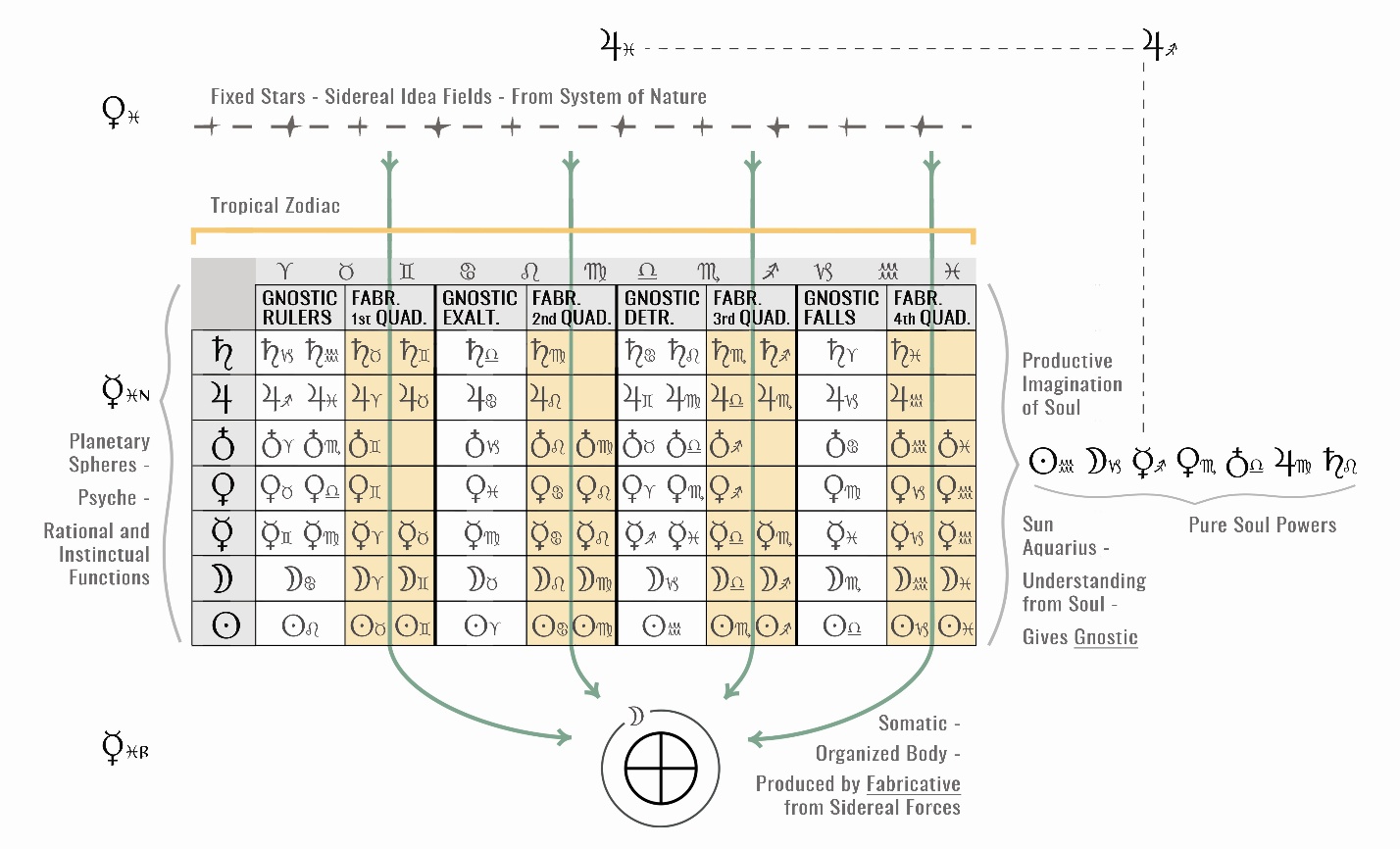
DIAGRAM appended to this transcript:
- FIGURE Gnostic-Fabricative-1. "The Grid" – Gnostic and Fabricative.
Other diagrams also referred to are not with this transcript version. [Transcriber note: [diagram] means the speaker is referencing a diagram as he or she is speaking. If someone is drawing or writing, with audible sounds of chalk on a blackboard, I indicate this by [drawing] or [writing].]
NOTES:
This was a Wednesday evening class.
See also WG Class 1982 0128 for more on Aurora Consurgens.
TRANSCRIBED Verbatim by IT 2021. In 2025, IT completes TOC, adds diagram and references within transcript to this diagram, updates audio file markers to match new REP audio. Archival verbatim transcript – V12a.
AUDIO FILES: 1982 0127a, 1982 0127b. [Note 1: "Tape" and "Side" refer to original audio cassette tapes that were later digitized into .MP3 Audio Files. Note 2: The last ten minutes of the first side of the first audio file is of poor sound quality due to the tape speeding up randomly every few seconds. The problem starts earlier but doesn't really interfere with hearing what is said until the last ten minutes. Note 3: In 2024, REP Studio cuts dead air from file a.]
1982 01/27 at Wisdom's Goldenrod
Alchemy; Aurora Consurgens
[Audio File 1982 0127a Begins]
AD: --do speak in the Kalachakra. [one/two words inaudible] [S simultaneously, very faint: Ok.] And we're not speaking about the three. They speak about the objective Kalachakra. Then they speak about the internal cha-- Kalachakra. And then they speak about the alternative Kalachakra. And they were equated with the-- the objective Kalachakra's equated with when they say the planets, signs, and houses. And the inner Kalachakra was equated with the-- the-- [short pause] the aggregates, the elements. [aside: It's there.] That was the inner Kalachakra. And the alternative Kalachakra?
AS: Gods.
AD: Hm?
AS: Gods.
S (faint): Thank you, Avery.
AS: They say that--
AD (simultaneously): The Kalachakra--
AS (faint): The say it means and is concerned with the-- the operation of the Gods, or what did we say, the degrees of the Nous.
AD: And they said you had to build a mandala of the fundamental mind. And I think we went to the-- we go through all the meanings or the parts, this would be your-- the meanings that you're sitting on. And that would be the mandala of the Bodhicitta. You remember that?
S (faint): It's your birthday candle.
AD: Well this is [one word inaudible]
[short pause]
S (very faint): Uh-hm.
S (very faint): Yeah.
S (faint): I think the last one had to do with the deities, with the deities.
AD: I'm sorry?
S: They're ready for-- ready for-- (S laughing)
S (simultaneously): I'm sorry for-- go ahead. (bit of laughter)
S: Take care.
S (faint): That would be--
AD: Don't apologize, say it again. It had to do with the deities. So when you look on-- when you look at your natal chart, you have these three things in your natal chart. [short pause] Now-- [short pause] You remember what we were doing Saturday?
S (faint): Oh yeah.
AS (faint): Just (wading) through.
AD: Huh?
AS: The three Mercuriuses [couple words inaudible] the--
AD (simultaneously): The three Mercuriuses.
AS: --the balsam in the heart. The [AD: Well--] fifth ess-- the quintessence.
[flipping of pages]
AD: I'm going to take the Aurora Consurgens which was written by his very devoted disciple and student, friend--Franz Marie-Louise the third or something. [11¾ second pause] In the chapter called the commentary, the first commentary, "Here Beginneth The Treatise…"-- We're getting into alchemy by the way. I (think/guess) that you noticed. And tantra I think is also alchemy. Anyway, we'll read a few things from the Aurora Consurgens. The first chapter-- and this is about a document which they think was written by Thomas Aquinas, and it's called the Aurora Consurgens. It was the arisal of wisdom for St. Thomas. But they don't know for sure if he wrote it. But it starts-- this is a commentary on his writing.
[Transcriber note: I am using Aurora Consurgens: A Document Attributed to Thomas Aquinas on the Problem of Opposites in Alchemy, edited with a commentary by Marie-Louise von Franz, A Companion Work to C.G. Jung's Mysterium Coniunctionis, Bollingen Series LXXVII, Pantheon Books, New York, 1966. Originally published in German as part III of Mysterium Coniunctionis by Rascher Verlag, Zurich and Stuttgart, 1957.]
Marie-Louise von Franz [Aurora Consurgens, pp. 155-156, AD reading]: "[The] first chapter introduces a mystical female figure who appears at first as the personified Sapientia Dei [or Scientia Dei]. This [AD reads: The] feminine divine hypostasis is painted on a broad canvas, and is amplified by numerous Biblical sayings and comparisons. At first the figure of Sapientia appears in the same personification which we see in [AD adds: the] Proverbs, [Ecclesiasticus, and] Wisdom of Solomon. [AD adds: And] In patristic literature she was mostly interpreted as Christ, the pre-existent Logos, or as the sum of the [rationes aeternae] (eternal forms), of the"self-knowing primordial causes," exemplars, ideas, and prototypes in the mind of God. She was also considered the archetypus mundus, "that archetypal world after whose likeness this sensible world was made," and through which God becomes conscious of himself. Sapientia Dei is thus the sum of archetypal images in the mind of God. Other patristic interpretations equate her with the soul of Christ or, more frequently, with Mary."
AD: Followed it? So, all the forms and all the ideas they equate with this Wisdom, and, they say that all these forms or ideas come from the mind of God. But, it would-- I'm going to lower my sights. I'm going to think of them as in the mind of the cosmic soul, not in the mind of God. You'll get carried away too soon.
Marie-Louise von Franz [Aurora Consurgens, p. 156, AD reading]: "In modern psychology she would [AD reads: will] be interpreted as a feminine personification of the collective unconscious."
AD: But, if you remember what we said, the collective unconscious very often-- not necessarily always but very often, is the Nous. [student assents, faint] Collective unconscious, all the ideas that are in the unconscious, superconscious, transconscious. But basically, they're supposedly the Ideas in the Nous.
Marie-Louise von Franz [Aurora Consurgens, p. 156, AD reading]: "…she would be interpreted as a feminine personification of the collective unconscious."
AD: So fellas, every time you see a beautiful girl around try to keep that in mind.
Marie-Louise von Franz [Aurora Consurgens, p. 156, AD reading]: "The beginning of the text would accordingly describe a numinous encounter with the anima, whose irruption into the sphere of consciousness the author endeavours to control. From the sublime, almost divine significance here attributed to the anima we must conclude that previously she had been devalued in the author's consciousness, and that this devaluation is here compensated by the sublimity of the image."
AD: Alright now-- Here's a quote from--
Marie-Louise von Franz [Aurora Consurgens, p. 156, footnote 6, AD reading]: ""Now in the Word of God from eternity there existed not only the forms of corporeal things, but likewise the forms of all spiritual creatures.""
AD: These are quotations from his writings.
Marie-Louise von Franz [Aurora Consurgens, p. 156, footnote 6, AD reading]: ""The wisdom which the philosopher reckons as an intellectual virtue, considers divine things so far as they are open to the research of human reason.""
AD: And he goes into-- she goes into detail here. But we've discussed the ideas for a long time.
LC: Why do they make this a female symbol, is that just a symbol? Why do they talk like this, the Logos is a [AD: Well--] female?
AD: Her claim is that because there was such a strong emphasis on masculinity for so many-- you know, a thousand years or better, alright, that the-- that the-- the collective unconscious of the people in general was expressing this lack, and personification of the Nous as female was like a compensation for that lack because in the Trinity there is no female. So they bring her in. Well-- [short pause] And he goes on, he says--
Marie-Louise von Franz [Aurora Consurgens, pp. 156-157, AD reading]: "It seems to me [that] in this respect Aurora cannot be independent of this supposedly genuine work of Albertus Magnus, though the difference is that our author goes on to equate his feminine figure with the"soul in matter" [and] with the "filius philosophorum" or lapis, thus lifting her out of her [AD reads: the] purely ecclesiastical framework into the empirical sphere of scientifically based alchemy and bringing her closer to individual human experience.
"It is important to remember that the thirteenth century, [to which Aurora presumably belongs], [AD: Yeah, s--] was a time when the worship of Mary was on the increase. Psychologically, this would point to a need, rising from the collective unconscious, for a feminine figure to be given a place in the purely masculine, patriarchal Trinity, as the representative of the anima of a man and the self of a woman."
AD: The quote here--
Marie-Louise von Franz [Aurora Consurgens, pp. 157-158, AD reading, first paragraph is quoting St. Thomas Aquinas]: "All good things came to me together with her, that Wisdom of the south, who preacheth abroad, who uttereth her voice in the streets, crieth out at the head of the multitudes, and in the entrance of the gates of the city uttereth her words, saying:"Come ye to me and be enlightened, and your operations shall not be confounded; all ye that desire me shall be filled with my riches. Come, therefore, children, hearken [to me]; I will teach you the science of God.
"Wisdom calls men to her with seductive words, promising them health and great riches…"
AD: Etc. [short pause, flipping of pages] Now-- he-- they get into the subject of the-- matter is, the matter that we have to work with. So I'm going to just [one/two words inaudible] Um, there's a quotation here and then-- From this quotation they say of the figure that she is trodden, that is, this feminine figure is a--
Marie-Louise von Franz [Aurora Consurgens, p. 160, AD reading]: "…she is trodden into the mire by the ignorant, which means psychologically that the feminine personification of the unconscious is rejected by the prevailing collective views, with the result that the lapis, [AD: The stone.] the germ of the individuation process, is stifled. The saying is quoted with extraordinary frequency by the alchemists, and almost always it refers to the stone of the wise…"
AD: Individuation process they're referring to stone of the wise.
Marie-Louise von Franz [Aurora Consurgens, p. 160, AD reading]: "…so that our author obviously identifies Wisdom with the lapis [AD: with the stone]. The same identification can be found in a quotation [from Alexander in Petrus Bonus], who says [in his Pretiosa margarita novella that the work comes about]"by the addition of the secret stone, which is not to be apprehended by the senses, but by the intellect alone, through inspiration or divine revelation, or the teaching of a sage. . . . And Alexander saith, There are two categories in this art, namely, seeing with the eye and understanding with the heart, and this is the hidden stone, which is fitly called a gift of God . . . and this is the divine hidden stone, and unless it be admixed with this stone alchemy would be brought to nought, for it is itself very alchemy. . . . And this divine stone is the heart and [AD adds: the] tincture of gold which the philosophers seek." Here the stone is described as something invisible, as the God-given gift of understanding, and alchemy is nothing other than this. It is "gnosis." Hence we can understand why the author of [AD adds: the] Aurora makes Wisdom not only the guide but also the goal of the alchemical opus."
[27¾ second pause, flipping of pages]
AD: Remember-- you remember what we're doing, right? You have a chart, it's got 360 degrees in fire, earth, air, and water. Then you have the planets running around. Then you got all the parts which fall on all those degrees. Keep that in the background. Now, in the-- in Buddhism, they call that the Kalachakra, right? I don't know how far we have to go to get some depth of understanding in that, but we'll just keep going. And in alchemy, they're not going to call it Kalachakra but I-- I want you to watch similarity. I think-- I think you'll find it quite amazing. [13 second pause] Now, we get into this discussion of the corpora vilia, you know, vile and, you know-- vile matter.
Marie-Louise von Franz [Aurora Consurgens, p. 162, AD reading]: "These"materiae viles" are, psychologically speaking, the images and symbols that rise up directly from the unconscious and have not been judged, interpreted, or changed into anything else by the discriminative activity of the collective consciousness. They are the real prima materia of every religious experience, but the tragedy is that they are always "trodden into the mire" by the prevailing collective opinions."
[short pause]
AD: Here's a description of-- from the Bible of the Wisdom, you know, if you read Proverbs 8, 9, 10 and 11, find it in--
Marie-Louise von Franz [Aurora Consurgens, p. 163, AD reading]: "In alchemy, the tree is primarily an image for the prima materia which gradually unfolds during the transformation process and is"sufficient unto itself." … The tree symbolizes the individuation process in the sense of living one's own life and thereby becoming conscious of the self, i.e., [AD adds: through] gnosis.
"The images which liken Wisdom to"unfailing light" and "rightful food" require no further explanation. They symbolize the stream of contents that flows like a spiritual substance from the unconscious or, as the alchemists would say, from the "lumen naturae," [AD reads: lumina natura] [AD: Light of nature.] which the adept felt as divine illumination."
AD: Remember we spoke about three lights? The divine light, light of reason, and the light-- What was the other one? Light of nature?
S: (Light of--)
AD: Hm?
S (very faint): Reason.
AD: Yeah, light of reason. [short pause] Now--
Marie-Louise von Franz [Aurora Consurgens, p. 164, AD reading]: "…[AD adds: in] De Anima, Aristotle emphasizes there, in refutation of other theories, that the soul or reason is the cause of all limitation of growth, and not fire. The soul sets limits, and thereby gives the body its form. This conception was [further] elaborated during the Middle Ages. [Thomas] Aquinas, for instance, regarded the soul not only as the"form" of the body, but as a form which possesses its own substantiality and also imparts it."
AD: You follow that?
CDA (very faint): Could you read it again (please/for me)?
Marie-Louise von Franz [Aurora Consurgens, p. 164, AD reading]: "The soul sets limits, and thereby gives the body its form. This conception was further elaborated during the Middle Ages. Thomas Aquinas, for instance, [AD reads: This conception was elaborated by Aquinas for instance, who] regarded the soul not only as the"form" of the body, but as a form which possesses its own substantiality and also imparts it."
AD: Ok? Soul actually imparts the form to the body and provides it with the substantiality it's going to--
S: Huh.
LC: So [S simultaneously, faint: Just this--] this would be even the soul, I mean they're saying the body is the soul.
AD (simultaneously): They're talking about the soul. No, they're talking-- he's talking about the soul--
LC: And (Eros), isn't that also calling the body the soul some way?
AD: Well that's not also, that's secondary. The soul takes the form of the body but the point that he's making here is that the soul provides the form, that is, all the processes necessary for a body to be a body, a living body. The important thing here is because if you notice it, you realize that Aquinas was a mentalist.
S (faint): Hm.
AD: He says it provides it with its substantiality.
S (very faint): The body.
S (very faint): Yeah.
CDA (faint): Is he talking about the first soul?
AD: He's talking about the soul, he's not talking about first, second, he doesn't have those kind of--
CDA (faint): Well what do you think he's talking about, (just--)
AD: I won't tell you what I think.
CDA (very faint): [couple words inaudible]
S (simultaneously, faint): That seems like the gross, the alaya, the way we talk about the alaya-vijnana.
AD (simultaneously): I can't hear you.
S: Does it sound similar to the alaya-vijnana when we were talking about the Buddhist (philosophy)?
AD (simultaneously): He doesn't know anything about the alaya, the poor man was in thirteenth century [S simultaneously: (Yeah) but--] Italy surrounded by the [S simultaneously: Yes I think--] Pope. (laughter) Was almost excommunicated, so he probably would never mention the Buddhists.
S (simultaneously): Right, I thought they had [one word inaudible] a Tibetan monastery here. (bit of laughter, students assent, faint)
[short pause]
Marie-Louise von Franz [Aurora Consurgens, p. 164, AD reading]: "[It] can act [AD: The soul that is,"can act] creatively on its own account and is thus an "ens in actu"…"
AD: That means a being in actuality.
Marie-Louise von Franz [Aurora Consurgens, pp. 164-165, AD reading]: "Matter, in itself formless, becomes invested with its actual properties only in so far as it receives form from the soul.
"In the light of these conceptions it is clear that Wisdom is not a personification of the individual soul, for the author likens wisdom to a firestone from which inexhaustible fire can be struck."
AD: You read. Make those(--/.)
[short pause]
AS: Um--
AD (faint): You just have to kind of push 'em.
AS: I see.
AD (faint): Go ahead.
Marie-Louise von Franz [Aurora Consurgens, pp. 165-166, AS reading]: "The firestone is therefore an image for Wisdom in respect of her difference from all forms and formed things, the difference being that she can bestow unending life without ever exhausting herself. Her action, unlike that of the soul, does not aim at individual form but is capable of infinite extension. She gives the prime impulse towards all being and all knowing in their endlessly diverse forms, and as an inexhaustible vitalizing principle her range of action is unlimited. She therefore acts transpersonally, beyond and outside the individual, as an ordering principle showing him the way,"directing the steps" of the alchemist, as the next sentence says. [short pause, flipping of pages] This only confirms that psychologically she is not the personal aspect of the man's anima (in medieval language, (AS reads: that is) not the anima humana as the "form of the body"), but is a purely archetypal anima figure, the feminine aspect of the God-image. As an archetype, she is in fact form without limitation, eternal and yet manifest and repeatable in an infinite number of individuals."
S: Could you do that (Avery/Anthony)? Just that last two sentence repeat.
[short pause]
AS: Uh--
S (very faint, possibly part of background): I see.
Marie-Louise von Franz [Aurora Consurgens, p. 165, AS reading]: "This [only] confirms that psychologically she [AS reads: this wisdom] is not the personal aspect of the man's anima…"
AD: Louder Avery.
AS: That--
Marie-Louise von Franz [Aurora Consurgens, pp. 165-166, AS reading]: "…not the personal aspect of the man's anima (in medieval language, (AS reads: that is) not the anima humana as the"form of the body"), but is a purely archetypal anima figure, the feminine aspect of the God-image. As an archetype, she is in fact form without limitation, eternal and yet manifest and repeatable in an infinite number of individuals.
"The comparison of Wisdom with fire is in this context no accident… This is a symbolic fire, whose meaning could best be rendered by the modern conception of psychic energy. Flame or fire is a widespread symbol for the soul, and as an image for psychic energy it seems to have been venerated in many primitive religions [as something divine]. … Later [AS adds: on] in the text we shall come across the fire symbolism of the Holy Ghost.
"The archetypal idea of a cosmic, divine energy capable of consciousness was not confined in the Middle Ages to certain symbols of the Holy Ghost, but was resuscitated, sometimes in modified form, in the concept of the intellectus agens or [Transcriber note: Two Greek words here.] (active intellect). This concept and the discussions that grew up around it seem [to me psychologically so] important…"
[short pause]
AD: Just a couple more pages, we'll read them slowly because-- and then we'll go back and over it. And, I think it'll be-- [short pause] I think it would be quite a revelation as far as the meaning in your chart.
Marie-Louise von Franz [Aurora Consurgens, pp. 167-168, AD reading]: "According to Avicenna, man's ego is receptive to the intellectus agens [AD reads: intellectual agent]. We know today that all thinking which takes place in our ego-consciousness obscures that"absolute knowledge," and that an abaissement du niveau mental [AD reads: abaissement du no--] [AD: Lowering of consciousness.] is required before one can approach it."
AD: He's saying that-- this is a-- I don't know how to call it, you know, it's like official language backwards. But let me throw out this here notion. What he's saying is something like this. That when you reduce the mental activity to nought, you get the ego out of the way, then there's a kind of cosmic knowledge that comes into you.
S: (Pluto.)
[Note: See FIGURE Gnostic-Fabricative-1 for the following. Because this diagram is not from this class, there is not necessarily a one-to-one correspondence between Anthony's words and the diagram but it is close enough to help follow along.]
AD: Now you remember we said that if we took the Earth, you know-- We made this kind of remark. Where's the-- (Oh/Well) this is the Earth here [Body Mercury in Pisces level, circle with cross], ok. And we say well this would represent-- [drawing] the Earth here. And our chart participates in this knowledge that the Earth has. You remember that, ok? We said our chart is a participation in the Earth's chart so if there's a Saturn square Jupiter in the heavens of the Earth [Nature Mercury in Pisces level], ok, our chart plugs into that. So you could see that if this ego here [diagram], alright, was in the way, then whatever the-- whatever the aspects are that are going on for the cosmic Earth would be interfered with if the ego's functioning. If the ego is sort of taken out of the way, you know, then there would-- this-- it would be a flow of knowledge. One would suspect that idiots and retards have absolute knowledge but-- (bit of laughter) You're familiar with this idea. (bit of laughter) At any rate, when Avicenna says that the ego-- let me read this again.
Marie-Louise von Franz [Aurora Consurgens, pp. 167-168, AD reading]: "…man's ego is receptive to the intellectus agens [AD reads: intellectual agent]. We know today that all thinking which takes place in our ego-consciousness obscures that"absolute knowledge"…"
AD: Now the absolute knowledge would be the knowledge that the Earth has. That would be the absolute knowledge as far as we're concerned. And our ego will be interfering with that. In other words, the way our chart is constructed is an interference because we tend to identify with it so closely. Now, if-- the other thing would be this here, you-- you have to keep in mind that the Moon which goes around the Earth would be the planet closest (to) the Earth and surrounding the Earth and that planet would be the last of the planets within-- within the sphere of the Moon, we're within that sphere of the Moon so, if you keep them-- if you keep this (line/way) I think you'll find it helpful. That is, think of the Moon as the last of the receptors [Moon at Body Mercury in Pisces level], and that through the Moon that knowledge is going to come into us.
Marie-Louise von Franz [Aurora Consurgens, p. 168, AD reading]: "[AD adds: Now] [Thomas] Aquinas modified the idea of the intellectus agens [AD reads: intellectual agent] as a cosmic principle outside the psyche by attributing the capacity for abstract thought to an intellectus agens [AD reads: intellectual agent] within the human soul…"
AD: See what Aquinas is doing? Instead of calling-- instead of referring to the intellectual agent to the totality of the planetary spheres and in particular to the Moon, he's going to say no, there's also an individual participation in that and that individual will have an intellectual agent of his own.
LC: That's this-- what we just talked about his make-up, well, in one-- in one sense the soul which reports the form and actually gives form to the matter or imparts the form, and on the other hand the wisdom which is something other than the soul.
AD: I'm sorry, I missed your point.
LC: Well if Aquinas has got to-- isn't that where Aquinas is coming from, talking about-- and then saying that this Wisdom, that is, the stone that they were calling Wisdom, to bring it into the individual the individual has to have an agent, and that--
AD (simultaneously): Has to have his own [LC simultaneously: His own intellec--] intellectual apparatus to understand it.
LC: Right, to understand this Wisdom that's a cosmic Wisdom.
AD: So [one/two words inaudible] if we put all the degrees around the circle, ok, and those are the Ideas [Venus in Pisces level], and they're being manifested through the planetary functioning [Nature Mercury in Pisces level], the last of the planets being the Moon, would be the intellectual agent for the entire cosmic knowledge seeping through the Moon, you know, and coming to us, coming into us. But, from the Arab point of view, there was no need for, you know, an individual intellectual agent. And Aquinas is bringing that in, he says "We've got to have our own." At any rate.
Marie-Louise von Franz [Aurora Consurgens, p. 168, AD reading]: "…modified the idea of the intellectus agens [AD reads: intellectual agent] as a cosmic principle outside the psyche by attributing the capacity for abstract thought to an intellectus agens [AD reads: intellectual agent] within the human soul…calling it a"natural light." In other aspects, that of a source of illumination external to man, he identified with God or with Sapientia Dei. For the subtler details I must refer the reader to the work of Gilson."
AD: Anyway. A quotation.
Marie-Louise von Franz [Aurora Consurgens, p. 168, AD reading]: ""God enlightens our souls in so far as he has bestowed upon them the natural light thanks to which they know, and which is that of the active intellect. . . . This active intellect is indeed [AD reads: indeed is] always in actu [AD reads: in act], but the soul possesses also a possible intellect, and actually knows itself only through the cooperation of its possible intellect with its active intellect.""
S (very faint whisper, possibly part of background): [three words inaudible]
AD: Yeah.
Marie-Louise von Franz [Aurora Consurgens, p. 168, AD reading]: "Thomas Aquinas modified the idea of the intellectus agens [AD reads: an intellectual agent] as a cosmic principle…"
AD: He wants to also make it an individual principle. And he calls that a natural light which is in the soul.
Marie-Louise von Franz [Aurora Consurgens, p. 168, AD reading]: "[AD adds: In] Its other aspect, that of a source of illumination external to man, he identified with God [or with Sapientia Dei]. …"God enlightens our souls in so far as he has bestowed upon them the natural light thanks to which they know, and which is that of the active intellect. . . . This active intellect is indeed [AD reads: indeed is] always in actu [AD reads: in actuality]…""
AD: (Look/Well)-- you know, if we look at the planetary spheres they're always in act, they never stop.
Marie-Louise von Franz [Aurora Consurgens, p. 168, AD reading]: ""This active intellect is [indeed] always in actu [AD reads: in act], but the soul possesses also [AD reads: also possesses] a possible intellect…""
AD: And possible intellect would correspond to what we would call our consciousness.
Marie-Louise von Franz [Aurora Consurgens, p. 168, AD reading]: ""…and actually knows itself only through the cooperation of its possible intellect with its active intellect.""
AD: Well I think he's saying something like this.
LR: See I could-- it sounds like the active intellect there is a cosmic principle, not an individual one.
AD: I'm sorry?
LR: It sounds like what-- from what you just read that the active intellect is not an individual faculty but a cosmic one.
AD: Well that's what Avicenna said, yes.
LR: Oh, ok.
AD: And, Aquinas is trying to say that the act-- the active intellect is also an individual thing.
LR: I see, ok.
S (faint): Uh-hm.
AD: And, we just hold on to this for (a while), and he's saying also that the human ego possesses a possible intellect. So that the human intellect would have these two things, active and possible intellect, alright, and on the other hand, we have to keep in mind that we have also the cosmic intellect. Ok? So the cosmic intellect you could imagine is the entire functioning of the planetary grid [Nature Mercury in Pisces level] and the active intellect of an individual we could temporarily just associate it let's say with the angular relationships that the planets have and this would be your active intellect. And the possible intellect would be the receptive attitude that you have, so to speak, in permitting knowledge to arise within you or ideas to arise within you. And this becomes-- he calls your possible intellect.
AH: Anthony, which intellect is the knowledge that the world has?
AD: I'm sorry?
AH: Which intellect is the knowledge that the-- the world has? On this diagram a few minutes ago you said if the ego wasn't pervading (you'd have) knowledge.
AD: Well, that would be the knowledge of the entire, you know, planetary sphere which in Jung's writings is referred to as the absolute knowledge.
AH: Which intellect would you call it?
AD: That would be the active intellect, the cosmic active intellect of Avicenna.
AH: But not the individual aspect.
AD (faint): No, not the individual, (uh-hm).
Marie-Louise von Franz [Aurora Consurgens, p. 168, AD reading]: "In the act of contemplation, the intellectus agens [AD reads: intellectual agent] brings about contact with Sapientia Dei…"
AD: So, in the act of contemplation the individual, I-- I assume, the individual intellectual agent brings about contact with the absolute knowledge or the knowledge of God. Now we said that the knowledge of God consists of the planetary cosmic-- planetary functioning, and that the active intellect of an individual would be the angular relationships that the planets have to each other at the moment of birth. That would be let's say the active intellects of the individual which works itself out, you know, as it traverses the entirety of the degree symbolism, and these parts, the meanings and all that. And that the ego becomes the possible intellect or receptive of that knowledge which is being manifested through that activity, alright.
LC: But-- but didn't Aquinas just say that the possible intellect was in the soul?
S: (No/Yeah).
AD: Yeah.
S (faint): Soul itself.
S (faint): Yeah.
LC: And I'm trying to--
AD (simultaneously): The individual soul has a possible intellect as well as--
LC: And it's the combination of the two that makes for the individual, right?
AD: That makes for?
LC: The individ-- that the--
AD (simultaneously): No, the combination of the two belong to the soul. And what he's doing here, he's saying that the soul has an active intellect and a possible intellect. And he's going on-- and I-- I said just temporarily we can associate the active intellect of an individual with the angular relationships. The possible intellect of an individual will be like his ego understanding. And when you're a child if you remember you had very little knowledge and as you grew up you got more and more as you went along. Now look Tim, look. Now, that growing consciousness would be the possible intellect, and it's being fed by your active intellect, nourished. [short pause] So he goes on--
Marie-Louise von Franz [Aurora Consurgens, pp. 168-169, AD reading]: "In the act of contemplation the intellectus agens [AD reads: intellectual agent] brings about contact with Sapientia Dei [AD reads: with the absolute knowledge], whereby an assimilation of the human mind to God can take place [AD rereads: whereby an assimilation of the human mind to God can take place]."
LC: So he's going against what this guy Avicenna said and said that's [one word inaudible] consciousness around the Earth that produce. No? No.
AD: No he didn't say that, I said that, or Jung said that, that he felt that this-- that absolute knowledge was [one word inaudible] [couple inaudible student words simultaneous with AD] What he's saying here, assimilation of the human mind to God can take place. Insofar that you have degrees around the chart, 360 degrees, and this represents the Nous or the Ideas in the Mind of God. Now this Nous has-- what the suggestion here is, is as the planets going around manifesting those meanings (symbolically), and that the ego assimilates those meanings, being brought closer to the Nous. So that God is assimilating you. You'd like to put it the other way, you're assimilating God, that's alright. You follow? This is all coming out of your chart.
Marie-Louise von Franz [Aurora Consurgens, pp. 168-169, AD reading]: "In this theory of St. Thomas's the nous poeticus, or [AD reads: In this theory Thomas-- Thomas's]"absolute knowledge," is partially integrated in man. The Thomist splitting up of the nous-concept signifies, from the psychological standpoint, an advance of consciousness. Generally when an unconscious content becomes conscious it is first split up [AD reads: conscious it-- first it is split up], one part entering into association with the field of consciousness centred by the ego, the other remaining in the unconscious or being projected into the extra-psychic realm. Our Western intellect, as it developed at the time of Scholasticism [AD reads: of the Scholastics], seems to have arisen in this way: one portion of our "pre-conscious thinking" was asserted to be the operation of the subject, the rest remained pre-conscious and was projected into the non-human realm, in other words, it was personified in the "metaphysical" figure of Sapientia Dei. The important thing is that the part which remained in the non-human realm no longer continued to be, [as in Avicenna], a purely masculine concept [("intellectus")] but was identified with Sapientia Dei: in psychological language, it entered the sphere of the archetypal anima-image."
AD: You're tired.
S: So this [one/two words inaudible]
AD: No this--
AH: The part about-- the part about how the subject--
AD: Well take it from the beginning.
S: That's the beginning.
AD: Take it from the beginning. I think-- I think they would like to read it once more so just read the underlined thing.
AS (very faint): You just want me to read? Well--
Marie-Louise von Franz [Aurora Consurgens, p. 168, AS reading]: "[Thomas] Aquinas modified the idea of the intellectus agens [AS reads: intellectual agent] as a [AS reads: which had been a] cosmic principle outside the psyche by attributing the capacity for abstract thought to an intellectus agens [AS reads: intellectual agent] within the human soul…[AS adds: and] calling it a"natural light." Its other aspect, that of a source of illumination external to man, he identified with God or with Sapientia Dei. … [AS adds: That is] He writes: "God enlightens our souls in so far as he has bestowed upon them the natural light thanks to which they know, and which is that of the active intellect. . . . This active intellect is indeed always in actu [AS reads: in act], but the soul possesses also a possible intellect, and actually knows itself only through the cooperation of its possible intellect with its active intellect.""
[short pause]
JC: [one/two words inaudible] that even (life) which the soul descends into the cosmos, (the intellect of) the individual, and it is I think a reflective consciousness by which or through which he can know of its own existence reflectively, that-- (so on), so forth.
AD (simultaneously): Well, if you don't know (who your) [couple words inaudible] And that's not what I want, I want an explanation of (the) passage. [JC simultaneously: I'm just talking.] We could try, we could try. Alright?
S (faint): Uh-hm.
AD: Let's pull out a text in front of you. Let's go over one sentence and then another one.
S (faint): Ok.
AS: You want thought-- maybe one paragraph at a time [AD simultaneously: Yeah.] just on the Nous?
AD: Just the top of the page.
AS/S(?): (Alright.)
AD: This is really-- it's a-- it's a little steep but after a while you'll see its value. Just read from the top of the page.
AS: Let me read the previous sentence.
Marie-Louise von Franz [Aurora Consurgens, pp. 167-168, AS reading]: "According to Avicenna, man's ego is receptive to the intellectus agens [AS reads: intellectual agent]."
AS: And you made that point [one/two words inaudible] thinking which takes place for ego-consciousness obscures that absolute knowledge. It had-- we have to do away with somewhat before we can have absolute knowledge.
Marie-Louise von Franz [Aurora Consurgens, p. 168, AS reading]: "[AS adds: And] [Thomas] Aquinas modified the idea of [the] intellectual agens [AS reads: intellectual agent] as a cosmic principle outside [AS adds: of] the psyche by attributing the capacity for abstract thought to an intellectus agens [AS reads: intellectual agent] within the human soul…"
AD: Now, in a way, insofar-- insofar that you participate in the Earth, (it could tell you), you know, what's going on. And he-- you know, you can say, you (looked up) [one word inaudible] you know that's feeling--willing, feeling, knowing [one/two words inaudible] And if you took that vision, you would see that the-- in a sense every chart includes his participation in the active intellect of the Earth's chart. But insofar that you're operating [possibly one/two words inaudible] you could also call it your active intellect because of your participation in it, ok.
AS: And that seems [one/two words inaudible]
AD: Yeah, that's what he's saying here. Now if you read the next sentence--
AS: He said--
Marie-Louise von Franz [Aurora Consurgens, p. 168, AS reading]: "…calling it [a]"natural light." [AS adds: In] Its other aspect, that of a source of illumination…"
AD (simultaneously): Now he's calling it a natural light, before you go on, what does that mean?
AS: It's the nature, he's saying that this-- he said it's part of our [one word inaudible]
AD (simultaneously): Well, in terms of our chart or anyone's chart, what's the natural light that you're working with?
AS: Saying the light of the planets.
S (very faint): This light [one/two words inaudible]
AD: Not the planet.
S (very faint): Transit.
S: Huh?
S (faint): Transit.
AS (simultaneously, faint): (Then) what's wrong?
AD: But wouldn't it be the degrees that your planets are sitting on? Isn't that the natural light? In other words, the degree symbolism which represents the various combination of psycho-essences that constitute a personality, this is the natural light.
AH: Is that different than that bit of-- bit of light that Bodhicitta is--
AD: Leave that out now. I'll get to that light.
JC: You're saying the intelligence in the degrees (what's) indicates the functioning of this intelligence.
AD (simultaneously): Is a manifestation of that intelligence.
JC (faint): The basic intelligence as a reason-principle to know-- knowing which is structured in a certain way is indicated by those degree [one word inaudible]
AD: So isn't that the natural light?
(Side 1 of original cassette tape digitized as 1982 0127a Ends; Side 2 Begins)
AD: --degree. Your understanding is constituted by what your planet is sitting on. And that very understanding that you're working with, which by the way of course everyone thinks belongs to him, is really this natural light of Nature which belongs to those degrees.
S (faint whisper): Go ahead.
AD: Go ahead, read the next passage. Now remember, this-- these are v-- this is a very secret place. I didn't want to give it. Go on.
Marie-Louise von Franz [Aurora Consurgens, p. 168, AS reading]: "Its other aspect, that of a source of illumination external to man, he identified with God or with Sapientia Dei."
AD: Ok, now if you continue your reasoning. We said that those parts, alright, which-- those degrees which constituted your natural understanding and is your birthright, the meanings that you're born with. Now, what about the other degrees that, you know, your-- your chart doesn't include? Reread.
Marie-Louise von Franz [Aurora Consurgens, p. 168, AS reading]: "Its other aspect, [AS: The other aspect of the intellectual agent.] that of a source of illumination external to man, he identified with God or with Sapientia Dei."
AD: So all the other degrees that your-- let's say your planets are not on, alright, he's calling those which are external to the essences that constitute you, he's calling that absolute knowledge.
LC: No, that doesn't make sense.
AD: Argue with Avery, I don't feel like arguing tonight, tonight I feel like teaching.
LC: Why would-- why would you say that only the degrees that you don't have are those that belong to God, somebody else has those degrees. I don't understand that reason.
S (faint): Yeah but they don't have the one that you have.
AS (simultaneously): No, he's just--
LC: Right, so what?
AS (simultaneously): He just means that you're-- you're participating in God's knowledge and that particular little slice of it that is illuminating your-- your understanding he calls your-- your active intellect.
LC: Yeah. And-- and the degrees or that part of it that is not yours?
AS: Well the whole thing, the whole business is Sapientia Dei.
LC: Yeah.
Marie-Louise von Franz [Aurora Consurgens, p. 168, AS reading]: "…a [AS reads: the] source of illumination external to man, he identified with God or with Sapientia Dei."
AS: Of course the whole thing, yeah.
AH: Seems that this light of nature-- this light of nature can be looked at on the one hand as an obscuration, but also as the potential of-- of the human individual.
AD: It's not a obscuration. The light of nature is not obscure. What may be obscure is our understanding, but not the light of nature. The reason-principles that are employed to constitute any object know precisely what they're doing. We may not understand what those reason-principles are, what makes a thing to be what it is.
AH: Well maybe if--
AD (simultaneously): Now what-- what makes a thing to be what it is, alright, we're just speaking about the essence of a thing, we're speaking about the way the various reason-principles or degrees are combined to produce that thing. That will be external to the psychic that you're working with. So what's outside of what constitutes your personality is external world. So, on-- within the same 360 degrees, where your planets are sitting constitutes your subjective psyche. Where they're not sitting constitutes the objective psyche.
AH: And the subjective psyche is not to be looked at as the obscuration of the ego.
AD: No. No, the ego is going to be the medium in which some understanding hopefully will take place of what's going on. You follow so far or should we go read something else? Sunday comics [S simultaneously, faint: Yeah I--] or something? Well, alright, [S simultaneously, faint: Alright.] let's go on. [short pause] Next passage, Avery.
AS: Um--
Marie-Louise von Franz [Aurora Consurgens, p. 168, AS reading]: "He writes [AS reads: So Aquinas writes]:"God enlightens our souls in so far as he has bestowed upon them the natural light thanks to which they know, and which is that of the active intellect.""
AD: Now if you can get beyond the religious terminology here, "God enlightens our soul", insofar that we are constituted by those degree symbols that we refer to as natural light, and the combination of them constitutes your personality, alright, and he's got a perfect right to say well God enlightens your soul. Because, if we think of the 360 degrees as the Nous, and some of-- some of those degrees are going to constitute the active or the passive intellect that you're operating with, then God is enlightening your soul insofar that he-- he gives you those principles to work with. So if you just go a little beyond the religious terminology. You know, it's a strange thing. Aquinas wrote an enormous amount of material. I don't know if you've ever looked in the library, we don't even have half of his stuff. And then when he got the beatific vision he stopped writing. Never wrote another word and died shortly after. Shankara, after he got the beatific vision, kept writing until he died. I can't figure it out. [9 second pause] Alright. [short pause] [very faint, possibly a student: Go on.]
Marie-Louise von Franz [Aurora Consurgens, p. 168, AS reading]: ""This active intellect is indeed always in actu [AS reads: in act, actual], but the soul possesses also a possible intellect, and actually knows itself only through the cooperation of its possible intellect with its active intellect.""
AD: So we said that the active intellect was what constituted the angular relationship of all the planets, and the possible intellect will be the reception of the meanings. Active intellect, possible intellect. You want to try again? The active intellect would be boom! the moment you're born. All those parts and meanings are laid out for you, alright. The possible intellect is the transits start working, alright. There has to be a possible intellect, like you're a little child and you start going through experiences and you start building up little pieces of knowledge, alright, and as you get six, seven, eight, nine years old your consciousness starts getting integrated and more and more knowledge comes in. Those are the transits going around, hitting off the parts, the meanings that come into you. So your possible intellect starts growing. Then by the time you're twenty, you know everything. Possible intellect.
AS: Possible intellect's also what they call the acquired intellect.
AD (faint): Acquired intellect.
AS: So, of all-- I mean it sounds funny because-- The active intellect is in a way a potential intellect the way you're speaking of it. If you say that's what you're born with in a sense, the--
AD: I'm sorry, uh-- Say it again.
AS: The active intellect in a sense seems like a parti-- a-- something that's potential, in the sense that although you're born with a certain aspect pattern and degree meanings, (there/they) haven't been incorporated into your ego structure.
AD: Yeah but it's active because it's always working.
AS: It's always working.
AD (faint): Yeah.
AS: But it's potential in the sense of the-- from the ego's point of view it's something that it's going to acquire possibly. So in that sense--
AD (simultaneously): Yeah, it hasn't got it yet.
AS: Yeah. And in that sense the-- the acquired intellect is what is possible.
AD (simultaneously): But I-- I think if you'll notice very carefully [AS simultaneously: It's what you (one word inaudible)] if you think back, you will see probably that you have some premonition of the active intellect. In other words, very often you know things way before they ever occur and there's a premonition of the (possibilities/possibility) coming to you, you know, that understanding or that event or destiny, whatever it may be, ok. So you can see it operative there. Let's read a little more. Go ahead. (very faint: Go ahead.)
AS: Ok.
Marie-Louise von Franz [Aurora Consurgens, p. 168, AS reading]: "In the act of contemplation the intellectus agens [AS reads: intellectual agent] brings about contact with [AS adds: the] Sapientia Dei, whereby an assimilation of the human mind to God can take place.
AD: Alright, that one we explained by saying your natal chart, which rests on certain degrees and which is relatively fixed, is the natural light that you're operating with. And as you have transits and experiences going on, alright-- you've probably had the experience as you read degrees which don't even concern you, you know, with no planets on yet there's a certain familiarity about it. And if you're very sensitive you could even-- when planets are going over it you could even experience it or feel it. Now what he's saying there is that with this intellect that you have you-- you are assimilating the Nous, you're bringing it into yourself, or the way she puts it is that the Nous is assimilating you. In other words, the Divine Nous is bringing you back to itself. Now the Nous is what you remember he called Sophia, Sapientia Dei, absolute knowledge. All these terms refer to what I'm referring to the cosmic intellect of that grid [FIGURE Gnostic-Fabricative-1, Nature Mercury in Pisces level].
S (very faint): (Is it?)
S (very faint): Yeah.
AD (faint): It's inside.
[short pause]
AS (faint): Well--
AD: Continue.
Marie-Louise von Franz [Aurora Consurgens, p. 168, AS reading]: "In this theory of St. Thomas's the nous poeticus, or"absolute knowledge," is partially integrated in man. The Thomist splitting-up of the nous-concept signifies, from the psychological standpoint, an advance of consciousness."
AD: You follow that point?
CDA (faint): They the first ones-- are they the first ones who did that?
AD (simultaneously): See, it's almost-- it's almost like the ego is coming into being.
CDA: They're the-- they're really the first ones who did that, I mean isn't that--
AD (simultaneously): I'm sorry.
CDA: The Thomists were the first time that split the psyche up?
AD (simultaneously): In the Western, in the Western world. In the Western world. But that doesn't mean that there weren't people who knew about this [CDA simultaneously: Yeah.] before, there were people. Go on. Well, what he's basically saying is something like this, it seems like the Nous is coming down more and more into us. We spoke about that as an increase of subjectivity. In our times we could speak about it as an increase of ego-- egotism, alright, because that could also go the wrong way. Basically the knowledge as it's coming in as the-- it's only a (literal/literary) thing, you know, it's only metaphorical, the Nous is descending, alright, so that more and more of the Ideas become available to the individual consciousness. And of course this is a very strange time we're living in, 1980's. Little more.
Marie-Louise von Franz [Aurora Consurgens, p. 169, AS reading]: "Generally when an unconscious content becomes conscious it is first split up, one part entering into association with the field of consciousness centred by the ego, [AS adds: and] the other [AS adds: part] remaining in the unconscious or being projected into the extrapsychic realm."
AS (faint): And into the world.
AD: Now, shall we try that? [short pause] We're speaking about an Idea, alright, from the Nous. It's going to become conscious in us. And he says a certain aspect of that Idea which is becoming conscious in us, alright, and there's another aspect of the Idea which is not becoming conscious within us. And that part either gets projected out into the world, into the external world, or is part of the external world.
S: The part that's not conscious.
AD: Part that's not conscious. Now obviously anyone could see that it's impossible for any individual to understand or have the totality of knowledge in regard to or respect to any individual object. It's a problem, yeah. So you can see that part of the object that you're trying to understand is going to remain unconscious. That part of which you are unconscious is the part that remains in the Nous or in the unconscious, or it gets projected out into the material world. So that when an event, situation, circumstance occurs in your life, you're going to project that onto it. So it's basically remain-- that aspect of the object (remained/remains) unconscious.
AH: Anthony?
AD: Go ahead.
AH: You said that it gets projected or is a part of the external world. Those are the two choices.
AD: Well no, they're not a question of choices, just a question that either of these things could happen. There's other choices but these are the two things (you're) concerned with.
AH: Then you also said that it could remain unconscious.
AD: Yeah. Very often, very often a person has an idea about-- let's say an idea or an understanding which, you know, will take hundreds of years before others will even accept it. And part remains unconscious. The part that associated with that person became-- became conscious in him and even if he tries to speak about it basically, alright, the other-- the part that-- part that he'll speak about, alright, because s-- the association with the other parts is not available to the collective society, he'll just be ahead of his times and that will have to wait. Let's go a little more.
[short pause]
Marie-Louise von Franz [Aurora Consurgens, p. 169, AS reading]: "…one portion of our"pre-conscious thinking" was asserted to be the operation of the subject, the rest remained pre-conscious and was projected into the non-human realm, in other words, [it] was personified in the "metaphysical" figure of Sapientia Dei. The important thing [AS reads: And the thing] is that the part which remained in the non-human realm no longer continued to be, [as in Avicenna], [a] purely masculine [concept] ("intellectus") but was identified with Sapientia Dei: in psychological language, [it] entered the sphere of the archetypal anima image."
AD: Let's go on a little more.
Marie-Louise von Franz [Aurora Consurgens, p. 169, AS reading]: "The intrapsychic [AS reads: intrapsychical] part of the intellectus agens [AS reads: intellectual agent] is, according to Thomas, capable of producing, in conjunction with sense experience, those first principles upon which man is able to erect a scientific system. He can then formulate his truths because he is in active participation with the original truth of God."
AD: Ok, fo-- you following this process?
S (faint): Would you just read that over again?
S (faint): Uh-hm.
AS: "Intrapsychical" [CDA simultaneously, faint: Yeah sure.] he means the part that is getting assimilated to the individual. And the other part is the extrapsychical, the one that remains the-- the Sapientia Dei. So the intrapsychic part, part that's individual in some way--
Marie-Louise von Franz [Aurora Consurgens, p. 169, AS reading]: "…of the intellectus agens [AS reads: intellectual agent] is, according to Thomas, capable of producing, in conjunction with sense-experience, those first principles upon which man is able to erect a scientific system."
AD: Let's stop there. He's saying here Avery, what do you think?
AS: Well, in conjunction with the sense-experience, I think he's using the notion that-- that you can-- he can know something about the universe more than just the sense-- sensory experience because of this wisdom which he has inherent in him which is a part of the cosmos to begin with. So, if he can begin not just taking sensory data for what it is but formulating scientific concepts about the world, they're not really abstracted, they're really-- he's capable of doing this because that in him which is able to formulate these conc-- scientific concepts about the sense experience is coming from the wisdom which is the universe within them.
AD: You follow what he said or you want to talk about it a little more?
ME: Yeah. Is what he's possibly referring to like what we've been talking about like the symbolic forms and that-- you know, he's able to get-- he's able to get the knowledge from, he said universal that is a meaningful kno-- scientific in the sense of not-- not [couple words inaudible] sciences or you might mean to say the scientific and that it's-- it has [one word inaudible] It's almost like [one/two words inaudible] constructing you say for art and things like that [one/two words inaudible]
AD (simultaneously): No I don't-- I don't think he's-- he's going into that, uh--
S (very faint): Right.
AD: Basically what he's saying here is the reason that we're capable of constructing many of the sciences that we do like geometry, trigonometry, you know, optic stereometry, ok, he says because the kind of intellect we have, alright. Now what is our intellect? We just said it's a participation in the cosmic intellect, the Earth's cosmic intellect. [student assents, faint] So that if we look at the degree symbolism, the 360 degrees and the various aspects that could be formulated from that mind, if we think-- if we think that our personality is constituted by a combination of those psychical essences, alright, then in there are the reason-principles, in that-- In the very thing that constitutes us are the very reason-principles that we would have to use in order to understand an object in the world, a sensible object. So the combination of those reason-principles which is being manifested through, let's say, the planetary aspects we're working with, alright, and the sensible object, we're able to extract from them a certain amount of meaning and from that build up a vari-- various sciences, whether it's math or physics or whatever.
ME: I don't want to take you off the subject but in references to the-- to the discussion we had--
AD: He's not getting into symbolism here.
ME: Ok.
AD: That's going to be a whole different ballgame. Not a different ballgame, that's going to be the in-between, ok. In other words, how this transformative understanding-- well, how insofar that we project something, alright, because our soul is part of the World-Soul producing, how is it that in that very act of projecting, the imagination makes for itself a symbol by which to understand things. I want to leave that out just for a little while.
ME: But, that argument that you had with Richard the other night about whether science contacts reality greater than let's say the other, let's say, arts, (because it's) true from what you've just said.
[short pause]
AD: Yes, insofar that you're dependent on that. But the modus operandum is what I'm trying to leave out now. And the point to recognize is that, in these degree symbols, alright, this natural light which Nature, so to speak-- which is our nature, and which is given to us by the Nous and which constitutes us in a sense, is very-- is the very inner potential by which we can understand let's say sensible-- the sensible world. Now, from that he's saying we're going to deduce certain understanding, certain meanings, and build up a whole science, whether it's math or anything else. Now, that would mean that all the understanding, all the disciplines, are ultimately-- are coming from these degree symbols or these reason-principles of which we are constituted. This is the thirteenth century.
LR: The notion-- that last sentence about in conjunction with the sense world.
[short pause]
AD: Go ahead, (it does).
AS: Yeah.
LR: Avery?
Marie-Louise von Franz [Aurora Consurgens, p. 169, AS reading]: "The intrapsychic part of the intellectus agens [AS reads: active intellect] is, [according to Thomas], capable of producing, in conjunction with sense-experience…"
LR: Yeah. Does it-- in that system, in their system, isn't the-- the wisdom or the reason-principles or whatever, equally embedded in that materia, in the sense-world, or in man (and/or) (what) you would say?
AS: Yeah but, it wouldn't-- this is like the-- the Thomistic theory. The intellectual agent extracts, has to be able to extract from that sense-image.
LR: But is out there, I mean it's not--
AS (simultaneously): In some-- yeah, they do seem to say that. [LR simultaneously: Yeah, I'm just trying to--] I don't know if that's--
LR: I'm just trying to--
AS: But without-- but without the conjunction of the intellect-- of the active intellect--
S (faint): Avery--
AD: Continue, huh? I'll be back in a few minutes.
AS: Without the conjunction of the active intellect you wouldn't be able to-- you wouldn't be able to know anything about it. It could be embedded there but you wouldn't be able to get it.
LR: But then why does he make it more-- I'm just wondering why he makes a point of saying in conjunction with the sense-experience.
AS: Oh, because you need the sense experience too.
LR: And what is that-- of what is that sense experience composed is what I'm asking.
AS: Well I don't think he's saying right here.
LR: I know.
AS: But it-- but he's a-- he's not a strict mentalist in that sense, I mean there's-- [LR simultaneously: Right, that's why I'm--] there's some world there.
LR: And that--
AS (simultaneously): You-- what are you forming your scientific theory about? A scientific theory is about the world that you're living in. And the world that you're living in is coming to you through the senses. [short pause] I'm not sure quite what-- what the question is.
LR: Well I think-- it's probably not-- I'm just trying to remember what that sense world contains as far they're concerned.
AS: You mean whether or not it contains any forms, [LR simultaneously: I thought--] any intelligible forms.
LR: Yeah, I thought it (does/did).
AS (simultaneously): Yes, it does, they say.
LR: That is was-- you know, that it contained those same forms as the psychical realm. And then their problem was exactly how to connect those.
AS: Well I think he says here because, since the intellectual agent is part of the very same Wisdom which constructed the object, [LR: Right.] fabricated the object, therefore that intellectual agent can know something real about the object. If that weren't the case, then you would have these theories of science which really are agnostic because they would-- you know, all you can know is your own imagination [LR assents] about the thing, you can't--
LR: So it's an intelligent-- it's an intelligent sense world. I mean it's got--
AS: Well, I'm not sure what you mean, I think he's [LR simultaneously: It doesn't matter.] saying it's only intelligent when you have an active intellect to make it intelligible. It's the only way it becomes intelligible to you. But--
AH: Could you s-- could you say Avery perhaps that there's a-- a resonance between this agent and the sense world? And the connection of the senses provides that bridge. Like there's something about the-- the-- the world that is of the quality of that agent.
AS: No, but the agent is the bridge, the sense world isn't the bridge. The agent-- the forms-- he's going to say little later on, we'll read it there. [AH simultaneously: What's the (connection) (one word inaudible)] He's saying that light contains those forms, for him, that light. Just as we were saying here. The cookie cutter, the angular relation of the planets and those degrees are already part of that light, like form-bearing light. That light contains the intelligible (image). And that's what's gonna-- the natural light. And that's what's going to make the link between the sense world and your con-- conceptual understanding of it. That's what's going to unite the concept and the percept if I understand what he's saying. Not that the sense world is going to unite (them/it).
AH: What's the conjunction between the-- he speaks of a conjunction between--
LC (simultaneously): The active-- yes, on--
AS (simultaneously): Between the sense experience and those first prin-- no. "…capable of producing…"
Marie-Louise von Franz [Aurora Consurgens, p. 169, AS reading]: "…the intellectus agens [AS reads: intellectual agent] is…capable of producing, in conjunction with sense-experience, those first principles upon which man is able to erect a scientific system."
AS: Like we were speaking, the-- you begin to develop a whole system of geometry. Now-- You have to have both because without a sense world, you won't be able to formulate triangles and so on, you need that as a-- as a crutch as it were or a-- you know, something to-- a support, ok. But without the active a-- intellect, you'll go on seeing circles and so on forever and you won't develop any notion of geometry out of looking at the sense world. You won't develop a system, a scientific system of geometry. So it's-- it's the active intellect that really when it goes in it really begins extracting from that sense world, organizing it in such a way that it has meaning. Until then you can see circles and so on but it-- like it'll all be instinctual functioning. There won't be any system of meanings. I think that's what he means is bringing in a system of meanings through which (out of) evolves a scientific system. Linda, I don't know. Well, go ahead.
LR: No. No I don't think it's relevant here.
AS: Yeah maybe.
S (faint): Right.
LR: Yeah, go ahead.
JA (faint): Avery? You're saying that the active intellect then is like the combination of essences or the images that is knowing other combinations. Is that [couple/three words inaudible]
AS (simultaneously): Yeah that's-- that's the way I understood it because the active intellect was that certain combination of essences we spoke of as in your chart. Through that you'd get to know something about what he called the extra-psychic.
JA: Right, now what-- what is it that makes (them) similar, is it that-- The active intellect is organizing [AS simultaneously: I don't know, gotta read on.] the e-- extra-psychic according to its own organization or there's something else that makes that?
AS: I don't know, we gotta read on. That's the same question Linda was just asking, right? Is there already some kind of idea in the object that's being extracted, are you imposing it? I don't--
JA (faint): Yeah, she was-- tried to hear what I said.
AS: Ok, but--
LR: And I know they have three, they have the--
AS: Idea in the object, [LR assents] the idea in the mind and the idea in itself.
LR: Right. And the connection is which of these-- the-- the-- the [student assents] connection is to--
S (very faint): Uh-hm.
AS: Yeah, I don't-- I don't think he's going that way, talking about that, [student assents] you know, he's [student assents] more interested in the light and the nature of that intellectual agent than he is in the nature of what it's going to know. Yeah Paul, would you say--
PD: Yeah, could you speak about the building up of the understanding, [AS simultaneously: Possible.] the possible intellect, would you repeat?
AS: And as to whether it's being built up from the sense world, yeah, you'd have to include that, you can't-- [PD assents, faint] it's not going to operate on itself. It's not a self-- a self-perpetual motion machine, you gotta feed it. You gotta feed it sense data and sense experience and from there it-- the ac-- the acquired intellect will grow.
S: But--
AS: But according to the organization which is laid down by your active intellect. Somebody else will have the same sense experience and extract different meanings, as Tim will--
JA (simultaneously): No, but that like-- You read something earlier that said it's possible to form knowledge [student assents, very faint] [S, very faint: That's the vesica.] in common and that's what I don't (understand).
AS: Well, yeah, he said, your active intellect is a participation-- your natural light is a participation in the Sapientia Dei. [student assents, very faint] [JA simultaneously: (Go on.)] The act-- I think we should read on a little more.
S (simultaneously, very faint): Yeah.
CDA (faint): Would someone (just like) please formulate the question and [one word inaudible]
AS: Yeah, I-- I'm not sure really.
CDA (simultaneously): I missed it. Ok. Well I missed something before but, there is a-- a projection out of what's unconscious. Now is this what is projected out what is unconscious of those very essences that are-- are incorporated in the individual. You know, as we speak about that it takes an entire lifetime for these meanings to be-- become formed in our understanding, you know, these essences that-- that we have, that they're in our chart. Or, is he saying that these very essences that compose our personality are what we already have and-- and that is what we're building our-- our knowledge on and that all that is unconscious is what we don't have in our chart. Does that make sense to you? Is that-- is that a question that is presented here?
AS (faint): Maybe.
CDA (faint): Maybe? Ok.
AS: Yeah. I'll read the sentence again.
Marie-Louise von Franz [Aurora Consurgens, p. 169, AS reading]: "The intrapsychic part [AS rereads: The intrapsychic part]…"
AS: Is the part that he says belongs to the human soul, is thought of as within the human soul and he calls it a natural light. And the other aspect of what Avicenna had defined Aquinas calls the Sapientia Dei, the illumination external to man. Now the intrapsychic part, that one which is available, or that slice, that part of the Nous that you have--
Marie-Louise von Franz [Aurora Consurgens, p. 169, AS reading]: "…is, according to Thomas, capable of producing, in conjunction with sense-experience, those first principles upon which man is able to erect a scientific system."
AS: Cosmos may have been built by the Wisdom of God but you're going to understand it through that particular part of the Wisdom of God that your-- your chart shows.
Marie-Louise von Franz [Aurora Consurgens, p. 169, AS reading]: "[AS adds: And] He can then formulate his truths because he is in active participation with the original truth of God."
AS: Let me just read a little more and maybe-- maybe he'll answer the question. I think--
Marie-Louise von Franz [Aurora Consurgens, p. 169, AS reading]: ""The human soul knows all things in the eternal types, since by participation of these types we know all things. For the intellectual light which is in us is nothing else than a participated likeness of the uncreated light, in which are contained the eternal types.""
AS: Let me just read one-- a little more.
Marie-Louise von Franz [Aurora Consurgens, p. 169, AS reading]: "Illumination, therefore, does not come down only"from above" to [AS adds: a] man, who in himself is blind; according to St. Thomas there [AS emphasizes next word] is an intellectual light innate in man, which by "participated likeness" is capable of knowing the first principles. Prophecy, for instance…"
AS: See, he's-- he's more not-- he's not so much talking of the relation of the man to his environment, he-- the outer, the extra-psychic he's talking about as the, you know, Divine Wisdom.
S: Yeah.
AS: And he's more talking of the relation of those. And he's saying in contradistinction to say Avicenna where you have to talk about just an illumination coming into the soul [LR: Well you know--] from outside, he's talking about an innate knowledge in the soul to begin with.
LR: It's interesting because in history books and stuff they attribute this idea to the Greeks (and/in) (their/ there)-- and they say that up until the Greek times, any gov-- self-government or anything like that was impossible because man didn't have an idea that these ideas could be within him. And that suddenly or gradually with the Greeks the dawning of the idea that each man had his own bank of ideas, each soul had them, made ideas like self-government possible. I mean this really seems like an extension of that, the difference between Avicenna and Aquinas say. How could man be responsible for his own act if all the ideas were coming from outside of him? He was being [one word inaudible] and moved by forces outside of--
S: Yeah.
LR: So Aquinas was really reversing all of that it (seems).
S (faint): Oh no.
LR: I mean in-- the import of what Aquinas did there?
AS: Yeah well, I don't know, I don't think completely reversing it.
LR: Well he's not reversing it but he's including a lot more in the notion of individual soul.
AS: Yeah, yeah.
LR: And therefore the soul's respon-- each humanly-- each human's responsibility for its own action.
S (faint): That's (absurd).
AS: He says--
Marie-Louise von Franz [Aurora Consurgens, p. 169, AS reading]: "Illumination, [therefore], does not come down only"from above" to man…[AS adds: but] according to [St.] Thomas there is an intellectual light innate in man, which by "participated likeness" is capable of knowing the first principles."
[student assents, very faint]
AH: That's the possible intellect's-- its potential.
AS: No, I think he called-- he called that the active intellect.
PD: It's strange, a psychologist saying that last sentence, is-- isn't it?
EMD: Yeah.
AS: What?
PD: It's strange that a psychologist is saying that last sentence.
AS (simultaneously): Yeah. Yeah I know.
PD: Capable of knowing first principles through participation.
AS: Yeah. Yeah see, the footnote here, Andrew, he says--
Marie-Louise von Franz [Aurora Consurgens, p. 169, footnote 67, AS reading]: ""From the time of St. Thomas, we are henceforth [AS reads:"We are henceforth, from Thomas] in possession of a natural light, that of the active intellect. . . . [Like [Aristotle's active intellect]] it is capable, on contact with sensible experience, of generating first principles, and with these [AS: Of bringing into generation, bringing down first principles. "…and with these] and of these, it will gradually build up the system of the sciences.""
AH: So that's not the light from above, that's the one that's innate.
AS: Yeah but the one that's innate is the one that originally-- that is a participation in the one from above. The part-- and he says--
Marie-Louise von Franz [Aurora Consurgens, p. 169, footnote 67, AS reading]: "…there is an intellectual light innate in man, which by"participated likeness" is capable of knowing the first principles."
AH: That's the active intellect?
AS: I-- that's-- I think that's what he's calling the active-- your active intellect.
AH: Your individual active intellect.
AS: Right, the one he distinguished off from the cosmic active intellect, or we'd say those degrees that are going to be operative or those reason-principles which are going to be illuminative in your psyche or your chart.
AH: And then, to just continue the logic, the possible intellect would be the perceived science perhaps or (that--)
AS (simultaneously): Ok, the possible intellect would be now when this active intellect gets to work on the sense experience, the ego begins to accrue all of these-- these ideas, meanings, that have been precipitated. And as they get precipitated--
AD (simultaneously): Andrew, you remember what we said Sunday about the mandala of the Bodhicitta?
AS (faint): Yeah.
AH (very faint): Ok.
AD: You remember something about it? They said that there's [AS simultaneously: It had this--] the external chakra, the inner Kalachakara, [student assents, faint] and then there's the alternative Kalachakra, and that is a mandala of your fundamental mind. If you think of your fundamental mind as constituted by these reason degrees, alright-- Remember? And if I can go further and say that when you meditate on the mandala of your Bodhicitta, the fundamental mind, that means you're meditating on these deities. These deities are these reason-principles which go to constitute your psychical essence. Now if you meditate on that, alright, you remember the way they speak about them, they appear, and then they're-- disappear and go back into the void and all that. [S, very faint: Right.] They're not real. They are real. What's not real, what's not real is their-- and the language here you really have to be careful, that's why I told you, is-- to say that they're illusory is nonsense. To say that it's an apparition is to the point. Now these Gods that appear or of which there is an apparition that you meditate when you meditate on the mandala of your Bodhicitta, they are the apparition of those Gods. [AH, very faint: Ok.] He's referring to them as constituting your active intellect. Alright?
AH (faint): They have an individual possibility as well as a (cosmic) one.
AD (simultaneously): Now if you take-- if let's say you're sitting on thirty reason-principles or thirty degrees, each of these degrees representing a God, alright, the totality of these Gods interrelated in many ways to each other, and if this constitutes basically your psychical personality, well certainly they're-- they're the understanding you're working with. [AH assents, very faint] Then with that you certainly could evolve sciences and you could evolve disciplines, you could evolve a great deal. So the Gods one way or another, alright, are helping to bring into manifestation very structure of the-- let's say the cosmos that we live in. You wanted to know a little astrology, if I remember, ten years ago.
S (faint): Yeah.
CDA (faint): I never get hit.
AD: You never get to it, huh? Go on. [short pause] Avery, there are passages that I had mark-- marked up.
AS: Yeah, I'm (gonna--)
S (very faint): (Uh-hm/Vic--) uh-hm.
CDA: When he speaks about what-- what is unconscious is what is projected out, now is that what is unconscious of these psychical essences that constitute the active intellect for the individual, or are these--
AD: Look. You have to remember, these terms are all relative.
CDA: I know.
AD: When you speak about what constitutes the meanings that constitute you, there's a relative knowledge about what constitutes you. You have some ideas of the kind of person you are, the kind of identity and meanings you're working with. But it's a relative thing, ok. So that means that the part that you do know, there's a greater part that you don't know [CDA: Yeah.] and that gets projected out.
CDA: Yes. So it is-- it is-- what is projected-- 'cause there was this distinction before between what was the individual and everything else that was-- that was the-- the Wisdom of God--
AD: That didn't constitute your individuality was the objective.
CDA: So-- but then the question is, is that--
AD: The question would be [CDA simultaneously: There's two objectives.] and the answer would be that the whole hundred and-- the whole 360 degrees get projected out. Because you only know the surface of the degrees that you're working with.
CDA: Ok.
AD: You do have to do a little thinking for yourself. Go on.
CDA (faint): Well I asked a question.
AD (simultaneously): Avery? The passages that are marked. (bit of laughter)
Marie-Louise von Franz [Aurora Consurgens, p. 170, AS reading]: "These amplifications may suffice to shed [AS adds: a little] light on the nature of Wisdom in [AS adds: the] Aurora as an entirely transpersonal power.
"The concept of the intellectus agens [AS reads: intellectual agent] also coincides psychologically with Jung's conception of the"luminosity" (or twilight consciousness) of archetypal contents in the unconscious. Jung comes to the conclusion that the archetypes, in conformity with the cosmic function of the nous, must possess a non-psychic, or "psychoid," aspect which even causes them to appear as ordering factors in the physical space-time continuum."
AD: Keep going, I don't want to stop yet.
Marie-Louise von Franz [Aurora Consurgens, pp. 170-171, AS reading]: "We may recall [that] what St. Thomas calls the intellectus divinus [AS reads: divine intellect] or wisdom of God has in Avicenna the character of a power objectively present in created nature as an intellectus agens [AS reads: intellectual agent] or intelligentia influens [AS reads: intelligent influence]. If we try to translate this [concept] into [AS reads: in] modern psychological terms, it would mean that there exists in nature and in the collective unconscious, at least potentially, a kind of objective consciousness…"
[Audio File 1982 0127a Ends]
[Audio File 1982 0127b Begins]
Marie-Louise von Franz [Aurora Consurgens, p. 172, AS reading]: "The luminosity of the archetypes means, in practice, not only that they represent the forms and the meaning of our instincts but [that] they develop at the same time a quasi-conscious intelligence of their own, which does not coincide with that of the ego-consciousness. Consequently, a constellated archetype conveys to the individual ideas, intuitions, insights, [AS reads: insights, intuitions] inspired thoughts, and a foreknowledge of things which he"really" could not know."
AS (faint): Should not know.
[11¼ second pause]
AD: What do you think that means Randy? [11¾ second pause] What do you think, Paul, that the text is going to be?
PD: Well he's-- these degree meanings, let's say, (are really in a) thought, possess a numinosity or living enlightening power that like when you have a transit or progression of a sort, bring to you certain insights, self-knowledge or knowledge of the, you know, external [student assents, very faint] phenomena.
AD (very faint): Ok.
LR: Why does he call it the form of the instinct? What does that mean to say it's the form of the instinct?
PD: The intelligent essence of instinctual behavior.
AD (faint): To Avery the (body-based). A little bit more Avery.
AH: May I ask a question about that last passage? You say-- Paul just described how through the transits or progressions this knowledge is presented. He said this knowledge is not associated with the-- with the ego.
S (faint): Yeah.
PD: Does not coincide with the ego. It's through [couple inaudible student words simultaneous with PD] the transits or progressions that association occurs, and that-- and that's why you become aware of something you're not normally aware of. That knowledge that, quote, "the unconscious" has isn't (that) the conscious possession of the ego.
AH: How is it known?
PD: Well, how do you have a vision of something or have a-- a dream that forewarns you of something? You don't know how but you're given that knowledge.
AH: It's not part of the-- of the human structure per se, it-- it has an autonomous nature.
AD: You ever think about an idea long enough and insistently enough and persevering enough until suddenly it blows up in your face? [short pause] Let's go on.
S (very faint): Yeah.
AS (faint): Yeah actually I followed those.
S (very faint): [one word inaudible] I'm asking.
RC: Would you just [AS simultaneously: "In so far…"] reread that part about how-- the passage about him having a life of your own heart.
AD (simultaneously): I'm sorry?
RC: Just wanted to hear that part again, that coming to have a life of your own.
AD: That's what I just told Andrew. Think about something. Think about it enough. You'll be giving it a life of its own. After a while, that thought gets more and more numinous. And it lives independently of your thinking about it. And you go back to it and it becomes even more numinous. It'll reach a point where it'll explode as knowledge for you. Systematically I do this. [RC: So we (can't--)] Over and over again, ten years worth, twelve years worth.
RC: In terms of its delivering knowledge that you really could not know he's talking more in terms of like a-- or is he talking more in terms of--
AD: Randy, he's doing what I've been talking-- what I've just been talking about. You've got to do the thing enough times, you've got to go through inferential reason about what the Absolute is, before it blows up into your mind as some understanding. You're actually [RC: Yeah.] nourishing--
RC: Ok, that's what I was trying to get at, whether he's talking in terms of an explosion where there's a delivery of insight which is like beyond the knowing function itself and he's not talking in terms of predictive structure or the--
AD: That too will happen.
RC: That's the one I'd have trouble understanding.
AD: Well, he gets to a passage there. He quotes Avicenna on that so let's wait for that. Read a little bit more.
Marie-Louise von Franz [Aurora Consurgens, p. 172, AS reading]: "In so far as Wisdom was defined by the scholastics as the sum of the"eternal forms"…"
AD: Wisdom is all the Ideas.
Marie-Louise von Franz [Aurora Consurgens, p. 172, AS reading]: "…she is a feminine personification of the collective unconscious…"
AD: So then you fellows that go chasing beautiful girls try to remember--it's a personification [AS simultaneously, faint: It's an idea.] of the unconscious.
Marie-Louise von Franz [Aurora Consurgens, p. 172, AS reading]: "…and in so far as all these eternal ideas coalesce in her into one, she is a feminine form of the God-image (i.e., of the self)…"
AD: The poets could tell you this very beautifully, go on.
AS: Next he goes on--
AS/S(?) (very faint): For example--
AD: Let me see, alright.
AS: It's the tincture, I don't know if you want to do.
[short pause]
AD: Alright.
Marie-Louise von Franz [Aurora Consurgens, p. 173, AD reading]: "Senior calls the same secret that appears personified in Aurora as Wisdom, the"tincture"…
AD: This Wisdom is a tincture.
Marie-Louise von Franz [Aurora Consurgens, p. 173, AD reading]: "…and this he defines as that which can change things from potentiality into actuality. According to the philosophical [AD reads: philosophic] thinking of the Arabs, this would be the creative essence of God and the soul…"
AD: But, you see, I'm changing words like "God" into these degree principles. So the creative-- these degree symbols or meanings are creative. And if a da-- if an idea or form isn't creative it's nothing.
Marie-Louise von Franz [Aurora Consurgens, p. 173, AD reading]: "…[AD adds: and] Senior says, [AD adds: it] becomes"free"--active--only when the alchemist has "cleared" his thought by subtle meditation. "[For] the medieval Christian this typical idea of Islamic mysticism could not be assimilated without difficulty, for in his view God alone was endowed with creative power: only God could change the potential into the actual. Nevertheless [St.] Thomas holds that a real continuation of God's creative power runs through the human soul. The soul does not of course create things directly like God, but as a"second cause"…
AD: So, Thomas is saying that although these Ideas are creative factors in themselves, creative essences, he says the soul too could do that. The soul, by what we just spoke about, alright, the constant attention to an idea until it starts building up a certain numinosity. It's like you're animating that idea. You remember the story about Ramakrishna worshipping the stone God, Kali? And then she actually took on life. You ever hear-- read that? Now who's life was it that she took on? You think the stone came to life? Or do you think it was a projection of the vitality and the life, the soul of Ramakrishna projected onto that?
S (very faint): Uh-hm.
S (very faint): Yeah.
AD: Then you understand what he's talking about, the soul is also creative. Well, we'll try to get to the point here now. [short pause] Alright, so he says--
Marie-Louise von Franz [Aurora Consurgens, p. 174, AD reading]: "They flow from the soul"by a certain resultance . . . as colour from light. In modern language, this means that the human psyche, like God, can intervene creatively in the physical and chemical processes of nature. So if the author of [AD adds: the] Aurora interprets Senior's "fluens" [AD reads: influence] intra-psychically, [AD: That is, within the psyche.] as a flowing of the spirit resulting in an alchemical transmutation of metals, it is tempting to assume that he too was thinking of a function flowing from the essence of the soul, which can impart actual being and bring about material changes. According to [St.] Thomas it is one of the special properties of the soul of one who has been enlightened by Wisdom that, by the virtue of God, [AD: The Nous.] even matter outside his body will obey him. His soul can intervene effectively in the physical order."
AD: Now you all heard of spiritual healing. So, we're beginning to get an idea where the alchemist is coming from, that he knows that his soul has this creative power and can influence and even change the order of physical happenings. Um--
[short pause]
RC: And that soul isn't-- (I'm going to) pull up a question. When soul is spoken of that way it-- it doesn't seem like it's a-- it doesn't seem to me like it can be any longer spoken of as just a [one/two words inaudible]
AD: Yeah, it's the Bodhicitta.
RC: Well--
AD: What do you think the key of the alchemical is about, what do you think the lapis is?
AS: Well, when he spoke about the tincture there--
RC: I think it's the second-- see I can't-- that's where I have my--
AD (simultaneously): Well be patient, be patient.
RC (simultaneously): The second soul can transform into--
AD (simultaneously): Be patient. [RC simultaneously: That's--] Hold off. Hold off. I-- I had some doubts about the Venus too, you know.
S (very faint): (Really?) (student laughs)
AS: But you know, when (he/you) talk about the tincture there, the previous-- the previous sentence, the tincture is applied and transforms it into this Wisdom.
AD: Yeah.
AS (faint): It seems there he's speaking about that also, some things we got here that--
LR: Would you speak louder please?
S (very faint): Yeah.
AS: No, I was just--
S (very faint): Once more.
AD: Alright, let me read this from here.
S (faint): Ok.
Marie-Louise von Franz [Aurora Consurgens, p. 177, AD reading]: "[Nevertheless], it was clear from the portions that have [AD reads: had] been preserved that Avicenna saw in the human soul not only that factor which…"
AD: Now listen, this is Avicenna. And the Arabs were quite into astrology.
Marie-Louise von Franz [Aurora Consurgens, p. 177, AD reading]: "…that factor which,"as form, aggregates and builds up the fundamental forces and matter into a body of their own," but also one which produces material affects outside that [AD reads: the] body, thus explaining many so-called miracles--the healing of the sick, etc."
AD: Let me-- [short pause] Let me give you the example he uses from Avicenna. [30 second pause, flipping of pages] Alright, we have to go through with it, and it's worth my turn to--
Marie-Louise von Franz [Aurora Consurgens, p. 178, AD reading]: "In psychological terms the constellations in the sky are where the archetypes of the collective unconscious appear in projection…"
AD: Remember I told you, use the term Nous, then you'll understand what he's talking about. Although there will be-- there will be times when Jung does not distinguish, whether he knows or doesn't know I don't know, between the-- let's say the vasanas or the residue of life functions which are left behind in body and matter, and the archetypes which never are left behind in body but always stay, so to speak, above. Now, over here he's speaking about the archetypes which always remain above. So when he says--
Marie-Louise von Franz [Aurora Consurgens, p. 178, AD reading]: "…the constellations in the sky are where the archetypes [of the collective unconscious] [AD: Or the Ideas of the Nous.] appear in projection, in such a way that, in contrast to myths, fairytales, and other elaborations of the archetype, its time-quality is also taken into account. The individual psyche also…is instrumentally the place of realization for the archetype, which in itself is transpersonal and, [in] its lower reaches, even non-psychic [AD reads: non-psyche]."
AD: You follow (him/that)?
S: Yeah.
AD: It's in your mind that these archetypes get actualized and realize themselves. That's what we're saying.
Marie-Louise von Franz [Aurora Consurgens, p. 178, AD reading]: "An archetype is constellated, [i.e.], becomes a realizable power having real effects, only when a specific attitude of consciousness prevails."
AD: Follow that? In other words, you can't actualize them unless there's a certain attitude which permits it to actualize.
S (very faint): Good [one/two words inaudible, possibly another student]
S (very faint): [couple/three words inaudible]
Marie-Louise von Franz [Aurora Consurgens, p. 178, AD reading (simultaneously with S above)]: "Avicenna formulates this by saying that the constellation is brought about by"science," that is, [AD emphasizes the rest of this sentence and the sentence that follows.] by the "right" understanding. Science is the production of the right [AD adds: kind of] "imagination," the right symbols. As is clear from the account…"
AD: Gives the name of a book. See what he's doing there? You follow what he's doing here?
DB: Yeah, I think there wa-- the sentence before, just before the one you read where I think he says that the archetypes can't be actualized without there being a specific attitude in the mind which makes that possible. I'd always kind of looked at it the other way, that the attitude in the mind had to do with the fact that a particular archetype was being actualized.
AD: Well, that attitude is the actualization of a certain archetype, yes. So why is there a conflict?
DB: Well, it seemed to-- the way the sentence read or the way I heard it, it seemed to say that the attitude was what was required for the actualization of the archetype.
AD (simultaneously): Uh-hm, yeah.
PD: But he seems to be speaking here of like developing "scientific method" in the realm of symbology to gain knowledge of these archetypes. And in order to develop such a scien-- whole science of symbology, certain development of a symbolic consciousness is required in order to gain that knowledge. Now he's not speaking of when an archetype is psychologically active in your behavior but to develop science as the production of right imagination and the right symbol(s). And he's speaking here almost of science of magic.
AD: Follow, David?
DB: Well I--
AD: On the one hand it's not disagreeing with what you said before. The attitude you have is the constellation or realization of an archetype, but that's not what we're discussing. There would be no conflict between that and the permission of another archetype getting constellated. As a matter of fact, the ar-- attitude that you do operate with will constellate an archetype.
DB: Right, I mean there's a-- just--
AD (simultaneously): You just go on being negative and after a while you'll find you're sick.
DB: Right.
AD: Alright, you constellate something. But we're not talking about that. What he's talking about here is that the kind of understanding that must prevail in order for you to bring about the proper symbols, whether they're, you know, analytical, cognitive, synthetic, non-cognitive, but the attitude that you're working with, the-- in other words you have to know something about your own inner being, could make that science become possible in you, to bring about within you the necessary symbols to get knowledge of what you might call the imaginal realm.
AH: Anthony? Is that to say that the attitude here is spoken of not as a consequence of an archetype trying to become conscious but conscious control of-- of symbols?
AD: Look. It's really irrelevant, this business about the attitude. What the point here is Paul made, that if we have the right attitude we can go about developing our-- well, what could we call it, the matrix, the imaginal mundus, the faculty of imagination, of active imagination within us, to make the right symbols. This is all he's saying here. Let's forget about the attitude, ok. This is what's important here.
AH: Then I'm more confused now than I was a minute ago.
AD: Well, I'll repeat it, ok. If you have the right approach, ok, then-- in other words, if your mind is of such and such an organization and a certain receptivity, a certain understanding, you will have the right approach towards being able to evolve a method of manifesting symbols that will give you some knowledge about what's going on in the productive imagination. We'll go over it.
Marie-Louise von Franz [Aurora Consurgens, p. 178, AD reading]: "Avicenna formulates this by saying that the constellation is brought about by"science," that is, by [the] "right" understanding. [AD adds: And for him] Science is [the production of] the right "imagination," the right symbols [AD reads: symbol].
AD: To him science is just that. Now, if I-- [flipping of pages] I'll read you the quote-- I don't know if it's here or not. [short pause] And I forgot where it was.
HE: Did Jung do anything like that, I mean is that the same realm as talking about sort of like this-- and that sort of idea of the deity yoga where you try to imagine and you have the specific sequence you go through imagining the deity, is that the same kind of thing, working with the right imagination and then some--
AD (simultaneously): Yeah, yeah, to produce the right symbol. I mean, when the-- when the image of a God appears to you, you'll-- you'll have to go through a-- I mean there are certain approaches to it, you know, purification, and a few steps that they take you in order to make you ready to bring about or actualize the correct symbol in your mind that would represent that God. [HE assents, very faint] So there's a cannon of law, you know, cannon of law as to how to go about bringing that-- that into manifestation. You just don't sit down and start imagining. He says of course that it has to be the right time, the aspects have to be in your favor, things like that, and he speaks about it-- there's a passage where he speaks about that.
It's pretty late, I'm going to stop now but, in summary, alright, in summary we're go-- what we're-- what we're coming to is something like this. What they're saying is in that every-- everything that exists in the world, every object, that reason-principles are embodied in that object, no matter what the object is. And that that is the Wisdom, that's God's Wisdom, or they call it Sophia, the lower aspect of the soul which gets immersed in matter, alright, and insofar that it gets immersed in matter and starts producing things with that matter or showing you, alright, that there's a way by which that reason-principle which is in the matter can be extracted and worked with. Now, do you remember the passage in Plotinus, what was it, 1.1.7? How did it go, he says that the soul imparts--
AS (simultaneously): Soul he says imparts a light together with the organized body to form this animate.
AD: Ok. Now, the soul imparts a light to the animate-- [AS simultaneously: To the organized--] to the body. Now what does that mean?
AS: He says it's not that the soul gives itself as it is in itself.
AD: But what does it impart to the body? [short pause] Well, [AS simultaneously: Well (couple words inaudible)] we just said it would [S simultaneously: Forms.] be these reason-principles, form, alright.
AS (faint): Yeah but also--
AD: Now, what the alchemists are saying is something [AS simultaneously, faint: Also (one word inaudible)] like this. We have to extract or separate that light from the body. Now this is the first principle of alchemical work, the separation. If you can separate the light from the body, alright, now with that light you have the key for the work. That light is what you're going to have to use to develop what they call a body of light. Did you ever hear of the physiology of a man of light? Because that's what you're going to be working with.
CDA: So, you're saying that the Bodhicitta--
S: Can't hear you.
CDA: The Bodhicitta--
AD: It's very secret.
S: Oh. (bit of laughter)
CDA: Once this light is extracted--
AD: Separated would be better.
CDA: Or separated from the body.
AD: Because that's what you try to do in meditation, right?
CDA: Ok. The [one word inaudible]
AD: You try to separate the light from the body.
CDA: Yeah. Can you ju-- Is the wisdom of the soul, of the first soul, is in this light? Ok, the Wisdom of the Nous [AD simultaneously: We said it is--] in the cosmos--
AD: No.
CDA (faint): Ok.
AD (simultaneously): We said it is the light from that soul which goes into the body.
CDA: Yes, yeah.
AD: That light is not the first soul, it's the [CDA assents] light emitted from and by the first soul.
CDA (simultaneously): Ok. But the wisdom that is in this light, this-- the Sophia that is embedded in the matter, you said were these very reason-principles. Ok, now, these reason-principles are what that light has-- has brought--
AD (simultaneously): Which reason-principles are you talking about, the ones in your body or the ones in an object?
CDA (simultaneously): And that's where I'm confused (when he) speaks about-- No, in the body, in the body.
AD (simultaneously): In the body, then that would be the light-- the reason-principles that your soul is working with.
CDA: And this would be like the aspect pattern.
AD: Yeah, well whatever it is it [CDA simultaneously: Ok.] would be the reason-principles that your soul is working with. [CDA simultaneously: Ok.] You find it confusing with the reason-principles for instance that constitutes a tree?
CDA: No, no, no, no, no. No I don't.
AD (simultaneously): The-- that constitutes a stone?
CDA: No, what I was---
AD: Ok.
CDA: --what-- the distinction that I wasn't clear about is there's the wisdom that we speak of it in the Nous, the 360 degrees, that the soul-- soul is participating in, Bodhicitta's participating in this wisdom, and then there is the innate wisdom in the first soul.
AD (faint): Yeah.
CDA: Ok. Now, when you speak of this wisdom that is-- that is in the Bodhicitta, it is quite distinct from the wisdom of the first soul? Ok.
AD (simultaneously): We'll-- we won't even mention the first soul.
CDA: Ok.
AD: Because the alchemist is not concerned with that. See the alchemist remains always cosmological.
CDA: Right, right. So, so-- Ok.
S (very faint): Yeah.
S (very faint whisper): Ok.
AD: You get a feeling of the mys-- the mystery that the alchemist is trying to [CDA assents] tackle? He's going to actually get that light, like you think of a light which goes into the body in Plotinus' term. Think of a light that goes into making a plant or an animal, anything. [couple/three inaudible CDA words simultaneous with AD] And they say that they-- if they can get that light, separate it from the body, they can manipulate that light and do what they want with it. [short pause] Ok. We'll continue some other time. If you get a chance, go on reading that chapter on the Mysterium Conjunction, those of you who working Saturday.
[Audio File 1982 0127b Ends]
1982 01/27 V12a: CLASS: Alchemy; Aurora Consurgens. Copyright 2025 Wisdom's Goldenrod p. iii