DIAGRAM FOR 1982 0130
Class
Saturday, January 30th, 1982
Verbatim, unedited transcriptClick the series name to view more
CLASS at Wisdom's Goldenrod, Hector, NY
with Anthony Damiani (AD)
January 30, 1982
ALCHEMY; MAN OF LIGHT
TOPIC: Alchemy
SUBJECT: Man of Light (Light Body)
SUBSUBJECTS: Gemini Twins, Shepherd of Men, Colors of Mystical Light, Jung, Mysterium Coniunctionis, Bodhicitta, Mercurius, Reason-Principles, Eros & Psyche, Alchemical Wedding, Three Conjunctions
CONTENTS:
Reading from Mead's Thrice-Greatest Hermes, "Poemandres, The Shepherd of Men"; exposition of Hellenistic Theosophy, contains many hints
Soul in Intellect emanates light (Gemini twins); light gets captured by darkness of matter/body; must be re-emitted through heat (spiritual practice)
Evolutionary trajectory: 1) horizontal development (endless repetition/samsara); 2) vertical development (evolution of body of light); guided by perfect nature
Stages of mystical light development from white to black; not necessarily linear
Each color/light associated with building a specific chakra into body of light; differences in cultural traditions create terminological variance
Mrs. Ybor's experience beyond ninth sphere in archetypal world; archetypal images as organs of meditation/active imagining and our orientation in the world
Ascent from geography to mundus imaginalis through meditation on light/colors; indicates stages to perfect nature; intimate relationship with perfect nature heralds true individuation
Identity of essence between twins but distinction of persons
One twin contemplating in the other and vice versa; polishing mirror (light body) allows more exact reflection of perfect nature; becomes difficult to distinguish one from the other
Reference to Mrs. Ybor's experiences where inner light was overwhelming
Forms appearing within man of light are the very activity of that man; distortions indicate issues within the subject; constant need for purification to dignify apparitions
Spreading out of ego in sleep/ecstasy per Steiner, Hartmann quotes; ego poured out into world, worked on by cosmic forces; returns concentrated into body identity
Brief review of Aurora Consurgens (von Franz); concept of Sapientia Dei (Nous) embedded in matter (elements); Jung's interpretation as collective unconscious
Nous/Solar Logos plants Ideas into world through planetary spheres; reference to Wisdom (Sophia) seeking those who will search for her (Proverbs 8-10); interaction between reason-principles in individual and world
Extensive discussion clarifying relationship between world, body, psyche, soul
Soul learns from subjective (body) and objective (world) reason-principles but primarily from subjective until reaching position of Witness-I
Psyche as generic mentality/subjectivity that evolves out of body produced by inerratic and planetary spheres
Discussion clarifying extraction of reason-principles; scientific knowledge as extraction of reason-principles from body/world; body as microcosmic field through which soul is learning about the world
Tincture concept: something (Nous) that enters consciousness and makes previously meaningless experiences significant; growing recognition of meaning in all experiences
Disagreement with von Franz: distinguishing Nous/Ideas and light of soul which becomes the double; subjective reason-principles do not evolve into man of light
Reading/discussing Jung, Mysterium Coniunctionis, "The Conjunction"
Unio mentalis (first conjunction): union of Eros (love from higher soul) with Psyche; comparison to chemical substances combining; produces unified, integrated mental functioning
Analysis of various symbols for conjunction (dragon/woman, fighting animals, king dissolving)
Necessity of intense aspiration to call forth love from higher soul
Clarifying what unites in unio mentalis - Eros and psyche versus bodhicitta and psyche; love from soul unifies bodhicitta and psyche and now you think of yourself as a mental being
Critique of Jung's omnivorous mysticism; his tendency to reduce everything to unity; risk of losing true individuality in this approach
Unio mentalis as conjunction of bodhicitta with planetary grid; spiracle into eternity; probable source of omniscience myth (Buddha, Jesus); archetypal mistakes
Control of passions necessary before disidentification/unio mentalis possible; maintaining consciousness of both sides rather than repression
Critique of Jung: conjunction not symbolic but real
Reunion with body (second conjunction): making insights real, applying understanding to life
Unus mundus as lawfully ordered all-containing continuum prior to sensory world; includes all possible combinations of reason-principles
Union with unus mundus (third conjunction): Sage operating according to archetypal world beyond planetary spheres; time and place still dictated by grid
BOOKS READ FROM OR REFERENCED:
G.R.S. Mead, Thrice-Greatest Hermes, Studies in Hellenistic Theosophy and Gnosis, Volume II–Sermons, "Poemandres, The Shepherd of Men"
Plotinus, The Enneads (MacKenna translation, 4th ed.)
Paul Brunton, Notebooks
Franz Hartmann, The Life of Philippus Theophrastus Bombast of Hohenheim, known by the name Paracelsus
Rudolf Steiner, Macrocosm and Microcosm
Marie-Louise von Franz, Aurora Consurgens: A Document Attributed to Thomas Aquinas on the Problem of Opposites in Alchemy
Bible (King James Version), Psalms, Proverbs
D.T. Suzuki, Outlines of Mahayana Buddhism
C.G. Jung, CW 14, Mysterium Coniunctionis, "The Conjunction"
Lucius Apuleius Madaurensis, Cupid and Psyche, from Metamorphoses (or The Golden Ass)
Paul Brunton, The Wisdom of the Overself
Marie-Louise von Franz, Number and Time: Reflections Leading Toward a Unification of Depth Psychology and Physics
PLOTINUS QUOTES READ FROM OR REFERENCED: I.1.7, III.5, IV.1.1, IV.3.12, IV.8.8
AD NOTES read in this transcript:
- AD handwritten notes in the back of his copy of Mysterium Coniunctionis
DIAGRAM appended to this transcript:
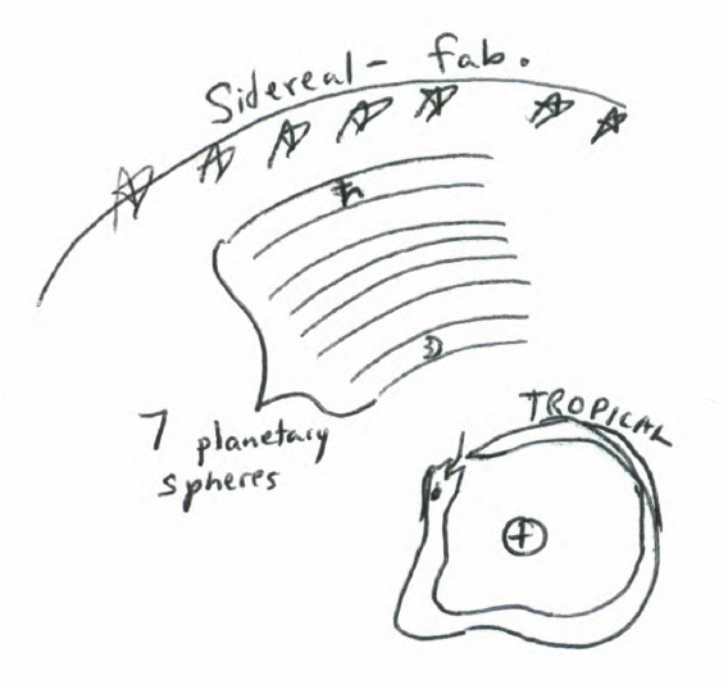
- FIGURE 1982 0130-1. Sidereal, Planetary, Tropical.
[Transcriber note: [diagram] means the speaker is referencing a diagram as he or she is speaking. If someone is drawing or writing, with audible sounds of chalk on a blackboard, I indicate this by [drawing] or [writing].]
NOTES:
We have a partial transcript for this class (Scan File 1982 0130-10R17.PDF), originally typed by CdA, with handwritten AD edits in it (AD apparently edited into a paper). These are noted in the present transcript.
There are a few places in the earlier part of the class where AD reads off his notes that he wrote in the back of his copy of the Mysterium Coniunctionis. He reads loosely, mixing speaking with reading, and I do my best to determine where the loose reading ends and the formal speaking begins. These notes are mentioned and briefly read from in the 2/5/82 Alchemy class as well.
TRANSCRIBED Verbatim by IT 2021. In 2025, IT completes TOC, expands Book List and Plotinus quotes section, adds new notes within transcript, adds diagram and reference within transcript to this diagram. Archival verbatim transcript – V12a.
AUDIO FILES: 1982 0130a, 1982 0130b (formerly labeled as 1982 0129a, 1982 0129b). [Note: "Tape" and "Side" refer to original audio cassette tapes that were later digitized into .MP3 Audio Files.]
| NEW FILE NAME | OLD FILE NAME |
| 1982 0130a, b | 1982 0129a, b |
1982 01/30 at Wisdom's Goldenrod
Alchemy; Man of Light
[Audio File 1982 0130a (formerly 1982 0129a) Begins]
S: Yes, it is on.
AS: Yeah.
S: Ok.
[18 second pause, noises]
AD (faint): Well thank (you/her).
[10 second pause, noises, flipping of pages]
S (faint): Has it been published?
S (very faint): Uh-hm.
AS (faint): Uh-huh, 469.
S (very faint): What was it again?
S (very faint): Yeah, uh-hm, uh-hm.
AD (faint): Start on section two?
AS (faint): Got to do these sections. [short pause, faint background student talking] Was that [one word inaudible]
AD: Would you read?
VM: Just start from the beginning, Anthony?
AD: Yeah, start, it's from-- tell 'em where it's from.
VM: This is uh-- I'm not sure how to pronounce it, it's "Poemandres".
AD (simultaneously): Thrice-Greatest-- yeah. Thrice-Great Hermes.
VM: "Poemandres, The Shepherd of Men". And, this is Thrice-Great Hermes by Mead. It's chapter one.
[Transcriber note: I am using Thrice-Greatest Hermes, Studies in Hellenistic Theosophy and Gnosis, Volume II--Sermons, by G.R.S. Mead, The Theosophical Publishing Society, London and Benares, 1906.]
G.R.S. Mead [Thrice-Greatest Hermes, "Poemandres, The Shepherd of Men," pp. 3-4, VM reading, brackets Mead's unless indicated]: "1. It chanced once on a time my mind was meditating on the things that are, my thought was raised to a great height, the senses of my body being held back--just as men are who are weighed down with sleep after a fill of food, or from fatigue of body.
"Methought a Being more than vast, in size beyond all bounds, called out my name and saith: What wouldst thou hear and see, and what hast thou in mind to learn and know?
"2. And I do say: Who art thou?
"He saith: I am Man-Shepherd, Mind of all-masterhood; I know what thou desirest and I'm [VM reads: I am.] with thee everywhere.
"3. [And] I reply: I long to learn the things that are, and comprehend their nature, and know God. This is [VM reads: That is], I said, what I desire to hear.
"He answered back to me: Hold in thy [VM reads: my] mind all thou wouldst know, and I will teach thee.
"4. E'en with these words His aspect changed, and straightway, in the twinkling of an eye, all things were opened to me, and I see a Vision limitless, all things turned into Light, --sweet, joyous [Light]. And I became [VM reads: become] transported as I gazed.
"But in a little while Darkness came settling down on part [of it], awesome and gloomy, coiling in sinuous folds, so that methought it like unto a snake."
VM: Continue or--
S (very faint): (This is good.)
S (very faint): Yeah.
VM: It's interesting but I don't know how--
[short pause]
AD: Well, I'll just read a few of these.
G.R.S. Mead [Thrice-Greatest Hermes, "Poemandres, The Shepherd of Men," p. 6, AD reading, brackets Mead's unless indicated]: "Know that what sees in thee and hears is the Lord's Word (square brackets mine) [(Logos)]; but Mind is Father-God. Not separate are they the one from other; just in their union [rather] is it [AD adds: that] Life consists."
AD: This runs on for a few pages. It's in the library. It's called "The Shepherd of Men". And the reason I'm bringing this up is because it's an exposition of Hellenistic Theosophy. And it contains many many hints of what we're going to try to understand. And, I don't know, maybe perhaps a good way to start this would be to say that this is one of those fairytales, your story about Gemini. You heard of the immortal twins. And in this extract, "Shepherd of Men", he would correspond to one of the twins. He would correspond to you might call your perfect nature, or your supersensory guide, your heavenly guide, [AD handwritten addition from partial transcript: ref to in Psalm 24] you can call it any of these things but, it is what we [AD handwritten addition from partial transcript: Plotinus] refer to in a more abstract way as the soul in the Intellect or the soul in the Divine Nous, the soul which always remains there the way Plotinus said, never descends. [Note: See Plotinus, IV.1.1, IV.3.12 (first para), IV.8.8 (first para).]
Then he says-- says that it emits a light from itself, radiates or emanates a light, and this light is captured by the darkness of matter [Partial transcript: AD replaces 'matter' with 'the material man'.]. But, nonetheless, this light as you can see is like the intermediary. On the one hand, we have the soul in the Intellect. On the other hand we have the darkness of [AD handwritten addition from partial transcript: the ego & its] body. And this light is the connection between these two. It is this light which, if you remember, Plotinus speaks about as making the body living, making it a living body. [Note: See Plotinus, I.1.7.] And the body would represent true darkness, the darkness of matter, the infraconsciousness or subconsciousness, whatever you want to call it. [short pause] And we could say that that light is like the intermediary consciousness and the soul in the Intellect is the superconsciousness [Partial transcript: AD replaces 'is the superconsciousness' with 'emanates'. There is also a handwritten question mark in the left margin]. And the soul in the Intellect or that superconsciousness will arise like a new day, it'll arise in the intermediary, not in the body or the matter which has captured the light and made it captive or a prisoner.
So-- so our story goes something like this. You have the Intellectual soul, you have the emanation from the soul or the light, which gets captured by the darkness of matter or the body. And, this light which is captured has to be re-emitted. Now, you remember we used the example that objects capture the light and that they-- like black objects take in all the light. And then if you heat-- if you heat the-- the object, it re-emits the light and it goes through various stages. [Partial transcript: "If you heat the object it re-emits the light through various stages of heating." ('of heating' added by AD).] Now, that's alright for a, you know, an object. You can put it in a furnace, [VM assents, faint] you can get it to re-emit the light. But what do you in the case of a human being? You can't put him in a furnace.
VM: Put him in the retort.
AD: Put him in a retort. (laughter)
AS: Put him in [few words inaudible]
VM (simultaneously): That's what they do in alchemy.
S (very faint): Yeah.
AD: What do they do in alchemy?
VM: That's what I'm trying to find out.
AS: Cook him.
AD: Cook him. How? (some laughter)
VM: Yes.
S: I'm not sure (it's something that) we can do.
S (simultaneously): Put him in the retort.
AD: No. No because that's-- that-- that's just a symbol.
VM: Yeah.
AH: They do speak of it in images in--
AD (simultaneously): Well what could create a lot of heat in you?
VM: Experience.
S: [one/two words inaudible] (bit of laughter)
S: A world.
S (simultaneously): [three/few words inaudible]
S (simultaneously): Desire.
AD: Desire for what?
S: (Don't.)
VM: We know.
AD: Well you could practice yoga.
S (faint): Yeah. (bit of laughter)
VM: Oh come on you guys.
AD (simultaneously): Practice of yoga, the practice [S simultaneously, faint: What's that?] of yoga [AD handwritten addition from partial transcript: or any intense form of introversion] will generate a great deal of heat. Or the practice of a mantra, [AD handwritten addition from partial transcript: etc.] you know, if a person practices a mantra, that generate a lot of heat. It generate, they call them the purifying fires of yoga. So then you would be forced, that is through mantra yoga or any of the known yogas, you would have to-- I mean the darkness of your own body would be infraconsciousness, the matter which has captured this light would have to re-emit that light. But it would be gradual, these stages. I mean it won't happen all at once.
At any rate, the story runs something like this. If we succeed-- if we succeed in emitting this light, it is the-- a next step in our evolution. You know, we spoke about this-- I think in a quotation that we use from PB. [Note: See PB Notebooks, V16, 26:4.257 and Persp., Chapter 26, #49.] PB speaks about-- speaks about it in a similar way. This light which is projected and then has to go through all the kingdoms of Nature starting at the very lowest germinal stage and reaches the human stage of ev-- of development. Now what happens? Well, there's two possible courses. There's a horizontal development [AD handwritten addition from partial transcript: endless repetition -- samsara]. You know, you can go on spreading himself out in a horizontal way, and there's a vertical development that could take place. The vertical development-- the vertical development would be the [AD handwritten addition from partial transcript: unfolding or] development of this light. It would-- it would be vertical in the sense that it's not exactly a continuation of what Nature has produced but it will be almost contra-Nature in the sense that, [Partial transcript: AD replaces "but it will be almost contra-Nature in the sense" with "nonetheless it has that for it [its] base and carries it further"] having emitted this light from the body, this light becomes eventually or becomes-- gets built up into what you might call the resurrection body or the-- some call it the empty body. [Partial transcript reads: "…that this light evolves and develops into the resurrection body, the body of light", AD crosses out 'resurrection body'.] [12¾ second pause] And it would have to develop all the necessary organs that-- or let's say there will be a transformation of the organs that we have in the physical body, these organs will be transformed and become sup-- organs to be used in the supersensory realm. So they would be organs made of light and seeing light, experiencing light. And, we said it is this intermediary, alright, which evolves and develops, goes through various stages and re-- reaches a stage where--
By the way in this whole process is-- it is being guided by its perfect nature. [VM assents, faint] But, as it-- [short pause] as it's developing, alright, and the closer it gets to it, I think we said something to the effect that the re-emitting of light and the building up of the light body is-- can be-- like the stages of progress can be indicated by the various lights. So, over here for instance-- now, I don't know how accurate this is because the variety of traditions. What's difficult, the variety of traditions make it impossible to collate them into the kind of Virgo system that I would like. I can't. The difficulty is because it's not always a linear development. You know what I mean? It isn't that-- it's isn't that you say steps one, two, three, four, let's say up to seven. From steps one to seven, then, you have to wait till the seventh step let's say till you see your angel or your perfect nature. Sometimes you could see your perfect nature or your angel when you're in the second step and you think it-- this-- the process is over but it isn't. It's just a-- a peculiarity, a quirk that I can't-- I can't-- (I'm not going to) understand. But at any rate, you can see your-- the presence, or this angel in your second or third step so there's no linear development necessary. Sometimes you see it at the beginning, sometimes you see it at the end. So I'm not going to try to make sense out of it because I can't.
But at any rate, they often start out by saying that usually the first thing is that you see the white light. This is usually the first step. Now, later on I hope to make correlations with the alchemists. I don't know if I can but we'll try.
VM: Which tradition is this?
AD: It's a compilation. (AD laughs)
VM: Oh ok.
S (faint): What Vic?
AD: And that usually is a sign of soul, yeah.
S (faint): Start over again, Anthony.
AD: Hm?
S: I just-- I'm-- Do you want any questions or would you rather [couple words inaudible] it's all--
AD (simultaneously): No, not yet, not yet. I don't know how you could have questions, I didn't say anything yet. (bit of laughter)
S: You didn't say anything?
AD: Well, the first sign is you see this white light in meditation. And that's usually an indication of the presence of the soul. Then the second indication would be like a yellow-- a yellow light. Now, the lights are various, they're-- there's-- there's no order that I can understand. You might see the Sun and the Moon and they indicate that you and your beloved are one or you can see the rising of a huge black sphere in front-- front of you and that might simply indicate that the lower soul still exercises tremendous power. You experience it as power, you get scared and-- or terrorized. Sometimes people think it's divine and all that, you know, but it's really the lower soul still has a great deal to say. So-- I'm not going to try to make order out of all this. You can't. At any rate, the yellow light usually indicates some sort of faith or fidelity in the soul, alright, so--
S (simultaneously, faint): (Faith.)
S: T-h?
JfL (faint): Yeah.
AD (simultaneously): F-a-i-t-h.
S (very faint): (Uh-uh.)
AS/S(?): Faith.
S: Faith.
HE (faint): It might be just--
AD: Then the third would be like a dark blue, and that usually indicates benevolence. The fourth would be a green, and that's like the soul pacified. Later on I think we'll see that this would be equivalent to one of the things that Jung refers to as the-- the second conjunction. Then the fifth step you may see your s-- the sky of the mind would be like an azure blue, and this is like a very firm assurance that you're going along the right way. Then the sixth comes and that's very very strong and it's a very powerful red. Usually refers to theosophical knowledge of some kind or gnostic. Basically it is an indication of the Nous, the presence of the Nous.
FW: (Color?)
AD: Blue.
S (faint): Red?
S (faint): You said red.
S (simultaneously): You said red.
VM (simultaneously): I thought you said powerful [S simultaneously, faint: Red.] red.
AD: Oh red, I'm sorry. Yeah. The-- the Chinese red. Maybe even darker. And then the seventh is black. And that usually indicates (a/uh) passionate love, ecstasy. [short pause]
Now the other thing you have to keep in mind, and this is a very rough summary, but just want to try to-- is that associated with each one of these colors or lights, alright, there's a building up of a center which, you know, in yoga they refer to as the chakras. So you have the various chakras being built up accordingly, so-- In various traditions they refer to them differently. You know, in one tradition they may refer to it as the muladhara. In another tradition they may refer to it as the corporeal atom. I mean, so, to correlate in the various traditions the different names that they give to these chakras I'll leave to you to do. (AD laughs a bit) But they would be-- the names will be different but the references will be the same. So what we're saying is that these chakras that are being built, alright, are being built into the subtle body or this body of light which is referred to variously as the resurrection body, the body of glory, the man of light. Um-- [short pause]
I think Jung referred to the fact that when there's a numinous content, it is possible or it brings about a lot of synonyms. But I think that there could be a more realistic explanation and that is that the variety of traditions, the mores of particular cultures, the background, the geographical background and all that, has as much to say about the variety of different terms they use and the differences, you know, a tremendous number of synonyms. I think it's due more to that than the numinosity of the experience. But at any rate, I don't particularly care for the amalgamation that Jung tries to work with.
So, very briefly, very briefly that would be, you know, just an overall view. But, the picture is very confusing. I used to think it was just me but-- I want you to play a little bit of a tape from Mrs. Ybor. Any mystic-- [Note: There is a tape break here. The partial transcript reads: Tape was played of Mrs. Ybor describing some of her experiences.] [Note: See WG Multiday Interview 1982 0106b (includes 0106–9, 0120–21, 0127–28).]
--going to talk about when we read Jung, I think you'll see where I'm coming from. It's-- it's a little more involved than the symbolism that Jung likes to parade around as the mystical path. But, I don't know-- Let me see, I'll try to say something about-- These tapes I'm preserving, I'm going to edit them, I'm going to edit everything-- all my comments I'm going to edit out. But I want to preserve the tapes for the library. It's an actual living experience and they deserve to be taped. I will edit out all my comments because very often, like I said, I had to say things, they were like medicinal lies not to discourage her, to make her feel she was getting closer and closer, you know. So I had to do that but now she understands these things so--
Let's see. Basically we have to locate ourselves in this realm that she's talking about which is beyond the ninth sphere according to the Ibn 'Arabi, for instance, astrology. Although, Tim I read that and I can't make any sense out of it except the traditional sense. But when he tries the explanations I don't know what he's talking about. So I'll have to go on my own. So we're saying that where she lives is-- or where she's coming from or the experience she's having is basically in that realm that we've called beyond the ninth sphere. We've said that that's the archetypal world where the images, the archetypal images are the very organs. [short pause] They're the very organs of meditation and of active imagining.
[Transcriber note: AD is reading his notes written in the back of his copy of Mysterium Coniunctionis by Jung. I don't have access to this, needs to be checked. He reads loosely, mixing speaking with reading, and I do my best to determine where the loose reading ends and the formal speaking begins.]
AD [Notes, AD reading]: "It is these here that give meaning and make known the manner of being of a specific human presence and the fundamental orientation that they're involved in."
AD: It is-- if I can-- [short pause] I'll try to make it more concrete but I'll be spoiling it. If you could think or conceive abstractly of the degree meanings as the archetypal images [Partial transcript: AD replaces 'as the archetypal' with 'are the underlying'] with which you will understand whatever your experience is here, it is also those degree meanings which orientate you in this world, alright. So that when you come down here, it is those meanings that give sense to whatever experience you have, but it also is the-- it's the basic orientation that you are working with. And as you can see this is not something that you have, it's something that you are.
[short pause]
AD [Notes, AD reading]: "Allowing for a world other than this one, an ascent can be made out of geography and into what we just referred to as this world, the mundus imaginalis."
AD: --which many people refer to it as such. The mundus imaginalis.
[short pause]
AD [Notes, AD reading]: "And an acquaintance with this world has nothing to do with the universals of logic."
AD: As a matter of fact, I think we said some time ago that the universals which we find in logic are like the desiccated and the mortal remains of that living angel. So, there's no need to burn your contemporaries if they don't believe in nominalism or conceptualism but this is basic-- Now the Orient that, for instance, she was referring to, the North that she was referring to was beyond the eighth sphere, and this is where these forms are to be found. Some mystics refer to it as the midnight Sun, the Sun at the heart, the presence of the angel, there-- there's many many poetical descriptions of it.
[short pause]
AD [Notes, AD reading]: "Now through the practice of meditation and attention to the phenomena of light, and the chromatic succession [AD handwritten addition from partial transcript: of colors], it becomes clear to a mystic…"
AD: No. It doesn't become clear. At any rate--
AD [Notes, AD reading]: "It indicates the stages until we reach our perfect nature."
AD: So like we said there was these various stages, one, you know, through seven. And the essential thing here is that the nature of the apparitional figure that you might see, and usually which heralds an indi-- an individua-- it heralds a very-- or makes available really-- You recognize that there's a very intimate relationship with this, what she calls the One, alright, but we can call the perfect nature or the shepherd of-- the shepherd of men. And it is this here which starts the process of real individuation because then this intimate relationship with that higher nature separates you from everyone else. I think we could put it that way. So, that would be true individuality like you probably saw when you saw PB.
RC: Is that what you also call the summit of the soul? When you said she experiences summit of the soul but not the One.
AD: Yes, you experience the summit of the soul if by-- If you think of the-- if you think of it this way, the summit of the soul is one of the Gemini twins. And this body of light which is build-- being built up to become a resurrection body is the other of the twins. And this relationship between the two, alright, is basically what we're calling true individuality. [students assent, faint] That's-- because it's based on the nature, the perfect nature, and it's unique and separates you from everyone else, the collectivity included down below. But up there I'm speaking about it separates you from other natures, perfect natures. So as, let's say the-- an individual, a man of light would be different from another man of light although there may be some similarities of experience. The-- the other important point here, and this is really very difficult but-- There's an identity of essence as far as the twins are concerned, but that there shouldn't be a confusion of persons [Partial transcript: AD writes 'principles' above 'persons']. You follow that?
RC/S(?): Yeah, the realms.
S (simultaneously, faint): Right.
AD: There's an identity of essence; as far as the twins are concerned, the essence is one and the same. But they are two different persons and the person should not be confused. Alright, so the soul which is in the Intellectual realm is one person let's say. This man of light that reaches up to it and now becomes its vehicle or its double is the second person. They're two persons. They're identical in essence but remain distinct as two person(s). This is going to be a cause of a lot of confusion with everyone. [S, faint: Right.] But we're trying to really, you know, establish very close distinctions.
JfL: So it's like the Intellectual-Principle in the soul?
AD: I'm sorry?
JfL: Is it like the Intellectual-Principle in the soul in that--
AD: You want to use that as an analogy?
JfL: Yeah.
AD: Well you can. I don't. I don't want to use that. 'Cause what we're doing here is like we're-- we're really going to concentrate more and more on the mystical steps and processes. And from this point of view we make these distinctions, you know, the soul and the-- and the Intellect, there's a commonality of substance but there's a distinction of existences, ok. But that's a verbal distinction, when you're up there you can't notice it. I mean, unless you're a Plotinus.
JfL: Well then what's the distinction in the-- that you said is-- still remains, I mean let's say.
AD: Betwe-- I'm-- that remains?
JfL: If you're saying it's a verbal distinction of the lower life and the-- and the subtle--
AD: Of the soul in the Nous, the distinction between the soul and the Intellectual-Principle I said is one of--
JfL: Oh that. I see.
AD: 'Cause you're speaking about the Divine, right? And in the Divine, the souls that are in the Divine or the soul that is there and the Nous, we make the distinctions here to help ourselves but you wouldn't be able to make it up there. Yeah. Now, this figure which we said is approaching, you know, its perfect nature or its double is really a theophany, an apparition, alright, of light. And it is the image, we were saying the twin, the mirror, in which the mystic contemplates the theophany or the apparition in a form that corresponds to his own being. [Partial transcript, AD changes it to read: "…the image of its twin, Soul in Nous, the mirror in which it contemplates the projected theophany or manifestation that accords with his own being."] So it will be like one-- one of the twins contemplating in the other and the other contemplating in-- in the one above, and, depending upon how well the mirror has been polished--the mirror has got to be very polished--so much the better the apparition, so much closer the conjunction or the-- the feeling of identity.
FW: I tried but I missed that point.
AD: Which point?
FW: The one about-- Did you say [couple/three words inaudible]
AD (simultaneously): I-- you people are write all-- writing this all down, this is just a fairytale, it's a story, it's a--
S (faint): No it's not.
VM: It's not a story.
S (simultaneously, faint): It's not.
S: We've got to 'cause you're right. (laughter)
S (amidst laughter): It's no story.
S (very faint): [few words inaudible]
FW: Their man of light is the theophany you would say?
AD: Yeah.
FW: That's a synonym of it.
AD: It's a theophany, it's an apparition. The Buddhists like to call it a-- an empty body. I refuse that kind of language because of the usage that those words have in English absolutely prevent any meaning and they become-- they're very bland, you know, and--
FW: And they contemplate each other, is that what you--
AD: Because there the contemplation of your higher nature is experienced as yourself, your higher nature is experience of yourself, is an experience of yourself. But that apparition or that body of light which is becoming a grea-- a closer and closer resemblance to that perfect nature, reflects on that perfect nature. And, when there is an identity, there's an inability to distinguish one from the other. In other words, the more polished the mirror is, alright, the more exact [AD handwritten addition from partial transcript: or similar] the reflection of the perfect nature becomes. So that it is [Partial transcript: AD replaces 'is' with 'becomes'] very difficult to distinguish one from the other.
S: So what were you referring to as being two separate people? You said the essence was the same between two separate--
AD: I'm sorry?
S: What were you referring to when you said that they were two separate people, the essence was the same but they were two separate people.
AD (simultaneously): Separate people, yeah.
S: You're referring to the man of light and the--
AD: And the soul.
S (simultaneously): (Summit of) the soul.
AD: Yeah.
S (simultaneously): And the summit of the soul.
AD: Yeah. [S simultaneously: But you said that you can't make distinction(s)?] So we're saying they're two persons, alright, with the same essence, but they should be distinguished one from another. They're not the same. Like PB referred to the apparition as his cousin. You know, remote cousin.
S: But when-- but you just said when you get to a certain point you can't make that, you can't know the difference, we should [three words inaudible]
AD (simultaneously): Well, there-- you can't in-- when there's a union. In other words, when she was speaking about this light coming down and she going up to it and the feeling of identity, there-- then you cannot distinguish two people, alright, two persons, or two different entities. It's only either in retrospect or when you go to a higher level you see that they-- they do go on remaining distinct.
HE: Oh, ok, thank you.
S (faint): Yeah.
[9 second pause]
AD: It gets very difficult too because the closer you approach-- I do have some tapes of hers. But the closer you approach to the pole, which is what we refer to as the-- the origin of where the double takes place, the closer you approach to it, the darker it gets. As a matter of fact when you reach the highest, it gets black because now there's this passionate ecstasy that precludes any knowing. Um-- [9 second pause, flipping of pages] That's why I don't want my book in the library. [23 second pause]
I wanted to say just one or two other things and then we will resume our text. [short pause] Now these forms and figures that we spoke about which exist before the man of light and cannot be seen with the physical eyes, that's obvious, alright, they can only be perceived you might say with supersensory organs. And, in her experience she'll speak about feeling two orbs of light here. [student assents, faint] And, she can't see anything. I mean, if you notice the lights are out. (AD laughing) She can't see anything, the light is so strong inside. Alright, the light is within and outside is the darkness, alright, and I go in there and I tell her I want to put on the light so I can see, she says I don't want to see. It's all darkness for her, I mean the light is very strong inside. It can get so strong that you can't function.
And the other thing to-- I might-- I might want to remind you about is that these forms that appear in the man of light, they are the very activity of that man. They're not something outside of him. How can we-- [12¼ second pause] Well we could say that the activity of the man of light is conditioned by the physiology of the man of light. So that if there's something wrong in the man of light, it is experienced as the light itself, but in this case, instead of seeing like a-- let's say a-- a clear color, transparent white or yellow or whatever, it gets murky and there's interferences in it. And that means that the subject himself is exuding these things, they're not-- it's not [Partial transcript: AD replaces 'it is not' with 'they are not'] coming from somewhere but from within himself. So there will always be a little confusion.
RC (faint): When you distinguish in the modes of the two distinct person(s), I don't-- is it the second, the one that we call the man of light in which the principle of appearance per se is actually rooted?
AD: Has to be what?
RC: That the-- the principle of appearing per se seems to be like the substrate of the-- the man of light.
AD: Uh-hm.
RC: So that anything that does appear takes his existence as the presupposition.
AD: Yeah.
RC: And it is cast into a form [AD: Yeah.] that he's able to work with.
AD: The more highly evolved that man of light is the-- becomes, the more precise and dignified do the figures or the apparitions are that appear. [Partial transcript reads: "…the more precise and dignified do the apparitions are that appear." AD replaces 'do the' with 'are', intends it to read: "…the more precise and dignified are the apparitions that appear."] So the-- there's this tremendous need for constant purification that they put themselves through. Because it's the body of light that they're working on. Yes David.
FW: Does this go all the way down so that even now as we perceive shadowy objects and so on, have worldly desires, it's still that man of light that's produced in that kind of image? Or (would--)
AD: You're saying--
FW (simultaneously): Is it-- in other words, is it now-- even now the principle of attention or-- or perception in (us)?
AD: Yes and no. I wanted to avoid that question because what you're saying is, is he the prerequisite perception. On the one hand he is but on the other hand perception takes place pure-- purely on a horizontal plane. Remember the way we spoke about, there's the horizontal plane--east, west, north, south. And then there's the zenith and the nadir. Now, what you're saying or I think what you're trying to say is that any perception that takes places on the horizontal plane requires the vertical man. Now that's true in a way, it can't be helped. But on the other hand it's untrue because any perception that takes place on the horizontal plane is of the horizontal plane.
RC: So when you speak of a man-- the experience directly attributed to the ones you say the man of light (had/has), then are you necessarily assuming the presupp-- like interior perceptions rather than the perceptions--
AD (simultaneously): They're within the man of light. How big do you think the body of that man of light would be?
RC (faint): As big as you'd want.
AD: Well you'd see it spread out infinitely across the sky of your [Partial transcript: AD replaces 'your' with 'the'] mind. You-- [RC simultaneously: But, I guess what I--] you won't be able to equate it with the physiology and anatomy of the ordin-- you know, of the empirical man.
RC: But you already-- I mean-- it seems that you are speaking of a mode of perception that is different than the type of perception that we have in this horizontal physical plane.
AD (simultaneously): Yeah, yeah, it's quite different.
RC: It doesn't-- it's not loaded with that sense of-- that absolute distinctness of a subject from the object.
AD: No, as a matter of fact it's always the feeling that it's all you. Whereas over here the feeling is quite the reverse, all of it is not you. Or you feel enclosed or capsulated within the skin, and that your subjectivity is within that. Over there it's the reverse process. Let me-- let me see if I could find something. Steiner isn't exactly my cup of tea but every now and then he does say things that are-- If I can't find him, I'll just try to paraphrase it. [short pause] He speaks about when we go to sleep at night-- [short pause] he speaks about when we go to sleep at night the way our ego is poured out into the world and in that very process gets spread out. It's called Microcosm and Macrocosm.
RC (faint): There's a nice one in Hartmann.
AD: Huh?
RC (faint): There's a nice one in the Hartmann too.
AD: Oh alright.
RC (faint): It's on 77 I think.
AD: Do I have it?
[29 second pause, AD looking for book]
RC (faint): I don't know (what you want).
AD: Read it, oh yeah.
S (faint): Yeah.
RC: "Before a man…" (Let's) see, this is from Paracelsus.
[Transcriber note: I am using The Life of Philippus Theophrastus Bombast of Hohenheim, known by the name Paracelsus by Franz Hartmann, London, George Redway, 1887.]
Franz Hartmann [Paracelsus, p. 113, RC reading]: ""Before man is born, and [shortly] afterwards, his soul is not perfect, but it may be perfected through the power of the Will. Spirits are essential, visible, tangible, and sensitive in relation to other spirits. They stand in [a] similar relation to each other, as physical bodies to other physical bodies. Spirits [RC reads: They] speak with each other through the will, but not through audible speech. [RC adds: Thus] While the body is asleep, the soul may go out to a distant place, and act intelligently at such places.""
AD: Alright, here.
[Transcriber note: I am using Macrocosm and Microcosm by Rudolf Steiner, Rudolf Steiner Press, London, 1968.]
Rudolf Steiner [Macrocosm and Microcosm, Lecture One, AD reading]: "Thus in sleep, as in ecstasy, we have surrendered the Ego, [AD: Whatever that means to him.] and further--this is the characteristic of sleep--the bearer of our consciousness and its manifestations [AD reads: manifestation]. This is our astral body; it is poured out into the world of spiritual beings and facts revealed in the state of ecstasy. We may therefore say that man's sleep is a kind of ecstasy--a condition in which he is outside his body not merely in respect of his Ego, but also in respect of his consciousness." [AD handwritten addition from partial transcript: (empirical mind)]
[short pause]
AD: And, just to follow up that quotation.
[27¼ second pause, flipping of pages]
Rudolf Steiner [Macrocosm and Microcosm, Lecture Four, AD reading]: "[AD adds: And] Although man does not need to see the external forces which work on him, he learns [AD reads: knows] to know by instinct that what is usually called the 'soul' is quite different from current ideas of it. He learns to realise that the human soul is indeed little, but that it can be compared with something very great; also that the individual capacities which the soul may possess are very slight compared with the capacities of that great Being with whom, however, it may feel itself akin. The knowledge acquired on descending into the physical and etheric bodies is that on waking we emerge from another world in which there is a Being akin to our own soul, [Partial transcript: AD puts 'own soul' in parentheses and writes 'selves' beneath it] only infinitely mightier. Thus on waking the human soul feels insignificant after passing the Lesser Guardian [of the Threshold] and may say to itself [AD reads: himself]: I am paltry indeed…"
[short pause]
AD: Then he speaks about the three forms, willing, knowing, and feeling, (alright), but the basic thing here is that they-- it's almost like when we speak about the light being held captive by the body, alright, and then when the-- when sleep comes, this is his version, that light is re-emitted, poured out into the universe. But it's something like dropping a-- you know, a drop of wine in a basin of water, you feel these cosmic forces, you're poured out into the cosmos but these forces work on that and then when you return, it gets like concentrated and-- whereas before the ego was spread out over the universe, now it is identified with a body. This is going to come in I think useful in understanding the three conjunctions that Jung speaks about. Remember the unified mentality, which was the conjunction of psyche and Eros. And then he speaks about the conjunction of that with the spirit and then all three of them in conjunction with the unus mundus, the archetypal world. (Well) anyway, the reason why I gave this, to--
(Side 1 of original cassette tape digitized as 1982 0130a (formerly 1982 0129a) Ends; Side 2 Begins)
AD: Did he?
LR: Yeah.
AD: I can't answer that. I think he did achieve some significant relationship with the mundus imaginalis, you know.
S (simultaneously): Just what?
CDA: What's that?
AD: The archetypal world.
S (simultaneously, faint): [few words inaudible]
S (faint): Right, imaginal, uh-hm.
S (faint): Uh-hm.
AD: You have to remember that these archetypes are the very organ, the very means of your experiencing these wor-- this world. But, if we s-- if you artificially separate yourself from the sensorial world and you're identified with the archetypal images that he speaks about, [short pause] it's quite a feat. He speaks about it, I think-- I think he thought at that time that he was-- he was inundated and invaded by these archetypes, and I think in his biography he speaks about putting a revolver in his desk because the possibility of psychosis and he would probably would rather have eliminated his life than go through psychosis. But, that experience of the astral world or the archetypal world invading does have the characteristics of psychosis. In many of our talks he speaks about a complete disorientation and the inability to get back into the ego with all its tricks and all its habits, you know. It's like re-emerge-- submerging yourself back into a diving suit, you know, and now operating. But, until-- until the insertion into the body takes place, there's this extreme terror of, you know, not being able to orientate yourself in the world. Let's go to-- what page was that, Avery?
AS: 469 I think.
[flipping of pages]
S (faint): [one/two words inaudible]
AS (simultaneously): [one/two words inaudible] first stage?
S (faint): The first stage, yeah.
AD (simultaneously): Well, Avery could you-- [AS: Second was--] could you briefly summarize the chapter we did in the other book without them? [Note: See WG Class 1982 0127.] [AS simultaneously: The Aurora.] You think you could do that?
AS: The Aurora?
AD: The Aurora Consurgens?
S (very faint): Uh-hm.
VM: It's (copied) down.
AD: Basically the idea is really quite simple. But, it gets a little messy because of the lack of real clarification as to what's happening to who. [AS assents, faint] And who is this "who". In other words, the "who" and the "what" are not properly distinguished.
AS (faint): I don't see, if we get a little--
AD: By the way, you people want that chapter [S, faint: Yeah.] xeroxed?
S: Yes.
AH (faint): Yes.
AD (faint): She'll probably review in chapter 4. If you do you raise your hands.
S (faint): What chapter?
S: Well you're speaking of the Aurora?
S (simultaneously): Good job.
S (very faint): No.
RG/S(?): No.
S (faint): What chapter?
S (very faint): Uh-hm.
AD (simultaneously): The chapter from that book then I--
VM (simultaneously): No, the Mysterious Conjunction.
S (faint): Chapter 6, Mysterium.
S (faint): Oh, oh.
VM: Or you can grab it flat.
AD: How many out? That's possible, wow.
S (faint): Must be [few words inaudible]
AD (simultaneously, faint): (Then/And) what? You'll catch it.
AS (faint): Here we go.
S (faint): (Explore that.)
S: Oh that's fine.
S (faint): Yeah? Ok.
[short pause, flipping of pages]
AD: Now you could (throw it) away. What we did was take this chapter from the Aurora Consurgens by Louise, (ok), Louise Franz Mary. (bit of laughter) She's very devoted disciple of Jung's. As a matter of fact I think if she has her way she's going to immortalize him. And, I took her point of view and tried to understand because sometimes you get something from a disciple or a student that you don't get directly from the teacher or the master. And, she's very efficient, she's very learned in medieval philosophy. So, I thought it was worthwhile just to (witness) that book and I did. And, she more or less presents a coherent account of-- all the time, explain-- You want to pick it up, Avery?
AS: Yeah I try just briefly, ok, sure. Basically the idea seems to be that there's this original archetypal wisdom, you know, like you would speak about the Nous or the-- the Ideas, degrees, degree symbols. I guess best we'd say the Nous or some kind of intelligence.
AD: I can't hear you any.
AS: A--
AD: Start out by imagining [AS: Yeah.] the way she did, ok, the wisdom that's in matter.
AS: Yeah, that's-- And that this-- this wisdom or-- ok, say this wisdom or this Nous gets some spark of it or these reason-principles get embodied or entrapped in the elements or in matter. And then this spark has to begin working its way out of the matter. Now part of the problem for me is there seem to be these two things we're getting in-- embedded in matter. On the one hand you had this, what he called the Wisdom, Sapientia Dei, ok, which some fragment of it is actually embedded in the elements, in the matter, and this becomes eventually-- through your experience you work out this-- these meanings, this wisdom gets distilled and this becomes the light of your experience, this is a-- this is going to begin to guide you in your development. On the other hand, also embedded in this matter or these elements is a spark from your soul. Like we spoke about the first soul gives off a light to form this living animate. So embedded in this-- embedded in these vehicles or in this matter is also a spark from the soul, and that is going to begin working its way out through this experience. It's going to become individuated and eventually become a double for the original soul.
So, on the one hand it seems that these-- these bits of wisdom which are embedded in the body are actually going to be guiding-- as they get unfolded they're going to guide the soul in its development. On the other hand the soul or this light of the soul as it begins to evolve out of matter, to re-evolve out of-- out of matter the way that PB gave that quote on the ego finitized out of the Overself, [Note: See PB Notebooks, V16, 26:4.257 and Persp., Chapter 26, #49.] as that begins to evolve itself out of matter, these-- this wisdom which is embedded in the matter is going to become more available. So it seems to be this double-- two things going on. And I-- you know, I couldn't get clear sometimes which one is which.
LR: Or she doesn't distinguish them at all?
AS: And she didn't-- no, she didn't really distinguish them. So, she speaks about-- for example in the first one she speaks about Avicenna's notion of the active intellect. He says that this intellect, this active intellect, there's going to be a fragment of that actually embedded in the individual and that is going to guide him, um-- how did she say it? Right.
AD: Use your text though.
S (faint): Yeah.
AS: Sorry I'm not being very-- No I mea-- let me-- let me use the quotes, I think it'd be better. Anyway, at the beginning she makes this point about the--
[Transcriber note: I am using Aurora Consurgens: A Document Attributed to Thomas Aquinas on the Problem of Opposites in Alchemy, edited with a commentary by Marie-Louise von Franz, A Companion Work to C.G. Jung's Mysterium Coniunctionis, Bollingen Series LXXVII, Pantheon Books, New York, 1966. Originally published in German as part III of Mysterium Coniunctionis by Rascher Verlag, Zurich and Stuttgart, 1957.]
Marie-Louise von Franz [Aurora Consurgens, p. 155, AS reading]: "…the pre-existent Logos, or [as] the sum of the [rationes aeternae] (eternal forms)…[AS adds: the] exemplars, ideas, and prototypes in the mind of God. She [was also] considered [AS adds: as] the archetypus mundus,"that [AS reads: the] archetypal world…"…"
AS: Ok, so we talk about that as the totality of all these archetypes, ok, and she says--
Marie-Louise von Franz [Aurora Consurgens, p. 156, AS reading]: "In modern psychology she would be interpreted as a feminine personification of [AS reads: In modern psychology this would be personified as] the collective unconscious."
AD: We told you to refer to it as the Nous.
S (faint): Ok.
AS: And so, they have the totality of all this wisdom, the Nous. We symbolize it I think also as the 360 degrees. Jung speaks about it as the whole archetypal world.
[Note: See FIGURE 1982 0130-1, Sidereal, Planetary, Tropical, appended to this transcript for the following. This diagram is not from this class but is used as a stand-in to help follow along.]
AD: So, I think what we could do is something like this, if we think of this diagram here, and we put the degrees [drawing] along-- Imagine 360 degrees here, and the functioning of all the planetary spheres would be taking these degrees, alright, and planting them-- well, this is our world [diagram], would be implanting them in the matter. So the organization, the organization of the perceived world, the sensible world, has for its substratum these meanings, just like for instance when you give a formula of a compound, you know, any formula, you-- you would say H2O, it's not so much-- it's not only the combination of these two elements, but what's much more-- more important is the way that they're organized into a definite pattern, this pattern would be let's say analogous to a reason-principle which is organizing the elements, [VM assents] alright. So that the Nous or the Ideas, the Nous [AD handwritten addition from partial transcript: (Solar Logos)] itself is in the actual experienced world. So naturally, when she quotes from, what was it, Proverbs 8, 9, 10, you should read them, where Wi-- [one/two inaudible student words simultaneous with AD] Sophia goes around trying to interest men in searching out wisdom, but of course they're all too busy buying and selling oranges or something, and she doesn't have much luck. (AD laughs a bit) And every now and then somebody figures well there must be some meaning to this world, let me see. Well, alright, in any rate, the diagram I think will be helpful there if you think of the 360 degrees as the reason-principles and through the efforts of the planetary spheres [AD handwritten addition from partial transcript: & Sun], which Avicenna calls the intellect, and that in--
VM (faint): Planetary spheres he calls it?
AD: Yeah. I-- that's what I think he's-- And that intellect, [couple/three inaudible VM words simultaneous with AD] that active intellect is universal, it's not individual; and that St. Thomas comes along and individualizes it. [Partial transcript reads: "This is what Avicenna calls the active intellect, and he considered it universal; later St. Thomas individualizes it." AD puts this entire sentence in parentheses and puts a question mark in the left margin besides it.] It's both universal and individual. So that these-- these Ideas in the Nous are going to be planted not only in the world but also in each individual. So that there's this interaction between the individual and the world. And on the one hand the understanding or the reason-principles that he manages to extract from the experiences of his life illuminate-- illuminate him, and on the other hand of course he has to bring the reason-principles that constitute him into understanding the reason-principles that are constituting an object, let's say, "external to him", un-- quote unquote. Alright, go ahead.
LR (simultaneously): Anthony? I'm--
S: Go ahead.
LR: --got confused the other night and I'm afraid I'm still confused and it's about the distinction, what you're speaking of between the world and the body. I mean I know there's a distinction between the body and the world but if sometimes you speak about all those reason-principles being-- helping to compose the stuff of the body the way we were speaking about the elemental body a few days ago.
AD: Uh-hm.
LR: And then we also change references and speak about it as the reason-principles in the world. And I'm just confused about the references.
AD: You're confused about the what?
LR: The references to body and world. Are you using them interchangeably? I mean is it that--
AD: Well, don't you distinguish yourself from the world, your body from the world body? I mean you're not asked to take care of the body of the world, you're only asked to take care of your own body, wash it, feed it, clothe it, put it through--
LR (simultaneously): Yeah, I s-- I said it sounds kind of silly, I mean I'm not trying to say the body and the world are the same principle. But, in what you've been speaking of it seems that those reason-principles, those 360 degrees are in some sense part of the body, the elemental body, as well as the stuff of the world.
AD: Yes.
LR: You'd say they are in both?
AD: Yes, they would be in both. But that's not to be confused with the soul.
LR: No, I wasn't speaking of the soul. I was speaking of the body and the world.
AD: Yes.
LR: And the reference goes back and forth, well, one case you speak about those 360 reason-principles--
AD: Yeah but I don't see what you're confusioning.
LR: Well what is actually being contacted by the psyche?
AD: What is being contacted by the psyche?
LR: From-- from which reference point is the psyche drawing out meaning?
S (faint): Right.
AD: Do you know what she's saying?
LR: Oh, forget it.
AS: No.
AD: No, if you distinguish--
LR: It's not worth pursuing if (I/you) don't get it.
AD (simultaneously): But if you distinguish the [AD handwritten addition from partial transcript: higher] soul from either the subjective or the objective psyche, alright, [LR: Yes I have.] then it would be a question of the soul learning from both, but more particularly from the subjective. In other words, you learn primarily from the most immediate environment that your soul has to deal with, that's your body.
LR: That's the body.
AD: Yeah. But that doesn't exclude the world.
AS: I think I--
LR (simultaneously): No, it does embody-- ok.
AS: Maybe this thing he did with-- maybe it make sense, the thing from Aquinas where he began to distinguish between the active intellect of the cosmos and the individual. And I think we made the point something like those reason-principles which are actually constituting your subject-- subjectivity, the ones that are in your chart, are going to be more-- more predominant or more available. And all the other ones as it were represents the objective psyche. It seems you would be more learning from the ones that constitute you, or through those. But then you'd be-- but you'd have to conceive of being able to assimilate something outside.
LR: Of course.
AS: Otherwise you would just be in that same condition, there wouldn't be any progression.
LR (simultaneously): But then that what you're saying is and I think the answer is that the immediate field that that psyche-- or that psychic consciousness contacts the immediate field of the body. And that what it-- what it contacts of the world is through those reason-principles in its own body. [short pause] Is that what you just said? Something like (it/that)?
S (simultaneously, very faint): I don't think so.
LR: Ok. 'Cause we go back and forth and we'll speak of them as in the world or it is in the body and I just--
AD: Well, [AS simultaneously: What's in the body is an extract.] for your soul aren't the reason-principles embedded in the body just as objective as the reason-principles embodied in an object outside your [LR assents] body? But these are much more immediate and dominant in the sense that they-- they would be concerned with the development of the powers of your individual soul. [LR assents, faint] So these are given a priority. Your subjective psyche, the way it's constructed and the way it operates in relationship to the world is primary. Now, if the person achieves a status of a Witness consciousness, then they're both at the same level, the objective reason-principles and subjective-- or objective psyche and subjective psyche are both at the same level. But insofar that he hasn't then he considers the reason-principles that he learns primarily from would be the subjective reason-principles. Those have to be developed. And we could say that through those, knowing, willing, feeling and sensing, alright, are being brought to certain level of development. Until they reach a certain level, he's not going to understand the objective way-- a wor-- objective psyche except in a very crude way.
So what we're making is this distinction that the first chapter entailed. When we tried to find out what he meant by Mercurius, we came up with the fact that Mercurius could be anything, alright, and by anything we mean it could be the degrees, it could be the functioning of the planetary spheres, could be the way the elements are gathered together into aggregates. So that he referred to this as Mercurius. And I said, I said we have to keep this distinct from the individual bodhicitta or the-- the light of a soul, alright, which is inhabiting that realm and is experiencing that realm. So we keep these distinct, then we could see that that bodhicitta, we give it that name so to separate it off from the whole twelfth house functioning, that it's going to learn through the reason-principles that are primarily subjective and then objective. I still don't see your confusion. Unless someone could formulate it better.
LR: Well, you either say that the 360 are all contained or reflected in the body or you say that each pres-- spec-- each individual body contains a selection, a certain predominant, has a certain predominant of those 360, a representation of those 360.
AD: (No), so if you look at the planets where they're sitting, on what degrees they're [LR assents] sitting, you're primarily working with those [LR simultaneously: Certain meanings.] meanings rather than with all the meanings. Not that all the meanings aren't available to you. You're just not, you know, sensitive enough. So you're working primarily with those and that's what we mean I think in the West when we speak about subjectivity.
LR: But I-- I was trying to keep the notion of the psychic and the somatic separate the way you were doing the other day. And maybe you don't want to bring that in. It seems like right now you're bringing it together. You're not distinguishing. You're speaking of one thing as the psychosomatic organism. The other day we were trying to distinguish those two terms, saying that the somatic had to do with the elemental stuff or the body. And that the psychic was what I believe were on specific [one word inaudible]
AD (simultaneously): Arises from that.
LR: And was pulling out of-- pulling the meaning out of--
AD (simultaneously): Yeah, and that's the psyche that you're working with. [LR: Right.] And that's predominantly subjective.
LR: Ok, now, if that's so, if the psychic has these predominant degrees from which meaning will be distilled, or with which meaning will be distilled, then the somatic part, the material part seems contains all the reason-principles. The element-- the elements, within the elements--
AD: The somatic you say contains all the reason-principles.
LR: I'm thinking of the somatic as analogous to the Earth's belt.
AD: To the Earth--
LR: The substance of the Earth. (If we) separate the psychic from it for the purposes of discussion--
AD: Well no. Suppose-- suppose you say that the 360 degrees are involved in the production of the elemental body, [LR: Body.] ok. They're also involved then in the production of any body.
LR: Yes.
AD: Alright. But, the combinations in various bodies would vary.
LR (faint): Yes.
AD: The reason-principles in one body will be different from another.
LR: And we said the distribution-- we said the distribution of elements was different according--
AD: Yeah. So now what's the problem? Or did-- did it get clarified as we were talking?
LR: It did momentarily, now--
AD: Well--
LR: Maybe it will.
TS: You're saying that the reason-principles embedded in the-- in the soma, in the body or in the elements which are not constituting the individual body but-- the extrication of those would be like the sciences. It's the study [AD simultaneously: Yeah.] of the sciences.
AD: Sure.
TS: Whereas the extrication of the reason-principles which are embedded in one's own body, the organ-- the elements, or the organizing of the elements would be more personal lessons or the--
AD: The personal what?
TS: The personal meanings or lessons of that individual life?
AD: Yeah. That's what we mean by subjective, don't we?
TS: Well, I want to be sure.
AD: Well what do you mean by subjective then? Wouldn't you say it's the totality of the parts?
TS: Yeah but is that-- the question-- I mean that-- this was the question I was also having confusion last-- whatever day we did this Con-- the Consurgens, [Note: See WG Classes 1982 0127, 0128.] that in-- when you speak of the reason-principles embodied in-- embedded in the elements, at that level that you speak of the body, but it's-- it's hard to understand-- 'Cause sometimes we speak of the-- the totality of our experience being drawn out of the body both, well you-- the scientific, [student assents, faint] you know, perception of the tree, the whole epistemological situation and drawing on images in the brain consciousness or something like that. I could see the whole thing as being within the individual [S: Yeah.] structure of the elements.
AD: Within the-- You could see the whole thing in an individual body? [TS simultaneously: As far-- as far as--] Then why did it take so many-- so many thousands of men to evolve the various sciences? Why didn't one man suffice?
VM: I don't think there's [couple words inaudible]
BS (simultaneously): True, but there's an assimilation after that.
TS: That doesn't-- I--
VM: He's te-- I don't think there's speci-- Tim, are you saying something like look, I grant you there's an exta-- external world. But my personal experience of it is only through my own body and in (the/a) sense all I am ever experiencing are my own sense organs, my own bodily functioning. Is that what you're saying?
TS (simultaneously): Those-- yeah. And those reason-principles which are--
VM (simultaneously): And the reason-principles embedded therein.
TS: Embedded therein, not-- not necessarily the reason-principles-- It would seem to me it would only be someone like Paracelsus or maybe Goethe or somebody that would be capable of extricating the reason-principles in a-- the true reason-principles [VM simultaneously: In the world.] in an object.
VM: Right.
TS: You know, seeing the archetypal plant or empirical or something like that. But the-- by and large it would seem as though the sciences would still be a-- an elaboration of the reason-principles inherent in my subjective psyche, subjective-- not my subjective psyche but in the-- the-- the reason-principles in the organization of the body, the elemental body [one word inaudible] body.
DB (simultaneously): If that were the case there wouldn't be any reason why there should be any difference between bodies.
TS: Well--
S: No.
DB: I mean if everything is contained, right?
BS: That's a good question, is there [one/two words inaudible]
TS (simultaneously): According to medicine there's a fair similarity, you know.
DB: Well--
[short pause]
AD: Well, I don't-- I don't see-- I don't see yet the confusion.
DB: Anthony, I think-- I'm not sure if I understand the problem here but it seems that--
AD (simultaneously): But, I mean if anyone looks at his chart and he can't distinguish between what's external in his chart and what's internal--
LR: I can't distinguish the psychic from the somatic when I look at the chart.
[short pause]
AD: Alright, well we could work at that in a little while but in a-- in abstraction right now, in terms of theoria?
VM: Anthony, can I just take a couple of seconds to see if I'm equally as confused as everyone else here?
AD: Ok, sure.
VM: You talk about the external world, the world that appears always external to the body that's given. That's one level of-- of matter, and that is invested with reason-principles or the structuring principles of Nature. These 360 degrees go to constitute that-- that world. Then, within that world is the physical body that we all operate.
AD: Uh-hm.
VM: That body is a part of that world yet it's also distinct and separate. That body too is invested with 360 archetypal degrees, each body being a little different than every other body because it's peculiar orient-- or peculiar grouping or peculiar emphasis of some degrees. Now, there's a third principle yet, what you call let's say the psyche, and that is the functioning of these planetary spheres in that body as locus to experience the world. And of course the experience of the world is always through that body, as Tim was emphasizing.
AD (simultaneously): Wait say that-- say that last part again.
VM: We got these two distinctions, the external world and the body.
AD (simultaneously): Yeah, the two we have, yeah, yeah.
VM: Now we also have the psyche. Now what do we mean by the psyche? Let's say the functioning of the planetary spheres, the particular group of reason-principles that makes us up as a-- a subtle body or a-- a psychological individual. And that works through the locus of the body and experiences the world through the reason-principles in the body and in the psyche as-- as a-- as a subtle organ. And when you say extract meaning from-- from the world, you do it through the functioning of the psyche. The meanings you can extract are by and large determined by the particular kind of degree symbols which are emphasized in your chart, whether it be the parts or the actual planets I'm not clear on but maybe that's something that'll come out. I don't know, I'm just trying to make these three distinctions, the world, the body, and the psyche. It seems like the distinctions you were working with but maybe not.
AD: Well I think the dis-- the way we were working was something like this, we think of the three of them as producing a body. So you have the inerratic sphere with the Ideas in them, [VM assents] alright, the planetary spheres, the fabricative aspect of the planetary spheres [VM: Right.] producing, projecting the body. Then the body, so to speak, becomes the medium through which the gnostic aspect of the planets becomes available to you.
VM (simultaneously): (Alright), fine, fine.
AD: I thought we did that Thursday or--
VM: Yes, yes I--
AD (simultaneously, faint): No?
VM: I didn't [AD simultaneously: You remember what we did?] emphasize the gnostic and fabricative but--
AS: Yeah, that's right, the-- the fabricative aspect of the planets first builds the body with the elements, [VM simultaneously: Right, then the gnostic (couple words inaudible)] so embedded in that body-- Well then that would mean that embedded in that body are all the reason-principles that went to constitute it and then you talk about within that now we can extracting meaning(s) through that-- through the [AD simultaneously: And--] experience through that body the gnostic aspect of the planets--
AD (simultaneously): And you're going to call it the psyche.
AS: --is now called the psyche because now that-- you point-- that's saying that's what's the apparent subject. And the point is both of these now are really objective to the soul, what we call the [AD simultaneously, faint: Yeah.] balsam, the bodhicitta, that light that-- See that's where-- see that's where I tried to make that distinction, I don't know if it's valid. On the one hand, all these degrees, all these reason-principles which she calls Sapientia Dei or he calls the mundus archetypus, there's an image of that in your body because those reason-principles have been used to build up your body. On the other hand then you now speak about having experience in that body and you're speaking about the light of your soul being injected in that, conjoined with that and going through this experience and eventually evolving out of that. And there's this constant interaction it seems of the soul, light of the soul experiencing the world and all these reason-principles which are being experienced or being worked out of that matter also. And, [VM simultaneously: Avery, do we need--] seems that the psyche is instrumental in-- the psyche gets built up as these meanings get extracted from this experience, and you speak about the psyche as the functioning, what your participation in the functioning of the gnostic planets. And that still is some-- that-- all that is separate, kept-- is distinct from [AD: The soul.] soul.
AD: So that's the ontogenesis [S simultaneously: (That's right.)] of what [AS simultaneously: It's very (one word inaudible)] you call your psyche. Now I don't see what your problem is.
VM: Well there's a lot of distinctions there.
LR: I have no problem.
AD: That's what we did Thursday.
S: Right.
S: What (do you--)
AS (simultaneously): And that-- and that was where you also brought in that point of what you did just this morning of once this light had been somewhat freed from its en-- its [couple inaudible AD words simultaneous with AS] entombment, as it were, that it could then begin to go through these stages of this mystical development, so-called, where you have these levels of light. Before that's-- this light would be so encased in this. It would be guided-- before that, Plotinus says for example, that this soul that was immersed in that and more entombed would be more guided by circumstances. Whereas after that the development would be more one of it kind of trying [AD simultaneously: The higher, yeah.] to determine its own development.
AD (simultaneously): Linda, you want to continue please?
LR: No.
AD: Because they won't speak up.
LR: I-- I [AD simultaneously: Go ahead.] don't think this is what you want to do now Anthony, I-- I [one word inaudible]
AD (simultaneously): No, no I-- we want to get this clear, we want to get this clear. Because I think it's important in terms of the three conjunctions that he speaks about. If we don't have this clear in our mind, then when he speaks about the conjunctions we're going to have difficulty understanding what's conjuncting what.
LR: Well, it's clear to me that after several people restated their viewpoints, that there's more confusion about this. [S, faint: Right.] It's clearly a confused problem. There's-- everyone came up with a little bit different statement of what this body principle is and I don't know. I don't--
AD: Well it is true because there's nothing-- there's nothing as complex as a human being. The whole range from heaven to hell is within him. And no creature, no creature goes through the torment that a human being can go through.
LR: For one thing you have-- you have already three se-- three slightly distinct notions of subjectivity. You've got a subjectivity which we've separated off as the soul. And then we have these two varying kinds of subjectivity bracketed under objectivity called psyche and body.
AD: Uh-hm.
LR: The world is objective. The body is semi-objective and semi-subjective, [AS simultaneously: Oh but, that's right.] and the psyche is also somewhat [AD simultaneously: (Could you--)] objective and somewhat subjective.
AS: But that's right. I think [LR simultaneously: Subjective to--] if you start the-- why not-- if you start the other way with-- I'm sorry.
AD: Go ahead.
AS: Go on. No, go on, you didn't finish, I'm sorry. Go on.
S (simultaneously, very faint): (That's right), Avery.
AH: Could I-- could I [one/two words inaudible]
AS (simultaneously): If you start the o-- ok, then let me-- then let me go. If you start the other way with the cosmos, the objective cosmos, you have these three levels we spoke about, the Nous, the planetary functioning and the elements. Now, that's objective, let's say that's the macrocosm. Now you have the microcosm, the individual begins to develop through that. Now first all he has is this body and all those principles are embedded in his individual body. And they begin to-- then after a certain evolution, the other levels of the cosmos begin to be-- of the macrocosm get differentiated out in his microcosm. So he has these elements and then he begins to have a psychic functioning, and eventually he'll have his own Nous, his own-- the reason-principle functioning. Now that's-- both of those two group-- both of those two systems are in a way objective.
AD: See if you go this way, Avery, if I could add to that, if you go this way that he just enunciated, if we say that the fabricative aspect of the planetary spheres are fabricating the entity, [LR: Yeah.] and then the arisal within the entity [LR, faint: Of the psyche.] of the psyche, this will be like what some of the Buddhists refer to, especially the Sautrantika school, that refers to the generic mentality that evolves phylogenetically and ontogenetically [LR assents] out of the-- out of that creature.
LR: Right.
AD: So then, insofar that that psyche's evolving within him, alright, he's going to call that his subjectivity. But subjectivity, like any other word, depends upon [AS simultaneously, faint: It's a (one word inaudible)] the framework in which you're using it.
LR: Of course, it's objective to the soul--
AD (simultaneously): So from the point of view, from the point of view if you-- you know, if you spoke to one who's identified with his Witness-I, his ego would not be his subject, [LR, faint: Right.] would not be his subjectivity. He'd say no, that's not my subjectivity. Ok. So it's always a word that has meaning only in terms of the context, the framework. Go ahead Avery.
AS: I thought also Sam-- well I don't know, this is going back, I thought the Samkhya was a help in this. If-- I mean I don't-- it helped me but I-- maybe it does, when they spoke about, you know, you first are i-- the soul is directly identified with the mental which then is identified with the material body. And they distinguished between a material body and a mental. And as long as you're identified with the body, the material body, that's what you took to be you.
AD: Yeah.
AS: Upon freeing the mental body from the material, the material became a "me" which is not an "I", it became objectified. It was still your body but it wasn't you anymore. But you are now the mental body. And then you s-- and, you'd show him that--
LR (simultaneously): Right. The reason this became a problem for me, and I just remembered something. The reason this confusion arises in me is that when you start speaking of the emission-- the-- the light which is imprisoned in the matter, and the various stages towards freeing up of that light, ok, abstra-- extracting that light so that it can become a vehicle in its own right, ok, it's just not clear what that substance of light is made of. In other words we called it a body of light. It's the vehicle which will begin evolving. And it's very much entrenched in--
AD (simultaneously): Well we have that difficulty for instance when we try to understand what was the nature of the bodhicitta, didn't we. [LR simultaneously: Well, that didn't (help).] And so finally, finally we picked on one definition which was given by Suzuki, you remember it?
LR: Suzuki's definition? No I don't.
S (faint): Uh-hm.
S (very faint): It's in [couple words inaudible]
AD: Anybody have it written down? Or remembers it? An eternal fragment from the Dharmakaya or the divine essence, [students assent, faint] which is immortal and which goes on forever evolving. [Note: See D.T. Suzuki, Outlines of Mahayana Buddhism. See also WG Class 1982 0103.]
AS (faint): [couple words inaudible] some realm.
AD: And it goes through the System of Nature or the Womb of Taga-- the Tathagata [one/two inaudible student words simultaneous with AD] and becomes a Buddha?
AS (faint): Right. Right.
S (faint): Ok.
AD: Is the soul in Heaven, the soul in the Intellectual-Principle going to become a Buddha?
LR: No.
VM: It already is.
AD: So then--
AS: It already is.
AD: So then this bodhicitta or this, what do they call it, this thought of enlightenment, these-- ok?
LR: I'm not sure I studied this.
AD: Now, now you're asking me, what is that?
LR: No.
AD: We can't because that's-- that's really a profound mystery.
LR: Well, maybe that's what I was asking, but I was saying that the confusion about the body, the psyche, the world--
AD: There's no confusion.
VM: Right, (yeah/go ahead). (VM laughs a bit)
S (simultaneously): That's right.
VM (laughing): (Right.)
AS (very faint): Is there a [couple words inaudible]
AD (simultaneously): No confusion.
VM: Not for you.
S (faint): All is well.
AD: Maybe you didn't have your coffee, I had mine. (laughter) No confusion.
AS: Linda, can I try to--
S (simultaneously, very faint): [few words inaudible]
S (faint): You'd have a (corpse).
AS: Linda, I think one of your questions there was like on this body-- this so-- this body of light that we've spoken of or this-- you know, the man of light, the body of light that's evolved out.
LR: Yeah.
AS: And it-- it seems that there-- (I don't know), this is going off, it seemed that there are these two-- the two aspects of it, you're right, and I don't think we've fully distinguished them although it's clear that they're there, one is this spark, what he called the bodhicitta, the spark from the first soul that gets finitized out. That's the light part of it. But also in this development there are all this wisdom, these meanings which have been extracted through all this experience we talk about the other side of it. This whole 360 degrees of the Nous is hidden in the body, immersed in the body. They call it wisdom, like in the Proverbs, it's hidden in the body, and that's getting extracted out through your experience. And it seems that that too is part of what you're calling a body of light. Because that wisdom would have to constitute that body of light as well as the-- the soul.
LR: Yeah I know.
AS: And-- [VM: That's--] I mean it just seems like you have both of these.
TS: But that's to me where the question arises [AS simultaneously: (I don't know.)] (in/and) the [one word inaudible] is where the-- when you speak of the light-- It's not the question of so much of the bodhicitta as being embedded in the body. But when you say these reason-principles are embedded in the-- in the body you-- as the four elements. And, right, we've talked about that on Thursday.
AS: Yeah or the degree-- you know, and-- [TS simultaneously: The degree meaning--] Even the degrees that where your planets are, where your parts are represent that--
TS (simultaneously): Ok now when (you speak) of-- when you speak of the-- the reason-principles in the body which are being extracted, seems to me that's where my-- my confusion lies--what do you mean by the reason-principles that are-- what kind of experiences are being extracted there.
AD: Well why don't you ask a science what kind of reason-principles he's extracting when he understands a chemical formula. Isn't he understanding something about the way the vitality, so to speak, or the power of the Ideas in the Nous are expressing themselves through that pattern or combination?
TS: Yeah that's true, Anthony, but what-- my transiting Mars doesn't evoke that kind of experience in me when I think of-- we spoke about the-- the evolution of the-- the-- the dis-- the growth of the light of the bodhicitta from extracting a meaning of the reason-principles in my body. Now-- in the individual body. Now that question still remains to me, what-- when you speak of those reason-principles in the individual body, it seems to me that in some way, you're speaking from individual experiences or meanings [couple words inaudible]
AD: The what?
TS: [one/two words inaudible] enlightenment [one/two words inaudible]
AD (faint): Yeah.
TS: Now, those are the meanings that are embedded in that by that elemental body of the-- the four elements.
AD (very faint): Uh-hm.
TS: So that that body of the four elements then, although somatic is not exclusively-- it's a body of sense, feeling-- or sense, emotion, thought and so forth, that the psyche rides on. Is that correct?
AD: I'm sorry, again?
TS: That when you speak of the body in which these reason-principles are embedded, that-- by that body you mean the s-- the body of sense, emotion, thought, feeling that then the psyche [AD simultaneously: No.] rides on, the subtler man rides on?
AD (simultaneously): But what's the difference between psyche, emotion, feeling?
TS: Well I'm not [AS simultaneously: It is distinct.] sure. [AD simultaneously: Well (why--)] Because when I speak of-- what's a good--
AD (simultaneously): Then why--
TS: But what's--
AD: Let's-- let's get back to the question you're trying to ask then.
VM (faint): I'm getting screwed up.
TS: What is the-- when you speak of the reason-principles embedded in the matter of the-- of the-- of the individual body, what is the nature of those reason-principles, what are the-- what kinds of meanings are to be extracted from those reason-principles? And is it the--
AD: What kind of reason-principle is extracted when you combine hydrogen and oxygen and get water? For a scientist, a chemist.
TS: Well, for a scientist or a chemist I wouldn't know, I mean--
S: Uh-hm, (I feel--)
AS (simultaneously): But didn't you say that now-- didn't you say that that hydrogen and oxygen now are like the vehicle now for this instantiation of the idea of water.
AD (simultaneously): For the idea of water to manifest.
S (very faint): Uh-hm.
AS: And then presumably extracting it from matter would mean now it's-- that same idea would now be at a psychical level. It's like your psyche is composed of these-- in a sense it's saying your psyche is composed of the same original reason-principles as the ones-- if you just look at the reason-principle part or the form part, the ones that constitute your body or the ones that constitute your psyche are both coming from this realm of the archetypal world.
AD (simultaneously): If I could make-- if I could make a little distinction there. So the-- it's the citta or the-- that light which is going to extract the meaning ultimately, for that light. [VM assents, faint] It's not for the psyche.
AS: Yeah.
VM (faint): No.
AD: Because even the psyche is going to be a source of reason-principles for that light.
AS: Right. [few inaudible TS words simultaneous with AS] But that's what I'm saying, that the psyche is the-- If you say that the reason-principles are being extracted for that light, it seems that the psyche is the totality of those reason-principles which have been extracted.
AD: In a cognitive way.
AS: For that light. Well--
S (faint): Uh-hm.
AS: I mean I--
AD: Well, let's go back to your question Tim. What is extracted from experience--
TS: No, from-- well, what is extracted from the reason-principles embedded in the body--the form tree, the thought, the perception of water? Is it on that level, is that what you mean by reason-principle?
AD (simultaneously): Well that would be one level.
TS: In other words, the actual forms that perception takes. That would be the-- the reason-principles intrinsic in the body. Whereas [AD simultaneously: Yeah, the perceived body.] the meaning that that has that I-- I see you all within this tree--
AD (simultaneously): But you have a perceived body, right?
S (very faint): Ok.
S (very faint): Yeah.
TS: Yeah.
AD: You're talking about the perceived body. [TS: Well--] Now what reason-principles are extracted from the perceived body? Any physiologist could tell you.
TS: Well-- but now I guess--
AD (simultaneously): But would that be enough?
TS: No because-- I mean if you say the reason-principles in the body, I think the fabrication of the blood out of the marrow. But, [AD simultaneously: Yeah, what does that mean?] Uranus goes over my Mars I don't experience that, it's not-- I mean those reason-principles, when they say then that the reason-principles are extracted out, that meaning's extracted from the reason-principles in the body, it doesn't seem as though I directly or consciously experience those-- those kinds of reason-principles that maintain my functioning of the kidneys, maintain the digestive system and so forth. And when I think of reason-principles in the body that's what I think of is these-- Either that or I think of the totality of the psyche, and then that got thrown out so--
AD: No, that didn't get thrown out. It is through the psyche that the extraction is going to take place but-- If you were not capable-- Let's take a very simple example, if you were not capable of extracting from, let's say, an object in your experience, or there being evoked from the object of experience the idea of a circle or a square, you think-- you think you're going to evolve a geometry?
TS: No, that's why I ask--
AD (simultaneously): But you did evol-- you did extract it. You do get to the form, the idea of this object, [TS simultaneously: Ok well that's--] that form, alright?
TS: That was one of the possibilities I offered, that when you-- when you speak of the reason-principles in the body, you mean the forms such as tree, circle. You mean the forms of cognition which are inherent in--
AD (simultaneously): And I'm lost there.
TS: Well, that--
AD (simultaneously): When you ex--
TS: When I see that it's a part of the structure of the-- the reason-principles in my body such that when I see the pillow I-- I also see it in-- as, well having color and having circular shape, that those shapes and forms are what are the reason-principles which I contact through-- which the psyche contacts through the body.
AD (simultaneously): Let's say in perception.
TS: Yeah. Now those are the reason-principles, when you speak of the reason-principles embedded in the body so that if there's a failure of-- of organization of those in the body there would be a randomness or chaos to perception and you couldn't extract these-- the geometry or the-- [AD: Yeah.] the figures, [AD: Yeah.] which then the psyche would take as having some meaning and the bodhicitta would-- would organize according to its-- its needs.
AD (faint): Uh-hm.
TS: So is that the-- See that's-- my confusion rests there is that the kind of-- when you speak of the reason-principles in the body is it that which is-- those immediate forms of my day-to-day experience, like the meanings of the houses or something like that, or is it those reason-principles such as govern the digestion and govern the fabrication of the blood and so forth. 'Cause those I don't understand how it is I would speak of as being contacted by the psyche excepting-- or--
AD (simultaneously): Contacted by the knowing entity, whatever that is, ok? Well then, how would you explain for the development of sciences, physiology?
TS: But that's [VM simultaneously, faint: Yeah, uh-hm.] generally-- I mean it's not by a--
VM (simultaneously): And so that's the idea.
AD: I mean-- I mean you're taking such a restricted view of the extraction of reason-principles. What you will know about your body is limited by--
[Audio File 1982 0130a (formerly 1982 0129a) Ends]
[Audio File 1982 0130b (formerly 1982 0129b) Begins]
AD: You will have only a very superficial acquaintance with what that is. But if this wasn't so, it-- then we would have no sciences. Because this is the way the soul develops the sciences from its innate knowledge, by the contact with the external, alright, and then evolving [one/two inaudible student words simultaneous with AD] from it the knowledge that's buried in it.
TS: Now I got lost again because--
AD: But what-- (AD laughs a bit)
TS: Yeah.
VM (simultaneously): I mean this is the whole point that we're trying to do with Cassirer.
AD (simultaneously): Where you got Mars today, in the thirteenth house? (some laughter)
VM: That's alright.
S: Is it retrograde?
AD (simultaneously): You got lost again.
S: No.
AD: Go ahead.
TS: No I don't got lost.
AD: No, go ahead.
S (simultaneously): Say your point now.
TS: I got retrograde Mars, retrograde Venus, Mercury Moon Sun.
AD: The whole point here is that the whole world including our body is a product, a fabrication of wisdom.
TS: Yeah, now, that fabrication of wisdom, does it separate for the fabrication of the indivi-- reason-principles in the individual and the reason-principles--
AD: But in the beginning it would have to, wouldn't it. You'd have to go through a process where you could separate it from the world and you study it as something alien from you.
TS: Now, when I study that as alien from myself, I mean that seems to me back the question comes. When you speak of the reas-- well, see but that was-- When you speak of studying the reason-principles-- I was-- I was trying to go back to-- you study the reason-principles in my-- in the individual's body, that would seem to be an extrication of the m-- the natural sciences and personal experience?
AD: Yeah.
TS: In terms of personal perceive-- experience of perception and so forth. All of that comes from the extrication of processes in the individual body?
AD: Yeah.
TS: But not of the objective world.
AD: Well both, both.
TS: Both.
AD: How do you know about, for instance, the tropes? Don't you know about them through your body basically?
TS: Yeah.
AD: And when you say digestion, circulation and all that, what are you really talking about?
TS: Well, the movement of the planets. The government of--
AD: Yeah but, that's not what you're knowing first. Primarily you're going to know what's going on, the digestion, right, [student assents, faint] is affected. So you look up my Mercury and you say it's being squared. Well, there seems to be some connection here, right? So then, so then that system is involved or let's say is pro-- projecting out this functioning. So I get to know something about the way the macrocosm is in the microcosm. And so I begin to learn something about the reason-principles which govern the universe through my own body.
TS: Well, ok.
AH: You say that the body has a status equal to the rest of the--
AD (simultaneously): Where the dickens have you people have been in the Plotinus and Proclus classes? Where have you been? What do you think Proclus was talking about all the time?
[short pause]
VM (very faint): Go ahead. Come on, Jeff.
AD: Go ahead, Andrew.
AH: Could you say that (bit of laughter) the body has a status equal to the rest of the objective world, like it's a given-- has [one word inaudible]
AD (simultaneously): It's part of the-- it's part of the world, yes.
AH (simultaneously): Yes. Then-- then it's, in some sort-- in some way animated when it becomes into an individual entity. From the point of view of the psyche or that individual entity, if you talk about extracting reason-principles from the world or from one's own body, and that's possible, but if--
AD: It's the only way.
AH (faint): Yes it is.
AD: You're not going to know-- the soul isn't going to know anything about this world except that it has a body in this world, a body which epitomizes all of the world.
AH: Ok, so, the body is in this position where it's an objective part of the world, but it also is felt as--
AD: As--
AH: As individual.
AD: As subjective, [S simultaneously: Sure.] sure.
AH: Subjective. So it's like a door that swings both ways.
AD: I see I'm not the only Virgo. You're all Virgos.
S (faint): [few words inaudible]
AH: It swing-- it swings both ways. It swings to the objective world (then--)
AD: But subjectivity could mean anything. For a dog it means his body. For a human-- for a human being it might mean his feelings or, you know, his mental activity. For a spiritual person, it wouldn't be that, it would be the light that constitutes him. So you have all kinds of purushas, physical, mental. You name them and you got them. [AH: Well, my question--] And so the term 'subjectivity' is quite meaningless unless you give it this flexibility.
AH: My question is this Anthony. How-- how do we speak of the reason-principles that constitute the psyche?
AD: How do we speak of what?
AH: How do we-- how shall we speak of reason-principles constituting the psyche? It seems that the psyche is a consequence of-- of reason-principles. But (we/you)--
AD (simultaneously): It's going to work both ways. [student assents, very faint] On the one hand if you look at the psyche as formulated by a body which arises, then what psyche are you talking about? You're talking about a subjectivity restricted to the body or the portrayal of physiological functionings as your psyche.
S (very faint): Yeah.
AH: You have two streams of reason-principles coming together, one the body, one the psyche and the consequence is experience?
AD: Two reason-principles coming together?
AH (simultaneously): Yeah, like two streams of reason-principles, one constituting the body and the world, one constituting the psyche. Is that--
LR: No, he was just speaking the psyche arising from the body and--
AH: Yeah. Psyche is consequence of the body?
LR: Yeah.
AH: Consequence of the bodhicitta [AD simultaneously: Well--] as in the body?
LR (faint): You're bringing in too many terms into this.
AH: That's body is all constituents is some way animated by an individual life principle.
AD: Yeah and after you have the body then you'll start thinking, you'll have thoughts, right, and you s-- little by little it gets built up into something coherent, then you call it your psyche.
VM (faint): Uh-hm.
AH: Now is that psyche--
AD (simultaneously): Now try to reverse the process.
AH: Try to evolve the body out of the psyche?
AD: Yeah.
AH: Can't do it.
AD: No, not as [AH assents, faint] far as we're concerned.
AH: Can't do that.
AD: So, in order for you to be able to say I'm thinking about something, I'm experiencing the world, the body-- you got to have a body. And then through that body they-- the development or the ontogenesis of the psyche takes place, what you call the psychosomatic organism.
AH: The reason-principles produce the psyche. Or do the reason-principles that produce the body (themself--)
AD (simultaneously): Well, indirectly through the production of the body there will be this reflecting of these physiological processes as mental processes and you're going to call it your psychical essence, you're going to call it your psyche.
AH: I'm not sure my question [one/two words inaudible] can I try once more please? Reason-principles produce the body, that's agreed. Do reason-principles produce the psyche or is the psyche consequence of reason-principles [one/two words inaudible]
AD (simultaneously): Well I just tried to explain. The way we're going is that you first have to produce the body in order to have a psyche.
AH: Psyche is the consequence of the reason-principles that produce the body. In itself it has none.
S (faint): Yeah.
JfL: How about that the [AD simultaneously: You try.] reason-principles that constitute the body, you need all of them to create the body, but only part of them are going to be used for the psyche or objective.
AH: I can't see that, we got--
JfL: [couple words inaudible]
AS (simultaneously): Only need certain of them for the body too.
JfL: I mean it's back to the Sap-- the-- the Nous, the Sapientia Dei or whatever, isn't it?
AH (simultaneously): You got two-- you got two creations, you know? You got a creation [EM simultaneously: Oh, no. No.] of the body and then a creation of the psyche.
S (simultaneously): No.
EM: No but they follow.
AH/S(?) (faint): What?
EM: They follow, I mean, it's not really two creations, it's like one string, it's two different points on that place and [AH simultaneously: I could see it-- I guess--] first-- first like a-- I mean you can even see it in-- in a very primitive way in a child, like they're born with this body but when they're first born they don't have a developed-- you know, a highly developed psyche in which to deal with the world and do all-- recognize all these things in the world but if-- just if-- [VM simultaneously: Evolves out.] through the experience of the body it builds up.
AS: It's like your soul, [S simultaneously: Pain.] your-- [EM: Through pain.] the soul, a lot of the light of the soul needs a vehicle to express all its functions but before it can build-- before it can have individuated distinct vehicles for these it has to start at this first level, the-- you have a body. And then through experience in that body begins to be built up a vehicle, the higher vehicles for these higher soul powers to become manifest.
AH: The idea of what you're calling psyche.
AS: I mean just onto-- Yeah well but psyche and body are just like-- I mean I'm looking at it now as like two levels of this same process, the way Elaine was-- was speaking of, and maybe you could see it in-- in a child.
S (very faint): In a child.
DB: Could you-- could you speak of it--
AS: That's where you may--
S (very faint): Uh-hm.
S (very faint): Yeah.
DB: And could you speak of it as the unembodied that's constituted by these reason-principles, how the world that's constituted by reason-principles [couple words inaudible]
AH (simultaneously): Same ones for the world and the body I think Dave.
DB (simultaneously): Yes, right. But-- but there's a specific emphasis on the body insofar there's certain reason-principles that are-- that are more accessible let's say because of the degrees, the planets, the parts and so forth. Given that, the interaction between the world and that body is going to be through the transits and progressions and so forth, is what's going to constitute the psyche which is going to be the-- the re-- the-- the-- the result of that interaction.
S (faint): (Uh-hm/Uh-uh).
[short pause]
AD: That help?
AH: No.
AD: You want-- you want to make the psyche first.
AH: No. I guess my question is, what does it mean to extract meaning.
AD: Well I can't believe it. I can't believe.
AH (faint): Yeah.
AD: Let me have one of your strong cigarettes. (bit of laughter) What is it to extract meaning. From what?
AH/S(?) (faint): From life, yeah.
VM: I-- [AS simultaneously: Yeah, from life, there you go.] I think the term is screwing you up, Andrew. When you get beat on the head and you say, "Wow, what's going on here?" You run to your ephemeris. (bit of laughter) You're a good American Brahmin, you know, if you don't have anybody else to complain to you run to the ephemeris and say, "Ohhh, yeah, now I got it, it's Saturn on Uranus" or whatever and you look at the symbols and you try and make sense out of it. I mean that's a very simple-minded approach but it's a beginning I think. (some laughter)
AH: Actually I don't do that.
VM: You don't that, well, then you're lost. (laughter)
AS: But-- but Jung has another technique which he called the [VM simultaneously: Alright.] active imagination [VM simultaneously: That's right.] [LR simultaneously with AS and VM: Right. You go to a shrink--] where you're doing that. And you have certain things are going on [VM: Yeah.] and you're trying to get at this wisdom which is trying to come through you, primarily coming through your experience, your body. And you begin actively imagining and you're trying to get at that wisdom, as it were, through these imaginal-- you know, through these imaginations, and that acts as a vehicle for incorporating more and more of this wisdom or extracting it.
AH (simultaneously): Am I trying to get through my body? Am I trying to get my body or am I try--
AS (simultaneously): No, the reason-principles coming through your body.
AH (simultaneously): Or am I trying to get (to/through) the body that belongs to the world?
AS: No, [VM simultaneously: Any body.] you're trying to get at the reason-principles coming through your body.
VM/S(?) (very faint): Right.
AH (faint): I see.
AS: I mean, the body too is just-- is a-- is a vehicle and it's primary vehicle because that's where you're going to have your experience is through this body. And if you can't have the experience, you can't get at the wisdom that's embodied in the experience and so-- That's why it seems the body has to be first in the order of your experience, not-- maybe not in the order of ontology. You say the soul is first and it exudes this body. Then there you are, you're going to start experiencing, you need the body first to begin having the experience from which the wisdom embedded in that experience will be extracted. And so, in the evolutionary-- you know, it's like this evolutionary process, this point of view, Andrew.
VM: Let me try a Buddhist one on you. You don't like astrology. You have certain experience or let's say that arise from the desires of being embodied. And it gives you frustration, pain, whatever. And you start reflecting on it and you say, "Oh, now I understand the nidana chain. That's what they mean by one, two, three, four," you go through-- You know I mean, it's a different schema but still you're trying to extract certain structural principles which underlie experience and which manifest through the body. Alright? And you'd say "Oh, I got a slanted view" or whatever, I already know.
S: His hand would say. (bit of laughter)
S (faint): (Not bad.) (some laughter)
VM: But you want to know what those slanted views are.
S: So you can straighten them out.
VM (simultaneously): [one/two words inaudible] desires and--
AH: Is the slant of the view a consequence of my seeing my body instead of the body?
VM: What's "the body"?
AH: The one that belongs to Nature.
S: Uh-hm.
VM: I'd say it's a body within the body. If you want to say the whole external world is the body, then that's ok. But there's still-- the guy next to you gets hurt you may feel compassion but you don't really feel his pain. So there is this unique point of reference for our own bodies and that's the-- the vehicle through which our experience comes, and the meaning will have to be understood right there.
AH: It's quite simple, I just-- I'm confused about the status.
VM (simultaneously): I sympathize with your confusion. Too many terms.
AH (simultaneously): The body has a status, you know, that's dual, it's objective and it's also personal and it-- it's hard to keep that straight. What does it mean to extract meaning, to extract meaning at the level of s-- of the subjective entity. But you're-- the meaning itself is about something [S: Right.] apart from individual stream of life.
AB: But Andrew, because the wisdom in the body-- a reason-principle is when you extract that wisdom it will help you understand the whole world.
S (simultaneously): (Sure/Yeah).
AH: Presumably.
AB: Yeah, it's not like a completely different set of reason-principles that has nothing to do with what's going on outside of you. So that wisdom, you know, has a-- a trope.
AH (very faint): Ok, go (on/ahead).
AD: That's why you like emptiness so much. (bit of laughter)
VM: Cleaner, neater.
HE: Simple. (bit of laughter)
S (faint): What did he say?
AD: The body is a messy affair.
VM: Yes it is. (bit of laughter)
EM: Sure is. (EM laughing a bit)
AD: Well, anyway, Andrew, we'll try to continue, maybe it'll come on you that ultimately we're here to find some meaning to life and then actualize that meaning in ourselves. And, that meaning which we're going to actualize in ourselves is something that has to be first learned in the school of hard knocks. And if you come to the school of hard knocks, I know you'll learn something even if you may not reflectively know it yourself. Anyway, I forgot where we were.
S (faint): [couple words inaudible]
AD: Huh?
S (faint): [few words inaudible]
VM (simultaneously): We're reviewing the Aurora.
S (faint): Weed it out (somehow)?
AD (simultaneously): We were reviewing?
VM: The Aurora. (laughter)
S (faint): [couple/three words inaudible]
S: That's what I was saying.
VM: But you know, reviews always mean like it [AD: Yeah.] goes a little deeper, that's all.
AD: Well, basically I think what we're essentially saying is that the world is embodiment of meaning. Meanings-- it took wisdom-- the profoundest wisdom to build a world, organize it into some sort of cosmos, and the individual human being in that world which is a microcosmic duplication of all those processes is the field in which the soul is learning about the world. And if we think of the world as the universal man, then the small microcosmic man inside that universal man is going to learn what the universal man is going to more or less impose upon him. And then after a certain amount of learning, alright, which takes place by understanding the experiences you're going through, this understanding is the-- the thing that has to evolve or develop to a higher level than the phys-- physiological. Yeah--
AH: Anthony, the last class you spoke of this tincture or a certain attitude by which this process can be understood. And-- I guess really that's-- that's the issue, that--
AD: No, that's not the issue, that's something else. What is it that comes into you--
AH: Well you just said-- excuse me--
AD: What is it that comes into you that all of a sudden makes you start realizing that there's meaning to your experiences? They call it the tincture.
AH: But apparently that tincture is a very precise way of understanding [S: What?] experience, or a certain--
AD (simultaneously): Well, it isn't a precise way. It is something that comes into you. It's a higher level of understanding which comes into you and starts coloring all your experience differently than it used to be before it came into you. So that whereas before a person for instance is on the quest, alright, he charges most of his experience to miscellaneous, doesn't even care if there's any meaning to it. (some laughter) But when he gets on the quest he begins to realize that this has happened to him for a very specific reason and he tries to understand what it is that's happening to him and what it's trying to teach him. Now, that's what you might call the tincture. Something came into your mind. You know, like you drop-- put a drop of ink in a basin of water, it spreads out throughout the water, alright, so that the water is slightly tinctured now. Now if a bigger dose of the Nous comes into you, there's more meaning into what's going on in the everyday world. And if a greater dose comes in then practically everything starts becoming more and more significant. That's the tincture, but we won't worry about the alchemical terms, I mean, that's something as we go along we'll just have to translate into English. I don't know if this help you any, what we've been talking about. Because sometimes one man's problem is another-- is a problem of a few of us. So, basically that was what she was saying, or did we leave out anything important? (laughter)
S (amidst laughter): Right, that's not fair.
S (amidst laughter, faint): Right.
VM: She didn't say it as well.
AD (simultaneously): She really doesn't say that much.
VM: She didn't say it as well.
AD: You know, you have to remember, generally people (will) write a book and it's only about one idea. And I spent 25 dollars for the book just to get that one idea. And then I read three hundred pages and I got just one little paragraph.
S: Could we paraphrase it?
AD: I don't have to-- I don't have to get [VM simultaneously: It's a good buy.] carried away with their words.
LR: Didn't she also call, (in that kind of/I'm not going to) (statement), didn't she also call the split the-- Sophia the part of Wisdom which remained? Like the celestial Wisdom, and the anima is that which got embedded in the form?
AD: You wanted to read the passage. That's-- that's-- I think there's a lack of clarification of terms. When the Nous splits up and part of it becomes subjective and part of it becomes objective, I think that would be our way of saying that the world, alright, and-- at all three levels, that if we think of the totality of Ideas involved in the manifestation of the whole of the world, alright, and then we say that within that world there's an individual who's a product of that world, then again the Nous has got-- has got to be split up insofar that it's in the world, it's got-- it's in the individual. What's in the individual she's going to call the subjective. I'm not. What's subjective, and I went through the preliminary prelude, what is subjective is the light which is within you. [LR: From the soul.] Now if you want to call the Nous or the Ideas the light which is within you, alright, I think you're going to end up with some tremendous difficulties when you start speaking about the-- you know, what I refer to as the two twins, the twins. Because it's not going to be those Ideas, the Nous, alright, which is going to become the double of the soul in heaven.
S (very faint): No.
VM: Uh-hm. Although they would go to help fabricate that, help build that body of light up.
AD: Yes, yes.
S: Uh-hm.
AD: But-- but the point here is the [VM simultaneously: The Ideas (couple words inaudible)] Ideas always remain themselves and never become anything [VM assents] else. Now we're speaking about a man who develops into a man of light and then becomes the vehicle or the double for the soul which is in the Intellectual realm. Now, that which becomes the double of the man-- of the soul which is in the Intellectual realm, is that the Nous or part of the Nous? Now, I think you can say yes and no.
LR (faint): Yeah.
S (faint): Uh-huh.
AD: Huh?
VM: Yeah, [LR simultaneously: Yeah, so that's (couple words inaudible)] sure, [few inaudible AS words simultaneous with VM] that's embodiment of the Idea of Man and yet it's not the Idea of Man, it's not an Idea.
LR: No but the--
S: Soul.
LR: See--
AS (simultaneously): It's not in there. Go on.
LR/S(?) (very faint): Yes (Andrew).
RC: (As/His) essence it is, as appearance it's not.
AD: I'm sorry?
RC: As essence it is, as appearing it's not.
S (faint): Uh-hm, uh-hm.
AD: I'm sorry, I-- I--
RC (simultaneously): It would seem that-- what you were saying, the essence is identical, but the mode of being is different.
AD: Uh-hm. They're two distinct persons. [student assents, very faint] Go on.
AS (simultaneously, faint, part of background): Well, look here.
LR: But the substance, the composition that's all from within. The Ideas from which it's being built up, evolved, the meanings it's extracted.
AS: Yeah.
LR: That's-- that's all been sculptured by that wisdom.
RC: Yeah but the note-- the Nous is not a conjoint of any kind.
LR: Pardon me?
RC: The-- the Nous would not be a conjoint of any kind whereas the development of--
LR: I don't know what you mean there, not [RC simultaneously: Well--] a conjoint.
RC: It doesn't depend for its being on a plurality of factors.
LR: No.
AD: Well wouldn't you have trouble if you thought back about what you learned about Plotinus when he speaks about the Intellectual World as a unity-in-duality or a duality-in-unity and that it is always authentic, integral, always self-identical with itself, authentic existence, eternal and all that? Now you want to take a piece of that and say it's going to become the twin of your soul.
LR: No, no. No, no.
AD: No? What do you want to do then?
LR: I don't think I said that. Did I?
AD: Well, what does it amount to, what you said? If you say that this light which is embodied is part of the Nous and becomes the twin.
LR (faint): I don't know. I didn't say that Anthony.
AD: Alright, ok.
LR: I [one/two words inaudible]
AD (simultaneously): Then tell me what you said.
LR: That the light is projected from the soul. But that it's not an easy matter to extract that part which is soul and that part which is Nous. Because the celestial soul itself is in the Intellectual-Principle.
AD: I'm sorry, the--
LR: The unit, the--
AD: The unit?
LR (simultaneously): The unity of the soul itself is part of the Intellectual-Principle.
AD (simultaneously): Yes.
LR: So to-- so to be able to put a wedge between them and say this is only soul and this is only Nous is going to be a very difficult matter.
AD: No, I was speaking about the emanation which comes from the soul which is in the Nous, if that is part of the Nous, alright. In other words, if the Ideas here which get extracted from our experience and lead to the development of the man of light, then that man of light is ultimately traceable to the Nous is what you were saying, that that man of light is composed of the Nous substance.
LR: When you say man of light, you speak as if it's one clear thread, and that--
AD (simultaneously): Well, is it the same bodhicitta from the beginning to its achievement?
LR: Is it?
VM (faint): I hope (so).
AD (simultaneously): Yes.
S (faint): Yep.
LR: Is your bodhicitta the same as [AD simultaneously: The same.] my bodhicitta?
S (faint): No.
S (simultaneously, faint): No.
AS: No.
CDA (simultaneously): No, it's not.
VM: No, no, no, you--
AS (simultaneously): No, no, not that [few students at once, few words inaudible simultaneous with AS] yours is the s-- [S: No.] [S simultaneously, faint: No one said that.] the same with itself. It's more like it is now than it was when it first came here.
[students assent, faint, bit of laughter]
LR: One would hope.
AS: It's the sa-- but it's the same-- he didn't mean yours and mine are the same, he means yours is the same now [S simultaneously: As yours.] as it will be when it eventually evolves into--
AD (simultaneously): When you started out as a germ and [LR simultaneously: Ok.] when you become enlightened, [LR simultaneously: Ok, fine.] it's the same bodhicitta.
TS (simultaneously, faint): Passage.
LR: But, you speak about purifying the bodhicitta. The thing which is evolving is the bodhicitta.
AD: Yeah. Yeah.
AS: In that sense it's not the same.
LR (simultaneously): Now the principle of the bodhicitta is self-identical.
AD: Yes.
LR: But-- and in that sense it's identical and the same.
S: How can you know [couple words inaudible]
LR (simultaneously): But if you're purifying, if you're separating the dross from the-- Forgot what the other word--
S (faint): Gold.
S (faint): Right. (laughter)
S: Mar.
S (faint): No, no.
VM: Good stuff.
LR (simultaneously): You're purifying the bodhicitta and the vehicle is getting polished and all the stuff the alchemical process speaks about, it actually is evolving and in that sense it's not always the same. I mean, what would evolution mean if it's all--
AD (simultaneously): No but, what we were discussing was, is there an identity between the bodhicitta and the Nous, or is there a difference.
LR: Ok.
S (simultaneously, faint): I'm not sure I see (yet).
AD: If [AS simultaneously, faint: The answer is (no).] the-- The point we were making from Franz was this here. That she-- she thinks of this-- the reason-principles which become part of the world or organize that world, that part of it becomes subjective. And this subjective part of the Nous evolves into the man of light. And I'm not saying no, that's not so.
AS: It was always was [couple inaudible student words simultaneous with AS] from the subject.
AD: Huh? Is that so?
AS: No.
LR (simultaneously): Yes it's so that you said no. (laughter) Is what so?
AS: That which is coming from--
AD (simultaneously): That this is what Louis Franz is saying.
LR (simultaneously): Yes. That's so.
AD: That this reason-principle which becomes part of the subjective is what evolves and becomes the man of light.
LR (faint): Right, that (she--)
AD: And I said no!
LR (faint): Right.
AS: It's a spark of the soul.
AD (simultaneously): That is something else!
LR (very faint): Right. I didn't [AS simultaneously: But--] say that.
AD: Huh? But that's where we started about. That was what the argument started about.
AS (simultaneously): Yeah. Oh I know what the pro-- Linda--
AD: Go ahead.
AS: When they s-- I think maybe this helps but of course I-- the-- the-- we're using Nous here. Leave out, leave out the Intellectual-Principle per se, you know, up in the-- when we-- the second quadrant whenever(--/.) 'Cause I think when she uses Nous, in this we're using Nous as--
LR: Objective.
AS: Yeah, the--
LR (faint): Or more objective.
AS (simultaneously): More-- almost like the part of the World-Soul which is the intelligence of the World-Soul and-- and then--
AD (simultaneously): Reason-Principles.
AS: The reason-principles.
AD (simultaneously): And Nature, what we refer to as Nature.
AS: Yeah. And then it's clear that the spark from your soul or what develops into-- what the bodhicitta is isn't something coming from that objective reason-principle, it's something coming from-- it's a fragment of your own Overself. Now then it gets confusing if you say well my Overself or my first soul is in conjunction with the Nous, you see then-- and only in that way could you say yes the bodhicitta really is coming from the Nous. But not the way that she's talking about it. It's an old diagram-- the objective and subjective. If you [AD/S(?) simultaneously: Yeah.] want to say it's part of the Nous because it's a fragment of your own Intellectual soul, it's in that sense that it-- that it's coming from-- from the Nous.
AD (simultaneously): Whe-- yeah, we'll end up with an in-- infinite [AS simultaneously: But--] number of World-Minds (probably).
S (simultaneously): Uh-hm.
AS: But otherwise it's--
VM (faint): Ok, then it's the Nous.
AD (simultaneously): Well it's 12 o'clock. (laughter) Go home.
S: Nobody (really) followed that anyway.
AS (simultaneously): The review's over. (AS laughing, laughter)
S (amidst laughter, faint): [few words inaudible]
S: Right.
AS (laughing): Next week we'll just do text over.
S (simultaneously): Did the ice melt yet?
AS: That's only beginning, (would you say--)
AD (simultaneously): Go ahead Andrew.
AS (faint): Review it again. Begin the (beginning).
AH (simultaneously): I got a little confusion. You say that on the one hand, it's not as Marie says that this psyche will become a man of light. On the other hand, one--
AD (simultaneously): Not the psyche, the Nous, the reason-principles. They're two different things.
AH: Alright. On the other hand, bodhicitta defines us in such a way that it really can't become more like itself. It is what it is. So that-- Where's the man of light, is it perhaps the image of that objective body against the light of that bodhicitta?
AD: I'm sorry, I don't know what you're saying.
AH: The man of light is obviously not evolution of the subjective.
AD: (Is/It's) not a what?
AH: It's not evolution of the subject.
AD: Yeah, it is an evolution of that bodhicitta.
VM/S(?): Go ahead. Go ahead [one word inaudible]
AH (simultaneously): I thought we said that-- that--
AD: I'm going to put up a mind-- a sign pretty soon as to what I say.
AH: Let me try again, Anthony, because--
AD (simultaneously): Yeah.
S (faint): Yeah.
AH: You said, the man of light is not a consequence of the-- of the subjective psyche's evolvement.
VM: No. No it is.
AH: Or is that?
S (faint): Yeah.
S (very faint): Yeah, uh-hm.
S (very faint): Yeah.
AD: Well, now I don't know what I said. (AD laughing, laughter)
VM: I thought [AH simultaneously: You said--] the point was that-- Anthony was saying that it's not this embodied Nous or the World-Soul and the structural principles in it which go to-- to evolve into the bo-- bodhicitta. Granted those principle are needed to let's say help evolve the bodhicitta or help-- what shall I say, unfold its true nature. But it really comes from the subjective soul, the bodhicitta. I thought that was part-- part of the whole point.
AD (simultaneously): Yeah, very simply.
AB (simultaneously): (But) last-- [S: Yeah.] last week [VM simultaneously: Simply said, I don't know.] we had this, we made the point that there are these--
VM (simultaneously): I don't know if I spoke to Andrew's [S: That's right.] question of--
AS: Yeah, it is.
AH (simultaneously): It's a que-- kind of a question of deciding [AS: But--] what is the man of light. Is-- is it like a consequence of the psyche evolving? Is it a consequence of the psyche--
AD: Well what do you mean by psyche? We're using the term bodhicitta here to distinguish.
AS (faint): From psyche.
VM: From the psyche.
AD (simultaneously): We're saying that the bodhicitta or this germ of light, alright, is what is emanating from the soul and goes through the whole process of [half word inaudible] (genesis) and metamorphosizes until it reaches the level, the stage of light.
AH: Yeah.
AD: Now, if among those stage are included its identification with a material body and with a mental [AS assents] body, they're just stages on the way.
S (faint): Yeah.
S: It's true.
AH: The bodhicitta is not evolving but it's-- [VM: Yes.] it's [AS simultaneously: It is.] that which-- that which [couple words inaudible]
AS (simultaneously): It is evolving. The problem [couple/three words inaudible]
AD (simultaneously): If it's not evolving, then why does it start out on this journey?
AS: See the thing is, Andrew, the psyche too is evolving at the same time because it's through that inter-- it's through its experience here of e-- identifying with a body, identifying with a psyche, [S: Ok.] identifying with these vehicles [AH, faint: Yeah.] that it's evolving. At the same time it seems like and perhaps it is that that psyche too, this vehicle is evolving. And at the different stages when it's identified with different vehicles, those vehicles are too, also evolving in a way, or seem to be going through this evolving.
VM: Yes.
AS: But you know, and this--
AD: Until it reaches Buddhahood.
AS/S(?) (simultaneously): And-- ok?
AS: Can't stop him.
AD (simultaneously): Until it reaches Buddhahood. [VM, faint: Yeah.] Right? So the historical man, Sakyamuni Buddha, alright, he's not the soul in heaven, is he? Is he identical with the soul in heaven?
AH/S(?) (very faint): No.
AD: The soul in the Intellectual-Pri-- No. But, we can say it's an emanation or a reflex of that soul in heaven. And that it took the Buddha, and the Buddha is usually people who brought through their own efforts that enlightenment, he did go through this whole process for eons and eons, you remember? Remember? They speak about it in all kinds of texts. Then they speak about his parinirvana, he's never going to come back. Does that mean now that he gets absorbed?
AH: Is the man of light--
AS (simultaneously): And that was what PB said was a mystery.
AH (simultaneously): Is the man of light [VM: Right.] really-- really a way of speaking about something becoming more transparent?
AD: Well let's wait for the man of light, we'll go into that. Right now, as far as you know you reach this level, alright, where you're on the quest and you still regard yourself as this physical human being, associated with the psychosomatic organism, alright, and you think this is-- this is as far as you go. And you say well I want to get enlightened. Ok. So now we're going to introduce the path, the mystical path. This is one of the ways, it's not jnana, this is a mystical development. This is-- this is-- for instance what is laid down for you is certain procedures that you have to follow, alright, and the first one they speak about is a separation, the act of separation, the light from the body has to be separated. Once this light from the body is separated, then you start developing that light. So, we'll leave it there. We'll leave it there. And we'll get into this body or this resurrection body as we go along. We're not going to get to it in one shot. You're not going to understand all these things in one shot either. None of us are. We're going to go back, forth, up and down. And it take us a little time. But you try to follow what I'm saying. Now, I may be wrong. And I'm not a-- I'm not ashamed to say well, this is Franz's view, it's not my view. And, I'll say it that way. You could follow Franz. I don't care. You know, you-- But think it out for yourself and s-- and see if it doesn't end in self-contradiction. If it ends in self-contradiction, then you have to back up. [short pause] Alright. So, we got a li-- well we'll spend a little time on chapter 2. Shall we?
VM/S(?) (faint): Go ahead.
[17½ second pause, flipping of pages]
S: I think we ended up [AD simultaneously: (Jeff--)] in chapter 3.
AS: No, that was during--
VM (simultaneously): Depends on which night you're speaking of, Tony.
AD: I don't remember.
S (faint): (No/Yeah).
VM: (I mean he went over) one class.
AD (simultaneously): That's all [AS simultaneously with VM and AD: Saturday.] one night.
CDA/S(?) (simultaneously, faint): [three/few words inaudible]
AB: Last Saturday we did the first and you said to read the second for this week.
S (faint): Uh-hm.
S (faint): Everyday.
VM: Feels like it's still mystical.
AS (simultaneously): Your notes [couple/three words inaudible]
C.G. Jung [CW 14, Mysterium Coniunctionis, "The Conjunction," pp. 469-470, paragraph 669, AD reading]: "…Gerard Dorn [had] recognized the psychological aspect of the chymical marriage and clearly understood it as what we today would call the individuation process. This is a step beyond the bounds which were set to the coniunctio [AD reads: conjunction]…"
BS: Page please?
S: 469 and part of 470.
AD (simultaneously): 470.
S (faint): Is that (the Void)?
S (faint): I hope not.
S (simultaneously, faint): Yeah.
[9¼ second pause]
AD: Let me read the-- just a few-- a little bit. Why don't you read just some scattered fragments.
AS: Scattered [one inaudible student word simultaneous with AS] fragments?
AD: Yeah, from the-- this paragraph, ok?
AS: Yeah. So--
AD: See, they don't have a text so they-- you gotta read this again.
AS: Yeah.
VM/S(?) (faint): The right side.
C.G. Jung [CW 14, Mysterium Coniunctionis, "The Conjunction," p. 470, paragraph 669, AS reading]: "It seems to me that Dorn's view represents a logical understanding of it in two respects…"
AS: This chemical-- this chemical marriage. Let me just (give) some--
C.G. Jung [CW 14, Mysterium Coniunctionis, "The Conjunction," p. 470, paragraph 669, AS reading]: "…first because the discrepancy between the chemical operation and the psychic events associated with it could not remain permanently hidden from an attentive critical observer, [and] secondly because the marriage symbolism obviously never quite satisfied the alchemical thinkers [themselves, since] they [constantly] felt obliged to make use of [AS reads: to use] other"uniting symbols," besides the numerous variants of the [AS reads: this] hierosgamos, [AD: Sacred marriage.] to express the [AS reads: this] all but incomprehensible [nature of the] mystery. [AS adds: And] Thus the coniunctio is represented by the dragon embracing the woman in the grave, or by two animals fighting, or [by] the king dissolving in water, [AD: Let's stop there.] and so on."
CDA/S(?): I don't--
AD: First of all, I mean-- I think what they're talking about here is that there-- there's an analogy, you know, like when we see chemical substances combined, alright, you know, iron and oxygen, you get iron-oxide or something.
VM: I don't know why you wanted new forms (to) connect them, so--
AD: And in the-- in the first conjunction when they speak about the unified mind that the Eros is married to Psyche, you remember they speak about that as the first conjunction? Like there's a combination like of two substances, alright, and iron, insofar that it loves oxygen, produces iron-oxide, ok. So, if the Psyche and Eros or the higher feelings combine, something new is produced, they call it a unified mind or the first stage. And in this conjunction, alright, conjunction of these two things, Eros and the Psyche, like when you're looking or if you're watching a chemical process and you see two products combine, alright, and a third comes out and then if you're seeing in yourself like, you know, the-- those of you who've read Psyche and Cupid, [Note: The Story of Cupid and Psyche by Lucius Apuleius Madaurensis.] when Cupid comes to Psyche and kisses her or makes love to her, she could never see him of course. But, there's that infusion, there's that unification that takes place and now this Eros or this feeling has penetrated her soul, and all the psychic processes like get fused. It becomes like an integrated functioning mind now, and it isn't fragmented, it isn't, you know, like most of us have the experience, part of us is one place and another part somewhere else. When you reach this here, I think he said that it brought about personal maturity and the potentiality to achieve the second stage.
AS (simultaneously): That's kind of what he calls at times his-- his individuation process.
AD: Ok. But, you see like-- like things like here, now, [three/few inaudible AS words simultaneous with AD] when he says, he--
C.G. Jung [CW 14, Mysterium Coniunctionis, "The Conjunction," p. 470, paragraph 669, AD reading]: "…they constantly felt obliged to make use of other"uniting symbols," besides the numerous variants of the hierosgamos, to express the all but incomprehensible nature of the mystery. [Thus] the coniunctio [AD reads: conjunction] is represented by the dragon embracing the woman in the grave…"
AD: I don't know, what would that mean to you?
S (faint): [couple words inaudible]
AS (faint): Yeah.
AD: No?
RC: Like uh--
VM (faint): It's too far out.
RC: The life forces become conjoined with-- how to say--
S (faint): The matter.
AD: Aren't you--
RC (simultaneously): It seems the grave is the body.
AS/S(?) (very faint): Oh that's good.
AD: Yeah.
RC: And the dragon would be the intelligence in the elements. And the woman would be the soul powers of the individuating soul. That those soul powers [AD simultaneously: Well, I'm--] have come into conjunction with the intelligence in the body.
AD: Let's say-- You said the grave represents the body, alright. The woman would represent the psyche.
RC: Soul powers. Embodied soul.
AD: And the dragon would represent--
RC: The intelligence in the elements.
S: Where's the Eros?
S: Tropes.
AD: Huh?
RC: The intelligence in the elements.
AD: But, he speaks about Eros uniting with Psyche.
AS: Yeah, that's what I don't (know). (AS laughs a bit)
S (faint): [couple words inaudible]
S (faint): [couple words inaudible]
AS (simultaneously): Since you said where did Eros go. Is Eros the dragon? (AS laughs, bit of laughter) Does it-- the symbol-- the symbol [S simultaneously: It's more like the (life/light).] is goo-- it's a nice symbol, but then-- but does it--
AD (simultaneously): It's a love-- it's a lovely symbol.
AS: But [VM simultaneously, faint: How does it relate it to what (he/we) talked about?] how does it correspond with what he talked about as this conjunction?
S: Good question.
RC (simultaneously): Well otherwise [one/two inaudible student words simultaneous with RC] it would just be a dragon in a grave.
AD (simultaneously): Well, again, now if we go back a little bit, ok. If we think of Eros as the child of the soul, alright. [AS assents] You remember, Plotinus speaking [AS simultaneously: Yeah.] about Eros as the offspring of Love. [Note: See Plotinus, III.5.] [AS assents] And if you think of your soul sending Eros into your psyche, alright, but your body has to be dead, it has to be a tomb, [VM: Still.] ok, then this conjunction takes place. [AS simultaneously: And the Eros (presents to) the psyche.] So the dragon representing Eros or the Love, the offspring of the celestial, combined with your psyche, alright, is a perfectly natural symbol, alright, that unites the psyche, alright, and the soul. So the dragon embracing the woman is beautiful. How about the next one?
AS (simultaneously): The trouble is we've used the dragon [student assents, faint] in a different--
AD: No.
AS: I know.
AD: What are you going to do, nail one meaning to the dragon [AS simultaneously: No. No, that's not (my--)] and say "Don't you dare use it any other way"?
AS: No I was just--
AD (simultaneously): In-- in China for instance only the emperor could use the dragon, the symbolism [AS assents, faint] of the dragon with five claws.
AS: Yeah.
AD: If the proletariat used it, he got executed.
RC: It seems that nothing--
AD: Everybody else can only use four!
VM: Yeah, right, they couldn't drink tea either, the proletariat.
AD: So, in China for instance the dragon always represented the celestial soul.
AS (faint): Yeah.
RC: Yeah. And it seems [AD simultaneously: Alright.] that nothing but the fact of their being intelligence in the objective world could give the world any power over the soul at all. If it weren't there, it's--
AD: How about two animals fighting?
S (faint): Yeah.
RC: Physical body and the desire nature of the individual.
AD: No I-- I think of it the same way. The celestial trying to make love to the psyche. There's usually quite a bit of a conflict.
RC: I'm not saying that, like you-- you inherit-- I inherit a body but I also have a certain self-drive that I came into incarnation with. And in the beginning they don't necessarily get along so well.
AD: How about the king dissolving in water?
RC: Collective point of view becoming-- no longer having a formal constellating power on the soul.
AS (faint): Well we just did that one.
S: No, king [few words inaudible]
TS/S(?) (simultaneously): Well we had (talked) about [AS simultaneously: Which dissolves in which?] soul immersed in life?
S (simultaneously, faint): Assimilation [couple words inaudible]
VM: Ego universalizes the souls but--
AD (simultaneously): What would the king be?
RC: I-- I don't know. I would think the king is the collective [one word inaudible]
AD (simultaneously): Well it's always-- it's always the male or that principle in the male. You know, it's referred to as the male principle. I would assume that the king would be the soul. The water would be the psyche. The king dissolving in the water.
S (very faint): Uh-hm.
AB: Like he's getting [S simultaneously: The tincture?] infused with this intelligence.
AS (simultaneously, faint): Yeah, yeah, the tincture and-- I don't-- I only have one--
AD: Go ahead.
AS: Could I ask a-- it's on-- but I-- the-- We spoke about Eros before. Now it seems like you're more or less equating this with the-- these-- the notion of the higher soul coming in and permeating the psyche. Now--
AD (simultaneously): Yeah but it's not-- it's not the higher soul, [AS simultaneously: That's what I was going to say.] it's the love which it sends out.
AS: Ok but now, that seems that that love which it sends out must be similar to what we called before the spark of the soul or the bodhicitta. Now on the one hand we have this light evolving up through the matter. Ok, on the other hand now you're speaking of something different, you're speaking about this love from the soul, [AD: Well--] which is-- which is being conjoined with-- with the mind.
AD (simultaneously): Suppose, suppose you put yourself in a state of tremendous agitation and turmoil, and let's emphasize aspiration, alright? And, that would be something you would be experiencing in your psyche. I mean, it's going on in the psyche this aspiration. Now, what would it call forth from what's higher? It would call forth love.
AS (simultaneously): Call forth love from the-- yeah, from the higher.
AD: Ok.
VM/S(?): Yeah.
AD: And you're saying this love would come from the bodhicitta?
AS: No.
S: Well, Anthony, in your example what's [AS simultaneously: I'm just--] the agitation and turmoil have to do with it?
HE: It's aspiration.
VM: No, it's [S simultaneously: That's--] aspiration. It's a particular [S simultaneously, faint: It's aspiration.] kind of agitation.
S: Oh ok, that's-- (bit of laughter)
VM: Not just any old [couple words inaudible]
AD (simultaneously): Yeah, unless, unless there's [S simultaneously: What?] a very intense aspiration and desire, alright, you're not going to go anywhere. You're just going to sit down everyday here at five o'clock like little cuckoos, you dodo birds, you know, and go to sleep. (bit of laughter)
S: I noticed.
AH (faint): So [few words inaudible]
AD (simultaneously): Well-- What would you say, Avery, that love would come from--
AS: Well, see the love comes from the soul. I mean I-- I follow that and-- but also we-- I mean, maybe the question is too abstract the way I'm trying to say it. We talk about-- we talk about this spark of the soul evo-- or light of the soul evolving out through-- and this is one of the stages of the evolution of that bodhicitta say.
AD: Yeah, yeah.
AS (simultaneously): In fact a very important one.
AD: Yeah.
AS: And we spoke about-- they speak about well at this point, conversely to this union there's also the separation. This is like a first stage at which this light is somewhat--
(Side 1 of original cassette tape digitized as 1982 0130b (formerly 1982 0129b) Ends; Side 2 Begins)
AS: --mind. Before [AD simultaneously: Alright.] all the attention, all the vitality and everything was centered in the body. I mean maybe in Jungian terms you say like the libido now has been redirected. This is like the agitation, it's been redirected from its old habit patterns in the body and now, through this aspiration, there's this life is attracted to the mental, you'd say the intellect, and there's a fusion of the intellect with Eros.
AD: Yeah but the point we were getting at this here was, that the-- the notion that I thought that Franz expressed which was mistaken, alright, you can see-- I think I see it here very clearly. Because in this-- in this fusion between love and the psyche, alright-- How could-- how could-- how could I put it? The whole notion of the bodhicitta, the soul, alright, which is different from the three Mercuriuses, again is ignored.
AS: That's what I'm-- maybe that's what I'm asking.
AD (simultaneously): Alright? So then, it is this bodhicitta is present when that fusion between the mental is taking place in love. [AS: And all--] Now, the love is going to be coming from one of two places, either the bodhicitta or the-- or the-- the soul in-- in the Intellect.
AS: Oh I see, yeah.
AD: Ok?
AS: Ok.
AD: Now, if we say--
AS: That wasn't-- that wasn't my que-- I see where you're making your distinctions. Which would you say it's coming from there, from those two?
AD (simultaneously): Yeah. Where would you say it's coming from?
AS: See because if it's coming from the higher soul and it's not the bodhicitta, then there's something left out of the conjunction.
AD: Uh-huh.
AS: If-- because the bodhicitta, it seems that the p-- again we're speaking of these stages of the development of this bodhicitta and this is an important stage, that it must be now some transformation in this-- in this bodhicitta is occurring, I mean we could say that symbolically. Now what is the bodhicitta in this example? It's not the psyche. We've dec-- [AD simultaneously: Yeah. We said it's not the psyche.] the psyche we said is part of the whole system. Now the Eros, if that's what's coming from the higher soul, then where did the bodhi-- what happened to the bodhicitta in this example?
CDA: Did it [couple words inaudible]
AS (simultaneously): I mean where-- I don't know if you see what I'm saying.
AD: Yeah I see what you're saying.
AS (simultaneously): What's the bodhicitta in the-- isn't that getting conjoined with something.
AD (simultaneously): So how would-- how would you state it? How would you state this?
AS: That's why I tried to say well, isn't in some way the Eros identified with the bodhicitta. The Eros is an emanation from the soul; the bodhicitta is an emanation from the soul.
AD: Yeah but, [AS simultaneously: Then--] remember, remember, the point is this here, that the bodhicitta has made this huge trajectory, alright. Now it's reached the level of the psyche. [AS simultaneously: Right, I see, so now--] Now as identified with the psyche, alright--
AS: Now it can attract this Eros from the soul.
AD: From the soul in [AS simultaneously: I see.] the Intellectual realm because that's [AS simultaneously: Right.] the one that's going to guide it.
AS: So-- you're saying the separation part is now-- since this bodhicitta has separated from its identification with the body and is identified with the mind, it now can attract to itself something of this love of the higher soul. The higher soul couldn't really love it-- send its love forth when the bodhicitta was still at a di-- stage of development of being totally immersed in the bodily functions. It had to at least get to a point [AD: Ok.] where it's able to recognize [AD simultaneously: You follow the point?] the distinction from that.
VM (faint): (I see/Ok).
AD: Follow the point? So that this Eros, alright, is coming from the soul because ultimately it is that first of the twins which is directing the bodhicitta. The bodhicitta identified with the body, the soul leaves it alone--[AS simultaneously: It doesn't want--] "Go ahead, have your fill." Alright?
AS (simultaneously): But then psyche here has to include--
AD (simultaneously): Identified with psyche?
AS: Yeah.
AD: Now something else has to come up in order to unite the bodhicitta with the [AS assents] psyche and that subject, that real subject starts thinking of itself as a mind. Now, that means that the unification of all the mental processes are taking place. Well I think a little different than Franz and Jung and--
VM (simultaneously): Yes it is.
AD: Ok?
VM (simultaneously): Uh-hm.
S: What is it (reflecting)?
AD: So I'm going to give both points because if I don't, alright, then my criticisms, you know, be in a vacuum. [student assents, faint] I'm sorry?
S: There's some magnet you can use. You said that when the bodhicitta is coming into conjunction with the psyche [one/two words inaudible]
AD (simultaneously): That's what makes possible the conjunction with the psyche, alright. But they say it's a conjunction of love with the-- with the psyche. I'm saying, it's the love from the soul which [AS simultaneously: Conjoins.] brings together, unifies, the bodhicitta and the psyche, [AS simultaneously: That's-- ok, that's what I meant.] and now you think of yourself as a [AS assents] mental being.
S (very faint): Right.
S (faint): Ok.
AS: That was my question. This should be a stage in the conjunction of the bodhicitta or in the de-- yeah. And Eros is always thought of as this uniting element.
AD: Principle, uh-hm.
AS (simultaneously): So in that sense-- The Eros is more like the whole thing, the-- well, yeah, the uniting principle.
AD (simultaneously): Can't do nothing-- can't do nothing without it. That's why you remember even PB made that remark in the Wisdom where he says that veneration is much more important than erudition. Because you're not going to go anywhere without it. And almost all of them make that remark. Not unless there's a-- you know, a-- a going out towards it will it come to you but, you go out towards it and-- It's the same experience that the man of light has. The more intense his desire, alright, the more the projection from the higher and it pulls him up.
S (simultaneously, faint): Right.
AS: And, you're really saying like this aspiration, if we could put it that way, is really the bodhicitta working-- has begun to work itself out or free itself somewhat and now aspiring for its original. And that's what calls forth [AD: Yeah.] this Eros from this-- from the soul.
AD (simultaneously): That aspiration for the original, yeah.
EM: Is that the--
CDA (simultaneously): So the lower-- the lower work prior-- like the-- there has to be a dissociation from the body and if we--
AD: Yeah.
CDA: And introversion of the senses.
AD (simultaneously): Yeah, if there isn't a dissociation to-- for some ex-- to some extent, whether a moment or an hour or a day, with the functioning of the sense body and all the senses, this experience of light is unavailable.
CDA: Right. But and-- but that-- but the fact that there can be this disassociation doesn't-- doesn't of-- guarantee that this Eros is going to unite the two, it's just the-- like the-- the possibility for that to happen. It's like you can dissociate--
AD (simultaneously): Well, I can give no guarantees.
CDA: Right, so I'm saying [AS simultaneously: There has to be Grace.] that's like the-- that's just [AS simultaneously: Well it's really Grace.] like the practical-- practical work that has to be done is this disassociation has to be right. But it's not going to guarantee it there.
AD: Alright now, if we continue a little bit more. I'm not going to keep you long. Another hour, ok? (bit of laughter)
S (very faint): Uh-hm.
AD: We didn't do the-- we'll reread. (I want you to) read the bottom.
S (faint): We just did that.
AS: Bottom here?
AD: "For a man of those times…"
AS (simultaneously): "For a man of those…" yeah.
AD: Yeah.
C.G. Jung [CW 14, Mysterium Coniunctionis, "The Conjunction," p. 470, paragraph 670, AS reading]: "For a man of those times there was no intellectual difficulty in postulating a"truth" which was the same in God, in man, and in matter."
AS: There's no problem.
C.G. Jung [CW 14, Mysterium Coniunctionis, "The Conjunction," pp. 470-471, paragraph 670, AS reading]: "With the help of this idea he could see at once that the reconciliation of hostile elements and the union of alchemical opposites formed a"correspondence" to the unio mentalis which took place simultaneously in the mind of man, and not only in man but in God…"
AD: You see what's going to happen, Linda? I can't see you. Oh there you are, yeah.
LR (simultaneously): Sorry.
AD: You see now, this remark here what's going to happen? You're going to end up with a mysticism that I regard as the-- How do I regard it? (bit of laughter)
S: Omnivor--
VM: Omnivorous.
AD: Omnivorous, yeah, [VM simultaneously: It's all one.] omnivorous mysticism.
VM: Right.
AD: According to this here, you'll see what's going to be-- you're not going to be led into a relationship that forces you to develop your highest individuality, you're going to be swallowed up. Because after all if this light which you become is part of the Nous, you're going to end up in the Nous. And what was the-- what was the whole point in starting out to begin-- to begin with?
S (faint): Yeah.
LR: Yeah. But-- but if you say the bodhicitta is self-identical with itself, then, as far as the--
AD (simultaneously): Not-- not according to Nagarjuna. (bit of laughter)
LR: No. I'm not talking about him.
AD: No? Well what-- what do I mean by self-identical, that it cannot include otherness?
LR (faint): No.
AD: To me self-identity includes otherness.
LR (faint): No I didn't mean that, just--
AD: Alright, now, go ahead and say that that's the bodhicitta, yeah. [short pause] I've lived with the Buddhists a long time too.
LR: I don't know what you're talking about.
RC (faint): Is it--
S (faint): Just--
S (faint): Can you (go/get) over it?
AD (simultaneously): Well, this piece, this piece, this emanation, this bodhicitta, is self-identical with itself. Yes. Providing by self-identity you don't exclude otherness. Because if the bodhicitta couldn't be self-identical with itself, and identical with a body which it in-- inhabits, alright, then we get nowhere.
LR (faint): [one word inaudible]
AD: Yeah. I'm not a Buddhist, remember that.
S (faint): Obviously not.
AD: You have to speak to the Buddhist(s).
LR: But, Anthony, I-- I wasn't-- [S simultaneously: Whoever that--] I don't understand the Buddhist, but--
AD (simultaneously): Well the whole point I was making here is, that if you-- if you follow this passage very carefully where Dorn speaks about that the way that the oppositions, the opposites can be united is because there is an underlying unity that underlies the three realms. And what is this underlying unity? Well the Ideas that are in God, the ideas which are in man, and the ideas which are in matter will bring this unity about. But for heaven's sakes then that means that all this traver-- travail that I went through is to end up as the Nous again.
LR: And I-- right, and then (he asked), if-- if you call the bodhicitta self-iden--
AD (simultaneously): Not-- not that this is meant disrespectfully by the way. Ending up as the Nous.
AH: Anthony, that un-- (laughter) that underlying-- that underlying [S simultaneously: Yeah right.] unity-- [S: It ain't bad.] is that underlying unity that Dorn speaks of be a bodhicitta?
VM: No, no.
AH (simultaneously): And its possibility for difference would be the three manifestations that it can occur in, God's man?
S (faint): Yeah.
AD: The same ideas in man, the same ideas in matter, the same Ideas in God, so ultimately I become what I started out as.
AH: So (there's an) underlying unity.
AD: Yeah.
AH: And the underlying--
AD (simultaneously): Well this is the way, this is the way he's going to produce that unity.
AH: But that unity can be bodhicitta.
S: No.
AH: And insofar as that unity is identified with man, then you could talk about--
AD (simultaneously): But-- but, if that-- then in that case you will never become an individual, alright, an individual that has a very personal relationship with your own higher soul and which indiv-- individuates you.
AH: I'm really sorry, I don't see why that precludes that because if the bodhicitta is--
AD (simultaneously): But, if you're going to reduce everything to unity, it certainly will preclude that.
AH: It's not unity, it's three. It's man, God--
AD: Well read the sentence for him in brackets.
AH (simultaneously, faint): (Well you've gotta) understand--
S (very faint): Yeah.
AS: Oh, the brackets, yeah. "So it's ba…" Oh, hm.
VM: "For a man of those times…"
C.G. Jung [CW 14, Mysterium Coniunctionis, "The Conjunction," p. 470, paragraph 670, AS reading]: "…same in God, in man, and in matter."
S: Well, read the whole sentence.
AH: When the bodhicitta is manifest in man, you could talk about the Idea of Man, man could realize his fullest potential.
C.G. Jung [CW 14, Mysterium Coniunctionis, "The Conjunction," pp. 470-471, paragraph 670, AS reading]: "…there was no intellectual difficulty in postulating a"truth" which was the same in God, in man, and in matter. With the help of this idea he could see at once that the reconciliation of hostile elements and the union of alchemical opposites formed a "correspondence" to the unio mentalis which took place simultaneously in the mind of man, and not only in man but in God ("that He may be one in All")."
HE: Isn't that idea of correspondence really where-- where it's at, there's a correspondence between these three levels rather than that they're the same? [AS simultaneously: Is there or is--] And there's a resonance between them?
AS: Or is the correspondence that of man and God, [VM and another student assent] [HE simultaneously: Yeah that too.] microcosm and macrocosm?
HE (simultaneously): But he did say matter, man and God so that--
AH: If there wasn't correspondence, how could transformation be possible?
VM: See I think Jung just doesn't understand what subjectivity means in a genuine sense of the term. Remember we go back and we talk about, Jung himself admits he doesn't understand consciousness and then he sometimes defines a self as a sum totality of psychic processes and so on. And it seems to me that he has this idea of the self which is-- which is limited almost to objective processes. And in that way he I think naturally falls into this-- this omnivorous mysticism if you like.
AB: If you just define the self as an archetype within the collective unconscious--
VM (simultaneously): Yeah, then it's part of the objective world.
AB (simultaneously): Then it's just part of that whole-- (it's) part of the Nous.
VM (simultaneously): Right. It's part of-- part of the functioning of the Nous.
AD: Let's read a little bit more, ok?
S (faint): Ok.
C.G. Jung [CW 14, Mysterium Coniunctionis, "The Conjunction," p. 471, paragraph 670, AS reading]: "Dorn correctly recognized that the entity in which the union took place is the psychological authority which I have called the self. The unio mentalis…"
AD: Stop there.
TS: Puzzle.
S: Hm.
AD (simultaneously): Read it again.
C.G. Jung [CW 14, Mysterium Coniunctionis, "The Conjunction," p. 471, paragraph 670, AS reading]: "Dorn [correctly] recognized that the entity in which the union took place is the psychological authority which I have called the self."
AD: Now you remember what he called the self, the totality of all psychic processes?
VM: Right.
S: Uh-hm.
AD: So he's saying that the conjunction, unio mentalis, takes place in that realm. Now-- What did we say?
AB: That brings the confusion out right there, because we would be saying, if the conjunction is with the bodhicitta, then something from outside the realm of the psyche is being unified.
VM: Yes.
AB: So he would be saying it's just within the objective realm.
AD: So then, what we would be saying would be that the unus mentalis will be the conjunction of the bodhicitta [VM: We (did/had) this.] with the whole of the grid.
VM: Right, right.
AS: Right.
VM: A psyche is required for that clearly but to--
AD: Yeah, psyche's [VM simultaneously: Without-- without a proper dis--] required, well you're talk-- you're talking about two things being united, one thing being-- being what they're referring to as the psychic grid or the absolute knowledge and on the other hand the bodhicitta.
VM: Right.
AD: So very often when people have that thing go on, then they like want to know everything. That's probably where that mythology springs up from that we become omniscient.
VM: Oh I see, they want to know all the ideas in that psyche.
AD (simultaneously): Everything, yeah. Probably that's the origin of the notion that the Buddha's omniscient.
VM: Uh-huh.
AD: That would be like making the Buddha, the historical Sakyamuni Buddha, equivalent to the Intellectual-Principle. And, what would be the difference between that and saying that the infinite incarnated in Jesus? [short pause] None, huh?
VM: Same old problem.
AD: You can see, you can see that there's not only archetypal thinking going on but archetypal mistakes.
VM: Archetypal confusion.
AD: Even the mistakes that are made, you know, have a very defined trap. Let's read it once more.
C.G. Jung [CW 14, Mysterium Coniunctionis, "The Conjunction," p. 471, paragraph 670, AS reading]: "Dorn [correctly] recognized that the entity in which the union took place is the psychological authority which I have called the self."
AD: Alright, continue.
C.G. Jung [CW 14, Mysterium Coniunctionis, "The Conjunction," p. 471, paragraph 670, AS reading]: "The unio mentalis, the interior oneness which [today] we call individuation, he conceived as a psychic equilibration of opposites"in the overcoming of the body," a state of equanimity transcending the body's affectivity and instinctuality."
AD: Whereas we would-- I would, I would think of that as the bodhicitta's conjunction with the grid, alright, as the unio mentalis. [VM assents, very faint] And that has to-- and it can only be accomplished when there's the overcoming of the bodily affectivity.
C.G. Jung [CW 14, Mysterium Coniunctionis, "The Conjunction," p. 471, paragraph 670, AS reading]: "[AS adds: It is] The spirit [(animus)], which is to unite with the soul, he called a"spiracle [spiraculum] of eternal life," a sort of "window into eternity" [(Leibniz)], whereas the soul is an organ of the spirit…"
AD: Alright, let's stop there.
AS (simultaneously): That-- that's what we said.
AB: Yeah, right.
AS: I mean if you-- if you say the spark or this spiracle of eternal life is like the bodhicitta--
AD: The bodhicitta combine--
AS: Combines with its organ, the soul, but by soul here he means the grid [VM simultaneously: Psyche, yeah.] and the psyche.
AD (simultaneously): The grid. And then that would give you what Plato referred to as the man who is a spectator of all time and all existence. And that's the spiracle into eternity.
AS (faint): It's the window into time.
C.G. Jung [CW 14, Mysterium Coniunctionis, "The Conjunction," p. 471, paragraph 670, AD reading]: "…whereas the soul is an organ of the spirit [and] the body [AD adds: is] an instrument of the soul. The soul stands between good and evil and has the"option" of both. It animates the body by a "natural union," just as, by a "supernatural union," it is endowed with life by the spirit."
VM (very faint): Uh-hm.
[short pause, flipping of pages]
AD: Alright, let's read the next paragraph and-- and we're getting in a little thicker now. Next two paragraphs, uh--
C.G. Jung [CW 14, Mysterium Coniunctionis, "The Conjunction," p. 471, paragraph 671, AS reading]: "[But] in order to bring about their subsequent reunion, the mind [(mens)] must be separated from the body--which is equivalent to"voluntary death"…"
AD: It could happen forcibly too.
C.G. Jung [CW 14, Mysterium Coniunctionis, "The Conjunction," p. 471, paragraph 671, AS reading]: "…for only separated things can unite. By this separation [(distractio)] Dorn obviously meant a discrimination and dissolution of the"composite," the composite state being one in which the affectivity of the body has a disturbing influence on the rationality of the mind. The aim of this separation was to free the mind from the influence of the "bodily appetites and the heart's affections," and to establish a spiritual position which is supraordinate [AS reads: superordinate] to the turbulent sphere of the body. This leads at first to a disassociation of the personality and a violation of the merely natural man."
AD: Alright let's--
S (faint): Yeah, uh-hm.
AS: There's a-- the composite is similar to the animate, or the-- the union of this light with the organized body or actually with the body. He says-- seems the first thing is to distinguish this light from the soul somewhat-- from the body, to recognize that there is a distinct principle which is operative in the body and is not the body.
VM: It's really the passions of the body that have to be, let's say, freed you're-- freed from or be free. Let me back up. It's actually the passions of the body it seemed which are what have to be put in their place let's say before the mental functioning, the psyche aspect of the psyche-soma composite [AS: Yeah.] can be united with the bodhicitta, (the love).
AS (simultaneously): As long as the light is attracted to the bodily functioning or the [VM assents, faint] passional functioning then it's not going to turn around and look for its other-- its higher part.
S: Is it more of a dissociation or disidentification from the body than it is a control of those functions or a control of those--
BS: I hope so. (bit of laughter)
S: Well it seems why they talk-- I mean they talk about controlling it, you know, they speak of it in two different ways. Sometimes it seems as if they talk about, you know, overcoming the affectations by some kind of control of the passions or whatever. And other times--
AS (simultaneously): It seems that until they're controlled to some extent, you're not [HE simultaneously, very faint: (You) won't do it.] going to disassociate [HE, laughing: Yeah.] from them because--
S: But--
S: Well--
AB: Yeah but on the other hand, you disassociate (from the--)
AD (simultaneously): Let's go on. Let's go on.
AS: Ok.
VM (faint): Yeah.
C.G. Jung [CW 14, Mysterium Coniunctionis, "The Conjunction," p. 471, paragraph 672, AS reading]: "This preliminary step…"
AD: No, no, [AS simultaneously: Oh.] "the composite state being one…"
AS (simultaneously): I'm sorry.
C.G. Jung [CW 14, Mysterium Coniunctionis, "The Conjunction," p. 471, paragraph 671, AS reading]: "…the composite state being one in which the affectivity of the body has a disturbing influence on the rationality of the mind."
AS: So when the light is-- at the first point before the separation when the light of the soul is completely caught up in the affectivity of the body, the-- its rationality is overcome very often, you know, the affects of-- [S: Pluto.] the affective nature is overcoming the rational nature and leading it on. And so it has a disturbing influence. And the aim of the separation is to free this rationality, to free the mind from these influences.
DB: Excuse me, but is it being said that the-- the influence that the body has is on the psyche or is it on the bodhicitta or what?
AS: Yeah, that's a good question.
AD (simultaneously): There's no bodhicitta in this text.
DB: Ok. Well--
[10 second pause]
AD: Say-- all he's simply saying here is that the habitual modes of operating that the body has in-- inherent within it are a source of distraction as far as the mind is concerned because of the demands it's always making. So that some control or disassociation has to be brought about. If a disassociation is brought about, and the separation of these-- of the light from the body takes place or what we're-- we're calling the mind, alright, then we can go ahead and do something. With that light which has been disassociated, alright, it becomes possible to bring about this unified mentality by an infusion of love from a higher sphere and unifying that mind.
AH: Anthony?
AD: So that becomes a superordinate position or a position which transcends the two lower ones. Yeah.
AH: Is it significant to maintain distinction between the affectivity of the body and the body as objective part of Nature? Like-- [S, very faint: Yeah.] I mean not having a body is a considerable disadvantage even for a Sage, you know.
HE (faint): You could say that.
AD: Even a Sage loves his existence. You ever hear that?
AH: So it's the affectivity of the body that has to be--
S (faint): Yeah.
AD: Yeah what we refer to the body as containing all the inherited modes or tropisms of operating, these-- these have to be regulated. But-- yeah.
AH: You talked earlier today about extracting those reason-principles from the body.
AD: I'm sorry.
AH: We talked earlier today about the necessity of extracting those reason-principles from the body.
AD: Well the reason-principles would-- would have something to do with the way those vasanas or tendencies are organized. But they still are reluctant to operate according to the way the reason-principles have organized them. So there's always an inherent tendency in the body to disintegrate. You notice you sit down to study how many times we get up for a cup of coffee? That's the body's interference, right, keeps saying "Let's go have coffee. Let's go do this, let's go do that."
S: Is that the body?
HE: I thought that was the ego. (HE laughs a bit)
AD: Well, if the ego's identified with the body then--
HE: Maybe,
EM (faint): Then you're in trouble. (bit of laughter)
AD: Then the [HE simultaneously: That doesn't want to study, you know.] body will be telling you. [short pause] He goes on, he says, this indispensable-- the next--
AS: Um, "This…"
AD: The next section, 6--
AS (simultaneously): "This preliminary…"
AD: Yeah.
AS (faint): Oh.
C.G. Jung [CW 14, Mysterium Coniunctionis, "The Conjunction," pp. 471-472, paragraph 672, AS reading]: "This preliminary step, in itself a clear blend of Stoic philosophy and Christian psychology, is indispensable for the differentiation of consciousness. Modern psychotherapy makes use of the same procedure when it objectifies the affects and instincts and confronts consciousness with them. But the separation of the spiritual and the vital spheres, and the subordination of the latter [AS reads: of the vital] to the rational standpoint [AS reads: to the spiritual, or to the rational standpoint], is not satisfactory inasmuch as reason alone cannot do complete or even adequate justice to the irrational facts of the unconscious."
AD: Alright, we stop there just for a minute. He's saying that in modern psychology what they attempt to do is to force a confrontation between the affectivity of the body and the-- the mental being or the mentality that you operate with. [short pause] So that, you know, you're forced to confront these things, that is, perhaps the rational comes into operation and has to evaluate what's going on.
JC/S(?): But if the-- you're just acting reflectively, the instincts may still be-- as long as the bodhicitta or the psyche, whatever, is still mixed up with the instinctual functioning, no matter how much rationality you can bring to play on this problem, it's only a temporary medicine let's say because the-- the instincts that are still strong will assert themselves. But, only if the unio mentalis has happened where the bodhicitta's now actually centered in the mental being is there hope for any freedom from the instinctual nature.
AD: Yeah. And then he goes on--
C.G. Jung [CW 14, Mysterium Coniunctionis, "The Conjunction," p. 472, paragraph 672, AD reading]: "Only the man who hides the other side in artificial unconsciousness…"
AD: You know, like most people want to make out that they don't know that they're being negative.
C.G. Jung [CW 14, Mysterium Coniunctionis, "The Conjunction," p. 472, paragraph 672, AD reading]: "…can escape this intolerable conflict. Accordingly, the chronic duel between body and spirit seems a better though by no means ideal solution. The advantage, however, is that both sides remain conscious."
AD: So, it's better to keep the conflict alive and on the stage, [S, faint: Yeah.] alright, than hide it in the wings of the--
C.G. Jung [CW 14, Mysterium Coniunctionis, "The Conjunction," p. 472, paragraph 672, AD reading]: "Anything conscious can be corrected, [AD: That is, at least you know what's there. (AD laughs a bit)] but anything that slips away into the unconscious is beyond the reach of correction and, its rank growth undisturbed, is subject to increasing degeneration. Happily, nature sees to it that the unconscious contents will irrupt into consciousness…"
VM: Happily. (laughter) (Keep your) business.
AS: Yeah we went through that.
VM (laughing): Happily. (laughter)
AS: For him that's getting-- generates business.
VM (simultaneously): Big-- big business. (laughter) No, in a deeper sense, you know (that).
AD: Then the-- I think the whole next paragraph is a kind of warning on-- from a psychological point of view, that it's important that we know to what depths and what heights we can rise. [short pause] I don't know if it's worth anything to you where he says--
C.G. Jung [CW 14, Mysterium Coniunctionis, "The Conjunction," pp. 473-474, paragraph 674, AD reading]: "The alchemists sought for that [AD reads: the] effect which would heal not only the disharmonies of the physical world but the inner psychic conflict…and they called this effect the lapis Philosophorum. In order to obtain it, they had to loosen the age-old attachment of the soul to the body and thus make conscious the conflict between the purely natural and the spiritual man. In so doing they rediscovered the old truth that every operation of this kind is a figurative death--which explains the violent aversion everybody feels when he has to see through his projections and recognize the nature of [his] anima. It requires indeed an unusual degree of self-abnegation to question the fictitious picture of one's own personality."
AD: You could read that for yourself, I--
C.G. Jung [CW 14, Mysterium Coniunctionis, "The Conjunction," p. 474, paragraph 674, AD reading]: "[AD adds: So] The goal of the procedure is the unio mentalis, the attainment of full knowledge of the heights and depths of one's own character."
AD: Let's start the next paragraph, 676.
C.G. Jung [CW 14, Mysterium Coniunctionis, "The Conjunction," pp. 474-475, paragraph 676, AS reading]: "The alchemists [AD: Uh-hm.] rightly regarded"mental union in the overcoming of the body" as only the first stage of conjunction or individuation, in the same way Khunrath understood Christ as the "Saviour of the Microcosm" but not of the Macrocosm, whose saviour was the lapis. In general, the alchemists strove for a total union of opposites in symbolic form…"
AD: I doubt that serious that they strove for it in symbolic form. I can't [AS assents] understand this man.
CDA (simultaneously): What does that mean? I don't get it.
AD: I mean if--
VM: Little more than symbolism, you know?
AD: What does it mean?
CDA: Yeah. How could it be in symbolic form--
AD (simultaneously): Well no wonder you'll never understand my anger. Go ahead. What do you want to do, live a real life or a symbolic life?
CDA: Well, I-- I don't-- I can't imagine how there could be a union in symbolic form besides just-- It's such a--
AD (simultaneously): In other words that the-- when they use the chemical experiments and they (try/tried) to understand what was going on in the unconscious by the projection that was projected out onto the experiments they were performing, they were experiencing this unconscious unio mentalis in an objective form by projecting it onto a chemical experiment.
CDA: As opposed to seeing that experiment as being [VM simultaneously, faint: (couple words inaudible) real--] nearly--
AD (simultaneously): As opposed, as opposed to the real thing. Even [CDA simultaneously: Yes.] for instance if you have-- [CDA: Oh.] let's say you have the experience-- Well, if you can imagine Cupid coming to you and making love to you, alright. Imagine you're seeing this all in your mind right now, ok? But it's not happening. That's symbolic.
CDA: Yes, ok.
AD (simultaneously, faint): Ok?
CDA: Ok.
MB: But I think that he means something different by that. I may be wrong but it sounds like when he's talking about in symbolic form he's talking about bringing it down into the material and that the-- the symbolic form is the chemical combinations of the material elements that they manipulated and that this was so to speak embodying what was the real--
AD: Yeah that's what we s-- that's what I said. [student assents, very faint] It was embodying the real in an external process, not in themselves.
MB: But that the ex-- not-- and not in themselves.
AD: Yeah.
MB: Ok.
C.G. Jung [CW 14, Mysterium Coniunctionis, "The Conjunction," p. 475, paragraph 676, AD reading]: "Hence [AD reads: So] they sought to find ways and means to produce that [AD reads: the] substance in which all opposites were united. It had to be material as well as spiritual, living as well as inert…"
AD: Etc. Alright, the second step.
C.G. Jung [CW 14, Mysterium Coniunctionis, "The Conjunction," p. 475, paragraph 677, AS reading]: "The second step on the way to the production of this [AS reads: the] substance was the reunion of the spirit with the body. For this procedure there were many symbols. One of the most important was the chymical marriage, which took place in the retort. The older alchemists were still so unconscious of the psychological implications [of the opus that] they understood their [own] symbols as [mere] allegories…"
AS (faint): Well, I mean--
S: That's from the next four.
AS (simultaneously): Um-- Let me just-- you want-- do you want to read all of the-- go--
AD: No, no, just-- just pick out the--
AS (simultaneously): Goes on--
C.G. Jung [CW 14, Mysterium Coniunctionis, "The Conjunction," pp. 475-476, paragraph 677, AS reading]: "A religious attitude was essential. For in the individual was hidden that"substance of celestial nature known to very few," the "incorrupt mendicament" [AS reads: incorrupt medicine, incorruptible medicine] which "can be freed from its fetters, not by its contrary but by its like." The "spagyric medicine" whereby it is freed must be "conformable to this substance." The medicine "prepares" the body so that the separation can be undertaken."
S (faint): Yeah.
AB: Seems like before you can actually consciously extract these-- wisdom from the body you have to have this mental being. Is that what he's saying?
AD: I'm sorry.
AB: Well the first stage we said is you-- the mental being or the unio mentalis. And then he's saying that this-- in the second, the-- the medicament must be freed from its fetter, you know, in the body.
C.G. Jung [CW 14, Mysterium Coniunctionis, "The Conjunction," p. 476, paragraph 677, AB reading]: "The medicine"prepares" the body so [that] the separation can be undertaken."
AB: I was asking in the second stage, you have this mental being and now you can extract the wisdom that's buried in the body.
AD: Well--
AS (faint): I don't know where (he) [one word inaudible] this.
S: Yeah.
C.G. Jung [CW 14, Mysterium Coniunctionis, "The Conjunction," p. 476, paragraph 679, AD reading]: "The second stage of [AD adds: the] conjunction…"
AD: Let me-- let's do this paragraph and then we'll come back.
VM(?): Uh-hm.
C.G. Jung [CW 14, Mysterium Coniunctionis, "The Conjunction," p. 476, paragraph 679, AD reading]: "The second stage of conjunction, the re-uniting of the unio mentalis with the body, is particularly important, as only from here can the complete conjunction be attained--union with the unus mundus. The reuniting of the spiritual position with the body obviously means that the insights gained should be made real. An insight might just as well remain in abeyance if it is not used. The second stage of conjunction therefore consists in making a reality of the man who has acquired some knowledge of his paradoxical wholeness."
AD: Let's put this aside for now, let's-- let's see if we could spend just a couple of minutes, what he's talking about. First of all, you remember what the unus mundus was?
S (faint): Yeah but--
RC: We called that the-- the world of the--
S (faint): [one word inaudible]
VM (simultaneously): The soul of creation.
AD: The totality, the totality of the entire manifested [VM simultaneously, faint: Well, I think--] world but in an unmanifested state. So like for instance, every possible combination of-- and permutation of the reason-principles which is already included, let's call this an algebraic formula. We would say that that's the unus mundus. A prefiguration of the world, alright. So then, that wouldn't-- that wouldn't be the sensible world, would it?
RC: Not as sensible.
AD: Not as sensible. I think somewhere here we had that.
AS: The one-- (notion of) the one continuum?
AD: This is from Time and Number.
[Transcriber note: I am using Number and Time by Marie-Louise von Franz, Northwestern University Press, Evanston, IL, 1974.]
Marie-Louise von Franz [Number and Time, p. 10, AD reading]: "[According to] Wang Fu Ch'ih's [AD reads: Wu Ch'ih's] interpretation, all existence is finally based on an all-containing continuum which is itself lawfully ordered, but which"in itself…is without perceptual manifestation" and is therefore not immediately accessible to sensory perception. … In [Wang] Fu Ch'ih's view, the dynamism inherent in this universal continuum differentiates certain images which, in their structure and position, participate in the conformity of the continuum. Since these images are in themselves ordered and therefore lawful, they participate in the world of number and can be grasped in [a] numerical procedure."
AD: Remember that? So that would be the unus mundus.
RC (faint): Uh-hm.
AS: We call the one-continuum.
AD: Well--
AS: Now I-- there's something--
AD: But if it's the-- if it's [AS simultaneously, faint: I don't really understand it.] the-- if it's the unity of the world of forms, then it wouldn't be in a planetary grid.
AS: Oh no, but that would be the third stage, that would be above that.
S (faint): The planets (don't--)
AS: And the u-- the unity-- [S simultaneously: It wouldn't be--] That would be like [RC simultaneously: Yeah.] a conjunction with the Nous.
RC: In a way it would if you're talking about one world, I mean, like this (world).
AD (simultaneously): You remember, you remember we start-- [S simultaneously: No.] I started out by saying that the archetypal world, the munda-- mundi imaginalis is above the throne, is above the ninth sphere. So that would be the archetypal world. [student assents, faint] [AS/S(?) simultaneously: (The Sun.)] That would be the world where is prefigured in an unmanifested form everything that's going to take place [RC simultaneously: In this world.] at the planetary grid. That's going to crank it out.
RC (faint): Uh-hm.
AS: That's prior to that. But you're saying that's the third stage that you're trying to get to [AD: Yeah.] is to resume [couple words inaudible]
AD (simultaneously): So he says in the unus mentalis you first bring about a union of the psyche with the [AS, faint: With mind.] Eros.
AS: But then you have to come back.
AD: Then you have to come back into the body, [AS simultaneously: And make that actual.] actualize that knowledge, alright, [AS simultaneously: And only then can you--] so that-- Now, you actualize the knowledge by living in the body, and then there's going to be a conjunction with the unus mundus. [student assents, faint] The third.
AS (simultaneously): Yeah I won't-- yeah.
AD: Ok. I'll leave you with that.
AS: That's what he's saying but--
RC: Well and can you-- when you say that how-- how a Sage realizes what his particular role is in the world that he's living in, it seems that that's his insight into that third conjunction, that he sees both what is possible but also those particular limitations that he's supposed to accept.
AD: So then he's in perfect alignment with or accord with the mundi intelligi-- intelligible, the archetypal world of images.
AS (faint): Yeah.
RC: So it would seem that [S: Yeah.] while he's PB, he'd be living out the World-Mind's idea of PB. And-- but he would also have access in knowledge to more than--
AD: Let me put it this way. Would he be guided by what's going on according to the planetary spheres or would he be guided by something prior to that?
RC: Well, it seems as far as action, that the action would-- would have to be coordinate with the planetary spheres, but in terms of potentially what could be done, that that would be something--
AD: Potentially what could be done or potentially--
RC: Like he might have access to knowledge which will not be available in this period, but he still wouldn't speak it.
AD: Yeah but the point I'm trying to-- the point I'm trying to get at is, if this-- if he already had achieved the third conjunction, of which Jung thinks is very rare, but if he had achieved that then he would be operating in accordance with the meanings that are inherent in the archetypal or the imaginal world. Wouldn't he?
RC: Uh-hm.
AB: Yeah but, that would be--
AD: The time, the place will be dictated by the planetary grid, or circumstances and events.
S (faint): Uh-hm.
AS (faint): Uh-hm, that's so.
AD: Alright, we'll continue next week, I'm tired. I have a lot of fun with him.
S (faint): Yeah.
RC (faint): The only question was that-- from way back at the beginning.
AD: Yeah?
RC: It might be too specific a question to deal with now but, when you put the planets in some position, on some degrees, when you put a natal chart up there, could I conceive that natal chart as a compound essence?
AD: You'll have to explain what you mean.
RC: Well-- See, however many degrees I decide to include in it--
[Audio File 1982 0130b (formerly 1982 0129b) Ends]
1982 01/30 V12a: CLASS: Alchemy; Man of Light. Copyright 2025 Wisdom's Goldenrod p. iv