DIAGRAMS FOR 1982 0220
Class
Saturday, February 20th, 1982
Verbatim, unedited transcriptClick the series name to view more
CLASS at Wisdom's Goldenrod, Hector, NY
with Anthony Damiani (AD)
February 20, 1982
ALCHEMY; JUNG; Mysterium Coniunctionis
TOPIC: Alchemy
SUBJECT: Jung
SUBSUBJECTS: Mysterium Coniunctionis, Quintessential Body, Shadow/Dragon, Projection, Mercurius, Bodhicitta, Ether, Chakras, Sage
CONTENTS:
Don't confuse Jung and Western Hermetics with the highest teachings; self-knowledge according to Jung is different from self-knowledge according to Sages
Reading/discussing Jung, Mysterium Coniunctionis, "The Conjunction"
"Confrontation with the shadow produces a dead balance": confronting one's negativity creates a difference in potential which provides energy for further exploration; giving in to negativity dissipates this energy
Defining the shadow - multiple perspectives; shadow as body itself; bright vs. dark shadows based on genetic/animal inheritance
Shadow evolves alongside of consciousness; will outwit you at every turn
Two traditions in the West: 1) occultist/tantric seeking power; 2) psychologist seeking integration of personality through active imagination
The "wearisome process of self-knowledge" requires recognizing and withdrawing projections; possibility of spirit guide in background helping you
Example of reading astrological charts: initially projecting one's own chart onto others; learning to see through projection to understand others objectively
Example of associating novel with music, preventing pure appreciation of either; words carry psychological associations that create misinterpretation when reading/studying
Unio mentalis as self-knowledge; self as image of God/bodhicitta, incommensurable with ego; purusha-atma theory same as Gemini twins
Discussion of Dorn's substantia coelistis as the quintessential body
Explanation of physical vs. mental evolution: physical body evolution has reached its limit; further evolution must be mental/inward; this mental growth builds the quintessential body
Description of quintessential body as semi-material; wisdom extracted from experience forming a substance
Mercurius as both prima materia and ultima materia; prima materia must be dissolved at the beginning of the work
Putrefaction/nigredo as the existential meaninglessness that initiates spiritual quest; often accompanied by sadness/melancholy (Dürer painting)
Reading/discussing Atwood, A Suggestive Inquiry into the Hermetic Mystery, on the quintessence and ether
Ancients' analysis of experience in terms of perceptuality (elements); physicists' analysis in terms of energy, will come to same conclusion
Quintessential body often experienced as fire in meditation
As cosmological principle, ether regulates and governs manifestation of objects in Nature; medium of combination of reason-principles in eleventh house
Cosmologically, order of unfoldment is ether to earth; in individual, order of evolution is from earth to ether (quintessential body); embryology parallels cosmology; alchemical doctrine is cosmological
Mercurius as paradoxical substance; as ether from which elements differentiate; process of differentiation initiated by fire
Brief reference to Jung's commentary on Kundalini yoga; activation of ajna chakra gives knowledge of ether; if kundalini stops there, restricted to cosmological premises
Critique that Jung doesn't connect his work on Kundalini with Mysterium Coniunctionis
Study of Sage's teaching helps to align our reflective reasoning with reason-principles in archetypal sphere; this process builds the quintessential body
All development in twelfth house; two more bodies to be developed after quintessential
Bodhicitta that has reached level of unus mundus becomes vehicle/mouthpiece for its Intellectual Soul; now could know whole chart and receive wisdom from the other shore; PB as mouthpiece for Intellectual-Principle
Symbolism of the Buddhist eight-spoked wheel: one who has gone beyond the seven planetary spheres; vehicle has been perfected and can be a reflecting apparatus for the truth beyond it
Purpose not only to follow Jung but to expose him; students will be contending with Jung as Western world Guru
Reading/discussing Jung, Alchemical Studies, on eight concentric circles diagram
Detailed interpretation of each circle
Request to clarify nature of seventh circle; wisdom distilled from experience has golden quality, is blissful; golden (quintessential) body as medium of theophany, perceiving Intelligibles
Question regarding second birth; equivalent to experience of Void and achievement of Sagehood
Dragon should be tamed, not killed, otherwise nothing to work with
Debate about whether circles 5-7 correspond to the three conjunctions
AD addresses students who will become teachers; emphasizes that a non-conceptual process is being communicated, "a certain way of doing"
BOOKS READ FROM OR REFERENCED:
C.G. Jung, CW 14, Mysterium Coniunctionis, "The Conjunction"
C.G. Jung, CW 9, Part II, Aion: Researches into the Phenomenology of the Self
G.R.S. Mead, The Doctrine of the Subtle Body in Western Tradition
Marie-Louise von Franz, Aurora Consurgens: A Document Attributed to Thomas Aquinas on the Problem of Opposites in Alchemy
Mary Anne Atwood, A Suggestive Inquiry into the Hermetic Mystery
Michael Sandivogius, A New Light of Alchymy
C. G. Jung, The Psychology of Kundalini Yoga: Notes of the Seminar Given in 1932
Paul Brunton, Notebooks
C.G. Jung, CW 13, Alchemical Studies
Julius Evola, The Doctrine of Awakening
DIAGRAMS appended to this transcript:
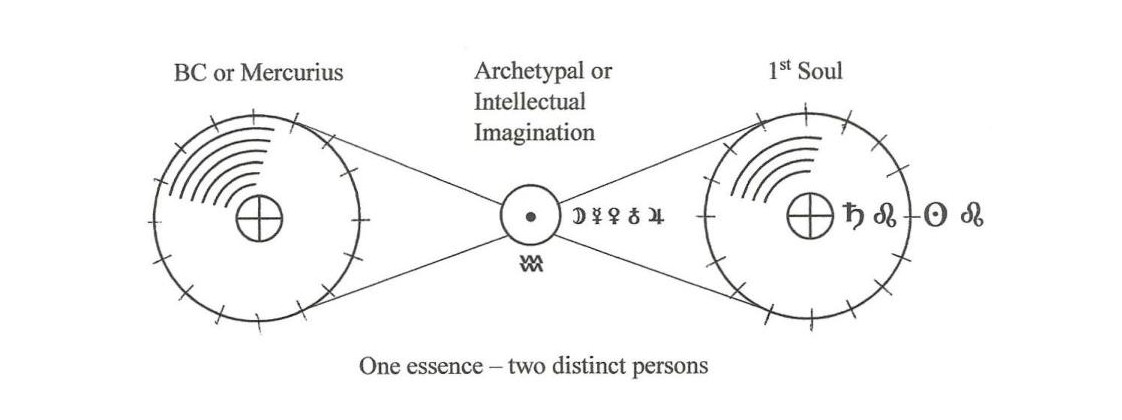
FIGURE 1982 0220-1. Bodhicitta, Imagination, 1st Soul; One Essence–Two Distinct Persons.
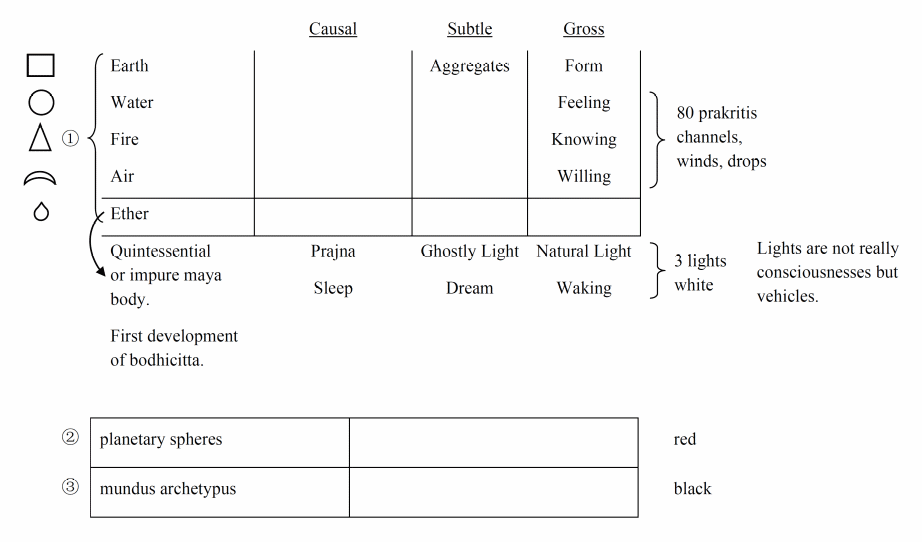
FIGURE 1982 0220-2-AB. Channels, Winds, Drops, Lights, and Elements in Tantra correlated with Twelfth House Levels, States of Consciousness, and Skandhas.
Other diagrams also referred to are not with this transcript version. [Transcriber note: [diagram] means the speaker is referencing a diagram as he or she is speaking. If someone is drawing or writing, with audible sounds of chalk on a blackboard, I indicate this by [drawing] or [writing].]
NOTES:
We have a partial transcript for this class, Scan File 1982 0220-09R17.PDF, with no AD edits. Partial transcript originally typed by CdA.
Feb. 20, 1982 was a regular Saturday AM class.
TRANSCRIBED Verbatim by IT 2021. In 2025, IT completes TOC, expands Subsubjects and Book List, adds new notes within transcript, adds two diagrams and references within transcript to these diagrams. Archival verbatim transcript – V12a.
AUDIO FILES: 1982 0220a, 1982 0220b. [Note: "Tape" and "Side" refer to original audio cassette tapes that were later digitized into .MP3 Audio Files.]
1982 02/20 at Wisdom's Goldenrod
Alchemy; Jung; Mysterium Coniunctionis
[Audio File 1982 0220a Begins]
AD: I'd like to mention one thing before we start, and that is that Saturday was a class devoted to Plotinus. And, if I had the freedom, I would say, not only to Plotinus but to the higher Jnana teachings or wisdom teachings. That would-- that would include the Easterners too.
EMD (simultaneously): Tony, we can't hear anything back here.
AD: I haven't got my energy yet. If you crank me up-- But we're--
EMD (simultaneously): I can hear you. (laughter)
AD (amidst laughter): Can't hear yet?
S (amidst laughter, faint): Crank you up. (student words)
AD: You mean I got to keep on yelling? (laughter) I want to utter one warning, alright. The Saturday class is a class that's devoted to Plotinus. I regard Plotinus as a Jnani, probably one of the greatest in the West that I know of. We have-- we have the correspondences in the East, we have many of the great teachers in the East too. But there is a distinction that I want you to keep always in mind. There is the highest teaching that these people represent, whether it's Shankara or Plotinus or Plato, and there is a teaching which is below that. It's the teaching that we're getting into now which is the more practical and the more de-- practical in a sense of trying to transmute everything into Mind. But, I don't want you to confuse levels, I want you to always keep that in the back of your mind. Most of the people that we will discuss, although great in their own way, are miniatures, you know, they're-- they're trifle-- trif-- trifling incidents in the course of wisdom. So, try to keep that in the back of your mind. The basic discussions that go on in the philosophy that we've been studying in Plotinus is the main problem. These are divisions within him. So if we go to someone like Jung, don't get carried away. Any of the Western Hermetics, don't get carried away, be cautious. Many of them have a little-- a little glimpse of the truth and they blow it out of all proportion. Anyone-- anyone who has had the experience of the descent of some kind of understanding tends to get inflated, so keep that in mind. So, we'll proceed now with self-knowledge--what he calls self-knowledge. And just keep in mind what Plotinus said self-knowledge was and see how utterly childish this is. Ok? You started chap-- you started the sixth section, Avery? Avery, [S simultaneously, faint: Yeah.] please begin.
AS: Yeah, we started it.
AD: Ok. You did the first--
AS (simultaneously): One at 702. Well we could go on, that would be-- [14½ second pause, flipping of pages] We didn't get past the two pages. We-- we read through some things up to about page 499. So we only [AD simultaneously: Well--] really read the first two or three pages.
AD: Let's just do with the second chapter, I mean the second paragraph.
AS: Well I could show you but I don't know if it's right.
AD: No, let's hear it, go.
AS: Ok, well, where he talks about--
C.G. Jung [CW 14, Mysterium Coniunctionis, "The Conjunction," pp. 497-498, paragraph 708, AS reading]: "[AS adds: The] Confrontation with the shadow produces at first a dead balance, a standstill… Everything becomes doubtful, which is why the alchemists called [AS reads: call] this stage nigredo… It is [AS reads: And it's] right that the magnum opus should begin at this point, [for] it is [indeed] a well-nigh unanswerable question how one is to confront reality in this torn and divided state."
[short pause]
AS: Uh, well--
AD: (Why don't you) [one word inaudible]
AS (simultaneously): I tried to draw a picture. Well, I tried to use the example we were doing [drawing] before, that the original state of e-- you're in this experience. At the-- the center of consciousness, the ego or the empirical standpoint, is one of being identified with certain of this wisdom which has been accumulated from the experience in the four elements but that a lot of it went into what-- a lot of this wisdom was contaminated as it were, or is projected. You don't realize that this wisdom which has been attained from this experience in the elements is really you, it's yours, so you project it. At some point enough of it is accrued as it were, and something happens where he has to begin-- whenever the center has gotten to a certain point, it's like it has to be broken through in order for there to be this [drawing] unio mentalis that we spoke about. So it seems that, on the one hand-- let's see if I could-- I'm (not sure I--) When he speaks about-- well-- we basically put the stage of the nigredo tentatively just prior-- it seemed then prior to what he calls the unio mentalis that this state had to take place, although now it seems like it might be afterwards.
AD: Well Avery if you were to, [AS: Let me try--] in a very--
AS: I'm not saying this.
AD: Alright, we'll just (walk) little by little. He speaks of a difference of potential. And, confron-- he says a confrontation with the shadow produces a kind of dead balance. Now, what I'm interested in is could we think of it in a practical way? I mean because at this level it's-- it's almost theoretical. [AS simultaneously: Well, I think-- I tried to--] Suppose, suppose you're confronted with-- suppose you're confronted with your [AS simultaneously, faint: --tried to--] shadow. [AS simultaneously: --do it practically.] How does this produce a potential?
AS: Well, I was thinking of it like, in terms of energy, just in terms of an energy gradient, normally the en-- you have certain-- what allows you to get along in the world, you make certain projections and you say oh this is good or bad. It's like the other end-- you know, when you once gave that example of the tube. The energy can go out as it were. But if you block up the other end of that tube, ok, if you confront those contents as it were as your own and not as pr-- something that's projected, then that creates a certain tension, [S, faint whisper: Yeah.] ok, and ultimately that build-up of tension, he seems to say, if that's forced-- if the energy is forced not to go out as you confront these contents, recognize them as part of yourself, then the energy is forced to seek a deeper level as it were. He-- you know, he goes into this. Psychologically he says at some point this tension forces the eruption from the unconscious. But, I was taking it as forcing eventually this-- what he calls the unconscious would be more like what we would call the unio mentalis.
AD: But suppose, suppose I was a person given constantly to negativity and I decided to try to put it to a halt, alright. Wouldn't that create a certain amount of tension?
AS: Yeah, uh-hm, well--
AD: And that would-- that would give me the-- the energy I'm seeking.
AS: Well if-- if you recapture the-- if you don't allow the energy to go into this negativity then it's possible that it could be reclaimed.
AD: But if I don't allow it to go into the negativity then there would be, you know, like a difference in potential. This difference in potential is-- provides me with the energy to go ahead, so to speak, and explore further. Whereas if I [AS assents] give-- if I give into my [AS assents] negativity, alright, then that energy is dissipated there.
AS (simultaneously): Then it gets dissipated. I think that's something like-- it-- yeah. In the picture that the energy is allowed to-- is-- flows out into the negativity or into these projections [one/two words inaudible]
AD (simultaneously): You follow the point here?
AS: This bottleneck.
AD (faint): Alright?
AH: So, is it-- isn't it that this energy is flowing without effort into negativity for a person-- you know, for the person's life. At some point--
AD: At some point you want to confront it.
AH: There's a conflict.
AD: Yeah.
AH: And that energy can't flow easily.
AD: Well, it can't flow easily 'cause you say it's not gonna flow that way.
AS (faint): Yeah.
AH (faint): And then presu-- [S simultaneously, faint: Right.] (precludes) a conflict, produces conflict. And [AD simultaneously: A--] then that conflict is going to--
AD (simultaneously): Well, if you want to put it that way but it would-- wouldn't it be better to say it produces energy.
AH: Yes, the conflicts results in a--
AD: Well, if it produces the energy that's what you want. Right? I mean instead of using the energy in dis-- or dissipating it by let's say certain attitudes, then that means you got some energy at your disposal to develop. If you do-- if you do understand this then you can understand how-- how we are constantly harming ourselves by dissipating this energy which instead of accumulating it, alright, we keep dissipating it. No sooner it comes in and we convert it into negativity. Right?
AS: It's habitual.
AD: Yeah, it's habitual, I want to-- the point I want to get at is I want to take this out of the stratosphere and just bring it down to where we need it.
AH (faint): Anthony could-- could you talk a little about what is meant by negativity now, that's--
AD: That what? (laughter, student words)
AH (faint): We all have-- you know, we all have an idea about what negativity (means), what negativity [couple words inaudible] what represents a negative attitude. But, I think there's something more fundamental.
AD: Well, you can-- you can expand this to include let's say immoral acts or any kind of behavior where the-- the shadow seems to have a-- more to-- to say than it should. Which by the way brings about the notion, then what is this darn shadow?
AS: What is the shadow, yes, that was-- that's the point (here/yeah).
AH: Well is it--
AD: Good. That gives me ten minutes by the time you come up with an answer. (laughter) Go ahead, what is it?
PD: Well, one place Jung says that--
S (simultaneously): People [couple words inaudible] shadow.
AD: What do you say!?
PD: Its roots go back into your instinctual nature in sym-- Symbolically it's often portrayed as a dragon.
AD: What do you say it is, Paul?
PD: I don't have an opinion. (laughter)
AS: Well, I don't-- well--
BS (faint): A (mass of/massive) [one/two words inaudible]
AS (simultaneously): I was try--
AD: You were-- you were putting it in the body, right?
S (simultaneously, faint): Better look, Paul.
PD: Yeah.
S (faint): Yeah.
AH: It's in some sense the life-- the life of the-- it's like the (sauric) life of the organism.
[noise, some laughter]
AD: Go ahead, Avery. What are you-- what-- what are you going to do about it?
AS: Well I basically would follow Andrew's line. See I was trying to think of it though as-- instead of in quite so negative way say well, guy-- the spark of the-- we spoke about the spark of the soul as immersed in this-- in the elements. So it's got to work with the elements for a while. I mean all the wisdom it-- it accumulates is going to be from these elements. But unfortunately since the experience is gained in the elements, that is, in the body, in that animal life, this wisdom is like contaminated, if you want to put it that way. Or, when you distill the wisdom or you gain these drops of experience, they're con--
AD: Remember the quotation from [AS simultaneously: They're contaminated with the elements.] Jung [one/two words inaudible] when the light comes into the body what happens?
AS: When the light comes into the body--
AD: The rational soul [AS simultaneously): It's like the tomb.] (comes into) the body, a shadow is produced.
AS: Yeah. [few inaudible BS words simultaneous with AS] The body throws the light-- I don't know [one word inaudible]
BS: The light of the elements [S simultaneously: Wait.] is what?
S (faint): Yeah.
VM: At the base--
AD (simultaneously): (I'm sorry?)
RC: In the Mead book or shadow of the rational soul casts on your--
AD: You remember that?
RC: Yeah.
AD: Say it out loud.
RC: He said that your-- you could find the irrational soul as the shadow of the rational soul cast on matter.
AS (very faint): Uh-hm.
S: Whatever that means.
S (faint): Yeah, what--
DB: Well--
S (faint): The shadow.
S: I mean it--
AD: That's the point. (bit of laughter)
DB: So, in what sense--
AD: Otherwise, otherwise you'll be thinking about it as some theory.
DB/S(?): What was it, I didn't hear the point.
S (very faint): Uh-hm.
S (faint): Try not to break.
AD: Randy, would you say it again?
RC: I think it was in the Mead book, that one on the subtle body. I think he's quoting Synesius. And Synesius says that the irrational soul is the shadow of the rational soul cast on matter. [Note: The Doctrine of the Subtle Body in Western Tradition by G.R.S. Mead, p. 60. "…the irrational soul, which is poetically said to be the shadow cast by the shining of the rational soul on the body (i.1.2)."]
AD: And so what--
S: That it's the real shadow.
S (faint whisper): No.
S (very faint): That's what it is.
AD: What would she mean by that?
AH: It's-- it can be-- it can be spoken of as a certain kind of entity.
AD: No, no, no, just point to something.
EM: Body. It's the body and its feeling.
AD: It's the shadow walking around, a shell.
DB: So then, what-- in what sense is that-- that shadow different from the ego or the personality?
AD: What sense--
DB: In-- in what sense is that shadow different from the ego or what's ordinarily understood as the personality?
AD: Let's leave those distinctions alone right now. I'm not after that. I'm after something very very practical and specific. I've always wondered what he meant by the shadow, he had-- had all these theoretical ideas.
PD: In fact, the shadow in Aion he speaks of as an aspect-- the lower aspect of the archetype of the Self, you know, his concept of Self, which represents the-- like I was saying, the instinctual roots of-- of the man going right back into his animal historicity. It's the low--
AD (simultaneously): And that's summed up here, right?
PD: Pardon?
AD: That's summed up right here.
PD: Well that-- that's accompanying the conscious position at all stages of its development, its historicity.
AD: That's what I'm pointing to.
PD/S(?): (I mean--)
AD: Some of us are lucky, we have bright shadows. Most of us have dark ones.
S: Randy, what do you call (the) [one word inaudible]
AD (simultaneously): We took the discussion right away and got it out of the words and brought it down to where we are.
AH: Anthony, the-- the notion of its darkness referring to the fact that it remains unconscious to the-- to the, like-- unconscious to the personality. Its dark side is the fact (that you) do not know.
AD: Well, I'm taking a different approach.
AH: I'm trying to-- I'm trying to s--
AD: I don't want to use that. That's-- that sounds so nice theoretically, I mean the words flow smoothly. I want to get a little more brutal. This is the shadow, right here.
AH: Yes, I understand--
AD: No you don't! If you walk away from it you won't understand it, you're too anxious to get away from that.
AH: I hear what you're saying--
AD (intensely): When the rational soul inhabits the body there's a shadow produced. Now what in the world could that shadow be? Am I going to look behind me or am I going to look at myself?
[short pause]
AH: So the confrontation with the shadow is confrontation with oneself.
AD: Well that's a good beginning. Read-- would you read some sections from that quotation now? Avery, please.
AS (simultaneously): The-- the paragraph?
AD (faint): Yeah.
AS: "Confron…"
S (simultaneously, very faint): [couple words inaudible] about the bright shadow?
AD (faint): What? Oh yes, there's some people that have a bright shadow.
S: Does that mean that their body is [one/two words inaudible]
AD (simultaneously): Well they in-- inherit genetically and the animal historicity better than the usual.
RC: You mean the-- the intelligence in the body is smarter than they are. (laughter)
AD (amidst laughter, faint): [couple words inaudible]
S (amidst laughter, very faint): [few words inaudible] (more laughter)
S (faint): Right, not close to [one/two words inaudible]
PD/S(?): Well, not most of us.
AD: So read-- read a little bit from it. I just like you to take these people and tear them down [one word inaudible] their operation.
AS: From that paragraph?
AD: Yeah, from that second paragraph now.
C.G. Jung [CW 14, Mysterium Coniunctionis, "The Conjunction," p. 497, paragraph 708, AS reading]: "Confrontation with the shadow produces at first a dead balance, a standstill that hampers moral decisions and makes…"
AD: I think it was just before that, the paragraph before about-- about the middle?
AS: Ok.
AD: Where he speaks about the potential.
AS: Uh--
AD: The difference in pote-- potential.
S: Yeah.
JfL/S(?): Well, what--
AS: "The opposites…"?
BS: "The shadow, as we know…"
AS: "The shadow…" Uh--
S (faint): Ok.
C.G. Jung [CW 14, Mysterium Coniunctionis, "The Conjunction," p. 497, paragraph 707, AS reading]: "The shadow, as we know, usually presents a fundamental contrast to the conscious personality. This contrast is the prerequisite for the difference of potential from which psychic energy arises. Without it, the necessary tension would be lacking. Where considerable psychic energy is at work, we must expect a corresponding tension and inner opposition. The opposites are necessarily of a characterological nature: the existence of a positive virtue implies victory over its opposite, the corresponding vice. Without its counterpart virtue would be pale, ineffective, and unreal. The extreme opposition of [the] shadow to consciousness is mitigated by complimentary and compensatory processes in the unconscious."
AD: Yeah, that's the passage I'm referring to more than the next passage, the next paragraph.
PD: Are you saying that's the normal, the-- in order for a conscious position to be active in-- in whatever its framework is, there has to be a-- a shadow to (exact--) to the conscious mind. Otherwise there would be no energy involved for the conscious framework.
AS: I'm not--
AD: Alright, if we keep going. So we think of the light in the body, or the reason-principles coming into the body, what could be a greater hindrance?
AS: You're saying other than the bodi-- the bodily inheritance.
AD (simultaneously): Than the body itself. And this is the shadow with all-- all its historicity.
AS: When you say the shadow it seemed still-- it seems like-- I (get) maybe it's the same thing.
AD: Go ahead.
AS: That, in the process of development of this light, I want to call it the second soul, since it is working through this body or through this vehicle, in its process of transformation certain traces or deposits are left in the body also. Or it has a certain-- the body itself has a certain karmic inheritance. And you're saying that that's-- the shadow part is the part that doesn't belong to the light as it were but the part that the light-- [AD simultaneously: Must work through.] the shadow that the light throws on the body, the vehicle.
AD (simultaneously): And must work through that.
AS: Yeah, but since it has to work through that, it's-- that shadow too is going to be-- could almost say developing along with the light. I mean, as-- as the light is developing, the shadow too must be-- or the body it-- the body or the vehicle that's aiding [AD simultaneously: So--] the light go through the development is also going through this.
AD (simultaneously): So if I follow, you're saying that in order for the light to manifest it has to evolve through those vehicles, and in the process evolves the vehicles.
AS: Right. In that process those vehicles will be evolved, but the shadow part is what he-- you're saying belongs to the vehicles, not [AD simultaneously: Uh-hm.] to the light, but is almost like a necessary accrual around the light. And at some point, it seems that you're saying, there's a recognition that that accrual is a shadow, is not the light. Or it has to be-- that has to be recognized.
AD: Ok, so--
AS: And that sets in this dark-- a kind of a dark stage because before, certain attitudes which were really bodily attitudes would now have to be--
LR (simultaneously): But Avery you're saying that the shadow evolves, aren't you kind of saying it becomes keener and smarter and sharper?
AD: It does.
AS: Yeah.
LR: (But/So that)--
AS: Sure.
LR: I mean it's a funny kind of evolution.
AS: Well yeah but--
LR: The further you get the more-- the more [AS: Well the--] acute your shadow becomes.
AS: But the problem is that prob-- its-- its needs are probably not met by the same things that your needs are met by. Right, I mean the-- the-- the goal of the-- No, that's not right, I didn't like it too.
PD: I think that-- I really didn't say that, Linda.
AS (simultaneously): But they may come into con--
AD: It's enough to say that that's true. That it will get just as subtle as you, [LR, faint: Right.] and will beat you at every-- at every change, every corner. Yes. That's enough.
AH: There's another idea in that passage that's just being discussed, (is there) any conscious point of view that-- especially so if it becomes a moral or spiritual one is meaningless unless it's-- unless it's opposed by an equal kind of energy in-- in terms of its opposite. Like what-- you say that shadow becomes keener and smarter. Well, every-- every conscious step has to be opposed in terms of energy by that shadow or else it wouldn't (mean) [one word inaudible] it's like what meaning would a-- would a moral decision have?
AD (simultaneously): Yeah, you're coming to the same conclusion that we all have. The road to hell is paved with good intentions.
AH: I'm trying to see the thing in its energic sense, that whatever-- whatever conscious perspective is enjoyed by way of an ascent out of this instinctive sphere has to be opposed by an equal kind of tension or energy in the unconscious or in the shadow. Or I mean what-- what would progress mean? It would be meaning-less unless it was opposed.
AD: Well I think we're getting the point. Yeah, Dave.
DB: I'm a-- I'm afraid I'm still not clear from what he's saying-- He continually contrasts the notion with-- of the shadow with what he speaks of as the conscious personality. Now maybe he means something more by that than I do but I don't understand why the-- the personality is taken to exclude the shadow, I mean it seems that if anything it's that which is going to block the-- block the understanding. I mean the personality is the-- the total of the historicity of the individual, and it's something we take up when you wake up in the morning and leave behind when you go to sleep. I'm not-- I mean I can understand it if we discuss that whole thermometer as the shadow relative to the light. But, to make a distinction within that, saying well some contents are the shadow and some contents aren't, some-- some contents are the ego or the conscious personality, I-- I don't really understand that.
RC: It seems that part of what would make a shadow (with that) part of the personality would be any-- the set of modes of behavior that seem to function relatively autonomously to the intentions of the personality, Paul, that they haven't been integrated and (actually) made part of something you could say this is me and I can turn it on or I can turn it down. That this would be more a set of-- set of moods, modes and behavior that come over you.
AH (faint): Compulsions [one word inaudible]
RC/S(?) (faint): Yeah.
DB: But--
S: Uh-hm, right.
PD (simultaneously): And I think the example that you worked with last week, Avery, where you put-- you say the lu-- the numinosity, the meanings are dispersed in the elements. And then the-- the conscious-- let's say the-- the light of the rational soul is identified with certain of those luminosities which represents the conscious personality, the conjoint of a certain-- certain of those possibilities and the light. But the rest of those luminosities in the unconscious or aspects of the total personality the light's not identified with.
DB: Right he's-- he seemed to--
PD: So-- but that total complex is the whole personality.
S (faint): Yeah.
AS: But I-- I think I saw David's--
DB: See, Paul, it seems like from a point of view of the development of that-- that light, see, any identification or-- or personality structure, whatever, would represent some kind of an obstacle to it.
AH (faint): What would be (considered an obstacle)?
AD: If you got that point, then you got the idea of the shadow.
DB: But, see the-- I understand that but I don't-- what I don't understand is Jung keeps saying that that takes place in opposition to the ego or the conscious personality. Seems like what you're saying is if ego-- what he calls the ego or the conscious personality is that shadow, I mean it-- you're taking a higher point of view than-- than what he seems to be willing to take. I'm just asking if that isn't so.
AD: Well I think if you carry out the implications of what he means by ego you'll find it to be precisely what we just spoke of. If you carry through with his implications, then the ego is going to be the dark shadow. But, if we don't reach up to that level right now and just try to understand that when that light or the rational soul is embodied, the-- there will be cast forth a projection from that embodied light and that projection which he-- we call the shadow, Synesius referred to before calls the shadow, is not something which is b-- vaporous and void and a vacuity and emptiness. It is the actual thing that you are working with here and now. And I'm just trying to bring it down to that gut level. And the reason I use the example of negativity or you can take any one of our attitudes which let's say are contrary to what we have understood in philosophy, if we take any one of those attitudes, we would immediately see that that is the shadow. And he is working full time. We are employing him constantly. And if we say we're employing him and we-- we realize that we're the ones that are working all these things out, then you won't have to go very far to look for your shadow. [student assents] As a matter of fact you wouldn't have to go anywhere. [student assents, faint] I'm-- I'm-- I'm (thinking--)
AS (simultaneously): Could have it right here and now.
AD: Huh?
AS: Could have it here, yeah.
S (simultaneously, faint): Uh-hm.
AD: No because, in the discussion people seem to think that the shadow is something extraneous, external or something out there. [AS simultaneously: Yeah. That--] I just want to bring it right home where their belly is, alright.
AS: No I guess what I was trying to do is more theoretical but, we did say that the first state there of that light is immersed in those four elements. And so it seems that the totality of what's accrued from these elements, the elemental part, is more or less what he's calling this shadow, that that's the-- that's the bodily life. And it ha-- it seems like it's-- for a while anyway it's inescapable because that's the beginnings at least of how that soul is going to gain some experience. But at some point it ha-- it's the--
S (very faint): Uh-hm.
AD: Alright in-- in this passage here where he speaks of, he says--
C.G. Jung [CW 14, Mysterium Coniunctionis, "The Conjunction," p. 498, paragraph 708, AD reading]: "These methods are of value only for increasing concentration and consolidating consciousness, [but] have [AD reads: having] no significance as regards effecting a synthesis of the personality…"
AS: Yeah, oh yeah.
AD: Alright.
AS: Interesting. Of course if you-- if you-- if you have the view that it is exactly that consciousness which is going to integrate the personality, then maybe there is a value to it. I mean I'm just trying to--
AD (simultaneously): Well, there's two traditions that I might mention in passing. One of them is the occult tradition in Western mysticism, where these people are concerned with, let's say, getting knowledge and using that knowledge, which means power. And you have the other tradition of Jung himself who believes that the synthesis can be brought about through active imagining, alright. Now, they will both criticize each other. The occult tradition, like for instance in the West, the occultists actually go in and for knowledge, I mean they're-- you might say they're tantrically orientated. They want knowledge for the purpose of using it. And, we might call that the occultist, alright. And then you have the psychologists who believe that the integration of the personality can be brought about by active imagination. You remember what his active imagination is, you engage a theme from dream, or you engage a fantasy and you confront that. And in the confrontation you bring to bear everything that you are and have a dialogue with this content which is coming from the unconscious. So you try to assimilate. And that's the way that the psychologist would go. Now Jung is of course blowing his own trumpet, he would say that this is the way to [AS assents] that integration or synthesis that he's seeking for. But I just want to bring the opposite point of view, that many of the occultists would say that it won't-- it won't work. There's a limit to it.
AS: Yeah.
AD: Alright. The next part I think you all know.
C.G. Jung [CW 14, Mysterium Coniunctionis, "The Conjunction," p. 498, paragraph 709, AD reading]: "[In general], meditation and contemplation have a bad reputation in the West."
S: Uh-hm. (bit of laughter)
[short pause]
AS: We just read it. We just read every time he said no we'd try to--
AD: Let's do 710. Would you read 710?
AS: Um--
C.G. Jung [CW 14, Mysterium Coniunctionis, "The Conjunction," pp. 498-499, paragraph 710, AS reading]: "When meditation is concerned with the objective products of the unconscious that reach consciousness spontaneously, it unites the conscious with contents that proceed not from a conscious causal chain but from an essentially unconscious process. We cannot know what the unconscious psyche is, otherwise it would be conscious. We can only conjecture its existence, though there are good enough grounds for this. Part of the unconscious contents is projected, but the projection as such is not recognized. Meditation or critical introspection and objective investigation of the object are needed [in order] to establish the existence of projections. If the individual is to take stock of himself it is essential that his projections should be recognized, because they falsify the nature of the object and besides this [AS adds: they] contain items which belong to his own personality and should be integrated with it. This is one of the most important phases in the wearisome process of self-knowledge. And since projections involve one in an inadmissible way in externalities, Dorn rightly recommends an almost ascetic attitude to the world, so [that] the soul may be freed from its involvement in the world of the body. Here only the"spirit" can help it, that is, the drive for knowledge of the self, on a plane beyond all the illusion and bemusement caused by projection."
[15¼ second pause]
AD: Well you want to talk about this?
S (faint): Uh-hm.
AD: I think most of [AS simultaneously: Some--] you are very well aware of that wearisome [AS simultaneously: The wearisome process.] process of self-knowledge. Some people get to it in six months, some in a year, some in five years, some in ten years. But sooner or later it comes. It becomes very real.
AS: The wearisomeness or the--
AD: Shows up.
CDA: Oh you mean it might take up to six months for it to show up.
AD: Yeah, some people-- (laughter) some people it shows up within a week. They figure self-knowledge is like, you know, something you can get to in a very short time.
AH: As the-- as the ego [one word inaudible] confronts these contents of the unconscious, you know, first through projection and-- the notion is that there's an attempt made to make what is unconscious conscious. It has the enlargement of-- Is that the enlargement of ego?
AD: Supposedly there's supposed to be an enlargement of the ego as it includes or assimilates these contents or meanings which are derived, you know, and come from our world of experience, supposedly.
AS: I-- I s--
AH (simultaneously): Ok, so if it's enlargement of the ego, what is the drive for self-knowledge? Certainly not the ego, it's something--
AD: I would be inclined to say it's perhaps a hidden guide.
AH: A hidden guide?
AD: Spiritual guide. You could refer to it as some of the degrees in your chart, you know, and that makes it very-- very soon you figure you got nothing else to worry about. But if later on you pictorialize one of those degrees as a god, alright, or something of that level, you know, then it would be one of the gods or a few of them that are behind that urge to find this self-knowledge.
AH: You can't speak of the ego as being the motive force towards self-knowledge.
AD: Well try it.
S (very faint): Right.
AS: Didn't we say it had like the reverse-- the reverse goal, to block-- to block self-knowledge? (AS laughing)
AD: Well, that's what PB said--function of the ego is to [AS simultaneously: To block (one/two words inaudible)] block out the light.
AS: But the-- Andrew, you know, along the lines of what you s-- the-- well-- there does seem to be something here though, he s-- I mean when he says that it is important to withdraw these projections, I-- couldn't-- couldn't you interpret it like on a slightly higher level if you say that these degrees or something is guiding us to attain a certain amount of wisdom from this experience. Now, some of the wisdom we a-- so-- so to speak obtain doesn't become really available to us. But, as long as we keep projecting-- well, making these projections, then we're not really fully assimilating this wisdom that we should be gaining from the experience and maybe that's part of what he's saying there. Rather than saying it goes to build up the ego, which it certainly would become conscious but--
AD (simultaneously): Well build up the ego--
AS: But that's a-- [AD simultaneously: I mean--] that's a funny thing to say.
AD: Yeah, you have to understand it in the right way, it's getting attenuated.
AS: That's a-- but that's what I'm trying to say, that maybe it's wrong to say building up the ego because if--
AD: Well--
AS: These pro-- I'm saying if these projections are withdrawn, it seems you're saying there's more of the wisdom that's been distilled is available. And that's not really an ego so much as it's-- eventually I-- I was looking at it as going to eventually form this quintessential body. [S: But--] That the wis-- that wisdom really, the essence of it, is really of the nature of this quintessence. Eventually it's going to be this organized system of meaning or understanding. And in that sense it's not so much the dark side. It may be contaminated with all the bodily affects and so on but there is something in those projections which is a necessary wisdom. But-- that's part of--
AD: I'm sorry, I lost you. There's a [AS simultaneously: I'm just trying to say--] projection in the wisdom-- there's a wisdom in the projections(--/?)
AS (simultaneously): No, no. I'm just trying to-- when he says that--
C.G. Jung [CW 14, Mysterium Coniunctionis, "The Conjunction," p. 499, paragraph 710, AS reading]: "…it [is] essential [that] his projections should be recognized, because they [AS adds: can] falsify the [nature of the] object and [AS reads: but] besides this [contain] [AS adds: certain] items which belong to his own personality and should be integrated with it."
S: Well--
AD: Go on.
AS: Well, I was just trying to see it in the light of this process of distilling this certain understanding. Say it's guided by the degrees. Ok. Something-- some quintessence, some understanding is continually being distilled from his experience. But, it isn't-- it isn't recognized as his own understanding or it isn't recognized as part of his own personality, it gets projected, projected into the object or projected onto the object. But if these projections could be withdrawn then some of that wisdom might become more available.
AH: See, the notion, Avery, that it might become--
AS (simultaneously): But maybe I'm not--
AH (faint): "Might become" is like no guarantee that experience will result in knowledge. It seems that there is this third thing, quintessential body or-- like a third point of view that's not the ego that makes decisions about knowledge. Like, if it's not the ego that assimilates the knowledge, or if it's not the ego that-- that is about the business of knowledge, then it seems it has to be third principle. Because, you know, experience-- experience can result in no knowledge whatsoever. The choice of whether or not an experience becomes a-- a way toward knowledge, I don't know if that's decision of the ego or--
AD: Well couldn't we leave the ego in this transitional stage, you know, in a stage of process, and bracket it or put it in (parenthesis/parentheses) and speak about the ego, so to speak, as assimilating certain contents from the unconscious and later on we could try to understand what's happening with the ego. Right now I think-- I think over here what he's trying to get at is that, some extent, there has to be a withdrawal of projections from the world so the world can be seen as it is and not as we fancy it to be. And then that makes it possible for us to understand what meanings or significances there may be in events and situations or relationships.
AS: Yeah, can I--
AH (simultaneously, faint): Anthony, my question has to do which was a possibility of knowledge, and how that knowledge actually becomes available.
PD: But, that's kind of a very theoretical question, Andrew, 'cause there's knowledge there all the time, I mean, what do you mean, a possibility of knowledge?
AH (faint): [couple words inaudible] (quality) of the experiences of-- of doing something, you know, for years and years and not understanding it and suddenly there is this kind of understanding.
PD: Ok.
AH (faint): (Ok?)
AD: So at one and the same time there could be a withdrawal of the projection which made it possible for you to see. There's no contradiction in a withdrawal of projection and the realization of what it-- what that experience means. As a matter of fact it usually follows that procedure. You don't see something because you've been superimposing on it something that you wanted to be there which wasn't there. And so you can go on doing it for a long time.
PD: And that's where he says--
C.G. Jung [CW 14, Mysterium Coniunctionis, "The Conjunction," p. 499, paragraph 710, PD reading]: "Meditation or critical introspection and objective investigation of the object are needed…"
PD: You're not going to get insights into the meaning of your experience if you're not working at it through meditation and through investigating experience.
S (very faint): Go ahead.
S (faint): Well, excuse me.
DB: Yeah but, with regard to this projection, would that [tape break] being a certain vitality of-- of the-- of the soul which is becoming dissociated from it?
AD: Which what?
DB: Has become dissociated.
AD: Associated?
DB: Disassociated.
AD: Well that vitality of the soul first has to flow through the body and get infested with the potentialities from experience which the body contains, [DB: Ok.] and which consequently is projected onto the situation or event.
DB: So then the projection is due to two things. On the one hand you have the vitality of the soul, on the other hand you have a particular association of that soul with these contents in the body and that this association which causes the-- the-- the vitality to be projected on some other person or--
AD: Yeah. So that's why there's need for observation and investigation into the nature of things so that you could at least be aware of the projections that are going on before there is any into-- any insight or understanding of that significant meaning. [short pause] Again I'd like to say, "Here only the"spirit" can help it," spirit here I think shouldn't be taken-- it can be taken literally. I mean there might actually be a spirit guide in the background helping you.
PD: You know, the notion of daimon?
AD: Well, you could call it that, you can call it that.
AH (faint): (Yes Anthony.)
S (simultaneously): (Does/Is) that-- (does/is) that have to do [AH simultaneously, faint: I guess that was my--] maybe with the connection to the first soul? Is that connected up there or the Overself or--
EMD: Can't hear back here.
AD: It would have to do with an actual guardian spirit that works in that realm, you know, that there's all kinds of entities, the way you take care of your children, supposedly there's spirits who help and guide us, try to be heard, you know.
S: Or just--
AD: Actual entities.
S: I-- I know what you're saying but--
(Side 1 of original cassette tape digitized as 1982 0220a Ends; Side 2 Begins)
AD: Alright. Shall we go on, next paragraph?
AS (simultaneously): Yeah. 711?
BS (faint): Anthony, I'd be a-- a little bit-- a little curious.
AS (simultaneously): Lucky paragraph.
AD: Go ahead.
BS (faint): I'd be a little curious then. At least in this context that we're speaking of, let's say if we project onto a-- "a real world" in terms of superimposition. But something in me says that let's say this projection is withdrawn and you realize that it's coming from you, that this would be a form-- some form of self-knowledge, [AD: Yes.] except that we're calling that the ego. Or maybe we're not.
PD: I think the next sentence clarifies something of that 'cause he's saying that knowledge that we're speaking of there isn't the ego, is his notion of the Self and in fact the image of God in man is what that knowledge is pointing to.
BS: Well it will just seem, not-- yeah, ok. But, my thought was that even this would be somewhat contaminated. But like I don't mean contaminated, I just mean-- well let's say not a clear light.
AD: Not clear. Is that what you said?
BS: That light, when it's--
AD: Come on Bert.
BS: The withdrawal-- the withdrawal of the projection [AD: Yeah.] into "the Self" or the ego or (some--)
AD (simultaneously): Well let's just say the withdrawal of the projection.
BS: Ok.
BS: What is the result of that?
AD: Greater clarity. Let me-- let me try this way. Perhaps this is something you've noticed. If you ever have been asked to read someone's chart, after the third or fourth time you begin to see that you're reading them pretty much the same, all of them. And if you inquire further, alright, you go into your own chart and you see you're projecting something from your own chart constantly onto the other people. And you're interpreting according to some need that you have. Isn't that right Timothy? (laughter) It takes a little time to break through and say "But I'm not-- I'm not understanding his chart. I'm reading my understanding into his personality and--" In other words I'm get-- I'm reflecting back what constitutes me. Whereas what's required here is first to see through that projection, to see that you don't project it onto the other person; and if you can do that, then you get some insight into the way that personality is operating.
BS: Ok.
AD: That's a withdrawal of a projection and an insight into what the other person is like.
BS: If the other person and yourself are like-- you mean in terms of your personality.
AD: No I-- I think it would be wider than in terms of personality, it would be in terms of understanding. One minute Dave, one minute.
S (faint): Ok.
BS: This understanding would supersede or transcend the personality of both.
AD: Well let's-- yes, yes.
S (very faint): Uh-hm.
BS: And I can see another personality.
AD: You could see that person objectively.
BS: But what do you mean by see them objectively?
AD: What constitutes-- well there will be levels of meaning to that. [BS assents] But we would say that the most immediate one would be what psychically constitutes that person to be what he is and not anything else. If you can see that, you also accept him too. If you don't accept him it's usually a sign that you haven't seen that.
BS: On this level, are you speaking of the level of the other person, let's say their personality and so on?
AD: Yeah, yeah.
BS: Their empirical status.
AD: Yeah.
BS: Psychological.
AD: Yeah! Just the way Wang Yang-ming said: We learn our transcendental lessons in the empirical world. Regardless of how humble the origin, that's where we're going to learn. You're not going to get an insight into the twin nature of this person, alright, through any other method. You start where you really are. And it doesn't mean you'll always get it or that the conditions will always permit that.
BS: And to that extent you've transcended all the-- seen your own personality? I suppose. That--
AD (simultaneously): Well we-- we've postulated that to some extent you have to be freed from the burden of your personality constantly projecting onto what's out there. Because if your personality's always projecting let's say its-- its past onto what's right in front of it, there will be this curious mixture of an objective reality with subjective illusion. And until there is a withdrawal-- some withdrawal of your own subjective fantasies, you're not going to see that, that-- that objective situation. Now we're saying that there are degrees to that too. We don't see into the bottom of the well all at once, but we have to train our-- our sight to see in the dark.
JfL: As an analogy--
BS/S(?) (simultaneously): (Slow down./So now--)
JfL: As an analogy it almost seems like the reason-principles that are projected on the body have to be picked out. It's like literally taking them right out of the muck and mire, which is I thought what Avery was getting to. That the withdrawal of those projections is actually taking the reason-principles out of the body right there.
AS: No I think he was saying the opposite though, that the projections themselves are what's preventing the reason-principles from being known [S: Well--] as they are.
AD: Because they're operating from within. Yeah, [AS: Oh yes.] if-- if [S simultaneously: No.] you have-- [AS: Same thing.] [S simultaneously, faint: Yeah.] if we could take a clumsy example, let's say you've associated some novel with some piece of music, alright, very intensely. Then later on you would see when you look back that you appreciated neither one nor the other because there was this constant interference or a very strong association. So if you're reading an-- this poem or this novel, this music would flow back into you and you don't get the novel per se. And if you're listening to the music then reminiscences of the poem come back into your mind and you don't hear the music per se. Alright, that kind of contamination is constantly going on. Anyone who acts-- who operates in these professions, like psychology, astrology or-- will see that very (shortly/certainly), I mean if he has any awareness, that this is always going on. And this constant projection is something that has to be dealt with and recognized in oneself before there could be a real objective understanding.
We see that for instance when we were studying some books. The-- the amount of material that a word can carry, you know, psychologically be associated or, if we can-- we can say the Rorschach that's going on is tremendous. We see that all the time. Our basic arguments are basically interp-- let's say, you say I'm misinterpreting and I say you're misinterpreting and then when we really get down to it we're both misinterpreting because we've got these words loaded with a psych-- psychological meanings that they never were meant to carry. So what does the word 'God' mean? You ask a hundred people I'm positive you'll get a hundred definitions. Alright, let's-- let's continue.
This is only the beginning of self-knowledge, this isn't even self-knowledge. This is self-ignorance. (laughter) I mean self-knowledge is talking about the identity with the heavenly twin. That's self-knowledge. These are all the things on the way that we have to get rid of to-- to begin to know who we are. So, again, I-- I ask you to keep in mind what we said, there's self-knowledge according to Jung and to many of the occultists, and there's self-knowledge according to the Sages. And I have found them to be quite different. Let's continue.
AS: 711?
AD: Yeah.
C.G. Jung [CW 14, Mysterium Coniunctionis, "The Conjunction," p. 499, paragraph 711, AS reading]: "The unio mentalis, then, in psychological as well as [in] alchemical language, means knowledge of oneself. In contradistinction to the modern prejudice that self-knowledge is nothing but a knowledge of the ego, the alchemists regarded the self as a substance incommensurable with the ego, hidden in the body, and identical with the image of God."
AD: If-- I think if you use the word 'soul' there, you would be much better off. If you think of the soul in the Intellectual realm-- Remember this fairytale we had about the Gemini twins? [Note: See FIGURE 1982 0220-1. This diagram is not from this class but is used as stand-in to help follow along.] Alright. If you think of the immortal, the-- the one in the Intellectual-Principle, if you think of that as imprinting on its offspring an image of itself, that would be the image of God in-- in that, whatever-- whatever you want to call it, the bodhicitta, the quintessential, whatever you want to call it. Alright then.
C.G. Jung [CW 14, Mysterium Coniunctionis, "The Conjunction," p. 499, paragraph 711, AS reading]: "[AS adds: And] This view [fully] accords with the Indian idea of purusha-atman."
AD: I thought I would find an explanation of that but he goes into a Chinese footnote.
S: (Mm.)
S: Uh-hm.
S: Uh-hm. (bit of laughter) That's-- (laughter)
S (amidst laughter): Tim--
AS (amidst laughter): Yeah, isn't that funny? (more laughter) "As in Chinese alchemy…" (AS laughs a bit)
AD: I don't think Jung drank tea-- coffee, did he? (laughter)
AS: He free-associated too much. (laughter) [S simultaneously: Not really.] He must have drank peppermint tea or something, I don't know. You-- you want to go on with the paragraph or the footnote?
AD (simultaneously): Yeah, please read the paragraph.
C.G. Jung [CW 14, Mysterium Coniunctionis, "The Conjunction," p. 499, paragraph 711, AS reading]: "The psychic preparation of the magisterium as described by Dorn is therefore an attempt, uninfluenced by the East, to bring about a union of opposites in accordance with the great Eastern philosophies…"
AS: But uninfluenced by these.
AS/S(?): It could be accordance with the West.
C.G. Jung [CW 14, Mysterium Coniunctionis, "The Conjunction," p. 499, paragraph 711, AS reading]: "…and to establish for this purpose a principle freed from the opposites and similar to the atman or tao. Dorn called [AS reads: calls] this the substantia coelistis, which today we would describe as a transcendental principle. This"unum" is [nirdvandva] (free from the opposites), like the atman [AS reads: atma] [AS adds: or the] (self)."
AD: I don't know, you discuss that, I can't. Go ahead, Avery.
AS: Well I--
AD: See if you can [AS simultaneously: I'm--] aggravate them. (laughter)
S (amidst laughter): Go ahead (and/then) (talk).
AS: Well I think we-- we made this point about the image of God that you just mentioned, by God if we say the higher soul. Although I don't-- I mean we said that imprinted in-- on the bodhicitta is this image of the higher soul, or the bodhicitta itself is a fragment of the higher soul. But-- but I get a little confused because they says he re--
C.G. Jung [CW 14, Mysterium Coniunctionis, "The Conjunction," p. 499, paragraph 711, AS reading]: "…the alchemists regarded the self as a substance incommensurable with the ego, hidden in the body, and identical with the image of God."
AS: It seems that would be the bodhicitta or that spark, not the fragment, ok, but-- I don't see why that view fully accords with the Indian idea of the purusha-atma. I don't--
AD: Unless by purusha-atman they mean the--
AS: The jiva.
AD: Purusha would be equivalent to the bodhicitta and the Atma would be the Intellectual soul.
AS (simultaneously): Yeah. Unless he means something like Jivatma. [one/two words inaudible] that way(,) like that. But that's ok. And then it--
C.G. Jung [CW 14, Mysterium Coniunctionis, "The Conjunction," p. 499, paragraph 711, AS reading]: "…to establish for this purpose a principle [AS emphasizes next word] freed from the opposites and similar to [the] atman [AS reads: atma] or tao."
LR: Wouldn't that be the quintessential body, Avery?
AS: I don't know.
LR: I mean wouldn't it--
AS: Whatever quintessential (would mean).
LR: Well, either one it seems.
AD: Read the passage again, Linda, read the passage that you're referring to.
C.G. Jung [CW 14, Mysterium Coniunctionis, "The Conjunction," p. 499, paragraph 711, LR reading]: "The psychic preparation of the magisterium…is [therefore] an attempt…to bring about a union of opposites…and to establish for this purpose a principle freed from the opposites…"
LR: And, [AS: Yeah.] (in/from) the way we've been talking with the person-- projections going in and [one word inaudible] or fusing with the elemental stuff, it's only through a withdrawal or retraction from that elemental stuff that one can then begin to take the reigns of thoughts and I thought that's what we were calling that body freed from total subjection (through the objective), is what we're calling (empty or) maya body or the beginning of the body of reason, something like that. And that would be the beginning of the process, (I don't know), self-knowledge. All the actual projections are with the entity.
S (faint): Yeah.
PD: You know, I was thinking of that passage I think along the same lines as Linda, if you-- instead of saying the-- the Intellectual-Principle here, say this image of God is like the-- the North Node or the Dragon's Head. And-- 'cause he was just speaking about the shadow and-- and the first conjunction, and the South Node as being the Dra-- Dragon's Tail or-- the Dragon's Tail, which represents the historicity of the lower personality, then we're speaking of a distillation at a much lower level than the-- the soul in Nous. We're speaking of forming that--
LR: Well he's speaking about the unio mentalis, [PD: Yeah.] and that's what we were calling the unio mentalis when the projections were actually withdrawn.
PD (simultaneously): Right, this is-- this is coming up from the elements to the quintessential body rather than at the level of Nous or [LR/S(?) assents, faint] the soul in Nous.
[short pause]
AH: Well Avery, in the context of--
S (faint): Yeah.
AS (simultaneously): Well, same-- [S, faint: Well--] same-- along [AH simultaneously: Yes.] the same lines? Ok.
AH: I'd just like to get a hold of fundamental grasp of this notion. Wouldn't the union of the opposites result in some sort of third point of view? Is that-- I mean just logically the way this passage is--
AS (faint): Uh-hm.
S (very faint): Yeah.
AH: There's a-- there's opposition, and because of it a possibility for a third point of view emerges, or a third thing out of the opposites?
AS: I think the third view or the uni-- the unio mentalis I think referred to that position, that point of view which we equated with the quintessential body but some kind of experience of this unio mentalis which would unite-- which is equivalent to uniting the opposites, in other words, the opposite being that between-- well between what?
PD: Between the elements, the lower-- he's not speaking about metaphysical principles that are opposite or opposed but, you know, I think in the elemental level.
AH: But what are those opposites, I-- I missed your point, Paul, and Linda's point. What would be the opposition, between what?
PD: Well, just going back to the astrological motif that I was coming from, the Head and Tail, the Head represents the goal, the guiding principle in your development, and the Tail represents the historicity and the past. So right there is a fundamental built-in en-- source of energy or tension which is the opposite(s) of-- that I'm saying he's referring to here.
AH: Could you translate that into psychological language the shadow?
PD: The shadow's the Tail.
AH (faint): Tail.
PD: And the Head represents the direction towards the higher Self. And the quintessential body is the-- is what's being distilled out of that.
AH (faint): Resolution of those opposites.
PD: The forming a-- a-- a maya body or a quintessential body.
AH: The notion being there could be no solution or resolution within the opposites.
S (faint, possibly part of background): Thank you.
S (faint): Uh-hm.
BS (faint): (And/Now) here's the solution.
S (very faint): Yeah.
PD: Yeah, (on/I'm)-- I mean there's-- the point is I think to try to-- to form a-- a purer vehicle, you know, one that's not centered in the bodily consciousness.
AD: Alright, let me take-- let me take you back.
C.G. Jung [CW 14, Mysterium Coniunctionis, "The Conjunction," p. 499, paragraph 711, AD reading]: "…the alchemists regarded the self as a substance incommensurable with the ego, hidden in the body, [and] identical with the image of God."
AD: Now we're saying that this self would correspond to something like the bodhicitta. Ok? And this is incommensurable with the ego. I mean there's no-- there's no symmetrical relationship between the ego and the bodhicitta. The ego, so to speak, perishes at the end of a life, alright, whereas the b-- bodhicitta goes on indefinitely and eternally. We said it was a radiation. It is the purusha. And this is hidden in the body and it's identical with the image of God. So they're saying that within-- within this organized body, alright, that there is hidden within it this bodhicitta and that it is this here that they say is incommensurable or way beyond anything that the ego could imagine. Jung's notion of the Self would be the totality of all possible psychic functioning. The totality. So that would be like combining 360 degrees in the infinite ways that it can operate. And that will be equivalent to what he's calling a Self. Go ahead.
AH (faint): Question. Self is incommensurable with the ego, but it's not incommensurable with the body (though).
AD: It's incommensurable with the body too. That body will perish, there'll be another one and there'll be a third and a fourth and go on and on.
AH (faint): Ok.
AD: The purusha-atma theory that he's talking about is the same thing as I refer to as the fairytale, the Gemini fairytale.
AH (faint): Isn't that passage about-- what does he say the relationship of that is to the body, it's different than the relationship to the Self.
AS: No I think the rela-- the bo-- the body is commensurable with the ego, it's very commensurable with it. But those two, the body or the ego or the shadow or any of those are incommensurable with the light of the soul, with the purusha or the bodhicitta. [AH, faint: Yeah but he's trying to say that--] Because they're t-- they're totally-- I mean as long as we're retaining this dualistic frame anyway they're totally opposed, they're totally different. So let's not say opposed.
AH (simultaneously, faint): Well I-- I'm trying to see what the opposition is, Avery, the opposition is not between the Self and the body and the ego.
AD: Well, let's wait for the opposition, [AS simultaneously: Oh that's--] we're doing this a little at a time, ok? We got that part clear with the Indian idea of the atma-purusha. Alright, the next sentence--
C.G. Jung [CW 14, Mysterium Coniunctionis, "The Conjunction," p. 499, paragraph 711, AD reading]: "The psychic preparation of the magisterium…is therefore an attempt…to bring about a union of [AD adds: the] opposites in accordance with the great Eastern philosophies [AD reads: philosophy]…"
AD: Now what is the union of the opposites here? What is he referring to? What opposites is he referring to here?
PD: Generally his context would be the-- I mean the elements in alchemy, they s-- the rotunda. But he doesn't say, I don't know.
AH: (I/I'd) say the body and the ego.
LR (faint): No, [RG simultaneously: No, (Lou).] that's not opposite.
AS: They're not-- (AS laughing, some laughter) they're not exactly opposite(s).
LR/S(?) (faint): Those aren't opposites though.
AD (simultaneously): Yeah?
RG: Yin and yang given his [S simultaneously: Both.] Chinese pref-- from his footnote here you would say.
AS: Yeah but--
CDA: Come on! (CDA laughs)
DB (faint): In some sense [AS simultaneously: Yeah.] (is it) the body which the-- the light of the soul is identified with as opposed to those contents with souls or which are not identified with the body?
AD: Alright, let me read again.
C.G. Jung [CW 14, Mysterium Coniunctionis, "The Conjunction," p. 499, paragraph 711, AD reading]: "[The] psychic preparation of the magisterium [as] described by Dorn is…to bring about a union of opposites in accordance with the great Eastern philosophies, and to establish for this purpose a principle freed from the opposites and similar to the atman…"
AS: I-- I [S simultaneously, faint: (No doubt.)] think he's speaking of the original condition is that the psyche is disjointed as it were, and that the-- he's-- he's talking about the unified mentality which I think would be the quintessential body. And that's an attempt, the magisterium would be similar to this quintessence which he's distilled or extracted and that is similar to the atma. I don't-- I don't think he's saying that-- well I don't know.
AD: Alright, stay there.
AS: And I don't think he's yet getting to the notion of the atma.
AD (simultaneously): Stay there, stay there.
C.G. Jung [CW 14, Mysterium Coniunctionis, "The Conjunction," p. 499, paragraph 711, AD reading]: "Dorn called this the substantia coelistis…"
AD: The [AS simultaneously: Yeah.] substantial, the heavenly body.
AS: Heavenly body or-- yeah, what we call the quintessential body.
C.G. Jung [CW 14, Mysterium Coniunctionis, "The Conjunction," p. 499, paragraph 711, AD reading]: "…which today we would describe as a transcendental principle. …[AD adds: which is] (free from the opposites)…"
S (faint): Uh-hm, uh-hm.
AD (simultaneously): Now, go over what you just said.
AS: Well, in-- in the state of the men-- mind or mentality as caught up with the bodily experience, there's not-- there is always these constant oppositions going on. But, what the aim is, the first aim it seems or that first conjunction is to bring about a state at least of a unified mind, the unified mentality which he calls a quintessential body. (And/Now) this isn't atman yet at all.
AD: No.
AS: I mean as a-- but it is-- it would be a state wherein he wouldn't have to go through all his experience in a state of-- well, theoretical, but he wouldn't have to have-- go-- he could gain experience without having to project part of his personality as an other and experience all these things as un-unified. There would be a certain unification of opposites. For example we've talked about those-- even the degrees, you know, the opposition of degrees where, you know, one part you'd look at as-- you take as subjective and the other part you project as objective. Supposedly from the point of view-- if you had this quintessential point of view, you wouldn't have to see such an opposition in your experience, you'd see that the apparent subject and the apparent object weren't so disjointed as-- as they were--
AD: Avery, if you put up the diagram we worked with the other night now.
AS: --to the single point of view.
AD (simultaneously): Because now I think you would see the way there's great convergence taking place in our studies. And whether poor Vic is struggling with the theories in physics or we study-- or we-- we're struggling with the theories in alchemy--
AS: [couple words inaudible] [drawing/writing] I was trying to use this one. And then the quintessential one was-- You know, where he had the-- this one like-- and then the planets, and then finally [short pause while drawing/writing] the-- the inerratic.
AD: Ask questions on this if you want, it's a little complex so most-- most people are no longer interested in Buddhism. They found it wearisome. (bit of laughter)
[AS drawing/writing]
S (faint): Uh-hm.
S (faint): Uh-hm.
S (very faint): Yeah put a little [one word inaudible]
AS: [couple/three words inaudible]
S (very faint): Yeah, uh-hm.
CDA (faint): I have a question.
AS: Oh, yeah.
AD (simultaneously): Well, do you-- [AS simultaneously, faint: (Go on) (one word inaudible)] you better pull this in. You better-- you better pull this in.
AS (simultaneously): Ok, let me pull it in now for quality.
AD: And I'll talk to you, you just make-- This here would represent-- [drawing/writing] this would represent, let's say, n+1 bodies, ok?
S (faint): Oh God.
S: Wow. (laughter)
VM: N is an integer [couple words inaudible]
AD (simultaneously): I mean, that's his-- [S: (Ho-ho.)] is easy. (laughter) It's easy. (AD laughing)
AS: Oh I-- I didn't think that was what you were laughing at, I thought you were laughing at that that had come all the way down now into the-- Remember that thing with the n+1 uni-- oh well. (bit of laughter)
AD: Well--
TS (very faint): Only [one word inaudible]
[Note: See FIGURE 1982 0220-2-AB for the following. This diagram is not from this class but is used as a stand-in to help follow along. The actual diagram used might differ in some details but the general idea is the same.]
AD: Remember we spoke about three aspects to everything--salt, sulphur, mercury. We-- this is the realm of the elements [diagram], ok. [drawing/writing] This is what you know. This part you're familiar with, so we can say wakeful consciousness. And the other term that they used was natural light. The Westerners use the term 'natural light'. Ok. This was the realm that they refer to like dream consciousness [diagram]. And they call this the ghostly light. [writing] And this realm here was like sleep consciousness or prajna [diagram], and they refer to this as divine light. [writing] Now if you operating this realm here [diagram], you would have to use wakeful consciousness; if you operate in this realm here [diagram], dream consciousness; and if you operate in this realm here [diagram], prajna consciousness. So like for instance, to be able to see this realm here [diagram] you would have to operate like in meditation when you're disassociated from the body, you're identified with the subtle realm. The kind of consciousness that accompanies that is what they call taijasa consciousness or dream consciousness. Ok? Now the point-- I think the point that we're trying to get to is something like this. This represents n+1 bodies [diagram] from which there's going to be distilled the quintessential body. So if you think of all the experiences in a given lifetime, the result of that is some sort of knowledge, some sort of understanding. And it builds up this body here [quintessential body] so, if you could think of-- I guess you could think of it in that way, that ultimately this body gets fulfilled or gets fully manifested.
AS: It was like-- I-- the-- well-- like the Scholastic notion, they said this poten-- the acquired intellect eventually reaches a point where it like drops its he-- like, you know, it's ripened and it becomes a-- they say it becomes an intelligible. And the acquired intellect is--
AD (simultaneously): Alright, so we spoke about this here as the physical development [diagram] that takes-- takes place on the physical plane. If you think of the evolution that the bodhicitta went through as it evolved in the amoeba all the way up to human existence, now evolution can't proceed further, at least on a physical level, alright, it proceeds on a mental level. So that means that this is what's going to be built up, this body here [diagram] gets built up. And this would be equivalent to what I think he's suggesting here, [AS: Yeah.] he's calling the heavenly substance.
AS: Yeah, where he said reconciliation--
LD (simultaneously): So are you saying that once that body's built up that the physical body is no longer needed?
AD: No I'm not saying that. You're saying that.
LD: Yeah I-- but-- seems that you said the evolution can't take place anymore [AD simultaneously: Well--] in the physical body.
AD: As far as the body itself, I mean, we're saying that it's in the-- in terms of physical nature, the evolution of the body represents the ultimate in the kingdom of Nature. This is as far as the physical body has evolved, alright. And, I mean, I don't know if it could be improved by adding a third ear or two noses or something. I don't know. But, what we are saying is that having reached that, it seems that now it becomes a sufficiently evolved vehicle or a field within which the evolution of the soul can go-- go on further. But it would have to go inward. So the evolution of the person now or that entity, whatever it is, is in terms of mental growth. And that happens to most of us, you know, sooner or later, that the only way to go is to go in. And that means the evolution of the mental body. But, what in the world is that? [S, faint whisper: Right.] So you say well, is it possible to think that all the wisdom that I've extracted from my experiences in the world is a sort of semi-material thing. You know, it's not matter on one hand and yet on the other hand it's not spirit, it's usually a combination of both. And they refer to that as the quintessential body. They also refer to that as a heavenly substance. And that's what supposedly is being evolved. [AH, faint: Anthony--] And I think that's what the reference here is in this text here. He speaks about Dorn's--
C.G. Jung [CW 14, Mysterium Coniunctionis, "The Conjunction," p. 499, paragraph 711, AD reading]: "…attempt…to bring about a union of opposites in accordance with the [great] Eastern philosophies…similar to the atman or tao [AD reads: to the atma or-- to the atma]. Dorn called [AD reads: And Dorn calls] this the substantia coelestis [AD reads: celestial substance], which today we would describe [AD reads: be describing] as a [transcendental] principle."
AD: Now, that brings into question if this is equivalent to what he's calling the atma. [AS: Yeah.] Ok, that brings that into question. 'Cause I found-- I have found Jung-- Jung's interpretations of a lot of Eastern teachings I found them very strange. As a matter of fact I even go back and go over it, see if maybe, you know, if something wrong. But, I prefer to-- to think that I think he misinterpreted a lot of Eastern teachings, especially insofar that he (didn't) studied the Vedanta really till all his books were written and all that so, I get a little skeptical. At any rate, if we do that, could we see that within here, within this realm here [Ether], there will be a union of opposites. Can you see that?
AH: Uh--
AS (faint): Uh-hm.
AD: Will you answer the question?
AS: Yeah.
AH: I don't know what the opposites are anymore.
AD: Well how about love and hate?
AS (faint): Yeah those are the opposites. I mean--
AH: See I may [couple/few words inaudible]
AS (simultaneously): Those are concrete examples.
AD (simultaneously): How about love and hate?
AH (faint): Yeah that's certainly opposite.
AD: That's a good pair of opposites? You've experienced both?
AH (faint): Yeah.
AD: Ok. Go on.
AS: Put them together.
AD: Put them together, yeah.
AH (faint): On the one hand, there's this body which has all this innate knowledge within it. Now that's one side of your opposition.
S (faint): He didn't know either.
AD: No the--
AS (simultaneously): Couldn't you look at within that, Andrew, that-- Suppose you had here-- I mean like we imagine a unified reason-principle. But [drawing] here in your experience it's always split up, just like the degree and its opposite. On the one end it's a subject, on the other end, something is projected onto the object. And you-- you ne-- you could o-- in this view, in the ego view here you could only take one view or the other. You can't-- you can't conceive from this view of this opposition of a subject and object, you can't conceive of both ends of the stick as it were united. Here [diagram] it's almost like saying that this reason-principle or this distilled wisdom could-- could be a point of view where you wouldn't have to have this opposition of the two sides of this reason-principle into like-- I mean--
AH (simultaneously): So the opposition is always in terms of two sides of the reason-principle.
AS: Well I-- no I'm just suggesting that was one possible way of looking at the opposition.
AH (faint): Anthony, who asked [few words inaudible]
AS (simultaneously): You take one view and you-- you take one view con-- one point consciously and you project what's unconscious, and so you set up an opposition all the time between yourself and the object.
AH: So opposition is always within the gross.
S: Yeah.
AD: Yeah.
AS: Or-- yeah.
AH (simultaneously): That's the context within which this opposition occurs.
AS: Yeah, like you love yourself, you hate that guy or-- You know, this paradox, you can't-- it's-- on that view you can't conceive of this more true nature of things as paradoxical union of opposites, how one and the same thing could be both ends.
AD: So you see what's slowly going on is the building up of this quintessential body or heavenly substance.
AH (faint): You mentioned that-- you mentioned that that's a semi-material substance.
AD: Semi-material, yeah.
AH: It's neither gross nor subtle.
AD: Uh-hm. Let me put it this way. It seems to be spiritual and it seems to be material. It seems that we can speak about it in both these ways. If you locate it in the human body, alright, then you're locating something in the human body, you're talking about something material. But when you try to refer to it and understand it, it seems to be something spiritual. Let's read the next paragraph.
AS: 712?
S (faint): Yeah.
AD: Yeah.
C.G. Jung [CW 14, Mysterium Coniunctionis, "The Conjunction," pp. 499-500, paragraph 712, AS reading]: "Dorn did not invent this idea but [AS adds: he] merely gave clearer expression to what had long been secret knowledge in alchemy. Thus we read in the"Liber octo capitulorum de lapide philosophorum" [AS reads: in this book] of Albert Magnus, with reference to quicksilver (Mercurius non vulgi, the philosophical mercury) [AS reads: that is, the philosophical mercury]: [quoting Dorn]
"Quicksilver is cold and moist, and God created all minerals with it…"
AD: Alright, you don't have to read that whole thing.
AS: You don't want to read this.
AD: No.
AS: Ok then, go on?
AD: Yeah.
C.G. Jung [CW 14, Mysterium Coniunctionis, "The Conjunction," p. 501, paragraph 713, AS reading]: "Since Mercurius is the soul of [the] gold and of [the] silver, the conjunction of these two must be accomplished…"
AS: Um--
C.G. Jung [CW 14, Mysterium Coniunctionis, "The Conjunction," p. 501, paragraphs 713, 714, AS reading]: [quoting Dorn] "There is no worthier or purer substance than the sun and its shadow the moon, without which no tincturing quicksilver can be produced. . . . He who understands, therefore, how to unite this with the sun or moon will obtain the arcanum, which is named the sulphur of the art.
"Mercurius is the prima materia. This must be dissolved at the beginning of the work, and the dissolved bodies then transformed into"spirits." The transformation is effected by putrefaction, which is synonymous with the nigredo, the grave, and death. The spirits are joined together as sponsus and sponsa."
S: What's it mean to say the transformation is effected by putrefaction, I mean do things just rot away or something? (S laughing) What does that mean?
PD: Well if this is referring to the early part where he spoke of the confrontation with the shadow produces a dead standstill and the-- there's no going ahead in-- in his framework, then if-- just-- if Mercurius represents the system of meanings that a person has, then at that point of a dead standstill, the particular structures or particular understanding that has been built up have to go through a reformulation of some type. It seems like it may have to get broken down or restructured, it goes through a chaos for a while, I mean just-- just trying to conjecture.
AD: Yeah, well, if I followed up your conjecture, about the time that a person, let's say, thinks of going onto the path, prior to that, very often person has experienced a sense of meaningless in life. I think many of you are acquainted with that. That meaninglessness of life, alright, is where, let's say the entirety of your meanings have been-- are being smelted down, alright. And this smelting down process is experienced as a kind of putrification.
[short pause]
AS: This is where he says this must be dissolved at the beginning of the work. (bit of laughter)
AD: Don't let-- don't let the language of--
S: How can I help it? (laughter)
AD: Go ahead, Avery, please. First of all, you're familiar with that. I mean most of you are. There's a point when everything was meaningless.
S (very faint): Yeah.
S: When do you get beyond it?
AS (simultaneously): And when does it stop? (laughter)
AD (amidst laughter, faint): I'm sorry?
S: When do you get beyond that point? (laughter)
AD (faint): Oh, (that's--) (bit more laughter) I don't know.
S: Oh. (bit of laughter)
S: Oh dear.
AS: Well, that's bad. (AS laughs, laughter)
S (amidst laughter, faint): That's bad news.
AS: Bad news. But, I think, I think the way Pau-- the way we were trying to say it before too makes sense, that this--
AD: Speak louder, Avery, please.
AS: All-- (laughter, AS laughs) I--
AD: Well that's why I come here so that they speak.
S (very faint): And they do.
AD: Ok.
AS (simultaneously): I was speaking to Paul. I was speaking to Paul but-- The way we-- following the way we were going before that-- at first before there is a precipitation of some kind of this unified mentality, that we were speaking of this understanding is still tied up with the whole bodily apparatus. And so be-- it seems prior to its actually being freed to some extent, there has to be some dissolving of it, like-- almost like a distillation dissolving wherein all of that understanding is somewhat freed from the affectivity and so on that was always associated with it. I don't know if that's too theoretical or, you know-- But just when he says "This must be dissolved at the beginning of the work". If Mercury-- you know, there's three levels of Mercury, the way Paul was trying to explain I think the Mercury, I would agree, the Mercury as this understanding. First it's-- and the three levels, first it's tied up with the elements. And then at the next step it's Mercury itself which is transformed into the quintessential body and Mercury is doing the transforming. So he's saying the understanding is transforming itself. Or the understanding is what's doing the transforming and it's what's getting transformed, this-- the understanding being equivalent to that quintessence which is getting distilled.
S (faint): Yeah.
TS: I don't follow (that).
AS: Because he says--
C.G. Jung [CW 14, Mysterium Coniunctionis, "The Conjunction," p. 501, paragraph 714, AS reading]: "Mercurius is not only the lapis as prima materia [AS reads: prime matter] but the lapis as ultima materia [AS reads: ultimate matter], the goal of the opus."
AS: I think by prime matter there he doesn't mean mater-- matter.
AD: He doesn't mean non-Being.
AS: Yeah. He doesn't mean that kind of matter.
AD: No, he doesn't mean prakriti.
AS (faint): Yeah.
[short pause]
AS: It seems--
AD: He doesn't mean formless matter like Plotinus, he's not referring to the--
[short pause]
AS: Well, I mean it almost could be like the way you were s-- we were speaking of this fifth element or the quintessence. And in a sense-- the sense in which it is prime matter is it's infiltrating all the other elements. Befo-- before you've distilled out this quintessence, he says well it's in-- you know, like in the Aurora, this wisdom which is buried in the-- in the body and is getting distilled out of the body, if we take that view, and say that that's the quintessence, the fifth essence, the quintessence which is--
AD (simultaneously): You know a good quotation from Atwood on the ether?
AS: --primarily in the--
AD: Do you know a good quotation?
AS: I have a coup-- I had a couple of them. We read that one. You had-- you picked out that one, do you want to read that again?
AD (simultaneously, faint): Yeah, yeah, sure.
AS: 78 to 80. We read that a couple of-- [short pause, flipping of pages] Says-- like on 79-- uh--
[Transcriber note: I am using A Suggestive Inquiry into the Hermetic Mystery by Mary Anne Atwood, Belfast: William Tait, London: J.M. Watkins, 1918.]
M. A. Atwood [A Suggestive Inquiry into the Hermetic Mystery, p. 79, AS reading]: "The chemist, Homberg, indeed, with Boerhaave, Boyle, and others eminent of that period, hold with the alchemists, [AS reads: These various alchemists hold] that there is a distinct substance universally diffused, though sensible only in its mixed forms and powerful effects; that it is the alone pure and active source of all things, and most firm bond of the natural elements, giving life to all bodies, penetrating and sustaining all things, and enlivening all; that this mighty Ether moreover is always at hand, ready to break forth into action on predisposed subjects; fermenting, producing, destroying, and governing the total course of nature. [AS adds: And] [Bishop] Berkeley, [too, in his Siris], contends [learnedly] in favor of the same universal material, which he [likewise] calls ether, and a pure invisible fire--the most subtle and elastic of all bodies pervading all, [and] considers that it is from thence, [and] not from any mingled property, that the air has its power of sustenance and vitalization. [short pause]
"These then, with [AS reads: and] a few others, in recent times have so far concurred with the ancients in distinguishing the fontal Spirit of nature, apart from its manifestation, and as distinct from that elementary ignition [with] which we are sensibly familiar…"
AS: Then, he speaks about it as the--
M. A. Atwood [A Suggestive Inquiry into the Hermetic Mystery, p. 80, AS reading]: "…Lumen Vestimenti [AS reads: Vestment], the Vehicle of Light; [and] the Greeks, [Note: Greek word] [AS adds: call it] the Free Ether, that is to say, freed from the prison of gross matter, [and] able to work of itself intimately…"
[short pause]
AD: So we'll-- we'll read it once more because this is really important. You know, most-- the ancients spoke about the four elements, they s-- they-- as starting from the bottom, the earth, air-- water, air, fire or fire, air. And then the next element was ether, alright. Then there's one above that and a seventh. There's seven basic tattvas or principles. Now, what I was trying to explain last night, the-- the analysis that the ancients did was in terms of perceptuality. They did not analyze the force or the-- what you would call energy today. They analyzed experience as it was perceptible and they went right down to the bottom that way. Physicists are doing it in a different way, they're analyzing energy and they're going to come to the same conclusion. But in terms of the-- in terms of these seven elements you can see that we have four here [FIGURE 1982 0220-2-AB, Earth, Water, Fire, Air], the fifth one here [Ether], sixth and seventh will evolve eventually. Now these are cosmic. And, when we speak about them as cosmic we mean (that) they're universal principles. But, once we start speaking about the individual, then we gotta turn everything upside down and see the individual evolving, so to speak, through these various levels. So, although this body's form-- the body's formed of these elements, the next thing he has to evolve from that would be this here [diagram], the so-called ether. Now again, the ether-- Let's read it just once more.
[short pause]
AD: Uh--
M. A. Atwood [A Suggestive Inquiry into the Hermetic Mystery, p. 78, AD reading]: "…Stoics, Pythagoreans, Platonists, and Peripatetics vie with each other in celebrating [AD reads: The Platonists, Peripatetics, Pythagoreans, all these people celebrated] the occult virtues of the Ether…"
AD: Now think of the ether as I said in a cosmic sense.
M. A. Atwood [A Suggestive Inquiry into the Hermetic Mystery, p. 78, AD reading]: "…its [AD reads: it is] all-pervading essence and perfective power: in it they place the providential regulation of nature; it was the very life and substance of their theosophy, in which from the highest to the lowest confines of existence, from Jove to the last link in the infernal monarchy, all were inhabiting the ethereal world; for, as Virgil says, it lights and nourishes the innermost earth as well as the air [and starry heavens]."
[Audio File 1982 0220a Ends]
[Audio File 1982 0220b Begins]
AD: --would manifest itself as his body, whatever it was to be. Every regulative or-- ordering principle would be included in that ether. So that you could, let's say, plant it-- throw it in some water and then you would see if-- if that had the-- let's say if that was the principle of some kind of animal, then so-- that animal would get evolved. You know, that's the theory of the homunculi.
PD: So when they speak of the tincture as a-- being helpful in longevity of life, they're speaking of that etheric [S, faint: Yeah.] ingredient.
AD: Now it's going to be confusing because on the one hand they're going to use it in this cosmological sense. From the ether evolves the air, from the air evolves the fire, then the water, then the earth. You've come acro-- you remember-- you should remember that from Samkhya, the differentiation of the various tattvas, ok. And each tattva, as it gets differentiated from above-- the one above has a distinct ontic existence different from that above it and the next one down, so that the last one, the earth, would include all the others within it, alright. Go ahead, uh--
RC: So, if this is trying to be too specific then you can drop it but, when I say like I have a planet in the fire element, and I have a planet in the earth element, and they're somehow related, there's an aspect between them, am I to conceive of like this-- this ether as a medium that can carry the properties of the fire and carry the properties of the water in such a way that-- that-- that these two modes can be related?
AD: Yeah. Yeah, it is-- if I could read from her.
[short pause]
M. A. Atwood [A Suggestive Inquiry into the Hermetic Mystery, pp. 78-79, AD reading]: "That there is a fluid or vitalizing principle invisibly permeating all things, and resident [AD adds: everywhere] in the air we breathe, common experience indicates, for life cannot subsist without air, nor in all kinds of air; but there is some one quality or ingredient in the atmosphere which is a secret food of life, and on which it immediately depends; what this aliment is, though many names have been invented…"
AD: Well, let me-- Again, another quote.
M. A. Atwood [A Suggestive Inquiry into the Hermetic Mystery, p. 79, AD reading]: "…that there is a distinct substance universally diffused, though sensible only in its mixed forms and powerful effects; that it is the alone pure and active source of all things, and most firm bond of the natural elements, giving life to all [AD adds: the] bodies, penetrating and sustaining all things, and enlivening all [AD reads: them]; that this mighty Ether moreover is always at hand, ready to break forth into action on predisposed subjects; fermenting, producing, destroying, and governing the total course of nature."
AD: They also called it--
M. A. Atwood [A Suggestive Inquiry into the Hermetic Mystery, p. 79, AD reading]: "…a pure invisible fire--the most subtle and elastic of all bodies pervading all, and considers that it is from thence, and not from any mingled property, that the air has its power of sustenance and vitalization."
S: Anthony, is another term for this imagination, I mean could you use the word imagination as a-- and as a, you know--
AD: I don't want to confuse it.
[short pause, flipping of pages]
AS: There's a few more.
S (very faint): Yeah.
AD: Well--
[short pause]
AS: There's--
RC (faint): (Well) and vitalizing seems to be really a key in that description, you really-- I mean you think in terms of how we talk about these soul powers fabricating my experiences, on the one hand we speak of them as distinct powers but each experience is woven out of the interaction of those-- those functions. It almost seems like--
AD: Let's wait for that, let's wait. Yeah. Let me try again here. This is-- this is difficult to understand, that's why we're going to spend just a little time on it because this quintessential body is-- is going over-- always remain like very vague, undefined, you know, ungraspable. But, mystics have experienced it over and over again. And when they speak about it, especially when the alchemists speak about it, the descriptions they give obviously, you know, they're talking about something that's going on in the inner world, their inner eyes have been opened, they're looking at it. Whereas we could keep looking we won't see anything. [student assents, faint] It's very often experienced as fire in meditation, a fire that doesn't burn but it's-- It'll scare you in the beginning but after a while you-- you can recognize what it is. This is from Sendivogius, a book he called the New Light. I saw one edition once, 35 years ago, and I'm still kicking myself for not buying it. But it didn't cost 200 dollars then. It hasn't been reprinted so it's-- any-- anything from this book is a gem.
M. A. Atwood [A Suggestive Inquiry into the Hermetic Mystery, pp. 89-90, AD reading]: "It is, says this esteemed author, speaking of the same Matter, a clear Light, which fills with true virtue every mind that has once perceived it; it is the nucleus and bond of all the elements which are contained in it, and the spirit which nourishes all things, and by means of which nature operates universally; it is the virtue, true beginning, and end of the whole world; in plain terms, the quintessence is no other than our viscous celestial and glorious soul drawn from its minera [AD reads: minerva] by our magistry. But nature alone engenders it; it is not possible to make it by art; for to create is proper to God alone; but to make things that are not perceived, but which lie in the shadow, to appear, and to take from them their veil, is granted to an intelligent philosopher by God, through nature."
AD: And then a description will follow.
M. A. Atwood [A Suggestive Inquiry into the Hermetic Mystery, p. 90, AD reading]: "And this Latex is the sharp vinegar which makes gold a pure spirit…"
AD: And all that. They throw you right off again. You've got more quotes? There's an abundance of [AS simultaneously: Well that one. That I know too.] quotes in the-- in the "Theory of Transmutation" by Atwood.
LR (faint): May I see that?
AD: Who by the way, although Jung said there was no mysteries in here, I would say for Jung there's a lot of mysteries.
AS: There's-- on 152 we've read that one a lot before.
AD (simultaneously, faint): Read it then, read it, yeah.
AS: Well I don't-- I mean I don't know if you want to-- Alright.
LR (simultaneously, faint): May I ask a question then?
AD: Go ahead, sure.
LR (faint): I'm trying to connect the notion of the ether as being something (off to the side), I mean-- also something which seems to be on a par with the intelligence of Nature.
AD: Well, like I said, there's the application of ether as a cosmological principle. [LR, faint: Yeah.] As a cosmological principle, the ether is what regulates and governs the manifestation of any object in Nature.
LR (simultaneously, faint): So it does then (produce--)
AD: So if you think of the eleventh house [diagram], if you think of the reason-principles and the way the Gods combine the reason-principles, you would ask yourself well what is the medium in which all of this is taking place? It is in the ether that this is taking place. They're the ones who would, so to speak, combining in a variety of different ways the reason-principles and let's say inserting them into the ether. Ok? And there-- and from thereon Nature goes on. Now, if we go back to this quotation here--
C.G. Jung [CW 14, Mysterium Coniunctionis, "The Conjunction," p. 501, paragraph 714, AD reading]: "Mercurius is the prima materia [AD reads: prime matter]. This must be dissolved at the beginning of the work, [and] the dissolved bodies [AD reads: body] then transformed into"spirits." The transformation is effected by putrefaction, which [AD reads: and this] is synonymous with [the nigredo], the grave, [and death]. The spirits are joined together [AD adds: then] as sponsus and sponsa [AD reads: husband and wife]."
AD: Now, I think we interpret that to mean that, the very beginning of the opus starts with this sense of meaninglessness, alright, that your life has become meaningless, alright, or everything that supported you up to that time, the instinctual roots of our being, the collective values, all the-- all these collapse. Unless they do, you're not going to get on the quest. Now, the difficulty is that sometimes they collapsed in a previous life and you don't remember and they-- you just naturally, you know, pick up or resume from there. But assuming that that-- that is understood, that has and that is, it smells like putrification. I don't know if you ever had the experience where let's say you were a very highly developed intellect or a feeling type, it doesn't matter which, alright. You've enjoyed music all your life, all kinds of emotional relationships, it was the greatest thing in the world. There comes a point where all of a sudden it just all is meaningless. It just doesn't mean anything anymore. And you can almost smell the grave. It tastes horrible, alright. It's over. That function is about to be kaput. It's got to be reorganized and worked up differently. Well if you-- if you amplify that in terms of your whole life, that everything in your life has become meaningless, that you don't get excited just because somebody gave you a new Cadillac, as a matter of fact you're even bored. (laughter) You're in that stage, you're what they call at the nigredo stage. And there's very often accompanying a sadness and a melancholy which I think Dürer made a nice representation in that painting he did, you know, the one called Melencolia, and you have this big unfinished block in front and all this work to be done. And you're just sitting there, "I'm not going to do it." (AD laughs, laughter) So I think that's what we're referring to in that paragraph here.
LR (faint): Oh, can I repeat the question?
AD: Go ahead.
AS (faint): Yeah.
LR (faint): The cosmic ether you're saying is the medium through which all the reason-principles are combined in a certain structure, all the [one word inaudible]
AD (simultaneously): Yeah, it's the-- it's the medium where the Gods work. Yeah, ok.
LR (faint): Now, what-- is it a separate thing when we speak of individual ether, in other words--
AD: Yeah. It's a different thing.
LR (simultaneously, faint): (--for--) so that this-- each individual-- what-- what fuses together or provides [one word inaudible]
AD (simultaneously): Let me try again, Linda. If we think of-- if we think of the chart in a cosmological way, alright, and we try to evolve the twelfth house, alright, it's like we have to start with the ether, alright, work our way all the way down to the twelfth house where you finally have the combination of the elements. There everything is worked out, alright. The universe is evolved out of the ether and the elements are coming out of the ether till finally you get to the last one. The human being, you have to reverse the process. He hasn't-- he's not-- he's not the One, alright. Now he's going to work opposite. Starting with the lowest elements, alright, he's going to recapitulate-- he's going to recapitulate. That's why I said that-- you remember my complaint was about Tibetan embryology, that they claim, and they know it better than I do, it's axiomatic, that cosmology and embryology are parallel to each other, alright. Now, if we based ourselves on that, the individual bodhicitta will recapitulate but in the opposite way, starting there and evolving his own quintessential body.
LR: I understand that but what I'm asking is, the ether which we speak of in terms of an individual quest or a path is evolving of the quintessential body. Is it the same ether or is it [couple words inaudible]
AD (simultaneously): Same ether.
LR: So that in some ways it's objective to the soul, it-- it really has nothing to do with the light of the soul, it's something which-- through which the soul is evolving.
AD: Yeah. Because then there will be the next stage.
LR: Ok. Because sometimes they speak of it as really [one word inaudible] that light of the soul and that's where I was confused. But that's the same confusion that's coming in (by the/with a) soul here.
AD: Well, let me see. We'll try this way. If we go through this stage here [diagram], alright, and we see how important this is for the evolution of the bodhicitta, alright, and then we come to this stage here [diagram], we see how important this is for the-- ok, for the bodhicitta to evolve through this here. Then this also in a sense can be left behind, not practically, theoretically in terms of-- alright, and you approach this here [diagram], ok. As you approach this realm here, you know, like you get beyond the archetypal plane. You get beyond where the images are formed. I'm talking about the images which are constitutive of the world we live in, the presentation. You get beyond that, alright. So, again this started off with the keynote that we started, that the-- the wisdom-philosophers are only talking from this point of view [diagram]. They're speaking beyond the archetypal plane. If you took the eight circles and you went beyond the zodiacal sphere, alright, that's what they're speaking about as spiritualism-- being really spiritual, whereas these people are talking about the process that leads to that. So they're necessarily cosmological.
LR: Ok. So the individual ether is this image you're speaking or this cosmic [one word inaudible]
AD (faint): Yeah.
LR: It's not-- it's not a different [one word inaudible]
AD (simultaneously): The same way that the-- let's say the three principles deposited everything into the ether so that the universe evolved out of that, in the same way the individual is going to do, the same thing. He's going to deposit all his understanding in the ether, and that ether will bring him forward. So the development of the mayic body is an absolute necessity in almost all traditions. I don't know if you're getting a feeling of what this quintessential body is. But, perhaps as you approach fifty or sixty or seventy, you begin to realize you-- (AD laughing) you better have something besides this here with you, 'cause that's the only thing you're taking. So you do take something with you. As a matter of fact you always take it with you. So--
C.G. Jung [CW 14, Mysterium Coniunctionis, "The Conjunction," p. 501, paragraph 714, AD reading]: "Mercurius is not only the lapis as prima materia but the lapis as ultima materia, the goal of the opus."
AD: And that's what I mean when I say that this doctrine is cosmological. Would you read that? "Mercurius…"
C.G. Jung [CW 14, Mysterium Coniunctionis, "The Conjunction," p. 501, paragraph 714, AS reading]: "Mercurius is not only the lapis as [AS adds: the] prima materia but the lapis as [AS adds: the] ultima materia, the goal of the opus."
AS: Well, from his point of view it's the goal.
AD: Yeah. From his point of view.
C.G. Jung [CW 14, Mysterium Coniunctionis, "The Conjunction," p. 501, paragraph 714, AS reading]: "Hence Albertus cites [Gerber]:"One is the stone, one the medicine, and therein lies the whole magistry.""
AD: Next paragraph, 715?
[short pause, flipping of pages]
AS: You mean from the [one word inaudible]
AD: Albert Magnus was of course almost a legendary figure of the Me-- Middle Ages and he was the teacher of Aquinas too, if you remember.
C.G. Jung [CW 14, Mysterium Coniunctionis, "The Conjunction," pp. 501-502, paragraph 715, AS reading]: "…[AS adds: so] Albertus Magnus…describes the celestial substance, the balsam of life, and the hidden truth. … …it describes a transcendental substance characterized, as is only to be expected, by a large number of antinomies. Unequivocal statements can be made only in regard to immanent objects; transcendental ones can be expressed only by paradox. Thus, they are and they are not (that is to say, not to be found in our experience). Even the physicist is compelled by experience to make antinomian statements when he wants to give a concrete description of transcendental facts, [VM, faint: Alive and dead cat.] such as the nature of light or [of] the smallest particles of matter…"
AS: Alive and dead cat.
AD: Yeah but let me-- (bit of laughter) let me point out [couple inaudible student words simultaneous with AD] that the great philosophers had no need for paradox until they got to the Divine itself. [AS assents, faint] At the lower level they cull al-- they could always handle the contradictory qualities in a really rational way, I think you saw that with Plotinus.
[short pause]
C.G. Jung [CW 14, Mysterium Coniunctionis, "The Conjunction," p. 502, paragraph 715, AS reading]: "In the same way, the quicksilver is [a] material substance and at the same time a living spirit whose nature can be expressed by all manner of symbolic synonyms--though only, it is true, when it is made fire-resistant by artificial means. The quicksilver is a substance and yet not a substance, since, as a natural element, it does not resist fire and can do this only through the secret of art, thereby turning into a magical substance so wonderful that there is no prospect of our ever coming across it in reality."
AS (faint): You want to continue?
AD: Wait, just give me a minute, I want to (read something else). [19½ second pause] Alright, read a little more on [AS simultaneously, faint: Ok.] this. Just pick out some of the--
AS: Let's see.
C.G. Jung [CW 14, Mysterium Coniunctionis, "The Conjunction," p. 502, paragraph 715, AS reading]: "It is also assumed that this occult quality is at least potentially present in Mercurius [AS reads: Mercury], since he is the prima materia [AS reads: prime matter]… … Thus he is at the outset a significant exception among metals [and chemical element]. He is the primordial matter from which God created all material things. The change which the artifex proposes to induce in it consists, among other things, in giving it"immense weight" and [AS adds: an] indivisible wholeness. This strange statement assumes another aspect when we compare it with the modern view that matter consists of extraordinarily, indeed "immensely" heavy elementary corpuscles which in a certain sense are of "uniform nature" and apparently indivisible. They are the bricks nature builds with and [they] therefore contain everything that [AS reads: which] nature contains, so that each of them represents the whole of the universe."
[short pause]
JC: So is he saying there that the Mercurius is the substance out of which all the planets and-- as represented by these different metals or [couple words inaudible] as far as their vehicles go?
[11¼ second pause]
AS: Jeff? Well-- in the cosmic-- I mean doing it the cosmic view it seems that way. That it's going down as it were from the production of the World-Soul that it's out of the quintessence that the other-- out of the ether that the other elements will evolve.
S: Right.
JC: But he's including the metals in that and my understanding which may be wrong--
AS (simultaneously): Planets, yeah.
JC: What?
AS: The planets, the metals are--
JC: Yeah. Just-- I mean I-- I have trouble seeing this division into [couple words inaudible] and the higher world. Seems to me the quintessence gets differentiated as the bodies of these various planets and stars.
AS: Well going up we so-- we seem to have had that, that after that stage we spoke of as extraction of this quintessence body, it had to be brought into conformity with the planets. And in fact was in some way an extract from the planets, from the planetary sphere(s).
CDA: Wait, say that again.
AS: Maybe I'm saying it confusedly but-- Seen going the way we spoke of being extract-- e-- starting from the body, the four elements, extracting the quintessence, you talk about impure maya body and all the stuff. (Then/And) we spoke about developing within-- the development that took place within that, purifying that was conformable to the seven planetary spheres.
JC: Or it could mean differentiating the quintessence according to those seven planetary functions, [AS: Yeah.] developing the organs within the quintessence [AS: Yeah.] to express those reason-principles that [AS: Yeah.] the planets are deepening.
AS: Yeah I thought that's what--
JC: Ok, but still, I mean I don't see a division into quintessence, planets, and stars. I'd say quintessence is the substrate, ok, and it--
AS (simultaneously): Of the planet.
JC: It's differentiated into planets and stars.
CDA: Well, I think-- I have the same question. If I may put it in a different [student assents, faint] way. Because the way it was explained before was that the planets-- this realm of the planets and the Intellect were further elements that were going to be involved. There seemed to be a distinction between those and the ether. But when we talk about the individual, it seems that they're all contained somehow or they're all subsumed. These two other levels are subsumed in the ether.
AS: Linda-- Linda will--
AD: Ok.
AS: Yes.
LR: Well I mean I don't see what's contradictory [AD simultaneously, in background: Where-- where we had--] about saying you had this principle--
AS: We just read this--
AD (simultaneously): Where we had-- I'm sorry.
LR (simultaneously): --the inerratic sphere that--
AS (simultaneously): We just read this, somebody had a--
AD: Uh--
AS: Jeff was asking a question [couple words inaudible]
C.G. Jung [CW 14, Mysterium Coniunctionis, "The Conjunction," p. 502, paragraph 715, AD reading (simultaneously with AS above)]: "The quicksilver is a substance and yet not a substance, [since], as a natural element, it does not resist fire and can do this only through the secret of art…"
AD: The quicksilver-- I'm sorry, Jeff. I had to--
JC: It was right below that where he says (here--)
AD (simultaneously): He says the quicksilver is a substance and you're referring-- you're saying that's the ether. That's the substance out of which all these things evolve.
JC: Yes.
AD: And, by all these things you're talking about fire, earth, air, and water, [JC: But--] the planets, [JC: Yes.] the actions that-- yeah.
JC: He also includes the metals.
AD: Yeah.
JC (simultaneously): Says the Mercurius is the prime matter of all metals. And, I assume that meant that the planetary bodies are composed of this substance primor-- you know, like the differentiations of [couple words inaudible]
AD (simultaneously): Yeah, they get differentiated out of the ether, yeah.
JC: Ok, two parts.
AD (simultaneously): Ok, and then when he says "it does not resist fire"--you mean it could burn?
JC: Fire is differentiated-- fiery element's differentiated out of it, so it's very--
AD (simultaneously): Yeah, so it's the fire principle that differentiates out of the ether all the others, and that's why it doesn't resist the fire. Fire here, again go back to the meaning of the term 'fire' that we just read. It's the life.
JC: You could speak of that ether as a fiery principle. Or when you say fire doesn't burn it, that you might mean that the element fire which is differentiated from the ether is-- I mean it relies on [couple words inaudible] but--
AD (simultaneously): What-- is what initiates the process of differentiation out of the ether. That's why it doesn't resist. When they say it doesn't resist the fire, they means that that principle is what differentiates everything out of the ether. Alright? And then you-- we were going on.
C.G. Jung [CW 14, Mysterium Coniunctionis, "The Conjunction," p. 502, paragraph 715, AD reading]: "It is also assumed that this occult quality is at least potentially present in Mercurius, [AD: In the ether.] since he [AD reads: it] is the prima materia [AD reads: prime matter] of all metals and is found in all minerals. He [AD reads: Mercury] is not only the initial material of the process but also its end product…"
AD: So it's not only initial in the sense that we said, you know, it starts the whole cosmic process. But in the case of the human you can see it will be the end process. But again I warn you, this will be a cosmological doctrine. If it stops here [diagram], it's cosmological. If it goes on, it becomes a doctrine concerned with Being.
CDA: So--
C.G. Jung [CW 14, Mysterium Coniunctionis, "The Conjunction," p. 502, paragraph 715, AD reading]: "He is not only the initial material of the process but also its end-product, the lapis Philosophorum [AD reads: the stone]. Thus he is at the outset…"
AD: Oh, that's where the kids got the notion of being stoned. (laughter)
S (amidst laughter): (How/Oh) lovely.
C.G. Jung [CW 14, Mysterium Coniunctionis, "The Conjunction," p. 502, paragraph 715, AD reading]: "He is the primordial matter from which God created all material things. [AD: That is, this ether.] The change which the artifex proposes to induce in it consists, among other things, in giving it"immense weight" and indivisible wholeness. This strange statement assumes another aspect when we compare it with the modern view…"
AD: No, I don't follow that at all.
VM (faint): I agree, I don't follow that either.
AD: That's a-- that's-- I mean, the experience in mysticism is that when this comes into you it feels like an immense weight precisely the size and the shape and the configuration of your body comes into you. I don't know what he's talking about here.
C.G. Jung [CW 14, Mysterium Coniunctionis, "The Conjunction," p. 502, paragraph 715, AD reading]: "…[AD adds: they] are of"uniform nature" and apparently…"
AD: This-- this I just drop.
S: Yeah.
S (faint): But he's wrong.
[short pause]
AD: Alright I wanted to bring something out here. There are descriptions that you could read about the various centers, chakras, alright. That this center, the ajna, you know, the-- supposed to be the doorway into the-- into a certain type of knowledge, I say these seven chakras, each one leads into knowledge of a certain different realm. And in Jung's commentary on yoga he says--
[Transcriber note: I am using The Psychology of Kundalini Yoga: Notes of the Seminar Given in 1932 by C.G. Jung, edited by Sonu Shamdasani, Bollingen Series XCIX, Princeton University Press, Princeton, NJ, 1996.]
C.G. Jung [The Psychology of Kundalini Yoga, p. 57, AD reading]: "The ajna center, you remember, looks like a winged seed, and it contains no animal. That means [AD adds: that] there is [AD adds: nothing] no psychical factor, [nothing] against us whose power we might feel. The original symbol, [the] linga, is here repeated in a new form, [AD adds: in] the white state. Instead of the dark germinating condition, it is now in the full blazing white light, fully conscious. In other words, the God that has been dormant in [AD adds: the] muladhara is here fully awake, the only reality; and therefore this center has been called the condition in which one unites [AD reads: is united] with Siva. One could say it was the center of the unio mystica with the power of [AD adds: the] God, meaning that absolute reality where one is nothing but psychic reality, yet confronted with the psychic reality that one is not. And that is [AD adds: the] God. God is the eternal psychical object. God is simply a word for the non-ego."
AD: Now, that's the level that is going to be referred to as the ether. And it is-- it is when that chakra gets activated that one gets a knowledge of this ether. Now this is-- this is the commentary-- this is the commentary that he has on kundalini, alright, and it doesn't jive with what he's doing in the Mysterious Conjunction. He doesn't see that that quintessential body, alright, if it stops here [diagram] is only going to-- in other words, the chakras, the kundalini hasn't gone up to the thousand-petaled lotus, hasn't become ontological, but has restricted itself to cosmological premises. So if I can go back to this notion of the ether again, because this is-- [short pause] But, the next paragraph, 717, he says--
C.G. Jung [CW 14, Mysterium Coniunctionis, "The Conjunction," p. 503, paragraph 717, AD reading]: "[By] introducing the modern concept of the self we can explain the paradoxes of Albertus without too much difficulty. Mercurius is matter and spirit; the self, as its symbolism proves, embraces the bodily sphere as well as the psychic [AD reads: psyche]. This fact is expressed particularly clearly in [AD adds: the] mandalas. Mercurius is also the"water," which, as [AD reads: in] the text emphasizes, occupies a middle position between the volatile (air, fire) and the solid (earth), [AD reads: between the air and fire and earth] since it occurs in both liquid and gaseous form [AD reads: forms]…"
AD: You read it, I can't. You go through this whole section and I think you will see that there's a kind of confusion between what he's doing here and what he's doing here. In other words, when he goes through the description of the seven chakras and shows that each chakra leads you into certain kind of knowledge-- I'm sorry I don't have that quotation from PB that Tim gave me where he-- he describes that the (Jains) spoke about seven levels of consciousness. I prefer to use the term seven levels of intelligence, where seven different ontologically distinct degrees of existence are being referred to and that you need to-- in order to get knowledge about them, you have to trigger the opp-- trigger off the operation (in/of) one of these psychic centers in order to get knowledge into that realm. Now, what I'm trying to state-- state here is that if-- if the proper chakra, the-- is activated, then one gets an insight and an understanding as to what this ether or this quintessential body is that we're discussing and trying to understand. So, you're doing without-- you're doing without that, I mean, you're-- you know, you're just grasping or trying to conc-- imagine what these things are and you're making a leap.
But nonetheless there is a value in this here for this reason. We mentioned previously that one of the things we're trying to do here was that, insofar that our reflective consciousness is murky and has reflec-- and is let's say where-- it is infested with all these past tendencies and potentialities for experience, it is the duty of the Sage, 'duty' perhaps is the wrong word but, the compassion of the Sage to help us reorganize the reasoning which we do in our reflective consciousness by first of all pointing out the existence of these contaminations that are going on in our reflective consciousness so that within our reflective consciousness we could reason or align our reasoning according to the reasoning which is in the archetypal sphere. So that there's brought about some coordination between the reasoning that we practice in the reflective awareness with the reason-principles as they exist in the archetypal sphere. This is basically what has to go on in the reflective consciousness.
Again, continuing, as we do this, we are organizing the quintessential body. So you're doing it all the time. Every time you stand up to an error and you get corrected and you accept the correction, you are doing that. You're realigning the reflective understanding that you operate with according to this primal imaginative functioning which, you know, PB says that willing, knowing, and feeling for that cosmic soul is one and the same. And I say no, let's keep them distinct. We don't have to make a hierarchy out of it but let's keep them distinct and say that it wills this and knows that and-- and there's certain compulsion in that which we-- we experience as feelings. And if we keep this in that framework, then we can understand that insofar that we're studying, we're trying to realign our understanding according to those higher principles. That is building the quintessential body.
NR: Anthony? Could the quintessential body be considered the ground on which the bodhicitta presides over the individuality?
AD: The bodhicitta presides over--
NR: Over the individual. Would that quintessential body be its--
AD: Well that will be what [S simultaneously: Yeah.] the bodhicitta will-- will use. Doesn't stop there.
NR (simultaneously): So that's what--
AD: The bodhicitta will not stop in its evolution, because even the Buddhists refer to it as the germ of enlightenment or the thought of enlightenment. Now the thought of enlightenment, this is a fragment or a projection from the Divine Mind, is going to achieve that status regardless of how long it takes. And what we're saying is the bodhicitta is-- is what is be-- is going to use this here [diagram], the way it-- it is involved in this here [diagram], it'll also be involved here [diagram] until it reaches all the way down to, let's say, the possibility of identification with its heavenly twin. So it's always in this whole process. What-- and un-- until it reaches that identity or I should say its recognition, the recognition that although you have one essence you have two persons here. The purusha-atma theory [AD indicates on diagram], or the Gemini fairytale [FIGURE 1982 0220-1]. That's what we're talking about. So the Atma projects or emanates from itself a fragment from its divinity and this becomes the purusha. This purusha goes through all the stages, through the somatic, through the mental, through the spiritual it just keeps going up. That's what we're talking about. So it has to use these things, it doesn't become these things. I'm sorry, you take-- take the next paragraph.
S (very faint): Uh-hm.
AS: Which one, 717?
AD: Yeah let's do 718.
AS: 718?
AD: Uh-hm.
C.G. Jung [CW 14, Mysterium Coniunctionis, "The Conjunction," p. 504, paragraph 718, AS reading]: "The"serpent rejoicing in itself" [(luxurians in se ipso)] is the Democritean physis (natura) [AS reads: (nature)] "which embraces itself" and is symbolized by the uroborus of Greek alchemy, a well-known emblem of Mercurius. It is the symbol of the union of opposites par excellence and an alchemical version of the proverb: [les extremes se touchent]."
AD: Extremes [AS simultaneously: Whatever.] touch.
AS: Extremes meet.
C.G. Jung [CW 14, Mysterium Coniunctionis, "The Conjunction," p. 504, paragraph 718, AS reading]: "The uroborus symbolizes the goal of the process but not the beginning, [AS adds: which is] the massa confusa or chaos, for this is characterized not by the union of the elements but by their conflict. The expression"giving birth in a single day" [(in uno die parturiens)] likewise refers to Mercurius, since he (in the form of the lapis) was named the "son of one day." This name refers to the creation of light in Genesis 1:5 [AS reads: This refers to Genesis]…"
AD: Ok. Let's go down bottom, first stage, last--
S (faint): The what?
C.G. Jung [CW 14, Mysterium Coniunctionis, "The Conjunction," pp. 504-505, paragraph 718, AS reading]: "The first stage consists in giving up the bodily and the temporal in order to attain the"first principle," which is spiritual and eternal and "above us": [quoting St. Bonaventure] We must enter into our mind [mentem], which is the eternal spiritual image of God within us, and this is to enter into the truth of the Lord; we must pass beyond ourselves to the eternal and pre-eminently spiritual, and to that which is above us . . . this is the threefold illumination of the one day."
[short pause]
S (very faint): Uh-hm.
AD: What do you think he's saying there, "We must enter into our mind…"
AS (faint): "…into our mind, which is the eternal spiritual image…"
AD (simultaneously): Which is the eternal spiritual image of God. Now again I said if you take God to be the soul in the Intellectual-Principle, [AS simultaneously: Yeah.] then when he says enter into our mind, what is he referring to? Certainly [AS simultaneously: Soul.] not-- [AS: Yeah.] certainly not the mind which is the result of this here [diagram].
AS: Well, I mean, even if we wanted to-- yeah.
AD (simultaneously): I mean if we think of-- if we think of what we call our mind as a reflex of all the physiological functioning that's going on, and if he says enter into that mind, I don't see that it's going to get us into the image of God.
AS: No he means one of-- he either means the so-- by mind we could say soul, or the light of the soul.
AD: The light of the soul, which is the image of God or the image of our soul.
AS (simultaneously): Which is the image of the higher soul. I would s-- you know, when he s-- enter into our mind our-- the light of the soul which is the spiritual image of the higher soul. [AD simultaneously: Ok.] And this is into-- this is to enter into the truth of our soul or the truth of the Nous, truth of the Intellectual-Principle in some way. "We must pass beyond ourselves", by ourselves I think he means the lo-- ourselves as lower, into "the eternal and pre-eminently spiritual", again would be the light of the soul. This threefold illumination of the one day, [JfL simultaneously: Isn't that still (the first)?] he might be saying that that threefold is like the three s-- the three states of consciousness, that that's the real origin of those lights is the soul. I'm not sure, I mean I-- I'm not sure what he means.
JfL: Why isn't he still talking about the conjunction still, and that [AS simultaneously: Yeah.] the threefold illumination is the threefold aspect of the Mercurius? Of which that's the [AS simultaneously: Ok.] first maybe? First conjunction?
[short pause]
AD: Yes, that would seem to be if you follow the next paragraph with the--
AS: Yeah.
C.G. Jung [CW 14, Mysterium Coniunctionis, "The Conjunction," p. 505, paragraph 718, AS reading]: "The"one day" is the day on which light appeared over the darkness. I cite this passage not only for that reason but as a parallel to the three stages of conjunction in Dorn, which obviously originated in the exercises for spiritual contemplation in the early Middle Ages. The parallel is clearly discernable [AS reads: And here's the parallel]: first the turning away from the world of sense, then the turning towards [AS reads: toward] the inner world of the mind and the hidden celestial substance, the image and truth of God, [and] finally the contemplation of the transcendental unus mundus, the potential world outside time, of which we shall have more to say below."
AS: Yeah.
PD: So that's-- his explanation there seems to correspond to the threefold layout we have again of the twelfth house, of the elements, the [AS simultaneously: Well that one, yeah.] planetary spheres, the mental realm, and [AS assents] then the unus mundus as the archetypal realm.
AD: Yeah.
PD: So again he's not dealing with the-- the principle of-- [AS simultaneously: Yeah, you're right.] Intellectual-Principle.
AD: I'm sorry?
AS: Well not only that, I-- what you're saying is he's not really dealing with the principle of soul. I mean by mind then he means the unio mentalis or the quintessential perhaps and he's not-- he's-- and even there he's not really talking about the soul. Or at least in Jung's interpretation, that's why I don't--
PD: Maybe he-- you know, he might not have a distinction between those two--
AS: Well I don't know, the quote is from Dorn and the interpretation is from Jung and-- I mean that seems one interpretation but I-- but maybe there's a different-- there's another. You're right, Jung's-- Jung is interpreting it I think the-- according to this-- we would-- you're interpreting Jung as interpreting it according to our diagram of the elements, planets, and Intellect. But, then we go back to the quote it seems you'd have to say "we enter into our mind, which is the eternal spiritual image of God within us," that would have to be equated with what you just called the quintessential body, the unio mentalis, and not necessarily the soul as you say, not the Intellect, not-- not even the soul.
PD: Yeah see-- well I'm-- I think we have to do more research and the parallel between the-- you know, we-- we go from the elements to the unus mundus in the twelfth house, and that represents some type of developmental process. But then the-- the back tracing of the soul into a Nous, the contrast of those two processes I don't have clear in my mind.
AD: Well, maybe if we do it this way. We-- we refer back to one of the old diagrams we used to use. Let me use this for a minute. [14¾ second pause] We use the-- the following diagram. And we try to keep in mind that behind this is the cosmic soul [diagram], ok. [drawing] And this is the last of the soul powers, the World-Soul getting invested now. We put-- [short pause while drawing] We locate you somewhere in here, ok, on the surface of the Earth [diagram], ok. And you have the other planets running around you, alright. Earth, Venus, Mercury, and here's the Sun. Now, what we're saying is something like this here. Over here you would have the elemental spheres [diagram], ok, fire, earth, air, and water. This will be equivalent to the quintessential body, the mental body [diagram], alright. Then beyond this sphere here you locate--
PD: Unus mundus, the ar-- potential world.
AD: Yeah. Let's say you-- [drawing] you put the degree symbolism here [diagram], ok. And they would represent the zodiac or the Intellectual realm. Behi-- behind here we put the realm of the archetypes [diagram]. This will be equivalent to what he's calling the unus mundus, because over here there's the Idea of the World prior to its appearance in time or manifestation. Over here we would imagine that the aspects that are going on between the various planets are arranging, coordinating, adding, putting together the sensible world that's appearing for us.
PD: Yeah, yeah I follow that.
AD (simultaneously): So then that would be the unus mundus above it [diagram]. This would be the working out of the unus mundus into the sensible [diagram].
PD: Now what's the relation of-- no, what I was saying was-- That-- I follow(ed) that, and that's the way I interpreted that paragraph. But, when you s-- when you take like the wisdom teachings of Shankara or Plotinus and you trace the soul back direct to the soul in Nous--
AD: Look. You see, [PD simultaneously: There's--] what I'm work-- what I'm working is-- what I'm working with is this here. When you reach the realm of the unus mundus or you're contemplating the archetype, isn't-- he says that here?
PD: Yeah.
AD: And finally the contemplation of the transcendental unus mundus, the potential world outside time of which we-- Alright. When you reach that level that means as-- from my understanding, now this is not traditional and this is not alchemical, from my understanding, this would mean that you have achieved a level where you can identify with your heavenly nature, with your Atma. In other words, you as the bodhicitta, you as the soul which has now become a vehicle, a mirror, a double of the true soul in heaven.
PD: So all development occurs within the twelfth house.
AD: Yeah.
PD: There is no development, you know, just speaking in the metaphysical chart, outside the twelfth house.
AD: No, no, it's all got to take place there. Once you know that, then you could know the rest of the chart. But not until you reach that development. So, if we took a man like Plotinus, alright, we use him as an example, then he achieved that identity or let's say that capability that he was capable of reflecting his own Intellectual soul in heaven. And that is, let's say, his perfect nature. This that was reflecting that will be the equivalent of Buddha, Sagehood. You follow that?
(Side 1 of original cassette tape digitized as 1982 0220b Ends; Side 2 Begins)
AD: --the-- it should lead to the goal where this becomes a Buddha, a Sage. I mean the development of the-- the development of the quinte-- quintessential process or the quintessential mind is not the end. Let's say that this is-- [AD indicates on diagram] this could be corresponded to the ether principle of the universe. That will be equivalent to saying that the manas evolves out of the ether principle. Then after that there is another development. Let's call it the sixth tattva. And then there's another development, let's call it the seventh tattva. Now the fifth tattva, the development of the quintessential body is still-- you're still not in a position to identify with the Atma. [PD: Ok.] You still have to evolve the sixth body and the seventh body. When you evolve the seventh body, what I think they refer to as the wisdom body, this [AD tapping on board with chalk] becomes the perfect vehicle to reflect the light coming from the Intellectual soul, your soul. Now you could know the whole chart. Now there could be a transmission of wisdom-knowledge, knowledge which is coming from the other shore, that is, everything out of the twelfth house, but not before. Before that it's going to be just a lot of, what'd he say? I forgot the point I was getting to.
PD: Well you cleared up my confu-- I kept seeing two lines of development. [LR, faint: Right.] You know, from within-- there's a line of development in the twelfth house and somehow there's following back the Soul ring. [student assents, very faint] And the development is occurring within the twelfth house--
AD: Well, this is-- this is the marvel of this whole dharma theory or whatever you want to call it, doctrine, it doesn't matter. That the ultimate purpose is eventually to lead us to Sagehood. If you want to call it Buddhahood, call it Buddhahood, I don't care. But, if we take a Sage, if we take a PB or if we take a Ramana, alright, they have developed a vehicle that now could perfectly and adequately express the truths which we're referring to as wisdom-knowledge. They're delivering information that-- That's why I used to call PB a mouthpiece for the World-Mind. He'd open his mouth and it was like the Intellectual-Principle speaking. But, if that-- if that vehicle wasn't evolved, I'd never be able to hear his soul in the Intellectual-Principle.
So when they have-- when they have the diagram, you know, they have the eight-spoke wheel for the Buddha, they call it the praying wheel. Alright, there again the symbolism and the penetration into the meaning of that hasn't gone far enough. It simply means you've trans-- you've gone beyond the seven planetary spheres, you've reached the eighth, you've accomplished-- the vehicle, the vehicle is perfect now and could be a reflecting apparatus for this truth which lies beyond it.
So if the soul of PB for instance, if the heavenly-- the Atma of PB did not radiate this bodhicitta which evolved through myriads of time until it finally became a suitable vehicle to reflect that, alright, then we would never know what that soul wanted to communicate. So it had to ref-- it-- it had to, on the one hand, evolve that soul for its own purposes but at the same time it becomes possible through that to transmit the higher teachings, or, you know, Intellectual knowledge, true Intellectual knowledge.
I don't know if you followed the-- the beauty of this, alright. And, the paper that-- I mean the quotation that Randy gave us when PB said well, you know, it's absurd to think it's going to be reabsorbed or that it's going to be annihilated, it's-- Perhaps his way of stating it was best--it's unphilosophic. (PB Notebooks, V16, 26:4.257 & Perspectives, Chapter 26, #49) It is, to me, absurd to-- He was British--"It's unphilosophic." (bit of laughter) [AS simultaneously: So the development--] You go through all that development so that you can get reabsorbed or you can get annihilated? I'm--
PD: So, like the development of the Ka, it's like they'll say the outward-facing hypostasis of the soul in the--
AD (simultaneously): Of your soul in the Intellectual realm, yeah. And all the travail and all the work and agony and pain that we go through eventually with the hope of reaching such a development and-- and perfection. [short pause] Now the next-- the next section, seven, I'm-- I just forgot about it. [15¼ second pause, flipping of pages] But I think if you read him a little carefully, I think after a while you can see that he's tied up in his own-- in his own theories, psychological theories, which has prevented him from going further. [short pause] Let's read. 739?
C.G. Jung [CW 14, Mysterium Coniunctionis, "The Conjunction," p. 519, paragraph 739, AS reading]: "If Dorn, then, speaks of freeing the soul from the fetters of the body, he is [AS reads: he's] expressing in [AS adds: a] rather different language what [Albertus] Magnus describes as the preparation or transformation of the quicksilver…"
S (faint): Where are you?
S (very faint): Uh-hm.
S: [couple words inaudible]
AS (simultaneously): Paragraph 739.
S (very faint): Right.
C.G. Jung [CW 14, Mysterium Coniunctionis, "The Conjunction," p. 519, paragraph 739, AS reading]: "…or what our unknown author depicts as the splitting of the king in the yellow robe. The arcane substance is meant in all three cases. Hence we immediately find ourselves in [AS adds: the] darkness…"
AD: Oh by the way-- Of--
C.G. Jung [CW 14, Mysterium Coniunctionis, "The Conjunction," p. 519, paragraph 739, AD reading]: "…or what our unknown author depicts as the splitting of the king in the yellow robe."
AD: You follow that?
S: No.
S: No.
AD: I gave you information on that, the sixth stage of the mystic progress. What was the color?
S (very faint): Yellow(./?)
AS: Yellow.
AD: And what did we refer to it as?
RC (very faint): Some kind of--
AD: Hm? A kind of--
RC (simultaneously, faint): Some kind of a [S simultaneously: Faith?] testimony that you're going the right way and--
AD: Well--
CDA/S(?) (faint): My notes are here.
CDA: Yellow was faith.
S: Louder.
AD: Well the sixth-- the sixth they don't describe. In the quotation that Paul pulled out, do you have that around?
S: They're straight from the boxes.
S (simultaneously): I don't know.
AS: It was the seventh sphere there that they wouldn't-- that they spoke of as the next grade up.
PD/S (simultaneously): Sixth was the ogdoad.
AS: Yeah, the sixth was the six people and the two storks.
AD: Alright.
AS: But anyway [one/two words inaudible]
AD (simultaneously): Do you-- you have that quotation?
AS: Yeah I know it's-- well I [AD simultaneously: Alright. S--] don't have it here but I could go through and--
AD: Say--
AS: The first-- the first sphere was the sphere of the-- the inerratic.
AD: No I want the quotation so that they--
S: Yeah.
AS: Oh, we read (it).
AD: I-- you see, the purpose here is not only-- not only to follow Jung but also to expose him. I mean, you're going to be contending with him, I'm not. But you're going to be contending with him as a so-called world Guru, or Western world Guru. I don't have that problem, you're going to have that problem.
AS: This--
AD (simultaneously): Anybody got Religion and Alchemy?
C.G. Jung [CW 13, Alchemical Studies, p. 316, paragraph 416, AS reading]: "…it [AS reads: this] was a picture of concentric circles."
AD: Ok, read it.
C.G. Jung [CW 13, Alchemical Studies, pp. 316-317, paragraph 416, AS reading]: "The first, outermost, circle contains [the"verba divinitatis,"] the divine world order; the second the seven planets; the third the"corruptible" and "creative" elements [(generabilia)]; the fourth a raging dragon issuing from the seven planets; the fifth "the head and [the] death" of the dragon. The head of the dragon "lives in eternity"… …identified with Christ… But if the dragon's head is identified with Christ, then the dragon's tail must be identical [AS reads: identified] with [AS adds: the] Antichrist [or the devil]. According to our text the whole of the dragon's body is absorbed by the head, so [AS reads: and] the devil is integrated with Christ. For the dragon fought against the imago Dei, but by the power of God it was implanted in the dragon and formed its head: "The whole body obeys the head, and the head hates the body, and slays it beginning from the tail, gnawing it with its teeth, until [AS reads: till] the whole body enters into the head and remains there for ever." The sixth circle contains six figures and two birds, [namely] storks. The figures are presumably human, for [AS reads: These are probably human because] the text says one of them looked like an Ethiopian. It appears that the stork is a vas circulatorium (a vessel for circular distillation), [AS reads: It appears the stork was the vessel for circular distillation], like the Pelican. Each of the six figures represents three phases of transformation and together with the two birds they form [AS reads: formed] an ogdoad as a symbol of the transformation process. The seventh circle, says the text, shows the relation of the "verba divinitatis" and the seven planets [AS reads: shows the relation of the first two circles, the divine world and the seven planets] to the eighth circle, which contains the golden tree. [AS adds: And] The author states he would rather keep quiet about the content of the seventh circle, because this is where the great secret begins, which can be revealed only by God himself. Here is found the stone which the king wears in his crown."
[short pause]
AD: Now if you read this quotation and you follow Jung's interpretation, you're welcome to it, ok? Avery, show them how we interpret it.
AS: Well--
AD: You're going to have to use the board. You got eight [AS simultaneously, faint: Yeah.] circles here.
[9 second pause]
TS (faint): Well, we can wait (then), Jung.
AD (simultaneously): [one/two words inaudible] Jung never understood the seventh or reached it.
[9 second pause]
AS: Well, see, there you go. (bit of laughter) Well the first one he said was the archetypal world, [drawing/writing] the world of stars. And this was the one-- he's beginning macrocosmically I think with the world of-- the last one we had down there but as macrocosmic, the world of the Intellect or the-- the reason-principles. The second one was the whole seven planetary spheres. And then the third one was the four elements. Now that's-- it seems that that's the state of the macrocosm, those first three levels. And then there's going to begin this whole state-- there's going to begin the whole process of evolving out of that, this spark of the soul or whatever is implanted in this, goes all the way into the elements and then begins to evolve out, and he spoke about the fourth stage as the evolution of the dragon which evolves out of the seven planetary spheres. So it seems that that is the original position.
You're within the four elements now and the first-- you know, you first begin to develop this personality. And dragon could also be like that ego or it's-- all of the wisdom but still contaminated that you're developing within the pla-- within the elements. And at some state he's ne-- at some stage, I think roughly equivalent to the first alchemical conjunction, he speaks about the head and death of the dragon, which sounded like the-- the twins again, the Gemini twins, the head of the dragon being the immortal part and the death of the dragon, the tail, being all of that which had accumulated from the experience in the body. So at this point there's this first recognition of the immortal nature of the soul, which basically seems to correspond to that first conjunction, the quintessence.
The sixth one, he says there's six-- six people and two storks, seems to be the next stage of purifying that quintessential body in those seven psychic powers or the level we call the planetary spheres. These six people and the two storks might refer to those six powers or the six soul powers which had to be developed after the recognition of the immortal nature of the soul. Then you would begin to go through this whole process of the six-- what he's calling the sixth and seventh, two storks.
S: What is a stork?
AD: Wait, wait, we'll get to that.
S: Ok, fine.
AD (simultaneously): Ok? Seven.
AS (simultaneously): Well, this is just brief, real brief.
AD: It could be any-- any kind of bird, winged bird.
AS (simultaneously): Yeah. The bird because it has wings.
AD: Could be a phoenix, could be a stork, could be ibis, could be any one.
AS: Now the eighth one, skipping this, the eighth is what he calls the golden tree. That's apparently the soul per se, the bodhicitta, completely developed in some way. But the seventh seems-- he says is very mysterious. This-- if we follow the backwards correlation, the seventh would have to correspond with a knowledge of the archetypal world or the unus mundus. In other words, now he hasn't-- in six he's activated his soul powers but now in seven he has to really come into conformity with some kind of wisdom-knowledge. And that's what he calls this-- he said that's the stage of the stone or something that's going to connect this-- his soul-- or is going to connect these powers that he's developed with the golden tree. And he says this is a great mystery. Also in the-- when we did the Tibetan one, they seem to speak of this as the color black, what we call black because it's-- ok, well he won't speak about it or its darkness to us would be the light of the unus mundus or the light of these reason-principles beyond the inerratic.
AD (simultaneously): Alright, let's see here, Avery, the first three, you follow the first three, ok? In the first realm you have-- in the first you have the Ideas, in the true Platonic sense of the word, the Ideas which have the power to actualize themselves. In the second we have the planetary spheres where there are images, living images, of the archetypal Ideas. And these living images of the archetypal Ideas, alright, [couple inaudible AS words simultaneous with AD] will organize the elements so that you have living beings. Now, if-- if you think of this cosmologically, alright, the fourth has to be the dragon. [tape break] Is-- And if you think of the unifying bond between them all, you would say it's a life that they all share in common. Whether you think of an amoeba or whether you think of a man or whether you think of a monkey, alright, that life is common to them all but diversified through all these various forms or ideas. Now, that is the dragon. The life which is in you is the dragon. I've made this point before because I think when we use the example from Evola, he [AS simultaneously: Yeah.] accurately pointed out the-- [AS: That life force.] that life is-- is this dragon that they're speaking about. [Note: See Julius Evola, The Doctrine of Awakening, pp. 68-70, 1951 edition.] Now, up to that stage, when we're at the dragon stage, alright, life wants to be lived, good, bad, indifferently, but it must be lived out, alright. Assuming that we've gone through and now we're at this point where the quintessential body is developing, the head and the death of the dragon means what? It has to follow logically.
AS: The death of the dragon is the death--
AD (simultaneously): Super logically. I'm sorry.
AS: The death of the dragon would be the death of this life that's being lived but the head would mean now there's a recognition of the soul.
AD: Yeah. [AS simultaneously: It's the immortal.] The death of the dragon always means that the irrational life is brought under subjection to the reason-principles. So when you look at the Head in the chart, there's an indication of the purpose-goal, or the purpose of evolution that is being actualized in the individual life. If we-- if we think of this as a plurality, as many, many lives, alright, six people and the two storks-- Six people or six figures?
S (faint): Six figures.
AS: Oh six figures, I'm sorry, he doesn't say-- I don't think he says people. He said six--
AD: Six figures.
AS: But I don't know if he indicates if they're human or not, except that one is an Ethiopian.
S (faint): One's an Ethiopian.
S (faint): That was one of the storks.
AS: Except one-- one of his-- seems one of the people is an Ethiopian.
S: I always thought that was one of the storks.
S (faint): Uh-hm.
AS: I don't think it was one of the storks that was [three/few words inaudible]
AD (simultaneously): No. No the storks or the ibis or the bird would indicate-- would indicate the-- on the-- the first-- the first one, the first bird would indicate the rebirth [AS: Rebirth.] in terms of your spirituality, alright. In other words, once you develop what we call this quintessential body, alright, that's the first birth. That's the first bird. It is-- it is very possible that in meditation a person would see in his meditations let's say a chicken coming out of an egg. Alright, that's rebirth. Just because it's a chicken don't feel-- (bit of laughter) don't feel so superior. Sometimes it could be a goose. (laughter) The Egyptians used to think of the ibis because the ibis bird was capable of self-purification. He was-- the Egyptians say that it would land in a water and be able to go to the pure water, it would separate or discriminate pure water from an impure water, that it carried on the rights of self-purification by inserting its beak into its rectum and giving itself an enema. So they had very high regard, they use the ibis bird. But any-- any winged bird would-- would serve.
The seventh Jung will never understand because he already decided that there was no mysteries in Atwood's book or any other book, alright. The seventh is the theophany that takes place. When you see, and we get back to the quotation, when that yellow light is available to us in meditation, then the indication is that the next step is gnosis or a self-theophany. Now the reason that they can't talk about that self-theophany is because it will vary with each individual. The contents of your soul will be different from the contents of someone else's soul. And the epiphany would be a manifestation of those contents but-- Let me back up.
We said that the essential, the quintessential body was the reduction of the totality of your experience into these drops of wisdom. These-- this wisdom which is now let's say this substance of your quintessential body is also the substratum where when the theophany takes place that is what's being manifested, the wisdom that you have acquired. That gets manifested. Consequently it will vary in each person or each mystic, his theophany will be something different than someone else's. You follow that? Alright. The eighth of course is obvious. Now, they speak about this as the Asvattha tree with its roots planted in heaven and its branches down to the Earth. You've seen the image of the tree upside down. [PD: But that was--] If you take the human being, his head is up and his feet down, so it will be like a tree. If you look at the central nervous system, alright, the brain will be like the roots and everything coming out will be its branches, that would be the Asvattha tree, roots-- its roots in heaven and its feet on Earth. Yeah?
PD: What's the difference between the tree and the theophany, they appear like the same image.
AD: The theophany takes place in stages, one after the other, and it doesn't happen all at once. In other words, you could have a-- an epiphany of your soul's contents now and you could have another one in the next life, ok. Or you could have them all at one time or they could be scattered. But the tree, the golden tree, is the process is now completed. In other words, now you are that perfect double.
AS: And that would-- I mean that seems like you said it will be equivalent to Buddhahood or Sagehood.
AD (simultaneously): Now, you could interpret this your way, you can interpret it Jung's way or the way we worked it out here. Take your choice.
PD: I just-- I-- I don't understand that seventh. I just--
AD: Well you have to get back-- you have to get back to this point, and this point is very important. When we speak about the extraction of wisdom from our experience which goes to build up the-- the quintessential body or-- the extraction of that wisdom is actually like golden drops going into a golden vase. I mean, some-- some mystics have ex-- have described it that way because that's the vision that they got in meditation. But if we were to try to explain it, it's like, if you think of you're living out a whole lifetime and all the experiences and out of that you distilled one or two drops of wisdom, it's like a golden quality, it has a golden aura to it, it's-- it's even blissful to come into contact with. Now if you think of the entire quintessential body built up of this substance, alright, then you could see that any experience beyond that will be using this quintessential body as the medium by which it grasp that thing. So like if we speak about the hylic inte-- the hylic intellect grasping an Intelligible and portraying that, in that very-- in that original grasping of the Intelligible, in the-- in this golden body-- I prefer golden rather than quintessential, alright, when it's grasped by this golden body it's like the imagination spreads out in front of you for you to look at in the most beautiful colors and numinosity that you can conceive of, that would be the way the-- that would be the sixth where the body that's been built up becomes the basis for a theophany. In other words, anything that's going to be manifested it will use that not only as its medium but also as its substance. It's a higher form of narcissism.
AS: You know that-- in the--
S: What's the second bird?
AS: There was that one Atwood quote.
AD: Go ahead.
S: What's the second bird? In the sixth we talked about the quintessential--
AD (simultaneously): The second birth, the second birth only takes place after the person has gone beyond. When he does reach-- when he does become a perfect vehicle, he has the experience of the Void. That is when you have the second-- that's the second birth. That-- that's the true birth because after that, the person is completely transformed. There is no falling back ever again. So, if you go into the Void, you-- you might have picked this up or read across it, when you're-- when you have the experience of the Void, it means that you've completely died. All these things are behind you now. You come out of that experience, alright, and they call that the mystical rebirth. Now you're a Sage. I can't do better than that, Paul, you'd-- The only thing I could compare it to if I wanted to bring it down, you know, if you've ever had any dream or any experience where there was a tremendous numinosity, alright, that would be the (tasting) of the quintessential body. It's in the locus of that quintessential body that that takes place. We follow a little?
PD/S(?): Well--
PD: Yeah I follow the-- what you're saying about the quintessential body, it's just the theophany of the soul-- It seems like the quintessential body is developing like the-- the head of the dragon and the powers of the soul are developing at stage six.
AD: Yeah.
PD: Comparing these two frameworks.
AD: Yeah, the head and the death of the dragon, alright, it's obvious-- You see, there again, let's not let the alchemists mislead us because the head and the death of the dragon, insofar that you have a chart, alright, and that means that you have a Head in (the/a) chart and that there's a purposive evolution going on in that life or-- that would be the Head, the reason-principles being applied to your-- your life. The death of the dragon doesn't have to be very dramatic that you take out your sword and you cut off its head in one shot. But, life after life this dragon is being gradually brought under control, or you could say slayed if you want. But, insofar that the reason-principles are beginning more and more to lead you towards a greater convergence to that purpose of evolution, you can call that the death of the dragon. But remember, again, the dragon should not be killed. I'll be honest--it has to be tamed. And there's a big difference between the two. You kill the dragon what are you going to work with?
PD: Right.
AD: Ok?
AS: But Paul, [JfL simultaneously: Aren't these--] in this exa-- what-- I'm sorry, go ahead.
JfL: I thought you talk too.
AS (simultaneously): You-- wouldn't you say (that), if you did this distinction you'd say well here you'd have the-- what we call the planetary, ok, con-- the [drawing] conformity to the planetary. This would be equivalent to the 360 degrees which were within that individual [diagram]. So now this-- in other words, these three seems to mirror the upper ones. Now you're talking about projecting from within himself this whole archetypal realm.
AD: Oh that would be a good [AS simultaneously: The last one would be the (bodhicitta).] way to put it, yes. Think of the quintessential extraction. Think of the extraction of your experiences in life as the reason-principles in a peculiarly individual way. By individual I don't mean empirical.
AS: Ok.
JfL: Five, six, and seven--
AS (simultaneously): Yeah. And that's different from--
PD (simultaneously): And eight would be that--
AS: It would be like the soul.
PD: --those principles conjoined to the light of-- of the soul in Nous.
AD (simultaneously): Yeah I-- That too could be symbolized as the eight-spoked wheel that you see in the-- you know-- they call it the Buddhist praying wheel. But you'll see that eight-spoked wheel in many diagrams come up again and again, and you wonder how does that relate to astrology? It doesn't.
[students assent]
AS (simultaneously): In fact it's beyond-- it--
AD: It's beyond astrology, yeah.
AS (simultaneously): Beyond astrology.
AD: It's beyond astrology.
AS (simultaneously): Higher than it.
JfL: Is it simplifying it to say that five, six and seven are the three conjunctions?
AD: Are the what?
JfL: Three conjunctions. And the fifth one seems--
AD: No. [JfL simultaneously: No?] I wouldn't even use the term 'conjunctions' here.
PD: Well, I mean that-- that's-- that's go-- coming from Dorn which might [AD simultaneously: Yeah.] be. Because he calls them stages of one conjunction, Dorn. And he calls it three stages for one conjunction so-- I don't know, you know--
AS (simultaneously): In-- in some way. But I mean following Jeff, I mean the third conjunction was the union with the unio men-- the mundus, unus mundus.
JfL: It remains at this-- and the day of the--
AS (simultaneously): This-- the one before that was conjoining the uni-- unio mentalis with the body and the first one was having to do with the quintessential body itself or the (union--) union with the body. I don't know.
JfL: Well this one seems to be the closest out of the six. I don't follow yet but, it's using that and turning it-- you know, again going on what Avery said about going backwards on-- you know, following it back out, taking the very same-- the stuff that you picked up in the fifth, the-- the-- take the body that's developed, that you've developed there, and you-- and you start turning it back on your experiences to develop the-- what?
AS: I thought these six figures, like we had six or seven stages of those chakras, those psychic powers which are being developed, those psychic organs which are windows into those seven [drawing] or six realms, I thought that would-- might correspond to those six figures. But [couple/three words inaudible]
JfL (simultaneously): Activate the soul's powers? Purifying the quintessential body?
AS: Yeah, all those six-- those six powers would correlate to those six (forces--)
JfL (simultaneously): So that would be horizontal again?
AS: --seven realm.
AS (faint): [few words inaudible]
JfL: I thought like actualizing it and using it, sort of like purifying it in a practical sense. No.
AS: I don't know.
AD: Well you could-- you could say that, you could think of the six sym-- the six powers or the seven powers of the soul, when they reach complete actualization, then there is the second bird that appears, the mystical death will follow that.
S (faint): Yeah.
JfL: And then the seventh would be the-- the third conjunction that was mentioned only briefly so far, with the remaining reason-principles sort of identifying with unio mentalis or whatever.
AS: You mean unus mundus.
JfL: Unus mundus.
AS: That the-- that whole theophany of all of the reason-principles within his own soul.
AD: That would be the equivalent to the contemplation of the archetypal realm.
JfL: Yeah, of the Venus [in Pisces]. We said that--
AD (simultaneously): So that-- so that we're saying if there's a theophany taking place, alright, a theophany means that there is an apperceptive vision of the contents of your own soul included within one vision. That is the theophany that we're speaking about. But that is also the contemplation of the unus mundus.
JfL: Isn't that the third conjunction? No?
AS (faint): [three words inaudible] Well it's-- you know--
AD: It might be but the alchemists haven't told me so.
AS: Yeah.
AD: I'm-- you see, we have a problem here, every time-- every now and then we work things out, and then people read the book and they read into it what these people say and it's not there. So you have to be careful not to put what we've built up in our understanding into the statements that these people make. Of course, that can't be helped, we do-- It's the same old thing (we--) with Rorschach test. Let's-- let's pick out the important passages. Oh it's pretty late, 12:30. So we better leave this chapter for the next week.
PD/S(?): Section 8?
AD: Yeah, section 8 and section 9, maybe we could do that next week. [short pause, flipping of pages] Oh, there's more to it. There's a 10 too.
AS: (You) want it to be [one/two words inaudible]
S (simultaneously): And an Epilogue.
S: [one/two words inaudible or bit of laughter]
S: Yeah.
AD: Well we won't read the Epilogue. But, insofar-- One of the advantages that might be taking place here, a few of you people here are already starting to get involved in trying to-- well, what can we say, you-- you're going to be giving lectures, you're going to start trying to take-- take on some of the teaching here, and I think it's important that you try to join in the process that's going on. I know you're not aware but there is a process going on where others will after a while begin to feel that something is coming to life in them. And, there's a way of understanding which is coming from within which no matter what the text says you can see right through it and you-- you understand what's going on. And, those of you who are going to do some teaching, I wish you could start taking it seriously. There's something being communicated which is not ideational, it's not conceptual, ok. It's a certain way of doing. I'll leave you with that word. Ok, ok. We'll continue next week.
[Audio File 1982 0220b Ends]
1982 02/20 V12a: CLASS: Alchemy; Jung; Mysterium Coniunctionis. Copyright 2025 Wisdom's Goldenrod p. iv