DIAGRAMS FOR 1982 0226a
Class
Friday, February 26th, 1982
Verbatim, unedited transcriptClick the series name to view more
CLASS at Wisdom's Goldenrod, Hector, NY
with Anthony Damiani (AD)
February 26a, 1982
ALCHEMY; JUNG; Mysterium Coniunctionis
TOPIC: Alchemy
SUBJECT: Jung
SUBSUBJECTS: Mysterium Coniunctionis, Quintessential Body, Mercurius, 12-fold Alchemical Process, Chakras, Image of God, Active Imagination and Philosophy, Vase Initiation, Bodhicitta, Sage
CONTENTS:
Brief discussion about future class plans
Reading/discussing Jung, Mysterium Coniunctionis, "The Conjunction"
Self-knowledge as withdrawal of naive projections; relationship between self-knowledge and non-illusory view of world; dangers of confronting one's shadow
Discussion of the volatile Mercurius and its tendency to escape and return to its former nature
Disagreement with Jung's claim that intellectual formulation is merely auxiliary; necessity of bringing understanding down to lower mind; reference to PB's journey in Hidden Teaching Beyond Yoga
Each of the seven soul powers must be refined through the twelvefold alchemical process; quintessential body built up over lifetimes, no liberation in one life
Reading from Jung, The Psychology of Kundalini Yoga, on vishuddha chakra; the elephant's power lent to psychic realities; understanding abstractions as substantial
Image of God as duplication in man of cosmological processes in reverse; individual etheric body built up by impregnation with distilled reason-principles
Proper understanding of philosophic principles (theoria) as magnet which draws out meaning from your experiences; student suggestion of natal angle pattern as magnet attracting meaning
Tartarus as Dragon
"Philosophic wine" as product of refinement of soul powers through twelvefold alchemical process; once sufficiently refined, soul powers can extract hidden reason-principles
Cosmic soul caught in its own creation; projection as psychological duplication of this
Alchemists very practical, devised method of liberating the light from the body
Phlegm vini as residue of reason-principles extracted from life
Jung's view of alchemical operation as equivalent to psychological process of active imagination
AD's alternative view: expanding beyond fantasy to all life experiences; active imagination translated into philosophical discernment; continuous process of extracting meaning from experiences; impossibility of taking vacation from the quest
Meaning as having substantiality, not mere abstraction; distilled wisdom drops impregnating the etheric body
Hero as one who conquers the dragon, not devoured by it; facing the dark ground of self to gain authentic self-confidence
Disagreement with Jung's interpretation of Plotinus IV.9.1 on the question of whether all souls are one
Discussion of third stage of conjunction as "identity of personal with suprapersonal atman"; "suprapersonal atman" as reference to unus mundus in twelfth house, not Intellectual soul in second quadrant; Jung's framework cosmological
Quintessential body as third thing which unites unembodied soul (sprit) and elements (matter); as both liquid and Microcosm; visible in the subtle realm as golden liquid/drops; reference to Psalms, "though anointest my head with oil"; corresponds to vase initiation in Tantric tradition
Jung mediumistically inclined; had inherited or karmic predisposition to push aside philosophy; paid heavy price
Two views of matter: 1) created; 2) uncreated
Confusion in Jung between soul and reason-principles
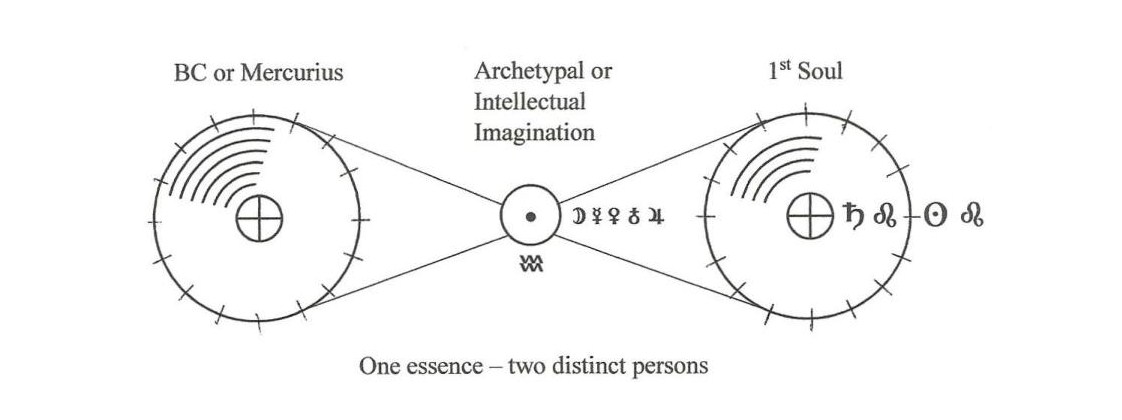
Some souls do not descend; Plotinus's view that soul remains in Intellectual-Principle but sends forth emanation; one essence, two persons; critique of the idea of absorption or annihilation as the goal
Unus mundus as the unitary psychophysical background of our empirical world; AD questions Occam's razor
Caelum (heavenly substance) as universal medicine, living stone, etc.
"Terra damnata" as what's left of the body after extraction of quintessence; body as having its own karma that must be lived out even after enlightenment
Plans for next class
BOOKS READ FROM OR REFERENCED:
Paul Brunton, The Hidden Teaching Beyond Yoga
C.G. Jung, CW 14, Mysterium Coniunctionis, "The Conjunction", "The Journey through the Planetary Houses" (in Chapter III)
H.P. Blavatsky, The Secret Doctrine
Henry Corbin, The Man of Light in Iranian Sufism
C. G. Jung, The Psychology of Kundalini Yoga: Notes of the Seminar Given in 1932
Dante Alighieri, The Divine Comedy
Julius Evola, The Doctrine of Awakening
Marie-Louise von Franz, Aurora Consurgens: A Document Attributed to Thomas Aquinas on the Problem of Opposites in Alchemy
Bible (King James Version), Proverbs, Psalms
Plato, Parmenides
Tarl Warwick (ed.), Unknown Author, The Six Keys of Eudoxus
Plotinus, The Enneads (MacKenna translation, 4th ed.)
Arthur Edward Waite (ed.), The Hermetic Museum: Containing Twenty-Two Most Celebrated Chemical Tracts
Mary Anne Atwood, A Suggestive Inquiry into the Hermetic Mystery
Richard P. Benton, "Keats and Zen," Philosophy East and West, Vol. 16, No. 1/2 (Jan. - Apr., 1966)
Paul Brunton, Notebooks
PLOTINUS QUOTES READ OR REFERENCED: IV.1.1, IV.9.1
DIAGRAMS appended to this transcript:
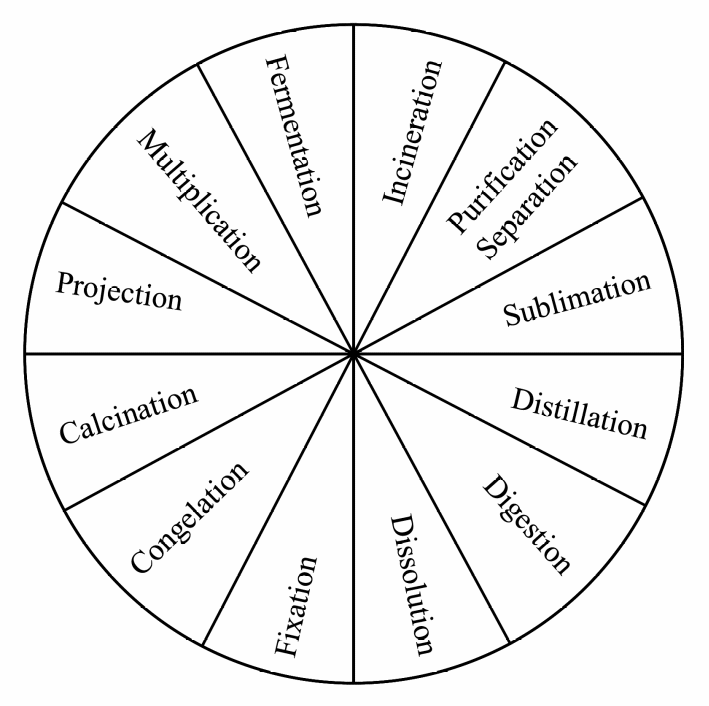
FIGURE 1982 0226a-1-AB. Alchemical Twelve-fold Wheel.
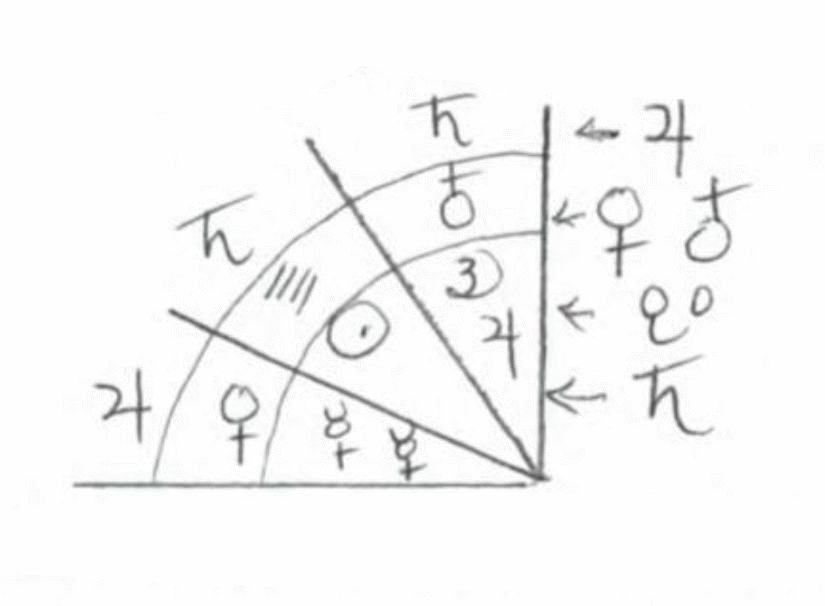
FIGURE 1982 0226a-2. Universal Soul and Fourth Quadrant Dignities.
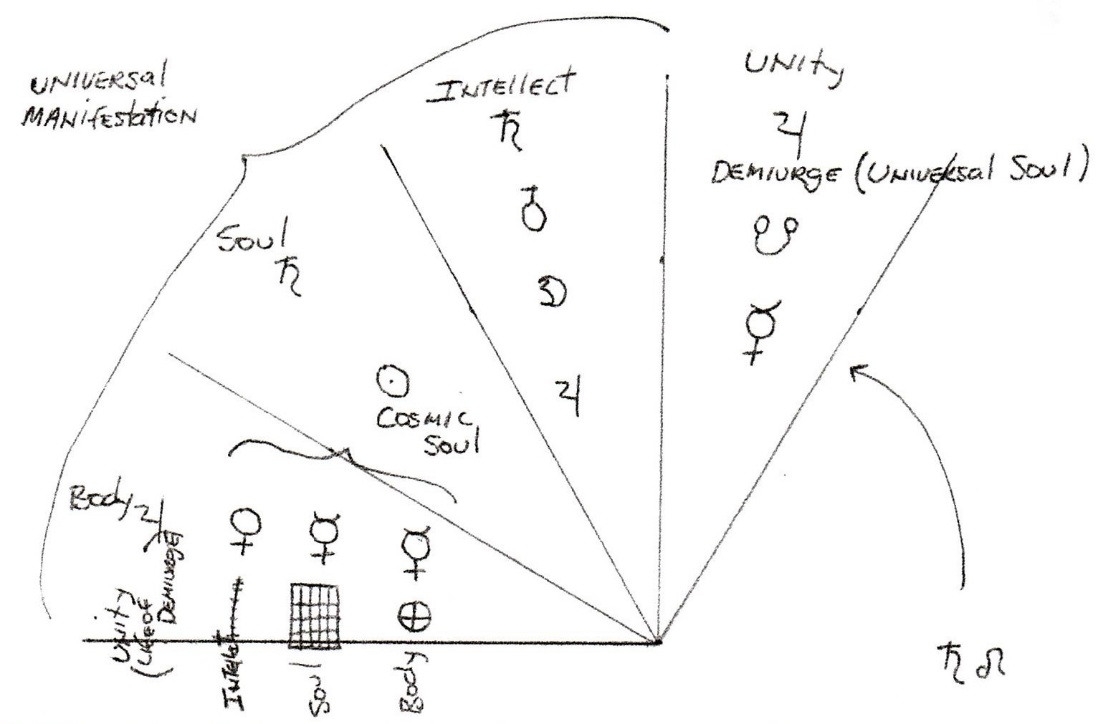
FIGURE 1982 0226a-3. Saturn in Leo, Houses 9-12, and House 12 Levels.
FIGURE 1982 0226a-4. Bodhicitta, Imagination, 1st Soul; One Essence–Two Distinct Persons.
Other diagrams also referred to are not with this transcript version. [Transcriber note: [diagram] means the speaker is referencing a diagram as he or she is speaking. If someone is drawing or writing, with audible sounds of chalk on a blackboard, I indicate this by [drawing] or [writing].]
NOTES:
This is 1982 02/26a, the Alchemy Class, and the first entry associated with this date. 1982 02/26b = "Columbus" — possibly no AD.
Verified that 1982 0226 is the correct date from AD Blue Book & Events Master.
1982 02/26 is a Friday.
TRANSCRIBED Verbatim by IT 2021. In 2025, IT completes TOC, expands Subsubjects, Book List, and Plotinus quotes section, adds new notes and removes some notes within transcript, adds four diagrams and references within transcript to these diagrams, updates audio file markers to match new REP audio. Archival verbatim transcript – V12a.
AUDIO FILES: 1982 0226a, 1982 0226b. [Note 1: "Tape" and "Side" refer to original audio cassette tapes that were later digitized into .MP3 Audio Files. Note 2: Audio files 1982 0227a, b (roughly 45 minutes each) are mostly identical to file 1982 0226a (roughly 90 minutes). The main difference is 1982 0227a, b started recording a few minutes earlier than 1982 0226a and so contains some material at the beginning and at the transition between Sides 1 and 2 that 1982 0226a doesn't have and is also missing some material at the end of 1982 0227b that 1982 0226a does have. In 2024, REP Studio consolidates all audio files into 1982 0226a, b.]
1982 02/26a at Wisdom's Goldenrod
Alchemy; Jung; Mysterium Coniunctionis
[Audio File 1982 0226a Begins]
AD (faint): --spoke about truth, I was embarrassed. I'm not going around the same age, all you have to do is go over it and refresh it in your mind. When I have to make distinctions between perceptual and material analysis, I'm going to become a hermit. So-- And if anyone wants to join you, you know, let them join you and yous try to-- I'll come every now and then, right? Anyone who tells me he's going to find truth in the mental realm--he should be planting turnips.
VM: We'll do that on Thursday nights. (laughter)
AS (laughing): Plant turnips.
VM: They're terrifying.
S (simultaneously): Yeah.
AD: Alright, so-- and then after that maybe yous could review the Hidden Teaching. You know, you don't have to-- [short pause] I-- you have to cover it, see what the points are and it's good but I think it has to be done over.
S (faint): Uh-hm.
S (very faint): [couple/few words inaudible]
S: Is this-- is this going to be on Wednesday night you said?
AD: Wednesday night. And there's one other topic I want but I can't think of it right now and then after that I-- or we start-- we could start reading PB's notes together. I'm going to ask Randy to give me a hand there, maybe Randy could-- since he's buried in them maybe he could select among those-- (go over this), I mean-- And, we could use Wednesday night in that direction. You know, PB's pretty straightforward and if he can't say it so that it's understood he don't want you to say it and that's the way he writes. The ideas sometimes may be difficult but not-- we don't have to entangle ourselves in a lot of mythology. So, we'll ask Randy to maybe-- He's got enough to do but we're (asking him for help). [11 second pause] Alright, well, we could re-- resume. Wherever it was we left off. [student assents, faint] [2 minute 7 second pause, shuffling about] What page were we up to?
AS: I think we were on the chap-- section 8.
VM (faint): We did it already, no?
[short pause, flipping of pages]
AS (faint): Yeah, (6-0-0-7).
[1 minute 12½ second pause, flipping of pages, faint background student talking]
AD (faint): Why don't you start just that paragraph here.
S (very faint): Yeah.
AS (faint): 7-- paragraph 739?
AD: Ok.
S (very faint): Uh-hm.
S (very faint): That was it.
S (faint): Ok.
AS (faint): Oh yeah. Well it doesn't-- we just started it.
C.G. Jung [CW 14, Mysterium Coniunctionis, "The Conjunction," pp. 519-520, paragraph 739, AS reading]: "If Dorn, then, speaks of freeing the soul from the fetters of the body, he is expressing in rather different language what [Albertus] Magnus describes as the preparation or transformation of the quicksilver, or what our unknown author depicts as the splitting of the king in the yellow robe. The arcane substance is meant in all three cases. Hence we immediately find ourselves in darkness, in the nigredo, for the arcanum, the mystery, is dark. If, following Dorn's illuminating hints, we interpret the freeing of the soul from the fetters of the body as a withdrawal of the naïve projections by which we have moulded both the reality around us and the image of our own character, we arrive on the one hand at a [AS adds: kind of] [cognitio sui ipsius], self-knowledge, but on the other hand at a realistic and more or less non-illusory view of the outside world. This stripping off of the veils of illusion is felt as distressing and even painful. In practical treatment this phase demands much patience and tact, for the unmasking of reality is as a rule not only difficult but very often [AS reads: often very] dangerous. The illusions would not be so common if they did not serve some purpose and occasionally cover up a painful spot with a wholesome darkness which one hopes will never be illuminated. (bit of laughter) Self-knowledge is not an isolated process; it is possible only if the reality of the world around us is recognized at the same time. Nobody can know himself and differentiate himself from his neighbour if he has a distorted picture of him, just as no one can understand his neighbour if he had [AS reads: has] no relation to himself. The one conditions the other and the two processes go hand in hand."
AD: That seems pretty straightforward, huh?
[short pause]
C.G. Jung [CW 14, Mysterium Coniunctionis, "The Conjunction," p. 520, paragraph 740, AD reading]: "I cannot describe the process of self-knowledge here in all its details."
AD: Nor can anyone else. Let's go on. Next paragraph. (bit of laughter)
AS: 740?
AD: Yeah.
AS: You want to read it?
AD: 41.
AS: 41.
C.G. Jung [CW 14, Mysterium Coniunctionis, "The Conjunction," pp. 520-521, paragraph 741, AS reading]: "Self-knowledge is an adventure that carries us unexpectedly far and deep. Even a moderately comprehensive knowledge of the shadow can cause a good [AS reads: great] deal of confusion and mental darkness, since it gives rise to personality problems which one had never remotely imagined before. For this reason alone we can understand why the alchemists called their nigredo melancholia,"a black blacker than black [AS reads: than night]," night, an affliction of the soul, confusion, etc., [AS reads: and so on] or, more pointedly, the "black raven." For us the raven seems only a funny allegory, but for the medieval adept it was, as we have said, a well-known allegory of the devil. Correctly assessing the psychic danger in which he stood, it was therefore of the utmost importance for him to have a favourable familiar as a helper in his work, and at the same time to devote himself diligently to the spiritual exercise of prayer; all this in order to meet effectively the consequences of the collision between his consciousness and the darkness of the shadow. Even for modern psychology [AS adds: this is]…"
S (faint): Uh-hm.
S (very faint): Uh-hm.
C.G. Jung [CW 14, Mysterium Coniunctionis, "The Conjunction," p. 521, paragraph 741, AS reading]: "Even for modern psychology the confrontation with the shadow is not a harmless affair, [and] for this reason [it] is often circumvented with cunning and caution. Rather than face one's own darkness, one contents oneself with the illusion of one's civic rectitude. Certainly most of the alchemists handled their nigredo in the retort without knowing what [it was] they were dealing with. But it is equally certain that adepts like Morienus, Dorn, Michael Maier, and others knew in their way what they were doing."
[short pause]
AS: And then 742.
S: (2.)
C.G. Jung [CW 14, Mysterium Coniunctionis, "The Conjunction," pp. 521-522, paragraph 742, AS reading]: "Their"spirit" was their own belief in the light--a spirit which drew the soul to itself from its imprisonment in the body; but the soul brought with it the darkness of the chthonic spirit, the unconscious. The separation was so important because the dark deeds of the soul had to be checked. The unio mentalis signified, therefore, an extension of consciousness and the governance of the soul's motions by the spirit of truth. But since the soul made the body to live and was the principle of all realization, the philosophers could not but see that after the separation the body and its world were dead. They therefore called this state the grave, corruption, mortification, and so on, and the problem then arose of reanimation, that is, of reuniting the soul with the "inanimate" body. Had they brought about this reanimation in a direct way, the soul would simply have [AS reads: would have simply] snapped back into its former bondage and everything would have been as before. The volatile essence so carefully shut up and preserved in the Hermetic vessel of the unio mentalis could not be left to itself for a moment, because this elusive Mercurius would then escape and return to its former nature, as, according to the testimony of the alchemists, not infrequently happened [AS reads: as they say frequently happened]."
AD: We're going to have to discuss 742.
AS: Yeah. Want to go back?
[short pause, flipping of pages]
AD: I think the paragraph 742 is something we ought to talk about. [12¾ second pause] Try to think of it, you know, in a very personal way, very personal [one/two words inaudible] and very practical. What is he saying here?
[short pause]
PD: Well, if the spirit is what we're-- withdraws the-- the soul from the body, then let's say that's the-- the spirit is the desire to-- for self-knowledge, inwardizing of the consciousness. And, I-- it's-- it sounds like-- like the soul is the life that's animating the living organism. So, it's through this-- the-- the life principle gets joined to the-- the search for truth, the spirit, then the-- the problem becomes when there's the introversion and the life principle is withdrawn from the activities of the body, you know, like in studying or in quiet meditation, that sounds almost like a-- a degree of a-- a union of soul and spirit. But as soon as one's back doing things in the body, that inwardness gets lost. It can't be re-- it seems to be a problem to retain it once one's immersed in the activities of the body again.
AD: That's a good beginning. There was-- you spoke a-- you're-- you're speaking about the conjunction of the spirit and the soul. And, in that sentence he says--
C.G. Jung [CW 14, Mysterium Coniunctionis, "The Conjunction," p. 522, paragraph 742, AD reading]: "The volatile essence so carefully shut up and preserved in the Hermetic vessel of the unio mentalis [AD reads: united mind, or the integrated mind] could not be left to itself for a moment…"
AD: Now, it sounds far away from, you know, the practical. But, I think we might be able to try something like this. When this first happens, when there is that dedication, and, that dedication is followed up by the unio mentalis, they speak about it as shut up and preserved in the Hermetic vessel. And I thought Paul was going to say if you turn your back on it, alright, it'll just jump right out of the bottle and go right back to the old ways of doing things.
VM (faint): Well Paul did say that.
AD: Yeah. And so it is a very volatile thing. You probably all notice(d) that in the beginning. The past way-- you know, our past always seems to have a-- recall us back to our past ways of being and this-- this of course is the u-- unified mind is meant to start you off on a different path. But he speaks about Mercurius here as always, you know, being so volatile and jumping back. And if you think of the many people who start out with good intentions, who go on the quest and you can see Mercurius jump right out of the bottle and go right back to the old ways of doing things. It gets lost very easily. And they were afraid of that happening. Alright, let's be more blunt. A lot of people start out on the quest. How many of them continue? That's Merc-- Mercurius jumping back to the old. So--
C.G. Jung [CW 14, Mysterium Coniunctionis, "The Conjunction," p. 522, paragraph 742, AD reading]: "…Mercurius would then escape and return to its former nature, as…not infrequently happened. The direct and natural way would have been to give the soul its head, since we are told that it always inclines to the body. Being more attached to this than to the spirit, it would separate itself from the latter [AD reads: the spirit] and slip back into [its] [AD reads: the] former unconsciousness without taking with it anything of the light of the spirit into the darkness of the body."
AD: I-- I think that's pretty obvious now. Alright, it's not so hidden.
C.G. Jung [CW 14, Mysterium Coniunctionis, "The Conjunction," p. 522, paragraph 742, AD reading]: "[AD adds: And] Psychologically, it [AD reads: that] would mean that the insight [AD reads: insights] gained by the withdrawal of projections could not stand the clash with reality and, consequently, that its truth could not be realized in fact, at least not to the desired degree or in the desired way."
AD (faint): Alright, I think that whole paragraph is clear. Now ask questions. Let's continue. Avery?
AS: 740?
AD: Yeah. 43?
AS (simultaneously): "Sin…"
C.G. Jung [CW 14, Mysterium Coniunctionis, "The Conjunction," p. 522, paragraph 743, AS reading]: "Since earliest times, therefore, men have had recourse in such situations to artificial aids, ritual actions such as dances, sacrifices, identification with ancestral spirits…"
AD: Organizations, groups, institutions, societies.
S (simultaneously): Uh-hm.
S: Right.
S (faint): Doubt it. (bit of laughter)
C.G. Jung [CW 14, Mysterium Coniunctionis, "The Conjunction," p. 522, paragraph 743, AS reading]: "…in the obvious attempt to conjure up or reawaken those deeper [AS reads: deep] layers of the psyche which the light of reason and the power of the will can never reach…"
AD: I-- I think we ought to point out here by-- you remember his definition of reason--it was a biological adaptation to reality, [student assents, faint] it's not reason as we use it. Try to remember that.
C.G. Jung [CW 14, Mysterium Coniunctionis, "The Conjunction," p. 522, paragraph 743, AS reading]: "…reawaken those [AS reads: these] deeper layers…and [to] bring them back to memory. For this purpose they used mythological or archetypal ideas which expressed the unconscious. [AS adds: And] So it has remained to the present time [AS reads: day]…"
AD: Alright.
S (very faint): Avery, where are you reading right now?
AD: Let's turn [one/two inaudible AS words simultaneous with AD] to 746 now.
[short pause, flipping of pages]
C.G. Jung [CW 14, Mysterium Coniunctionis, "The Conjunction," p. 524, paragraph 746, AS reading]: "The"living idea" is always perfect and always numinous. Human formulation adds nothing and takes away nothing, for the archetype is autonomous and the only question is whether a man is gripped by it or not. If he can formulate it more or less, then he can more easily integrate it with consciousness, talk about it more reasonably and explain its meaning a bit more rationally. But he does not possess it more or in a more perfect way than the man who cannot formulate his "possession." Intellectual formulation becomes important only when the memory of the original experience threatens to disappear, or when its irrationality seems inapprehensible by consciousness. It is an auxiliary only, not an essential."
[students assent, faint]
AD: What do you think? You buy?
AS: Don't agree. (some laughter, AS laughing) [couple/few words inaudible]
VM (simultaneously): That's-- that stems from his idea of reason.
S: Sure.
VM: For him sort of a-- it's enough to make a direct contact with these archetypal experiences and the idea of actually penetrating with the reason into the meanings themselves apparently is-- Well, he-- first of all he would say it's not possible, number one, that all we can settle for is symbolic apprehensions. And, it seems to follow from his-- his appreciation of what reason is.
AS (faint): (He doesn't know) [one/two words inaudible]
AD (simultaneously): I-- I think there are many people who've been gripped by these experiences suffer total anguish because they can't understand. And by understanding I mean that they can't bring it down to the lower mind and have the whole of the lower mind pervaded by an understanding of these experiences. And then when that happens that there may be a confrontation with even greater problems, that is, the reintegration of the way we are with what we have experienced. And it calls forth the need let's say to become philosophic. I think a good example was PB, you know, in the Hidden Teaching? He speaks about the fact that he had had these experiences, many and varied, but that somehow he was unsatisfied and that he kept on searching. And many of his critics pointed out, you know, they said it's your Western mentality with its perpetual agitation. But, I think for most of us who read carefully through, the way PB said, there was a dawning recognition that there was a philosophy that was higher than the partial-- I mean the one-sidedness of mystical experience or the one-sidedness of religious experience and metaphysics, and that this very dissatisfaction eventually pointed out to him that he had to travel the philosophic path which would include both sides of the question. So that until he was able to formulate that, let's say, and perceive it, he had to formulate it really at the lowest level, at the level of concepts, and then he really saw the problem. I don't know, those of you who remember the Hidden Teaching. But he made that very clear. Until-- until it came up in that form, he was perpetually in a state of agitation, he felt that there was something incomplete about the path. So I don't-- I don't buy that it's not necessary to bring about an understanding down at the level that we're-- we're at. Now I-- I'm-- I am not placing-- I'm not saying that the experience is not a superior thing and a very important-- I-- I'm not saying that that's not true. It is true. But it doesn't seem to be enough, it doesn't seem to be all that(--) that is.
AD/S(?) (faint): Go on.
AS: And he s-- it's funny, he makes-- he says in this one line--
C.G. Jung [CW 14, Mysterium Coniunctionis, "The Conjunction," p. 524, paragraph 746, AS reading]: "If he can formulate it more or less, then he can more easily integrate it with consciousness…"
AS: That seems all important. And then he goes on to say oh but that-- but that doesn't mean he possesses it in a more perfect way than (what) [couple words inaudible]
AD: Yeah.
AS: But that's the whole point of [RG simultaneously: But--] integrating it with the consciousness if you can.
VM (simultaneously): To possess it more perfectly.
RG: Yeah. [AS: Of--] But isn't-- but isn't he there just speaking about-- I mean, isn't he trying to point out the objectivity of the archetype rather than the-- I mean when he says it's auxiliary and not essential isn't it not essential for the experience of the arising [S simultaneously, faint: Experiencing it.] of an archetype and not for the comprehension of it.
AS: Right but it's the essential for the individual who's having the experience. It might-- I mean--
RG: Well it might-- well, I don't (know). I mean it's essential for the individual who needs it to be essential for him, I mean--
AS: Well, I-- it seems as he says, to integrate it with his consciousness.
VM (simultaneously): [one/two words inaudible]
RG: Yeah.
AD: Well I can see what you're saying Richard and I think that that's true, that he does want to emphasize the extreme importance of the experience, [AS simultaneously: Extreme, yeah.] that's primary. [AS assents, faint] Unless you have it there's nothing you can-- you can't integrate it.
AS: You can't integrate it, yeah.
S: (What then?)
AD (simultaneously): But I think then he goes ahead and blows the whole thing by making that kind of a remark.
RG: Mm.
AD: Let's try 48, 748.
C.G. Jung [CW 14, Mysterium Coniunctionis, "The Conjunction," p. 525, paragraph 748, AS reading]: "This raised the question of the way in which the coniunctio [AS reads: conjunction] could be effected. Dorn answered this by proposing, instead of an overcoming of the body, the typical alchemical process [of] the separatio, solutio, incineratio, sublimatio, etc. [AS reads: the separation, solution, incineration and so on] of the red or white wine, the purpose of this procedure being to produce a physical equivalent of the substantia coelestis [AS reads: of this coelestis]…"
AD: Heavenly substance, yeah.
AS (simultaneously): Substance of the coelestis. Heavenly substance.
S (faint): Read it.
C.G. Jung [CW 14, Mysterium Coniunctionis, "The Conjunction," p. 525, paragraph 748, AS reading]: "…recognized by the spirit as the truth and as the image of God innate in man. Whatever names the alchemists gave to the mysterious substance they sought to produce, it was always a celestial substance, i.e., something transcendental, which, in contrast to the perishability of all known matter, was incorruptible, inert as a metal or a stone, and yet alive, like an organic being, and at the same time a universal medicament [AS adds: medicine]. Such a"body" was quite obviously not to be met with in experience."
AS: (Read that?)
AD: Yeah, read the whole paragraph.
AS: Yeah.
C.G. Jung [CW 14, Mysterium Coniunctionis, "The Conjunction," pp. 525-526, paragraph 748, AS reading]: "The tenacity with which the adepts pursued this goal for at least seventeen hundred years can be explained only by the numinosity of this idea. And we do indeed find, even in the ancient alchemy of Zosimos, clear indications of the archetype of the Anthropos, as I have shown in Psychology and Alchemy; an image that pervades the whole of alchemy down to the figure of the homunculus in Faust. The idea of the Anthropos springs from the notion of an original state of universal animation, for which reason the old Masters interpreted their Mercurius as the anima mundi; and just as the original animation could be found in all matter, so too could the anima mundi. It was imprinted on all bodies as their raison d'être [AS reads: reason for being], as an image of the demiurge who incarnated in his own creation and got caught in it. Nothing was easier than to identify this anima mundi with the Biblical imago Dei, which represented the truth revealed to the spirit. For the early thinkers the soul was by no means a merely intellectual concept; it was visualized sensuously as a breath-body or a volatile but physical substance which, it was readily supposed, could be chemically extracted and"fixed" by means of a suitable procedure. This intention was served by the preparation of the phlegma vini. As I pointed out earlier, this was not the spirit and water of the wine but its solid residue, the chthonic and corporeal part which would not ordinarily be regarded as the essential and valuable thing about the wine."
AD: Alright, let's try. [10 second pause, flipping of pages] What is he saying (now/there)?
[short pause]
AS: Well at the beginning I think he's saying after that first stage of separation of the-- this unified mentalis he said, well now you might think well, you can just do away with the body but, he's saying well you have to bring in the second stage through this separation, solution and so on of reintegrating that with the experiencing or--
AD: He says--
S: Who's the--
C.G. Jung [CW 14, Mysterium Coniunctionis, "The Conjunction," p. 525, paragraph 748, AD reading]: "Dorn answered this by proposing, instead of [an] overcoming [of] the body, the typical alchemical process of the separatio…etc…"
S (faint): Uh-hm.
AS: That's that twelvefold-- that would be the twelvefold alchemical process that we (spoke), the calcination, congealing.
AD (simultaneously): You're familiar with that process?
AS: Yeah that would be-- I mean--
[Note: See FIGURE 1982 0226a-1-AB for the following.]
AD: [drawing] I think we had it on the board, they call it the alchemical process. And, I guess it's the Western version of the nidana chain. I don't remember it, Avery, do you?
AS: Yeah, I think I know most of it. Calcination--
AD: Calcination. [writing] Congealing. Fixation.
[short pause while AD writes]
AS (faint): Dissolution. [short pause while AD writes] Digestion. [short pause while AD writes] I don't know, that--
AD: Sublimation?
VM: Dissolution.
AS (simultaneously): The next one is--
AD: Sublimation. [writing]
TS: Virgo's distillation.
AS: Yeah, distillation. Sublimation is--
AD: How could I forget that? (bit of laughter)
AS: [couple/three words inaudible] Sublimation, purification, and transformation. [short pause while AD writes] Incineration.
AD (faint): This-- incin--
[short pause while AD writes]
AS: Fermentation. [10 second pause while AD writes] Multiplication.
AD: Multiplication and projection. [short pause while writing] If you read that you feel like an alchemist. (laughter, AD laughs) What could that possibly mean? You could try to start it.
[19½ second pause]
S (faint): (Imagine it/Imagination).
S: Yeah.
AD: Avery, you should have a few. You should have a few ideas, what might that suggest to you?
PD: Well--
S: Yeah.
AS: (Well/Or) [one/two words inaudible]
DB: Isn't he talking there-- isn't this process involved with the transformation of the bases of the personality? Insofar as one is going to be in a body it's going to be in a particular relationship to the world, and that that (hit) that set of vasanas which is going to constitute the personality now is going to have to go through this process of transforming itself to accommodate the vision which the soul has had. And that this is the process whereby that-- that structure is broken down and reassembled, so forth.
AD: Well, why don't yous discuss it a little bit, come on. Come on, don't be bashful.
DB: Well--
PD/S(?): David--
AD: They're going on all the time with you.
PD: If we put that-- the chart of the elements up before where we said the seeds of the degree meanings or the meanings are dispersed in the elements, then the-- if we're taking it as the analogy of like the nidana chain, then would it be referring to the s-- the distis-- distilling out of the seed-- of the meanings that are constituting the person and through the rotation of the planets or the wheel it's precipitating out the quintessential body or the body of meaning or reason with which the-- is a subs-- kind of a substantial vehicle for the soul to operate with. But it's brought together and made a vehicle through these distillations, coagulations, etc. But it's taking the meanings that are already immersed in the body or in the elements that's, so to speak, given via Nature or your natural horoscope and forming a mental vehicle.
[10¼ second pause]
AD: I think that's a start. Why don't we add to it or amplify it? I mean, if we look at that, what-- who-- who is going through that process or what is going through that process?
[short pause]
PD: The living experiencing entity or person.
AD: Ok, that's (a) beginning. All at once or part at a time?
PD: Stages at a time I'd have to say.
AD: So if you put down let's say the seven planets, Chaldeans, and they represent the various aspects or powers of the soul-- powers of the soul, [PD assents] you say that these seven planets repre-- I'm not speaking about ten because it's complicated enough. If we take the seven planets of the soul and s-- they symbolize the-- these powers, you're suggesting then that it is each and every one of these powers that it has to go through that process?
S (very faint): Uh-hm.
AD: What?
PD: Eventually yes.
S (faint): Yeah.
S: I'm not-- before you go any further, I'm not sure if-- if you're talking like it's like the quintessential body that's going through these processes or is it the light of the soul that's going through these processes. And-- so I mean it-- I'd like to be more clear on what you mean.
AD: The [S simultaneously: Uh-hm.] quintessential--
S: Well, just what's the-- as you said, who's going through this process. And, I'm just not clear, I could see it either way at this point, could see this building up of this quintessential body that we spoke about or the bodhicitta.
AD: If you look up in Volume 2, The Secret Doctrine, there's a chapter on divine substance and divine thought. And, I di-- I brought it along but I don't want to read it because she only confuses (everything). But she speaks about this ether as the-- the material part, let me use the word like that, the substance part which gets impregnated with the Divine Ideas and from this the whole universe will evolve. Remember, last week I spoke about this as the cosmic process coming from above and working its way down. I said now the individual will have to recapitulate that. But he'll have to do it the reverse way. [Note: See WG Class 1982 0220.] (You'll/He'll) have to build up an ether body which will be impregnated or within which will be planted the seeds, the distilled-- the distilled wisdom of all his experiences. That will be implanted in his, let's say, etheric body, that builds up his etheric body.
Now, prior to the building up of that etheric body, the question here is, if we say that the person is represented by Saturn, Jupiter, Mars, Venus, alright, and each one of these planets represents a certain power of the soul, now obviously the powers of the soul are not refined and developed the way we would like them to be or the way let's say a philosopher would like them to be. So, let's say the-- let's say that we have-- let's say that we have a-- a power of the soul, whatever we want to refer to it, you know, like we think of Venus as aesthetic sensibility or Mars as self-drive (or) some kind of desire, alright. It would seem that each and every one of these power of the soul would have to go through that kind of process in order for us to refine them so that we could-- and they could ultimately, let's say, represent the powers of the soul, not the way they are in their primitive condition. Now, just a suggestion, I'm-- I'm only suggesting something.
BC (simultaneously): So you-- so you're saying that these powers of the soul conjoined with some kind of let's say etheric, what you call the quintessential body, is what's going through this process.
AD (simultaneously): Well, I-- I was suggesting that these powers of the soul, as they go through that alchemical process, and deposit the re-- the residue of their functioning, build up the etheric body.
BC: Ok, so then it is the light of the soul that's going through this(--/.)
AD: Well I want to leave that out right now. You want to bring in the subjectivity, you want to bring in the bodhicitta.
BC: Well, I'm just trying to figure out who's going through this.
S (faint): Yeah.
AD: Well, (there'll) always be present the subjective soul, the bodhicitta there. I mean, we have to leave that alone right now because we're not investigating that.
AS: Yeah. I mean, to go along with that, he even speaks of this coelistis as sevenfold, you know in that pre-- in a previous chapter where he describes the components of it. And he has these seven different components which ultimately have to go to compose this substance as it were. It seems that each of those substances would be like the planet, each would correlate to those planets, each having to go through this whole process. And (also--)
AD (simultaneously): Yes but, do you remember the quote where--
TS (faint): I could find it.
S (simultaneously): (Uh-hm.)
AD: Is that a substitute?
AS (simultaneously): Well it's just in the-- yeah in the pre-- in-- He-- he goes through 'em, he calls them the honey and so on. And he says they have to be combined with the red and white wine. It's the sa-- you-- same thing, he says (they) have to be combined with the red and white wine.
PD: You know, it-- there's an analogy in the Sufi mysticism where they speak of the man of light. [Note: See Henry Corbin, The Man of Light in Iranian Sufism, which was also used in the alchemy series.] And it's one realm of light but there's seven realm-- seven stages or seven processes and-- or-- it's a sevenfold anyway. So it's-- yeah it's all-- it's all [few inaudible MW words simultaneous with PD] light but there's seven distinctions within it. So, it almost seems like this-- it's a-- it's the quintessential body that's developing but the-- there's seven forms or stages within it.
AD: The quintessential body in the reference you're making, Corbin book, that-- that's built already. In order for these visionary apperceptions to take place, body's already built now.
AS: Yeah. Yeah they talk about building it up.
AD (simultaneously): And the-- and the theophany that takes place or the manifestation of that quintessential body, alright, is not this here, this is the prelude or precedes the building up of the quintessential body.
PD (simultaneously): Right. To-- you got to have the quintessential body in order to function in the realm of light. In other words, that has to be distilled from your worldly or bodily experience.
AD (simultaneously): Experience, yeah. So that means that a person who let's say started on that path, alright, that is, wants to become a man of light, has built up an essential-- a quintessential body and what we mean by that would be that there is a kind of substance which is neither organic nor inorganic. You remember they speak about it as semi-material. It's a divine kind of substance. The reference here obviously is ether. But-- Within this ether there is impregnated the totality of all the distilled experiences of your life drop by drop. Now you can see why the process is going to take so long and I don't know of anyone who's going to be liberated in one lifetime. By-- by definition it would be impossible. It's a long drawn-out process and this is the process that's going to be involved. Go ahead.
AS: Well see I tried to draw-- I-- I was thinking of drawing it this way, [drawing] where you would have in the middle here, this would be the ether which is built up [diagram]. These seem to form a link [diagram]. Yeah, maybe this picture, where you have outside here, you'd have this unknown wisdom, you know, the image of God or whatever you want to call it, the anima mundi. Yeah but out here would be this intelligence which the soul would have to be equi-- this-- Embedded in this-- [drawing] this cosmos in which he finds himself or in the world is this wisdom which he has to distill. And this alchemical process represents this link between the world where he's distilling this wisdom from. Like, the first one.
PD (simultaneously): So the-- the outer circle is the world of his experience you're saying here, Avery.
AS (simultaneously): [drawing] Not-- yeah but-- but unknown, it's like each one of these, each one of these would represent one of those links, like cal-- from calcination. If we take this first idea, the first house idea of self-identity, through calcination, the process of calcination, he'd be building up the wisdom that's concerned with his self-identity and through congealing he would be incorporating in his quintessential body or ether the experience that has to do with his-- with samskaras and-- well I don't want to use the other terminology.
PD: Well--
AS: (Ok/And) each one of those ideas and-- wait, in here [diagram], [drawing] you'd have all the seven-- you'd have the seven planetary functions through their-- through those soul functionings, you would be building up this quintessential body which would be like the deposit of all this whole scheme. I'm not sure [couple words inaudible] (got) clear.
AD: Let me read you a little bit from his commentary on kundalini. He's trying to describe the fifth chakra, the vishuddha, where the-- He says--
[Transcriber note: I am using The Psychology of Kundalini Yoga: Notes of the Seminar Given in 1932 by C.G. Jung, edited by Sonu Shamdasani, Bollingen Series XCIX, Princeton University Press, Princeton, NJ, 1996.]
C.G. Jung [The Psychology of Kundalini Yoga, p. 56, AD reading]: "…something similar happens in visuddha. The power of the elephant [AD: That's the symbol on that.] is lent to psychic realities, which our reason would like to consider as mere abstractions."
AD: You know, like when I say that the residue or the distillation of our felt experience is distilled into these drops, we'd like to think of that as an abstraction.
C.G. Jung [The Psychology of Kundalini Yoga, p. 56, AD reading]: "But the power of the elephant is never lent to products of the mere intellect because they are never convincing; they always need physical evidence. And for purely psychical things, there is no possibility of anything like physical evidence. For instance, [you know that] it is impossible in physical fact ever to make a concept of God, because it is not a physical concept. It has nothing to do with [an] experience in [AD reads: within] space and time. It has simply no connection with space and time, and therefore you cannot expect any such subsequent effect. But if you have the psychical experience, if the psychical fact forces itself upon you, [then] you understand it, and [you] can then make a concept of it. The abstraction, or the concept of God, has [AD adds: then] come out of experience. It is not your intellectual concept, though it can be intellectual too. But the main thing in such an experience is that it is a psychical fact. And psychical facts are the reality in visuddha. Therefore the insurmountable force of reality is sustaining no longer [AD reads: is no longer sustaining] the data of this earth but psychical data [AD reads: psychical fact].
"For example, you [AD adds: may] know that you would like to do something very much, but you feel it is [AD reads: it's] simply not to be, as if there were an absolute interdiction. Or you feel very strongly that you don't want to do a certain thing, yet the psychical factor demands it, and you know there is no defense--you must go that way; [AD adds: and] there is no hesitation about it. That is the power of the elephant, which you feel perhaps [AD reads: which you may feel] even in what you [would] call absurdities. Those are [the] experiences of the reality of [AD adds: the] visuddha as expressed by the [AD reads: that] symbolism.
"That [AD reads: Now this] is only the fifth cakra, and we are [AD reads: we're] already out of breath--literally so--[AD reads: out of breath--quite literally] we are beyond the air we breath; we are reaching, [say], into the remote future of mankind, or of ourselves. For any many has at least the potential faculty to experience [AD reads: of experiencing] that which will be the collective experience in two thousand years, perhaps in ten thousand years [AD reads: the collective experience in thousands of years]. What we are dealing with today has already been [AD adds: experienced] [we don't know how] many millions of times before…"
AD: Go ahead (and pay for--)
[short pause]
C.G. Jung [The Psychology of Kundalini Yoga, p. 57, AD reading]: "In visuddha psychical reality was still opposed to physical reality. Therefore one still used the support of the white elephant to sustain the reality of the psyche. Psychical facts still took place within us, although they had a life of their own.
"But in the ajna center the psyche gets wings--here you know you are nothing but psyche. And yet there is another psyche, a counterpart to your psychical reality, the non-ego reality, the thing that is not even to be called [AD adds: the] self, and you know that you are going to disappear into it. The ego disappears completely; the psychical is no longer a content in us, but we become contents of it. You see [that] this condition in which the white elephant has disappeared into the self [AD adds: and] is almost unimaginable."
AD: And there's another passage I wanted you to read where-- when he speaks about what is the substance of the visuddha. He says it's the very substance of our abstractions, and I should (be--)
[12 second pause]
C.G. Jung [The Psychology of Kundalini Yoga, p. 55, AD reading]: "But here [AD reads: In visuddha] it is not supporting muladhara, this earth. It is supporting those things which we assume to be the most airy, the most unreal, and the most volatile, namely, human thoughts. It is as if the elephant were now making realities out of concepts. We admit [that] our concepts are nothing but our imagination, products of our feeling or of our intellect--abstractions or analogies, sustained by no physical phenomena.
"The thing that [AD reads: which] unites them all, that [AD reads: which] expresses them all, is the [AD reads: this] concept [of energy]. In philosophy…"
[short pause]
AD: I can't find it but-- I think you have the gist of what he's talking about here, he's trying to show that this ether or this volatile substance is a substance which has this peculiar quality of being neither organic nor inorganic or both. And, that it is a heavenly kind of substance and this is what the alchemists were preoccupied in trying to-- to make, to produce. So, if we take that point of view, then we would be saying something like this if we go back to this point here, is that in the same way that the yo-- yogis of the East and philosophers of the East don't want this process to go on forever because the evolution could take thousands and thousands of years, they evolve systems or methods of trying to produce the product, this so-called quintessential body, much more quickly, and especially if destiny and fate has ordained that. They have to work with it. So when he says here that--
C.G. Jung [CW 14, Mysterium Coniunctionis, "The Conjunction," p. 525, paragraph 748, AD reading]: "Dorn answered this by proposing, instead of an overcoming of the body, the typical alchemical process [AD reads: processes]…[AD: and then] of the…white wine, the purpose of this procedure being to produce a physical equivalent of the substantia coelestis [AD reads: heavenly substance], recognized by the spirit as the truth and as the image of God innate in man."
AD: Now, the way I understand the image of God in man is not that in the soul that there is an image of-- you know, that God has some image because we know God has no image. So, the way I understand that would be that man in himself duplicates the processes that are involved in our understanding of the way the whole of cosmology is evolved from the pure hypostatic principles that Plotinus informed us about. So this is the way I understand the image of God in man. I don't know if you disagree [three/few words inaudible]
AS (simultaneously): When you're saying that this image of God in man has to actually be embodied in this ether, the ether-- this ether, he's trying to build up this etheric vehicle to actually be an expression of that intelligence which he has in his soul.
(Side 1 of original cassette tape digitized as 1982 0226a Ends; Side 2 Begins)
AD: Well you remember we said before, we said that if we go back to [AS simultaneously: That's why it's in the third.] the traditional teachings, I use Blavatsky, alright, because there's a wealth of details. And she pointed out that you have on the one hand cosmic ideation, on the other hand a cosmic substance, alright. And the cosmic ideation or divine thought impregnates the ether, [AS assents] alright, like plants a seed, in this case reason-principles. And then these reason-principles which are in the ether, alright, will ultimately manifest a whole-- the world or the whole of cosmology. Now with us we're doing the reverse but essentially the same thing, alright. From the-- from the totality of experiences which, let's say, get distilled, that distillation of these experiences impregnates the substance in us, this ether, and this ether, alright, now has these wisd-- the ideas or the reason-principles, distilled reason-principles, in that quintessential body. It actually impregnates that, alright. Now, when that body is impregnated completely with the reason-principles, then like I spoke-- I mentioned to Paul, now you could speak about a theophany taking place.
AS: Yeah and I unders-- I thought this-- if-- I mean I (think he's) saying symbolically, suppose you take the twelve Ideas, the twelve reason-principles around, and you say this is the process of impregnating or extracting from those Ideas through this twelvefold process and implanting them in the quintessential body, or the distillation of those reason-principles as the quintessential body. (I mean) [one word inaudible]
AD: Let's see. Let's see the consequence of what you're saying. Repeat. Yeah, go ahead, it's alright, repeat.
AS: Well--
AD: You see, this [S simultaneously: I didn't follow.] process is left out here, Jung doesn't even speak about it. I don't think he even knows what this process is, I don't think any of us know. And, it's going to be one of the subjects we have to take up in a seminar, work out the details.
AS (simultaneously): See I was just trying to-- I was just trying to-- in the pre-- in a few-- a few-- well, a lot of pages back, he had this thing with these seven substances that constitute this caelum, the honey, celandine, mercury and so on. And he goes through all these. And he [AD simultaneously: Fine.] says that-- and then he talks [S simultaneously: Good.] about this kind of a magnet that attracts the hidden thing in the self, ok, this theoria which--
AD: A theoria that will-- which attracts a hidden thing would be like for instance-- I don't know if that would be the proper way to put it. I would be more inclined to say that a proper understanding of the philosophical principles, or [AS assents] let's say the nature of the path, the disciplines involved, focuses one's understanding on the meanings-- let's say focuses one understand-- one's understanding. And this is the-- what he's referring to as the magnet which draws out the meaning from our experiences.
S: Yeah.
AS: I was thinking of it actually astrologically if you talked about that angle pattern, his natal angle pattern, we have seven planets would be like these seven substances. That would be a magnet which is going to attract out of the-- out of all these essences it would pick out the particular ones that had to go [AD simultaneously: Yeah.] into the formation of [AD simultaneously: Ok, alright.] your quintessential body. And the twelvefold process would be what that-- [AD drawing/writing] would be the steps towards the distillation of that meaning. So you'd have the-- you'd have to have both things, you'd have those sevenfold-- that sevenfold angle pattern. And he says that has to be united "with the heaven of the red or white wine of Tartarus" and so on. It would be like that has to pull out these meanings that are inherent.
AD (simultaneously): So, [drawing] these would be the seven substances [diagram]?
AS: Yes, those would be equivalent (with/to) the seven.
AD (simultaneously): So even if we-- if we use-- it doesn't matter whatever terminology right now.
AS (simultaneously): Yeah, self-apperception.
AD: Self-apperception, [AS assents, faint] [writing] libido or instinctual energy, family whatever, desire nature or self-drive, ok, feeling, sense-- aesthetic sensibility, reflective awareness. The Moon--what'd we use for that?
S (very faint): Lower thinking.
S (simultaneously, very faint): (Moon?/Uh-hm.)
AD: Lower thinking, thinking of the brain, and the Sun the imagination. Now he's saying that these seven substances have to be refined.
AS: Yeah. They-- he makes this-- you know, even here he says it has to be combined, united "with the heaven of red or white wine or Tartarus." And he identifies Tartarus I thought with what you called the tropical zodiac. He says this is-- this--
C.G. Jung [CW 14, Mysterium Coniunctionis, "The Conjunction," p. 493, paragraph 703, AS reading]: "…phlegm is the [AS reads: a] residue…[AS adds: the] Tartarus, [AS adds: is] the underworld and [AS reads: the] realm of [the] dead, is the [AS reads: it's a] sediment or precipitate of a [AS reads: the] once living world."
AD: Where you at? Sorry.
AS: I'm-- I'm back on this other--
AD: Yeah just-- just find it.
AS (simultaneously): It's on 493. [flipping of pages] Because here also he says the alchemical process so-- so on and so on of the red and white wine-- red or white wine. It produced the physical equivalent. But over here he says--
C.G. Jung [CW 14, Mysterium Coniunctionis, "The Conjunction," p. 493, paragraph 703, AS reading]: "This peculiar mixture…"
AS: And the peculiar mixture was the mixture of those seven.
AD: Uh-hm.
C.G. Jung [CW 14, Mysterium Coniunctionis, "The Conjunction," p. 493, paragraph 703, AS reading]: "…was then [AS reads: has] to be united with the"heaven of the red or white wine or of Tartarus.""
AD: Oh, I see what you're-- yeah, I see what you're referring.
AS: The caelum is the phlegm of the wine.
C.G. Jung [CW 14, Mysterium Coniunctionis, "The Conjunction," p. 493, paragraph 703, AS reading]: "Just as the phlegm is the residue, in the bottom of the vessel, of the evaporated wine, so Tartarus, the underworld and realm of the dead, is the sediment or precipitate of a once living world."
AD: You follow what we're doing here?
S (very faint): Uh-hm.
JA: No, (uh/oh), I got lost.
AD (simultaneously, faint): Go ahead.
JA: Started out-- Avery?
C.G. Jung [CW 14, Mysterium Coniunctionis, "The Conjunction," p. 493, paragraph 703, AS reading (simultaneously with JA above)]: "It contains--or is--the"scintilla Animae Mundi.""
AD: Wait a minute, [JA simultaneously: Alright.] wait a minute, go ahead.
JA (simultaneously): Started out by saying that the focusing of the understanding attracts the substances, is that what you said? I-- I mean what [couple words inaudible]
AS (simultaneously): Is at-- is attracting this wisdom. He says it's-- it's attracting these sparks of light or scintilla which are hidden in-- buried in-- in his experience.
AD: In other words, in other words, when you're-- when you're going somewhere and you're given information, to keep your eye out for certain markers, you know, and this will show you that you're going the right way, alright. That's like theoria, the theis-- the theoretical aspect of your-- of your journey. The practical aspect of course is the actual doing. So they're pointing out here that a proper understanding of the teaching and the doctrine is required so that you can extract from the experiences because your attention has been brought to bear on it and the meaningfulness of the experience so, that's-- that's about the size of it. But what it-- what-- the point that Avery is making here I think bears repetition and should be re-- repeated and you have to try to follow what is going on here. Please, Avery, would you repeat?
S (very faint): Uh-hm.
AS: Is this peculiar mixture of-- I-- peculiar mixture is these seven, seven planets, taking it as like this angle relation you have, has "to be united with the heaven of red or white wine or Tartarus." And he says this--
C.G. Jung [CW 14, Mysterium Coniunctionis, "The Conjunction," p. 493, paragraph 703, AS reading]: "Just as the phlegm is the residue, in the bottom of the vessel…so Tartarus, the underworld and realm of [the] dead, is the sediment or precipitate of a once living world."
AS: I thought he was saying that this sevenfold here is-- has to be united with that-- we spoke about the residues as this tropical zodiac, right, and through-- through the refinement of these seven what's also happening is that the meanings that are inherent in that--
DB: Couldn't-- couldn't the once-lived world, that residue refer--
AD (simultaneously): Louder please.
DB: Couldn't the residue or the once-lived world refer rather to the-- the whole history of the individual's [one word inaudible]
AD (simultaneously): Precisely. Yeah, precisely.
DB: His personality and what he thinks he is.
AD (simultaneously): Exactly. Your experiences. [AS simultaneously: Yeah, that's what (he/I just) said.] That's the residue of the life which is being lived out. That life is being referred to as Tartarus or the-- what we call the Dragon. [student assents] The life that we participate in.
AS (simultaneously): That's what (he/I just) said.
DB: Could I-- could I ask the-- they speak of it as a red or white wine there. What's-- why is that, I mean what's the difference between the two?
S (very faint whisper): [couple words inaudible]
DB: Yeah I know but--
S (very faint): (Has to do with a lot of good questions.)
AS: No but--
S (very faint): Yeah.
S (very faint): [few words inaudible]
S: Sorry Fred.
PD: Gnostic and fabricative?
AS (simultaneously): Fabricative and gnostic. Yeah.
S (faint): That one always got me too.
PD: The red seems to be the gnostic, creative, [student assents] and the white fabricative.
AS: Yeah, except I would do [couple inaudible student words simultaneous with AS] the other way around.
S: Red is--
PD: Is fabricative, [CDA, faint: Buddhism.] and the white seems to be gnostic. (bit of laughter) (Reflective) light and creative light.
DB: So then could-- I mean like on a physical-- on a physical level would that be like the difference between your images that are in the-- in the blood as opposed to the images that are in the nervous system? Is that the kind of distinction they're talking about?
[10½ second pause]
AD: Well, I thought of the wine, and I didn't think of it as either red or white. But I thought of the ru-- the wine as the product of these processes. In other words, if we take each and every one of these powers or substances and subject it to that process, the ultimate result of that should be wine.
TS: The wine would be like the-- the fabrication of the individual etheric body?
AD: Of the?
TS: Individual's etheric body.
AD: Well--
TS: Through the extrication of the reason-principles from the Dragon--
AD: No, again if-- just this-- just this passage here, Tim.
TS/S(?) (simultaneously): Yes.
AD: The alchemical process of incineration all the way through the multiplication, the result of that, if we think of the-- these substances or faculties of the soul going through that process, the result of that would be a wine. Now a wine is something that's the result of a lengthy process. And, if-- if we put ourselves through this process, alright, or if we go through this process, the result is this philosophic wine.
TS: Wouldn't-- wouldn't that be the-- the quintessential body that's the philosophic wine?
AD: I'm making a distinction between the quintessential body and the process that these powers have to go through. I know you're going back to what you're saying and I'm going back to what I'm saying. I'm saying that this process here, alright, results in the wine. You're saying that the wine is the quintessential body. Yes. But before it becomes a quintessential body, you first have to think of each one of these as going through this process, alright.
TS: So that when it's going through--
AD (simultaneously): And the result of that would be the philosophic wine.
TS: When it's going through the process that's when it's in-- it's the-- the powers of the soul are embedded in-- in the body or the reason-principles in the body.
AD: Alright.
TS: Well is that what-- what do you mean [AD simultaneously: But if we--] it's these seven substances?
AD: I'm sorry?
TS: What are these-- I mean, they are the planets but are they the-- (were/are) they the planets as the reason-principles in Nature, the planets as--
AD: No, no, there's a difference between the planets and the reason-principles. We spoke about the planets as representing the powers of the soul, the intelligibles which manifest and make available the meaning of reason-principles. So, if we have a planet on-- or the-- the to-- you know, if we have a planet sitting on a degree, it makes available, makes available the meaning or manifests the meaning of that degree. But before it can do so adequately, the planets or the functions have to be considerably refined so that they can manifest those thoughts. So, this is the process that they're talking about, as far as I understand. Then we'll worry about the quintessential body.
S (very faint): (Yeah.)
AS: (Is he--)
AD: If we look at-- if we look at it in a very simple way. You take the chart of some Bushman living somewhere in-- I don't know, where do they live? (bit of laughter)
S (very faint): Valois.
VM (laughing): Bush land.
AD: Valois.
S: (Valois.) (laughter)
S (laughing): Yeah.
AD: And you look at his Venus and say, you know, he has-- he has not developed the aesthetic faculty or sensibility at all, right. Now, to talk about-- to talk about-- to talk about bringing out the meaning, alright, of, let's say, a vo-- a Boccaccio story (AD laughs a bit) is about where he can get. (laughter) But if you want to bring out the meaning, let's say, of something in depth, The Divine Comedy, that's going to have to go through a tremendous refining process [student assents] before we can speak about this developing the quintessential body. So what I think they're saying here is that through this process, the-- each one of these functions or powers of the soul will reach a level of refinement where then it can become operative and bring out the meanings that are hidden or the reason-principles that are being, let's say, experienced. So that when you look at-- you know, when you take a planet and you see all the parts, you begin to see that these are the meanings that are being extracted. But they can only be extracted when that faculty or power of the soul is capable of doing it, not before that. Although before that we could say well at that level it's working at the level that's it's fun-- it's, you know, working at. It'll bring out the meanings at that level. But--
TS: Now, what-- where it extracts these meanings from is the-- that what the-- that where this process or these planets getting refined as going on-- I'm just trying to connect it to the (idea--)
AD (simultaneously): I'm sorry, once more? That where is this process going on? Everywhere.
TS: Isn't it, well-- [AD simultaneously: And in--] speaking of the development of the--
AD: In all of your experience, regardless of where it is.
[short pause]
TS: I was trying to connect it to his idea of the unio mentalis to see if in what ways-- Because I don't think it is that but it seems to be--
AD: Well, you're going to first have to have a unified mind before you understand some of these things.
TS: Well-- (laughter)
VM (amidst laughter): Catch-22.
S (amidst laughter): Right.
AD: No but the point here is that the theory helps you orientate your attention and direct it, alright. If that isn't there first, the experiences just go on and they keep going on, you know.
TS: So [AD simultaneously: Go ahead.] what I'm trying to say is that it seems that these-- that this process of refinement or this-- where this is occurring is prior to that unio mentalis, this is where the reason-principles [couple words inaudible]
AD (simultaneously): Yeah, let's say that it's aiming to bring you to that level of the unified mind, a [PD assents] unified mind.
TS: Here the powers of the soul are totally embedded in a not-- not yet distinguished from the-- the elements which constitute the body.
AD (simultaneously): Yeah, and he refers to that as the chaotic state, the state of chaos, alright, [TS simultaneously: And there--] which most of us feel. Well-- Yeah Michael?
MW: I just want to see if-- Seems to me that you're-- you're distinguishing between the process of the refinement of the soul powers going through this twelvefold wheel let's say, and you're saying that results in this philosophic wine. The-- once you got the soul powers being able to operate somewhat efficiently, let's say, then the process-- then they can be actually used to manifest the-- or assimilate these reason-principles and that may be the production of the quintessential body, [AD simultaneously: Yeah, yeah, so--] so that's--
AD: That's the way I [MW/S(?) simultaneously: Ok.] understand it. [11 second pause, flipping of pages] Uh, let's see.
C.G. Jung [CW 14, Mysterium Coniunctionis, "The Conjunction," p. 525, paragraph 748, AD reading]: "The tenacity with which the adepts pursued this goal…can be explained only by the numinosity of this idea."
AD: I thought it might have been the truth of the idea.
C.G. Jung [CW 14, Mysterium Coniunctionis, "The Conjunction," p. 525, paragraph 748, AD reading]: "The idea of the Anthropos springs from the notion of an original state of universal animation, for which reason the old Masters interpreted their Mercurius as the anima mundi; and just as the original animation could be found in all matter, so too could the anima mundi. It was imprinted on all bodies as their raison d'être, as an image of the demiurge who incarnated in his own creation and got caught in it. Nothing was easier than to identify this anima mundi [AD: The soul of the world.] with the Biblical imago Dei [AD reads: image of God], which represented the truth revealed to the spirit."
AD: Let's try to take that apart.
S (very faint): Uh-hm.
AS: (Right), we spoke before of one of (my--) he calls it the Demiurge, we said the World-Soul produces this whole-- produces the cosmos or manifests it, there's something of that soul which is embedded in the cosmos which it-- which it's creating, that is, the reason-principles with which it fabricated--- the reason-principles with which it fabricated the cosmos, something of those reason-principles must be embedded in that cosmos itself, something of the wisdom with which it fabricated.
AD (simultaneously): Well, we're not speaking about the Universal Soul, right, which informs the matter with the Ideas [diagram]. You remember when we take the-- [AS: Yeah.] the Jupiter, Mars, Venus, and Saturn and the Tail and we [VM assents] say these inform matter, [VM/S(?), faint: Structure matter.] insofar-- you know, we could think of the matter which is inundated or informed by the Universal Soul with these Ideas. [Note: Third quadrant rulerships and exaltations inform tenth house dignities. See FIGURE 1982 0226a-2.] But the matter that is being informed there would be prime matter, alright, prakriti, alright. [AS simultaneously, faint: Yeah. (one word inaudible) and he doesn't meant (matter).] So, I don't think that's the soul of the world, because that's [AS simultaneously, faint: That's (a--)] the Universal Soul. [student assents, faint] So then he has to be referring to what we would call the Sun in Aquarius as the soul of the world [FIGURE 1982 0226a-3, cosmic soul]. Now, he's saying then that the-- insofar that the soul of the world, Sun in Aquarius, projects out from its own substance and its own being, it projects out the world, then it would be caught or would be involved in that very projection. So in other words like when-- when a person has a projection on another person, alright, regardless of what the projection is, then he's caught up in that very projection which is out there. So we're in a psychological way duplicating in a miniature fashion the presence. The same way that the cosmic soul is present in its creation and has-- is caught there, the term they use, the same way we're caught when we project onto someone and there's-- alright. Now how (is) that relate to the image of God?
PD: Well, (by a--)
AD: Yeah.
MW: It was [AS simultaneously: But--] easier then to identify. (laughter)
S (amidst laughter, faint): [few words inaudible]
VM: But the image of God were those reason-principles which go to con-- let's say were the reason-- are the reason-principles embedded in this Sun in Aquarius or the cosmic soul which then are, let's say, invested or embedded in the matter.
CDA (faint): And dealing [one word inaudible] possible to project out.
VM: Yeah, and that is the reason for being of the various bodies or entities in the world, it is their-- their meanings, their structures.
[short pause]
AS: And just-- I think the World-Soul produces an image of its powers, but also there's an image of this-- of the reason-principles which it contained.
AD: In what it produces.
AS (simultaneously): In manifesting-- yeah, in what it produces. So in that sense it would [few words inaudible]
AD (simultaneously): But I think after a while you'll begin to see that a great deal of alchemy, especially [VM: Watered down too.] that it had its origins in Greece and-- [VM, faint: Right.] You remember I mentioned to you when Plotinus says that the soul imparts to the body a light. [Note: See Plotinus, I.1.7.] Now you and I would simply ignore that or let's say pick it up philosophically and epistemologically and try to work out the consequences, whereas--
AS (simultaneously): They built a whole thing out of it [few words inaudible]
AD (simultaneously): They built a whole-- the whole method of how to liberate that light from the body, [AS simultaneously: Yeah, you know, he's just (going to) (three words inaudible)] and they evolved this whole method. So you can see, you know, how differently they were working, how practical they-- they were. Alright, fine, I got the light in the body, now let me see how I can-- [AS simultaneously: Get it out.] (gotta/I) get it out! Alright.
AS: There's also this myth we had of Bacchus where Bacchus is-- is distributed [one/two words inaudible] part distributed. And then we had this process of-- and then through Minerva and so on preserves the heart, it gets reassembled and reborn again as Dionysus. It's like saying that this-- thi-- I think this is similar. The Sun is like Bacchus gets distributed in his production. And then it's our job to, as it were, re-- res-- [AD simultaneously: Go ahead.] make him whole again or take all of his distributed wisdom.
AD (simultaneously): And they said that Minerva preserved the heart intact. So, if you get a vision of Minerva, it's usually a very fortunate occurrence that indicates that process is fully on its way and established. Let's go a little further.
C.G. Jung [CW 14, Mysterium Coniunctionis, "The Conjunction," pp. 525-526, paragraph 748, AD reading]: "[For] the early thinkers the soul was by no means a merely intellectual concept; it was visualized sensuously as a breath-body or a volatile but physical substance which, it was readily supposed, could be chemically extracted and"fixed" by means of a suitable procedure. [AD adds: And] This intention was served by the preparation of the [phlegma] vini. As I pointed out earlier, this was not the spirit and water of the wine but its solid residue, the chthonic and corporeal [AD reads: the earthly corporeal] part which would not ordinarily be regarded as the essential and valuable thing about the wine."
AD: Go ahead.
S (faint): Uh-hm.
AS: I understand except-- I mean I know he's used all through that by soul and spirit he's changed-- he's switched the words around.
AD: Yeah, quite a few times, yeah.
AS (simultaneously): By soul here-- soul here he obviously doesn't mean what we call soul, he means more what we would call the spirit or the breath-body or volatile but physical substance.
AD (simultaneously): The breath, spirit. What do you mean by spirit now?
AS (simultaneously): It's not spirit. No I don't-- By soul here he doesn't mean the higher soul but he means the-- the [AD simultaneously: The residual--] second soul or the [short pause] breath-body.
AD (simultaneously): Well if he's-- if it's volatile but physical--
VM: It's almost like the prana.
AD: Again it sounds like, you know, the ether.
AS: Yeah.
S: Yeah.
AD: It could be chemically extracted and fixed by means of a suitable procedure, and we're [AS simultaneously: Yeah he means-- yeah.] saying that this is the procedure by which they're going to extract that, alright, and fix it. Well, fixation is one of the processes.
AS: Yeah. In fact--
CDA (simultaneously): What is--
AS (faint): --it's the third one there [FIGURE 1982 0226a-1-AB].
AD: Yes Carol?
CDA: What is the-- this phlegma vini? 'Cause it seem(ed) he's saying that he's fixing the-- the residue or the corporeal part. Seems that's what he's saying.
RC: Can I take a guess?
S: But this was [one word inaudible]
AD: Louder. What?
S: (Right.)
RC: Can I take a guess maybe, (it's just-- I mean--)
AD: Well it was already said what that is.
VM: Yeah that's the experiences that you've gone through and you've fixed through your, let's say, appreciation of the meanings in those experiences.
AD: The analogy [CDA simultaneously: But--] here is phlegm, right, which is like an end-process of living, you know, like a waste product, ok. In the same way the experiences of life that we have are an end-process, an end-product of the process of living. And the analogy here is that this-- or this phlegm of-- what do they call it?
AS: Yeah.
S: Phlegma vini.
S (simultaneously): [one/two words inaudible] (phlegma vin).
AS (simultaneously): Phlegma vin, the phlegm of the wine, the sold residue.
AD: Yeah.
C.G. Jung [CW 14, Mysterium Coniunctionis, "The Conjunction," p. 526, paragraph 748, AD reading]: "This [AD reads: The] intention [CDA simultaneously: But--] was served by the preparation of the phlegma vini [AD reads: phlegm]."
AD: It is that which has to, so to speak, get organized and fixed the way let's-- [students assent, faint] analogously we speak about the phlegm.
RC (simultaneously): I have trouble with that particular word, I mean, why ever they use that, but it seems like-- it seems like what he's talking about is something similar to what we've referred to in other contexts as like isolating the reality principle in a way, that you get grounded in this kind of substance which makes it possible for you to distinguish between whether something is authentic or whether something is-- just you've imagined it to be so. Like ordinarily we take the body's experience as having a certain authenticity whether we believe it or not. And then in terms of our own thinking, seems we have to rediscover that very same convincing substance in our thinking that the world normally has because of its mediation by the body.
AD: I don't follow you. You follow? Maybe you want to elaborate. Let me-- let me state what we were saying first and then go back. You remember in the Evola article where Evola speaks about this life that we participate in? And that we're like chained dogs, we have a certain amount of liberty until we hit the-- the end of the chain and then it snaps us back. And this life which was inherent in every creature wished to live--right, wrong, indifferently, but no matter how it was going to live. [Note: See Julius Evola, The Doctrine of Awakening, pp. 68-70, 1951 edition.] It reminds you something like the swamp level animals, you know, where they eat one other, devour one another. They love one another and then kill one another. You remember, like the widow, the spider widow, you know. Well, we're speaking about life at that-- at that level. In other words, the tropical zodiac, that snake, the celestial Dragon. Now what we're saying is that the ordinary life that we live ultimately-- the residue of that life, in spite of the fact that it is this kind of swamp consciousness, the residue of that life does leave traces behind of having lived, [VM, faint: Right.] and it is these traces which they analogously compare to the phlegm that the body produces, alright, when it is like the end process, a toxic process.
LR (simultaneously): He says that's not the part that they value.
AD: Huh?
CDA: Right.
AS: No, that is the part that's valuable.
LR (simultaneously): He makes the [S simultaneously, faint: No.] point, that's not the part that they--
AD (simultaneously): Would you-- would you please point it out to her?
AS (simultaneously): No, it-- that is [CDA simultaneously: It's not-- it's not ordinarily.] the part-- that's not the part that you value ordinarily.
S (simultaneously, faint): [one/two words inaudible]
MW (simultaneously with AS and S): They want to make wine now.
AS: I-- I think what he's saying--
LR (simultaneously): Who said (that--) wait, wait.
AS: Linda I think he's-- he says that is the part that they value, it's not the part that you normally value.
LR: Right.
AS: You normally value the living it out. You know, great, we live it out. That's when it's got the water in it.
VM: It's where it's at.
AS: But afterwards you dehydrate it, [LR: Right.] so there's no more-- in a sense for you you say there's no more life because there's no more water in it, it's been dehydrated, but that's the important part.
LR (simultaneously): But isn't that the part that returns to the Earth? Isn't--
AS (simultaneously): No, I think that's the important part he's saying. After you-- after the life's gone out of it, after you've lived it out, it's not wet anymore, that you've-- you know, you've evaporated all the water off of it, what's left is just this residue. Now you [LR simultaneously: But--] can't live that out in the same way anymore because the-- the experience is over as it were, there's no more wine but the phlegm or the-- that--
LR (simultaneously): That's the part that gets fixed in the Earth.
S (very faint): Well yeah.
AD: That's the part that what?
LR: That's the part that becomes the resi-- becomes part of the Earth, from what I can--
S (faint): Part of the--
AS: Oh you were use-- I see, you're using the macrocosmic example, but I think here (is/he's)-- No? I don't know what you mean by gets caught-- [LR simultaneously, faint: Well (couple words inaudible)] gets retained in the Earth.
TS: Well he refers to it on-- there's a footnote on 486 where he uses that thought but I think it's a s-- it's the same meaning as what Avery is saying, that--
C.G. Jung [CW 14, Mysterium Coniunctionis, "The Conjunction," p. 486, footnote 102, TS reading]: "Phlegm has also a moral connotation:"Sow likewise thy wisdom in our hearts, expel from them the phlegm…""
TS: And all this other stuff, but uh--
AS (simultaneously): But Tim, that footnote, the black earth and the ash, I don't think he means gets returned to the Earth.
TS: No that-- yeah that's what I'm saying, that here by earth what he-- it's not-- it's the-- that the residue-- the-- the reduction to the essential is what he means.
VM (simultaneously): No but, read the last line of that footnote, Tim.
C.G. Jung [CW 14, Mysterium Coniunctionis, "The Conjunction," p. 486, footnote 102, TS reading]: "…"for in them is the diadem, the ash of the things that endure.""
TS: Right.
VM: Right.
CDA: (It's) not the phlegm.
VM: I don't know, "despise not the ashes".
TS (simultaneously): No, the phlegm and the black earth is the same thing there.
AS (simultaneously): That's it. Exactly.
VM (simultaneously): And that is the--
AS: "Despise not the ashes, [VM simultaneously: Yeah, that's what you're after.] in them is the diadem, the ash [TS simultaneously: Yeah.] of the things." That-- that's the same thing.
VM (simultaneously): It's distillation of (your) experience.
CDA: So--
TS (simultaneously): It's the residue of those reason-prin-- the phlegm here is the residue of the reason-principles extracted from life. Is that what he's saying?
S (faint): Uh-hm.
VM/S(?): Yeah.
TS: Is that what you see?
AD/S(?) (faint): Uh-hm, (yeah).
S (simultaneously, faint): Yeah that [one word inaudible]
TS: (Yeah.)
AS (simultaneously): Yeah. And the-- and the de-- the extraction is just(--) the water part is gone. [TS simultaneously: But why--] It seems to me to be the life has gone out of it, as it were, the lived life, the experience, but there's something of it--
CDA: So it seemed that you said-- you're saying-- I think the confusion is is you're saying it's the extraction from the matter of the experience which we've-- we're calling wisdom--
AD: I'm sorry, the extraction of the matter?
CDA: From the matter of-- of-- the essence from the matter of the experience.
AD: Yes, which we regard as something base and ignoble and which they of course thought very highly of.
CDA: Yeah, we're calling that the-- the extraction of the wisdom from an experience. But is that-- you also said this is the traces left in matter and I think that's where the confusion is.
S (faint): (Yeah.)
VM: But see the matter that's spoken about here is that-- that [CDA simultaneously: The body.] sort of quasi-material, quasi-spiritual entity known as the quintessential, it has [CDA: Ok.] the kind of material-- semi-material nature insofar as it's able to, let's say, hold those traces in it.
CDA (simultaneously): Ok, ok, it was just confusing [AS simultaneously: Yeah.] because we're us-- usually we speak of that-- the traces left behind in matter as the vasanas and tropes at a lower level than this, you know?
LR (simultaneously): But see, I don't see where that [AD simultaneously, faint: Oh.] really differs, I mean the vasanas are actually changed, aren't they, from the process. From the distillation of this process, isn't-- aren't the actual habit-- habits of the body changed, isn't that the point of the second conjunction? The actual reorganization within the body? I mean and isn't that the corporeal part that's being spoken of?
AD: I don't know what she's talking about.
PD (simultaneously): All through there he [CDA simultaneously: She's saying that-- that--] seems to be speaking about soul in this whole paragraph, (I mean) not the body.
CDA: In the sentence, "In order to bring the…"
LR (simultaneously): Don't you have-- but the whole point of the second conjunction is that you're bringing all those things back into the body. You're bringing light in with the body. And there's a reorganization in order to bring it-- it-- to make the process (actually) real.
PD: Right. If the-- if the whole process is leading towards a formation of a quintessential body or a mental body, then the body that's formed isn't the physical body now.
LR: But Paul, you're not going to take that quintessential body and run. I mean--
AD: No, but you can fly.
PD (simultaneously): That's what the Sufis do. [AD simultaneously: You can fly.] They run in the mental realm.
LR: But that's not the point of the second conjunction.
PD: I don't [one/two inaudible student words simultaneous with PD] see how this paragraph at all is talking about the physical body.
AD: Let's read through to the next--
C.G. Jung [CW 14, Mysterium Coniunctionis, "The Conjunction," p. 526, paragraph 749, AD reading]: "What the alchemists sought, [then], [VM: Can I--] to help…"
AD: Yeah, sure.
VM: It just-- I'm sorry to interrupt, Anthony, this just seems to be quite germane to the discussion of what this Tartaric or this kind of residue that's left over, this is back on paragraph 691. Just from the place where Tim was reading the footnote. He says--
C.G. Jung [CW 14, Mysterium Coniunctionis, "The Conjunction," p. 486, paragraph 691, VM reading]: "The residue was treated in the same way again, until in the end no"asperitas" remained in the ashes." [VM reads: The residue was treated in the same way again until there were no more "asperitas"…" I'm not sure what that is. "…remained in the ashes."]
VM: And-- and he goes on (and) say-- um--
C.G. Jung [CW 14, Mysterium Coniunctionis, "The Conjunction," p. 486, paragraph 691, VM reading]: "What was left over…("our winestone," calculus vini [VM reads: this calcus vinis or vini])…"
VM: Which I guess is kind of like the calcinated part of the wine, "the natural salt of all things". Goes on just to say--
C.G. Jung [CW 14, Mysterium Coniunctionis, "The Conjunction," p. 486, paragraph 691, VM reading]: "The tartaric water was the quintessence of [VM reads: or] the philosophic and even of ordinary wine, and [VM adds: he] was [then] subjected to the above-mentioned rotation."
VM: Well that's another reference again to that rotation that we spoke about before. But I think he makes it clear in that case where it's certainly that which is to be valued and that--
EMD (simultaneously): We can't hear anything back here.
VM: Sorry. I'm just trying to read from this paragraph 691 where he makes, in somewhat oblique terms, the case that this residue is precisely what the goal of the alchemical process is. It's "the quintessence of the philosophic and even-- even of ordinary wine". And as he said earlier the philosophic wine is this quintessential body which they're trying to build up.
[short pause]
AD: Let's read 49, Avery, huh?
C.G. Jung [CW 14, Mysterium Coniunctionis, "The Conjunction," p. 526, paragraph 749, AS reading]: "What the alchemist sought, then, to help him out of his dilemma was a chemical operation which we today would describe as a symbol. The procedure he followed was obviously an allegory of his postulated substantia coelestis [AS reads: heavenly substance] and its chemical equivalent. To that extent the operation was not symbolical for him but purposive and rational. For us, who know that no amount of incineration, sublimation, [and] centrifuging of the vinous residue can ever produce an"air-coloured" quintessence, the entire procedure is fantastic if taken literally. We can hardly suppose [AS adds: then] that Dorn, either, meant a real wine but, after the manner of alchemists…"
AS: --this--
AD: Spiritual wine. (some laughter)
AS: The spiritual wine.
AD (simultaneously): Spiritual wine.
S (very faint): Uh-hm.
C.G. Jung [CW 14, Mysterium Coniunctionis, "The Conjunction," p. 526, paragraph 749, AS reading]: "…in other words [AS adds: the] Mercurius non vulgi, who embodied the anima mundi."
AS: The non vulgar Mercurius, [student assents] who embodied the soul of the world.
C.G. Jung [CW 14, Mysterium Coniunctionis, "The Conjunction," p. 526, paragraph 749, AS reading]: "Just as the air encompasses the earth, so in the old view the soul is wrapped round the world. [AS adds: And] As I have shown, we can most easily equate the concept of Mercurius with that of the unconscious. If we add this term to the recipe, it would run: Take the unconscious in one of its handiest forms, say a spontaneous fantasy, a dream, [an] irrational mood, an affect, or something of the kind, and operate with it. Give it your special attention, concentrate on it, and observe its alterations objectively. Spare no effort to devote yourself to this task, follow the subsequent transformations of the spontaneous fantasy attentively and carefully. Above all, don't let anything from outside, that does not belong, get into it, for the fantasy-image has"everything it needs." In this way one is certain of not interfering by conscious caprice and of giving the unconscious a free hand. In short, the alchemical operation seems to us the equivalent of the psychological process of active imagination."
[short pause]
PD: So, it seems to be what Jung is saying here is that this alchemical process is a process of contacting the innate meanings that a person has inherent with-- within him. He approaches it through unfolding the psychic imagery that one is conditioning-- one is conditioned by and yet unconscious of and forcing it to explicate itself into one's consciousness.
AD: Why-- why not expand and amplify that, why restrict [AS simultaneously: I know.] yourself to a fantasy? [VM simultaneously: Yeah I-- that's--] Why not regard all of your experiences in the same way? If we say-- if we say that the world is maya instead of fantasy, ok, alright, so it's like some huge fantasy that we all are participants in and each one experience it in his own peculiar way to learn from it whatever his peculiar thing (in it). If we use-- if we use active imagination, alright, in the sense that he wants us to use it for an interior mood or something like that, if we expand both, if we say, no, let's not restrict ourselves to a mood, to a fantasy, but let's take the totality of (like--) of our experience that way, then you would have to translate active imagination into philosophic discernment. Which I think will be closer to what the alchemists were doing than what he's trying to do.
RC: Anthony, you know how PB talks about generally when you present mentalism in the beginning, the guy says "You mean to tell me this locomotive I see is a thought?" That ordinarily sense experience comes with much more impact than-- than the thinking comes with. It seems that the way he's talking about extracting this corporeal part, (not even) the water or the spirit of the wine, that-- that there is a correspondence there to-- to taking that-- the way that you ordinarily take sense experience as concrete and substantial and gradually transferring that into the psychic processes and then the intellectual processes. So that that kind of substantial reality which you once invested into the flow of imagery gets extracted from the flow of imagery and transferred back into the essence. It really seems to be approaching it here in terms of the substance side of it.
[short pause]
AD: Well, I follow what you say and it's I think quite legitimate. But it is to the point because that's the way I think I defined, you know, the way we're trying to understand. If we say that we're presented with the rupa, the body, the sensible object, in our attempt to understand it, we will go through a process of retracing the genesis, so to speak, of how it is produced to begin with. But for us that's a backward process, I mean we have to go from the conjectures in the imagination or-- and then retrace it back let's say through the realm of opinion back into reason, alright, so that we can get to what that idea is which is embodied there. So that in the everyday and practical life that we have to live, we're gradually being forced into that situation where we have to extract from the sensible experience the value that it contains for us. Now the-- the difficulty is that, first of all to see this-- this philosophic principle operating in an everyday practical way, that it's always going on. And, if we bring our conscious understanding to that process going on then we intensify and become much more acute about our reasoning and trying to understand. So it isn't something that isn't happening, it's always going on. It's a question of bringing in the whole-- the whole of your intense conscious understanding to bear on these things. And I-- I don't think there's anything at all mysterious about any of this.
RC: That's what I was saying was that true-- when you're saying bringing your intense conscious understanding to bear on it, I think he's talking about that very intensity as a-- as a substance, that this substance is being transferred from the plane of the senses into the plane of the thinking.
AD: Well, [RC simultaneously: That seems--] I think we were doing that last night.
RC: Yeah.
AD: We were pointing out that you have willing, knowing, and feeling. Now these-- these three in themselves do not have the force or the power. That seems to be something else. We have on the one hand the gnostic knowing, alright. We combine it with the fabricative which would mean that it has the energy. So whatever it, so to speak, knows, that is, wills, feels and understands, is associated with the energy and the two of them together, the gnostic and the fabricative, is productive of the imaged world, the primal image, not the second, alright, the primal image that we construct for ourselves is the result of that functioning. But there would have to be a combination of power or fabricative and gnostic. And that's what I think we were trying to do yesterday where we were breaking down the problem of, you know, complementarism in physics. [Note: See WG Class 1982 0212b (=0212, 0219, 0225, 0226).] Now I-- most of us experience this all the time in our dreams. It is our thinking, our willing, our feeling, alright, and the inherent intensity or energy of our desires which actualizes itself as a sensible image that we then experience. We get lost in it like Narcissus, you know. We plunge into it and get drowned and we say, "Oh, look at that bear chasing me up a tree, what did I ever do to it?" (bit of laughter)
RC: Yeah it seems that that's-- that's what we ordinarily don't take as valuable, like first we assume the reality of these images and then we get caught up in [one/two words inaudible] the images.
AD: But don't you remember the way-- do you remember in the Aurora Consurgens when Louise Franz or Countess, whatever her name is, (some laughter) she goes through this rap, she has this whole thing from the Proverbs 8, 9, 10, and 11, which by the way I recommend that you people read. Because there wisdom is crying out loud: "Listen you stupid people! Where are you going?" They're going around in circles looking for gold, silver, women, whatever it is, alright, bars, ok. "Here I am!" you know, (AD laughs a bit, bit of laughter) and they keep going around. You remember that?
VM: She's in the mud or something like that by the [AD simultaneously: Yeah.] wayside and all that.
AD: So the alchemists of course took this here and, you know, met a-- made these beautiful metaphors, viscous phlegm, you know, and you're supposed to relate that to the end product of, or the residue of the Dragon's life which you lived out. And it's go-- it's poetical.
S: Uh-huh. (bit of laughter)
AD: Let's read a little bit more. Because we want to do "The Journey Through the Planetary Houses" and get Jung's version of what astrology is. I think very often he's an unconscious astrologer, he's just pouting astrology and doesn't know it. And then even writes a treatise against it. (bit of laughter)
S: That was very ironic.
AD: Yeah.
AH (faint): I would like to understand a little more about this notion that the whole life becomes an object of observation from the point of view of philosophic discernment, rather than just a fantasy. You say that the life is supposedly sensible images. They don't-- they don't seem to have any stability in themselves, like that's-- it's al-- always a polarity with this psychic realm.
AD: I-- I got lost Andrew, would you start again?
AH (simultaneously): You say--
AD: We're making the analogy-- he speaks about a fantasy image [one/two words inaudible]
AH (simultaneously): Right, and I see this whole life is--
AD: And I say instead of restricting yourself to that, develop these phoenox-- phoenix eyes, you know. If you ever watch the snake look at something, he hypnotizes, alright, you have to develop that same capacity. So I think instead of taking just a mood, you take the whole of your experience and each item that comes up, alright, to investigate it with microscopic x-ray vision.
AH: The perspective of that philosophic x-ray vision, is that the consequence of the polarity between this sensible world and the reality of that psyche which is operative? There's a-- a dynamic set-up of a continual-- a continual flow of energy between this sensible world that we call our lives and the reality of that psychic world, the Nous or the unconscious or whatever term--
AD: Buried in those--
AH: There's a continual polarity and conflict. And in-- insofar as there is there seems to be--
[Audio File 1982 0226a Ends]
[Audio file 1982 0226b Begins]
AD: We participate in that fantasy, permit yourself to become one of the participators and be engaged in that participation in a felt way. And he says this act-- this sort of activity, alright, is what he refers to as active imagination, and also helps to bring out what that fantasy contains, what-- what the idea is that's embodied in that fantasy. You know, I was saying this here. We-- we'll use that-- we'll use this as an analogy. Instead of using active imagination and the fantasy, we'll take ourselves in reality the way we are. We are, so to speak, in the world, this imaged world, alright, and we are in it. This primal image, alright, is what provides experience for us. But experience is meaningless unless we approach this primal image, regardless of how we're involved in it, with the necessary resources so that we could extract the meanings that are going on in that world for us.
So an ordinary person would let things happen and just let them-- you know, throw them off his shoulder. A person philosophically orientated would inquire and try to understand what this particular event means to him. "Why is a Porsche all of a sudden so overwhelmingly important?" (laughter) Instead of just going out and get the Porsche. He says "Wait a minute, wait a minute. Why? Why?" And that-- that forces him, you know, into a recognition that there's certain ideas operating in him or in the world which he has to really come to grips with. And I say this is-- this would be the way that we should go, this is the way that we prefer because it's philosophic. I mean, we-- we have to be conscious of this all the time now. It isn't you can take a vacation from the quest and say well the next three weeks I'll just get off it. [S, very faint: No.] (bit of laughter) And resume in the fourth week. Because, there's not going to be a fourth week. You're not going to take that advantage, you know, because it doesn't work like that. It's going to be this continuous application and there's going to be all the failures and faults that come with it.
AH: Could I try a little more?
AD: Alright. Avery? Use Avery. Go ahead.
AH: I'm-- [S: Well--] I'm not sure I can articulate the question.
AD: That's alright, that's why sometimes it's preferable to talk to someone else. (laughter)
S (amidst laughter, faint): You sure?
AH: [couple words inaudible] you're going to extract this meaning out of the sensible world. [short pause] Doesn't-- doesn't-- doesn't that require-- What-- what I want to-- what I want to find out, what is this philosophic perspective? Is it-- prerequisite to philosophic perspective is the point of view of mentalism, the reality of the psyche?
AS: I don't know. You know, I was also think-- you know, in terms of Buddhist terms, they speak about this whole satipatthana exercise of becoming aware, you know, they do it that way. They say first you become aware of all of the bodily motions, you try and every instant be continually aware of everything that's going on. And then take-- then the feeling. Everything that goes on, your whole experience, they turn it into a-- a meditation exercise as it were, an exercise in awareness. And you try to gird yourself with this awareness. You know the Evola? He describes that very well. [Note: See Julius Evola, The Doctrine of Awakening, pp. 174-175, 1951 edition.] I thought that was very similar to what-- what he's talking about here except, as Anthony said, turning it into the-- turn the whole of your experience into this investigation, into this exercise in awareness.
BS: Well what does experience mean Avery? I-- that's a vague question, I know.
AS: That's it, that's the point. You want to find out what your experience means.
AD: What it means, and what it means to you.
AS: Yeah.
S (very faint): Yeah.
BS: Are we take--
S (faint): [one/two words inaudible]
AD (simultaneously): Now the point that we're making here is that it's going to require an arduous effort.
AS: Yeah.
AD: It's not going to be given to you on a silver plate.
BS: Ok, what-- we don't care. [student assents, faint] Are we speaking of a-- a continuum of the sensible world that we're going to extract experience from or is somehow all the experience in the ev-- in the individual apparatus, or however you want to put it, is it--
AD (simultaneously): Philosophy would prevent you from making that distinction.
BS: I'm trying to gr-- grapple with that. [S, very faint: Right.] Yeah.
BS/S(?): Go ahead.
AD: [one/two words inaudible] you're trying to grapple with--
BS: When you say that if you make everything that's given our experience, then of course there's no distinction between the individual and the so-called experience or external givenness, that the coincidence of the two will--
AD: Well let's say he's preoccupied (what/with) those mean. You remember like Plato pointed out? He says we're like sleepwalkers. We walk around thinking that we're awake and we-- we fail to realize that we're constantly asleep, that life is going on and we're not pulling out the meanings from it that are important to our growth. [student assents, faint] What-- why-- why is it so difficult? I mean the same way the-- that a plant extracts from the Sun the energy necessary for chlorophyll and from the Earth the nutriments, alright, in the same way our physical body has to do that, in the same way, alright, there's something in us that wants to extract from experiences the meanings that will make it grow. Why do you find that difficult?
AH: I don't know what it means to extract meaning. Like in a psychological example it's fairly easy to see. In the case of projection, there's unconscious content--
AD: Well why not extend it then? Extend that.
AH: Well, when you extend it to the whole of life, there's no place to stand in order to extract meaning apart from this notion of a philosophic view. I just-- I'm just wondering what the philosophic view is.
AD (simultaneously): Oh don't worry, you'll find a place to stand. (bit of laughter) You'll always be-- you'll always be the referent point. What does this mean to me? You'll always find that there. And then that "me" of course goes through various transformations. You begin to realize it's more than what you started out thinking it was. But we had this problem before, Andrew, we'll talk about it over a cup of coffee, let's-- let's go back to what we were doing.
RC: I think I got what I-- where-- on the mark or not I think I finally got clear what-- what I was trying to get at. When we say meaning, when we (see/say) something does have a meaning for me, it seems that he's-- he's speaking more to-- in these passages here, it seems he's speaking more to the-- the substance side of meaning than any particular form. That when we finally come down to it you say, "Yes, this is the meaning." And that that particular meaning that applies to this particular situation seems to be substantially different than a lot of speculative meanings might have for that situation. There's something substantially convincing.
AD (simultaneously): I-- I think what you're trying to say, Randy, you-- you can correct me, is that when a meaning is extracted, it becomes and is, the way Jung pointed out in that commentary, a very peculiar kind of substance [RC assents] for you. This-- this extracted substance is what we're referring to as the building up of the etheric body. This is what impregnates the ether, your ether.
RC: Yeah.
S (very faint): Right.
AD: And, the impregnation of your ether with these distilled wisdom drops, alright, is what later on makes it possible for that quintessential body to have a theophany of its own.
RC: Yeah.
AD: Alright so, you're-- you're coming there from the point of view of that-- the meaning that is extracted has a peculiar quality of having some sort of substance to it. And we prefer to think of concepts as, you know, airy, volatile, practically unavailable, alright, and what they're saying, what the alchemists are saying, no, that there is a real substance attached to it.
RC (simultaneously): Yeah.
S (very faint): Yeah.
RC (faint): Yeah.
AD: Or let's say associated with it and when the peculiar meanings that are relevant to us get extracted, (if/that) this substance goes on building up in us.
RC: Yeah. 'Cause he speaks of it as the corporeal part of wine, not (drop).
AD: Well if-- when he speaks about the corporeal part, you want to read that passage? [RC simultaneously: (couple words inaudible) that's--] He's saying that you have to get that experience or these airy abstractions from the corporeal.
PD: So like the substance--
AD (simultaneously): It's-- yeah.
PD: I'm sorry, go ahead.
S: Right.
AD: No, it's alright now.
PD: The substance is this-- what Randy is referring to as the substance for the soul is forms or meanings that soul acquires. [student assents, faint] That's-- that's the-- the substance or the-- that the soul operates with or through is the system of meanings that it acquires and builds up. It is not another-- it-- it's not a-- a material substance but the system of meanings acquired.
S: Yeah.
LR: But Tony you're--
AD: If we can conceive or imagine for instance that we have in our hands a little drop of ether, alright, we can-- if we can imagine that, and just drop it in a pail of water, you'll see that ether evolve out of itself a very highly deterministic form ultimately. And that's because there's an idea implanted in it just the way that there is an idea implanted let's say when you have a conjunction with the sperm and the ovum. The idea of a-- of that species is implanted in it and will work its way out. But now, if we're speaking about the ideas impregnating the (ether/etheric) body, it'd work itself out but it won't work itself out on the physical plane. It'll work itself out what we're referring to as realm of light, the man of light, it works itself out that way. So that this is what they're-- this is what they're aiming at. It's-- they're talking about very practical things. It's so practical, alright-- I remember once a Virgo was telling me he wants-- he says "Why are you wasting all your time with this here?" And I told him, "Well, you're not a real Virgo yet." (VM laughs) He thought I was engaged in airy abstractions. [student assents, faint] I don't [S simultaneously: Well--] think you know who I'm referring to.
S: You-- you were calling the substance of this body forms that are being extracted and Randy--
AD: The substance of the body.
S: The substance of this etheric body, the forms of the-- of the meanings that are being pulled out from the experience.
AD: The substance of a concept for instance.
S: Ok but, Randy was saying something-- he was distinguishing between a substance and a form in a slightly different mannerism. And I wasn't-- I wasn't exactly clear. You were-- you were-- you were using the term--
RC (simultaneously): He seems to talk about the wine here, he says--
C.G. Jung [CW 14, Mysterium Coniunctionis, "The Conjunction," p. 526, paragraph 748, RC reading]: "As I pointed out earlier, this was not the spirit and [RC adds: the] water of the wine but its solid residue…"
S: (Perfect.)
S: Isn't--
RC (simultaneously): That [S simultaneously: Right.] the wine has (those) threefold constituents but I think this particular part he's talking about is what's-- what makes meaning meaning is that you do in part or take it to have this substantial reality to it. Otherwise it's not a meaning.
VM: It's not the meaning that when Anthony was reading from essay on kundalini, that ele-- elephantine substantiality of the psyche is-- is that transition that's being made there and that's the appreciation of psyche as not just mere abstractions and so forth but as living realities that one takes (at/as) the highest (value).
S (very faint): Right.
AD: So of course you can see that this is all a prelude like to when we-- hope-- hopefully we're going to do some research in astrology and especially with the parts. And hopefully what we want to do is see if this-- if this thesis gets substantiated in experience, in other words, if-- if we can get a few astrological diaries where we can follow the course of events and see the way the person understands them, even if he doesn't understand them if we could see the way they're manifesting and getting worked out, then I think we could be much more down to Earth in speaking about the quintessential body that is being built up as the person goes along. It isn't that you're doing it now and ten years later, it's always going on. [student assents] And Tim assured me that there was an aspect going on every seventeen seconds. (bit of laughter)
S: Can I ask my question once more to Randy?
AD: Go ahead.
TS (faint): Almost [couple words inaudible]
S (simultaneously): Um, would-- Randy, the way Paul was speaking of this body as a-- as the substance being of forms that are extracted. Were you making a separation between the forms and the sub-- the forms as being separate from the substance or as-- [RC simultaneously: Not so much--] you'd say they were prior to in some manner.
RC (simultaneously): Not so much distinguishing them as seeing that the substantiality rather than the structure seems to [one word inaudible] be expressive.
S: Ok, structure would be more on the form.
RC: It'd give you a plurality of forms. It'd be something in common about his substantiveness and taking reality.
S: And it's because they're being extracted from the elements say, like we-- from that end of it that we speak of their substantiality more than from the ideational side, which would speak more to forms, the substance having this sort of semi, quasi-material, quasi-psychical [short pause] combination. Am I-- do you see what I'm saying? Ok. Go ahead.
AD: Now let's turn to 31, about the middle.
C.G. Jung [CW 14, Mysterium Coniunctionis, "The Conjunction," p. 531, paragraph 756, AD reading]: "In myths the hero is the one…"
AD: I want to read it because it's a story.
S: 31?
S (faint): [couple/three words inaudible]
AD (simultaneously): 531, page 5--
C.G. Jung [CW 14, Mysterium Coniunctionis, "The Conjunction," p. 531, paragraph 756, AD reading]: "[In myths] the hero is [the] one who conquers the dragon, not the one who is devoured by it. And yet both have to deal with the same dragon. Also, he is no hero who never met the dragon, or who, if he once saw it, declared afterwards that he saw nothing. Equally, only one who has risked the fight with the dragon and is not overcome by it wins the hoard, the"treasure hard to attain." He alone has a genuine claim to self-confidence, for he has faced the dark ground of his self and thereby has gained himself."
AD: Alright, let's go on to the-- I just like that, that's a story.
VM (simultaneously): Yeah that's nice. (some laughter)
S (faint): That's right.
AD: (You--) [VM simultaneously: We're Saint George.] Siegfried, Siegfried, ok. [MW: That's--] Well, let's do section 9.
S (simultaneously): Anthony? You keep saying that he's-- that extracted substance must necessarily be a meaning assimilated by the subject before it can become the substance, that it was just the meaning, not just the potential meaning-- meaning actualized.
AD: A meaning, yes. It's 10. [17½ second pause, faint background student talking] I think the be-- the most straightforward and simplest way to put it is that our life is an actualization of these meanings, literally. And that whatever fragrance our life has are those meanings. And I-- I'm-- I'm trying to keep it out of the dualistic framework. So, if you can somehow drop the dualism and think of meaning actualized life, or life as actualized meanings and not think of them as two separate things, I think that would be the most straightforward way to deal with it.
AH: That's what I was driving at a few minutes ago. The necessity-- it seems that the apparent necessity of-- of extracting meaning from life in a non-dual way. I mean that's the logical conclusion of what's being said and I-- I was trying to get some kind of flavor of what that-- of what that process actually is. It's perhaps impossible to do on a-- on a-- in abstract (way).
AD (simultaneously): Well, we're doing it in a reflective way. I mean what we're doing is not the thing itself that's going on. What we're doing is reflectively trying to understand what it is that is going on. That's the marvelous thing about reflection, it could kind of separate you off and make you a spectator of that, alright, and you could try to see it objectively. Of course the objectivity is a pseudo-objectivity, it's not a real objectivity. Let's do this ninth section, third stage. Unus Mundus. [9¾ second pause, flipping of pages] Now most of us, you know, we know this.
C.G. Jung [CW 14, Mysterium Coniunctionis, "The Conjunction," p. 533, paragraph 759, AD reading]: "More than once everything he has built [AD adds: up] will fall to pieces…[S, faint: Where is this?] he must not let this discourage him…"
AD: 533, page 533.
TS (simultaneously, very faint): Yeah.
C.G. Jung [CW 14, Mysterium Coniunctionis, "The Conjunction," p. 533, paragraph 759, AD reading]: "…where it is that his attitude is still defective, and what are the blind spots in his psychic field of vision. Just as a lapis Philosophorum, [AD reads: a lapis-- the Philosophic stone] with its miraculous powers, was never produced, so psychic wholeness will never be attained empirically, as consciousness is too narrow and too one-sided to comprehend the full inventory of the psyche."
AD: Now if there ever was a metaphysical statement made, here's one.
VM: It's the ultimate statement.
[flipping of pages]
C.G. Jung [CW 14, Mysterium Coniunctionis, "The Conjunction," p. 534, paragraph 760, AD reading]: "The One and [AD adds: the] Simple is what Dorn called [AD reads: calls] the unus mundus [AD reads: the one world, the unus mundus]. This [AD reads: The]"one world" was the res simplex [AD reads: simple thing]. [AD adds: And] For him the third and [AD adds: the] highest degree of conjunction was the union of the whole man with the [AD reads: this] unus mundus [AD reads: one world]. [AD adds: And] By this he meant, as we have seen, the potential world of the first day of creation, when nothing was yet "in actu," [AD reads: in actuality] i.e., divided into two and many…"
AD: Then 761.
C.G. Jung [CW 14, Mysterium Coniunctionis, "The Conjunction," p. 534, paragraph 761, AD reading]: "This potential world is the"mundus archetypus" of the Schoolmen. I conjecture that the immediate model for Dorn's idea is to be found in Philo Judaeus…"
AD: I don't know why they always have to find something in someone else. Why can't I find it in myself? You know like the derivation of the One in Plotinus? You can find it in the Parmenides, if you look at the Parmenides very carefully. And you'd see that Plotinus really just borrowed the concept. And I wonder what's the matter with these people?
S: It's embarrassing to footnote yourself. (laughter)
S (amidst laughter, very faint): [one/two words inaudible] you could footnote yourself. (laughter)
S (faint): This is probably what he meant. (laughter)
AD: Alright, would you read the-- (bit more laughter) What I'd like to do is work out the "Six Keys", [Note: "The Six Keys of Eudoxus," author unknown.] you know, some-- some day in the future and show you how completely different I interpret this than anything Jung does.
VM: "Six Keys"?
AD: Yeah, it's an alchemical work.
AS (simultaneously): In Hermes? It-- it's in that Hermes book, I've seen it.
AD (simultaneously): In the Herm-- Hermetic Museum.
AS (faint): Yeah.
AD: It's also-- there's a complete translation of that in the Atwood book.
AS: Yeah.
AD: Would you read a paragraph?
S (faint): Uh-hm.
AD: Let's see [AS simultaneously: Because Dorn--] if we could pick out just the-- [AS: Uh-hm.] Let me do this because I think-- I'd-- I'd rather you just sit back and enjoy it, ok? (bit of laughter)
C.G. Jung [CW 14, Mysterium Coniunctionis, "The Conjunction," p. 534, paragraph 761, AD reading]: "[Here] Philo points clearly to the idea of the Microcosm [and] hence to the unity of the psychic man with the cosmos. According to Philo, the relation of the Creator to the mundus intelligibilis is the"imago" [AD reads: image] or "archetypus" of the relation of the mind to the body. Whether Dorn also knew Plotinus is questionable. In his fourth Ennead [(9, 1ff.)] Plotinus discusses the problem of whether all individuals are merely one soul, and he believes he has good grounds for affirming this question."
VM: Oh boy.
AD: I thought you'd enjoy that. (laughter)
C.G. Jung [CW 14, Mysterium Coniunctionis, "The Conjunction," pp. 534-535, paragraph 761, AD reading]: "I mention Plotinus because he is an earlier witness to the idea of the unus mundus. The"unity of the soul" rests empirically on the basic psychic structure common to all souls, which, though not visible and tangible like the anatomical structure, is just as evident [as it]."
AD: But you can see here, we went through a discussion of this here where it was clear as daylight that all souls are not one. And I'm pointing this deficiency out because Mr. Jung feels that he's qualified to pass judgment on all philosophers.
C.G. Jung [CW 14, Mysterium Coniunctionis, "The Conjunction," p. 535, paragraph 762, AD reading]: "The thought Dorn expresses by the third degree of conjunction is universal: it is the relation or identity of the personal with the suprapersonal atman [AD reads: atma], and of the individual tao with the universal tao. [AD adds: And] To the Westerner this view appears not at all realistic and all too mystic… He has no knowledge of any world other than the empirical one. Strictly speaking, his puzzlement does not begin here; it began already with the production of the caelum [AD reads: substance, the heavenly substance] the inner unity."
AD: Let's just pick up that first part, ok?
C.G. Jung [CW 14, Mysterium Coniunctionis, "The Conjunction," p. 535, paragraph 762, AD reading]: "…[AD adds: the] identity of the personal with the suprapersonal atman [AD reads: atma], and of the individual…"
AD: Can you make sense out of that?
CDA: Well it seems like he's saying, instead of the way we interpret that, where the-- the individual bodhicitta would become a double for the soul he's saying that what happens is that it becomes united with a universal principle and that therefore there is no individuality that, you know, you get absorbed and that's all, go to sleep.
S: Well--
CDA: That the-- that the-- the goal is to lose your individuality.
AD: "The identity of the personal with the super-personal atman". If I follow you, Carol, you're saying that the bodhicitta, having achieved the status where it can be a-- a double for the soul in heaven, alright, that it seeks union with that.
CDA: But he's saying-- he's implying that's not so, that-- that it gets-- really gets united or absorbed into the universal tao. It doesn't seem that he's leaving any-- any higher individuality again. I mean that's just--
BS (simultaneously): Well he says relation or identity. He's not just saying identity.
CDA: It's true.
AD: No but the point we're trying to get at here, it seems that all along, alright, all along we were led to believe that the alchemist was considering or working towards (a/the) goal where having achieved, let's say, a unified mentality, and then applying that unified mentality to the body, that is, to live it out in the body, alright, that the next step in the evolution was that he would then be able to identify with the prefigured idea of the universe. But now he's saying that--
VM: He's going to the second quadrant [FIGURE 1982 0226a-3, Saturn in Leo].
AD: Now he's going and saying now-- [AS: The other way (Vic/Pat).] something else.
VM: Yeah.
PD: Well the--
AD: Do you follow the point here yet?
PD: I [S simultaneously, very faint: No.] think for Jung, the super-personal atman or tao he's using as equivalent [S simultaneously, faint: World-Mind.] to the unus mundus, which we would not do.
S: Right.
VM (faint): I think Paul would know better.
S (whisper): Yeah.
S: [one word inaudible]
PD (simultaneously): And if we-- you mean-- the third-- he's speaking of the third stage of con-- conjunction here where he said--
C.G. Jung [CW 14, Mysterium Coniunctionis, "The Conjunction," p. 534, paragraph 760, PD reading]: "For [him] the third and highest degree of conjunction was the union of the whole man with the unus mundus."
AD: Uh-hm.
PD: And I think we would place that like the-- as the-- one of the last of the spheres, the archetypal world or the firmament. We would not equate those two terms I wouldn't think whereas Jung does.
AD: You follow the point here?
RG: Well, not-- not only--
VM (simultaneously): It s-- it seems there's some--
RG: Yeah. But not on-- I mean Jung--
VM (simultaneously): Seems there's two levels here. Oh go ahead, Dickie.
RG: Yeah there are, yeah. I mean there are two. It seems in the first one when he's talking about the relation of the personal with the atman, he-- in his language that would be the relation of the ego to the Self. And in the second part of the individual tao with the universal tao he seems to be speaking about the individual psychic structure as embedded in an archetypal world or a unus mundus, [S simultaneously: Yeah but he--] both of which we would understand differently.
PD: Well, I think the-- if I may differ with you, Dickie. The unification of the soul is the process of self-unfoldment I think in Jung. It's not the ego. So, like in that paragraph where he says--
C.G. Jung [CW 14, Mysterium Coniunctionis, "The Conjunction," p. 535, paragraph 762, PD reading]: "Strictly speaking, his puzzlement does not begin here; it began already with the production of the caelum, [PD adds: or] the inner unity."
RG: Uh-hm.
PD: That's the integration of his t-- term 'Self' with what we mean by the lower soul. And now that's got to be conjoined to the archetypal world.
RG: Yeah-- yeah but there are two-- there are two th--
LR (simultaneously): Yeah but, still, what Dickie's pointing out, whether you call it ego or whatever you call it, the identification with the world of archetypes or all let's say unformed Ideas as the archetypal world, the plan of the universe, is not the same as the identification with the celestial soul. And he seems to be equating that. It's again the subjective and objective (typical/physical). I think that's all Dickie was trying to say.
MW: Unless it was the idea of the world that's in his soul.
S (very faint): Uh-hm.
S (faint): Uh-hm.
LR: What is that, the idea of the world in his soul?
MW: [three words inaudible] what is that.
LR: Well, um--
S (faint): Go ahead.
LR: Yeah, what-- when you say-- I mean that's still-- that's-- when you say he-- his soul in some way picks up the plan of the universe, isn't that what you mean Michael?
MW: Yeah.
LR: Yeah. That's still not the same-- on the same level as his own celestial principle. Is it?
PD: So Jung has stayed in the world of existence perhaps totally, and he doesn't refer, in our language, to the Intellectual-Principle or soul in the Intellectual-Principle.
S (faint): I don't know.
PD: But he's-- his framework is always within the sphere of the cosmos.
[short pause]
AH: Paul, do you equate self with cosmos, his notion of self with the notion of cosmos?
PD: No. No the-- that's the inner unity, the caelum that we've been speaking about all before.
AH (faint): (Perhaps.)
PD: The-- it's the cosmos-- the unus mundus is the Ideas in themselves. The indivi-- the developed person is the unfoldment of the innate wisdom in him and the unification of that conjoined to the-- conjoined to the body is the ideas in the world, which is the threefold principle that Dorn worked with--the Ideas in themselves, the ideas in matter, and the ideas in the mind.
[short pause]
AD: Go over it again Paul now, start from the beginning.
PD: The-- the inner unity that has been-- we've been developing through these stages or Jung has been trying to explain has been the development of I think what we call soul, the in-- the soul that's becoming. When that-- when that reaches a point of development, the uno-- unified mentalis or quintessential body, then there's the possibility in Hermetic tradition of conjunction with the archetypal world, which is the world of the firmament-- which is the unus mundus. Which I think is the extent of Jung's understanding of the Hermetic tradition where there's Dorn's threefold principle of the Ideas in themselves, the ideas in the soul, and the ideas in matter. So when you have the three conjunctions, it's-- it's the whole cosmic sphere, the threefold division of the twelfth house. And he's not at all referring to the soul in Nous.
[15½ second pause]
AH: I-- Paul are you saying that Jung interprets Dorn to the extent of cosmology, but there's--
PD: That may be the framework of the Hermetic tradition, I'm not acquainted with it enough to say whether the Hermetic tradition would be dealing with the Intellectual-Principle in any other framework than cosmology. That's obviously Jung's framework.
AH: Whereas the notion of the soul in Nous would be a metaphysical concept.
PD: A pure principle.
[22 second pause]
AD: 765, paragraph 765. [15 second pause, flipping of pages] Why don't you read that.
C.G. Jung [CW 14, Mysterium Coniunctionis, "The Conjunction," pp. 536-537, paragraph 765, AS reading]: "This self-evident truth was still strange to medieval man and it has been only partially digested even by the man of today. But if a union is to take place between opposites like spirit and matter, conscious and unconscious, bright and dark, and so on, it will happen in a third thing, which represents not a compromise but something new, just as for the alchemists the cosmic strife of the elements was composed by the [Note: three Greek words] (stone that is no stone), by a transcendental entity that [AS reads: which] could be described only in paradoxes. Dorn's caelum, which corresponded to the stone, was on the one hand a liquid that could be poured out of a bottle and on the other [AS adds: hand] the Microcosm itself. For the psychologist it is the self--man as he is, and the indescribable and super-empirical totality of that same man. This totality is a mere postulate, but a necessary one, because no one can assert that he has complete knowledge of man as he is. Not only in the psychic man is there something unknown, but also in the physical. We should be able to include this unknown quantity in a total picture of man, but we cannot. Man himself is partly empirical, partly transcendental; [AS: So--] he too [AS reads: he himself] is a [Note: three Greek words] [AS reads Greek as: stone that is no stone]. Also, we do not know whether what we on the empirical plane regard as physical may not, in the Unknown beyond our experience, be identical with what on this side of the border we distinguish from the physical as psychic. Though we know from experience that psychic processes are related to material ones, we are not in a position to say in what this relationship consists or how it is possible at all. Precisely because the psychic and the physical are mutually dependent it has often been conjectured that they may be identical somewhere beyond our present experience, though this certainly does not justify the arbitrary hypothesis of either materialism or spiritualism."
[short pause]
VM: It sounds like [AS simultaneously: (He's doing) something with that. (AS laughs a bit)] he too is struggling with the qualitative and quantitative [student assents] points of view too, [couple inaudible AS words simultaneous with VM] isn't he, of substance, function, gnostic, fabricative and so on.
S: What does he mean though that the transcendental entity composes the cosmic strife of the elements?
AD: Well--
S (very faint): Maybe-- maybe [couple/three words inaudible]
VM (simultaneously): Where is that sentence?
S: I don't get it.
VM: Where is the sentence you're ta--
S: It's right at the beginning in the first paragraph. It says-- well--
C.G. Jung [CW 14, Mysterium Coniunctionis, "The Conjunction," p. 536, paragraph 765, S reading]: "…third thing, which represents not a compromise but [S adds: it's] something new, just as for the alchemists the cosmic strife of the elements was composed…by a transcendental entity…"
S (very faint): [three/few words inaudible]
S (simultaneously): Stone that plays no [one word inaudible]
AS (simultaneously): Yeah, but strife of-- you mean-- you know, [VM simultaneously: Yes, of course.] that was the very beginning of the treatise when he [VM simultaneously: Yeah, he s--] spoke about the four elements in the [couple/three inaudible student words simultaneous with AS] state of opposition and [S simultaneously: Yes.] conflict, and that the unio mentalis or the quintessence would be something which unites them.
S: Yes.
AS: Ok? But in a sense was something different from those elements, something new, that he calls it a transcendental en-- entity, there he called it the individuated self or the--
S (simultaneously): Yes but he's saying you're composed. He's not saying [one/two words inaudible]
DB: Yeah that means to be put together [AS simultaneously: Composed by.] in a harmonious fashion.
S (faint): Right.
AS: The stone that is no stone.
S: [one word inaudible]
AH: It's a--
AD: Well, if we think of-- if we think of on the one hand of the unembodied soul, ok, and on the other hand of the lunar elements of which our body is composed and which, you know, we evolving, then if we speak about the possibility of combination of these two, (wouldn't) it be a third thing? Would it be a third thing, would it be something other than [S simultaneously: (Oh sure.)] the unembodied soul on the one hand or the elements on the other.
S: Uh-hm.
S (faint): Be a (good) composite.
AS: Be a medium. No not a-- no not a composite, [VM simultaneously: Not a composite, no.] that's-- he's making the point that it's not a com-- In other words, you have two distinct, totally separate things, the elements and the unembodied soul. What unites them is not something which is a composite of those two. In fact you can't effect the composite, you need a third-- it's actually a third thing which is akin to both in some way somebody else said. Something which is-- But didn't you say that?
S (very faint): Uh-hm.
LR (simultaneously): See Lauren you're thinking of composed [S simultaneously: No, no.] of, as if its composition is [couple words inaudible]
AS (simultaneously): He says it's not a compromise.
LR (simultaneously): --but he means composed like composure. His--
AD (simultaneously): What would that third thing be?
S (faint): Quintessential (body).
S: Well you-- it's that light, I mean, I would think it would be that spark of the soul that unifies the-- the matter and the-- the psyche.
S: [one/two words inaudible] already got the spark of the soul though.
DB: It's understanding yourself.
AS: The third thing that unites the unembodied soul and the elements?
S (faint): Yeah.
S: Of course.
S (very faint): (It's on) Avery, go ahead.
AD: Well they called it a stone but, again, what would that be to us?
AH: To us it appears a paradox.
AD: No, it's the--
JfL: Why isn't it the soul?
LR/S(?) (simultaneously): I don't understand [couple words inaudible]
AD (simultaneously): It has to be more than a paradox, [LR/S(?) simultaneously: This--] I gotta deal with it, and you have to deal with it.
AH: Yeah but, the notion of [AS simultaneously: It's your understanding.] its opposites always [S simultaneously: Yeah.] imply a certain tension or paradox. And that third thing is distilled out of that opposition.
S (very faint): Yes (but--)
CDA: Is it--
AH: And it's not going to be in the context of either whole--
AD (simultaneously): It's what we've been talking about, it's the quintessential body [one word inaudible] which is stuff--
CDA (simultaneously): It's the semi-material s-- can I--
AD (simultaneously): Which is a con-- which seems to be a s-- a material and s-- and spiritual substance.
AH: Yeah but you s-- I-- I understand that Anthony when you say that and use those words but--
AD: Well--
AH: It's a certain-- certain problem to actually grasp what-- what that means. For me it is. I mean it doesn't-- doesn't really help me much to say quintessential body. Because you got the immaterial soul and you got the elements.
AD: Yeah but we were speaking about the quintessential body, we were trying to point out, or at least make available to our imagination, that this element, this fifth element, the ether, alright, we spoke about it as the very substance of concepts or [AS, faint: Yeah (one word inaudible)] the-- the ground in which we can locate our ideas. And we're speaking about it as a-- as a real thing, we're speaking about it as an actual thing. And that it is this medium (in) where these two can be brought together, or at least if not composed of these two that it stands in its own right as participating in both, like, you know, an amphibian, you know, it could live in land, it could live on water. [student assents, very faint] [AH, faint: And earlier--] That this substance is of that nature.
AH: Earlier today we spoke of that as extracting the meaning, that that's the meaning that is extracted, that quintessential.
AD: Yeah.
AH: From life.
S: Uh-hm.
AD: And that it gets built up.
S: But how is he calling it the Microcosm? In the [AS simultaneously: Well--] next sentence he says Dorn's [AS simultaneously: Yeah.] caelum [AS: Isn't it?] is also the-- you know, this liquid substance and on the other hand [AS simultaneously: But--] a Microcosm.
AS: But a [AD simultaneously: Well--] totality of your understanding is-- that is your Mi-- that is where you live. [S, very faint: Well--] [VM: No, not just--] That is the Microcosm.
VM: I don't disagree with Avery but it's a-- let's say a-- your particular version of the totality of the 360 ideas that-- the Macrocosm in a sense of-- of all those, let's say, what's the word-- When they speak about the embodied Nous, that would be like those 360 degrees and our version of it is our Microcosm.
S (very faint): [few words inaudible]
RG (simultaneously): But (definitely) not. Doesn't-- he seems to refer to it here more as the unus mundus than as the quintessential body.
VM: Which Dickie?
RG: This union from the-- the transcendental entity, the third principle. Which could be the confusion from the previous page with the two descriptions of the personal and the super-personal.
S (very faint): (Right/Yeah).
S (faint): Maybe.
RG: I mean he says on 766--
C.G. Jung [CW 14, Mysterium Coniunctionis, "The Conjunction," p. 537, paragraph 766, RG reading]: "With this conjecture of the identity of the psychic and the physical we approach the alchemical view of the unus mundus…"
AD: Well I-- I think-- I want to go back to her, she says here--
C.G. Jung [CW 14, Mysterium Coniunctionis, "The Conjunction," p. 536, paragraph 765, AD reading]: "Dorn's caelum [AD reads: substance], [which] corresponded [AD reads: corresponds] to the stone, was on the one hand a liquid that could be poured out of a bottle and on the other [AD adds: hand] the Microcosm itself."
AD: What could that mean?
PD: The unified soul.
AH: Substance and function.
PD: The-- when they use the image stone it-- it's like the distilled quintessential body, it's the [S, faint: First (one word inaudible)] integrated mental vehicle, the stable mental vehicle.
AD: Can you-- can you imagine that to also be capable of being poured out [PD simultaneously: To be able to flow.] from a bott-- bottle?
PD: To flow and understand its diverse experiences and not get dispersed into the elements.
AD: Did you ever hear of the vase initiation?
S: Yeah.
RC: Think of the [TS simultaneously: Yeah.] body as the bottle and the [S simultaneously: Yeah.] soul (almost) flowing.
AD (simultaneously): Hm? I'm sorry?
S (faint): Yeah.
RC (simultaneously): You think of the body as the bottle and the soul flower-- soul flowing.
AD (simultaneously): Oh no, no, I wasn't [AS simultaneously: No.] thinking like that at all.
AS (simultaneously, faint): Well-- what was that (Randy)?
AD: That this entity could be poured out of a bottle and yet is the Microcosm, and that these two are par-- paradoxical ways of looking at it. The pouring out of a bottle, that refers to-- that's a subt-- the subtle aspect of the-- well, of the quintessential body. It can actually be poured out. But that's only in the subtle realm, you can see drops coming out. [AS: It's almost like that--] Golden drops, one at a time.
AS: Wasn't that also that Biblical passage [AD simultaneously, faint: No.] you quote that "My cup-- my cup runneth over"? (some laughter) No, no, when it-- saying at this point-- at the point of this, like you (said/say) this jar initiation, at that point he says, you know, "…my cup runneth over. Surely goodness and mercy [AD: Yeah.] will follow me…" (Psalm 23:5, 6.) And when this happens it actually is this--
AD: "…thou anointest my head with oil…" (Psalm 23:5)
AS: Yeah.
AD: The oil that they're referring to here is precisely [AS simultaneously: Is the-- yeah.] that wisdom which is in the quintessential body. In the subtle realm it's actually a golden liquid that you can pour out and you can actually see it, alright. But on-- on this level you can speak about that, alright, as the Microcosm. You see the whole point here is, and I know that-- the whole point here is that these people are talking about things you could actually perceive but not with your physical eyes. You could see them with your-- what do they call them, the supersensory organs, the eyes of light? [AS simultaneously: Organs of light.] You could see it with that in the subtle realm. And I-- I have a suspicion that the tantric notion of the vase initiation is from that-- that experience. That until one sees that he has not had the vase initiation but, you know, when I read the interpretation of what the vase initiation was by Guenther and that-- the other one, I just couldn't understand. I just gave up.
S: Anthony, does the vase itself refer to the body [AS simultaneously: Well somebody sent you flowers.] and then the liquid is the quintessential [AD simultaneously: The--] body or is it all the--
AD: Just think of the quintessential body, alright, as a bottle and you could--
S: As a bottle.
AD: And you could pour out the contents. [S, faint: Yeah.] And as these drops fall down they're-- they're very tasty. (bit of laughter) You've got the quotation from Keats, if you remember, you never looked that up?
S (faint whisper): I--
CDA (faint): I can't remember where it was. [Note: See Richard P. Benton, "Keats and Zen," Philosophy East and West, Vol. 16, No. 1/2 (Jan. - Apr., 1966), pp. 33-47.]
AD: Well-- Don't blame me now. [AS: Yeah.] Let's read 766.
S (simultaneously): [couple words inaudible]
AS: I'm not sure [couple/three words inaudible]
AD: Let's get into-- let's get into 766. You know, Jung had quite a number and considerable amount of experience. But Jung was also mediumistically inclined. And I think also the other difficulty that Jung was, was because of the predisposition, I don't know whether inherited or karmic, a predisposition to push aside philosophy, I mean, he paid a heavy price. It's too bad that he had to wait for the last, what was it, two, three years in his life to start studying some Vedantic doctrines. Let's read that 66.
AS (faint): I don't think he wanted to see Ramana.
S: Yeah.
AD: Well-- of course that was-- that was a clue when he went to see Ramana.
S (faint): And he didn't.
VM/S(?) (faint): Didn't go see (Ramana).
AS (simultaneously): He didn't go.
AD: The superb ego he was operating with, [students assent] a really very polished stone.
AS (simultaneously): Well he's done it-- he's done that.
AD: Reflected back to Ramana everything that Ramana was trying to give him.
CS: Anthony, did PB meet [S, very faint: Yeah.] [S: Yeah.] Jung?
AD: Yes, he went there, I think you'll read it in the notes. Somewhere in the notes there's a meeting of PB and Subramanya Iyer and a couple others. I even have a picture, a photograph, of these five or six people who went to Europe and Subrama Iyer and Jung had an interview with Jung. You can study or read it for yourself. Alright, let's read 766.
C.G. Jung [CW 14, Mysterium Coniunctionis, "The Conjunction," p. 537, paragraph 766, AS reading]: "With this conjecture of the identity of the psychic and the physical we approach the alchemical view of the unus mundus, the potential world of the first day of creation, when there was as yet"no second." Before the time of Paracelsus the alchemists believed in creatio ex nihilo [AS reads: in a creation out of nothing]. For them, therefore, God himself was the principle of matter. But Paracelsus and his school assumed that matter was an "increatum," and hence coexistent and coeternal with God. Whether they [considered]…"
(Side 1 of original cassette tape digitized as 1982 0226b Ends; Side 2 Begins)
C.G. Jung [CW 14, Mysterium Coniunctionis, "The Conjunction," p. 537, paragraph 766, AS reading]: "…certainly not the potential matter of the first day of creation. It seems that only the Paracelsists were influenced by the dualistic words of Genesis."
AS: I don't know.
AD: That's pretty obvious, alright, [AS simultaneously, faint: Yeah (one/two words inaudible)] these two theories about matter. There were others besides Paracelsus. A good example was the one we spoke about if you remember. Gena the Scott [Note: John Scotus Eriugena] (considered) and he was ninth century. Quite a few of them believed that matter was uncreated. I couldn't discover it, I don't know why.
RG (faint): Well I still-- I-- I still don't follow the-- follow those last couple paragraphs.
AD: Alright, go ahead.
RG: (You said) um-- It seems to me there's a switch in here of what the-- what the transcendental aspects or what the stone is, whether he refers to it on the subjective side as the quintessential body or on the objective side as the unus mundus, it seems there's an indiscriminate non-understanding there. And then in the next-- and then [one/two words inaudible] talks about the union of both, I don't get it.
PD: Well, I was taking the unus mundus as the transcendental, the objective being the elements or body, and the subjective side being the soul or caelum. So that the unus mundus is the transcendent, [RG: Right.] not the objective.
RG: Right. Oh ok, fine, I would agree with that but then we just spoke of it as being the quintessential body, the transcendental.
AD: Well, if I could just add to what was just said. That's what we were working on, you know, when we kind of understood the outer Kalachakra, the inner Kalachakra and the alternative Kalachakra. And the first Kalachakra referred to the-- the inner referred to the combination of the elements which constitutes our body, the outer was the planetary spheres and the alternative was that which combined both, alright. I just want to recollect that. Now, the whole problem in that, alright, and the whole problem I think with Jung is that he speaks about the light which is encapsulated in matter and which way-- works its way out through matter and frees itself from matter, evolves this quintessential body, alright, and this was a point we had made a couple weeks ago. Now I think it was in-- in relation with Louise. Now, are the reason-principles which are embodied in matter, and which are the same in matter as in the Ideas and-- what did he say, matter, God, and the soul. Now, are these the reason-principle-- these reason-principles, are they our subjectivity? Or have they left out of account subjectivity per se, and what happens every now and then they're forced to fall back and say well you're one of the reason-principles invested in matter. So that we would have the same equivalence as a reason-principle that's projected into the world regardless of what will come out of that, alright. I think you're going to see that all the way with Jung. I don't think he can distinguish between the reason-principles in the Nous, alright, and the soul as distinct from those reason-principles and which the soul works out one way or another. I don't think he-- I don't think he makes that distinction. You remember we had that?
RG: Yeah.
AD: I don't know if you were here then. But we had-- we kept bringing that out. And I kept saying, leave them both-- leave both alternatives open. The both alternatives were: 1) Does he have a bodhicitta? 2) Is he speaking about the bodhicitta as a reason-principle, alright. If it's a reason-principle, alright, then it's certainly not subjective, it's something that's cosmic, alright. I don't think you're going to get an answer, Richard. And I think you're going to see that that ex-- that confusion, alright, is working throughout the whole of the Mysterium Conjunction. That's why your objection I think is so legitimate. But anyway, if-- to state once more. It was said that the archetypal world or the mundus imaginalis or the inerratic sphere is that which includes within itself both, the two lesser ones, you know, the planetary and the sublunary, and therefore su-- transcends them. Now if an entity, if a subject, if we think of a subjective soul inserted into that whole twelfth house where you have the inerratic, planetary, and the elemental spheres, if you insert a soul into that, alright, how do you distinguish that soul from the whole process that's going on? Again, I'm just restating [RG: Uh-hm.] the problem.
RG (faint): Right.
PD: The-- the other perspective, was there any a time that the soul wasn't part of that cosmic circuit.
S (very faint): [one word inaudible]
PD: And if there wasn't, [AD simultaneously: Well, (try--)] then the ideas of the soul are co-extensive with the cos-- with the circuit.
AD: Well let me answer your question before you go on. There are very distinct references in some of the ancients that not all souls descend. So that would mean that some souls never come into manifestation and they have no need to.
PD: That's understandable.
AD: On the other hand some souls do descend and get out as quickly as they can.
CDA: And then there are others.
AD (simultaneously): Then there are others. (laughter)
AS: That just descend.
AD: That descend.
VM: Stick around.
PD: But is that is-- so-called descension of the soul, is that a specific act in time?
AD: I would-- I would be inclined to say yes. Now it could be beginningless in the way the Orientals speak about-- about this process. But if there are some souls that never descend, I can also conceive of the possibility of their willingness to descend even if they had to use vehicles that were prepared for them. But I-- I don't know what your point-- what is the point you're trying to get to Paul?
PD: Well when you s-- taking-- trying to define the two sides of soul and one side of it not involved in the-- in-- in the cosmic circuit, in one sense that seems like a-- maybe metaphysically you have to say that but a very theoretical statement. Because the cir-- the soul's process of becoming will, to all our practical knowledge, will not be apart from its-- cosmos it's a part of.
AD: I'm sorry, I still don't follow you right here.
PD: Speak of the ideas of the soul or the soul nature (as/is) outside of the cosmic circuit. And then to speak of the soul's becoming within the cosmic circuit as two heterogenous systems is kind of a theoretical position. Because the soul's process of becoming is always within its world or the cosmic circuit.
RG: I think for Jung that that's his only position, that the psyche only exists when it's in process. I don't think he can distinguish properly the subjective side from the objective processes that the soul is involved in.
AD: You see it's a strange thing that keeps happening, you know there's those people like Proclus who insist that the soul descends completely, and there's those people like Plotinus who say no, the soul eternally remains in the Intellectual-Principle but sends forth from itself an emanation. [Note: See Plotinus, IV.1.1.] Now, following (this/his) principle that anything which is eternally an authentic e-- an-- an essence will project or radiate from itself powers, ou-- an outward-facing hypostasis. The outward-facing hypostasis of the soul is what gets involved in manifestation and goes through a process of evolving what the Buddhists call the bodhicitta until it reaches Sagehood, which then becomes the double or the vehicle that can reflect the soul which is in heaven. Now I don't think it's at all theoretical, Paul, when we've had witnesses to this, alright. When you have a man like Plotinus and his student Porphyry, who declared that he had had the experience of, you know, unification with the One, let alone the unus mundus, but with the One, when you have a person like that, or someone like PB pointing out how unphilosophical it is to think in any other way, I think then it's the other people that have to be considered as incapable of philosophic understanding of what's going on.
PD: Well I don't see that as the-- that as (the) problem though.
AD (simultaneously): And it's not hy-- heterogeneous because you have to remember, when we say that the soul emanates or radiates from itself an outward-facing hypostasis, you have one essence, two persons [FIGURE 1982 0226a-4]. [PD simultaneously: Yeah.] One essence, two persons, that's--
PD (simultaneously): Even though that you'll s-- you'll have to speak of and you do speak of the infinite long process of development that even a Sage has gone through.
AD: Yes, yes. Yes.
PD: So--
AD: And that's why it would be absurd, like in the remark PB made, to think of this as getting absorbed or annihilated. [Note: See PB Notebooks, V16, 26:4.257 & Perspectives, Chapter 26, #49.]
PD: Right.
AD: And if the-- if the whole purpose of the soul is to emanate such a vehicle that could represent it or be a symbol or a vehicle or a mirror for it, then this would make sense in a philosophic way that this is what the goal is. Otherwise, the goal of all-- all the work and all the suffering that an entity goes through would be-- to me it would be the most bizarre episode in the history of philosophy I ever came across. I mean, when someone speaks about me getting absorbed into God, alright, or getting annihilated, it's utterly bizarre.
PD: Oh I agree, that's the-- that's the-- why I say it's almost a-- a theoretical statement to speak of the soul-- subjective soul series as being a part of it-- process of development that it's going through.
AD: The soul itself does not go through that development. It's its radiation that goes through it. And if we remember that the soul is eternal, what it radiates must be eternal too. So the bodhicitta or the germ of-- or the thought of enlightenment, whatever you want to call it, is what is eternal. [PD simultaneously: And (is/it's) what is going through the development.] But it is eternal in this stra-- Huh?
PD: And is what is going through the development.
AD: Yes.
PD: Yeah.
AD: Yeah. And it will be that that ultimately seeks union with its divine partner. The Gemini fairytale.
PD: Right.
S (faint whisper): Yeah.
[short pause]
AD: Well, we'll try reading just a little bit more.
C.G. Jung [CW 14, Mysterium Coniunctionis, "The Conjunction," pp. 537-538, paragraph 767, AD reading]: "If Dorn, then, saw the consummation of the mysterium coniunctionis [AD reads: conjunction] in the union of the alchemically produced caelum with the unus mundus, he expressly meant not a fusion of the individual with his environment, or even his adaptation to it, but a unio mystica [AD reads: mystical union] with the potential world. Such a view indeed seems to us"mystical"… … Undoubtedly the idea of the unus mundus is founded on the assumption that the multiplicity of the empirical world rests on an underlying unity, and that not two or more fundamentally different worlds exist side by side or are mingled with one another. Rather, everything divided and different belongs to one and the same world, which is not the world of sense but a postulate whose probability is vouched for by the fact that until now no one has been able to discover a world in which the [known] laws of nature are invalid. That even the psychic world, which is so extraordinarily different from the physical world, does not have its roots outside the one cosmos is evident from the undeniable fact that causal connections exist between the psyche and [the] body which point to their underlying unitary nature."
AD: If this isn't a metaphysical, you know, philosophic poem, and his insistent-- his insistence that in philosophy has no-- I-- I really can't understand this man.
S (very faint): Uh-hm.
RG: Well this paragraph (too).
TS/S(?): Yeah, that's why [one word inaudible] yeah.
RG (simultaneously): This one's really--
AD: Well you read it Richard. (bit of laughter)
C.G. Jung [CW 14, Mysterium Coniunctionis, "The Conjunction," p. 538, paragraph 768, RG reading]: "All that is is not encompassed by our knowledge, so that we are not in a position to make any statements about its total nature. Microphysics is feeling its way into the unknown side of matter, just as complex psychology is pushing forward into the unknown side of the psyche. Both lines of investigation have yielded findings which can be conceived only by means of antinomies, and both have developed concepts which display remarkable analogies. If this trend should become more pronounced in the future, the hypothesis of the unity of their subject matters would gain in probability. Of course there is little or no hope that the unitary Being can ever be conceived, since our powers of thought and language permit only of antinomian statements. But this much we do know beyond all doubt, that empirical reality has a transcendental background--a fact which…can be expressed by Plato's parable of the cave. The common background of microphysics and depth-psychology is as much physical as psychic and therefore neither, but rather a third thing, a neutral nature which can at most be grasped in hints since in essence it is transcendental."
AD: Go on a little more.
C.G. Jung [CW 14, Mysterium Coniunctionis, "The Conjunction," p. 538, paragraph 769, RG reading]: "The background of our empirical world thus appears to be in fact a unus mundus. This is at least a probable hypothesis which satisfies the fundamental tenet of scientific theory:"Explanatory principles are not to be multiplied beyond the necessary.""
AD: Why not? (bit of laughter)
VM: It's Occam's razor.
AD: And who knows what's necessary?
VM: Yeah, I agree. It's--
AD: Go on.
C.G. Jung [CW 14, Mysterium Coniunctionis, "The Conjunction," pp. 538-539, paragraph 769, RG reading]: "The transcendental psychophysical background corresponds to a"potential world" in so far as all those conditions which determine the form of empirical phenomena are inherent in it. This obviously holds good as much for physics as for psychology, or, to be more precise, for macrophysics as much [as] for the psychology of consciousness."
[short pause]
AD: So then he goes on and he says--
C.G. Jung [CW 14, Mysterium Coniunctionis, "The Conjunction," p. 539, paragraph 770, AD reading]: "[So if] Dorn sees the third and highest degree of conjunction in a union of relationship of the adept, who has produced the caelum, [AD reads: substance] with the unus mundus, [AD reads: with the one world, the unus mundus] this would consist, psychologically, in a [AD reads: the] synthesis of the conscious with [AD reads: and] the unconscious."
PD: That unconscious is worse than Mercurius anymore.
RG: Uh-hm.
C.G. Jung [CW 14, Mysterium Coniunctionis, "The Conjunction," p. 539, paragraph 770, AD reading]: "The result of this conjunction or equation is theoretically inconceivable, since a known quantity is combined with an unknown one; but in practice as many far-reaching changes of consciousness result from it as atomic physics has produced in classical physics. …Dorn expects from the third stage of the conjunction can be established only indirectly from the symbolism used by the adepts. What he called caelum [AD reads: the substance, the heavenly substance] is…a symbolic prefiguration of the self. We [AD reads: You] can conclude from this that the desired realization of the whole man was conceived as a healing of organic and psychic ills, since the caelum [AD reads: this heavenly substance] was described as a universal medicine…"
AD: Again--
C.G. Jung [CW 14, Mysterium Coniunctionis, "The Conjunction," p. 539, paragraph 770, AD reading]: "It was a"living stone," a [Note: three Greek words], a "stone that hath [a] spirit," [and] the "living stone" mentioned in the New Testament, which in the Shepherd of Hermas is the living man who adds himself as a brick to the tower of the Church. Above all, its incorruptibility is stressed: it lasts a long time, or for all eternity; though alive, it is unmoved; it radiates magic power and transforms the perishable into the imperishable and the impure into the pure; it multiplies itself indefinitely; it is simple and therefore universal, the union of all opposites; it is the parallel of Christ and is called the Saviour of the Macrocosm. But the caelum [AD reads: heavenly substance] also signifies man's likeness to God [(imago Dei)], the anima mundi in matter, and the truth itself. It "has a thousand names.""
S (very faint): Uh-hm.
[short pause, flipping of pages]
AD: And then on 774--
C.G. Jung [CW 14, Mysterium Coniunctionis, "The Conjunction," p. 542, paragraph 774, AD reading]: "The mainspring of this endeavour was the conviction that this world was in a morbid condition…"
AD: And he goes on and he says--
C.G. Jung [CW 14, Mysterium Coniunctionis, "The Conjunction," p. 542, paragraph 774, AD reading]: "The Microcosm, [i.e.], the inner man, was capable of redemption but not the corrupt body."
AD: That's why I--
C.G. Jung [CW 14, Mysterium Coniunctionis, "The Conjunction," p. 542, paragraph 774, AD reading]: "This insight was reason enough for a disassociation of consciousness into a spiritual and physical personality."
AD: Down at the bottom.
C.G. Jung [CW 14, Mysterium Coniunctionis, "The Conjunction," pp. 542-543, paragraph 774, AD reading]: "It was therefore the body with its darkness that had to be"prepared." This, as we have seen, was done by extracting a quintessence which was the physical equivalent of heaven, of the potential world, and on that account was named "caelum" [AD reads: this heavenly substance]. It was the very essence of the body, an incorruptible and therefore pure and eternal substance…capable and worthy of being united with the unio mentalis. What was left over from the body was a "terra damnata," a dross that had to be abandoned to its fate. The quintessence, the caelum, on the other hand, corresponded to the pure, incorrupt, original stuff of the world, God's adequate and perfectly obedient instrument…"
S: It's interesting that he talked about what's left over in the body has to be abandoned to its fate. Just reminds me of that idea that was so hard at one time for me to accept, that the body has its own karma that it has, no matter what happens it seems like that karma still has to be lived out, the body karma, even if-- even if the higher self isn't attached to-- isn't identified with the body anymore. Is that what he means by that (passage)?
AD (simultaneously): Well that would be included, sure.
S (faint): Yeah.
AD: But, did we find anything here that, you know, was worthy of admiration? [short pause, flipping of pages] Well in that case we'll call it quits. We'll do 10, and we'll do the "Planetary Journey" next week. This is only a preparation. If I do the Six Keys you'll have to have this for background.
SC: Should we make copies of the "Planetary Journey" for people who don't have the books?
AD: Oh, alright.
SC: Like we did in the arti-- this other article?
AD: Let's see, [SC simulates: I'll do it.] how many pages is it?
S (faint): No, (go/hold) on.
LR (simultaneously): It's not very long.
S (faint): No.
AD: It's-- yeah, it's a short article.
RC (simultaneously, faint): (Then) I'm just gonna do this.
AD: We'll get his idea of theory of astrology and we'll try to work out now and see if [tape break] going through this process [tape break] what-- [tape break] now, you know, like your merc-- [tape break] some [tape break] at 14 I'm sure, that whole thing [tape break] working out [tape break] it's really--
[Audio File 1982 0226b Ends]
1982 02/26a V12a: CLASS: Alchemy; Jung; Mysterium Coniunctionis. Copyright 2025 Wisdom's Goldenrod p. iv