DIAGRAMS FOR 1982 0312a
Class
Friday, March 12th, 1982
Edited transcriptClick the series name to view more
CLASS at Wisdom's Goldenrod, Hector, NY
with Anthony Damiani (AD)
March 12a, 1982
PLOTINUS; ONE
TOPIC: Plotinus
SUBJECT: One
SUBSUBJECTS: Astronoesis Working Draft Outlines (One, Intellectual-Principle, Soul), Metaphysical Chart Symbolization, Intellectual-Principle, Number, Genera of Being
CONTENTS:
Reading of Astronoesis Working Draft Outlines of One, Intellectual-Principle, and Soul
Procession from the One and back
Theory of participation
Unity and Unities
Successive impressions of One by Nous and unfolding of universe after universe
Purpose of these Outlines
Indeterminate Dyad, and One
One imparts Power and Being to each of the Unities
Distinctions and the One
Being defined, essence defined
Transcendent and immanent
Energy analogy for polarity
Illusory and Vedantists
Dyad, double act, non-dual
Principle of Difference
Plotinus' ability of inward concentration
Levels of reality and the One
Unities in the One and the One's intactness
Power crucial concept to understand
Participation
Principle of Being in Third House, Ontology
Various possible arrangements of principles, metaphysics open-ended
A sage might do it differently
One, transcendent, immanent
Intellectual-Principle, Being, Ideas prefigured in One
Greeks and notion of infinity
No knowledge of One
Knowledge and its object
Number coordinates Ideas and powers
Ten structuring metaphysical principles, Divine Numbers and One
Correlation of Intelligibles and Ideas through Number
Number symbolized by Head in Gemini
Ideas, self-gnostic, each special and unique form of whole
Intellectual-Principle knows One in essence
Successive impressions, mind knows itself through its products
Absolute Soul and Intellectual-Principle
Individual souls and lives like successive impressions
Each idea special, unique form of whole
Successive impressions
Power
Intellectual-Principle has existence in own right
Motion as one of genera of Being
Where is the One?
Genera of Being
Seeing principles is complex in system of Nature, empirical world
BOOKS READ FROM OR REFERENCED:
Anthony Damiani, Astronoesis: Philosophy's Empirical Context; Astrology's Transcendental Ground (published 2000)
Plotinus, The Enneads (MacKenna translation, 4th ed.)
Plato, Philebus
PLOTINUS QUOTES READ OR REFERENCED: V.5.4, V.5.5, VI.8.18, VI.9.6. See also Chapter One, "The One," and Intellectual-Principle and Soul Outlines in Astronoesis for more Plotinus quote references.
DIAGRAMS appended to this transcript:
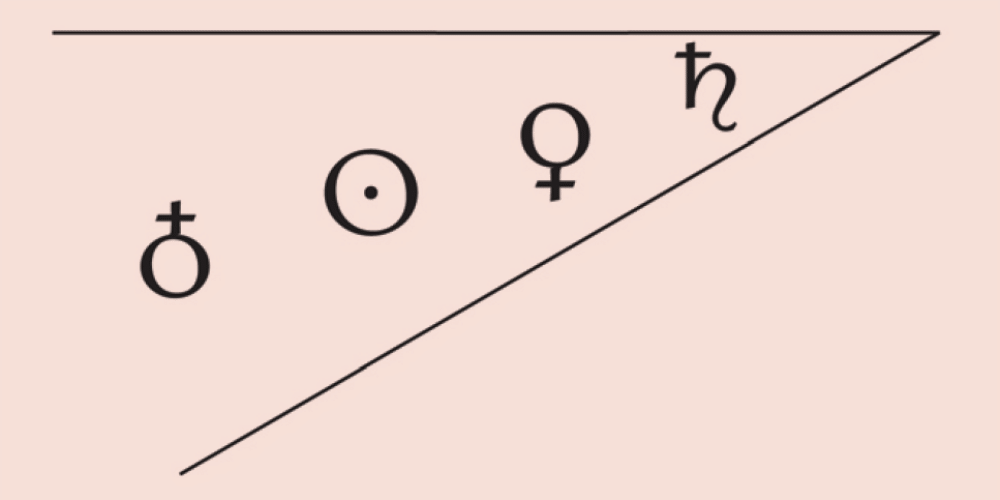
FIGURE 1982 0312a-1. The One-Only.
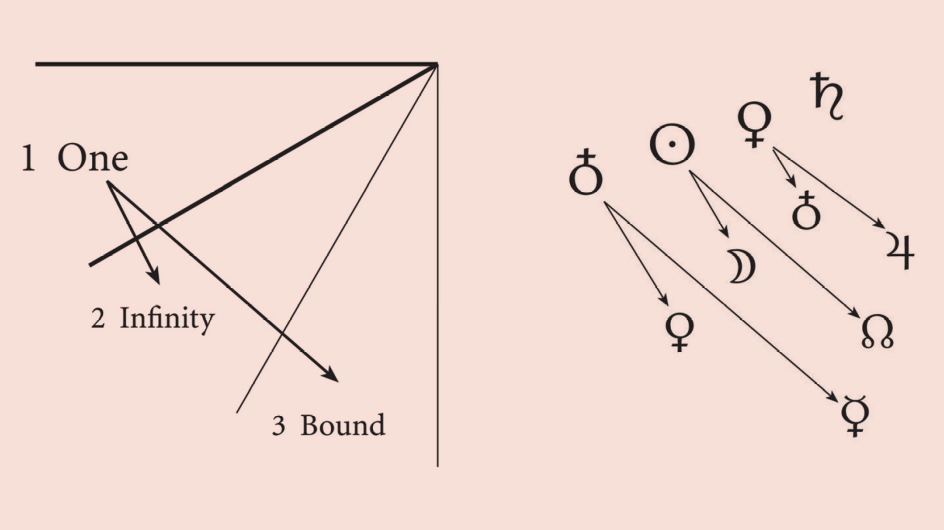
FIGURE 1982 0312a-2. One, Infinity, Bound.
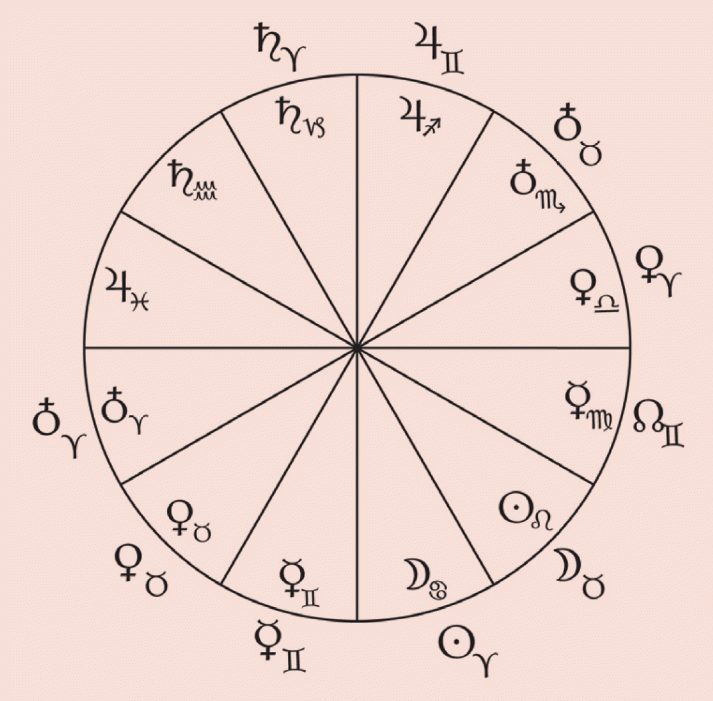
FIGURE 1982 0312a-3. Ten Unities and Twelve Rulerships.
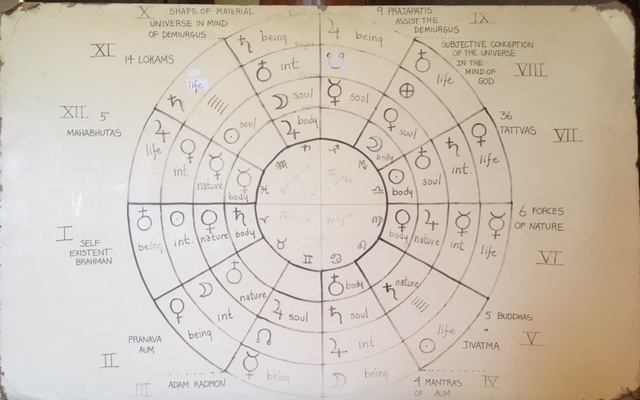
FIGURE IMG 2202-Posterboard Metaphysical Chart, used in classes at Wisdom's Goldenrod. For class discussion reference.
The first three diagrams are from Astronoesis, pp. 54, 56, 321, respectively.
AD PAPERS read in class:
- Astronoesis Working Draft Outlines of One, Intellectual-Principle, and Soul. The working draft outline of the One as read in this class has been retyped as 1982 0312b V09MP Astronoesis - One - Outline. The working draft outline of Intellectual-Principle as read in this class has been retyped as 1982 0312c V09MP. Astronoesis - Intellectual-Principle - Outline. The working draft outline of Soul as read in this class has been retyped as 1982 0319b V09MP. Astronoesis - Soul - Outline (where it is also read). See also the Outlines for these three chapters in Astronoesis, as well as Chapter One, "The One" (p. 19 ff.).
NOTES:
This is 1982 03/12a, Plotinus; One Class, and the first entry associated with this date. 1982 03/12b = One Outline. 1982 03/12c = Intellectual-Principle Outline.
Previously printed, distributed 2003 as part of a set.
Older partial transcript exists as two Scan Files, 1982 0312P-06R15.PDF and 1982 0312C2-10R15.PDF.
This class series on the One was held on Fridays.
TRANSCRIBED by jf 2002 from Audio Cassette tapes; reformatted by jf 2018. In 2024, IT updates prefatory matter and footer, replaces tape markers with audio file markers, completes Book List, adds Plotinus quotes section, corrects typos/errors, adds new notes within transcript, appends four diagrams and references within transcript to these diagrams, reformats to accord with new conventions. Readable edited transcript with AD Papers – V11rp.
AUDIO FILES: 1982 0312a, 1982 0312b. [Note: "Tape" and "Side" refer to original audio cassette tapes that were later digitized into .MP3 Audio Files.]
1982 03/12a at Wisdom's Goldenrod
Plotinus; One
[Audio File 1982 0312a Begins]
Astronoesis draft, One Outline (LR reading): "The Philosopher's wisdom-knowledge first expresses to us a view of the Supreme Reality as a simplex, the Absolute, the Alone, the utterly Self-sufficing. This simplicity is not that of a spatial point or a blank homogeneity, nor a numerical one to be numbered in with the others. It is the Highest Good, Pure Intelligence, and it is so complex in Its undifferentiated simplicity so as to include all and everything within It. (inaudible comments) Plotinus identifies the infinite and indeterminate power of the One as not distinct or apart from the pure Undifferenced Knowledge itself. It must remain a simplex, and yet be the source of all distinctions. This power is spoken of as the indeterminate Dyad and is the basis, or the indeterminate"matter," or substratum of all the Unities. It is what imparts to each of the Unities their characteristic uniqueness and being-form in a distinctionless mode within the One. They are therefore super-essential, super-gnostic, and super-vital. To elicit the distinctions within metaphysical infinity requires this power (the Shakti of Brahman). The One in its interaction with the Dyad exhibits Infinity and Bound, or Repose and Act. The double act in the Divine Mind is non-dual. The Unities which express or constitute the inner nature of One are no new production. The totality of all possible arrangements and combinations of these Unities, which are rooted in the One, still leave the oneness untouched. This view of the One as the Unity of Unities established in and by the power of the One, in the One, leaves intact the One. This is the basis for the Platonic theory of participation. So in the Unity of Unities are the transcendental principles of Nous and Being, of Ideas and Numbers, the totality of infinite possibilities. The power of the One establishes distinct real principles, levels of Being, or a variety of spiritual principles, yet not separated from their source. We must repeat that this power when identified with the One, or as extending from the One, this sheer indeterminacy, forces us into the perception of the One as transcendent and immanent."
LR: The next part is called "The Intellectual-Principle," so maybe we should go over the part on the One. (inaudible student comments) I'll keep reading it. (inaudible) Okay, let's do that and (inaudible) commentary on each. (inaudible student request) I see you. Okay, maybe, Alan, you can read the passage from VI.9.6. (AB: On page 619.) And V.5.5. He writes--
Astronoesis draft, One Outline (LR rereading): "The Philosopher's wisdom-knowledge first expresses to us a view of the Supreme Reality as a simplex, the Absolute, the Alone, the utterly Self-sufficing."
LR to AB: VI.9.6 and V.5.5.
S: Could you read that once more? (LR inaudible)
Plotinus VI.9.6 (AB reading): "In what sense, then, do we assert this Unity and how is it to be adjusted to our mental processes?
". . . We must [therefore] take the Unity as infinite not in measureless extension or numerable quantity but in fathomless depths of power.
"Think of The One as Mind or as God, you think too meanly; use all the resources of understanding to conceive this Unity and, again, it is more authentically one than God, even though you reach for God's unity beyond the unity the most perfect you can conceive. For This is utterly a self-existent, with no concomitant whatever. This self-sufficing is the essence of its unity. Something there must be supremely adequate, autonomous, all-transcending, most utterly without need. . . .
"The sovranly self-sufficing principle will be Unity-Absolute, for only in this unity is there a nature above all need whether within itself or in regard to the rest of things. Unity seeks nothing towards its being or its well-being . . . This is The Good. . . . This is base to all, cause of universal existence and of ordered station. . . .
". . . in the Solitary there is neither knowing nor anything unknown. . . . It is not to be thought of as having but as being Intellection; Intellection does not itself perform the intellective act but is the cause of the act in something else and cause is not to be identified with caused: most assuredly the cause of all is not a thing within that all.
"This Principle is not, therefore, to be identified with the good of which it is the source; it is good in the unique mode of being The Good above all that is good."
AB: V.5.5.
AD: But my intention was that the whole thing would be read. (LR: I did, just the One and--) No, read the whole thing. (LR: Read the whole thing, no quotes?) No quotes. If you could read the whole thing and try to get a bird's-eye view of (inaudible) from there-- And it would be like beginning with the One, and the procession of the One all the way to the third hypostasis. (LR: Okay.) We won't worry about the quotes now. (LR: Should I start on line one?) Just a sentence at a time.
[Astronoesis draft, ONE OUTLINE (LR reading):]
--"The Philosopher's wisdom-knowledge first expresses to us a view of the Supreme Reality as a simplex, the Absolute, the Alone, the utterly Self-sufficing.
--This simplicity is not that of a spatial point or a blank homogeneity, nor a numerical one to be numbered in with the others.
--It is the Highest Good, Pure Intelligence, and it is so complex in Its undifferentiated simplicity so as to include all and everything within It.
--Plotinus identifies the infinite and indeterminate power of the One as not distinct or apart from the pure Undifferenced Knowledge itself. It must remain a simplex, and yet be the source of all distinctions.
--This power is spoken of as the indeterminate Dyad and it is the basis, or the indeterminate "matter," or substratum of all the Unities. It is what imparts to each of the Unities their characteristic uniqueness and being-form in a distinctionless mode within the One. They are therefore super-essential, super-gnostic, and super-vital. To elicit the distinctions within metaphysical infinity requires this power (the Shakti of Brahman).
--The One in its interaction with the Dyad exhibits Infinity and Bound, or Repose and Act. The double act in the Divine Mind is non-dual. The Unities which express or constitute the inner nature of One are no new production.
--The totality of all possible arrangements and combinations of these Unities, which are rooted in the One, still leave the oneness untouched. This view of the One as the Unity of Unities established in and by the power of the One, in the One, leaves intact the One. This is the basis for the Platonic theory of participation.
--So in the Unity of Unities are the transcendental principles of Nous and Being, of Ideas and Numbers, the totality of infinite possibilities. The power of the One establishes distinct real principles, levels of Being, or a variety of spiritual principles, yet not separated from their source. We must repeat that this power when identified with the One, or as extending from the One, this sheer indeterminacy, forces us into the perception of the One as transcendent and immanent."
AD: That's about the shortest summary I could think of, of the One. It's not excluding any really important points. (inaudible)
[Astronoesis draft, INTELLECTUAL-PRINCIPLE OUTLINE (LR reading):]
"THE INTELLECTUAL-PRINCIPLE
--The One as the source of all contains in its inner nature, in a differenceless mode, transcendentally all the principles which are to be distinguished from it. (AD: That's just a connecting sentence.)
--In the undifferenced knowledge of the One are prefigured the Intellectual-Principle and Being, the Ideas and Numbers, so, in essence, the unity of the Intellectual-Principle is to be found in Universal Being.
--When we conceive of the essential simplicity of the One, i.e., its transcendental aspect, we are considering it as partless and indivisible. Even knowledge of it is excluded. When considered as the principle of all principles it is immanent. Both views are necessary to understand it rightly. This follows the paradigm of the double act.
--The radiant emanations or the divine outflowing is now unfolded. Within Being the first distinctions arise, knowledge and its objects, the one-many.
--Number, which is already transcendentally in the One, presides over, arranges, and coordinates the Ideas and their powers in the Intellectual-Principle.
--We will attempt to show that a derivation of the 10 structuring metaphysical principles, the Divine Numbers, are from the One itself. These are the properties of Number. (AD: Not for Number.) (LR: I don't know.)
--These properties will form the basis and archetypes for the ordering of the Ideas in the Divine Mind. This principle of Number will coordinate the specific relations of the Ideas with the appropriate powers or dignities which essentialize and singularize the Ideas.
--Number, which coordinates the Ideas and their powers, is symbolized by the Head in our illustrations, the two are distinguishable but not separable.
--The inability to grasp the Infinite One in its totality even by the Intellectual-Principle, its repeated attempts to do so, accounts for the innumerable successive impressions of that One as universe after universe is unfolded and the planned evolution or idea of manifestation progresses.
--The Intellectual-Principle, or self-thinking thought, knows the One in essence.
--In the Intellectual-Principle the unities of the Ideas and their Power are made explicit. They are its own divine content which is itself self-gnostic. It is that which it knows.
--Each Idea is an Intellectual-Principle entire, a special and unique form of it. The same as Intellectual-Principle entire is a dua-- (S: I'm not sure (inaudible); LR: Is this just almost 'Same as'?; AD: 'Same as,' yes.) The same as Intellectual-Principle entire is a duality and unity with a specific internal structure of its own determined by Number, and similarly self-gnostic and self-distinguishing, which gives rise to the notion of the separative intellect rooted in the one unified Divine Intellect. (short AD/LR interchange)
--The power of the One is so great that the Intellectual-Principle, although an image-One, is an authentic reality in eternal actuality. There is no notion of becoming or potential in the Intellectual-Principle; all is actualized, and all is one eternal life.
--The Power of the One, being the indeterminate Dyad, the Intellectual-Principle paradoxically stands a distinct reality, distinct in the One, yet expressive of the One's own nature.
--Plotinus attempts to reveal something of the essence of the Divine Mind by a discussion of the categories or the constitutive principles of Being: isness, motion, permanence, difference, identity. Sometimes he speaks of five, and sometimes of six. (LR: Is there supposed to be (inaudible)? AD: Yes (inaudible) But he does sometimes. Sometime-- in one tractate he speaks of six categories and in another he speaks of five. I go on to explain.) The nature of these principles is the cause of some ambiguity. Nonetheless, these are not parts of Being but Being itself. Mind thinks, which is an eternal act, this is divine ideation. It is a permanent reality and has Power or motion and is stable essence. (AD: Explanation, analogy, (that).) Mind equals Isness, thinks equals power or motion, its thoughts are self-identical, and different from one another, and their permanence is their stable essence. In their totality they are identical with Being or Intellectual-Principle. Any real Being or Idea will also be similarly constituted."
LR: Now this is Soul.
[Astronoesis draft, SOUL OUTLINE (LR reading):]
--"The Third Hypostasis [Soul] is also an authentic essence, Real-Being, and similarly constituted by the five genera peculiar to Soul, that is, characterized primarily by Life.
--It is said to be both a one and many.
--In Plotinus Soul as a generic term may be regarded in three distinct ways. Nonetheless in all three its essence or principle is said to be Life. He distinguishes: a) Absolute Soul or the principle of Life in the Nous, called also Rhea, in Greek Theology; b) Universal Soul as an outraying of the Absolute Soul toward the manifestation of the fourth Plotinian principle, the system of Nature and the objective world; and c) the Individual Soul which is also rooted in the Absolute Soul, in the Divine Mind, but reaches down to its association with bodies. In this last category he places planetary souls, star souls, and cosmic soul.
--Absolute Soul is the unity of soul in the Intellectual-Principle, and in this are rooted both Universal and Individual Soul. It is the principle of Life or matter for the Intellectual-Principle, in which all the forms are simultaneously reflected.
--The Universal Soul is spoken of as two-fold. It is the Providence which presides over the whole of manifestation, and illumines matter with its reason-principles. It is the One Life of the Universe and that is its outer aspect or Fate. Its other aspect is its inner conjunction with Absolute Soul. Thus Plotinus tells of the Royal Soul and Royal Intellect which belong to Zeus.
--Because of the prior activity of Universal Soul, the groundwork, it now becomes possible for an Individual Soul which can be cosmic in its sweep, to elaborate what is to become the objective manifestation, and for the Individual Souls that are conjoined with various bodies within that cosmos to participate therein. These Individual Souls are not produced by Universal Soul--they too spring from Absolute Soul and in this unity are in continual contemplation of the Divine Mind.
--In this contemplation the indeterminate life of Soul is eternally conjoined with a vision of the Idea of Man as in our case.
--This is the Authentic Man, a true essence, a permanent possibility in the Intellectual-Principle.
--The tendency of Souls toward secession must be with a desire toward a fuller self-realized vision of this Idea.
--Through their association with bodies, they are individuated and eventually taught to be self-conscious of their divine origin in the Nous.
--Each soul is a unity.
--It is also an outflow of graded powers and life, to unfold what it contemplates in the Intellectual-Principle. It is a logos or transmitter of the Ideas to the cosmos through its multiple powers.
--Summing up, for Plotinus, Individual Soul must be of such a nature--a unity and multiplicity, divisible and indivisible. At its highest--in Divine Mind--it is a unity, but it has phases and powers which unfold through various levels down to the sensible world.
--But even in its associations with body, with the universe which has been illumined by Universal Soul, it remains impassive. Soul is entire and indivisible even where its distinct powers are operative.
--It gives from itself a light to the formation of living entities when conjoined to body, and thus produces living images of its powers.
--These images are seated in the animate principle, coupled with body, bring about the relation of individual soul to cosmic soul."
AD: Now, as I said, I can't make it any briefer, or any simpler. But I do think all the main points are included in it. Everything is here. If you notice the ideas, it's rather simple and straightforward. That as a general topic the One and a procession from the One, and the reversion back to the One. And what I tried to do was to follow this procession out of the One, first the One in itself as transcendent, insofar that we think of it in a certain way, that is in its undifferentiated simplicity. And on the other hand we can think of it as immanent insofar as we can think of that power as extending. From there you go on to the next notion, and then the following, and there's like a step by step unfoldment or procession of the One and ultimately you want to bring it all the way down into the 12th house. That was the simple idea behind it. I try to use simple language, but also to nail every important item down. Now I have more written, but this is quite a mouthful and I don't know if you people want to discuss anything, before I do the next thing.
S: (inaudible)
AD: Yes. the part that was (inaudible).
DB: The part on the One (inaudible) participation.
AD: No. I won't talk about that--because that's going to require--I'm going to go over that paper, you remember-- the Platonic theory of participation and I'm going to show that how Plotinus works on the Platonic conception, not necessarily because he is dependent on Plato but because that's the way it is. And when he speaks about the view of the One as the Unity of Unities or the principle of all principles, each one of these principles is contained within the Unity, each one of these principles is what you would refer to as a unity. Now, it's granted, or let's use Plato's words, it is the One itself which grants or which imparts to each of the principles their characteristic uniqueness and power. And on that idea the whole theory of participation is based. If that is not properly understood, then participation is meaningless, it can't be followed.
And I didn't want to get into the diagram, I wanted to just keep it very abstract. But the point here would be if you think of the principles that are rooted in the One, and in themselves they are indistinguishable from the One, because they are rooted in the One and as we said it is the One that gives them their characteristic aseity and unity, from those principles we will see stemming from them or, let's say, suspended from them a whole list of principles. So like from one principle, let's say, Being, there would be Being as a principle which would be included all the way down to the Mundane Gods; they would all participate in Being. And the same with Life, Motion, each one of these are Unities. In the One they're are inconceivable for they are united with the One. But insofar that the Being, the Intellectual, has any Being, that's because it is rooted in the One, and it participates in that Unity. And this was basically Plato's theory of participation which he brought down, right down into the empirical world. So that has to be understood in order to understand properly the Platonic theory of participation. And that's going to take a whole class. I'm working over that paper. Well, then you have nothing to say--alright. Have you understood this well?
LC: There's a lot there.
AD: You're allowed to ask questions.
LC: Thank you, the fact that-- the Intellectual-Principle is looking back on itself and the universes are unfolded from that. (AD assents) And the sentence or two right after that that you read, it sounded that reason for it was manifestation, it sounded as if manifestation is the reason, the principle for that unfoldment, and it didn't make sense--
Astronoesis draft (AD rereading): "The inability to grasp the Infinite One, the infinite, metaphysical infinity, in its totality even by the Intellectual-Principle, its repeated attempts to do so, accounts for the innumerable successive impressions of that One as universe after universe is unfolded and the planned evolution or idea of manifestation progresses."
AD: I think what we are trying to say there is very simply what Plotinus was speaking of, was in the attempt to understand, or to proceed, the One itself, metaphysical infinity, there transpires, or what goes on is this constant attempt to do so, there's formulated ultimately in the sensible world-- We would say that the manifestation that is taking place in the sensible world *is* unfolding, is unfolding this attempt on the part of the Intellectual-Principle. In other words, what we are trying to do is here, is to show that the evolution of the World-Idea, or I should say, of universal manifestation, proceeds ultimately from the Intellectual-Principle's attempt to understand the One, or to grasp the One. And that would be simple and direct. Alright, I'm not going to put you through the course--
DR: If we could have a copy of it-- to look it over-- (student laughter)
S: Well, if you could read it again, if you wouldn't mind-- (more laughter)
AD: Or what we could do is read it over, and stop with each one. I brought this out chiefly because Mr. Bennett was very confused and he couldn't keep together all the principles, and I thought that it was pretty straightforward and they just follow one after the other, so I just want to oblige Mr. Bennett.
SS: Thanks, Bob. Thank you, Mr. Bennett, thank you, Bob.
AD: Alright, we'll read it slow one at a time. And you ask questions because it'll get *much* harder. If you can grasp this thumbnail sketch, alright, it's like a birds-eye view, you can see the basic presuppositions that they would claim he's working with, you'd really have a weapon in your hand to understand the whole of the Enneads. And everything that we've been trying to do here.
LD: (inaudible) On the one hand you speak of the One as an utter simplex, you started out the paper but speaking of the One as it is in itself, with no distinctions--
AD: That's the first one.
LD: That's the first one. And then you speak of the One as the source of all distinctions, its indeterminate nature, you speak of the indeterminate Dyad, now that would mean that--
AD: Alright. Let's take one point at a time.
LD: But I'm trying to understand the-- you say the interaction between the One and the Dyad--
AD: Yes, that's a perennial problem.
LD: You mean the interaction of the One within, with itself?
AD: With itself.
LD: But I just get stuck there--those two aspects of the One how do they-- how does the One interact--
AD: With itself.
LD: Yes.
AD: The first point was that the supreme reality is a simplex. Alright, utterly self-sufficing. That's very important characteristic and we have to keep that in the mind. Now this simplicity that we're speaking about is not that of a spatial point or any kind of a blank homogeneity--you know the way they interpret Nirguna Brahman as a blank homogeneity. It's nothing like that. Nor is it to be even considered in any shape, form, whatsoever, that is, in terms of quantity. So all that's eliminated. Now if there isn't any of this here, if it isn't any of this nature, then we can see that when we are speaking about the One, or the simplicity of the One, it's going to be the most complicated and complex thing that we could deal with. The complexity of Unity is unfathomable. So don't import into your understanding of the term 'one' as some kind of number to understand unity. The next point is that--
Astronoesis draft (AD reading): "It is so complex in Its undifferentiated simplicity so as to include all and everything within It."
AD: So we have to find, or ultimately we will have to find that everything comes from the One. And yet, although everything comes from the One, the One remains intact. That's is the paradox. Yes, that's the paradox. Now the next point and this is a real slippery eel--
Astronoesis draft (AD reading): "Plotinus identifies the infinite and indeterminate power of the One as not distinct or apart from this pure knowledge itself."
AD: Very slowly, think about this. We are thinking about metaphysical infinity, that means the totality of all conceivable possibilities combined in an undifferentiated mode, which of course cancels out the word mode. So another way of looking at it would be as Universal Being, not any particular being, not any kind of being, but Universal-- Universal Being. Now that would include power. As a matter of fact there is one place where he speaks about the One as characterizable as the "depths of power." (Plotinus, VI.9.6) Now it is this power which is, so to speak, going to be the wedge with which we hope to understand what he's [Plotinus is] speaking about. You can conceive of this undifferentiated [unity]-- or the totality of all possibilities as containing power. You can think that way. So here the power is identified with the One in this case, right?
LD: The power is identified with the One?
AD: Yes, the Power is one of the-- If we said it is an attribute of the One, and if we said that other things, say A, B, and C are also attributes of the One, that would be false because then you would be able to say that the One has all these attributes, and therefore you would be speaking about it as something as knowable. But by definition, Unity precludes knowledge in the sense that it is already included within it. So we can't take that approach. As soon as we start saying, well the One is all these things--A, B, C, D--well you don't have a simplicity anymore. So we can't take that approach.
But the important thing to notice here is that Power is identical with the One. Now the next step is to notice that this power can be extended--there's no difficulty there. This power is spoken of, this power which is extended, is spoken of as the indeterminate Dyad. Now that means that the power in itself is sheer indeterminacy in the sense that it is identical with the One and it seems to be productive of the Many.
LD: It has these two aspects--
AD: So it has these two aspects. So it is sheer indeterminacy. If it comprises one of the totality of possibilities which is included under the notion of metaphysical infinity, then it can also be conceived of simultaneously as something which can be extended from the One. So insofar that I speak to you, the power of my voice is communicated. Right. You hear my voice. But the power does not leave me. So you have that problem of thinking of the One as the power as identical with the One and as power as going forth from the One.
Astronoesis draft (AD reading): "This power is spoken of as the indeterminate Dyad and it is the basis or the indeterminate matter--
AD: Now this we have to listen to carefully--
Astronoesis draft (AD reading): "--the basis or the indeterminate matter, the substratum of all the Unities."
AD: Now if we said that this power is the substratum of any unity, that would mean that the substratum of all the Unities is one and the same thing, power. Okay. But if we think of this power as extended from the One to the unities, and yet this power, as like I just pointed out in the example with my voice, it's still my power. The word that goes out is still my word. If we look at it that way, and if we think of this as the substratum, or that which makes an idea, a form, a henad, a unity, it is this which is the *stuff* of that unity, this power that we're speaking of.
LD: But all the unities are different.
AD: Yes.
LD: So it's one stuff, one essence but in its given, outward-- it gives different essences out--I'm not making myself clear.
AD: No, you're clear. The power which is, so to speak, the underlying substratum of each of the unities is the same, it's power in all cases. The difference between one unity and another is what you're asking.
LD: Yes--
AD: So for instance, if we speak about the unity of Being, if we speak about the unity of Life, if we speak about the unity of Intellect, alright, these are all unities. What distinguishes one from another would be this peculiar uniqueness or aseity that makes this thing to be what it is and not anything else. But if we say that the One is that which imparts *Power* and *Being* to each of the Unities, then where can the distinction, so to speak, or the separation be made? You cannot separate, you cannot separate the power which the One operates with, insofar as it gives to a principle its power and gives to the principle its characteristic aseity, alright, you cannot separate it from the One.
LD: (inaudible) Say it over again.
AD: You remember the old example we used where we say you have ten trees in the ground, a birch, an elm, a-- Each tree is different from every other tree, but insofar that they are all rooted in the ground, and their roots are made of earth, then at that level they all share in that commonality of the earth. Now in the same way if we think of a principle, what makes principle A different from principle B, we say is its essence, its characteristic aseity. That is given to it by the One. And we say that the stuff or the power which it imparts that, is given by the One. So the power and the aseity of a unity is given to it by the One. Then what distinguishes them in the One from the One?
LD: (inaudible)
AD: Nothing. That's the point. Then they exist-- and again words will beggar --and we're beggars, alright-- but if I were to put it this way-- they exist in the One in a distinctionless mode.
LD: I'm thinking of them as distinct within the One.
AD: Yes.
LD: Because I'm here and not there.
AD: No. Because as soon as you bring in the operation of the distinctions, where you make them different from one another, you're in the Intellectual-Principle.
LD: Alright. That's what I--
AD: Yes. But that's exactly what Plotinus wants to avoid. He says you've got to anchor the bull's-eye and if you deviate in the slightest, you'll be among the many. [Note: See Plotinus, V.5.4, third para, first sentence.] So the same thing here-- If the point isn't precisely grasped, then you will say, well how can the many come from the One?
LD: So they're not distinct in the One yet-- yet-- the potential for the distinction is there in the One.
AD: Alright, if you want to put it that way. That ultimately the One will generate all the distinctions of which we are aware of all the way down here.
LD: I don't see how we can even talk-- I don't (inaudible).
AD: Well, we can't talk about it, you see. Actually it's a man like Plotinus that could talk it or a sage, because in their experiences they've been--
(Side 1 of original cassette tape digitized as 1982 0312a Ends; Side 2 Begins)
AD: --is required when you read Plotinus. I hope to elaborate the chart, but right now I want you to do it just abstractly, just carry it in your mind abstractly. So if we finish that--
Astronoesis draft (AD reading): "This power is spoken of as indeterminate Dyad and it is the basis or the indeterminate matter, or the substratum of all the Unities. It is what imparts to each of the Unities their characteristic aseity and Being in a distinctionless mode within the One. They are there called and can be referred to as super-essential, super-gnostic, and super-vital."
AD: That is, they're above Being, they're above Life, and they're above Knowledge.
LD: You say it imports its characteristic aseity *and* its Being.
AD: Yes. If we say love is an Idea alright, and it also has power, we'll use it as an example, we'll go over that. Love has a characteristic or unique kind of existence, and the power that it has, we just said the One gives it to them. The One gives it its characteristic uniqueness or aseity and the power. Now when it gives both of those, both the aseity and the power, it is still so to speak within the One, it is not distinct from the One. It exists within the One but as, so to speak, in this distinctionless mode. Let me think if we could--
LD: You said Being and power--
AD: No. Being and power are two different things.
LD: Yes. I think-- What do you mean by Being exactly?
AD: Its essence. Essence--what makes a thing to be what it is. Now an Idea, the ultimate simplicity of an Idea, would be what you refer to as an essence. So we could say Love is an essence, Being is an essence. Each one of these things reduced to its ultimate simplicity, like a single element, that's its characteristic aseity, that's its characteristic essence. And insofar that it can do something it has power, that's the power aspect. These two must always be included in a notion of a unity. Otherwise then the Ideas of God would be meaningless, because then they don't have the power to effectuate themselves.
JC: Following what she just asked, I wondered why you said that the power of the One was the substance of the unities.
AD: But that's the whole point-- that's the whole beauty of it, that's the whole beauty of it -- think about it for a moment. The power of the One is the substratum of the Unities. You see that's what we mean when we say, when we speak about the One as transcendent, we are thinking of all the power as identified with the One. When we say it is immanent, we are thinking of the power as extending to everything. So these two conceptions, transcendent and immanent, is something which you have to hold, one in each hand in order to realize what metaphysical infinity amounts to, or at least to get some insight [into it]. It is this paradoxical complementarism which gives us a clue how far the One transcends all of these polarities-- let alone the polarities that we speak of down at the psychological level which are absurd (inaudible). But that's the beauty of it, that it's power which is the substratum, the *stuff* of these unities. That I can't give, I can't find simpler ways to say-- It's almost like if you were to think of energy, now this is again an analogy. This chair is nothing but energy alright, but energy which has been structuralized and it will always have that shape and form. So if you think of energy which is about as immaterial as you can get, and you say that that's energy structuralized, I'll say what are you talking about--that's a chair! (inaudible) By the way, I guess you know Avery's sick, he's not well--
JC: Are you saying like the activity of the One considered as-- the activity of the One distinguished according to various universal modes of functioning--
AD: Very good.
JC: You could speak of it as the Unities.
AD: Very good. And if this is a universal mode of functioning and this is a universal mode of functioning -- Being, Life, alright -- then how do you separate them in (/from) the One? Exactly. That's universal Being, the universality of Being.
JC: The activity of the One distinguished according to its universal modes of activity, is what you call the Unities--
AD: You know in Vedanta they have the same thing. And they say that you only have metaphysical infinity, or Nirguna Brahman, alright. Nirguna Brahman means characterless. So, if Nirguna Brahman has no characteristics, it cannot be apprehended by any characteristics, then how do they explain the arisal of the world? And they have to bring in the notion of Shakti, the *power* of Brahman. And that forces them to say-- Now this is the only thing I would ask you to keep in mind. The ultimate consequences, if you say that this world is illusory, the ultimate consequences are a denial of that power, to establish the scales of reality that we live in. If you see that, you've got a capital point. Tuck it away and put it in your pocket and don't lose it. Don't lose it-- Alright, so it's kind of straightforward, the next sentence-- If we go back to your question, Laurie-- Now we're speaking about the One and its interaction with the Dyad. Now we said that the Dyad was this indeterminate power. We're just giving it a name--Sam, Harry, James, Dyad-- (student laughter). You'd be surprised that nonsense that goes on over this Dyad.
Astronoesis draft (AD reading): "The One in its interaction with the Dyad, or with its power, exhibits 'Infinity and Bound'--this is a direct quote from the Philebus--or Repose and Act."
AD: These two in Plotinus are referred to as the double act in the super-intellective Mind, if you remember.
Astronoesis draft (AD reading): "This is non-dual."
AD: --There. As the One it is non-dual. If we think of the totality of possibilities which are active, and we think of the totality of possibilities which are passive, now you're speaking about the totality of all possibilities that are active and-- either one would be the same as the other, according to your definition. They're universal modes of activity. What would distinguish one universal mode of activity from another? You're getting a feeling of Universal Being?
LR: (inaudible) One of the Ideas or principles in the One is the Principle of Difference. We're asked to conceive of the differences. (inaudible) Now when you say that the One bestows upon each of its principles, its power and its aseity or its essentiality, it's true that principle of Difference that aseity has happened at all, that unique aseity? (AD assents) Or in that there are modes of unity there's also oneness?
AD: What you're saying basically, if I translate the terminology, is you're saying something like this. In the One, or in metaphysical existence, in metaphysical infinity, there exists universal relativity. And what would be wrong with that? Don't think of it as the principle of negation, which becomes operative, let's say, in the second and third quadrant, or at the level of Intellectual-Principle and Soul.
LR: Well, I'm trying to think of the Principle of Difference as what makes possible the unique aseity.
AD: Now universalize it. You see, if you think of the Principle of Difference, immediately and unconsciously you have to bring in two things in juxtaposition to another. if you blend these two things as universal, then this Principle of Difference as universal alright, can't be distinguished out from other principles. Try it.
I think you were told the story, or I think the story was mentioned, that Plotinus had this ability, this tremendous inward faculty to be able to concentrate inwardly. And to continue for hours unbroken. And someone would come and interrupt him. And he'd talk to them or do whatever he had to do--even if it took hours--and then go back and resume precisely where he left off. Now you can see that kind of inward faculty is equivalent to what you would call nirvikalpa samadhi. He's capable of entering the thought-free state with the sharpest, subtlest intellect, both of them are right present there for him. So there these people cannot work that way, that's why I say taking this as scriptural. I don't know, although I'll have to change that now, after reading PB's notes (inaudible). But I don't know, I haven't come across such a universal philosophic genius. Now you remember Ramakrishna, he would take a bite of an apple go into nirvikalpa samadhi and he'd stay like that. He'd be in there for a minute or ten or whatever, and when he'd come out resume biting-- (student laughter) and chewing. Now it's the same thing. This man [Plotinus] was capable of resuming his samadhi or (inaudible) concentration, this inward faculty alright, which was really an extraordinary gift. There are probably others, I'm certainly finding that out in reading PB's notes. (inaudible) Randy gave me a book to read, and said here, see if you can straighten out the categories here-- Next time we come back.
SC: Anthony, I didn't get the relationship between the One and the Dyad, and bound and infinity--
AD: Alright, let's read this--
Astronoesis draft (AD reading): "The One--metaphysical infinity--in its interaction with its own power, or the Dyad, exhibits or reveals or shows in some way for the sage, 'Infinity and Bound' --that's Plato's-- Plotinus put it in this way-- 'Repose and Act'."
AD: So that means eternal stillness-- and eternal stillness yes, and absolute activity. On the one hand, what they refer to as active perfection and on the other hand, passive perfection. And he refers to these two, if we grasp them simultaneously, then we would see them as referring to the non-dual. Not that we understand the non-dual, but it's referring to the non-dual. If you think of the One as having infinite substance and immeasurable activity, you can't. Even if you try to combine them. Let's say you could conceive of either one and try to combine them, these two simultaneously conceived would be Metaphysical Infinity. Now he called that, Plotinus called that the double act. I don't want to go to the text, I don't want to go to the chart, I just want to have this very abstract discussion before I hit you with the chart.
SC: It's not that this bound and infinity come from the One and the Dyad, but it's just another way to talk about the One and the Dyad. But--
AD: That's alright. And the other way is to look at it this way. If we were to analyze the One, let's say, is it possible for us to factor out the constituents of the One--now of course this is absurd. But let's say we're super-ones, alright. And we would say, on the one hand there is this immeasurable activity--in all directions like he spoke about before --this universal functioning. And on the other hand, we think of it as having unlimited infinite substance. Now if you could simultaneously bring these two [notions] together--because they're paradoxical, they're contraries, complementaries, in a sense, we could see this is how the One is revealing itself through these two diametrically opposed symptoms [aspects] or--that's what Plato meant when he spoke about the One exhibits itself through bound and infinity. We don't have to accept the words, I mean we could use synonyms, write them down, bring them out.
JfL: The point about the Dyad *is* the One, it's not the next or something?
AD: No, it's not extra, that's why if we use the term power, the power is the One. If you say you have a thing, and that this thing has power, you're not speaking about something different when you're speaking about the power that this thing has. So this is where most of the confusion comes from, when people say that they cannot understand how Plotinus derives the many from the One. And this is the pivotal point to understand-- how you have the One, or metaphysical infinity alright, and how the many come from the One. And I think we'll be able to show on the chart how that's worked out. At any rate we'll be able to make pictures for ourselves.
SC: But in a way it's saying that he's not deriving the many from the One, that the many is present in the One.
AD: The many are present in the One, yes. Yes that's true. But what's also true is the reality of the existence of levels within that One. Alright. If you abolish those levels of reality, then there's nothing to distinguish me from a sage. And I know that's powerfully false. Alright, then it goes on and it says:
Astronoesis draft (AD reading): "The Unities which express or constitute the inner nature of the One are no new productions."
AD: Now again this is a little bit of a complicated, but I think it's as simple as we could put it. You go back to what we said before. We said that the power, that the One imparts through the use of its power, the characteristic aseity or self-identity. And its essence. Now you remember the way we said. We said what the One is giving to itself is itself. So therefore how could there be, so to speak, any differences within that arrangement? Try again--alright.
Astronoesis draft (AD reading): "The double act within the Divine Mind--this is the One--not the Intellectual-Principle--the double act in the Divine Mind is non-dual. Now the unities which constitute or express the inner nature of the One are no new productions."
AD: So what we're saying is, metaphysical infinity has as one of the characteristics or attributes, this infinite power. This power imparts to everything its aseity and its power. But what it grants, it is granting to itself. So insofar that it grants a characteristic uniqueness to this Idea, gives it the being that it has, and gives it the power that it has, and it does it with so many others, alright, we cannot say that something *new* is within the One. There is no new production. There is nothing other than the One, alright, or this double act. Because, as you just said, if the One itself is what grants the Ideas their power, and grants them their aseity, then we are speaking about the One giving to itself something. But what it can give to itself is what it already in itself has. Therefore nothing new has come into being. And that refers back to that quotation when he was speaking about that the unities, each and every one and the total of possible combinations and arrangement of all the unities, doesn't produce anything new within metaphysical infinity.
JG: (inaudible)
AD: Nada, nada, other than the One. Outside of the universality of the One. You're all too quiet, you must be assimilating something.
JG: It doesn't produce something that hasn't been produced before, hasn't always (inaudible).
AD: You're going by definition when you say that the metaphysical infinity is the totality of all possibilities active and passive, what in the world could you possibly produce that would be different from what already is?
JG: (inaudible)
AD: But you can't say that you can't say that. The point is that we have to make these distinctions here and now for ourselves very clear. (JG: inaudible) As I'm tried to tell you, this is only something a sage can say, not you or I. Okay.
S: And nothing new is ever produced? (inaudible)
AD: What would you mean by new?
S: That's why I asked you.
AD: Well, that's why I'm asking you.
S: Nothing other than the One.
S2: Nothing new to the One, but it could be new to the (inaudible).
AD: It could be novel to you -- (inaudible) (student laughter) So he goes on--
Astronoesis draft (AD reading): "The totality of all possible arrangements and combinations of these Unities, which are rooted in the One, still leaves the oneness untouched. And this view of the One as the Unity of Unity, the principle of principles, established in and by the power of the One in the One, leaves the One intact."
AD: If you follow this, believe me, you will have followed and have understood what dozens of commentators insist on denying. And I'm being mild.
RC: One word (inaudible) untouched by. I didn't know if undivided (inaudible) untouched by.
AD: Undivided alright, I like untouched because that's really-- When you say untouched, it's like you're really leaving the mental realm, getting right down into the gut level, the sensorial level, if I can't touch it it doesn't exist, I wanted to get down to that level. But undivided is quite good, Randy, I think we'll use that too.
S: Could you read that again, with that word?
Astronoesis draft (AD rereading): "The totality of all possible arrangements and combinations of these Unities, which are rooted in the One, leave the oneness untouched. This view of the One as the Unity of unities, or the principle of principles, established in and by the power of the One in the One, leaves the One intact."
AD: And this, I'm leaving out David's question, but we'll answer it, I will answer it--this is the basis for the Platonic theory of participation. The reason I brought this in, is because the paper that deals with this here [participation] takes off right from here, from this position here.
DR: (inaudible) I have another question--
AD: Well, you know it's been a problem for about 2000 years, the theory of participation which I personally believe has been misunderstood consistently, for 2000 years. After the work of Aristotle and the Church Schoolmen it was impossible. But there--we'll get into it okay.
DR: I think this other question is still the same question. When you speak of the unity, it sounds as though you're establishing the various (existence) of all these unities by the contradistinction of the One and (the many).
AD: Of course.
DR: I hear things said, but I don't exactly follow, and it sounds it's though there's something there that would make it quite clear that there's no other possibilities.
AD: No other possibilities?
DR: Well, it sounded very inherent in that very contradistinction that also--
AD: There are all sorts of possibilities in the One. It is the supreme beauty, the most beautiful, the most lovable, (inaudible).
DR: But these themselves are not necessarily-- I don't see how they are established by that contradistinction. But you seem to be saying that they are.
AD: That the unities are established--?
DR: By that contradistinction, it almost sounds like--
AD: Oh definitely.
DR: It sounds like according to the view of essence.
AD: Oh definitely, he's definitely saying that, he's saying that ultimately everything is traced back to the spanda, I'm sorry, the power, everything. That's why I brought in the Hindu version because they come to the same conclusion: you have Brahman and its Shakti, and everything can be reduced back to that. Sure, that's exactly what he's saying.
DR: Why is it, is it because that power is unending? That can you go on forever with seeing the essences that are--
AD: You can go on forever listening?
DR: I don't know what word. Enumerating--
AD: Enumerated. Yes.
DR: Enumerating the unities.
AD: Yes. And that's why in one of the discussions when we were speaking about the 3rd house, we spoke about that each one can represent-- in other words, we have only one word there-- the ontology-- in the 3rd house that represents ontology or the principle of Being, which is above Being, which goes into the 4th, 5th, and 6th. According to some of the discussions we've had, we've begun to realize that the 3rd house-- Being, or ontology is the only way we understand. But I'm quite sure for a Buddha or a sage there would be other principles that could be placed there, which would be principles of a particular manifestation other than ours. Whereas in ours we think of Being as the ultimate. This is the-- In other words when we put up that One-Being-Life-Intellect-Soul-Nature-Body, this is the only way we can understand, because, let's say, because of the identification of soul with Man. And insofar as we're speaking about this human soul, this is the way, this *human*, underline human, can understand metaphysics. But a different sort of entity could understand it quite differently. And there could be an entirely different arrangement of principles, instead of seven there could be seventy. In other words, I have to leave metaphysics in a special-- in the 1st house I have to leave it open all the time, open-ended. Metaphysics by definition can't be closed, it's can't be systematized. That's one of the frustrating things you probably all experience in this class. It is not a system. A system has a beginning, a middle, and an end, it is bounded, and you can learn anything that operates within that system and get thoroughly acquainted with it. With metaphysics you can't do that. And anyone who tells you otherwise-- go to the movie.
Astronoesis draft (AD reading): "So in the unity of unities, or the principle of principles, are these transcendental principles, of Nous, the Ideas, Being, Numbers, and the totality of infinite possibilities. The power of the One establishes distinct real principles, levels of Being or a variety of spiritual principles yet not separated from their source. We must repeat that this power when identified with the One or --let me put it this way-- We must repeat that this power when identified with the One refers to the transcendent. When extended from the One, or this indeterminacy of the power which is extended from the One, we refer to that as immanent."
AD: Alright?
DR: (inaudible) clear that the power isn't (inaudible) all those unities of the One (inaudible) the hardest part to understand is that same power which is establishing all those by the very necessity of what it is. What it is, is completely unfathomable.
AD: Yes, but after all the greatest joy that a human being can have is to try to fathom the unfathomable. When he gets to the point where he gives up then he gets enlightened -- but he better try real hard in the beginning. I'm sorry--Jeff--
JfL: I do think that David's point is that the power is some sort of critical in-between, because as was just said, when you spoke of it inwardly it's the One, it's the simplest to see that way, so (inaudible) the Dyad. When it's directed inwardly you've got the One in itself, and outwardly-- it is pivotal, it goes back and forth--
AD: Yes, as a matter of fact this brings up an apology that Linda is-- At one time I made the remark that if I-- (sounds like blackboard) --if we look at this here as the transcendent One, alright, and insofar as it has a self-identity, and we're restraining the power, it stays here, doesn't move out of here. [Note: See FIGURE 1982 0312a-1, The One-Only, appended to this transcript. This diagram is from Astronoesis, p. 54.] But on the other hand when we start pointing out that this is the leader, [Note: See FIGURE 1982 0312a-2, One, Infinity, Bound, appended to this transcript. This diagram is from Astronoesis, p. 56.] that these are leaders, alright, put all the others here (chalk-on-blackboard sound). That they're unities, and from these unities will develop all the other unities. They are suspended from it. And they go all around, alright. [Note: See FIGURE 1982 0312a-3, Ten Unities and Twelve Rulerships, appended to this transcript. This diagram is from Astronoesis, p. 321.] Then we can see that what we're speaking about over here, the immanence of this power all around. When we restricted it here, then we're speaking of this as transcendent. And these two conceptions, these two together-- [the Transcendent and Immanent] will give us the notion of the One. So what I'm trying to say, is that it's not enough to think of the One as just this here [transcendent, 1st house], but I also have to think of the One as this here [immanent, Triad] and everything else that it generates. The power is identified with the One, the power is extended or stretched out to infinity. And *both* these conceptions give us the notion of the One or the transcendent or the metaphysical infinity or universal Being. But by themselves you can't. This is unknowable inside, the One (inaudible) unknowable. But insofar as you could know its manifestations here, and be acquainted with its power you could trace it back to a certain extent. So you see Linda, I do remember your question, it took two years--
Astronoesis draft (AD reading): "The One as source of All contains in Its inner nature, in a differenceless mode, transcendentally, all the principles which are to be distinguished from It.
AD: We're in the Intellectual-Principle now and this is the tie-in between what we said --this is a transitional sentence.
Astronoesis draft (AD reading): "In the undifferenced knowledge of the One, what he called the super-intellection of the One, there's prefigured the Intellectual-Principle and Being, the Ideas and Numbers. So in essence the unity of the Intellectual-Principle is to be found in Universal Being."
AD: Now you remember he spoke about it in the actual quotation --he speaks about it that there's a transcendent copy of the Nous and Being in the One. Do you remember that quote? [Note: See Plotinus, VI.8.18, third to last para.]
AB: You're equating Universal Being with the One and--
AD: Alright--Yes, there's the transcendent--could you distinguish?
AB: I just wanted to make sure if I remembered--
AD: The One, Universal Being, Metaphysical Infinity, all these things can be (applied) to the One. The-- In the time of the Greeks it was a very difficult conception. As a matter of fact, the Greeks disliked the notion of Infinity, they were frightened by it, because for the Greeks everything had to be in a form. Always. If a thing did not have a form, they considered it ugly. So you can imagine when you brought up the notion of Infinity, or when Plato tried to speak about it [infinity] a little, it was very guarded, for it would have gone against the entire cultural trend. All you have to do is look at Greek art and see how you know implicit form is--they're always on that. As a matter of fact I think they anthropomorphize more than any other culture. Alright, we said in the One then, these things are prefigured.
Astronoesis draft (AD reading): "When we conceive of the essential--"
AD: And the word 'essential' here --and I am not a literary man, so remember that-- and it's not flowery language, I want precise language, so if I say "in the essential simplicity" I'm saying the essence is One, so keep that in mind then.
Astronoesis draft (AD reading): "When we conceive of the essential simplicity of the One, that is, its Transcendental aspect, we are considering it as partless and indivisible. Even knowledge of it is excluded."
AD: You follow that? There can't be knowledge of the One. You can't, so to speak, even at the highest level, the Intellectual level, there can't be knowledge *of* the One. By definition, Unity precludes knowledge. Or should we say, it is already included in, within it in a synthesized form, as part of its undifferentiated essence. So there can't be a *knowledge* of the One. Anyone tells you he's in nirvana, you can rest assured he's out. (some student laughter) Yes?
LR: (inaudible) two-year-old questions, I want to make sure I've got the right one. Did you mean the question about why the whole chart can't be considered as immanent?
AD: Yes. That was (inaudible). I refused at that time to accept it. (LR: Yes.) So you see you've brought me around to your way of thinking. "When we conceive" -- Oh I'm sorry--
Astronoesis draft (AD reading): "Even knowledge of it is excluded. But when considered as the principle of all principles it is immanent. Both views are necessary to understand it rightly. Now the radiant emanations or the divine outflowings -- in the Plotinian doctrine, the doctrine of emanations -- is now unfolded. The radiant emanation or the divine outflowing is now unfolded. Within Being--that is, within the Intellectual-Principles, or Principle-- the first distinctions arise, knowledge and its object, the One and Many."
AD: We could also use a slightly different terminology. When we say knowledge and its object, we could say power and its object. But knowledge is the way it's best understood. What we're saying now is that in the Intellectual-Principle you have a distinction among the Intelligibles, the Ideas, the Powers, Numbers, and all that. All of these arise within the Intellectual-Principle. And then he goes on and he speaks about--
Astronoesis draft (AD reading): "Number, which is already transcendentally in the One, presides over, arranges, and coordinates the Ideas and their powers in the Intellectual-Principle."
AD: That was an exceedingly difficult time we had-- if you remember, the notion of numbers-- we'll go over it in detail, because you had a lecture on numbers which flabbergasted me. The next--
Astronoesis draft (AD reading): "We will attempt to show the derivation of the ten structuring metaphysical principles, the Divine Numbers are from the One itself. And these are the properties of Number."
AD: Just to help you remember. Remember how we derived the Two from the One? And then the Three from the One? the Four? Now, if you remember, the Two would be equivalent to this indeterminate Power that the One has, they call that the Dyad. Two is always considered as feminine, they considered it as matter, anyone thinks of it as matter in the vulgar sense of course he's as far away as these things as he can be. And if you remember we had that intense discussion where we evolved all of them, all the numbers from the One. People like Euclid, for instance, when they went through this trouble to prove this infinity of prime numbers, they were not doing it because they were concerned with number theory. You can take my word for it. Besides there was no Nobel prizes then.
Astronoesis draft (AD reading): "The properties of these numbers will form the basis, the archetypes, for the ordering of the Ideas in the Divine Mind."
AD: What we're saying is something like this. That Venus in Libra [Rulership; correlated to Nature Venus in Aries; see FIGURE 1982 0312a-3, Ten Unities and Twelve Rulerships, appended to this transcript.]-- Number is what organizes what Intelligibles will manifest what Ideas, alright. So if we think of Venus as the Nature of the One, and that from that we have to suspend this power of the One, its infinite power, it is this particular Intelligible which is going to manifest the 36 or 24 tattvas. So the correlation of the Intelligible and the Idea, the manifestation of that Idea through this Intelligible or the power of this Intelligible was something that Plotinus said is governed by Number. Number determines what it is. And we got into an inquiry as to what Number is, and that was worse than (inaudible).
Astronoesis draft (AD reading) : "So this principle of Number coordinates the specific relation of the Ideas with their appropriate powers or dignities which essentialize and singularizes the Ideas. Number which coordinates the Ideas and their powers is symbolized by the Head in our illustrations. The two are distinguishable but not separable."
AD: The next point in the Intellectual-Principle was--
LR: You said these two are distinguishable.
AD: Yes, in other words, Venus in Libra, or Venus so to speak manifesting the 7th house, the 7th Idea, it will distinguish the Intelligible from the Idea, but they cannot be separated.
LR: It sounds the way you have it that, it sounds like the two are Number and the Head, and (inaudible) and you said that Number is symbolized by the Head, and in that diagram these two are distinguishable, but you don't mean that--
AD: No. I see what you mean. The Ideas and their powers, and what they manifest, is what is distinguishable, yes. Bad sentence.
Astronoesis draft (AD reading) "The inability to grasp the Infinite by the Intellectual-Principle, its repeated attempts to do so, accounts for the innumerable successive impressions of the One as universe after universe is unfolded and the planned evolution or idea of manifestation progresses."
AD: (inaudible) Again this is not detailed, this is very pithy, this is the table of contents.
Astronoesis draft (AD reading) "The Intellectual-Principle, or self-thinking thought, knows the One in essence. In the Intellectual-Principle the unities of the Ideas and their Power are made explicit. They are its own divine content which is itself self-gnostic, that is, self-knowing. It is that which it knows."
AD: Now, this sentence was a little confusing--
Astronoesis draft (AD reading): "Each Idea is an Intellectual-Principle entire, a special and unique form of the whole, of the Intellectual-Principle."
AD: So we're saying for instance, the 7th house Idea, is like a special and unique version of *all* the Ideas, all ten of them, and that applies to each one in turn. Now--
Astronoesis draft (AD reading): "The same as Intellectual-Principle entire is a duality-and-a-unity with a specific internal structure of its own determined by Number."
AD: In the same way that we conceive of the Intellectual-Principle as a duality-in-unity, and that it is self-gnostic, self-vital and all that, in the same way you have to conceive of each Idea. Now remember we're speaking about the Ideas in the sense that they're the divine predicables or in the sense that they're the divine names. I mean, you are speaking of the wisdom of the supreme Godhead. You're not speaking about your ideas or my ideas. Alright, which are neither divine or undivine. You have to keep that in mind. Idea here always has to be capitalized because it ends up-- it ends up in the (Marburg) school they thought the Platonists were speaking about concepts.
AB: I had a question about the way knowledge was being used just before this. In the One, knowledge cannot be properly spoken of because it's an undifferenced unity. So in the Intellectual-Principle we can first speak of knowledge, because there's a knowing and a known which are unified. But how can you say that the Intellectual-Principle has knowledge of the One?
AD: We said that it [the Intellectual-Principle] was incapable of grasping the totality, the entirety, of the One, although it knows the One in very essence.
AB: Alright, "knows the One in very essence"--
AD: What would that mean? Wouldn't that mean that on the one hand insofar that it's already included within the One and that a transcendental copy of itself is in the One, it knows the One in terms of that simplicity of essence.
AB: But insofar as the One is infinite-- total possibilities--
AD: It can't--
AB: It can't know the One.
AD: Exactly. Exactly.
LR: When you--
AD: All you did was to make clear what I just said. And you have to do that as we go along. If you think of it as Intellectual-Principle it can't know the One. If you think of the essence of Intellectual-Principle it is synthesized with the One.
AB: Well, it's self-identical with the One.
AD: There there would be no self to be self-identical with.
AB: That's where I was-- In the sense in which it's identical with the One, you (can't) speak of knowledge.
AD: Yes, that's the highest level of knowledge and Being, when you get to the Intellectual-Principle-- Beyond that you cannot speak of Being and Knowledge.
S: When we speak of the Intellectual-Principle trying to grasp the One, are we-- another way of putting--
[Audio File 1982 0312a Ends]
[Audio File 1982 0312b Begins]
AD: You seem to think it's something unique. You could absolutely be out of your mind to think that you could ever grasp anything in a total way.
LD: I see that--
AD: So then why do you worry about this?
LD: When I try to think about an idea-- grasping--
AD: Think of yourself trying to understand something, isn't it piecemeal?
LD: Oh, yes.
AD: Do you think it'll come to an end?
LD: No.
AD: Okay.
LD: Well, what does it mean--what does it mean for an idea trying to grasp, I don't understand what that means.
AD: For an idea to know itself?
LD: Yes. Say that. What does that mean?
AD: Well, if you think of your mind, alright, as an Idea, it's trying to know itself through the products it produces. It's a process going on all the time, all around, with everyone. It's a cheap imitation, true, of the Idea. You notice with what vigor you're attached to the ideas that your mind produces? The mind wants to know itself, it can only know itself or thinks it can know itself through the manifestations of thoughts. And this intimacy springs up with your ideas and you think they're your first cousins and you want to embrace them, hold on to them. But that's because their origin is the mind itself. And now if we expand and amplify this to think of the Idea, and Idea now here would be super-individual of course, we spoke about it as having universal qualities.
LD: That's what I-- (inaudible)
AD: Think of it this way, the duality already existed insofar that we said that it had power and a characteristic aseity or essence-- the duality is already built in. So a thing is not only itself it is also what it does and what it knows. And you can see, the thing itself and what it does is unified by the knowing. And there you would have like, at this level you would speak about a triple relationship, but the implication would be an underlying unity.
JA: Because the power of the Idea is made explicit in the Intellectual-Principle. (inaudible)
AD: The power of the Ideas is made explicit-- in the Intellectual-Principle. But we could read a lot of quotes on that I have four of them listed here. I just want you to get a nice little thumbnail sketch memorized in the back of your mind, because then we'll do the quotes. I want yous to discuss this, yous, all of yous. (student chuckles)
JA: You're not going to answer it now?
AD: No. No, Plotinus does a far superior explanation than I. But you're referring to this sentence, if I'm right?
Astronoesis draft (AD reading): "In the Intellectual-Principle the Unities of the Ideas and their power are made explicit."
JA: Yes.
AD: When we spoke about Absolute Soul, which is in the Intellectual-Principle, and we refer to that as the second in the Nous. We speak about the Absolute as the matter--now matter here is just a word--the very matter that the Intellectual-Principle uses. And we said further that Absolute Soul in the Intellectual-Principle reflects the totality of all the Ideas or forms in that soul. So the Absolute Soul is the matter in which is implanted the Ideas that belong to the Nous. Now what is being made explicit there is that we are speaking about the Absolute Soul as one of the eternal realities, and the Ideas which are implanted in that Absolute Soul which will be actualized further down. So we see on the one hand, Absolute Soul, we see it as an Idea, and we see it as an intelligible, and we see it as receiving, alright, in eternality, all the forms that are implanted with it. And these distinctions arise in the Intellectual-Principle. They are not available in the One itself. But only in the Intellectual-Principle this is made more explicit, it's unfolded, it's revealed.
There, of course, the Absolute Soul can receive all the forms at one time, here it can't be done. Here you can see the absolute reversal of that. You can only accept one form and you can only have one life, that's one life-- your life, my life-- or you could think of a commonality, but your life and my life are regarded as distinct one from the other. So this life that you have can only accept one form, and that's all it could work with. But in the Intellectual-Principle you have the entire reversal [of that], where the one soul can accept all the forms simultaneously eternally and in actuality. That's making it explicit, but he does it much better than I can.
And then the next point I think we spoke about. He said that that--each Idea insofar that it is an Intellectual-Principle entire-- Now we tried to do this here, remember we took one Idea at a time-- I don't remember how many of you-- and we showed we showed that one Idea, alright we took the 36 tattvas and we put it in the 1st house, and we showed that that one Idea was like the whole Intellectual-Principle, everything could revert back in terms of that one Idea, as the Intellectual-Principle. So that for instance in India you have the Shaivite school, they have one of the Ideas of the Intellectual-Principle and they claim that that is the highest doctrine. So when we put the 36 tattvas in the 7th house, in Plotinus's description that would be *one* of the Ideas in the Intellectual-Principle, and this one Idea, alright, can fill up the whole chart and doesn't need any of the other Ideas. Everything could be explained in terms of that one Idea. So it would seem that from the Platonic point of view, we say 10 Ideas alright, from the Platonic point of view it would seem that there should eventually evolve ten absolute philosophies. And I'm not going to undertake that. Let me just finish this on the Intellectual-Principle. Go ahead, David.
DB: You might have just answered this but when you speak of the Intellectual-Principle, in attempting to grasp the One, generating successive impressions, and you referred to one universe following another and the consequence of that interaction? Is there a way to distinguish the consequence of each Idea as an Intellectual-Principle itself and its attempt to grasp the One and the consequences of that?
AD: No. I haven't been able to work that out.
LC: If the-- you said earlier that the substratum of the unities, that the power was of the One, we just said that the Absolute Soul which is in the Intellectual-Principle, its substratum would be this.
AD: No. No.
LC: No, what?
AD: No, the unity of the Absolute Principle would be in the first quadrant. The Jupiter [in Gemini, Soul planet].
LC: So after that substratum, it's no longer the power of the One.
AD: No, the power emanates. You have to keep in mind when he spoke about any eternal reality has an outward-facing hypostasis, alright, so Jupiter would have Saturn as its outward-facing hypostasis, and you go right down the line. Ultimately, alright, insofar that you could brush your teeth in the morning, ultimately that power ultimately is derived you know from where. Why do you think the tantrics are so interested in power? What do you think the Dalai Lama represents? Power.
Astronoesis draft (AD reading): "The power of the One is so great that the Intellectual-Principle, although an image-one --that's the word he used, image-one, let's say a reflected one-- is an authentic reality in eternal actuality."
AD: This right away says something like this: The Intellectual-Principle has an existence in its own right. Do not assume that it's there for the sake of the sensible world. If there was no sensible world, there would be nothing, it's an eternal actuality, so we have to keep that in mind. The same way for instance that you can speak about Motion about one of the genera of being. If start thinking that there's undulating waves in the Intellectual-Principle, you're wet. (student comments, inaudible comment)
Astronoesis draft (AD reading): "There is no notion of becoming or potential in the Intellectual-Principle."
AD: There *is* Motion in the Intellectual-Principle. There is Motion, I'm not saying there isn't motion. But don't superimpose on that idea or on that genera of Being, one of the genera which is Motion, don't superimpose on it your ideas.
Astronoesis draft (AD reading): "There is no notion of becoming or potentiality in the Intellectual-Principle. All is actualized and all is one eternal life. The power of the One being the indeterminate Dyad, the Intellectual-Principle paradoxically stands a distinct reality, distinct in the One yet expressive of the One's own nature."
AD: That would have to be, because where can the One not be? And if you say it is here, you can't say it's here. Because here is included in it. So it's everywhere and nowhere, if you remember that famous quotation. Now--
Astronoesis draft (AD reading): "Plotinus attempts to reveal something of the essence of the Divine Mind by a discussion of the categories or the constitutive principles of Being--sometimes there's five, sometimes there's six--isness, motion, permanence, difference, identity. These are not parts of Being, but Being itself."
AD: It's almost like we are required to conceive of in the simultaneous grasp the notion these five constitute Being. "Mind thinks--" alright, this is an example, I'm trying to get you to work with.
Astronoesis draft (AD reading): "Mind thinks, which is an eternal act, this is divine ideation. It is a permanent reality and has Power or motion and is stable essence.
AD: Now if you take each of these important nouns-- Mind, this equals isness; thinks, this equals power or motion. Its thoughts, the mind's thoughts, each one is self-identical with itself, but different from the others. Their permanence is insofar that they are stable in their essence, that is, they are what they are.
Astronoesis draft (AD reading): "In their totality these are identical with Being or Intellectual-Principle."
AD: Then he then takes the same five genera and he applies them to Soul. But there the chief characteristic is something else. He will do that with any of the authentic realities that are within the Intellectual-Principle or in the second hypostasis, Soul.
Astronoesis draft (AD reading): "Any real Being or Idea will also be similarly constituted."
AD: Alright, I think I've taken up enough time, I'm sorry I was late today. Soul is the most-- there's a relative complexity, in some ways for me, the more abstract the subject is, when I'm at home, so I feel comfortable with the One. But as it starts getting into the empirical I start getting lost, so I usually can't even get across town without not finding the street. But it's going to happen now, the complexity increases, you can isolate one principle, speak about it, and pivot your attention. But when you get into the system of Nature, and when you get into the empirical world, all these principles, the interconnection, the various levels or frameworks of reality that are operating, then it gets more and more complex. But if we memorize these things, the best we can, then when we get into the empirical, and we'll be doing that now, we're going to start Mondays, we've already started a little bit [new astrology class on Mondays] we'll try to see what the ingredients of the cake are, one by one. So, tomorrow we'll continue. Also, this is important in terms of alchemy. I must confess that I'm a little prejudiced towards Jung because he makes such a mishmash of alchemy. If we get an opportunity tomorrow we'll read some passages from Atwood, or I'll take some of the other authorities on-- and the goal that they're interested in is really the most obvious thing to a mystic, the untarnished imaginal essence. (inaudible) You got to go through these wrong ways.
(inaudible student comments)
[Audio File 1982 0312b Ends]
1982 03/12a V11rp: CLASS: Plotinus; One. Copyright 2024 Wisdom's Goldenrod p. v