DIAGRAM FOR 1982 0313
Class
Saturday, March 13th, 1982
Verbatim, unedited transcriptClick the series name to view more
CLASS at Wisdom's Goldenrod, Hector, NY
with Anthony Damiani (AD)
March 13, 1982
ALCHEMY; IMAGE OF MAN
TOPIC: Alchemy
SUBJECT: Image of Man
SUBSUBJECTS: Medieval vs. Modern Man, Academic Philosophy vs. Occult Philosophy, Astral Body, Astrology, Earth Soul, Dragon, Böhme, Imagination
CONTENTS:
Comparing medieval vs. modern image of man
Two philosophical traditions existing in parallel for centuries: 1) official academic philosophy; 2) occult philosophy
Reading/discussing Durand, "The Image of Man in the Occulted Tradition of Western Culture"
Historical progression of occult philosophers opposing mainstream philosophy
In pre-Averroes Middle Ages, official and occult philosophies were united; split began around 14th-15th century with displacement of Avicenna's concept of active intellect
Unity vs. dualism in conception of self: 1) Western academic thought: Cartesian dualism, etc.; 2) traditional occult thought: no separation between self and cosmos; initiatory practices directed toward magical connection with cosmos
Principle of unity in creation as basic leitmotiv; astrology as system of correspondences; doctrine of signatures; human being as microcosm reflecting macrocosm
Western knowledge: fragmented by focus on diverse objects; divergence between method and content; push toward plurality
Traditional knowledge: primary vision of unitary experience of cosmos; the Great Work as activating this unity; symbolic unity reverberating in diverse experiences; principle of Oneness experienced simultaneously as unity and plurality
Astral body as intermediary subject joining spirit and body; as collection of animal spirits; every animal condition found in man
Unity of astral body as receptacle of diverse planetary influences; example of transiting Mars
Plurality of temperaments explained through astrology; more nuanced than reduction to single temperament
Astrological language as figurative and deific; operating with emblems of things, not mere words; contrasted with Logical Positivism
Causality's devolution from substance to concept; Positivists manipulate symbols and think they're dealing with reality; totality of their meanings in the subtle
No dichotomy between intellectual development and magical consciousness; both points of view required
Space and time in traditional thought; space not as empty Euclidean void but as qualitative; lived space vs. abstract space; common sensorium retains traces of lived experience
Crisis of modern philosophical man: empty unity of "I" opposed to alienating world; split between skepticism and scientific fragmentation
Traditional man: quieted and seeking wisdom; expanding life rather than will to power
Reading from Bernoulli, "Spiritual Development as Reflected in Alchemy and Related Disciplines"; example of plant growth as alchemical process; idea of correspondences
Reading/discussing Penny, Studies in Jacob Böhme; T. Lake Harris on World-Soul/Dragon
World-Soul diffused throughout mineral, vegetable, animal, human kingdoms; an immortal, indivisible, instinctively conscious entity abstractly conscious of pleasure/pain; distributes Divine vitality
Earth's psychic atmosphere inverted from light to darkness; inversion caused by moral degeneration of humanity
World-Souls existing in pairs, male and female; Earth's World-Soul as feminine, Mars as masculine counterpart supporting Earth's struggles, as progenitor of animal life on Earth
Natural disasters as response to moral degradation; Atlantis
Hypnotic influence of World-Soul as key to mystery of evil
Christ tried to help bring about a purification of the Earth soul and tip the scales
Imagination as central to alchemical transformation; as medium of will's operation; primal imagination interfered with by reflective imagination
Quote from Sinnett on the brain and adeptship
Earth soul assimilates to itself the thoughts that we generate; moment of hate, etc., a creature in its own right, joins with similar elements; eventually precipitates war, violence
Brain as location of archetypal structure of reality
Adept's will capable of organizing tropes into an entity and objectifying them; adept can restructuralize certain portions of your inner being
Form of body traced to reason-principles in cosmic soul, vitality of body to Earth soul, matter of body to elements
Gravity as analog to personal will; experience in meditation of weight/heaviness when subjectivity returns
Vivifying agent in body automatically subject to planetary influences affecting Earth soul; trying to understand the modus operandi of astrology
The need to purify ourselves to help restore astral atmosphere; vegetarianism as means to reduce its pollution
Importance of understanding occult tradition for proper criticism of Jung
Reading from Pfeiffer, Meister Eckhart, on soul
Two lights in the soul (Gemini twins); love as the force that carries the soul upward to its heavenly counterpart
BOOKS / ARTICLES READ FROM OR REFERENCED:
Gilbert Durand, "The Image of Man in the Occulted Tradition of Western Culture" in Spring 1976: An Annual of Archetypal Psychology and Jungian Thought, James Hillman (Ed.)
Paul Brunton, The Spiritual Crisis of Man
Mandukya Upanishad
Rudolf Bernoulli, "Spiritual Development as Reflected in Alchemy and Related Disciplines" in Spiritual Disciplines (Papers from the Eranos Yearbooks, 4)
A.J. Penny, Studies in Jacob Böhme
T. Lake Harris, Arcana of Christianity, Vol. 1, Parts I and III
Julius Evola, The Doctrine of Awakening
Thomas Taylor (tr.), The Mystical Initiations; or, Hymns of Orpheus
Henry Corbin, Creative Imagination in the Sufism of Ibn 'Arabi
Paul Brunton, The Hidden Teaching Beyond Yoga
A.P. Sinnett, The Occult World
Johann Kaspar Lavater, Essays on Physiognomy
Mary Anne Atwood, A Suggestive Inquiry into the Hermetic Mystery
Franz Pfeiffer, Meister Eckhart, Volume 1, trans. C. de B. Evans
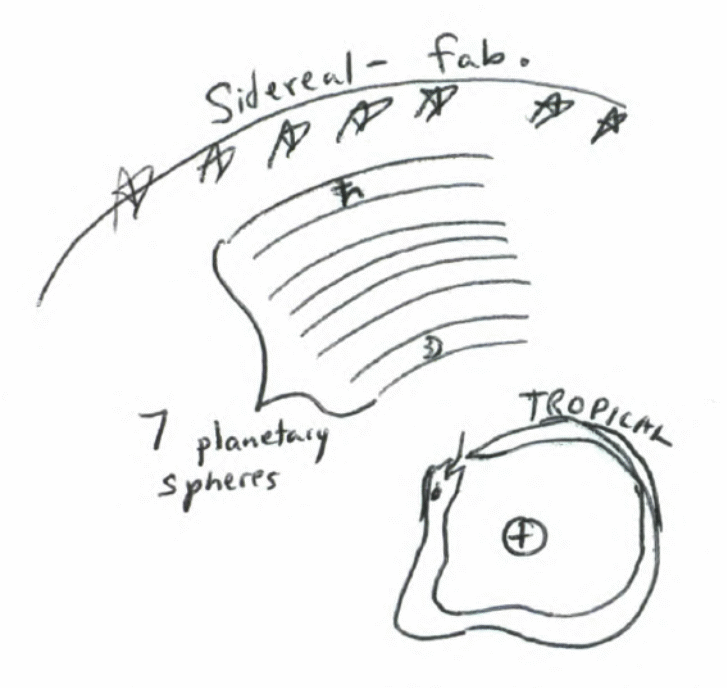
DIAGRAM appended to this transcript:
- FIGURE 1982 0313-1. Sidereal, Planetary, Tropical.
[Transcriber note: [diagram] means the speaker is referencing a diagram as he or she is speaking. If someone is drawing or writing, with audible sounds of chalk on a blackboard, I indicate this by [drawing] or [writing].]
NOTES:
We have a partial transcript for this class, Scan File 1982 0313-10R17.PDF, with no AD edits; originally typed by CdA. This is really a summary of the class and is read at the beginning of the 3/20/82 alchemy class. It references the Durand article, the Bernoulli paper, and A.J. Penny's book.
This was a Saturday morning class.
TRANSCRIBED Verbatim by IT 2021. In 2025, IT expands Subsubjects, completes TOC, adds new notes within transcript, corrects typos/errors, adds diagram and reference within transcript to this diagram. Archival verbatim transcript – V12a.
AUDIO FILES: 1982 0313a, 1982 0313b. [Note: "Tape" and "Side" refer to original audio cassette tapes that were later digitized into .MP3 Audio Files.]
1982 03/13 at Wisdom's Goldenrod
Alchemy; Image of Man
[Audio File 1982 0313a Begins]
[background student talking, 10 seconds; AD begins to speak at 0:00:20.1]
AD: We'll try to pick up a little background today. We'll try to pick up a little background in alchemy. [short pause] And, I found an article that I think would be appropriate. And what we're speaking about is the image of-- the image that we have of ourselves in the twentieth century, and the image that a man would have of himself let's say in the fifteenth century. And, I'm of the opinion that it would be worthwhile if we get back to something about the way medieval man thought about himself. And in this article, of which I'm going to read lengthy extracts, 'cause I consider it--
EMD (simultaneously): Can you speak louder Tony?
AD: I'm going to read some lengthy extracts from this article. It's called "The Image of Man in the Occulted Tradition of Western Culture", written by Gilbert Durand. It's going to be spotty but-- (I don't have time to) find my glasses.
S (faint): I think they may be in the restroom.
AD: Yeah. [13¼ second pause with faint background student talking] It's going to be a spotty thing but it's going to be a portrayal (of/uh)-- [15¼ second pause] But it's a necessary background so we have to-- we have to go through this. [12¼ second pause] To begin with, you know, we have two kinds of philosophies. There's the official academic philosophy, and then there's the philosophy that we're interested in. And this contrast has been going on, oh, for some time, a few hundred years. Prior to that, as you remember, there was a sort of cosmopolitan philosophy in Europe. Medieval man felt himself to be part of the world, not alienated from the world. And then if you remember at one time we spoke about the displacement of Avicenna's notion of the active intellect by Averroes' notion of the individual intellect and the way Thomas Aquinas furthered that conception. [Note: See WG Classes 1977 1012, 1977 1023, and 1982 0127 for some examples.] So that the common ground between all men, insofar that they shared in one and the same intellect, the active intellect, was there. Then after about the fourteen or fifteenth century when that split came between what was happening in the sense that medieval man was being forced to individuate much more than perhaps was wise.
EMD (simultaneously): Tony, we can't hear anything you're saying.
AD: You can't hear me?
S: No.
AD: No?
S (faint): It's just-- no.
AD: You'll have to get closer. It's going to take me a half hour to warm up.
EMD: Sit in the middle then please.
S (faint): Uh-hm. (laughter)
S (amidst laughter): What you talking about?
S (simultaneously, faint): Can you [S simultaneously, faint: (Sure/Certainly). (S laughs)] get the door?
S: It's not working. [S simultaneously, faint: Right, it's not working.] It's not working.
AD: At any rate he starts-- He says--
[Transcriber note: I am using "The Image of Man in the Occulted Tradition of Western Culture" by Gilbert Durand, James Hillman (Ed.), Spring: An Annual of Archetypal Psychology and Jungian Thought, New York: Spring Publications, 1976.]
Gilbert Durand [Spring, "The Image of Man in the Occulted Tradition of Western Culture," p. 83, AD reading]: "One could write the history of this antiphilosophy, a philosophy considered"occult" because occulted by official scholarship. One could go back point by point: just as in our time [AD reads: One for instance could point to in our time] we have to counter the official views of Sartre, Merleau-Ponty, Gabriel Marcel, Ricoeur with the less official views of [Mircea] Eliade, [Gaston] Bachelard, [Carl Gustav] Jung, [Fritjuof] Schuon, [and even Rudolf] Steiner, [AD: And again go back further.] [so] in the nineteenth century we have to set off the poets and [AD adds: the] visionaries against the university philosophers. Nerval may certainly be set opposite Hegel, but also Eliphas Levi, Ballanches, [Bonald], Maistre, Baader, Schlegel, [and] Weishaupt."
AD: These are all occultists.
Gilbert Durand [Spring, "The Image of Man in the Occulted Tradition of Western Culture," p. 83, AD reading]: "Then back to those arrayed against Kant [AD reads: Then if we go back further, there are those who arrayed against Kant] -- Goethe, Novalis, Schubert, Saint-Martin, Hamann, Martines de Pasqually, Swedenborg [especially], Eckhartshausen…Ashmole…[AD: And a few others.] [Morin de] Villefranche, [and] Blake. [AD: Then going back further.] Opposing Descartes and Cartesianism, we find Angelus Silesius, Paracelsus, [Cornelius] Agrippa, [Robert] Fludd, Kunrath, [Valentin] Weigel, [Giordano] Bruno, [Pico de la] Mirandola, [Marsilio] Ficino…"
AD: Go back further and you have against the official philosophers people like--
Gilbert Durand [Spring, "The Image of Man in the Occulted Tradition of Western Culture," p. 83, AD reading]: "…Nicholas of [AD reads: de] Cusa, [Nicholas] Flamel, [Meister] Eckhart, Tauler, Suso, Roger Bacon, [and] the mythical Albertus [Magnus], in whom both the occult and the official philosophies were united in the pre-Averroes Middle Ages."
AD: So he's trying to give a picture where if we go back far enough, let's say Albert, Albert the Great, you have-- that kind of a person combined within himself both the official philosophies and the so-called occult tradition. [short pause] Now, to some extent most of you people have been acquainted with-- and forced to get acquainted with the official philosophies, the academic philosophers. And you remember I used to make remarks about Kant's categories of thoughts are about-- about as empty and blank and as meaningless to me, alright, as anything could be, it's like an empty-- an empty "I know", whereas the traditional doctrine and the Platonists, the categories of the understanding were the Gods. (AD laughs a bit) One is a living institutionalization of our being and the other one was like a desiccated corpse. Anyway, it gets interesting as we go along. [short pause] He says--
Gilbert Durand [Spring, "The Image of Man in the Occulted Tradition of Western Culture," p. 84, AD reading]: "The first important characteristic seems to be that the traditional image of man does not distinguish, nor even want to distinguish, the I from the Not-I, the world from man; whereas the entire teaching of Western civilization, through its concern for angelism on the one [AD reads: other] hand and objectivity on the other, strives to cut the world off [AD reads: strives to cut off the world] from man, [AD adds: so] to separate the"I think" from what is thought. Dualism is the great "schizomorphic" structure of Western intelligence. Not only does classical antiquity, and in particular the structure of the Greek language, prepare for this divorce between the "I" and the world, but the problem of duality reverberates throughout [AD reads: through] all academic philosophy."
AD: I think you got the gist there, huh? Continuing. In contradistinction, alright--
Gilbert Durand [Spring, "The Image of Man in the Occulted Tradition of Western Culture," p. 85, AD reading]: "Traditional thought…"
AD: That is, the man we spoke about as medieval man.
Gilbert Durand [Spring, "The Image of Man in the Occulted Tradition of Western Culture," p. 85, AD reading]: "Traditional thought is entirely different: here the image of man is never cut off from the universe. [As] the traditional thought of Africa, the South Seas, or China demonstrates, man does not set up an angelic image of himself as a singular and in some way ethereal being, confronting the world, the stars, the fauna, the flora, and his own body. [Furthermore], all initiatory practices are directed towards an engagement or magical connection with the cosmos. So too the hermetic art consists in establishing sympathetic relationships between chemical substances, plants, places, stars, [and the] human situation.
"In [AD reads: Now in the] Western tradition -- which owes much to the hermetic art -- this principle of the unity of creation is one of the basic Leitmotive [AD reads: motifs] to be studied both in astrology and [AD adds: in] the doctrine of"signatures" as well as in the philosophy of the microcosm [so] illuminated by Paracelsus."
AD: So he brings in the first-- the first divergence, alright. In the Western man he says "I think, therefore I am", ok. The-- the other type of man doesn't do that. He doesn't separate his "I" from the world within which he is. If you remember the (Hermes) in-- the Hermetic formula. The world, man, God, alright, it was like a unity that ran through all of this. But in the classical orthodox philosophies, the "I" and the world were cut-- sundered from each other, separated from each other. Now of course that's going to lead to schizoid conditions such as we know in the twentieth century but, go on a little bit more.
Gilbert Durand [Spring, "The Image of Man in the Occulted Tradition of Western Culture," p. 86, AD reading]: "The schema…"
AD: I'm sorry.
Gilbert Durand [Spring, "The Image of Man in the Occulted Tradition of Western Culture," p. 85, AD reading]: "The same analogy, the same macro-microcosmic sympathy, constitutes the anthropocosmos in [Hildegard] von Bingen's work."
AD: (But I don't know no-- huh?) Um--
Gilbert Durand [Spring, "The Image of Man in the Occulted Tradition of Western Culture," p. 86, AD reading]: "This [AD reads: The] analogy gave [AD reads: gives] rise to the celebrated image of the astrological man…in…"
AD: I'm going to go right into that, alright.
Gilbert Durand [Spring, "The Image of Man in the Occulted Tradition of Western Culture," p. 86, AD reading]: "Some shepherds say that man is a small world in himself because of his conformities and likenesses to the great world, which is an aggregate of the nine heavens, the four elements, and all the things that are. [M. Sauvage, L'aventure philosophique, p. 31]
"The schema [AD adds: for instance] of [AD adds: the] four complexions [(temperaments)] follows from this. Each group of zodiacal signs belongs to the four elements which determine whether the"complexion" will be airy, earthy, watery or fiery…"
AD: You remember the theory of the four temperaments.
Gilbert Durand [Spring, "The Image of Man in the Occulted Tradition of Western Culture," p. 86, AD reading]: "There also follows the theory of similitudes [(similia similibus)] between the image of man and aspects of the world --"aspects" being a technical term in astrology. Together these theories then allow the Paracelsian physician (and then the Hahnemannian homeopathy) [AD reads: and also the homeopathy] to weave a vast sympathetic network in which the signature of the stars, the health or the lack of it, minerals, and plants all "echo" each other in more audacious correspondences than any dreamed of by the poets.
"It is quite remarkable how much the link that joins universal things to the parts and the humors of man…resembles the archetypal principles revealed by modern depth psychology: [AD adds: and] the same specified archetype -- [and] Paracelsus uses the word arche -- is at work in the representation of the world as in the man who represents it."
AD: Now, here's an example.
Gilbert Durand [Spring, "The Image of Man in the Occulted Tradition of Western Culture," p. 86, AD reading]: "…Paracelsus places poisonous hemlock…"
AD: You remember, the stuff that Socrates drank.
Gilbert Durand [Spring, "The Image of Man in the Occulted Tradition of Western Culture," pp. 86-87, AD reading]: "…under the rule of Saturn it is because qualitatively and actively they belong to the same archetype. This binds (1) the therapeutic action of the hemlock which"cools" natural inflammations, (2) the noxious action of the poison [AD reads: points] which dries out the tissues, also cooling and slowing down the chemical and nervous reactions…(3) the external appearance of the plant, its sickle-like leaves, its long weak stems, its dull umbels and malodorous smell, and [with] (4) the dreary, abandoned, stony places where it grows, [and with] (5) the "Saturnian" character, its slow, somber, leaden, anti-social movements -- that is to say, finally, with (6) the power and [AD adds: the] attributes of the planetary God Saturn.
"Therefore the planetary world, the geographical locale, and the configurations of the object are all one with the character, the psycho-dynamics, and the health or sickness of man. Astrology [AD adds: then] constructs a precise system around this philosophy of"signatures". But we must take care not to speak of it in the deterministic or causal terms of our sciences [AD reads: science] of distinctions."
AD: You know, when they bring in the notion that this aspect causes that. Don't bring that in, that's not so.
Gilbert Durand [Spring, "The Image of Man in the Occulted Tradition of Western Culture," p. 87, AD reading]: "Whatever it is that binds a given human event…simultaneously to a planet, to [a] certain aspect of the planet, to its place in the celestial zodiac, to its elementary nature, etc., it is not a causal bond, not a determinism comparable to the principle of universal gravitation. It is a general condition of creation at a given moment which 'signs' both the human and the cosmic event. Therefore each receives a similar"humour", as the doctors would say, or, as the alchemists would put it, an identical "tincture". If a person is Saturnian or Martian, then Saturn or Mars is reciprocally "exalted", "exiled"…[AD: etc.] [short pause]
"[AD adds: Now] A second distinction follows [from this first one]. The knowledge of traditional man is a unity. His consciousness is systematized; whereas the knowledge of Western culture is torn apart by extraversion."
AD: Now this is a strange kind of unity but if you can follow it it's quite enjoyable.
Gilbert Durand [Spring, "The Image of Man in the Occulted Tradition of Western Culture," pp. 87-88, AD reading]: "Unity of knowledge has always been a problem to Western consciousness, fragmented by its focus upon a [AD reads: the] world of diverse [AD reads: different] objects and by [AD reads: in] its cult of objective facts. [Hence] the constant divergence between"method", "logic", even "reason", [AD reads: "logic", etc] and the contents of knowledge. Possibly this explains Hegel [AD reads: Hegel's] or Comte's reduction of the unity of knowledge to a historical myth, whereas increasing knowledge is pushing us anarchically toward [AD reads: pushing us towards an] all-pervading plurality. … [short pause]
"[AD adds: Now] Traditional knowledge, to [AD reads: on] the contrary…"
AD: And we're speaking about the knowledge of the Medieval, tantric practices, Eastern cultures, alright, which is basically magical. And we're going to get into that in depth. "…has…"
Gilbert Durand [Spring, "The Image of Man in the Occulted Tradition of Western Culture," p. 88, AD reading]: "Traditional knowledge…has its primary vision in a [AD reads: the] unitary experience of the Cosmos, such as we find in alchemy. To the practising alchemist the world reveals itself without difficulty as one."
AD: The reason-principles in you, the reason-principles in the world, the reason-principles in God is to the practicing alchemist and astrologer one thing. He has no difficulty in accepting that unity in plurality. In contradistinction to the Western academic philosopher, you take a man like Descartes, "I think therefore I am," and you could see the "I" on the one side and what he thinks about on the other side and in between no-man's land. And he could-- he'll never bring them together.
Gilbert Durand [Spring, "The Image of Man in the Occulted Tradition of Western Culture," p. 88, AD reading]: "To the practising alchemist the world reveals itself without difficulty as one. The Magnum Opus for human knowledge is the task of activating that unity…"
AD: You follow that? [couple inaudible student words simultaneous with AD] That's important.
S (faint): Uh-hm.
S: But--
AD: The magnum opus of the traditional man is to activate that unity.
S: So we have to try and find in ourselves that which--
AD: Which is the same in [S simultaneously: Which is the same-- right.] man, the world, and God.
S: In other words, we have to get back to those reason-principles, those--
AD: You have to get back to those ideas [S simultaneously, faint: Ideas, yes.] that are embedded in matter, in the world, in man, in God. This will give you the unity you're looking for. And that they assign to themselves as the Great Work. That was a great work. In other words, that would correspond to something like Jung was speaking about the unus mundus, the conjunction with the one world.
Gilbert Durand [Spring, "The Image of Man in the Occulted Tradition of Western Culture," p. 88, AD reading]: "Astrology should no more be reduced…"
AD: I'm sorry.
Gilbert Durand [Spring, "The Image of Man in the Occulted Tradition of Western Culture," p. 88, AD reading]: "The Magnum Opus for human knowledge is the task of activating that unity, [of] abstracting the pure oneness of the world from the apparent impurities of the universe. [AD adds: And] Astrology should no more be reduced to determinism than alchemy should be conceived as a method -- or, worse still [AD reads: still worse], a recipe -- for making gold. The alchemists had nothing but scorn for the blowhards…"
AD: That was people trying to make gold in their laboratories in--
S (faint): Yeah.
[short pause]
Gilbert Durand [Spring, "The Image of Man in the Occulted Tradition of Western Culture," p. 89, AD reading]: "Traditional thought, on the contrary…"
AD: I don't like the use of that word 'traditional'. It's-- it smacks too much of the Traditionalists. (some laughter, student words)
S: Yeah it does.
AD: I intend to-- I prefer to think of it as magical. Magical in the sense that the imagination is magical.
Gilbert Durand [Spring, "The Image of Man in the Occulted Tradition of Western Culture," p. 89, AD reading]: "Traditional [AD reads: Magical] thought…makes no cut between multiplicity and unity. [The] symbolic unity located in the world reverberates in the"I" as its diverse [AD reads: different] experiences. [For] in traditional thought unity is not a method of reducing the other to the same; it is a principle, the Principle of Oneness which can be experienced simultaneously as a cosmic unity and as plurality."
AD: You follow that? This no good.
S: What?
AD: I like to stare you right in the eye. You follow that?
S: Oh.
S: Vaguely. Only vaguely.
AD: Well, let's try for more precision.
S: Yes.
S: Would you read it over again?
AB (simultaneously): Would you read the last again?
S (simultaneously): Yes.
S (simultaneously): Yes.
Gilbert Durand [Spring, "The Image of Man in the Occulted Tradition of Western Culture," p. 89, AD reading]: "[For] in traditional thought unity is not a method of reducing the other to the same…"
AD: You don't reduce the Notre Dame Cathedral to the rocks that make it.
S: Ok.
Gilbert Durand [Spring, "The Image of Man in the Occulted Tradition of Western Culture," p. 89, AD reading]: "…it is a principle, the Principle of Oneness which can be experienced simultaneously as a cosmic unity and as [AD reads: and a] plurality."
LR: So they're not s-- they're not set up as contraries [AD simultaneously: Yeah.] right from the start at all. There's no-- where we would see a contradiction or a paradox in thinking of-- of multiplicity and unity, they would not. They wouldn't see that--
AD (simultaneously): They would not. They experience the unity which underlies all three of them: man, the world, and God. Or, in our terminology it would be the cosmic soul.
Gilbert Durand [Spring, "The Image of Man in the Occulted Tradition of Western Culture," p. 89, AD reading]: "In traditional thought man experiences himself as multiple, diverse. There is no pride in traditional man; he feels himself"divided up" between sleeping and waking, good and evil, angels and demons [AD reads: daemons]. It has taken all the discoveries of contemporary depth psychology to bring the ego back to this [AD reads: his] modest pluralism, to show that behind its triumphant consciousness the unconscious proliferates disquietingly. Contrary to the mythical Bergsonian continuity of the "I", which in this respect is hardly different from the "transcendental Kantian subject", [AD reads: or for that matter the Kantian apperceptive, which in this respect--] Bachelard [AD adds: Jung and others for instance] reaffirmed [AD reads: reaffirm] the existence of "multiple summits"…while [AD reads: and] Jung went back to [AD adds: the] more traditional ideas of the human being as quadri- or multi-polar."
AD: Again we try. You follow that?
S (faint): Uh-hm.
S: (faint): Uh-hm.
S: What does it mean that the human being's multi-polar, I mean, as a starting place?
AD (simultaneously): Well don't you feel-- don't you feel in yourself the pull of many, many tendencies?
S: And that's all he means there, a variety of centers out-- that seem to be-- and warring with each other?
AD (simultaneously): That are operative, yeah, and that you experience this plurality of your being. You don't experience the transcendental apperceptive unity of your "I". It sounds great [S simultaneously: But you can't help it.] but it doesn't mean anything, you know, (laughter) just like a mummy. Yeah, Richard.
RG (faint): Well--
AB: But, if you take the academic point of view and you oppose the "I" to the world, the "I" seems to be a unity. But he's saying--
AD (simultaneously): Yeah, but if you keep dumping everything out of the "I" and everything that's worthwhile is out in the world, [S: Right.] then this thing becomes an empty form of cog-- cognition.
S: Uh-hm.
AD: Alright?
AB: But he's saying if you don't do that you realize that the "I" is a plurality also.
AD: Yeah.
[short pause]
Gilbert Durand [Spring, "The Image of Man in the Occulted Tradition of Western Culture," pp. 89-90, AD reading]: "In the Western tradition, from Paracelsus to Steiner, contrary to the dualisms of academic psychology, there is always to be found between body and spirit a bothersome soul or"astral body", an intermediary [AD reads: intermediate] subject joining [AD adds: the] spirit and [AD adds: the] body. Paracelsus studied it under the names of Evestrum (which organizes prophetic visions) and Trarames (the inner voices and music). [AD reads: Paracelsus studied it, called it the Evestrum, the inner voices and music.] For him the astral body is made up of an unlimited number of specialized monads which he called [AD reads: calls] "animal spirits"."
AD: In deep meditation you can get a view of many animals raging within you.
Gilbert Durand [Spring, "The Image of Man in the Occulted Tradition of Western Culture," p. 90, AD reading]: "These account for the attractions and [AD adds: the] repulsions, the sympathies and [AD adds: the] sudden antipathies between two individuals. The astral body is the very experience of the Principle of Oneness within ourselves."
AD: Want to go over that?
S: Uh-hm.
S (simultaneously, faint): Yeah.
AD: Most of us know that we have the ape, the gorilla, the monkey, the lion, the dog within us. And you might think this is literary--the joke's on you.
[short pause]
Gilbert Durand [Spring, "The Image of Man in the Occulted Tradition of Western Culture," pp. 89-90, AD reading]: "In the Western tradition, from Paracelsus to Steiner [AD reads: from Paracelsus all the way to the present], contrary to the dualisms [AD reads: dualism] of academic psychology, there is always to be found between [AD adds: the] body and [AD adds: the] spirit a [bothersome] soul or [AD reads: an]"astral body", an intermediary subject joining spirit and body [AD reads: joining them]. Paracelsus studied it [AD reads: this]… For him [AD reads: And for Paracelsus] the astral body is made up of an unlimited number of specialized monads which he called "animal spirits". These account for the attractions and repulsions, the sympathies and sudden antipathies between two individuals. The astral body is the very experience of the Principle of Oneness within ourselves. Even in detail…"
S: Stop.
S (faint): Yeah [one word inaudible]
S (simultaneously, faint): Stop.
S: Yeah.
S: Why does he-- why does that follow? [S, faint: Exactly.] It seems like the principle of multiplicity almost.
AD: Well, you get up-- you remember the example we use. You get up in the morning, Mars went into Capricorn and you're out chopping wood. Yeah. (student laughs) I'm being ambitious.
S: California [one word inaudible] (laughter)
AD: Couple days later-- let's say a couple days later you have Mars going into Libra. (laughter)
S (faint): Aquarius.
S: You're in bad shape.
S (simultaneously, faint): [couple words inaudible] as-- (laughter)
AD: And let's say you have-- Oh, alright, let's say Mars going into Aquarius, what follows (it)? (laughter)
S (amidst laughter): Libra.
AD: It [S simultaneously: Aquarius.] doesn't matter. The point is this here, Mars goes into Aquarius, alright, you have Saturn in Aquarius, now all of a sudden Mars is studying, you're picking up books, pounding, alright. So that this impulse that this astral body receives in the case of Mars in whatever it was, Capricorn, doing something, Mars moves into Aquarius, alright. You got a rulership, Saturn's in Aquarius, so Mars now is studying. Now, you say there's a plurality, there's a plurality. It seems that there are different drives, in one case you go out and chop wood, in the other case you study. But you have to notice the unity of the astral body which is the receptacle which has all these impulses. So on the one hand the astral body is the receptacle in which all these impulses could take place, alright, that's its unity. And on the other hand you have these impulses in that astral body, which is its plurality. So you experience the variety of, let's say, these signatures in that one astral body. If that astral body was not a unity, alright, you would be absolutely fragmented. So it's the unity of the astral body which makes possible the reception of these so-called different monads.
S: Ok.
AD: Yeah?
DB: Would-- would you speak about this unity as the ability of the-- the variety of structures within the astral body to function relatively harmoniously?
AD: Not necessarily. Why should it be harmonious?
DB: Well I said relatively, I mean-- I just meant [couple/three words inaudible] coherence.
AD (simultaneously): Yes it can do both, it can experi-- it can experience relatively harmony, it can also experience disharmony.
DB: Ok but it is--
AD (simultaneously): But it is the unity of the astral body that makes possible both these opposites within you. So that you can experience a unity and a plurality, a diversity.
DB: Could-- could I pursue this just a little bit?
AD (simultaneously): Sure. Go ahead.
DB: When we speak of that as being fragmented now--
AD: What being fragmented?
DB: The astral, the astral.
AD: The astral body's not fragmented. If it wasn't a unity, you would not experience it. In other words, if the astral body didn't rem-- didn't remain self-identical with itself, how could it have any experiences and be called your experiences? We're getting-- we're getting away or we're losing sight of what he's trying to get at, alright. It's the astral body with all these impulses within it which provides both at the same time, the unity and the diversity.
[10 second pause]
Gilbert Durand [Spring, "The Image of Man in the Occulted Tradition of Western Culture," p. 90, AD reading]: "The astral body is the very experience of the Principle of Oneness within ourselves."
AD: Shall we repeat it? Or is it obvious? Go ahead.
DB: When he says it's the-- the experience of the principle of unity, it's-- wouldn't that-- it's not the unity itself but it's the projected unity experienced within the astral body which--
AD: What do you mean projected?
DB: Well, it seems-- it seems that we speak of the astral body as this-- as containing all these various possibilities within it, ok, and it's within this context that we experience the unity of ourselves, alright. But the unity of ourselves, it would seem to me, would have to in some respects transcend this astral body. But, it's experienced within the context of the functioning of uh--
AD (simultaneously): Look, David, make it simple, one is a container, the other is the contained.
DB: Right.
AD: So how do you project a container?
DB: No, the con-- the con-- what I was-- what I'm trying to suggest is that-- that it's a container insofar as that unity is projected within it or experienced within it.
LR: I think he's doing the reverse analogy, David, I think he's doing the container is the unity. The astral is contained within that (fantasy), what they here challenge.
AD: We're not speaking about true unity, alright. Not at all. We're not--
DB (simultaneously): I know, that's-- that's why I was trying to be-- I was trying to understand the relation where he says it's the experience of that unity. I was thinking of that unity as being projected within this astral body and it's at that level that we experience it, or the--
RC (very faint): It's talking about the unity of that world of God.
S (faint): Yeah.
RC (very faint): And isn't that the unity you see [one word inaudible] You're experiencing the sympathetic view [couple words inaudible] the unity of-- You and the world around you are [few words inaudible] same in all [one word inaudible] present. You within the world [couple/three words inaudible]
[short pause]
S (faint): Go.
AD: Alright David?
Gilbert Durand [Spring, "The Image of Man in the Occulted Tradition of Western Culture," p. 90, AD reading]: "The astral body is the very experience of the Principle of Oneness within ourselves. Even in detail man reflects the animal world. …"…there is no condition, or manner, in any beast that is not found in man…". It then goes on to review the virtues of"…the lion, the ox, the cock, the dog, the deer, the turtle dove, [AD reads: the turtle, the dove] the leopard, the donkey", [and] so on, ending up with "[the] mouse and [the] angel". Paracelsus…echoes…"
S (simultaneously): What?
S (simultaneously with AD and S): Do it again. (bit of laughter)
S (faint): Mouse?
S: What?
AD (simultaneously): Mouse and angel, yeah. (bit of laughter)
S: What?
AD: All of these are within us. (bit of laughter)
Gilbert Durand [Spring, "The Image of Man in the Occulted Tradition of Western Culture," pp. 90-91, AD reading]: "Paracelsus…echoes this popular lore when…he writes:"…the animals and the instincts preceded man; therefore the animal soul of man is derived from animal elements in the cosmos. [Thus] man possesses, combined into a single soul, [AD: Astral soul here.] all the animal elements in the world; but he also possesses something more…". … [12¾ second pause] The pluralism of traditional man is admirably rendered in astrology, because the subject of astrology is always a collection of often disparate and sometimes contradictory qualities."
AD: I think we all know this.
Gilbert Durand [Spring, "The Image of Man in the Occulted Tradition of Western Culture," p. 91, AD reading]: "The pluralism of the ego is rendered in the symbolism of the different astral powers: in the tension or accord between them, either directly or in their aspects…and in the way that the zodiacal signs in which they are set"exalt" or "exile" them [AD reads: "exalt" etc]. [Also], there is no more delicately nuanced description of character than astrology gives us; it will always surpass any unitary reduction of character to a single "temperament" or morphology."
AD: You follow that?
S (very faint): Uh-hm.
S (faint): Go on.
AD: Astrology will never reduce a man to one drive, one impulse, one instinct or any of that nonsense. He will see man as a plurality of all these various kinds of activities and abilities. And sometimes in contradiction to one another, sometimes working, alright. Now, this is what you should know automatically. I'm only reading it to refresh your memory of what we're like. (laughter)
Gilbert Durand [Spring, "The Image of Man in the Occulted Tradition of Western Culture," p. 91, AD reading]: "[Also], there is no more delicately nuanced…"
AD: I mean don't you feel some days you get up and everything is just fine? Another day everything is just wet? (bit of laughter)
S: Mostly it's all wet.
S (faint): [few words inaudible]
AD (simultaneously): Alright, and yet it's one and the same person going through all these experiences. So that there's this unity which is underlying all these experiences which is a felt unity. It's a lived unity. It's not something you conceive of with a-- with a concept. That's what these people are talking about, they're right down on ground zero. My toe hurts. Don't give me an explanation in physiology.
Gilbert Durand [Spring, "The Image of Man in the Occulted Tradition of Western Culture," p. 91, AD reading]: "[Also], there is no more delicately [S, faint: Why not?] nuanced (laughter) description of character than astrology gives us; it will always surpass any unitary reduction of character to a single"temperament" [or morphology]. In the refinement of his character summations, the famous seventeenth century astrologer [Morin de] Villefranche seems to come much closer to Jung's typological character studies than to other psychologists of the beginning of the [AD reads: than do the astrologer-- the psychologists of the twentieth] century."
AD: Now, this is really worthwhile, this man really pins down some of the superiority that astrology will always have over all this academic nonsense.
Gilbert Durand [Spring, "The Image of Man in the Occulted Tradition of Western Culture," p. 91, AD reading]: "[Furthermore], in its symbolism and the syntax of its aspects, astrology, like all traditional arts, [of] alchemy, [geomancy], palmistry, etc., provides us with a model of elementary, meta-language operating with pure images, with emblems."
AD: Pace Positivists. Of course I don't expect any analytical philosopher to be interested in astrology. He's already decided to guillotine himself.
LR: What do you mean pace Positivists?
AD: I don't want to disturb them, let them sleep. (bit of laughter)
LR: No, no, I don't mean what kind of idom is it, I mean [S: Uh-hm.] what-- what would they say about this?
AD: (They'd) think you're absolutely crazy. If a thing-- if a word does not precisely and absolutely refer to an object, then anything you're saying is nonsense.
LR: Including any symbolism or--
AD: Any kind of emotionality, there's no word. It's useless, let's throw it out. So, if they succeed they'll I'm sure turn us into robots. Again--
Gilbert Durand [Spring, "The Image of Man in the Occulted Tradition of Western Culture," p. 91, AD reading]: "…[AD reads: it provides us, that is, astrology] provides us with a model of elementary, meta-language operating with pure images, with emblems [AD reads: with images and emblems]. Our modern [AD reads: The] Indo-European languages have great difficulty taking their content seriously; they lean toward [AD reads: towards] nominalism, [AD rereads: They lean towards nominalism.] sophistry, formal logic."
AD: Now you see, we do both here. I'm not going to have you get off the hook that easy.
Gilbert Durand [Spring, "The Image of Man in the Occulted Tradition of Western Culture," pp. 91-92, AD reading]: "[But] astrological language is figurative -- even deific, [since] it accords divine power to its semantic elements. It operates with the"emblems of things"…[AD adds: and] not with "mere words". The complexity of its field of possible combinations makes impossible logical permutations…"
AD: We're speaking about what astrology can do.
Gilbert Durand [Spring, "The Image of Man in the Occulted Tradition of Western Culture," p. 92, AD reading]: "…such as those in syllogisms. [AD rereads: The complexity of its field of possible combination makes impossible logical permutations, such as those in syllogisms.] The emblems can't [AD reads: cannot] be held by syntax."
AD: They're not going to restrict the meaning that the world has for us or we have for ourselves to logical structure, syn-- syntax of language.
Gilbert Durand [Spring, "The Image of Man in the Occulted Tradition of Western Culture," p. 92, AD reading]: "The reason it can be confused with the pragmatism of a language concerned with mathematical physics [(astronomy in this case)] is that it consists of [a] topography -- just as does mathematics essentially. But the parallel ends there: the language of astrology is pure quality and pure qualification. In the cosmos it provides us with a model for the unification of the qualities of the"I" and for the way that the multiple hierarchical [AD rereads: hierarchy] tendencies of the "I" are organized, like the field of combinations of a complex [AD adds: and] celestial "machine"."
AD: Now I don't know if you're getting the drift of the way this man is going, alright. It's like he's trying to reinstate you back into the magical view of the world that most of the Medievals had these, tantrics and all that. And he's trying to give you a glimpse and trying to get-- get you to have a feeling for that. Now, we have been developing for the past, you know, thousand years the intellect and-- It has its value, I mean-- Wednesday night class will be devoted to that aspect and we're-- the Wednesday night class will be to get you to work towards understanding whatever we can of truth through the logical syntax of language and conceptual development. But, it doesn't necessarily preclude the other one, alright. But, like he said, Western man is always in the schizoid state where he wants to separate these two. I'm sorry to put you through this but it's a necessary background for alchemy. And, we'll get much further in alchemy if we have this kind of a background.
NR (faint): Anthony, I have a question. When he goes from talking about the unification of that astral body and then goes into a discussion of astrology, is he-- he's not speaking of them as opposing fields but rather complementary to the traditionalist point of view?
AD: As opposing what?
NR: They're not opposing each other then, they're rather complementing each other in a traditional point of view.
AD: What's complementing each other?
NR: The astral body concept and the concept of astrology.
AD: Oh no. He's not opposing them, he's trying to show that astrology of-- of any of the sciences is much more capable of understanding the variety of impulses which could be operative in the astral body of an individual and yet not reduce ourselves to fragmentary bits of I's. And in that sense, in that sense the medieval man, or the man who was based in a magical consciousness, didn't feel it as an alienation from the world. So, I don't think that there's a critical judgment there. [short pause] Now, here's an example for instance which I think you may find difficult but really worthwhile.
Gilbert Durand [Spring, "The Image of Man in the Occulted Tradition of Western Culture," p. 92, AD reading]: "[Concerning]"cause", which results in determinism, the whole history of philosophy from Aristotle to Hume shows how its effort has emptied this notion [AD: The notion of causality.] of any trace of substantiality… [AD adds: The cognition] The cogito remains the model of this unity -- this "reduction to a common denominator". Cartesianism has admirably demonstrated the way that unity of method is joined simultaneously to the emptiness and [to] the unity of "I think"."
AD: You follow that?
S: No.
S (faint): No.
S (very faint): Not really. (bit of laughter)
AD: If-- if you study for instance-- or if you go through a history of philosophy and you study the idea "cause", alright, in-- among the ancients cause was something substantial in the sense that you were speaking about a lived kind of situation or some kind of thing, I say thing, in the sense that it was an actual thing that was the cause of some other thing. As we progress in our-- as we progress in the-- in the history of philosophy and we start reaching more modern times, causality loses that substantiality, that it takes a thing to cause something to happen and becomes more and more conceptual, until you reach the point where in Hume for instance he says billiard ball strikes another billiard ball and I cannot for instance explain how this is caused, how A moves B. And we think David Hume is a great philosopher because he's abstracted the concepts "billiard ball", alright, from the actual billiard ball and then has difficulty understanding how one concept could move another concept. So that there's a progressive dematerialization or desubstantialization of causality until finally it's come to a point where causality, like in modern physics, has become incomprehensible. So it's this progressive dematerialization of the notion of causality, alright, which finally leads us to suspect it, that perhaps now we're-- we're trying to explain what's happening in terms of verb-- verbalization, and we've lost contact with the actual substantiality that is causality.
JfL: I think it's kind of like when we were doing the chart last week where there was the gross and the subtle where the-- there are no cause and effect really in the gross, and it's like we have to take it back to that subtle realm.
AD: Yeah.
JfL: And that's where the astrology would have its subsistence as well, the astral body as well.
AD: Yes but if you remember, it was both points of view that were simultaneously required. The causality that takes place on the gross level required or was descriptive. The cause-- the causality that took place from a subtle to a gross was actual. But the subtle that they speak about is a materiality, it's-- even if it's a semi-materiality, it is substance of some kind.
JfL: But when they're talking about it being conceptual, aren't they limiting it-- limiting it to the gross aspect?
AD: When the who?
JfL (simultaneously): Right there where you were saying that--
AD: When the who, the [JfL simultaneously: (When the--)] philosophers speak about it?
JfL: No, when the-- the conceptual appro-- approach of today, when the scientist is trying to determine the cause and effect, aren't they limiting it to just the gross aspect?
AD: Isn't it the reverse?
JfL: Is it?
AD: Isn't it?
JfL: Is it? I don't know. (bit of laughter)
AD: Is the physicist-- isn't the physicist come to the recognition that ultimately what he was manipulating was symbols?
AB: Yeah but I think Jeff was referring to like the Logical Positivists, when they conceptually try and understand these things it's because they've truncated--
AD (simultaneously): Oh, well then you don't understand the Logical Positivist because what has he done?
AB: He's truncated off the subtle. He doesn't believe in it.
AD: He says that this word has to refer to this object, this sensible object.
AB: Right.
AD: Now all this is taking place where?
JfL: In the gross.
AD: No! (AD laughs)
AB: In--
JfL: It isn't?
DB: If the Logical Positivists didn't have a subtle mind he wouldn't be able to do any of his work.
AD: Where is all this understanding taking place, in the gross?
AB (simultaneously): Yeah in his-- in his mind.
JfL: Well their understanding isn't but--
AD (simultaneously): He's manipulating symbols and thinks he's doing something with reality!
AB: Uh-hm.
AD: What they say is one thing, what they mean actually is another!
AB: Right. We are trying to tackle what they say, not what they--
AD: Don't listen to what they say, see what they mean! You know, the Communists go around saying we believe in fraternity, equality, and all that. They say the same thing but what do they mean? [JfL simultaneously: Well but--] Their kind of liberty, their kind of fraternity.
JfL: Well if they're using it, why are they having any trouble with it? Why aren't they understanding it, if it's--
AD: I'm sorry.
(Side 1 of original cassette tape digitized as 1982 0313a Ends; Side 2 Begins)
JfL: They're looking in the wrong place for it? They're trying to look for the cause and effect to be explainable in mani-- in the manifest?
LR: It-- you know that he's always saying that the very place where the system is taking off from is the thing that they most deny?
JfL: Uh-huh.
LR: That they can't see? I think-- I think that's what he means there.
AD: The totality of all their meanings is in the subtle. But they insist that they're materialistically and-- orientated and that they're dealing only with the sensible world. [JfL simultaneously: Fine, let's--] And I'm saying just look at what they're saying and you see that that's a lie, a bald-faced lie! [short pause] Uh, I'm not going to go too much further in this but--
NR (faint): Yeah but do you necessarily have to pass judgment on that, I mean the scientists are curing people just as well as the homeopaths are. They both have their methods.
AD: Let's not get into that now, huh?
S (faint): Yeah.
AD: People were getting cured and killed all the time.
S: Yeah. (laughter)
S (amidst laughter, faint): And there we go. (more laughter)
HE: Anthony?
AD: Yeah?
HE: In terms of what you just read, I get--
EMD (simultaneously): Can you please speak louder?
HE: Ok, in terms of what you just read about this development from the dematerialization of the notion of cause and effect, this last discussion got me a little confused and I'm just wondering, you said that the-- now that the-- the moderns claim to be talking about the material but actually they're-- they've removed themselves.
AD (simultaneously): I was speaking specifically about the Analytical philosophers, [HE simultaneously: Right.] those are the Positivists, [couple/three inaudible HE words] who insist that [HE: I got--] the-- the analysis of language, alright, must be taken to a point where each word refers specifically to a sensible object, and this way there would be no confusion in our understanding, alright. Now if I use the word 'love', that can't refer to a sensible object.
HE: Right. Ok. Um, that--
AD: I'm--
HE: When he said the-- when they said the ancients substantialized this idea of cause and effect, now what you're saying, that they (actually/actualized) [couple words inaudible]
AD (simultaneously): In other words, they're saying a God is doing this.
HE: Oh. But do they have more of a grasp on the sensible then in a way although they were taking a stand (and) [one word inaudible]
AD (simultaneously): Well let's wait and find out, let's wait and find out.
HE: Ok.
AD: Because I don't-- I don't want to-- I don't want to build up a dichotomy between the-- the development in the intellect of man that has been taking place, alright, let's say his conceptual thought has been evolving, I don't want to make a conflict between that and the magical consciousness that medieval man works with. Because our view, and I think you're going to see, will require both points of view, alright. On the one hand I object to the Tibetans because of the my-- mythological structure that they operate with and they try to communicate to the twentieth century man who can only deal with concepts. But on the other hand I'm going to object to the conceptual man who wants to deny the efficacy of magical practices with which we can work with. And you'll see that this is again is implicit in the twentieth century or let's say the-- the conceptual development of man, he's always doing that to himself. He's always doing that, he's always cutting himself into pieces. He's trying to reduce this apperceptive "I" to an absolutely meaningless term.
[short pause]
Gilbert Durand [Spring, "The Image of Man in the Occulted Tradition of Western Culture," p. 94, AD reading]: "For traditional thought, the great book of the world, like the Holy Scriptures, has multiple layers of significance. Every fact is a"creature" and thus in some degree subject to increased opacity through the "Fall", that is, through manifestation in space and time. Thought consists not solely in connecting facts to each other, or to the ideas or equations representing them, but also in decoding the facts. That is why traditional seekers, from [Arnold of] Villanova to Paracelsus, have attempted to find the quinta essentia [AD reads: quintessential] in things, a first laboratory stage of gnostic reversion. Since man is a microcosm of qualities, the macrocosm both corresponds with and responds to the microcosm of man's emotional, feeling, sensory, and intellectual qualities. The consequence of this qualitative pluralism is perceptible particularly in connection with space and time."
AD: Now here's an example.
Gilbert Durand [Spring, "The Image of Man in the Occulted Tradition of Western Culture," p. 94, AD reading]: "To the symbolic approach space is never [a] geometric Euclidean void [AD reads: empty space]. It is an aggregation of localities, analogous [or homologous] according to their qualities. It is a vital area of extension with an above [and] below, [an] interior [and] exterior, [a] right [and a] left, [a] zenith, [a] nadir, [a North, an East, and] so on. And this area homologizes into favorable or unfavorable"sympathetic" series, assimilating all possible concrete areas of extension…
"For"thought" space traditional man substitutes "lived" space, but this term must [not] be understood as contemporary phenomenological philosophers all too often understand it. [AD: "Must not be misunderstood", I'm sorry.] "Lived" [AD adds: space] means instituted by life, not just filled with life post facto."
AD: You get the feeling of the difference the way they're speaking about space. One is a lived space, alright, just-- It's not a question that you situate life within that space, but space is either lived or it isn't space. That's the only kind of space they speak about. We can speak of a space as absolute of-- absolutely devoid of all qualities and we can build in that space a church or a factory, it don't matter to us. To a Medieval, no, that couldn't be because-- or to a magical consciousness there are certain localities that are permeated with certain qualities and there's certain localities that are not. And this is the kind of space-- this is what they mean by space.
CDA: Is-- are those qualities that would be permeated from the astral? Are those astral qualities?
AD: Yes.
CDA (very faint): Ok.
AD: Yeah. We'll get into that a little more deeply, I-- this is a-- a quick and superficial treatment.
Gilbert Durand [Spring, "The Image of Man in the Occulted Tradition of Western Culture," p. 94, AD reading]: "It would thus be better to say"experienced" than "lived" since, for tradition, [AD: Now again--] life is not a biological entity. It is the general faculty of being something man uses; it has or is the potentiality of being "experienced"…"
[short pause]
AD: Now, he goes into this notion, which again we-- well, we have to assimilate.
Gilbert Durand [Spring, "The Image of Man in the Occulted Tradition of Western Culture," pp. 94-95, AD reading]: "The vast extension of lived space is composed -- discontinuously -- of small islands of correspondences [AD reads: correspondence]. Any shift of place makes a difference… This extension, which anybody can experience in a dream, as Nerval showed so well in Aurelia, creates channels of similitude that makes possible the transmission of thought to a distance, and give the astral body…an anti-geometrical power of omnipresence. Paracelsus writes:
During sleep the sidereal body of man may be projected from the physical body by the power of imagination and may act at a distance with a fixed purpose. No place is too remote and one man's imagination may act upon another man's wherever it reaches it. [Paracelsus, Philosophia sagax]
"We spoke of the"channels" that guide and pluralize the evestrum [AD reads: this astral body] in space. Paracelsus even alludes directly to the polarity and magnetism of the universe [(Magnale Magnum)], the soul regulating the world and orienting [AD read: orientating] this or that part of man, whether corporeal or astral, to this or that place in the universe. One could perhaps say that, for traditional man, extension is a discontinuous universe of particles, cores, and experiences. [AD adds: And] Astrology gave us a foretaste of this extension that is purely qualitative, non-quantitative, topology where elective affinities come into play."
[short pause]
AD: Well, I'm not going to take you to any more examples.
JfL: It sounds like he's constructing astrology for us, like, you know, when he's talking about--
AD (simultaneously): He's not constructing, he's trying to tell you what astrology meant to the medieval man. And if you ask a modern astrologer what it means to him, it is so utterly absurd with his theories, you know, of mechanical causation, that it's frightening.
JfL: Well he was talking before about a lived space-- you know, each moment being sort of particularized. You know, each has a left or right. I mean it sounds like, you know, with the very last sentence you said it's like you choose that space, you choose the moment for that expression, whether it's taking--
AD (simultaneously): Yeah, yeah. Yeah when-- Jung says something similar like that, he says the moment you're born, you participate in the quality of the energy of that moment. And you're-- that's imprinted on you, that's the [JfL simultaneously: That's the life.] signature of the universe, alright, and the correspondence between you and the universe, alright, is-- is that signature. And-- Well, how could we put it, that the-- this is the theory of signature and correspondence here, alright. So a lot of people will lea-- will go out and eat a lot of walnuts because they have convolutions like the brain and that's supposed to be brain food. But it's not that simple. The correspondences run much deeper. (bit of laughter)
S: How about (pumpkins)?
S (possibly same S as above): And they (believe)?
S: Well he spoke of split-- with space as small islands of correspondence?
AD: Yeah.
S: Ok now [S simultaneously: Through what?] there's-- in other words, there's certain qualities or images that the space gives it.
AD (simultaneously): Yeah, in the sense that we could say, if you locate yourself in a certain area, you can fell-- there's a felt presence in that, alright. [student assents, faint] And, you may walk away and maybe walk miles before you feel that again in some other space. It isn't that there's a homogeneity of qualities in space running throughout, but there's pockets of it [student assents] in different areas. This would-- this naturally follows from what we speak about when we said that the world retains the traces of everything that lives on-- on the surface. [S: Oh.] You're speaking-- we're speaking about actually the common sensorium of the world where the retention of the experiences that are going on are those qualitatively felt spaces, lived spaces.
S (faint): Like the vasanas of the (man)?
S (very faint): Yeah.
AD: Alright. Alright.
LR: These-- this might not be appropriate time to ask this. This investigation within the imagination of things like these spaces, qualitied spaces, etc--
S: What?
LR: The investigation within the imagination of the qualitied space that's being spoken of, who-- who's imagination is being investigated?
S (faint): Yeah.
AD: Try again now.
AD/S(?) (very faint): I'm sorry.
LR: It seems that this is very much the way Jung was speaking in terms of the investigation of imagination, I'm asking who or what-- to what principle are we attributing the imagination which concerned them, the qualitied spaces. In what imagination does that rest? It's obviously not the individual soul or anything like that. It's very much concerned with-- or like Laurie was saying it--
AD: What is the locus of the lived experiences and which are retained, wh-- the locus of that, is that [couple words inaudible]
[short pause]
LR: Well, I'm not sure.
AD: Alright, let's try again.
LR: If I were to go out-- I mean this is if-- when you read any Indian lore, American Indian lore, this is what they do, it seems they spend a lot of time finding those spaces, the appropriate times and spaces in order to perform any kind of ritual or any--
AD: Uh-hm.
LR: And I'm asking, in what imagination does this occur?
EMD: Can you speak louder Linda?
AD (simultaneously): What is the locus in [LR simultaneously: I'm sorry Ella.] which this occurs.
S (very faint): Yeah.
S (very faint): Yeah.
LR: I guess.
S (simultaneously, faint): Yeah, yeah.
AD: Yeah, I just told her, the common sensorium of the world.
LR: So the attunement or at-one-ment with the world's imagination or the--
AD: No, the-- no, not the world's ima-- the common sensorium of the world. I don't want to use imagination 'cause I'm going to use it differently in a little while. In other words, the-- let's say that atmospheric belt which surrounds the world. Let's refer to that as the noosphere or the common sensorium. The lived experiences are left behind in that.
LR: The noosphere? Peter--
AD (simultaneously): Yeah. N-o-o-s, alright, not N-o-u-s.
LR: N-o-o-s?
AD (simultaneously): I'm calling it something. (bit of laughter)
S (faint): Is it the tropical zodiac?
AD (intensely): No, no! I just said, the atmospheric belt that surrounds the world. [S simultaneously: (So/To) the tropical zodiac.] The actual air that surrounds the world, the atmosphere.
S (faint): Ok.
S (faint): [few words inaudible]
S (simultaneously): [one word inaudible] there's certain portions of it are lived and others are not the way you're speaking of it.
AD: Oh sure, you can go to virgin lands where no one has lived for hundreds of thousands of years.
S (faint): That's doesn't make sense.
AD: It doesn't make sense?
S (faint): No.
AD: Well why don't you ask some of the explorers? Read some of the accounts of people who made these explorations and went into virgin country where nothing-- no human beings have lived. [S simultaneously: But that's what--] Why do you go up to the mountains, the Himalayas or wherever?
S: I thought they were (saying) that this--
AD (simultaneously): They were what?
S: I thought they were saying it's the space as lived, it's not as if space is and then you put life into it which sounds more like what you're talking about, life is a--
RC (simultaneously, faint): Yeah, but you're not the only center of life.
S: --placement. Excuse me?
RC (faint): You're not the only center of life.
S (simultaneously, faint): That's the basis.
AD: Well, I don't know that--
S (simultaneously): That's what I-- yeah. I agree with that, that's why I didn't understand what he--
LR: Yeah.
AD: But why do you see that as a contradiction?
LR: The living spa-- to say space is living, is alive, doesn't necessarily mean it's from all the people who've deposited stuff in there that it is alive.
S: Yes, correct.
LR: So, if you wanted to go into a rarified atmosphere, you'd want to get away from all the contributions of the actual entities and get to the living space per se.
S: Keep going.
S: Ok, well the places that are-- that-- that are specialized or sacred or that have this particular sort of energy about them, what are those, are those the spaces that haven't gotten all these contributions or that have?
LR (simultaneously): I don't think you could say.
S (faint): I think that they got certain kind of contributions.
AD (simultaneously): Again, [S, faint: No.] again. We'll go back to this here, [S simultaneously, faint: I'm sorry.] you go to Himalayas, alright, and you go and you climb up 15,000 feet, alright. What are you doing? You're trying to get from space that has been lived by vulgar human beings, alright. You're trying to get to a purer space. What would that mean, a purer space?
S: Freedom.
AD: Yeah, contaminations, [S simultaneously, faint: Freedom (couple words inaudible)] let's say, of the emo-- emotional, the dregs, you know, of mankind's thinking. You're getting-- that's lived space. Good or bad it's-- it's lived space, alright. [short pause] Let's continue a little more. We got-- we got too much to do tonight because tonight--
S: Tonight? (laughter)
S (faint): (Will) you reread the last couple--
S: It's going to be a long time.
AD: We got to go through some selections in Jacob Böhme and Thomas Lake Harris in-- Maybe as we go along I think it'll become clearer. [short pause] Would you mind reading this (aloud)? Read out loud because Ella May can't hear.
S: Ella May?
EMD: Yes, thank you.
AD: The acoustics in this building are terrible. (laughter, student words)
S (faint): Wait what?
S: What?
[background student talking, laughter, pause, 12½ seconds]
Gilbert Durand [Spring, "The Image of Man in the Occulted Tradition of Western Culture," pp. 97-98, LR reading]: "The fifth differentiating characteristic lies in the fact that philosophical man is in a state of crisis. He is buttressing an"I" which he would have be a unity, and thus void, opposed to a world, and with techniques for possessing the world, which is increasingly pluralistic and alienating. He is actually living the epistemological rending in twain of general oneness and multiple experience, which Aristotelians have made the keystone of all progress in Western philosophy. This leads to the schism between skeptical, liberated agnosticism, which preserves the unity of "I" think, on the one hand, and on the other the pulverization of the living "I" amid different 'scientific' lines of reason: physiological, psychological, biological, sociological, etc. Western philosophy is alienated by the two extremes of its thoughts processes: at one end it preserves a unity, empty of all life, at the other it gains knowledge, but it is an incongruous and terrible knowledge that is split by the multiple facets of pragmatic technical specialization."
S (faint): Alright. (bit of laughter)
Gilbert Durand [Spring, "The Image of Man in the Occulted Tradition of Western Culture," p. 98, LR reading]: "Only the will to power of a Prometheus, or a Sisyphus, enables Occidental philosophy to maintain an exhausting equilibrium, the equilibrium of"I think", which creates unity by insisting that it is "master and possessor of nature".
Traditional man, to [LR reads: on] the contrary, is quieted: his effort [is] to individuate the "I" on the symbolic model provided by nature's oneness, the oneness of the Creation. His ethic makes itself known in terms of expanding life, not in terms of will to power. His duties and demands subserve his happiness. His thought is a reversion. The ethical effort of traditional man is thus aimed at wisdom (the knowing-wisdom which is gnosis), not at the domination of an empty "I" over an alienated world, not at the heart-rending reduction of things to the "non-sense" of reason."
AD: Thank you.
[short pause]
Gilbert Durand [Spring, "The Image of Man in the Occulted Tradition of Western Culture," p. 98, AD reading]: "It is the mythical or ontological which distinctly separates civilized from traditional man. [For] the civilized philosopher, an interest in being has become increasingly rare in the course of history. The Aver-roistic catastrophe of the thirteenth century progressively closed off all recourse to Being as a principle."
S: Oh.
AD: Uh--
S: What's the Aver-roistic catastrophe of thirteenth century?
AD: The one that we spoke about at some time, you know. Every now and then I'll make demands on your memory. (bit of laughter) And, at one time we spoke about the fact that in medieval epistemology, the theory was that we all participated in one and the same active intellect. And that was a universal intellect which presided in all of us. So that provided a kind of common ground, alright. Then after that came change. And especially with Thomas Aquinas who insisted upon the individualization of that intellect. You have your intellect, I have mine, alright. Once we've done that, it's like the process or the s-- the road to containing the ego into a capsule is the end result. So that ultimately with that, we're enclosed more and more in our own ego and separated [S: Because--] from the cosmos.
S: Because they-- like because of Aquinas there's this-- this separative quality is-- in each individual is stronger than the universal quality and so that's why the ego-- I mean that-- a very specific separative principle becomes stronger and stronger, is that--
AD (simultaneously): Yeah. As a matter of fact I think-- I think we could see that in the history of philosophy. Because if-- if you do read the history of philosophy both East and West, you'll see that there's a tendency more and more towards subjectivism. It's like the ego is des-- descended. Or, we could put it the way the Traditionalists-- that there is an increasing corporealization of the individual soul. And this brings about greater and greater involvement in matter, till finally one is encapsulated, so to speak, and he's alienated from the cosmos within which he lives. Now what-- what he is saying here is in a sense that traditional man did not permit that, because he felt that-- a certain openness to the cosmos. In other words when-- when a person says, "Gee I got this aspect going on in--" not that it's causing--let's say it's concomitant with what I'm experiencing, there's-- there's some rapport with the universe, so to speak, [student assents, faint] a rapport, you know. He doesn't feel alienated, he feels that he's not totally responsible for the operation of cosmic tattvas, alright. On the other hand, if you take a modern who's completely alienated from magical consciousness completely, you sundered it, cut it off, then he holds himself responsible. But this is exactly what the ego wants. It wants to more and more be so dominant that it can refer or, let's say, conceive of itself as godly. And the result is of course it's becoming devilish.
S: Yeah.
S: (Uh-huh.)
AD: There's an old saying that-- I feel there's a lot of truth in it. Any time people say man is good, I get the feeling that they mean God is bad. They will--
SS (simultaneously): Anthony?
AD: Yes?
SS: Wasn't this ego development, I think like PB even says in the Spiritual Crisis, a necessary part of [AD: Yes.] our development, up to a certain point of course, and now we have to turn back.
AD: Yeah, up to a certain point it's necessary. And that's why, that's why I think what I'm trying to do here is both. I mean I want to give due value to the magical processes and procedures that are always operative and at the same time we want to account for the fact that our intellectual development is going on and that there's no rea-- there's no need to sunder these two aspects of our being and throw one out. Both are necessary. So if we read-- well, you remember that sign, well, that my little sweetheart is making for me where PB speaks about what is required is the sharpest subtlest thinking and the thought-free state, the combination of these two is the Sage's way of operating, alright. Well in a similar way, in a similar way, or at a much lower level, the attempt is going on, so to speak, here. On the one hand we want to develop this-- I'm using the word 'magical', I'll-- I'll amplify more as we go along, and on the other hand we want to develop the conceptual. You want to be able to read the Mandukya Upanishad, and with the subtlest and most abstract kind of thinking penetrate it, alright. But you also want to be able to understand if you have a Jupiter Saturn going on on a certain degree, alright, why you feel so, you know, impoverished. If you look at the degree you see something's coming out. You want to be able to do both. Why should you restrict yourself?
S: It's um-- it's hard for me to believe though that-- that-- that, you know, in medieval times the intellectual power wasn't there in people, in certain individuals. Are you talking about a sort of a general thing that's happened? A general change in man or--
AD: Yeah we're speaking about the changes that started coming over with the coming of the modern age.
S: But are you really saying that the-- that the intellect is more refined now than it was in the past?
AD: It's capable of greater precision and refinement. [S: Oh.] That depends on the totality of the personality you're [student assents] speaking about.
S: It depends on the individual.
AD: Yeah.
S: Totally.
AD: But [S simultaneously: So it's a general--] there's-- I think-- again, if we use the philosophy of history as an example, or I mean the history of philosophy, you can see a precision and an abstractness becoming available to mankind which is really staggering, alright, as you go through the history of philosophy. And the ability to conceptualize is very exact. So you read Dharmakirti, it's hair-raising. Whereas if you read what was going on in Buddhist philosophy let's say five, six hundred years ago, or a thousand years, it seems almost childish. But that's because what was prior required a kind of magical consciousness to understand it. What was later required more of a conceptual consciousness to understand it. But there's no need, there's no need, so to speak, to sunder that. Uh-- Let me do something now. This is very simple. Now thi-- this is a really direct attack in the sense that it's going to make-- Did I forget the book? I think I got the wrong book. No, no. (bit of laughter) [short pause, background student words, flipping of pages] (Yeah) let me read you this little thing. It's only a page, I think it'll place us in a context that's quite meaningful. You walk into a garden. There's all kinds of things growing, alright, [S, faint: Oh.] especially in--
S: Oh wow. (bit of laughter)
AD: Weeds, flowers, vegetables and everything.
S (faint): Oh. (bit of laughter)
[Transcriber note: I am using Spiritual Disciplines (Papers from the Eranos Yearbooks, 4), "Spiritual Development as Reflected in Alchemy and Related Disciplines" by Rudolf Bernoulli, Pantheon Books, Bollingen Series 30, New York, 1960.]
Rudolf Bernoulli ["Spiritual Development as Reflected in Alchemy and Related Disciplines," p. 306, AD reading]: "First comes…"
AD: Now, this is the way an alchemist would look at it, alright, he's trying, again, insert us back into the-- into the magical view.
Rudolf Bernoulli ["Spiritual Development as Reflected in Alchemy and Related Disciplines," p. 306, AD reading]: "First comes the secret of the seed from which they all [AD reads: from which all these plants] spring…"
AD: Oh, this is called Bernoulli's "Spiritual Development in Alchemy", it's one of the Eranos Yearsbook-- Yearbooks.
Rudolf Bernoulli ["Spiritual Development as Reflected in Alchemy and Related Disciplines," p. 306, AD reading]: "…the seed which might be likened to the grain of mustard in the parable. From this parched grain, which seems so utterly dead, a full life miraculously develops. Alchemy devotes much attention to the secret of the seed: The earth in which we plant it contributes its solid nutrients [AD reads: nutriments], the water with which we sprinkle it bestows its virtue, [and even] from the air the seed draws subtle nourishment, while from the sun it takes fiery energy. Thus all the elements combine to confer their blessings on it. Here we have the wonder of germinatio [AD reads: germination], that plays so prominent a role in all alchemy. The seedling develops, [and] we look with astonishment…"
AD: Instead of thinking of a plant, think of yourself.
Rudolf Bernoulli ["Spiritual Development as Reflected in Alchemy and Related Disciplines," p. 306, AD reading]: "The seedling develops, and we look with astonishment upon the formation of its organs, its growth according to very definite laws that are innate in every plant.
"[And] then comes the moment when the buds burgeon, when the blossoms burst open, the plant has reached its prime, the hour of its sacred nuptials. The blossoms are fertilized by grains of pollen borne on the wind: [AD adds: and] this is the coniunctio [AD reads: conjunction] of which alchemy speaks. [But] now we encounter an apparent inconsistency. These flowers, which have just opened, these flowers whose creation seemed [AD reads: seems] to be the whole purpose of the plant, now begin [AD reads: begins] to wither and fade."
AD: Middle age has set in. (laughter)
Rudolf Bernoulli ["Spiritual Development as Reflected in Alchemy and Related Disciplines," pp. 306-307, AD reading]: "The whole process would seem to have been in vain. This fading of the flowers [AD reads: flower], this [AD reads: the] seeming failure of the whole process, is also known to [AD reads: in] alchemy, which calls it the nigredo, the blackening. Everything appears to be lost. The lovely petals have shrunken, they are withered, dry, brown. But under the blossom the fruit grows and matures, turning from green to yellow to red. This reddening is also known to alchemy; it is the rubedo, the yearned-for stage leading up to the"great work" [which alchemy projects]. At last the fruit is ripe. The process seems to be ended, but this is not quite so. The plant is torn up parched seeds and all. Where a moment past we beheld hopeful burgeoning and ripening, we now see a withered brown wilderness. But the seed is gathered and sown again in [AD adds: the] new earth. [AD adds: And] This is the projectio [AD reads: projection] [of alchemy].
"[And] now the garden reveals one of its greatest mysteries: this seed, which is sown again, will begin the cycle anew. Here we have the phenomenon of [the] rotatio [AD reads: rotation], the cycle, another typically alchemical concept. This cycle is the seal and the true image of alchemy. There is one figure that is never absent from the old alchemical manuscripts of Egypt…and that is the Uroboros, the serpent with a head like a dragon and a scaly body, biting its tail. This whole metamorphosis, this growth and passing, this eternal cycle, is the first [great] lesson we find in our garden."
AD: So then we have these steps, alright. The seed, the germination, the formation, the nigredo, the reddening and the projection. Alright, these are all processes that the alchemists speak about which seem to us, you know, so obscure. But all we have to do is look at a plant and there's the process going on right in front of our eyes. [short pause] Now, I'm going to, again, recapitulate in one page what we just read here. And this is the idea of correspondences, which is one of the greatest ideas in alchemy.
[short pause]
Rudolf Bernoulli ["Spiritual Development as Reflected in Alchemy and Related Disciplines," p. 311, AD reading]: "The most important conception [of all], one which I regard as the very beginning and foundation of alchemy, is the idea of correspondences. This idea is taken so completely for granted by the alchemists that nowhere in the literature is it considered at any length. What do we mean by correspondences? I should like to offer a very simple illustration for [AD adds: the] modern daily life. If you strike a match in the dark, you feel the resistance of the surfaces [AD reads: surface], you feel the friction, you feel the heat that is generated by the rubbing, you hear the scratching of the wood, smell the burning sulphur, and at the same time see a light flare up. Now what in reality is the striking of the match? Is it [AD reads: It is] only the light, only the smell, only the scratching, or only the heat? We cannot separate these things. The striking of the match is precisely the manifestation of an event [AD emphasizes rest of sentence] in different sensory fields. The conception of a primal event manifested in many different fields is one of the fundamental ideas of alchemy… [But] the idea goes much further [than our example], although our example illustrates an essential point: there is no way of proving that a given acoustical impression must correspond to a given optical impression. These are things that cannot be treated logically. [And] no more are the great correspondences asserted by alchemy accessible to logical analysis. We cannot for example prove the basic correspondence world = man = God, which signifies that one fundamental fact is manifested in these three forms."
AD: Now that's a short summary of what we just read in Durand, "The Image of Man in the Occult Philosophy". [one/two words inaudible] So now we get to-- now we get to the real problem. [S simultaneously, faint: Anthony, what book was that?] Before we do so you want to discuss?
S (faint): Excuse me, what book was that?
AD: The Eranos Yearbooks. And I think it was volume 4. There's an article in there on alchemy, it's not too good but I just pulled out what I wanted. Let's stop for a few minutes and you talk.
S (simultaneously): Sure.
S (very faint): Uh-huh.
S (faint): [couple words inaudible]
S: Right.
AD: Yeah.
DB: The-- the article you just read from, you know you discussed the-- the various stages of the plant, ok. Now, it seemed as if he was referring that to the psyche of man with the totality of the psychic processes there. But, could you also conceive of that process being regarded for each one of the elements within that psyche? So that you could have-- you know, how you were speaking earlier of this menagerie of various animals within the psyche, that each one of them might be at a particular stage of this process? Is that ever done or is it looked at more from a unified point of view?
[18½ second pause]
AD: I think the question-- I think the question you're asking is, are these various animals in us eventually put through that process from seed to projection. Yes. That's what exactly alchemy is involved in.
S (very faint): Ok.
DB: And like it would be the attempt to consciously determine or assist certain of these animals' development through this process?
AD: Yes.
DB: Ok.
AD: That's a-- yes. Basically you're speaking about some of the prime matter, or what they refer to as the prime matter, which constitutes us; in other words, all these various animals or the zodiac within us, which in certain introspective states can reveal themselves, you know, like one could see what typifies him, whether it's a bear, a monkey or a snake or whatever. Occa-- in introspection when that is revealed, that's usually a very dangerous and crucial state. Because it can break out of its confines and take over. Or it can be transmuted or transformed. And the alchemists are going to get into that problem. But, those are details that until we lay out a general background would be quite-- they'd be suspended in a vacuum until we get enough of a background.
S: So-- He said that these primal events manifest in different fields [couple words inaudible] the sentence. On what level is primal events? We talk about ideas as being [one word inaudible] (in) matter. But, are these primal events on that level or are they on a lower level than that or--
AD: Well let's say they're concomitant. It's not necessary to arrange a hierarchy at this stage. Any more?
S: So, in regards to David's question then you would say, if you could put it in a nutshell, that-- that what's taking place is the purification of the lower soul. And a-- and a disidentification with these images that we've picked up, these images in-- these animal images.
AD (simultaneously): Alright, you-- Yeah, then you insist on going through that, ok, we'll do that now. (bit of laughter) No, I'm just fo-- I'm just taking leads from--
[flipping of pages]
S: You said that-- you know, that-- that man is partially soul-- you know, you have the lower soul, ok, or just identification with these images. But that-- you said that's not all man is, that there is this other part which is not coming from there, it's coming from-- well, I guess you don't want to talk about that.
AD: Well I'm going to talk about it right now. Now, a lot of this material is really unavailable and that's why I'm reading it, I mean, I'm not going to ask you people to go out and buy all these books, it's enough that you become acquainted with it. They'll be in the library, you could always go and read it for yourself. I'd like you to try to follow this because this is very crucial. And, I have-- I have spoken about it in terms of the Dragon. This is a quotation from Harris, it's called the Arcana of Christianity. [Note: Arcana of Christianity, Vol. 1, by T. Lake Harris.] And he revealed this in a trance state. It was revealed to him in a trance state. He speaks about it, and at first when I read some of Harris I was so discouraged that I just put it aside. As I matured, I learned not to judge too quickly.
[Transcriber note: I am using Studies in Jacob Böhme by A. J. Penny, Wipf & Stock Publishers, Eugene, Oregon, 2016.]
A.J. Penny [Studies in Jacob Böhme, p. 162, AD reading]: ""Every sun has a solar spirit." . . . "Every planetary orb of the terrestrial sort a terrestrial spirit. The spirit of every orb is diffused into, and lives throughout, its mineral, vegetable, animal, and human kingdoms, and is an immortal entity, a living, indivisible, and instinctively conscious existence, but is without human personality, and so abstractly conscious of pleasure or pain, but without power to determine its own sensations. Insphered in every solar, [aromal], or terrestrial planetary world, is an appropriate World-Soul…"" [T. Lake Harris, Arcana of Christianity, Part I, Vol. 1, pp. 100, 101]
AD: In other words, think of the atmosphere surrounding our Earth, alright, as its soul.
[short pause]
A.J. Penny [Studies in Jacob Böhme, pp. 162-163, AD reading]: ""Insphered in every solar, [aromal], or terrestrial planetary world, is an appropriate World-Soul, living in the life of all its distinct creations, and permeating alike its atmospheres, its waters, its material crust, and its electro-igneous centre [AD reads: its rocks, everything]. These World-Souls [AD: Or this World-Soul.] comprise [AD reads: comprises] the first family of God, and their number is as that of the stars." . . . "They are absorptive organs for [AD reads: of] the Divine Spirit; and pervading each its own world, and living in all its parts, they distribute throughout matter the Divine vitality."" [T. Lake Harris, Arcana of Christianity, Part I, Vol. 1, pp. 100, 101]
S (faint): What kind of organs are they? Or something like (it).
S (faint): The absorptive.
S (faint): Yeah.
AD: Yeah.
A.J. Penny [Studies in Jacob Böhme, p. 163, AD reading]: ""I was given to understand that the World-Soul of one planet had [AD reads: has] become inverted from light to darkness, in consequence of the abandonment of its race to moral evil; that the external body of that orb had long since been dissipated; but that the psychical form of the planet still adhered together, and was the abyss spoken of in ancient days." . . . "The lost Spirits from that orb were the first tempters and deceivers of our own human race." . . . "The World-Soul of our orb is exceedingly afflicted and suffers in all the inversions of Divine order upon our globe."" [T. Lake Harris, Arcana of Christianity, Part I, Vol. 1, pp. 100, 101]
AD: I'll stop now. You get the drift?
RC (very faint): [one/two words inaudible] instinctively conscious, abstractly aware of pleasure and pain but in terms of these other [one word inaudible]
AD: Yeah, let me read that again. Let me read that again. This is-- this is a description of the Dragon. In that article you have I'd like to have back which I need to read later. There's always a discussion and a dis-- a kind of misunderstanding when they speak about the Dragon. And generally, you-- you know, in astrology we refer to Draco or the Dragon in the constellations. But there's another Dragon and that's the one that, you know, that man up there with a sword is struggling with. [Note: Reference is to a statue at Wisdom's Goldenrod.] And this Dragon, alright, refers very specifically to our planet. Now again, I want you to concentrate. I know it may be difficult but you'll see the point.
A.J. Penny [Studies in Jacob Böhme, p. 162, AD reading]: ""Every sun has a solar spirit."" [T. Lake Harris, Arcana of Christianity, Part I, Vol. 1, pp. 100, 101]
AD: But we're not worried about the Sun, alright. We're worried about our--
[Audio File 1982 0313a Ends]
[Audio File 1982 0313b Begins]
A.J. Penny [Studies in Jacob Böhme, p. 162, AD reading]: ""…is diffused into, and lives throughout, its mineral, vegetable, animal, and human kingdoms, and is an immortal entity, a living, indivisible, and instinctively conscious existence…"" [T. Lake Harris, Arcana of Christianity, Part I, Vol. 1, pp. 100, 101]
AD: Now it seems he's saying there that there is a kind of life which surrounds the Earth, that this life in itself is an indivisible eternal creature, alright.
S: Does he refer--
AD (simultaneously): And he's-- One step further. It lives in every one of its kingdoms, the mineral, the vegetable, the animal, and the human. Or if we want to reverse it we could say our life seems to be a participation in its life. Now it cannot experience consciously sensation. It could only do so through you.
A.J. Penny [Studies in Jacob Böhme, p. 162, AD reading]: ""…[AD adds: it] is an immortal entity, a living, indivisible, and instinctively conscious existence, but is without human personality, and so abstractly conscious of pleasure or pain, but without power to determine its own sensations. Insphered in every…terrestrial planetary world, is an appropriate World-Soul…"" [T. Lake Harris, Arcana of Christianity, Part I, Vol. 1, pp. 100, 101]
AD: Remember we said that for instance if we think of our Earth, it has its own soul around it. Let's say the atmosphere so that we have something to pin or localize our thought. Each and every planet will also have that, will have its own terrestrial soul. Mars will have one, alright, Venus will have one, the Earth has one. You-- do you remember, you remember the quotation from Evola? [Note: See Julius Evola, The Doctrine of Awakening, pp. 68-70, 1951 edition.] Same thing. Same thing, only he's-- you know, it's a difference in language but they're the same thought. And this is the life that wants to lea-- live in you no matter how bad, good, indifferent. The same creature.
A.J. Penny [Studies in Jacob Böhme, p. 162, AD reading]: ""…living in the life of all its distinct creations, and permeating alike its atmospheres, its waters, its material crust…"" [T. Lake Harris, Arcana of Christianity, Part I, Vol. 1, pp. 100, 101]
AD: Etc. So this one life permeates everything in the Earth: the rocks, the plants, the animals.
A.J. Penny [Studies in Jacob Böhme, p. 163, AD reading]: ""They are [AD adds: the] absorptive organs for the Divine Spirit; and pervading each its own world, and living in all its parts, they distribute throughout matter the [AD reads: this] Divine vitality."" [T. Lake Harris, Arcana of Christianity, Part I, Vol. 1, pp. 100, 101]
CDA: Could you do that--
AD (simultaneously): Now we're getting the picture?
CDA: I want-- can you just read that over again?
S (faint): Uh-hm, uh-hm.
AD: These-- these creatures or these various kingdoms are the organs by which it assimilates, [CDA: What do you mean by--] or dis-- it distributes vitality and assimilates it.
CDA: You mean the animals? The kingdoms as the animals or the kingdoms as Nature? I don't--
AD: We're saying that this soul of the Earth [S: Yeah.] lives in and through those creatures and becomes conscious of the sensation [S simultaneously: (How?)] of pleasure and pain through those creatures.
CDA (simultaneously): Through those creatures. And so--
AD: Go ahead.
CDA: It seemed that he was saying something different in the last sentence or further and I just didn't catch it.
AD: No, that-- no. Now the next thing he says and this is important especially for us. Because every one of us has to deal with negativity.
A.J. Penny [Studies in Jacob Böhme, p. 163, AD reading]: ""I was given to understand that the World-Soul of one planet [AD reads: And it's obvious which he's referring to.] had [AD reads: has] become inverted from light to darkness, in consequence of the abandonment of its race to [moral] evil; that the external body of that orb had [AD reads: has] long since been dissipated; but that the psychical form of the planet still adhered together…" [T. Lake Harris, Arcana of Christianity, Part I, Vol. 1, pp. 100, 101]
DB/S(?): Well, is he talking about the [one word inaudible]
AD (simultaneously): Wait. Let me finish this, let me finish.
A.J. Penny [Studies in Jacob Böhme, p. 163, AD reading]: ""…and was the abyss spoken of in ancient days." . . . "The lost Spirits from that orb were the first tempters and deceivers of our own human race." . . . "The World-Soul of our orb is exceedingly afflicted and suffers in all the inversions of Divine order upon our globe."" [T. Lake Harris, Arcana of Christianity, Part I, Vol. 1, pp. 100, 101]
AD: Yeah?
DB: So he's referring there to the Moon as being this [one word inaudible]
AD (simultaneously): He's referring to what?
DB: To the Moon desiccated by--
AD (simultaneously): No, I didn't hear the word once.
DB: Well, which is the particular orb which the physical vitality has been desiccated through psychic--
AD: It's not desiccated, he said there's an inversion has taken place in the psychic atmosphere of our Earth, [DB: Yes.] and is-- it has been inverted in the sense from light to darkness.
DB: But the source of that affliction--
AD: Is you and I. [short pause] Yeah, you and I, and a couple of billion others.
NR (faint): So it sounds like he's saying that-- I mean for instance when you talk about a person, you know, confronting the Dragon that we each don't operate with our own individual Dragon but that rather--
AD: You and I refuse, refuse to live the life that we're supposed to. Don't get fancy now. The man is speaking in very clear words. Because of the lack of moral and ethical behavior on our part, the psychical atmosphere of the Earth is gradually being turned into an opaque darkness. Don't run away from these things. This is obvious especially for anyone acquainted with the history of the last fifty years. Let me go on now. Again this I say is necessary to understand alchemy. We certainly won't apply it immediately to yourself but after a while you'll have to.
A.J. Penny [Studies in Jacob Böhme, p. 163, AD reading]: ""The World-Souls of the universe exist in pairs, male and female. They maintain a vast impersonal consciousness throughout the [electrical] natural spheres of the orbs to which they respectively pertain. The World-Soul of our orb is feminine and its masculine counterpart is that of the planet Mars…"" [T. Lake Harris, Arcana of Christianity, Part III, Vol. 1, Ch. 2, par. 98]
S (faint): Hm.
S: Mm.
AD: Why, does that bother you? (bit of laughter)
A.J. Penny [Studies in Jacob Böhme, pp. 163-164, AD reading]: ""…through which it is supported in its fearful struggles at the present time." [T. Lake Harris, Arcana of Christianity, Part III, Vol. 1, Ch. 2, par. 98] . . . "The nature and the direction of the affinities of the World-Souls determine, to a large extent, the industrial and social harmonies of the human races. The grouping of the planets, in psychical relations growing out of these affinities, determines the genesis of ideas in individuals." . . . "When the World-Soul is deranged or disturbed the disturbance and disadjustment of human society is inevitable, as it is through the World-Soul of each orb that the Divine harmonies are distributed." [T. Lake Harris, Arcana of Christianity, Part I, Vol. 1, pp. 102, 103]
""The associations of the World-Soul determine the typal varieties of animals [and] new races and varieties of races will appear among us as the result of [the] disenthralment of our own World-Soul from the slavery of the hells."" [T. Lake Harris, Arcana of Christianity, Part I, Vol. 1, p. 105]
AD: Alright, let's stop there.
PD: The World-Soul then doesn't seem like this-- that's suffering the evil conditions or the present conditions. You know like in the comparison you made with Evola, that doesn't-- what Evola's speaking of isn't the World-Soul there. [S simultaneously, faint: Yes, (uh-hm).] It's the collectivity of man's momentum of live-- of living that Evola's speaking of which-- And what he's saying is the World-Soul isn't the cause of evil here, it's suffering the evil that man has brought about.
AD: Yeah.
PD: So, which one are you saying the Dragon's referring to, the World-Soul or the collectivity of man's actions?
AD: Well you're making a distinction between them whereas what we're saying is that the-- you know, the life that is lived by the race on the planet is something which is absorbed and assimilated by this World-Soul. And, insofar that it-- the World-Soul assimilates it, alright, it's just like if you assimilate certain foods that are not good for you, alright, your disposition becomes sour, alright. So if we think of the World-Soul as assimilating these experiences, which its-- it gives to its offspring and takes back, and what it gets back, alright, is this-- these proclivities or tendencies or-- alright, then it in turn gets colored by that.
PD (very faint): Ok.
AD: Alright? You see-- do you follow what he-- this man is saying?
S (simultaneously): Yeah. Unfortunately.
S (simultaneously): That our actions are creating the general tenor of this--
AD: Of the-- yeah, [S simultaneously: Yeah.] of the atmosphere we live in.
S (simultaneously): Yeah, right.
S (faint): Anthony, is that what brings about the natural disasters like earthquakes and [one word inaudible]
AD: Yes, the-- Nature would respond, what we call Nature or the soul of the world would respond very often in kind. So that the-- like the common example they use, that the moral degradation that the Atlanteans were living out ultimately brought a res-- brought a response on the part of the soul of the world and destroyed them by natural cataclysms. Alright, they're natural to us. But if you read some of PB's notes you can see that so-called cause and effect is-- is so obvious. You remember the example he gives of the Russians when they lost all this employed labor to build this huge dam and they showed it as a monument to their efficiency and ideational-- And, he pointed out that during the Second World War the Germans came in and they had to destroy it. And that was the-- you know, the karmic result. In other words they built it with slave labor. It was destroyed by them, they had to destroy and he-- he said there's a direct consequence of, you know, what they were doing there.
S: Could you read again the part about the soul of the Earth being-- or the World-- can't think of the word, being feminine and then Mars being [AD simultaneously: Alright.] the masculine counterpart?
AD: Now-- Well, we don't have to read again, alright.
S: Or just talk about it. That's better.
A.J. Penny [Studies in Jacob Böhme, p. 163, AD reading]: ""The World-Soul of our [AD adds: own] orb is feminine and its masculine counterpart is that of the planet Mars, through which it is supported in its fearful struggles at the present time."" [T. Lake Harris, Arcana of Christianity, Part III, Vol. 1, Ch. 2, par. 98]
AD: So he's saying here that Mars is the masculine counterpart of the feminine soul of our Earth. You know, you hear the remark Mother Earth over and over again. Why would Mars be the masculine counterpart?
S: Go ahead.
DB: I-- With regard to the twentieth century, would it be that the wars that have taken place here have been like the presence of Mars in a sense that-- well, the evil that was going on in Germany, something like that, required Mars to come and, so to speak, encourage the allies to-- to destroy that, to-- I mean that--
AD: No, I wasn't thinking of it that way, I don't think that's what it means, you-- (He--) maybe you're right. [S, very faint: Yeah.] [S simultaneously: Would it be--] But I don't think it means that. [S, faint: I think--] Go ahead.
SD (simultaneously): Would it be along the lines of Mars as a purifying? You could almost speak of Mars in the soul, the Mars in the--
S (very faint): Hm?
S (faint): Go ahead.
TS (faint): The solar system is built in pairs. You have Mercury and Venus together and the Earth and Mars and then Jupiter and Saturn.
AD: Alright but wouldn't-- if you-- again if I could ask you to fall back on your memory, you remember what Mars was regarded as, the progenitor of all the-- [MW simultaneously, faint: The animal kingdom.] you remember? What?
MW (faint): The animals.
AD: The animal.
S: Animal?
RC (faint): It was also the separation of the forms too.
AD: Yes, it's-- it brings about the mutation of forms through reason-principles and cuts them off. But I think we have to remember that in the Orphic Hymns-- Hymns it was pointed out that Mars is a progenitor of all animal life on the planet. [Note: See Thomas Taylor (tr.), The Mystical Initiations; or, Hymns of Orpheus, "To the Curetes": "And from whose breath all animals arose…"] I think we can look up that reference, I don't remember it exactly right now. But it would be the male aspect of the soul of the world, because that's what's predominant on this Earth, animal life, from which evolves the human kingdom. But, since we-- since we got into this, and I didn't intend to by the way-- Yeah--
S: Maybe I'm just looking for a little rose-colored cloud but, when they talk about the fearful struggles that are happening on the Earth, are they referring to the-- are they referring to the fact that there might be something also in this World-Soul on this Earth plane that's fighting this evil? Or is there-- or is any fight against this evil have to come from a higher point of view? Is there anything in the World-Soul-- is it just passive to the evil of man or can-- is there some positive thing happening, struggle against this evil?
LR: This-- it's-- this description seemed to say that it's man's activities which are its organs.
S: Yeah.
LR: Like it didn't actually have an aspect of-- I mean it seems like the improve-- at least in this point of view the improvement would have to come from its induo-- its individual organs, namely the animal creatures, and you're saying can't it affect some good.
S (simultaneously): I'm asking (S laughs) if there's another level that can-- [S, very faint: (Will help me.)] that can help out, yeah. I'm-- I mean maybe you don't want to get into that but--
[short pause]
CDA: Well-- what-- can't-- it has to be--
LR (simultaneously): This isn't the World-Soul the way we would speak of it, Elaine. [student assents] I mean there still would be--
CDA (simultaneously): It has to be the-- the higher faculties of the soul, of-- of the individual souls that--
AD: Alright, let's-- let's continue.
S: Uh-huh. That's what I thought. (bit of laughter)
A.J. Penny [Studies in Jacob Böhme, p. 164, AD reading]: "I wish to draw…"
AD: And this is the authoress herself speaking, alright. Penny. These-- this is a book called Studies in Jacob Böhme by J. Penny. She's a very devoted student to Jacob Böhme.
A.J. Penny [Studies in Jacob Böhme, p. 164, AD reading]: "I wish to draw special attention to this saying about the magnetization of the World-Soul, because I think it points to a [AD reads: an] [hitherto] unworked vein of knowledge. The every-day marvels of magnetism [AD reads: hypnotism], animal magnetism [as it is called], will give us, I believe, something of a key to the mystery of evil. To all who think, I conclude it is a mystery; most of all, one would suppose, to people who regard the idea of a spiritual tempter as an outworn superstition."
AD: Right? We all think that that's superstition. "There's no such thing as a devil."
A.J. Penny [Studies in Jacob Böhme, p. 164, AD reading]: "But if there is no powerful adversary behind the scenes, urging, prompting, [and] alluring to [AD reads: alluring us into] evil practices, how are we to explain conduct which opposes every instinct of self-interest? If human weakness accounts for much crime, it leaves much more…"
AD: Alright, let me go on.
A.J. Penny [Studies in Jacob Böhme, p. 165, AD reading]: "Now if we examine the curious process by which a magnetizer…"
AD: A hypnotist. This is old-fashioned.
A.J. Penny [Studies in Jacob Böhme, p. 165, AD reading]: "…induces in his patient every feeling which he wills to establish, and the completeness of consequent sensation in that patient, I fancy we may begin to understand how it is that men and women believe they will find happiness in an evil course, and success in habits which must land them in ruin."
AD: So, she's suggesting something here. She's saying on the one hand, there is some kind of-- of agent of evil who lures us on, keeps us out after midnight. (some laughter) And then she says-- and also she's bringing in this notion of hypnotism, and that-- She says, insofar that a-- a hypnotist could magnetize a person and induce into this person certain states of feelings, alright, that we have something here to work on, that this may be the cue that we're looking for. In other words, that within our own imagination--now we're coming to the mystery of the alchemy, the alchemist--within our own imagination is the key that we're looking for. Again let me-- let me jump somewhere else.
[11 second pause, flipping of pages]
AD/S(?) (very faint): It's a nightmare.
AD: See I didn't work this out, no. [short pause] No.
S (very faint): [few words inaudible]
AD: Uh-hm. [52 second pause, flipping of pages] Alright, I can't order them right now in my mind because I read this book too long ago. And I put in all the-- the papers, the order to be read, but I changed the papers around. (laughter) So, we may have to reorder as we go along.
[short pause]
EC: Anthony? Todd Ferrier, in his writings, is always pointing to the fact that the Christ being born at the time that he was-- the Christ figure being born through Jesus at the time he was, was that was one of the primary reasons was to help to absorb and take on some of that atmosphere. That's how [AD: Yeah that--] (he/it) would express it all the time, that was the oblation, and then the forty lives, that he said he continued to come in as unknown afterwards to take on that atmosphere.
AD (simultaneously): Well that-- that part I don't understand, you know, the forty lives.
EC: But he does talk about it a lot.
AD: But the-- the other part, the alchemists do speak about that Christ to some extent-- that, you know, his incarnation-- and which is very mysterious, if you remember PB speaks about the fact that Plotinus was aware of this light which was coming into the world, this impulse, the Christian impulse which Christ represented and which he brought down with him. And that this was to some extent to help bring about a certain purification and try to tip the scales. And it seems that-- it seems that, in my opinion that what they're speaking about-- Now I think the Scholastics misinterpret that. They-- they speak about Christ as dethroning the powers, the dominions, you know; in other words, the-- the functioning of the planetary spheres. But I think that-- and again, remember it's me thinking this, I think that that was concerned particularly with the planetary soul or the soul of the planet, and that the impulse that Christ came down into the Earth with was to help in some sense purify that and not to displace the planetary functionings.
EC: That's how Todd Ferrier writes of it.
AD: He writes of it too? Oh.
EC (simultaneously): That's exact-- exactly how he writes of it.
AD: Well, I'm glad I'm in good company.
A.J. Penny [Studies in Jacob Böhme, p. 86, AD reading]: ""There is nothing in this world that can touch or kill the soul, no fire nor sword, [AD adds: no acid] but only the imagination; that is its poison; for it is originally proceeded out of the imagination, and continueth eternally therein."" [Jacob Böhme, Forty Questions (1665), Ques. 11, par. 10]
AD: Now, these quotations are going to be by Böhme and it will drive you crazy. I mean I-- I can't make head or tail out of Böhme, I had to go to someone who studied Böhme in order to get into him a little bit. Again, once more.
A.J. Penny [Studies in Jacob Böhme, p. 86, AD reading]: ""There is nothing in this world that can touch or kill the soul…only the imagination; that is its poison; for it is originally proceeded out of the imagination, and continueth eternally therein."" [Jacob Böhme, Forty Questions (1665), Ques. 11, par. 10]
S (faint): Uh-hm.
AD: Now, I think what he's-- No? Do you follow what he's saying here?
S (simultaneously): No.
S (faint): No.
LR (simultaneously): Soul proceeded from the imagination?
S (simultaneously): [couple words inaudible]
S (simultaneously with LR and S, faint): Don't follow at all.
S (very faint): [one/two words inaudible]
S (very faint): (Me neither.)
DB (faint): Is it possible that what he means by the soul--
S (faint): Thank you, David.
AD: He's saying that the imagination which can s-- can kill the soul came out of the imagination. Yeah?
DB: I-- so would-- could he be speaking about there the relationship between imagination and the-- the quintessential body?
AD: No, we're-- I don't think-- it's very obvious. Your reflective imagination can kill [CDA/S(?): The--] the real imagination, the primal imagination that-- that you operate with.
S: I got that from the first part, I didn't understand the last.
AD: Well I know, that's-- that's why I'm going to translate things in my own terms. If we think of the-- the primal act of knowing, willing and feeling and sensing, alright, if we think of that as prior to what takes place in the psychological functioning of the individual, alright, on the one hand you have the primal imagination of the individual. On the other hand you have that imagination in its reflective awareness. Now in the reflective awareness, which is infested, like we said, with all the vasanas which are contained in let's say the-- the brain of the person, the body of the person, alright, that's going to obscure and interfere and infect that imag-- that primal imagination which wants to work through it. So as the primal imagination works through the empirical or psychological individual, there there's a fusion, so to speak, taking place between the vasanas that are inherent in the body and the imagination which is prior to that. So the confusion of these two or the fusion of these two will-- would mean that the primal imagination gets infected with the reflective imagination or let's say the tendencies, fantasies, ex-- trends and experience that insert themselves into that, alright, and contaminate it. So that it interferes with the actual observation and understanding that we should have. He goes on and says-- now these quotes are difficult--
A.J. Penny [Studies in Jacob Böhme, p. 87, AD reading]: ""All things are existed through divine imagination, and do yet stand in such a birth or geniture, condition, or regiment."" [Jacob Böhme, Of the True and False Light, par. 78 (printed at the end of Several Treatises, 1661); also Epistles (1649), Ep. 6, par. 78.]
AD: Now I think he is saying here that all things exist-- cosmic soul's functioning. That's the divine imagination. And we said that this divine imagination produces the creatures on the world through a vast series of intermediaries. But then when this body is constructed and the (subtle) or the psychosomatic organism is built up, we have to remember that included in the psychosomatic organism is the vasanas (or/all) the tendencies of life which are in what we call this soul of the Earth, because that's where the body is being built from. The life which is flowing through that body is a life that belongs to this primal creature that refer-- we-- we refer to as the soul of the Earth. Now, if that soul of the Earth is already predisposed or inclined towards evil, then it will be constitutive or built in into the very psychosomatic organism. You follow that?
S (faint): Uh-hm.
AD: So, when he says all things existed through divine imagination we have to keep in mind what we've understood. He goes on and he says-- and--
A.J. Penny [Studies in Jacob Böhme, p. 87, AD reading]: ""Angels are mere imaged powers of the Word of God; for man's mind is an express, or [AD adds: a] reflex image, or anti-type of the eternal power of [God]."" [Jacob Böhme, 177 Theosophic Questions, Ques. 6, par. 2]
AD: No, this-- I've got to-- Alright.
[short pause]
A.J. Penny [Studies in Jacob Böhme, p. 88, AD reading]: ""For the soul is out of the eternal magic fire, which must also have magic food, viz. by or with the imagination." [Jacob Böhme, Incarnation, Part I, Ch. IV, par. 46]
"The inward blood of the divine substance is also magical, for the Magia [AD reads: magic] maketh it to be a substance; it is spiritual blood, and which can not be touched or stirred by the outward substance [AD reads: substances], but by the imagination only."" [Jacob Böhme, Small Six Points, par. 7]
AD: Alright, here's where we want to get to.
A.J. Penny [Studies in Jacob Böhme, p. 88, AD reading]: ""Hold fast to love in your imagination; nothing can take it from you but your own imagination. As soon as our imagination goes out of [the] love, darkness enters the imagination and the devil then has access." [Jacob Böhme, Gichtel's Letters]
"…[AD adds: he] insisted on [AD: That is, Böhme.] the unquestionable creative might of imagination, it will be interesting to see how far he explains the process by which"longing goeth into being or substance," and to compare his explanations with that of a contemporary expert…"
AD: Alright. You remember, we spoke about this in-- in terms of Ibn 'Arabi, and Corbin makes the point that the imagination is that which transposes the realm of the archetypal images and ideas into being. You remember he spoke about it as the intermediary. Alright? He's doing something very similar here but the language is so abstruse I'm-- and so ancient.
PD: I mean, could you just say that if the imagination is kept fast so it flows with the Divine or the higher, it'll be steering the right course. But when there's not that orientation in consciousness, it immediately will assume structure of the-- of bodily and astral consciousness.
AD: And-- yeah, and the environment and just spread out into that, yeah.
RC (faint): And then through that imagination [couple words inaudible] would maybe original [one word inaudible] in the soul(,) actually do get involved in the soul's [AD simultaneously: Substance.] [one word inaudible] being from then on.
AD: Uh-hm. Now they're going to-- as we go along you'll see that the imagination is going to be so important, alright, that it's almost-- it's almost regarded as the key to the alchemical work.
[students assent, very faint]
A.J. Penny [Studies in Jacob Böhme, p. 88, AD reading]: ""The will is the mysterium magnum, the great [AD reads: greatest] mystery of all wonders and secrets, and yet it driveth forth itself, through the imagination of the desiring hunger, into substance."" [Jacob Böhme, Small Six Points, pars. 66-70, 88]
AD: And I-- that's what I mean, it's antiquated language but I think we can make sense out of what he's saying.
A.J. Penny [Studies in Jacob Böhme, p. 88, AD reading]: ""The will is the mysterium magnum, the great mystery of all wonders and secrets, and yet [AD: That is, the will.] it driveth forth itself [AD reads: itself forth], through the imagination…into substance."" [Jacob Böhme, Small Six Points, pars. 66-70, 88]
AD: So it's like the will works through the imagination and manifests itself through the imagination and reveals itself through the imagination. So the imagination is the medium through which the will operates.
HE: Anthony, in all these case he's referring to the primal imagination or is it imagination as it's [one word inaudible] reflected?
AD (simultaneously): No, now he's bringing it home to us. If we took this as an example, Harriet. Remember, in discussing the Hidden Teaching we say something like this. I have to think hardness into existence, otherwise I can't have experience. Now if we think of it as a pure logical-- pure logical concept, alright, it's almost like there's no interference with that. You can almost conceptually logically follow the rationale that the thinking itself, alright, is what produces the hardness. But, when we're caught up in this situation, that the "I" in thinking brings about its-- a corporealization of itself in a body, alright, then that body becomes the very obstruction or the medium of, you know, deflecting this will, and so it gets dissipated or let's say becomes obscured through that second medium. The first one is when I say I think hardness into existence. There's nothing to interfere with that and logically it's correct. But because of the interference of the body, which we said was constituted of these life traces coming from the terrestrial soul and it therefore obscures that willing and distorts it. So that instead of saying I-- I'm thinking hardness into existence, I'll distort that view and s-- and perhaps come up with a improper philosophic understanding or worse still in my fantasies think of a hard girl, you know, something like that, instead of the hardness. All of a sudden instead of this abstract-- this quality of hardness, alright, the fantasies interfere, "She's a hard girl." [student assents, faint] (So/It's) completely deflected, off the point. So, the will.
A.J. Penny [Studies in Jacob Böhme, p. 88, AD reading]: ""It is the original of nature; its desire…"" [Jacob Böhme, Small Six Points, pars. 66-70, 88]
AD: Your desire and my desire, alright, is the outcome of this will.
A.J. Penny [Studies in Jacob Böhme, p. 88, AD reading]: ""…its desire maketh a representation; this representation is no other than the will of the desire, yet the desire maketh in the will such a substance as the will in itself is."" [Jacob Böhme, Small Six Points, pars. 66-70, 88]
[short pause]
AD: Now, this is a quotation from Sinnett, The Occult World.
A.J. Penny [Studies in Jacob Böhme, p. 89, AD reading]: ""The human brain is an exhaustless generator of the most refined quality of cosmic force out of the low, brute energy of nature; [and] the complete adept has made himself a centre from which irradiate potentialities that beget correlations upon correlations through Aeons of time [to come]. This is the key to the mystery of his being able to project into and materialize in the visible world the forms that his imagination has constructed out of [AD adds: the] inert cosmic matter in the invisible world. The adept does not create anything new, but only utilizes and manipulates materials which Nature has in store around him, and material which, throughout eternities, has passed through all the forms. [AD: Tropisms.] He has but to choose the one he wants, and recall it into objective existence." . . . "Every thought of man upon being evolved passes into the inner world, and becomes an active entity by associating itself…with an elemental--that is to say, with one of the semi-intelligent forces of the kingdoms. It survives as an active intelligence--a creature of the mind's begetting--for a longer or shorter period proportionate with the original intensity of the cerebral action which generated it."" [A.P. Sinnett, Occult World, 1881, pp. 129, 131; 4th ed., 1884, pp. 88, 89]
AD: You follow?
S (very faint): No, I don't follow it at all.
AD: You'll read that whole passage again, I need to stop for a few minutes. What we're getting into, before we were speaking about the fact that the astral light of the world or the terrestrial soul is getting so contaminated or has been so contaminated that it was converted from light to darkness. Now he's going to give you the details of how you do it every moment of your-- our life.
LR: Just the part on the human brain?
AD: Yeah, yeah, I'll be back.
A.J. Penny [Studies in Jacob Böhme, p. 89, LR reading]: ""The human brain is an exhaustless generator of the most refined quality of cosmic force out of the low, brute energy of nature; and the complete adept has made himself a centre from which irradiate potentialities that beget correlations upon correlations through Aeons of time to come. This is the key to the mystery of his being able to project into and materialize in the visible world the forms that his imagination has constructed out of inert cosmic matter in the invisible world."" [A.P. Sinnett, Occult World, 1881, pp. 129, 131; 4th ed., 1884, pp. 88, 89]
LR: Should I read that sentence again?
S: Yeah.
S: Yes.
S (faint): (Could you read) that sentence again?
A.J. Penny [Studies in Jacob Böhme, p. 89, LR reading, quoting A.P. Sinnett, Occult World]: ""This is the key…""
LR: This refers to the center that the adept has made and somehow refers to the brain.
S: Being the transformer.
S: (Gotta use) your brain.
S: Sort of--
LR: Hm?
S: Read it again.
LR: The whole thing?
S (very faint): Yeah.
S: Yeah.
LR: Ok.
A.J. Penny [Studies in Jacob Böhme, p. 89, LR reading]: ""The human brain is an exhaustless generator of the most refined quality of cosmic force out of the low, brute energy of nature; and the complete adept has made himself a centre from which irradiate potentialities that beget correlations upon correlations through Aeons of time to come. This is the key to the mystery of his being able to project into and materialize in the visible world the forms that his imagination has constructed out of inert cosmic matter in the invisible world."" [A.P. Sinnett, Occult World, 1881, pp. 129, 131; 4th ed., 1884, pp. 88, 89]
LR: I think he's saying that the brain actually has built up of co-- of this matter of the Earth actually has those forms imprinted in it and through the imagination can get back to what's been-- it-- there for aeons of time, those ideas.
S (faint): Is that what--
S: I didn't understand that.
S (very faint): Keep reading.
LR/S(?) (faint): I'll just do it.
AB: Keep reading.
S (very faint): Yeah.
LR: Keep reading or-- keep reading?
S (faint): [few words inaudible]
LR: Well maybe it'll get cleared up. Yeah I think--
A.J. Penny [Studies in Jacob Böhme, p. 89, LR reading]: ""The adept does not create anything new, but only utilizes and manipulates materials which Nature has in store around him, and material which, throughout [LR adds: the] eternities, has passed through all the forms. He has but to choose the one he wants, and recall it into objective existence."" [A.P. Sinnett, Occult World, 1881, pp. 129, 131; 4th ed., 1884, pp. 88, 89]
LR: And I think he's saying the brain has them all in there.
A.J. Penny [Studies in Jacob Böhme, p. 89, LR reading]: ""Every thought of man upon being evolved passes into the inner world, and becomes an active entity by associating itself, coalescing we might term it, with an elemental--that is to say, with one of the semi-intelligent forces of the kingdoms [LR reads: kingdom]."" [A.P. Sinnett, Occult World, 1881, pp. 129, 131; 4th ed., 1884, pp. 88, 89]
AD: That was the question that Paul asked before, that this entity, this terrestrial soul of the Earth, assimilates to itself the thoughts that we generate. And so, let's say, a-- a moment of an experience of intense hate or something like that is a creature in its own right and now joins with other aspects in that-- in that soul of the world, alright, that are similar to it in nature. There comes a point where enough of that, so to speak, converts the light into darkness and instead of calling it the astral world or the world of light, the astral world of light, it becomes the astral world of darkness. And, of course if you multiply five billion people that every moment are generating intense hatred, and if you think that war is something accidental or violence is something accidental, we're fooling ourselves. With this knowledge there comes a certain responsibility, that's why we're bringing it out now.
A.J. Penny [Studies in Jacob Böhme, p. 89, LR reading]: ""It survives as an active intelligence--a creature of the mind's begetting--for a longer or shorter period proportionate with the original intensity of the cerebral action which generated it."" [A.P. Sinnett, Occult World, 1881, pp. 129, 131; 4th ed., 1884, pp. 88, 89]
LR: So isn't he saying something about the brain, that it's like an actual physical reproduction of the material state of the Earth. And that in the brain is contained all the trace-- all the traces somehow that are contained in the Earth and all the ideas.
AD: That's exactly why Jung for instance said that the brain is the actual location of the archetypal structure of reality.
S (faint): Uh-hm.
S (very faint): Yeah.
LR: And that through the imagination--
AD (simultaneously): He placed the archetypes right in the brain.
S (very faint): Hm?
BS: But what did he say the adept does then? I must have missed that part.
AD: Well, read what the adept does. Now, you know, the adept would be a man who's proficient in magic, you know, who has some understanding of the laws of Nature but has much more control over himself. Because if an adept was not of that ability, these things would crush him.
RC (very faint): [few words inaudible]
AD: Literally.
RC (faint): No I mean the Sinnett, when he says--
AD: Literally.
RC (faint): When he says--
AD: Finer substance of the brain, (not your vasana).
RC (very faint): Yeah but I wanted-- seems that the-- When he says that he's etherealized [student assents] (these forms) [few words inaudible] things that would happen before.
AB: Louder.
S (very faint): Louder. (laughter, student words)
S: Move up here. (laughter)
AD (faint): There's a softball here.
RC/S(?): Uh--
BS (faint): (You say in our garden) [couple/few words inaudible]
RC (faint): When he says the-- that through concentrated activity his brain-- the adept can materialize these things which have been in the [one word inaudible]
AD (faint): In other words, the will of the adept is capable of organizing various tropisms into an entity and objectifying them.
RC (faint): Ok. So he doesn't mean that you can turn your mind towards a thought and (transport) your [couple/three words inaudible] It seems to be actually saying if somebody walks in a room they bump into--
S (faint): Uh-hm.
AD: Oh yeah.
S: What was that Randy?
AD (simultaneously): Remember the remark you made to PB and you misquoted me? You said that I believe that the Dalai Lama can completely transform your inner nature. I didn't say completely. You said that.
RC (faint): I didn't mean it.
AD: I didn't say completely. He can transform, with the use of certain powers that he has, the inner nature of the person, bring about certain changes within him, alright. That's why he's an adept. And, PB corrected you by saying "not completely". That will be your karma [couple words inaudible] Now [couple/three words inaudible] (laughter)
LR: He said--
A.J. Penny [Studies in Jacob Böhme, p. 89, LR reading, quoting A.P. Sinnett, Occult World]: ""The adept does not create anything new…""
AD: He's not creating new forms. [LR simultaneously: "…but only utilizes and…"] He works with the forms that already exist.
MW: He's got all these vasanas that are disposed all in the World-Soul and he can--
AD (simultaneously): Yeah definitely, they're forms, vasanas, and he-- he can, so to speak, restructuralize certain portions of your being so that you function differently.
RC (faint): Now (did you/didn't)-- I still have tr-- trouble with that. Because I can [one/two words inaudible]
AD (simultaneously): Remember he said he wanted to work on you alone, didn't want no one around?
RC (faint): I could see how he could (laughter) [one word inaudible] (into) my imagination and perceive these things. But then it seemed like there's definite working or the individual's own imagination to actually complete it into making--
AD: You won't have much choice.
RC (faint): But it is still through the imagination rather than through like matter.
AD: Oh yes.
RC (faint): Ok.
S (very faint): Yeah.
AD: What they call particles are the-- some ways are the forces of the will that are operative. Alright, I just want to take a breather. I'm sorry I'm putting you through all this but there's no other way.
LR: It just has to be [AD simultaneously: You--] read a few times. I mean if we--
AD: Well, you tell her to type it out and reread it.
S: Yeah.
LR: No I mean [few words inaudible]
AD (simultaneously): See-- see what I try to do is pick out a continuity among the various-- you know, the researching that I do, I pick out the continuity, I follow the-- the logic or the thread of thought. The thread here is what provides me with the continuity and then I have to go around researching these people who speak from actual experience. May I?
S: (Go ahead.)
(Side 1 of original cassette tape digitized as 1982 0313b Ends; Side 2 Begins)
S: --matter that this transformation occurs you said he has to will-- the particles and the waves are the will in function. That sort of took away Ran-- what I think Randy was-- the distinction Randy was trying to make as matter. What you're saying is that the transformation is through the imagination and not through the will? (Has it) been tested in--
AD (simultaneously): Well, the imagination is the medium through which the will is operative. Would you read that footnote? The will is prior.
S: What-- when Randy said matter, you responded by saying yes, the particles and the waves are the will, are the functioning of this will.
AD: The will manifesting through that. It's the will of the adept that forces you to imagine what you are perceiving. But you do that yourself anyway. You don't have to talk about it nec-- You yourself are doing that all the time. It is your will that organizes and orders the knowledge that is taking place in your imagination.
S: It's not my particles and waves that are organizing my knowledge.
AD (simultaneously): Alright, let's leave that out, [S: Good.] let's leave that out.
BS (faint): Is it just the elements of existence like we talked about [one/two words inaudible] dharmas that--
AD: Yeah.
BS (faint): (--combine.)
AD: Yeah.
BS (faint): And the will--
AD: The will is what organizes [S simultaneously: Yeah.] all of that. If you think of the dharmas as the totality of possible vasanas that are operative at any given time period. Read that quotation please.
A.J. Penny [Studies in Jacob Böhme, p. 90, LR reading]: ""There is a mixed agent…"" [Eliphas Levi, Histoire de la Magie, pp. 19, 21]
AD: Who is it by? I forgot.
LR: Essays on Physiognomy.
AD: Oh yeah, ok.
LR: Doesn't say who it's by. Ed.
S: Uh-huh.
AD: Yeah I know who it is, it's alright. (some laughter)
A.J. Penny [Studies in Jacob Böhme, p. 90, LR reading]: ""There is a mixed agent, an agent both natural and divine, corporeal and spiritual, a universal plastic medium, a common receptacle of the vibrations of movement, and the images of form, a fluid and a force that one might call in a certain sense the imagination of nature". … "…the essence of the living light is to be configurative, it is the universal imagination of which each of us appropriates a part, more or less great, according to one's sensibility and memory."" [Eliphas Levi, Histoire de la Magie, pp. 19, 21]
LR: Oh you want the other one too?
AD/S(?) (faint): Uh-hm.
[short pause]
[Note: See FIGURE 1982 0313-1 for the following.]
AD: If I momentarily can just pause. And, [drawing] in the diagram that we use, you know, with the seven spheres around, alright, and you put the Earth over here [diagram], and then we say surrounding-- surrounding the Earth, alright, is this soul or the common sensorium [diagram]. Now, I don't know if this has become something-- a living notion for you rather than just a concept. This [AD taps on board], this here part, I sometimes call it the tropical zodiac. Yeah?
NR (faint): Can you say that this World-Soul started out as a, you know, a delicate kind of balance--
AD: I don't know.
NR (simultaneously): --and through-- through our willing (being--) caused it to--
AD: That part yes.
NR (faint): --be (external). (laughter)
AD (amidst laughter): That part yes.
NR: Then that will--
AD (simultaneously): Don't you notice how when you live in a room after a while it's contaminated with your atmosphere?
S: Uh-hm.
S (faint): Yeah.
LR: Ready to move.
AD: Hm?
LR: Have to get ready to move.
AD (simultaneously): That reminds me of a-- [couple/three words inaudible simultaneous with AD] Red Witter wanted to sleep in my bed and he had nightmares all night. (laughter)
LR: It's by this guy Lavater.
AD: Yeah he wrote a [CDA simultaneously: Page?] book on physiognomy.
LR: 90.
AD: Which I'm not going to tell you about. 'Cause then you'll go buy it and I got my mind on it. (bit of laughter)
A.J. Penny [Studies in Jacob Böhme, p. 97, AD reading]: "emanations of the world-soul. Having no knowledge on the subject it may be absurd to offer any opinion, [AD adds: but]…"
AD: Now she-- she does the-- (laughter) She does the same thing I do, she (doesn't) research it! (AD laughing) And she's-- she quotes someone.
A.J. Penny [Studies in Jacob Böhme, p. 97, AD reading]: "…the world-soul creates--by formative imagination--multitudes of bodies, which I call astral because I know no better designation for them; that these are animated by the outbreathing of the derived Spirit of the world-soul; and that they emanate from this sub-creator as necessarily as those thoughts of the Abyssal God which create [AD reads: created] Spiritual beings."
AD: Now, again here I think you see the reference, on the one hand the Soul of the World is what she's speaking about is creating the multitude-- I'm sorry.
A.J. Penny [Studies in Jacob Böhme, p. 97, AD reading]: "…by formative imagination--multitudes of bodies, which I call astral…"
AD: That's not this here [diagram], alright. The formative imagination we refer to as the cosmic soul or the Sun of our sphere.
S (faint): (Mm/Oh).
LR/S(?): I just got some [one word inaudible]
S (very faint): World-Soul, (what'd she say)?
AD: One minute. [short pause] Alright.
A.J. Penny [Studies in Jacob Böhme, p. 97, AD reading]: "…by formative imagination--multitudes of bodies, which I call astral [AD reads: multitudes of bodies, astral bodies] because I know no better designation for them; [that] these are animated by the outbreathing of the derived Spirit of the world-soul…"
AD: Now I think what she's saying here is that the formation of the bodies would be due primarily to the imagination of the cosmic soul. The life of those bodies are due to the "outbreathing of the derived Spirit of the world-soul…"
CDA: Outbreathing?
A.J. Penny [Studies in Jacob Böhme, p. 97, AD reading]: "…outbreathing of the derived Spirit of the world-soul; and that they emanate from [this] sub-creator…"
AD: Now the sub-creator would be what I regard as the soul of our particular planet. The formation of bodies on that planet is due to the cosmic imagination. Ultimately you have to trace the forms of the bodies that are here to the cosmic soul. The vivifying of those bodies is due to the inbreathing or she-- in our case inbreathing, in the case of the terrestrial soul its outbreathing, its vitality.
S (very faint): (But I don't see that.)
AD: I don't care what you say.
S (faint): No I don't-- I just want to see [S simultaneously, faint: Could I interrupt?] if you clarified that definition.
AD (simultaneously): Well, you'd have to go back to the Platonic theory that the forms-- that the forms of a body are due to the reason-principles inherent in the cosmic soul. They are not brought about by the terrestrial soul of the world itself.
S (very faint): (Anthony) [few words inaudible]
AD (simultaneously): Good, 12 o'clock, we're finished.
S (very faint): (Awesome.)
S (very faint): (We're/You're) not finished.
[short pause]
S: If you said the terr-- said that the [AD simultaneously: Yeah?] terrestrial soul vivifies those bodies? [AD, faint: Yeah.] The image of the-- the-- the images that inhabit those--
S (faint): How would you say it?
AD: The terrestrial soul vivifies-- vivifies those bodies. The matter of those bodies comes from the Earth itself. The form, the form, [S simultaneously, faint: Yeah.] the idea, [S: Yeah.] comes from the cosmic soul.
S (very faint): Ok.
RC (faint): So like when the Earth soul for example [one word inaudible] the Idea of Man, within the terrestrial sphere, that has the effect of gathering together certain life systems that have been developed in animal form through the ages, organizing it into the particular form of the human body (that's given to us).
AD: Correct. So then you would have on the one-- The important part for us would be that the matter of that body comes from the Earth itself, alright, and the vivifying spirit of that body comes from the terrestrial soul, soul surrounding.
RC (faint): So it's in that sense. That's another sense in which we actually have all these traces.
AD: Incorporated in the body.
RC (faint): Right in the life systems' functioning.
S: More Paul.
S: Could you say that you had a unit form at the higher level and at the-- at-- or at the cosmic level formative imagination? And that at the terrestrial that becomes particular again, a particular unit, because of the traces or the (imagining--) because of particular--
AD (simultaneously): I'm try-- I'm sorry, Lauren, state it again.
S: Is it proper to say that at the formative level you have a unit form, and that at the terrestrial level that-- that unit becomes particular in a sense that there's certain imaginal traces that are going to be conjoined to that form of a unit, not as par-- it's not particularized (at all/all), it's not-- It's a unit. It's particularized as a unit but not--
AD: Yeah I think I follow. Yeah you could put it that way. [11¾ second pause, flipping of pages] [three/few words inaudible] [15½ second pause] Well it's this-- I'll read the last. Alright, we're-- we're talking about-- we're talking about the-- the key necessary in order for you to apply, according to the alchemists, the key necessary in order for you to apply these teachings and start on the work. Next-- the next quotation starts again, I think you'll see what is required of us. She says here--
A.J. Penny [Studies in Jacob Böhme, p. 427, AD reading]: ""Will is an energy whose unique direction is always towards self-perception, so that its reflection on the material plane is that of work directed into its own centre. But this is the distinctive characteristic of the effect of gravity, which is therefore common to every atom composing our own globe, because it is the result of the impress of the nature of will [(as an impulse to self-perception)] in all its agglomeration of partial activities."" [T. Williams, Lucifer, Vol. IX, p. 103]
AD: And (fruit--)
S (simultaneously): You would say gravity is the working of something on itself, is that-- is that--
AD: Gravit-- gravity is an analog to your personal will. [short pause] As a matter of fact it's an experience that occurs very often in introspective exercises. You feel-- Let's say you're in a-- in the-- in a-- let's say you're in the sky of the mind, alright? You're weightless, you're expanded, you feel that you're-- And, there seems to take place, there seems to take place a-- like a-- something coming down into you. And it seems to be the exact size of your body, perfectly formed, you know. And it comes down into you and it feels like a heavy weight coming into you. And that experience is an indication-- when that happens, it usually is an indication that your subjectivity has come back. And now it is asserting itself and you feel yourself as weighted down. That's the inclusion of your own will whereas before you were free of that will and you experience yourself in this expanded, amplified-- you think of yourself as infinite because when that will is not ex--in the body, that weight that you experience yourself to be, alright, is not available so you feel yourself expanded to all infinity. But when that comes back into you, alright, it feels that it-- it's an exact reduplication of your body, and it's like a heavy weight coming into you. And you can almost physically, palpably, you know, experience it as a sensation.
[22 second pause]
BS: So Anthony?
AD: Yes?
BS: If you don't mind going back over it, it says something-- you quoted something before about the Earth is the matter. You have the forms, the reason-principles, and the Earth is the matter, and this matter in turn gets vivified, if I remember correctly.
AD: Uh-hm.
BS: Now what do you-- I'm a little puzzled on how the Earth is the matter. Do you-- is it meant there Earth is the matter in the sense of the gross bhutas or in some sense the soul passing through the atmosphere of the Earth?
AD: No, we're speaking about the actual Earth, I mean you actually take a lettuce from the ground, alright, you actually take lettuce from the ground and you eat it, [BS: Yeah.] alright, and then that foo-- that food gets assimilated by the body and becomes the flesh and blood of the body, it's actually substantial material. And so we're speaking about the substance or the material of the world providing us with a body, alright. I'm speaking at that level, ok. That's the matter that the world or the Earth provides for this manifestation of a man, the Idea of a man. And then we-- the other thing we said was that it's-- it's the life or the Dragon, the life systems in themselves, alright, but organized in this peculiar way within the Dragon, that these are the vivifying-- this is what is operative in that material body.
BS (faint): Right.
AD: Ok?
BS (faint): Ok.
AD: Now, obviously then, if this here-- if that vivifying aspect of the terrestrial soul of the Earth is what is in the body, impregnated in the body or let's say vivifies the body, then you could see that insofar that that is subject to the planetary aspects that are going on, the vivifying agent which is in the body and is the-- the operative power in the body is subjected to those influences. Because we said that, even if there was no tropical zodiac but I'm working on the supposition that there is, insofar that there is that organism which is around the Earth and that is the recipient of these in-- influences from the starry spheres, you know, the planetary spheres, then any-- any-- any activity that goes on in the soul of the Earth which is the recipient of those influences will automatically affect the vivifying agent which is in the material body.
What-- I think in a way what we're doing is we're trying to lay the background, you know. As we're going along and trying to understand this we're also laying the background to understanding in very specific detailed ways the meanings that, you know, occur to us when we're having aspects and certain meanings come up. And what we're lo-- what we're really doing is laying the groundwork to understand how that is possible, what is the modus operandi. Otherwise we're simply taking for granted a lot of matter-- a lot of information that the mundane astrologers have piled up which is meaningful, but we're taking it for granted without understanding the-- to some extent the "how it works", the rationale behind it. So that you could provide yourself with some understanding of why this is the way it is and not otherwise. The confrontation that eventually takes place to a quester forces him to evolve a state of understanding that could deal with the subtleties, alright. And in the chapter-- in the Atwood book where she speaks about the subtle work, this has to be understood. Otherwise all you'll be able to engage in is in the gross work. But the subtle work will require subtler understanding.
S (faint): This is a peculiar question but [few words inaudible] you put the Dragon or this life surrounding the Earth can only experience the kingdoms, the mineral and vegetable, through the-- through--
AD (simultaneously): Through the creatures.
S: Through the creatures. If-- if the-- specifically sensation-- this may be too specific or whatever but, if these creatures were not, would that Dragon still be experiencing others like what we say willing, feeling, are there other levels of--
AD (simultaneously): I can't answer that.
S: Ok. I just--
AD (simultaneously): I don't know.
S: Can you even speak of that?
AD (simultaneously): I don't know how-- I don't know what kind of knowledge that creature would have.
S: Yeah.
AD: I-- we-- we speak about that it experiences itself only through the medium-- In other words, we are its organs and through that it experiences itself, alright, and go-- to some extent gains knowledge I suspect. But one of the things that was brought home I think in many of the writings of PB was the necessity for us to weed our own garden so that we could help, you know, restitute the atmosphere, the environment we live in. I think the term 'environment' is really much bigger than we want to admit to ourselves.
S: (But) (no/not) what the Buddhists are so-- when they talk about the--
AD: Let's leave the Buddhists for Sunday. I'll get to them Sunday. I'm piling up some research on that (for/but)--
S (very faint): The Bodhisat--
AD: I'm going to call it quits. We'll continue next Saturday. I'm going to have my [one word inaudible] (walking) with you.
S: Uh-hm. (bit of laughter)
AB: Anthony? When we say things like that you have to be a vegetarian or things like that [AD simultaneously: It's (one word inaudible)] it's because all the suffering of these animals is polluting this astral--
AD (simultaneously): Yeah, it's polluting that astral atmosphere.
S: Still.
AB: Of the world.
AD: But, to some extent, unless we get some familiarity with the so-called occult tradition, the only thing that's occult about it is our intellectual myopia, but, until we get some background in this I don't think that you will understand sometimes the criticisms [S simultaneously: The reference(s).] I make with Jung and why I'm criticizing him the way I do, alright. Because I too have been versed in a great deal of Western tradition, and I-- I feel he commits an injustice. And he has a-- an almost pandering attitude, I mean-- These people were not morons. I mean if you try to penetrate Eckhart-- Here, while you're here let me give you just a little quotation from Eckhart, ok.
S (simultaneously): Yeah.
S (faint): Uh-hm.
AD: In reference to your Buddhism.
[13½ second pause, flipping of pages]
[Transcriber note: I am using Meister Eckhart, Volume 1, by Franz Pfeiffer, trans. C. De B. Evans, London: John M. Watkins, 1924.]
Franz Pfeiffer [Meister Eckhart, Sermon XXXI, p. 84, AD reading]: "The spark…[Note: AD reads title.] The Man in the Soul…"
AD: Watch his wording because even though I don't think he has the stature of men like Plotinus, his wording is really something.
Franz Pfeiffer [Meister Eckhart, Sermon XXXI, p. 84, AD reading]: "The spark (i.e. the intellect, the head of the soul), the so-called husband of the soul, is none other than a spark of the divine nature, a divine light, a ray, an imprint of divinity."
AD: And then he goes on.
Franz Pfeiffer [Meister Eckhart, Sermon XXXI, p. 84, AD reading]: "A woman begged our Lord for the water which he gives. Whoso drinks of this shall never thirst. Theologians say, the best gift of God is the Holy Ghost wherein God bestows all his grace and favour, his living water, [namely]. 'Whom I give this to shall never thirst.' This water is grace and light upspringing in the soul to everlasting life."
AD: Anyway, instead of going through this whole sermon, let me get to--
Franz Pfeiffer [Meister Eckhart, Sermon XXXI, p. 84, AD reading]: "As the soul is the life of the body so God is the life of the soul. As the soul suffuses our members so God suffuses the powers of the soul and is passed on by them in goodness and love to everything round that they may be aware of him as flowing all the time, i.e. above time, in eternity and in the life [AD adds: that] they live."
[short pause]
AD: And then in the "Synderesis"--
[short pause]
Franz Pfeiffer [Meister Eckhart, Appendix to Sermon XXXII, p. 90, AD reading]: "For the power of the Holy Ghost seizes the very highest and purest, the spark of the soul, and carries it up in the flame of love."
AD: You know where it carries it up to, if you remember the little fairytale?
Franz Pfeiffer [Meister Eckhart, Appendix to Sermon XXXII, p. 90, AD reading]: "Just as the power of the sun takes what is purest and subtlest out of the roots of the tree and draws it into the branches where it is in flower. Likewise the soul-spark is conveyed aloft into its source and is absorbed into God and is identified with God and is the spiritual light of God."
AD: God here would be the soul. The soul in the Intellectual.
Franz Pfeiffer [Meister Eckhart, Appendix to Sermon XXXII, pp. 90-91, AD reading]: "There are two lights in the soul, one is a light [AD reads: one is lit] up in the soul at the point where the soul is by nature in contact with the angels' nature. The other light is what I speak of. This light pours into the soul from on high, above nature.
"Some call it a power of the soul. But it is not. It is called synderesis. To wit, the intellect which is a spark [(or ray)] of God the Father given by God out of his Godhead's God-nature, and is the form of God without any difference at all. In it she is in touch with the angelic nature."
AD: Now we spoke about this as the fairytale of the Gemini twins. And what he is saying here again is you can see this absolute division of the soul as on the one hand belonging to the Intellectual-Principle, on the other hand it sends a part of itself out into the world or into manifestation, alright, and that it is love which will take that part and bring it up to its heavenly counterpart and one will experience this again in introspective states where without the tremendous love and aspiration to reach the higher, one will not be born aloft or carried up into that higher realm. And he speaks of it so accurately that it's almost like I was reading a map, you know, with all the directions, the street signs and everything necessary. Because I can't get anywhere without street signs. We'll continue next week.
[couple seconds of background student talking]
S: What, 106?
S (faint): I think so.
S (faint): 131 (anyways).
S: Page 131.
S (simultaneously): (One thi--)
S: 31 and--
S (faint): Page 20?
S: It's in the Appendix.
S: [couple words inaudible]
S (simultaneously): Right.
S: Kind of surprised you?
AD (very faint): Oh [few words inaudible]
S: Anthony?
[Audio File 1982 0313b Ends]
1982 03/13 V12a: CLASS: Alchemy; Image of Man. Copyright 2025 Wisdom's Goldenrod p. iv