DIAGRAMS FOR 1982 0402a
Class
Friday, April 2nd, 1982
Verbatim, unedited transcriptClick the series name to view more
CLASS at Wisdom's Goldenrod, Hector, NY
with Anthony Damiani (AD)
April 2a, 1982
PLOTINUS; ONE
TOPIC: Plotinus
SUBJECT: One
SUBSUBJECTS: Astronoesis Working Draft (One, Intellectual-Principle, Soul, Nature Outlines, Invocatory Prelude, One: Exposition, One: Symbolization), Metaphysical Chart Symbolization, Consciousness vs. Intelligence, Transcendent and Immanent
CONTENTS:
Reading of Astronoesis working draft Outlines of One, Intellectual-Principle, Soul, and Nature
Dyad, One, and Intellectual-Principle
Dyad allows Intellectual-Principle, Soul, Body to be distinct yet not separate from One
The Logos of the Universe and the Demiurge (and Sephiroth 10 X 36)
Plotinus, Plato, Alchemy, Astrology
Reading of Astronoesis drafts, Invocatory Prelude section on philosophy and astrology; beginning of One: Symbolization
Metaphysical dualism
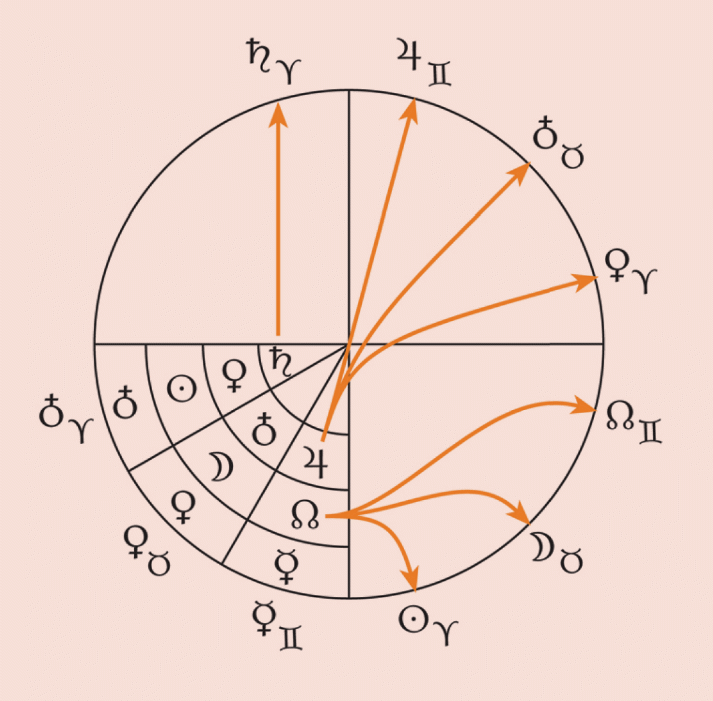
Quadrants, rings, dignities symbolization
Reading of beginning of One: Exposition
One-Only and its self-sufficient complexity
Unity
Use of word Intelligence, rather than Consciousness, Awareness, Knowledge to describe the One
Intelligence at different levels
Turiya
Positive statements about the Absolute
Reading of Astronoesis: One-Only
Intelligence vs. Consciousness as the One
Ontology
Starting with full-blown reality rather than the Absolute Transcendent
Whole circle, first quadrant, first house
Symbol as means to understand, the symbol of the circle
Symbolizing transcendent and immanent
Ontological and metaphysical charts
All metaphysics dualistic
BOOKS READ FROM OR REFERENCED:
Anthony Damiani, Astronoesis: Philosophy's Empirical Context; Astrology's Transcendental Ground (published 2000)
Plotinus, The Enneads (MacKenna translation, 4th ed.)
Plato, Timaeus
Rene Guenon, The Multiple States of Being
John N. Deck, Nature, Contemplation, and the One: A Study in the Philosophy of Plotinus
Swami Nikhilananda, The Mandukyopanishad with Gaudapada's Karika and Sankara's Commentary
Bible, John (14:2)
PLOTINUS QUOTES READ OR REFERENCED: III.8.6, IV.3.17, IV.4.16, V.1.8, V.1.10, V.3.17, V.4.2, VI.7.36, VI.8.16, VI.9.5, VI.9.6, VI.9.11
DIAGRAMS appended to this transcript:
FIGURE 1982 0402a-1. Twofold Zeus.
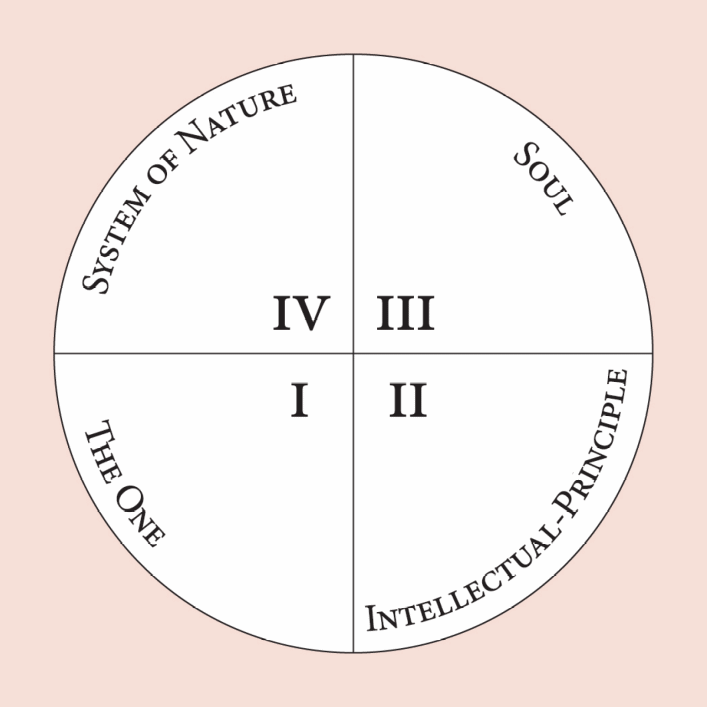
FIGURE 1982 0402a-2. Construction of Metaphysical Chart.
FIGURE 1982 0402a-3. Active and Passive Perfection.
FIGURE 1982 0402a-4. One, Infinity, Bound.
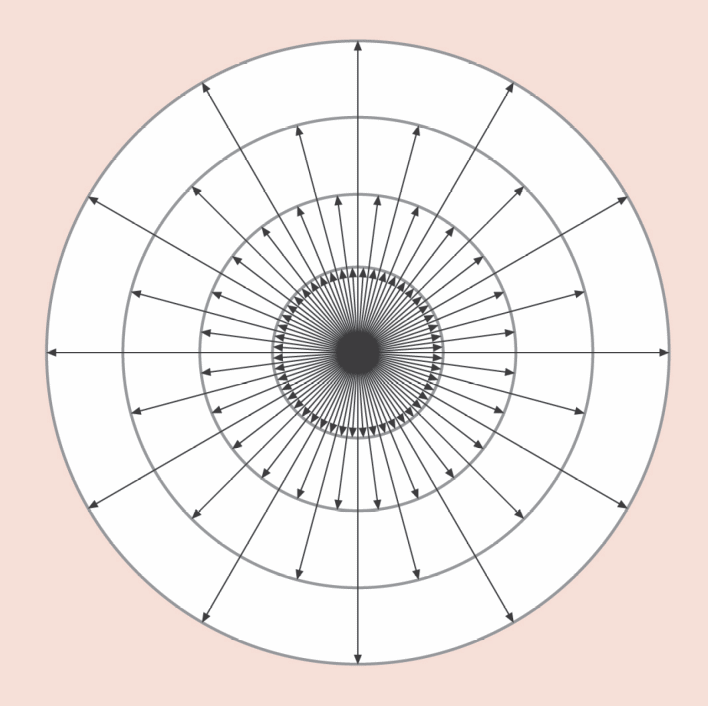
FIGURE 1982 0402a-5. Unknown Center Radiating Four Concentric Circles.
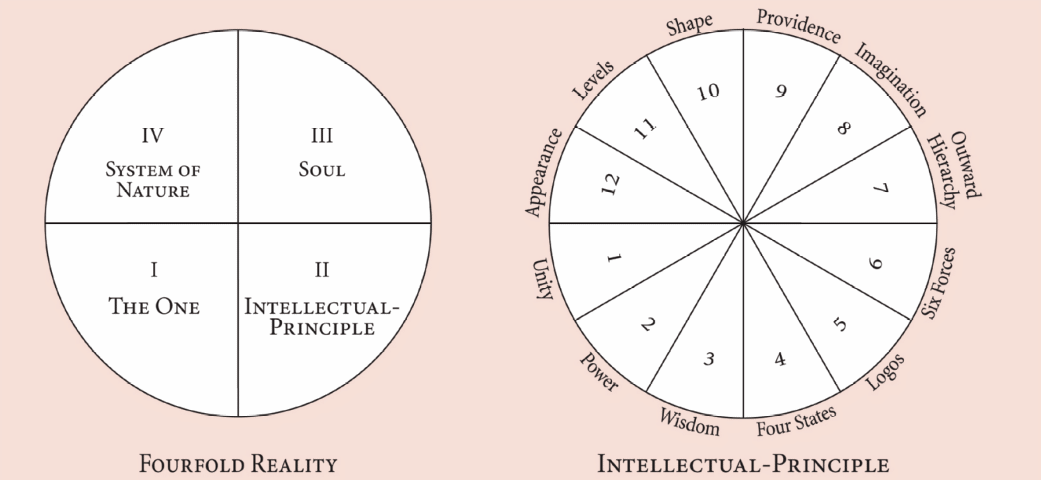
FIGURE 1982 0402a-6. Fourfold Reality.
FIGURE 1982 0402a-7. From Unities to Rulerships.
FIGURE 1982 0402a-8. The One-Only.
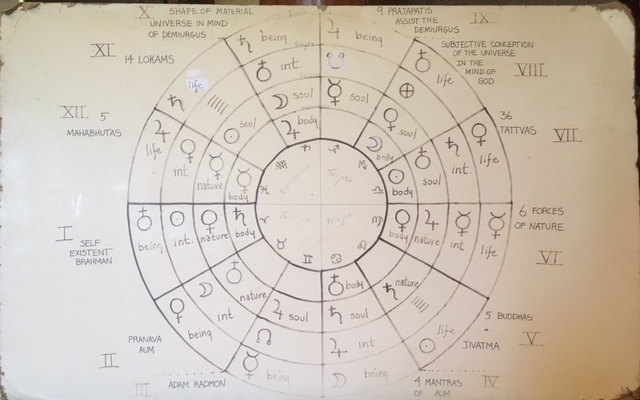
FIGURE IMG_2202-Posterboard Metaphysical Chart.
FIGURE 1982 0402a-10. Fourfold Reality and Intellectual-Principle.
AD PAPERS read in class:
- Astronoesis Working Draft Outlines of One, Intellectual-Principle, Soul, and Nature; working draft of Invocatory Prelude section on philosophy and astrology and beginning of One: Symbolization; working draft of One: Exposition. The working draft outline of the One as read in this class has been retyped as 1982 0402b V09MP. Astronoesis - One - Outline. The working draft outline of Intellectual-Principle has been retyped as 1982 0312c V09MP. Astronoesis - Intellectual-Principle - Outline. The working draft outline of Soul has been retyped as 1982 0319b V09MP. Astronoesis - Soul - Outline. The working draft outline of Nature as read in this class has been retyped as 1982 0402c V09MP. Astronoesis - Nature - Outline. The working draft of Invocatory Prelude section on philosophy and astrology and beginning of One: Symbolization has been retyped as 1982 0326e V09M. Astronoesis - Introduction. The working draft of One: Exposition as read in this class has been retyped as 1982 0402d V09MP. Astronoesis - One. See also Astronoesis: Outlines for all four Astronoesis chapters, Invocatory Prelude, and Chapter One.
NOTES:
This is 1982 04/02a, Plotinus; One Class, and the first entry associated with this date. 1982 04/02b = One Outline. 1982 04/02c = Nature Outline. 1982 04/02d = The One: The Only Perfection Paper. 1982 04/02e = Astrology; Nature Seminar, for which we have no audio, just JF notes.
Previously printed, distributed 2003 as part of a set.
This class series on the One was held on Fridays.
TRANSCRIBED by jf 2002 from Audio Cassette tapes; reformatted by jf 2018. In 2024, IT does two more passes, corrects listening errors and makes verbatim, updates prefatory matter and footer, replaces tape markers with audio file markers, expands Subsubjects, completes Book List, adds Plotinus quotes section, corrects typos, adds new notes within transcript, adds nine diagrams and references within transcript to these diagrams, reformats to accord with new conventions. Archival verbatim transcript with AD Papers – V12ap.
AUDIO FILES: 1982 0402a, 1982 0402b. [Note: "Tape" and "Side" refer to original audio cassette tapes that were later digitized into .MP3 Audio Files.]
1982 04/02a at Wisdom's Goldenrod
Plotinus; One
[Audio File 1982 0402a Begins]
AD (faint): --namely myself and a few others, that despite certain prejudices we have, as we go along analyzing a chart, what happens is it just ignores our prejudisms and goes on stating these principles that we've been working with. So, we've gotten to that level where now we're starting to do-- do really careful interpretation of these [one word inaudible] Anyway, Avery wants to know if you want to start from the beginning with the outline, or if you wanted to talk-- resume where you left off on Nature.
[short pause]
S: Continue.
S: Well--
S: Let's do the outline.
S: Yeah.
RG (simultaneously): Starting over it with [S simultaneously: Just start over (one/two words inaudible)] Nature or with the One?
AD (faint): Either one.
AS: Anything you want.
AD (faint): It's up to you, uh-hm.
S: That'll be nice.
S: Yeah.
S (simultaneously): Definitely.
S (simultaneously): Start with One.
S (simultaneously): Yeah, yeah. [one/two words inaudible]
AD: Well we always redo "The One".
[19 second pause]
S (whisper): Speak louder.
AS: Louder?
AD: David?
DR (faint): Yeah.
AD: Try to keep everything in your mind (off it), alright? I mean David will-- [S: Yeah.] Try to keep everything in your mind, huh? Don't let go of anything, hold it all together. (bit of laughter)
LR (faint): Yeah David.
VM: Oh no this--
RG: Try a reference to last week.
S: Uh-hm. (bit of laughter)
S (very faint): Last week?
AD (faint): You know--
AS: Should we read it straight through?
S: Uh-hm.
AD (faint): Do the whole thing.
AS: You want one for the quotes?
S (faint): Yeah right. [few words inaudible]
S (simultaneously): Never heard this before.
AS: It's a long outline.
S (faint): Why don't you read one section and then stop?
AS: What?
S (faint): Only read one section and then [one word inaudible]
AS (simultaneously, faint): Ok.
S: Get off (my monk).
S: Then--
RG: Hey Randy, Randy. The outline's before the Introduction?
S (faint): Go ahead, read.
HS (faint): Well let's do that (then).
S (faint): What did he say?
AS: Ok, this is the outline. Now-- table of contents, "The One".
[Astronoesis Outlines drafts follow (AS reading)]
[ONE OUTLINE]
"[1.] The Philosopher's wisdom-knowledge first expresses to us a view of the Supreme Reality as Simplex, Absolute, Alone, utterly Self-Sufficing, the One-Only. This simplicity is not that of a spatial point or blank homogeneity nor a numerical one to be numbered in with the others. It is super-knowledge, Pure Intelligence, and is so complex in Its undifferentiated simplicity as to include all and everything within its universal essentiality.
2. Plotinus identifies the infinite and indeterminate power of the One as not distinct or apart from the pure Undifferenced Knowledge itself. It must remain a simplex, and yet be the source of all distinctions. To elicit the distinctions within metaphysical infinity requires this power--the Shakti of Brahman.
3. This power is spoken of as the indeterminate Dyad and is the basis for indeterminate "matter," or substratum of all the Unities. It is what imparts to each of the Unities their characteristic uniqueness: Being and Form in a distinctionless mode within the One. They are therefore super-essential, super-gnostic, and super-vital.
4. The One in its interaction with the Dyad exhibits Infinity and Bound, or Repose and Act. The double act in the Divine Mind is non-dual. The Unities which express or constitute the inner nature of the One are no new production.
5. The totality of all possible arrangements and combinations of these unities which are rooted in the One still leaves the Oneness untouched. This view of the One as the Unities established in and by the power of the One in the One leaves the One intact. This is the basis for the Platonic theory of participation. So in the Unity of Unities are the transcendental principles of Nous and Being, of Ideas and Numbers, the totality of infinite possibilities. The power of the One establishes distinct real principles, levels of Being, or a variety of spiritual principles which are yet not separated from their source. We must repeat that this power when identified with the One, or as extending from the One, this sheer indeterminacy, forces us into the perception of the One as transcendent and as immanent."
[9 second pause]
AS: You're going to like this.
"THE INTELLECTUAL-PRINCIPLE [OUTLINE]
[1.] The One as the source of all contains in its inner nature, in a differenceless mode and transcendentally, all of the principles which are to be distinguished out from it.
[2.] In the undifferenced knowledge of the One are prefigured Intellectual-Principle and Being, the Ideas and Numbers, so, in essence, the unity of the Intellectual-Principle is to be found in Universal Being.
3. When we conceive of the essential simplicity of the One, that is, its transcendental aspect, we are considering it as partless and indivisible. Even knowledge of it is excluded. When considering it as the principle of all principles it is immanent. Both views are necessary to understand it rightly. This follows the paradigm of the double act.
4. The radiant emanations or the divine outflowing is now unfolded. Within Being the first distinctions arise, knowledge and its objects, the one-many.
5. Number, which is already transcendentally in the One, presides over, arranges, and coordinates the Ideas and their powers in the Intellectual-Principle. We will attempt to show that a derivation of the 10 structuring metaphysical principles, the Divine Numbers, are from the One itself. These are the properties of Number. These properties will form the basis and archetypes for the ordering of the Ideas in the Divine Mind. This principle of Number will coordinate the specific relations of the Ideas with the appropriate powers or dignities which essentialize and singularize the Ideas. Number, which coordinates the Ideas and their powers, is symbolized by the Head in our illustrations. The two--Ideas and powers--are distinguishable but not separable.
[6.] The inability to grasp the Infinite One in its totality even by the Intellectual-Principle, and its repeated attempts to do so, accounts for the innumerable successive impressions of that One as universe after universe is unfolded and the planned evolution or idea of manifestation progresses.
[7.] The Intellectual-Principle, or self-thinking thought, does know the One in essence.
[8.] In the Intellectual-Principle the unities of Ideas and their Powers are made explicit. They are its own divine content which is itself self-gnostic. It is that which it knows.
[9.] Each Idea is an Intellectual-Principle entire, a special and unique form of it. The same way as Intellectual-Principle entire is a duality and unity with a specific internal structure of its own determined by Number, and similarly self-gnostic and self-distinguishing, which gives rise to the notion of separative intellect rooted in the one unified Divine Intellect.
[10.] The power of the One is so great that the Intellectual-Principle, although an image-One, is an authentic reality in eternal actuality.
[11.] There is no notion of becoming or potential in the Intellectual-Principle; all is actualized, and all is one eternal life.
[12.] The Power of the One, being the indeterminate Dyad, the Intellectual-Principle paradoxically stands a distinct reality distinct in the One, and yet expressive of the One's own nature.
[13.] Plotinus attempts to reveal more to us [something] of the essence of Divine Mind by a discussion of the categories or constitutive principles of Being: isness, motion, permanence, difference, identity. Sometimes he speaks of five, sometimes of six. The nature of these principles is the cause of some ambiguity. Nonetheless, these are not parts of Being but are Being itself. Mind thinks, which is an eternal Act, this is divine Ideation. It is a Permanent reality and has Power or Motion and it is Stable essence. The Mind equals the Isness, the Thinks is equal to the Power or Motion, and its Thoughts are Self-Identical, and Different from one another, and their Permanence is their Stable essence. In their totality they are identical with Being or the Intellectual-Principle. Any Real Being or Idea will also be similarly constituted of these genera.
[SOUL OUTLINE]
[1.] The Third Hypostasis, Soul, is also an authentic essence, Real Being, and similarly constituted by the five genera peculiar to Soul, that is, it is characterized primarily by Life.
[2.] Soul is said to be both a one and many.
[3.] In Plotinus Soul as a generic term may be regarded in three distinct ways. Nonetheless in all three its essence or principle is said to be Life. He distinguishes: a) Absolute Soul or the Principle of Life in the Nous, called also Rhea, in the Greek Theology; b) Universal Soul as an outraying of the Absolute Soul toward the manifestation of the fourth principle, the system of Nature and the objective world; and c) the Individual Soul which is also rooted in the Absolute Soul, in the Divine Mind, but it reaches down to its association with bodies. In this last category he places planetary souls, star souls, and cosmic soul.
a) The Absolute Soul is the unity of soul in the Intellectual-Principle, and in this are rooted both Universal and Individual Soul. It is the principle of Life, or matter for the Intellectual-Principle in which all the forms are simultaneously reflected.
b) The Universal Soul is spoken of as two-fold. It is the Providence which presides over the whole of manifestation, and illumines matter with its reason-principles. It is the One Life of the Universe and this is its outer aspect. Its other aspect is its inner conjunction with the Absolute Soul. And thus Plotinus tells of the Royal Soul and Royal Intellect which belong to Zeus.
c) Because of the prior activity of Universal Soul as the groundwork, it now becomes possible for an Individual Soul which can be cosmic in its sweep, to elaborate what is to become the objective manifestation, and for the Individual Souls that are conjoined with various bodies within that cosmos to participate in it. These Individual Souls are not produced by Universal Soul--they too spring from Absolute Soul and in this unity are in continual contemplation of the Divine Mind. In this contemplation the indeterminate life of Soul is eternally conjoined with a vision of the Idea of Man as in our case. This is the Authentic Man, a true essence, a permanent possibility in the Intellectual-Principle. The tendency of Souls toward secession must be with a desire toward a fuller self-realized vision of this Idea.
[4.] Through their association with bodies, Individual Souls are individuated and eventually taught to be self-conscious of their divine origin in the Nous.
[5.] Each soul is a unity.
[6.] It is also an outflow of graded powers and life, to unfold what it contemplates in the Intellectual-Principle. It is a logos or transmitter of the Ideas to the cosmos through its multiple powers.
[7.] Summing up, for Plotinus, the Individual Soul must be of such a nature--a unity and a multiplicity, divisible and indivisible. At its highest--in the Divine Mind--it is a unity but it has a phase and powers which unfold through various levels down to the sensible world. However, even in its associations with body, with the universe which has been illumined by the Universal Soul, it remains impassive. Soul is entire and indivisible even where its distinct powers are operative.
[8.] It gives from itself a light to the formation of living entities when conjoined to body, and thus produces living images of its powers. These images are seated in the animate principle, and coupled with body, bring about the relation of Individual Soul to the Cosmic Soul."
[short pause]
AS: And Nature.
S (very faint): You didn't stop.
AS: What?
S: Go on.
AS: You wanted to stop or talk about it?
S: Fine.
AS: We'll go back.
HS: Three seconds of assimilation? (laughter)
AS: We could go back to it, I thought it was nice to read the whole thing through, it was--
S (faint): Right, just read (more).
AS: Get the continuity.
S (faint): What?
S: Right.
"NATURE [OUTLINE]
[1.] Following the discussion of the three primal Hypostases, we find that these also exist in and for the system of Nature. Plotinus is speaking here of the entirety of universal manifestation to which he applies the principles of Unity, Intellect or Being, and Soul.
2. The unity of universal manifestation is found in the Logos principle within the Universal Soul or Demiurge. Universal Soul contemplates the Ideas in the Nous, and the assimilation of these Ideas by Soul is an abiding wisdom. This is the Logos, or Unified Reason-Principle of the universe. [AS: The unity.]
3. The "in-forming of matter" by these reason-principles, or more precisely their reflection in the mirror of non-being results in the stratification of matter into various grades. This he refers to as the "tentative illumining of matter," the tracing in matter of the idea of the cosmos. This corresponds to the second Hypostasis. It is the Intellect of Universal Manifestation, the Being of Non-Being.
4. The soul or principle of animation for the universe is a system of living images of reason-principles corresponding to the third Hypostasis. These vital and separable images in the soul reflect the immutable Ideas in the Intellect. The graded powers of the Soul will combine the forms within it with the appropriate grades of illumined matter to produce the hylomorphic entities.
[5.] Now in the fourth aspect or Body of universal manifestation, we will also find a reflection of the three prior principles. The material manifestation is divided into inerratic, planetary, and sublunary spheres, corresponding to its intellect, soul, and body.
6. The life of the Demiurgic Soul is the unity aspect of this universal body and it pervades the entire corporeal manifestation of the unified life or force fields.
[7.] It is the cosmic soul which elaborates the demiurgic productions and manifests the three material worlds. Itself a subjective soul rooted in the Nous, the cosmic soul has a series of unembodied powers, the last of which is intellective imagination. The intellective imagination combines in itself the living images and illumined matter.
[8.] The intellective imagination projects from itself the inerratic sphere as a subordinate image of the living form or Idea of Man within itself. This sphere of stars is embedded in the life-fields and is the Intellect of our sensible cosmos.
[9.] The imaginal essence projected by the World-Soul contains also an image of its graded powers which form the planetary spheres, the Soul aspect of our cosmos.
[10.] The system of living forms is spoken of as Nature, the last of the productive powers reaching down to the vegetable kingdom.
[11.] Nature, this emanation of Soul, is in contemplation of Soul, and this contemplation is a producing.
[12.] The cosmocrators in the system of Nature are the vehicles of the higher soul powers, and they are the agents in the fabrication of bodies, organizing the elements or bhutas into bodies, and in this organization there is the embodiment of reason-principles into matter.
[13.] Nature can thus be conceived as an intermediary between the lowest phase of Soul, its intellectual imagination, and the corporeal sensible world. It may be referred to as an imaginal essence, or image-bearing light, as receiving the seminal essences made of the substance of the imagination. It is this spark or fragment of the divine in Nature which is the organizing and individuating logos of any body--a star, planet, and so on.
[14.] Nature is the medium through which our soul, or rather a light from it, is associated with various vehicles in the cosmos, principally the astral body. Our personalities are thus bound up with the stars."
[10¾ second pause]
AS: There's some more but we don't have. Anthony might. I had it too. Huh? Wanted a law?
S: Is there more?
AS: What? Well, there will be a little-- there will be a little more of the outline probably. The-- I think one idea was to put that-- was to put the-- that short paper that we read last week on-- Oh, that's the-- yeah but-- that short paper we read last week on the levels of intelligence going all the way down into Nature, from the One down to its association with Nature. [Note: See 1982 0326c, Six Levels of Awareness paper.] After that, following that. But I don't-- I don't think we've got-- I guess we don't have it right now but--
S (faint): Yeah.
LR: Avery?
AS: Yes.
LR: Could I just ask for a repeat of a couple lines?
AS: Sure, yeah.
LR: There's a line in the Intellectual-Principle that said something about the power of the One being the Dyad. Therefore the Intellectual-Principle is essence in its own right or--
AS: Yeah.
LR: I didn't--
AS: "Stands a distinct reality."
LR: Could you read that line?
AS: Yep. [few words inaudible] "The power of the One--" I should read-- this really goes with an--
Astronoesis draft (AS reading): "The power of the One is so great that the Intellectual-Principle, although an image-One, is an authentic reality in eternal actuality."
AS (faint): Just gonna--
Astronoesis draft (AS reading): "The power of the One, being the indeterminate Dyad, the Intellectual-Principle paradoxically stands a distinct reality, distinct in the One, and yet expressive of the One's own nature."
[9 second pause]
LR: I'm having a hard-- I don't understand the connection between the power of the One being the Dyad, therefore the Intellectual-Principle stands both in and-- [AS: Well--] in its own right. I mean I don't see-- I'm trying to follow how the Dyad then determines that ma--
AS: Well first, I think, first was that it-- it allowed the One to remain-- yeah, and-- allows the One to remain intact even when it's the source of all and everything comes from it.
LR: But-- what allows all--
AS (simultaneously): The Dyad. The Dyad, the Power. If we go back, I think it follows from the first--
LR: Ok.
AS: Ok? And then what you're really asking for then is through this nature of participation. Whereas the unity of the Intellectual-Principle is in the One, and yet the Intellectual-Principle can stand a distinct reality when we consider the One as immanent--the One, Intellectual-Principle, Soul, and Body. You have these in-- this indeterminacy of this-- the Dyad is this principle of indeterminacy. Ok?
LR: Yeah.
AS: Try the quote? Try again?
LR: I don't think I'm-- You know, I can follow with the Intellectual-Principle is-- can stand as this authentic master principle.
AS (simultaneously): Ok. I think-- yeah.
LR: But I didn't-- I still can't quite--
AS: Well the other part is-- See he wants to allow for two things. He wants to allow that-- he wants to avoid these two extremes, (let's/just) put it that way. On the one hand he wants to avoid the extreme that there's this ultimate duality.
LR: Ok.
AS: And on the other hand he wants to avoid the extreme that Being, Intellectual-Principle, Soul are illusory. Ok, two extremes. Now, if the power of the One is a separate principle from the One, is ultimately-- there's no ultimate resolution of power back into the One, then you have a metaphysical duality. And then you just have the case of duality, there's the One, Intellectual-Principle, Soul, Body, they're absolutely distinct, separate. And he wants to avoid that.
The other thing is, if this power is illusory, as some of the Vedantins take it, then all of the emanations of the One are unreal. Intellectual-Principle, Soul, Body are illusory, let's say unreal, they're illusory, they're the result of an illusory power. So his original notion of the Dyad, the Dyad in the One, the power of the One, allows that this power is a) not different from the One, but b) allows all the distinctions to arise without being separated really from the One. So this notion of participation, first of all, and second of all that he avoids the extremes of either the Intellectual-Principle, Being, Soul being absolutely separate, and avoids their being absolutely illusory. So they're distinct and yet they're not different, separate from the One. Those two views wherein the Intellectual-Principle is in the One, and distinct principle in its own right, is again the Dyad, which I think originates from the very first view of the One as transcendent and immanent. And that's why I think it follows. Maybe that needs more elucidation.
S: Ok.
AS: That's a hard one.
LR: No I follow, yeah.
AS: Ok?
S (faint): Yeah.
LR: Could I ask for one other [one word inaudible]
AS (simultaneously): Could be worded better, yeah.
LR: I'm sure a lot of people have questions, I just wanted to [few words inaudible]
AS (simultaneously): Oh yeah, sure, I-- I don't know, unless there's some other way to proceed.
LR: The notion of the Logos in the Demiurgus somewhat baffles here because-- well, because I had thought about the Logos being the World-Soul.
AS: Well--
LR: And, am I not (think--)
AS (simultaneously): I think (it goes--) transmits all the way down but--
LR: Yeah, well what is that-- what is meant by the (Logos) of the-- the Logos [AS: I don't know.] of the Demiurge, which is like not-- I thought it was not a two [AS: Yeah.] in the soul [AS simultaneously: Yeah.] that way?
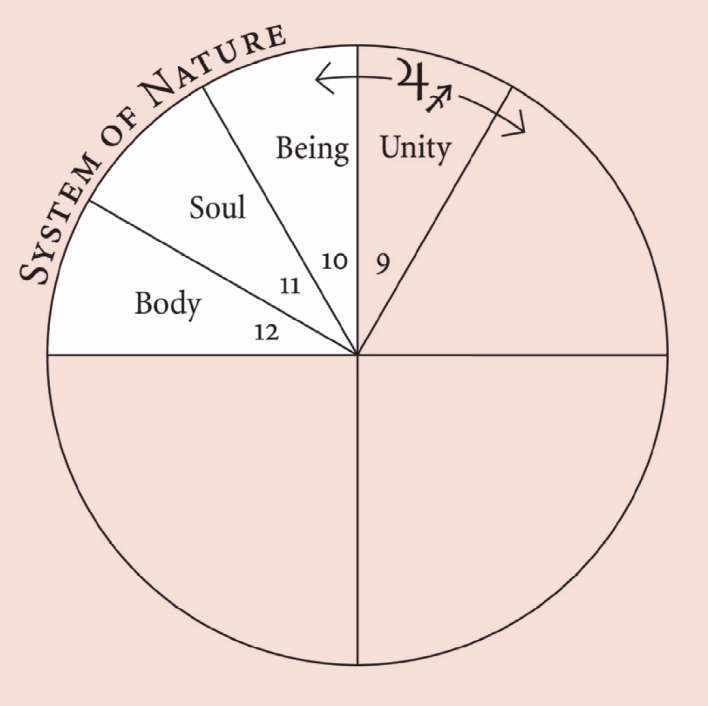
AS: Well, I think it tries to-- "The unity of universal manifestation…" You just start-- Universal manifestation has also these three aspects of Unity, Intellect or Being, and Soul, and we drew that picture of the last four houses. [Note: See FIGURE 1982 0402a-1, Twofold Zeus, appended to this transcript. This diagram is from Astronoesis, p. 237.]
Astronoesis draft (AS reading): "The unity of universal manifestation is found in the Logos principle within the Universal Soul or Demiurge."
AS: Now what is this?
Astronoesis draft (AS reading): "The Universal Soul contemplates the Ideas in the Nous, and the assimilation of these Ideas by this Soul is an abiding wisdom."
AS: So we're speaking of this as the Logos, the unified reason-principle of the universe. For example in Plato he says that the Demiurge has-- assimilates within himself Phanes. He takes into himself the plan or the idea of the whole universe. [Note: See Plato, Timaeus.]
LR: But, how is that anything other than the Demiurgus?
AS: How is it anything other than?
LR: If that's the way-- How is it just a-- that's how I would think of the Demiurgus. Why is it the Logos principle of the Demiurgus?
AS: I-- well, you could think of the two aspects, the functional aspect of the Demiurge and the Ideas which he's assimilated.
LR: And you're saying the Ideas which he's assimilated is the Logos?
AS: Like the Logos, and that's transmitted to the World-Soul. That's the third ste-- that this-- in Aquarius as it were those Ideas would have to be transmitted not as unified but as all the reason-principles with which the cosmic soul-- [LR simultaneously: Well what would--] which that-- which the cosmic soul will elaborate.
LR: Then what would the rest of the Demiurgus do?
AS: Well the rest of the Demiurge would be the powers, you know-- for example in the-- well it's like in the-- remember we did that once? You know who explained it very well is the Kabbalists where they had the ten powers. Ok, but we said something about each one of those powers had to work at manifesting or assimilating all the Ideas. I think there's-- I think-- all I'm trying to say is that there's more-- I think there's more to the notion of Demiurge than the Ideas. Just as in Intellectual-Principle you'd have the Ideas and you'd have the Intelligible powers. I think you could say within the Demiurge also you'd have those-- the powers, the functioning aspect, which would be assimilating those Ideas. [short pause] More? I don't know, Anthony? [short pause] But I-- [short pause] You know, we had that-- that scheme, I don't remember how it went. 10 X 36 is 360, yeah.
LR: Yeah.
AS: Yeah you-- you remember that schema? I mean I-- that was just a schema but, I mean, imaginally you have these ten powers in the Demiurge. And they do ascribe the number 10, well the Kabbalists also have these 10--
LR: Prajapatis?
AS: Yeah, the 10 Prajapatis, rather than the unmanifest Sephiroth, you had the manifest Sephiroth. And they were going to be responsible for assimilating and transmitting these Ideas. And, you know, there was even this-- you know, a schema, for example, you could get the 360 that way. But I don't see why you can't conceive of the Universal Soul also as a distinct principle, distinct as-- distinguished in-- in the Demiurge between--
LR (simultaneously): Yeah, yeah. No, it's not a problem.
AS: Between the Universal Soul and the Ideas which it contemplates. Just as you could distinguish between individual [LR simultaneously: Well (one word inaudible) would--] soul-- I mean it's hard, it's like saying the distinction between an individual soul and the Idea of Man which it contemplates.
LR: And you're saying the idea which the Demiurgus is contemplating is this Logos-- Logos principle of the Demiurge?
AS: Ok, yeah, I think that's what it's saying here. "The Unified Reason-Principle of the universe, the Logos". And it's transmitted. I know, that-- I don't know whether you would say the Idea itself or the transmission of it is the Logos principle.
LR: Yeah.
AS: I-- I mean I see the point, it may be a good point.
LR (simultaneously): I just-- it's just by--
AD (simultaneously): The Demiurgic Soul, the Demiurgic Soul, in the same way like Absolute Soul, receives the totality of the Ideas and produces a living image of those Ideas. And the Demiurgic Intellect fabricates the universe according to that reason-principle which it has made a living image of. This living image is referred to as the Logos, Logos means word. Word means the same as that which conceives it, so the Logos is the same as the Demiurge. Just like on a higher level you say the Divine Mind and the Divine Wisdom--the Divine Wisdom cannot be separated from the Divine Mind. In a similar way the Demiurge, the Intellect of the Demiurge and the idea of the universe which it has cannot be separated from one another. [short pause] All we're interested in-- all we wanted to do in these four outlines was to make a very simple outline so that, you know, you can place in the back of your mind as you-- as we go through the text and start elaborating the details of the symbology. [short pause] That's all.
[30¼ second pause]
DR: I just have a comment.
[students assent, faint]
AS: Yeah. Yes? The Ruth [one word inaudible]
DR (simultaneously): I have to [one word inaudible] all the times I've heard all the different parts elaborated. How could it ever grasp connections from one level all the way down and still keep each piece so tightly knit and whole. [short pause] [few words inaudible]
AD: Yeah I think Dave if you, yeah, memorize it, or let's say have the chief characteristics, you know, which is in the back of your mind, when we start reviewing the sequence of logical arguments of why we're doing this in symbolism, you know, in the chart, you'll be able to follow. But if you don't have a general outline in the back of your mind, you're going to consider, you know, what we're doing esoteric and it isn't, it's right there, it's all over the text, everything he says is right there in the text. And like I said I consider Plotinus one of the most comprehensive statements of the perennial philosophy that's ever been made. I'm not saying the only one but one of the most comprehensive to the point where he in his revelations as to even astrology (there), things that we're interested in, the notion of the self, the five gradations of consciousness.
I mean, in the Saturday class when the alchemists start speaking about the way reason-principles, you know, are buried in this black matter, this prime matter, I mean it'll be just an allegory or a fairy tale unless you see that they're taking off from the Platonists themselves. And they say that these ideas or these reason-principles are in matter and the alchemist wants to work on that. In the same way like when in astrology you say well, these reason-principles are buried right in this chart. If I can't find them there, astrology's a waste of time. So, like we investigate aspects that are going on in transits and progressions, we see that these reason-principles are being made available to the actual understanding of the person, and he's assimilating them. And that's the whole point. [DR simultaneously: That (one word inaudible)] That's the whole point here. And then you say well why should he assimilate all these reason-principles? Well we'll continue, I mean, that goes into mysticism which the-- the building up of the man of light or the body of light, this is the extraction of the meaning of these reason-principles and you live life (or the entity). And these extracted reason-principles which condense into a body of light which then when the mystic has experiences, you know, mystical experiences, he is having a visionary apperception of the contents of his own soul. Everything has been worked out in ridiculous detail in Plotinus. And all we want to do is make pictures so that, you know, when we make pictures, drawings, you know-- Now some people I know don't find the pictures illuminating. And I-- I can accept that. But then I don't know what astrology would mean for them.
OG: Nothing. (laughter)
AS: Skeptic (raving) is pertinent in our eyes.
[few seconds of background student whispering]
AD: If I were to answer you, Om, I would say that there isn't anything that could mean nothing. [few seconds of background student whispering] Alright, do you want to continue (the next)?
[short pause]
AS: So-- well, you'll forget it's a little long so you have to be patient. This we read last week.
VM (faint): Is this [couple words inaudible]
AS: This is-- no this is the-- following that is the Introduction. Ok? So-- Get-- might as well get-- get comfortable, I mean, (yeah).
AD (faint): Read a little louder.
[13¾ second pause]
AS: I'll read it right through. I'll try and read clearly.
Astronoesis draft (AS reading): "We propose to begin where we are, in the sensible universe, or more precisely, in this particular world that our minds and bodies reveal. For transcendental understanding has its humble origins in the empirical. Here we find the only phenomenon adequate to the task our aspiration has assigned. It is sufficiently vast to provide a symbolism that can help us synthesize the seeming contradictions in the various philosophic and religious traditions, and it is sufficiently determined in its parts, both to keep our understanding under rein and to spur it to its limits. We must restrict ourselves in the beginning to the scale of perception provided by this one particular world within the unique integrity of our own solar system. To do otherwise is to risk having our understanding completely relativized too early by the immensities of universal manifestation.
"And so we take as our model the geocentric world view that has been made popular through the many diagrams of Ptolemaic astronomy. We accept and we inquire into the nature and structure of the apparatus that creates our experience of this world in the hopes of being led by it to a superior understanding, to a symphony of celestial suggestion that does not deny the anomaly of sense perception but instead reveals something of the meaning implicit in the modifications that our bodies and minds undergo. This model provides us with a symbolism that is adequate to make explicit many meanings that are hidden in the Enneads of Plotinus in particular, [AS: Sorry."This model provides us with a symbolism that is adequate to make explicit many meanings that are hidden in the Enneads of Plotinus in particular] and in the Neo-platonic tradition as a whole. That allows us to juxtapose philosophy and astrology in such a way as to reveal that the sensible universe is a primordial living scripture that embodies the wisdom of primal principles that are beyond it. It allows us to reconcile the senses' thrill beneath the vista of the starry skies with the heart's awe with the mystery behind its ordered course.
"In the course of this juxtaposition, we will distinguish philosophy and astrology from one another and define the terms of each, while at the same time illustrating how they are mutually implicating elements of a single whole and combined in manifestation. This method allows us to develop a sharp contrast, to conceptually bifurcate the indivisible in such a way that the intellect [that] can [operate only in the realm of dualities can see how it itself is included or subsumed within the cosmic harmony and yet somehow to try and understand its role.]"
(Side 1 of original cassette tape digitized as 1982 0402a Ends; Side 2 Begins)
Astronoesis draft (AS reading): "[Therefore we shall on the one hand speak of this] immaterial knowledge, the pure Hypostases in themselves. This hierarchy of wisdom-emanations exists in a distinctionless manner and constitutes a spiritual hierarchy of reality that is broader and more inclusive than any technical sense in which Being may be understood. Their self-sufficing and eternally august nature, the grandeur of their authenticity, seems to loom before our undeveloped intellect as an inscrutable abyss, a blinding darkness.
"Yet, though an encounter with them may suffocate the unprepared, these are precisely what illuminate and permanently enlighten the proficient, the adept. They must be discussed separately, [AS] for an approach to them must scale heights that are literally unimaginable. Their own proper subsistence constitutes a realm beyond the reach of any imaginative activity."
S (faint): [couple words inaudible]
S: (Vic read.)
S (faint): (Hm?)
VM: Yeah alright.
AS: I'm just going to do--
VM: You giving out, Avery?
AS: Yeah, I'm losing my voice.
S: Where are you?
AS: Yeah.
S: "Concomitantly"?
VM: "Concomitantly," yeah.
AS: Yeah. Ok.
VM: I hope it's not catchy.
Astronoesis draft, cont. (VM reading): "Concomitantly with [and] parallel to the analysis of these principles, we look to their immanence in the realm of manifestation as portrayed through the astrological symbolism that operates in our world. This method allows us to further objectify our internal and abstract understanding and apply it to the levels of epistemology, analytical and empirical psychology, and the problems of everyday life.
"Though we here attempt to communicate something of the untouchable marvel, to express in word and metaphor something of the mystery that silently embraces our everyday existence, bring into bold relief the intelligence that is the underlying ground of the experience of cosmic consciousness is beyond our power. To do so requires a direct encounter without the aid of the imagination, with the reason-principles that underlie and produce our experience. Nevertheless, the illuminaries of mankind--whose noble generosity and compassion have guided us this far--will not fail us in our present need to sacralize the world and ourselves, to restore unity to thought and becoming.
"The conscious"reinstatement" of the purposive evolution in the divine scheme must be made available to us again at the most practical level. Our intention is to help reveal the verities we embody and that actualize our life within and around us. A philosophy that enhances existence with wonder and meaning may easily encompass many schools of thought that supposedly contradict one another. It may make available to the subtle thinker unlimited vistas of conception regarding the depths of man's being. A brief introductory glance at the symbolic method we mean to turn to this purpose should suffice for now to orient the reader toward the general framework of the chapters that follow.
"Many of us who try to penetrate deeply into Plotinus' thought find his vast web of ideas too difficult to grasp. We find ourselves transformed in the very process of trying to understand them. Some method had to be found to a) isolate principles from one another, b) follow these same principles through the various interrelations that exist within and among themselves and go to form a network of previously non-existent degrees of reality, and c) spread out the whole system in such a way as to provide a comprehensive view of the totality thus constituted. We had in mind a visual schematization that would somewhat stabilize the elusive nuances that anyone must face who wishes to have something more than a passing acquaintance with Plotinus. Among the many symbols in astrological lore that can help us we call first upon the circle. Considered by the Greeks as the most perfect of geometrical forms, it perpetuates many properties that will help to support our thoughts about the principles that Plotinus spreads out before us in his writings. Geometrically it resembles a Zero, and as such is reminiscent of the Buddhists' sunya or void. Mathematically it translates more appropriately into the number system as One. The many subdivisions to which the circle readily lends itself without abandoning in any way its own nature will help us to deal with the many difficulties that arise when encountering the incredible wealth of meaning that Plotinus develops.
"Tractate V.1.10 is a good passage with which to begin applying this symbolic system, a system that will evolve as we proceed."
VM: And this is the tractate.
Plotinus V.1.10 (VM reading): "There exists a Principle which transcends Being; this is The One, whose nature we have sought to establish in so far as such matters lend themselves to proof. Upon The One follows immediately the Principle which is at once Being and the Intellectual-Principle. Third comes the Principle, Soul.
"Now just as these [VM reads: the] three exist for the system of Nature, so, we must hold, they exist for ourselves. I am not speaking [VM adds: here] of the material order--all that is separable--but of what [VM reads: of that which] lies beyond the sense realm in the same way as the Primals are beyond all the heavens; I mean the corresponding aspect of man, what Plato calls the Interior Man."
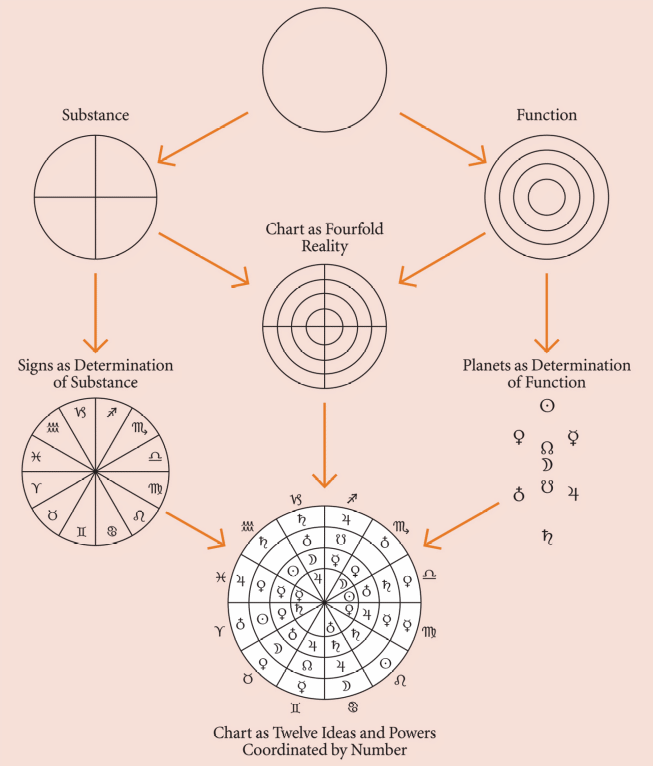
[Note: See FIGURE 1982 0402a-2, Construction of Metaphysical Chart, appended to this transcript for the following. This diagram is from Astronoesis, p. 317.]
Astronoesis draft, cont. (VM reading): "If we take a circle [and] divide it into four quadrants and label these quadrants successively 1, 2, 3, and 4, we will generate a simple static representation of the meaning of this passage. The first quadrant will stand for the One, the second for the Intellectual-Principle, the third for Soul. The fourth quadrant will represent the system of Nature.
"We could also pictorialize this passage by means of four concentric circles, let the largest ring represent the One as immanent, the second the Intellectual-Principle, which also contains the Separative Intellect, the third Soul, and the fourth the entire system of Nature.
"We take the first, the quadrant point of view, as the point of view of substance; the second image, that of the four rings, represents the dynamic or functional point of view. In themselves each of these two extremes points of view is a radical one, the"conflict" between them is concretely illustrated by the crisis that occurred in Indian philosophy between the substantialism of the Vedanta and the functionalism of Buddhism. To insist exclusively on either position will lead to an incorrect and unbalanced view. Our method allows us to superimpose two images in such a way as to produce a symbol that contains both points of view, expressing the paradoxical nature of the One and the various degrees of reality within it.
"This foundational diagram gives us a basic symbol that is adequate to begin an approach to one of Plotinus' most important initial premises--the Double Act, at once act and repose--of the One as presented in tractates V.4.2 and VI.8.16. Some of the advantages it affords will be elaborated in the chapter on the One.
"To complete our initial introductory correlation of the philosophical and astrological schemas we refer to V.1.8. Plotinus there reiterates Plato's position"in the passage where he names as the Primals the Beings gathered about the King of All and establishes a Secondary containing the Secondaries and a Third containing the Tertiaries…" We associate the Primals with the first quadrant and the King of All about which they are gathered must be sought in the same locus. Similarly the Secondaries are associated with the second quadrant and the Tertiaries with the third. The fourth quadrant will be used to represent those lesser agencies at work within the system of Nature.
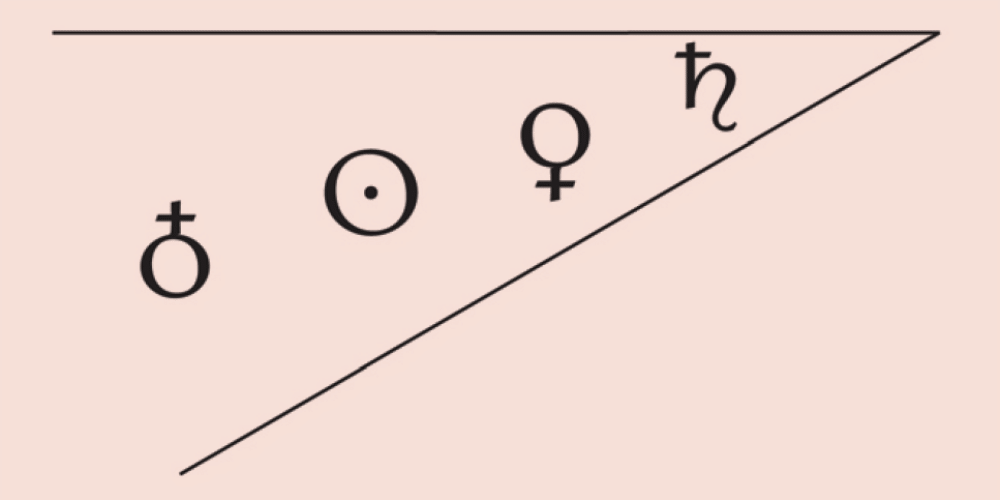
More precise [VM reads: precisely] astrological correspondences to these Primals, Secondaries, and Tertiaries can be provided by filling in the ring structure of the diagram with the rulerships, exaltations, detriments, and falls of the classical astrological wheel. The rulerships are assigned to the outer ring, the exaltations to the second, detriments to the third, and the falls to the inner ring. These dignities that fall within the first quadrant correspond to the Primals, those found within the second quadrant correspond to the Secondaries, and those in the third quadrant correspond with the Tertiaries. We now have at our disposal a chart that tries to illustrate the principles that are "constitutive" of the One and its divine outflowings."
[13 second pause]
AD (faint): Well--
S: I think it's hard.
AD: Everybody's walking out. (bit of laughter)
S: Yeah.
S: Yeah.
AS: They want to go meditate on it.
AD: Any problems there? Is it said simply enough? Can you follow it? Ok? Can you discuss it?
[few seconds of faint background student talking]
AS: [few words inaudible]
AH: There's a question concerning the resolution between Vedanta and Buddhism.
S (faint): Uh-oh.
S: Uh-oh.
S: Oh.
AH: It seems that you need to make a metaphysical presupposition or you don't. [student assents] And there doesn't seem to be a space between those two positions.
AD: No, that's not true, Andrew.
AH: Could you explain how--
AD: If you speak-- if you want the intellect to understand, you must work with metaphysical dualism. You can't avoid that. The intellect only-- can only operate in a dualistic framework. If you speak about the One itself, then there's nothing to talk about, then you have what you might call metaphysical unity. And that-- and there you apply intuition, intuition is what functions in metaphysical unity. But if you wanted to try to explain and explicate some of these meanings you're going to have to work with metaphysical dualism. You have to work with the notion of the transcendent and the immanent simultaneously. You're going to have to work with the notion of substance and function simultaneously. Passive and active repose simultaneously, there's got to be two all the time. No exception.
AH: It seems that to posit the notion of substance is to necessarily work from a position of substance in terms of a logical system.
AD: If you have a logic based on substance it will end up in that-- [AH: Yeah.] it won't-- (it won't be/in one-being). And yet we know that there are functions going on which is not substance. You could say it's the power of substance but then again you've brought in function. You're going to have to leave the metaphysical dualism whether you like it or not. And then also the way Plotinus points out is, he's trying to accommodate our mental processes. [Note: See Plotinus, VI.9.6, first para.] He's trying to work with them so that we could make a leap.
[11 second pause]
LCG: Are these two-- this was all one paper or did you read two separate things and it was the order of the two? Maybe two separate--
S (faint): No.
AS: No.
S: No, one was the outline and the second one was the Introduction.
AS: Did I stop them?
AD (simultaneously): The second should come first and the outline should come second.
LCG: Ok.
AD: It doesn't matter, Lauren.
LCG: Well I didn't know.
AD (faint): Ok.
LCG: I mean the order [couple words inaudible] Also there will be-- I'm on a question you already asked but--
AD: Well-- well that's all I'm interested in right now is that.
LCG (faint): Ok.
AD: No problem, go ahead, start with the third. Avery, have we started on that?
AS: Yeah. Last one.
DR: I wouldn't mind--
AD: Ok, good, go ahead Avery.
DR: Just a little continuation on Andrew's question. Would you say that the passage in Plotinus where he speaks about the Beings gathered around the King of All, and there's-- there is the Tertiaries and each of those places, that that's his manner of presenting the-- the point of substance and function both being simultaneous? Or do you think they're [couple words inaudible] Well I'll just leave it like that. And somehow it just-- it just seemed to come up out of-- out of thin air.
AD: No, the substance and function comes up when he speaks about the double act.
AS: Double act.
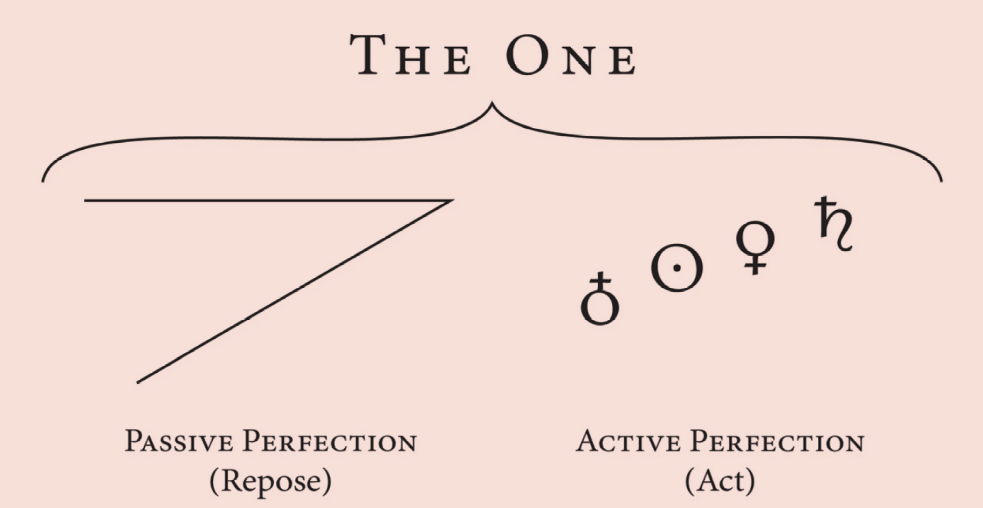
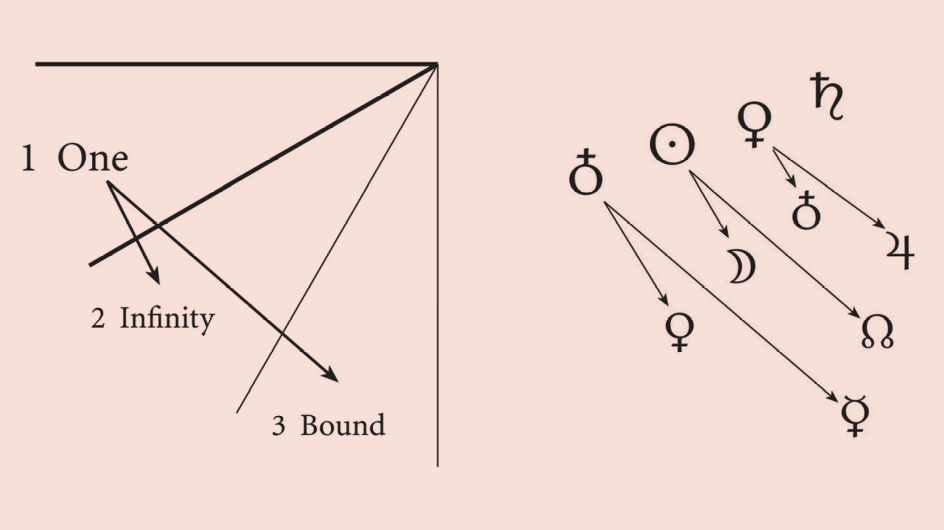
AD: He speaks about active and passive repose, you remember? [DR: Yeah.] The double act. That's when substance and function comes up. So, if you wanted to you could think of for instance the passive perfection which is included as part of the double act, you could think of that as the (very) substantial aspect, and the active perfection you could think of that as the functional. But you have to conceive of them both simultaneously in non-dual in the One itself. [Note: See FIGURE 1982 0402a-3, Active and Passive Perfection, appended to this transcript. This diagram is from Astronoesis, p. 55.] Now when you separate them out of the One, when you make Hypostases out of them and you call one Infinity and the other Bound or you say passive perfection and active perfection, this permits us to make the Houses 2 and 3. [Note: See FIGURE 1982 0402a-4, One, Infinity, Bound, appended to this transcript. This diagram is from Astronoesis, p. 56.] But, that comes later on, I mean that's the next-- that's the next thing we worked up, now you try to follow from the diagram we have and try to follow that out.
DR: Ok. Could you also say that once-- once you've put in the dignities into the-- into the quadrants, does that-- that's then your symbolization of those two juxtaposed?
AD: Try it again.
DR: When you put the dignities into the circle within each quadrant, is that then your symbolism for the functional aspect and the substance aspect?
S (faint): (No.)
RG: That's good.
AD: I think Avery can show you that in the next paper as we're going along.
AS: Ok.
AD (faint): I think he can show you.
AS: Ok.
AD: Yeah Leslie.
LC: You call the circle divided into quadrants substances and the circle and rings [AS simultaneously: Rings function.] function. [students assent] I don't think I really understand the difference, you know, why the quadrant is called substance and the ring function.
AS: Rather than the other way around.
LC: Yeah. Does it matter?
AS: Well, [LC: Yeah.] just the way you're using the symbolism.
AD: There's one quotation where he speaks about the One at the center and the line from the center to the circumference as the Intellectual-Principle, the circumference as the Soul, and the Soul revolves around the One, alright. [Note: Possible reference to IV.4.16, last paragraph.] So there the suggestion, I think, is that the circular form is dynamic, no end, no beginning, alright. Whereas when you traverse quadrant, you know you traverse it when you go from one quadrant-- In other words, it's almost like you're passing two different kinds of geometrical topography. The circle will always give you a feeling of a flow, something moving, alright, and a square will always give you a feeling of stability. It's a natural symbolism.
S (faint): Ok.
S (faint): Oh, it's good.
AD: But let's see if we follow the symbolism. Avery, do you have that-- the first few pages of the next part?
AS: Oh yeah. And it's the-- Ok. That quote-- By the-- maybe we should put that in also in the Introduction, the IV-- the IV.3.17 where he speaks of the radiation of those circles, that was the third one that we had used that we didn't put in. [Note: See FIGURE 1982 0402a-5, Unknown Center Radiating Four Concentric Circles, appended to this transcript. This diagram is from Astronoesis, p. 49.]
AD (simultaneously, faint): (We could) use that, sure.
AS: Ok. So this is supposed to follow after you already have a Introduction and the Table of Contents, is the first [section] on the One. Ok? And, if you had in mind the order of the Outline, it should more or less-- this should be explicating the various lines in the Outline.
VM: This is the expansion of the so-called Table of Contents?
AS (simultaneously): This is the actual-- yeah. The chapter is an expansion of the so-called--
VM: Of one of the-- like the--
AS: Well you'll see.
VM: Oh, go ahead, just do it.
AS: This deals with the first-- We could do it that way. I mean, the first three where he says-- Ok. I'll just read it. But for example-- The first three-- the first part of the One outline. I'll just read that again, why not.
Astronoesis draft (AS reading): "The Philosopher's wisdom-knowledge first expresses to us a view of the Supreme Reality as Simplex, Absolute, Alone, utterly Self-Sufficing, the One-Only. This simplicity is not that of a spatial point or a blank homogeneity or numerical one to be numbered in with others. It is super-knowledge, Pure Intelligence, and is so complex in Its undifferentiated simplicity as to include everything in its universal essentiality."
AS: So the first few pages here are on that first point. And it begins with the quote from VI.9.6.
Plotinus VI.9.6 (AS reading): "Think of The One as Mind or as God, you think too meanly; use all the resources of understanding to conceive this Unity and, again, it is more authentically one than God, even though you reach for God's unity beyond the unity the most perfect you can conceive. For This is utterly a self-existent, with no concomitant whatever. This self-sufficing is the essence of its unity. Something there must be supremely adequate, autonomous, all-transcending, most utterly without need."
[short pause]
AS: Ok, that's the quote.
Astronoesis draft (AS reading): "The Wisdom of the Philosopher-Sage primarily and jubilantly expresses to us the existence of the Transcendent, the One-Only. Its essential nature is an utter self-sufficiency, by which he indicates to us its completeness and the only perfection. Sufficient and complete in itself, it is beyond any limitations, or duality of any kind, or dependence or need. This transcendence does not mean a blank homogeneity, but unlimited actuality. Its self-existence is a pure be-ness, a super-intelligence which is inbound with the total of possibilities. It is a pure awareness which is"self-distinguishing throughout, in a mode above intellections." (Plotinus, V.4.2) [AS: That's a quote.] The One is so complex in its unique and undifferentiated simplicity as to encompass all within its universal essentiality. It is thus absolute positivity, rather than a metaphysical abstraction or teleology as some commentators would make it."
AS: We should stop, I mean, and I heard some-- I heard some groans so--
S: Where are you?
AS: Hm?
S: Which tractate are you reading?
S: That's the re-- that's the paper.
AS (simultaneously): No this was a-- this was a paper.
S: Oh.
AS: Sorry.
S: Sorry.
S: This is your paper?
AS: This is the paper, this is--
S (faint): Chapter one.
AS: I-- the quote stopped with-- where does that quote end?
S: [couple words inaudible]
RG: How do you draw the idea of complexity out of this quote [one word inaudible]
AS: Out of this quote?
RG: Yeah. Oh wait [few words inaudible]
AS: Huh? Ok, well-- I think it's [few words inaudible] good question. Well, I'll read the quote.
[short pause]
AD: Didn't hear the question, Richard.
RG: How did-- how is the complexity of the One, that idea, drawn out of the quotes? I mean it may not be that you want-- you need to do that but if [AS simultaneously: Oh.] you are doing that I was trying to see.
S: You want to read the quote?
S (faint): Uh-hm.
AS: Yeah. [11¾ second pause] There's no quotes I could see. Well actually, maybe the order is a little bit-- the order may be a little bit bad because we should read-- let me just read the-- He does make that clear in another quote. If that's the case we should change it.
AD: Must speak louder, Avery, I can't hear a word.
AS (simultaneously): Yeah, um-- The question of how to get the complexity out of that one quote I think also comes from the next-- it follows along from the VI.9.6 that we didn't read the rest of it, the next sentence which I got stopped before.
S (simultaneously, faint): That's why you reread that sentence.
AS (simultaneously): Yeah.
Astronosis draft (AS reading): "Plotinus makes clear in VI.9.6 that"its Simplicity is not that of a spatial point nor a quantitative unit to be enumerated with others, and its impartibility is not that of 'minuteness' but of 'greatness'.""
AS: Yeah but-- [26½ second pause] The ques-- can you say it again, Richard? You want to know how-- how the--
RG: Yeah, that didn't seem to me to draw [AS simultaneously: Didn't follow.] complexity, I mean, it seems you're-- you want to draw the complexity out of the-- out of the greatness of it. Or by contrasting it to those other terms we normally consider simple.
LCG: Wasn't the complexity it was pointed out earlier [few words inaudible] paper?
RG: Yeah where?
AS (simultaneously): Yes, this is-- it says--
LCG (simultaneously): [few words inaudible] quote so--
RG: Well I thought the idea was to establish it to some extent to-- through-- through the text.
AD: No I think Richard's criticism is correct.
AS: Yeah.
AD: In that first quotation the emphasis is on the simplicity of the One. [AS assents] Although the next point I would have him bringing out would be what is the meaning of that. [student assents] What is the meaning of the simplicity of pure intelligence. [AS assents] I think your point is correct. In that quotation the weight of the entire emphasis is thrown on its self-sufficing as its absolute adequacy, alright, its utter independence. [9½ second pause] Is that so? Oh I just want to see (if they're around). How would you interpret that quotation if you read that quotation, read it again. And the emphasis is on one point, a point which he will constantly reiterate over and over again.
[short pause]
AS: Read it again? Take a-- the first quote.
AD: Well, they know the first quote, they've heard it twelve times. Now let's-- let's read the comments on it.
Astronoesis draft (AS reading): "The Wisdom of the Philosopher-Sage primarily and jubilantly expresses to us the existence of the Transcendent, the One-Only."
AD: God is.
[short pause]
Astronoesis draft (AS reading): "Its essential nature is an utter self-sufficiency, by which he indicates to us its completeness and the only perfection. Sufficient and complete in itself, it is beyond any limitation, or duality of any kind, or dependence or need. Nor does this transcendence mean a blank homogeneity but unlimited actuality. Its self-existence is a pure be-ness, super-intelligence [AS: Oh I have to read it that way.] inbound with the total of possibilities."
HS: Is that the part that you're objecting to or commenting upon?
AS: Yeah. That's what he's-- that's what he's objecting--
HS: "Inbound with possibilities"? Is that--
RG: Wait, that's the comment. Is that the quote or the (comment)?
AS (simultaneously): No, this is the comment.
LC (simultaneously): It's the comment.
S (very faint): "Inbound with possibilities".
Astronoesis draft (AS reading): "It is a pure awareness which is"a self-distinguishing throughout in a mode above intellections.""
AS: Yeah. We should leave out the "inbound with total of possibilities" [couple words inaudible]
RC: And what you said before when you did that was that self-distinguishing implied that there would be some variety.
S (faint): Yeah.
AS: Well, I think the point is well taken that you want to just have the single first point, to begin with. Of course, I think we could put that line a little later on because he's going to make the point--or I think we could draw it out of this by a logical-- by a logical train which we haven't done, [few inaudible RG words simultaneous with AS] but which there's a Guenon quote that does but--
RG (simultaneously): Yeah.
S: Yeah but it's also that [one/two words inaudible]
AS (simultaneously): That being beyond-- No, he makes the point I think very well which I don't think we made well enough (here/there) that the being beyond any-- "self-sufficient and complete in itself, it is beyond any limitation or duality or dependence." And being beyond limitations does not mean beyond in the sense of there being-- it being nothing but in the sense of including within it all possibilities. So the notion of self-sufficiency implies that it contains everything it could possibly need. It has no lack whatsoever. Containing everything it possibly needs means it contains everything. There can't possibly be anything outside of it.
RG: Well, what is this every-- yeah, but a concept of everything--
AS (simultaneously): In an undifferenced way.
RG: --with which it con-- everything which it needs--
AS: Right.
RG: What does that mean?
AS: It means every--
AD (simultaneously): That means it would go beyond even the attributes of aseity and being and essence.
RG: Then the words you're using I-- then the words we're using to describe it, what kind of meaning do they have?
AD: I'm sorry.
RG: If in fact, and I agree that--
AD: It's not a negation for instance the way some people would take it, that when we say it's beyond Being, that Being isn't included in it. Being is included within it but it goes also beyond the Being which is included within it.
RG: Right.
AD: So in that sense it's not characterizable any longer.
RG: Neither as complex nor as simple, in a sense.
AD (simultaneously): Well, no, the point is that [AS simultaneously: No, not as anything.] I want to keep-- I'm going to insist on the use of the word "the complexity of the simple" because for simple-minded people they're going to reduce it to grade-A [AS simultaneously: Of course.] homogenized milk.
AS: Yeah. Actually, you know, the one--
AD: The thing to understand here is that the ultimately simple is the hardest of all things to understand because of the immense complexity of all the unities that are involved. So I'm going to keep on insisting that the simple in our everyday colloquial understanding, the word that should be used is 'complexity'.
RG: Ok then--
AD: Parabrahman is simple too, right, but everything comes out of it, the Shakti included. [student assents] The whole universe of illusion comes out of it. You can call it simple.
RG: No, no, but he seems to make the point, or he's trying to in VI.9.6, is that all our conceptions of simple are inadequate to describe its nature. Anything we can conceive as simple isn't it. So it's simple in a very different sense than we could even conceive of.
AS: Right and this is trying to make clear in what sense it's simple. He makes the point clear that it's not simple-- I mean yeah, its simplicity is not of a point, quantitative unit, impartibility not of minuteness [RG: Right.] but of greatness.
RG: Right.
AS: Now what's implied in that?
RG: Yeah, what is implied?
AS: Well isn't it implied that within it-- that within this infinity can be ev-- the totality of everything.
RG: But the meaning of those-- I don't understand yet what the meaning of those words you just said are, the totality of all-- [AS: Ok.] I mean, in some sense again we're importing the language of Being--
AS: Well--
S: How else though?
AS: Let me read this thing--
RG: Yeah how else, I know.
AS: This follows right after where we ended off. Let me just read this one more. Although it's from Guenon and it's not from Plotinus. I just think he said it very well. [few words inaudible] "The Infinite, on the contrary, if it is…"
AD (simultaneously): Louder please.
R. Guenon, The Multiple States of Being (AS reading): "The Infinite, on the contrary, if it is to be such must admit of no restriction, which supposes that it is absolutely unconditioned and indeterminate, for all determination is necessarily a limitation simply because it must leave something outside itself, namely all other possible determinations. Limitation, moreover, presents a character of real negation: to set a limit (AD handwritten insert: and Being does; AS reads this as: and Being for example does this) is to deny to that which is limited everything that this limit excludes; [and] the negation of limit is in fact the negation of a negation, which is to say, logically and [even] mathematically, an affirmation. Therefore the negation of any limits is equivalent, in reality, to total and absolute affirmation. That which has no limits is that to which one can deny nothing; and this idea of the Infinite, which is the most affirmative of all because it comprehends and envelops all particular affirmations, can only be expressed by a negation [AS reads: can be expressed as negation only] by reason of its absolute indetermination."
S (faint): Uh-hm.
AS: I know it's a hard-- I just think he said the quote very well.
AD (simultaneously): Yeah (it was) obviously it's the One but that's what you're talking about.
AS: I mean I think he made the point very well in it.
AD (simultaneously): You're not talking about, you know-- like if you speak of an element you say the element is simple. You know, iron is iron, and you reduce it to a quantity-- you reduced it to something quantitative as far as your thinking is concerned. And it doesn't include anything about the complexity of all the other metals, it's just talking about this one metal, alright. And this is the way most people would take up the notion of One or simplicity.
VM: But Anthony--
AD: Or, when you say simple-minded what do you mean?
VM: But the word [RG simultaneously: Very complex.] 'simple' is not used in that quote that you brought out at all, the whole-- doesn't occur there once. The notion is (they) emphasizing unity. So in some ways perhaps to even introduce the word 'simple' in the commentary draws you off.
AD: Alright, use the word 'unity'.
AS: He uses it.
VM: Not in that quote.
AS (simultaneously): He said, simplicity is not that of a spatial-- it's-- well, it's part of the VI.9.6, the whole quote.
VM: Oh ok, that paragraph.
AD (simultaneously): He refers [AS simultaneously: Ok.] to it as an utterly simplex.
S (faint): Yeah.
AS (simultaneously): Yeah.
VM: Well, in that particular paragraph, VI.9.6, the second paragraph, the word 'simplicity' is not mentioned, it's (a--) discussion is unity, unity all over the-- Later on maybe but--
AD: Well, I don't think there's any difference, simplicity, unity.
VM (simultaneously): I agree in some way(s).
S: Yeah, yeah.
AD: Except that the way the mod-- the word is used colloquial today [couple words inaudible]
VM: The difficulty is when you bring in 'simplicity,' it has some negative connotations, [AD: Yeah.] or some, let's say, incompleteness about it.
AD (faint): Uh-hm.
AS: [few words inaudible]
AD: So is unity.
VM: I mean I suppose, then people just start putting together quantitative--
AD (simultaneously): Today everybody thinks they know what the word 'unity' means. And they even, they even have the i-- the notion that they can grasp, let's say, an idea in its unity.
VM: Yeah, you got the United Nations.
AD: Yeah. United Nations, united this, united that. And it never occurs to them that that's the one thing they never grasp when they perceive anything is unity.
VM (simultaneously): Of course. Unity is excluded by definition.
AD: Yeah. [short pause] Alright, let's-- let's finish.
S: Yeah.
AD: Let's finish. Yeah-- Om?
OG: The question of the self-sufficient, that unity [couple words inaudible] I could see that, that when you analyze the experience and you ultimately reduce that to the consciousness, consciousness is part of every experience. It just seems like--
AD: It's more than (part). If all experience is included within consciousness--
OG (simultaneously): Right. Right exactly. It seems that there's nothing without so-called consciousness in everything.
AD: Let's use the word, let's use the word [OG simultaneously: Awareness.] 'intelligence'. Let's use the word 'intelligence'. Everything comes out of Intelligence, everything goes back into Intelligence.
OG: Yeah, awareness without (anything).
AD (simultaneously): No, no. You see when we use words like that we're in trouble. You can imagine, I mean you can conceive of things coming out of Intelligence. You can't conceive anything coming out of consciousness.
OG: No. Intelligence--
AD: It's too far gone, right? The Neo-Vedantists did a terrible job. [OG: Yeah.] They use words like 'consciousness' in English which should be 'pure intelligence'.
OG: Well, why not 'awareness' instead of 'intelligence'? Because--
AD: Because 'awareness' again has no implication of a content.
S: Yeah, too simple.
OG: Yeah, but-- but that's your whole idea, in unity there is content but there are no contents.
AD (simultaneously): But don't you see then-- Yeah but then if you do that, if say there's Awareness and only Pure Awareness, what about the 'of', 'awareness of'?
OG: That becomes the substantial (new aspect) [couple words inaudible]
AD (simultaneously): But it's got to be included in the awareness.
OG: It is.
AD: Yeah.
OG (simultaneously): But awareness is always of something.
AD: Yeah.
OG: And-- so that its function is included within it.
AD (simultaneously): Yeah but-- But the point here, semantically and logi-- philosophically, it is difficult to conceive of a withdrawal or a retraction of the contents of awareness into awareness. It's much easier to conceive, alright, of the contents of intelligence retracted back into intelligence. Intelligence has got a much profounder connotation. And I'm sorry that the Vedantists use the word 'awareness' and 'consciousness,' I think they did a big disservice to Vedanta.
OG: Fine, but intelligence, like that has different connotations than the awareness. I can accept awareness as part of the intelligence and I could expect-- I could accept that everything going back into pure awareness.
AD: Or included in that.
OG: Included in that.
AD: [few words inaudible]
OG (simultaneously): But right inside it.
AD: I know, that's the way you're thinking about it. I'm not. I'm very specifically using the term and I prefer the term 'intelligence'.
RC: Intelligence implies the awareness and consciousness.
AD: Hm?
RC: Intelligence in itself implies the awareness and consciousness. But, it's not true the other way.
AD: It's only-- it's only a question of words (involved).
OG: Yeah but these words (ultimately) [couple/three words inaudible] just talking.
AD: Well, what-- if you looked up etymologically the meaning of 'consciousness,' what would that be?
OG: Well consciousness is much greater in the whole schema of so-called creation. Because when you come to consciousness itself, (and) the object will have created. There is awareness only. There is-- you could call logically or whatever, is before that, before consciousness. Yeah. I give up.
AD: No, it's alright, that-- You're entitled to that view, that's exactly what the Neo-Vedantists did for the past fifty years. They translate those words in that fashion as consciousness and awareness. And I can understand that. But I think if they were a little philosophically oriented they would have used the word 'intelligence'. Where awareness of something means that you could retract yourself back into the turiya state and the awareness of the contents remains outside. You can't do that with intelligence. If intelligence-- if there's just a pure intelligence, then it can only, so to speak, be conscious of its own intelligence, there isn't any thing, even though there's several levels of reality go on persisting. Go over that very slowly in your mind.
OG (faint): No I see it now, actually.
AD: Alright, that's why I like the word 'intelligence'. I had a long discussion with PB, he says forget about it, it's too far gone now. They've been using this word for 100 years, they're not going to change it. But the philosophic lexicon in the West would call for the word 'intelligence,' and a Greek never hesitated to use the word 'intelligent,' 'intelligible,' or 'intellectual'. They would never use 'consciousness'. Anyway-- We're going to come to the point that ultimately this ultimate simplicity that we're talking about is pure intelligence. That's what we're going to come to. And that everything is going to come out of that intelligence and yet remain identical with that intelligence, never be different from it.
OG: Otherwise (then) you could use that every [few words inaudible] how is intelligence part of every experience. I go to [couple words inaudible] PB says that I never experience [one word inaudible]
AD (simultaneously): Well, in this way, in this way. For instance, the example that we've been using in terms of trying to apply this practically. When in astrology there is a very distinct understanding of some meaning, alright, that means that you're assimilating a reason-principle, alright, which is something intelligent, and you're something intelligent, and there could be the assimilation, the identification of intelligence. But when I say "I am conscious of a meaning in the chart" or let's say an aspect that's going on, the word 'of' automatically keeps the dualism. Whereas if I take the word 'of' out, then that meaning which is coming into me and I who understand that can easily be homologized.
OG: Yes, (right). Then actually [few words inaudible] I go to the [one word inaudible] of PB [few words inaudible]
AD: Well you ought to read some of the notes too.
OG (faint): Ok.
AD: He does a lot of the same thing.
OG: There you showed everything, unless your own experience. The awareness that you are awareness. Without that there's no experience possible and that's the consciousness.
AD (simultaneously): Granted. Granted.
OG: And, I could see that if you think that's knowledge. Ok, I change that word from 'awareness' to 'knowledge'. I can't change that to 'intelligence'. I understood your argument, that if I say everything is the-- from intelligence, then I could see that going back into intelligence and I don't (fly) into that duality all the time because whenever I try to (speak) awareness and (all different) [one word inaudible] of that and they should be [couple words inaudible] but, just all different states transcendent, the fourth state of turiya but how--
[Audio File 1982 0402a Ends]
[Audio File 1982 0402b Begins]
OG: I can't say that you [one word inaudible] (at it) just from awareness to intelligence. How that--
AD: You could easily change the word. Instead of awareness you could say there has to be intelligence in order for there to be any experience or any content. Very easily.
OG: I could say knowledge and in knowledge the knowledge in--
AD: Now, again, knowledge would have connotations in Western philosophy that it doesn't have in the East.
S (faint): Ok.
S (faint): Yeah.
S: Yeah.
AS: Ok.
RG (simultaneously): Well you just said the Greeks didn't have any trouble using the word 'intelligence'. But isn't-- aren't those the very words-- kinds of words they use for ontology and they reserve different words for beyond ontology?
AD: Well I think-- I think one of the obvious things in like Plotinus is that, if you speak of this as Pure Intelligence, alright, which is in the One, and then there is-- in the One itself there's this concentrated Intelligence which is homologous in a simple way, alright. And then you could take the next step in the Intellectual-Principle where there is a relaxing of that concentration and a spreading out of that Intelligence, it becomes looser. And then in the Soul even more so. And then in Nature even more so. So that there's this relaxation of the unity of Reason or Intelligence, there's a relaxation of it till you get to Nature. Now if you keep it always in that framework, you're always in the framework of Intelligence, the Ideas relaxing more and more, getting spread out more and more, then when they're up at the summit, they're more closely concentrated as one thing, alright. Now in Plotinus that's very clear and that's what the paper was trying to say last week. [Note: See WG Paper 1982 0326e, and also earlier in this transcript, reading of Astronoesis working draft, "Bringing into bold relief the intelligence that is the underlying ground of the experience of cosmic consciousness is beyond our power."] Because these very reason-- or this super-intelligence which is the-- in the One, alright, is ultimately got to be located even in the matter of the world you live in. Now in the paper part of the point was this here, that the possibility of cosmic consciousness can arise because there is an underlying Intelligence which is the substratum of any and every thing in the world, including you. So that the vision of a cosmic consciousness is precisely the homologization of the two intelligences. But if I use the word 'consciousness' I can't do that. And I don't see why I shouldn't be allowed the liberty to say it the best way I can.
RG: Right.
AD: I don't-- I don't have to go along to the way the Vedantists write, whether it's Malkani or Mookerji or anyone else.
RG: No forget-- forgetting about the Vedantists but let's just think about the Greek who-- Why then do the Greeks need to resort to a seemingly very different kind of understanding in terms of unity? Are they trying to say something different when they say unity rather than all the words connected with Nous, Life, Intelligence.
AS: Yeah.
AD: I'm trying-- I still don't understand you.
RG: I mean--
AS: I feel they're trying to say something different.
RG: Right.
AS: I mean it's obvious, I mean, the Intellectual-Principle isn't the ultimate.
RG: Right.
AS: But why? I think the point here was that-- again this thing of going-- you know, self-sufficiency or transcending limits, to go beyond those duality of Intellect and Being say, or Intellection and content, is not to obliterate the two of them.
RG: Right.
AS: Right?
RG: Granted.
AS: But to conceive of them somehow in an undifferenced or in a union of some kind, [VM simultaneously: But Dickie, are you saying something--] where they're--
VM: I'm sorry.
AS: Yeah.
VM: You're saying something like this I think. Words like 'essence' and 'being' are usually restricted to let's say the Intellectual-Principle and ontology. And very often when you see in Greek texts descriptions of the One or the primal-- say the primal unity, they talk about super-essential. Ok? And are you saying that perhaps similar kind of language should be used for the word 'Intelligible' like-- or an Intellectual or Intelligence?
S: [couple words inaudible]
RG: And also to make--
AS (simultaneously): And we have to use this other quote in there.
AD (simultaneously): They all seem to have the word 'Intelligible,' [VM: I know.] 'Intelligible-Intellectual,' and 'Intellectual'.
VM: Yeah but they all seem to apply to ontology [RG simultaneously: And it's all within Being.] which is Dickie's-- Dickie's intention.
AS (simultaneously): Oh yeah. I think we need--
AD (simultaneously): Yeah but you notice the way it's being spread out.
AS: Yeah.
RG (simultaneously): Yes but don't-- right, but they're still all within-- I agree. They're still all within Being, [VM: Well--] Intellectual-Intelligible, Intelligible-Intellectual.
VM: Super-gnostic or something like that.
OG: (Yeah) Intelligible is not in Being.
RG: I mean even-- And Deck even resorted to it. [Note: See John N. Deck, Nature, Contemplation, and the One.]
AD (simultaneously): When you say 'Pure,' alright, then you no longer have Being, just like when he says that the One has this Being within himself, Being there is not a formed Being but is Universal Being. [RG assents, faint] So as soon as you put or qualify the term 'Being' by 'Pure' or 'Universal,' you're no longer speaking about Being, you're speaking about the One.
OG: Ok.
VM: So your thing, if you just said 'Pure Intelligence' that would satisfy Dickie's [AS simultaneously: But--] philological instincts.
AS: Yeah but look, I mean--
AD (simultaneously): I-- I like the word too.
VM: No I'm serious, Pure Intelligence [AD simultaneously: I like that. Like that.] as opposed to-- as opposed to any kind of differentiation in ontology.
AS: But-- that's true. But, you know, he uses both of those words in reference to the One--Being and Intellection, in two places, and he also uses Self-Awakening. Maybe-- you know, [AD/S(?) simultaneously: That is nice.] maybe that quote would be a good one to put in there. We should have that.
AD (simultaneously): Yeah, (what I'd) like to do is the one I like most because there the suggestion of turiya is very implicit, [AS assents] and turiya if you remember in the Karika of Gaudapada, the seventh, I mean in the Upanishad, the seventh [AS simultaneously: Karika] karika is very-- very precise there. You got a quote?
AS: Yeah we have that there, it's just-- [AD simultaneously: Read that quote (couple words inaudible)] it's just a little later on. But, I got a quote. You know, in the VI.8.16, he says "his being is constituted by this self-originating self-tendence…"
AD: Yeah. Now Being here is not form-being, that's Pure Being.
AS (simultaneously): Right. But he does use the word. And in VI.9.6 he says that--
Plotinus VI.9.6 (AS reading): "It is not to be thought of as having but as [AS emphasizes next word] being Intellection; Intellection does not itself perform the intellective act but is the cause of the act in something else and cause is not to be identified with [AS adds: the] caused…"
AS: But then the-- I think the real one that points out that intelligence is that VI.8.16 again where he says: "He created Himself because his Act was inseparable from Himself." Let me read it from the Deck.
Plotinus VI.8.16, Deck trans. (AS reading): "If now, its…act does not become but is always, and is a kind of wakefulness which is not other than the one who is awake, being a wakefulness and an eternal super-knowledge, it will be in the way it is awake. The wakefulness is beyond being and Nous and intelligent life; the wakefulness is itself." (John N. Deck, Nature, Contemplation, and the One)
AS: In-- this-- this super-knowledge--
AD (simultaneously): That is one of the most beautiful paraphrases (in/and) positive statements ever made about Turiya. Now if you read the Hindu description of turiya, you remember how that goes? Read the quote.
AS: Ok.
Swami Nikhilananda, The Mandukyopanishad (AS reading): "Turiya is not that which is [AS reads: Turiya is that which is not] conscious of the internal…world, nor that which is conscious of the external…world, nor that which is conscious of both, nor that which is a mass all sentiency, nor that which is simple consciousness, nor that which is insentient. (It is) unseen…not related to anything, incomprehensible…uninferable, unthinkable, indescribable, essentially of the nature of Consciousness…"
AD: You see, 'consciousness,' and I would-- I-- I'd use the word 'intelligence'. How could you speak about a nature of consciousness?
S: What?
RG: Why not?
AD: You can, I can't.
RG (simultaneously: No, no, but why?
AD: Well what nature does it have?
RG: The same-- Well, you can't use that argument because we already have the-- to make--
AD (simultaneously): But don't you, see I'm a Westerner, I got to have things in a positive mode! Now everything he said there is absolutely negative, I got no idea what he's talking about!
VM: The only positive he said, he said it's of the nature of consciousness.
AD: But again, that meaningful for Dickie, not for me!
VM: Yeah, ok, I-- (laughter) I agree. I agree, we're underlining that passage for Dickie.
S: Seventh karika, no one will detect it.
AD (simultaneously): Notice, notice, notice, even though, even though, [VM: That's right.] if you watch very carefully what Plotinus says, it is a very positive statement, something that you could absolutely relate to, alright. Imagine the intensest alertness and wakefulness that you can experience. That to me is a positive statement, I've got some-- I got a thread.
LR: Yet also, the-- the negative argument makes it so remote that it's una-- it's totally un--
AD: Unavailable, yeah.
LR (simultaneously): Unavailable.
AD: So then we take these two arguments, my side and the other side and put them together. And I have something. But I can't work like-- in a negative fashion. Now that's because my soul is immature, the Easterners would say.
OG: I have another question. I think I see it differently than (this) intelligence and awareness and why you are defining Mind as intelligence. I see no (real) difference between intelligence and knowledge.
AD: Well, knowledge would be closer to us, knowledge-- Knowledge in the West doesn't have all the inclusiveness, (it's exclusive). When you say knowledge in the West you automatically are saying 'object to'.
VM: Uh-huh.
OG: But this object [couple words inaudible]
AD: As soon as you say knowledge, there's got to be knowledge of something. They have no conception of knowledge per se, intrinsically or sui generis principle in itself. They have no such conception in the West. If you read 2,500 years of Western history you will not find that. I'm only going by what I think would be pertinent and useful for a Westerner.
RG: Wait, you're saying they have no concept of pure knowledge but they do have a concept of pure intelligence?
AD: In the West, yes.
RG (faint): I don't follow.
AD: What concept of pure knowledge do you find in the-- in the West?
RG: I don't know, but I don't know what concept of pure intelligence you find.
AD: Read philosophy of Sphota. If you read all the ontological arguments of the medieval Scholastics, [RG: Yeah.] they're full of it.
RG: Yeah that's exactly the point, isn't it the ontological argument.
AD: I don't follow you, you gotta say again.
RG: That the very-- the very history of Western philosophy in its consideration of Pure Intelligence is within-- is mainly within-- within ontology, since Aristotle I believe. And that-- and it's been very confusing. By negating the metaphysical basis of intelligence, considering it only ontologically.
AD: That's the [couple/three words inaudible] except that the-- that's as far as Christian theology goes, to ontology. And ultimately everything would have to be reduced to that.
LR: That's his point. You say, because of that, it's exactly because of that, that the word 'intelligence' is taken as subject-object and it's-- you know, it's inevitable even, [AS simultaneously: Well, that--] super argument.
S: Uh-hm.
AS: Yeah, I say-- no, I made a mistake in the quote, that one quote. I should've quoted-- the thing didn't get completely quoted, the one with the self-distinguishing throughout.
AD: (Ok.)
AS: And he says--
Plotinus V.4.2 (AS reading): "…it is therefore no unconscious thing: all its content and accompaniment are its possession; it is self-distinguishing throughout; it is the seat of life as of all things; it is, itself, that self-intellection which, stemming from an inner consciousness, takes place in eternal repose, that is to say, in a mode other than that of the Intellectual-Principle."
S: Uh-hm.
AS: I mean I-- I think that's--
RG: That's great, I--
AS: I'm sorry, that-- that quote [RG simultaneously: That's clear.] just didn't get a-- get completely [one word inaudible]
AD: Well I don't think we should spend any more time-- any more time on philology.
LR: Yeah.
AS: V.4.2.
AD (simultaneously): How to use the word 'consciousness'.
RG: No, no.
AS: Yeah but this was on the--
RG (simultaneously): It's not a question of philology.
AS (simultaneously): Well, and this was on the point of the-- of it containing the [VM: Complexity.] infinite complexity.
VM: Also, it speaks directly just on a--
AS (simultaneously): But it also speaks to all the-- yeah, [VM simultaneously: Yeah, right.] the quote just didn't get completely read.
LdS: Well what about the part before that Avery, he says "beyond intelligent life," or goes beyond intelligent life.
AS: It is-- I'm sorry.
LdS: That seems to--
AS: That's not in--
LdS: Was that VI.9.16?
AS: VI.8.16. Yeah, oh I know, where he says, "It is before Intellectual-Principle, before rational life." Yeah. Oh, Deck, yeah.
LdS: The awakening.
AS: The Deck. Yeah, it's the same quote but Deck said it a little differently. It is--
Plotinus VI.8.16, Deck trans. (AS reading): "The wakefulness is beyond being and Nous and intelligent life; the wakefulness is itself."
LdS: Uh-hm.
AS: In other words, beyond Being, Life, and Intellect. I mean that's he says, that's what Deck--
LdS (simultaneously): It doesn't necessarily preclude--
AD: Alright, then let's reread from the beginning, Avery.
AS: Sorry, yeah, let me try and [one/two words inaudible]
AD: Let's reread [few words inaudible]
AS (simultaneously): I put the quote back in there, what--
AD: Now that you have the whole quote.
S: That's right.
AS: Now that I've rewritten-- (bit of laughter) Ok, the first quote you know, "Think of The One as Mind or God…"
Astronoesis draft (AS reading): "The Wisdom of the Philosopher-Sage primarily and jubilantly expresses to us the existence of the Transcendent, the One-Only. Its essential nature is an utter self-sufficiency, by which he indicates to us its completeness and the only perfection. Sufficient and complete in itself, it is beyond any limitations, or duality of any kind, or dependence or need. And this transcendence does not mean a blank homogeneity, but unlimited actuality. Its self-existence is a pure be-ness, a super-intelligence inbound with the total of possibilities. [AS: The quote, it says--] [V.4.2]:"…it is therefore no unconscious thing: all its content and accompaniment are its possession; it is self-distinguishing throughout; it is the seat of life as of all things; it is, itself, that self-intellection which, stemming from an inner consciousness, takes place in eternal repose, that is to say, in a mode other than that of Intellectual-Principle." (AS: That's the end of the quote.) The One is so complex in its unique and undifferentiated simplicity as to encompass all within its universal essentiality. It is an absolute positivity, rather than a metaphysical abstraction or teleology as some commentators would make it.
"Plotinus makes this clear also in VI.9.6, continuing, where he says that its simplicity is not that of a spatial point nor a quantitative unit to be enumerated with others, [and] its impartibility is not that of 'minuteness' but of 'greatness'. Again, we point out that the negative descriptions of the Absolute as beyond determinations or limitations, in Plotinus and elsewhere, should not be taken as a lack, but as going beyond all possible determinate considerations. We feel that an excerpt from Guenon's Multiple States is worthwhile in expression of this point."
AS: Well, we read that.
AD (simultaneously): Skip the quote and go on.
AS (simultaneously): Yeah. Ok.
Astronoesis draft (AS reading): "We can see here also in what sense the One is even beyond God or Mind or Being. (AS: From the quote.) Total affirmation is beyond any particular determination. The One is not an abstraction from other principles, but they are all determined unfoldings out of the One. These later principles are all dependent in some way, but the One depends on none. For any principle or being to be at all it must first be a unity. So the first principle of all principles is unity itself. We speak of it as One-Only because from the view of the One there really is no view at all.
"So for Plotinus, non-duality does not preclude the possibility that the unity of every being is already included in the super-knowledge of the One, but we will have to understand in what precise way this is so.
"When our mind tries to grasp this ultimate paradox of pure perfection and infinite immanent actuality, it may burst its limits. Yet, in fact, the very contact with the One, the"Touch of the Untouchable," is our goal. This is the "Grand Learning," the learning of the One which Plotinus speaks of. [Note: See Plotinus, VI.7.36.] This is to "cut away everything." [Note: See Plotinus, V.3.17.] In a flight of the alone to the Alone, [Note: See Plotinus, VI.9.11] Plotinus is inviting us to an ascent, which is the only possible way that we can finally understand without understanding.
"Clearly no symbol is apt to this Absolute, but since we must speak of it, he say"there is a certain rough fitness in designating it as unity." [Note: See Plotinus, VI.9.5.] This is the nearest we can conceive it. You cannot have it without falsifying it, and yet you cannot speak of it at all if you do not use some symbol to point to it. And we do endeavor here to reveal something of its nature. We feel that on this point, the silence of the Buddha or Christ should not be taken agnostically, but perhaps pedagogically. In other times and circumstances such as our own, it may be even more harmful to refuse to speak, for this invites a host of skeptics who may claim that even the sage cannot know truth as he has not expounded it or expressed it. [AS: Or experienced it.]
"But the knowing it and the expressing it are two things. Plotinus himself says that the sage is all vision within himself, filled with the intelligible contents of the Nous, yet he must use reason in his expression of Reality to others. [Note: See Plotinus, III.8.6.] Plotinus does just this, and his comprehensive and explicit exposition shows us just how much this reasoned revelation can expose.
"So, in our attempts at understanding Plotinus, we will use the symbols indicated in our Introduction. And we showed there how the One was symbolized as the first quadrant of the four quadrants. The One as immanent is the whole first quadrant. Within this we found the King of All, and we will now equate the transcendent One with this King of All, which we symbolized as the first mansion."
AS: You have a little picture.
AD: Feedback.
S (very faint): That's very clear.
S (very faint): Good.
AD: No, I want to criticize.
S: Yeah.
RG: Fine.
VM: Come on.
S (very faint): Yeah.
AS: Richard? (bit of laughter)
S: Yeah. (bit more laughter)
RG: [couple words inaudible]
AS: Yeah that was a good criticism.
OG (simultaneously): Yeah, I see somewhat differently. Last week, two weeks ago you talked about the power of the One, that [couple words inaudible] [AS assents] (appears) in the One.
AS: [three/few words inaudible]
OG: And, I was very healthy, I thought I understood that. When I say the consciousness, and how there is a power in the consciousness to limit it [few words inaudible] then the object and this is-- that's difficult for the intelligence [couple words inaudible] association.
AD: Well, Om, that's alright, you could use the word 'consciousness'.
OG: No, that's what I want--
AD (simultaneously): If you want to say, if you want to say that consciousness has the power, and that this power is not other than consciousness, [OG: Right.] and that it creates within itself the Ideas or the Forms so that you could reduce the Ideas back into consciousness, or extract them out of consciousness, if that's the language that (you'll see), use it.
OG: Well, it's the intelligence, ultimately intelligence [one/two words inaudible] many, I think the many comes out of Pure Intelligence [few words inaudible]
AD (simultaneously): I know, it's much harder. Because in the Pure Intelligence, in the One, when you say, instead of saying like Plato says--Plato says the One imparts, and gives to each their characteristic uniqueness, essence, and being, alright, if you change that, if you say the Pure Intelligence gives to everything its characteristic aseity and being, alright, you have never left the One.
OG: Yeah, that is true.
AD: Exactly! Now you got my point! Exactly!
AS: Yeah, that was--
AD: Well let's go on, I [AS simultaneously: That was the point we made with Linda.] want the symbolism criticized 'cause this is-- this is the process, ok, which I can't--
S: What did you make of that?
S (simultaneously): Go ahead.
AS: What?
LR: Do you need the black-- oh.
AS: Did you--
LCG (simultaneously): The last paragraph about the mansion?
AS: Yeah, did you fi-- did you fi--
LR: That's Anthony word for houses.
S (faint): Houses.
LCG (simultaneously): Yes, I know.
S: But--
AS: Mansion, the astrological-- Did you fi-- I mean maybe we should draw the picture.
AD (simultaneously): That's-- that's from the-- comes from the Bible.
S (faint): The word [AS simultaneously: I--] make-- has to have a big (mansion)?
AD (simultaneously): In my father's house, in my father's mansion, there are many (mansions)? [Note: See Bible, John, 14:2.]
AS (simultaneously): --house there are many mansions.
S: In my house--
[Note: See FIGURE 1982 0402a-6, Fourfold Reality, appended to this transcript for the following. This diagram is from Astronoesis, p. 48.]
AS: Mansion. Actually, I think-- I think that symbol is-- I think finally this symbolism really just to-- Could I draw the picture on the board? I think finally it really makes some sense to start with this picture. 'Cause Bo-- Bo was also criticizing that or, at least, you know, critiquing that before. Starting with this view that lays out the four. I think it makes sense, you can't start with the view of the Absolute Transcendent. You have to start with the view of the full-blown reality. [drawing]
AD: Ah, [AS simultaneously: That--] you got the point.
AS: Yeah. You have to start with this. Now we start with that.
AD (simultaneously): You've been saying for a long time that the unity precludes knowledge and now you finally got the point!
AS (simultaneously): I know. No, no, I-- I'm malleable, it only takes thirty times. (bit of laughter)
AD: Ok, go ahead.
AS: But anyway I thought this was the point you were making. You have to start from the point of view of the full-blown reality 'cause that's-- first of all that's where we are. You can't deny-- Otherwise, if you start with the One you're going to be denying the whole of the cosmos. This is-- I mean this is the whole point of the Introduction. [one word inaudible]
RG (simultaneously): But I don't (know) why methodologically you could do (that).
AS: No, no, I think methodologically too you have to start with this view. Well just-- just follow. [S, faint: Ok.] You start with this view, ok, the fourfold. We-- we're all the way down here. [drawing] You can find these principles in reality full-blown. And now we have within this view the One. Ok?
S (faint): Yeah.
AS: Good.
S: The One as immanent.
AS: Yeah, the One as immanent. Now-- but then we have all these quotes where he says that all of this-- that the One in fact is also beyond all of these. So now you bring in this funny indeterminate view, now you bring in this principle that shows that the One--how do you want to say it--this complementary view of the One. It's immanent but then he also has all these quotes which say that it's transcendent. So we have to find within the view of the One as immanent, we have to find the view of the One as transcendent.
VM: Act and repose.
AS: Ok? So not only are these [drawing] all spread out, but we have to say well we can also find all of these completely within the One. That was part of-- like Linda's point, the Intellectual-Principle is spread out, that's here, but it also has to be found in an undifferenced way within the One itself, [LR: But Avery, couldn't that--] without anything else.
LR: Couldn't that also be brought out by bringing out the point that the One encompasses all four?
AS: Ok but--
LR: Instead of saying--
AS: That would be ok too. And all I'm-- and just to follow what you're saying, I would say the One as [drawing] encompassing all four we'd like to have a separate symbol for it. Because look, here's the One. [LR assents] The One here is immanent, [LR: Immanent.] it's one of the four levels of reality. But here, we want to say that all of these can also be viewed as encompassed within the One.
LR: Yes, but if you say-- I don't see how if you're saying the One is one of the four that shows it's immanent in all four.
AS: Immanence.
RG: And not only that Ave-- well--
LR: If you say-- I mean I'm trying to pretend like I've never heard--
AS (simultaneously): Immanence but the--
LR: Yeah I'm trying to pre--
AD: Go back to the quote, go back to the quote. [Note: Plotinus, V.1.10.] We have three principles, four principles. We got to go back to that quote, right?
LR: Yeah.
AD: Alright. And so you diagram that quote.
LR: Right, there it is.
AD: There it is, ok?
LR: Yeah.
AS: Ok.
AD: Now go on from there.
LR (simultaneously): Now Avery said that's a view of the One as immanent.
AD: Yeah. Spread out. There's an outflow.
LR: And I'm saying no, when you do it-- when you show that picture, it doesn't show the One as spread out.
VM: No but it does because if I had only--
AS (simultaneously): [few words inaudible] here, we got the-- (and), we got that too.
LR (simultaneously): Yes, I-- you have to bring in that.
AS: Oh. Oh yeah, I'm sorry, this view is meant to be the whole.
AD (simultaneously): Now, that's the view of the One (as/is) spread out.
LR: If you put the rings in there, (great).
AD (simultaneously): Does it show-- does it show Body, Soul, and Intellect as included in the One?
LR: Not yet.
VM: Yes it does, the One was symbolized [AS simultaneously: By the circle.] first by the circle.
LR: Ok.
VM: That was the first astrological [LR simultaneously: Ok.] symbolism, or symbolism period. Then the quadrant was superimposed on that so that the underlying unity as pervasive was always there and then--
LR: Ok, that wasn't--
AS (simultaneously): Everything is the One.
LR: But--
VM: That was emphasized in the Introduction, I read it.
LC: But Linda said it to be clear 'cause you're seeing it for the first--
AD (simultaneously): [couple words inaudible] is saying that here we have the four quadrants spread out, unless you have reality of-- reality in the sense of including all the grades, we can't even start.
LR: That's right.
RG: We (can/can't).
LR: And has to be said again when you speak of the immanence of the One. Because just to point to one quadrant and say that's the One as immanent doesn't do it. You have to either remark that the whole circle is the One again and also can be found within that circle, or show the rings as pervasive of the One.
AS: No but he's got a quote which says, there's the-- there's this principle of Nature and beyond that we find Soul, Intellectual-Principle, [LR simultaneously: Yeah, of course (few words inaudible)] and the One. So there is a-- there is a diagram of that.
RG (simultaneously): But Linda's just denying that that particular diagram shows [AS simultaneously: Oh.] the immanence of the One, [AS: Oh.] not that that doesn't have its-- also its place.
AS (simultaneously): Oh I see what you're saying.
RG: Yeah but the empty circle--
LR: Do you see what I mean? It's not a--
HH: But you-- you've shown three different ways of looking at the immanence of the One. You have [AS simultaneously: That's not true.] the circle, you have the four dignitaries in the first quadrant, and now you're calling [AS simultaneously: That's transcendence.] the whole first quadrant the immanence of the One and you used [AS simultaneously: Oh.] to refer to that as the transcendent. [AS drawing] See what I'm saying?
AS (simultaneously): Ok but we-- yeah, we're calling this one I think the transcendence of the One.
HH: No we used to always refer to that as the immanent.
MB (faint): Uh-hm, uh-hm.
AS: But-- well--
HH: Go ahead, yeah. The four dignitaries.
AS: I-- [couple inaudible student words simultaneous with AS] we're leaving out the dignities.
HH: Ok. Ok, that-- say that's one.
AS: I think we're just saying there's a view of the One as spread ou-- there's a view--
HH (simultaneously): Well if I were reading this in a book I would be confused because you're using, you know, a graphic symbol three different ways to describe one idea but that's ok, just--
RG: Yeah, and-- So the empty circle, the circle before you put in the quadrant, is to represent the immanence of the One or the tran-- or the transcendence of the One or neither?
HH: No the immanence.
AS: Well--
S: Both.
RG: Well, Avery would--
HH (simultaneously): No but, [couple inaudible AS words simultaneous with HH] you read it with a [couple words inaudible] circle.
AS (simultaneously): We're just going to [one/two words inaudible]
RG: Avery what is the order? Ok.
AS (simultaneously): I think it's just that Dickie's asking, if this is a usable symbol, just the circle, without the four quadrants. Is it a symbol of the transcendent One or the immanent One.
RG: Now, are you using it as a symbol or not?
AS: And are we using it as a symbol at all.
VM: At that level I don't see how you can pose the question.
RG: Why?
VM: Well, because I don't think there's differentiation we can--
AS (simultaneously): Between the immanent and the transcendent.
VM: We can speak about immanent and transcendent.
RG (simultaneously): Yes but from the transcendence there's no distinction [VM simultaneously: No, ok.] between the immanence and the transcendent.
VM: Good.
AS: Right, but [VM simultaneously: Good.] from the immanent there is. And as soon as you use it as a-- I would say, as soon as you use the circle as immanent, [RG: Yeah.] you are-- you automatically are going to have this 'cause immanent in what? [RG simultaneously: Fine.] If it's only the One, then there's no other thing to show.
VM (simultaneously): Ok. There's no questions about it, right.
RG (simultaneously): Fine.
LR: Right.
AS (simultaneously): So--
RG: I don't see how once you have that diagram you can cut out that first slice of the-- one-twelfth of the pie and call that the transcendent when you've already sliced it out of the-- out of the quadrants [AS: Oh I see.] sym-- graphically.
AS: I know, we keep-- you keep coming back to this, I don't see though why this--
RG (simultaneously): But graphically it doesn't make sense. You've already established the four quadrants and implicitly the 12. Now you're going to take the first part of the 12 and say it's the transcendent when you've already said that the four quadrants represent the immanence.
AS: He says in the One we have the King of all with the Primals.
RG: Ok. Don't [AS simultaneously: Alright.] break to the quotes yet. I don't see graphically [AS simultaneously: No, it's from the quote.] yet how you could do it.
VM: I see what you're saying. This whole-- this is all back in--
AS (simultaneously): Graph-- you don't--
VM: Yes, it's [one word inaudible]
AS (simultaneously): You don't see graphically how I can use the diagram in a indeterminate mode. The diagram has to be fixed in the mode--
RG (simultaneously): No, there are diagram-- No, no, not at all. You could-- I'm sure there are diagrams that you can use in indeterminate modes. This particular application I don't see as that.
AS: Well, isn't it a funny thing that when everything unfolds from the One, the One which un-- now when seen as unfolded, that One which originally had everything now appears to be one part of the whole thing which has unfolded.
RG (simultaneously): Ok but-- No, but why wouldn't you use the empty circle then?
AS (simultaneously): Both. That's ok too.
RG: No but-- you're making a-- you're making a choice for some reason.
AS: Yeah.
RG: Alright, and I don't know why.
AS: You don't know why. You don't know why we're not using this diagram for these first transcendent without any divisions in it.
RG: Yeah.
AS: You don't know why we're not using that.
RG (simultaneously): Because already I think when you have divisions you're already in the immanence and then [AS simultaneously: Right, I agree.] to go back and call one part of it [AS simultaneously: Right.] the transcendent seems arbitrary.
AD (simultaneously): You see, you see, you're still working with that notion that you can (go in--) you're going to get an intuition. And I'm working with the notion that not until my intellect has all the objects in front of it will it understand.
S (very faint): [one/two words inaudible]
AD/S(?): What?
RG: Understand?
AD (simultaneously): Yeah, you're working with the ten ox-herding pictures. You know, that's alright in Buddhism. (laughter)
AS: Or worse. [few words inaudible]
AD (simultaneously): Because then what you've got is sunya, the void.
AS: Yeah.
RG: Ok I'm--
AD: To me it doesn't mean anything.
RG: Fine. Now, you're going to have-- I-- alright, then you have to explain how one aspect of an already manifested symbol can represent the transcendent aspect of it.
AS: Well because he's saying-- Look, [drawing] here you have everything already manifested.
RG: Yeah.
AS: Now, is the notion of transcendence excluded from it?
RG: But you've de-- it's not excluded, no, but it's [AS simultaneously: No.] defined already by its immanence.
AS: It's symbolized already within it.
S (faint): Well--
RG/S(?): If you--
AD (simultaneously): Well, [AS: Even if--] I'll tell you this much. With the transcendent, alright, or with the immanent, either or both, you're not going to understand it. But the intellect is going to have something to look at.
AS: I'm going to need both.
RG (simultaneously): I'm not even asking to understand it, I'm only asking to understand the graph you're using to even symbolize the attempt at understanding.
AD (simultaneously): But-- but you won't-- you won't allow me to make the graph because we start out by saying take a circle and divide it into four quadrants. [AS: Yeah.] And we're symbolizing each one of these quadrants as one of the principles.
AS: Yeah Richard-- Richard-- But you have the same problem--
RG (simultaneously): That's right, and you're already-- you're already defining that as the immanence of the One.
AS: But Richard, you already have this problem, if you start with this as the transcendent, the whole circle, now how is it that when I slice it up only one part of it now is called One? It's definite-- that's no help, that symbol.
RG (simultaneously): But there-- at least there you could say that's the immanent aspect of the One as appearing within the symbol. It's to me easier to understand that way.
AS: Oh you want a symbol that shows the all-inclusive One actually physically gra-- you know, spatially inclusive.
OG (simultaneously): [few words inaudible] also.
AS: I think that's-- he wants a--
RG (simultaneously): I think-- well--
AD: As a matter of fact, you're going to have to have the juxtaposition of the transcendent One and the immanent always there, that's a-- [couple inaudible student words simultaneous with AD] because one without the other is meaningless.
AS (simultaneously): He just wants it differently.
RG: I agree with that. I'm just try-- I just [AS simultaneously: Well--] don't think it makes sense graph-- symbolically that way. That's all I'm saying. I don't deny that you should have both.
AD: Well, repeat your argument why it don't make sense.
RG: Maybe somebody else.
AS: No I-- I understand his argument.
[several students talking at once, can't sort out; laughter]
HH: Because you're representing one idea by three different diagrams.
AD: One idea by three different--
HH: Yeah, you're calling the immanent-- Like if I'm reading this book, I have this book, ok, (laughter) I don't have to (go through it).
AD: I just want you to look at that diagram.
HH: No I'm saying [few words inaudible] I'm giving you a--
VM: Man in the street view.
HH: Yeah, constructive benevolent misunderstanding. (laughter, student words) So I got this book, you see--
AD: Alright, you got this diagram.
HH: Ok, we have this book.
AD: You got this diagram.
HH: We have this diagram. (some laughter) The first diagram is just the circle.
AD: Divided into four.
HH: No just the circle.
AD: No, no, no.
AS: No, we never--
RG: And he never [AD simultaneously: Again--] made that distinction though. That's what I'm [couple words inaudible]
AS (simultaneously): Never used just the circle.
AD (simultaneously): You insist on saying something I haven't said.
HH: It's there, it's in the quote [one/two words inaudible]
AS (simultaneously): Wait, I can explain.
VM: I know where [few words inaudible]
HH (simultaneously): Read the second paper and read the first circle. What are you talking about!? So, the first circle, you call that the immanent. Read it! (joking, laughter) Read it!
VM: He just paid $20 for this book.
S: Yeah. (laughter, joking)
AS: He never calls it either one, it just says we're going to start by using the symbol of the circle and divide it into four.
HH: Now, now--
AS: Yes. "Among the many symbols in astrological lore that can help us, we call first upon the circle."
LR: Right.
S (simultaneously): Come on.
AS: Ok but that's--
LR (simultaneously): Not upon the circle divided into four. You call upon the circle [few words inaudible]
AS (simultaneously): Oh come on, you really-- It's not-- it doesn't-- it doesn't say anything about that. [RG simultaneously: Well go on then.] I'll read it.
Astronoesis draft (AS reading) "Considered by the Greeks as the most perfect of geometrical forms, it perpetuates many properties that will help us to support our thoughts about the principles that Plotinus spreads out before us in his writings."
LR: Yeah, great, yeah.
RG (simultaneously): Yeah.
VM: And that's not the quarter--
AS: Then he can say anything.
AD (simultaneously): I'm not dealing with a circle as a diagram. [AS: Yeah.] I'm dealing with a circle that has certain aspects and [AS assents] properties. [VM: Well--] And I make the remark that the circle per se looks like the Zero as something that the Buddhists worship, I don't. I don't even want to equate that with Zero, I equate that with One.
LR (simultaneously): With One. Exactly. Of course.
VM (simultaneously): Right.
Astronoesis draft AS (reading): "The many subdivisions to which the circle lends itself…"
AD (simultaneously): So? So what? I mean you're [few inaudible AS words simultaneous with AD] agreeing with me but that's my point of view.
RG: With you.
LR: Yeah, we are agreeing with you.
RG: But then you're not using it. You see if-- if in fact we take the Introduction and said the Greeks thought the circle was the most perfect geometric figure, we're not using it, we're not correlating it with anything. Only as divided, only as squared or quartered are we using the circle.
AD (simultaneously): Well, you just be patient and you'll find out all the properties of the circle that the Greeks are speaking about will come out as we go on.
LR: But you start with that suggestion.
RG (simultaneously): But-- right. But my claim is still that you're already immanizing the One, and then there's no room to show the transcendent in the diagram after you've done that. I don't think you can then quarter out one section and call that the transcendent aspect, it's already immanent.
AD (simultaneously): Why-- why not-- why not allow us to go through it and see if we can do that?
RG: Because you asked for criticism and you got it.
AS: Well-- (RG laughs, laughter)
AD: [few words inaudible] [AS simultaneously: You ask for it, you'll get it.] asking if I can do that. Can I take a circle and divide it into four quarters and refer to each quarter as one of the principles? Can I do that or is there some law that I don't know about?
RG (simultaneously): You certainly can do it.
S (simultaneously): [few words inaudible]
AD: Can I do that?
RG: Certainly.
S: Yeah. Have at it.
RG: Yeah [few words inaudible]
S (simultaneously): Well let's see (now) you could do it. (laughter)
S: Jeff?
AH: But you're not dividing up nothing. I'm dividing up a circle.
AD: Yeah.
AH: There's something to start it with that's being quartered or halved or whatever.
AD: Yes eventually, eventually, I'll be able to show you that the circle symbolizes two aspects, alright, the transcendent and the immanent, and that I need that for the symbol, that I can't have one without the other.
AH: You need the circle itself for that.
AD: The circle is just a visual aid!
AH: The four quarters is just a visual aid and all the rest of the diagram is a visual (aid).
AD (simultaneously): Yeah but you'll see as we go along that you've got to have both. Now I don't know if you follow what I'm saying, that you have to have the immanent and the transcendent simultaneously viewed, alright, so that you can understand neither. (laughter) You won't be able to understand either one, even with the visual aid.
AH: Ok.
AD: And even with both of them present.
RG: Once-- once we set that premise-
AD: What premise?
RG: That you have to have both the immanent and the transcendent so we can understand--
AD: So that the intellect could operate.
RG: Right.
AS: You call it the--
AD (simultaneously): Because it can only operate with dualities.
AS: But look-- look how nice it would be. You want to say, use this as the transcendent. No, no, no, just use this as transcendent and here you have it's also immanent.
RG: That symbol is nice but it's--
AS (simultaneously): But that-- Yeah but look, that does nothing, that's too-- look how easy it is, you just-- you just put it right there--
RG (simultaneously): What's wrong with it being easy!? So what's wrong with easy?
S (faint): [few words inaudible]
AS (simultaneously): Because you got-- I think it's that you're going to not grasp the ungraspability of the nature of the One. If you say this is the symbol of the transcendent and this is the immanent -- "Oh no problem. I see, the immanent is immanent in the-- the transcendent is immanent in the immanent."
RG: You think by saying that means you grasp it?
AS: No but I think that--
RG: So you mean the more complex you make it, [S simultaneously: Well I can't--] the easier it is to non-grasp it?
AS: I don't think it's that complex. (some laughter, student words)
AD: Well it's a question-- it's a question of following the (routes) that we're following. Because we have to show that these principles exist not only at spiritual levels of reality, alright, the One, the One-Many. But we also have to show it as applying to Nature. We also have to show it as applying to man.
RG: There's-- I think there are two separate issues: one is the understanding of the line of quotes, and the other is the use of a particular schematic diagram to exfoliate that.
AS: Oh, well we're using it the way we want.
DR (simultaneously): Richard, if you take the as--
AS (simultaneously): The quotes are in Plotinus already and this dia--
RG: I'll shut up. You asked-- you asked for--
AS (simultaneously): [one word inaudible] no, no. Yeah, go on.
DR: Well I got a real good reason why you can't do what you're wanting to do.
RG: Well I don't-- I don't even [AS simultaneously: No.] care about that [DR simultaneously: No, no, just (semantically).] particular one, I just want to know why you can do the one that you're doing.
AS (simultaneously): Why you do-- why we're doing that one.
DR (simultaneously): Semantically. If you say that-- if you consider [AS simultaneously: It's a good-- good question.] the circle as the-- as the One, then you'd be very likely to make the One a whole of parts, which they argue against forever. You'd see the One as having-- containing all these little pieces in it, and that's never the description that they give.
RG: And you don't think graphically taking 1/12th of the-- of the whole makes it seem like it's a part of a whole?
DR: Just-- if you [S simultaneously: Yeah.] just consider that, you could--
AD (simultaneously): But, when we continue, when we continue, we'll show that that 1/12th of the circle, alright, is not part of the whole but that the whole is that.
AS (simultaneously): Is part of it.
RG: Exactly.
LR/S(?): Right.
RG: Exactly.
AS (simultaneously): Right. What do you mean exactly? That's the point.
AD (simultaneously): We'll be able to spread all the unities from that One.
AS: Yeah.
DB: Richard, if we take a circle and call it the transcendent-- [RG simultaneously: Good, let's go on.] I mean just graphically, what graphically is that transcendent to?
AS: Look-- Richard, here. Here's another way.
RG: Just go on.
AS: No, no it's a good point but look, suppose we did-- remember we had [drawing] this picture with all of the-- you know, we had all of-- this we started with this one, it's just the same one with all the unities here. [Note: See FIGURE 1982 0402a-7, From Unities to Rulerships, appended to this transcript. This diagram is from Astronoesis, p. 320.] Now, I think the way it'll come out the other way is collapsing all these four back into here, and finding the principles of all these unities who are-- of all these in what we called the Unity.
RG: Yeah that's what we've done, yeah.
AS: Ok? [RG assents] But that still would in a way be the One as immanent. In other words you're looking [at] it as the unities. [RG assents] Now I have to collapse it back I think one step further and say that view is still not a view of the transcendent. [RG: Ok.] Because you're still view-- even if you just did-- I'm trying to look at this way. Even if we just did it-- collapse everything back into the unities, we still don't have a view of the transcendent because we're still looking at the unities of. There's still implied an immanence or relation. Ok? So you have to say well the transcendent One is even one step further back than that. It's conceived of as not even being-- you can't even view it-- not even being viewed from the point of view of the other three, which [drawing] this is in a way because you're saying these are the unities of. So now you're saying we have to collapse it even one step further and try and understand the One now as some absolute transcendent. So we don't want any parts in it. No distinctions as it were, so we'll collapse it back even further into just a single symbol here. [Note: See FIGURE 1982 0402a-8, The One-Only, appended to this transcript. This diagram is from Astronoesis, p. 54.]
AD (faint): I don't see (that).
AS: I mean I think it's valid to-- to like-- to fold it back in that way.
AD: Yeah but you see, if you do that, Avery, there's no understanding of the transcendent either.
AS: Yeah. I know. I'm just saying--
AD (simultaneously): That's why they both have to be juxtaposed, the transcendent [AS simultaneously: Yeah. No I--] and the immanent always have to be juxtaposed simultaneously.
AS (simultaneously): Yeah. I'm-- I'm just trying to justify the s-- the symbolism is-- seems to-- I think to me seems to be valid to take just that slice-- as valid as considering one quadrant of it and asking what that symbolizes.
RG (simultaneously): I (thinking) that the slice or the quadrant are both divisions within the quadrant view. [AS: No.] Therefore they'd sym-- I mean-- I don't think you're graphically showing the distinction enough.
AS: [drawing] I think we're saying-- Let's start from one step down. We start with the ten unities. We have a view of the unities. And we say out of these unities, unfolded from within them, are the other three principles. Now when we see the whole thing unfolded, we still seem to have these unities symbolized here. We've used the picture in two different ways now. On the one hand, all we had was the unities, but on the other hand, when we unfold everything from them, [drawing] we still have those unities as the principles [RG assents] of all the others. So that quadrant right there was to the piece of the whole thing, but it isn't a piece 'cause everything came out of it.
RG: Right but it's--
LR (simultaneously): That's why you need the rings.
RG: But it's immanent.
AS: Well that's right and we have the rings to show that, sure.
RG: But that's ok as-- [AS simultaneously: That's fine.] 'cause you-- 'cause that's-- that's showing the immanent view.
AS: Right. So now we start all over again with the transcendent view.
RG: Right.
AS: [drawing] There's a symbol of the transcendent. That doesn't have any particular symbol-- I mean, you're trying to look for a-- a symbology that this slice--
[Note: See FIGURES IMG_2202-Posterboard Metaphysical Chart, 1982 0402a-10, Fourfold Reality and Intellectual-Principle, appended to this transcript for the following. FIGURE 1982 0402a-10 is from Astronoesis, p. 320.]
AD (simultaneously): I'd like you to take a look at this just for a minute. Just take a look at that. (laughter, student words)
VM: Metaphysical initiation.
AD: If you put it up, if you put it up and just look at it, Dickie, you'll see something strange. (student laughs) You'll see two frameworks-- you'll see two frameworks, alright, simultaneously.
AS (simultaneously): That's strange?
RG: Yeah.
AD: If you look-- if you look at the whole chart, alright, that will be ontological, alright, that's not a metaphysical chart. [RG assents] And yet at the same time if you keep on looking at it, you'll see the metaphysical chart in the ontological. Or is the ontological in the metaphysical?
RG: You want to answer that?
AD: Well you followed the--
RG: Yeah.
AD: You follow the point, (right)?
RG (simultaneously): I follow your point.
HS: Which is the metaphysical--
AD (simultaneously): It's like, you know, those two va-- the vase, it looks like two people kissing, and then you look at it again it's-- it's a vase, and then you look at it again it's two people kissing.
RG: Right, I follow your point.
AD: If you look at that you'll see the metaphysical and the ontological chart are doing that kind of trick on you.
RG: Ok.
HS: Which is the metaphysical here, just the quadrants? Is that the metaphy-- or is the whole chart the metaphysical? I'm--
(Side 1 of original cassette tape digitized as 1982 0402b Ends; Side 2 Begins)
AD: The metaphysical chart, yeah.
RG: Is its immanence in the ontological. Or the ontological--
AD: The immanence of the metaphysical in the ontological, yeah.
RG (simultaneously): Right. Ok. The full-blown chart as you said doesn't represent--
AD: Now inside that metaphysical chart, alright, [RG: Yeah.] wouldn't you also have to see the transcendent?
RG: I agree that in the metaphysical principle of the One you have to see both the transcendent nature and the immanent nature of the One.
AD (simultaneously): In other words what I'm saying is the metaphysical chart is basically dualistic.
RG: Yeah.
AD: That-- that's what I'm saying. Because all metaphysics has to be ultimately dualistic if we're-- if we're to talk, write, speak or converse. [RG assents] Alright, now you're looking at the metaphysical chart now. Doesn't the transcendent have to be there too?
RG: Certainly it has to be there (too).
HS: Can you just point to it? (laughter)
AS: The first house.
RG: If-- yeah.
AD: Herbie, the first house is the transcendent One. Now ignore it and look at the outpouring now or the outflow, and that's the metaphysical chart. Again, stop there, alright. Go back. Look at the chart and look at it as just the ontological chart, just the chart of Being, the Intellectual-Principle, and within it you'll see the One.
S: Yeah.
S (faint): Let's do it.
AD: Hey it's past my working hours. [student assents] We'll continue next week.
[few seconds of background student talking]
[Audio File 1982 0402b Ends]
1982 04/02a V12ap: CLASS: Plotinus; One. Copyright 2024 Wisdom's Goldenrod p. iv