DIAGRAM FOR 1982 0409
Class
Friday, April 9th, 1982
Edited transcriptClick the series name to view more
CLASS at Wisdom's Goldenrod, Hector, NY
with Anthony Damiani (AD)
April 9, 1982
PLOTINUS; ONE
TOPIC: Plotinus
SUBJECT: One
SUBSUBJECTS: Astronoesis Working Draft (The One), Transcendent and Immanent, Monism and Non-duality, Conventional and Ultimate Truth, Nirguna and Saguna Brahman, Language, Symbolism
CONTENTS:
Throughout this class excerpts from an Astronoesis draft, beginning of the One chapter, are read, then commented upon
One as eternal wakefulness
Its self-sufficiency and unlimited actuality
Need both transcendent & immanent views of One
Metaphysics, talking about the One, necessarily dualistic
Transcendent and immanent not both at all levels of reality
The monistic Vedanta view = nirvikalpa, no speaking or knowledge from there
Compared to the experience of the world
Unity vs. duality and the paradox
Conventional truth & ultimate truth
Only the sage can operate with both
Knowledge of One's super-abundance
Sage as Knower: speaks as the Nous, given knowledge through revelation
Levels of reality
All logic dualistic, knowledge of One impossible
Mind thinking thoughts analogy
Indra's net analogy misleading
Method vs. discourse
Nirguna Brahman & SatChitAnanda
Definition of the One as not a negation
Sacred texts: meaning vs. correct translation
The need to speak about Unity
Words, symbology, astrological symbology
Methods: ours vs. Zen
George Orwell's 1984: newspeak & oldspeak
The materialization of language, Scholasticism
Symbolization as well as conceptual language needed
BOOKS / ARTICLES READ FROM OR REFERENCED:
Anthony Damiani, Astronoesis: Philosophy's Empirical Context; Astrology's Transcendental Ground (published 2000)
Plotinus, The Enneads (MacKenna translation, 4th ed.)
John N. Deck, Nature, Contemplation, and the One: A Study in the Philosophy of Plotinus
Sri Aurobindo, Mandukya Upanishad (in The Upanishads)
Rene Guenon, The Multiple States of Being
Heart Sutra
Gilbert Durand, "The Image of Man in the Occulted Tradition of Western Culture" in Spring 1976: An Annual of Archetypal Psychology and Jungian Thought
George Orwell, 1984
PLOTINUS QUOTES READ OR REFERENCED: III.8.6, V.1.6, V.3.17, V.4.2, VI.7.36, VI.8.16, VI.8.18, VI.9.5, VI.9.6, VI.9.11
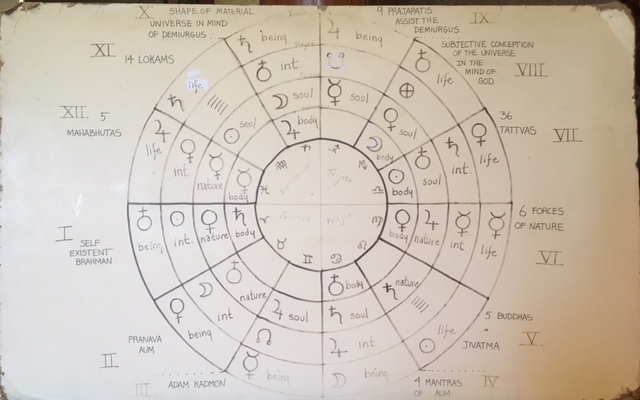
DIAGRAM appended to this transcript:
- FIGURE IMG_2202-Posterboard Metaphysical Chart.
ASTRONOESIS WORKING DRAFT, section on the One, read in this class. This is an early draft and is published in a different form in Astronoesis. There it is primarily found in the chapter on the One, with a fragment found in The System of Nature.
NOTES:
Previously printed, distributed 2003 as part of a set.
This class series on the One was held on Fridays.
TRANSCRIBED by jf 2002 from Audio Cassette tapes; reformatted by jf 2018. In 2024, IT updates prefatory matter and footer, replaces tape markers with audio file markers, expands Subsubjects, completes Book List, adds Plotinus quotes section, corrects typos and some listening errors, adds new notes within transcript, appends one diagram and reference within transcript to this diagram, reformats to accord with new conventions. Readable edited transcript with AD Paper – V11rp.
AUDIO FILES: 1982 0409a, 1982 0409b. [Note: "Tape" and "Side" refer to original audio cassette tapes that were later digitized into .MP3 Audio Files.]
1982 04/09 at Wisdom's Goldenrod
Plotinus; One
[Audio File 1982 0409a Begins]
AD: And it won't be itemized like the outline was. (long pause) Annunciator of the Logos.
Astronoesis draft (AS reading): "The Philosopher-Sage is an annunciator of the Logos, and the knowledge that he communicates is primarily Wisdom. It is required of him to be precise within the given structures that he operates with, although he stands outside of these forms. So it is only natural and in the order of importance that we should concern ourselves first with his remarks about the One-Only. In Ennead VI.9.6 he describes the essential characteristic of the One."
AD: (Just/That's) the whole VI.9.6.
AS: You want to read the whole--
AD: No just read the part that's printed.
AS: Yes.
Plotinus VI.9.6 (AS reading): "Think of The One as Mind or as God, you think too meanly; use all the resources of understanding to conceive this Unity and, again, it is more authentically one than God, even though you reach for God's unity beyond the unity the most perfect you can conceive. For This is utterly a self-existent, with no concomitant whatever. This self-sufficing is the essence of its unity. Something there must be supremely adequate, autonomous, all-transcending, most utterly without need."
Astronoesis draft (AS reading): "He indicates here its utterly self-sufficiency by which he means its completeness, the Only-Perfection. Sufficient and complete in itself, it is beyond any limitations, duality of any kind, dependence, or need. Nor does the transcendent mean a blank homogeneity, but unlimited actuality. Its self-existence is a pure be-ness, and super-intelligence inbound with the totality of possibilities. Perhaps it might be more meaningful and provocative to say it is a pure intelligence. Better still, all intelligence.
"He refers to it as an eternal wakefulness, a wakefulness or a contemplation which cannot be separated from or distinguished from the totality of all its contents. And nonetheless he refers to it as a self-distinguishing throughout in a mode above Intellection. [Note: See Plotinus, V.4.2.] The One is so complex in its unique and undifferentiated simplicity so as to encompass all within its universal essentiality. This is the absolute positivity of the One-Only. So within this pure intelligence, which includes a self-distinguishing that is identical with it, we can relate this idea of the supreme to the Vedantic notion of pure consciousness, or what they refer to as the fourth state or turiya consciousness. Before we do so, let us amplify somewhat these passages by quoting from John Deck, a sincere and earnest student of Plotinus, from his book *Nature, Contemplation, and the One* [p. 32, Larson ed. Deck translation of VI.8.16]:". . . the One is called an eternal super-knowledge: 'If now, its [the One's] act does not become but is always, and is a kind of wakefulness which is not other than the one who is awake, being a wakefulness and an eternal super-knowledge, it will *be* in the way it is awake. The wakefulness is beyond being and Nous and intelligent life; the wakefulness is itself.'[VI.8.16]"
"Notice that in the above quotation"it will *be* in the way it is awake." It is an identity between being and knowledge. Or if one prefers the Hindu terminology, Nirguna Brahman. For example, in the Mandukya Upanishad the similarity between these two notions of an eternal wakefulness and a pure distinctionless intelligence can be illustrated by the reference to the Seventh Karika [Sri Aurobindo, The Upanishads] which (states): 'He who is neither inward-wise, nor outward-wise nor both inward- and outward-wise, nor wisdom self-gathered, nor possessed of wisdom, nor unpossessed of wisdom, He Who is unseen and incommunicable, unseizable, featureless, unthinkable, and unnameable, Whose essentiality is awareness of the Self in a single existence, in Whom all phenomena dissolve, Who is calm, Who is good, Who is the One than Whom there is no other, Him they deem the fourth: He is the Self, He is the object of Knowledge.'"
AD: Stop there.
(Lots of coughing. Coughing interrupts dialogue many places on the tape.)
AD: Sounds like a tuberculosis ward. (student laughter)
AD: You want to discuss something? Go ahead.
DB: Is it possible to (inaudible) more completely the distinction between the identity of being and knowledge in the Nous, and this super-knowledge in the One, in contrast (inaudible)?
AD: No, I don't want to do that, I just want to read and go along, and see if it's understood.
DB: Well, in that case--
AD: Besides I haven't got that written yet.
DB: Oh.
PD?: Was that reference in the Nous okay? Or is the One the identity of being and knowledge?
AD: The point that we're making there was that he speaks about it as an eternal wakefulness, it is, 'is' here would be, let's say, the being, and the 'wakefulness' would be consciousness. And he speaks about them as an eternal awakening. So there is a coincidence between, or an identity between being and consciousness. This he's referring to as the One.
DB: Well then (inaudible) the actuality, the complete actuality in the One. Remember that sentence that was (inaudible)?
AD: "Nor does this transcendence mean a blank homogeneity but unlimited actuality."
DB: Right. That unlimited actuality, could that be spoken of or understood as within the One, um, all the ideas and the (inaudible) of ideas of the various levels of being contained in, not in an undistinguished manner, but they're all present to it, so to speak, without the distinction of relative degrees of being?
AD: Yes. The point that is trying to be made here in the passage of VI.9.6 is that the One is the only thing that is. Complete absolute perfection, and it is utterly self-sufficing. Now we're seizing upon this particular point more than anything else because the most important announcement that the sage could make is to speak of God's existence, to affirm it, and to try to somehow describe it. Now that existence that he's referring to, is God's existence, he's elaborating in terms of its self-sufficiency, it has no life, it doesn't need anything, and this is the point that is being seized from this VI.9.6 and elaborated and amplified. And I simply want-- as we read this to follow and discuss the sequence of logic that's involved, whether it's doing what it claims to do. And he speaks something about this simplicity of the One. And that's all. I mean, when you write, when you read or write something, you have to stick to the point that he's trying to make. And that's all I want to do, I just want--
EMD: Tony, we can't hear back here.
AD: Listen louder.
S: I listen louder, it's not just me.
AD: So that's about all I want to express. I want to go beyond that. I made certain-- I establish a certain boundary within which I want to operate, and as we go along it'll get elaborated just in that way. By the time we finish the third or fourth chapter, there'll be more complexity than you can handle. But let me stick to one thing at a time as we go along, let me itemize in this logical sequential order, okay? Alright, let's continue.
HS: Let me try, let me itemize first the facts of the One -- that there is the One--
AD: What we're doing is we're speaking about the One. Now, this is the quotation we read, right [Plotinus VI.9.6]: "Its oneness must not be belittled--" You got the text with you? "--that of monad and point: for these the mind abstracts extension and numerical quantity and rests upon the very minutest possible, ending no doubt in the partless but still in something that began as a partible and is always lodged in something other than itself." Now he's speaking about God, whatever you might call God, whatever they call it. "The Unity was never in any other and never belonged to the partible: ... on the contrary it is great beyond anything, great not in extension but in power, sizeless by its very greatness as even its immediate sequents are impartible not in mass but in might. We must therefore take the Unity as infinite not in measureless extension or numerable quantity but in fathomless depths of power. Think of The One as Mind ... as God [Anthony emphasizes"God"], you think too meanly [Anthony also emphasizes "too meanly"]; use all the resources of understanding to conceive this Unity and, again, it is more authentically one than God, even though you reach for God's unity beyond the unity the most perfect you can conceive. For This is utterly a self-existent, with no concomitant whatever. This self-sufficing is the essence of its unity." Let me repeat that. "This self-sufficing is the essence of its unity. Something there must be supremely adequate, autonomous, all-transcending, most utterly without need." In the passage we read, what is the most important characteristic of this unity?
S: I would say its self-sufficiency.
AD: He kind of makes that clear, doesn't he? And that's where we started from, we started from that point. That it is utterly self-sufficing, complete perfection, the only complete perfection that there is, there isn't any other, except in the dictionary. Okay?
S: So that means, in the reference to the self-sufficiency and without need, in the sense that the --
AD: Go ahead, try.
S: It must be (inaudible).
AD: So this is tantamount to a great declaration.
S: Yes. The first thing that--
AD: That's all, that's all. You know, like someone could ask the question "Well, if it's so great, and it's so utterly without need, why does he fabricate a universe?" Maybe he doesn't fabricate a universe. Maybe the universe is the *result* of this super-abundant, utterly self-sufficiency. The exact reverse of the Christian. There's creation because he is *perfect*, not because he needs anything. Alright, lets reread it. Go ahead, David.
DB: It seems this self-sufficiency would constitute its perfection, not only insofar that the One has no need of anything else but if there wasn't anything other than it which could be spoke of as doing anything. I mean its perfection would constitute the entirety of reality, so where else would you go? Or is that a--
AD: He wouldn't accept that, he wouldn't accept that. And what about the Divine Mind and Soul, what about that?
DB: From the One's perspective, from the perspective of the One itself and its unlimited actuality, would they be considered as being *other* than it?
AD: Or would it exclude them?
DB: Well, that too.
AD: You see the problem he reduces (inaudible) language, (inaudible) to a monistic metaphysics. In other words, you're taking Om's [Om Gupta] part.
DB: Oh, forgive me. But is it saying something different to say that it does not exclude them? To say that they're not outside of it? For instance (inaudible) from the point of the One, we experience themselves outside of it.
AD: I'm sorry--
DB: I'm sorry--
S: (inaudible)
DB: Right, and that's what I was trying to say, that the fact that they could experience themselves as outside of it, is only due to the fact that the One is not yourself.
S: It also contains within itself the distinctions which make that possible.
DB: Right. But none of those distinctions within it making that possible are in any sense *other* than the One. Nor is it in need of any of those distinctions. I mean, if they are but that it is not a requirement of that self-sufficiency.
HS: Would that establish that (inaudible) distinctions?
DB: (inaudible)
HS: Where did they come from?
VM: You could return to this business about reducing it to a monistic metaphysics, I didn't get that point.
AD: Well, maybe the best way would be to look at the chart. The first house would be the One as transcendent. [Note: See FIGURE IMG_2202-Posterboard Metaphysical Chart appended to this transcript.]
VM: Uh-huh.
AD: And everything else would be the One as immanent.
VM: I've heard that said, yes. I've also heard other things said too along those lines. I mean the discussions we've had with our friend Mr. Goldman who is not here tonight. I remember, but please continue.
AD: You have to have both positions in order to speak. If you take the position of the transcendent One, then you have to keep quiet, there's nothing to talk about. But even so, even so, you would have to place yourself in the realm of reality, and by reality here I mean and I include (both) the transcendent and the immanent, so the two of them have to be simultaneously present. In order to speak of the immanent you've got to speak of the transcendent, in speaking of the transcendent the immanent is there. Now if you recognize this then you understand that metaphysics is by definition and necessity dualistic.
DB: Um, I'm-- When you speak of metaphysics as being dualistic, is it that that the dualism of this metaphysics is not something which separates the One from everything which has been unfolded from it, but of understanding that that dualism is being inherent within the One?
AD: Now it is an understanding that your intellect can only operate this way and no other way.
VM: Anthony, are we talking about reality or our apprehension? Our limited and faulty apprehension of reality? Are we speaking about reality or our limited and faulty apprehension of reality? In other words if you say to me my mind cannot grasp the reality unless it does so dualistically, I'd say well that's unfortunate and no doubt true, but is that the nature of the reality or my limitation in trying to approach it?
AD: What do you (suspect)? (very hard to hear)
VM: I'd assume it's my limitation.
AD: It's not possible that the transcendent and the immanent both simultaneously exist in all the levels of reality. In other words, that include (inaudible) or the other. Or do you insist that there has to be an monistic interpretation of the (it)?
VM: Anthony, I'm afraid you have to back up even more. I don't precisely know how you're using that word monistic.
AD: By reducing everything to the One you have a monistic framework, and then there won't be anything to talk about. And also you'll be limiting the totality of reality, which would mean the One, the Divine Mind, Soul, system of Nature, you'd be reducing everything to the One. You'd reintegrate the entirety of all the different levels back into the One.
VM: Sounds great.
AD: Sounds great. Now there would be nothing to talk about. You and I would not be here now.
S: Why do you call it (someone talking in background at same time) --?
AD: I'm not a Hindu.
AH: Is monism the same thing as nondualism? Or is there a distinction, Anthony?
VM: They claim there is.
AD: It doesn't matter, what words you use, we'll make the meanings up as we go along. You want to say nondualism is monism, alright. But you see we're going away from what I was just trying to explain, you must have *both* --that means metaphysics is dualistic.
AH: Yes but, there's two things going on--
AD: DO NOT, DO NOT give me the Vedantic terminology, I'm trying to work so that you understand what I'm doing.
AH: Okay, let me see if I understand it--
AD: (If you) understand that there's the Transcendent One and there's the Immanent One, you understand that there are many frameworks of reality and that there's one reality. Both simultaneous. This is the--can we say?--the ultimate of oppositions.
AH: So reality is found dualistically, as well as monistically? Because we defined the One as the result of (inaudible).
AD: You have to use your words with the utmost precision. I only have a few pages there, but the only thing I can say, is that they are precise as I can make them.
AH: Let me--
AD: Start again, choose your words carefully.
AH: You're saying that this One, is utterly self-sufficient, it certainly doesn't mean dependent on a (mind/inaudible).
AD: It doesn't depend upon our squawking.
AH: Our squawking or my dualistic understanding. (inaudible) It seems that we've defined the One as reality outside of dualism. A reality not to be attained though dualistic metaphysics. And that seems part of the definition. I guess that pursues Vic's question, (to repeat it) How shall we speak of reality within a dualistic framework? If that One is defined as not dependent upon--
AD: I'm saying you cannot *speak* of reality outside of a dualistic framework, it's not speakable.
AH: Nor is it speakable within the dualistic framework.
AD: Within the dualistic framework it's speakable because there are various levels of reality, and we're located in one of them.
AH: So everything is real--so everything is real.
AD: What are you saying?
AH: Where would we find the unreal?
AD: Pardon?
AH: What is unreal?
AD: The phenomenal, as a reality that's much less than any of the other realities. There are degrees of reality that Plotinus speaks about. He speaks about reality as having degrees.
AH: So this degree of reality is unreal?
AD: No, it has a certain reality. You never hear the word, you never hear the words unreality or illusion in Platonism.
S: So that--
AD: Go ahead.
DB: Wouldn't this reflection, when we speak of this level of reality it's certainly not self-sufficient, nor (inaudible/less) sufficient--
AD: Yes.
DB: I mean we trace that back until we reach the Divine Mind and then it's at that point we can speak of utter perfect self-sufficiency. Is that so? Or-- this is the thing that-- My framework has broken down here-- On the one hand you speak of the (inaudible)
AD: On the one hand?
DB: On the one hand you speak of this One as this utter self-sufficiency or unlimited actuality, and that does not involve the levels of reality which proceed from it so to speak, but that procession from it is from its point of view.
AD: (inaudible) from its point of view?
DB: From its point of view.
AD: Various levels of reality.
DB: But from its point of view all that procession is real and constitutes part of its unlimited actuality?
AD: Yes (assents).
DB: Okay, so that that dualism then, well it's almost (inherent) insofar as we can speak about it and understand it, it's inherent in the One itself, it's not something that comes about after.
AD: It's not inherent in the One itself, I don't want to put it that way. I want to simply put it this way that when we can get to the unique and unknowable God, we can only get to an infinity in our thought about it. What do you think--yes, no?
VM: (inaudible)
AD: Huh?
VM: I agree, but it's disappointing.
DB: Well, but it does seem inevitable, because if you define the One as being self-sufficient, anything other than that is not going to be self-sufficient. consequently insofar as we're going to speak of a certain reality that the world has, the Intellectual-Principle, and so forth, (inaudible--people coughing).
AD: I'm sorry--
DB: And that's coming from my mouth, so--
AD: Try again.
DB: Well, if we characterize the One as being this utter perfect self-sufficiency, anything else is going to be characterized in some measure by some form of self-sufficiency, by some insufficiency it is going to require something else (inaudible) for its being. So insofar as we can speak positively of this unfoldment from the One as being certain levels of reality, then the antinomian quality that-- this dualistic manner of thought is unavoidable. I'm not complaining, but that's not the way it works.
OG: (inaudible)
AD: Go ahead.
OG: (hard to hear) I don't get (inaudible) experience from this point, experience of (inaudible) or whatever you call it, and then there's the so-called unity which is beyond the experience or beyond anything, and it becomes (inaudible). I could see that by using the word consciousness, because consciousness is awareness (inaudible) there's a unity there in this awareness (inaudible), you can't, you can never know (in this) dualistic framework-- awareness you can intuit consciousness as ground (of the experience). (inaudible) I don't see a problem with that.
PD: Well, how would you intuit more than your own individual awareness? How would you intuit more than your own individual awareness? How do you have knowledge that you're intuiting more than your own individual capacity for awareness?
OG: Because you find out that you (inaudible) (vehicle.)
PD: I don't follow.
OG: Because you find out that you yourself are the so-called intuiter or the experiencer, (inaudible) our empirical self is a product of that awareness. In the ultimate sense there's no confusion (inaudible) not separately intuiter that is intuiting the ultimate awareness, in that case the awareness is self-(inaudible).
AD: And only for that content.
OG: (inaudible)
AD: And only for that content, because the nirvikalpa doesn't last forever. And then when you're out of the silence, you're again faced with the fact that its productions or its emanations are (inaudible), and there you have to talk about it. For intuition you can have monism, alright. But for the intellect you've got to have dualism.
OG: Yes, well--
AD: If I wanted to communicate intuitions on a paper, I would have to leave it blank. Say a person has nirvikalpa samadhi, an intuition of the absolute reality, and that is (him); there is nothing else, not a hint. The universe doesn't cease except for him. The outflowings or the divine emanations are still there, you still have the Divine Mind.
OG: Yes, but in that point in time that you're saying (inaudible), if at that point-- you are trying to create that problem by saying that for that particular awareness, that the universe (couldn't/never ceased to) exist --in that experience that the universe is there but if anyone did not see the universe--
AD: All the other degrees of reality are still there, but for him they cease at that moment.
OG: (inaudible) for him.
AD: For him they're not there.
OG: In what sense are they not there? they are there. Like he sees the unity (inaudible) both points of view. (inaudible) unity is one (inaudible) creator. (inaudible) the ground and the creation you have both points of view, and also would cease? (inaudible) I don't see both points of view. (inaudible) monistical (inaudible). I thought that he could see both points of view, and he could be in identity--
AD: What we're saying is something like this, the experience of unity precludes any knowledge; consequently there cannot be any other levels of reality. Now we're not speaking about the experience of unity, there are the other levels of reality, and there isn't unity at all these various levels. Now from the point of view of the intellect, we're squawks, you have a dualistic metaphysics. From the point of view of intuition, you have silence, there is no dualistic metaphysics. Now which one of these two are you going to use in order to explicate your understanding, the understanding that you're trying to bring out about the unity?
OG: The second one.
AD: Yes.
OG: But that is a big problem.
AD: There is no problem, I know that--
OG: The problem is saying that when the intuition occurs, at that point the whole experience, there is nothing but that awareness.
AD: --for that individual--
OG: For that individual. But I don't see that point--
AD: You say that the universe exists.
OG: (But I don't.)
AD: But not for him.
OG: He also is existing.
AD: Of course!
OG: (inaudible)
AD: Of course! Exactly. Now we're getting somewhere, aren't we? Now we're getting somewhere. From the point of view of the universe, from the point of view of intuiting or experience the unity, which we said precluded knowledge, there isn't even a 'he' to talk about having an 'I'. That's monism. Alright, now, from there go on, from there try to give me a metaphysics.
OG: What are talking about (inaudible) the experiencer is the experience(ed) and --
AD: From the experience of Unity, stop talking. (student snickering) Do you understand why I have to use a dualistic framework to talk? Can't you see that this satisfies both, intuition operates in silence, intellect operates in duality, you have to have *both* points of view. It's not very intriguing, it's not--
SC: When you say that the One has to include both points of view, and that--
AD: There he goes again-- you insist on doing it that way.
SC: Well, I thought--
AD: Where are you people, born in Bombay or somewhere? (laughter)
SC: When you said that the experience of unity precludes any knowledge,
AD: If you use the word 'include' alright, do not, do not for instance the Divine Mind and the Soul include the unity within itself? In what way, precisely in what way? Just like you would like to reverse them and say that the unity includes other hypostases in itself.
SC: I didn't follow.
AD: You say it now, just repeat what you might have said--
SC: The way I was looking at it was when say the experience of unity excludes, precludes any knowledge, that unity isn't the One in its entirety. If you were to say that that was the One in its entirety that in some way is limiting the One, because it precludes the outward-facing hypostasis of the One, it precludes the One as immanent.
AD: But then again the remark you made wouldn't be false either.
SC: The remark the experience of unity--
AD: Of unity--
SC: --wouldn't be false.
AD: No. It wouldn't be false, it would be true to say that the unity isn't any other principle.
SC: Right, but if you said the experience of unity precludes any knowledge and anything outside of that experience is false, then you would be saying something that was not true because--
AD: But you can't say that, you can't say 'outside'.
SC: But people do, and there are people that speak in terms of everything outside of that.
AD: (inaudible) But the logic demands and forces you to establish this approach.
SC: Yes. Yes, it's compelling you to see that you--
AD: You use both methods, the intuitive method and the speculative intellect.
SC: And anything else is in some way a limit on the One. Well, I guess that I was thinking was that trying to limit--
AD: The result of that, Sam, will be that you won't be able to grasp. Isn't that so? if on the one hand you have the experience of unity, totally self-sufficing, and on the other hand you have the various levels of reality, and be able to merge them.
SC: Yes. (inaudible, several people talking at once)
AD: That's the whole point here, to show you that you cannot resolve the problem. Now you tell me there isn't a problem. It is insoluble from the point of view of the intellect. And you object because I'm trying to acknowledge that.
OG: (inaudible) I don't see that.
RC: One way to rephrase it, given we're starting to talk about it at one point, if you define the One as the first step in defining the One, as that which is utterly self-sufficient, then when you encounter anything that is not utterly self-sufficient, you couldn't also call it the One-- if it's not essentially self-sufficient it's not the One.
OG: But one could say to that, you can realize that the ground of that is the One.
DB: I think the point is that you're forced to comprehend there is that of which you can speak of the One as being described and there's no escaping that.
S: That's where I get confused when you use (inaudible) again, use the term intuition; I'd like to ask Anthony also, what is meant by intuition in this case? You have the metaphysical view of duality is (inaudible) to understanding something, trying to grasp it, yet you seem to I think you seem to be using intuition as something as synonymous with this grasping of the One.
AD: No, that wouldn't be intuition. Or if you like the term 'insight' that PB uses. The word that you want to be more technical would be nirvikalpa samadhi. Okay. There is simply a removal of the interferences, one way of putting it, that prevent you from understanding without understanding that there is only the One. That's what insight is. There is total identity of knowledge and being, at the highest level. That would be insight.
OG: But I think that insight you have the unity as the ground of the whole of creation, the ground of the universe--
AD: I'm only making clear what you mean by saying realize because--
(Side 1 of original cassette tape digitized as 1982 0409a Ends; Side 2 Begins)
AD: --either way.
OG: Good point.
AD: The Vedantists are at a disadvantage. They're going to carry the ball, and they're going to go through 18 lines of defense, they're going to go to the goal, the One. That's the only thing they talk about, alright, and I'm talking about something quite different.
OG: I see the problem distinctly. (inaudible, people coughing) could be more than (inaudible), because they understood something quite intimate with being there in that experience (inaudible) not like they said that (inaudible) many people recognize that (inaudible).
AD: Alright, it has its value, but that value is going to turn into a great disadvantage in a little while.
OG: Yes, because (inaudible) I have a question, a different question: What is the point in saying that this creation is because of the self-sufficiency of the One?
AD: The way he says of it, that which is perfect generates, that which is eternally perfect generates eternally. Now you try to get out of that. That would mean that as long as there's a One, or we can speak about the One's being or the One being around somewhere, there will always be its manifestations.
OG: How does--
AD: Let me finish now. That would mean consequently that you will always have a dualistic metaphysics. Is that right or wrong?
LdS: Yes, but for a different reason, though. You said before we have a dualistic metaphysics because we're employing the intellect to talk about the real. Now you're saying in that quote from Plotinus that if the One is perfect, it generates eternally, if something is perfect, it generates. [Note: See Plotinus, V.1.6, second to last para.] So now you're saying in reality there's production, not just because my intellect is trying to grasp the reality.
AD: You're using that as a contradiction?
LdS: I see you saying two different, two very different points. One is the point of view of the intellect trying to formulate and express reality, and the other seems to be a statement about reality,
VM: That also seems to be made from the point of view of intellect.
AD: Go on, why stop there?
LdS: The statement's from the point of view of the intellect.
AD: (inaudible) But why stop there?
LdS: Do you want me to elaborate?
AD: I want you to go just a little further.
LdS: So, in other words, in reality--
AD: Yes.
LdS: I guess what I'm coming to is that the One, the absolute, allows for both points of view.
AD: Now suppose we continue a little bit further, Louis. Then if I wanted to say quote unquote the experience of the unity, it will preclude the experience of duality. And if I experience duality, unity is excluded. Now why not enjoy all these knots, why try to deny them by simply cutting (through them) like Alexander cut the Gordian knot, cut it with a sword.
OG: The question of generation--
AD: That night that he didn't untie the knot, right-- he just cut it with a sword. That's not the way I'm approaching it. I want to try to untie the knot, (and then if) it turns out that the knot cannot be untied, it can only be described. Most people can't live that way, you know, it's like they're suspended between two beliefs, the unity on the one side and all the levels of reality on the other side, and they've got to make the decision to go to one or the other. Whereas I'm telling you the greater delight is to stay in the middle. There will be times when you read text where you'll see the kind of instrument you can employ to understand it would be an intuitive faculty, whether we have it or not is another story. And on the other hand as you're reading texts you can see that the only faculty that will help you understand that will be your intellect, and no intuition is going to work there. So it's the paradoxical nature of reality, I mean of the truth.
OG: Like one experience (of that point is) that tension of going through this dualistic philosophy, and the tension that we are talking about, and (there is an) image, and that the experience is to come through the intellectual discussion.
AD: Okay. So in the case for instance of a completely enlightened Buddha, the remark is made that both points of view are available to him, which means that neither or both of them together (can) exist for him. So if you say that both points of view are available, in other words --how do they put it?-- the emptiness and the conventional truth, exist for the Buddha simultaneously. And tell me, Is there monism? What do you think?
AH: That's not quite the way I would express it.
AD: Alright. You express it.
AH: Things are not utterly non-existent. Nor are they said to be inherently existent.
AD: Well, they speak about two truths, don't they?
AH: The phenomenon resides in the middle way.
AD: They speak about two truths. Now what are called the two truths?
AH: Emptiness is one.
AD: Yes.
AH: And the other is--
AD: The conventional.
AH: The conventional in their writings.
AD: So does that mean therefore that you have both monism and dualism simultaneously?
VM: They could oscillate.
AD: Well, we're making believe that we're Buddhists. Now if we're Buddhists both points are available to us. But then do you have a monism?
AH: No, because you (inaudible) phenomena.
AD: You have dualism.
AH: At the level of conventional truth.
AD: Now how are you going to operate? Wouldn't a more comprehensive way would be to operate with both? The more comprehensive way is operate with both.
AH: You can't (inaudible).
AD: Well, if you were a sage, you could.
AH: If you a sage you could--
AD: That's the assumption I'm working on. That this man is a sage.
AH: Only the sage can operate with both.
AD: Oh, yes. But for the rest of us if we should ever be so fortunate as to have nirvikalpa, that means that the external world and all the other levels of reality are gone, and only for that time that there is the identity or unity. When you come out of that the unity is gone, and you're back in the conventional framework.
AH: Now we ask the question: What does it mean to operate with both in terms of the philosophic disciplines?
AD: What does he mean to try to operate with both?
AH: With both points of view. Both points of view are really from one side, of (inaudible).
AD: Well, both points of view would prevent me from making (inaudible) (to you) of myself. By saying that something which is here doesn't exist.
AH: That's not quite what I meant. The question is more specific. Only the sage can have both points of view, actually-- so what does it mean to construct a metaphysical system that retains both points of view?
AD: It would be truthful.
AH: But isn't that system from one side?
AD: No, we just said if it's the sage's point of view and he's communicating to us the truth of what this doctrine is, then the availability of a monistic metaphysics and a dualistic metaphysics, alright, (even if) it's possible, we could use both.
AH: The shortcoming (isn't in the system,) it's in the student.
AD: That we don't need any affirmations about.
AH: The system's correct.
AD: Yes. If we could follow it through.
HS: When you speak of an intuition of the unity, and so to say, beyond-(meaning/being), would it be called nondual at that point, or--
AD: If you speak about the nirvikalpa samadhi or the experience of unity which is not an experience because there's no one there who's experiencing--only when he comes out--if you're speaking about that, which precludes knowledge, the subject-object relationship, go on--
HS: Then you speak of the One as being all-perfect, I mean the super-abundance, the rest so to say flows out of that oneness and (infinite) perfection --and super-abundance. The knowledge of-- is that knowledge the fact of the super-abundance?
AD: That's knowledge standing outside the One. That's like knowledge that the sage as a Knower would have. In other words, when the sage speaks about the way that Plotinus does here when he speaks about inner constitution of the One, the way its power can group itself or rearrange itself or combine itself in any number of ways, that is not acquired when you are in the One. Only when you're out, when you're in the Nous.
HS: But at that point when you're in the Nous, the knowledge is beyond still?
AD: When you're in the Nous, yes.
HS: The object is still the One, that's where you acquire the knowledge of this--
AD: Well, I don't know what you mean that the object--
HS: Well, you're speaking of the super-abundance of the One.
AD: Yes.
HS: I can't see that as so to say--
AD: In other words, when the sage speaks about it, the divine emanations or the outward-facing hypostasis of the One, alright, it is the sage speaking as a Nous, as a Knower of the Nous.
HS: In the Nous.
AD: Yes, he's in the Nous when he says that, he's not in the One when he says that.
HS: He's speaking from his point of view of his contemplation of the Nous.
AD: No. It's not his contemplation, he is the Knower then, he is the Nous when he says that.
HS: He is the Nous--
AD: He is Intellectual-Principle when he makes the statement, alright, that the genera of Being which constitute Being, he is speaking as the Nous, the Knower. In other words, he's a mouthpiece for the World-Mind.
AH: Could any statements be made from the point of view of the One?
AD: There's nothing that could be said there, (inaudible).
AH: Even a sage couldn't speak--
AD: Well, there's nothing, nothing at all. You've got (inaudible)?
AH: Because it must remain self-sufficient.
AD: Well, if it's (inaudible), it wouldn't be self-sufficient. Well, we speak because we have some need, don't we?
AH: So the most sublime metaphysics then is from the point of view of the Nous.
AD: Yes. That's what I mean when I say that the Intellect ultimately is dualistic because it's as high as we can go is let's say the Nous, or point of view of the Intellectual-Principle, there is a subject-object relationship but here the identity is much closer, and almost an identity in comparison to what is found later on. Om?
OG: We have this problem of the generation or the creation, there's no creation from the point of view of the One?
AD: No creation?
OG: There's no creation from the point of view of the One, there's no creation in there, it's all simultaneous, the creation goes with the point of view of the experience, (inaudible) contents, where space and time and all those divisions come in. But before that we can talk about this how creation--
AD: Before what? Before what?
OG: We cannot ask the question, that we have asked many times, how the many came from the One? That question we've been asking.
AD: It's askable in a certain way. When you say, how the many came from the One, you're speaking about the eternal generation of principles, you're not speaking about any sequential or temporal generation. Insofar that the One is perfect, eternally, alright, then -- and the word 'then' here is incorrect -- then we have the generation of the Divine Mind or the Intellectual-Principle. But then here only is something that follows logically. Not sequentially or temporality.
OG: Right, okay. From that point of view, most people normally think of how many came from One, one of the problems that I take is that the general sequence and you want a logical sequence, I don't think that that's (inaudible)
AD: I think there's quite a few people that disagree with you. When we asked how the many principles came from the One, how did the Nous come from the One, how did Soul come from the One, how did the System of Nature come from One, to say it's unaskable, then you're telling all these people --look, you won't be able to answer the question. (OG begins to interrupt) Let me finish. But that would be like describing what the knowledge of the Nous is. You're already determining that the Nous cannot know this. And what we're just saying is that Plotinus as a Knower standing in the Nous, poised in the Nous, alright, knows this, and is given it, even if you want to say through revelation. But it is given to him to know that. You see what I'm asking you now is to be very precise when you're talking now. We've been studying Plotinus for years and if your language isn't precise, it just shows the years have been going by quickly smoothly quietly with the same errors.
OG: But you said both points of view are there, of the many and the One--
AD: And then we just defined that.
OG: Okay, both points of view are simultaneous there. Then does that question become unaskable that how the Many came from One? Because (we're not there) all the time.
AD: Yes. But what we're asking is the *logic* in it. You are not going to be there and see how the many came out of the One, because there never was such a beginning. If you think of it as a beginning, you're misunderstanding. As long as there's the One, there will be these emanations from the One. So when was the One not there? Well if it's been eternally existent, then the Divine Mind is eternally existent. Okay. Well then we want to know, well if the Divine Mind is lesser than the One, alright, and the One is utterly sufficient, then how do we account for the existence of the Divine Mind? And so Plotinus goes through an explanation of that.
OG: The explanation is that both are there all the time.
AD: Yes, they're both there all the time, but the way the Ideas and the way the intelligibles and the intelligibility, the Intellect that can see that Intelligible, the way that they can come into manifestation, not so much the modus operandi but a description of the topography of the intellectual realm, is not something to be despised. Suppose we took the example-- Never mind the example, go ahead.
LdS: I keep hearing you say two different things, though. You said before a few minutes ago, you agreed with me, the One or the Absolute, allows for these two points of view. It's not just the matter of a sage standing in the Nous bifurcating the One, but rather a sage standing in the Nous appreciates or comes to the realization that in the One must be the three hypostases super-essentially. There's a-- are you familiar with the place in Plotinus, I can't tell you the quote, where he talks about the Three Hypostases being in the One in a sense in a super-essential way, they must be in the One in a super-essential way. In a way that is not understand--
AD: He speaks about them being in the One in a transcendent mode. And then he also speaks about them as being, not there in a transcendent mode.
LdS: What does he mean by them not being there in a transcendent mode?
AD: Well, when he speaks about the Intellectual-Principle, he says there's a copy of the Intellectual-Principle, there's a transcendent copy of the Intellectual-Principle in the One, alright. [Note: See Plotinus, VI.8.18, third to last para.] It's not to be equated with the Intellectual-Principle that he speaks about.
LdS: No.
AD: And there is a distinction.
LDS: There is a distinction.
AD: So there are levels and frameworks of, let's say, the reality we're trying to grasp. Go on--
LdS: It has to do with the whole question of monism, that even though there is the plurality of levels of reality in his work, what that means is that the One or the Absolute in itself does not preclude plurality.
AD: Yes, exactly.
AH: But it doesn't include plurality, it--
LdS: In a sense it does, Andrew.
AH: Only logically. Not temporally or sequentially.
LdS: No no no. You said--
AH: Go ahead, I'm sorry.
AD: You said I disagree with you, so I seem to be saying two things: Would you tell me what they are?
LdS: Yes. You're saying by necessity as we're trying to express our metaphysics, or communicate our metaphysics, we must bifurcate, we must speak in a dualistic framework because of the very mode of our apprehension, of our understanding. But also you're saying in reality--
AD: And the converse of that?
LdS: The converse of that is that there's some kind of, there's some mode or some--
AD: The converse of the logical statement you made. In other words, wouldn't that be based on the fact that reality may be that way. And that's why we are forced to speak about it that way.
LdS: Yes, okay, that's what you've been trying to say.
AD: No, that's what *you've* been trying to say.
LdS: Yeah, okay.
AD: You said there's this disagreement, and I said there's no contradiction there.
PD: Logic is dualistic.
AH: It must be that way, because we're forced to think about it in that way. But then--
AD: You're forced to think about it that way because it is that way (people interrupting each other)
LdS: I say if metaphysics is a valid expression of reality, if there is such a thing as a valid expression of reality, then that valid expression of reality cannot be determined entirely by my mode of apprehension. If it's really saying something worthwhile about reality.
AD: Your mode of apprehension is based on that.
LdS: Okay, I'm not disagreeing.
AD: Your logic is based on the structure of reality so if you see that you can't exclude the levels of reality from unity, that's because that's because that's the way the levels of reality are.
LdS: So as the sage stands in the Nous and apprehends the One, in whatever he can, he recognizes or sees, he must see there must be plurality in the One. In some way.
AD: No.
LdS: In a transcendent mode.
AD: Yes.
LdS: Which is--It's not understandable.
AD: It's not reality-based.
LdS: But he must--
LDam: in some fashion--
LdS: (inaudible) that way.
AH: If the sage can't speak about the One, if the sage can't speak about the One, how can he apprehend it? Like the One precludes a speaking about it. All you can speak about is an apprehension of the One.
LdS: I don't think the One does preclude a speaking about it.
AH: I thought that's been decided. That nothing could be said about the One, the most sublime metaphysics is from the point of view of the Nous.
AD: What was the definition of the One?
AH: Self-sufficient.
AD: Yes.
AH: Certainly (it doesn't mean) to say that (inaudible). (AD: I'm sorry--) It doesn't depend upon the sage to apprehend it. I just wondered what we're talking about when we're talking about apprehending the One.
AD: We're not saying that there's an apprehension of the One.
AH: Not even for the sage.
AD: No. Exactly. We made that clear, abundantly, over and over again. Unity precludes any understanding. In the experience of unity, you're not in there saying 'ah--these are the henads, these are the unities, this is the power'. (student laughter)
S: But understanding does not preclude--
AD: Did you ever try to understand *any thing* as a unity? Let me put it this way, can you grasp the unity of anything? An idea, a tree, a friend, a piece of music? A doll?
S: When you say grasp, you don't necessarily mean identity with, do you? You mean--
AD: Any way you want to translate the word 'grasp' -- identity, what does that mean? In your understanding do you ever grasp the unity of an object?
S: I think I have to say that I think I have the understanding that there is a unity.
AD: But is that the same as grasping the unity? In other words, does your knowledge of the object include the unity?
S: No, but if the One allows for this dualistic framework then I could say I'm grasping, apprehending the unity, from the metaphysical or dualistic point of view.
AD: Yes, you could say that. As far as you can, in the metaphysical, in the realm of the intellect, it's as far as you can go. But that's not the knowledge of unity. This is like the Rorschach test. It's just a (inaudible).
OG: It's just a juxtaposition of words--
AD: No, it's not a juxtaposition of words. This is the whole point, the precision in which you think is not a juxtaposition of words, and it's not turning words around. Otherwise Plotinus wouldn't have written 600 pages. Or PB have written 30 or 40 Notebooks. It's not just words.
S: Okay. Then when you speak of knowledge, understanding is not knowledge of the unity, but this knowledge of course is superior to understanding, it would be direct, one way or another, unmediated, or however you want to put it.
AD: Well, if it's unmediated, that's what we mean when we say that unity precludes knowledge.
PD?: But that is, you said--
AD: Well, it depends on how you use the term knowledge then. If you want to say, you have knowledge of the One because you have the experience of unity, I can understand that, but it has to be very distinctly understood that *knowledge of* the One is impossible.
JA: You can experience the One--
AD: Yes, there can be the identity, and Plotinus refers to it as having had that experience eight or nine or ten times.
JA: But in terms of--
AD: But you can't say he had knowledge of the One.
JA: They're on two different levels--
AD: Yes. And if you didn't establish the fact you have these two ways, a dualistic metaphysics and silent monism, there's no sense talking. Let's try reading the page over again, Avery.
OG: I want to ask one question--
AD: We'll continue this question.
OG: Yes. (inaudible) why they're questioning (inaudible) if we say that the experience of, that the metaphysics has to be understood, then in that sense the questions I asked you-- Like if you're talking about the experience, you're already starting with Many--beyond that we can't even speak about it. That's why these questions pre-suppose part? And-- Do you know what I'm trying to say?
AD: I know what you're trying to say, you're just repeating yourself. You're doing the same thing. Like for instance my mind, alright, or your mind, thinks, thoughts. And each thought is distinct from all other thoughts and self-identical with themselves. Now, can I infer the background or the ground of these things? In other words, of these four or five statements I just made? Then I would have to say yes, the Mind itself is that unity. Now have I made a description of the modus operandum? I've asked the question and even though I can't answer it because to answer it is to submerge myself into the unity of the mind, I can see where the question is going to lead me, and ultimately he's going to say, if you wish to understand this you must make the ascent. Don't tell me that the question is unaskable.
OG: This very question is askable but the other way is unaskable because they never say-- the other question is unaskable because--
AD: How the many divide out of the One? Well, you see to go around in circles, that's one thing I noticed about here, if I want to talk about A, you talk about B to Z, but we will not stay on A. When we get to the Intellectual-Principle, and we're going to talk only about the genera of Being and their derivation, you'll go back to this point about why the many, --why the one is the one.
OG: That was actually my point. (inaudible) One more (can't) if I make the claim (inaudible) that the many are sort of like one gem with different facets, and what is the--
AD: No, no, that's Indra's net. That's one of the most misleading analogies that you can use. In Zen Buddhism, for instance, the Zen master will chase you with a two-by-four if you asked him the question how the many came from the One. If you asked Plotinus, he might spend three-four days relentlessly informing you until you might get an insight. Now, if the Zen master wanted to hit me with a two-by-four, I probably would run. To Plotinus. (student laughter)
AH: How the many come from the One.
AD: I don't think those answers are smart: I think they're very stupid. When the Zen people come around trying to impress me with that, I just find it humorous. Or sometimes I find a certain inadequacy in the so-called master. An inability, an inability, to philosophically expound his point. You remember what Plato said? He says, Now if you get into a discussion of the One, alright, only he who knows properly how to defend his position against all attacks, and preserve his position, is one who I call a Knower of the One. Whereas for others who write books, I would not call knowers of the One, because they're not going to be around to defend it.
HS: But wouldn't you say in some point of the ascent as it were to the One that you have to take this radical kind of stance?
AD: What radical stance?
HS: The radical stance of cutting it all off, that that (inaudible)
AD: (hard to hear) (Don't confuse) this method (with) this discourse.
HS: Okay, but I thought discourse was not meant there.
AD: No, if I ask a question to my master, how the many comes from the One, alright, I don't get discourse, I get method. This is the way he did it, that's a method he employed.
AH: I've lost the distinction between method and discourse. Could you make that --
AD: When you ask the question, if he hits you over the head with a two-by-four, and touches you in time, alright, what he's trying to do is revert you back into that state of unity, before you uttered the first word, before your silence broke into ideation. And he's trying to point to it. And this is a method that he's using. The other one's a discourse, the other one's going to explain to you that when that silence is broken, and that ideation sieved out, it's not possible any longer to speak about the One. Then he leaves it to you to break your own head. Can we go back now? Let's try re-reading.
Astronoesis draft (AS reading): "The Philosopher-Sage is an annunciator of the Logos, and the knowledge that he communicates is primarily Wisdom. It is required of him to be precise within the given structures that he operates within, and though he stands outside of these forms. So it is only natural and in the order of importance that we should concern ourselves first with his remarks about the One-Only. So in VI.9.6 he describes the essential characteristic of the One, which we read.
"He indicates here the utterly self-sufficiency, by which he means its completeness, the Only-Perfection. Sufficient and complete in itself, it is beyond any limitations, duality of any kind, dependence, or need. Nor does the transcendent means a blank homogeneity, but unlimited actuality. Its self-existence is a pure be-ness, and a super-intelligence inbound with the totality of possibilities. Perhaps it might be more meaningful and provocative to say it is a pure intelligence, or better still, all intelligence.
"He refers to it as an eternal wakefulness, a wakefulness or a consciousness which cannot be separated from or distinguished from the totality of all its contents. And nonetheless he refers to it as a self-distinguishing throughout in a mode above Intellection. The One is so complex in its unique and undifferentiated simplicity so as to encompass all within its universal essentiality. This is the absolute positivity of the One-Only. So within this pure intelligence, which includes a self-distinguishing that is identical with it, we can relate this idea of the supreme to the Vedantic notion of pure consciousness, or what they refer to as the fourth state or turiya consciousness."
AD: Speak louder.
S: (inaudible) again.
Astronoesis draft (AS reading): "This is the absolute positivity of the One-Only. So within this pure intelligence, which includes a self-distinguishing that is identical with it, we can relate this idea of the supreme to the Vedantic notion of pure consciousness, or what they refer to as the fourth state or turiya consciousness. Before we do this, let us amplify somewhat these passages by quoting from John Deck a sincere and earnest student of Plotinus in his book *Nature, Contemplation, and the One* [p. 32, Larson ed.]:". . . the One is called an eternal super-knowledge. (quote) 'If now, its [the One's --in Deck] act does not become but is always, and is a kind of wakefulness which is not other than the one who is awake, being a wakefulness and an eternal super-knowledge, it will *be* in the way it is awake. The wakefulness is beyond being and Nous and intelligent life; the wakefulness is itself.'
"Notice that in the above quotation"it will *be* in the way it is awake." It is an identity between Being and Knowledge."
AD: Or Being and Consciousness.
Astronoesis draft (AS reading): "Or if one prefers the Hindu terminology, Nirguna Brahman."
AD: Remember Nirguna Brahman? They say that Sat-Chit-Ananada is *not* a definition. Remember that? That they are not attributes, remember that? They are not attributes. So that means they have to be conceived intrinsically and simultaneously. Alright. So instead of spelling it S A T, hyphen, C H I T, hyphen, A N A N D A, hyphen, okay, they don't spell it like that, they spell it SatChitAnanda without any hyphens.
OG: (inaudible) attributes, they (inaudible)
AD: (inaudible/precise?)
OG: I think devotion.
AD: You don't think this is devotion in trying to understand precisely. You don't think burning the midnight oil is devotion?
OG: Yes, because they (inaudible) tears--
AD: Does it always have to be with tears? Okay, let's continue.
OG: I don't see the point.
AD: Well, the point here is--
AS: There are several points (inaudible)--
AD: This definition, an eternal awakening, if that doesn't give you a feeling what he is speaking about is just pure consciousness, the same thing like when the Hindus speak of Nirguna Brahman, it has no attributes, it's just pure consciousness, and that's the identity I'm working with, I'm trying to show the correlation between the Plotinian notion of an awakener without an awakening-- I mean an awakening without an awakener-- and Nirguna Brahman.
OG: I saw that, but (inaudible) attributes.
AD: Yes. I got you confused so just forget it. All that's (inaudible) point, if that point doesn't (work), (I throw it out) and use another one. Let's continue a little more. You see what we're speaking about, we're speaking about the One, which we said we can't do, we're speaking about, we're trying to show why we can't do it. Would you continue, Avery?
AS: The above quotation, we read this--
Astronoesis draft (AS reading): "So if one prefers the Hindu terminology we can speak of Nirguna Brahman."
AS: That's one of the nice things about that, they do, when they say SatChitAnanda with no distinctions, they refer that to Nirguna Brahman. When they say Sat-Chit-Ananda hyphenated, they refer to Saguna Brahman and those become the attributes.
S: I can't understand you.
AS: He's read that, it's right in the Hindu tradition I think.
AD: He's said it a few times himself. (inaudible, is saying something in the background, can't hear over Avery)
AS: And then that would be Intellectual-Principle, that they speak of Saguna, with attributes, or from the attributes of it. For example in the Mandukya Upanishad.
AD: Now the Mandukya is a big work in the Vedanta, I've got ten-twenty tapes of Mahadevan just on the Mandukya, that's how important it is, if you understand that, he says, you understand Vedanta, plus a little meditation on the side, too. Now listen to this quote very carefully.
Astronoesis draft (AS reading): "For example, in the Mandukya Upanishad the similarity between these two notions of eternal wakefulness and eternal distinctionless intelligence is also illustrated by the reference to the Seventh Karika: quote: 'He who is neither inward-wise, nor outward-wise nor both inward- and outward-wise, nor wisdom self-gathered, nor possessed of wisdom, nor unpossessed of wisdom, He Who is unseen and incommunicable, unseizable, featureless, unthinkable, and unnameable, Whose essentiality is awareness of the Self in a single existence, in Whom all phenomena dissolve, Who is calm, Who is good, Who is the One than Whom there is no other, Him they deem the fourth: He is the Self, He is the object of knowledge.'
"Consequently, as Plotinus makes clear, the simplicity of the One is not that . . ."
[Audio File 1982 0409a Ends]
[Audio File 1982 0409b Begins]
Astronoesis draft (AS reading): ". . . beyond determinations or limitations, in Plotinus and elsewhere, it should not be taken as a lack but as going beyond any possible (synthesis) of all essences. We are speaking here of unity. In a sense, the Unity is beyond God or mind or being as spoken of in the quote. The total affirmation is not only beyond any particular determination or the totality of all essences, but it is itself, the Alone. It is in this sense that we can justify this excerpt from Guenon's Multiple States of Being: 'Total affirmation is not beyond any particular determinations or the totality of all essences but is itself, the alone.' And Guenon has this, makes the point--"
AD: Would you read it slowly and loudly? Maybe this definition by Guenon would help.
EMD: (inaudible)
AS: It's partly Hindu, partly.
AD: Louder. Let the (inaudible).
AS: "The Infinite," and this is this quote--
AD: The unity (inaudible).
Rene Guenon, *Multiple States of Being* (AS reading): "The Infinite [AS adds: the One,] . . . if it is to be such must admit of no restriction, which supposes that it is absolutely unconditioned and indeterminate, for all determination is necessarily a limitation simply because it must leave something outside itself, namely all other possible determinations. Limitation, moreover, [AS reads: Moreover, limitation] presents a character of real negation: to set a limit (AD handwritten insert: and Being does) is to deny to that which is limited everything that this limit excludes; and the negation of limit is in fact the negation of a negation, which is to say, logically and [even] mathematically, an affirmation. Therefore the negation of any [AS adds: and all] limits is equivalent, in reality, to total and absolute affirmation. That which has no limits is that to which one can deny nothing; and this idea of the Infinite, which is the most affirmative of all because it comprehends and envelops all particular affirmations, can only be expressed by a negation by reason of its absolute indetermination."
S: Can you read that line again?
AD: We'll discuss that a little bit. I think you're aware that he's assuming that you understand something about Spinoza's definitions, that his definition is a form of negation, do you follow that? When I say the ground or the floor, I am not speaking about the walls or the ceiling. And so if I define the floor, I have to negate, I have to negate what it is not. It is not that, it is not that, it is not that, it's this.
S: (inaudible)
AD: Yes. Now he's simply saying that the Infinite is of such a nature that you cannot do that, you cannot say it is not this and it is not that, it's not the other, you cannot exclude anything from it. But then if that's so, that is the only absolutely positive affirmation that you have. In other words the only real is the knowledge of the infinite, this you always have.
S: (inaudible)
DB: If at the same time one speaks of the knowledge of the intelligence in the One as being distinctionless, it's at the same time self-distinguishing?
AD: Yes.
DB: Okay (inaudible).
AD: It's an (inaudible)
DB: Of unity.
AD: What was the word we used that you looked up?
RC: Synesthesis.
AD: Synesthesis.
OG: I just wanted to understand that quote --(inaudible)
AD: Now if you allow me to be precise, I mean, I hit that guy over the head when he comes over with an imprecise statement and he does the same for me, and it takes us a week to get a couple of pages together, and by that time we're both (inaudible) and then by the time we come here and we get this kind of inaccurate language after studying Plotinus for five years, I think I have the right to return. You know what I mean by that, huh? -- be sharp. You have to return the favor.
OG: (inaudible) these Indians (inaudible).
AD: The Self is the object of knowledge. There he's saying this is what you want.
OG: Object of revelation (inaudible).
AD: No, no, you have to understand that by object of knowledge he does not mean the way we use knowledge, when we say I have knowledge of a chair. He has just gone through the whole definition of saying what knowledge is, and says this is the knowledge that you want, okay? You've got to learn to read, you've got to read with understanding, not only computers. So read-- By the way, we went through a lot of trouble getting the exact [Mandukya] quote because four or five translations of the Karika as I'm concerned were inexact. I don't even know Sanskrit, I don't know Sanskrit, but I could tell just by reading it, this fellow didn't know what he was talking about. And then when I went on and read some of his other translations and compared them, I saw these are useless. I had to go to Aurobindo, the one man who I didn't think would ever have it. There's a consistency, there's a consistency in these ideas which you see spread out everywhere in the perennial philosophy of most every tradition. Don't think they stand alone, and that's why I say we can make correlations. Anything that Plotinus said, I think I can find it for you (in all) the other traditions. He's not saying something that hasn't been said. All I've been saying about Plotinus is, he said the *most* in the shortest space, 560 pages. [Faber & Faber edition of Plotinus] (Which is why ) I'm going through Vedantic literature, Persian literature, Chinese literature, Platonic literature, all in 560 pages, (all in) 6000 years of reading. That's one thing (inaudible).
Astronoesis draft (AS reading): "The One is not an abstraction from other principles. Rather on the contrary, they are divine outflowings from its super-abundance of Perfection. These later principles are all dependent but the One depends on none. For any principle or being to be at all, it must first be a unity. And so the first principle of all principles is Unity itself. We can speak of it as One-Only because from the view of the One, there really is no view at all.
"But for Plotinus, non-duality does not preclude the possibility that the unity of every being is already included in the super-knowledge of the One, but we will have to understand in what precise way this is so. When our mind tries to grasp this ultimate paradox of pure Perfection and infinite immanent actuality, it may burst its limits. Yet in fact the very contact with the One, the touch of the Untouchable, is the goal. This is the grand learning, the learning of the One which Plotinus speaks of--[Note: See Plotinus, VI.7.36.] that is, to cut away everything. [Note: See Plotinus, V.3.17.] In a flight of the alone to the Alone, [Note: See Plotinus, VI.9.11] Plotinus is inviting us to an ascent, which is the only possible way that we can finally understand without understanding."
AD: That was just to relax you.
Astronoesis draft (AS reading): "Clearly no symbol is apt to this Absolute, but since we must speak of it there is a certain rough fitness in designating it as unity, [Note: See Plotinus, VI.9.5.] the nearest we can conceive it. We cannot have it without falsifying it, yet you cannot speak of it at all if you do not use some symbol to point to it. And he does endeavor here to reveal something of its nature. We feel that on this point the silence of the Buddha or Christ should not be taken agnostically."
AD: Now listen to this remark. I'm not (inaudible) I don't think either of us has any intentions of being arrogant or anything like this, but you hear the Buddha's silence and you hear the Christ's silence, alright, and it's important. Why would Plotinus for instance push that aside and *talk* about the One rather than keep silent about it? Now, some people would say it's very irreverent to do that. Well, you just think about the silence of the Buddha and all the confusion it caused, and you might hesitate in thinking that silence is the best answer. But any rate we didn't put it that way, because we didn't want to sound (inaudible). Avery, please.
Astronoesis draft (AS reading): "We feel that on this point the silence of the Buddha or Christ should not be taken agnostically, but perhaps pedagogically. In times and circumstances such as ours, it may be even more harmful to refuse to speak of Unity or God, for it invites the intellectual skeptics to assert that even the sage cannot know truth because he has not experienced it.
"But the knowing it and expressing it are two things. Plotinus himself says that the sage is all vision within himself, filled with the intelligible contents of the Nous, and yet must use reason in his expression of reality to others. [Note: See Plotinus, III.8.6.] And Plotinus does just this and his comprehensive and explicit exposition shows us how much this reasoned revelation can expose.
"So in our attempt in understanding Plotinus we will use the symbolism indicated in our Introduction."
AD: Shall we stop here? (silence with coughing) I guess not, let's keep going.
HS: Something that Plotinus does just this?
AS: What? (several student comments, can't hear)
HS: Unfolds it.
Astronoesis draft (AS reading): "He must use reason in his expression of reality of others. Plotinus does use his reason in his expression of reality. His comprehensive and explicit exposition shows us how much this reasoned revelation can expose."
HS: You spoke of the symbol, the symbology (AD: Speak louder Herbie.) When you spoke of the symbology that you evolved before--
AS: The symbology to help us to understand his exposition.
HS: So Plotinus spoke words, right, and you're saying with the symbology you can view the words now? What was spoken, right? Reasoned revelations, talking words, (inaudible) right? And now you're saying that it's through the symbology that you can translate the words?
AS: It will help us get at the revelation that's expressed in the words. Hopefully something of his vision of the Nous, and the One, are expressed in the words.
HS: But is it that words are not inadequate to symbology to reveal the One, to express the revelation? Words (inaudible)
AS: Well, maybe if somebody was capable of somehow getting it just with the words that would be fine, but we're saying that it would be helpful to us. We need a little more help (inaudible). I think setting up the charts and the diagrams are more of help for those who can't get it-- I mean some people might be just happening to tell somebody who said that, what was it--
JC: From the Heart Sutra--
AS: From the first not a thing is, and they don't know anything, and there they go. Or you might just happen to read Plotinus and you get it right off. But it's you know-- you might just see the chart and get it right off. The more things you have, the more different ways complementary and different ways you have of seeing it might help. Again. Rather than just trying to get there with one method, to have the other methods that one could play off the other. It seems to unfold the meaning rather than to make it terser. There's a whole other approach--language, the written word, and the symbolism, seem to be complementary.
HS: So is that (defining) the same understanding but just applying it in different modes? Or are you saying that symbology is expressing more than the language?
AS: Well, we went around with that a little bit, and Randy even expressed the view that the words themselves might be symbolical, could be used symbolically.
RC: Well the only claim that was made was (inaudible) the claim was introduced--
AS: In the Introduction.
RC: --was that it would serve three purposes. That one purpose was to try to pin down some of the main points that seemed to be very fluid and very moving. throughout the Invocation and put them in a framework where we could discuss them specifically, and bring together because they turn up in a lot of different places. And the second was I think to be able to pin down more precisely some of the multiplicity of principles that are brought in, but that their relationships aren't so apparent. And then hopefully the third was that you might see it actually working, be able to see it in terms of how the astrology works.
HS: You're saying that that can't be delivered though thinking or reasoning out through words?
RC: I didn't hear it that way (inaudible).
HS: But that's not the question (inaudible)
AS: Right, but it may be helpful to some. But Randy's point is also good the other way, as far as the (inaudible) position goes though, it's also, as the Introduction pointed out, to put the astrology too which is practical right here in your life on a philosophical basis.
HS: So then you would say then--
AS: I think you were speaking to the continuity of thought, right here, you think the assumption is here, that yes the symbolism is going to help, it certainly can't hurt, in making available the wisdom which is inherent in the writings.
HS: In speaking of it that way the symbolism does help to transfer what you call the natural world as symbol better, or (faster). That's the immediate-- (inaudible)
AS: I think there's something obvious, there's a bit more here on symbolism now that follows that may help. It's to the point.
Astronoesis draft (AS reading): "It is our belief that the cosmic mandala is a fragment of an divine wisdom, a residue and a clue that will guide us through the labyrinth of the philosophical schools, so that we can see them from their proper perspective. Unless it is used to combine a conceptual thought with the advantages of the language of symbolism. And in a quote from G. Durand this seems to be adequately expressed as follows."
AS: Oh. This is from an article in Spring Magazine, "The Image of Man in Occult Tradition". And he has this to say about it.
Astronoesis draft, Gilbert Durand article (AS reading): (Spring 1976, "The Image of Man in the Occulted Tradition of Western Culture," tr. Jane Pratt, pp. 91-92): "The pluralism of traditional man is admirably rendered in astrology because the subject of astrology is always a collection of often disparate and sometimes contradictory qualities. The pluralism of the ego is rendered in the symbolism of the different astral powers: in the tension or accord between them, either directly or in their aspects (oppositions, squares, conjunctions, etc.), and in the way that the zodiacal signs in which they are set"exalt" or "exile" them. Also, there is no more delicately nuanced description of character than astrology gives us; it will always surpass any unitary reduction of character to a single "temperament" or morphology. In the refinement of his character summations, famous seventeenth century astrologer Morin de Villefranche seems to come much closer to Jung's typological character studies than to other psychologists of the beginning of the century.
"Furthermore, in its symbolism and the syntax of its aspects, astrology, like all the traditional arts, of alchemy, geomancy, palmistry, etc., provides us with a model of elementary, meta-language operating with pure images, with emblems. Our modern Indo-European languages have great difficulty taking their content seriously; they lean toward nominalism, sophistry, formal logic. But astrological language is figurative -- even deific, since it accords divine power to its semantic elements. It operates with the"emblems of things," not with flatus voci, not with "mere words". The complexity of its field of possible combinations makes impossible logical permutations, such as those in syllogisms. The emblems can't be held by syntax. The reason it can be confused with the pragmatism of a language concerned with mathematical physics (astronomy in this case) is that it consists of a topography -- just as does mathematics essentially. But the parallel ends there: the language of astrology is pure quality and pure qualification. In the cosmos it provides us with a model for the unification of qualities of the "I" and for the way that the multiple hierarchal tendencies of the "I" are organized, like the field of combinations of a complex celestial "machine"."
AD: Let's spend a few minutes speaking about it. To follow the (inaudible). I mean there is a certain advantage that this meta-language has, this emblematic language.
AS: (That's), I don't know--
HS: (inaudible)
AD: Come on, this is the method I'm using, right? I mean the Zen master, the Zen master that we spoke about before, alright, he will come over and hit you over the head with a staff and the moment that, or at the instant that you're about to ideate and verbalize. Now his method is, to use the actual living situation as symbolic of a kind of teaching. What does he want to do? He wants to say if you break the silence, alright then the question about the nature of what the One is can't be answered. You already violated it. So he's using an actual living symbol to deliver a lesson. Alright, in the West I don't think we'd stand for that. I mean if anyone came over and hit me with a two-by-four I'd probably hit him back. So that method won't work. (Will) the language work here? Well, notice what's happening today? Can I remind you of a nice interesting novel? Do you remember *1984*, the difference between 'oldspeak' and 'newspeak'? Remember it?
RC: (inaudible) Definitely a deliberate construction of the language that made certain things that they decided they didn't want you to think about. Language was constructed in such a way that much of the traditional knowledge and wisdom couldn't be got, wasn't available, because of its characteristic limitations.
AD: So in newspeak they used words which had just one meaning, alright, you're only allowed to use a word that has one meaning, and you can hang it up on a clothesline --this clothesline this word, okay, and you hang them up-- one word, one meaning. Now consequently you knock out all the nuances shades connotations and you only have the --this is what the analytical philosophers would love, wouldn't they?
S: Isn't this like computer languages/are like?
AD: Yes.
HS: Okay, back to the situation--
AD: Now oldspeak was different. In oldspeak when I say something to you it's a lot of nuances, shades of meanings, emotional overtones, undertones, and you're never quite sure, you can't just nail it down, and say "this is what he means and nothing else." You can't box it, your Virgo reaches utter frustration (student chuckles). Now that's the difference between oldspeak and newspeak. And Orwell was really almost on the button, I mean 1984 I think it's started, I think we reached that point before 1984. You people never read *1984*?
RC: Basically what he's saying, is that astrology is using the symbolism, they make certain things thinkable. I mean, Plotinus has already been translated into English, it's not even in the original Greek.
AD: Yes.
RC: And the original Greek was a symbolic system it was thought-- the word for 'one' isn't the "1".
AD: Yes, as soon as you say 'one' in English, you already are thinking of one dollar, two dollars. (laughter) I mean it's quantity, actually (quantity) (inaudible) something.
RC: He's just trying to expand the capacity that thought has, by providing it with a little more (language).
AD: So then accompanying the steady materialization, the increasing density and corporeality of our brain, this process that is the linear development of language has been accompanying it. So that today if you write a paper for a scientific journal and if you watch, it has to be very precise, you have to go look up the word, it can only mean this and nothing else. So they have this one-to-one correlation. Now you show me what in life is like that. Alright so, back. 20th century language I don't feel is sufficient to do the job, so we could attach a kind of symbolic language where those disadvantages are disowned. When I say Jupiter I could mean 101 things, either some of them, most of them, all of them, or let's say, except one. So it forces a person to operate with all the shades of meaning at his disposal, all the kinds of nuances. In other words, it approaches more a vital language rather than a conceptual language. And I said our position is such today that it would be wise to use both, the symbolic and the conceptual. When we see one lacking, or let's say the conceptual and the symbolical, and we see we don't understand the symbolic we'll fall back on words and this way we can progress that way step by step gradually.
HS: But it's the symbol that contains the multi-valent-- the multivalent symbol that's given with the more words or the more (AD assents) possibility for conception. The symbol is the prominent one.
AD: Now, I don't know if you remember 13th, 14th, and 15th-century Scholasticism, in Europe, and the Scholasticism of the 7th, 8th, and 9th century in Asia, started on that process of restricting the meaning of words, alright, so that it could only mean one thing and nothing else. And so then this logic became more and more formal, more and more stylized.
HS: And you would say less and less vital and living?
AD: Yes.
AH: But it seems we-- you express two extremes. On the one hand there's a vital and living communication that lacks, could reach an extreme, was no longer able to be precise. And the opposite extreme would be an interest in precision, language loses its vitality.
AD: I don't think I caught your meaning, Andrew.
AH: It seems that we're describing two possible extremes of the use of language and ideation.
AD: Yes. A tendency towards quantification and a tendency towards qualities.
AH: Well, this notion of a living language that has 101 possibilities could lack precision in the sense that it just further embellishes-- further and further embellishment with a--
AD: Yes. I won't even try to defend (you) against that point of view.
AH: What notion is the--
AD: Because then the whole point was missed.
AH: No I see your point but, I think the point could be taken to an extreme also.
S: No.
RC: You mentioned a few times that musical analogy sometimes helps in the sense that-- Like if, we usually don't take a musical note, let's say you get 88 keys on a piano keyboard.
AH: Excuse me Randy, musical analogy could help do what?
RC: To bring out like how the symbolism can be fluid and still be precise. That here you got 88 keys on a piano keyboard, and none of those notes have a specific meaning in themselves you could put in a dictionary. They're capable of becoming units of meaning, but you could never write up a dictionary as to what this note is always in all contexts. But nonetheless in the context of combining the notes, something can often be expressed with much greater precision than you could ever do in terms of any verbal moment.
AD: Which has restricted meaning.
RC: Yes. In its particular context it would take on a restrictive and very precise meaning, without itself being a fixed definable term.
AH: I was thinking for instance--
AD: Just like they said in oldspeak, we'll finally reduce the use of words to such a point-- I mean newspeak will reduce the use of words to such a point that it will narrow consciousness just to that point. In other words the purpose of delimiting and making the language so precise that one word stands for one thing and only that thing, the concomitant effect is to reduce your consciousness accordingly.
AH: See that part I think could be debated . . .
AD: Yes, I know it could be debated.
AH: This is not to quarrel for that thing.
AD: Tell me, how many words do you have in English for love?
AH: Not many in English but-- Amor.
AD: How do you express then the variety of emotions that you can experience and that you can feel? With the same word over and over again? Alright. Tomorrow we'll try to continue on a very interesting point, three levels of the imagination, and you try to figure out which one you're functioning in. [Note: See WG Class 1982 0410a and 1982 0410b, Three Levels of Imagination paper.]
DB: The point about the symbology. Is it that you speak of a plurality of meanings, but isn't it more that this type of symbology was forced to recognize the implication of unity, of specific unities behind certain ideas, that you have a-- there's a continuity on many levels of being.
AD: Well it's really quite simple. It's very simple. Here's a nice huge reptile, let's say an alligator. Now, I'll bet you all the tea in China that no matter how many words I use, it will never come close to the vitality of that perception.
DB: Yes. Right.
AD: And, one is oldspeak, the other's newspeak. Newspeak doesn't want you to get that close to the vital concept. (DR: Right.) It just wants a description, you know, and that's all. That when you read it that's what it's referring to.
DB: The difference is that the perception, when you have it, is that it's formless, whereas if you just read about these little things, you know, or read about it in a book or whatever-- (AD: Well--) I mean the vitality (AD assents) of the symbol has power to transform the mind, whereas newspeak or whatever can't do anything but limit it.
AD: Yes. Well, that's another topic we'll go into, (the Sun and the Tail). And I'm now in the process of writing out the-- some kind of understanding on what an image is. Distinguish it from a symbol, how the image makes the symbol and not vice versa. So, we'll put that off for now. Alright.
[Audio File 1982 0409b Ends]
1982 04/09 V11rp: CLASS: Plotinus; One. Copyright 2024 Wisdom's Goldenrod p. iv