DIAGRAMS FOR 1982 0410a
Class
Saturday, April 10th, 1982
Verbatim, unedited transcriptClick the series name to view more
CLASS at Wisdom's Goldenrod, Hector, NY
with Anthony Damiani (AD)
April 10a, 1982
ALCHEMY; IMAGINATION
TOPIC: Alchemy
SUBJECT: Imagination
SUBSUBJECTS: "Toward an Archetypal Imagination" paper, Fantasy, Active Imagination, Archetypal Imagination, Mercurius, Bodhicitta, Meditation, Jung
CONTENTS:
The Spirit Mercurius (Jung quote) as light of the Soul
Diagram: 1st and 2nd Souls, with Intellectual Imagination mediating
Bodhicitta and Mercurius: whole of Intellectual World within Soul, and Soul gives a light of itself, which can be called Bodhicitta or Mercurius
Reading/discussing AD (Casey) paper, "Toward an Archetypal Imagination"
Psychosis and inundation with images
Active or Creative imagination: "Kubla Khan" example
Three levels of imagination: ordinary fantasizing, active imagination with participation in the fantasy, archetypal or intellectual imagination
Working upwards from the realm of fantasy to active imagination to the primordial structures
What's not active imagination; to live out fantasy & dangers of therapy
Gestalt Therapy (Fritz Perls) vs. Jung
Follow thread of fantasies through active imagination to get to the archetypes; otherwise fantasies continue
Re-reading of paper; diagram of levels of Nature, Psyche, Soul
Experiencing the vision of Christ in imagination
What's coming through the image?
What regulates the regulators?
Quaternity or Mandala (Jung) vs. other configurations
Clusters of archetypes/degrees
The Trinity: inerratic, planetary, sublunary
Mercury/Mercurius as psychopomp; myth of him stealing Apollo's cattle and marching them backwards (involution)
Intuition: from fantasy to active imagination to intellectual imagination; state of gazing; intuition drops in
"Reasoning without images" (Plato)
Contemplating the nature of the Self to get an intuition into the structural principles in the Intelligible Realm
Idea of Universal Man/Anthropos
Levels of subtle bodies – in the realm of Nature, Astral, Inerratic, with a vehicle appropriate to that world
Driving the cattle backwards (myth), and Plato's analogy of the Cave – walking backwards
Sun in Aquarius – prefiguration of entire universe imprinted on the bodhicitta – contains all the knowledge you'll want
Getting to the Philosophic Sun, but start with fantasy
Using the Will
One essence, two persons
Qualities imprinted within us from Intellectual World: mentalism
BOOKS / ARTICLES READ FROM OR REFERENCED:
C.G. Jung, CW 13, Alchemical Studies
Arya Maitreya, Aryasanga, The Sublime Science of the Great Vehicle to Salvation, Being a Manual of Buddhist Monism, tr. E. Obermiller
Plotinus, The Enneads (MacKenna translation, 4th ed.)
Edward S. Casey, "Toward an Archetypal Imagination" in Spring 1974: An Annual of Archetypal Psychology and Jungian Thought, James Hillman (Ed.)
Mary Anne Atwood, A Suggestive Inquiry into the Hermetic Mystery
The Secret of the Golden Flower, Richard Wilhelm (translator), C.G. Jung (commentary); also in C.G. Jung, CW 13, "Commentary on "The Secret of the Golden Flower""
Franz Hartmann, The Life of Philippus Theophrastus Bombast of Hohenheim, known by the name Paracelsus
Samuel Taylor Coleridge, Kubla Khan: or, A Vision in a Dream: A Fragment
C.G. Jung, CW 5, Symbols of Transformation, "Two Kinds of Thinking"
C.G. Jung, CW 11, Psychology and Religion: West and East, "Foreword to Suzuki's Introduction to Zen Buddhism"
Paul Brunton, The Wisdom of the Overself
PLOTINUS QUOTES READ OR REFERENCED: I.1.7, III.4.3, III.4.6
DIAGRAMS appended to this transcript:
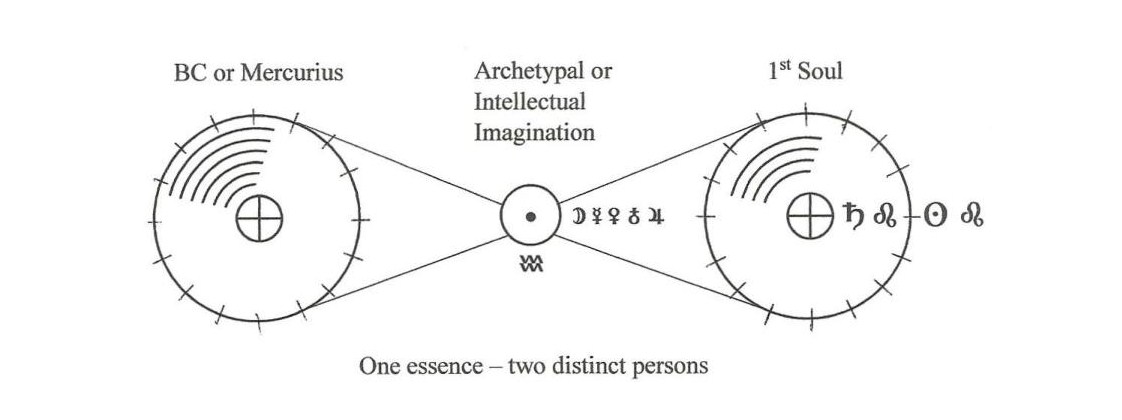
FIGURE 1982 0410a-1. Bodhicitta, Imagination, 1st Soul; One Essence–Two Distinct Persons.
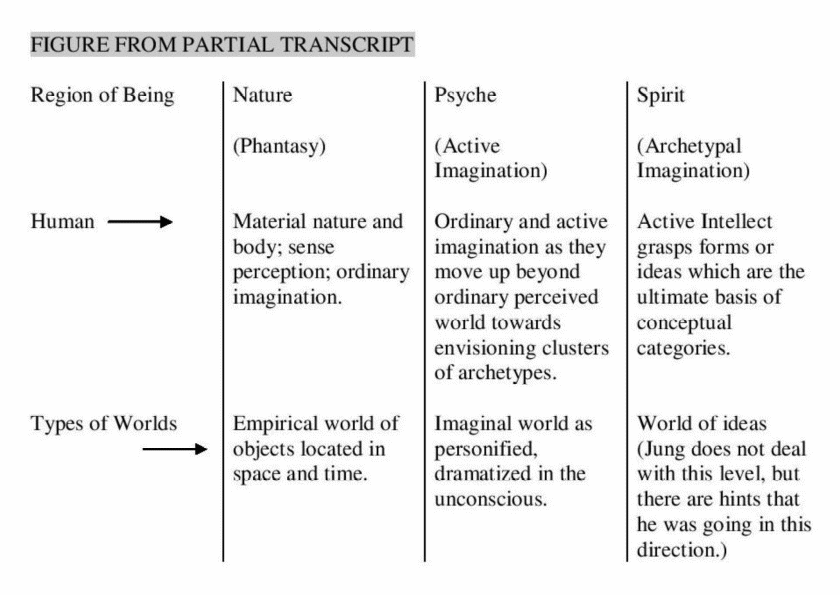
FIGURE 1982 0410a-2. Imagination: Phantasy, Active, Archetypal vis a vis Human Level & Worlds Levels.
Other diagrams also referred to are not with this transcript version. [Transcriber note: [diagram] means the speaker is referencing a diagram as he or she is speaking. If someone is drawing or writing, with audible sounds of chalk on a blackboard, I indicate this by [drawing] or [writing].]
AD PAPER read in class:
- Precis of Edward S. Casey's "Toward an Archetypal Imagination". Retyped as 1982 0410b V09BN. Archetypal Psychology - Imagination.
NOTES:
This is 1982 04/10a, a class on Alchemy and Imagination, the first entry associated with this date. 1982 04/10b = "Toward an Archetypal Imagination" Book Notes.
This is among the Saturday AM Alchemy series class.
We have a partial transcript for this class, Scan File 1982 0410 ALCHEMY 08F.PDF, that contains handwritten AD edits. These are noted in the present transcript. Original transcript by CdA.
The partial transcript also contains two typed diagrams (that were redone by NT), which are referenced in the appropriate places and appended to this transcript.
TRANSCRIBED Verbatim by IT 2021. Earlier transcript versions exist, including the V11a upon which this version is based. The appended paper has been removed, now stands alone, and a note within the transcript has been altered. In 2025, IT updates front matter, title of paper, and note pertaining to the paper within the transcript, expands Plotinus quotes section, adds new note and alters two existing notes within transcript. Archival verbatim transcript with AD Paper – V12ap.
AUDIO FILES: 1982 0410a, 1982 0410b. [Note: "Tape" and "Side" refer to original audio cassette tapes that were later digitized into .MP3 Audio Files.]
1982 04/10a at Wisdom's Goldenrod
Alchemy; Imagination
[Audio File 1982 0410a Begins]
AS: (Well--) (AS laughing)
S (very faint whisper): [few words inaudible]
AS (faint): Uh-hm.
AD: Well, we left off last week I think-- Do you have summary? [few words inaudible]
S: Summary?
AD: Last week.
S: Oh no.
AD: Remember [student assents] the way we left off, with--
C.G. Jung [CW 13, Alchemical Studies, "The Spirit Mercurius," p. 237, paragraph 284, AD reading]: "The multiple aspects of Mercurius may be summarized as follows: [student assents, faint]
"(1) Mercurius consists of all conceivable opposites. He is thus quite obviously a duality, but is named a unity in spite of the fact that his innumerable inner contradictions can dramatically fly apart into an equal number of disparate and apparently independent figures.
"(2) He is both material and spiritual.
"(3) He is the process by which the lower and material is transformed into the higher and spiritual, and vice versa.
"(4) He is the devil, a redeeming psychopomp, an evasive trickster, and God's reflection in physical nature.
"(5) He is also the [AD reads: a] reflection of a mystical experience of the artifex that coincides with the opus alchymicum. [AD: And--]
"(6) As such, he represents on the one hand the self and on the other the individuation process and, because of the limitless number of his names, also the collective unconscious."
AD: We spoke about that Mercurius a little bit. Now-- [37¾ second pause, noises, flipping of pages] I brought the wrong book.
S (faint): Yeah.
AS: Which one did you--
AD: The Sublime Science, that's alright, ah--
AS: Hm.
[short pause]
S: How about page 30?
AS: Sam got one.
AD: No, I got mine marked out.
S (faint): Oh.
S (faint): Uh-hm.
[10¼ second pause]
AS: You want to go get it? I can go get it.
AD: No, I-- what I [S simultaneously: You sure?] was thinking was-- She had an intuition as to what Mercurius was.
AS: Oh, yeah.
AD: Remember she gave the class Thursday night?
AS (simultaneously): Oh right, that's right, so she should give it again.
[short pause]
AD: Madame?
S: Uh-hm.
[short pause]
AD: You know, it's very enjoyable when someone gets the idea that I'm working with without me telling them about it. So I figure they're doing it on their own independent-- in their own independent way. Could you please tell us what you think Mercurius is?
CDA: Well, um--
AD: Loud.
S (simultaneously): Louder. (laughter)
S: It was [S simultaneously: She couldn't even say it.] said "Well um…" (laughter, student words)
CDA: Well the diagram was [one/two words inaudible]
AS (simultaneously): Yeah, show the diagram.
CDA: Yeah.
AD: Please.
CDA (faint): Should I draw the diagram?
AS: Yeah.
[57 second pause while CDA draws]
S (very faint): (Well don't) [one/two words inaudible]
AS: I know, clean it up.
S: Uh-hm.
[34¼ second pause while CDA draws; continues drawing as AD and students talk faintly in background (next 7 lines)]
AD (faint): Alright.
[9¾ second pause]
BS (very faint): Do you remember?
AD (faint): Remember?
S (very faint): Yeah.
AS (faint): Well kind of.
AD (faint): So, he speaks about the lower [one/two words inaudible] in the Sun soul.
S (faint): (Yeah/Ok).
AS: Tell hi-- tell him-- remember how you came about it? Well, tell them.
S (whisper): It's too (long).
AS: Why don't you sit on the mat?
CDA: Pardon?
AS: Well, say-- tell them what you said the defi--
AD (simultaneously): Well-- well tell us, tell us what happened.
AS (simultaneously): Yeah, she had a story about that.
AD: Yeah, you want to--
CDA: Well the story was just that I was reading in Jung about Mercurius, and it just was one sentence that said Mercurius was a trinity. And I said no, that's not so, that's the Christian doctrine, that it was fourfold and that the unity of it-- of Mercurius was the bodhicitta. And that's really not so different I think-- I mean it's really what we've been saying all this time. And that we've called the twelfth house or the three realms Mercurius and this is just a different-- a way of picturing that as within the individual, all within the bodhicitta as the emanation of the bodhicitta. And using the paradigm of the metaphysical chart, how the bodhicitta is both transcendent and immanent, transcendent to the Mercurius and immanent in Mercurius. [student assents, faint] And also it was the threefold of the three-- on the paradigm of the three-- the first, second, and third quadrants as being the-- as inserted into the elements becoming a 12-fold, not-- I don't know, that needs to be worked out more.
AD: You have to work that out.
CDA: Yeah.
AD: Alright, there's-- there's a quote from Plotinus. I don't know, Avery do you have it?
AS: Yeah, it's in-- well two places in III.4, in Ennead III.4. One is III.4.6 where he says that--
Plotinus [III.4.6, AS reading]: "We must understand that, while our souls do contain an Intellectual Cosmos, they also contain a subordination of [various] forms like that of the Cosmic Soul."
AS: And he says--
Plotinus [III.4.3, AS reading]: "[For] the Soul is many things, is all, is the Above and the Beneath to the totality of life: and each of us is an Intellectual Cosmos, linked to this world by what is lowest in us, but, by what is [the] highest, to the Divine Intellect…"
S: Where is that from, Avery?
AS: III.4.3 and III.4.6, in the last paragraphs. Ok. That's all (I think).
AD: Now obviously that statement is extremely important. Plotinus is saying there, he's saying there that the whole of the Intellectual World is within your soul. It can hardly be overestimated. I mean you can't even imagine what that is. But, a statement is made, the whole of the Intellectual-Principle is in the soul. So each and every soul carries within himself or has within itself the entirety of the Intelligible World. This is an absolute prerequisite, an axiom required in order to work [AD handwritten addition from partial transcript: out] the full implications of mentalism. Without it, we cannot work out mentalism. Alright, so, if we take that as num-- as axiomatic, and then we keep in mind what Plotinus said, he said that the soul imparts a light or gives a light of itself. [Note: See Plotinus, I.1.7.] And we said that this light which it gives of itself, that this light was equivalent to, well, some call bodhicitta, some will call Mercurius, the names will be varied. [Partial transcript reads: "…this light is equivalent to what we call the Bodhicitta, and some will call Mercurius." AD changes to: "…this light is equivalent to what Buddhists call the Bodhicitta, and what alchemist refer to as Mercurius."] It's the symbolic concept that you have to try to grasp, it's an intuition of that symbolic concept, a concept won't do it. As a matter of fact I think the concept will prevent you from following that. So, let's do something like this then.
[27½ second pause while AD draws. Diagram here in partial transcript. See FIGURE 1982 0410a-1 for the following.]
Let's say that this represents the soul in the-- you know, in the Intellectual Realm. Within the soul, if you remember we have the Sun on the one-- one end and Saturn on the other [AD indicating on diagram], ok. Well, if we take-- if we-- if we-- if we say that the whole of the Intellectual World, the whole of the Intellectual World is in the soul, and we're thinking of this as the soul just to get a-- a diagra-- a visual aid, [drawing] then we would have to put in the soul all the Ideas. [VM assents, faint] So let's say this is equivalent to all the Ideas [diagram]. And then within that let's say we put all the spheres [diagram]. [drawing] And within that the sublunary realm [diagram], alright?
Now, the Matter here, the sublunary realm that you're speaking about here is going to be Intelligible Matter. It's not going to be like the sensible matter here [AD indicates on diagram]. This is all Intelligible Matter. So when you look at the Sun in Leo, Saturn in Leo, and you have these spaces in between [diagram], alright, that's going to all be reflected further down. [students assent, faint]
But what we're saying, what we're beginning with now is, this is the first soul, [drawing] this is truly soul, soul in the Intellectual. We're saying that it has all the reason-principles within it; the means of translating those reason-principles [AD handwritten addition from partial transcript: thru the planetary]--that would be, let's say, willing, feeling, knowing, sensing; and it has within it the Matter, Intelligible Matter, and it's going to operate in such a way that everything that's in the Intellectual Realm is going to be actualized in [Partial transcript: AD replaces 'in' with 'as'.] the sensible world. I'm going to use-- I can't help right now using dualistic language, but like we-- like we were saying last night, you can't speak metaphysics without a dualistic language. Then the trick is at the end to turn it ups-- flip it in-- inside out.
Alright, now-- if we say that this was Saturn here [diagram], and over here the Sun in Aquarius [diagram], alright. So these would be all the Intellectual powers [diagram]. This will be the soul, so to speak, unembodied soul. And over here where the [drawing] Intellectual paradigm, the Sun, the Intellectual Imagination operates [diagram], it projects out this bodhicitta. This bodhicitta, let's say over here we could put inside the bodhicitta the inerratic spheres, planetary spheres, the sublunary realm, and the little bodies situated on a planet [diagram], ok?
But, if we speak about this here as the bodhicitta, if we speak about it as Mercurius, it doesn't matter what-- call it xyz. [S, very faint: I don't care.] This is what they speak about. They speak about this germ of enlightenment, this thought of enlightenment. They speak about it as being pure, eternally pure. But they also speak about it as-- in two different ways, on the one hand, it is eternal and immutable, on the other hand it is active. Um-- I'm pulling these things out from the Sublime Science of Maitreya. And they speak about the bodhicitta as universally pervasive, like space. But they speak about adventitious defilements ac-- there's an accretion of adventitious defilements which prevents the purity of the bodhicitta to shine through. And the Buddhists speak about a process whereby you have to separate yourself, notice, you have to separate yourself from those adventitious defilements in order to get to the purity of the bodhicitta.
So then-- so that we're saying now, in the bodhicitta, alright, there will be a reflection in this immaculate, pure substance, it'll be a reflection of the whole of the In-- Intellectual Realm which is within the soul, it is reflected in this. So then this bodhicitta, Mercurius, whatever you want to call it, is that magical substance, that stone that the philo-- the philosophers have been searching for, alright.
Now-- This realm here, let's call this the Intellectual Imagination [diagram]. [short pause while AD draws; AD continues to draw as he speaks] And the powers of the soul golt-- go like that, I know. [AS assents, faint] Jupiter, Mars, Venus [diagram]. [S, very faint: Jupiter (one/two words inaudible)] Now, I don't know if you're getting a little bit of a picture, that everything is within the soul, alright, over there, the whole of the Intellectual World is within the soul [diagram]. And then we're saying that in the-- insofar that the soul emanates from itself this principle which they refer to as the bodhicitta or a light or an image-bearing light, alright, we're saying that everything that's there is in here [diagram]. So that you would have-- let's say you would have one essence-- [drawing] The essence of this and the essence of this is one essence, but you have, if I could use Scholastic terminology, two persons, two entities.
AS: Yeah.
AD: These are two distinct entities but the essence is the same in both.
FW: That's why calling the one a reflection is slightly misleading because in terms of our reflection in the mirror there's-- don't-- definite difference in substance. It's just on a glass, it's not even there. But there's something the same about those.
AD: There's something very mysterious about this here, yeah, the bodhicitta. The terms-- the words that they use are very often misleading. You know, like when Samkhya says the purusha is somehow reflected. And the "somehow reflected" has to carry the burden of a-- of the whole doctrine. Yeah. But sometimes, it may be that that's-- that's all they can say because that's all they know and the rest has to be dug out as you go along. Alright, before we proceed now, for reasons of method, I'm going to ask Avery to read a paper. We got a pap-- we got on, and this is on the imagination. Basically it's Jungian orientated but it goes a little beyond Jung, [S, faint: Oh.] and a lot of people are going to disagree but that's alright. But I don't think [S simultaneously, faint: No, we--] Jung would disagree. He didn't go that far, [couple/three inaudible student words simultaneous with AD] he didn't go that far but I don't think he would disagree with how far I went. It's implied, it's implicit in his writings. Well, do you want to put that up (there/here)?
AS: Read this.
AD: Yeah, read the paper and-- Read it nice and slow and then if-- if they want a diagram-- I got them used to visual aids now.
S: Uh-hm.
S (faint): Yeah.
VM (faint): Got what?
S: Used to visual aids [few words inaudible]
S: Uh-hm, right.
S (faint): What page?
AS: Well, you'll see. Ok, um-- [S, faint: What page?] This in on the levels of imagination, ok.
[Transcriber note: The following is a precis of Edward S. Casey's "Toward an Archetypal Imagination". It has also been retyped as 1982 0410b V09BN. Archetypal Psychology - Imagination. I transcribe it as AS reads it, including any alterations made during re-reading.]
AD ["Toward an Archetypal Imagination," AS reading]: "Jung himself stresses two features of the imagination, one its autonomy, and the other its creativity. These two aspects are linked together in the formation of symbols and pervade all psychic activity. Another way we refer to his autonomy as the mother of all possibilities. And he also refers to fantasy as drawing together and mediating every act of the psyche. And he says this fantasy is the universal solvent of the mind. We can refer fantasy to what is merely a subjective figment of the mind. But in contrast, imagination proper is said to be an image-making, a form-giving creative activity. [AS: And Jung has this quote.]
""Fantasy is mere nonsense, a phantasm, a fleeting impression, but imagination is active, purposeful creation… a fantasy is more or less your own invention, and it remains on the surface of personal things… but active imagination means that the images have a life of their own and that the symbolic events develop according to their own logic." [AS: Ok?]
"Now this active imagination we can perceive as a two-fold movement and synthesis. First, it is a general movement from the unconscious to the conscious, or from a primary to a secondary process. Synthesis here implies a change in psychic level, a change in the kind of awareness (reflective awareness) with which the psychic contents are apprehended. [AS: Cha-- so there's a change in level.] But secondly, we can conceive the subsequent elaboration and unfolding, and here the synthesis primarily proceeds at one level, the conscious level, as the contents delivered in the first synthesis are expanded and unfolded to reveal aspects which had not been apparent initially. In this process, your special attention is focused on the amplifying of this material from the unconscious. You concentrate on it, observe its alterations objectively, and follow the transformations carefully. If this is done, then we can convert what is purely possible, the merely phantized, into the psychically real. So in this process of active imagining, the fantasy is invested with an element of reality. The ultimate source of this psychical reality is found in the primordial images or archetypes. These inform and pre-form the imaginative activity. So, we could say that active imagination [AS: This second level here.] is a kind of spontaneous amplification of archetypes and it is an unleashing of their potentialities. To imagine actively is to make archetypal patterns psychically real and effectual in the psychic life of the imaginer.
"What is it that introduces and maintains an order within the experiences…"
AD: Let's stop there, [AS simultaneously, faint: Oh, yeah, ok, sure.] because that's another subject. Very simply what we're saying is something like this. There's three levels of imagination, ok. The first one you're all familiar with: the stuff that's going on in your head all the time; [S: Oh.] just ordinary fantasizing which we're all, you know, participating in. Then there's a second kind of imagination. Jung called it active imagination, and that means that you have to participate in the fantasy that's taking place, alright, and become an actual participant. And that means that you're going to have to bring in some control, some direction. It is your drama. Ok. That's active imagination. You're-- you're actually playing a role in it.
[student assents, very faint]
AD/S (?): (You have--)
LC: (We'd/You'd) say that you bring the wi-- the will becomes--
AD: Comes into play, sure.
S (very faint): Oh yeah.
AD: And then there's a third type of imagining which he calls archetypal imagination or which we can call intellectual imagination, and there you have an entirely different kind of imagination. Not in-- not different in kind, but like a-- like an imagination which is conforming to reason-principles. There you do not control anything. Start from-- start with the second paragraph, just slowly.
S (faint): (What page?)
S: Yeah.
AS: Ok. This is dealing with this--
AD (simultaneously): Now, one thing I'd like you to recognize. You're being put through this and you have been being put through this. Instead of calling it active imagination I call it thinking, try and force you to think. That means your will has to participate in it, you have to be a participator. When you sit back in class and you can't offer me a reasonable question, you're not participating in active imagination. If you participate in the active imagination, your will's forced to come into play. And that's why it's important. A person who doesn't give questions, I cannot tell where he's functioning, because that's what's got to be revealed in this dialogue between people when they're discussing ideas. Otherwise a-- you-- the framework is unavailable. Let's go over that slowly. You're talking about something that you're doing all the time when you're here and also about where, hopefully, we're going to be led to. And so, if-- if you ask spiritual man for-- for help, and I think many of you who have seen that many-- that what they do is employ a species of creative imagination or archetypal imagination; and there is no sense, and I think the Dalai Lama made this very clear, there is no sense going on endlessly, alright, prostrating yourself in front of a Sage. That's not what he wants. Remember the way the Dalai Lama put it? "If I were to bless you, it wouldn't be by patting you on the head. I'd teach you the Doctrine." Remember that? [student assents, very faint] He made that very clear. Anything else is really a waste of time, after the initial premises have been cleared up. So let's try again, the imagination; that which everyone rejects as useless.
S: Yeah.
S (faint): (Page, yeah.)
AS: Ok, this is on the second kind of imagination he speaks of, the active imagination.
AD ["Toward an Archetypal Imagination," AS reading]: "Active imagination we can perceive as a two-fold movement and synthesis. First, we have to perceive a general movement [tape speeds up, 3 seconds of talking inaudible]…"
AD: [tape speeded up, 2 seconds of talking inaudible] an idea, an image, an image comes into your mind. Alright, that's coming from the unconscious. Now you, by paying very strict attention to it, observing very carefully this fantasy, as soon as you do that, you're interfering, alright, because now you're coming with, let's say, a certain conscious attitude which has to assimilate what that unconscious content is. So to some extent you're going to interfere with it. But you-- you're-- you're involved in the process of apperception. Whatever this unknown content is comes up to the surface and then you with your conscious attitude and your ability to grasp and understand, to assimilate it, but according to the attitude that you work with. So, if you took a very clumsy example, in astrology you get a new aspect, a new conjunction going on, a mat-- an idea is trying to manifest. But you can't grasp the idea the way it is in itself, you can only grasp it according to the attitudes that you have at your disposal to apprehend it and assimilate it. So that's what we mean, from a primary to a secondary process. Go on. Please.
LC (simultaneously): I have one question, the [AD simultaneously: Sure.] place where these images are coming from, is that the place of the creative imagination?
S (very faint): No.
AD: No. The creative imagination is going to be something you're going to use. But by "place," all this is taking place in the imagination.
LC: When you say "the unconscious," when you say-- when you say "unconscious," [AD, faint: Yeah.] I really don't know what that means anymore, it--
AD (simultaneously): But you can't.
LC (very faint): Ok.
AD: That's what they mean when they say "unconscious," you don't know where it is [LC simultaneously: Or where it comes from.] or where it's coming from, [LC: Ok.] or what it is, or anything. [LC, faint: Ok.] In other words, we could use the word from the unknown something comes up into our conscious mind and that's what we have to deal with, but as soon as we attempt to grab it, it goes through a process of transformation. Now, in extreme cases like you-- in extreme cases sometimes some ideational content of some sort comes up and it's too overwhelming, the person can't deal with it, and so it has to keep coming back two, three times before gradually he assimilates the idea to himself.
LC/S(?) (faint): Hm.
AD: Go ahead.
S: Would you say that the unconscious has to do with the-- the ideas in the archetypal imagination, would it be getting-- would it be--
AD: Li-- let's leave it like that, I'll explain it as we go along. Leave it as the unknown, the unconscious, ok? It's going to be a very vast term. It's going to be at different times different things.
S: Because I was wondering if-- if the second type of imagination was structured by the third kind and kind of-- do you know what I mean?
AD (simultaneously): Well, let's wait. I'll come to that, come to that gradually.
S (simultaneously, very faint): Uh-hm. Ok.
AD: Alright.
[short pause]
AS: Should I go on?
AD: You want to read on-- from the Atwood, there's a-- that little section on the labyrinth, the way the Sphinx devours--
VM: This, "For is she not that very Sphinx of the Labyrinth?"
AD: Uh-hm.
S: What page?
VM (simultaneously): A paragraph Anthony? It's page 194. It's marked out, starts at the bottom.
[Transcriber note: I am using A Suggestive Inquiry into the Hermetic Mystery by Margaret Anne Atwood, London: J. M. Watkins, 1918.]
M. A. Atwood [A Suggestive Inquiry into the Hermetic Mystery, p. 194, VM reading]: "For is she not that very Sphinx of the Labyrinth, the devourer of strangers and all who have not the wit to unriddle and know themselves? At all events, such is said to be the nature of the Phantastic Spirit before it is mundified, that he who enters so far as to be profoundly conscious in her essence, will be lost in irrational confusion, if he assume not quickly his intellectual energies and solve, that is comprehend, it on its own ground."
AD: Alright, there-- wouldn't you say that [VM simultaneously: Exactly.] if you don't know what's happening in [VM simultaneously: You get (one/two words inaudible)] the imagination, which is always going on, it's always going on, you're always imagining, if you don't know what's going on you're-- she's going to devour you.
VM: Yes. Take the case of-- an extreme case of, say, psychosis, where these archetypal images, let's say, are erupting and a person can't operate in a conscious, let's say, willful manner and assimilate them into his understanding of himself or the world, and he's totally [AD simultaneously: (one word inaudible) yeah.] inundated, wiped out.
AD: They take over.
VM: Fragmentation of the personality. So that would be an example.
AD: That's one of the dangers, slight dangers that always exists when a person meditates or introverts intensively, that he will get inundated with images. And if he doesn't have a-- a-- a rational ego, a strengthened ego, he can go under. And in The Secret of the Golden Flower there's diagrams where a person's meditation, you see the schizophrenic process starting, but they seem to think it's something spiritual. Unless-- unless it's understood this way it will not be spiritual. I'm sorry, Avery, let's go over the whole paper. Start from the beginning. I can--
AS: Very beginning?
AD: Yeah. I-- I see why I consider this important, it takes me a little time too.
AD ["Toward an Archetypal Imagination," AS reading]: "Jung stresses two features of the imagination, one, its autonomy, second…"
AD (simultaneously): Its independence, right?
AS: Independence.
AD: The other its creativity.
AS: Its creativity. Ok?
AD ["Toward an Archetypal Imagination," AS reading]: "These two are linked together in the formation of symbols and pervade all psychic activity."
AD: You follow that? Its [LD simultaneously: So the ima--] autonomy. You know what he means by that?
VM: Yeah, you can't control it.
AD: Yeah, it just keeps going on!
S (simultaneously, faint): (Definitely.)
LD: Is the imagination what's creating these symbols or--
AD: No, leave that aside now. That will be answered very soon. Understand just what I'm telling you. This is also part of the discipline I put you through yes-- yesterday. Stop the damn running around, stick to the point.
LC: Ok, on the one hand it's autonomous, on the other hand it's creative.
AD: Creative, yeah.
LC: It's autonomous because it keeps going on, it's creative because you put your will into it?
AD: No, not yet, it's--
LC (simultaneously): Well, ok, what--
AD: It's creative because [S simultaneously: It creates (the/your) world.] everything that's in your mind is being done by it, so it's creative.
LC: Wait, wait, that's a--
S (simultaneously): It's creating a world.
S (faint): It's creating a whole new world.
AD (simultaneously): On the one hand, it is itself, it does what it wants to do.
LC: Right.
AD: And on the other hand, it's doing something.
VM: Yes, it presents [LC simultaneously: I don't understand that difference.] your experience to you continuously.
LC: I don't-- It what?
VM: It's continuously presenting your world of experience to you.
LC (simultaneously): That's the autonomy of it.
VM: Well--
AD: And it's also [LC simultaneously: What's it--] the creativity!
S (very faint): Yeah.
S (faint): Hm.
AD: Don't identify them, don't think that they're one and the same thing.
LC: Like you don't understand what the creativity is.
AD (simultaneously): Yeah, you're trying to say they're one and the same thing, Jung is saying, no, they're not. [LC simultaneously: Well what's the creativity?] On the one hand it's creative, on the other hand it's independent.
LC: How is it creative? I see how it's in-- how--
AD (simultaneously): Making images all the time.
LC: But that-- isn't that the autonomy, making--
AD (simultaneously): The autonomy? No.
LC: The autonomy is presenting it?
AD: No.
LC: I don't understand.
S (simultaneously): There's two aspects of it.
DB: The auton--
S (simultaneously): Just look at it--
DB: The autonomy is that you don't have anything to do with it.
LC: Right.
DB: Right.
LC (simultaneously): Yeah, ok, [DB simultaneously: Ok.] and you say, what's the creativity?
AD: The imagery that it creates.
S (faint): The idea has to be (present).
DB: Just like a policeman, you can't tell him what to do, right? So he goes about doing his business. I mean it-- (laughter)
VM (amidst laughter): That's great, Dave! (VM laughing)
AS (simultaneously, amidst laughter): Now that's a weird example.
S: That was creative, right? (more laughter)
AD: In other words, in other words, you're identifying creativity, independence and autonomy, you making it up sym-- synonymous.
LC: No, they're two different things to me.
AD: That's what he's saying.
S (faint): Yeah.
LC: But they are two different things [AD simultaneously: Yeah.] but I don't see how this--
AD: Exactly.
LC: Great. (bit of laughter)
S (faint): I'm lost.
MW: It happens-- well, it happens that its autonomous activity is that it's creative, in this-- in this particular--
LC (simultaneously): Oh. Oh, so you're so-- oh ok, so there's a separation of the activity and then what it's activating, and you're calling--
AD (simultaneously): What it's doing, yeah, right.
LC (simultaneously): What it's doing you're calling creative aspect [AD simultaneously: Uh-hm.] and that it's going on is--
AD: Its independence from our, let's say, rule.
LC: I think it's--
AD: Alright, think of them [LC simultaneously: --very-- ok.] as one, think of them as one. (laughter, student words) Don't get hung up on it.
LC: Ok.
S: (Alright.)
AD: So, it's creative and autonomous. Go on.
AS: Um--
AD ["Toward an Archetypal Imagination," AS reading]: "These two are linked together in the formation of symbols and pervade all psychic acts. He speaks of the fantas…"
AD (simultaneously): Do you agree with that?
S (very faint): Yeah, uh-hm.
AD: Pervades all psychic acts. Alright.
S: It seems like it is-- it-- I mean it is the psychic act, isn't it? I don't understand why the word 'pervade' is used because it makes it sound other than the psychic act. I don't see how there could be a psychic act without this imagination [VM: That's right.] or without this-- Do you understand what I'm--
AD: Uh-huh, you just eliminated higher psychical acts like where there is no imagery accompanying the thinking (process).
S (simultaneously): Oh ok, I see.
VM: Ok. But [AS simultaneously: That's going the other way.] Jung uses the term 'psyche' as that which can be imagined, or no, that's not exactly his words but-- no, he used the word 'psyche' as that which can be known, capable of being known, that's the way Jung uses 'psyche'. So in that sense his use of the word 'psyche' [AD: Yes.] is relegated to the imagination.
AD (simultaneously): His use of the term 'psyche' is enormous, he calls it the principle of all existence.
VM/S(?): I see.
LC: I have one more ques-- question, it's about the word 'image' now. That includes the events that actually arise in the world as well as-- does it-- does it include--
AD (simultaneously): An-- any presentation.
LC: Any pre-- presentation.
AD (faint): Any presentation.
LC (simultaneously): Ok, I just wanted to know, go ahead.
S: Jung calls-- and he was calling soul at one time the totality of all psychic acts, but that would be the soul as the Sun in Aquarius that-- Ok, so one time we got--
AD (simultaneously): The totality of all psychic acts?
S: Was it-- he was calling the soul.
VM: Self.
AD: Self.
S (simultaneously): Self, calling the Self. So that would be the Sun in Aquarius he was calling Self. This imagination is the totality of all these psychic processes.
[short pause]
AD: Alright. Shall we try again? [students assent, faint] Go on. Continue Avery.
AS: Ok.
AD ["Toward an Archetypal Imagination," AS reading]: "We can refer fantasy to what is merely a subjective figment of mind."
AD: Any-- any doubts, questions yet?
S (laughing, faint): No. (bit of laughter, student words)
AD: Ok, next statement.
AD ["Toward an Archetypal Imagination," AS reading]: "But in contrast, imagination is said to be an image-making, a form-giving creative activity."
AS: And then he has this quote where he distinguishes the two.
AD: Read it please.
AD ["Toward an Archetypal Imagination," AS reading]: ""Fantasy is mere nonsense, a phantasm, fleeting impression, but imagination is active, purposeful creation… a fantasy is more or less your own invention, and remains on the surface of personal things… but active imagination means that the images have a life of their own and that the symbolic events develop according to their own logic.""
[9 second pause]
S (faint): That was (a quote).
AD (simultaneously): That was a quote by Jung.
BS: Are we talking about personal interference, on the one hand, of the imagination and its-- [AS, faint: No.] with the imag-- per-- are we speaking of personal-- fantasy as personal interference?
AD: No, just speaking about it as fantasy, it's something very personal, it's yours, it's going on all the time. And then we're speaking about the imagination, alright, which is creative, which is making the images, the vitality that is behind that image. What is the distinction that you're being called upon to make? Fantasy and imagination, right? [student assents, faint] Now, can you make the distinction in your understanding between what is fantasy and what is imagination?
CDA: But when he says that that develops according to its own logic, [AD: Uh-hm.] that implies that there has to be some-- some basis of reality behind--
AD: Behind it, [CDA simultaneously: Behind it.] whereas in fantasy there isn't. [AS and CDA assent] That's why Paracelsus referred [AS simultaneously: It's the autonomy.] to this as the cornerstone of madness. [Note from jf: cf. Franz Hartmann, The Life and the Doctrines of Paracelsus. Found online https://universaltheosophy.com/fh/the-life-and-the-doctrines-of-paracelsus/ where this passage occurs: "The spirit is the master, imagination the tool, and the body the plastic material. Imagination is the power by which the will forms sidereal entities out of thoughts. Imagination is not fancy, which latter is the cornerstone of superstition and foolishness…"]
AS: That's also what you referred to as its autonomy in the beginning.
AD: Uh-hm.
AS: The-- the autonity-- autonomy implies a certain inherent logical structure to it.
AD: Ok.
AS: Certain order.
AD: Go on a little bit more.
S: Wait, could I ask you? It seems like in that first one though, the fantasy has a certain autonomous nature too. I mean if you didn't do anything about applying the will or sort of focusing, then that kind of fleeting fantasy life would just go on. And in a way it's-it's dealing with personal things but it also seems to be just autonomous in its nature.
AD: Well, we're not disagreeing with that.
S: Ok. But then, in a way, it has a life of its own.
AD: Yes.
S: And then the imagination, the second kind that you talk about, like you're bringing a certain focus to let this other kind of life of its own come through.
AD: What's the difference between let's say the fantasies that arise in your mind and let's say the construction of a poem like Kubla Khan? One would be erratic, right, meaningless, dreamy, alright, whereas the construction of Kubla Khan was a very well ordered and organized imaginative activity.
S: Yeah, no, I see the difference with that in [one word inaudible] but the-- the thing that I don't see yet is-- I mean it does seem like in the second kind it's coming through the person by a certain kind of focusing of attention or-- [AD, very faint: Uh-hm.] [short pause] so that you could allow-- allow this certain ordered--
AD: Yeah, you're saying focusing of attention which brings the will into operation, sure.
S: Yeah. And then what comes through is-- it-- you become the ve-- the imagination becomes then like a-- a constructive vehicle for-- for this-- for a higher idea to come through.
[student assents, very faint]
AD: Fine.
S: Whereas the fir-- in the first case, there's no structure at all.
AD: Yeah, it's rambling around.
S: Yeah, so it's really bringing--
AD: So it's very superficial, it's on the surface.
[student assents, very faint]
S: But is it the same substance, it is the same substance?
AD: Well--
S: Images [half/one word inaudible]
AD (simultaneously): Let me stop the question there.
S: (Uh-huh.)
AD (faint): Let me stop the question there now. Continue some more.
[short pause]
AD ["Toward an Archetypal Imagination," AS reading]: "We can perceive active imagination as a two-fold movement and synthesis. First, a general movement from the unconscious to the conscious, or from a primary to secondary process or processes. Synthesis here implies a change in psychic level, or coordination, and a change in the kind of awareness (reflective) with which the psychic contents are apprehended. And secondly, the second movement is a subsequent elaboration and unfolding, and here the synthesis proceeds primarily at the conscious level, the contents delivered in the first synthesis are expanded and unfolded to reveal aspects which had not been apparent initially."
AD: Alright, we see the twofold-- the two steps in the process? Go ahead.
S (simultaneously, faint): Yeah.
FW: Would the first correspond to a transit and then the second would be how that would be worked out in a life?
AD: The way you're assimilating it, sure. By transits you mean something is coming [FW simultaneously: Planetary.] into you, we don't know what it is, something's coming into you. Then the way you elaborate it and assimilate it and make it your own. These are processes that are going on all the time. Even like when you're thinking, like for instance you try to think out a very difficult passage from Plotinus, alright, and something is coming from the unknown, you don't know exactly what it is--
(Side 1 of original cassette tape digitized as 1982 0410a Ends; Side 2 Begins)
AD: --the thing, the way it is.
FW: Then the first would actually be what the Platonic tradition would call a remembrance?
AD: Well basically-- I don't want to get into that because that's memoria, and that's the way Plato said you can get back to it. But Plato would say you're starting off with the fantasy, going into the active imagination, and going back into the archetypal, you're working your way back into memoria, reminiscence. Ok. Some more, Avery.
AS: Ok.
AD ["Toward an Archetypal Imagination," AS reading]: "In this process, your special attention is focused on the amplifying of this material from the unconscious. You concentrate on it, observe its alterations objectively, follow the transformations. If we do this, we will convert what is purely possible, the merely phantized, into the psychically real. So active imagining invests the fantasy with an element of reality. The ultimate source of this psychical reality is found in the primordial images or archetypes…"
AD: Let's stop there.
RC (faint): Can you reread those last two sentences? Just the last two.
S (faint): Yeah.
AD ["Toward an Archetypal Imagination," AS reading]: "Active imagining invests the fantasy with an element of reality. The ultimate source of this psychical reality is found in the primordial images or archetypes…"
AD: See if you can understand this because, if you don't understand these things you don't know what-- what will happen to you in mysticism.
LC: So right there he-- is three-- is the three levels that we went through then. Isn't (that/it) the archetypal or the primordial and the creative imagination and the fantasy? Did you shake your head "no" Avery?
AS: Well, and-- except that the reference of the archetypes is primarily to-- [S, faint: To the reality (one/two words inaudible)] to the active-- to the active imagination.
LC: But isn't-- but--
AD: We're talking about a person who's practicing active imagination. Alright? That's all we're doing, we're not up to [AS simultaneously: Haven't brought the third one.] archetypal imagination.
LC (simultaneously): I thought he just mentioned in that sentence the archetypal.
AD (simultaneously): You become aware of archetypes but that's not archetypal imagination. We're talking about different ways that you can operate with the imagination. Let's forget about the fantasy now. Now imagine you're under the treatment of the Jungian analyst, alright?
S (faint): Go.
AD: Yeah, alright. And he-- he employs-- he employs one of his methods or active imagination. So he says you'll see a fantasy come up and you invest yourself into that fantasy, you direct your attention upon it and become an active participator. So if you see that this beloved friend of yours is going up to the end of a bridge and going to jump off, you don't sit passively by but you make an effort to prevent it, so you're employing the will, you know, to guide, let's say, the scenario. And you've got to feel involved.
LC: Yeah, where did this image come from, this--
AD: Well, let's not worry about that now. Let's not worry about that.
LC (simultaneously): You don't want to-- ok.
AD: No.
S: Go ahead.
S (faint): It's alright.
AD: You have to imagine that you're actually a participator in this drama, ok?
LC: Yeah.
AD: Now, the last sentence again.
AD ["Toward an Archetypal Imagination," AS reading]: "The ultimate source of this psychical reality is found in the primordial images or archetypes…"
AD: No, the sentence before that Avery.
S (faint): Yeah, uh-hm.
AD ["Toward an Archetypal Imagination," AS reading]: "The active imagining invests the fantasy with an element of reality."
AD: Now, do you feel you do that when-- when you're active imagining?
LC: Yeah.
AD: I mean if you feel that, "I better stop my friend from doing that," alright, you're getting-- you're getting into it. Ok, that's-- that's what you have to work towards when you're meditating or active imagining, any of these processes. Yeah?
LC: So the fantasies are all ok (then).
AD: Hm?
LC: And the fantasies are all ok?
AD: No.
AS: Yeah, except now the-- the reality of it is not something as it were outside but it's something coming up from within you--
AD: You see how you're bringing a reality to it.
AS (simultaneously): --investing it with reality.
AD: You remember like Ramakrishna used to pray to this stone idol and people actually saw it was invested with life and they-- "A stone came to life! The stone," you know, "God made the stone." They didn't see that it was his psychical reality, his vitality which was invested in that and giving it life. In the same way you do the same thing with these images, you give them life. So let's say you have a-- an im-- an image come into your mind, alright, and you invest it with psychical reality, then you're going to come back and tell me about this great vision and this truth that you learned and I very politely shake my head and walk away. That's the way the ego got in!
[students assent, very faint]
S (faint): (Touché.)
AD: Go ahead.
CS: So Anthony, fantasy stops being fantasy when the will comes in?
AS (simultaneously, in background): Had an image once.
AD: When you participate in it and you take a-- you take an interest in it and you direct it. It's no longer fantasy.
CS (simultaneously): Don't you direct [AS simultaneously: What?] the fantasy too though?
AD: Huh?
CS: Don't you direct the fantasy too?
AD (simultaneously): No you don't, most people just (skip these). (laughter)
AS (simultaneously, in background): And I called it the truth.
CS/S(?) (amidst laughter): Yeah but you never skip. (laughter, student words)
S: The images--
AD: Let me recommend to you who have the-- what was it, the one that has "Two Kinds of Thinking"?
S: Yeah.
AD: The Symbolism of the Unconscious or whatever, The Symbols of the Unconscious? [Note: C.G. Jung, CW 5, Symbols of Transformation, "Two Kinds of Thinking".] He has a chapter on two kinds of thinking--one is passive, one is active. Read it very carefully. [S, very faint: Yeah.] Go ahead.
S: Would it be appropriate to use an analogy of say a symphony orchestra tuning up would be like a fantasy and then the conductor coming and (bit of laughter) playing music would be the active? (AS laughing) And then maybe if they played inspired (some laughter) that would be the third type.
S (faint): (That's pretty good.)
AD: If you were Chinese--ok. (some laughter) You remember the story about the Chinaman who came. (student laughing)
S: No.
AD: Orchestra tuned up, and he clapped and walked out. (laughter)
S (amidst laughter): And what?
VM (amidst laughter): After he clapped [couple/three words inaudible]
AS (simultaneously, amidst laughter): He clapped and walked out. (more laughter, student words)
VM: I thought that was an Eskimo. (more laughter)
AD: Continue.
AS: Um--
AD ["Toward an Archetypal Imagination," AS reading]: "[AS adds: So] The ultimate source of this psychical reality is found in the primordial images or archetypes which inform and pre-form the imaginative activity."
AD: Fine, that's right on the surface, huh? [AS assents, faint] Now--
S: Why is that right on the surface? When you-- you're talking about the ultimate--
AD (simultaneously): Now he's saying that that's-- now he's saying that [AS simultaneously: That's not ultimate.] that which vitalizes the drama is ultimately coming from a source which he calls the archetypes, [AS assents, faint] the configuration of archetypes which is the presupposition of this whole drama. We're only touching on it, the next-- the next stage [AS assents] [S simultaneously: So--] will show you what that is.
S: You're talking [couple inaudible AS words simultaneous with S] about the archetypes in the active imagination there. You're not-- is [AS assents] that right?
AS: As they structure. I think he wa--
S (faint): What?
AS: As they structure it. I think he was trying to say some-- he'd say something like well, you know, these archetypes are activating, say you had a dream or something, you know, and-- or some archetype is coming into you, you have a transit, and there's these fantasy images. But if you really want to get to the reality of the psyche or the primordial image or archetype that's really caused this spon-- fantasy to erupt, then you have to start working with the fantasy images to try and get to that reality, what he calls the reality, the psychical reality that's really below it.
S (simultaneously): Would that be like the Sun in Aquarius?
AD: Leave [AS simultaneously: Well I--] it-- leave that discussion out right now, leave out any--
AS (simultaneously): I don't-- he's not [S simultaneously, faint: Ok.] saying that here.
AD: Leave out all that discussion. [S simultaneously: (But the--)] First you have to understand something before you can apply the symbolism.
S: Ok.
AS: Yeah. I think it's still in the re-- region of the unknown, because as he said at the beginning, the first part, it's a general movement from the unconscious to the conscious. So we're just leaving that-- just saying here what he calls unconscious, he's meaning the primordial images or the archetypes.
S: I guess my problem is I'm trying to relate it to the chart and I shouldn't do that.
AD (simultaneously): No not immediately, I-- I keep telling people you first have to understand the thing as abstractly as you can before you try using the chart.
S: Ok.
S: Can the person have any other images than those that are also contained in the Earth's psyche? If the Earth-- if the Earth is a projection or going to be unfolded from within the bodhicitta or from within the person's own soul, are there any other im--
AD: Well leave that question alone now. (AS laughs a bit) No. [couple/few inaudible student words simultaneous with AD] Let me not answer that!
RC: Seems like at one point you're speaking now at this-- the archetypes at this level, [MW simultaneously, part of background: Well you wanted the twin questions.] it-- it seems that what's really being brought into operation are not-- it's not like the objective structure of the unknown that's being spoken about so much as the presuppositions of active psychic subjectivity; that this is what-- when it's brought into operation you start to talk about active imagination.
AD: Alright but-- You see, I'm working from the bottom up. One could start from the top-- the top with the archetypes in the intellectual imagination and ultimately land in the realm of fantasy, alright. We're reversing the process, we're starting from the realm of fantasy, working up to the realm of active imagination, alright, and you start getting closer to the primordial structures which are-- have activated you-- that-- that whole process till it culminated as fantasy.
RC: Uh-hm. It seems like at the fantasy you don't really-- you don't really have at the fantasy level a-- a psychic subject. What's going on hasn't been (projected).
AD (simultaneously): But you had a s-- you have a subject but it's passive.
RC: Yeah.
AD: But in the active imagining, the subject is not passive anymore but active.
RC: Right. But in-- and-- and it seems that the-- the change in the-- like the reality investment in the situation seems to be that-- now the whole situation gets invested with-- with the principles that underlie the reality of the psychic subject.
AD (faint whisper): Yeah.
RC: Is (important/imported)-- it gets courted at that level. But [AD simultaneously: But--] it isn't yet the reality above. You talk about the Intellectual World--
AD (simultaneously): Insofar, insofar that the s-- the subject, alright, activates his attention, then he's bringing in his own vitality, alright. But we're not speaking about that, we're speaking about-- we're speaking about that but more important right now is to-- would be to try to see that we're tracing the fantas-- the fantasies and the imagery in the active imagination and then the archetypal imagination that (would put--) [student assents] Like we're taking the objective view more than the subjective, just in this short passage. A little more.
AD ["Toward an Archetypal Imagination," AS reading]: "So the active imagination is a kind of spontaneous amplification of archetypes, and an unleashing of their potentialities. To imagine actively is to make archetypal patterns psychically real and effectual in the psychic life of the imaginer."
AD: Ok?
S (faint): Can you (stand) between the vitality of that active imagination, I mean, and the vitality of the lower imagination?
AD: And of the what?
S (faint): There seemed to be a different level of vitality that these [half/one word inaudible] I mean, in the active imagination there's a certain development of vitality that's added to the-- to [AD, very faint: Uh-hm.] creative process. But how-- how can you distinguish between this vita-- between the vitality of that active imagination?
AD: That vitality--
S: Of the active imagination.
AD: Yeah, well--
S (simultaneously, faint): The vitality of the [one inaudible student word simultaneous with S] fantasizing, the fantasizing.
AD: If you notice, if you notice you're daydreaming, you are as a subject absolutely passive. Whereas, again, when you invest yourself in the fantasy, then you can see your own subject psychical vitality coming into operation.
S (faint): Ok, so it's a matter of vitality, you have (imagination).
AD (simultaneously): No, it's not a matter of vitality.
VM (faint whisper): It's the (unconscious).
AS: Will.
S (faint): Will?
S: Direct [half/one word inaudible]
AS: It's more will than vitality.
AD (simultaneously): That's-- that's so irrelevant to what I'm trying to get to.
VM (very faint): Yeah.
S (faint): Ok.
VM: Anthony--
BS: (Belief/Believe) you said.
VM: You know, there's a very nice example of active imagination and perhaps it's worth discussing. In Gestalt therapy that-- the way Fritz Perls did it a number of years ago is it was really an amplification of Jung's idea and basically without going into a lot of detail, after you-- if you had a important dream or an important experience in the outer world, he would ask you to come in, he would put two chairs up in the middle of the room. And let's say you had a dream with some kind of monster in it. So first thing he'd have you do is retell the dream as though it's happening in the present, you're right in the dream, and try and activate those feelings and tho-- and really see those images in living color. And then he'd say, ok, now be the monster. And well, what you would do is you would get in one of the chairs and you'd say "I'm black and I'm furry and I have hot breath and I have threatening aspect" (some laughter) and blah blah blah, and you actually try and embody very actively and very consciously assume those qualities of the monster. And then you would jump to the other chair and assume (some student giggling) yourself in the dream: "I'm cowering in front of this monster, I'm afraid, yet I'm fascinated," and then you start a dialogue between the monster, let's say, and you as the dream person and actually try and take that--
AD (simultaneously): That's-- yeah, that's not active imagination.
VM: Well then how does it--
AD (simultaneously): That's Perls' Gestalt therapy.
VM: Alright, (laughter) how-- fine, fine, how-- alright then maybe you can clarify the confusion but in what sense is that not similar to what Jung is doing?
AD: Well yes there's some similarity, but to act out the role of the monster is no longer to be in active imagination.
VM: Well let's say set up a dialogue with the monster and so forth, to-- for-- to fill out that projection which is a projection of the psyche.
AD (simultaneously): You cannot fill out the projection. You can only follow the-- the lines of your own subjectivity, your own participation. And even then he doesn't want you to get concerned with the aesthetic components of the [VM simultaneously: No, no.] active imagining.
VM: The aesthetic components are only to vivify (it/this).
AD (simultaneously): I'm only being polite.
S (faint): Uh-hm.
VM (simultaneously): Pardon? (some laughter)
AD: I'm only being polite.
VM: Well, maybe it's not worth going into but I--
AD (simultaneously): You're not to live out-- you're not to live these things out.
VM: But what does it mean then to make them concrete reality? I agree you're not supposed to go out and live-- let's say you have some dream of running off with your neighbor's wife or something, that's not the issue to run off with her, but instead to somehow appreciate what that projection is and in that way assimilate that unconscious content being symbolized there. Alright, perhaps I'm throwing it off Anthony, I'm sorry, I don't want--
AD (simultaneously): Vitalize-- you vitalize, you bring your attention into the drama that's being unfolded [VM: Yeah.] and to be a participant is all that he's asking, he's not asking that you then go out and perform a dram-- a drama. He don't want you to do that. Jung does not want you to live out these things.
VM: But I'm not suggesting that-- that either did Perls. I don't want to get to a Perls versus Jung, that's not the issue. The only reason I brought up Perls was that you could really see where the-- the drama was being concretized, the drama was being enlivened by your own conscious effort and you were bringing to bear a certain activity of the-- of the psychic subject rather than a passivity and just letting the fantasies play over you.
LDS: But Vic, if I could intervene. I think the difference would be-- one difference anyway would be for Jung, he wants you in active imagination to understand something of an archetype that's trying to come into you, ok, where Perls really is not so-- it doesn't seem as if he's really concerned with the understanding of some archetype but rather with-- I don't know what he's concerned with, that's not--
VM (simultaneously): I could-- that's fine Lou, I agree with you one hundred percent there, there's no problem, [LDS simultaneously: So--] I'm just saying that the technique of trying to embody each of those projections that you-- that you had in a vision or the dream and so on seems to me to be this-- in sympathy with what Jung is saying.
LDS: Some similarity but I think Jung would be concerned with giving the archetype a vocabulary to work with. In other words, he says we can't speak-- we can't grasp the archetype in and of itself per se.
VM: Sure.
LDS: Ok. So, we have images and-- psychic images that are available, that we should make available he's saying, to the archetypal influences trying to come into us.
VM: But how do you do that? I mean, that sounds good Lou but how do you it? See like I find a lot of the questions that appear to be coming up here are in some ways that myself as well as others don't really understand what active imagination really means, what does it mean to-- to embody and give reality to these fantasies? [AS simultaneously: No, not embody.] I was trying to use this-- this technique that I used to fool with years ago as a way of relating to this issue but perhaps it's inappropriate.
AD (simultaneously): All he's asking you to do, all he's asking you to do is to pay very careful attention to the metaphor-- metamorphosis and transformations that are going on and your participation in there. He's not asking you to [student assents] perform. He doesn't want to go-- That's exactly when you reach the limitations of therapy and the dangers of therapy.
BS: What is participation?
VM (simultaneously): Well look-- hey, can (I--) let me just continue this for a little bit, ok?
AD (simultaneously): What is participation? I'm going to let this person not jump off the bridge. Now I don't have to take the role of the person who's jumping off the bridge [BS: Oh.] or myself. I'm only going to act out my role in the drama, not the whole drama, because then that's phony!
S: Right.
S: You're contrasting between the dissipation of the energy and the-- and the concentration of the energy.
AD: I don't know what you mean.
S: What we're-- what they were suggesting is finally by-- in the-- in the therapy of talking to and acting it up, where it just takes your attention (to get) lost in the-- in the-- in the embodiment of it instead of trying to concentrate back on--
AD (simultaneously): It would be identifying with (a role of) everything.
S: Yeah.
AD: Whereas all he wants you to do is to identify with the attention that you bestow on the role that you're playing in that.
S: Is it more the decision between being active and reactive? Between the-- that the active imagination where you're trying to actively structure the situation or structure your imagination as opposed to just reacting to whatever seems to be presenting in whatever order it's presented?
AD: Yes, there would be action, there would be reaction, yeah. I'm going to make you people write a paper. (bit of laughter) One at a time.
[couple students at once, few words inaudible]
RC: It seems the ego has to maintain a respect for the other [few words inaudible] content. But for the ego to try to appropriate, you just missed the point, that here it only reproduces its own presupposition.
S: Right.
RC: But where you were when--
AD (simultaneously): It's the enactment or the playing out of a personal drama.
RC: Yeah--
AD: That's-- [RC: But I--] it doesn't go beyond that. And that's why it has these limitations that it-- that it does. And in the third part I'm suggesting (fewer). [RC simultaneously: Yeah, like (one word inaudible)] Which we'll never get to. (laughter, student words)
RC (amidst laughter): It's like the respect that a scientist has for the god.
S (faint): Very interesting.
AD: What?
RC: Like the scientist knows he's imposing a certain theory but he has a respect for the god. And it seems that when you're working within the imagination, you have the same kind of respect for what the imagination is presenting.
AD (faint): Yeah.
RC: But nonetheless you have an interaction with it.
AD: Yeah. [RC simultaneously: But you don't try to reduce it.] This is-- this is definitely not psychodrama.
VM: I'm sorry I brought it up because I feel that the-- we both have very different associations to it.
AD (simultaneously): No, look, I read-- I read Gestalt therapy, I went through it and I saw right away what he was doing. [VM simultaneously: It's ego psychology, I wouldn't--] And, I'm not agreeing or disagreeing, I'm just saying it's not active imagination, the way it's defined by Jung. I'm not disagreeing with what he did, Perls.
VM: Alright, i--
AD: As a matter of fact I even had something to do with the book getting published. (some laughter, student words)
VM: What-- When Jung asks you to do active imagination--
AD: Why don't we go on, [VM: Alright.] it--
VM: Fine, I don't want to-- I--
AD (simultaneously): If-- maybe, maybe if you get a broader view of the canvas you'll see what [S simultaneously: We have to.] I'm getting at.
S: Yeah, see.
MW (simultaneously): See, you had told us you wanted to have questions.
AD (simultaneously): You know, that's-- (laughter) [S: Right.] that's-- that's what I liked about the Dalai Lama, when they asked him about psychology-- [AD makes noise]
AD/S (faint): [couple words inaudible] Dharma.
CS: If the [one inaudible student word simultaneous with CS] fantasy is our own invention, does that mean our ego--
AD: It's not your own invention.
CS: How about that fantasy, the fantasy?
AD: It's going on all-- we just said it was autonomous and creative. [student assents] Autonomous means [CS simultaneously: Ok.] you're not doing it, it's happening to you.
CS: Fantasy.
S (faint): Yeah.
AD: Don't you remember?
CS: No, I'm confused.
AD (simultaneously): A couple of minutes ago when you were alone you were talking with someone, the fantasies were going on?
CS: Yeah, I thought it was my ego doing all that.
AD: Well your ego's there too. (bit of laughter) [couple inaudible CS words simultaneous with AD] Somebody's got to be there! (AD laughs, laughter) Let's give them a little more, please.
BS (faint): It's getting to your--
AS: Well--
AD ["Toward an Archetypal Imagination," AS reading]: "What will introduce and maintain order within the experiences [MW, laughing: In this class.] induced by active imagining?" (laughter)
AD: What will introduce and maintain order within the experiences-- I'm sorry, Avery, (more laughter) [AS: Right.] go ahead.
S (faint): Ok, sure.
AD ["Toward an Archetypal Imagination," AS reading]: "…induced by active imagining?"
AS: So, he's getting at what are the suppo-- what is the ordering principle, what is the organizing principle?
AD ["Toward an Archetypal Imagination," AS reading]: "Certain collective unconscious conditions which act as regulators of creative or imaginative activity and call forth corresponding formations by availing themselves of existing conscious material. These of course are the archetypes themselves."
AS: Now there's-- there seem to be two things going on in the active imagination that I-- that seem to interplay. On the one hand you're saying that the individual has to exercise his will because otherwise it's just a spontaneous fantasy. So there is a direction going on, an involvement in it or an active trying to reflect on it and participate in it and watch it. But on the other hand, what you are trying to get at is this so-called-- the archetypal psychic reality underlying the fantasy and that itself is autonomous, that itself has its own struc-- you're not going to give a structure to that. You're-- it's in a sense you're allowing that structure to reveal itself [AD simultaneously, faint: To reveal itself, exactly.] properly through your own active participation.
AD: Because you have [AS simultaneously: But--] this little thread, first it's in the fantasies, you keep following it, ok, through the active imagination. You keep pulling on that thread, you keep following that thread, and it takes you to the organizers, the regulators, that which has produced the fantasies as you know them down at the lowest level. [AS: Yeah, in fact--] This is the whole purpose of going through these three steps or three stages of the imagination, to help you trace back. And while there's fantasies going on in your mind, alright, that you want to get to the archetypes, the regulators, what is producing those fantasies in you. [LC/S(?): Can--] So that means you have to get involved in it, otherwise the fantasies just keep going on. If you stop one of them and take a look and say, "Now let me see, what's going on here?" and you trace back this thread, that's the only thing you have. They used to refer to that as prime matter. That's the matter that you have to work with.
S (faint): Hm.
S: You're calling the archetypal psychic-- What do-- what do you exactly mean by the archetypal psychic reality? Is that-- is it another way of saying that this-- ideas in your soul or--
AD (simultaneously): The archetypes which are organizing the way this psyche is going to function. That's what you want to get to, what organized this-- let's say the flow of images.
S: In other words, what organizes the way you think, the way you perceive the world.
AD (simultaneously): The way you think, the way you're fantasizing, the imagery that comes up. That's what you want to get to.
S: And-- and another wa-- another way of saying that would-- would be the ideas in the soul? Or you don't want to say that [couple words inaudible]
AD (simultaneously): Not yet, not yet!
S (faint): (Fine./Why?)
AS: Alright.
S: I'm just [AS simultaneously: Just like--] trying to understand what-- what it [AS simultaneously: Oh.] is. So--
AS (simultaneously): The structuring principles of the psyche.
S (very faint): The soul.
S: So one [student assents, faint] thing [S simultaneously: Ok.] we're saying [couple words inaudible]
AS (simultaneously): You know, your experience, even when it's fantasy and so on, is not completely arbitrary. Right, I mean there's something ordering it that's standing behind it and projecting the stuff-- this stream of fantasy forth, it's like its façade, and you want to get [one/two inaudible student words simultaneous with AS] behind the façade [AD drawing] to what's projected it in the first place.
S: But I thought that this--
AS (simultaneously): And by following the façade, the thread of the façade actively, you may be able to get back to that reality which has spontaneously produced the fantasy.
S: But you said earlier the moment you intervene [S, faint: I know.] in that, you're already are altering that initial--
AD: That's alright, [student assents] that's no [few words inaudible]
AS (simultaneously): Well to some degree, even the [S simultaneously, faint: But then how do you do it--] scientists know that.
S (faint): What?
AS: But even the scientists know that, in order to do any experiment of course you're going to interfere to some extent in the phenomena.
S (faint): Ok.
S: Yeah but then you don't really get back to the actual--
AD: It's the same thing that's happening now, Laurie, the moment you [AS simultaneously: You're part of it.] interfere you can't get on.
AS: Huh. You know what?
AD (simultaneously): In the same way, as soon as you interfere, there's going to be some transformations of what's going on. That can't be helped. [AS simultaneously: Sure.] But that doesn't mean that you won't be able to make a-- an accounting of it. Here. This is a kind of brief outline.
S (very faint): What's that?
AS (faint): Ok.
[short pause while AD draws/writes]
AD: Go ahead, read the paper, I'll put this down.
[AD continues to draw as class continues and AS reads]
AS: Ok, let me read a little more. As soon as we get to the third-- Maybe it would be worthwhile to get-- Actually Anthony, maybe it would be worthwhile-- it's very short, maybe it would be worthwhile to just read through the rest of it briefly to get an overall-- You think-- would that be worthwhile?
AD (simultaneously): Sure, go ahead.
AS: I mean-- just to go with-- and then you could see it on the diagram, it might help. So--
AD ["Toward an Archetypal Imagination," AS reading]: "Certain collective unconscious conditions act as regulators of creative and imaginative activity. These call forth corresponding formations by availing themselves of the existing conscious material. These are of course the archetypes.
"Now, what regulates the regulators? How do archetypes impart patterns for particular imagined contents? There must be at least a minimal ordering of all experience. The archetypes must be ordered among themselves. We can refer to this as an archetypal topography, [AS: Not typography, it's a topography.] a map of the archetypal realm. A first proposal would be to conceive this topography in terms of the specific structures of fourness, or quaternity. This would be the simplest. Second, though, we could posit more complex configurations. This increasing complexity might be one approach as to how the archetypes are arranged among themselves. The quaternity or mandala structures are indicative of the first, the fourness. The archetype clusters into groups of four is valid for the psyche as well as for the cosmos. Imaginative activity therefore or imagination itself must be tetradic in nature. This quaternity always expresses a totality. The second proposal is more complex and recognizes that a plurality attaches to the imagination, which neither devalues nor negates it. Imagination is immeasurable in the sense that it is also innumerable. It is full of innumerable things. Any such complex numbering will also be partial and provisional for no such schema can be definitive of this whole archetypal realm. In the end, the archetypes are numberless, immeasurable."
AS: So on.
[Diagram here in partial transcript. See FIGURE 1982 0410a-2 for the following. Adapted from Edward S. Casey, "Toward an Archetypal Imagination," Spring 1974: An Annual of Archetypal Psychology and Jungian Thought.]
AD: Let me just briefly, alright, this is the Region of Being, alright, Nature, Psyche, Spirit [diagram]. Now, in the realm of the human we'd-- we would have the material nature, body, sensory perception, ok, ordinary imagination insofar as it simply replicates the world [diagram]. Again, continuing under Nature, the empirical world of objects located in space and time. That's this realm here [diagram]. The next realm, Psyche, alright, ordinary active imagination as they try moving (us/this) up beyond the ordinary perceived world towards an envisioning of the clusters of archetypes that are operating [diagram]. And again, going down into the type-- type of world, this would be the imaginal world where the contents of the collective unconscious are personified [diagram]. The next level, where you get into the archetypal imagination, here the active intellect gets to work and it grasp the forms as the ul-- the forms or the Ideas which is the ultimate basis of our conceptual categories [diagram]. Over here you grasp directly the world of fo-- Ideas. Alright?
So you can see over here [diagram] we're speaking about in a sense the kind of ordinary fantasizing that's always going on. Over here [diagram], active imagination plays a role. Over here [diagram], archetypal imagination plays the role. This [AD hits board] Jung does not deal with. But, there's enough hints that he's going in that direction. And, we could very simply say like Hillman says, "It is through the imagination that we will have access to the gods." You first have to attenuate, refine the imagination, you know, clear it of all things the way Atwood explained, before the-- before the gods can become accessible. And then you go beyond the realm of the imagination itself, wh-- when Synesius starts speaking about, you remember, the notion that-- or the way we spoke last night when we said that the Sage is all vision himself, and by that we mean that he directly apprehends the Ideas, the Intelligibles. He does not do so through the imagination, no matter how refined and ultimate that imagination is. So, in one of the latter parts, when Jung had for instance the experience of the green Christ at the foot of his bed, it was in his imagination. It was not the Christ. Mrs. Ybor also, if you remember, she had the image of the Christ arising within-- within her and it was in the tomb. It was in the imagination; the attenuated imagination or the archetypal imagination was portraying certain processes that are going on in the Intelligible World.
LC: And to gra-- and those-- both those situations, to grasp the archetype you have to not allow the image, that particular structured image to arise and just try to get to what's below?
AD (simultaneously): You're jumping, you're jumping, you see. We first have to reach the realm of the ima-- archetypal imagination, try to understand that before we speak about how the Sage could be all vision.
LC: Well that's what I was asking, [AD simultaneously: Yeah.] not-- that's what I want to know, if-- if-- Oh, then are you calling that the archetypal imagination, the archetype of--
AD (simultaneously): Yeah, or the intellectual imagination.
LC: That arch-- the archetype that--
AD (simultaneously): That paints for you in golden colors, alright, the arisal of the Christ within you. It's still the archetypal imagination.
LC (simultaneously): That's that archetype, so that is archetypal, you weren't-- that's the third--
AD (simultaneously): That is archetypal or intellectual, [student assents, very faint] or-- yeah.
LC: Ok.
AD: But it is through that that you're going to go to the next step beyond where there isn't any imagination.
LC: And that's beyond imagination.
AD: Yeah, but that's why I want-- I want yous to [LC simultaneously: Ok.] follow-- follow what I'm doing and not your fantasies!
LC (simultaneously): Ok, then I have-- now I have a question then. (bit of laughter) If that third step, the imagining of(--) [S, faint: What does that mean?] that archetypal imagination, if one person sees a green Christ and another person apprehends Christ in a tomb and you're still calling that archetypal imagination, [AD simultaneously: Yeah.] one of the things we said about archetypal imagination is that you can't impose any structure on it.
AD (simultaneously): Exactly.
LC: So what are--
AD: I [S simultaneously: Isn't it--] know, you say, "Look at the differences."
LC: Right. So isn't some kind of structure [one word inaudible]
AD (simultaneously): Wait till we get to that, wait till we get to that. That's so trivial, in this sense, alright, in this sense. It isn't the picture of Christ that you see. That's unimportant, [LC assents] because the mind will always make pictures, [LC assents] even when it's attenuated. But what's coming through that picture?
LC: Oh ok, ok.
AS: Yeah. That's al-- and it seems also to be the level at which I-- maybe not [few words inaudible]
AD (simultaneously): Because you have to remember, once you can intellectually imagine, you're a man of power, a woman of power, nothing to trifle with anymore. When a Sage imagines something going on or, you know, is giving you his blessing, he's working in that realm. Let's-- let's read that all over again.
AS (faint): Oh.
AD: And also-- also incidentally, this'll give you a mirror as to what you're doing and what's being-- what's going on here. [next few sentences spoken passionately] Because this is what you're being put through! It's almost like sometimes when we take the very abstract passages in Plotinus and I keep hammering away, even if I'm wrong, but I keep hammering away, and I'm trying to get that imagination attenuated to the point where every propensity, proclivity, vasana, is thrown out. Then-- and then it comes through. What comes through, more words? No!, something that those words are pointing to. Alright. Today's a class on method, as-- as you notice. Let's go over it again.
S (faint): Uh-hm.
MW: Go ahead.
AD: Avery, please.
S (faint whisper): Yeah.
S: (Magazine.)
AD ["Toward an Archetypal Imagination," AS reading]: "What will introduce and maintain order within the experiences induced by the active imagining? What is the organizing principle? Certain collective unconscious conditions act as regulators of creative or imaginative activity. These call forth corresponding formations by availing themselves of existing conscious material. These of course are the archetypes themselves.
"What is it that regulates the regulators?"
AD: He has the notes for astrology. He has to try to understand what is it that's governing the chart, the way things are coming out, the organization(s) (of such) events in order to produce a certain understanding. And we know that there's something big doing all of that, watching, governing all of that. And I'm saying, what is it that regulates the regulators? Now these are-- these are really difficult problems because Jung himself was spending all his last years trying to figure these out. And he ended up with only one totality figure and that was the mandala or the [S simultaneously: Soul, yeah.] quaternity. And he said that that's-- that's the regulator or the regulators, but I'm saying there's more. He-- we-- he just didn't hit bottom and I don't know if we can but we're going to give it a good try. You may not know it but you're on a trip. (laughter, student assents, student words) It'll make going to the Bahamas a-- [9¼ second pause with faint background student talking, bit of laughter] A little more, Avery.
AD ["Toward an Archetypal Imagination," AS reading]: "There must be at least a minimal ordering of all experience. The archetypes must be ordered among themselves. We can refer to this as an archetypal topography. The first and simplest proposal is to conceive this topography in terms of the specific structures of fourness, or quaternity."
AD: That's an easy way of conceiving the organization of the archetypes, in clusters of four. We see it in a-- we see that in the chart, four quadrants, [FW simultaneously: That--] four elements.
S: Oh.
FW: Has the paper passed now into trying to describe the unconscious?
AD: I'm sorry?
FW: Have you passed now [AS simultaneously: The structure--] in the paper--
AD (simultaneously): No, no. That's where we're trying to get to.
AS: Yeah.
AD: I didn't get to it. (Alright/Go ahead), go on.
AS (simultaneously): But right, but that's what it's trying to--
[student assents, very faint]
AD ["Toward an Archetypal Imagination," AS reading]: "The quaternity or mandala structure is indicative of this first type of organization, the fourfold. The archetypal clusters into groups of four is valid for the psyche as well as for the cosmos. The imaginative activity, therefore, or imagination itself must be tetradic in nature. This quaternity always expresses a totality. The second approach would be to consider more complex configurations, to recognize that a plurality attaches to imagination and this neither devalues nor negates it. In fact, it establishes it, for the imagination is immeasurable and innumerable. [AS: The archetypes are innumerable.] Any such complex numbering there will always be partial and provisional because no such schema can be definitive or exhaustive. In the end, the archetypes and the orderings of them are both numberless and immeasurable."
[short pause]
AS: Now, could we refer here like to the--
AD: Finish it.
AS: You don't want to-- ok.
AD (simultaneously): Finish it.
S (faint): Yeah, go (on/ahead).
AD ["Toward an Archetypal Imagination," AS reading]: "There are three types of imaginative experience."
AS: Ok, this is going back. So, this is a summary.
AD ["Toward an Archetypal Imagination," AS reading]: "There are three types of imaginative experience, and for each there is a different method of analysis. The first we might call conscious everyday fantasizing, the second, active imagining, and the third archetypal or visionary apperception. The first is treated by phenomenological approaches, the second by depth psychology, the third by mysticism.
"Starting with the second, if the active imagining begins with a concerted elaboration of fantasies, it might end with a breakthrough, which is the disclosure of a world not of its own making. If this is true, we cannot claim that active imagining is itself the ultimate kind of imagining. As crucial as it is, it is still an intermediary. We must go beyond that in order to analyze the imaginal component of human experience. So here we are starting to talk about the third level, archetypal imagination. Where is the proper place for this type of imaginative experience? [AS: That is, the visionary.] The place is the place of visions, the scene on which visionary events and symbolic histories appear in their true reality. Now, the visionary imagination is potentially present at every level. It can be found in the imaginative transformations of even the most mundane objects into a denizen of the mundus imaginalis."
AD: Remember Blake's notion, eternity in a grain of sand? So right in the everyday experience is the-- I didn't say that clearly. But as [AS simultaneously: (Yeah--)] soon as let's say you see infinity in a grain of sand, you've broken right into the imaginal world.
AS: And was that-- remember Santayana had an example, you know, you're just riding along and suddenly--
S (faint): Uh-hm.
AD: Yeah.
AS: Do you remember that [AD: Yeah.] [student assents] in the example?
RC: Blake had another really nice term when [AS simultaneously: Spirit is (like/life) peeking out the window.] (referring to that), called it the living body of the Savior.
S (faint): Uh-hm.
AD: The living body--
RC (simultaneously): The living body of the Savior.
AD: Yeah, because that would be the intellectual imagination of the cosmic soul.
[students assent, faint]
S (very faint): (Go.)
AS: Ok.
AD: Is that finished?
AS: Not quite.
AD: Alright. Hurry up while you got their attention.
AD ["Toward an Archetypal Imagination," AS reading]: "Such imaging posits real being, real imaginal being…"
AS: This visionary imagining.
AD: Alright, this is from Corbin, you should remember this.
AD ["Toward an Archetypal Imagination," AS reading]: "…but in such a way as to surpass the empirical existence characterizing the objects of our natural appearances and the purely personal experience that is the focus of so much psychological analysis."
AS: So this transcends all of tho-- both of those.
AD ["Toward an Archetypal Imagination," AS reading]: "What is told through the imaginative projections, personifications, and identifications is the story of the imaginer himself. Hence its potential value for therapy but also its limitations and dangers. The advantage is that it affords a first glimpse into this extra-personal domain. The visionary imagination is required for investigating this archetypal region, which by its very nature transcends active imagining and is what Paracelsus calls the"true imagination". We know very little of its method of operation. But, this is the plane of the archetypal structures themselves in their joint configurations. It is true also that we do not know the archetype in itself, or by itself alone. In the experience of the visionary imagining, the method which discloses the order inherent in the content of such imagining reveals the presence of whole clusters of archetypes. It is within these groupings that individual archetypes can be known. In other words, we know the reason-principles only as related to each other, not as they are in themselves. It is through this imagination that we have access to the gods. They are presences and not names; they are the archetypal essences, the eternal hexeities of names. Now even these are ontologically inadequate. They demand the supreme sphere of the Ideas, the eternal exemplars that give the universe its formal character and which provide being to [all that is]."
[Audio File 1982 0410a Ends]
[Audio File 1982 0410b Begins]
AS: Now, were you meaning in this last to make a further distinction now [VM simultaneously, faint: Yeah, (talking about the) second.] of the Ideas in themselves [AD simultaneously: It's when you're in the arch--] even-- as even beyond--
AD: It's when you're in the archetypal imagination that it's possible to grasp or to get a view of the Ideas, the Platonic Ideas, that which characterizes the formal structure [S simultaneously: Ok.] of imagining. [short pause] That whole thing was one-- one thought, that whole paper was one thought, I saw immediately like where Jung was heading for, what he was trying to do, where his shortcomings were, and why you had to move ahead beyond active imagination right away. Paper-- the whole thing is just one thought but I had to work it out. And if you follow the logic of it you can see the advantages and disadvantages in Jung, you can see why in some ins-- instances he's useful and in others it's-- and you draw a blank. Alright, now we go. You finished it?
AS: Yeah.
AD: Go [VM simultaneously: Yes?] over it. I can't even get to the bodhicitta till all this is explained [AS assents] first.
S (faint): No.
AS: Can we use as an example of that third, the interrelation of the Ideas, we would symbolize that as the 360 degrees in their totality. And you can see there are various organizations of those, trines, I mean you can-- you know, you can do the fourfold, three, and so on.
AD (simultaneously): Yeah that-- I'm thinking-- I'm thinking of the cluster of the archetypes in-- in-- not in terms of four [AS: Right.] but a-- a multiplicity.
AS: Yeah, as you mentioned.
AD: And there you could also see, for instance, the remark being made that you can only understand Ideas in relation to one another, but you [AS assents] can't understand them if they're isolated from each other. [AS assents] The Idea in itself can't be grasped. [AS simultaneously: Well-- we used to even--] But when you see it in relation with others then you can grasp through the cluster the meaning of the Ideas that is coming through.
S (faint): Yeah.
CDA: Is the cluster actually the-- the planetary motion that is bringing-- no, the more the--
AD (simultaneously): No, the en-- the totality [AS simultaneously: Structure of the degrees themselves.] of specific degrees that are significant to you can only become significant to you because they're organized into certain relationships. That's a cluster of archetypes coming through for you.
CDA: But their organization is through the planetary spheres.
AD: No.
CDA: No, then the organization [AD simultaneously: (This/If) organization (will--)] is that prior image-- that prior--
AD: Would-- it seems to be leading to the notion of number is organizing [CDA simultaneously: Ok, ok.] these clusters of Ideas so that they can become transparent let's say in-- in the-- in terms of the significances that experiences have in your life. The other one, the one that Jung uses the most is the four, the tetradic. But that's because I think it's based on the gnostic functions. They're always four and never more, never less.
S: Is the notion that the Ideas can only be understood in relation, the archetypes can only be-- is that-- is that based on the Primals or the Ideas are each in each? That each Idea contains a special version of all the Ideas?
AD (simultaneously): No, no, not based-- it's not based on that. No, it's based on the notion that an Idea per se is inscrutable, um-- You remember the way Plato speaks about an Idea, it has a characteristic aseity which makes it to be what it is and nothing else. Now, if that was true then (you/we) would never know any Idea. The only way we could know an Idea is because the element or the principle of-- of Difference combines two Ideas and relates two Ideas. Then-- then it's possible to know. Let me-- let me try another way. [S simultaneously: Is it-- is it--] If you had just one sensation, if you can conceive of just one sensation, you have nothing. [S, faint: Ok.] But, if you have two sensations, then you have the formation of something.
S: I'm just trying to understand what you were saying, this part about that-- you know, in that kind of intuition of identity there is no second, there's no way of-- there's no knowledge, that you'd have to get to a-- an-- a twofold position of duality, position of the experience of (contrast).
AD: Yeah, let me try-- let me try this way though. If an Idea indicated its presence and you penetrated into it, there wouldn't be anything else. There would be no subject who would be knowing what an Idea is, alright. But if he didn't penetrate into the Idea and a couple of them came together for him and they were related, then he would have some idea of what they-- he would have some notion of what these Ideas mean. It's only through relationship that he has some understanding of what the archetypes are. In themselves, each in itself, alright, as a thing in itself, cannot be apprehended.
S: This is like-- what's this quaternity?
S (faint): Uh-hm.
AD: Fourfold, that [student assents] everything is based on a fourfold. [S simultaneously: What-- what would--] But insofar, insofar for instance, that you have the four functions, ok, you know, sensation or perception and thinking, feeling, and intuition, he says that this is the way, the expression or the way the Self can express itself and through those functions express itself as a total. In other words, the Self remains as integral as it operates through those fourfold-- that fourfold arrangement, and that seems to be a very solid basis on which the totality the Self can ex-- work or express itself. And so he always goes after the fourfold. [student assents, faint] If it's a threefold he gets suspicious because he thinks that's just an intellectual formulation.
And, the thing that Carol was saying, when she read about Mercurius being [S, faint: Right.] trinity [S: Right.] and she got upset because he thought it was Christian version. But, if you look at-- if you look at it, in one way it is-- it can be a trinity, if you think of the inerratic sphere, the planetary sphere, and the sublunary, there you have a trinity. So it can be a trinity. Now Mercurius is one of the gods you can actually see in mystical experiences or in the archetypal imagination, and I don't mean maybe. They call him the psychopomp, they give him a lot of names. Remember one of the-- one of the (deeds/things) he used to like-- one of the things he did? He stole Apollo's cattle? What would that mean? Now use your archetypal imagination. [AD repeats the phrase slowly, with emphasis] He stole Apollo's cattle. [S, faint whisper: Oh boy.] You won't get it with active imagination, you won't get it-- get it with fantasizing.
[short pause]
S: The way he did it is by marching them backwards.
AD: Hm?
S: The way he did it is by marching them backwards, so they could put themselves [couple words inaudible]
AD (simultaneously): Alright, go on, good, go on. What was he doing?
S: He's leading them away, (right)?
AD (simultaneously): He's stealing the souls away from Apollo.
S: Yeah.
AD: And you have to go backward. Nivritti or pravritti. In other words, it's not-- it's not evolution, it's involution. That's why you call him the psychopomp, the thief.
S: He also (invented--) Mercurius (influences) souls at death and he escorts them into the underworld.
AD: Oh yeah, yeah, that's doing that too, that's doing that too. [AS: No.] That's what I mean, that's why you have to develop some kind of presentation within yourself that the archetypal imagination's working. And you start reading the symbolism, you'll go crazy, unless you start getting hints from the archetypal imagination that's organizing those symbols for you to try to get into what is really-- what is the real reason-principle that's organizing your fantasies [student assents] ultimately.
VM: Anthony, what we normally call an intuition, let's say where we're working for some sort of intuition, is a product of this archetypal or active imagination that we then try and unfold in thinking with amplification and a conscious effort and [AD, faint: Uh-hm.] bringing other material to bear and thought--
AD (simultaneously): Yeah, you see, again, I'm taking a word like 'intuition' which means everything and nothing, [VM simultaneously: Yeah, I know, it's too broad.] ok, and I'm trying to-- to get to its origin and show you, you're [VM simultaneously, faint: Ok.] talking about something very real.
VM/S(?) (faint): Ok.
VM: But I don't understand the transition, how you go from process of, let's say, trying to unfold an intuition through-- Let me try-- be more concrete. Let's say you get-- it doesn't matter how the intuition comes, whether it comes in-- when you're walking down the street or studying a book, I-- that's not the relevant thing. I think I understand the process where you actually bring your conscious energies to bear on the thing and throw out what's there or bring other source material to it, amplify it and so on. But I don't understand the transition from, let's say, active imagination or from this middle column [diagram] into the-- into the active imagination. Is that where you would, let's say--
AD (simultaneously): Into the active [VM: Do I--] [S simultaneously: Or archetypal.] or intellectual?
S (simultaneously): Archetypal.
VM: Intellectual, sorry. Is that more like where you would let's say hold a problem in mind but try and still thoughts and see--
AD: Didn't you notice in the paper what I said?
VM: I guess I missed it.
AD: Would you read to the-- It's pertinent, what you're speaking about is pertinent. But when I-- when I reach a limitation, I know it. And when I don't know something, alright, I consider that a piece of knowledge that's very important. [VM: Yeah.] "I don't know that, good." That's a piece of knowledge.
AS: Um--
AD: "We don't know the modus operandum [AS simultaneously: Yeah. I'm looking for--] of how the archetypal imagination operates."
AS: That was it. (bit of laughter)
[students assent, very faint]
VM: Well, I'm asking a methodological [AS simultaneously: Can't find it.] question I guess then.
AD: I don't-- I don't know. So far what you said seems to be about-- about a description of how we go about doing it. But it's not giving me the rationale behind it.
VM: No, no.
AD: So in the active imagining process, alright, when you're converting primary sources into secondary sources, your attention is fixed on that whole process of transformation and metamorphosis that is going on, there's let's say revelation or an unfolding of the imaginer, the person who's doing all this, of the contents within him, ok. We understand that, alright. But we don't understand, and I'm-- I can only speculate, that when we speak about the intellectual or the visionary apperceptive process, and that-- where you have-- where let's say you have visionary experiences, we tend to say, I tend to say that they do come from the body of light which is a condensation of all your experiences of reason-principles [VM assents] as that body, and now they have to be-- now they can only be experienced according to the way the-- the reason-principles will organize themselves within that body of light according to certain laws that we don't understand. I don't understand them. So I don't know. But that's the speculation I would have.
S: Anthony, are you saying that maybe, if you push the active intellect to the point where you feel that you've penetrated and done the most that you could--
AD: The active imagination.
S: I'm sorry, active [AD simultaneously: Yeah.] imagination, and then-- then it's almost like you have to let go and perhaps wait for the right transit to bring up a-- a deeper penetration which if you (come back company that) you think with?
AD (simultaneously): No, when you're-- when you're working you're not going to let go, but you're going to--
S (simultaneously): Well, not let go of the idea but somehow-- I-- I mean, is there [AD simultaneously: No, that--] that Grace taking place for him?
AD: No, again, the description there would be that you hold on and you contemplate, it's like a state of gazing.
S: Uh-huh.
AD: There's a stillness and an attentiveness but there's no content. And thi-- that's just a description, a phenomenological description of what that [VM: Right, right.] method, how it works or what it seems to be from the outside. But the rationale itself I don't understand.
VM (simultaneously): No, no, no but there is a wealth of fine content to that gazing though, I mean it's not just like a--
AD: No. [VM simultaneously: Right.] Yeah, in the sense that, as that gazing continues, alright, then the images, the archetypal images or the intellectual images, become available. Yeah.
VM: Yes, yes. In other words, what I'm trying to say is, it's not a question where you just try and wipe everything clean from the mind where you're trying to have contentless state of consciousness. You've fixed on a problem let's [AD simultaneously: Yes.] say, and you hold to that problem, but you've exhausted all the rational--
AD (simultaneously): You hold to that, even when there approaches-- even when there approaches that blank gazing.
VM: Pardon, say the last statement, even--
AD: You hold on to that problem to the point where you reach, what would you call it, no-man's land. There's-- there seems to be no solution and you can't go back, alright, and you stay fixed. That's the contemplative act.
VM: Yes, [S: Hm.] yes.
AD: And then something arises within it, and it's usually-- it's usually the intellectual-- the paradigm of the intellectual imagination that comes out of it.
S: Well, why is it so often that there are examples where you would have to-- you would penetrate and then it would seem like you'd have to drop it and you'd go about your business, and then you get an intuition and it's as a result seemingly of that work? Then--
AD (simultaneously): Yeah. It's still the same process. You're still talking about the same thing, except in-- instead of putting it in one block of time you're spreading it out over interval. But it's still the same process. The point I'm getting at, I don't understand the rationale.
S (very faint): Oh I-- uh-hm.
AD: All we're doing is describing something. We're not-- we're not any closer to the rationale.
VM: Anthony, you know in that essay "Introduction to Zen Buddhism" where Suzuki-- Jung writes about Suzuki's book, [AD/S(?), very faint: Yeah.] and there he speaks about how you have to exhaust all the efforts at the rational intellect. He actually says you want to destroy the rational intellect. That seems sli-- slightly dramatic. Wouldn't he be saying something like, you have done as much as you can with the active imagination. You have unfolded this thing as far as you're able, amplified it, and so forth, and then by holding the-- he uses the example of a koan, holding the koan relentlessly, then an answer breaks through, he calls it it's an answer from Nature. But he's using Nature to describe, let's say, the psychoid realm here [diagram], something like that.
AD: That's why-- that's why it could be so confusing [couple/few words inaudible]
VM (simultaneously): Yeah, because you're using Nature the opposite of--
AD: All these-- all these distinctions that we make we have to throw out the window to follow what they're saying.
VM: Yeah.
[short pause]
DB: And, is it possible that this-- and the whole-- part of the purpose of pursuing a particular question or problem is that in so doing what you're actually doing is building a s-- a receptacle for the answer.
AD: You're doing that. You're doing that. I'd be, let's say, fantasizing a problem and then I'd be actively engaged, alright, and then I reach a point of-- having given-- having given the problem life, so to speak, I gave it my life, I'm concentrating, alright, you reach a point where there's no point-- there's no return anymore, I've got to go through. And so I'm working on that, I've reached a point then where I just stay fixed until it drops into me. But, you have to do it. You can't imagine you're doing it. You gotta do it. That's what I meant when I told Om last night, don't think that devotion is only, you know, burning incense. It could also be burning the midnight oil, that could be devotion too. [11¾ second pause] [this last sentence is in the form of a question] Well, you got the drift now, what we were talking about, or at least what we re-- regard as something that's going on all the time with us, is it--
S (very faint): I--
AD: (Talk.)
DB: Is-- (does/is) this have-- is this to be understood the way that Plato speaks about the distinction between reasoning with images and reasoning without images, that this-- this primal stage where-- where--
AD: Without images would be here [diagram], employing the intellectual imagination.
DB: It would-- it would be beyond the active intellect here [diagram].
AD: Yeah.
DB: Right, ok.
AD: See, up on the top [diagram], alright, you recognize, the active intellect recognizes that the Ideas are the ultimate constituents of our conceptual categories. In other words, the concept that I'm working with has behind it a certain logos, a certain reason-principle. Ok? The next step is to leap out of the imagination and grasp it di-- directly, no intermediaries. That would be the step below [diagram], the World of Ideas. And I think there's a logical order and progression in what Jung was doing and what many of the revisionists and contemporary Jungians are doing. I think that it just flows logically.
VM: Anthony, where you would say that you've extended beyond Jung is actually you're saying, "I want to really understand the structure of the unconscious, I don't want to just leave it as saying,"Well this is it, this is the limits of human understanding." I want to grasp the archetypal configuration that makes up the unconscious," or to use Jungian terms, "I want to understand the structure of the Self," let's say.
AD: Yeah.
VM: And on top of that, you'd say, "Look, I also appreciate that the true Ideas in the-- in the Intellectual realm and what we call the second quadrant are in fact structuring those psychic, or psychoid perhaps, archetypes and I also want, through contemplating that nature of that Self, Jungian Self, to get an intuition into the true structural principles in the-- in the Intelligible realm."
AD: Yeah [one/two words inaudible] go back.
VM (simultaneously): So, in some ways you're going two jumps beyond it, beyond Jung.
AD (simultaneously): Well, it isn't a question of jumping, [VM simultaneously: Well, I don't want to--] it's a question-- yeah, just a question of fulfilling. I mean many of the Jungians themselves now come to the opinion that it's only through the imagination that we're going to have access to the gods or be able to feel their presence.
VM (faint): Uh-hm.
JfL: From the Jungian point of view, what we were doing last week with the-- the fourfold Anthropos or whatever that was called, is that the same process, the attenuation and breaking out of the skin for the snake? Is that why maybe he would look at the active intellect and the organization [one/two words inaudible] fourfold?
AD (simultaneously): No, in that passage what he was-- what we're talking about is something like this. There is the Idea of Universal Man. And this total Idea immerses itself in matter, and through the process of rotation, in other words, the Sun circulation through the zodiacal signs, there is a condensation of that Idea of Man in matter, and then that-- that Man-- that Universal Man which has been condensed or precipitated into matter finds his way out and returns to that Universal Man. And among the Gnostics, for instance, they point out that he who does so, alright, is in a sense even greater than his father, the Anthropos, because he informs the Anthropos that there is a way out.
JfL: Is that process not the same process the snake has provided?
AD: Well, the snake simply means that that's as far down as the Anthropos goes, into that instinctual level of matter.
JfL: But the attenuation of the imagination is not--
AD: Is the upward--
JfL: Yeah, and isn't that the snake going--
AD (simultaneously): Coming down from the snake, alright, working your way all the way up again.
JfL (simultaneously): We're going out of each successive layers of skin though.
AD: (Uh/Ah) yes. [short pause] Alright? I don't know how much of this you understood.
VM: Anthony, [S simultaneously: (To work/You want) this--] could you correlate this with the-- the three realms in the twelfth house [diagram], let's say the elemental realm, the planetary realm, and the inerratic sphere? And then of course if you do that you can do it to the three higher as well.
AD: No, now if you do that, alright, if you do that--
VM (simultaneously) But it seems like twelfth house is the place to do that.
AD: If you do that, alright, you would be speaking about the body that you have in the realm of Nature, [VM simultaneously: Well, yeah, uh-hm.] ok? Then you'd be speaking about the body that you have in the astral world. [VM assents] Then you'd be speaking about the body that you have in-- in the inerratic [VM assents] spheres of the stars. [VM assents] Alright, the body there would be the Augoeides. Because in order to have an experience of a world, no matter what world you speak about, there must be a vehicle appropriate to that world.
VM: Yes.
AD: So, in the inerratic sphere you develop a body of what they call the Robe of Glory, alright, that's the Augoeides. Now, the thing is, can you-- can you relate all of this to what we've been doing with the bodhicitta? Or are you tired? You tired, you want to--
VM (simultaneously): No I got to drive the cattle backwards. (bit laughter) They're making a mess in my yard.
AD: How about the cattle, you like the idea, that you can get to the actual--
S (faint): Yeah.
S (faint): Yeah.
AD: If you couldn't, we might as well hang ourselves.
S: I don't understand what cattle you were talking about.
AD: Don't worry about it Lisa.
VM: You got to be a farm boy to understand. (bit of laughter)
AD: First of all, you know what cattle are?
S: Yes.
AD: What?
S: Thank you. I mean cattle (could be--)
AD (simultaneously): Driven animals.
S: Pardon me?
AD: Never mind.
MW (simultaneously): Driven animals.
S (simultaneously): Driven animals? Ok. (some laughter) Is that it?
AD: And they all belong to Apollo.
S (very faint): Oh I see.
AD: And Mercury every now and then picks out one of them, says, "Look, I think you're ready. Come this way. (laughter) (I'd like) you (to) walk backwards."
S: Oh my gosh. (laughter, student words)
S (amidst laughter): That's about sheep. (more laughter)
AS: You know, it's funny 'cause in the cave analogy Plato also had the people walking backwards out of the cave. They kept looking-- they kept-- they kept wanting to go backwards and they're like dragged backwards out of the cave. (bit of laughter) But they kept facing the images. Maybe that's why they're dragged backwards. They-- you know, most of the time, they keep looking back at the realm they came from, pulled backwards.
AD: Well, it is a fascinating world, you know, the images, we keep looking at them, staring at them with a-- an intellectual myopia that's utterly amazing. (bit of laughter, student assents) And the Sophia is in those images crying, saying "Can't you see me?" [short pause] You want to start relating this to the bodhicitta, to the [students assent, faint] pet idea of--
[short pause]
AS: Pet idea of-- of?
LR: (I don't know/Kind of).
S (simultaneously): This.
AS: Carol?
AD (faint): You want Carol?
AD/S(?) (faint): Yeah.
AS: Well--
AD: Well try, Avery, put the hourglass up there.
AS: I mean as a start you-- all of this is-- [S, faint: Yeah.] these three levels are being put within [diagram]-- No, not that outward.
AD: That's [student assents] why they [S simultaneously: Oh.] gave me the hourglass, see. [couple/three words inaudible]
AS (simultaneously): I mean as a start you're putting all three of these levels of imagination within what you call [S simultaneously: Here it is.] bodhicitta.
AD (faint): Uh-hm.
AS: [drawing] This-- this side of the hourglass [diagram].
AD: Now you keep looking at that. If you ever saw an hourglass, doesn't it-- doesn't it strike something in you and you say, "Something about this that is like a fascination. I don't know what it means, I gotta keep looking at it."
AS: Maybe I should have put it sideways, [drawing] [VM simultaneously: Except then--] I mean it's like you have all these s-- [AD simultaneously: Yeah (half word inaudible)] one at a time they're-- [S simultaneously, very faint: Gotcha.] This is all filled up with sand [diagram].
S: Salt, salt.
S (simultaneously, faint): Time's running. (bit of laughter)
AD: Time [S simultaneously: Good.] is running out, sand is running out.
AS: Or salt. (CDA laughs) That's right, that would be a be--
S (faint): See I believe it.
S (faint): Like wet salt.
AS (simultaneously): Salt, in the-- in the-- the alchemist description would be more like drops of salt would just drop down into the--
S: Uh-hm.
S: You should've (put--) put salt with the ego knowledge.
S (very faint): I could (imagine).
S (faint): Well it's--
AS (simultaneously): Well--
VM: Drops of gold turn into salt.
S: Hm?
AS: Yeah.
MW: I think it was a joke.
AS: It was not meant to be literal. But--
LC: In some ways, aren't all three levels of this imagination taking place in the bodhicitta?
AD: Yeah.
[students assent, faint]
AS (simultaneously): Ok, that's a good-- [couple/few inaudible AD words simultaneous with AS] I think that's a good situation.
VM (simultaneously): Ok, but the active imagina-- not active, but the intellectual imagination or archetypal imagination would be the gateway to this-- this higher world, let's say.
[short pause]
AS: [drawing] Here you have the Sun, Saturn [diagram]. Certainly the lowest one would be within this empirical reflective consciousness [VM assents] here [diagram]; an empirical personality has been projected. [short pause] See actu-- um-- where did he go?
S (faint): Oh.
S (very faint): Yeah.
AS: Any ideas? On that-- see, I think the-- the paper (and he/anyway) was working backwards. Going this way [diagram] we would talk about the projection by the World-Soul, ok. Within the-- within the bodhicitta there's this whole productive imagination, intellective imagination. And then there's a structuring of the [drawing] whole subject-object image and within that the guy finds himself [diagram]. But the paper seems to be working backwards from the guy finding himself within that whole projection of the bodhicitta and then trying to work back through this imaginative structure that's projected him in the first place. [student assents, very faint] But I don't know how we could get to--
LC (simultaneously): The-- the imagination is the thread actually, is that one little drop that comes all the way down, and you can start with the fantasy and then try to bring some reality or meaning to it by using active imagination. And if you can go beyond the active imagination and grab the archetype, which you're still doing, the bodhi-- it's still in the bodhicitta, that part [AS drawing] of the archetypal imagination, that part of the archetype, is coming directly from the sa-- well no, that's probably coming from the middle, from where it meets [diagram]. And then when you get beyond the archetype that's when you ha-- you're beyond imagination. Imagination probably doesn't-- doesn't go any (further/farther).
AD (simultaneously): You remember we located, where the Sun is, we-- we located the reason-principles, we had all the gods, [AS or AD drawing] Jupiter, Vesta, and Hermes [diagram].
[students assent, faint]
AD: Alright, we [VM simultaneously: Vesta.] put the gods around there [VM assents] and then the embodied powers of the soul [diagram]. And these powers of the soul combine with these reason-principles which are gods, devatas, alright, combination of various of these here [diagram]. So, we would be saying in a sense that in the intellectual imagination of the S-- the Sun, the last of the powers of the cosmic soul, there's already a prefiguration of the entire unfolding or manifestation of the universe, and that's going to be imprinted into the bodhicitta. So everything in the bodhicitta is already-- in other words, the entire unfolding or prefiguration, the plan of your evolution and involution, is already contained in the bodhicitta.
[student assents, very faint]
S: Hm.
AD: So then within you, within this bodhicitta and within its unfolding or what-- there is-- there is all the knowledge that you want. It's all within you, not metaphorically, literally. So a Sage could look within himself and see, you know like, planets rise and disappear like bubbles on a--
S: Uh-hm.
S (very faint): Yeah.
S: I always believe that and yet the-- that whole mystery of well then how do you read it-- how do you know it, I mean how do you get to know that, I mean--
VM (simultaneously, faint): Yes, that's the question, isn't it [couple words inaudible]
CDA: I--
AD: Well, the Buddhists have a technique, they speak about getting rid of all these, [student assents, faint] you know, adventent-- adventitious defilements, and the alchemists speak about separating the coarse, you know, separating what isn't necessary from it, so that as you keep on doing that, you know, you keep-- you get closer and closer to the stone itself, philosophic Sun.
LC: Couldn't we use what we usually talk about, the imagination, to sort of cleanse, get closer to--
AD: But you'd have to start with the fantasies, [LC assents] right, at the lowest level start with them and work back. [LC assents] So then, that the whole process and technique of meditation is based on that idea, that gradually you eliminate-- you eliminate the-- let's say the fantasy life that's going on. But in order to do so you have to very actively participate when you sit down and meditate, alright, you actually have to very carefully pay full attention to what's going on, whether it's a mantram or whether it's discursive reasoning that you're applying or whatever it is, but your attention-- you actually have to be a participator. Now if you're not a participator in it, you're dead. You're not doing anything; you're just sitting. You might as well lie down. Although I know a lot of people do a good job of sleeping sitting.
S: Me.
[students assent]
CDA: Could you say that-- could you say that when you actually apply the will in active imagination, that within the will, somehow conjoined with or in some intimate relationship or possibly even identical with the will is this plan that is contained within the bodhicitta, and that through the-- through the process of discriminating in the imagining act what is of s-- what has some reality and that which is fantasy that you can bring yourse-- that that very process might bring you-- would bring the will into realization of itself, in that sense, of this plan. Does that make sense?
AD: Yes, it makes sense. Sure.
S (faint): Uh-hm.
CDA: So then how could you describe this relationship between the plan within the bodhicitta and the will?
S (faint, possibly part of background): Uh-hm.
AD (faint): After they slow it down.
S (faint): Uh-hm.
AD: But it is the will that concocts and brings about what it perceives.
CDA: Right.
AD: It is the will. I think the important point here is to recognize what Atwood had spoken about at one time as that the-- ultimately when we get down to it, a purgation of the will is going to [CDA assents] be required. And without that, alright, we're not going to get it.
CDA: So that would mean that on the lower level, say you're-- say you're at the level of discriminating fantasy-- you're trying to active imagine, and in that act there's this discrimination that takes place, that-- of where there is a certain power in the image, that you can-- you could feel that as opposed to the-- the images of fantasy that are really quite dead. That make sense? [student assents, faint] That those images that have this power in them can be then further refined by the will, the w--
AD (simultaneously): Yeah, you recognize the presence of an archetype in the fantasies. [student assents, faint] You pick up on that and you pursue (that/them).
CDA: Ok. And the will, at the same time that it's pursuing it, it seems to be quite concomitant with that image at the same time. Otherwise, what would it mean to purify the will?
AD: Well, [CDA simultaneously, faint: But, (I mean) (one/two words inaudible)] what would it mean to purify the will, what would be the first step?
CDA: Well, it seems on the first level that you-- you have to sub-- detach the w-- discriminate the-- the-- the will from the lower fantasy, that it's not that.
AD: Yeah but that's--
VM/S(?): That's just strengthening it, that's a start.
AD: You know, I mean you're going to have to use the will to start doing that. [CDA: Yeah.] You're going to have to use the will when you're in the realm of active imagination, you're going to have to use the will when you want to stay in the state of contemplative effusion. All the time the will is going to be employed. So as soon as you sit down and say "I'm tired," you can see the will's out the window. And what good is it anyway to say "I'm discouraged"? Because it's basically an arousal of the will that's required, sure. Very good. Go back to this point though.
VM: Anthony, are we--
AD (simultaneously): So far, so far we got-- we got some information there, we put where the Intellectual Sun is [diagram]. We put all the reason-principles or all the gods to the empowered-- [AS assents] the empowered-- the embodied powers of the soul. And we're saying that if we think of that as the cosmic soul, and the cosmic soul, you remember when we were speaking about the Wisdom and said that from it it projects the universe. That means that within it there is already a prefiguration, plan of the entirety of manifestation. So it's already contained within the intellectual imagination. What we said that fur-- furthermore we said that insofar that the last power(s) of the soul projects this light, and this bodhicitta would now contain that whole prefigured plan of the unfolding of a world or of an individual, an individual within the context of that world is already contained in the bodhicitta.
MW: Hm.
AS: And that would be the archetypal realm then. That would be the third level of the imagination.
AD (simultaneously): Tell me, then in that (case), would the bodhicitta be equivalent to what they refer to as the cosmical body of the Buddha?
AS: Yes, as including within it the whole of everything that's going to manifest, that whole arch-- the whole archetypal realm or the whole-- all the-- the whole idea of the entire universe.
AD (simultaneously): Well let's say that everything's been manifested that has to be manifested to bring him to the point where he's identical with the bodhicitta now. Would we say that that is the cosmical body of the Buddha, the undifferentiated plenum which fills the entirety of space and can't be distinguished from space?
AS: Well, it's in essence identical with it, seems, I mean-- You would-- you wouldn't have to say that he was now the World-Soul or the cosmic soul in order to say that he was in essence iden-- that he recognizes identity with it. That's the only--
AD: You wouldn't have to say--
AS: Well-- Saying that he-- You wouldn't have to say that he was the cosmic soul, in a sense of absolute identity, but in terms of identical in essence in that he now recognized that within his own soul is the entirety of the plan of the universe.
AD (simultaneously): So we would be including the inerratic sphere, the planetary spheres, sublunary spheres, they're all [AS: The whole thing.] included within him. And to that extent he would be the cosmic body, [student assents] cosmic body of the Buddha would be precisely that. And that the cosmic body of all Buddhas would be precisely that.
S: It's more than that.
AD: More?
S: Yeah.
AD: What do you mean "more"?
S (faint): Well--
AD: Well we've located the Intellectual World which is within the soul and that the soul projects it into the bodhicitta. What do you mean "more"?
S: Well the bodhicitta is the bo-- or you mean like-- will the bodhicitta be-- be (promoted) to [short pause] the [AS simultaneously: Now--] principle of relation?
AD: I'm sorry?
S: To the principle of relation. [13 second pause] Will the bodhicitta be limited by this principle of relation that has to come about for the cosmos to be. Seems as if the bodhicitta is more than just that cosmos unfolding but it's a principle beyond that cosmos unfolding, and the cosmical body of the-- of the Buddha seems related to that cosmos as unfolding.
AD: Didn't we say-- didn't we say that this, on the left hand side you have an entity, on the right hand side you have an entity [diagram], but the essence is one and the same, that you have two persons but one essence?
S (faint): Yeah, you're putting the bodhicitta on the left side, right?
AD: Yeah. But that's only half the story, the other half is that the essence is one, the entities are two.
S: Ok, but I-- in the way that's-- in the way that--
S (very faint): Yeah.
AD: No, I want to get to your word "more," "more than that".
S (faint): More in the sense of not being limited to relation, to the realm of relation. It may be that that-- that that principle must be inherent in the right side as well, I mean that principle of relations or Matter has to be inherent in the right side of this diagram as well.
AD: I don't know what you mean "relation" when I just made very clear, or at least tried to, is that the essence is one, the entities are two. [S simultaneously: But the functions that--] What relationship are you talking about?
S (faint): The function(ing) of that essence is-- the function of the essence is different in those two-- in those two sides.
S (faint): Right.
[14 second pause]
AD: It gets a-- a little thick, doesn't it?
[student assents, very faint]
DB: Well, uh-- remember wh-- the first part of the class when you put this diagram up you spoke of the prefiguration of the-- of the cosmos in the-- on the right hand side [diagram] and you spoke of a Matter there, fourth level, and s-- you said that was an Intelligible Matter?
AD (simultaneously): That's Intelligible Matter.
[student assents]
DB: Ok. Now is that-- is the bodhicitta constituted of that Intelligible Matter and it's that which provides its--
AD: It's not constituted, it includes [DB: It includes.] its own Matter in order to manifest a world for itself.
DB: Ok, so that--
AD: So all-- and Matter here means qualities.
DB: Right.
AD: So, for instance, the example we use was in a dream, alright, you see an orange in a dream, roundness, pulpiness, [DB assents, faint] the orange, all these things [DB assents, faint] are instantiation of the ideas which are within you, within your mind. Your own mind, alright, projects from within itself that orange which is pulpy, red, round, alright. So that means all those qualities have to be coming from within.
DB: Yes.
AD: So that means that that which we call matter, alright, the orangeness, the pulpiness, [DB assents] alright--these are basically qualities. These qualities reside within us. Now, let's say I see an orange there or a box. The form of the square is within me, [DB: Yes.] alright. The notion of the qualities of that box, the brownness or hardness, those are within me. There is an organizing faculty within me, the cognitive aspect of my un-- of my mind which organizes, takes the forms, the matter, and produces that manifested object.
DB: Yes.
AD (intensely): So that I don't need any matter from outside.
DB: Right, ok.
AD (intensely): And there is no external matter out there, the thing I'm looking at.
DB: Yes.
AD: Ok. [the following sentence spoken intensely] Then you got mentalism. Ok, that's enough for today. I hate to put you through this. Next week you'll do it over and over in more detail.
S (faint): Ok.
S: Can we bracket that whole thing under bodhicitta there [diagram]?
AD: What are you, a phenomenologist?
S (faint): Just seeing if it (leads) [couple words inaudible]
AS: What?
AD: Then you didn't understand what that is. If you [S simultaneously: Oh.] think-- if you can extend, if you can extend consciousness to the limits of the inerratic sphere to where you are here, and you think that's a limitation, well then--
S: But it's within the imagination, it's within the-- it's within it-- it's imaged.
AD: I don't follow you.
S: To extend consciousness to the limits of what we call this cosmos--
AD: But that would mean-- that will mean that the imagination, whether you think of it at the highest level, the archetypal imagination, down to the reflective imagination or the fantasies, is all included within this world, alright, and by "world" I mean the inerratic, the planetary, and the sublunary realm. That's all included within (you/it). And also you have direct access to what is not in the imagination.
S (very faint): That's [one word inaudible]
AD: But then you m-- then you're forgetting the other half, that the bodhicitta, alright, and the embodied powers of the soul, there's one essence, two distinct persons. [student assents, faint] You never took my fairytale about the Gemini twins seriously. You have to go over in your mind, one essence, two distinct person. Now for instance if I have two dogs here, each of those dogs or each of those horses, lions, elephants, will embody the totality of the knowledge of that species. So I have one essence, one species, two individual particular manifestations of it. Now, can you say I have one species in dog A [S simultaneously, faint: No.] and another species in dog B? No, it's one species, it's one essence, right? [S, faint: Yeah.] But I have two particular individual entities. Now if you use that for a framework you'd be saying, "Ah, one essence, two persons." Don't run off into your fantasies. Run off into the archetypal imagination. Ok. The fun is just beginning.
S (faint): Right.
S (faint): Let's go.
[Audio File 1982 0410b Ends]
1982 04/10a V12ap: CLASS: Alchemy; Imagination. Copyright 2025 Wisdom's Goldenrod p. iv