DIAGRAM FOR 1982 0416a
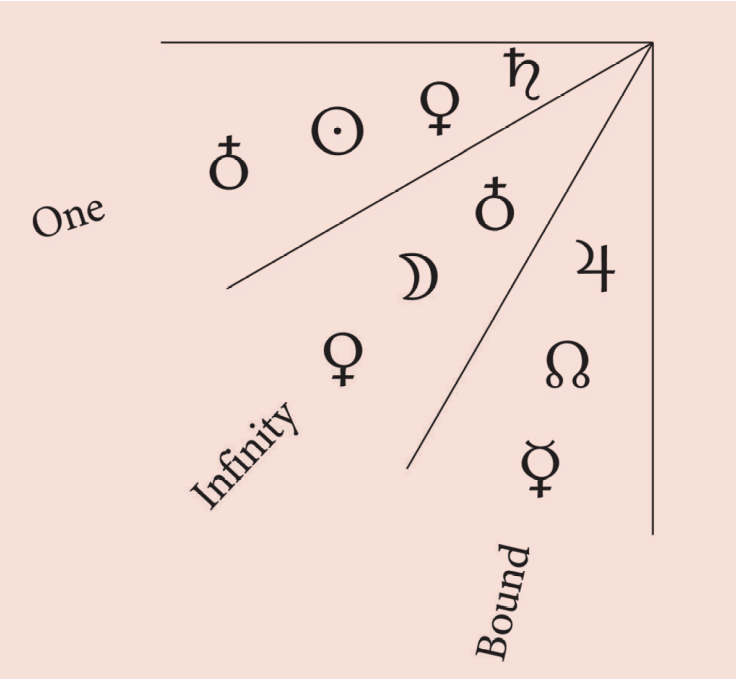
Class
Friday, April 16th, 1982
Verbatim, unedited transcriptClick the series name to view more
CLASS at Wisdom's Goldenrod, Hector, NY
with Anthony Damiani (AD)
April 16a, 1982
PLOTINUS: ONE
TOPIC: Plotinus
SUBJECT: One
SUBSUBJECTS: Astronoesis Working Draft ("The Unity, the Paradigm of Paradigms"), Power, Participation, Transcendent and Immanent, Intellectual-Principle
CONTENTS:
Reading Plotinus, VI.9.6
Reading/discussing AD paper, "The Unity, the Paradigm of Paradigms"
Identity of Being and Consciousness in the One; Nirguna Brahman not without qualities but beyond qualities
Discussion of how Unity can be both complex and distinctionless
Comparative philosophy vs. intuitive understanding; comparative philosophy as sport
Can't import quantity into understanding of the One
If Being is complex, Unity is even more complex; infinity a positive concept
Cosmic mandala as product of intellectual imagination; formulated by reason-principles, not shepherds
More discussion on how Unity can be both complex and distinctionless; One as transcendent and immanent; highest view doesn't exclude other views; example of reintegrating manifested lion into species lion
Astrology as meta-language operating with emblems of things; contrast with analytical philosophy and "Newspeak"
Power as infinite and immeasurable; as undivided from the One
Discussion of dualism vs. illusion problem; resolution through Power being synonymous with the One
Brahman and Shakti (not Maya) as cause of world
Power establishes levels of reality and henads (unities)
Relationship between Power and essence of the One
Double nature of Power (identity with One and infinite extension/indeterminacy)
Source of categories of Being in the One
Creation the result of One's super-abundance; One remains unmoved; comparison to Lao Tzu's thought
Guenon: it is we who conceive of the Infinite under different aspects
Plotinus, VI.8.16: self-originating self-tendance of the One as Act and repose
BOOKS / ARTICLES READ FROM OR REFERENCED:
Plotinus, The Enneads (MacKenna translation, 4th ed.)
John N. Deck, Nature, Contemplation, and the One: A Study in the Philosophy of Plotinus
Swami Nikhilananda, The Mandukyopanishad with Gaudapada's Karika and Sankara's Commentary
Rene Guenon, The Multiple States of Being
Plato, Parmenides
Gilbert Durand, "The Image of Man in the Occulted Tradition of Western Culture" in Spring 1976: An Annual of Archetypal Psychology and Jungian Thought, James Hillman (Ed.)
George Orwell, 1984
T. Subba Row, Esoteric Writings, "The Twelve Signs of the Zodiac"
Shrine of Wisdom (1923, No. 18), "The Simple Way of Lao Tzse"
PLOTINUS QUOTES READ OR REFERENCED: III.8.6, V.3.17, V.4.1, V.4.2, V.5.11, VI.7.36, VI.8.16, VI.9.1, VI.9.5, VI.9.6, VI.9.11
DIAGRAM appended to this transcript:
- FIGURE 1982 0416a-1. Triad.
This diagram is from Astronoesis, p. 58. [Transcriber note: [diagram] means the speaker is referencing a diagram as he or she is speaking. If someone is drawing or writing, with audible sounds of chalk on a blackboard, I indicate this by [drawing] or [writing].]
AD PAPER read in class:
- "The Unity, the Paradigm of Paradigms". The paper as read in this class has been retyped as 1982 0416b V09M. Astronoesis - One - Plotinus. It is an early draft and is published in a different form in Astronoesis. There it is primarily found in the chapter on the One, with a few fragments found in the Invocatory Prelude as well as The System of Nature.
NOTES:
- This is 1982 04/16a, Plotinus: One Class, and the first entry associated with this date. 1982 04/16b = The Unity, the Paradigm of Paradigms Paper.
TRANSCRIBED Verbatim by IT 2021. Archival verbatim transcript with AD Paper – V11ap.
AUDIO FILES: 1982 0416a. [Note 1: "Tape" and "Side" refer to original audio cassette tapes that were later digitized into .MP3 Audio Files. Note 2: We only have the first audio file for this class, we are missing the second.]
1982 04/16a at Wisdom's Goldenrod
Plotinus: One
[Audio File 1982 0416a Begins]
AD: (We will) just read (part of) the quotation. And this is from VI.9.6. And Plotinus says--
Plotinus [VI.9.6, AD reading]: "In what sense, then, do we assert this Unity and how is it to be adjusted to our mental processes?
"Its oneness must not be belittled to that of [AD adds: the] monad and point: for these the mind abstracts extension and numerical quantity and rests upon the very minutest possible, ending no doubt in the partless but still in something that began as a partible and is always lodged in something other than itself. The Unity was never in any other and never belonged to the partible: nor is its impartibility that of extreme minuteness; on the contrary it is great beyond anything, great not in extension but in power, sizeless by its very greatness as even its immediate sequents are impartible not in mass but in might. We must therefore take the Unity as infinite not in measureless extension or numerable quantity but in fathomless depths of power.
"Think of The One as Mind or as God, [AD adds: and] you think too meanly [AD adds: of it]; use all the resources of understanding to conceive this Unity and, again, it is more authentically one than God, even though you reach for God's unity beyond the unity the most perfect you can conceive. For This is utterly a self-existent, with no concomitant whatever. This self-sufficing is the essence of its unity. Something there must be supremely adequate, autonomous, all-transcending, most utterly without need."
AD: Alright, I think that's enough for now. Quote VI.9.6. I suggest you read these quotes in their-- in their entirety, even though I don't do so. Alright, suppose we read this, Avery.
[11¼ second pause]
[Transcriber note: The following paper is an early draft and is published in a different form in Astronoesis. There it is primarily found in the chapter on the One, with a few fragments found in the Invocatory Prelude as well as The System of Nature. I do not have access to it, quotes need to be checked. I transcribe it as AS reads it, including any alterations made during rereading.]
AD Paper ["The Unity, the Paradigm of Paradigms," AS reading]:
"The Unity, the Paradigm of Paradigms
"The philosopher-sage enunciates the Logos, and the knowledge that he communicates is primarily Wisdom. He is required to be precise within the given structures, the cultural mores that he operates within, although he stands outside these forms. So it is only natural and first in the order of importance that we should concern ourselves with his remarks about the existence of God, the One-Only. In this Ennead, VI.9.6, he does just that. He describes the essential characteristics of the One-Only. It would, however, be misleading and incorrect to speak of characteristics and attributes of the One except in this very strange and mysterious way. And we hope to unfold in what way we can speak of these characteristics of the One as we proceed.
"In this tractate he indicates the utter self-sufficiency by which he means its completeness and the only Perfection. Sufficient and complete in itself, it is beyond any limitation, duality of any kind, dependence or need. Nor does this transcendence mean a blank homogeneity, zero, but unlimited actuality. The One is so complex in its unique and undifferentiated simplicity as to encompass all in its universal essentiality. It is absolute positivity. Its self-existence is a pure be-ness and a super-intelligence inbound with the totality of possibilities. Perhaps it might be more meaningful and provocative to say it is pure intelligence or better still, all-intelligence.
"The One is referred to as an eternal wakefulness, wakefulness or a consciousness which cannot be separated or distinguished from the totality of all its contents even though there is a self-distinguishing throughout in a mode above intellection. [Note: See Plotinus, V.4.2.] From Deck's book, Nature, Contemplation, and the One, we quote his version.
"…the One is called an eternal super-knowledge:"If, now, its [the One's] act does not become but is always, and is a kind of wakefulness which is not other than the one who is awake, being a wakefulness and an eternal super-knowledge, it will be in the way it is awake. The wakefulness is beyond being and Nous and intelligent life; the wakefulness is itself." [Note: See Plotinus, VI.8.16.] A wakefulness which is a super-knowledge, or a wakefulness which is above knowledge? (John N. Deck, Nature, Contemplation, and the One)
"Mr. Deck, a sincere and discriminating devotee of the sage, tends to identify the wakefulness with its super-knowledge. And he goes on to state:
"…Plotinus goes on to say that the One is"not, so to speak, imperceptive, but everything of it is in it and with it [i.e., it is entirely self-contained]; it is entirely self-discerning; life is in it and all things are in it; and its self-knowledge is itself, a self-knowledge by a kind of synesthesis being in eternal stasis and in a knowledge otherwise than knowledge according to the Nous." Thus knowledge, which appears in a way in nature, more fully in soul, perfectly in the Nous, is not absent [AS adds: either] from the highest "nature," the One: the continuity of knowledge is not abruptly broken in the ascent from the Nous to the One. (John N. Deck, Nature, Contemplation, and the One)
"Mr. Deck's concentration is intensely and sharply focused into the true meaning of the One. It is a magnificent exposition of the master's teaching in positive terms. He has seized the jugular vein of the doctrine when he says further"the self-identical synesthesis of the One can be a super-knowledge in a positive sense."
"The quotation from Plotinus repeats and affirms the identity of wakefulness with existence. It is reemphasized when he says"it will be in the way it is awake". We'll amplify more fully as we go along that all the contents of this super-intelligence can share in the above description. The intuitive perception of Being and essence reduces the discipline of comparative philosophy to anthropology. There are no new truths in philosophy. When we work our way through the ego's psychopathology, we will simply rediscover them."
RG: Hm. (bit of laughter)
S: Rational.
AS: Ok?
AD: No, no, no, finish that (other--) yeah finish the thing up to the numbers.
AD Paper ["The Unity, the Paradigm of Paradigms," AS reading]: "The resulting experience of the flight of the alone to the Alone [Note: See Plotinus, VI.9.11.] is here being articulated by Plotinus. The similarity with that of the unknown Indian sage, the author of the Mandukya Upanishad, will be attested to by quoting the seventh Karika.
"Turiya is not that which is conscious of the internal (subjective) world, nor that which is conscious of the external (objective) world, nor that which is conscious of both, nor that which is a mass [AS adds: (for/or)] all sentiency, nor that which is simple consciousness, nor that which is insentient. (It is) unseen (by any sense organ), not related to anything, incomprehensible…uninferable, unthinkable, indescribable, essentially of the nature of Consciousness constituting the Self alone…" (Swami Nikhilananda, The Mandukyopanishad)
AD: Oh you're finished? Alright the rest was it's the "negation of all phenomena, it's Non-dual and it's all Bliss. This is the object of knowledge." Ok, that's the end of the quote. [short pause] You have any difficulty with this?
S (faint): Yeah.
S (very faint): (Do you want to--)
S (very faint): (No.)
AD: Can you speak up?
S (faint): Can you please just go over what exactly you mean when you say "it will be in the way it is awake". I have a hard time with that. What you're trying-- are you trying to establish the-- I don't understand what you mean.
AD: Well, "being" would refer to some kind of existence.
S: Right.
AD: And "awake" would refer to some kind of consciousness. And then he goes on to identify them. Being and this wakefulness are supposedly two attributes. But they're both identical with each other so there's no difference between that and the super-knowledge of the One.
[short pause]
S (faint): In other words the-- the One has a special kind of knowledge. Is that what you're trying to say?
AD: No, I'm not trying to say that. I'm trying to point out that in that quotation by Plotinus, when he says that you are in the way you are awake, he's identifying Consciousness and Being. [short pause] Like when the Hindus or the Vedantists speak of Brahman as Sat, Chit, and Ananda, alright, let's forget the Ananda.
S: Yeah. (bit of laughter)
AD: Brahman is Sat [AS, faint: Easy to (blame him).] and Brahman is Cit. That means-- that means that Brahman as Sat is Being and Brahman as Cit is Thought. And Sat and Cit are identical with each other. So then Brahman is both Sat and Cit, there is no difference between Brahman and Sat and Cit. So what we're saying, insofar that you say Being is Sat and Cit is Consciousness, alright, and they're both identical with each other, he did-- he's declaring the Nirguna Brahma. He's speaking about Brahman as being without any qualities. Not that it doesn't have qualities but it goes beyond all qualities.
S: So it's distinct-- there's the-- there are distinctions in the One.
AD: No, there are no distinctions. Yeah we just-- [VM simultaneously, faint: (It's) complex.] we just dissolved them. If we said that the Brahman or the One is meta-- is infin-- infinite, then one of the so-called characteristics of this infinity is that it's all-knowing. Another characteristic of this One is that it's all-Being. Now what is the distinction between all-knowing and all-Being? When he says, when he says that it is in the way it is awake.
S (faint): Doesn't that erase them?
AD: Yes, he's identifying them. Well then, this is what they refer to as Nirguna Brahman, Brahman without any qualities. And I think you have to be very careful when you say without any qualities that you're speaking about a blank. You're speaking about something which goes way beyond any qualities. It transcends qualities. It'll include them, it won't deny them. It'll include them but go way beyond that. [short pause] Did you have something?
VM: Well, I don't know Anthony, it's a question that I've had before and I guess it's in some ways the inadequacies of language but, you say that there are no distinctions in the One or it's distinctionless. Yet, in the same paragraph essentially you also underline its complexity or emphasize its complexity. And so, these paradoxical statements are hard for me to synthesize and maybe that's because they're impossible to synthesize from the kind of dualistic consciousness that we normally work with. [short pause] So, [RG/S(?), faint: Yeah.] I mean-- [S: Ok. (bit of laughter)] You're not going to try and synthesize them, you say well that's the way it is.
AD: Well--
VM: But can you bring meaning to the thing that-- can you bring meaning to the juxtaposition of the notion of distinctionless and complexity. Now I know we can-- you could lay out the first quadrant [diagram], you could put down ten unities [AD simultaneously: No, no.] and so on and that's enormously complex. [Note: See FIGURE 1982 0416a-1, Triad, appended to this transcript. This diagram is from Astronoesis, p. 58.]
AD: No, we're trying to avoid that, we're trying to just engage in discourse, we'll-- we'll get to the chart soon enough.
VM: And also to be very honest, from that quote that you read, I didn't really see a direct reference to complexity. He did speak about fathomless depths of power. Well there's complexity in there. I mean if I look at it more closely it's in there.
AS: Well, he says--
AD Paper ["The Unity, the Paradigm of Paradigms," AS reading]:
"…it is entirely self-discerning; life is in it and all things are in it…"
AS: By identity.
AD Paper ["The Unity, the Paradigm of Paradigms," AS reading]:
"…the One is"not…imperceptive, but everything of it is in it and with it…it is entirely self-discerning; life is in it and all things are in it; and its self-knowledge is itself, a self-knowledge by a kind of synesthesis being in eternal stasis…[S: Yeah.] knowledge otherwise than…"
VM: Well that certainly speaks to the complexity of it, yeah.
AS: Yeah I don't think the depths and complexity of it could (be) split up but if all-- if everything is it--
VM (simultaneously): If all things are in it then obviously it's complex.
AS: Everything is in it then it couldn't be any more complex. On the other hand if they're not in it as distinct, [VM simultaneously: So that doesn't mean--] then it's distinctionless.
RG: Right, then it's good.
AS (simultaneously): I mean if you went in there, meaning that if you were to go in there would you see any distinct thing.
VM: If you say no then how can you assert that everything is in it?
AS: Because it's totally self-sufficient. Can't be anything outside it.
AD (simultaneously): Well, only when-- only when-- only when the Sage comes out of the silence is he capable of articulating this knowledge. It's not when you're in the silence. I thought we could just say that, we made that very clear that it precludes any kind of knowledge in the [VM/S(?) simultaneously: (Yeah/Sure), sure.] sense that we understand it. Yes David.
AS (simultaneously): But I think--
DB: And, could you speak of it-- then you speak of discerning of the One, that's not one of its aspects. In a sense that self is very-- can be looked at as being-- You know, one way of looking at the One in its entirety as insofar as revealing pure unity, that self-discerning does not have a separate object. Insofar as it doesn't have an object which it's discerning, insofar as it's self-discerning, it's distinctionless. I mean it seemed to point to the-- the infinitude of the interrelationships implied by this fathomry-- fathomless depths of power. I mean, if you-- In a sense if it wasn't paradoxical it wouldn't be the-- it wouldn't be One.
S: Right.
AD: [couple/three words inaudible] [short pause] Any other difficulties?
VM: Yeah, I didn't understand the reference to anthropology. It seemed like a-- not a very, you know, major issue.
AD (simultaneously): I want--
VM: But I'd kind of like to hear the little skirmish.
AD (simultaneously): I didn't want to say-- I didn't want to be impolite so I said anthropology instead of saying sport.
VM: Oh sport.
AD (simultaneously): But there's a discipline today called comparative philosophy. [VM: Uh-huh.] And, in these dis-- in this discipline they go through this enormous discipline and training on how to study philosophy, alright, and that if you study different systems of philosophy in different parts of the world, alright, you have to have this, alright, enormous academic apparatus, you know, language at your disposal, this, that and the other thing. And all I'm saying, that's alright for academic comparative philosophy. But there's another way of looking at comparative philosophy, and that would be that if you can intuitively perceive the essence of what someone is saying, you know, in this case we took the Mandukya and we took the Plotinus, and we got underneath all the verbal and cultural mores of the One and we got right to the point, it's like an intuitive perception of what essence is, whether it was in Mandukya or Plotinus. And the consequence of that is that comparative philosophy becomes a kind of sport, you know. It's like creating another agency so that we could have more people working. I don't see it as philosophy.
VM: Alright.
AD: Ok that's all. It's just my nasty Virgo coming out.
VM: Yeah I thought so but I always enjoy it.
S (faint): Yeah.
AD: You know, because I read some of these things and they're-- [VM simultaneously: And they're discouraging.] they're really sometimes--
VM: It's discouraging.
AD: They go to the point where they're utterly ridiculous.
VM: Yeah, they know Greek and they know Sanskrit [AD simultaneously: Yeah.] but they don't understand either lang-- either doctrine.
AD: Well I understand the difficulty. But maybe as go along and we try to show how Unity can be so complex and yet be Unity-- The whole point-- one of the major points here is, get out of your mind this notion that Unity is something that you could let's say represent by number or spatial point or an analogy from the chemical elements, you know, like this is iron and nothing but iron. Those all have to be abolished so that you can get to an understanding of what Unity is. And, the other thing we have to do is remove your notions, you know, that you come with as to what Unity is. And you pointed out, in the response that I was trying to make to Richard once which didn't succeed, that if we start with the Unity as all-intelligence and as we come down the ladder of being, that all-intelligence seems to be spread out, it gets more and more discontinuous, spreads out, alright, till you reach the level of Nature [student assents, very faint] where you do have intelligence. But, it's an intelligence that's functioning below sensation, imagination, or any of the gnostic functions, but it's still intelligence. There there isn't no self-consciousness of what it's doing or anything like that. In the Nous or in the soul there would be (a rise in) sense. But notice, notice that as you approach the One, the more concentrated, the more gathered together is this intelligence that he speaks about. So it gets-- it's like a pyramid, you know, at the base it's very wide but at the point it-- point of the pyramid it be-- it pyramids at the point. It's all concentrated in that one point. And this is the way I think Plotinus was speaking. Alright let's continue with the paper.
AD Paper ["The Unity, the Paradigm of Paradigms," AS reading]: "Consequently, as Plotinus makes clear,"its simplicity is not that of a spatial point nor a quantitative unit to be enumerated with others, and its impartibility is not that of minuteness but of greatness." (Plotinus, VI.9.6) The negative descriptions of the Unity as beyond determinations or limitations in Plotinus and elsewhere should not be taken as a lack but as going beyond any possible synthesis of all essences. In this sense the Unity is beyond God or Mind or Being. Total affirmation is not only beyond any particular determination or the totality of all essences but is itself the Alone. Keeping in mind the reference here to the One as infinite, we can justify an excerpt from Guenon's Multiple States of Being, where he says:
"The infinite, on the contrary, if it is to be such, must admit of no restriction, which supposes that it is absolutely unconditioned and indeterminate, for all determination is necessarily a limitation simply because it must leave something outside itself, namely all other possible determinations. Limitation, moreover, presents a character of real negation. To set a limit (AD handwritten insert: and Being does; AS reads this as: and Being for example does this) is to deny to that which is limited everything that this limit excludes. And the negation of limit is in fact the negation of a negation, which is to say, logically and mathematically, an affirmation. Therefore the negation of any limits is equivalent, in reality, to a total and absolute affirmation." (Rene Guenon, The Multiple States of Being)
AD: Do you follow that now? See now, if you think of the One, or if you think of the Unity or the Simplicity, if you import into your understanding any of the quantitative ways of understanding, alright, you immediately would be setting a determination or a limit on the infinity of the One. You'll be saying it must be of one kind. As soon as you said that it's no longer infinite. So you can't-- you can't even speak of it as a genus of any kind. You-- it's-- it's, you know, prohibited by the very nature of what you're talking about.
VM: The same would be true if you said it's purely simple and didn't emphasize its complexity, you leave out all the possibilities of complexity.
AD (simultaneously): Yeah. And purely simple is going to be translated or transposed into some quantity, some kind of quantitative thinking. Purely simple. So you say well water is simple, water is water. That's what he means? No that's not what he means.
RG: I-- I don't understand.
AD: You don't understand?
RG: Well-- no not really.
AD: Yes you do!
RG: I do?
AD: Sure you do.
RG: Well-- ok. (bit of laughter)
S: You do.
AD: Now if you don't understand try to explain your-- what you don't understand.
RG: I could do that. (RG laughs a bit) But that doesn't mean I understand it. You're-- the example of thinking "simple" and then equating it with something other than a metaphysical idea is-- holds just as much for complexity. I mean, the-- stripping the mind of the concepts of-- of numerical unity or quantity doesn't grant-- seem to grant the necessity to think of the One as also complex. It just seems to strip the concepts of its false attributes below metaphysics.
S (faint): Yeah.
AD (faint): Well keep talking Richard, (I have experience) of what you think.
S (faint): Yes.
AD: Go ahead, try it (again).
S (simultaneously, faint): [couple/few words inaudible]
VM (simultaneously): I just didn't understand you Richard, try it again, I didn't get it either.
S (simultaneously, faint): Yeah.
RG (faint): Wait a minute.
AD: I mean that-- that would go without saying that--
RG: Let Avery state it over. Let Avery say it, he understands.
AS: No, no, no, do-- you do it again.
RG: No, no, but he won't understand it if I [AS simultaneously: Sure he will.] say it. If you say it he'll understand [one/two words inaudible]
VM (simultaneously): So-- but that's the same point Richard.
AS (simultaneously): Go on Richard, just do it again. (bit of laughter)
RG: I mean, you said-- well, you can't think of the One as really the quantitative ideas of simplicity and unity. For sure. I mean--
AD (simultaneously): Alright, that's quite a secondary point, yeah.
RG (simultaneously): No, ok. But insofar that you don't do that or you-- and you try not to, does that mean that the-- this concept of complexity will arise naturally of the One as complex?
AD (simultaneously): Oh no.
RG: No it-- But, I don't see the necessity for it.
AD: Well, you don't see the necessity--
RG: For including the concept of com-- complexity from this analysis, from this way in. In other words, I don't see why you can't hold that all the complexity is just say in Being, even in-- I mean--
AD: But then if all the complexity is in Being, and Being is something which it transcends or even includes that, then you would have to say that it too is complex. [RG: What if--] Certainly if Being is complex insofar that it had the multiplicity of Intelligibles in Intellect, alright, the One will be-- which is beyond that and which is the source of that is going to be even more complex.
RG: No but you see-- alright, but that-- that's where my problem is. By-- by saying it's the source, I don't see any necessity to say that it too is complex. It could be the source as Unity, to the unity of Being, but insofar that Being is itself an eternal principle, I think you can hold that the eternal complexity exists within Intellectual-Principle and not necessarily within the One.
S (faint): Well--
AS: No but-- Duality.
PD/S(?): But wouldn't that--
AS: Sure you do. You have the One which you said is simple, has no complexity at all, and you have Being which has all the complexity. [RG simultaneously: From the point of view--] And they're eternally separate.
RG (simultaneously): From the point of view of Being yet you have-- you have duality, from the point of view of the Unity you can't even ask that question. 'Cause you're [AS simultaneously: I don't follow.] standing in the source. And from the point of view of the source the effects don't look like anything else.
VM/S(?) (simultaneously): But a source other than the effect.
AD (simultaneously): What would it--
RG: No, not from the point of view of Unity.
AD (simultaneously): Let's try this way, let's try to approach it this way. Be-- in Being, in the Intellectual-Principle, there is Being. In the One, alright, it has to go beyond Being. In the Intellectual-Principle there is Life. In the One, there's more than that Life. It's an un-- even an unused Life, alright, and with each one of the so-called Ideas that-- or Intelligibles we find in Being. Now if-- if we say there's more of Being, or that Being is universal, [S, faint: Yeah.] unlimited, in the One, then you're not reducing its complexity, you're-- you're just making it unconditional and immeasurable. What I'm trying to say is that infinity is a very positive concept. Now again, let me repeat because this-- When they say for instance Nirguna Brahma is without qualities, I say no, for us that is the wrong way to explain it! Brahman is not without Being! Being could be extended in-- infinitely in Brahman. [student assents, very faint] So it's not without qualities. It's more than qualities. [student assents, faint] If you can see this, then why can't you see metaphysical infinity as the consequence of this? [RG(?), faint: Well (I do).] And of an extreme complexity.
[short pause]
VM: I can't hold onto it and metaphysical Unity at the same time and that's a problem. I know but if you say extreme complexity and the fullness of Being really obtains in the One then it's hard-- well, at least to my limited kind of thinking, it's very hard then to hold on to the Unity.
AS: I don't think Richard's arguing from a logical point of view, I mean this-- I mean you're not-- you're on this-- you're not denying of the One in-- the infinity.
RG: No, not at all.
AS: In other words, you're just--
RG (simultaneously): I'm not. Yeah.
RC (faint): I think this is where they call it a paradox now in this contradiction [one/two words inaudible]
S (very faint): Uh-hm.
AS: Uh-hm.
RG: But we have [S simultaneously, faint: Sure.] to come to this par-- But would you grant me that we have to come to the paradox through a rational form?
RC (faint): Yeah.
RG: Ok, well I-- I have-- I'm not there yet. Once-- once-- once you take me there with the paradox then I'm alright.
AD: Alright, then let's try further on. Alright, let's try further on.
AS (faint): Ok. "If…" Want to read a little?
AD (simultaneously): Yeah, let's read a little more.
AD Paper ["The Unity, the Paradigm of Paradigms," AS reading]: "The One is not, therefore, an abstraction from other principles."
AS/S(?) (faint): One second.
S (very faint): Yeah.
AS (faint): I'm just going to--
AD Paper ["The Unity, the Paradigm of Paradigms," AS reading]: "Rather on the contrary, they are divine outflowings from its super-abundance of Perfection. These later principles are all dependent but the One depends on none. For any principle or being to be at all, it must first be a unity. So the first principle of all principles is Unity itself. We can speak of it as One-Only because from the view of the One, there really is no other view at all."
[short pause]
AS (faint): We've read the last one. But we didn't read the-- read the last sentence of Guenon but--
AD Paper ["The Unity, the Paradigm of Paradigms," AS reading]: "For Plotinus, non-duality does not preclude the possibility that the unity of every principle is already included in the super-knowledge of the One. But we will have to understand in what precise way this is so. When our mind tries to grasp this ultimate paradox of pure Perfection and infinite immanent actuality, it may burst its limits. Yet in fact the very contact with the One, the touch of the Untouchable, is the goal. This is the grand learning, the learning of the One which Plotinus speaks of--[Note: See Plotinus, VI.7.36.] that is, to cut away everything. [Note: See Plotinus, V.3.17.] In a flight of the alone to the Alone, [Note: See Plotinus, VI.9.11.] Plotinus is inviting us to an ascent, which is the only possible way where we can finally understand without understanding. It is clear that no symbol is apt to this Absolute. But since we must speak of it, there is a certain rough fitness in designating it as Unity, [Note: See Plotinus, VI.9.5.] the nearest we can conceive it. You cannot have it without falsifying it. And yet you cannot speak of it at all if you do not use some symbol to point to it. And here he does endeavor to reveal something of its nature. We feel that on this point the silence of Buddha or Christ should not be taken agnostically but perhaps pedagogically. Or in times and circumstances such as our own it may be even more harmful to refuse to speak of Unity or God, for it invites the intellectual skeptics to assert that even the sage cannot know Truth, he has not experienced it.
"But the knowing it and expressing it are two things. Plotinus himself says that the sage is all-vision within himself, filled with the Intelligible contents of the Nous, and yet must use reason in his expression of reality to others. [Note: Plotinus, III.8.6.] Plotinus does just this and his comprehensive and explicit exposition shows us how much this reasoned revelation can reveal, keeping in mind of course that the experience of the Void or silence and the intellectual articulation of it must be kept separate.
"In our attempts at understanding Plotinus we will use a symbolism which we have indicated in our Introduction. It is our belief that the cosmic mandala is a residue or fragment of a divine wisdom, probably a product of the intellectual imagination, guiding and including which is a formulation of the reason-principles which it includes."
AD (faint): You want to stop there?
VM (faint): Last sentence again?
S (faint): Yeah.
AS: I'm sorry. Probably-- Sorry.
AD Paper ["The Unity, the Paradigm of Paradigms," AS reading]: "It is our [AS reads: a] belief that the cosmic mandala is a residue or fragment of a divine wisdom, which is probably a product of the intellectual imagination, guiding and including which is a formulation of the reason-principles which it includes."
VM: I don't understand just the grammar [S simultaneously: Yeah.] of the last few sentences.
AS/S(?) (simultaneously): I don't think so.
AD: I just put it in.
AS (simultaneously): I (can't/can) hardly read that line.
AD (faint): I just don't know if I--
AS: Hard to read. He's just saying that this-- this cosmic mandala is the wisdom-- is a fragment of the wisdom which-- and it is probably-- the cosmic mandala is a product of the intellectual imagination.
VM: That's fine but then they--
AD: Now you remember the intellectual imagination is the [one/two words inaudible] the soul powers [VM simultaneously, faint: The last of the soul (powers).] operates on the reason-principles. And I'm saying that the-- the cosmic mandala or the chart is a product of it, it's an archetypal imagination. [S: That (does--)] And, that it not only includes the reason-principles, it is guided by those reason-principles which it includes.
VM: Now that's the part, yes.
AD: Well, need an explanation? [short pause] Well just [one/two inaudible student words simultaneous with AD] try to read it. If you read a chart, [AS simultaneously: Oh I'm sorry, yeah.] alright, what are you reading? You're trying to understand reason-principles that [VM assents, faint] are being manifested.
VM/S(?): Sure.
AD: Alright? But in order to be able to do that it takes the reason-principles to formulate a chart that will guide you in doing that. So on the one hand reason-principles go into formulating a chart and on the other hand the chart helps you to read the reason-principles. And I'm saying it's not a product of shepherds sitting out on a rock and counting the stars. I didn't want to put that in because that would be the shadow battle.
S: This is nicer, yeah. (bit of laughter)
HS: So your use (would be) the phrase "cosmic mandala" is the chart that we-- that we use or-- or I thought it might-- Well one way I see this, before you said that that might be the universe itself. But, you're not using it in that-- in that way (there).
AD: I'm using it exactly the way I said it.
HS (faint): Ok.
AD: It's a product of the archetypal imagination, which means it's a clairvoyant vision of how the imagination, the intellectual imagination, understands its own functioning.
HS: So, the chart itself--
AD (simultaneously): And we have a reproduction of that in terms of symbols.
S (very faint): (Uh-hm/Yeah).
AD: Just stop and think, it's nothing profound.
S (faint): I didn't say it was.
HS (faint): This is very profound. It as-- as [couple/three words inaudible]
AD: It is what?
HS (faint): This is quite (profound), it is [couple words inaudible]
[short pause]
AD: Where do you think it came from? [short pause] I know Mr. Rudhyar says the shepherds brought it (out/down).
S: Well he forgot to say the shepherds are all sages too. (laughter)
VM: I thought they did learn.
S: That's [S simultaneously: Right.] right but--
S (very faint): [few words inaudible] (bit of laughter)
RG: Ok.
AD (faint): But I thought that was these shepherd(s), (the existence--) supposition that I'm working (on/out). (bit of laughter)
AS (faint): Does not apply. (some laughter)
AD (faint): Well, we're going to need this part, we're going to need this for instance tomorrow when we speak about the imagination, or the archetypal imagination. [Note: See WG Class 1982 0417a.] Alright but-- but it's (obvious) [three words inaudible] (not going to do it). Alright, but up to here?
S: Avery, could you-- [AS: Yeah.] could you go back a couple pages to-- at one point talked about the-- the One as being the principle of unity.
AD Paper ["The Unity, the Paradigm of Paradigms," AS reading]: "For any principle or being to be at all, it must first be a unity. So the first principle of all principles is Unity itself."
AS: Well?
S (faint): Yeah.
AS: For anything to be it must first be a One. [S, faint: So is--] He (said/says).
S: In other words, is the-- this participation in oneness that seems to transcend all that enter all of this?
S (faint): Yeah, uh-hm.
AS: Yeah I mean--
RG: And insofar that it does, [three inaudible AS words simultaneous with RG] and that logic demand that you're putting the complexity in the Unity also? It demands that Unity as its prior?
DB (faint): Isn't-- isn't it at all a question, Richard, of [AS, faint: Ok.] (saying it--)
RG (simultaneously): Excuse me, could I-- go on.
DB: Forgive me.
RG: I mean, I asked-- go ahead.
AS: Forgive him. Well I think that what it's-- I think he's saying that all of the beings are already pre-included in the One. In other words, before something is a being it's first a unity.
RG: Right.
S (faint): But it is--
AS: And that means the being comes out of the unity and is already included in it.
S (faint): Yeah.
AS: Right? I mean that's the other way of saying. You're taking the being is here and the unity is someplace el-- no.
RG: Yeah, well--
AS: In a way you are.
RG: But he seems to be making a principial difference in his idea of the One or the way, you know-- from my reading of it.
AS (simultaneously): Between?
RG: Between the One as Unity, he uses the word 'Unity', and any other differentiation, complex, being, whatever.
AS: No but-- See the problem is that he makes clear a lot of times that by Unity he doesn't mean a numerical one.
RG: Well I'm not saying numerical.
AS (simultaneously): Ok. No but then-- or-- or any-- or sim-- what-- then what does he mean by Unity?
RG: What does he mean by Unity?
AS: Well that's what I think the pa-- the first part of the paper is trying to understand, what exactly he does mean by absolute Unity.
RG (faint): Right.
AS: And I think it's saying that he's trying to make clear that he doesn't mean any of our conceptions of what unity sh-- what we normally think of as unity. 'Cause every time you try and express it you keep saying well, doesn't-- shouldn't it-- shouldn't it exclude--
AD (simultaneously): Shouldn't it be a homogenous blank zero.
AS (simultaneously): Yeah, just what we said, is it--
RG (simultaneously): No!
AS: Should--
RG: No.
AD: Well what-- well then-- then what is Unity?
AS (simultaneously): Or shouldn't it exclude by being-- You're saying by being beyond--
RG (simultaneously): I don't see why you-- why you say if it isn't complex [few words inaudible]
AS (simultaneously): Richard, Richard, the point-- no, no, the point is this, if it's beyond all determinations--
RG (simultaneously): That itself is a (complex/conflict).
AS: There are two ways it can be beyond determinations, either to exclude all the determinations or to go beyond them as including them all in some transcendent way. [BS simultaneously, faint: Excuse me, why do you have to--] I mean that's part of the logic of that-- the Guenon quote, that by excluding limitations or being beyond limitations, doesn't mean that well here, Unity has been extracted now and we'll leave the limitations behind somewhere. It can't be behind anywhere because if they are, then we're back at that whole problem. Either we've got a) an unreal appearance, because ultimately when you get to the One you're going to exclude those, or b) you're going to have an absolute duality.
RG: No, no, but the Intellectual-Principle is a real principle, it is not illusory in any sense of the word.
AS: Exactly. But is it illus--
RG (simultaneously): Therefore--
AS: But is it separate from the One? In a way it is and in a way it isn't.
[someone drawing]
RG (simultaneously): In a way it isn't, that's right.
AS: And how is it not separate from the One?
RG (simultaneously): But it-- but the argument about illusory doesn't exist because the Intellectual-Principle is a real eternal principle.
AS: What?
RG: The argument about whether the distinctions are illusory is answered by the existence of Intellectual-Principle.
AS (simultaneously): But, he's also a non-dualist, right? So what does that mean? On the one hand you're saying well, the Intellectual-Principle is a real existent.
RG (faint): Ok.
AS: But not outside of the One. A real distinct principle within the One. And that means that Being is included within the One.
RG (faint): In some way.
AS: In some way, yeah, because otherwise you're going to have duality. You have to have both views.
AD (simultaneously): This is what you must avoid, you've got to avoid this.
RG (faint): What is it, what is it?
AD: Unity, alright, is not A here, well, excluding B. Unity includes B.
RG: But how?
S (simultaneously, faint): Yeah.
AD: Well that's what we're trying-- [AS simultaneously: We're trying-- yeah.] that's all we're trying to explicate as we're going along.
RG: Well I'm lost already. (bit of laughter) I mean I'm-- it's only going to get worse from here, I mean if--
AD (simultaneously): No, no. It should get-- it should get more difficult, not worse. (some laughter)
RG/S(?) (faint): Is that so? (some laughter)
AS: Richard, where does Being go to when you--
RG (simultaneously): Nowhere. Nobody every claimed it-- it went anywhere, it stays where it is.
AS (simultaneously): Right. It-- neither does it-- Well, if it stays where it is--
RG: "Where", come on, it's--
AS (simultaneously): Right, ok, I'm just--
RG (simultaneously): It is-- it is the Intellectual-Principle, it does-- those questions don't apply to it as it doesn't apply to the One.
AS (simultaneously): No not by "where", that's not quite what I meant, I mean what-- what happens to it when you try to conceive of Unity?
RG: Nothing.
AS: You either have to resolve it back into the One [RG: Why?] or you have-- Why?
RG: Why can't it exist--
AS: You don't have to have a view of non-duality as well?
RG/S(?) (simultaneously): It's (irrelevant).
RG: From the point of view of the One, a pure unity, you might. But why from the point of view of Being are you demanding it?
S (very faint): No.
S (faint): Uh-hm.
AS: But I thought we made the point that from the point of view of Being even you'd have to conceive of the One (it seems) in two ways.
RG: Yeah. The two ways being?
AS: One as transcendent.
RG: Right.
AS: And the One as immanent.
RG: Ok, now, in both those ways, you're going to have the same problem. Transcendent and immanent. Immanent--
S: Yeah.
AD: Well I think we can show how it's [RG simultaneously: Ok.] immanent when we speak about the indeterminate Dyad or the Power of the One as being identical with the One and also flowing out from the One and yet not different from the One. So that when we speak about the Power as identical with the One we're speaking about Self-Existent or the One as transcendent. And when you speak about this Pow-- Power flowing out from the One you're speaking about it as immanent and that you cannot possibly grasp the two positions at the same time. We can only state them but you can't grasp them. You can't integrate them. And it's the very nature of the One to reveal itself through this paradox. You're not going to get to it. You're only going to state paradoxically the way it might be available to our understanding. And that's why I was insisting last week that we do not restrict ourselves to one view. The Vedantic point or the Vedantic view may be the highest but it's not the only view, there are other views that must be simultaneously entertained with that view. The highest view does not exclude other views. [student assents, faint] But the Vedantist insists, that is the Neo-Vedantist insists on interpreting this way. [AS, faint: Yeah right.] But I think we make those points as we go along.
AS: Yeah. I think the point of Power is going to be crucial also there. This-- it comes out (like--)
(Side 1 of original cassette tape digitized as 1982 0416a Ends; Side 2 Begins)
AD: --two by four. I don't consider that an answer. This I do. Anyway, let's try some more. Yes it's true, it's going to get more difficult because I'm going to try to explain theory of participation and I very carefully headed this "The Unity as the Paradigm of Paradigms". And I'm very careful with what I'm saying here. I don't want to revise it anymore. Go ahead. Let's [RG simultaneously, faint: Just--] try. [RG, faint: Ok.] Go ahead.
RG: Just before you get into the chart application could you try simply just to give me some idea of the-- the kinds of complexity you're-- you're talking about.
AD: Think of the complexity of one symphony. It's one piece of music.
RG: Yeah.
AD: And it entertains and contains within itself all these various harmonies, notes, instruments and everything. It-- it's one piece of music. I know that's not adequate as an analogy.
RG: But if I-- Any analogy--
AD: If we could-- if we could amplify it to the nth degree, I think it will be a good analogy. In all directions. [students assent] [short pause] You're not going to see it, Richard. You're not going to see it.
AS: Yeah, another-- another example, I don't know if it-- But maybe it's going-- trying to go from the bottom up. You know the way we talked about an Idea. Suppose you take even the unity of an Idea. Now, in some views, you know, the-- in these wrong views in the Parmenides, the one wrong view is you take the Idea and you say it's separate from all the existences. And he tries to point out that no, everything is already included in it. All the partic-- every particularity that could possibly manifest (of) an Idea is already included in it. Yet the Idea's a unity, it obviously is a unity. Anywhere it's present it's a unity. You say this is a man or that's a man. Take the Idea of Man for example. In some way the Idea doesn't get broken up even when you have all of these particulars come out of it. And you have to say all-- at least he does also that all the particular details are already included in that unity of that Idea. Now somehow if you trans-- translate this up one level to say that Unity per se, as just the One is the paradigm and Unity, Unity per se would have everything included within it.
RG: And the other claim [three words inaudible] is that-- that all the constituents-- constituents of it are included in its essence and not necessarily in Being. Right?
AD (faint): Yeah, yeah, yeah, good.
AS/S(?) (simultaneously, faint): Say more.
RG: And you can't really transpose the analogy up at all. Now I don't-- is that simply--
AD (simultaneously): Well that's-- that's going to be the problem. If we say that you have species lion, horse or whatever, the unity of that species is in no way diminished or expanded by the number of particular lions or dogs or horses you may have.
RG: Uh-hm.
AD: So there you have the unity of species even though you have a million or a trillion or s-- you know-- you know, an innumerable number. Now, the point would be to try to show, because in this-- in this very faulty example you would still-- you would still be making a division between the material lion and the Idea of lion. And the whole process or the whole explanation that's required here is to reinsert the lion back into the unity of the Idea and that means taking not only the form of the lion but every-- all the matter and the substance that went into making the lion and reinserting it back into the Idea of the unity of the species. And that's exactly what we're going to try to do here.
AS: But I see what he's doing, I think he's saying that the Unity ex-- take Unity in that-- you're saying the Unity excludes the essence. It's exclusive of it. Has to be. And he-- we're saying I think that the-- [RG simultaneously: No I would say it's the grou--] the Unity is inclusive.
RG: Yeah I'd say it's the ground of the essence.
AS: Well not even--
RG: I'd say it's the source of the essence.
AS (simultaneously): The ground makes distinct-- But again every time-- when you say ground it makes you think like the essence is separated off from its unity.
RG: I don't think the essence can be separated off from its unity but I think the unity can be separated from its essence.
AD: No.
AS (simultaneously): Oh, I think he's saying no here.
RG: Yeah, right.
AS (simultaneously): But I think the point here is no, you can't. Because when you-- when you take away the unity, the essence-- rather than the essence just falling down somewhere, it gets reintegrated back and is not cut off from it.
AD (simultaneously): That's one of the chief criticisms we have about Santayana, his essences [AS simultaneously, faint: It doesn't (fall) off.] are suspended in a vacuum.
RG: No but be-- but essences at this level are eternally existent in the Intellectual-Principle, I don't--
AS: And yet they still get reintegrated back into Unity.
AD: You seem to [one/two inaudible student words simultaneous with AD] think (the--)
AS (simultaneously): They're cut off.
S (simultaneously): Yeah.
AD: Yeah but you seem to think because they're eternally existent and eternally generated, that they don't need a principle which is prior to their production.
RG (simultaneously): I-- no I agree they need Unity, no they need--
AD (simultaneously): Oh right, then we're back again.
RG: They need Un-- I didn't say that, they need Unity.
AS: Yeah.
RG: They wouldn't exist without Unity.
AS: But the way-- that's it, the peculiar way in which they won't exist without Unity isn't like Unity as some further base to them all. You're looking at like Unity is like a ground for all these essences. And I think we're saying--
RG (simultaneously): And even as the immanent-- immanent I would-- I would-- I would say ok, so the-- I mean the One is there in the essence.
AS: No, that the essence is also there in the One.
RG: Ok.
AS: So that means when you go back into the One you don't throw the essence out. It comes back-- it goes back into the One. You see it as merging back into the One. Why do you see it as being cut off from the One when you go back into the One?
AD: The--
AS (faint): I'll just shut up.
AD: The idea we're working with here, one of the ideas we're working with here is that, in the same way that a species, a lion, can-- that the entirety of all manifested lions could be refunded back into the species of lion, alright, so that the contradictions that we find between one lion and another could be reintegrated into the unity of the Idea, we're going to do the same thing with all the principles, we're going to reintegrate them back into the unity of the One. [short pause] Go ahead now.
DB: Could-- [couple/few very faint inaudible student words] could you just-- could you say that totality of all possible distinctions is made possible by the One but that one of those distinctions is not the relationship between the One and that totality within the One.
AD: (From/In) that totality?
DB (faint): Of distinctionless (Being).
AD: Well yes, and we said that that would not be a distinction.
DB (faint): Right.
AD: That all of those distinctions which we're speaking about exist in a distinctionless manner within the One.
DB: Right. And distinctionless in relation to the One, I mean, there's not a gap at that point between this totality and distinction between that which is impossible.
RG: But then, but then it loses all meaning.
AD: What loses all meaning?
RG: If you-- if you claim that all the distinctions lose their distinctions and become distinctionless, how is that different than-- than-- than Unity, pure Unity? How can it be a unity?
AD (simultaneously): Exactly. Yeah, exactly. (AD laughing)
AS: That is the [one word inaudible]
AD: That's exactly.
RG (simultaneously): No, no, no. (bit of laughter)
VM: He's saying pure Unity without com--
AD (simultaneously): That's exactly what happens!
VM: Pure unity without complexity you say.
RG: If you-- [S, faint: What?] well--
AD: Well, alright let's go on some more.
RG: Wait, if--
AD: You're anticipating. Let's read a little more, alright? I don't want to go too far, just far enough.
BS: May I-- may I ask a question?
AD (simultaneously): To make it difficult. Yeah
BS (faint): Just so I could follow this. When you speak of distinctions or non-distinction or distinctions within the One, you're speaking of principles only? That's the question.
AD: Yeah.
BS: In other words, we can't--
AD: You're speaking about the henads or unities.
BS (faint): Yeah.
AD: You're not speaking about anything below that level.
BS: Ok. At this level you can't speak of species and--
AD: No. Genera, species, none of that is--
RG: But if you say--
S (faint): I'm going to start.
RG: If you say distinctionless--
AD: If you say what?
RG: If distinguish-- if distinctionless has any meaning, any symbolic meaning or any actual meaning in this case, how do you-- how is it then held that it's also a complexity? If the distinctions are all made to be distinctionless, then in what sense can you understand complexity?
AD: I think you ought to take a direct problem that faces you every time you look at a chart where you have seven or ten planets. [RG: But is--] And in their-- and in their-- in their combination-- Richard if you won't try to follow an analogy there's no--
RG (simultaneously): No, go ahead. Go ahead.
AD: Yeah.
RG: Go ahead.
AD: In their combination we have, let's say, a pseudo-unity, an adventitious one, you, I and whatever. And, I don't think that it's possible for anyone to distinguish in that unity Jupiter from Mars or Jupiter from Saturn in a very clear and definitive way. It's just out of the question. Now if you could see this at this level, you certainly can see it above, that this must inevitably be the result as you go up towards universal essentially. [short pause] Now, let me get on with the paper [RG assents] a little bit. Let's read a little bit. Because I-- I want to-- I want to make it difficult for Richard. Go ahead.
AS: Well, ok, here we go.
AD Paper ["The Unity, the Paradigm of Paradigms," AS reading]: "The mandala as cosmic in its implications can be used to combine conceptual thought with the advantages of the language of symbolism, a concept which we have adequately stated in the following quotation from G. Durand."
AD (faint): Well, first paragraph here.
AD Paper ["The Unity, the Paradigm of Paradigms," AS reading]:
"…in its symbolism and the syntax of its aspects, astrology, like all [AS adds: the] traditional arts, of alchemy, geomancy, palmistry, etc. [AS reads: and so on], provides us with a model of elementary, meta-language operating with pure images, with [AS reads: or] emblems. Our modern Indo-European languages have great difficulty taking their content seriously; they lean toward nominalism, sophistry, formal logic. But astrological language is figurative -- even deific, since it accords divine power to its semantic elements. It operates with the"emblems of things"…[AS adds: and] not with "mere words". The complexity of its field of possible combinations makes impossible logical permutations, such as those in syllogisms." (Gilbert Durand, "The Image of Man in the Occulted Tradition of Western Culture" in Spring 1976: An Annual of Archetypal Psychology and Jungian Thought, pp. 91-92)
AD: Do you follow that point?
BS (faint): What is the last sentence Avery?
AD Paper ["The Unity, the Paradigm of Paradigms," AS reading]:
"The complexity of its field of possible combinations makes impossible logical permutations such as those in syllogisms."
VM: And I don't-- I don't follow that. [S, faint: Yeah.] I don't see it.
AD: Well, think of a syllogistic example, [VM: Yeah.] alright. Man is mortal, Socrates a man, therefore Socrates is mortal, [students assent] alright. Try to do that with the planets. In other words, take the chart, take the symbols that you have [VM simultaneously: Oh.] to work with, [VM: Ok.] alright, and see if you can come up with a form of logic where the major premises or of-- let's say the premises already have included within them what the conclusion is going to be.
S (faint): It would have to be restricted to what symbol (point of view would be).
AD: In other words, in other words, Jupiter doesn't stand for one thing. Like if I say table, one word stands for one object, you remember? Oldspeak and Newspeak? [Note: See George Orwell, 1984. See also WG Class 1982 0409.] Alright? See Newspeak wants to restrict the nuances, shadings, connotations the language has. So they start eliminating--they call it today analytical philosophy--they start eliminating any emotional overtones. If a word doesn't have a specific referent, alright, then it's not something you can use. [student assents] So it's like you gotta have a clothesline, you know, you hang one word on one object and that's it. That would be Newspeak. But with this you can't do it. [VM simultaneously: Oh, alright.] You can't do that, alright. [S, faint: No, no.] Now, is it-- is it necessary for us to take sides? I'm saying no, let's combine both. Let's combine both. I don't want to deprive us of the intellectual heritage of a thousand or two thousand years of, let's say, what history has provided us. But at the same time, that-- if I don't want to deny that I'm not going to deny [VM simultaneously: Don't want (one/two words inaudible) either, yeah.] what includes-- what's included in that. Like for instance you remember this-- these hundred and eighty people who wrote a letter about astrology that it--
VM: Yes, I know that group.
AD: I-- every one of them had a degree in engineering or astronomy or physics.
VM (faint): Physics and astronomy [couple words inaudible]
AD (simultaneously): Yeah. Now what in the world these people think they have to do with astrology I still haven't been able to figure out! (bit of laughter)
VM: Well we can discuss that there. I agree with that.
AS (simultaneously): They might as well-- they might as well write a paper on the value of food additives.
VM: It's a religious war.
AS: That we-- we don't endorse food additives.
AD (simultaneously): Yes. Yes.
VM (simultaneously): That's what's it about. It's a religious war. They don't understand anything but it's a religious war, they're threat--
AD (simultaneously): It's a war, it's a war between people who want-- who want to up-- uprate conceptual consciousness over every other kind.
VM: Exactly.
AD: And even that is a kind of limited conceptual consciousness. Alright, continuing from this quote.
AD Paper ["The Unity, the Paradigm of Paradigms," AS reading]: "We have superimposed or projected upon the astrological mandala all the levels of reality that we will speak of except for one particular one. We can proceed by adding to the symbol meanings which T. Subba Row has evoked from the zodiacal signs in"The Twelve Signs of the Zodiac". The attempt is made there to interpret the underlying Idea behind each of the sidereal zodiacal signs. It seems that the mythology associated with the various zodiacal signs is a depository of the mystical experiences associated with it. And he attempts to decipher and translate those mythologies into concepts about God's Wisdom, that is, the Logos or the Ideas symbolized by the stars. We have referred to these lights in the heavens as the primal scripture. At any rate, we will associate each of these Ideas derived from the zodiac with the corresponding segments of the wheel. This will provide us the necessary information to complete the illustration."
AD: Well, it was kind of sketchy but it's enough. They could go read it for themselves.
AD Paper ["The Unity, the Paradigm of Paradigms," AS reading]: "Within this context we can now single out one pure principle at a time for the purposes of our analysis and synthesis. The ultimateless Ultimate, the Unoriginated, the Transcendent can be symbolized by the first mansion or the first house. And we will apply to the first house all the remarks previously made by Plotinus in VI.9.6. That is, the One we symbolize as the first house and the dignities or intelligibles which it contains. He refers to it as the utterly simple, Perfection itself, Transcendent. This One must contain aprioristically all the principles that are to follow or emanate from it, but as we said in a pure or undifferenced manner.
"Now he speaks of the First as infinite in Power. And this Power is even beyond the being and essence of any Idea. And it is undivided from the One. He speaks about this Power as infinite and immeasurable and indeterminate. All other powers and principles are derivates from it and imitative of it. The consequences of this view of Power can be illustrated by a practical and common sense application. If the world is real, if it is the result of a real power, and if this power is other than the One, then there will be an ultimate dualism of One and Power. Now if on the other hand Power is unreal, then any product of this Power will be also unreal from our universe up to all the levels of reality and even the Divine Mind, which is the second to the One. Both of these alternatives as alternatives, those of metaphysical duality or of illusory being, are unacceptable for Plotinus and therefore he makes the One and its Power synonymous. It is this principle of Power which will establish the levels of reality and also those principles referred to as henads or unities."
AD: You get [one word inaudible] we'll stop. Ok?
S (very faint): Let's go on.
RG (faint): I just-- you know. Too difficult.
AD: Scream.
[short pause]
RG: It wouldn't be (polite). What um-- [9½ second pause] Well, I don't get this. [student assents, very faint] I just don't get it.
AD: Oh. (RG laughs a bit)
RG: I mean I could-- I could argue about it but I just don't get it.
AD: Alright. Well then we first have to get it before you can argue about it. (RG laughs a bit)
AS: Maybe if you get it you won't argue about it.
S (simultaneously): Could you read it again? (AS laughing)
RG (very faint): (I don't want to argue about it.)
S: [one word inaudible]
VM: Yeah right. (VM laughs a bit)
S: Could you read it again?
AD: Alright, we'll read it again.
AS: We read it again. [couple/three words inaudible]
S: Was it?
AS: Well, yeah it's-- it's a little deceptive because you don't realize that there's kind of a transition here. I mean now it's-- it's starting to-- to bring in this notion of Power. Let me start from the beginning.
LR: Avery?
AS: Yes?
LR: Can I ask--
AS: Yes.
LR (faint): --small question about that? When you say-- when it is said of the One that it is distinctionless--
AD: When you say--
LR: When it is said of the One that it is distinctionless, containing all distinctions within it, that phrase "containing all distinctions within it" is not--
AD (simultaneously): Yeah, containing would be wrong. Synesthesis is the right term.
AS (faint): [few words inaudible]
AD: Avery?
AS: Randy.
AD: Randy? (AD laughs) What does synesthesis mean?
RC (faint): I think it's-- yeah, syn-- or synesthesis. Some kind of a holistic, synthetic maybe, something along those lines.
S (very faint): Uh-hm.
AS: Uh-hm.
AD (simultaneously): In other words-- in other words it's like an org-- organic wholeness.
RC (faint): (Something) like on the whole in that it itself carries that [one word inaudible] in other words [one/two words inaudible] (the vision) itself carries that content.
AD: So that it wouldn't have the implications that you have a container and content.
AS (faint): [one/two words inaudible] yeah.
LR: Ok.
AD: Yeah.
LR (simultaneously): That would have been a good question except that wasn't the question.
AD: Alright.
LR (faint): Container. When you say-- (you know/I mean) you've said quite a bit tonight, when you say the One (it is this) distinctionless [possibly one word inaudible] (trace but even) though it contains, ('cause now we don't have to say) [couple/three words inaudible]
AD: Yeah. That's [LR simultaneously: But--] why I used it.
LR: But contains all the distinctions within it.
AD: Uh-hm, in a distinctionless mode.
LR: Ok. Now, the part-- the phrase which says that it holds all the distinctions has to be said from ontology, not from within a view of the One.
AD (simultaneously): No.
LR: Oh wait. Let me-- let me explain my confusion. If the One is distinctionless, then the notion of distinctions cannot be from within the One.
AD: Uh-hm. Correct.
LR: But that's what I'm saying. So that to say it's distinctionless precludes distinctions. And so when you add that all distinctions are contained within it, all distinction is not-- that term or that concept, that idea of all distinctions is not itself intrinsically from the One because you just said of the One that it is distinctionless.
AD: All the distinctions are contained within it in a mode above distinctions or in a distinctionless way or undifferentiatedly.
AS: But it seemed as though--
RG (simultaneously): But--
LR: Do you--
S: Ok.
AD: You [couple inaudible AS words simultaneous with AD] just don't want to make the transition, none of you.
VM (simultaneously): We're biased.
LR: No.
S: That's right.
LR: Wait, I thought I was making a very small point and I-- I thought it just--
AD (simultaneously): It's not a small point.
RG (simultaneously): No, this was just the point that you--
S (simultaneously): I want to make and I just don't understand.
RG (simultaneously): This is exactly [S simultaneously: Go ahead.] the point.
LR: Can I try [S simultaneously, faint: Yeah.] this again [one word inaudible]
AD (simultaneously): What'd you say, Avery?
S (simultaneously): I want to make the transition, I just don't understand.
RG (simultaneously): And, it [few inaudible VM words simultaneous with RG] may disagree with that very strongly. I tried to make that point, that it's from Being that the distinctions--
LR: No well-- let-- if it is--
AS: Actually that's [LR simultaneously: First--] not the point, from where-- from where-- [S laughing, faint: Oh Avery.] No but Richard just said [couple words inaudible]
RG (simultaneously): Yeah but their claim is that metaphysically the distinctions are there but in a mode that's not understandable.
AD: It's not understandable ontologically.
AS: And they're not.
LR: That's right, [VM simultaneously: (Picks up.)] it's not understandable ontologically.
AD (simultaneously): Exactly.
JfL: Remember when we used to say the Intellectual-Principle was in the One [S: What--] or knew the One essentially?
AS (simultaneously): Wait, let's not-- We better go on.
AD (simultaneously): We said that the Intellectual-Principle-- that there was a transcendent copy of the Intellectual-Principle in the One.
JfL: And that's what I took to--
AD (simultaneously): And that's what we're trying to explicate, how could the Intellectual-Principle exist in a transcendent way in the One.
JfL: And that key seems to be--
AD (simultaneously): That would be not only Being, Life, Intellect, but everything will exist there in a transcendental mode. That means it cannot have distinction there.
LR: Yes, but--
JfL (simultaneously): Fine, and I think that the key here in this last segment that you just read is the Power of the One. I mean we should read it couple times.
AD (simultaneously): Well, if they-- if they let us get that far then they'll see that that's the key.
LR: I don't see that I was referring to that part.
JfL: Yeah, it's like-- it's like the-- it seems [LR simultaneously, faint: That's the one you--] that the Power--
AS (simultaneously): Want to read it again? Somebody wanted it read again, we can read it again. Go on?
AD (simultaneously): Well, yeah, before they start getting nervous read it again.
S (faint): Yeah.
AS: Is it in-- it's in there Linda?
S (faint): Uh-hm, what?
AD: You see how everyone was about ready to jump out? (laughter)
VM: Bridge jumper.
S (simultaneously): He went overboard.
VM: He needs a tranquilizer.
S (simultaneously): Good thing.
S (faint): He got it.
AD: Let's read it again.
[couple seconds of background student talking]
AS: That--
S: Get the mat. (laughter, student words)
VM: Get the straightjacket.
AS: (In used) mat.
AD: (Keep up) that attitude (up) Carol and you will get it. (laughter)
S (amidst laughter): We'll get-- we'll get Andrew for that.
S (simultaneously): That-- and that far they understand. (laughter)
S (amidst laughter): [couple words inaudible]
S: Ok.
AD: It's only when you start getting anxious about these things will it come. But not in the moment of anxiety [couple words inaudible] (laughter)
S (faint): What other moment is there?
AD: Let's reread it, Avery, alright?
AS: Fine. Let's start there.
AD (simultaneously): Look, don't think that these problems that you're talking about we haven't thought out. We've thought them out, don't worry. Every lunchtime after lunch. (AD laughs a bit) Go ahead.
AS: Start from here. Ok.
AD Paper ["The Unity, the Paradigm of Paradigms," AS reading]: "The One must contain aprioristically all the principles that are to follow or emanate from it, but as we said, in a pure or undifferenced manner. Now he speaks of the First as infinite in Power. And this Power is even beyond the Being and essence of any Idea. And it is undivided from the One. He speaks about this Power as infinite, immeasurable, and indeterminate. All other powers and principles are derivates from it and imitative of it. The consequences of this view can be illustrated by a practical and common sense application. If the world is real, if it is the result of a real Power, and if this Power is other than the One, then there will be an ultimate dualism of One and Power. Now on the other hand if the Power is unreal, then any product of this Power will also be unreal from our universe up to all the levels of reality and even the Divine Mind, which is the second to the One. Now both these alternatives as alternatives, that is, of metaphysical duality or of an illusory being, are unacceptable for Plotinus and so for him the One and its Power must be synonyms. It is this principle of Power which will establish the levels of reality and also those principles referred to as henads or unities."
AD: Now let's try-- let's try this way. If we say the world is illusory, alright, then the Power required to manifest this world is illusory, [AS, faint: Yeah.] alright. On the other hand, if we say that this Power is real, alright, then the world as a consequence of that Power has to be real. Now Plotinus wants both of these points of view. The world in a certain sense is not as real as the One, it's less real than the One or any of the principles that follow the One, ok? And on the other hand-- what was the other?
VM: The other hand--
S (faint): No.
S (faint): We didn't do it.
VM: [couple words inaudible] [few inaudible AS words simultaneous with VM] real outflow from the One.
AD: Yeah.
VM: And the outward-facing hypostasis [couple words inaudible]
AD (simultaneously): So, so, when a Vedantist says that Brahman and his Maya conjure up the world, don't pay attention. A real Vedantist would say Brahman and Shakti is the cause of the world.
S (faint): Yeah.
VM: And Shakti is--
AD: Shakti is power.
VM: Power. I see.
AD: And if you read the Vedantists carefully, some of the old Vedantists, they go back to Shakti. This is-- this is why the world is--God's power.
S (very faint): Oh, I see.
JfL: So the power is both-- it can't be false or it would be illu-- everything that follows would be illusory.
AD (simultaneously): Would be illusion.
JfL: And it has to be the same as the One, otherwise you would have the dualistic system that would [one/two words inaudible]
AD: Now, can you continue where-- to the next point?
AS: Yes. Ok.
AD Paper ["The Unity, the Paradigm of Paradigms," AS reading]: "It is this principle of reality which will establish the levels…"
AS: I'm sorry.
AD Paper ["The Unity, the Paradigm of Paradigms," AS reading]: "…this principle of Power which will establish the levels of reality and also those principles referred to as henads or unities."
AD: [one/two words inaudible]
AS: Then there's the quote--
AD Paper ["The Unity, the Paradigm of Paradigms," AS reading]:
"[If] The First is perfect, utterly perfect above all, [and] is the beginning of all power…"
AD: Go on.
AS: Want to skip quote?
AD (simultaneously): The next two quotes, go on, the next two quotes.
AD Paper ["The Unity, the Paradigm of Paradigms," AS reading]:
"…it must be [AS reads: if not] the most powerful of all that is, and all other powers must act in some partial imitation of it. (Plotinus, V.4.1)
"…the First Good, the Power towards all, how could it grudge or be [AS reads: how could it grudge the] powerless to give of itself, and how at that would it still be the Source? (Plotinus, V.4.1)
"…this [AS reads: the] unseen First is the source and principle of Being and sovran over Reality. (Plotinus, V.5.11)
"And also:
"It is in virtue of unity that beings are beings." (Plotinus, VI.9.1)
AD: Alright? We'll stop there.
AS: And therefore [couple words inaudible]
AD (simultaneously): "It is in virtue of unity that beings are beings."
S: (Is he saying) [couple words inaudible] that it is in virtue of Unity's Power now that beings are beings?
AD: Yeah, but now you see you're making a distinction [RG simultaneously: Doesn't matter.] between the One and its Power. When you make that distinction then you're speaking about the One as immanent.
S: And you-- but we're still speaking about the One as Power and--
AD (simultaneously): If you speak of the Power as identified with the One then you're going to not be speaking of it as immanent but as transcendent.
S: Which is how we're going to speak now.
AD: If you're going to be s-- you're going to have to speak with a double tongue all the time. [S, very faint: I'm a Republican.] Whether you like it or not. (some laughter)
AB: Wouldn't you say that the Power establishes the henads, in the beginning of what you read?
S: Excuse me?
S (very faint): Yeah, yeah.
AB: In the beginning of what you read you said the Power [AS simultaneously: Yes, so that--] establishes the henads?
AD Paper ["The Unity, the Paradigm of Paradigms," AS reading]: "…Power establishes the levels of reality and all those principles referred to as henads or unities."
AB: Right. Now, the original way we spoke of the One as this complexity which is also distinctionless, in that sense you wouldn't have to establish anything and it would only be the One as immanent.
AS: Right, the view of the--
AB (simultaneously): (So/Where) you would establish something through its Power which is inherent.
AS: Well 'establish' is a funny word too, [AB simultaneously: Yeah. Well that--] and we'll have to--
AB: Trying to bring out what we mean when we use that word 'establish' in this context.
AD: We'll get into that when we say that the Power is that which gives existence and aseity to each of the forms. And that is going to be the most crucial and key factor in your understanding.
S (very faint): Uh-hm.
AB: Well are we saying you don't want to go into it?
AD: I want to wait till we get to it. I think we state it better than the way you stated it. And by you I don't mean you in particular.
S (faint): It's ok. [few words inaudible]
AS (simultaneously): No the point-- Yeah the point here, Alan, was not the detail of it but just to say that it is this Power which is going to establish all the (Being/beings). It's going to establish everything.
AD: All the levels of reality and all Being, Soul, everything is going to flow from this Power.
AB: I was just trying to say that it-- a different way of stating it because we just started out by speaking of it all as within it already.
AS: Right. It establishes all these distinctions within it.
AD: And "within" here is not a spatial metaphor.
AB: Right.
AD: I don't have to repeat that (I hope).
LDS: I'd just to like hear (if I'm/about)(--) [AD simultaneously, faint: Yeah.] from the beginning, talked about the One containing all the distinctions in a distinction-- distinctionless mode, are you saying in this section, are you just amplifying that idea in this section and being more articulate as to what you meant in the introduction or are you--
AS (simultaneously): It's also going to exhibit these distinctions in a distinctive mode. Not only are the distinctions in it in a distinctionless mode, but then it has to exhibit them in a distinctive mode. (Or) otherwise we're not going to be here 'cause we're not in the distinctionless.
LDS: I follow you.
AS: So where do the distinctions come from?
LDS: But my question is, in the beginning, were you always speaking really about the One's Power and not really about this-- let's say the notion of the One as-- [couple inaudible student words simultaneous with LDS] another aspect of the One [AS simultaneously: No but--] beyond even this.
AS (simultaneously): Ok. The point here though is the highest view of the Power is that it is the One.
RG (faint): Right, ok.
AS: So in the first view there's no distinction between One and its Power.
S (very faint): Well--
S: And in fact the first quote that [one word inaudible] tonight he's like-- [AD: Yeah.] (he) talks about (Saturn) [AS simultaneously: Uh-hm, yeah.] (conjunct) first house.
AD: 'Cause we're right. (bit of laughter)
S: Go ahead.
S: Ok.
AD: Go ahead.
BB: [one/two words inaudible] [few inaudible AS words simultaneous with BB] this view, are you equating the Power of the One to the essence of the One?
AD: No.
BB: It's above it.
AD: No.
S (very faint): Not really.
BB: The essence of--
AD (simultaneously): If you think of the One--
BB: Huh?
AD: If you think of the One, instead of saying it has no attributes, alright-- Let-- let's get this over with, alright. If you think of it as containing an infinity of attributes, alright, [couple inaudible AS words simultaneous with AD] now go ahead and ask your question.
BB (faint): Alright. If you say that it contains an infinity of attributes, are you talking about it as the essence of the One in that respect?
AD: I just prevented that language.
BB (faint): Let's try another. When you-- you talk about Power are you--
AD: If we say, if we say that it has an infinite number of attributes, one of them would be what?
BB (faint): That's its essence.
AD: One-- another?
BB (faint): The-- the Power.
AD: Power. Another?
BB (very faint): Knowledge.
AD: Knowledge. Another? Life. Another? Infinite workability and a capacity for operation. You want to-- you want to tell me where to stop?
BB: Well, what I'm-- Ok. That-- that would-- those would be attributes of its Power, uh--
AD: Now, if all the attributes can be identified with each other, [BB, faint: Yeah.] what will you say now?
BB: Then that would be its essence.
AD: That would be the One.
BB (faint): That would-- [RG simultaneously: I-- (yeah/no).] that would-- that would be-- that would be-- well, that would be the immanent One.
S (very faint): Yeah.
S (very faint): Uh-hm.
S: Right.
S: Yeah, yeah.
BB: The point I'm--
AD (simultaneously): The distinctions won't matter here.
BB (faint): The question I'm wondering is individ-- that is, in Plotinus he talks about two areas, not so much Power although he says-- talked about them in some respects, he also talks about the Will of the One and also a first activity that is prior to essence. And is that [AS simultaneously: (They're all the same.)] [one/two words inaudible] talking about the Power there, Power of the One?
AS: Uh-hm.
AD: Go ahead.
S: Wait, wait.
S (very faint): Go ahead, yeah.
AS: I was-- Robert, I was-- in that context I would say simply they're the same, the Power, what we're going to speak of as double Act, the Will of the One, the self-ten-- its self-tendance and so on. Those all seem to be--
BB: The same or similarly related.
AS: Equivalent, yeah, I--
BB: But would that Power also be in relationship to what you would call the Dyad? Is it in [AS simultaneously: Yeah.] the same context?
S (faint): Yes.
AS: Yeah. That's the Dyad.
BB (simultaneously): The essence and the Dyad are in the same context?
AS: The Power and the Dyad are the-- are equivalent.
BB: Power and the Dyad.
AS: The Power is dyadic or called the Dyad.
AD: And again you can add it's dyadic because you can conceive of it as identified with the One or as flowing out within it. And that's why they-- they refer to it as sheer indeterminacy. And it is this very sheer indeterminacy of the Power of the One which is going to impart to each their aseity and their existence. [BB: That I--] If you get that point, then you've got all of it.
BB (simultaneously): I understand that point but I see-- the thing I wanted to get to is that if with regard to that aseity and that existence, that would be what I would think about as attributes of the essence of the One and not necessarily the activity of the One or the Power of the One. Power I-- I would-- I'm looking at as something that would be relative to the immanence aspect whereas the activity would be something that would be prior to that, in other words, it would be not--
AD (simultaneously): Oh, we're back on your favorite subject.
AS: Yeah, well you've got Act-- Bob, Act, Power, Will, all these things don't--
BB (simultaneously): Well, Avery, I disagree, activity and Act are-- and I can find it in [AS simultaneously: No, no.] Plotinus are-- are not necessarily one and the same thing.
AS: Ok but we just made the point that even if you start out saying, you try and say these are all different, you attribute them all as infinite to the One then they're all equivalent. [short pause] I mean I don't-- I don't really see what the--
AD: (Let's work) [RG simultaneously: Yeah.] that out again.
RG: Now, in this point-- this point of attributes, it-- it seems to me when you try to develop the attributes, you took what I-- or what I understand to be the principles of Being [couple words inaudible] Sameness, Difference, etc, and you unfold them. And then you say that you have an infinite amount, you-- attributes and infinitely spread. Right? But-- but even the concept of attributes still seems to be given through the very categories of Being and not-- not through the categories of Beyond Being. And I-- I mean that's where my q-- that's where my-- I get hung up.
AD (simultaneously): If you say, if you say that intellection must ultimately be poised in the Intellectual-Principle, I cannot disagree [S simultaneously: No.] with you.
RG: Yeah.
AD: But if you think that it-- that is also the genesis of the categories of thought then I must disagree.
S (faint): Yeah.
RG: Do you mean-- well I don't-- well, (every time) you say that. I mean you're stating now that the categories of Being--
AD: Are what provides us with the nec-- the necessary categories for intellection.
RG: But also for Being. Not only for intellection but also for the very essences and constituents of the Ideas.
AD (simultaneously): Yes, alright, it doesn't matter. The point is though, if you want that to be, so to speak, the genesis also of these categories, it's the very converse or the reverse of that that I'm-- I'm setting out to prove.
RG: Right, I know. You're trying to prove that the genesis of the categories of Being are not-- are beyond Being, [AD: Yeah.] and are not within Being.
AD (faint): Yeah.
RG: Yes I-- I understand [LR simultaneously: Yep.] that that's what we're trying to do.
AD: Yeah. You very well understand what I'm trying to do.
RG: Right. But now I don't understand that.
AD: Alright! (laughter) That's alright. That's alright, you got that far.
AB (faint): You're gonna have to try to understand.
AD: You got that far, that's-- that's pretty far.
RG: I know.
AD: Yeah. That's pretty far. Let's go on a little more while we still have their attention and they're still standing or sitting.
LR (faint): Anthony? Does the point come up next about, you could say more if you could understand how the Power does both the aseity and existence?
AD: Yeah.
LR: Is that what's after?
AS: Mm, not for a while.
AD/S(?) (simultaneously): Well, (that/that's) (vision).
AD: Just one moment. Hold on a little while.
AS (simultaneously): It's a little further on.
AD: I guess when [few inaudible AS words simultaneous with AD] you people sit down and listen to the first movement of a symphony, [few inaudible student words simultaneous with AD] you're mad because it's not the last movement.
LR: No I wanted to know if that was coming in because you mentioned it.
AS: No, no I-- oh yeah, it's there.
LR: But I thought--
AS: It's a ways down.
LR: Ok, so it's not--
AD: I got all budding-- all little budding Mozarts here. (bit of laughter) They need a piece or the violin sonata in one flash.
S (faint): Say it.
S (faint): Yeah.
BS: If it's immanent it's got to be at the beginning.
VM: Hey.
AD: If it's immanent--
BS: It's got to be right at the beginning.
MB (faint): Uh-hm. (bit of laughter)
AD: The Power is [AS simultaneously: True.] in the beginning.
BS: Excuse me?
AD: The Power is.
VM: No he said the end's got to be in the beginning if the-- if the Unity is immanent.
S (simultaneously, faint): Oh no, no, no, no, no.
S: No he said it's immanent.
BS (simultaneously): But I-- I didn't say the (answer/after).
S (faint): Well sorry Bert.
AD: The interesting thing is there is no end here.
S (very faint): Right. (bit of laughter)
S: Right.
S: (It's already arrived.)
LR: We haven't found that out yet.
VM (laughing): Yeah right.
S (very faint): Uh-hm. [couple words inaudible]
AD: Alright, let's read a little more.
AS: Ok.
AD Paper ["The Unity, the Paradigm of Paradigms," AS reading]: ""It is in virtue of unity that beings are beings [AD addition: and therefore they're not illusory]." We can see that for Plotinus, perfection and self-sufficiency imply an abundance of Power, not passivity or inaction. The One is overflowing, source of everything. The One produces by its very perfection and infinite Power and not through any necessity of its products. Creation is the result of super-abundance and it does not need. Even in its producing it remains unmoved, for all possible production is already included in its infinite Power.
"The words of Lao Tzu have the same taste or flavor, and Plotinus might well be expressing his thought."
AD: Oh this is a very beautiful paragraph, go on.
AD Paper ["The Unity, the Paradigm of Paradigms," AS reading]:
"How unfathomable is Tao! An infinite depth, the Source of all that is--the Ancient Progenitor before all things. Yet, how pure and still is Tao! (Shrine of Wisdom,"The Simple Way of Lao Tzse," v, no. 18, p. 10)
"In considering the Power, its twofold nature is observable. On the one hand, its identity with the One, and on the other, an infinite extension or sheer indeterminacy. We cannot by the very nature of our intellect grasp any Unity but only aspects of it. And since this is unavoidable, except for the soul's pure intuition, we must accommodate our mental processes to this doubling of vision."
[short pause]
AS (faint): Ok.
AD Paper ["The Unity, the Paradigm of Paradigms," AS reading]: "Guenon for example is very lucid on this point and so we quote him.
"When we say that universal Possibility is infinite or unlimited, it must be understood that we speak of nothing less than the Infinite itself, envisaged under a certain aspect, and yet, only in so far as one may say that there are aspects to the Infinite. For the Infinite is truly"without parts". There can be thus no question of a multiplicity of aspects existing "distinctively" within it. It is we who so to speak conceive of the Infinite under this aspect or that, since we can do no other. (Rene Guenon, The Multiple States of Being)
"Both of the points of view of Power that we spoke of could be referred to as the non-dual double Act in the Divine Mind or to the coincidence of the ultimate opposites. Plotinus refers to these as Act and repose. We could broaden or enlarge this paradoxical theme by bringing it into correlation with other similar views such as active and passive perfection, yin and yang, substance and function. It is an exquisite mystical vagary, a paradoxical statement that is universally diffused in the perennial philosophy. Here in our example we'll find in the One's own self-nature the presentation of the two ultimate principles, Act and repose, which are non-dual and in coincidence in the indistinction of the One."
AS: There is identity.
AD Paper ["The Unity, the Paradigm of Paradigms," AS reading]: "He says: [AS: The quote, VI.8.16.]
"That his being is constituted by this self-originating self-tendance--at once Act and repose--becomes clear if we imagine the contrary; inclining towards something outside of Himself, He would destroy the identity of his Being. This self-directed Act is therefore his peculiar being, one with Himself. Thus, He created Himself because his Act was inseparable from Himself." (Plotinus, VI.8.16)
[Audio File 1982 0416a Ends]
1982 04/16a V11ap: CLASS: Plotinus: One. Copyright 2021 Wisdom's Goldenrod p. iii