DIAGRAM FOR 1982 0417a
Class
Saturday, April 17th, 1982
Verbatim, unedited transcriptClick the series name to view more
CLASS at Wisdom's Goldenrod, Hector, NY
with Anthony Damiani (AD)
April 17a, 1982
ALCHEMY; ARCHETYPE OF SELF
TOPIC: Alchemy
SUBJECT: Archetype of Self
SUBSUBJECTS: Imagination, Jung vs. Hillman, "Psychology: Monotheistic or Polytheistic?", Avens, Imagination is Reality, Bodhicitta, Mercurius, Fourfold, Symbolism, Epistemology, Kant
CONTENTS:
Question about balancing use of will with receptivity to archetypes in the practice of active imagination; will employed to point of receptivity
Jung was moving toward fourfold as totality figure and symbol of Self; relates to four gnostic functions
Reading precis of Hillman's "Psychology: Monotheistic or Polytheistic?"; Hillman criticizes Jung's emphasis on wholeness and Self; prefers polytheistic psychology (plurality of archetypes)
Reading precis of Avens's Imagination is Reality: Western Nirvana in Jung, Hillman, Barfield, and Cassirer; Western "liberation by vision" as comparable to nirvana
AD's critique: can't separate degree meanings from gnostic functions interpreting them; psychological form of problem of one and many; both Jung and Hillman lack philosophic understanding
Entirety of Intelligible World is within bodhicitta; includes 360 degrees, planetary powers, intelligible matter
Reading/discussing Obermiller, The Sublime Science, on gotra (Buddha nature)
Gotra manifests in two aspects: fundamental and developmental; correlated with soul in Nous and bodhicitta; hourglass analogy (diagram) to explain spiritual development; Gemini twins
Quote from Floyer Sydenham in The Shrine of Wisdom on mind as seed; bodhicitta contains prefiguration of individual's process of realization
Quote from Jung's Mysterium Coniunctionis on serpent-chariot
AD questions Jung's interpretation of the God-image: is it image of anima mundi or imprint of soul on bodhicitta?
Jung/Hillman debate irrelevant, bodhicitta contains both reason-principles and planetary functions; Jung's totality figure incomplete, doesn't understand the nature of the image of God in man
Jung quotes Plotinus as saying all souls are one soul; this is a misinterpretation of Plotinus
You will only get out of alchemy what you already understand; Jung can't help but reveal the innate philosophic view he's operating with
Reading from Plotinus (IV.9.1) to examine his actual position; souls share substance of Nous but remain individual existents
Kalachakra as true totality figure, includes whole universe; fourfold not a true totality figure and not the archetype of the Self; can't read a chart without looking at the degrees (reason-principles)
Extended debate and discussion of Jung's notion of archetype of Self
Jung approach dualistic, has not resolved epistemological question of how we know; ascribes qualities of Mercurius (bodhicitta) to an external Demiurge; AD's position: it's all coming from within
Jung's epistemological stance: symbols as representations of unknowable archetypes; AD's position: soul's gnostic functioning produces the symbol and is inherent within it; there is no unknown for you
Jung's approach fundamentally Kantian; doesn't understand philosophical implications of his own theory
Reading/discussing Jung, Aion; in-depth examination of Jung's definition of Self
Self as eidos behind ideas of unity and totality
How to understand fourfold figure as manifestation of the Self; four elements, four gnostic functions, other fourfolds
Integration of unconscious contents (reason-principles); assimilation augments field of consciousness and ego; closer approximation of ego to Self through integration; warning against inflation through identification
Projection-making factor as anima; effects of withdrawing projections
Unity as subjective gnostic functions, totality as 360 degrees
Christ as exemplifying archetype of Self; Augustine's distinction between God-image and image in man
Discussion of Jung's view of Self including animal instincts; might point to Self as a totality including 360 degrees
Proclus's concept of Idea manifesting in three ways: unity (bodhicitta); fourfold (gnostic functions); tenfold (incarnation of soul in body)
Jung's position confined to imagination, esse in anima; quote from Letters stating God is a mental image
Reading precis of Avens's Imagination is Reality: Western Nirvana in Jung, Hillman, Barfield, and Cassirer; Jung's position that all consciousness/knowledge depends on fantasy images
PB met Jung, Jung didn't meet PB
Experience is of reality, not symbols
BOOKS / ARTICLES READ FROM OR REFERENCED:
James Hillman, "Psychology: Monotheistic or Polytheistic?" in Spring 1971: An Annual of Archetypal Psychology and Jungian Thought, James Hillman (Ed.); also as Appendix in The New Polytheism, David L. Miller (Ed.), 1981
C.G. Jung, CW 9, Part II, Aion
C.G. Jung, CW 8, The Structure and Dynamics of the Psyche, "On the Nature of the Psyche"
Roberts Avens, Imagination is Reality: Western Nirvana in Jung, Hillman, Barfield, and Cassirer
Arya Maitreya, Aryasanga, The Sublime Science of the Great Vehicle to Salvation, Being a Manual of Buddhist Monism, tr. E. Obermiller
The Shrine of Wisdom, v. 18, no. 69 (Autumn 1936), Floyer Sydenham, "Extract from Onomasticon Theologicum"
C.G. Jung, CW 14, Mysterium Coniunctionis
C.G. Jung, CW 13, Alchemical Studies
C. G. Jung, CW 16, The Practice of Psychotherapy, "The Psychology of the Transference"
Paul Brunton, Notebooks
Plotinus, The Enneads (MacKenna translation, 4th ed.)
C.G. Jung, Letters, Volume 2, 1951-1961
PLOTINUS QUOTES READ OR REFERENCED: IV.3, IV.4, IV.5, IV.9.1, V.3.3, V.7, V.9.8
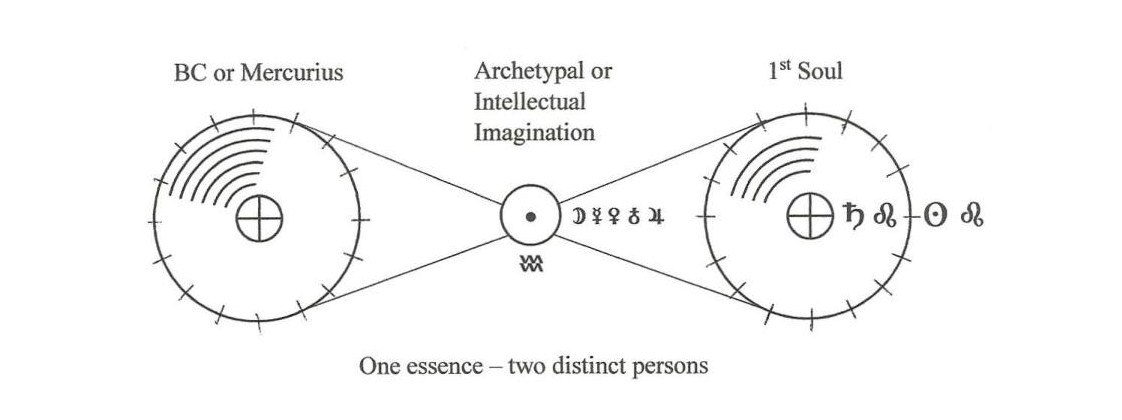
DIAGRAM appended to this transcript:
- FIGURE 1982 0417a-1. Bodhicitta, Imagination, 1st Soul; One Essence–Two Distinct Persons.
[Transcriber note: [diagram] means the speaker is referencing a diagram as he or she is speaking. If someone is drawing or writing, with audible sounds of chalk on a blackboard, I indicate this by [drawing] or [writing].]
AD PAPERS read or referenced in class:
Precis of James Hillman's "Psychology: Monotheistic or Polytheistic?" Retyped as 1982 0417b V09BN. Archetypal Psychology - Hillman.
Precis of Roberts Avens's Imagination is Reality: Western Nirvana in Jung, Hillman, Barfield, and Cassirer. Retyped as 1982 0417c V09BN. Archetypal Psychology - Imagination.
"Jung's Archetype of the Self". Retyped as 1982 0417d V09P. Jung - Archetype of Self. It is briefly mentioned but not read.
NOTES:
This is 1982 04/17a, a class on Alchemy and Archetype of the Self, and the first entry associated with this date. 1982 04/17b = "Psychology: Monotheistic or Polytheistic?" Book Notes. 1982 04/17c = Imagination is Reality Book Notes. 1982 04/17d = Jung's Archetype of the Self Paper.
No earlier partial transcript exists.
This is a Saturday AM class.
TRANSCRIBED Verbatim by IT 2021. In 2025, IT expands Subsubjects and Plotinus quotes section, completes TOC, adds new notes within transcript, removes appended papers (which now stand alone) and makes relevant changes in front matter and within transcript to indicate this change, adds one diagram and references within transcript to this diagram. Archival verbatim transcript with AD Papers – V12ap.
AUDIO FILES: 1982 0417a, 1982 0417b. [Note: "Tape" and "Side" refer to original audio cassette tapes that were later digitized into .MP3 Audio Files.]
1982 04/17a at Wisdom's Goldenrod
Alchemy; Archetype of Self
[Audio File 1982 0417a Begins]
S (faint): [three/few words inaudible]
WY: In using the active imagination, you try to get to the archetypal level, there seems to be some tension between using the will and using the imagination clearly and that at the same time being receptive for the archetypes. Is that a-- a wrong way of thinking, that there is some sort of tension or balance there? Or is that the will that is just merely clearing away the dross of the imagination to allow the archetypes that structure the imagination to present themselves?
[13 second pause]
AD: That's not a question that could be answered in a general way because the requirements of each situation are different. But if-- if I try to say generally what was going on, it would be to the effect that the will is employed at a certain point where it can bring a certain receptivity or contemplative attitude, [student assents] and then after that there's nothing to use, otherwise the reception would be [one word inaudible] [short pause] We got the general drift of what we were doing now?
VM: Anthony, this question may not be worth (the/your) salt but, you know, you s-- it's clear there's an argument for [student assents, faint] discussing a fourfold in the realm of psyche, in the active imagination. But also we've spent a lot of time developing threefold structure to cosmic soul. And-- I mean I'm sure you can also, and you obviously have, make an argument for a fourfold in the cosmic soul but why wouldn't you appeal to the threefold and say precisely that transition is from three to four? Because sensing in some ways doesn't have meaning in the moment, so it's a paradox so I can't use--
AD (simultaneously): Well, you-- yeah you remember he speaks about a three which becomes a four which becomes a one. And they have a lot of these clichés. [VM simultaneously: Yeah well I-- those are--] And, I think what's going to be required of us is to place each one in the proper context. You're going to have to do that, show how the soul is a threefold, how it's a fourfold, how's it's a tenfold, or let's say a cluster. And we're going to have to do that now. I-- that will be the goal we're working towards. But, there's another little thing right here. I-- I'll read it off quickly, it's not really important but it gives you the point of view. You see, Jung was heading in the direction where he felt that the fourfold was a totality figure and was leading us towards some kind of symbol of the Self.
VM: What did he say, that's the-- that's the principle which structures and arranges the archetypes, that's that [AD: Yeah.] ordering principle that you were discussing before and [AD: Yeah.] calling it a fourfold?
AD: Well, to us it would be very obvious that the fourfold would refer to four gnostic functions [student assents, faint] through which the [VM simultaneously: Soul.] archetypes, alright, or the degree meanings become available to us, and to separate them from each other could be a very damaging-- and we think is a problem that psychology (couldn't/can't) answer. It's going to, I think, require philosophic perspective that they don't have. But what I wanted to do was contrast this opinion, contrast Jung's heading and some of the-- with people like Hillman for instance who believes that Jung is leaving the beaten path and going off into something very obscure, let me see.
S (very faint, possibly part of background): Heard that.
AD (faint): Alright.
[Transcriber note: The following is a precis of James Hillman's "Psychology: Monotheistic or Polytheistic?", an article in Spring 1971: An Annual of Archetypal Psychology and Jungian Thought, and also found as an Appendix in The New Polytheism by David L. Miller (Ed.), pp. 109-142, Dallas: Spring, 1981. The precis summarizes half the article and consists mostly of statements taken from it with a few original observations by AD. I transcribe AD's paper just as he reads it, including any paraphrasing and alterations made to the paper as scanned. The scan of this paper has also been retyped as 1982 0417b V09BN. Archetypal Psychology - Hillman.]
AD ["Psychology: Monotheistic or Polytheistic?", JNG imagination P 8p.PDF, AD reading]: "For Jung"The anima/animus stage is correlated with polytheism, and the Self with monotheism."" [Note: C.G. Jung, CW 9, Part II, Aion, p. 268, paragraph 427.]
AD: There's a lot of quotes here, I'm not just-- I'm just going to read the paper and maybe we'll--
AD ["Psychology: Monotheistic or Polytheistic?", JNG imagination P 8p.PDF, AD reading]: "The former, the anima-animus, is a pre-stage of the Self, so polytheism is a pre-stage of monotheism. Consequently the Self is the archetype of the utmost value to Jung and contemporary man. Now this preference for the archetype of the Self strikes at the very roots of the polytheism or the plurality of archetypes that psychology works with."
AD: In other words, in psychology they-- they try to isolate certain contents of your consciousness and they point out that this is the puer aeternus or the virgin archetype or this or that operating, and they need this plurality of archetypes to diagnose the pathology, alright. So--
AD ["Psychology: Monotheistic or Polytheistic?", JNG imagination P 8p.PDF, AD reading]: "…the exploration of consciousness in terms of the gods will be only preliminary to something more important, the Self. And this archetype would be paramount, and the investigation should follow the phenomenology of the Self, that is, the conjunction, the mandalas, the quaternity, and the unus mundus."
AD: Remember, this is the point of view of Hillman and a few of the other revisionists in contrast to the direction that Jung seemed to be going at.
AD ["Psychology: Monotheistic or Polytheistic?", JNG imagination P 8p.PDF, AD reading]: "There is a [AD reads: Now this] basic conflict in Jungian psychology, what fantasy governs our view of the soul-making and individuation, many or the one. Now, for Hillman there is an unproved notion in comparative religion that monotheism is the pinnacle of the evolutionary development of religion. And this hypothesis may be referred to as the"theological temperament". And Jung somewhere writes that "the monistic attitude belongs to the introverted mind, and the pluralistic [AD reads: pluristic] to the extroverted attitude." This is supposedly correlated with polytheism and monotheism, which are supposedly in conflict and constant warfare. Now for Hillman, monotheism isn't necessarily the highest point of view except from its own bias. And that the progressive stages that lead to individuation are leading up to a superiority that the monistic point of view is trying to propound, he says this is questionable, that's not necessarily so, as a matter of fact he seems to believe that it's an alignment with the Judeo-Christian conception which favors historical development and hierarchical improvement. There's another thrust in psychology, Hillman points out, and that tends to be the multiple field of circularity. We might refer to the description above as the revisionism which is going on in analytical psychology, and this is being propounded by Hillman.
"Now in his description of the objective psyche, Jung tended towards a multiplicity of partial consciousnesses, like stars or sparks or luminous fishes' eyes."
AD: You remember in the [VM, very faint: "Nature of the Psyche".] "Nature of the Psyche".
AD ["Psychology: Monotheistic or Polytheistic?", JNG imagination P 8p.PDF, AD reading]: "The psychological polytheism corresponds with this description and provides for its conceptual formulation in terms of classical mythology, so that providing a god for each context it would find a place for each spark, and is more interested in integrating each fragment according to its own principle, giving each god his due over that portion of consciousness, the symptom or complex which calls for an archetypal background. He would accept the tower of Babel rather than gathering them all into a unity under the auspices of the archetype of the Self. Now this emphasis upon the many-dominance would then favor the differentiation of the anima-animus complex. An interest in a plurality of divine hypotheses and their processes displayed in myth will prove more psychologically useful even if less religious. This interest will more likely produce insights into the emotions, the images and the relationships even though less concerned with wholeness. It will reflect more accurately the illusions and the entanglements of the Soul.
"Now what in effect Hillman is saying I think is that the more occupied with the anima-animus complex one is, the more one will be preoccupied with the welter of psychological phenomena. In contrast the more I am occupied by the Self, the more will I be concerned with goal-states, peak experiences and universality. And the many gods of Mount Olympus must fade away before the single god of Jehovah, even if he appears in a trinitarian form. For Hillman fragmentation would indicate many possibilities for individuation, and it might even be the result of individuation. If there is only one model of individuation, can there be true individuality? The complexes that will not be integrated force recognition of their autonomous goal and will not serve the single goal of a monotheistic wholeness. This from one point of view might be a psychological improvement, since all of psyche is being reflected. And without a consciously polytheistic psychology, are we not more susceptible to fragmentation? (Vol. 9, part 2, para. 41 and para. 60, CW of Jung)
"The theme of monotheism vs. polytheism is very complex and from my point of view requires understanding, philosophic understanding. It can also historically be viewed as the confrontation between Christianity and paganism.
"But a pathological view towards many of the psyche's phenomena is inevitable, if psychology does not keep alive the totality of archetypal forms and the different ways of viewing the Soul and life. Should psychology prefer to merge the many ways into a wholeness, determined by monotheism [(egotism)], will it not be recapitulating its former mistakes, in other words, will it not be dismissing the very reason principles that truly constitute the process of individuation? When our model for individuation is governed by the Protestant monotheistic psychology then every image finds meaning only in those terms, like the pilgrim in his progress towards integration, with the resulting consequence [AD reads: consequent] that every psychic event is bound to the Protestant myth. The suppression of the many gods results in the ultimate elimination of all individual fantasy for Hillman. So we may draw the conclusion that individual symbol formation requires a polytheistic psychology, because the symbols refer to their likenesses in the variety of archetypal forms within which they find their authentication. The danger here which is stressed by Hillman is that Jung's stress upon totality and wholeness could be turned by the influential monotheism of our culture to a new one-sidedness. In other words, is the restoration of the pagan gods as archetypal dominants of the psyche impossible in a monistic psychological world? He would prefer to leave the question of whether the many are each aspects of the one or the emanations of the one as a discussion in theology. For him the restoration of the gods reflects both the varied beauty and messy confusion…"
AD: Let's see, "confusion", someone's got a note here. "June likes this." (laughter)
AD ["Psychology: Monotheistic or Polytheistic?", JNG imagination P 8p.PDF, AD reading]: "…tragic [AD reads: tragical] limitations of the anima-animus. Polytheistic psychology can give sacred differentiation to our psychic turmoil and welcome its outlandish individuality."
AD: (Now/And) that's-- you have to remember, this is Hillman, this is not me. I'm trying to just see from-- from his point of view.
S (faint, possibly part of background): Don't tape.
S (faint): This is (good).
S (simultaneously, faint): Yeah.
AD: I have another short paper but I'm not going to read it, I'm just going to pull this out from it. This is from a book by Avens called the Imagination is Reality. And-- let me pull this out. [short pause] These people, and we'll refer to these people means people like Coleridge, Wordsworth, Hillman, you know. Coleridge, for instance, disassociated-- I just pull this out.
[Transcriber note: The following is a precis of Roberts Avens's Imagination is Reality: Western Nirvana in Jung, Hillman, Barfield, and Cassirer. I do not have access to this book but it's clear the precis only summarizes a small portion of the book. I transcribe AD's paper just as he reads it, including any paraphrasing and alterations made to the paper as scanned. The scan of this paper has also been retyped as 1982 0417c V09BN. Archetypal Psychology - Imagination.]
AD [Imagination is Reality, PSY imagination is reality B 3p.PDF, AD reading]: ""Coleridge disassociated primary or creative imagination from reproductive imagination or fantasy.""
AD (faint): (I--/And) Coleridge you don't like.
AD [Imagination is Reality, PSY imagination is reality B 3p.PDF, AD reading]: "Fantasy or reproductive imagination is a handmaiden to perception by which it becomes apperception."
AD (faint): And half of these books are (a problem).
S (very faint): [couple/three words inaudible] (bit of laughter)
AD: Again, this is still (Imagination/imagination), they're not quotes.
AD [Imagination is Reality, PSY imagination is reality B 3p.PDF, AD reading]: "Imagination for Coleridge is basically vital and can lead to a deeper discovery of the truth of the world, and in it one can see the embodiment of a universal significance, that is, [a] deeper meaning than it."
AD: But the point that I wanted to make is this one.
AD [Imagination is Reality, PSY imagination is reality B 3p.PDF, AD reading]: "He makes a comparison of liberation by vision, which is a Western version of nirvana, and he even refers to it as a noetic vision, and claims that in its acutest form it is noetic."
AD: You see the--
LR (simultaneously): What does that mean?
AD: Well, all these people--
AS: He even says that all these people are basically trying to get at this point, which he's [one/two words inaudible] trying to emphasize.
AD [Imagination is Reality, PSY imagination is reality B 3p.PDF, AD reading]: "They do not believe in being reabsorbed in some kind of primal undifferenced stuff -- this is their interpretation of course of Eastern doctrines, or in other words, how self-consciousness emerged from mere consciousness."
AD: I mean their interpretation of Eastern doctrines is not even worth considering but-- I-- I'm just bringing it out as we-- you know, I bring it up.
AB/S(?) (faint): Did you want to discuss it a little bit or just--
AD: Yeah, pl-- yeah, I'd like to discuss this, I-- I want to see if you understand the, you know, point of view of Hillman.
AB: You take this, what he's calling a polytheistic view of individuation, and then each of these sparks or reason-principles is seen as having its own inherent validity. So for instance my individuation could be actualized through one and yours could be through another. You wouldn't subsume them all into one, you know, archetype of the Self, right?
S: Right.
AB: That's what I thought his criticism was. Isn't there still an apperceptive organ or in this case the organ of the imagination which still is a unity which is ap-- experiencing or organizing for itself all these different reason-principles, and there you really still could have the archetype of Self or monotheism. Otherwise you'd have, you know--
AD: Well--
S: Yeah.
AD: Why don't we try to understand the position that he's taking in this sense, because I think you've got the point there. It seems that he's saying that if you o-- if you operate with the archetype of the Self or the notion of wholeness, alright, the totality figure, alright, you're going to end up with a kind of universal Self and everything gets swallowed in there. And so he says, no, let's stick with the polytheistic form. And in this way, when we try to understand the conflicts, the vagaries, whatever is going on in our consciousness, and we could pin down precisely which of the gods this is symbolizing, he says, in this way we would be able to restore-- you know, restore to the god his due, alright, and-- or recognize that they are powers in themselves and that the psyche can best depict or reflect itself in that way.
AB: He would accuse monotheism of being reductive, which it is in Judaism and Christianity. So that seems to be why this criticism is important.
AD: Yeah.
AB: So for instance in, say, Platonism--
AD: No, never mind Platonism, what you just said. Suppose, suppose you have a plurality of contents. [AB assents] Suppose you think that you have the 360 degrees in your chart which are capable of being combined in an indefinite number of ways so that, you know, to make it innumerable, and that these appear as let's say the degrees in your chart, alright. Now, let's call them reason-principles. Now, to whom do they appear? Wouldn't it be the fourfold gnostic functions that Jung is always considering as a totality figure? [AB assents] So the fourfold gnostic functions is the totality figure that always comes up in mandalas, [student assents, very faint] and quaternities, conjunctions, and all that he studied. Now, the fourfold gnostic functions refers to an individual who is having experience of reason-principles. And that's what's happening and you get a conjunction, some kind of understanding or meaning comes into you and you assimilate it. [student assents, very faint] Now again, I-- can you separate the degree funct-- the degree meanings from the gnostic functions which are interpreting that? [S, very faint: Not really.] And if you separated them, what would the gnostic functions be interpreting? [S, very faint: Yeah, that's right.] And if the gnos-- if the degree meanings were there and there was no gnostic functions, whose experience are we talking about?
S (simultaneously, faint): That's right.
AB: So Hillman's taking the degrees without even the unity of the functions that are experiencing them and Jung is emphasizing the archetype of the Self or this unity of the consciousness.
AD: Well then, then it's really a mutual misunderstanding. [AB: Yeah.] I mean on the part of both, if you take either side, alright. It's the same problem where it's (neither) one and the many, everybody wants to see it one way; the archetype of meaning is the one that's dominant so you people think therefore you must believe in the non-dual One and everything else has to go out the-- the window. And I try to point out that there could be a highest view and there could be many views, and the higher view does not exclude the many views. Alright. So over here (you/we) have the same problem but in a psychological form, Hillman insisting on the plurality of the contents of the psyche, alright, and that these-- these are of ultimate value because they-- they depict the psychopathology of the soul and it-- the way the soul is working out its problems in that very imagery that it's-- it's projecting. And as a matter of fact, I think I have a definition (of that). Let me read this definition from Jung-- from Hillman.
AD [Imagination is Reality, PSY imagination is reality B 3p.PDF, AD reading]: ""Essentially by Soul…""
AD: This is a quote.
AD [Imagination is Reality, PSY imagination is reality B 3p.PDF, AD reading]: ""Essentially by Soul, Hillman means, 'the imaginative possibility in our natures, and experiencing through reflection, dream, image and fantasy, that mode which recognizes all realities as primarily symbolic or metaphorical', [AD: End of quote.] -- that [AD reads: this] is Hillman's definition of [AD adds: the] Soul.""
S (faint): Read it again?
PD: Seems like a criticism of Hillman is that all the psychic values and symbols are at the same level and there's no vertical or depth dimension which he'll allow. He maintains a (standpoint) of radical relativism. And so the deepening of consciousness is not allowed in his framework.
S (faint): Yes.
AB: He would say that's what brings about a deepening of consciousness.
PD: Well he would not allow plurality or hierarchy and that's what he's being critical of Jung, he's speaking of a hierarchy.
AB: Right, but wouldn't he say that thus we close ourselves off through all these-- this plurality of reason-principles or gods, then we don't deepen our consciousness and we have to let in this plu-- pluralism in order to individuate.
PD (simultaneously): Yeah but an-- an activation or a-- or mobilization of an archetype through an instinctual structure, or instinctual symbolism, is at the same-- contains the same possibilities of meaning that an activation at a higher level of psychic development, whereas for Jung there is a difference.
[short pause]
AD: I don't think your point is clear yet.
PD: Well, I mean just, it seemed to me an implication with Hillman is that the-- if there's no development towards some teleological goal outside of the psychic activity, then all structures and all activities are at the same level. Whereas for-- for Jung, the Self as a symbol of totality is leading to a teleology outside of psychic structures. [short pause] So Jung-- so that it seems to me that Hillman will maintain at a horizontal, well, you know, path, horizontal level of development, like in du-- like not acknowledging the subjective soul stream in the psyche. Whereas Jung-- Jung definitely has the implication of a subjective soul stream within the psychic phenomena that has to be followed back.
[24 second pause]
AB: Well, isn't Hillman saying that if you emphasize the archetype of the Self--
PD: But you can't emphasize an archetype, that's speaking very intellectually, conceptually.
AB (simultaneously): Ok, right, but let's--
PD: You don't emphasize an archetype.
AB: Let's-- I'm just trying to-- I'm not going to agree with him but what I thought he was saying is that if you give predominance to the archetype of the Self and the individuation process, you do so at the expense of all these other reason-principles and thereby you may truncate your development.
PD: I don't see where Jung is saying that at all.
AB: But isn't that what Hillman's saying Jung's saying?
PD: Yeah but that's-- if you've read anything of Jung he's-- that's-- [AB simultaneously: Well I agree with you but--] that's absurd.
AB: Yeah I-- I think Jung is deeper than Hillman's giving him credit for here.
[10¼ second pause]
AD: Finish that coffee? (bit of laughter)
VM: The argument doesn't seem to hold up.
S (simultaneously): [few words inaudible]
AD: Huh?
VM: Well you mean the argument doesn't-- it seems like it's (fake), I can't-- I can't relate to it. It's [AS assents] like a straw man somehow.
AS: What?
AD: Straw man?
S (simultaneously): Just narrative.
AS: No, I don't-- [VM simultaneously: I think (few words inaudible)] I think it's a real-- I think there's a real dis-- difference in the emphasis but--
VM (simultaneously): You really think Jung-- Jung took this-- [AD simultaneously: Monism's the definitive (you/we) have.] [AS simultaneously with AD: Primarily.] Jung took this monistic view?
AS: I-- yeah-- no, not monistic, Vic.
VM (simultaneously): And deprecated the other [one word inaudible]
AS (simultaneously): But look, look at the diagram [FIGURE 1982 0417a-1]. All of the monistic view, what is he really pointing to? Isn't he really pointing to that Witness position, the point of view of the unity of the subject, the perceiving subject, the Witness? Whereas the other guy is really pointing out, look, we also have reflected there the totality of the archetypal world, that is of the Intelligible World. So he's emphasizing the other side of it. These archetypes are portraying-- It's like if you go back to the "who" and the "what". You go back to the s-- the s-- I mean as a paradigm, you take the Saturn in Leo and the Sun, the "who" and the "what" [right side]. [student assents, faint] And now down here, within the-- in the bottom half of the hourglass [left side], you're going to have these two factors, the sub-- the subject who's experiencing and also there's an imaging of that entire archetypal realm.
VM: I agree, it just seems to me like it could be a straw man in the sense of, if you want to emphasize the objective side, alright, you can do that temporarily but you must always keep in the back of your mind that there is some center of-- of experience, there's some [AS simultaneously: Yeah but there's an--] consciousness being brought to bear and assimilating these meanings and so forth. If you emphasize [AS simultaneously: And the other hand--] the subjective, then you say well there certainly are real contents which are coming into me which are independent [AS simultaneously: Not coming in.] and having their own sort of status. So it's [one/two words inaudible]
AS (simultaneously): No but it's within you a-- no but, that's not--
RG: Wait a minute, I-- I-- I don't think that our problem is subjective-objective at all because in all your critiques of [AS simultaneously: Yeah.] Jung you're going to claim he's on the objective side anyway and not really bringing [AS simultaneously: Ok, let's not--] in the subjective soul.
AS: But what is he pointing to when he's talking about this fourfold unity? What is he talking about when he's always centering on this individuation process? True, he deals with all the archetypes, there's no doubt, I mean he deals with a plurality of archetypes. But what does he say is the highest point of view you can come to with the structuring of these archetypes is always this fourfold centering process [RG assents] 'cause he's saying this whole thing is always the aim as it were, as he's trying to get to the unity of individuation. Now, I mean, what-- what does that really seem to be pointing to?
RG/S(?): What?
S (very faint): [couple words inaudible]
AS: Well, [couple inaudible student words simultaneous with AS] I would say the subjective soul, [RG: Sure.] that he's pointing at that, I mean that's what he's-- Now the other point of view if that the ideas are-- that-- a point of view that the plurality of ideas is more important here.
RG: No, no, but why can't the [AS simultaneously: Not more important.] other point of view be that all the soul powers are what has to be experienced as reflected in the planets and not take the substance point of view? I don't-- I don't read from Hillman that he necessarily goes to that point of view. [AS: To the point of view--] He could be talking about how the planets unfold in-- in the psyche as-- as gnostic and fabricative. I don't-- I don't see why you have to see it as-- as the substance or whatever, the substance point of view.
AS: Well, it's-- no, substance is actualizing the contents of the Divine Mind. [one/two inaudible student words simultaneous with AS] You say well part of the whole process of the soul being here is it's going to get know the Intelligible World which is within it. How is it going to do that? By differentiate-- manifesting and differentiating all these contents. They can't-- it can't know them in its undifferenced way within itself so it's going to continually manifest, project these archetypal meanings.
RG (simultaneously): Yeah but these contents are-- is not the (vast) powers in the psyche.
AS: No, the contents are the Ideas.
RG: No, no but, does Hillman make-- Hillman doesn't make that distinction.
AS: It doesn't-- I mean, what's the different--
AD (simultaneously): But isn't that the point, [AS simultaneously: Is--] wasn't it that they both lack the philosophic understanding now?
S: Good for Paul, yeah.
RG (simultaneously): I mean yeah, (usually).
AD: I mean [AS simultaneously: Yeah, would you--] how could you-- if you tend to [AS simultaneously: Yeah.] look at the-- at your natal chart, alright, can you leave the de-- degrees out?
VM: No, no more than you can leave the center or the subject out.
RG: No. No.
AD: Well, if you can't leave the degrees out and you can't leave the, you know, the planets as representing the soul powers [VM assents] as embodied, alright, then they're both necessary. But, let's say, let's say that the embodied soul powers are represented by the planets in your chart. [VM assents, faint] Alright? Then we would say that the soul powers, alright, whatever they may be, all of them together, the seven, are working out and trying to understand the meanings that are inherent in the degree symbols, alright. Now, if-- if we said, and let me go back to this quotation because we're-- if you don't keep this quotation in mind I think you'll always fall into one side or the other.
[Transcriber note: AD is quoting himself from WG Class 1982 0410a, see p. 4 of that transcript. See also beginning of Scan File 1982 0410 ALCHEMY 08F.PDF, the partial transcript for this class.]
AD [1982 0410 ALCHEMY 08F.PDF, AD reading]: "Each and every soul has within it the entirety of the Intelligible World. Thus, this is an absolute prerequisite in order to work the full implications out of mentalism. And if we take that as axiomatic and keep in mind what Plotinus said, that the soul imparts…"
AD (faint): Alright.
PD: What do you mean when you say "within the soul"?
AD: The-- it's not metaphor-- it's not spatial.
PD: Granted. Can you be a little more explicit?
AD: Well, ask me in what way you want-- want me to be explicit.
PD: Well, in what sense is the Intelligible World within the soul? Can you give some amplification? I don't know what that sentence means.
AD: That the contents of the Nous are within the soul, and that all of this, all of this is available (to/for) you. You can use it. In other words, if one identifies with the soul to the point he can become a-- a knower, he can be standing or poised in the Nous, and understand the-- let's say the-- [PD simultaneously: You're saying Nous within the soul?] the Idea that's being worked out.
PD: I don't-- I don't understand what that means. Is that Nous within the soul or the soul within Nous?
AD: "Within" here is only a metaphor. It's meaningless to speak of space and time.
VM: But, could we try it like this, Anthony, like you'd stress over and over Plotinus' notion of each Idea is a unique and special version of the whole. [Note: See Plotinus, V.9.8, third para.] You take the Idea of Man and say that too is a unique and special version of the totality of all the Ideas. Insofar as the soul assimilates that Idea of Man and lives out some of those possibilities, in that sense the Intelligible is inherently within the soul.
AD: Or if we want to bring it home, you want to bring it (closer/close to) home, inside the species of lion, the lion contains the entirety of the knowledge that that species operates with. The totality of that knowledge is within the lion, each individual lion. Each individual species, alright, gives to each of its offspring the totality of its in-- innate knowledge.
VM: Ok so--
AD: Now, analogously we're saying that the totality of the Nous or an in-- the Intelligible World is within each soul, reflected in each soul. The contents of the Intelligible World are in the soul. So if we imagine that is in the top, alright, the top circle in that hourglass diagram [FIGURE 1982 0417a-1, right side], alright. And we said that don't-- the soul gives off a light. In other words that's its outward-facing hypostasis [left side]. Inside that (light/life), we have to postulate, because the essence of the two of them is one, although you have two distinct persons, first soul and the second soul, inside that (light/life) you can posit the existence of the whole of the Intelligible World for that individual soul. That is going to be called the bodhicitta in other tradition. It's going to be called Mercurius in the alchemical tradition. But the point here is that in each individual soul that has been projected forth, alright, that within that there is contained the entirety of the Intelligible World. That would mean the 360 degrees that we see in a chart, the embodiment of the planetary powers, the Intelligible Matter which can become the bhutas ultimately in the process of transformation when it projects out its own individual world.
PD: So that whole Intelligible World is arranged and organized within the context of that soul.
AD: Uh-hm.
PD: So that whole-- that whole specific Intelligible World is a content of an individual bodhicitta or soul, and its existence and unfoldment is for that soul.
AD: The existence and unfoldment or the-- yeah.
PD: Its existence--
AD: The manifestation that occurs is for the [PD simultaneously: Well, yeah.] benefit of that soul.
PD: Right. So then the-- the multiplicity and panorama of reason-principles is existing for the individual soul there.
AD: And is within that individual soul.
PD: So then it seems--
AD: So all the Gods are within you. Yeah.
[short pause]
VM: Well I mean, from this point of view the argument between Jung and Hillman seems like a--
AD: From this point of view what?
VM: The argument between Jung and Hillman seems almost meaningless.
AD (simultaneously): Is stupid.
VM: That's why I say, it seemed like a straw [AD simultaneously: Is stupid.] argument, I can't--
AD/S(?) (very faint): Yeah.
S (faint): Yeah.
S (very faint): Uh-hm, yeah.
AD: Let's go back. If we say that the whole of the Intelligible World was within you-- You remember Paracelsus' remarks. You're a star. If you don't know that, you don't know anything, alright. The whole of the sidereal zodiac is within you. Now, he is not a poet, he is not being poetical, he's not writing poetry to his-- his mistress. He's stating a fact that within you is the whole of the Intelligible World. The whole of the zodiac, the mythological constellations, the whole of the planetary spheres and all of the sublunary elements, he says they're within you, very very precisely and clearly and real loud. And he didn't say that they're imaginary, you're not in-- he says they're within you. If you don't see them within you you're not going to understand what's out there. Remember those remarks by Paracelsus, you read a little bit of Paracelsus? Do you read anything else besides the New York Times? (bit of laughter)
S (very faint): Uh-hm.
S (faint): Yeah right.
CDA: Anthony, is this-- [S simultaneously, faint: (I'm/He's) not sure.] is this valid from-- (laughter) in the--
AD: Wait a minute. Would you get the-- Quick. I don't know if you regard this as [S, very faint: That's Maitreya.] serious (as me). Sublime Science, Maitreya?
PD: He's using mythology.
VM: Ohh. (VM laughs a bit, bit of laughter) But this mythology, Paul, is a-- an unfolding of the Intelligible contents within the soul.
PD: I agree.
S (faint): Ok.
VM: So it's not to be denied (in that view/on that point).
AD (simultaneously): It's a mythology because it's not explained and they're hiding behind metaphor. And I have to dig it out. And until you dig it out for-- for yourself it remains metaphor.
PD/VM(?): Agree.
[9¼ second pause]
PD: The only problem is it's something like a Rorschach test. The only problem is it's something like a Rorschach test.
AD: No, the only problem is to recognize the distinction between a person who knows and one who doesn't.
PD (faint): I guess I'm saying that. (laughter)
AD (amidst laughter): So if you attach-- if you attach yourself to a person who doesn't know regardless of who it is, you're going to get into trouble, yes.
PD: Well, it's best not to be attached at all. (laughter)
VM (faint): I thought you said the last time that you can't get in a fight.
AD/S(?) (very faint): (We're/They're) not fighting (fight). (bit of laughter)
AS: Yeah but Paul's got Mars in Aries, [S simultaneously, faint: Paul might.] he's ready to fight anybody. (AS laughing)
VM (simultaneously, faint): Yeah I know, he clearly says Mars in-- hard to rise and debate.
AD: Opposite my Jupiter Venus. (laughter, AD laughs)
S (very faint): Very funny.
S: (What/Huh)?
AD: Huh?
S (faint): That's terrible, Paul.
PD: I recall.
S (faint): Yeah Paul.
S: Uh-huh.
S: No. (laughter)
S (amidst laughter, faint): Yeah.
AD: Paul--
AS: Make him read it.
AD/S(?) (faint): No, that's alright. (laughter)
RC: In the buddha gotra?
AD: Yeah.
[Transcriber note: I am using The Sublime Science of the Great Vehicle to Salvation, Being a Manual of Buddhist Monism, The Work of Arya Maitreya with a Commentary by Aryasanga. Translation, Introduction and Notes by E. Obermiller. Publisher not identified, Shanghai, 1940.]
E. Obermiller [The Sublime Science, of Maitreya, p. 100, RC reading]: "The gotra is regarded…"
RC/S(?): Uh-oh. (laughter)
VM: Let's move on to Paracelsus. (laughter, student words)
AS: What the matter?
S (faint): [few words inaudible]
E. Obermiller [The Sublime Science, of Maitreya, p. 100, RC reading (simultaneously with S above)]: "The gotra is regarded by both the subdivisions of the Yogacara school as manifesting itself in 2 aspects, viz. the fundamental, existing in every living being from the outset, and that which undergoes the process of development. Thus, the standpoint of the Yogacaras regarding the very essence of the gotra itself agrees with that of the Sautrantikas. It is held to be a pure force and an active mutable element. This active character is very pregnantly expressed in the Gudhartha [RC reads: in a certain text] where it is said that the Absolute Reality manifests itself in 2 forms, viz. the active and the immutable. The first of these forms [RC adds: namely the active] has again [RC reads: again has] 2 varieties,--the pure Transcendental Wisdom of the Buddha and the seed, the germ of this Transcendental Wisdom. This seed is the gotra, the fundamental element and the original cause of Enlightenment."
S (faint): Is that the end?
RC (faint): No [one/two words inaudible]
AD (faint): Now who wants to discuss this? Keep turning pages every place that's [one word inaudible] about the bodhicitta and the gotra [one/two words inaudible] you'll find at least fifty references in there as to the nature of this seed.
VM: Anthony, it said-- it says in there that the gotra has this-- a fundamental nature and I forgot what the other one is, he's speaking about this objective-- apparently objective character of bodhicitta, in other words like these degrees or reason-principles that appear to be somehow objective and then the subjective is (screening) that experience then, but that really are both two sides of the same bodhicitta principle or form-bearing light?
AD (simultaneously, faint): (Think I would like to/You've gotta lightly) change the wording a little bit. [VM: Alright.] You want to reread it and as we go along we--
VM: Yeah.
E. Obermiller [The Sublime Science, of Maitreya, p. 100, RC reading]: "The gotra is regarded by both [the] subdivisions of the Yogacara school as manifesting itself in 2 aspects, viz. the fundamental, existing [RC reads: which exists] in every living being from the outset, and that which undergoes the process of development."
AD (faint): Now right there stop and that's equivalent to the first soul.
VM: Well, that would tend to go through process of development, let's say that's the embodied soul powers or [student assents, very faint] subjective element and-- and then-- Or maybe the other way around, I don't know, but let me just carry it through, and the fundamental are those reason-principles which are found right in the matter, right in the-- [AD: Uh-uh.] in the experienced world, [AD/S(?) simultaneously, faint: Well I don't-- I don't--] if you want to go-- I want to do it that way.
S (faint): Ok.
RC (faint): It seems to be saying that on the one hand soul's rooted in Nous, and in that sense--
VM: Can't hear you.
S (faint): What?
RC (faint): Seems to be saying that on the one hand the soul is rooted in the Nous. On that sense it has an unchanging eternal form, the [one word inaudible] But being soul, it's also the ground of the process of actual unfolding of whatever does unfold.
AD: So that part is the projected part which he refers to as the seed, and that is what they're referring to as [one/two words inaudible] germ of enlightenment.
RC (faint): Substantially as one (within Nous) I've got unchanging character. But in its own nature, substantially, when you've gone with the perpetuity process, (process) going on here, Saturn. It's (real/really) amazing.
AD: So if we looked at that diagram we would be saying something like this. The upper part-- the upper part would be referring to (like) the Absolute. Now this is an emanation of the Absolute, we can imagine this circle here [diagram], alright, and we can say this is the Nous [FIGURE 1982 0417a, Sun in Leo] and soul [Saturn in Leo] is within the Nous, alright. [student assents, faint] And these are the unembodied powers of the soul [string of planets, Jupiter through Sun in Aquarius]. This-- from this point on, the Intellectual Imagination [Sun in Aquarius], alright, the seed is projected, the bodhicitta is projected, which let's say is this whole thing here [left side]. So within the seed, within the seed-- Now, as soon as you say the word 'seed', you're gonna get out your magnifying glass and go looking around, right?
S (very faint): That's [one/two words inaudible]
AD: But he also says that this seed is as undifferentiated as space and like space. Can you find that quote? So that means-- that means that the bodhicitta is coincidence or coincides with the extent of the universe. So if we say that that's the bodhicitta, within the bodhicitta, alright, or in the-- in the imaginal world, the mundus imaginalis, alright, is what the bodhicitta is located. That's the only place we can locate it. That's-- that's the locus of the visionary apperceptions that we're going to deal with. Now within that, alright, we're going to see that the whole process from the reason-principles, the inerratic spheres, alright, the planetary spheres, the sublunar, are all included within the bodhicitta. The working out, the unfoldment, of the bodhicitta-- This is very good, you know, this is an hourglass, [drawing] alright. [VM simultaneously, faint: Yeah it's like (one/two words inaudible)] The sand keeps falling out. When this [right side] gets emptied of sand then this [left side] is all full of sand [diagram], alright, the-- the--
AS (faint): 21,600 drops.
AD: Huh?
AS: 21,600 get piled up [one/two words inaudible] (bit of laughter) [S simultaneously, faint: It's unbelievable.] Then it reaches up.
RC (faint): Just round it up. (bit of laughter)
AD: So then, when that happens, this would all be empty, right? And this would all be full [diagram]. And by that-- by that time you should be free, you should be liberated, you should reach recognition of the bodhicitta.
AS: That's like this(--/.) By the time, uh--
VM (simultaneously): And then would you say Anthony that, going along with your grains [AD simultaneously, faint: Let him finish.] of sand analogy, that after the bottom is full, after all these essences let's say have been experienced in the-- within the bodhicitta, then the bodhicitta becomes fifth-- reflective of (the/that) Intelligible (Light/Life).
AD (simultaneously): Of that, yeah. That was the Gemini twin, the-- the myth of the Gemini. That not until we reach that situ-- that position where the soul has finally worked out its own self-realization and actualization through this process does this become a fit vehicle to reflect and obey. Did you find another one, Randy?
RC (faint): I haven't found one yet where-- where space is [one word inaudible] but he talks about it and the cosmic body of the Buddha being the same state of the Buddha.
AD: Read that.
[short pause]
RC (faint): A little bit of [one/two words inaudible] He says--
E. Obermiller [The Sublime Science, of Maitreya, pp. 104-105, RC reading]: "As we have [RC reads: We've] frequently stated [above], it is considered to exist in all the living beings without exception and forms the true essence, the background of all the elements constituting a personality. At the same time it is considered to be of a pure spiritual nature and as the element of the spirit of the Buddha. Only it, and nothing else, is real and persistent in an individual… In its essence it does not differ from the Cosmical Body of the Buddha, which is accordingly characterized as pervading everything that exists."
AS (faint): (Let me) [one word inaudible] seed from--
AD: Alright, here's another quotation, sure.
AS: Yeah. This (is) Sydenham in this-- in one of these Shrine articles has this quote which is (what you're doing). Says--
[Transcriber note: I am using The Shrine of Wisdom, v.18, no. 69, Autumn 1936, Extract from Onomasticon Theologicum by Floyer Sydenham. See http://iapsop.com/archive/materials/shrine_of_wisdom/shrine_of_wisdom_v18_n69_autumn_1936.pdf.]
Floyer Sydenham [The Shrine of Wisdom, v. 18, n. 69, pp. 248, 249, AS reading]: "…they must presume that their rational part--mind--was at first as it were a seed, sown [in their souls] by the Great Mind [AS reads: Soul] Universal--a seed, teeming with Universal Ideas, like so many lobes, [into] which it afterwards divides… … …if those [Universal and] Divine Ideas are con-natural to their minds, and as it were innate in them, this rational principle within their souls--namely mind--must have been derived…"
(Side 1 of original cassette tape digitized as 1982 0417a Ends; Side 2 Begins)
AS: --or it contemplates Divine Mind.
AD: So the strange nature of this germ or whatever name you want to give it, Mercurius, is that at one time it's a s-- i-- self-identical thing. It always persists, is always what it is. But at the same time it's always going through a transformation. In other words, within this-- if this is your bodhicitta [FIGURE 1982 0417a, left side], alright, or the center of your being, the image of God which is within you, then all this process that's taking place within you has probably already been prefigured in here [diagram]. And that there is this prefiguration in the bodhicitta of the unfoldment of the plan of the individual's process-- I mean of the individual's process towards individuation and soul realization. Here's another quote from Jung now. Here again I think something will be borne out. This is 207 in the Mysterium Conjunction.
C.G. Jung [CW 14, Mysterium Coniunctionis, p. 207, paragraph 270, AD reading]: "These hints may throw a little light on the strange idea of the serpent-chariot. It is a symbol…"
AD: Serpent-chariot is a-- I don't think I have the picture but anyways.
C.G. Jung [CW 14, Mysterium Coniunctionis, p. 207, paragraph 270, AD reading]: "It is a symbol of the arcane [AD adds: the hidden] substance and the quintessence, [AD adds: it is a symbol] of the aether that contains all four elements, and at the same time a God-image or, to be more accurate, an image of the anima mundi."
AD: Now, this is Jung, alright. I'll repeat this once more. And you tell me what-- you know, what possible concept that we're working with could possibly fulfill this description.
C.G. Jung [CW 14, Mysterium Coniunctionis, p. 207, paragraph 270, AD reading]: "These hints may throw a little light on the strange idea of the serpent-chariot. It is a symbol of the arcane substance and the quintessence, of the aether that contains all four elements, and at the same time a God-image or, to be more accurate, an image of the anima mundi."
AD: Now, if you follow that carefully you see that when he puts this insert in, that it is an image of the anima mundi, you can see what he's doing.
PD: Somewhere around that he also-- he calls that state chariot or vehicle for God.
AD: Yeah.
AS (faint): Right, an image for the--
AD: Yeah.
PD (simultaneously): Not a God-image but a vehicle for-- for God.
AS (simultaneously): For God. He means for the higher soul.
PD: But-- well (the/for) Nous.
AS: Yeah, exactly.
AB (simultaneously): Isn't that the confusion which we once discussed between the cosmic soul there and the bodhicitta as (going/gone) beyond--
AD (simultaneously): Well the point-- the point here is, is the image of God, what is called here the God-image to be more accurate, is it an image of the anima mundi or is it an image of your own soul, the imprint made by your soul on the bodhicitta? And my contention is, he's bringing in this notion that it's an image of the anima mundi, alright, because it must coincide with what-- the way he's working it out.
AB: But even in the quotes, like when he quotes Origen and all that and they say that the image of God in man is an image of God imprinted in the soul, that would be inconsistent with his saying that it's an image of the anima mundi.
AD: Yes, and again, you remember the quotation where he-- he quotes Plotinus as agreeing to all souls being one soul. And we said that we don't have that in our understanding nor in the McKenna translation, nor as I looked it up in the translation by Guthrie. So he's working out his notion of the God-image, and, since we're on the point, he insists that it's the fourfold which is a totality figure and which represents the Self. And Hillman is insisting that if we go that way we go towards the way of monotheism, alright. Yeah.
S (faint): Are there questions?
AB: If Jung is saying that the anima mundi is the image, you know, of the Self, then actually in a way he's agreeing with Hillman.
AD (very faint): I don't follow.
AB: Well, might not be important but, Hillman's emphasizing the plurality of all these gods or all these reason-principles. And if that we could somebo-- some-- sometimes symbolize as the anima mundi or the mundus intellectus, then they both have the same problem from the philosophic point of view.
AD/S(?) (very faint): Yeah.
S (very faint): See my problem (is), Hillman just says he's writing [one/two words inaudible]
S (faint): Uh-hm.
S (very faint): (To each his own.)
S (very faint): This is how you do [couple words inaudible] How--
AB: Ok, but neither [few inaudible S words simultaneous with AB] one is really going beyond--
S (faint): What?
AB: But neither of them is going beyond really the cosmic soul.
S (faint): Oh.
S (very faint): True.
AD: Well, the whole point here, isn't-- isn't their discussion irrelevant and-- and they're missing the whole thing, that all-- the bodhicitta is all this, that the soul of the individual contains all this? Either that or I would have to drop Plotinus and s-- and say, he doesn't understand, these people do. And that the totality figure that he's working with, the fourfold figure, is a reference only to what we would call the dignities in the chart where you have the functioning of the gnostic faculties and meaning is assimilated, brought into you, and that this accrual of meaning eventually results in the individuation of the person and even the self-realization. But what is he realizing?
S: Both his own and--
AD: I ask you, what is he realizing?
VM (faint): His own implicit nature.
S (very faint): [one/two words inaudible]
AD: But what is that nature?
S (faint): The Nous. We don't (know).
AD: If the soul is a child of the Nous or the offspring of the Nous, what is-- is the nature of the soul and what is it realizing? And if it's realizing the contents of the Nous which are within it, then why make a distinction and a division between the reason-principles and the gnostic functions?
RC (faint): [couple/three words inaudible] read that quote where (they talk/they've got)-- What if-- what if Mercurius (is this) bodhicitta, does that make sense?
[short pause]
S (very faint): It's ok.
AS: But that's what he was saying, the serpent-chariot. I thought that was the point, wasn't it?
RG: But in that passage he claims that it's the symbol for both.
S (faint): You want this quote, (Avery/Anthony)?
AS (faint): Uh-hm.
AD (faint): No I-- there, if anyone has Alchemical Studies I think we could turn to a-- There may be a picture of the chariot (in there). You want to call the bodhicitta the chariot. (Why not?)
RC (faint): And particularly, there will be a certain (test) in that symbol but I don't know how-- [AD/AS(?) simultaneously: But--] if that's what (he) just said.
AD: Oh, fine, let's agree with that, let's agree with that. That's not the point. That's even quite secondary. What is the point here? The point that we're discussing here is what is the nature of the image of God, the image of the soul, the image of God in a man. What is its nature?
S: Or do you think he doesn't distinguish that, between that and the soul?
AD: That he doesn't understand what the nature of the image of God in man is. That he wants to-- he wants to emphasize the fourfold totality figure; he wants to emphasize conjunction, he wants to emphasize mandalas, alright, [student assents] all that, alright, but he wants to leave out the reason-principles, they're not part of the soul.
RG: But in-- but doesn't he do that in this-- I mean in terms of right where you just read, doesn't he distinguish between quaternity figures for the self-image and the-- and the trinity figures for the anima mundi and God-image?
S (very faint): (Yes sir.)
AD (very faint): Well, you gotta show me that.
RG: Well, it's right in the passage you read.
C.G. Jung [CW 14, Mysterium Coniunctionis, p. 207, paragraph 269, AD reading]: "The symbols of the self are as a rule symbols of totality… In the former [RG reads: In the symbols of the self] the circle and the quaternity predominate, in the latter [RG reads: and in God-images] the circle and the trinity [RG adds: predominate]…"
RG: I mean--
AD (faint): Go ahead.
RG: No, no, (just/yes) but-- I mean I thought you were understa-- that you were saying that he doesn't really make the distinction symbolically between the God-image and the self-image, between a quaternity and-- and that he lumps everything into the quaternity. But, in a lot of his writings I mean he does talk about the-- the threefold nature of the God-image, the trinity and so on.
AD (faint): The threefold is never for him anything but an intellectual formulation.
PD: I have to disagree. (bit of laughter)
AD: Well, show--
PD (simultaneously): Threefold-- a threefold structure symbolizes the dynamics of the conscious directed position. The fourfold image is a symbol of totality. And when a threefold appears in reference to the Self, then it's a distortion or an intellectual conception. But at it-- in the symbolific imagery, it generally refers to the direction and orientation of the conscious stance which-- which is this [student assents, faint] threefold symbol. If you want I could--
AD (faint): Get the quote.
S (simultaneously, very faint): [few words inaudible]
[15¾ second pause]
C.G. Jung [CW 16, The Practice of Psychotherapy, "The Psychology of the Transference," p. 208, paragraph 406, PD reading]: "The triad appears as"masculine," [i.e.], as the active resolve or agens whose alchemical equivalent is the "upwelling." In relation to it the dyad is "feminine," the receptive, absorbent patiens, or the material that still has to be formed and impregnated [(informatio, impraegnatio)]. The psychological equivalent of the triad is want, desire, instinct, aggression and determination, whereas the dyad corresponds to the reaction of the psychic system as a whole to the impulse or decision of the conscious mind. This would of course perish of inanition [PD reads: if the ination] if it did not succeed in overcoming the inertia of the merely natural man and [in] achieving its object [PD reads: objective] despite his laziness and constant resistance. [But] by dint of compulsion or persuasion the conscious mind is able to carry through its purpose, and only in the resultant action is a man a living whole and a unity…"
AD (faint): I'm sorry Paul, I don't understand.
VM (simultaneously, faint): He didn't bring in four.
PD: Well--
VM: I got three, two.
PD: Yeah, that's what he's speaking about, the three is referring to the directed [student assents, faint] conscious process, [student assents, very faint] the-- the orientation of the conscious position.
VM: Again it's real--
S (faint): (Two.)
PD: Yeah. [S simultaneously: What's the point?] But the-- my point is, my point is just the-- the meaning of three.
AD/S(?) (faint): Yes.
VM: Oh. Oh ok. I guess the context [few words inaudible] quote.
PD (simultaneously): It's the de-- it's the directionality of the conscious position is indicated by a threefold symbolism or a conscious framework.
[short pause]
AD: Anybody follow? [S: Well--] Reading them-- reading of that quote, you follow?
VM: Yeah, I always feel like it's in some ways hopeless to follow Jung in philosophic matters (of fact), and that-- that you never get a consistent picture, and I don't think he would say "I have a consistent picture", I think he just works off what he happened to be going through at the time. So in some ways it's-- Like for example here, this-- (I meant) the end of the paragraph, and you read paragraph after it, what you read from Mysterium Conjunction, he said something like this--
C.G. Jung [CW 14, Mysterium Coniunctionis, p. 208, paragraph 271, VM reading]: "[As] Ezekial's vision can be interpreted psychologically as a symbol of the self, we may also mention in this connection the Hindu definition of the self…"
AD (faint): Hindu what?
VM: Hindu definition of the self.
AD: Go ahead.
C.G. Jung [CW 14, Mysterium Coniunctionis, p. 208, paragraph 271, VM reading]: "…here hiranyagarbha--as [VM: Quote, and he quotes commentary by Ramanuja.] the"collective aggregate of all individual souls.""
VM: Now I don't know what to do with that if he's going to call it-- if he's going to draw support from that for his notion of the Self as the collected aggregate of all individual souls, that doesn't seem to make any sense at all [couple/three words inaudible]
AD (simultaneously): Well why don't we go back-- go back to that quotation where Jung insisted on-- on the-- the recognition of the soul as being included in the totality, where he insisted that Plotinus interpreted that all souls are one, whereas we have read passage ov-- after passage-- passage over and over again, variety where they are not one; that individual soul and cosmic soul are distinct.
VM: I don't exactly know where that quote is but, if it's necessary to go back I reme-- I remember.
AD (simultaneously): That's the problem-- that's the problem you're going to have with alchemy because you will only get out of it what you understand already.
S: Yeah.
AS: Hm.
VM: Paul would [S simultaneously, faint: Yeah.] take the Rorschach test, is that it? (bit of laughter, student words)
AD: I-- I [VM simultaneously: Is that what you meant?] think what I said is more meaningful than the Rorschach example. You will only get out of it what you already know. You're not going to learn anything new.
S: You mean there's (more toward) alchemy than there is to that.
S: (Hm.)
VM: Its native obscurity and so on makes it impossible to draw a coherent framework out of it so you just interpret it.
AD (simultaneously): But-- but whether he likes it or not, [VM simultaneously: I agree.] Jung cannot help but reveal the innate philosophic view he's operating with. In spite of the fact that he's just going to be manifesting psychologically or in terms of [S simultaneously, faint: Right (one/two words inaudible) (in terms of).] imagery, the fact remains that this is how he's going to re-- report that.
S (very faint): (Yeah/Ok).
S (incredibly faint, possibly part of background): [few words inaudible]
AD: Yeah.
RC (faint): Alright. Page 534 and-- Volume 14.
C.G. Jung [CW 14, Mysterium Coniunctionis, p. 534, paragraph 761, RC reading]: "In his fourth Ennead [(9, 1ff.)] Plotinus discusses the problem of whether all individuals are merely one soul, and he believes he has good grounds for affirming this question."
AD: Avery, before you leave will you get the quote from Plotinus and have fun with it?
RC: IV.9.1 is where he--
AD: Anyone got Plotinus?
S: Yeah.
VM: Long summary.
AD (simultaneously, faint): Mine is with him.
C.G. Jung [CW 14, Mysterium Coniunctionis, pp. 534-535, paragraph 761, RC reading]: "I mention Plotinus because he is an earlier witness to the idea of the unus mundus. The"unity of the soul" [RC, faint: Or--] rests empirically on the basic psychic structure common to all souls, which, though not visible and tangible like the anatomical structure, is just as evident as it."
S (faint): Uh-hm.
RC (faint): He seems to be saying there the unity of the individual soul is a participation in the unity--
AD (simultaneously): S-- of soul essence.
RC (faint): Uh-huh.
AD: Yeah. But participation of soul essence or that the essence of soul-- soul must share in that essence [RC simultaneously, faint: Right, but he seems to be (couple words inaudible)] does not reduce them to one soul.
RC (faint): Right. He seems to want to be applying it to [couple words inaudible] model and say that the apparent individuality of soul in the world is a participation in the unity of [one/two words inaudible] rather than (report to--)
AD (simultaneously): Well, I don't know that he-- I don't follow. Try again.
RC (faint): I was just thinking that he would know without distinction.
AD: There is none.
C.G. Jung [CW 14, Mysterium Coniunctionis, pp. 534-535, paragraph 761, RC reading]: "[I mention] Plotinus [because he] is an earlier witness to the idea of the unus mundus. The"unity of the soul" rests empirically on the basic psychic structure common to all souls, which, though not visible and tangible like the anatomical structure, is just as evident as it."
[short pause]
AD (faint): Wasn't there another quote that you-- on that Plotinus?
VM: I think it's just earlier. You didn't read the first sentence.
RC (faint): Again(?/.)
C.G. Jung [CW 14, Mysterium Coniunctionis, p. 534, paragraph 761, VM reading]: "…Plotinus discusses the problem of whether all individuals are merely one soul, and he believes he has good grounds for affirming this question."
AD: Ok, [VM simultaneously: I thought that-- that's the one you want.] that's the one I want, yeah. Do you remember the quotations from that?
S (faint): Give me one of them.
RG: Uh-hm. I mean--
Plotinus [IV.9.1, RG reading]: "[Now] are we to hold similarly that your soul and mine and all are one, and that the same thing is true of the universe, the soul in all the several forms of life being one soul, not parcelled out in separate items, but an omnipresent identity?
"If the soul in me is a unity, why need that in the universe be otherwise, seeing that there is no longer any question of bulk or body? And if that, too, is one soul, and yours and mine belong to it, then yours and mine must also be one: and if, again, the soul of the universe and mine depend from one soul, once more all must be one.
"What then in itself is this one soul?
"First we must assure ourselves of the possibility of all souls being one as that of any given individual is."
[short pause]
VM: Stop there. [couple/three words inaudible] but if you want keep going.
RG: Well, "You must be…" Sure. I mean--
Plotinus [IV.9.1, RG reading]: "It must, no doubt, seem strange that my soul and that of any and everybody else should be one thing only: it might mean my feelings being felt by someone else, my goodness another's too…"
S: Think so.
AD: Is he agreeing?
VM: Well not-- not there, besides--
AD (simultaneously): Is he agreeing?
Plotinus [IV.9.1, RG reading]: "Yet if we reject that unity, the universe itself ceases to be one thing and souls can no longer be included under any one principle."
PD: So it sounds like he's agreeing.
RC: He can still agree, yeah.
S (faint): [couple/three words inaudible]
AD: Turn to the individual-- "Does the Soul have an Individual Archetype?" [Note: Plotinus, V.7, "Is there an Ideal Archetype of Particular Beings?"]
RG: No but--
S (very faint, possibly part of background): Right there.
S (faint): Individual?
VM: Well at least [three words inaudible]
RG (simultaneously): Well, we can find quotes for each position.
AD: No, no, no. No, the g-- the outcome, the outcome of Plotinus' reasoning is that each soul is individual.
RG: But yet has a common gr-- yet part of it has a common ground in the World-Soul.
AD (simultaneously): You remember? The conclusion was that each soul in the Nous is a separate existent from other souls. They all share in common the substance of the Nous but each are individual existents.
RG: Uh-hm.
AD: Wasn't that the conclusion we came to, that he came to? [student assents, very faint] [RG simultaneously: I--] He came to it, I didn't, [RG, faint: I--] he came to that.
RG (faint): Well, I didn't read about--
S (very faint): Read the [one word inaudible]
AD: Let's turn to the very opening of the "Problems of the Soul". [Note: Plotinus, IV.3, IV.4, IV.5.]
RG: But insofar that he doesn't even deal with the level of the Nous, we can't--
AD: But wait a minute, Richard. This man claims that he understands Plotinus and he's going to quote from Plotinus like all people do when they quote what is favorable to their position.
RG: Well doesn't [PD: Well that's a pretty common technique.] everybody do that, we all do that, I mean--
AD (simultaneously): Huh?
RG: That's just supporting your argument, I mean [AD simultaneously: It is--] everybody does that.
AD: Well is that honest?
RG: I mean--
PD: We don't do that. (laughter)
S (amidst laughter): Paul--
RG (amidst laughter): I mean-- I mean--
AD: Is that honest?
RG: Is it honest? No, ultimately no, it isn't honest, but-- but when you're [few words inaudible]
AD (simultaneously): Well let's-- let's say that we're going to try to be honest and get Plotinus' position, [student assents, faint] alright. Let's say we're going to be honest.
RG: Ok.
AD: What is Plotinus' position?
RG: Well, I'm going to su-- I'm going to bring out the quotes that support my idea and you're going to (RG laughing) bring out the quotes that support yours.
AD (simultaneously): Alright. So even-- even if we do that.
RG: Yeah. I agree, all souls are individually unique in the Intellectual. That's-- I agree.
AD (simultaneously): We also had-- we also had for instance a quotation from PB. You remember that quotation? Where PB mentions well, it would seem preposterous that a soul, alright, should go through all this agony so that it could be either annihilated or subsumed, absorbed by the-- the Nous. [Cf. Paul Brunton, Notebooks, V16, 26:4.257 & Persp., Ch. 26, #49.]
RG: Uh-hm.
AD: He says, that-- that's not balanced, that's not even a philosophic outlook.
S (very faint): Yeah.
RG: But would you also agree that it's within the second soul, just speaking about the second soul, not the first soul, that the-- that the common element of the individual soul's manifestation and the second soul are common in the-- in the World-Soul and can be derived from that.
AD: Repeat that?
RG: In other words, that at the level of--
AD: Oh, can I restate and say that within each individual soul there is the demiurgic functioning of the World-Soul going on? [student assents, very faint] Alright?
PD/S(?): Yes.
AD: I took the point off your-- your spear? [S, faint: Yeah.] Just go over what I said. That within each individual soul there's not only the Nous, alright, but there's the World-Soul or the Demiurgic Soul, and these are the principles that are, let's say, required in order to formulate and organize the knowledge which is going to manifest within you. So then what we're saying is that within each individual bodhicitta, if we put down the reason-principles we're putting down the Nous in the bodhicitta, we're putting down the planetary souls, we're putting all of this inside the bodhicitta.
RG (faint): Uh-hm.
AD: You honestly think that Jung has that idea in mind?
RG (faint): No.
AD: Ok. Then that's our difference.
LR: Anthony?
AS/S(?): Go ahead.
AD: Now, I just want to finish. Now you show me a totality figure that Jung can justify. And show me a totality figure that the Tibetans can justify. There's only one. It's the one they use at the Kalachakra. And you know what the Kalachakra stands for now. [short pause, bit of laughter] They have to put the whole universe in the Kalachakra.
PD: I-- I missed your point.
RG: Ok, and insofar that Jung uses alchemy and astrology as those symbols, isn't he doing that, isn't he doing that also?
AD: Well he may be doing that but he's not succeeding.
S (faint): Right.
S (faint): No.
S (faint): (Go ahead.)
PD: What's your point?
AD: The difference as to point of view here, that insofar that you insist on regarding the fourfold as a totality figure or the archetype of the Self, alright, that would be to deny in us the functioning of the Nous, the reason-principles, because the emphasis here is being thrown on the dignity of the planets which are functioning and reveal those meanings that are in the Nous. Now, Plotinus would say, you are soul, yes, but you're poised in the Nous and you can use the Nous. Not always, and you are not the Nous, but you can use it. [Note: See Plotinus, V.3.3, eleventh para.] Therefore, it is something that's available to you. So, that's why I refer to Plotinus as poised in the Nous and when he speaks it's a knower that's speaking.
PD: When he speaks it's a fourfold structure.
AD: And he-- I'm sorry?
PD: When he speaks he-- it's a fourfold structure.
AD: Yeah and I'm-- I'm suggesting [AS simultaneously: That may be but--] I think that's not a totality figure and [AS assents] that's not the archetype of the Self.
AS: Paul, but the thing-- the point I think, what he's trying to say is that, the fourfold structure may have to be present because he's speaking through the soul. But, on the other hand, what's important is also the content of that expression, the Ideas or archetypes which are being expressed. I mean like, if you had a movie projector and it's projecting film you want to see the film. Sure, the projector is always there. I mean this is a bad analogy but you-- there's two aspects of the thing, you're focusing on the soul point of view, you know, the power of the soul, but what about the content that's manifesting through it also, that's valid and that can't be restricted to just the fourfold view 'cause it's a mult-- it's a multiplicity (there). So that--
PD (simultaneously): But what's above the soul will be expressed through fourfold quadratic structure(s).
AS: But, the content of it-- it's no-- I think he's not denying the fourfold, he's just saying it's not a totality figure 'cause it isn't inclusive of a basic point, namely the content of the to-- the contents of that fourfold. [PD simultaneously: But I--] Fine, but the fourfold could be applied to any one of the archetypes.
PD (simultaneously): Once you step above the soul-- once you're stepping above the [AS simultaneously: No but this shows that the arch--] individual soul there there's no--
AS: No, no, but the archetypes-- the Ideas are going to be represented within the soul also. The Nous, the contents of the Nous he says are within the soul. So any one of those Ideas is going to have to exist and what about the contents of all those Ideas that the soul is articulating? That too is very valid. In fact, in some ways, more valid.
AD (simultaneously, faint): And in some ways [one word inaudible] you're going to have the greatest difficulty understanding the totality figure unless you could read the reason-principles that are operative when you are looking at a person's chart. You will not come up with a totality figure by looking at the dignities. So in other words if I'm looking at a chart and I'm trying to get a picture of the personality that's being manifested, I have to go to the reason-principles that are being manifested through the functioning of the powers of the soul. What I get is an image or a, let's say, combination of reason-principles which in their totality will constitute what I'm referring to as this native.
PD: Yeah, but all that is below the level of the Self in Jung's framework, ultimately, I mean (is/he's)--
AS: No Paul. [few words inaudible] Paul.
PD (simultaneously): Specific contents are manipulated and organized by [AS simultaneously: No, no.] the archetype of the Self.
AS: No but the archetypes-- oh yeah but s-- now you're-- yeah I--
AD (simultaneously): You see, what I'm saying, the archetype of the Self is being revealed by the gnostic functions. Let's take an example. If we could imagine in someone's chart, we looked at a person's chart, alright, and you got spread out in front of you all the parts, and the planets sitting on the degrees and the relationship between all these parts or all the reason-principles one to another. And let's say you were able to take the eighty years that a person lives and telescope them into a static image, alright, and at that instant or at that moment you get a kind of image of what this person's life was like. Now, that would be, that would be let's say a totality figure in a sense that everything that went to constitute this person in the way that he is would be these reason-principles being manifested through these soul powers. So I'm not denying on the one hand that the soul powers or the fourfold is a totality figure. But, if you leave out the other part then there's nothing to be aware of.
PD: But I see a confusion in the way you're expressing the notion of the archetype of the Self because you're taking it as the contents of the ego subjective psyche and the Self [VM: No.] in Jung's framework is not.
AS: No. No but it--
PD (simultaneously): Those are-- those are specific contents, well, stages within the Self.
AS: The soul is only one of the contents of the Nous too, Paul. So even if you want to take it at that level. And why make that one the only one? I mean that's rather, you know, pushing it to its extremes. Now that's like saying why-- why pick on-- I mean of course it's important but it's not the totality.
PD (simultaneously): Well I'm not-- I'm not really worried about the integration of the Nous, I'm more [AS simultaneously: Yeah, right.] worried about the development of my selfhood.
AS: Yeah. Yeah, I followed but I think he's [couple inaudible student words simultaneous with AS] saying that your-- your self is not a-- it's obvious, Paul, but that--
VM (faint): Better-- [S simultaneously: Call Kathleen.] gotta worry about the Nous, Paul. (some laughter)
AS: Paul, you-- you're going to develop in a vacuum? What do you mean by develop?
PD (simultaneously): I would like to but I can't. (laughter)
VM (faint): Paul's the end of the line, I don't believe him. (bit of laughter)
RG/S(?) (amidst laughter): Well wait, I mean (I quit).
AS: Well he could develop in a vacuum.
RG (simultaneously): And Jung doesn't leave it out, I mean Ju-- did Jung leave it out and we-- [AS simultaneously: No, but--] his whole thing is the archetypes arise and have to be dealt with and all the-- and-- I don't-- I don't-- I can't (understand).
PD: But the-- the unfoldment [AS simultaneously: Yeah, this is--] of the archetypes [AS, faint: Yeah.] are being governed and arranged and organized by the archetype of the Self and you're referring to them.
VM (faint): Uh-hm.
AD: Well then, then [AS simultaneously: Well--] exactly what-- [AS: No.] exactly, isn't that the point? That that which is arranging the manifestation of the reason-principles is the totality which is more than the-- the four [S simultaneously: Fair enough.] gno-- the fourfold system.
S (very faint): [few words inaudible]
PD (simultaneously): But-- well it de-- it really depends how the gnostic functions are being interpreted. And at this point I'm in a bit of confusion about it because of the complexity of the issue that develops in Aion. And it is a very complex issue because that-- it almost appears that the gnostic functions go through-- each-- each level of the soul goes through a fourfold development, so there's a six-- [AS: Yeah.] a sixteenfold structure [AS assents] that symbolizes the totality for the total development of the Self. And, [VM, faint: Sounds familiar.] it's just a lot more complex than I [S simultaneously, faint: Well--] think the way you're representing it, you're representing [AS simultaneously: No.] it like a straw man.
S (very faint): (We have) sixteen [one word inaudible]
AS: We had that [few inaudible RC words simultaneous with AS] sixteenfold consciousness, remember the four by four--
AD (simultaneously): Then-- then Paul, why don't you go up on the board and put up his chart of the fourfold arrangement of the Self?
PD: Well I'm not-- I-- I'm not strong enough to write. (laughter, student words)
AD/BS(?) (faint): You get sixteen. (some laughter)
AD: Jung got that from-- Jung got that from Goethe. Goethe thought that there was four levels of development and each one was a fourfold arrangement.
S (very faint, possibly part of background): What do you mean?
RC (very faint, possibly part of background): Except that--
PD (simultaneously): There's a medieval alchemical text that Jung uses.
RC (simultaneously, faint): Yeah, sixteen [inaudible] Can't talk about it now.
AD: Now look, you coming from my position, you're not coming from Jung's position, I want Jung's position. I want him with his alchemical (outfit) to lay it out for me. He's got a diagram in there, he could put it up.
PD: I can't write. (bit of laughter) If somebody wants to put it up I'll--
AS: Sure, I'll put it up. Here, pass that up, somebody will put it up.
AD: This is where Mr. Jung, Mr. Hillman and all the Jungians who insist-- who insist that the imagination is the ultimate reality are going to trip over their own feet.
PD: Well--
S: Well he's got the chart.
PD (simultaneously): See definitely you have a confusion. (laughter)
S (amidst laughter): Uh-huh.
S (amidst laughter): Take that.
PD: The imagination isn't the ultimate reality for Jung.
AD: Doesn't Jung say the psyche is the principle of existence?
PD: And is the principle of existence equal to ultimate reality in anybody's definition?
AS: Well, yeah, there are some people, [S simultaneously, faint: There are (one/two words inaudible) people.] those-- the Hill-- fre-- there are some people. Hillman, I mean, certainly.
RG (simultaneously): But in Jung-- let me just-- and Jung says that he would say, the contents of the-- of the anima mundi, the World-Soul, these contents are the general archetypes, not the archetype of the Self but the other archetypes, the 360 aspects of existence that he mentions in Volume 8, ok. These are organized by the archetype of the Self into the plan of let's say the person's life and his development. Insofar that that archetype organizes the plan of the person's unfoldment, isn't it-- is-- why is it unreasonable then to talk about a totality figure to that organization of the unfoldment of the person's life?
AD (simultaneously): Now, first I want to ask you, what is his definition of the Self?
VM: It depends on [RG simultaneously: Ok, what is--] where-- which volume, I mean I know you-- one of the definitions you bring up a lot but I'm not sure it's apropos here, the totality of psychic functioning. But if [S simultaneously: (I know)(--/.)] you do that, you bring it down to level of the imagination.
RG: I would say it's that psychoid factor that organizes and-- and plans the entire life and unfolds it.
AD: So-- so then, if-- if you want to-- if you want to do--
PD (simultaneously): If you take another half hour let's read some of the things he says about the Self.
AD: Sure. We've been reading quite a bit of Jung.
RG: But what-- wait a minute.
S (faint): [one/two words inaudible]
PD/S(?) (simultaneously): Gesundheit.
S (faint): Well--
AD: No, let him read about the Self. [PD simultaneously: No then--] If he wants to read about the Self, I'll be glad to listen to him.
S: There's (order) there?
PD (simultaneously): I think the fact-- [S simultaneously: You're going (to--)] in order to get an image of Jung's concept of the Self, we have to work through [S, faint: Yeah.] a symbolic approach, not a logical dialectical [student assents] approach. Which is going to involve reading some Gnostic symbolism, but--
AD: Try it.
PD: Everyone wants to develop the symbolic function but when it comes to reading Jung they can't use their symbolic function.
AD: First of all, you have to remember [AS/S(?) simultaneously: I just read it symbolically (one word inaudible)] that way before they-- way before Jung reads the symbolic function, he already has-- You unders--
PD: I'm listening.
AD (simultaneously): You know what he already has?
VM: A philosophic preconception.
AD: Yeah, of what it's all about.
RG: But could you just answer my que-- I really don't unders-- just [couple words inaudible] [AD simultaneously: Yeah.] ans-- just answer that question, I mean what was your question then, you asked me what the Self was and I gave you [AD simultaneously: Yeah.] the definition. And then what?
AD (simultaneously): Now, if the-- if the Self is the totality of psychic functioning--
RG: Didn't get [couple words inaudible] But it's the totality that's prior to the psychic functioning, 'cause it organizes the psychic functioning. It's the totality in the sense that it's a principle, not in the sense that it's containing. [11½ second pause] Otherwise you couldn't speak of teleology, the concept of the teleology and the planets and the signs is totally meaningless if it's just a container of psychic processes. Then the idea of teleology of development doesn't make any sense. It couldn't possibly orient the psychic processes and then-- and then-- and interact with them, I don't--
RC (faint): But then you have a nice time [S simultaneously: What was--] [couple words inaudible] If you applied it at the level of the natal chart, no matter how much you talk about progressions and transits and so on and so forth [few words inaudible] nothing more is going to come out of that chart than what you put there when you start to put that (in terms of) the natal. In that sense you've got the natal chart as the regular [one word inaudible] how those planets maybe are going to unfold for that individual. Collapsed in that one moment then you've got an image of it. It's going to take a time process to unfold.
VM/S(?): Yeah.
DB (faint): Yeah but--
S (very faint): But that's (true).
VM: But that isn't at all what Dickie's trying to say. That ok, the na-- natal chart is the symbolization of let's call it the psychoid archetype of wholeness and-- On the other hand I know the quote that Anthony mentions a lot and, you know, makes it seem like the Self for Jung is, let's say, this totality of the imagination, totality of psychic processes, in which case that level of Self is [one/two words inaudible] That was very hard to understand how that could actually organize the archetypes which are superior to the imagination. I don't want to say superior but let's say hierarchically structure the imagination.
AD: Yeah, in other words the question that we raised in the last paper, if we have-- if we have the regulators (or/are) the dominants of consciousness, then what regulates the regulators? [Note: See WG Paper (Book Notes) 1982 0410b.]
VM: Yes, yes, in other words this spiritual archetypal realm you speak about, which Jung would translate then I guess as psychoid.
RG: And it seems to have two concepts, that in the objective world the concept of the objective psyche regulates it and in the subjective world--
AD (simultaneously): Uh, uh, I'm sorry, again.
RG: In the objective world the objective psyche regulates it and in the subjective world the archetype of the Self regulates it. Those seems to be his two dominant organizational principles.
[18 second pause]
AD: I'm sorry, I don't follow that.
RG: You asked what could regulate the regulators. Well it seems-- I mean he falls back on, I mean, seems two principles to do that. I mean in the sub-- in the psy-- in the subjective psyche the archetype of the Self organizes the other regulators and seems to-- seems to be a, you know, the more dominant principle.
AD: I-- I honestly don't know what you mean when you say the archetype of the Self.
RG (faint): Then why am I--
AD: I don't know what you mean.
RG: I only mean what I think he means.
S: (Well--/Right.) (student laughs a bit)
AD (simultaneously): Alright.
VM: What was that?
AD (simultaneously): Try again.
S (faint): What do you think he means?
AD: What do you think he means?
RG: I think he means that principle that is principial to the psychic processes that organize them, (unfolds) them as the individuation process.
AD: But what do you mean "that principle which is principial to the psychic processes"?
RG: Well, we call it the-- the bodhicitta as that which carries the light and [one/two words inaudible]
AD (simultaneously): No, but what does Jung mean?
RG: I just think I said what Jung-- I mean, what--
AD (simultaneously): You think he means the bodhicitta?
RG: I think it's the closest thing he has to it, whether he consciously means it or not I don't know.
AD: The image of God.
S (faint): Yeah, right.
RG: The image of the Self.
AD: Alright, the [RG simultaneously: Whatever the--] image of the Self.
RG: Yeah.
AD: And you're saying in there that that's included.
RG: Insofar that teleo-- in that there's a plan there, and insofar that Jung does talk about a plan and that there's an unfoldment of this individuation process and it seems to be in some sense preordained and prefigured and-- throughout the person's life, to that extent I would say there's a-- there is a relation there. [9¼ second pause] Otherwise, his concept of individuation is too-- is--
AD: Well no-- no. No, no, let's repeat that, let's repeat that. What would be for instance the meaning of the image of God according to Jung? We got a few texts, we could look it up. Let's look up the image of God, what does it mean for him? You look up in this book, I'll look up in-- [S: Do you want--] in that one and that one.
S (faint): Do you want--
AD: I don't care what book you use. Let's look up the image of God, see what it means.
[14 second pause, flipping of pages]
AS/AB(?): You want that?
RG: You know, you know--
AD (simultaneously): Yeah read it, read it.
RG: In the Mayer's thing in Mysterium Conjunction, in the "Personification of the Opposites", I mean I think he-- he relates it a lot to the way we look at it astrologically as-- has-- has it in Mayer.
AD: The Mayer?
RG: Wouldn't-- you know, "The Personification of"-- "The Journey through the Planetary Houses". [Note: See C.G. Jung, CW 14, Mysterium Coniunctionis, "The Journey through the Planetary Houses" (in Chapter III).]
AD: You got something on it?
RG: He goes through, you know, the journey through-- well--
AD: He didn't even scratch the surface with that.
RG: Well yeah.
AD: If you got something out of it [RG simultaneously: No I'm trying to just-- I mean--] (why don't you) inform me now. I want to know. (AD laughs a bit)
[14¼ second pause, flipping of pages, faint background student talking]
RG: I mean this one is--
C.G. Jung [CW 14, Mysterium Coniunctionis, p. 231, paragraph 309, RG reading]: "…that the soul, which was imprinted with a horoscopic character at the time of its descent into birth…"
RG: Um-- not answering (the) one before but there he seems to talk about, you know, the imprint that's given to the-- to the self prior to its coming into existence.
AD: The imprint that's given to the soul that he's speaking about is the incarnation of what individual, [RG: Right.] something which is a, you know-- let's say you and I the way we are, alright, and the way the bodhicitta has arranged for that.
S (faint): That's right.
AD: So, [RG: Yeah.] you know--
RG: That's all he was saying. And that-- and that development of the individual's life is in some sense organized by the ac-- by-- it's his natal chart then and that's his symbol.
AD: Alright.
RG: Now in that sense--
AD: Now that's common, I mean that's common in Jung.
RG: Right, right, yeah.
AD (simultaneously): Now, how does this fit into his notion of, you know, archetype of the Self?
RG: It seems to me that that is part of his notion of the archetype of Self, that that is what organizes and unfolds through the rest of the chart and the aspects or the transits what's going to go on.
RC (faint): It seems to be equivalent of when he a-- what is it that holds the natal chart together. If the universe, cosmos goes on, and the planets keep moving, what is it that holds those in place in the chart?
AD (simultaneously): What holds, what holds everything together for us, yes, [RC, faint: Yeah.] and we-- but I would answer that would be the bodhicitta, the germ, [RG: Right.] alright? And you say he has the same-- the same idea?
RC (faint): I think when he says that there is a principle that does such a thing that's what he means by archetype of the Self. When he speaks of individual self, that would lend itself to the particular natal chart. Then the question for hi-- for me becomes, does he mean to group that archetype in the Sun in Aquarius with this Witness-I, or wouldn't it go (to hit) the Saturn in Leo and that that would be the big difference between the [one word inaudible]
RG (faint): I don't (understand that).
AD: Well to me it would-- it would-- I would interpret it to mean something objective that is being-- that is happening to us. In other words, we are projected into the universal of the anima mundi. [RC assents] And so that he would be conceiving, so to speak, the role that an individual is forced into by, you know, living in the Demiurgic-- the world of the Demiurge. [RC assents, faint] Whereas I'm saying that the Demiurge is something within us, which is functioning within us, alright, and insofar that each one is a bodhicitta so that it's an entirely internal process. [RC assents, faint] Whereas his position is that there's an objective world which is given to us and we get inserted into it.
RC (very faint): Yes.
AD: Yeah.
[27½ second pause]
C.G. Jung [CW 14, Mysterium Coniunctionis, p. 525, paragraph 748, AD reading]: "…I have shown in Psychology and Alchemy; an image that pervades the whole of alchemy down to the figure of the homunculus in Faust. The idea of the Anthropos springs from the notion of an original state of universal animation, for which reason the old Masters interpreted their Mercurius as the anima mundi; and just as the original animation could be found in all matter, so too could the anima mundi. It was imprinted on all [AD emphasizes next word] bodies as their raison d'etre, as an image of the demiurge who incarnated in his own creation and got caught in it. Nothing was easier than to identify this [AD reads: the] anima mundi with the Biblical imago Dei [AD reads: image of God]…"
S (faint): Uh-hm.
VM: Yes but, he says right here--
C.G. Jung [CW 9, Part II, Aion, p. 38, paragraph 71, VM reading]: "The God-image is not in the corporeal man, but in the anima rationalis, [the] possession of which distinguishes man from animals."
AD: Yeah.
VM: So-- I mean, just to balance out the apparent corporeality of the image of man there. Anthony, you know, maybe-- I don't know, if you're not moving in the right direction but perhaps it really is worth it since we do spend a lot of time contrasting our own views of Jung's view if somebody, maybe Paul would-- could be induced into-- to take half an hour or whatever's necessary, present let's say appropriate quotes and supporting material for Jung's notion of a Self, I mean-- I'm fuzzy on it now and we're going to start paying closer to it and-- maybe it's a hopeless task, I don't know but--
CDA: I have a paper that-- I mean we did it for two or three weeks here. We went through the "Archetype of the Self" and-- [Note: The scan of this paper has been retyped as 1982 0417d V09P. Jung - Archetype of Self.]
AS: Oh yeah?
VM (faint): Then why don't we go through some of that?
CDA (simultaneously) Several classes. I mean, there's a paper up in the library and then there's--
RG/VM(?): Avery doesn't remember it.
CDA: The "Archetype of the Self", "Jung's Archetype of the Self".
RG: Yeah.
CDA: Well I remember. (CDA laughs a bit) [few inaudible student words simultaneous with CDA] Listening to the tapes for several weeks.
VM (simultaneously): Well, alright.
CDA: So--
VM (simultaneously): But, we've been known to do things more than once here.
CDA: So boring.
S (faint): We didn't (fill) up for this weekend.
S: That's (right).
S (simultaneously, faint): No.
S (faint): [couple words inaudible]
S (faint): Yeah.
S (faint): Yeah.
AS: Yeah, I [S simultaneously, faint: Right.] didn't think we've done anything from Aion on [one/two words inaudible] I mean Paul--
LR (simultaneously): It wasn't a matter-- we didn't have quotes from all his works.
AB/S(?): We'll just (start/search) from Aion.
LR: It was--
S (faint): Well--
S (faint): Uh-hm.
[21½ second pause]
S (faint): You know what page he's on?
AD: Alright. Continue the same thing, I do-- I keep-- I keep seeing it differently than you do. The 16--
C.G. Jung [CW 14, Mysterium Coniunctionis, p. 16, paragraph 12, AD reading]: "Accordingly Mercurius, in the crude form of the prima materia, is in very truth the Original Man…"
[Audio File 1982 0417a Ends]
[Audio File 1982 0417b Begins]
C.G. Jung [CW 14, Mysterium Coniunctionis, p. 17, paragraph 12, AD reading]: "…sun and the planets and causes them to be within him as a crown. This may be the origin of the designation of the lapis [AD adds: or stone] as the"crown of victory.""
AD: For this-- to me this is very obvious that this man is working from a dualistic point of view. And that he's ascribing, he's ascribing some of the qualities which I-- I would restrict to the Mercurius here [FIGURE 1982 0417a-1, left side], he's ascribing it to a Demiurge and I'm saying that Demiurge and all the powers of the soul and all the principles that are operative in the soul could bring about manifestation of the perceived world, the manifested world that you live within. And you live within your own manifested world, no one else's, that this is the-- the fic-- the road I understand and that his is always something that gets cleaved in half as he goes along. In other words, what I'm saying, Vic, is he has not resolved for himself an epistemological question which is how is it that we know.
VM (faint): Oh I-- I agree.
AD: And cons-- the consequence of that will always be that there will be a resultant objective world in which he will believe! And that he's going to ascribe to that world, alright, things that I would not. And as long as you think that way you're going to think that it's the outside world that bothers you. And you're going to attribute reality to the objective where there isn't any. I'm insisting it's all coming from within, that this whole notion of bodhicitta, germ, Mercurius, is all something within you. And he's not-- he's not even being fair or-- and he wrote a paper on Paracelsus where Paracelsus makes that clear, over and over again.
PD: But Paracelsus also maintains the increatum of matter, which is co-eternal with God and is not a product of God. And [AD simultaneously: What's that--] he made that very clear.
AD: Yeah but what's that got to do with this though?
PD: Well-- because the reality of matter will-- [AD simultaneously: I mean we'll agree with that.] the reality of the spirit will not be reduced one to the other as long as there's any relative position within the framework(s).
AD: Look, first of all that's irrelevant because we accept the fact that [PD simultaneously: Ok (couple/three words inaudible)] by-- that-- that God has a principle-- [couple inaudible student words] that God has a principle of Matter. We call it a principle of Difference, that it's co-eternal, that it's one of the-- one of the aspects of Him. That even in the analysis of God we always have to come up with that principle of Difference. But I don't see what that has to do with this notion of the Self, the archetype of the Self.
PD (faint): That's not been (clear).
S (very faint): [few words inaudible]
AD: Well, let's get back to the point, alright, and the point was this here. That for Jung, the fourfold was a totality figure. Ok?
VM (faint): Yeah, ok.
AD: And, we also get back to the next notion, that was that there was a cluster of archetypes, the other notion that was brought in, which was also regulative, alright. We were trying to find out, on the one hand we have the fourfold structure and on the other hand we have something which is, let's say, a m-- a multiplicity of archetypes. And we wanted to understand what was the regulator of the regulators. In other words, what was controlling the archetypes to manifest the way they do and controlling the material that is going to be manifested. Is that right, right?
VM: Yeah. It looked like (a/at) first--
AD (simultaneously): Let me go back to (Tim).
AS: Yeah.
VM: --first--
TS (faint): Last week we discussed it.
RG/S(?) (faint): Yeah (Tim).
AD: Is there any-- any reading that you've come across in Jung where he, let's say, investigated the archetypal world, the archetypal imagination? Do you know of any place where he goes bes-- beyond active imagining?
S (faint): No.
[short pause]
AD: Richard?
VM: He posits a notion of the psychoid. I think--
AD (simultaneously): Well if he doesn't go beyond active imagining, tell me, what is this principle or the totality of, you know, that he's referring to?
S (very faint): Oh, good.
RG (faint): Oh I'd agree. Um--
AD: If we must restrict reality to the imaginal world, the world of the imagination, alright, could you tell me then now what is this totality figure which represents the Self? Is it outside of that realm?
RG: The figure in the image isn't but that the fact-- but that the fact that that figure refers to something that isn't, yes.
AD: That will be the psychoid realm?
RG (faint): Yeah that--
AD: What is the difference between them?
RG: The psychoid realm is unknowable.
S (faint): That's right.
VM: And Jung would say that's why everything has to be only symbolized, we can't grasp the archetype in its true nature because we're constrained to work within the imagination and that's why we're-- we have to suffer the-- the limitations of symbolism.
AD (simultaneously): Alright, now-- now, let's take, let's take the perception of an object, alright. Let's say an object that you're familiar with, a table, a chair, alright, and let's take the perception of a ja-- an object that you're not familiar with at all. Now repeat your statement.
VM: Well, I think it's-- Jung would say that the reason you can't grasp the archetype per se--
AD: No, no, in [VM simultaneously: --is where that (was) made to work--] terms of this here, in terms of this here.
VM: Pardon?
AD: In terms of what the-- the exa-- the example we just gave.
VM: Alright. I think I follow what you want, I'm not sure but--
AD: No, what--
VM (simultaneously): The-- the object you profess to see--
AD (simultaneously): You follow what I'm-- what I'm doing?
VM: No, I'm not sure.
AD: I want to understand what he means by symbolism. You cannot grasp a thing and therefore you make a symbol of it.
VM: Well, to be more specific, the thing in reference here is an archetype which may be grasped, the structural principle can't be grasped directly. It can only be spoken of in symbolic language.
AD: Alright, let's take an example, something is happening to you, alright, and you cra-- can't grasp the meaning of what is happening to you. [VM, faint: Yeah (couple/three words inaudible)] You make a symbol of it.
VM: Yeah.
AD: Ok.
VM: Yeah. You say "Saturn is going over this" or "Mars is over that".
AD (simultaneously): Yeah but, when you say you make a symbol of it, what did you do?
VM: You're trying to-- you're trying to [LR simultaneously, faint: Distort it.] bring meaning to, [AD: Huh?] you're trying to perceive--
LR: You distort it.
AD: Yeah, but more important, haven't you already put your foot in it? Isn't it already, insofar that you make a symbol, isn't there already the awareness that the concept is woven into the symbol, [VM/RG(?), faint: Of course.] that it's right there?
[student assents, faint]
VM (faint): Of course.
AD: Then why do I have to operate with a symbol only?
VM: If you're going to work in the imagination and discursive processes, it seems like you are constrained [LR simultaneously: In the world of images.] to that, but if you want dianoia to energize without images [AD simultaneously: Alright, again--] then you don't have to do symbol(s).
AD (simultaneously): Again, let's take an example. There's a box, ok, there's a box, alright, an unknown box, alright. I see it, I perceive an image here. At the same time simultaneously is the form or the knowledge of what it is accompany it?
VM: (Inherently), yes. If not, you (didn't) get anything out.
AD (simultaneously): What is it that I grasp, do I grasp the image? Or do I grasp the concept?
VM: No, the image is only a carrier of the concept [RG simultaneously: Neither.] or the form.
AD: Well then, then inherent in the symbol there's already a ca-- it's already a carrier of the meaning.
S (simultaneously, faint): Just the opposite.
RG (faint): Yes.
VM (simultaneously): (Yeah/See), otherwise the symbol is useless.
RG: That's his-- yeah.
AD (simultaneously, intensely): Then what does he mean when he says that the symbol is the product of an unknown?
VM: The symbol is the product of let's say form, reason-principle.
AD (simultaneously): Yeah, it's the result-- it's something I don't know. Huh?
VM: The form or the reason-principle or the essence, archetype, it's a product of that. [LR simultaneously: In the same way that it's--] Granted it's all contaminated with our own vehicle and so on but--
LR: The same way that the concept [one word inaudible]
AD (simultaneously): What I'm-- what I'm trying to say is [S, faint: No.] that [AS simultaneously: It's already inherent in it.] symbol already has inherent [AS simultaneously: It's already--] within it all of the gnostic functioning.
LR: Yeah. Well no [AS simultaneously: (one word inaudible) they are.] one's-- who said-- who's not saying that?
TS: Well let's say that Jung says that instead of the symbol embodying the known it's em-- embodying--
LR (simultaneously, faint): An un-- unknown.
AS (simultaneously): An unknown. [student assents, very faint] That's the same point as saying--
VM (simultaneously): Oh but that's lang-- [S simultaneously: It's known but very (one/two words inaudible)] that's language, I mean the man uses the word 'unconscious' and we would say, well that's very bad language because if anything it's superior to consciousness.
AD (simultaneously): But look, look, look, Vic, if-- [AS simultaneously, faint: I understand.] if-- if we say to each other that the only way I can know something is because the gnostic functions of the soul are operative, [VM: Yes.] and by knowing here we're saying knowing, willing, feeling, and sensing, [LR, faint: Yeah.] alright, and if we say that these are operative in the production of an image or a symbol, what do you mean by telling me it's unknown?
RG: Which is unknown?
AD: The symbol!
RG: He would never-- he doesn't say the symbol is unknown.
VM (simultaneously): No it's not the symbol is unknown, it's that which is--
AD (simultaneously): What's unknown?
RG: The archetype is [VM simultaneously, faint: What you symbolize.] unknown and [couple words inaudible]
AD (simultaneously): The archetype is unknown?
AS: But insofar as you have a symbol of it, it's already--
RG (simultaneously): To the-- to the mind that's perceiving the symbol the archetype is unknown, yes.
LR: Not [AS simultaneously: No.] ultimately [couple words inaudible]
RG (simultaneously): To the mind-- wait-- the mi-- the mind that's perceiving the symbol, the archetype is unknown.
S: Yeah.
LR: In fact, that mind is going to grasp [one word inaudible]
AD (simultaneously): Now, the archetype [S simultaneously, faint: (Yeah.)] he says is the condition for meaning. Right?
RG (simultaneously): Yeah.
VM (simultaneously): Yeah, that's right.
RG: Right.
AD: Alright. Now, an archetype (as/is) a condition of meaning is included in the functioning of the gnostic faculties.
RG: That I don't understand.
S (simultaneously, faint): I'm sorry.
AD: Well the-- [AS simultaneously: Yeah but Richard--] I'm going to produce something, my gnostic functions are going to produce something, alright.
RG: The symbol.
AD: And what it's going to produce is this archetype. This archetype is the condition of meaning.
RG: Well the gnostic fac--
AD (simultaneously): So it's go--
RG: The gnostic faculties (aren't going to) produce the archetype, [VM simultaneously: They don't produce the archetype.] they'll reveal the archetype in a symbol.
AD (simultaneously): Yeah, I said, it's a condition of meaning.
RG: Ok.
AD: Alright, so it has to instantiate that meaning.
RG: Right.
AD: How does it do that if it doesn't know what it is?
RG: Who doesn't know (that)?
AD (simultaneously): The gnostic functions.
VM (faint): Oh but Anthony, what--
AS (simultaneously): They do know.
RG: Is there any difference to claim that we don't know essences directly but have to get them through-- first get them through [VM simultaneously: Instantiations in the imagination.] some sort of symbolism or conceptual unfoldment?
AS (simultaneously): But I-- but Richard, this is the sa-- this is the same point as we just did Wednesday night in fact, where Richard-- where we were taking the other point of view, the Malkani article. [Note: See WG Paper 1982 0414a. We are missing the audio files for the class.] His view was not the Kantian view where you had the unknown-- no, [RG simultaneously, faint: I agree, I agree.] no, no I think-- I think that's the point here, [VM/S(?), faint: I agree.] that Jung is generally taking the Kantian point of view that the archetype in itself [AD simultaneously: The thing is unknown.] is unknown, [RG simultaneously: I agree.] and even when it's symbolized it still remains unknown whereas I [RG simultaneously, faint: I--] think we're taking more that Malkani view of that article, that it's right in the e-- if it's unknown, how is it that there's anything of it revealed in the symbol to begin with, that it i--
RG (simultaneously): I agree 100%.
AD: You agree?
AS (simultaneously): Well--
RG: I agree with that 100%.
AD (simultaneously): You agree, you agree?
AS: That was the [S simultaneously, faint: Right.] same argument as-- and from Wednesday.
RG (simultaneously): Yes, that because-- I a-- because he's a Kantian in this way, he had-- he ends up with this dilemma of never being able to know the archetype. And therefore he--
AS (simultaneously): Yeah, I think that was the whole point.
AD (simultaneously): Therefore the world is a lie! (AD laughs a bit)
AS: That was a-- I think that was the only point.
RG (simultaneously): I-- yeah I agree, the world for--
AD (simultaneously): Yeah, you know how much time Jung spent studying Jung, I mean Kant? (laughter)
RG: Long time on both.
AD: Both long time. (laughter) You don't think it influenced him to a point where he doesn't even understand philosophically what he's saying?
RG: He is totally Kantian in his conceptions.
AS: Yeah, I think that was the only--
AD (simultaneously): So you believe that a thing remains unknown?
RG: I don't, no!
AS: No but he thought that's-- but that was-- then--
RG: But no, no we're trying to-- but ins-- but, at a certain level it is true. At a certain level it is true, that the thing remains unknown until you get to the level at which it-- you get to the essence.
VM: Yeah, so that means [few words inaudible]
RG (simultaneously): And at that level it is true, there-- I mean--
AD: Well, wait a minute. Are you talking about the essence or the thing? I want to know the thing, I don't want to know the essence.
RG: Oh ok. So you want to know the manifested thing.
AD: Yeah, I want to know for instance this man wants to chop my head off. Do I have to know the essence, [RG simultaneously: No.] cruelty, directly?
RG: No. But Jung wouldn't claim that either. You know it right there, it's manifested, you know it through the manifestation of it.
AD: Then what do you mean when you say that the-- the symbol is unknown, it's partly unknown and partly known?
RG: Inso-- wouldn't you say that insofar that the world is appearing--
AD (simultaneously): Look, let me-- let me put it this way. Can you even speak about it without knowability? Can you even mention symbol without knowability?
RG: No. But no-- nobody--
VM (simultaneously): Yes, but it always points beyond itself, [RG: Right.] right?
AS (simultaneously): But--
AD: Hm?
VM: It always points beyond itself. Clearly there's a men-- there's an aspect of it which is known and draws your attention and has real luminosity and so on, but it points beyond itself. It's like you look at the horoscope, which we're fond of using as a certain kind of symbol that's-- and, it doesn't reveal itself at a-- at least to most of us, to me anyway, it doesn't reveal all its depths in one flash. It takes an enormous amount of digging to get at what's behind it. I don't think that Jung's position is that much different. [RG: Right.] [one/two inaudible student words simultaneous with VM] The symbol has a certain power to carry meaning, but it's always less than that which it's trying to express, just like this chalk mark is less than the reality you're trying to express.
RG: Now we would disagree and say that you can go beyond the symbolic and directly know the essences which the symbolic is manifesting. [student assents, very faint] And that seems to be a huge difference between the Kantian-Jungian point of view and the way we think.
VM: The dianoia without images.
RG: Right. He doesn't accept that level of knowledge, yeah.
AB: Are you talking about the difference between active imagination and the archetypal imagination?
VM (faint): Perhaps.
AB: You're saying Jung always stays in the second one?
RC (faint): Symbol of the Godhead. [couple seconds of faint background student talking] But what's really known is [one/two words inaudible]
S: But what Randy?
[few seconds of background student talking]
AS: Oh yeah.
S: Repeat that Randy.
RC (faint): It seemed that the symbol that's produced in the act of trying to know the archetype is a product of the active imagination. And that's as far as Jung would go with what he really would call (intelligence). The archetype remains beyond the reach of the imagination that you've used (in--) [S, faint: Sure.] Whereas it seems that the other point of view you're saying is really the symbol-- when the symbol is formulated by the active imagination, it's not the symbol that's known, what's known is the unit of meaning that you have symbolized and in that sense within the archetypal imagination the knowledge that you had.
VM (faint): I don't think that's--
AD: Just think about it for a minute.
VM (faint): Well that's--
RG (faint): His law-- I mean I-- I don't think there's any problems though to speak of the epistemology. But what we all agree is, I mean-- we all understand it, is it's a major aspect of [one/two words inaudible]
AD (simultaneously, faint): Alright, then let's go back to our problem. Our problem was, what is his definition of the Self?
S (faint): Right.
RG: Now, and in fact-- but, even if you-- even if you take his point and-- we would disagree but-- that he would claim Self is unknown directly and is only known through the product-- it is only known through its effects on your life, say, in terms of its organization.
AD (faint): And you don't really-- you don't really understand the nature of self-evidence.
RG: I'm not--
S (faint): Wait.
RG: (I'll just) start by saying that this is his claim and not my claim.
AD/S(?) (faint): Alright. (some laughter)
S (faint): Go ahead.
RG: You can't compare apples and oranges.
AD: Alright, then let's go back to the point. What is his definition of Self? (laughter, student words)
RG (faint): I may join Paul in (his process). (more laughter)
S (faint): Not right now.
S (faint): One day.
AD: No, again, let's try again, what is his definition of Self? [S: Don't be (angry).] Let's get it all together, let's try to get this--
VM: But, Anthony, there's so many volumes that-- each volume seems to have a different nuance and so forth, you know, I mean, it's not like it's an e-- not easy to-- to s-- to summarize it [one/two words inaudible]
AD (simultaneously): Well, Paul, you got Aion there?
PD: Yeah.
AD (faint): Why not turn to the Self in that (book)?
S (faint): [couple words inaudible]
AD: In my copy it's underlined.
AB: Well, the o-- Self or the God-image?
RC (very faint): Even if you know that something is an adequate symbol (of what this--) get into complexities.
S (simultaneously): It's right [S simultaneously, faint: Yeah.] here.
S (simultaneously with RC): 31.
S (simultaneously with RC, faint): (It's where he said.)
RC (faint): Even if you know that something is an adequate symbol of what the object [few words inaudible] means that you know what it is that you're going to be making a symbol of. But yet this is a symbol of what I'm trying to talk about.
S: [three/few words inaudible]
S (very faint): [few words inaudible]
VM (simultaneously): Yes, the meaning is inherent in the-- in the symbol, otherwise it's not genuine symbol.
RC: No, but even to know that it is a symbol of what I'm talking about presupposes that I know something of what I'm talking about.
AD: Do you see the point here?
VM: I guess not.
RC (faint): It's like when we talk--
AD (intensely): If you don't see that point then there's no use going on, let's stay right here, [VM, faint: Ok, let's--] that there is no unknown for you!
RG (faint): That there is none.
AD: You wouldn't be able to deal with it!
S (faint): Huh.
S (faint): Uh-hm.
S (faint): Ok.
LR: What?
VM: Yes, I mean I [AS simultaneously: You missed the Wednesday night class.] [few words inaudible] Wednesday night.
RG: Yes, I--
AS: Yeah, Vic, it was-- [VM simultaneously: I agree.] this is the same-- we [RG simultaneously, faint: Oh come on.] just went-- we spent two hours on Wednesday night beating that point.
VM (simultaneously): I-- I can do Wednesday night in pain and [one/two words inaudible] over again. It's just that I'm trying to separate--
AD (simultaneously): So, is that today's karma, Wednesday night?
VM (simultaneously): No, we're trying to see-- we're trying to prepare this Saturday morning (laughter) even more, [AS: But--] which is Jung's viewpoint, (he/he's) just takes a slightly different notion. And, [AS simultaneously: Yeah we just--] I mean you can-- you can harmonize them to some extent by saying yes, that aspect of the symbol which carries meaning is the known part, but it points beyond itself, just like any tradition would say, yes, there are levels of reality, it's not like Plotinus says all manifested worlds aren't real, Intelligible is real. No, there's levels of reality, there are-- there are four complete expressions of these reason-principles at different levels. [students assent] I don't think we're saying anything different, maybe I'm just totally lost.
LDS: Vic, I [AD simultaneously: Alright, let's--] think-- I think Randy did last night but what he said that, to know anything of the symbol at all, to get anything out of the symbol presupposes [VM simultaneously: That it's in there already.] at a deep level who already knew the archetype. That's all he's [S simultaneously, faint: I know.] saying [few words inaudible]
VM (simultaneously): I don't question that, I don't think we were arguing that.
LDS: No but, you s-- you said--
AD (simultaneously): Linda, did you find the chapter on the Self?
LR: Yeah.
AD: Read some of the quotes from it, (would/will) you?
LR: Things you have underlined?
AD: Yeah.
S (faint): Yeah.
[short pause]
LR (faint): I don't-- boy, it was some kind of (knot).
AD: This is one of his favorite works.
S: Yeah.
AD: And if you remember when we were reading the chart he was compelled to write this.
RG: Here wait, I got-- here's a (quote/book).
C.G. Jung [CW 9, Part II, Aion, p. 31, paragraph 59, RG reading]: "Although"wholeness" seems at first sight to be nothing but an abstract idea [(like anima and animus)], it is nevertheless empirical in so far as it is anticipated by the psyche in the form of spontaneous or autonomous symbols. These are the quaternity or mandala symbols, which occur not only in the dreams of modern people [who have never heard of them], but are widely disseminated in the historical records of many peoples [and many epochs]. [AD, faint: Ok.] Their significance as symbols of unity and totality is [AD simultaneously: Yeah.] amply confirmed by history as well as [by empirical] psychology. What at first looks like an abstract idea stands in reality for something that exists and can be experienced, that demonstrates its a priori presence spontaneously."
LR: Yeah, and then he says--
C.G. Jung [CW 9, Part II, Aion, p. 34, paragraph 64, LR reading]: "Finally the self, on account of its empirical peculiarities, [RG: Wait a minute.] proves to be the eidos behind the supreme ideas of unity and totality that are inherent in all monotheistic and monistic systems."
AD (faint): Louder. (One minute.)
S: Did you hear that Andrew?
AD/S(?): No.
S (faint): Right.
AH: Just say it. (some laughter)
C.G. Jung [CW 9, Part II, Aion, p. 34, paragraph 64, LR reading]: "Finally the self, on account of its empirical peculiarities, proves to be the eidos behind the supreme ideas of unity and totality that are inherent in all monotheistic and monistic systems."
DB: What was the first point of that, [S, faint: Huh.] the very--
C.G. Jung [CW 9, Part II, Aion, p. 34, paragraph 64, LR reading]: "[Finally] the self, on account of its empirical peculiarities…"
DB: What does that mean?
LR: I don't know.
RG: Yeah but--
VM: When it manifests [RG simultaneously: When--] in the world.
RG: There ha--
AB: I think the problem in this discussion is that there's two points of view of knowledge in Jung, one's the ego and one's the Self and the ego-- to the ego the Self is always unconscious.
AD (simultaneously): Of course that's the problem because we have the same problem when he co-- correlates-- when he correlates [VM simultaneously, faint: Consciousness (of--)] Atma and says it's personal.
AB: So--
AD: What does he mean, a personal Atma?
S: The totality of all bad decisions about-- (laughter)
S (amidst laughter): Yes.
[few seconds of background student talking, some laughter]
RG: But then he-- I mean how do you understand that line Anthony--
C.G. Jung [CW 9, Part II, Aion, p. 31, paragraph 59, RG reading]: "What at first looks like an abstract idea stands in reality for something that exists and can be experienced, that demonstrates its a priori presence spontaneously."
AD: Well, we have to go to a very particular example, alright, let's go to a particular example.
VM: Well--
[14 second pause]
EC (faint): Well when you have a-- when a meaning comes into you at one moment [few words inaudible] world, that meaning was always there and it finally revealed itself to you. And that (meaning--)
AD: Yeah, but how is this fourfold? He says it's a fourfold figure that reveals the to-- the presence of the Self.
AB: Couldn't he say like if you look at a sequence of dreams, the first one that's, you know, evolving, this archetype of the Self manifests as a wholeness principle which also produces these fourfold symbols in the dream. And then from that you infer that the Self has a fourfold structure and that this principle--
AD: Alright, so if you look at a mandala, a thangka, or, [AB: Right.] you know-- or the series of drea-- or in the dream references there's a fourfold image, you know, as this background, alright, we have to try to understand now what he means there that the Self is manifesting itself in this fourfold figure. Alright now, how would we go about doing that? How would it represent the totality or the Self?
AB: You say that the Self-- the totality is all these 360 degrees.
AD: No, I said the totality is the degrees and the gnostic function(s).
AB: Right but if he's only looking at the degrees--
AD: If he's looking at a fourfold, what is he looking at?
AB: The gnostic [LR simultaneously, faint: Functions.] functions.
AD: What other possibilities?
AB: He's looking at the degrees through the gnostic functions.
AD: Well, we could say that a fourfold, fire, earth, air, and water, we can pose that fourfold, alright. There's four ways of knowing, alright, [three words inaudible] gnostic functions, [students assent] (think--) Think of a-- think-- think of a few fourfold ways.
RG (faint): Well-- well, you had [S simultaneously: Of course--] that one-- one line on the four-- maybe the 360 aspects of existence [one/two words inaudible] Avery seems for him to be more-- and also he never quite does.
AD: Never quite does, yeah. Alright, let's take his fourfold figure. Let's say we look at our ch-- we look at a chart, we say well, we know that the planets have four levels of gnostic functions. So, from that example we would be able to say well there's a fourfold significance in our chart insofar that we have to operate in a fourfold different way. And we were trying to find out thinking, feeling, you remember, alright, and that is a manifestation of the Self. Now, the Self that's being manifested is what we're interested in, not the medium through which it manifests. [RG assents] But evidently he's making the point here that it takes this fourfold configuration of the knowing, willing, feeling, etc, and sensing in order for the Self to manifest or operate and, let's say, deal with its reflection.
RG: Or he's saying-- it seems-- I mean also you're saying that when the fourfold, whatever fourfold it is, gets "made conscious", then you get closer to the Self. That allows you to get closer to the experience of what he's calling the Self. In other words, what-- if you develop the four gnostic faculties fully, you would-- you could be in closer contact to the Self. But we wouldn't, I mean-- we wouldn't on the whole disagree with that. [student assents, very faint] That the full development of the gnostic faculties requires to get to some-- some experience of soul.
AD (faint): No I-- I wouldn't disagree with that, no.
[short pause]
SD (faint): Seems what he's saying is that, it isn't that the fourfold is the Self per se but that it-- it's the level of a completeness of expression which allows the Self to be (somehow) expressed.
RG: But (in) the fourfold [one word inaudible] is only a symbolic structure too. I mean that isn't the Self. The Self may use the fourfold as its-- I mean it may be the-- an appropriate symbol in the conscious mind but that isn't to be equated with it.
AD: Well that's not symbol, that's an actuality, [RG simultaneously: Ok, (right).] they're four different ways that you have to operate.
RG: Ok. But that's still not the Self, the Self is still prior to those four.
AD: Ok. Then let's read some quotes from him, just out of curiosity, this is from Aion, one of the later works, right?
VM (simultaneously): Yeah. What page are you on and (a/the) paragraph?
AD: 23, starting at 23.
VM (faint): Uh-hm.
[short pause]
C.G. Jung [CW 9, Part II, Aion, p. 23, paragraph 43, AD reading]: "We [shall] now turn to the question of whether the increase in self-knowledge resulting from the withdrawal of impersonal projections--in other words, the integration of the contents of the collective unconscious--exerts a specific influence on the ego-personality."
AD: In other words, if these reason-principles withdraw from our-- from the content of meaning for us, alright, then in what way do they affect the-- the conscious-- the ego-personality.
C.G. Jung [CW 9, Part II, Aion, p. 23, paragraphs 43, 44, AD reading]: "To the extent that the integrated contents are parts of the self, we can expect this influence to be considerable. Their assimilation augments not only the area of the field of consciousness but also the importance of the ego, especially when, as usually happens, the ego lacks any critical approach to the unconscious. In that case it is easily overpowered and becomes identical with the contents that have been assimilated. In this way, for instance, a masculine consciousness comes under the influence of the anima and can even be possessed by her.
"I have discussed the wider effects of the [AD reads: an] integration of [AD adds: the] unconscious [contents] elsewhere and can therefore omit going into details here. I should only like to mention that the more numerous and the more significant the unconscious contents which are assimilated to the ego, the closer the approximation of the ego to the self…"
AD: So he's saying here the more we assimilate the meanings, the closer we're getting to the Self.
VM: Excuse me, Anthony, but in this isn't it quite explicit though that those meanings really are a part of the Self and in fact that's italicized in the first paragraph there? So he is not just taking the Self as fourfold but the Self is containing the meanings or the reason-principles at the same time.
AD (simultaneously): Well, could you read-- read the passage you're referring to.
VM: Well, [RC, faint: "To the extent…"] he says--
C.G. Jung [CW 9, Part II, Aion, p. 23, paragraph 43, VM reading]: "To the extent that the integrated contents are parts of the self, [VM: Which he italicizes.] we can expect this [VM reads: the] influence to be considerable."
VM: And then down below he says-- um-- [short pause] Well, that first-- [AD: Uh--] to that paragraph 44 where he says--
C.G. Jung [CW 9, Part II, Aion, p. 23, paragraph 44, AD reading (simultaneously with VM above)]: "…the unconscious contents which are assimilated to the ego, [VM assents] the closer the approximation of the ego to the self, [VM: Right.] even though this approximation must be a never-ending process."
VM: Right, do you agree?
AD (simultaneously): And he's saying that-- he's saying here that it is assimilating parts of itself.
VM: That's right, that's right. So I'm just saying this [AD simultaneously: Yeah, yeah.] seems to be harmonious with the-- the view [AD simultaneously: Uh-hm.] you'd like to have although I'm sure we could find plenty of places to disagree.
AD (simultaneously): No, no, no, let's-- let's go on.
C.G. Jung [CW 9, Part II, Aion, p. 23, paragraph 44, AD reading]: "This inevitably produces an inflation of the ego, unless a critical line of demarcation is drawn between it and the unconscious figures."
AD: Ok?
VM: Uh-hm.
C.G. Jung [CW 9, Part II, Aion, pp. 23-24, paragraph 44, AD reading]: "[But] this act of discrimination yields practical results only if it succeeds in fixing reasonable boundaries to the ego and in granting the figures of the unconscious--the self, anima, animus, and shadow-- relative autonomy and reality [(of a psychic nature)]. To psychologize this reality out of existence either is ineffectual [AD reads: intellectual], or else merely…"
LR (simultaneously): Ineffectual.
VM: Ineffectual.
AD: Ineffectual.
[student assents, very faint]
C.G. Jung [CW 9, Part II, Aion, p. 24, paragraph 44, AD reading]: "…or else merely increases the inflation of the ego. One cannot dispose of facts by declaring them unreal. The projection-making factor, for instance, has [AD adds: an] undeniable reality. Anyone who insists on denying it becomes identical with it, which is not only dubious in itself but a positive danger to the well-being of the individual."
AD: Bottom line--
C.G. Jung [CW 9, Part II, Aion, p. 24, paragraph 44, AD reading]: "Inflation magnifies the blind spot in the eye, and the more we are assimilated by the projection-making factor, the greater becomes the tendency to identify with it. A clear symptom of this is our growing disinclination to take note of the reactions of the environment and pay heed to them."
AD: A little interpretation? Go ahead.
VM: I think the projection-making factor here is what he calls the anima elsewhere. And-- [AD simultaneously: Yeah.] and this principle in the psyche invests all our experience with a certain kind of feltness, a certain kind of reality. If the anima's withdrawn then everything becomes flat and dimensionless (and/then) (it feels good). But to be assimilated by that principle is really [one word inaudible]
AD (simultaneously): Wait, what did you just say? The withdrawal--
VM: I say the withdrawal of this projection-making factor gives a kind of flatness or two-dimensionality in the negative sense of two-dimensionality, kind of lack of interest and so forth from the psychological point of view of the world. Philosophically at a certain point this may be quite appropriate but, let's say at a psychological level the withdrawal of the anima leaves one with a kind of indifference, lassitude, and so on, but an identification with it makes one almost hysterical as some of us confess to.
AD: Go ahead, yeah.
VM: (Then/So) the consequence would be that the meaning or the intelligence is within the anima, will express through, let's say--
S (very faint): Uh-hm.
S: Yeah.
RG: I think he's just saying here that the ego has to stay-- hold its ground apart from the-- that the (dominance of your) unconscious, otherwise you'll get swallowed up by it.
S (very faint): Yeah.
RG: You'll get inflated [couple words inaudible]
AD: And then, [LR: I--] what would the next line mean? [RG/AS(?) simultaneously: Sure.] It would be a psychic catastrophe when the ego is assimilated by the Self.
VM: Uh-hm. Prematurely, you could add that.
LR: I don't understand why you equate (projection/projecting)-making factor with anima. [VM simultaneously: Because that's Jung's--] I mean I see how they ride on one another but I don't see how they're iden-- they're equivalent.
RG (simultaneously): Well, in the-- in the [VM simultaneously: That's--] first paragraph of Aion.
VM: That's essentially [TS simultaneously, faint: Well--] his definition.
S (very faint): (What?)
LR: Can you explain it to me?
S (simultaneously, faint): Well we-- what, what?
S (faint): Yeah.
S (faint): Uh-hm.
VM (simultaneously): Well-- he had this wonderful quote, uh, where his-- where he talks about it as the spinning--
RG: Yeah, [LR simultaneously: Spinning-- it's right here.] it's in the paragraph 20.
VM: Where is it?
RG: Paragraph 20 in Aion. "What, then, is this projection-making factor?"
VM (simultaneously): Oh yes--
C.G. Jung [CW 9, Part II, Aion, p. 11, paragraph 20, VM reading (simultaneously with RG above)]: "What, [then], is this projection-making factor? The East call it the"Spinning Woman"--Maya, who creates illusions by her dancing."
S (very faint): Yeah.
VM: So on all the way through. It's really a beautiful description. [student assents, very faint] You-- I don't know if I want to read. Do you want to go into this or not, Anthony? It may be tangential to what you're after. You know, the anima can draw you in, [LR simultaneously: As opposed to some--] that spinning-woman. (VM laughs, laughter)
AS (amidst laughter): As opposed to-- yeah.
LR (amidst laughter): As opposed to everything else. (laughter)
S (amidst laughter, faint): Just [one/two words inaudible]
VM: I li-- I get into just the poetry of it, it's, you know, takes me right in. (laughter)
S (faint): Oh my (word). (bit of laughter)
DB (faint): I'm not sure I understand why it would be a catastrophe.
VM/S(?): Look, [couple inaudible RG words simultaneous with VM/S] from a psychological point of view it's a disaster.
DB (simultaneously): (No.) For the ego to be assimilated by (the Self--)
RG (simultaneously): He explains.
C.G. Jung [CW 9, Part II, Aion, p. 24, paragraph 45, RG reading]: "The image of wholeness then remains in the unconscious, so that on the one hand it shares the archaic nature of the unconscious and on the other finds itself in the psychically relative space-time continuum that is characteristic of the unconscious as such. Both these qualities are numinous and hence have an unlimited determining effect on ego-consciousness, which is differentiated, i.e., separated, from the unconscious and moreover exists in an absolute space and an absolute time. It is a vital necessity that this should be so. If, therefore, the ego falls for any length of time under the control of an unconscious factor, its adaptation is disturbed and the way opened for all sorts of possible accidents."
DB (faint): Well, I guess-- I guess then it's a question of the definition because he insists the ego would be assimilated to some cosmic processes or could be really severely [one word inaudible] But I mean, doesn't-- seems to me that he was gonna use another definition of the Self rather than Jung, that would be, you know, part of the point.
VM: Yes but that-- if that's done prematurely David, then you got people running around saying "I'm God," [DB simultaneously: Yeah but that's the point.] this and that, and they're completely out of whack, crazy mistakes and so on.
DB: Yeah, but you wouldn't say the ego would be assimilated to the Self [one word inaudible]
VM: But-- but we'd say their rationality has been assimilated [student assents, faint] to-- to these archetypal-- or the reason-principles have just completely overwhelmed their center of rationality. It's just different language but the same phenomenology is being described.
AB: Then the inflation that he spoke about in the page before takes place.
VM: Yeah right, they call that-- the Greeks had a nice word for inflation, what do they call it? Not-- not exactly hubris, something else.
AB: Also, there's no individuation if there's no ego to grow [couple words inaudible] understand.
BS: Well, wouldn't his unconscious though be part of the psyche in that quote? Because to project identification with the unconscious that he speaks of as a danger is really an identification with the objective psyche taken to be unconscious, an identification with it.
AB: The point of view of the ego is overwhelmed by the point of the unconscious.
BS: Yeah but what is the unconscious in that paper? [short pause] I'm asking you.
[short pause]
AB: More than individual, (Bert).
BS (simultaneously): (If--) yeah. Is it an abstraction that the ego is identified with or from objective contents or is it something truly (unconscious)?
VM: I don't think it's either.
BS: What?
VM: I don't think it's easier. It's certainly no abstraction, otherwise-- you don't get pushed around too hard by abstractions. [BS simultaneously: Why not?] He would say-- Well Jung would say these are real numinous powerful forces in the unconscious and if the ego's assimilated to that it's not like an intellectual abstraction, it's a-- [couple inaudible student words simultaneous with VM] it's a form of insanity in extreme cases where people commit all sorts of perverse acts.
BS (simultaneously): Or there might be-- there might be-- there might be a depth-- I'm saying there might be a depth to that absolute ground, a ground to that abstraction, but the identifi-- identification seemed like it would have to be with that abstraction.
VM: I guess I don't understand how you're using abstraction.
BS: Ok, well--
[10 second pause]
S: Well--
[short pause]
AD: Would you read paragraph 60?
[11½ second pause]
S (faint): (Should we) read it?
AD: Yeah, go ahead.
S (very faint): (Read it?)
C.G. Jung [CW 9, Part II, Aion, p. 31, paragraph 60, LR reading]: "Unity and totality stand at the highest point on the scale of objective values because their symbols can no longer be distinguished from the imago Dei [LR reads: image of God]. Hence all statements about the God-image apply also to the empirical symbols of totality. Experience shows that individual mandalas are symbols of order, and that they occur in patients principally during…"
VM: Principally.
LR: Princ-- oh.
C.G. Jung [CW 9, Part II, Aion, pp. 31-32, paragraph 60, LR reading]: "…and that they occur in patients principally during times of psychic disorientation or re-orientation. As magic circles they bind and subdue the lawless powers belonging to the world of darkness, and depict or create an order that transforms the chaos into a cosmos. The mandala at first comes into the conscious mind as an unimpressive point or dot, and a great deal of hard and painstaking work as well as the integration of many projections are generally required before the full range of the symbol can be anything like completely understood. If this insight were purely intellectual it could be achieved without much difficulty, for the world-wide pronouncements about the God within us and above us, about Christ and the corpus mysticum, the personal and suprapersonal atman, etc., are all formulations that can easily be mastered by the philosophic intellect."
AD (very faint): Stop.
S (very faint): Finish the paragraph?
AD/S(?) (very faint): (Uh-hm.)
C.G. Jung [CW 9, Part II, Aion, p. 32, paragraph 60, LR reading]: "This is the common source of the illusion that one is then in possession of the thing itself. But actually one has acquired nothing more than its name, despite the age-old prejudice that the name magically represents the thing, and [that] it is sufficient to pronounce the name in order to posit the thing's existence. In the course of the millennia the reasoning mind has been given every opportunity to see through the futility of this conceit, though that has done nothing to prevent the intellectual mastery of a thing from being accepted at its face value."
AD (faint): Alright. Then the next paragraph, (61), (is/has) that--
LR: The whole thing?
S (very faint): Yeah, uh-hm.
C.G. Jung [CW 9, Part II, Aion, p. 32, paragraph 61, LR reading]: "It would seem that one can pursue any science with the intellect alone except psychology, whose subject--the psyche--has more than [the] two aspects mediated by sense-perception and thinking. The function of value--feeling--is an integral part of our conscious orientation and ought not to be missing in a psychological judgment of any scope, otherwise the model we are trying to build of the real process will be incomplete."
AD (faint): (Everything) [one/two words inaudible] [32 second pause] And, paragraph before that?
S (very faint): Yeah.
LR (faint): 59?
S (very faint): Uh-hm.
C.G. Jung [CW 9, Part II, Aion, p. 31, paragraph 59, LR reading]: "Although"wholeness" seems at first sight to be nothing but an abstract idea (like anima and animus), it is nevertheless empirical in so far as it is anticipated by the psyche in the form of spontaneous or autonomous symbols. These are the quaternity or mandala symbols, which occur not only in the dreams of modern people who have never heard of them, but are widely disseminated in [the] historical records of many peoples and many epochs. Their significance as symbols of unity and totality is amply confirmed by history [LR reads: historical] as well as by empirical psychology. What at first looks like an abstract idea stands in reality for something that exists and can be experienced, that demonstrates its a priori presence spontaneously. Wholeness is thus an objective factor that confronts the subject independently of him, like anima or animus; and just as the latter have a higher position in the hierarchy than the shadow, so wholeness lays claim to a position and a value superior to those of the syzygy. The syzygy seems to represent at least a substantial portion of it, if not actually two halves of the totality formed by the royal brother-sister pair, and hence the tension of opposites from which the divine child is born as the symbol of unity."
[short pause]
AD: Did you pick out any other sections in this chapter (on) nature of the Self or definition of the Self?
VM (faint): No, but the next chapter gives you [three/few words inaudible] There's several (issues).
AD/S(?) (very faint): Look up [couple words inaudible]
AD (very faint): [couple/three words inaudible]
S (faint): That one.
[9 second pause]
S: Go ahead.
VM: I just would like to really point out though, Anthony, that I'm just trying to see in Jung not only the fourfold but the idea that-- the Self is not only fourfold but also as containing those reason-principles principially.
AD: Yeah that was-- that was on paragraph 59.
VM: Which was on page-- paragraph 59, which aspect, both?
AD: Unity and totality.
VM: Yeah, ok.
AD: And you're saying that unity-- the totality would refer to, let's say, reason-principle.
VM: Right, right, and unity would reply-- would, let's say, primarily address the subjective gnostic functions. And also when he says in here, how one can't get at the nature of the Self until one has assimilated a good deal of projections. And it seemed that that also points to the fact that unless you can appreciate [student assents, very faint] reason-principles are in the Self, you'll never get (out/at) a meaning or a sufficient understanding of the Self.
[21¾ second pause]
AD: And then on the next page you said you wanted to read something?
VM: Well, there's some discussion of the image of God.
AD: On 70? Paragraph 70?
VM (simultaneously): Paragraph 70, right, yeah.
AD: Yeah, read.
C.G. Jung [CW 9, Part II, Aion, p. 37, paragraph 70, VM reading]: "These [VM reads: Those] few familiar references should be sufficient to make the psychological position of the Christ symbol quite clear. Christ exemplifies the archetype of the self. He represents a totality of a [VM reads: the] divine or heavenly kind, a glorified man, a son of God sine macula peccati, [VM reads: without (AD, faint: Sin.) sin, without any evil sins] unspotted by sin. As Adam secundus [VM reads: the second Adam] he corresponds to the first Adam before the Fall, when the latter was still a pure image of God, of which Tertullian [(d. 222)] says:"And this therefore is to be considered as the image of God in man, that the human spirit has the same motions and senses as God [has], though not in the same way as God has them." Origen [(185-254)] is very much more explicit: The imago Dei imprinted on the soul, not on the body, is an image of an image, "for my soul is not directly the image of God, but is made after the likeness of the former image.""
VM: (Now/Yeah) that's [one word inaudible] I'm ok with that.
AD (simultaneously): Yeah. Yeah that's Origen, yeah. Yeah he was-- he was one of the students of Ammonius Saccas, go ahead.
VM (simultaneously): Right, right, [S: (Huh/Yeah).] right. So, let me see about (that).
AD (simultaneously): Now how would you-- how would you explain that now?
VM (simultaneously): Yeah well-- let's say that--
VM/S(?) (faint): Yeah, how many images here [one/two words inaudible]
AD: Well he says here, "The image of God…"
(Side 1 of original cassette tape digitized as 1982 0417b Ends; Side 2 Begins)
VM: --soul, and that first soul image is then imaged in the second soul, in the bodhicitta. Now that's one way of doing it, I don't [AD simultaneously: Ok. Alright.] know if that's the best way but--
[10 second pause]
AD: Well, let's do 71.
VM (simultaneously): But then he says here, Anthony, that the next thing is quite interesting, and this is Jung's point now, he says--
C.G. Jung [CW 9, Part II, Aion, pp. 37-38, paragraph 70, VM reading]: "Christ, on the other hand, [VM: Remember, Christ being the ima-- the symbol of the Self.] is the true image of God, [VM: So it's only one image removed from God.] after whose likeness our inner man is made, invisible, incorporeal, incorrupt, and immortal."
[short pause]
AD: Alright, let's go to 71 now. Saint Augustine.
VM: You want me to read that?
AD: Yeah.
C.G. Jung [CW 9, Part II, Aion, p. 38, paragraph 71, VM reading]: "St. Augustine [(354-430)] distinguishes between the God-image which is Christ and the image which is implanted in man as a [VM reads: the] means or possibility of becoming like God. The God-image is not in the corporeal man, but in the anima rationalis, the possession of which distinguishes man from animals."The God-image is within, not in the body. . . . Where the understanding is, [VM: Or I guess we should say "but rather where the understanding is"] where the mind is, where the power of investigating truth is, there God has his image." Therefore we should remind ourselves, says Augustine, that we are fashioned after the image of God nowhere save in the understanding: ". . . but where man knows himself to be made after the image of God, there he knows there is something more in him than is given to the beasts." From this [VM: Jung says] it is clear that the God-image is, so to speak, identical with the anima rationalis. The latter is the higher spiritual man, the homo coelestis [VM reads: heavenly man] of St. Paul. Like Adam before the Fall, Christ is an embodiment of the God-image, whose totality is specially emphasized by [VM reads: in] St. Augustine. "The Word," he says, [VM: Or we would say Logos I guess. ""The Word," he says] "took on complete manhood, as it were in its fullness: the soul and body of a man. And if you would have me put it more exactly--since even a beast of the field has a 'soul' and a body--when I say a human soul and human flesh, I mean he took upon [him] a complete human soul.""
VM: I think there's a little thing here, I'm not sure. It says--
C.G. Jung [CW 9, Part II, Aion, p. 39, paragraph 71, VM reading]: ""…when I say a human soul and human flesh, I mean he…""
VM: Is he referring to the Logos or the Word there?
C.G. Jung [CW 9, Part II, Aion, p. 39, paragraph 71, VM reading]: ""…took upon [him] a complete human soul.""
VM: How do you interpret that?
AD: Christ took on.
VM: Christ.
AD: Yeah.
VM: Well he's identifying Christ with the Word?
AD: Yeah.
VM: Ok. Well Christ is a representative of the Logos.
AD: Oh yeah.
[short pause]
EC (faint): That wouldn't be the image of an image? That would just be the one image [couple words inaudible] that came down. (Wouldn't it) be one image [couple words inaudible]
VM: Christ is an image [one word inaudible]
EC (faint): Yeah. That seems like when he says--
AD: Let's try interpreting this. Let's try interpreting it. Now these are quotations from [VM simultaneously: Yeah see, it's tricky.] the early Church Fathers.
VM: It's tricky here in a way because, you don't know how Jung really believes them or really understands them, [S: Or--] [RG simultaneously: Well, that--] takes their position or which, you know, it's--
RG: In the next paragraph, in 73 he gives his idea.
VM: Yes. In some ways, in some ways it's better to use, if we're trying to get at Jung, to use his own interpretation of these quotes. Where do you mean Dickie, it's in the paragraph that had-- Go ahead, read it.
RG: Um--
AD: "As I have already emphasized…"?
RG: Yeah.
AD: Go ahead.
C.G. Jung [CW 9, Part II, Aion, pp. 40-41, paragraph 73, RG reading]: "As I have already emphasized, the spontaneous symbols of the self, or [VM simultaneously: Yeah.] of wholeness, cannot in practice be distinguished from a God-image. Despite the word [Note: Greek word here] ('be transformed') in the Greek text [of the above quotation], the"renewal"…of the mind is not meant as an actual alteration of consciousness, but rather as the restoration of an original condition, an apocatastasis. This is in exact agreement with the empirical findings of psychology, that there is an ever-present archetype of wholeness which may easily disappear from the purview of consciousness or may never be perceived at all until a consciousness illuminated by conversion recognizes it in the figure of Christ. As a result of this "anamnesis" the original state of oneness with the God-image is restored. It brings about an integration, a bridging of the split in the personality caused by the instincts striving apart in different and mutually contradictory directions. The only time the split does not occur is when a person is still as legitimately unconscious of his instinctual life as an animal. But it proves harmful and impossible to endure when an artificial unconsciousness--a repression--no longer reflects the life of the instincts."
VM: Read just the next sentence, Dickie.
RG: "No…" Yeah.
C.G. Jung [CW 9, Part II, Aion, p. 41, paragraph 74, RG reading]: "There can be no doubt that the original Christian conception of the imago Dei [RG reads: image of God] embodied in Christ meant an all-embracing totality that even includes the animal side of man."
VM: You know, when he says all-embracing totality, (it) includes the instincts and so on, if we also keep in the back of our mind that each instinct in some ways is an expression of an archetype, (it) really does point to the Self as a totality including the reason-principles.
LR: Yeah but it also puts it-- embeds it in-- in that last side. It is a totality but, if he wants to improve all the things which involve the animal side of man, it should come, say, not directly from the soul, or might, but which the souls involved with the Earth sphere--
S (faint): Yeah.
VM: I was looking at it more like including of the animal side of man would be perhaps-- [LR: Right.] say that's something like the zodiacal signs, each of the degrees would-- you know, can be understood as that huge animal which is being embodied in-- in man. That may be too glorified an interpretation.
LR: No even that.
S (faint): Uh-hm.
LR: It's like the totality of the cosmos or something. It's what it sounds like here.
VM: Well look, let's [couple inaudible AB words simultaneous with VM] just put it this way. I don't know, at this stage, I would (think) of that in the doubt. He says totality, and he's including in that also the instinctual nature, that's-- that's in the-- that's the way one would talk about a real totality, it's not just a totality of transcendent principles but those transcendent principles as embodied as well.
CDA: What's the unity of that now?
VM: But he speaks about it as a unity and a totality. I mean you can't ask the guy to say everything in one sentence.
CDA (simultaneously): But how does he describe the unity of the--
RG: As the integration of all those processes then. [student assents, faint] In that you listen to this wholeness and listen to it it becomes your inner [student assents, faint] guide.
CDA: But I just thought the whole point, at least in the pa-- the discussion has been in the past that he doesn't give you a soul in this totality.
RG: That's why we're trying to read these [CDA: Yeah.] quotes.
LR: Yeah no, I wasn't trying to argue with his-- with his concept of it, I was trying to understand. And it seems like that's the totality he's speaking of. But I'm trying to get a grasp of what totality he's talking about.
VM (simultaneously): Yeah. It is losing it.
S (simultaneously, faint): Yeah.
LR (faint): And it seems like-- it's just-- from this description seems like the totality of all those powers in the twelfth house that we had spoke of just--
VM: Yeah, you know Linda, like he says crazy-- well, crazy (conjectures), maybe he really is speaking about something Earth soul or something. This I'm just going back and I hope it's not totally irrelevant. Paragraph 57 at the bottom he says-- Well-- well let me just read the part that I'm-- understand.
C.G. Jung [CW 9, Part II, Aion, p. 30, paragraph 57, VM reading]: "…all consciousness is manifestly founded on unconsciousness, is rooted in it and every night is extinguished in it."
VM: So I mean, when he takes that kind of notion of consciousness, it's just very hard to give it philosophic interpretation. Reflected consciousness perhaps. [AB simultaneously: He means by totality--] But not the light of soul. 'Cause we would say the soul illuminates the-- well, the sleep state.
AB: He means by totality maybe more psychological because he has a whole discussion in this section about evil and the anti-Christ in theology and how he would believe that the Christ symbol [VM simultaneously: That's right, it's an animate--] as a symbol of totality should include evil within itself.
VM: Yeah, right, it's an animate principle.
AB (simultaneously): The unity of the dichotomy between good and evil where criticizes Christian theology where evil-- the principle of evil isn't given a reality.
VM: Yes, alright, right. God to the Christian is the highest Good and so on, uh-hm.
AD (simultaneously): Well, then what do you think-- what do you think his definition of Self is from the few things we've read here? [VM simultaneously, faint: That's hard.] Go ahead, no. Please. You want to give him the benefit of the doubt, [S simultaneously, faint: No I don't.] alright, you-- you're saying that he speaks here of a totality, so that must be referring to the reason-principles, right? [VM/S(?), faint: Perhaps, yes.] And he speaks about a fourfold [VM: Unity.] nature. "Their significance as symbols of unity…" Unity would be what?
VM: The unity of the gnostic functioning I would (hope/think).
AD: The unity of the gnostic functioning?
VM (simultaneously): Or the bodhi--
RG: And this ever-present wholeness that--
AD (simultaneously): Hm?
RG: This ever-present wholeness he talks about?
AD: You would refer to that as the unity then.
RG: Yeah.
AD: So then you would-- you would be bringing-- bringing in unity, the fourfoldness, and the totality.
RG: Uh-hm, yeah.
AD: And you remember how Proclus did it? He speaks about unity, the fourfoldness, and a-- a ten. Remember that?
S (very faint): In the Proclus, yeah.
AD: Uh--
S (faint): Well--
AD: He speaks about an Idea for instance as having a unity. [student assents, very faint] And then it has a fourfold manifestation and it has a tenfold. You remember the quote?
AS (faint): I'm sure you could find it in the back [couple words inaudible]
AD: You remember it--
LR (faint): There's Jeff [one/two words inaudible] [Note: Jeff (JC) created appendices in the backs of some of the Proclus books.]
AS (simultaneously): I know it's in the--
S: Jeff.
S (simultaneously): [few words inaudible]
S (simultaneously): Jeff.
VM: Where's Jeff Proclus?
RC (simultaneously): It wasn't in volume 2?
JC (faint): I remember.
AS (faint): It's in the (Commentaries/Commentary).
S (simultaneously, faint): Alright.
S (very faint): That was [one word inaudible]
AD: Well let's try.
VM: Well it's got Proclus' big three and it's got these three [one word inaudible]
AD (simultaneously): Alright, so the unity would be what, the bodhicitta?
S: Yeah.
S (very faint): Yes it would.
AD: The fourfoldness would be the gnostic functions? What would the tenfold be?
RG (faint): The seven planets.
AD: The ten what?
RG (faint): The seven planets.
VM (faint): How come only ten?
AD: Well, [LR simultaneously: Yeah, that's represented by--] the way we were thinking of it was that it would be the inerratic spheres, the-- the seven planetary spheres, sublunary elements, the signs and houses. [RG assents] That would give you-- that would give you, so to speak, the unity as manifested in this tenfold way insofar that incarnates, alright.
VM: Can you give me the ten again for example? I-- is it supposed to add up to ten?
AD: Yeah, I think so.
VM: I'm not quick with numbers.
LR: Inerratic.
VM: The [S simultaneously: That's one.] inerratic's one, you got seven planetary spheres, [AD simultaneously: Eight.] and we count the four elements as just one?
AD: One.
S (faint): Uh-hm.
VM: Oh, I'm sorry, go ahead.
S (faint): Uh-hm.
AD: The signs and the houses.
VM (simultaneously): Fine, fine.
AD: And that-- alright. So that would be ten. So they would s-- Proclus made the remark that it manifests in these three different ways--unity, fourfoldness, and the [one word inaudible] framework [student assents, faint] is the term he used. Now, if we looked at the bodhicitta, could we say that represents the unity? [student assents, very faint] And the fourfoldness or the four gnostic functions would be the powers of the soul as-- And the tenfold would be the incarnation of that soul, so to speak, into a body.
VM (faint): Yeah, yeah.
RG (faint): Uh-hm.
[9¾ second pause]
AD: (Well/Yeah) it's pretty close, isn't it?
VM: It seems that way. (Seems too blissful.)
AD (simultaneously): You-- you don't think there's any-- anything wrong at all?
VM: It seems too blissful, Anthony, [CDA simultaneously: Well he doesn't--] this is like the calm before the storm. (bit of laughter)
RG: Yeah, we're wait-- waiting [couple words inaudible] We're waiting.
VM (simultaneously): We've been through this already, [few inaudible student words simultaneous with VM] you know, and-- and I'm a little-- I'm a little gun shy. (VM laughs)
RG (amidst laughter): We're waiting for the torpedo.
AD: No, no.
LR (simultaneously): You already shot one out [one/two words inaudible]
AD: No. (laughter) [CDA: Where's--] No, the-- (RG laughs) the gun shot comes next week.
VM: Oh, I see. (VM laughing) Look, the guy who only drops one shoe.
LR: Whenever you say it's pretty close, isn't it, you know-- you know to get suspicious.
AS: It's a catch.
AD: No the-- but the point-- I'm-- I'm not-- I'm not saying that he doesn't have insights into these things, I'm not saying that at all.
LR (faint): And this is something.
AD: Well, just go back to what is-- what is the ground within which he's working.
VM: Imagination.
LR (faint): (He) doesn't really talk about [couple words inaudible]
AD: Pick it up from there and follow it through.
[9½ second pause]
VM: Well maybe I'm-- I'm not sure precisely what you mean by that but insofar as you limit yourself to the imagination you sure truncate philosophy. You don't even get to the-- to the beginnings of philosophy.
AD (simultaneously): See he quoted the-- he quoted these early Church Fathers and some of them are giants, I mean I don't have [VM simultaneously: Sure.] to tell you St. Augustine, Origen, these people are giants in philosophy. You think their experience was in terms of pictures in the imagination?
VM: No, I don't think so.
AD: Do you think that they made drawings that had a circle with four doors on it?
VM (simultaneously): I don't think so. I hope not, I don't (know).
AD: And that this was indicating that they were getting closer to the image of God?
AB: Yeah, that would be the Chri-- the paragraph you read in Aion when he's criticizing the nominalists. Actually the same criticism applies to him in terms of only working with the imagination.
AD: Yeah, not-- and more specifically not only the imagination but the existence of all these things are in the anima. Esse in anima.
VM (faint): Uh-hm.
S (simultaneously, faint): Yeah.
AD: And you don't see-- you don't see anything at all?
S (very faint): Not really.
AD: Huh?
S: There's a lot-- a lot wrong.
VM (simultaneously): (There's a lot wrong), Anthony, I mean the guy's a mechanic, you can't ask him to understand [one word inaudible] philosophy.
RG (simultaneously): [few words inaudible] [S simultaneously: Philosophy.] but I didn't think that was the point.
AD: Well, the point was then what is the definition of the Self?
RG (faint): Right, that was the point.
S (faint): Yeah.
AD: Alright, we'll continue next week. (VM laughs)
S: Oh, yes.
S (very faint): [couple/three words inaudible] Anthony.
S (very faint): Uh-hm.
AD: Well this is your clue. For him, the existence of a thing is in the projection or the image-bearing factor, what he called the anima complex. And if you-- if you place the reality, if you place the reality of the image of God in that, alright, you don't have--
VM: Oh but Anthony, that particular quote [one/two words inaudible] what I know, he's-- he's trying to discuss epistemology and I can't remember if it's from "Spirit and Life" or "Nature of the Psyche" or whatever, but he says you know, people who talk about matter, they try and explain epistemology from the objective, the material side, then you have the idealists who try and explain, to whom everything is just a projection of the mind, he says "I don't want to take that point of view, I want to take a middle ground where everything is in this-- everything is in the anima or the soul."
AD: Yes.
VM: Ok, but I didn't think that he meant by that everything as well the image of God but more epistemological or sense objects, the image of God is prior to that.
S: Yeah.
RG: Well he says-- but he does say you can't know it. [one/two inaudible student words simultaneous with RG] He (said/says) you can't know the image of [VM simultaneously: Yeah, right.] God unless as in the psyche and it's really speculation to claim whether there is God other than in the psyche, I mean--
AD: Is there God other than the image of God.
VM/S(?): Right, yeah, now--
RG: But clearly [few words inaudible]
TS (faint): You know, I was looking through his letters and even in 1960, the year before he died, the year before that, he still held that position.
VM: What's that? Gnosticism?
TS (simultaneously, faint): (He said--)
C.G. Jung [Letters, Volume 2, p. 522, TS reading]: ""God" [TS adds: is] therefore is in the first place a mental image equipped with instinctual "numinosity"…"
VM: I would say he'd make a good Buddhist.
RG: Hm.
S (faint): Ok, no.
S (faint): [couple words inaudible]
VM (simultaneously): I mean that's true, you know, he wants to disabuse us of a lot of anthropomorphic projections and so on about God and the God-image and, you know, from that point of view we tend to agree.
AD (simultaneously): Would you read that--
S: Alright.
AD: Would you read that again?
C.G. Jung [Letters, Volume 2, p. 522, TS reading]: ""God" therefore is in the first place a mental image equipped with instinctual "numinosity," i.e., an emotional value bestowing the characteristic autonomy of the affect on the image.
"This is my chief statement." (some laughter)
TS (faint): Now that's--
AD (simultaneously): You better think about it carefully.
S: Oh man.
TS (simultaneously): That's 1959 so--
AS: Hm, he's a good Kantian.
VM (simultaneously, faint): Oh yeah.
S (very faint): Uh-hm.
S (faint): (Yeah/Is).
RG: A great Kantian.
AS (simultaneously): A good Sautrantika maybe.
RG (faint): He's a great Kantian.
AD: If I could just-- just a minute, ok?
[12¾ second pause]
AD [Imagination is Reality, PSY imagination is reality B 3p.PDF, AD reading]: "He makes a comparison of liberation by vision, which is a Western version of nirvana, and even refers to it as noetic vision, and claims that in its acutest form it is noetic vision.
"They insist that the mythological or archetypal images constitute the very essence of psychic life, that they are the psyche, their preoccupation with man as a harp for instance."
AD: Their preoccupation with man as a harp, and you know the wind blows and makes sounds.
VM/S(?): Oh perfect.
AD [Imagination is Reality, PSY imagination is reality B 3p.PDF, AD reading]: "For instance, Barfield's [AD reads: Garfield's] scheme of things is a form of consciousness that has contracted from the periphery [AD: alright] into-- [AS, faint: To an individual center.] to an individual center, helping bring about a free subjectivity.
"They do not believe in being reabsorbed into some kind of primal undifferenced stuff -- this is their interpretation of course of Eastern doctrines, or in other words, how self consciousness emerged from mere consciousness.
"They are considering the imagination as an intermediary realm between the conscious and the unconscious, which embodies the first images and constitutes [the] common matrix of myth and language, [etc].
"We can imagine nothing or perform nothing that is not already formerly given by the archetypal imagination of the gods." [AD: And then--]
""Essentially by Soul, Hillman means, 'the imaginative possibility in our natures, and experiencing through reflection, dream, image and fantasy, that mode which recognizes all realities as primarily symbolic or metaphorical'…"
"The material substance of the mirror is not the substance of the image -- the substance of the image is simply the place of its appearance.
"In terms of archetypal psychology, the mundus imaginalis is the realm of psychic reality, [AD: The psychoid realm.] identical with the images contained therein, or the images are not in the psyche as the container, but are the psyche.
"The place of the psyche is identical with the place of the imagining, and it is irreplaceable."
AD: Let me--
AD [Imagination is Reality, PSY imagination is reality B 3p.PDF, AD reading]: "For Cassirer, symbolical universe is essentially confined to a humanly created realm of meaning from which all experience of things in their immediacy is precluded."
AD: It's just like saying, you know, what's strange about the fact that we have nervous reactions which produce symbols, alright. We don't have to employ any transcendent factor (in/of) man, all this is all very natural.
AD [Imagination is Reality, PSY imagination is reality B 3p.PDF, AD reading]: "Avens proposes to reorientate Cassirer's symbolical universe within the realm of archetypal imagination, freeing it from its humanistic connotations, and connecting it with the psyche which is the only reality he wants to speaks of…"
AD: Notice the words, the only reality they want to speak of.
VM: Yes, that's true for (some).
AD [Imagination is Reality, PSY imagination is reality B 3p.PDF, AD reading]: "…for him the psyche is simply the world.
"Because for Cassirer, what [AD reads: when] the thing is apart from its symbolic formation it is irrelevant and false problem and for him the symbol is what unifies the universe of the first cultural forms."
AD: Again, reading--
AD [Imagination is Reality, PSY imagination is reality B 3p.PDF, AD reading]: "Hillman:"All consciousness-- [AD: Listen here.] All consciousness depends on fantasy images.""
AD: Not the other way around, alright.
S (faint): Uh-hm.
AD [Imagination is Reality, PSY imagination is reality B 3p.PDF, AD reading]: ""All we know about the world, the mind, the body, about anything whatsoever, including spirit [AD: consciousness] and the nature of [the] divine, comes through images and is organized by fantasies into one pattern or another… Because these patterns are archetypal, we are always in one or another archetypal configuration, or one or another fantasy…"
"All metaphysical and ontological claims according to Hillman, will be reduced to the images which they express. This is their reduction to the imaginal that they are operating with."
AD: There's no difference here between him and Jung.
AD [Imagination is Reality, PSY imagination is reality B 3p.PDF, AD reading]: "For according to Jung, the primordial images and symbols arise from the depths of the body and express its materiality -- every bit as much as the structure of consciousness."
AD: If you think there's no difference between Jung and what we are supposedly [S simultaneously, faint: Night and day.] standing for, [S, faint: Night and day.] you're in the mud.
S (faint): Night and day.
AD [Imagination is Reality, PSY imagination is reality B 3p.PDF, AD reading]: "Or to put it differently, [VM simultaneously: But I think that's (few words inaudible)] the mythical image does not represent the thing, [AD repeats: The mythical image does not represent the thing.] but rather replaces the thing's immediate presence, it [AD emphasizes next word] is the thing, and maybe we could add, fuses the phenomenal with the real.
"As [AD adds: to] this amounts to"the spontaneous experiencing and visioning and speaking of the configurations of existence of psychic presences."
""Personifying is the spontaneous activity of the Soul, a way of being in the world and experiencing the world as psychological field, a way of knowing what is invisible and hidden. He even wants to call this an epistemology of the heart."
"Personifying or the diversity or autonomy of the psyche from dominion by any single power…is the Soul's response.
"Avens' proposition is that imagining is potentially the Westerner's mode or way of liberating himself from the delusional ego."
VM: Yes Anthony, I mean that's pathetic and also one of the things I can't help but make--
AD (simultaneously): You think, you think Jung's position is outside the imagination?
VM: No, not at all, but I also think that Hillman doesn't do him justice.
AD (simultaneously): Do you think the quotations then, you think that the quotations that he brings in are in any way real for him?
VM: Well that's why I said before, I don't want to read Jung's quotations, I want to read his interpretation of the quotations because I'm not sure he either understands or (believes) or what.
AD (simultaneously): Then what does he mean-- what would it mean to say that the totality of these reason-principles with which the ego confronts and has to assimilate, alright, and it has to assimilate them, integrate them so that it could be free from that, alright, what would that mean if they're not real to begin with, if they are imaginary, if they are images?
S (very faint): Uh-hm.
S (faint): Yeah.
VM (faint): It sounds like a (fake) [one word inaudible]
AD: No, no, I'm just asking you to consider. I'm asking you to consider. PB met Jung. Jung did not meet PB.
VM: Yeah that's right.
S (very faint): Uh-hm.
AD: Next week we'll continue some more.
RG: He doesn't claim they're not avai-- he doesn't claim they're imaginary, he only claims that they're not knowable psychically. There's a big difference.
AD (simultaneously): Shri Carl Jung.
RG: No, no. But isn't there a big di-- but there's a big difference!
AS: Shri [three/few words inaudible]
RG (simultaneously): There's enough to critique about him then you-- you don't--
AD: Then, then you're really missing the point I think when we're speaking about that what we face is reality and not symbols. That the experience that you having in this world now and at this moment, alright, is not symbolic. It's real. This is where I'm going to bring the argument, right down here. He says that our experience is of images. I say our experience is o-- is of reality. We'll wait for next week.
VM (simultaneously): Boy, [few inaudible student words simultaneous with VM] that sounds like a good one now.
S: Sounds like a good one.
AD (simultaneously): Yeah, that's [VM simultaneously: Sounds like Wednesday night, doesn't it?] how hopeful it is! That's how [AS simultaneously: Yeah!] hopeful it is.
VM: It sounds like Wednesday night, Anthony.
AD: Well, I'll come Wednesday night. (bit of laughter)
S (faint): Or (Tuesday/Thursday).
VM: Good, Thursday--
[Audio File 1982 0417b Ends]
1982 04/17a V12ap: CLASS: Alchemy; Archetype of Self. Copyright 2025 Wisdom's Goldenrod p. iv