DIAGRAMS FOR 1982 0423
Class
Friday, April 23rd, 1982
Edited transcriptClick the series name to view more
CLASS at Wisdom's Goldenrod, Hector, NY
with Anthony Damiani (AD)
April 23, 1982
PLOTINUS; ONE; DOUBLE ACT
TOPIC: Plotinus
SUBJECT: One
SUBSUBJECTS: Astronoesis Working Draft (Dyad, Double Act), Power, Transcendent and Immanent
CONTENTS:
Reading of Astronoesis draft on Dyad and double act
VI.8.16 and V.4.2 relating to quadrants, rings, and dignities symbolization
Repose and Act, passive and active perfection
Double act as houses vs. dignities, 1st house vs. 2nd & 3rd, chart of One vs. chart of Intellectual-Principle
Unchanging Being as repose
Repose and Act are not Rest and Motion
Double act as transcendent and immanent, as Power
Indefinite number of ways of viewing double act
Its complexity
Infinite possibilities of the One
Three meanings of Dyad
Dyad/Power as Matter of the One
Double act as substantial (houses) and functional (dignities)
Double act and Being
Distinctions are only verbal, the sage and words
Participation, Parmenides
Thinking about universals (Universal Life for example)
Negative vs. positive theology
Distinctionless mode of the One and distinctions
"Mind thinking thoughts" analogy: the categories of Being and distinctions
Power as bridge between transcendent and immanent
Developing the organ of thinking as an organ of perception
BOOKS READ FROM OR REFERENCED:
Anthony Damiani, Astronoesis: Philosophy's Empirical Context; Astrology's Transcendental Ground (published 2000)
Plotinus, The Enneads (MacKenna translation, 4th ed.)
Plato, Parmenides
PLOTINUS QUOTES READ OR REFERENCED: V.1.5, V.4.2, VI.8.16, VI.9.6
DIAGRAMS appended to this transcript:
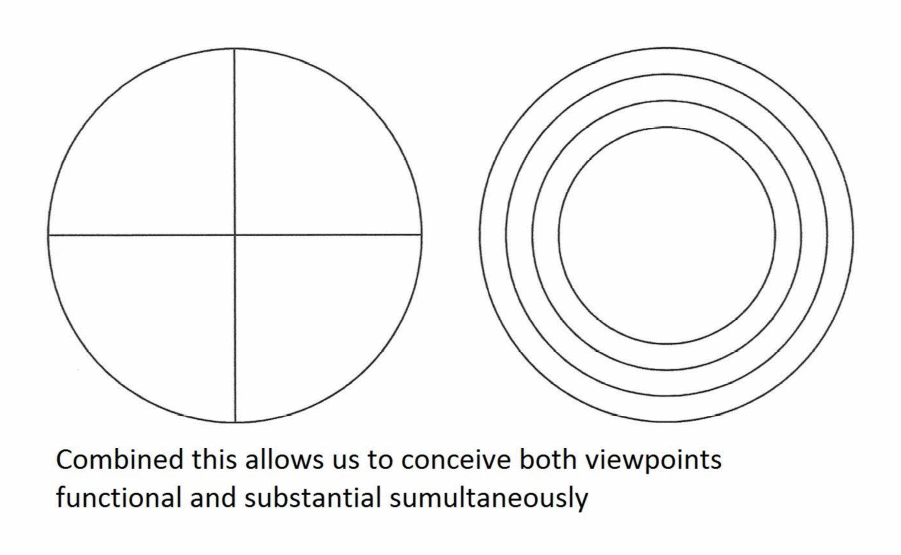
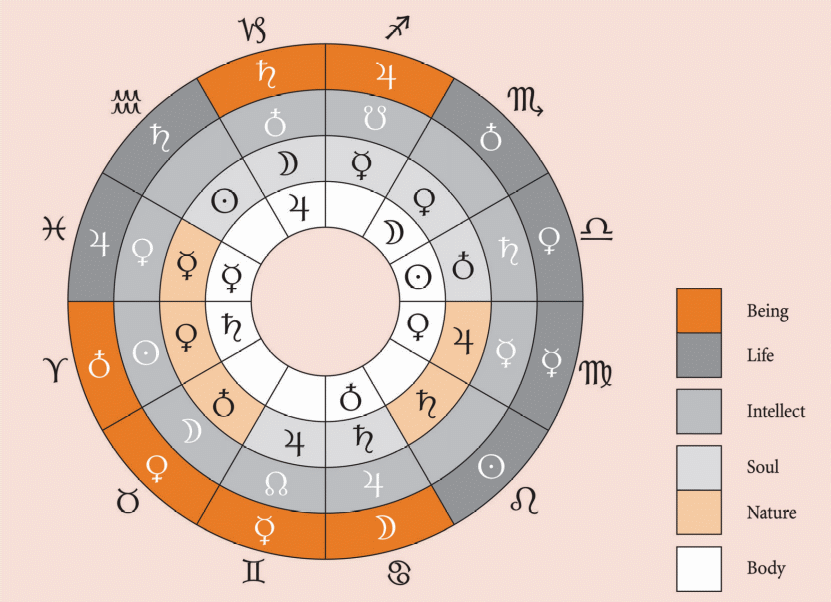
FIGURE AD Supp 201-top-digital. Quadrants and Rings (Substance and Function).
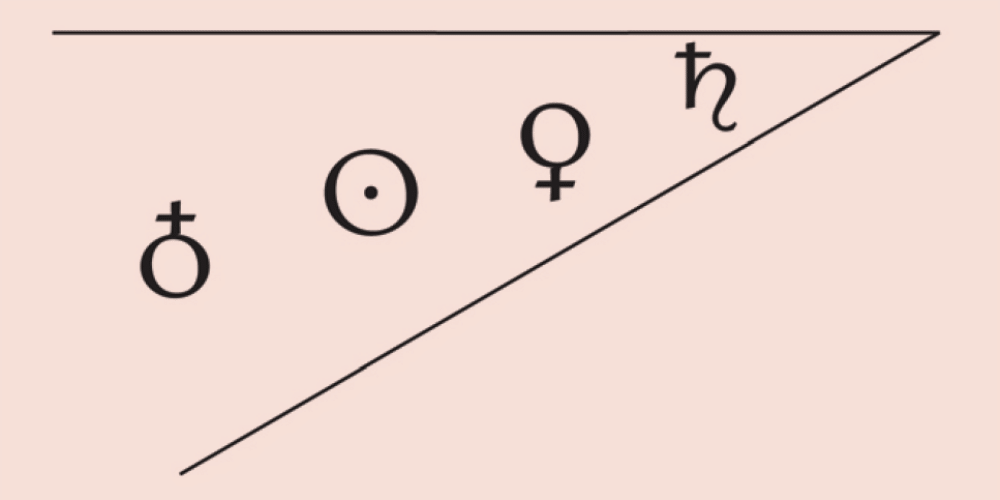
FIGURE 1982 0423-2. The One-Only.
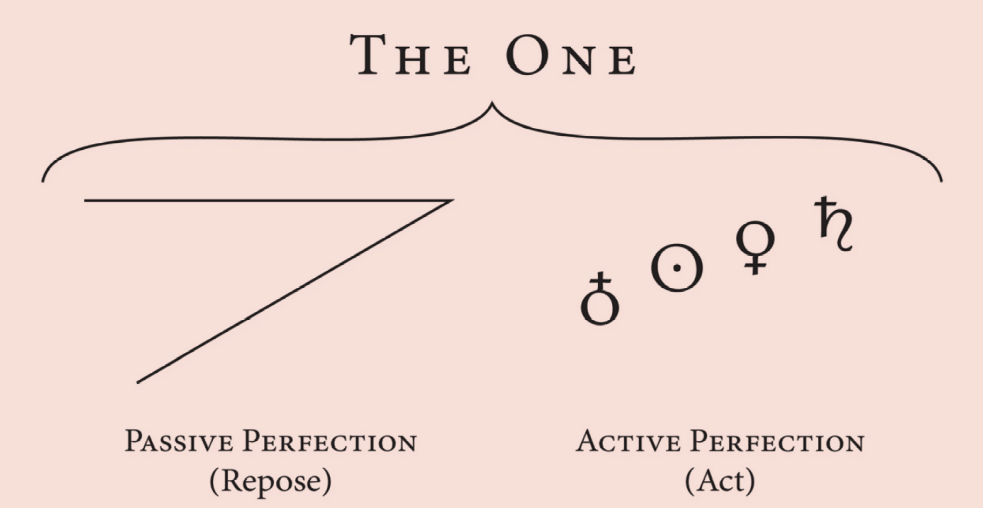
FIGURE 1982 0423-3. Active and Passive Perfection.
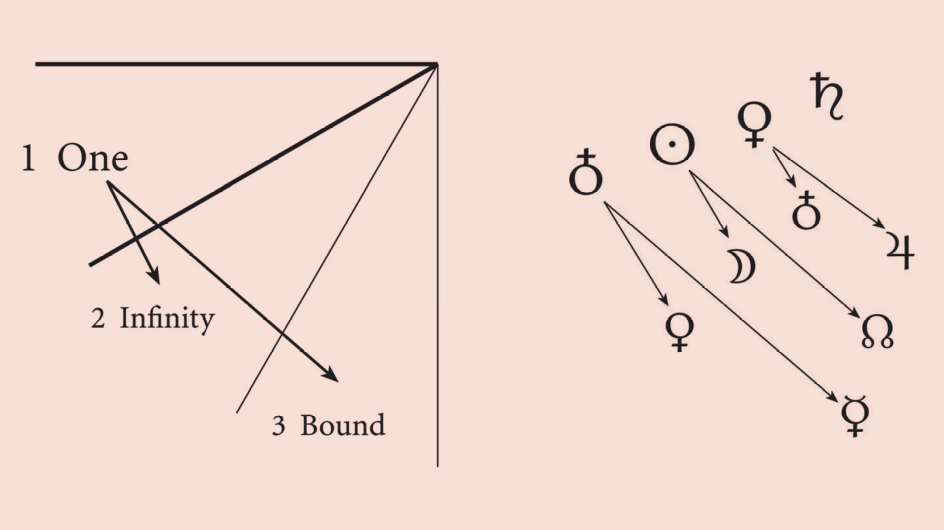
FIGURE 1982 0423-4. One, Infinity, Bound.
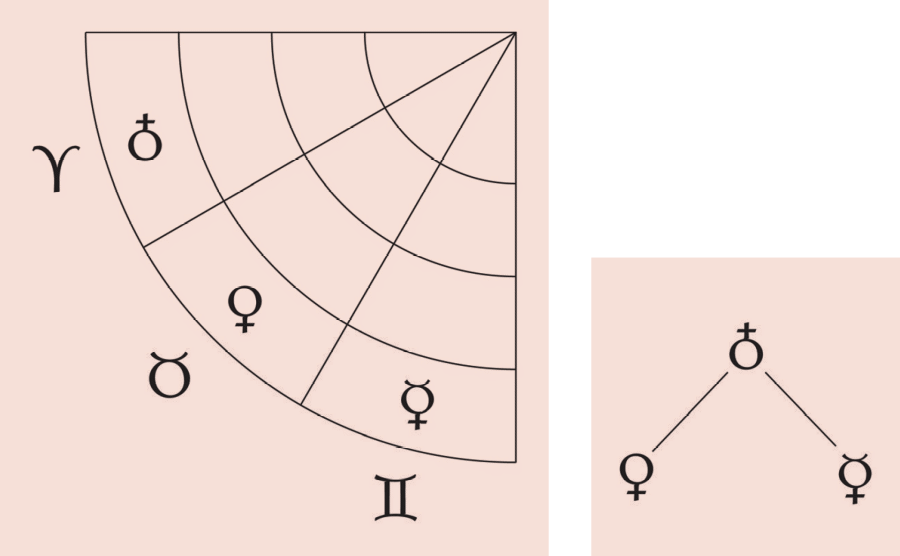
FIGURE 1982 0423-5. Double Act: Mars in Aries.
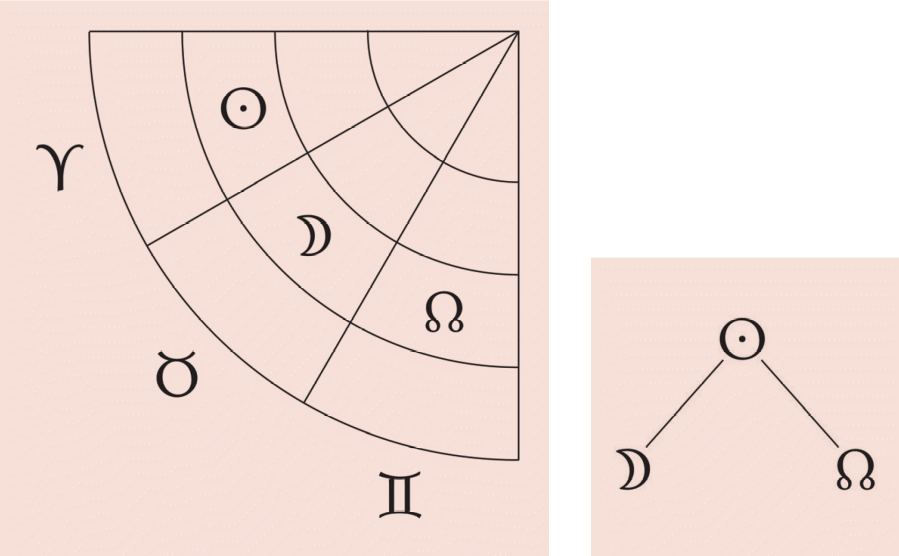
FIGURE 1982 0423-6. Double Act: Sun in Aries.
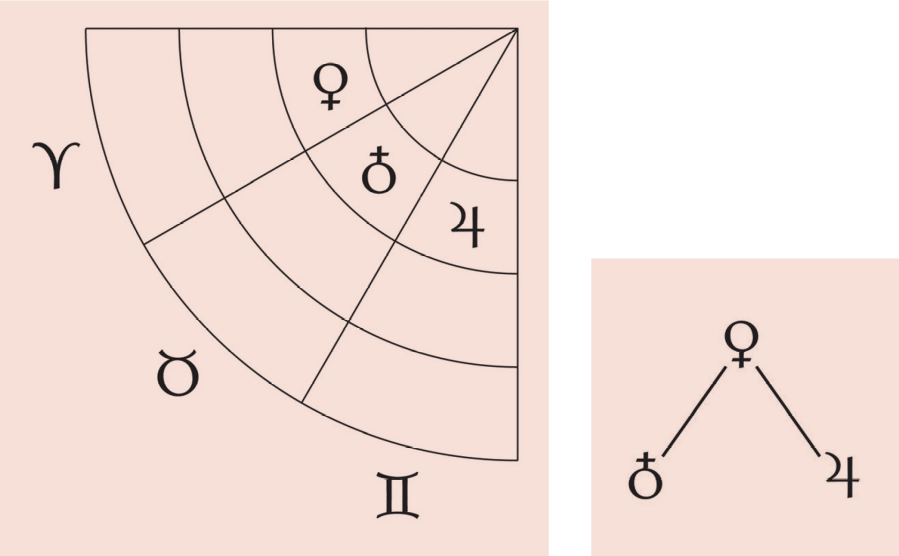
FIGURE 1982 0423-7. Double Act: Venus in Aries.
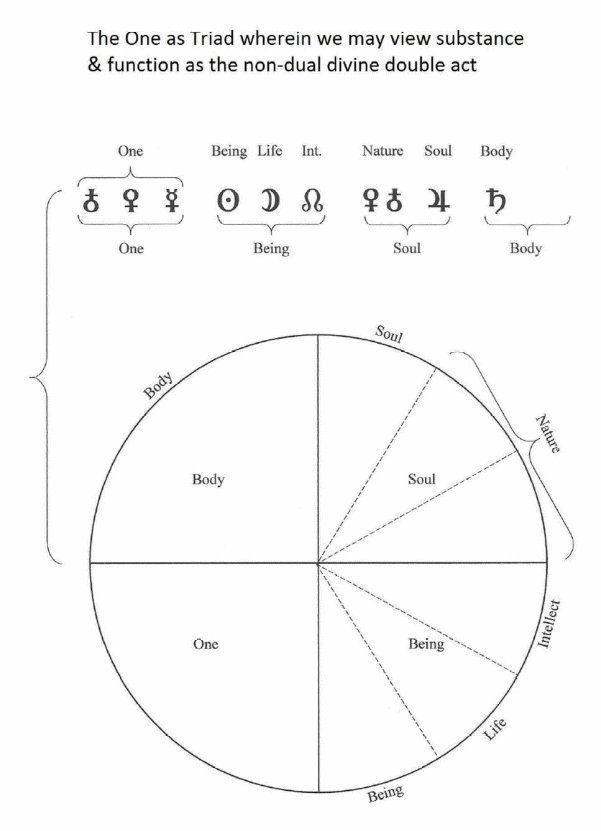
FIGURE AD Supp 202-digital. Triad, Double Act, and Circle.
FIGURE 1982 0423-9. Intellectual-Principle.
ASTRONOESIS WORKING DRAFT, section on the One, read in this class. See Astronoesis, chapter on the One, p. 19 ff.
NOTES:
Previously printed, distributed 2003 as part of a set.
This class series on the One was held on Fridays.
TRANSCRIBED by jf 2002 from Audio Cassette tapes; reformatted by jf 2018. In 2024, IT updates prefatory matter and footer, replaces tape markers with audio file markers, expands Subsubjects, completes Book List, adds Plotinus quotes section, corrects typos and some listening errors, appends six diagrams and references within transcript to these diagrams, reformats to accord with new conventions. Readable edited transcript with AD Paper – V11rp.
AUDIO FILES: 1982 0423a. [Note 1: "Tape" and "Side" refer to original audio cassette tapes that were later digitized into .MP3 Audio Files. Note 2: We are missing the second audio file for this class. Note 3: In 2024, REP Studio improves sound quality.]
1982 04/23 at Wisdom's Goldenrod
Plotinus; One; Double Act
[Audio File 1982 0423a Begins]
(inaudible talking)
AD: (inaudible) It's such a mess, (first of all).
AS: Let's start with (inaudible). Let's start a little before it.
AD: Let's start with the (inaudible) chart.
(inaudible student talking)
AS: Well we should-- I know where to find them. . . . (pause) You want to start right where we just start the new diagrams, that's about where we left off, in the middle of the double act part.
AD: Double act. Think it's important (to read). (student laughter, then barely audible comments, joking around)
AS: It's funny if he says, oh yes, there it is. (student laughter) Yes. Anyway, that's where we left off last week was we had just started. Do you want to do that again?
S: Yes, try again.
AS: Doesn't matter? Didn't think so. (inaudible)
AD: The irritating sentence.
AS: Oh. (AS laughs) Right around here just about any one will do it. (AS laughs) Okay, well-- Briefly, these next two things were an attempt at explaining the double act from two slightly different points of view. Okay. So remember we ended up with last week, we had the view of the four quadrants and the four rings. [Note: See FIGURE AD Supp 201-top-digital, Quadrants and Rings (Substance and Function), appended to this transcript.] And then we had the view of the One as repose and act or substance and function, factored out of that. [Note: See FIGURE 1982 0423-3, Active and Passive Perfection, appended to this transcript. This diagram is from Astronoesis, p. 55.] (loud noise) Sorry. Okay. I'll stop now.
Astronoesis draft (AS reading): "In VI.8.16, he says: 'That his being is constituted by this self-originating self-tendance--at once Act and repose--becomes clear if we imagine the contrary; inclining towards something outside of Himself, He would destroy the identity of his being. This self-directed Act is therefore his peculiar being, one with Himself. Thus, He created Himself because his Act was inseparable from Himself.'
"In this passage the inner Being of the One is universal, the term Being is used analogically, where its Being would be infinite fullness which is the non-difference of two aspects of power, infinite function and absolute substance. To proceed with our analysis in illustrating these ideas that we have discussed up to now, we can begin to employ our diagram. In our use of the astrological mandala we have distinguished the complementary modes of substance and function as respectively the quadrants and the rings which contain the powers or the intelligibles. Here the many levels of reality are spread out and encompassed by the concept of the One as overflowing power or super-abundance. The substance and function that we laid out are analogous to repose and act. And we lay out the four quadrants and the four rings. (inaudible)
"Within the first quadrant we located the King of All whom we referred to here as the Transcendent. Within its perfect self-sufficiency we find repose and act, as in the quote, or infinite substance and unlimited function as impartible. As a symbol of this Transcendent we take the first section or mansion, that is, the Aries notation or the Idea of Ideas, the Self-Existent Brahman, to symbolize the repose, and the four dignities or Intelligibles as act or unlimited function." [Note: See FIGURES 1982 0423-2, The One-Only (from Astronoesis, p. 54), and 1982 0423-3, Active and Passive Perfection, appended to this transcript.]
AS: So the four dignities on the one hand and-- (reading): "Factoring out these two aspects of the first--"
S: Avery, can you (inaudible)?
Astronoesis draft (AS rereading): "Within the first quadrant we located the King of All whom we referred to as the Transcendent. Within its perfect self-sufficiency we find repose and act, or infinite substance and unlimited function as impartible. As a symbol of this Transcendent we took the first section or mansion, that is, the Aries, the Idea of Ideas, the Self-Existent Brahman--"
AS: We took the mansion, the house, as substance or repose, analogously to the way we took the quadrant as substance, and the four dignities or intelligibles represented there as act, in accordance with the ring view also. We factor out these two aspects of the first house we have referred to as the Transcendent.
So we have -- as in this VI.8.16 quote (drawing on blackboard) this is the substance, and the function (more blackboard sounds) Let me finish up (inaudible) The transition or progression we can follow from this--
Astronoesis draft (AS reading): "We can follow the quote 'transition' or progression of the One as source of all, the One as image, and this is made more explicit in the progression of powers, which Plotinus calls the double act in the Divine. Eventually we will see that this establishes the view of the One as including the Primals or Unities which are not other than the One, that is are the first quadrant, from which will unfold all the levels of reality. This arrangement of its interiority, which is as yet no progression or emanation, he states most fully in V.4.2."
AS: The previous quote, VI.8.16, is talking about the act and repose as constituting the One's self-tendance, and we took that as symbolized here, and now from that we're going to see unfolded this view of the One as immanent or as source. (inaudible) go on to the next quote. Well it all follows--
Plotinus V.4.2 (AS reading): "But if something arises from an entity which in no way looks outside itself, it must arise when that entity is in the fullness of its being: stable in its identity, it produces; but the product is that of an unchanged being . . ."
AS: I'll read the whole thing through.
Plotinus V.4.2, cont. (AS reading): "So it is in the divine also: or rather we have there the earlier form of the double act: the divine remains in its own unchanging being, but from its perfection and from the Act included in its nature there emanates the secondary or issuing Act . . ."
Astronoesis draft (AS reading): "We first want to illustrate this symbolically with our diagram, and then give a more specific interpretation of the particular symbols of unity that we are examining. He starts: The One"in no way looks outside itself" [V.4.2] remaining in its own unchanging being. The reference to the One here is the same as the self-originating self-tendance of the one in the previous quote. The utter self-sufficiency of perfection includes an act of perfection or a double power, which is a coincidence of repose and act in the One."
AS: And these we factored out from the previous as the first house or substance and the dignities or function, which will manifest the substance. [Note: See FIGURE 1982 0423-3, Active and Passive Perfection, appended to this transcript.]
Astronoesis draft (AS reading): "This is the first so-called double act; the divine is stable in this identity of power with itself, and the power pervades both the substance and the function. The first house as substance contains aprioristically and without otherness a double act, houses 2 and 3. Each of the intelligibles as function, as absolute or unlimited function contains aprioristically a double act. That is, Mars includes the next two; Sun the next two, Venus the next two, and so we have--"
AS: (chalk on blackboard sounds) and each of these (blackboard) are already contained within it. (more blackboard). So each contains aprioristically a double act, the substance containing without any otherness the double act, and also the function aspect, each of the intelligibles containing the next two dignities. [Note: See FIGURE 1982 0423-4, One, Infinity, Bound, appended to this transcript. This diagram is from Astronoesis, p. 56.]
Astronoesis draft (AS reading): "What is contained is also going to be expressed, the One remains intact, he says, he goes on, the One remains intact, but from the perfection and the double act included in its nature, there is the production of the second act --I'm sorry-- there is the second act, the production of power [cf. V.4.2] The unlimited essence and absolute wisdom consciousness of the One are exhibited as hypostatized in houses 2 and 3, and the repose and act of each dignity are also exhibited as distinct unities."
AS: So we have this picture.
DB: (inaudible) coming out of the repose act of the first house, (inaudible) I mean, we use repose for the substantial act, and act for the functional and (inaudible) totally confused, that the active part, the active perfection is the intelligibles, and the substantial is the passive aspect, and yet it's spoken of as a double act coming forth from a substantial portion of it?
AS: No, I'm saying that the double act is expressing or exhibiting a double aspect of substance as well as a double aspect of function.
DB: Okay, now the initial double act-- right?
AS: It's all over the place right now.
DB: Yes, I know, that's why I'm confused because-- Is it that this repose or the substantial functional differentiation in the first house is considered as double act?
AS: That too.
DB: Apperceptive (inaudible)
AS: Passive. You can think of them as passive perfection and active perfection.
DB: But, see that's-- I know it (felt) but I mean it's like active perfection and active-- I mean it just seems-- I don't understand why you refer to them (in principle) as the double act and what way to understand this, the passive perfection as an act, as distinguished from the functional.
S: Avery?
AS: Well, we got to answer him.
S: Didn't we also use the word 'super-abundance'? Maybe that word works a little bit better than (active).
AS: Well, let's go back to the quote itself: [Plotinus V.4.2]: "So it is in the divine also: or rather we have there the earlier form of the double act . . ." So there, we can interpret in the divine, within the first house itself, or considering it as the first house, first quadrant, or consider the whole first quadrant as the divine. He says [V.4.2]: "we have there the earlier form of the double act." So which way do you interpret it -- many ways. He says [V.4.2]: "the divine remains in its own unchanging being, but from its perfection and the Act included in its nature there emanates the secondary or issuing Act . . ." So "from its perfection and the Act included in its nature there emanates the secondary or issuing Act . . ."
The point is that the perfection includes and in a united way, in an undifferenced way. I think later on we try and use some conceptual terms, but here we try to merge back into the One this absolute wisdom-consciousness and the unlimited essences which are its contents, and there the two of them merge, as we tried to show at the beginning, that it's the fullness of all the possibilities. It's the fullness of all these possibilities, together with this absolute wisdom-consciousness which knows them, that he says is super-knowledge -- this super-knowledge has this unlimited super-essential unlimited infinite content as unseparable. Now if you think of them as exhibiting -- then we're going to have them exhibited as 2 and 3 from the substantial view. And you're also going to have the act--
AD: Let me elaborate a little bit. Take an example at a lower level, Mars in Aries. What's being manifested?
DB: Aries.
AD: What about Mars?
DB: Mars is--
AD: Got a double act.
DB: Mar is (inaudible)
AD: You're not going to have one without the other. So that means power is pervasive in both places.
DB: Power is pervasive in the substantial.
AD: Of both. Yes. The mistake you make is in thinking that passive perfection or passivity is without power.
AS: Power.
DB: Right.
AD: So now if you realize that power is pervasive of the whole first house with the dignities, then it's crucial for (us) (inaudible) the intelligible to have (the whole Absolute) (inaudible). Insofar that the intelligibles are manifesting the substance, you have a double act both ways. We're only doing this to show you that you got the division, so to speak, between the intelligibles and the substance and the function, but that of these-- each pervades the other-- each pervades the other, the intelligibles are pervaded by power, the substance is pervaded by power. You're not going to have function, alright, not pervaded by power. You will have the intelligibles pervaded by power, they'll have a double act. You will have substance pervaded by power, you'll have a double act there too. So if you put Mars in Aries, you say well, Mars is manifesting the fullness of the Universal Being of the One, okay, but at the same time Mars is being manifested by the passivity of the One, Being of the One.
DB: I see, okay. So--
AD: You're going to have the same problem tomorrow.
DB: So the substantial--
AD: All you have to do is work out now what is Mars doing. If we say Mars is manifesting-- We say Mars is the principle of difference, I mean of separation, then what is Mars doing? It's supposedly, hypothetically dividing the substance of the first house is. What is the substance of the first house? Metaphysical infinity, the totality of possibilities, what is that constituted of? -- That would be constituted of, what we might put in the incorrect mode, as the container and the contained, so that the possibilities as conceived without a subjective referent would be the second house, the subjective referent conceived without the possibilities would be the third house. And we have to do that with [these other] dignities too.
DB: But whether we're speaking about the intelligibles or the (basis) within those intelligibles as function, they're both pervaded by power. How would they characterize the One?
AD: There's no aspect of the One which is not included in that pervasive power. Do not import into terms like repose and act associations that are psychological. At any rate, we do make an attempt to translate these illustrations in conceptual terms (too). (inaudible)
(inaudible joke and laughter)
AD: You want me to repeat it or try and see if they--
(inaudible back and forth between AD and student)
AD: Well there isn't one double act. The analysis that takes place is (inaudible). You can look at a double act (inaudible) for instance you can look at a double act as existing in the first quadrant, where the first house is transcendent and the second and third is immanent. Immanence as the tra-- yes, the immanence of the transcendent in the Triad. You can look at the double act in another word. Another way you can look at it. Take the entirety of the chart and spread out-- Well here's a beautiful double act. If you look at the metaphysical chart, alright, you take a look at it, and you see that there's both there simultaneously. There's the chart of the One, and there's the chart of Intellectual-Principle. In other words-- would you put that up? Yes, put that up. Put it behind Bill's head. But if you look at that very carefully it could be *both* simultaneously. If you look at it-- if you think of it as the chart of the One, alright, if you think of the chart of the One, then you would have One, Being, Soul, and Body. And, the seven aspects here would be One-Being-Life-Intellect-Nature-Soul-Body, that would be the chart of the metaphysical One. [Note: See FIGURE AD Supp 202-digital, Triad, Double Act, and Circle, appended to this transcript.] Then if you keep looking at it, you'll see that that's also the chart of the Intellectual-Principle. [Note: See FIGURE 1982 0423-9, Intellectual-Principle, appended to this transcript. This diagram is from Astronoesis, p. 110.] Now there's a double act right there spread right in front of you. See that?
RG: It seems to me that that's the one that has the functional (inaudible)
AD: Yes, I know you expressed that opinion a few times, and I'm not going to disagree with it, the plurality of meanings are very often available in one and the same quotation. But, what I think that is going on is probably the most fascinating thing I've ever seen in philosophy, is that Plotinus is carrying (on/out) or applying the nine hypotheses to the One. And by a careful elucidation, explication of the principles, in other words, the way they flow out of the One, that he is in actuality demonstrating what the nine hypotheses talk about. (inaudible) So, right there I took that as a hint to follow that up, that in his first hypothesis he speaks about the One, second hypothesis (One as) a whole, the third hypothesis, that it has an internal structure. So the second hypothesis straddles the first and the third and it's between them. And, I'm just following that (inaudible) through. But, sometimes (inaudible) coincidence of the ultimate opposites, passive and active perfection in the One, I'm going to try to do it conceptually the way (inaudible). Right now we want to work with a few diagrams so we can (practice). See ultimately (inaudible) this is to bring it down, right down to the natal. Or it's not going to make it (no more), the chart of the (inaudible) and of the last-- of the unities (inaudible). Let's work till we get to the next section, okay, where we try to translate this conceptually.
JA: You said that you consider the (inaudible) of substance and function as repose. Substance and function. Does that mean that the substance that is in the first house imparts (inaudible). (AS: yes) Then consider the intelligence, then you're bringing in partibility.
AS: (inaudible) I don't think so.
JA: I thought there was the suggestion that if Mars divides into Venus and Mercury, then substance and function are exhibited by the (inaudible).
AS: I thought the point that was made just now, if the power of the One which exhibits-- and it isn't just that the intelligibles are divisive or the substance but it's this power that is inherent in both of them which will exhibit this double nature of each one. I think I understand what you're saying-- We're trying to say that these intelligibles which are doing the-- doing something--
JA: Well, are we going to speak of just Aries as substance and function, could you do that?
AS: I think what the diagram, let me try it this way-- When first you talk about the transcendent in VI.8.16, it's at once act and repose and these two aspects are inseparable, and so considering it as this (chalk-on-blackboard-sounds) --inseparable. Looking at those two inseparable aspects which you can't really separate there, now you're saying within each one of these there's the power that is pervasive of both, and each one of these two aspects that we factored out, is going to have factored out of it two aspects, which he calls infinite and bound, or repose and act again. And each one will apply to the other, so for each one you'll have the repose and act. Which we'll go through, the paper speaks about these specifically.
AD: You're still only speaking about the One multiplied by One, and all you're going to get is the One.
AS: I think we make that point later on, it's not two acts, it's just the one power, it's just power, and in fact this is really just-- I think if you look at it as something going on or happening, then it doesn't really-- What we're really trying to explain is the simultaneity of these views: the One as immanent and the One as transcendent, and to show how through this power that both of these have to be conceived. The One as transcendent and then at the same time the One as immanent. And you only see the One as immanent after you have these various aspects that we'll go through conceptually exhibited. And really it's only from there that you're making the analysis of saying that you must have this transcendent aspects, each aspect of which is exhibiting the double act. But it's only after you get the whole thing--
RG: It's partly David's question, I don't see the reasoning for elaborating the point of repose as from the active point of view. In other words he has the two united in VI.8.16, and in V.4.2 he seems to be talking about the differentiation from the point of view of act, not from point of view of repose and act. I can't make the leap there, to show the differentiation of these two points of view.
AS: Maybe that will come across when we do--
AD: Will you read the quote? V.4.2. (inaudible)
Plotinus V.4.2 (RG reading): "So it is in the divine also: or rather we have there the earlier form of the double act: the divine remains in its own unchanging being, but from its perfection and from the Act included in its nature there emanates the secondary or issuing Act . . ."
AD: --question? (inaudible) if you don't understand how we turn it around, if you don't understand how we derive the double act from the Divine Mind's passive perfection and its act. I'm not saying, I don't understand how *you* understand it. How would you interpret it?
RG: I don't understand it. We're just playing on misunderstandings.
AD: No, no. It's not enough to tell me you don't just tell me you don't understand it, you also have to tell me how you don't understand it.
RG: Can I just tell you I don't understand it?
AD: But if I tell you how I understand it, you tell me you don't agree.
RG: It's not that I don't agree. (student laughter) I would understand it that that unchanging Being aspect is the repose aspect.
AD: Yes.
RG: And it remains in itself unchanging, and in fact -- and it's from the act aspect of the transcendent that you speak of the distinction of the transcendent and the immanent. And it's not from the repose aspect, because that's always transcendent, and the distinctions of 2 and 3 really arise from the act's issuing forth from itself, and that appears to give us the distinction in the repose aspect, and in fact it (isn't.)
AD: (inaudible ) function. If you took the first house, and you say that's the Idea of Ideas, or Metaphysical Infinity, and that it is constituted by possibilities which we refer to as active and passive functioning. If you do that, that means you're working with houses 2 and 3. Then the inevitable consequence of that if you see them coinciding would be the first house. If you don't want to follow it down, then follow it up. But I think you're going to come out with the same thing.
RG: I'm not questioning the (inaudible) but your method of derivation. See, I don't get the two double acts--there seems to be (inaudible) a parallel double action between the unfoldment of the 2nd and 3rd houses from the 1st house, purely from the power inherent in the passive (means both) aspects.
AS: The perfection.
RG: The perfections--
AS: They're active and passive.
RG: And the second way of understanding it is from the functional side or the act side. I can't see the first way -- I don't see it in the text, the way you derive it, I see the second way, I see the way from the act that it unfolds its issuing act, but I don't see the part where the repose unfolds itself from the repose aspect.
AD: You're thinking of repose in the One, you're thinking of it as rest.
RG: No, no. I don't. I'm just trying to go from unchanging being.
AS: How about this, Richard? Instead of saying the unchanging being it's just the repose aspect. I think you have to say that the unchanging being is both of these together. Now they interpenetrate, they're inseparable. We've distinguished them this way, but you can't say like that this has some property that this one doesn't --that they don't both have. This is the unchanging being: both of them. Because in the unchanging being, the act is inseparable from its repose, that's what this is supposed to symbolize, it starts out looking like this.
RG: But insofar that the passage crucial passage, and it seems to be a crucial passage (inaudible) -- insofar as he's using the act aspect to show the issuing, he doesn't seem to use the repose aspect.
RC: But he does there -- because he speaks that "from its perfection and from the Act included in its nature."
RG: Well I still think it's from the act side, the active perfection.
AD: I still insist that you're still conceiving of repose in terms of rest, and in the One there is neither activity nor rest. The thing can be misconstrued, there is no activity in the One, there is no rest in the One, we're speaking about passive perfection and active perfection, we're speaking about the totality of possibilities which can be conceived ultimately in this oppositional way, this complementary way. Now if you keep on insisting on saying that you cannot see repose divided itself up and this is speaking without vigor of course, that it bifurcates itself into these houses two and three. And I'm saying now, if you look at houses two and 3, and examine them very carefully, alright, one of them is going to be passive perfection, and the other one is going to be active. And again, you still have no motion, you have no activity, there is nothing in the One, in the sense of any genera that we can understand of in Being. So if you keep on associating repose with some kind of activity or stillness or rest, you're not going to grasp what he's talking about in terms of the eternal act of the One. It's the same mistake Blavatsky makes. She thinks that there's continuous activity going on in the One.
LR: What about transcendent and immanent?
AD: Oh, again that's the remarkable thing about this here. You see the progression of immanence from transcendence.
LR: I'm saying might that be an easier way to contain the--
AD: No. You first have to understand this double act, even in the first quadrant, you can see a double act. You can see the transcendent One as the passive perfection, see houses 2 and 3 as the active. And there you have 1 times 1 which will still give you 2.
LR: I'm not proposing the double act could be in terms of the One being transcendent and immanent.
AS: He mentions that too, that's one's easier to see. (inaudible)
RG: That's no problem.
LR: It seems that what Anthony's saying (inaudible), in the One, (transcendence and immanence,) act and repose, and that repose means rest and stillness (hard to hear)--
AS: That's-- What you just said is different from this, this double act here, seeing these two, seeing this, [Note: See FIGURE 1982 0423-4, One, Infinity, Bound, appended to this transcript.] is not the same thing as seeing the One as transcendent and immanent.
LR: Well--
AS: Well, because this double act here [Note: See FIGURE 1982 0423-3, Active and Passive Perfection, appended to this transcript.] is completely transcendent. That's not his problem anyway, he wants to see it in terms of both sides.
AD: The other thing that Richard and David did was to restrict power, to the act of perfection, and eliminate it from the passive perfection. And one of the chief definitions and characteristics when he speaks about the One is that if anything that defines it or characterizes it is in depths of power [cf. VI.9.6]. And I don't see why you see why we should (exclude) passive perfection from that power?
RG: I agree, but then what do these two different views represent? If in fact they're inseparable they both represent power, they both represent metaphysical infinity. In what sense can you even unfold this--
AD: Well, we said if you thought of this as a kind of distinction within the One, if you don't recognize that what we're speaking about is a modeless distinction within the One, a prefiguration of the distinctions that will take place, then I think you're going to come up with that question.
RG: Insofar as you now speak of modeless, and all of sudden there are these two views, two visions of how aspects of this modeless unity unfold.
AD: They will be more than two views, Richard, there will probably be--
RG: Twelve--
AD: --an indefinite number of views, as to the possible ways of conceiving of the arrangements of the modeless distinctions within the totality of possibilities that exist in the One. You simply got to get that out of your mind. So the whole point that we're making here is that most people-- if you remember that quote which Deck [V.4.2, Deck trans., p. 33 Larson ed.] translated very beautifully and he pointed out that it was kind of synesthesis, in that everything was in the One was in the One, as contained by the One, and that it was not imperceptible what was within it. Now if we speak about each of these contents within the One, then we could say that within the One there could be an indefinite arrangement of all its content, and still we would have no kind of distinctions to work with or operate with. In other words, what we're saying is that the One is very, very complex. And that I think that between the past two classes you can disabuse this notion, that you could have any idea of what the One is, or that you could reduce it to the element of hydrogen? or the element of sodium? or whatever element you want to reduce it to. That this is nothing that you could? speak about.
RG: There's a contradiction there that I can't get past--
AD: Well, (inaudible) Well, anyway--
AS: So maybe--
AD: Write it down so you won't forget it, Avery. But I remember, this argument is (something from) Plotinus (inaudible) the One. This argument is eternal and (if you still don't see it), it's no different. I'm sure there's still going to be people who disagree with the way we said it. (inaudible) What I would ask them to do is give me their interpretation -- in English not in Greek -- because some people have the notion that it has to be said in Greek. It's as old as philosophy, this whole theory. Go ahead.
DB: Would it be any help, if rather than discussing this in terms of the One, we just thought of the problem in terms of power? The One is spoken of in characterized by of this power, fathomless depths of power. Wouldn't it be possible to understand two aspects of power, so that might make--
AD: But we pointed out that the two aspects of power are going to identify the power with the One, or think of the power as he interprets it as extending from the One as super-abundance. There again you've got the double point of view.
DB: Yes, but just within the One itself between the intelligibles in the first house and the Aries or the substantial point of view, you speak of them both as power. Could you say something like in the same way that Mars in virtue of its power is going to manifest the infinite possibilities of the One, the infinite possibilities of the One--
AD: In virtue of that infinite Being of the One.
DB: Alright, the infinite Being of the One.
AD: Which would be comprised of possibilities and the subject. Why don't you wait? I will go into that and then we'll see if you understand.
(Side 1 of original cassette tape digitized as 1982 0423a Ends; Side 2 Begins)
Astronoesis draft (AS reading): ". . . Infinity and Bound. These are the (inaudible) for the One and its dual power. But if the power of the One itself upon itself, which exhibits itself to itself, and is called an eternal awakening without a subject who is awake. The result is the whole first quadrant and the primal unities. The result of this act, this second act or the power of the One, is that you now have the whole first quadrant."
(noises on tape)
AS: The One as (inaudible)
Astronoesis draft (AS reading): "We want that to make clear here that the One as divine is not another, or in others, but is still the power of the One. If the houses 2 and 3 display for us the double power of the One, and if this power is also identical with the One, the result is the whole first quadrant and the Primals established in and by power are not different from the First. The double act ensures that we can retain the highest view of the One as transcendent by also viewing the One as the immanent source or the unities. The double act also describes to us the dual modes of substance and function, the wisdom and content united in the One and exhibited for our purposes as distinct. We can summarize this in a way with the meaning of 1 times 1 equals 1, which is really beyond the imagination of the mathematicians. The Dyad is the identity of the One and its power; the Dyad is the simultaneous alternation of the One as first house and as first quadrant; and the Dyad is the complementary modes of the One as repose and One as act."
LR: Would you mind reading that sentence again please?
Astronoesis draft (AS rereading): "The Dyad is the identity of the One and its power."
(dog barking outside window)
AD: He wants it repeated. (laughter)
AS: So we had these three meanings of the Dyad.
Astronoesis draft (AS rereading): "The Dyad is the identity of the One and its power; the Dyad is the simultaneous alternation of the One as first house and as first quadrant; and the Dyad is the complementary modes of repose and act."
AS: The One is repose and the One is act, neither one, the One as immanent or as transcendent.
AD: If you're frustrated, don't let it bother you (inaudible).
AS: Now we're trying to use the One as the paradigm of any unity, and this was the second--
AD: Let's stop now for just a few minutes--
JA: You said there were three meanings of the One?
AS: That was just an example, well-- Of course I mentioned three of them. "The Dyad is the identity of the One and its power." You can look at the Dyad as the identity of One and Power, in other words, that's the Dyad, the One and its power is the Dyad. "The Dyad is also the simultaneous alternation of the One as first house and the One as first quadrant, or transcendent or immanent. The Dyad is also this complementary mode of the One as repose and as act." That is, in the first house or in the first quadrant we have that, the One as repose and the One as act.
AD: That already would also show you the indeterminate matrix of power itself, what they keep on referring to as the Dyad, the matter. Plotinus even refers to it as the 'matter of the One' [cf. Plotinus V.1.5 & Astronoesis, p. 31]. Remember that quote--the matter of the One? Remember that quote?
S: He seems to be putting the Dyad in, along with (inaudible) the transcendent? (inaudible)
AS: Well, the dyadic (inaudible). In the first view of the Dyad, it's the power which is inherent in the One.
S: But then, what is the distinction?
AD: The other view is that the power is the matter on which the One works. Don't say half--you got to say them all. You cannot say that the One and the power are identical without at the same time saying that the power that belongs to the One is the matter that the One works on. So if you want to have the true view of Dyadic notion.
RG: So the distinction between the Dyad and the One in this case is that the power is now acting as the matter and not as identical--
AD: No, the One is acing on the power, that's its matter, that's what it's working with.
RG: But you have the One and its power. In the one case you call it the One, because there's no distinction.
AD: Now you're not speaking of it as dyadic.
RG: And then you say the One and its power--
AD: Now you say it's dyadic.
RG: What's the difference?
AD: (We'll go over it) (inaudible).
AS: Say it again Richard, I'm not sure if I caught what you--
RG: You just made the big point before--
AD: Make the three definitions of Dyad, the indeterminate Dyad.
RG: I just want to ask about this one. You have the One and its power, we've just discussed that, that's the One, that power was inherent in the transcendent One.
AS: But that same power is also the power extending from the One.
RG: Right, insofar as you speak of the One and its power, you also speak of it as the Dyad, so what's the difference?
AD: In the one case you're identifying power with the One, and in the other it's indeterminate and extends from the One as sheer indeterminacy, it will be the matter that the One uses to form the unities.
AS: And both of those views are again the dyad, namely the power remains with the One, and is the One, and characterizes the One, and also--
RG: How could the first view be the Dyad? If you've already called it the transcendent One?
AS: The One and--
AD: It's not the Dyad. I just said that. The One as self-identical with the power is not the Dyad as the transcendent.
RG: Right.
AD: The transcendent has a double act--what is the double act? Now you tell me now.
RG: I don't know, I mean there are many, a lot of them--
AD: Did you ever take math? (RG: Sure.) Take a piece of paper and pencil and write them down, itemize them. You're asking me to repeat like a parrot.
AS: That would be my parrot (degree). (laughter: [Avery's Sun degree symbol is the parrot].) Let me read the three again and --(inaudible) The last two out of three were clear.
AD: Richard, let me-- the diagrams--
AS: First, this is one view, you have repose and act, either way here, you have repose and act, or you have repose and act, or you have repose and act, that's one view of the dyadic power: Plato says God exhibits Infinity and Bound. So one view of the Dyad is it's infinity and Bound, this complementary modes, you follow that? No problem. No, you didn't follow that one.
RG: Is it just--
AS: The second one is the One as transcendent and the One as immanent. The power remains with the One and the power is expressed, right?
AD: Yes, go ahead--
AS: And the third view-- you could also conceive of the identity or the One and its power as being the Dyad.
AD: The thing is to write it down in order on a piece of paper, (and to keep it) spread out in front of you. (inaudible)
LR: (inaudible)
AD: It helps me. Because it's pretty hard to keep them all together and you're not going to get a Virgo definition of these things by any means. Any self-imposed mental limitations will immediately block the perceptions that you're trying to apply here. Better still for you to get a mathematician to explain to you the properties of the number 1. What are you shaking your head for, Vic?
VM: The mathematicians you're looking for no longer exist.
AD: They gave up on that. Well, I think you'll see here what they're discussing is there is by staying as far away removed from the original are these metaphysical properties, that the number 1 itself has. And we'll attempt to show later that all the numbers from 1 through 10 are going to be derived from the peculiarities of the metaphysical properties of the One. Not from the One as a rational consciousness either, for that claim is that [it's] the revelatory reasoning that Plotinus is delivering to us. Let's try again, let's go over it. Or do we want to continue?
AS: (psychological comment)
AD: But read right up to the ideas.
AS: Excuse me?
AD: Read right up to the ideas, the (text) refers to the ideas.
AS: Using the One as a paradigm? Read through that?
AD: The paradigm (inaudible).
S: (comment about sound system feedback from bug buzzing noise on microphone)
Astronoesis draft (AS reading): "In our discussion of Unity as the principle of principles--"
(noises and whispers)
Astronoesis draft (AS reading): "In our discussion of Unity as the principle of principles, we have laid out a model or paradigm that later we can apply to any one. We observe firstly that the first house which symbolized the self-existent, had a hidden and mysterious distinctionless constitution, which we itemize in the following way, the house segment by itself representing the substantial side of the double act, its functional aspect represented by the functioning intelligibles, the dignities. Then we proceeded to display the double act as operating as the substantial side resulting in the next two segments or houses of the wheel."
AD: That's a repeat.
Astronoesis draft (AS reading): "The transposition into conceptual terms would require us to conceive that from the point of view of substance or passive intelligence per se, we are hypostatizing the contained and the container, or the object, in this case the possibilities of manifestation and the manifestor. Now considering the intelligibles--"
AD: No, let's stop there--
Astronoesis draft (AS reading): "This is applying this double act to the point of view of substance will require us to conceive that from this point of view, the point of view of passive intelligence or substance we are hypostatizing the contained and the container, or the object, in this case the possibilities of manifestation, the second house as hypostatized, and the manifestor, or the 3rd house as hypostatized."
AS: Now if you put those back together as the unity you'd get the first house.
AD: Let's try--we have in the first house the self-existent or the idea of ideas. And we referring to that as the passive perfection. And the Mars is the active perfection which is the principle of-- in that case, in that situation, of Being (hard to hear). Now we're going to say that Mars is going to manifest the Being of that Idea. And we said that that idea was what? --
RG: (inaudible)
AD: Well, we referred to it as metaphysical infinity. So what will it manifest--it will manifest metaphysical infinity. Now if you want to understand, you've got to try--what will it do? You go back to what your definition is. What was the first house idea? It was active and passive perfection. Wasn't it? Now what will Mars manifest? Active and passive perfection--one will be the Venus and the other will be the Mercury.
Alright, let's use conceptual language. If it will manifest metaphysical infinity which the first house was constituted of, that means that we're speaking of two sorts of principles, two sorts of possibilities, we say, referred to, as active or passive. Then that would mean that these two have to be manifested by Mars, so included under the manifestation of Mars when we say Mars is manifesting Aries, these two things have to be manifested. Equally Manifested will be the Venus and the Mercury, because they will represent that double act, but in a state of identity in the Mars. Now we're thinking of it just as function. It isn't that there isn't power, we're de-emphasizing the power, so that we can understand that the principle of Mars, which always stands for the principle of separation is going to take the simultaneity of the double act in the One, which coincides and hypostatizes and then spreads them out -- that's the Venus and Mercury. You'll be able to do that with the Sun, and with Venus [in Aries], and I could do that with Saturn too, and there's no double sign there, there's no double planet. [Note: See FIGURES 1982 0423-5, 6, 7, Double Act: Mars, Sun, Venus in Aries, appended to this transcript. These diagrams are from Astronoesis, pp. 61-63.] Try the Sun, maybe the Sun will be easier. Try the Sun.
RG: (inaudible) the part about that unfoldment is easier for me.
AD: How about the Sun, is that easier to see too?
RG: In terms of Act and intelligibles.
AD: Then try the Sun. The Sun as the Intellect of the One, as the Intellect of the One, also has to do the same thing, right? Now the Intellect of the One is the Author of Being, Being is comprised of what? You would have to include among it, right, you'd have to include what?--Life and Intellect, right? That's a Triad you can't separate even when you try. The thing, the activity of the thing, and the comprehension of the activity of the thing. Alright, the Sun would represent the Author of All Being. The Moon would represent what? The Life of that Being. And the Head would represent the Intellect of that thing. So then the Sun as the author of all being is simultaneously manifesting the active and passive perfection which is inherent in the One itself, it's transcendent. Alright, try the next one. Try the next one. Try Venus.
(inaudible AD/student interchange)
AS: I think that--
AD: You see what we're doing--we're taking the ideas that surround the house, the logos and we're using the logos to try to understand what's happening here, that's what we're doing. Now we should work without any of that conceptual language, work with just the symbols. And it's much faster with the symbols.
AS: This may not be in line with what you're doing, but I'll try it anyway. (inaudible) You take the Mars for example, and you saying that within the Mars which represents the Being of the One, you're factoring out these two aspects, and it's going to have (inaudible) One of them represents the repose and the other one the act. But could you say this thing back here, the Mars in Aries, I'm thinking of a lower level with the (inaudible) analogy, you say that Mars manifesting Aries, okay, as well as Aries itself is exhibiting the-- It's a two way thing, the Mars manifests the Aries, and the substance is manifesting something of the function. They're both constitutive of the other, each is constitutive of the other. And insofar as this is functioning and it's exhibiting something of substance, and the two are identical here, but function itself will have an aspect of repose which is like a factoring out of its non-relation to substance, a relation with non-relation, and also an active aspect. And substance too, insofar as it gets manifested by function, but of course here is identical with it, it will take on an aspect of function as well as an aspect of substance or repose. (inaudible) Even here each one will also be taking on the characteristic of the other, will participating in the characteristic of the other. The function exhibits its own characteristic and the others, but the other here is not other, that's the point they're identical, (which we can see) conceptually from the diagram. This one has to exhibit-- (inaudible)-- you see that fine.
RG: If other is not other, then why have the--
AD: There is no otherness in the One.
RG: Right. But why can't you hold that the repose and act are totally interpenetrating at the level of the first house?
AS: But then when they get exhibited --
RG: What gets exhibited?
AS: (inaudible) Is it that they get exhibited, or are you going to say that in Being-- (very hard to hear)
RG: Oh I see.
AS: If you did what you saying, then within Being there's only going to be differentiated functions, but there's not going to be any differentiated substance. Now you're not going to claim that right? There are certainly differentiated substance, for example, we have the ideas within being, and we have the intelligibles. But how are you going to follow the progression from function, alright, but can't follow the progression from substance?
RG: Because function in fact includes (inaudible).
AS: (The unifying progression from substance all right, but you can't have it from function.) In fact includes--
AD: They're reciprocal all the time.
AS: The substance also includes a power, a functioning, and that in fact it's because they are identical at this point or inseparable at this point. But I guess my point there Richard, is that you'd have to admit within Being that this differentiation of this function, and you also have to admit the differentiation of substance as (inaudible). And somewhat through their mutual interaction. (inaudible) self-constitutive of the other so it seems like the distinction in substance is brought about by function and the distinctions in function are brought about through substance. For example, if you looked at Mars series in Being, you'd see that by functioning in the different substances of those signs, that the Being, Life, Intellect, and so on, of Mars are getting differentiated. So substance also has a power of differentiation, not only functioning. (inaudible) And even Vedanta would admit grades of consciousness.
(inaudible comments)
S: Avery, when Plotinus speaks about the issuing act, are we referring to that as, as it were, when you say 2 and 3 are included in 1, when you say that they're not included in the 1, is that what we're calling the issuing act?
AS: He says the secondary act or issuing act.
S: Right.
AS: Which, in the quote, he says, "then attains to Real Being [V.4.2]". So I think in this view, you're really differentiating all those steps one by one. By saying when it attains to Real Being, then you'll talk about Being of the Intellectual-Principle. But the fact of the secondary act--
S: Are we?
AS: The issuing act as it were, is here, looking at these things are exhibited.
S: Right.
AS: Which really don't go out anywhere, it's more in terms of this completing act.
AD: Avery, you've got that combination, you've got the Triad which makes possible the arisal of the (Being).
S: So the first stage in this analysis, you couldn't speak of the double aspect to this unity, like you have the first house and you're conceiving of it as including the meaning of substance as 2nd and 3rd house, and including the meaning of the intelligibles as the second and third house (sounds of chalk on blackboard)
AS: If you really want to-- You'd probably do something like this, (chalk-on-blackboard sounds), see the diagram, (inaudible) you don't see them at all, they're inseparable; then you see these two aspects in VI.8.16 act and repose; and then he says included within each of these, within, included in there is this double act so then we have the 'included'. But then he says with the second act you seem them exhibited, so then you have this. And finally one two three four, and then finally the result of this is this, all the unities (chalk-on-blackboard scratching). And then the result of that the finally all of-- from that we'll see suspended all of the unities, the whole chart, the fourfold with all the dignities. So I mean you--
AD: So the discussion is obvious. Where does the many come from? That would come from the One, there's no place else that it could come from. So we're agreed on that? Alright? Then the next step is a working out of a step-by-step progression from the One: a detailed step-by-step, as microscopic as you can make it. Because this is what Plotinus is saying--these are the exact steps that we quoted. And he was given that description, very accurate, so that you work out how the Triad, or let's say how Universal Being arises out of the Transcendent One. Once you work it out, and I make this comment in the paper, you can see that the fourfold, the Transcendent, remains intact, regardless, and that the analysis is faulty and incorrect. But what's wrong with building up a scaffold so that I can get up the building?
AS: We're all bums.
AD: We're all bums, and you can see that the transcendent One always remains transcendent, and that's why 1 times 1 will always remain 1.
AS: When you did the Parmenides too last time, we started it with the first hypothesis.
AD: Let's not bring that up-- But this is exactly what he's doing, Plotinus. He takes those nine hypotheses and he's applying them to the One.
LR: In illustrating the One in these various ways, is it an actual metaphysical difference, or would you say that they're all just different ways of illustrating it? In other ways, when you show the One as being the first house and you show the One as being the first quadrant, is there an actual metaphysical--- um, difference?
AD: Not in that realm, not in that realm.
LR: Or are you just then illustrating (inaudible).
AD: In that realm we couldn't possibly see any possible distinction between the One as transcendent and the One as immanent, just like we couldn't possibly see any possible distinctions between Soul and Being, or Being from the One. These are distinctions that the sages are delivering. They're more in the sense, they're more like where we opened the very first sentence, that the Philosopher-Sage is an annunciator. He's not making these truths up, he's not discovering them, they're given to him to reveal to others. So what it would amount to saying is that the sage in the silence receives this knowledge and transmits it to us. But that he himself does not see these distinctions, they do not exist for us when we're there. And this has been affirmed even, for instance, in the Eastern tradition, the Buddhists point out that you cannot distinguish between the universal ideation and the subject-wisdom. Those distinctions are only verbal and they're from our point of view here. But if we can understanding something of what's happening here, then later on when we get to the notion of participation, how a unity could be both one and many, equal and unequal, alright, and how it could sunder all these contradictory qualities, you will be able to realize that the unity, the indivisibility of the unity does not sunder at all, it remains intact throughout all of it, and if that wasn't so, the logos of discourse would be simply out of the question. This is Plato again, the Parmenides, if you remember.
AS: Someone's coming.
AD: Someone's coming? You think--
S: Parmenides is coming? (laughter) (inaudible)
AD: It's the greatest metaphysical, as a matter of fact, I even don't like to call the work metaphysical, I like to call it meta-ontological, because metaphysical is a stupid phrase coined by Aristotle [for] anything that's above physics. Well anything that's above physics could be Soul, Being, and the One. Alright, but this is above even Being, so it's meta-ontic. And that would be the correct way to describe it and not metaphysical. But once you coin a word, you know-- so it is for the rest of eternity. So we have to hear the words like 'consciousness' coined by Neo-Vedantists who don't understand their own doctrine and we have to accept this word because if we change it nobody could (inaudible) it. If you say 'pure intelligence' they look at you; 'pure consciousness' they think you know what you're saying.
Alright, let's go through it a little bit more. Don't worry, tomorrow you'll have a picnic, you'll be back in the imagination.
VM: Anthony, could you say again there's a general lack of distinctions in the One, correct me?
AD: Yes. (inaudible student comments) I just pointed out to you that these distinctions only exist for us in order to understand something about the nature of the One, and you're not to confuse this kind of understanding with the actuality of infinity and eternality. But if you have an insatiable craving to get some sort of understanding you will be inevitably and ineluctably drawn to try to understand it--and that's all we're trying to do. And the difficultly that I think that you're pointing out is one that we've had all the time--basically how can anything exist in a modeless manner in the infinity of the One? I would reverse the question and throw it back to you, and say how can anything exist in metaphysical infinity in a distinct manner?
VM: How could it exist--
AD: Always take for granted that your ego is going to turn things upside down, wrong side up, and inside out. Now you ask me a question, How can anything exist in a distinctionless mode in the One? And I'm asking you, How can it exist otherwise in the One? If by One, if we say that the One is constituted for instance of Life, can we say *a* life? It could only be the universality of Life, that's the only way it can exist there. And the universality of Being, and universality of Nature? But well if they all have this universality of essence, how are you going to distinguish them?
S: How would it be possible, yes?
AD: You can't. That's why we say they exist there in a distinctionless manner.
AS: It's not outside, Vic. (student laughter)
AD: Well, next week we're going to the Intellectual-Principle, we'll find it easier.
VM (& student comments): (How could it be?)
AD: But one of the things you ought to try to do, is to try to understand it conceptually, before you try to tackle the thing symbolically.
S: I don't know how to tackle conceptually, Life -- if I don't think of the idea of repose as rest-- if I don't have any associations with the word I don't know how to tackle it at all. But I mean--
AD: Well, we're back to the same situation that we spoke about before, can you conceive a billion dollars, yes, can you imagine a billion dollars, no. In the order of thinking as you conceptualize more and more abstractly all imagery is left behind. So if you can extend that abstract conceptualization to a One, the way we're speaking about it, you can see that any of the properties that you can understand through imagery and no other way are inapplicable. It will just not follow through. Just like you can't conceive of infinite life, you can't, I mean you can't imagine it -- you can make a negative conception out of it, that's all.
RG: Insofar as you speak-- you said that everything exists in the One in a distinctionless and modeless manner.
AD: (assents)
RG: And yet everything exists in a universal-- (inaudible)
AD: Even the One doesn't exist in anything, even the One doesn't exist in anything, if it did it wouldn't be the One.
RG: So when, within the One, you now look at it, you put these--
AD: You understand that is incorrect, within the One.
RG: And insofar--
AD: And now we proceed, we know that we use a metaphor.
RG: The precise nature of its metaphor keeps eluding me, in other words, it seems the metaphors are-- the use of the metaphors in a distinctive way block the very understanding of the distinctions of the (nature of the One's) (inaudible).
AD: Yes, I'm aware of that and so are you. That's why negative theology is so popular. It's much easier to say not this and not that, than to say that it is.
RG: But in a sense, isn't it just more than just popular? Isn't there a truth there in that negative dialectic?
AD: I wouldn't deny that, it just doesn't fulfill me, that's all, because I'm an extrovert.
RG: So we have to use metaphors.
AD: As an extrovert, I've got to have it said in a positive way. To me, I find the Eastern mode of explaining things in the negative way unavailable. Because if we operate basically by extroversion, and you're giving it to me in a negative way, I can't take it in. The negative way comes when I schematize what you've externally presented to me. Now we're getting into psychology, I think we should leave that for tomorrow, it's more popular with people, their imaginations.
VM: If I could persist (inaudible). You really stress the distinctionless modeless manner of the One, yet you very carefully and very precisely speak about the lacks, the different kinds of bifurcations, and different kinds of modalizations, and so on. I know that (theory). (inaudible)
AS: That's the double act. That's the Dyad, just what you said, the distinctionless, there it is again. The distinctionless, it has to be absolutely distinctionless, and yet on the other hand you have all this analysis, to try and understand exactly--
LR: How do know it's distinctionless?
AS: Because I think the point also about distinctionless was that it doesn't mean absolute--
LR: Homogeneity. (AS assents) You have nothing to be distinctionless otherwise there's you've already could put everything in there and then call it distinctionless. The mind is not set with a paradox if you just say distinctionless One, it's only when it's--
AD: When you (inaudible).
LR: When you put every distinction possible in there and then call it distinctionless that it takes on this quality of being a supreme--
AD: Let's go back to this here--he says that the power of the One is what imparts to each of the unities their form or aseity and their existence. Now how would you understand that?
JfL: I think that what you were saying just before, and I liked the way you say it, is where the Universal Being, Universal Life, is that the Universality, it's the power that imparts it, it's the power that guarantees it--
AD: Its existent.
JfL: The power is the wedge, the universality is what guarantees it.
AD: Now if we didn't have that as an origin, that distinctionless mode of universal essence, where would we be able, or let's say, how could we trace the many back to the One, or vice versa, how could we say the many came from the One? Let's take another example. Imagine, in the sense that your mind thinks 12 ideas or 10 ideas. Each one a big idea, each one simultaneously present to you, so that all 10 ideas are simultaneously present to you. Or 5 ideas, let's say 5 because that's easier. And we would notice in the ideas, that you have, the 5 ideas, they are different from one another, but they're self-identical, alright, that they're permanent insofar that there a standing actuality, that they call forth the activity or the thinking of the mind in the same way that the mind produces them, you would have motion. So in that example, and it's only a kind of picture, he has these 5 ideas, and so to speak they're symbolizing the five genera, you can see that each idea is different from the other, the principle of difference. You thought those ideas into existence: motion; each idea is self-identical with itself: sameness. Now, go backwards a step now, imagine that they all collapse back into the mind, the ideas-- okay, then that means the principle of identity which made an idea to be what it is, alright, is back in, let's say, the substance of the mind or the mind's being. And that which makes one of the ideas to be different from the other, that notion of difference, also is collapsed back into the mind. Now tell me, How are you going to distinguish in the mind, sameness, difference, identity, then you got it (claps), then you know how they exist in a distinctionless mode in the mind.
Now you say I, I don't know how, you're thinking in a differentiated and distinctive way. You know that they exist there, and that's what you mean when you say that the unity of identity is in the mind, the unity of life is in the mind, the unity of motion is in the mind. But when you say they're in the mind you've just deprived yourself of any distinction by which to recognize them. Let's go over this another twelve times. (inaudible student comments) You're hung up on words, you're hung up on words, you don't see that this is happening to you right here in your own mind! (inaudible student comments)
And insofar as that the power brings it out, it is (dependent) from the power, so the power is the bridge between these two, between saying that the One is transcendent and the One is immanent. When you think of that power projecting forth those unities you say it's immanent, when you see it retaining itself it's transcendent. Now if you think that you can see it, you're stupid! (student laughter)
(shuffling, sounds like class is ending, Avery also seems to be explaining something in the background)
AD: I always dread these classes, you know that?
VM: I know, you dread them.
AD: You have not developed the organ of thinking as an organ of perception. Your thinking is still tied in with words. It's like when you go fishing and you drop the fish, I mean you drop the hook down and you pick up a boot, all the mud comes up with it, you can't see the boot anymore. You drop a thought with words and you come up with more words. When you drop the thought and you have to use words, there's a point where you drop the words too. I still want one of you to try now, how is the infinite nature of the One, how does it comprise Mars (and--) Because this is the only way I can tell if you see it! The Venus, alright, would have to contain a double act within itself, passive and an active. Venus is manifesting something of the nature of the transcendent One. If you try to conceive--
[Audio File 1982 0423a ends. We are missing the second audio file for this class.]
1982 04/23 V11rp: CLASS: Plotinus; One. Copyright 2024 Wisdom's Goldenrod p. iv