Appendix: Examples of Sun and Saturn Sign Positions For Gnostic and Fabricative
Sun [Self, Life-force]
Sun in Aries [gnostic, exaltation]: There's a growing identification with understanding, the meaning of the individual is paramount, it's the knowing of the subject.
Sun in Taurus [fabricative]: is the being of the subject. Sun in Taurus is insisting on affirming his being. One possibility is getting actualized, one samskara [Taurus correlated with samskaras], which is going to persist. The Life force is being poured into the samskaras.
Sun in Gemini [fabricative]: is preoccupied with the thoughts he has; the Life force is being poured into the ideational processes.
Sun in Cancer [fabricative]: the four levels of individuality are coming into being; an attachment to the psychological selfhood.
Saturn [Senex]
Saturn in Aries [gnostic, fall]: In Aries, there's a knowing of the Senex. …is completely concerned with the Saturn function, self-apperception, through sensing [because in fall].
Saturn in Taurus [fabricative]: There is a preoccupation with the being aspect of the Senex; the emphasis would be on the way the degree is building up the Senex. …it's something being assimilated into that [Senex] archetype.
Saturn in Capricorn [gnostic, ruler]: The emphasis is on willing, like the paradigm of the Intellectual-Principle. There the manifesting power is so identified with the Idea; but it's still the manifesting function.
[Note: Key meanings for the gnostic, dignity planetary positions can be found in Astronoesis.]
DIAGRAMS AND CHARTS FOR 1982 0426
Class
Monday, April 26th, 1982
Verbatim, unedited transcriptCLASS at Wisdom's Goldenrod, Hector, NY
with Anthony Damiani (AD)
April 26, 1982
ASTROLOGY; THEORY; GNOSTIC AND FABRICATIVE
With Appendix: Examples of Sun and Saturn Sign Positions For Gnostic and Fabricative.
TOPIC: Astrology
SUBJECT: Theory
SUBSUBJECTS: Dignity and Non-Dignity, Gnostic and Fabricative, Tropical Zodiac, 360 Degrees/Tropes, Cosmology, Divided Line, Elements, Jung Psychological Functions, Jungian Archetypes in Mercury Pisces, Jung chart degrees
CONTENTS:
Jupiter in Pisces as unity of Five Mahabhutas; five different kinds of material life
Venus in Pisces combines 72 Names/Powers of God with Five Mahabhutas to create 360 Gods/reason-principles; other terms: psychoid, alayavijnana
Each God has five aspects; one central (etheric) and four peripheral in elements
Nature Mercury in Pisces as productive imagination/planetary spheres/manas
Tropical zodiac as traces of reason-principles left behind by prior functioning; a certain number of these combined by planetary spheres into a psychosomatic organism
Within tropical zodiac, planetary spheres represented by categories of imagination, reason-principles by tropes
Division between gnostic and fabricative only available within tropical zodiac, doesn't apply to functioning of planetary spheres
Jung's Uranus at Leo 15: recognition of the embodiment of reason-principles in flesh and blood (archetypes)
Examples: 1) Saturn at Aries 5 (gnostic) senses content of degree; emphasis on knowing (sensing); 2) Saturn at Taurus 5 (fabricative): degree builds up being of senex
Psychosomatic: 'psycho' refers to knowing aspect, 'somatic' to fabricative/being aspect
Saturn going through all the dignities will result in purification of soul power, through all the non-dignities in the etherealization of the reason-principle or God
Once soul powers purified, can operate in and out of the world; Sage can directly apprehend Intelligibles and also directly engage sense objects
Rulership as willing/intuition, knowledge and action coincide; Spinoza: freedom is conformity with necessity
In moving from rulership to fall, there is a growing separation between function and idea
Problem of gnostic and fabricative traced back to Intelligibles manifesting the Idea
Examples with Sun in different signs: Aries through Leo
Subject-object relationship in tropical zodiac illusory
Polytheistic psychology would dissolve soul powers back to reason-principles and monotheistic psychology would dissolve meanings back to unity of soul; both are extreme positions; not "either or" but "either and"
Question on relationship between natal planet in non-dignity and itself transiting through a dignity sign
Question on how rulership differs from fabrication
Ordinary person operates within tropical zodiac, Sage has direct access to reason-principles
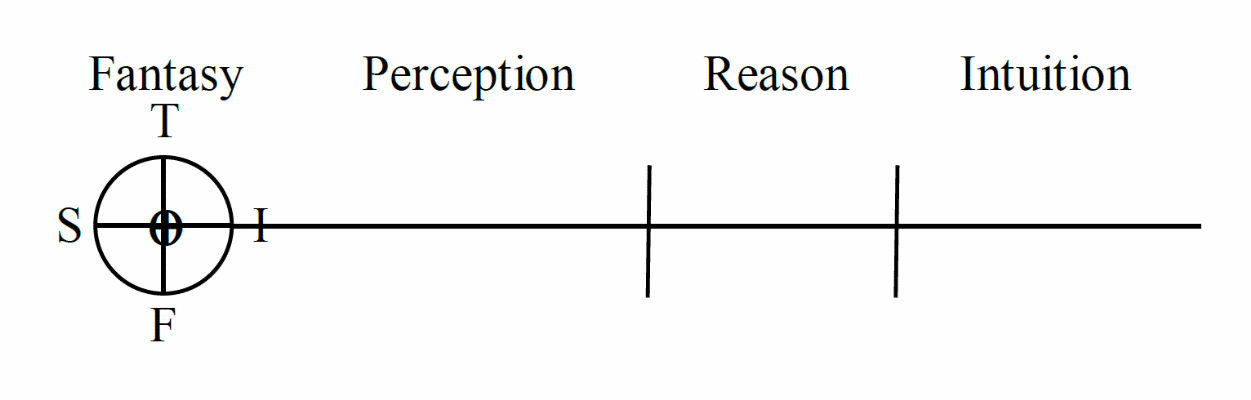
Divided line and Jung's psychological functions; Jung's functions all in lowest segment (imagination/fantasy)
For Sage, intuition, thinking, feeling outside imagination but also represented inside imagination
Seven categories of imagination each have four psychological functions, these corresponding to dignities
Purpose of this development is production of man of light; realization of a meaning in your life not in any element; dissolution and coagulation of philosophic stone an ongoing process
Purification of four elements of body an absolute necessity for gnostic functions to become operative; purification of emotional body starts with purification of its physical base
Distinction between intuition in imagination and beyond imagination not applicable to philosophic students; knowledge which is present in any image is never the image
Question on how to distinguish between a non-dignity planet in an earth sign and a planet in fall
Examples of writers' styles related to elemental qualities
Are there four levels of sensing, thinking, feeling, willing which finally precipitate the God included in the elements?; is this related to creative visualization of a God in Tantra?
Temperaments related to elemental qualities; earth element as figure, shape, form
Can each element be revealed in seven different ways corresponding to seven planets?
Elements don't differentiate soul powers but serve as fields of operation; degree meaning is what's being built into soul power, not element; elements dissolve in life, not in soul power
Example: Taurean quality of power, coagulation being assimilated with Taurus degree, but not Taurus as earth element
Psychoid realm (alayavijnana) transformed through operation of planetary spheres (manas) into categories of imagination and their content
Culmination of development of senex archetype results in position of Witness-I; from this perspective, subject-object distinction is illusory
Witness-I can now operate through senex; senex not destroyed but transformed, required to function on Earth
Appendix: examples of Sun and Saturn sign positions for gnostic and fabricative
BOOKS READ FROM OR REFERENCED:
Krishnachandra Bhattacharyya, Studies in Philosophy, Volume 1, "Studies in Yoga Philosophy"
Marc Edmund Jones, The Astrology of Concepts
Ashvaghosha, D.T. Suzuki, Ashvaghosha's Discourse on the Awakening of Faith in the Mahayana
PLOTINUS QUOTES READ OR REFERENCED: IV.8.5
SABIAN SYMBOLS: Leo 15
DIAGRAMS and CHARTS appended to this transcript:
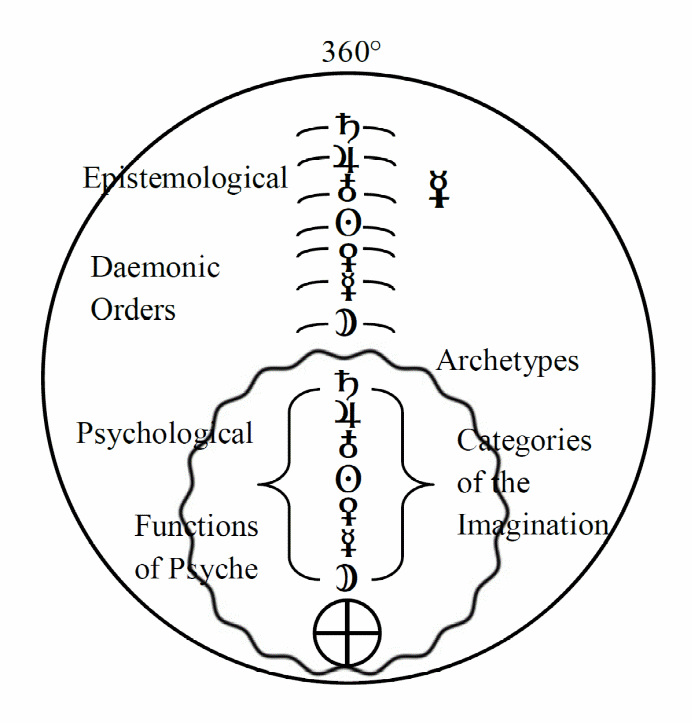
FIGURE 1982 0426-1. Levels of Cosmos.
FIGURE 1982 0426-2. Divided Line with Four Functions Under "Fantasy".
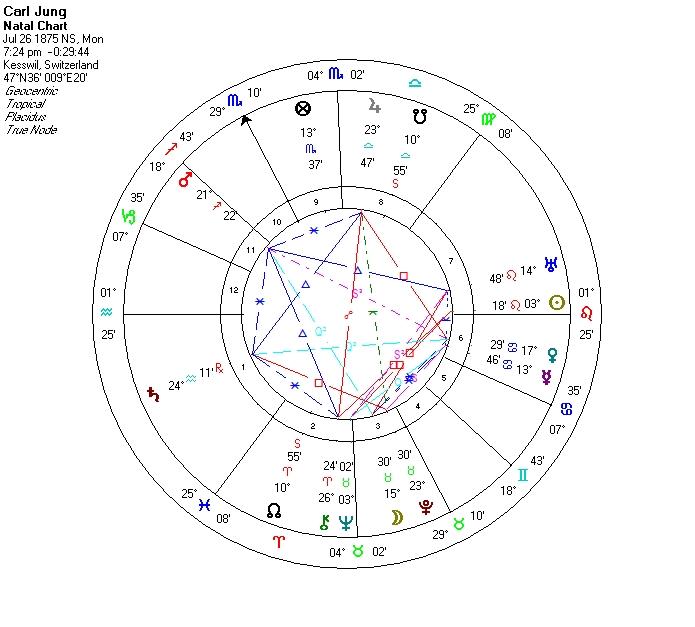
FIGURE 1982 0426-3. Carl Jung Natal Chart (astro.com).
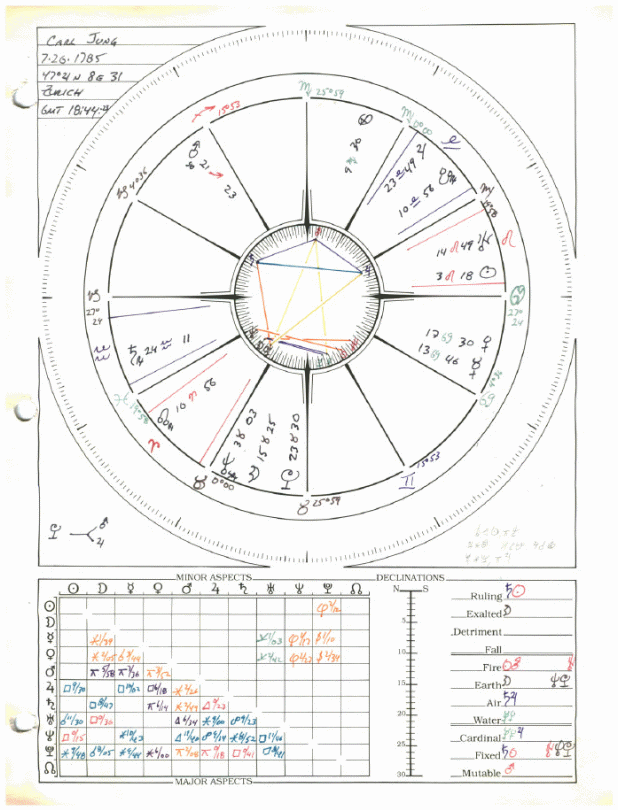
FIGURE 1982 0426-4. Carl Jung Natal Chart (WG version).
Other diagrams also referred to are not with this transcript version. [Transcriber note: [diagram] means the speaker is referencing a diagram as he or she is speaking. If someone is drawing or writing, with audible sounds of chalk on a blackboard, I indicate this by [drawing] or [writing].]
NOTES:
We have a partial transcript for this class, Scan File 1982 0426-07R06.PDF. It was originally done by TS and included diagrams, which are appended to this transcript.
1982 04/26 was a Monday.
This event is among those in later 1981/early 1982 when Anthony was exploring Astrology/the Zodiacs, Cosmology, Physics, Astronomy, Soul, Nature, and The Grid: Gnostic and Fabricative.
For more on The Grid: Gnostic and Fabricative, please see the Appendix to WG CLASS 1981 1016a. Anthony worked on this Topic in 1981, 1982, and into 1983; with approximately three dozen transcripts known to exist as of April 2022.
Some of the original text lines from the partial on examples of Sun and Saturn Sign Positions in Gnostic and Fabricative Positions are included in the Appendix to this transcript.
This transcript also refers to the Ideas and Intelligibles. Ideas are substantial - and Anthony often correlated with the Zodiacal Signs. Intelligibles are functional activity or gnostic - and Anthony correlated with the Planetary Dignities. Ideas and Intelligibles are coordinated by Number. See Astronoesis, especially pages 103-109.
TRANSCRIBED Verbatim by IT 2021. Archival verbatim transcript – V11a.
AUDIO FILES: 1982 0426a, 1982 0426b. [Note: "Tape" and "Side" refer to original audio cassette tapes that were later digitized into .MP3 Audio Files.]
1982 04/26 at Wisdom's Goldenrod
Astrology; Theory; Gnostic and Fabricative
[Audio File 1982 0426a Begins]
TS: If it was on the blackboard you got six inches. (bit of laughter) And we talked about just briefly, didn't get into the problem, started by talking about the Jupiter in Pisces as the unity of the Five Mahabhutas [diagram], and, I guess some idea that the-- those Five Mahabhutas might be five kinds of life fields or instructions of life in matter.
S (faint): Yeah, ok.
TS: And we talked--
AD (simultaneously): Five different kinds of material life.
AD/S(?): Get that Carol?
TS: Ok.
S: Uh-hm.
TS: Then we said that the 360 degrees [drawing] as the reason-principles would come from the Venus in Pisces where, um-- (you look at/if you took) the last three houses, that the Venus in Pisces is at once part of the Separative Intellect, is part of the-- the exaltation ring, and it's also a part of the twelfth house Idea [diagram]. So it brings in from [writing] the Sun in Aquarius the i-- the 72 Names of God or powers of God and it combines those with the-- these Five Mahabhutas, and in that knowing of the Five Mahabhutas creates the 360 Gods that would be in the Nous here. Ok? So far so good?
RG: Could you do that again?
TS: Oh well, this is a-- a peripheral issue I think but uh--
RG (simultaneously): Oh. Then don't do it.
TS: Just that-- we've done this, we've come up with 72 but lots of different ways, I mean if you remember, but one thing that we talked about the 72 is as the 72 Names of God from the Kabbalah. And we've talked about that as each one of those then [drawing] having five aspects, manifesting in these five material life energies. So if you take each one of these and say-- say that each of these Gods has five aspects, which it has a central aspect and four peripheral aspects. So this would be like the ether, the form of it in the aetherium, and that these others would be its form in the elements. Now--
AD (simultaneously): They're out of the reason-principle, in ether, in air, earth, air, fire, and water.
RG: Uh-hm.
S (faint): Uh-hm.
AD: So usually in a mandala they think the central figure is the God and then they have the four gates.
[Note: Diagram here in partial transcript. See FIGURE 1982 0426-1 for the following. See also WG Class 1982 0507a for a more detailed version of this diagram.]
TS: Yeah. And we said that this-- [drawing] we were thinking that these four might be then embodied in the four elements in this realm of the reflective imagination or the archetypes that-- the tropes of the tropical zodiac [diagram], ok, where the 360 Gods would be out here at the reason-principles [diagram], ok. And this would be the productive imagination, [drawing] 'cause we like to-- Mercury in Pisces [diagram], and these would be reflections of the powers of the soul, ok, the powers of the soul being there, cognitive-isness, dialectic, purification. Now these names are totally tentative, I just [AD: Yeah.] looked them up. These are the vrittis of buddhi, ok, that-- the various ways that buddhi can be modified, and it's just a tentative suggestion, those might be related. From Bhattacharyya I found a-- a quote in "Studies in Yoga" where he talks about two kinds of vrittis for buddhi, epistemological and psychological. Ok. The psychological ones would be like sleep, the-- the revelation of the real, the unreal, cessation, nidra, memory, and those guys. There's five of them which he lists and that would be I think related to the reflected level where productive would be these vrittis here [diagram], they're epistemological. And it's just a tentative-- We also tentatively said that maybe this would have to do with the various realms of the angels, archangels, choirs, dominions, (for instance) powers. [student assents, faint] Um--
Then, within the reflected-- reflected imagination, we talked about the categories of the imagination which are these guys, senex, hierophant, shadow, puer or hero, the anima, trickster and mother archetype. Well, I think we said that those guys-- these archetype-- categories of the imagination would be objective and self-apperception, instinct, will, imagination, which are the functions of those would be the subjective pole of that. So-- [RG assents, faint] I think that the-- where we're really going to kind of try to begin tonight is that you have a degree [drawing/writing] which is a reason-principle, and that's combined with some planet or is one of these productive powers of the imagination, ok. And that then is manifest, or the-- Let me try to put it this way--that the powers of the productive imagination, in union with these Gods, fabricate and manifest in the reflective consciousness, reflective imagination. And then that would be polarized into a subjective aspect and an objective aspect, ok. So, in this-- so, we already have implicit a combination of the reason-principle and a planet. And when a planet then within the trope, within the tropical zodiac is on that degree, two different things are going to happen, depending on whether it's manifesting towards the subjective or towards the objective, ok, or towards the gnostic, [drawing/writing] and this would be towards the fabricative or fabricative [diagram].
RG: And which are you calling which in the-- in the tropes, in the-- in the tropical zodiac?
TS: Both.
S (very faint): Oh yeah.
TS: The degree and the planet will manifest both gnostically and fabricatively, ok, but that's sort of where we--
AD: In other words, gnostic and fabricative is something within the tropical zodiac.
RG: Uh-hm.
TS: Well--
LR: (Goes on from here.)
TS: What?
RG: As opposed to prior to it?
LR: Yeah.
RG: As opposed-- as opposed to prior to the tropical zodiac?
BS/S(?) (very faint): Well, maybe we should (read it).
LR: Yes.
RG: Tony, you just-- you said gnostic and fabricative were within the tropical zodiac, the implication is that above that it isn't, you don't have that kind of distinction there.
S (simultaneously): The vision splits up.
RG: Right.
TS: So-- Now this is where I think these begin to get a little complicated.
AD: Well, it does get complicated Tim. The-- if the reason represents the psychoid realm and the psychoid realm is the basis for the-- for the psycho and the physical, the psychical and the physical have their, let's say-- in-- in that, the discussion is never brought up as the intermediary, what is the intermediary. In other words, you have a psychoid realm, alright, and [TS simultaneously: Ok.] then he speaks about the emanation or the i-- the psychoid realm is the basis for the physical and the psychical. But there's never mentioned the intermediary, what's organizes, governs, and manifests what the-- In other words, the psychoid realm is the realm where the reason-principles (embody in/embodying) the-- or informing the matter.
TS: Ok, that would be the 360 degrees?
AD: That'd be the 360, alright.
RG: Right.
AD: And then we spoke about gnostic and fabricative functions of the planets, alright, and we kept putting them in the sphere. But the spheres in themselves would never do that division. That [RG simultaneously: Do it.] division only is available to us within the tropical zodiac.
RG: Yeah, yeah.
AD: So gnostic and function is within the tropical zodiac but outside of that, it-- it doesn't mean anything to say gnostic and fabricative.
RG: (Yeah/Good).
TS: Or they'd be simul-- they'd be coincident.
AD (simultaneously): They'd be both.
RG: Yes, because at that level anything that's fabricative has to know itself also.
AD: There you're speaking about the powers of the soul [RG assents] and what they're doing.
RG: Yeah.
AD: So, similarly, like yesterday when we spoke about the eight vijnanas, alright, and they speak about manas as the vijnana which transforms or translate the alaya contents, alright, into the pravritti contents. Remember?
TS: Yeah.
AD: And the-- the manas principle they spoke about as the intermediary which functions to transform or bring about the transformation of the otherness which is inherent in the alaya into the subject-object or the empirical consciousness, the five senses and the mind. So, our-- our hunch was right that, you know, that that realm is the realm of manas.
RG: Which realm?
S (faint): Yeah.
AD: The planetary spheres.
[short pause]
RG: Ok. [short pause] Well--
AD: Now the interesting that's-- the interesting thing that shows up is of course that we have to try to understand the psychological category of the imagination like anima and the content of that, and that's where the-- I think the real confusion comes in.
TS: Yeah. Let's see if I can articulate what we said.
AD (simultaneously): Yeah, go ahead, see if we could get it out.
TS: Um--
[14 second pause]
LR: Start off by s--
S: Hey.
TS: Let me see.
LR: Well--
AD: Well, tackle it directly, go right into it. [LR simultaneously: It started out by saying--] You got Saturn on 5 degree Aries, alright?
TS: Ok.
LR: Yeah, and we started out by saying that within the degree [someone drawing/writing] already, the degree 5 degrees Aries, you have combined the reason-principle and the powers of the soul.
TS: Yeah, that's from up here [diagram].
LR: So that's already implicit or inherent in the degree. The degree is not simply content or objective but it's already a combination of both.
RG: Wait I'm-- I'm sorry, I'm lost.
LR: Ok, see you have--
TS: See, RP plus PL--
RP: Yeah, I saw RP plus PL.
LR (simultaneously): Alright, RP plus--
RG (simultaneously): How do you derive RP plus PL? (RG laughs)
TS: Ok well, here's the [one/two inaudible RG words simultaneous with TS] RP, ok. You got the reason-principles up here, ok, which are the 360 Gods, ok. They are being instantiated in the tropical zodiac through the functioning, the gnostic and fabricative functioning of these seven planetary spheres [diagram].
RG: Yeah.
TS: When one of these little-- when one of these has been inserted here or is manifested here, then together with it is not only the reason-principle or the God but the planet that-- the planet's functioning as well.
RG: That's unclear to me. Why? Why do you-- why do you-- how do you-- how do you see that? In other wor-- in other words, why necessarily does the function that manifest the content also [LR: Because--] participate in the manifestation?
LR (simultaneously): It's because what do you mean by manifest the content? What you mean is that the soul power there has gra-- is grasp-- or has contained within it the reason-principles, and it's in that co-mixture that the reason-principles are all within each soul power. When they hit the imaginal realm, it's not that they-- it's not that the contents are simply spit out and the soul power remains distinct from it. What you have now is the reason-principles within your imagination. The "your imagination" part is very much a part of what those reason-principles will represent as the 360. In other words, when you look at the-- the tropical zodiac and there's 360 degrees, that's not other than you. That is already a combination of those reason-principles with your imagination, with the powers which have manifested, so that each degree is a combination of both. It's not simply objective, it's not like [student assents, faint] some world out there which has to be brought into you.
RG: Well, the claim-- yeah it isn't about objectivity or subjectivity but about the merger, fusion of them.
TS (simultaneously): Well they're both, I think-- it's-- this started on Wednesday I think, I just realized that. One thing we left out was--
LR (simultaneously): Yeah but Dickie was here.
AD: He really was here?
LR: No, he was here, just--
S: He is one too.
TS: No. (RG laughs, laughter) [few second of background student talking] That the reason-principles, I think some of you-- the reason-principles, the 360 degrees would be inside or part of the soul. Both of these are within the soul, and if we take a-- the-- a strictly mentalistic view, ok, it's not that these are outside of the soul which are being instantiated in the soul powers, [student assents] but the soul powers are the very media in which these are contained. There's no other place for these to be contained but the soul powers themselves.
RG: (Yeah, uh-hm.)
AS: I don't know, I-- I'm not sure what you're asking but it seems like the simpler is, the Saturn is at 5 degrees Aries, you have Saturn [RG: Yeah.] and you have the 5 degrees Aries and you-- you can't have-- you have to have them both.
RG: Oh, but I don't [LR simultaneously: Yeah, no but--] [one/two words inaudible]
TS: No, that was a--
LR: That wasn't--
RG (simultaneously): That, yeah, that's obvious. I thought the claim was that before you talk about Saturn on 5 degrees Aries, 5 degrees Aries already includes 5 degrees Aries and the soul-- and the soul powers or some--
S (simultaneously): No, no.
AD: Yes [one/two words inaudible]
RG (simultaneously): Yeah, isn't that it?
LR: Yes, that is [TS simultaneously: Yeah.] the claim.
AD (simultaneously): But, they're symbolically represented [S simultaneously, faint: Yeah.] in the imaginal realm.
RG: Right.
S (faint): Yeah.
AS: Yeah.
RG: So, like I said, I still don't understand.
AD: Well, let's go over it. We have the tropical zodiac, alright, and within that tropical zodiac you have the traces of all the reason-principles which have been left behind by the functioning, prior functioning, alright. And think of the tropical zodiac as-- well we had suggested the belt which surrounds the Earth, with all the traces of prior functioning.
RG: Uh-hm.
AD: Alright. Now, you have 360 degrees, reason-principles, and you're speaking about that as the quantification and qualification of the reason-principles. The reason-principles, let's say, would represent (quality/qualitied) [one word inaudible] The-- the five elements would represent quantity. The combination of these two, alright, would give us the reason-principles in matter. Now, a certain number of reason-principles are combined by the functioning of the planetary souls which represent the powers of that soul, cosmic soul, ok?
RG: Uh-hm.
AD: Now, insofar that they combine those various reason-principles into an entity, the entity that we're speaking about which is in point here is the psychosomatic organism, which is a compound, alright, of the various elements of fire, earth, air, and water.
RG: Uh-hm.
AD: So included in that very compound but in a way which is not pure, I mean it is not the reason-principles per se but the way they're embodied in that.
RG (faint): Uh-hm.
AD: So now you can speak about anything within that embodiment, alright, as an archetype.
RG: Uh-hm.
AD: Ok? [RG assents] Now you-- the distinction we're making is the archetypes are within the tropical zodiac, the reason-principles are outside the tropical zodiac. The only way we're going to know the reason-principles is through the tropical zodiac. Now, if we go back to the example we used of Jung.
RG: Uh-hm.
AD: Remember how-- what we said is the point that he made that I-- I thought, you know, the chart was showing was the recognition of the embodiment of the reason-principles in flesh and-- and blood? [Note: See FIGURES 1982 0426-3, 4.]
RG: Uh-hm.
AD: And I think that was the Uranus degree, the carnival degree? [Note: See Marc Edmund Jones, The Astrology of Concepts, Leo 15, "The great American carnival, the Mardi Gras at New Orleans, is seen with a wealth of floats, decorations and merriment."]
RG: Yeah.
S (faint): Uh-hm.
TS (simultaneously): Yeah.
AD: And so that he recognized that.
RG: Uh-hm.
AD: When he makes a statement like the emotionality and the passions are-- these images are derived right from the materiality of the body, soon as he made that statement, then he was saying that he intuit the reason-principles right in the matter.
RG (faint): Uh-hm.
AD: Now, those reason-principles that are intuited in the matter, we're not going to call them reason-principles for the sake of terminological distinction, we're going to call them archetypes, his archetypes.
RG: Right.
AD: And we're going to say that within those archetypes, the organization-- first, the representation of the powers of the soul are in terms of the categories of the imagination. Ok?
RG: Uh-hm.
AD: And the next point would be that these reason-principle per se embodied in the tropical zodiac are going to be the archetypes. [student assents, very faint] The organization of the body was an organization of these archetypes in the tropical zodiac. Now the combination of these two brings up the problem--when you do that, alright, then you have the categories of the imagination, let's say Saturn, the senex, and its content. What is the content of the senex, which is-- in other words, into the psychosomatic organism you're going to have a subjective factor, the gnostic function, and the content.
RG (faint): Yeah.
AD: If we-- if we stick to that, then if Saturn in Aries, 5 degrees Aries, alright, what would happen?
RG: Saturn would represent the archetype and 5 degrees Aries would represent the content to (the--/that.)
AD: Well, you have to be more precise.
RG: Well-- well what do you mean?
AD: What?
RG: No, I mean what-- what kind of understanding of that do you want?
AD: I want you to remember, I'm not on Orchard Street.
RC: You mean Saturn would represent 5 degrees Aries in terms of the senex archetype?
AD: Well you're saying that Saturn is the senex.
RC (faint): Uh-hm.
AD: So symbolically it's representing-- it is one of the categories of the imagination. Instead of saying a power of the soul you're saying it's a category in the imagination.
RC (faint): Uh-hm.
AD: Alright. It's sitting on 5 degree Aries. Now you know that that's one of the digni-- dignities. What's it doing there? We-- 'cause we're going to ask you of the next one is [couple inaudible student words simultaneous with AD] Saturn on 5 degrees Taurus, what's it doing there.
RG (faint): Uh-hm.
RC: So for now we're just going to go over and just pass by it? 5 degrees Aries in itself going up to Saturn at 5 degrees Aries?
AD: Yeah.
AS: Yeah, but that was the point here. Yeah, but Richard, that's--
RG (simultaneously): Well that-- all that's fine, I thought--
AS: Both of them are combined there, [RG simultaneously: Right, but there-- right, there they have (one/two words inaudible)] and the Saturn [one word inaudible] have the 5 degree Aries.
RG: That's no problem. The problem comes when you claim [few inaudible AS words simultaneous with RG] that prior to that fusion there's a-- a fusion of the pow-- of the reason-principle [AS simultaneously: Oh.] and the soul which represents 5 degrees Aries without any planet being on it. I thought that was your [AS simultaneously, faint: No, (I don't think so).] initial understanding.
S: Well, (that/there) was [student assents, faint] lots of that.
S: Yes.
LR (simultaneously): Yes it was, that was [student assents] definitely (how I understood).
S (simultaneously, faint): Yeah.
AS: But I think here the question was, you know, just within that imaginal realm, I mean you already got-- yeah but the question is-- I think part of it came up with seeing there is a bifurcation within that realm into subject and object, within the imagination. And so those planetary functions which as he said prior are neither gn-- or both gnostic and fabricative at once, here within that realm there seems to be this split where the fabricative will do one thing, some kind of organization of content or incorporation of certain [one word inaudible] and then the gnostic will refer to the, you know, self-apperception and so on, the apparent subject.
RG: Well, so if you're looking at subject and object in terms of a planet, then what do you do with the degree?
AS: Well, that's a [TS simultaneously: Oh, yeah.] question [one word inaudible]
LR: They're both in both.
AS: Yeah.
RG: Well then how does it--
AS: Yeah, how does the--
LR (simultaneously): That was the-- the complication comes in seeing that there's going to be a fabricative and gnostic side both revealed by the 360 and by the planets. It's not as simple as saying the planets are the functioning-- the subjective functioning and the degrees are the objective content. I think that was the point.
AS (simultaneously): Well the question is also how-- how does that degree relate to that planetary function in two different cases of the planet functioning primarily subjectively or gnostically and when the planet then functions primarily objective or fabricative.
TS: And so where we had Saturn at 5 degrees Libra-- Aries, we're saying that it's primarily a gnostically functioning Saturn 'cause it's in dignity. So that if it's-- if it's a gnostic Saturn, then its functioning-- [short pause] We say it's sensing, yeah, it's sensing 'cause it's in fall.
AS (simultaneously): [few words inaudible] sensing the content of 5 degree Aries.
TS: Yeah, it's sensing that content and trying to distinguish itself as a gnos-- as a-- an image of a power of the soul from the archetypal content that it-- that it's sensing.
LR: Wait, can I--
AD: In other words, there would be the-- the Saturn in 5 degree Aries, alright, we're saying perceives through sensing the content of that idea, but the primary emphasis is that Saturn in that as a gnostic, alright, knows that it is knowing. That's the primary emphasis.
AS (faint): Self-apperception.
S (faint): Yeah.
AD: Now, in Taurus, it's reversed. [student assents, faint] There in Taurus it would be fabricative. You want to try?
S (very faint): Yeah.
[short pause]
AD: You follow the first one?
RG: Um, with difficulty. [one/two words inaudible]
LR (simultaneously): I think we s--
AD (simultaneously): Alright. You've got Saturn in 5 degrees Aries, your chart, ok? So that means it's in a dignity, it's in dignity. [student assents, faint] Now, the primary function of the Saturn in a dignity or any planet in a dignity is that it is-- it knows that it is a knower.
S (faint): Yeah.
AD: If you perceive the idea through sensing, alright, the perception of that idea through sensing emphasizes and brings about the refinement of that gnostic function. There's an emphasis on the knowing aspect here. We're not saying that it doesn't-- that the know-- or the content that it knows is irrelevant. We're just saying that the emphasis is on the knowing. Now the Saturn moves into Taurus.
RG: Uh-hm.
AD: Whether you-- whether you have it innately or not doesn't matter. It moves into Taurus and now what would the emphasis be on, if Saturn is not in the gnostic realm but let's say in the fabricative? [short pause] Come on, think [one word inaudible]
RG (simultaneously): Well-- well-- well I think I-- I mean-- well [few words inaudible] It would be fabricating more the-- more in relationship to the degree and assimilating the content rather than knowing itself.
AD (simultaneously): He-- I'm sorry?
RG: It would be more assimilating the content of the degree rather than--
AD: Wouldn't you be saying that the degree is building up the fabricative or is building up the senex?
RG/S(?) (faint): I don't get that.
LR: Dick--
AS: Yeah, the senex-- you take the Saturn, objective-- the objective side of the Saturn, so the content, and you seem to be saying that the form of that senex is being built up by its degree image. It's being incorporated into-- being incorporated into that archetype. [LR simultaneously: Can I--] Or the degree is building up the senex archetype primarily, rather than an emphasis on gnostic function.
RG: Just one question, when you call-- I mean the other word we use for Saturn is ego-complex. Which side do you think [one/two words inaudible] working out? Is it always--
AS: Well, maybe that's the general term for both of these, that the-- the-- not the function, the imaginative function of the ego-complex would be self-apperception. It has an objective archetype (or) a [RG assents] subjective structure of the archetype would be the senex, or the structure of (me) [RG assents] will be the senex and it has a function [couple words inaudible]
AD (simultaneously): Alright well, let's try the double language, you know. If we say that you have a psychosomatic organism, that means that there's two aspects to this entity, alright, a psychical aspect, alright, and a somatic aspect. [RG assents] The psychical aspect would refer to the knowing aspect of the organism. The somatic would refer to the physical part of the organism. Now when Saturn is in-- in the Aries, in the dignity, alright, there's a concern, relatively speaking of course, a concern with the knowing aspect of the psychosomatic organism. When the Saturn moves into Taurus, then there's a preoccupation with the being aspect of the senex, the building up of the being of the senex. In the Aries there's a knowing of the senex that is being emphasized. Now, if you let the Saturn go around the wheel, [RG: Yeah.] alright, then you can see that all those functions are going to get fulfilled. Out-- at-- at-- [TS assents] sometimes there'll be an as-- there'll be an emphasis on the knowing that the senex is operating and other times the building of the senex in other signs where it's fabricative.
LR: I don't--
TS (faint): Go ahead.
LR: I think we maybe skipped over a few points that would help.
AD: Well, they'll come up as we go along.
LR: Well--
AD: Go ahead, bring them in.
LR: There was one point that I-- that I thought we made, which might be implicit in what you said but-- Going back to the part where we had the 72 powers of God being combined in five different ways to get 360. Is that right in terms of the--
TS (simultaneously): Yes.
LR: And it seemed that there was a unity that we were speaking of, both to each reason-principle and to the power of the soul. So that the direction was towards the unification of the soul or towards the unification of the reason-principle. In one case you had the reason-principle or that God being displayed in four different ways, with the fifth being the unity, ok, and in the other case you have the unity of the soul displayed in four different ways which are namely the dignities. So that there was two fourfolds going on in the chart. And, depending upon the placement of that planet would indicate the emphasis either to one fourfold or the other. In other words, if more fabricative, the intent would be towards getting to the unity of the reason-principle or the God itself. And if more gnostically oriented, the intent would be going towards the unity of the-- the gnostic knowing or soul power. And then you bring up the example of Saturn in Aries versus Saturn in Taurus.
AD: So, [LR: Now--] let's keep on elaborating. So you think of the Saturn, it goes through the twelve signs, alright. It'll be going through the four fabricative functions, fire, earth, a-- I mean the-- [TS assents] in its dignities, and it'll be going through the four elements. Now supposedly the purpose would be, the Saturn going through the four elements, eventually the meaning that comes out of the, let's say the 5 degrees in those four, alright, should be the etherealization of the meaning principle or a God. Now, in other words, when you truly and really understand the central idea of a God, alright, that's because the Saturn has gone through the four elements and the--
AS (simultaneously, faint): But I think that you changed it.
AD: Hm?
AS: Instead of-- that was a question-- that was one question I had. You talk about in terms of we talked about building up this meaning, like the quintessence, you-- you know, it extracted let's say these four parts of that God are finally extracted through this whole process and you have this quintessence. Now, seems your answer to the question there I was going to ask you in terms of, this is primarily going on in the non-dignities or the fabricative is doing that, [AD simultaneously: Uh-hm.] you seem to be saying.
AD: Yeah.
AS: That that's primarily extracting-- the fabricative is dealing primarily with these reason-principles but as embedded in the matter as these tropes, and through extracting the pieces of them like you're building up a unity, like a mandala symbol, fourfold [few words inaudible]
AD (simultaneously): Yeah. In other words, when you get the idea coming through-- through the four elements, alright, then the fifth one should be ether, etherealized. The meaning that is in the four elements, the fifth meaning, the central meaning is something that you get out of it subjectively.
AS: Uh-hm. That seems to point more towards the reason-principle per se.
AD: Yeah.
AS: Whereas if you talk about the dignities, the planet Saturn now going through all the dignities as it goes around, [AD simultaneously: Four dignities.] six dignities, then the four gnostic functions would be operative until you get a--
AD (simultaneously): And you're building up a fourfold--
AS: Yeah, a unity of that planetary power rather than some kind of [few words inaudible]
AD (simultaneously): Exactly. So it takes the planetary powers, the four-- in other words, when you think of the planet going through the four dignities, alright, you would think of it going through sense, belief, reasoning, and intuition. Then that means that it's building up this fourfold or revealing more and more the fourfold nature or the integrity or the unity of that soul power.
AS: The implication of that, Anthony, this is what my question was on, maybe it's wrong or right but, the impli-- two implications, one is, you say, well that reason-principle isn't known in itself, only known as it says-- organizing those images or only as it's deposited in fire, earth, air, and water.
AD (faint): Yeah.
AS: Eventually you abstract, say, this meaning which is a unification. You seem to be saying a similar thing with the soul powers, that the soul powers are only expressed through those four, knowing-- the four gnostic functions.
AD: Uh-hm.
AS: You know, sensing [AD simultaneously: Uh-hm.] and so on. And then that does [one word inaudible] [AD simultaneously: Wouldn't that-- for instance, wouldn't--] I'm asking him to say that those only refer to the imaginal realm there.
AD: Yeah, but wouldn't that ultimately lead to the separation of the soul powers [AS simultaneously: Yeah, from the imagination.] from-- from the imaginal-- from the imagination.
AS (simultaneously): Yeah. That puts a whole other light on those gnostic dignities though [student assents, very faint] in terms of seeing well part of their function of those gnostic dignities is to purify the imagination so that the soul power can operate free of the imagination.
AD: Ultimately.
AS: Ultimately. And that almost-- I mean again you seem to be saying that those gnostic functions won't operate above-- well that's not saying that they won't operate above the imagination.
RG (simultaneously): Won't operate. They won't just be gnostic is what (you're/he's) saying.
AD (simultaneously): No but, the point-- [AS simultaneously, faint: What is (one/two words inaudible)] the point would be is that ultimately with the three higher soul functions, one should be able to operate in the world as well as out of the world.
AS: Right. But what I'm-- my question-- right. I'm just saying that the origin--
AD (simultaneously): I mean Sage would have to live in the world and also have the vision of the Intelligibles.
AS: Right, now, would the gno-- would those gnostic functions as three higher dignities, knowing, willing, and feeling, they do seem to apply to that intermediate realm there, the realm of the soul powers. They seem to apply above the realm of the imagination, [AD: Yeah.] although as we're talking of them they're embedded in the imagination or functioning in the imagination.
AD (simultaneously): Yeah, but wouldn't that make it interesting because then those soul powers, knowing, willing, and feeling, are applicable in either-- either direction.
AS: Right.
AD: The Sage could directly apprehend the Intelligibles and deal with them with a disembodied knowing, willing, [student assents, faint] and feeling, or directly engage a sense object and recognize the knowing, willing, [AS simultaneously: Yeah, this--] and feeling functioning there.
AS: Right, we did that a long time ago with that (theme), very similar, about becoming divisible. And Plato has this line about these soul powers becoming divisible in body. [AD, faint: Uh-hm.] And we brought in the point that it is those knowing, willing-- the very knowing, willing, and feeling that are going to become divisible when they operate in the realm of imagery and then get freed from it. There again they seem indivisible but--
AD (simultaneously): Plotinus says the same thing, that the reasoning powers experience themselves in a way they're-- that before they never understood or they never knew. When they became embodied they experience themselves differently than when they are unembodied. [Note: See Plotinus, IV.8.5, last two paras.]
AS: But anyways, then you're saying the point of the whole dignity operation or one of the points is to bring that soul power to a level of functioning in itself, in a disembodied way.
AD (simultaneously): In a disembodied-- disengaged from the imagine-- imagination.
AS (simultaneously): And the p-- and the purpose of the non-dignities, as it were, the process for the non-dignities is to free the meaning or-- yeah, the meaning of the contents.
AD (simultaneously): But these cannot be conceived in isolation.
AS: Right, and that shows up in the tran-- I mean if you do the transits.
S (faint): [few words inaudible]
RG: How do-- how do you--
AD (faint): Was also PB's [one word inaudible]
RG: How do you-- how do you understand a-- a rul-- the rulership?
AD: Another cigarette will help. (laughter)
[few seconds of background student talking]
RG: Could-- could you do either Saturn in Capricorn or Saturn in Aquarius in this way?
TS (faint): I mean sure [couple words inaudible]
RG (simultaneously): Like, is that [one/two words inaudible]
AD: I didn't hear you.
RG: Could you do the rulership? If you--
AD: Do the rulership?
RG: Yeah, explain the functioning of the rulership in this way. 'Cause it seems to me the rulership could be interpreted differently but I--
AD: Well, interpret it differently so I see what you're talking about.
RG: Well, it's easier to see the gnostic aspect of the dignities from the exaltation down, particularly from the level of the exaltation.
AD (simultaneously): Can't see it in the willing? I can see willing but I can't see it down.
RG: Wait a minute. It's easier to see--
LR: But just say it the way you would s--
AD (simultaneously): For me to understand willing as a gnostic function--
RG: Yeah, is what, is easy?
AD: Is easier than to understand the exaltation down.
RG: Why-- what do you mean by [couple words inaudible]
LR (simultaneously): How would you say it, Dickie?
AD: If anything is a gnostic function is when that-- when knowledge and action coincide.
RG: But when they do coincide, in fact one-- is one aware that one is knowing or is one just doing and through the doing he's acting out what he knows?
AD (simultaneously): What the hell's the difference? (AD laughing)
RG: Because the way you were talking about it, the point of a-- of the Saturn--
AD: Which is true knowing?
RG: The ruler-- the-- the doing.
AD: The doing.
RG: Right.
AD: The doing what?
RG: Whatever it is that you know.
AD (simultaneously): Doing the will of God or whatever you want to call it.
S: Yes.
AD: That's real knowing. Ok.
RG: Ok, fine. But in terms of your dis-- I agree with that. But in terms of the way you've spoke about it, it seems the-- the way you were understanding the gnostic faculty was that it was becoming aware of its own functioning, [AS: Yeah.] not-- Ok. But when you say the real knowing is doing the will of God, it seems that there's-- that there's no distinction of the knower knowing its own function but in fact it's just doing the content directly [AS simultaneously: Yeah but Richard--] and there's no distinction between the knowing and the content.
AS (simultaneously): Yeah. But I thought the point-- I don't think he said knowing-- doing its-- knowing its own function as much as its function being freed from an attachment to the lower imagination. That was the point of the gnostic ones. So in fact the rulership would be-- let's say would be the most in conformity with pure meaning of the degree, and that would be its most freedom from the images.
AD: You see, the [AS simultaneously: Just doing-- I mean that makes--] notion that it's the same [RG simultaneously: I agree with that.] like Spinoza, you know.
RG: What?
AD: It's the same notion like Spinoza--freedom is conformity with necessity. And that would be true intuition. Freedom is not the spontaneity of your instinctual nature that has impulses one after the other and follows each one out. They consider that the worst kind of bondage.
RG: Uh-hm.
AD: Alright, so intuition here to me is much more recognizable as a gnostic function than even thinking or feeling.
LR (simultaneously): See-- and also that would be getting more to the planet not as a category of the imagination but directly to the planet as a [RG assents] pure soul functioning which has the purity of those reason-principles within it. So that it wouldn't be-- do you see what I mean?
RG: Yes, but I'm still (gathering--)
TS (simultaneously): Uh-hm.
RG: But I would still claim that in the rulership one is not aware of the functioning of the planet per se but is just doing the activity--
LR: Of?
RG: Of--
LR: Of what?
RG (simultaneously): Of the reason-principle.
LR: Of what, that degree?
RG: Of the degree.
LR: Yes but, [couple inaudible student words simultaneous with LR] that's not--
RG: Not really, that's in reflection.
TS (simultaneously): Yeah, I think I-- I think that that's-- I would have to agree with him in that way that you're saying that the-- it takes the planet going through all four gnostic signs or all four of its dignities to fully distinguish the reason-principle from the planetary functioning. And that although in the rulership there's an intuition into the reason-principle which seems less obscure than in some of the other dignities, on the other hand there's a lot less distinction between the functioning of the-- the subjective functioning of the planet and that reason-principle, [LR simultaneously: Right, beca--] and that's why it requires the full transit of the-- of all four to incorporate into itself the other three gnostic faculties before the gnostic functions of that-- of that particular planet before that planet's subjective function can be revealed.
LR: Right, but Tim I'm claiming that's because it's getting closest to that point where the two are bifurcated. That's why the distinction isn't made. Prior to the bifurcation there-- you don't have a distinction [TS assents] I thought we said [TS: Yeah.] between the soul power and the contents within it. [student assents, faint] So the [TS simultaneously: But we--] rulership [student assents, faint] could be the closest point towards the unification of the two, [TS simultaneously: That's true, yeah.] not down towards the imagination [TS assents] but toward--
TS: But nonetheless I thought the advertising was that we were trying to separate eventually the reason-principles from the soul functions so that there's a-- that-- there's an incomplete functioning in the rulership and that there's not-- a not-- a distinction between the function and the reason-principle.
RG (faint): That's right.
TS: That identity is-- is one which needs to be elaborated. It's not one which is a more perfect functioning as in a fall.
LR (faint): I don't understand it that way.
RG (simultaneously): But wouldn't-- wouldn't you say that in the rulership the function of the planet is it's ea-- the manifestation of the content happens in a-- in a easier way.
TS: Yeah.
RG: And that in the fall it's much more difficult for the substance of the si-- of the degree or the sign to come through and in fact in the fall particularly the attention is more directed toward the functioning because in fact there's a certain conflict between the-- the function and the substance that it's in where in the rulership there isn't.
AD: Yeah, you-- you want to state that again? You're speaking about the rulership in the tropical zodiac, right?
RG: Yeah.
AD: Alright. Would you repeat that?
RG: That in the rulership--
AD: That in-- from the rulership down there is a spreading out--
RG: There's a spreading out of--
AD: The function and the idea that's being expressed by that function?
RG: That's right. And in the rulership the spreading out is non-existent yet.
AD (simultaneously): Minimal.
RG: Minimal, if non-existent. And as it goes dow-- through the dignities--
AD: As it goes into the exaltation [RG simultaneously: --tation there's more-- more attention to what you're doing.] there's a separation of the subject and object.
RG: That's right, and so there's more attention--
AD (simultaneously): In the feeling it's even more [RG simultaneously: And in--] and sensing it's ultimate.
RG: Right. So if you follow Saturn down in that way I think you would see that it's-- you know, in Saturn in Capricorn or Aquarius there-- one-- the Sat-- the first one, Saturn in Capricorn, is not aware particularly of the functioning of Saturn but he has a-- a certain clear intuition into the substance [AD simultaneously: As to what he's doing, yeah.] of Capricorn and Aquarius. In Saturn in Libra there's more attention on the reasoning process or the ego-complex.
AD (faint): Yeah.
RG: And in Saturn in Aries there's a complete attention to the Saturn because in fact its substance that it's in is almost antithetical to the nature of its functioning.
AD: Well, the Saturn in Aries you say would be completely con-- self-concerned [S: Yeah.] [RG simultaneously: Uh-huh.] with sensing?
RG: With-- with the Saturn, with the ego-complex.
TS (simultaneously): Self-apperception.
LR (simultaneously): Self-apperception.
RG (simultaneously): Self-apperception. And in fact can't [one word inaudible]
AD (simultaneously): How?
RG: How?
AD: It would be through sensing.
RG: Fine.
AD: Then the emphasi-- the emphasis is on the sensing.
RG: Yeah. The sensing of itself.
AD: Ok, now, now do it with Taurus.
RG (faint): I don't know (if I could), it's non-- I mean--
AS: Yeah but see, I think the point, the prob-- I mean even in the Saturn in Capricorn, the emphasis-- I mean if the scheme is right the emphasis is still on the willing. Now the thing with willing is that just as the paradigm we did with the Intellectual-Principle I think, there the manifesting power is so identified with the Idea. Here you're saying with the sign or the reason-principle. But it still is that manifesting function, namely the willing is operating [couple/three words inaudible]
RG: Yeah.
AS: Which is non self-impeding itself.
RG: Right. Uh-hm.
AD: So then it seems that the basic problem of gnostic and fabricative can be traced all the way back to when we spoke about let's say the Intelligibles manifesting the Idea. It's either concerned or an emphasis on the Intelligible, [AS, faint: Or on the Idea.] alright, or on the Idea. And what we're saying is the Intelligible seems to be a concern with gnostic or, you know, the idea-- subjective ideation and the fabricative seems to be the Idea.
AS: Yeah, except you--
AD: Now this almost gives the fabricative almost a superior value some ways.
JC: I thought Dickie's-- Dickie's point to some extent was that the rulership of Saturn in Capricorn, I don't see why you wouldn't say the emphasis is just as much on the senex then as the-- as self-apperception.
AS: Not on the se-- but see senex there doesn't-- doesn't correlate with the idea meaning or the degree meaning. It's not-- it's nei-- I mean that-- that distinction isn't the same one. It's the meaning, almost like saying the meaning of the reason-principle that-- the meaning of the degree it's on [JC simultaneously: You're saying that list of archetypes is not--] manifested most clearly because there's such a free functioning, Saturn in Capricorn and Saturn in Aquarius. The doing or the willing is manifesting that--
JC: The content.
AS (simultaneously, faint): --meaning, content. Just like in the example of the Intellectual-Principle.
JC: [few words inaudible] you're saying the senex and these other archetypes are not the Self.
AS: Yeah.
(Side 1 of original cassette tape digitized as 1982 0426a Ends; Side 2 Begins)
AS: It was just content.
JC: You're looking at the senex as what unifies both-- [AS assents] is both the subjective functioning and an objective functioning.
AD: Well first of all we have to take [couple words inaudible] together, cannot speak of these things in isolation. You must have both simultaneously present, ok?
JC: Yeah right, also.
AD (simultaneously): We'll agree on that.
JC/S(?) (faint): Yeah.
AD: That means that wherever there's a planet there's gotta be a degree and vice versa, otherwise we-- we got nothing to talk about. Alright, taking that for granted, then the-- the dignities of the planet we say are concerned with the knowing. Alright, will we agree with that?
JC: Well except you were wondering about that in terms of the rulership.
AD: Well-- well first let's say is that-- Wondering about it in terms of the rulers, what do you mean?
RG: Like by know-- instead of knowing just say just not cognitive.
AD (simultaneously): 'Knowing' here is a generic term. It includes willing, feeling, sensing, all the others, alright. We're using it that way. Instead of saying cognitive and non-cognitive. Ok. And the planets in non-dignities we said are-- would be primarily concerned with fabricative. Ok? Now, with that as a background, take the planet Saturn, which is represented within the categories of the imagination by the archetype of the senex. Now, we-- we can't speak about it no more as Saturn, we're going to speak about it as the senex. In your chart you're not looking at Saturn, you're looking at the senex of Saturn, a representation of Saturn, something which is represented in the tropical zodiac. Ok. Now, we say Saturn is moving. It's in Aries first, alright. The emphasis would be primarily--
JC: Well we said safa-- self-apperception through sensing.
AD: Through sensing, uh-huh. Saturn comes into Taurus.
JC: Has something to do with manifesting a certain reason-principle to build-- that's what I wonder, uh-hm, the senex archetype in an objective mode in some way.
S (very faint): Uh-hm.
AS (faint): Yeah. I-- and it seems to--
JC (simultaneously): If that's what you're trying to-- maybe trying to translate it.
AS (simultaneously): I mean or-- yeah, or in terms of this where he's-- where he's using the ego, you know, the ego-complex or the senex archetype is being built up. The form of that senex is being filled out by the contents of that 5 degree Taurus.
S (faint): [one word inaudible]
TS (simultaneously): Well, it seems to be like almost a coalescence of the degree meaning is like assimilated to that mode of functioning, that category of the imagination, like Saturn in Taurus is-- well 5 degrees Taurus is assimilating that meaning into the senex archetype per se.
AS (simultaneously): Especially if you say those archetypes are like a complex, it's not a uni-- a homogenous thing, I mean is it possible to speak that way. So you speak of that senex as-- as a-- a complex.
TS: It's going to pull-- yeah.
AS (simultaneously): It's organizing, pulling together a whole bunch of archetypal images and--
TS: It will assume it.
AS: And as it goes through the non-- goes through those transits to the non-- places where it has non-dignity, it's pulling together, trying to unify a certain-- all those 5 degrees of those non-dignities into a uni-- into a unified new meaning. [short pause] Or that--
[12¾ second pause]
JC: I mean Saturn in Taurus, maybe that Saturn would build that degree more into its environment rather than be confronting itself so much directly.
AD: Well, let's try something empirical now. You have the Saturn in Taurus, alright. What will be a particular characteristic of the person who has Saturn in Taurus? What will be a characteristic of a person who has Saturn in Aries?
RG: Yeah. [short pause] Uh-hm. Go ahead Tim. (RG laughs)
S (faint): He's thinking.
TS: Well--
RG: Or [couple words inaudible]
TS: Yeah. [RG simultaneously: Deific.] You want local or classic examples?
AD (simultaneously): Well--
RG: (Go ahead.) (RG laughing, bit of laughter)
AD (simultaneously): Look-- look, if the Saturn is difficult use another planet, [TS: No.] [RG simultaneously: No, Saturn is-- oh yeah, is fine.] either the Sun in-- Sun in Aries and Sun in Taurus.
TS: Oh that's worse, uh--
AD: Let's try the easy one, alright, Sun in Aries.
TS: The pioneer, uh-- The Sun in Aries it seems, well that's an exaltation.
AD: Yeah.
TS: So there it would seem that the-- a fur-- there's this-- a growing self-understanding, a growing identification of the person with his mental processes and his understanding that happens with the Sun in Aries, and that's the-- we talked about the Sun as the-- the hero or the imagination that the-- the general purposiveness or meaningfulness of life would be in that Sun. So, in Aries that that meaningfulness would come primarily through self-understanding or intellectual activity.
RG: Yeah. I mean wouldn't you also say that the individual-- the meaning of the individual is paramount in the Sun in Aries and that's what he's focusing on? Because it's the exaltation, it's the knowing of the Sun as-- [AD: Go on.] as selfhood or as "I" or as [TS assents] hero or whatever-- whatever meaning you want to give to it, that's what's being brought out and not-- and Aries is really the vehicle for it but it's not the prime motivation.
TS: Well it's through the understanding of the-- of that power, that unifying energy of Aries in the degree meaning, that some self-understanding will occur, and that will seem to be the residual kind of truth with the Sun in Aries.
RG: Yeah.
TS: What do you think the Sun in Taurus means? (bit of laughter)
S: Uh-hm.
RG: You ask me that question. What do you think?
TS: Here today, here tomorrow. (laughter) It seems like the Sun in Taurus then, that that same kind of imagination-- (more laughter)
S: Yeah.
LR (very faint): Watch it Tim.
TS: What?
LR (faint): I said watch it.
AD: In one case the Sun in Aries, it's the knowing of the subject and Sun in Taurus, it's the being. Sun in Taurus could be pretty stubborn. He's insisting and affirming his being.
TS: All the po-- universal possibilities within that being.
AS (faint): (Or some of them.)
TS: What?
AS: Yeah. That's what he's saying.
AD (simultaneously): So the emphasis, the-- the emphasis would be what, on the being, the fabricative. In Aries it would be on the gnostic mode.
RG: Yeah but you say-- you could claim-- I mean, that isn't distinct enough for the fabricative 'cause I think you could claim that for the Sun in Leo too.
AD: The Sun in Leo what?
RG (simultaneously): Is concerned with his being, in-- in a very similar way.
TS: Not at the end of his life.
S (faint): No.
TS: I mean the Sun in Leo, it seems like it gradually gets divested of any kind of personal attachment to their life, and they-- as they-- I-- an impersonalization of the life experience with the Sun in Leo.
AD: They only put it on stage so you could disidentify with it.
TS: But the Sun in Taurus it seems like there's the infinite possibilities within the individual habitually getting manifest.
AD: Don't say infinite possibilities. (bit of laughter)
TS: Indefinite possibilities.
AD: Don't even say that. One possibility.
TS: Is repeatedly [one/two words inaudible] (laughter) Well if it means samskara then there's going to be a certain kind of repetition or cyclic nature to the evolution.
AD (simultaneously): It's going to be a samskara, yeah, which is going to be pretty persistent. (student laughs) Whatever that samskara is. That help make a distinction between gnostic and-- no? Alright, try another.
RG (simultaneously): Yeah, yeah, I-- no that's good.
AD: Randy says no.
RC: Well if you would keep-- admit a continuum of it, you know, like what would happen if you put it in Gemini or Cancer, how would that distinction (be fully) manifest?
AD: Well would you say the Saturn in Gemini is more flexible?
RC: The Sun in Gemini?
AD: Or the Sun in Gemini?
RC: Like in what way would-- would this Sun in Gemini be preoccupied with--
AS: Being.
AD: What is he preoccupied with?
AS: Being.
AD: With himself or with the thoughts he has?
RC: Seems more with the thoughts. Oh I see, so you're saying the Sun in Taurus is like the life force is being poured into the manifestation of these samskaras, to get the samskaras out in front of them.
AD (faint): Uh-hm.
RC: In Gemini it's getting poured into these ideational processes, to get them out in front. Whereas like in Aries [couple inaudible LR words simultaneous with RC] it's more to bring the subjective pole [AD: Out.] into self-awareness. Ok, I see now.
AD (simultaneously): Move it into Cancer.
RC: Objectification of--
AD: Which one? The Sun?
RC: The Sun?
AD: The Sun in Cancer?
RC: I guess the life force there would be getting--
S: Yeah.
RC/S(?) (faint): It's funny.
TS: I'd say four-- four levels of being or the four levels of-- of ex-- reality within individual experience would be getting manifested in Cancer. A person would objectify, see that there's an integration, that the sense, psychological, mental, and the unity of the being, that things have to show up on all four levels with Cancer, if you speak about it as the, you know-- in some way has-- it's an image in the psyche of fourfold being.
RC: It seems to be like a-- like-- both for good and bad but it seems to be a-- much more of an attachment to the psychological selfhood than to either the thought-processes per se or a particular kind of samskara per se. Seems to take itself much more personally or something.
TS: Yeah but again I think that-- I mean it's like-- if Saturn-- if Cancer's where the soul enters into the cosmic s-- into the zodiac, it's almost like the-- when the person-- the persons may begin by grasping the psy-- the equipment of the psyche as their-- as them-- their self-identity, but it seems like if we're saying that that's what's being objectified, that that-- that there is an objectification of the psy-- the-- the-- the machinery of the psyche as part of the cos-- as the tropes and, you know, part of the mechanical process of the tropes themselves that's seen as-- gradually seen as other, not itself.
RC (faint): Did Jung have a Mercury Venus conjunction in Cancer?
TS: Cancer, yeah.
RC (faint): Maybe that's (where) his four levels in the anima came.
TS: I think that that's from Venus, yeah, that's what I was thinking. It's why he saw it that way in a fourfold way.
S (faint): Right.
RG (faint): So if you went back to the Saturn in Taurus--
AD: I'm sorry.
RG: If you went back to the Saturn in Taurus, and that would you say there that like, I mean, one's reflective consciousness is rooted in certain samskaras or dispositions or-- where the person is [one word inaudible]
AD (simultaneously): His meanings are rooted in. Yeah.
RG (simultaneously): And is utterly rooted in it, uh-hm.
AD (simultaneously): Yeah, in those meanings. That's why he can be referred to as stubborn. [short pause] And necessarily so, I mean there's reason for it. [students assent] They often refer to Taurus as [couple/three words inaudible]
RG: Uh-hm.
TS: Yeah.
RG (faint): Right.
TS: Taylor had it there, didn't he? Thomas Taylor had [S simultaneously: He did.] Saturn in Taurus. [Note: Thomas Taylor has Sun at 25 Taurus, Saturn at 4 Pisces.]
RG (faint): Yeah.
TS: And so did Proclus but-- So, it would seem like--
RG (simultaneously): No, Taylor had his Sun there.
TS: What?
RG (faint): Did Taylor have-- Proclus.
TS: I think Taylor had it there as well.
RG (faint): Oh really?
AD: Yeah, they have a Saturn Sun in the same place, uh-hm.
RG (simultaneously): Yeah. Proclus' Saturn on Taylor's Sun. [Note: Proclus has Sun at 21 Aquarius, Saturn at 28 Taurus.]
TS: Yeah, 'cause a certain, you know--
AD: Well, if we get back to the principle of the thing then maybe it's becoming more distinguishable in our-- in our mind when we think of a s-- gnostic and a fabricative is something which has to go on within the tropical zodiac, alright, [RG assents] and that we're speaking about the-- the refinement, the building up, the development, not only of the ego-- let's say the soul powers, but also the necessary understanding. The understanding also has to be built up, you can't have one without the other. So the soul powers, so to speak, would represent themselves in this subjective-objective form. And again if we go back to the Buddhist position the alaya, alright, which has content, that content is manifested by the manas into a subject-object relationship. The subject-object relationship they insist upon as illusory. That would be like saying like the anima function and the contents of the anima function are illusory. That if you could return them back into their reason-principles, you would see that they-- the separation of the categories of the imagination between a subjective and an objective, the anima and its-- and the contents of that functioning, alright, could be dissolved back or reduced back into the reason-principle.
RG: See that's what I don't get. I don't understand why in that case the function or the planet in the tropical-- tropical zodiac wouldn't be returned to the soul power as you have it on the board, and that the content of the tropical zodiac wouldn't be returned to a reason-principle. Otherwise you mer-- you don't-- you don't hold any distinction between the soul power and the reason-principle, it seems (to be what you) do in the one case.
AD: Alright, how-- how would the soul powers get evolved, developed?
RG: Well, just the way that we-- the distinction we made on Satur-- well, I don't remember what it was but--
AD: Well, what was the distinction?
RG: Well, in terms of the way let's say Jung would-- would develop a function or Plotinus.
AD: Well how would you develop the soul powers, yes?
RG: Well, you would just--
AD: They're unembodied soul powers, alright, they have-- they-- they gotta get embodied. How would they get developed?
RG: You would have to trace the function in the-- in the-- in the tropic-- the planetary function and archetypal function (was) manifesting a certain degree.
AD (simultaneously): You would have to take those soul powers and put them in a psychosomatic organism.
RG: And then trace them back.
AS: Yeah, through manifesting certain meanings they'd get developed.
AD: Exactly.
AS: So that-- yeah. But [RG simultaneously: Yes.] Richard's-- I mean that's saying that you need both sides, that the [RG simultaneously: Right.] soul power won't develop unless it has these degree meanings to operate on, to function on. And then--
RG (simultaneously): Right, but-- yeah, and it also doesn't mean it gets merged in the degree-- in the reason-principle, it-- it retains--
AD (simultaneously): No, no, we didn't say it gets merged.
AS (faint): Doesn't.
RG: Well-- well, then I don't quite understand.
AS: But that's right Ri-- I mean doesn't that make sense? I mean that part makes [RG assents] sense, that the-- through the functioning to understand these degree meanings, especially the gnostic ones, that the planetary function is getting freed from its association with the imagination or purified of its associations so it can function purely in that middle realm there [diagram], ok. And then the same thing going on with those degree meanings, you know, the-- I'm extracting the meanings from the degrees as they're embedded in the fire, earth, air, and water, [RG assents] the quintessential meaning would begin to arise. And that's right, I mean the one side seems to be more the-- the pl-- the plural, so we talked in that line.
LR: Poly--
AD (simultaneously): Polytheistic, yeah.
AS (simultaneously): Well polytheis-- would-- because in that view, it seems that that view is aiming towards incorporating as many of these meanings as possible into the person's psyche, whereas the other view, you're not incorporating new soul powers, you're just trying to unify the soul powers or unify the soul. [student assents, faint] So the one heads towards monism--
AD (simultaneously): So then the polytheistic psychologist would dissolve even the soul powers back into the reason-principles.
RG: That would seem to be the difference, yeah.
AD (simultaneously): And the integrative approach Jung wants to take, that the unity of the soul, alright, all the reason-principles-- No, he doesn't say that.
S (faint): [three words inaudible]
AD: He still insisted on-- But the extreme position would be that the soul powers by assimilating all the reason-principles, alright, we can take the reason-principles and think of them as something that the soul assimilates, and insofar that it assimilates all the reason-principles, then the concern would be with the fourfold totality figure as expressing that unity, the unity of that soul. So these are the two extremes that could be taken, alright. And I think that what will probably come out is one would see that it's-- it's a duplication of the old argument, you know, [RG: Yeah.] "either or", and we're saying "either and".
S (faint): Uh-hm.
[short pause]
S (very faint): Uh-hm.
AD: Ok, now you people discuss it if you don't understand what was going on.
AS: Well, I don't know, a rather specific-- maybe it's just was a-- I mean take that example, say Saturn starts on the 5 degrees Taurus, ok, where it's primarily fabricative. Ok, there's an emphasis on the fabricative, there's going to be an emphasis on the objective side of that senex archetype incorporating certain meanings. Or take it from the point of view of the image, 5 degree Taurus say. Well, the Saturn goes around all its non-dignities and you-- Maybe this is too empirical or too specific an example but there's-- it transits, it goes Gemini, Cap-- it's in Taurus, then it goes Gemini, Virgo, the ones it has non-dignity, Scorpio, Sagittarius, and [TS: Pisces.] Pisces. Now those 5 degrees of those other signs, which you'll have fire, earth, air, and water, plus two-- two earths or something, (I don't know), are-- are all of those-- those-- you could somehow combine the meanings, let's say the aspects, in twenty-eight years, you know, it goes around, goes into Gemini semi-sextile at 5 degrees Gemini and then to-- to Virgo where it's [TS simultaneously: It's a trine.] trine, whatever, that through that whole process something of a unity is being made out of that degree, or something [AD simultaneously: Yeah.] of a meaning is being incorporated into the senex that'll be eventually the totality figure because all of these 5 degrees, something of all these 5 degrees will be incorporated into that senex. I mean I-- I (don't understand) how [couple words inaudible]
AD (simultaneously): Alright, assuming-- assuming that that's correct, alright, the Saturn on 5 degrees of each-- of each of those non-dignity signs, and we don't know that that's so, [AS: Right, uh-hm.] but assuming that that's correct, alright, then the net result of that should be an etherealization of the senex archetype, a transparency of the senex archetype.
S: Uh-hm.
TS: In terms of that reason-principle that's being manifested through those non-dignity signs.
AD: That is, their meaning is being manifested as the senex archetype.
S (very faint): Yeah.
TS: Uh-hm.
AS (faint): It's fulfilling the senex.
RG: Uh-hm.
AB: Why did we say etherealization, because now it's available?
TS: It's not in all the four elements, it's-- the ether would be [AB simultaneously: Oh.] the fifth element, ok.
AB/S(?): Etheric, yeah.
RG: Uh-hm. The mea-- the meaning has ar-- has risen from the [TS simultaneously: From the element.] substance of the element(s).
AB (simultaneously): Yeah, (just like a) [one word inaudible]
S (very faint): Uh-hm.
AS: Yeah, and that-- so you're saying that's more or less the emphasis or co-- that's the supposition that that is the emphasis in the non-dignities.
AD: Uh-huh.
AS: Not that there isn't gnostic fun-- not that Saturn isn't always gnostic [RG assents] in any of those signs.
RG: Yeah, sure.
TS: That so then-- well let's ask that question then next in-- and supposing you start with it as saying that Saturn is at 5 Taurus. Now as it's going through its cycle not only will it be hitting the non-dignities which will be revealing some kind of unity to the senex archetype, but it's going to be also triggering off the non-- the gnostic [student assents, faint] functions as it goes through the dignity signs.
RG: Uh-hm.
TS: And when it goes through those, it seems like something of the nature of the self-apperception is going to be revealed. Now, is there some kind of priority, is there some--
LR: How about the natal?
AD: Priority between what or among what?
LR: By the natal position.
TS: By the natal-- In other words, if you had Saturn at 5 Aries or Saturn at 5 Taurus, as they go around they'll go through all the signs. But it seems like there's an emphasis on-- in the one case, if the Saturn's in Taurus that there would be some emphasis on the-- bringing something into being or establ-- incorporating something into the being of the psyche.
AD: (Of/Or) the senex, yeah.
TS: Where in-- when the Saturn's in Aries, there's going to be more of a focus on [AD: Well--] the knowing of the Saturn as in [AD simultaneously: Uh-hm.] the self-apperception. So, if it's in Taurus, as it goes through the dignities, is it that there is a deepening of a know-- of knowing of what the reason-principle is that is trying to be worked into the being?
LR: Say that again.
RG: Uh-hm.
AD: I'm sorry, [TS simultaneously: Well (one word inaudible)] state that again.
TS: Ok, it's not (that/bad). Um--
AD (simultaneously): The Saturn's in Taurus.
TS: If the Saturn's originally in Taurus--
AD (simultaneously): Is there-- is there a deepening?
TS: Yeah. Saturn's in--
AD (simultaneously): Well--
LR: Assimilation of the being.
AS (simultaneously): Deepening of the knowing of the reason-principle [RG assents] that's being [TS assents] incorporated [LR/S(?) simultaneously: That's being-- yeah.] into its being.
RG (simultaneously): When it goes through a dignity and when it's--
AD: I'm sorry, start again.
TS: Right.
RG: You start with Saturn in a non-dignity.
AD: Yeah, Taurus.
RG (simultaneously): Then it goes through a dignity.
TS: It hits a dignity sign, it [RG assents] hits-- goes into Cancer.
RG: Right.
TS: It's transiting Cancer.
RG: But it's natally in a non-dignity.
AD (faint): Yeah.
RG: But there's some gnostic aspect because Saturn's transiting Cancer now. So Tim's asking, is when it travels through Cancer, is there a knowing of the [LR: Being.] content, bringing out of the content or the-- or the-- the substantial side rather-- if-- because it started in a natal non-dignity and-- or the reverse-- and the reverse. In other words, there's some knowing going on in the transit of the planet in the dignity, Saturn's in Cancer or Leo. During that time there seems to be a relationship also to the natal Saturn which is in a non-dignity. What's the relation of a transiting knowing to the natal fabrication?
AD: What is-- (some laughter) Just-- just the question, yeah, just the question.
RG: What's the relation of a si-- of a transiting si-- a planet in a dignity to a-- to the natal planet in non-dignity?
[20½ second pause]
AD: What's the relationship-- let me see if I could rephrase it, what's the relationship of a being senex-- the relation of a-- of the senex in a knowing sign to itself in a being sign.
RG: Uh-hm.
AD: Well the an-- the question is the answer, isn't it?
RG: Well, sort of, yeah.
TS (simultaneously): Well that was the-- the suggestion was that--
AD: I think-- I think we have to learn to question-- to put up the questions properly so that they-- they don't have to go any further.
RG: Just the one. (RG laughs a bit)
TS: Well let me try another question, um--
AD: Well no, let's not try another question, [S simultaneously: Yeah (few words inaudible)] let's go over what we did and see if we got this clear.
RG: So your formulation of the question that way [one/two words inaudible] in a-- in the-- when it's transiting the--
AD: It's not even a question Dickie, it's absurd.
RG: Tell him. (RG laughs)
AD: Your Saturn is in Taurus, it moves into Cancer, alright, so you're asking me, what is its relationship to itself.
TS: No. [S, faint: Yeah.] As--
RG: Yeah but--
AD: What is the relationship of the s-- of the knowing senex to the being senex.
RG: And you answered it.
TS: Well, is it towards--
AD: Because again you will be artificially saying there's a knowing senex and there's a being senex and you're saying that you have two senexes.
TS: When we started out, we said that when Saturn is in Taurus there's an-- an emphasis on the being which we spoke of as the--
AD: The being of the senex, yeah.
TS: Yeah. And when it was in Aries we spoke about it as being a knowing of self-apperception.
AD: A knowing senex. The emphasis, relative emphasis, always relative here. Ok.
TS: And so, when we speak about the transits to the Saturn in Aries, in general we spoke about a-- an-- an unfoldment of the knowing of the senex throughout the life, that there's coming into actualization--
AD (simultaneously): The emphasis would be on the gnostic functioning of the senex, yeah.
TS: So-- and-- so it seems to me what-- the question that's sort of behind this is what's the difference then between a planet in Aries-- Saturn in 5 Aries and Saturn in 5 Taurus in terms of the-- the overall part of the life.
AD: In terms of the--
TS: No, that's not quite-- no, that's not the question, I'm sorry. I take that question back.
AD (simultaneously): Well-- well Tim, again, before you ask the question, ask yourself, what is the relationship between being and knowing?
[short pause]
TS: Well I thought that-- that in the imagination that there is some distinguishing between the being and knowing.
AD (simultaneously): Yeah, there's a distinction but not a separation. Again, what is the relationship? There's a distinction, yes, not a relation-- not a separation. [short pause] Pretty hard, isn't it?
S (very faint): Well, yes.
RG: But you're putting a lot of meaning in that distinction [AD: Yeah.] without separation. And so that's all he's asking about, he's not trying to separate.
LR (simultaneously): But it seems like-- [TS simultaneously: No I--] it seems like what we're saying is that in the non-dignity there's an incorporation of the subjectivity revealed or-- as-- an incorporation of the s-- the knowing subject into the being.
AD: There's an incorporation [LR simultaneously: The emphasis--] of being-- of knowing into the being.
LR: Yes.
AD: And in--
LR: And in the dignity there's an incorporation of the meaning--
AD: Of the being into the knowing.
LR: Into the knowing subjectivity. It's like there's two different directions. Both have knowing and both have being, but in the non-dignity the emph-- the direction is to incorporate the subjectivity-- reveal--
AD (simultaneously): Or the subjectivity to incorporate being.
LR: And-- well, I was going to say, incorporating the subjectivity into the being, revealing the being. Is that different from what you said?
AD (simultaneously): Well, in revealing the being it's becoming that being.
LR: Yes, right.
AD: In other words, the Saturn in Taurus, alright, is incorporating the being of the idea into itself.
LR: Or-- ok, or we-- incorporating itself into the being. I mean, doesn't-- it doesn't-- I don't think it matters which way you say it.
RG (simultaneously): And I'm-- you know, and I'm back to my original question, if that's how you're going to formulate the fabrication, how is that different than a rulership where that same process seems to go on.
LR (simultaneously): Wait a minute, wait a minute, let's just get--
AD (simultaneously): You're doing-- you're doing it in terms of either sensing, feeling, knowing, or willing.
RG: But in term-- but in terms of the rulership, particularly.
AS (simultaneously): Oh. Oh I see Richard, in the-- I see, in the non-- in the non-dignity, it's incorporating the being into itself. In the dignity, even in the rulership, it's not incorporating it so much as it's manifesting it, and in doing that it's functioning that's getting--
AD: Exercised.
AS: --exercised and developed.
RG: And there you have--
AS (simultaneously): I mean you could see--
RG: Alright, you have to elaborate that distinction.
AS (simultaneously): Yeah. Ok, if it-- In other words, it can manifest something in such a way that the being of it gets incorporated into it or--
RG: Yeah. Or it can reveal it in a way where the function gets separated from it?
AS: Not separated [RG simultaneously: Well, go on.] from it, just-- it doesn't have to-- in-- in the dignities it doesn't have to be separated from it necessarily, as you pointed out, it's just that it's being ex-- the knowing function is being-- been-- [AD: Exercised.] cognitive function [RG: Yeah.] is being exercised.
RG (simultaneously): Ok, within the rulership or-- [AS: (Yeah.)] we say that the-- that the cognitive aspect is willing.
AS: Right, the cognitive aspect.
RG (simultaneously): Yeah.
AD: That's being exercised.
RG: It's doing the-- it's manifesting the reason-principle.
AD: Through doing.
RG: Through doing. What-- how is that different than fabric-- the non--
AS (simultaneously): Doesn't have to be becoming.
RG: --the non-dignities.
AS: In the non-dignity that archetype seems to actually be becoming it, like the senex is actually incorporating something of that degree into itself.
RG (simultaneously): And how can you claim that in the rulership the function also doesn't become it by manifesting it? What's-- what's the difference?
AS (faint): Well, (hard to see). I think that doesn't--
AD: Alright, let's go back to the question. You have rulerships, dignity and don-- non-dignity. What's the difference between the functioning of a dignity and a non-dignity?
RG: Well, particularly the rulership, I can see the other three.
AD: Yeah, we're just talking about rulerships, [RG simultaneously: Right, ok.] that's all we're talking.
RG: Right.
AD: Ok.
[10 second pause]
RC (faint): I mean probably--
RG: I don't care, do it-- I mean-- I don't need [one/two words inaudible] explain it.
TS (simultaneously): You're saying that the-- [S, faint: (Yeah/Uh-hm).] in the ru-- when a planet's in rulership, that its functioning manifests the being of the degree meaning [RG assents] through its-- through its willing activity. And in that willing activity, that very function of the planet is what is manifested or becomes known as distinguished from the degree meaning.
RG: Is that your definition now of rulership and do you want to hold to that? Ok, it's alright?
TS: Ok [one/two words inaudible]
RG (simultaneously): Alright. Then go ahead, now do the fabricative one.
TS: Well the fabricative one, you're saying that the activity of the planet-- the being of the degree meaning is getting-- actually no, I shouldn't say the being. It-- the-- the degree meaning of the-- of the-- yeah, the degree meaning is being brought into the being of that function or that planet. So that-- say you take the Saturn. The degree meaning is being brought into the being of the senex through the non-dignity, whereas through the dignity the knowing of the senex or the subjective functioning of it is being distinguished from the degree meaning, the being which is in the degree. And it's in rulership where we have more the quality of being or willing, it's in-- whereas in exaltation it would be more knowing.
RG: Right, but I think your definition's closer to exaltation. But I think that's a very good definition of an exaltation, what you just said is to the dignity. And I'm-- I mean I'm not clear that in a rulership that the function ever gets separated or distinguished from the substance but it just man-- it manifests it very completely in some sense.
AS: Yeah, and in doing that doesn't it develop?
TS (simultaneously) But as doing so--
RG: It's not-- I-- well--
TS: Isn't that the way [RG simultaneously: Sure if it--] in which it is distinguished?
RG: I-- that I don't know. [LR simultaneously: Wouldn't the knowing have to-- wouldn't the gnostic have to be (couple words inaudible)] I mean I'm-- I'm not sure about that in a rulership. I think it's much clearer in an exaltation that that happens and I'm not sure that in a rulership that happens.
TS: No, over the period of a life, I mean looking at the whole of a life say of someone like Jung who has, say, the Sun in Leo, that the-- through the fulfillment of the life that the-- there is a distinguishing of that Sun from the degree meaning it's on.
AS: And you know, the implication [couple inaudible TS words simultaneous with AS] [RG simultaneously with AS and TS: I don't think that's how that-- I don't know about that.] of this of course, the-- [TS: Yeah.] the im-- the implication seems to be, taking that point of view of what's kept after the life as it were, in the dignity the implication seems to be that something of that soul function is retained, you know, the essence of the life is retained. In the case of a dignity it seems to be in terms of that particular function which is developed. In the case of the non-dignity if it's really so it seems that something of that degree meaning, the quintessence of that meaning, has been incorporated into the soul rather than the quintessence of a certain kind of functioning. So that in [TS assents] the next life, I mean I-- you know, this is speculation but it seems to be the implication that in the next life if you had a non-dignity you would have more of this-- you know, this quintessential meaning, this transparent meaning would be incorporated and then you would bring that over, whereas with the dignity would be more that soul power, that real will-- you know, that willing power would now be-- [LR: That's what gets developed.] manifesting power would be incorporated.
LR (simultaneously): Yeah, it-- with-- so with the not--
AS (simultaneously): Now for example, if that planet which had been in non-dignity-- in a rulership in a previous life were now in a non-dignity-- well, that's not-- yeah but suppose it (was/wasn't) [couple words inaudible]
AD (simultaneously): No, just stick to the present, Avery. [S, faint: Yeah.] Just stick to the-- emphasize-- [AS simultaneously: Well--] emphasize [LR simultaneously: Right, so--] what you just said.
AS: Yeah. I mean that's-- I was just saying in terms of what the soul is really gaining from the-- I mean this may or may not be so but this seems to [RG simultaneously: Yes I--] be the implication [RG: Yeah, I agree with this.] of the whole thing, [RG assents] you know, whether it's so. And in the dignity, again, even in the rulership dignity, it may be manifesting that sign to the fullest possible, [RG: Right.] but it's the manifesting power that it's really retaining.
AD (simultaneously): Soul power that's-- that's being emphasized.
AS: And of course in exercising it to the full the degree-- [RG simultaneously: But the--] the meaning will be manifested prow-- even objectively you could say but it's the soul power which is [three/few words inaudible]
LR (simultaneously): Yeah, in eith-- in either case, the meaning of the degree will be revealed, so that's not obviously the criterion for making the distinction. But in terms of a subject having that degree, is it more of his being that's being revealed or is it more that a knowing function is getting developed? [AS simultaneously: In-- in fact, in the rulership--] And that seems to be where the distinction is coming in.
AS: Which in the rulership I think more of the meaning of the degree would even be revealed. [RG simultaneously: For sure. I agree with that, yes.] I mean I would even [couple words inaudible] Because in the case of the non-dignity, insofar as it's incorporated into his being, it might not be so much revealed, it's more like-- much more like an activity type of thing [RG assents] where through the doing of it it would be incorporated into that archetype and it may not even be so well revealed. Just as, you know, you were going through this distinction, you know, from rulership [RG simultaneously: Right.] down, [RG: Sure.] it's not so well revealed as you go down to the fall, maybe even less so when it's in non-dignity.
TS: [three words inaudible]
LR (simultaneously): Yeah but--
AS (simultaneously with TS): I think more incorporated.
RG: Yeah, uh-hm.
TS: But it would seem like the-- like for the-- [AS simultaneously: Oh that's--] with the rulership it would take the whole life for the s-- the planet to be distinguished out or be evident as a clear function, [student assents, faint] whereas the [AS simultaneously: Yeah, content.] degree meaning would be obvious right from the very beginning.
LR (faint): Exactly.
AS: Right, but in a non-dignity--
TS (simultaneously): Whereas in a non-dignity, the planet might be-- the function might be more (evident) [LR simultaneously: Real evident.] [AS simultaneously: Right, exactly.] but the [AS simultaneously: That-- that (few words inaudible)] degree meaning would take a great deal of time.
AS: The whole life for it to really-- to-- for it to be distilled out [LR simultaneously: That's what-- yeah.] or the quintessence of that to really be distilled out because it's got to actually be incorporated into his mental body.
TS: Yeah.
AS (faint): Yeah.
TS: So like if we took that Freud, that battle of swords and torches is his Sun, it would take him half his life or three-quarters of his life to recognize that such a battle was going on. It wouldn't be like [LR simultaneously: (Sun) in Taurus.] obvious from the beginning because his Sun's in Taurus, it's in a non-dignity.
RG: Right.
TS: That the sense that he had a purpose in his life, he-- he had an idea that he had a purpose for his life all the way along. But what the nature of that purpose or meaningfulness was was never-- took a long time and fabric to-- to get actualized. [student assents, very faint] Whereas we'd say the reverse for Jung, 'cause he had the Sun in rulership.
AS (faint): Yeah, [RG assents] that's interesting.
LR: So it would take the whole life for that knowing aspect of--
TS: Yeah, for the imagination to be really--
LR (simultaneously): Fully-- fully seen to itself. Yeah I mean that's the other thing, when you see somebody else with a dignity, what you see as obvious or self-evident may be-- how do you say it--
AD: Unavailable to him.
LR (simultaneously): --may-- maybe [TS simultaneously: Yeah sure.] what takes him his whole life to know, 'cause that's the point. I mean that's what he has to build up is the knowing of that, so that the content may be very obvious but the self-kn-- the gnostic-- the building up of the gnostic element of that or function of that is--
AD: Well, do we see now the [LR simultaneously: I don't know.] distinctions that are coming up between [LR simultaneously: Not really.] let's say what-- what might be called an archetype in the imagination, the senex sitting-- the senex, hierophant, or the shadow and all that. That's like a category that structures the imagination. Can we see the distinction between that and let's say something outside of that realm? Would we-- would we be forced to say that the ordinary person has to operate within that tropical zodiac and that all this knowledge would be in terms of the imagery in there, whereas the Sage would have direct access to the reason-principles because he's not operating within that, except when he re-- you know, wants to perceive the world as sensible.
S (very faint): Uh-hm.
[Note: Diagram here in partial transcript. See FIGURE 1982 0426-2 for the following.]
AD: So then if we took-- if we took that divided line, alright, we would say that the psychological functions are all in the last segment of that line [diagram].
S (faint): It's good.
S (very faint): Yeah.
TS: Yeah, by the psychological functions that would mean--
AD (simultaneously): Jung's psychological functions.
TS: And were we going to connect those with the dignities?
AD: I'm sorry, uh--
LR: Oh (geez).
TS: Maybe I just took a leap.
AD (simultaneously): Draw us [one word inaudible] the-- draw a divided line on the board.
LR (simultaneously): No, it's not a leap, it's--
AD: Just down at the bottom, Tim.
[10¼ second pause while TS drawing]
RG: Do it over there. I see the dig-- the gnostic fabricative distinction theoretically but I don't see it practically as it were yet, I don't--
AD: Well, again, I think those are things that you have to constantly keep repeating before they become available to us. That's why the repetition is-- has got to be gone through a few times and the ordeal has to be sustained. If we looked at Plato's divided line-- yeah, go ahead, go ahead.
AS: Can I just give an example of [AD simultaneously: Sure.] that? I'll use my-- one of my-- I'm not sure it's a correct example but-- It's like that Moon, you know, like in that Moon rulership. I think, I think one of the things about, like I always thought this thing about mathematics, you know, if you do mathematics, you can either concentrate-- or any science, you can concentrate on the contents, you know, like the particular theorems, or the method of doing theorems as it were, the gnostic function. Now, it seems that analogously that with the dignities say you would be concentrating, like what would be important would be this method as it were. The contents weren't so important. [student assents] Whereas with the non-dignity it would be more the contents which were much more important, that-- rather than the method of doing the thing (and so on), the method of knowing of the psyche.
RG: Uh-hm.
AS (faint): I don't know if that--
RG: Yeah.
[short pause]
AD: If we take-- if we take that divided line, the last--
TS: With the intuition, reason, belief, and then sense or fantasy, and then--
AD (simultaneously): Yeah, (and/no) judgment, ok.
TS: Now within the sense or fantasy we had the sense, thinking, intuition, and feeling of the psych-- of the psychologist. Right?
AD: Uh-hm. Then why-- why did you put it between the two of them? [TS simultaneously: Why did I put--] Why did you have it overlap into the two?
TS: I don't. It's all in-- it's all over here. This is-- this is belief right here [diagram].
AD: Oh I see, ok, I'm sorry.
TS: Then this is-- [drawing] this whole realm would be fantasy [diagram].
AD: Alright, so within the realm of the imagination, you're saying that you have thinking, sensation, feeling, and intuition.
TS (simultaneously): And intuition, yeah.
AD: And they are all, so to speak, within the imagination. Now, if we take a Sage, for instance, alright, just to try to exaggerate the example, then we would say that the three higher levels, like the intuition, the thinking, [TS assents] and the feeling, are outside the imaginal essence.
TS: Yes.
AD: They do get represented inside the imagination too.
TS: So that-- in other words, you're saying that the intuition here [diagram] would be represented by this-- through the intuitive function in this-- in the imagination.
AD (simultaneously): In the imagination. So let's say you get an intuition, you come into a room and you see twelve different possible ways of combining the furniture all at one time. (laughter) You got an intuition, right? In the imagination, I mean it's right there in the imagination. [short pause] [TS assents, faint] And insofar that you're thinking a problem out, alright, you're thinking it-- your think-- your thinking of the problem requires the association of images. So you're really manipulating images around. It's still with the im-- [RG assents] within the imagination. And it's not possible for you to have a belief in anything without associations of some kind of feeling at the same time. So all that could take place in the imagination, and the imagination can represent these higher functions but as associated with images. Now, the question that we're asking, I'd be asking would be, can they be separated? Can I separate, so to speak, the intuition, the dianoia, the belief, from its representation in the imagination?
LR: One would hope.
RG: I hope so.
S (faint): Yeah. (RG laughs bit) Say it again.
AD: Well--
LR: Well, when you say "one" it--
AD (simultaneously): Don't use-- don't use the categorical imperative.
S: Ok. When you say that--
LR (simultaneously): No, when you say one would have to, you'd have to say who it is.
S (simultaneously, faint): --there's (fusion) coming up.
AD: There is-- there is a confusion between them, yeah.
AB: So maybe that even though you might still have the imagery taking place, you would know that the intuitive functioning was not the same as the image which it is producing. And in that sense you could distinguish them more clearly at least.
S (very faint): Uh-hm.
S (faint): Uh-hm.
LR: Certainly there'd be-- certainly if one were able to attain the level of operating gnostically without images, then he could know, he would know when he was operating with imagery [AD: And--] and when he wasn't.
AD: Was operating without them.
LR: Now--
AD: So that there is a real distinction between Plato's gnostic functions and Jung's psychological functions.
LR: Yeah.
RG: No doubt.
TS: Yeah.
LR: Ok. But for one who hasn't attained the level of operating--
AD: Yeah but, we shouldn't be concerned about that because [LR simultaneously: Oh.] every now and then there take place these flashes of immaterial [LR simultaneously: Right.] knowledge, [LR simultaneously: Right, ok.] even in-- in us lowly creatures.
AS: How-- now, I follow those ones you put there Tim, the sense, thinking, intuition, and feeling. Now would you also put up the-- those categories of the imagination there?
TS (simultaneously): Oh, Saturn-- you mean self--
AS (simultaneously): Yeah, I mean how does that relate-- well, could-- can you put those-- the ones up there, those different levels of the planetary functions actually within there. In other words, are all those lo-- self-apperception, instinct, and so on, that you call those [TS assents] psychological categories above there, are those also--
AD (simultaneously): But can you take the seven--
[Audio File 1982 0426a Ends]
[Audio File 1982 0426b Begins]
TS: [couple words inaudible]
LR (simultaneously): But you can only put the four, I don't think that--
AS (simultaneously): I-- that wasn't my question I don't think but-- I think I follow what you're saying. I'm-- I'm asking, [AD, faint: Alright, try.] couldn't you put all of those-- the categories of the imagination, let's not call them-- let's take one side or the other. Suppose you take self-apperception, instinctual functioning, whatever ones he has, will, imagination, feeling, all the names we gave to those-- [TS: Seven Chaldeans.] the seven psychological functions. Now say-- say again, how are you relating that to the lowest part of the divided line?
RG: No I would say the seven spoken of that way could go anywhere.
AS: That's-- yeah, that's what I'm asking, I mean could you put-- that's what I'm--
AD: Well--
TS (simultaneously): When I take this--
AS: Can you put all seven and say that each one of those planets--
AD (simultaneously): Would you be putting the seven archetypes?
AS: I'm saying that each one of those seven archetypes or the subjective side, I was using the subjective side, [AD simultaneously, faint: Uh-hm.] has all four of those psychological functions that you've been talking, sensing, thinking, intuition, and feeling. Like if you look at Saturn in your chart, which represents self-apperception or the senex, it could be op-- as a-- as a imaginal-- as a category of the imagination or as an [AD simultaneously: Yeah, ok.] archetype [three words inaudible] do, it could have any of those four psychological functions--sense, thinking, intuition, and feeling.
AD: Exactly.
LR: Are those the dignities?
AS: Oh I didn't-- no, that's (something I'm--)
AD (simultaneously): No, he's taking the seven functions, putting them there and they-- and they appear as four psychological functions.
LR (simultaneously): Each one would have four. I'm asking, [AS simultaneously: Yeah.] are those psychological functions the dignities or not?
S (faint): I don't think so, no.
LR: They couldn't be.
RG (faint): No.
TS: Well--
AD: I'm sorry, I lost the question.
AS: Are those the dignities. She's asking are those the dignities.
AD: Look at what we said. [AS simultaneously: I was (couple words inaudible)] You take the seven functions and you put them into the psychological realm and you got four dignities, four knowing functions.
S (faint): Oh.
S (very faint): Ok.
LR: I'm getting-- I'm sorry, I'm getting lost in the fourfolds. I just got lost in-- I got swallowed up by too many fourfolds.
AD (simultaneously): You take the seven functions, the seven planetary powers--
LR (simultaneously): Could operate in any of those four. Each [AD simultaneously: Uh-hm.] could operate in any of those four.
AD: You take all seven of them up there, the powers of the soul.
AS: And put them into the imagination.
AD: Put them into the imagination, [LR assents] alright, and they're going to become the seven gnostic functions and the four fabricative functions, imaginally.
LR: They're going to become the s--
AD: In other words, it's going to be the senex, it's going to be the hierophant [AS assents] [LR: Right.] going down, ok.
AS (simultaneously): Right, and those senex, hierophant, [LR: The--] and so on are going to have those four psychological functions, sense, [AD simultaneously: Yeah.] thinking, intuition, and feeling.
LR: So [AD simultaneously, faint: Right.] Saturn will be the senex and it can manifest in sensing, feeling, intuition, and thinking. Isn't that what we're saying?
AD: Uh-hm.
AS: That's right.
LR (simultaneously): Yeah, no I-- I still have the same question.
AD (simultaneously): So it would be easier if you put the anima there you can recognize it has four levels.
LR: Right, but I still have the same ques--
AD (simultaneously): And (how about) if you put the senex there would you have four levels?
LR: Yes.
AD: In other words--
AS (simultaneously): Four functions.
AD: Hm?
AS: Four-- four ways it could function anyway.
AD: Yeah.
S (very faint): [few words inaudible]
TS (simultaneously): Well now, would it-- wouldn't it have both, wouldn't it-- in other words-- as it's the-- in terms of its fabricative mode that it would have four levels and it would also have four modes that it-- and in-- on its subjective side, Saturn as self-apperception or the ego-complex would function intuitively, [LR: Rationally.] think rationally, [AD: Yeah.] and so forth.
AS: She's still asking though [RG simultaneously: I'm here.] are those--
TS (simultaneously): I know, I know.
RG: And I-- and I don't get--
TS (simultaneously): I'm trying to state the question then, wait let me-- that--
AS: They're straight out.
TS: Well, but it's just in--
S (faint): Equable person.
TS: This is it. (TS laughs a bit, bit of laughter)
AD: You get up there you get the darts. (bit of laughter)
TS: Uh--
S (simultaneously): Yeah.
TS: The Saturn functioning as the senex would also have four levels of-- [AD: Yeah.] like the anima has four levels, the senex has four levels. Now--
AD (simultaneously): So what would be the four levels of the senex?
TS: Uh--
AD: They're named for you.
TS: They are?
AD: You operate with a senet-- with a senex that's based on the fall, based on the rulership or based on the exaltation.
RG: Yes, but ins--
TS: Ok.
RG (simultaneously): Well, insofar--
TS: (That's) great. (bit of laughter) I'm ending on--
AD: I mean it's-- it's very easy for Jung to say, you know, the anima could operate on four levels, biological, alright, which he means sensually, alright, it could operate [TS simultaneously: Fall.] romantically, Helen, alright, there he means it's in Scorpio or something like that, alright.
TS: Ok.
AD: Huh?
TS (simultaneously): Something like that. (TS laughs a bit)
LR: Something like that. (LR laughs a bit, some laughter)
AS (faint): Yeah, something that-- Didn't want to get too personal.
AD (simultaneously): No, he just likes-- he just liked the easy one, the anima, that's an easy one to deal with. But all the others are much more harder. [LR simultaneously: (Navel/Natal) chakra.] And they all have four levels. How would you consider the hierophant at four different levels?
LR: Let's do it, we have (enough).
TS: Ok, well-- the Baptist priest, the--
S: Yeah. (AD laughing, laughter)
RG: We could look at (one).
AD: Fundamentalist, number one, yeah, go ahead. (laughter) Number two.
TS: (Hillman?)
AD: Yeah, you got the idea. (laughter) Yeah, you got the idea.
RG: But, is it fair-- but because all those-- those four functions as the psychological functions are in this one level we call conjecture, it doesn't seem [TS simultaneously: Surely is.] right to [LR simultaneously: No that's (not--)] put them-- to put them hierarchically.
AD (simultaneously with RG and LR): But again, again you're forget-- again you're forgetting that the whole purpose of that is to produce a man of light. So it's within the imaginal essence that this is going to take place.
RG: Yeah but I don't think it's within Jung's four functions that that takes place.
AD (simultaneously): Oh, stop worrying about Jung, look, the point here was-- (laughter)
RG (amidst laughter): You put him up, I didn't.
AD: When the planet goes through the four elements, alright, and finally the meaning-- the meaning is realized-- now just think that this is possible, alright, that you finally realize the meaning of something in your life, ok, (laughter) is it going to be in earth, air, fire, or water?
SD: Right.
AS: No.
RG: No.
AD: Ok, you got the point.
AS (simultaneously): They're not.
S (faint): No.
AS: And simultaneously when that function of that Saturn say gets realized, it should be able to operate with it.
AD: Independent.
AS: Independently also.
AD: Disembodied of--
S: Well, yeah.
AD: Because that has to be because you'll have the same problem when you get out of the tropical zodiac. In other words, that soul power has to function without the sense imagery that usually accompanies being in the body.
TS: And the thing would be repeating this.
AD: I'm sorry Tim.
TS: Then this whole-- this whole scheme will have to be repeated in the psychic realm or the realm of the pure imagination?
AD: Yeah because there you speak about, remember, the dissolving and then the coagulating and the rebuilding of the lapis, over and over again, it's a process that keeps going on. Philosophic stone is not something that with one washing gets clear-- cleaned up.
LR: But there's a still problem here now. If you say-- if you say-- once again I'm sorry to repeat this--
AD: If you say what?
LR: If you say for each planet and-- Paul, can you hear me? Each planet operating within the realm of the imagination can operate in any of those fourfold, the psychological functions, and then the next thing you say is those-- that fourfold can be seen as the dignities--rulership, exaltation, detriment, and fall--then what happens to the ones that aren't in dignity? Are-- don't they also have a fourfold that they--
AD: Yeah, but there you're building the being.
LR: But still--
RG (simultaneously): You'd say (they're just) in terms of the elements.
LR: That's a fourfold of the elements would you say?
AD (simultaneously): Yeah, yeah. Absolutely. The purification of the body, the four elements of the body is an absolute necessity [LR simultaneously: That's a fourfold of (few words inaudible)] in order for the gnostic functions to become operative.
TS: And by body here you would mean the sense-- sense body, the emotional body, the mental body.
AD (simultaneously): Well, let's start at the lowest [LR simultaneously: Well see, I can't see those elemental bodies as--] first--[TS: Well--] the earth, air, water. You know, like I have to stop drinking coffee. Things like that. Yeah, yeah. Start there. [TS simultaneously: But now is that all--] Purification of that body.
TS: But isn't all of that body the earth body?
AD: Yeah. How about the liquids in that body? Wouldn't you say that they're representative of the water element?
S: Well, some--
S: Yeah.
AS (faint): Then the air, the seven pra-- the air, the actual energies go into that, dissolved in [one word inaudible] and so on.
AD: What we're saying, [LR simultaneously: Thing is though the dignities (couple words inaudible) too.] at first what is required is a purification of the earthly body, alright, and all the elements that constitute it. Then there has to be a purification at a higher level.
TS: But now, wait. Suppose when you talking about the purification of the emotional body, wouldn't-- I mean--
S: Uh-hm.
AD (simultaneously): How do you do that? That would mean that you would have to eliminate from your diet certain foods, things like that. [TS simultaneously: Yeah, that's what I was--] Like you don't go eat red hot peppers.
TS: Oh no. (bit of laughter)
AD: Well that would be like purification of the emotional body because it-- you've got to start with-- with its basis.
S (very faint): Right.
TS: Ok well, that would be-- that was what I wanted to ask was that when you speak about the purification of the emotional body which I'd associate with the water elements, that would also-- wouldn't the media in the physical body of the emotional body be the fluid-- fluids that are coursing through the physical body?
AD: Alright, let's say so.
TS: Well, I'm trying to-- I-- [S, faint: Speak.] Maybe this isn't the time to ask this question so I'll-- I always get lost when you do this part. I mean it's-- you lump all the four elements as being within the physical body or as being-- having correspondence within the physical body.
S: Yeah.
AD: We would say then, if we took the-- what we call the psychical aspect of the physical, alright, that's what we're discussing. Like if you want to relate the fluid with the emotional.
TS: And the air to the thought.
AD: Air to thought, earth to sensing. [LR, faint: That's not--] And the last one?
TS: Well I think it would be to the imagination.
AD: Well, intuition would have to correspond to the fiery nature in the body.
TS: Within the Earth's aura.
S (faint): Yeah.
TS: So that when you have-- the reason I asked that is when you did have a planet that's in say a fiery sign by non-dignity, you're talking about the purification of the nervous body and the intuitive-- the contents of the intuition, the type of intuition that the (soul--)
AD (simultaneously): Say that again Tim.
TS: When you have say Saturn in Sagittarius, [AD, faint: Yeah.] it's in non-dignity in a fiery sign. So you're saying that there is a purification of the nervous system and the development of the contents of the intuition. [12 second pause] I'm just trying to figure out what the-- [short pause] It's an interesting--
S (faint): Except I'm not sure--
AD: I'm trying to empirically state that for myself. You'd be saying that the ego-complex would be careful as to what kind of foods it imbibes?
S (very faint, possibly part of background): Yeah.
TS: Well, I mean-- no.
AD: And that was, you know, the process of purification.
TS: No, ok. Let me-- let me see if I can ask it in a comparative way. If you had Saturn in Capricorn, it would be in rulership, ok, and we said that in-- Saturn in Capricorn in rulership that the in-- intuition function is what is getting brought into being. Right? So far so good?
AD: The intuitive function is being exercised.
TS: Ok. And-- so that through the life process, the-- and through-- through the functioning of intuition, the senex is going to become realized or actualized.
AD (faint): Ok.
TS: Ok? Now, when we put Saturn in Sagittarius, I-- you know, there the sign, the element is a fiery element, would have a certain quality of-- would be like the intuitive body or the vehicle of intuition, or the media of intuition. And there something of the degree meaning as an intuition is being worked in to the senex? Well, trying to [few words inaudible]
[short pause]
AD: You're saying, if I state you, the senex is being built up by the incorporation of the fiery elements in the Sagittarius senex.
TS: Yes.
AD: Yeah.
TS: And that fiery element would be in some way related to the imagination or the i-- the-- [AD: Well--] intuitive perception?
AD: Why do you mention that, why do you bring that in now?
RG: Because he equates fire with intuition.
AD: Well we're speak-- if we're speaking about fire, we're speaking about something in the imagination, but [TS assents] so is air, earth, and water.
TS: Yeah.
AD: Alright so, leave out the imagination that [couple words inaudible]
TS (simultaneously): It's the intuitive-- the-- well I'm just trying to be careful because it's intuition but it's intuition within the imagination, it's not intuition like over here [diagram], ok, it's not intuition as a gnostic fun-- it's neither intuition as-- oh God-- it's not intuition as part of the divided line, nor it is intuition as one of the gnostic functions--
AD (simultaneously): Are you going to make a separation in between intuition as it exists outside the tropical zodiac and as it exists inside the tropical zodiac? [TS: And then--] Which I don't do.
TS: Which you don't do.
AD: I don't do.
TS: So there's no difference between the-- wait a minute. (laughter)
AS: So then the point is that Saturn in Sagittarius isn't necessarily intuition. It's what--
TS (simultaneously): Well wait a minute, Avery. So there's no--
AS (simultaneously): [one/two words inaudible] to be the consequence of the [couple words inaudible]
AD (simultaneously): What will be the difference between an intuition outside the imagination and inside the imagination?
TS: Well I would think there'd be a lot of difference.
AD: What?
TS: I think that the different--
RG (simultaneously): Content. (You're ridiculous.)
AD: Well, let's take an example, I walk into the room and I can see ten different ways of arranging si-- the furniture in-- [RG assents] in-- in a flash. What would be the difference between the intuition outside the imagination and the intuition inside the imagination?
RG: The content. Wouldn't-- if you-- if you were not in the imagination you wouldn't intuit anything about tables and chairs.
AD: But if an intuition, if an intuition is an understanding, alright, how could you put it in the content?
RG: The functioning of the process of intuition may be the same, but the fact that when you're in the imagination the intui-- the-- the intuitive faculty is working only with the contents within the imagination.
AD (simultaneously): Dickie, maybe this example be closer to home, ok. You read--
LR (simultaneously): Watch out Dickie. (laughter)
AD: You read in the newspaper and you got-- and-- and you get an intuition, "Put five dollars on [RG simultaneously: (Zibest.)] Robam." (laughter)
S (amidst laughter, faint): Robam.
RG: Right, it's-- right, so it's purely within the--
AD (simultaneously): There's no-- there's no image of Robam here. (some laughter)
RG: I-- the intu-- right. [TS simultaneously: (Well), maybe there's running (one/two words inaudible)] But the content is within the imagination. (RG laughing a bit) I mean, not within--
AD (simultaneously, faint): Well I-- well I-- I don't want to go through this now.
AS: Wait but--
TS: No the--
AS: Actually this--
AD (intensely): The knowledge which is present [RG simultaneously: Ok.] in any image is never the image.
RG: Well, yes. Ok.
S (very faint): (It's) still--
TS (simultaneously): But that's the difference, isn't it, be-- between the-- what's in the imagination would be the image--
AD: What's in the imagination?
RG (simultaneously): No.
S (faint): [couple words inaudible]
TS (simultaneously): The image [AD simultaneously: Ok.] of the knowledge, of which [AD simultaneously: Ok.] the knowledge is--
AD: The knowledge is there too, the intuition is there too?
TS: No.
AD: Oh, because if I came into this room and you came in, we should both have the same intuition then if it's in the knowle-- if it's in the image.
TS: Right so, I thought we-- we at one time made a distinction between the gnostic faculties and the psychological faculties. The fourfold--
AD: What did I just do with that?
RG (laughing): Just threw it out.
S (simultaneously, faint): [couple words inaudible]
S (very faint): Like the Buddhist.
LR: It's just that they're reflected in or they're not reflected in, it's not that they're two separate things.
S (faint): Right.
LR: In other words, those faculties of the divided line aren't completely separate.
AD (simultaneously): The whole thing exists within the divided line!
LR: Yeah.
TS/S(?) (faint): Uh-hm.
LR: So that those higher ones can be reflected within the imagination or not.
TS: Ok. [few words inaudible]
AD (simultaneously): Yeah, the whole thing exists within [RG simultaneously: Yeah.] the divided line, do this here, [RG: What?] alright. You made the circle here, alright. Do this here [diagram].
[short pause while AD draws]
AS: Seems (and that's) [one word inaudible]
RG: So that's why you had to teach us what you're doing here. (RG laughing, some laughter)
S: It's none of his business.
S (faint): [three words inaudible] at the spiritual?
S: Yeah. (S laughs)
RG: But wait.
AD: Look, when Jung said that Mr. Plato had this awkward example, you know, about the gnostic functions, you can see that he was throwing a bigger shadow on Plato than Plato could possibly throw on Jung. (laughter)
RG: Great deal of foresight on that one. (RG laughing, laughter)
S (amidst laughter): Right.
S: Here's my intuition.
AD: Well what do you-- what do you think Jung was doing when he makes a remark like that? I mean you've got 2,300 years of commentators trying to understand Plato and-- and call him the bible of the intellectuals. All of a sudden Jung is going to replace him.
S: Yeah.
[few seconds of background student talking]
RG: But, you know, this question still stands practically speaking in terms of the dignities. Do you think-- do they really equate with those four functions?
AD: I think there's a close correlation.
RG (simultaneously): (Yeah), really?
AD: I think so.
TS: So then (when--)
AD: You see what-- what Jung is doing that I'm not doing and that I refuse to do is to place the in-- intuition in the image or the thinking in the image. I want to have them both.
RG: But then-- [S: Uh-hm.] then don't those--
AD: In order to deal with an empirical situation I'll tell the person that he's thinking in the image and with images. If I speak to a philosophic student, that's not necessary. You know or you don't know.
RG: But, then those functions are no longer psychological functions.
AD: They are until the day you realize that. It's just like saying the purusha's identified with the psychological being. When it's no longer identified with that psychological being, it's more than that psychological being, then it recognizes that and incl-- and-- and can include the psychological being within itself. Well we go-- we're going away from our problem.
RG/S(?) (faint): Uh-hm.
AS: I thought the original problem was not on the gnostic ones but where did you get-- [RG: (The) fabricative.] it was where-- it was on the-- the fire, earth, air, water, that's where we-- I'm not sure if I really [one word inaudible]
TS (simultaneously): Yeah well that was--
AS: The question was on the elements.
TS (simultaneously): The distinguishing, the-- that's-- maybe intuition's a wrong one to take but if--
LR: Well-- wait, let me just say it this way, I can try. [TS simultaneously: Please.] Go ahead. No I'm sorry Tim, you were still [one word inaudible]
TS: Uh, that-- Well take sense, because maybe that's more obvious, that the sense function is one of the gnostic functions, psycho-gnostic functions, and (bit of laughter) the earth element is also generally referred to sensation in some way, r-- referred to the physical body. So if a planet is in an earth sign, in a non-dignity earth sign, it's functioning with respect to sensation in some mode, in some-- in some way. Now what's the difference between the planet in a non-dignity in earth functioning with sense phenomena and the planet in fall which is functioning with a-- using the s-- this thing here, sense-- the sense function?
LR: In other words, to always-- to speak of the four elements we've always spoken of them as coordinated with those [one inaudible AD word simultaneous with LR] four. We've never-- Yeah. We've always-- in trying to elaborate the meaning of the elements, we've always done it in terms of those four functions so now to really try to see them separate is very difficult, in other words, to see sensing as apart from the earth element.
AS: No but-- yeah but-- Linda don't--
LR: So a non-dignity, if we're speaking of non-dignity more in terms of the elements and dignities more in terms of the functions, there's a confusion of--
AS: Yeah but, I don't-- I don't think that's valid anymore particularly. It seems more we have to go the way of saying [LR simultaneously: Right, it isn't.] the four elements refer to the-- to the wholeness of one of those degrees then or in terms of meaning, [LR simultaneously: That's right.] not in terms of the function but in terms of the content.
LR: No, I know, we've said toni--
TS (simultaneously): But with that content, isn't the content of the earth element a sense content?
LR: Not necessarily.
AS: Well, that's--
TS (simultaneously): Well what is it then, what would you say it is?
LR (simultaneously): Well that's the problem, I mean to-- the way we've done it with two different fourfolds we've really separated them now, we're seeing that the elements are revealing a reason-principle or God.
TS: Uh-hm.
LR: And that the-- the gnostic form are going to reveal soul power.
TS: Uh-hm.
LR: Ok, so in that sense, we've got to talk about say the earth element not in terms of sensing at all.
AS: Well why is it [TS simultaneously: Why--] sensing? Can't Saturn [LR simultaneously: It has to be something--] in Aries be sensing and Saturn's in Aries.
LR: Right.
TS: Yeah, why is there a function?
AS (simultaneously): So [few words inaudible]
RG: But what do you with earth?
TS: It's the fall.
S (faint): Yeah.
LR: Ok, how do you [AS simultaneously: Yeah.] speak of earth per se?
RG: You just need another meaning for earth.
S (faint): [couple words inaudible]
AD (faint): I-- I understand (differently).
RG (simultaneously): Tim, here's the problem. [AD simultaneously: That--] In Linda and Tim's mind, earth--
TS: Wait a minute. (bit of laughter)
RG: No, no, just for the question, and in every-- in everybody's mind for the last twelve years, that whenever we talk about the four elements, we usually refer to the same four-- similar fourfold distinction, not in terms of the subjective side of sensing, intuition, thinking, and feeling but in terms of levels of existence, the earth level as connected with the field of sensation, the water element, the field of emotionality, the air element, the field of thought or the realm of thought, the fire element, the realm of intuition. Now this-- so now there's this problem.
AD (simultaneously): Ok, now, let's take the four falls, ok--Saturn in Aries, Jupiter would be in Capricorn, Mars would be in Cancer--
RC (faint): Uh-hm.
LR (faint): Venus in Virgo.
AD: I'm sorry, Venus in--
LR: Venus in Virgo.
RG (faint): In Virgo.
S (faint): Uh-hm.
S (very faint): Uh-hm, that's right.
LR: Mercury in--
TS/S(?) (simultaneously): Moon in Scorpio.
LR: Mercury--
AD (simultaneously): What did he say?
S (faint): Scorpio.
RG (faint): The Moon in Scorpio and the Sun in Libra.
[short pause]
AD: And what would sensing mean for Saturn in Aries and Jupiter in Capricorn, for the Mars in Cancer?
TS/S(?) (very faint): And Scorpio.
LR: It would be a [three inaudible student words simultaneous with LR] gnostic-- a gnostic sensing.
AS: But you want to distinguish them.
[students assent, very faint]
LR: For each of--
AS (simultaneously, faint): Each of the cardinal ones, right, that's the ones in four particular [one word inaudible] division, the cardinal ones--Saturn in Aries, the Mars in Cancer, the Sun in Libra, and the Ven-- Jupiter in Capricorn.
RG: So what do [couple words inaudible]
AS: And they're all sensing. Can you-- [RG simultaneously: Right.] can you differentiate them in terms of the elements that (they're in/arise)?
AD: In other words, when you say you're sensing in earth or you're sensing [RG: Right.] fire, sensing water.
S (very faint): Yeah.
RG: Yeah.
TS/S(?) (faint): Sensing the meaning.
RG (faint): Seems so.
LR (faint): (Show him/Surely).
RG: But in terms of the fall it doesn't seem you'd say you're sensing in water, what you're doing is sensing the planet itself rather than-- in fact and that was your definition for the dignity, that you're-- you're coming closer to the planet.
AS: But it was sensing-- but-- but it was through manifesting-- [LR simultaneously: Through s--] how is the sensing being revealed or functioning or operating or getting transformed was through manifesting the content of whatever sign it was in. So-- I mean like in one you have-- maybe [three words inaudible] particularizing, [LR: Yes.] this Jupiter in Capricorn. You'd have to be sensing in a very concrete particularizing way, although it's hard to conceive of sensing [couple words inaudible] would be kind of--
LR: No it's not, I don't think it is.
AS (faint): Well I can't, I got Jupiter in Capricorn so [one/two words inaudible] (AS laughing)
LR: No, sensing in an expansion-- in the mode of the way they speak of let's say [AS simultaneously: Yeah ok well--] sensing of water or sensing of air.
AS (simultaneously): Like Sun in-- like Sun in Libra.
S (faint): Uh-hm.
LR (simultaneously): [couple words inaudible]
AS (simultaneously, faint): You know, sense-- sensing wouldn't have to [couple/three words inaudible]
LR: In an air medium.
AD: You see like the-- I think you could notice, like you take one writer like Shelley, alright, and I don't know which function would be operative but you say his writing has an airy quality.
S (very faint): Yeah.
S (very faint): Yeah, ok.
AD (faint): Ok. Another one, (Tim).
TS: Yeah Bhattacharyya.
AS: But that's not an airy-- I mean you [AD simultaneously, faint: Yeah.] wouldn't say that's an airy quality. (bit of laughter)
S (very faint): It's (an earth).
S (faint): You are too.
RG (faint): That's very earth.
AS (faint): More like an earth quality.
TS: Shelley had--
AD (simultaneously): Well, I think, I think you can see that various writers would-- you can sense or you can sense the presence of the elements-- Where's Paul?
TS: Well those-- the one you just picked-- (Never mind.)
S (faint): Yeah.
[27¾ second pause]
AD: When, for instance, you say a writer is sanguine or more melancholy, would you say that there's a presence of what's present here, the quality of one of these elements?
RG (faint): Well [one word inaudible] you take the [couple words inaudible] Uh-hm.
[short pause]
AD: Would you put fire?
RG (faint): Yeah.
S (very faint): [couple words inaudible]
TS: Shelley.
AD: Shelley is fiery?
TS (simultaneously): Shelley had his Sun-- Sun and Venus Uranus conjunction in Leo.
AD (simultaneously): I don't care, I don't care.
LR (faint): (Those are) gnostic dignities, how can they be [one/two words inaudible]
AD: Don't let the chart determine. You know, just think of the quality of his writings, what would you say?
RC (faint): (Yeah/I think) Blake's fiery.
AD: Blake's fiery?
RC (very faint): [one word inaudible] was fire.
AD: [one word inaudible] was fire?
LR (faint): Shakespeare's fire.
AD: Wordsworth?
S (faint): Ok.
S (faint): Uh-hm, Butler.
LR (simultaneously): Yeah.
PD/S(?) (faint): Wordsworth.
TS (faint): Edison.
S (very faint): [few words inaudible]
AD: Would you say that there was a sensing going on there?
S (faint): Yeah. This is what happened there.
AD: Hm?
RC (faint): That's the wrong [few words inaudible] They actually tried to create images that [one word inaudible] something to obviously the element of senses (and sense functioning). And they'd reveal that in images [one/two words inaudible]
LR (simultaneously): Yeah, that's definitely sensing of those different elements, I would--
RC (simultaneously, faint): They were creating images and sensing.
AD: So then, would there be four levels of sensing?
LR: Yeah.
AD: Jung made us aware of four levels of feeling. Would there be four levels of thinking? Would there be four levels of willing before that, (and/in) each one of these levels we finally precipitate or bring out the-- the God that let's say is included in those elements.
S (faint): I don't know if those are sensing.
AD: Because actually what we're asking is a-- you know, when in the Tantras they start talking about creative visualization of a God, what are they really doing? We're trying to-- we're trying to understand something about the modus operandi that's involved.
S: That's Edison.
RG: Well no, it's also known. I mean--
AD: Well, I don't think you'll ever meet a human being that has just sensing.
RG (faint): Alright.
S (faint): Yes.
AD: I mean, they're all going to be involved in one another.
RC (faint): In the sense that Bhattacharyya speaks of sensing (anyway), the senses don't passively reveal the object but they actually (produce). Are involved in [one/two word inaudible] form.
S (very faint): [couple words inaudible]
RC (faint): Yeah.
AS (faint): Uh-hm. Were you talking about fabricative klista manas when you talked about the space [couple words inaudible]
AD (simultaneously): Well, I was only distinguishing between fabricative and gnostic.
AS: Ok, so you speak about four levels in term-- you're speaking about di-- differentiating those [AD simultaneously: Because--] four in terms of the elements.
AD: Yeah, because I can-- I can think of the four elements or the quality that the elements have being built into the archetype or the archetype taking out from the elements. [AS simultaneously: Wait, what I meant is--] That's all. So I'll leave that aside.
AS: What I meant is you can look at all the falls and they appear in the four elements, this fall's in fire, earth, air, and water.
AD: Yeah.
AS: So you would assume that's gnostic. There'd be some kind of differentiation of the gnostic function of sensing [few words inaudible] I mean we could also look at a fabricative view in terms of saying that (the soul--)
AD: So you could say that the person, alright, that the (poverty) [AS simultaneously: He's--] of the attributes or the characteristic of the person has these four qualities, you know, we can call him a melancholy person or person that's sanguine. But at the same time you can also say, let's say, something he produces as having those qualities. So that the-- we'll put aside the question of gnostic and fabricative now. [AS, faint: Yeah.] Just concentrate [AS simultaneously: Is that-- is that--] on, is there four levels to each of these.
AS: And that just seems to me in particular that you couldn't just correlate sensing with earth, for example.
AD: Yeah.
AS (faint): Sensing could go with all four, and that-- [TS simultaneously: And the meaning of earth is--] It's not just-- sensing could be in terms of any of those four realms.
AD (faint): Uh-hm.
AS (faint): The water.
LR: So then we can't define-- that seems pretty clear but-- but nor can we take earth then and define earth in terms of sensing. Because that would be a reduction of earth to just one-- [AS assents] I mean that's the problem.
AD (simultaneously): But what would we mean when we say earth like that?
LR: Right. We can't-- we have to find terminology for just--
AD: You mean figure, shape, form, rupa.
TS: Would you say that there would be seven levels of earth according to the seven planets moving through the non-dignities of the earth signs, that each planet will take a certain form?
LR (simultaneously): There's a Saturnian earth, a Venus [TS simultaneously: Yeah.] earth, a-- like we listed the elements.
AD (faint): How can she just say this is (the form)?
LR: See like, just like we--
AD (faint): They only take four forms.
TS: They could only take four forms?
AD: Yeah, they could only appear either in fire, earth, air, or water.
RG: No.
LR: No, no, but he--
TS (simultaneously): [couple words inaudible] in earth, we have-- [LR simultaneously: Yeah.] There's a sensing which-- the four forms which are sense forms according to the four elements functioning with respect to the seven planets in fall. Now, that's one half.
AD (faint): Ok.
TS: That's-- well the other one would be take the seven planets functioning all in the earth signs where they're not in dignity, they're just simply present in earth signs.
LR: In other words, earth could be revealed in seven ways.
TS: Earth could be-- yeah, if we talked about the-- the building up of the being of-- [LR: The planet.] of the planet in the non-dignities, wouldn't we be saying that the-- that there'd be seven grades of that earth that those planets would be referring to, seven qualities or--
S (very faint): No but that's [one word inaudible]
[short pause]
AD: Then there would have to be seven ways in which fire could be revealed [TS assents] and water.
LR: Right.
S: Didn't we once talk about the five mahabhutas being manifested each level [LR simultaneously: There's also fall.] of the-- of the cosmocrators? [LR: (Yeah right.)] You know, on each-- within each cosmocrator that the, what's it called-- that the-- there was a meaning of the five mahabhutas within these-- these five kinds of materiality?
[13¼ second pause]
AD: Try again. I'm still [S simultaneously: It's just--] back with the other one.
S: It just seems like we're talking more about the planetary spheres per se, the actual bodies of the cosmocrators, than we're talking about psychological [one word inaudible] to function.
TS/S(?) (faint): No.
AD (faint): Slowly once again. Try again, someone. [16 second pause] I'm-- I'm still back at the [one word inaudible] [S, faint: Yeah.] seven planets can reveal-- reveal seven levels of earth.
RG: I mean when you say seven levels of earth--
AD (faint): I don't understand that.
LR: Well, it was coming off the fact that we said that you take something like sensing, take the four levels of the gnostic faculties, and you say that each level, sensing, may be revealed according to each of the elements.
AD: There's four levels of sensing.
LR: Right.
AD/S(?) (very faint): You have-- you [couple words inaudible]
LR (simultaneously): According to each of the elements--there could be an earth [AD simultaneously, faint: Yeah.] sensing, a water sensing. So now Tim's-- Tim's flipping to the point of view of the elements. That was the point of view of the gn-- of the dignities, sensing four ways. Now Tim's saying, well, from the point of view of the-- from the other way, the fabricative way we spoke of, the-- where we spoke of a planet in a non-dignity sign--
AD: Yeah, a planet in non-dignity.
LR: Right. Saturn in Taurus, [AD, faint: Yeah.] and Sun in Taurus--
AD (faint): Or Saturn in Gemini, go ahead.
LR: That each of the elements would be revealing the planetary function in a particular way.
AD: Each of the elements would be revealing the planetary function?
LR: The knowing--
AD: Isn't it that each of the elements would be building [LR: Building.] a soul quality?
S (very faint): (Well that's true.)
LR (simultaneously): In a particular way.
AD: Yeah, but then that could only be in four ways.
RG: Yes the planets get the four ways but insofar that there's seven planets, there are seven differentiations that can manifest through one's (sense).
TS (simultaneously): Fall(s).
RG: It's just a corollary (of it).
AD (faint): No, no, no. I got to understand it.
RG: There's seven powers of the soul.
AD: Yeah.
RG: The seven powers of the soul can manifest [LR: Oh.] in both-- yeah, in [couple words inaudible] water and earth.
AD (simultaneously): Earth, air, water, and fire.
RG: When the seven powers of the soul manifest in earth you get seven differentiation-- seven-- seven differentiations according to the s-- the planetary functions beyond and so-- And Saturn in earth, Mars in earth, Jupiter in earth, they all mean something different insofar that you get a sevenfold differentiation of-- of the ele-- of the element looked at from the planet, the planet.
S (very faint): Exactly.
[13½ second pause]
RG: Not that the element ever really gets differentiated though. I mean I think that's--
LR: Well--
TS: I thought that was-- no, I thought we said that--
LR: Why not?
TS: We say in each of the el-- that the fabricative was to bring into being something of the degree meaning which I would think would incorporate something of the element that it's in. [RG assents, very faint] And that's why I was-- that's why I thought maybe there was [AD simultaneously: So--] a sevenfold quality and not a fourfold.
AD (simultaneously): So when Saturn is in Taurus, there's an introjection of Taurus with the Saturn function.
TS: Yeah.
LR: It built-- go ahead.
AD: If Jupiter is in Taurus there's an introjection of the Taurus element in Jupiter.
TS: In the Jupiter, yeah. So if Sat--
AD: That function, whatever that function is.
TS (simultaneously): Yeah. So the Taurus--
AD: So then there would be a differentiation--
RG: Of the element in sevenfold planetary way. The potential for Sa-- for Taurus to build up Saturn, Jupiter, Mercury, Sun.
S (very faint): I see, (uh-hm).
LR: Wouldn't you say though that it would be the same Taurus?
S (faint): No, it wouldn't.
LR: I mean, the same Taurus but affecting Saturn you come out with one thing and the-- and Taurus affecting Jupiter you'd come out with another thing. I mean the--
AD: I'm sorry, I can't see it.
LR: Yeah.
S (faint): [few words inaudible]
LDS (simultaneously, faint): You couldn't have seven then, because every element would have at least two dignities.
AS (very faint): [few words inaudible]
LR (simultaneously): Right.
AD: The commonality of the-- the commonality of the element is not going to-- is not going to differentiate the planet.
LR: Right, [RG: Yeah.] that's-- yeah, I [RG assents, faint] think that's right.
TS (faint): The commonality of the element.
LR (simultaneously): Yeah, the-- [AD, faint: Yeah.] Taurus will stay Taurus and earth will s--
AD (simultaneously): It's not earth as earth which differentiates Saturn from Jupiter.
LR: Right.
[short pause]
TS: Ok, are you saying then that the tropes that are in the earth element and the earth element of a specific sign even are the same tropes no matter which planet they manifest through?
AD: If it's on that degree.
S (very faint): Yeah.
TS: But that degree incorporates within it I thought all the seven planetary powers which went in-- instantiated in-- in the-- as a trope. And wouldn't there be traces of all the seven planetary spheres in every trope?
AD: Well, what differentiates, again, the-- I think you think you changed it but-- because by-- instead of saying earth you're saying the degree in earth, alright.
TS (simultaneously): No.
AD: But what is it that differentiates Jupiter from Saturn?
TS: Well what--
S (faint): Jupiter and Saturn.
TS: What Jupiter differentiates Jupiter from Saturn will be the planets but I thought that when we were talking about [AD simultaneously: Alright, no-- no let--] the fabricative aspect of the planets we spoke about the differentiation coming from the side of the reason-principle as being what is differen-- doing-- is what is becoming differentiated.
AS: Oh, but it's not differentiating Saturn from Jup-- if you have Saturn on a degree, you say that archetypal image is going to, you know, be incorporated in the senex.
TS: Yes.
AS: Saturn's in a degree in Taurus, you say the image, that archetypal image is getting incorporated in Saturn. Now somebody else has Jupiter on that degree, that archetypal image is being incorporated into Jupiter. The differentiation of Saturn from Jupiter is the Saturn and Jupiter function. But the-- that degree could be building up that individual's Saturn complex, make it particularly what it is because that Saturn complex say is going to incorporate certain [one/two words inaudible] those archetypal images. In other words, it seems [TS: Ok now--] that that archetypal image can become the content or-- or get incorporated into any one of those seven, what do you call them, categories or [one/two words inaudible]
TS (simultaneously): Ok, now, what is that earth element then?
AS (faint): What is the earth element?
TS: That's doing-- that's getting built in to these seven categories.
RG (faint): I don't understand your question.
AS (faint): But is it the earth element or is it the images that are incorporated in the earth element, traces of [couple words inaudible]
TS (simultaneously): Well, whichever.
[10 second pause]
AS (faint): [few words inaudible]
[short pause]
AD: I think I follow what you're saying Avery, I-- that the-- the-- if you take Jupiter and Saturn on the same degree, it is the degree meaning which is the-- being differentiated according to that soul power.
AS (faint): Right. Right.
AD: And that's getting incorporated, if we want to say that there's a building up of that.
AS: Yeah, the degree meaning is going to be incorporated into the senex or the hierophant or any of them.
AD (simultaneously): Yeah, but I can't understand-- I can't understand the soul power incorporating the element, and that that element is going to differentiate the planets or--
AS (simultaneously): Right, that's right, but I'm saying it's not, it doesn't seem to be the--
S (faint): Well, go ahead.
AS/S(?) (very faint): [couple/three words inaudible]
TS: Well so-- ok. Granted that the element does not differentiate one planet from the other, are-- is there no meaning to the element at all there now? I mean I--
AS (faint): What do you mean is that element [couple words inaudible]
TS (simultaneously): Well you just said that it's not the element that's incorporated into the planet but the image of the degree that's incorporated into the planet.
AS (simultaneously): Even if the-- even if the element is incorporated in it, even if it is a degree in fire, there's still a meaning to that but--
TS: Which is what?
[short pause]
AD: I don't think there is--
AB (simultaneously, faint): But that's not the point.
AD: I think it's the way we s-- we're saying it that's wrong, Tim, not-- I don't think it's the idea that you got behind it. The way we're saying it is wrong.
AS (faint): Uh-hm.
[short pause]
AD: Can't understand a soul power incorporating into itself an element.
AS (faint): Uh-hm.
CDA: Then the elements are coming out of the soul.
S: What?
RG: So what does it mean there?
AD (simultaneously): Because what happens [couple inaudible AS words simultaneous with AD] is the ul-- the soul e-- the elements themselves, the fire, earth, and the air and water get dissolved in life [AS assents, faint] itself, they don't get dissolved into the soul power.
AS (simultaneously, faint): Yeah.
RG: So what's the di-- the [TS/AS(?) simultaneously: Wait a minute.] difference between Saturn functioning in earth, Saturn functioning in air? If the-- if the element has no-- no differentiation or no relationship to a planet in that-- in a soul power, then what's the meaning of the different functions?
AD (simultaneously): Well we didn't say it has no differentiation, [RG simultaneously: Right.] I'm just saying I can't see a soul power assimilating or digesting the element. [short pause] And yet I know that the idea has to come through that element.
LR: Uh-huh, that's--
AS: But that's-- I think that's exact [few words inaudible] principally have some-- that's the s-- the thing of it comes to an-- not a-- a formal identity but not an existential identity with the element. It comes to a formal identity with the degree meaning perhaps.
AD: Yeah, because that's [AS simultaneously: So it's not the--] what's being bui-- that's what's being built into the soul power, [AS simultaneously: Yeah. But they're not the--] or being incorporated in it.
AS: But not the-- not the substratum of that degree, what's it called, not the earth element per se. And yet, there's some-- there's--
RG: And yet you can define whole temperaments by the predominance in-- in an element. So what-- I mean--
AS: But that's-- right, but there I think you're saying it's because-- you said it very well, I thought that was the best, that the earth is like a field of operation for that power, not that the power will assimilate that field. But that when the power is manifesting a certain content, the quality of the substratum of that content is going to come through, it's like that is the field, qualitied space. [RG assents, faint] I mean use the [one word inaudible] analogy.
LR (simultaneously): Yeah but now-- but the question remains, what are those quality spaces apart from their correlation to--
AS (faint): Different planets?
S (faint): Uh-hm.
LR (simultaneously): No, not plan-- gnostic--
AD (simultaneously): I don't [S simultaneously, faint: No?] see that that-- I don't [S simultaneously, faint: No?] see that that would wipe out the temperaments.
LR: No, [S simultaneously, faint: No.] it doesn't.
AD: No.
AS (simultaneously): No, in fact that ex-- I mean the-- [student assents, faint] that [AD simultaneously, faint: Yeah.] exactly explains what it means the temperaments that are distinguished from the soul power.
RG: Yeah the-- the power works within this field of operation.
(Side 1 of original cassette tape digitized as 1982 0426b Ends; Side 2 Begins)
AD: --would you know that?
RG: Well, I don't know, try again. We allow for the assimilation of the sign, we allow for the assimilation of the degree, but for some reason you don't want to allow the assimilation of the element.
AD (simultaneously): Alright, then what more precisely do you mean when you say that the Taurus has to incorporate something of the degree in Taurus?
LR: The Taurus has to what?
RG (simultaneously): No, you mean when Saturn [TS simultaneously: Yeah.] incorporates the degree.
AD (simultaneously): Yeah, let's say incorporates the degree meaning from Taurus. What precisely would you be saying then? Because that-- it might be just a-- an argument over words. [student assents, faint] That it's assimilating the idea according to the Taurus or the earth substance, what would that mean? Would that mean that the idea has more of a configuration, a shape or a form in comparison to, let's say, Saturn in Gemini where it's airy? And there the idea would not be in a figured form but let's say expansive, [students assent] no boundaries, unlimited.
LR: But that idea you assume also could only come through the median in which--
AD (simultaneously): Yeah but, the point I'm making here is I'm trying to understand what you mean when you say it incorporates Taurus. If I understand you to mean that when you say the idea in Taurus is being assimilated and it has certain Taurean qualities and now I ask you what are these Taurean qualities, well there it would be-- it assimilates let's say the power of the idea, alright. Then I can say, "Oh yes, ok, it assimilates the Taurean quality of the idea, is being [RG simultaneously: Ok.] assimilating with its Taurean quality."
TS: So if you had in Saturn in [AD simultaneously: Ok.] 5 degrees Taurus, that the Saturn--
RG (simultaneously): So let's say the earth aspect to Taurus now. Now some part of the earth aspect of Taurus, some substantiality is coming in also. The function's also assimilating some substance along with the-- the power of Taurus and along with the 5 degrees Taurus.
CDA: Couldn't you say that--
AD: What do you mean by "substance" now? Some of the matter?
TS: There is the tendency towards coagulation?
CDA: No, that those-- that those samskaras in Taurus are-- are unique and particular for one another. I mean that would be an earth-- an earth quality.
AD: Yeah, well that's just what I said, in a figured form.
CDA (simultaneously): Yeah.
S (faint): Yeah.
CDA: And not anything else though.
TS (simultaneously): So if you had Saturn in Taurus-- so if you had Saturn in Taurus you're saying that the Sa-- we-- we began by saying that that was a fabricative Saturn, 5 degrees Taurus, that so-- we said that something of the senex consciousness is getting built up or fabricated for this entity.
AD: Uh-hm.
TS: So we're saying that-- that not only is the 5 degree meaning getting built into the senex consciousness, but the quality that it-- that that senex consciousness is getting--
AD: Is a Taurean [TS simultaneously: Coagulation or--] quality that the 5 degree has.
TS: Yeah. There's something that the-- that the senex or ego-complex is becoming solidified, coagulated, separated.
AD (simultaneously): Ok, then-- then that makes sense. [RG: Right, ok.] That makes sense. [student assents, very faint] Alright, we better call it quits.
LR: In order to say Taurus, you as-- you presuppose that.
CDA (simultaneously): Anthony [couple words inaudible] question [TS to LR simultaneously, faint: Yeah, I know.] not quite on the same-- [LR to TS: Yeah.] on the same level. When you answered and said that the elements dissolve into life itself. How in a mentalistic framework you would say that the soul is manifesting-- that the matter is within the soul. The elements [AD/S(?) simultaneously: Yeah.] are within the soul.
AD: What happens to the yellow in the dream that you're looking at? Where does it go?
CDA: You're saying it dissolves into--
AD (simultaneously): Dissolves right there.
CDA: --into--
AD: What gave it birth reabsorbs it. Dissolves right there. You don't have a, so to speak, a garbage disposal company that comes out and takes the qualities of yellow and the odor and astringency and goes into a dump.
AS: Uh-hm.
AS/S(?) (faint): Then why does it [couple words inaudible]
S (very faint): Yeah.
AD: Alright, if you [CDA simultaneously: So is this-- is this--] followed anything we did tonight, your mind [S simultaneously: Yeah.] is getting one-pointed.
AS (faint): [one word inaudible]
LR (simultaneously): Or--
CDA (faint): Is this [one/two words inaudible] (laughter, student words)
AD (simultaneously, amidst laughter): It won't hurt, Tim.
S (faint): I'm lost.
S: It's getting hopelessly--
S: Is this dump, let's say-- (laughter)
[few seconds of background student talking]
[tape break]
AD: That the processes of life that are going on are bringing about a transformation in all those elements. From the-- the green, alright, to the red, to the black and then a dissolution of those elements takes place. Where do they go? Isn't it that they're being dissolved by life itself?
CDA: Yes, yes. And how would you s--
AD: Anyway, we're off the point. Let's go back to this--
S (simultaneously, faint): Yeah. No I know you are 'cause you said you were gonna try(--/.)
AD: I don't know, any clarification for you Tim?
TS: It brings up a couple of big questions but I think the fo-- something got clarified, that the-- the gnostic-- I mean if I look at one planet only it's-- something's a little clearer, that it's--
AD: Even if-- if right now they're not clear, the fabricative and gnostic, I think what has come very clear is that the psychoid realm is transformed or through the functioning of the intermediary realm, alright, produces in the imagination categories and their content.
LR: Yeah, [TS simultaneously: Yeah.] that's clear.
AD: That's a capital point.
TS: It seems like the-- the questions-- I don't know if you--
AD: That the reason-principles, which is the psychoid realm, is similar-- similar to what the Buddhists call the alayavijnana, through the functioning of the planetary spheres, transforms those contents into the imagination which has all these categories, the seven categories, and all these contents so that you have these-- these three realms. Within there you have the imagination, alright, what you might call imagination and then active imagination and then productive imagination or archetypal imagination taking place. They're laid out there. Also the fact that we recognize that when Jung says for instance the psycho-physical entity emerges from the psychoid realm, then he left out the intermediary process by which that operates. Same difficulty we found when we were reading Suzuki on the Awakening of Faith, that it was manas which transforms the seeds which are in the alayavijnana into the empirical subject-object.
LR (faint): And how those seven soul powers are going to be involved.
S (very faint): (Too late.)
AD: No, [LR simultaneously, faint: I mean (that--)] I'm not saying that. That's true but I'm not saying that. I'm saying the way those soul powers are transforming the seed-thoughts or the reason-principles into an empirical-- that is, an imagination [LR simultaneously, faint: Ok. Yeah, alright.] entity, which within that imagination is going to include the subject and object. So the categories in the imagination and the contents that those cate-- those categories experience, alright, have this mu-- mutual reciprocal activity going on. And it doesn't matter right now if you can pin down precisely gnostic or fabricative.
[short pause]
LDS: Anthony, if we take the senex archetype in that example, that would be-- ok, that's in the imagination, the--
AD: That's the categories.
LDS: Category of the imagination.
AD: In other words, that's something that without wh-- without which, if an object did appear, no meaning can be imputed to that. [LDS simultaneously: Right (few words inaudible)] So the senex is the condition in order for the meaning to become apparent.
LDS: Ok. Now what-- what happens is those for-- those archetypes in our imagination, that can-- constitute our imagination, let's take the senex, [AD: Uh-hm.] it has to go through, let's say, the experience of knowing through willing, through feeling, through thinking, and (intuitive/intuiting) at several, let's say, several times, several rounds, ok.
AD (simultaneously): Over and over again, yeah, cycling around.
LDS: And what happens is it gets rarified, that archetype finally gets rarified so that it's really matured and then it can get transformed into the cognitive-isness or the true soul power that is its prior.
AD (simultaneously): Ultimately yeah. So you have a-- [RG simultaneously: And--] you have to work these categories of the imagination beyond the imagination.
LDS: So they're really objective categories, they're-- they're objective forms that add-- well--
AD (simultaneously): Objective-- yeah, insofar that they organize the way the imagination's going to function. So they're objective.
LDS (simultaneously): But the objective soul is working through those forms to finally come to itself, to fin--
AD (simultaneously): Yeah, yeah. To come to its own self-realization.
LR (faint): Yeah.
AD: Because when self-apperception reaches its pinnacle, alright, what would happen? (You're/He) no longer, so to speak, identified only with the body. The I AM is not only this organism.
S (faint): Right.
LDS: Right, it's beyond the psycho-physical.
AD: Yeah, beyond the psycho-physical organism. [LR: That would be--] So then you take a position of the Witness-I. Now, in the position of the Witness-I, the subject, the sene-- senex or the self-apperception, and its object, are the same. For the-- for the Witness-I, alright, which is like an extremely impersonal consciousness, the distinction between subject and object is illusory.
LDS: That would be like the maturity of the senex archetype.
AD: Yeah.
LDS: That would be its fulfillment.
AD: Uh-hm. Well, the fulfillment-- yeah.
LDS: It's done-- in other words, that form--
AD (simultaneously): Yeah but, you have to remember I'm taking the position that the Witness-I isn't the permanent.
LDS: No, no. But let's say that form of-- that archetype of the senex, once let's say you achieve let's say the Witness-I perspective, then that archetype is no longer necessary for-- for the soul to come to that realization. It's like--
AD: Well, that way of putting it is clumsy, I mean-- The senex, when it does reach a pinnacle of development, alright, then the higher, the permanent "I", can operate through it.
S (faint): Yeah.
AD: Doesn't have to destroy it.
LDS (simultaneously): So that form-- what I'm saying is that form of the senex is not really required. It may still be there, it may still be used, but it's not required.
AD: Well, if you want to be on this Earth it's required.
LDS (simultaneously): Yeah, I know. If you want to function.
AD/S(?) (faint): Uh-hm.
S (faint): Yeah.
[background student talking till the end]
[Audio File 1982 0426b Ends]
1982 04/26 V11a: CLASS: Astrology; Theory; Gnostic and Fabricative. Copyright 2021 Wisdom's Goldenrod p. iv