DIAGRAMS FOR 1982 0507c
APPENDIX: AB CLASS NOTES FOR 1982 0507c
[Classnotes AB 1982 0507 Begin]
5/7/82 Intellectual-Principle
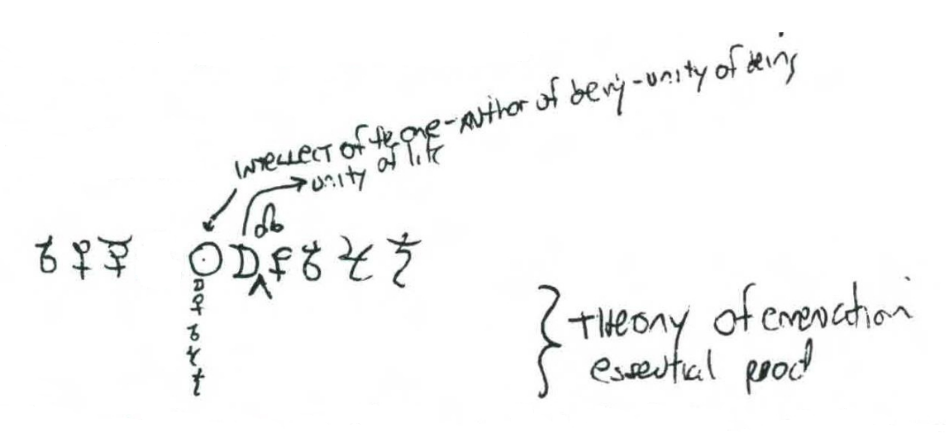
[FIGURE 1982 0507c-3-AB. Triad and Essential Production, with Sun in Aries as Author of Being, Moon in Taurus Unity of Life. Essential prod = Essential production. Facsimile scan from AB class notes.]
The One does not become anything in Plotinus, Plato, PB -- it always remains intact.
All Authentic Existences essentially produce.
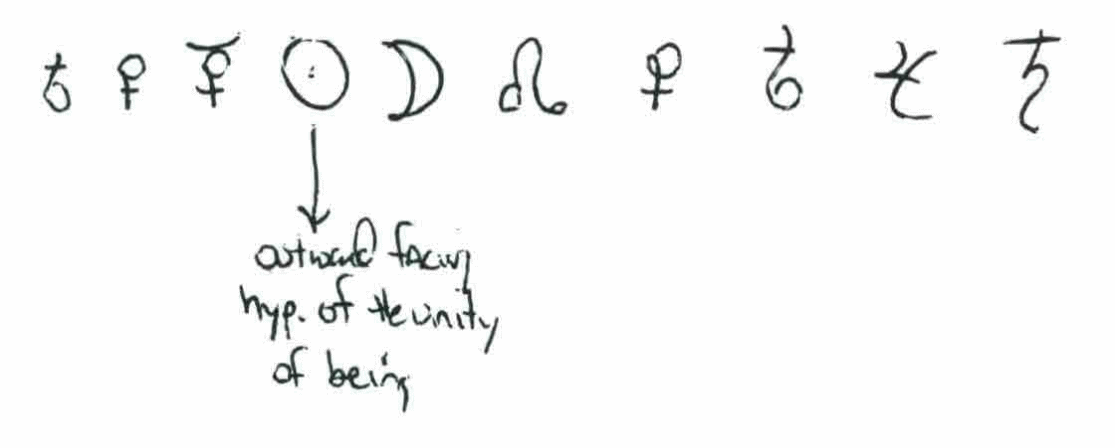
[FIGURE 1982 0507c-4-AB. Triad and Sun in Aries. Reads: Outward-facing hypostasis of the unity of being. Facsimile scan from AB class notes.]
P. 57 Schaya -- the existence of a second within the One without a second = Saturn (Malkhuth). [Note: Leo Schaya, The Universal Meaning of the Kabbalah.]
2.5.5 (122), 2.4.5 (108), 5.5.8 (410), 5.3.15 (396-7) [Note: Plotinus, The Enneads. Page numbers vary with edition.]
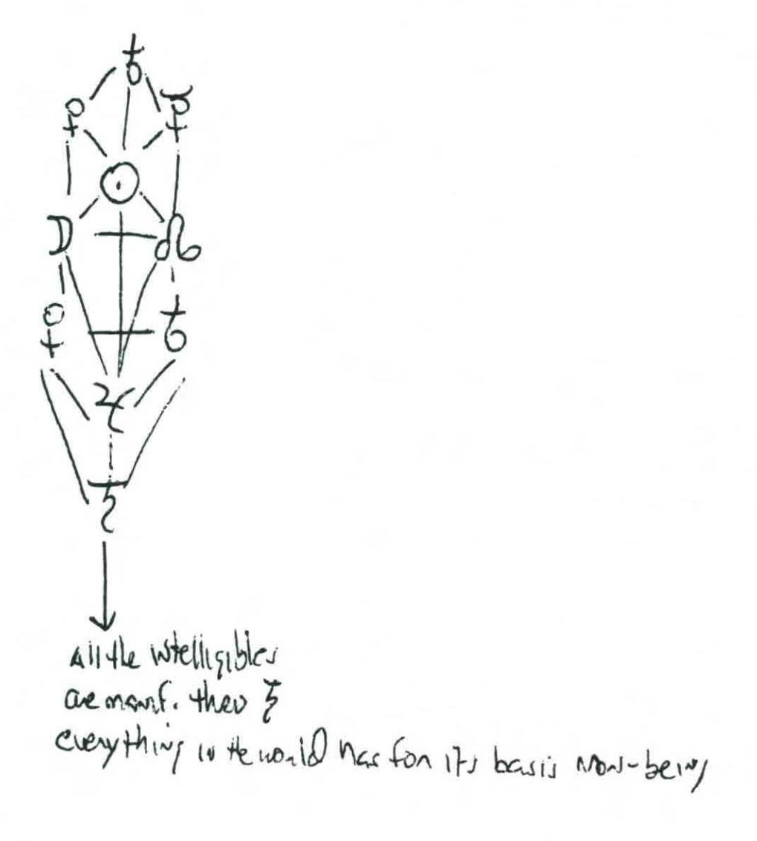
[FIGURE 1982 0507c-5-AB. Triad as Kabbalistic Tree. Bottom reads: All the Intelligibles are manifested through Saturn. Everything in the world has for its basis non-being. Facsimile scan from AB class notes.]
The coordination of the Intelligibles with the Ideas by Number is within this tree = the Triad = above Being, meta-ontic.
Malkhuth = Divine Immanence. Makes the Godhead concrete. Authentic Non-Existence (space). The Intellectual Realm is located within this second = mulaprakriti.
Paper on the Intellectual-Principle.
Number exists in unproceeding union within the Authentic Being (i.e., Triad) along with the henad -- Universal Being.
[Classnotes AB 1982 0507 End]
Class
Friday, May 7th, 1982
Verbatim, unedited transcriptClick the series name to view more
CLASS at Wisdom's Goldenrod, Hector, NY
with Anthony Damiani (AD)
May 7c, 1982
PLOTINUS: INTELLECTUAL-PRINCIPLE & ONE
with Appendix: Classnotes AB 1982 0507.
TOPIC: Plotinus
SUBJECT: Intellectual-Principle & One
SUBSUBJECTS: Number, Matter (Saturn in Aries), Emanation, Triad
CONTENTS:
The One never becomes anything, always remains intact
Illustrating theory of emanation using diagram of Triad and monads
All Authentic Existences essentially produce; example of fire
Reading from Schaya, The Universal Meaning of the Kabbalah, on malkhuth
Existence of a second within the One without a second correlated with Saturn in Aries, principle of Authentic Non-Existence, Mulaprakriti; strangest of all principles
Reading Plotinus, II.5.5, II.4.5, V.5.8, on matter
All Intelligibles are manifested through Saturn in Aries; anything following upon the One has for its basis non-Being
Debate about whether matter being referred to in II.4.5, II.5.5 is matter of One or Intellectual-Principle
Research into Plotinus' Greek still at primitive level; AD interested in his vision of Plotinus' meaning, not in the commentators; text as springboard
Diagramming Triad as Kabbalistic tree; coordination by Number of Intelligibles with Ideas is within the Triad (meta-ontic)
Mulaprakriti as veil of Parabrahman
Armstrong, McKenna, Guthrie translate Plotinus' passages on matter differently because they don't understand him
Distinguishing theory of emanation from principle of matter
Number 10 symbolizes unities (1) implanted in non-Being (0)
Emanation illustrated by radiating Sun
PB quote from Essays on the Quest distinguishing emanation from manifestation; World-Idea as emanation rather than illusion
Emanation grants existence to something new; manifestation makes evident something which is already there
Principles which emanate from the One only give traces of it, no symmetrical relationship
No knowing of unities in the One, only monads in Intellectual-Principle
In Plotinus, principle of awareness is the One itself
Reading Plotinus, V.3.15, on emanation; soul always remains what it is, doesn't merge back into the One, even though temporary union possible
Reading Plotinus, II.5.5, III.6.7, on matter as falsity; Buddhism tries to express this by saying the arisal of a moment is also its disappearance
Reading/discussing AD paper, "The Intellectual-Principle"
Multiplicity of Intellectual-Principle's contents coordinated and ordered through principle of Number; Number exists within the One but not applied
Debate about Being as a homogenous unity vs. duality-in-unity; importance of grasping true meaning of unity
Appendix: AB class notes
BOOKS READ FROM OR REFERENCED:
Anthony Damiani, Astronoesis: Philosophy's Empirical Context; Astrology's Transcendental Ground (published 2000)
Leo Schaya, The Universal Meaning of the Kabbalah
Plotinus, The Enneads (MacKenna translation, 4th ed.)
A.H. Armstrong, The Architecture of the Intelligible Universe in the Philosophy of Plotinus: An Analytical and Historical Study
T. Subba Row, Philosophy of the Bhagavad-Gita
Paul Brunton, Essays on the Quest
Paul Brunton, The Wisdom of the Overself
PLOTINUS QUOTES READ OR REFERENCED: II.4.5, II.5.5, III.6.7, V.1.6, V.3.15, V.5.8, VI.6.9-10
DIAGRAMS appended to this transcript:
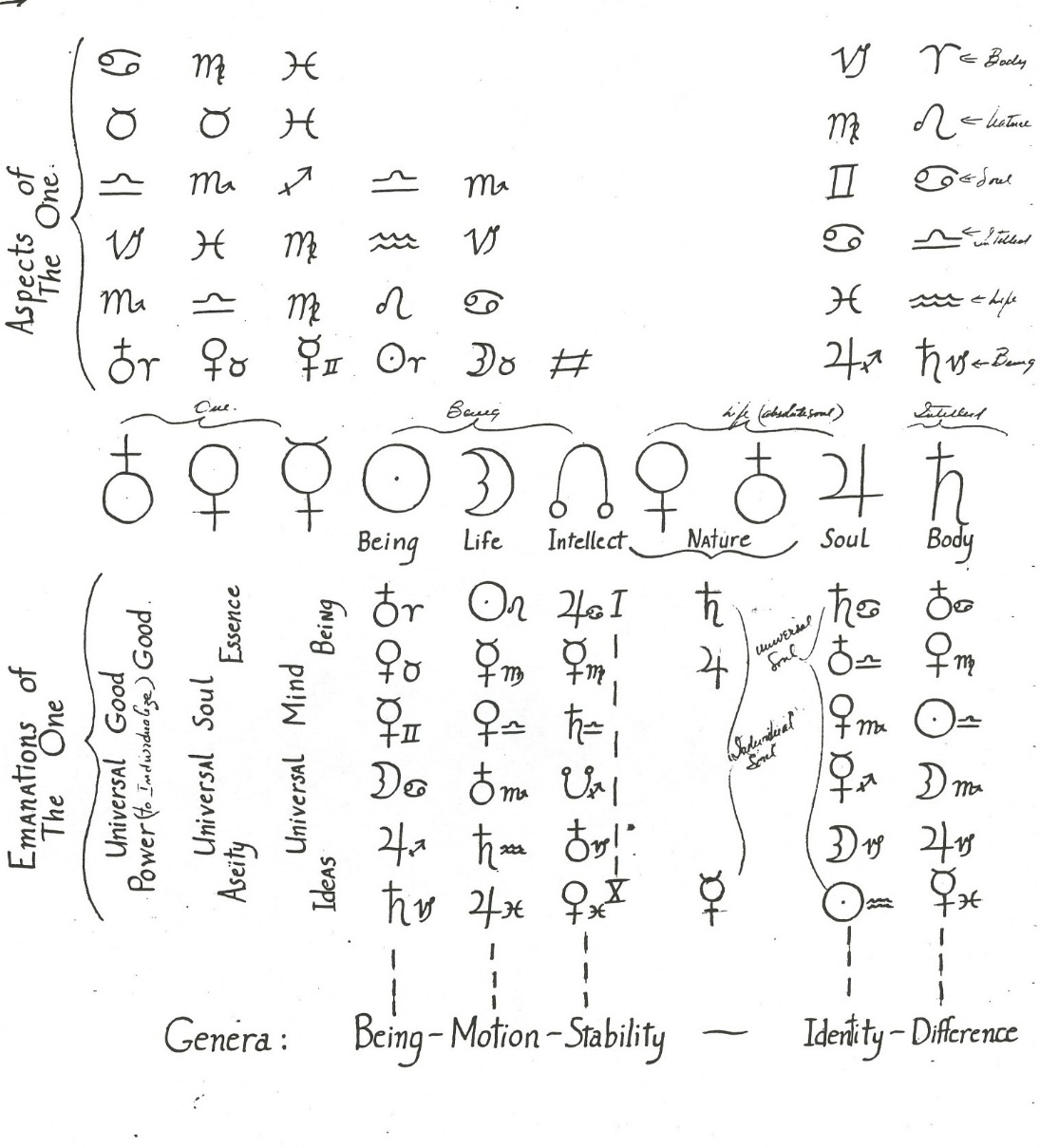
FIGURE AD_G_007. Aspects of the One; Emanations of the One; Genera.
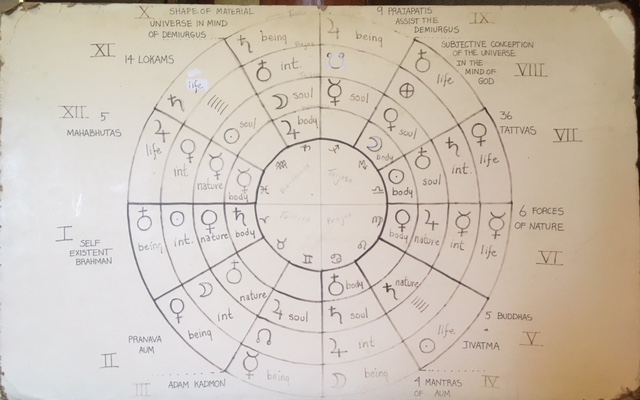
FIGURE IMG 2202-Posterboard Metaphysical Chart.
FIGURE 1982 0507c-3-AB. Triad and Essential Production.
FIGURE 1982 0507c-4-AB. Triad and Sun in Aries.
FIGURE 1982 0507c-5-AB. Triad as Kabbalistic Tree.
[Transcriber note: [diagram] means the speaker is referencing a diagram as he or she is speaking. If someone is drawing or writing, with audible sounds of chalk on a blackboard, I indicate this by [drawing] or [writing].]
AD PAPER read in class:
- "The Intellectual-Principle". This is an early draft and is published in a different form in Astronoesis in the chapter on The Intellectual-Principle, p. 101 ff.
NOTES:
This is 1982 05/07c, the Friday evening class, and the third entry associated with this date. 1982 05/07a = a daytime seminar on Astrology. 1982 05/07b = "Columbus"; there appears to be or have been an audio cassette tape, but there is no more information on it — might refer to something misdated. 1982 05/07d = The Intellectual-Principle Paper.
The first audio file, which is the only audio file we have, is primarily about the One (especially the section on Saturn in Aries). About 80% through this class AD's "Intellectual-Principle" paper is read, and the discussion transitions to Intellectual-Principle and Number. The discussion about the One seems to be "just setting the stage" for AD's presentation of the Intellectual-Principle. Therefore this transcript is entitled "Plotinus: Intellectual-Principle & One".
AB class notes have been appended because they contain information and diagrams that the partial transcript does not have and thus help round out the class. Retyped from Classnotes AB 1982 0323 to 1982 0517.PDF. All spelling, capitalization, and punctuation corrected, abbreviations and astrological glyphs spelled out in AB Classnotes.
TRANSCRIBED Verbatim by IT 2021. In 2024, IT completes TOC, removes most notes within transcript referencing diagrams in Astronoesis (no longer necessary), adds new note within transcript, adds one diagram and references within transcript to this diagram. Archival verbatim transcript with AD Paper – V12ap.
AUDIO FILES: 1982 0507a. [Note 1: "Tape" and "Side" refer to original audio cassette tapes that were later digitized into .MP3 Audio Files. Note 2: We only have the first audio file for this class, we are missing the second.]
1982 05/07c at Wisdom's Goldenrod
Plotinus: Intellectual-Principle & One
[Audio File 1982 0507a Begins]
AD: Before he starts reading let me-- let me place you in-- in-- in the context. [19¼ second pause while someone writes on board] I want you to try to imagine what I'm going to say now. The Plotinian theory of the One always leaves it intact. The One never becomes anything. Now, you gotta nail that down. The One does not become anything. [student assents, very faint] It always remains the One. If any-- if there should be any division or fragmentation or any of that, you do not speak about the One anymore, you're speaking about your version of the One. But for Plotinus, and for Plato, and for PB, One always is what it is. So then the problem of course is that you have the second principle and the third principle, you know, going down the line.
Now maybe this might be a way of trying to comprehend or grasp the way he's speaking about. [Note: See FIGURES AD_G_007, 1982 0507c-3-AB for the following.] You know, [drawing] we said that for instance this is the Being. This [Sun in Aries], the Intellect of the One, is the author of Being, alright. And, that [Moon in Taurus] would be like the leader of Life [diagram], ok. This [Head in Gemini] would be the leader of Number or Intellect [diagram], whatever you want to call it. You could do that with all of them, now let's do just one, [drawing/writing] Mars is in Aries, Venus is in Taurus, Mercury's in Gemini, Moon in Cancer, Jupiter in Sagittarius, and Saturn in Capricorn [dignities underneath Being/Sun in Aries]. Now you could do this with each one but let me do it just for one so that you get a context.
Now if we say that this is the One and we know that in the One there is a transcendent copy of Nous, Being, risen-- reason-principles, Intellect, etc, whatever-- whatever is going to exist at the lesser levels, there will be a perfect copy or perfect stance, perfect paradigm of that in the One Itself. And so we would say that this is the unity of the O-- of Being [Sun in Aries] and this would be the unity of Life [Moon in Taurus]. And then, we said further, but [drawing] all these unities are various aspects of one and the same thing. [student assents, faint] Remember? They're all various aspects of one and the same thing, it isn't that you have ten different "ones". Alright. Now, this might be a way of looking at it that might help you-- um--
If we call this a theory of emanation, [writing] and that's what we're doing, what's important here is, Plotinus says that anything that is an Authentic Existent has an outward-facing Hypostasis. [Note: See Plotinus, V.1.6, third to last para.] So he's speaking about production-- essential production, and he gives the example fire is hot in itself, alright, at the same time projects heat. That's essential production. Snow is cold, alright, same time projects cold. So that it remains itself but at the same time a lesser principle, a lesser offspring springs out of it, alright.
Now, we have to try to do the same thing here. If we think of these all u-- if we think of these all as unities, and we're s-- and we're saying that-- we're saying that there's an outward-facing Hypostasis coming from the transcendental paradigm of Being, then we'd have to think all of this here [drawing/diagram] is like the outward-facing Hypostasis of the unity of Being, and we'd have to do that with all of them, if each one would have an outward-facing Hypostasis [FIGURE 1982 0507c-4-AB]. So that would mean-- that will mean that in no way is this sundered, divided, or anything like that. It would be like if you have a mirror, alright, and (if) there's objects they get-- No, the analogy wouldn't work. [short pause] Oh, the-- the film might be a good idea, the cinematographic pictorial machine. The film stays in the machine, it doesn't go out where it's projected. But even that's not good because-- We could use that. So basically, the idea of emanation would be that since all these here [diagram], alright, all those-- all these here are reflections from the ou-- the-- the unities within the One Itself, alright, then if we do that, alright, then we could easily see that over here [drawing] you would have the Intellectual-Principle over here [diagram]. And over here you'd have Soul [diagram] and over here Body [diagram]. And they will be reflections of that. So he calls--
You can see actually what he's doing. To him, there is only one Principle [AD taps board to indicate]. This is it, and all the rest are going to be lesser grades. He refers to them as images of the Archetype or the Authentic. So if we-- if we keep that in mind, I think you could go into the context of trying to understand the Intellectual-Principle. And there's one other thing. And this came up very strange 'cause this is-- this is really quite stunning. Avery put me on-- onto this here by quoting a few-- Do you have The Meaning of the Universal Kabbalah? [Note: The Universal Meaning of the Kabbalah by Leo Schaya.]
AS: You have the quote in here. There's a whole quote here. They let me read (Sunday). I think there's the whole quote here.
AD (faint): Look at that.
AS: Do you have the book? Oh.
AD (faint): Oh yeah.
AS: Well that's even better.
AS: Do you want me to read that?
AD: Yeah read that quote, I want you-- I want you to listen to this quote, [AS simultaneously, faint: It is, uh-hm.] it's really quite-- it's stunning.
AS (simultaneously): [one/two words inaudible] This is page 57. He's talking about the tenth Sefirah [AS says: Sefiroth], Malkhuth. He says--
[Transcriber note: I am using The Universal Meaning of the Kabbalah by Leo Schaya, Penguin Books Inc, Baltimore, Maryland, 1973.]
Leo Schaya [The Universal Meaning of the Kabbalah, p. 57, AS reading]: "Therefore it is the existence of a 'second' [AD drawing] in the midst of the 'One without a second' which makes the only reality mysterious; in the end, all spiritual search comes to the question: by virtue of 'what' [(mah)] does cosmic existence become concrete? The Kabbalah answers: this 'what', [mah], is divine immanence, the last Sefirah, malkhuth, the 'kingdom' of God, which produces, encircles and penetrates the whole of creation. … In other words, malkhuth is the 'descent', [the shekhinah] or omnipresence of the supreme…"
[short pause]
S (very faint): Would you read it again?
DR: Would you mind reading it again?
VM: Yeah, could you do that again?
AS: Sure.
AB: Is that Schaya, Avery?
AS: Yeah, [AD simultaneously: Yeah.] this is this fellow Schaya in a book called by some, The Universal Meaning of the Kabbalah. [short pause, someone drawing/writing] Without a cover. (bit of laughter) Says--
Leo Schaya [The Universal Meaning of the Kabbalah, p. 57, AS reading]: "Therefore it is the existence of a 'second' in…"
AD (simultaneously): This one here [diagram].
S (very faint): Uh-hm.
Leo Schaya [The Universal Meaning of the Kabbalah, p. 57, AS reading]: "…in the midst of the 'One without a second'…"
S: Hm.
S (faint): (Right.)
S (very faint): Hm.
AS: We could go over--
AD (simultaneously): This is an extraordinarily good book. It is the only presentation of Judaism I ever saw that's worth the name.
S (faint): Who was it?
AS: Yeah it's good.
S: Could you spell it?
S (simultaneously, faint): Yeah.
AS: It's a little book, S-c-h-a-y-a. And, he has a very good-- especially good presentation of the ten Sefiroth at the beginning. Second chapter or so, it's-- first chapter, it's very good. Um-- I'll read it again.
Leo Schaya [The Universal Meaning of the Kabbalah, p. 57, AS reading]: "Therefore it is the existence of a 'second' in the midst of the 'One without a second' [AD drawing/writing] which makes the only reality mysterious; in the end, all spiritual search comes to the question: by virtue of 'what' [(mah)] does cosmic existence become concrete? The Kabbalah answers: [AS adds: that] this 'what', [mah], is divine immanence, the last Sefirah, malkhuth, [AS reads: the last principle or malkhuth] the 'kingdom' of God, which produces, encircles and penetrates the whole of creation."
AD: Now, I like-- I like to take two or three quotes from Plotinus to show you the way they lock in, I mean they-- We're speaking about-- speaking about matter. [short pause] Because this is the [drawing/writing] strangest of all the principles, you know, this one here [Saturn in Aries]. This is the hardest one of all to understand. And, Plotinus refers to that as Authentic Non-Existence. Authentic Non-Existence.
AS (faint): Yeah. So then--
AD: It would also correspond to the Mulaprakriti of the Hindus.
[short pause]
AS: Says-- in-- ok, there are three-- three quotes in each row, this one is-- I'll read this one first I guess, III.5.5, [Note: AS means II.5.5.] where he says--
Plotinus [II.5.5, AS reading]: "Grasped, then, as an underlie in each order of Being, it can be no actualization of either: all that is allowed to it is to be a Potentiality… …
"[So that] Matter, as the Actualization of Non-Being, is all the more decidedly Non-Being, is Authentic Non-Existence. …
"If it is…"
VM (simultaneously): Avery, would you excuse me, just the last sentence again please.
Plotinus [II.5.5, AS reading]: "[So that] Matter, as the Actualization of Non-Being, is all the more decidedly Non-Being, [AS adds: it] is Authentic Non-Existence. …
"If it is to be present at all, it cannot be an Actualization, for then it would not be the stray from Authentic Being which it is, the thing having its Being in Non-Beingness…"
MB: What was that number Avery?
AS: It's II.5.5. Says it's--
S (very faint): Do you have an extra (book)?
AS (faint): No.
MB (very faint): Avery wasn't that II.5.5?
S (simultaneously, faint): Yeah.
AS: There is such a tractate, isn't there?
S: (No.)
S (faint): You said III.5.5.
AS (simultaneously): Yeah.
S: You said III.5.5.
S (faint): You said III.5.5.
AS (simultaneously): Oh. I changed my mind, it's II.5.5. (bit of laughter)
S (very faint): Right.
AS: And then there's another one in "Matter" (on) II.4.5. Right? Is that (what/where) he says about the-- he talks about the cleavage away from the First?
AD: Yeah.
AS: Is that right? And in II.4.5, page 108, he says--
Plotinus [II.4.5, AS reading]: "[For] that differentiation within the Intelligible which produces Matter has always existed and it is this cleavage which produces the Matter there: it is the first movement; and movement and differentiation are convertible terms…this motion, this cleavage, away from The First is indetermination (=Matter), needing The First to its determination which it achieves by its Return, remaining, until then, an Alienism, still lacking good; unlit by the Supernal. It is from The First that all light comes, and, until this be absorbed, no light in any recipient of light can be authentic; the recipient is itself without light since light is from elsewhere."
AS: This is-- and then (we seem to) have one more. There's one more in V.5.8, where he has this-- he mentions this principle of the One being present and yet non-present. It's at the very end of it, V.5.8, he says--
Plotinus [V.5.8, AS reading]: "No doubt it is wonderful that The First should thus be present without any coming, and that, while it is nowhere, nowhere is it not: but wonderful though this be in itself [AS reads: but of course, the cont-- this-- though this is wonderful], the contrary would be [AS adds: even] more wonderful to those who know."
AD: Would you read that once more?
AS: Sure.
Plotinus [V.5.8, AS reading]: "No doubt it is wonderful that The First should thus be present without any coming…"
AD: [drawing] So then, the One will be present without any coming in this whole realm [diagram]. Here it could be everywhere [diagram]. Over here it can't be anywhere [diagram]. Nowhere. Then, then what he has done or what he is at least inclining us to consider is that the whole-- that all of the principles that evolve or let's say are emanated [drawing] are going to enamate-- emanate in this-- within this realm [Saturn in Aries], this would be the locus. [Note: See FIGURE 1982 0507c-5-AB. Cf. Astronoesis, p. 72, Fig. 32.] [student assents, faint] You follow what we're doing here?
VM: Think so but--
AD: If this is the principle of Non-Existence [Saturn in Aries], [writing/drawing] Authentic Non-Existence, Non-Being, alright, then all these here [planets above Saturn] will have to come through space, if we think of space as the last of the Triad, the Intelligible in the Triad. So, insofar that it comes through this principle, it will be present everywhere, insofar that it remains what it is over here [diagram], it'll be nowhere. So this [diagram]-- this matter or space as the Body of God is what he's speaking about.
MB: What--
S (very faint): I see.
MB: He's speaking of matter or he's speaking of the One?
AD: The One as [AS simultaneously: Contained, (yeah).] present in matter.
MB (faint): Thank you.
AD: In this principle [diagram].
MB (faint): What is the contrary in the se-- in the (sentence further)?
AS: Oh.
Plotinus [V.5.8, AS reading]: "…but wonderful though this be in itself, the contrary would be more wonderful…"
AD (simultaneously): In other words if it didn't work out like this--
AS (simultaneously): If it didn't work, yeah. The-- the contrary isn't a thing, it's a situation. It has to be like this. The [AD simultaneously: So--] contrary isn't some entity.
AD: Contrary [MB simultaneously: Contrary means it can't--] simply means, [AS simultaneously: For the other case, the other case we could--] it means, it's so amazing but it will be more amazing if it wasn't like this.
MB: Yeah but-- which is impossible.
AD: Which is impossible.
AS: Yeah.
AD: But--
AH (simultaneously, very faint): Question.
AS: Yeah.
S (faint): (Uh-hm/Go ahead).
AH: Question about that earlier quote, that a thing, if the thing's being is based on Non-Being? [S, very faint: (Yeah.)] Is that accurate? Is that accurate paraphrase? I think it is. If a thing's being is based on a principle of Non-Being-- Thing is matter, is that so?
AD: Uh-hm.
AH: So matter's being has it's his basi-- has as its basis Non-Being?
AS: Yeah [couple/three words inaudible]
AD (simultaneously): Everything in the world has for its basis Non-Being. Everything in manifestation. In other words, [AH: So the--] even-- even to the point, and I think this is quite amazing, even to the point where he's saying that if the Intellectual-Principle or the Intellectual Realm has to have a locus, it's within that too.
AH: I'm sorry?
S (simultaneously, very faint): (It's ok.)
AD: Even the Intellectual Realm has its locus within that second, alright, in the midst of a One without a second.
AH: Anthony forgive me, but that sounds like double talk. (laughter)
AD: Yeah that's why I didn't want to bring it up. [AH simultaneously: But--] I'd sound like a Tibetan.
AH: It sounds like [S simultaneously: (Tibetan?)] Tibetan, you know, like how can the [AD simultaneously: But--] One without a second have a second.
AS (simultaneously): It also contains its second. Well that's-- and that's the strange thing, I mean it contains everything, we said it's the infinity of all possibilities, it must also contain within it-- if that principle of the s-- the same argument, again if that principle of a second is something outside of it, then you're going to end up with a final real duality. But if the principle which even allows otherness to appear is already contained within it to begin with, then when the otherness does appear, namely when this world manifests or any world, even the Intellectual World manifests, it's ok because that principle that allows it is already contained within the One also.
S (very faint): Go ahead.
AH: So Avery, you feel that's a logical statement [AS simultaneously: No--] (to be) explained in a rational way.
S (very faint): No.
AS: Well--
AD: You're gonna be forced to it whether you like it or not.
AS (simultaneously): No it's not-- that's not logic.
AD: You're gonna be forced to accept it whether you like it or not as long as you accept the reality of the World-Idea and stop kidding-- you know, we stop kidding ourselves that it doesn't exist. I mean when someone tells me nothing exists, I'm the one then who gets offended and walks out.
AH: You say it exists as--
AD: It must exist in this way, [AD taps on diagram] having matter for its basis.
AH (simultaneously): As-- as Authentic Non-Existence.
AD: Huh?
AH: It exists as Authentic Non-Existence.
AD: Yeah.
AS: Yeah don't forget--
AH: I don't see how that's any different from saying that it's empty of inherent existence.
AD: Because saying it's empty doesn't tell me anything. I'd like some reasons. What are you saying? I won't get much if I go to a dictionary. But if I-- if I-- if-- if we can begin to understand gradually that this is a principle, Authentic Non-Being, or the Being of Non-Being is a principle, it is one of the Divine Ideas, alright, then we know we got something real to deal with instead of something imaginary. At any rate we're-- we're not going to do the One, we just want to lay the context out.
RG: But--
AD: Now-- Yeah.
AH: Objective.
RG: But-- but in the context of the In-- the Intellectual-Principle, why is it that you understand the-- this matter, the matter that he's talking about as the base in the Intellectual in this-- these passages anyway, as not within the Intelligible World and prior to it?
AD: I'm sorry, try again Richard. Say it again.
RG: Well-- I'm afraid of getting my head chopped off.
AD: No that's alright.
S (simultaneously, faint): (He won't) do that.
RG: The matter of the Intellectual-Principle, the matter he's talking about in fi-- in II.3-- [AS simultaneously: II.4.5.] II.4.3, right?
AS: 5, II.4.5.
RG: Whatever it is, II.4.-- yes, II.4.5. I don't understand from the passages why it's not referring to the matter within Being itself and not to-- and-- well you were saying it's referring to the meta-ontic level.
AD (faint): Yeah.
[short pause]
VM: Sounds like a familiar question.
AS (simultaneously): Picked that word up though. (bit of laughter)
S: Yeah.
RG: It's a familiar question but it-- I mean--
AD: What's he saying, that the Intel-- the Intellectual-Principle contains the Idea of Non-Existence?
AS: Yeah [S simultaneously: Well, I don't know.] I think, he says he doesn't see any need to push it back [couple words inaudible]
AD (simultaneously): Yeah I know.
S: He's saying--
RG: No, no, [S simultaneously: Who is this?] but I-- I don't-- I see-- wait a minute, I do-- I take it back, I see what you're saying and I can accept it as a principle. But I don't see it that that's what Plotinus is saying [AS simultaneously: Oh yeah.] in these passages.
AD: Well I know, that's what I--
RG (simultaneously): No but I-- but-- but it isn't enough just to say-- I mean we have-- I mean-- am I the only one who rea-- who reads it that way? I mean when he says--
Plotinus [II.4.5, RG reading]: "Those that ascribe Real Being to Matter must be admitted to be right as long as they keep to the Matter of the Intelligible Realm…"
RG: He doesn't say there's a matter of the One. He says to the matter of the Intelligible Realm. [DB simultaneously: There is no--] Now what does that mean?
DB: I-- well I thought that the whole discussion was preceded by the-- the idea that there is in the One nothing other than the One Itself. So as soon as you speak of matter, you're already speaking about a-- a differentiation from that perspective.
RG (simultaneously): But that's true-- that's-- that's true of everything. I don't disagree with that. But if you're gonna use--
AD: Look, without even using the texts, without even using the texts--where is this principle gonna come from?
RG: I already granted you that, so--
AD (simultaneously): Ok that's-- that's all I'm saying. That's all I'm saying.
RG: But insofar that you're relating it to these textual passages, I mean doesn't-- I mean I don't-- can't I have just some understanding of how it relates to these passages? Or no?
AD: Well, would you read that?
AS: I mean-- and Richard, this one here like the Being of Non-Being.
AD: Read that.
AS: I-- He says "Matter…" Now, suppose you say matter at all-- all the levels, all the way down from Intellectual-Principle down--
Plotinus [II.5.5, AS reading]: "…as the Actualization of Non-Being, is all the more decidedly Non-Being, is Authentic Non-Existence."
AS: I think-- think he's referring there to the [someone drawing] actualization of this principle. Just as you'd say the Intellectual-Principle is an actualization of the unity of Being, and Soul is an actualization of this unity of Soul, I think he's saying there [RG simultaneously: (Where are you reading?)] matter--
RG: Oh, alright.
AS (simultaneously): The pre-- right-- right there--
Plotinus [II.5.5, AS reading]: "…Matter, [as] the Actualization of Non-Being, [is all] the more decidedly Non-Being, is Authentic Non-Existence."
AS: The same way he's used Authentic Being, he's using the word here Authentic Non-Being.
RG (faint): (Well/Yeah), go on.
LR: He also says--
Plotinus [II.4.5, LR reading]: "For that differentiation within the [LR emphasizes following word] Intelligible which produces Matter…"
AS: Yeah. And he's [student assents] saying here that the [couple inaudible LR words simultaneous with AS] principle of matter-- and he's saying that the principle of matter is what we're calling absolute Non-Being, [LR: Excuse me Avery.] or Non-Existence.
LR: We call those henads the Intelligible. So that could be proof Dickie that it-- it's within the One.
AS (simultaneously): No. Right that's-- no.
RG: Yeah, true.
AS: No, I don't-- that-- that wouldn't be a good--
RG (simultaneously): I just don't see one [couple words inaudible]
AS (simultaneously): We don't generally call those Intelligibles.
RG (simultaneously): --where he talks about matter in any other way than in the Intelligible World. I'm not disagreeing that there is a matter in the-- that we could refer to Saturn as that in the One but [couple/three words inaudible]
AS (simultaneously): I don't follow, he's using-- he use-- seems to use it in the same way he uses all the other principles, where he uses Being and he says there is no Being in the One but then he finds the pre-existence of Being. And he says there is no knowing of the One and yet he finds the principle of super-intellection in the One. They say there's no matter in the One, what does it need matter for? But there's the principle of Non-Being or the principle of Authentic Non-Existence is also in the One. I don't see why it's any--
RG: He-- well, (the--) in-- Well, it's no different.
AS: (Uh-huh./What?)
LR: Avery, [AS simultaneously: What?] you're not s-- aren't you saying that's what he means when he says this motion, this cleavage away from the First is--
RG (simultaneously): Because he keeps-- the whole passage just talks about matter in the Intelligible Realm, if you want to now make the Intelligible Realm the One, ok, then we'll read the whole [one word inaudible]
AD: (simultaneously): How come [AS simultaneously: Yeah.] he says 'Intelligible,' they al-- they always use the term 'Intellectual'. Why-- why all of a sudden 'Intelligible'? How often did you come across that word 'Intelligible' in reference to the Intellectual-Principle?
RG: How often? I don't know.
AD: Then read me-- read me the Ennead.
RG (faint): Well [one/two words inaudible] ok, I mean--
AD: It's really rare.
AS (faint): No he uses it (at the end), I wouldn't--
S (very faint): Maybe it's not.
[short pause]
LR: Aren't you calling the Saturn the motion or the cleavage away from the One?
AD: Uh-hm.
S (very faint): Yeah.
AD: That's-- that's Mulaprakriti. And I-- like I try to point out over and over again I could never understand why they equated that with Parabrahman. And, the Western alchemists and some of the Western philosophers refer to that also as the matter which is co-external with God. Well co-eternal shouldn't-- I don't think it's proper, what they mean is that that matter is included in this notion of metaphysical infinity as a principle with-- as a principle. If I say it has a principle within it, I'm wrong. I can only say as a principle which is one of the aspects of that infin-- infinite and we're trying to grasp-- we're trying to grasp. [Note: See FIGURE AD_G_007 for the following.] And that's why I suggest that we always keep this here [Triad] distinct, alright, and look at all these here below as emanations from that [diagram], and in that way they're-- this outward-facing Hypostasis is what we're referring to-- This will be the unity of Prakriti [Saturn in Aries] and this will be the differentiations and the distinctions that arise or come out of it [dignities underneath Body/Saturn in Aries], [student assents, very faint] ok. So, the very sheer logic of the argument he presents, not only in this text but in the text in general, will force you to assume this [couple inaudible student words simultaneous with AD] principle [diagram], [AS: That's-- that's also--] over and over again.
AS: Without the rest.
AD: Alright.
AS: That's the prin--
AD (simultaneously): Now, the-- I think I mentioned it, maybe I didn't, last week but, research on the Greek language the way Plotinus used it is still at a primitive level. I mean it-- it isn't the Greek of Plato. This was a classical Greek and they could deal with. The Greek of Plotinus is really a difficult Greek because there's quite a mixture. They're never quite sure of what the words meant because they always had certain nuances and shades of meaning that-- And I tried to tell you Dickie, I'm not interested in the commentators, I'm not interested in the [couple inaudible RG words simultaneous with AD] translators. I'm interested in the vision that I've seen of what he's saying. And it's the vision I'm interested in.
RG (simultaneously, faint): I know by now.
AD (faint): Uh-hm.
RG: But-- forget about the text and just see the vision.
AD: No, it's not a question of forgetting the text, the text is a useful-- it's a useful and necessary expedient because we've got to try to understand it. But when it comes to a point whether-- when it comes to a point, what am I going to do, play sides, go with my vision or-- and go against the commentators or go with the commentators against my vision, I'll go with my vision any time. (I/I'd) never pay attention to the commentators any more.
S (very faint): (Well that's good.)
AD: I mean when a man-- here look. Let me give you an example, look.
RG (simultaneously): Who's talking about the commentators? We're talk--
AD: Well, you're taking their position, right?
RG (simultaneously): We're ta-- I'm just reading the text, I'm not [S simultaneously: Yeah.] taking any position!
AD (simultaneously): Yeah, that's the position of all the commenta-- Let me give you an example. (laughter)
RG: But that's irrelevant, that it's the position a-- of all the commentators.
AD (simultaneously): Well-- well that's what I'm trying to tell you, I'm trying to tell you, if you go back you'll see that your position has been expounded for the past two hundred years in Plotinian research [RG: Well that--] and I just don't pay attention to it anymore, be--
RG (simultaneously): Just because it's been expounded before doesn't mean it's necessarily wrong.
AD: I didn't say it was wrong, it's just that I'm acquainted with it and I just don't want to bother with it, because of the dead end it takes you to.
RG/S(?) (faint): Ok.
AD: Let me give you an example. You got a-- if you can get a copy of The Structure of the Intelligible Universe by Armstrong. [Note: The Architecture of the Intelligible Universe in the Philosophy of Plotinus: An Analytical and Historical Study by A.H. Armstrong.] [RG, faint: Uh-hm.] Now, the man is editor of, you know, the Cambridge Philosophic series, [RG assents, faint] you know, those hippies?
RG: Yeah, go ahead.
AD: You read them?
RG: I've read the-- the articles.
AD: You know what he says? He says now look, Plotinus can't have it both ways, he can't have his cake and eat it. He can't have the One remain intact and at the same time be the source and the origin of everything. You want the page reference? I'll get it for you.
RG (faint): No [one word inaudible]
AD (simultaneously): No, the point I'm getting at Richard here is, I just don't want to follow that clue!
RG: That's fine.
AD (simultaneously): The text is only something for me to hang onto, to get into, and then to see what he is saying.
RG (faint): Alright.
AD: The words are a springboard for me.
RG: I know. And I'm glad to give it up. But when you start to base the-- the-- your vision through the text then I have to ask the relationship, that's all.
AD (simultaneously): Uh-huh. I told you my-- [RG: I know.] my way of interpreting that passage. There isn't to me no other possible ways of interpreting that passage. That's why I didn't want to do class tonight. Full Moon, I'm not taking no chances.
S (faint): Uh-huh.
S (faint): (Uh-hm.)
S (very faint): Oh no.
AD: Well at any rate, the last point in all this was in order to give you the background and context for this here. Let me also honestly say, I don't think-- I don't know more than one or two commentators who know what-- what Plotinus is talking about when he's talking about the One.
S (faint, possibly part of background): That's what he said.
S: That's (true). Is there another one besides Deck? [Note: John N. Deck, author of Nature, Contemplation, and the One: A Study in the Philosophy of Plotinus.] Is Deck the-- when you say one or two, you-- do you count Deck as one?
AD: Deck was I think a very discriminating and sincere student. The only things I couldn't understand were his notion of the evolution of the One in Plotinian thought. I couldn't understand that at all. [short pause] Do you want the other one too?
RG/S(?): Yeah.
AD: What did you have? (bit of laughter)
S (faint): Right. (some laughter)
S (amidst laughter): Uh-hm.
[Note: See FIGURE 1982 0507c-5-AB for the following.]
AD: We did something like this. [16 second pause while drawing] Well, whatever.
[short pause while AD draws]
VM: Anthony, is this a way of diagramming the Triad or are you at a different level entirely?
AD (simultaneously): Yeah, thi-- this is the type, I-- In other words, I took the ten [VM: Ok.] Sefiri [Note: Sefiroth] and I [VM simultaneously, faint: Ok but--] just threw them into a-- an astrological [VM simultaneously, faint: Different-- a different set-up.] form, alright. You could take-- you could say these are the ten Sefiri, ok.
VM: No but I mean, is this the Triad level you're working on or is this in ontology?
AS (faint): Yeah.
AD: No this is the Triad.
VM: Ok, fine.
AD (simultaneously): This is the Triad, before we get out. Before we get out and he starts doing the Intellectual-Principle, he's going to speak about Number in the Intellectual-Principle. And we said that Number coordinated the Intelligibles which manifest the Idea or the substance of the Idea, and at the same moment that that's happening the Idea is manifesting the Intelligible, [VM, faint: Right.] and that this commonality or this identity of Being and Knowing has its commonality in the Consciousness which is the unitary ground. And this gives us the Intellectual-Principle, ok? [student assents, very faint] So--
But, the point that we want to get to here is that-- is this one. Um-- How could I say it? If this is the Triad [diagram], [drawing] if this is in the realm of the One-- we're not out of the One, we're in the realm of the One, and we're saying that this is Number [Head in Gemini]. And Number we said coordinates the Intelligibles with the substantial Idea and with the unitary-- alright. The point I'm trying to make is that all this is taking place within here [Triad]. It's all within this realm here [Triad], it's not out here [FIGURE AD_G_007, Emanations of the One]. Because, once you leave this realm then you'd be in the Intellectual-Principle. So the coordination, or what he referred to that the Intellectual-Principle in essence knows the One, if you remember that quotation, then he is saying this here [diagram] knows in essence the One, it has a vision of what the One is. That vision of what the One is is in here [diagram], is in the One.
Now all this has got to come through and come out through this principle [Saturn in Aries] or-- which you can [writing/drawing] refer to as potentiality. Which by the way this-- again going back to that quotation, I've never seen Plotinus use the term 'potentiality'. Because for him, to use it the way he did show-- showed that he was trying to bring in an idea that he didn't fully work out. But at any rate, try to keep this in mind now. This has to be taken for granted, the coordination of the Ideas to the Intelligibles in the unitary consciousness which underlies them and makes possible Being-Knowledge, Knowledge is Being. [S, faint: (Exactly.)] All this has to come through the Saturn [diagram] or the-- the principle that he refers to as the principle of matter or the principle of Difference.
Now if we think of this-- if we try to make it more available to us, if we think of this as space. Now not the space you know because the space you know is already part of the corporeal domain. [student assents, faint] It's already part of the sensible world. But if you think of this as space, then what we would in effect be saying would be that these [diagram] are coming through space, and that space is going to be the locus in which the Intellectual Realm is going to be situated. So this would be the highest level [diagram], the highest level of matter and it's part of the principle of Difference within the Triad itself. Once we located ourselves in that situation, alright, then we could take a backward look into this realm [FIGURE 1982 0507c-5-AB, planets above Saturn] and forward or downward into the Intellectual Realm [FIGURE AD_G_007, Emanations of the One]. Ok? So that-- that's roughly about the situation.
S: Would you say-- could you say that the-- (that/the)-- that the Saturn in Aries would be the principle of the Intellectual-Principle?
AD: No.
S: No.
AD: No.
S (simultaneously): You wouldn't, ok.
AD: I tried to make very clear that Saturn in Aries represents-- the Hindus would call it Mulaprakriti, which means primal matter, alright, that's their interpretation. Another interpretation is the principle of Difference. All these, no matter which way you-- you twist and turn, it's going to be very difficult to understand.
S: So there's-- there's the Intellectual-Principle--
AD: If you do it this way. [11½ second pause while drawing] Ok? [short pause] That's Jupiter [diagram], ok? [drawing] They've got to go out through this [Saturn in Aries].
S: So within that configuration within the brackets would be the Intellectual-Principle in a transcendent--
AD (simultaneously): The Intellectual-Principle [S simultaneously: Like--] will be situated within that principle.
S: In a-- No, it would have to manifest through that principle.
AD: Yeah, manifest [AS simultaneously: You mean--] in that principle.
S (simultaneously): But it wouldn't-- but it would be-- in a transcendent [AS simultaneously: In the unity of it, yeah.] way it would be within that-- those brackets or those-- those nine unities [diagram].
AS: You mean its u-- its unity is there.
S: Right, the unity.
AS (simultaneously): Its-- its unity is in--
S: And--
AD: It's the same thing-- again, the same thing came up when we were speaking about Samkhya, Samkhya insists that everythings come-- everything comes out of matter. Everything comes out of matter because everything is put into the matter. And it's the same thing like the alchemist says. If you get even the tiniest little piece of Mulaprakriti, of prime matter, you can watch the entire evolution of the universe take place. Because within that matter is already the seed of everything to be. And that's why-- that's why the alchemists used to refer to matter, prime matter, as co-eternal with God. And that's why the Vedantists refer to Mulaprakriti as Parabrahman too. And as a matter of fact, if you remember the-- long time ago we read a book by T. Subba Row, Philosophy of Bhagavad-Gita, where he makes the remark that Mulaprakriti is the veil which is thrown over Parabrahman and makes it unavailable for inspection.
S (very faint): Oh yeah.
S (faint): Yeah. Uh-hm.
AS: Anthony, but--
AD (simultaneously): Now I'm sorry I gotta disappoint Richard but I'm going my way, I'm not a Lama. Go ahead.
AS (simultaneously): Anthony, about that veil, I mean I-- I think I see now why that's kind of a mis-- it seems to be a mis-- misrepresentation of the-- When they say it's a veil, it seems that the way it veils Parabrahman is that Parabrahman is infinite, all-- you know, if we trace back the Intellectual-Principle, it's infinite, and you trace back Being, Soul, all these principles as in-- rooted in the One, as they are in the One are infinite and indistinguishable. But it seems that the way that the Mulaprakriti veils Parabrahman is by actually allowing for determination. In other words, it's through this principle of Difference that all of these are going to be deter-- when they're put through this principle of potentiality and matter, there's going to be some determination taking place. [AD simultaneously, faint: As soon as you say--] And in a sense that veils the infinity of the original-- of their original status.
AD (simultaneously): As soon as you say-- as soon as you say that Mulaprakriti represents the potentiality of the entire manifested cosmos and all the principles, you're-- you're saying that it has veiled the One. It's not available any longer.
AS: Yes.
BS: Well but if it's-- if it's Authentic-- call it Authentic Non-Being, then it seems that what emanates from it or included within it is some kind of un-Authentic Being. So why not call the One Being?
AD: I'm sorry. What's within it is Authentic Being. Why do you say it's unauthentic Being? He's saying that these-- these emanations which are within matter are Authentic Being. And they will be translated or transposed by unauthentic Existence. Or at least that unauthentic Existence would provide the potentiality or the placelessness in which manifestation can occur.
[12¾ second pause]
BS: Would you refer to the-- the others in the One as Being-- as Beings, Authentic Beings?
AD: No again, again, we've got to go back to what we said. They're not Authentic Beings in the sense that they belong to the Intellectual-Principle.
BS: No I didn't say-- I didn't say that.
AD: They're beyond that.
BS: Yeah.
AD: They're unities. It isn't that they come out and do anything. It's their sheer presence, the totality of these im-- unities, their sheer presence, the abundance of their perfection, forces this outward (radiating/rating) Hypostasis right into the potentiality of matter. Now matter can carry, so to speak, this transposition or carry out this transposition of let's say having the Intellectual-Principle evolve from (them). No the-- the-- the thoughts that are being expressed by Plotinus and the one we read by Schaya are-- are-- I-- they're not points of argument, they're points of contemplation. I wouldn't sit down and argue with any academician. (Of course he'd) just keep his mind still for a half hour then I'd talk to him and have an argument with him. [student assents, very faint] So-- would you read that Schaya one more? That Schaya article?
[short pause]
AS: Um-- Let me read the previous sentence, says--
Leo Schaya [The Universal Meaning of the Kabbalah, p. 57, AS reading]: "Without this otherness, there is neither who nor what…"
AD: Louder.
Leo Schaya [The Universal Meaning of the Kabbalah, p. 57, AS reading]: "Without this otherness, there is neither who nor what, neither search nor mystery. There is nothing but the only reality in its non-dual absolute selfness."
AD: What-- what is he saying there, Avery?
AS: He's saying--
AD: Without this otherness--
AS (simultaneously): Without this there won't be any universe, there won't be any Intellectual-Principle or any other, it'd just be the One. I mean, you'd just-- that would be the only reality would be the One. I think that was his-- that's his whole point in here.
AD (simultaneously): Yeah, the whole point is he's saying that that's malkhuth [AS: It--] in which the foundation of the kingdom is laid (down).
AS: He's saying that, within the One has to be als-- the One has to allow even for its otherness, even for a possibility of manifestation.
AD (simultaneously): And within that otherness there will be everything else.
AS: Yeah. Like otherness is within the One and then within otherness is everything else [AD: Yeah.] that's gonna manifest. It says--
Leo Schaya [The Universal Meaning of the Kabbalah, p. 57, AS reading]: "Therefore it is the existence of a 'second' in the midst of the 'One without a second' which makes the only reality mysterious; in the end, all spiritual search comes to the question: by virtue of 'what' [(mah)] does cosmic existence become concrete? The Kabbalah answers: this 'what', mah, is divine immanence, the last Sefirah, malkhuth, [AS reads: And the Kabbalah answers that it is this principle, malkhuth, the divine immanence] the 'kingdom' of God, which produces, encircles and penetrates the whole of creation."
AD: And of course the kingdom of God are the three lower Hypostases, Intellectual, Soul, Nature, Body. All that is the-- and all that is within malkhuth or what they call the foundation. Now another interesting thing you can do if you have the time and the patience. There's three translations of Plotinus--Armstrong, McKenna, and Guthrie. Read these passages, and you will get three entirely [student assents] different versions and interpretations, three entirely different wordings. And if you can come out with any sense, I'll sit at your feet.
LR: Why would that be Anthony, if it--
AD: Huh? [S, faint: Yeah.] Why would that be? Because it's ungraspable what he's saying! They can't understand him!
LR: Do they have a (similar--)
AD: And the Greek itself is difficult.
LR: Do they not-- right, do they all use the word 'matter'? Or do they have different translations?
AD: They have different translations. One refers to it as indeterminate and others-- one doesn't even-- Guthrie uses the term 'One' and then changes it with Intellectual-Principle.
LR: Oh, they don't have that middle--
AD (simultaneously): They don't-- yeah. So you know right away, this is a-- you know, a-- well, what would you call it? A black hole. (laughter)
S (amidst laughter): Yeah.
AS: That's what it is.
S (faint): Black hole.
AS: Principle of black hole.
AD (simultaneously): Alright, now-- now we have the context within which Avery is going to try to like look above, alright, and then look below, in other words the way Number operates in these two realms. Avery?
VM: (But/Well), excuse me Anthony, we're kind of lost. Any discussion then of the principle of emanation really is a discussion of, let's say, the ability of matter to allow an unfolding of these-- of the One let's say or whatever level you happen to be working on. In other words, emanation is only another description of activity if you like or the potentiality of matter to reveal forms.
AD: Yeah but-- That's true, the-- the principle of matter in-- in the-- in the One itself does permit and allows for the revelation to take place. Yeah.
VM: Ok, so--
AD (simultaneously): But, the point is this here, that it is only the intermediary. [VM: Alright.] It is not the Intellectual-Principle.
VM: Ok, fine.
AD: Ok?
VM: But, let me say it slightly differently. I think--
(Side 1 of original cassette tape digitized as 1982 0507a Ends; Side 2 Begins)
AD: --in their simultaneity, like we [VM simultaneously: Well, of course not.] were looking at the Sun [in Aries] as the Intellect of the One [diagram], alright, and its perfection-- and this is very peculiar, Plotinus says, "That which is perfect engenders eternally-- [VM: Perfect, yeah.] Perfection engenders eternally perfection." [Note: Plotinus, V.1.6 (second to last para), "Again, all that is fully achieved engenders: therefore the eternally achieved engenders eternally an eternal being."] [VM assents, faint] So the outward-facing Hypostasis of this principle, alright. Now all these principles are engendering by their sheer perfection an outward-facing Hypostasis. And the-- the Saturn represents the receptacle in which let's say they all get focused and operate through to manifest, let's say, the Intellectual-Principle next.
VM: Let me persist just a little more. Are there really two distinct principles here, the principle of matter and the principle of emanation? Or are they really two different ways of describing the same process?
AD: Are there two different principles, emanation [VM simultaneously: Yeah let's say pri--] and matter?
VM: Yeah.
AD: Definitely.
AS: Yeah.
AD: Yeah.
AS (simultaneously): And I think they're different principles.
VM (simultaneously): Uh-hm, yeah.
AS: Eman-- because he--
AD (simultaneously): Because the whole Plotinian notion is the theory of emanation. And if that is not understood, nothing else can be understood.
AS: (And/Then) we would say (that that) is a dependence.
VM (simultaneously): See-- but see I-- I guess what I don't understand is, how the principle of emanation is different from or distinct from the idea of let's say various forms, at whatever level you happen to be discussing, [AS simultaneously: Oh I see.] various forms [S simultaneously, faint: (couple words inaudible) yeah.] manifesting or, [AS simultaneously: Did (he/you) just say--] let's say, being reflected on matter.
AS: I think-- I think it was--
AD (simultaneously): Each-- insofar that each unity, alright, [AS simultaneously: Has its own power.] insofar that each unity has an outward-facing Hypostasis of itself, [AS simultaneously: Doesn't need the matter, right.] this is not matter.
AS: Matter is potential. It's not the matter that produces the outward-facing of each one. Each one of those has its own power to do that.
VM (simultaneously): But isn't it meaningless in a way to speak about outward-facing Hypostasis if there's nothing to reflect it on?
AS: And isn't it meaningless to speak about outward-facing Hypostasis if each one of these can't produce-- in other words, if there were just matter and none of these things had the power--
AD (simultaneously): I told you you have the totality of these principles in their simultaneity-- [AS simultaneously: Then there would be nothing to manifest.] in simultaneity, don't work around with that notion of logic here, there isn't any.
AS: It would be like a blank screen.
VM (simultaneously): What would you have to work with?
AD (simultaneously with AS and VM): Point here-- point here is meta-entalo-- meta-ontic.
VM: Ok the--
AS (simultaneously): Right. But you--
AD (simultaneously): It is not metaphysical, it's meta-ontic, [VM simultaneously: Ok.] that means it's beyond Being.
AS: You'd either say that the matter without those would be a blank screen or the other way of putting it is that the matter doesn't have any power to evoke anything, it's just a potentiality.
VM (simultaneously): Ok. Ok so-- so the matter is-- to use inappropriate words but whatever you can, the matter is in some ways passive [SD assents] and the activity, if again it's an inappropriate [AS simultaneously: No, it's not, that's it.] word but the activity is that outward-facing Hypostasis.
AS (simultaneously): Of those unities.
VM/S(?): (Sure.)
AD (simultaneously): Correct, yeah.
AS: Yeah.
S (very faint): Right.
AS: Yeah that's--
AD (simultaneously): Matter is passive or the way he says, pure potentiality.
VM: Yeah right, right.
AS: That's--
VM: It has no nature in itself.
AD (simultaneously): I mean he never uses that word, he's cautious with that word.
AS: That's also that-- even the-- I think that's where that num-- even the number symbolism, the one and the zero, indicates that it's the unities which are the active aspect which are kind of implanting themselves or operating in matter, the zero, the principle of Non-Being. And that's the tenth-- the tenth principle, the 10, and it seems to be principle of the number 10.
AD: See unfortunately [couple inaudible AS words simultaneous with AD] we have no example of that principle in the empirical world. [VM: That--] I mean you can say radiation but the thing comes to an end, and the matter even decomposes and breaks up. And he speaks about an eternal radiation from a source which is eternal, it never dries up, a fountain which never dries up. And he also uses the example of a Sun. But today we're very smart, we know that the Sun is going to go extinct in five billion years, (bit of laughter) so that example can't be used either but basically he uses the Sun as an example. That's the principle and it's constantly radiating or there's this-- a light which is emanating from it. And, this has to be understood very distinctly. As a matter of fact, maybe-- Would you read that quote from PB, first page?
AS: Yeah. That's what that actually is.
S (very faint): I just read that book.
[short pause]
VM: There's another point too but I don't remember, but-- well, I might as well say it out loud. In one of those quotes from Plotinus, it seemed like the principle of motion was equated with matter. And that's somewhat difficult too because at that level I thought the principle of motion was one of the-- the five Genera of Being.
S (very faint): Uh-hm.
S (very faint): Yeah.
S (very faint): Uh-hm.
SD/S(?) (simultaneously): Motion away though, I mean-- Doesn't sound like he's referring to motion per se.
S (very faint): Yeah.
S: Well, perhaps it's--
AS (simultaneously, faint): Well [one word inaudible] and that's motion per se and--
S: What did you say right now?
AD: You find it?
S: Motion what?
AS (simultaneously): What? Oh, yeah.
S (simultaneously, faint): It was motion away.
S (faint): And that--
AD: Read it.
AS: Well, there was some questions still. There was some questions--
AD: Read the quote first.
VM: Go ahead, [AS simultaneously: Ok.] read the quote Avery, that was a minor--
AS: Ok.
[Transcriber note: I am using Essays on the Quest by Paul Brunton, Samuel Weiser, Inc., York Beach, Maine, 1985. Note: The version actually read from was PB's manuscript draft as it existed in 1982.]
Paul Brunton [Essays on the Quest, p. 101, AS reading]: "The One…"
AS: This is PB.
AD: This is a quote from PB.
Paul Brunton [Essays on the Quest, p. 101, AS reading]: "The One does not become the Many, for the orders of being and consciousness are different. It remains what it is and from it emanates the Many. The universe is much more an emanation than a manifestation. Because it is an emanation rather than an illusion, the World-Idea is not to be treated as a non-entity. It is not to be sharply divided from reality. For it is the Real manifesting something of itself in a particular way. All events are only its activity as all things are only its attributes. Relativity exists between the ideas themselves but the substratum out of which they spring is the eternal and infinite, the self-existent and Absolute Mind. Matter thus becomes but a mental entity. The Absolute is not cleft inseparably from the Relative for the Relative is its own Idea. Mind itself is that which has always existed, which is the…Principle of the world process. We may say of it what we may say of nothing else except Infinite Space: [AS adds: namely] It is."
AD: You notice he had to use that too?
VM: He did, yeah. Where is this from, his notes Avery?
Paul Brunton [Essays on the Quest, p. 101, AS reading]: "And this will still be true even if the whole universe, including the conscious beings in it, disappears. Mind could not have come into existence at any specific time as it could not have come into existence from nothing; therefore, it must always have existed and there was never a moment when it was not."
[short pause]
S (faint): Say something?
AS: I think it's from one of his-- I don't know exactly which-- probably 16, sounds like 16.
S (faint): Randy.
AS: Randy? 16 Randy? Is that from volume 16? [short pause] Or like was 16, 25.
S (very faint): Seems like [couple words inaudible]
[short pause]
SD: What was the-- do you-- could you explain perhaps at the beginning the emanation and non-manifestation?
AD (simultaneously): Are you speaking to yourself?
AS: Yeah, that we have to understand.
SD: At the beginning there's a line about it being emanation and not manifestation.
AD (faint): Yeah.
SD: I was wondering what the distinction there would be.
LR: Well, in mani-- [one/two words inaudible]
AD: Manifestation and emanation? [S: Yeah.] What I just went through.
S: Uh-hm.
S (possibly part of background): Hold onto that Vic.
[9 second pause with faint background student talking]
AD: In other words what I said didn't make any sense.
SD: Well I don't see it in that context, I don't see what-- maybe I've always thought of manifestation as being emanation.
MB: Does he mean manifestation as (a) [couple words inaudible] is that what-- is that what he means Anthony?
AD: No, [VM simultaneously: (one word inaudible) no.] it's a question of principle here. We're trying to say, again, there's a Unity which from a super-abundance of its perfection cannot but help, alright, give off from itself something which is not itself. And he gives the example of fire. Fire is hot, right? In itself it's hot. But it emanates the heat also, you feel it even though you're ten feet away from it. Now, what would manifestation be? Would that be manifestation, would you say the fire is manifesting heat?
S (faint): Right.
VM: Well--
S (faint): Uh-hm.
AD: Come over (here).
SD (simultaneously): And [S simultaneously: (That's) good.] maybe it's a question [LDS simultaneously, faint: Hold on.] of words.
AD/S(?) (simultaneously): (Alright.) (bit of laughter)
LDS: What you're saying is, the heat given off by the fire is really incidental or not essential.
AD (simultaneously): Not incidental.
AS: No.
AD: It's of a lower ontic [LDS simultaneously: Yes.] status than the fire.
LDS: The fire, yeah. So it's not a manifestation--
AD (simultaneously): That's the po-- that's the point, yeah.
LDS: It's not a manifestation of the fire.
AD (simultaneously): No, manifestation means you bring a-- you bring along your magnifying glass and you see something that wasn't there. You manifest things, alright, that means that you're applying consciousness to what's there, you're revealing.
AS (faint): Right.
LDS: I would say-- I thought we--
AD: No, no, no. What I say, no, what I say. This is the distinction, isn't it?
LDS: Say it again, I'd have--
AD: Well of course I have to say it again. You try it. You think it out now.
LDS: I thought what he meant when he said dis-- made the distinction between manifestation and emanation was, when you have a manifestation of something, you have that something in whatever's manifest. In other words--
AD (simultaneously): It's already there.
LDS: It's there.
AD: It's already there.
LDS: So, in that sense if you said the One--
AD (simultaneously): And you make it available to yourself.
LDS: Yeah.
AD: Ok. Now, emanation? [LDS simultaneously: Emanation would--] You're not talking about a thing that's already there.
LDS: No.
AD: We're talking about a thing that's going to be put there. [LDS: Yeah.] Going to be actually delivered. It's going to be given existence.
LDS (very faint): Yeah.
AD: [snaps fingers] You got the point. Good night. (bit of laughter)
S (faint): No.
BS: I know we (have--)
AS: Good night.
S: Come back. (bit of laughter)
VM/S(?): Arrivederci.
S (simultaneously, faint): [couple words inaudible]
AD (faint): You're not crazy.
S: What?
S (faint, possibly part of background): We already have some.
S: Too hot for him today?
AS: It could be.
AD: Go ahead Avery, start.
AS: Yes, any questions? (bit of laughter)
S (very faint): Uh-hm.
S (faint): I'm getting (real) far.
BS: Yeah, distinction between manifestation and emanation.
VM: That's right.
BS: Say the manifestation is something that's already there? (bit of laughter)
DB (very faint): (Ok) [couple words inaudible]
BS: Oh you bet.
AS: Mani-fest.
BS: Yes! (laughter)
AS: Mani-fest just mean-- well-- make manifest means to make ob-- evident something which is there.
BS (faint): Make evident something which is there. Yeah. Oh (that).
AD (faint): You got homework.
S (faint): Yeah.
DB (very faint): I'll be right back real (quick). (laughter)
LDS (amidst laughter): Let me grab it real quick.
AS: But I think there are other implications of that too. I think there are other implications.
BS: Go ahead David.
AD: The criteria here is that emanation grants existence to something. Manifestation will then make that available to you. We're talking about what makes a thing existent. And he's speaking about what makes the authentic realities existent. So, again, if we go back to what we said, the One imparts to each and every form its characteristic aseity and its existence. He do-- we're-- we're not sa-- he's not saying, Plato or Plotinus, is not saying that the One manifests these characteristic aseities and forms, he doesn't-- he's not saying that. He's saying it gives them being and essence. If you can't make these distinctions, you just take Plotinus and put him back on a shelf and say, "The next lifetime."
OG: I always think of it twice the crowd.
AD: The what?
OG: Twice the crowd. Emanation means something is coming out of it [couple words inaudible]
AD (simultaneously): Why do you insist on saying it your way, when my way is more accurate? Because it's not my way, it's the way that these people have said it, whether it's Plato or Iamblichus or Plotinus, they [hitting board with chalk for emphasis] granted existence to the Ideas! [short pause] How else are you going to understand that an archetype of a gnat and an archetype of an archangel is one and the same as far as ontic status is concerned in the eyes of God?
[9½ second pause]
AS: Yeah that's-- but, he-- I think he makes the best place-- maybe it's not the best but a very good place where he makes the point is where he says that existence or 'on', he uses the Greek word, is a trace of the One. And he seem-- he seems to be making that point there about it being an emanation, the same point, it's actually a trace of the One. It's not a separate-- it's not a separate reality.
AD: Alright Avery, get the second chapter on the Intellectual-Principle. See if you can find some easy parts.
AS: I-- the-- I thought that the introduction to it was good. Could read that. (AS laughing a bit) Uh--
AD: Now watch, these people won't even be able to count from one to ten. Watch this now.
AS: We could get to Number.
BS (simultaneously, faint): His-- it gives all the principles their name?
AS (simultaneously): That would be fun.
BS: To what?
S (very faint): Yeah.
AD: He gives all to the forms. In other words, when we took the Mars, Venus, Mercury, alright, and we said that the Sun [in Aries] was the author of Being, was the transcendent copy of Being in the One. And that in-- in terms of just (this/its) pure Isness, it imparted to all these other principles, the Mars, Venus, Mercury going down, it imparts to them their existence and their characteristic uniqueness. [short pause] You follow?
S (faint): Not buying it [one/two words inaudible]
AD (simultaneously): Ok, let me just-- let me get to that-- Suppose--
[14½ second pause]
BS: Oh, it's the very Intelligibles that are being emanated and you're displaying around the chart [diagram]. And that all would be under the realm of Saturn, (probably/all of it) be within that realm.
[Note: See FIGURES AD_G_007, IMG 2202-Posterboard Metaphysical Chart, 1982 0507c-3-AB for the following.]
AD: You-- you remember the diagram I put up here a little while ago, we're taking this Sun [in Aries] [writing] out of the Triad and we said the Mars, the Venus, Mercury, Moon, Jupiter, and Saturn, each in their respective signs [diagram], alright. Now, these are all referred to as Being, Being, Being, Being, Being, and Being [AD indicates on diagram], alright. Now what we're saying is, this here [Sun in Aries], the Intellect, the tr-- the Intellect of the Transcendent One is the father, the author, the generator of Being. It is the transcendent copy, I mean the transcendent model of Being in the One itself. Well then if this is [drawing] the paradigm, if this is the model, then all these below, alright, are emanations from it. This here [Sun in Aries] has to give each one of them their peculiar characteristic and also what we refer to as their being. So, he gives them being and he also characterizes that being in a s-- very specific way. So this would be a-- for instance, the revealer, or that which functions towards manifestation of the fullness of the Being of the One [Mars in Aries], this will be of the essences [Venus in Taurus], this will be of Adam Kadmon or the, you know, Subjective Wisdom [Mercury in Gemini], this will be the four-- the quadratic nature of Being itself [Moon in Cancer], this [Mercury in Gemini] will be the being of the 10 unmanifested Sefiri [Note: Sefiroth] which there become manifested [Jupiter in Sagittarius], and this will be the principle of Prakriti or the Shape of the Material Universe, remember, the Matter of the fourth quadrant [Saturn in Capricorn]. Now if you take every one of these [drawing] Ideas, alright, you will see that all of them could be collapsed, so to speak, and re-inserted back in here [diagram]. So this is the father [Sun in Aries], this is-- these are the offsprings [diagram]. He has six children. The children are not the father, the father is not the children, ok. It is here [Saturn in Aries] where emanation takes places. And, that will-- that would follow with the Moon too, if you take the Moon [in Taurus] and you say the Moon is the unity of Life [diagram]. Then you would say that [drawing] all these here [diagram] represent or are subsumed under the unity of this principle of Life. And you could do that with each thing in the Triad or in the One. You follow that?
S (very faint): Yeah.
AD: Ok. Now obviously, their existence and their uniqueness is being granted to them or given to them or imparted to them by the power of the One. This is the theory of emanation, which means that there is a distinct, very distinct, hiatus as far as ontological status between these here which are in the realm of Being [FIGURE AD_G_007, Emanations of the One] and this is which is beyond Being [Triad]. Ok?
EC: Does--
LDS/S(?): It was all--
EC: Does the-- [BS simultaneously: It's a manifest--] does the Saturn in the first house have to play some part in that with-- with that Sun emanating those children, from what you said over here in that-- behind you.
AD (simultaneously): Those children have to have a playground, and Saturn is going to be the playground. (AS laughing)
BS (faint): So it's only-- it seems that-- forgive me if I misuse a term but it would seem that the-- that the offspring, so to speak-- We could only speak of manifestation when they look back to their source. And, you probably speak--
AD: No, you can't speak of manifestation, you speak of emanation.
BS: No, I-- (well--)
AD (simultaneously): These [diagram] are not manifestations of this [diagram].
BS: Right.
AD: Ok.
BS: No that's ok. And we're leaving manifestation out completely, right?
AD: I'm sorry?
BS (simultaneously): Or are we making a distinction between manifestation and emanation?
AD: Yeah I'm trying to point out that the proper terminology here is emanation.
BS: And manifestation should be out of the--
AD (simultaneously): Leave-- I'm-- leave manifestation out.
BS: Ok.
AD: Don't confuse these two. There are-- there are cosmologies which speak strictly in terms of manifestation. [BS simultaneously: That would be (one word inaudible)] Plotinian-- Plotinian cosmology is emanation. The whole of his ontology is in terms of emanation.
BS: Ok I could stop short, I mean, but I'll bring the other point in. I just thought I saw how both of them--
LDS: Anthony?
AD: Go ahead Lou.
LDS (simultaneously): So, the quote that Avery read of PB's and-- where the distinction was made about emanation and manifestation there, he also spoke of how, even in these emanations, these principles that are not the One and are not manifestations of the One, are still, as you said, granted some kind of reality, or you said they were granted their aseity by the One. And that's-- and that then includes in these principles something of a reality. In other words, it follows the quote in the Wisdom where he says reality is continuous with its appearances. [Note: Paul Brunton, The Wisdom of the Overself (2015), p. 306, "When we recognize that the Real is continuous with its Appearance and that the latter is indeed the very incarnation of it…"]
AD: No, no, no, there-- [LDS simultaneously: That's--] don't go back to those quotes.
LDS: Ok that-- but that doesn't follow.
AD (simultaneously): Don't go back to the Wisdom. You'll [LDS simultaneously: That doesn't follow what--] get in trouble. PB makes the point there, he says that the Ideas are relative to each other. [LDS, faint: Yeah.] And in their totality they constitute a system of universal relativity. But not in the One.
LDS (faint): No, ok.
AD: He says that. The Ideas are relative. Even the World-Idea is a relative thing.
LDS: But see, he-- and even in the passage (of) Avery read, he does grant them some kind of reality, in other words, this--
AD (simultaneously): But of course, so does Plotinus.
LDS: Yeah.
AD: Plotinus points out that the Intellectual-Principle is an authentic reality. It is the second of the greatest, alright. And he-- and he makes that very clear, it's so great a Being is it. But still, in-- still there's no symmetrical relationship between the One and the principles which emanate from it.
LDS: No symmetrical.
AD: Yeah. If anything, it would be asymmetrical. [student assents, very faint] And, if you follow the meaning in Plotinus, I think you'd come up with the notion that it's strictly null and void in comparison to the One itself. Because, like Avery just quoted, they do nothing but give you a trace of the One, these principles.
LDS: And you would say too that the aseity that's granted to these things would be that part of them that is exactly unintelligible or ungraspable in a sense. And that, in terms of their powers or their functions, these principles, that would be the aspect of them, their powers and functions would be the aspects of them that we could make intelligible or understand or grasp. Whereas the aseity--
AD: Well, assuming that you were functioning in the Nous. But, since we're not and we're functioning here in the spatial-temporal arena, nonetheless, the indivisibility of any and every Idea, alright, cannot be denied nor can it be affirmed, because you can't grasp it. But without it, alright, you can't speak about anything. Now, the other point here is that, if you understood what I was doing here, if you say that this is the author of the Transcendent One [diagram], then you take each Idea that corresponds to it, [LDS, faint: Yeah.] ok. You could see that the Ideas here, even though like this Idea [diagram] and this Idea [diagram] have seemingly contradictory qualities, alright, they're unlike each other, alright. One would say well, where is the thread, where is the indivisibility of the Idea which flows through all of them? You'd have to go to this [diagram]. [LDS, faint: Yeah.] But, this is exactly what Plato said. A pure unity in itself, alright, cannot be known. Only what's below that can be known, where you have the Intellectual-Principle, subject-object relationship, or, the way we put it, the Intelligible and the Idea. But below that realm only. There's no knowing of the unities.
[short pause]
OG: Once you gave an example, (I already said it's applicated, about your) mind having five ideas and when they are projected out, then we need to become aware of them. It's like the emanation of the mind-- an emanation of those ideas. And then it connects back to the mind. Then just the pure mind remains.
AD: Yeah. So one could see the distinction between what PB referred to as Absolute Mind, alright, and that which comes from it or emanates from it.
OG: Yes. In that sense the emanation becomes the principle of awareness.
AD: No, no, this is the principle of awareness in Plotinus, the One Itself is the principle of awareness. It is the ultimate awareness which flows into all the levels going down, into the Intellectual, into Brahman, down into Hiranyagarbha, down into Vaishva-- Vaishvanara.
OG: Yeah, but the emanation is not different from the source. It is this-- it is the source.
S (faint): What is that?
S (faint): [one word inaudible]
AD: (Get rid of it.) Not (its/as) source. That's an old Vedantic trick. (bit of laughter)
AS: He has a good one here. He has this one here Om in-- this is in V.3.15, he says, how does the One confer multiplicity when it doesn't contain any? Now that's a good question. Says--
Plotinus [V.3.15, AS reading]: "The emanation, then, must be less good, that is to say, less self-sufficing: now what must that be which is less self-sufficing than The One? Obviously the Not-One, that is to say, multiplicity but a multiplicity striving towards unity; that is to say, a One-that-is-many.
"All that is not One is conserved by virtue of the One, and from the One derives its characteristic nature: if it had not attained such unity as is consistent with being made up of multiplicity we could not affirm its existence [AS adds: at all]…"
[short pause]
RG: No, and what is that?
[short pause]
AD: Say (louder/bottom).
RG: What-- what are you calling that principle there?
AS: Which principle?
RG: The one you just wrote-- read about. What is that?
AS: The principle of emanation, I-- I thought that was a quote to illustrate this principle of emanation he speaks about.
AD: The basic point here, Richard, was that Om is trying to get back to this notion of identity, alright, and it's not so.
RG: Right, ok.
AD: The soul remains soul, and even-- [AS simultaneously: Oh yeah, right.] even if there should be a temporary union or identity with the One, it's not permanent. Soul again becomes soul, that is it remains back-- it remains in the sphere of ontology or let's say in-- at the level of Being, even if you want to put it in the Nous.
OG: I-- I didn't mean that emanation is same as its so-- emanation is not different from the source, not in the sense after being manifestation but the power of-- power to emanate or we could use the word "the urge to emanate". That's not different from the source. Of course once it's manifested any of those principles, then it is different from the source.
[short pause]
AD: Alright Om.
RG: I-- but just in that quote with the sen-- the Not-One then you're saying is what?
AD (simultaneously): [one/two words inaudible] and you'll have actual compassion.
RG: What? The Not-One is-- which is the-- what gets emanated is what?
AS: Like [S simultaneously, faint: Yeah.] the Intellectual-Principle.
RG: Is the Intellectual-Principle.
AS: The Soul. I mean all-- all-- the All, yeah all the other levels.
RG: But by One you're including within the One here the principle of matter or the Saturn.
AD: Yeah.
S (very faint): Uh-hm.
S (faint whisper): Yeah.
[13¼ second pause with faint background student talking]
AD: Well we got a good start. If you followed any of this of course you-- you're following very profound teachings.
DB (faint): (An--) Anthony?
AD (faint): Yes.
DB: Is it-- is it possible to distinguish this notion of Authentic Non-Existence, the Saturn principle as not having any kind of gnostic capacity? And that which distinguish-- that it's-- it's that which makes it as Authentic Non-Existence as opposed to the Authentic Existence?
AD: Because it has no gnostic functions you mean to say.
DB: Well, I'm just-- see, the way we've spoken of it, its-- its passivity, its receptivity to--
AD: Pure poten-- pure potentiality.
DB (simultaneously): Pure-- pure potentiality. It doesn't-- it doesn't seem to me that it's any kind of knowing principle.
AD (simultaneously): That's true, it's not any kind of knowing principle.
DB: And--
AD: As a matter of fact-- where's the passage where he calls it falsity?
AS: Falsity, a lie, where he says it's a lie.
AD: Now listen to this very carefully.
[short pause, flipping of pages]
AS: Actually, I think it's in Deck right now. [couple words inaudible]
RC: 122.
AS: 122? Why don't you read it Randy?
RC: I think this is the one.
AS: [one/two words inaudible] No not the-- oh I didn't even see.
Plotinus [II.5.5, RC reading (simultaneously with AS above)]: "Its actuality is that of being a phantasm…"
AS (simultaneously): No. No I think it was this one, no.
Plotinus [II.5.5, RC reading (simultaneously with AS above)]: "…the actuality of being a falsity; and the false in actualization [AS simultaneously: Oh, yeah.] is the veritably false, which again is Authentic Non-Existence."
S (very faint): [few words inaudible]
S (simultaneously, faint): (Compassionate/Compassion) Avery.
AS: I speed him (on/onto) [one/two words inaudible] (compassion).
RC/S(?): Wait till you see my mile.
AD: I'd rather you speeded its evolution.
VM: That's right.
S (very faint): Sorry Randy.
AS: Sorry.
AD: (Did) you forget?
VM (simultaneously): (It's) the Samurai tradition.
AD: Let's-- let's hear that again.
Plotinus [II.5.5, RC reading]: "Its actuality is that of being a phantasm, the actuality of being a falsity; and the false in actualization is the veritably false, which again is Authentic Non-Existence."
S: Uh-hm.
S (faint): The veritably false.
AD: Would you read the other where he refers to it-- Avery, the other passage too?
AS: Well I-- I think-- I'm not sure. But he says "Its every utterance is a lie". That whole-- I don't know if that was the one you wanted.
S (very faint): Yeah.
Plotinus [III.6.7, AS reading]: "…it pretends to be great [and] it is little, to be more and it is less…"
AS: On--
AD: So he actually calls it a principle of absolute falsity. And he refers to it as Authentic-- Authentic Non-Existence. [S: That's (so/right).] Now tell me, what's the difference between that and when a Buddhist says that a moment arises and its arisal is also its disappearance? What would be the difference? Well, I think they're all trying to express this paradoxical nature of this principle. [short pause] Alright Avery. Let's try reading a little bit from the notion on Number. Because, part of the reason we're doing this is for the Monday class too, we want to bring it into alignment with what we're doing on Monday. And if we could see some of these things in operation as principles, then later on maybe we could see how they're applied in a very practical way in the chart. Avery you want to start or you want me to read?
AS: Oh--
AD: Let's start.
AS: Where do you want to start from? You want to start at the beginning?
AD (simultaneously, faint): [couple words inaudible] yeah.
AS: Ok good. (AS laughs a bit) Says-- "The sub…" This is like a preface.
AD: Oh no, don't read that, there's nothing there.
AS: I know, that's what-- that's why I asked.
AD (simultaneously): They might think they understand something.
AS: Oh ok. That's why I asked that, where do you want to start. So you want to start at [AD simultaneously, faint: Ok.] the real-- the other beginning?
AD: Yeah, start at the beginning of the actual work.
AS: Ok.
AD: The introduction is a prayer so I-- you don't need that.
AS: I thought that was nice.
VM/S(?): [one word inaudible]
S: I'll read it.
S (simultaneously, faint): We don't even need it. (bit of laughter)
S (very faint): [few words inaudible]
AS (simultaneously): "Out of the…" Ok well, (just this/this is) (Deck). We-- I think we read this last week, two weeks ago.
[Transcriber note: The following paper is an early draft and is published in a different form in Astronoesis in the chapter on The Intellectual-Principle, p. 101 ff. I do not have access to it, quotes need to be checked.]
AD Paper ["The Intellectual-Principle," AS reading]:
"The Intellectual-Principle
"Out of the ocean of infinite possibilities in the ineffable undifferenced intelligence of the One, the unique and unknowable God, is poured a radiant display of glorious revelations and divine Ideas. In other tradition, the Divine Names. The double Act inherent in the One exhibits its inner nature, manifesting luminous existences on the surface of its voidness. The Power of the One is so great that the Divine Mind, though an"image One," stands as an authentic reality, the All. This "outward" expression of the One, which is to stand as a distinct reality, though, in the midst of the One, must do so as (another/an other) or second to the One.
"At once then the outpouring of Power takes on determinations and limitations as the Intellectual-Principle. Within this arise the first distinctions of knowledge and its objects, the One-Many.
"The indefinite multiplicity of its contents will be coordinated and ordered specifically through the principle of Number, which is also found transcendentally in the One.
"It will be this principle of Number that will provide some guidance in understanding how the form, the Idea of the Good, arises from its formless source and within it.
"We lead into this discussion with a passage from VI.6.9 where Plotinus examines the principle of Number and its relation to Being.
"[But] if Number thus preceded the Beings, then it is not included among them?
"The truth is that it existed within the Authentic Being but not as applying to it…"
AS: I'm sorry, there should be more of the quote but I'll just read what's here. Just a little more.
AD Paper ["The Intellectual-Principle," AS reading]:
"The truth is that it existed within the Authentic Being but not as applying to it, for Being was still unparted; the potentiality of Number existed and so produced the division within Being, put in travail with multiplicity; Number must be either the substance of Being or its Activity; the Life-Form as such and the Intellectual-Principle must be Number. [AS adds: Now] Clearly Being is to be thought of as Number collective, while the Beings are number unfolded: the Intellectual-Principle is Number moving within itself, while the Living-Form is Number container of the universe. Even Being is the outcome of the Unity and since the prior is unity the secondary must be Number.
"Hence it is that the Forms [AS adds: or] (Ideas) have been described as Henads and Numbers. This is the authentic [(essential)] Number; the other…"
AS: Um-- alright. What happened to the quote? But-- Sorry. Well, technical difficulties here.
S (faint): Uh-hm.
AS (faint): Ok.
AD Paper ["The Intellectual-Principle," AS reading]:
"This is the authentic [(essential)] Number; the other, the 'monadic', is its image. The Authentic is that made manifest in the Forms and helping to bring them to be; primarily it is the Number in the Authentic Being, inherent to it and preceding the Beings, serving [to] them as root, fount, first principle.
"For the Unity is [AS adds: the] source to Being; Being's Being is stayed upon the Unity as its safeguard from dissolution; the Unity cannot rest upon Being which at that would be a unity before possessing unity…
"[10.] When it takes lot with multiplicity, Being becomes Number by the fact of awakening to manifoldness; before, it was a preparation, so to speak, of the Beings, their fore-promise, a total of henads [AS: We showed.] offering a stay for what was to be based upon them." (Plotinus, VI.6.9-10)
[short pause]
AS: That was a quote from VI.6.9. [short pause] All--
AB (simultaneously, faint): You want (qu--)
AS: Yes.
AB (faint): Do you want questions or you want to just (read)?
AS: But--
AD: It's up to you.
AS: Well if there are questions maybe we should stop there.
AB: Well, I had a question on the quote.
AS (simultaneously): Yeah [one word inaudible]
AB: See but, he seems to very clearly state that Number is prime-- prior to Beings, and that in effect, Number is what unfolds out of Being this plurality. But he also says that Number is after the Unity, and that Being is after the Unity and prior to the Beings but, I'm not quite clear on the relationship between Being and Number or if they're in-- be spoken of in a hierarchical fashion.
S (very faint): Repeat that Alan?
AS: Two weeks [S simultaneously: Why--] ago. You weren't here two weeks ago.
S: That was last week.
AS: It was last week.
S: Last week.
RG: Yeah, was it last week?
AB (simultaneously, faint): Well, well, I know, I didn't-- I still didn't (follow).
AS: Oh.
RG: Oh well-- uh-hm.
AB (simultaneously, faint): I was here but I didn't get it.
RG: What's the question?
DB: It's not a-- I follow once that Being existed within-- I'm sorry, Number existed within the Authentic Being but not as applying to it because Being there was unparted.
AS: Ok. By Being there he's meaning Universal Being. So Number subsists in Universal Being in that line of the Triad we showed [FIGURE AD_G_007, Head in Gemini], within the One. But it can't apply there, we-- let's get into that. It can't apply there because nothing can be parted there. We can't have any distinct things within the One, it's only afterwards that it applies but the principle is there. [short pause] It says--
AD Paper ["The Intellectual-Principle," AS reading]: "All the numbers are in unproceeding union in Authentic Being, along with all the other unities and henads. In speaking incorrectly, this total of unities has been referred to as the undifferenced. These are the transcendent paradigms from which will be suspended the ineffable monads, Being, Life, Intellect, Soul, Nature, Body, which are the principle and basis for any ontology. [someone drawing] We use the Triad as a visual aid, as speaking without vigor, each and every symbol represents a unity, and they all exist in a relationless and modeless homogeneity."
AS: So, Alan in the quote where he says that Number subsisted within Authentic Being, we're taking that Authentic Being to be universal. [student assents, faint] Whether or not agree with that. Where "Being was still unparted". Ok, I think the other point we made is that, whenever he speaks of Being as actually a distinct Hypostasis, that is the Intellectual-Principle, it's not unparted. It's always a duality-in-unity.
AB (simultaneously, faint): Right, differentiated.
AS: To speak [AD simultaneously: So--] differentiated. To speak about pure unity, you must be speaking back within the source.
RG: But to say that it's unparted doesn't mean that it's a pure unity, it just means that it could be one-- could be the totality of Being.
AD (simultaneously): I'm sorry, again.
RG (faint): No. (some laughter)
AD (amidst laughter): (Clarify.)
AS: He says there's such a thing as a One-Being which is kind of intermediary between--
AD (simultaneously): Yeah, I know, I know, that's--
RG: No, no, no, no, not-- ok.
AD (simultaneously): That's [AS simultaneously: Oh.] Proclus, yeah.
S (very faint): Yeah.
AS: Well-- But that was-- I'm sorry, that was my interpretation.
RG/S(?) (very faint): No I just asked Avery.
AD: We just used this here and we said these are the Beings in the Intellectual-Principle [FIGURE AD_G_007, Emanations of the One]. And that, as such, [AS talking to someone in background simultaneously with AD] alright-- [drawing] Put this here. Mercury. (You/He) said these are the Beings [diagram], right? Over here [Triad] they're unparted. [RG assents, faint] This would be Authentic Being over here [diagram]. [short pause] [RG simultaneously, faint: Yeah I know that.] That's the way I'm doing it.
RG: I know, I know, I know that's what you're saying.
AD: And you want to interpret this here to be the second quadrant or the Intellectual-Principle [diagram].
RG: I don't want to. But--
AD (simultaneously): Yeah, you want to interpret it like that.
RG: I'd like not to so we don't-- so I don't have to disagree, I--
AD (simultaneously): Well that's alright, we could-- look, there could be differences of interpretation.
RG (simultaneously): I know that. I don't really want to, I just like to see why (that--)
AD (simultaneously): There could be differences of interpretation. I-- I don't hold anyone in ransom because he disagrees with my interpretation.
VM: Well--
RG: Maybe. (bit of laughter)
AS: Oh [one word inaudible] (AS laughs a bit)
RG: No I mean--
AD (intensely): No, the only point I would say is, if you really believe it then follow it throughout the whole book [RG, faint: I do.] and see if it's not contradictory.
S (very faint): Will do.
AD (faint): Yeah.
RG: To the best of my abilities I think it can be held that way. I mean it may not be but I'd still like you to show me how it isn't.
AD: Well, it-- you mean after at least a hundred passages where he speaks about Being as always being in plural, never as a unity, never.
RG: Wait, that's not true.
AD: Well, will you show me a passage?
RG: It's a One-Many.
AD: You show me-- yeah, you show me a passage where he speaks about Being as homogenous, [RG: It's a One-Many.] and I'll show you ten for every one you show me.
S (faint): That'll work.
CDA: Being a One-Many-- I mean, you-- [RG/S(?), very faint: So what?] you're saying it's a One-Many, he's saying it's a One-Many.
S: Yeah.
AD: No, he's saying it's homogenous Being, I'm saying it's not. For Plotinus there is no such thing as Being as homogenous [RG: But then--] or that there is unity of Being.
RG: No? Then what does it mean to be a One-Many? What does that mean?
AD (simultaneously): Exactly what we said.
RG: What?
AD: A unity which is composed of many many parts, [RG simultaneously: But you just said--] a whole of many parts.
RG: So when you're speaking it from the unity aspect you can speak of all the parts as unparted. If you only speak of it from the point of view of the parts, you would never speak about [AD simultaneously: If it's--] the unity aspect of it.
DB: If you speak of it [AD simultaneously: Wait.] that way, [AS, faint: (I know.)] if you speak of it in the-- in the former way that-- that you mentioned, then you're not speaking about a One-Many, you're speaking about the unity of Being. That's not--
RG (simultaneously): That is exactly what they mean by a One-Many. The unity of Being.
DB: Which is-- which is not--
RG: He calls it a second One.
AD (simultaneously): They don't speak about-- he doesn't speak about unity of Being, he speaks about a duality-in-unity. He never s-- he never refers to it as Being-in-unity. It's always a duality-in-unity.
RG: Yes, or a One-Many. Or a One-Many, right?
AD (simultaneously): Alright.
AS: Yeah.
RG: No?
AS: Or a One-Many.
AD (simultaneously): Let's get the passages then.
RG/S(?) (very faint): Well--
AS: But, Richard, one-- what-- what's the point of-- I mean, One-Many. So what about it?
AD: Because-- no, fundamentally the problem here, I think, Dickie is, I don't think you-- I don't think you've grasped the notion of unity.
RG (faint): Oh no. Clearly not.
AD: You want to try with the passages?
RG (faint): I would-- yeah I'd like to see what-- why I'm wrong.
AS: A lot of them.
[short pause, flipping of pages]
S: Anthony, after those particular ones, could you read--
[Audio File 1982 0507a Ends]
1982 05/07c V12ap: CLASS: Plotinus: Intellectual-Principle & One. Copyright 2021 Wisdom's Goldenrod p. iv