DIAGRAMS FOR 1982 0514
Class
Friday, May 14th, 1982
Edited transcriptClick the series name to view more
CLASS at Wisdom's Goldenrod, Hector, NY
with Anthony Damiani (AD)
May 14, 1982
PLOTINUS; ONE; EMANATION
TOPIC: Plotinus
SUBJECT: One
SUBSUBJECTS: Astronoesis Working Draft (Emanation), Double Act, Triad, Henads, Saturn in Aries, Participation, Intellectual-Principle
CONTENTS:
Readings throughout class of Astronoesis draft, section on emanation
Plotinus example of emanation as the Sun and radiated light, V.1.6
Dividing lines between hypostases?
Plotinus, a sage, requires balance of metaphysical dualism and contemplation
Astrological mandala allows seeing of the One's facets
Active and passive perfection, only one One
Essence of the One
Negative theology: "cut away everything" in meditation
"Beyond Being, beyond Life, beyond Intellect"
The sage: double discipline of mysticism and intellectual understanding, dialectic
Unity is very complex
Plotinus: reason and revelation
Ultimate essence, definition
Psychological associations with ideas
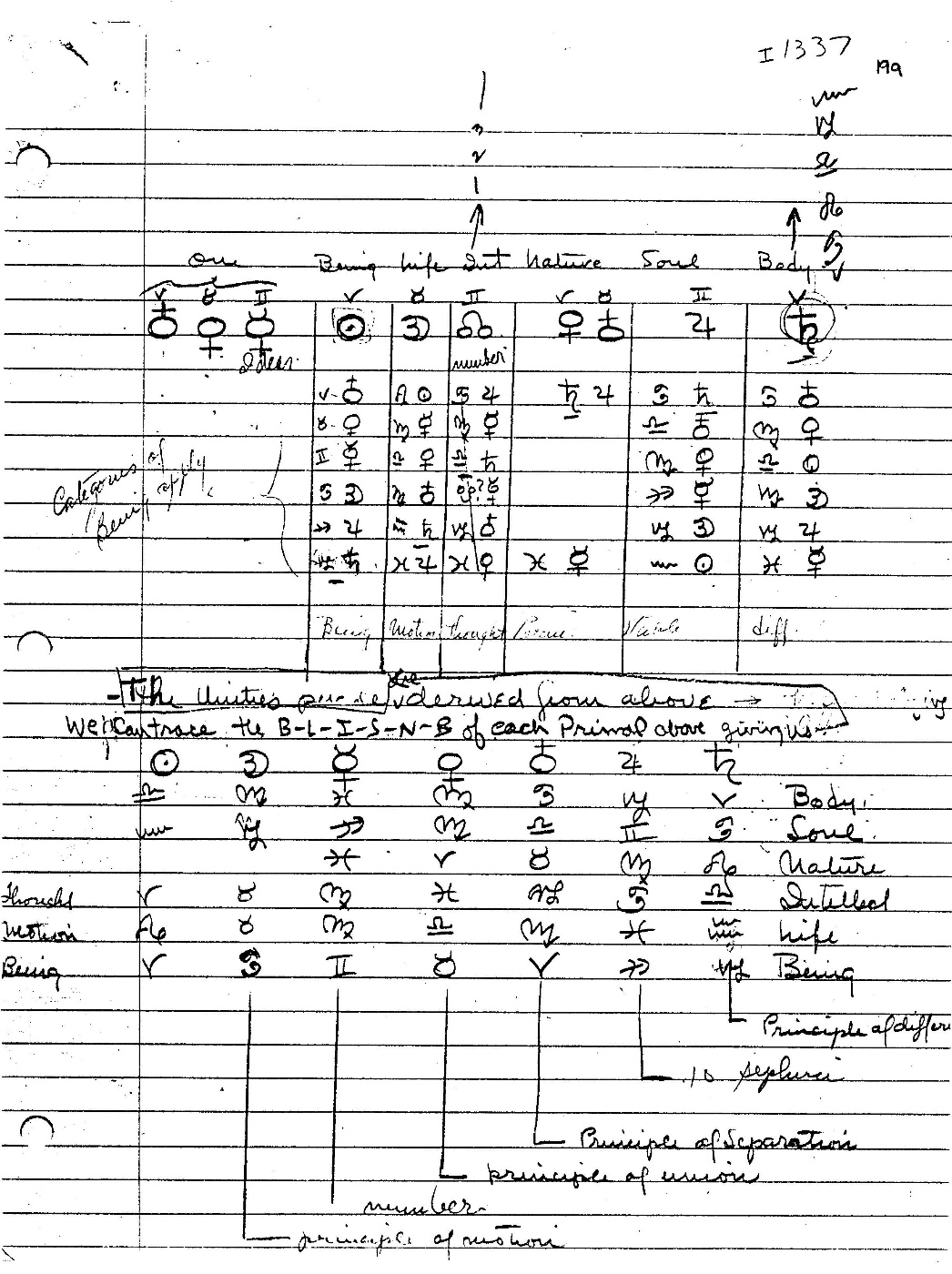
Triad gives rise to whole chart, unities, henads, leaders of series
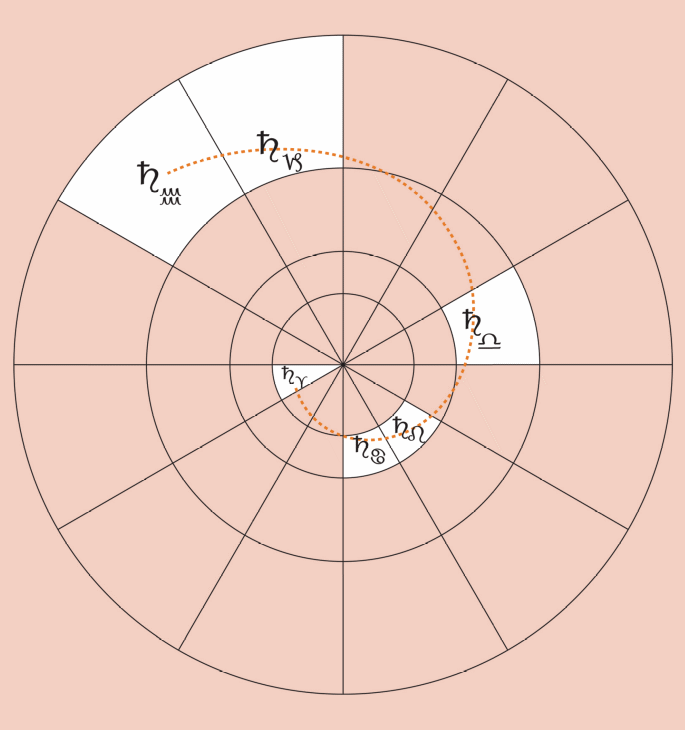
Saturn henad
Intellectual-Principle a glow of the One
Meta-ontology better term than metaphysics
Number orders emanation
Saturn in Aries
Emanation takes place in Saturn in Aries, the Body of the One
Being and unity
Participation
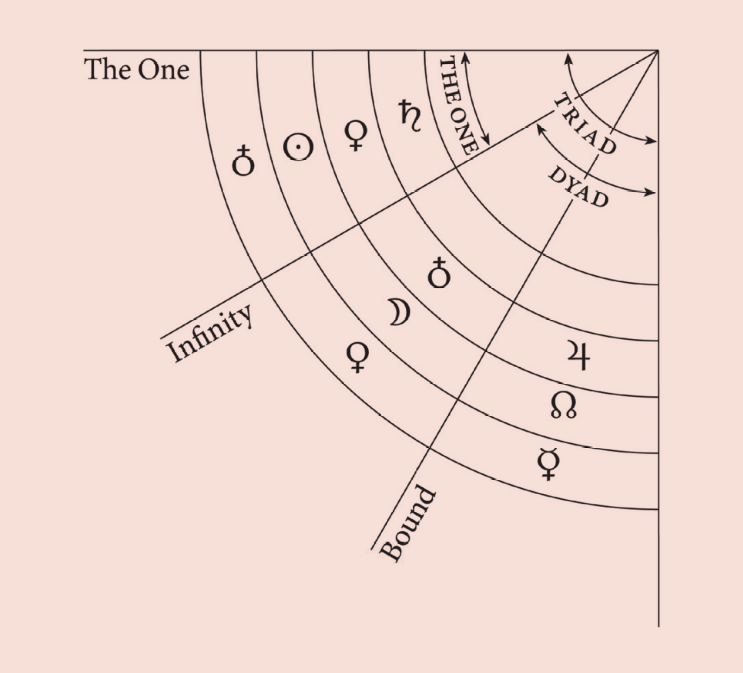
Unity/facets of One and relativity/emanation seen using *Triad: Henads & Monads* diagram
BOOKS READ FROM OR REFERENCED:
Anthony Damiani, Astronoesis: Philosophy's Empirical Context; Astrology's Transcendental Ground (published 2000)
Plotinus, The Enneads (MacKenna translation, 4th ed.)
A.H. Armstrong (tr.), Plotinus (Loeb Classical Library)
A.H. Armstrong, The Architecture of the Intelligible Universe in the Philosophy of Plotinus: An Analytical And Historical Study
Edith Hamilton, Huntington Cairns (eds.), The Collected Dialogues of Plato (Republic)
Leo Schaya, The Universal Meaning of the Kabbalah
Proclus, The Elements of Theology
Rene Guenon, Man and His Becoming According to the Vedanta
PLOTINUS QUOTES READ OR REFERENCED: I.3.4, V.1.1, V.1.6, V.3.16, V.3.17, VI.8
DIAGRAMS appended to this transcript:
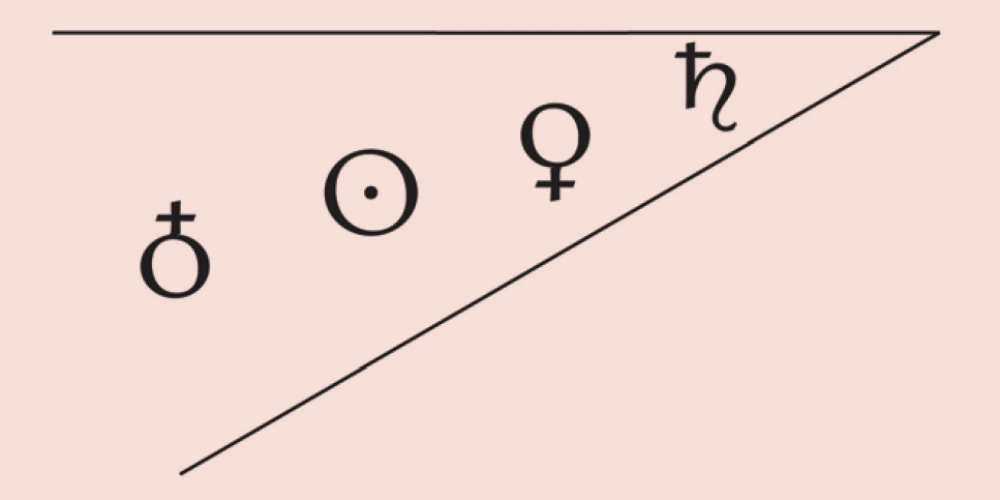
FIGURE 1982 0514-1. The One-Only.
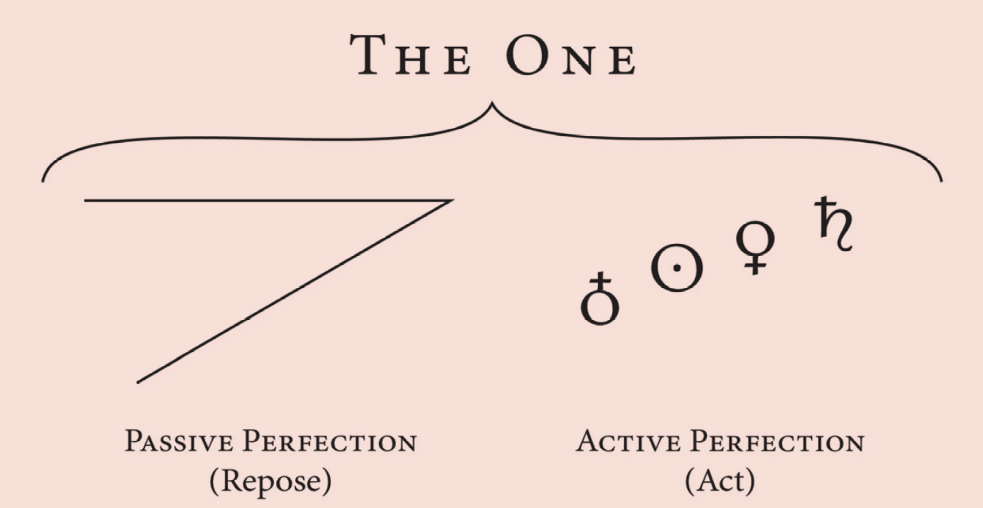
FIGURE 1982 0514-2. Active and Passive Perfection.
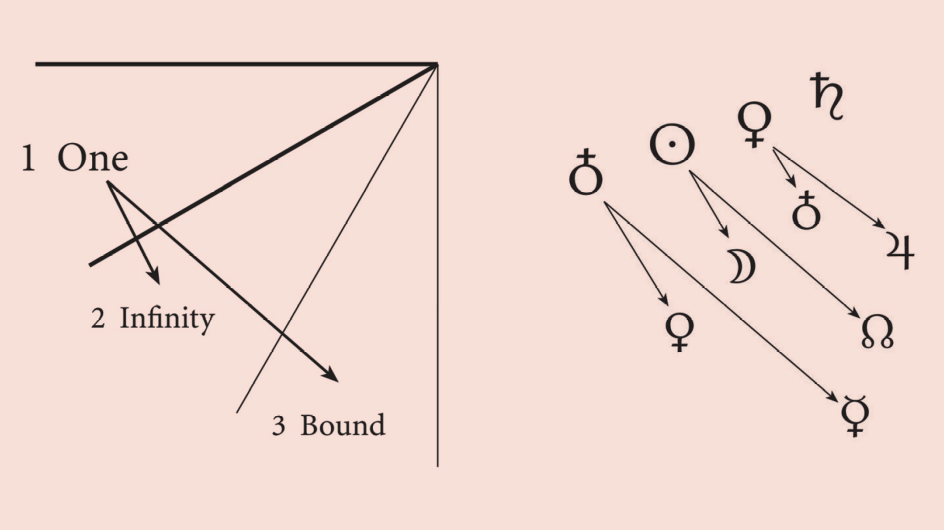
FIGURE 1982 0514-3. One, Infinity, Bound.
FIGURE 1982 0514-4. One, Dyad, Triad.
FIGURE 1982 0514-5. Double Act: Mars in Aries.
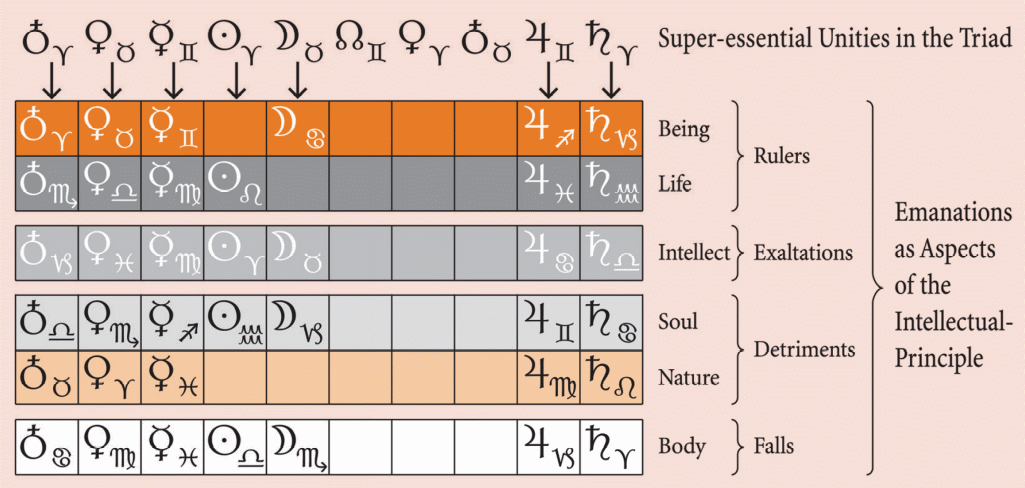
FIGURE 1982 0514-6. Triad and Intellectual-Principle; Henads and Monads.
FIGURE 1982 0514-7. Saturn Henad.
FIGURE AD_I_1337. Triad: Henads & Monads.
ASTRONOESIS WORKING DRAFT, section on the One, read in this class. See Astronoesis, chapter on the One, p. 19 ff.
NOTES:
Previously printed, distributed 2003 as part of a set.
This class series on the One was held on Fridays.
TRANSCRIBED by jf 2002 from Audio Cassette tapes; reformatted by jf 2018. In 2024, IT updates prefatory matter and footer, replaces tape markers with audio file markers, expands Subsubjects, completes Book List, adds Plotinus quotes section, corrects typos and some listening errors, adds seven diagrams and references within transcript to these diagrams, reformats to accord with new conventions. Readable edited transcript with AD Paper – V11rp.
AUDIO FILES: 1982 0514a, 1982 0514b. [Note 1: "Tape" and "Side" refer to original audio cassette tapes that were later digitized into .MP3 Audio Files. Note 2: Audio files are a little noisy, in some places hard to hear, with background drone, apparently of air-conditioner.]
1982 05/14 at Wisdom's Goldenrod
Plotinus; One; Emanation
[Audio File 1982 0514a Begins]
(faint background student talking; AS begins to read at 0:00:44.9)
Astronoesis draft (AS reading): "It is absolutely imperative that we make these two points very clear in our mind before we proceed any further: That the One-Only thing of its kind, there is no other like it, it is a One without a second. Plotinus has in too many instances affirmed his position again and again. In V.1.6 he reveals with full awareness of the immense complexity involved. And as he points out the problem that was and is endlessly debated by the most ancient and modern philosophers in the East and West, that if the One is of such a nature how can the others arise. Now despite the bias inherent in the nihilistic and evolutionary mode of thought of our modern and ancient contemporaries, the fact remains that Plotinus does fully answer the question. It is their refusal to understand his answer that causes all their difficulties. This point is capital, without which can be understood nothing which follows, that is, the notion of emanation. Having assumed that Absolute Mind IS, and that multiplicity IS, it is the link between them that we must establish and understand. This is to be found in the notion of emanation. We have no example in the empirical world that is strictly applicable, it can only be suggested. The example Plotinus uses of the sun raying forth light, which never diminishes the substance of the sun itself, is hardly appropriate to our sophistically skeptical auditors of today." (student chuckles)
AS: --who are aware--
VM (astrophysicist): Sun is losing mass, by the way, according to the skeptical (inaudible).
S: You think he's disappointed? (student laughter)
S: (inaudible) (more student laughter)
VM: Give me five minutes, I can calculate just how (inaudible)
AS: --(so far) aware--
AD: How much mass is the soul of the sun losing?
VM: Soul I never think about. (student laughter) Physical body of the sun is (losing).
AD: You can't tell me anything about the physical body, you can only tell me about what your idea of it.
VM: Precisely. (student laughter)
AB: Your ideas are (the way) they're (remembered). (laughter, student words)
VM: You guys are (under the thread) about Wisdom's Goldenrod. (student laughter)
S: Yes.
VM: I don't have a similar (thread).
S: Be calm.
JA: (inaudible)
VM: Down one. (student laughter)
AS (in tone of voice as when reading Astronoesis draft): Hardly appropriate to our sophistically skeptical auditors today, Dr. Mansfield among them, (laughter) who are aware (laughter) that the sun has a lifespan and that its substance will ultimately be diminished because of its constant radiation.
Astronoesis draft (AS reading): "What we are required to conceive here is the possibility of a timeless principle, whose very perfection glows and its luminous efflux constitutes another thing. Emanation as properly conceived is the notion of the progression of the many from the One. It will be thought of an elongation of the One's continuity and identity rather than an efflux."
AD: Read it (again)? Would you go over that sentence?
AS: Yes.
Astronoesis draft (AS rereading): "What we are required to conceive here is the possibility of a timeless principle or thing whose very perfection glows and its luminous efflux constitutes another thing. Emanation prop--" (some inaudible comments about "is" or "are")
Astronoesis draft (AS revising reading): "If emanation as improperly conceived, the notion of the progression of the many from the One will be thought of an elongation of the One's continuity and identity rather than an efflux. Plotinus precisely enunciates this principle."
AS: I'll read it again. I hope I--
AD: Yes.
Astronoesis draft (AS rereading): "If emanation is improperly conceived, the notion of the progression of the many from the One will be thought of as an elongation of the One's continuity and identity rather than an efflux."
LR: If it's an elongation, would it be that the principles have equal status all the way down, and there wouldn't be a diminishment of power.
AD: Think of the procession of the many from the One, the way most people think of it-- the identity of the principle itself is simply prolonged or extended. And this would not give you the object as a distinct existent in itself. I um-- I think it would be this right here, taking the commentators-- This is a-- you know, this person here Armstrong, in a book he wrote called *The Intelligible Architecture of the Universe in the System of Plotinus* --sounds very impressive (is all). [Note: See A.H. Armstrong, The Architecture of the Intelligible Universe in the Philosophy of Plotinus: An Analytical And Historical Study.]
AS: (inaudible) 'Cause there's some words missing.
AD: There's words missing? Those are Greek words, don't worry about it.
AS: Yes I know but, (is in--) ok.
AD: But I didn't get a chance (and reply). Now here's a sampling of the modern commentator, when I said in the paper that they *refuse* to understand Plotinus, that they insist on interpreting him in *their* way. This is going to say (inaudible).
AS: This is from the Armstrong.
A.H. Armstrong, *The Architecture of the Intelligible Universe*, pp. 2-3 (AS reading): "This dependence persists even when, as in the eighth treatise of the Sixth Ennead, the One is described in terms almost identical with those applied to Nous, or at least in language which suggests something more like Nous than the unpredicable . . . unity, the One-above-being, of other passages. In VI.8 the One is called pure will, absolute . . . love, and that love of Himself, and the cause of Himself, and thus the cause of all that proceeds from Him, not merely the ground of all being in the sense of a primal element, but deliberately willing Himself and all that comes from Him. He is said to include all His effects. This positive description of the One is very closely connected, especially in Ch. 18, with the light-metaphor of emanation and the comparison of the One to the sun, [AS adds: which is] a metaphor found throughout the Enneads. It is obvious that this self-directed, self-loving God (I am using the terms of a later theology deliberately at this point), whose Being is Act directed upon His own perfection, from whom all other orders of being proceed as images of Him of varying degrees of adequacy, is not the mathematical Unity to which it is impossible to apply any predicate whatever. Plotinus may protest as much as he likes that he intends to introduce no sort of duality into the One, and that any appearance of appearance of duality which his words may suggest is due to the limitations of language. He takes the decisive step when he . . . gives it [AS: the One] will, makes it eternally create itself and return eternally upon itself in love. This [AS adds: undoubtedly] makes it . . . [AS adds: some kind of duality], however much it may transcend the beings which we know . . . [AS reads: and thus it will be a] one-in-many. It becomes a being to which predicates can be applied and about which logical distinctions can be made."
AS: So he doesn't like our--
S: That's mutual.
AD: So, we take out from Plotinus the quote.
AS: Here is one place where he particularly describes this principle of emanation, in V.1.6.
Plotinus V.1.6 (AS reading): "All existences, as long as they retain their character, produce--about themselves, from their essence, in virtue of the power which must be in them--some necessary, outward-facing hypostasis continuously attached to them and representing in image the engendering archetypes: thus fire gives out its heat; snow is cold not merely to itself; fragrant substances are a notable instance; for, as long as they last, something is diffused from them and perceived wherever they are present.
"Again, all that is fully achieved engenders: therefore the eternally achieved engenders eternally an eternal being. At the same time, the offspring is always minor: what then are we to think of the All-Perfect but that it can produce nothing less than the very greatest that is later than itself? This greatest, later than the divine unity, must be the Divine Mind, and it must be the second of all existence, for it is that which sees The One on which alone it leans while the First has no need whatever of it."
AD: Alright let's talk about this quote for a little bit, let's see if (we can) (inaudible).
AB: I think the point that Armstrong made about Plotinus introducing a duality, this would seem to contradict it because the hypostasis is not continuously attached to that which it's flowing out of, and therefore there would be no separation.
VM: It also says in there however that the image engendered somehow seems very distinct, it's of a lower ontic status. With that argument there is a distinction.
AB: Not a separation.
AD: Naturally, there wouldn't be separation. If you have the sun pouring out light, and we said that the light is a distinct existent from the sun, then naturally the light would depend upon the sun and not vice versa. So that would then -- the sunlight would be dependent on the prior. But it is a distinct existent from the prior. So there isn't a running identity between the two in terms of existence. Now if we think of the entirely or the totality of all the principles, this is what we refer to as ontological principles and we conceive of these principles in their totality as unity, and then we say that this is the One, perfect perfection itself complete, it lacks nothing, it is utterly self-sufficient. Now we imagine that's the sun. And it emanates, or lets say there is projected from it, the very glow from its perfection would be the Intellectual-Principle. Now obviously the Intellectual-Principle, if the analogy still holds, is a *lesser* than the prior, it is also a distinct existent separated from the prior insofar that we say distinct. We can say it's distinct, we cannot say it's not dependent. And we can say it's distinct, or it is separate because it's of a different status. So then when Plotinus would be speaking about, this is the way that perfection has to be conceived. Sheer perfection, the abundance which flows out from sheer perfection gives rise to a whole new level of reality lesser than that principle, but gives rise to it. Now if that's emanation, the in terms of emanation we can say that lesser or the lesser principle is a reflection of the prior and a distinct existent from it. Now if we do that, then that leaves the One intact; it doesn't in any way, let's say, spoil it or fragment or diversifies it. In the same way that when my image appears in a mirror, in no way, you know -- that anything happens to me if someone breaks the mirror.
AB: Wouldn't you also say that because the One is a plenum or totality of principles that it's a distinct or separate hypostasis flowing from it is within it, then in that sense it's not separated out--
AD: But it's within it in a very special way. And we'll get to that. It's within it in a very special way. But the point that we want to first make very clear to ourselves is what does this man mean when he speaks about emanation. Now if what we said is true, if what we said is true in the sense that the secondary principle is a reflection or an emanation from the first then the first remains intact. (inaudible) But notice with what assurance -- he's absolutely sure -- alright, of what he's saying. That Plotinus cannot eat his cake and have it, so to speak. Now let's go on a little (inaudible)
DR: The point, I've found it very difficult to grasp--
AD: I can't hear you, David.
DR: If you say that I hear what it is that's (inaudible) and that's to keep the One intact and always the principle is in its own right, without dependence on its emanation. The difficulty seems when you speak of the emanation and call it distinct, and it also seems that it's distinct, the light coming from the sun (inaudible) But to call it distinct existence, almost to make it a whole being all by itself, that part seems quite difficult. And in no way would you say that the sunlight exists (as) it's distinct from the sun.
AS: What about it right here, is it at the sun right now? If the sunlight's here, then in some way it seems that it is a distinct something distinct from the sun. If it weren't able to appear as something distinct from the sun, it would just be the sun, it wouldn't radiate. The principle seems to imply that something does actually emanate. In fact he says other places that it stands a reality, the power of that emanation is so great that the distinct principle stands a reality.
DR: Well, that's again the distinction is a difficult one, that it's a distinct existent that--
AD: And it has a dependence on the prior we admit -- that's very obvious. The light does have a dependence on the sun. It depends on the sun for its issuance.
DR: But in what manner do you cut it off from the sun, and consider it by itself?
AS: It's not cut off.
AD: We're not cutting it off, no, we're just pointing out that they're just two distinct existence that we're speaking about now. If we are talking about two distinct existences, then we're saying one existent is higher than the other, we're not cutting them off from one another, we're just saying that there's degrees of ontic reality here being expressed, the prior, so to speak, being independent of that which follows upon it.
S: Distinct does not mean disjoint.
DR: Just a little--
AD: Go on, David.
DR: If you say that even if that there's a hierarchical order of existences (inaudible) that usually implies that you can consider one order separate from another, even if it's just in consideration. Now the one will be the (alone) for the moment. How in the analogy if you take the second and consider it alone? It doesn't seem possible.
S: Could you repeat--
DR: By making graded orders, there is some (inaudible) within, this is now another order of existence. It doesn't really seem to stand as a whole in any way that I can see. It doesn't stand by itself in any way and it should be able to, (inaudible) should be an order. They seem so interconnected, that to even speak of another hypostasis is --
AD: They seem interconnected.
DR: The connection's seems clear.
AD: Yes. The connection is clear, which is--
DR: And that's how is this gradation to be established, this light that pours forth from the sun, where is it you put in the dividing line? And say now the light begins and it is a whole order of existence by itself, how is it that you ever put in that boundary?
AD: Well, there is no 'when' here.
DR: Well--
AD: We're speaking about things that are in an eternal progression so we're speaking about temporality or a beginning. There never was a time when the sun shone and the light wasn't raying out forth. What we're speaking about is the order of the hierarchy of grades, of existences. Obviously it would seem that the sun has a higher order or grade of existence than the light, if for no other reason than that the sun is producing the light. Even if we want to say that that light is only a glow. Now if we understand that the light is only a glow or a reflex, then we're certainly entitled to say that the sun has a higher order, as far as graded existences are concerned. Secondly, that it is distinct from the light. And thirdly, that the light is absolutely dependent on its prior principle for its existence. And yet in all of this the important thing in there isn't a running identity, alright, an identity in terms of existence, between the sun and its light. Now if this analogy is developed further, then we can conceive of the sun as let's say, the totally perfect, remaining always integrally what it is, an undiminished one, a one that has an integrity that cannot be violated in any way. This is the perfection which some would call God, some would call the One, and some call metaphysical infinity. We don't have to agree with this, we only have to understand this is what he's saying. Now if that is so, alright, then I think Plotinus is justified in laying it out the way he does. And I'm going to carry this point a little further. And I think that Armstrong misconceived it entirely and refuses to understand. Because of an inherent bias he works with, which I can go over the details as to what the God should be.
DR: Yes. He's wiping out that dividing line.
AD: Yes, this is a theory of emanation, it's not a theory of creation. God doesn't create out of nothing something. It is in an entirely different way, this is what he means by emanation, it's very likely that this is what Samkhyans mean by emanation, most of the theories that we become acquainted with when they speak about emanation. Let's go one step further, next please.
Astronoesis draft (AS reading): "A delicate balance is required here, for thought is walking a razor's edge. On the one hand, we can introduce a hiatus that leads to metaphysical dualism and which is proper and appropriate for the intellectual understanding. On the other hand, and in contrast, a monolithic monism, a unique and unknowable omnivorous God, which is appropriate to the absolute stillness of the advanced contemplator. But for the philosopher-sage both points of view will supply us with supply us with completion and balance. That perfection engenders, that the eternally perfect engenders eternally, is not a theme for discourse but rather for contemplation."
S: Read that again.
Astronoesis draft (AS reading): "That perfection engenders, that the eternally perfect engenders eternally, is not a theme for discourse but rather for contemplation. Repetition is necessary: emanation is the principle that leaves the One intact and undiminished, its integrity unspoiled and its evenness undisturbed. Whatever reality the engendered reflection may have is not being denied. What is being maintained is the unimpeachable sovereignty and integrity of the One. The One-without-a-second of which there is no double, may be better approached by conceiving it as meta-ontic infinity. This will permit an accommodation to our mental processes. It will also make possible relationship and comparison to other philosophic traditions clearer. We can conceive of metaphysical infinity as having many facets, and it may even be helpful to consider it that way. Each and every aspect that we consider may be referred to as a unity and regarded as metaphysical infinity in a certain way or mode. The Kabbalists would refer to this as the Sephiroth, which would imply that each and every aspect can be spoken of as a god and above Being, above Life, and Intelligence. Expediency dictates the advantages of such usage, especially since it will permit us to evolve a visual aid, a figure bearing immense practical applications."
AD: Any discussion?
S: Anthony, in what way-- you said that when the position of monism is taken, then that the One then becomes unknowable, but it would seem to me that when you have the actual dualism where the One is not-- that all connected with the many when they're totally distinct from it, that that's when the One becomes unknowable.
S: (inaudible) distinction in the first house (inaudible) the duality (inaudible) can't know anything in the One, duality is taken as passive and (inaudible) unknowable also.
EMD: We can't hear anything back here.
AD: Could you repeat your question?
S: Yes, in the --
AD: Would you read that?
AS: A delicate balance, on the one hand??
AD: (inaudible)
Astronoesis draft (AS reading): "On the one hand, we can introduce a hiatus that leads to metaphysical dualism and which is proper and appropriate for the intellectual understanding. On the other hand, and in contrast, there is a monolithic monism, a unique and unknowable omnivorous God, which is appropriate to the absolute stillness of the advanced contemplator. But for--"
AD: Now your question.
S: But with the dualism it would seem even more so that the One would be unknowable, because if there is a real hiatus between the One and the many, that since one could say that in knowing the many one knew the One, there would be no way of knowing the One per se, if there was a real hiatus between the One and the many.
AD: I suppose--
S: Well, if there wasn't a hiatus, if on the other side of monism, if the many were the One, then one could say, well right here in your everyday knowledge, when you know the many, you're really knowing the One. But if there's a real hiatus, then the many is totally cut off from the One and then it would seem there was no way to know the One. There would be no continuity between the knowledge that we're capable of and the One.
AD: And you were saying, Jeff?-- you have to say it louder.
JfL: (inaudible) making the point that bringing in the Intellectual-Principle or bringing in the many is bringing in-- I hate to answer what I thought you were saying before. I thought that it was the One in itself in a transcendent mode is really unapproachable, and it's not until the emanation from the One, sort of the outward-facing aspect, that anything can be known at all. And once you have (inaudible) that possibility, it's at that time that there's the possibility (inaudible). I'm thinking that for the sage, that even though that the silence there is above being, I think it's only through being that it's ever possible-- Well, I mean it's not possible if the One is intact completely by itself, before it emanates at all.
(inaudible student comment)
AD: Well, what are we trying to say here? We can introduce a hiatus that leads to metaphysical dualism, and this is alright there's nothing wrong with this. For the intellectual that's the only way. And we can have the other point of view, the Vedantists' complete and utter stillness where you have nothing but the One itself, and there's nothing to communicate. And that point of view is alright. Now the question I was asking was, Would that be alright for the sage? Would it be alright for Plotinus, would he accept this?
S: Either point by itself is partial.
AD: Then?
S: Then what emanation is--
AD: No no no no, we're not talking about emanation.
S: Well, as something that walks that path between these two points of view, that in some ways manages to be both without being singly either one. You avoid either of the extreme points of view.
VM: You started off with the question of knowledge--
PC: Right.
VM: (inaudible) So is the transcendent One knowable, or not? Or is the dualistic approach the knowability inherent in that? Maybe that's a side issue, but I thought that's what you were starting with. The Vedantists would say that the transcendent One--that is pure knowledge, that is the goal of knowledge in some sense. So in some ways perhaps it depend on what you mean by knowledge. The Greek notion of knowledge is different as I understand it.
AD: No, (inaudible) for Plato the Idea in itself cannot scientifically or technically be known. It's out of the question. So they have the same opinion. But all I'm doing here, and I think you're carrying the previous reading, what I'm doing here is to try to show that Plotinus has this balanced view. Where on the one hand you have to have metaphysical dualism in order for the intellect to operate at all. Now on the other hand you have to have the experience of the advanced contemplator, and realize pure knowledge. Now it is the combination of these two points of view that will give us the balance we need in order to proceed to understand what Plotinus is going to say. If you take one side, if you take this side that there's only pure knowledge, it would have been unnecessary for Plotinus to write 500 pages.
AS: And to think of the other side then Aristotle would have written a lot less Metaphysics.
AD: At any rate go into the next paragraph where this is now what we have to do is to try to understand what we see of this metaphysical infinity, and we do that. We think of it as having many facets. Because we're aiming to get right to the core of the problem of emanation. Now the One has to remain firm, there' nothing, there's no way that we could so to speak dismember it, find out what makes it tick, that's out. So there's another approach, and this approach speaks about trying to understand that the One or metaphysical infinity has many facets, like a diamond, you know, it has many cuts, any one of those facets of the diamond-- there's still the diamond it's not separate from that. And we're leading into each and every aspect that we consider of the diamond or metaphysical infinity could be considered as the unity--it can't be separated from it. And we're saying that it can be regarded as metaphysical infinity but in a certain way, and we go on, now there's an advantage to doing this because it's going to accommodate our mental processes. If we can't grasp the One, maybe we can understand something about the way our mind works. That's what we're really doing. Alright, this is just-- the purpose of this is just to lead to the development of the Dyad.
Astronoesis draft (AS reading): "One of the possible uses of the astrological mandala is to help us into our enquiry into the nature of the One. We have distinguished the complementary modes of substance and function, respectively as the quadrants and rings. Furthermore, superimposed upon the combined imagery, or the 12 zodiacal signs. Within the first quadrant specifically the first mansion we located the King of All whom we referred to as the transcendent. Now within its perfect self-sufficiency we find repose and act, or infinite substance and unlimited function, indivisibly impartibly. We look first at one aspect and then another, but keeping in mind the indivisibility of metaphysical infinity. This analysis of the aspects of the One will make more explicable that which Plotinus refers to as the double act in the divine, and will unfold a multitude of ways of mentally understanding the One. Each view will be referred to as a unity or a Sephiroth or a principle. The totality of these various views will later on permit us to grasp emanation as a reflection of those principles which in turn produce further levels of reality and spread out before us the All. But at this point it is important to remember that the arrangement of all these views or its interiority is as yet no progression or emanation, or any alteration in the One."
AD: Let us discuss that. Let me put up the chart. Let's discuss that, go over it.
S: I'll get the chart.
S: That last statement is like saying that the facets of the diamond are nothing different than the diamond, but you're not talking about something emanating yet, you're not talking about the light which can be distinguished from the Sun, but that the facet is the diamond.
AD: (assents) Go over it right now. (inaudible) sickness from chalk. (S: Silicosis. Jokes about chalk, student laughter)
AS: That's okay, it's counteractive. Yeah, you go smoke, it's white, black (inaudible)
AD: I think you could all see this chart. Alright. Go ahead, Avery.
AS: Want to read some more?
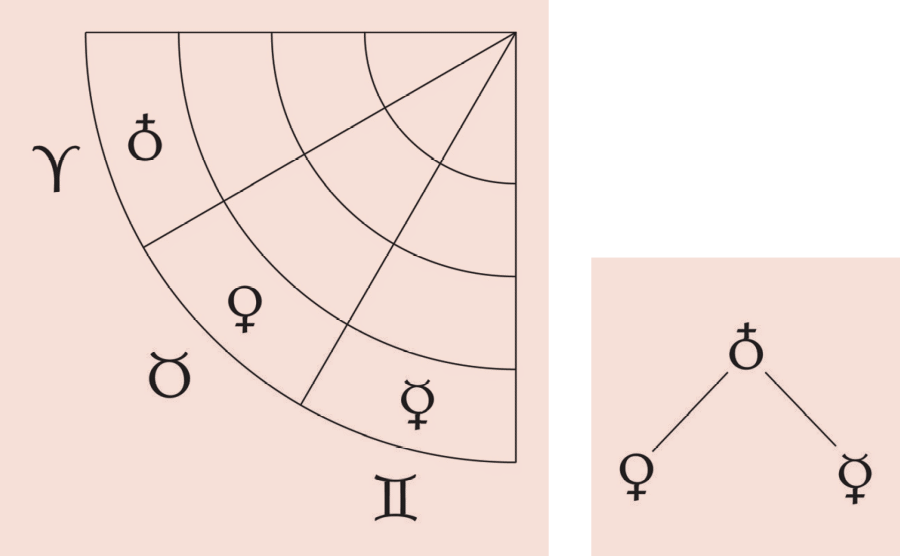
AD: Well, page at a time, this way we could intelligently discuss one page at a time I think. Alright, you see what we're doing, this is the first house. And we're saying there's a double act. Now, there's a very simple and direct way of seeing, the double act is active and passive perfection in their simultaneity. So the first house would represent the transcendent now. [Note: See FIGURES 1982 0514-1, The One-Only, and 1982 0514-2, Active and Passive Perfection, appended to this transcript. These diagrams are from Astronoesis, pp. 54, 55.] So we take--
(Side 1 of original cassette tape digitized as 1982 0514a Ends; Side 2 Begins)
AD: --down into-- in other words, in order to evolve the whole first quadrant. Now this would be equivalent to saying 1 times itself still gives you 1. Alright, let's reread it then. Try a little bit at a time.
Astronoesis draft (AS reading): "One of the possible uses of the astrological mandala is to help us in our inquiry into the nature of the One. We have distinguished the complementary modes of substance and function, respectively as quadrants and rings. Furthermore, we have superimposed on the combined imagery the 12 zodiacal signs. Within the first quadrant, specifically in the first house or mansion, we located the King of All whom we referred to as the transcendent. Within its perfect self-sufficiency we find repose and act, or infinite substance and unlimited function, indivisibly and impartibly. We look first at one aspect and then another, but keeping in mind the indivisibility of metaphysical infinity. This analysis of the aspects of the One will make more explicable that which Plotinus refers to as the double act in the divine. And this will unfold a multitude of ways of mentally understanding the One. Each view will be referred to as a unity or a Sephiroth or a principle. The totality of these various views will later on permit us to grasp emanation as a reflection of those principles which in turn produce further levels of reality and spread out before us the All."
AS: The whole diagram.
Astronoesis draft (AS reading): "But at this point it is important to remember that the arrangement of all these views or unities or its interiority is as yet no progression or emanation, or any alteration in the One."
AD: Do you want to go on or shall we stop?
HS: When you say there's no alteration in the One-- What's being altered is the mode of looking at it, or are we looking at it now in a speciated manner? That's what you've been talking about it-- stressing that it's being altered in its modes?
AS: Something like that.
AD: Not only the mode, I think it's an attempt to understand more deeply what he means when he says that the Absolute is the coincidence of the active and passive perfection. So we ask ourselves what does he mean by the identity of active and passive perfection in the One. Now what would he mean? So if we're allowed to analyze his statement, alright, we would say that on the one hand, we think of substance as infinite, that would be the passive perfection. And on the other hand we're allowed to think of active perfection as the unlimited activity of the substance. So we have these two aspects of this One non-dual divine or double act. Okay? Now we take either one of them or both of them and we still have the One.
HS: The One in its totality, that is in its total perfection? Is the one or both of them you have the One?
AD: If I take both of these aspects, I have the One, haven't I?
HS: Okay.
AD: And I'm saying one of these aspects would be second house, another of the aspects would be the third house. These two together is going to be the Dyad.
HS: Ok. And--
AD: Now wait, wait. So that means I have One multiplying One. One multiplying itself.
HS: Where do you multiply?
AD: Well I don't have anything different.
HS: Then why multiply?
AD: Well because that's what I just did. I took the One--we said it had a double act, two aspects alright, infinite substance, unlimited activity -- I took these two aspects, alright, and I'm distinguishing them from my understanding, and I have two Ones here, haven't I?
HS: Ok, two Ones.
AD: Or do I have two Ones?
HS: Well I'm not sure. I would say you have one One and two aspects.
AD: I have one One.
HS: You have the One and it has two aspects, and those two aspects are now two. But, I don't know if I would say you have two Ones.
AD: I have One-- please repeat.
HS: I would say that there is the One and now you conceive its two aspects, or see it in two aspects.
AD: I have the One and it has two aspects?
HS: Well, two aspects are now seeable. You gave me a choice between saying that (I'll have) two Ones. (inaudible)
AD: Well, no, you could say what you (think).
HS: The problem is when you say you're multiplying the One by itself and you're coming up-- well 1 times 1--
AD: Could we say the One divided by the One?
S: No.
AD: Well tell me why.
LR: Because the One isn't divided.
AD: I'm sorry--
LR: It's not multiplied and it's not divided.
AS: That's why you get one. That's what 1 divided by 1 equals 1, or 1 times 1 equals 1. So it shows you don't get anything else. Anything other.
HS: So (inaudible) that the One with two aspects you're still staying-- it's still the One.
AD: I still have the One.
S: Still have it.
S: Because the two aspects can't really be conceived as apart from each other, they have to be conceived [AD: Together, yeah.] as a unity and that's why you can't (separate--)
AD: No, not as unity, okay, they have to be conceived together. You can't take one-- you've got to take the two aspects, got to get (one word inaudible) (aspects).
S: Yes . . . You can't think of just . . .
BS: Well would you also say that if it's 1 times 1 both aspects are equal?
AD: Both aspects are equal, sure.
BS: Substance and function.
AD: Yes, they're both infinite. If infinity could equal infinity.
HS: The original thing then--
AD: Alright, persist--
HS: Have we added anything to the original infinity of the One as perfection, prior to this, other than seeing it now in two ways or seeing it with two aspects?
AD: No, I would say we haven't added anything except that we see it in a different way.
VM: So what are we really seeing? Are we seeing the One or our modes of apprehension? I'm sorry, I always ask this question.
AD: (We) have to wait till we get a little (further). Shall we persist, Herbie? Maybe if we do it with the Intelligibles. First, include the house with it automatically okay. So we show that Mars this is the first house alright you have a second and a third house. Now we think of the Mars as including Venus and Mercury in a way. Now what would we mean by that? The Mars including the Venus and Mercury. Like the Mars has these two aspects within it. So it's like if we could conceive of a perfect identity between the subject and the object, alright, we would say that that would be represented by the Mars. And if we separate the subject and the object, then that would either one of these two. [Note: See FIGURES 1982 0514-3, One, Infinity, Bound, and 1982 0514-5, Double Act: Mars in Aries, appended to this transcript. These diagrams are from Astronoesis, pp. 56, 61.]
HS: And you're still in the first house?
AD: Yes. No. Once I do that I've got to get out of the first house because in the first house, they must be unified.
HS: They *must* be unified?
AD: Yes. Over here for instance, if you wanted to use the term Parasamvit, this would be the identity of the subject and the object. Now Shiva and Shakti would be a separation, or a division, the separation of the subject from the object, that would be these two here. But they can't be in here [first house] anymore because we're seeing it no longer as Parasamvit, but as Siva and Shakti two different aspects. [Note: using Shaivite example for the houses: Parasamvit = 1st house, Shakti and Shiva = 2nd and 3rd.]
HS: And you speak of the separation of the subject and object. In this case the Mars is spoken of as separating the Venus and the Mercury.
AD: Into these two. In other words, the Mars would represent these two in identity alright, and the Mars and Venus [Venus and Mercury] would represent the aspects of that identity.
HS: Aspects of--
AD: Of that identity.
HS: Does the Venus -- Is the Venus ever not identical with the Mars? And is the Mercury ever not identical with the Mars?
AD: No. It's always identical with it. As long as you're referring to it as the transcendent One.
HS: When you speak of it in those terms--
AD: If you speak of it in terms of having aspects?
HS: Yes.
AD: Then is it transcendent? But we said that transcendent would refer to unique unknowability. (HS: inaudible) Then as soon as we start saying it has aspects then we're not speaking of it as uniquely unknowable and transcendent. We're speaking about it as though it is in some way available to our understanding. Go ahead--
VM: Anthony, is it legitimate to speak of the first house-- I'm abstracting the dignities out-- just think of the first house as the infinite substance and then take the dignities, and think about the--
AD: As function.
VM: --as activity or function.
AD: (assents). Alright now if we think--
VM: But you're doing that with the transcendent One, it seems to violate it's transcendence doing that. In other words, you just said (inaudible) as long as you see substance and function unified, you're discussing the transcendent One. Is that correct?
AD: Yes. (assents)
VM: Then I asked you this question: Is it possible to just take the first house and think of the house bereft of the dignities as pure substance, infinite substance. And now consider the dignities in the first house look at them as infinite function. But to permit that it would seem you have changed your view of the transcendent One.
AD: But that would be identical, wouldn't it?
VM: They would be identical there. I'm sorry--
AD: What you just referred to as infinite substance and unlimited function would be in identity in the first house. You can't do anything with that.
VM: You can't even make the distinctions.
AD: You can't even make a distinction.
BB: Can I understand you to say that you have this unknowable One. And then in (inaudible) talk about it or something like that as the transcendent One. In other words you're making a distinction between this One that is greater than the transcendent One-- Did I understand you to say that?
AD: I'm sorry-- try again.
BB: You said something about--
RC: He says they can't hear in the back. (student laughter)
BB: (inaudible) There was this unknowable One or something like that that was above the transcendent One?
AD: No, the transcendent and the unique unknowable are the same thing. If I'm allowed to use synonyms.
BB: So they're one and the same.
AD: Yes.
BB: Okay, well why wouldn't then what you're using there as this first house with the Mars Sun Venus Saturn and so forth, if that's unknowable, then it has to have something that is less than that unknowable to be talking about it-- Why would that immediately become something less than unknowable One, and either be what we might call essence or even relating that to something that would be both essence and emanating. In other words it seems to me if you're talking about something that's unknowable then how can that show up as something in the chart itself? So why wouldn't you be talking about something that is related to -- like you made the analogy of the sun and the light of that sun, the light itself is inherent in that sun, and that light might be related to that first house so that the Mars Sun Venus Saturn can thus be essentially that transcendent One but yet something slightly different?
AS: Another (inaudible).
S: One minus one.
AS: (inaudible) He wants to put another, he wants another transcendent above the transcendent, and the reason is because he feels the way we've symbolized the Transcendent as the first house with those four dignities already shows that there's some kinds of distinctions in it, and therefore there should be something even beyond it, which is absolutely undistinguished, undistinguishable.
(humorous hard-to-make-out student comments about another student)
HS: Did he just answer that because I'm--
AS: Lots of people do. Come on, raise your hand if you think that! (student laughter) Raise your hand if you understood what Bob said. (Someone's willing to--) Come on, Jeff! Come on, Herbie! Come on. I just said what he said. Bob, do you agree with what I said?
BB: (inaudible) Yes, I think that there is something, that as soon as you put that on the chart, you're dealing with something that is related to essence. I believe that there's something beyond, and I believe that when you talk about a will of the One, that as soon as you talk about that (AS: Armstrong!) you find something that is distinguishing this thing you're calling the transcendent from this absolute One that is unspeakable or however you want to call it. The will of the One directed upon itself brings forth, as far as I can see from what Plotinus is saying, some kind of essential nature of that One, that's not anything different from that One, but it's like the One is, in a manner of speaking.
AS: Then you agree with Armstrong.
BB: I don't know, I don't understand what Armstrong says, so I-- He's setting up a-- what is he doing? He's setting up a duality, and I'm saying there's both the duality and the unity and that the you deal with it like you read an article here in Spring Magazine two weeks ago that the extremes converge upon the middle, the middle converges upon the extremes.
S: (inaudible) psychology (inaudible) that article.
BB: The principle I think is the same, when you're talking about the will directed upon the One.
DB: As one man to another-- (student laughter)
AS: We decided already that you've got Leo in Pisces and-- (student laughter) There's too much water, there's too much water out there. [is it raining outside?]
DB: The thing about the will of the One, if you're going to speak of that, you've got to be speaking about intentionality in the One. But that intentionality is never directed elsewhere, it's always absolutely self-intent. Alright. Insofar as that is the case, there are no distinctions that can be made there from this point of view. And insofar as you have a will that is not directed towards anything else, in virtue of that fact you're dealing with the transcendent. We're dealing with th-- If it were directed towards anything else, it couldn't (inaudible), so insofar as it's a self-directed intentionality, it's transcendent, and there's nothing from its perspective outside of itself.
AB: But David, you're saying, if you speak of it then you've automatically departed from--
DB: The point is that we have departed from it, and we're trying to get back to it and that's why we're speaking of it.
BB: I'm saying, that if you talk about a transcendent One, (inaudible) transcendent, which means you're talking about something outside--
AS: What does transcendent mean, Bob?
AD: What does transcendent mean?
BB: It's beyond anything that you can talk about, it's greater than the--
AD: Let's say then that the transcendent is greater than Being, greater than Life, greater than Intellect. No, don't the whole-- I want specific essences and forms.
BB: Okay. I can-
AD: When we say it's greater than Being, what do you mean by saying it's beyond Being?
BB: It means that it has an existence, but it is also may be considered beyond--
AD: Beyond Being.
BB: It has an existence, but in a manner of speaking, but also an existence that is beyond the concept of that existence.
AD: 'Beyond the concept' you mean beyond the form of that existence.
BB: Yes.
AD: So then it isn't available to our understanding.
BB: It's unavailable to our knowing.
AD: If we say--
BB: If it's unavailable to our knowing. If we could know--
AD: If we could know of it-- If we say that it contains the infinite Life, we only know life as it's found in the forms, (inaudible) each material species or the life of an individual soul, or something like that. But in the Transcendent that life would be without any form, so when we say it's beyond Life we're not saying you come to the end of the world and then you drop off, it's simply beyond bound, form, but it isn't absolutely unavailable to the understanding.
BB: It would have to be--
AD: If you say infinite Life it's not absolutely unavailable--
BB: Yes. But you could know something, know of it.
AD: We already got a clue that when we say beyond-Being, when we say beyond-Life, when we say beyond-Intellect, we're not saying when we reach the end of intellect we drop off into an abyss of nothingness, but that it goes on infinitely. Because the transcendent has no form, no boundary, no limit. Alright then if we do that we've already recognized three aspects that are so to speak simultaneous, with the Transcendent. Infinite Life, Infinite Intellect--these are different ways of speaking about one and the same thing.
VM: Alright, I'm sorry if I join in the heresy, I hope I don't distract you from what you're trying to get at, Robert, but I thought when you said beyond Life, beyond Being, beyond Intellect, you mean that those categories or those forms are not strictly applicable to the transcendent One. Or if you say beyond Being it's that the category of being--
AD: In other words, what would be beyond Being, what would be beyond Being? Nothing?
VM: I wouldn't say nothing but I would say that the category of Being does not (inaudible)
AD: Why?
VM: Because it's not characterizable by either Being or not-Being.
AD: Well, it's not characterizable because it doesn't have the form of Being.
VM: Okay.
AD: But to say that something is beyond the form of Being is not to say that it's not Being. We could then say it's Pure Being.
VM: Just repeat the last part again, Anthony, the last part--
AD: You would then say it's pure Being.
VM: No, I'm --the last two--
AD: To say it's beyond the form of Intellectual Being, we're not saying that when you reach the end of Intellectual Being that you've got nothing or an abyss, alright. We'll admit that. And there is something there, and what we're saying is there, is Being without form, what can he mean beyond-Being?
VM: I don't mean Being with form or without form. That's--
AD: Without form? You don't mean Being with form, alright. What do you mean being without form--you mean infinite Being? Yes.
VM: That's a legitimate question.
AD: You mean infinite being!
VM: Maybe--I think you're putting words in my mouth.
AD: No! I'm not putting words in your mouth, I'm just pulling out your teeth! (student laughter)
VM: (inaudible)
AD: Let's go over this again, because this seems to be a problem that everyone has. When you say beyond Being, you're not saying nothing, you're not saying that's there's a principle beyond Being which we're now going to call non-Being. Beyond-Being does not mean non-Being.
VM: True.
AD: It means beyond any form that Being that could have.
VM: Fine.
AD: If we do that with Life? If we do that with any aspect that we can handle?
VM: Yes, yes.
AD: And we see that it's without form in the sense of what-- there Life is infinite it has no form. Well then what are we doing?
VM: I just want to get back to what I thought Robert was working with. And that is when you say it's beyond Being, beyond Intellect, beyond Life, you are forbidding yourself the use of any characteristics that will allow you to symbolize it in the way you're trying to symbolize it. Is that a fair representation of it?
BB: Yes.
VM: Only if you--
AD: What we're saying is that metaphysical infinity has a variety of aspects--Being, Life, Intellect, etc. But all of these aspects are each and every (form). When you say beyond Being, beyond Life, beyond Intellect, what do you think they're saying?
VM: I didn't think I was saying--
AD: Well then, tell me what you think they're saying?
VM: I'll say it again.
AD: What's beyond Life?
VM: Whatever it is, it can't be characterized by the form of life.
BB: How about the principle of life?
AD: How about that? So we call it the principle of Life, what form would we give it?
BB: It's prior to form-- The cause of form has to be prior--
AD: The cause of the cause of Being has to be prior to Being, therefore it itself cannot have a form, and you run through as many aspects as you want.
OG: (inaudible) You say beyond that, and then you say that form, talking about (inaudible)
BB: Even when you're talking about a unity, within the One, sure you can talk about everything within the one, and obviously you don't have anything to talk about. But the point is that even when you talk about the unity, these unities, you're talking about--
AD: Let's call them, let's not call them unities, let's call them facets of metaphysical infinity.
VM: Aren't they determinations? Aren't they determinations if you call them facets. Even if you say unity, absolute unity--
AD: Well, I want to avoid the term 'unity' for very specific reasons. Because the unity would give us too much of a feeling of form.
BB: When Plotinus talks about the essence of the One, what is he talking about?
AD: Its universality.
BB: Its universality. In what respect though-- Is he talking in terms of the transcendent One or the immanent One?
AD: (inaudible) distinction.
BB: Well, I'm wondering just where you would place it in terms of its context, of the chart or your concept of the essence of the One?
AD: You can speak of the immanence of the transcendent in all of its aspects.
BB: That would be the essence of the One?
AD: That would be the essence of the One.
BB: It would be the immanence--
AD: It would be the immanence of the transcendent in every one of its facets--But I don't think the term is applicable here, to speak about the essence of the immanent and the essence of the transcendent. I don't even think that a distinction can be made.
BB: Well, I'm not sure that it can either--
AD: Not until we worked out, not until we worked out the what we're doing now.
BB: Well, see, I'm not sure if I'd agree with what you're doing right now, but I think that what you're dealing with here is something related to the essence of the One. And if the essence of the One is related--
AD: Now again, what is this "essence" that you're talking about?
BB: To me it's what--
AD: I want to know what you mean by the word essence.
BB: What I mean by the word essence is consider it to be relative to your--
AD: In the dictionary it means "it makes a thing to be what it is".
BB: And that's what the One is.
AD: What the One is, alright, we're saying, what makes the One to be what it is, alright. Then what makes the One to be what it is? The infinity of Being, the infinity of Life--?
BB: No, sir. I believe that you're talking about something that's beyond that. And I think that you're talking about, if you have a progression, or what you're trying to set up here is some type of progression or emanation out of the One that you have--
AD: Wait. Before you talk about emanation this has to be straightened out. Because I don't think you understand.
BB: Maybe I do, and maybe I don't.
AD: I don't think you understand. Let's stick to one point at a time, and not too many (inaudible). Again, what is the essence of the One? (inaudible) for it's completely unknown.
BB: The essence of the One is probably what you're going to be relating in terms of, that which is within the transcendent or analogously which is the light of the sun within the sun.
AD: No, no. Leave the sun out.
BB: Well, I'm trying to give you something that's trying to explain what I'm trying to say. In other words--
AS: Try again, try again.
BB: I think we're having a confusion here.
AD: Now (joke inaudible, student laughter)
BB: Okay, what I see if you're looking at this and I tried to explain, the concept of the One, the absolute, that which is beyond, what you say, Being and so forth. (inaudible). Number two is that--
AD: Now I want to know what you mean beyond Being Life--
BB: It's just saying it's beyond anything that you can talk about, anything that you can conceive, anything even without--
AD: When I say it's beyond Being, when I say it's beyond Life--
BB: You're qualifying it, you're qualifying it even when you say its beyond Being, Life, and Intellect. And you start to qualify what it is or is not. And I'm saying that it's beyond any of your qualifications. The next thing I thing is what happens is that--
AD: Now look, now look, Robert, you just said to me it's beyond any of my qualifications.
BB: Right.
AD: In other words, it's beyond any quality. Again, you're saying the same thing I'm saying-- it's beyond Being, it's beyond Life, it's beyond Intellect.
BB: Fine, but why bring those in to begin with?
AD: Because I'm trying to point out that's how you can get to what the Absolute is. By saying it's beyond the qualities. And *beyond* here does not mean an abrupt end or an indefinite infinite continuation of that. Now if I know *something* of Life here, alright, and if I speak about what's beyond life, I'm certainly can carry it forward and thinking of it that way, and say it's even beyond any individual life, the life of any individual (inaudible)
BB: So Plotinus says 'cut away everything' [Note: See Plotinus, V.3.17, last line.] and that's how we'll know of--
AD: Alright, but that's the negative approach you take in meditation. It is not the approach you take in rational discourse.
BB: Well, Plotinus says 'cut away everything'.
AD: Yes, and he also says it in a very specific context. When you meditate you do that. He's not talking-- in other words, that's negative theology. And it has a long history and a long tradition. Now there's a positive theology, alright, if you remember the quotation from Plato. Anyone have Plato's works here? The volume?
AS: The one volume one? [Note: Edith Hamilton, Huntington Cairns (eds.), The Collected Dialogues of Plato.]
AD: You have the one volume one?
VM: Sure.
AD: Let's get this point over with.
AS: Anthony--
AD: One thing I can tell you I'm absolutely sure, and is that you people will not hear out what's going on. You won't figure it out, now you should ask yourself why.
AS: He has it right here in Plotinus, the two methods.
AD: (inaudible) theology, and it's as old as philosophy.
AS: He says:
Plotinus V.1.1 (AS reading): "A double discipline must be applied if human beings in this pass are to be reclaimed, and brought back to their origins, lifted once more towards the Supreme and One and First.
"There is the method, which we amply exhibit elsewhere, declaring the dishonour of the objects which the Soul holds here in honour; the second teaches or recalls to the Soul its race and worth; this latter is the leading truth, and, clearly brought out, is the evidence of the other."
AD: Now what Avery is telling there is I can only hear the one, I can only do the rational discourse on what the One is. I can't do the other one, cut away everything. That *you* do when you sit down. And you're accountable to yourself, no one else. But this we can do together. Remember where he speaks about, he speaks about the person who understands the One, he has won a battle and pierced through every argument--
AS: Republic, do you know which?
AD: I think it was in the Book VI or Book VII.
LC: The other thing, Anthony, when you use the word 'beyond' as in beyond-being, that doesn't mean that Being is totally denied?
AD: Exactly. Exactly.
LC: It just means, that you're not limiting it by taking that position--
AD: To the form that Being has, or to the form-- Exactly, Lauren, that's exactly the point. That's the problem I'm always dealing with, not with the means, but with the psychological associations that words have for people.
LC: Otherwise the One would be--
AD: Beyond is like beyond Being, they imagine that you come to an end of Being, and there's a huge hiatus, nothing beyond it. It's not that at all.
OG: Beyond Being, the way I understand it, that it's going, so to say, the ground (inaudible) ground for Being.
AD: That's alright too, the alright. If you say that the Absolute is the All-Ground, okay, then it's the all ground to what? It's the ground to Being, it's the ground to life, it's the ground to everything, and Eckhart and Boehme and quite a few of them refer to the Absolute as the All-Ground. Sure. Let's see, anyone?
AS: Talking about what the philosopher--
AD: Well, you keep looking for it. I'm going to--
HS: Could you state what the problem is--
AD: Well what happened to you? (student laughter, and comments) No, it's not a windy point, although (inaudible) (laughter) You have a tendency to get off the point. (laughter)
HS: The point is-- here's the point that you can't symbolize--
AD: The point he's taking, the point he's taking is unresolved: God is uniquely unknowable. There's a quote from Eckhart. (inaudible) Because we called it the transcendent or we called it the absolute, but I don't (inaudible) Now there's two approaches to that, there's one through mysticism where Plotinus says 'cut away everything' to get to the Absolute itself, that's the negative theology, where *everything* has to be (inaudible), even the being the soul has to be pushed aside, and through the grace of the Intellectual-Principle you have the identity. There's the other approach which they call the positive theology, which is carried forth, or carried upon, in the sense of correct doctrine, you've got to understand precisely what it is you're aiming at, what you have to do, and you have to work it out in order to understand. The two of them are like having two legs, you walk with two legs (inaudible). Also like the Buddha pointed out that the master is one who not only (inaudible) and is accomplished in both. So that's what we're basically trying to do, what we're speaking about.
HS: Is the problem just to maintain the transcendent nature of the One without denying its transcendent nature, and then permitting a symbolization of that?
AD: In other words, the transcendent and the uniquely simple is of such awful complexity that it absolutely boggles the mind.
HS: And its complexity doesn't in any way disturb its (inaudible) simplicity?
AD: That's what we've got to show.
HS: So when you show the chart now with the 10 Sephiroth, (inaudible) simplicity which is also multiplicity.
AD: When we show that insofar that there's a double act in the One, active and passive perfection, and then we can show, we can proceed to the next step, and show that each one of these has a double act, then that would end up with giving us some (inaudible) into the ten intelligibles. Remember every time I say intelligibles they are always accompanied by the Idea, that underlie, or if I speak about the substance think of the intelligible (content that intelligible will manifest). If we conceive that the four intelligibles in the first house would represent the active side of perfection and the house the passive side of perfection, and we say the two of them together constitute absolute transcendency. Now let's reverse the train of thought. We say the transcendent is constituted, or from our point of view, can be understood as the identity of active and passive perfection. So now we take these two sides that we've got and we're going to hypostatize them, we're going to hypostatize them active perfection, we're going to hypostatize passive perfection. At the same time, naturally the Intelligibles will be accompanied, so that means we will have 10 intelligibles. Now, we're still in the first quadrant, now each one of these intelligibles, we're going to be referred to as a facet of metaphysical infinity. Which is the infinite but in a certain mode.
HS: Does the mode not in any way require a transcendent nature?
AD: I can think of water as ice, I can think of it as steam, I'm not denying its unique (inaudible).
LC: Can you remind me of--
AD: Can I do that? Can I do that?
HS: Can you speak of the infinity of the One?
AD: Infinite as having various aspects and facets.
HS: If it's infinite, the whole denial of its infinitude by (inaudible).
AD: Yes. (inaudible) Did you find it, Avery?
AS: No.
DB: I was just wondering if when you're speaking about the transcendent as being characterized in two ways, I think Plotinus does, as self-sufficiency on the one hand, absolute self-sufficiency and fathomless depths of power, that we spoke of the first house as that self-sufficiency and the intelligibles (inaudible) as that power, it's just another way that you could speak of the first house (inaudible), you could speak of the Intelligibles as the power of that self-sufficiency, and the first house as the self-sufficiency of that power, in which case they'd be virtually indistinguishable there.
AD: Any luck?
AS: Yes I got it.
AD: Would you read this to Robert, please? One minute. Plato was not exactly-- I mean most of us are aware (inaudible) the Platonic tradition, when they speak of Synesius (inaudible) of Proclus, Plato, they all call themselves Platonists. So there's a continuity of the tradition. It's a tradition that has depths of subtlety that are actually treacherous. Everybody thinks they understand Platonism. Would you read that to the class?
AS: Yes, he just finished the divided line, he says:
Plato (Republic 534b, Paul Shorey trans.) (AS reading): "And do you not also give the name dialectician to the man who is able to exact an account of the essence of each thing? And will you not say that the one who is unable to do this, in so far as he is incapable of rendering an account to himself and others, does not possess full reason and intelligence about the matter? . . . And is not this true of the good likewise--that the man who is unable to define in his discourse and distinguish and abstract from all other things the aspect or idea of the good, and who cannot, as it were in battle, running the gauntlet of all tests, and striving to examine everything by essential reality and not by opinion, hold on his way through all this without tripping in his reasoning--the man who lacks this power, you will say, does not really know the good itself or any particular good, but if he apprehends any adumbration of it, his contact with it is by opinion, not by knowledge, and dreaming and dozing through his present life, before he awakens here he will arrive at the house of Hades and fall asleep forever?"
AD: What do you think he's saying there?
VM: I think he was abolishing that distinction, Anthony, that you were speaking about before as-- There's from mysticism or monism, and for let's say the intellectual approach or ontological or perhaps metaphysical duality, it seems that he's saying that the metaphysician or the true dialectician must be able to maintain that dialectical understanding of the unity under all circumstances, under any kind of duress.
AD: And you think that disagrees with the philosopher-sage when he accepts both positions, that of monism and metaphysical dualism.
VM: No I'm saying it's joining the (inaudible)
AD: Yes.
[Audio File 1982 0514a Ends]
[Audio File 1982 0514b Begins]
AD: --necessarily and forced to consider reality as dual. Now you take the take the advanced contemplative, alright, when he's in that state, and he doesn't have to be in samadhi or asleep. He can be discussing the monistic aspect or the unknowableness of the transcendent, and also discussing the various aspects--in other words the dualistic framework--which we operate with. So he would require the two of them to really communicate. But let's go back, what is he saying there? Go ahead.
DB: Well, it seems he's speaking about the development of the faculty of reason, being the absolute prerequisite to the-- I think ultimately--
AD: Can you say you can *understand* the One? It's not an authentic experience of identity with the One, because that would be only half (inaudible). If you can't communicate your understanding then you only have half your understanding. Wasn't it the same criticism that PB made a remark that although he had experienced the ultimate enlightenment, his vehicle was incapable of communicating that, he was not a philosopher-sage in the usual sense of the word. [Note from jf: Referring to Ramana, I think.] Remember that?
S: (inaudible)
AD: Go ahead.
DB: It seems that we're speaking about the distinction which takes place that on the one hand one can have the experience of that and he's purposively familiar with it, but in some sense not understand it in its--
AD: Do you suppose he cannot communicate that knowledge to someone else?
RC: He'd understand it in terms of essential reality not in terms of (inaudible)
AD: No, I'm speaking in terms of essential reality, the sage has full understanding of the One, and also the sage has full understanding, he can also discursively reveal that understanding to us by the use of reasoning and through that reasoning. But it's reasoning here in the sense of the dialectician, who deals only with verities, he doesn't deal with things.
RC: (inaudible) a full understanding which is (inaudible) Intellectual-Principle (inaudible)
AD: I'm sorry--
RC: It seems that he's saying that someone could have the experience of the One and call it an experience, but any understanding he has of the One (inaudible) is going to come from taking into his mind the essential understanding and the Divine Mind's understanding. (inaudible)
AD: Let's see if I follow you, you're saying that the knower would be able to discuss the One.
RC: Only the One.
AD: Only the One.
HS: The knower in this case being the presence of the Intellectual-Principle in the soul?
AD: If you're going to discuss the One and the Nous that is operative within you, you're going to have a lot of difficulty.
RC: It seems like the Intellectual-Principle's knowledge, there is -- it's striving to have knowledge of the One, and it's that knowledge that the philosopher-sage--
AD: And then suppose it succeeds, alright, and then it achieves a temporary identity with that, then of course that's not a permanent state. (inaudible) Now wouldn't you say, that for his own satisfaction and for no one else he will make an attempt to understand that.
RC: It would seem he will--
AD: So he would be using both methods, the positive and the negative. The negative is the inner inwardness, the negation of one's own soul, even the being of the Intellectual-Principle, to achieve that identity, alright. And then an understanding of that in terms of the Intellectual-Principle itself.
RC: Is it a necessary completion of the--
AD: Now I had this argument, the very first time I said the first house symbolizes the transcendent One, everyone here, and they're not all Jewish, not all Jewish and very few Mohammedans, but they all got up in one chorus and said you can't do that. I can't symbolize the transcendent by the first house, it can't be symbolized at all.
HS: I say it could. (student laughter, joking) He's not Jewish. (more laughter, joking)
S: (inaudible)
AD: Assuming, assuming that the person is enlightened from the experience, and then (inaudible) but we can't (inaudible) on the level of expressing that dualistically (inaudible). Like someone would come to him [Ramana], like he would use the same guy all the time. The first guy he'd ask him to ask himself, "Who am I?" Another guy would come "Who am I?" The third guy "Who am I?" That was his technique.
CS: It seems like it would be a verbal technique.
AD: No, but the point is that the sage doesn't work like that. The sage has the equipment and the necessary knowledge and experience to tell you exactly what to do. He doesn't tell you to know yourself because you go home and meditate and keep asking yourself, Who am I? You comes back after five years, to deal with your problems, and he says continue knowing yourself. It doesn't work like that. And the criticism that Atmananda made of Ramana was that of course to some extent true, but that at the same time the criticism of Atmananda was that he was too much preoccupation with philosophy, the (inaudible) of truth. Let's get back to our point now, our point was this here: that the transcendent can in some way, we can get some understanding, even if it's only a mental understanding that (inaudible), but that we can get some understanding of the awesome complexity of the One as transcendent. That would be only (inaudible), but it's something, and in any case is something should happen and that person does have some experience of these things, he will not come out bewildered, he can't speak he will be utterly confused because if a person does come out of that he usually finds it necessary to ascertain what he has an experience of. So we're saying that there is something about the simplicity of the One, and this simplicity of the One, like we spoke about previously, is not the simplicity of a quality, there's no relation to anything, or the homogeneity for instance of pouring water into water. It is a very complex-- unity is very complex. Think if you try to grasp an idea. If we don't get some idea of this complexity in the One, I don't think it's possible to understand properly what is emanation. Its emanation depends on understanding something about the utter simplicity of the One. And I think we could present a visual aid that could *almost* palpably, palpably you could almost feel that it's (inaudible)
HS: Would the emanation depend on the simplicity in the One, or would it depend on the complexity within the One?
AD: The simplicity which is all-enveloping. When you say that the Absolute is One, and he says in no way could anything (inaudible) and then he went ahead and said that everything could be traced back. (inaudible) the All --which means from the Intellectual-Principle down all the way to the principle of falsity itself. If all of that could be traced to the One but is not the One, and he says [cf. V.3.16] that there is a transcendent copy a better version of all this in the One, that One must be something utterly unimaginable (inaudible) finite (inaudible)
HS: Is it inconceivable (inaudible)
AD: It's inconceivable for human beings to (inaudible) complexity of the One, it's inconceivable even for the sage. But here in Plotinus he does give some hints and these hints obviously would be revelations given to Plotinus in those states and which he communicates to us by exercising reason. (inaudible) reason himself.
HS: Is it necessary to infer (inaudible) emanation which would establish (inaudible) qualities within the One?
AD: To establish the complexity of what we mean, what he means when he speaks about the Absolute.
AS: He has a nice, in the chapter on dialectic, he has a nice, he also has a very nice thing--
AD: Dialectic of course means that the philosopher is capable of using reasoning, to deal with verities. Alright, we'll listen to (inaudible). Go ahead, read it.
S: This is from V.1.1. and it says:
Plotinus V.1.1 (S reading, hard to hear on tape): "A double discipline must be applied if human beings in this pass are to be reclaimed, and brought back to their origins, lifted once more towards the Supreme and One and First.
"There is the method, which we amply exhibit elsewhere, declaring the dishonour of the objects which the Soul holds here in honour; the second teaches or recalls to the Soul its race and worth; this latter is the leading truth, and, clearly brought out, is the evidence of the other."
AS interjects in middle of above: Sounds familiar?
AD: Avery, read the other?
AS: I'd better read it louder, though. (laughter, inaudible student comments) This whole chapter he talks about dialectic. "Dialectic treats also--"
Plotinus, I.3.4: "It is the Method [this science, Dialectic] . . . that brings with it the power of pronouncing with final truth upon the nature and relation of things--what each is, how it differs from others, what common quality all have, to what Kind each belongs and in what rank each stands in its Kind and whether its Being is Real-Being, and how many Beings there are, and how many non-Beings to be distinguished from Beings.
"Dialectic treats also of the Good and the not-Good, and of the particulars that fall under each, and of what is the Eternal and what the not-Eternal . . .
"All this accomplished, it gives up its touring of the realm of sense and settles down in the Intellectual Cosmos and there plies its own peculiar Act: it has abandoned all the realm of deceit and falsity, and pastures the Soul in the 'Meadows of Truth': it employs the Platonic division to the discernment of the Ideal-Forms, of the Authentic-Existence, and of the First-Kinds . . . : it establishes, in the light of Intellection, the affiliations of all that issues from these Firsts, until it has traversed the entire Intellectual Realm: then, by means of analysis, it takes the opposite path and returns once more to the First Principle.
"Now it rests: caught up in the tranquillity of that sphere, it is no longer busy about many things: it has arrived at Unity and it contemplates . . ."
AS: In I.3, on Dialectic.
RC: You know what I think is one of the consistent sources of confusion when we speak about the essence of the One, is really spending some more time on clarifying how essence is being (inaudible) there. I think it often comes up if a certain thing has a certain aseity that, and (inaudible) now it's an essential reality. But it's a context really, that the essence of something is that which makes it to be what it is, it is not the being so much as the aseity part.
AD: As soon as you say universal essence, or that the ultimate essence, as soon as you say the ultimate essence, you stripped away from every one of the forms, what characterizes it, alright, in other words what I was trying to do just now when I was trying to clarify the word 'beyond' because certainly Mr. Armstrong misunderstood the word and here's a man supposedly-- by the way, he's editor of the what is it *Cambridge Series of Philosophy* he is now translating Plotinus in the Loeb Classical -- I don't know what kind of translation but I already read parts of it and I always feel like sending the books back and asking for my refund. Alright, we go back to this point. Being has form, Intellect has form, Life has form, all these have form. When you say 'what is the ultimate essence' you have to strip the form off of all of these and then you've got the ultimate essence.
RC: It would seem that it would be included within--
AD: You see that that is the most complete definition you can have.
RC: (inaudible)
AD: Then why can't I speak about it?
RC: It seems like it would be included in what we would think of as the essence of the One -- Being-Life-Intellect--and so on. It's not at all the same thing to think of it as a step down.
AD: Well, that's a psychological association.
RC: I know.
AD: That's not in the text. You'd be surprised most of the time I'm struggling with associations and psychology, I'm not struggling-- I'm not trying to communicate an idea as much as to dissolve the associations that they already have which prevents the idea from coming in. Let's do this because now it's pretty late. Let me in a very short way say something like this. This is a quick two-minute summary. Alright, and then I'll get into details if you want to stay up all night. I've been studying Platonism for many, many years. I haven't scratched the surface. And I've been doing the same with the Vedanta and the Buddhists. For many many years, and I know I haven't scratched the surface. And especially in these studies. And even though I convinced Jeff a great deal about Proclus, I have the highest regard for him as a Platonist, one of the most astounding systematizers, *anywhere* in the world! Right, Jeff? (student laughter)
At any rate, we speak about these as aspects of the infinite One, the active and the passive perfection, okay. And that would be like saying this is Parasamvit, this is Shakti and this is Shiva. The combination or interaction of these two is going to give us the Triad. [Note: See FIGURE 1982 0514-4, One, Dyad, Triad, appended to this transcript.] From the Triad, by looking --and this is peculiar-- because we have to go a roundabout way, from the Triad if you remember, we've evolved the whole of the chart. [Note: See FIGURE 1982 0514-6, Triad and Intellectual-Principle; Henads and Monads, appended to this transcript for the following. See also FIGURE 1982 0514-7 for Saturn Henad. These diagrams are from Astronoesis, pp. 111, 75, respectively.] And we have laid out Being here, Life here, Intellect, all the others. Now we go back to the Triad and we look at the Triad very carefully --I have to keep these two together-- you take a look at the Triad alright, and we say that from it evolves the Intellectual-Principle--Being, Life Intellect--that's the Intellectual-Principle--Soul and Body. And if we look under Being we'll see all the Beings, under the life we'll see all of these here. So we know that the Intellectual-Principle is an emanation from the One--the One being this one.
But then when we look very carefully we see the Saturn in Capricorn. And we see the Saturn in Aquarius. And we go along and we see the Saturn distributed throughout, spread out emanation. And we begin to make an inference. Well, we got Saturn all along the way, and it seems we have the five aspects and here's the sixth. So we have the Being of Saturn, the Life of Saturn, the Intellect of Saturn, the Nature of Saturn, the Soul of Saturn, and the Body of Saturn. Well, then Saturn per se, in itself, as it is in itself, we're winding up this way. Not that it has all these distinctions above it, this is only a visual aid. That means that Saturn has this facet of metaphysical infinity, alright, has all these included within it. We do that with each one of these. Then we begin to see that within each one of these here we can refer to its unity as a unity per se or itself in itself. Alright. But insofar that it is the leader of a series, in other words we can see these suspended from it, then this is the leader of a series, this is a leader of a series-- and we say all of these represent in their totality metaphysical infinity and any one of these is a facet of that metaphysical infinity. Then each one of these facets is like the *transcendent copy* that he speaks about which is in the One. Now if this is the transcendent copy of Being, this here and it is in the One, and this here has its own interiority, its own internal structure.
And again, we're speaking mentally, we're not saying this is the way it is, you won't go up there to find the sign Aquarius when you get to the One. If we see that then we can see that the complexity and the immense heterogeneity which somehow is fused into an integral simplicity alright, we see it all so to speak above here.
So then that means that each one of these is a point of emanation; through this here emanates Being, through this will emanate-- In other words the very perfection of the One, its glow, if I can use that poetically, its luster, is that Intellectual-Principle, the All, let me say the All is the luster which is distinct insofar--remember what we said, it's distinct it's dependent upon that but it's a distinct existent from that, it's not of the same ontic status. So I don't use the term 'metaphysics', I use the term 'meta-ontological'. Metaphysics simply means everything above the empirical world. Meta-ontological really says it's got to be above Being, and that's going to refer to the One.
So now if we get back here, and we look at this here, and we begin to get some idea that if all this is the interiority of the One itself in its state of singleness or evenness or oneness or fusion, then we have to say well it's going to emanate the true and be a reflex for the engendered image of the One. Then we have the next problem--geez I won't get a chance to read the paper--well, I might as well just give you a short outline.
Then the next problem would be of this nature. If there is, if this is an ordered eternal simultaneity, what would be its prior? What orders that eternal simultaneity? And we refer to our principle of Number. We said that Number in authentic Being is what's going to provide for that ordered eternal simultaneity which will manifest the Intellectual-Principle, or let's say, more exactly, emanate. But--where will this emanation take place? It takes place in Saturn. Why in Saturn? Because Saturn is the only principle or the only aspect of metaphysical infinity-- and you remember we refer to this as the One-Being-Soul-and Body-- so it is within the Body of the One that the entire emanation takes place. But if this is the body of the One, and that's equivalent to space, and space has no dimensions, no location--you can't say I can locate space-- you can locate everything in space--you cannot locate space. Then the entirety of this emanation process is located in what the Kabbalists refer to as the Foundation of all the Kings. Then coming out through that, alright, then we can say emanation takes place in that locus.
(someone starts interrupting) If you permit us to go through with it, then you will see what I think Plotinus was trying to present. He was not trying to present you with a lot of words, he was presenting you a vision. Now this is true: you have not seen the vision. You have read words. And even if you see the vision, it will take you twenty years to work it out. Okay, it's late enough. Maybe you'll give us a chance to read next time. [Note: Much of WG Class 1982 0521a is taken up with reading Astronoesis Working Draft, chapter on the One.] Got any questions?
VM: Yes, the last point you made, Anthony, was very interesting because when you initially were talking about emanation in the beginning, I think I understood that the principle which is emanated is certainly dependent upon its prior, yet distinct from its prior, and it's ontologically-- and I don't want to say ontologically --less in the hierarchy than its prior, and when you say all those things, it was hard for me to keep that emanated principle from in some way limiting the infinity of the One. Because now it sounds like there's something *outside* the One. And that then limits it, it's not fully infinite any more. But then when you go through the business, when you say look it's all emanated in some ways into the *Body* of the One then it no way ever leaves the One.
AD: (inaudible)
VM: So the whole unity--
AD: But not only that is the view, not only that is the view-- We quoted from Schaya, remember he wrote this *Universal Meaning of the Kabbalah*. [Note: Leo Schaya, The Universal Meaning of the Kabbalah.]
VM: Of the Kabbalah, yes--
AD: But not only is that the beauty of it, but here's another thing-- Here's a few, you could pick them out rationally one at a time, but that's assuming you make a chart and put it up on your ceiling when you go to sleep and keep looking at it.
[Note: See FIGURE AD_I_1337, Triad: Henads & Monads, ("below" = henads; "above" = monads) appended to this transcript for what follows to end of class.]
VM: (inaudible)
AD: Or you go under a crawl space and look at it. The beauty of this here, the whole theory of participation now is explainable, can be understood. That's the beauty of this here, because if you look at the Saturn running across or the Mars or any of them alright, we can call these here--and here for instance, I was going to read some quotes from the Elements of Theology of Proclus--but let me do it this way. If we call this the transcendent copy of Being in the One [Sun in Aries], alright, then all these here which are suspended from it and emanate from it, then all these are participating in that unity. Now each one of these is going to be a unity, the unity of Being, but there isn't one Being. (yells): Where are you, Dickie? No, Being cannot be a unity by just looking at it! It can't, in principle. And if you say all of them together are one, what are you talking about, they're not, this is a one-Being, this is a one-Being, they're all one-Beings. Now here's the interesting thing. If you take the Being of this Idea, and the Being of this Idea and the Being and Being and Being of all these Ideas, you can see that what tethers them together, the thread that runs through all of them will be that--and the same with all of them. Now that would mean that this here can have qualities which are contradictory and even in opposition to this here. And you say well how could both of them which have contrary qualities be suspended from one and the same unity? Just work it out and you see it must be so. Because this here is the transcendent Author of Being [Sun in Aries] is the Unity which will preside over the revelation of the fullness of Being of any Idea. Venus in Taurus would be the representation of the Being of all the essences of that Idea, and go down the line, then you see they're all tethered together, like a string running right through them all.
And the theory of participation becomes as explicable as an orange in the palm of your hand. That's what we've been working on, because he's a master dialectician. Plotinus knew what he was talking about. He understood participation. I didn't understand it, he didn't understand it. This was the way we got to an understanding of that participation.
TS: In that diagram you're just referring to, it seems that one of the implications of that diagram is that the entire metaphysical chart compared to the organization of the chart by what's above the line--all the planets, that the whole of the metaphysical chart then is the symbolization of that unknowable complexity of the One, the transcendent copy in the One of what will be unfolded in the Triad as the unities below that (inaudible) line. So the chart is at once the interior transcendent copy of everything, and at the same time it's the unfoldment--
AD: Yes, it's the model which contains and also the source from which all could be emanated. So this here could considered like the reflection in the mirror compared to this reality here. Notice another thing here, they're speaking about picking up, if this is the Being-Life-Intellect-Soul-Nature-Body, alright and you go right along they all have that, and then there is no relativity of one Idea with another. It cannot be distinguished if they all participate in Being-Life-Intellect-Soul--. This is the Being-Life-Intellect-Soul-Nature-Body of this, this too, this too, alright. So that it's equivalent to saying is that metaphysical infinity is also being revealed by the interiority or the internal structure of each of these facets of the unity. Being-Life-Intellect-Soul-Nature-Body, the same here, the same here, here here here. Okay now do you see how in a sense these are participating in the Idea of the Idea, or Unity? This is a unity, it has a Being-Life-Intellect-Soul-Nature-Body, this is a unity, Being-Life-Intellect-- So then this here is again the model for the interiority of one of the facets of metaphysical infinity. This is going to be brought down right down to the practical level of the chart you work with.
HS: So you say there's no relativity (inaudible)
AD: Can't be. No relativity there.
HS: But then say each of the principles-- that these principles aren't dependent upon them for their (inaudible) Being?
AD: Uh-hm.
HS: Are not dependent.
AD: They're not dependent. Over here dependent upon another, one another. In the Intellectual realm, the Ideas depend on the Beings to manifest them, the Beings depend on the Ideas, and you go through the whole Intellectual-Principle. As a matter of fact the Intellectual-Principle is a universal and organized and systematized, intellectualized system of universal relativity. But relativity here would mean that each one of these things still remain what they are. It's the relationships to each other which we're referring to as universal relativity.
HS: And that's what's exhibited below--
AD: Below that line, below the Triad.
HS: Ok (inaudible) above they say--
AD: (Above) there's no relativity. There the Ideas--or they're not Ideas, they're facets of metaphysical infinity. And one facet of metaphysical infinity isn't relative to another facet of metaphysical infinity. Let me put it this way. These principles which exist in a distinctionless mode within the indistinction of the One. You're going to have that problem when you read, what is it, the fifth and sixth chapter in Guenon [*Man and His Becoming According the Vedanta*] on the unity and identity of Atma. And you're going to see what I'm saying, what I'm saying, he's repeating what he's read in texts. But to work this out in detail, in the way Plato says--you get to work on this if you want to understand anything. I'm not giving it away. You know the way Plato was. He used to speak with his tongue in his cheek. You remember after that beautiful long passage describing all this, and he says "but only God knows if it's true". (student laughter) Alright, we'll continue tomorrow. One of the delights about this thing, Vic, is I don't care who you're speaking about, what philosophic school. I can locate him in a framework. You give me a whole series of quotes by Jung and I can tell you right away what framework he's operating with. You can give me whole list of quotes by Santayana and I can tell you where the--
VM: Are we going to do Jung tomorrow or (inaudible)
AD: Well we're going to continue, yes.
VM: (inaudible)
AD: Yes I have (inaudible) You have to really connect.
S: When you say that there's Being-Life-Intellect-Soul-Nature-Body, each of the unities, and then you point out that that's also--
[Audio File 1982 0514b Ends]
1982 05/14 V11rp: CLASS: Plotinus; One. Copyright 2024 Wisdom's Goldenrod p. iv