DIAGRAMS FOR 1982 0521a
Class
Friday, May 21st, 1982
Edited transcriptClick the series name to view more
CLASS at Wisdom's Goldenrod, Hector, NY
with Anthony Damiani (AD)
May 21a, 1982
PLOTINUS; ONE
TOPIC: Plotinus
SUBJECT: One
SUBSUBJECTS: Astronoesis Working Draft (One, Dyad/Double Act/Power, Triad, Emanation), Saturn in Aries
CONTENTS:
Philosophic synthesis and PB
The vision, not the word
Overview of One chapter
Reading of Astronoesis draft: One, Only-Perfection, Dyad, symbolization beginning
Plotinus translations and "total meaning"
The Dyad
Astronoesis draft on Double Act
Definition of One-without-a-second: nothing else like it
One divided by One
The duality between One and its emanation, not One and its power
Power real or illusory
Reading of Astronoesis draft on individual unities in the Triad and discussion
Unity itself as paradigm
Double act and planets in Triad
Astrology as presupposition
The word 'emanate' in V.4.2
Monads are interiority of One
Wire and its glow example
Relation of Intellectual-Principle to One is asymmetrical: emanation
Reasoning and intuition in Plotinus
Active and passive perfection are not transcendent One
One-without-a-second
Criticism of A.H. Armstrong's views on Plotinus, One
Principle of Difference, Saturn in Aries
Immanence and Emanation
Emanation and the eternal generation of the universe
Reading of Astronoesis draft on emanation
Dualism and monism, both required, the hiatus, stadia of existence
On symbolizing the One
BOOKS / MAGAZINES READ FROM OR REFERENCED:
Anthony Damiani, Astronoesis: Philosophy's Empirical Context; Astrology's Transcendental Ground (published 2000)
Paul Brunton, The Hidden Teaching Beyond Yoga
Paul Brunton, Essays on the Quest
Paul Brunton, Notebooks
Plotinus, The Enneads (MacKenna translation, 1st, 2nd, and 4th ed.)
Plotinos, Kenneth Sylvan Guthrie (tr.), Complete Works
A.H. Armstrong (tr.), Plotinus (Loeb Classical Library)
John N. Deck, Nature, Contemplation, and the One: A Study in the Philosophy of Plotinus
Swami Nikhilananda, The Mandukyopanishad with Gaudapada's Karika and Sankara's Commentary
Rene Guenon, The Multiple States of Being
Shrine of Wisdom, "The Simple Way of Lao Tzse," v, no. 18
Plato, Philebus, Parmenides
A.H. Armstrong, The Architecture of the Intelligible Universe in the Philosophy of Plotinus: An Analytical And Historical Study
PLOTINUS QUOTES READ OR REFERENCED: III.8.6, V.1.5, V.1.6, V.3.17, V.4.1, V.4.2, V.5.11, VI.7.36, VI.7.40, VI.8, VI.8.16, VI.9.1, VI.9.5, VI.9.6, VI.9.11
DIAGRAMS appended to this transcript:
FIGURE 1982 0521a-1. The One-Only.
FIGURE 1982 0521a-2. Active and Passive Perfection.
FIGURE 1982 0521a-3. One, Infinity, Bound.
FIGURE 1982 0521a-4. One, Dyad, Triad.
FIGURE 1982 0521a-5. Triad arranged as Kabbalistic Tree.
FIGURE 1982 0521a-6. Double Act: Mars in Aries.
FIGURE 1982 0521a-7. Double Act: Sun in Aries.
FIGURE 1982 0521a-8. Double Act: Venus in Aries.
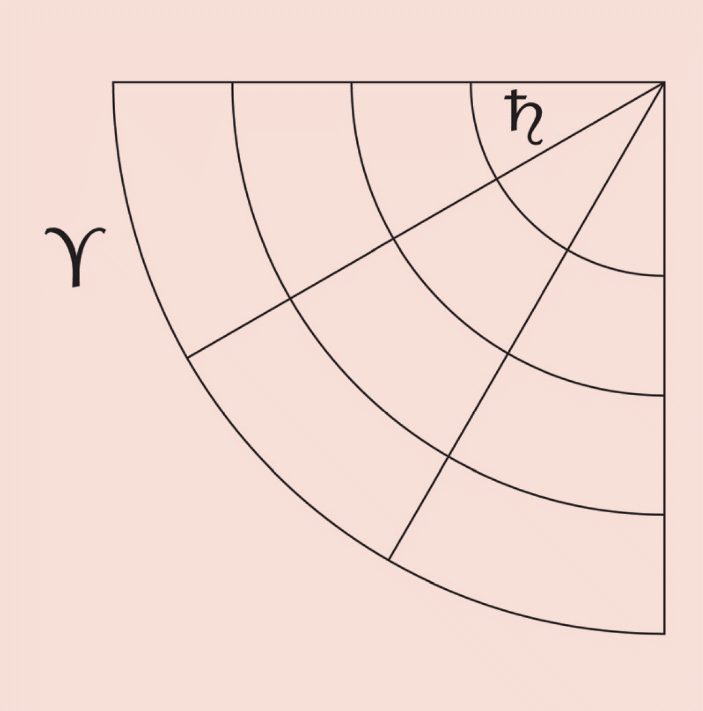
FIGURE 1982 0521a-9. Saturn in Aries.
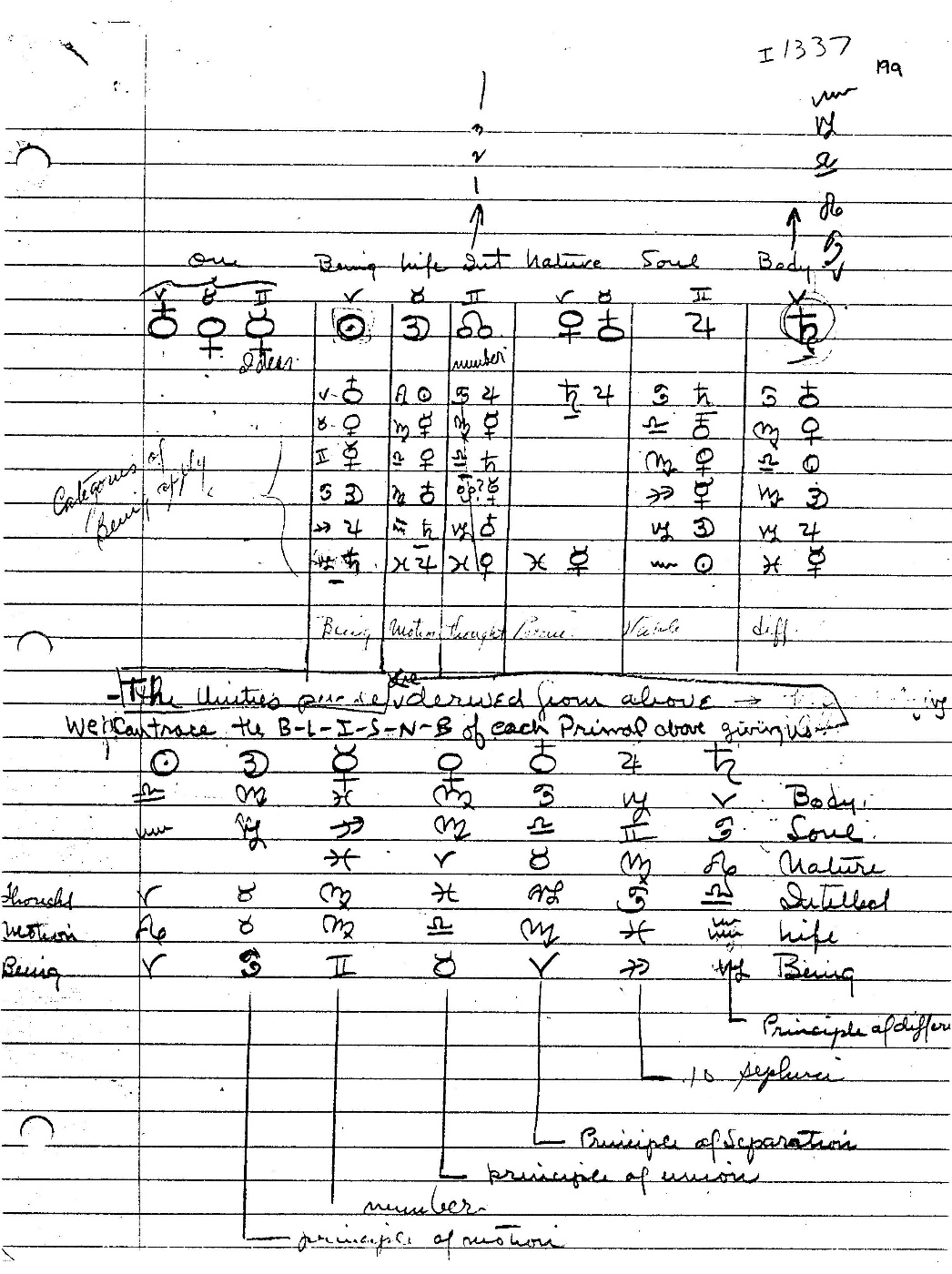
FIGURE AD_I_1337. Triad: Henads & Monads.
ASTRONOESIS WORKING DRAFT, section on the One, read in this class. See Astronoesis, chapter on the One, p. 19 ff.
NOTES:
This is 1982 05/21a, Plotinus; One Class, and the first entry associated with this date. 1982 05/21b = Plato; Divided Line Seminar, for which we have no audio, just JF notes — might refer to something misdated.
Previously printed, distributed 2003 as part of a set.
This class series on the One was held on Fridays.
TRANSCRIBED by jf 2002 from Audio Cassette tapes; reformatted by jf 2018. In 2024, IT updates prefatory matter and footer, replaces tape markers with audio file markers, adds Subsubjects, completes Book List, adds Plotinus quotes section, corrects typos and some listening errors, adds new notes within transcript, adds nine diagrams and references within transcript to these diagrams, reformats to accord with new conventions. Readable edited transcript with AD Paper – V11rp.
AUDIO FILES: 1982 0521a, 1982 0521b. [Note 1: "Tape" and "Side" refer to original audio cassette tapes that were later digitized into .MP3 Audio Files. Note 2: In 2024, REP Studio separates off Freud class fragment from file b.]
1982 05/21a at Wisdom's Goldenrod
Plotinus; One
[Audio File 1982 0521a Begins]
AS: --up to the surface, and are actually available. I mean, I don't think at any other period of time in recent history or perhaps even history we know of there's been such an availability of all these various different doctrines, each one of which seems to have some amount of truth and some amount of understanding of truth but also have some limitations and shortcomings.
RC/S(?): And some that had never been-- they've never been available before.
AS: Yes. I was going to say never but I don't know that, so I would-- (student laughter) That would be much more important. I mean you just look physically, the communication, the language problems, let alone all the other problems, with these things being secreted away and so on. All these various traditions seem to be coming out into the open now.
BS: Beginning of the Hidden Teaching he talks about it.
AS: Yes. So he's made that point and so it seems that perhaps, since this is happening, the time has come for some kind of a synthesis of all of these different philosophies, seeing how they all fit together and not contradict so much as complement each other, not so much a comparative philosophy is needed but, I think he points out here a synthetic one, some way of synthesizing all of the various points of view that these different philosophies represent.
And it's not just an attempt to draw a few little diagrams on the board and see how one system just happens to do nicely, but I think there's something more than that going on than just a couple of little pictures of philosophy. It's not exactly a picture book of philosophy or some arbitrary thing like that. It really is more an attempt at almost a universal synthesis with all of these different philosophies that I think is being attempted. And, of course the symbolism is useful and most appropriate, as I think the Introduction we read several times tried to make clear. Well, let me read this quote, we read it once before. And I'd imagine even more this time. (bit of laughter) (This is) from [PB] Volume 20.
Paul Brunton (Notebooks, V8, 12.2.186 & Perspectives, Ch. 12, #19) (AS reading): "They alone will comprehend the purport of this volume who can comprehend that it does not only seek to present the pabulum of an ancient system for modern consumption but that it has integrated its material with the wider knowledge that has come to mankind during the thousands of years which have passed since that system first appeared. Consequently we offer here not only a re-statement but also an entirely new and radically fresh world-view which could not have been reached historically earlier.
"If we study the history of human culture we shall begin to discern signs of an orderly growth, a logical development of its body. Truth has had different meanings at different periods. This was inevitable because the human mind has been moving nearer and nearer to it, nearer and nearer to the grand ultimate goal. And when we watch the way knowledge has mounted up during the last three centuries we ought not to be surprised at the statement that the culmination of all this long historical process, the end of thousands of years of human search, is going to crystallize in the new East-West philosophy which it is the privilege of this century to formulate. Here alone can the relative interpretations of truth which have been discovered by former men, rise to the absolute wherein they merge and vanish. This means that although truth has always existed, its knowledge has only existed at different stages of development, that we are the fortunate inheritors of the results gathered by past thinkers, and still more that we are now called to complete the circle and formulate a finished system of philosophy which shall stand good for all time.
"All the conflicting doctrines which have appeared in the past were not meaningless and not useless; they have played their part most usefully even where they seemed most contradictory. They were really in collaboration, not in opposition. We need not disdain to illustrate the highest abstract principles by the homeliest concrete anecdotes, and we may describe them as pieces in a jig-saw puzzle which can now be fitted together, for now we have the master pattern which is the secret of the whole. Hence all that is vital and valuable in earlier knowledge is contained in the East-West philosophy; only their fallacies have been shed. A full view of the universe now replaces all the partial views which were alone available before and which embodied merely single phases of the discovery of Truth. Thus the analytic movement which uncovered the various pieces of this world puzzle must now yield to a synthetic process of putting them together in a final united pattern. Culture, on this view, is the timeless truth appearing in the world of time and therefore in successive but progressive periods. Only now has it been able to utter its latest word. Only now does philosophy attain its maturest completion. Only now are we able to reap the fruit of seven thousand years of historical philosophy. Only now have we achieved a world-system, a universal doctrine which belongs to no particular place but to the planet. Knowledge has grown by analysis but shall finish by synthesis."
(long silence)
AS: Well, we can read a (bit). (more silence) (inaudible) This one point about that it's not just a re-- not only a restatement but a new and radically fresh world-view as it were.
RC: I thought it was very (interesting). You know where he talks about formulating a philosophy that would stand good for all time?
AS: All time, yes. Well there are some--
RC: . . . Yes there are other notes, you might have seen them, where he talks sometimes of how he considered himself a pioneer in this climate. He is described here (inaudible) [AS assents] Pretty amazing. When you were reading it I was thinking one day at lunchtime (inaudible) Came out with it pre-world-war in this century. . . . So I started to think, you know, really what date was it. Took about five minutes (inaudible) I said, pre-world-war (inaudible) And this that we're in right now honestly (inaudible) He was just driven back out of the (inaudible). And the thing that's so sinister about it is that most people don't realize there is (inaudible) right now that might be that.
(long silence)
AS: I was planning to go back and start from the beginning, since there have been some major and minor revisions. I think that I should just read through (inaudible). Yes but there's one other point. This may not-- this isn't directed personally, (student laughter) or to Bob. And I don't mean it to be a personal point, it just seemed a general comment. And I'm not sure how to-- if I'm going to put it the right way. This point that I wanted to make, so there's a point here about a fresh formulation. And, I think that in general, people usually say well if you're going to read something you should read something by a sage because other things are always open to interpretation, and you should read that which is written by somebody who is at least a Knower, or has had some insight and so on, and that's the best thing. But of course anything that is written on a page where you don't have the person in front of you, even if the person was a sage, and it was written in another language, even if it were written in English, you don't have the person in front of you to question, and say what did he mean, what did you mean. You can't ask him, Plotinus isn't here now. What are you going to do, you can't call him up. There's nothing you can do except to use your own understanding to try and formulate what he's saying in terms of your own understanding, and get some help or guidance from those who might have had some insights into what he was trying to say. But when a question comes down to it, it seems always better to take the fresh insights rather than those which are written down. Because you don't-- it's too hard, it's so far gone, you can't ask the guy and say well what did you mean by this. It's there in the book and it's been around for 2000 years or whatever and you have to make some interpretation, I mean every one of the traditions will tell you that anyway. So you can take it as a starting point, but when it really comes down to a question, you just have to use other insights, use other means than just say oh well, here it is in the text and therefore it must be so. I think when push comes to shove, it's better to take a living interpretation than the word written in a book. And when it comes down to it you can't ask the book questions. You can only ask yourself or you can ask somebody who might understand it. But you can't ask Plotinus anymore. And when it comes down to it, it's just a book, just words, and you've got to get at the meaning. (inaudible) more vital than the words. So . . .
RG: I don't follow your point.
AS: No, I don't think so.
RG: No, no, I-- What does that really mean though? I mean--
RC: I know what it means, it means Anthony's put a lot time in getting this very (inaudible) and, we should probably give him the benefit of the doubt and try to understand what he's put out.
RG: And what other method, what other method is there to get at that (without) asking questions?
RC: I think that's been the most frustrating. Both Anthony and Avery, Avery probably wouldn't say it because he's been putting in a lot of time in this paper.
AS: I wouldn't say it.
RC: But a lot of time has gone into getting it to the form that it's in now, and it hasn't really been allowed to be read completely. It hasn't really come out yet, at least not in the classes I've been to (inaudible).
AD: What he's saying, Dickie, is something like this, that when it comes down to the words or the creative vision, I'm going to go by the vision and not the words. Take V.1.5 for example and you got fourteen different versions and interpretations. Is power the matter of the One or is it the matter of the Intellectual? When there's that kind of discrepancy in the text then I can take the freedom to say, plague on both your houses, neither of you know what you're talking about. I'm going to go by my vision and the coherent whole understanding of Plotinus' doctrine and not just a portion of it. That's what I'm going to go by.
RG: Right. That's quite clear. But the question, I mean--
AD: Now that's where I'm coming from. It should be obvious that I'm--
RG: I know that's where you're coming from.
AD: You know, the answers are coming from in my head, not from a text. Because I look at Guthrie's translation, I look at the first and second revised edition of Plotinus, I look at Armstrong's version, I say well what the hell's the matter with these people?
RG: Well, then I would only ask that you just don't ask for questions when you-- I mean, you read through the thing and then you ask for questions. And if you don't want questions then (we'll) (inaudible)
AD: No, I want questions.
AS: That wasn't (inaudible) questions (there).
RG: Well that seems to be the import though. I mean--
AD: No I want questions, I take note of them. I take note of the questions but I don't want the questions endlessly repeated after I've answered them to the point where I think they're satisfactory. An answer is given, the best that can be given at the time. It's not meant to be permanent or forever. But, the understanding is something that grows, it's not, you know, fully determinate or given to us all at one time. And if the vision isn't about to be presented, then of course it would be legitimate, others would say 'But I don't understand.' I think this gentleman here, (whoever) it was, doesn't understand because the whole vision didn't (present). And we have to have the whole picture so that the pieces of the jigsaw puzzle -- you can see where they go once you have the whole vision in front of you. But you've got to get a vision of the whole. And then I think the other points can be seen to be as minor as they really are. You know, there's such a mountain, it's a monumental mountain of commentary on Platonism, I mean, you go to any library, especially a university library, and they're just piled up, mountains and mountains of these commentaries, that are more rotten and more dead than any mummy that is embalmed in Egypt 5000 B.C. I said I don't want no part of that. I want a Platonism that's living and vital, whatever truths I find in there I want to be able to apply right here and now, in my life, in the reading of a chart, and in the understanding that I got to live with. Anything else to me is a waste of time, especially as the years get less and less. So why don't we try, why don't we try, Avery, we'll try (out/it) our synthesis.
AS: Okay, the first quote here, this is from PB also. I'm not really sure where. From Volume 16 but know where.
Paul Brunton, *Essays on the Quest* "Is the World an Illusion?" p. 101 (AS reading): "The One does not become the Many, for the orders of being and consciousness are different. It remains what it is and from it *emanates* the Many. The universe is much more an emanation than a manifestation. Because it is an emanation rather than an illusion, the World-Idea is not to be treated as a non-entity. It is not to be sharply divided from reality. For it *is* the Real manifesting something of itself in a particular way. All events are only its activity as all things are only its attributes. Relativity exists between the ideas themselves but the substratum out of which they spring is the eternal and infinite, the self-existent and Absolute Mind. Matter thus becomes but a mental entity. The Absolute is not cleft inseparably from the Relative for the Relative is its own Idea. Mind itself is that which has always existed . . . (AS adds: and which is the) Principle of the world process. We may say of it what we may say of nothing else except Infinite Space: It *is*. And this will still be true even if the whole universe, including the conscious beings in it, disappears. Mind could not have come into existence at any specific time as it could not have come into existence from nothing; therefore, it must always have existed and there was never a moment when it was not."
AD: Avery, would you like to try just spontaneously to give a very brief outline of the steps we're going to follow, (AS: Sure.) the order?
AS: Sure. Briefly. Just briefly, as he says here, the topic for discussion in this first chapter is the One, but in general how the One emanates the Many, and how from the One we can speak about the emanation of the Many. Briefly, the first part speaks about the One itself, the self-sufficiency of the One, and the One-Only, and in what ways it is possible to speak of the absolute transcendent. He goes into that a little bit about how the One, and the nature of the One can possibly be viewed, and how it can it even be spoken about at all.
We bring in the point that you have to examine it from various viewpoints even though in itself it's absolutely ungraspable. But in the Mind's attempts to grasp it, it will see all these facets of it. So some attempt is going to be made to understand it from various facets which we may call unities. And after an investigation of the One itself the first facet to be examined is, or the first way of viewing the One, is through this view of power, the Dyad. That there is in the One, and conjoined with the One, this notion of power. And that this power itself has a twofold aspect to it, an indeterminacy that remains with the One, and it also is that principle or that power through which everything that's going to emanate from the One. And so the next step after the One, we speak about the Dyad, the Power of the Dyad, the Power of the One, and then this power itself is dyadic, it has two aspects that we view the One through-- substance and function, or repose and act, or active and passive perfection. And through this power then we're going to see established, at least from the way we have to view it, that from within the One itself, and not going outside it, you will see established all of the unities, all the principles which are the unities of Being, Life, Intellect, everything that will be manifest from the One or emanated from the One will be found first to be in the One, and established in the One by the power of the Dyad. And again that the point that these unities are to be conceived as in the One as a completion, and not as something outside of the One yet, but as being its inner nature. And that is necessitated by our own view of it.
And so that will give us the view in the diagram, in the diagrammatical mode of just going from the first house and the first quadrant, the whole first quadrant established as the source of Being, Intellect, Soul, and so on. And from there, from these unities you will see everything suspended from their inner nature, you will be able to see unfolded the whole of the Intellectual-Principle Soul Body, the whole of Reality, the whole of the four quadrants, the four rings. (inaudible)
AD: (inaudible)
S: (inaudible)
AS: We'll have to trace this through substance and function, the Dyad itself having these two modes of substance and function, we'll have to trace the progression through both of these modes, if we're going to be accommodated for our mental processes. That's what he's talking about.
Plotinus VI.9.6 (AS reading): "In what sense, then, do we assert this Unity and how is it to be adjusted to our mental processes? (AS: This is a quote from VI.9.6.)
"Its oneness must not be belittled to that of monad and point: for these the mind abstracts extension and numerical quantity and rests upon the very minutest possible, ending no doubt in the partless but still in something that began as a partible and is always lodged in something other than itself. The Unity was never in any other and never belonged to the partible: nor is its impartibility that of extreme minuteness; on the contrary it is great beyond anything, great not in extension but in power, sizeless by its very greatness as even its immediate sequents are impartible not in mass but in might. We must therefore take the Unity as infinite not in measureless extension or numerable quantity but in fathomless depths of power.
"Think of The One as Mind or as God, you think too meanly; use all the resources of understanding to conceive this Unity and, again, it is more authentically one than God, even though you reach for God's unity beyond the unity the most perfect you can conceive. For This is utterly a self-existent, with no concomitant whatever. This self-sufficing is the essence of its unity. Something there must be supremely adequate, autonomous, all-transcending, most utterly without need.
"Any manifold, anything beneath The Unity, is dependent: combined from various constituents, its essential nature goes in need of unity; but unity cannot need itself; it stands unity accomplished. Again, a manifold depends upon all its factors; and furthermore each of those factors in turn--as necessarily inbound with the rest and not self-standing [AS reads: self-sufficing]--sets up a similar need both to its associates and to the total so constituted.
"The sovranly self-sufficing principle will be Unity-Absolute, for only in this unity is there a nature above all need whether within itself or in regard to the rest of things. Unity seeks nothing towards its being or its well-being or its safehold upon existence; cause to all, how can it acquire its character outside of itself or know any good outside? The good of its being can be no borrowing: This is The Good. Nor has it station; it needs no standing-ground as if inadequate to its own sustaining; what calls for such underpropping is the soulless, some material mass that must be based or fall. This is base to all, cause of universal existence and of ordered station. All that demands place is in need; a First cannot go in need of its sequents: all need is effort towards a first principle; the First, principle to all, must be utterly without need. If the Unity be seeking, it must inevitably be seeking to be something other than itself; it is seeking its own destroyer. Whatever may be said to be in need is needing a good, a preserver; nothing can be a good to The Unity, therefore.
"Neither can it have will to anything; it is a Beyond-Good, not even to itself a good but to such beings only as may be of quality to have part with it. Nor has it Intellection; that would comport diversity: nor Movement; it is prior to Movement as to Intellection.
"To what could its Intellection be directed? To itself? But that would imply a previous ignorance; it would be dependent upon that Intellection in order to knowledge of itself; but it is the self-sufficing. Yet this absence of self-knowing, of self-intellection, does not comport ignorance; ignorance is of something outside--a knower ignorant of a knowable--but in the Solitary there is neither knowing nor anything unknown. Unity, self-present, it has no need of self-intellection: indeed this 'self-presence' were better left out, the more surely to preserve the unity; we must eliminate all knowing and all association, all intellection whether internal or external. It is not to be thought of as having but as being Intellection; Intellection does not itself perform the intellective act but is the cause of the act in something else and cause is not to be identified with caused: most assuredly . . ."
S: Can you read that last sentence again?
AS: Sure. (inaudible)
Plotinus VI.9.6 (AS reading): "It is not to be thought of as having but as being Intellection; Intellection does not itself perform the intellective act but is the cause of the act in something else and cause is not to be identified with caused: most assuredly the cause of all is not a thing within that all.
"This Principle is not, therefore, to be identified with the good of which it is the source; it is good in the unique mode of being The Good above all that is good."
AS: We've read that quote quite a number of times, it's the whole of VI.9.6. And also other stuff in there, couldn't tell where the quote ended and where the writing began.
AD: Next page.
Astronoesis draft (AS reading): "The philosopher-sage enunciates the Logos, the Word, and the knowledge he communicates is primarily Wisdom. He is required to be precise within the given structures, the cultural mores of his era, yet his stance--"
(inaudible short AS/S dialogue)
Astronoesis draft (AS reading): "He is required to be precise within the given structures, the cultural mores of his era, yet his stance is outside of and beyond these forms. Hence it is only natural that first in the order of importance that we should concern ourselves with his remarks about the existence of God, the One-Only.
"The One is absolute positivity, its self-existence a pure be-ness and super-intelligence, inbound with the totality of possibilities and infinite of power. Perhaps it might be more meaningful and provocative to say it is Pure Intelligence. Better still All-Intelligence. Sufficient and complete in itself, the Only-Perfection, the One is beyond any limitations, dependence, need, or duality of any kind. This transcendence does not mean a blank homogeneity, a Zero, rather it is unlimited actuality. The One is so complex in its unique and undifferentiated simplicity so as to encompass and include all in its universal essence. The certain way the transcendent One is inclusive of all it is our hope to unfold. In this Ennead Plotinus describes and our ensuing statements will explicate the essential characteristics of the One-Only. Yet it is misleading and incorrect to speak of such attributes except in a most precise, albeit strange and mysterious way. Plotinus refers to it as self-distinguishing throughout, in a mode above intellection. And again, as an eternal wakefulness, a wakefulness or consciousness which cannot be separated or distinguished from the totality of all its contents.
"The following we quote from *Nature, Contemplation, and the One* by Mr. Deck:"The One is called an eternal super-knowledge: 'If, now, it's [the One's] act does not become but is always, and is a kind of wakefulness which is not other than the one who is awake, being a wakefulness and an eternal super-knowledge, it will *be* in the way it is awake. The wakefulness is beyond being and Nous and intelligent life; the wakefulness is itself.'[VI.8.16, Deck] A wakefulness which is a *super*-knowledge, or a wakefulness which is *above* knowledge?" [Deck, Larson ed. p. 32, square brackets are Deck's]
"And Mr. Deck, a sincere and discriminating devotee of the sage, tends to identify the One's wakefulness with its super-knowledge. And he states:"Plotinus goes on to say that the One is 'not, so to speak, imperceptive, but everything of it is in it and with it [i.e., it is entirely self-contained]; it is entirely self-discerning; life is in it and all things are in it; and its self-knowledge is itself, a self-knowledge by a kind of synesthesis being in eternal stasis and in a knowledge otherwise than knowledge according to the Nous.' [V.4.2, Deck] Thus knowledge, which appears in a way in nature, more fully in soul, perfectly in the Nous, is not absent from the highest "nature," the One: the continuity of knowledge is not abruptly broken in the ascent from the Nous to the One." [Larson ed. p. 33, square brackets are Deck's] (AS: That's from Deck.)
"Mr. Deck's concentration is intensely and sharply focused into the true meaning of the One. It is a magnificent exposition of the master's teaching in positive terms. He has seized the jugular vein of the doctrine when he says further that"the self-identical synesthesis of the One can be a super-knowledge in a positive sense." [Deck, p. 34] The quotation from Plotinus repeats and affirms the identity of wakefulness with existence, that is pure being. And it is reemphasized when he says "it will *be* in the way it is awake." [Deck VI.8.16] We will amplify more fully as we go along how the all the contents of this super-intelligence can share in the above description.
"The intuitive perception of Being and Essence when reduced to the discipline of comparative philosophy or anthropology. There are no new truths in philosophy. When we work our way through the ego's psychopathology we will simply rediscover them.
"The resulting experience of the flight of the alone to the Alone [Note: See Plotinus, VI.9.11.] is here being articulated by Plotinus. And the similarity with that of the unknown Indian sage, author of the Mandukya Upanishad, can be attested to by quoting the 7th Karika [Nikhilananda trans.]: 'Turiya is not that which is conscious of the internal (subjective) world, nor that which is conscious of the external (objective) world, nor that which is conscious of both, nor that which is a mass all sentiency, nor that which is simple consciousness, nor that which is insentient. (It is) unseen . . . not related to anything, incomprehensible (by the mind), uninferable, unthinkable, indescribable, essentially of the nature of Consciousness constituting the Self alone, negation of all phenomena, the Peaceful, all Bliss, the Non-dual. This is what is known as the fourth (Turiya). This is the Atman and it has to be realized.'
"Consequently, as Plotinus makes clear,"its [AS: the One's] simplicity is not that of a spatial point nor a quantitative unit to be enumerated with others, and its impartibility is not that of minuteness but of greatness." (Plotinus, VI.9.6) The negative descriptions of the Unity as beyond determinations or limitations which we find in Plotinus and elsewhere should not be taken as a lack but as going beyond any possible synthesis of all essences. It is in this sense that the Unity is beyond God or Mind or Being. Total affirmation is not only beyond any particular determination or the totality [of all essences but is itself the Alone. Keeping in mind the reference here to the One as infinite, we can justify an excerpt from Guenon's Multiple States of Being, where he says:" --from another transcript]
(Side 1 of original cassette tape digitized as 1982 0521a Ends; Side 2 Begins)
R. Guenon, *Multiple States of Being* (AS reading): "[The Infinite, on the contrary, if it is to be such] must admit of no restriction, which supposes that it is absolutely unconditioned and indeterminate, for all determination is necessarily a limitation simply because it must leave something outside itself, namely all other possible determinations. Limitation, moreover, presents a character of real negation: to set a limit (AD handwritten insert: and Being does; AS reads: and Being does this) is to deny to that which is limited everything that this limit excludes; and the negation of a limit is in fact the negation of a negation, which to say, logically and even mathematically, an affirmation. Therefore the negation of any limits is equivalent, in reality, to total and absolute affirmation. That which has no limits is that to which one can deny nothing; and this idea of the Infinite, which is the most affirmative of all because it comprehends and envelops all particular affirmations, can only be expressed by a negation by reason of its absolute indetermination."
Astronoesis draft (AS reading): "The One is not, therefore, an abstraction from other principles. Rather on the contrary, they are divine outflowings from its super-abundance of perfection. These latter principles are all dependent but the One depends on none. For any principle or being to be at all, it must first be a unity. And so the first principle of all principles is Unity itself. We can speak of it as One-Only because from the view of the One, there really is no view at all.
"But for Plotinus, the One does not preclude the possibility that the unity of every principle is already included paradigmatically in the super-knowledge of it, of the One. We will have to understand in what precise way this is so. When our mind tries to grasp this ultimate paradox of pure Perfection and infinite immanent actuality, it may burst its limits. And yet in fact the very contact with the One, the touch of the Untouchable, is the goal. This is the grand learning, the learning of the One which Plotinus speaks of--[Note: See Plotinus, VI.7.36.] that is, to cut away everything. [Note: See Plotinus, V.3.17.] In a flight of the Alone to the alone, Plotinus is inviting us to an ascent, which is the only possible way that we can finally understand without understanding.
"Clearly no symbol is apt to this Absolute. But since we must speak of it, there is a certain rough fitness in designating it as Unity, [Note: See Plotinus, VI.9.5.] the nearest we can conceive it. We cannot have it without falsifying it. And yet you cannot speak of it at all if you do not use some symbol to point to it. And he does endeavor here to reveal something of its nature. And we feel that on this point the silence of the Buddha or Christ should not be taken agnostically but perhaps pedagogically. In times and circumstances such as ours, it may be even more harmful to refuse to speak of Unity or God, for it invites the intellectual skeptics to assert that even the sage cannot know Truth because he has not experienced it.
"Yet the ultimate realization of the absolute Unity and the sage's expression of that are necessarily distinct levels. Plotinus himself says that the sage is all vision within himself, filled with the Intelligible contents of the Nous, and yet he must use reason in his expression of reality to others. He says [III.8.6]: 'The Sage, then, has gone through a process of reasoning when he expounds his act to others; but in relation to himself he is Vision: such a man is already set, not merely in regard to exterior things but also within himself, towards what is one and at rest: all his faculty and life are inward-bent.'"
AS: A little more and then I'll stop.
Astronoesis draft (AS reading): "In our discussion of the Unity, the One, we must create for ourselves a way of seeing, a thinking organized so that it can become specificated, a specificated organ of perception. And by recruiting from the master architect Plotinus the sequence of reasoned revelations, it may be possible for us to reconstruct conceptually his vision, and this would be tantamount to a penetrating into the secret adytum of his thought, and not his experience, through which his revelations from the One become available to us. Through the series of quotes recited there accompanies the unfoldment of something about the mysterious and infinite complexity of the One. These quotes simultaneously order the many formless grades in the shapeless and unfigured. The inquiry naturally reveals the meta-ontological source of Plotinus' revelations and also the reasoning out of his revelations. And we believe that one of the final results of this procedure will be to provide us with a thought-model which we can apply with certain qualifications to any principle that is a unity, idea, or number, and gain an insight into this.
"But it is important to bear in mind that disciplined thought will always keep the One intact. In spite of our incorrect mode of thinking will never fragment the One into a diversity, nor must we think that the One can become many. When we are speaking of the parts of the indivisible unity we cannot but help recognize that our intellect operates in dualities. An account of that must be taken into consideration because we are actually unable to do otherwise."
AS: (inaudible)
AD: Keep going while you've got them.
Astronoesis draft (AS reading): "Obviously we can't approach the perfection-- (AS inaudible) We cannot help but recognize that our intellect operates in dualities. This must be taken into account. Obviously we can't approach the perfection, the self-sufficing completion of the One analytically . The nature of Unity precludes that possibility. Therefore our approach to some extent will be to conceive of all of its aspects as available to our understanding and intellect. We must accommodate our mental processes to this multiplying of vision. So we will proceed in this fashion: subject the constituents or the interiority of the One to itemization and understand each and every one of its aspects in this relative fashion. We can then speak of the coordination and interpenetration of these aspects with each other so that a totally perfect and complete infinite unity would be the result. Now when we have done this, and only after we have done this, we cancel out the whole process of reasoning up to that point. And by a leap of the creative imagination immerse ourselves in this notion of an infinite unity, eternally and intrinsically complete and perfect. So any description of this perfect One is"as if" in order to accommodate that level of mind that is constantly in the process of instantiation and transformation.
"So with the limitations of our understanding kept in mind we will approach one of the most mysterious difficult yet absolutely pivotal ideas in the Plotinian doctrine, and that is, the Power or the Dyad. Plotinus identifies the infinite and indeterminate power of the One as not distinct or apart from the pure undifferenced knowledge itself. The One must remain a simplex and yet it is the source of all distinctions which we are ascribing to meta-ontic infinity. In the quote in V.1.5 [MacKenna 1st ed.] Plotinus refers to it where he says: '. . . the Dyad is, as regards that sphere, undetermined -- representing . . . the underly [or Matter] of The One . . .'"
AD: The first edition has that translation, the second edition, Page's revision is altered, "the matter is that of the Intellectual-Principle". If you can see how calamitous this interpretation can be, you can see why I'm bumping all of these people aside and working with the *total meaning* that Plotinus was presented with.
AS: The conflict of reading from various translations, he tells us, will interpret this as such, and this first edition--
Astronoesis draft (AS reading): "--for all of the powers and principles from it are derivatives from it and imitative of it. The consequences of this view can be illustrated by a practical and commonsense illustration. If the world is real, if it is the result of a real power, if this power were other than the One, then there would be an ultimate dualism of One and Power. If on the other hand Power is unreal, any products of this Power, from our universe through all the levels of reality, including even the Divine Mind, will be illusory. Either of these alternatives, that of metaphysical duality or of illusory being, are unacceptable for Plotinus, and so the One-and-its-Power stands first and foremost and yet sustains lesser levels of reality which again are neither illusory nor non-existent. This principle of Power will establish the levels of reality, those principles referred to as aspects of the One, from which eventually emanates all the lessers."
AS: And there are some quotes:
Plotinus V.4.1 (AS reading): "If The First is perfect, utterly perfect above all, and is the beginning of all power, it must be the most powerful of all that is, and all other powers must act in some partial imitation of it. . . .
". . . the First Good, the Power towards all, how could it grudge or be powerless to give of itself, and how at that would it still be the Source?"
Plotinus V.5.11 (AS reading): ". . . this unseen First is the source and principle of Being and sovran over Reality."
Plotinus VI.9.1 (AS reading): [And again:] "It is in virtue of unity that beings are beings [AS adds: and therefore they are not illusory]."
AD: That's my revision, it's not in the text.
Astronoesis draft (AS reading): "Now we can see that for Plotinus, perfection and self-sufficiency imply an abundance of Power, and not passivity or inaction. The One is the overflowing source of everything. The One produces by its very perfection and infinite Power and not through any necessity of its products. The One does not need-- Creation is the result of super-abundance. Even in its producing the One remains unmoved, for all possible production is already *in* its infinite Power.
"The words of the Lao Tzu have the same taste and flavor, and Plotinus might well be expressing his thought. He says 'How unfathomable is Tao! An infinite depth, the Source of all that is--the Ancient Progenitor before all things. Yet, how pure and still is Tao!' [Shrine of Wisdom,"The Simple Way of Lao Tzse," v, no. 18, p. 10]
"And again the same thought is expressed more lucidly in recent times by Rene Guenon where he says [*Multiple States]: '[Thus], when we say that universal Possibility is infinite or unlimited, it must be understood that we [AS adds: can] speak of nothing less than the Infinite itself, envisaged under a certain aspect, [AS adds: yet only] insofar as one may say that there are aspects to the Infinite. For the Infinite is truly "without parts," and strictly speaking, there can [AS reads: and there can thus] be no [further] question of a multiplicity of aspects existing [really and] "distinctively" within it. [AS adds: So] It is we who in fact [AS reads: who so to speak] conceive of the Infinite under this aspect or that, because we cannot do otherwise [AS reads: since we can do no other] . . .'
"In considering this Power, a twofold nature is observable: on the one hand, its identity with the One, its absolute passivity and stillness; on the other hand an infinite extension, a sheer indeterminacy, a profundity of unlimited activity. Plotinus says [VI.8.16]: 'That his being is constituted by this self-originating self-tendance--at once Act and repose--becomes clear if we imagine the contrary; inclining towards something outside of Himself, He would destroy the identity of his being. This self-directed Act is therefore his peculiar being, one with Himself. Thus, He created Himself because his Act was inseparable from Himself.' Thus we find in the One's own self-nature a presentation of these two ultimate principles, act and repose, which are non-dual aspects of the One's absolute completion, the coincidence of ultimate opposites. We can broaden or enlarge this paradoxical theme by bringing it into coordination with other similar views, such as active and passive perfection, yin and yang, substance and function. It is an exquisite mystical vagary, a paradoxical statement that is universally confused in the perennial philosophy.
"In these quotes where Plotinus attempts to describe something of the status of the completeness of the interiority of simplicity, that which is eternally achieved is reduced to our mode of understanding, that is, it is in terms of temporality and causality, which must cancel themselves out when we are restored to that insight of the interiority that is timelessly fixed, perfect, and complete. If we do not keep this in mind, we will arrive at the notion that the eternal One is in the process of evolving. So we return to this quote on the act and repose, and we wish to glimpse the incomprehensible nature of the One. And our intellect must be like a bird which in flying through the sky leaves no trace behind, that is, is dissolved."
RC: Could you reread that paragraph, Avery, (inaudible)?
AS: Sure.
Astronoesis draft (AS rereading): "In these quotes where Plotinus attempts to describe something of the status of the completeness of the interiority of this simplicity, that which is eternally achieved is reduced to our mode of understanding, that is, it is in terms of temporality and causality, which must cancel themselves out when we are restored to the insight of the interiority that is timelessly fixed, perfect, and complete. If we do not keep this in mind, (AS: Namely that this is in terms of our mode of understanding.) then we will arrive at the notion that the eternal One is in the process of evolving. So if we return to this quote, we wish to glimpse the incomprehensible nature of the One, then our intellect must be like a bird which in flying through the sky leaves no trace behind, that is, it is dissolved."
Astronoesis draft, cont. (AS reading): "Now at any rate we will proceed through this series of quotations that attempt to fathom the unfathomable for our benefit. In V.4.2 he says: '. . . if something arises from an entity which in no way looks outside itself, it must arise when that entity is in the fullness of its being: stable in its identity, it produces; but the product is that of an unchanged being . . . So it is in the divine also: or rather we have there the earlier form of the double act: the divine remains in its own unchanging being, but from its perfection and from the Act included in its nature there emanates the secondary or issuing Act . . .' Here once again, the hidden and mysterious distinctionless constitution of the One-Only is being considered. The nonduality of active and passive perfection, or substance and function, Plotinus is here referring to this nonduality, this nondual or Absolute Mind, as the double act. This consideration of the double act as the ultimate paradox will ensure that we can retain the highest view of the One as transcendent, and allow a multiplication of its facets that reveals to us its various aspects of the One-Only as meta-ontological infinity. It describes the dual modes of substance and function, or wisdom and content, united, and yet *exhibited* as distinct. The double act is thus equivalent to multiplying the One by itself. Consequently there is no new production that takes place: the One remains intact.
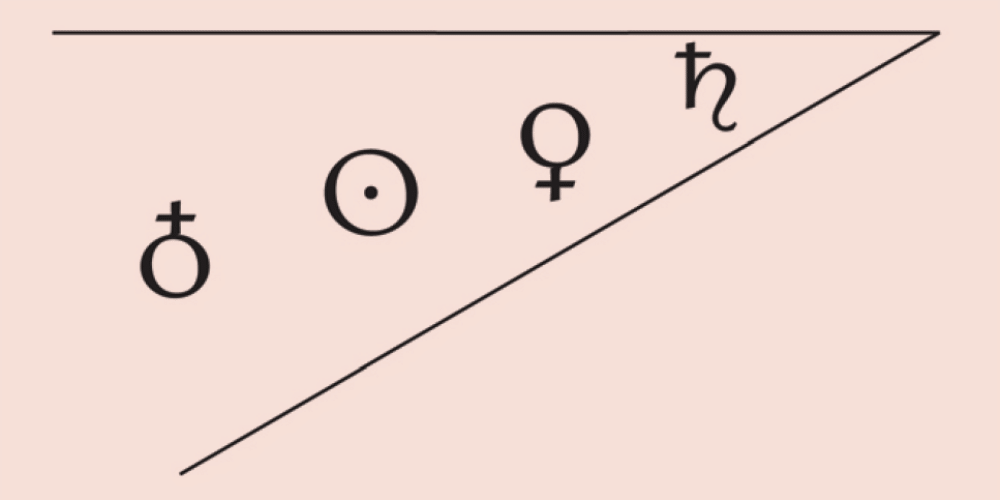
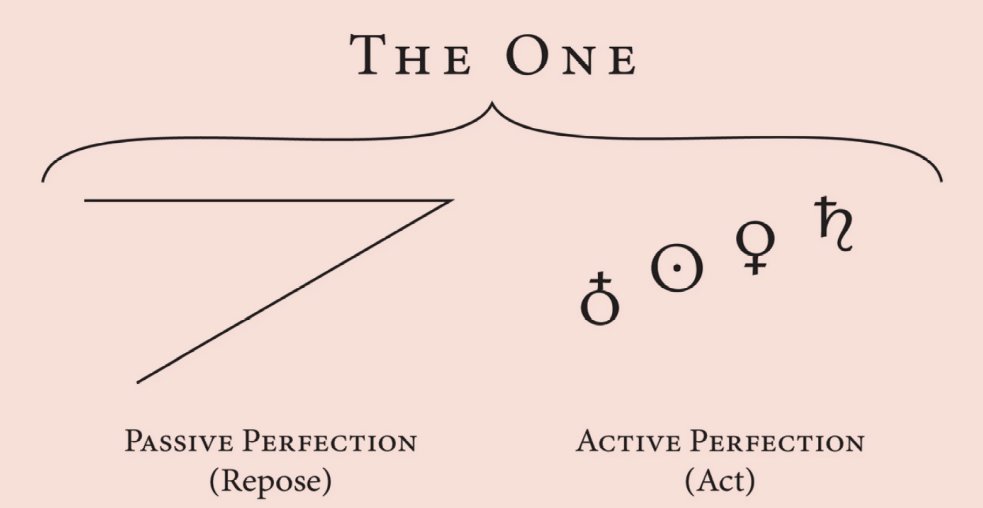
"Yet the result is that all the various aspects, the primal unities or intelligibles and their substance within the first quadrant of the astrological mandala, are presented as different ways of viewing the One. It is thus the power of the One upon itself which exhibits itself to itself. All this may be tersely summed up by his statement that it is an eternal awakening but without a subject who is awake. To draw out the implications of this central point we will refer again to that segment of the circle called the first house. For our diagrammatic unfoldment of the double act we will isolate the house from its contents, and designate the house as its passive perfection and the intelligibles or its contents referred to by astrologers as the dignities of Mars, Sun, Venus, and Saturn, we designate active perfection." [Note: See FIGURES 1982 0521a-1, The One-Only, and 1982 0521a-2, Active and Passive Perfection, appended to this transcript. These diagrams are from Astronoesis, pp. 54, 55.]
AS: I'll read it again.
Astronoesis draft (AS rereading): "For our diagrammatic unfoldment of the double act we will isolate the house and designate it as passive perfection and the intelligibles we designate as active perfection."
S: Avery, excuse me, is this the first house?
AS: Yes. We're in the first house.
Astronoesis draft, cont. (AS reading): "Again let us point out that power is mutually pervasive of both for without its presence no distinction or operation is possible. Now to conceive of the double act in its integrity we must see the non-distinction within both active and passive perfection exhibited simultaneously. The intelligibles or dignities expose respectively their twofold nature, as each manifests the double act. Simultaneously the passive perfection is hypostatized as a totality of possibilities, second house, and the subjective wisdom consciousness in the third house."
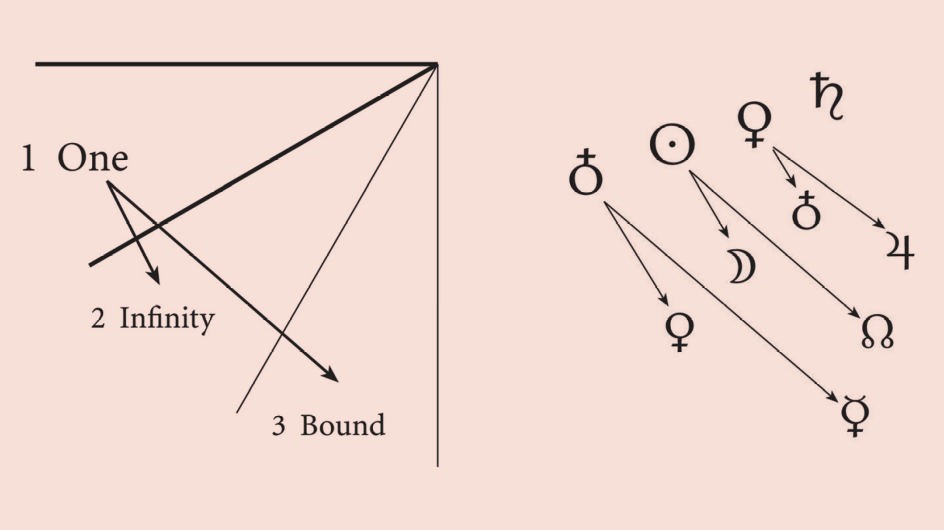
AS: And we have some pictures to show this, but we'll hold off on the pictures (inaudible). The second and third house and the dignities come out of the first house, and here's another way of doing it which has been recently-- (chalk-on-blackboard sounds) the Mars, Sun, Venus, and Saturn, and then the 2nd and 3rd coming out of them. (chalk on blackboard) [Note: See FIGURE 1982 0521a-3, One, Infinity, Bound, appended to this transcript. This diagram is from Astronoesis, p. 56.]
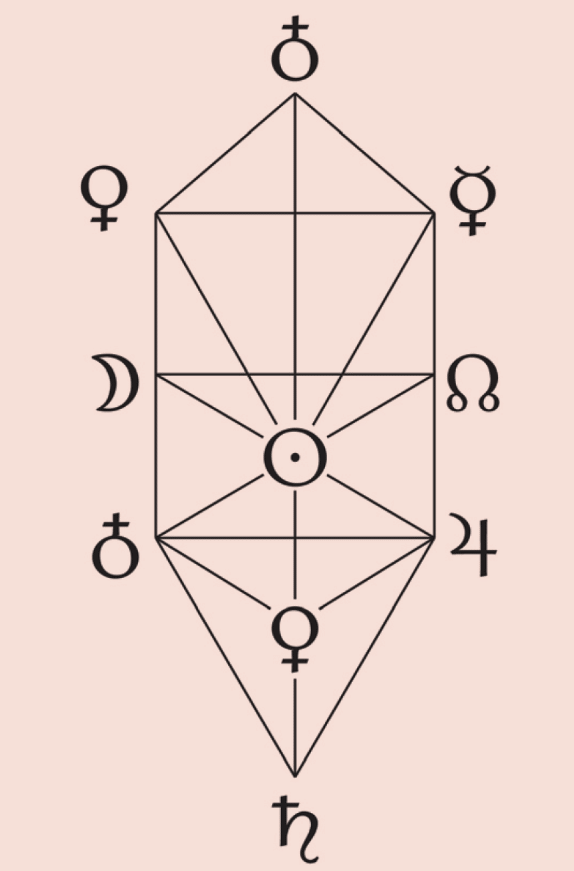
Another way would be with the Kabbalistic tree with the first house down the middle, and the two side houses as being 2 and 3 coming out of the first. Imagine the first house down the middle, houses 2 and 3. [Note: See FIGURE 1982 0521a-5, Triad arranged as Kabbalistic Tree, appended to this transcript. This diagram is from Astronoesis, p. 60.]
AD: We're saying something very simple. You use it all the time in astrology, right? You got a planet in a house and sign and degree, it's going to manifest something. Right? We're doing the same thing. You got four dignities in the first house, it's going to manifest something. What does it manifest? What could it manifest? The double act, (AS: It's own nature.) that's its content. That's all it can manifest, there isn't anything else. (AS: Manifest itself.) The double act is manifested. Well what is the double act? The 2nd and the 3rd house. So you're multiplying the One by itself, what do you expect to get? Twelve, I guess, huh? New arithmetic. Little bit more and their patience would be worn thin.
AS: Okay. Only a little more anyway (inaudible).
AD: No it gets dense, I know, but we can't help it, it's got to be like a geometrical theorem, step by step.
Astronoesis draft (AS reading): "Let us reiterate. Active and passive, perfection the ultimate coincidence of opposites, are being exposed."
AD: By the way, this is not Jung, this coincidence of the opposites, whatever you do--
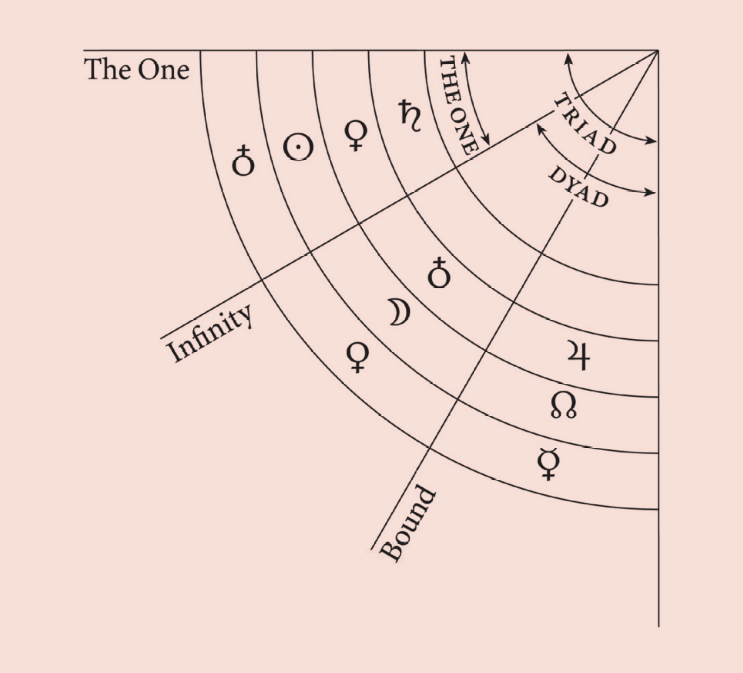
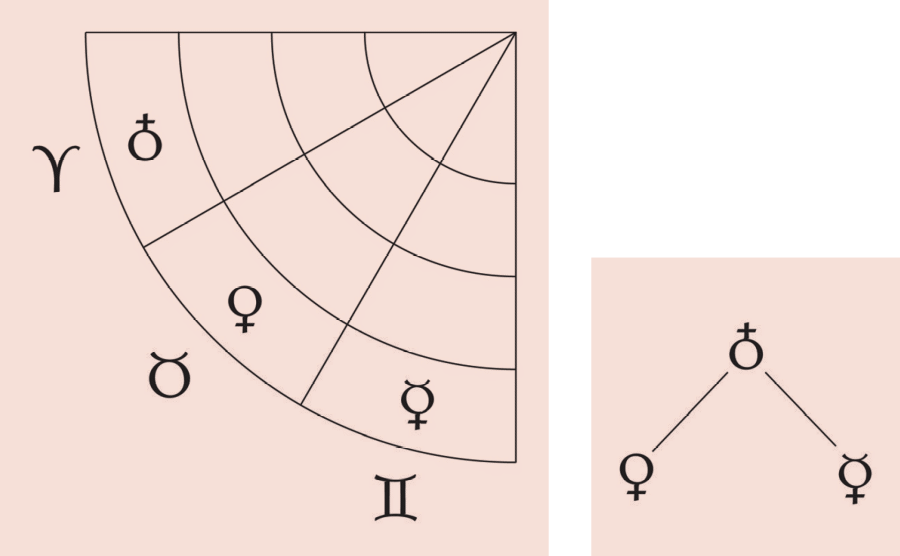
Astronoesis draft (AS reading): "And the double act is thus revealed. The 2nd and 3rd houses and their respective intelligibles are being posited by this act. The double act thus unfolded reveals the 2nd house as active perfection, the 3rd house as passive perfection, along with the dignities, or as Plato speaks in the Philebus 'God exhibits infinity and bound'. And the result is the establishment of the whole first quadrant. The paradox yet remains: there is no new production, power identical with the double act, is thus extended throughout this whole one-continuum. It is the basis, the indeterminate matter of each of the intelligibles. Power is what imparts to each of the unities their character is uniqueness, their shapeless form, and super-being, in a distinctionless mode in the One. Thus unfolded to our view we will refer to these 10 unities or intelligibles as the Triad." [Note: See FIGURE 1982 0521a-4, One, Dyad, Triad, appended to this transcript. This diagram is from Astronoesis, p. 57.]
AD: Let's stop now. The logic is very simple: completeness, perfection, absolute autonomy, One; and that one of the characteristics of it is power; and then the discussion of the power and the interaction of the Power with the One and the production of the Triad from that interaction. And at the same time keeping the One intact -- that always has to be, the One is absolute, there's nothing else like it. I mean, I don't know what the Hindus speak, but when I say the One-without-a-second, what I mean by that is there's nothing like it -- there are other things, but there is nothing like that, it's *one of a kind*. Ok? That's the way, that's where I'm coming from. When they say One-without-a-second they mean that there isn't anything else besides the One, yeah. You could tell them how PB went through torture try to find the Vedantists expressing something positive, they're not capable of a positive statement.
RC: One funny thing that happened. One day he came (inaudible).
AD: He worked hard.
RC: Yes, he said, he had a very difficult morning, he was trying to write about nonduality. I said, there must be some way that you can speak of it that isn't incorrect.
AD: Big problem.
RC: I could stand to hear that section again on the double act. It includes--
HP: Avery, that point (inaudible) again. I had a question that came up last week (inaudible). In the first quadrant or at least in the first house, you can speak about the Dyad in terms of multiplying or dividing 1 by 1, does that exist throughout the entire first quadrant? So you're not getting into another procedure of an additive or subtractive procedure?
AS: He's saying that the One as the One divided by the One gives you the One first quadrant.
HP: And that's all the first quadrant?
AS: The first house, the power of One gives you One, the first quadrant, and it all remains one.
HP: And so the 2nd and 3rd house (inaudible)?
AS: All those are just aspects of the One and nothing new is being produced.
AD: We try to draw that there's a couple of approaches, I'll put it up, we use the-- There's a couple of ways of approaches, there's not one way, this was one of the easiest ways. The other way is you could take the first house and the Kabbalistic way of doing this would be this way. [Note: See FIGURE 1982 0521a-5, Triad arranged as Kabbalistic Tree, appended to this transcript.] (chalk on blackboard sounds on tape) That would be the one way. That would be the One and these two would be the functional adepts. Another way to do it would be to do it and this would be seeing it from two aspects. Another way of doing it would be-- and then put the two aspects as coming from here. [Note: See FIGURE 1982 0521a-3, One, Infinity, Bound, appended to this transcript.] Each one of these approaches is going to give you a whole different way of looking at it. So you would put the 2nd house here, or the 3rd house and the 2nd house here. And you can imagine that coming out again. But this is the easiest way I think, because it's the most obvious.
If in astrology you would look at a house or a sign and you got a planet in it, and he says it's going to manifest something about what that content is. We take the same technique, apply it to this philosophic problem, four dignities in the first house, and he says that the first house is the identity or the nonduality between the substance and its attributes or function. And so if these manifest anything, all they can manifest is the active and passive perfection which is within here, well that means the 2nd and 3rd house, one standing for the active and the other standing for the passive. These two are equivalent to this here manifesting what's in here. So that means the One is dividing itself. [Note: See FIGURE 1982 0521a-3, One, Infinity, Bound, appended to this transcript.] But if you divide 1 by 1 you're going to get 1. The basic mathematical laws are based on metaphysics, they're not based on mathematicians' imagination. Alright, we could stop now, see if you've seen it that far. (silence) Well, in that case read a little more.
MW: Somewhere where in there you gave a simple example (inaudible), that if power was real, and all its products have to be real, and you mentioned (inaudible) if the power was illusory, all its products would be illusory, (defined thus) all the way down. And so you can go--
AD: For Plotinus either one, either way is wrong, they're both together right.
MW: So that would (inaudible)
AD: Both views are correct. See, the Vedantists-- let's say that they have the highest view, but Plotinus would say, that's not all, that not the only view, there are other views that have to be added to that to make it complete. It is incomplete to speak just about the One and to consider everything else as illusory. So he wouldn't accept that view. But he would take the two of them, and follow the two of them down.
MW: Right, but by taking the two of them, you can't go by saying-- Well, that was my question-- are you saying that there's a duality between the One and its power? (inaudible)
AD: No, there's going to be a duality between the One and what emanates from the One. The Intellectual-Principle is an emanation from the One.
MW: You mean the Intellectual-Principle as let's say second quadrant, you're not talking about--
AD: The second (or) the circle, uh-hm.
MW: The first quadrant as the Triad.
AD: Uh-hm. Having found the Absolute Mind is, that doesn't mean that nothing else is. And having found (now/out) that the Absolute Mind is, and other things are, then what's required here is metaphysical dualism on the one hand--that would be for the intellectual--and monism for the mystical, the intuitive. And you can't cancel one out for the sake of the other, so you gotta walk both-- gotta walk them both down.
HS: Both down, both views of power as illusory and real, is that what you mean, "walk them down"?
AD: No, power is always real.
HS: Power is always real.
AD: The obvious consequence of the way we're thinking of power as real, as a characteristic of the One, therefore any of its productions must be real too, they can't be illusory. That's (how I would view it).
HS: But, as I understood it, you accepted both.
AD: Yes, we accept both, the Intellectual-Principle is not as real as the One.
HS: That would be a reference to its illusory nature.
AD: Yes. And if you want to call the Intellectual-Principle illusory, you've got to be pretty inflated.
HS: But that would be the place where people would call that illusory, that's what they're addressing as illusory?
AD: All the way down.
HS: And you would be calling the Intellectual-Principle--
AD: If you call the World-Idea illusory, if you call the manifested universe illusory, aren't you saying that the power of the One is illusory?
HS: What produces something illusory would itself be illusory.
AD: --would be illusory. Of course. Shall we read a little more?
AS: We ended up saying that--
Astronoesis draft (AS reading): "In this unfolded view we will refer to the 10 unities or intelligibles as the Triad."
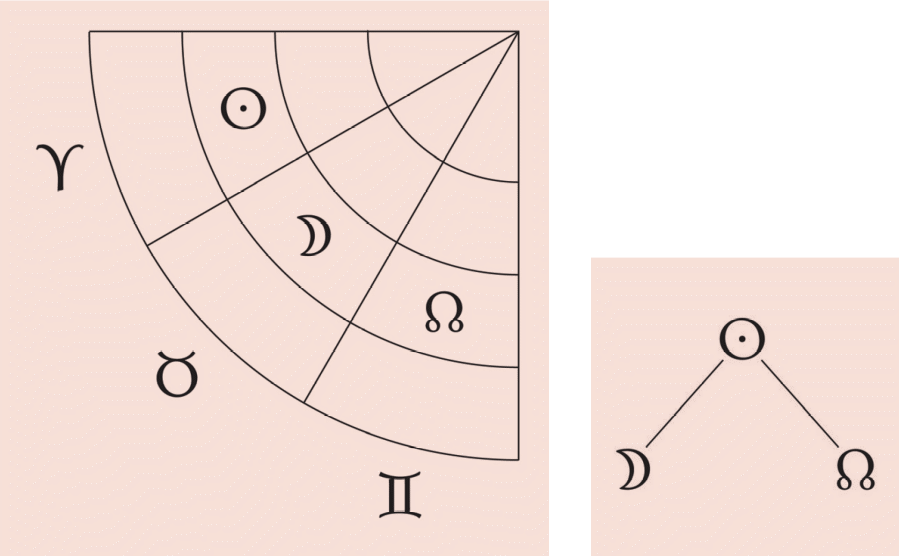
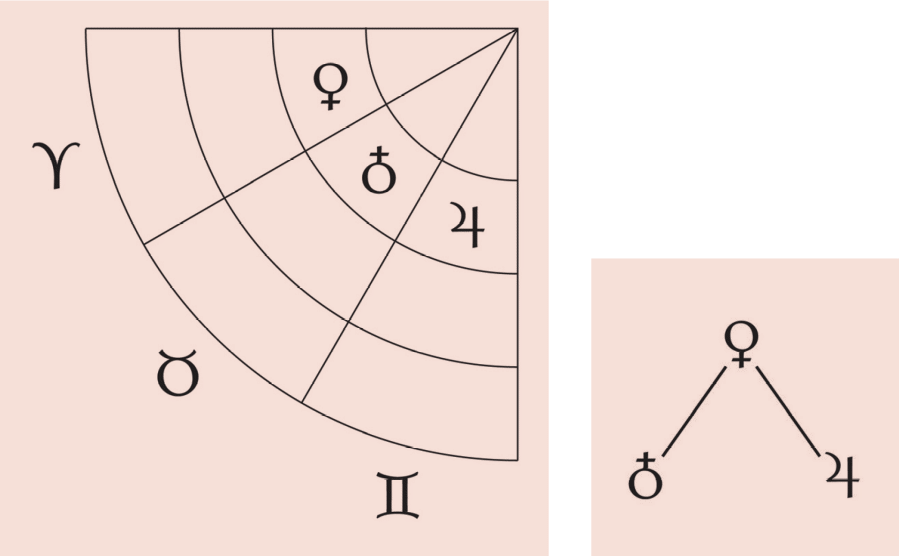
AS: Now we should have this picture in front--everybody knows-- [Note: See FIGURES 1982 0521a-6, 7, 8, 9, Double Act: Mars, Sun, Venus in Aries, Saturn in Aries, appended to this transcript. These diagrams are from Astronoesis, pp. 61-64.]
Astronoesis draft, cont. (AS reading): "The Mars in Aries represents the Pure Being of the One, and in manifesting the infinite fullness of the Absolute reveals its double nature as Venus in Taurus and Mercury in Gemini. Venus represents the totality of essences, the Being of Infinite Possibilities of the objective aspect of Mars. Mercury in Gemini, the Being of the passive or Subjective Wisdom Consciousness. Thus Mars is manifesting the double act or paradoxical coincidence of the opposites that now may be conceived as the aspects of this double act.
"The Sun in Aries, the Intellect of the Transcendent One, or the Author of All Being, exposes another version of the double act, two complementary aspects of Unity's undifferenced wisdom -- the Moon in Taurus the activity of the Infinite Possibilities, and the Head in Gemini their eternal Ordering equivalent to an understanding or intellectual Numbering. Thus the Sun is manifesting the nonduality of the totality of the intelligibles of these essences in their eternal self-comprehension.
"Finally Venus in Aries, the Infinite Nature of the One, projected into view by the totality of power inherent in the possibilities: Mars in Taurus -- Shakti, conjoined with the undivided power of the Subjective Wisdom Consciousness -- Shiva -- or Jupiter in Gemini. The reciprocal and mutual interpenetrating aspects of this one-continuum expresses the identity and indivisibility of the One which then allows us to cancel out others. This inner completion is the act of the One remaining in itself, stillness reigns."
S: Avery, can you reread (inaudible)?
AS: Okay, I can go through them again-- I guess you can't see the diagrams on the board, so anyway but you know-- (inaudible) Without going through each one of the ones in that central column and seeing how the left and right come out of it. [Note: See FIGURE 1982 0521a-5, Triad arranged as Kabbalistic Tree, appended to this transcript.]
Astronoesis draft (AS rereading): "Mars in Aries represents the pure being of the One, and in manifesting the infinite fullness of the absolute, reveals its double nature as Venus in Taurus and Mercury in Gemini. Venus represents the totality of essences, the being of infinite possibilities as the 'objective' aspect of Mars, as the so-called objective aspect, I mean objective in quotes. Mercury In Gemini represents the being of the passive or subjective wisdom consciousness. Thus Mars manifests the double act or paradoxical coincidence of the opposites that now can be conceived as aspects of its double act.
"The next one, the Sun in Aries, the Intellect of the Transcendent One, the Author of All Being, exposes another version of the double act, two complementary aspects of the unity's undifferenced wisdom-- the Moon in Taurus the activity of the infinite possibilities; and the Head in Gemini their eternal ordering equivalent to an understanding or intellectual numbering. Thus the Sun is manifesting the nonduality--"
S: Read the Moon and the Head again, Avery.
AD: That's kind of dense, we'll have to give it to Randy to (inaudible)-- What we're saying, David, is something like this, when we split it up, when we say that this here is manifesting houses 2 and 3, the same time you say that it's manifesting houses 2 and 3, each of the intelligibles goes with it and it's not just an empty house, okay? You follow that? So if you say that if Mars is manifesting the double act, or let's say all the intelligibles are manifesting the double act, houses 2 and 3, at the same time what's being manifested is each of the intelligibles. So this Mars would be manifesting the Mercury and Venus alright; the Sun the Moon and the Head; Venus Mars and Jupiter. Okay, you follow that? (S inaudible) Okay. Then that means when I'm doing this very specifically for a reason -- this way I have the six intelligibles available, the way I have the four that are manifesting the double act, and that's going to give me the 10 aspects of metaphysical infinity that I have to have. Because there's 10 in the first quadrant. Now the same way you say--
[Audio File 1982 0521a Ends]
[Audio File 1982 0521b Begins]
AD: See the point is as we're saying this, the point is as we're saying this, that the One always remains what it is, absolute, unique, there's no changing. So what we're doing is really accommodating our way of understanding, trying to understand which can't be understood, that which can't be understood, that's what we're really doing. Because we need to apply this here-- In other words, once I understand the nature of unity itself, then I can understand anything that's a unity, anything that's an idea, anything that's a principle. But the paradigm of all of that is in the nature of the One itself. Because the One is perfect, then it is the paradigm for any idea, any entity, any unity, any principle, they will all have that as its model to look up to. And they will duplicate it in some way or other. Okay, that's the goal. And also the other goal is the notion of participation.
DR: The hard part is that there doesn't seem to be that there are many aspects, you have to speak in a dubious way (inaudible)
AD: You have to wipe them out. (DR inaudible) I'm sorry, go ahead.
DR: The hard part is grasping that this paradigm takes place in this double act, the double act in some way -- it's understandable from these two views of grasping the One, the monistic and at the same time as a source--
AD: See, I don't like to use the-- alright-- keep trying, go ahead.
DR: You say that the One has to remain intact, and at the same time includes everything.
AD: Well, it includes everything in a paradigmatic way, so that the principle of the Intellectual will be in the One. It isn't that the Intellectual-Principle is part of the interiority of the One, but the model or the paradigm of the Intellectual-Principle is in the One, the model of Being is in the One. So if the model of anything that exists below the One, the model of it is in the One. And then you think of these models as absolute perfection, each one of them perfection in itself, and then synthesize them as like fused into a uniqueness that can't be separated one from the other. Then this gives you the absoluteness of the One which you can't tear apart anymore. But to say that the One is a simplex is not to say anything. The way I want to do it is to say that the One is a simplex in the sense of showing the tremendous complexity that's in the One first. And then show that it's a simplex. But if it's a simplex in the way that we understand, alright, then we would have to say to ourselves, but how could anything come out of it? How could the Intellectual-Principle have its essence there if it is this utterly simple primitive raw kind of stuff. So we have to show that in this primitive raw kind of stuff is the germ or the potentiality-- and that's even wrong-- because it isn't potential, it's more real than the actual, that's the problem.
DR: At the same time we still have this problem of the double act, right? Almost the Dyad is each one as a double act?
AD: Each one of these has a double act?
DR: Right. You keep repeating this over and over again.
AD: Only this here, only this here has a double act. We started out-- the premises was that the house represented the passive perfection and the intelligibles which are hidden, so to speak, and unmultiplied in the One represented the active perfection, okay?
DR: Didn't we get to that somehow by this double role that the One is going to-- the double way in which we will have to understand the One?
AD: Yes, I'm just saying. So we're symbolizing the double act-- we're symbolizing the houses as passive perfection, the intelligibles are active perfection, the two of them together are what we're calling the Transcendent. [Note: See FIGURES 1982 0521a-1, The One-Only, and 1982 0521a-2, Active and Passive Perfection, appended to this transcript.] Okay? Alright, now if these operate, if these intelligibles operate and they manifest what's in the passive substance, alright, it would have to be a manifestation of the double act, wouldn't it? So it's not only that you double the houses or divide it in there, if you want you could divide it in there, but you also have to do that with the intelligibles. Because the active perfection itself has to be subject to that act. It is part of the double act. What you want to do is you want these to manifest two houses with no intelligibles. Isn't that so?
DR: I don't know--
AD: Well, I mean--
DR: It's not that (inaudible)
AD: Well, you have to decide (a few student chuckles)
DB: I'm not sure if I completely understand the problem, but isn't the point that you're emphasizing is that the active and passive aspects of the One can't be understood in any way being ultimately distinguishable. So when you speak of the double act, it has to be referred to as, it has to be spoken of as the substantial portion as well as the functional-- because to do it otherwise, would be to limit the double act to just the functional aspect.
AS: I guess beyond the astrological example probably-- I don't know if you could to transpose it. (DB inaudible) The astrological example. Say you have Mars in Aries. Now Mars isn't just manifesting Mars, at the same time that Mars is functioning you'll also have Aries being manifested. And at the same time that Aries is qualifying Mars, characterizing Mars, conditioning Mars, the Mars itself is being manifested. So both of those, you could look at every time that you have a function, you can't just speak about Mars, it's Mars in Aries, so automatically you have the double act, you have the act of substance and of function, anytime in astrology. You never just speak about Mars functioning unless it was in some substance. You never never just speak about the substance being manifested unless you spoke about the function. And even to speak about it as the Mars functioning and the sign isn't functioning in a way that's true, but in a sense they're always simultaneous, you always have both of them together. When Mars is manifesting, the sign itself is also being manifested, both go together, and so there you have a kind of double act. But here you're trying to conceive that even there where they're almost inseparable even in the astrology, they're absolutely united here. So within either one the Mars functions, and then you could go even further and say the Mars functions, and in the Mars functioning, it's manifesting itself and it's also manifesting the passive aspect of Aries. So it will be functioning in a twofold way. And then Mars is manifesting Aries, Aries is being manifested, Aries itself is being manifested actively through the Mars also. So Aries itself will take on a passive and active. So the function that's doing it and the substance that's being manifested both will partake of the active and passive, this is in a dualistic mode in the chart. But I think it's similar in the empirical, you never have one without the other. And then in the second aspect either one of them will also be in conjunction with the other manifesting itself and itself in relation to the other one as it were, and you'll have an active and a passive.
AD: Of course the basic presupposition here is you say-- you could say, well look, you're using astrology, and that's-- you know, that might be-- I might be incorrect. But my initial premises is that it's the world I live in where I'm going to find the answers to the problems I see, and not by reading the footnotes to somebody's book. 'Cause this actual world where the planets are out there, are revolving, and you know we look at it, we see something going on, we look at the ephemeris and sure enough the next day we're in for some kind of disturbance or headache or whatever, and we can see that there's a correlation (there). Don't take it any further than that because I'll interpret it differently than you will, but we see that there's a correlation there. We begin to say well, it seems that there's some sort of synchronicity between the states of mind that I experience and the aspects that are going on out there -- that's an astrological technique we're all familiar with. Well why not take the whole of that technique and apply it to philosophic problems --because this is the real world! That one out there. Those planets aren't moving on anybody's whim. They're moving according to certain immutable laws which are not illusory, and which I won't say are emptiness. They're damn real! And that's what I'm going to base my understanding on.
AH: (inaudible)
AD: No, they're not as real as the One, exactly, Andrew, exactly, but they're real enough, they're real enough for us.
(very short inaudible S/AD interchange)
RC: What you've diagrammed so far, you're saying now: ". . . from its perfection and from the Act included in its nature there emanates the secondary or issuing Act . . ." [V.4.2]
AD: Is that the quote?
RC: Yes. ". . . from its perfection and from the Act included in its nature there emanates the secondary or issuing Act . . ." [V.4.2]
AD: See, I would say that that's wrong.
RC: It seems that--
AD: No. The word 'emanate' is wrong.
RC: Right. It seemed that what you've diagramed here was that (inaudible)-- it seems that you're diagramming the internal structure of the double act in the One, and that you haven't come to apply what you speak about an emanation (inaudible). And from here emanation follows.
AD: Yes, because the whole point is that we have this absolute oneness, and we said now, we imagine that it has parts, and they existing a distinctionless mode within this absoluteness, alright. And we have to take them and manipulate them around and imagine that the One or the absolute power of the one is organizing and manipulating everything around so that's it's complete and final perfection. Then we say, now we've got the total perfection alright, then we *forget* it ever did anything like that because that's only our way of understanding. Once we grasp that complete perfection could never have had a before or an after, because if it had it wouldn't be perfection-- now that we have the absoluteness and the uniqueness of what makes the Absolute to be the Absolute and we have, so to speak, all the monads lined up within it, above it, which is the interiority of the One --remember the diagram, okay? [Note: See FIGURE AD_I_1337, Triad: Henads & Monads, appended to this transcript.] Then we could say, now emanation will take place.
The same thing like the example I used that Avery liked, imagine a nichrome wire or any kind of wire with electricity pouring through it, and it reaches such a stage or such an intensity that it glows, alright. Now take the nichrome wire away and imagine the glowing-- the glow persisting. Now you can speak of that being an emanation. That is a distinct existent from the wire with the power charging through it. Alright, that would be the real 'one,' that would be absolute, there is no other like it. Now the glow or the glow from that would be the secondary principle. And the glow let's say will emit heat, that would be a tertiary principle. Now we can speak of emanation, but not before, and not until we understand the completeness of the One.
RC: Would you be willing to say that in terms of the quote that what you've diagrammed has not gotten to what he calls the secondary or issuing act?
AD: Yes. We're not up to that, we've just stopped short of that, just stopped short of it.
RC: The perfection and--
AD: The issuing act would be what we call the completeness of the One. And now that the one is absolutely complete, total perfection, and that means lining up those things the way we saw --we look above each of the ten aspects of the Triad, and above it they're all in perfect order, and we saw-- And now that we have that, and only when we have that, we'll say the issuing act results in the Intellectual-Principle.
RC: Okay, I think that deals with that difficulty, at least I've had for a long time in terms of putting these two together. If someone took you to be saying the conceiving of the Venus and the Mercury from the Mars was the secondary or issuing act--
AD: No.
RC: That would be incorrect and if so (inaudible)
AD: (inaudible)
LC: You're saying there really aren't two double acts.
RC: Right, the diagram-- He's diagramming the acting included in its nature by means of those dignities, he's diagramming the perfection by means of the houses.
LC: It's only the secondary act, it's not the second act, but it refers to the other aspects of the One.
RC: Yes. So if I'm following now, then in the sentence, "From its perfection and the Act included in its nature" that's as far as this diagram goes. To diagram the rest of it we'd have to go to the second quadrant.
AD: Well no. No! That's where I stop, that's where I stop and I make a big issue out of this. What does emanation mean?
LD: Well you know--
AD: This is very important.
LD: Anthony, that example you used, I don't want to get picky about your examples, I like it so far as you say that this wire that's charged with power that glows, but I don't know why you say the second part, then next part you said well imagine taking the wire away and just having the glow.
AD: Alright, leave the wire there.
LD: You can't take the wire away.
AD: I know you can't, but I did it for them, it's a nice picture.
LD: No, no. But isn't it the point that you can't.
AD: Of course you can't, all the other principles depend on the One.
LD: But I'm saying, Isn't that misleading to say that you would still have the glow if you took the wire away.
AD: I just wanted to exaggerate the hiatus between the uniqueness of what a One is, the absoluteness of a One, and everything else that comes after that. There's a part where I'm explaining, where you speak about what it means to speak about the One without-a-second, I am not interpreting it according Vedantic clichés, I am not doing it way, I don't even want to bother with that.
LD: I can follow that so far as -- I can focus on the glow and the wire.
AD: That's what I want you to do, because that's almost like a hiatus, that's like an abyss, between two orders of Being -- one Infinite Being and the other one Form Being or Intellectual Being. To give you something of like when PB speaks about the Absolute Mind as a sky and a cloud within so to speak is the Intellectual-Principle, and you can imagine many of them coming and going, but the sky always remains there. In the relation to the Intellectual-Principle to the One, there's no symmetrical relationship, it's an asymmetrical relationship.
LR: And (inaudible) that point the reason that we need (inaudible) is not imagining symbolically that the One is the totality of the chart, why you can't imagine the One as the totality of the chart-- in a sense you can because (inaudible) but I remember you're saying there that the reason that would incorrect would be that then one would think of the One is limited to that which is within it.
AD: It sort of deprives it of its uniqueness, its transcendency. See transcendency means here that this will always and forever be self-identical and it will even have to drop out 'self', because that implies a kind of dualism. That it will always be and it will never be anything else-- you can't imagine a time when it wasn't perfect or a time when it will become perfect but will lose its perfection. But you can't think of the Intellectual-Principle as not yet achieving its ideas.
DB: I-- that one quote that was brought up, that Avery brought up, Randy brought up, regarding the secondary or issuing act, I thought I understood previously where that was being placed in regards to the diagram, but I'm not sure of anymore. Is it when--that you're saying that what he's referring to there as the secondary or issuing act are the necessary implicates of the transcendent's unity and not many emanation from it?
AD: It's (inaudible).
DB: Okay. But if it is in some way an elaborating of that self-sufficiency--
AD: --or a completion of that self-sufficiency. But once, like I said, once you achieve or come to the completion of that, the completion would cancel out all the reasoning processes that brought you up there--the notion of the (completeness, etc.), drop them, that will leave just the completion. It's like you've got to baby your thinking. (DB inaudible, then student laughter)
You can't do it, you can't (inaudible). And the other remark I made was that these things were given to Plotinus in intuition. It isn't that they were reasoned, it isn't that the Intellectual or the One reasoned out for him, they were given to him in intuition and then he reasoned them out, and we had to follow that reasoning process. That's why I say he holds a model up, if you follow that reasoning that he's following for us or exemplifying for us, then we could reconstruct what he's talking about. Let's read a little bit more. Let me take advantage because this [discussion of the One] probably won't happen again for a long time. Avery, do you want to read a little more?
AS: Yes (inaudible). Well, I'll read a little more (inaudible) not sure, be a little patient right here, I'm having some troubles reading it.
AD: (inaudible) where they speak about (inaudible), you're going to find that you're going to find (Jung) speaks about the unity and identity of the self, and I'm telling you it's not that simple, it's a helluva lot more complicated than he makes it.
(inaudible student comments, laughter)
S: This first would be a repetition (inaudible) of the One, and the (Intellectual-)Principle amongst principles but of course (inaudible)
AD: Okay, okay.
S: That bothers me a little.
AD: No, that's alright, that's fine.
S: And on the other hand of course, you're speaking about it otherwise--
AD: Yes. --as including all the principles within it paradigmatically.
S: Paradigmatically, okay, I could accept that word.
AD: Yes. Everything is getting complicated, right?
S: Yeah, okay, what I didn't understand--
AD: And it's going to get worse--
S: The reference Linda made to some remark of yours is you can't consider the whole metaphysical chart which includes all the dignities.
AD: She wants all the (inaudible) (S inaudible) All she's saying is that she wants me to think the chart, the whole chart, the way it is, as the transcendent One-- I can't.
LR: (inaudible)
S: Well, I don't see way you can't because they're all transcendent.
AD: In the transcendent One, in the transcendent One, there are two, the active and passive perfection, have to be thought of as identical with each other. Substance and its attributes are not, are non distinct. Now once I spread everything out in the chart, I distinguish them, I've laid them out, I've spread them out, so it's no longer transcendent, I'm showing the active and the passive perfection as different from each other. How could that be transcendent? (S inaudible) Alright, I'll get to that next, I'll get to that next.
S: Each dignity would have an active and passive perfection.
AD: Yes. And so would each Idea! That wouldn't be transcendent. The Ideas are universal, right, and it contains within itself the power to manifest itself. And it does so. Okay? Now the Idea of horse manifests as horse. Now is that the transcendent one? No, of course not. There's only *one* of its kind. The One is without a second, there is no other principle like it.
S: (inaudible) Idea that could include rest of the chart?
(AD inaudible; Ss inaudible)
AD: Yes. Over here Plotinus demands a precision of thought that you must follow, must follow (inaudible).
S: See it must be (inaudible) operating you'd be considering each dignity or maybe combinations of dignities, but each one anyway as an eternal principle.
AD: Yes.
S: Therefore can't be excluded. It may not be--
AD: Can't be excluded from what? (S inaudible) No, but we're going to show in what way, in what way that is. Now you're jumping ahead. We're going to show, like for instance, if you take the Idea-- Bert, can you see the chart up here? If we say for instance that this which is part of the Triad, which is part of the Universal Being, this is an aspect of Universal Being, okay? And he says that there's a paradigm in the One of Being. This would be the paradigm of Being, okay? Now all these are beings, okay? These depend on that, they're emanated from it, like if this is the hot wire, this would be the glow. Okay? Now these all depend on that, this does not depend on any way on them. There's a hiatus here, there's almost an unbridgeable gulf, unless you understand emanation. Like I could be so happy and full of joy that I infect you without actually touching you --that would be the day. (student laughter) We're going to get into this notion of emanation, we're going to get into this notion of emanation-- (laughter continues)
S: (inaudible)
AD: I don't remember, tell me about it.
LD: The opposite example, (inaudible) would understand this.
AD: I'm sorry--
LD: The opposites, the converse--
AS: You mean, if you're happy, then it'll affect him.
LD: No, if he's not happy, then it's going to affect us--
AD: Anyway, we're going to bring this up in just a few minutes, where we're going to give an example of an incorrect understanding of emanation. And I pulled a quote out willy-nilly from Armstrong. I could open any text book and I could get the same thing. When it comes to the notion of emanation--that's why I had that paper by PB read. Can we have that one again?
AS: Armstrong?
AD: No, the one on PB. I know, he makes it so direct and so-- [what follows in quotes is from PB, emphases are AD's not PB's] "The One does *not* [AD emphasis] become the Many, for the orders of being"-- all this here -- "the orders of being and consciousness are different." The consciousness in the Intellectual-Principle is different from the consciousness of the soul. "It remains what it is" --the One remains what it is-- "and from *it* emanates the many. The universe is much more an emanation than a manifestation. Because it is an emanation rather than an illusion" --then he goes on. So he really makes a distinction. What we're going to do is exaggerate, we're going to show what Armstrong thinks emanation is and what we think it is. It doesn't matter, like I said, we could pick any one of the commentators of Plotinus Like (inaudible) said, they read words. Like they have eyes, they have a mind, they have no vision.
S: Avery, was it said a few months ago, remember?
AS: No.
S: Somebody said a few weeks ago that the whole of the chart can be considered as -- I don't know what the right word is -- manifesting or emanating within the Body of Saturn and that's how we can conceive of--
AS: When we talked about the principle of emanation and all of these unities are going to be, or are going to appear, or are going to emanate-- These unities are going to emanate Being and Soul and Body -- through this principle of infinite space, the principle of Difference, the Saturn. Yeah.
S: So I was just trying to understand that idea with what Anthony was saying about that the hiatus between the orders of Being and the Triad there--
AD: (inaudible)
AS: What?
AD: PB's example, this is only going to throw her off. She's talking about the Saturn in Aries.
AS: This is an example from Armstrong, maybe I should just--
S: --the Saturn is just---
AS: Armstrong, pages-- it doesn't matter.
A.H. Armstrong, *The Architecture of the Intelligible Universe*, pp. 2-3 (AS reading): "This dependence persists even when, as in the eighth treatise of the Sixth Ennead, [AS: What we just read.] the One is described in terms almost identical with those applied to Nous, or at least in language which suggests something more like Nous . . ."
AD: What's the matter, doesn't he know the difference?
A.H. Armstrong, cont. (AS reading): ". . . than the unpredicable . . . unity, the One-above-being, of other passages. In VI.8 the One is called pure will, absolute . . . love, and that love of Himself, and the cause of Himself, and thus the cause of all that proceeds from Him, not merely the ground of all being in the sense of a primal element, but deliberately willing Himself and all that comes from Him. He is said to include all His effects. This positive description of the One is very closely connected, especially in Ch. 18, with the light-metaphor of emanation and the comparison of the One to the sun, a metaphor found throughout the Enneads [AS reads: which is a metaphor he uses a lot]. It is obvious that this self-directed, self-loving God (I am using the terms of a later theology deliberately . . .), whose Being is Act directed upon His own perfection, from whom all other orders of being proceed as images of Him of varying degrees of adequacy, is not the mathematical Unity to which it is impossible to apply any predicate whatever."
AS: So he's saying, this description Mr. Plotinus is a little different from the way you describe mathematical unity, no predicates whatever and so on. He's objecting to the way Plotinus is now speaking about this One as emanating as comparison to the Sun and so on.
A.H. Armstrong, cont., p. 3 (AS reading): "Plotinus may protest as much as he likes that he intends to introduce no sort of duality into the One, and that any appearance of appearance of duality which his words may suggest is due to the limitations of language. He takes [AS reads: is taking] the decisive step when he makes the One . . . [AS reads: something or other] and gives it will, [AS: he says] makes it eternally create itself and return eternally upon itself in love."
AD: You see how he puts the whole thing in the realm of causality and temporality? The whole thing is conceived in that way. So it has to become an evolving God, a God who gets more perfect with more time, I'm sure.
AS: Then he goes on and says--
A.H. Armstrong, cont. p.3 (AS reading): ". . . [AS reads: Once he takes this step of course inevitably it must be] a one-in-many. It becomes a being to which predicates can be applied and about which logical distinctions can be made."
AS: And he obviously interpreted the Parmenides that way too. That's (inaudible)
AD: You see when he speaks about 'He wills Himself to be as he is,' [Note: See Plotinus, VI.8.16, more in VI.8.13-18.] and you put that in the framework of temporality and causality, you've misconceived the point that he [Plotinus] has gone to so much pain to elaborate. it isn't that he willed himself to be, it's not something that he's doing, what is done in the absolute is eternally, simultaneously ordered and accomplished, it is an achieved perfection and achieving, he has no tense. But he [Armstrong] is going to interpret theologically -- why? -- because his training was theological. He trained to be a minister. But at any rate, we got a little longer, either they're paralyzed or they can't tell anymore.
LD: I don't see how that answers my question.
AD: If you can't see, that's not my problem.
LD: Well you got to help me a little -- I mean, I am your daughter-in-law, right? (student laughter)
AS: You've used that already once, Laurie. (laughter)
AD: A foul if I ever heard it. (inaudible) (more laughter)
S: What if it's relatively real?
AS: Laurie, what was your question again?
LD: You were speaking about the hiatus between the Triad and then the orders of Being that come under that, that there's a gap there. Is that right?
AD: There's an ontological hiatus.
LD: Right. I just don't understand why that all of those orders of Being can't be conceived of as within the body of Saturn, as you said -- I guess I didn't understand that -- but I'm just trying to put those two ideas together.
AS: See, you're doing the same thing that a famous person here once said that it's the Principle of Difference that unites beings in the One, and this is saying that the Principle of Difference is what allows them to be *distinguished* from the One, if I could use that terminology, I'm not sure. The fact--the Principle of Otherness -- see if we call Saturn the Principle of Otherness -- as a principle it's within the One, but it's the principle of *Otherness*. So it seems that it's the principle which allows for distinct hypostases to be distinct, not that it causes the other ones, not like the Principle of Difference is the cause of Being in that sense, but it's necessary that the Being can be hypostatized as a distinct principle. In other words, when these unities emanate, the principle that will allow them to emanate as a *distinct* principle as distinct, would be the Principle of Otherness. If there were no Principle of Otherness there couldn't be real levels of manifestation, he says Intellectual-Principle is an image, but of a power so great that it "stands a reality." [Note: See Plotinus, VI.7.40, fourth para.]
JA: That Saturn, that Principle of Difference -- Saturn (inaudible) we can see--
AS: He says-- In another place he speaks of it as this 'cleavage' away from the One. I think-- I'm not sure -- I would interpret it -- the Principle of Otherness or Difference is what allows the distinct hypostases to stand as distinct.
AD: (inaudible) let me put it this way--
AS: However--
AD: We're going to develop 10 different aspects of this here, and one of these aspects are going to be referred to as the principle of authentic falsity. (inaudible) We first have to develop the Triad, all the ten of the Triad, then we have to specify what each one of them is the principle of. So he said the Sun is the principle of Being, everything suspended underneath or emanates from that principle. The same with the Moon, the principle of Life, all of the principles of Life will be suspended under that. You go all the way across until you get to Saturn. Now all these principles are going to manifest, Saturn is the principle within which they manifest, it is the locus or the space within which they manifest. So that's irrelevant now. That's why I'm trying to follow this in a very sequential order, one step after the other, if you jump one step, you'll have to take three back.
LdS: (inaudible) It seems that first you established the locus of the emanants in the transcendent aspect of the One, by looking at the first house and then at the first quadrant.
AD: You establish first the One as the absolutely One, okay. Then the next step is to establish that there are two ways or two aspects to this One, one of them is called active and the other one is passive perfection, okay. And we established that power is the chief characteristic of the One, it's pervasive just like its Intellection is pervasive, just like its Being is absolutely without form, shapeless and unfigured. As we do this, that means we have to show that the interaction of the One and the Dyad is establishing each aspect, each thing that we're calling an aspect. Then when we have the 10 aspects we also have to keep in mind that this is not something that's going on in the process of time, causality, or temporality--that this has been totally achieved, alright, there's been an ordered and eternal simultaneity from beginninglessness, until the end of end, that's it, that's the Absolute. Within that, we've established all this. When we've get this all established, and we can conceive 10 aspects, then we *forget* that there was ever any ordering, any completion, any act within it, any self-tendance towards it, all that gets canceled out and abolished.
LdS: One point, I'm not saying that this is all the issue, but one thing that seems that was important tonight was that in establishing the immanent aspect of the One in the first quadrant--
AD: What do you mean by the immanent aspect?
AH: That the fact the One is the place or is the principle that is going to have --
AD: By immanence we simply mean the extension of power.
LdS: Let me try to finish-- The contribution that's being made here, in opposition or in juxtaposition to other commentators, in speaking of the immanent aspect of the highest One, the way I see it, is the unique contribution here is the fact of establishing its immanence by not in any way necessitating or calling for the descent of the One into those principles that it will be the immanent principle of, okay. And further, the way that's being done, one of the ways of taking care of that, is bring in the notion of participation or emanation, (inaudible) the principle that preserves the immanence and transcendent aspect of the One, and does not require that the One in any way will descend into those principles that will have a stance of existence beneath them.
AD: I wouldn't put it that way. Louis, the way I would put it is that I'm simply trying to understand the internal schemata or the interiority of the transcendent One, and when I understand that then I know I have been kidding myself that I could understand it and I have just the transcendent One.
LdS: But when you say that, you're going to establish the interiority of the transcendent One.
AD: Yes. We said that a one does not mean simplicity except in the sense of the word --that it's an awesome complexity.
LdS: Yes.
AD: Something we can't even imagine.
LdS: But what you're also establishing in that interiority of the transcendent One, is that aspect of the One which is immanent, what we speak of the immanent aspect of the One, you've got to put also in there.
AD: But why do you insist?! I say no!
LdS: Because you're not only-- you're answering the question it seems to me of how--
AD: Here's when we speak about the immanence of the One, insofar that it emanates, it's immanent. Insofar that the fire and the heat are together, and the heat let's say projects out, that the fire is immanent in the heat, is that what you mean?
LdS: Wait, that's all I'm trying to say is that the principle of emanation that you brought up, that Plotinus brings up, is the way that you're preserving--
AD: --the integrity of the transcendent.
LdS: Yes.
AD: Yes.
LdS: And you used the example of the wire, and you think of the wire as glowing, and then take the wire away you've got the glow, well to me that example is indicating that you don't--
AD: If you took away the wire, if you took away the wire and you just have the glow, then you have just the immanent One.
LdS: Yes but-- (student laughter) --the way you're speaking of immanence is this peculiar way, you're saying it's following Plotinus, that is that the One truly does not descend into those principles, it's immanent in a funny way, it's immanent not by being there, localized in its lesser principles, but only through emanation.
AD: Yeah. (inaudible) Emanation--
(Side 1 of original cassette tape digitized as 1982 0521b Ends; Side 2 Begins)
(shuffling sounds and people inaudibly talking)
AD: If an analogy doesn't (tell) you then throw it away and get another one. But that's the point, yes. And as a matter of fact I like that expression so much I'm going to include it. 'Emanation preserves the integrity of the transcendent One.' And that's why it's so pivotal in understanding Plotinus. Because if anything, even PB, he almost yelled at me and he never yelled, when I-- I happen to modify the absoluteness of the Self once, wow, he turned upon me with such fury that I went to the other side of the table. Anyone who's had the experience of the One will react like that. That has to be preserved at all costs, regardless of what the theologians want to do with it. They feel uncomfortable with something like that. They like to think of God as their father. Well, I don't see why this stops them from thinking of God as their father. (inaudible) (student laughter) Look, why don't you pick up just that part on the emanation and we'll call it a night.
AS: You want the page on emanation?
AD: Yes, there's-- in contrast there's the Armstrong thing you just read. Then there's Plotinus' note on emanation, alright, and then there's a couple comments made on that.
AS: We read the thing from Armstrong. And then there's the quote from V.1.6. I think you ought to (inaudible)
Plotinus V.1.6: "All existences, as long as they retain their character, produce--about themselves, from their essence, in virtue of the power which must be in them--some necessary, outward-facing hypostasis continuously attached to them and representing in image the engendering archetypes: thus fire gives out its heat; snow is cold not merely to itself; fragrant substances are a notable instance; for, as long as they last, something is diffused from them and perceived wherever they are present.
"Again, all that is fully achieved engenders: therefore the eternally achieved engenders eternally an eternal being. At the same time, the offspring is always minor: what then are we to think of the All-Perfect but that it can produce nothing less than the very greatest that is later than itself? This greatest, later than the divine unity, must be the Divine Mind, and it must be the second of all existence, for it is that which sees The One on which alone it leans while the First has no need whatever of it."
AD: You can see how this is the reasoning (out) of the theory of emanation. For if the one is eternally perfect, then the universe is eternally generated: there isn't a time that it started, and there won't be a time that it ends. Can you follow that? --the implications are very clear, Plotinus is saying it didn't start 4,200 BC. As long as the One has been there, the Intellectual-Principle was emanated, the world will be there. And we can see why a man who studied Christian theology is not going to attempt to understand what he's saying. Christian theology, the world started, it was made out of nothing, it had a beginning in time, it will have an end in time, it's a historical myth that they keep living. Alright let's go on, Avery.
Astronoesis draft (AS reading): "A delicate balance is required here, for thought is walking a razor's edge. On the one hand we can introduce a hiatus that leads to metaphysical dualism and which is proper and appropriate for the intellectual understanding. On the other hand and in contrast, we have a monolithic monism, a unique and unknowable omnivorous God, which is appropriate to the absolute stillness of the advanced contemplator. It is the simultaneous grasp of these two views which will exemplify the paradoxical nature of reality, which is the unique contribution of the philosopher-sage, and which in following will supply us with completion and balance.
"That perfection engenders, that the eternally perfect engenders eternally, is not a theme for discourse but rather for contemplation. Repetition is necessary: emanation is the principle that leaves the One intact and undiminished, its integrity unspoiled and its evenness undisturbed. Whatever reality the engendered reflection may have is not being denied. What is maintained is the unimpeachable sovereignty and integrity of the One. The One-without-a-second of which there is no double, nothing similar, may be better approached by conceiving it as meta-ontic infinity. This will permit an accommodation to our mental processes, it will also make possible a relationship and comparison to other philosophic traditions. We can conceive of metaphysical infinity as having many facets, and may even be helpful to consider it that way. Each and every aspect that we consider may be referred to as a unity and regarded as metaphysical infinity in a certain way or mode. The Kabbalists would refer to this as the Sephiroth which would imply that each and every aspect can be spoken of as a god--above Being, above Life, and above Intelligence. Expediency dictates the advantage of this usage, especially since it will permit us to evolve a visual aid bearing immense practical applications."
AD: So we sort of (inaudible) this.
JfL: The problem that I have (inaudible), given the Triad, the immanent nature is meant there that there's no holding it back, even if there's a hiatus as you've described, it's a bit of a--
AD: It's not really a hiatus, Jeff, maybe that's wrongly put. When he says that fire projects heat, one the hand it contains heat within itself, and on the other hand it also projects the heat, alright, and the same with odorous substances. We don't want to say that there's a real break in the continuity, between the transcendent One and what emanates from it. What we really want to say is, to go back to the analogy of the wire, it's glow, yes, we want to say that we have two very distinct levels or stadia of existence. The wire let's say represents the One, the perfection and absoluteness of the One, and the glow from the wire is a different stadia--altogether of existence, from its prior. So you can see that there's not an ontological hiatus, but that there is a lessening of the greater reality, from the most real to the next which is most real, and a next which is most real . So there's a continuity but it's a lessening of reality. So Plotinus wouldn't speak of a lesser reality as illusory. He'll speak of it as Real Being--it is real, but not as real as that [the One].
S: (inaudible) Intellectual-Principle--
AD: Because the One itself is absolutely self-sufficient. It has no need of anything, it is completely perfect, alright, everything else like PB says, disappears, dissolves, but that always remains what it is. So they always depend on that. So for Plotinus of course, the prior, as you might say, has a higher status in terms of reality. The Secondary depends on that for whatever reality it has. If I took away the wire, like someone so wisely pointed out, I'd also take away the glow. And naturally that would be so. But I could imagine the wire getting very hot and giving off a glow. So the glow is a secondary always. And the important thing here, as Louis just recognized, it preserves at all costs the integrity of the One, no matter what. If you understand that, everything else will follow. Destroy that and then you'll have a One-Many, like Mr. Armstrong wants. Or even like Proclus at times used to be, you know a little (inaudible). Okay?
JfL: No, there's still a gap, it seems we're simply moving the hiatus down between the dual aspect, like when the One is (inaudible) as the monistic one and --
AD: It's not monistic--don't (inaudible)
JfL: It can be that though. And when it can't be dealt with until you have a metaphysical duality, right?
AD: Yes.
JfL: And you can't know anything before then, isn't that an aspect of it? And isn't that inextricably connected with the Triad as the emanation, and it seems that then the separation is now these two aspects of the One. You know what I mean? --it's almost like I would to see all those little unities or the dignities suspended from the Triad, all the ones below the Triad there, the emanation aspect, literally hangs from the First the first quadrant or the whole chart. [Note: See FIGURE AD_I_1337, Triad: Henads & Monads, appended to this transcript.]
AD: You could say they're suspended from the unities.
JfL: And then I want to make the hiatus above the Triad.
S: Or the transcendent and immanent (inaudible)
JfL: Right. When I said earlier of this dual nature, that it's necessary in order to have anything-- you can't have either one -- alright these are the two aspects within the transcendent. It's, not the Intellectual-Principle as dualism and the One, is it? Isn't it this first, the dual aspect of the One looked at monistically in a transcendent sense, and metaphysically dually in the immanent sense?
AD: I'm sorry I didn't follow you. Avery, would you help?
JfL: Do you understand?
AS: You're asking about what we read on participation, I mean on emanation, you're asking is that double aspect that 'delicate balance' --let me read it.
Astronoesis draft (AS reading): "On the one hand we can introduce a hiatus that leads to metaphysical dualism that is proper and appropriate for intellectual understanding."
AS: You're asking about that hiatus, right?
JfL: Right.
AS: You're asking where is that hiatus characterized.
JfL: Right. You use the word hiatus, I don't want to put in the Triad or in emanation, is that where you're putting it? I thought it was the dual seeing the power sort of in repose and the power as turning outwardly of the One, and those are the two aspects--
AD: The hiatus I was referring to was to distinguish the One from all the other principles, that's the--
JfL: The other principles, though, it seems like they are connected to the Triad.
AD: In the way that we spoke about, right, they're an emanation.
JfL: Right, and I don't know if I know what that is, but as soon as the Triad is produced, its emanation follows immediately, there's no differentiating the Triad as the first quadrant and eliminating the 2nd and 3rd and 4th quadrants.
AS: But the Triad is not produced.
JfL: When it is complete, when the One is complete as the Triad.
AS: But it always is.
LR: That's not the point he's making. He's saying that the--
AS: I think that's what you have to answer though.
LR: No. I think what Jeff is saying is that the Triad is a logical distinction not an actual one.
AS: Between--
LR: Because the moment you posit the Triad, it you have the emanation following.
AS: Wait, what's a logical distinction following, between -- you said 'it's a logical distinction'.
LR: I think what Jeff was saying that-- and you can correct me-- is that when you say there's a hiatus, it's one of status or power, not actual because the minute you posit--
AS: I didn't hear that--
LR: It's not actual, it's not an actual hiatus, because the minute you posit the Triad or involve the Triad in your explanation, the emanations naturally unfold.
AS: I think he's just saying that the hiatus seems to be 'here we are, we have the world' there is the One and there is a hiatus. And we have to take that point of view because here we are intellects trying to understand it. There's also the other view, we go into the One and there's only the One and there's nothing else and there's no hiatus there, there's just absolute monism the One. Then we come back here and there's the world and the levels of reality, and we can't say they're nothing, they're illusory, they're obviously distinct in some way from the One. So there's a hiatus and at the same time there's a unity and you have to have both points of view, so from one point of view there is a real hiatus.
JfL: Okay. So that's fine, that's a good example, but when you talk about going into the One like that --as if (inaudible)-- isn't that the transcendent One when the whole world dissolves--?
AD: The world doesn't dissolve just because you achieve a temporary identity with the One.
JfL: Okay, is the experience there of the transcendent when you leave the soul behind and you--
AD: When you come out of it, you realize you had an experience of the identity, yes.
JfL: Is the identity with the immanent aspect of the One? Do you ever get past the third house? Is it--
AD: Don't worry about that. (laughter)
JfL: But the point though is that it's a hiatus that Avery is bringing out.
AD: No. This is very simple; let me put it this way, so that we throw out all kinds of sequents-- There's an eternally ordered simultaneity okay? alright? So I don't have to deal with logically what comes first or another. And I'm saying within *that* there is a hiatus. If I take the point of view of an intellectual, then there has to be. If I take the point of view of a contemplator and I think of the identity of the One or I achieve that, then there isn't. There's only monism. And I'm saying that both are required if you want to be balanced. You won't get off that easy by getting on one side or the other with me.
JfL: I'm trying to take both--
AD: Okay, then what's the problem?
JfL: The understanding of and the experience, you can't have either one, you can't just--
AD: You can't have one or the other.
JfL: You have to have both -- I thought--
AD: If you have one or the other, you're not going to have both.
JfL: Oh right. (student laughter) Well if I had either I wouldn't be-- (student laughter and comments) The--
AD: Shut up, Herbie.
LD: I think what I'm trying to say maybe is that both exist simultaneously but the Triad emanates, and that the planets below it have to be conceived of as on different levels but that they both-- that simultaneously you have to try to see those two points of view at the same time. Is it something like that?
JfL: Well, actually the way Avery described it before, where we are here and (inaudible) and you go up, the point is, ok, granted there's a hiatus. If that is the hiatus that's being discussed (inaudible)
AS: Well there are levels of reality. You mean you have to accept that there are these levels of reality simultaneously existent. They're not unreality. If you don't have this hiatus this is one of the things you're going to lead to is just the-- this is going to be unreal-- I mean that's the whole-- that other thing, you're either going to have the unreality-- Don't forget, you're going to have unreality, the unreality of these distinct principles.
DB: Couldn't you just say that from the point of view of the archetypes, you have this simultaneity and identity, but from the point of view of the image you're forced to have a hiatus. So whenever you're speaking of an outward-facing hypostasis of any principle, you're speaking about an image, and it's from that point of view, the point of view of the image, that you're going to be presented or forced to deal with the hiatus. But from the principle which has generated that image, there isn't one.
S: I think Jeff was implying something else, not right or wrong, but the transcendent point of view and the emanation point of view both come from the One. (inaudible)
DB: Jeff, you tried to put the hiatus between the Triad and the first house, right?
JfL: Yes. I want to know if it--
DB: What I'm thinking we've been speaking about is that Triad is not an image of the One, whereas the Intellectual-Principle is, the Triad is still --
JfL: No, I see the distinctions, but I also see how the emanation is immediate and synonymous with it there, and it seems to me the Triad --and bang--
AS: As synonymous with it thought--
DB: Then you'd be back in the unities-
AD: You see the Triad, right in the first house?
JfL: As act and repose--
AD: Yes, can you see it?
JfL: Well, I don't--
AD: Well then it would be one and the same as the transcendent, wouldn't it? We could do it this way, and I think it would be an easy way. (chalk-on-blackboard-sounds) I'm sorry, I said you got to see it in the transcendent, right? (more blackboard sounds) Can you see it right in there?
JfL: Yes. Well likewise I could see it--
AD: These-- you divide-- The passive perfection gets divided into active and passive, so you got the three houses right here.
JfL: And the dignities.
AD: And these [first house dignities] get divided into two. [Note: See FIGURE 1982 0521a-3, One, Infinity, Bound, appended to this transcript.] So you got it right here. I'm going to keep this no matter what, whether you're Mohammedans or Jews or whatever -- because they can't stand any symbol of the One, they don't want any symbol of the One. To an unknown God. This is the symbol of the One for me and out of this I can-- I expect to pull out everything. That's why I wouldn't make this equivalent to the circle. This is transcendent, the integrity always got to remain. And then another thing is this here, if you look at it this way, the whole circle, Linda, okay. Everything that is in the circle would be-- have to contain --the superior version of it would have to be in the transcendent. So you can't make this the same as this. Thanks for your patience, 10:20, heavens knows what happened to you people. Anyway we got 20 pages here. That'll (inaudible). Thanks, Avery.
AS: Thank you.
[Audio File 1982 0521b Ends]
1982 05/21a V11rp: CLASS: Plotinus; One. Copyright 2024 Wisdom's Goldenrod p. v