Seminar
Thursday, June 3rd, 1982
Student notes of a class/seminarWISDOM'S GOLDENROD, JUNE FRITCHMAN SEMINAR NOTES
(TYPED)
JUNE 3b, 1982
HINDUISM; FOUR STATES OF CONSCIOUSNESS
TOPIC: Hinduism
SUBJECT: Four States of Consciousness
SUBSUBJECTS: Kashmir Shaivism (7th House Idea), Vedanta (4th House Idea), Samkhya, Divided Line
BOOKS READ FROM OR REFERENCED:
- Rene Guenon, Man and His Becoming According to the Vedanta
DIAGRAMS embedded and/or described in these notes:
FIGURE IMG_2331 copy. Shaivite Scheme of 36 Tattvas with States of Consciousness. (embedded and described)
FIGURE AD_D_050. Samkhya: Purusha and 24 Tattvas. (embedded)
FIGURE AD_D_006. Samkhya: First Quadrant and Fourth Quadrant in Metaphysical Chart. (embedded)
FIGURE AD Supp 103-digital. Table of Matras of A-U-M. (embedded)
FIGURE 1982 0603b-5. Vedanta Diagram of 7 Elements (limbs) and 19 Prakritis (mouths). (described)
FIGURE 1982 0603b-6. Viraj and Divided Line. (described)
TYPED AND REFORMATTED by JF and IT 2022
NOTES:
RETYPED HANDWRITTEN NOTES (hence V08).
This is 1982 06/03b, a Thursday daytime seminar, and the second event associated with this date. 1982 06/03a = a scan of an Astrology Class on Wagner, Scan File 1982 0603-16R07.PDF, possibly misdated.
As of Sept 2022, the original jf notes for this event are no longer to be found, may have been loose pages; a note with these notes says: "not final version typed on jf personal copy; typed by jf 1/2002". The version below slightly corrected by jf Sept. 2022.
1982 06/03b SEMINAR at Wisdom's Goldenrod
Hinduism; Four States of Consciousness
[JF Notes Begin]
SHAIVISM -- or the 7th House Idea of the 36 Tattvas
Diagram of tattvas with states of consciousness (see below): Parasamvit, Shiva, Shakti = Turiya; Sadashiva, Mahesvara, Shuddavidya = Prajna; Maya & 5 Kancukas, Purusha, Prakriti, Buddhi, Ahamkara = Taijasa; Manas + 10 Senses, 5 Tanmatras, 5 Bhutas = Vaishvanara.
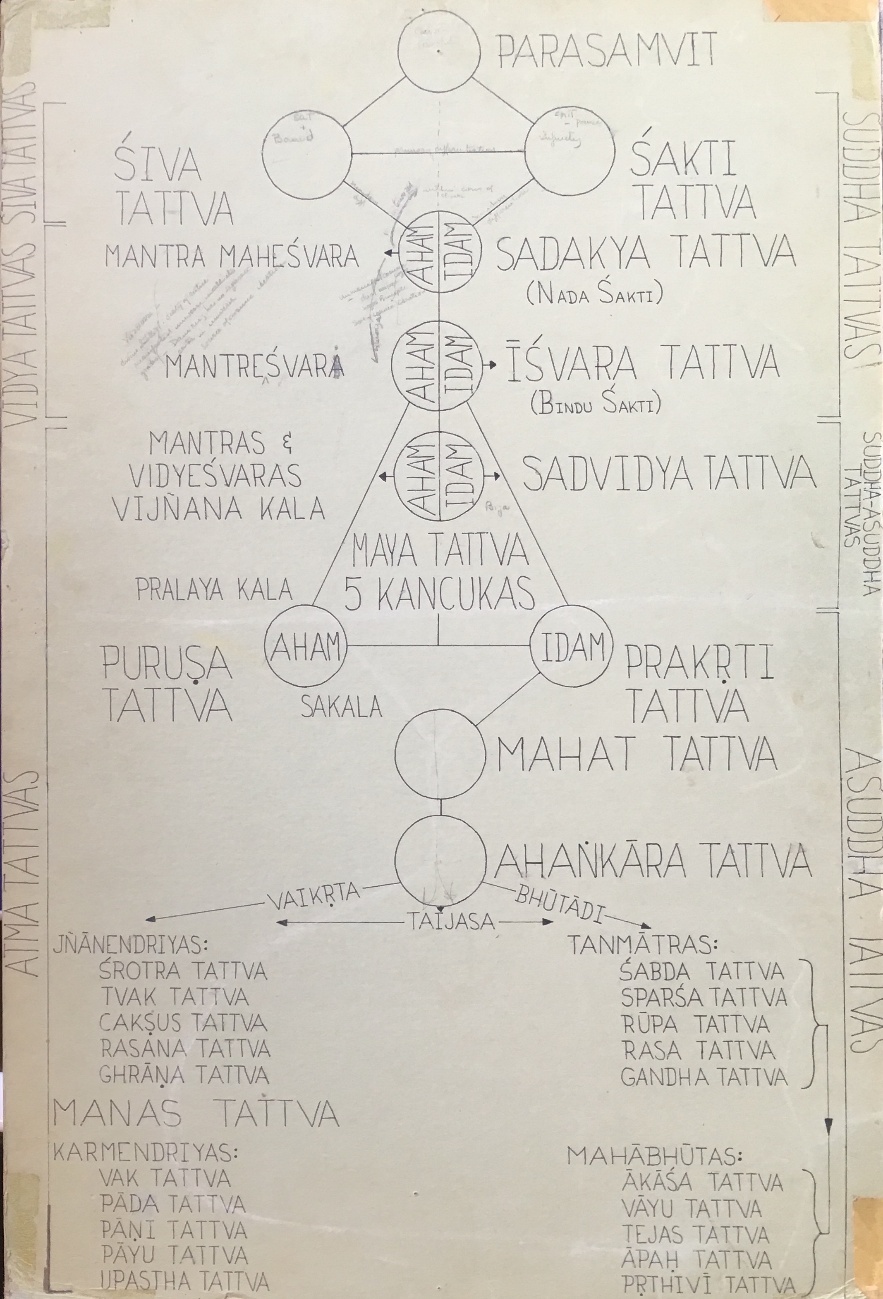
[FIGURE IMG_2331 copy. Shaivite Scheme of 36 Tattvas with States of Consciousness. Facsimile scan of posterboard drawing done by LCG per Anthony's instructions.]
These tattvas can be divided into operating at various levels. Whereas Vedanta comes from the consciousness or substance view per se, Shaivism speaks of the attributes or the functioning of consciousness, the point of view of function. For instance, Prajna consciousness operates at the second level through Sadashiva, Mahesvara, and Shuddavidya. In Shaivism, these tattvas are the organs through which consciousness operates and are the active aspect of perfection.
The light of the cosmic Purusha inserted into the 24 objective tattvas would be the entire Samkhya system.
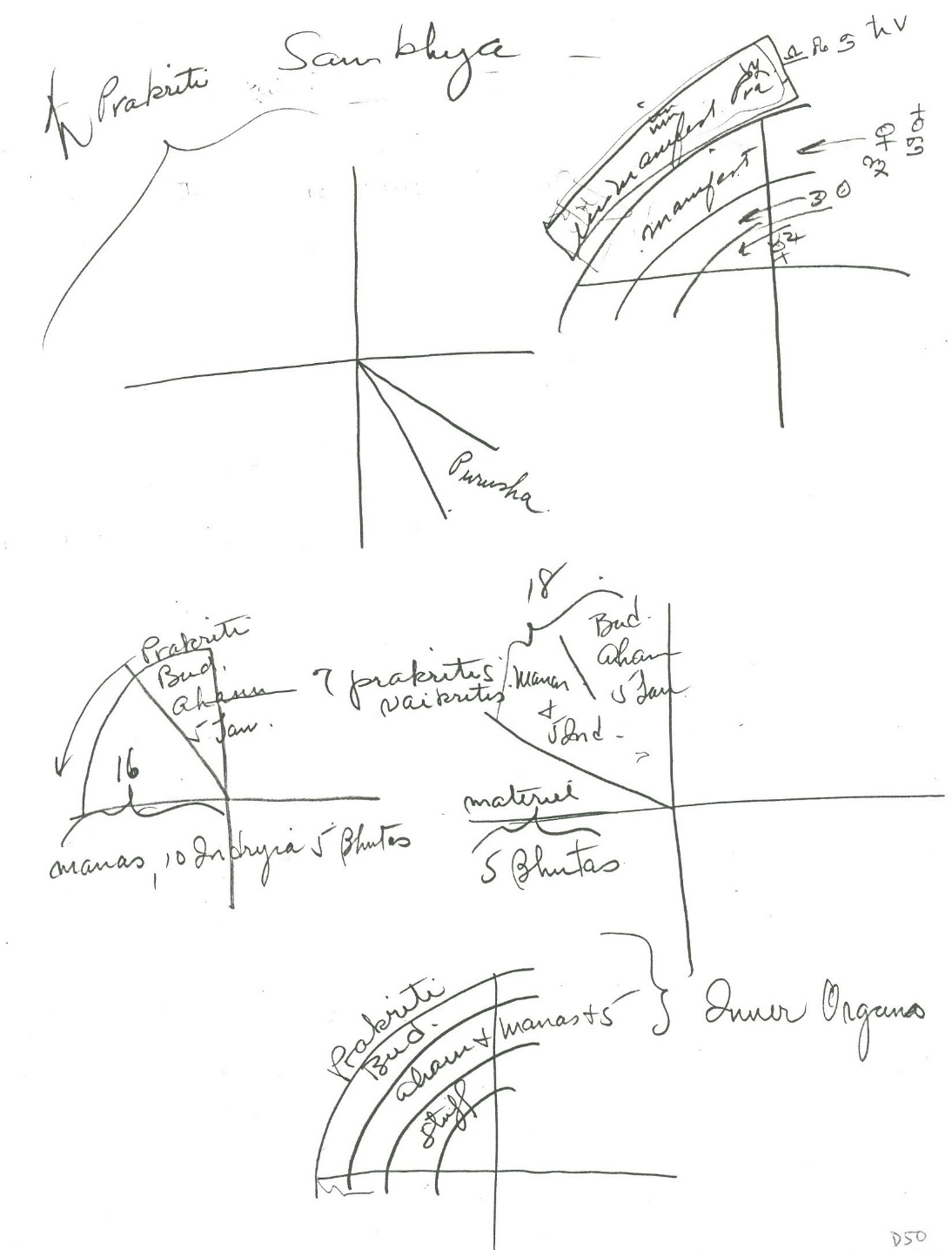
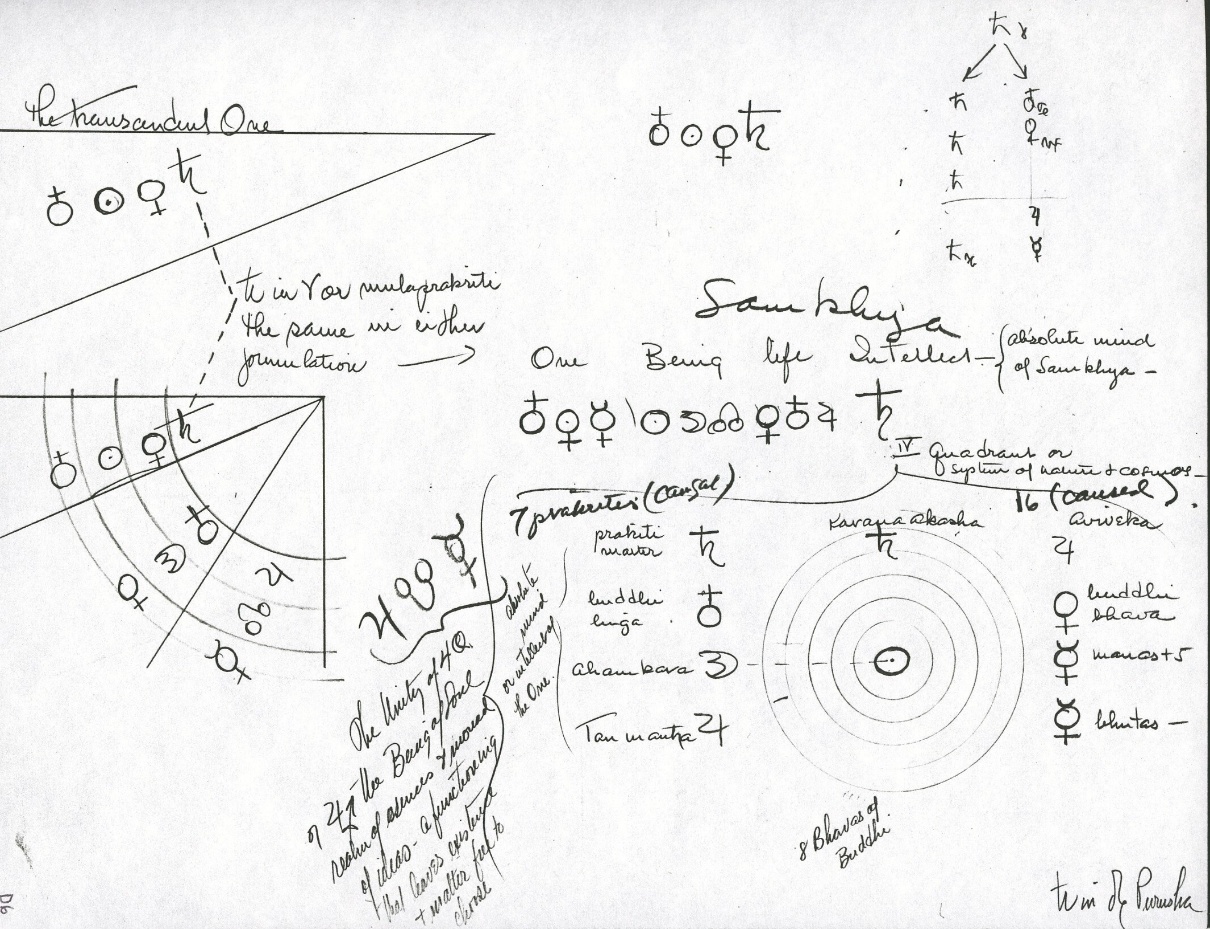
[FIGURE AD_D_006. Samkhya: First Quadrant and Fourth Quadrant in Metaphysical Chart. Facsimile scan of hand-drawn diagram by Anthony Damiani.]
---
VEDANTA -- or the 4th House Idea of the Fourfold
Guenon, in Man and His Becoming, writes of wakeful consciousness having 19 mouths and 7 limbs. These correspond to the organs of experience and the elements, respectively.
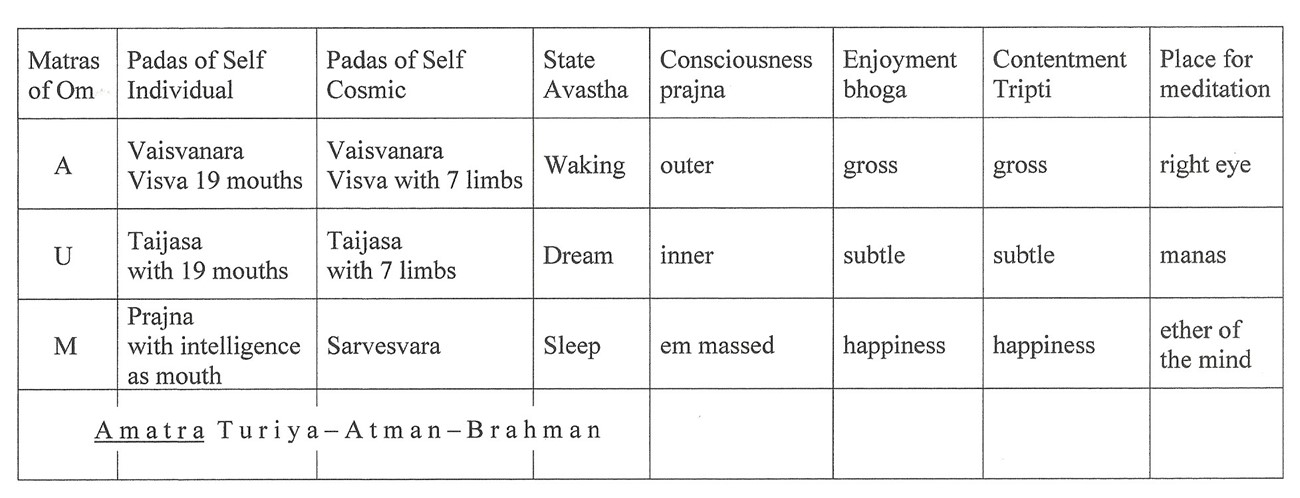
[FIGURE AD Supp 103-digital. Table of Matras of A-U-M. Digital redrawing by NT of AD hand-drawn diagram, Fig. AD Supp AD-I-103.]
These organs and elements also apply to the dream or subtle state. The wakeful consciousness externalizes itself through those organs. The dream consciousness internalizes itself through those organs.
Vedanta seems to be coming from the 4th house Idea, with its 4 states of consciousness, 4 states of matter, 4 states of sound, 4 gods, 4 matras of Om. (The 4th of all of these is potential or the absolute, and the other 3 are manifest in some way.)
The various levels of consciousness are discussed by Guenon in Man and His Becoming in chapters 10, 11, 12, 13.
In the waking state -- VAISHVANARA -- the universal man has an objective side -- the 4th Quadrant-- and manifests himself through the organs or attributes (19 mouths and 7 limbs) of that consciousness. Likewise on the subjective side -- the 3rd Quadrant -- the universal subtle man manifests through the TAIJASA consciousness, with the same number of organs and the perceivers of the internal world.
PRAJNA consciousness is the principle of manifestation for this system. In the deep sleep state both VAISHVANARA & PRAJNA are included in a mass of sentiency.
[FIGURE 1982 0603b-5. Vedanta diagram of 7 elements/limbs (external = Prak. luminous (inerratic), Buddhi (Sun Moon), Aham (Ether), 4 elements: fire air water earth) and 19 Prakritis/mouths (internal = Buddhi, Ahamkara, Manas, *Citta, 5 pranas, 5 knowing senses (Jnanendriyas), 5 action senses (Karmendriyas) -- the latter 5+5 = Samkhya's 10 senses)] [Note: Unable to locate this diagram. Was written up on the blackboard but may no longer exist.]
* Vedantists include these, but they are not among Samkhya's tattvas. Citta is defined as thought, as the faculty that gives rise to ideas, and is probably Samkalpa in Samkhya.
The complete scheme is the cosmic Viraj. On the other hand, Samkhya's cosmos, as an object, is conceived of as one entity, and has 24 elements or principles constitutive of it. It has intelligence insofar as it is ordered, and that one whole world is made up of these 24 principles and every object within it has these 24 principles.
It seems that Vedanta is taking Samkhya's tattvas and splitting them into subjective and objective ones. In this scheme what is meant by "luminous", also by "Sun & Moon"?
We speak of the "luminous" matter of the inerratic sphere, or the "luminous" force fields which the inerratic represents, the radiation of the stars which is molding matter.
The Sun and Moon refer to the planets, or the Platonic Sun-like and Moon-like aspects of the planets, the fabricative and gnostic. In the 4th Quadrant this would be the bhavas and lingas of Buddhi -- the differentiation is in Buddhi, and the linga and bhavas functions are further down. Any object will have both the linga and bhava aspect. In an individual, the subjective aspect is the Ahamkara, the "I-maker" of that individual.
The Vedantists take the 23 objective tattvas of Samkhya, and split them into the subjective and objective world.
Samkhya's presentation can't be Vedanticized (as Guenon would like to do) because Samkhya's presentation with the 24 objective tattvas is meant to be a complete scheme of the cosmic Viraj, in its external and internal aspects.
Samkhya says the light reflected within the 24 principles subjectivizes all of it, whereas Vedanta says the light subjectivizes only part of it.
By this split, the Vedantists destroyed mentalism because all has to be within the subject. SAT (Being) and CHIT (Consciousness) cannot be separated.
Viraj is the 4th Quadrant or the Body principle; Hiranyagarbha is the 3rd Quadrant or the Soul principle; Ishvara is the 2nd Quadrant; and the 1st Quadrant is Shiva.
In Hiranyagarbha, which is at the taijasa level or the 3rd Quadrant, the object and subject or external [and internal] are not separated.
The 2nd Quadrant as Ishvara is a mass of sentiency where we can't make distinctions at all.
----
4 levels of Consciousness / Divided Line in the 4th Quadrant
[FIGURE 1982 0603b-6. Diagram of Viraj and Divided Line.] [Note: Unable to locate this diagram. Was written up on the blackboard but may no longer exist.]
As that formless matter gets organized by the inerratic stars (where the Ideas are immutable) the mythological constellations or those Ideas are the first step in the organization of matter. The stars organize the matter on a gross level. The first breakdown occurs in the stars.
"Qualitied spaces" is the result of the instantiation of Ideas in the receptacle. The 10th house matter and the 11th house form combine to form the 12th house hylomorphic entity.
Bhutas are the result of the analysis of sense perception, not the result of the analysis of matter. The analysis of matter takes you back to prakriti. The analysis of bhutas takes you back to the subjective realm.
Putting this all into the 4th Quadrant, where is the TURIYA level of Viraj? Out of Turiya consciousness or substance differentiated and evolves Prajna, etc (like out of Buddhi evolves Ahamkara, etc). Everything is included in Turiya, it will be in the way (Tattvas) it is awake (Consciousness).
Or Turiya as all intelligence is the passive aspect or [of?] perfection, and the other states are the active aspect of perfection.
Only in the 4th Quadrant, in the 10th 11th and 12th houses, can we speak of something evolving out of Turiya consciousness. The Ideas of the 10th and 11th houses have to be made of the stuff of Turiya consciousness. At the level of Ideas is the undifferenced intelligence out of which everything evolves.
At the exaltation level, MAHAT, the universal intelligence organizes the universal manifestation.
AHAMKARA or Manas perceive the subtle elements, the Tanmatras. The senses perceive the gross bhutas.
Out of consciousness evolves all these lesser tattvas, for there has to be a power identical with the substance.
For example in the 10th house:
Saturn -- manifests the 10th house idea of prakriti.
Mars -- as the inherent intellect separates one idea from other ideas.
Moon -- participates as an individual.
Jupiter -- 4 Tanmatras in the 10th house become the 4 Bhutas in the 12th house.
In the Divided Line, at its lowest level there is an awareness but not understanding, of an image, that it is, but not what it is. This is at the level of the senses, pure presentation, VAISHVANARA consciousness.
At the next level, of TAIJASA, you believe that the objectivity exists, infecting the VAISHVANARA vision. (Reasoning is also mental, therefore TAIJASA.) In believing in the existence of the thing (and reasoning about it), one eventually becomes acquainted with the reason-principles that make this thing what it is and not anything else. This is the level of PRAJNA. In actuality, these 3 states can be operating simultaneously.
It seems there are 7 planes of existence on which the 4 levels of consciousness are operative. At the Bhur level of existence, for example, PRAJNA consciousness would reveal the reason-principles operative at this level of existence. The 7 grades of existence are based on the 7 prakritis. The 4 states of consciousness are the thread running through them all.
[JF Notes End]
1982 06/03b V08: NOTES: Hinduism; Four States of Consciousness. Copyright 2022 Wisdom's Goldenrod p. ii