DIAGRAMS FOR 1982 0604
Class
Friday, June 4th, 1982
Edited transcriptClick the series name to view more
CLASS at Wisdom's Goldenrod, Hector, NY
with Anthony Damiani (AD)
June 4, 1982
PLOTINUS; ONE; DOUBLE ACT
TOPIC: Plotinus
SUBJECT: One
SUBSUBJECTS: Astronoesis Working Draft (Outline for The One and Number Paradigms, Intellectual-Principle; text for Chapter One), Double Act, Triad
CONTENTS:
Passive and active perfection of Transcendent One as 1st house and its dignities
Passive perfection as an act (both passive and active have act and repose)
Paradox
Astrological example: natal planets in first house and transits to that as passive and active
Paradigm for all of the houses
Presuppositions, and discourse is possible only because of unity, of logos
Using astrology to understand philosophy and vice versa
Interplay of substance and function at all levels
'Act' in Greek philosophy
"Order" goes with Intellectual-Principle
Issuing act results in Triad, the completing activity
Intellectual-Principle emanates from the Triad
Purpose of second act in One is to reveal perfection of its own being
Metaphysical infinity is fullness of being, not emptiness
Active and passive reflect that
"Essence of the One" is both substance and function, meaning of essence at various levels
V.4.2 "act of the essence and act going out . . ."
Double act means double conception of the One, both passive and active
All opposites in God
No universal relativity of Ideas in One
Finite Being in Intellectual-Principle vs. Infinite Being in One
Active perfection as Universal Being, Life, Intellect
The One is the most important thing you could discuss in your life
Unities of Triad = issuing act
Monads vs. issuing act
Emanation vs. creation
The "glow" of the One is a lesser, it's the Intellectual-Principle
Intellectual-Principle an aggregate of forms
Head (in Gemini) is not the issuing faculty but coordinates contents emanating as the Intellectual-Principle
Approaches to the One through the Head in Gemini, Moon (Life) in Taurus, various unities
Intellectual-Principle's vision of the One is the Head
Levels of consciousness
Buddhist-Vedanta debate results from emphasis of function or substance only
Image of intelligibles in the soul, the metaphysical chart in your soul
Sequence of Plotinus quotes and reasoning process
VI.7.40, One and Intellectual-Principle
First and second intellection: first as Triad and second emanating as Intellectual-Principle
Triad two different ways
How could anything be outside the One?
Principle of non-Being, Saturn in Aries
Double act of Saturn in Aries
BOOKS / MAGAZINES READ FROM OR REFERENCED:
Anthony Damiani, Astronoesis: Philosophy's Empirical Context; Astrology's Transcendental Ground (published 2000)
Plotinus, The Enneads (MacKenna translation, 4th ed.)
Leo Schaya, The Universal Meaning of the Kabbalah
Plato, Philebus
Shrine of Wisdom, "The Simple Way of Lao Tzse," v, no. 18
Swami Nikhilananda, The Mandukyopanishad with Gaudapada's Karika and Sankara's Commentary
Rene Guenon, Man and His Becoming According to the Vedanta
A.H. Armstrong, The Architecture of the Intelligible Universe in the Philosophy of Plotinus: An Analytical And Historical Study
PLOTINUS QUOTES READ OR REFERENCED: III.4.3, III.4.6, V.1.6, V.3.11, V.4.2, VI.7.40, VI.8.15, VI.8.16, VI.9.1
DIAGRAMS appended to this transcript:
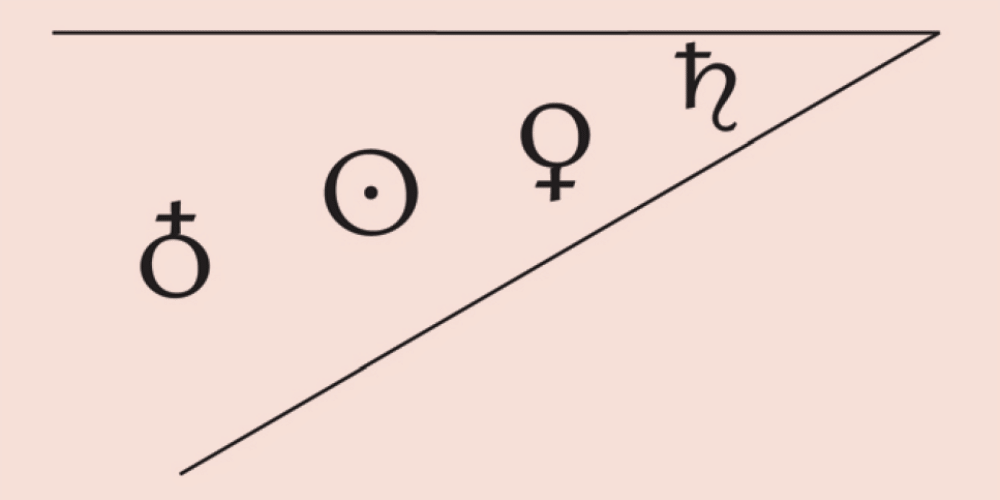
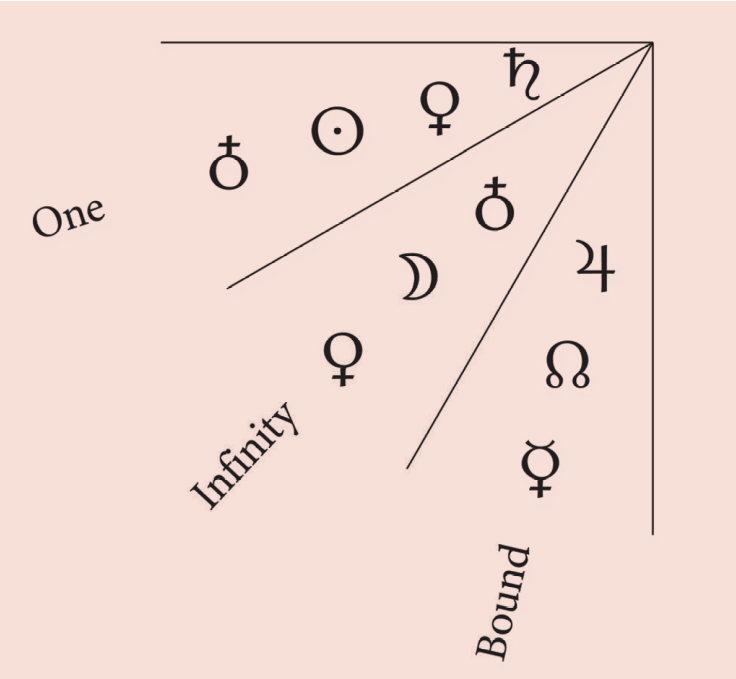
FIGURE 1982 0604-1. The One-Only.
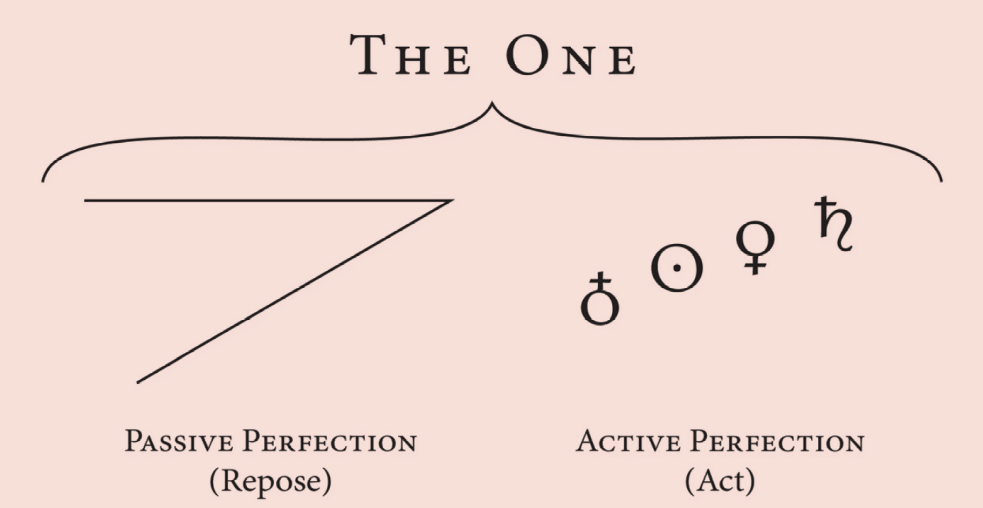
FIGURE 1982 0604-2. Active and Passive Perfection.
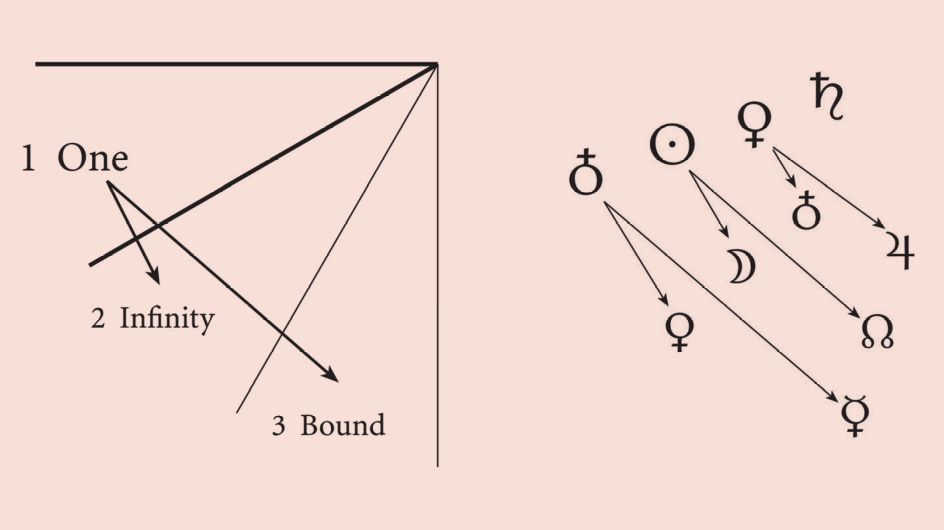
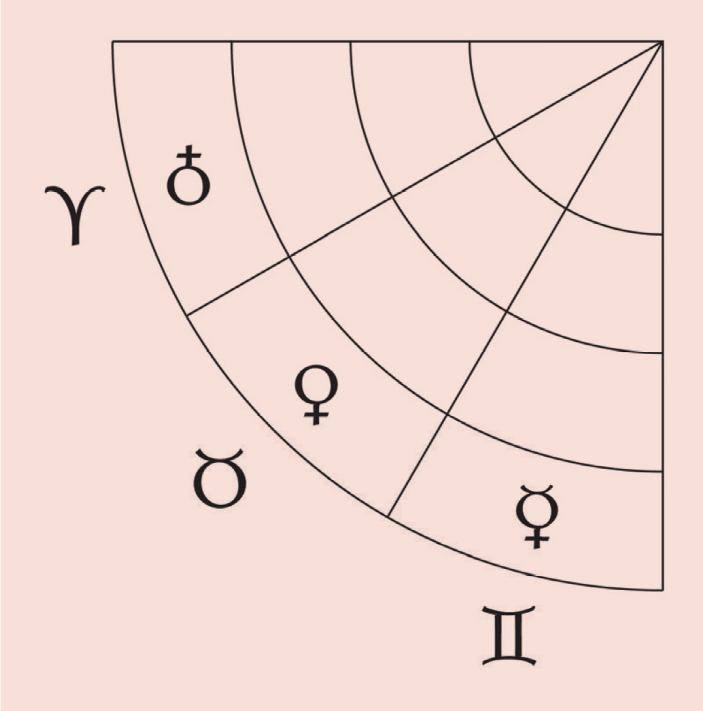
FIGURE 1982 0604-3. One, Infinity, Bound.
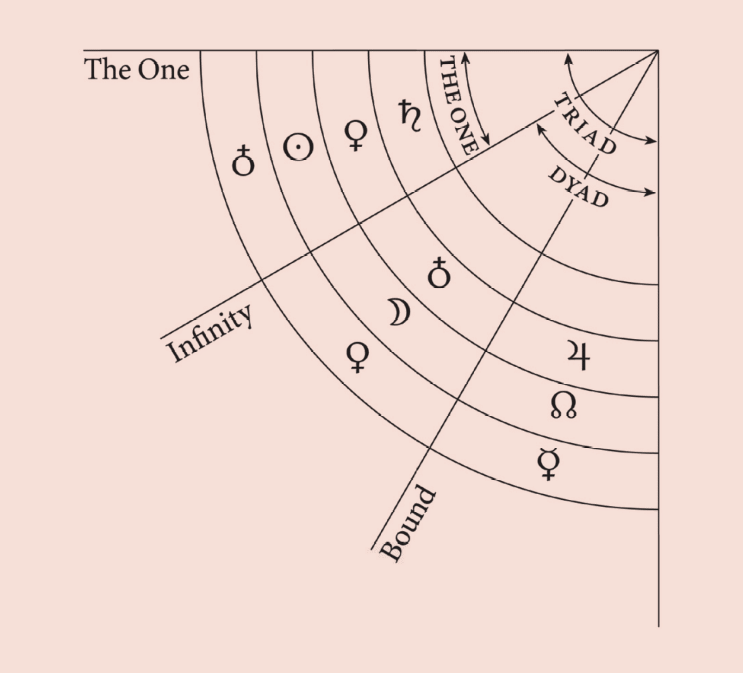
FIGURE 1982 0604-4. One, Dyad, Triad.
FIGURE 1982 0604-5 Triad.
FIGURE 1982 0604-6. Mars Venus Mercury as the One.
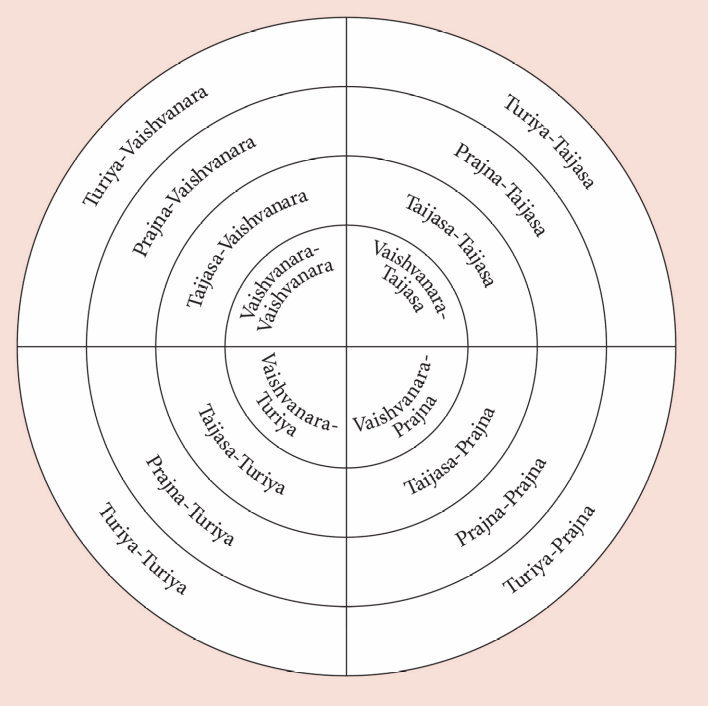
FIGURE 1982 0604-7. Four States of Consciousness in Four Rings and Four Quadrants.
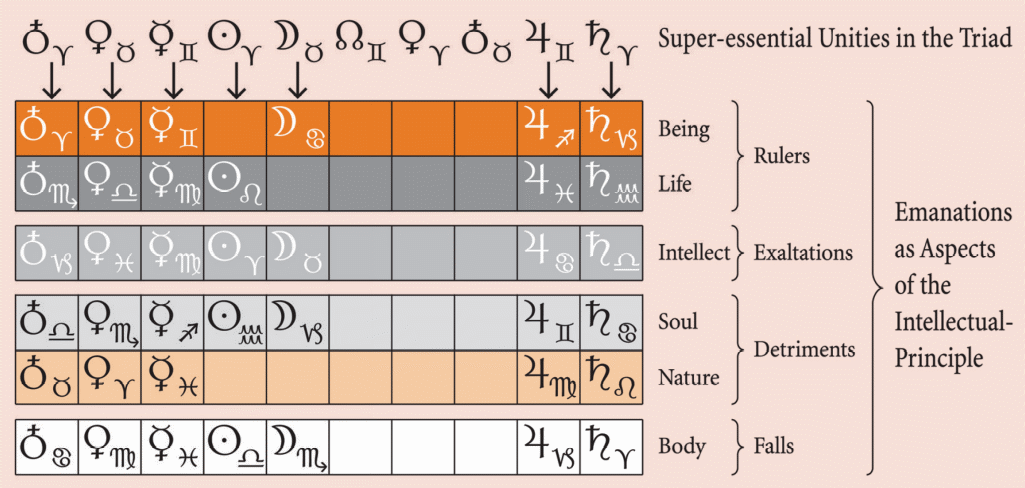
FIGURE 1982 0604-8. Triad and Intellectual-Principle; Henads and Monads.
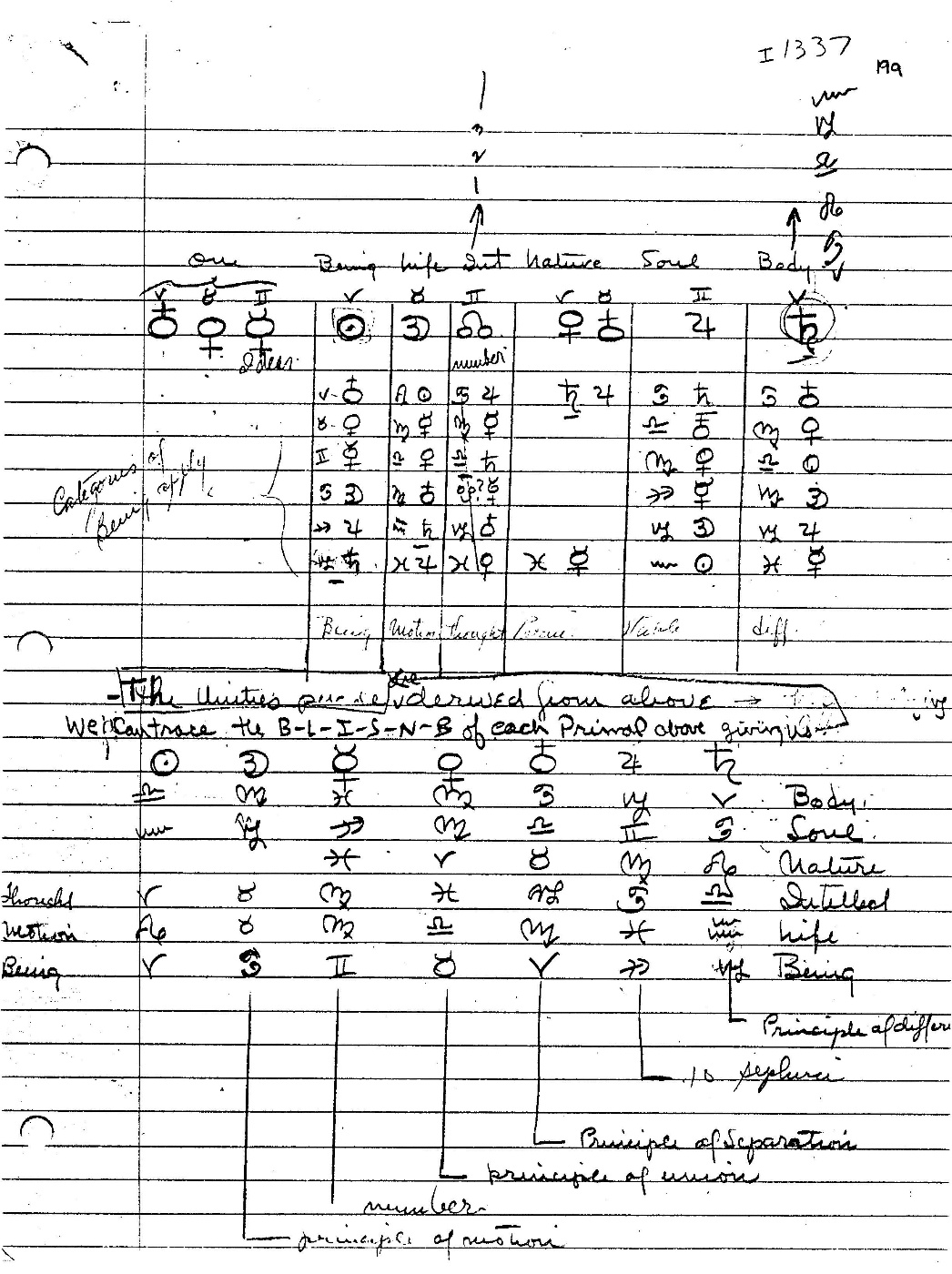
FIGURE AD_I_1337. Triad: Henads & Monads.
ASTRONOESIS WORKING DRAFT, section on the One, read in this class. See Astronoesis, chapter on the One, p. 19 ff. A version of the Outline read at the beginning of class can also be found in AD Supplementary Material, p. 1.
NOTES:
Previously printed, distributed 2003 as part of a set.
This class series on the One was held on Fridays.
TRANSCRIBED by jf 2002 from Audio Cassette tapes; reformatted by jf 2018. In 2024, IT updates prefatory matter and footer, replaces tape markers with audio file markers, expands Subsubjects, completes Book List, adds Plotinus quotes section, corrects typos and some listening errors, adds new notes within transcript, adds eight diagrams and references within transcript to these diagrams, reformats to accord with new conventions. Readable edited transcript with AD Paper – V11rp.
AUDIO FILES: 1982 0604a, 1982 0604b. [Note: "Tape" and "Side" refer to original audio cassette tapes that were later digitized into .MP3 Audio Files.]
1982 0604 at Wisdom's Goldenrod
Plotinus; One; Double Act
[Audio File 1982 0604a Begins]
Astronoesis Outline draft (also read later; the tape begins with point Two--but Transcriber added point One here in [brackets]; AS reading):
[One: The absolute, meta-ontological infinity, Mind, all these are synonyms for the One itself.]
"Two: The One is intrinsically complete perfection.
Three: It exhibits two aspects--active and passive repose, substance and function or attributes, active and passive perfection; it reveals something of itself through this paradoxical nature.
Four: The interrelationship of the One with its power, or the completing act, is the underlie of its total perfection.
Five: Total perfection can be conceived as having indivisible aspects; this is not contradictory.
Six: Each of the indivisible aspects of meta-ontic infinity can be considered as a mode or way of the One.
Seven: Each and every mode will be a transcendent model or a superior version of lesser principles, for example the Intellectual-Principle.
Eight: Among the aspects included within meta-ontic infinity is the principle of matter, the formless being of non-being. This is the second One within the One-without-a-second.
Nine: Space or the body of the One-Only is the locus for emanation.
Ten: The reflection or emanation of the One's total perfection, as the Intellectual-Principle, the eternal schema of the Intellectual-Principle's contents are organized by that aspect of unity referred to as the principle of Number.
Eleven: This principle of Number, essence of Intellectual-Principle, is that which has an impression of unity, and it is to this aspect of the unity that the Intellectual-Principle goes on amassing impressions (can't hear--AS mumbles something to verify--point Eleven reread several times in first go-through of outline, as follows). This principle of Number, essence of Intellectual-Principle, is that which has an impression of unity and it to this aspect of the unity that the Intellectual-Principle goes on amassing impressions of it. (inaudible request to reread with AS response) This principle of Number, essence of Intellectual-Principle, is that which has an impression of unity; it is to this aspect of the unity that the Intellectual-Principle goes on amassing impressions, in other words the Intellectual-Principle goes on amassing impressions of this aspect of the unity.
Twelve: Therefore Number has substance and activity, regulative of the emanation, it must have a peculiar aseity.
Thirteen: The principle of Number as an aspect of indivisible unity is the transcendent model of Number as distributed throughout Being; therefore integrally present in the principle of Number are those properties which will determine precisely the Intellectual-Principle as an aggregate.
Fourteen: This view [through Number] is not exclusive, this approach is possible through any other aspects of the unity, and even through all of them--the restriction is imposed upon us by the lack of insight.
Fifteen: At any rate, we must remember that the Intellectual-Principle is an imaged one and as such is only a partial reflection."
(inaudible student comments, with request to reread point Four)
Astronoesis draft (AS rereading): "Four: The interrelationship of the One with its own power, or the completing act is the underlie of the One's total perfection."
(request to reread Eight, other heard-to-hear comments)
AS: Read them all over?
AD?: (inaudible)
Astronoesis Outline reread (AS reading):
"One: The Absolute, meta-ontological infinity, Mind, all these are synonyms for the One itself.
Two: It is intrinsically complete perfection;
Three: It exhibits two aspects--active and passive, substance and function or attributes, active and passive perfection, it reveals something of itself through this paradoxical nature.
Four: The interrelationship of the One with its own power or the completing act is the underlie of its total perfection.
Five: Total perfection can be conceived of as having indivisible aspects, this is not contradictory.
Six: Each of the indivisible aspects of meta-ontic infinity can be considered as a mode or way of the One.
Seven: Each and every mode will be a transcendent model or a superior version of lesser principles, for example the Intellectual-Principle.
Eight: Among the aspects included within meta-ontic infinity is the principle of matter, the formless being of non-being. This is the second One within the One without a second.
Nine: Space or the body of the One-Only is the locus for emanation.
Ten: The reflection or emanation of the One's total perfection, as the Intellectual-Principle, the eternal schema of the Intellectual-Principle's contents are organized by that aspect of unity referred to as the principle of Number.
Eleven: This principle of Number, essence of Intellectual-Principle is that which has an impression of unity; it is to this aspect of the unity that the Intellectual-Principle goes on amassing impressions of.
Twelve: Therefore Number as substance and activity, regulative of the emanation, must have a peculiar aseity.
Thirteen: The principle of Number as an aspect of indivisible unity is the transcendent model of Number as distributed throughout Being; therefore integrally present in the principle of Number are those properties which will determine precisely the Intellectual-Principle as an aggregate.
Fourteen: This view through Number is not exclusive, this approach is possible through any other aspects of the unity, and even through all of them, the restriction is imposed upon us by the lack of insight.
Fifteen: At any rate, we must remember that the Intellectual-Principle is an 'imaged one' and as such is only a partial reflection."
DB: I'm not sure if I understand the last number Fifteen, and part of number Ten.
AS: Well, for the benefit of those who have yet--
DB: Well, (inaudible) the Intellectual-Principle is an image, but is a partial image of the One, okay?
AS: It can't reflect all of the totality of the infinity of the One.
DB: Right. Now the problem I had is in the first part of number Ten it sounded (inaudible) understand it properly that the Ten--
Astronoesis draft (AS rereading): "The reflection or emanation of the One's total perfection--"
DB: Yes.
Astronoesis draft (AS reading): "The One's total perfection-- The One's total perfection is reflected or emanated as the Intellectual-Principle."
(short DB/AS interchange)
AS: Just so the adjectives go with--
Astronoesis draft (AS reading): "The One's total perfection is reflected or emanated as the Intellectual-Principle." (AS/DB mumbling)
DB: I guess that's the part I don't understand -- If the Intellectual-Principle is a partial representation of the One, then in what sense is its total perfection (considered as being emanated/available to it)?
AS: I think the total perfection is emanated, the Intellectual-Principle is which is emanated from the One's total perfection. That is, all the aspects of the One are involved in the emanation of the Intellectual-Principle.
S: I think what he's saying (inaudible) is this total refers to the perfection, the perfection of the One is totally (inaudible), and not that what flows out of it (inaudible).
AS: How could what flows out--?
DB: Well, obviously the emanation couldn't be total, it would have to be a partial representation, otherwise it would be an image, but that image depends on the totality of the perfection of the One. (inaudible) I guess it's not contradictory.
AS: I don't think so. (inaudible student comments)
LDam: Number Eight seems to talk about the One within the One, (AS: --the second--) the being of Non-being. I seem to understand that one less than the other ones.
AS: There was a nice quote from the Kabbalah on that. [Note: See Leo Schaya, The Universal Meaning of the Kabbalah, p. 57.]
AD: It's in the text, it's in the table of contents. (inaudible)
LDam: That's what I asked -- Do you want questions or do you want to go on and get sidetracked or--
AS: I think what we're going to read discusses that point, the next few pages which are going to discuss the point-- I know what the problem is -- we didn't read through everything-- this table of contents is like the whole of that first chapter. And last week, two weeks ago, we didn't read this whole thing, we only read up to about 4 or 5 or something, point 4 or 5, we didn't read the main body, that deals with these other things-- (inaudible) We'd be discussing it before we read the actual-- but it is a hard point. (inaudible)
(inaudible student comments)
AD: (inaudible) the passive and the active perfection. (inaudible AD/AS interchange about what to read) (the double act what we're talking about.) (inaudible)
AS: Jumping in the middle-- Starting with the V.4.2 quote, the double act, in V.4.2. --this is going back a little bit-- In V.4.2 he says:
Plotinus V.4.2: "[But] if something arises from an entity which in no way looks outside itself, it must arise when that entity is in the fullness of its being: stable in its identity, it produces; but the product is that of an unchanged being: . . .
"So it is in the divine also: or rather we have there the earlier form of the double act: the divine remains in its own unchanging being, but from its perfection and from the Act included in its nature there emanates the secondary or issuing Act . . ."
Astronoesis draft (AS reading): "Crucial to our vision is the interpretation in V.4.2. For the entirety of our understanding of the Plotinian system is revealed by the way we understand this tractate. Philosophic thought will require the services of a polyvalent symbolism, that only astrology can supply, to amplify the problem to our limited sights. We are attempting to penetrate into the hidden mysterious constitution of the Absolute as revealed to Plotinus. Plotinus is fully aware of the extraordinary difficulty involved in producing a solution to the problem of how the many arises from the One. There is an adequate statement of the problem in V.1.6 in the opening paragraph--"
AS: This is how "from such a unity as we have declared The One to be"--
Plotinus V.1.6 (AS reading): ". . . from such a unity as we have declared The One to be, how does anything at all . . . [AS reads: arise], any multiplicity, dyad, or number [AS reads: any number, or dyad, or any multiplicity]? (AS: That's a paraphrase.) Why has the Primal not remained self-gathered so [that] there be none of this profusion . . ."
Astronoesis draft (AS reading): "In the following paragraph he insists upon the prerequisite condition for this understanding, that is the actual way of sapiential devotion and inward vision."
AS: The next paragraph in V.1.6:
Plotinus V.1.6 (AS reading): "In venturing an answer, we first invoke God Himself . . ."
Astronoesis draft (AS reading): "Axiomatic about the One-Only is literally is this totally complete perfection synonymous with it. Therefore there cannot be within the One itself any change, processions, operation, arrangement, and combination. Or even the universal relativity of the forms. Keeping this in mind, it, the One, does not become anything. Therefore when he speaks of the perfection of the One and the act included within it, we are not to conceive that stillness reigns and then is rearranged as though a fixed number of blocks within a container are shuffled about until the container is refilled. This is not perfection and the act included within it. Perfection has no tenses, nor even is it the timeless ordered simultaneity of the eternals, it is what it is, itself. So when in this paragraph of V.4. 2, referring back"So it is in the divine--" he speaks of the issuing act, it is included in the perfection of the One, and from its power the Intellectual-Principle arises. The glow from the power of the issuing act is a distinct existent and not to be confounded with the One itself or its issuing act, the issuing act being the functioning of the ten partless aspects of the unity."
LR: (inaudible) issuing act (inaudible)?
AS: The act of the Triad. And what issues, results, is the Intellectual-Principle. We'll go over it-- Let's finish the-- the double act and the divine. Let me just read these three pages together, okay, I think that would be helpful, let me go back--
Astronoesis draft (AS reading): "Let us return to our diagram for whatever help it may offer in the perception of this idea. [Note: See FIGURES 1982 0604-1, 2, 3, 4, 5 appended to this transcript for the following. These diagrams are from Astronoesis, pp. 54-58.] Perfection we have identified with the first house and the intelligibles therein, the active or second act which is included in the nature of the One is the activity of those intelligibles that are exhibiting infinity and bound or, for the infinity and bound, the 2nd and 3rd house with the intelligibles therein. The One multiplied by itself results in the spreading out of the One as the whole first quadrant. (AS mis-reads the next sentence, then continues) Looking at the first house with its power *un*multiplied stillness reigns, passive perfection. At the same instant active perfection exhibiting infinity and bound as the second and third house. Therefore the first quadrant is a complete picture of the One as a double act. (inaudible student) (sounds like chalk-on-blackboard on tape, diagrams being drawn)
"Again, the view of the One as the passive perfection is the substance point of view. Still looking at the 1st quadrant vertically or in terms of the rings we get the functional. The fusion and interpenetration of these two views or two points of view may be seen by showing that Mars Venus Mercury insofar as they are grounded in turiya-turiya is the One substantial, for they are all grounded in turiya, turiya-turiya, or the highest state. This can be diagrammed as follows. [Note: See FIGURES 1982 0604-3, 6, 7 appended to this transcript. These diagrams are from Astronoesis, pp. 56, 61, 70.] Let us reiterate: active and passive perfection, the ultimate coincidence of opposites are being exposed, the double act is being revealed. The second and third houses and their respective intelligibles are being exhibited by that act. The double act thus unfolded reveals the 2nd house as infinity and the 3rd house as bound. These two together are the active perfection, or as Plato speaks in the Philebus, God the One exhibits infinity and bound. (chalk-on-blackboard-scratching sounds)
"Nonetheless the paradox remains: there is no new production. The power, identical with the double act, is extended throughout the timelessly completed one-continuum, the whole first quadrant. It is the basis for indeterminate matter and it is what imparts to each of the unities their characteristic uniqueness, their shapeless form and super-being in a distinctionless mode in the One. Thus unfolded for our view we will refer to these ten unities or intelligibles as the Triad. [Note: See FIGURES 1982 0604-4, 5 appended to this transcript.]
(class silence)
AS: Linda?
LR: I wish I could (inaudible). I think the double act is made difficult, I don't think it should be that difficult, (inaudible) to say (inaudible) when we speak of the double act, we're speaking of passive and active perfection, is that right so far? And passive perfection can be seen as the first house--
AS: --remaining as it is.
LR: And the active as the intelligibles in the first house?
AS: That's one way, that would be the very first way-- (LR inaudible) Yes, I agree, that would be the first way, seeing the passive perfection as the first house and the active as the intelligibles --and they're absolutely united.
LR: I'm just trying to find a way of doing this (inaudible) to make clear for me. I find this tremendously difficult--
AD: No, this is crucial.
LR: So then if you say it that way, the passive perfection, is the first paradigm, is substance, and the active perfection would be intelligence (intelligibility) would be function. That's one way--
AS: And that's actually the first way because there they're not separate. That's all.
LR: Now you're saying that there's another way of looking at this point, which is saying that the first house is the passive and the second and third are the active? (AS: well then he says--) Or then do you want to do it--
AS: If we do it from the passage. [Plotinus V.4.2]: "in the divine" we have "the earlier form of the double act: the divine remains in its own unchanging being, but from its perfection and from the Act included in its nature" -- Now we just spoke about the perfection and the act included in its nature would be the intelligibles. Then--
LR: I guess, just stop right there, Avery, "from its perfection and the act included in its nature" that seems to say the act included in its nature is other than its perfection.
AS: In the VI.8.16 he distinguished repose and act.
(inaudible LR/AS interchange)
AD: If you apply a little bit of astrological understanding and technique and you think of the first house as the identity of an individual, and this individual is schizoid, there will be one part of him, there will be two parts to him, one part is perfectly sane, and the other part is manifested by the planets that are transiting through there. But then it would have to in manifesting the identity of that individual it would have to manifest these two aspects, the double act which is in it which is its identity.
LR: But there's only one act--
AD: There's a double act--
LR: The double means two--
AD: The double act, we're speaking about passive perfection and active perfection. The passive perfection is the first house with the intelligibles in the Idea, but unmanifested or hidden in it, unmultiplied, that's passive perfection. So if you think of an Idea in a house that would be passive perfection, it is total, it is complete, it doesn't need any addition, anything--that's passive perfection. Now if that Idea could remain like that nothing could occur, no manifestation would occur. But the very powers within it are now going to manifest its content, and the activity that manifests that content must manifest that it has this paradoxical or two-sided nature. And so it will have to manifest that it has an active and passive perfection.
Try this way, one moment. If you put Parasamvit in the first house, and I'm assuming that you're familiar with what Parasamvit means, that Shiva and Shakti are combined. Now you say that the planets within it are going to manifest that content. Now what will it manifest, what will those planets manifest? Those symbols or metaphysical principles, what will they manifest? What would they manifest, yes? (LR: Parasamvit?) Well, wouldn't they manifest as Shiva and Shakti?
LR: (inaudible) manifest *as* Shiva and Shakti--
AD: I'm sorry--
LR: So Parasamvit is--
AD: Parasamvit is the Idea in the first house, alright, now the active perfection is going to manifest, now what will manifest?
LR: It will manifest Parasamvit as Shiva and Shakti.
AD: Okay.
LR: But that's different from saying?
AD: Why is it different?
AS: One way to say is that it manifests itself as itself. Shiva and Shakti is itself. (LR: --is--) And it's manifesting itself. It's like a self-manifestation of itself.
LR: But that's not what-- (inaudible) I think the idea stated very simply (inaudible) I still have a difficulty every time we think of the passive because that's like-- First of all, passive perfection is difficult for me to see-- as an act, well we call it the double act; it seems like the act is the active perfection, and it's hard for me to see the passive perfection as an act in the explanation, that's one thing that I trip over. (inaudible)
AD: Are you getting personal? You're not splitting hairs at all-- If you can't understand this, then there will be a big hiatus in your understanding. Then I don't know how you understand astrology either when a planet is transiting through your houses, what's happening? If it's not manifesting the contents what is it doing?
LR: I'm not arguing with that, Anthony, I see that--
AD: Well then again, if they are manifesting the contents, what are the intelligibles manifesting?
LR: The contents--
AD: --of the first house which is what--the double act. It's manifesting the double act.
LR: Do you see passive perfection as an act?
AD: Absolutely, absolutely. Passive perfection perhaps is even more so an act.
LR: (inaudible) If you say passive perfection is an act, why do you have to postulate the intelligibles to manifest that substance?
AS: Because its act is to remain itself what it is, that's the problem, the One aspect of the One--maybe I'll try this way--that the one aspect of the One that you're calling the passive perfection, its act is to remain itself, it also however has this emanating power as it were, which is the other aspect of it, the so called active perfection, and that in its act, the power remains with the One and it also flows out and emanates.
LR: So that's what double act refers to: two acts, one is to remain itself, and one is to manifest or emanate.
AS: I don't know. I thought that was one possibility--
AD: (inaudible)--in one function, substance and attributes.
LR: (inaudible)
AS: In the first view of repose the power remains with it, it doesn't go out. And in the second view there's an emphasis on the active, where the act goes out. But in each of those there's both, there's the active and passive.
AD: This is not an explanation of the double act, it's just a description. You remember the quotation from Lao Tzu, will you read it to them? (sounds like AS trying to find quote)
Lao Tzu (AS reading): "How unfathomable is Tao! An infinite depth, the Source of all that is--the Ancient Progenitor, before all things. Yet how pure and still is Tao!" [Shrine of Wisdom, "The Simple Way of Lao Tzse," v, no. 18, p. 10)
AD: How would you interpret that passage?
LR: (inaudible) Plotinus--
AD: But how would interpret it now, that ultimate reality has, what seems to us, to have these absolutely contradictory qualities, one is absolute stillness, and the other one unlimited activity. And that if you extend these things to the nth degree they must coincide and they would be what we would call the ultimate reality. So no attempt at explanation here, it's just a further description of what they are saying.
LR: And how would you (inaudible) realization of that seeming paradox?
AD: I'm sorry--
LR: How is that one can arrive at that insight into that seeming paradox?
AD: By removing--you know, the common phrase which they use--by removing the ignorance within which we ensconced. And then we would find out that it's so with us too. But you're asking for a realization and that's not our concern in the paper. Our concern in the paper is simply to show that these two contradictory qualities, which they make a lot of fuss over later on, they speak of it as they coincidence of the opposites, which could only take place in this supreme principle, but at all other lesser levels of reality, they don't exist in that fashion. Now the real point is this here: that if we're referring to the first house as symbolizing the ultimate reality, and that this ultimate reality is composed of or has these two aspects, then would the technique of astrology reveal to us and justify that position? In other words, could we see in a chart that even though in the first house, the identity of an individual remains and is what it is, on the other hand the transiting of a planet there manifests something of what that identity is? Is this so or not as a technique? (LR inaudible) It would have to be. It has to be. Then the basic presupposition of the horoscope, the basic technique that is employed, is based on a presupposition that seems to be adequate. That's all we're doing. This is not a mundane reading of the chart, but I would say all mundane readings as well as soul readings of the chart are be going to based on this paradigm. At any rate let's go over the whole thing again.
AS: Herbert?
HS: You specify self-identity as being the first house to the houses, to the idea that each of the houses would have their own self-identical nature and the planets manifesting the self-identical Idea of each of the houses would be self-manifesting.
AS: You're saying this is a paradigm for any one of the houses.
HS: Yes. Is this a paradigm for any one of the houses?
AD: It's a paradigm for any of the houses, any of the Ideas, that point was made. But you have to make certain qualifications here, because there's a distinction between the One and any Idea, any Idea would be in the realm of Being, and consequently it would have only the unity that Being permits it to have. But when you're speak of the Unity itself you're speaking about a much higher level of reality. So if you make allowances for the differences of level, and we will do this-- we will apply this to any Idea, we will put any Idea in the first house and unfold the entirety of its contents and we should be able to come out with a reasonable understanding of what's included in that Idea.
HS: (inaudible) seen in a person's life?
AD: We're speaking about an Idea, not a person. So I'm just saying we could take any Idea, any of the Ideas in the chart and put it in the first house and work out the ontological implications of that Idea.
HS: This is still prior to actual mundane astrology?
AD: Oh, sure.
HS: Okay, the implications, then, of putting an Idea in the first house is that it will exhibit its own unity in that house.
AD: Yes. So that was the reason why I suggested you take Parasamvit, that's one of the Ideas in the Intellectual-Principle, and if you put that Idea in the first house: you would say Parasamvit, Shakti, Shiva, Aisvarya, and go around the whole circle, and that one Idea in the Intellectual-Principle would have all these qualities. In other words, you would manifest by using the metaphysical principles or the planets, by using them, you could get out the content of what that Idea is, unfold it, and this way you'd go around the chart. So, if you did that with the Shiva Shaivite principle, just on the basis of that one Idea, you would have an ontological chart. And you could do that with any of the Ideas. So if the technique wasn't valid, the whole thing would be ridiculous. And that's what it comes to when Linda doesn't understand the technique we're employing. She's questioning the presuppositions. If I assume that she's intelligent enough not to try to go beyond the paradoxical nature of reality itself, and I assume that. She's not questioning that, because that's the way it is. It's double act, it has unlimited function and infinite substance. I assume that that's understood, there's no questioning that. If you say it's total perfection, if-- Plotinus says it's total perfection, then there can't be no before after or in-between, it always what it is, it will never lapse, and it will never evolve, it won't get better, it won't get worse, that has to stay the way it is.
HS: And yet you do have to establish (inaudible) exhibit itself right at the very (inaudible).
AD: But of course, of course, you and I would not be able to avail ourselves of discourse if there wasn't unity in our discourse about what we're speaking about. When I say horse, the Idea of horse is something that our words participate in, and so we can refer to a common referent. But if Ideas weren't available to us, we wouldn't even be able to communicate. I thought we went through this in Buddhism, when someone tells me this doesn't have a specific nature, I tell them what are you talking to me for then. This is a man, you and I understand that, right. That means our understanding and our participation in the Idea, that is, our knowledge participates in the Idea of Man, that's why we could communicate. We know we're both referring to the same thing, and not to the words.
HS: Now would that be following like "in virtue of unity beings are beings"? [Note: See Plotinus, VI.9.1, first para.] Is that what you're doing, is that following that, because this seems to be a little prior to that in some way.
AD: Well I didn't have that quotation in mind. No, the quotation I-- the point I'm making here is that without logos there's nothing to speak about. Can't you see that every time you discuss anything that you're assuming the existence of the idea of that thing. If I started speaking to Severin about squares or circles he'll know right away what I'm talking about. Why? Wouldn't you say that there's the existence or the idea of a square or a circle that evoke our knowledge--
(Side 1 of original cassette tape digitized as 1982 0604a Ends; Side 2 Begins)
AD: (inaudible) can you follow this? After One, then you think about it as passive perfection, then you leave everything alone in the first house. You don't touch anything, everything is fine where it is. And the intelligibles in there are undivided and hidden within it. They're unmultiplied powers, they're part of the passive perfection. Then he speaks about active perfection. Now we think about those intelligibles as manifesting what that content is. If it manifests the double act, you got to have two houses manifesting from that activity. Alright? So then what did we do? Did we multiply one by one, did we do anything else? Then isn't that the same as speaking about the Triad or the whole first quadrant. You mean you're doing this all with astrology and you don't know what you're doing? You don't question the technique? You take the astrologers word for it? Then you deserve an astrologer. Let's go on. Let's reread the thing.
HS: Could you say that what you're doing is-- could-- even in so-called astrological interpretation, you're just finding unities all over the place as it were? You know, you're just-- you're always trying to-- like you're rearranging unity within itself?
AD: Well when a planet goes through your 7th house, what are you finding out?
HS: Well, you'll see something about whatever that 7th house idea.
AD: Something about your personal relationships, or your business, or your marriage, something like that, right? So it's manifesting something about that idea. I got to scratch my head. (student chuckles) Come on, imagine Uranus and Saturn both trudging through the 7th house, what do you think is going to happen?
S: (inaudible) Okay.
RC: (inaudible)
AD: Well, apply the same technique to the first, apply it to the metaphysical-- In other words, I'm going to use an astrological technique to understand philosophical problem. What do you think I've been doing?
HS: You're using an astrological technique to understand a philosophic problem.
AD: Exactly. And then later on I'm going to use philosophic understanding to work out what the basic presuppositions of astrology are.
HS: Okay which part are we doing now? (student laughter) Are you using philosophic understanding to work at this point still?
AD: We're working with both. The way I've been doing it I've been working with both simultaneously.
HS: Yes. The thing that Linda brought up, because when you discuss the first house the active and passive perfection --I can't see that, it's like, it's all within unity, and you're supposed to see so-to-say an interplay of meaning. So that's the paradigm, which is quite beautiful actually, but it's difficult to see in mundane situations that paradigmatical meaning. I'm not saying there is or there isn't, that's how the meaning is to be found, that's the problem I'm having.
AS: Herbert, I don't understand--
HS: I'm saying the paradigm, the meaning in your own existence, through discussing aspects of unity which are in some way, (inaudible) both are beyond meaning or [the] individual?
AD: You're running ahead, Herbie. Later on we'll apply that to an Idea, alright, or to a number, the principle of number, an Idea to an intelligible itself and its power, insofar that it has some identity. Later on we'll do that, later on we'll go all the way down to the natal chart of an individual and be able to see that the transits that are going on in a house are manifesting something about the meaning that is inherent in that first house, for you. I don't want to get into that except on Monday [astrology class]--
HS: Nah, I don't want do (inaudible), but you are establishing this very-- it's going to be this interplay of active and passive perfection that you're going to take all the way down, the playing off of the substance and function is all--
AD: All the (way--)
HS: It's like the primary definition--
AD: If there's a thing it's doing something, if there's activity something is involved.
HS: Okay, (I can trace this--)
AD: Substance and function you'll always find together, you won't find one without the other. When you find one without the other, alright, like just function, you'll find the Buddhists, and when you find substance without the function you'll find the Vedantists. Now (you need) neither one nor the other but both. And by the way, Linda, the term 'act' in Greek philosophy has a very special meaning -- so when they say passive, the act of passivity, the passive act, you're not to think of it in any way as a resting, it doesn't mean that. It's the eternal fixity and the simultaneity of the eternals, and their activity, that would be the passive act.
LR: Well, I understand that it takes tremendous act to demand what one is, in two principles (inaudible) but then the two principles are--
AD: Actually the word translates better when they use the word 'act', the word translates better as (inaudible). Let's read it again, Avery. (inaudible)
Astronoesis draft (AS reading): "Crucial to our vision is the interpretation in V.4.2, for the entirety of our understanding of the Plotinian system is revealed by the way we understand this tractate. Philosophic thought will require the services of a polyvalent symbolism, that only astrology can supply, in order to amplify the problem to our limited sight. We are attempting to penetrate into the hidden and mysterious constitution of the Absolute as revealed to Plotinus. Plotinus is fully aware of the extraordinary difficulty involved in producing a solution to the problem of how the many arise from the One. And there is an adequate statement of this problem in V.1.6. And then the following paragraph insists upon the prerequisite condition-- the actual way of sapiential devotion and inward vision. Axiomatic about the One-Only is literally the totally complete perfection synonymous with it. Therefore there cannot be within the One itself any change, processes, operation, arrangement, or combination, or even the universal relativity of the forms. Keeping this in mind, the One does not become anything, therefore when he speaks of the perfection of the One and the act included within it, we are not to conceive that stillness reigns and then is rearranged as though a fixed number of blocks within a container are shuffled about until the container is again refilled. This is not perfection and the act included within it. Perfection has no tenses, nor is it even the timeless ordered simultaneity of the eternals."
AD: Do you follow that?
LR: Nor is it the timelessly--?
Astronoesis draft (AS rereading): "Nor is it the timeless ordered simultaneity of the eternals, it is what it is, itself."
AD: (They weren't pretty words), I mean I was saying something very actual.
S: (inaudible)
SD: It's just that you're denying any real change there, but you're also denying any real distinctions -- when you refer to the unities, they're not to be held as other than each other.
AD: But you can see that the reference here is that if you think authentic existences, eternally void, to be what they are, like they are in the Intellectual-Principle, (inaudible) not even the determined perfection of the One.
AB: So the word 'ordered' is very important -- (inaudible) Because if it was ordered then it wouldn't be the infinitude in the One.
AD: Yes.
AB: And that you could have an infinite number of Intellectual-Principles that can come out of the One, based on different ordering of the unities within it.
LR: Well also, it would not be correct to conceive it as a whole of these (eternal--)
AD: --of the Ideas.
LR: That would be conceiving of the One as a whole of parts, which would be incorrect.
AD: Which would be incorrect. The man Plotinus knows what he's talking about, he really does understand the problem, because, as I said, the (inaudible) (work/inaudible) on that revelation, he reasons it out for us. All we could do is try to trace his reasoning, try to follow it as best we can. Continue from there, Avery.
Astronoesis draft (AS reading): "So, in this paragraph, in V.4.2, he speaks of the issuing act and it is included in the perfection of the One."
AD: Now maybe, Avery, we ought to have a conversation here. The issuing act is included within the perfection of the One. Now the interpretation usually given is that the issuing act results in the Intellectual-Principle, is the Intellectual-Principle.
AS: Right, and here you're saying that the issuing act results in the Triad, or is the Triad.
AD: It would not be the issuing act, if we follow this line of reasoning, would not result in the Intellectual-Principle, because the Intellectual-Principle is an *emanation*, whereas he's speaking about the completing activity that's going on in this unlimited substance of infinite act.
AS: I think that's the way we were interpreting it, in other words--
AD: This is the way we interpret it consistently, once we found out what he was talking about.
AS: The act included in its perfection is the first house, and then the act as completing, the completing or the second act is the first quadrant.
AD: Would be the whole first quadrant.
AS: Or--
AD: That diagram I think shows that very clearly that--
AS: That says also that each of those unities in the Triad will itself be *an act*. Each of the unities itself could be conceived of as an act, one of the issuing acts, whereas if you so-to-speak think of them all pushed back into the absolute perfection of the 1st house, then you would have the first station, the first position of power, united with the perfection.
AD: Alright, then we could also add to that if we took the Mars, in the first house, and we say that it's got to manifest the double act, the active and passive perfection, there they are in terms of the second and the third house, as the active and passive perfection being manifested in that. And that will apply to each one of those symbols manifesting the double act which is in the One. It's another way of doing the other chart, remember the other chart where we have these doubles coming from Mars, Venus, and the Sun. [Note: See FIGURE 1982 0604-3 appended to this transcript.]
AS: The other point of view, I guess, the other thing we mentioned, is that actually there aren't are two different things. If you're just looking at the One, in these two different ways, we're looking at it with all these unities as -- If you're looking at it in terms of the first act, you're looking at these al-- from the Mars, the Venus and Mercury, you're looking at the double act as the Venus and Mercury is contained back in the Mars -- or else you're looking at it as 'exhibited' it's not two different things. It's not like two acts, it's really the single act of the One in the first house.
DR: Why is it every time that act manifests, it's not as emanates but as remaining within itself, so it's called the issuing act or manifesting something (at the time), the description is not quite--
AS: He means from this that the Intellectual-Principle is going to be emanated.
DR: Say that again please. (inaudible)
AS: Um, I think one interpretation is that from this point of view now of all the unities, now you could speak about the Intellectual-Principle as emanating.
DR: Right, but when we're speaking about the double act here, we're not speaking of it as an emanation.
AS: Right.
DR: Now how in fact could you speak of that act, each time that description, that description using that word 'manifest' or 'issuing act' or something that is an outgoing but then each time it's made quite clear that there's no outgoing act.
AS: Well, you could say that this act, the second act of the Triad, is the one that's going to issue forth the Intellectual-Principle.
DR: But if by itself, (inaudible) there are these unities, this is what you mean that by that by that act?
AS: But the result of that is going to be--
DR: But the result is irrelevant, because of the fact that there's a double act in the One.
AS: Right, on the one hand the result is irrelevant, but on the other hand it is not completely irrelevant because these are all the principles of the Intellectual-Principle.
DR: But it's not because of the Intellectual-Principle that the One has the double act?
AS: No, the Intellectual-Principle *is* because the One has a double act.
DR: Right. So now in principle then, how can you speak of that act?
AS: The second act--
DR: (The second act) of the One.
AS: What do you mean in principle? Do you mean if you go into--
S: Why speak of the Intellectual-Principle as an issuing act from the issuing act?
AD: No, it's not an issuing act, but throws out the Intellectual-Principle, the Intellectual-Principle is brought about by emanation.
S: Okay, are you considering the second act of the One as substance or the Intellectual-Principle?
AD: No, no, the whole purpose of the second act within the One is to reveal the perfection and fullness of *its* being.
S: Its own being.
AD: Its *own* being.
S: And that's going to be the Intellectual-Principle?
AD: No -- It's not even in view.
S: Right, okay.
AD: Bob, would you get that chart there? You know, the one that we used last week.
S: So all the intelligibles there, each is a pure principle and is only a self manifestation.
AD: No, they're (inaudible)
DB: Isn't it something like the second act is not characterized by the fact that it's called an issuing act, but it is out of that, that the Intellectual-Principle will issue. The second act doesn't issue forth from the One but it is due to that secondary act that the Intellectual-Principle emanates.
AS: He's just making the point that that this second act or the completion or this Triad doesn't really have anything to do with the-- the whole setup of all these unities is the internal structure of the One as it were, it has nothing to do with the Intellectual-Principle per se.
DB: The reason he called it 'issuing act', I mean that seems to be the term we're (applying).
AD: I'm sorry Bob, you were right, the other chart. These darned glasses. Let's see, one way of putting it would be to say something like this. If we think of just passive perfection, we're just going to think of these as identical with the One. Okay? That would be passive perfection. But that's not going to give us any understanding of the fullness of the being that this infinite has, this metaphysical infinity has. So he speaks about a second act which would be these down here, as the completion or --let me use an incorrect metaphor-- Unity, one of the ways we described unity was to say that it was the fullness in the sense that, if you can think of substance as being infinite, and that the act of substance, or its activity which is infinite, is also completed, then you would have the identity of metaphysical infinity, everything totally accomplished in a timeless fixity. Everything is perfect the way it is, there is no need. It has no need, it is completely self-sufficient. Now, in order to show that the One itself is not like a Zero, that's important, it's not a Zero, it's not emptiness, although emptiness could be a description of it, it's not emptiness, it is this infinite One. If everything is going to emanate from it, it must contain in some fashion or other everything that will eventually flow from it, it must contain within itself the principle of everything which is going to follow, follow after. So he has to show that metaphysical infinity is not emptiness, is not a Zero, but is the very fullness of being itself. So on the one hand, the passive act refers to, what you might say, a static conception of the fullness of being, and the active perfection refers to the fact that it has so much in it and that they are all in a way, so to speak, eternally and simultaneously ordered that way forever-- you know, without any past present and future. So he has to use two descriptions in order to explain something about it. Only when this here is-- when this here is seen to be the fullness it is, that we begin to see that here is its fullness, everything here-- [Note: See FIGURES 1982 0604-3, 4, 5 appended to this transcript.] This is the complete fullness of metaphysical infinity, and we can't get a picture of this unless we have the second act operative. So he's using an incorrect mode of saying a 'completing power'. There's nothing that's going to get completed in the One. How could it be perfect and still be in the process of doing something? So basically that's what you're talking about. Let's go on with the discussion on the One. Go ahead.
RC: You have the active perfection and the passive perfection--
AD: Could you what--
RC: You have the passive perfection and the active perfection, and these two together (inaudible) would be responsible for the second act.
AD: Responsible? for the second act?
RC: (reading Plotinus) "From its perfection and the Act included in its nature there emanates--"
AD: Yes--
RC: What is it about this first act, the active perfection, that makes it inadequate to be conceived of as a completing act? Why is the second act a completing act of (inaudible), why isn't the active perfection the completing act?
AD: Now I didn't succeed, Randy, but I'll try again. Remember in the quotation by Lao Tzu he said that on the one hand it is absolute stillness, and on the hand it is the progenitor of everything, so that would be the active perfection.
AS: Could you simply use the distinction right there and say that the One remains in itself intact, but then you want to see the One as the source of All, as the infinite fullness of All, and see everything within it, prefigured within it, you have to view it in the second way. In the first way you don't see everything prefigured in it, everything may be prefigured in some way, but you just don't see anything in it. (inaudible) In order to see it as source and not as remaining intact in itself, you have to see the second act, in order to see it as the source of all-- Not just to see it as source of all but to see everything prefigured in it in metaphysical infinity, you would have to have the second view.
RC: You just jumped from passive perfection to issuing act. What about active perfection? (inaudible)
AS: No. I was trying to conceive passive perfection in the first-- passive perfection, perfection includes within it the active aspects, but there you don't see it, it's completely united with the substance, as we might say, the absolute function and unlimited-- or unlimited function and absolute substance are absolutely united, you don't see its act. The first act is there but you don't actually see any act except as a passive act as remaining in itself. And the second act you see it as the source. Now you have the active and passive are unfolded or exhibited. In the first they're not exhibited. When they are exhibited, you also see within the One are all the aspects of metaphysical infinity, all the paradigms for everything that's going to come out of it. You have act in both of these. But the first act remains with the repose, and in the second act you have exhibited all of the various aspects of metaphysical infinity, the source of all. It seems in the first one the repose predominates maybe, and in the second one, the active perfection predominates.
S: Does that follow once when you say you can't have repose without act, substance without function or the other way around, that when we speak of the substance there's function implicit there, in the first house as the passive aspect implicit by putting those intelligibles there is also the active, but only implicit. In making it explicit you still have substance but now the function is stressed, and that's generation of the 2nd and the 3rd.
AD: How about this way? Can you conceive of substance that doesn't have attributes? Can you conceive --and I'm saying this with full awareness -- so that you'll be able to answer me back-- can you conceive of attributes without a substance? PB makes a remark in one of the books, he says if you analyze an orange and peel away all the attributes --(peel away) its pulpiness its color this that --he says there won't be anything left.
S: Well, it depends on what you mean by substance, in the sense that (inaudible/define) substance.
AD: Exactly. Alright now you think of a table, you think of a plank of wood, you think of an iron bar, whatever the substance is it will have some attributes, or you can't *know* it, it's out of the question, okay. Now think of an entity within which both of these coincide, it has substance which is infinite, and it has unlimited activity or unlimited attributes. You haven't read Spinoza very carefully, have you? Go ahead Bob.
BB: (inaudible) In reading Plotinus, two terms I get confused with, and I wondered how they fit in here. It's like when he talks about 'essence of the One and the Good,' where would those relate in terms of what we've been discussing here-- or would they?
AD: The essence of the One would be the coincidence of the substance and the function, or substance and attributes. (BB: Well--) Or, you know, the identity of the two acts.
BB: Would that then be the first house and the intelligibles within it?
AD: Yes. When we say the first house with the intelligibles within it, if we say passive perfection, we're saying that the intelligibles are like hidden in it, they're unmanifest or they're unmultiplied. But now if you speak about the powers of that First, they will manifest the substance, you can't think of them as hidden, otherwise we'd be saying who's doing what.
BB: So it would be like-- I'm hearing you saying that the essence is not the passive perfection, it's more the active perfection.
AD: No, I'm saying the essence is both--
BB: Both.
AD: Its essence is metaphysical or infinite.
BB: It's different from--
AD: Essence here does not mean aseity of any kind.
BB: Well, when we're talking essence and transcendent One are we saying there's really-- he does make a distinction -- but I know there's no distinction between the One and its essence, but there is a distinction in a manner of speaking, otherwise he wouldn't make that-- and I'm not hearing where the distinction is.
AD: Well, you have to get me the passage, you have to get me the passage, I don't know.
BB: (inaudible)
AS: Well, isn't he saying that the essence of the One is exactly to be that coincidence, it's the only thing that has an essence like that. And even if you say it's what characterizes it, what characterizes it as One, is it something other than itself?
BB: When you said that--
AS: How could its essence -- in fact its essence is that its character is not other than itself.
BB: When you talk about the orange with all its attributes being peeled away, could you say (inaudible), and you say that its essence are those, active and passive perfection, with its attributes--
AD: I'm sorry, I lost you.
BB: In other words, when you talk about the analogy of the orange there, peeling away all attributes --its orangeness, its everything else, and what have you got left. Can we say that that in a way is the One, the transcendent One, could we say that the orange with all its attributes, unlimited substance and function and--
AS: The transcendent One is the orange with all its attributes.
BB: --its essence. It seems to me that there's two things that are involved here in terms of the One and its essence--
AD: THERE IS NO ONE AND ITS ESSENCE, essence and the One, if you say essence you could say 'the One', providing by essence here you mean that it cannot be characterized by any form or aseity. And you cannot characterize the One by any form. But he gave you the correct answer.
BB: Say it again, I missed it, I'm sorry--
AS: That's the only thing --and the thing is wrong-- the One is the only thing for which its unity and essence are the same. So its unity is its essence, that's the funny thing about it, and the other thing is that there's no transcendent One beyond this coincidence of absolute perfection and act--that *is* the One--because if it wasn't you wouldn't have --
BB: (inaudible) Essence and One they're both the same and it's just different words for the same thing.
AD: Yes.
BB: And in terms of the (inaudible) the Good, I've run across that numerous times, would that be related to the Triad?
AD: I'm sorry, I--
BB: The Good-- that Plotinus--I don't know is that's the same as Plato's 'The Good' but would that be related to the Triad? I'm just trying to understand just a couple words I run across and really had some trouble with. Would that be related to the Triad? We're talking about that outward active force or something like that? --That is resulting in the Triad, the Triad itself being the Good? Would that be analogous, are those analogous words--the Good and Triad?
AD: And the One?
BB: Yes.
AD: Yes.
BB: Okay. That's all I wanted to ask--
AD: No, but you have to understand that the word 'essence' is very peculiar. On this level when I say what is the essence of such and such an object, I will come up with a very specific definition, and that definition will be what the essence of this thing is, and then when I go up the scale of being, and say well what is the essence of the World-Mind or the Intellectual-Principle, alright, I can still use the word essence. And it's a generic term from the Intellectual-Principle all the way down you can use essence that way. But once you apply it to the One you're using it in a very peculiar way, in the opposite way of the way you've always used it. Now let's try to be a little more specific, what's the essence of this creature here? And you list the series of attributes, okay. It has being, it has life, etc. Now what is the essence of the One, does it have being, it has more than Being, does it have life, it has more than life. Now how are you using the term 'essence'? So, in the East too, in the East too, they'll speak about the essence as the non-dual. --I'm warning you people, don't read words.
BB: Okay, (inaudible) The words are there, it's a matter of understanding of understanding what he's really saying--
AD: Yes.
BB: --in those. Because sometimes it looks like there's a distinction being made but maybe there isn't, so maybe I just didn't understand that--Thank you.
AD: Go ahead, sweat a little more, I'm willing.
RC: A little earlier (inaudible) V.4.2: "there is in everything the Act of the Essence and the Act going out from the Essence" --the first one he refers to as "the thing itself in its realized identity," and the second he refers as "an inevitably following outgo from the first, an emanation distinct from the thing itself." So it seems when he goes on and says "so it is in the divine also" then this first one what we're calling the act of the essence, he's saying that's the identity of substance and function in the first house, that is the act of the essence of the One.
AD: Yes. But you notice again, if you're not careful with this analogy, you'll be in trouble. Because everything that has essence, everything that is authentically existent, alright --and he refers to it--he says it has an outward-facing hypostasis [V.1.6] so here's the fire and the heat which is intrinsic to the fire is also that heat, which is also projected out of the fire, alright, that's the essence and the act of the essence. Now in the One, the essence and the act of essence are going out, it's not outside of the One, it stays within the One, it is the act of the essence of the One which completes, completes the infinity of the One, gives it the fullness of being.
S: That place in the outline--
AD: Wait a minute, did you follow what we just did?
RC: Yes. (inaudible) throw the book away.
AD: It's not a question of throwing the book away, read it again, Randy.
RC: (inaudible) words on the paper that make it difficult (inaudible)
AD: You can follow it. Take all the definitions that he gives you of the One, hold on to one of the definitions he gives, its complete perfection, you've got to hold on to that, if you let go of that, then you'll be thinking that the One has process, that's there's an ordering going around in the One to bring it to this metaphysical perfection. Whereas he's only using an analogy-- what he's saying is that One it is complete, when you think of it that way, go back to what we used to do. Think of infinite substance, alright, infinite substance and *unlimited* activity, could anything be added or subtracted, could there be any *processes* involved in that?
RC: (inaudible) the process(es) would all be included--
AD: Everything is already included, alright, but when you speak about the first part, infinite substance, that's like a static conception. And then you speak about unlimited activity --absolutely unlimited, okay-- then that's the active perfection. The two of them together will give us the fullness of the meaning of the One. Separate them from each other and you only have half the One.
RC: We're still in the first house--
AD: Still in the first house.
LR: You said something about that being different from the idea of the outward-facing hypostasis?
AD: Yes, he takes you first at a lower level aright, and he speaks about a principle that has an outward-facing hypostasis. Okay, you understand that-- Every authentic principle has an act which is proper to it. Now he takes you to the One, the substance of the One, alright, is the authentic existent, analogously, the outward-facing hypostasis of the One, that issuing act, is the *proper act to it*. But all of it remains within the One, nothing goes outside of the One.
LR: So the only difference between--
AD: Wait! So then that means you've got to have a double conception of the One, you cannot operate with a conception of the One which is just passive, it would be utterly meaningless. You can't even *talk* except that you bring in opposites. By definition. What do you think about all the discussion in the great mystical writers is when they're speaking about the coincidence of the opposites, and they refer to God as the coincidence of the opposites where all opposites are united. Now if all the opposites are united in God, is there something going on in there? Now do not try to realize conceptually what we're talking about!! You'll get a headache. It can only take you up to the door, you can't go in with it! Didn't we cover that last week? Remember we spoke about this using this method of analysis, to get up to the top there, to get as far as we can with it, and then we have to cancel out the activity of the intellect, and rest.
S: It's clear that I can't go there. (inaudible)
AD: Well, that's because there are unmultiplied powers even if they are active.
SL: Well, actually it provokes, before you were (inaudible) there's more than being, there's more than life, why can't you push (argument/inaudible), why can't you consider the One as a unity, the double act as containing being, life, intellect, soul, nature, body, unless you mean--
AD: Then you would have the universal relativity of Ideas within the One. Being, Life, Intellect these would be Ideas within the One, or forms within the One, each related to the other. But if you say infinite Being, if you say Infinite Life, if you say Infinite Soul, then there is no universal relativity of the Ideas because they will all have to coincide with each other.
S: Well, I wasn't necessarily thinking of them in a relative way.
AD: Alright, the same thing I told Bob last week. Being in the One is not like Being in terms of the Intellectual-Principle. Being in the Intellectual-Principle is finite, Being in the One is infinite, that's why he says beyond-Being, because the only way we understand it is as determined Being.
S: Okay. Good, he qualifies it, I did that last week--
S2: Universal Being, Life, Intellect, and so on, would that be considered as the active perfection?
AD: That would be the active perfection.
S2: Now when you consider that as the active perfection, the passive perfection would be descriptive of some kind of -- (inaudible, sounds like a dialogue). How would you speak of the passive perfection? (inaudible)
AD: How could you speak about the stillness? Avery, you remember the passage we read on about when we're discussing and analyzing these things, we reach a point when we have to drop off--
AS: We have to drop-- (student laughter)
AD: You know, like a bird flying in the sky leaving no traces behind. You know, this here, this convinces me more than ever. The book has to be written. If this is what you get out of Plotinus, you're better off without it. The only thing, and I should say, the most important thing about what the philosophic sage wants to deliver is that God is, that's number one. Then, some of us are very inquisitive and say, well, what's he like? So Plotinus says, "Well, I'll try to give you a hint."
[Audio File 1982 0604a Ends]
[Audio File 1982 0604b Begins]
RG: Where are you Avery?
AS: The first-- VI.8.15, it's just a couple of lines.
Plotinus VI.8.15 (AS reading): "The First cannot be in the soulless or in an unreasoning life; such a life is too feeble in being; it is reason dissipated, it is indetermination; only in the measure of approach towards reason is there liberation from happening; the rational is above chance. Ascending we come upon the Supreme, not as reason but as reason's better: thus God is far removed from all happening: the root of reason is self-springing."
AS/S(?): (inaudible)
AS: Is there another one?
AD: No, I was referring to the paper.
AS: Oh. Sorry, that passage--
LR: (inaudible) where he says the bird--
Astronoesis draft (AS reading): "If we do not keep this in mind we will arrive at the notion that the eternal One is in the process of evolving. So if we return to this quote and wish to glimpse the incomprehensible nature of the One, our intellect must be like a bird which in flying through the sky leaves no trace behind, that is, dissolved in stillness."
AD: Now we have to do something similar to that. We have to think very intensely about what the nature of the One is, there's a point where he does go very deep because (inaudible) (intuitive) way. But do not think that the discussions we have on Fridays are pointless, it [the One] is the only important thing you could discuss ever in your life, at any time, any place, any where, there's nothing more important. So it's not a waste of time, and it's not just anxiety and frustration, it's quite meaningful. Let's go on with some more reading.
JA: Before you go on--
AS reading: Insofar as --
JA: When you read about the issuing act, I thought that the passage talked about it as a functioning of the reasoning, but you said that it was the Triad.
AS: I would equate the unities with the Triad, and say that is the issuing act, the unities or the Triad. Were you just distinguishing the unities from the Triad in what you just said? I thought they're more or less equatable.
JA: Yes.
AS: Okay, I don't see a distinction. In other words, the Triad is all those ten Unities. Hm?
JA: Except that--
AD: Jeanne, this is the same, if you speak about this here as the One, alright, you're referring only to this here. [Note: See FIGURE 1982 0604-1 appended to this transcript.] But you're also saying that this is the One too, this is hidden in it. It's only when the activities of these here will manifest this here, and show you that's what's hidden in it. [Note: See FIGURES 1982 0604-3, 4, 5 appended to this transcript.] So when you say the One and the Triad, you're not saying anything different.
JA: Okay, but I would like to (inaudible)
AD: So this would be the same thing, wouldn't it? This is showing exactly that, what is hidden in it are these two.
JA: Yes.
AD: So the One is the Triad.
JA: Right. But I just wanted to make a distinction -- The Triad and what you have listed there, the One has Being, Life, Intellect, attached to it. [Note: See FIGURES 1982 0604-8 and AD_I_1337 appended to this transcript. FIGURE 1982 0604-8 is from Astronoesis, p. 111.]
AS: (inaudible) She was asking about the relation of the unities and the Triad. (AD: These here--) And they are--
AD: You see again, if you speak about relationship of the Unities within the Triad, you're introducing universal relativity into the One. You can't-- these are *aspects* of infinity, partless aspects of infinity. Can't you follow the words?
JA: Yes.
AD: Okay.
AS: She was asking not about the relation of the unities in the Triad but she wanted to know if Triad was a different designation than unities.
JA: Yes. But--
AS: But, oh well--
JA: I just wanted to make a distinction between the Triad as portrayed there with the designations there as Being Life Intellect and so on, and the Triad by itself, as the issuing act. In other words, the Triad as the unities' functions, but then thinking of the Triad with the designations as the issuing act is thought of points of emanation, if you can call them (inaudible)-- Because you objected to this idea (inaudible) of ordered functioning -- I've always had this trouble with this (inaudible) of the Triad as a -- it seems to seems to be in some sort of hierarchical order when you put Being Life Intellect (inaudible).
AD: What's hierarchical about it?
JA: Well, I don't think there is anything hierarchical about it but there is a tendency to think of it that way.
AD: But why should associations determine reasoning?
JA: I just happen to do that.
AD: Well, I could rewrite it, instead of putting it in this arrangement, alright, the way it is here, I could put Mars followed by the Sun, Mercury followed-- I could rearrange it any way I want. It wouldn't matter at all to metaphysical infinity.
JA: Yes, but words do tend to limit-- I just wanted to make a distinction between the Triad with the words there as sort of portraying the Triad with the unities as points of emanation, and the difference between that and the issuing act.
AD: Well, the way I conceive of the issuing act is, that if you are to think of the infinite in the fullness of its being, and that we speak about it as having aspects, although in truth there are no aspects to infinity. Each of these aspects, like we said, acted as a transcendental model or superior version of the entities below it. So that's why this can be called the issuing act.
JA: Does it coincide with that you talked about as points of emanation?
AD: Yes.
JA: The same thing.
AD: Yes. The same thing. So if we think of an infinite being, and we say that it has aspects, now these aspects in relation to the infinite being are purely illusory, they're just accommodations to our mental processes. And we say that this infinite Being has ten aspects. Each one of these aspects will be an issuing act in the sense that insofar that the body of this entity is an aspect of that indivisible infinity, its glow, alright, its glow-- it doesn't-- it just stays what it is, but its glow emanates the entire-- the emanation of the entire body monad follows from it, and the same with all the others. So that the One always is like it is, perfect in itself, and the sheer perfection-- And this is a difficult conception because you people are either Jewish or Christian or Mohammedans, and so you have this notion of creation. Well, you have to remember, I mean it in the sense that the culture you're in has ingrained that with your mother's milk. And unless you've, you know-- you didn't have any milk from your mother, it's going to stay with you, don't think you're going to get rid of the notion of creation. And the whole point we're making here is that the Plotinian theory is not a theory of creation, nothing is created. It is the sheer glow from the intensity of the perfection of this One that other things come into existence. And the first thing that comes into existence is eternal, because the One never wasn't! It's really simple.
JA: The first thing that comes into existence also is determination, determination--
AD: I don't follow-- the whole thing--
JA: The first thing that comes into existence is determination--
AD: But it wouldn't be the first thing, it would be one among the eternally ordered simultaneity of the Intellectual-Principle.
JA: Determination--
AD: But why just determination, why not being, life, too? Because you say this is being determined, what is the *this* being determined --life, well then they both have to be there!
JA: Being, life, (inaudible) is a determination--
AD: Yes but you said that determination is the first to come into existence, and I'm trying to point out-- now try to follow the words, okay, and then see if we could jump on to the meanings, and not onto a grasshopper. We're speaking about this infinite perfection which has these indivisible aspects, each aspect from the sheer intensity of its perfection glows. That glow, that glow is not the thing. Okay? Then that means that glow is a distinct existence from the thing that's glowing. It's a lesser. That's the Intellectual-Principle. Now, at that moment, it isn't that one thing comes into existence, the Intellectual-Principle, because for Plotinus --maybe not for Dickie-- but for Plotinus, the Intellectual-Principle is an aggregate of all the forms. And they all simultaneously, in an eternally ordered way, are existing. So you can't say what's first, because they all eternally are existing at that time, time here not-- the timeless time. It's about as straightforward as can be made, I can't do anything else. So it doesn't come-- God did not create the world out of nothing. According to this conception, God created the world out of the fullness of his being! It was a simple efflux. Just like you see how happy and joyful I am and you get infected. (some students laughing) Stop laughing otherwise you'll prove the point. (more laughter) What do you think the theory of emanation means? But anyway maybe we ought to get into a discussion of that. Did we read that part of the paper?
AS: Yes, we did read those, with the quotes from Armstrong and then the interpretation of that. Do you want to read that part again?
AD: I don't know--
JfL: I have a question. We have this indefinite power that is providing for the Triad here, as the completing act, you have the Triad, okay, and I'm not going to pinpoint the power necessarily, but just say it's underneath the whole thing, there's a power under every one of those unities. Why --and granted the Head is a little different just by (inaudible)-- but all the other planets also have an imprint of the One, they all have the same strength in a sense-- Why does the Head seem to be the one to be the issuing faculty, according to the--
AD: Well, it's not the issuing-- it's not the issuing--
JfL: Okay.
AD: It is that which coordinates all the contents which are in the One. In other words if there's going to be a reflection, and we say that this perfect object, this intellectual object is perfect, but it gets reflected. Now we think of this reflection as something which is automatic and simultaneous, alright, but we also know that reflection happens according to very specific laws, that make it happen. So if you look at yourself in a mirror, there's a reflection of you, its' not just a reflection, there's laws prior to the reflection which govern how the reflection takes place. All we're simply saying is that the Head is enunciating what those laws are as to the formation of the Intellectual-Principle. Why is Venus the ruler of Libra? --that's what we're asking. And we're saying that it is this principle that is determining that. Otherwise the reflection could be random and haphazard. I'd look in a mirror and I could be disorganized, there would be parts of me all over the mirror instead of all the way they are. So we're saying is that that principle is what organizes how that emanation or how that reflection will occur. It's all the same, but there's other ways to approach the emanation. One could approach the emanation, let's say, the emanation from the One through Being, because if anything is, if we say that the Intellectual-Principle is all the Ideas are, then Being will be one of the possible approaches of understanding the nature of emanation. Or Life. Or Soul. But I also pointed out that all of them can be an approach but I can't do it. I got a little brain too, it can't be done, perhaps later on (inaudible).
JfL: (inaudible) Why the Head is coordinated but I don't know why we couldn't come in through the-- I obviously don't understand this but--
AD: Why couldn't come in through?
JfL: Why couldn't we come in through the-- In other words, -- there are some loose ends here-- it seems to be the Head which is coordinating, and the issuing act follows from that, and then we have sort of funneling through Saturn, and from the other end it seems that when we're coming up from let's say the Intellectual-Principle, it comes up through the Head. Why can't we go up through the Moon, or why can't we go-- we have a small mind--
AD: But you can go up through the Moon, you can conjoin and you can experience the unity of the One through the principle of Life in you or respond with the power of the One which would be its Life. I just said you could do it any way you want, I'm picking the easiest way. I'm picking the way that I can.
JfL: Does that mean that you can do it through the Soul directly without the Intellectual-Principle?
AD: What is the hyparxis or the root principle of Soul?
JfL: Jupiter? in Gemini, is that what you're saying?
AD: No, I'm asking you what is the principle of Soul?
JfL: The Intellectual-Principle?
AD: No, what is the principle of Soul?
JfL: Life?
AD: Yes! And where does it ultimately come from?
JfL: The Intellectual-Principle?
AD: Where does it get it from?
JfL: The principle of life?
AD: Yes--
JfL: From the One.
AD: Yes.
JfL: Why can't, why does Plotinus-- Why do we have to-- Why from a soul, why can't we-- I mean, we're going back to the Intellectual-Principle through the Head, aren't we?
AD: No, no, the purpose of the Head is to show how the chart is organized the way it is.
JL: --it's organized. And the soul will present it in a certain way.
AD: All the contents of the Intellectual-Principle are organized according to the Head, alright, okay.
AS: It seems to be a similar question to what Jeanne was saying. Organization is not the entirety--all the other principles are involved in the Intellectual-Principle, its organization is one aspect of the Intellectual-Principle, and organization or ordering happens to be, seems to be the easiest way of understanding it, because that's the one that's the most determined. In fact, it's almost like the determination aspect is determining it. But there are all these other principles involved in it, there's Soul, there's Being, Power and so on, and they're all involved in the Intellectual-Principle, in its constitution, it's the approach through the determination of Number, as one of the aspects of it. I mean if you just had Number and you didn't have Being or Life or anything you wouldn't have Intellectual-Principle, you wouldn't a content to it, you wouldn't have the life, you wouldn't have all the other principles, you'd just have that one.
JfL: How about, why is the Intellectual-Principle-- why aren't there other--
AS: He has passages, we didn't get to that yet, where he characterizes the Intellectual-Principle's relation to the One as a kind of vision, an indeterminate vision of the One, and that seems to be why the equation of that vision as the Head with that ordering principle. There are passages which seem to talk about it in this relation to the One, in terms of its indeterminate vision getting determined in successive impressions, and so on. And there are also specific passages relating to that specific notion as the Head as Intellect, the unity or principle of Intellect in the One, the principle of Intellection, and its place in the third house, there are a lot of other corroborating (inaudible). But also passages. How that indeterminate vision of the One gets determined-- And there may be other passages which go through other aspects like the Life, or through Being or through--
(silence for awhile)
AD: Alright. Let's let it go.
JC: Anthony, in talking about the One, the substance and function of the One, would you say that the Triad is a function of that substance?
AD: When we do it this way, but again, we can't say it exclusively because-- (sounds like blackboard writing)
AS: And you also have the fourfold view of the Triad--
AD: Remember this arrangement here. Now if you do it this way, you'd say One Being Life Body, okay, and this would be the fourfold substance. And those of you who are doing the Wednesday class are going to get some kicks out of this-- because then over here, if this is all turiya, you would have the vaishvanara level of turiya, the taijasa level, the prajna level, and the turiya level of turiya, alright, this would be the substance aspect. [Note: See FIGURE 1982 0604-7 appended to this transcript.] But then if you think of this again, this as the One, this is Being Life Intellect Nature Soul Body, that will be the function aspect, you're not going to tear them apart, you're always going to have-- If you have a substance you've got to have its attributes, now look notice, notice that this is almost a disease and a pathology, that our minds have to work with, you've got to go one side or the other. If you're a Vedantist and you're born in India, there is NO DOUBT that's the attitude you're going to work with. And if you're born in a Buddhist country, you have no doubt this is the right way. And people will not accept the fact that the ultimate reality will always consistently manifest itself thorough this paradoxical polarity.
JC: If say what I did, you speak of distinguishing the functions from the substance, and then you said well you could look at it as the Triad, it's also the function aspect. And then what you did, you also took the substance side of the first house and said well there's a function and substance there too. (inaudible) So it just keeps splitting--
AD: It proliferates all the way down. Right down to when you start analyzing that orange, and you say if I take away all the attributes, I'll have nothing left, that's exactly what a Buddhist will say. And a Vedantist would say, no, the only thing you have left is what really is. And I've got to struggle to keep always these two things together, never let them slip one from another. Now at this level here, this would be for instance where you could say, the opposites coincide, the substance and the function perfectly coincide. This is infinite substance. Remember the quotation from the Mandukya about the nature of turiya consciousness, that's infinite substance. [Note: See Swami Nikhilananda, The Mandukyopanishad with Gaudapada's Karika and Sankara's Commentary, Seventh Karika.] This they'll leave out, they won't talk about the function. Remember how he speaks about it in Guenon, it has 19 mouths and 7 limbs. [Note: See Rene Guenon, Man and His Becoming According to the Vedanta, Ch. 12.] So when this wants to express itself it uses the 19 mouths and 7 limbs, the 7 limbs are the 7 prakritis and the way we found out last night that the 19 mouths are the subjective side of the 24 tattvas. [Note: See WG Seminar 1982 0603b.] So it's very convenient. And Dickie correctly pointed out that the Vedanta Vedanticize Samkhya so they could use it for its own purposes. Now from the point of view of Samkhya, they'd say, no there's none of this what are you talking about, this is unknown, we don't know anything about that. This conflict is so rampant that the Hindus and the Buddhists have been at it for 2000 years, so if you think that your participation in that conflict is something new, I'm used to it, I've been reading this literature for years and years and they keep on going on this merry go round like the convolutions in their brain and they can't find their way out. Maybe all they have to do is to step outside the brain for a minute. The beauty of it you can't even see, all you can see is your anxiety. You read a chart and you don't know that you're doing this all the time. Wasn't it Proclus who said that there's an image of the intelligibles in the Soul?
JC: Yes.
AD: There is, alright? Isn't that the same like Plotinus was saying that in the soul of each there is the whole of the Intelligible World. [Note: See Plotinus, III.4.3 (last para), III.4.6 (sixth para from end).] Now, what's the difference between that and saying here's the chart, imagine the metaphysical chart, that's what they're talking about, that that's in your soul. That's in your soul, yes. Otherwise how do you think a horoscope comes up? You think some bright guy put it together? Or maybe some shepherds, you know, on a dark night they had nothing to do and devised it. Dane Rudhyar's idea, the shepherds. He forgot to say the shepherds were sages.
AS: And Krishna.
AD: Alright. The best thing for you to do-- this is something-- Randy, you shouldn't be discouraged. We went through this process step by step and had to pick out every quotation, follow the general idea and pick them out, one here, one there, on there, and then out of this whole series of quotations make a sequence out of it. And that was the most difficult part of this whole thing. Once that was done, the rest had to follow. Now, someone would ask, well how do you know your sequence is correct? Not mine. That's legitimate, I got no objection to it.
RC: (inaudible)
AD: The passage you've read, they do often do that, they use analogies. And, if the analogy is properly understood, you're in worse trouble than if he didn't use it.
(hiatus--sounds like the taping stopped; class begins again at 0:29:25.7)
AD: --six passages as the nature of the One, its perfection, there can't be anything going out from it. In other words we spoke about the Intellectual-Principle not as a prolongation or an elongation of the object, the One--in other words, it's not putting the (fist) out and saying that's the Intellectual-Principle, that can't be, everything is self-contained, it is eternally what it is, there's no processes, no time, and this is the nature of the One. And he speaks about an issuing act-- Can you think of an outward-facing hypostasis or an elongation of its being, its infinite being?
RC: I can think of outward-facing hypostasis, but I can't think of an elongation of its Being (inaudible).
AD: Then you're forced to admit that what he's speaking about is something happening *within it*. As incorrectly described.
RC: As incorrectly described.
AD: Yes, exactly. And he does point out a few times, we can't help of speaking without vigor, the incorrectness of our language, and it doesn't matter to me that Armstrong says that well he can't have it both ways-- [Note: See A.H. Armstrong, The Architecture of the Intelligible Universe in the Philosophy of Plotinus: An Analytical And Historical Study.]
RC: You know, I just don't like to leave the door open (inaudible).
AD: I think that the sequential reasoning of the passages that we pulled out are -- you know like the reasoning act -- remember in the Joad class -- reasoning could break down, then there's a certain point where if you go any further there won't be any more steps, it becomes meaningless. There are intervals in the reasoning process, and you try to make them smaller and smaller alright, and then if you go beyond a certain point it's meaningless. Alright, that's what I aimed at, I have to keep to the reasoning process step by step so close that there can't be inserted a false step.
RC: (inaudible) makes sense, (inaudible) number--
AD: I don't know them by numbers, you always have to--
RC (hard to hear): The one about the intellection that remains within its source (inaudible) doesn't leave (inaudible) and then there's the second one, a second intellection, that goes forth and (inaudible). It seems when you're speaking of the Triad (inaudible), I still have trouble (inaudible) with equating that first intellection with --
AD: Which is identical with its substratum, and the second intellection which moves away from its substratum. (RC: Yes.) Do you want to get the passage out?
AS: Yes. VI.7.40.
Plotinus VI.7.40 (RC reading): "It must be borne in mind that all intellection rises in some principle and takes cognizance of an object. But a distinction is to be made:
"There is the intellection that remains within its place of origin; it has that source as substratum but becomes a sort of addition to it in that it is an activity of that source perfecting the potentiality there, not by producing anything but as being a completing power to the principle in which it inheres."
AD: Look at that diagram. (inaudible)
RC: I didn't go that far--
AD: Read it again, Randy-- Let's see if the insight is worth anything. We all worked on this together. Read it.
Plotinus VI.7.40 (RC reading): "There is the intellection that remains within its place of origin . . ."
AD: Right there, it stays right there the way it is.
Plotinus VI.7.40 (RC reading): ". . . it has that source as substratum but becomes a sort of addition to it in that it is an activity of that source perfecting . . ."
AD: So he's speaking about here the unmultiplied powers which passive act has.
Plotinus VI.7.40 (RC reading): ". . . perfecting the potentiality there, not by producing anything but as being a completing power to the principle in which it inheres."
AD: Alright, read the second passage.
Plotinus VI.7.40, cont. (RC reading): "There is also the intellection inbound with Being--Being's very author--and this could not remain confined to the source since there it could produce nothing; it is a power to production; it produces therefore of its own motion and its act is Real-Being and there it has its dwelling. In this mode the intellection is identical with Being; even in its self-intellection no distinction is made save the logical distinction of thinker and thought with, as we have often observed, the implication of plurality.
"This is a first activity and the substance it produces is Essential Being; it is an image, but of an original so great that the very copy stands a reality."
AS: (inaudible) You interpreted (inaudible)-- I thought the first one, the completing act referred to the Triad itself, and the second one refereed to the emanation, the actual constitution of the Intellectual-Principle.
AD: No no (inaudible).
AS: --the completing act, the Triad is the completing act of the One, and the second one was the "intellection inbound of Being" as the constitution of the Intellectual-Principle.
(several people talking at once)
S: (Can you consider) doing it this way Anthony?
AD: I can.
AS: I can't.
S2: And there's a big jump.
S: Because the second one could be the Triad as we referred to it as universal being.
AS: No, I can't see it in that passage.
S: But he speaks of it as the second (inaudible) as an image and--
AS: The second one doesn't remain confined to its source, the second intellection constitutes being.
AB: The way we speak of active and passive perfection is that they both remain within the One. So they would be confined to the source.
AS: I don't think that this passage is exactly equivalent to the double act.
S: No--
SD: You're saying that by using the word active intellection there, he's automatically-- you're not referring to the passive perfection.
AS: No, I don't care (inaudible), I'm just saying if you read what he says there, the first one refers to the Triad as a completing act, the competing act, now you see the whole of all the unities, all spread out within the One. And the second intellection he's speaking about the constitution of Being, I think he's really talking about Being there as a distinct hypostasis.
AD: Okay. Let me read it and follow me.
Plotinus VI.7.40 (AD reading): "There is the intellection that remains within its place of origin; it has that source as substratum but becomes a sort of addition to it in that it is an activity of that source perfecting the potentiality there . . ."
AS: The "sort of addition" is the Triad, its source is the One, the Triad remains in the One or the unities remain in the One.
Plotinus VI.7.40 (AD reading): ". . . not by producing anything but as being a completing power to the principle in which it inheres."
AS: That's what before we called active perfection, he's not even mentioning the passive perfection, or the One remaining--
RC: What I was upset about was that it sounded like that's what you were calling the issuing act that didn't really emanate.
AS: Yes, it is, that's right, that's the issuing act that doesn't really emanate, that's the second double act as it were, that's the Triad, the Unities. That's the completing act, that's--
RC: That's a point too-- that issuing act issues from the act included in its nature.
AS: That's right, but he's not mentioning the act included in its nature is its source. He says it remains in its source, the source is that perfection and act we symbolize as the first house, and the completing act here is the whole Triad, the Unities, that remains rooted in its source, the One, it doesn't go out anywhere, it's the completing act, now we see that nothing new is produced, but we see all of the unities now remaining in its source, the One. And the second intellection is the one that actually constitutes Being, that's the intellection of the Intellectual-Principle.
AD: There's also the "intellection inbound with Being, Being's very author," let's listen to this very carefully.
Plotinus VI.7.40 (AD reading): ". . . intellection [AD adds: which is] inbound with Being--[AD adds: but also] Being's [very] author--and this could not remain confined to the source since there it could produce nothing; it is a power to production; it produces therefore of its own motion and its act is Real-Being and there it has its dwelling.
AS: I think that is the emanation--
AD: That's the emanation, that's the emanation.
AS: Almost like the Head there.
LR: I can see how both of those things, if you're describing the Triad. One as the second double act which remains with the One, with its source, and the other is the Triad as we speak of it as Universal Being, Being's very author, where you suspend all the monads from it.
AD: Yes.
LR: So you really do speak of the Triad in two different ways, one is the source, and one as universal being, and it seems you could interpret both these intellections that way.
AS: But the second intellection is emanating from the Triad that's true. But the Being constituted there is not Universal Being, but the second-- is the Intellectual-Principle.
LR: But they say Being's very author, which is the way we conceived the Triad with all those monads suspended from it.
AS: Even analogically with-- with the quote that says the Intellectual-Principle has its prior vision in the One, and then from there it goes forth amassing successive impressions [cf. V.3.11], and so on, and that would be like the Head would be like the indeterminate vision it has of the One, and that vision constitutes or gives rise to or emanates as the determinate Intellectual-Principle, yes.
S: Avery, when you speak of that intellection as not being confined to its source, like he's now actually--
AS: --it emanates--
S: --it now makes a split from the unity of active and passive perfection, he's only speaking of the active side from which everything else emanates.
AS: No, but even in the emanation there'll be an active and passive side.
S: But is he coming just from the active side of the One?
AS: In the emanation-
S: In the activity confined to the source, the unity as total perfection.
AS: But in the emanation there'll be an active and passive side as well, the Intellectual-Principle will have a substance and function.
S: But not confined to its source doesn't mean it's left the source, but--
AS: But it has, in a way-- I thought that's what we spoke of before as that glow.
S: They're not really separated but could be thought of as being separated -- as the second hypostasis and so forth.
AS: It becomes a distinct principle.
S: My question would be, is that an emphasis on just the active side with the passive being implied?
AD: Being implied?
S: Well, we have to take the passive side for granted, the total perfection of the One has to be taken for granted. But as soon as you emanate, so to speak, other acts that appear to be not just confined to the pure principle itself, and only in a manner of speaking of course, then it seems you've taken one aspect. Otherwise how do you explain the arisal of the Intellectual-Principle as being *outside* the One, that always gets me-- How could anything be outside?
AD: No, everything is within the principle of non-being, which is a one within the One which is without a One-without-a-second. (student laughter)
AS: A second within the One without--
S: Exactly. (student laughter)
AD: In other words, in other words, everything is going to exist in this principle, the Saturn in Aries. That's the locus within which everything exists. The only-- the one principle that you can't think of as having a double act is going to be that principle, principle of difference. And that's because we can't understand it, not that it doesn't have a double act. I would say, I would say that the principle of difference, or the Saturn in Aries-- now, don't get upset-- If you remember its definition, it has the being of non-being. It's a perfect example of the double act. Alright.
S: We'll continue.
AD: Huh? We'll continue next week, it's alright. The principle of Saturn in Aries, or the principle of difference, if you think of the definition, the being of non-being, right there is probably the greatest example of the double act. It has the being of non-being. Being would be its active perfection, its non-being would be its passive perfection. Thank you, Avery.
AS: You're welcome.
[Audio File 1982 0604b Ends]
1982 06/04 V11rp: CLASS: Plotinus; One. Copyright 2024 Wisdom's Goldenrod p. v