DIAGRAM AND CHARTS FOR 1982 0708a
Seminar
Thursday, July 8th, 1982
Verbatim, unedited transcriptSEMINAR at Wisdom's Goldenrod, Hector, NY
with Anthony Damiani (AD)
July 8a, 1982
ASTROLOGY; THEORY
TOPIC: Astrology
SUBJECT: Theory
SUBSUBJECTS: Three Hypostases, Substance and Function, Fourfold, Dignities and Non-Dignities, Gnostic and Fabricative, Primal Image, Imagination, Reading a Sabian Symbol, Anthony's Saturn at 6 Libra, VM's Saturn at 11 Taurus, CdA's Moon at 11 Taurus (square Pluto), DM's Moon in ninth house (square Pluto), AB's Mercury at 3 Virgo, TS's Moon at 3 Virgo, Verdi's Jupiter at 3 Virgo, Categories of Imagination vs. Reason-Principles, Being and Knowledge, Philosopher
CONTENTS:
Balancing distinguishing and unifying the three Hypostases; metaphysical chart shows both views
Divine Henads immediately present to cosmocrators; but can also make distinctions between different levels; this logic uncomfortable for Aristotle
Question about how to distinguish substance and consciousness in each quadrant; AD avoids using 'consciousness,' prefers 'intelligence'; intelligence and substance seen as the same
Example of eighth house Idea as a Taijasa substance rooted in Turiya; Intelligibles unfold the substance
Number coordinates Intelligibles with Ideas
Question about distinguishing planets in dignity from those not in dignity; initial suggestion that non-dignity might indicate individual
Some people just come for a visit, not here to learn; e.g., Shelley, Beethoven
Seven planets on degrees as your mode of being in the world; how you apprehend
Suggestion that fabricative planets (non-dignity) tend to be unconscious, while gnostic (dignity) tend to be conscious
Reading from AD paper, "Saturn at 6 Libra: An Illustration of How Your Experience is Structured by the Productive Imagination"
Self-apperception as an a priori way of perceiving the world; not reflective awareness; analogy of a curved mirror that can't see its own curvature
Suggestion that dignities express Idea of Man while non-dignities express aseity of individual soul
Question of whether dignity/non-dignity distinction occurs at level of productive imagination, reproductive, or both; different possibilities considered
Suggestion that in dignity emphasis is on meaning of reason-principle, in non-dignity emphasis is on being or structure of category of imagination; being vs. knowing distinction
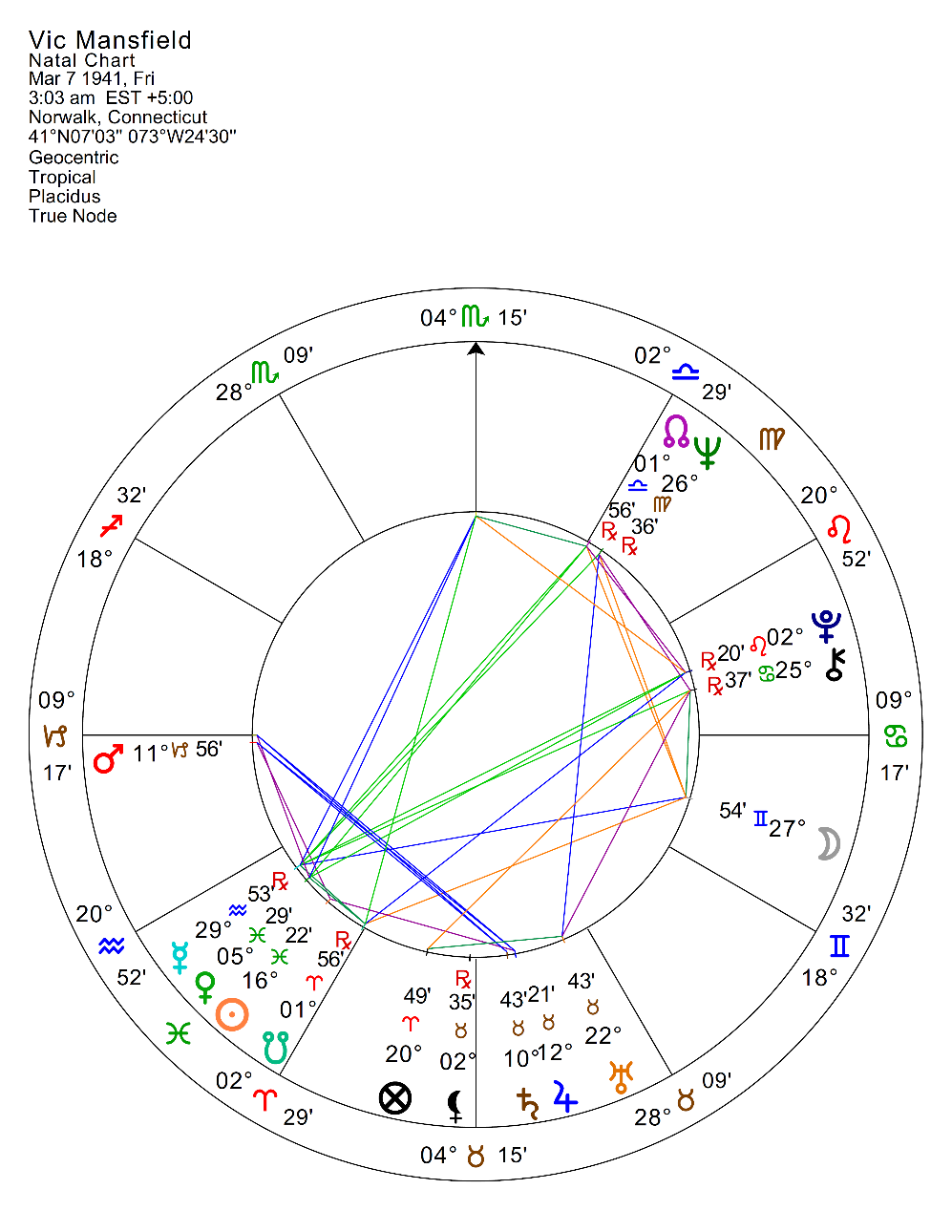
VM's Saturn degree at Taurus 11 (4th house, non-dignity) and opposite read/discussed
VM sees himself through doing what the degree indicates; the soul wants a vehicle through which it can express itself creatively through doing; the source of his ethics
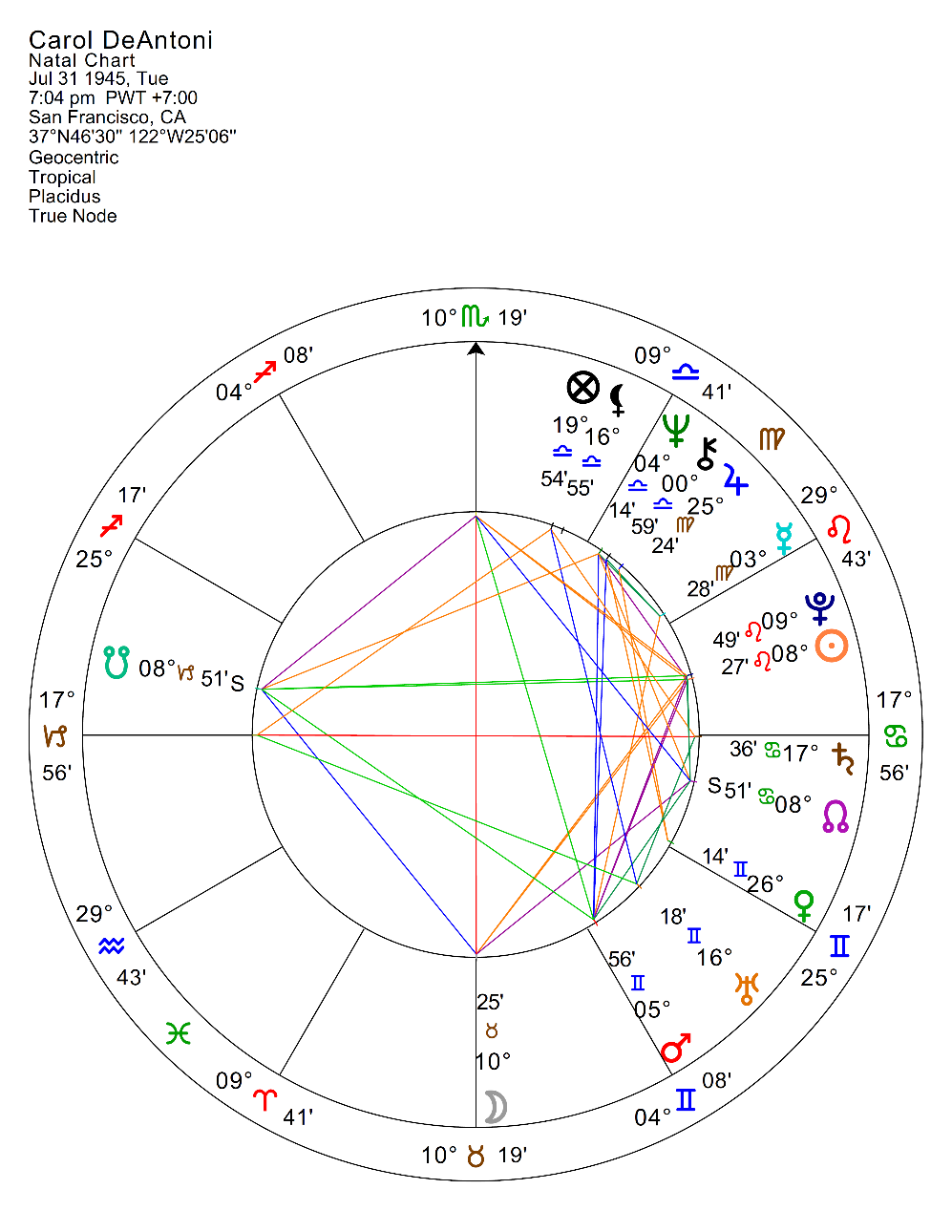
CdA's Moon degree at Taurus 11 (4th house/nadir, exaltation) read/discussed; Moon as Mother, recognition of oneself as an embodied being; fourth house as ascending levels of being
CdA's experience since living at WG: increased introversion; forced awareness of relatedness, non-relatedness; reflection on her own psychological function
1-degree square to Pluto in 7th house: unreflective participation in relating Moon's knowing function to other individuals; makes manifestation of Moon function more difficult, forces broader understanding/universality
Knowing function growing across multiple levels: physical, psychological, metaphysical; nadir most powerful point in chart
Intelligence linked to body allows for metaphysical, psychological, etc., distinctions; these distinctions being forced through growth of Moon in Taurus on nadir
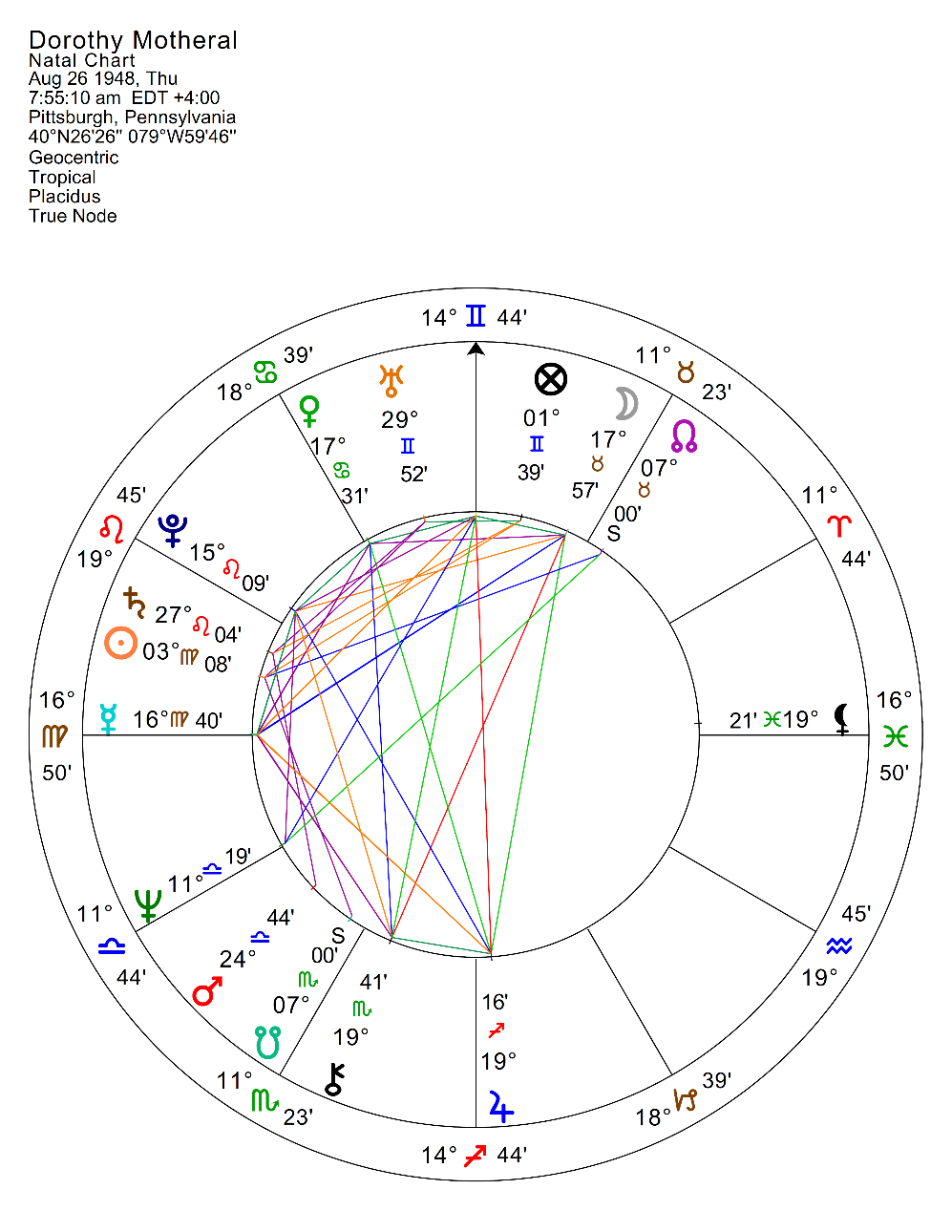
DM's Moon at Taurus 18 (9th house) square Pluto (11th house): recognition of the body as a great means of knowledge
More discussion clarifying the distinction between dignity/non-dignity, being and knowing
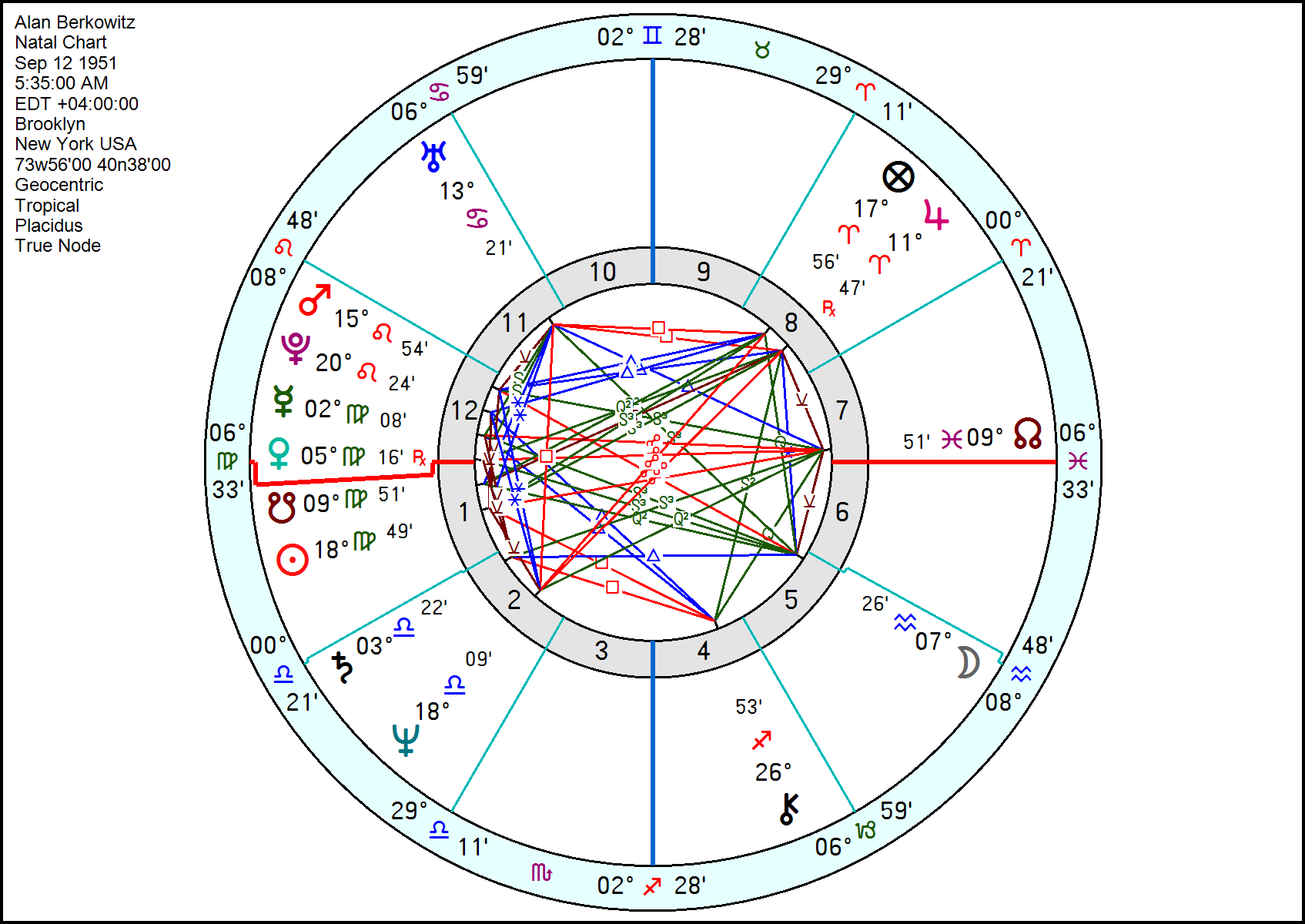
AB's Mercury at Virgo 3 (12th house, rulership) read/discussed; inner conviction that helping others formulate/understand something will be beneficial to them
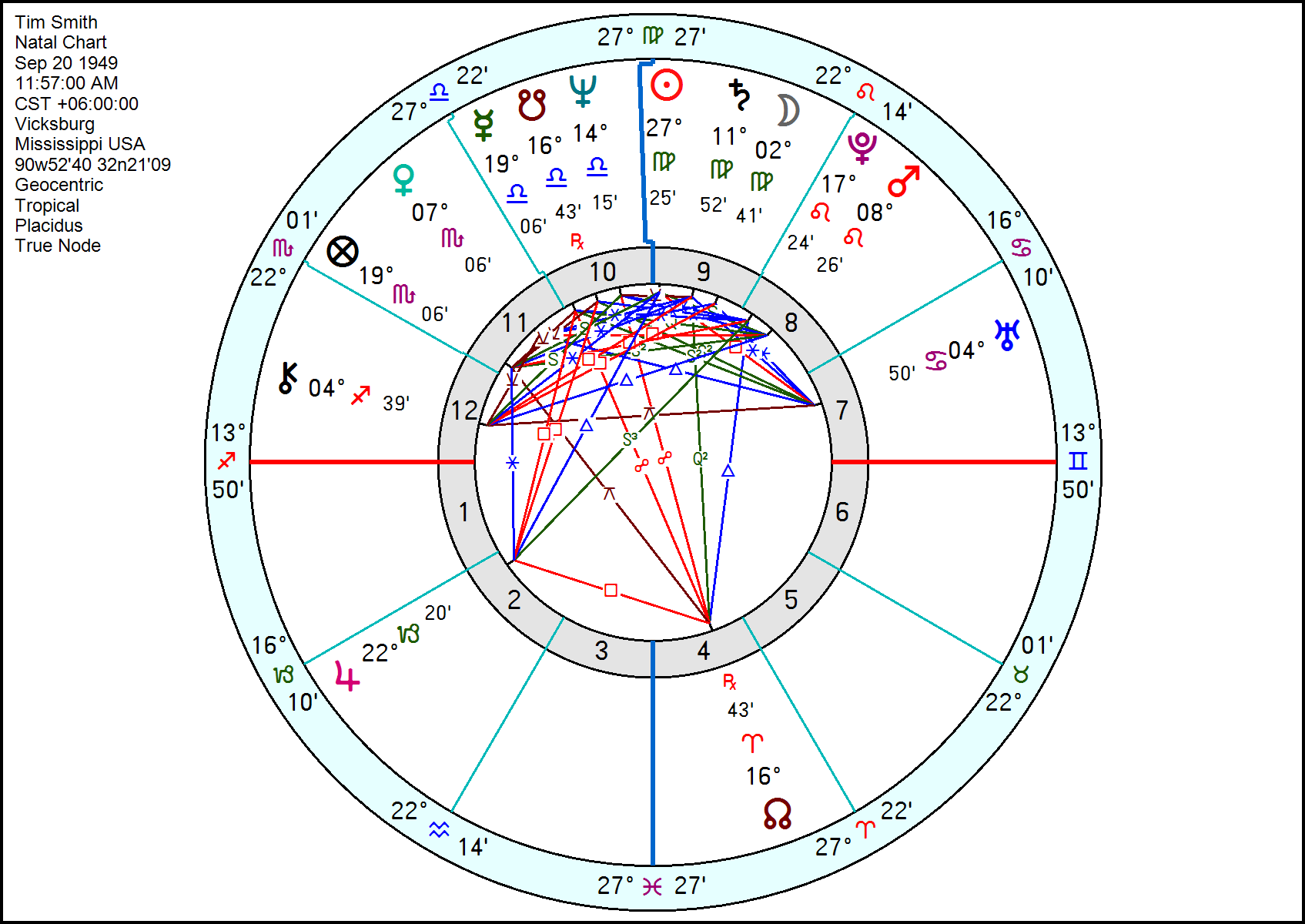
TS's Moon at Virgo 3 (non-dignity) read/discussed
TS unconscious of his Moon; tends to disregard the body; most men unaware of their Moon until middle age; sextiles to Uranus and Venus help to more precisely weld body into a mode of being
First indication of Moon awareness is mellowness; won't have to eat so much chocolate
Brief discussion of Verdi's Jupiter at Virgo 3; Jupiter as kinship libido; Verdi's life expressed the helping aspect of the degree; his inner conviction and appropriateness of behavior
Future work: need for more detailed definitions of each category (senex, anima, etc.)
Modern analysts have started writing specific articles on categories but not aware of distinction between categories and reason-principles and that they always exist together
Philosopher operates with rational soul outside of the Dragon; can see the morality in the embodied image
Everything gets distorted in the Dragon due to mixture of soul's reason-principles and body's desires/passions
In Dragon, powers still in conformity with soul but not in any way we understand; can be speeded up if soul identifies with rational part
Intelligence as ultimate substance; no abstract intelligence; always intelligent about something, which is itself; in the slightest perception there's recognition of intelligence
Perception through substance of Intellectual-Principle as eternal stasis, through substance of Soul as movement
Soul is principle of motion; even an animal knows this
BOOKS / ARTICLES / JOURNALS READ FROM OR REFERENCED:
Vyasa, Bhagavad Gita
Anthony Damiani, Astronoesis
Plotinus, The Enneads (MacKenna translation, 4th ed.)
Marc Edmund Jones, The Astrology of Concepts
Marc Edmund Jones, The Sabian Symbols in Astrology
C.G. Jung, CW 8, The Structure and Dynamics of the Psyche, "The Structure of the Psyche"
C.G. Jung, CW 20, General Index
Marie-Louise von Franz, James Hillman, Lectures on Jung's Typology, "The Feeling Function"
James Hillman, "Anima," Spring 1973&1974: An Annual of Archetypal Psychology and Jungian Thought
Journal of Analytical Psychology
SABIAN SYMBOLS: Aries 6, Taurus 11, Virgo 3, Libra 6, Scorpio 11
DIAGRAM and CHARTS appended to transcript:
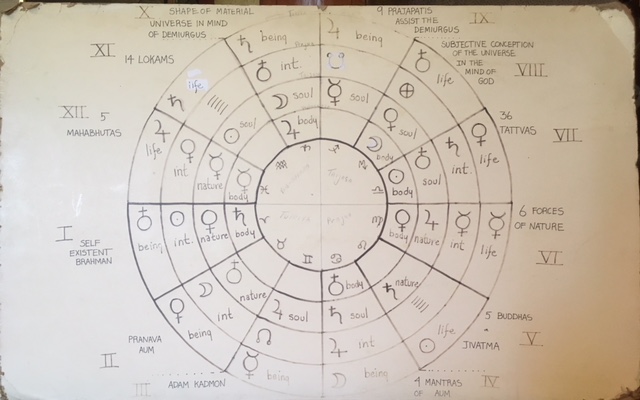
FIGURE IMG_2202-Posterboard Metaphysical Chart, used in classes at Wisdom's Goldenrod.
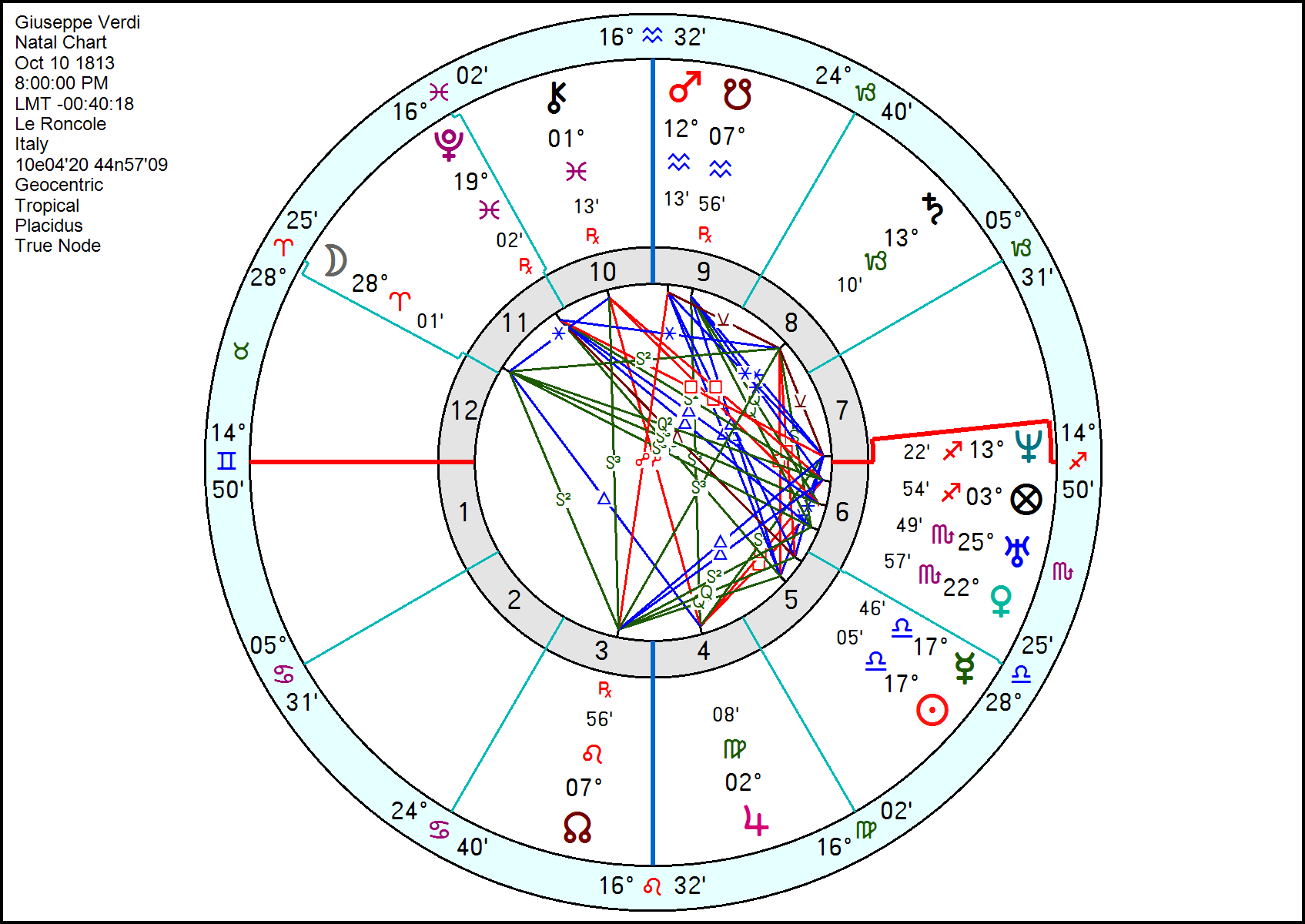
FIGURE 1982 0708a-2. Giuseppe Verdi Natal Chart.
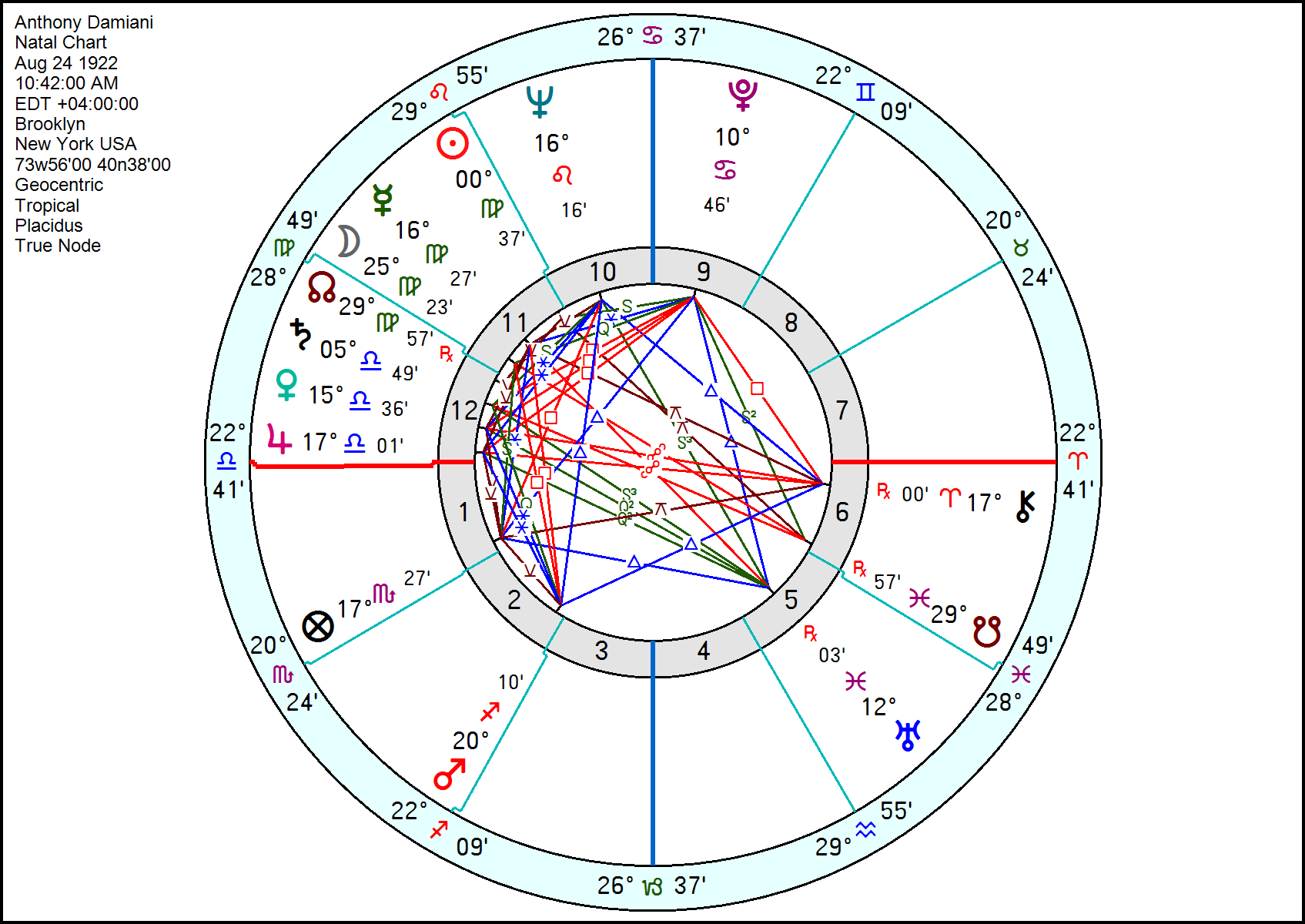
FIGURE 1982 0708a-3. Anthony Damiani Natal Chart.
FIGURE 1982 0708a-4. Vic Mansfield Natal Chart.
FIGURE 1982 0708a-5. Carol DeAntoni Natal Chart.
FIGURE 1982 0708a-6. Dorothy Motheral Natal Chart.
FIGURE 1982 0708a-7. Alan Berkowitz Natal Chart.
FIGURE 1982 0708a-8. Tim Smith Natal Chart.
Other diagrams also referred to are not with this transcript version. [Transcriber note: [diagram] means the speaker is referencing a diagram as he or she is speaking. If someone is drawing or writing, with audible sounds of chalk on a blackboard, I indicate this by [drawing] or [writing].]
AD PAPER read in class:
- "Saturn at 6 Libra: An Illustration of How Your Experience is Structured by the Productive Imagination". Retyped as 1982 0626 V09MP. Astrology - Theory - Imagination (AD Supp 282-284).
NOTES:
This is 1982 07/08a, an evening Astrology Seminar, and the first entry associated with this date. 1982 07/08b = an afternoon Astrology Seminar, for which there is no audio, only JF notes. 1982 07/08c = a morning Astrology Seminar, for which there is no audio, only JF notes.
Earlier partial transcript, Scan File 1982 0708-02R07.PDF, exists.
7/8/82 is a Thursday, not a regular class night, but often seminars held Thursday, especially in busy 1982.
TRANSCRIBED Verbatim by IT 2022. In 2025, IT completes TOC and removes appended paper, which now stands alone, and makes relevant changes in front matter and within transcript to indicate this change. Archival verbatim transcript with AD Paper– V11ap.
AUDIO FILES: 1982 0708a, 1982 0708b. [Note: "Tape" and "Side" refer to original audio cassette tapes later digitized into .MP3 Audio Files.]
1982 07/08a SEMINAR at Wisdom's Goldenrod
Astrology; Theory
[Audio File 1982 0708a Begins]
AD: --which corresponds to Soul in the Bhagavad Gita. [RC assents] Alright, now these three distinctions that they make within Brahman, they want you to just keep them tentative, I mean don't, you know, make real, hard, and fast. And on the other hand, you also want to be able to distinguish, when you're talking about the higher, you want to distinguish various aspects of the higher, that part which is Divine Perfection, that part which is Nous and that part which is Soul. So you want to make those distinctions so you ha-- you have these two different ways of dealing with it. [Note: See FIGURE IMG_2202-Posterboard Metaphysical Chart appended to this transcript for the following.] Now the chart shows that you can do that because, on the one hand you could speak about-- you could speak about the third quadrant just as Soul, alright. Then the Ideas there are rooting, so to speak, in the Intellectual-Principle, true. But still, what constitutes them as Soul is distinct as what constitutes the Intellectual-Principle. [student assents, very faint] But at the same time you could also see that there's a kind of thread around the whole circle which relates them all at the same level [diagram]. So you have Turiya which is circling around the whole thing but you have Vaishvanara, Taijasa, and Prajna. So you had to-- you have to have both and the diagram does show both. And you can't go beyond that, you can't get carried away with these distinctions to the point where they would be really hard and fast rules. They're not. [student assents, faint]
The same way because the principle down-- down at the level of Nature where the planets, the cosmocrators, not only are the cosmocrators, but also the immediacy of the Divine Henads in the cosmocrators is there too. They're immediate. I mean it isn't that you've got to climb up a scale of ladders, you say I go from a cosmocrator to the soul of the planet then to Intellect. I mean, you're not going to climb up because the unity of the principle is present in the cosmocrator right there. There's no ladder you're climbing. Alright but we have to make the distinctions and when we make the distinctions then we turn them into Hypostases and think that they're real. So you speak about the soul of the planet, alright, and then you speak about the Intellect of the planet so the planet could operate without a soul or its Intellect. [S: But you can't u--] So you want to retain a language that could employ both, to distinguish the cosmocrator from its higher principles, and also at the same time be able to see that the cosmocrators are integral to those higher principles and expressive of those higher principle(s). You see what I'm saying? You have to do both at the same time. [student assents] And it's a very uncomfortable logic for Aristotle, he wouldn't like it. It can't be helped.
RC: Do you think that there's any need or any-- it's in any way fruitful to develop more about what it means to say on the one hand that the Soul is identical in substance with the Nous, and then--
AD: That's done in the first chapter. [Note: Reference is to Astronoesis.]
RC (faint): Ok.
AD: That's in the first chapter. The distinctions that are made are-- they're actually quoted too there, the example with the Gita is given, how in the Gita you have the same situation where the three-- three aspects of Brahman are referred to as one and the same thing. [Note: See Astronoesis, pp. 69-71.]
RC: Uh-hm.
AD: In the same way like the three Hypostases are referred to as one and the same thing in certain passages when he speaks about them as eternal and authentic Being. [Note: See Plotinus, The Enneads.]
RC (very faint): Yeah.
JC: Is that how you mean they're identical in substance is in that way? Is that how you mean they're identical in substance is in that way?
AD: Yeah.
S (very faint): Ok.
AD: They're (a trinity).
S (very faint): [couple/three words inaudible]
AD: The distinction is made of course between perfection of the One (as/is) eternal Being and the others which are not of that nature. [short pause] I think that that's the theory, important point but it's in the first chapter, I didn't want to look at it.
RC: Yeah. No, I was-- I realize it wasn't me but I was wondering if I was just imagining the problem or if there was a problem, but--
AD: It is a problem, yeah.
RC (simultaneously): Yeah, see in the one class it's identical and another saying that this is how we distinguish the Soul insofar-- Soul from the substance of Intellectual-Principle.
LR: How do you speak of a substance differently from the consciousness?
AD: Can't hear you.
LR: How do you speak of the substance underlying-- [short pause] how do you speak of the substance underlying each quadrant as distinct from the consciousness that you attribute to each quadrant?
AS: Yeah. I think--
RC: Uh-hm.
AS: I-- I think the question, that's one question but-- [RC, faint: Yeah.] how-- the substance still seems identical with the consciousness. The question is how do you distinguish [LR simultaneously: Well then if you s--] the substance from the Ideas.
RC (faint): Yeah.
AD: You (can). That's why I don't use the word 'consciousness', [S simultaneously: Yeah, intell--] I use the word 'intelligence'.
AS (simultaneously): Intelligence.
RC: Yeah.
AH: But--
LR (simultaneously): But if you say that the Soul [AS simultaneously: The intelligence is the Idea.] is of the same substance as Nous, is it only the Soul in the second quadrant that's of the same sub-- substance as Nous?
VM: The Soul in the third quadrant you mean?
LR: No, second.
AS (simultaneously): No, she meant--
VM: Second.
AS: I mean--
LR: Because thing-- the problem of the Taijasa intelligence which isn't Prajna intelligence-- I mean I'm trying to--
VM: Right.
LR (very faint): [couple words inaudible]
AS (simultaneously, faint): No it's the same question Randy [couple words inaudible]
LR: Yeah I know, I'm just saying.
AD: If you take the [LR: The--] third quadrant [Note: second quadrant], alright, you have Turiya at the outermost circle, the Turiya-Prajna [diagram].
RC (faint): Uh-hm.
S (faint): Yeah.
AD: If you take the third quadrant, you've got Turiya of Taijasa substance [diagram]? So the outer ring, all of it is Turiya. But the subdivisions would be Prajna, Taijasa, Vaishvanara, right?
LR: Yeah. So, I guess-- I'm just getting hung up on the words 'cause I don't know how to think about substance as different from intelligence or, you know, s--
AD: No they're the same, substance, intelligence are the same for me.
[short pause]
RC: It's like maybe that'd be a better way to put it, like instead of saying distinguish the substance of Soul from the substance of Nous to say distinguish the intelligence of Soul from the intelligence of Nous. That would make the problem go away.
AD: Ok.
RC: Then you could say that the intelligence is-- the Soul is a Taijasa consciousness operating with these three Ideas [diagram] and the intelligence of the Nous is a Prajna consciousness operating with these three other Ideas [diagram], and not get into your problem at all.
AD: Uh-huh.
AS: Yeah, that's the way I tried to do her but then, suppose we ask you, what is the subs-- if we have-- talk about a substance of the Soul quadrant we still have two ways to go. We have the Intelligibles are function-- the Intelligibles are-- are the function(s). Now you ask, what's the substance that goes with that.
RC: I'd say it's a certain--
AS: Would you say it's the Ideas or would you say it's the Taijasa intelligence or would you say it's the combination of those two?
RC: I'd say [S simultaneously, faint: The what?] that it had to be necessarily both, that the type of consciousness and the Ideas that are being manifested, alright, just inextricably woven together.
AS: Right. But it seems that the type of consciousness and the type of-- and the functioning going on is also inextricably [RC: Yeah.] woven together.
RC: Yeah.
AD: Well, let's take an example. If you take the Subjective Conception of the Universe [diagram], alright, that would be-- the Subjective Conception of the Universe in the Mi-- in the Mind of God, that would be an Idea rooted in Turiya, wouldn't it. But, if it is Subjective Conception, if it's some kind of knowledge or an activity, then it has to be Taijasa. [AS: Yeah.] See, the two of them have to be almost inextricable. You can't have the Subjective Conception of the Universe in the Mind of God [AS: In Prajna.] in Prajna or [AS simultaneously: Yeah.] Taijasa, it has to be in [AS simultaneously: Right.] Turiya, alright. But then if you speak about it as this-- as a kind of intelligence that the Soul works with, then you have to make a distinction or you have to differentiate it out. But it doesn't get differentiated out except through the intermediaries and the powers.
AS: Right.
S: Would you--
AD (simultaneously): In the outer ring itself it's not differentiated. It's only when the exaltations differentiate it and then, and only then, can the Soul take in that Idea into itself into a living form and do something with it.
RC: Yeah.
[few seconds of faint background student talking]
AD: You follow, Linda?
LR: So then, the differentiation of the Idea at each grade would have to be a different intelligence, would actually define what we mean by a different intelligence. In other words, if you say that as an Idea, as a pure Idea, that Subjective Conception is Turiya.
AD: You have-- you have to trace it back to Turiya.
LR: And then you say well, the differentiation or the-- the exaltations differentiate that Idea, the Separative Intellect in some way differentiates out that Idea and yet it still remains identical with itself, something like that, then you're speaking of that Idea as prior to intelligence?
AD (simultaneously): Yeah, uh-huh.
LR: And then if you say, well that Idea also has a life, a motion to it--
AD (simultaneously): Or is put into (formed life), that--
LR (simultaneously): Then you're speaking still of the same Idea but [AD simultaneously: Uh-huh.] now as it's unfolding in Taijasa?
AD (simultaneously): In Taijasa.
AS (faint): Yeah but, I just don't--
LR (simultaneously): And you-- and you can do that all the way around, and that's the ring point of view.
AD: And that's--
LR: That would be the ring point of view.
AD: Yeah.
S (faint): Yeah.
AS: Could I ask [one/two words inaudible]
LR: But it wouldn't-- but it wouldn't just be Turiya, Prajna, and Taijasa, it would be Taijasa-Turiya, [student assents] and Taijasa-Prajna, and Taijasa-Taijasa, right?
AD (simultaneously): Uh-hm.
LR: I mean, it seems like you have to bring in sixteen because four is not enough.
AD: You have to bring in sixteen?
LR: You have to bring in the sixteen.
AD: Sixteen are automatically implied in the four quadrants.
LR: Right.
AD: Automatic.
LR (simultaneously): So each Idea would have four intelligent ways to be unfolded, right? And that would be the substance of the Idea that--
AD: Uh-hm.
LR: That-- the substance of that Idea would be the kinds of intelligence which you-- which can unfold it?
AD: Well it would be the Intelligibles that unfold that substance, that intelligence. You have to go to the Intelligibles to unfold the substance. And to us it seems as though it's getting differentiated.
RC/S(?) (faint): Uh-hm.
RC: So the Intelligible would be unfolding-- the functioning Intelligible would be unfolding not only the Idea but also the sort of consciousness required to have it in presence of that Idea. It would be conceiving the Intelligible as (now) itself being able.
AD: I don't follow that, "not being able".
RC: Either necessarily a state of consciousness or a form of intelligence.
S (very faint): Uh-hm.
S: Well--
AD (simultaneously): Well I conceive of it as a form of intelligence, it's a certain type of intelligence.
RC: Yeah, yeah, once it's associated with that Idea.
AD: Uh-hm.
RC: Like, [AD simultaneously: (What's--)] once the Venus is associated with Libra then it becomes a form(ed) intelligence with a characterized kind of consciousness.
AD: Try again.
RC: Like Venus in itself, it is an intelligent or seems to be capable of coordinating its own aseity with different kinds of consciousness in different forms of intelligibility. When you put it in Libra, then it manifests Turiya-Taijasa consciousness according to the form of the 36 Tattvas. You put it in S-- I mean Pisces, then it manifests Vaishvanara-Prajna consciousness and forms of the sense world. It seems that both the form and the state of consciousness are coming from the-- the side of the-- the Ideas. [student assents, faint whisper] And that the Intelligible is capable of-- of--
AD: Manifesting.
RC: Manifesting it. But in itself is not limited to any one of them.
AD: In itself?
RC: It itself is not necessarily limited to only one of them.
AD: You mean the Intelligible in itself is not limited.
RC: Yes. But that anything [AD simultaneously, faint: Yeah.] that goes into that sign, the Intelligible is automatically forced to conform its functioning to kind of consciousness and form of intelligence to that.
AD (simultaneously): Yeah, except-- except that-- We're saying that that can't happen because Number already has determined-- determined that.
RC (faint): Correct.
JC: So when you (say) the unity of the Intelligible, it has that freedom to be associated with one substance or another, but Number determines the relationship of the Ideas and the Intelligibles in the Divine Mind, Soul, and Nature, or the System of Nature. So once that's happened it's already coordinated in a very specified way.
AD (simultaneously): --fied way. And that's also the theory of participation. In other words, once Number decides which Intelligible, which planet, goes to what sign, and the various aspects of that planet-- In other words, if you take Venus in a rulership, alright, and you trace it all the way down to the body, insofar-- insofar that Venus has a unity, everything that's under that unity, you know, its Being, Life, Intellect, Soul, is already a participation in that unity. It's already included in there. [student assents, very faint] That's looking at it vertically, but looking at it horizontally, alright, then if-- if you were at one level of reality, that Venus would work the same for everyone at that level of reality. In other words, insofar that we all participate, we all have Venus somewhere, alright, we're all participating in that Venus. And there you could speak about our participation in that Venus is a subsumption under that Venus. It's all included in that Venus. Alright, that's the horizontal way but the vertical way is much harder because we have to see somehow that the unity of Venus, the Being of Venus, already prescribes where the Intellect must fall, where the Intellect of Venus must fall, where the Body of Venus must fall--although I don't understand that. [students assent, faint] Do you follow this now?
RC (simultaneously, faint): Yes, (ok).
AD: It can't fall anywhere. [student assents] The Body of Venus must fall in Virgo. Why? I don't know. Maybe if we--
RC: But that almost seems like if you think of these functional planets as like the life side, that that principle of motion that their motion represents is getting [few words inaudible]
AD (simultaneously): Power, of power, you're better off. Venus has power to do something, alright. In Libra it has power to do something, in Scorpio it has power to do something. But the power that it has, has a certain peculiarity, a certain aseity, and it could only manifest, let's say, or reveal something about certain signs, not about all signs.
RC: Uh-hm. Now, would you-- would you say that the Venus, that the intelligence which is-- which it has-- [VM: Of course you would, (Randy).] the intelligence which it has is imposed on it from within.
AD: Imposed upon it from--
RC: Upon it from within, that the--
AD: Yes. That you would have to trace back to Venus in the Intellectual-Principle, where as an emanation from the Divine, alright, the entirety of its determination is set up.
RC: Uh-hm.
AD: Once Venus, or once that principle that Venus represents, is given a certain aseity, that's it, I mean she can't, so to speak, go to Capricorn to reveal Intellectual [RC simultaneously: Yeah.] function. The aseity already determines what Idea she can reveal, what Idea she can't.
[10½ second pause]
LR: Well that would really--
AD: [one word inaudible]
LR: I don't-- this might be tangential and you can stop me, please, but that would really be an explanation of when you do the-- the horoscopes of the dignities versus the non-dignities. The last thing you just said. You just said, Venus cannot reveal intelligence in Capricorn. Its as--
AD (simultaneously): Yeah, it wouldn't be Intellectual there.
LR: So that distinction between a planet in dignity and not in dignity would have to do with the development of a functioning or the revelation of intelligence. If it's in dignity, from what you've just said, it's been placed there by the principle of Number, meaning that it's actually fit to reveal inte-- the intelligence of that form, Idea.
AD (faint): Uh-hm.
LR: That that would be what it would mean to assign certain intelligence. [student assents, faint] So that if you place a planet in a sign where it isn't assigned by--
AD (faint): Uh-hm, not in dignity.
LR: Then it would be more being built up by that i-- it would not be a revelation per se of that Idea. It would be-- I don't know what you would say, it would be doing-- it would be worked on by that Idea or it would be [AD(?), faint: Uh-hm.] built up but for some (reason--)
AD (simultaneously): I don't know, we-- there's still an uncertainty about that, what would the planet mean in a non-dignity sign.
LR (faint): Yeah.
RC: It does seem though that we're saying that these dignity locations that go into the actual constitution within the Nous of-- of each of these planets, that those would be things that it's capable of recognizing as itself, that as constituents of its own being is (brought up) in Intellect and so on. And that the Ideas which are not included within that structure would necessarily seem to it other than itself.
AD: Try again.
[short pause]
RC: If-- if I take an Intelligible like Venus, and I say that within the Nous the true form of Venus arises, and it arises as having certain kinds of consciousness in association with certain forms of intelligibility and that's what constitutes Venus in the Intellectual-Principle, then it seems like Venus could know those things as itself. And, whenever it encountered something other than those things it would be dealing with something that it simply couldn't perceive as part of its own constitution.
[short pause]
AD: I don't know about the second part. I just don't know. I don't know what it means for them not to be in non-dignity.
LR: The first part seems clear though, the dignity.
AD: Yeah. But to say that-- to go as far as Randy did, I-- I hesitate now.
[11 second pause]
LR: Well, for one thing, if they were always in dignity you wouldn't have an individual. Something-- so-- something of the individuality is defined by the non-dignities, because the dignities are revealing cosmic intelligence or ontic intelligence.
AD: Yeah, they're revealing the Idea, yes.
LR: So--
AD: Now what does it mean when they're in a sign where they're not in dignity?
LR: Well-- is this off the point?
S (very faint): I don't know, (Linda).
LR: What I'm saying is if a-- if a person's natal horoscope was all made up of dignities, he wouldn't be much of an individual soul operating. He would be a revelation of ontic intelligence. So that, because that doesn't happen, something of the individuality is defined by the fact that those cosmocrators are placed differently than in our-- in the metaphysical chart. His-- I don't know how to say it. [S, faint: Yeah.] No one is a pure revelation of the Nous. Otherwise he wouldn't have to come here and go through all this. Right?
AD: Well, is it-- is it possible to have seven dignities?
S (faint): Yeah, sure.
AD: Yeah?
S (very faint): Uh-hm.
S (very faint): Uh-hm.
LR: Is it?
JC: Yes.
LR: Does it happen?
AS: Is that really seven, Tim? (I've seen) six.
LR (simultaneously): Tim, have you ever seen someone who had all [AS simultaneously: Seen six.] his planets in dignity?
S: Six that you saw?
S (faint): Yeah.
TS: Theoretically I think that it's possible but I don't know--
JC/S(?): Get my chart.
AD: And if it's theoretically possible and he comes here then evidently he's not a pure revelation.
LR (faint): Right, I think I know that. (bit of laughter)
S (faint): Without going [one/two words inaudible]
AD (simultaneously): And besides, there are some people that come here with an entirely preformed a priori prefigured soul, and they're not going to learn anything from the world and are going to keep telling the world, "No, this is the way things are, you got it all wrong." (AD laughs a bit)
[short pause]
AS: He had-- Lincoln had six.
LR (simultaneously): In fact, (bit of laughter) the person Dotty just pointed out is telling everybody what's going on. (LR laughs a bit)
AD: Who? Who?
DM: There's some guy, who I think, he came into Fred's office and we always get their birth stats. And I looked up in the ephemeris and I think he has all dignities and he's a mover.
AD: Alright, he's a mover.
S: (As) mover. (bit of laughter)
JC/S(?): I was a mover [one/two words inaudible] ten-year old.
AS: He's a cosmocrator. (AS laughs a bit)
S (very faint): You bet your life.
S (faint): Exactly.
AD: No, I think it's the other way around, I think he's getting moved.
LR (simultaneously): He is moved, (bit of laughter) he's getting moved.
AS: Listen, Lincoln had six, six out of seven. [S, faint: Oh.] Just Saturn, Saturn was the only one (who had nothing).
S: Yeah.
AD: Well, I was [AS simultaneously: (Votes.)] thinking of someone more like-- [short pause] someone like Shelley.
AS: Yeah. Ok.
AD: He was an ethereal spirit, he came here, he couldn't get-- no one could instruct him in anything. He already had a priori innate knowledge of the way things were supposed to be. And he's very unhappy that they weren't that way then. But don't-- don't think you could ever change him. I think he just came for a visit.
AS (simultaneously): Beethoven was probably-- [AD simultaneously: Yeah] Beethoven was probably a lot like that too.
AD (simultaneously): Yeah. They just come for a visit.
S: Who?
S: Who?
AS (faint): Beethoven was like that too.
S (faint): Yeah.
[short pause with faint background student talking]
LR: I was just trying to say that the non-dignities would have to reveal-- show us more of the person's historicity or own individual constitution, and that the dignities--
AD: Alright, then in that case let's go back. Let's stop right here and see if we get this.
RC: Yeah. About-- like you were [LR simultaneously: I'm sorry.] talking about the Subjective Conception of the Universe as part-- one of the Ideas that was necessary for the Soul substance, Soul intelligence to work with. Seems that what we've got with the dignities and the Ideas, their coordination prefigured in the Head, is we have the-- the Intellectual-Principle's self-image. And, Plotinus distinguishes Soul from it by saying that the Soul deals-- Soul deals with things as external-- external to itself. So is it possible then in terms of these three Ideas in the fourth quadrant that that's where the-- the shuffling comes in of coming up with arrangements that are different than the dignities' arrangement.
AD: Tim, put up Verdi's chart. [Note: See FIGURE 1982 0708a-2, Giuseppe Verdi Natal Chart, appended to this transcript.] Otherwise it's going to remain all theory.
TS: What?
AD: Put up Verdi's chart.
TS: Uh-oh. [short pause, flipping through pages] I think we still have them.
AD: I'm sure he had a few that were in non-dignity.
TS: Yep he did. Ok, Verdi's chart. Ok.
AS(?): That I'll put up.
S (faint): (Do/Bring) 'em all today.
TS: What?
S (simultaneously): Ok.
S (very faint): (Do/Bring) 'em all today.
S (simultaneously): Hm? You take down--
AD (simultaneously, very faint): Yeah.
TS: You got that chart, Linda?
S: I got [couple words inaudible]
AB (simultaneously): Yeah.
[quick tape break]
S: You know where he started?
AB (simultaneously): It's easier to read.
AS: Yeah, I got that.
S: [one word inaudible]
[quick tape break]
AD: --it would have-- if we look at the Chaldean planets, alright, and we say that these seven planets [someone drawing/writing] are constitutive of the personality. Ok?
RC: Uh-hm.
AD: And that the aspectual relationships that exist between these seven planets is the personality. Now, we say that a planet is placed on a degree. That degree is organizing that particular category of the imagination. [student assents, very faint] Ok? That's what you mean by image.
RC: The intelligence embedded all the way in some--
AD: The way, the way that is organized by a reason-principle, that's the image. [student assents, faint] You can't see it, right?
RC: Right.
AD: And yet, in order for you to apprehend anything you must do so through that vehicle. [RC simultaneously: Yeah, that's because--] So, you don't see the image that constitutes you.
RC: Ok.
[16½ second pause]
LR: Do we project them?
AD: At-- at this level, what would be the distinction between gnostic and, you know, one in dignity and one out of dignity? [14¾ second pause] You follow what we're saying?
RC (simultaneously): In consciousness?
VM: Yeah, I don't see how you can make the distinction.
AD (simultaneously): This-- this is really very important. [VM simultaneously: I don't see how you can make--] I can't emphasize how important it is because what we're saying is, these seven planets are the very mode of your being in the world.
VM: Ok.
AD: Alright. And consequently this very mode of being in the world is not something which can be apprehended but is the way that you apprehend.
VM: Is you, yeah.
AD: So it's the presupposition, alright, it's the attitude with whi-- that you are. Now what would be the distinction at this level between one in dignity and one not in dignity?
LR: That you--
RC (simultaneously, faint): There's a kind of consciousness that that function operates with.
[short pause]
AD (faint): Would you be more specific?
RC: We talked at one point as one possibility was that some functions were appropriate to the cerebral-spinal development and some cases is not. And, the distinction we make at this level between conscious functions and unconscious functions might derive from that.
S (very faint): Uh-hm.
[30¼ second pause]
AD: Then you're saying that there is a distinction at this level whether the planets in dignity or the planets in non-dignity are situated on a planet, I mean in the-- in the sense that they're fabricative-- either one, dignity or non-dignity, [RC assents] is fabricative of the mode of your being in the world.
RC: Yes.
[15¾ second pause]
AD: Any ideas, any-- any more ideas?
S (faint): Well--
LR: Last week you were saying that-- just to review what you said last week, you were saying that one usually identifies oneself more with the (negative)?
AD: Yeah, you're just saying what he's saying.
LR: And that-- [short pause] that they co--
AD: That is, the fabricative tend to be unconscious and we identify with them and (the) dignity we tend to be conscious of them. In other words, you have planets in dignity, you tend to be reflectively aware of their functioning. Planets in non-dignity, you're unconsciously identified with them. It's the same thing as he said.
[short pause]
RC: To the "I" and the not-I (truth)?
AD: They're both "I".
RC: No I mean psychologically experienced you could have an "I" and a not-I.
S (faint): Uh-hm.
AD: No, they're both "I", you ex-- you experience a m-- I think what you're trying to say is that you experience the mental processes as not-I and the psychosomatic organism as "I" or is it vi-- vice versa?
RC: I guess following the line that I'm on now, I-- I would (try) to say well, if you've got dignities in the Body monad that you might take the body as "I", if you've got dignities in the exaltation that you might take the mental processes as "I". If you have no dignities in the Body you might never think you're the body. If you have no dignities in exaltation you might never think that you're those processes.
S (very faint): Yeah.
S (very faint): [couple words inaudible]
BS: But if these are the presuppositions of our thought, then how are-- how could they be explicitly reflected and known?
AD: How could they what?
BS: Be reflected and known explicitly if they're presuppositions. It's almost as if when you think of something as a presupposition you would think of that as the unconscious, on one level anyway.
[16 second pause]
AD: Oh. We have to go over that again.
[short pause]
JC: This is the paper on the Imagination?
AD: Well just some notes Avery took down while we-- while we were talking.
JC: Of course.
S (very faint): Ok.
[Transcriber note: The following is an excerpt from a paper by Anthony Damiani, tentatively titled "Saturn at 6 Libra: An Illustration of How Your Experience is Structured by the Productive Imagination". I transcribe it as JC reads it. The scan of this paper has also been retyped as 1982 0626 V09MP. Astrology - Theory - Imagination (AD Supp 282-284).]
AD ["Saturn at 6 Libra: An Illustration of How Your Experience is Structured by the Productive Imagination," JC reading]: "For an illustration we take the function of self-apperception or the senex, and try to see in a couple of examples how the self-apperception function which the individual is always operating with must be working according to the degree that the Saturn is sitting on and is further objectively manifesting a content according to the opposite degree. According to the Vedanta explanation the subtle mind goes out and grasps the intelligible, and then has to make a representation for itself of what it went out to -- of what that intelligible or reason-principle is like. In the first example we have Saturn at 6 degrees Libra, and the opposite 6 Aries. Can we see here how the 6 Libra with the Saturn represents the structure of the subtle mind grasping the Idea, and the opposite degree its concretization or outward representation?
"6 Libra -- A pilgrim sits on a bench and one by one watches his ideals take form before him. [Note: This is Anthony Damiani's natal Saturn degree.]
"Here the person cannot be satisfied with a purely abstract or idealistic understanding of himself, but must bring the understanding into a very concrete and practical application. There is a recognition of what constitutes him and his ideals only as this is substantiated -- in this person's case particularly through the science of Astrology, and its application to the human condition. [JC: And the opposite degree--]
"6 Aries -- A black square stands firmly, illumined [JC reads: illuminated] red on one side.
"In this opposite degree, we find that the way the inner self-apperceptive organization is objectively portrayed is that the"material reality" seen just in itself without the expression of the higher ideals or meanings being seen in it cannot be given any real power. But insofar as the sensible reality is truly revealing something of his higher ideals, or is seen to validate them, then it does take on the highest importance. If astrology can reveal the true or inner meaning of the world experience, then the experience can be seen to be meaningful, and not just a show. Insofar as "material reality" is an expression of inner intelligence, the person's experience will express his self-apperception, his views of his own ideals."
S (faint): Uh-hm.
S (very faint): Yeah.
JC: [one word inaudible] you want (to--)
AD (simultaneously): Let's-- let's see if we could summarize it in a sentence because I think this-- it's an answer to the question Bert asked him. If you don't try to re-- remember these things we can't build up. Because you first have to make, you know, the bottom secure, then the next, and you've got to hold onto these here. We made this remark, I think something to the effect that self-apperception is a mode or a way of being. And that means that inwardly I'm already organized or whoever has that degree is already organized to perceive the world in a certain way. [Note: See FIGURE 1982 0708a-3, Anthony Damiani Natal Chart, appended to this transcript.] Now, that proclivity or that tendency to perceive the world in a certain way is going to be the outward manifestation of that inner state of being. Now the outward would be the sensible image. It'll be the house structure. Whereas the inner would be the way I can perceive and that's the only way I can perceive. Any-- any time I perceive I must perceive in that way. In other words, I must see how the ideals that I'm living for are getting crystallized. I can't see it any other way. So no matter what the perception is about, it will be in that peculiar way. Now that's making explicit what is already implicit. Now you have to do that with the seven Chaldean planets to get an idea of the way they are tethered together and constitutes your mode of being. And this constitution of your mode of being, like we said, is the image that you can't see, but is reflected in the mirror. If we use the mirror, that's an-- a good example. [student assents, faint] Alright, you take a curved mirror and you reflect something in it. No matter what you reflect in it will be curved according to the mirror, alright. It'll always have the contours of the mirror, but the mirror itself is not available to itself. It can't see itself as curved, alright. That's the way-- that's the situation we're in. Now, if we pick up from here, what would be the difference between a planet in dignity and a planet in non-dignity?
S: Well--
AB: Aren't you saying, the extent to which you are aware of or identified with the inward or outward expression?
AD: I don't follow. Maybe say another way.
AB: Well you're automatically identified with this a priori attitude, you can't help that because that's what you are. But then it's also externalized as an image.
AD: Uh-hm.
AB: Now--
AD: An image that you can see.
AB: Right. Now maybe the extent to which you identify with, you know, one or the other pole is dictated by the position of the planet.
[short pause]
TS: You know, it seems that in thinking about an individual human being there's a confluence of something of the Idea of Man and also something which is peculiar to that specific incarnation. And, I'd like to suggest that possibly with the dignities and non-dignities, those planets which are in dignity are the way in which (the) individual participates in the Idea of Man in some way, whereas the planets which are in non-dignity are more the specific peculiarity of that individual or that incarnation.
AD: You ever see charts of Sages with no planets in dignity?
TS: No planets in dignity, Sages with no planets in dignity. I haven't seen that many charts of Sages, Anthony, so-- The three or four--
AD (simultaneously): I'm pretty sure, I'm pretty sure you'll find them.
TS: Yes, but you won't-- I-- there will be planets-- you're pretty sure there'll be Sages who have no planets in dignity. Ok, well I-- I don't know that Sagehood would be a char-- I don't know how to see that in the chart so I don't know why dignities or non-dignities would be particularly--
AD (simultaneously): Well, why are you bringing in the Idea of Man then?
TS: Well, we talk about individual soul and-- as being characterized by the planets in Nature--Saturn [in Leo], Jupiter [in Virgo], and Mercury [in Pisces]. You know, we talk about either the powers of the soul as being that individual soul participation in the Soul monad, for example. And it seems like that an individual incarnation has to be participating in both of those. That it does have these soul powers but it has these soul powers in a peculiar way, (in/and) a specific way.
[short pause]
AD: Try again, see if you can bring it out.
TS: That the planets which are in dignity have to do with the--
S (very faint): Yeah.
AD: Expression of the Idea of Man?
TS: Expression of the Idea of Man or expression of the pure powers of the soul as evolving in as-- in a life, whereas the planets in non-dignity have to do with a specific-- with the specificity of that individual, with what his unique contribution to the World-Idea would be.
[11½ second pause]
AD: Anyone follows Tim?
TS (faint): (No/Yeah).
AB: But Tim--
AD: Maybe you could rearticulate or restate those things?
JC: Thought he was saying that in non-dignity the individual soul has the freedom from the previous, has the freedom to contribute something of his own inherent structure so-- as this individual soul to what's happening in the cosmos. But when you're tied in with the dignity--
AD (simultaneously): Well, well, well, wait, (wait). The non-dignities--
JC: Yeah non-dignities, he's saying, the soul has the-- the availability of his own inherent individuality can be manifested more-- like contribute to what the cosmos is doing more easily because the planets are not in dignity, they're not tied in with what the cosmos-- the cosmic being wants to do.
AD (faint): Yeah.
JC: If you had all rulerships or let's say all-- I mean all dignities we're going to be saying you're--
AD: In other words, the dignities would have to conform to the Idea of Man but the non-dignities would not. They would have to conform to the Idea of the World. Something [TS simultaneously: But--] like that?
TS: Well, that the non-dignities would have to conform to the peculiar aseity of the individual soul.
VM: But why isn't that also an expression of the Idea of Man?
TS: It is. But I'm saying that the-- just let me go the other way, that the individual soul is a specific expression of the Idea of Man as it is an ex-- you know, so its specificity I was suggesting is coming from the non-dignities and its universality is coming from the dignities. And whether it's the Idea of Man or the powers of the soul, you know, the-- if you take the ring down and talk about Venus as aesthetic consciousness and Mars as courage and so forth, that the indi-- the way one specific incarnation might be the evolution of certain of tho--
(Side 1 of original cassette tape digitized as 1982 0708a Ends; Side 2 Begins)
AS: --let's say the structure of the primal image. They're all-- they're all going into-- they're all going into the organization of your experience. [student assents, very faint] They're a priori, they're behind on the obverse side of that. And then the result of all this functioning is going to be your actual empirical experience, your reproductive imagination, the all-- the house system. All that's now taking place within the house system, you'd have reproductive imagination. Now, is-- is the distinction of dignity and non-dignity going to be right back at the level where we speak about these as structuring principles? I mean in the scheme-- I mean the schema we laid out I didn't see yet two different things, I mean, in the description maybe we need more details there. It seems to be saying well these-- all these categories are taking the intelligible and portraying it, or taking the-- taking the internal idea or taking the reason-principles, portraying them in the imagination. Now is-- is the difference in dignity and non-dignity functioning gonna happen right there? Or is it something that's only gonna show up within the reproductive?
S (very faint): Uh-huh.
S: Yeah.
AD: Yeah that's put-- that's putting it pretty precisely, Avery.
S: Uh-hm.
AS: If you couldn't follow that [couple words inaudible] Is the difference gonna show up at the level where they're structuring the imagination, receiving the reason-principles and structuring it, and does a dignity operate differently from a non-dignity there, or does a distinction only show up in terms of the reflective consciousness? And once this primal image is [one word inaudible] (going to produce--)
AD (simultaneously): Do you follow what he's doing?
VM: Yes.
AS: Is there then within that some distinction between the way the empirical personality is gonna operate that shows up by this dignity and non-dignity? Or both levels, there's possibility that obviously if there's a difference on the higher level probably it will show up in the empirical person the way he identifies with something in that image. But is there any difference at the level of the production, I mean i-- are they all functioning-- 'cause I didn't-- in the s-- at least from the schema we laid out, we'd have to bring in another distinction, 'cause we didn't say anything about-- all we said was well here's this whole structure of the imagination and it's taking this reason-principles and portraying it as the imagination and I didn't hear anything in there about different ones-- about there being different kinds of function. I mean in that functioning it seemed like you're saying well this whole thing, the whole mind functions-- energizes to produce the imagination. Is there a distinction there between a fabricative and gnostic or a subject-object or anything in that-- in that production? Maybe and I just--
LR: Well there seems to be less--
AS: Yeah, well what would-- what would it be?
LR (simultaneously): There seems to be less interference when a dignity is operating, less interpretation brought on by the psychic-- psychosomatic organism.
S (faint whisper): Yeah.
S (faint): Yeah.
AD: I don't follow you.
LR: If a person's operated from the dignity, he's revealing something of the knower in him. Now, he may not be conscious of revealing that, I'm not saying that, but he will operate in a prescribed way that seems to be coming from some aspect of his soul, and he's a vehicle for that, he's revealing that functioning, and he's not interpreting the orders as much as acting in accordance with them, he doesn't have a choice. Whereas there seems to be a lot more interpretation going on, a lot more, like Avery said, reproduction going on--
AS: I think-- Linda that-- I wasn't-- that's not--
VM (simultaneously): But it's the implication.
S: No I--
LR: Try again?
AS (simultaneously): Well let me try again. That don't-- that doesn't-- that may be so, I-- it doesn't fit. It's gotta fit with what I was saying.
LR (simultaneously): I thought you said that the distinction had been at the level of the productive imagination or at the reproductive.
S (very faint): [couple words inaudible]
LR: Is that what you said?
AS: Well, something like that, yeah, but what-- but I didn't see how what we're saying fit in, I didn't. Try again. [short pause] At the level of productive is the thing-- the whole-- here's the whole structure of the-- that's not you, I mean you don't normally have access to that yet. [LR simultaneously: (Well--)] When you say the guy-- [S simultaneously, faint: You are that.] when you say there's interference or non-interference, you're already talking about [LR simultaneously: In the reproductive.] in the reproductive, [VM assents] [LR simultaneously: Right, and I was--] whereas within the productive, that may be, we didn't-- didn't seem we made before some distinction, maybe we could, that would indicate that there is a difference there. Were you trying--
AD: If you take Venus in Capricorn and you take Venus Libra and Aries, any one of its dignities, is there any difference when you speak about the production of the anima? You got a Venus in Capricorn or you got it in Libra, alright. What would be the difference? [short pause] [JC simultaneously: Let's say that-- well--] Would you say that the Venus in dignity is self-reflective, that you have an anima that thinks about what it's doing, [LR simultaneously: Not necessarily.] and in Capricorn it doesn't?
LR: Not necessarily, no, I wouldn't say that.
RC: In the sense that you used [LR simultaneously: I--] self-reflective the other night I think you could. But, I don't think that's really come out yet in class, that what we're talking about when-- when you were using self-reflective we don't mean ego-reflective. [AD, faint: Hm.] We mean that within the vehicles there is an awareness that this is not-- that this is a reflection of the self.
AD (faint): Go ahead.
LR: I--
S (faint): Yeah.
S (very faint): Uh-hm, (yeah/right).
RC: And the Venus in Libra would know, I mean I-- the way that it would operate, Venus in Libra would present the objects and the kind of consciousness that precipitates in a way that your s-- your soul realizes that it's its own nature that's being relie-- revealed. Whereas, if you put it in Capricorn, it doesn't seem that the soul functions with the same eagerness toward what gets manifested.
AD (faint): I don't really follow. So in other words--
RC: You don't-- doesn't seem that the person recognizes the functioning of that activity as [short pause] intrinsically a product of its own self-seeking. [22 second pause] Say maybe to make it simpler, Venus in Libra manifests something, and the soul says, "That's me and that's what I really am." [S, faint: Well--] I'll operate in conformity with that and so on. For Venus in Capricorn to manifest something, there might be a lot of hesitation on the part of the soul per se, "This is-- this is I, this is what I really am."
[short pause]
S (very faint): Yeah.
S (faint): Yeah.
LR (faint): I don't follow Randy at all.
RC: But, I guess it hinges on the way I'm taking-- understanding which is self-reflected so--
LR: Well-- Anthony, you said if a-- if Venus is in dignity would it be more self-reflective.
AD (faint): If Venus is in dignity--
LR: Would it be more self-reflective.
AD (faint): Uh-hm.
LR: And I don't think that was the criteria-- I mean-- I didn't think self-reflection was the criterion-- would necessarily be the criterion for having a dignity or not. In other words, even if the person were manifesting or revealing something of the idea of the sign in which he had that planet, ok, he may not be aware that he's doing that. In fact, very often in a rulership he's totally unaware that that's what he's doing.
RC: If you mean ego-reflective.
S: Yeah.
LR: I'm [RC simultaneously: But the--] speaking about-- right, I'm speaking on a--
RC (simultaneously): But the very fact that the rulership has the compulsion it does is because you know that that's you.
LR: Who knows?
RC: The soul.
LR: Alright, then we've got to define what level we're speaking [RC simultaneously: Yeah.] from. I mean it's just like when we look at these charts in class and Anthony says, you know, he knew then that he had ma-- he was making a choice and blah blah blah but he keeps pointing out, well he-- he didn't know.
RC: The ego didn't know.
LR: (Right.) He didn't know any of these things. It seems like the individual in process or in temple-- in temporality is not aware when-- very often when those critical decisions are being made, at least not while they're being made, very often. So-- [S, very faint: It's--] I'm lost.
AS: Well, when a planet's in dignity or non-dignity and it takes this reason-principle and then it's going to manifest this imagination, is it-- is the one in dignity gonna do something different than the one in non-dignity? They're both gonna take this reason-principle, they're both gonna manifest this-- (ness--) manifest that reason-principle in some way in the imagination. [student assents] I mean, are they gonna-- [LR: Yeah.] are they gonna manifest it in a different form, is there a diff-- is there something different about the way that the non-dignity [LR simultaneously: Ok.] planet's gonna do it and the way that the dignity planet's gonna do it? They're both doing something, I mean I don't think we deny that, they're both doing some kind of production. Is there a difference in their-- in the effect of their functioning?
LR: Right, that's what you want to speak more, right?
AS: Yeah, is it at that level.
LR (simultaneously): And you didn't understand how I answered that or how I [one word inaudible] Ok. I guess what I was trying to say is no, they'll both operate prod-- productively on the same level. But one will do more reproduction than the other.
AS (faint): That could be.
LR: I mean that's just a--
AS (simultaneously, faint): That's a possibility, yeah, that was [couple words inaudible]
LR (simultaneously): That's just a possibility but that--
S (faint): Yeah.
AS: That's what I'm asking, Linda. And I would say well no, the difference is only in the reproductive.
LR: That would be--
AS/S(?): Uh-huh.
S (faint): Maybe, I don't know.
S: You know, (one planet)--
AS (simultaneously): But in what way? (You/I) mean like an example, I-- you know like, we can think dignities, oh yeah that's [one word inaudible] Like for example, Freud had Mars in Libra in dignity, and Beethoven had Venus in Capricorn. Now I mean [S simultaneously: Yeah, sure.] (does) this guy-- there's this tremendously different Venus in Capricorn, the other guy with a Mars in Libra. Was he-- was the guy with the Mars in Libra more self-- more reflective than the guy with the Venus in Capricorn? And then I don't even know if it's his ego.
LR: I don't know [few inaudible student words simultaneous with LR] why we-- why the reflec-- the self-reflection is the--
AS (simultaneously, faint): No. Don't say reflective, gnostic.
S (faint): What do you mean by that?
LR: I mean certainly Beethoven-- Beethoven's [couple inaudible AS words simultaneous with LR] contribution was seen to be highly creative and original in the time that he was composing. He invented forms that were unknown up to that point, right?
S (very faint): Yeah.
AS: True though we don't know much about his own life or anything (outside) [couple words inaudible]
RC (simultaneously): One thing that was interesting about him, he kept falling in love with women who thought that other people's music was so much better than his because they could understand it.
LR: Randy, I can't hear what you're saying.
RC: Well this [AS simultaneously: And that's not very (subtle).] one thing that I always thought was interesting about his life was each time he fell in love with a woman, the woman couldn't relate to his music at all and generally thought that other people's music-- why couldn't he write like some of these other people that were popular at the time.
S: Hm.
TS: Can I take us back-- If you said that-- Seems like the natal chart is unfolded in-- in the twelfth house. Doesn't seem like it comes from previous to that as far as its structure in terms of the seven Chaldean planets and their-- their aspects. Seems like the-- what's guiding that or-- well what's guiding that may be coming from prior-- certainly it's coming from prior to that but the actual natal chart seems to arise only in the twelfth house. [student assents, very faint] And it would seem to me that that would mean that the-- it's in the productive imagination or the Mercury in Pisces [diagram] that the natal chart is getting now constituted, that that's the agent in the metaphysical chart that's presiding over it being this natal chart. And it seems like when we speak about the unfoldment of the cosmocrators whipping around the zodiac, whipping around the Sun, that it's at that point that they're-- each cosmocrator as a planetary sphere is in some way pervasive of all the signs of the zodiac. If you think of the planetary spheres, each sphere has to go-- has 360 degrees. Before that, it seems like that idea of its-- like you have the four rings which are within the metaphysical chart and they're all pervasive of-- of the metaphysical chart in a certain way. But it seems like it's only in the last house that you-- that one comes up with these-- the way in which each planet pervades or participates in each sign. [student assents, very faint] So it would seem like it's from the point of view of that Mercury in Nature that we could speak about non-dignities at all, and it doesn't seem like before the-- that point in the metaphysical chart would it be there's even a possibility of their arising. So far so good?
VM: Ok.
TS: So it seems to me that-- I mean-- the thing that was said about Beethoven's Venus and these people's Marses, like these-- these three guys we just did. All three of them have Mars in a non-dignity, you know, Mars in Aquarius. They all seem to be pretty creative in ways which left something behind, you know, it seems to me that that-- Again if we-- if I could reiterate my suggestion that something of-- something specific or uniquely individual comes out there because that's coming from the Mercury in Nature which is part of that individual soul series rather than from the Soul ring, that it seems to be that what's fabricated there is some specific or unique or-- and it seems like that's the difference at that level of the productive imagination. In the productive imagination-- I think there would be a difference between dignity and non-dignity both in the productive and the reproductive imagination, and then again from the point of view as to whether you're identified with the reproductive imagination or not. [student assents, very faint]
Because people-- if you look at the biography of someone like Verdi or Puccini or somebody, that some of these people who have planets in dignity, the last planets they know they own are the planets which are in dignity. Those aren't the planets which are immediately available for use by that individual psyche. They don't know they have a will power, for example, that's Freud, that he has a personal self-drive, I mean it's not like-- He's always trying to-- trying to build it up rather than-- and he finally realizes near the end of his life, oh he's always had one, and he's been operating from it, but within the reproductive imagination I'd say it's just as obscure as a planet in non-dignity. I didn't notice any remarkable clarity of one over the other in these-- in the lives of these people and [few words inaudible] But if you back up, it seems like that from the point of view of the productive imagination, that there certain soul powers are available for the person to actually implement whatever unique contributions are going to try to add to-- to the World-Idea or to human life, ok. In other words, it's through this Venus in Scorpio that these-- this fellow's four planets in dignity that his-- he would be able to create something. He would have the ability actually to add something. He had no dignities, he might be able (to) [couple words inaudible] I mean, I don't want to go to either extreme and-- you know, but--
AS/S(?) (faint): Well--
[short pause]
TS: Trying to avoid--
AS (simultaneously): No Anthony (and/I'm) still the on-- still the only-- maybe that makes sense, Tim, I don't know. Maybe this is saying the same thing but, in the productive there's still-- there are two factors, it's true, that are coming in operation, there are two distinctions. There's the reason-principle and there's also that function, alright, in the productive imagination, we say the degree is-- Saturn's on a degree. The degree is structuring the Saturn operating in a certain way and the Saturn in turn is manifesting the degree in the imagination. At the same time something of the Saturn is being manifested also. [student assents] Like I mean within the reproductive, within the reflective imagination you have a Saturn function, you have self-apperception. And you also have an image of the reason-principle. Now here [TS assents] you have both in there. Now, maybe this thi-- maybe the distinction you said could be-- could it be done in terms of those two, the one emphasis on the reason-principle-- I mean we did this a long-- we did this any number of different ways and a combination. That in one case there's an emphasis on the meaning of the reason-principle. And in the other case there's more an emphasis on-- in the-- within the imagination is more an emphasis on the functioning of that archetype, functioning of that, what do you call it, category, depending on whether it's a dignity or non-dignity. Now I don't know whether that em-- whether that emphasis [couple/three words inaudible]
LR: That's back to the original distinction (we bring up).
AS (simultaneously): That's almost back to the original distinction, yeah.
LR (simultaneously): Could--
AS: I was--
AD: Original distinction, you're referring to being and knowledge.
AS: Something like that. You know, I was wondering-- I don't know--
AD (simultaneously): The dignities represent the knowledge aspect, fabricative the being.
AS: I don't know if you want to bring in that-- the rasa business but, I was almost thinking that the rasas, that's-- was trying to get-- that the rasas don't really represent knowledge so much as a way of being or feltness. In other words, that the rasa really does represent the feltness of that category or psychic function. And that would be more manifest, tend to-- that would tend to be more manifest in the case of a non-dignity. Whereas in the case of the dignity, it would have to be less the feltness of the category or archetypal function and much more the meaning of the reason-principle.
S: Oh (sweet).
AD (simultaneously): Well before you get into the rasas, why don't you try to handle it this way in terms of being and knowledge, [AS: Yeah.] that the planets that are in dignity are [AS simultaneously: No.] acting from the point of view of knowledge. [AS simultaneously: Yeah. Ok, well I (couple words inaudible)] Those in fabrication are acting from the point of view [AS simultaneously: Being.] of being, alright. [AS simultaneously: Yeah, now the being, now you--] Now see if we can elaborate that a little more.
AS (simultaneously): Now I think by being and knowledge you mean the being and knowledge of the imagination.
AD: Yeah. [couple words inaudible]
AS (simultaneously): Again I-- yeah. Well, but I-- I'd be coming from--
AD (simultaneously): So if you have a planet, let's say you have Saturn sitting on a-- on a degree, and it's in the fabricative. Ok?
AS: Yeah.
AD: Then we're saying that the Saturn is being organized according to that reason-principle. [AS assents, faint] We speaking about the being of self-apperception.
AS: Yeah, that's a non-dignity.
AD: As a non-dignity.
AS: Yeah.
S (very faint): Uh-hm.
AD (simultaneously): And if Saturn was in a dignity, then we'd speak about again the reason-principle organizing the Saturn in terms of basically knowledge.
AS: Yeah, that's what I was trying to s-- in-- and those seem to emphasize-- since both the reason-principle structuring the category, the Saturn, and they're both together are going to manifest this image, now within the image you're gonna have an image of both of those, the functioning and the reason-principle. In terms of the rea-- if the reason-principle were coming through more it seemed that the image would be more in terms of some kind of knowledge. Then the Saturn would be more like a vehicle for this knowledge or meaning. If, on the other hand-- on the other case of a non-dignity, well we said it before but I-- it still makes sense, there's more an emphasis on the being of that imaginal vehicle. [AD/S(?), faint: Yeah.] By imaginal vehicle I mean that fabricated psychosomatic organism. There seems to be more an emphasis on how that's gonna be structured rather than on the meaning that's going to come through it. Now I don't know [few words inaudible]
AD (simultaneously): So if a person has Saturn in Taurus, and a person has a Saturn in Libra, what is the distinction?
AS: Well I would say-- 'cause if Saturn-- it should mean more in terms of Saturn, and this probably (won't work), this is a [one word inaudible] but, in the Saturn in Taurus in the non-dignity, it's more like the senex-- there's an emphasis on being means that the senex struc-- the s-- the senex complex itself is being built up or structured or organized. Every-- every time that the categories are taking this thought and producing it into the imagination, there's more an emphasis on restructuring that Saturn or the senex complex. Whereas in the case of Saturn in Libra it should be more an emphasis on-- within the imagination is going to be manifested more of the meaning that the degree represents.
AD (simultaneously): So, in case-- in the case of the one in dignity there would be more emphasis on the reason-principle being revealed. [S, faint: Absolutely.] And in the case of the being more a question of the senex being revealed [student assents, very faint] and made available.
AS: Yeah. But I-- I think that fits exactly with Tim's formulation if I just turn-- could take the liberty of turning it around just a little bit. The reason-principles would represent the Idea, namely the Idea of Man, and the senex and so on, the categories, are coming more-- they're a reflection of the soul powers, namely what Tim I think was calling the individual. [student assents] I mean on a higher level I think-- I think what Tim was saying would fit on that higher level. And maybe that's not going--
AD: Try again, go over it.
AS: I think it's this-- I-- I think it does fit, I think the two-- the two explanations do fit. On the one hand you said in dignity, it's more the meaning of the reason-principle that's being emphasized. When the structures of the ima-- those categories or structures of the productive imagination are producing this image, within the image there's going to be more a revelation of the meaning of that reason-principle.
AD: Alright, so--
AS (simultaneously): And Tim would say in dignity this means that it's more the Idea of Man that's being revealed. If we say the reason-principles are the fragments of the [couple words inaudible]
AD (simultaneously): Well, we can take that for granted, I mean, what else [AS simultaneously: Ok.] is going to be revealed, a donkey? [AS simultaneously: Right. Yeah, but--] Although I certainly feel like one.
AS: But in the other c-- ok, now let's-- let's do the other example, a non-dignity. You're saying now in a non-dignity, all the categories of the productive imagination again are fabricating this primal image, but within that there's more an emphasis now on the being or the structure of his senex archetype.
AD: Alright, could we concentrate on that for a little while?
AS: Right? They won't say his--
AD (simultaneously): Because that's where the trouble seems to be, it doesn't seem to be on the-- on the side of dignity.
AS/S(?) (very faint): It doesn't seem to be on [couple words inaudible]
LR (simultaneously): Yeah, right, what the--
AD (simultaneously): Let's concentrate on what it means to be on the fabricative.
AS: Right, right, ok.
LR (simultaneously): Because what does it mean that the complex is being built up? I--
AD: The Saturn is in Taurus, alright, what does that [AS simultaneously: I--] mean?
S (faint): Yeah.
AS: I would say that-- wouldn't you say that this-- there's something outside of the imagination-- the whole-- the whole schema that works for everything is that there's a reason-principle [drawing] outside the imagination and there are these archetypal structures which are structuring the imagination or are organizing it. Now within that imagination, you're gonna have these structures, these ener-- these complexes, like your Saturn, Jupiter, Mars, the senex, the hero and all these, are energy complexes or are structuralized imagination. They're organizations of tropes even. I mean maybe we could do it in terms of the tropes, the tropism and so on, historical complexes. That's-- I-- that's what I think we're saying by fabricated, that is what fabricates it.
LR: Say again.
AS (very faint): Maybe not but-- (uh-hm).
LR: Well just say it again.
AS: Something outside the imagination is organizing something that's inside the imagination.
[short pause]
LR: The reason-principles are what you're speaking of as outside the imagination?
AS: Reason-principles, and the-- essentially the-- the powers of the soul, or if you wanted, the categories, are essentially outs-- they're all outside of the imagination.
LR: And they're building up something within the imagination?
AS: Yeah, now what are they-- well, they're mani-- they are producing the whole primal image. Now leave out the meaning side because we-- seems that that's-- that would be the emphasis in the dignity, now what's emphasized in the non-dignity we're saying is that it's some [LR: See, what it seems--] complex in the--
LR: Yeah, what it seems to me that you're saying is that-- is that there's really a difference in directionality almost, that the reason-princ-- principle is either building up the category, (like) the senex, or the power of the soul is revealing the reason-principle. It's almost like-- Well, this point was made last week also, that in one case the direction is looking towards the knowledge of the soul. [student assents, faint] And in the other case it's interpreting.
S (simultaneously, faint): Yeah.
AS: Well, I-- I think I've see-- Yeah, let me-- let me just follow that up a little more closely, Linda. I-- the vritti, the productive powers are manifesting this primal image and that includes your meaning and your psycho-physical organism. You got a psycho-physical organism-- that's it, you got a psycho-physical organism and there's going to be a certain meaning. Now within the reproductive, the guy has got to function through that psycho-physical organism to apprehend something of his world. And part of the way he perceives his empirical experience, his circumstances, are gonna be through the structures of the imagination that that production is fabricating. Now why can't you say that in one case there's an emphasis on reorganizing that psycho-physical organism. In the other case there's an emphasis on the meaning that's gonna come through that. I mean, within our experience you always have the two sides, the immaterial knowledge and the-- the s-- the organism through which the knowledge is gonna come. I mean isn't-- for reproductive, for the guy, you know, who's having the empirical experience. Like my experience is structured by the very eye-organ I'm operating with. And the same with the organs of my mental body, I mean that's determining how I'm going to experience. [LR simultaneously: So we're back to building--] So the ones in non-dignity seem to be more organizing how I'm going to experience. [LR simultaneously: Building up the vehicle.] They're restructuring the vehicle of how I'm going to experience.
LR (simultaneously): Yeah, we're back to that, yeah, that's--
AS: Well--
LR: Yeah, no, I mean we've just come full circle, I think that's--
AS: Well I didn't s-- I didn't really see anything particularly wrong with that except the mean-- except well, I mean elaborating it I don't really know. But I didn't see anything wrong (there/here).
AD (simultaneously): So-- so then you're saying that the Saturn in Taurus, the being of the senex is being built up. Saturn in Libra [AD pronounces: Library], the knowing of the senex is being built up.
AS: Yeah. And being--
S (simultaneously): I thought--
S (very faint): Yeah. Tim has his hand up.
AD (faint): Go ahead, Tim.
TS: I have-- well I'll give up after this but, it seems to me that-- that there's an individual that we're talking about that's not the-- that there is an individual soul that-- that is what the chart is the chart of. And it seems to me that when you speak about a planet in non-dignity, that could we-- well, what's incorrect about saying that it's the being of the individual that is being built up by the functioning of the senex archetype rather than it's the senex archetype's being which is being built up?
AD: I'm sorry, I didn't follow your distinction.
LR: Yeah.
TS: Why don't we say that it's the being of the individual which is being actualized through the functioning of the senex archetype instead of saying that it--
AD (faint): Well distinction, not different. [TS simultaneously: Well--] To me they're the same.
TS: Sound-- ok, well I-- sounds different to me in the sense--
AD: I didn't-- it doesn't mean something different to me. The-- if-- if we think of the soul as impersonal, alright, aloof and all that, and that it's going to get actualized as individual soul, we could think of using the senex as a vehicle, that it is ultimately the individual soul that is being built up. And certainly, there's nothing there permanent, I mean the senex that's being built up in Taurus or in Libra isn't anything permanent but only the traces it leaves behind in the soul is permanent.
TS: So let me see if I can say it again and see if this is-- how you would disagree with this. The fu-- if I-- if a person has Saturn in Taurus, through the dominant functioning of the senex archetype in their life, there will come to be actualized something of their individual being, their individual soul.
[short pause]
AD (faint): No, I-- (what's the) [couple words inaudible]
TS (faint): Yeah, yeah, thank you.
AD: I-- I'm not interested in the more-- the more remote question here, ultimate question. I'm strictly interested in now, what is going on when Saturn is in Taurus and when it hits Libra, [TS simultaneously: How is that a remote question, Anthony?] that's all I'm interested in, just that.
TS: How is what I said a remote question-- answer to that?
AS: (Tim--/Yeah.) Oh I-- Tim, [TS simultaneously: I don't--] because I think he's emphasizing--
AD (simultaneously): You're bringing in the soul.
AS: Yeah. He's emphasizing the actual psychosomatic organism. He's saying, look, this psychosomatic organism is what's being created or molded through this whole life. Let's look at it that way. Now some trace of that may be retained by the soul but let's just look at it right now. You got a psychosomatic organism and it's being restructured all the time. And primar-- Does that make sense? [couple/three words inaudible]
AD (simultaneously): Try to zero in on this question. [AS simultaneously: That seven--] This is the question that you have to zero in on. [AS simultaneously: Seven (couple words inaudible)] What is the distinction between the Saturn in Taurus and the Saturn in Libra? We know that the productive imagination in-- in the ca-- in the-- in one person is putting it in Taurus and another one in Libra. Right? Now, what does this mean and we got to look at it squarely, what does this really mean? [couple/three inaudible AS words simultaneous with AD] Never mind, you know, our morality right now, [AS simultaneously: And--] which is better, which is worse, 'cause that's all irrelevant. [AS: Can you say if--] What does it mean if you have Saturn in Taurus, or if you have Saturn in Libra, as an astrologer what does it mean to you? Yeah you!
TS: Nothing, at the moment.
S: Uh-hm. (bit of laughter)
[short pause]
AD: Well think. [short pause] Well, he's got Saturn in Taurus.
AS: And you've got Saturn in Libra.
S: Yeah.
AD: What would that mean to you? [14¾ second pause] [AS simultaneously: But, you know--] You don't think there's a distinction between them?
AS: But, you know, we did that thing with the--
TS (simultaneously): Well, I suggested my distinctions but you say that they're not-- not applicable.
AD (simultaneously): But, you're going off the point. You're worried about the soul now. I'm simply worried about why is my soul invested with a-- with a self-apperceptive faculty that's built in Taurus or built in Libra? I'm not concerned about the soul. I'm concerned about why it is in this situation now, it's [AS simultaneously: (Vic--)] mode of being here.
AS: You know, we did the example of your Saturn. Ok we have the Saturn at 6 Libra, and we discussed that whole thing of the self-apperception in terms of the meanings that it was going to actually embe-- embody, the meaning of that degree, the pilgrim sits there, looks at these ideals and so on, and there's a certain description in terms of not-- it was a-- it was-- and it was a description in terms of knowing. Certain ideals have to be seen actually operative in the world and we described the self-apperception that it was mainly concerned with knowing in a certain way. Now if we did his Saturn, Vic's Saturn in Taurus, could we actually see the distinction? [Note: See FIGURE 1982 0708a-4, Vic Mansfield Natal Chart, appended to this transcript.] In other words, [AD: Let's try.] the degree is structuring his senex also, he's got a degree [AD simultaneously: Ok, let's try.] that's structuring his senex but now how is the description going to be different from the description of the one in exaltation? And the exaltation was a good one because that is knowing [few words inaudible] planet(s).
AD: Anyone got a--
S (faint): Yeah.
AS: Maybe we should do his and see-- see it working differently.
S: Yeah.
AD: What was the Taurus degree?
VM: 10.
AD: 10?
VM: 10, I think so, yeah, it's a woman with a watering can.
Marc Edmund Jones [The Astrology of Concepts, Taurus 10, S reading]: "A pretty lass in Red Cross uniform…"
VM: No, no, no, must be 11 then.
AS: Not that.
Marc Edmund Jones [The Astrology of Concepts, Taurus 11, S reading]: "A woman, cool in sunbonnet [VM: Yeah.] and simple garments, is leisurely watering long rows of flowers in full bloom."
AD: Now Timothy, don't let what we do here interfere with your profession outside of here. (bit of laughter)
S (faint): Yeah.
VM: (Let's say the) [one word inaudible]
S: This is a great example. (bit of laughter)
S (faint): Right.
VM: Timothy's being disintegrated [one word inaudible]
AS (simultaneously): Sorry, Tim.
S (very faint): Want the whole?
AD: Yeah, let's read the explanation.
TS: I'll let--
Marc Edmund Jones [The Sabian Symbols in Astrology, Taurus 11, S reading]: "This is a symbol of the soul's determination to give constant and tangible manifestation of its creative powers, and of its eagerness to pour itself into every potentiality of living. There is here an easy and rewarding partnership between man and nature, so that a natural profusion tends to match his inner generosity of spirit. He feels responsible for the welfare of his world, and its rewards for his interest are very great. The keyword is CARE [S reads: CARING]. When positive, the degree is the high stewardship by which man builds everything around him into an enduring organism for his own fulfillment…"
AD (faint): Alright, stop here.
AS/S(?) (faint): Yeah.
AD (faint): You comfortable with that?
S (very faint): Yeah.
S (faint): Uh-hm.
S (very faint): (She's just sprinkling.)
AS (faint): And even [couple words inaudible] (inhabit) this world that he lives in?
AD: Do you see yourself that way?
S: Uh-hm.
VM: Sometimes almost to a fault.
S: Hm.
S (faint): Yeah.
S (very faint): [few words inaudible]
[students assent, very faint]
VM: What is the negative on it, I haven't looked at the symbol in a long time, I-- I--
Marc Edmund Jones [The Sabian Symbols in Astrology, Taurus 11, S reading]: "…superficial satisfaction and a wasteful truckling to petty concerns."
VM/S(?) (faint): I don't like that (one).
AS: Just read the positive one.
AD: I haven't found his negatives very good.
VM: I didn't find that too [AS simultaneously: No.] useful, I could find a lot more negative possibilities for that degree. (VM laughs a bit) But anyway, we're leaving that aside.
AD: Alright, let's try to understand the nature of the senex here.
VM: Could we do the opposite too, Anthony, or isn't it appropriate?
AD: Yeah, you could do the opposite. Where was that, in your fourth house?
VM: It's in the fourth house.
AS: Saturn?
AD: So then the opposite would be in your tenth house?
VM: Yeah.
AD: Alright just-- just read the opposite, we're going to (notice it).
S (faint): (And) the symbol('s) [one word inaudible] as well.
Marc Edmund Jones [The Astrology of Concepts, Scorpio 11, S reading]: "There is a great excitement on the narrow and treacherous beach; finally a drowning man is saved and brought ashore."
Marc Edmund Jones [The Sabian Symbols in Astrology, Scorpio 11, S reading]: "This is a symbol of the soul's personal immortality, and of its unabated eagerness in returning to the various stages of its experience again and again. There is here a consistent partnership between man and nature, so that the very accidents of circumstance can be counted on to serve him as long as he maintains his underlying enthusiasm of being. His consciousness has a continuity through his sense of responsibility for his own creative powers. The keyword is SAFETY. When positive, the degree is an inherent courage which constitutes a protection from the vicissitudes of life, and when negative, a tendency to hysteria on the least occasion (VM laughs a bit) and a lean on transient excitement for all self-realization."
VM: That's a pretty good positive, that--
S (faint): Yeah.
S: Uh-hm.
S (very faint, possibly part of background): You know what I'm trying with this?
AD (faint): Now of course what would be interesting is if you could use not only the Saturn but let's say take the Moon which would be in exaltation there or Venus which will be in rulership, (alright) [couple words inaudible]
VM (simultaneously): In the same degree you mean.
AD (faint): Yeah, the same degree.
CDA (very faint): My Moon's there.
AD: Your Moon's there?
CDA/S(?) (very faint): Uh-hm. (It is.)
S: That degree in Taurus? [few words inaudible]
AD: Hm?
S: I mean with that degree.
AD: Well, alright, let's-- let's concentrate on the-- the Saturn degree (we) were doing.
AB: Anthony? It seems that when we do the-- your Saturn and Michael's, the two in Libra, that the ex-- experience was being structured in such a way to bring about a certain kind of knowing, like a certain way of perceiving the world through knowing.
AD: Alright, now that the preamble is over, look at the Saturn in Taurus.
AB (simultaneously): Ok, now maybe in Vic, what I could see there is there's something more in terms of doing or like a mode of being, like we're not-- when-- when that degree meaning was read I just (kept think) of Vic in terms of, you know, being always doing things and being very energetic in his projects and all this, maybe I'm looking at a different [S simultaneously, faint: I think it's--] or his Mars.
AD: No, no, [AS simultaneously: No, I think you're right.] I-- I think that that--
AB: But, it's kind of like, [AS/S(?): Yeah.] through this activity he has to bring about a certain experience of himself which is more in terms of a being or a doing and there's not like a knowing which is--
AD (simultaneously): This is the way he sees himself.
AB: What?
AD: This is the way he sees himself.
AB: Yeah but it's not like reflective--
AD: No.
AB: --apart, like "Oh, this is the way I see myself," it's more like immersing yourself in it to experience yourself as being that.
AS: And it's not like the knowing part of it is so important in his case.
AD: It's the doing here that's the seeing.
AS (simultaneously, faint): He's gotta do it.
AB: See I don't have any confu--
AD: It isn't a seeing, you know, in the sense that he's reflectively but it's an actual doing that's going on. This is the kind of apperceptive seeing.
AB: But see, I have a confusion when we say doing versus being, what the difference is.
AD: The same thing.
AB: Ok.
AD: Ok, being, doing. Act.
VM: But Anthony, I don't--
AD (simultaneously): Can we try that once more? Can we try that once more, we'll-- You have to see if we could--
VM: Try reading it, the symbol?
AD (simultaneously): Yeah, read it again.
S (very faint): Yeah.
S: Just say when.
AD (faint): Yeah, just the explanation.
S (very faint): Uh-hm.
Marc Edmund Jones [The Sabian Symbols in Astrology, Taurus 11, S reading]: "This is a symbol of the soul's determination to give constant and tangible manifestation of its creative powers, and of its eagerness to pour itself…"
AD: Now, the soul wants a vehicle in which it can show its creativity, [S: Yeah. How is--] its doing, its doing. You know, "I can do," alright. [S: And (then--)] Now if-- if I-- if I give this soul a Saturn in Libra, he's not going to be doing. He's going to be saying, "Wait a minute, let me think this over." He'll never get to doing anything. (VM laughs a bit)
S (faint): Yeah. (What did) he say?
AS: But, yeah, that's what I-- you know, the-- I think if you-- like in his case-- maybe this is off but if you contrast that Saturn say with your Mars, now the Mars in Capricorn, that would be where he does his science from partly, you know, the se-- he's--
AD (simultaneously): Let's-- let's wait a while before (we) [couple words inaudible] (AD laughing)
AS (simultaneously): But I'm just-- in contrast, [VM simultaneously: No you're right there, Avery.] you just said, there's not a doing there, there's really a knowing, whatever [VM simultaneously: That's right.] the sensible world brings [AD simultaneously: Well--] he knows it but in case of the Saturn--
AD (simultaneously): Well, we always-- we always characterize Vic, you know, with a Mars in Capricorn. I've ignored that, I went deliberately to the Saturn.
AS: I know, I'm saying that this-- this Sa-- the M-- Saturn seems to be more like at his home, he chops the wood, he does every-- he's very self-sufficient. You know, he know-- he makes use of every potentiality. He doesn't think about now he's going to get the wood and now he's going to take care of his house. (laughter) He doesn't-- everything seems to work out the way-- you know, he just-- he does it. He comes here, something needs to be done and he seems to make use of that potentiality there.
AD: Well then, since he [AS simultaneously: It's (a) (couple words inaudible)] sees himself in that way, alright, and let's say that the seeing is unconscious if we don't want to grant any reflectiveness to--
VM: Let's say. (some laughter)
AD: Ok? I-- I mean just to cover the rear guard, [AS assents] ok, rear guard action. Then he sees himself in this way.
AS: Yeah, as-- and a certain eagerness to pour itself into every potentiality of being.
AD: Yeah, you know, like when we were [AS simultaneously: Some--] building the log cabins he'd come down [AS simultaneously: This--] singing with the axe [AS simultaneously: Yeah. Yeah this--] on his shoulder and twelve pounds. That's the-- that's the self-apperception that he operates with. [student assents, faint] [AB simultaneously: Wouldn't that be (couple words inaudible)] Now self-apperception doesn't have to be reflective. (some laughter)
AB: Yeah wouldn't it be more-- [AS simultaneously: He (one word inaudible)] instead of saying he sees himself that way, wouldn't it be better say he experiences himself through that activity? [S, very faint: Yeah.] Like that's when he feels himself to be himself, when he's doing that.
S: Or the self he sees it through (there).
AD: I'm not saying you're wrong but I deliberately chose [AB simultaneously: You're more right.] (that) he sees himself because like [VM simultaneously: It is self-apperception.] we said before, [AB: Yeah, it is self-apperception.] we said before that the degree that the planet is sitting on is the primal image. It is the way you are organized. It is the image or the mode of being of the senex. [student assents, faint] Now, because he sees himself that way, not in a reflective way but because he sees himself that way, because that-- this is the presupposition of his senex, he's out there chopping wood. And then he can experience himself in that way and we can say well now he has his self-apperception, he experiences himself the way he unconsciously sees himself. Well it doesn't matter, as long as we get to the idea, alright?
VM: Uh-hm.
AD: Now I think over here you can see the-- the emphasis is on being, not on knowing. It's a certain mode of his being in the world.
VM: Uh-hm.
AD: Now of course we could also say that a person who has a knowing, you know, [LR simultaneously: A dignity there.] of Taurus, Venus or Moon, alright, we would have to say he-- he-- his being is in the world in the-- in the way that it knows.
AB: Yeah well, like with Michael we said that his-- his being in the world had to be set up in a certain way so that he would know differently. The emphasis of-- of the product of that experience was towards this certain knowing of himself, whereas this-- we're not doing that with this non-dignity.
AD: Alright, so if you read a little-- a-- the next line.
Marc Edmund Jones [The Sabian Symbols in Astrology, Taurus 11, S reading]: "…and of its eagerness to pour itself into every potentiality of living."
VM/S(?) (simultaneously): Is that (right)?
S: It's ok.
Marc Edmund Jones [The Sabian Symbols in Astrology, Taurus 11, S reading]: "There is here an easy and rewarding partnership between man and nature…"
AD: An easy and rewarding partnership of man and nature?
S: Uh-hm.
AD: Alright, so he seems to get along well in the world.
Marc Edmund Jones [The Sabian Symbols in Astrology, Taurus 11, S reading]: "…so that a natural profusion tends to match his inner generosity of spirit."
S (faint): He pours all his energy into that.
AD: Uh-hm. He pours his being out here.
Marc Edmund Jones [The Sabian Symbols in Astrology, Taurus 11, S reading]: "He feels responsible for the welfare of his world, and its rewards for his interest are very great."
VM (faint): Yeah. Can--
AD (simultaneously): Does it make sense to you?
VM: Yes, that-- that makes sense and the opposite makes sense too.
AD (simultaneously): Do you see that-- can you also see that that's where your ethic stems from?
S (very faint): Uh-hm.
VM: Definitely, and the ethics as--
AD (simultaneously): Read the last sentence and you'll see where your ethics are coming from.
S (faint): Interesting. Yeah.
Marc Edmund Jones [The Sabian Symbols in Astrology, Taurus 11, S reading (simultaneously with S above)]: "He feels responsible for the welfare of his world, and its rewards for his interest are very great."
VM: Yeah, that's a hang-up times two.
AD: Yeah.
S (faint): Right. But that--
AD: It's not necessarily a hang-up [VM simultaneously: Well, I meant in the sense that it can be obsessive.] but I think you can see that this is the mode of being of the senex as far as you're concerned, ok.
VM (simultaneously): Yes, yes, very much so. I mean that-- this last year or so that degree has been-- at least that experience has been very vivid.
AD: Now, you see what I mean when I say you cannot see this image?
VM: No, that image you don't see.
AD: You can't see that image.
VM: I see the one on the tenth house though.
AD: Yeah, you see the one that's reflected back, when [VM assents] you do it, the reflection, the empirical image you can see. So that the world you live in, alright, the empirical image is the one that you'll think of when I say look at the image you're operating with and people look around for a picture (of/or) something. [student assents, faint] And that's not a picture. That's a mode of being.
LR: But can you see that same degree operating gnostically?
AS: Sure.
AD: Well, can we wait till we get this [AS simultaneously: Gotta wait (few words inaudible)] done first and I said then we'll put Venus or the Moon there. She's got the Moon there.
AS (faint): I--
VM: Who's she?
[Audio File 1982 0708a Ends]
[Audio File 1982 0708b Begins]
AS: --conform to his mode of knowing. In the case of a dignity [AD: Yeah.] Saturn you're saying--
AD: Yeah, in the case-- in the case of the Saturn in Libra for instance, alright, his being must conform to the way he sees himself.
AS (simultaneously) Perceives himself, exactly.
AD: Yeah.
AS: I think this is the-- you know, we could do the paper now.
AD (simultaneously): Then why the hell always this argument about [AS simultaneously: Yeah. I think we can do--] fabricative and gnostic?
AS: I think we can do a good paper now on the SD and the DS schools in Vedanta, I think that's what they're talking about.
AD (simultaneously): Why don't you let them do it?
AS: I'm serious, I think that's what SD and DS is talking about, you know, the Shristi-Drishti and the Drishti-Shristi. It sounds exactly like the description. Remember those, the one guy says that because of a certain knowing that's the way that the being-- the being of the world is fabricated and the other one says because of the way the being of the world is fabricated that's gonna-- way your knowing has to con-- going to have to conform to that.
AD: This has always been, this has always been my premise, that everyone has these psychological hang-ups. I call them their-- these images that they're working with, and they think they're writing about philosophy. [student assents, very faint] Now I understand when Jung says all philosophy comes out of the archetypes. Unfortunately Jung doesn't understand people who say different. He would've been the better for being able to understand the two ways instead of sticking just to one. Now Timothy, what's your complaint?
AB (faint): Saturn in Virgo.
AD: No complaint?
TS (faint): Not really.
S: The Moon.
AD: Let's do your Moon. Sit down, sit down.
CDA: [couple words inaudible] (CDA laughs)
AD: Cigarette isn't going to help us. Your Moon's on that, huh?
CDA (very faint): Yes it is.
LR: I mean the way Jones describes [CDA simultaneously, faint: But it's on the nadir so--] that symbol is in terms of activity.
AD (simultaneously): It's at the nadir?
CDA/S(?): Yeah.
AD: Well that make it even more pronounced.
LR: Though, you know, Jones' description of that symbol is in terms of activity so I'm suspicious.
AD (simultaneously): In terms of what?
VM: Activity.
LR: Activity. [AB simultaneously: Yeah, but that's the point.] His description of that symbol is in terms of-- is predisposed towards action.
AD: Alright, let's try the Moon in Taurus now, let's see what we do with that, [LR: Yeah.] ok?
S (very faint): Yeah.
AD: Let's go over it. Now-- [AS: Yeah.] now the guinea pig is Carol over here. [Note: See FIGURE 1982 0708a-5, Carol DeAntoni Natal Chart, appended to this transcript.] Now this is neither a compliment, alright? [CDA simultaneously, faint: You mean this--] We're just going to try to be very honest, even though you're my mother. Alright, let's go on.
VM: She's my sister. It's really incestuous.
AD (simultaneously): As soon as she washes dishes, she's my mother. Come on.
S (faint): Read it again?
AD: Tell my what you think of it. Well we already read it.
S (very faint): No I'm not going to do it (again).
CDA: I can't do it. (CDA laughs)
AB: But, could we hear it once more so like--
CDA (simultaneously): You didn't ask Vic to do that, [AB simultaneously: Lose track.] he just agreed with you. (CDA laughing)
LR: Yeah but also Carol, [AB: Wait.] yours is in the fourth house and so [couple words inaudible]
AD (simultaneously): You-- Vic has got Saturn there, you go the Moon there, that's why I ask you what you think of it and I didn't ask him!
AS: Oh yeah, one of the-- [LR simultaneously, faint: (Doesn't matter now.)] what-- what house-- (CDA laughs) But one other thing, what house is it in? What house?
LR (simultaneously): You see Vic's--
AD (simultaneously): It's on the nadir.
LR: Vic's Saturn--
AS (simultaneously): Oh it's right-- is it [CDA simultaneously: (It's) (one word inaudible) (CDA laughs)] right on the nadir?
AD: Smack on the nadir?
S (faint): Yeah.
CDA: Yeah.
VM: How many degrees from the nadir, you mean an exact?
CDA (faint): Four minutes from the nadir.
VM (simultaneously): Four minutes.
S (faint): That's a good--
VM: My-- that's [AD simultaneously: Four minutes from the nadir, that's the nadir.] clo-- my Saturn is very close to the nadir too.
AS: That's the nadir.
AD (simultaneously): Huh? That's the nadir.
VM (simultaneously): My-- yeah that's the nadir, mine's close to the nadir too but not four minutes, more like four degrees.
AS: He used it.
VM: [one word inaudible] times six.
CDA: No, [AS simultaneously: Well that's good, that's--] it's six minutes.
AD: Alright, let's hear it again, Alan wants to hear it again.
AB: Yeah.
AD: Alan, I want you to employ your Ph.D. on her.
VM: No need to fear. (AS laughs)
S (faint): [few words inaudible]
AS (simultaneously): That'll [one/two inaudible student words simultaneous with AS] cost you $50 an hour. (bit of laughter)
S (faint): [few words inaudible]
AD: Now you can see what's-- what's required is you really have to develop microscopic vision whether you like it or not. You've got no choice in these matters. Otherwise you can go to the Hindu school and say everything is one and solve everything, the way Alexander untied the Gordian knot. Let's have it.
Marc Edmund Jones [The Sabian Symbols in Astrology, Taurus 11, S reading]: "This is a symbol of the soul's determination to give constant and tangible manifestation of its creative powers, and of its eagerness to pour itself into every potentiality of living. There is here an easy and rewarding partnership between man and nature, so that a natural profusion tends to match his generosity of spirit. He feels responsible for the welfare of his world, and its rewards for his interest are very great."
S (faint): Uh-hm.
AB: See, I think that's what's being developed and forced out in Carol whereas in Vic it's like the way he is.
AD: Some more, come on, Tim. I mean what do you get, $50 an hour or something? (AD laughs)
AB: No, I don't get that much. Like living here and all that, like it seems to me Carol would be more, you know, introverted naturally like and to tend to withdraw from people but living here like forces you to see what your, you know, talents are in relationship to giving to others and then to actually do it. And the-- and the-- and her situation is forcing that out of her, that awareness of herself as having that to give or being able to invest myself in others in these different ways. Whereas with Vic it just kind of happens, it's already there seems to me. Maybe with the dignity it's being brought out--
CDA (simultaneously, faint): Alan, I'm much more introverted here than I've ever been.
AS: Alan, but what--
AB (simultaneously): Yeah but that isn't what I meant necessarily.
AS: But what are we calling the Moon besides the Mother?
AD (simultaneously): No, that's alright, that doesn't disagree. They're-- [AB assents] they're not contradictory.
AB: Right, I don't think they're contradictory. What, Avery?
AS: What-- I was just talk-- what are we calling the Moon besides Mother? [S, faint: Yeah.] What's the other word, you know, like of the self-apperception.
LR (simultaneously): Assimilation.
AS: Assimilation?
VM (faint whisper): Assimilation, yeah.
AS (faint): That-- is that what we called it?
LR: That was one of them.
AD (simultaneously): It's one of the terms that was used, recognition was another.
S (faint): Memory? That's what you said?
S (very faint): Uh-hm.
S: Thinking.
S (faint): Memory, yeah.
AS: Memory?
S (very faint): Uh-hm.
AB: See Carol, like you could feel more introverted here but it could still force about a recognition of your interrelatedness with others.
S (very faint): Uh-hm.
AD: Now you were saying, Carol, that you're getting more introverted while you're here.
CDA: No, I now just am in general.
AD: What is the fourth house?
CDA (faint): The psychological (womb), roots?
AD: Psychological womb, that's a good term for it. Yeah.
CDA (faint): But we use the word--
AD: Go on.
CDA (faint): The home?
AD: I'm sorry?
CDA: The home?
AD: Yeah, the home, alright. The home, psychological womb, soul. Desce-- ascending degrees of being, right? So it could be the soul, could be the psychological womb, could be the home. And you got the Moon there, alright? And you say that there's more introversion now. Would you say that there's more of the development of that function? A more reflective awareness of that fun-- function?
CDA (simultaneously): Yeah, because it's more difficult to relate to people, it's not natural anymore where before I was able to-- I (would--) the relationships were much more unconscious collective kinds of conditions with other persons.
S (faint): Yeah.
LR: Well, and also--
CDA: And that's not available to me anymore.
LR: Also, the-- you were able to choose who you were going to relate to. Here you're not exactly [CDA simultaneously, faint: Right, right.] able to choose it, it's kind of imposed.
CDA (very faint): Right.
AB: Yeah, so isn't that forcing out a certain awareness of your relatedness [LR/S(?) simultaneously: Yes, it's--] or non-relatedness you might feel to people.
CDA: Yes, yes, I have to reflect [AS simultaneously: I--] on that.
AB: I mean you might feel non-relatedness but still--
AS (simultaneously): Actually, isn't it forcing also an aw-- the relatedness or non-relatedness is forcing an awareness of her own psychological function, [student assents] of her own function. The aware-- the having to relate to the other people is forcing her to become more aware of her own function of assimilation.
AD: That's why I recommend that she goes to parties when she doesn't feel like going, right?
VM: Yeah.
AS: Because then you re-- [CDA simultaneously: Wait, wait, why?] that resistance that comes up [AD simultaneously: Huh?] is really--
AD (simultaneously): That rips her up, that really rips her up, you know.
AS: The resistance that comes up is really the--
AD (simultaneously): "I want to stay alone," and here she's got to go with other people and look at other people and [AS simultaneously, faint: Coming in, uh-hm.] the contrast starts, you know, like a little rat gnawing away.
AB: See, that fits in with what Tim said earlier too about how--
AD: The o-- the other one who likes to go to the party I tell her "Stay home!" (bit of laughter)
AB: Who's that? (AB laughing) No comment. (bit of laughter) 'Cause-- 'cause Tim was-- Tim, weren't you saying that like a person's not aware of the dignity until later in life?
S (very faint): Yes.
AD: Well we'll-- we'll come to that in a minute, we'll come to that in a minute. Let's-- let's deal with it in isolation first.
VM: Ok can we talk about the Moon part of it? 'Cause that's where I have the hardest time.
AD: Yeah.
AS(?) (simultaneously, faint): Right.
VM: To be knowing it in terms of sharing of the lunar consciousness.
AD: Well, I don't know what that means.
VM: Neither do I, that's what I'm saying.
LR: I would say, I would say that--
AD: What does the Moon stand for in terms of the categories of the imagination?
LR: When you say assimilation I--
AD: If you say Mother, what do you mean?
LR: I would say that the Moon has to do with the moment-to-moment subjectivity as it is rooted in a body, very much connected to a body, so that it's not a abstracted kind of consciousness, it's not a-- a directed kind of thinking. It's the kind of [S: (Speech.)] consciousness as it is rooted to a body producing emotions and emotionality.
AD: So if we use assimilation or recognition, [LR, faint: That's right, yeah.] recognition of what, assimilation of what?
LR: An embodied being.
AD: Of an embodied being?
LR: Oneself as an embodied being.
AD (simultaneously, faint): Well, (come on).
S: Hm.
LR (faint): That's what I think.
AD: Yeah.
S (very faint): Good, uh-hm.
S (faint): Yeah.
AD: So, the connotations of Mother, you're suggesting, when you say Mother, you know, when I call her Mother, alright, I'm not thinking figuratively or literally. Symbolically that function that she's operating with is the awareness, the moment-to-moment subjective awareness about living in the world with a body.
LR: Right.
AD: Yeah.
[students assent, very faint]
S: That's the "tangible manifestation of its creative powers," the Moon? (That--)
AD: Well the creative powers haven't come out yet, except when she's cooking and she's really ready.
LR: But see now, [few inaudible student words simultaneous with LR] there's something very interesting going on, because I can see in Carol-- take that same degree, I can see in Vic where it's a very natural thing for you to be doing, [AD: Uh-hm.] that process, and I can also see in Carol where the development of that consciousness [student assents, faint] is what's going on.
AB: Yeah, that's it.
LR: So-- Carol's is a rulership. It's almost the reverse of the way [AS simultaneously: Exaltation.] we were speaking about--
AD (simultaneously): Exaltation, yeah.
VM: Exaltation, yeah.
AS: [couple words inaudible] it's ok.
AD (simultaneously): It's an exaltation, Taurus, Moon in Taurus, Taurus.
LR: Oh I'm sorry, I was thinking of Cancer, fourth house.
AD: It's being forced-- rammed down her throat whether she likes it or not. [CDA simultaneously: Yeah I have to, (uh-hm).] In spite of all my comments.
AB: Yeah Carol, (if/did) you take--
LR (simultaneously): So, could I fin--
CDA (simultaneously): I'm-- I'm not [AD simultaneously: Go ahead.] quite getting it. I'm not quite [AB simultaneously: Carol, did you take care--] getting it but I don't need to.
AD (simultaneously): Well, let's keep talking about it.
LR: Or wait, let me just finish what I was saying. It seems like-- the reason you're not quite getting it is that's what-- that's what that reason-principle is trying to get you to get. It's not-- Alright. Did you see it in Vic? Did you see it as a-- as a very natural out-flowing of Vic's nature? Vic sees it as a very natural out-flowing, I mean it's--
VM (simultaneously): It's easy. It's easy.
LR: It's not something which you [VM simultaneously: Even in--] can get--
CDA (simultaneously): You mean his ac-- his ac-- the activity in the world [LR simultaneously: It's not something which--] as a body-based person?
VM: No, no, no that's-- [S simultaneously, faint: Yeah but, that's (few words inaudible)] that's looking at it through the Moon now.
LR: No, [AS simultaneously: (No.)] no, I'm just speaking [AS: Yeah.] about the symbol (right now).
AS: Thank you.
LR: Everybody can see this in Vic as a pure out-flowing, a very natural--
CDA: Ok, what is--
AD (simultaneously): His way of being in the world.
CDA (faint): His way of being in the world.
AD (simultaneously): Now, how about your way of knowing in the world?
AB: Yeah.
LR: I'm saying that you don't know yourself in this way, [AB: But Carol--] in a day-to-day--
CDA/S(?) (simultaneously, faint): No (just--)
LR (simultaneously): Wait, now-- well let me just--
S: Wait a minute.
AB: I'm sorry.
LR: You don't. And in fact, that degree symbol is attempting, that reason-principle is attempting to get you to embody that. And that's-- you say you don't see it because it hasn't-- you haven't finished your life yet, I mean--
AD: Well she don't see it because she's got the square to Pluto. [VM assents] The square to Pluto in the seventh house is trying to get her to relate that knowing function to individuals.
LR: Ok, but my point is this, that this seems to contradict the way we were speaking of a dignity versus non-dignity because [VM simultaneously: Yeah, way beyond (one word inaudible)] we were saying that in a dignity position the person is revealing all the time that reason-principle whereas in a non-dignity something is attempting to be built up. And I see it just the reverse in that situation.
VM (simultaneously): Yeah. But-- but you have to be a little careful [AD simultaneously: No.] because of that exact square with Pluto.
LR (simultaneously): No? Why?
AD: No, I disagree with you.
LR: Ok, why?
AD: That knowing function is operative in her whether she wants to admit it or not, [student assents] [S simultaneously, faint: Yeah she (few words inaudible)] by the way she handles the affairs of the Center, [student assents] alright, by the way she wants to take care of me, little items that show that that knowing function is working.
S: There's like [S simultaneously: Oh, ok, yeah.] more (of it).
AD: I think her problem is the square to Pluto, [LR: Yeah.] which constantly makes it [few inaudible AS words simultaneous with AD] difficult to make that relationship, that knowing, alright, in relationship to an individual. And that's where her difficulty comes in, that hasn't manifested, how to take that knowing that's going on, alright, and relate it to an individual. That hasn't manifested fully.
S (very faint): Uh-hm.
TS: Is it the knowing?
LR (simultaneously): But Vic knows that also.
S: No.
VM: But wait, let me just add, in contrast to a square, that thing-- that degree is like a very close conjunction with Jupiter and the whole combination is an exact trine [student assents] with Mars.
LR: Here we go.
VM: So, that's-- you know, I don't want to spin out a lot of aspects [S simultaneously, faint: No but--] but I'm just saying, a beautifully aspected degree so it's much easier for it to manifest whereas Carol there's more perhaps conflict with the Pluto square.
LR: But I conceive of the whole problem of--
AD (simultaneously): Now, let's make the problem complicated because it is, alright, [LR simultaneously: It is.] she's got a one degree square, which means that she will unreflectively participate in this process of being able to relate through her knowing function to other individuals [LR: Whoa.] whether she knows it or not. (bit of laughter)
S: Yeah.
TS: But isn't that [LR simultaneously: Wait, can I just (point out--)] knowing function-- but isn't that knowing function to do with the-- the exalted Moon more than it-- than it is to do with the degree?
AD: I'm sorry.
TS: I'm trying to see the difference between the degree and the [S simultaneously: Planet.] category, [VM/S(?), faint: Yeah.] and it seems that in Carol-- in Carol--
AD (simultaneously): I don't think-- I don't think-- I don't think that's possible, Tim. I don't think you can see the degree independently of a planet.
LR: Yeah.
TS: Well, I was try-- then why are-- I thought that's what we were trying to do [VM simultaneously: What was the (essence).] with looking at the Saturn in Taurus and then-- on the degree and the Moon in Taurus on the degree.
AS (simultaneously, faint): See it from the degree rulership and-- I mean dignity and non-dignity.
LR (simultaneously): But the-- but the actual--
AD: Alright, let's see. She's got the Moon on that degree. [student assents, very faint] We spoke about what that degree is, he gave an explanation of what that degree is. We have to think of that degree the way it organizes this knowing, the Moon in Taurus, so that the knowing function that is represented by her Moon is organized by that degree. Now once we understand that this is the way that knowing function is organized, then forget about the degree and just work with that knowing function as organized by that reason-principle.
TS: Well I mean do-- doesn't it seem that the knowing function as unorganized is what is already available to Carol and it's the process of--
AD: I don't know what you mean, I never seen a knowing function unorganized.
VM/S(?): Look I have.
AD: I mean you just said square circle to me.
VM: Yeah you can't separate the planet from the degree, is that what you're saying, Anthony?
AD: Yeah, but not only that, you cannot-- you can't speak of a chaotic knowing.
VM: No, that's not knowing by definition.
AD (simultaneously): That's not knowing by definition. No matter how primitive the knowing is it's there, and that de-- that-- that degree has organized that knowing function, the Moon in Taurus, and it'll rise, you know, as a-- as the life gets filled up with experience more and more, it'll get manifest. But the difficulty with her is-- is the way I see it is that that knowing function is an exact square to Pluto, one degree. Now what does a one degree mean?
AS: Absolutely identified.
AD: Yeah. An absolute identification, non-reflective, inable [sic: unable] to be reflective about that process. That's what one degree means. So if you got a one degree conjunction or opposition, you can't even reflect on what's going on, you're just participating unreflectively willy-nilly. You got no choice in the matter. Two degree you have a little bit, right? It's intense, but there's some-- there's a little bit. Three degrees it's like on the threshold of consciousness. Four degrees it must manifest, it must be actualized in the perceived world. Five degree you-- you begin to manipulate, you're actually incarnated in that. Six degrees of course is a whole nother ball game. Now, I know you're not going to understand the knowing function because of that square that you're working with. Because that Pluto says not only now the you-- First of all, if we say that the knowing function starts manifesting, it starts growing in you, you begin to recognize various levels or depths of meaning within yourself, alright, because you have to exist not only let's say on the physical level, but you have to deal with psychological problems, me as an example, alright, metaphysical problems, a deeper level, alright, that's the Moon right at the nadir. I don't know of anything more powerful than the nadir. Even more than the midheaven. I see people die when they get planets at the nadir. So it's a very useful aspect. Alright so, that Moon there, let's say-- if-- if we took away the Pluto it would grow much easier because you wouldn't have to relate it.
S (very faint): Right.
CDA/S(?) (faint): Uh-hm.
AD: Ok? [AS simultaneously: Can you--] To individual(s), another person, a group. Over here [Note: seventh house] it's like a group, over here it's like a business, right? You got to relate what's going on down there at the nadir to what's going on over here. Look at the-- look at the conflict, automatic. The nadir you want to be alone, you want to close the door, you want to be private. Seventh house won't allow that. So, there's difficulty in recognizing that knowing function but it's there, it's a knowing function. And besides, Pluto is--- is insistent upon what? That you have a more-- a broader understanding of what this knowing function is. Much broader. It implies a kind of universality.
RC (faint): Uh-hm.
CDA: I don't understand when you say the knowing function. You call that the Moon. And then, is it the nadir that you're giving these levels to or the fourth house that you're giving--
AD (simultaneously): No, no, the Moon in Taurus is the knowing function, it's just that at the nadir I think it's extremely accentuated. Very prominent.
CDA (simultaneously): The knowing function of what though?
AD: Huh?
CDA: Is it-- is it the knowing function of this body-based person?
AD: Yeah, yeah.
S (faint): (Uh-hm.)
CDA: How is--
AD: I think Linda gave it out quite good, a subjectivity which is based on yourself as embodied-- as an embodied being, the moment-to-moment consciousness that you have to operate with.
AB: Carol?
CDA (simultaneously): That doesn't seem like a very profound something that I need [AD simultaneously: It isn't?] to communicate to other people. I mean I know-- or that I-- that it's such-- why is it-- I don't--
AD: Because there are mysteries in the body just as well as in the soul and just as well in the spirit and within the body there are divisions that are really quite in depth. But then again, it is the intelligence based on a consciousness which is linked to the body which makes it possible for you to make the distinctions that we just made, the distinctions for-- for instance between the metaphysical realm, the discussions that go on here, alright, the distinctions between the psychological realm, the distinctions between yourself and others. All these are being forced on you. This is the growth of the Moon in Taurus, this is the growth of that knowing function. Who else has the Moon in Taurus here now?
S (simultaneously): I do. Uh-hm.
LR (simultaneously): Dotty. [Note: See FIGURE 1982 0708a-6, Dorothy Motheral Natal Chart, appended to this transcript.]
AD: Dotty? Well why-- why the hell are you hiding it for? (bit of laughter) What house is it in?
DM: Ninth.
AD: Ninth house.
DM (faint): It's also square Pluto.
AD: Hm?
DM (faint): It's also square Pluto.
AD: Square Pluto too?
DM: Yeah.
VM: What degree?
S: 19?
DM (faint): It's 18.
AD: And, I--
VM (faint): 18?
AD: It-- would you say you got a similar problem on a smaller scale now? It's in the ninth house.
DM (faint): (I guess so.)
S (very faint): Yeah.
AD: Um--
DM (faint): Which one?
AD: The Moon is in the ninth house and [DM simultaneously, faint: Yeah.] Pluto is where?
DM: In eleventh.
AD: Eleventh house? [student assents, very faint] [13¼ second pause] How much of a square?
DM (faint): Two degrees.
S (very faint): Uh-hm.
AD: Can you see now? Can you see what's going on in her? Her very presence will tell you. [DM/S(?) assents] Very presence here.
S (faint): Do you know?
AD: Eleventh house stands for what?
S (very faint): (Refinement.)
AD: Ninth house stands for what? Moon there, Pluto in eleventh house. What do you think she's doing here? She wants to know what her Moon is doing in her ninth house! (AD laughs, laughter)
S: Well--
VM: Repeat.
AD: That's why Freddy doesn't see you.
DM: Oh.
[short pause]
S (faint): (Suzie), what was the healing?
DM/S(?) (faint): Could you be a little more explicit? (bit of laughter)
AS: She wants [AD simultaneously: Will I--] to know about philosophy through her own-- her-- her actual bodily-based enjoy or kind of-- something like that.
AD (simultaneously): Well, yeah, if we say-- if we say that the eleventh house represents refinement, alright, whatever the eleventh house represents, hopes, wishes, alright, and you take the Moon and put it in Taurus in the ninth house in-- in exaltation there, alright. Through-- through the square, alright, there's going to eventually be manifested some self-awareness, some understanding of what-- what-- what it means for her soul to be embodied in a body. Sticking to the definition now that Linda gave for what the Moon means. I think you'll see that with people with Moon in Taurus over and over again. The recognition of the body as a great means of knowledge.
AB: Like I would bet-- like did you guys really respect and take good care of your bodies when you were younger? Like I would bet that that's where this-- (laughter)
LR/S(?): Well I would vouch for that.
AD (simultaneously): But it's [AS: No.] in square--
AS: Squares to Pluto, watch it. (All) squares to Pluto.
AB (simultaneously): No but I would bet that's what's being forced out, you know, by that is through your life is, you know, learning how to live with the body and respect it as a vehicle [AS simultaneously: I-I--] in the world [VM/S(?) simultaneously: You're very kind.] and take care of it.
AS (simultaneously): Yeah, more likely later on they'll be-- they'll start taking good care of it [AB simultaneously: Right, but I'm saying--] but earlier--
AB: Right. But--
CDA (simultaneously): No there-- but there has-- [AS, faint: Earlier--] I would say-- I think-- I think that's something-- I-- I think it's-- it's that-- it's not that-- so much the taking care of. That when something goes wrong, it's always been very obvious and clear that-- that it's not that I just go to a doctor and get fixed, because they can't do it. For some reason they never been able to do it. It's always [AD simultaneously: You have to participate in the healing.] I'm thrown back on myself, that--
AD: Right? You have to participate in the healing, yeah.
CDA (simultaneously): Yes, that I have to participate. And each time it happens, it has to get more subtle, I have to reach a different level of how I can participate in my own healing. [VM/S(?) simultaneously: (one word inaudible) are doing what?] The doctors have never been able to (do it).
AD (simultaneously): I smell the skunk.
S (faint): [couple words inaudible]
S (simultaneously): Yes.
S: Yeah.
S (very faint): Yes, there's a [one/two words inaudible] (bit of laughter)
AD: I'm not smelling myself yet.
AS (faint): [few words inaudible]
S (faint): Yes [couple words inaudible]
AD (simultaneously): Alright. [AS simultaneously: Well--] The distinction between me-- being and knowing--[S: Well uh--] any clearer?
TS: No.
AD: No?
TS: When you said-- I said that the planet is-- that (it's) unorganized and you took exception to that. You still say that the planet is-- you say that something is growing in Carol, that something that-- there's a growth of knowledge or a growth-- something is developing.
AD (faint): I-- yeah.
TS: Didn't you say that or did I--
AD: Yeah, I said that usually there is no such thing as an unorganized knowing function, that there's always some level of organization, it may be primitive but there has to be some. By definition knowledge implies structure and law, organization. It's not a chaos.
TS: But we say that what organizes the-- the Moon is--
AD: The reason-principle.
TS: Reason-principle.
AD (simultaneously): Yeah, right, that (is--)
TS (simultaneously): Now when you say that the-- that the Moon-- that her knowing of the reason-principle-- that-- are you saying that the degree symbol is assimilated by the Moon or the development of the Moon? Is it that the degree symbol--
AD: That the reason-principle which is that degree organizes the way that knowing is going to operate.
TS: That way that the knowing is going to operate.
AD: In other words, the knowing function is organized in a certain way. It could be organized in any of 360 different ways. Plus, you know, again--
[9 second pause]
TS: Well, if you say that the knowing function--
AD (simultaneously): Well, let me-- let me ask you this here. When you speak of the senex, when you speak of the trickster, when you speak of the hero, you are speaking of some thing. I mean as vague as it is, it is something you're speaking about.
TS: Uh-hm.
AD (simultaneously): Alright. That something, the reason we can speak about it is because no matter which degree the Sun sits on, alright, you're always speaking about the way that hero principle, you know, power is organized. It'll always be basically a power but organized in 360 different ways.
TS: So it doesn't matter whether it's in rulership or not, it'll always be organized by the degree?
AD: Well we said now what the difference is between whether it's in dignity or non-dignity is that in one case you're speaking about the being of it, in the other you're speaking about the knowing.
S (very faint): Yes.
TS: So if it's in dignity, one of its modes of knowing will be organized by the degree. If it's in non-dignity--
AD: Its being is organized by those degrees.
TS: Its being.
AD: Yeah. And, you know as well as I do, in Greek philosophy there's an identity between being and knowledge.
TS: Well (I don't) [VM simultaneously, faint: Intellectual.] know that, yeah.
AS (simultaneously): But in the imagination [one/two words inaudible]
VM (simultaneously): But in the Intellectual that's true.
AD (simultaneously): But in the imagination there'll be a distinction, yeah.
VM (simultaneously): Yeah sure.
AS (simultaneously): And one-- you seem to be [AD/S(?) assents, faint] saying further that in the dignity that the degree organizes the knowing and then the being must follow suit. 'Cause that-- if the thing is, it has to have some kind of existence. In the other case--
AD (simultaneously): Yeah. If you say it knows, then it knows some thing. If you say it is, then [AS simultaneously, faint: Must know.] that is, so to speak, will also have-- be some kind of knowledge. [AS simultaneously: And the o--] You can't have one without the other, I told you, just take the problem of "consciousness is". You could even leave the word con-- 'is' out, [AS assents] and you see implicit in intelligence is both being and knowledge.
AS: Right.
VM: Yeah.
AS: But now in the imagination, again you're saying that in the case of the dignity, the degree organizes the knowing and the being must follow suit. In the case of non-dignity, the degree is organizing the being of that structure--
AD (simultaneously): Being, and knowledge must follow.
AS: --and the knowledge must follow suit. I mean it seemed to be pretty--
S (faint): Yeah.
AD: Uh-hm.
AS: So the degree can organize-- does actually, by transitivity, the degree does organize the knowing and the being of that function. But in the one case it's-- it seems you're saying it-- it's organizing the knowing and then the being only by transit.
AD (simultaneously): Well, if you take a-- if you take a planet organized according to knowing, alright, the Saturn in Libra, what does it know? Its being.
AS: It knows its own being, right. They're both there. Yeah, alright. Yeah.
AD: So we have the same problem and I'll bet you it'll come up again in two weeks.
S (very faint): Uh-hm.
TS: And when you say that a planet is in non-dignity and a degree organizes the being of that function, that being-- how is that being of that-- say the being of the senex different from the being of the individual of--
AS (simultaneously): That is (it).
AD (simultaneously): What individual are you talking about? Are you speaking about all the categories imagination-- of imagination organized to be a metaphysical compound, a psychosomatic organism, is that what you mean by individual?
TS: Yes.
AS: Then it's this-- then what's the difference?
AD: Is that what you mean by it?
TS: Well I thought that's what we were talking about.
AD: Well yeah. I-- I just wanted to know what you were referring to, if you were referring to the soul.
AS: [couple words inaudible]
TS (simultaneously): I mean I might have been but that--
AS: But Tim this lower one, the personality, is the confluence of all of those structures and therefore if you say the being of one of those is being organized you mean the being of the individual because he is the participation in all of those, and it's his pers-- his personality is the confluence of all of them.
S: Uh-hm.
AD: The way we put it at a previous time, the angular relationship that exists between all the soul-powers, alright, is the vehicle through which that soul will manifest.
S: Uh-hm.
TS: So if I have a-- if there's a planet that's in dignity-- in non-dignity, it's the being, not-- it's not the being of the senex, it's the being of the metaphysical compound that is getting organized by the degree.
VM/S(?) (simultaneously, faint): No.
AS: But the metaphysical compound [VM simultaneously: Is the senex, right.] includes the senex as one of its components. [student assents, very faint] And therefore, saying that the structure of the senex is being organized, you don't mean the cosmic senex, I think you mean the senex that your-- that's a part or constituent of your personality.
AD: Tim, maybe this would simplify, if we-- if we took all the archetypes, alright, senex, the trickster, the anima, the mother and all that, we take these seven categories of the imagination and we say the total of the angular relationships constitutes this being, alright. But we also, you know, literally say well, what constitutes the being of his se-- senex, what constitutes the being of his anima, what constitutes the being of his trickster, ok. We can use the language, I mean it's only words. As long as we get the idea that we're simply going into a further analysis of what constitutes this entity as a whole. Now, you could take for instance some people where there isn't that organization of the seven categories of imagination welded together into an entity and there you would-- you'll have multiple personality. You'll have schizophrenia, you'll have all kinds of illness, mental illnesses where there isn't a compound, a metaphysical entity.
TS: Uh-hm.
AD: Now if we can keep this in mind so that we don't have to go over it again.
TS: Well I still don't see it, so I--
AD: Well--
TS: I don't see-- I can't see any difference at all, not even the planets.
AD (simultaneously): If I can see it, if I can see it with all the aspects I got going on, you can see it with your eyes closed and your brain not working.
TS: Well--
LR: That's why he can't see it. (LR laughs)
S: Uh-huh. (bit of laughter)
AD: I can't see anything. All I'm doing is following the logic of words right now. And you [TS/S(?) simultaneously: (Well--)] certainly can do that.
TS: I mean I don't see-- I don't understand the difference between Saturn in-- on that degree and the Moon on that degree.
AS (simultaneously, faint): [couple words inaudible]
S (very faint): Uh-hm.
AS/S(?) (faint): Yeah.
TS: And I don't see--
[couple seconds of background student talking, laughter]
AD: Well--
TS: You can say that--
AD: Does anyone have anything on Saturn-- I mean in Libra 6 degrees, besides Saturn? Or could we get a reasonable ex-- analogy like that?
TS: And I just don't-- Carol you said that the-- there seems to-- there seems to be three things there, there's an exaltation, which is some kind of objective knowing, thinking or something like that. Ok. How would you characterize exaltation?
AD: Well, the name that you gave to the Moon was what, Mother, assimilation, recognition?
TS: Something like that.
AD: That-- these are good words. They're-- they're perfectly useful. Now if we say that the Moon represents Mother, Mother would mean what, what does Mother mean? Mother is what gave us this body, right? [student assents, faint] This is really a protuberance from her. The physical body we have is actually comes from Mother. Alright, so then we could say that it means the body. This is my Mother. Or I could say that through this I'm going to assimilate the world. Now that's a profounder meaning. Because it is only when we have these invisible intangible principles like seed-thoughts dropping from the causal realm through the subtle and then finally into the gross, alright, and coming up through the brain and expounding the perceived world for us, alright, if you understand assimilation of the Mother, you-- you have taken a metaphysical capsule. [students assent, faint] That's real assimilation, that's what it means to assimilate what it is to have a body. Alright? Now, in her case this is something she has to learn, what her body means to her. It is the doorway to all these various roads to different kinds of knowledge.
TS: So when you say she has to understand what her body means to her, that comes from the degree symbol, from the exaltation?
AD: The knowing function that the Moon on that degree represents. The way that Moon is organized as a knowing function through which her soul must operate.
RC (faint): Uh-hm. So--
TS: Can I ask that question again? I don't see-- Is it the degree symbol that--
AD (simultaneously): I told you, once-- once you incorporate, once you incorporate the degree into the planet, then forget about the degree as isolated.
TS: But then why bother looking at whether it's in dignity or non-dignity? I mean I thought--
AS (simultaneously): But yeah, it's the dignity Tim. That's why we-- I-- I think you-- I'm sorry. Maybe-- well, I'm going to answer it.
AD (simultaneously): Go ahead, no, go ahead, continue.
AS: See, it's the dignity we're speak-- that's why it's in terms of knowing. That's why we're talk-- that's where the thing of talking about her Moon in terms of [RC assents, faint] knowing whereas in Vic we weren't talking about that kind of-- a way of knowing. [VM simultaneously: Perhaps what the--] Here it's the exaltation.
VM: Can I-- let me just do--
AS (simultaneously): So she has to come to a recognition of the knowing of it. [one/two words inaudible]
VM (simultaneously): But perhaps knowing-- Maybe one of the things that I thought I picked up in Tim's questioning was that knowing seems to be [AS simultaneously: Too vague or--] either too vague or too closely aligned with the notion of exaltation. Perhaps if we said cognition and then-- which sounds indistinguishable from knowing but let me finish, cognition but as structured through willing let's say in-- in rulerships, knowing or thinking in exaltation, [AS simultaneously, faint: Oh I see, I got it now.] and let's say feeling or body in fall and detriment, [student assents, faint] detriment and fall. Now I don't know if that [AS simultaneously, faint: Yeah.] adds to the thing or just makes-- makes it worse but if you say-- you know, willing is a kind of cognition, feeling is a kind of cognition, thinking is [AS simultaneously, faint: Oh I see.] and-- and so on, and so that makes a slight-- slightly more differentiation within the notion of knowing. Whereas all the non-dignities can be lumped together in a manifestation of their being. Maybe. I don't know.
TS: Yeah that's-- I mean also you said, we spoke of the self-apperception as a kind of knowing.
VM: Yes.
TS: See, and there's an innate knowing of the being.
VM (simultaneously): But-- but you can know through willing, I mean--
TS: Well yes, I mean everything is intelligence so it's-- it's-- I don't-- that's why I keep losing it, you-- we-- when we spoke about your Saturn degree, or when your Saturn degree was spoken about that we spoke about there's certain kind of-- a innate self-knowledge, self-apperception now. [VM assents] When we speak about self-apperception as this-- a way in which you see yourself, how is it different from a knowing?
AD: I pointed out that the way he sees himself here is the way he is, his mode of being in the world. Seeing here was not cognitive.
S (very faint): Yeah.
VM: No. Vision is enacted, [student assents] if you like.
AD: Alright.
S (faint): Yeah.
RC: It seems that in both-- in both these examples now, you're speaking at the level of the productive imagination, it's like ok, what is different about the way the productive imagination is operating (us). And it seems that with the non-dignities saying that the productive imagination is producing an empirical doer that acts in conformity with this reason-principle.
AD: The productive imagination is producing a psychosomatic organism and that-- ok.
RC (simultaneously): Right but-- that is primarily doing in conformity with this reason-principle. And it's doing more but--
AD: Yeah, now if you take one aspect of the psychosomatic or-- entity, the aspect that is referred to as the senex, alright, [RC: Uh-hm.] and this is basically oren-- orientated in the world by being, [RC: Uh-hm.] not by knowing.
RC: Right, yeah.
AD: That's all we're saying.
RC: Right.
AD: Now he says he can't see that, when we [AS simultaneously: That, yeah.] were reading Vic's degree.
[short pause]
RC: [one/two words inaudible]
TS (simultaneously): You say the senex is the-- senex is the way in which his being is organized in the world? That's the meaning of senex? (And/Then) I don't--
AD: No, the way [couple inaudible student words simultaneous with AD] the senex-- the-- the being of the senex, alright, which is organized by the reason-principle, it's the way-- it's his mode of being in the world which is the way that senex is operating, that degree. It's an actual performance going on in the world. This is the self-apperception that will occur to him.
RC: And that in Carol's case it seems that what the productive imagination is producing is it's producing an empirical knower, whose knower-- whose knowing applies directly to a moment-by-moment bodily emotional consciousness.
S (simultaneously): (The) relationship.
AD (simultaneously): To understand the relationship it has with that body.
RC: Right. And it-- the reason-principle in one term is-- well she could say, I don't know, there's a balance. You say that in one sense the reason-principle is appearing, like in Spinoza's terms, the extension being acted out, and in the second case the reason-principle is appearing in thought.
AD: You mean Descartes.
RC: Well I got it from Spinoza.
AD: Uh-hm.
RC: Where he talks about the-- the intelligence can appear in the--
AD (simultaneously): Alright, ok.
RC: --extension or [AD: Uh-hm.] thought. [short pause] So that in both cases something is being produced. But what's being produced in one case is an empirical appearance of knowledge and in the other an empirical [AD simultaneously: The being.] appearance of doing a deed.
CDA: Could you say that--
AD: Why don't-- why don't you get another-- [RC simultaneously: Yeah.] get another example?
RC: Either of those could be reflected in the reproductive imagination. Like in the repro-- reproductive imagination they could easily say, "Yeah, I do these things."
AD: But that isn't primarily the mode of the senex's being.
RC: Right. Right.
[short pause]
CDA: Well, you would say--
TS (simultaneously): I don't-- in Vic's example--
BS (simultaneously): Well Vic seems to be identified with the function of his--
AD: Of the senex?
BS: Yeah, or the--
AD: Well they're both functions so that's not going to help us. Function of being and function of knowing. Function of being here is really sensible becoming.
BS: Yeah, it's like a-- What--
AD (simultaneously): I wouldn't go that way of function, [student assents] 'cause I'm trying to make this clear. And, if this example doesn't work then we just get another example where you have two planets, one in dignity, one in non-dignity and work another example out if you don't get it from one. [AB: Wait Tim--] Try another example.
VM: Let's do another.
AB: Tim, what do you have at 3 Virgo?
TS: Moon. [Note: See FIGURE 1982 0708a-8, Tim Smith Natal Chart, appended to this transcript.]
AB: Yeah, I have Mercury. There's an example. [Note: See FIGURE 1982 0708a-7, Alan Berkowitz Natal Chart, appended to this transcript.]
AD: Hm?
RC: They're both--
AB: I have Mercury in Virgo and Tim has the same degree Moon, so one is in dignity and one is not.
AD: Ok.
S (faint): That's a good one.
AD: If you're willing to stay up.
TS: Well this guy's got Jupiter there, something like--
AD: I'm sorry?
AB: Oh.
TS: Verdi's got Jupiter there.
AB (simultaneously): Oh Verdi's got Jupiter there, yeah.
AS: And Verdi has Jupiter.
AD: Alright, let's read the 3 Virgo.
Marc Edmund Jones [The Astrology of Concepts, Virgo 3, S reading]: "A glorious vision unfolds over a little struggling family in the wilderness; two mighty angels bringing protection."
Marc Edmund Jones [The Sabian Symbols in Astrology, Virgo 3, S reading]: "This is a symbol of the absolute certainty which any individual may develop in the terms of his conscious faith, and of the power in [S reads: of] human character which becomes the hallmark of his spiritual orientation. There are the traditional legions of heavenly forces which ever move to sustain the soul in its outreaching to eternal values, facilitating the simple and consistent convergence of all good things toward their own kind. High-mindedness here pays very pleasant dividends. The keyword is SECURITY. When positive, the degree is a sure conviction which enables man to proceed to an effective fulfillment of his dreams, and when negative, vain pretense and self-importance."
[9½ second pause]
AD: Alright Alan.
S: Uh-hm.
[couple students at once, few words inaudible]
S (very faint): Yeah.
AD: What house is it in by the way?
AB: It's in the twelfth house, but it's conjunct Venus, almost on the ascendant, retrograde. [few inaudible student words simultaneous with AB] No, it's not [couple words inaudible] I mean--
AD: Hm?
RC: It seems to me that Alan's Mercury is doing that all the time, and--
AD: It's been there all the time?
RC: I mean doing that all the time. He's always trying to help out wherever somebody's struggling to formulate something, [student assents, faint] always getting involved in coming in and bring-- trying to bring in a higher or a clearer point of view.
AD: Uh-hm.
AB: It's even very mundane, like if I notice that the hose needs to be fixed at the Center I buy the thing and I fix it. [S: Yeah.] And you could see it on that level too.
VM: Fix that hose out there [couple words inaudible]
AB (simultaneously): I got the part at home, I didn't-- I didn't put it on.
VM: Good, I saw it yesterday too and I was thinking of getting it [one word inaudible]
AB (simultaneously): No, I got the-- I got the piece for it (earlier). (AB laughs, laughter)
VM: Yeah, Saturn [AB simultaneously: Don't waste your money.] do it, you know what I mean? (VM laughs)
BS: There goes part of your world, Vic.
VM: Right. (VM laughs, laughter) Beat me to it.
AD: You see what Randy said about his Mercury in Virgo?
LR: Hm.
AB: I think there's also like-- I could-- I could hear it-- need to hear it again but I think there's kind of also a self-assurance that I have a lot that was reflected in that interpretation.
AD: Would you read it again, just read the explanation.
S: Yeah.
Marc Edmund Jones [The Sabian Symbols in Astrology, Virgo 3, S reading]: "This is a symbol of the absolute certainty which any individual may develop in the terms of his conscious faith, and of the power in human character which becomes the hallmark of his spiritual orientation. [S, faint: That would be the character.] There are the traditional legions of heavenly forces…"
AD: Alright, look, look. Well before he gets lost, what is he saying now?
LR: I think--
AD: Alan?
RC: He knows when it'll--
VM (simultaneously): Inner conviction.
AD: He has an inner conviction that if he goes over and tries to help that fellow explain [VM simultaneously: It'll work, it'll work.] something he's going to absolutely benefit!
AS: Right.
AD: Good. Alright.
VM: So it's inner conviction.
S: But what--
AD (simultaneously): Now, his Moon.
S (faint): (His Moon.)
S (faint): Uh-hm.
LR: Well Tim doesn't have any faith that anything's going to work out. (laughter)
TS: I think it must be the wrong degree. (AD laughs)
LR: No, that's exactly the point, that's what-- that's-- that's what's getting built up.
CDA (faint): It's conjunct Saturn.
LR: I mean in Alan, the dignity, that's--
(Side 1 of original cassette tape digitized as 1982 0708b Ends; Side 2 Begins)
AD: That's the most obvious thing about Alan, I gotta shut him up half the time.
S: "…the power in human character which becomes the hallmark of spiritual [AB simultaneously: What do--] orientation."
S (faint): What does he mean by that?
S: The human character is whoever--
AD: Read it, read it.
S: Oh that's what it is.
AD: Don't hang on to words as though your life depended on it. See what the idea is.
VM: Also, read the opposite too, it'll be two times as fun.
LR (simultaneously): No.
AD (faint): (You) read right now.
Marc Edmund Jones [The Sabian Symbols in Astrology, Virgo 3, S reading]: "This is a symbol of the absolute certainty which any individual may develop in the terms of his conscious faith, and of the power in human character which becomes the hallmark of his spiritual orientation. There are the traditional legions of heavenly forces which ever move to sustain the soul in its outreaching to eternal values, facilitating the simple and consistent convergence of all good things toward their own kind. High-mind…"
AD (simultaneously, faint): He mu-- he must have studied either Kant or Hegel.
S: (Hang on.)
TS: Well--
Marc Edmund Jones [The Sabian Symbols in Astrology, Virgo 3, S reading]: "High-mindedness here pays very pleasant dividends."
S: (Yeah.)
AD: So very simply we could say that there's an inner conviction, a soul conviction, [VM assents] that if he operates in this way, there is a benefit to be had.
S (faint): Yeah, uh-hm.
AS: And I think--
AD (simultaneously): And there's an assurance in that.
AS: I think-- I see that in Tim also [student assents] [couple/three inaudible words]
RC: That if you see (them all--)
AS (simultaneously): There's a conviction that if he does the right thing, that he-- that if he tries to help other people that there will be powers. How else could he do his astrology if he didn't-- if that wasn't innately part of his being, that by putting his body there in front of this person, he's going to give them some help. He must believe that.
RC (simultaneously): Yeah but it's-- also it's part of his Moon, do you think he'd announce it?
AS (simultaneously): I mean, his-- his whole reason for doing it [AB simultaneously: No, that's it.] is so altruistic [possibly one/two words inaudible]
S (faint): [couple words inaudible]
AD (simultaneously): But then when [AB simultaneously: That--] he does talk to them what does he tell them about?
AB: Randy--
S (faint whisper): 'Cause he has a disregard for the body, he could see [LR simultaneously: David--] that higher-- [AS simultaneously: Well that is--] higher conviction.
AD (simultaneously): Imagine going over, an astrologer tells you, "No transits are good, don't worry, catastrophe faces you on all sides." (AD laughs, laughter)
AS: That's ok because don't-- (laughter)
TS/S(?): Quite nice.
AS: It's a different function.
AB: You know how I could also see it?
AS (simultaneously): But we-- but we're talking about the Moon here, not his Merc-- [students assent] his Moon and not his Mercury.
AD: Yeah, well how do you see the Moon there?
AS: That's what I'm trying to see, how [one word inaudible]
AB (simultaneously): I could see it 'cause he's in his--
AD: Go ahead, Alan.
AB (simultaneously): Tim has a kind of-- you know, at least in the past, a kind of recklessness towards his body or, you know, doesn't--
AD: Well first of all, we s-- we defined what the Moon was, alright?
AB: Right.
AD: And we said that that degree is organizing the way that Moon is being built up.
AB: Right, and the Moon--
AD: So it's fabricative, [AB simultaneously: Right.] it's a mode of being, [AB: Right.] a way of his being. Not a way of knowing, but a way of being.
AB: Right. And the Moon was the-- a rec-- recognition or assimilation of being in-- in the world in a body. Ok?
AD (simultaneously): Ok.
AB: But I was going to say, sometimes it seems to me Tim di-- you know, disregards or pushes his body to the ultimate, and maybe that degree symbol is structuring in this kind of higher conviction or faith so that he disregards or pushes-- you know, pushes it to its extreme. Maybe that's backwards interpretation but the--
AD (simultaneously): No I think-- I think I know what you're saying.
AS: Yeah, the faith that [few words inaudible]
AD (simultaneously): The same way I tell you to shut up occasionally I tell him to make sure he goes to sleep.
S: Uh-hm.
AB: But why do you tell me to shut up? (laughter) Tell me now. (AB laughs)
AD: Because you're practicing your Mercury on the class! [S, faint: Ok.] But how do you-- how do you see his Moon, Alan?
AB: Well I was just trying to see it right there in terms of his relationship to his body.
S (faint): I mean, I--
AD (simultaneously): Yeah, in relationship-- go ahead.
S: I-- some way that I think Tim uses his body actually in terms of giving. He actually is almost psychic with his-- with his physiology. And he has a-- there's a certain kind of a feeling that gets transmitted. And sometimes even when he's in a complete state of utter exhaustion and practically hallucinating in his sleep, that there's someone who's [one/two words inaudible] or some kind of a physical-emotional stress, he-- he's operated-- Well, it's almost-- it's not-- it's not even a conscious kind of behavior. It's a complete-- it's almost instinctive behavior whereby he-- you know, he may put his hand out [couple words inaudible] and there's a kind of transmission of some sort, a certain kind of physical (relief). [couple words inaudible] and also his mother has the same-- and father (had) the same capacity, that's the only thing--
AD: Do you think that's the Moon?
LR: No.
S: I--
AB: See Devon, I think the Moon--
S (simultaneously, faint): [couple words inaudible] 'cause it's-- I was just saying in terms of this degree.
AD (simultaneously): I think Tim is really unconscious of his Moon.
S (very faint): Yeah.
S (faint): (What?)
S (simultaneously, faint): Well I was just [few words inaudible]
AD (simultaneously): It's very hard for a man to be conscious of his Moon.
S (faint): (I know.)
AB: Devon, I think the Moon part is the part which allows him to push himself to the point where he's so uncon-- so exhausted that he's hallucinating.
AD: He's unconscious really of his Moon yet. That's why he gets away with what he does. But it won't last forever.
AS: In other words, of his body, you mean of his actual (form) [few words inaudible]
AD (simultaneously): Yeah, of his actual body.
LR: He doesn't (will--)
AS (simultaneously): But it'll (protect you).
LR: He doesn't exactly operate with a faith in his embodiment.
S: Yeah.
S: No.
AS: Yes, but in a way [LR simultaneously: That's getting built up.] he does because [AD simultaneously: What aspects you have to the Moon?] how else could he-- how else could he go and keep doing this if there wasn't an inherent faith that everything is going to be ok?
LR (simultaneously): Because that's what's trying to get built up.
TS: It's sextile Uranus, [VM/S(?) simultaneously, faint: (No) but that's the problem.] sextile Venus.
S (faint): Oh my God.
AS: I know. He's got to-- in-- but in the [TS simultaneously: Those are its closest aspects, those are (sextile).] case of Vic it was-- the degree was obvious.
AD (simultaneously): Those are sextiles?
TS: Two degree sextile to Venus, two degree sextile to Uranus.
AD: Well, it's probably-- I don't think I'm exaggerating if I say the body is going to be welded or molded into a mode of being. And it's-- it'll find its appropriate-- appropriate-- will become the appropriate vehicle in the world with those sextiles. It's being forged by those sextiles. In other words, it's not only-- not only is the fabrication of the body in terms of that degree, alright, it's also being defined much more explicitly and precisely with those sextiles. So your body is still not available to you as an organ of, you know, or a mode, a way of being.
S (very faint): Uh-hm.
VM/AS(?): How old are you, Tim?
AD: Well roughly.
VM: How old is your body? (laughter)
LR: [one word inaudible]
S: Uh-hm.
TS (faint): Let's see, what is this, 1982? 33, 34.
AD (simultaneously): 33? Well, in general I would say that that's really quite true, that for most men they're unaware of their Moon. I think the first indication that you'll be aware of your Moon is when you start getting some mellowness. Just like most women are unaware of their Sun till their middle years.
TS: Huh.
RC: This seems to be implicit in that degree, that I-- as those angels come into the Moon, they'll bring with it a certain equanimity, peace, inspiration or value to the very thing--
AD (simultaneously): Yeah, and he won't have to eat so much chocolate.
RC: --to the very physiology. (bit of laughter) Yeah. And the nervous being will get quite-- quietude.
AD: Yeah, that's what I mean by the definition that's taking place with those sextiles.
RC (faint): Yeah.
AD: But I think it's the difference between the way he operates with the Mercury on that and the way he operates with the Moon on that is pretty obvious. Just think of your relationship to your body.
S: Can't. (laughter)
S: He can't, you know?
S (simultaneously): [couple words inaudible]
RC: He got two angels waiting to take it over as soon as he gets home. (laughter)
TS: Whew.
AD: Just think of the way you relate to your body, alright, and I think the degree meaning would come out. And think of the way his Mercury, you know, is wo-- working with that degree. And I'll see-- and you can see the knowing function that's there with the Mercury and the being that you are in terms of your-- your way of being in the world are very very contrasting. [AB: Could you see a--] Not possible to confuse those two.
S (faint): Yeah.
AB: Could we see it in Verdi or it's like we don't know him well enough? [Note: See FIGURE 1982 0708a-2, Giuseppe Verdi Natal Chart, appended to this transcript.]
AD: That was [couple inaudible student words simultaneous with AD] his Jupiter?
AB: Sorry, Tim.
TS: Hm?
AD: That was his Jupiter?
LR (faint): Yes.
AD: Yeah?
[16 second pause]
AB: Yeah, I can see.
RC (faint): In fact his whole life. (bit of laughter)
S (very faint): Sure.
AB: That would be a-- a dignity also.
RC: (Sounds) like that was his whole lifetime the way they talked about it. He was always dragging his-- he (denying) [few words inaudible] sharing his wealth, sharing his outer wealth, his inner wealth.
S (faint): That's the important--
S (faint): Yeah.
RC (simultaneously): (I mean have) no time affecting the artificial aristocracy at one point. He was very much a part of the-- the people that were struggling with day-to-day life, and he wanted to stay with those individuals and not lose track. [short pause] Didn't want archetypal figures that probably he was working with. He wanted to stay right with the little family struggling in the house, you know, the wilderness, (yeah). [student assents] Then the angel's right there.
AD: Well alright, what does Jupiter stand for? The hierophant is too fancy.
LR: Instinctual libido?
RC: Kinship libido.
AD: Kinship libido.
RC: It's almost like his whole life was an expression of that, the [AD simultaneously: Of that degree, of that degree.] (hierarchical) insight.
S (faint): Uh-hm.
S (faint): So how would you see that as the dignity for him?
AD: Well that's not important.
RC (simultaneously): He had it right [couple words inaudible]
S (very faint): [few words inaudible]
AS/S(?): [couple words inaudible]
AD: Oh, Jupiter, right.
S (very faint): Yes.
RC (faint): [few words inaudible] I mean he was always helping people [couple words inaudible]
S: Well, Jupiter's detriment.
TS (simultaneously): Detriment.
RC: Detriment.
S (very faint): Uh-hm.
AB: Randy, also the tremendous inner conviction he had. I don't know if you could attribute that to that degree also.
RC: Yeah.
LR: I think so.
RC: Oh definitely.
LR: He knew from a very early age exactly, that conviction was operating, exactly what he was going to do, how he was going to act, there was a certain amount-- appropriateness of behavior, that certain faith again in the way that all of the operas unfolded. Even his behavior when things apparently weren't to his favor was very much self-contained, and yet there was another knowing that it was ok. He didn't rebel and fight against those things.
AD: Well maybe then the next thing for us to do to finish this would be to take each one of those categories of the imagination [S: Yeah.] and get a real flowing definition, pre-- precisely what we mean when we say the hierophant, kinship libido, go down the line, see if we could get a paragraph of meaning. A few words are not going to be adequate. [VM: The idea, (uh-hm).] The same with anima, alright, [student assents, faint] get a paragraph of meaning. We're going to have to do that with each one of the categories of the imagination so that a-- so that only after we do that can we see the clear-- more clearly when one is operating with being and then when one is operating in terms of knowing.
TS/S(?): Yes.
AD: And with that we'll even better go to 11:30.
S: Well this--
LR: Obviously the--
AD (simultaneously): But I-- it's not going to be simple, I mean these things are very very microscopic, I mean you don't see them even while you're looking at them.
LR: Jeff, you've done some work on that, haven't you? Going through Jung and pulling out quotes on those things?
JC: Uh-hm. Well I only worked with the one on "Structure of the Psyche" [Note: See C.G. Jung, CW 8, The Structure and Dynamics of the Psyche, "The Structure of the Psyche".] that Tim referred to and got the basic definitions.
S (very faint): Yeah.
LR: Well I can give you-- I can get you the--
TS (simultaneously): I've got all of Volume 8 marked up if that's-- I don't know if that [couple words inaudible]
AS (simultaneously): I don't think you have to--
AD (simultaneously): I think you have to go-- I think you have to go beyond Jung.
AS: I think it's going to do any good to go to Jung, I think you have to formulate it from what we've been doing in these-- in these chart readings. And how, I mean-- if you just pull this stuff out of Jung I don't--
S (faint): Uh-hm.
LR: No I think--
AD (simultaneously): It could be a leap-- a-- you know, it could be a send off or could trigger you off [S simultaneously: But isn't there--] but I think (if/that) you're going to have to [AS assents] expand to a much bigger version.
VM (simultaneously): Because I think that's the index to all his volumes? Do you know there is a special volume?
AB: Yeah, the index. [Note: See C.G. Jung, CW 20, General Index.]
VM: Is it called the index, whatever [TS assents] it is? Where if you looked up senex for example you'd find all the references to all his books, which would probably be a very laborious--
AD: Well, many of the modern analysts of the analytical school have already started writing very specific articles on these things like the senex and the anima.
S: Yeah.
AD: Yeah. Now I don't think, I don't think that it is aware to the-- that they are aware, for instance, of trying to understand the distinction between what they call the categories of the imagination and reason-principles. These things do not exist.
VM: I wonder if we could be so particular as to say like four levels of the anima you could actually make correlations to the four possible dignities of Venus. I mean that may be trying to go too far and, you know, you get bogged down there.
TS: Physical, the romantic, [LR simultaneously: Yeah. Yeah right.] the intellectual and the spiritual, it's like--
VM: Right. I mean you could make a quick correlation there, it may not work, (and really do) look into it.
AD: No, I think that would be the wisest approach. There are many, many of the analytical school that have already broken out into very specific paths and some of them have written very lengthy articles on the anima, some on the senex.
VM (simultaneously): You mean like in Spring magazine, that place?
AD: Yeah, Spring magazine would be one, Journal of Analytical Psychology another. And I think you'll see that probably every one of these have had some write-up that would run to a few pages [VM assents] to give you a more precise and clear idea of what they mean by this category of the imagination. The difficulty's going to come much later on when they're in-- when they're not even aware that there's-- that a distinction exists, the category or let's say the structural-- the power of the soul in itself and the power of soul as it is organized by a reason-principle. That's something that won't occur to them. Don't look for it, you won't find it. But power of the soul in itself, alright, is quite meaningless. [S simultaneously: So don't--] It doesn't exist like that.
VM: For psychologists for sure.
AD: Yeah, but it doesn't exist like that, it always exists in combination with some reason-principle. [student assents] It must always be embodied in some way or-- or other. To speak of them in the abstract is to put everything back into the sixth house. In other words, the way they exist in the Nous and that would be meaningless to us. Well we could try that. It'd certainly be worthwhile so that we get this ridiculous argument over with, [VM assents] what is being and what is knowledge. [TS: Do you--] And by the way, I think you ought to look that up in Greek philosophy, being and knowledge. Because I'm-- in the chart you have a specific sensible example of being and knowledge. The identity of being and knowledge exists in the astrological chart. Being and Knowledge as it exists in the Intellectual-Principle is entirely, you know--- well, it's elevated, it's very exalted. But we have an imitation of that right here in the-- in the chart.
JC: Do you want to consider-- well you mentioned one night the feeling function as the function of evaluation, as distinct from its particular organization within the Dragon as an anima function.
VM: Hillman has a very good article about how to distinguish the anima from the feeling function. [Note: See "The Feeling Function" (Hillman) in Lectures on Jung's Typology by Marie-Louise von Franz and James Hillman, and WG Class 1973 1120 where this article is discussed. See also James Hillman, "Anima," in Spring 1973, pp. 97-132, and Spring 1974, pp. 113-146 and PSY Hillman Anima B 7p.PDF for a summary of these articles.]
AD (faint): Yeah.
VM: It's in a book [S: Yeah.] that's--
LR (simultaneously): It's in the typology book.
S (faint): Yeah.
VM: It's in the typology book, right.
LR (faint): The second essay (on Jung).
VM: I don't remember the details of the article but I remember when I read it maybe seven, eight years ago that I was really-- I thought it was a very precise kind of distinction he was trying to make.
LR (simultaneously): Except he-- the article's on the anima as the inferior function.
VM: Yeah. But then there he does make-- try and make the distinction, doesn't he, between the anima and feeling function? Hey, I'm sorry to interrupt you [JC simultaneously: No it's important.] but that's a good reference if you want to look through that.
JC: Like the-- the seven functions above the Dragon as something that a rationalized ego might work with as opposed to that individual (as/who's) not yet distinguished from the instinctual functioning.
AD (simultaneously): In other words, you're speaking about-- you're speaking about a-- a philosopher who is rational.
JC: Yeah. Still working with the imagination, his lifestyle.
AD (simultaneously): Yeah, but even-- even though he's working with the imagination he sees through the imagination and sees the rational principles that are being embodied. And you would say he's working outside the Dragon. In other words, [JC assents] in other words, if your morality comes (to) you from the soul which is outside the Dragon, [JC assents] it will tell you within the Dragon, "This is right, this is wrong."
JC: Yes.
AD: Yeah. Well that's the philosopher, sure. That's what it-- that's what the philosopher's aiming at, to acquire a morality which is obviously distinct from its en-- the soul powers as embodied [JC assents] in the Dragon. Sure. That-- every Platonist philosopher knows that.
JC (simultaneously): Ok. But I mean-- without going to the pure soul powers in themselves the-- the soul may--
AD (simultaneously): Yeah, yeah, not going-- yeah.
JC: We're talking about--
AD (simultaneously): You're speaking about the rational soul.
LR/S(?) (faint): Yeah.
JC (faint): Uh-hm.
AD: Go ahead Jeff, tell me what you're speaking about then.
JC: Well, is the-- the hang-up on the word 'rational soul'. I'm not taking rational soul as-- I could see those powers, like the reason-powers can work either free of the imagination or in conjunction with the imagination.
AD: Alright.
JC: In conjunction with the imagination, I'm not talking about within the Dragon necessarily but let's-- let's expand the word 'imagination' to include everything from the stars down. That those powers that are unfolding the stars but before they get projected into the Dragon, in organizing the Dragon for an individual, represent a certain form of individuality that's being built up in terms of a long-term historicity of the soul's involvement with the cosmos. [AD assents, faint] And that is a particular mode of say pure soul powers as operating in terms of their maybe long term destiny regarding its place in the cosmos. And then those powers again would be involved in the lower realm as these anima, senex.
AD: Yeah, well I was doing it much more simpler. If you take the categories of the imagination, they're operative within the Dragon, right? Outside of the Dragon these are rational soul powers, so to speak, but now as in the [JC assents, faint] representive or the reproductive imagination. That I refer to as a rational soul. [JC, faint: Ok.] Now that rational soul, a person could be here embodied, alright, have a body which is the product of the Dragon's functioning, all that, and he can operate as a rational philosopher seeing the morality in the actual embodied images. And he will know what's right and wrong, although we may not agree with him.
TS/S(?) (very faint): Uh-hm.
VM: Yeah.
JC: Ok. But anyway, in terms of defining these functions and the way they're working, I (guess), you want to just stick with the categories of the imagination as--
AD (simultaneously): I want to stick with the categories of the imagination, [JC simultaneously: As part of that.] I want to get that very clear first. Because if we get that clear at this level then I think the-- these as powers of the soul, you know, of the rational soul, that is, outside the imagination-- Believe me, that's rational. (AD laughs a bit) [JC assents, faint] The Sage is one who operates in accordance with those-- with the dictates of the rational soul. [JC assents, faint] And I'm not [JC assents] talking about the Nous. [short pause] It's only within the Dragon that-- that everything gets distorted. Outside of that, everything is fine. The universe goes on functioning, planets go around their daily journey, they never look to the right or to the left, they just have a task to do, they go on and on eternally. It's only over here, inside the Dragon, that all the confusion starts because the imagination of the soul-- let's say the rational principles that the soul has and lives with and operates with, alright, when they come into the body there's a confusion of the desires and the passions of the body with the rational principles of the soul, and that con-- that's the source of all the confusion, that's the source of everything--[JC: So if you say--] all the distortions, all the problems.
JC: So above the Dragon the powers are not-- the-- they are in conformity with the soul itself, [AD: Yeah.] the way that [AD: Uh-hm.] it's in tune with its unfoldment of the cosmos.
AD: And I would say even within the Dragon they are, alright, but not in the way that we understand. Some-- within the Dragon they're being worked out, alright. But the whole process can be speeded up if the i-- if the soul identifies with the rational part and not with the irrational. Then it gets worked out much faster. Ok? We got something to (do now).
RC: Can I ask one more question? I didn't see how we shifted gears but I'm wondering, is this discussion that we've been having about the astrology part here, is this in any way directly related with the discussion we were having before about distinguishing the substance of the Soul from the substance of Nous?
AD: No, the argument-- no. [short pause] No, not really, not really. No, the-- the-- the problem that we had-- we had started to get into was that you had the Turiya intelligence and within that intelligence is rooted all the Ideas. Now, to me Ideas and consciousness or, you know, the various levels of consciousness are one and the same thing. [RC assents] I cannot conceive of an abstract intelligence. [RC assents] There is no such thing to me. If it's intelligent, it's intelligent about something. And that something is itself. Ok? So, let me put it in a very simple way. In the slightest perception there's recognition of intelligence. So the ultimate substance is intelligence. Now, when intelligence expresses itself--let's say through one of the planets it manifested some-- it's manifesting something of itself--for it not to recognize itself is to me utterly absurd. [RC assents, faint] So if we say that intelligence is the substance, the planets represent the power by which it manifests that substance, and then to say that the substance doesn't recognize its own manifestation is ridiculous, is out of-- I just can't conceive it. [RC assents] So, go back to what I said. In the slightest perception, no matter how vague, there's already the indication that intelligence is substance because if you recognize something, alright, it can only be intelligence. What else can there be? What can you recognize? Can you recognize a tree? What amazes me is people don't see this, they tell me they see the tree. And I tell them, no, you recognize-- intelligence is recognizing itself. If it takes the form of the tree, so be it. That's why I make intelligence the ultimate substance and not consciousness. Consciousness is too abstract, unless you go back to the etymological meaning of the word. [RC simultaneously: Ok. Then can--] Con-perception.
RC: Ok, then can we say that, insofar as we do distinguish between the substance of Soul and the substance of the Intellectual-Principle, that when the perception is through the substance of the Intellectual-Principle--
AD: There would be eternal stasis. When it is through the soul, there would be movement.
RC: And, when in eternal stasis it would also be known as self-knowledge.
AD: Yeah.
RC: And where there's movement it would be known as other than it.
AD: Itself in motion. The soul is the principle of motion. Only the soul-- Even an animal knows that. Notice a-- an animal looks, if there's the slightest motion it knows that life is over there.
RC: Ok, so right in the substance of those two quadrants seems to be the difference between that motion and the taijasa, I mean the stillness (in) [one word inaudible]
AD (simultaneously): More Intellectual. Taijasa always refers to ideas in movement.
RC (faint): Ok.
AD: Oh yeah. Alright, it's late enough.
S: Ok.
AD: Timothy, you go home and think about your Moon.
S (faint): Yeah.
[Audio File 1982 0708b Ends]
1982 07/08a V11ap: SEMINAR: Astrology; Theory. Copyright 2022 Wisdom's Goldenrod p. iv