APPENDIX: AB CLASS NOTES FOR 1982 0712
[Classnotes AB 1982 0712 Begin]
7/12/82 Santayana
Daniel Cory -- Santayana: The Later Years [Note: Daniel Cory, Santayana: The Later Years — A Portrait with Letters. New York: George Braziller, 1963.]
PB about George Santayana: "The poor professor -- he was blinded by his own intellect and couldn't let go."
Dignities and Non-Dignities
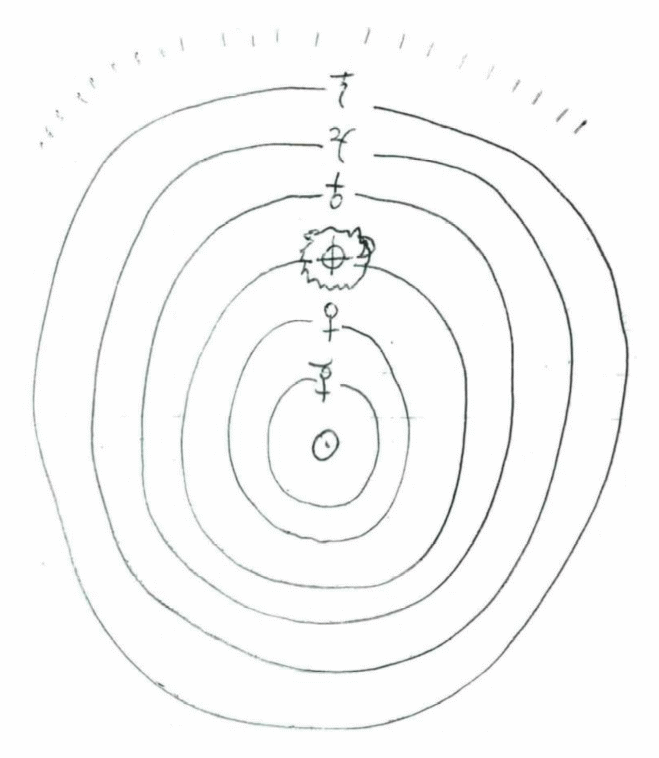
All soul powers are both gnostic and fabricative but in different ways according to dignity and non-dignity.
Gnostic -- knowing of the soul power, reason-principle or degree gets worked into the life stream. Reason-principle is fabricated through knowing of the power -- knowing the function brings out the degree meaning which is structuring it.
Non-Dignity -- soul power functions to know the degree and is itself built up or fabricated through the knowing -- the reason-principle is known as projected into the circumstances and the faculty is built up through assimilating the projection.
All planetary spheres go through every sign in 12th house -- in this solar system where they are spheres -- dignity/non-dignity problem is therefore in terms of primal and reproductive imagination.
Dignity concerned with planet -- gnostic -- soul power or category of imagination is emphasized -- more introverted.
Non-dignity concerned with degrees -- fabricative -- more extroverted.
Faculty of soul in dignity is concerned with elaborating itself and therefore the reason-principle.
Non-dignity is not concerned with elaborating itself and therefore the reason-principle is brought out more circumstantially.
Non-dignity -- preoccupied with assimilating the reason-principles/meaning as projected in the world.
Dignity -- preoccupied with assimilating the reason-principles/meaning of the soul faculty.
Both exist within the imagination or the dragon.
Mercury dignity -- preoccupation is with the intuitive faculty -- tendency towards introversion.
Mercury non-dignity -- preoccupation is with understanding the reason-principles which have been projected and extracting them -- tendency towards extraversion -- preoccupation with circumstances and events.
Santayana
Sun opposite Uranus
Venus opposite Pluto
Fifth [house], Sun degree (25 Sagittarius) -- chubby rich boy -- meaning of symbol is mundanely and literally true = non-dignity
Ambition to leave a stamp on the world; desire for fullness of living; perfection of accomplishment; used his own skills to relate to his world.
Symbol itself -- chubby little rich boy -- richness of vasanas
Riding a bright hobby horse -- not a real horse (i.e., reproductive and not productive imagination)
Wishes for dangers he may never know -- imagination is not the real thing (i.e., wrote about the materiality of the world but didn't actually experience it -- never had to do hard work, etc.).
He expects to conquer and understand reality with his store of vasanas rather than directly experiencing reality.
A predisposition constituting the central purpose of his life (Sun) to fall back on itself -- the central purpose or imagination is usually felt to be sufficient to answer any problems.
A preoccupation with circumstances in terms of self-expression -- not an examination of the Sun itself.
Uranus -- 23 Gemini (opposite Sun) -- three fledglings, secure in a nest high in the tree, already reveal the deep pride of their heritage.
Was it detachment or inferiority? They have an untried promise.
With Uranus the threefold = knowing, willing, feeling as the higher knower -- which is secure and detached.
Deep pride = aloof superiority and an inherited knowledge of what refined knowing willing feeling was. An inborn, innate aristocracy of the spirit.
Opposite Sun -- he couldn't completely bring the intuition out because it was limited by, or could only know it through, the hobby horse (Sun) -- through his own imagination (which is his philosophy -- you don't know reality directly).
The ideals or essences can only be realized in the psyche and not in the flux of matter.
Venus (8 Scorpio) dignity (opposite Pluto) -- beautiful gem of a lake high in a mountain revealed by a silvery moon.
What does this symbol say about how the anima is organized?
Santayana was an aesthete -- preoccupied with aestheticism -- only concerned with European values -- a congealed aesthetic sense. A lake is self-contained and static. The pool is restricting the light it is reflecting. He was European to his fingertips. Scorpio Venus has fixed opinions. Dignity made it a readily available conscious attitude which he was preoccupied with.
Pluto (11 Taurus) -- woman in a sunbonnet watering long rows of flowers.
Pluto restructured imagination -- degree interpretation -- the way he restructured his imagination left an impact on the world. Constant and tangible manifestation → very productive. Eagerness to pour himself into any potentiality of living -- ninth house -- Pluto realm of matter has all the power.
A consistent partnership between man and Nature = a naturalist, his writing, an easy commerce with Nature.
Instead of a philosophy of truth you have the expression of his psychical essences.
Saturn (17 Libra) -- retired sea captain = a nostalgic retrospective self-enjoyment. A symbol of maturity -- or ripe fruit -- he was a man who has matured and lived the rich limits of life. He was an 18th century living in the 19th and 20th centuries.
If he enjoyed anything, it was reflection. Dignity = enjoyed the faculty of reflection. He is always at the same level.
Mercury (3 Capricorn) -- human soul as a hovering spirit.
He related to people through their works.
Mankind's naïve capacity -- read his comments on others ((i.e.) (one word illegible) naïve)
Read his essay on Egotism in German Philosophy (1916) (had Pluto opposite Mercury). A superficial view -- receptive to everything but hovering above and not getting into it.
[Classnotes AB 1982 0712 End]
CHART FOR 1982 0712
Class
Monday, July 12th, 1982
Edited transcriptCLASS at Wisdom's Goldenrod, Hector, NY
with Anthony Damiani (AD)
July 12, 1982
ASTROLOGY; HOROSCOPE-SANTAYANA
with Appendix: Classnotes AB 1982 0712.
TOPIC: Astrology
SUBJECT: Horoscope-Santayana
SUBSUBJECTS: Dignity and Non-Dignity, Santayana natal chart, transits
CONTENTS:
Biographical overview
Dignities and non-dignities: general principles
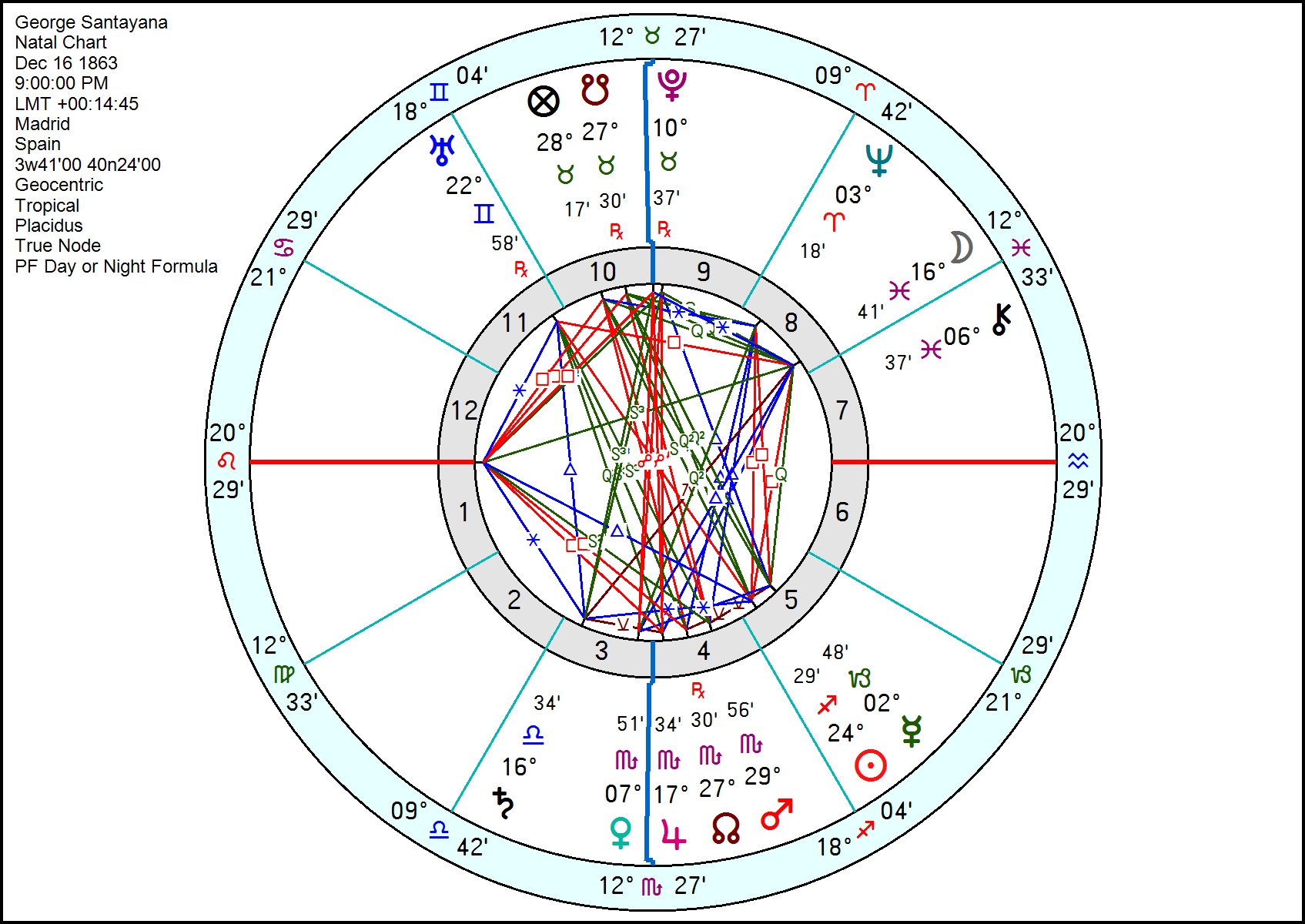
Santayana natal chart
Sun at Sagittarius 25 (non-dignity), fifth house: the central purpose of his life is to use imagination as the basis of his philosophy; assumes his store of vasanas is sufficient to conquer and explain reality; preoccupation with circumstances, matter, the external world
Uranus at Gemini 23, eleventh house: knowing, willing, and feeling as higher knower, which is secure and detached; aloof superiority; inherited knowledge of refined knowing, willing, feeling
Uranus opposite Sun: couldn't fully bring out the higher intuition; essences could only be realized in the psyche, not in the flux of matter
Venus at Scorpio 8 (dignity), third house: a congealed, static aesthetic sensibility; could not appreciate art that fell outside his established norms; anima function extremely refined
Venus sextile Mercury: could arrive at understanding, even though Sun-Uranus opposition blocked direct intuitive expression
Pluto at Taurus 11, ninth house: realm of matter has all the power; a naturalist; easy commerce with Nature
Pluto opposite Venus: both a materialist and an aesthete
Saturn at Libra 17 (dignity), third house: maturity and nostalgic retrospective self-enjoyment; richness of earthly life was behind him; enjoyed the faculty of reflection above all else
Mercury at Capricorn 3 (non-dignity), fifth house: related to people through their works; a superficial, naïve receptiveness
Outer planet transits for Scepticism and Animal Faith, Dialogues in Limbo, The Realm of Matter; natal regular, quintile, and septile aspects
Appendix: AB class notes
BOOKS READ FROM OR REFERENCED:
Marc Edmund Jones, The Astrology of Concepts
Marc Edmund Jones, The Sabian Symbols in Astrology
Daniel Cory, Santayana: The Later Years — A Portrait with Letters
George Santayana (abr. Cory), The Life of Reason
George Santayana, Scepticism and Animal Faith: Introduction to a System of Philosophy
George Santayana, Dialogues in Limbo
George Santayana, The Realm of Matter
SABIAN SYMBOLS: Taurus 11, Gemini 23, Libra 17, Scorpio 8, Sagittarius 25, Capricorn 3
DIAGRAM and CHART embedded in and appended to this transcript:
FIGURE 1982 0712-1-AB. Heliocentric View. (embedded)
FIGURE 1982 0712-2. George Santayana Natal Chart. (appended)
RETYPED AND REFORMATTED by IT 2026
NOTES:
RETYPED PARTIAL TRANSCRIPT (hence V10). From 1982 0712 ASL horoscope Santayana 11p.PDF. THERE ARE NO AUDIO CASSETTE TAPES EXTANT.
This is a Monday Evening Astrology class.
Anthony is Anthony Damiani (AD).
AB Classnotes have been appended because they contain information and a diagram that the partial transcript does not have and thus help round out the class. Retyped from Classnotes AB 1982 0627 to 1982 0804.PDF. All spelling, capitalization, and punctuation corrected, all abbreviations, astrological glyphs, and most numbers spelled out in AB Classnotes.
All spelling, capitalization, and punctuation errors have been corrected, all abbreviations, astrological glyphs, and some numbers spelled out.
1982 07/12 at Wisdom's Goldenrod
Astrology; Horoscope-Santayana
[File 1982 0712 ASL horoscope Santayana 11p.PDF Begins]
SANTAYANA I — 7/12/82
Biography
Bo's review of his life.
His father was Spanish. His mother had three children from previous marriage. An only child of a second marriage.
Went to Latin school at an early age, like everyone else at this time.
At age 17 or 18, he realized writing was to be his profession.
Got Ph.D. at Harvard, then taught there. Spent about forty years at Harvard. His early works were drawn from his early classes. He quit lecturing at age 49 to begin writing.
He withdrew and became a sort of hermit for the rest of his life.
WWI he spent in England, reading at Oxford, and writing novels.
The WW II he spent in Rome in an old folks house and his money was never lost in the depression.
He remained a Spanish citizen.
He could move into towns where no one knew him so he could set up the sort of lifestyle he wanted.
He was conversant on the subject of architecture, was fond of music, opera in particular. He knew all the Italian operas--who was singing, etc. He said opera was the only thing he could stand sitting in a crowded auditorium for.
He would only look at one piece of art per day. He would study it and try to assimilate it.
His daily schedule was writing all morning. Then he would lunch, then take a long (20 mile) walk, then return after seeing a piece of work and prepare dinner.
He had a good friend but after he died at age 30, he declared he never had a friend after that. Another man who he took walks with for nearly fifty years died. At his funeral, Santayana said the man was only an acquaintance.
Santayana lost his sight in the last period of his life. His friends thought he would give up, but instead he insisted he knew many foreign poems that he would transcribe into (English?)…
He saw himself as a diehard materialist since age of 7.
Though not a Christian or Catholic, he was receptive to the ritual and symbolism.
He once told Cory he thought when at Harvard he may have had slight homosexual tendencies.
PB said after reading some Santayana, "The poor professor was blinded by his own ignorance and couldn't let go."
He was very well liked by the Harvard students and attended their parties.
ON DIGNITIES AND NON-DIGNITIES
Linda: In dignity, the focus is on the soul power. The reason-principles are reflected in the soul power. In non-dignities, the attention is not so much focused on itself, and the soul faculty is built up experimentally in the house and sign it's in: the experiencing reveals the soul power to itself.
Timothy: Every soul power is both fabricative and gnostic. When in dignity or non-dignity. The gnostic function is not so much knowing the reason-principles, but knowing the soul power: that's why that planet is more obvious--more known. That knowing will be organized by the reason-principles. So what that planet manifests is the degree it's on; through the life process there will be a gradual realization of the reason-principles or idea the planet is on.
Anthony: Planet in dignity, preoccupation with soul faculty and is something the person does recognize.
Planet in non-dignity, there is a preoccupation with assimilation of reason-principles projected into circumstances, events.
Anthony: So if you have Mercury in dignity there is a preoccupation with intuition or thinking, whereas if it is in non-dignity, you're trying to understand the meaning projected into circumstances which you project as your perceived world.
In the non-dignity there is a tendency to extroversion, and in the dignities there is a tendency to introversion (an inferior life)--but not in the normal psychological sense.
DEGREES OF CHART
[Note: Sabian degrees and interpretations are from Marc Edmund Jones, The Astrology of Concepts and The Sabian Symbols in Astrology.]
Regarding his Sun degree. Read Sun degree. [Note: Sagittarius 25, "A chubby little rich boy rides on a hobby horse of bright colors and wishes for hazards he may never know."]
Anthony: Regarding "fullness of living" [in Jones symbol]--you remember how he described his life--good walks, good living, good wine…[chubby little rich boy…] -- Rich in what way?
Timothy: A certain richness of vasanas--life experiences available to him.
Anthony: Riding a hobby horse.
Bo: One half year before he died he said all his life what he yearned for was not unity but completion. "When I see a circle unfinished, I yearn to complete it." [Note: See George Santayana, The Life of Reason. Abridged by the author and Daniel Cory. New York: Charles Scribner's Sons, 1954. Preface, p. vi.]
Timothy: The hobby horse is something going on in his imagination, not in the real world, not in touch with the productive imagination.
Anthony: It's one thing to write about the materiality of the world and another to dig the ditch.
This degree refers to the store of vasanas in his imagination with which he wants to go out and conquer ultimate reality.
Anthony: What is the symbol pointing to? What is the image underlying the symbol?
Timothy: (Read Symbol.) Here is the symbol again.
Richard: It was a great degree for an artist but not for someone who wanted to study philosophy; the degree is a rich storehouse of one's vasanas and that seemed to be adequate for what is happening in the life.
Anthony: There is a predisposition on the part of that which constructs the hero archetype….
The central purpose of his life is indicated by the [Sun degree] and is to use the basis of the imagination as the basis of his life.
Richard: Regarding non-dignity aspect: his attention is totally given to his self-reflection, the products of his imagination.
Anthony: He's preoccupied with circumstances. What is circumstance?
Linda: Preoccupation with animal faith.
Anthony: Yes.
Richard: The self is assumed as the substrate.
Anthony: The circumstances he (Santayana) is taking into account is the whole external world. In his case, the assimilation of reason-principles embedded in circumstances is what he is preoccupied with. He assumes he can explain all circumstances in terms of that image that the Sun degree represents.
Anthony: Philosophically he took the position that there was an object corresponding to knowledge. What was he preoccupied with?
If the basic presupposition is about there is an object outside knowledge--what is he preoccupied with? Circumstances! Matter! The world! Knowledge for him is mediated through symbols and you never get to that knowledge.
Anthony: What is the reason-principle drawn upon? --A rich fat boy-- This is the state of his imagination. He is using that degree to understand his circumstances.
The important thing is that circumstances is what he's preoccupied with.
Uranus degree (Read degree.) [Note: Gemini 23, "Three fledglings, secure in their nest high in the tree, already re-veal the deep pride of their heritage."]
Timothy: There is a threefold Knowing, Willing, and Feeling of the higher being: (three fledglings) are high in the nest--secure, in a detached position. There is a nascent youthfulness in the function, but detached. They reveal a "pride in heritage"--an aloof superiority with which he regarded things.
Linda: Santayana felt he was superior to America. He returned to Spain and never returned to America. He said Harvard was the only place that held some of the old-world heritage he liked.
Richard: If the three faculties are innate, and with Uranus there--he had a fledgling intuition, but with an opposition to the [Sun] it couldn't successfully be put into operation.
Linda: Through the opposition he couldn't arrive at the understanding, but through the sextile to Venus he could. [Note: Reference is to Mercury sextile Venus.]
Randy: [blank]
Venus / Pluto degrees (Read both degrees.) [Note: Venus, Scorpio 8, "A beautiful gem of a lake set high in the mountains is revealed in the silvery bathing light of a full moon." Pluto, Taurus 11, "A woman, cool in sunbonnet and simple garments, is leisurely watering long rows of flowers in full bloom."]
Anthony: Let's go on to another symbol.
Timothy: Venus in Scorpio opposite Pluto in Taurus (natal). (Read degrees.)
Anthony: How is the anima function organized?
Linda: It's extremely refined. In a dignity there is a preoccupation with a soul function. Is this something Santayana had to educate?
No, it seemed as though it was a reflector used from early life.
Richard: Yes--but reflection at night through a full moon.
Anthony: Do you think Santayana was an "aesthete"--as he was called?
He wouldn't be able to see the beauty in the Brooklyn Bridge--he was fixated on the beauty of European architecture. Beauty had to be on to his norms.
Anthony: Let's read Pluto degree. The pool is a lake--there's a very congealed notion of aestheticism.
If he was to go to Asia, would he appreciate the art? NO.
--Does Venus in Scorpio have fixed feelings?
It was a clear aesthetic sensibility and he veered away from what didn't please him.
--Venus in Scorpio dwells in the feeling state: he was preoccupied with the development of his aesthetic--he wanted to enhance his aesthetic faculty. And Venus was in the third house--very available.
--He took up drawing when he was young.
Read Pluto degree.
Timothy: Pluto was prominent; it was right on the Midheaven.
As a restructuring of the imagination, as his imagination tried to capture meaning, it left its mark on the public.
Avery: --His "watering" was his words.
Vic: --He made remarks about every philosophy --And never seemed to go quite deep enough.
Anthony: The Pluto was his matter.
Randy: The appropriate response to matter is reverence. Pluto opposite Venus.
Vic: With Pluto in 9th house, as deep as he could go in terms of his philosophy is the man's relation to Nature.
Anthony: Without that Venus he would have leveled out with that degree.
--He walked with a cane, very dignified, and had an easy commerce with Nature.
Randy: [blank]
Anthony: Back to Pluto. (Read Symbol again.)
Timothy: Pluto in 9th house is his Nature mysticism and it was fully manifest in his feeling function. On the reverse--his fascination with metaphysics would obscure his grasp of philosophy.
Anthony: Santayana refers to himself as a materialist but he is also an aesthete. As Vic pointed out, there's intoxicating poetry--but reading further regarding his philosophy--matter in flux--and the opposition is so glaring it comes out in his writing.
Linda: Wasn't he unhappy about the fact that there were these essences, but you couldn't get directly at them?
Anthony: We used [sic; need?] to try to get a holistic view of how these are all interrelated to each other.
Randy: The way he defined truth was in terms of the empirical event.
Anthony: What he enjoyed was reflection--Saturn dignity in Libra. He enjoyed reflection more than the content. He considered this one of the greatest achievements of man.
With "Retired sea captain" -- The richness of earthly life was behind him. [Note: Libra 17, "A retired sea-captain, still resplendent in his uniform, frequents the docks from which the world's commerce departs.]
Alan: Wasn't he preoccupied with being an observer? He went to the docks to watch the ships go by.
Mercury degree (Read degree.) [Note: Capricorn 3, "The human soul is visualized as a hovering spirit eager and receptive to the lessons to be learned from life."]
Anthony: Did you read his essays on Dante, Goethe, Browning, etc.? The way he felt he could relate to people was through their works. He must have been a vicious reader. Read his comments on Dante and see if you agree with him. Read his essays on Egotism in German Philosophy. (He had Pluto opposite Mercury then.) It's one of his worst essays.
--End--
Animal Faith -- 9/?/1923 -- Mercury stationary retrograde at 14 Libra; Sun, Venus, Mars not used.
| Normal | Quintile | Septile |
| Jupiter trine Moon | Jupiter conjunct Jupiter | Jupiter conjunct Jupiter |
| Jupiter conjunct Jupiter | Jupiter bi-quintile Uranus | Uranus conjunct Moon |
| Jupiter semi-sextile Saturn | Saturn quintile Mercury | Neptune tri-septile Moon |
| Saturn semi-sextile Jupiter | Uranus conjunct Moon | Head bi-septile Sun |
| Uranus conjunct Moon | Uranus quintile Mercury | |
| Uranus quincunx Saturn | ||
| Neptune square Jupiter | ||
| Pluto sextile Pluto | ||
| Head trine Pluto |
Position of transiting planets: Jupiter 16 Scorpio, Saturn 20 Libra, Uranus retrograde 16 Pisces, Neptune 20 Leo, Pluto 13 Cancer, Head retrograde 12 Virgo
Dialogues in Limbo -- Year only is known, so these are Jupiter, Saturn, Uranus, Neptune, and Pluto transits for mid-July 1926.
| Jupiter sextile Sun 2° | Neptune quintile Venus 3° | Neptune tri-septile Moon 3° |
| Neptune trine Sun 2° | Uranus bi-quintile Venus 3° | Jupiter septile Mercury 2° |
| Head trine Moon 1° | Uranus bi-quintile Uranus 3° | Neptune septile Saturn 2° |
| Pluto trine Moon 3° | Jupiter quintile Pluto 3° | Head bi-septile Neptune 1° |
| Saturn trine Moon 3° | Pluto bi-septile Neptune 2° | |
| Uranus trine Mars 1° | Neptune bi-septile Pluto 1° | |
| Head trine Jupiter 2° | ||
| Head square Saturn 1° | ||
| Pluto square Saturn 3° | ||
| Saturn semi-sextile Saturn 3° | ||
| Uranus sextile Neptune 1° | ||
| Uranus trine Jupiter 3° | ||
| Uranus trine Head 2° | ||
| Jupiter square Head 2° |
Santayana -- Natal aspects! Listed from Sun to Pluto, not by closest orb.
| Normal | Quintiles | Septiles | |
☽
|
Mercury quintile Moon 2° | Pluto septile Moon 3° | |
| ☿ | Mercury sextile Venus 6° | ||
♂
|
Head conjunct Mars 3° | Head conjunct Mars 3° | Head conjunct Mars 3°; Uranus tri-septile Mars 3° |
| ♃ | Moon trine Jupiter 1° | Uranus bi-quintile Jupiter 1° | |
| ♄ | Moon quincunx Saturn 1° | Pluto tri-septile Saturn 2° | |
| Jupiter semi-sextile Saturn 1° | |||
| ♅ | Sun opposite Uranus 2° | Head tri-septile Uranus 1° | |
| Moon square Uranus 7° | |||
| Jupiter quincunx Uranus 6° | |||
| Saturn trine Uranus 7° | |||
| ♆ | Mercury square Neptune 1° | ||
| Venus quincunx Neptune 5° | |||
| Mars trine Neptune 4° | |||
| ♇ | Moon sextile Pluto 7° | ||
| Pluto opposite Venus 3° | |||
| Pluto opposite Jupiter 7° | |||
| Pluto quincunx Saturn 6° |
Aspects for beginning Realm of Matter 10/?/1928
Sun, Moon, Venus, and Mars not included because only the month is known; however Mercury was stationary retrograde at 10 Scorpio; Jupiter retrograde at 8 Taurus; Saturn at 16 Sagittarius; Uranus retrograde 5 Aries; Neptune 1 Virgo; Pluto stationary retrograde 19 Cancer.
| Usual | Quintile | Septile |
| Pluto trine Moon | Pluto tri-septile Sun | |
| Saturn square Moon | Jupiter septile Moon | |
| Uranus square Mercury | ||
| Jupiter SRx opposite Venus | ||
| Mercury SRx conjunct Venus | Mercury SRx conjunct Venus | Mercury SRx conjunct Venus |
| Tail conjunct Mars | ||
| Neptune square Mars | ||
| Pluto trine Jupiter | ||
| Pluto square Saturn | ||
| Uranus conjunct Neptune | Uranus conjunct Neptune | Uranus conjunct Neptune |
| Mercury SRx bi-quintile Neptune | ||
| Mercury SRx opposite Pluto |
[File 1982 0712 ASL horoscope Santayana 11p.PDF Ends]
1982 07/12 V10: CLASS: Astrology; Horoscope-Santayana. Copyright 2026 Wisdom's Goldenrod p. iii