CHARTS FOR 1982 0906
Class
Monday, September 6th, 1982
Verbatim, unedited transcriptClick the series name to view more
CLASS at Wisdom's Goldenrod, Hector, NY
with Anthony Damiani (AD)
September 6, 1982
ASTROLOGY; HOROSCOPE-EMERSON
TOPIC: Astrology
SUBJECT: Horoscope-Emerson
SUBSUBJECTS: Emerson biography, natal chart
CONTENTS:
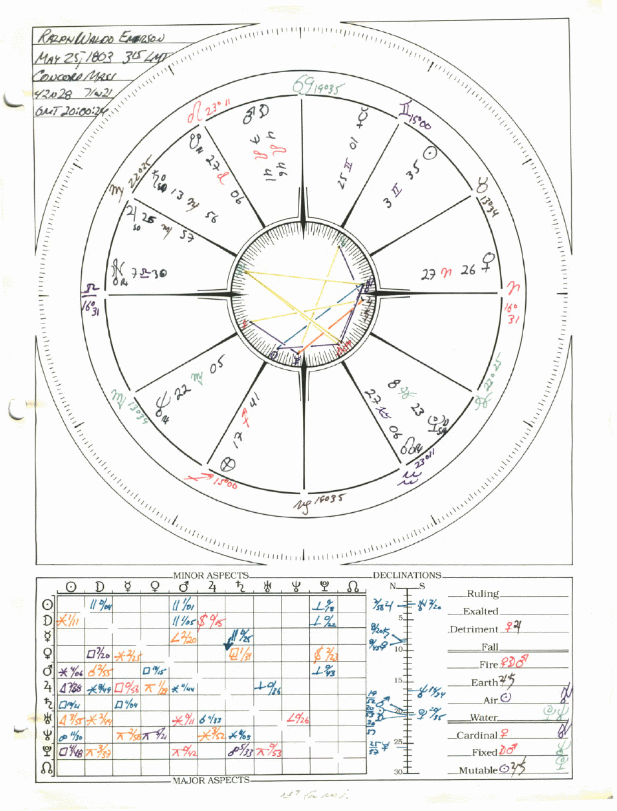
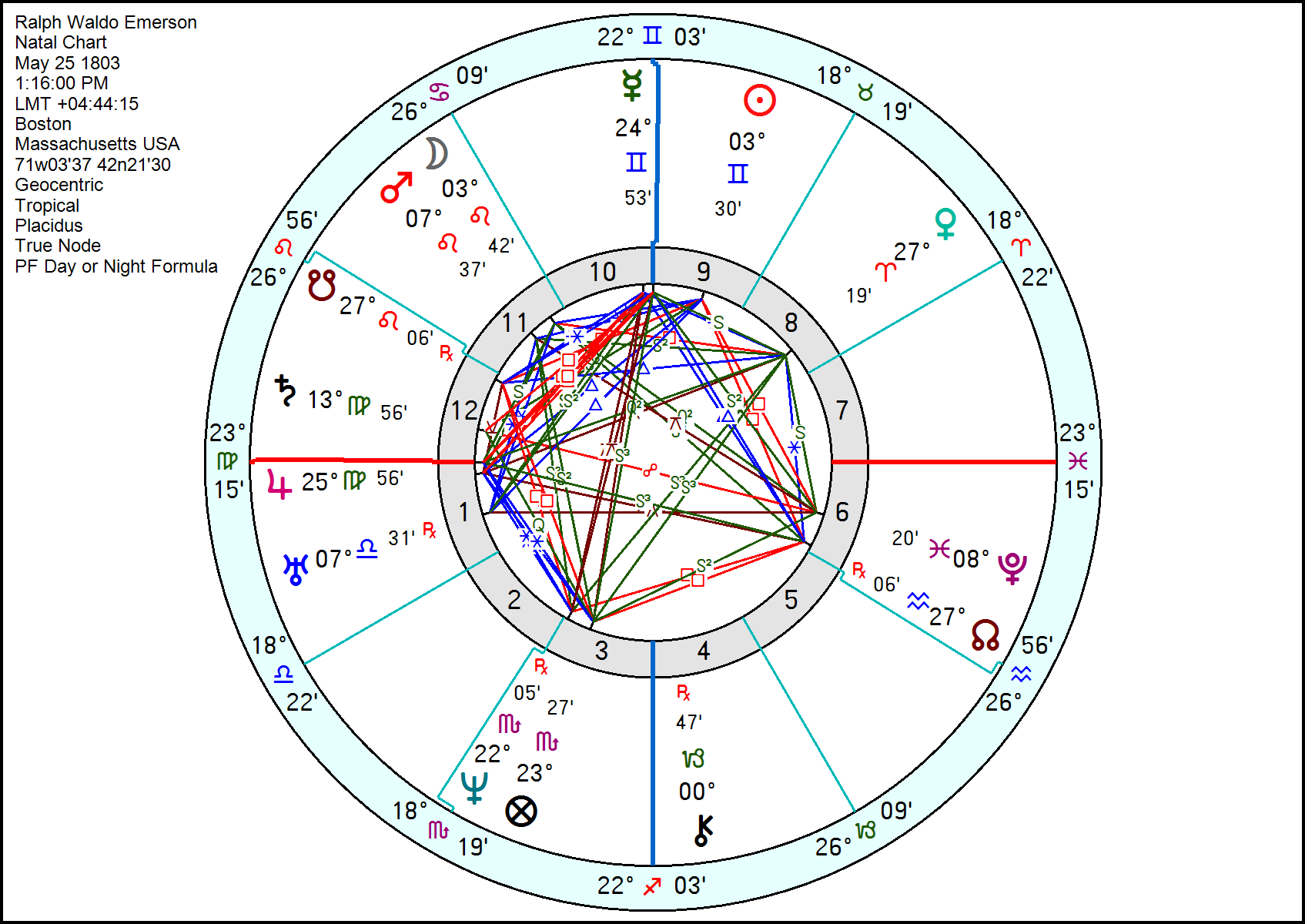
Two birth charts for Emerson; class uses 3:15 PM chart
Three Chaldean planet groups; Mercury as sole dispositor
Initial reading of Sabian symbols for all Chaldean planets
Biographical overview of Emerson:
a) early life and education
b) early career: teaching and preaching
c) first marriage and pastorship
d) crisis of conscience: resignation from the ministry
e) European journey and return
f) middle life: marriage, writing, lectures, and growing fame
g) later life: lectures, social causes
Emerson's writing was painstaking and labored; he felt his expression was inadequate to the fullness of what he was trying to convey
Reading from "The Over-Soul"
Jones's 1:15 pm birth time unsupported by any biography; should not be granted undue authority
Mercury at Gemini 26, ninth house: the individual is forced to consider things from a cosmic point of view; preoccupation with philosophy
Opposite at Sagittarius 26, third house: standard-bearer of idealism accessible to many; the universal expressed through the common
Jupiter at Virgo 26, twelfth house: libidinal energies organized to seek the divine; strong sense of morality; appreciation for Nature (God) as impersonal force
Opposite at Pisces 26, sixth house: application of inner morality to experience; wouldn't act until he received clear inner direction
Mercury square Jupiter: living philosophy; the tendency for the individual to universalize his point of view is the way the individual becomes himself
Venus at Aries 28, seventh house: spiritual independence in relationship
Opposite at Libra 28, first house: the personality others would meet — spiritual fellowship, openness, inner warmth, friendliness
Venus quincunx Jupiter: the strain of attempting to live one's ideals in daily life while remaining spiritually independent; continuous self-spiritualization; constant interruption of his solitude by visitors (12th vs. 7th house tension)
Sun at Gemini 4, eighth house: inherited a rich, developed, well-integrated ego
Keyword "ritualization" means making archetypal modes of behavior conscious through repetition — a release from unconscious compulsion
Opposite at Sagittarius 4, second house: a soul learning its way in the world while retaining its selfhood through tragedy; soul learning detachment
Caution from AD: don't turn symbols into more symbols
BOOKS / JOURNALS READ FROM OR REFERENCED:
Marc Edmund Jones, The Astrology of Concepts
Marc Edmund Jones, The Sabian Symbols in Astrology
Plotinus, The Enneads (MacKenna translation, 4th ed.)
Ralph Waldo Emerson, Nature, Addresses, and Lectures, "Nature" (1836), "The American Scholar" (1837), "The Divinity School Address" (1838)
Ralph Waldo Emerson, Essays: First Series, "Self-Reliance," "Compensation," "Friendship," "Heroism," "The Over-Soul" (1841)
Ralph Waldo Emerson, Essays: Second Series, "Nature" (1844)
Ralph Waldo Emerson, Representative Men: Seven Lectures (1850)
Margaret Fuller (ed.), Ralph Waldo Emerson (ed.), The Dial
Ralph Waldo Emerson, The Letters of Ralph Waldo Emerson, ed. Ralph L. Rusk, 6 vols.
Ralph Waldo Emerson, Journals of Ralph Waldo Emerson, ed. Ralph Waldo Emerson and Waldo Emerson Forbes, 10 vols.
Ralph Waldo Emerson, The Journals and Miscellaneous Notebooks of Ralph Waldo Emerson, ed. William H. Gillman et al., 16 vols.
Ralph L. Rusk, The Life of Ralph Waldo Emerson
Walt Whitman, Leaves of Grass
SABIAN SYMBOLS: Aries 28, Gemini 4, 26, Leo 5, 8, Virgo 14, 26, Libra 27, 28, Sagittarius 4, 26, Pisces 26
CHARTS appended to this transcript:
FIGURE 1982 0906-1. Ralph Waldo Emerson Natal Chart (3:15 PM).
FIGURE 1982 0906-2. Ralph Waldo Emerson Natal Chart (1:16 PM).
[Transcriber note: If someone is writing, with audible sounds of chalk on a blackboard, I indicate this by [writing].]
NOTES:
- Earlier partial transcript, Scan File 1982 0906-06R08.PDF, also exists.
TRANSCRIBED Verbatim by IT, LCB 2025-26. Archival verbatim transcript – V11a.
AUDIO FILES: 1982 0906a, 1982 0906b. [Note: "Tape" and "Side" refer to original audio cassette tapes that were later digitized into .MP3 Audio Files.]
1982 09/06 at Wisdom's Goldenrod
Astrology; Horoscope-Emerson
[Audio File 1982 0906a Begins]
S: No.
TS: Any announcements? [few seconds of background student talking] Dickie's going to do a class tonight. I'll give it.
RG: Think we're all doing it.
VM: What about the database?
TS: What?
AD: [couple words inaudible]
S: (Who knows?)
TS: Worry about the database? What does that mean?
VM: Watch this.
TS: Whether we could just read?
VM (faint): No, no, what [one word inaudible] is not going to happen. [few seconds of background student talking] Well, which chart are we on?
[Transcriber note: Ralph Waldo Emerson's birth data presents conflicting information between sources. The first appended chart (FIGURE 1982 0906-1) uses the commonly cited birth time of 3:15 PM paired with Concord, Massachusetts as the birthplace (per Marc Edmund Jones). This is the chart referenced throughout the class. The second (FIGURE 1982 0906-2) uses Jones's stated birth time of 1:16 PM paired with Boston, Massachusetts, which is cited by most biographers as Emerson's actual birthplace. Historical records confirm Emerson was born in Boston on May 25, 1803, where his father was minister of the First Church.]
TS: There's-- there are two charts for Emerson. There are two times for him, 1:16 [FIGURE 1982 0906-2] in the afternoon and 3:15 [FIGURE 1982 0906-1]. We favor one. This being the 3:15, but there's-- you know, it may come out, we'll have to just keep that in mind. If you make note-- if you're copying the chart down you might want to know that. The other one has a Virgo rising, 23 Virgo rising. And the Moon is a degree earlier and the Mercury is a degree earlier by Sabian symbol.
S: We choose other one?
TS: Yeah. There's those two times that-- Marc Edmund Jones gives him-- his birth time as 1:16 in Concord. However all the biography-- his major biographer has him born in Boston and at quarter past 3. So, thing is he actually was born in Boston, and that-- He was born during dinner time, and I don't know when that was really.
So then, I guess what we'll try to do is build up some kind of image of the Chaldean planets as we have them with the other people we've looked at. There are three groups of Chaldean planets. [short pause] If you look at the chart-- Let me just draw a little bit on the side. The Mercury in rulership in Gemini. And, some of you have read Jones. The Mercury is what they call the sole dispositor. It rules everything else in the chart. In other words, Mercury rules Gemini, it rules Virgo. By ruling Virgo it rules Saturn and Jupiter and so forth. So it's a dominant Mercury that way. And the Mercury is in an exact square to the Jupiter in Virgo. And, Jupiter in Virgo is quincunx to Venus in Aries. And these three planets then form one of the two Chaldean groups. Ok? Mercury in Gemini square Jupiter in Virgo. And then Jupiter in Virgo quincunx Venus in Aries. Ok, so we'll try to see what we can come up with for those three.
And the other group then would be the Sun in Gemini is sextile the Moon in Leo. And Mars in Leo is conjunct that Moon and then hence sextile the Sun, very wide sextile to the Sun. So, the Sun, Moon, and Mars make a second little group, and Saturn is unaspected, wherever it is, here's Saturn. Saturn does not aspect either group, although in-- till you go out about 12 degree orb, which is far too wide. So, that's the two groups of just the Chaldean a-- or three groups, ok. One of them is [writing] Mercury, Jupiter, Venus. That's one group. Then there's Sun Moon in sextile and Mars. And then there's Saturn.
So I guess what we'll do is-- is start by looking at the Sabian symbols for-- Maybe we should read through all the Sabian symbols for all Chaldeans, and then try to see these groups, each little group. So we'll have some (like time) to play with. And we'll be using-- like I said, this one, we might have to adjust it.
S: See, we divide these into those.
LR: Read them all?
TS: Yeah. Well you're familiar the second time around.
S: Maybe I'll get it later on.
LR: Am I right? Wait.
RG: Anyway, if anyone's reading a biography and comes across a reference to the 1:16 time, could-- I'd really like to see it. I mean we haven't found it [one/two words inaudible]
TS: It just comes out of Jones.
RG: Yeah.
S: Ok well then [few words inaudible]
LR (simultaneously): [couple words inaudible] Mercury, Jupiter, Venus, Sun, Moon, Mars.
TS: And then Saturn.
LR: Ok, the Mercury degree, the one we're using is--
Marc Edmund Jones [The Astrology of Concepts, Gemini 26, LR reading]: "The winter frost has stolen through the woods, and given to the trees and underbrush a witching cosmic lacery."
LR: And that would be square Jupiter, which is--
Marc Edmund Jones [The Astrology of Concepts, Virgo 26, LR reading]: "A [LR reads: The] highly ritualistic service is in process: [LR: Is that right?] officiating priests are automatons, [LR adds: and] a boy with a censer is rapt-eyed."
S: Yeah.
LR: The Venus--
Marc Edmund Jones [The Astrology of Concepts, Aries 28, LR reading]: "A large audience is seen rejoicing in some disillusionment to which it has just been subjected."
S: (Is that about) rejoices?
Marc Edmund Jones [The Astrology of Concepts, Aries 28, LR reading]: "A large audience is seen rejoicing in some disillusionment to which it has just been subjected."
RG: It's just [couple words inaudible] very similar.
S: Oh, you never learn, huh?
S: Uh-hm.
LR: Ok, so that's those three. Then the Sun is--
Marc Edmund Jones [The Astrology of Concepts, Gemini 4, LR reading]: "A series of rooms in a hospitable house, opening one into the other, are decorated gaily with holly and mistletoe."
LR: The Moon--
Marc Edmund Jones [The Astrology of Concepts, Leo 5, LR reading]: "Overhanging a vast canyon, but giving evidences of thousands of years of survival, are suggestive masses of granite."
LR: And the Mars is--
Marc Edmund Jones [The Astrology of Concepts, Leo 8, LR reading]: "A man of mean and low appearance, but with the burning fire of a great cause in his eyes, is stirring up discontent."
LR: And then finally the Saturn would be--
Marc Edmund Jones [The Astrology of Concepts, Virgo 14, LR reading]: "A large sheet of parchment is covered with finely lettered names and mysterious lines; it is a splendid family tree."
LR: Should I read Uranus, Neptune, and Pluto? [few words inaudible]
TS: You want any of the other symbols right now, Anthony?
AD: No, I think we'll work with one symbol, both-- both sides, and also how-- how it's manifested, you know, in terms of the house.
TS: Ok.
LR (faint): The opposite.
TS: The opposite degree.
RG (faint): Uh-hm. Let's start [one word inaudible]
LR: Let's start with Mercury.
TS: So we'd start with Mercury, which is 26. Mercury symbol is--
Marc Edmund Jones [The Astrology of Concepts, Gemini 26, TS reading]: "The winter frost has stolen through the woods, and given to the trees and underbrush a witching cosmic lacery."
TS: The interpretation of that symbol in Jones is--
Marc Edmund Jones [The Sabian Symbols in Astrology, Gemini 26, TS reading]: "This is a symbol of the cosmic significance in any momentary cancellation of the more immediate interests and private concerns, and the emphasis is on the supremacy of the needs and powers of nature over the aspirations and conveniences of man. Implicit in the static symbolism is the call for a reorientation in the individual's point of view, and for some further discovery of the self's potentials. Normal life is brought to a point of sharp suspension so that the larger magic may be manifest. [The] keyword is SPLENDOR. When positive, the degree is the [TS reads: a] creative transformation by which older cycles give way to newer ones, [and] when negative, a reduction of the useless to a total annihilation."
TS: And the opposite degree--
Marc Edmund Jones [The Astrology of Concepts, Sagittarius 26, TS reading]: "The scene is an old-fashioned battle; in the hot hand-to-hand fighting a flag-bearer distinguishes himself."
Marc Edmund Jones [The Sabian Symbols in Astrology, Sagittarius 26, TS reading]: "This is a symbol of the enduring significance which tends to overshadow the more immediate interests or wholly selfish concerns of man, and the emphasis is on the natural supremacy of common ideals over mere individual ambitions. Implicit in the symbolism is the call for a high self-sacrifice, and for the development of such new dimensions of experience as will permit the self to realize its transcendental aspirations. Every resource of normal life is commandeered for the greater potentiality. [The] keyword is NOBILITY. When positive, the degree is spiritual exaltation through some dramatic or vital service to all, and when negative, a resort to empty show or a demand for false credit."
[short pause]
TS: Anyone? [short pause] So Mercury is-- this is the degree for Mercury. We have said Mercury is the trickster, some kind of-- had to do with the way in which the person thinks or understands things, communicates things.
[short pause]
RG: We've also (talked of it) as concept formation.
TS: Yeah, concept formations.
AD: You want to tell us something about his life first?
TS: Oh.
AD: It might help.
[few seconds of background student talking]
BS: Say it.
VM: Say it, Bert.
VM: No it's not, it's just the head.
RG: Right. Oh no.
S (simultaneously, faint): Yeah.
VM: It's good, (well) start teaching us.
S: Uh-hm.
RG: You sure-- you sure you want something on his life first, Anthony?
AD: A little bit. I mean just to start, get us started.
RG: Ok. Ok, a very little bit.
LR: [couple words inaudible] but in [one word inaudible]
RG: Ok. Um--
AD: Don't assume that because he was American people know who you were.
RG: Ok.
VM: Anthony, can I just ask a question--
AD (simultaneously): You know [couple words inaudible] (understanding) about that they know anything about him.
VM: Yeah, I want to ask the question that these other guys are afraid to ask. (laughter)
RG: They're not afraid of it.
VM: I thought one of the approaches to the astrology of these men or women, as the case may be, is to-- see I've been beating around saying--
LR: Seen a lot of women out there [couple words inaudible] (laughter)
S: Quite a-- quite a few.
VM: I thought the idea, at least one approach is to, as much as possible, put aside the man's life, work, history, and so on, and to try and grasp the Chaldeans as a-- as a manifestation of the psychosomatic organism, which is the bearer of let's say this particular incarnation. And then, you know, to grasp it without reference to the history and biography. And then there's the way of, well let's lay out the history in some detail and now look at the Chaldeans.
AD (faint): Alright, [VM: Can--] we'll do that.
VM: No, no, I'm not saying I want to do it either way, I'm delighted to go in either direction. I was wondering if you could comment on the virtues of one over the other.
AD (simultaneously): Well let me-- let me ask point blank, you got something ready on Emerson?
RG: Yeah, we do.
AD: Series of events?
RG: Uh-huh.
S: Yeah.
AD: Well Emerson is too well known. Kid ourselves.
RG: Right, ok.
VM: Well see, that's the way I felt about Einstein but that's probably my peculiar disease.
S (faint): Yeah.
RG: Well you probably know by now. Ok, so we'll do some of his life. We can get into it more later.
VM (faint): Not going to answer.
RG: Well, he stated his preference. You don't want to read anything from his work?
AD: No, no.
RG: Ok.
AD: Just-- just a thumbnail [RG: Ok.] chronological list, you know?
RG: Ok. First major event of his life after his birth seemed to be (laughter) [one/two inaudible student words] his father-- well, that's right. He was born in Boston. His father was a minister, a fairly well-known minister. And he-- his family actually came from a long line of ministers, who-- (who--) And he had five or six brothers. I don't remember out of hand, but he was the-- he was the oldest brother. And when he was seven, his father died. And-- [S, faint: Yes.] What? After his father died, things got harder for the family obviously, his-- his mother had to scrounge to get-- to get lodging and everything. But people took pretty good care of them, it was a very close-knit community in Concord, New Hampshire [correction: The family remained in the Boston area after the father's death; Emerson did not move to Concord, Massachusetts until 1835]. And, they scraped by, his mother-- his mother worked and then when he got a little older he started to work and-- and everybody pitched in and families took care-- their family took care of them back and forth.
And in 1817 he-- he went to Harvard. Harvard was really no big deal at the time. I mean anybody who wanted to go in and pay the tuition basically could go. He wasn't-- he wasn't really a good student either in grammar school or in college and was very-- he didn't take too much interest in the subjects that they were teaching, and, sort of was a mediocre student but read a lot on his own. He seemed to-- he fell in love with Platonism very early in his life. And while he was a student at Harvard, one of the papers he wrote was on-- was on Socrates, and he-- for a pr-- a prize at Harvard. And that period when he was about 17 or 18, he studied a lot of Greek philosophy, he started to-- read a lot of Plato, read whatever-- some Eastern philosophy, whatever he could get his hands on. And that seemed to be the first point where he really got taken with the idea of the transcendental. From then on, I mean, Plato and Plotinus were his main teachers, and he quotes from them constantly throughout his work. In fact, the-- the essay on Nature, the-- the inscription is a-- is a-- are lines from Plotinus. And, his one line is in-- in this book where he says philosophy is Plato and Plato is philosophy. You could burn all the other books if you've read Plato. [Note: See Ralph Waldo Emerson (1850), "Plato; or, the Philosopher," in Representative Men.]
So he'll-- so he went to Harvard. And after he went to Harvard, he didn't-- he didn't quite know what to do. But it seemed that in the line of being a-- being a pa-- in a pastor's family, the thing to do--he had a very religious bent--was to become a pastor. So he went to the Harvard Divinity School, which again was very much low-- was even lower key than Harvard College, it was very minimal requirements. You're basically left on your own as long as you pay the tuition. And he graduated from Harvard Divinity School. Again, there wasn't-- there wasn't-- he wasn't a great student there. And he hadn't-- he hadn't really taken on any of the-- the charisma that he was to have later it seems.
And in 1821 he's-- there were no pastor's jobs really available and he started to teach school. This was while he was also going to Harvard Divinity School. In order to put him through divinity school he had to work. So he taught in a little school and he gave-- and he had to support his family so he gave all the money to his mother and he had all these younger brothers growing up that he cared very much about and was very fond of and supported them while he was going to divinity school. So he taught school for about five years, from 1821 to 1826. And that was ok. He didn't really like it that much but he did it. And he was a real stoic too, I mean he just-- he did what he had to do and that was-- that was what [couple words inaudible]
And then in 1826, he was approached to preach. And-- and, it was really the first time he was-- he was asked to preach. And that started a series of about three years of wandering around and preaching at different churches. At the time many-- there were many guest pastors around Boston and he would travel around and preach and-- and people seemed to like the way he preached. And he was a good orator. But he very carefully prepared his sermon. He would never speak extemporaneously. He always labored, he would read the same speech, the same sermon, to many congregations just because he wouldn't read anything that wasn't really clear and what he thought was right. So he didn't really have that great a repertoire of sermons at the time. And maybe had fifteen or twenty that he would-- he would walk around and preach with.
During this time too his health was never quite really good. He had pains in his-- his legs and was hobbling around for quite a while. His family-- his family, as you'll see, never was of great help. Many of his brothers died very early in life. And he always feared often that he might-- he might also die early. Ok.
So [one/two words inaudible] 1827, he was 24 years old. And when he was 24 he meets Ellen Tucker, who he was-- the one-- his first wife. He fell madly in love with her.
S (very faint): She turned 16 years old, right?
RG: What? He was-- she was very sick when he met her. She had tuberculosis and there really-- there really wasn't much chance that she was going to live that long. I mean everybody seemed to know that but he didn't care. And, they got engaged in December. And-- so they-- you know, they were both very much in love with each other, it was really like this ideal, you know.
S (very faint): She was (15).
RG: Yeah, she was (only--) So they-- they had their courtship. And on March 11th, 1829, he was offered to be the pastor of the Second Church in Boston, which was a well-known church, and he took-- he took the job as pastor and that became his permanent pastorship for three years. And after that on September 30th he married Ellen Tucker.
Well in 1831 in February his wife died of tuberculosis. And-- [S: (What transit?)] Got the transits for that. But it was ama-- obviously a major event in his life and he never-- he never quite-- well he really it seemed internalized a lot of his feelings at the time and he never like quite felt the same way. But he married again. Ok.
So then 1832-- this was a big time, in October of 1832 he-- it sort of seemed there was a major crisis. He-- he was being a pastor and everybody liked him, they really-- and people were coming from all over to hear his sermons, he was getting quite well known and people liked his ideas and he was bringing in-- starting to bring in a lot of transcendental ideas into his sermons and stressing the-- the individual relationship with-- to God rather than the collective idea. And people seemed to like it but there wasn't much (thrown) about about those ideas yet. But he decided at some point that he couldn't do a certain part of the religious service. I think it was give the Lord's Supper in public. He had no problem giving it-- giving it in private but he didn't feel that it was-- that it was right to have-- for it to be in this-- in this service. So he went to the board of directors of the church and told them that he couldn't do it anymore, and that he would be glad to accommodate them in any other way, but he couldn't do this thing.
AH: What thing was that, Richard?
RG: It was giving the Lord's Supper in the service.
S: Communion?
TS: Communion, [student assents] communion.
RG: Yeah, communion. And he thought that was an individual event, and that-- and that people shouldn't be forced to do it. If they wanted to do it, fine. But if they didn't they shouldn't be forced to. So--
VM: Wait a minute, the pastor shouldn't be forced or the congregation? (bit of laughter)
RG: No, he shouldn't--
VM: He shouldn't.
RG: He didn't want to impose it on his congregation, that he would give it if they-- if individually they wanted to, but as a general part of the service he thought it was too in-- it was too much of an individual event and it shouldn't anymore be part of the general service. So they got into a big deb-- I mean they loved Emerson, they didn't want to see him go. I mean he was real good for the church, the congregation was growing. And actually most of the members of the congregation didn't want him to go either.
S (very faint): What church was it?
RG: It was the Second Church of Boston. And--
VM (faint): What-- Presbyterian, Methodist?
S (faint): I don't see it.
VM: Episcopalian?
TS (simultaneously): Unitarian.
RG: What?
S (faint): Unitarian, Unitarian.
RG (simultaneously): Unitarian, right, Unitarian.
S (faint): (They were really) [one/two words inaudible]
RG: Yeah.
LDS: Dickie?
RG: What?
LDS: I think more that-- another aspect of why he didn't want to do the Last Supper service was, he thought it was too much worshiping of Christ rather than--
RG: Yeah, yeah. Right, that he wanted to stress the-- the inner aspect of it rather than the outer. [student assents, faint] Right, Christ as external rather than as within. So that most of the congregation didn't really care. I mean they just wanted Emerson, they liked him. And, there was-- there was a couple of people on the board of directors of the pastor, they were quite conservative, even for Unitarians, I mean he's Unitarian anyway, but they were quite conservative. And they-- they said, well, we have to-- you have to do it. So he went into the mountains for a week. And he really thought about it, he really didn't want to-- he really didn't want to give up being a pastor. I mean he had family to support, he didn't know what he was going to do, he never did anything else. But he-- he wrote them this-- he thought about it and meditated on it all week and he-- he real-- his inner voice just said he couldn't do it and that was it. So he wrote them a letter stating his position very clearly, offering as far as he could go within the thing. And they debated about it for a long time and finally the vote was very close but they decided to-- that he should resign. So he did resign.
And that seemed to be the first-- a major event where he really started-- he had to listen to his inner voice, which kept growing and growing in every event and he just couldn't do anything that went against his [LR simultaneously: His friend (one word inaudible) connecting.] friend. Right, right. He couldn't do it. And this was just after his wife died. I mean he was-- he really-- he was-- he was in a pretty distressed state at this time. He had lost his pastorship, his brothers were sick, and his mother was starving and, you know, he-- he really didn't know what to do. But he couldn't go against his inner voice.
So then he resigned the pastorate, and, I guess he needed a rest so he went to Europe. And went to England and went to Italy. And there he met-- he met Coleridge, he met Thomas Carlyle, who [he] struck up a great friendship with, and met Wordsworth. And he learned a lot in Europe and has a lot of journal writings about it that you can read.
And, then 18-- he came back to the United States, and then he started lecturing, 1834 was his first public lecture, and this really started his lecturing. And his lecturing became-- and he started becoming a lecturer and all-- almost all the time that's what he did, he would go all over and lecture. First around Boston and New Hampshire, and then he would start going out West, he even went to California [couple words inaudible] and went to St. Louis and just traveled all over the place giving lectures. He was hardly at home. Although-- I mean he loved his home but he never-- he never spent much time there.
And in 1835 he married another woman, Lydia Jackson. And she-- they stayed married for the rest of his life. It was nothing like his marriage to Ellen Tucker. And, they got along pretty well, and-- but he did-- he didn't really-- he didn't really pay her that much attention. I mean he didn't, he didn't, he was-- he was off all the time lecturing. And she accepted that. I mean he was-- he was already becoming very famous, and she sort of accepted it and she would be there. And he would-- he would leave Thoreau at his house to take care of his house when-- [VM: Chop the wood.] when he left and that was fine. Thoreau and his wife liked each other and got along. (laughter) Just friends. And, he actually gave Walden Pond to Thoreau this time though. Thoreau became a very, very dear friend, his closest friend, and they spent a lot of time together.
And in 1834 another brother died. In 1836 his brother Charles died. And, he was very close, it was a very close-knit family and they all had-- these deaths had major impact on him and-- [LR, faint: Yeah, they did.] and he started developing, you know-- he started writing about-- about the meaning of Nature and the meaning of compensation and the law of karma, things like that. He didn't call it the law of karma, he calls it compensation. [Note: See Ralph Waldo Emerson (1841), "Compensation," in Essays: First Series.] But in 1835 and 1834, during that whole time, probably his-- his most up to that time seminal work, the work on Nature, which really launched his career as a writer, he was developing the ideas for. [Note: See Ralph Waldo Emerson, Nature, Addresses, and Lectures, "Nature," Boston: James Munroe, 1849.]
And in May of 1836, "Nature" was published. And, there was a lot of positive and negative reaction to it, you could read the essay, it has-- it definitely revea-- it was very Platonic and reveals the Ideas in Nature, in manifestation. And it created quite a-- quite a scene. Actually he wrote it anonymously. He didn't want anyone to know who wrote it. And-- but they discovered quickly-- quickly after who wrote it.
PC (simultaneously): Excuse me, Dickie?
RG: Hm?
PC: There is an essay called "Nature" and then there's another. There's one that's in the Essays: Second Series [published in 1844], and there's another piece called "Nature" [published in 1836].
RG: This is in the First Series, the essay on Nature. Or it's even befo-- it was published before that.
PC: So it is part of the essay series, it's not a whole separate-- 'cause there are two that are called "Nature."
MC: At least.
RG: Well I'll have to look.
S: Well probably [PC simultaneously: Ok.] this one 'cause it's [couple words inaudible]
RG: And then they formed this transcendental club. He never liked the word "transcendental" because [S simultaneously: No (few words inaudible)] he didn't think of himself really as a transcendentalist. He always wanted to find the Ideas in Nature. That's what he first worked with. But he accepted the-- he accepted the idea, and they started meeting and it became very famous, everybody's probably heard of it. All the Platonists of the area got together and start-- edit-- came out with a magazine called The Dial and started writing essays on it. And there were-- there were women involved too, Margaret Fuller was probably the most famous and she was a very famous women's rights advocate. And they-- they developed a close friendship. And so they started disseminating knowledge in that way.
And-- then in 1837 he gave "The American Scholar" at Harvard, which was also very-- really what the role of the intellectual is in America, and how it really should be and what the-- what thinking should be used for. [Note: See Ralph Waldo Emerson, Nature, Addresses, and Lectures, "The American Scholar," Boston: James Munroe, 1849.]
Then in 1838 he gave-- they asked him to do the Divinity School Address at Har-- in Harvard Divinity School. [Note: See Ralph Waldo Emerson, Nature, Addresses, and Lectures, "The Divinity School Address," Boston: James Munroe, 1849.] And, so-- he was-- he was getting pretty bold by this time. And he really knocked them around talking about how irrelevant, you know, collective churches are and things like that. And actually after that lecture he wasn't allowed back at Harvard. (laughter)
Finally when he was 70, they asked him to-- to give a lecture. By that time they needed his fame. But they really didn't like it at all. Ok. During that time they had a son named Waldo who was born in 1836, who Emerson loved a great deal, played with him a lot, and took him with him sometimes.
And then in 1839 they had a daughter, (that/and) they named the daughter Ellen for the first wife. And Lydia sort of acceded to it, I mean she knew how important Ellen Tucker was to Emerson so-- They had-- they had a daughter, and then he kept going around lecturing, writing.
And then in 1842 Waldo died, his son. Lot of death in this family. [LR simultaneously: Obviously.] And that was very crushing to him. Alright. I mean he took it well, a week after-- a week after his son's death he was-- he had already basically integrated the experience it seemed and was accepting it as part of his life and Waldo's life. And so it goes on.
And then, I don't know, through (the) 1840s and '50s just constant traveling, lecturing. He had now become very famous and he was in great demand and developed a lot of his work, wrote lectures on representative men, including Plato, Napoleon, Lincoln, [Note: See Ralph Waldo Emerson (1850), Representative Men: Seven Lectures.] published-- wrote poems, just wrote all the time. His letters fill six volumes. [Note: See Ralph Waldo Emerson, The Letters of Ralph Waldo Emerson, ed. Ralph L. Rusk, 6 vols., New York: Columbia University Press, 1939.]
S (faint): (I don't know.)
LR: He had a very strict way of living. [couple/three inaudible RG words] He spent many hours during the day in his library.
RG: Right, every morning at--
LR (simultaneously): He wasn't--
RG: Right, when he was home, every morning he would go in for about three or four hours and write. And then he'd usually take a walk in Walden-- around Walden Pond or something. And then, they would-- and then he'd eat sparsely, they live-- they lived very simply.
LR: He considered himself to be a writer and he resented time having to be taken from his solitude. In fact, there's places in his journal where he says anybody who wants to do the work I'm trying to do should be a monk, should not have to have a family, should not have to take care of anything but God-- thinking your thoughts. Anyone who wants to think should spend-- should be able to spend all his time doing that. [RG: Yeah.] Everything else is a distraction.
S (faint): Yeah. Go ahead.
S: [three words inaudible]
LR: There's a lot of-- I mean-- We can get into that. There's a lot of--
RG (simultaneously): We can-- yeah, I thought we-- you know, we just want a thumbnail. We'll bring out the detail, I mean I don't know how detailed you want but-- But in the rest of his life he was-- he lectured, wrote, meditated, studied.
In 1872 his house burned down and everybody rebuilt it, I mean everybody in the community. It was a very close-- his friends were very close to him, and he did a lot of favors for them and they-- they reciprocated. He would support people who couldn't find a living, I mean like guys like Bronson Alcott who were just totally inept in the world but they were great Platonists. He-- he just-- he put 'em in a house and support-- and supported them. (bit of laugher) And-- 'cause he liked to have 'em around, I mean, down the road was Nathaniel Hawthorne, Henry Thoreau lived next door. I mean, you know, he liked people around him. (He/It) was funny.
He wrote a-- he wrote a great letter to Walt Whitman in 1855 which he sort of regretted later, praising Leaves of Grass to the hilt before he really knew Whitman. But once he realized Whitman was a real renegade he sort of regretted it a bit.
And then in the late 1850s and '60s he got taken up more and more with social issues, obviously particularly with slavery at that time. And, Daniel Webster was a great hero of his when he was younger, he was very disappointed that Webster went for the slavery compromise, and never-- never forgave him for it. And-- but he started speaking out on social issues. He met with President Lincoln in the 1860s, and he really started picking up issues in the world that he felt were important, from women's rights to slavery, I mean--
S: This is all happening in New Hampshire or Boston?
RG (simultaneously): All-- he lived in Concord.
S: In Concord, ok.
RG: Yeah, Concord, New Hampshire.
AS: Concord, Massachusetts.
S (simultaneously): Massachusetts.
RG: Massachusetts, [LR simultaneously: Massachusetts.] right, Concord, Mass., yeah.
AH: Was his relationship with Lincoln-- to Lincoln unusual (or anything)?
RG: No, he just mentioned it briefly that he had a couple of meetings with him but that he-- he was a strong anti-slavery advocate.
AH: Some of the other folks in his-- in his group were-- idolized, revered.
RG: No, he didn't revere Lincoln, he thought he was a good man. He thought he was a very good man but he certainly didn't revere him. No. He didn't revere anybody, except one-- (on/one) principal. Ok and then he lived to-- till 1882. And in the last couple of years of his life he sort of forgot-- forgot names of people but--
TS (very faint): [couple words inaudible] 87 (years).
RG: Where does it say 1887? I have a lot of that.
TS (simultaneously, faint): [one word inaudible] ok.
RG: And-- but Anthony thinks it was 'cause he was in a state of euphoria, that he wasn't really senile, so-- That's really the outer shell of his life. But one thing I would men-- I should mention now is that example of him giving up the pastorship. He could not do anything that conflicted with his inner voice. It was so strong that everything he did and said came from that source. And, you know, he went into conflict about what (it) should be done but he always in the end went back and listened. And his writings really reveal that. But it doesn't seem he writes about anything he hasn't experienced either. He doesn't write about theories. He writes about things he's seen and experienced, and therefore when you read him, you won't be reading a logical philosopher. You're reading a vision. You know, you're reading an unfoldment of a perception rather than a reasoning to, I mean, it is reasonable obviously, but it's not-- you don't reason to anything. You just see it as reasonable.
LH: Can you say a little bit, Dickie, about what it meant to be a famous lecturer back then? I mean, it's a kind of weird thing, famous lecturer, about how he--
RG (simultaneously): It didn't mean much, I mean, you know--
LH: --and how that came about?
RG: What does it mean to be a famous lecturer?
S: There was no TV.
LH: No I mean-- right, right.
S: No movies. (laughter)
TS: No town.
S: No that's-- well--
RG (simultaneously): Yeah, he had invitations, he'd take the tr-- he'd take a stage-- a train or a stagecoach, whatever they had, and-- and he'd go into a hotel and he'd lecture. I don't know. I mean people knew him but no-- they didn't make a great-- he wouldn't let people make a big deal about him. I mean he totally disliked any pomp or--
LH: Was it like the universities all knew him or popular people--
RG (simultaneously): No, he didn't lecture in universities much.
VM: Oh these are town meetings.
RG: These are town-- town lectures. He was not looked at as an academic at all. And they didn't, you know-- most of his lec--
LR (simultaneously): Although--
RG: What?
LR: Although when he went to Europe, he was invited as an honorary member of a certain very elite club, I mean he was world-renowned.
RG: He was world-renowned, but it wasn't through an academic setting. It was just through people reading his work and through-- and through many, many lectures.
S: So like organizations [one word inaudible]
RG: Yeah, sure, yeah. Churches, a lot of churches, would have him on.
LR: A lot of poets in Europe, he knew a lot of poets in Europe.
S (faint): Right.
S: [few words inaudible]
LH (simultaneously): His writing appear in magazines or?
RG: What?
LH: His writing appear in magazines?
RG: His writing what?
LH: Appeared in magazines?
RG: Oh yeah, everywhere. But they were published and they were books. There were a few magazines. And he edited a magazine and put it out, The Dial. One other thing we should mention was, I guess it was pretty unusual for the period, was his relationship with-- with other women. He had many close women friends, all of whom worshiped him dearly, but-- and-- but they were all very Platonic relationships and they were very-- he found them inspiring. But always had a lot of-- a lot of relationships with women, and it seemed to be unusual for the time and was al-- was a big advocate of women's rights at the time. Very Platonic.
RC: One thing too about the context he was working in I think was important in that, inside the churches and a lot of the collective thinking at the time was a very hardcore Calvinism, and basically saying that if the pers-- there's two types of people, when they are-- when they're born it's already determined whether you're saved or you're not saved. And if you are, there's nothing you can do wrong, and if you aren't, there's nothing that you can do about it. And his voice was the first and the strongest that came up in opposition to that. And that was one of the big reasons for the trouble and unpopularity that he had, [RG: Yeah.] was that for him to be bringing in those ideas that were very antagonistic to the collective he was operating in.
RG: Yeah. It wasn't the normal view. That's why-- that's why he had to leave the church. But it's funny, I mean when you read the biographies it doesn't-- that conflict is sort of-- it's there but he didn't really experience it in a great-- you know, in a great way, I mean, he was kind of-- he accepted it.
S (faint): [couple words inaudible] his popularity was really enhanced after he left the ministry. [RG simultaneously: Oh sure.] Well people just really loved what he was saying and that for them it didn't matter whether he was with the Church or not [RG assents] but enjoyed his-- whatever he had to say.
RG: Right. But, yeah, and his oration, obviously, giving so many lectures, developed after a while. He wasn't really a great orator when he started, but I guess by the end he was-- he was quite charismatic as a (good) speaker.
LR: One more thing, just because he did spend so much time trying to write, he found writing very, very difficult. And-- and he-- he has long passages about how each word had to be carefully inspected and crossed out and rewritten. He wrote very painstakingly. He didn't consider himself poetic or (he would know). Because he was--
VM: That's the way he reads though, isn't it.
RG: Yeah but--
LR: It's like just what he's speaking of here. You read it and you think, boy, the words just flowed out of him like a fountain. But when he stop-- talks about it, it wasn't that way and it really makes you wonder about these people who would be a-- [RG: Right.] being that lucid, what they have to go through to achieve that, you know.
RG: But, you know, to really get a feeling for him, you have to read some of his writings. I mean I haven't found a real good biography yet that really does-- gives you a sense of his being.
LR: And he's got so many journals that it's (confu--)
RG: Yeah, you can just read them.
LR (simultaneously): Just read the journals. [Note: See Ralph Waldo Emerson, The Journals and Miscellaneous Notebooks of Ralph Waldo Emerson, ed. William H. Gillman et al., 16 vols., Cambridge, MA: Harvard University Press, 1960-1982.]
RG: Yeah, it's very easy to read. And he's published it.
RC: He always said that there was-- with respect to his writing, he used the expression that there was always one string in the chord that never sounded. And, he always felt like his expression was inadequate to what he was trying to express. And that was the main reason that he really exulted when Whitman turned up, [RG assents] because he thought that Whitman was sounding the full chord. And-- but he experienced himself-- at least he wrote about experiencing himself that way almost all the time, he was really trying to express himself.
RG: Well, I mean, do you want-- I mean I could do more but it's nice to--
AD (faint): Well that's--
TS: Do you want some transits to go along with any of that or progressions?
AD: No, I think now we could resume, you tell us now.
RG (simultaneously): What did he say?
S: Should we read one of his--
RG: Anthony, would it be good or not to give a fla-- just one page maybe of a flavor of his writing or not?
AD: And if you feel like, sure.
RG: Well would it--
VM (faint): Yeah, do it. Give me one page right now.
RG (simultaneously): Ok, well-- Ok let's-- I'll read-- I'll read a passage from "The Over-Soul." Ok.
[Transcriber note: I am using Ralph Waldo Emerson, Essays: First Series, "The Over-Soul," Boston: James Munroe and Co., 1841.]
Ralph Waldo Emerson [Essays: First Series, "The Over-Soul," p. 221, RG reading]: "There is a difference between one and another hour of life, in their authority and subsequent effect. Our faith comes in moments; our vice is habitual."
VM: And I--
AD (very faint): We can [one/two words inaudible] that.
S (faint): Yeah.
Ralph Waldo Emerson [Essays: First Series, "The Over-Soul," pp. 221-223, RG reading]: "Yet is there [RG reads: there is] a depth in those brief moments, which constrains us to ascribe more reality to them than to all other experiences. For this reason, the argument, which is always forthcoming to silence those who conceive extraordinary hopes of man, namely, the appeal to experience, is forever invalid and vain. … We give up the past to the objector, and yet we hope. He must explain this hope. We grant that human life is mean; but how did we find out that it was mean? What is the ground of this uneasiness of ours; of this old discontent? What is the universal sense of want and ignorance, but the fine innuendo by which the [great] soul makes its enormous claim? Why do men feel that the natural history of man has never been written, but always he is [RG reads: but he is always] leaving behind what you have said of him, and it becomes old, and books of metaphysics worthless? The philosophy of six thousand years has not searched the chambers and magazines of the soul. In its experiments there has always remained, in the last analysis, a residuum it could not resolve. Man is a stream whose source is hidden. [Always] our being is descending into us from we know not whence. The most exact calculator has no prescience that somewhat incalculable may not baulk the very next moment. I am constrained every moment to acknowledge a higher origin for events than the will I call mine.
"As with events, so is it with thoughts. When I watch that flowing river, which, out of regions I see not, pours for a season its streams into me, -- I see that I am a pensioner, -- not a cause, but a surprised spectator of this ethereal water; that I desire and look up, and put myself in the attitude of reception, but from some alien energy the vision comes.
"The Supreme Critic on [all] the errors of the past and the present, and the only prophet of that which must be, is that great nature in which we rest, as the earth lies in the soft arms of the atmosphere; that Unity, that Over-Soul, within which every man's particular being is contained and made one with all other; that common heart, of which all sincere conversation is the worship, to which all right action is submission; that overpowering reality which confutes our tricks and talents, and constrains every one to pass for what he is, and to speak from his character and not from his tongue; and which evermore tends [and aims] to pass into our thought and hand, and become wisdom, and virtue, and power, and beauty. We live in succession, in division, in parts, in particles. Meantime within man is the soul of the whole; the wise silence; the universal beauty, to which every part and particle is equally related; the eternal ONE. And this deep power in which we exist, and whose beatitude is all accessible to us, is not only self-sufficing and perfect in every hour, but the act of seeing, and the thing seen, the seer and the spectacle, the subject and the object, are one. We see the world piece by piece, as the sun, the moon, the animal, the tree; but the whole, of which these are the shining parts, is the soul. [It is] only by the vision of that Wisdom, that [RG reads: can] the horoscope of the ages [can] be read, and [it is only] by falling back on our better thoughts, by yielding to the spirit of prophecy which is innate in every man, [that] we can know what it saith. Every man's words, who speaks from that life, must sound vain to those who do not dwell in the same thought on their own part. I dare not speak for it. My words do not carry its august sense; they fall short and cold. Only itself can inspire whom it will, and behold! their speech shall be lyrical, and sweet, and universal as the rising of the wind. Yet I desire, even by profane words, if sacred I may not use [RG reads: if I may not use sacred], to indicate the heaven of this deity, and to report what hints I have collected of the transcendent simplicity and energy of the Highest Law."
[17¾ second pause]
AD: Feeling the Sage, aren't you?
[24 second pause]
RG: I wasn't (aware). (bit of laughter)
TS: Yeah.
[19¾ second pause]
(Side 1 of original cassette tape digitized as 1982 0906a Ends; Side 2 Begins)
RG: Should we read--
TS: [one/two words inaudible]
RG: Yeah.
TS: Anthony, should-- do you want to compare the two sets with the Mercury and the Moon which are-- will be different according to the different times or-- Do you have a preference yourself?
AD: Well I have no preference. First of all, I don't consider Jones as any authority on [RG: Well, we have to use the (principle).] the (date). I mean people have written biographies and he's the only one that has a 1 o'clock report. [RG: Yeah, correct.] He has not written any biography of Emerson. So I don't know why we should even be preoccupied with trying to, you know, say that his birth time is 1:15.
RG: Yeah.
S (faint): Uh-hm.
TS: Ok.
RG: You want to just do the degrees then?
AD: It's very possible that Jones may have had reasons for-- of his own, you know, reporting. But you read the Trask-- the-- the book, the big biography. [Note: See Ralph L. Rusk, The Life of Ralph Waldo Emerson, New York: Charles Scribner's Sons, 1949.] I read another one where again it was reported at about 3.
RG: Uh-hm.
AD: I haven't come across anyone saying 1 o'clock.
RG: Yeah, uh-hm.
AD: I don't know why we should consider Jones unless he gives us his references.
RG (faint): Right.
TS: He does that for people--
VM: You just have to rectify it, [RG simultaneously: (He does?)] you know?
LR: And then we have evidence for the [couple words inaudible]
RG: Right.
LR: (Ten minutes.)
S: Yeah, uh-hm.
TS: Yeah, we're trying to--
AD (simultaneously): I think what we ought to do now is go to the Chaldeans, try to get the dossier, you know, a (source) for the painting. But we won't (touch--)
TS: Ok, well we'll start with that-- that Gemini.
S: Yeah, (ok).
TS (simultaneously): (What are you thinking?)
AD: Well you first aspect Mercury square Jupiter?
RG: Uh-hm.
TS: Yeah. I might-- I might also point out we didn't-- maybe it's a minor point but the-- well, it is a minor point, that he has three planets in dignity: Mercury in rulership, Jupiter in detriment, and Venus in detriment. And those three are in this exact little configuration. The three planets which are in dignity are all working, as it were, in concert together, and the planets which are not in dignity are-- form a second group, which I thought sort of was interesting in terms of what we've said about the dignities as being in some way gnostically oriented and the non-dignities having something to do with the ability of the person to work with the World-Idea. And (he) get-- it's that Moon Mars Sun would still come out as being the lecturer probably. So we'll see.
LR: Also, the other thing is that the chart is all above the horizon, except for the trans-Satur-- the trans-Saturnians is what brings it below the horizon.
S (faint): Ok.
TS: So the Mercury.
S (very faint): You don't think (it's right)?
TS: 26-- I'm sorry, read those again.
S (faint): Ok, I thought it was--
Marc Edmund Jones [The Astrology of Concepts, Gemini 26, TS reading]: "The winter frost has stolen through the woods, and given to the trees and underbrush a witching cosmic lacery."
Marc Edmund Jones [The Sabian Symbols in Astrology, Gemini 26, TS reading]: "[This is] a symbol of the cosmic significance in any momentary cancellation of the more immediate interests and private concerns, and the emphasis is on the supremacy of the needs and powers of nature over the aspirations and conveniences of man. Implicit in the static symbolism is the [TS reads: a] call for [a] reorientation in the individual's point of view, and for some further discovery of the self's potentials. Normal life is brought to a point of sharp suspension so that the larger magic may be manifest. [The] keyword is SPLENDOR. When positive [TS reads: Positively], the degree is the creative transformation by which older cycles give way to newer ones, and when negative, a reduction of the useless to a total annihilation."
TS: Now, this is in exact square to the Jupiter. Should I say a couple words about the Mercury first? I'll try? Alright, that-- It's hard to break into anything in this. The things that seemed to be pretty apparent to me from the Mercury symbol was that there is that orientation towards the contemplation of Nature and some sense of the cosmic intelligence as manifesting itself in Nature. And there's a natural tendency to transcend the irrational soul. It seems to be in this degree. And it is a dignity Mercury, it rules the whole chart. And it seems to be in a-- with the symbol and Jones's interpretation some facility in-- within the psychology of the person to be sensitive to the light of the rational soul. Or I'm taking the symbol as the-- he says-- it was in here--
Marc Edmund Jones [The Sabian Symbols in Astrology, Gemini 26, TS reading]: "…cancellation of the more immediate interests and [TS adds: the] private concerns, [and] the emphasis is on the supremacy of the needs and powers of nature over the…conveniences of man."
TS: And Nature both projected as Nature's-- the wisdom of Nature and I think individually as his own higher nature. He was receptive to that naturally. And I think that would be part of the way his own thinking and understanding would be oriented. (Was it) here?
LR: No.
TS: No?
AS/VM(?) (chuckling): Sounds good.
AD: You're saying there's a prevalence of the universal point of view.
TS: Yes.
AD: It's given a priority.
TS: Yes. And that-- but that's actually here-- in-- even in his psychological makeup, even in the irrational subjectivity there is that receptivity and awareness of a universal point of view. I mean, we'll get to some of the other degrees which may not-- which may be more uniquely psychological. But I think that this one is both.
AD: The individual is almost forced to consider things from a cosmic point of view.
RG: Yeah.
AD: Alright, the opposite point of view?
TS: The Mercury o-- [RG: Yeah.] the Sag degree?
AD: Yeah, opposite that. That's a ninth house Mercury?
TS: Yes, that's a ninth house Mercury.
AD: And we're s-- and we're saying that that's the way he would see objectively. How would it manifest objectively, in what realm of experience?
TS: Writing.
AD: Hm?
RG: Go ahead.
TS: Writing, daily communication.
AD: (Twelfth) house matters, huh?
TS: What?
S (simultaneously, faint): Why isn't it third?
AD: Ninth house matters.
S (faint): Yeah.
AD: Yeah.
TS: Third house?
RG: [couple words inaudible]
AD: No, ninth house matters.
S (simultaneously): Ninth house.
VM: Ninth house matters would be expressed in [LR simultaneously: Sagittarius.] the third house though. Wouldn't you say?
AD: Huh?
VM: Wouldn't you say ninth house matters would be expressed in the third house?
S (faint): [few words inaudible] so it must [AD simultaneously: No.] be in the third.
S (faint): Yeah.
RG: But Mercury--
AD (simultaneously): Ninth house matters-- ninth house matters, alright, are a reflection of the Mercury on that degree.
RG: Right. And his preoccupation is with philosophy.
AD: Yeah.
RG: So it makes sense that he's [S simultaneously: If you put up the--] got Mercury up there.
AD (simultaneously): Ninth house matters is a reflection of that subjective functioning of that Mercury sitting on that degree. Now read the opposite degree.
TS: Ok.
Marc Edmund Jones [The Astrology of Concepts, Sagittarius 26, TS reading]: "The scene is an old-fashioned battle; in the hot hand-to-hand fighting a flag-bearer distinguishes himself."
Marc Edmund Jones [The Sabian Symbols in Astrology, Sagittarius 26, TS reading]: "[This is a] symbol of the enduring significance which tends to overshadow the more immediate interests or wholly selfish concerns of man, [and] the emphasis is on the natural supremacy of common ideals over mere individual ambitions. Implicit in the symbolism is the call for [a] high self-sacrifice, and for the development of such new dimensions of experience as will permit the self to realize its transcendental aspirations. Every resource of normal life is commandeered for the greater potentiality. [The] keyword is NOBILITY. When positive [TS reads: Positively], the degree is spiritual exaltation through some dramatic or vital service to all, [and] when negative [TS reads: negatively], [a] resort to empty show or [a] demand for false credit."
RG: You know, in this sense it def-- this degree is really like how people-- if you ask somebody what-- what was Emerson's thinking like, it's like they would describe it to this degree. The other-- the degree Mercury is on is like the inner part of the concept formation. But this is what people would see, let's say, in his writing or what he's calling them to do, what he-- what he's-- what he's invoking in the-- through the third house, through practical life almost.
VM: Isn't there in this degree though, when you think of the-- there's a certain kind of heroism, an extreme idealism or some kind of collective goal perhaps, you know. The guy is not fighting a battle single-handedly, he's in a-- part of a larger army and so on. And, in a way, one of the things that Emerson was very close to the people in his-- I don't mean like he went in and pressed the flesh like Lyndon Johnson but, you know, he brought the-- he brought these very esoteric ideas in a form that could be assimilated by a large number of people. [RG assents] I don't want to use the word "popularizer" in a derogatory sense. But in a way, if you use that in the best sense, he was a popularizer, so he was putting his own Mercury, let's say, in the service of a large community.
S: Yeah.
VM: You know, unlike let's say you could name other philosophers whose stuff is only accessible to [student assents, faint] a few intellectuals let's say.
RG: Uh-hm.
AH: But one of the-- one of his more famous essays is the one on self-reliance. [Note: See Ralph Waldo Emerson (1841), "Self-Reliance," in Essays: First Series.] [students assents] That-- that I think is a very close line to what you just said about third house, the expression of that degree.
RG: Yeah, I think this opposite degree is in a lot of ways calling to self-reliance. I mean it's really-- I mean it--
TS: Well-- well here-- well, I-- I think that when-- when we read the Jupiter which is exactly square this, you'll see that there is a lot of self-reliance expressed in that Jupiter and what the Mercury is working out is that self-reliance which is being expressed here.
LR: No but Andrew's right, I mean, "Every [TS simultaneously: Self-sacrifice?] resource of normal life is commandeered for the greater potentiality."
AH: Yeah.
RG: Right but it's not-- that's not him, and that's how he appears. It's not his own psychic function in this case. You have-- we have to distinguish then between how he appears through the opposite degree and his own psychic functioning when a planet is on it, right?
LR: Yes, on it.
RG (simultaneously): Right.
LR (faint): Right.
RG: But in this case you'd say he appears as the-- as the bringer of self-reliance through his writing, but he experiences himself as self-reliant from Jupiter.
S (faint): Right.
RC: One of his remarks that impressed me in college is he said, one of the unfortunate things about peace time is that heroism goes out of style. [Note: See Ralph Waldo Emerson (1841), "Heroism," in Essays: First Series.]
S (very faint): Right.
S: Right. Uh-hm.
[short pause]
TS: Well I think if you-- Mercury in the ninth house is concerned with philosophic and traditional matters. I mean, just taking a mundane meaning of it. And that through his thinking and his communication, he distinguished himself in that he did not-- he's-- he did obviously overcome his own personal needs and motives in his thinking. In other words, when his thinking took him out of the Church, he went out of the Church, he-- and even though it risked his, you know, livelihood and so forth, and that he was willing to think for himself and think independently and be a vanguard for a kind of idealism, could be part of that [couple words inaudible]
VM (simultaneously): Standard-bearer.
TS: A standard-bearer.
VM: That's just what the symbol is, right?
TS: Yeah. And that he would-- his own way of communication and thought about religious and philosophic matters would carry that meaning.
RG: Ok but then we have to distinguish between what's the difference, I mean, between-- how then is the opposite degree different than the natal. How does he experience it. He obviously doesn't experience it in the same way as he experiences the planets in Gemini.
S (very faint): Right.
VM: Could-- could you say-- let me just try. This-- when I think of this ice on the-- in the woods, I think of some kind of overnight cosmic transformation which completely transforms the landscape and brings a whole new life to it. You know, like when you go over the Picnic Area Road (at) the right time it just-- it's incredible, you know, it's all new. And I would just guess that that subjective experience of a total sort of illumination of his inner world would then be expressed in this third house Mercury in a way with this sort of standard-bearing idealism that he expresses in his writing and tries to drag along the rest of us through it, through that. In that outer expression he's trying to give us some hints, let's say, of that inner transformation that he went through.
RG: But it's very-- [VM simultaneously: Just try.] alright, but it's hard with Mercury to speak that way 'cause Mercury is also what's expressing itself directly in the ninth house. Now how do you distinguish that from the expression that you want to say goes on in the opposite degree?
VM: Well what I'm trying to say is that the kinds of illumination that he would see, would experience, would be of a-- towards the philosophic or traditional, in the sense that we use the word, value(s).
S (very faint): Right.
RG: Right. But being that Mercury is the planet of communication, he's also going to directly communicate through the ninth house. I mean, right? I mean, that's--
TS: Well, wouldn't you [VM simultaneously: I don't know.] say that [couple words inaudible] manifested through the opposite I think.
RG: I don't know. Well this is a question. I mean--
AH: I think what's really-- one thing that's remarkable about Emerson was that he was expressing his inner vision to-- to a-- to a collective situation. He was able to do so without becoming a rebel. You know, like he obviously had some mild criticism of his youth being extreme. But he never-- he never got quite as far out as Thoreau or someone like that.
RG (simultaneously): I mean he tried to be, yeah.
LR: But, you know, this--
AH (simultaneously): But-- and in some sense his vision was more unique and-- and more non-collective than the rest of the-- So there's something remarkable about the fact that he was able to transmit something of it without becoming [RG assents] socially ostracized.
LR: There's something-- there's something in the opposite--
AH (simultaneously): (I think there's one here.)
RG: (Page?)
LR: --that-- that's also I think we're not putting out yet, which is that the first degree was a revelation of the universal or the rational, the wisdom that's found in Nature. And that the sense of his own formulation was always in terms of the universal or cosmic larger focus. The opposite degree, the emphasis is on, they say common ideals, and-- "emphasis on the natural supremacy of common ideal." And, in some ways I think maybe we can bring out the oppositions through that, I mean-- It's like the universal vision which he had was getting expressed through the most common of perceptions. And that's very true when you read his journals, I mean, he-- he found as much food for his thinking on the dirtiest streets of Boston as he did in his own library and he really-- he found the commonplace to be food for this universal thought, I guess that--
AH: And I think in so doing he appealed to a very large audience.
TS: Yeah, I think that's what you were saying and then-- that in the standard-- the idea of the standard-bearer, and I think Vic was saying the same thing, that there's a-- in the authenticity of his inner vision, there's a matter of-- some matter of indifference towards his own-- towards forging that sort of a trademark way of thinking. So he would tend to, you know-- like someone else, you know, he would tend to try to make his vision available or to communicate it in a simple way. And I think that would be what is-- one sees in that opposite degree of the Mercury is the form of the communication is a form which is accessible.
S: Uh-hm.
S (faint): Yeah.
MC: Also, didn't that bring him out into third-- third house affairs, all the traveling, which for him-- you mentioned he was very close to family and friends, sort of a sacrifice like the soldier. And, [student assents] he had to go all over the place.
S: Right.
S (faint): His understanding wasn't just, you know, expressed in his writings, it was also-- he had a lot of people come to his home and ask for advice and write to him and ask for advice. Take them all in and answer their letters and really respond to their needs [couple words inaudible] too. So that he wasn't just off in the distance as a lecturer, he also personally (found) himself.
TS: But very-- ('cause) I don't know about [one word inaudible]
RG (simultaneously): Yeah, yeah. Anthony, but do you have any-- how do you see it?
AD: Yeah, that's fine.
RG: You don't know--
TS (faint): No. (bit of laughter)
VM: Now you got his [one word inaudible]
TS (simultaneously): That's what you're saying. Was so fun.
S: I mean, I--
AD: You're grounding-- you're grounding the function of Mercury on that degree as part of the primal image, the manifestation in the third house. Now, now pick up-- pick up the square, the Jupiter square. First read the Jupiter. In other words, you're taking the twelve houses as the totality of experience, and you see the ninth and third house as part of that totality. Now look at the Jupiter and the opposite and then the squares of the two functions.
Marc Edmund Jones [The Astrology of Concepts, Virgo 26, TS reading]: "A highly ritualistic service is in process: officiating priests are automatons, a boy with a censer is rapt-eyed."
S: Ok.
S: Excuse me?
Marc Edmund Jones [The Sabian Symbols in Astrology, Virgo 26, TS reading]: "This is a symbol of individual initiative as a basic dynamic in the universal scheme of things, [TS: See that's--] [RG: Ok.] and it reveals itself most simply in man's positive and necessarily [TS reads: necessary] self-seeking outreach to the world he would claim for himself. He makes his conscious appeal to God, since it is a divine being which provides the over-all unity he recognizes and would enlist for his aspiration. His motive is spiritual because he knows he must share any reality he would care to possess. [The] keyword is RAPTURE. When positive, the degree is a completeness of self-dedication and an achievement grounded in a consistent worthiness of living, [and] when negative, a resort to empty motions in order to avoid any appreciable self-expenditure."
[short pause]
TS: Now--
[short pause]
LR: Shall I read it for a minute?
RG: No doubt.
S (faint): [couple words inaudible] (further on--)
TS (faint): You have the one--
RG/S(?) (faint): Yeah I do.
Marc Edmund Jones [The Astrology of Concepts, Pisces 26, RG reading]: "A new moon just visible at sundown to the lovers is romantic only, but to the philosopher it speaks of eternity."
TS: Yeah.
S (very faint): What degree is that?
Marc Edmund Jones [The Sabian Symbols in Astrology, Pisces 26, RG reading]: "This is a symbol of universal initiative as a basic dynamic in any personal scheme of things, and it reveals itself most simply in man's instinctive and often blind outreach to the reality in which he participates. His action must be tentative until he achieves his own true self-discovery, but he makes a fine skill of his uncertainty and refuses to commit himself except as he encounters a full response to his deeper realization and ultimate motives. The keyword is FINESSE. When positive, the degree is a thoroughgoing capitalization on life's transitions and an effective development of every emerging potentiality of self, and when negative, a completely disruptive vacillation."
TS: So-- I guess we'll start with the one Jupiter's on. Jupiter is all of that--
Marc Edmund Jones [The Astrology of Concepts, Virgo 26, TS reading]: "A highly ritualistic service is in process: officiating priests are automatons, a boy with a censer is rapt-eyed."
TS: Say Jupiter is the libido of the person, the energy. It's sort of the instinctual orientation of the person. We said that it represents the archetype of the hierophant. And I think as the instinctual energy it's the creative processes and powers or abilities in a person-- person's working. Creative aspiration. And I've noticed occasionally that it's in the Jupiter degree of a writer or a-- well, say of a writer that one of the messages they seem to want to bring out is carried. [RG assents] I've seen that in a few writers' charts.
VM: Uh-hm, would you say that also of, let's say, these composers and so on, any artist, that's his point-- one of the points he wants to express or just writers?
TS: Well, it's harder to see what's intended intellectually by a composer [VM simultaneously: I see.] for me. I mean--
VM: Unless it's--
TS: I haven't seen it, that could [couple words inaudible] So, I think in the way-- the first thing that Jones remarks about this is appropriate, or very strongly appropriate to Emerson, he says that it's a symbol of individual initiative as a basic dynamic in the universal scheme of things, like a completely, you know-- self-reliance is the natural reaction and natural growth of the person. But the way in which the person grows, the way in which his energy and creativity is organized is towards being utterly self-reliant, you know. That seems to be the basic structure of the Jupiter function. And as-- if it's the teacher, again, if that's the teacher, then it's going to tend to be an introverted mode to that. I mean it's a self-reliant kind of way of learning, it's going to see the teacher in some way within himself.
RG: Right, right, but it's-- right.
TS (simultaneously): (This--) but an actual degree.
RG: It's self-reliant but it's self-reliant based on a higher reality.
TS: Yeah.
RG: That's-- that's in it too.
TS: Yeah even-- even just in the interpretation [student assents] Jones gives?
RG: Yeah, right.
Marc Edmund Jones [The Sabian Symbols in Astrology, Virgo 26, TS reading]: "He makes his [TS reads: a] conscious appeal to God, since it is a divine being which provides the over-all unity he recognizes…"
TS: It's practically the essay (on) [one word inaudible]
RG (simultaneously): (This is) Plato.
S: Showed me the quotes.
S: Yeah.
S (very faint): Do we just move on now?
RG: Yeah.
S (faint): Isn't [couple words inaudible] there's maybe something you can't connect (chemically/karmically)?
TS: Yes.
S (faint): Is that-- well, (alright).
TS: Yeah.
LR: You know, there is-- you know, there's something we haven't brought out in the symbol which-- there's a certain respect for ritual, for things being done in the proper way such that the appropriate thoughts are instilled or the appropriate effect is made, that-- There are many times in the journ-- in his writings that he would criticize things, the intention would be good, this and that would be good, but there wasn't proper respect for that kind of formality, and I think that's intrinsic in this Jupiter. I think his way of finding-- if you ever look at pictures of Emerson too, there's a propriety in the sense that there's a properness or a way of being that he appeared as and felt to be important, certain stance or dignity, and I think-- I think his actual instinctual energy was structured in that way, had that kind of flavor, that you stood in a certain way with yourself, within yourself.
TS: Well, I suppose if you took it as the instincts (also), that there would be some indication that he would see the mechanical and hypnotic effect that the instincts would have, that he would be aware of that as something that-- again in a-- in your reading Richard that--
VM: Yeah, the vices are every day and [TS: Yeah.] the faith is now and then.
TS: Yeah.
RG: I think I [couple words inaudible]
TS: There's a sense of the-- [VM: But backwards.] the perpetual mechanicalness of the lower nature.
S: It's almost as if in this-- it-- this symbol too that you feel like he can project-- like he's standing there rapt-eyed at this mechanical thing, and the awe is coming from him to this thing that's going on that really-- it's li-- you know, in itself is somewhat lifeless, it's an-- it's automaton doing this thing. And it's like his ability to-- from what's inside of him to bring out what's in a situ-- what's in his situations or-- seems to be what [couple words inaudible] when I get this one.
[short pause]
RN: I would-- I--
RG (faint): Ok Richard.
RN: It's very hard for me to accept what's just been said, the last few comments. The only way that I could put together the description or the-- this-- the-- the words of that degree symbol with Jones's interpretation and come out with anything that has an integral whole is not that there be this effort to discipline oneself and to control the instincts. Not at all. But that in this ritualistic ceremony, the only way this higher meaning can come through is through a kind of transparency, through a suspension of effort that that-- that the ritualistic service in the automaton priests, that this is-- this is a symbol not of some kind of striving but of a letting go.
TS: Yeah. I don't know that that's vastly different from what we--
RN (simultaneously): I don't see how this is gazing at the mechanical instincts or [TS simultaneously: No.] anything like this at all.
TS: No, no, I would say--
S: Go ahead.
TS: In the awareness of the mechanicalness of the ins-- of the-- the instincts or the-- the psychology of the person, there would be a certain freedom from it. If you saw them as mechanical and not numinous, and then there would be a-- they would-- you would have begun to see through their--
VM: Compulsiveness.
TM: Yeah, their compulsiveness. So in that-- it wouldn't be an effort-- as you say, it is not an indication that there's an effort to control them because they've already begun to appear mechanical. And yet there is also an appreciation of them, ok, because the boy is standing rapt-eyed. So you say there's some awareness of them as they're valued.
AD: Are you saying that his yearning for spiritual reality is already a built-in reflex?
TS: No but that's-- (laughter)
RG: Yeah.
S: That's really good.
RG: For sure.
S: Sure.
TS: Don't say that (again/yet).
RG (simultaneously): Yeah.
[short pause with faint background student talking]
LR: There's something else too, which is this part where he says--
Marc Edmund Jones [The Sabian Symbols in Astrology, Virgo 26, LR reading]: "His motive is spiritual because he knows he must share any reality he would care to possess."
S: Is that--
AD (simultaneously): You didn't add-- you didn't add anything.
LR: No, I'm not adding to what you said. I wasn't trying to.
AD: That's already included in what we said.
LR: That it was a built-in reflex?
AD: Yeah. If you're reaching out for reality and it's already built-in, that's already included in it. You share it.
S (very faint): Right.
S (very faint): Yeah.
AD: If it's reality. You may not share your money or your cake.
RG: Or your coffee.
AD: Or your coffee. (laughter) Same thing. (laughter)
VM: But everybody's got his own thermos but he'll share the doctrine. (laughter)
AS: Well, seems in particular to give his strong sense of morality. It's like an almost-- an essential-- his own essential nature [AD: Yes.] must be built-- I mean it's not something added [AD simultaneously: Uh-hm, it's who he is.] and it's part of the way he is that has to express something higher.
AD (simultaneously): (It's who) he is, yeah. Yes, as soon as he-- He started keeping the journal very early. He started actualizing morality very early. He wasn't theorizing about it, he was living it. If he couldn't then it wasn't philosophy for him. [student assents, faint] So you won't find him bringing up logical presuppositions.
AS: Yeah that comes out again as living images, can-- even Jones says, "grounded in a consistent worthiness of living." The instinctual libido has to be-- has to be moral, it has to operate-- Embodiment of (morality), that means he would (apply) [one word inaudible]
[short pause]
AD: In what realm of experience would you say that-- that was being manifested in? Twelfth house?
TS: Um-- [18 second pause] There is a certain-- yeah, that's-- that's good but-- Although the twelfth house sometimes is considered a house of, (wait a sec--)
VM: Institutions.
TS: Well institutions [S simultaneously: Refinement.] for sure, it's gonna-- There is something of the twelfth house which is Nature, the world at large, the general sense of the public. [S, faint: How about if we (proved it)?] Ordinarily I find that people with Jupiter in the twelfth house have a tremendous value for Nature as an impersonal force and an appreciation for the natural order of things, that it's in rulership there in the twelfth house. And we talked about the twelfth house as the projected world. That the sense-perceived world is seen as having a certain kind of creativity and providence inherent in it.
AD: Nature is the same as God--to the Platonist. Same as God, obviously.
[10½ second pause]
AS: Tim, that-- that would be like in the-- seems like maybe the twelfth house Jupiter like where-- exactly where we place it, the Life of the Demiurge is the Providence of the universe. That's what runs-- that's-- I mean, even in the simple-- [TS assents] (he's conscious of the) [one word inaudible] because he recognizes that in fact the whole world is within the soul.
TS: Yeah.
AS: The whole world is a manifestation.
TS: There's an awareness.
AS: Or the soul or the Demiurge is the-- what externalizes the universe in my soul, and that's-- well, maybe that's the realm-- I don't know.
S (very faint): Yes.
AD: Now, if we do the opposite.
[students assent, faint]
TS: Um--
AD: Again, the sixth house would be what area of experience in human life?
TS: Well that tends to be more one of self-refinement, service to others. That's a different--
AD: Individual adjustment?
TS: Oh yeah.
S: That's right.
TS: Also the healthy.
S (faint): (Uh-hm.)
TS: Something to do with relationships.
Marc Edmund Jones [The Astrology of Concepts, Pisces 26, TS reading]: "A new moon [TS adds: is] just visible at sundown to the lovers…"
TS: I'm sorry.
Marc Edmund Jones [The Astrology of Concepts, Pisces 26, TS reading]: "A new moon just visible at sundown to the lovers is romantic only, but to the philosopher it speaks of eternity."
TS: Opposite Jupiter degree.
Marc Edmund Jones [The Sabian Symbols in Astrology, Pisces 26, TS reading]: "[This is] a symbol of universal initiative as a basic dynamic in any personal scheme of things, [and] it reveals itself most simply in man's instinctive and often blind outreach to the reality in which he participates. His action must be tentative until he achieves his own true self-discovery, but he makes a fine skill of his uncertainty and refuses to commit himself except as he encounters a full response to his deeper realization and ultimate motives. [The] keyword is FINESSE. When positive [TS reads: Positively], the degree is a thoroughgoing capitalization on life's transitions and an effective development of every emerging potentiality of self, [and] when negative, a completely disruptive vacillation."
RG: This-- yeah. This really seems to be how it manifested in his life, much more-- I mean more so-- I mean the Jupiter in Pisces with the vision, that this is how he tested it in experience.
TS: And it's in terms of his own personal morality and his-- his development of his lifestyle and his life energies, there's a sense he was aware of that as being where the inner guide is--
RG: Right. He made a great skill of his uncertainty. It became the-- it became the-- you know, his credo. (student laughs)
RC: Could you say when he made that decision to leave or [RG assents] to confront the truth, he went (out into) the mountains first [RG assents] and then he came back.
S (faint): Uh-hm.
S (faint): Yeah.
RG: Yeah.
VM: You know the thing that I find quite difficult, and maybe this is not the proper place to deal with it, is I can't understand how you make the transition from picture to Jones's explanation or something we build up, I mean that's the part that I--
RG: Yeah.
VM: And I just don't--
LR: The what?
VM: I say I find it difficult, I don't-- you know, I know you can't plug (it) in a formula, which is my-- that's--
LR (simultaneously): There's a symbol with-- is that what you mean?
VM: How does one go, you know, from the symbol into this explanation which he spins out.
RG: You can't. (RG laughs)
VM: Of course because that's the art. I'd like to be able to throw his explanations away and just see the symbol and the wisdom.
S (very faint): But that's not what we--
RG: Remember we tried that for a while.
VM (simultaneously): I mean-- yeah.
RG: We didn't--
VM: We didn't get too far.
LR: There is somebody we know quite well who-- for whom that doubt that's explained and-- I mean this explanation and-- questioning the doubt and questioning (is actually) more important than the answers I think. Seems to be what Jones is-- I don't know, I think that--
AD (simultaneously): A little more work I have to do yet, Vic. [VM assents] I think that later you'll be able to see that the symbol is anchored or grounded in the primal image and is a matrix of possibilities.
VM: No, I didn't say--
AD: The psychological explanation is already one or some of those possibilities actualized as a psychological state of mind. Follow what I'm saying?
VM: I think so, Anthony.
AD: Alright.
VM: I think so. It may be premature.
AD (simultaneously): Alright. So, until we have a little experience it's better to put off trying to [VM: Ok.] show how that's done.
VM: Ok. But could I maybe ask a more specific question instead of the general sort of technical question of how does one go from the symbol to, let's say, an appreciation from it in terms of concepts (for me). Where do you get doubt in this symbol? How does that come out?
AD: I'm sorry?
VM (simultaneously): You know, you got the two lovers and they see it in one way, and the philosopher sees in another. Where does the doubt that we're playing with here come out of the symbol?
RG: [couple words inaudible]
LR: Opening--
AD: Again, your question instead of being general is now specific.
VM: Right. Yeah I know. I said let me instead--
S (faint): [few words inaudible]
RG (simultaneously): Oh, oh, I didn't-- oh wait, but it's here. There's a dual [LR simultaneously: Yeah I see it too.] image, you go from two different perspectives. On the one hand, you're totally immersed in one level of the image, and then in the next instant there's a new le-- new vision from the philosopher. And then there's a doubt as about to the reality of the image.
LR (simultaneously): But better than doubt, an [S simultaneously: No.] uncertainty, [RG simultaneously: Let's-- yeah.] an inability to fix anything into one given framework.
VM: Oh it's two-- at least two levels of reality present right there.
LR: Right.
RG (simultaneously): And that implies a question.
VM (simultaneously): Ok, ok.
LR: That implies a-- yeah, right, a non-fixi-- a [RG: Right.] non-dogmatic stance.
RG: Right.
VM: Good.
RG: And it implies, does the image, does the thing on first appearance really mean what you thought it did.
TS: Yeah, I think that even in the interpretation, it's more that constant reformulation and receptivity to the-- to the-- these two levels than it is a kind of strong doubt.
LR: But that--
TS (simultaneously): And then you're not doubting--
VM (simultaneously): A multivalent, you know, experience, let's say.
TS (simultaneously): Yes.
LR: You know how--
TS: It's more of an indeterminacy than a doubting, you know, in the way he says here.
Marc Edmund Jones [The Sabian Symbols in Astrology, Pisces 26, TS reading]: "…he makes a fine skill of his uncertainty and refuses to commit himself except as he encounters a full response to his deeper realization and ultimate motives."
TS: Ok, it's not just a-- it's not that it is a doubt but that he-- he won't let-- I think in this is something that we said about his morality is that he was-- would struggle perhaps at times at-- with receiving the-- taking guidance from within. But eventually he wouldn't go until he got that, you know, and that he always was trying to respond or react, which would be the function of Jupiter, to that inner guidance, to that deeper level, and-- and there would be-- the vacillation would be a waiting, an attendance upon that inner guide's direction.
S (faint): Right.
TS: What are you looking for?
S (very faint): Seeing if [couple words inaudible]
TS: You can't find those things now.
S (faint): [few words inaudible]
S (simultaneously): There ought to be right in the symbol itself, it's a new Moon seen at sunset, not a full Moon. So that's kind of suggested too. [S: Tell me more.] Something that's not fully revealed.
TS: A new Moon at sundown.
RG: Just repeat what you said.
S: Yeah, it's a new Moon. It's not a full Moon.
RG: And?
S: Well, a new Moon is just beginning to reveal what's fully revealed at the full Moon in terms of the lunation cycle, you know, the lun-- the new Moon personality and so forth. And it's not fully manifest.
RG: Yeah.
S (very faint): [one word inaudible] Moon.
RG: Yeah.
S: Like (it lives). How? Find out.
AS: You know, maybe here he's saying Richard that also here is how he's going to apply that inner morality. The inner morality would be the Jupiter, but the way he's going to actually live it is in the outer symbol.
RG: Yeah, it seemed--
AS: And just at the one event you described with the church seems almost like [couple words inaudible] he went in and now he refuses to commit himself except as he encounters a full response to his deeper realization and ultimate mode.
RG: I know, it's a perfect description of that explanation.
AS (simultaneously): Unless-- unless there's a response from there, there's always going to be an uncertainty to-- But, as long as there is an inner response, there's no doubt. Like if the philosophical point of view comes in, he knows how-- if-- if that, you know, comes inwardly to him, he acts by the philosophical point of view. Otherwise, he-- almost like he doesn't act at all.
LR: And it's also [TS simultaneously: Or (one/two words inaudible) future.] an ability to let that uncertainty be somewhat of the guide. I mean, [AS simultaneously: Yeah, the (philosophy--)] it's a rare man who can [AS simultaneously: (To live in that), yeah (couple words inaudible)] live in that uncertainty of "That's ok, I don't know yet."
AS: Right, yeah. That [LR simultaneously: You know?] seems to be in here. He doesn't mind, he'll live that way if there's no inner--
LR: Yeah (and pass).
RG: Yeah. But when he had that experience he had Saturn on Jupiter, Neptune trine Jupiter.
S: Hm.
AD: Well--
RG: Doesn't make sense.
LD: But even when you were talking about when he first started giving sermons, there was a non-committal unless that reflective instinct was operative, [RG assents] you know, and even in the way he wrote also, [RG assents] it was very precise.
RG: Yeah, he would never speak offhandedly.
LD: But when he first started out, he just didn't go out and rap, he-- you know--
RG: That's right.
LR: So now can we s-- Oh.
RG: But I don't (think--)
LR: That's the opposite degree.
TS: You don't what?
S (very faint): I've [three words inaudible]
LH: So, what I'm seeing, especially in that-- in the first sentence, symbol of individual initiative as a dynamic in universal, and universal as a dynamic in the personal is a consistency between self and world that-- that would be expressed in the-- in the soul's creativity, that Jupiter.
S (faint): I see.
RG: Uh-huh, yeah.
S (faint): Yeah.
AS: Also could you-- in-- and with that could you bring in that-- that the sixth house, the individual adjustment, the way this individual adjusts to his world is very much structured by that inward im-- or that inward guide that you mentioned [one word inaudible] [RG assents] morality or whatever, and that always determines-- that's always the final arbiter in how he adjusts individually to whatever-- to his world situation.
RG: Yeah, so it seems-- I mean in this degree there's a definite adjustment to the imper-- the individual and the universal, I mean in both degrees.
TS: Yeah. Now if we square them, they'll both be in (charge).
RG: Right. Ok, go ahead.
TS: Yeah I think-- if we go back to just the two degrees, ok. The Jupiter degree is the rapt-eyed boy with the censer. Ok now just the first two lines of that, and then going to the square to Mercury it seems to me that the square is pretty clear. So in Jones's first statement about it is the Jupiter's "initiative--" "individual initiative as a basic dynamic in the universal scheme of things." Now that's the Jupiter. Then the Mercury, he says, "cosmic significance in any cancellation of the immediate interests and private concern." Ok. So there you right-- right there you have an exact-- the square. And the Mercury, the way the cosmic is revealed through the cancellation of the individual subjectivity on-- and the Jupiter, there is a natural self-reliance which i-- through which self-reliance there is a discovery of universal significance.
AH: It's like they'd be square even if they weren't in 90 degree relationship.
TS: Yes, unfor-- fortunately they are, but-- (bit of laughter) and they are-- I mean this-- they're both 26 degrees, never mind--
RG: Right. [few words inaudible]
TS (simultaneously): So they-- they would be in the cycle of the 26 degree all the way around. [RG assents] Ok. But there is in-- in the very interpretation that Jones offers an obvious sort of stress that's going to be a dynamism for the individual. In other words, how can this person combine a certain kind of inner self-reliance with a canceling of his own subjectivity in order to intuit something of universal order, which seems to be what's required by that square. And it seems like by putting the two together, there's an absolute foundation in-- in an impersonal-- or outlook. There's no room for-- as soon as the individual that-- the psychological individual breathes, it gets stomped by one or the other, it's--
S: Huh.
RG: Yeah, and that seems to be a thread through all of the twenty-- four 26 degrees that we read.
TS: Uh-hm.
RG: There seems to be that strain through it.
S: I have a quote here that might be appropriate. He's talking about his view of slavery. Can you read, Vic?
VM: "God must…"?
S (very faint): Yeah.
[Transcriber note: I am using Ralph Waldo Emerson, Journals of Ralph Waldo Emerson, vol. 8: 1849-1855, ed. Edward Waldo Emerson and Waldo Emerson Forbes, Boston: Houghton Mifflin, 1912.]
Ralph Waldo Emerson [Journals of Ralph Waldo Emerson, vol. 8, Journal entry, August 1852, p. 316, VM reading]: "…God must govern his own world, & knows his way out of this pit, without my desertion [VM reads: without any dissertation] of my post which has none to guard it but me."
VM: Oh I'm sorry, I read it wrong. Let me do it again.
Ralph Waldo Emerson [Journals of Ralph Waldo Emerson, vol. 8, Journal entry, August 1852, p. 316, VM reading]: "…God must govern his own world, [&] knows his way out of this pit, without my [VM reads: any] desertion of my post which has none to guard it but me."
S: Uh-hm, yeah.
VM: I guess not. (bit of laughter)
Ralph Waldo Emerson [Journals of Ralph Waldo Emerson, vol. 8, Journal entry, August 1852, p. 316, VM reading]: "[VM adds: But] I have quite other slaves to free [VM reads: face] than those negroes, to wit, [imprisoned spirits], imprisoned thoughts, far back in the brain of man…[VM adds: and] which have no watchmen, or lover, or defender, but I [VM reads: me]."
S: Uh-hm.
S: Not bad.
S (faint): Uh-hm.
S: So he's saying that, you know, he'll speak against slavery up to a point but yet he'll [couple words inaudible] (ability) and write. Can't say [inaudible]
TS: Yeah, see, but--
VM (simultaneously): But then over there-- but that there were-- in some ways we're all slaves, these thoughts which back in the depths of man, but--
S: Those are slaves too actually.
S: Yeah, right.
VM (simultaneously): Right, those are the guys he wants to liberate and bring those thoughts out too.
S (faint): Right.
S (faint): Uh-hm.
VM: Right.
LR: This is--
AH: Tim, this description of how he was forced into a higher point of view, is that like he's talking about his spiritual impulse or the reflex of-- towards spirituality as part of (the quest or the--)
S: Yeah he--
TS: That seems to be in both of the [RG assents] degrees, I mean-- The Jupiter degree, he says, "He makes his conscious appeal to God, since it is a divine being which provides the over-all unity he recognizes." There is in the Jupiter, which is the planet of reaction and growth, there is that reflex towards spirituality. Now, a square-- Mercury and Jupiter are-- in dignity are always square, ok, they always find [student assents] themselves in square. [student assents, faint] So the-- I don't know that this would be necessarily considered a malefic orientation of those two planets.
LR: Wouldn't it be like that his-- the inner guidance that he had--
[Audio File 1982 0906a Ends]
[Audio File 1982 0906b Begins]
LR: --and articulated in terms of universal wisdom or [RG: Right.] cosmic significance, [RG: Right.] that kind of operation of the square?
S: Yeah.
TS: Uh-hm.
RG: Yeah or just-- or, in another way of saying the same thing, I mean the Jupiter provided his own inner guidance that his own God within, but it was square to Mercury, he could put that in a pattern of universal Nature and come up with laws that, you know, compensa-- a general law of karma for example in his own words and his own thinking. I mean, it definitely gave him the integration of the individual's relation to himself and is also relation to the world.
TS: Yeah but I think-- well what you're saying here, and what Linda's saying, if we take the meaning of the square, Mercury would be trying to come into being through Jupiter, right, because the Mercury is in Gemini, it's the earlier [RG assents] sign, and it will be-- the fourth sign from Mercury would be Virgo, from Gemini it'll be Virgo. So what-- it's like the Jupiter's the field in which the Mercury is going to try to come into being, be manifested, ok.
RG (faint): Uh-hm.
TS: So, it seems like if you take that, you can say that there's-- well what-- so far what we've seen about the Mercury, I'm sure-- hope we see more of it, that-- if we see in the Mercury some sense of an or-- an ability to recognize cosmic or impersonal significance, and that he's able to bring that into being in his orientation towards spiritual growth, towards receptivity to an inner guide, [RG assents] that his ability to communicate, to see that inner reality as not just his own, which is like what-- [RG assents] what Richard is saying. And it was--
RG (simultaneously): Uh-hm, there--
LR (simultaneously): It's just the con--
TS: --through him.
RG: Right.
TS: And he-- he was able to see not just that true for himself but that was a part of the nature of man. And what he was oriented towards communicating about, or writing about and developing and understanding about would be towards that inner reality, that inner world of-- the way in which it would become manifest in a more mechanical automaton-like processes of a perceived world.
VM: Yeah. I'd like to refer to those so-called mechanical or automatic processes just as sort of laws embedded right in Nature, they function-- like we say Nature doesn't contemplate in the-- [TS: Greek.] in the Greek sense, you know, it just flows naturally, almost automatically. I suppose automaton has a certain negative connotation if we wanted it but, I don't want to sound like--
TS: I think when we add the Venus you'll see also why the tendency towards seeing these automatons as being inspirational will come out. That there's an inspirational-- aspirational quality of Venus and the feelings which is going to add to the Mercury Jupiter square, and that--
VM (simultaneously): Oh that's right, ok, I understand.
S: And Venus--
TS: Venus is right into those.
S (very faint): I agree but--
LH: Could you say that-- that his soul's experience was in terms of this very intimate relationship between-- between himself and the world. But, when he had to communicate that, he had to always-- almost cancel the self side of it, or self-interest, you know, uh--
LR: Right.
S (faint): That seems [couple words inaudible]
S (faint): Yeah, that sounds pretty--
AD: What does the square mean?
RG: What?
S (faint): [few words inaudible]
AD (simultaneously): What did the square mean, Jupiter Mercury square?
RG: I think in this square there's a tremendous--
AD: It's one degree square?
RG: There's a tremendous questioning of everything, of all-- of his predisposition. What?
LR: (I don't/Why not)-- I keep seeing it as por-- as articulation or manifestation.
RG: But we haven't really brought out the pulling nature of the square, I mean how they each pull at each other.
LR: Except that--
S: Yeah.
LR: I mean, we have formulated the square in terms of something which needed to be brought out, needed to be manifest. [RG simultaneously: Well what do you--] There's a certain strain in there.
RG: What do you think, Anthony?
AD: Well, I'm asking you.
RG: But I'm asking--
AD: It's a one degree square, so it has to be [RG: It's working all the time.] participated in.
RG: You know he has line, that "foolish consistency is the hobgoblin of little minds," I mean-- [Note: See Ralph Waldo Emerson (1841), "Self-Reliance".] I think in that square there's a questioning of any-- of any traditional value, and he has to get to the truth of it apart from any-- any appearance. I think that's also part of the auto-- automaton giving up-- you know, really getting to the heart of a thing.
AD: Yeah but I was just trying to get a sentence.
RG: For a square?
AD: A sentence or two as to what this square means.
RG: Right.
S (faint): Uh-hm.
RG: The boundaries have failed so far.
S: Ok.
AH: What are the two aspects?
AD: You're speaking about two soul functions in square.
BS: Yeah.
S: What are the (si--) I mean--
AD: What is being articulated or manifest has to be a very persistent pattern of behavior. What is it?
AH: What are the two aspects of the square?
LR: Alright, so you said Jupiter is the libidinal output, the coming into life, the instinctual pattern which one is given. And Mercury is the formulation, conceptual formulation or thought formulation, [student assents, faint] the ability to take something formless and put a form on it, correct?
AH: Yeah but in terms of his particular degree symbol--
LR: Ok, well that-- those are the two functions, ok.
AH: Right.
RG: But I [LR simultaneously: (Just) say--] think in your description then you would say he would always question his instincts. He would always test them.
RC: I'm seeing it the other way around, that his instincts sort of like compel from within to-- to objectify the ideas that the Mercury is presenting him.
S: Well, (but--)
RG: Squares work both ways.
RC: His actual behavior. His embrace of life as a whole.
S (faint): Oh no.
LD: Why not a [RG: Agree.] conceptualiz-- conceptualization through the Mercury of what is being brought out through the Jupiter, this spiritual reflex, this reflective instinct. What that's bringing out and the Mercury is conceptualizing that, putting it in a [S, faint: Thought.] thought-form.
AS (simultaneously): Or the other way-- or-- it seems the other way around.
TS (simultaneously): Yeah, or the other way around because it's just--
LR (simultaneously): [three words inaudible]
AS (simultaneously): What the Mercury conceptualizes as the supremacy of Nature has to be actually grounded. [TS simultaneously: In life.] His instincts have to actually ground that in a consistent worthiness of living.
TS: Yeah, that--
LR (simultaneously): He has to embrace--
AS (simultaneously): And that's-- [student assents] it's the consistent worthiness of his life and this morality that he lives that's manifesting and grounding, manifesting [TS assents] the truth of the higher or cosmic point of view. [RG assents] But right in his life, he's manifesting the cosmic point of views through a consistent worthiness of his living.
TS: He must so adjust his life forces such that they manifest his philosophic understanding, his insights. And it seems like the Mercury by itself having that vision of the cosmic needn't all be manifested in a person's actual life. But with that square it would have to be. And it would be the very authentication of that vision. Seems like that would make him a real philosopher, that square, with those degrees, I mean not--
JC: Also Dickie said something about that he struggled long and hard to carefully express the ideas that he lived I guess, to express the ideas that were embedded in his own life, that he-- the lessons that he thoroughly knew through that Jupiter or the-- to express would require constant reformulation.
S: He didn't just deal with theories, right, but--
TS: Well I think that's [S simultaneously: Would that--] what Larry is getting at also, that he had to cancel his own subjective conceptions to try to get to the essence of the understanding.
RG: Right. Yeah, let's listen to this.
[Transcriber note: I am using Ralph Waldo Emerson, Essays: First Series, "Self-Reliance," Boston: James Munroe and Co., 1841.]
Ralph Waldo Emerson [Essays: First Series, "Self-Reliance," p. 41, RG reading]: "Whoso would be a man must be a nonconformist. He who would gather immortal palms must not be hindered by the name of goodness, but must explore if it be goodness. Nothing is at last sacred but the integrity of your own mind. Absolve you to yourself, and you shall have the suffrage of the world."
RG: And I think that's the process of that square. Trusting-- trusting your own-- questioning everything until you come to the heart.
S (faint): [few words inaudible] (a new) method.
AH (simultaneously): It's as if he-- [AD(?) simultaneously: Yeah.] he can always speak about that transpersonal perspective from the point of view of the personal perspective. Like as if he's saying to people, the best part of your life is not yours. Always like looking behind in a-- in a way that-- a perspective that's very much tied to the here and now. But that's what I always felt about his writing. There's something intimately personal for everyone who reads it, but there's also this flavor of something absolutely transcendental.
LR: Unique particular, [AH: Yeah.] or the universal particular.
AH: It's right there all the time like in every sentence, it's almost like parallel structure. Maybe that's the square.
LR: Is there-- is there something else you're seeing in it, Anthony?
AD: No, we're just talking.
LR: Does that satisfy you in any way?
AD: Yeah. (RG laughs)
RG: Very [one word inaudible]
TS (simultaneously): Which way? (RG laughs)
AD: No. [few words inaudible] ok. You got the idea, got the pattern, the way that Jupiter square operates. [student assents] And you have to see that it's persistent in its operation, uninterrupted. That the tendency for the univers-- the individual to universalize his point of view is the way the individual becomes himself.
LD: And that's the Jupiter, he--
AD: Well, it's that interaction between.
S (very faint): Yeah.
TS: And that seems to be-- I mean it is a one-degree square, [RG assents] it is the most essential thing and here it seems to be quite benign, I mean it's functioning to actualize that all the time. And that sort of permeates the rest of this-- the Chaldean structure. It's interesting that the Saturn sort of floats free of this. It doesn't interfere with the functioning of this.
RG: But-- and the degree certainly lends a certain benign-- a very benign aspect to it.
S: Probably.
TS: Shall we add the Venus to it then?
AD: Well try this. Go ahead.
S: Go, go.
TS (simultaneously): (Why/Well) Venus is-- makes an aspect of-- those are the three that are in aspect together. But you wanted to do the Sun or Saturn?
AD (very faint): Any one. Any one, you're doing it.
S: Let's do Venus.
TS: Yeah, let's do Venus.
VM (simultaneously): I didn't-- I didn't get it, yeah, yeah. Let's go.
TS: Venus has got a-- how many whats?
S: It's two degrees.
S (faint): Two-degree sextile?
TS: So it's not exactly wide either.
S: It's also sextile the Mercury. Is that Aries?
TS: Venus?
LR (simultaneously): Yeah.
RG: Yeah [few words inaudible]
LR (simultaneously): Venus sextile Mercury, three.
S: That's not three.
RG (simultaneously): Yeah, three, right.
TS: Yeah. It's good.
LR (faint): I don't see a (quintile).
RG: Yes, let's just do it.
S: Yeah, I thought (I/I'd) come through [one word inaudible]
LR (faint): Oh, I can't see anything.
VM (faint): You need a light?
TS: So, Venus.
LR: I got it.
Marc Edmund Jones [The Astrology of Concepts, Aries 28, LR reading]: "A large audience is seen rejoicing in some disillusionment to which it has just been subjected."
S (faint): Yeah.
S: Yeah.
S: Just.
TS (faint): (I don't see) a difference with--
RG: Right.
[few seconds of faint background student talking]
Marc Edmund Jones [The Sabian Symbols in Astrology, Aries 28, TS reading]: "This is a symbol of the transiency of the rewards in a life taken too literally and narrowly in its more superficial terms. Implicit in the reversed symbolism is the disillusionment that comes when an individual learns that he cannot depend on the applause of his fellows, or make [TS reads: makes] the momentary mood of the masses any proper guide for the values he should pursue. There is here the call to a selfhood which can rest secure in its own creative potentiality, catering to nothing exterior to itself. [The] keyword is DISJUNCTION. When positive [TS reads: Positively], the degree is complete spiritual independence…"
S: Right.
TS: There it is.
RG: Uh-hm, yeah.
AS: Got some dates.
RG: Yeah.
AS: That seems to me the most (like quoted).
TS: With-- yeah. "Implicit in the unreversed symbolism…" (TS laughing)
S: Right.
AS: Say he had this tremendous value on his self-reliance in some--
TS: See that's why I think that this adds to that Jupiter degree, you see. [VM assents] Because the Jupiter degree sometimes one would-- feeling in the Jupiter degree alone is this-- can be the one of sort of a dry mechanicalness. But with this Venus quincunxing it, that becomes a self-reliance and then it's an aspiration to see beyond the mechanical qualities of the-- the repetitive qualities of the life processes.
AS: Yeah, of all-- yeah, that's in there too. The disillusionment you're saying is with-- he sees through this whole world process of becoming into some deeper spiritual reality.
TS: Yeah, this is the anima structure, the structure of the values or the anima and it's one where he has become it-- rejoicing in its release from the collective, from its bondage to the collective man it seems. Of course it would take a few transits perhaps to reveal that.
RG: But you know, in his case, it seems to only take like one. I mean one that, you know-- one major event and he had it.
JC: What was the aspect when his first wife died?
S: I don't know.
LR: That's [TS: (Nothing.)] what we--
TS: First wife, Andrew?
LR (simultaneously): Let's see, I'll--
JC: Maybe that's off the point, [student assents] but I think the point is that the Venus may also represent that devaluation of the outward flow of the anima--
LR: Yeah, that's what--
RG: Definitely.
JC (simultaneously): --and, you know, the introversion of that.
S: Yeah.
RG: Yeah, definitely.
LR: So we're-- I mean you get the feeling from the symbol that the audience has just been subjected to something which has really drawn their attention and then it's ju-- and then it had just been ripped out and they've seen it all as an illusion or something. And in the moment of, you know, seeing the illusion as not what it was taken to be, there's a tremendous insight. There's a tremendous independence or insight that that's not where the attention should've been. [student assents] Or can-- could be [one/two words inaudible] The outer is not the dependable thing, the inner is.
VM: It's almost like breaking a collective dream in a sense, you're waking up and seeing--
LR (simultaneously): And he says--
VM (faint): Go ahead.
LR: He says-- well I'm not--
S (very faint): [couple words inaudible] go ahead.
S (very faint): Yeah.
LR: What was that date, Tim, '31?
S: I-- (anyway), I don't know.
S (simultaneously, faint): Of which day?
LR: He has an amazing thing that just-- in his journal that seems right to the point there right after she died. He says-- Should I--
VM: This is his first wife.
LR: Yeah, it's all over here.
VM: Go ahead so then--
[Transcriber note: I am using Ralph Waldo Emerson, Journals of Ralph Waldo Emerson, vol. 2: 1824-1832, ed. Edward Waldo Emerson and Waldo Emerson Forbes, Boston: Houghton Mifflin, 1909.]
Ralph Waldo Emerson [Journals of Ralph Waldo Emerson, vol. 2, Journal entry, 13 February 1831, pp. 356-357, LR reading]: "There is that which passes away and never returns. This miserable apathy, I know, may wear off. I almost fear when it will. Old duties will present themselves with no more repulsive face. I shall go again among my friends with a tranquil countenance. Again I shall be amused, I shall stoop again to little hopes and little fears and forget the graveyard. But will the dead be restored to me? Will the eye that was closed on Tuesday ever beam again in the fulness of love on me? Shall I ever [LR reads: never] again be able to connect the face of outward nature, the mists of the morn, the star of the eve, the flowers, and all poetry, with the heart and life of an enchanting friend? No. There is one birth, and one baptism, and one first love, and the affections cannot keep their youth any more than men."
S (faint): That's good.
[short pause]
TS: He had a bunch of planets [couple words inaudible] anymore.
S (faint): Right.
TS: Do you want to get into it?
RG: Well, then it would be-- Would you like to interpret that passage that--
AH: Interpret the--
LR: I think that death at the early-- at a very early stage he was-- he was [one word inaudible] you know, 20s. She was 18. I think never again could he put full value, he-- you know, in the projection of his feelings, they were-- they were severed and-- and he was forced to be self-reliant. I mean there was a certain-- there's a real indrawing, an intaking of the projection of the anima which I take to be the belief in the soul as other at any time, or as outside, and it seems like he was brought inward very dramatically.
AH: And this is written like hours after her death?
LR: Couple days.
AH (faint): Ok.
LR: I mean any death brings about that kind of reflection upon-- He-- he had his share of those tragedies though.
S (very faint): Yeah.
LH: Just as an aside to that, one of the biographies I read the-- he said that Emerson's technique that he liked to use a lot in his lectures was to-- to play the advocate of a point of view that in the end he was going to-- not until the end would he turn on and completely overturn, that did lead the audience all the way through the lecture and really get them invested in the opposite point of view that he wanted to prove. (laughter)
S: Oh.
VM: That's an old trick. (laughter)
S: Yeah.
S (faint): Yeah it is.
TS: Still works. (laughter) So, that seemed like a--
LR: Well here's one more, Tim, I'm sorry.
S (faint): Yeah go on.
LR: They say-- this is also just a few days after the [couple words inaudible] a little while after that he said--
Ralph Waldo Emerson [Journals of Ralph Waldo Emerson, vol. 2, Journal entry, 15 June 1831, p. 385, LR reading]: "…translate the fair and magnificent symbols into their own sentiments. [But] this were to antedate knowledge. [LR: (Archivally.)] It grows into us, say rather, we grow wise, and not take wisdom; [LR rereads:"…we grow wise, and not take wisdom…"] and only in God's own order, and by my concurrent effort, can I get the abstract sense of which mountains, sunshine, thunders [LR reads: thunder], night, birds [and] flowers are the sublime alphabet."
[10¼ second pause]
TS: Do you want to look at the opposite degree then, should we do that? [student assents, faint] That would be 28 Libra.
Marc Edmund Jones [The Astrology of Concepts, Libra 28, TS reading]: "A man stands alone in surrounding gloom; were his eyes open to spirit things he would see helping angels arriving."
Marc Edmund Jones [The Sabian Symbols in Astrology, Libra 28, TS reading]: "[This is] a symbol of the enduring rewards of life whenever it is taken seriously in its own fundamental terms or accepted with a realization of the underlying friendliness of the world at large. Implicit in the intangible symbolization [TS reads: symbolism] is an encouragement on which any individual may count, knowing that his unflagging courage in pressing forward on his pilgrimage from darkness to light is the best of all guarantees of his achievement. Circumstances here are seen as they dramatize his mood and confirm his potentiality. [The] keyword is RESPONSIVENESS. When positive [TS reads: Positively], the degree is a complete spiritual fellowship with human kind, [and] when negative [TS reads: negatively], self-stultification through wishful thinking."
TS: Now that would be coming out of the first house, which would be the personality of this individual who would see-- you know, would experience his own subjective awareness this way as being aware that if his own, say, psychological subject was able to be aware of the spiritual influences then he would be able to receive help from them. I would imagine you could find some passages where he sort of chastised himself for that, see that when he's able to open himself up he can see the strength coming but otherwise it's a sort of downcast point of view.
LD: Wouldn't that possibly show the score or so of Platonic friendships that he had?
TS: Yeah, that too, I mean that there would be that spirit, he would see, discover that kind of a--
LD (simultaneously): No, true friendships.
TS: Real friendships that would be around him. And then the friendships would be on an inner-- an inner level of (communication).
LR: You ever read his essay on friendship? [Note: See Ralph Waldo Emerson (1841), "Friendship," in Essays: First Series.]
TS: Yeah. Yeah, Venus would have a-- You know, Venus is in dignity also.
[9½ second pause]
LR: So what's the-- what's the idea that's going to manifest into [couple words inaudible]
S (faint): [couple words inaudible]
LR: In our lines of--
RG: From gloom-- from gloom to happiness.
TS: Oh both of them.
RG: Yeah, both of them.
TS (simultaneously): Is he-- Yes, in the one there's a capacity of rejoicing in some disillusionment, you know, to which [couple words inaudible] to be able to see the underlying wisdom even in the suffering that his life brought him at times. It seems like he went through a fair number of, [S: A lot.] you know, losses, relationships, and he must-- and from what you say he knew that this was a (doomed bearing), and he didn't seem to become embittered by it but recognized that it was something that had its place and would pass. [student assents, faint] He was able to see that.
RG: Yeah, in both there's a drawing inspiration from an apparently bad level event.
TS: Or definitely sad level.
RG (laughing): Only event.
LR: But--
AH: There's some-- there's some kind of real detachment though in that first passage you read, like, you know, written two days after her death he'd already assimilated the experience. [RG simultaneously: Well, I don't know.] He's already expressing a philosophical perspective. And that's real detachment in some form. He's not struggling with it as much as he is explaining it.
S: You know, he was really criticized by his critics, you know, as being very cold and non-feeling in that the tragedies of his life didn't affect him. There really was that detachment that he's (just) given.
[short pause]
TS: It seems like it's a detachment from the-- the collective emotions and their ex-- their expression. Doesn't seem like he's unaware of the event or didn't [student assents] even experience it.
S: Right, he definitely felt it but he internalized it.
RG: Well, I have a letter he wrote to his aunt three-- two hours after she died.
S: What time again, Rich? This book--
RG: I'll read part of it. Um--
[21¼ second pause, flipping of pages]
TS (faint): If we have it.
RG: If we could find it.
S: (Oh.)
S: Go ahead.
RG: Oh, and this was two hours after she died, he says--
[Transcriber note: I am using Ralph Waldo Emerson, The Letters of Ralph Waldo Emerson, vol. 1: 1813-1835, ed. Ralph L. Rusk, New York: Columbia University Press, 1939.]
Ralph Waldo Emerson [The Letters of Ralph Waldo Emerson, vol. 1, Letter to Mary Moody Emerson, 11 o'clock, February 8, 1831, p. 318, TS reading]: "But the past days the most eventful of my life are all a dim confusion & now the pall is drawn over them, yet do they shine brilliantly in my spiritual world. [Say, dear Aunt, if] I am [RG reads: am I] not rich in her memory?"
TS: Well that's that Venus degree, that's the opposite degree right there, you know.
Marc Edmund Jones [The Astrology of Concepts, Libra 28, TS reading]: "A man stands alone in surrounding gloom; [TS adds: and] were his eyes open to spirit things he would see helping angels arriving."
TS: Even the way he starts his letter--
RG: Right.
Ralph Waldo Emerson [The Letters of Ralph Waldo Emerson, vol. 1, Letter to Mary Moody Emerson, 11 o'clock, February 8, 1831, p. 318, TS reading]: "My angel is gone to heaven this morning & I am alone in the [TS reads: this] world & strangely happy."
TS: You know. [S: Well--] But there-- there is that awareness, ability it seemed in the feelings to see the inner significance and meaning, the inner connections.
S (faint): Well--
VM: But doesn't the symbolism say were his eyes open, implying to me that his eyes are not open. I know it's not good to criticize Emerson, on the other hand, isn't there a certain lack of ability to see these spirit things?
RG: Well no-- well, it doesn't-- it seems he has the option in the degree.
TS: Yeah.
RG (simultaneously): I mean were his-- he could choose to keep them closed [S simultaneously: Yeah, he could open them.] or he could open them.
TS: Yeah. That's the way Jones interprets it, both in the long version and the short version.
RG: Right.
TS: In the long version he says--
Marc Edmund Jones [The Astrology of Concepts, Libra 28, TS reading]: "This is a symbol of the brightening influence [TS reads: influences] always surrounding an individual [when] once he opens himself to the full [TS reads: fullness] of his own destiny."
VM: I see, so they're potentially there, they don't have to be actualized, depends on, let's say, the aspects, change the native and so on.
LR: But [TS: Yeah.] say if his eyes are open [couple words inaudible]
TS: He would see.
VM (simultaneously): I know, subjective.
RG: But yet also--
VM: Relative I guess (he would see).
RG: There's also a certain implication that--
VM: And that not necessarily that it occurs.
RG: No, no, but [TS simultaneously: No.] even so I think implicit in this-- in the reverse symbolism--
VM: Oh no.
RG: See it says "the encouragement…"
VM (simultaneously): No [couple words inaudible] (VM laughing)
RG: The intangible symbolism is that even if his eyes aren't open, he's getting the help. The angels are helping whether he sees it or not. So there's a certain encouragement going on. [S, faint: Nice.] The eyes open, just he recognizes it. But even without his recognition the help comes.
S: Ok.
S: (And that's) a little bit.
S: You know, in that death-- in that quote that you just read about the art of dying, [RG assents] it seemed like the-- that degree that the Venus is on was more apparently opposite one in the sense that he said, this death has happened but look what has been given to me, you know. That's the-- the disappointed audience rejoicing in this-- this dissolution they witness.
RG: Yeah and it seems they're both there. I mean I could see both of them in here, (just) initial (very) [one/two words inaudible]
[short pause]
S: I'm not going to be.
S: Right.
S: Hm?
S: You want to bet?
RG (simultaneously): So Anthony, what do you think?
S: Yes.
S: Save himself.
AD (faint): (In October.)
RG: You're not thinking at all.
S: (Great.)
AD: Vic keeps coming up with this problem, he wants to understand the difference between what is grounded in the primal image and the way it's reflected as a house circumstance.
S: Ok.
VM: Yeah that's right.
AD: If you take-- if you take 28, a large disappointed audience, alright, whatever the original, it's only a matrix of possibilities. It could be taken in a large variety of different ways, [RG: But let's--] but only one of them will be actualized as the house circumstance. [11 second pause] And usually, you'd be able to see that. If you were to meet this man, I-- I mean if you were to meet him in the street, what would you-- what would you suspect? I mean, what kind of person you think you would meet? [short pause] If you took it as-- if you looked at his twenty-- if you looked at the opposite image, wouldn't that be the man we know?
S: Uh-hm.
RG: Uh-hm. Yeah. And that appearance is a result of the experience of the Aries degree. That's what he shows to the world as a result of the experience (he manifests).
TS: Would you say then that--
AD: Well in the-- he says here, "a complete spiritual fellowship with human kind". [student assents] Wouldn't you expect a [one word inaudible] (he saw)?
RG: Definitely. That was his main thing.
AD: Then what was the remark that she was making?
S (faint): Spiritual fellowship.
RG: What? What?
AD: That he was a cold fish.
RG: He was critiqued for lack of feeling though. I mean I've-- I-- Because he had this-- he had this transcendental attitude so quickly almost after all these losses, people didn't believe it. They didn't believe anybody was capable of really internalizing the feeling like that.
AS: I wonder if it was actually by anybody who met him though. Or was it by somebody who just [couple words inaudible]
RG: No, people around him who couldn't understand how anyone could do this, you know, and not, you know--
AH: Of course-- of course they couldn't understand it 'cause they're operating from the point of view of their psychology.
RG: Right.
AD: Well, so was he.
S: Yeah.
AH: But-- but his psychology was not quite like--
AD (simultaneously): And it says-- it says "spiritual fellowship with human kind," alright.
AH: He was operating through his-- through his personal vehicle. But there was an understanding of-- of human circumstances that allowed him--
AD: Suppose you took the-- the degree before, alright, Libra 27, and put that there. And it says--
Marc Edmund Jones [The Sabian Symbols in Astrology, Libra 27, AD reading]: "…the degree is high effectiveness in self-adjustment or real skill in meeting the crises of life…"
AD: So you meet a person who has-- who has that there, what do you expect to meet? If you'd meet this fellow you'd probably say, hmm, probably, you know, something like he's very ingenious or something.
S: Resourceful, yeah.
AD: But this man emanated friendliness. That's why I didn't understand [student assents] the criticism, the criticism that some people made about him. They were referring to his writings evidently, not to the person.
RC: It's funny but Thoreau made that comment.
AD: Huh?
RC: Thoreau was one of the people that criticized him for that.
S (faint): That's what I'm saying.
AD: I'm sorry, Randy.
RC: It was-- it was odd that later in life, Thoreau was one of the people who criticized him for that. In fact, I don't remember the words exactly, but when Thoreau was put into prison and Emerson came to visit him, the exchange was in terms of how-- how can you pretend to have fellowship with these people as you do and still be out there? Why haven't you been compelled to do something that would get you put into prison like I have? And he accused him of outwardly affecting friendliness but inwardly living in an ivory tower.
AD: Well, what was the truth of the matter, Randy?
RC: Both.
AD: Wasn't it that Emerson felt he belonged there?
RC: Emerson felt-- belong--
AD: That Thoreau belonged in jail, [RC simultaneously: Oh definitely.] being so stupid.
LR: Oh yeah. (laughter)
AD: It has nothing to do with friendliness. He was still friendly. (laughter) Emerson was very friendly, but if this man wants to be so stupid as to resist the tax collector, he belongs in the jailhouse.
AS (simultaneously): That's-- that's-- that's my only question. Even with-- he did that with Alcott a lot. You know, he went along, he helped him with all his schemes right to the limit, but he never participated in them.
LR: He would never join.
AS (simultaneously): I mean he-- he'd never join him. But he was totally friendly, he'd give him all the money, he came to see him, even when he said-- he knew, in his journal he says, well I knew it was not going to work but he's a friend of mine and I helped him out.
VM: Give him all the wealth he needs.
AS: Yeah. Well-- (laughter)
LR: I think that-- I think--
AD (simultaneously): Well, the only point I'm trying to make is if you can see that per-- that opposite degree. Because that's what you would meet when you-- if you met him out in the street. Would you experience friendliness?
TS: I think you-- well--
LR: I think-- yeah I think the criticism was a misunderstanding of his feelings more than [one word inaudible] He was very intent on his own inner voice, and he didn't exude feelings and he didn't shower-- I think the emoti-- feelings and emotions should be separated. And al--
RG (simultaneously): No, no, but he exuded idealistic [AD simultaneously: Huh?] feeling.
S (simultaneously): Yeah.
LR: And value.
RG (simultaneously): And people-- a lot of people couldn't handle that and-- because he wasn't very personal. [S simultaneously: Professional.] And that was the criticism.
LR (simultaneously): Impersonal, yeah.
RG: That was the-- that was what they were criticizing was a non-understanding of what his feelings were about.
AS: Yeah, namely lack of emotion.
LR: Right.
TS: Yeah.
RG: Yeah.
AS: But not-- not a lack of the impersonal [RG assents] feelings of goodwill and-- right.
S: Yeah.
TS: But because of that-- because it was an internal feeling state, it seems that there's the obscurity that the opposite degree gives-- gives to it, that it wasn't--
AD: Was that PB's Sun degree?
S (very faint): Yeah.
S: The Libra?
S (very faint): The Libra.
TS: Yeah.
AD: Huh? 28? 20?
S (faint): Uh-hm.
S (faint): 20?
TS: No, it was 28.
S: 28.
TS: And [couple words inaudible] what he says to (him).
AD (simultaneously): Yeah. Just read up.
S: "A man…"
AD: Spiritual independence and friendliness.
RG: [couple words inaudible] anyway.
S (simultaneously): Sounds like a [one word inaudible]
TS (simultaneously): Yes.
S (faint): Exactly.
S: 28 Libra.
S: (28) Libra.
LH: You know, if you read the-- if you read the negative of the Aries 28, "a destructive assimilation of the self to every defeat or frustration of human kind," and read self as-- as ego, you could see that as a universalization of the feelings by participation in hardship, sufferings he went through in his life.
S: (Destruction.)
[14¾ second pause]
LH: Yeah, it's a kind of person, even though his brother just died, you'd go to him and tell him your own troubles, he'd be completely sympathetic.
S: Right.
TS: In that he's able-- you're saying that in the-- in the-- the orientation of the anima there's a-- an ability to transcend his own subjectivity or put aside his own ego's needs, that's what you're saying.
[short pause]
LH: Yeah by dealing with defeat and frustration rather than, you know, enlarging his own self-- sense of-- of self or self-pity, [TS assents] it was directed toward a destruction of the self, towards a universalization [TS assents] of feelings towards his fellows.
TS: Let me-- No I could see it. Then we got to make a quincunx out of these things.
S (faint): Yes.
TS: Well, ok. Because they're in dignity all these would be the natural places that these-- these are natural aspects. Venus in Aries is always quincunx Jupiter in Virgo. So the kind of meaning of strain or not-- incomplete manifestation that a quincunx means, we've seen it to mean, might not here be taken as inappropriate. That we say there's some kind of orientation towards spiritual independence that's in the Venus degree, that that-- that orientation kept him from-- although from projecting his personal life out too far into the public and exposing himself, he was a self-- there's a certain self-containment and internalization of his own psychological development and psy-- and subjective processes that-- that that quincunx might provide. Ok 'cause his Venus in Aries would be going to the internalization or not yet manifest quality of the Jupiter, alright, so the-- it would be first of the two quincunxes, Aries to Virgo. So, it seems that in a-- let's see, and the way I was trying to say it was that in the-- one way I see that-- the quincunx, that quin-- that particular one, is that the-- there's this kind of a substantialization, a process of making substantial. And I would say that in the Jupiter, in the spiritual-- the idea of spiritual growth and spiritual development that the Jupiter would have as its natural orientation, that would be seen as-- the substance of that would be in terms of morality, in terms of the Venus, in terms of ethics. Ok. It wouldn't be, say, an intellectual or an action or will oriented spiritual growth prim-- at-- or at the outset, that it would be based upon his sense of ethics, his sense of-- about what is the value of things. He would see that this-- that refinement of individuality is in terms of having a moral ground, a moral origin.
And I think in the other one would be Jupiter quincunx Venus would be that the reaction, the development of-- or the constant drive towards spiritual growth would constantly cause him to see higher levels and deeper levels of what values are, what are the values that one will respond, [couple inaudible student words] be driven to see the internal nature of spiritual-- spiritual reality.
LR: So he'd be perc-- he'd be perceiving higher levels of his instincts with that? And--
TS: No. That through--
LR (simultaneously): I mean how do you look at that--
TS (simultaneously): Ok, the second (one), as he-- starting with an identification with the Jupiter, say that as this person saw through the mechanical quality of the instincts, or began to aspire truly to spiritual growth that would be in the Jupiter, that that-- that would s-- that would be, well, the thing that Richard pointed out, that he saw that guide as his friend, the Venus, the relationship he sought to establish was with this guide, that was the-- it was with the spiritual reality within the person, the inner reality, that he sought to orient his sharing or his growth. That's the relationship, and Venus in the-- in the seventh house. To what is he trying to establish a relationship? Well here it seems to be the higher Venus, the celestial Venus. He's trying to establish a real friendship there.
If the orientation of the lifestyle, the orientation of the long path, the development of personality and character-- character traits would be towards being able to be receptive to that inner friend, that inner relationship. Ok. 'Cause this-- the second quincunx could be between Aries and Scorpio, which usually I see as having a certain kind of deepening effect of the level. There's a deepening of the subjective awareness that quincunx brings. Here one-- the subjective awareness of the meaning of Venus.
RG: Yeah, and there was great pain. I mean, he didn't do it easily, it was a quincunx. I mean there was a lot of pain in that process, he had about eight, you know, very close people die by the time he was forty years old in his life. And, there was great pain attached to that process, it wasn't easy. [LR simultaneously: That was hard.] He may have done it-- What? Huh?
LR: The process--
AD: I'm sorry, I lost your point. [LR: I didn't--] What's the quincunx mean? [TS: Um--] You have Jupiter represented-- representing-- or Venus representing spiritual independence?
TS: Uh-hm.
AD: Jupiter representing dedication and achievement. What does the quincunx mean?
[short pause]
TS: Well-- Yeah. The quincunx in itself, I mean, taking the two kinds of quincunxes--
AD: No, no, how would that manifest is all I'm asking, you know. How would that manifest in terms of, say, psychological pattern? We said that on the one hand you have the spiritual independence that Venus represents, right, and on the other hand, the dedication to living out these ideals that Jupiter represents. So what-- what would the quincunx manifest?
S: Right.
LD: Would it manifest going a week into the woods to meditate on the problem whether he has to--
AD: Could you give me the date too when he went, the week he went?
RG: Yeah, we can probably--
AD: No, come on. What would it-- what would this show? On the one hand, if you're trying to live these ideals in everyday life, alright, and on the other hand, you're trying to be a spiritual independent person. What's going to be the result?
S: Some kind of conflict (here).
AD: Some what?
S: There would be some kind of conflict there.
AD (simultaneously): Yeah of course. It's always going to be there. There's always going to be some activity, conflict, some stress.
TS: I would say that he would never be left to, quote, "rest on his laurels" as it were, that every-- that there's a certain continual dynamism of the-- of the--
AD: Yeah. It won't stop. Exactly. The continuous dynamic (acting) [TS simultaneously: Toward--] and spiritualizing oneself.
S: Uh-hm.
TS: Yeah, that dedication-- neither the dedication nor the spiritual independence was allowed to ossify into any form.
AD: At any point, yeah.
TS: He always had-- it was always demanding to be expanded and reformulated, right, to [few words inaudible]
LR (simultaneously): But for one thing, he was never allowed to be alone. I mean, this-- it seems to be a common problem in that-- I mean, you know, he-- he just, over and over through his journals, speaks about the way there should be rules for visitors, and they should know when they come in the door and why can't, you know, I just be left alone in my study and why all these interruptions of-- I mean--
RG: Yes, the twelfth house, seventh house conflict too because I think part of the Jupiter we didn't bring out was that he might have-- it really did want be alone in the twelfth house and his own isolation, the Venus wouldn't let it.
S (very faint): Yeah.
S: Yeah.
LR: He had to constantly bring that into relationships. That means people were always [RG assents] coming to him I would guess.
S: Right.
S (faint): Ok.
AD: Let's do one more, the Sun?
[short pause]
Marc Edmund Jones [The Astrology of Concepts, Gemini 4, LR reading]: "A series of rooms in a hospitable house, opening one into the other, are decorated gaily with holly and mistletoe."
LR: Well we didn't do the other one, Anthony, in that.
S: Yeah we did.
S (faint): That's right.
LR: The Venus sextile Mercury.
[few seconds of faint background student talking]
TS: Sun's comment is-- oh, that's not it.
LR: I thought we were (strictly/restricting)--
Marc Edmund Jones [The Sabian Symbols in Astrology, Gemini 4, TS reading]: "[This is] a symbol of the maximum possible encouragement of human personality on the inner or subjective side…"
TS: I don't know why you would probably say more.
S (faint): Yeah you--
Marc Edmund Jones [The Sabian Symbols in Astrology, Gemini 4, TS reading]: "…life's continual stimulus to every resource of imagination and spiritual appreciation. Here is a universal richness of experience through which man may substantiate the dignity of his order and learn to share the magic of his own self-renewal on every occasion. He responds quickly and enthusiastically to the frequent and cyclic manifestation of life's eternal overtones. [The] keyword is RITUALIZATION. When positive [TS reads: Positively], the degree is a gift for [TS adds: fellow] participation in every rewarding expression of individuality on all levels of human relationship, and when negative, complete obsession with superficialities."
[11¾ second pause]
S: Look at the wide range of his writings. I mean the span.
S (faint): Span?
AD: Look at what house it's in.
RG: Uh-hm.
[short pause]
AD: Look at the symbol. Would you read the symbol?
Marc Edmund Jones [The Astrology of Concepts, Gemini 4, TS reading]: "A series of rooms in a hospitable house, opening one into the other, are decorated gaily with holly and mistletoe."
AD: That ought to be good for Vic.
VM: Yeah, that's really a hard one for me to understand where he gets his-- you must have read my mind. (laughter) How did you get business out of--
RG: Well what do you see in the symbol?
AS: I don't know, that-- I-- I think that--
RG (simultaneously): Yeah but [LR simultaneously: I--] Vic, do you see anything in the symbol?
VM: I don't see anything.
RG: Yeah. (laughter)
S (amidst laughter): Well, how come? (more laughter)
TS: You really got [couple words inaudible] steel chains on it [couple words inaudible]
VM (simultaneously): You gotta understand that symbol. I-- I need total equation, (Gemini--)
AS (simultaneously): It seemed like that house was-- seemed like that house was just the breadth and harmony of all the life experiences that he had, that he could harmonize together.
AD (simultaneously): Why don't you go closer home, closer home?
RG: Let's hear it, Anthony.
S: Go.
AD: Closer home.
AS: I mean I--
RG: Getting warmer, A.
AS: Getting warmer. (laughter)
[students assent]
TS: It's like you would so--
AD (simultaneously): A series of rooms in a house, in a nice house. [AS simultaneously: I'd say it's all the parts of his soul.] They're all readily accessible to each other.
AS: All the parts of his soul that are [AD simultaneously: Well--] readily-- that are all one harmonic being.
AD (simultaneously): Well if we say this is the Sun, say this is the Sun, [LR: The ego (being).] and we say this is the ego-complex, [S simultaneously: Ego.] and there's a certain interrelatedness of all the parts of the ego to each other.
RG/AS(?): They're all-- yeah and they're all [one word inaudible] available.
AD (simultaneously): Holly and mistletoe. You know why mistletoe was--
RG: No, I don't.
AD (simultaneously): You should know.
AS: Tim knows. Tim said--
AD: Mistletoe?
LR (simultaneously): Tim knows.
S (very faint): Uh-hm.
TS: A fairytale I have about that is that it has to do with the winter solstice or the--
AD: The what?
TS: The winter solstice, or the present--
AD (simultaneously): Well, how about-- how about mistletoe itself?
TS: How about mistletoe itself?
LR (simultaneously): You're supposed to kiss under it, but if you eat it, it kills you. (laughter) Very symbolic. (LR laughing)
S (simultaneously): [few words inaudible] (RG laughs)
S: Yeah.
AD: Well what's it supposed to mean?
S: I don't--
AD: Mistletoe-- mistletoe is known for having more than its share of astro-magnetic forces.
S: Wow.
S: Huh.
(Side 1 of original cassette tape digitized as 1982 0906b Ends; Side 2 Begins)
AS: That was--
AD: Ego.
AS: But-- [S: Well--] so his ego could do-- particularly you seem to be emphasizing on a certain level of--
S (faint): Uh-hm.
AD: Well, you know, a lot of people have an ego that one part doesn't know the other part.
AS: No, it's very integrated.
AD: Yeah, it's very integrated.
AS: Yeah. And it's all--
AD: It's very hospitable.
AS: It's all available. Yeah.
AD (simultaneously): It's available, all the rooms (are next to) each other. And then on top of that there's a kind of magic of being, you know, a richness. Mistletoe would represent that.
TS: Yeah. Well it seem--
AD: So now, what kind of feeling would you get for his ego?
S: It's really an ego (that might) [one/two words inaudible]
S (very faint): Yeah.
TS: It's a very-- yeah, well-- (laughter) Except-- what I-- I think one part of it is that there is not only a kind of a psychological purity or fluidity in the ego but that it-- that the ability of the ego to reflect the inner consciousness, that inner consciousness is capable of radiating-- irradiating any aspect of the ego structure. It's not a question like in Jung's chart where there's a-- there's a preparation and coming to birth of the individ-- of the Apollonic consciousness. Here it's there and its-- its presence is indicated in e-- in every compartment of the psyche.
AD: Well, he says--
Marc Edmund Jones [The Sabian Symbols in Astrology, Gemini 4, AD reading]: "…symbol of the maximum possible encouragement of human personality on the inner [or subjective] side, or [of] life's continual stimulus to every resource of imagination [and] spiritual appreciation."
AD: It would certainly seem that his ego has a wealth-- you know, has experiences, is an immense reservoir of-- or a matrix of possibility.
S (very faint): Uh-hm.
RG: Uh-hm.
Marc Edmund Jones [The Sabian Symbols in Astrology, Gemini 4, AD reading]: "…a universal richness of experience through which man may substantiate the dignity of his order and learn to share the magic of his own self-renewal…"
RG: Right.
S (faint): Yeah, besides that eighth house.
AD: Well the eighth house would be heritage. In this case what is he inheriting?
AS: Wealth of experience.
TS: A vehicle.
AD: Or a rich-- a rich ego.
RG: Right. So--
AD: It's also a kind of place where spiritual purification, separation from the ego takes place.
Marc Edmund Jones [The Sabian Symbols in Astrology, Gemini 4, AD reading]: "He responds quickly and enthusiastically to [the] frequent and cyclic manifestation of life's eternal overtones [AD reads: manifestations of the ego's eternal overtone]."
AD: You don't mind I change the words around?
RG: (Uh-hm.)
AD: He uses "spiritual" but I won't use that. (bit of laughter)
Marc Edmund Jones [The Sabian Symbols in Astrology, Gemini 4, AD reading]: "[The] keyword is RITUALIZATION."
AD: Now what would ritualization be here?
TS: Empowerment?
[short pause]
S: Yeah.
RG: The e-- I think that the e-- the ego's ability to reflect itself, to reflect the higher worlds within it, become a vessel for it.
S (faint): What does that mean?
RC: Whereas a ritual makes you take something archetypal and bring it to the conscious mind?
AD: Yeah. Yeah, that's exactly what primitives do for instance. A ritual is a repetition of a certain activity or a certain archetypal mode of behavior. And (if I) constantly repeat it, it becomes conscious and a person is released from it.
[short pause]
RC: Almost seems like that passage that Linda read about his realizing that in a few days, short period of time he'd be back responding to his old duties (if--) It was almost like he was accepting that as a ritual that he would return to.
S (very faint): Still don't [few words inaudible]
S: About him.
TS (very faint): [few words inaudible]
RG (faint): Yes, and-- no. (In this--)
AD: That's why I have to usually read the Sun first because that-- they-- [10¾ second pause] Well I didn't mean to interfere, I'm sorry, go.
S (faint): Go ahead, Anthony.
AK: Somewhere along the line, the meaning of the Sun has changed.
RG: Yes it was. (bit of laughter)
AK: I just-- [S: It did change.] I don't know if it's appropriate to ask the question.
S: Yeah.
AK: I just wasn't here when it was.
S (faint): It's changed. (laughter)
AK: It's changed? (student assents, bit of laughter) Can I ask this now or is it not--
AD: Next week.
AK: Ok.
AD: Stop by. (bit of laughter)
TS: By next week he'll change something (new). [few words inaudible]
LR (simultaneously): He says--
[Transcriber note: I am using Ralph Waldo Emerson, Journals of Ralph Waldo Emerson, vol. 10: 1864-1876, ed. Edward Waldo Emerson and Waldo Emerson Forbes, Boston: Houghton Mifflin, 1914.]
Ralph Waldo Emerson [Journals of Ralph Waldo Emerson, vol. 10, Journal entry, June 1870, p. 321, LR reading]: "The reason of a new philosophy or philosopher is ever that a man of thought finds that he cannot read in the old books."
AD: I'm sorry, Linda.
Ralph Waldo Emerson [Journals of Ralph Waldo Emerson, vol. 10, Journal entry, June 1870, p. 321, LR reading]: "The reason of a new philosophy or philosopher is ever that a man of thought finds that he cannot read in the old books. I can't read Hegel, or Schelling, or find interest in what is told me from them, so I persist in my own idle & easy way, & write down my thoughts, & find presently that there are congenial persons who like them, so I persist, until some sort of outline or system grows. 'Tis the common course: Ever a new bias. It happened to each of these, Heraclitus, or Hegel, or whosoever."
[short pause]
Ralph Waldo Emerson [Journals of Ralph Waldo Emerson, vol. 10, Journal entry, 21 July 1870, p. 325, LR reading]: "I am filling my house with books which I am bound to read, & wondering whether the new heavens which await the soul, (after the fatal hour,) will allow the consultation of these?" (laughter)
S: Me too.
VM: Didn't he read Thomas Taylor very extensively?
RG: Yes. Oh yeah.
S: Bring it on down.
RG: He was [couple words inaudible]
LR (simultaneously): [few words inaudible] I mean--
S: Yeah.
[17¼ second pause with faint background student talking]
AD: Well, you might as well do the opposite degree.
Marc Edmund Jones [The Astrology of Concepts, Sagittarius 4, TS reading]: "A little child is learning to walk; near are happy parents wise enough to refuse unnecessary assistance."
Marc Edmund Jones [The Sabian Symbols in Astrology, Sagittarius 4, TS reading]: "[This is] a symbol of the maximum possible encouragement of human personality on the practical or objective side, [TS: As opposed to the inner side.] [or of] life's continual stimulus to every potentiality of skill and character. Here is the universal fellowship which enables man to share the various privileges of his state with other members of his order. There is a constant rehearsal and perfecting of function [TS reads: functions] through which the conscious being gains and strengthens its powers. [The] keyword is INDIVIDUALITY. When positive [TS reads: Positively], the degree is exceptional facility for entering experience on its own immediate terms while yet preserving the full genius of selfhood, [and] when negative [TS reads: negatively], inability to take any real initiative."
[short pause]
TS: This would be in the second house--power, the strength of the individual.
[short pause]
S (faint): I don't get it.
[short pause]
VM: Oh yeah, on a very simple level this seems to be a theme that we've brought up over and over again, this self-reliance, this-- I mean he couldn't stay in any collective religion, any organized religion, he preached a doctrine of self-reliance. Certainly it's an individuality, it says that a child is learning to walk on its own.
LD: Wouldn't it also be the outward show, if you talking about a well-developed ego, all these matrix of possibilities, the outward show of that would be a well-developed character, a refined individuality. Just what that said. [student assents] I mean, the way you're-- I mean, if you talk about the ego as a matrix of possibilities, and this one is very developed and full and fat and--
VM: This would be like an individuated-- an individuated ego, let's say.
LD (simultaneously): This would be the outward show, what you would see, [students assent] you know, well-rounded, practical, a very developed character.
S: But there's an exploration there too, I mean it's a child learning to walk, it's not [couple words inaudible]
LD: Yes.
S: There may be an independence but it's surely not fully developed as a real--
LR (very faint): [few words inaudible] [RG: Right.] It's the expression.
RG: But in either degree there's a sense of growth and adventure and exploration. And one's the-- the holly and mistletoe degree's on the inner subjective side, and the-- and this one is on the outward-- the external, the outward side. I think Louis was right, you would see it as a-- well, as a-- you know, as a-- as an emerging personality in the world rather than as, let's say, the storehouse of spiritual experiences that he came in with or was discovering inwardly.
TS: And also a certain detached observance of that emerging personality. It's like there's almost a-- [student assents] I-- an ironic or-- or a contemplative self-awareness of his personality, the way he-- some of the things he speaks about, well, here's another guy working on this philosophy, it happens to be me, you know. It's not-- the investment in the outer expressions of the individual is not strong. But the full symbol is a-- right, you know--
Marc Edmund Jones [The Astrology of Concepts, Sagittarius 4, TS reading]: "A little child is learning to walk; near are happy parents wise enough to refuse unnecessary assistance."
AD: You could of course understand that this doesn't have to be a child, it could be a soul learning its way in the world. [students assent] And the fact that, you know, he says he enters into experience on its own immediate terms and preserves the full genius of selfhood, just because some of the things that he had to experience and still retain his selfhood. You know, the examples I gave about the tragedies in his life. Most people would be practically altered. (They would be--) well, you'll be crushed if not altered. As a matter of fact I think it may be interesting to see the aspects to the Sun when had those [S: Which one?] tragedies, yeah.
RG: Yeah.
LR: Yeah, I would like to get to the point of seeing these opposites-- When we were doing-- the way we were doing it when we saw Einstein and Freud, where you could really see one idea manifesting in two opposite ways. 'Cause there it was-- it seemed to be very clear that you could do that with those degrees, that in the Freud and Einstein degree it was-- remember it was the expression from imagination to conception, conceptualization, and the opposite degree was the opposite process taking place. [Note: The reference is to Einstein's (15 Sagittarius) and Freud's (15 Gemini) Moon degrees. See WG Classes 1982 0803, 0809, 0821, 0823.] [student assents, very faint] I don't know what it takes to see that, but it seemed to be-- in that experience, it seemed that there was really one idea taking two forms. It's not--
RG (simultaneously): Well I think that's inherent in all this, that there's one idea.
LR (simultaneously): Yeah but it's not enough to say one's on the inner side and one's on the outer side.
RG (simultaneously): I know, but the idea here is of human-- of growth. And there's a definite idea of exploration and growth and the soul-- the soul's learning I think, one inwardly and one-- and one outwardly.
VM: And expressing itself I would (think).
LD: Doesn't that Sun seem obvious though, Linda, if you interpret the ego the way we've been talking about it like on Wednesday nights as the-- where the Sun is? If you talk about it as this huge matrix of possibilities, not as Jung uses the term, but as this whole matrix. And that would be the inward side, that-- it's not necessarily visible but, I mean it's obvious it was a very developed person there. And the outward show would be, you know, quite a strong individual, quite a flavor of genius.
LR (simultaneously): No, but somehow growth is not specifi-- I mean, just want some real specific-- You're saying there's some kind of growth or potentiality portrayed or spiritual unfolding but--
RG: Well his keyword is the--
LR (simultaneously): It's a very specific idea that he's bringing out.
RG: He says "the encouragement of human personality." That's his phrase for both.
LR: Is what, Dickie?
RG: Is "the encouragement of human personality," the maxim possible encouragement. And then he applies it one inwardly and one outwardly. And I'm sure if we look through all the other 4 degrees we'd get a mu-- we'd get a better sense of the unity manifesting in twelve-- in twelve ways there. We saw that with 26, that we had four degrees manifesting a very similar-- similar idea.
LR: So it's really the personality that's being emphasized?
S: No but--
LD (simultaneously): In the outward?
RG (simultaneously): I think the growth of it, the encouragement of it. Like in the holly and mistletoe degree there's a tremendous development going on
LR: Oh, in the personality.
RG: Yeah. Well now we're talking about the ego-complex. He uses the word "human personality."
LD: Yeah, I think depth of character would go deeper than personality, I mean-- I think that outward show is a whole depth of-- even the way you would see him, [LR assents] you know.
LH: The growth, Linda, is like the dynamic potential that you don't really get until you have a really fully developed individual. You know, our growth is, you know, [LR: But see I guess my problem with this--] stultified, you know.
LR: All the symbols to me represent some kind of growth to be taken (back).
LH: Well that's what I was trying to say, that specifically here, if you look at-- at the Gemini degree, you see a really fully developed individual, and it's not until you get that kind of individuality that you have this really dynamic potential that is being.
RG: Yeah but it's four degrees Gemini, it isn't a-- it isn't so fully developed. There are rooms opening one into another, there's a definite feeling of-- [LR simultaneously: That's the part I should pick up.] of ex-- of exploration and discovery.
LR (simultaneously): A harmony of all the parts [RG: And--] and the openness of all the parts to one another, all the experiences related to all the rest of the experience, and he wasn't-- I mean that I can get from the four degrees Gemini, that his life was integral, that there was an integrality, an integrity to the thinking, the life, all the parts opening.
LH: Well, that's what-- [S simultaneously: His way.] isn't that what fully developed means? [TS simultaneously: But I (couple words inaudible) (each) room.] It certainly doesn't mean that it's done.
RG: No, but it's a definite discovery process I think too.
LR: The process.
RG: One room into another.
LR: Yeah, right, ok.
RG: And in the [LR simultaneously: And just--] other degree there's a process of growth where there can't-- the other part of the degree, happy parents refuse unnecessary assistance, it's like they're creating the ideal conditions for the soul to grow, in both cases. There's one fully developed, there's a house with mistletoe giving its encouragement on the inner side, and the happy parents are encouraging the child-- the child to walk, giving the maxim possible assistance.
LR: You're saying the idea for both is inner dis-- is discovery, kind of openness and discovery within the psyche, [S simultaneously: Yeah this--] you know, one in terms of (feeling--)
RG (simultaneously): And-- and that the psyche's very positive towards that development. He says maximum possible encouragement.
S (faint): Yeah.
VM: It's like there's a certain element of celebration in both. [RG assents] When I think of the holly and mistletoe you think Christmas celebration and so on. Let's say there's a celebration of a-- of an integrated ego structure. And there's clearly a celebration when a child first walks. Oh, oh, it's a big moment, you know, the soul is now moving out and, [couple inaudible student words] let's say, displaying-- displaying this integration, what's-- you know, what's-- that an inner realization is now displayed in the world. And it's a-- it's a joy.
AH (simultaneously): Yeah. Right.
LB (simultaneously): You know, it seemed too there's a freshness. It's like those ideas that he presented, you know, to the different schools and is new-- is-- what do you call them, his, you know, sermons and the like, [RG simultaneously: Right, these (one word inaudible)] they were very fresh ideas, you know, really--
RG (simultaneously): Yeah. When people are looking at Emerson--
S: Yeah, and the opposite degree is how people would see him, that was one of the ways you were talking [LB assents] [RG simultaneously: Right. Right, that's the--] about the opposite. So they would see him like that as somebody very open and eager-- yeah, like you said, freshness and openness, [TS: I like--] like a child would be.
S (faint): Yeah.
TS: Vic's point of the child being first self-motive, able to walk on his own power, like the-- like the Sun degree as being a kind of a-- an internal psychic richness. There's an endless openness, you know, like a nautilus shell, an endless openness to the inner life. With the opposite degree it's like that inner life is first being brought out to contact the-- the life-- the outer life.
LR: There's also in both degrees that-- I'm not saying anything different, just differently, that sense of coordination, that all the parts are working harmoniously [RG assents] in the (houses), you're-- and also the child taking his first steps, it's like every ounce of coordination has to be complete or they-- you know, that's really one [RG assents] of the things that it--
BS: Aren't you taking it [S simultaneously: So--] too literally, maybe?
S: Uh-hm.
AS: But that was good.
RG (simultaneously): Ok, how would you interpret it?
BS: A child learning to walk?
AH (simultaneously): Yeah, you--
AS: But I thought that was good though, Bert, the last bit.
BS: It may be good--
RG: But it's a-- (laughter)
S: But I think the point--
AS: Let's hear [couple words inaudible]
LR: No, I don't think it's too literal.
S (simultaneously): Point's--
S: Well I know.
S: Walk after that with him.
RG: But it's a child learning to walk in the context of the parents letting him be on his own [student assents] is also the idea of independence and the soul learning from its own experience and not relying on any-- anything else.
BS: It just seems it becomes heavily endowed into the world. You know, the Gemini form.
LR (faint): He says [one/two words inaudible]
S: Right.
BS: It's not a question of so-- only of him learning to walk. It's always going to appear like he's [student assents] learning to walk. It's really an adaptation, if you want, to the external let's say, of someone who's already endowed and it's going to be his own way, and it'll be an appearance of (the tool).
S: Of experimentation.
RG (simultaneously): Yeah.
LR: Yeah, so that would-- that would somehow say something about Emerson's-- like Lauren was saying, the freshness of soul. I mean reading him you felt like there was a new discovery happening, [student assents] it was charged. [BS: It's all (good).] You know, that there was some-- it wasn't old. [student assents] Same thing he says these things have to be restated in new terms all the time, the way he was speaking about philosophy, because to read the old masters isn't enough, it has to have a new expression.
S: Are we going to say that's found in the second house circumstances?
TS: The strength of the [LR simultaneously: In both places.] individual, strength of purpose. Did you want to see some of the transits happening now?
AD (faint): [one/two words inaudible] not now. [couple words inaudible]
TS: I mean you had asked about the transits, to see if there are transits to the Sun.
AD (faint): Well, you know, he's talking about-- I mean, this is pretty vague.
LR (faint): I'm getting a sense.
AD (faint): He speaks [RG simultaneously: Right.] about entering experience on its own terms or not being offered any help. And, you're speaking about people that died in his life and how he had to learn to stand on his own feet. Child learning to walk. I don't know how you're interpreting that symbol. If you think of the soul learning detachment, inward detachment, you can certainly see that as a child learning to walk. [RG assents] You have to be careful of not taking those symbols and turning them into more symbols.
S: What?
AD: Ok?
[background student talking until the end]
[Audio File 1982 0906b Ends]
1982 09/06 V11a: CLASS: Astrology; Horoscope-Emerson. Copyright 2026 Wisdom's Goldenrod p. iii