APPENDIX: AB CLASS NOTES FOR 1982 0920a
[Classnotes AB 1982 0920 Begin]
9/20/82 Emerson
[Note: All references to "Journals" are to Bliss Perry (Ed.), Ralph Waldo Emerson, The Heart of Emerson's Journals.]
Problem -- difference between opposite degrees and/or opposite houses in chart interpretation. If rational soul is prior to chart and bifurcates into opposite degrees, what is their meaning.
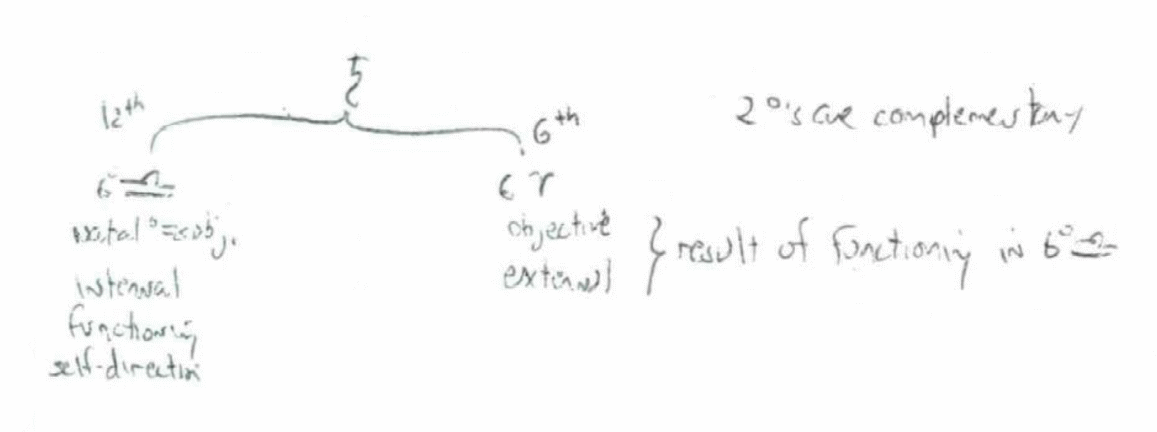
[FIGURE 1982 0920a-1-AB. AD Saturn 6 Libra, 6 Aries. Subj. = Subjective. Facsimile scan from AB class notes.]
In 6th house = readjustment. This subjective functioning in 12th, Libra, brings about a readjustment,
House shows what realm of experience the functioning is concerned with.
House structure shows the World-Idea exteriorized.
Terry Jay
Aries, 12th, opposite Moon -- is experienced in terms of a set style or approach of teaching within an institution.
Libra, 6th, Moon -- is developing a faculty of imagination which requires a self-adjustment.
Emerson
Jupiter Venus Mercury group
Venus, 28 Aries, 7th -- "A large audience is seen rejoicing in some disillusionment to which it has just been subjected."
Opposite, 28 Libra, 1st -- "A man stands alone in surrounding gloom; were his eyes open to spirit things he would see helping angels arriving."
Opposite -- can see the spiritual value of life's disillusionments.
Venus = spiritual independence -- the evaluative function had a freedom and independence (natal degree).
Opposite degree -- outer manifestation of the inner functioning was in terms of spiritual fellowship with others which was possible because of his independence -- instead of becoming bitter he felt a fellowship with others -- was in terms of his personality (1st house, now 2nd) -- the friendliness was a part of his personality which was developed over his life (aloof as a child, relating to others when older).
p. 156 Journals
7th house (now 8th -- experienced in terms of deaths in his life) -- all his friends and relationships -- the World-Idea set him up in this.
This nexus was the locus for his independence.
Relationships with a "large disappointed audience" -- this built up in him a knowledge of spiritual fellowship.
Those who didn't know him saw him as aloof and impersonal (7th house).
Emerson's experience of himself as cold was really due to his independence.
Sun Moon Mars = public lecturer
Mercury Venus Jupiter = moralist, introvert, idealist -- philosophy as morally lived.
Mercury, 26 Gemini, 9th -- "The winter frost has stolen through the woods, and given to the trees and underbrush a witching cosmic lacery." -- Need to keep thinking in conformity with Nature.
Opposite, 26 Sagittarius, 3rd -- "The scene is an old-fashioned battle; in the hot hand-to-hand fighting a flag-bearer distinguishes himself."
[Natal] degree -- Mercury degree applied universally to all of Nature -- rationality was natural to him.
Opposite [degree] -- the living of common ideals as a way of distinguishment.
3rd [house] (writing) -- his thinking process was disciplined.
9th [house] -- higher ideals, religion -- got back to universals beyond sectarianism.
A universalization of the natural.
The Mercury on that degree is a self-cancellation -- reflective knowing cancels itself in the recognition of the universal in the individual.
Square Jupiter -- insists that all the biological processes in the individual can be universal.
Mercury square Jupiter = the concrete universal individual or individual as universal.
Mercury degree → debunking of any personal thinking.
Jupiter square Mercury 1 degree: "What is the hardest task in the world…to think." "No man can see God face to face live."
If you talk about a square, can you bring in the opposite? The two degrees and functions manifest something different than the opposites.
There is a demand (square) for him to think for himself and apply that thinking (or derive it) from his living.
Mercury = thinking according to Nature -- by canceling itself it becomes universal.
(After Andrew left (and others) -- now that we're alone we can talk.)
Jupiter, 26 Virgo -- aspiration to spiritualize the biotic processes.
"A highly ritualistic service is in process: officiating priests are automatons, a boy with a censer is rapt-eyed."
His libidinal energies are organized to seek the divine.
Square the universal rationality in Nature (Mercury).
The manifestation of Jupiter square Mercury = living philosophy, living the rational.
Square is by dignity (naturally) -- 1 degree -- two are fused into one functioning.
He preached and actualized morality.
Venus quincunx Jupiter -- to live philosophically he had to respond to the demands of karma.
Jupiter Mercury Venus all in dignity by house and sign.
Sun Moon Mars all not in dignity by house and sign.
Jupiter Venus Mercury was given to him -- meaning had to be drawn out (dignities) -- more gnostic.
Sun Moon Mars had to be developed (non-dignity) -- more involved in the World-Idea (fabricative) -- more related to circumstance.
Saturn, 14 Virgo -- "A large sheet of parchment is covered with finely lettered names and mysterious lines; it is a splendid family tree."
= Man, know thyself -- in the reflective consciousness.
= Sense of his ancestors (spiritually and literally).
Journals -- p. 17, Saturn opposite Neptune, Uranus trine Saturn
p. 148, Uranus opposite Saturn, Tail conjunction Saturn
p. 279
Emerson's opposite Venus degree (28 Libra) is PB's Sun. PB's evaluative function was independent.
[Classnotes AB 1982 0920 End]
CHARTS FOR 1982 0920a
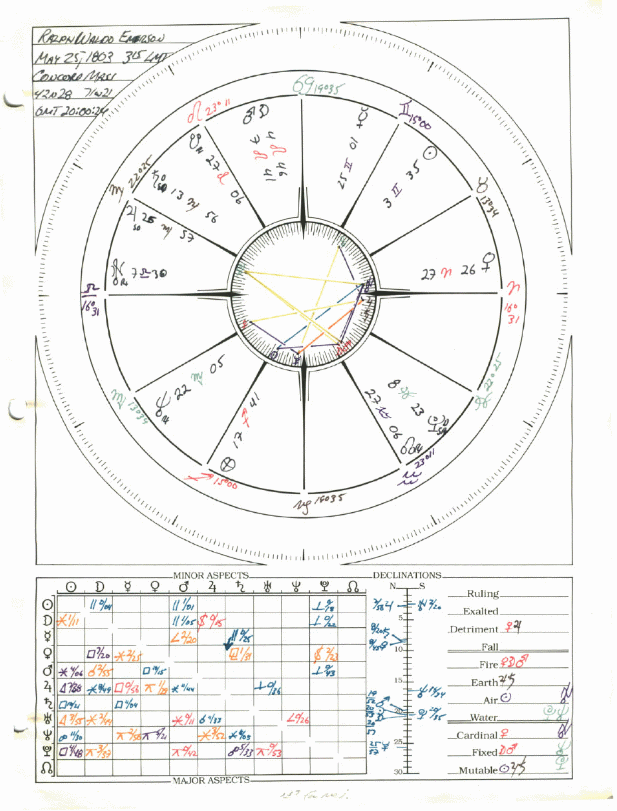
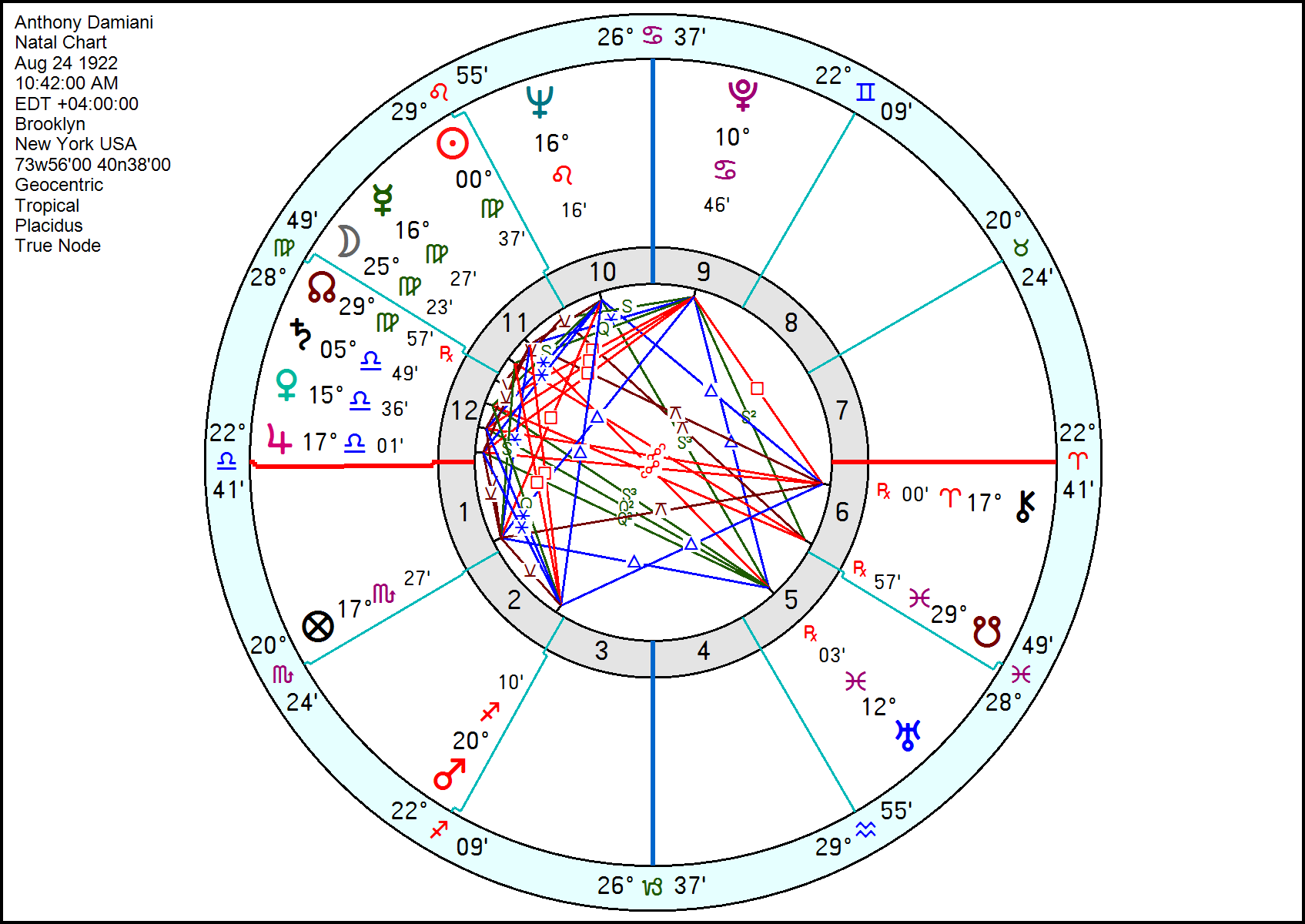
Seminar
Monday, September 20th, 1982
Edited transcriptClick the series name to view more
SEMINAR at Wisdom's Goldenrod, Hector, NY
with Anthony Damiani (AD)
September 20, 1982-a
ASTROLOGY; HOROSCOPE-EMERSON
with Appendix: Classnotes AB 1982 0920.
TOPIC: Astrology
SUBJECT: Horoscope-Emerson
SUBSUBJECTS: Emerson natal chart, transits, Degree and its Opposite, House and its Opposite, Dignity and Non-Dignity
CONTENTS:
Problem: difference between opposite degrees and opposite houses in chart interpretation
Degree vs. opposite = inner psychological functioning vs. outward manifestation; outer seen by others, inner is inferred
Example of AD's Saturn
Saturn at Libra 6: employment of imagination for discovery of human potential
Opposite at Aries 6: unimpeachability of genuine self-direction
Saturn in twelfth house, opposite in sixth house: by being of service, self-direction is readjusted
After you do something (opposite degree) you find out what it's all about (planet on degree)
Reflective consciousness recognizes unity of inner functioning and outward manifestation
House structure always fixed, represents World-Idea
Example of Terry Jay's Moon at Libra 6
Moon in sixth house, opposite in twelfth house: institution Terry works for is laying groundwork for how her imagination is developing; necessary readjustment of mundane consciousness required by total personality
Emerson's natal chart
Venus at Aries 28, seventh house: spiritual independence in relationship; detached evaluative function
Opposite at Libra 28, first house: spiritual fellowship with others incorporated into his personality; friendliness
Subject-object distinction as imagination of unreality; dream analogy
Most of us experience from position of irrational soul; Emerson experienced from position of rational soul
Degree and its opposite originally together, can't unify them
Through indefinite series of incarnations, what is external gets internalized and what is internal gets externalized
Einstein and Freud's opposite Moons: difference in meaning due to level at which ego was functioning
Sage has separated evaluative function from animality; this is real warmth, but experienced by others as aloofness
Mercury at Gemini 26, ninth house: reflective knowing cancels itself out so the universal can become operative; universal rationality of Nature
Jupiter at Virgo 26: universalization of biological processes; libidinal energies organized to seek the divine
Mercury square Jupiter: manifestation of concrete universal individual; living philosophy, living the rational
Emerson's Chaldeans are unusual, rational soul practically incarnate
Mars at Leo 8: had to learn when appropriate to express political opinions
Saturn at Virgo 14: "Man, know thyself"; his heritage is the rational soul
Biographies can't give you what you get from a chart; we can't apply our standards to these men
Appendix: AB class notes
BOOKS READ FROM OR REFERENCED:
Marc Edmund Jones, The Astrology of Concepts
Marc Edmund Jones, The Sabian Symbols in Astrology
Bliss Perry (ed.), Ralph Waldo Emerson, The Heart of Emerson's Journals
Ralph Waldo Emerson, Essays: First and Second Series, "The Poet"
Ralph Waldo Emerson, The Complete Works of Ralph Waldo Emerson, v. 4, Representative Men, "Montaigne; or, the Skeptic"
SABIAN SYMBOLS: Aries 6, 28, Gemini 26, Leo 8, Virgo 14, 26, Libra 6, 28, Sagittarius 26, Aquarius 8 (implied), Pisces 14, 26
DIAGRAM and CHARTS appended to this transcript:
FIGURE 1982 0920a-1-AB. AD Saturn 6 Libra, 6 Aries.
FIGURE 1982 0920a-2. Ralph Waldo Emerson Natal Chart.
FIGURE 1982 0920a-3. Anthony Damiani Natal Chart.
RETYPED AND REFORMATTED by IT 2021
NOTES:
REDONE RETYPED PARTIAL TRANSCRIPT (hence V10.1). From File 1982 0920 ASL Emerson 12p.PDF. THERE ARE NO AUDIO CASSETTE TAPES EXTANT.
This is 1982 09/20a, the Astrology; Horoscope-Emerson seminar, and the first of two entries associated with this date. 1982 09/20b is the Plotinus; Soul seminar, for which no audio survives — only JF notes.
Anthony is Anthony Damiani (AD).
AB Classnotes have been appended because they contain information that the partial transcript does not have and thus help round out the class. Retyped from Classnotes AB 1982 0915 to 1982 1030.PDF. All capitalization and punctuation corrected, all abbreviations, astrological glyphs, and some numbers spelled out in AB Classnotes.
This is a redo of the previous version which was done in 2018. This version has: mistakes in Prefatory matter corrected; AB notes appended (which contain information and a diagram that the partial does not have); Book List completed; Title, Subject, Subsubjects changed to accord with new conventions; notes inside transcript; different Emerson chart appended that matches the information discussed in the class.
All spelling, punctuation, and capitalization errors have been corrected, abbreviations spelled out. _____ has been replaced with [inaudible].
1982 09/20a SEMINAR at Wisdom's Goldenrod
Astrology; Horoscope-Emerson
[File 1982 0920 ASL Emerson 12p.PDF Begins]
9/20/1982 Monday Astrology Seminar Emerson
[Note: Sabian degrees and interpretations are from Marc Edmund Jones, The Astrology of Concepts and The Sabian Symbols in Astrology.]
Question: What is the difference between planet on a degree and planet plus opposite degree?
Tim: Planets = rational soul, therefore first level of subjectivity = transiting planets. Planet in a degree organized by a reason-principle = rational soul level, manifesting in a psychosomatic organism = polarizes into subject-object pair, or subject and object as content to rational soul. Each colored by house circumstances. What difference between having a planet on a degree or opposite a degree? Degree and opposite seem to be some kind of a unity. We have degree and opposite, content as psychological subject, content as object.
Anthony [AD] gives example: His Saturn at 6° Libra; [Libra 6, "A pilgrim sits on a rustic bench and one by one his ideals in a sort of trance-vision take form before him."] another person would see Saturn functioning outwardly through the opposite degree, [Aries 6, "A black square stands firmly, illumined red on one side."] and could only infer the quality of the inward functioning, symbolized by Saturn on 6° Libra, from the quality of the outward functioning. The outer you can see, but the use of the imagination you can't see, it's not objective. That would be my subjective functioning. You can see the complimentary, the opposite point, but you don't see the inward pointing, the employment of the imagination, which can only be inferred from the way I work externally. So you refer to the fact that I'm employing the imagination, and you infer that I must be functioning that way inwardly.
Andrew: Both planet on degree and opposite degree must be thought of as externalized and manifested in house circumstances?
Anthony: No, we're just talking about the degree and the planet on the degree. The 6th house would represent service, readjustment. If you take the Saturn, the opposite point of view is in the 6th house. The degree symbol is described as some sort of self-direction. I interpret that as a necessary readjustment that the personality has to go through. The psychical meaning of self-direction refers to the fact that I'm functioning in a certain way, the self-apperceptive mode of functioning, and the effect of that is still psychical; I get a certain direction from the way I function psychologically, and that's a unit. But now the houses come in. The self-direction is a readjustment. In other words, by being of service I am readjusting something about the way I am going. I see that as its necessary accompaniment. The house is telling me that it's necessary through service to readjust my direction. Then why isn't Saturn on 6° Aries? But then 6° Libra would be the result of the functioning of 6° Aries. Suppose Saturn were on 6° Aries. I would have to conceive of that as my internal psychological functioning and the outward functioning of that would be to produce an idealization, personification.
Dickie: You use the words inner and outer, yet describe both in terms of psychology, therefore I don't get the difference.
Anthony: Maybe it would be better to drop the words altogether, and just take them as metaphorical. There is no inner and outer. Put the Saturn on either side and see if you can tell the difference. By putting the Saturn on one or the other, that should give us the meaning of the Saturn in terms of the four houses and the opposite signs. Let's try. Saturn is on 6° Aries. It's in the 6th house -- we'll reverse them. The degree is "absolute unimpeachability of genuine self-direction". What would be the outward manifestation of that inward psychological functioning?
Dickie: I would say the house position of that Saturn.
Anthony: You mean within those circumstances. But that's not going to be the outward manifestation of an inward psychological functioning.
(incomprehension)
Anthony: Let's go back to the original Saturn on Libra 6°. It says, "the employment of the imagination for the development of the individual." That means that the way I psychologically operate is to employ the imagination and the effect of that functioning is a certain direction; the direction is going to be the opposite degree. The functioning is in the Libra, the effect of that functioning is in Aries. Superimpose on that the house structure. The 6th house in mundane astrology refers to service, employment, illness, readjustment. Gather those meanings together. How would you interpret that as the effect of that psychological functioning? I know that I have to deal with the opposite to get into the person, because I don't know the inner being of the person, but its outward manifestation I can see. And from that I can infer the way he works psychologically. The description of the way we understand may be the answer itself. By superimposing the house structure on the psychological functioning you see what realm of experience that functioning is concerned with. You see the effects of the functioning in the opposite house, which is quite different from its functioning per se. That's like saying, after you do something (opposite degree) you find out what it's all about (planet on degree). The function operates in the opposite house and thereby the soul learns about its powers. If the 6th house represents service, readjustment, and I superimpose it on that functioning and its outward manifestation then I see that the 6th house tells me that this is where a person is of service or his illness is corrected or readjustment takes place and so I see the outward manifestation of the psychological functioning from the 12th house in the 6th house, the realm of experience within which that outward manifestation of that functioning is being worked out. You have reflection on that activity and recognition of its source. Through reflection one would recognize the effects of the way he psychologically functions and he could bring them together into a whole. He'll recognize this is the way I psychologically function and this is the net result of that functioning and that they're really obverse sides of the same coin.
Tim: The opposite degree is the process of differentiation of the natal degree. As that process is accomplished, the natal degree becomes objectified and available to reflective consciousness.
Anthony: If you had no reflective consciousness there would be a psychological operation going on, and the effect of that psychological operation, and you'd never be able to connect them.
Tim: The connection is in reflective consciousness. The connection will be made by all the transits, but would you say specifically by the planet's transits to its natal position? Does that bring out awareness of a planet's function? Or all planets transiting to the natal?
Anthony: That's difficult because I assume that reflective consciousness is a presupposition and that its manifestation is a gradual thing to the ego.
What is the 12th house part of the example?
Anthony: The 12th house refers to institutions, prisons, hospitals, centers, ashrams -- superimpose that. I am forced to employ my imagination in this institution. There must be one concept that will combine all features of a planet on a degree, and eventually one concept that will combine all seven planets and their relevant degrees.
Question about the relative importance of the houses and the planets.
Anthony: My experience has been that they are always closely allied. In the case of a primitive, circumstances would seem to have a priority over the psychology. I'm saying, put the planet on the degree, and you see the opposite degree manifesting from that psychological functioning, then impose the house structure and you can say they have to operate in terms of those realms of experience. The house structure is always fixed, so the suspicion I have is that the house structure represents the World-Idea exteriorized. That you've got to take for granted.
Andrew: Can the houses be thought of as transpersonal in the sense of the transpersonal planets?
Anthony: It's transpersonal but not in the way of the transpersonal planets. I do think of the house structure as something we all have in common.
Andrew: We all share a world, but we are unique in the way we experience that world. The similarity is the houses, and the uniqueness is the planets.
Anthony: Yes, the houses are always the same -- everything else is variable. My suspicion is that's got to be the World-Idea. There's no changing that. Let's have another example.
Terry Jay: Moon at 6° Libra in the 6th house. Read degree and opposite.
Anthony: That functioning is manifesting outwardly in an institution. Wouldn't you say that the institution you work for is laying the groundwork for how your imagination is developing?
Read 6° Aries.
Alan: As outward manifestation of her Moon degree, wouldn't you expect to find a certain methodicalness?
Anthony: Let's bring in the conjunctions, the mother archetype, and all the other implications that this Moon has, and associate with it the development of the imagination, and what would be the outward effect of that? You're identifying the Mother archetype with the development of the imagination to realize what the potentials are. Now what is the outward manifestation of that? Wouldn't it give her direction, self-direction? Now superimpose the houses on that.
Tim: The self-direction comes out of the degree. The fact that it's the Moon that is being manifested in that degree has something to do with the ordering of daily circumstances. The Moon has a certain mundane orientation in itself -- it is the function of trying to understand and order experience. So there's a self-direction in terms of a practical awareness which is being manifested in the circumstances of some institution. That's the 12th house. With that Moon, Terry was probably not allowed influence within the school system to change her curriculum, her direction of accomplishing the service she wants to do.
Anthony: I disagree, because insofar as she is teaching in a school, she is operating within an institution, and this is the organization of her experience.
Dickie: Isn't that an other- rather than self-direction?
Anthony: The keyword is personification. Something of the nature of personification is taking place. She uses the imagination for the discovery and development of human potentials. Put the Moon on that.
Tim: That would be the potential that's being discovered. The evolution and unfoldment of the mother archetype.
Anthony: The opposite, the manifestation of that functioning?
Tim (reads): "Absolute unimpeachability of self-direction".
Anthony: What would that mean?
Dickie: That those ideals are so personified that outwardly she has an absolute self-direction given by those ideals.
Anthony: A little further -- what do you think is being directed?
Dickie: The Moon…
Anthony: Could we say mothering? Mundane orientation? Down to earth? Now, let's superimpose the houses on that. The 6th refers to a readjustment that is necessary. So the psychological functioning is a readjustment necessary in the total personality. The outward manifestation of that psychological functioning in the 12th house -- institutions--
Dickie: Within the institution she would show an integrity to her own ideals, self-direction within the framework.
Anthony: If the outward manifestation of this set direction is in Aries and we superimpose the circumstances, institutions, on that, what will we have?
Dickie: The circumstances in which that outward functioning will manifest.
Anthony: And I could add, Terry, that you have quite a few children, including some that you took in. It really seems that there is a mundane orientation going on, and it is required by the total personality.
When the school board disagrees with what you're doing, aren't they seeing the way you're operating, the effect or manifestation of that 6th house operation? The same way that, in order for me to understand a person I have to look at the opposite sign and work my way inward to the psychological functioning. Because the psychological functioning is much more inward, and is not as readily available as the results of that functioning. We need this method in order to understand many charts where we only have information about the imprint made on circumstances and events.
As for Terry, I would say there is a basic readjustment of a mundane consciousness taking place, a necessary readjustment for her own interest.
Emerson's Venus degree read, with Jones' interpretation. [Aries 28, "A large audience is seen rejoicing in some disillusionment to which it has just been subjected."]
Opposite degree and interpretation. [Lira 28, "A man stands alone in surrounding gloom; were his eyes open to spirit things he would see helping angels arriving."]
Tim: Venus as value, feeling function. Emerson saw himself as having a dark outlook (1st --opposite--house). Able to transcend life's darker moments.
Linda: This degree also as demanding spiritual independence.
Anthony: In spite of innumerable friendships, the Concord school, Alcott, Fuller, he maintained his spiritual independence. His evaluative function was really a free and independent thing, and even something as close as the death of his wife, there was still that freedom and independence that the evaluative function operated with. And it's amazing because it's right in the 7th house and you're talking about his relationships with everyone, and still he maintained that independence.
How about the opposite degree? The keyword is "responsiveness." "The degree is complete spiritual fellowship with all mankind." The outer manifestation of that inner functioning was in terms of what? Venus in Aries in the 7th house is the psychological functioning. The opposite is what? Spiritual fellowship. He feels a fellowship with others rather than becoming bitter about his experiences. What are the circumstances (the House)? 1st house, personality. So he incorporates that into his personality -- that outward manifestation becomes part of his personality.
Tim: Reads quote from Journals when Saturn was on Venus. [Note: See Bliss Perry (Ed.), Ralph Waldo Emerson, The Heart of Emerson's Journals. Not clear which entry is being referred to.]
Linda: I don't think it's just friendship, but also spiritual guidance, only available to him if he stands alone. (Quote from Emerson's writings.)
Anthony: The outward manifestation of that Venus degree, friendliness, is an extraordinary thing. You can't artificially grow it.
Andrew: Houses as World-Idea?
Anthony: Here for instance were all these friends in Boston or Concord and he was thrown in among these people. That's something independent of the individual…these 7th house activities. If he went into business relationship with ten people, that's the World-Idea and the role he's playing in that. The psychological functioning has to be placed in the context of the situation, the milieu that he's in. Emerson's evaluative function is evaluating the World-Idea.
Tim: By being thrown into relationship with "a large, disappointed audience," that is, Alcott and the Transcendentalists, yet there was a certain inner knowledge that this would not be completely proper because of the collectivity of it. He was going to have to be involved with them and yet independent of them; and by fulfilling that function and accepting that demand by the World-Idea he learned something about spiritual fellowship.
Anthony: Within his own subjectivity. You take any one of your planets sitting on any degree and see if it doesn't work that way.
Tim: It's just a little hard to see the 1st house.
Anthony: Yes, we only have others' reports about the sweetness of his personality and the genuine warmth that radiated out from within him. These are things that you can only get from the outside.
Andrew: He was thought of by those who didn't know him personally…
Anthony: 7th house.
Andrew: As an aloof and distant sort of figure… And those who knew him…
Anthony: Who were in contact, got in touch with him more intimately, knew his subjective personality much more intimately.
Dickie: But the 1st house is the outward manifestation of his inner psychic functioning.
Anthony: 7th house Venus. We know that this man has a detached evaluative function, and the outward manifestation that is taking place in his personality is this friendliness, this warmth. Now you get next to a person like that you're not going to experience it, feel it?
Dickie: But that's the outward manifestation of the inner functioning.
Anthony: What would be the difference between the outward manifestation and the inward psychological functioning?
Dickie: A lot! If not, having a planet on one degree or its opposite is fairly unimportant. It's the same archetype coming through.
Anthony: But if he had Venus in the opposite degree, the outward manifestation would be in the 7th house, then instead of the aloof, detached relationship he had with everybody in the 7th house, there would be warmth and friendliness and handshaking.
Dickie: But I still submit there is a big difference between the function in the degree and the sign that it's on and the one that it isn't. It seems that we're melding the distinction.
Anthony: But I am melding them. First of all, I do not consider them two different things -- I can't have a psychological functioning without an effect. The effect is not something in terms of a relationship. It is the obverse side of the function.
Dickie: Is the effect on the same level with the function?
Anthony: No, one is the manifestation and one is the psychological function. And so I've introduced a nice hiatus, and now I've got a subject and an object.
Dickie: But we do have a subject and an object in this case.
Anthony: I know you think that. I don't. The seven planets and their opposite degrees form one integral whole. The divisions, subject-object dichotomies, are purely the imagination of unreality.
Dickie: But it wasn't unreal that he was born in May and not October. The planets are there for a particular reason. The World-Idea is structuring his psyche in this particular way and not any other. Isn't there a meaning to that?
Anthony: No. No, I don't consider the analogy as proper. Because I am speaking of the seven planets that constitute the irrational soul as one integral thing. The division that we see between the outward manifestation and the psychological functioning -- we're within it, within the seven Chaldean planets and we think there's this division. From the reflective consciousness we see that it can't be. From the reflective point of view that would be inherent contradiction. Within -- this is the paradox -- within the empirical personality, we must take that stand. Let me try an analogy. You, the dreamer, are having a dream. As the dreamer, you do not see a dichotomy between the dream-character and dream-events. But, when you identify with the dream-character, then you do see a dichotomy, you see the dream-character is different from the dream table, and both points of view have to be employed.
Dickie: I accept that. But when you look at Emerson's Venus, 28 Aries is dominant throughout his life. He may have appeared friendly to those who knew him, but that was always very external to him. He always kept 28 Aries much more as what he felt himself to be. The effect may have been an appearance of spiritual friendliness, but that wasn't what he was taken up with in his own evaluative function.
Linda: But that was what he was doing with his life, sharing his spiritual feelings, he wrote it all down.
Dickie: I think we can find that without having to resort to the opposite degree of Venus. But what was really important to him was not the sharing with others but the fact that he lived it himself. That he had this independence. We're talking about his experience.
Anthony: The same problem. When we talk about experience, we're talking about everything that's going on in the irrational soul. So most of us speak of experience from within the rational [sic; irrational] soul, taking the position of the psychological functioning. We call that the experience.
Dickie: How do you think Emerson experienced it?
Anthony: I think he experienced it from the rational soul.
Dickie: Then we should find in his description a unification and almost an equality of those two points of view and I don't believe you do.
Andrew: I think it could be found. People who knew him personally, they describe warmth. Why is it necessary for him to describe that?
Dickie: He does talk a lot about how others see him and about how he feels about himself and his independence of any manifestation of that? If you're looking for this kind of unification…
Anthony: There is no unification. There is no unifying the two opposite degrees -- they are originally together. We are saying if you start with the psychological functioning, and the outward manifestation of that functioning, I get to know the outward manifestation. Then if I trace it back to my psychological function, I can see through that development that there's an integral unity between the psychological functioning and its outward manifestation. But I would state that it is originally posited there to begin with.
Dickie: Ok, the opposites are never sundered. They only appear so to the rational [sic; irrational] soul. What is the meaning of the instantiation of particular soul powers into particular degrees and not the other ones, opposites?
Anthony: In so far as the rational soul is manifesting at that degree that means that the outward manifestation of that psychological function is externalized. Given the indefinite series of incarnations that we go through, what is external gets internalized and what is internal gets externalized. If you multiply this by the seven Chaldeans, 360 degrees, and innumerable aspects, you begin to get an idea of the range of experience that a soul has to go through before it gets matured. It doesn't mean anything to ask why is this soul incarnating at this degree -- it's because it needs this lesson right now.
Dickie: When we looked at Einstein's Moon and Freud's Moon on opposite degrees, we gave very opposite interpretations. We saw one as a very limiting factor and the other as a very expanding factor. If they were opposite, different results would have followed. There was a major difference in meaning there.
Anthony: Yes, but the major difference in meaning came through the level at which that ego was functioning. Another ego would have interpreted that degree quite differently. The best way to see this is to work a few more examples.
Alan: Question about Emerson's alleged iciness.
Tim: (disagreeing with Anthony) From readings, it seems that Emerson saw himself as cold and aloof, not in his relations but in his quality of personality. At one point he said, "I was born cold, and I've always been cold."
Anthony: It wasn't a question of coldness, but rather lack of recognition of his independence. I'm saying when he introspected and analyzed himself and compared himself to conventional friendliness, he thought of himself as a cold fish, but the truth was rather that he was an independent fish.
Andrew: The psychological function in the 7th house translated itself into 1st house circumstances. What people felt was the presence of unification rather than some kind of psychological personality.
Tim: We're saying the 1st house degree, the opposite to the location of Venus, is: (reads Jones' degree symbol). That is complete spiritual fellowship of all humankind. I submit that this means a certain radiance from his personality of being of a spiritual fellowship. This would be apparent to those who were "sensitive to spirit things." People who weren't, whether close friends or not, saw the surrounding gloom and aloofness in his personality.
Dickie: All his close friends complained about the lack of depth of feeling in him.
Linda: He was aloof, he was spiritually independent; some understood his coldness, some didn't. So what's the problem?
Tim: I see that as being the 28 Libra, not 28 Aries. So the aloofness is seen as the effect of the characteristic relationship of the 7th house.
Nancy: He wrote a lot about solitude, how to maintain solitude in public.
Tim: That refers to Moon-Mars conjunction in 10th sextile the Sun in the 8th house dragged him around in public, whereas the thinker, the philosopher, the moralist, the introspector, comes from the Mercury-Venus-Jupiter group. Those two groups are not connected in his chart. One side is developing his inner life and the other is pursuing something of communicating his understanding to other people. Two different sides of his personality. Venus seems to have to do with his valuing of solitude and independence. Mercury-Jupiter-Venus is the source of doctrine of self-reliance and morality as the living of philosophy.
Andrew: Emerson's warmth was an animal warmth, not psychological?
Anthony: When a person has overcome to some extent his desire nature (kama rupa) and he operates with the evaluative function, it is not affected by what you call warmth; that warmth is phony to it. That's the same kind of warmth a kid has for his mother; that's not spiritual warmth. You're talking about a man who is a Sage, who has separated the evaluative function from any animality, and you're going to experience that as distance, aloofness, whereas it is real warmth, real friendliness, because he knows what the thing is worth, and doesn't go beyond that.
Avery: The psychological entity has undergone the development of its powers through the activity of manifesting the World-Idea.
Andrew: Less ego functioning means more conformity to the World-Idea?
Anthony: We're speaking about various aspects of man's ego. Let's zero in on the ego.
Now onto Mercury…
Linda reads 26 Gemini degree symbol from Jones, and interpretation, and opposite degree. [Gemini 26, "The winter frost has stolen through the woods, and given to the trees and underbrush a witching cosmic lacery." Sagittarius 26, "The scene is an old-fashioned battle; in the hot hand-to-hand fighting a flag-bearer distinguishes himself."]
Linda: Degree speaks to notion of God as Nature, Nature as rationalizing of God; empirical quality here. Conceptualization and intuition in Emerson were universal, against a universal background. Rationality was natural to him. Opposite degree --the living of common ideals as a way of distinguishment, as manifesting reason.
Tim: Reads Mercury degree and opposite degree. 3rd house mundane meaning. Mercury-thinking, is in the 3rd house. Emerson disciplines thinking processes to become efficient vehicle for his insights. Mercury degree in the 9th house -- in his thinking, an intuitive flow from his inner being, for which he must neutralize or adjust his personal being, yield transparency and universality of his communication. Universality communicated through the 3rd house.
Tim: Jupiter in Virgo square (one degree) Mercury. Detriment -- differentiation of feelings. Jupiter as instinct, biotic energy, in dignity by house and sign. Mercury comes into being through Jupiter: purification (Virgo) of the biotic force is the foundation for the awareness of philosophy. Ethics and morality from Jupiter.
…
Anthony: A universalization of the natural is going on. The Mercury is a self-cancellation, reflective knowing canceling itself. In the face of the recognition of the universal in the individual, the result would be the complete reevaluation of one's thinking. Square that to Jupiter, which insists that all the biological processes which are in the individual can be universalized. It's the way the universal lives in the individual, that square. That's what is being manifested. It's the closest occurrence I've seen anywhere of what they call the concrete universal individual, the individual as universal. With a Mercury degree like that, you'd practically [inaudible] any personal [inaudible]
Linda reads quote from essay on The Poet, [Note: See Ralph Waldo Emerson, Essays: First and Second Series, "The Poet".] and reads Jupiter degree.
Linda: Essay on Montaigne -- two types -- poetic and active. Third type -- in the middle, drawing from the extremes. [Note: See Ralph Waldo Emerson, The Complete Works of Ralph Waldo Emerson, v. 4, Representative Men, "Montaigne; or, the Skeptic".]
Read Jupiter degree and opposite. [Virgo 26, "A highly ritualistic service in is process: officiating priests are automatons, a boy with a censer is rapt-eyed." Pisces 26, "A new moon just visible at sundown to the lovers is romantic only, but to the philosopher it speaks of eternity."]
Anthony: If you're talking about a square, can you bring in the opposite degree?
Tim: Planet in opposite degree seems to be one mode of operation of chart. The square seems to be a different kind of relation, and the opposite degree no longer applies. The planets in aspect are brought into some kind of identity.
Anthony: These two degrees and two planets are going to manifest something quite different from what the opposites. What do you think?
Dickie: If your understanding is correct, the opposite should manifest despite the square. If there's a unity to the opposition prior to its manifestation in an entity it should hold. If the unity of the two degrees is prior and the psychological entity is making the bifurcation then the square does not interfere with that.
Anthony: What does it mean Mercury square Jupiter?
Dickie: Fusion of universal thinking in nature and individuality generates self-reliance, the individual relationship to Nature. The two psychic functions are integrated in a working relationship.
Tim: There seems to be a demand for this individual to absolutely think for himself, thinking that is always applied to living. Jupiter as an expression of life-energy must accord with what insights that person gains. The insights must come from an original and self-reliant source. Explicitly self-reliant. This man must think for himself. The Jupiter-Mercury square. The thinking for himself comes from the Mercury.
Anthony: But we said the Mercury represents its own cancellation. Could we put it more positively?
Dickie: According to Nature or the real object.
Tim: Or according to his insights. Sometimes he writes "The well is dry."
Dickie: Isn't that Jupiter?
Anthony: What do you think the Mercury is?
Tim: I suggest it is able to stop itself so the inner light of the rational soul can irradiate the thought processes. Forest as thoughts -- he catches the light reflecting off the trees.
Anthony: The Mercury recognizes that only by canceling itself can the universal become operative.
Tim: Yes. He doesn't move without that.
Anthony: And Jupiter?
Tim: An aspiration to spiritualize the instinctual processes.
Dickie: He has to live by his own inspiration rather than something formal.
Tim: (reads Jones' interpretation) "Completeness of self-dedication and achievement grounded in constant worthiness of living."
Anthony: You're speaking about the way his libidinal energies are organized.
Tim: The natural response of this person is to seek the divine, spiritual; his instinctual energy is conditioned to always seek that.
Anthony: And now it's confronted with an exact square to the universal rationality of Nature. So the outward manifestation? There's only one manifestation of these two in square.
Tim: Living philosophy.
Anthony: Living philosophy. Let's say living the rational.
Tim: Mercury and Jupiter are always in square by dignity. So here the square is not an obstacle but rather a compelling actualization always going on. And it's one degree, it's always operating.
Anthony: I think we recognize he was one who practiced and actualized morality otherwise he wouldn't even get into philosophy. And Venus?
Tim: Quincunx Jupiter, sextile Mercury. Venus as value and spiritual independence. Quincunx as responsiveness to karma.
Anthony: His Chaldeans are really unusual.
Tim: Yes, the rational soul is practically incarnate.
…Planetary groups. Mars-Moon-Sun. Jupiter-Venus-Mercury. Mars-Moon-Sun works with the World-Idea.
Linda: Mercury operated right from the beginning. Mars he had to work on. This seems to corroborate earlier conclusions.
Tim: Mars and changing interests. He had to learn when it was appropriate to express political opinions. [Leo 8, "A man of mean and low appearance, but with the burning fire of a great cause in his eyes, is stirring up discontent."]
Alan: Non-dignity means involved with World-Idea? Dignities…
Tim: Dignities more involved with knowing.
Linda: Saturn. (Reads degree symbol and interpretation.) [Virgo 14, "A large sheet of parchment is covered with finely lettered names and mysterious lines; it is a splendid family tree."]
Dickie: Reads quote from Journals.
Anthony: What is his heritage, his unique achievement that lies buried in him? I'm inclined to think it was the rational soul. He knew he was a member of that fraternity. The symbol itself points to it.
Linda: (Reads symbol again.)
Dickie: It's unaspected; it's his transcendent principle.
Anthony: Yes, reflective awareness. I think that degree means, "Man know thyself." Man is a hieroglyphic to himself. The achievement is to know himself and that can only happen in the reflective consciousness in the rational soul. All his Chaldeans are gems.
Tim: Reads quotes for transits to Saturn. At 20 he wrote "Myself," with Saturn opposite Neptune and Uranus trine Saturn. (Reads quote.) [Note: See Bliss Perry (Ed.), Ralph Waldo Emerson, The Heart of Emerson's Journals, "Myself," pp. 17-23.]
Anthony: (interrupts) You see how he takes the confidence out of irrational soul and puts it in the rational? He's calling divinity.
Tim completes reading.
Tim: Uranus opposite Saturn, South Node conjunct Saturn. Reads a quote… [Note: See Bliss Perry (Ed.), Ralph Waldo Emerson, The Heart of Emerson's Journals, p. 148. South Node conjunct Saturn in 1839 and 1858. AB notes mention quotes read on p. 148 (1839) and p. 279 (1858).]
Anthony: I would have to understand his Uranus to catch the flavor of that. Biographies can't give you what you get from a chart. You can't apply our standards to these men.
Tim finishes reading quote.
[File 1982 0920 ASL Emerson 12p.PDF Ends]
1982 09/20a V10.1: SEMINAR: Astrology; Horoscope-Emerson. Copyright 2022 Wisdom's Goldenrod p. iv