CHARTS FOR 1982 1004
Class
Monday, October 4th, 1982
Verbatim, unedited transcriptClick the series name to view more
CLASS at Wisdom's Goldenrod, Hector, NY
with Anthony Damiani (AD)
October 4, 1982
ASTROLOGY; HOROSCOPE-EMERSON
TOPIC: Astrology
SUBJECT: Horoscope-Emerson
SUBSUBJECTS: Emerson natal chart (trans-Saturnians), transits
CONTENTS:
Opening: trans-Saturnian planets in Emerson's chart
TS notes: interpretive framework for the three trans-Saturnians
Uranus at Libra 8: detachment (or attachment to true center); Uranus conjuncting each planet = disidentification with that function
Uranus transits: circuit through the natal chart
Uranus conjunct Sun (1858-1859): "birth of perception…eyes of my eyes were opened"; knowing the Sun as the mode of perceiving the world; birth of perception of the Intelligible in the sensible; knowing the purpose of his life
Uranus (and Pluto) conjunct Venus (1850-1851): disillusionment with collective man; put in touch with himself as true teacher; Margaret Fuller's death ("I have lost in her my audience")
Pluto conjunct Venus (1848–1851): entrance into politics; valuing the world as actualizing various facets of the Idea of Man
Natal Uranus-Pluto quincunx demands actualization of knowing and knowing of actualization; their conjunction on Venus = fulfillment of that natal potential
Uranus conjunct Mercury (1864–1865): intensified Shakespeare study; refusal to be dictated to by any outside mode of thought; complaint of no consecutiveness; after transit writing turns practical, less metaphysical; liberated from compulsive need to communicate
Uranus sextile Sun (July 1872): house burned
Uranus conjunct Moon and Mars (1872–1874): travel to Egypt and Europe while house rebuilt; worsening aphasia; no longer needs to agitate, released from the Bolshevik function
Tail–Head arc: he came in a mystic and went out a philosopher
Uranus conjunct Tail (1877–1878): re-elected to Harvard Board of Overseers; "The Fortune of the Republic" speech
Alcott's Concord Summer School of Philosophy (1879–1880) — bringing to fruition a lot of what he stood for
Uranus conjunct Head (1835): marriage to Lydia Jackson; settling in Concord; writing first draft of "Nature"; increasing poetic output
Uranus reawakens higher self-awareness; Pluto reformulates role and function in the world; Neptune transforms the rational soul itself toward wider participation
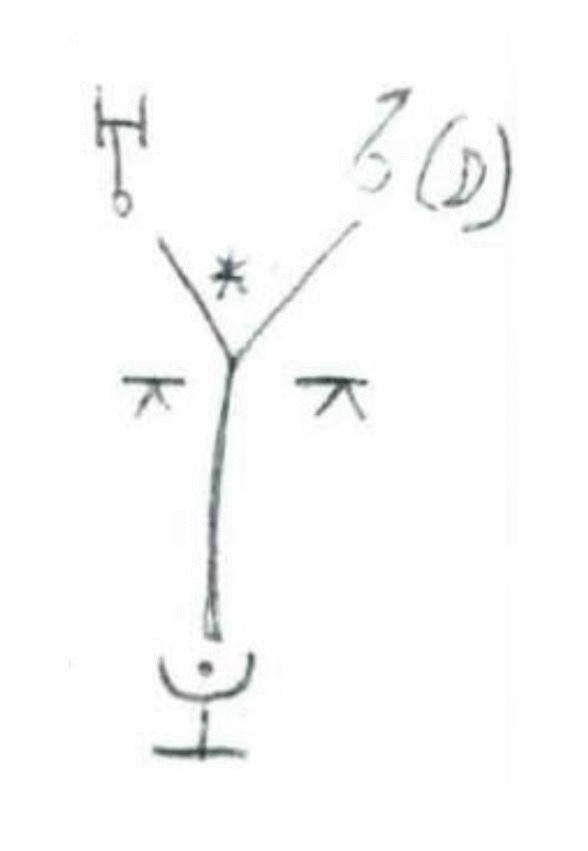
Finger of God, with Pluto in fifth house as apex: Mars always expressed the inner Pluto imperative; his morality was that one had to be compelled to listen to his own inner voice
Uranus brings the philosophical/Nous perspective; Neptune brings the mystical/rational soul perspective; Pluto actualizes and transforms
AD: Uranus was not primarily about detachment but about bringing the forces of the higher self into actual life; an enlivening, a vitalizing
May–June 1849 journal entry ("The soul is near things because it is the centre of the universe") attributed to Uranus sextile Mercury; Uranus knowing made available to the thinking function; intellect got defined
AD: Uranus conjunct Sun: recognition of the Sun as the sensitive faculty; recognition of the duality inherent in the ego-complex
Consideration of alternate birth chart (1:16 pm)
Birth time source: Marc Edmund Jones gives 1:16 pm; other sources say only "early afternoon" or "middle of dinner" (a Sunday — Unitarian family); actual time remains uncertain
Mercury at Gemini 25, tenth house: continuously husbanded his thinking; public/written output
Opposite at Sagittarius 25, fourth house: he supported every venture but didn't join; always kept at a nice comfortable distance
Uranus conjunct Venus, eighth house: Margaret Fuller's death
Uranus and Jupiter in first house: the dominant vision of his life; had identity with the higher self from age 18 (Uranus)
Moon at Leo 4, eleventh house: a dignified man — upright in bearing, direct in gaze
Jupiter square Mercury: his compulsion to write constantly; had to be in public
BOOKS / JOURNALS READ FROM OR REFERENCED:
Marc Edmund Jones, The Astrology of Concepts
Marc Edmund Jones, The Sabian Symbols in Astrology
Ralph Waldo Emerson, Journals of Ralph Waldo Emerson, ed. Ralph Waldo Emerson and Waldo Emerson Forbes, 10 vols.
Ralph Waldo Emerson, The Journals and Miscellaneous Notebooks of Ralph Waldo Emerson, ed. William H. Gillman et al., 16 vols.
Ralph Waldo Emerson, Nature, Addresses, and Lectures, "Nature" (1836), "The American Scholar" (1837)
Ralph Waldo Emerson, Essays: Second Series, "The Poet," "Experience" (1844)
Ralph Waldo Emerson, Poems, "The Sphinx," "Concord Hymn" (1847)
Ralph Waldo Emerson, Representative Men: Seven Lectures (1850)
Ralph Waldo Emerson, The Conduct of Life (1860)
Ralph Waldo Emerson, May-Day and Other Pieces, "Brahma" (1867)
Ralph Waldo Emerson, Society and Solitude (1870)
Ralph Waldo Emerson, Letters and Social Aims, "Inspiration" (1876)
Gay Wilson Allen, Waldo Emerson: A Biography
George Edward Woodberry, Ralph Waldo Emerson
Margaret Fuller (ed.), Ralph Waldo Emerson (ed.), The Dial
K.C. Bhattacharyya, Studies in Philosophy, Volume 2, "The Concept of the Absolute and Its Alternative Forms"
SABIAN SYMBOLS: Aries 8, 28, Gemini 4, 25, 26, Leo 4, 5, 8, 28, Virgo 26, Libra 8, 28, Scorpio 23, Sagittarius 25, Aquarius 28, Pisces 9
CHARTS appended to this transcript:
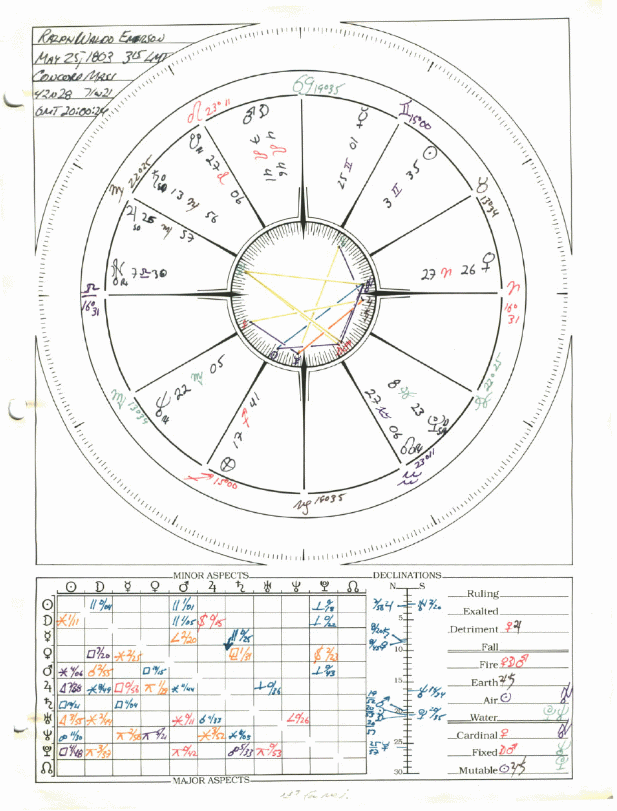
FIGURE 1982 1004-1. Ralph Waldo Emerson Natal Chart (3:15 PM).
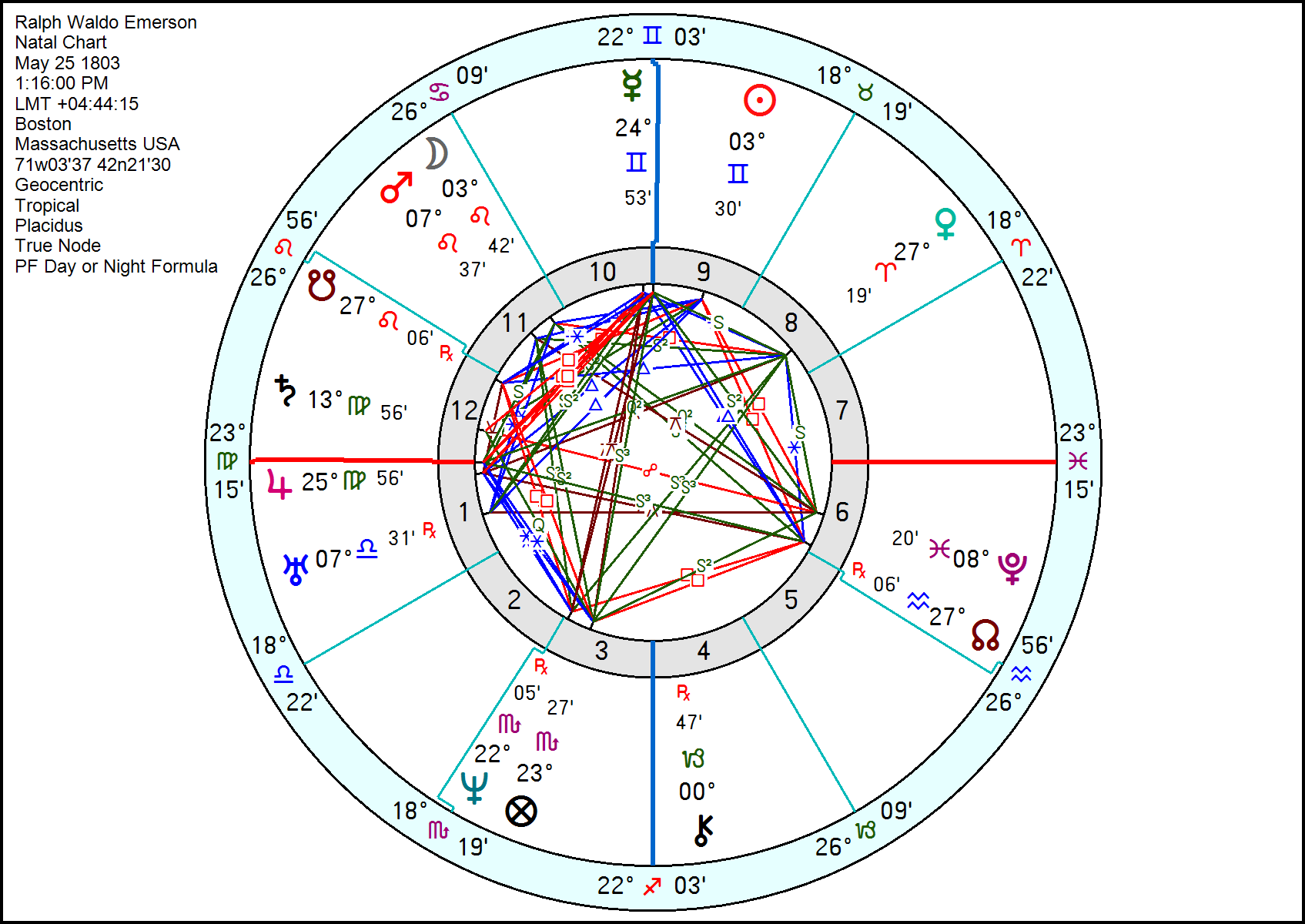
FIGURE 1982 1004-2. Ralph Waldo Emerson Natal Chart (1:16 PM).
FIGURE 1982 1004-3-AB. Emerson's Finger of God.
NOTES:
- Earlier partial transcripts–Scan Files 1982 1004-03R08 ASL emerson class.PDF, 1982 1004-05R08 ASL emerson class more.PDF, 1982 1004-07R08 ASL emerson seminar.PDF–also exist.
TRANSCRIBED Verbatim by IT, LCB 2026. Archival verbatim transcript – V11a.
AUDIO FILES: 1982 1004a, 1982 1004b. [Note: "Tape" and "Side" refer to original audio cassette tapes that were later digitized into .MP3 Audio Files.]
1982 10/04 at Wisdom's Goldenrod
Astrology; Horoscope-Emerson
[Audio File 1982 1004a Begins]
[few seconds of background student talking]
[Transcriber note: Ralph Waldo Emerson's birth data presents conflicting information between sources. The first appended chart (FIGURE 1982 1004-1) uses the commonly cited birth time of 3:15 PM paired with Concord, Massachusetts as the birthplace (per Marc Edmund Jones), and serves as the primary chart for the majority of this class. The second (FIGURE 1982 1004-2) uses Jones's stated birth time of 1:16 PM paired with Boston, Massachusetts, which is cited by most biographers as Emerson's actual birthplace. Historical records confirm Emerson was born in Boston on May 25, 1803, where his father was minister of the First Church. Toward the end of the class, AD invites the group to consider whether FIGURE 1982 1004-1 is in fact the correct chart, at which point FIGURE 1982 1004-2 is introduced and discussed as a potentially more accurate alternative.]
TS: Look at the natal Uranus, Neptune, and Pluto, their Sabian symbols and the planets that they aspect. We'll see if we can get a sense of what they are, and we'll perhaps look through some transits to see if our ideas are brought out or changed. And-- [11¾ second pause with shuffling of papers, background student talking] I sort of have pulled out some notes from the Jones commentary, from-- and I tried to get the high points of these things. [short pause] Emerson's Uranus is at 8 Libra. Its symbol is--
Marc Edmund Jones [The Astrology of Concepts, Libra 8, TS reading]: "In the depths of the woods is an abandoned farm; in the deserted house a fireplace blazes merrily and mysteriously."
S: Oh.
TS: Alright? Jones says--
Marc Edmund Jones [The Sabian Symbols in Astrology, Libra 8, TS reading]: "….a symbol…of the…law of the cosmos whereby…things tend to continue…in their accustomed function. …here is the…capacity for passion which establishes man's loyalty to each object of his self-projection… [The] keyword is GUARDIANSHIP. When positive [TS reads: Positively], the degree is an exceptional [TS reads: it is a] gift for enlisting…men and…natural forces…in…service of self and its…vision…"
TS: I have the opposite degrees but I don't know that they help me, so I'd like to leave them out for the moment. The Neptune degree is--
Marc Edmund Jones [The Astrology of Concepts, Scorpio 23, TS reading]: "A little white rabbit rests contentedly in his cage; before the eyes he metamorphoses into an elf in a fairy glade."
Marc Edmund Jones [The Sabian Symbols in Astrology, Scorpio 23, TS reading]: "This is a symbol of the inner or creative values of everyday living… Implicit…is the kaleidoscopic capacity of his imagination…the extent to which he may…remold the everyday reality with which he deals. Here is poetry of soul as it mirrors each person's ongoing achievement in character and skills. … When positive [TS reads: Positively], the degree [TS reads: it] is…thorough self-conquest by which an individual subordinates his…animal impulses to his ideals…"
TS: Ok. So Pluto is--
Marc Edmund Jones [The Astrology of Concepts, Pisces 9, TS reading]: "A tiny jockey from his magnificent horse looks about eagerly and as the race starts he becomes a god of speed."
Marc Edmund Jones [The Sabian Symbols in Astrology, Pisces 9, TS reading]: "This is a symbol of the eagerness for life an individual must show in any…revelation of himself… It is…consistent performance of his skills…and as this develops…he is under…obligation to be successful in exhibiting them. …[TS adds: there] are…harsh penalties for any failure to drive the capabilities [TS reads: capacities] of self to the limit [TS reads: limits]."
LDS: Yeah.
TS: And I wrote out little fairy tales on these. Let's see if it--
S (very faint): [couple words inaudible]
TS: Yeah, that's what I'm going to do.
[TS Notes, TS reading]: "Uranus represents a spiritual knowing. Neptune is spiritual feeling. And Pluto is spiritual willing. These act by transit to transform the psyche. Their natal position or degree may give us some hint of the character of their operation. Uranus as spiritual knowing carries within itself a knowledge of itself as detached from the contents of the psyche. The Sabian symbol contains both a mysterious fire and a sense of abandonment. When Uranus transits a Chaldean, there may be-- there is some special character to the way in which it knows the psychic content. Here the Uranus degree suggests that Emerson was able to see the essence of a thing, to see the living reason-principles. And having seen this essential meaning, he was able to abandon any ego investment in that content.
"The three Chaldeans natally aspected to Uranus are Mars, Moon, and the Sun. The Moon Mars conjunction in Emerson might represent the orator, the New England priest turned transcendentalist. The Uranus is sextile to this Mars Moon conjunction. This would determine his knowledge so that its main concern would be in detachedly knowing the flux of daily personal circumstance and what he called the animal spirits. He was dispassionate because he objectively knew the passions and so abandoned them, as he did his emotional involvement with daily life, with his personal daily life. The Uranus Moon sextile gave Emerson the capacity to fully experience the emotions arising out of his personal life, such as his son's death, and having gotten to the meaning of the experience he drops any further personal concern with it. The Uranus trine the Sun may indicate that his life was peculiarly receptive to this emptying of the chambers that the Uranus transits brought him, that the increasing detachment and impersonality he developed was towards incarnating some interior awareness of the Idea of Man."
VM: Say the last thing again, Tim. What about the-- I missed the thing about the Idea of Man.
[TS Notes, TS reading]: "…that the increasing detachment and impersonality he developed was towards incarnating some interior awareness of the Idea of Man."
VM: I just don't understand the sentence, I--
TS: Well, through this process of detachment, he got something he could have-- there was some inner awareness of what the Idea of Man is or what enlightenment would mean. I guess I'll-- there-- it's-- it's only a couple more paragraphs, let me just rattle through. We'll go back over it more.
[TS Notes, TS reading]: "Pluto represents his spiritual will, here a will to act in accord with the impersonal good. It begins with the capacity to act in accord to some given sense of good, like the morality of the Christian doctrine, but evolves into a more prototypal and individual form of moral action. Pluto's closest aspect is a quincunx to Mars. This would give Emerson an incessant drive to withdraw from his Mars, from the animal consciousness and the negativity it represents. Also the personal will would have for its ground the impersonal"ought" of Pluto. This aspect is Emerson's need to act always in accord with his inner being's dictates, although such act would always put some strain on his personal drives."
TS: Like when he was giving up the ministry or when he felt he had to go into politics, it was he ought to go into it. His own inclination was not entirely comfortable with that. And last I have a little quick thing on Neptune.
[TS Notes, TS reading]: "Neptune is cosmic feeling or value and works most directly on reflective consciousness. The symbol in Emerson's chart indicates he began by being quite content and self-contained in his reflective consciousness. And that is, that as his values evolved, he became a denizen of the rational soul of the world. This receptivity to the rebirth of values was one of Emerson's greatest strengths. And through the quincunx to Mercury, it obligated him to communicate this in his thoughts. The square to Jupiter transformed his natural tendency to be observant--from the observation of Nature, the observation of the spiritual underlying nature."
TS: There's plenty there to work with. (RG laughs)
S: Right.
S: Square Jupiter did you say?
TS: Yeah.
S: Neptune square--
VM: If you read it a little faster.
S: Yeah, you could've read it faster and (laughter) then I wouldn't have understood anything. (bit of laughter)
S: Yeah.
S: Of course you can.
VM: You gonna do it again, Tim?
TS: I guess so. Or Neptune was square Jupiter.
S: I think it's a sextile.
RG (simultaneously): Neptune's not square Jupiter.
S: Sextile.
S (simultaneously): Sextile.
TS: Oh. Well that's-- that makes it better.
S: It's a sextile.
S: (If you got) last year.
S (faint whisper): I know.
TS: Well, ok, we'll start over with Uranus. I just wanted to make this broad sweep across.
VM (simultaneously): [couple words inaudible] Yeah. I understand.
TS: One thing that struck me is-- in reading the three symbols the only thing that sort of so far has managed to strike me is there is certainly some kind of transformation, energy of transformation, mode of transformation in at least the Neptune and the Pluto symbol, you know, they both have a very distinct quality. And I was trying to see if I could get all three of them together to see if there was some general sense of a subject that those three would represent. Of course hopefully that would be the thing we come to and not begin with. So-- let's go back. [13½ second pause] Let's start with the Uranus again. [short pause] Uranus's symbol is--
Marc Edmund Jones [The Astrology of Concepts, Libra 8, TS reading]: "In the depths of the woods is an abandoned farm; in the deserted house a fireplace blazes merrily and mysteriously."
TS: Now, I'll read all of what Jones says I guess.
[9¼ second pause]
Marc Edmund Jones [The Sabian Symbols in Astrology, Libra 8, TS reading]: "This is a symbol of naïve reality, or of the basic law of the cosmos whereby all things tend to continue steadily in their accustomed function. Implicit here is the burning desire or capacity for passion which establishes man's loyalty to each object of his self-projection and instruments his more consistent self-orientation through each phase of personal responsibility to the world in which he finds himself. [The] keyword is GUARDIANSHIP. When positive, the degree is an exceptional gift for enlisting both men and [the] natural forces of life in the service of self and its dominating vision, [and] when negative, a witless dismissal of all affairs to their own devices."
TS: Now, one thing that sort of, I don't know if we mentioned in the last class, that's significant I think about Uranus transits is that Uranus conjuncted every Chaldean in the charts but Jupiter. Ok?
LR: And he died with Uranus on Saturn.
TS: And he died with Uranus on Saturn. And that Pluto and Neptune only made it to Venus. They only made one conjunction. So, in terms of at least the transits in the development of the person there would seem to be a prominence given to the Uranus. I mean obviously he had squares and oppositions and trines by everybody, but in terms of just simply a conjunction or some kind of--
VM: Tim, that's in part due to the fact that Uranus has the shortest period, isn't it, [student assents] I mean--
RG: In part.
TS: Well--
RG: But you could also find a chart where--
LR (simultaneously): No, but look at the way the chart is sitting.
RG (simultaneously): Yeah, you could find a chart where everything is right before Pluto and Neptune.
VM (simultaneously): Oh I see, where they'd be all stacked up right before Neptune or something [TS assents] they could make-- it will tick them all off.
TS: Yeah, yeah.
RG: You're right.
S: (Mr. Artistic) skills for me.
TS: But if you look for example in Freud's life or Jung's life, a lot of the Uranus conjunctions (from/were) last four or five years. [VM: Huh.] So it would be perhaps reaping a fruit but it wouldn't necessarily be the course of their evolution, you know. It'd be like Wagner, I think it was Neptune hit things first, you know, eventually Uranus passed it but-- I mean I know that that's the case, but I still think that here it's interesting [VM simultaneously: There's something significant (couple words inaudible)] that-- that [RG simultaneously: Too bad (he) can't find it.] it's the only point-- they only hit one planet, and they happened to also hit it together. No. [VM simultaneously: No (couple words inaudible)] No, no they didn't, Uranus and Pluto.
LR (simultaneously): Uranus and Pluto.
RG: Pluto did.
TS: Conjunct on his Venus.
LR: So let's just get up here for the Uranus symbol.
AD(?): Yeah.
LR: Um-- [short pause] The symbol of the-- I can't remember what you said about this, the symbol of the blazing fireplace in an empty house accords somewhat if you think of the symbol of the Sun which was the series of rooms in the house opening one on one. [Note: Gemini 4, "A series of rooms in a hospitable house, opening one into the other, are decorated gaily with holly and mistletoe."] But those rooms were also empty. That house was also empty. And if we can bring in the emptiness here--
VM: You connect those real good. (VM chuckles)
LR: There's something to that. What we thought about the Uranus was that the fireplace at the center of the house really represents the center of the soul, the soul embodying mirth and-- incarnating itself.
S: In the heart, yeah, sure.
LR: Or the heart center. And that the Uranus symbol constantly (brought him--) The Uranus really represented his center, which was-- seemed to be through most of his life pretty available. And, there's a certain wisdom which came out of his ability to detach himself from the emptiness of all the rooms, so to speak. If you-- if you could think of all the functions of the ego-complex as what we're normally identified with, in Emerson there seemed to be not that identification or a progressive series of deep dis-identifications so that his identification was truly with that central heart, was with that central fire. And, our speculation was that as Ne-- as Uranus went over and hit, touched each of the planets, there was a dis-identification with that functioning. And he was really detached. That that symbol really represents a true detachment. And that detachment you can find many places in Emerson's chart, but I think this is a very good place to find it, that his real identity was what he was attached to and not the separate and individual functionings of all the ego-- the members of the ego-complex. That that's what that degree of the fire burning has to do with. And we have a lot of transits to point out that, but basically is that what we said?
RG: And also, can I just say one other thing too, that it's an abandoned farm. And insofar that the fire is-- it's almost like the content that exists [one word inaudible] but now I [one words inaudible] if I could bring in an understanding of knowing. It's like the-- the-- the self is there and the ego is-- is abandoning. And for a Uranus symbol, it seems a pretty appropriate symbol that the content exists and the-- in the house without the identification with it.
LR: There's no ownership of--
RG: Of the self in the symbol.
AB: You know, like an absence of vasanas or a lack of attachment, you know.
RG: Yeah, that's what (I'm saying).
LR (simultaneously): The detachment.
RG: Yeah.
VM: I think it's [couple words inaudible]
LR (simultaneously): But it wasn't an aloof kind of detachment. It was an attachment because he really had something with which he was [student assents] identified.
RG (simultaneously): Yeah. Right, I think it's less a detachment than an attachment to the-- to the--
LR (simultaneously): Attachment to the true center.
RG: To the true center of his being.
TS: But there was, I think, a growing-- we did point out that there was an abandonment of each function as they came by.
RG: Uh-hm.
RN: I--
RG: Don't.
RG: I don't want to-- I don't want to cause confusion but the way you just described it, [S: No come on.] it sounds a little more like the value was correctly placed. I mean it seems more-- rather than coming from knowing, it seems like you're coming from the valuing that you're saying, you know, in every situation he abandons the particular farmhouse, the structure, but-- because he's always kept in mind the true value.
RG: Well, he--
S (simultaneously): But--
LR: Well why call it value or not.
RN (simultaneously): Say it exclude that--
VM: Where do you see value in the symbol though?
RN: Well I don't, I see it just in what was just said.
RG: No, no, but-- well, but if-- you could understand it from Uranus in the fact that it isn't through an alternation of experience and feeling that-- that he gives up a thing. It's because he sees the other, the other exists, and that there's no-- there's no alternation going on. There's just a direct seeing of what's real and what's not. And I could be speaking the language of Uranus here.
TS: We should probably do some of the transits.
S: Let's do it.
LR: Well, should we do that first or should we do the aspect [one/two words inaudible]
TS: Well, I think-- what? I think we'll see that as we go through these aspects-- well you do a few of the transits for the Uranus. The Uranus ones are pretty apparent. The others a little harder. But, then I think the natal Uranus Sun trine, and what is the other one, the quincunx to Pluto and the sextile to Mars, they're all pretty available. 'Cause if you remember the Sun degree was the [LR: Series of rooms.] series of rooms and the-- these chambers. And it seems like that it's a natural harmony between that Uranus, which is sort of going by and seeing into the essence of something, and staying in its own position as it goes by, and there's this sort of clearing out of each of these rooms or this-- or they open out each into the next.
LR: The Uranus on the Sun is a very good one (to pull/we pulled) that out.
TS: Uh-huh. When was that?
LR (simultaneously): Remember?
TS: No.
LR: Remember the quotes in May se-- May '59 and August '59 that he wrote? He had Uranus on the Sun for-- in 19-- in 1859. And, since we're talking about the Sun symbol and the Uranus symbol, maybe you'd like to hear what he has to write at that time, because I think it points it out very-- it's almost self-evident what he's trying to say here. In May of 1859, he writes--
[Transcriber note: I am using Ralph Waldo Emerson, Journals of Ralph Waldo Emerson, vol. 9: 1856-1863, ed. Edward Waldo Emerson and Waldo Emerson Forbes, Boston: Houghton Mifflin, 1913.]
Ralph Waldo Emerson [Journals of Ralph Waldo Emerson, vol. 9, Journal entry, May 1859, pp. 216-217, LR reading]: "Our doctrine must begin with the necessary and eternal, [LR: And this is in his journals.] and discriminate Fate from the necessary; there is no limitation about the Eternal. Thought, Will, is co-eternal with the world; and, as soon as intellect [LR: This is the part."…as soon as intellect] is awaked in any man, it shares so far of the eternity, — is of the maker, not of the made. But Fate is the name we give to the action of that [LR reads: what] one eternal, all-various necessity… [LR: Excuse me. Let me go on.]
"The great day in the man is the birth of perception, which instantly throws him on the party of the Eternal. He sees [LR: And this is Uranus on the Sun."He sees] what must be, and that it is not more [LR adds: than] that which must be, than it is that which should be, or what is best. To be then becomes the infinite good, and breath is jubilation. A breath of Will blows through the universe eternally in the direction of the right or necessary; [LR: This real good.] it is the air which all intellects inhale and exhale, and all things are blown or moved by it in order and orbit."
LR: And then a couple months later he writes something in his journal which he calls "Beatitudes of Intellect." And he says--
Ralph Waldo Emerson [Journals of Ralph Waldo Emerson, vol. 9, Journal entry, August 1859, p. 221, LR reading]: "Am I not, one of these days, to write consecutively as the beatitude of intellect? It is too great for feeble souls, and they are over-excited. The wineglass shakes, and the wine is spilled. What then? The joy which will not let me sit in my chair, which brings me bolt upright to my feet, and sends me striding around my room, like a tiger in his cage, and I cannot have composure and concentration enough even to set down in English words the thought which thrills me — is not that joy a certificate of the elevation? What if I never write a book or a line? for a moment, the eyes of my eyes were opened, the affirmative experience remains, and consoles through all suffering."
S (faint): That's what?
TS: Yeah that was the quote.
S: Yeah.
LR: The eyes [TS simultaneously: The eyes of--] of my eyes.
S: Yeah.
LR: Or-- That's the closest thing we've found to his describing a kind of--
VM: Mystical experience.
LR: Mystical experience.
VM: Right, right.
AB: We [LR simultaneously: That--] can ask Avery.
RG (faint): Yeah.
LR: That and also the great day of the man is the birth of perception.
RG: Of perception, yeah.
Ralph Waldo Emerson [Journals of Ralph Waldo Emerson, vol. 9, Journal entry, August 1859, p. 221, LR reading]: "What if I never write a book or a line? for a moment, the eyes of my eyes were opened, the affirmative experience remains, and consoles through all suffering."
[9½ second pause]
LR: And this [RG simultaneously: Right.] was Uranus on the Sun.
RG: Yeah. But in this sense, would you say there was a detachment or an infusion? And what--
AB: What's the difference?
RG: No.
LR: Well--
AB (simultaneously): If you're going to receive from the higher--
RG (simultaneously): In terms of understanding the mechanism there's a difference.
LR: Ok but--
RG: That's all. And then in effect there wouldn't be.
LR (simultaneously): But you can see that of the-- you know-- Definitely you can see the immersion of the higher into the ego. I mean that's-- [RG: Right.] that's which way it goes is-- There are quite a few and--
[short pause]
VM: Were there other trans-Saturnians going on at the same time?
LR: Yes. There are. It's hard to find any of these dates without-- without having them all, and there-- there are Neptune and Pluto transits as well at this time.
RG: But this certainly was a-- had the qualities of Uranus [few words inaudible]
S (simultaneously): I agree, I agree.
S: Uh-hm.
TS: And I-- we've spoken about the Sun sometimes as being the imagination or what knows the sensible. And that first quote that-- from the journal where he says, "The great day in man is the birth of perception, which instantly throws him on the party of the Eternal," there seemed to be in that passage there an indication that he would-- that he had-- was seeing the way in which the ideas were instantiated in perception. And it would seem like that higher knowing to the Uranus was knowing the Sun as the mode of perceiving the world. And he was seeing the Intelligible, the-- So he was able to stay in himself. So it seems like it's not-- it's almost like a relocation, not an abandonment. It's like there seems to be that that-- that Uranus never loses its center. There's never a-- the center is always lit and available. But when Uranus comes to the Sun, it lights up that Sun as knowing the sensible really.
RG: Why do you say as knowing the sensible? I-- I don't-- Sorry Tim. (RG laughs)
TS: Well if you could copy that.
S (simultaneously): Thank you.
RG: Ok, I'll slow down but--
S (faint): For sure.
RG: It's alright, you don't have to. I mean--
BS: I didn't hear your question though.
RG: I'm not allowed to ask. (RG laughs)
S: (I thought) it was the Jupiter, Tim.
RG: No, I don't know. I mean, in your formulation you said Uranus knows sort of the way the Sun perceives the sensible?
TS: Yeah. One of the meanings of the Sun to me is the sensible intellect.
RG: Right. But isn't-- it seems though that in that experience, the Sun as the sensible intellect is getting elevated to see the Intelligible as inhering in--
TS: Oh, here we go.
RG: I know, it's the classic "which way is it?"
S: Can I j-- we might as well maybe try again.
RG: But we don't have to.
S (very faint): Why not?
S: Yeah let's. I don't understand what he asked.
TS (simultaneously): The people he (asked are--)
VM: The people in the back request more volume, and rightly so.
RG: Well, there's a question. The way Tim was under-- Tim was presenting it, it's as if Uranus was the knower looking at the Sun as content and seeing how the Sun worked.
TS: Yeah.
RG: And the way-- I mean another possibility is that the Sun is getting lifted in this sense to-- so that it sees by the light of Uranus, and that it itself isn't being observed particularly but down-- getting elevated to the level of the observer.
S: And that's where the-- where the abandonment may come in is that the-- that the functions-- the Chaldean functions may have to abandon something of themselves to be able to see a higher vision.
LR: But is it-- are they [RG assents] the subject that abandons it or is the true subjectivity getting detached from them?
TS: Or that it's constant [LR simultaneously: You see what I mean?] association or reference to them.
LR (simultaneously): Where-- in which place do you put the subject?
RG: But, you can't take it--
LR: I don't know.
RG: I don't know how you take it all out of the Sun though, I mean--
S: It seems like there's two-- there's two things going on at once somehow. And that--
RG: See, I just don't see the description of what-- the way we've talked about this transit is how the Sun becomes an object to the-- to the knower. It doesn't even match the quality of the experience. It seems this quality of experience is the elevation almost of the soul to real perception.
S (very faint): Uh-hm.
S: Yeah right.
TS: Well, I mean-- when he says here-- Now the one that actually was when he had Uranus on the Sun, ok, we--
S (faint): How we had to wake up our (self)?
TS: Was-- was this one where he says--
Ralph Waldo Emerson [Journals of Ralph Waldo Emerson, vol. 9, Journal entry, May 1859, p. 217, TS reading]: "The great day in the man is the birth of perception, [TS: ok] which instantly [TS reads: constantly] throws him on the party of the Eternal. He sees what must be, and that it is not more [TS adds: than] that which must be, than it is that which should be, or what is best."
RG: None of that's right. So where-- how do you see that?
TS: Alright, so he had Pluto square Mars, I know that. (TS laughs a bit)
RG: Oh no, but I [S simultaneously: That's right.] think that has Uranus there too, I mean, but-- I'm still not following, what in that talks about the-- The birth of perception you're not-- are you going to talk about that as sensible? Isn't it the birth of the perception of the-- of the Nous in him?
TS: It's-- yes, it's the birth of the perception of the Intelligible in the sensible is what I think he means (by that/right here). If you read earlier, he says--
Ralph Waldo Emerson [Journals of Ralph Waldo Emerson, vol. 9, Journal entry, May 1859, p. 216, TS reading]: "[But] Fate is the name we give to the action of that one eternal, [all-various] necessity on the brute myriads, whether in things, animals, [or in] men…"
TS: He's speaking-- I have another quote from the same month. If I can find it. He talks about the same thing of opening his own eyes in reference to Dante. He says-- he speaks about looking out at the planets with fires and stars. And Dante was-- he said, spoke--
Ralph Waldo Emerson [Journals of Ralph Waldo Emerson, vol. 9, Journal entry, May 1859, p. 206, TS reading]: "…'of [TS adds: a] conquering [a] hemisphere of [the] darkness.' Yet he says nothing about his own eyes."
TS: And that was written the same month [RG assents] as this other one. There seems to be some ex-- some reference here that by perception what he means is sense perception, but not of the sensible, but of what is in the sensible, the ideas in the sensible. Seems like Uranus is looking through the Sun as it were.
RG: Right, yeah, I understand. Yeah.
TS: I mean it would certainly-- the question of why would there be a sense of evela-- elevation. I mean-- I mean that's usually the experience that has it. But, if you say that the rational soul-- supposing we say that the-- the subject in the chart is twofold, the rational soul and the spiritual consciousness, or the reflective consciousness, the spiritual consciousness, (from/of) Bhattacharyya. [Note: For further discussion of these terms and their correlation with different levels of the horoscope, see WG Classes 1982 0904, 0911, 0918b, 0925, 1002, 1009b (in part), and 1128, where K.C. Bhattacharyya's "The Concept of the Absolute and Its Alternative Forms" (Studies in Philosophy, vol. 2) is read and discussed.]
RG: Right.
TS: Ok? 'Cause the empirical is content to content, so [student assents] that really can't be a real subject. But the reflective consciousness could be so enamored of the empirical as to be looking downwards and in the intrusion into its field of awareness of some spiritual consciousness, there would be a reversion in-- to an upward mode. [RG assents] And I think that which would feel uplifted would be the rational soul, ok, not the empirical, alright.
RG (simultaneously): Oh granted. I agree.
TS (simultaneously): Ok so I mean if we-- if we rattled off the dozen of transits he had at that time-- See he had Saturn on Moon Mars and Jupiter on Mercury, you know, Mercury on Venus stationary, the Head on the Head. He had plenty of transits among the Chaldeans to the Chaldeans to show the presence of the rational soul at the same time that he had Uranus on the Sun.
S: [one/two words inaudible]
JA: When you're talking about content, what-- you know, calling it a vasana or whatever, an abandonment, what are you talk-- The functioning or the degree? I mean isn't--
RG: Oh, the abandonment is part of the Uranus symbol.
JA: No but I mean, talking about the content or-- you're talking about the Sun getting elevated or [RG assents] abandoned. In either case, what are you talking about? You're talking about the functioning getting elevated, are you talking about abandonment of the content as a-- the meaning, you know, the degree? I mean I-- I just don't understand--
RG (simultaneously): Well I think the identification with the function.
JA: What?
RG: The identification with the function.
JA: So then, would it be legitimate to say that [one/two words inaudible] have to be idea underlying the function.
TS: No, I don't think so. I think there would be a-- a seeing of it as an idea. If you, you know, instead of trying to-- sort of compulsively and unreflectively living it out the person would-- especially with that Uranus degree he'd see what is the purpose of that Sun, what is the purpose or the structure of his life. And I think there would be an abandonment of-- only in the stance of the-- of trying to remain entirely within the empirical. So which would, you know, force him to live it-- only discover it as he lived it. But I think with Uranus sitting on it he'd know what it was he had to do.
JA (very faint): Would you say that it's probably--
TS: Well, we say Ura-- I mean-- We usually think of Uranus as some kind of pure-- a real knowing, some kind of authentic knowing. So it seemed that in-- in looking when it conjuncted the Sun or-- that it would know that Sun as a function, as a psychic function, and not as a self. And it would know the degree that Sun was on as a reason-principle which was structuring that psychic function to some end. I would think that from that point forward he would see the purpose that he'd-- you know, that that Sun had to fulfill. Now this was in 1859, I don't--
VM: How old was he?
RG: 56.
S (very faint): 56.
TS: 56.
S (faint): 46?
LR: You know, maybe we should look at some more Uranus transits, [student assents] because a lot of this is theor-- pretty theoretical.
RG (simultaneously): Yeah (well) [few words inaudible] (and expand) from that and understand it.
LR: And maybe if we got some more actual data from more Uranus transit(s) [one/two words inaudible]
RG: What was Uranus on Venus?
LR: Well that's the one we have a little problem with, although you have some quotes, don't you? He had--
RG (simultaneously): No I don't. Oh but he had Pluto there I think, yeah.
LR: Yeah, but still, I think that's--
S (faint): Yeah.
LR: Do you want to do that one?
S (faint): No.
S (faint): I don't either.
RG: Tim, what was that [few words inaudible]
LR (simultaneously): Emerson had Uranus and Pluto on Venus at the same time, for a stretch. And it's curiously one of the only times that there is nothing written either in his journals or in his biographies.
TS: I finally found one quote.
LR: I mean, it's--
RG: But it's (on) [one word inaudible]
LR: It's--
RG: There's nothing, we searched everything we could, we couldn't find a damn thing.
LR: And you know something was going on. Uranus-- it was sitting on that Venus and the only thing we could guess was that whatever was going on was experienced and not written, and then-- you know, that he had a real inward time of it.
AB: What was the year?
LR: And he never wrote about his inner experiences of that time so-- It's almost like the remarkable absence of material during that period of time is itself--
VM: A very loud statement.
RG: Oh we did find some stuff, Tim [couple words inaudible]
LR (simultaneously): Here. Tim found a few quotes this afternoon today.
RG (simultaneously): And then we did find some history that was going on at the time.
AB: What was the year?
TS: 18-- well, ok. For-- just for Uranus-- Uranus hit Venus the first time in April of-- no, I'm sorry, May of 1850. It was-- Pluto had been on it for a couple of years, but Uranus hit it in 1850. Ok. [short pause] Now, let's see here, I can read you what I thought--
LR: For which day?
TS: This would be for that-- that day.
LR (faint): Which one?
TS: Yeah. [17½ second pause, flipping of pages] It's this one, this one here I think. [short pause] And we should read the Venus degree. I don't remember what it is, (it's what) you get. The Ve--
LR: "The large…"
TS: Yeah.
LR: The large disillusioned audience? Remember-- [TS assents] you all remember that degree, don't you?
Marc Edmund Jones [The Astrology of Concepts, Aries 28, LR reading]: "A large audience is seen rejoicing in some disillusionment to which it has just been subjected."
TS: Ok, so when-- there are two quotes that I can read from these. First one is right at the first entrance of this transit.
[Transcriber note: I am using Ralph Waldo Emerson, Journals of Ralph Waldo Emerson, vol. 8: 1849-1855, ed. Edward Waldo Emerson and Waldo Emerson Forbes, Boston: Houghton Mifflin, 1912.]
Ralph Waldo Emerson [Journals of Ralph Waldo Emerson, vol. 8, Journal entry, April 1850, p. 110, TS reading]: "The worst symptom I have noticed in our pol[itics]…"
TS: No, I'm sorry. We'll get it.
Ralph Waldo Emerson [Journals of Ralph Waldo Emerson, vol. 8, Journal entry, July-August 1850, pp. 119-120, TS reading]: "If I should be honest, I should say, my exploring of life presents little or nothing of respectable event or action, or, in myself, of a personality. Too composite to offer a positive unity, but it is a recipiency, a percipiency. And I, & far weaker persons, if it were possible, than I, who pass for nothing but imbeciles, do yet affirm by their percipiency, the presence & perfection of Law, as much as all the martyrs."
TS: That strikes me as somewhat disillusioned.
VM: I don't quite get what you're saying.
S (laughing): I don't either.
TS (simultaneously): I-- I don't know what percipiency means.
VM (simultaneously): See I thought percipiency, it says--
RG: Right.
TS: But, [S: Oh no.] I'll read it again, you know, since I [one/two words inaudible]
S (simultaneously): Yeah, yeah. Yeah read it.
S: We don't even know what [LR: So how about--] percipiency means.
RG (simultaneously): At least you have the quote, Tim. (RG laughs)
TS: Oh, you want the one I read this afternoon, ok.
S (faint): No I want [BS simultaneously: Percipiency?] [few words inaudible]
VM: Percipience. What does he mean by--
LR: Percipient.
BS: You're percipient.
LR (simultaneously): Oh that's parsi--
BS (simultaneously): He who perceive(d).
VM (simultaneously): The one-- [LR: But--] the one who perceives, the percipient.
LR: The percipient.
VM: Right?
BS: The act of perceiving.
LR: The perceiver.
VM: Yeah.
S: Oh. Right?
VM: Like the recipient, and there's the percipient.
RG: They're the same.
VM: Ok. Can you do it again, Tim?
LR: But that wasn't the quote [couple words inaudible]
RG (simultaneously): And either way, come on.
LR: Unless you wouldn't want these.
RG (simultaneously): [couple words inaudible] changes extremely [one word inaudible] (RG laughs)
S: We all were so full of [couple words inaudible]
VM: Well I thought it was something that we should (maybe) look into.
TS (simultaneously): Well that was the actual passage.
RG: It was, yeah.
TS: I'm sorry.
VM: Alright, let's hear it.
TS: But here's the one I was looking for.
VM (faint): (Well) this you way you got a percipient more than [few words inaudible]
TS: You don't see it? You guys got me all confused.
VM: Sorry, Tim.
S: Class is over. (laughter)
TS: Ok. The quote I read this afternoon was Pluto on Venus.
RG: Oh right. That's right. Yeah. So you have nothing for Uranus on Venus.
TS: Oh, ok, so I'll go back, that was right, so this is-- I-- the quotes for Pluto on Venus are-- are noticeably clearer. This was-- this was what was written when he had this--
RG: Ok, read it again.
Ralph Waldo Emerson [Journals of Ralph Waldo Emerson, vol. 8, Journal entry, April 1850, p. 110, TS reading]: "The worst symptom I have noticed in our politics lately…"
TS: Oh, he had this-- he-- I want to skip this part, but it begins with this complaint about how fruitless politics are getting and he's complaining about Webster. Then he goes on to this.
Ralph Waldo Emerson [Journals of Ralph Waldo Emerson, vol. 8, Journal entry, July-August 1850, p. 119, TS reading]: "If I should be honest, I should say, my exploring of life presents little or nothing of respectable event or action, or, in myself, of a personality."
TS: Ok, we could just stop with that. Ok. You see-- in other words, that Uranus on Venus is this-- seems to be a certain devaluation taking place within [student assents] that statement.
S (faint): Would you read it, Tim?
Ralph Waldo Emerson [Journals of Ralph Waldo Emerson, vol. 8, Journal entry, July-August 1850, pp. 119-120, TS reading]: "If I should be honest, I should say, [TS reads: I should say-- If I were to be honest, I should say] my exploring of life presents little or nothing of respectable event or action, or, in myself, of a personality. Too composite to offer a positive unity, but it is a recipiency, [a percipiency]. And I, & far weaker persons, if it were possible, than I, who pass for nothing but imbeciles, do yet [TS reads: yet do] affirm by their percipiency, the presence & perfection of Law, as much as all the martyrs."
TS: And that was Uranus on Venus. That's--
S (faint): That's my favorite picture.
S: This is what day, Tim?
VM: Uranus and Pluto on Venus?
TS (simultaneously): 1850.
S: [one word inaudible]
TS: This is just Uranus on Venus.
S: Ah.
VM: What month?
TS: That was May [sic; July-August] of 1850.
S: I don't think that it would make [one/two words inaudible] I--
S: Yeah.
TS: Well, I thought that-- I thought--
S (simultaneously): I mean I could make up in my head what I think it means but I'm not sure it holds so--
LDS: Well, one thing there, he seemed to be talking about the compositeness of the personality. It's not a unity. He didn't sense it-- he didn't feel himself to be a unity in terms of the personality.
S: Yeah.
[short pause]
TS: Yeah, see-- remembering that the degree symbol is--
Marc Edmund Jones [The Astrology of Concepts, Aries 28, TS reading]: "A large audience is seen rejoicing in some disillusionment to which it has just been subjected."
TS: We said that there's something in the way that Venus or values is structured which is being taken away of him anything collective. [student assents] Ok. And I thought that in that quote there was-- what he was speaking about was a disillusionment in anything to do with the collective man, whether in himself or in another.
LDS: Yeah.
S: Uh-hm.
TS: Ok, that that sheer passivity of the psychological being was something that he was no-- he saw through that at this time.
S: I just don't understand that phrase where he talks about the perfection of the Law. Is that the phrase? That last phrase.
TS: Well I'll read it.
S: To the percipiency.
VM: See that seems to me that the Uranus characteristically-- in the-- When I think of the Uranus symbol, the abandonment and the deserted farmhouse seems to be a lack of personal-- a personal-- we could say personal attachment, or no possessiveness. Ok? And in that-- in that particular quote he's saying how the ego is just a bundle of tendencies, let's say, that's the way we would say it, and it's really not worthy of a whole lot of attention. On the other hand, it's nonetheless the site or the location or the excuse, whatever, for this perception or this infusion by something higher, he calls it the Law. It's almost [TS assents] like he's the-- The farmhouse is abandoned but nonetheless there's a fire.
TS: There's something there, there is [VM simultaneously: An order.] some order there [couple words inaudible]
VM (simultaneously): The wisdom, or let's say the light of Uranus is nonetheless there.
TS: Yeah well, the way I thought it meant was that, when he speaks of this percipiency, that there's a kind of-- I think that means some kind of consciousness. And that this Law is what I think he means by what we would call something like the World-Idea or some kind of objective order.
VM (simultaneously): Right, the Logos.
TS: And that all these people show in their-- the only mode of consciousness is a sort of automatic response to that order. Ok, that that would be their own-- [student assents] their own-- there's no other consciousness in them than that-- within the lower personality than its response to the laws of Nature. I thought that's what he was saying.
VM: Well I took it on a higher level.
S: Yeah.
VM: You say that's sort of like automatons, that's what he was commenting on?
S: Would you just read it over again [one/two words inaudible]
VM (simultaneously): Yeah you better read it again.
TS: Ok, well I--
VM: I'm sorry.
TS: It's-- we can try to find a better quote to work on.
S: No, no, [RG simultaneously: We don't have a quote, we don't have a--] just read that one over again, I-- now I want to understand this one. (S laughing)
S (faint): Yeah.
Ralph Waldo Emerson [Journals of Ralph Waldo Emerson, vol. 8, Journal entry, July-August 1850, pp. 119-120, TS reading]: "If I should be honest, I should say, my exploring of life presents little or nothing of respectable event or action, or, in myself, of a personality. Too composite to offer a positive unity, but it is a recipiency, a percipiency. And I, & far weaker persons, [if it were possible], than I, who pass for nothing but imbeciles, do yet affirm by their percipiency, the presence & perfection of Law, as much as all the martyrs."
S: Oh, Tim.
VM: It's not like he's criticizing [S simultaneously: No he's (couple words inaudible)] people for being automatons. It seems to me that he's saying despite this pathetic thing called the ego, there's nonetheless this light of soul [S simultaneously: Divine order.] which shines through it.
S: Yeah.
S: Yeah.
S: Divine order even-- even [RG assents] shines through an imbecile.
RG: Right. And by percipiency, I don't think he necessarily means a perceiver. He means that the thing manifesting in the being regardless of your knowing it or not. Percipient-- it's there, it's percipient.
S: But-- yeah.
S: Yeah.
RN: In other words, that perception is only possible because consciousness is present.
RG: Right.
RN: And that's what he's focusing on.
S: Uh-hm.
JA: Something like the-- the-- the wisdom and meaning of the experiences are deposited in this ego. The experiences themselves are not the important factor. That this--
RG: Uh-hm. And isn't that-- and it's also meaning of that Venus degree, rather than a giving up of that degree.
LR: There's a call to spiritual independence [RG: Right.] that we said about the Venus degree and-- We thought that with Uranus and Pluto on the Venus, there was a real bringing out of-- that he probably experienced the true teacher in himself and the withdrawal of the dependence of any outside tea-- In fact, we did say that, because remember he had just made a journey, [RG assents] and he had thought that England was full of men for whom he would have great reverence [students assent] and he was very unworthy himself. But in fact that's not what happened. He found out that in England there was no one better than himself. You know, he was really put in touch with himself as the true guide, the true teacher. And he-- we thought that with that Uranus and Pluto he was really-- he made it, he made it in himself and he was really put to work to show that, to express that spiritual independence which he found.
RG: Right. And the corollary to that is right after this when Pluto went on there he started getting into politics. I mean he had to manifest his vision very practically in the sla-- in the antislavery [TS assents] movement. And his-- his falling out with Daniel Webster happened right around that time too.
S (faint): Yeah.
S: [couple words inaudible]
S: Yeah.
S (faint): Uh-hm.
RG: Right. Also--
LR: And also he wrote Representative Men right around then. [Note: See Ralph Waldo Emerson (1850), Representative Men: Seven Lectures.]
RG (simultaneously): Right, right.
AB: Well, it was published before this.
LR: Was it?
AB: It came out in January.
LR (simultaneously): His lectures. He gave the lectures.
AB: No, it was published in January 1850, so probably before this transit.
RG: Right.
LR: No, it says '49.
AB: Oh I-- yeah it is (around) '50.
S: Yeah they (weren't--)
S (simultaneously): [couple words inaudible]
S: Yeah.
RG: It's real hard to distinguish Uranus and Pluto 'cause they're-- they're (up and/often) back here together.
(Side 1 of original cassette tape digitized as 1982 1004a Ends; Side 2 Begins)
RG: --on slavery, anti-slavery. He was very active.
VM: He started lecturing on all these things.
RG: Yeah. Right. It seemed to bring him out rather than bring him in or something.
LDS: Well Venus is in the seventh house.
RG: Right.
S: You mean Pluto.
LDS (simultaneously): So it seems that he would be--
RG: Right [S simultaneously: Pluto there.] but Tim-- Tim's up-- Tim's corollary idea though is that because the Venus function took experience to be illusory, that that very function had to be devalued.
LDS: Yeah.
RG: The-- what had to be devalued was taking the world as a illusory. So with Pluto and Uranus on Venus, there was a higher meaning given to the world than before when it was just seen as illusion and he had to penetrate it into its depths by becoming very practical and taking the world seriously which he never did before.
S: Don't you think that quote Tim read sort of spoke to that point?
RG: Yeah, [S, faint: It did.] yeah. Uh-hm.
S (faint): Yeah.
RG: Yeah.
TS: We also left out another major event in his life, which is that that was-- when Uranus hit Venus is when Margaret Fuller died.
RG: Right.
LR: Oh yeah, that's what we left.
RG: That Margaret Fuller died in June of 1850. [Note: Margaret Fuller and her husband and child died in a shipwreck July 19, 1850.]
VM (simultaneously): Margaret Fuller is-- maybe we should--
RG: Margaret Fuller was probably the ori-- the-- the first woman's right advocate. And she was very famous and she died in a-- in a boat sailing back-- sailing back from Italy. And he couldn't get it-- She was [few inaudible TS words simultaneous with RG] one of his best friends.
LR: He thought(--) the ship wrecked on Fire Island as it was landing, then he was [one word inaudible]
RG: And she was sixty yards from shore and she wouldn't take any help from anyone. I mean there are descriptions of how she died. But the important point is that she was probably one of his best friends. And if you read his letters, they're utterly mundane, except the letters to her, which have-- which reveal a lot of his inner states, which he doesn't do in any other letters. All he talks about is, you know, very mundane thing. And he couldn't get her out of his mind. There are eight pages in his journal about her death, which is very unusual for him given that, I mean, what he wrote when his-- when his first wife died.
S (simultaneously): He was alright about it, yeah.
RG: Like two hours later he like, you know, introverted and internalized the experience.
S (faint): Right.
TS: And again with the Uranus transit he says in here--
Ralph Waldo Emerson [Journals of Ralph Waldo Emerson, vol. 8, Journal entry, 21(?) July 1850, p. 117, TS reading]: "I have lost in her my audience."
S: Right.
TS: In other words, [S: Yeah.] he had a sense of her as his audience and I think there was a sense of her as that fun-- fulfilling that Venus function.
VM: Anthony, is it worth reading the opposite degree to that Venus?
LR: We have, the-- and it's--
VM: I mean especially since we're trying to understand this transit.
LR: It's the man in gloom; [VM simultaneously: Well ok (couple words inaudible)] were his eyes open [TS simultaneously: He was going to have to go--] he would see the angel (fall). [Note: Libra 28, "A man stands alone in surrounding gloom; were his eyes open to spirit things he would see helping angels arriving."]
VM (simultaneously): Yeah, yeah, yeah, it's really--
LR: I've got the official lot having to do with [one word inaudible] (a friend).
S: Right.
VM (faint): Ok.
RG: Well I don't know, I think that's fine [couple words inaudible] It's real hard. I mean I-- we don't have much more content [couple words inaudible]
LR (simultaneously): Read a little bit about what he writes then, Dickie.
RG: About Margaret?
LR: Uh-hm.
RG: Um--
LR: You read some quote.
RG: Oh yeah.
Ralph Waldo Emerson [Journals of Ralph Waldo Emerson, vol. 8, Journal entry, 21(?) July 1850, pp. 117-118, RG reading]: "I have lost in her my audience. I hurry now in my work… There should be a gathering of her friends & some Beethoven should play the dirge. … Her life was romantic and exceptional: so let her death be…"
[short pause]
RG: I don't know. Um--
Ralph Waldo Emerson [Journals of Ralph Waldo Emerson, vol. 8, Journal entry, 21(?) July 1850, p. 117, RG reading]: "Her heart, which few knew, was as great as her mind, which all knew…she was the largest woman; and not a woman who wished to be a man."
RG: There was another quote (that we read) about, the way that-- the ambivalence he had for her.
LR: That was from the journals.
RG (simultaneously): Oh yeah, right.
LR: I've read this before but-- But that wasn't from there but it's just the way he felt about her.
RG (simultaneously): Right, but-- oh right, but this is interest-- I mean-- here I mean this was like [S, faint: I don't know.] the Venus had really been knocked around, I mean there was so many deaths in his life of people around him and yet this one affected him in a way that it seemed a lot-- some others didn't. Of which you would expect that the people closer to him would. And it seems Pluto and Uranus were really demanding an attention and reality to the experience that wasn't demanded before almost.
LR: So you want me to read this, Robert?
S: Sure.
S: (I don't know/Uh-hm).
S: Yeah.
LR: He says about her-- I've read this before.
[Transcriber note: I am using Ralph Waldo Emerson, Journals of Ralph Waldo Emerson, vol. 6: 1841-1844, ed. Edward Waldo Emerson and Waldo Emerson Forbes, Boston: Houghton Mifflin, 1911.]
Ralph Waldo Emerson [Journals of Ralph Waldo Emerson, vol. 6, Journal entry, 12 October 1841, p. 87, LR reading]: "I would that I could, I know afar off that I cannot, give the lights and shades, the hopes and outlooks that come to me in these strange, cold-warm, attractive-repelling conversations with Margaret, whom I always admire, most revere when I nearest see, and sometimes love, — yet whom I freeze, and who freezes me to silence, when we seem to promise to come nearest."
[short pause]
LR: Ok, so she died when Uranus and Pluto were on it.
RG: Yeah.
TS: You know, in--
LR: And that-- that was the end of his-- that kind of close companionship.
RG: Uh-hm.
TS: Now in--
AB: Yeah but wasn't she like nagging him, I mean-- The impression I got of her relationship with him is that even though they were very close, she was kind of trying to extrovert him all the time and he didn't want to do it. So-- And wouldn't in her death there be a certain-- that independence, the spiritual independence, he'd be released from the world in-- in a certain way and he was bound to it before.
S: Yeah but he-- it seems like he wasn't, I mean--
S (simultaneously, faint): [couple/three words inaudible]
VM: He internalized her nagging, if you want to use your--
S (simultaneously): Yeah, he started nagging before (too long).
VM: He went out chasing [one word inaudible] to take the proper stand on slavery [student assents] and so on.
RG: He seemed [AB simultaneously: So--] to take on her archetype more.
AB: So did he take on her archetype or did he become more inwardly free and then he was able to speak out against certain things that he before would restrain himself on?
RG: Well, we could take it both together.
BS: He lost some of his self-timidity you mean?
S: Uh-hm.
RG: Well he got-- I think he gave the world a reality he never gave it before. [student assents, faint] Seems strange to say but--
TS: I think that's-- I think that's true but I think that came especially from the Pluto transit to the Venus.
RG (simultaneously): Yeah, yeah.
TS: And I think that the-- with the Uranus on Venus he really saw what she meant to him, [RG assents] you know, and with the Pluto transits he began to value the world as his anima was restructured. [RG assents] And I do have some pretty remarkable quotes for the Pluto on Venus. [RG assents] So I-- I guess to-- to clarify this we can bring them in. But it's interesting too that he-- the next time-- the last time he had Uranus on Venus was seven months after she died. It was in February of 1851 and he enters an essay in his journal on her again at that point. Ok so, it did seem to be connected to that. Let me read these two other quotes which may help us understand the Venus if not anything else. This is Pluto on Venus. And now the Pluto degree is the--
RG: Tiny jockey (on a racehorse)--
TS (simultaneously): The tiny jockey.
RG: --becoming a god of speed.
LR: Yeah.
TS: Ok.
Ralph Waldo Emerson [Journals of Ralph Waldo Emerson, vol. 8, Journal entry, January-February 1851, p. 171, TS reading]: "To every reproach, I know now but one answer, namely, to go again to my own work. 'But you neglect your relations.' Yes, too true; then I will work the harder. 'But you have no genius.' Yes; then I will work the harder. 'But you have no virtues.' Yes; then I will work the harder. 'But you have detached yourself and acquired the aversion of all decent people. You must regain some position and relation.' Yes; I will work [TS adds: the] harder."
VM: That little jockey's really gonna push that horse for all it's worth.
LR (simultaneously): Well, that Pluto is unbelievable in his chart.
AB: What's the date, Tim? What's the date for [one/two words inaudible]
TS: That was Ja-- this last on here, this is in '51.
S: That's Pluto on Venus?
S: Yeah.
TS: Yeah. It's the last one of them. The first one is--
Ralph Waldo Emerson [Journals of Ralph Waldo Emerson, vol. 8, Journal entry, September 1849, pp. 50-51, TS reading]: "It is my belief that every animal in our scale of creatures leans upward on man, and man leans downward on it; that lynx, dog, tapir, lion, lizard, camel, and [crocodile], all find their perfection in him; all add a support and some essential contribution to him. He is the grand lion, he the grand lynx, he the grand worm, the fish of fishes, and [TS reads: the] bird of birds; so that if one of these tribes were struck out of being he would lose some one property of his nature. And I have no doubt that to each of these creatures man appears as of its own kind; to a lion, man appears the arch lion; to a [TS reads: the] stork, the arch stork. He is the master key for which you must go back, to open each new door in this thousand-gated Thebes."
TS: And that-- I mean it seemed to me that in that--
VM (simultaneously): I mean how do you connect that?
TS: What?
VM: Go ahead.
TS: Seemed to me that that-- that what was involved with that was that there was a seeing of these reason-- living reason-principles and a valuing of the world as fulfilling or as actualizing these various facets of the Idea of Man in life. 'Cause there is a tendency-- What I tried to do today is really sort of look at the Chaldeans and then see what happens when you add the trans-Saturnians to them. What does the trans-Saturnians add to this chart? And it seems like with the Venus degree and the Mars degree in particular, and the Sun, that there's a very strong mystical and reflective awareness developed in this individual. But there is some tendency to devalue the world and the life in the world. And it seems like what Uranus Neptune and Pluto had to do was connect him to that objective actuality and give some value to him. And here it seemed to me that with Pluto on Venus, the will to transform this-- the values was to see man as physically the fulfillment of all these different creatures in life.
VM (simultaneously): Right. The pinnacle of each--
TS (simultaneously): And there's some kind of Idea of Man that seems to be involved with that.
RG: Just to add to that, while we're talking about Uranus and Pluto, natally they're in exact quincunx. And it seems here that there is almost a demand to actualize what one knows, and to know what one's actualizing simultaneously and we see that in his writing, I mean nothing-- nothing is what-- you know, nothing is thought without being manifested, without being (lived), and here they're conjunct on the Venus. [TS assents] Here's the proof. Here's your actualization.
TS: Yeah, that seems like the fulfillment of their natal potential. So let's see if we can (do a little bit). And Uranus is some kind of knowing of the essence, and Pluto is some kind of transformation to accommodate some transcendent will.
RG: Uh-hm.
LR: Remember-- oh yeah, this might be a good time. Do you all remember the quote about how-- about riding on the divine animal and letting it take you?
S: No.
S: Uh-uh.
S: Yeah.
LR: That seemed to describe the Pluto. In the Pluto symbol that-- there's a tiny little man riding this magnificent horse and he's transformed into this god of power. And it's like the animal is the vehicle--I mean there's obvious symbolism there--that he's really mastered, he's really put to the task. And that seems to be what the Pluto has a lot to do with is that work, you know. He would-- it never let him go, that Pluto, and its [sic; it] aspects, what, almost everything in the chart, doesn't it, Tim? A good lot of the chart?
TS (simultaneously): Well, yeah. It aspects everything that Neptune doesn't. The Neptune and Pluto have different groups. [RG assents] We also found, for example, when Pluto trined his Mars, it forced him-- the first time Pluto trined his Mars, he became ordained as a minister and he took up his work in the ministry. The second time, he married his first wife, and the third time she died. And he then shortly thereafter left the ministry, left his church and his-- And it seemed like that was one set of aspects which forced him to take actions in the world. And then when Pluto came to the square of Mars, then he took up his [LR, faint: Anti-slavery.] anti-slavery actions or speeches. Also I meant to mention when he had Pluto trine Mars, he took Webster to be a real inspiring person. He writes a great deal about the heroism of Webster. And then when Pluto comes to the square, he's disillusioned with Webster because now Webster has taken up the side of slavery and he really--
LR: Lashes out and--
TS: Cuts down on Webster because of that.
LR: The sha-- you can see the shadow part of Mars. He's got a lot of really-- it's funny, we have a lot of those real detailed things for the Pluto.
TS: Yeah.
LR: Anyway, that--
TS: Uranus is a little harder.
S: Right.
LR: Um--
[short pause]
[Transcriber note: I am using Ralph Waldo Emerson, Essays: Second Series, "The Poet," Boston: James Munroe and Co., 1844.]
Ralph Waldo Emerson [Essays: Second Series, "The Poet," pp. 29-30, LR reading]: "As the traveller who has lost his way, throws his reins on his horse's neck, and trusts to the instinct of the animal to find his road, so must we do with the divine animal who carries us through this [LR reads: the] world. For if [in] any manner we can stimulate this instinct, new passages are opened for us into nature."
VM: What do you think he means by a divine animal?
S: Yeah.
LR: Well, in one place in here he refers to it as Nature, Nature as the divine animal.
TS: I think it's the rational soul of the world.
VM: I mean it can't be simply the instincts. [TS simultaneously: No.] Clearly he's not operating at that level.
LR: No but what he meant by instinct was-- I mean, his own instincts were tied into something much higher. I mean the Jupiter symbol--
VM (simultaneously): Ok, let's say-- let's say instincts the way the normal psychologist or [LR: Right.] man on the street would think of it.
LR (simultaneously): No he doesn't, but it's almost in Emerson you get the sense that when he said trust to the instincts, he meant something--
VM: It's almost like love of the soul.
LR (simultaneously): He didn't mean the embodied-- right. He meant that thread which is actually directing the course of your life.
TS: Well, if you think of Mars as the kama rupa, the desire nature, that Mars is tied down into a one degree sextile to Uranus, and a one degree quincunx to Pluto. And they-- and then consequently Uranus and Pluto are in a one degree quincunx. So that Mars is very locked in, it seems like it's defined and limited by the Uranus, the kind of higher knowing, and it is constantly being held back by the Pluto. So I don't--
LR (simultaneously): And-- and furthermore if you think of Jupiter as the instinctual wisdom, the Jupiter symbol is that boy who's in a trance. [Note: Virgo 26, "A highly ritualistic service is in process: officiating priests are automatons, a boy with a censer is rapt-eyed."] And it seems like the way-- the point of view of the Jupiter is almost of the obser-- as the observer or the com-- you know, he's not-- what is-- how did I say?
VM: He watches in a trancelike vision that--
LR: That was almost instinctual to him. The stopping of the instincts was almost more the instinct.
S (faint): Uh-hm.
TS: (Because) there's the priest and the automaton priests and the boy stands rapt-eyed. Right.
LR: But back-- you know, back to the Pluto thing which really seemed to be the planet that put him to work all the time. We had-- well, you mentioned those two transits.
TS: So let's see, we've got Ur-- we get Uranus going over Venus, and we brought in the Pluto. We did Uranus on the Sun. Let's do Uranus on Mercury. [LR: Yeah.] So we stay with the Uranus a little bit. [student assents] That's the only one that's really complicated as far as there being double conjunctions, Uranus Pluto on Venus. And when he had Uranus on Venus, Margaret Fuller died and he began to be involved somewhat with the slavery issues, when, that was 1850. [RG assents] Uranus on the Sun was 1859 and he wrote that remark, "the eyes of my eyes were opened." [RG assents] And was that-- he was returning from Europe the second time? Is that right?
S: Uh-hm.
S (faint): (Yeah.)
AB: Well I think the [LR simultaneously: No, that was--] second time was 1850.
LR: That was the [couple words inaudible]
RG (simultaneously): Right, that was in '48.
TS (simultaneously): No, that was in--
RG: Right.
TS: So in 1859 what was he doing when he was obviously-- We said that he-- we found the quotes for it but--
RG: Right. Um-- [14¾ second pause, flipping of pages] well, I think he was [couple words inaudible]
TS (simultaneously): That was John Brown's raid on--
RG: Right, John Brown, yeah. He was taken up with John, and he was very heavily involved in John Brown's raid and Harpers Ferry and he gave addresses and speeches after he was killed. And he-- and his Conduct of Life was published, [Note: See Ralph Waldo Emerson (1860), The Conduct of Life.] which I think he was writing [few words inaudible]
S: What was the name of the [one word inaudible]
RG: You know, Harpers Ferry, John Brown's raid.
S: (1900.)
RG: No, transit.
TS: Uranus on the Sun.
LR: Uranus on the Sun. The quote we had about "the eyes of my eyes."
VM: Ah yes.
TS: But that seems to be mostly an inner experience, that Uranus on the Sun there, 'cause that--
RG: Yeah.
TS: I could see these other transits as tea-- teaching him not to-- I mean Uranus is-- would've been sextile the Moon Mars at the same time.
RG (simultaneously): Right, right.
TS: I think we'll have to leave it with that-- that kind of inner experience. Uranus on Mercury was [RG: Well--] 1864.
RG (simultaneously): Although it's funny-- You know, in the spring of 1859 he wrote in his journal--
Ralph Waldo Emerson [Journals of Ralph Waldo Emerson, vol. 9, Journal entry, April 1859, p. 183, RG reading]: "I have now for more than a year, [I believe], ceased [RG adds: almost totally] to write in my Journal, in which I formerly wrote almost daily. I see few intellectual persons, and even those to no purpose, and sometimes believe that I have no new thoughts, and that my life is quite at an end."
LR: Yeah that was that year.
TS: Yeah.
LR: 1858 and 9 were--
RG (simultaneously): Yeah, 1859.
S: That Pluto came-- could've been--
RG: No that was--
TS: That was Uranus on the Sun.
RG (simultaneously): That was Uranus on the Sun.
S (simultaneously): (Uranus?)
TS: Oh I thought that was Uranus on the Sun.
RG: 1859.
S (simultaneously): Uranus (is a) trip.
AB: Didn't he have Pluto square the Moon also right then?
TS: Let's look. These people were born before 1850 or earlier.
S: Well, that's what you said on my--
LR (simultaneously): Pluto square Mars.
TS: Yeah. Pluto square, yeah.
LR: Saturn on the Moon Mars.
S: Ah yes.
LR: Jupiter on Mercury, Head on Head, Uranus on the Sun, Neptune opposite Jupiter.
TS: Square Mercury.
S: Yeah.
S: You ok with that?
[short pause]
S (faint): What's the matter?
TS: Yeah. So we have a few [one word inaudible] that heck-- are we going to be heckled a little bit? (bit of laughter)
AB: So let's hear the Mercury.
AD (simultaneously): Let's hear the summary.
TS: What?
LR: Uranus on Mercury.
AD: Read the Uranus on Mercury.
S: Uranus on Mercury?
TS: Ok.
S: Can you?
LR: Jumping all over the place now.
S (faint): Oh.
TS: (Follow me.) You're not even jumping (yet). Ok.
S (faint): We did that in the spring.
S: What was [student assents] Uranus on Mercury?
S: [couple words inaudible]
LR: I--
TS: 1864 he had Uranus on Mercury. Oh dear. This is another one of these messes. June of 1864.
S: Uh-hm.
LR: He had a whole-- we [TS assents] did it. If I can sort through it, we have a whole thing for the Mercury.
AB: He said-- once said he was thinking about dying then.
TS: Yes. A great deal of suffering death at that time. [short pause] That Mercury degree is the-- the frosted woods.
S: Uh-hm.
VM: Oh yeah, right. (That's) [one word inaudible]
S (faint): Uh-hm.
[short pause]
Marc Edmund Jones [The Astrology of Concepts, Gemini 26, TS reading]: "The winter frost has stolen through the woods, and given to the trees and underbrush a witching cosmic lacery."
Marc Edmund Jones [The Sabian Symbols in Astrology, Gemini 26, TS reading]: "This is a symbol of the cosmic significance in any momentary cancellation of [the] more immediate interests and private concerns, [and] the emphasis is on the supremacy of the needs and powers of nature over the aspirations and conveniences of man. Implicit in the [static] symbolism is the call for a reorientation in the individual's point of view, and for some further discovery of the self's potentials. Normal life is brought to a point of sharp suspension so that the larger magic may be manifest. [The] keyword is SPLENDOR. When positive [TS reads: Positively], the degree is [the] creative transformation by which older cycles give way to newer ones, and when negative, a reduction of the useless to [a] total annihilation."
LR: Tim? Was Uranus on Mercury in April or May '65 also? I have written down those-- those as being the (dates). Maybe that's wrong.
S (very faint): Yes.
S: Let's see here.
TS: I think that's right.
LR: Oh, I know, that's right, 'cause I remember this now.
[short pause]
TS: Yeah.
LR: Yeah, ok. Can we-- he-- we said that Uranus on Mercury really freed-- the freedom from the ownership of the thinking function?
TS: Uh-hm.
LR: And that he really refused to be dictated to by any outside mode of thought. And he writes about that. First he writes on immortality. And then he writes that thing about the lives of the philosophers, remember that?
[Transcriber note: I am using Ralph Waldo Emerson, Journals of Ralph Waldo Emerson, vol. 10: 1864-1876, ed. Edward Waldo Emerson and Waldo Emerson Forbes, Boston: Houghton Mifflin, 1914.]
Ralph Waldo Emerson [Journals of Ralph Waldo Emerson, vol. 10, Journal entry, May 1865, p. 101, LR reading]: "It is because the Bible wears [black cloth]. It comes with a certain official…"
LR: (I'm trying to) [one word inaudible] about him.
AD: You remember any physical events that were going on then?
S: It's sketchy.
AD: Sketchy?
S: Yeah.
S: (Who/He) wants to learn [one word inaudible]
S: [few words inaudible]
RG (simultaneously): There's nothing that stands out (in there) certainly.
TS: There are a few references to public events in the journals for 1864 and '65?
RG: Yeah.
TS: Every time he has a Uranus transit he clams up.
AB: Didn't he say in his journal that he was really consumed with reading everything he could find about Shakespeare? 1864.
TS: Really? Ok.
AB: He says--
Ralph Waldo Emerson [Journals of Ralph Waldo Emerson, vol. 10, Journal entry, April-May 1864, p. 31, AB reading]: "I am inquisitive of all possible knowledge concerning Shakespeare, and of all opinions. [Yet] how few valuable criticisms, how few [AB reads: and] opinions I treasure! [How few] besides my own!"
LR: Right, and that-- and to that same tune he says--
Ralph Waldo Emerson [Journals of Ralph Waldo Emerson, vol. 10, Journal entry, May 1865, pp. 101-102, LR reading]: "It should be easy to say what I have always felt, that Stanley's [LR reads: that the] Lives of the Philosophers…are agreeable and suggestive books to me, whilst St. Paul or St. John [LR reads: while blah blah blah] are not, and I should never think of taking up these to start me on my task, as I often have [LR reads: have often] used Plato or Plutarch. It is because the Bible wears black cloth. It comes with a certain official claim against which the mind revolts. The book has its [own] nobilities — might well be charming, if it was left simply on its merits [LR reads: merit], as the others; but this 'you must,' — [LR adds: and] 'it is your duty,' repels [LR adds: me]."
RG: There is one quote from his journal the day when Hawthorne died. And he said--
Ralph Waldo Emerson [Journals of Ralph Waldo Emerson, vol. 10, Journal entry, 24 May 1864, p. 40, RG reading]: "It would have been a happiness, doubtless to both of us, to have come into habits of unreserved intercourse. … Now it appears that I waited too long."
RG: Emerson thought a tragic element in Hawthorne caused--
Ralph Waldo Emerson [Journals of Ralph Waldo Emerson, vol. 10, Journal entry, 24 May 1864, p. 40, RG reading]: "…the painful solitude of the man, which, I suppose, could not longer be endured, and he died of it."
RG: That was a [one word inaudible] Uranus (transit)?
LR (simultaneously): He also writes a lot about getting old, like you said Alan. The pain of growing old and losing a certain sharpness. [AB(?): Right.] He writes a lot about that here.
TS: Here's a really good one, finally. There's so many.
[Transcriber note: I am using Ralph Waldo Emerson, The Journals and Miscellaneous Notebooks of Ralph Waldo Emerson, vol. 15: 1860-1866, ed. Linda Allardt and David W. Hill, Cambridge, MA: Harvard University Press, 1982.]
Ralph Waldo Emerson [The Journals and Miscellaneous Notebooks of Ralph Waldo Emerson, vol. 15, Journal entry, March(?) 1864, pp. 230-231, TS reading]: "Barriers of man impassable. They who should be friends cannot pass into each other. Friends are fictions founded on some single momentary experience.
"Thoughts let us into realities. Nothing of religious tradition [TS reads: traditions], not the immortality of the soul is incredible, after we have experienced an insight, a thought. But what we want is consecutiveness. 'Tis with us a flash of light, & then a long darkness, & then a flash again. This separation of our days by a sleep almost destroys identity. Ah! could we turn these fugitive sparkles into an astronomy of Copernican worlds!
"Scarcely a link of memory holds yesterday & today together, with most men; I mean, in their minds. Their house & trade & families serve them as ropes to give a coarse continuity. But they have forgotten the thoughts of yesterday, and they say today what occurs to them, & something else tomorrow."
TS: Well that seems to be of the nature of Uranus on Mercury 'cause-- And this was written when he had it the first time.
S (faint): Ok.
Ralph Waldo Emerson [The Journals and Miscellaneous Notebooks of Ralph Waldo Emerson, vol. 15, Journal entry, March(?) 1864, p. 230, TS reading]: "Thoughts let us into realities. Nothing of religious tradition…is incredible, after we have experienced an insight, a thought. But what we want is consecutiveness."
TS: He's o-- oftentimes when he has an aspect to this Mercury Jupiter aspect, his Mercury Jupiter square, he's complaining about that.
LR: About his writing.
TS: About his writing, where he says, if Minerva was to give me a gift would it that it was continuity, you know. [Note: See Journals of Ralph Waldo Emerson, vol. 8, Journal entry, May 1854, p. 463. See also Ralph Waldo Emerson (1876), Letters and Social Aims, "Inspiration."] He's constantly looking for some kind of (continuity). [short pause] And we said that, you know, Mercury would be the thinking function so there would be kind of a-- a seeing into that or an illuminating of that thinking function, and-- Did we say that after this time he's-- he didn't write much? Was this [RG: Not much.] the end of his essays?
RG: There were a couple more (in this) time. Pretty much.
TS: I thought we had said when we looked at this before that it was after this time that he seemed to be freed from the compulsive need or the demand that he write and communicate, that that was [RG assents] no longer something he was-- he had to do, that the thinking or the mental processes could go on but he didn't have to constantly manifest them.
RG: Uh-hm.
TS: So-- so when Uranus hit Venus he no lon-- he lost his last friend in a sense. And when Uranus hit the Sun, it seems as though there's some kind of change in his experience of the perceived world. And when Uranus hit Mercury it seems as though he saw something again about his thinking processes but also was divested of any further obligation to sort of express them.
RG: Uh-hm.
S: Is it?
RG: Yeah.
TS: Does that make sense?
RG: Yeah, and also-- I mean after this the writing became much less metaphysical, but less-- it was almost there was less about ideas and more about practical life. That one of the last books he wrote (of/on) the essays was called Society and Solitude which he wrote in 1870. And, he ve-- he avoided metaphysical subjects and concentrated on very practical ideas--farming, things like that.
AB: You said the-- somehow, when it hit-- Mercury hit Jupiter it was emphasized after that more than it had been before 'cause he had that exact square.
TS: Yeah.
AB: We said that the Mercury was this kind of universalization but the Jupiter meant that he had to bring the Mercury into like his own biotic vitality and individualize it. From what you just said Dickie it seems like it was more the particularizing and less of the universalizing after that transit. So maybe the Jupiter was freed up.
S: Uh-hm. What--
AB: Something [couple words inaudible] [RG assents] the Mercury, that's why the Jupiter allowed to come out more.
RG: Well, that was the only one that wasn't hit [couple words inaudible]
S: Uh-hm.
TS: And of course it was squared by it so that would've [RG: Right.] activated it, yeah.
AB (simultaneously): And with the two at once, I mean, Uranus on Mercury is Uranus square Jupiter, [S: Right.] in this case.
[short pause]
S: It's one degree.
[21½ second pause with faint background student talking]
TS: He does write quite a bit on (deference) and old age at this time.
S: Uh-hm.
AB: Wouldn't that also be the square to the Jupiter? The Jupiter's the vitality?
[12¾ second pause]
TS: I suppose so. [12¼ second pause] Oh yeah, he had Neptune on his Uranus [S: Oh.] [RG: Yeah.] at the same time.
S: Yeah.
S: Oh.
S (faint): But--
TS: (Uranus is) crisis.
AB: And then right-- right after this transit it went sextile his Venus.
TS: Yeah. Shall we do the-- I think we should do the conjunction with the Moon and Mars. Think we've-- he asked me about that. That was--
RG(?): I remember.
TS: Ok. Uranus hit the Moon in 1872, [RG: Right.] October 1872, in Janu-- April of '73. This is-- most of these people would straighten themselves out. He had Uranus on Moon, then Neptune on Venus, then Uranus on Mars, one month right after the other. But we'll try to get them straight. Uranus on the Moon was October of 1872. [S: Right.] And in 1873 Uranus goes over it again.
S: Right.
TS: What was going on then?
S: That was [S simultaneously: But--] from [few words inaudible]
LR: One of the things we've got for Uranus on the Moon Mars is that-- the repetition of the Divinity School Address.
TS: Yeah.
LR: And that we thought was real-- Do you remember the thing about the Divinity School Address, which forty years [S: No.] pri-- previously kicked him out of Harvard? [student assents] Well, he repeated-- I mean, he was finally invited back. Only this time it was, if you-- if you go along with the theory that Uranus was releasing him from identifying with these functions, and the Mars function was the man of mean and low appearance stirring up discontent. [Note: Leo 8, "A man of mean and low appearance, but with the burning fire of a great cause in his eyes, is stirring up discontent."] To go back and do that again with Uranus on Mars without that need to incite--which he had and he fully admitted to having, that he wanted to kick these people in the pants and stir 'em a little bit--that this Uranus on the-- on the Mars really released him. And, didn't we have details on what that said?
S: Yeah.
TS: Yeah, you have a quote from-- from that book of--
S: Yeah, look.
LR: And this was [TS simultaneously: --what (couple words inaudible)] really his last public address of any importance was that [S: Yeah.] speech there.
RG (faint): What time did we use?
AB: But wasn't this when the fire was in his house?
RG: This-- the fire was in May of-- May of '72.
AB: So that's before all this.
RG (simultaneously): It was before this transit. But you know, there is one interesting thing, [AB simultaneously: That was (one/two words inaudible)] they mention here October 23rd in 1872 he was attending a dinner for somebody and attempted to speak, but it says he was embarrassed because he could not remember the words he wanted to say.
AB: That was [couple words inaudible]
RG: Some people thought-- I mean he seemed to lose a sense of-- I lost my (train of thought).
S: Speech.
RG: But that's variously interpreted, what that meant.
S (faint): We see that.
RG (faint): Oh, ok.
[10 second pause with faint background student talking]
TS: So it seems like that Uranus is a withdrawing, you know? [RG: Yeah.] Whether we want it to be or not, it seems-- I mean it seems like there is-- most of the time there isn't much that we can find in terms of events or records. It seems like it is mostly an internal experience comes with that. Or something that's forced to be internalized.
RG: Right.
AB: Wasn't there-- like after this, when his house burned, it seemed like there was a real release from his ego. And that it was just two or three months after that that he had this transit you're talking about, Uranus on the Moon.
RG: But he didn't--
LR (simultaneously): [few words inaudible]
S (faint): Oh.
RG: You know, at the entry in his diary on July 24th about his house burning, it was "House burned." [Note: See Journals of Ralph Waldo Emerson, vol. 10, Journal entry, 24 July 1872, p. 386.]
S: Right.
S: Yeah.
S: Oh (right). (RG laughs)
S (amidst laughter): [one/two words inaudible]
S (amidst laughter): Yeah.
RG: I mean it didn't seem that-- you know.
LR: You know, and then they sent him money and it was rebuilt.
RG (simultaneously): Yeah. It really was not a major inward experience for him.
AB (simultaneously): Yeah but he was different after that. I mean--
LR: But was he [couple words inaudible]
AB (simultaneously): That's when they started accusing him of being senile. [RG assents] I mean he was in this inward-- some kind of inward ecstasy the whole time and he wasn't extroverted at all.
AS: When was that? Was that right before that it hit the Moon?
RG: Yeah, September.
AS (simultaneously): Sextile the Sun. Wasn't it sextile the Sun then?
S (faint): Yeah.
TS: May 20--
S (simultaneously, faint): In May?
AB: It was in July that his house burned.
S (simultaneously): I see [one word inaudible]
TS: July 1873.
S: But how--
AS: Maybe the house was the Sun. I mean maybe Alan-- maybe Alan really is putting that, I mean it may be a literal analogy. The Sun is talking about that house.
AB: 'Cause after the house burned they describe him as being senile and it just seems like he was in an inward, you know--
LR: A series of rooms with holly and mistletoe [couple words inaudible]
AS (simultaneously): Yeah maybe he had-- maybe he had just internalized that.
AB: Or he was really released from the ego after that. [S simultaneously: Or he really (one/two words inaudible)] He didn't even know how to use it-- he couldn't even utilize it anymore.
TS: Yeah, Uranus was sextile the Sun when the house burned. As I said before.
[short pause]
LR (to AD): Are you smiling 'cause you might have something to say?
RG: Anthony, say something.
CDA (simultaneously): I'm trying to encourage him but--
S: He's shy from the--
TS: Bribe him, anything. (student laughs)
S: [few words inaudible] a little bit.
LR: Feed him some chocolate, Carol. (student laughs)
VM (chuckling): Feed him some chocolate. (laughter)
CDA: We already have [few words inaudible]
AB (simultaneously): Either we haven't made fools enough of ourselves to speak or we've made [one word inaudible]
BS: Self-awareness.
AS (simultaneously): Oh, which book-- wait but this-- this-- those last two really made sense I think, the Moon and Mars one, you said-- that one you quoted from Uranus on the Moon, [RG: Yeah.] where-- where you said he couldn't remember what he was going to say.
RG: Right.
AS: So, it seems there again he was detached from the whole function of memory.
RG (simultaneously): From the brain function, of course.
AB (simultaneously): But that was--
RG: Yeah.
S (simultaneously): And that-- there wasn't--
AS (simultaneously): And then the Uranus hit the Mars and he was detached from the function of having to agitate.
RG: Yeah, right.
AB: But he'd be [AS simultaneously: I mean I--] giving a speech and he'd forget in the middle like what he was going to say and (it's like) he wouldn't know where he was. Who was it they brought him-- he went to some guy's funeral, Wordsworth or something, and--
LR (simultaneously): It's nothing terr-- I mean that [one/two words inaudible]
AB: He said-- like he said, "Who is that guy?" There's no--
S: Yeah.
AB: There's like no memory at all, it's what Avery said.
TS: Right, there's a complete inwardization of the attention.
AS: And the Moon-- that Moon symbol was a very--
LR: Rock. Rock walls and granite. [Note: Leo 5, "Overhanging a vast canyon, but giving evidences of thousands of years of survival, are suggestive masses of granite."]
AS (simultaneously): Yeah, the rock.
S: What was?
S: How do you know it though?
LR: Granite rock walls.
S (faint): I guess so.
TS: And space.
LR: Do you think they began to crumble then, Avery?
TS: You know, when he-- Ur-- the second time when Uranus hit the Moon is when he went to Cairo.
S: Yeah [couple words inaudible]
TS: And he writes about the sphinx.
AS: On?
TS: It was a nice-- the one where they said--
LR: The woman said--
TS: It was great. There's this-- oh the one here.
LR: Except--
Ralph Waldo Emerson [Journals of Ralph Waldo Emerson, vol. 10, Journal entry, May-June 1873, p. 420, TS reading]: "Mrs. Helen Bell, it seems, was asked…"
TS: This is Emerson himself writing in his journal.
Ralph Waldo Emerson [Journals of Ralph Waldo Emerson, vol. 10, Journal entry, May-June 1873, p. 420, TS reading]: "Mrs. Helen Bell, it seems, was asked 'What do you think the Sphinx said to Mr. Emerson?' 'Why,' replied Mrs. Bell, 'the Sphinx probably said to him, 'You're another.''" (laughter)
TS: When he had Uranus on the Moon when he was traveling in Egypt, and-- A few short one liners in there, he said--
Ralph Waldo Emerson [Journals of Ralph Waldo Emerson, vol. 10, Journal entry, January 1873, p. 407, TS reading]: "The Prophet says of the Egyptians, 'It is their strength to sit still.'"
TS: And then he says--
Ralph Waldo Emerson [Journals of Ralph Waldo Emerson, vol. 10, Journal entry, January 1873, pp. 407-408, TS reading]: "All this journey is a perpetual humiliation, satirizing and whipping our ignorance. …the sphinxes scorn dunces; the obelisks, the temple walls, defy us with their histories which we cannot spell. Every new object only makes new questions which each traveller asks of the other, and none of us can answer, and each sinks lower in the opinion of his companion. … No people walk so well, so upright as they are, and strong, and flexible; and for studying [the nude], our artists should come here and not to Paris."
TS: So he's-- he seemed to be really inspired by-- by his experiences in Egypt and his travels there which--
LR: Yeah? I thought he hated Egypt.
TS: [couple words inaudible]
AB: And then when he came back was when his house was rebuilt.
TS: Yeah.
AB: When he came back from Egypt.
TS (simultaneously, faint): [three words inaudible]
TS/S(?): Oh yeah?
RG: He liked the Sphinx, yeah.
LR: Liked the Sphinx.
S: Uh-hm.
TS: He didn't like traveling, I know that.
LR: Can't find it?
RG: I don't know where it went.
LR: I don't think there's another. Do you have another material [one word inaudible]
RG (simultaneously): I do but I don't know where they are (though). Well we don't.
LR: Well--
RG (simultaneously): We-- we remember what it was about.
LR: Well anyway--
RG: Go ahead.
LR: Uranus--
RG: Uranus on Mars.
LR: [couple words inaudible]
RG (simultaneously): After-- after 35 years after he was expelled from Harvard because he gave-- [S, faint: Yeah, go on.] 'cause he gave the Divinity School Address where he chastised preaching and that it was such an outward show and they weren't living according to their-- [LR: Inner.] their own inner being, you see-- He worked at Harvard for eight years in the regular college during the 1860s, he was an Overseer on the Board, tried to teach some classes but [couple words inaudible] But-- so they finally in 1874 or 5 invited him to give the Divinity School Address, which he did. And--
LR (simultaneously): Well everyone showed up. Wasn't that the one where all--
RG: Yeah, yeah, every--
LR: --senators and everything showed up?
S: [couple words inaudible]
AB (simultaneously): That was when they gave him a degree.
[Note: Clarification regarding Emerson's return to Harvard. Emerson was officially reconciled with Harvard in 1866, when he received an honorary LL.D. degree, and in 1867, when he delivered the Phi Beta Kappa address. Emerson never redelivered the 1838 Divinity School Address. By the 1870s, he was an Overseer of the University and delivered a series of philosophy lectures titled "Natural History of the Intellect" (1870-1871). The event where "all the senators showed up" was actually "The Fortune of the Republic," delivered on March 30, 1878, at the Old South Church in Boston. This was attended by President Rutherford B. Hayes and his cabinet and was Emerson's last public speech of significant historical importance.]
RG: But it was like-- it was like they legitimize again his place in the world, and that was with Uranus on Mars.
AB: 'Cause when he gave it the first time was Uranus sextile Mars. [Note: The address was delivered on July 15, 1838, at Harvard Divinity School in Cambridge, MA, when Uranus was at 13 Pisces. Thus Uranus was quincunx, not sextile, Mars.]
RG: Oh. Huh.
LR: Hm.
RG: That's interesting.
LR: I didn't think so.
S (faint): No.
LR: How could that be Alan?
AB: Well-- well, I write down everything you guys told me.
[few students at once, few seconds inaudible, laughter]
AS: (Can only do internally) fifteen years earlier.
RG (simultaneously): Fifteen years [couple words inaudible]
LR (simultaneously): No Alan, that can't be.
AS: No, there were oppositions to Mars.
RG: Could've been--
LR (simultaneously): No, there was a Pl-- there was a-- there was a Mars thing when he did it but it wasn't-- [S: Yeah.] Maybe it was (his shadow--)
RG (simultaneously): But that was his last major address.
S: No.
LR: He did the [few words inaudible]
S (simultaneously): Oh.
AB: 1838 I'm talking about.
LR: 1838?
AB: When he gave it the first time, he had Uranus sextile Mars and then--
S (simultaneously): Right.
AS: Ok.
RG: But it seems after that--
S (simultaneously): (How come?)
AS: Something else going on.
RG: It seems after that he didn't need to be a Bolshevik anymore.
LR: A what?
RG: A man of mean--
S: Speak up.
TS (simultaneously): (Yeah), Uranus sextile Mars.
LR: He did?
S: At some [one word inaudible]
RG: And he [one/two words inaudible]
AB: Or at least I was right that Tim said it.
S: Yeah.
AS: No Tim.
RG: Nothing for--
AS (simultaneously): Forty years earlier sextile.
S: [couple words inaudible]
S (simultaneously): (By the definition.)
S: We can try an ephemeris.
AS: That's only-- that's only fifteen years--
RG (simultaneously): Alright, it doesn't matter.
TS: 1838 [one/two words inaudible]
LR (simultaneously): Ok. Anyway, you get an idea of what Uranus is doing in this chart?
S: No.
LR: No?
VM: Well, [couple inaudible AS words simultaneous with VM] gonna summarize for me? (laughter)
RG (laughing): Yeah.
S (simultaneously, amidst laughter): Yeah.
AD (amidst laughter): [few words inaudible] go on to Tail?
LR: Huh?
AD (simultaneously): Let's go to Tail. Let's go to Tail.
LR: The Tail. Uranus on the Tail.
AS (simultaneously): Where he has the Tail. Um, yeah. We--
LR: We're real good on Pluto. (bit of laughter)
AS: Some year-- (this is) [one word inaudible]
S (faint): Everything you've been saying.
RG: You want to put Uranus on the Tail?
AS: I think Uranus is--
S: (Well), that helps me.
LR: It's hard to talk about the Tail, Tim.
TS: Especially in (Mexico).
S: Twenty--
S: Uranus on the Tail?
LR (simultaneously): Uranus on the Tail, do we have something for that, Tim?
TS: I'll make something up. (VM laughs)
S: What do you got?
S: Do 28 Aries.
TS: Yeah Uranus--
LR: Oh, I'll read the Tail symbol.
S: (Oh, that's great.)
S (simultaneously): [few words inaudible]
S: That's an idea.
LR: Ok.
S (simultaneously): [few words inaudible]
LDS: Do something, you know?
LR: I'm going to give-- I will. I'll-- [one/two words inaudible] I'll send you your interpretation of the Tail/Head in one sentence.
TS: Yeah, I know the--
LR: Alright, the Tail symbol is--
Marc Edmund Jones [The Astrology of Concepts, Leo 28, LR reading]: "Innumerable little [LR adds: song] birds have settled down upon one large…"
LR: I'm sorry. I'm not saying it.
Marc Edmund Jones [The Astrology of Concepts, Leo 28, LR reading]: "Innumerable little birds have settled down upon one large tree; they chirp happily to each other in endless rows."
LR: The Head symbol is--
Marc Edmund Jones [The Astrology of Concepts, Aquarius 28, LR reading]: "The pioneer cottage is prepared for winter's rigors with a tree felled and sawed for fuel and all else in order."
LR: So he came in a mystic and went out a philosopher. (student laughs)
RG: That was original.
TS: In 1877 he had Uranus on the Tail.
LR (simultaneously): That was a quote, that wasn't my own original.
VM: Oh, I see.
TS: But we also have-- [S simultaneously: Yeah.] I know the date for when Uranus hit his Head. But--
AD: But when it hit his Tail, what happened?
TS: It was 1877, he was--
VM (simultaneously): (I'm having a little--) it just fell off for me.
S: Uh-- hm--
TS: Oh this was a-- In 1877 he had Uranus on the Tail and Head on the Head. Now all we got to do is find out what happened.
LR: There's so little for this-- [RG simultaneously: Yeah, that was the end of his life.] the last several years there's nothing new.
RG: Again--
LR: All the books just stop.
[short pause]
JA: After what year?
LR: After what year?
JA: Yeah.
S: One, two, three [couple/three words inaudible]
RG (simultaneously): This is funny though. See they said-- here's one instance that like he was sitting in the Board at Harvard and he--
[Transcriber note: I am using Gay Wilson Allen, Waldo Emerson: A Biography, New York: Viking Press, 1981.]
Gay Wilson Allen [Waldo Emerson: A Biography, pp. 665-666, RG reading]: "…continued to attend meetings regularly, to listen [RG reads: he listened] attentively, [and to vote], but he seldom tried to say anything. Everyone understood and sympathized, and he never lost the ability to laugh at himself. If he could not say 'chair,' he called it 'the thing you sit on.' Sometimes his circumlocutions [RG reads: comments] were witty, as when he could not recall the word 'umbrella' and said, 'I can't tell its name, but I can tell its history. Strangers take it away.'" (laughter)
S (faint): How old was he then?
RG: He was 74. I mean he was 74 at the time.
LR: So he really did [RG simultaneously: He did-- he--] lose his ability to s--
RG: Yeah.
TS: He did.
LR (simultaneously): The word, the whole--
AB: [one/two words inaudible] [S simultaneously: Yeah.] to take him around alone.
RG: Right.
LR: --word-forming process?
RG: Right.
VM: He couldn't spell his name at a certain point, [student assents] you know?
AB: Yeah, but [LR simultaneously: And he--] there's still [student assents] (an exception).
S (simultaneously): Yeah.
S: Uh-hm.
S: Couldn't remember simple words.
S (faint): Right.
RG: Yeah.
LR (very faint): You can say anything, Richard.
RG: Right.
S (very faint): Yeah.
RG: And there's no incident, you know, for that but--
[Transcriber note: I am using George Edward Woodberry, Ralph Waldo Emerson, New York: Macmillan, 1907.]
George Edward Woodberry [Ralph Waldo Emerson, pp. 181-182, TS reading]: "His life, under these conditions, was characterized by unbroken placidity and cheerfulness; he was at ease, happy, [and] took his short walks or watched the play of his grandchildren with an old man's pleasure."
VM: He earned it.
TS: That's one description of what was going on besides him not being able to speak anymore. He stopped in the middle of one speech and just withdrew. [short pause] Uh--
RG: He even started to attend church again in 1879 you said.
TS: Well, that will make-- maybe his--
RG: He said mainly-- I mean it seemed to please his wife and daughters who tended to be more conventionally religious. But--
S (faint): Uh-hm.
[10 second pause]
AB: I mean wasn't his outward behavior what would be conventionally described as senile?
RG: Yeah, conventionally.
S: Uh-hm.
VM: Sure.
AB: At this point in his life.
RG (simultaneously): Yeah.
S: Sure, why?
AB: [couple words inaudible]
S (simultaneously): Yeah.
RG: Conventionally.
LR (simultaneously): He wasn't very often at church.
[few seconds of faint background student talking]
LR: Terry?
VM: What are you mumbling?
LR: Terry (sneaks) around. (VM laughs)
S: Poor old man be.
RG: Well Anthony, what do you think?
AD (faint): I don't think.
TS: What?
RG: What? You're not thinking?
AD: I'm not.
RG: You're not.
S: Oh yeah.
S: Projection?
RG: Either are we. (laughter)
TS: (You) come up with a solid thought and we'll unite.
RG(?): Getting prematurely senile.
S: Uranus on the Head.
[short pause]
[]{#_Hlk214386489} [Audio File 1982 1004a Ends]
[Audio File 1982 1004b Begins]
TS: And he had just quite a large number of progressions came exact at that point.
S (simultaneously): Uranus on the Head he left the Church?
RG: No.
TS: No.
S: No, I thought that's what you said.
TS (simultaneously): That was 1836.
AB: No, his brother died. "Nature," he wrote "Nature." [Note: See Ralph Waldo Emerson, Nature, Addresses, and Lectures, "Nature," Boston: James Munroe, 1849.]
RG: He wrote "Nature" [one word inaudible]
TS (simultaneously): Yeah, but he'd already left the Church I think.
RG: Yeah, he did.
S (simultaneously): Yeah.
AB: Would you say [one/two words inaudible]
AS: Well that was a lot of poetry too with the Uranus on that, wasn't that Tim?
RG: It was also the-- I mean, the [TS (to AS) simultaneously: Yeah.] Divinity School Address was around that time.
TS: Yeah.
AS: All the strange-- Was it when he wrote some of those--
S: "Brahma"? [Note: "Brahma" was first published in 1857 in the first issue of The Atlantic Monthly and later included in Emerson's 1867 collection May-Day and Other Pieces.]
AS: "The Sphinx"? [Note: "The Sphinx" was first published in The Dial in January 1841, and later collected in his Poems (1847). Emerson placed it as the opening poem of that collection.]
S: I don't know. Yeah, maybe [couple words inaudible]
TS: We can look.
AS: That one on the Sphinx?
TS: Yeah, he did write-- yeah, that was the address to the Divinity School, birth of Waldo, transcendental club, death of Charles, married Lydia, bought the Concord house. All of that was Uranus on the Head. The poetry was written--
S: Yeah, he wrote, "thinking is the function, living is the functionary." [Note: See Ralph Waldo Emerson, Nature, Addresses, and Lectures, "The American Scholar," Boston: James Munroe, 1849. The full passage reads: "Character is higher than intellect. Thinking is the function. Living is the functionary… A great soul will be strong to live, as well as strong to think."]
[9 second pause]
TS: "Concord Hymn" he wrote then, "The Sphinx." [Note: Written for the July 4, 1837 dedication of the "Battle Monument" at Concord, Massachusetts, Concord Hymn was originally printed as a broadside for distribution at the ceremony, then republished as the last poem in Emerson's first edition of Poems in December 1848 (the book, however, was dated 1847).]
S (faint): Right.
TS: Yeah. That was around-- well "The Sphinx" was written a couple years later. [short pause] Now--
S: Me too.
[short pause]
LR: (Let the records fall?)
S: What?
AB: Wasn't this the time when-- like he wasn't doing anything, but isn't that when Alcott started the Concord School [The Concord Summer School of Philosophy and Literature (1879)] and all that?
TS: In '36?
AB: No. At the end of his life.
TS: At the end of his life?
AB: Yeah.
S: Oh yeah?
AB: Was that significant? I mean, could you interpret that as being significant for him even though it wasn't him doing it, is that-- It was really a school of philosophy formed around the transcendentalist ideas, (I mean) towards the end of his life? We couldn't find anything in his personal--
TS: Maybe, I don't know. Maybe-- the transcendental club began when Uranus was on the Head so maybe it came to some fruition forty years later, I don't know anything about that-- that group. Was it--
AB: I mean they had the Summer School of Philosophy and they [student assents] would have all these lectures on Platonism and Neoplatonism and everything and it was--
AS: That was near like the end of his life.
AB: What?
AS: I think that was near the end.
AB: Yeah, that was near the end of his life. He was very old and he would just come and sit there but not, you know, be able to participate. So it was like a bringing to fruition of a lot of what he stood for but he wasn't involved in it outwardly.
[16¾ second pause]
AS: But I don't know--
S: [couple words inaudible] (work for ten hours) [couple words inaudible]
LR: What?
S: Hm?
S (faint): Yeah, it's probably both ends.
LR: I know, we've [student assents] spent a lot of time, you think we'd have something better to see.
RG (laughing): I--
AB: Seemed like there was--
LR: We didn't actually spend that long on Uranus, we could've--
TS: Yeah.
LR: I mean we're real--
TS: Uranus is still sort of a cipher to me, I--
LR: Yeah, the Uranus is not where we got most of our--
TS: Pluto was a lot more [couple words inaudible]
LR (simultaneously): --brilliant insights.
AB: Seems like reasonably coherent thing could be said about the Finger of God.
AS: Right. That makes sense.
LR: Yes, and--
RG (simultaneously): And, what did he have to say?
AS: I don't know. No.
RG: No, [couple inaudible student words simultaneous with RG] by the way, what-- I don't know-- I--
AS: It seemed very consistent. [LR assents] The nature of the transits as it's going around, I mean I don't know [RG: Yeah.] if we could-- if-- exactly figure out the mode of how it's functioning, you know, whether it's lifting a planet up or whether it's illuminating, you know, that-- the-- the idea or meaning that that function is, or whether it's detaching him from it, you know, exactly how it functions. It does seem to have that consistent effect as it goes around. Those psychological-- those functions of the ego seem to be some way, you know, detached from or like illumined by the tremendous [RG assents] power of that fire in the Uranus. Goes over it and, you know, it gets altered.
LR: But you know, some Uranuses you look at--
AS (simultaneously): I think-- I mean [few words inaudible] or would detach from those-- from those psychological functions in some way.
LR: You know how some Uranuses you look at and there's a kind of energizing of a planet? Uranus trines a planet, Uranus conjuncts a planet, and you see [student assents] that from-- you see that [three words inaudible] In this chart it seems really different from that. [student assents] Uranus does something to a planet and a planet disappears.
S: Some--
AB: Yeah but doesn't that [AS assents] fit in with your interpretation of the symbol?
AS: [few words inaudible] yeah.
LR (simultaneously): Yeah. No I'm saying-- and that's why it's difficult to kind of pick out the actual--
[students assent, very faint]
VM: The personal nature disappears.
LR: Yeah, it--
AS: It gets [few words inaudible]
S: Fire's burning [couple words inaudible]
AS: (The present--) you ever-- like the Venus one, that the personal [one word inaudible] practically his only real-- well, I don't know if it was his only real [one word inaudible] but one of his-- (I thought) his most important personal relation gets cut off.
S: [few words inaudible] Uranus on it.
TS: But can you tell me what it means?
LR (simultaneously): He doesn't have to.
S (faint): He just did, no?
S (faint): A little foggy.
LR (faint): You weren't supposed to (say--)
RG: Well, I can't-- it might be a thing.
S: Yeah, for Dickie.
RG: I don't know.
TS: And if you-- if you go back to--
AS: Maybe with the Uranus on the Sun there was an impersonal way of viewing his whole-- his whole ego, his ego as a unity (as it were). Was there-- was there an impersonal [one word inaudible]
LR: That was the--
S (simultaneously): (And) the "eyes of my eyes."
S (simultaneously): When the Uranus was going on?
AS: Yeah, no, the eyes-- the eyes (thing).
LR (simultaneously): [one word inaudible] of all perception, the man--
AS: I mean can you see a change in the--
RG: It's very hard to see any changes because he seems so consistent.
LR: Except [S: Yeah.] there is one period of his life.
RG: Yeah, but that doesn't-- isn't Uranus, right. We can bring that in.
LR (simultaneously): [few words inaudible]
RG: It was Neptune square Neptune.
LR (simultaneously): Anyone (wants--) No, it was Neptune.
S (faint): Ok, I'm really sure.
LR: But there actually is one period in his life which-- where his vision of what life and mankind's abilities were really seemed to change. And he-- rather than say reality is right there, the real is right there, just reach out, you know, the way he does through all his other essays, this one period he says, man lives in their-- his illusions and takes reality to, you know-- takes his illusions to be reality and only sees a very small segment of the spectrum, is bored-- is give-- the genius that stood at the gates that let him in gave him too much of a dose of leaf, and he-- he's asleep most of the time. I mean, that's in his essay on experience and it's so different a perspective of-- [Note: See Ralph Waldo Emerson, Essays: Second Series, "Experience," Boston: James Munroe, 1844.]
TS (simultaneously): We found it in--
RG: We found that--
S: Go ahead.
RG: Well it's called his skeptical period. I mean it's known, you know, it's documented.
LR: They label it his skeptical period.
RG (simultaneously): They label it his skeptical period but--
LR: And they say he really took-- that's when he really thought of man as taking a long time to develop and saw the long time.
RG: But what's interesting is he had Neptune square Neptune during this period. That was like the major transit that [TS assents] was going on.
TS: And the Nep-- even the degree that Neptune was squaring it from I thought was interesting, 'cause it was-- Neptune was at 21 Aquarius when it made that square.
LR: We just jumped in it. It was [TS: Yeah.] completely--
S: [couple words inaudible]
S: Well, it did square everything.
S: [one/two words inaudible]
S: Well which one is that?
AS: I had this funny--
RG: We'd finished--
AS: I was just--
RG: I think we finished Uran--
AS (simultaneously): [few words inaudible] Uranus.
S: That was [couple inaudible student words simultaneous with S] out of respect.
AS: In other words, (added more ego).
S: (Show) this to them.
RG: But we're clear on Pluto.
TS: Well, see--
[Transcriber note: I am using Ralph Waldo Emerson, Essays: Second Series, "Experience," Boston: James Munroe and Co., 1844.]
Ralph Waldo Emerson [Essays: Second Series, "Experience," pp. 54-55, LR reading]: "Dream delivers us to dream, and there is no end to illusion. Life is a train of moods like a string of beads, and, [as] we pass through them, they prove to be many-colored lenses which paint the world their own hue… We animate what we can, and we see only what we animate."
S (faint): Uh-hm.
AS: (He--) I think there's a lot, that implied--
RG: Go ahead.
AS: I mean-- well-- If you say that-- although there's this-- you know, it's this detachment and illumination (and) Uranus comes by, so you say well but you can't-- you know, there's not that much of a change, it seems like you're saying, well, he kind of was identified with that Uranus for a lot of his life anyway. Or it was available. Because if it was working from the planet that had gotten illumined in that way, it probably would've-- you know, it would've been a tremendous change, writing [couple/few words inaudible]
RG (simultaneously): Right. It seems what brought the change there is Pluto. I mean you could see changes with Pluto. Uranus you don't see much, number one, 'cause it seems to happen so interiorly. But it doesn't seem to affect anything that you could talk about in terms of his-- his manifestation. I mean there may be some inwardized experiences like that quote but, it's very hard to see anything in the life, while with Pluto it is easy to see things.
AS: Yeah [couple words inaudible]
VM (simultaneously): Why don't you ever look at the opposite degree with the trans-Saturnians? [S, faint: Yeah.] Has that been understood and I just missed it?
LR: No, it shows a little, I mean the thing about his-- remember the quote I read where it said he was all excited and he couldn't sit still and kind of--
VM (simultaneously): You mean he couldn't stand up or sit down, right, uh-hm.
LR: Well that-- the opposite symbol is--
TS: Excitation.
LR: The keyword is Excitation. [Note: Aries 28, "A large old-fashioned woman's hat is revealed with streamers flying in a stiff breeze from the East."]
RG: But it doesn't-- I mean--
TS: I mean let me just speak to what Dickie just said though 'cause I just caught something there. If we go back to the natal Uranus degree--
Marc Edmund Jones [The Sabian Symbols in Astrology, Libra 8, TS reading]: "[This is] a symbol of naïve reality, or [of] the basic law of the cosmos whereby all things tend to continue steadily in their accustomed function."
S: Yeah.
TS: No. Now it seems like in the Uranus degree itself, I mean it's-- it would be-- for most of us when Uranus hits a planet it does not continue (settling) as a (constant) function. It slaps around the room a few times. So I think that maybe there is a detached awareness which doesn't really disturb the psyche. It seems to be in that Uranus degree itself there's a-- [LR: Steadiness.] a pure objectivity almost to that degree which is [couple words inaudible] [RG assents] you know. I mean that it would-- you know, that it-- "the basic law of the cosmos whereby all things tend to continue in-- steadily in their accustomed function," [student assents] the way-- the thing keeps on going, but no more is there any--
VM: Personal attachment.
TS: Personal-- well even awareness of it. It's like the awareness, because it seems like-- well after Uranus hit the lower thinking function, the Moon Mars, it was it, you know, he couldn't--
AS: But, that fits in very well, Tim, too with the notion of Uranus, that the-- that the content is completely unconstituted by the knower. He's saying that in the-- in this knowing awareness that he had of any of those functions, which detached him from it. But on the other hand, it was completely unconstitutive. The knowing was unconstitutive of the-- [TS: Yeah.] of that content that got [one/two words inaudible]
TS (simultaneously): It didn't seem to really change anything. It didn't change his values, it didn't change his way of thinking. But when he had Pluto transits, the squares or the oppositions or whatever, there was actually something of a transformation, something of--
AS: Yeah, that seems to be in the degree too, you-- you say that [TS assents] the other implication we-- the degree, the Uranus degree is-- Jones' interpretation of the-- you know, there's this unwavering, you know, abiding in that self (there), that that-- [RG assents] the ego in a way is absent. [RG simultaneously: In fact (couple words inaudible)] But in that Pluto degree, you see there's really implied in the peculiar coloration of his will, of his higher will, an implicit transformation.
RG: Right.
AS: And Pluto comes by it must transform, it's like it must take it to some higher octave.
TS: So it seems like Uranus reawakens him or reminds him of his status in himself, in his higher self. And if Pluto comes by it tries to reformulate his--
AS: Role in the world?
TS: His role and function in the world, [AS: Moral--] or his way of being in the world even. And it seems like what Neptune does, which we haven't looked at yet much, but I think what Neptune did is it actually transformed something of the-- of the reflective-- of the rational soul itself, that there is a-- a ten-- a--
LR: The character [one word inaudible]
TS: A participation in a wider reality within the rational soul. So it's like his own rational soul is care-- was well cared for and well kept, it's like that bunny in his cage (23 Scorpio), but that the Neptune transit opened that out into this elf in this fairy glade where-- Like for example, later in his-- late in his life where he writes that he's done with Plato, you know, that he's able to begin to see thought in himself and he doesn't rely on others or himself only. Seemed to be more of a direct contact with the rational soul of the world, to be so bold.
S (faint): Well, yeah, but--
AS: (Tim), that one's (foggy).
TS: Well we haven't done Neptune [student assents] transits yet.
RG: But you know, just what we were saying ties in I think to the Uranus Pluto natal aspect and its aspects. I mean for example to the Sun, I mean Uranus has a trine to the Sun, Pluto has a square and they're quincunx. So it seems Pluto is the transformatory principle there that's revealing the know-- I mean you could speak of it as revealing the knowledge in Uran-- that Uranus knows himself to be. That's the dri-- certain driving force in his life.
[12 second pause]
LR: We also spoke about the quincunx a little bit. Remember?
S (very faint): Yeah.
S: Uranus Pluto?
LR: We spoke about the quincunx [S simultaneously: Uranus Pluto?] in terms of, you can really seem to see that the-- to equate the Finger of God here and the nature of the quincunx in terms of restraint. Cer--
VM (simultaneously): Can you just-- I'm sorry to interrupt you. Can you just quickly review what the Finger of God is, I missed it.
LR: Oh. There's a quincunx from Uranus to Pluto, from Pluto [VM: From the Uranus--] to Mars. Am I doing this right?
TS: Yeah.
LR (simultaneously): Yeah. Pluto to Mars, Pluto to Uranus, and then Mars and Uranus are sextile. So that the Finger of God is to that Pluto [FIGURE 1982 1004-3-AB]. It's two quincunxes and a sextile.
[11 second pause while TS draws]
TS: Ok?
LR: And they point to the Pluto. And Pluto seems to really do two things. For one, it doesn't let the Mars be fully expressive and fully-- The Mar-- even though that Mars was to incite and to really--
VM (simultaneously): Yeah, the Bolshevik, yeah.
LR: Yeah, the Bolshevik. It was never the primary thing that was going on. The primary thing that was always going on is (this/his) inner awareness. The public incitation or excitation or whatever happened always [as] a result of what the "I" was in-- the interior "I" is, the way he felt he should stand. The other was an expression of it. And the same with the connection between his knowing and his actual being. The Pluto being in the fifth house is really what got expressed. Because for him, moral beauty or moral action was the only true or wrong action, it was not-- that was what was always first and primary and so the Pluto really is a huge, I think real primary--
TS: Yeah it seemed like if he left a message behind that was recognized by the general public, it would be that of the moralist or the-- and a sense of morality which was--
LR: But the morality had to do with-- the morality was that one had to be compelled to listen to his own inner voice.
TS: Yes, there was--
LR: And it wasn't ex-- it wasn't a-- a law-- anyone's laws of morality, it was expressed yourself, and it was Pluto in the fifth house.
TS: Be true to yourself. 'Cause he-- he says that, he says at one point that he has no followers, and he says that that shows some-- some success and that he was trying to communicate, teach people that they should follow themselves.
AB: You know, usually when we look at the chart of these people and we have a certain approach, like the rational soul powers are getting developed and brought to a certain, you know, fruition or lesson, and the trans-Saturnians are bringing something in, we can kind of find a lot of stuff to correlate, but I think the reason we're coming up with a problem with Emerson is that he was on the way out. His rational soul powers weren't getting developed. He was getting released from them. I mean it almost seems like in this lifetime it was just a gradual letting go of everything so that we can't find the same type of things to elucidate the astrology as we do with all these other people because he's a different, more mature soul and he's really on the way out.
TS: Well, I guess the one thing that I found that, if any transformation was to come though, and I would agree with that in general, but I think, you know, one difference is that from-- one thing that Anthony had remarked about the Tail and the Head is that there was this transformation [AB assents] from some kind of mystical orientation to a more philosophic, that it seemed as though-- Like for example, in the Mars degree there is a certain-- the negative functioning of it is a distaste for anything superficial. Ok, now in his lower moments in his journals and so forth, he-- like even after his wife dies he says well, this-- this grief won't last, you know, I'll be back to my normal self and he's sort of bummed out by that. [Note: See Journals of Ralph Waldo Emerson, vol. 2, Journal entry, 13 February 1831, pp. 356-357.] Now, it seems like the sort of anchorite or ascetic in him was what was transformed, because as he writes in later life his-- his last essays and later essays after the skeptical period are really written to be very accessible to the common man. [student assents] He doesn't-- in earlier life he's-- he can hardly stand a Wordsworth and, you know, [student assents] his so-called contemporaries or colleagues, much less the hoi polloi, you know. But in-- and finally it seems that there was some transformation, that he did take an interest in making his thoughts available to the collective. And I would see some revaluation of the human condition and the service to humanity. If there's any real transformation I would think it would be that, there's a depersonalization, but also more reality given to circumstances.
S (faint): Uh-hm.
AB: Or like a compassion almost.
TS: Yeah.
S: Uh-hm.
AB: Right.
TS: So his own personal-- and there was nothing for himself, his personal circumstances. Like it's really remarkable, his-- two words when his house burns down, you know, "House burns," that's it, you know.
AB: Also like his-- there's nothing-- his wife seems to be a blank.
TS: Lydia?
AB: The second one.
S: The second one you mean.
RG: Go ahead.
S (faint): Right.
S: Not that blank.
AB: Well, I don't mean that she was a blank, I mean that he never says anything about her. It's just that--
TS (simultaneously): Oh he has a wonderful quote of--
AB: --certain-- certain influences that you would see in people's lives, you know, on a psychological level and getting played out and talking about, like there's nothing that I've come across about what, well, you know-- She just provided certain-- not trust but she provided a certain environment for him where he can (draw). (student laughs)
LDS: [few words inaudible]
[few seconds of background student talking]
S: She made good pasta.
S (laughing): Right.
VM: Made good pasta. (VM laughs)
S: Good sauce.
S: [one/two words inaudible]
AD: I didn't say it. (laughter)
S: You trained us good.
[couple seconds of background talking]
VM: A woman's place is in the oven, you know?
RG (possibly part of background): No I know.
VM: Terry's so mad she's (bringing--) (laughter)
RG: Terry, we need your insight (here).
S (simultaneously): She looks furious. (laughter)
S: I think-- I think you're blocked.
S (faint): Oh yes, yeah.
RG: You think what?
S: We're blocked.
S: She said "I think you're blocked."
RG: Oh.
BS: Oh, I thought she was just intense. (some laughter)
AS: You know, Tim, the other thing, the other thing that you just said about the-- to try-- said about the Tail to the Head, from a mystic point of view to a philosophic view, that could also be that Uranus coming by. Maybe that's-- maybe that's what's happening. [student assents] So it might be-- [RG assents] it might be that this-- is that possible?
TS: Well--
AS: As Uranus is going-- you know, as Uranus goes through-- Well, I guess it depends how you're defining a philosophic--
TS: See, the fairytale I was thinking of was that Uranus-- Uranus comes by first and would waken up the inner being or the-- [student assents] the mystical [AS simultaneously: And then--] status that he may have previously enjoyed, [student assents] you know. There are a few quotes in here where he says-- he talks about the fact that-- that there are-- some of the major things in his life will be left in silences, that he said there are things which are-- can't be written and he isn't going to write about them. And I ran across one quote where he speaks of that.
S (very faint): Yeah.
AS: He does-- doesn't really write about the mystical aspect. (I don't know.)
TS (simultaneously): No, but in that it seemed to be the remark was made there that there wasn't-- that there was no mystical states but that-- [S: Yeah.] Oh, and I did find one phrase in this transit where he speaks about experiencing the soul as the center of the universe. And that when he is in that state that anything can be known or understood.
S: Oh yeah?
TS: Yeah.
S: Well--
TS: Well, I can find it, it's short. But, I'd-- (see), I was thinking that the Uranus transit--
AD (simultaneously): Yeah, find that.
TS: You like that (kind of thing).
S (simultaneously): That was good.
AS: Offhand remark you mean?
TS: Finally. Oh dear.
[22 second pause]
AS: Tim, the reason I'm asking is because [one/two words inaudible] but, you know, normally, and certainly in mundane (chart) more, but usually you'd say the Neptune brings in some kind of mystical development, whereas the Uranus I would think would bring in the philosophical development. I mean, you-- if you say Uranus is the higher knower and it's-- I know, you want to say Pluto but--
RG: No, no, no. [S: There--] No, no. I would say (it's probably--)
AS (simultaneously): Ok but, normally you would say that the Uranus is bringing in a real-- the real philosophical point of view, in other words, the true self, the first self-knower in him. [RG assents] And it's from there that he would really have a phil--- a truly philosophical point of view. Whereas Neptune would normally be I suppose the mystic, the more mystical point of view, the rational, [RG assents] the soul point of view, whereas Uranus would really be the higher knower, the highest, the Nous point of view. [RG assents] And that's why I was suggesting maybe that's what was happening with Uranus going through so many of the planets. [RG assents] Whereas the Neptune and Pluto really didn't.
RG: Yeah.
AS: The main concern was with that-- reaching this really truly philosophical view, namely the point of view of the Nous.
RG: Uh-hm.
S (faint): And he couldn't [couple/three words inaudible]
AS: That would concur with the point of view of just the Head.
RG: Yeah but I-- see, I don't know, the sense I get though, that if you look at his overall life, it was a-- it was a bringing to manifestation what was in the Nous. That was a lot of the meaning of it. It's like he already had the Uranus vision and that it had to be Plutonized.
AS: But maybe the Uranus vision had to be actualized in terms of it going over the planets in his psyche, and that is how it was brought into each of those. I mean if you look at when-- I mean I'm just-- I'm just trying to say it the other way around.
RG (simultaneously): That may be, but if you look at-- if you look at the tendency in his life, I mean-- I mean after Uranus and Pluto were on Venus, it really changed. [AS assents] I mean, he really bec-- [AS: That was--] he became much more part of the world.
AS: I know. (We/He) spoke of that.
RG: Right, oh, I know, but I think-- [AS: I--] I think there was a-- That's why I don't think-- seeing the purpose only in terms of the Uranus I don't think--
AS: Oh.
RG: No, no, but I don't think-- I think because of the Uranus Pluto quincunx there you have to see 'em together.
AS: Ok, I could see the Pluto, as you're saying, as some kind of actualization of that point of view of the Nous.
JA: (Did--) read the positive of the Mars degree.
AS: What?
JA: I said read the positive of the Mars degree. (some laughter)
RG: Mars? Why? (RG laughs)
AS: I will.
S: Read it.
JA: Relates (to) [one/two words inaudible] (laughter)
AB: You can read it.
S: Yeah. (laughter)
S (faint): I'm reading it.
AS (faint): I'm reading it in my own way. What is the--
Marc Edmund Jones [The Sabian Symbols in Astrology, Leo 8, RG reading]: "…the degree is a determination to share the soul's vision and to make a permanent impact on history…"
RG: Yes Jeanne. And?
JA: Isn't that what you were talking about, that the Pluto and Mars were-- like are they-- Pluto was more concerned with bringing it in to your life.
RG: Uh-huh.
JA: Uranus-- [student assents] the Uranus vision was there. Pluto was (his tool to--)
RG: Right, right. And now you're saying it's really the Mars?
JA: Well you were tying it to the quincunx.
RG: Oh right, I agree. Right, it's definitely tied, I mean, yeah.
JA: And it's in the tenth house.
RG: Uh-huh, for sure.
JA: But you were trying to figure out how he became a philosopher, (huh)?
AS: Yeah, I was saying, I mean-- Yeah, ok, suppose you say the Uranus was very-- obviously was very [one word inaudible] But it came by to-- it hit all of those planets and-- That's why I was asking Tim what he meant by a philosophical point of view. And I could see the Uranus bringing in that philosophical point of view one by one, each of those psychic functions.
LR/S(?): But what do you mean by philosophical point of view?
AS: I said, the point of view of the higher knower, point of view of the Nous, the self-knower in him.
AD: But in what specific way, Avery?
LR/S(?): Yeah.
AS: In what specific way? That's what I'm trying to--
S (faint): Yeah.
VM: Say it.
AS: In a specific way-- well--
RG: It wasn't in a contemplative way, [AS: Well, that's (not clear).] really.
AS: Well, what-- in what way then?
RG (simultaneously): It seems his philosophical message was, it has to be actualized. It has to be-- that knowing and being have to be fused in action.
AS: Ok now you're bring-- you're bringing in also the Pluto, right? [couple words inaudible]
RG (simultaneously): Well, yeah, but I'm saying if you want to talk about his philosophical [LR: Message.] message or insight, [LR: Statement.] it's-- I can't separate it. When you say it's a vision in the Nous, that doesn't mean anything to me for Emerson, when you say a vision in the Nous. It's a vision in the Nous and--
AS (simultaneously): No, no, not a vision in the Nous.
RG: No, or a vision of the Nous.
AS (simultaneously): No, not a vision-- No, no, I didn't-- [RG: Well--] wasn't saying that. I was saying the vision of the Nous was available now to those psychic functions. I mean I-- I'm--
RG: No, no, that's ok, yeah. Ok, so let's say the vision was available to the psychic function.
AD: Well Dickie, what would you say the common denominator was in all these experiences as Uranus transited the chart?
S (faint): A detachment.
RG: I agree, there was a detachment. There was a certain-- I don't know whether it was a detachment but I tend to think of it more as an infusion of light into the function rather than a detachment from it but both are-- I don't-- I don't care. Either way is ok. It seemed there was--
AD (simultaneously): Detachment? It says here--
Marc Edmund Jones [The Sabian Symbols in Astrology, Libra 8, AD reading]: "…the degree is [an] exceptional gift for enlisting [RG assents]…natural forces of life in the service [S simultaneously: Uranus.] of self and its dominating vision…"
RG: The Uranus.
AD: Yeah, that's [RG assents] what it says about Uranus.
RG: Ok.
AS: Like it's being-- utilizing each one of those psychic functions as it goes along, enlisted-- is enlisted in the service of the higher self. [RG assents] Now I think that-- that would-- you would say that's a philosophic point of view.
RG: Fine, sure.
AS: That instead of them being used for the ego's-- for whatever the egoistic purposes that they're normally used, every one of them is gonna be put to the service of the--
AD (simultaneously): Well where would you find the dominant vision of his life? Which of the degrees? What would you say was his dominant vision?
S (faint): Yeah.
RG: You mean among the trans-Saturnians?
AD: Anywhere.
RG: Any of the vi-- any--
AD: Any degree.
RG: Yeah. Can you pick one? I can't.
S (very faint): What do you mean?
RG: I don't see it that clearly [couple words inaudible] what--
LR: They're so-- each--
AD: Hm?
LR: Each of those Chaldeans seem to have--
[short pause]
AD: Well, suppose we read a couple.
LR: Well--
AD: Why don't you start with Jupiter?
LR: Yeah, why-- (laughter)
S (amidst laughter): Jupiter, it's Jupiter.
RG: The one that Uranus didn't hit.
AS (faint): The one that [few words inaudible]
AD: Why don't you read the Jupiter symbol.
AS (faint): That's--
S (faint): (What was it?)
LR: It's the-- [RG simultaneously: Yeah, the boy--] the boy with the rapt-eyed-- I was gonna say the mark of the Jupiter is really the most--
S (simultaneously, faint): Yeah [few words inaudible]
Marc Edmund Jones [The Astrology of Concepts, Virgo 26, AB reading]: "[A] highly ritualistic service is in process: officiating priests are automatons, a boy with a censer is rapt-eyed."
[11¾ second pause]
S: Well--
LR: You were saying that the Uranus is the-- Uranus-- that was the one planet Uranus didn't touch.
S: Oh (but the--)
AD: But what-- what we-- I think what you were saying maybe was that, as Uranus made the circuit, what it was doing all the time was not so much it was a concern with detachment, I don't think. [S, faint: Maybe not.] But much more to bring the forces of the higher self into-- into the actual life that he was living.
RG (simultaneously): Right.
S: Yeah.
S: [couple words inaudible]
TS(?): Yes.
RG: Yeah, I agree.
AS: A life force. Just that fire in the degree symbol is like the life force of the higher self. The Uranus degree--the fire-- the fire burning there, Vesta, would be the life, the-- this-- the life force of the soul itself, or the Nous in the soul being brought into each of those--
AD: Every one of those functions.
AS: Each of the psychic functions.
RG: Uh-hm. Yeah, I see it.
AD: So that-- in other words then when the Uranus was making the transit there was an enlivening, a vitalizing.
S (very faint): [three words inaudible]
RG: Yeah. Of the function to a higher level. Can you say to the level of Uranus?
LR (faint): I didn't say that.
RG: Or not?
LR: I didn't say it. I didn't see the function-- The function if anything was being lifted out of--
S: Where would it go?
AS (simultaneously): [couple words inaudible]
RG: Just depends-- When you say the Uranus on the Sun, that quote, [AS assents] the birth of perception, I mean how are you-- how do you look at that? What's happening there?
[short pause]
S (faint): [few words inaudible]
LR: Well, if you say the Sun is the ego-complex--
AD: You didn't find it?
TS: I did.
AD: Would you read it? You got the date? Approximately, Tim?
TS: Yeah. May-June of 1849. Pluto [AS simultaneously: On Venus?] on Venus and I'll read you the rest after I read the quote.
AD: Ok. Read the quote please.
[Transcriber note: I am using Ralph Waldo Emerson, The Journals and Miscellaneous Notebooks of Ralph Waldo Emerson, vol. 11: 1848-1851, ed. A.W. Plumstead and William H. Gilman, Cambridge, MA: Harvard University Press, 1975.]
Ralph Waldo Emerson [The Journals and Miscellaneous Notebooks of Ralph Waldo Emerson, vol. 11, Journal entry, May-June 1849, p. 120, TS reading]: "And really the soul is near things, because it is [TS adds: the] centre of the universe. So that Astronomy & history & nature & theology date from where the observer stands. There is no quality in nature's vast magazines he cannot touch; no truth in science he cannot see; no act in [TS adds: the] will he cannot verify, — there where he stands."
[short pause]
AD: You say he had Pluto on Venus then?
TS: He had Pluto on Venus-- Oh this is 1849.
AD: Yeah.
TS: Look after 70, it'll come in a nice little--
S: (He) really broke his [one word inaudible]
TS: Uranus was sextile Mercury, I know that. [short pause] I can-- I can run the Chaldean--
AD: No, no. Uranus sextile Mercury. Pluto on Venus.
TS: Those were the main aspects at that time, I mean of the trans-Saturnians.
AD: Well, tell me, which one-- which one did you think that that applied to, which aspect? [short pause] Would you say that was the Pluto on Venus or would you say that was the Uranus sextiling? You pick.
TS: I think it would be Uranus sextile Mercury.
S (simultaneously): Uranus sextile Merc--
AD: Why?
TS: Because there seems to be in that Uranus degree a knowing of centeredness. I mean it is that-- there is both in the Uranus degree a centeredness and also of course Uranus is a knowing. And this quote speaks to a kind of knowing of things.
AD: And so he was binding that to his thinking function?
TS: And his-- yes, and his thinking [AD simultaneously: But he was (one word inaudible)] function had a certain universality to it to begin with, that it-- where he speaks of here of astronomy, history, Nature, and theology.
AD: So then it was almost like the intellect really got defined when that sextile came up.
TS: Uh-hm. I could see that.
AD: Reciprocal, you know. On the one hand the thinking, which we're aware when he writes the words, alright. But the other part, the Uranus, the knowing--
[10¾ second pause]
TS: The knowing was made available to that thinking function?
AD: I mean he says it in what-- in the quote you just read.
RG: And wouldn't we say that in Uranus on the Sun that that vis-- that knowledge in the Uranus was made available to the solar consciousness? [student assents] And that's what you call the birth of perception?
AD: Well, there, there I think what happened was that he became aware of the fact that the Sun is the sensitive faculty. And that it is the faculty through which perception takes place. And he saw that the ego-complex, alright, can perceive, and in the act of perceiving, alright, everything comes. [student assents] In other words, the Uranus on the Sun showed that-- I think recognized the duality inherent in the ego-complex. [student assents, very faint] Do you think this chart is right?
S: Oh.
S (faint): Till tomorrow.
LR: What are you thinking?
AD: I'm just asking.
LR: No, are you thinking that maybe it's--
AB: This was the one you like.
S (faint): Uh-hm.
TS: You mean the [AD simultaneously: I'm just asking.] Virgo rising you want?
AD: No.
RG: He was just asking. (bit of laughter) Got it. (RG laughs)
AD (amidst laughter): Do you have it?
S (faint): Let's just put up.
AD: Would you put-- put it up?
S: No.
[Note: See FIGURE 1982 1004-2 for the following.]
AD: You don't have to. Just give me an idea of the layout of the planets.
RG: Well, the Sun--
LR (simultaneously): The Moon changes degrees.
RG: The Sun goes into the ninth house. Mercury stands alone in the tenth, Mars Moon in the eleventh, Tail Saturn in the twelfth, Virgo rising, Jupiter and Uranus in the first, Neptune in the third, Pluto and the Head in the sixth, and Venus in the eighth.
LR: Switches that--
AS: Venus in the eighth.
RG: Yeah.
AD: Does-- Tim, which chart do you like?
TS: It sounds very appealing at this point. (laughter)
RG: No wonder we were blocked! (RG laughs) But the degree sym-- I mean--
VM: How many degrees change?
LR: No, [RG simultaneously: Two-- two degrees.] we have to change the Mercury degree.
RG (simultaneously): The Mercury [AS(?) simultaneously: (That's fine.)] and the Moon change degrees, and that's [LR simultaneously: That--] why we stuck with this chart.
LR: We have to read a different Mercury degree.
AD: Sure, that's alright. It's only the thinking function so don't worry.
S: No, I won't.
LR: It goes from the cosmic lacery in the woods to the gardener.
AD: The gardener [one word inaudible]
S: Oh no.
LR: Can I read?
RG: The gardener.
LR: The gardener cutting the palm trees or something.
S (faint): Right.
Marc Edmund Jones [The Astrology of Concepts, Gemini 25, RG reading]: "A gardener, with all of a mother's care for her child, is trimming a magnificent row of tropical palms."
RG: And the Moon changes also.
LR: Moon changes to the lovely mounted moose head. [Note: Leo 4, "An elderly man in evening clothes, of poised and military bearing, stands alone before a lovely mounted moose head."]
S: Oh. (loud laughter)
AD (amidst laughter): You've got it. (loud laughter)
TS: More moose. (laughter)
LR (faint): (Definitely) the animals.
TS: There are no more mooses.
AD: What do you think, Tim?
TS: Oh. Uh--
LR: This is a test. (laughter) The next is this, I'm going to--
RG (simultaneously): From that quote-- (laughter)
AD: I'm not saying change the chart, I'm just ask[ing]. You know, what do you think?
AB: If you put it up, Dickie, with just the planets and [couple/three words inaudible]
AD: Have you find out-- did you find anyone who's saying besides Marc Edmund Jones 1:30 or 1:15?
RG: No.
AD: He's the only one who said it?
TS: Well he got it [RG simultaneously: He got--] from somebody.
RG: I read-- I saw a reference but it was not to 1, it was-- it was just to early afternoon, it said nothing about 1:15.
TS: To after dinner, or in the middle of dinner.
RG (simultaneously): In the middle of dinner, which was, you know--
AD: Well what time do they eat dinner? (laughter)
S: Yeah that's right. Four o'clock in the afternoon [couple words inaudible]
[multiple students at once, mostly inaudible, laughter]
AS: What day of the week was it, you know?
RG/S(?): It was a Sunday. [TS simultaneously: Sunday.] It was a Sunday.
AS (simultaneously): It was a Sunday?
TS: Yeah.
S: Yeah [one word inaudible]
AS: Well that-- that [S simultaneously: After church.] leaves it open completely. (some laughter) I'm saying [couple words inaudible] it was a weekend, they might be (locked).
S: On Sunday the Protestant people had dinner after church.
AS (simultaneously): Always ate late.
RG: Right, right.
S: So it could be in that--
RG (simultaneously): Right, that could be-- Well that was what the discrepancy we--
AD (simultaneously): Well these-- these were Unitarian. (some laughter)
S: (Spare) [one word inaudible]
AS: All the better.
LR: And the other possibility is it's not 1:15 or 3:15, [AS simultaneously: But in the middle.] it's somewhere in between, [S simultaneously: No, it's late.] and you could have--
TS: Anything you like.
LR: Anything-- you could have the Moon at the same degree and the Mercury.
TS: Yeah.
AD: You wouldn't have an objection to Mercury moving into that degree, would you?
LR: The tropical palms?
AD: Yeah.
S: (I'll take that.)
AD: I mean because if anyone ever husband[ed] his thinking function, he certainly did, he's got six volumes of journals. [Note: The standard scholarly edition (Harvard/Belknap, 1960-1982) runs to 16 volumes; the earlier popular edition (Houghton Mifflin, 1909-1914) to 10.]
Marc Edmund Jones [The Sabian Symbols in Astrology, Gemini 25, TS reading]: "[The] keyword is ENHANCEMENT. When positive [TS reads: Positively], the degree is an exceptional gift for bringing all things to an effective service in some special aspect of over-all achievement…"
AD: Uh-huh.
TS: Or course the opposite degree is--
Marc Edmund Jones [The Astrology of Concepts, Sagittarius 25, TS reading]: "A chubby little rich boy rides on a hobby horse of bright colors and wishes for hazards he may never know."
S: Oh.
AS: Actually that's not too bad.
VM: That's not bad.
AS: He-- every single one of those ventures, you know, that he supported [TS: Yeah.] but didn't actually--
S: (Get involved.)
VM: No.
AS: Tim, you know all his ventures he supported but [couple inaudible student words simultaneous with AS] didn't actually get involved in.
AD: You know, always kept at a nice comfortable distance.
S: Yeah.
S: Maybe you're right.
AD: Who put up the transcendental school? It wasn't Emerson, was it?
AB: That was Alcott.
AD (simultaneously): Summer schools. Huh?
AS: Who was it again?
AB: Summer schools? That was Alcott.
RG(?): It was Alcott.
AS: Yeah, Alcott.
AB: He didn't do it at all, he just-- he, you know, came and sat on the stage.
AD (simultaneously): He was forced to do The Dial but I think it was by Margaret.
AB (simultaneously): Yeah, by Margaret Fuller.
LR: Well the other one is--
Marc Edmund Jones [The Sabian Symbols in Astrology, Gemini 26, LR reading]: "…the degree [is the] creative transformation by which older cycles give way to newer ones…"
VM: Which one is this?
AD: I don't know which-- what you're referring to.
LR: It's [TS simultaneously: Mercury.] the winter frost in the woods. I could see that also. And the opposite is--
Marc Edmund Jones [The Sabian Symbols in Astrology, Sagittarius 26, LR reading]: "…spiritual exaltation through some dramatic or vital service to all…"
AS(?): This is interesting.
AD: Anyone frustrated?
AS: Yeah. In the one chart he becomes known [AD simultaneously: Which one do you think it is?] in the world through the Mars [FIGURE 1982 1004-1].
S (to AD, faint): I have no answer.
AS: But--
AD: You don't know?
S (faint): Uh-hm.
AS: But in the other chart he becomes known in the world through the Mercury [FIGURE 1982 1004-2], [S: The Mars (few words inaudible)] both of which make some sense. (AS laughing)
AD: I would try two of them. (laughter)
AS: And both of which make some sense.
S: The Mercury (doesn't).
AS: No they both--
TS (simultaneously): (I use) those two charts.
AS: They either one make some sense and that--
S: Ok.
AD: You say Jupiter Uranus in the first house makes sense? Why does it make sense? Huh? Because I can't see with my eye, you know, why did it makes sense.
S (faint): I didn't hear [one/two words inaudible]
AD: Well tell me why it made sense.
CDA (simultaneously): I know [couple/three words inaudible]
AS (simultaneously): She means it's reasonable.
AD: It's reasonable. Alright, now, give me your reasons.
S (faint): I'm thinking.
AD: You don't have any.
S: (N-o.)
AD: It looks good in the first house? (some laughter)
S: It's good enough.
CDA: It's an identification with it.
AS (simultaneously): But you know, Uranus goes on the Venus somebody dies.
TS: I know.
AS: His friend dies.
TS: Well, that chart mundanely rings some bells because his--
AD: Hold on. You got a reason, huh!? Look at you!
TS: (Great), she had a reason.
RG: (You) work hard.
AD: She's got a reason--
CDA: You had to give me a minute.
AD: --why she like Uranus in the first house.
RG: 'Cause he has-- why?
S (simultaneously): Why?
AD: And Jupiter.
S (faint): Yeah.
CDA: Both [couple words inaudible]
RG: Let's hear it, Carol. Louder.
CDA: Just for Uranus because he was-- I-- he had identity with the higher self from the very beginning, from age 18.
RG: Uh-hm. And the rapt-eyed censer.
CDA (simultaneously): He wrote that in the--
TS: You know what?
S: What?
S (simultaneously): What?
TS: There's a few other people we know who have Uranus in the first house like-- what?
S: Like who?
AD: Yes I know. So?
LR: Maybe that's it.
S (simultaneously, faint): Who has it there?
TS: Yeah. No, we just from this afternoon, Ramakrishna has it there.
S (faint): (Anything new?)
S: Yeah.
AD: So if Uranus is in the first house and Jupiter's in the first house, [S: The two of them.] alright, and you're speaking about the identity of a person, now read those two symbols and see if that refers to his identity.
TS: The rapt-eyed boy?
AD: Yeah.
AS: Right here on the ascendant.
TS: (Maybe) a farmhouse?
LR: Jupiter is right on the ascendant [AS assents] practically.
RG: Yeah.
TS: [couple words inaudible] a mouthpiece.
RG: Oh it could be on the ascendant.
AS: Well, then Mercury's very close to the midheaven.
AD (simultaneously): [few words inaudible]
S: Think that Venus is close to it too?
[short pause, some laughter]
S: Well, just got to push harder.
AD: So if you put-- if we read the Jupiter in the first house, [RG: What?] would you say that this-- this is consistent?
RG: Yeah.
AB: Well also--
AD: I mean could anything be more formidable?
RG: Than his own first house?
AD: The reason you stuck to this diagram [FIGURE 1982 1004-1] was because I told you to.
RG: Right, I was pushing too.
Marc Edmund Jones [The Sabian Symbols in Astrology, Virgo 26, AD reading]: "…individual initiative as [a] basic dynamic in the universal scheme of things…"
RG (laughing): That's great!
AD: What's the matter, you're upset?
RG (laughing): No, not at all, it's great.
AD: You wanted me to talk, I'm talking.
S: Great. (laughter)
S (amidst laughter): [few words inaudible]
RG (laughing): That's great!
Marc Edmund Jones [The Sabian Symbols in Astrology, Virgo 26, AD reading]: "…it reveals itself most simply in man's positive and necessarily self-seeking outreach to the world he would claim for himself. He makes his conscious appeal to God, since it is a divine being which provides the over-all unity he recognizes and would enlist for his aspiration."
AD: And then if you go back to the Uranus, it's enlistment of forces, the forces of the self. And as you circuited around, you didn't see that happening?
LR: What didn't you see?
S (faint): I don't know.
AD: I mean, [LR simultaneously: Anthony, if this guy--] here's this identity. Take these two and try to think of it as his identity [VM: Ok.] and make it do the circuit. Go around.
RG: Uh-hm.
LR: This guy has the Moon on the moose head degree.
AD: I'm sorry?
RG: Should you give up astrology? (RG laughs)
AB: No, it doesn't have to be.
LR (simultaneously): We have to read another chart with the moose head, the man who (can make) a moose.
AS (simultaneously): It's not even a question.
[couple students at once, few words inaudible]
RG (simultaneously): [few words inaudible] the degree obviously, Linda.
S: It's a great degree, Linda.
RG: They are. And that's [couple/three words inaudible]
S (simultaneously): Is that degree understood we wonder.
LR (simultaneously): [couple words inaudible] That would make sense too with that.
VM (simultaneously, faint): What did we say (degree meant), remember?
S: You don't either?
S: Yeah.
[couple seconds of background student talking]
AD: Which is the moose head?
TS: Moon.
AD: Huh?
RG: His Moon.
AD: The Moon? No, she's thinking of Jung. She thinks Jung and the moose head are the same thing.
RG (simultaneously): Are synonymous.
LR: No, no. (laughter)
S (amidst laughter): Wagner too.
LR: Wagner.
S (amidst laughter): (Remember he only had) moose head? (laughter)
AD: I think when she looks at Jung's [TS simultaneously: Santayana.] picture she sees [couple words inaudible] (AD laughing, laughter)
[couple seconds of background student talking]
S: Huh?
VM: Santayana had that?
LR: Wagner had Jupiter there.
RG: Right, Wagner's Jupiter. Jung's Sun.
LR: Jung's Sun.
TS: Santayana's Saturn? [Note: Santayana's Saturn is 17° Libra.]
S (simultaneously): Think so, yeah.
LDS: Santayana had something there.
AB: The--
LR: Santayana had that degree. [Note: Santayana had nothing at 4° Leo.]
S: Think so?
AD: Then should it [RG simultaneously: Famous--] surprise you that Emerson has it?
RG (faint): No. It's a famous [one word inaudible] degree.
S: (You're gonna fight.)
S (faint): I know.
CDA: He was always, you know-- and [few words inaudible] how in his writing you felt-- you're never stimulated to abstract thought, you know, it was always down to earth, you know, and right--
RG (simultaneously): And what is that-- have you found out--
CDA: Well, I mean, I am recalling how we've interpreted this and--
S: Yeah.
AD: Oh, well don't do that in the present.
CDA: But, in terms of the realization of the ideas embedded in-- in the-- in the body.
AD (simultaneously): Would that Moon be in the eleventh house?
S: Yeah, I think.
AD: No?
S: Is it?
RG: Well, in the Virgo chart it's in the eleventh house.
AD: And if-- and if you saw Emerson walking down the streets in Concord or in Boston, what would you expect? Wouldn't you expect a dignified man who upholds himself straight, [student assents] looks you straight in the eye? [student assents] I mean he's not like one of these hunchback philosophers looking down. [couple words inaudible]
S (simultaneously): [couple words inaudible]
(Side 1 of original cassette tape digitized as 1982 1004b Ends; Side 2 Begins)
CDA: [couple/three words inaudible] extremely observant man.
S (faint): Right.
CDA: He was extremely observant. Extremely observant.
[few seconds of background student talking]
TS: There's no real help in this then.
AD (simultaneously): I think that moose head also referred to a man of military moose--
AS (simultaneously): Right, of military bearing.
AD: Bearing.
AS: A man poised and [one/two words inaudible]
TS (simultaneously): Lovely mounted poison mili-- no, a lovely man of poi--
AS: Military bearing. (some laughter)
S: An elderly man of poised and military--
S (simultaneously, faint): Poised and military--
AS: Bearing.
S (laughing): Yes!
AS: Stands [VM simultaneously: Come on.] before a lovely mounted moose head.
VM: Can you just read it one more time, Linda? (some laughter)
AD: Let's read it once-- once more. Linda, [LR simultaneously: I would love to read the degree.] I know you enjoy this life.
S: Come on, Linda.
S (simultaneously): [couple words inaudible] you're right here.
AD: You're at the climax of your acting career. (laughter)
S: What the hell [couple words inaudible]
TS: Come on, read it.
RG: Come on.
S: With feeling. (laughter)
S: Louder!
RG: With Leonine feeling.
AD: She always reads with feeling.
LR (simultaneously): I think it's in my descendant.
RG: Come on, Leonine feeling, Linda, let's go.
S: Oh gosh.
S: A little louder, Linda.
AS: That's right. (laughter)
RG: That's not very Leonine.
S (faint): Just help her.
Marc Edmund Jones [The Astrology of Concepts, Leo 4, LR reading]: "An elderly man in evening clothes…"
LR: We could concentrate on the first part.
RG (simultaneously): Would you read the symbol? Read the whole symbol.
LR: We always concentrate on the last part, now we'll conc--
Marc Edmund Jones [The Astrology of Concepts, Leo 4, LR reading]: "An elderly man in evening clothes, of poised and military bearing, stands alone before a lovely mounted moose head."
LR: But-- (some laughter)
RG: It makes sense--man's triumph over Nature.
S (simultaneously): Well I think if you compare it to--
Marc Edmund Jones [The Sabian Symbols in Astrology, Leo 4, LR reading]: "…self-assertion at a point of effective impact on the world… Formality becomes a magical ordering of the automatisms of lesser things, enlisting them in an [LR reads: them to] enduring service… His achievements become evident in [the] trophies by which he makes his consistent contribution of the real essence of himself to his fellows. The keyword is MORALE. …winning and holding the esteem of men…"
S (faint): Yeah.
S (faint): Uh-hm.
S: If you compare it to the granite rock(s) (Leo 5), the granite implied a feelinglessness that-- that really wasn't a feelinglessness. In this--
AD (simultaneously): You got a feeling for Emerson now?
S: In here there's a pride.
S: Uh-hm.
AD: If you-- (student laughs)
S: I don't know.
AB: Anthony, you had an incomplete sentence before. I'd like you to complete it. It's called the sentence completion test. (laughter)
S: Yeah Alan, not good.
RG: We're not in Hobart, Alan. (laughter)
AB: You said [S simultaneously: Just leave me alone now.] the dominant vision-- you're looking at the different degrees and you're saying the dominant vision of his life was--
AD: Yes. (loud laughter)
RG (laughing): [few words inaudible] is a yes!
AD: I answered it. It was affirmative.
RG: It was yes.
AB: But it was the-- was this guy-- (laughter) it was the Jupiter-- it was the Jupiter Mercury?
AS: Jupiter Uranus.
S (simultaneously, faint): Or Uranus.
AD: What do you think?
TS: I thought it was the Jupiter Uranus.
AB: Because it seems to me that Jupiter Mercury one degree square is really big.
S: I mean that is. (laughter)
AD: I think that-- I think that Jupiter square Mercury was really his writing constantly. (RG laughs)
AB: And then it makes sense to put Mercury in the tenth house.
AD: He had no alternative, he had to be in public.
RG (simultaneously): It's really a public--
BS: There goes the detachment.
AS: They (said) all along.
RG (laughing): Right.
AD: Well, it's ten o'clock, past your bedtime.
LR: It's been past my bedtime for the last (twenty minutes).
RG: A future note, Tim--stick to our goals.
AD: See I told you, you shouldn't have let me keep quiet.
S: Yeah. [one/two words inaudible]
LR (simultaneously): Detachment.
RG: I always thought he looked like a Virgo though in his picture.
LR: We all said that.
S (simultaneously): [one/two words inaudible]
S: No.
LR: You're not the only one [couple words inaudible]
RG (laughing): [one word inaudible]
EM: Anthony will always give everybody [RG simultaneously: Libra ascendant] Libra ascendant. Take it from me. (student laughs)
[couple seconds of background student talking]
AD: I had a Virgo--
RG: We-- yes! His picture, just like-- (right) how it says it! That's what we said!
AB: Right. He does-- he definitely does.
LR (simultaneously): And you have to (hear) [few words inaudible] he didn't like Napoleon's--
RG: Right. And then he didn't-- instead of a [few words inaudible]
LR (simultaneously): And you kept saying [one/two words inaudible] immense man.
S: Right.
[few seconds of background student talking]
[Audio File 1982 1004b Ends]
1982 10/04 V11a: CLASS: Astrology; Horoscope-Emerson. Copyright 2026 Wisdom's Goldenrod p. iv