DIAGRAM FOR 1982 1009a
Class
Saturday, October 9th, 1982
Verbatim, unedited transcriptClick the series name to view more
Class Held in Columbus, Ohio
with Anthony Damiani (AD)
October 9a, 1982 (daytime)
PB Paras; Ego
TOPIC: PB Paras
SUBJECT: Ego
SUBSUBJECTS: Quest, Egotism, Astrology
CONTENTS:
PB'S WRITINGS AS THE MOST PROFOUND AND TOTAL OUTLOOK ON PHILOSOPHIC MYSTICISM
PB PARAS ON EGO
INSTINCT FOR SELF-PRESERVATION; EGO AS MATRIX OF TENDENCIES; EGO VS. EGOTISM
EGO AS A VEHICLE OF THE SOUL; EGO'S MISAPPROPRIATION OF SOUL'S LIFE AS ITS OWN
REACTING EMOTIONALLY VS. RESPONDING APPROPRIATELY
SELF-IMAGE CAN BIND YOU OR SET YOU FREE; EGO HAS TO BE DEVELOPED; EGO AS A LOAD OF MIXED MEMORIES
PB VS. BUDDHIST VIEW OF NIRVANA; TWO DIFFERENT INTERPRETATIONS OF A TIBETAN RINPOCHE'S EXPERIENCE OF TORTURE
MORE PB PARAS ON EGO WITH AD COMMENTARY
"THE FIRST OF OUR THOUGHTS IS I"; "OUR WAY IS TO TEACH OUR SOUL"
WHEN EGO IS CRUSHED, GRACE MAY ENTER
MORE PB PARAS ON EGO; PARABLE OF THE PRODIGAL SON
FOOLISH TO DENY THAT EGO EXISTS; COOPERATING WITH THE WORLD-IDEA
MORE PB PARAS ON EGO
IT IS THE EGO THAT WANTS TO WIN TRUTH AND FIND REALITY
MORE PB PARAS ON EGO
EGO AS SOURCE OF COUNTERFEIT ILLUMINATION
MORE PB PARAS ON EGO; SOME EGO LEFT AFTER LIBERATION
OVERSELF THINKS EGO INTO BEING IN ACCORD WITH THE WORLD-IDEA; MORE PB PARAS ON EGO
MYSTIC VS. PHILOSOPHIC APPROACH TO DEALING WITH EGO; MORE PB PARAS ON EGO
INTELLIGENCE IS THE ONLY SUBSTANCE
MORE PB PARAS ON EGO
EGO DOESN'T EXIST IN THE NOW; MORE PB PARAS ON EGO
DANGER OF OCCULTISM/ASTROLOGY BECOMING A SUPPORT FOR THE EGO
MORE PB PARAS ON EGO
REVULSION; DWELLER ON THE THRESHOLD
HEAD AND TAIL; TIBETAN ASTROLOGY; ALICE BAILEY
UNDERSTANDING EGO BEGINS TO FREE YOU; EXCESSIVE SELF-PREOCCUPATION A SOURCE OF ILLNESS; EGO AS PRINCIPLE OF EVIL
ONCE THE QUEST IS BEGUN, THE WORST IS BEHIND YOU
WHO IS THE "YOU" THAT HAS TO REFINE THE EGO?; SOUL AS ONE AND MANY; THREE LEVELS OF SUBJECT CORRELATED WITH THREE LEVELS OF ASTROLOGY
BOOKS READ FROM OR REFERENCED:
Paul Brunton, Notebooks. 16 vols; Vol. 1 entitled Perspectives [Persp.], published 1984-1988. Some Paul Brunton Notebook paras are, as of 2018, unpublished, and are noted as such.
Paul Brunton, The Hidden Teaching Beyond Yoga
Paul Brunton, The Wisdom of the Overself
Plotinus, The Enneads (MacKenna translation, 4th ed.)
Plato, Republic
Mahendranath Gupta, Swami Nikhilananda (tr.), The Gospel of Sri Ramakrishna
Manly Palmer Hall, The Lost Keys of Freemasonry
Edward Bulwer-Lytton, Zanoni
Rudolf Steiner, Knowledge of Higher Worlds and Its Attainment
Alex Wayman, The Buddhist Tantras: Light on Indo-Tibetan Esotericism
Krishnachandra Bhattacharyya, Studies in Philosophy, Vol. 2, "The Concept of the Absolute and Its Alternative Forms," "The Concept of Philosophy," "The Concept of Value"
PLOTINUS QUOTES READ OR REFERENCED: III.4.2, IV.3, IV.3.30, IV.4, IV.4.23, IV.5, V.3.6, VI.4.14-15, VI.7.6
DIAGRAM appended to this transcript:
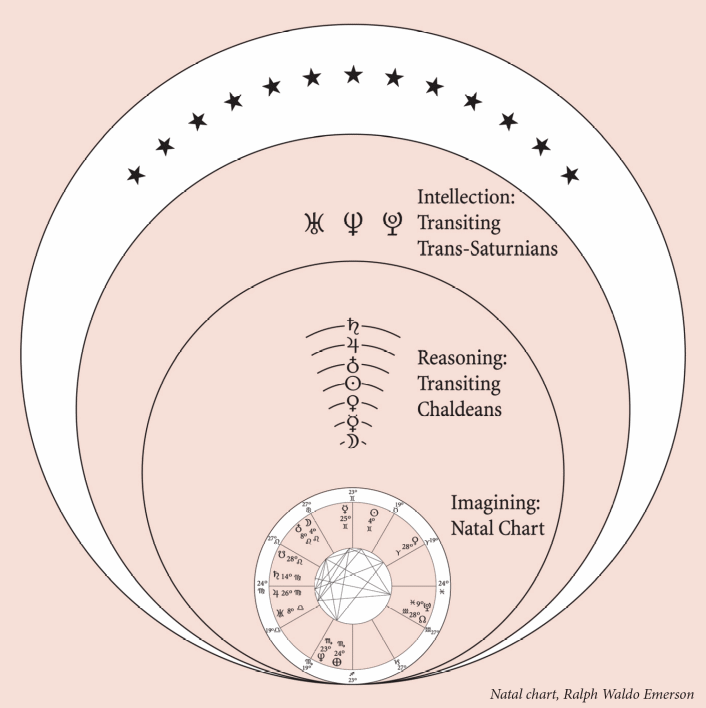
- FIGURE 1982 1009a-1. Three Levels of the Cosmos and Astrology.
[Transcriber note: [diagram] means the speaker is referencing a diagram as he or she is speaking. If someone is drawing or writing, with audible sounds of chalk on a blackboard, I indicate this by [drawing] or [writing].]
NOTES:
This is the "PB Paras; Ego" daytime portion of Saturday 1982 10/09. See 1982 1009b Astrology; Theory for evening of 10/09 and day of 10/10, for reading and discussion of the "Reading a Chart" paper (Jung paper). It is possible there was a Friday night session, but there are no audios for this as of 2023.
Apparently Anthony took a bound WG PB photocopy volume to this weekend in Columbus; possibly he took what is bound as WG Library Orange 11g = PB Archival GreyLong 08-13, section XI.
The audio files were previously misdated 1982 1019. Verified corrected date info from AD Blue Book & Events Master spreadsheets. Audio file 1982 1009c is now split up into 1982 1009c(1) and 1982 1009c(2).
TRANSCRIBED Verbatim by IT prior to 2018; reformatted from V11a version by JRM & JF 2019-2020, with TOC/Subheads added by JRM. In 2023, IT updates prefatory matter and footer, expands Subsubjects, alters Subheads to make more accurate, fixes/completes Book List, adds Plotinus quotes section, fixes errors/typos, adds new notes within transcript, adds one diagram and reference within transcript to this diagram, reformats to accord with new conventions. In 2025, IT updates audio file markers to match new REP audio. Archival verbatim transcript – V14.1a.
AUDIO FILES: 1982 1009a, 1982 1009b, 1982 1009c(1) (formerly 1982 1019a, b, c, respectively). [Note 1: "Tape" and "Side" refer to original audio cassette tapes that were later digitized into .MP3 Audio Files. Note 2: In 2024-25, REP Studio splits Audio File 1982 1009c into c(1) and c(2) and tries to reduce background static on both.]
| NEW FILE NAME | OLD FILE NAME |
| 1982 1009a | 1982 1019a |
| 1982 1009b | 1982 1019b |
| 1982 1009c(1) | 1982 1019c, first part |
1982 10/09a Class Held in Columbus, Ohio (Day 1 of 2-Day Event; Daytime)
PB Paras; Ego
Archival verbatim transcript
PB'S WRITINGS AS THE MOST PROFOUND AND TOTAL OUTLOOK ON PHILOSOPHIC MYSTICISM
[Audio File 1982 1009a (formerly 1982 1019a) Begins]
AD: --putting-- and putting those notes in classifications that he suggested was the last thing that he had mentioned to Randy and it was the last book they were reading. It was about forty volumes of writing, you know, PB's left behind which I would like to see published but, in the meantime, in the meantime we could benefit by (the--/them.) You know, it's like the University of Nal-- Nalanda all of a sudden dropped its library in your lap. I mean that's what it feels like, it's so enormous. And it's the most-- it's the most profound and total outlook on philosophic mysticism that I've-- I've-- I think is in the English language. I don't know of anything comparable. [short pause] Now you know the way PB writes. He writes so that he can be understood. He avoids the terminology that pre-- prevents understanding. So he's very straightforward and he-- I think they are basically-- [short pause]
Well it took a year for me to decide to start doing something, ok. It was only after-- a year after his death I decided that the class-- we should have classes on it. Because many of the people go to the library and read the notes but then when I ask them what they understand of a passage or something, there's some disagreement. We understand what he wrote so-- This was a-- this is a model experiment. We've taken this class-- this category and we're working with this category. And I thought, you know, since we're-- since we're friends, we can take this most difficult of all topics, because it'll bring about more antagonism and resistance than any other subject. But we have to face-- this is really the problem you're all faced with. Every and any quester must confront this problem. So, you might want to get to it. We could read a few, we could read a few, and then we could discuss them. [10¼ second pause]
There's probably one more volume like this. I haven't-- that is, the typist hasn't been able to keep up with it. [12¼ second pause] And sometimes the discussion gets very metaphysical and sometimes it's very straightforward, very straightforward in the sense that it's right down at the level where we're at so he-- his range is all the way from top to bottom. I think you're going to find this real gold, because this is where the fundamental problem of disease comes from. I don't think that psychologists are ready for it but you are. We'll read a few, alright?
S: Uh-hm.
S: Ok.
[Note: In January 2018 unpublished quotes looked up in PB/PBPF Archival files and copied here. 11g photocopy (the one AD took to Columbus; possibly he took what is bound as WG Library Orange 11g) = PB Archival GreyLong 08-13, section XI.]
PB PARAS ON EGO
PB [V6, 8:2.6, AD reading]: "With the body, the thoughts, and the emotions, the ego [AD reads: body] seems to complete itself as an entity. But where do we get this feeling of"I" from? There is only one way to know the answer to this question: the way of meditation. This burrows beneath the three mentioned components and penetrates into the residue, which is found to be nothing in particular, only the sense of Be-ing. And this is the real source of the "I" notion, the self-feeling. Alas! the source does not ordinarily reveal itself, so we live in its projection, the ego, alone. [AD adds: And] We are content to be little, when we could be great."
PB [V6, 8:3.9, AD reading]: "We may distinguish the ego by certain signs: it is not stable, for its characteristics fluctuate; it is not sinless, for somewhere in its nature there will be one or more flaws, no matter what the judging test may be; it does not feel totally secure for a fear, a doubt, an uncertainty about the future there will be."
PB [V6, 8:3.1, AD reading]: "The ego is a knot tied in the psyche of our inner being, itself being compounded from a number of smaller knots. There is nothing fresh to be gathered in, for b-e-i-n-g [AD: He's-- he's hyphenated"being".] is always there, but something is to be undone, untied."
PB [unpublished, 11g/1/3, AD reading]: "If I may change slightly Edmund Burke's sentence into:"What shadows we were and what shadows we pursue" his words picture the ego and its desires when seen after the passage of many years, throws them both into truer perspective." [version from PBPF Archival GreyLong XI: (553-3) If I may change slightly Edmund Burke's sentence into: "What shadows we were, and what shadows we pursue" his words picture the ego and its desires when seen after the passage of many years, throws them both into truer perspective.]
PB [V2, 1:2.283, AD reading]: "When he sees how the little personal self has brought him so much pain sorrow disappointment and waste of years, that even when it brought him success the latter turned out to be false and deceptive, he will become disgusted with it. He will not want to live with the ego any longer and will yearn to get away from it altogether."
PB [unpublished, 11g/2/4, AD reading]: "The question of what we are can get its first convincing answer by mentalistic study and practice: it brings a man into awareness of his soul." [version from PBPF Archival GreyLong XI: (555-4) The enigma of what we are can get its first convincing answer by mentalistic study and practice: it brings a man into awareness of his soul.]
PB [V6, 8:1.24, AD reading]: "The ego is put forth by the Overself."
PB [V6, 8:4.423, AD reading]: "The ego's interest in its own transcendence is necessarily spurious. This is why grace is a necessity."
PB [unpublished, 11g/2/1, AD reading]: "How can it be at all possible for anyone to move out of the very ego itself plus its temperament and particularities, its emotional colouring and intellectual gear? Can a man ennoble it at best, extinguish its tyranny but not the individuality?" [version from PBPF Archival GreyLong XI: (555-1) How can it be at all possible for anyone to move out of the very ego itself plus its temperament and particularities, its emotional colouring and intellectual gear? Can a man, however holy, really renounce what he is? Will not his efforts ennoble it at best, extinguish its tyranny but not the individuality?]
[9¼ second pause with some very faint inaudible student talking in far background]
AD: From Thoreau he has a quote.
PB [V6, 8:4.80, AD reading]: "[Thoreau:]"It is as hard to see oneself as to look backwards without turning round [AD reads: around]." [AD: End of quote.] [AD adds: For] The self…"
AD: And that's small 's'. Whenever he-- if he capitalizes, I'll tell you.
PB [V6, 8:4.80 cont., AD reading]: "… [AD adds: For] The self is involved in the very act of seeing and may colour, distort, or obstruct the observation."
PB [unpublished, 11g/1/7, AD reading]: "Each man is confined by his own nature, his own ego. How then is he to get at the truth, which transcends his ego? Is there no way of escape from the situation?" [version from PBPF Archival GreyLong XI: (553-7) Each man is confined by his own nature, his own ego. How then is he to get at truth, which transcends his ego? Is there no way of escape from the situation?]
[short pause]
AD: Now, you understand, as you read these and begin to understand them, you're not going to have any excuses. Your excuses will be gone. Every time-- every time you come up with an excuse, you've already got the answer, you know what's going on, and you're going to end up hating me for showing you these notes. Keep that in mind.
S: Uh-hm.
[short pause with very faint talking in background]
AD: I have never seen such an organized, totally comprehensive attack on the ego in literature in general. I'm speaking about forty years acquaintance with philosophic and mystical literature. I've never seen anything so thoroughly organized. It's like a circle, the ego is the center, and every possible attack, every possible understanding is being presented. Not only the bad but the good. Both sides. You know, PB always sees the both sides of an issue, he doesn't see just the bad, he'll see the good too. And, I was just-- my mind was boggled when I read these things because of the-- the thoroughness. There's hardly a point that escapes him and so, you know, when he stopped writing as far as we were concerned, you know-- He even told me, he had certain things to do and he had to do research and that publication can take care of itself. It was out. Notebooks were to be published, he didn't have time. Well just reading these notes, I not only agree but I-- I saw why he had to do what he did. There was no-- no getting away from the fact that he couldn't waste time preparing a book for publication when this stuff had to be put down.
[short pause]
PB [V6, 8:1.59, AD reading]: "The first great error to be thrown away is a common one-- acceptance of the physical body as the real self when it is only an expression and channel, instrument and vehicle of the self."
PB [V6, 8:3.60, AD reading]: "The ego poses as being the only self, the real self, the whole self."
PB [unpublished, 11g/3/6, AD reading]: "The truth will come down upon the ego like a sharp sword, cutting off its pretenses and barring its deceptions [AD rereads:"…baring its deceptions"]." [version from PBPF Archival GreyLong XI: (557-6) The truth will come down upon the ego like a sharp sword, cutting off its pretences and baring its deceptions.]
PB [V6, 8:3.61, AD reading]: "The ego has many hiding places. Exposed in one of them, it soon occupies another."
PB [V6, 8:1.17, AD reading]: "A tremendous surprise comes when the Overself shows him to himself--when, for the first time, the ego can see what it is really like by a diviner light."
PB [V6, 8:1.203, AD reading]: "Jung believed that the meditational effort to transcend the personal ego would end in utter oblivion because without it [AD: The ego.] all awareness would vanish. In this he erred and, I believe, in the last years of his life changed his view."
PB [unpublished, 11g/2/5, AD reading]: "Do not be over-anxious about spiritual progress, for it is still concerned with the 'me': let the ego go." [version from PBPF Archival GreyLong XI: (555-5) Do not be over-anxious about spiritual progress, for it is still concerned with the 'me': let the ego go.]
PB [V6, 8:4.452, AD reading]: "The degree of ego-attachment which you will find at the centre of a man's consciousness is a fairly reliable index to the degree of his spiritual evolution."
PB [V6, 8:4.431, AD reading]: "Out of this ego-crushing, pride-humbling experience he may rise, chastened, heedful, and obeisant [AD reads: obedient] to the higher will."
PB [V6, 8:3.119, AD reading]: "The ego automatically assumes the posture of rectitude, spontaneously comes [AD reads: come] to its own defense, rather than [to] examine whether it really is right."
[short pause]
AD: Want to stop for a few minutes?
[students assent, very faint]
S: Read that sentence again, just--
AD: Now, let me tell you. This man here has made a xerox copy of this, and I suggest that you read it together on Sundays and discuss it, alright. I-- I'm going to ask you not to give it out to anyone, only among yourselves. You could write down by longhand whatever he says. Do not xerox it. I'm in a very peculiar bind, I'm taking liberty which I don't think I should. But the information is so valuable I think you should have it and so if you keep-- if he keeps the copy, Sundays you could read it, you could take notes or whatever you think you should do, alright, but keep it among yourselves because this is not published and it's not-- you know, if it gets out, I'm going to be on the-- but that's alright, I'm-- So, don't feel that I'm rushing you through it, alright. You'll get a chance to go over many of these things, pick out those things that you think are appropriate for discussion and talk them over. So up to now, alright? Anything in particular, you want to discuss any one? Pick one.
RW: Do you want to-- do you want to encourage us to discuss some of these quotes now and--
AD: (Yes/It's) well(--/,) of course.
INSTINCT FOR SELF-PRESERVATION; EGO AS MATRIX OF TENDENCIES; EGO VS. EGOTISM
RW: Ok I have a question. Early on there you said that the ego puts-- I mean, the Overself puts forth the ego. Now, my understanding of that was like, well you heard it last night, and-- and my understanding would be, to reiterate briefly, that the-- the Overself [short pause] puts forth this intelligence into manifestation and that the ego somehow is a combination of this intelligence that is put forth by the ego and then this appropriation of this light to this new separative I-ness. And I guess what I need is a detail in there is, does the Overself actually contain this idea of ego or is ego something that occurs at that point of separation?
[10 second pause]
AD: Um-- [short pause] Let's-- let's discuss it this way. If we-- if we consider the fact that-- of reincarnation, that we have existed many many lives, from the very beginning as an amoeba to the stage of mankind, and if we think-- if we think that in each of these lives the most important thing for each individual life as it was progressing or evolving was to preserve itself. The instinct for preservation, self-preservation, is paramount. And if we think of this as a sort of stream or continuity of thought, one following upon another, and if we re-- if we try to keep in mind that each entity will add-- That is, every time the higher Self incarnates into an entity, that each entity will deposit-- the residue of all its activity will be left behind as a matrix of thought-possibilities. And that the one dominant thought always was self-preservation. And if we continue this right up to the level of man, we can see that if there's one thing which is always paramount in the-- in the mind of a, let's say an individual entity, is this instinct for self-preservation, to persevere, to persist, to endure, alright. Even a Sage loves his existence. So this is very fundamental. But when we're speaking about the ego, we're speaking about the body or the psycho-somatic entity as a whole, alright, and that totality of memories, you know, thoughts, tendencies, that it brings over from the past. Now if we think of this as an ongoing process and we think of it in that way, we-- when we speak about the ego we're not speaking about some sort of thing but we're speaking about a matrix of tendencies, possibilities. So it's not a thing. Ok?
S (very faint): Ok.
AD: But, the one-- the one-- the one tendency that I think in our discussion becomes obvious is that this instinct for self-preservation is one of the most dominant features, or let's say one of the most dominant residues left behind in this matrix of possibilities of thoughts. That's always there and there's more being added to it all the time, so that this becomes so paramount that the ego is always concerned with its own self-development, its own security, its own existence. Now ask your question.
RW: Ok. You just brought up another question I think and I need to-- When PB talks about ego, is he including egotism within this word 'ego' or is-- I-- and sometimes in the context of his statement I get the impression I'm hearing egotism although he's calling it ego, and other times I'm hearing about that empty center that the egotism attaches itself to. Is that a correct--
AD (very faint): No.
RW: I'm not quite sure where egotism fits into his definition of ego.
AD: Well, he makes a distinction which we'll come across in the notes, like the ego is concerned-- when it says, "I want this cup of tea," alright, [RW assents] a legitimate, you know, require for nutrition. I'm thinking of a herb tea, ok? But, when the ego says, "This is the best tea available," [RW: Yeah.] alright, then that's egotism, it's [RW simultaneously, faint: Got it, yeah.] setting itself up as a standard. But we don't have to worry about the egotism right now.
RW: Ok.
EGO AS A VEHICLE OF THE SOUL; EGO'S MISAPPROPRIATION OF SOUL'S LIFE AS ITS OWN
AD: Right now it would be best to try grasp the notion of what the ego is [RW: Ok, then back to it.] and then-- then we'll see its abnormal features.
RW: Ok, then go back to the original separation I guess is my question, where this-- this thing that-- or this-- I don't want to call it a thing. When does this separation from the Overself be--
AD (simultaneously): It never occurs except in the mistaken thought of the ego.
RW: Ok. So there was an ego before there was a mistaken thought--
AD: Well, when you say--
RW: --or is it a simultaneity?
AD: If you say that the ego is a-- is a complex of thought, then included in that complex of thought or that matrix of tendencies is the possibility for the ego to misunderstand. Now, if we-- if we take the notion that the Overself, the higher soul, alright, is this universal life, and that it projects forth from within itself the World-Idea and included in the World-Idea is the role of the Overself's projection. In other words, the Overself has to make a representation of itself and include it as part of the World-Idea. Now, that would mean that the life which is given to the ego is coming from the-- the soul. Now the problem starts when the ego appropriates this life and says "It is me, it is mine." In the very processes of thought where it separates itself in an illusory way because it cannot in actuality do so, in an illusory way it separates itself from this universal life which is and(--) is the soul, and considers its life as separate from the universal life, [AD snaps fingers] the ego is operating. That's the mistaken notion that its life is separate from the ocean of life, and it builds up on that separateness, keeps on building on, so that "I is a separate being from everyone else" is a thought which gets elaborated constantly, life after life. And that deposit of that erroneous kind of thinking also swells up the ego.
RW: Ok, but prior to that, you just changed it on me a little bit which helped, you said the projection of the Overself's role in thought. I can see that as being the projection and then the attachment to that as being the ego. Is that a fair--
AD: I'm sorry, try again.
RW: You described it a minute ago differently than you have before. You talked about it as the Overself's role in its projection of thought. Now, then you started talking about the ego. So it sounds to me as if from within the Overself, you have this-- this projection of this role.
AD: The projection of the World-Idea.
RW: Right.
AD: Yeah.
RW: And then there is an ego.
AD: No, not "then" but insofar that it projects the World-Idea and includes itself in that projection. In other words, the soul's role, the soul as trying to get experience of that World-Idea, must build for itself a vehicle through which it can experience [RW simultaneously: Ok.] the World-Idea. Now it builds this vehicle, this-- what we call ego. Now, it isn't inherent, so to speak, in the ego to separate itself. It is that the ego insists upon doing this, the ego is the one that claims itself to be separate from the universal life which is inherent in the Overself.
RW: Uh-hm.
AD: So basically what we're saying is that there develops in the ego this erroneous notion that its life is separate from all-- all of life, [RW: Uh-hm.] and this is the kernel, this is the core of ego.
RW: Yeah I guess what I was trying to do was to pin down catching it before that-- that separation occurred and I don't guess I can. It's such a simultaneous thing.
AD: Don't place it in time.
RW: Yeah, that's what I'm trying to do and--
AD: Don't place it in time.
S: If this projection could happen without the erroneous identification, would there still be an individual or is this-- I mean, is this a possibility? I mean a Sage has it(--/.)
AD: Yes, you might (reuse your individuality). [S simultaneously: I mean this is what the quest is.] The ego is your individuality. As a matter of fact, there's many quotes here where he points out that that is your individuality and there are never two alike, that the World-Mind, alright, multiplies itself in this infinite number of ways to try to reveal something of it's own nature so that there are no two egos that are alike. Now we know this astrologically--impossible to-- for there to be a numerical identity. So each individual, when you look at your chart, that's your unique individuality. You are a representative of the higher Overself. True, it's distorted, you can't see what you're really like and all that, but nonetheless it is a manifestation of the higher Self. And so it's nothing to be shunned or destroyed or anything like that. That's all nonsense. It has to be refined and developed, yes, but, you know, to listen to some people talk that it doesn't exist or that it has to be destroyed--that's not philosophic. It's immature.
S: So it would be fair to say that a Sage, i.e., PB, corrected this false identification, because that would [one/two words inaudible]
AD (simultaneously): Well, he'll point that out, but basically that happens when a person reaches the highest illumination and enters into the Void, because in the Void the ego gets crucified and then when you come out it's not anything like it was before. But you still-- he still has an ego.
S: Uh-hm.
AD: So whether you're speaking about Ramakrishna, Atmananda, PB, or any Sage, he still has an ego. If he didn't he wouldn't be here.
S: But it would be refined and (developed) [one/two words inaudible]
AD (simultaneously): Yes, well PB (knew) that, you know--
S (very faint): (Enlightenment.)
AD: There's-- I would say there's no egotism in them. There's ego, yes, but there's not egotism. Go ahead.
S: I just want to make sure I'm understanding it correctly. You say-- I thought I heard you say that the Overself has-- makes a representation of itself in order to manifest the universal life.
AD: In order to manifest itself [S simultaneously: (As/Has) (the universe--)] it makes a representation of itself, [student assents] but it is the source of life.
S: And in so doing-- this representation of itself in order to manifest life is the ego.
AD: Remember Plotinus?
S (simultaneously): And when it takes itself to be other than the representation of the Overself and goes out on its own, then it gets into trouble.
AD: Yeah. Then it sets itself up.
S: Uh-hm.
S: But o-- but originally it's(--) by a representation of the Overself it's pure.
AD: Yes, you rem-- no, not pure.
S: Well it's--
AD: It's not pure.
S: Well it's how the--
AD (simultaneously): Remember the way Plotinus put it? He said in order for the soul to have experience of the sensible world it must create for itself a vehicle [S simultaneously: Yes, yes.] through which it can experience the sensible world. [Note: See Plotinus, IV.4.23.]
S: Then is that the matter that reaches up and grasps the light, that--
AD: You mean when he speaks about the alien foists himself [S simultaneously: Yes, yes.] upon-- [Note: See Plotinus, VI.4.14-15.] Yes, if we see that, sure. See the difficulty is you cannot see the ego because you're inside of it. [student assents, faint] So it's only at the extreme cases like in death, Nirvikalpa, any state where you're free of thought, you've stepped out of the ego momentarily and you can see it. But then the next moment, like the wake behind a ship, it embraces you, takes you back into itself, and now you're the ego again and you're trying to understand, alright, it's like trying to look at your own face. But nonetheless we can make attempts without having Nirvikalpa samadhi. Allow this to-- allow some of the meanings to grow because there's going to be presented so many points of view that many of the things that you'll think of he'll answer as we go along. And sometimes these one liners are-- they just blow your mind into infinity.
[student assents, faint]
S: As a vehicle then.
AD: I'm sorry dear?
S: I'm still talking, I'm still working out in my mind. As a ve-- as a vehicle then it is matter, the ego, that's a representation of the Overself. That's why it's not pure.
AD: Well what do you mean by matter? It's an idea.
S: Well--
AD: It's an idea, the ego is an idea, the body is an idea.
S: Alright, matter--
[few seconds of very faint background student talking]
S: Anthony, did you-- would the individuality be that part that stays, so to speak, in harmony with the Overself and the ego that part--
AD (simultaneously): No, no.
S: Is there any differentiation at all between the two?
AD: No, there's differentiation. All I'm saying is the ego is basically your individuality. You-- you will never find two egos that are the s-- numerically identical.
S: But there-- wasn't there a quote there where PB said something about positing the ego in some way without crushing the individuality?
AD: Without--
S: Crushing the individuality or-- Was there a quote to that nature? I feel like there's something like that when you were reading, about how to deal with the ego without destroying the individuality.
AD (simultaneously): I don't know what you're referring to, if you could try to remember.
S: I can't, I'm afraid I can't remember very clearly.
[short pause]
AD: Well let's read a few more. You can go back with Red over these notes. And if you get into a real serious discussion you call me on the telephone.
RW: Every Sunday. (bit of laughter)
AD: Make it between 9 and 12 so I [few words inaudible]
RW: Ok. (RW laughing)
AD: Go ahead.
[short pause]
REACTING EMOTIONALLY VS. RESPONDING APPROPRIATELY
S: Anthony?
S: Don't.
AD: Go ahead.
S: Can I--
S: There's something [one word inaudible] about the use of the-- that I would love to have clarified. I remember when you spoke once before of the ego and you spoke of a quick reaction in connection with that, that when you have a quick reaction to things-- you know, the idea of pause and wait and [AD simultaneously: Uh-hm.] let certain things settle down because quick reactions usually mean the ego is involved. Well suppose just hypothetically that a person is offended by something that happens and you have a quick reaction and you think that's ego reaction so you withdraw and try to let the thing quiet down but it doesn't go away. And it becomes quiet but it becomes then in your mind like an injustice. It-- How do you differentiate between law and ego reaction? I mean, can you say well that would be an injustice if it happened to anybody. Just because it happened to me doesn't necessarily mean it's a-- an ego reaction. I have to stand up for my rights.
AD: But that's the point Barbara. You can stand up for your rights, you can see your right without there being em-- emotivity involved.
S: Yeah but it's tricky to-- for me to-- to see the difference.
AD (simultaneously): No it's quite obvious Barbara. You could be 120% right but if there's emotivity involved you're wrong.
S: Emotivity being body-based [AD: Yeah.] feeling. So it has to be completely [one/two words inaudible]
AD (simultaneously): Philosophic perspective does not exclude, you know, your understanding of what extent you're right or what extent you're wrong. And it doesn't mean that others can step on you, it doesn't mean that at all. And, again, he brings those points up, so it isn't that you'll be without guidance on those points. But generally if you see emotivity in any interaction, you can rest assured the ego is in there. Because, if you're evolving a phil-- philosophical attitude, and that means that you're having more and more of an impersonal point of view, that means that you're-- you're also including your ego. In other words, your impersonality will be able to judge correctly, you know, what your ego's role is in all this and to what extent it is justified or not. But as soon as you see emotivity, you know, self-righteousness or any of that, the ego's at it.
S: But even if you have that emotivity and then you're in a situation and you know the ego is involved, does that-- that does-- does it necessarily mean that you are wrong in your judgment or right or what? Can you have emotivity and still be accurate?
AD: And still be right?
S: Still have some accuracy and then--
AD (simultaneously): Yeah, I-- that's why I said you're already wrong. From a point of view of philosophy, you're already wrong. It doesn't-- it doesn't matter anymore that you're right [S simultaneously: It isn't-- it isn't that (one/two words inaudible)] factually, it doesn't matter. You're wrong because as a philosophic student your ego's already taken possession of the field.
S: Right.
S: That's where your attachments come in and--
AD: Yeah. And you remember he points out that one of the degrees or one of the ways of telling about the spiritual evolution of a person is to see how attached he is to his own ego. When you're very attached to your own ego, alright, when you die it's very painful. If you're not too attached, it's not so painful. If you're (not/non-) attached, it's not painful. That's where all the pain is coming from. It's almost like you're required to keep your mind virginal. I don't mean it in any way except that the mind-- [S simultaneously: Just say it.] that is, the person is not attached to these images, whether they're self-images, and the ego always has self-images. Here's the very next one.
SELF-IMAGE CAN BIND YOU OR SET YOU FREE; EGO HAS TO BE DEVELOPED; EGO AS A LOAD OF MIXED MEMORIES
PB [V6, 8:4.382, AD reading]: "The self-image which he holds may continue to keep him tied or help to set him free."
AD: So the kind of image that you hold in your mind as to what your ego is like either binds you or frees you. So if you're going to have an image of the ego, you know, do so according to the philosophic scheme. Here again, more on the whatness of the ego.
PB [V6, 8:3.23, AD reading]: "[AD adds: It is] The sum total of our past actions and thoughts, and especially of our tendencies, constitutes our character and makes us what we are today."
S: Very confusing to see the difference between ego and individuality. It would almost seem that you don't want to develop the ego, you want to en-- develop your individuality or objectivity.
AD: Same thing, you want to develop your ego.
S (simultaneously, faint): [one/two words inaudible]
S: That's the same thing?
AD: Same thing.
S: To develop your objectivity, your detachment, is the same thing as developing the ego?
AD: No, I didn't say that. I said to develop your ego, alright, is to develop your individuality. What do you think you're developing? Obviously the higher soul doesn't need development. It's already pure-- [student assents, faint] pure understanding. So you don't have to worry about developing the soul, right? So, what has to get developed?
S: But in the-- in the example [few words inaudible]
AD (simultaneously): I didn't say develop your egotism.
S (very faint): Ok. (RW chuckles)
S: [few words inaudible]
AD: Develop your ego. What are you doing here? You're developing your ego.
S: Just that [one word inaudible]
AD (simultaneously): There's a statement, he makes a statement here. [AD paraphrasing V6, 8:1.109] The highest and most impeccable manners, the utmost of refinement, belongs to the ego--if you get it that high. Even Nirvanic bliss is something that the ego enjoys. There's been so much misunderstanding about the ego that that's why I consider these things gems, you know, little gems. You've got no idea. Not even Chase Manhattan is as rich as you are.
S (faint): Let me write that down.
PB [V6, 8:4.473, AD reading]: "With this release from ego there comes a sense of exhilaration."
PB [V6, 8:3.10, AD reading]: "What is the ego but a load of mixed memories?"
AD: What would you say? Mixed memories, right? We're both old enough to say that.
S: Oh indeed we are. (RW laughing, student words)
AD: By the way, we're both deaf so you'll have to speak loud. (bit of laughter) She can't hear in her right and I can't hear in my right.
[short pause]
PB VS. BUDDHIST VIEW OF NIRVANA; TWO DIFFERENT INTERPRETATIONS OF A TIBETAN RINPOCHE'S EXPERIENCE OF TORTURE
PB [V2, 1:5.7, AD reading]: "Out of his [AD reads: the] present self [AD: Cleta."Out of his present self] he is to evolve a better one and to actualize his higher possibilities."
AD: Just in case you're getting ready to go to a nunnery.
[student assents, faint] (some laughter)
PB [unpublished, 11g/7/7, AD reading]: "The ego may get worn down by time's activity as well as by man's own work upon himself." [version from PBPF Archival GreyLong XI: (565-7) The ego may get worn down by time's activity as well as by man's own work upon himself.]
PB [unpublished, 11g/7/6, AD reading]: "Is there a total anonymity of the ego in this awareness?" [version from PBPF Archival GreyLong XI: (565-6) Is there a total anonymity of the ego in this awareness?]
PB [V6, 8:2.22, AD reading]: "The body, the emotional feelings, and the intellect, are all placed on the circle-line. That which is at the centre of being is consciousness-in-itself."
AD: Now you want me to hold your hand or am I supposed to [one word inaudible]
S (simultaneously): No, I'm [one word inaudible] by it, circle in that second [one word inaudible] (RW laughs)
AD: [couple words inaudible]
S (very faint): Yeah.
RW: She really wants you to hold her hand.
S: (Yeah.)
PB [unpublished, 11g/9/4, AD reading]: "Can he be blamed for wanting personal guidance in his perplexities, personal comfort in his troubles, and some sort of individual awareness when the nirvanic end of the quest is at last attained?" [version from PBPF Archival GreyLong XI: (569-4) Can he be blamed for wanting personal guidance in his perplexities, personal comfort in his troubles, and some sort of individual awareness when the nirvanic end of the quest is at last attained?]
S: I don't understand that.
AD: Can you be blamed for wanting an individual awareness when you reach the Nirvanic end? You very well understand. Who is it that wants Nirvana? [student assents, very faint] See, in the Buddhist scheme of things there is no self, so there is no one who wants Nirvana, alright. But PB doesn't buy that. He says, "What do you mean there is no ego? You mean it's not a metaphysical reality? Sure. But what about everyday?"
S: But the-- the Buddhists differentiate though between the Arhatship type Nirvana where there is this awareness and this "I" wanting to achieve Nirvana, there is this awareness of bliss, but then, though, by the time you get toward Mahayana and Vajrayana isn't there this point where there is this non-dualism, that the whole point of Bodhisattvahood is to break down that dualism between self and other and this idea of coming back as this universal (Saint)? But that sounds like the Arhatship type Nirvana to me, that awareness of ""I" as individual experiencing this". There is that duality. You see what I'm saying? But isn't there another Nirvana where that duality-- isn't that what Vajrayana is talking about, this other Nirvana where this duality is gone?
AD: The only place where the duality is gone I would-- I would say would be in the-- in the Nirvikapla samadhi where you're in a thought-free state and there is no otherness in that state. But, all other states you're speaking about someone who's having this state. Now, there was an experience for instance where one of the Rinpoches was speaking how the Chinese would--
(Side 1 of original cassette tape digitized as 1982 1009a (formerly 1982 1019a) Ends; Side 2 Begins)
AD: He--
S (simultaneously): --whereas Vajrayana is working toward that non-dualism where you don't have this sense of ego so clearly defined, that ultimately you reach the point where-- I mean the whole thing about the Bodhisattva is the world is not sep--
AD (simultaneously): Now, look, let's get away from mythology and what-- Bodhisattvas and all that. We're talking about an individual Rinpoche who I [student assents] know and I have the highest respect for [S: Right.] and had achieved a tremendously high spiritual status. Now look at the way we interpret things differently, alright. He was saying there was no one there. I was saying yes there was some[one] there, he was there, because if he wasn't there, he would not know that he was being tortured and it was he personally who was going through that and not me!
S: But if his consciousness wasn't tied to his physical body, if the--
AD (simultaneously): What do you mean the consciousness-- the co-- the body is a manifestation of his consciousness.
S: Yes but you reach a point where you don't have to come back in a physical body. As your consciousness evolve--
AD (simultaneously): That point-- that's a point when you're in Nirvikalpa. [S simultaneously: Sorry?] There's no one there. There's nothing to talk about.
S (simultaneously): Can-- can you periodically, like an evolved person, kind of get a perspective on their body? I mean you get outside that body.
AD: Yes.
S (simultaneously): Then-- well maybe he was experiencing briefly Nirvika-- what is it, Nirvikalpa?
AD: Nirvikalpa.
S: Perhaps-- (you see where I'm going)?
AD (simultaneously): No, no, he wouldn't be experiencing Nirvikalpa because then there wouldn't be any personal experience. [student assents, very faint] You see, these are fundamental points in the doctrine and they're points that I very clearly expressed in class why I don't agree with that point. That doesn't mean I don't agree with many other things they say but I do disagree on this point.
S: Yeah.
AD: And that is that each individual, alright, as an individual, is accountable to his own higher Self and I'm not going to dissolve the agony and pain of millenniums of ev-- evolution to, let's say, acquiesce to a metaphysical theory which, you know, I can't-- I can't see. [student assents, faint] But--
S (simultaneously): [couple/three words inaudible] I'm going to have to think about it for a little while.
AD: I think-- I-- I think it'll become clearer, our point of view will become clearer as we go along and it isn't one that you have to agree with, you can just make recognition of it.
[short pause]
S: Well, from their understanding though was I clearly understanding the different points of Nirvana in Buddhism, that they do differentiate between different levels of Nirvana?
AD (simultaneously): Oh yes, they're fully aware of those levels, yeah.
S (simultaneously): Ok.
AD: See I was just speaking about this Rinpoche's very specific experience, [S: Ok.] alright, [S: Ok.] and I was interpreting it my way and he was interpreting his way and we very, well, let's say politely agreed to disagree. (some laughter) There's nothing wrong with that. (bit of laughter)
MORE PB PARAS ON EGO WITH AD COMMENTARY
PB [V6, 8:4.81, AD reading]: "Ordinarily, men do not escape from their own point of view. [AD adds: And] This is one aspect of Anatole France's meaning in his phrase:"All is opinion." For all rests on the ego itself, since the latter participates in all events, both in the making of them and in [the] thinking about them."
PB [V6, 8:4.82, AD reading]: "The constant movement of thoughts and the ego's fascination with itself hide [AD reads: hides] from us the divine Overself, from which both are derived."
PB [V6, 8:4.47, AD reading]: "Man moves from [AD adds: the] Overself to [AD adds: the] ego and hence moves into suffering."
PB, [unpublished, 11g/9/10, AD reading]: "Every man's head is full of himself, his own little affairs." [version from PBPF Archival GreyLong XI: (569-10) Every man's head is full of himself, his own little affairs.]
AD: You see how we all agree on this stuff?
S (faint): Uh-uh. (laughter)
AD: No problem. (AD laughing, laughter)
S: Could-- could you talk one(--) about maybe four pages back you said man never escapes from his point of view.
AD: Yes, I could read it again.
[short pause]
PB [V6, 8:4.81, AD reading]: "Ordinarily, men do not escape from their own point of view. This is one aspect of Anatole France's meaning in his phrase:"All is opinion." For all rests on the ego itself, since the latter participates in all events, both in the making of them and in [the] thinking about them."
[few seconds of very faint inaudible student talking in background]
AD (very faint): [couple words inaudible]
S: If I have a point of view which is different from your point of view, but then as I listen to your point of view then I become in agreement with your point of view, is-- haven't I released my ego to my point of view?
AD: It's still your point of view. (laughter)
S (amidst laughter, faint): Oh so-- ok, alright.
S (faint): But if you keep--
[few very faint inaudible student words in background]
AD (faint): Alright. (laughter)
PB [unpublished, 11g/9/9, AD reading]: "Don't run around in a circle. Move towards the Center. You are thinking of your own ego-self. Move out of it." [version from PBPF Archival GreyLong XI: (569-9) Swami Premananda: "Don't run around in the circle. Move toward the Centre. You are thinking of your own ego-self. Move out of it."]
PB [V6, 8:4.201, AD reading]: "If [a] man wants to come to the awareness of his Overself, he must let go the awareness of his littler [AD reads: little] self, must shut himself off from its narrow world. But this can only be effectively done if it is done inwardly."
AD: And of course this is-- this is an exercise(,) to try to practice the Witness point of view, which means you have to let go of the ego's point of view.
PB [unpublished, 11g/11/13, AD reading]: "All life is expressed from the ego's point of view, all events are seen from it, all persons known from it." [version from PBPF Archival GreyLong XI: 573-13) All life is experienced from the ego's point of view, all events seen from it, all persons known from it.]
PB [unpublished, 11g/11/11, AD reading]: "He must look for the real and not simply the ostensible motives behind his own disputes and actions." [version from PBPF Archival GreyLong XI: (573-11) He must look for the real and not simply the ostensible motives behind his own decisions and actions.]
PB [V6, 8:4.106, AD reading]: "With one part of himself he honestly seeks truth, but with another part he tries to evade it."
AD: Well we're all familiar with these things, [student assents] aren't we? (some laughter) This is a good one. (bit of laughter)
PB [unpublished, 11g/11/9, AD reading]: "The ego's capacity for its own deception is immense." [version from PBPF Archival GreyLong XI: (573-9) The ego's capacity for its own deception is immense.]
S: [one/two words inaudible]
RW: [couple words inaudible]
PB [V5, 6:5.96, AD reading]: "His duty to himself calls on him to protect the personal interests. But his duty to [the] All calls on him to respect others' interests too."
PB [unpublished, 11g/10/14, AD reading]: "The ego always seeks to promote its own interest." [version from PBPF Archival GreyLong XI: (571-14) The ego always seeks to promote its own interests.]
S (faint): [couple words inaudible] (RW chuckles)
PB [V6, 8:3.139, AD reading]: "The ego is enamored of itself." (laughter)
AD: Well we all know that! (laughter) I got a mirror in my cottage bigger than life size. (some laughter)
PB [unpublished, 11g/10/13, AD reading]: "He can cultivate his ego, or try to cut it out." [version from PBPF Archival GreyLong XI: (571-13) He can cultivate his ego, or try to cut it out.]
AD: We would say, "Cultivate it."
S: He would say cultivate it?
[students assent]
AD: Don't try to destroy it. Cultivate it, refine it, ennoble it, make it better and better. He doesn't buy the stuff that you have no ego. He says, how can you carry on the practical duties of everyday life without an ego? Even a Sage has to have an ego. He has only 2½ percent ego. You got 99 percent ego. (AD laughing, laughter)
S: That's for sure.
AD: But, there's no-- I mean he doesn't shim-sham about this at all.
"THE FIRST OF OUR THOUGHTS IS I"; "OUR WAY IS TO TEACH OUR SOUL"
S: Ok, I have two questions, if I got a two-part question. First one is, would you say that when PB has said the first of our thoughts is "I", that's the ego? [Note: Paul Brunton, The Wisdom of the Overself, "The Secret of the I," p. 79, 1943 edition.] Would that be the first item?
AD/S(?) (very faint): (Uh-hm.)
S: When he has said in The Wisdom of the Overself at one point, "The first of our thoughts is"I"." Now that pure first thought upon which all else depends would be the ego?
AD: I could answer that, and I better answer it for now, as yes.
S: But it's a-- Is that an absolute yes or something that maybe--
AD (simultaneously): No, it's not an absolute yes.
S: --wasn't [one/two words inaudible] later on?
[Note: See FIGURE 1982 1009a-1, Three Levels of the Cosmos and Astrology, appended to this transcript for the following. This diagram is from Astronoesis, p. 271.]
AD: If I were to do something like this you'd probably get upset. [9 second pause while drawing] If we think of these as the 360 degrees in your natal chart [diagram], each one of these degrees represents a reason-principle, a divine reason-principle. And then [drawing] we put the eight or say the seven planets here [diagram]. I'm sorry. Three, and then there's seven [diagram]. [9¾ second pause while drawing] We would say something like this. The structure of your natal chart, alright, the way the Chaldean planets are arranged, that's your ego, ok.
S (very faint): Right, yeah.
AD: Now, which are the first of the thoughts, is it soul [diagram]? Is it the soul which is ultimately responsible to produce this here [diagram]? Would you locate the "I" here [diagram] or would you locate the "I" here [diagram] first? So it depends on the framework that you want to work with. I'll--
RW (simultaneously): What was this one on the right-hand side? The thing kicked on and I didn't hear what you said.
AD: No, what I'm saying is, if we think of the soul as having three aspects, [drawing] alright.
RW: Oh, ok.
AD: If-- and if we call this the highest phase of the soul [diagram], [drawing] the intellectual soul, [RW: Uh-hm.] this the reasoning soul [diagram], and this the empirical soul [diagram], ok, any one of them could stand for the "I".
RW: Ok.
AD: When the-- when the Samkhya speaks about the "I" they usually are referring to this here [diagram]. The way PB uses it in the text is this here [diagram] so, we'll leave that out [student assents], ok, because I don't want to get into it.
S (simultaneously): So the "I"-- the "I" could be a sliding scale, [AD simultaneously: Yeah.] [couple/three words inaudible] And then there's my second question, this is a Plotinus question. When it is said that, you know, our way is to teach our soul, [Note: See Plotinus, V.3.6, seventh para.] you know, the soul within (us), the question in my mind, could we frame that (and/in) what we were discussing now is our way is to teach our ego? I mean I've always had a hard time trying to figure why I'm teaching something that is perfect already. So, is there any kind of comparison in this, you know--
AD: No, when Plotinus says we must teach our soul, what he's referring to is that the reasoning part of the soul, [S: Uh-hm.] what the Hindus call buddhi, the reasoning part of the soul has to be informed. And it can be on-- it can be informed only because you understand the doctrine. So it's the reasoning part of the soul that has to be corrected. Plato, for instance, says when the soul looks downward, it gets lost in the sea of generation and gets confused. When the soul looks upward, then it can understand what is happening downward, what's happening in the sea of generation. [Note: See Plato, Republic, Book VI, 508d.] So, in order for us to understand, we have to look up to the highest part of the soul and then inform the reasoning part of the soul. I'll-- I'll be able to show you [S simultaneously, faint: Yeah, that's fine.] that later on in this diagram.
[short pause]
WHEN EGO IS CRUSHED, GRACE MAY ENTER
PB [V6, 8:1.62, AD reading]: "The ego expresses desires and preferences, the intellect thinks and remembers, the body's sense-organs experience and perceive the world outside. None of these three is the real"I"-ness of a man."
PB [V6, 8:4.425, AD reading]: "The ego may have to be broken to bits, if necessary, to let the Grace enter in, to open a way through passivity replacing arrogance."
S: The opening a way through passivity replacing arrogance--
AD: Yeah, in other words, when a man is crushed by external circumstances, alright, then he tends to be more passive and that's an occasion for Grace to come in. Now generally, most of us don't know that and we very often think that the worst that has happened to us, you know, is something horrible, but my experience has been that that's the only time anything good happens to you because when you're really stepped on and crushed and your ego is, you know, smashed, then your arrogance is out of the way. Not for long but enough for Grace to come in. And then it resumes again.
PB [V6, 8:3.141, AD reading]: "The egoist has eyes only for himself."
AD: That's the name of a popular tune. (some laughter)
S (amidst laughter): (We've) only have eyes for you. (AD laughing, some laughter)
MORE PB PARAS ON EGO; PARABLE OF THE PRODIGAL SON
PB [unpublished, 11g/10/13, AD reading]: "Is man's existence merely a chemical one?"
PB [V6, 8:4.146, AD reading]: "They are so accustomed to thinking in terms of the ego that it seems impossible (to them) to think in any other way."
PB [V6, 8:3.125, AD reading]: "The ego may carefully suppress its more obvious manifestations, both from other people and from himself."
PB [V6, 8:2.8, AD reading]: "When the"I" is thought to the body, appearance…"
AD: Wait a minute.
PB [V6, 8:2.8, AD reading]: "When the"I" is thought to the body…"
AD: This is wrong.
PB [V6, 8:2.8, AD reading]: "When the"I" is thought to be the body, appearance has replaced reality."
PB [V6, 8:3.138, AD reading]: "Despite…"
AD: Now this one we all know.
PB [V6, 8:3.138, AD reading]: "Despite all setbacks, the ego continues to retain its misplaced confidence in itself." (laughter)
PB [V7, 11:2.38, AD reading]: "The ego hates another and sorrows over its troubles: these are negative feelings."
PB [V6, 8:3.24, AD reading]: "The ego moves from childhood to old age, from waking to dreaming, but it moves around in a circle. It does not move toward freedom, reality, or peace."
PB [V6, 8:2.7, AD reading]: "That which claims to be the"I" turns out to be only a part of it, the lesser part, and not the real "I" at all. It is a complex of thoughts."
AD: You notice the way he keeps hammering away what the ego is, it's this complex of thoughts? It's an idea? He doesn't refer to it as a material thing but always as a-- an idea, and it's a persisting idea. Except when you're sleeping. But generally it's as a persisting idea and it's better to say that there's an idea that you have to analyze and understand than to say there's nothing there.
PB [V6, 8:1.155, AD reading]: "The individual man, the person that he is, is unique: he is distinct from others in form and character, separate from others in existence. He is himself, his own self with his own aura."
PB [V6, 8:3.46, AD reading]: "It requires a subtler intelligence or a simpler heart to realize that a man's best course is to put his forces at the service [AD reads: services] of a worthier cause than the mere perpetuation of his faulty ego. The parable of the Prodigal Son then assumes an intimate meaning for him. While reading it again, he may derive an astringent wisdom from remembering all the unpleasant consequences of the lower ego's activities. These are too often like a blind man tremblingly [AD reads: trembling] feeling his way and moving from one mishap to another and making one false step after another."
[short pause]
S: So how-- how would that be related to the parable of the prodigal son? The prodigal son, in going out and leaving the father was-- was trying to--
AD: What was his realization?
S: Well, I thought the realization was the father rejoicing that the-- that the prodigal son came back and he said to his brother, "I have more joy in that he's been saved."
AD: Well I wouldn't disagree with that interpretation but I thought that the astringent understanding that came out from reading that parable was this poor fellow ended up eating a lot of husk. In other words, all these experiences that he went through in the end turned out to be, you know, kind of bitter, husk. I mean the term that he uses is 'astringent'.
PB [V6, 8:3.46, AD reading]: "…he may derive an astringent wisdom from remembering all the unpleasant consequences…"
AD: So when the prodigal son left the father's house in search of experiences, and he got around to quite a few of them, he came back and realized they were like empty husk, you know, and bitter. I wouldn't disagree with the other interpretations but over here he uses the word 'astringent' so it's very-- Here's a nice one.
PB [unpublished, 11g/13/11, AD reading]: "Each man…"
AD: That means woman too, I assume.
S: Sure.
S: Yeah.
[noise or student assents]
PB [unpublished, 11g/13/11, AD reading]: "Each man is unique, has his distinct individuality." [version from PBPF Archival GreyLong XI: (577-11) Each man is unique, has his distinct individuality.]
AD: See, he's not going to belittle an ego and say it's meaningless. It's got its value! There's so many of us around, by now we should have come to that conclusion too! (AD laughing)
PB [unpublished, 11g/13/12, AD reading]: "He is unique, unlike anyone else." [version from PBPF Archival GreyLong XI: (577-12) He is unique, unlike anyone else.]
AD: These are one-liners.
PB [unpublished, 11g/13/10, AD reading]: "Is there such a creature as a man without ego? Is it possible for him to exist, to be an active human being?" [version from PBPF Archival GreyLong XI: (577-10) Is there such a creature as a man without ego? Is it possible for him to exist, to be an active human being?]
AD: These are question marks. [short pause] Here's the one we don't like.
PB [V6, 8:4.218, AD reading]: "Not only does the ego, at some point on its way, have to undergo humiliation, but it also has to undergo crucifixion."
S: How about lynching?
AD: How about lynching? (some laughter) That too.
S (simultaneously): Beating. Thrashing.
AD (simultaneously): That too.
S (very faint): [one/two words inaudible]
AD (very faint): That too.
[13 second pause]
FOOLISH TO DENY THAT EGO EXISTS; COOPERATING WITH THE WORLD-IDEA
PB [unpublished, 11g/14/7, AD reading]: "It is natural for each man to seek his own personal advantage: he would be foolish if he did not. But this is not the end of the matter." [version from PBPF Archival GreyLong XI: (579-7) It is natural for each man to seek his own personal advantage: he would be foolish if he did not. But this is not the end of the matter.]
PB [V6, 8:1.229, AD reading]: "The ego, the person, is there still; whoever denies its existence must deny the body's existence, and with it all his physical experience. Would it not be better, less muddled, to admit the ego to its proper place, and deny it any reality above that of an idea?"
AD: And you see how clear that is? I mean he's making no bones. The Vedantists say there is no ego. He says, "Well what do you pay your bills with?" It does lead to this muddled-headed confusion to say that there is no ego. It's the most obvious experience of everyone's daily life! And to go around saying there is no such thing, you know, because they heard of non-duality, alright, and think, "Well, if I express this doctrine of non-duality I am expressing the highest point of view," they don't see that they're not doing justice to the other side of non-duality which does not exclude universal relativity.
[short pause]
S: Anthony, you said that what we are trying to do is refine the ego. Could you also-- would it be correct to say that what we are doing is trying to understand the ego? In other words, if we could really understand that it is an idea in the Overself, if we were to be able to understand it and live it, then that would be the same thing as (refining).
AD (simultaneously): Yeah, you have to become philosophic [student assents] for this reason, because understanding is your-- your broad attack. If you understand that your ego is part of the World-Idea, then you're not going to try to deny it, you're not going to try to make out it's not there. You're going to try to evolve it and work with the World-Idea than against the World-Idea. So if it took three thousand years or four thousand years for mankind to work out this idea of freedom gradually, and we're never quite sure if it's going backward or forward, but you know if you read, in early Greek civilization slavery was accepted as a normal thing, and you go right down through history, alright, you see three, four thousand years how the idea is slowly and gradually working its-- Now you can associate yourself with that notion, with that evolution of the world and the Idea that's behind pushing us, or you can fight it. But it's foolish to say it's not there. You can't declare yourself neutral. There's no way that you could put your head in the sand. Not today, this is 1982, and we got H-bombs that are equivalent to a hundred. Well, why bring that in.
S: Yes.
AD: You do a little reading and I'll sit in the back and listen to you with my [few words inaudible]
S: Can I ask one question?
AD: Sure, go right ahead.
S: Now would you say that after the time, you know, the ego goes through this refinement, that there is a point where it's no longer attached to the body and then there is an ego that's going to-- like a primitive sort of Bodhisattva, someone that--
S: I always try to think of the ego as-- as the roots of the personality. It's like the roots of a tree: that tree couldn't grow without the root. So that's what egoism-- Does that make it a little bit clearer?
S: Yes, uh-hm.
S: (Good.)
AD: Yes you could-- you could-- he's-- he does speak of the ego as the root.
S (simultaneously): Just see if you can try to deny that. They don't know what they're talking about, wou-- couldn't deny that. You can't deny the roots of a tree, can you?
S (very faint): Uh-hm.
S: Well it's the same thing Linda.
[short pause with very faint student words in background]
MORE PB PARAS ON EGO
PB [V15, 24:3.86, RW reading]: "Out of the continued practice of this inward detachment from his own actions and their results, there develops within him a sense of strength and mastery, a feeling of happy peace and being at ease."
S: Read that one over.
PB [V15, 24:3.86, RW rereads]: "Out of the continued practice of this inward detachment from his own actions and their results, there develops within him a sense of strength and mastery, a feeling of happy peace and being at ease."
PB [V6, 8:2.2, RW reading]: "If past and future are now only ideas, the present must be idea, too. So runs the mentalist explanation. But this can and should be carried still farther. If the experiencer of past and future is (because he is part of them) now an idea, then the experiencer of the present (and in the present) must be idea, too. As anything else than [RW adds: an] idea, he was [RW reads: has] (and is) only a supposition, which is the same as saying that the ego is only apparent entity and has no more reality (or less) than any thought has."
RW: Got a lot of things in parentheses [S simultaneously: Right.] there so it's kind of hard to follow. Let me read it again and I'll give you the-- when we get to the parentheses.
PB [V6, 8:2.2, RW rereads]: "If past and future are now only ideas, the present must be idea, too. [RW: Period.] So runs the mentalist explanation. [RW: Period.] But this can and should be carried still farther. If the experiencer of past and future is [RW: parentheses] (because he is part of them) now an idea, then the experiencer of the present (and in the present) [RW: in parentheses] must be idea, too. As anything else than [RW adds: an] idea, he was [RW reads: has] (and is) [RW: in parentheses] only a supposition, which is the same as saying that the ego is only apparent entity and has no more reality (or less) [RW: in parentheses] than any thought has."
PB [V6, 8:4.145, RW reading]: "It is perhaps not that the multitudes of people are evil as they get so immersed in working for a livelihood, rearing a family, finding some pleasures, that the little ego provides their sole being. How much they lose if they attend only to this and never to the supreme question: Why am I here?"
IT IS THE EGO THAT WANTS TO WIN TRUTH AND FIND REALITY
PB [V6, 8:4.435 and Perspectives, Chapter 8: The Ego, #9, RW reading]: "What or who is seeking enlightenment? It cannot be the higher Self, for that is itself of the nature of Light. There then only remains the ego! This ego, the object of so many denunciations and denigrations, is the being that, [transformed], will win truth and find Reality even though it must surrender itself utterly in the end as the price to be paid."
AD: Why don't you read that again? That's a really positive--
PB [V6, 8:4.435 and Perspectives, Chapter 8: The Ego, #9, RW rereads]: "What or who is seeking enlightenment? It cannot be the higher Self, for that is itself of the nature of Light. There then only remains the ego! This ego, the object of so many denunciations and denigrations, is the being that, [transformed], will win truth and find Reality even though it must surrender itself utterly in the end as the price to be paid."
AD: What do you think of that?
[short pause]
S: Try it again.
PB [V6, 8:4.435 and Perspectives, Chapter 8: The Ego, #9, RW rereads]: "What or who is seeking enlightenment? It cannot be the higher Self, for that is itself of the nature of Light. There then only remains the ego! This ego, the object of so many denunciations and denigrations, is the being that, [transformed], will win truth and find Reality even though it must surrender itself utterly in the end as the price to be paid."
RW: So you-- you use your ego all the way to the point of finding reality but at that point then you will have to surrender itself utterly and completely also. But it is the only vehicle that you have to get to that point.
AD: It's the only way I would go. If it wasn't I who was going to get Nirvana I wouldn't bother. And I have no illusions about my egotism. I can't do it for others. I mean, you know, there's a notion, well, you seek salvation to help the others. I can't. I honestly came to the conclusion that I'm seeking it for myself. And I just have to admit it. So when they tell me, "Well, you're seeking the benefit of all the others"--I'm not. I'm being very honest, I'm telling you, I'm doing it because I want it. [student assents] I couldn't do it because you want it. And once I recognized that, it was much easier. I didn't have to have anybody's ideals, I only knew my own and I knew I had to work them out. But that's really one of the most positive statements that I've come across in philosophy, and that's really very encouraging. There is something at the end for you. It's true that it's paradoxical--it's only when you lose the ego that you find the truth. And you're not going to lose the ego until you're mature enough to know that you have to give it up. You can't give it up before that. But when you finally do accept the paradox and you see that that's the way it is, by that time you're ready to give it up. Well let me say it will be arranged for you to give it up. (AD laughs, very faint background student words)
S: You know that-- that's-- isn't that one of the paradigms of good psychology, that you have to want yourself to be well or you have to want a solution in order to be helped? And you can't be helped until you've stated that, isn't [student assents, faint] that true?
[students assent, faint]
S: (Psychology/Psychologist)?
AD: We have to be almost ruthlessly, you know, critical and observant about ourselves.
RW: The next one follows--
S (simultaneously): [couple/three words inaudible] wants to know-- make sure I understand it but-- If someone came-- if someone came to you for help and you help them, then you're saying that you're doing that for yourself and not for them.
AD: But you have to understand at the same time Anthony that when your ego has reached that position, it's a pretty highly evolved ego. It's not a primitive ego. So you will learn-- you've to some extent accepted the fact that they are me-- we're members of one another, whether we like it or not, alright. But a person who's reached that insight is already a matured ethically evolved individual.
S: I-- I'm just curious, 'cause that has happened to me and I've denied that I did it to-- for myself, I (denied it).
AD: Well you have to do both, you have to do both. [student assents, very faint] You have to see that it's not a personal egotistical thing that you're doing, alright, in the ordinary way that we understand egotism, you're not doing it on that basis. In other words, there was nothing in it for you, ok, but you did it anyway. But on the other hand there was something in it for you in the sense that your higher ideals were getting actualized.
S: Ok.
AD: But that's the higher ego evolving, developing. Who else is going to-- who's-- who else is there to develop?
S: Anthony? I-- I have done a whole lot of self-analysis on that issue of like this idea of compassion and altruism and stuff and I came to a similar conclusion that you did, that I know very honestly that I'm on this path to further my own understanding, that I don't understand other people's lives enough to be of much help to them anyway until I come to that sort of thing for myself. But, now my question is, do you think that there are actually beings who can reach a point where they can set aside their own [AD simultaneously: Uh-hm, uh-hm.] self-realization, their own Nirvana, and truly compassionately exist for the benefit of other beings?
AD: Uh-hm.
S: Ok. That--
AD (simultaneously): Yeah, yeah.
S: Ok.
AD (simultaneously): I believe that, sure. [S simultaneously: Ok.] But I don't accept that for us.
S: Well I don't accept it-- I know for [AD simultaneously: (No/Not) for us.] myself that is not true.
AD: Yeah.
S (simultaneously): I can see that but I have to assume that-- that there's--
AD (simultaneously): That there are such [S: Right.] superior beings? Oh yes, definitely.
S: Ok.
AD: Oh definitely.
S: Ok, I just wanted--
AD: I even knew of a couple. (laughter) Go ahead, read, go ahead.
MORE PB PARAS ON EGO
PB [V11, 16:7.66, RW reading]: "Overcoming the ego does not consist of replacing one's own by some other man's. When we leave science (so far as it consists of recognizing or discovering facts, not putting forward theories) and enter the world of occult/mystic studies, we have to be wary of unproved assertions, of statements for which no reliable evidence is offered, of revelations which are compounded from inventions and imaginations as well as from inspirations."
[short pause]
S: Could you read that one again?
RW: It's another one of these long ones with a big parenthesis in the middle. [few inaudible student words] When I get to "so far as it consists of reckoning," that's all in parentheses.
PB [V11, 16:7.66, RW rereads]: "Overcoming the ego does not consist of replacing one's own by some other man's."
AD: Like your teacher's.
PB [V11, 16:7.66 cont., RW reading]: "When we leave science (so far as it consists of recognizing or discovering facts, not putting forward theories) and enter the world of occult/mystic studies, we have to be wary of unproved assertions, of statements for which no reliable evidence is offered, and of revelations which are compounded from inventions and imaginations as well as from inspirations."
[11½ second pause while flipping through pages]
PB [V15, 24:3.31, RW reading]: "Will this atmosphere of impersonality have a chilling effect on him? It might be thought so and in some cases it does happen so. But in a well-controlled, well-balanced person it need not be so. There is no real need to withdraw from the more affectionate or more intimate human relationships. They [RW reads: Then] can be taken into the larger circle."
RW: He's left a word out there.
AD: Some of these things I have to [one/two words inaudible]
RW (simultaneously): Yeah, it's not a complete sentence.
AD (very faint): Yeah, uh-hm.
S: Yeah.
[short pause]
RW: I saw some of these originally and they were thoughts that were just written down at times when something came, and that the idea was to get it out with--
AD: Get it down.
RW: --the brushstroke rather than the details, I think.
PB [V6, 8:2.46 and Perspectives, Chapter 8: The Ego, #36, RW reading]: "If we have written of the ego as if it were a separate and special entity, a fixed thing, a reality in its own right, this is only because of the inescapable necessities of logical human thinking and language. For in FACT the"I" cannot be separated from its thoughts since it is composed of them, and them alone. The ego is, in short, only an idea, or a trick that the thought process plays on itself."
[short pause]
EGO AS SOURCE OF COUNTERFEIT ILLUMINATION
PB [V6, 8:4.321 and Perspectives, Chapter 8: The Ego, #22, RW reading]: "The ego not only obligingly provides him with a spiritual path…"
RW: Ah [few words inaudible] [couple very faint inaudible AD words simultaneous with RW] Yeah this-- this is their favorite.
AD (simultaneously): It gets four stars.
RW: Yeah. (laughter) This may be one at the top of the list.
PB [V6, 8:4.321 and Perspectives, Chapter 8: The Ego, #22, RW reading]: "The ego not only obligingly provides him with a spiritual path to keep him busy for several years and thus keeps [RW reads: keep] him from tracking it down to its lair; it even provides him with a spiritual illumination to authenticate that path. Need it be said that this counterfeit illumination is another form of the ego's own aggrandizement?"
S (very faint): Yeah.
S (very faint): Great.
AD: You know how often I've seen that in myself and in others? It's unbelievable. That's why it's always a good idea to talk to someone else, it doesn't have to be a spiritual man, but talk to someone else when you get carried away.
S: Would you read that again Red? (laughter)
RW (amidst laughter): Now this-- this is a good one. We could put this on the wall. (laughter)
S: We should put this up, we should frame it [couple words inaudible]
PB [V6, 8:4.321 and Perspectives, Chapter 8: The Ego, #22, RW rereads]: "The ego not only obligingly provides him with a spiritual path to keep him busy for several years and thus keeps [RW reads: keep] him from tracking it down to its lair; it even provides him with a spiritual illumination to authenticate that path. Need it be said that this counterfeit illumination is another form of the ego's own aggrandizement?"
[short pause]
AD: That's a real tricky one because very often you have to make a decision. And-- and speaking to people it's really, you know, I can antagonize them for the rest of my life and I can't tell them the truth because he won't listen. That's when I feel like sending them to Michael. (bit of laughter)
RW: You think they'll listen then? (RW laughs)
MORE PB PARAS ON EGO; SOME EGO LEFT AFTER LIBERATION
PB [V6, 8:1.61, RW reading]: "You have a body but the real you is not physical. You have an intellect but the real you is not intellectual. You have emotions but the real you is not emotional. What then are you? You are the infinite consciousness of the Overself."
PB [V6, 8:2.59, RW reading]: "The sense of egoic existence precedes, and gives rise to, the sense of the world's existence."
PB [V6, 8:2.59, RW rereads]: "The sense of egoic existence precedes, and gives rise to, the sense of the world's existence."
AD: That's very metaphysical.
[9¼ second pause]
PB [V6, 8:1.209, RW reading]: "If the ego continues to form-- per…"
RW: Whew.
PB [V6, 8:1.209: RW reading]: "If the ego continues to perform its functions, as it needs [RW reads: need] must even after Fulfilment, [RW: And that's capitalized.] it no longer does so as his master, no longer as his very self. For henceforth it obeys the Overself."
RW: Let me do that again.
AD: Yeah. 'Fulfilment' here means, you know, [RW simultaneously: Yeah, 'Fulfilment's' all capitalized.] complete Fulfilment. You're a Sage, you're a Sage at that--
PB [V6, 8:1.209, RW rereads]: "If the ego continues to perform its functions, as it needs [RW reads: need] must even after Fulfilment, it no longer does so as his master, no longer as his very self. For henceforth it obeys the Overself."
AD: Follow that? [short pause] You remember when they were pressing Ramakrishna about-- about this problem, he says, "Well"-- he finally admitted, he says, "No, there's a little bit of the ego left after complete liberation. Because if there isn't, I wouldn't be here to teach you." [Note: See Mahendranath Gupta, Swami Nikhilananda (tr.), The Gospel of Sri Ramakrishna.] So some ego remains behind, and PB, I don't know whether jokingly or in his British way, he says, "Well, about 2½ percent." Then the next time I came, he says, "No, two percent." (AD laughing, laughter, student words) But if it-- it's got to be left behind, you know, it's got to be left. He works through that. I wouldn't know how to find him if he wasn't there, you know, at a certain address. I certainly can't find the celestial address. I won't be able to locate him there so I had to find him where he was, in the body. But, you can see, in terms of the strict Vedantist who says there is no ego, even Ramakrishna came out and says, "No, that's not quite true, that's not quite the way to put it." Alright, let's read some more.
PB [original, pre-edit version of V6, 8:1.157 (11g/10/4), RW reading]: "During the past year identical statements have been made to me by Dutch and Greek students of philosophy. The Dutchman's was a repetition of a statement he made publicly to an audience at the International School of Philosophy, in Holland wherein he criticized the lecturer who was addressing the [meeting]."
[Audio File 1982 1009a (formerly 1982 1019a) Ends]
[Audio File 1982 1009b (formerly 1982 1019b) Begins]
S: --at the ego's altar. (S laughing)
RW: Yeah. (RW laughs, some laughter, student words)
PB [original, pre-edit version of V6, 8:1.157 (11g/10/4) cont., RW reading]: "You said,"You tell us to destroy the ego. But how can anyone live in the world and attend to worldly affairs, whatever they are, without using an ego?" The Greek student said, "How can anyone--however much he is spiritually self-realized--say that he has no ego? For without it, how could he function in this world? It is the ego which tells the body what to do--raise a hand, walk, etc." What he could properly say is that it has become a channel. But to avoid confusion it would be better to call this channel "the individuality."" [entire para, version from PBPF Archival GreyLong XI: (561-4) During the past year identical statements have been made to me by Dutch and Greek students of philosophy. The Dutchman's was a repetition of a statement he made publicly to an audience at the International School of Philosophy, in Holland wherein he criticized the lecturer who was addressing the meeting. He said, "You tell us to destroy the ego. But how can anyone live in the world and attend to worldly affairs, whatever they are, without using an ego?" The Greek student said, "How can anyone however much he is spiritually self-realised say that he has no ego? For without it how could he function in this world. It is the ego which tells the body what to do--raise a hand, walk, etc." What he could properly say is that it has become a channel. But to avoid confusion it would be better to call this channel, "the individuality."]
[9½ second pause]
AD (very faint): Little more.
PB [V6, 8:4.319 and Perspectives, Chapter 8: The Ego, #25, RW reading]: "That crafty old fox, the ego, is quite capable of engaging in spiritual practices of every kind and of showing spiritual aspirations of every degree of warmth." (AD laughing, laughter)
RW: PB had a good sense of humor or we wouldn't be (sleeping).
AD (simultaneously): Oooh. (bit more laughter)
PB [V6, 8:4.430 and Perspectives, Chapter 8: The Ego, #16, RW reading]: "When the ego is brought to its knees in the dust, humiliated in its own eyes, however esteemed or feared, envied or respected in other men's eyes, the way is opened for Grace's influx. Be assured that this complete humbling of the inner man will happen again and again until he is purified of all pride."
S: [one/two words inaudible] yeah.
AD: [couple words inaudible]
S (simultaneously): Oh. (bit of laughter)
S: Ouch.
[short pause]
RW: So you say it's been smooth sailing? Wait till tomorrow.
S: Yeah.
PB [unpublished, 11g/6/10, RW reading]: "The little self must die if the luminous self is to come into being." [version from PBPF Archival GreyLong XI: (563-10) The little self must die if the luminous self is to come into being.]
PB [V6, 8:4.205, RW reading]: "Every attempt to disassociate himself from his ego, to observe it in thought and action, to unbind himself from its desires and lusts will be successful only as it is merciless."
PB [V6, 8:3.61, RW reading]: "The ego has many hiding places. Exposed in one of them, it soon occupies another."
PB [V6, 8:4.200, RW reading]: "When all of a man's thoughts are put together, this total constitutes his ego. By giving them up to [the] Stillness, [RW: Capitalized.] he gives up his ego, denies his self, in Jesus' phrase."
PB [V6, 8:4.197, RW reading]: "It was a wise teacher who said to me:"Do not demand from human beings a selflessness they are not capable of giving; demand only that they understand this is the direction toward which the divine World-Idea is pushing them. Through one way or another, they will come in the end to suffer attrition of the ego until it is finally reduced to complete subservience to Overself.""
PB [unpublished, 11g/7/13, RW reading]: "Suzuki: [RW: This is a quote from, I expect T.-- D.T. Suzuki.]"The "I" is always at the center of whatever situation we encounter. "What am I?" really stands at the back of all the puzzling and harassing questions."" [version from PBPF Archival GreyLong XI: (565-13) Suzuki: "The 'I' is always at the centre of whatever situation we encounter. 'What am I?' really stands at the back of all puzzling and harassing questions."]
PB [V6, 8:4.196, RW reading]: ""Blessed are the poor in spirit," said Jesus. What did he mean? To be "poor" in the mystical sense is to be deprived of the possession of the ego, that is, to become ego-free."
PB [unpublished, 11g/7/5, RW reading]: "The presence and activity of the Overself…" [version from PBPF Archival GreyLong XI: (565-5) The presence and activity of the Overself is hidden from each ego until it surrenders itself.]
[short pause]
AD: Sometimes the phrasing is not clear. There's no--
RW: Now I'm not sure--
AD: Well-- well read it and I'll--
RW: Says--
PB [unpublished, 11g/7/5, RW reading]: "The presence and activity of the Overself…"
RW: Oh I see, it ran off the page here.
PB [unpublished, 11g/7/5, RW reading]: "…is hidden from each page until it-- from each ego…" (some laughter)
RW: Let me start over.
PB [unpublished, 11g/7/5, RW reading]: "The presence and activity of the Overself is hidden from each ego until it surrenders itself."
PB [V6, 8:4.450, RW reading]: "A correspondent wrote concerning an experience during meditation:"It was wonderful not to be limited to the personal self--joyful, peaceful, secure, satisfied. It was a revelation that this feeling of "I"-ness which makes one think one is the personal self comes from Reality itself but narrowly restricted down. It is this restriction that must be thrown off, not the I-ness feeling, and then the kingdom of heaven is found.""
PB [V6, 8:3.45, RW reading]: "The ego finds every kind of pretext to resist the practice required of it."
PB [V7, 11:2.17, RW reading]: "The ego is behind each point of resistance in a man which holds him down from advancing further on this quest."
PB [V6, 8:4.209, RW reading]: "It is necessary to forestall a possible miscomprehension. Subordinating one's own ego does not mean submitting it to someone else's ego."
PB [V6, 8:2.15 and Perspectives, Chapter 8: The Ego, #50, RW reading]: "His first mental act is to think himself into being. He is the maker of his own"I." This does not mean that the ego is his own personal invention alone. The whole world-process brings everything about, including the ego and the ego's own self-making."
[short pause]
AD: [few words inaudible]
RW (simultaneously): Joan's-- Joan's going to want that again.
S: Yeah.
AD: Yeah, we'll go over it again, sure.
PB [V6, 8:2.15 and Perspectives, Chapter 8: The Ego, #50, RW rereads]: "His first mental act is to think himself into being. He is the maker of his own"I." This does not mean that the ego is his own personal invention alone. The whole world-process brings everything about, including the ego and the ego's own self-making."
RW: "Self" here is small s, "self".
[9 second pause]
OVERSELF THINKS EGO INTO BEING IN ACCORD WITH THE WORLD-IDEA; MORE PB PARAS ON EGO
RW: [one/two words inaudible]
S (simultaneously): [couple/three words inaudible] the world-process is the Overself? The ego coming forth from the Overself? Like, you said it'd [couple words inaudible] Does that connect the world-process with Overself there?
PB [V6, 8:2.15 and Perspectives, Chapter 8: The Ego, #50, RW rereads]: "His first mental act is to think himself into being. He is the maker of his own"I." This does not mean that the ego is his own personal invention alone. The whole world-process brings everything about, including the ego and the ego's own self-making."
AD: Alright the-- that may require a little-- a little explanation so let's-- one sentence at a time.
RW: Ok.
PB [V6, 8:2.15 and Perspectives, Chapter 8: The Ego, #50, RW reading]: "His first mental act is to think himself into being."
AD: Ok. You as Overself think your ego into being.
S: Excuse me now, this is not a conscious act yet, we are not entering (into conscious, right)?
AD: What do you mean?
S: In our-- for instance, if I say I'm--
AD (simultaneously): Is your-- is your Overself-- is your Overself unconscious?
S: No, subconscious, I don't know, maybe it would appear [few words inaudible]
AD (simultaneously): You mean it's not a discursive consciousness? No, of course not. But it is your soul, alright, which produces you, projects you, ok, but not in a vacuum. The next part.
PB [V6, 8:2.15 and Perspectives, Chapter 8: The Ego, #50 cont., RW reading]: "He is the maker of his own"I.""
AD: Just like in a dream, when you make a dream, alright, you produce the dream Joan, ok. Now you have produced the dream Joan, [student assents, very faint] ok, so the dream Joan could look up to Joan and say, "Well she made me. What's the difference between her and me? None." Ok. Now the next part.
PB [V6, 8:2.15 and Perspectives, Chapter 8: The Ego, #50 cont., RW reading]: "This does not mean that the ego is his own personal invention alone."
S: Alright, now, which are we-- which are we talking about, a dream Joan or-- or Joan?
AD: No, you have to continue the rest of-- [S: Oh.] a little bit more.
PB [V6, 8:2.15 and Perspectives, Chapter 8: The Ego, #50 cont., RW reading]: "The whole world-process brings everything about, including the ego and the ego's own self-making."
RW: Period.
AD: So there we would say that the Overself, insofar that it projects the ego, alright, does so under the auspices of the World-Idea which already predetermines how that ego, what that ego, is going to experience. So it doesn't produce or manifest a-- an ego in a vacuum but according to a predetermined Idea, the World-Idea, which the soul is going to manifest. [student assents] But it manifests the World-Idea, alright, that's not enough, it also has to project itself into that World-Idea so it has to have a representative of itself in that World-Idea and that's the ego. But the World-Idea is already determining what experiences that ego is going to have. So it's-- it's really-- It's similar to Plotinus' version that there's the Idea of Man in the soul of man and this Idea of Man, which is the whole cosmos, the whole Intelligible World, the soul projects out. And in that very projection, in order to experience that world, has to create a vehicle for itself in that world. So that, on the one hand, it produces it, alright, but on the other hand, in conformity to the World-Idea which has been given to it. [student assents, very faint] Alright.
S: I still don't understand that. The-- I really don't. The first mental act is to think yourself into being. What is the first mental act of yourself?
AD: Well you tell me.
S (very faint): Well [few words inaudible]
S (simultaneously): I'm tell-- I don't know, I'm asking to-- (if) I don't understand.
RW: What's the first mental act of having a dream? You dream Philo. Dream Philo can't know anything without a dream Philo.
S: Does it mean-- does-- by mental act that-- then that's-- the mental act then is the World-Soul producing all this?
AD: Well not the World-Soul, your soul is good enough.
S (very faint): [couple words inaudible]
AD: You remember IV.3.30 in Plotinus?
S: I remember.
AD: Huh?
S (very faint): Yes, I remember.
AD: Remember it? The reasoning soul grasps the Intelligible or the Thought in the Intellectual soul and spreads it out in the imagination. Remember?
S: Yes. That's--
AD (simultaneously): Well, when the reasoning soul does that, that's a mental act.
S: That's the first mental act.
AD: That's the mental act, it produced the world, and the ego that's in the world.
[student assents]
S: To think yourself into being.
AD: Yeah. You think yourself into being. Your higher soul thinks the ego into being, into actuality. Just like if you don't think you would not produce a dream and there would be no dream Philo.
S: How does that-- how does that fit in with "the first of your thoughts is I," when you say "the first mental act"? That's a mental act.
AD: Yes. I don't see your problem.
S: I-- I don't see-- I don't-- [short pause] The first mental act is to think yourself into being.
AD: Uh-hm. Well, Philo, just like randomly talking about it, when you think, even if you think about an object, alright, the necessary concomitant operation is this feeling that you are thinking even though the "you" may never be expressed. But the feeling that you're doing it is included in the act.
S (very faint): Oh I see, alright. [S, very faint: I think I see.] I got it.
S: Anthony--
S: Yeah go on.
S: Anthony, you said that the seven planets, that they're related to the ego and then we're saying that the ego produces-- is produced out of the World-Idea. Could-- could you say that the other three planets are not produced out of the World-Idea?
AD: Well, why don't we leave that go because I'm going to discuss that tonight. Ok? Well, what I have-- what I hope to show is that this part [diagram], the irrational soul, is your natal chart; the transiting planets would represent the rational soul [diagram]; and the trans-Saturnians would represent thinking, willing, and feeling [AD indicates on diagram], [Note: See FIGURE 1982 1009a-1, Three Levels of the Cosmos and Astrology, appended to this transcript.] and the way they deposit Ideas [AD indicates on diagram] and they become included in the very structure of the ego, so that the ego is the depository of the activity of the Ideas. We'll do that later, ok? I-- I just wanted to do, you know, a little reading on this. We could stop in a few minutes and take a breather but, let's have a little more, I enjoy-- I-- this is the fourth or fifth time I read these and they get better and better.
PB [V6, 8:2.63, RW reading]: "The"I" thi…"
RW: Go ahead.
S: No I-- just-- what it seems like or-- that I'm hearing that's really become clear is the real simplistic way it just kind of starts fitting together, and what I'm seeing in this simplistic way, if the Overself, the consciousness of the Overself, moves and lives and has its being in the world through a vehicle, which is the body, the intellect, emotions and [AD simultaneously: Uh-hm.] so on, and it's like a light coming in, and when it comes in it animates all this. And as it just lights it up and starts moving, that movement is like the-- we use the spring projection. When the light goes through the film and you see this scenario of-- the figures move and live as though they're separate and apart.
AD: And each one thinks it's an "I".
S (simultaneously): And each one thinks that it's an "I".
AD: Whereas it's [S simultaneously: And that's just the way it is in this world.] only the light that could make that claim.
S: Uh-hm.
S: And that first mental act was this consciousness projecting into this vehicle in the world. First mental act he thinks (himself) into being. And when that comes into the vehicle the being is there and it becomes animated and confused, thinking that "I am the light," [RW assents] this body that's [AD simultaneously: Uh-hm.] moving, "I am moving, I am the emotions, the intellect, body." And--
S (very faint): [couple words inaudible]
AD: Yeah, that's pretty good. [student assents, faint] You see, I-- I will bring in a distinction, because the Overself's consciousness is a universal consciousness, alright, and it isn't the Overself that does anything. It's the reasoning part of the Overself, the reasoning part of the soul that does this.
S: I've looked at that as the light of [AD simultaneously: Yeah, yeah.] consciousness or the Overself.
AD: From the Overself, and under the auspices of the Overself, and then goes ahead and fabricates according to the-- let's say the Idea of Man which is in the Overself, alright. And you would be right in saying that it's a light or-- that's diffusing that body. But, I would add this, that body was put there by the Overself. It doesn't come out of matter. It's an idea.
S: Only it's in the World-Idea [one/two words inaudible]
AD (simultaneously): Yeah, but it's an idea, that's the important thing, and it's an idea of your Overself, not my Overself. So, it's alright to say that but then just take one more step and say, even this body is a projection of the Overself, and the light from the Overself suffuses that bo-- that body, alright, and then that body thinks it's an independent entity in its own right and ignores the light and says, "You're not me, I'm me." And that's again the point he made before at the very beginning when he speaks about how the ego separates itself off from the universal life, alright, and that's why it's an ego, because it cut itself off from that universal life and says, "I am I and I'm not anything else," and the momentum starts. But that's good Cleta.
PB [V6, 8:2.63, RW reading]: "The"I" thinks: this is the subject."
RW: He's got this--
PB [V6, 8:2.63, RW reading]: "The"I" thinks: [RW: colon] this is the subject. But the "I" it thinks of is "me," which is an object. Ordinarily, consciousness must have an object of consciousness. This coupling is an essential of our mental life."
PB [V6, 8:2.63, RW rereads]: "The"I" thinks: this is the subject. But the "I" it thinks of is "me," which is an object. Ordinarily, consciousness must have an object of consciousness. This coupling is an essential of our mental life."
S: That's what he means when he says the first mental act is to think yourself into being. That explains it better.
AD: Yeah. The "I" thinks you into actuality.
S: Then yourself [one/two words inaudible]
AD (simultaneously): But when it thinks-- [S: Yeah.] when the [S simultaneously: Great.] "I" which thinks you, it must simultaneously think you and an object that that "you" works with. So--
S (simultaneously): That word 'yourself' [couple words inaudible]
AD (simultaneously): Yeah, so when you work on the chart, you remember, and I pointed out, where your planet is sitting is where you feel subjectively. The opposite degree is your objective manifestation. The two of them are always together. You can't have 1 degree Aries without 1 degree Libra. So if your planet is on 1 degree Aries you experience subjectively that's the way you work, but you see the manifestation objectively at 1 degrees Libra. We'll do that tonight. Because everything that he says here can be illustrated in what we've been working with, everything. And beautifully too.
S: Read it over, Red.
PB [V6, 8:2.63, RW rereads]: "The"I" thinks: this is the subject. But the "I" it thinks of is "me," which is an object. Ordinarily, consciousness must have an object of consciousness. This coupling is an essential of our mental life."
[student assents, faint]
[11¾ second pause while flipping pages]
PB [V4, Part 2, 5:2.70, RW reading]: "The metaphysicians or mystics, particularly the Indian ones, who speak slightingly of the body and deny that it is the self, would conform more to the realities of experience if they said that it is [a] part of the self."
RW: The Vedantists who--
AD: Yeah. Instead of saying that it's nothing.
PB [V2, 1:2.237, RW reading]: "Some come to this through the joy enkindled by great music, inspired writing, or majestic landscape, [or] through response to beauty; but others—and they are more—come through being wrecked or crushed, threatened with destruction, [left] hopeless, forlorn, and helpless. They reach the end of their strength, or discover the falseness and futility of their wisdom."
[9 second pause]
PB [V6, 8:3.62, RW reading]: "The ego seems to have a colossal capacity for trickery and deception concerning its own motives."
AD: Who hasn't experienced that?
[student assents]
[short pause]
PB [V14, 22:3.380, RW reading]: "The knowledge that no two human beings are alike refers to the their bodies and minds. But this leaves out the part of their nature which is spiritual, which is found and experienced in deep meditation. In that, the deepest part of their conscious being, the personal self vanishes; only consciousness-in-itself, thought-free, world-free, remains. This is the source of the"I" feeling, and it is exactly alike in the experience of all other human beings. This is the part which never dies, "where God and man may mingle.""
RW: Quote unquote.
[14 second pause]
RW: That's, you know, that's another strong positive statement with this ray of hope that if you can listen to what the great ones have written and said about these experiences and know that your experience will be the same as their experience when you achieve that level of understanding.
AD (very faint): Yeah.
S: Could I say-- would I be wrong in saying that, you know, I feel that the-- the most hopeful thing that I hear through all this is that the ego is an idea of the Overself. If it is that, then we never can be far from the Overself and it is not only what we misunderstand but it is our way back. If it's an idea in the Overself, you know, it cannot be denied, it doesn't want to be denied, I mean it's our hope, it's our salvation, [AD simultaneously: Right, right.] it's not--
AD: So [possibly one word inaudible]
S: And so it's the-- it's the m-- it's the biggest [one/two words inaudible] to me, the ego-- before I never could understand whether we were talking of a big or [one word inaudible] or what but, when you think, you know, it's an idea in the Overself, I mean that's-- I mean what greater hope could we have?
AD: Yes, because then the intimate-- intimacy of the Overself and the ego as an idea is very very clear. (It helps/Perhaps).
RW: It helps you get away from all that emotionality that you have in your spiritual or religious quest that's so-- The next quote really kind of speaks to this.
PB [V6, 8:4.292, RW reading]: "To keep you attached to itself, albeit more subtly, the ego will make use of these very spiritual practices by which you hoped to escape it."
[9½ second pause]
S: It will use those experience to attach you more to it [one/two words inaudible]
RW (simultaneously): Uh-hm, uh-hm. Then if you can do what Joan was saying, that realize that it's just an idea in the world-- in the Overself, you can be a more impersonal attitude to it, a more detached (much further down).
PB [V2, 1:5.19, RW reading]: "Each human being has a specific work to do--to express the uniqueness that is himself. It can be delegated to no one else. In doing it, if he uses the opportunity aright, he may be led to [the] great Uniqueness [RW: Qu-- that's capitalized.] which is super-personal, beyond his ego and behind all egos."
AD (very faint in background): [couple words inaudible] we go over it again (Red).
S: Would you read that again please for me?
AD: Yeah, go ahead.
RW: When he gets to the great Uniqueness, that's in capitals.
PB [V2, 1:5.19, RW rereads]: "Each human being has a specific work to do--to express the uniqueness that is himself. It can be delegated to no one else. In doing it, if he uses the opportunity aright, he may be led to [the] great Uniqueness which is super-personal, beyond his ego and behind all egos."
[short pause]
RW: This is a good one too. (RW chuckling)
PB [V6, 8:3.150, RW reading]: "The egoist has as much chance of finding real peace of mind as the historian [has] of finding truth in politics." (laughter)
PB [V6, 8:1.28, RW reading]: "The ego borrows its reality, its power of perception, its very capacity to be aware, from its association with the Overself."
[12½ second pause]
MYSTIC VS. PHILOSOPHIC APPROACH TO DEALING WITH EGO; MORE PB PARAS ON EGO
S: Could I ask a question? Did we say in the beginning that-- that the ego-- the mistake of the ego is when it sees itself as separate from the Overself, that it is actually one with the Overself, and the mistake is the separatism which arises in our conceptions as individuals? I guess-- did I perceive right at the beginning, that the-- ok. Now, is the only place-- you know like, when you're in waking consciousness the ego is aware of the separateness and dream consciousness. Is the only place that you could really rectify that mistaken notion in meditation? Is that the only place where you can--
AD: No, you have to bring it into wakeful consciousness. That's where the rectification has to be made, in wakeful consciousness. [AD repeats slowly and with more emphasis] The rectification must be made philosophically in the full glare of your wakeful consciousness.
S: Uh-huh. Just that awareness of s-- self and Overself as one.
AD (simultaneously): Of what the ego is.
S: Do you begin that through meditation, is that the most--
AD: Yes, meditation is one of the most important ways, of course. [short pause] I don't know if-- did we read the quote where he speaks about the mystics who want to get rid of their ego? And he says they may spend a couple of lifetimes trying to do that before they're brought to their senses and recognize that that's not the way to go about it. (AD chuckles) I don't know, read (one/me)--
RW: I read one last night that I have-- that was to that point. [short pause] In 2.1. I don't know where it is.
AD: Alright, we'll probably come across it.
RW: Here it is. This was quoting Anthony Damiani quoting PB.
[Transcriber note: The following is RW's notes of a PB anecdote told by RC in WG Class 1982 0922.]
[RW Notes, RW reading]: "The different ways that a mystic reacts to intuition as opposed to a philosopher. The mystic tries to escape, but this is not possible. The philosopher asked what it means to have a body. There is a side that is worthy of contempt and there is a side that says the body is necessary for means to have this vision."
RW: Is that what you were referring to?
AD: Exactly, yeah. We'll come across it, you know. I-- you know, I have this problem with that elderly woman, Mrs. Ybor. She's got these tremendous experiences and visions, extraordinary visions, and she keeps wanting to get rid of the ego. I keep telling her, "You won't be here to tell me about it. Nor will you have them." She can't make that-- she can't make that adjustment yet. She keeps thinking it's something she's got to destroy.
S: Well isn't some mystical activity devoted to a-- like prolonged retreats of some sort, to refine the ego to the point where you can actually really help other people, really have compassion. Like if you could refine your ego over years and years of meditation and analysis or whatever else they do, then that really isn't an escapism, it's almost a much more direct confrontation.
AD (simultaneously): Yeah that's-- that's the philosophic approach.
S: Right, ok.
AD: Why don't you take a little break for ten minutes, alright? [students getting up; background student talking] I think after a while you'll see it's quite exhilarating even though it is very very one-pointed.
PB [V6, 8:2.3, RW reading]: "Everything remembered is a thought in consciousness. This not only applies to objects, events, and places. It also applies to persons, including oneself, he who is remembered, the"I" that I was. This means that my own personality, what I call myself, was a thought in the past, however strong and however persistent. But the past was once the present. Therefore I am not less a thought now. The question arises what did I have then which I still have now, unchanged, exactly the same? It cannot be "I" as the person, for that is different in some way each time. It is, and can only be, "I" as Consciousness."
[35¾ second pause]
PB [V6, 8:4.153, RW reading]: "Until it is brought to his attention, he may not know that the idol at whose feet he is continually worshipping is the ego. If he could give to God the same amount of remembrance that he gives to his ego, he could quite soon attain, and become established in, that enlightenment to which other men devote lifetimes of arduous effort."
PB [V6, 8:1.63, RW reading]: "Too often we say we are what we are by nature and heredity, but too often we leave out the more important ingredient of selfhood, the one most hidden and most elusive yet the very source of the personal life. That this omission is caused by ignorance, or by lack of any enlightening experience, is true, but does not pardon our inertia and apathy. For Consciousness gives us the"I," gives us the world, gives us wakefulness and sleep. It is the stuff of what we really are. Yet all we can say about it is to confuse it with a thing, the fleshly brain, and let it go at that dismissal."
[short pause with AD talking very faintly to someone in background, inaudible]
S: What Red, I-- what are we calling conscious? I mean what-- from the side of eternal Consciousness do you really [one/two words inaudible] Witness?
RW: Well, the consciousness, the-- the intelligence that's put forth by the Overself. If the Overself gives forth this ego, he said in an earlier quote, it says here--
PB [V6, 8:1.63, RW rereads]: "For Consciousness gives us the"I," gives us the world, gives us wakefulness and sleep. It is the stuff of what we really are. Yet…"
INTELLIGENCE IS THE ONLY SUBSTANCE
AD (simultaneously): You know it's the most paradoxical thing to me that people cannot accept the fact that the only real thing is Intelligence. If he's got to think [couple words inaudible] He's got to think [couple words inaudible] Intelligence is the only stuff there is. There isn't anything else. So people get very upset when I tell them, "Intelligence is substance. That's the only substance I know, you know another one?" He says, "Well yeah, you see that tree there? And the hardness…" "But that's all Intelligence, you're-- all you're conveying to me is meanings." And so we walk away, I think they're crazy and they think I'm crazy. But you think about it.
[short pause]
RW: It may have been in that article I gave you about the scientist or another, but anyway they s-- some scientists, mainly physicists, have come to the realization that PB wrote about years ago in the Hidden Teaching, is that all we are describing when we are describing phenomena like trees or anything else that they're describing in science, is a description of this-- our sense reaction to this idea that's out there. It's really not an object. And, you know, they've been backed down to-- through quantum mechanics, to the point where they can't describe things anymore, they're-- they've gotten down to force-fields and-- force-fields against force-fields and there's new terms even for that that are beyond force-fields now. So they're-- they're being shoved through the back door kind of to [AD: Yeah] face the fact eventually that it's their idea that they're trying to describe. It's really not an object out there. And there actually are some well-known prize-wining scientists who are now saying, you know, begrudgingly, that this is what is.
[short pause]
S: Is the "I" as consciousness the intellect or the unconscious as you were talking about it last night?
AD: Is the "I" as consciousness the intellect?
S (simultaneously): Yes. Uh-hm.
AD: The Intellect of the soul, not the intellect [S simultaneously: Yes.] that we work with. [student assents] If you-- if you want it in a sentence, I'll put it this way: Intelligence perceives itself. That's all that's ever going on. [short pause] So when a scientist is making a description of a phenomenal object, you know, it's-- it's very obvious that Intelligence is perceiving the way it is manifesting and its own activity and talking to itself about itself. And that to me it's the most obvious thing in the world, but perhaps the most simplest and obvious things that are hardest to see. I don't know.
RW: Here is the way Vic Mansfield, the astrophysicist from New York, describes what Anthony just said, is that there's two ways of looking at things. You have this wave function or this particle, and that we have to decide which way you're going to look at, you can't do both at the same time according to the science. And when he talks about particles he says, "These cannot be discussed independent of an observer in a measurement situation. The part they don't understand is that the observer is the guy who produced the particle that they're trying to describe in a measurement situation to begin with." And the other part was this force-field, the new terminology for that now is "a temporary concretization of the probability field or wave function". They're just words upon words to avoid the truth.
S (very faint): Uh-hm. Yeah.
[short pause]
RW: But it's happening, it's slow but it's happening.
AD (simultaneously): Oh yeah, yeah.
[short pause]
MORE PB PARAS ON EGO
RW: Ok, on with the quotes?
AD: Uh-hm.
PB [V6, 8:4.419, RW reading]: "He finds that no man can totally deny his ego, can step outside himself by trying to do so; some help, some intervention, some grace from outside is needed."
[student assents, very faint]
RW: You said earlier you-- so often the ego has to be crushed before the Grace can even [student assents] enter.
PB [V6, 8:3.121, RW reading]: "The ego's lower nature becomes fearful of being dislodged at last. To avoid this fate it goes into battle with every weapon from open resistance to smooth deception."
[student assents, very faint]
S: [couple words inaudible]
S: Yeah.
[short pause]
PB [V14, 22:3.24, RW reading]: "It is not as if he has to find something foreign, making communication too distant and too difficult, for this is his very native being, giving him meaning and awareness."
[short pause]
S: Anthony, does PB-- like it seems to me in one of the earlier quotes he'd say you can always tell the ego because if it's ego it is full of emotion and feelings, the ego is not stable. Would there be other indications by which, if we were on a practical level, we could [one word inaudible] and [one word inaudible] into that about how you might be able to discern which is the ego?
AD: Yeah, he has one quote where he has five categories by which he (refers) the ego. [Note: See PB, Notebooks, 8:3.5.]
S: Ok.
AD: He has one of those quotes.
RW: You'd-- you read one earlier today where the description of some of the symptoms of the ego.
AD: Yeah, that's the one she was referring.
RW: Is there another one of them that--
AD (simultaneously): Yeah. There's a couple more that give the marks of the ego.
PB [V6, 8:3.152, RW reading]: "Egotism [RW reads: Egotisms] may take different forms and the one wherein it most successfully cloaks itself is that religio-mystical form whose theme is all"me" or "I," or the expectation of personal gain. But whether this is to be preferred to a hard, soulless materialism is questionable and arguable."
PB [unpublished, 11g/14/5, RW reading]: "Is it not fraudulent to claim that anyone could become completely egoless or, if not, is it not foolish to believe that any historic person ever did become so? Is not the very concept of any egolessness an unreal one? For without ego who or what is going to attend to all those personal matters involved in everyday living?" [version from PBPF Archival GreyLong XI: (579-5) Is it not fraudulent to claim that anyone could become completely egoless or, if not, is it not foolish to believe that any historic person ever did become so? Is not the very concept of egolessness an unreal one? For without ego who or what is going to attend to all those personal matters involved in everyday living?]
PB [V6, 8:4.266, RW reading]: "Withdrawal from [RW adds: the] senses is hard, withdrawal from thoughts is harder still, but withdrawal from the ego is the hardest of all yogic tasks."
PB [V6, 8:1.103, RW reading]: "It is ludicrous if that part of the mind which is only within the personal consciousness, the ego, sets [RW reads: set] itself up to deny the Mind-in-itself--its own very source. For the ego is shut in what it experiences and knows--a much limited area."
[15¾ second pause]
RW: I-- I find myself putting these on analogies, as you read them you can-- you almost see where they fit.
PB [V6, 8:3.4, RW reading]: "The ego, although itself a projection, draws from its creative source enough power to project in turn its own small world."
RW: And just-- it's an ongoing--
AD: Yeah.
RW: There's no end to it, you know. Now if the creative source is beginningless and endless and it draws it--
(Side 1 of original cassette tape digitized as 1982 1009b (formerly 1982 1019b) Ends; Side 2 Begins)
PB [V15, 24:4.25, RW reading]: "[What men of our modern age], bewildered by tremendous world-wide happenings, crushed by the forces of an apparently uncontrollable destiny, deafened by the noises of a scientifically mechanical civilization, are really yearning after is simply Stillness. This, which would seem to be the simplest of all things, is inwardly the hardest to find of all things. This is what Jesus spoke of when he said,"Few there be that find it." Why is it so hard to find? The answer is [that] a price must be paid, as with all things. That [RG reads: The] price is the giving up of self. For Stillness is behind the self."
[short pause]
RW: I recall your saying that PB had said that on the quest that many many will start the quest but only a handful will finish.
AD: Oh yeah. He has-- he has said that. You see--
S: When you say giving up the self, you mean giving up the ego, [AD simultaneously: Yeah.] (psychic) soul?
RW/S(?): Yeah that's the little [S: Ok.] self.
PB [V6, 8:3.48, RW reading]: "The ego lays its crafty plans to catch him through his better side where it cannot do so through his worse one." (some laughter)
RW: You need to stick those in when you-- when you [few inaudible student words simultaneous with RW] put these in order, now and then. (RW laughs)
S: Yeah right.
S: He does it so well, that's the problem. (S laughing)
S (simultaneously, faint): (Yeah/Right). That's the problem.
PB [unpublished, 11g/14/10, RW reading]: "But if the ego is the personal man himself and cannot be killed, it can be suppressed and made obedient to the Overself." [version from PBPF Archival GreyLong XI: (579-10) But if the ego is the personal man himself and cannot be killed, it can be suppressed and made obedient to the Overself.]
PB [V6, 8:3.11, RW reading]: "Thoughts form themselves, emotions rise up, moods come and go in a rhythm; the ego lives and moves behind them all."
PB [V6, 8:4.90, RW reading]: "The ego gets in its own way and shuts out the truth. It is so immersed in itself that it sees nothing else than its own views, its own opinions. And this is true even when it apparently undergoes a mental change or emotional conversion, for in the end it is the ego itself which sanctions the newly accepted idea or belief."
RW: When you think you're born again it's the ego who says, "You're born again." (RW laughs a bit)
AD: It was willing to go through that, yes.
PB [V12, 18:4.86, RW reading]: "So few seem to know that surrender of the ego--what Jesus called denying self and also losing life--must be absolute. It does not stop with the more obvious and grosser weaknesses, [the] so-called sins. It must include [surrendering the] clinging to religious organizations and beliefs, religious dogmas, and groups. The attachments which hold [RW reads: attachment which holds] us to the self are not only concerned with material possessions and material things. They are also concerned with the social conventions and prejudices, with inherited habits and traditions. We remain deluded by the self until we are denuded of the self."
[short pause, flipping of pages]
PB [V6, 8:1.126, RW reading]: "Only by looking deeper, on another level, in another dimension, can we see that this pitiful creature, this feeble-willed flesh-subservient ego-limited human is not less a showing forth of the Divine Mind, a fragment of the World-Idea, than any other of Its expressions."
PB [V6, 8:4.385, RW reading]: "Charity, service, helpfulness, character-building--all such activities are good, but they take and leave the ego as a given fact. They are willing to curb, discipline, correct, reform, polish, or purify the ego, but its permanent and real existence is accepted not only as [RW adds: a] true but as a part of things as they are in nature."
PB [V6, 8:3.82 and Perspectives, Chapter 8: The Ego, #26, RW reading]: "If the ego can trick him into deviating from the central issue of its own destruction to some less important side issue, it will certainly do so. Its success in this effort is much more common than its failure. Few escape being tricked. The ego uses the subtlest ways to insert itself into the thinking and life of an aspirant. It cheats, tricks, exalts, and abases him by turns, if he lets it. Anatole France wrote that it is in the ability to deceive oneself that the greatest talent is shown."
AD: You'd like to hear that again, won't you?
[many students assent]
AD: I thought so.
S: Go ahead.
RW: That was another [S: Classic.] classic. (RW laughs) I didn't even finish it yet. There's more of it. Let me go on and then I'll read it over again.
PB [V6, 8:3.82 and Perspectives, Chapter 8: The Ego, #26 cont., RW reading]: "It is a constant habit and an instinctive reaction to defend his ego against the testimony of its own activity's unfortunate results. [RW rereads:"…its own activity's unfortunate results."] He will need to guard against this again and again, for its own powers are pathetically inadequate, its own foresight conspicuously absent."
RW: How you doing Charlie?
[laughter, some inaudible student words]
S: Pretty good.
PB [V6, 8:3.82 and Perspectives, Chapter 8: The Ego, #26, RW rereads]: "If…"
RW: Here we go again.
PB [V6, 8:3.82 and Perspectives, Chapter 8: The Ego, #26 RW rereads]: "If the ego can trick him into deviating from the central issue of its own destruction to some less important side-issue, it will certainly do so. Its success in this effort is much more common than its failure. Few escape being tricked. The ego uses the subtlest ways to insert itself into the thinking and life of an aspirant. It cheats, tricks, exalts, and abases him by turns if he [RW reads: it] lets it. Anatole France wrote that it is in the ability to deceive oneself that the greatest talent is shown. It is a constant habit and an instinctive reaction to defend his ego against the testimony of its own activities' unfortunate results. He will need to guard against this again and again, for its own powers are pathetically inadequate, its own foresight conspicuously absent."
PB [V6, 8:1.163, RW reading]: "This very egocentricity has prepared the way for its own collapse, and [RW reads: the] thence for the spiritually mentally…"
RW: I'm sorry.
PB [V6, 8:1.163, RW reading]: "This very egocentricity has prepared the way for its own collapse, and [RW reads: the] thence for the spiritual mentality which transcends it and which is next to be developed."
PB [V6, 8:3.26, RW reading]: "We are strange creatures, as remote from the real human ideal as we are from the selfish animal type."
EGO DOESN'T EXIST IN THE NOW; MORE PB PARAS ON EGO
PB [V6, 8:2.14 and Perspectives, Chapter 8: The Ego, #34, RW reading]: "If we analyse the ego, we find it to be a collection of past memories retained from experience and future hopes or fears which anticipate experience. If we try to seize it, to separate it out by itself, we do not find it to exist in the present moment, only in what has gone and [RW adds: in] what is to come. In fact, it never really exists in the NOW but only seems to. This means that it is a phantom without substance, a false idea."
S: If Jesus [few words inaudible]
PB [V6, 8:2.14, RW rereads]: "If we analyse the ego, we find it to be a collection of past memories retained from experience and future hopes or fears which anticipate experience. [RW: Past and the future.] If we try to seize it, to separate it out by itself, we do not find it to exist in the present moment, only in what has gone and what is to come."
S: [couple/three words inaudible]
S: Right, and that it doesn't exist in the now and I-- and what I'm saying is if it's a thought in the Overself, the ego is a thought in the Overself--
AD: Louder, Joan.
S: I'm confused in this one because I thought-- I understood that if the ego was a thought in the Overself--
AD: It's a projection from the Overself, not a thought in the Overself.
S: If it's a thought from the Overself, could I say it that way? An idea of the Overself? No?
AD: Uh-hm.
S: Then why isn't it existing in that I would think (it)?
AD: How does the soul produce?
S: How does the soul produce?
AD (simultaneously): How does the soul produce?
S: It projects out--
AD (simultaneously): From moment-to-moment.
S: Well that was going to be a question I was going to ask at one point, I didn't interrupt, that this ego, is it like a-- a-- what was it that PB said, was [S simultaneously: Point-instant.] the staccato--
S: Bullets.
S: Bullets.
S: Bullets. Is that [S simultaneously: Machinery.] what you were talking about?
AD (simultaneously): No, it's not only the ego but when you say-- when we say that life or soul produces the world, [student assents] that production is from moment-to-moment.
S: Ok.
AD: So therefore the ego cannot exist in the present NOW. It can only exist in the moment before or the moment to come, but it isn't in the present. The present wouldn't be one of those moments. The present is an everlasting NOW.
RW: It was helpful for me, Anthony, [S, very faint: That's good.] if I understand it correctly, to realize that there was this fixity as these come from moment-to-moment, this paralysis, this inertia, and only in the fact that these fixities of the world-picture came so fast did it appear to appear in the NOW, the motion. But in fact all we are really dealing with is a fixed paralysis, which then gets put this moment and this moment. If you are trapped within that fixed paralysis, and as you move them fast enough it looks like an animated motion and it looks like you're dealing with the NOW.
AD: Yeah, you could-- you could put it that way.
RW: So the past and the future are those two fixities and what's happening is in between those. The NOW part of what's happening.
S (very faint, possibly part of background): Ok.
RW: That didn't help, ok.
S: Little bit, I-- let me try that, I'm-- I'm [couple words inaudible]
AD (simultaneously): No I-- I mean, you have to remember Red, sometimes an analogy may help one person, not another, that's its-- no reason to discard the analogy if you find it useful.
RW (faint): Right.
AD: I wish we could find analogies that are useful for everybody at all times, but if it's useful, use it. After all, they're very abstract [one word inaudible] thoughts. When you-- if you remember, when we were studying Plotinian cosmology, the point was made that the soul, the-- there's two parts to the soul. There's one part of the soul which is everlasting, eternally contemplating the divine Ideas, alright. There's the lower phase of the soul which is manifesting that which the higher part is contemplating. Now this production of the lower part of the soul results in the manifestation of a universe. But the universe is something that is concomitant with time. In other words, insofar that the-- that the soul is actualizing the sensible world, it does so from moment-to-moment. It is actualizing the Idea. Now this Idea is being actualized in time. Time is atomic. Every-- [AD snapping fingers] every instant in time, alright, the soul is manifesting and actualizing itself. This very process, by definition, precludes the possibility of anything in that world being of a permanent nature. [couple/three faint inaudible student words] So then the ego cannot be a permanent thing. It can only be the result of this process which is continuous, and yet, this process is facticity.
S: Alright, I understand.
AD: So the ego has no NOW.
S: Uh-hm. I see.
[student assents, faint]
RW: There's a quote that's not in the book that I copied. It says-- this is another quote (that (will/we'll) come from).
PB [V3, 2:7.1, RW reading]: "To deny himself is to refuse to accept himself as he is at present. It is to become keenly aware that he is spiritually blind, deaf, and dumb and to be intensely eager to gain sight, hearing, and speech. It is to realize that nearly all men complacently mistake this inner paralysis for active existence. It is restlessly to seek the higher state, the nobler character, a more concentrated mind: it is to be willing to withdraw from all that accumulation of memories and desires which ordinarily constitute the ego."
RW: That's where I got the idea of the-- the paralysis.
AD: Uh-hm.
S (faint): Ok.
PB [V6, 8:4.150, RW reading]: "If we succeed in detaching ourselves from the claims of past memories and the anticipations of future results, we succeed in detaching ourselves from the ego. This is a practical method of reaching the goal, a veritable yoga-path."
PB [V6, 8:1.128, RW reading]: "What we find as the attributes of the ego are a reflected image, limited and changing, of what we find in the Overself. They ultimately depend on the Overself both for their own existence and their own nature."
PB [V13, 20:1.170, RW reading]: "Philosophy explains life, guides man, and--by removing his misunderstanding about his own identity--redeems him."
PB [V2, 1:2.404, RW reading]: "When they learn the price--disciplining and reducing the fattened ego--that will have to be paid for this higher consciousness, [RW rereads:"…that will have to be paid for this higher consciousness"] they are more hesitant to embark on the Quest."
PB [V2, 1:2.404, RW rereads]: "When they learn the price--disciplining…"
AD: So you're not disappointed when someone doesn't come to the group, are you?
RW: No, it's--
AD (joyfully): They don't want to go on that diet.
[student assents, faint]
RW: I'm always amazed at how many do.
[short pause]
PB [V2, 1:2.404, RW rereads]: "When they learn the price--disciplining and reducing the fattened ego--that will have to be paid for this higher consciousness, they are more hesitant to embark on the Quest."
PB [V6, 8:2.32, RW reading]: "When it is declared that the ego is a fictitious entity, what is meant is that it does not exist as a real entity. Nevertheless, it does exist as a thought."
PB [V2, 1:2.401, RW reading]: "The freezing temperature of those snowy peaks of thought frightens away some who might otherwise venture on the Quest. It is the ego which is so frightened, knowing that its own end would come with the end of the journey into this elevated region."
AD: So you think that a-- an entity that has endured and persisted for millenniums and has developed such a fine sense of (RW chuckles) self-preservation is going to go on the quest? (AD laughs)
RW: Go up there and freeze itself and lose itself.
DANGER OF OCCULTISM/ASTROLOGY BECOMING A SUPPORT FOR THE EGO
AD: That's one of the dangers that I have found in astrology or any of the occult sciences. If it's mistaken, alright, then it becomes a support for the ego.
RW: Yeah.
AD: That's always been a danger.
RW: Yeah, he warned us about that earlier in one of these quotes about anything that we attach our self to, any doctrine, we must be careful about all of the mistakes that can come from that, because it's not-- it's not provable opposite.
AD: In the-- the whole of this, you know, is-- it so deglamorizes, you know, all of these spiritual paths. (AD chuckles) It's probably the healthiest antidote I've ever come across. But a lot of people now, you know, who, let's say, study an occult subject, before they would-- before-- if it was like something I had control over, before they'd study astrology I'd make them know half of those things by memory before I'd, you know, permit that study to go on. So that the-- they'd-- they'd have some awareness of the way the ego is going to try to use it against them, ok. Because it'll simply take over any of these studies. The ego will take over any of these studies and glamorize them, alright, and make you feel that you're getting somewhere where in fact you're getting nowhere. Well, it's a-- it's a very-- (RW laughs)
AD: [one/two words inaudible] (AD laughs)
RW (simultaneously): Don't say that. [student assents] Save that till later. (RW laughs)
S: Yeah.
S: That was very depressing.
RW: Yeah, I knew that was going to happen. (RW laughing)
AD: Why do you think I'm introducing you to this marvelous volume of writings? I figure Linda we know each other ten years, our friendship is established, ok, so, you know, we could talk freely, frankly. We could talk about unpleasant things. And then after you get used to the taste of these things you begin to see it's a nice liberating teaching. Every time the ego tells you to do something now you'll stop and say, "Wait a minute. What do you want?" (AD laughs) No, it's a good doctrine [couple/few words inaudible] It's a very good doctrine.
S: Is there anything we do that isn't prompted by the ego?
AD: Well, there's some things that you do that are good and he points them out. He points them out. It's not all bad. You'll find some here and there. (laughter)
RW: If you look hard enough. (RW laughs)
AD: Well, go ahead.
MORE PB PARAS ON EGO
PB [unpublished, 11g/20/13, RW reading]: "A mental attitude of active watchfulness, of being mindful of what he does and says and thinks, will help to establish this objectivity towards himself." [version from PBPF Archival GreyLong XI: (591-13) A mental attitude of active watchfulness, of being mindful of what he does and says and thinks will help to establish this objectivity towards himself.]
RW: There you go.
AD: Well, isn't that good?
RW: You asked for it, you got one.
S: Say it again. (laughter) And again and again.
S: [few words inaudible]
PB [unpublished, 11g/20/13, RW reading]: "A mental attitude of active watchfulness, of being mindful of what he does and says and thinks, will help to establish this objectivity towards himself."
PB [V6, 8:3.5, RW reading]: "The ego's sphere of activity is fivefold--thought, imagination, memory, feeling, and action."
AD: You might want to [student assents, faint] write those down, Joan, you were asking for--
[students assent, faint]
PB [V6, 8:3.5, RW rereads]: "The ego's sphere of activity is fivefold--thought, imagination, memory, feeling, and action."
S: Yeah.
S: Just leaves out intuition, right? (S laughs a bit, RW laughs)
[few seconds of faint background student whispering/talking]
PB [V6, 8:3.2, RW reading]: "The ego is like a repression which must be dug out of the subconscious mind, seen and understood for what it is, and then let go until it vanishes, losing all its secret power thereby."
PB [unpublished, 11g/19/6, RW reading]: "He may have to revolt against the deadening effect of routine activities and habit-trends, for these are the ego-self's life, the old self to which he has to die." [version from PBPF Archival GreyLong XI: (589-6) He may have to revolt against the deadening effect of routine activities and habit-trends, for these are the ego-self's life, the old self to which he has to die.]
S: Does that mean all habits and-- I mean--
RW: No. (RW laughs)
S: Think how disoriented we'd be if you did that. I mean it would be like getting up and not knowing North for South or East or West.
AD: I used to have that problem with PB, I had to point him to his room--"Straight ahead." (laughter, AD laughs)
S: Does he really mean-- I mean, you know, if we were to put that thing into (practice), you'd say "Now tomorrow"--
RW (simultaneously): Wait a minute, no wait a minute, wait a minute. You've-- you've left out two words here.
S: Ok.
PB [unpublished, 11g/19/6, RW reading]: "He may have to revolt against the [RW emphasis] deadening effect of [RW adds: the] routine activities and habit-trends, for these are the ego-self's life, the old self to which he has to die."
RW: You can still live your routine life and go to work and do all the things you have to do, it's just that you won't be-- you won't succumb to the deadening effect of that.
[student assents]
[few seconds of background student chatting]
RW: Starting tomorrow.
[few more seconds of background student chatting]
PB [V6, 8:3.140, RW reading]: "How the little ego wants to be admired, whether worthy of admiration or not! How it admires itself and, especially, how it thinks all the time about itself!"
S: Huh.
S: What do you(--) (want me to/what do you) read for? (laughter)
RW: I was thinking of your self.
S: Right.
S: What is the-- what is the play on Broadway where the man looks in the-- in the mirror and he sings, "I believe in you"? What is that, "How to [S simultaneously:"How to Succeed in Business".] Succeed in Business" where you sing and you marvelous--
RW (simultaneously): "How to Succeed on the Quest". (laughter) "How to Fail on the Quest".
S: Has-- has anybody here seen [one/two words inaudible] Broadway?
[students assent]
S: It really-- it just is amazing to me, it's sort of like those two sides of any individual debating with each other. And it's really a good film that one man (Andre) has studied with Japanese Buddhist monks and-- and, you know, getting into this more spiritual side rather than the light side, and it's going to be at the Drexel beginning in the last week of October and it's really one wonderful movie. And it's amazing that it's even being shown in this country at this time, it's really-- [Note from JF: thinks movie = My Dinner with Andre, director Louis Malle, 1981.]
RW: Maybe they'll be great enough to try some more with a little more depth. Is that-- I don't think anybody thought that one was ever going to do anything.
[student assents]
S: Right.
PB [V6, 8:4.212, RW reading]: ""The truth shall make you free," promised Jesus. What kind of freedom was he talking about? The answer can only be--from the ego! And this is corroborated by his own statements, uttered at other times, concerning the need to die to oneself."
PB [V6, 8:4.369, RW reading]: "The ego stands in the way: its own presence annuls awareness of the presence of the Overself. But this need not be so. Correct and deeper understanding of what the self is, proper adjustment between the individual and universal in consciousness, will bring enlightenment."
PB [V6, 8:4.453, RW reading]: "In comparison with the ocean-depth of egolessness, altruism is shallow and charity is superficial."
S: Would you read that again?
PB [V6, 8:4.453, RW rereads]: "In comparison with the ocean-depth of egolessness, altruism is shallow and charity is superficial."
[short pause]
RW: Ok?
S: Quite the start.
S: Yeah. [couple words inaudible]
RW (simultaneously): He's not denying altruism or charity.
S: Why not?
RW: He's just saying as great as those are, egolessness is even greater.
PB [unpublished, 11g/17/8, RW reading]: "How can we overcome the illusion of the ego? All the various methods are good and useful." [version from PBPF Archival GreyLong XI: (585-8) How can we overcome the illusion of the ego? All the various methods are good and useful.]
PB [V13, 20:3.81, RW reading]: "The ability to discriminate between appearance and reality, between the false"I" and the true "I", is developed by subjecting the reports of the senses to the criticism of the intellect, by checking emotion with reason, by standing aside from all of these faculties with the intuition, and by diving deeper [and deeper] into one's essence in meditation."
RW: Somebody was asking about practical approaches to this last night and I think he brings it up.
PB [V13, 20:3.81, RW rereads]: "The ability to discriminate between appearance and reality, between the false"I" and the true "I", is developed by subjecting the reports of the senses to the criticism of the intellect, by checking emotion with reason, by standing aside from all of these faculties with the intuition, and by diving deeper [and deeper] into one's essence in meditation."
[12¼ second pause]
RW: I was reading one the other day, I was feeling guilty because I shirked on meditating and I was tired and I had some work to do and I happened to pick up a quote from PB on the bottom of a page and it said, "The attitude of laziness toward meditation is not something to discourage you because everybody on the Quest struggles with the same problem." [Note: PB, Notebooks, V3, 2:1.130.] I felt a bit better. (RW laughs, bit of laughter) Misery loves company.
PB [unpublished, 11g/21/4, RW reading]: "In the highest degree the ego remains but only as an obedient servant and no longer as a tyrannical master. It is then completely purified and utterly subdued." [version from PBPF Archival GreyLong XI: (593-4) In the highest degree the ego remains but only as an obedient servant and no longer as a tyrannical master. It is then completely purified and utterly subdued.]
PB [V12, 18:4.36, RW reading]: "Giving up the ego does not require us to give in always to other people. That would be weakness."
REVULSION; DWELLER ON THE THRESHOLD
PB [V6, 8:4.442, RW reading]: "The deep realization of [the] unreality of ego leads at once to sudden enlightenment. But only if this realization is maintained can the enlightenment become more than a glimpse."
AD: Would you read that over?
RW: Heard you speak that way before.
AD (simultaneously): You-- you heard it (before--) you heard it the first time.
PB [V6, 8:4.442, RW rereads]: "The deep realization of [the] unreality of ego leads at once to sudden enlightenment."
AD: And that's exactly why there's a possibility, with a very intense effort to understand some of these ideas, to get a glimpse.
PB [V6, 8:4.442 cont., RW rereading]: "But only if this realization is maintained can the enlightenment become more than a glimpse."
AD: That's another problem. But the Buddhists refer to that as revulsion. Once a person really sees his ego for what it is, there comes about a-- there's comes a turning about within the inner consciousness of the being, and from then on he moves away from that position. And it can occur when you're studying, let's say, something like this and you're trying to penetrate into the nature of the ego, and even if momentarily you glimpse its unreality, that momentary glimpse is so extraordinary that it'll provide you with enough fuel to really make a complete turnabout. But I also know that very often people are given a glimpse and within a few days betray it, so--
RW: Either you said or I read it in one of these quotes, that when you invoke the light of the Overself, this is a paraphrase, when you invoke the light of the Overself within you, you also light up your ego for what it is and that may be a horrifying experience.
AD: Yes.
RW: To see it for the first time.
AD: Yeah, anyone who really gets a look at his own ego might find it a very unpleasant experience. To see what we're really like, you gotta be quite strong. Or at least have some support outside of yourself.
RW: Yeah, I think that's when this-- the class-- the sangha, the community of fellow questers and a teacher is so helpful to people who are on the quest.
AD: You know, in a lot of-- in a lot of the so-called occult and secret doctrines, they speak about that as the dweller of the threshold.
RW: The what?
AD: The dweller of the threshold.
RW: (Oh/Ok).
S (faint): Oh.
AD: And you see what's stopping you all the time. Sometimes it could be a pictorial vision and it could assume, let's say, a pictorialization or a representation of, you know, a monstrous form and shape. And because it's your own self you-- you take it to be quite real. (AD chuckles) So it could be quite a frightening thing.
RW: What's the name of the book by Manly Palmer Hall that has that picture of the beast?
AD: The Lost Keys of Freemasonry?
RW: Yeah, The Lost Keys of Freemasonry.
AD: Yeah, you'll-- you'll come across that for instance in the novel Zanoni.
S (very faint): Right.
RW: Yeah.
AD: And some of Steiner's writings, like The Attainment of Occult Knowledge [Note: Rudolf Steiner, Knowledge of Higher Worlds and Its Attainment.]
RW: The what?
AD: The-- there's a book called Knowledge of the Supersensible World. [Note: There is a lecture titled "How Can We Gain Knowledge of the Supersensible Worlds?" on the Rudolf Steiner archival site but most likely AD is referring to the book noted above.]
HEAD AND TAIL; TIBETAN ASTROLOGY; ALICE BAILEY
S: Anthony, do aspects to your Tail--
AD: I'm sorry?
S: Do the aspects to one's Tail bring about a realization of the ego more so than others? I have found that so in my chart and I just wondered if it was where my Tail is or if it's so in everyone's or if it's just that I'm old enough to, you know, to look back and see all of this.
AD: Well Philo, the way I understand the Tail is like it represents, when you come into this incarnation, present incarnation, it represents like the sum or the total of your past. And the Head represents like what you're working towards, the new development that you're working towards. So very often when the Tail and a planet is conjunct, you momentarily experience very strongly some of the past tendencies that are peculiar to that function.
S: Couldn't that be the ego too, I mean, couldn't that [one/two words inaudible] yeah, that would--
AD (simultaneously): Yeah, it will be a certain aspect, a certain aspect of the ego.
S: That would make you see your ego and understand-- understand the parts of it better if-- I just wondered if that was so with everyone. It just seems to be with me and I-- every-- it just seems every time I have an aspect like that I just go into this horrible depression about how-- what a bad person I am and-- and how I just-- I get really (burned).
AD: Well why don't you look at the conjunctions with the Head? (some laughter)
S: Well but-- should be the opposite.
AD: Are you getting closer towards your goal? 'Cause usually the Head represents the goal towards which the evolution of the ego-- in other words, where-- what goal the ego is evolving towards. Assuming that-- assuming that we're not yogis, assuming that we're not philosophers, that we are still not taking into our own hands our own evolution. Ok? Then there's this life that the-- the planetary cir-- circuit is arranging so that you come in-carnation, you incarnate with certain past tendencies. These past tendencies will be transformed and modified by the experiences you will receive while you're here. And that modification of these past tendencies into a-- a new way of operating is represented by the Head. So the Tail would represent basically your past, the Head your future.
S: Well it has a positive reaction in a way because I'm so glad I can see it. Because then it makes me get-- brings an awareness of-- of changing my attitudes and changing my ways and-- when I'm conscious of it. So [AD simultaneously: Maybe--] that's the-- that's the Head, huh?
AD: Maybe-- yeah, maybe tonight or whenever we get a chance, we'll do Jung's chart as an example, ok, and we'll show how the Ideas come into his consciousness and how they transform the ego personality into something different than if-- than what it was when it first started.
[short pause]
S: Are-- are these Tibetan deities like Mahakala and so forth, the more demonic looking--
AD (simultaneously): I'm sorry?
S: Mahakala, the more demonic looking Tibetan deities and so forth, are they having to do with like the ego do you think or are they all--
AD (very faint): I don't know.
S: --different [one/two words inaudible]
AD: I don't know. Everything that I found out about Tibetan astrology, I mean, I-- is useless. I have not been able to correlate anything they said. And even the questions I asked the Rinpoche, he just said they were too complicated.
S: Well don't they say that the planets are the skandhas pretty much activated in the chart, how the skandhas are working in an individual's chart?
AD: I can say that I think that that's so.
S: Well Situ Rinpoche said that in Chicago, he said that-- I asked him specifically if the planets were the skandhas and he said yes. And I asked him to correlate each planet with each skandha, which he didn't do.
AD: Which--
S: He did not do. It was a question and answer session and he didn't want to, I don't think, get caught up in astrology at that point, but he did say they were skandhas specifically.
AD: I know, I've come across-- I've come across these correlations, these suppo-- the supposed correlations that, for instance, Alex Wayman claims exist. But then when I read his account, they're not only trivial, alright, they're actually trivial, but they're utter, utter nonsense. So I don't know where to go, where else to go to look up what the Tibetans are talking about.
S: Why don't [few words inaudible]
AD: I can't wait.
S: I can't either but I don't think I've asked him my-- myself and I don't think [few words inaudible]
AD (simultaneously): No I-- I've worked out, to my own satisfaction and to the scrutiny of whatever impersonality I was able to gather, precisely what they're talking about, made my correlations, and I'm going ahead and un-- understanding them in my own way. And the paper's almost finished, it's about fifty pages, and it's an explanation of the Yogacara school according to eight major texts, ok, translated by various people in various times. I've written it up, Avery and I have written it up, we're almost finished with it and when it's finished I'll send the Dalai Lama a copy. And I'm going to tell him, you know, the way I see it. I-- I just don't want to bother any more with the translators and I don't want to bother with their system because they don't say anything. Now, you may not believe me--there's only one thing to do. Get this-- get this book, for instance, for example, by Alex Wayman, it's called The Way of Tantra, [Note: Alex Wayman, The Buddhist Tantras: Light on Indo-Tibetan Esotericism.] put out by Samuel Weiser. He has two chapters on the correlation between the tantras and astrology. If you could make sense out of that chapter, I will come and sit at your feet and learn (RW chuckling) everything I can.
S (simultaneously): I've already tried to read those two chapters. (some laughter, student words)
AD: You know, it's like reading-- it's like reading Alice Bailey. You ever read Alice Bailey?
S: I tried.
AD: I've read-- I read the page, I put the book down, I go wash my face and hands, come back and I read it again. (laughter) I did this four, five times. I says, "No, it's not me, I know it's not me. There's something wrong here." [student assents] I put the book down, forgot about it. Couple years later they were still on my shelf, PB came to the house, had dinner with me, says, "What do you think of her?" I says "There's only three books of hers that I understood, the first three," I don't know if you remember the first three she wrote. I says, "But the rest, it's like I'm entering into a psychosis." He told me yeah, she was sick.
S: Well, I guess-- the way I take it is like just the planets, the Chaldean planets, are the skandhas. Then I take it as, I try to arrange my life according to what appears to be in my chart can be transmuted, you know, as far as like practicing-- doing practices and (meditate) because I've tried-- I'm trying to, I haven't tried to figure out whether-- if you can work on certain practices at a certain time it'd help transmute planets that obviously in your own chart you know need to be transmuted. Do you know what I'm saying? The whole point is like trans-- transmuting these skandhas, like trying to figure out how to transmute these thoughts and make them into memory (feeling) actions. I assume those are the skandhas in some way. That if you can watch transits going on, you could see what kind of energies that are coming in that perhaps, if you try to practice or study or whatever you can in some way try to transmute that planet. Does that make any--
AD: Yes, very [one word inaudible] [students assent, faint] Why don't you wait? Tonight I'll go over the-- Jung's chart, alright, and show you-- try to show you a way of understanding these things that isn't mumbo jumbo.
S: Isn't that how the Tibetans have used astrology, to transmute [possibly one word inaudible]
AD: I don't know, I'm [S simultaneously: Is there--] trying to tell you, I don't know how they're using it because I haven't had-- I'm not going to say the Tibetans don't know what they're talking about. I'm just saying that I have no account in English of what the Tibetans are doing. Those people who translate the Tibetan books either don't know, can't know, or will not know, but whatever it is, it's not coming out in English.
S: Well but Situ Rinpoche, I mean that he gave me, he said like there's the Lion and the Fish and they have very very similar connotations to what you get in our astrology, it sounded like they have the same sort of Zodiac. He said the Lion. Keywords were very similar to what you get with Leo, and Pisces too. To me it sounded like it must be about the same basic Zodiac, from what he said. But it wasn't in detail.
RW: Uh-hm.
AD: Wait for tonight.
S (very faint, possibly part of background): I can't.
AD: If there's enough-- if there's enough left by tonight, I'll show you.
UNDERSTANDING EGO BEGINS TO FREE YOU; EXCESSIVE SELF-PREOCCUPATION A SOURCE OF ILLNESS; EGO AS PRINCIPLE OF EVIL
PB [V6, 8:3.131, RW reading]: "The ego uses the most specious arguments to keep him from attaining truth, appealing to his subconscious selfishness or his intellectual gluttony or his occult-power-seeking vanity."
PB [unpublished, 11g/22/2, RW reading]: "The ego wants to remain alive and is incredibly cunning in the methods it will use for this purpose." [version from PBPF Archival GreyLong XI: (595-2) The ego wants to remain alive and is incredibly cunning in the methods it will use for this purpose.]
PB [V6, 8:4.103 and Perspectives, Chapter 8: The Ego, #23, RW reading]: "I am dubious whether anyone can be perfectly sincere if his actions do not come from this deeper source. He may believe that he is, and others may believe the same of him, but since his actions must come from his ego, which is itself spawned by deception and maintained by illusion, how can they achieve a standard which depends on complete truth and utter reality?"
AD: Try it again, for size.
PB [V6, 8:4.103, RW rereads]: "I am dubious whether anyone can be perfectly sincere if his actions do not come from this deeper source. He may believe that he is, and others may believe the same of him, but since his actions must come from his ego, which is itself spawned by deception and maintained by illusion, how can they achieve a standard which depends on complete truth and utter reality?"
[short pause]
PB [V12, 18:4.140 and Perspectives, Chapter 18: The Reverential Life, #32, RW reading]: "Within his heart, he may call or keep nothing as his own, not even his spirituality. If he really…"
[Audio File 1982 1009b (formerly 1982 1019b) Ends]
[Audio File 1982 1009c(1) (formerly 1982 1019c, first part) Begins]
PB [V12, 18:4.140 and Perspectives, Chapter 18: The Reverential Life, #32 cont., RW reading]: "[If he really does not want to cling to the ego, he must cling to nothing else. He is to have no sense] of inner greatness, no distinct feeling of having attained some high degree of holiness."
AD (very faint in background): Yeah.
[students assent, faint]
[short pause]
PB [V12, 18:4.2, RW reading]: "When we can fully accept the truth that God is the governor and manager of the universe, that the World-Mind is behind and controlling the World-Idea, then we begin to accept the parallel truths that all things and creatures are being taken due care of and that all events are happening under the divine will. This leads in time to the understanding that the ego is not the actual doer, although it has the illusion of doing, working, and acting. The practical application of this metaphysical understanding is to put down our burdens of personal living on the floor and let Providence carry them [RW reads: it] for us: this is a surrender of the ego to the divine."
AD: You really don't like this, Linda, you find it depressing?
S: No, [AD simultaneously: Oh.] but it reminds me of what Jung told his people about when you recognize the complex, it loses some of its value.
AD: Yes, that's one of the reasons why [S simultaneously: Is that what we're trying to do is--] we're going through. One of the reasons why we're doing this is to show, you know, the strength of the ego, the way it's dominating and ruling our lives, alright. And when you begin to understand a little bit about it you'll get a little freedom from it too.
S: Uh-hm.
AD: You're not being manipulated like a marionette, you know, these little puppets.
S: Or, if you--
AD: Look at the [S simultaneously: At least you're seeing you're being manipulated.] ego, the way it puts you in trouble. Huh?
S: At least you can see that you're being manipulated [couple words inaudible]
AD (simultaneously): Yeah. Which is a beginning, which is a good beginning, not-- it's not a trifle. [students assent] Believe me, it's not a trifle to know that the ego is manipulating you and now you're watching. You know you're going to be deceived but now it's not going to be as like you were stupid. You know, "Alright, you tricked me." Because you'll see the ego gets you into trouble and leave you in the lurch and not even care to get you out. (bit of laughter, students assent) Then you say, "Wait a minute, this guy isn't my friend." (student assents, laughter)
S: What-- I know that must have been talking about (just/this--) an inner sense of greatness or having feeling of pride I guess. What about the-- a sense of gratitude? Would this--
AD: (Yeah.) No, gratitude would be something else. Gratitude--
S (simultaneously): [one word inaudible] can't that, in a sense, can't that [S simultaneously: Sometimes it's you (one/two words inaudible)] even imply pride? That's what I'm-- (it) seems like it's such a fine line.
AD (simultaneously): It certainly-- it certainly could be turned-- gratitude could certainly be turned into something subtle but, it's [S simultaneously: Ok.] a normal thing to express gratitude to God.
S: Who would your ego be getting into trouble?
AD: Hm?
S: Who would that ego be getting into trouble except itself?
AD: Yeah, it gets itself into trouble, alright, Charlie?
RW: Uh-hm.
AD: Let's say, then when the trouble and the consequences come about, alright, it, so to speak, leaves you in the lurch, doesn't it? Or, tries to justify what happened. It doesn't try to correct it, make atonements, ameliorate.
S: Yeah, it usually tries to justify it.
AD: Yeah.
S: Uh-hm.
AD: It try and-- it tries to get away with it. But if it doesn't succeed, it doesn't care. So, you know, let next year you'll be doing the same mistake again, you say, "Well what am I crazy, why am I doing this?" The ego wants to do it, so you do it. But the last time you remember you did it and you suffered the consequences. You say, "Well wait a minute, I'm not going to do it this time." Alright, the ego will find another way to get some satisfaction. (some laughter) But after a while I think you'll see what I'm talking about, you begin to realize, you're the one suffering.
S: Still.
[short pause]
AD: You're asking now, "Who's this you?"
S: Yeah, I am.
S: Well the trick then is to-- [S, faint: Who is it?] is to try to discern which of the impulses or the ideas that are coming along are the product of the ego and which might not be.
AD: Yeah.
S: And then also to do whatever discipline seems feasible at your particular point to discipline the ego or to limit some of its-- some of its activity.
AD (simultaneously): Yeah. So you'd be bringing in understanding, philosophic discipline, alright. Exactly. Otherwise that statement by Plotinus would make no sense at all, "We must teach our soul," and I said, "I don't have to," because the ego is part of the soul, it's not something outside then(--/.)
[short pause]
RW: Here's another one of those happy ones.
AD: Oh I'm sure Linda will appreciate it.
RW: Yeah, she'll like this one.
PB [V7, 10:4.91, RW reading]: "When men and women become so completely occupied with their own affairs that thought or feeling for others is entirely absent and the point of extreme obsession with [RW adds: the] self is reached, they're liable to go mad. (laughter) It is certain that many [S simultaneously, faint: What's that?] of this type find their way into lunatic asylums or mental hospitals." (laughter)
AD: Now you have to speak to Michael about that. (laughter)
S (faint): Yeah.
AD: Do you think, Michael, that this preoccupation with ourselves is a s-- a source of illness?
S: Uh-hm.
AD: Just [S simultaneously: That's how you define us.] give him-- just give a man free time and see if he doesn't embarrass everyone and everything. Give him enough free time.
RW: Well that--
AD (simultaneously): Or how was it (Atkin) put it, he says, "Give a person power"?
S: Yeah.
S (simultaneously): Yeah.
RW: "If you want to [AD simultaneously: You--] embarrass a man, give him power."
S: Power.
AD: --him power, right.
S: Freedom is a rope that hangs him, huh?
AD: Yeah.
RW: There's-- I have on my wall from years ago called "Tony's Law" and it says, "If you don't have anything to do, that's exactly what you'll do."
AD: Uh-uh. The rest of the law was, "But if you would find things to do, you'll find more to add."
RW: Yeah. (laughter, student words)
AD: Only the negative part.
S: Yeah.
AD: Give us a couple more, Red.
PB [V6, 8:4.317 and Perspectives, Chapter 8: The Ego, #29, RW reading]: "The ego constantly invents ways and means to defeat the quest's objective. And it does this more indefatigably and more cunningly than ever when it pretends to co-operate with the quest and share its experiences."
PB [V6, 8:1.161, RW reading]: "All experiences play their part in developing the whole consciousness of the ego. In the earlier stages this development is limited to seeing, hearing, smelling, tasting, and feeling things; but in the later stages it expands to understanding them. Still later, the ego's attention is turned to its own self and, through the intuitive faculty, learns to recognize the hidden creative principle which brought it forth."
AD: Isn't that a good point, Linda?
S (very faint): Yeah.
S: Uh-hm.
AD: Yeah? Something positive about the ego. You know like Plato said? We're born in the mud but that doesn't mean we can't look up to the stars.
S: It's like we have to learn to be apparent to ourselves.
AD: Yeah.
S: We can't get away from it but we can at least expect--
AD: As a matter of fact, one of the kids in the class asked me, "Why do we have to know about the ego?" He was precisely the one who needed to know more about it than anyone else! (laughter)
S (amidst laughter): [couple words inaudible]
S (simultaneously): Sure.
AD (faint): Alright, go on.
S: For the Christians, does he wear a little red suit, the ego? (some laughter) With a pointy tail?
AD (simultaneously): He can be and very often is the principle of evil.
S (faint): Oh.
AD: Yeah.
RW: I was describing these-- some of these quotes a few weeks ago in class one night and there was a-- a lady sitting behind me and all of a sudden I heard this "Ah!" And I turned around and she said, "You've just described the devil." (some laughter)
PB [V6, 8:1.13, RW reading]: "What does a man regard as himself? It is the conscious centre of all that he thinks and experiences, feels and does."
PB [V6, 8:1.149, RW reading]: "The ego is the centre of human individuality."
RW: Which we--
ONCE THE QUEST IS BEGUN, THE WORST IS BEHIND YOU
PB [V6, 8:4.454, RW reading]: "The egoistic way of viewing life is a narrowing one. It keeps him from what is best, holds him down to what is base, and prevents him from working with the miraculous forces of the Overself. The farther he moves himself away from it and the nearer he moves into the impersonal and cosmic way, the sooner will he receive the benediction of more wisdom, better health, smoother relationships, and grander character."
S: Red, read that over.
RW: And [S simultaneously: Yeah. (couple words inaudible) that.] again and again. (RW laughs)
S: No is(--) the ego--
PB [V6, 8:4.454, RW rereads]: "The egoistic way of viewing life is a narrowing one. It keeps him from what is best, holds him down to what is base, and prevents him from working with the miraculous forces of the Overself. The farther he moves himself away from it, and the nearer he moves into the impersonal and cosmic way, the sooner will he receive the benediction of more wisdom, better health, smoother relationships, and grander character."
S: Yes, but-- (student laughs) It seems like you have to have acquired a lot of wisdom and you have to be pretty far along in the practices before you even begin to s-- to see those kinds of benefits.
AD (faint): Yeah.
S: Because on the other hand, and Anthony you make-- you make the point often, you know, it's-- this is-- this is really really a difficult path and if you think it's going to be easy at all and, you know, here we are talking about ego (in/and) all its insidiousnesses and it's going to drag us down at every opportunity. And then here on the other side you get this positive, that you're going to have, you know-- in a-- in a sense life is at least going to make more sense the more in tune you are. And to me it's-- seems like a dichotomy. And-- you know, there's-- there-- once you're on the path there's no really-- as far as I can see, there's no (really) turning back.
AD (faint): Yeah [couple words inaudible]
S: I mean once-- once you've had any sense of that at all, everything else pales.
AD (simultaneously): Well, once you got a glimpse-- once you got a glimpse, there's no turning back anymore. You may temporarily for a few years or something, but your soul will force you to resume, [S simultaneously: It would seem--] even if it has to bring a calamity.
S: But as-- and, you know, most of the people in this room can attest to, life did not get easier even though they saw where they, you know, at least saw at least the-- the general direction they had to go, things [student assents] got more difficult.
AD: Yes, but look at-- if you look at where you are now, look back, see how far you've gone already.
S: It's a lot more peaceful.
S: Kuh! (laughter, student words)
S: I don't know about that. (more laughter)
AD: Philo, let me assure you from pre-- from personal experience, we never know what's around the corner. (AD laughing, laughter) But it is true, it is true. [S simultaneously: It seems that--] There's some truth in that.
S: Just sort of slipped out.
S (simultaneously): There are-- [few inaudible student words simultaneous with S] there are certainly moments [AD: Yes.] of peace, yes.
AD: But you do have to take this general view. If you look back and you see, and even if you try to imagine what you've already gone through, I would say the worst is behind you.
S: Really?
S: Is that for all of us? (some laughter)
AD: I would say the worst is behind you, yes, once you're on the quest, the worst is behind you. Because [S simultaneously: Yeah, all those life times. (laughs)] you turned around, you turned around.
S: But what about [couple words inaudible]
AD: If you look at it the other way, that you're still going down, alright, then you know [student assents] there's more. But-- but once you've gone on the quest, there's a turning about that has taken place. And the Hindus have two words, pravritti and nivritti, towards more and more manifestation, or turning away from it, now seeking the soul. So I'm not saying that your life is going to be rosy in the future but I'm saying that in comparison, it is much better. You're going up now, not down.
[students assent, faint]
S: Well of course since we-- speaking for myself since I can't remember past lifetimes, you know, like only have some indications of past--
AD (simultaneously): But in a general way you-- I mean you just look at this life and you say, "Boy, I've done this a couple hundred times?" (AD laughing) That's enough.
S (faint): Right.
RW (faint): Uh-hm.
AD: And you're still yearning.
S (faint): Uh-hm.
S: It seems like it would be the ego-- in the ego's best interest to study philosophy and uplift itself so that it doesn't go insane--
AD: That's the proper attitude.
S: Yeah.
AD: That's the proper attitude, yeah.
S (simultaneously): So the ego has to help along the--
AD (simultaneously): You see, that [student assents with S] would be a rational way of looking at this. But the ego then will get off in a corner and say, "What am I going to do to trick this one now, you know, how am I going to trip her up?" (some laughter)
S: [couple words inaudible]
S: How many egos are there?
S (simultaneously): Now it starts limping.
S: Right. (laughter)
AD (simultaneously): Well there's a few of them, there's a few. But Linda, I would say that's exactly the proper attitude to take while you're reading this, to see that you're being given a whole view of the thing, a holistic view, and not just a partial view, alright. And to-- I would say in your depths you've already made that statement or that commitment--"Why not align myself with the higher forces and start moving in that direction?" I would think that almost every quester has done that.
S: Red said that just a handful of people that be--begin the quest will [S: Ever.] ever finish it. Red said just a handful of people who ever-- Red quoted somebody [one word inaudible]
RW: Yeah, [few inaudible student words simultaneous with RW] well what did I-- (laughter) what did I-- (AD laughing)
S (simultaneously): Red said and PB said it.
S: That only a handful of people who start the quest will ever finish it.
AD: In that lifetime.
S: In that lifetime. Ok.
AD: Takes a long time, it takes us all a long time. And I don't think anybody would really want to finish it in one lifetime.
[student assents, very faint]
S: In a lifetime.
RW: And you-- time goes fast when you're having fun. (bit of laughter)
S: Yeah but [few words inaudible]
S: If you're on the quest.
S: You know, sometimes I feel like al-- it's almost a-- you know, it's almost a split personality, it's almost a s-- schizophrenic attitude you have to maintain, I mean, living in the real world and, you know, lifting yourself up to that.
AD (simultaneously): You know, Randy was telling me a nice story. I don't know if I could give it to you exactly how he gave it to me but, it seems that they were sitting down to have dinner or tea or something, I forgot, and all of a sudden PB burst out laughing. And then, you know, went on about business and Randy was waiting around for an explanation. I don't know, I guess a couple of hours later finally Randy says, "What was that all about?" He referred to the laughter. He's, "Oh, oh." He says, "Questers aren't normal." (laughter, AD laughing)
S: You know, and that doesn't sound so schizophrenic, it's just everyday existence people are not even on the quest. What you were just describing about the ego reminded me of that movie, Three Faces of Eve. One of these personalities would take over and get her into all kinds of problems and then leave her there and she would come back and she's in this big mess and the-- the other one had put her in it and left her! (S laughs)
RW: Right.
S: That seems like normal existence! (S laughing)
AD (simultaneously): You got the picture, you got the picture, yes. (AD almost laughing)
S: She had three egos.
S (simultaneously): Oops, I (did it/didn't) [one/two words inaudible] (S laughing)
S (simultaneously): Right. (S laughs)
AD: But I think he has a quote where he says, "How many egos are there?"
S (faint): Right. (laughter)
[student assents, faint]
AD: Every time an "I" comes around with a desire, you got another one!
S (faint): Uh-hm. Yeah.
WHO IS THE "YOU" THAT HAS TO REFINE THE EGO?; SOUL AS ONE AND MANY; THREE LEVELS OF SUBJECT CORRELATED WITH THREE LEVELS OF ASTROLOGY
S: You know, this is coming out in just fragments and really from different levels and approaches and so on and I get the feeling like that I'm going in a circle with it and it just, you know, hit me again, you have to cultivate, you have to refine the ego. Who is this "you" that has to do this?
AD: Well it depends on what the "you" is identified with. You remember-- you remember the way Plotinus put it, which is quite appropriately. He says that part in you which dominates is the ruling part of the soul. [Note: See Plotinus, III.4.2, VI.7.6.] So in some people the reasoning part of the soul is very dominant and they're more identified with that part of the soul than let's say they are with the ego or with the intellectual soul or the visionary soul. For some other people the ego is more dominant, that's the ruling part of the soul, alright, the reason is left behind. So it depends on-- In other words, "you" will be something that's a sliding scale, alright, and it could refer to any aspect of the soul, whether it's completely immersed in identity with the ego--this is a very incorrect mode of speaking--or whether it has already made, you know, detachment from it and looks upon it as, "Wait a minute," you know, "you're a foreigner, I'm not going to go with you." So it's a-- it's a-- it's a varying scale. And the same question would come up when he says, "We must teach our soul." Well who's this "I" that has to teach my soul? If I am the soul, alright-- [student assents]
So unless you think of the soul as a plurality of powers, alright, and that it has an expanding, you know-- or let's say it has a variety of powers which can be employed for the lowest uses or the highest, and that it moves up and down, alright, unless you think of the "you" in that sense as this aggregate, then you'd always get into confusion because you would want to make "you" a very definite part of the soul, you'd like to say, "Well the"you" is only the in-- the intellectual part of the soul or the "you" is only the reasoning discursive part of the soul or the "you" is only the prudence or the courage of the soul." That wouldn't be a really comprehensive definition of soul. Soul includes all that.
That's why I told you, you remember when we were reading Plotinus, I said read the Soul where he-- especially those tractates on "The Problems of the Soul," [Note: See Plotinus, IV.3, 4, 5.] and he goes into considerable detail on that. And he shows that the soul has many powers, many grades, alright, that it has a unity as well as all these grades of powers. In the Intellectual realm, my soul does not exclude your soul, it includes your soul, we're mutually inclusive of one another. On the-- in the spatial-temporal world that's excluded. My body and my soul must by definition exclude your body and your soul, alright, so you need-- In philosophy don't give a word a definition and lock in of it that way because definitions always depend upon the context in which something is being said to you. And you won't know what the definition of the word 'knight' is unless I tell you the knight, alright, was riding in a-- a white horse in shining armor, alright, otherwise you'd be thinking of that part of the day when the Sun isn't shining. So you always have to go by context.
S: So, when you think about (it), the sense of "I", possibilities that is there through the "I", and you can disidentify it from the ego, the body, complexes, whatever, that "I" is the Overself.
AD: No.
S: I mean it's in the-- in the--
[Note: See FIGURE 1982 1009a-1, Three Levels of the Cosmos and Astrology, appended to this transcript for the following.]
AD: You know what might help you Cleta? When we do this here in astrology, [drawing] when I take a natal chart and let's say something's going on in your natal chart. Over here we'd call this the non-reflective irrational soul [diagram], non-reflective, ok. Then over here where you have the planetary spheres, alright, we call that the reflective part of the soul [diagram], alright. And above where you have the trans-Saturnians we call that the super-reflective part of the soul [diagram]. And you would call this the irrational, the rational, and the intellectual soul, alright. And then we'll try to show that all this is operative. But because these cannot be distinguished one from the other-- In other words, you might have [drawing] a moment of pure knowledge coming into you and you're not aware of it because you're so tied in with the way the ego functions, its fixed patterns, alright, that that moment that a pure illus-- pure knowledge is coming into you you're-- you're not aware. Or, you might be identified with the reflective part of the soul where you see that the subject-object opposition [diagram] is really included, so to speak, within reflection as a unity [diagram].
It's-- it's one of the reasons that I suggested that if you ever get a chance to read KCB, to read "The Triple-- The Triple Absolute". It's very difficult, maybe we'll go over some of the passages. And, "The Concept of Value" and "The Concept of Philosophy," alright, because in those essays he's speaking about true knowing, the trans-Saturnians, true feeling, true willing. [Note: See Krishnachandra Bhattacharyya, Studies in Philosophy, Vol. 2.] Those are the trans-Saturnians in--in relation to the Chaldean, alright, whereas the transiting Chaldean planets refer to the reflective soul, the rational soul, trying to understand what's going on in the irrational soul. Wait tonight we'll-- tonight, if you have enough energy left. I suggest that we stop, take a breather and then meditate a little?
RW: Yeah, I was [couple inaudible AD words simultaneous with RW] going to say we just-- it's about 10 after 4 and [one word inaudible] meditate.
AD (simultaneously): Why don't we do that? Take a ten minute or so break. [student assents] Then we could meditate?
[5 minutes 34 seconds of student talking; AD explaining something to someone in background but can't hear over all the students talking]
[Audio File 1982 1009c(1) (formerly 1982 1019c, first part) Ends]
End of PB Paras; Ego portion of weekend.
[This event continues as evening of Oct 9, 1982, day of Oct. 10, 1982 = Astrology portion of weekend = 1982 1009b Astrology; Theory.]
1982 10/09a V14.1a: CLASS: PB Paras; Ego. Copyright 2023 Wisdom's Goldenrod p. iv