DIAGRAM FOR 1982 1103
Class
Wednesday, November 3rd, 1982
Verbatim, unedited transcriptClick the series name to view more
CLASS at Wisdom's Goldenrod, Hector, NY
with Anthony Damiani (AD)
November 3, 1982
PB PARAS; EGO
TOPIC: PB Paras
SUBJECT: Ego
SUBSUBJECT: Reincarnation
CONTENTS:
PB PARAS ON EGO
THE FALSE BELIEF THAT THE EGO IS THE TRUE SELF HAS A HYPNOTIC GRASP
HIGHER AND LOWER EGO; DOUBLE KNOWER
MORE PB PARAS ON EGO; WHAT WE CALL "I" IS THE BIGGEST IMPOSTURE GOING
DISTINGUISHING CONCEPTUAL UNDERSTANDING AND SPIRITUAL EXPERIENCE; THE EGO IS BUILT INTO THINKING WILLING FEELING
SURRENDERING THE EGO IS A LONG DRAWN-OUT AFFAIR; TWO DIFFERENT INTERPRETATIONS OF A TIBETAN RINPOCHE'S EXPERIENCE OF TORTURE
THE PARADOX OF THE HUMAN SITUATION
TRACE THE CONSCIOUSNESS WITHIN YOU BACK TO ITS SOURCE
EGO AS AN EVOLVING MATRIX OF POSSIBILITIES; MUST BE FULFILLED BEFORE IT IS CRUCIFIED; TEACHING MASTERS, PRATYEKA BUDDHAS, BODHISATTVAS
IS THE LOGOS PRINCIPLE FOUND IN THE SENSIBLE?
MORE PB PARAS ON EGO; IMPORTANCE OF STUDYING THESE NOTES
EGO WORSHIPS ITSELF; EGO WILL TRY TO MISLEAD YOU; MORE PB PARAS ON EGO
THE FULFILLMENT OF THE EGO ALWAYS ENTAILS DISCIPLINING IT; RATIONAL VS. EXTREME ASCETICISM; MORE PB PARAS ON EGO
A FULLY DEVELOPED AND MASTERED EGO ACTING AS A CHANNEL FOR THE HIGHER SELF; THE EGO SEEKS ENLIGHTENMENT BUT DOESN'T ATTAIN IT
EGO AND REINCARNATION; EGO AS COMBUSTION PROCESS; LIGHT OF SOUL AS "I"
SUTRA-ATMA; MORE ON REINCARNATION
BOOKS READ FROM OR REFERENCED:
Paul Brunton, Notebooks. 16 vols; Vol. 1 entitled Perspectives [Persp.], published 1984-1988. Some Paul Brunton Notebook paras are, as of 2018, unpublished, and are noted as such.
Paul Brunton, The Wisdom of the Overself
Plotinus, The Enneads (MacKenna translation, 4th ed.)
Bible, Matthew (16:25)
Jataka tales (numerous sources)
PLOTINUS QUOTES READ OR REFERENCED: V.3.4
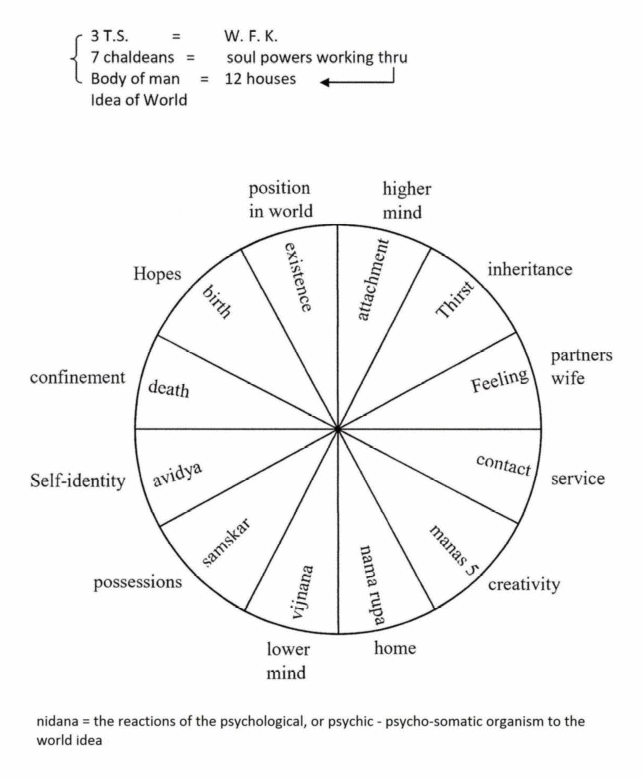
DIAGRAM appended to this transcript:
- FIGURE AD Supp 10-digital. Nidana Chain and Astrological Houses.
[Transcriber note: [diagram] means the speaker is referencing a diagram as he or she is speaking.]
NOTES:
- At least two earlier transcript versions exist: 1) Scan File 1982 1103C2-16R26.PDF. 2) A version transcribed from audio cassette tapes by HP, JF, et al. in 1992 as part of the set for Standing in Your Own Way.
TRANSCRIBED Verbatim by IT in 2019 using prior "readable verbatim" V11r from 2018; reformatted by JRM & JF 2019-2020, with TOC/Subheads by JRM. In 2023, IT updates prefatory matter, footer, and audio file name, alters Subheads to make more accurate, completes Book List, adds Plotinus quotes section, fixes errors/typos, adds new notes within transcript, adds one diagram and reference within transcript to this diagram. Archival verbatim transcript – V14.1a.
AUDIO FILES: 1982 1103a, 1982 1103b. [Note: "Tape" and "Side" refer to original audio cassette tapes that were later digitized into .MP3 Audio Files.]
1982 11/03 at Wisdom's Goldenrod
PB Paras; Ego
Archival Verbatim Transcript
PB PARAS ON EGO
[Audio File 1982 1103a Begins]
PB [V6, 8:4.221, RG reading]: "[The self-crucifixion of the ego is the terminal] of a long line of self-humblings, the culmination of years spent in gradually withdrawing from its thraldom."
[short pause]
PB [V6, 8:4.156, RG reading]: "It requires a heavy effort and involves constant difficulty to live such a life. The ideal of curbing and wearing down the personal ego can be made bearable only by holding cheerfully before the gaze a picture of the satisfying spiritual condition of the ego-free man."
MB: Read that again.
S (very faint): Yeah.
S (faint): Uh-hm.
PB [V6, 8:4.156, RG rereading]: "It requires a heavy effort and involves constant difficulty to live such a life. The ideal of curbing and wearing down the personal ego can be made bearable only by holding cheerfully before the gaze a picture of the satisfying spiritual condition of the ego-free man."
[short pause]
S (faint, possibly part of background): Right.
PB [V6, 8:3.155, RG reading]: "A man has many burdens to bear at different times during his life, but the heaviest of them all is the burden of his own ego."
[short pause]
PB [V6, 8:4.355, RG reading]: "It is both the irony and tragedy of life that we use up its strictly limited quota of years in pursuits which we come later to see as worthless and in desires which we find bring pain with their fulfilment. The dying man, who sees the cinema-film of his past flash in review before his mental eyes, discovers this irony and feels this tragedy."
S: Dickie, where are you reading from?
RG: Red volume 11, page 26. It's all from that volume one.
RC/S(?) (faint): Ok.
PB [V6, 8:1.189 & Persp., Ch. 8 #5, RG reading]: "The highest goal of the quest is not illumination gained by destruction of the ego but rather by perfection of the ego. It is the function of egoism which is to be destroyed, not that which functions. The ego's rulership is to go, not the ego itself."
JG: Would you reread that quote please?
S (very faint): Yeah.
PB [V6, 8:1.189 & Persp., Ch. 8 #5, RG rereading]: "The highest goal of the quest is not illumination gained by destruction of the ego but rather by perfection of the ego. It is the function of egoism which is to be destroyed, not that which functions. The ego's rulership is to go, not the ego itself."
[9 second pause]
PB [V6, 8:3.114, RG reading]: "The ego's cunning endeavour will be to persuade him to ascribe his irritating troubles [RG reads: irritation and troubles] to anything but the correct primal cause--within himself--and to anyone but the correct primal person--he himself."
S (faint): Yeah.
[short pause]
PB [V6, 8:4.222, RG reading]: "To die to the ego means that he will free himself from the thought-grooves that usually dominate his life."
[short pause]
PB [V6, 8:3.70, RG reading]: "All those types, encased in the ego and its desires as they are, are kept out of the kingdom by no other hands than their own."
[short pause]
PB [V6, 8:4.17, RG reading]: "Consciousness as ego has cut us off from the Source. But it need not do so forever. Through the quest, we can come closer and closer to the reintegration of a subdued ego with its Source, which will thenceforth act through us."
[short pause]
PB [V6, 8:4.270, RG reading]: "It requires a superhuman strength to practise the self-imposed discipline of living apart from the ego's desires."
[short pause]
PB [V6, 8:4.350, RG reading]: "The ego demands, fiercely and clamantly or suavely and cunningly, its own unhindered expression. But the ideal formed by intuition from within and by suggestion from without, counsels the ego's restraint."
[short pause]
PB [V6, 8:3.38, RG reading]: "To say that the ego keeps us captive is only one way of stating the problem. That we are infatuated with it, is another way."
[short pause]
PB [V6, 8:3.108, RG reading]: "When the ego sees a danger to its own continued existence in any proposed move or decision, it creates fears, invents false hopes, and exaggerates difficulties in order to prevent it."
[26¼ second pause]
PB [V6, 8:4.198 & Persp., Ch. 8 #31, RG reading]: "He will advance most on the Quest who tries most to separate himself from his ego. It will be a long, slow struggle and a hard one, for the false belief that the ego is his true self grips him with hypnotic intensity. All the strength of all his being must be brought to this struggle to remove error and to establish truth, for it is an error not merely of the intellect alone but also of the emotions and of the will."
S: Thank you.
JG (simultaneously): Would you read that [S, faint: Uh-hm.] again?
PB [V6, 8:4.198 & Persp., Ch. 8 #31, RG rereading]: "He will advance most on the Quest who tries most to separate himself from his ego. It will be a long, slow struggle and a hard one, for the false belief that the ego is his true self grips him with hypnotic intensity. All the strength of all his being must be brought to this struggle to remove error and to establish truth, for it is an error not merely of the intellect alone but also of the emotions and of the will."
[short pause]
PB [V6, 8:4.424 & Persp., Ch. 8 #38, RG reading]: "It is as hard for the ego to judge itself fairly, to look at its actions with a correct perspective as for a man to lift himself by his own braces. It simply cannot do it; its capacity to find excuses for itself is unlimited--even the excuse of righteousness, even the excuse of the quest of truth. All that the aspirant can hope to do is to thin down the volume of the ego's operations [RG reads: operation] and to weaken the strength of the ego itself; but to get rid of the ego entirely is something beyond his own capacity. Consequently, an outside power must be called in. There is only one such power available to him, although it may manifest itself in two different ways, [and] that is the power of Grace. Those ways are: either direct help by his own higher Self or personal help from a higher man, that is, an illumined teacher. [He may call for the first at any time, but he may not rightly call for the second before he has done enough work on himself and made enough advance to justify it.]"
[21½ second pause]
RG: Anthony, I don't know when we should stop.
S (very faint): At any time.
S (very faint): Yeah.
AD (faint): Any time.
RG/S(?) (faint): Yeah.
THE FALSE BELIEF THAT THE EGO IS THE TRUE SELF HAS A HYPNOTIC GRASP
AD (faint): Stop and talk about it a little bit Johanna.
S: Listen.
S: Uh-hm.
DB: In a quote that Johanna asked you to read again concerning the hypnotic belief of the ego, [RG: Yeah.] I'm not-- I'm not quite sure I understand that. Is that the same thing as the attachment that we have to ego spoken of last week? Or--
[short pause]
RG: Well he sa-- he says, "the belief that the ego is his true self grips him with hypnotic intensity."
DB: Right, ok, now what-- And he goes on to say that that belief is not one of the intellect but also of feelings and the will. Right? [student assents, very faint] So, seems like-- you know, at a certain stage, you know, you've read enough and you've studied enough and you say well, yes, I can really believe that the ego is not my true self but it persists in terms of will and feeling, also probably in terms of the intellect one way or another. But at least you can say that-- that you disagree with that. But what-- what precisely is this belief? You know I mean like, I believe that it's going to rain tomorrow because it said so. But this is of an entirely different order and I-- I don't quite understand it.
S: So you--
RG: Right.
DB: I mean it's one of those things that if-- to me it seems, you know, so, "Oh yes, well the problem is this belief and have to get rid of that," but I don't really know what we-- [S, faint: Right.] I mean all my thoughts are built on that-- this fact, you know, all my mental life and emotional life and so on and so forth, so what-- It's a belief but it's got to-- it's of a different order than my regular beliefs and-- so what is it?
JG: Well it seems to me that regular beliefs are very lightly held. This one is a very hypnotic belief. Don't you feel hypnotized?
DB: Well-- oh, no question. But I don't even think about it, you know, I mean, it isn't--
JG (simultaneously): Well that's what I mean, you don't think about somebody-- you know, if you can hypnotize they just go on and do.
DB: Right. So-- which brings me to the next-- the next point then. Is this belief a function of the ego, I mean is it something that it does. Does it believe in itself or is that belief something that is forced upon it?
JG: By what could it be forced upon it?
DB: Well, I don't know.
RG/S(?) (faint): Uh-hm.
DB: I'm just asking. Are you saying that there isn't anything that could do that or what?
JG: I don't see that anybody would have an-- anything outside the ego would have an interest in hypnotizing you.
S: Uh-hm.
DB: Well I-- I guess partly where I'm coming from is the quote in the Wisdom where PB speaks about the illusion of the world as something which is-- which is-- you know, the master magician I think, something to this effect, something the World-Mind provides, you know? I just-- I really don't know, you know. But I'm uncomfortable with just thinking of it as a normal run-of-the-mill belief. [JG simultaneously: Well but--] 'Cause those come and go, you know.
JG: It's not that category, [DB simultaneously: Right.] obviously, because that's as much as you can say safely.
MS: Well what has a hypnotic belief in the ego? I mean it's not the ego.
JG (simultaneously): The ego himself. Doesn't it?
S (faint): Same thing.
BS: You all heard of self-hypnosis. (laughter)
S (amidst laughter): Yeah.
JG: We haven't heard of self-hyp--
BS: I said we have.
JG: Oh yeah?
DD: I mean I don't think he used the term 'belief' anyway in that quote, I think he used the term 'error'.
RG: No, no, well-- it'll be--
HE (simultaneously, faint): Well you-- you can read it again.
PB [V6, 8:4.198 & Persp., Ch. 8 #31, RG reading]: "…the false belief that the ego is his true self grips him with hypnotic intensity."
DD: Yeah, read on.
PB [V6, 8:4.198 & Persp., Ch. 8 #31 cont., RG reading]: "All the strength of all his being must be brought to this struggle to remove error and to establish truth, for it is an error not merely of the intellect alone but also of the emotions and of the will."
[short pause]
DD: Well, false belief I think again-- he didn't say belief there, you said false belief.
RG: Uh-hm.
DD: And error helps more than belief to me.
RG: Uh-hm. Well I mean we talk about it as the primal error, David, it's certainly not your normal run-of-the-mill belief, you know.
DB: Right.
DD: Ignorance can dispel it. I mean uh, well, (laughter, student words) well, excuse me. It's ignorance and can be dispelled.
S: Right, ok.
DD: So maybe what dispels it is what-- who knows. (DD laughs)
RG: Well, I mean isn't it the very ignorance then, avidya, that, you know, we talked about in the nidana chain that [couple words inaudible]
S (very faint): Uh-hm.
DB: See I--
S (simultaneously, faint): Yeah.
RC(?): Yeah.
DB: So would you say something like that-- you know, the particular structure of the-- of egoity-- egoity that we operate with has at its base this fundamental error, this belief? I mean 'cause it's a-- it's not a random error, it's a very specific one, it's the belief that the ego is the real self and which-- In a way it's confusing because the way the ego seems to operate is to always try (either--) the cunning craft that it operates with is to make sure that nothing ever harms it, you know, or can possibly annihilate it, I mean it functions in some-- with some form of trepidation. You know I mean like if we make a decision that's going to result in some kind of consequences to it, it will do whatever it has to to prevent that from coming about. And yet at the same time, you know, if it really believed, if the ego really believed in this error, I mean if it really believed it, it would have no reason to-- to act in that way, wouldn't occur to it.
RG: Yeah, you're using belief in a very limited way though Dave. I mean it's-- you can't ascribe the normal meaning you have of belief of a particular to this kind of false belief, I mean, when PB says in the Wisdom I mean the first of our thoughts is "I", I mean (isn't/is it) that kind of order of belief that we're talking about?
DB (simultaneously): Yes, I mean, that was-- I thought that was what I had said initially.
RG: Yeah, uh-hm. [students assent, very faint] And that had-- that's what has hypnotic intensity, that first thought. All other thoughts follow its arising.
DB: See-- so you would say that this "I"-- this I-thought believes itself to be the true self.
RG: Yeah. That's the fundamental error and the fundamental and false belief. And they call it avidya I guess and-- That's where we start from. And anything you have in the first house you're going to take yourself to be that.
S (very faint): Right.
[10½ second pause]
LC: And I thought David, I thought your question was and-- is this thought-- does this fundamental error start in the ego or does it have-- does it come from a higher place. Isn't that what you said so far?
DB: I mean it-- yeah, I guess so. Something like that, I mean if we-- if we-- I mean-- We s-- at one time we were speaking of ego as this-- as one thought following upon another, this particular thought-series, ok, which took itself to be the one illuminating mind, right, and there was that quote about the (soul got--) Now, it functions, this thought-series seems to function with that-- with this belief, ok but--
RG: But, there's two things here David, there's the ego and there's the belief that the ego is the self.
DB: Right.
RG: They're not equatable.
DB: That's-- and-- and that's why-- I don't quite understand.
RG: We-- but we've said many times now that the ego in some sense is a fragment of the Overself. And [one word inaudible] somehow, s-- in some sense a manifestation of it or its thought. [DB assents] Now, the belief that this thought, this appearing thought, is its source is the belief. Now it seems that belief is generated within this projection and not prior to it, the false belief. It doesn't mean that the ego is cre-- is necessarily one with the thought that it is the self.
S (very faint): Yeah.
S: Right.
DB: Right. So this ego can persist and this thought then that it is this false belief can then be changed.
RG: Uh-hm.
S: Oh yeah.
[short pause]
RG: But it seems that is one of its thoughts, that it is its own source.
DB: Now that--
RG: I don't think that false idea comes from any-- from anything--
S (faint): I don't know.
DB: Right, ok.
RG (simultaneously): --from something prior, that is the avidya.
DB: Would it be-- would it be then the necessary consequent to losing awareness of that source, something like-- I'm-- you see I'm just-- I mean it-- it's such an important thing and I-- I just-- I've never really understood why it does that.
RG: Yeah, certainly if you were aware of the source you would know that the ego which is a thought within it isn't you, I mean-- [11 second pause] Well, well [couple words inaudible] [short pause] Anthony you have anything to say? No? Ok.
S (faint): Yeah.
RG: Alright, we'll go on.
JC: I don't understand that that-- that it's the ego that-- that is responsible for the fact that its-- appears to be the self. You know, I would say that it's the higher principle that has confused itself with its own thoughts, that might be one way of approaching it. When it has that first thought of "I", it's concentrated on that and then loses its awareness of its own prior essence. [students assent, faint] And then all of the-- all the other thoughts follow that and once the chain is started all the other habits of thought with-- and feeling, you know, will just take care of it.
RG: So you would say that it's the Overself itself that loses its consciousness by becoming the ego thought and therefore mistakes itself to be the ego? Is that-- is that your position on it?
JC: Yeah, more or less the way you said it.
RG: Well I can't see how the Overself is the Overself, I mean if it is consciousness it could-- it could [one word inaudible]
JC (simultaneously): It doesn't lose awareness. But it may lose awareness of itself, its own contents or--
RG (faint): I don't know what that means.
PC: But we have-- I mean it's--
TS (simultaneously): How could its awareness be other than its awareness of itself?
JC: It could be awareness of other, aware of other, you know, like the world.
PC: Well we've seen quotes where he says that the Overself is never deceived by the ego's image-making. But the ego itself always is.
JC: Well, I mean I could understand the second half, that there's no possibility for the ego to become self-realized.
S (faint): That's right.
S (very faint): Uh-hm.
JC: Um-- But I don't understand or I wouldn't agree with the idea that the Overself maintains its own exalted self-awareness and they-- on the other hand the ego maintains its own ignorant self-awareness relative to [one word inaudible] you know, claims it may make, and, you know, there's no-- there's no confusion on the Overself's part and the ego's always deluded as to its own nature. [RG assents] Then if it-- then what's the confusion to be undone?
RG: Oh I don't think you have to say that the ego is always deluded. Only if you identify with the ego (as/with) that mistaken belief, then you have-- then what you say follows. But if you allow that the thought of the ignorance is not ego itself--
HIGHER AND LOWER EGO; DOUBLE KNOWER
TS: No it-- One of the quotes you read earlier where he spoke about the need not to destroy the ego but the ego's rulership, you know, seems that a distinction is being held throughout that there's a difference between-- there's belief or ignorance or error of the ego to take itself to be its own origin and to be at all as a, you know, sense of "I" that is incarnate.
JC: I mean do you think that the ego has its own-- you think the ego has the capacity to realize its own finitude and the presence of the self?
S: Isn't that exactly what he calls the self-crucifixion of the ego?
JC: But does that ego do that?
PC: Does the ego do it?
JC: Does the ego realize or is it that-- I would say it's a higher principle that learns to give up its attachment to the ego, realizes its own inner essence as being free of that and no longer follows the dictates of it.
S: Yeah.
RG: And I-- and I would say it's a higher part of the ego that does that. [student assents, very faint] Well we're back at Proclus. (some laughter) Does the soul descend or doesn't it.
JC: Well, in what sense does it descend?
RG: And it can't [one word inaudible] but--
JC (simultaneously): But if you say higher part of [RG simultaneously: In the sense that the hi--] the ego you mean the Witness-I?
RG: In the sense that there's a hi--
JC (simultaneously): In the sense of a Witness-I?
RG: In the sense that we could mean ego as a higher part of the mind and what gets perfe-- what-- whose virtues gets perfected and whose intellect gets perfected and whose will gets perfected and then it becomes a-- a-- a (mirror/mirrored) vehicle for the revelation of the Overself, that's-- in that sense I would say it's that part of the mind as ego that re-- that can then reflect the Overself's light. [JC assents] But I wouldn't--
JC: Yeah, I would--
RG: So I wouldn't claim that part is the Overself. Now if you want to say that that is the soul's descent, part of the soul's descent, it means something different. We're reserving the term Overself for the higher part of the mind that you wouldn't be-- the higher part of the soul that doesn't descend. And we're-- I was using 'mind' for the part of the soul that does. [student assents] (Jeff?)
S (faint): Ok.
JC: [couple/three words inaudible] that's why I'm using it. I mean I'm using soul or Overself or self as something above the cosmos let's say, and it's involved with the cosmos, and the first thing would be the thought, this higher part of the ego it's involved with let's say, and whatever you call that, the I-thought.
RG: Right.
JC: And then that's-- and then that gets involved with the more extroverted animal nature in the sublunary world.
RG: Yeah, ok.
JC: And so first you have to purify the ego to reach this higher level of egohood. That's what PB's discussed at this intermediate level and that becomes sort of a rational "I", a rational "I" is ego, which then, as you're saying, could become a mirror for the higher. But still, you know, that-- you said yourself the most powerful hypno-- you know, the thing that's the most powerful is this original I-thought.
RG: Uh-hm.
JC: So it seems to me it would be an easier, comparatively easier job to get free of the-- the animal part than to let go of that individuality that that higher ego represents itself.
RG: Yeah, right.
JC: So-- I mean I don't see that-- the attachment is still-- I mean the problem of the ego rests in that higher "I".
RG: In the higher mind which is not in my view-- in my understanding here the Overself.
JC: Right, I agree.
RG: There's a sharp distinction between the "I"-thought which you identify with and the Overself consciousness.
S: Oh.
JC: I'm just saying the problem to me resides in the relationship, if any, I mean I wonder the way you talk, between the Overself per se and the ego. If there's no relationship then there's no problem and if the higher self is involved in it and caught up in it in any way-- I mean if there's a confusion there then-- [RG: Right, uh-hm.] then I wouldn't say it's the I-thought's problem, I mean the I-thought supposedly in this mentalistic view is a-- the first activity of the Overself in terms of this kind of thinking.
RG: Right. And that's why I would say that the ego as a projection of the Overself doesn't necessarily have to have this false belief attached to it be-- because it is a projection of the Overself, but once this thought gets projected, it immediately identifies with the all other thoughts and takes itself to be them.
JC: Ok, all that lower business.
RG: Yeah.
JC: Let's just-- But you say, ok, the I-thought could happen without the attachment or the belief in it. But what's the beli-- where's the source of the belief, I mean-- I'd say it's from-- the higher self could have the thought of "I" without being attached to it, use it as a necessary vehicle.
S (very faint): Right.
RG: Right.
S (very faint): Uh-hm.
JC: But there wouldn't be a belief attending it, the [students assent] judgment let's say attending it that this is me.
RG: Uh-hm.
JC: But I would say that that's the-- the realization there is a shift in the-- the knowledge of the Overself.
LD: Yeah, but Jeff, [RG simultaneously: I can't buy that.] why can't the [JC simultaneously: That's--] ego-- why can't the ego take itself to be-- like they say the I-thought takes itself to be a felt separation, and in this felt separation self-will is set up. Now once that's dissolved, it-- it's not the-- the self-will of the higher self that's dissolved. It's the felt separation, the self-will of the ego that's-- that's resolved back into more of a servant relationship than a master relationship.
JC: But, I mean I'd ask you [S simultaneously: So--] Louie, I mean it seems to me that it's the problem is that the self is identified with that "I" and-- and so the-- the felt separation is set up by that s-- by that process and that all later thoughts and the will that is associated with the ego is based on that primal identification.
TS: If you say that the Overself has self-knowledge-- Either the Overself has self-knowledge or it doesn't.
S: Ok.
TS: Now, if it does have self-knowledge and it is outside of time, then that self-knowledge must be beginningless and endless. So if it's self-knowing, and its self-knowing is essential to its meaning, then I don't-- I can't see how that self-knowing could ever be disturbed. But it seems to me that-- that the I-thought as a (light/life) from that Overself, as its agent in the world, within that light could arise this belief of that light as being identical with its prior or as Louie said as taking the role of being its own master, [student assents, faint] you know, but it seems like with the idea of realization and the act-- well what-- the first quote that Richard read, the self-crucifixion of the ego is to realize, to recognize, to re-know the original relationship that it enjoys with that Overself. But it seems to me that he--
JC: You're saying the ego does that, [TS simultaneously: Yeah, because it seems to me--] realizes its proper [TS simultaneously: Yeah.] relationship to these--
TS: Seems the realization, the ignorance and the realization would have to be in terms of the ego if it is said that a) the-- that the Overself is outside of time [student assents] and that it is at any point b) self-knowing. And it seems to me that it-- it would be very hard for me to understand the meaning of Overself as not self-knowing.
JC: Yeah, which is what I'm saying.
TS: Ok, [RG simultaneously: You're saying that it is.] you're saying that it's not self-knowing.
JC (simultaneously): Yeah, that's the way it appears to me, from my standpoint.
TS: Well what would have self-knowledge then?
JC: It could have self-knowledge.
TS (simultaneously): The World-Mind alone?
JC: I mean there's two kinds of self-knowledge, right? He talked about Plotinus. Self-knower is a double person? [Note: See Plotinus, V.3.4.] There's one where it's knowing the Intellectual-Principle, and even Plotinus says that will lapse. [TS simultaneously: Yeah well--] In some places he says, I mean there may be arguments here. And-- and the other thing about it, knowing itself by the understanding, by, you know, the reasoning within it, I think as long as the soul is looking into the world that that reasoning is not available, it's not doing it, it's not dianoia-ing or whatever you want to call it.
TS: Well [couple words inaudible] maybe.
JC: And so what's left is this-- you know, this awareness of the soul which can either look up or down. And when it's looking down it's caught up in its own though-processes.
TS: And it seems to me that the part that looks up or down would be that I-thought. [JC simultaneously: Ok.] And that the-- that when the two knowers, the double knower is referred to, that the-- both of those phases of the soul are as it is in the Intellectual-Principle. [JC: Ok.] And that would be ano-- another view.
JC: I mean I'll drop-- I'd like to drop it unless [TS simultaneously: Then we're going on.] people want to continue but I did-- no I'd say I disagree(d) with that [couple/three words inaudible] (bit of laughter)
S: Well--
RG (faint): Ok. This para.
S (very faint): Ok.
S: Ok.
S: (Yeah/Go on).
MORE PB PARAS ON EGO; WHAT WE CALL "I" IS THE BIGGEST IMPOSTURE GOING
PB [V6, 8:4.219, RG reading]: "Every pilgrim on this quest can finish it only by dying upon his own cross. He can rise to the union with his higher self only after the lower one is crucified."
[short pause]
PB [V6, 8:1.110 & Persp., Ch. 8 #33, RG reading]: "We draw the very capacity to live from the Overself, the very power to think from the same source. But we confine both the capacity and the power to a small, fragmentary, and mostly physical sphere. Within this confinement the ego sits enthroned, served by our senses and pandered by our thoughts."
JA: Would you please reread that quote?
PB [V6, 8:1.110 & Persp., Ch. 8 #33, RG rereading]: "We draw the very capacity to live from the Overself, the very power to think from the same source. But we confine both the capacity [RG adds: to live] and the power [RG adds: to think] to a small, fragmentary, and mostly physical sphere. Within this confinement the ego sits enthroned, served by our senses and pandered by our thoughts."
[9 second pause]
PB [V6, 8:4.418, RG reading]: "The senses which tempt him to go astray from his chosen path of conduct may be subjugated in time by right thoughts. The thoughts which distract him from his chosen path of meditation may be subjugated by persistent effort. But the ego which bars his entry into the kingdom of heaven refuses, and only pretends, to subjugate itself."
[10¾ second pause]
PB [V6, 8:4.16, RG reading]: "Rebirths, memories, occult powers--all these things exist and continue because they perpetuate the ego--the very thing we should try to escape from!"
AD: We better not read too many.
[students assent, very faint]
RG (faint): Yeah.
AD: Just a few at a time.
RG (faint): Ok.
S: [couple words inaudible] enlightenment?
SD (simultaneously): Can you repeat that last one?
LR: Read up Richard.
AD: You didn't hear it Severin or you didn't want to hear it?
SD: I just wanted it.
AD (faint): Well--
AS: Which one, the last one?
RG: The one Severin wants.
S (faint): Yeah.
PB [V6, 8:4.16, RG rereading]: "Rebirths, memories, occult powers--all these things exist and continue because they perpetuate the ego--the very thing we should try to escape from!"
[13½ second pause]
NH: Does he mean memories there connected with rebirth or just--
RG: I think you could take it either way, any memory.
S: Any memories.
RG: Including rebirth memory.
S: Uh-hm.
RG: Any thought of-- any past thought.
S (faint): Probably anchor.
LD: So again and again he seems to be putting the problem on us, the ego, as the mistake, instead of like Jeff wants to do and say the soul's got the problem. (laughter)
AD: I think you got something Louis. (laughter)
RG: No, no, Jeff-- Jeff would-- I mean I-- I'll make Jeff's position, try to [couple words inaudible] why that is so. But if-- but Jeff would just say that that which you're calling "us" is the soul enslaved.
AD: No it ain't.
JC: Yeah I--
RG: [three/few words inaudible]
AD (simultaneously): No it ain't. [S, faint: It's (one/two words inaudible)] What I call "I" ain't the soul.
S: No.
DD: There's no victory either.
AD (simultaneously): It's the biggest imposture going.
S (faint): Right.
DD: There'd be no victory. [S, faint: Yeah.] If there [S simultaneously: Yeah.] wasn't a being who was ignorant there wouldn't be a being who could come to know.
JC: And who is that being that's ignorant?
S (very faint): You.
TS/S(?) (faint): That's the one that you need to know. (bit of laughter)
AD (faint): Who knows (him/it)? (bit of laughter)
S (faint): Right.
S: Right.
S: Uh-hm.
S (faint): Yeah.
LD: The soul is ignorant, I'm not, right?
S (faint): What'd you say?
JC: You're a necessary vehicle. The soul is ignorant of what you really are.
AD: What was that?
LD (simultaneously): That's a nice flowery way out of it.
AD: I can't hear. (some laughter)
S (faint): [couple/three words inaudible] right?
AD: Come on, this is something we can all discuss, we all have one in common.
S (faint): Right.
S (very faint): (We/I) do?
AS: See--
AD (very faint): Come on, (Steve).
S: How common is it?
S (very faint, possibly part of background): Yeah.
RG/S(?) (faint): Pardon?
[short pause]
DISTINGUISHING CONCEPTUAL UNDERSTANDING AND SPIRITUAL EXPERIENCE; THE EGO IS BUILT INTO THINKING WILLING FEELING
AD: Jeff, I like to hear your stand again. (laughter) I really enjoyed it. (laughter)
JC: I'm saying the only thing that I-- the only thing in my experience that I'm-- that I could say is-- there must be some presence or some trace of the soul in my experience.
AD: You're-- you're aware of it?
JC: Awareness itself.
AD: You're aware of awareness?
JC: That illum-- well, if I wasn't aware of it then I could not e-- also--
AD (simultaneously): You mean because you understand the meaning of some words you're aware of the presence of the soul as this light?
JC (simultaneously): I have a reflec-- a reflective knowledge that that light is present and that that light is the most essential thing--
AD (simultaneously): If I wanted to shake your hand I wouldn't go to the mirror.
JC: You might be able to shake my hand. (bit of laughter)
AD: No, let's stick to the point Jeff. (bit of laughter) You know of the presence of the soul in you?
JC: Yes.
AD: Would you point it out?
JC: It's the thing that I can least point to because it's-- it makes all of my other knowledge possible.
AD (intensely): Do you know it or have you heard of it through concepts? Is your knowledge of concepts or is it of the reality?
JC: The concepts made me come to understand that that is present.
AD: That understanding is within the concepts.
JC: Yes.
AD (intensely): It's not the reality.
JC: I agree.
AD (simultaneously, intensely): You don't know the reality. [JC simultaneously: I-- the concep--] You know the meanings that you find in the concepts.
JC: Yes, which point to--
AD (simultaneously): Don't mistake that for the reality.
JC: I won't mistake my concepts for knowledge but they do point to a reality.
AD: Nonetheless--
JC: That is known in a way above concepts, immediately and presently.
AD (intensely): You know that!?
JC: Yes, I do.
AD: Ok, I have nothing to say.
[short pause]
JC: But I don't know it as a free being. I don't know it as not shining into the personality.
AD (simultaneously): You can't know it, you can only be that! You can't know that.
JC: By "know" you mean?
AD: There's no way that you could know the soul.
JC: But by "know" you mean conceptually.
S (simultaneously): Be, be.
RG (simultaneously): No by "know" he means be.
S (very faint): Yeah.
RG (very faint): Yeah, what he means by [one/two words inaudible]
AD: (You have this--)
JC (simultaneously): You can't-- you can't know it objectively.
AD (simultaneously): This was an interesting thing that came up Sunday, didn't it?
S (very faint): Yeah.
AD: To understand, to see the sense in the sensible does not mean that you are in any way aware of spiritual realities.
S: Uh-hm.
LD: Isn't the abstract now--
AD (simultaneously): Weren't you talking about that Herbie?
JC: Right, you said to see the meaning of a sensible world-- those meanings are not to be confused with essences. But you're talking about reflective understanding in which, you know, you come--
AD: I'm trying to avoid any complicated language and very straightforward, direct and simple. And what I'm saying is something like this. You do understand meaning that is in the sensible. That meaning may be referring to the spiritual but it is not the spiritual.
JC: Ok.
AD: Now, to that extent I won't say it's absolutely worthless, but I will certainly make a very clear line here and say that is not the spiritual. The fact that I am aware that there is embedded in conceptual meaning a referent to spiritual realities, that still does not make me spiritual.
JC: It seems to me there's a difference between being able to perceive those-- those things that those meanings are-- those essences that those meanings are referring to, especially as independent from their image, and the availability of the gnostic-- of the cognitional power which when properly trained could know those essences. 'Cause I think that cognitional power is present right in the personality.
AD: I won't disagree with that. And I even pointed out, I said there is some value in that. But I insist on making this line of demarcation very very absolute for us, ok, and that is whatever spirituality there may be in our understanding of a thing, in the understanding, let's say, of our concepts, should not be confused with spirituality. There is no mistaking when one recognizes the self in him, at whatever grade, with the meanings. There is no mistaking those two.
S: Uh-hm.
[short pause]
S: Is--
LD: Aren't the abs-- abstractions and conceptions you're talking about derived from the particulars themselves? And so therefore even have less of a reality than the sensible, let alone the spiritual.
[students assent, faint]
AD: That's quite true.
[students assent, faint]
AH/S(?): Louis, would you say that again?
AD: It's something that we have to spec-- be very (carefully) about because people do think because they understand-- and they understand, they do understand, I'm not de-- depriving them of-- of that, that we understand certain texts that refer to spiritual realities, our understanding of these things is something mental. And it should not be confused with the spiritual. They're quite different. [short pause] And as far as belief, I mean, I don't understand their discussion at all, David. If you got an ego, the belief is built in to the fact that it is the only thing that is. Even to discuss the point is a waste of time. You ever meet an ego that didn't believe in itself?
DB: No.
AD: Even when it hanged itself?
DB: No, it would be--
AD: Ok.
DB: I just-- I mean-- well you're saying that it's so obvious that it doesn't bear discussion, I-- I just-- I grant the fact that it's obvious, it's very painfully obvious, you know, but--
AD: And if you remember, he pointed out it's an error in the will, an error in the intellect and an error in the emotions.
DB: Right.
AD: Intrinsically built into our feelings, built into our thinking, built into our win-- willing is already the ego as a fact. We're willing what the ego wants us to will, we're feeling what the ego wants us to feel. Look, this is the last night on the ego, let's make it good, huh? You never want to kid yourself about this.
LC: And I think maybe that was David's question, it's built into the ego right from the very beginning. I [AD simultaneously: Yeah.] mean that-- to me that's disturbing, I mean, if it's-- it is built--
AD (simultaneously): So how are you going to deny it?
LC: Right, you can't deny, right.
AD: Exactly.
RG: But-- but then I-- I don't quite see it.
AD: I don't expect you to see it Dickie till next Monday. (laughter, RG laughing)
S: Ok.
AD: When we do Vivekananda.
DD: Anthony? These rational thoughts that-- that one understands, the seeing the sense in the sensible, is it-- can-- can the ego have understanding, is it the ego that these realizations come to? Does the ego become (more) [one/two words inaudible] becomes perfected?
S: Say it again.
S (very faint): Yeah, I didn't--
DD: I--
AD (simultaneously): Up to a point. [DD simultaneously: I mean I see it here--] You know it's not one of the-- it's not one of these-- it's not one of these discussions, you know, where the-- the bolt fits perfectly into the nut. [DD/S(?): Yeah.] You know? It's not that kind of a discussion. What we're talking about is a person let's say who's an ordinary-- you know, has collective values, lives a common life and all that, and he undertakes the study of some spiritual teachings. So the ego may make a concession and make him see a point here and there. And that could go on for a while. [student assents] And if a person is really persistent the ego will give ground more and more. But it won't be without a struggle. Now the point I'm trying to get at is that it's a question that sometimes, in the case of very intensive effort in that direction, you may get help from the higher self (where/and) passages can get illuminated and you'd know (that it/they would) never came from the ego. The illumination of those passages was something that the ego was never capable of. But there's also other instances where you as the ego can understand certain things. So, it's a relative question insofar whose ego are we speaking about and what particular thing are we talking.
DD (simultaneously): Well I was thinking (it/there) was the ego that had to surrender. And to get to that point, whatever point of perfection that is, I mean you may sit down as an a-spiritual being and start imbibing spirituality and-- and how you end up is different than how you started out. The ego that you-- that you first sat down with, [S, faint: Yeah.] it's not the same-- when you come out the end of the tube it's different. (bit of laughter) Am I making any sense? I think, you know, I agree with what you're saying. But, I just want to get it clearer.
AD: Well--
(Side 1 of original cassette tape digitized as 1982 1103a Ends; Side 2 Begins)
DD: --would be-- disintegrates or loses its power or dissolves in the process.
AD: Just a little tiny bit. [students assent] [short pause] And besides tomorrow it will reclaim what it lost today. (bit of laughter)
DB: And then some.
DD: But it still has to surrender in the end.
RG: Uh-hm.
AD: Let's not worry about surrender because that's a real long [student assents] drawn-out affair [DD simultaneously: Well we brought it up already and it still bothers me.] which involves a long series of (life/lives). [short pause] I just-- I just want to make sure that we understand that when we're talking about belief, it's born in us. We believe in our ego right down to the wire. [short pause] The point that Jeff was making is a little subtler but nonetheless it does have to be ma-- be made clear. And that is that occasionally we do glimpse certain spiritual realities through the medium of concepts which are in our understanding. This does not make us spiritual, it's just pointing the way to go. The thing still has to be done, we still have to make your-- the initial and the existential identity with those spiritual realities. [DD simultaneously: Maybe you'll--] I don't want anyone to walk out deluded, you know?
DD: Anthony, maybe what I wanted to say is can a higher part of the ego recognize--
AD: What higher part!? The ego is ego!
S: What about the (soul)?
DD (simultaneously): Alright. [RG simultaneously: No.] Can the [AD simultaneously: Go ahead.] ego realize it's ignorant?
AD: Can it realize it's ignorant?
DD (simultaneously): Can it know at least that it's ignorant.
AD: You-- will you show me such a creature?
S (faint): Yeah.
S: Yeah.
S (very faint): (Uh-hm.)
RG: [three/few words inaudible]
JB (simultaneously): Well how does it know to be afraid to defend itself from your efforts at seeing it?
AD: What's that got to do with this?
JB: Well that there's got to be a part there that's aware that it's ignorant in the se-- if it is clever enough to deny its principle.
AD (simultaneously): I would s-- I would say it's pretty smart if it knows it-- how to defend itself or preserve itself. You're bringing in something, you know, which is not the point, he's getting at something else. He's trying to say, now look, I'm an ignorant person. Someone comes over and talks to me, alright, and suddenly I get spiritual gleamings. So something did happen.
DD: Yeah, right, the little [AD simultaneously: Yeah, sure.] shift that took place.
AD: The next week it's taken right back.
CDA/S(?): PB does often, I don't know [one/two words inaudible] so part of that (quality), speak of a higher part of the ego.
S (very faint): (A high part of the--) (laughter)
AD: I'm just trying to get this right down to the point, alright, he's trying to point out that occasionally the ego can understand some spiritual truths, yes. And so it's given up a little bit of ground. A little bit, not much. The first opportunity it gets it will take that ground right back.
[short pause]
DD: It's like the iceberg with just a little bit up above and the big part underneath is the--
AD (simultaneously): Like the Dragon.
DD: --big daddy.
AD (faint): Yeah, like the Dragon.
DD: With a big club.
AD: You remember the famous axiom, one step forward and two back? (bit of laughter) Go ahead Dickie.
RG: What, do you want to read some more? You want me to just read? I'm not-- I'm not allowed-- I'm not allowed to--
AD: (Just) reread a couple Dickie. Of course you're allowed.
PB [V6, 8:4.211, RG reading (simultaneously with AD above)]: "No one else can…"
RG: What?
AD: Of course you're allowed.
S (very faint, possibly part of background): No thank you.
S (faint, possibly part of background): Tim's off (the) [one/two words inaudible]
S (very faint, possibly part of background): Yeah, uh-hm.
SURRENDERING THE EGO IS A LONG DRAWN-OUT AFFAIR; TWO DIFFERENT INTERPRETATIONS OF A TIBETAN RINPOCHE'S EXPERIENCE OF TORTURE
PB [V6, 8:4.211, RG reading]: "No one else can do for a man what Nature is tutoring him to do for himself, that is, to surrender the ego to the higher self. Without such surrender no man can attain the consciousness of that higher self. It is useless to look to a master to make for him [RG reads: It is useless for him to look to a master to make] this tremendous change-over within himself [RG reads: within him for him]. No master could do it. The proper way and the only way is to give up this pathetic clinging to his own power, to his own littleness, and to his own limitations [RG reads: limitation]. To turn so completely against himself demands from a man an extreme emotional effort of the rarest kind and also of the most painful kind. For to surrender the ego is to crucify it."
JG: Would you read that again?
S: What number was that please?
RG: 44 on page 16.
S: What?
JG: Page what?
RG: Page 16 in volume 11, red. Number 44.
[couple seconds of faint background student talking]
PB [V6, 8:4.211, RG reading]: "No one else can do for a man what Nature is tutoring him to do for himself, that is, to surrender the ego to the higher self."
AD: Life is always taking things away from you, right?
PB [V6, 8:4.211 cont., RG reading]: "Without such surrender no man can attain the consciousness of that higher self. It is useless to look to a master to make for him [RG reads: It is useless for him to look to a master to make] this tremendous change-over within himself [RG adds: for him]. No master could do it. The proper way and the only way is to give up this pathetic clinging to his own power, to his own littleness, and [to] his own limitations [RG reads: limitation]. To turn so completely against himself demands from a man an extreme emotional effort of the rarest kind and also of the most painful kind. For to surrender the ego is to crucify it."
[14¾ second pause with faint background student talking]
LD: Can I ask, how do you think-- how do you give that up, I mean, (again--) (bit of laughter)
S (very faint): You can't do it.
LD: A master can't do it for you, you can't do it for yourself, it's like hopeless. (bit of laughter) I mean there's no way you could hurry the process.
S: What did he say?
S (faint): Well--
S (faint): Well then you won't do it anyway. (some laughter, student words)
RG: Well--
LD: I know, I know.
RG: Alright. (laughter) It's a valid question. (RG laughs)
S (simultaneously, faint): [few words inaudible] discover.
DB/S(?) (faint): I know.
LD: Just trust me.
RG: Yeah just (trust). (RG laughing, laughter)
S (simultaneously): [few words inaudible]
RG: Anthony, what was the question?
S (very faint): (Yeah.)
RG: You don't care? (RG laughs, bit of laughter)
S (faint): Of course he doesn't care.
S (very faint): [one word inaudible] doesn't care either.
RG (simultaneously): Ok, yeah, (um--/go on.)
AD: He's going through a long discussion. All these aphorisms, Louis, keep telling you you have to keep working at it, you've got to keep trying. He gives an example where teacher goes to the student and tells him, "Here, break this iron" and he-- student says "I can't." He says "Well file at it." So you keep filing at it and when it's thin enough you can break it. You can't break the ego in the heyday of its strength, you can only wait until you've filed it down, thinned it down, water it down enough, and then maybe the attempt could be made. [student assents] And the attempt could come in various ways I s-- like I said, it can come in a pathological crisis, it could come in a mystical situation where you enter the Void and you have to give it up consciously, otherwise you-- you're still a mystic. But it's a long drawn-out affair before one could approach and really do it, most of us cannot give up the ego.
LD: But it just seems every time you do work at it and file it, all (of the--) [tape break] --and more sneaky it seems to get.
AD (simultaneously): And so will you, [S simultaneously, faint: (couple/three words inaudible) more sneaky.] you have to get more subtle. Then you have to see it operating on the subtle plane, and it will get even more subtler. It will get so subtle that your mind will thin out just as subtle as it can get. And at each level that-- that this happens you have to be right there struggling with it. But it's a long drawn-out process and you have to keep that in mind, it's not something you can just do overnight. And it's a constant pressure that you keep on it all the time. Because the first moment you relax it'll just take back as much as it can. You're not talking about the hero who stands up and gets shot and it's over in two minutes. We're talking about a long extended disciplined training that may take lifetimes.
S (faint): Yeah.
DD: You're saying it doesn't get more subtle, you just can see more subtly.
AD: No, it does get more subtle (Dennis).
DD (simultaneously): Well I mean it has subtlety but it doesn't need them against you when you don't have much insight, it doesn't need its subtle--
AD (simultaneously): Yeah, in the beginning-- in the beginning it doesn't need much. [DD simultaneously: Ok.] Yeah, he could present you with almost any little ordinary [DD simultaneously: And a full (one word inaudible)] desire, ok, so-- (laughter) But then when you begin [DD simultaneously: You're a piece of a cake in those things, you have no trouble.] to eliminate those desires, alright, it could present you with subtler desires, alright, then you follow them and you get rid of them, alright. But it'll keep getting subtler all the time if you first unmask its more obvious and coarse, alright, presentation. But it can get extremely subtle, so subtle, as PB pointed out in one of the other notes, that it can penetrate into the highest mystical trances and interpret them for you, all the way up to turiya. So even in the-- even in the prajna function there could be misinterpretation. There definitely could be misinterpretation. An example I think was given to us some time ago when there was a quotation-- this is a long time ago and I'm working off a very bad memory which is-- It seemed that one of the Tibetan Rinpoches who was captured in Tibet and was put through a great deal of suffering said that in the experience there was no "he" that was experiencing "the suffering". Now I-- the way I interpret this was that the teachings, the Buddhist teachings that there is no ego, that these teachings had permeated right into the interpretation of the trance state. If you notice what we said: there was no ego while he was suffering. Then who was suffering? But the doctrine, the Buddhist doctrine, says there is no ego. So there was no ego suffering according to the way he interpret it. The way I interpret it was that this teaching permeated right into the prajna consciousness and told him that there was no ego suffering. But from my point of view, there damn well was an ego suffering. Because the higher power had to come and lift him out of it. But that's an example of what I mean, the ego can [student assents] get pretty subtle.
NH: Well Anthony, when you talk about that, say one step forward and two steps back--
AD: That's just a joke.
NH: No, I know, but you-- (laughter, student words) If you're trying to--
AD (simultaneously): Everyone would be [one/two words inaudible] (if) your bad ones immediately follow, right? (bit of laughter)
S: (That) is no joke. (bit of laughter)
S (faint): Yeah, right.
S: (Disappear.)
NH (simultaneously): If you're trying to [S simultaneously: Yeah.] loosen the grasp of the ego so that that won't happen, is there some way--
AD: Yeah, be vigilant.
NH (simultaneously): --to just-- Well say in--
AD (simultaneously): I don't want to repeat it three times.
NH: Say in this group of [one/two words inaudible]
AD (simultaneously): Be vigilant.
NH (simultaneously): --experience, was there (laughter) some way that you could have, um--
S (simultaneously, faint): Uh, what's that mean? (some laughter)
AD: Once more? (laughter) Be vigilant. If you do something good, expect immediately for it to get undone.
S: I can do.
NH: But is [S simultaneously: Yeah.] it possible [AD/S(?) simultaneously, faint: That's true.] to analyze it with all that's happening, is it possible to-- to pull the ego totally out of operation?
AD: You won't pull it out of operation, you'll just understand what's going on with it. And you'll [NH simultaneously: So--] understand that it's immediately going to try to recompense its loss of dignity. (bit of laughter) [NH simultaneously: Well say this--] And you're going to have to take measures to prevent that immediately.
NH: This Rinpoche who had this experience of suffering with no ego, is there some way that he could have gone deeper into it and-- and seen--
AD (simultaneously): Well not at that time, he was-- he was in pain, he was being tortured by the Chinese. I think-- I think ultimately-- ultimately, if he achieved Sagehood, I think the distinction between the two was something that he will discuss within himself. Is this the right interpretation? Was there no one there suffering and yet suffering was? Or is it this-- or is this part of the dog-- dogmatics of Buddhism? He'll have to find that out for himself. I gave my interpretation and I labeled it as mine. And being a human being I can only say this is my opinion.
MB: Anthony, is your interpretation is that if there was any suffering that there had to be ego to suffer and that the two go together, so that if there really was no ego then there wasn't suffering, if there was suffering there had to be an ego?
AD: You're getting the point Myra.
MB (faint): Yeah.
S: Yeah.
MB: There's no such thing as just suffering without being just-- (some laughter)
AD: There had to be his body there, they were torturing it!
S (faint): Uh-hm, you-- you know.
MB: There's no free-floating suffering. (laughter)
S (amidst laughter): He didn't have any.
AD (amidst laughter): Try to make it complicated, learn how to [one/two words inaudible] (laughter)
S (amidst laughter): He only has--
MB (faint): Doesn't really-- doesn't make sense though, they must be talking about it as the whole body.
AD (simultaneously): Free-floating?
MB: (Definitely.) It sound to me-- it sounds like that would be the ego, there still is such a-- You know, and that it's almost independent of [one/two inaudible student words simultaneous with MB] anybody (watching).
S: Uh-hm. (bit of laughter)
AD: No I think it relates again to (what your--) [short pause] Another one Dickie, another one of the--
[short pause]
THE PARADOX OF THE HUMAN SITUATION
PB [V6, 8:1.167, RG reading]: "The paradox of the human situation is a tremendous one. He has to give up the self-life and yet to develop the self-nature. He has to crush the ego's desires and yet permit its fullness to unfold."
S: Again?
S (very faint): Uh-hm.
RG: Somebody want to comment on that?
[students assent]
LR: We'd like to hear it again though.
S (simultaneously, faint): Uh-hm [couple words inaudible]
PB [V6, 8:1.167, RG rereading]: "The paradox of the human situation is a tremendous one."
S: [couple/three words inaudible] (bit of laughter)
LR: What does that mean?
S: Oh no. (bit of laughter)
RG: Hey Linda. (some laughter)
S (amidst laughter): Yeah they-- (S laughs)
LR (amidst laughter): People are talking back here.
S: Ok.
S: Um, yeah. (bit of laughter)
RG: Especially the ego.
[student assents, very faint]
LR: Is it the paradox of the ego?
S (faint): Yeah, uh-hm.
RG (simultaneously): Yeah, I think we're witnessing it.
PB [V6, 8:1.167, RG rereading]: "The paradox of the human situation is a tremendous one. He has to give up the self-life and yet to develop the self-nature. He has to crush the ego's desires and yet permit its fullness to unfold."
S: Hm.
LC: I'd say when he goes back to the first quote of the ego, that we strive towards the perfection of the ego and not toward its destruction?
RG: Uh-hm.
DB: What-- what is the ego's fullness? [S: Yeah.] I'm aware of the other part.
LR: Isn't that when they talk about the refinement David?
DB: Yeah, I know, but--
LR: The perfection?
DB: Right, I know, perfection, refinement and so forth. And, from the quote it sounds like it's not a problem with the egoism-- what it is, it's what it's doing or what it's done for the past few millennia.
LR: Well, doesn't he say in a lot of quotes that the ego is fine as long as it's not the master?
DB: Right, yes.
LR: It's a good servant?
DB: Alright, now--
LR (simultaneously): So wouldn't that be the unfoldment?
DB: Right, but what is that-- I mean, in terms of what the ego is, ok, I mean you say well it's a good servant.
LR: It's an individual-- individuated center of consciousness.
DB: Well--
DD: Yeah David, there (would/will)--
LR: I mean it's a principle of individual awareness.
S (very faint): Yeah.
DB: Principle of individual-- Right, the I-thought.
LR: So in itself-- there's quotes that say in itself that's not a bad thing.
DB: Right, yes.
LR: However--
DB: However--
S (faint): Yeah.
DB: What it-- what it does isn't.
RG: But wouldn't-- wouldn't you say its fullness is living the rational life [DB: I--] in a-- in a intellectual [couple words inaudible] and--
LR: Can it live the rational life?
DB (simultaneously): Well see, I mean [RG simultaneously: The rational (one word inaudible)] we've spoke of it as-- as its fullness is, I mean, the only good ego is a dead ego. (laughter) I'm sorry.
S: Yeah I know.
DB: There it is.
S: Right.
RG: I don't think that's the gist of what we've been saying at all.
DB: No, I mean I'm trying to understand on the one hand you speak of this crucifixion, ok? And on the other hand we speak of its perfection and its fullness.
RG: Right.
DB: Ok? And I can understand that the crucifixion that is spoken of in terms-- is in terms of the ego's self-will, ok, and that false belief it has in its own supremacy and rulership and so on and so forth, ok. But there's-- [short pause] I guess my problem is is that I don't really have a-- a very complete understanding of what it means for it to be refined or perfected. If in some sense what it is is perfectly fine, alright--
RG: What it is may be perfectly fine.
DB: Right.
S: Yeah.
RG: But it's the--
DB (simultaneously): Now what is that? You see I mean that's-- forgive my stupidity, Richard, I was born this way.
DD: But (one) [one word inaudible] (if he's coming) from another David.
RG (simultaneously): No I don't think you were (born--)
DD: David, look there [one word inaudible]
RG/S(?) (simultaneously): What--
DB: Yes, right.
S: Dave, have you ever--
DD (simultaneously): So you take a universal good, a universal beauty and a universal truth and you'll get it particularized. And one man could only-- can only reveal it one way.
DB: Right. Right, but at the same time they're all fulfilled, I mean they're all perfected. Right, I mean--
DD (simultaneously): (That) presumably was his perfection.
S: (Uh-uh/Uh-hm).
DB: Well see, [DD: That was the--] we-- we've spoke-- we've spoken of this perfection as-- as in some sense the ego as being a-- an obedient servant to the Overself or acting as a pure vehicle of reflection or doorway for the higher power and so forth. But I don't understand what it is about it that makes that possible. I mean, you know, we speak of its functioning as so negative all of the time and it certainly would appear that way. And yet there's something in it when it's fulfilled that is of this very valuable character. And I don't understand that.
RG (simultaneously): Right. Well I don't-- I think-- I think all the quotes we've read have not just spoken of it negatively and that was the whole intent to bring in-- to read all the quotes, just to try to get a more-- a bal-- more balanced and a bigger picture of the ego.
DB: Right.
RG: So I don't-- I don't agree that everything we've said about it is very negative.
DB: Well, not everything.
RG (simultaneously): It's totally negative.
DB: Not everything.
RG (simultaneously): No but I mean there are parts of it that are the vehicles that have to be developed in order for you to realize anything higher also.
DB (simultaneously): Yes. And it's that very thing, as you just spoke, those vehicles that have to be developed. I mean, I can understand it if we say well, ok, you get rid of all of this stuff, this bad stuff, the ego's attachments and desires and so forth, and what you've got left is great. I mean that's alright. That's fulfilled and perfected and so on and so forth. But what is it?
JfL: David, how-- do you remember the older quotes where you had certain things to pick out and to develop and to work on and other ones that you wanted to ignore and put aside. I think it's-- I think this last quote is also talking of the twofold nature where you have to do both at once. It's not that you're just going to get rid of the lower part, the garbage of the ego, and then what's left is going to be perfect. But you have to draw out and develop those [half/one word inaudible] virtues as well-- as well. [student assents, very faint] You know, you have to do both at once.
S (very faint): Right.
DB: O-- yes, ok, I mean, the short path and the long path, so to speak, something like that. [student assents, faint] Is that what you're talking of?
LD: Isn't refining it though David making the image as an exact a copy as possible of its prior? [S, faint: Yeah.] Of the Overself? As far as possible. I mean, if you don't do this, if you don't refine this and have a good tool, a good instrument, you're not going to have no Beethoven Quartet, you're not going to have no Sistine Chapel, you're not going to have all these works unless you have a vehicle, a medium to portray the inspiration with.
DB: Yes. Granted. I would-- would not argue with that. I would not argue with that at all.
RS: But David I think-- simply for this sentence I think the-- if you can replace your anger with compassion, you can replace your greed with virtues, if you can replace your desires with fullness, you can replace your ignorance with knowledge, that's what this fullness of ego means and getting rid of the lower nature.
S (faint): Uh-hm.
DB: So-- so then the crucifixion that was-- that is--
S (faint): [couple/three words inaudible]
AD (simultaneously): Don't worry about the crucifixion, don't worry about the end. [DB: Well--] Just worry about getting there. (some laughter)
DB: Ok. So then-- then the fulfillment that we're speaking of here in-- in this quote--
AD (simultaneously): Well you're (just reasoning).
RG: Yeah.
AD: You are now the sum of everything you've been in the past. All that you've been in the past is now summarized in what you are. [DB assents] You satisfied with it? No. [S: Real (one word inaudible)] Make it better.
DB: Ok. Now, this fulfillment, ok, I mean we're talk--
RG: What fulfillment?
S: One's--
RG(?): Fullness (here).
MB: Fullness.
S: The fullness.
DB (simultaneously): I'm sorry, yeah, the fullness, right. See, that-- it-- it would seem to me that part of the fulfillment of the fullness that we're talking about here means the development of this-- this ego. [9¾ second pause] I mean, it--
S (very faint): Drop it.
DB: Alright, I'll drop it. It's too big, I just don't get it.
NH/S(?) (simultaneously): Well if you're equating that, the (fullness) with what he called the perfection before, he said perfection was stopping the ego's hold on the person, then you can talk about the fulfillment as-- as like making this pure a channel as possible for the individual to-- to express, you know, a non-attached state. I-- I'm not-- I'm seeing that fulfillment as equatable with perfection.
S (faint): Yeah.
[9 second pause]
LH: I thought what Louis said was good though, there's never going to be any expression of the higher here on this level. It would take developed vehicles of thought and feeling and that's what that would be.
DD: It would be developed particularly too. It would be particular. The knowledge may be total or universal but its expression will be particular through this vehicle.
S: Uh-hm.
DB: See what the-- I mean (if--) This is probably a typical Leonine conceit but, I mean as far as I know I can't take the position, you know, me personally, of speaking about my vehicle other than automobile from time to time. (laughter) You know, I am that, I mean as far as I know. You know, I mean all-- like Anthony said, all that I-- I am right now is based on what I've been in the past and so on and so forth.
NH: Well he says there's-- there's an ego as long as there's a body. So that-- that's the vehicle I guess, that you're embodied soul and until you're no longer embodied you have to function with an ego.
RG: Well let's go on. [student assents, faint] I mean, (read) the next quote.
S (simultaneously, very faint): [one/two words inaudible]
S (very faint): Might be [couple words inaudible]
RG: We've read this one before but let me read it.
S (faint): (Ok.)
TRACE THE CONSCIOUSNESS WITHIN YOU BACK TO ITS SOURCE
PB [V6, 8:3.17 & Persp., Ch. 8 #37, RG reading]: "The persona, the mask which he presents to the world, is only one part of his ego. The conscious nature, composed of thoughts and feelings, is the second part. The hidden store of tendencies, impulses, memories, and ideas--formerly expressed and then reburied, or brought over from earlier lives, and all latent--is the third part."
[15¾ second pause]
PB [V6, 8:1.33 & Persp., Ch. 8 #32, RG reading]: "The Overself-consciousness is reflected into the ego, which then imagines that it has its own original, and not derived awareness."
JG: Would you read that again?
S (simultaneously, very faint): Yeah.
PB [V6, 8:1.33 & Persp., Ch. 8 #32, RG rereading]: "The Overself-consciousness is reflected into the ego, which then imagines that it has its own original, and not derived awareness."
SD: Could I ask a question on-- on that one? Or do you want to go on?
AD: Sure, go ahead.
SD: Anthony, when you said that we really-- we're not aware of our awareness and we-- that we only have a conceptual understanding of it, that we don't have a direct understanding of the awareness that's in us, [AD, faint: Uh-hm.] is that the original awareness or like this reflected awareness, are we-- can we even touch that or is that also only conceptually available? That appropriated awareness. Do we even touch that?
AD: Well that you would tend to say that you are.
SD: Ok, so that we know other than just conceptually. It's the original unappropriated awareness which we have no hold on until we break free of-- of the ego.
AD: Yes. But try to remember, the reflection-- try to remember it's a reflection that you're talking about.
[short pause]
S (very faint): (Finish it.)
AP: Isn't it so that the reflect-- through reflective awareness, if that's dire-- directed inwards, through that awareness (we/you) can become conscious of the limitations and all of the-- and-- and even part of the ego (way/where) it's utterly painful to--
AD: Where it's utterly what?
AP: What you-- which is utterly painful to see how it ducks and how it twists and tries to-- always hiding something in a (sense) [couple words inaudible] that is-- which is [one word inaudible]
AD: Yes, but then it's no longer reflected consciousness. [S, possibly part of background: Excuse me.] When you could see the ego objectively it's no longer reflective consciousness.
[12 second pause]
BS (faint): And what would that (stand) [one/two words inaudible] if you could speak of it?
AD: Do you want a name for it?
BS: Yeah.
AD: Well call that-- call that Witness-I? Is that alright?
S (faint): Uh-hm. (bit of laughter)
BS(?): Yes.
S (faint): Yeah. (more laughter)
LR (faint, in background): What was the answer Vic? Witness-I?
S (faint): Uh-hm.
S: [couple words inaudible] (some laughter)
RG: That doesn't matter.
S: Yeah it does.
AD (faint): Well that was not sufficient, huh?
S (very faint): Yeah.
AD: Oh good.
[students assent, very faint]
AD/S(?) (faint): Uh-hm.
SC: Read-- read--
PB [V6, 8:4.288, RG reading (simultaneous with SC above)]: "The ego is cunning..."
SC (faint): Read the other quote again (please).
RG: Which one?
SC: The one you just read.
PB [V6, 8:1.33 & Persp., Ch. 8 #32, RG rereading]: "The Overself-consciousness is reflected into the ego, which then imagines that it has its own original, and not derived awareness."
AD: You know, if you take the example of a dream, now dream Tony appears in the dream and dream Tony thinks that his consciousness actually is his. [short pause] Fortunately Tony gets up in the morning and doesn't have to put up with it. (bit of laughter) "No, that's not me."
HS: Yeah but let's say dream Tony lasts a lifetime dreaming, (laughter) lasts a lifetime.
S: Uh-oh.
HS: What else does that indivi-- that-- that you have?
AD (simultaneously): That's exactly the point, that you do-- you lasted a lifetime, you last a lifetime, exactly.
HS: Yeah but else does that have, so to say, to get back to the waking person than that-- than in the consciousness?
AD (simultaneously): Well, Anna just gave you an example, trace-- [couple inaudible student words simultaneous with AD] follow back, trace the origin of the so-called reflective consciousness. Follow the Logos principle in you.
S (very faint): Uh-hm.
HS: So that-- that is a possibility to do that.
AD (simultaneously): Yes, definitely, sure.
HS/S(?) (faint): Ok.
AD: If the dream Tony started saying "Now, let's see, who am I? I know I'm not this fellow here running up a tree from an imaginary tiger. Therefore who in the world can I be?" Alright? [HS, faint: Ok.] And he starts thinking about the beginning of the dream, he says "Well, really there is no beginning to the dream, they seem to start in the middle." Alright, and he goes through this analysis. Then after a while he says, "Wait, wait a minute. The"I" here that's talking, who is this, you know?" So he starts following that back to its source. So before you know it, you know, Tony will get awakened. 'Cause he'll trace his consciousness back from where it came, through the man who had the dream. So if you follow the Logos principle in you, you must get back to the Overself.
HS: When you say follow the Logos principle in you, you're talking about an existential retracing which is no longer conceptual?
AD: I think. What's the sense of following it conceptually? You'll stay in the dream.
HS: And it-- and it is available to the dreaming-- to the dream individual to existentially retrace that back?
AD: I don't know, I don't know now. I mean you're telling me if the dream individual could do this, I don't know. I never remember a dream Tony inquiring into the origin of his being. [short pause with faint background student talking, bit of laughter] The real Tony might have tried to get to the origin of his being, but a dream Tony? No.
HS: When you say the real Tony--
AD: Me. (bit of laughter)
HS: Yeah, yeah. So the-- then what-- what Jeffrey said in the beginning then, it's the real Tony then that has the problem, it's the soul that really descended that has the problem then?
S (very faint): No.
AD: Go on, go on.
HS: Go on Jeffrey.
AD: No, no, you go on Herbie! (laughter) You go on, you take-- you take that position, go on.
HS: Well, I'm just saying what you said, it's the real Tony that inquires after its own being by having the dream. Now it's the-- just-- just by analogy.
AD: What we were saying, what we were saying before was something like this. That that consciousness which permeates through what we call the ego, the ego takes that consciousness to be its own. Built on that premise and starting with that premise, from then on it thinks of itself as an independent entity true to itself and really has selfhood.
HS: Ok.
AD: What we said-- the next thing we pointed out was that this was mistaken.
HS: Ok.
AD: Because even if you do understand that the consciousness which is in the personality or in the ego is a reflected consciousness, even if you do understand it, it's still only a mental understanding. It hasn't put you into contact with the consciousness itself. You are not existentially that consciousness, if I could use your terms.
HS: Ok. But the notion arises to that person who appropriated the consciousness that [one word inaudible]
AD: That he is the "I".
HS: That he is the "I".
AD: Yeah. [one/two inaudible HS words simultaneous with AD] And from there on, there on the belief that he exists can't be broken, except through a long discourse or a long course which you might call the Quest.
S: Yeah.
HS: And there's no possibility to get out of that from within, according to what [couple words inaudible]
AD: No, not from within. PB makes it very clear that ultimately you're going to need the Grace of the higher self to help you get out. After you've made some efforts on your own, then that Grace may come. Make no efforts, the Grace will not come.
HS: So refinement of the vehicle even toward-- you know, to say spiritua-- sort of the refined part of the material vehicle is no [AD simultaneously: Yes.] guarantee of anything.
AD: Oh no, I would say that that is. If a person does attempt to refine, develop the ego, that that is a form of discipline and struggle.
HS: Ok.
AD: You're not going to refine your ego without a struggle, I mean that-- that goes without saying.
HS: Ok but is there any guarantee that you'll be getting help from the top (then/there), so to say?
AD (simultaneously): Everything that I've read from PB he seems to say yes, definitely. As long as you make an effort in that direction, help will be given to you from the higher self, but you have to make an effort. And you can't bargain. (laughter)
S (amidst laughter): And you can't what?
HS: It's so hard being poor.
AD: No.
S (faint): Oh.
JL: It's (hard be/hardly)--
AD: But the point is interesting because that's why I harped on Jeff because one can easily confuse these two things, that you can have a pretty good understanding, let's say, of a teaching, alright, and quite a few people here do. But you have to be very careful not to confuse this mental understanding with the spiritual reality. You don't know the Overself, you have to be it. That means existentially your consciousness has been transformed. You no longer conceive of yourself as an ego. You are consciousness. They're worlds apart. But, again, I want to remind you, it's not worthless because that's why you study these things. You study them to know them and so that you're not going to be deluded.
HS: It's not worthless to strive from within.
AD: No, it's not.
EGO AS AN EVOLVING MATRIX OF POSSIBILITIES; MUST BE FULFILLED BEFORE IT IS CRUCIFIED; TEACHING MASTERS, PRATYEKA BUDDHAS, BODHISATTVAS
HS: Now, now let me-- David had a question, when-- when-- when you replace, you know, the-- the question of the guy who's getting crucified but is the guy who ends up full at the end, you like [one word inaudible]
AD (simultaneously): I really don't like to talk about the end.
HS: Ok well, well, just in terms of the entity that's going under transformation, you would have to say that it's not really a (fixed--/fix.) [S: (We--)] You got this word, (we're going on) a lot of years, 'I-thought'.
AD: Yeah but that means-- he means ego.
HS (simultaneously): Is that-- is that like a "I"?
AD: He means ego.
HS: Ego.
AD: Ego.
HS (simultaneously): But is there anything specific meant when you say ego?
AD: Yes, yes, he says it's a bundle of possibilities, thoughts, a matrix of thoughts, memories. He just gave a-- [S, faint: Yeah.] I think the previous one he read.
S (simultaneously): [couple words inaudible] yeah.
AD: And one you read last week where he said what-- what is the ego and he divide it up into five things, I forgot, one of them was imagination, another was memory. Could you help me? [Note: See PB, Notebooks, 8:3.5.]
DD: Thinking, action, [S, faint: Will.] willing, feeling.
AD: Huh?
DD: Thinking, action, willing-- action, willing or just what (you/he) said.
HS: So, so, but in itself it's the duplicity it had is that it's an individual matrix of possibilities.
AD: Oh yes, it's an individual stream, an individual continuum.
HS: But it isn't-- but is it--
AD (simultaneously): You are now what you've done in the past. Everything that you've ever been, everything you ever did is now being summed up in you here and now.
HS: But in that it's a matrix of possibilities, there's a possibility of a-- of a kind of transformation. But it's not like it's a fixed plot.
AD (simultaneously): Yes, definitely, of course. There's a possibility that you might see the light, sure. When you're rich in a lot of experience, you might remember having eaten a lot of husks in the past life and decide no more. No more husks will I eat. Only strawberries. (laughter)
S (very faint): Mango.
AD: Mangos, I'm sorry (Richard).
S (simultaneously, faint): (Eat your persimmons.)
AD: Strawberries are [one word inaudible]
S (faint): Uh-hm.
S: Sensitive.
S (faint): Yeah.
AD: Come on Herbie.
HS: And if this-- if this entity isn't other than as a matrix of possibilities, then there's a possibility of transformation. That sounds possible, I like that.
AD: Well don't you have to become a great man in the future? Great bodhisattva? Isn't the bodhisattva ideal the development of the ego to its ultimate and penultimate possibilities?
[student assents, very faint]
HS: It's a perfection of the vehicles then.
AD: Yeah, it's the perfection of the virtues. Of course.
HS: And that-- would you say that would-- would accord with the stage where the thing is purified enough so that it can be, so to say, supplanted as the master and then becomes a servant to [AD: Yeah.] is the way we're talking here?
AD: Yeah. Only-- only when the ego's been sufficiently fulfilled both in amplitude, in depth, then can we speak about or can we worry about the crucifixion of the ego at its root. But I think to talk about it now is quite foolish.
HS: When you talk of the sufficient fulfillment and-- you know and-- what-- can you say a little more about that?
S (faint): Yeah.
AD: Do you feel you're alright the way you are now? [S, faint: Yeah.] Or would you like to add a few things? [S simultaneously, faint: I'd like to add (couple/three words inaudible)] Like sublime virtues, (bit of laughter) artis-- artistic profundity.
HS (faint): (Avery) don't know.
S (very faint): Uh-hm.
AD: Philosophic insight and genius, wouldn't you like to add all those things?
S: I've got enough problems, what do you think [couple words inaudible] (laughter)
S (faint): Get those things you'll get more. (more laughter, student words)
HS: Ok.
StD (faint): If they want those, yeah.
AD: Of course you want them.
HS: And the sufficient fulfillment-- the--
AD: Otherwise you're going to be a dumb shoemaker when you become a guru. (laughter) You won't have the material, you won't have the amplitude, you won't have the range.
S: Why does he need them?
S (simultaneously, faint): (Or) redemption.
AD: You'd be surprised. Because if you get a class like this, you-- (laughter, student words) If you got people coming from any part of the ball field, you won't be a guru. (laughter)
StD: (If) it's not for his own liberation, maybe for [S simultaneously: For others.] (his/this) [one/two words inaudible]
AD: Others.
S: Yeah.
AD: Of course, you're doing it for others. As a matter of fact PB makes that remark that many of the people that are enlightened are incapable of teaching because they don't have the background. And so they-- they can direct people but generally they're not going to be gurus in that sense, Teaching Masters. Because they don't have sufficient background. So if you remember the remarks-- although we should say this with a little awe, Ramana Maharshi wasn't exactly known for being a good teacher because when you asked him a question he'd just tell you "Go sit down and meditate,"Who am I?"" And that was a common remark he made to everyone. Whereas different teachers would very specifically tell you what to do, according to the specific needs of the person involved. That requires a tremendous background.
StD: So then it would seem that there's two very different (kinds of) [one word inaudible]
AD (simultaneously): (Exalted), oh yes.
StD: Yeah. One person doesn't necessarily have to care about the liberation of anyone else.
AD: Yes, and they call that--
StD (simultaneously): I mean it would seem like that would be [one/two words inaudible]
AD (simultaneously): They call that the Pratyeka Buddhas, the people that are only interested in their own liberation. And then there's others who are interested in the liberation of others, they're a different kind. There's all kinds. [student assents, very faint] The Pratyeka Buddha's a good kind. [students assent] You just race for the wire for yourself. (bit of laughter)
LR: So then we shouldn't become one, Tony.
S (very faint): Hm?
AD: Oh shut up. (laughter, student words)
StD: Seems from what you've been saying though it (shouldn't) be possible for us as individual egos to know truth or reality in any kind of way.
AD: The way we are now? Yes. It's out of the question.
StD: Well in any kind of way as long as we're egos. I mean, what do we know?
LR: Yeah.
AD: You (do) know some things.
StD: It's not truth or reality.
AD: No but it's truth at the level that you understand it. For instance when you say "I know that I exist," alright, that could be just a mental formulation of a reality but at that level it's quite good. Because you know that if you say I don't exist that you deny it by the fact that you're saying it. So you do know some things. [short pause] The ego has to go through this development. Otherwise when he gets the first mystical experience he goes around saying "I'm God, I did it all."
[short pause]
IS THE LOGOS PRINCIPLE FOUND IN THE SENSIBLE?
LR: Anthony?
AD: Yes?
LR: Remember you made the comment that you could have-- it's actually possible to trace the Logos principle all the way back?
AD: Yes, that's the way that Ramana recommends.
LR: Get to the Overself that way?
AD: Yeah, directly. Get to the Logos within you and that means trace back consciousness within you back to its source.
LR/S(?) (faint): Yeah, and then--
AD: And that was what his "Who am I?" was based on.
LR: And don't you find that Logos principle right here and now in the sensible?
AD: I'm sorry? How could you find it in the sensible? What do you think it is, a pot!? [LR: Is--] You put it in a closet?
LR: Is it not in the sensible man then?
AD: What do you mean in the sensible?
LR: In you.
S: Yeah.
CDA: Where?
S (faint): Uh-hm.
S (faint): Oh dear.
AS (faint): When you say it's in you--
AD: She's going back to last week's argument.
AS (simultaneously, faint): --it's in you [few words inaudible]
LR: In you.
AD: Yes, you'll find it in you, yes.
LR: Ok. Right?
AD (intensely): In my thumb? In my hip? In my tongue, in my nose, where in me?
LR: In you. (bit of laughter) I can't be specific about place.
AD (simultaneously): You can't be more specific?
LR: No.
AD: No?
DD: High and inside.
LR: But it's not something that's not present.
S: In the flat.
LR: And if it's not something that's not present, then you have to pick-- you have to pick it up right here to follow it back to this. Is that right?
AD: Yes, Linda.
LR: So--
AS (simultaneously): But when you ask him-- I'll stop.
S: [few words inaudible]
LR: So it's not that you have to totally remove yourself. But there's no relation at all. [short pause] I mean you've taken both sides tonight, I'm just trying to clarify this point.
AD: Well tell me the point you're trying to--
LR: You know, you know.
AS: You know, (laughter) when you ask him-- when you ask him what he means "you," when you-- when you said "you," you know, you might have been thinking the sensible, whereas when you said "you," the "you" that this includes-- included more than just the sensible.
LR: Of course.
AS: So by saying it's in you--
LR (simultaneously): They're both here.
AS: No, there's a difference.
LR (simultaneously): That's the point, there's one mind.
AS (simultaneously): No, no, but I think it's different to say the Logos is in you or in me than saying that it's found in the sensible.
[students assent, faint]
LR: The sensible is within the Intelligible, there's nothing here that wasn't first there. [short pause] I mean that-- that's the other thing, (I can't do--)
S: Louder.
S: Yes.
AS: I think the point is that you (or) [one word inaudible] the "you" includes more than just the sensible.
LR: Ok, but if you're going to--
S: Nice.
AS: Well then it's-- then it's the part that's not sensible that has to be traced.
LR: Is there anything here, right here and now, right at this minute in you that you could trace back to the Overself?
AD: Yes.
AS: If it wasn't here and now then--
AD (simultaneously): It's you. What do you think it is, a goldfish in a tank!?
AS: It's not a (thing).
LR (simultaneously): Sort of, yeah.
AS: It's not a thing.
AD (simultaneously): Yes, I know that's the way you're thinking!
AS: It's not a thing.
LR (simultaneously): Sort of is like a goldfish in a tank but--
AS (simultaneously): No, it's not though.
S (faint): Listen, I got to stop for one person.
S (very faint): Well, what can we say [three/few words inaudible]
S (faint): Interesting.
LR: Well actually [couple words inaudible]
RG/DD(?) (simultaneously): He was talking to him.
LR: I know. But--
[Audio File 1982 1103a Ends]
[Audio File 1982 1103b Begins]
AS: --they say it's capable of immediate perceptual use doesn't mean it is sensible.
LR: What do you mean by sensible Avery?
RG (simultaneously): Nobody said it was sensible.
AS: No, you--
AD (simultaneously): No, I want to get on with [AS simultaneously: Ok.] the ego thing.
S (faint): The ego [one word inaudible]
S (faint): Yeah.
MORE PB PARAS ON EGO; IMPORTANCE OF STUDYING THESE NOTES
PB [V6, 8:4.288, RG reading]: "The ego is cunning, subtle, [RG adds: and] insidious. Even…" (laughter, student words)
S (amidst laughter): Say it again Richard, do it right. (laughter, student words)
PB [V6, 8:4.288 cont., RG reading]: "Even when the aspirant has long left a grosser kind of life behind him, it inserts itself into his prayers and meditations alike, and enters most of his inner work."
[short pause]
AS: And most of his so-called philosophic discussion.
RG: Right. (bit of laughter, student assents) That's all of us.
S (faint): Yeah.
AD: No, the inner work is much more intimate. Once more, Dickie.
PB [V6, 8:4.288, RG rereading]: "The ego is cunning, subtle, [RG adds: and] insidious. Even when the aspirant has long left a [RG reads: the] grosser kind of life behind him, it inserts itself into his prayers and meditations alike, and enters most of his inner work."
[short pause]
PB [unpublished, 11v/14/43, RG reading]: "When consciousness is too absorbed in the personal ego, it is unable to remember the Overself."
[short pause]
S (possibly part of background): (Yikes/Thanks).
S (very faint): Yeah.
DB: Richard?
RG: Hm? Yeah, let's read a few more David. [couple/three words inaudible]
S (faint): Yeah. (bit of laughter)
RG: We'll come back to this one.
PB [V6, 8:4.365, RG reading]: "It is no doubt an excellent effort to attempt the ego's curbing, restraining, disciplining, or purifying. But this is only a preliminary and cannot of itself bring enlightenment. Moreover, it is a preliminary that never seems to come to an end. As one fault is removed, a new one created by new circumstances or developments arises. So what is really required is the ego's dissolution. But this cannot be brought about without first acquiring some understanding of what the ego really is."
[21¼ second pause]
PB [V6, 8:1.23, RG reading]: "The personal ego derives its own light of consciousness and power of activity from the Overself."
PB [unpublished, 11v/12/4, RG reading]: "Nevertheless, with all its limitations and sufferings [RG reads: suffering], there is something in the ego and its experiences which feebly reflects the consciousness and power of the Overself."
PB [V6, 8:1.232 & Persp., Ch. 8 #62, RG reading]: "It would be an error to believe that it is the Overself which reincarnates. It does not. But its offspring--the ego--does."
PB [V6, 8:3.133, RG reading]: "He must start by admitting with complete frankness that the ego worships not God but itself, and that it carries this idolatry into a Church, if religious, [RG adds: if it belongs to one] or onto the Quest, if mystical."
S: Did you change volumes Dickie? No?
RG: I'm not sure, I don't know. No [one/two words inaudible]
LR: No we just read that before.
S: Oh ok.
RG (simultaneously): Ok.
S (very faint): Yeah.
[short pause]
PB [V6, 8:4.265 & Persp., Ch. 8 #44, RG reading]: "Only the deepest kind of reflection, or the most exciting kind of mystical experience, or the compelling force of a prophet's revelation can bring [a] man to the great discovery that his personal ego is not the true centre of his being."
S: Hm.
PB [V6, 8:1.208, RG reading]: "If a man could withdraw sufficiently from his ego to stop letting its interests and desires overpower him, he would thereby let peace come to triumph in his heart. The true paradise, the real heavenly kingdom, which has been postponed by an ignorant clergy to the post-mortem world, [thus becoming far-off and elusive], is in fact as near to us as our own selves, and as present as today. If we are to enter it, we can and must enter while yet in the flesh. It is not a time or place but a state of life and a stage of development. It is the ego-free life. The ego is not asked to destroy itself but to discipline itself. The personal in a man must live, but only as a slave to the impersonal. These two identities make up his self."
[short pause]
AD: Well there's quite a few there that are profound. And tell me, Dickie, as an astrologer, do you think these are favorable conditions, Saturn Pluto conjunction, for undermining the ego?
RG: Sure.
AD: What do you think Timothy?
S (very faint): Yeah Tim.
[short pause with faint background student talking]
S: Couldn't think of a better one.
AD: Then maybe we should continue with these ego exercises until it's over.
S (faint): Yeah.
S: Yay.
S (faint): Yeah.
AD: Do its--
TS (simultaneously): November.
AD: Do so at your own time. [RG: No the--] There's nothing more rewarding than to go over these notes till you understand it. And you can expect a real confrontation on your own. In your own time you understand what's going on. Read these notes. Go over them. It may sound depressing but after a while you'll be able to pin your finger-- you'll be able to put your finger on what is this unconscious cause that's always producing so much unhappiness in us. Let's go over a couple of them, [RG: Ok.] Dickie, there was one of them that was really quite good.
RG: Which one?
EGO WORSHIPS ITSELF; EGO WILL TRY TO MISLEAD YOU; MORE PB PARAS ON EGO
AD: The ego worships itself. (bit of laughter)
S: Yeah. Oh yeah.
[students assent]
[10½ second pause]
RG: Oh wait.
PB [V6, 8:3.133, RG reading]: "He must start by admitting with complete frankness that the ego worships not God but itself, and that it carries this idolatry into a Church, if religious, or onto the Quest, if mystical."
[9¼ second pause]
DB: Is the implication there then that the ego by very definition can't be spoken of as ever worshipping God?
RG: What? State that again?
DB: Is the implication--
AD: Have you noticed that?
DB: I beg your pardon?
AD: Have you noticed-- [DB: Well--] have you noticed that the ego can't worship anything but itself?
DB: Yeah.
AD: That when it-- it goes to the alter with tears, that it-- it's phony? (some laughter)
DB: Well, it's always trying to--
AD: It's crying for itself?
DB: --(clings/claims) to the self for being able to do it, yeah, something like that. So, does that mean that-- that what they speak of in the various traditions as devotion or whatever is just another ruse? I mean-- I mean it seems that by very definition the ego is incapable of anything other than various forms of self-aggrandizement or-- even its humility is a joke.
AD (simultaneously): Remember the quotation last week where PB says be careful of that because that's another sham.
DB: Which?
JG: What you just said.
AD: When the ego tries to disengage you from devotional practices.
DB: Right.
AD: You remember that last week?
DB: Yes, right.
AD: He says you got to watch out because that's a sham. [DB assents] The ego's just trying to put you off.
DB: Ok.
AD: And if you go and you try to pray and you recognize that that's still the ego doing it, ok, what do you do?
DB: Well, that's not a sufficient reason to stop, ok, but it does seem that-- I mean would it-- would it seem that once having seen that, reflected on it and developed it--
AD (simultaneously): Well, you're going too fast.
DB: I'm sorry.
AD: Going too fast. What do you do?
DB: Well, it seems that there are two alternatives at that point. You can either continue with it, being (aware/unaware) as possible of-- of the aggrandizement that might be taking place and just do it because it's the best thing to do anyway.
AD: Go on doing it because you know there's the possibility that even for a moment, alright, even for a moment you can go into a thought-free consciousness. That's all you want.
DB: Uh-hm.
AD: And the ego of course is not going to see that-- to that if it can help it.
DB: Ok.
AD: It's not going to stop worshipping itself but that doesn't mean that you should stop in your meditational practices or devotional practices, whatever they are.
DB: Ok. So that-- It does seem at this point, you know, that-- that there is a very real conflict here between the self-perpetuating tendency of the ego in terms of its-- its o-- the obstacles that it's throwing up to prevent this instant or moment of thought-free consciousness and the will to persevere regardless of-- of those obstacles.
AD: Yeah because if you do nothing else at least you'll be correcting the will, which is really fundamental.
DB: Ok. So-- See I think-- I think what I'm trying to get-- get to here is that it seems that this question of fulfillment that we spoke of earlier is directly the result of this conflict.
AD: I'm sorry?
DB: That-- that the question of this fulfillment or this fullness and perfection of this ego is directly the consequence of this very conflict that we're speaking of here, this correction of the will and so forth brings about--
AD: No, that was another point Dave, [DB simultaneously: Mm, ok.] the self-fulfillment there is simply the development of the ego and the potentials that it must rise to. We're speaking here about something that is quite different. What we're speaking about here is the subtlety with which the ego will attempt to mislead you. And in the one case, alright, it will try to make you feel as though any kind of practices are really hypocritical because after all who are you to pray to God, you're not even a worm, alright, it'll try that kind of approach. And you have to see through its shams all the time. And that's all we're-- that's all we're trying to point out, we-- that a-- The-- these writings are very aphoristic. That is a truth is being stated in the best possible way, it might be a sentence, it might be a paragraph. But stay within the aphorism that he's-- he's using and exploit it to the full, get all the meaning you can out of that one aphorism and work out that one aphorism. [short pause] Reread a couple of them.
[short pause]
DB: Richard, could-- could you reread the second one there?
RG (faint): I don't understand. Which one did you want?
DB: Had to do with-- oh, the consciousness being preoccupied with the personal ego and forgetting the Overself, that one. It was the first or second one [student assents] you read.
[students assent, very faint]
PB [unpublished, 11v/14/43, RG reading]: "When consciousness is too absorbed in the personal ego, it is unable to remember the Overself."
AD: Alright, continue Dickie.
S (very faint): Go ahead.
S: Go ahead.
PB [unpublished, 11v/12/8b, RG reading]: "If he is still locked up in his own ego he can neither find nor communicate truth, however eloquent his speech or erudite his writing. Even if it resembles truth, he can only copy from the outside what someone else has found."
[short pause]
PB [V6, 8:4.152, RG reading]: "Only day-by-day practice in the art of working deliberately and understandingly with the Overself by denying the ego will [RG reads: can] bring him eventually to the higher stage where he can work consciously with it."
JG: Would you read that one again?
PB [V6, 8:4.152, RG rereading]: "Only day-by-day practice in the art of working deliberately and understandingly with the Overself by denying the ego will bring him eventually to the higher stage where he can work consciously with it."
[short pause]
DB: Is it in?
RG: What? (I think.)
S (very faint): Yeah.
RG: Let me read one more. Ok?
AD: Sure.
PB [V14, 22:3.352, RG reading]: "The higher self affects the ego but is not affected by it. Its existence goes on quite independently of the serialized earth appearances of the ego, and persists when the other ceases. The insensitive can never know it, and may roundly deny it, but the others sometimes receive unforgettable glimpses for which they give thanks to Allah for years afterwards."
[short pause]
RG (faint): Is that ok?
S (faint): Uh-hm.
[short pause]
BS: You have to read the previous one again now. Got me thinking of this one.
S (faint): Yeah.
RG: The one--
PB [V6, 8:4.152, RG rereading]: "[Only] day-by-day practice [S simultaneously: Uh-hm.] in the art of working deliberately [and understandingly] with the Overself by denying the ego will bring him eventually to the higher stage where he can work consciously with it."
THE FULFILLMENT OF THE EGO ALWAYS ENTAILS DISCIPLINING IT; RATIONAL VS. EXTREME ASCETICISM; MORE PB PARAS ON EGO
BS: Is there any coincidence between the denial of the ego and the fulfillment of it (from/in) a higher point of view?
AD: They're the same, they're the same. The development of the ego (is) going to be something agreeable. [BS: But it seems--] Haven't you noticed that?
S (faint): Yeah.
S: Yeah.
BS: Yeah, very much.
AD: Ok.
BS: There seems to be like a double stance that is taken. On one hand, we have a fulfillment of the ego, the complete unfoldment as we speak of it so often. It would seem that the inspiration, whatever you want to call it, would be that non-fixity that comes from the Overself's ideas, you know, that (notion) of time. On the other hand, even while that's happening if you attribute I-ness or ego-ness to that unfoldment, you're back in the ego again even when it's unfolding.
AD (simultaneously): Yeah, yeah. Uh-hm, exactly. As paradoxical as it sounds that's exactly what takes place.
BS: Ok. Is a particular stand be neither one that-- I mean-- Or just, is it unavoidable or--
AD: No, it's unavoidable.
BS: Unavoidable?
AD: It's unavoidable [one/two words inaudible] [short pause] [student assents, faint] The fulfillment of the ego will always entail the disciplining of the ego. Except those rare happy cases where the person actually looks forward to the discipline. [short pause] You know, like Henry Suso used to wear a horsehair shirt with nails in it (bit of laughter) for about 20 years.
NH: Doesn't seem like a very refined way to work with the ego. (bit of laughter)
AD: Well, he must have had a pretty gross ego. (bit of laughter)
S: Was it objective? (bit of laughter)
AD: Each one will do what he thinks is the right thing. Some ascetics go (through/for) severe [S, very faint: This is an example.] examples. It wasn't necessary and when he met Eckhart a lot of that just fell away. He didn't have to do it anymore because he understood what it was he was trying to do. But prior to that he was doing physically what he was supposed to be doing mentally and it was only Eckhart's influence that finally pervaded.
S (faint): They paint it as liberation.
AD: No, the point is that a person could develop the rational part of his soul without becoming an ascetic to those extreme degrees. I mean St. Francis didn't have to go out and pick dirt up and put it over his food just so that it wouldn't taste good. (bit of laughter) He could have just as well have fasted. Leave the food alone and the next day eat it when it was palatable, it-- it would be rational and asceticism enough to live a life that is to eat the kind of food that your body called for instead of liking pig's knuckles. (bit of laughter)
[students assent]
AS (faint): [three/few words inaudible]
AD: I'm sorry Dickie? [few seconds of background student talking, bit of laughter] Few more Dickie.
RG: Yeah. Come on Avery. Read a couple more that we read maybe last week at the [one word inaudible]
PB [V6, 8:1.206 & Persp., Ch. 8 #27, RG reading]: "It is both true and untrue that we cannot take up the ego with us into the life of mystical illumination. The ego is after all only a reflection, extremely limited and often distorted, of the Higher Self . . . but still it is a reflection. If we could bring it into correct alignment with, and submission to, the Higher Self, it would then be no hindrance to the illumined life. The ego cannot, indeed, be destroyed so long as we need its services while in the flesh; but it can be subjugated and turned into a servant instead of permitting it to remain a master. When this is understood, the philosophical ideal of a fully developed, mastered, and richly rounded ego acting as a channel for the inspiration and guidance of the Higher Self will be better appreciated. A poverty-stricken ego will naturally form a more limited channel for the expression of the Higher Self than would a more evolved one. The real enemy to be overcome is not the entity ego, but the function of egoism."
[21 second pause with faint background student talking]
S (faint, possibly part of background): Only Avery.
[short pause with faint background student talking]
PB [V6, 8:1.102, RG reading]: "The personal ego of man forms itself out of the impersonal life of the universe like a wave forming itself out of the ocean. It constricts, confines, restricts, and limits that infinite life to a small finite area. The wave does just the same to the water of the ocean. The ego shuts out so much of the power and intelligence contained in the universal being that it seems to belong to an entirely different and utterly inferior order of existence. The wave, too, since it forms itself only on the surface of the water gives no indication in its tiny stature of the tremendous depth and breadth and volume of water beneath it.
"[Consider that no wave exists by itself or for itself, that all waves are inescapably parts of the visible ocean. In the same way, no individual life can separate itself from the All-Life but is always a part of it in some way or other. Yet the idea of separateness is held by millions. This idea is an illusion. From it springs their direct troubles.] The work of the quest is simply this: to free the ego from its self-imposed limitations, to let the wave of conscious being subside and straighten itself out into the waters whence it came. The [RG reads: just as the] little wave is thus reconverted into the infinite Overself."
S (very faint): That was very good.
RG: Yeah, that's true.
MB: Richard, what number is that quote?
RG (simultaneously): It's strange, it goes from page 23 to page 7.
MB: And what's the one on the previous-- the previous one that you read?
RG: That-- well-- Oh, number 14 on page 22.
A FULLY DEVELOPED AND MASTERED EGO ACTING AS A CHANNEL FOR THE HIGHER SELF; THE EGO SEEKS ENLIGHTENMENT BUT DOESN'T ATTAIN IT
MB: Could you please read the first sentence of that previous quote again?
RG: The one where it's both true and untrue?
MB: Yeah, does he explain--
PB [V6, 8:1.206 & Persp., Ch. 8 #27, RG reading]: "It is both true and untrue that we cannot take up the ego with us into the life of mystical illumination."
MB: Does he explain the untrue part of that? I sort of see that. In what sense is it untrue that we cannot take the ego up?
[17 second pause]
RG: Well, it's untrue that you can't take the part of the ego that we normally call our ego into that life. But it-- [MB: It's--] it's only true when it's a proper vehicle. But it's untrue if you think we could take the vehicle that we have now into that life.
MB: He switched [few words inaudible]
PB [V6, 8:1.206 & Persp., Ch. 8 #27, RG reading]: "It is [RG reads: It's] [both] true and untrue that we cannot take up the ego with us into the life of mystical illumination."
MB: It's true that we cannot.
RG: It's both true and untrue. So?
MB: Well one at a time, it's true that we can't take it up there but--
RG (simultaneously): Right, and it's untrue that we cannot.
MB (simultaneously): But that-- that we can sort of understand. How is [RG simultaneously: Right.] it untrue that you cannot?
LR (simultaneously): That quote that we read first last week about the ego permeates even prajna.
MB: Right. Well, so you would say that the mystical experience that it describes here is within the level of prajna, not with--
LR: He says the ego can go all the way up to turiya.
RG: Right. Yeah.
MB (simultaneously): It can go all the way up through prajna, he doesn't say it could go up to turiya.
LR (faint): (Well--/No?)
MB: Huh? It can go to prajna. He doesn't say it can go to turiya I don't think. It--
BS: In prajna, not in turiya.
MB: Right.
BS (faint): Yeah.
RG (faint): Right.
LR: So I think he's just trying to say that there can be a subtle part of the ego that uses that [one word inaudible]
S (very faint): Uh-hm.
[13¼ second pause]
RG: Really that's about it on that theme so--
[9¼ second pause]
S (very faint): You have to help her.
AD: Have to help her.
RG: Go ahead.
DR: I'll give it a stab. Suppose you say that instead of thinking of the ego as some being that accompanies some mystical experience, let's say in order to have the mystical experience there has to be some kind of cutting off of the ego for that to happen at all so that would be one side of [couple words inaudible] The other side would say that even that experience, it's possible to have the reflex that says "Oh this is mine. I've achieved this." That's a possibility and that would be the presence of the ego in that state.
MB: I guess you could look at it that way but that wasn't what I thought he was saying, I'm not really sure. That's sort of--
DR (simultaneously): Well why not? [MB simultaneously: Well that's--] It's both true and untrue that the ego comes with me.
JG: Cannot [couple/three words inaudible]
MB (simultaneously): Yeah, but that's one way of looking, I mean that's sort of a [couple inaudible RG words simultaneous with MB] negative interpretation, which may be the only interpretation, I don't know.
DR: What do you mean negative?
S: Go on.
MB: Well, because you're talking about ego jumping in again and reappropriating something rather than the ego being uplifted in a way. I mean there's another way to look at it, maybe the ego gets uplifted. Maybe we can-- maybe the ego gets transformed, maybe it--
DR: Oh, oh, I see maybe [RG simultaneously: True.] the ego get-- gains something by having that--
MB (simultaneously): Maybe something great happens to the ego rather than something horrible.
DR (simultaneously): Well, at the same time that he says it's mine, even that, I mean-- If you want to go through those kind of contortions, it's true, I mean each time you say ego there's both the negative and positive aspect to it. [RG: Well--] [MB simultaneously: Well--] In one sense that there's-- you know, it seemed to be this reflex that says "mine". On the other hand it seemed to be some being that's (developed).
RG: You know, he does say that--
PB [V6, 8:1.206 & Persp., Ch. 8 #27 cont., RG reading]: "If we could bring it into correct alignment with, and submission to, the Higher Self, it would then be no hindrance to the illumined life."
RG: So in that sense that would be the untrue part.
LR: Right.
MB: Yeah, the two percent maybe that comes back.
[short pause]
RG: He says--
PB [V6, 8:1.206 & Persp., Ch. 8 #27 cont., RG reading]: "When this is understood, the philosophical ideal of a fully developed, mastered, and richly rounded ego acting as a channel for the inspiration and guidance of the Higher Self will be better appreciated."
S (faint): That makes sense, (definitely).
JB: Isn't ego a reflection of the Overself some kind of qualification? Or is that always to be impugned?
RG: To be what?
JB: I mean is it-- is it always to be impugned that it's a reflection or doesn't it [RG simultaneously: Right.] seem a reflection of the Overself qualified it for entrance in [one word inaudible]
RG (simultaneously): Yeah, right, right, that's-- yeah that's--
JB (simultaneously): So that's the case where it's untrue that it doesn't get there.
RG: Right.
JB: So that-- the virtue of being a reflection is good enough so it seems.
RG: It's good eno-- yeah, it's good enough, yeah, right. Yeah.
CDA (faint): But wouldn't-- I lost you.
RG: What Carol?
CDA (very faint): I don't know. Sounds like it would be [one/two words inaudible]
RG: What?
CDA: Well, in-- I'm not-- I don't understand this (stuff/though). That it's a reflection doesn't quite seem good enough to me because--
RG: Good enough to take it into the life of mystical illumination?
S: Yeah.
RG: He doesn't say take it [CDA simultaneously: Well, but--] into Nirvikalpa samadhi, he says take it into the life [S simultaneously: (That's a good point.)] of illumination. In other words, as a vehicle, as living, it can be understood and carried and evo-- and unfold the-- the higher power.
[short pause]
JB: Well it's certainly it's most likely [couple/three words inaudible] So if anything that's where it's at.
S: Yeah. (bit of laughter)
S (very faint): Ok.
S: Uh-hm.
S: Uh-hm.
S (very faint): But that means you're not.
RG/S(?) (faint): That's means (you're not)?
HS: (Yeah/Ok), so what's the conclusion on this one, that the ego is-- is the way to go? And I'm-- (laughter)
RG: Yeah, let's go for it Herbie, let's just go.
HE: Gusto.
HS: That the ego that's the vehicle to get you to-- toward the Overself? Is that the-- is that the conclusion? Myra, is that what (he was) saying?
MB: Well, no, I mean no.
HS (simultaneously): What was wrong what David said, that was a nice thing. You lose both ways with that one. (laughter)
MB: The ego's the only vehicle you got so why look at it that way. (MB laughs a bit) You got to get in it and drive that.
DB (very faint): Right, yeah.
S: At first.
S (faint): Yeah.
RG: I don't understand the problem.
HS: Yeah, I don't understand the problem.
S: What is the question?
S (faint): There's no problem. (laughter)
RG: What does this mean?
HS: The question was how could the ego be the vehicle, be-- [LD simultaneously: Can go into (couple words inaudible)] to go into and not go into mystical illumination.
RG: Wait, but you see I think that quote qualifies that. It's not whether it could go into mystical states but whether it could live the life of mystical illumination.
HS: Oh then read it again, read it (over).
RG: Ok.
[short pause with faint background student talking]
PB [V6, 8:1.206 & Persp., Ch. 8 #27, TS rereading]: "It is both true and untrue that we cannot take up the ego with us into the life of mystical illumination. The ego is after all only a reflection, extremely limited and often distorted, of the Higher Self . . . but still it is a reflection. If we could bring it into correct alignment with, and submission to, the Higher Self, it would then be no hindrance to the illumined life. The ego cannot, indeed, be destroyed so long as we need its services while in the flesh; but it can be subjugated and turned into a servant instead of permitting it to remain a master. When this is understood, the philosophical ideal of a fully developed, mastered, and richly rounded ego acting as a channel for the inspiration and guidance of the Higher Self will be better appreciated. A poverty-stricken ego will naturally form a more limited channel for the expression of the Higher Self than would a more evolved one. The real enemy to be overcome is not the entity ego, but the function of egoism."
NH: I thought he was saying that as a servant the ego can live in that illumined life, but only as a servant.
S (faint): Uh-hm.
S: Yeah.
MB: Yeah, I think the example of that little-- the best example is PB. The mystical illumination does not all happen at once. And in order to receive the mystical illumination you have to maintain the ego, you have to maintain the body, and so he was very careful to do this in the best possible way so that the-- the lower life could be infused with the higher life, could become almost a vehicle for that higher life [couple words inaudible] Seems maybe that's what the quote is saying.
[student(s) assenting, faint]
JB: A simple answer is given in the first sentence and maybe that's where the parallel stops. It is both true and untrue because it's only a reflection and yet it is an-- and yet it is a reflection. And maybe the-- the deeper analysis that is going on in the class now pertains to the stuff that follows that. But that-- those first-- the first two sentences are immediately parallel and explain [MB assents, faint] each other.
MB: But how in the reflection-- how does a reflection experience a higher life? Only as a reflection. [RG assents] Why do you think the word reflection tells the [one/two words inaudible]
JB: I agree with you that that would not bear a deeper interpretation than just to explain the-- the first sentence. To the extent that it's a reflection it's a virtuous element that deserves consideration. To the extent that it's only a reflection, it's less virtuous than we'd like.
[student assents]
MB: Well if it helps you Jeff.
S (faint): Yeah. (bit of laughter)
AD: But isn't it strange that it's the ego that wants to get illuminated and makes all these efforts to get into Nirvikalpa samadhi, and then is excluded from [S simultaneously: Enjoying it, yeah.] Nirvikalpa. (students assent, laughter)
RG: You can put a cover.
S: [one word inaudible] (RG laughing, laughter)
AD: And you could put [one/two words inaudible] (more laughter, student words) I mean by definition Nirvikalpa samadhi excludes the ego but it can't figure this out.
LrD: But is it--
BS: But the ego goes willingly?
LrD (simultaneously): It's 'cause if the ego want to get illuminated [couple/few words inaudible]
AD: Oh yeah, you could reach that point.
S: Oh. (bit of laughter) Alright, alright.
AD: You could reach that point.
LrD: We s-- we said that-- we said that--
StD (simultaneously): Who do you know who has reached it? (bit of laughter)
LrD: You said that the ego--
AD: You already met two of them here.
LrD: You said that the ego doesn't want to willingly commit suicide and you've already stated that.
AD: Yeah but assuming that you've reached that point where you want the truth more than anything else, alright. [LrD: But--] And it's possible.
LrD: Ok, I hope it's possible. But, in that vast--
AD: If I get you confused enough, you might want it bad enough. (AD laughing, laughter)
S (amidst laughter): Yeah.
S: Yeah, Steve.
S (simultaneously): That's right.
RG: Ah. (some laughter)
S (amidst laughter, faint): That's what it is [one/two words inaudible]
MB (simultaneously): So that's what it is, right?
S (simultaneously): That's (the alone).
LR: Ah!
S (faint): Right.
VM: Go ahead Laurie.
LrD (simultaneously): That last [LR simultaneously: He's doing this Richard.] step is not-- we-- haven't we said that that last step is not taken by the ego?
AD: Yeah. But the fact still remains that it's you that is making the effort to get there. And you're doing everything in your power let's say, alright, to get there. But by definition, Nirvikalpa samadhi excludes all thought. The ego is thought. That's excluded.
LrD(?): Right.
AD: So on the one hand, alright, it tries to get there and does e-- its darnedest to get there. And then when it gets there it's not allowed to get in. (student laughs) [students assent, very faint] The paradoxes are just beginning. Didn't someone say that you have to lose your life in order to gain it? [Note: Bible, Matthew, 16:25.] Now how could that make any sense [couple words inaudible] (laughter) You got to lose your life in order to gain it, or to save it or any other--
HS: So in this mode of talk then it's actually a good thing that the ego is deluded, because if you told the ego that it's fi--
AD: That's enough Herbie. (laughter)
HS: --that the ego has these brains-- (laughter)
AD: You wouldn't go through all that trouble [HS simultaneously: Yeah, yeah, it's an actual-- (it's a house).] to get there [three/few words inaudible] (laughter) you (would see to it) that it's kind of a club.
HS: Yeah.
S: [few words inaudible] Herbert.
AD (simultaneously): Remember PB referring to his-- referring to PB as a very distant cousin?
HS: Referring to PB, yeah.
S (faint): Yeah.
AD (simultaneously): He referred to himself-- he referred to PB as a very distant cousin. (student laughs)
S (amidst laughter, faint): He said that, nice.
S: Yeah but what did he refer to himself?
AD: Some guy he once knew. (bit of laughter)
EGO AND REINCARNATION; EGO AS COMBUSTION PROCESS; LIGHT OF SOUL AS "I"
StD: The ego can never think that it won't be and it's just by its definition.
AD: Yeah.
StD: It could never not be, it doesn't have to worry about [couple words inaudible] or killing itself or, you know, destroying itself in any way, always is.
S (faint): Yeah.
AD: Well it thinks it is the reality.
S: Yeah.
StD: Well that then--
AD: The point is that it knows it's going to die.
StD: It doesn't.
AD: Oh sure it does. You die. I die. Everyone dies.
StD: But like you said before that's a concept I have.
AD (simultaneously): And it doesn't reincarnate, it doesn't reincarnate. The ego doesn't reincarnate, right?
StD: No, PB said it does.
AD: No, [three inaudible HS words simultaneous with AD] he doesn't say the ego reincarnates.
S (faint): He (does), he did.
RG (simultaneously): Yes he did, [few students at once, few words inaudible simultaneous with RG] we read-- yes [S simultaneously: No.] he does.
S: Yes he does.
AD: He does say it?
RG (simultaneously): We just-- [few students at once, few words inaudible simultaneous with RG] we just read one quote--
AD: Could you read that to me?
RG: Yeah.
S: He had one quote better than that.
RG: I certainly will.
[few seconds of background student talking, laughter]
AD: Show me where the ego reincarnates.
PB [V6, 8:1.232 & Persp., Ch. 8 #62, RG reading]: "It would be an error to believe that it is the Overself which reincarnates. It [AD simultaneously: Yeah, we know it doesn't.] does not. But its offspring--the ego--does."
S (faint): Yeah.
S (faint): [three/few words inaudible]
AD (simultaneously): Now tell me, which thought is it that reincarnates as the same entity in the next incarnation.
S (simultaneously): No.
S (faint, possibly part of background): [couple words inaudible]
RG: Well the one that sits in the anandamaya kosha. (laughter, student words)
S: Big [one word inaudible]
S: That one?
S: You created it.
LR: That's a good [possibly one word inaudible] (laughter)
RG (amidst laughter): What Linda?
AS: That's mentally. (AS laughing)
S: What did he say? (laughter)
S: What?
S: What?
AD: Herbie, it's time to call class over. Well tell me, what is the nature of this ego? Is it an entity, a static permanent kind of thing?
RG: No it's not static.
AD (simultaneously): Remember the definition of that in the previous week.
S (faint): [possibly one/two words inaudible] (say that).
RG: It's not static.
AD: Well what was this ego entity?
RG: Sum total-- we read it again, the sum total of three-- the three part-- well, the other [couple inaudible student words simultaneous with RG] one said the mind, the body, the senses and--
AD: Five different things, right?
RG: Yeah. And the other one said the three types of it were the persona, the thoughts and emotions, and all the latent tendencies that ever went up to make up this individual.
AD (simultaneously): And is that a static entity or is that a matrix of thoughts?
RG: From the point of view of manifest--
AD (simultaneously): If it's a matrix--
RG: Wait a minute.
AD: I'll put it bluntly. If it's a matrix of thoughts, alright, then that means that what I am now won't incarnate because there's no-- there's no way that Anthony Damiani, alright, or this complex of possibilities is going to reappear again because by that time-- by tomorrow this complex has already gone through changes.
RG: Uh-hm.
AD: Alright. So, there's that way of looking at it and the other way is to think of the ego as an actual static permanent entity and therefore it goes on reincarnating. Now [RG assents] which one do you think is reincarnating?
RG: Oh I think this-- I-- well if we've already denied that the first one can reincarnate, it can't be that one. So it has to be the second one. (laughter)
DD/VM(?): It's easy.
AD: In other words the permanent entity.
S: It's elementary.
RG (simultaneously): Uh-hm.
S: Wow. (S laughs a bit)
S (simultaneously, faint): Uh-hm.
AD: Do you remember a quotation, you remember one of the readings where he defines what an ego is? [S, faint: No.] Where he speaks about it as just thought? A continuum of thought?
AS: And also that thought flowing about this empty still center.
S: Empty center.
RG (simultaneously): Yeah.
AD: You remember?
DD (simultaneously): PB.
RG: (Even/Either)-- yeah.
AD (simultaneously): So tell me, of all these thoughts, [RG: Yeah.] alright, which is going to reincarnate?
RG: The nucleated structure of which we call that-- the most concreted, the ego or the "I".
AD: In other words, Dickie, you actually think that you're going to reappear again?
RG (simultaneously): No, I don't-- I don't think that the guy I know is going to reappear.
AD: Well what will reappear again?
RG: There's a certain I--
LR (simultaneously): Habits.
RG: --certain I-thought that persists [S simultaneously, faint: Yeah, it's the ego.] through-- from life to life, it's your--
AD (simultaneously): Yeah but you see you're making the I-thought into a permanent thing and this is what I'm hammering at. [RG: Sure.] Is there such a thing?
RG: I believe--
AD: What do you think Jeff?
RG: I believe there is.
AD: Is there such a thing as an I-thought which is self-identical and permanent?
JC: Definitely not.
AD: Huh?
JC: No.
AD: Let's do something like this, if we take-- take a test tube and we fill it up with a lot of dust particles, ok, and we keep them in motion and then we shine a light, you know, the searchlight in that test tube, alright, each one of these dust particles is going to be saying "I". [RG: And--] And it's going to-- that "I" is going to be borrowed from the light that's shining through it. [RG simultaneously: And are (you/we)--] Now of all those dust particles which one you think is going to reincarnate the next time?
RG: None of those dust particles.
AD: No.
DB (simultaneously): All of them.
RG: Or all of them.
AD: So if the [S simultaneously: But--] ego-- well, in a sense, all of them insofar that let's say you recapitulate all that you've been in the past.
RG: But if there wasn't a type of magnet--
AD: Hm?
RG: If there wasn't a type of magnet around which those dust particles constellated, you-- I mean you couldn't talk about a con-- continuation of an individual's karma.
AD (simultaneously): Well is this [S simultaneously: (one/two words inaudible) the ego.] magnet what reincarnates, that which makes for the coherence? Isn't that what he says doesn't reincarnate? That it never reincarnates?
RG: I don't bel-- no I believe there's not-- I believe we're leaving out a level there. It's not the higher lev-- the highest possible level, we said the Overself doesn't reincarnate. And the view of the dust particles as a-- [AD simultaneously: Is the lowest level.] as a constant flux doesn't reincarnate. But I believe there's a middle level at which those dust particles have a-- some type of structure around which they form and that is the part that reincarnates. Otherwise you couldn't talk about the continuity of an individual's karma from life to life and-- and it wouldn't make any sense.
AD (simultaneously): Why? Why couldn't I talk about the continuity of my thoughts which may be most random, dispersed, [RG simultaneously: But who's the one--] and unorganized that I have, you know, like from moment to moment?
RG: What do you mean my thoughts? If [AD simultaneously: Just--] they-- if there was not an entity there that had the thoughts structured to them--
AD: What's the (mine/mind) here?
RG: Not the Overself.
AD: Well then what-- what could it be--
RG: The ego.
AD: --if it's not-- Well what is that? If we s-- if we just said that the ego was all these thoughts.
RG: No, you said it was only just those thoughts and I--
AD: That's all it is, [RG simultaneously: I--] yes, that's all they are, just these thoughts. And you won't find no permanence in these thoughts.
RG: I think there tends to be one thought that's more permanent than the ones that just float around.
AD: In other words in my next incarnation I'm going to be a pianist no matter what comes, right?
S (simultaneously): Yeah.
RG: If you want it bad enough, yes.
AD (simultaneously): So in my next incarnation I'll be a pianist, that's what reincarnated. But at the end of that life I would have got fed up with being a pianist, alright, and I want to be a burlesque dancer. (laughter) Ok? And then the next one after that I want to be something else. Which of these are the principle of incarnation? [RG simultaneously: None of them--] Which is the entity?
RG: None of the manifestations, obviously.
AD: Obviously, yes.
RG: Right, but I never said they were the manifestations. But which-- what is that--
AD (simultaneously): That's not-- that's not what reincarnates.
RG: Right. Granted.
AD (simultaneously): There is no entity-- there is no ego entity here that reincarnates.
RG: The pianist and the burlesque dancer don't reincarnate.
AD: No.
RS: Yeah-- Can I--
AD: Yeah.
RG: I had [S simultaneously: But, yeah.] never-- Right, so what does?
S (very faint): But--
AD: You missed the point then.
RG: Well, obviously. No doubt.
RS (simultaneously): This definition of ego that we give as a matrix of thoughts. And that is so long--
AD (simultaneously): A (what)?
RS: Just a bunch of thoughts, [AD simultaneously: Thoughts, yeah.] matrix of thoughts. That is so long as we are as living individual(s). In the living individuals the ego-- it works as all these kind of thoughts and organs. But every thought, every action then accumulates further karma and [AD: Uh-hm.] a samskara.
AD: Yeah.
RS: And when what the re-- what reincarnation happen, that is influenced by all these karmas and samskaras.
AD (simultaneously): In other words it's like a snowball effect.
RS: And then-- yeah, next time all the thoughts are [couple words inaudible] but they're--
AD (simultaneously): And the snowball gets bigger and bigger, right?
S (simultaneously): Yeah.
RS: Well, it is influenced or it's based upon all those samskaras.
AD (simultaneously): Previous-- yeah.
RS: Yeah.
AD: So if-- you ever take a snowball and roll it down a hill and as it gets down it gets bigger and bigger? You ever notice? [student assents] Alright, so what we're saying is that this is basically what we're speaking about. Because to think of any ego entity incarnating is a sheer form of animism.
S: [one/two words inaudible]
RG (simultaneously): Then what does he mean in that quote?
RS (simultaneously): I mean, the reincarnation is not the--
RG (simultaneously): What does that quote mean then?
AD: Well I'm trying to explain the quote and also in reference to many other quotes where he in-- where he really hammers away at the fact that the ego is no static entity. The way he has just explained I think is good. If you think of it as this habit or-- habit of tendencies, they become cumulative, they go on building up. There is no entity there in the sense there's a thing which is permanent static but you could think of it in the sense-- you could think of it in the sense of a-- an entity if you keep in mind that it's an ongoing process that never stops. And then when you start saying well what reincarnates, you immediately understand that you misunderstood.
S: Hm.
AD: Because there's no entity that's going to reincarnate. Tony is not going to come back, when he's dead he's dead. All the parts that went to make him are going to be dispersed.
RG: Why do you define entity as only the manifested Tony? Why are you limiting your idea of entity to that?
AD: By entity I'm limiting it to anything that I know as a thought. That's what I'm referring to as the entity. [RG simultaneously: And what about--] And everything that I can spea-- speak about in terms of Tony is always a thought.
RG: Yes.
PD/S(?): That-- that [couple words inaudible]
RG (simultaneously): There aren't relatively permanent thoughts?
AD: I'm sorry?
RG: There aren't relatively permanent thoughts?
JC/S(?): No.
AD (simultaneously): Relatively permanent? Yes, you could say that they go on for a while, sure. [RG: Yeah but--] But you certainly, if you look back today, if you look back 20 years ago, assuming you're over 20, alright, and you look back and you see that there really-- there's hardly the same person there anymore. And the Dickie that we're referring to is of course an ongoing mental process, a combustion process, that's going on all the time. Death won't stop it. [RG: Yeah but I--] Death won't stop it.
LD: But last [S simultaneously: Anthony?] week you said [RG simultaneously: Not what I believe.] completely the opposite thing, that you'll (bit of laughter) always find the same entity there.
S: Otherwise [couple words inaudible]
LD (simultaneously): You just-- you just took the opposite point of view (two/couple) weeks ago and said the same entity [RG simultaneously: Then he's done his job Louis.] is always there. This crystallization--
AD: Don't get excited. (laughter)
S: Go on Louis, right.
RG (simultaneously): Get excited Louis, come on. (laughter)
LD: Last week you said, ok, you take this matrix of possibilities. Now each life is a different arrangement, crystallization of these possibilities and it's a--
AD: But (then), tell me, in this life that you're living, you're adding to it, right? And the next life you're adding to it.
LD (simultaneously): Yeah, but I am essentially the same person I was 20 years ago.
AD: Huh?
LD: I'm essentially the same person.
AD (simultaneously): No you're not, if by person you mean ego!
LD: No, if by person I mean identity, what I--
AD: That's another thing!
HS: There's a principle of growth [couple words inaudible]
AD (simultaneously): Wait, wait, wait, wait, this is-- this is personal. (laughter)
RG: Wait a minute there.
LD: I don't know, I-- sometimes I think (that).
AD: The identities that we were speaking about, Jeff, before, and Herbie, we were speaking about that (light/life) which permeates the ego is always self-identical with itself. But what it permeates is not self-identical with itself.
LD: The only thing I agree with is a couple lines ago you said you're here to confuse us. (laughter) Hey, you took-- you took the opposite--
AD: He's another one that I didn't take across my knees. (laughter)
S (amidst laughter): (Right.) (S laughing)
S (amidst laughter): What do call it [one/two words inaudible]
LD (simultaneously): You said the opposite thing just two weeks ago.
AD: They're not opposite things at all, they're not opposite at all. The identity-- the identity always refers to the subject, the miracle of subjectivity, which is never to be confused with the object of that subjectivity. The object of that sub-- subjectivity is thought. Now thought in its totality is what you call your ego. The light coming into this thought, this thought now appropriates the light and says "I am I," which is a downright lie! (laughter) The "I" is the light and not the light penetrating through the dust!! The dust isn't (life/light), it is--
(Side 1 of original cassette tape digitized as 1982 1103b Ends; Side 2 Begins)
LD: --can go with the subject or the object.
S (very faint): Uh-hm.
AD (simultaneously): I'm sorry.
S (faint): Yeah.
LD: The subject always seems the same-- have the same way of appropriating the different contents. Now--
AD: The subject never appropriates anything.
LD: Well this light.
AD: It never appropriates anything!
AS (faint): Ego appropriates.
LD (simultaneously): Well the content appropriates the light.
AD (simultaneously): Yes, [AS simultaneously: Yeah.] the content, the ego appropriates the light.
LD (simultaneously): Well the content always appropriates that in the same way.
AD (simultaneously, intensely): Yes, the ego appropriates the light and says "Now I am this identity"!
LD: And it always does that in the same way.
AD (intensely): In what way is that? Saying "I am the ego, I am the reality, I am the self." That's exactly what is not the self!
RG: But that's a pretty permanent thought.
VM (very faint): I don't know.
AD: No because it-- [AS simultaneously: That's (couple/three words inaudible)] it's different every other instant!
RG (simultaneously): It's-- no but Louis is ask--
AD (simultaneously, intensely): Whereas the light-- or the light of the soul that he's speaking about is never different from moment to moment, there is no interval in it!
S: That one [couple words inaudible]
StD: But that thought that appropriates the light--
AD (simultaneously): So before you tell me I'm-- shut up you! (laughter, student words)
StD: It's appropriating the same light all the time [couple/few words inaudible]
AD (simultaneously): I want to talk [AS simultaneously: Yeah right!] to you privately. (laughter)
S: Hey, take your sons across your knees a little more often.
StD (simultaneously): It's just appropriating the same light every lifetime.
AS (simultaneously): It is the same.
AD: Yes. The light is always [DR simultaneously, faint: (couple words inaudible) is present.] the same.
StD (simultaneously): The light is-- has an identity.
AD (simultaneously): But the contents-- but the contents [AS simultaneously: The light has an identity.] have altered from moment to moment!
StD: But not the light that it's appropriating!
AD (simultaneously): No, not the light!
AS (simultaneously): Right! The light's not the ego.
StD (simultaneously): So I-- today I'm black but I appropriate this light and I'm saying this is me, tomorrow I'm purple, I'm appropriating this light and I'm saying this is me. [RG simultaneously: (Right.)] What I'm appropriating is the same!
AD (simultaneously, intensely): But which is the me? Is the me the black and the purple? [StD simultaneously: Well--] When you say "me" not only the--
StD (simultaneously): But I'm identifying with what I'm appropriating [AD simultaneously: No you're not!] is what I'm calling me.
AD (intensely): You're not! That's the same thing he said, Jeff [student assents] said! [GA assents, very faint] You say that you're the light, I say that's bones! (laughter, student words)
RG (amidst laughter): He identifies--
AD: You-- you don't think of yourself as the light of consciousness. Never in a million years.
StD (simultaneously): That's exactly what (Paul) said before, he didn't [one word inaudible] me.
AD (intensely): But what other-- what else do you think of yourself as? Thought. If you don't want to say thought, then say the physical body. I don't care the terms you use. I'm just coming from a mentalistic framework that the only thing you could know is thought. You can't know anything else. But if you want to say "I am this physical body," fine. As the physical body the ego's saying "I am the self." The self doesn't say "I am the self." It never will. I think it'll be a good idea to go through the ego all over again. (laughter, student words) Since you got Saturn and Pluto in conjunction there couldn't be a more appropriate time.
S: You're right, yeah.
AS (simultaneously): (We/You) probably will. Actually [one word inaudible] could I--
AD: Sure, go right ahead.
AS: I-- it seems-- it's a funny paradox and that's why it's so hard to say reincarnation because the ego incarnates but it doesn't reincarnate. [students assent] And what's permanent, the light, never incarnates at all. So actually, I mean, when you think of it that way--
AD: Thank you very much Avery, that's perfect.
AS: --there's nothing-- there's nothing that reincarnates. The ego incarnates. The next time it'll be a different one so it doesn't reincarnate.
RG/S(?): But dealing with what?
AS (simultaneously): The light never incarnates at all!
S: Different ego.
GA: No I would [RG simultaneously: Nobody--] say the other way, Avery.
AS: Well, that's the way I would say it.
GA (simultaneously): Since that's perfect let me say it the opposite way. It's the very self-grasping of any thought, this appropriation, which makes reincarnation happen, it's-- propels that thought [AS simultaneously, faint: Ok.] to-- that tendency to arise again. [AS: And I--] So reincarnation itself is the very propulsive force or leftover force of this self-grasping [AS simultaneously: And--] in any thought.
AS: And I say rein-- and I'm saying that's a-- 'reincarnation' is almost a contradict-- it's a phony word because [GA assents] [S simultaneously, faint: What Avery?] if you ask-- No, not right.
GA (simultaneously): Uh-hm. Because there's no entity that's reincarnating.
AS (simultaneously): There-- there's nothing that re-- there's an incarnate-- and what you call that propulsion, [S simultaneously: Right.] that's gonna-- that's constantly changing.
GA: Uh-hm
RG: Is there an organization of all the incarnations in the World-Idea?
AS (simultaneously): Is there an organization of all the--
RG (simultaneously): Yeah, prior to the manifestation of the incarnation, [S: Yeah.] [S: Uh-hm.] is there-- is--
AS (simultaneously): Even supposing that there is.
RG: Well, well, if you don't suppose it--
MB (simultaneously): Even if there is that's not incarnating.
AD (simultaneously with RG and MB): No there isn't. No there isn't.
RG: There isn't?
AD (simultaneously): The organization, the intelligibility or the essential daemon governing over all incarnations is not the same.
RG: Is not the same.
S: [couple words inaudible]
RG: Of your incarnation.
S (simultaneously): [couple words inaudible]
S (simultaneously, very faint): [couple words inaudible] yeah. That wouldn't--
RG: Of your-- just yours, not everybody's.
AD (simultaneously): There's no-- there's no way of making an analogy there, Dickie.
RG: I don't understand it as that.
S (very faint): Yeah.
DB: Ram, what is the continuity of personal karma generally?
EC (simultaneously): Anthony, I can see me not coming back as Eleanor but how about PB, doesn't he come back pretty much that developed [S simultaneously, faint: He can't either.] soul that--
AD: Anyone who's born into [couple faint inaudible AS words simultaneous with AD] a physical body has to go through the search of finding himself all over again.
S (faint): Yeah, sacrifice.
S (faint): Uh-hm.
S: How could you recognize the same stream?
AD (simultaneously): What-- you see what that first box says [diagram]? Avidya. [Note: See FIGURE AD Supp 10-digital, Nidana Chain and Astrological Houses, appended to this transcript.]
RG: Yeah.
EC: But he had the choice. I don't have a choice.
AD: He's got to go into a physical body. He's got to get acquainted with the brain, he's got to go through the whole mess like everybody else. [student assents] He may be perfectly aware of who he is and what he is until that moment where he is in the body. As far as I know, there is no awareness in that sense. That is, an unbroken thread of continuity of soul awareness. It is broken when you're born. And then he has to institute re-- institute the search for self-discovery. In their case of course it's more immediate. And the prevalence is something that's obvious to those that are spiritually orientated. But everyone has to go through that. I'm-- I might make the exception of the avatar but I don't understand anything about avatars.
SUTRA-ATMA; MORE ON REINCARNATION
RG: But Anthony, what happened to the celestial ray of the Overself and the-- and the thing that differentiates one Overself from another as his his-- his historical relationship to the Overself. That transcends one manifestation.
AD: Yes, I--
RG (simultaneously): Where does that fit in?
AD: Yes, I [RG simultaneously: So--] don't disagree with that.
RG: I don't understand, where does that idea fit in with the non-reincarnation of an entity and just this bundle of energy that rein-- that manifests? If there is a certain historical relation to an Overself that obviously transcends one life, it must seem to have some unique relationship to the Overself. It's neither the Overself nor one particular manifestation. So how do you talk about that? I don't, I don't-- You can't speak of that as what is reincarnating, that ray?
AD (simultaneously): But Dickie, I don't see why you can't speak of it that way and still keep-- keep the truth of what we're saying, that the entity which is in-- incarnating-- In other words, if we think of an ego as an ongoing process of thought without interruption and constantly manifesting itself, even if we grant their premise that in seven days, seven nights you come right back, which of course I'm not going to do, even assuming that, alright, then you have this bundle of possibilities, this matrix of thought which is constantly in the flesh. Now, I don't see what objection there could be in saying that there is a historical relationship of the Overself to all of these series of incarnations.
RG: Right. Ok now, that--
AD (simultaneously): That-- I don't see no objection to that.
RG: Ok but when you think about all of these series of incarnations, [AD simultaneously: Yeah.] what-- how do you think about it?
AD (simultaneously): You see, if you speak about the thread, [RG: Right.] the sutra-atma which, so to speak, flows through all of them, [RG: Yeah.] again, that's the identity he was speaking about. [S: Which one?] That's identity, that's self-identity.
RG: No, but isn't there a difference between the identity at the level of the consciousness and the thread on which each incarnation is unfolding in terms [PD/S(?) simultaneously: You--] of content anyway?
AD: Say it again, I'm sorry (Dickie).
RG: Isn't there a distinction between that-- the awareness of that identity and the content side which seems to be the distinct historical cont-- manifestation of-- of that being, isn't there a distinction there?
AD: Dickie, I'll still say the same thing. There is, let's say, a sutra-atma, a thread of unity which underlies a series of incarnations.
RG: Right.
AD: So you have from 1 to 10, let's say, the [RG assents] same atma underlying all of those incarnations. In other words, it's the same light going into the-- each [RG assents] one of those ten test tubes, [RG assents] ok? And there will be nothing wrong with saying that. The point I'm simply trying to get at is that there is no self-identity in each one of those test tubes. So when--
RG (simultaneously): When taken as a distinct test tube I agree with you. Right.
AD (simultaneously): Yeah. Well then in that case there can't be anything reincarnating, and I think Avery here was quite exact. We can speak about something incarnating but not reincarnating. And if you remember there was also a quote where PB said that there's a lot of romantic, you know, ideals and mistaken notions about reincarnation. Because the way we're speaking about it and the way it's generally spoken of it's really quite animistic. I mean, it's not something of a mature thinking, you know, it's-- it's kind of primitive to believe that I'm going to come back again. This time instead of AD, AJD. And the next time AJSD, you know, and as long as AD keeps coming back. No, AD does not come back.
S (simultaneously, faint): Well, yeah, there's no other.
RG: There's no argument about that.
ME (simultaneously): There's certain contents that are [couple/three words inaudible]
AD (simultaneously): Yes but this-- thi-- [ME: No.] this throw of the dice, this potential, these possibilities will not constitute you again!
ME: But it's not random.
AD: Even just from an elementary acquaintance with the chart [student assents] you'll see that that can't be!
ME: But you wouldn't say it was random though, in other words, like when you say that--
AD (simultaneously): Of course not. [MW simultaneously: Right.] Of course not. [AS simultaneously, faint: It's all in the (one/two words inaudible)] I mean if I spend all my time trying to be a saint [ME assents] I'm not going to be born a bum.
ME: But the next-- what-- what would provide for that continuum then?
AD: But that's what we're just speaking about, the continuity in thought itself. If you think a certain thought, alright, and there's a tendency to repeat the repetition of thought, alright, then that thought goes on getting and acquiring a certain momentum of its own. [student assents] But the thought is not an entity.
ME (faint): Yeah, ok yeah.
RG: But the organs-- but the organs--
AD: So if you want to say that the inherited potentialities, the habits that you forge, alright-- Let's say like you develop an aura that-- to be (isolating/isolate and) alone life after life. Well that tends to repeat itself, naturally. But there's no one there that's incarnating, reincarnating. And as unpleasant as this is you have to really think about it. [DB: But when it (half/one word inaudible)] Because it's a kind of specious immortality that people seek in reincarnation and it's better that they cut it right off now and leave it to the others to take that.
ME: But you-- then you would speak about an incarnation that-- I mean the incarnation then is also a kind of a specious incarnation. In other words, you would say that the ego that's incarnated is also just a tendency of thoughts.
RS: You just-- that's like you twisting meaning but then it-- you are taking the meaning of reincarnation to be born again exactly same as what was. If that doesn't happen, then you want to--
AD (simultaneously): No, not quite, not-- I-- Like you pointed out, I'm-- I have a certain-- I'm the sum of everything that's been in the past, [RS assents, faint] alright. Now add to that this lifetime [RS simultaneously: But that's--] and all the experiences, alright, add that in.
RS: Yeah.
AD: This goes on, alright, [RS simultaneously: Right, that's what I'm saying.] and the next incarnation add that. And you tell me where there's an entity in all this. But, it doesn't deny-- notice, the emphasis here is on continuity, alright? [RS simultaneously: Right, yeah.] There's a continuity. [RS, faint: That's right.] But what he was speaking about was identity. So you could think of one as vertical, you could think of the other as horizontal. The Buddhists always speak in terms of continuity, constant repetition, alright. The atma theory is always one of "I," "I am what I am." These are the two points of view that we discussed as substance and function, alright, and from our point of view the two of them have to be brought together or you're going to be either in heaven or hell. One or the other, you can't be in both places according to (them/this).
MB: Could I-- could I say something? If the ego-- [S simultaneously: Yeah, go ahead.] the ego is not the continuity. The continuity refers to the tendencies [AD: Uh-hm.] that allow for the ego to arise. And that continuity is not an entity and it's nothing that ever incarnates, it's never in the flesh itself, you don't walk into one on the street. I mean it just doesn't happen that way so, the incarnation is sort of superimposed on the continuity so you can't say that anything reincarnates, the incarnation by definition ends when the body ends.
RG: Right, I--
AD: Alright, so we-- we could leave it like that and you'll begin to have an understanding of what reincarnation is. Now that does not exclude, that does not exclude when you read the Jataka and all that, that there can't be a memory of past lives. That does not exclude that.
RG: One other question about-- on that point. It seems to me you're positing the-- the level of atman, pure consciousness, and then the next level of the individual you're positing is the manifested corporeal being. Now it seems that there are levels in between that that have prior positions in the scale that are in between the manifested physical being or the mental being and below the atman. And it seems in there you could talk-- we seem-- I want to talk about a-- this type of individual that reincarnates that's neither the Overself nor the-- nor the [couple/three words inaudible]
AD (simultaneously): Even that causal body, Dickie, even that causal body goes through change.
RG: Ok but in some--
AD: It's an expediency and we use it, but even that goes through change.
RG: I-- I don't want to hold to the utter identity of it.
AD: Yeah. No, it could be a long drawn-out thing, could be a long-- That's why it's possible for certain people to recall distinctly their past lives, sure. But what we mean here is that there'll be in the view that they get, even if they-- is that of thought, images from the past which are retained in that continuum. I'm not explaining the complications in the notion of thought-continuum, I'm just trying to [RG assents] reduce it to the simplicity that, you know, his treatment warrants. Go ahead Anna.
AP: But, yes, they do. The problem with which this karma, if you-- if you look at it as-- in the continuum of thought and which is absolutely mechan-- mechanical [one/two words inaudible] (this) echo chamber, it could just go on. But if-- if you think of it as some intelligence behind that's ordered by [students assent, faint] some intelligence, you-- then the subject behind those thoughts does-- the ego [couple words inaudible] point.
AD (simultaneously): We're n-- again, again, we're not discussing that Anna. Anna, what we're discussing is the fact that the instantiation that takes places from the realm of the soul, alright, is always one of an ongoing continuity. We're not discussing the fact that there's intelligibility behind that instantiation, I'm not interested in that. I'm trying to hammer home one point now and that's to deprive you people of an idea that you are immortal because you're going to be reborn again. I want that really understood. And then we'll talk about the intelligibility of the law of karma.
LD: If there's a con-- con-- an identical consciousness that exists throughout say many lives, and there's an ongoing continuum of tendencies which seem to stay the same from life to life, adding up and building up, that--
AD (simultaneously): Nothing stays the same.
LD: The tendencies.
AD: They alter, they change, everything changes. The only thing that doesn't change is change. Everything changes. That there is a relative persistence of certain tendencies over a long span of time, yes, no one would deny that. But that's not identity.
LD: No, I'm not saying that it is identity but if those tendencies are relatively the same, they pretty much seem to be the immovable spectacles PB talks about and the way I perceive the world is going to be conditioned by those very tendencies. So the consciousness and the perception is pretty much the same. In a lot of ways it is self-identical.
AD: No, consciousness and perception are not the same.
LD: No, perception is the same from life to life if the tendencies stay relatively the same it seems. Or no?
AD: I'm not going to disagree with a relative thing. I'm not going to disagree with the fact that relatively you're going to be perceiving a similar world that you saw yesterday and the day before. I'm not going to doubt those things. I'm just talking about and I'm trying to emphasize that the entity that incarnates is no static permanent thing but an ongoing process. In 1982 there should be no need to repeat these things. [students assent] Even be-- even in many of your readings you'll get the fact that there's this old-- there's this process of evolution constantly going on and it's spiraling, alright. [student assents] Sometimes it seems to be lower, sometimes higher. But in that whole process of the manifestation of the World-Idea, there could not possibly be anything permanent in it. So that includes the ego and everything that it thinks, everything that it does, everything that it thought itself to be. Well, 10:15. Next week we'll talk about nicer things, we could talk about the Sage instead of the ego.
RG: Oh yeah.
AD: Should be (agrarian times here). (bit of laughter)
[Audio File 1982 1103b Ends]
1982 11/03 V14.1a: CLASS: PB Paras; Ego. Copyright 2023 Wisdom's Goldenrod p. 3