APPENDIX: 1983 0108 PARTIAL TRANSCRIPT
[AD Supp, pp. 1241-1244 Begins]
CLASS, SATURDAY, JAN. 8, 1983 on THE DIVIDED LINE
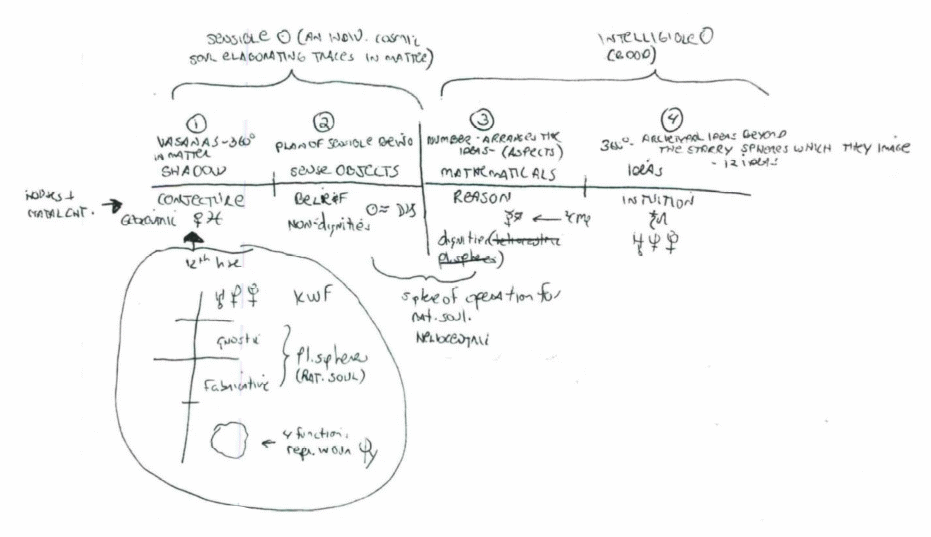
Plotinus says an individual cosmic soul elaborates the blueprint of the universe. Our sensible sun is such a soul in its outermost manifestation. The Intelligible Sun, as Plato says is the One (or the Good) and it imparts Truth & Being. The Good produces the Idea of the Good, i.e., the I.P. [Intellectual-Principle]. In the divided line, the top is Being, the bottom knowledge; but before the line is divided up, there are the Intelligibles, the knower and knowledge fused as one. The Good imparts Being to the intelligible object and the power to know. The sensible sun has a sketch of the intelligibles and elaborates that Idea. In this context the part of the line farthest to the right would be the Ideas in the Nous, and the second part would be the universal soul and reason. What is lower than this is the elaboration of a cosmic soul. The gnostic powers in the Soul ring would be found in the universal soul, where reason is, whereas in the individual soul they would be fabricative, i.e., the 6 Forces. This would be the paradigm for the non-dignities, as the 6 planets in the universal soul would be the paradigm for the dignities. The divided line in this context consisting of Nous, universal soul, cosmic soul, and the 12th house is the paradigm. Then put into the 12th house framework it can be used again. Here Uranus, Neptune, and Pluto would be in the highest part and the gnostic planets would be in the second, the fabricative planets in the realm of belief, and last is the imagination. All this is 12th house. In this context the fabricative planets are linked up with the 6 forces, and the gnostic ones, with the universal soul. One and the same soul traverses the whole line, and it exercises its powers that are adequate to each level of reality that it is immersed in.
KCB [Krishnachandra Bhattacharyya] writes in different places about the 4-fold function of the [mind] like Jung's 4-fold within the psychological processes, and also about knowing, willing and feeling. In a tentative designation of these different functions, within this second context of the divided line, Knowing, Willing and Feeling as represented by the trans-Saturnians are at the highest part of the line, where it is completely outside the imagination. The 4-fold psychological functions, knowing, willing, thinking, & sensing, although terminologically confusing, is assigned to the lowest part of the line. The two parts in the middle are the rational soul, as it either looks up or down. When we think of the soul as immersed in the ego, it is identified with its psychological functions, and it operates with conjecture in the realm of conjecture, but its other higher powers are also brought to bear in the realm of conjecture as well, it's just that they are identified with that realm. The soul could be just identified with its sensible environment, but it also could know by the Nous what the sensible really is. In the highest part where the 360 Ideas are one unified field, and number (second section) would determine what part of the unified field would be combined with another. Number is the section where the Intermediates and pure mathematics would be. In the highest part on the top line would be Being as the 360° Reason Principles, and Uranus, Neptune, Pluto would be the power to know. Knowledge is one eternally continuous unbroken expression represented by the whole divided line. It is our understanding that is broken. The dignities are the undivided mind of an individual. The two middle parts here are the heliocentric perspective. The second part of the line, belief, if it was looking up to the rational soul would have as its object the organization of the ideas in their seminal form. In other words the fabricative planets receive from the gnostic part of the soul the mathematical formula or what and how to construct an entity. They bring together the forms within the soul with the mathematical relationship of how they'll be interfused, but still this functioning is not yet within the realm of the vasanas. The blueprint of each sensible thing is now made, and it is this that is going to be inserted in the sublunary realm combined with the vasanas and tropes to make the actual entity, as the last part of the line. The 360° are also here, but as the final deposit or residue of the ideas which are above. On the extreme right are the archetypal ideas, the unified field forces, at the lowest in the sublunary realm are left behind the traces of the Ideas in the tropes, or matter. The totality of the traces of the Ideas left behind in matter is equivalent to the ancient concept of the dragon. Each part of the line where the appropriate functioning is going on even in the realms of belief and conjecture could be said to be gnostic in some way, in contradistinction to the division of gnostic and fabricative planets in the rational soul. The gnostic subject of the lowest part would be the natal chart. The two middle sections as the gnostic and fabricative aspects of the rational soul are the undivided mind, and the lowest section as the natal chart, where the planets split into opposites in the manifest psychology is the divided mind. When the planets are on degrees and psychological functioning takes place in a polarized way, space and time are then present, and thus the houses are created. Because there's a subject-object split with the ego and its world in this realm, the opposite houses arise as a result.
The functioning of the vasanas is what we know here in the lowest realm and it takes place within time and space. But this is not the same time and space of the Idea of the World which comes into being.
The soul fabricates the universe each instant. Time is the correlation of the soul's production of the universe. This is absolute time, and Euclidean space, whereas the subject-object split necessarily creates relativity in time and non-Euclidean space. The absolute space and time is in the subtle plan of the universe, whereas relative space and time is in the realm of conjecture, where the vasanas are. So the soul's understanding of what the vasanas are and its reaction to it is what establishes the Nidana Chain. Insofar as there is a reaction, then there is a consequence, and if there is a consequence then there is karma. The two middle parts -- that of the rational soul is where true apperception takes place. In looking down it sees its own production as the bifurcated subject and object as a whole, because the mind here is undivided. But only perception can take place within the realm of conjecture, as the divided mind cannot see beyond its apparent empirical subject-world object-dichotomy.
In the apperceptive act, the soul is aware of the empirical subject and its world as being "2 ends of the same stick" within itself. Insofar as the intent of the soul is concerned with its production, it awareness is on the realm of conjecture, but insofar as the soul sees the empirical subject-world as a whole, within itself, its awareness is in the realm of belief.
The middle realm of the divided line is the heliocentric system, and the Chaldean planets in it function in either of two respects. Some were the agents for the fabricative bodies, and others were vehicles for the higher will; non-dignities and dignities, respectively.
Knowledge is a unity as is represented by the extreme right of the line. Moving to the left there is more of a split between the subjective knower and the knowledge that it apprehends. Any functioning that is a gnostic one can have an intuition into the realm below it, but not the other way around.
[AD Supp, pp. 1241-1244 Ends]
[AD Supp, p. 1245 Begins]
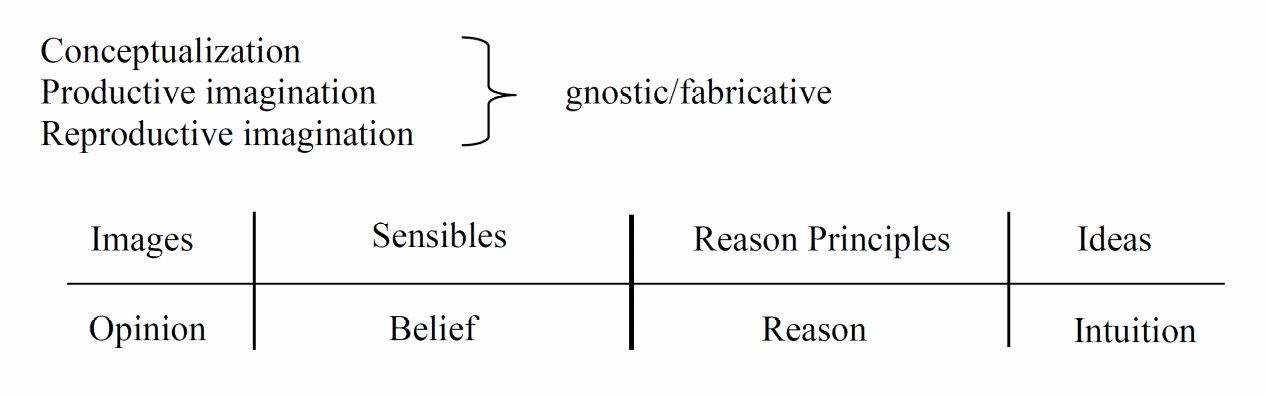
[FIGURE 1983 0108-1. Conceptualization/Imagination & Gnostic/Fabricative; Divided Line. Computer generated by NT from AD Supplementary Material, p. 1245.]
1. What is the relation of conceptualization to imagination, both productive imagination and reproductive imagination?
2. In the divided line what level does the productive imagination correspond to (is it at the level of sense, since it produces the objectively given world, or is it higher)? What about conceptualization -- is it at the level of conjecture or reason? (But it seems obvious that the reproductive imagination is at the lowest level, of perception of shadows--right?)
3. The divided line has to do with the 4 gnostic faculties, and has nothing to do with fabrication--right? Is the productive imagination, Sun in Aquarius, fabricative only, or is it gnostic also? What about the reproductive imagination?
4. Is conception a type of imagination, or vice versa?
[AD Supp, p. 1245 Ends]
[AD Supp, p. 1246 Begins]
[Note: The following is handwritten by AD.]
Look up Plato's remark.
Look up the Elements in HP. B [Helena Petrovna Blavatsky]
[AD Supp, p. 1246 Ends]
DIAGRAM AND CHARTS FOR 1983 0108
Class
Saturday, January 8th, 1983
Verbatim, unedited transcriptClick the series name to view more
CLASS at Wisdom's Goldenrod, Hector, NY
with Anthony Damiani (AD)
January 8, 1983
ASTRONOESIS; NATURE; DIVIDED LINE
with Appendix: 1983 0108 Partial Transcript.
TOPIC: Astronoesis
SUBJECT: Nature
SUBSUBJECTS: Divided Line, Perception/Apperception, Astrology, Dignities/Non-Dignities, Gnostic and Fabricative, Trans-Saturnians, Jung's Chart
CONTENTS:
Discussing Divided Line diagram
Intelligible Sun and Sensible Sun
Sensible Sun elaborates sketch of the universe
Soul as unity and plurality, one soul traverses whole line
Distinguishing four functions of antahkarana and knowing willing and feeling
Top level: 360 degrees, 12 Ideas as Being; Uranus Neptune Pluto, Saturn in Leo as power to Know
Second and third sections belong to rational soul
Second level: number, mathematicals, aspects; Reason, gnostic dignities, Jupiter in Virgo through Mercury in Sagittarius, heliocentric perspective
Idea as unified field, number breaks it up
Knowledge expressed by divided line is eternal continuous knowledge; it is our understanding that breaks it up
Dignities represent undivided mind of an individual
Quantification of Ideas is what the gnostic part of the soul has for its object
Third level: plan of sensible being in seminal form, blueprint; Belief, fabricative non-dignities, Moon in Capricorn, Sun in Aquarius, heliocentric perspective
Fourth level: vasanas, 360 tropes; Conjecture, Mercury in Pisces, geocentric perspective, natal chart and houses
360 tropes give clue to 360 Archetypes
ME Jones Sabian symbols: includes both tropes and Archetypes
Dragon as 360 tropes, the Worm; celestial dragon as 360 Archetypes
Dragon as subconscious, as Jung's two million year old man
Belief: when you externalize an idea you believe in the production
Once planet fixed on a degree, you create opposite degree and houses
Sections two and three are undivided mind, section four is divided mind
Sections two and three equated with apperception, section four with perception
Planet fixed on degree is incarnation of a vasana
Absolute and relative time and space
Nidana chain = soul's understanding of vasanas' functioning and its reaction to that functioning
Undivided mind can apperceive subject-object relation, empirical subject can't do so
Sun has knowledge of how it will elaborate the universe; would take working mathematician and physicist to figure out
Planets as agent (fabricative non-dignity) and vehicle (gnostic dignity)
More discussion of perception vs. apperception
Apperception equated with KCB's reflection
Savikalpa and Nirvikalpa, Savitarka and Nirvitarka
Student discussion of trans-Saturnian symbolism being introduced at level of Saturn in Leo
Transiting trans-Saturnians actualize and give insight into natal Chaldean degree meaning
Jung's Saturn at Aquarius 25: rebirth through recognizing rationality in images
Opposite at Leo 25 in seventh house: indifference to the opinions and criticisms of his contemporaries allowed him to persist in elaborating the rationality in images
Saturn in rulership, first house: reflectively identified with the incarnation of vasanas, sees himself as a rational person
Rulership as conformity to World-Idea
Jung's Uranus at Leo 15: a knowing of the archetypes as fundamental to images; higher knower structured to know the nature of the lower as based in tropes, organized to celebrate the lower
Transiting Uranus on natal Saturn: heightening of the meaning of senex consciousness; realized archetypes as basis of self-knowing; increased significance of vasanas for him
Ego as valuable means of reaching truth through content that's been deposited in it
Jung chose to believe in ego over higher self, only changed towards the end
Neptune on Uranus: linked self-concept to archetypes; self as totality of archetypes
Jung's knowledge grew and evolved as the trans-Saturnians hit the natal Chaldean dignities
Reviewing trans-Saturnian transits to Jung's dignity and non-dignity planets
Transits to non-dignity correlated with activity, transits to dignity correlated with understanding; both necessary
Transiting trans-Saturnians seem to lift natal Chaldeans out of lowest section of divided line into sections two and three
Transiting trans-Saturnians as real knowers, possible to identify with them even when they transit a non-dignity
Appendix: Partial Transcript
BOOKS READ FROM OR REFERENCED:
Plotinus, The Enneads (MacKenna translation, 4th ed.)
Plato, Republic
Titus Burckhardt, Alchemy: Science of the Cosmos, Science of the Soul
T. Lake Harris, Arcana of Christianity, Vol. 1, Part I
Marc Edmund Jones, The Astrology of Concepts
Marc Edmund Jones, The Sabian Symbols in Astrology
C. G. Jung, The Red Book: Liber Novus ("Septem Sermones ad Mortuos")
C.G. Jung, CW 8, The Structure and Dynamics of the Psyche, "Synchronicity: An Acausal Connecting Principle"
C.G. Jung, CW 11, Psychology and Religion: West and East, "Answer to Job"
C.G. Jung, CW 12, Psychology and Alchemy
C.G. Jung, CW 14, Mysterium Coniunctionis
C.G. Jung, Aniela Jaffe (ed.), Memories, Dreams, Reflections
SABIAN SYMBOLS: Taurus 4, Leo 15, 25, Aquarius 25
PLOTINUS QUOTES READ OR REFERENCED: VI.7.7
DIAGRAMS and CHARTS appended to this transcript:
FIGURE 1983 0108-1. Conceptualization/Imagination & Gnostic/Fabricative; Divided Line.
FIGURE 1983 0108-2-AB. Divided Line.
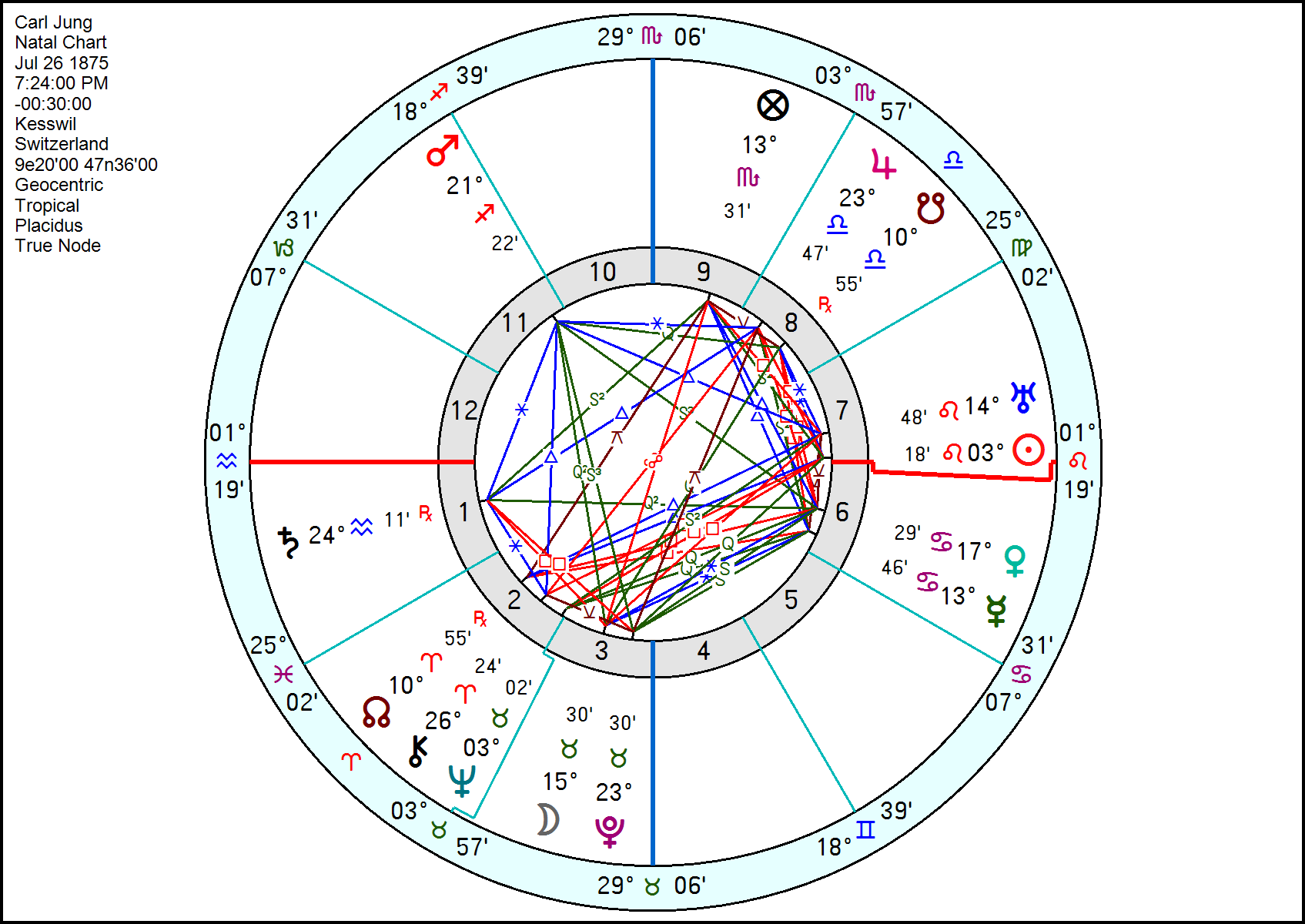
FIGURE 1983 0108-3. Carl Jung Natal Chart (astro.com).
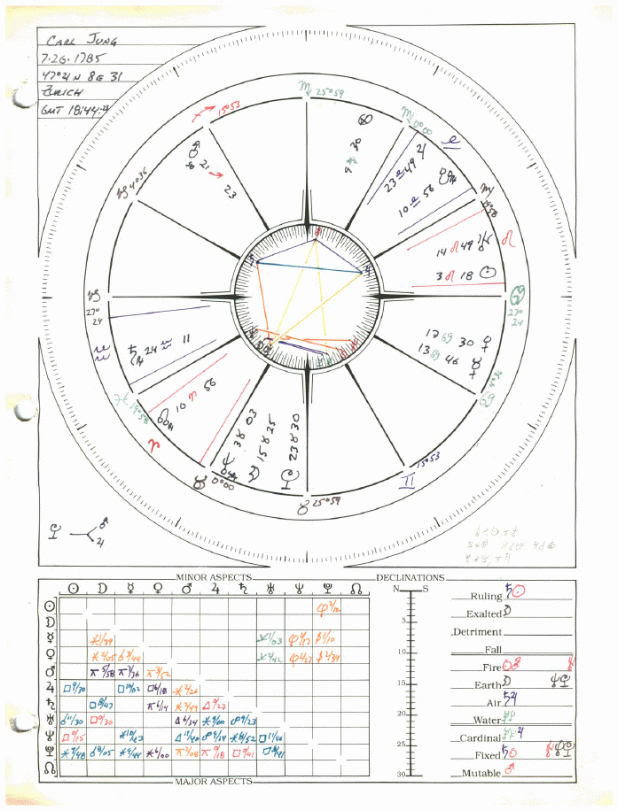
FIGURE 1983 0108-4. Carl Jung Natal Chart (WG version).
[Transcriber note: [diagram] means the speaker is referencing a diagram as he or she is speaking. If someone is drawing or writing, with audible sounds of chalk on a blackboard, I indicate this by [drawing] or [writing].]
NOTES:
We have an incomplete partial transcript for this class, Scan File AD SUPP 1241-1246 1983 0108 Plato divided line.PDF, which has been appended because it's a good summary and has a diagram. It summarizes only what's on the first audio file.
The transition from Audio File 1983 0108a to Audio File 1983 0108b is too abrupt, some material lost per AB notes.
This is a Saturday morning class.
TRANSCRIBED Verbatim by IT prior to 2018 (V11a). This is V12a (2023) and has: updated prefatory matter, footer, and audio file name; Book List and TOC completed, Subsubjects expanded; Plotinus quotes section added; new notes within transcript; Appendix redone with corrections and additions; divided line diagram from AB notes (and reference in transcript to this diagram) and two Jung charts appended; new formatting to accord with new conventions. Archival verbatim transcript – V12a.
AUDIO FILES: 1983 0108a, 1983 0108b. [Note: "Tape" and "Side" refer to original audio cassette tapes that were later digitized into .MP3 Audio Files.]
1983 01/08 at Wisdom's Goldenrod
Astronoesis; Nature; Divided Line
[Audio File 1983 0108a Begins]
[couple students at once, few words inaudible]
[Note: See FIGURE 1983 0108-2-AB, Divided Line, appended to this transcript for the following.]
AS (simultaneously): [three/few words inaudible] the planetary spheres, [AD drawing/writing] the Solar-- Solar Logos or the Sun, cosmic soul. But I-- and it's-- the-- those soul powers operated in two directions, they were both gnostic, we spoke of them [one/two words inaudible] and they were also fabricating--
AD: Well, you would have to do this first [AD indicates on diagram], right?
AS: Yeah.
TS (possibly part of background): Ok, what is it? [couple words inaudible]
AD (simultaneously): And this-- this was the sensible Sun [diagram]? Let's do that first. Now the sensible Sun would be an individual cosmic soul? If we go back to what Plotinus said, remember he said an individual cosmic soul elaborates the-- the sketch of the universe. [AD drawing/writing] [couple inaudible TS words simultaneous with AD, possibly part of background] [one/two words inaudible] laid down by the Universal Soul. [Note: Plotinus, VI.7.7, third para.]
AS: Yeah.
[student assents]
AD: Remember that quotation, right? [AS assents, faint] That's the Intelligible Sun [diagram].
[short pause while someone draws/writes, probably AD; continues as class continues]
AS: Now by Intelligible Sun we mean-- do you mean it to be an in-- the intelligence of an individual cosmic soul or do you mean it to be the Universal Soul's?
AD: Well, if we go back to the quotation of Plato I think he said that-- that he referred to that Intelligible Sun as the One, the Good? He says [AS simultaneously: Ok.] the Good imparts--
AS: Yeah.
[short pause with background student talking]
AD: The Good imparts to--
AS: To the Intell-- [AD simultaneously: Uh-huh (couple/few words inaudible)] the power to Know and the power-- and the Being.
VM (simultaneously): That which is known.
AS: And that which is known.
VM: Right.
AD/S(?) (faint): Right.
AS: [few words inaudible]
AD (simultaneously): So (then) the Sun on the right-hand side [diagram] would be the Good which imparts those two, Being and Essence.
VM: Is it the Good or the Idea of the Good, not to get picky Anthony, I mean is it-- is it the Nous--
AD (simultaneously): Well (here's) the Good--
VM: Is it the Nous or the One?
AD (simultaneously): --Good gives or imparts Truth and Knowledge, or Truth and Being. That means that the Good makes or it brings about the Idea of the Good. The Idea of the Good is the Intellectual-Principle.
AS (simultaneously): [one/two words inaudible]
VM (simultaneously): Yes, I know, that's what I was asking, I mean which-- which it was, but you're saying it's really the Good. Ok.
AD: Well the Good is superior to the Intellectual-Principle.
VM (simultaneously): No I understand that.
AD: Yeah. So insofar that the Idea of the Good or the Intellectual-Principle is the product of the One or the Good, alright, then he was saying, he gives the analogy, well, in the same way that the One gives to the Intellectual-Principle its Being, [VM assents] alright, and its Knowing, [VM assents] makes Truth possible, the sensible Sun does the same thing but at a much lower level.
AS: Ok, now, Being and Knowing, would-- wouldn't you say that by Being and Knowing you're talking about the upper and lower half of this line [diagram].
AD (simultaneously): Yeah, uh-hm.
AS: You're saying-- and in fact before he even divides this up, [AS drawing/writing] he calls this the Intelligibles [diagram]. He calls the joint object (of) these two, I think he says these-- this is the Intelligible object [diagram] and this is the sensible object there [diagram]. And he's saying that imparts Being [AS indicates on diagram] to the Intelligible object and the power to Know, which I thought you would put on the bottom [AD simultaneously: Yeah.] of the line and the top of it [diagram].
AD: Alright, and then if you remember the way they speak about the sensible Sun, the way Plato speaks about it and also the way Plotinus speaks about each individual cosmic soul for instance elaborates the universe, [AS assents] alright, according to a pre-figured plan. So then that would be the sensible Sun already has so to speak the sketch of the Intelligible, alright, and elaborates that Idea.
AS (simultaneously, faint, sounds like part of background): [few words inaudible] Yeah.
S (very faint): What did he say?
AS: Yeah. Well, in that case-- Well then it seems like you're sa-- no.
AD: I didn't say it, they said it.
AS: No, no, I mean but the cons-- I-- ok. Suppose we follow that so far then, the way then-- in the diagram then, at the highest level, and I thought you were using it down much lower but if you start there, then the highest level here has to be like the Nous, seeing the Ideas with intuition, this is the Ideas and the Nous [diagram]. And the next level would have to be like the Universal Soul, where you put reason [diagram]. [short pause] Right? I mean and then you would say that what elaborates that is the lower half, analogously now a cosmic-- any-- any individual cosmic soul which would elaborate that., that's here [diagram]. It's-- this is elaborating what's over here [diagram]. That this is the Intelligible World as it were, the Nous and the Universal Soul [AS indicating on diagram]. And this would have to be the cosmic soul with its belief and conjecture elaborating this [AS indicating on diagram]. And side issue, but that would fit in with what you were saying last night about those gnostic powers of the soul ring, [student assents] that the-- sorry, that the dignities in the soul ring would be the gnostic powers. Whereas for the individual soul they would be fabricative, six forces, so you could put the six forces here [AS indicating on diagram], fabricative, and that's the paradigm for the non-dignities. And the six planets in the soul ring, the gnostic side, in the Universal Soul, would be the paradigm for the dignity. That's-- I mean a-- that just fits with what you're saying but it's not--
AD (simultaneously): That seems to be the consequences of what [VM assents] [one/two words inaudible]
LR (simultaneously): Right, but then we wouldn't put Uranus, Neptune, and Pluto up there.
TS (simultaneously): No.
AS/TS(?): Oh but--
LR (simultaneously): We would put them all the way down in the sensible.
AS (simultaneously): No but I'm just-- [few inaudible TS words simultaneous with AS] oh but wait. Yeah but I would-- but-- Actually you wouldn't put any of those, [AS drawing/writing] you wouldn't put dignities [LR assents] or non-dignities in the paradigm one. The paradigm you're saying is Nous, Universal Soul, the individual soul's power and then whatever is fabricated, like the 12th house, would be all the way down there [diagram]. Then you take the whole thing and put it into the 12th house. So, the-- [AS drawing/writing] this, if you're saying like this is the 12th house, in this large-- in a very large scheme, then all of this divided line is now going to appear in the 12th house [diagram]. Right, I-- I think maybe that's what you're saying and then there you might say that-- there you would have a thing with Uranus, Neptune, and Pluto [diagram]. And then the planetary spheres, one aspect of them would be in conformity with the Universal Soul's gnostic functions and the other one would be in-- would be fabricating. And then over here you'd have the imagination [diagram]. So that would all be in the 12th house. And now (what) Vic was saying that the fabricative powers [AS drawing] are linked up to the six forces whereas the gnostic powers of the planetary spheres are in conformity with the Universal Soul's reasoning.
AD: And now upon the other side you put the soul and show it as a unity and a plurality. It has powers that correspond or that are a-- are adequate for the object. So the soul immersed so to speak in the sublunary realm, alright, has powers that are-- that can deal with that. One and the same soul traverses that whole line.
RC: When you have the second level of the line all in the 12th house, when you do it that way, would you have the primal image at the top and the generic image at the bottom?
AD: Repeat?
S: No.
AD: Won't you have the primal image--
RC: When you put-- you put the whole thing in-- in the 12th house.
AD: Uh-huh.
RC: Would you have the whole 12th house as the primal image and then the bottom of the 12th house 4-fold line be the generic (image)?
AD: The image generated in an individual mind.
RC: Yeah.
AD: Yeah.
RC: Ok. So then, in that-- in that context, the whole-- it seems to me that the whole second line becomes perception of the realm of sense.
AD: The whole second-- you mean--
RC: The whole 12th house line. The 4-fold 12th house line.
TS(?): Right.
S (faint): Randy--
[27½ second pause with faint background student talking]
AD: Instead of jumping to that Randy, why don't we try this here? You know, we can take the example for instance when we're reading the Vedanta, alright, they speak about, what is it, the antahkarana as having four aspects. Or if you speak of Jung he has four psychological functions, alright. But then one and the same man, KCB, in his exposition of the Vedanta speaks about four [VM: Sure.] aspects of the mind of the antahkarana, alright, and then he speaks about-- in another essay he speaks about thinking, willing, and knowing. [student assents] Now, are they the same thing or are they different things?
S (faint): It would seem they're different thing(s).
AS: I think they'd be different.
AD: I think they're different too. It seems that the four functions seem to be let's say down at the bottom, you know. In other words, they are-- in our psychology, those four functions are represented in our psychology. Whereas, I think the top is not represented in our psychology, it isn't in our psychology.
RC: You mean the top-- the horizontal line [diagram].
AD (simultaneously): Yeah, the thinking, willing, and knowing.
TS: You're saying that here you have [TS drawing/writing] the four functions [diagram]. [student assents] Is that right?
AD: Yeah.
AS: [one word inaudible]
TS (simultaneously): And this is all in the 12th house [diagram].
AD: Uh-huh.
TS: And this is the four functions [TS drawing/diagram].
AS: And at the top--
AD: Alright, and in between you have the planetary spheres [diagram].
AS: And at the top you have knowing, willing, and feeling [diagram].
AD: And on-- yeah. Now if we say in between you got the rational soul, which can identify either with what's below or with what's above. Now if (I/it)-- if it identifies with what's below, alright, then we can speak about it immersed in psychological functioning, and then you could speak about the antahkarana as having four aspects. Or, if you use Jung's terminology, which will be confusing, he speaks about sensation, feeling, you know, intuition, (I think) something else.
S: Thinking.
TS: Thinking, yeah.
[student assents]
AD: Now that seems to be confusing with what we got up above. Because thinking and feeling that he's talking about inside the psychological functions, alright, KCB for instance doesn't speak about them as inside the psychological functioning but as directing that functioning or even ordering that functioning. So that there's-- there's a little bit of confusion here. And we have to clarify, you know, for ourselves at least, what does it mean to speak about the four functions within our psychology and what do we mean when we speak about willing, knowing, and feeling as something which is organizing, directing, or let's say that that is the content of its functioning.
AS: Yes, well, one other [AD simultaneously: Go ahead.] thing. In this dia-- the lower diagram, you're saying like now for an individual-- this could still be the cosmic soul, that lower divided line is for the cosmic soul. Ok now for an individual, take his chart or whatever, the individual, like this individual ray of his soul is-- has all those functions but it's all operating in the lowest little imagination thing there, in his chart actually. Let's say well all-- all of those functions, all those psychic functions are operating [AD simultaneously: Yeah that's-- that's--] in the lowest realm. And that seems to be where the-- where that problem is.
AD (simultaneously): That's why I thought that this was a good representation of the difficulties. If we say that this is one soul, [AD drawing/writing] it goes all the way down [AS assents] to here [diagram], alright. [AS simultaneously: Right (couple words inaudible)] Then it has corresponding powers to deal with all those different levels. But over here we already pointed out it seems that we got two levels, one is Intelligible, one is sensible [diagram].
AS: Ok, now-- ok my one-- one last little-- the one difficulty I have-- not the one, but one difficulty. If this one soul here is operating at the lowest level, the-- one thing that seems to come up, is it operating with the function that's peculiar to that level, in other words conjecture, or are we also saying that since it has all of these other powers, they are also operative within that lowest level? There may not be any difference between the two things. But you have one soul, it's not two s-- it's one soul with many powers. Now obviously it can operate with its lowest power of conjecture in the realm [AS indicates on diagram] of conjecture. [AD simultaneously: Yeah, so--] Does it also operate with the higher powers within the lower realm of conjecture?
S (faint): Yeah, right.
AD (simultaneously): Yes, it can do both.
AS: Ok [one word inaudible]
AD (simultaneously): Alright, so if we think of that soul as immersed in the ego, alright, then we will speak about that soul as operating through its psychological functions, [AS assents] it's sub-- it's sub-- submissive to [AS assents] the cosmic soul's environment or, you know, its universe, its environment. But that same entity, that same soul, could understand what the sensible world is about because he also has powers functioning above that line, alright, and understand by the Nous what the sensible is.
AS: Yeah, or even by say the gnostic-- the second level down, or even by [couple faint inaudible words]
AD: Alright, is that a background to get you started?
TS: Well--
[student assents, faint]
AS/TS(?) (very faint, possibly part of background): (I think I can't even think.)
TS: No, um-- When you talk about this one soul, here [TS indicates on diagram], that from what you just did, if I followed you and Avery that, in this upper divided line when you speak about this as the Intelligibles and the sensible, in one way you could say that this, as far as the soul was concerned this is Saturn in Leo [diagram]. [TS drawing/writing] And, then this would be Jupiter in Virgo through Mercury in Sagittarius just being the Uni-- the powers of the Universal Soul [diagram]. And then here you have the Capricorn Moon and the Sun in Aquarius as creating some kind of individual cosmic soul [diagram]. And that this guy here is the Mercury in Pisces [diagram].
S: [couple words inaudible]
S: What?
S (faint): [couple words inaudible]
S (faint): His reasoning.
S: Yeah.
TS: I thought that's what you did. [RC assents, faint] No? Ok, [possibly another student: well I'll keep it].
AS (simultaneously): Yeah. No, that's ok, and then what--
TS (simultaneously): So that's one soul that that's [S simultaneously, faint: How do you put the--] going from Leo all the way to Pisces.
AS: I (guess/get--) the point is now, you can put the Mercury--
TS (simultaneously): Now is this guy here, [TS drawing/writing] the Mercury in Pisces only, is this the third-- when we speak about this soul which is immersed in sensible world, is this all under the Mercury in Pisces, the third phase of the soul only, or is there in-- are all-- or are all three phases of the individual soul involved when you speak about this one soul? [short pause] 'Cause now we're-- this is all in Pisces, this is all what's referring-- reference [couple words inaudible] the world.
[student assents, faint]
VM: Isn't that the same question that Avery asked in a way?
S: Yeah.
TS: Yeah.
S: Ok.
VM: Let me see if I understand you Tim, you're saying-- you mapped out those four functions of the soul using the soul ring. Now you want to ask, when that's all invested or inserted, whatever the proper word is, in the 12th house, would you say that the Saturn in Leo for example has um-- (what would you want to say), [LR: Representative.] has a representation, that's good, in-- in the sublunar.
TS: Yeah.
[student assents]
VM: But I thought we said before, I mean that the-- that the-- the knowing, willing, and feeling or the Jupiter Neptune-- I'm sorry-- [LR: Uranus, Neptune.] Uranus, Neptune, and Pluto were in some way representative of that-- that highest soul.
TS: Yeah, we've said that.
VM: We've said that, ok.
AS (simultaneously): The problem is if you answered [couple inaudible student words simultaneous with AS] yes-- yes because you-- is there a representative there, the-- the yes answer doesn't really tell you what-- I think doesn't tell [TS assents] you what you want to know because to say there's a representative--
TS: Doesn't tell you whether it's there or--
AS (simultaneously): Right because obviously it's a representative, the whole thing is the representat-- this representative of the line. I mean, it seemed that we said that this is within the Mercury in Pisces, especially this lower divided line.
LR (simultaneously): Yeah but I mean most of us said that Uranus, Neptune, and Pluto represent the highest part of the soul.
AS: Right, exactly.
TS (simultaneously): [few words inaudible] that's [one/two words inaudible]
VM (simultaneously): (Take it/Taken) for granted, what-- you're asking what does that mean, is that what you're saying?
TS: I guess that's what I'm asking.
LR: He was asking are we still saying that.
VM: Are we still saying that. (VM laughs a bit) Hate to do archaeology but keep going.
TS (simultaneously): Well I'm not trying to go back, I'm just trying to understand that when we speak-- if we're talking about this diagram here, [VM assents] and we're saying that the soul has four functions which can operate in the psychological and with the fabricative, then with some kind of ra-- image of the rational soul and some kind of image of the-- of intuition, you know, are we saying that this is an in-- that this unity, u-- one soul is the Saturn Jupiter Mercury [someone drawing/writing] of one individual soul which is then functioning in the cosmos? Or is it just the Mercury part of that individual soul? I mean it seems to me that it would be the latter, that it's just this Mercury.
LR: But when you say just this Mercury, it doesn't mean that it's cut off from-- it means that this Mercury I-- and this somewhat of what we're speaking of last night too, it means that the Mercury is n-- is the manifesting of that whole unified soul in a sense.
TS: Uh-hm.
LR: I mean it doesn't mean that the Mercury part is just going to take the lowest part and put that here and everything else is somewhere else. So when you say Mercury you mean that Mercury is now going to fabricate or make an image of or place the being in the world. It's not like all the rest of them are somewhere else. I mean there would still have to be-- You know, I'm just trying to hold onto the idea that the-- it isn't-- the soul comes all or nothing in some way. You don't break it into parts and send one part down there and another part somewhere else. It's under the governing-- the governance of Mercury because yesterday--
TS (simultaneously): Let me ask it a different way. Is this an elaboration-- ok, granted that I'm not-- I'm not trying to--
AD (simultaneously): Let's-- let's do this, Tim. Where the Ideas are, put the 360 degrees [diagram].
S: Where the-- you mean one above the other?
[faint background student talking, TS drawing/writing]
AD: Now, those would refer to the archetypal Ideas which are beyond the starry spheres and represented by those stars. That's the realm of the Ideas, alright.
VM: Why wouldn't you put 12 Ideas up there Anthony?
AD: Yeah.
VM: I'm sorry I'm being picky about numbers but--
AD (simultaneously): Listen, how do you put the 12 Ideas?
VM: But I mean I thought when you made those Intelligibles, you were trying to really distinguish them from let's say the representation that we have in the 360 Sabian symbols.
AD (simultaneously): Alright, put the 12 Ideas. Put the 12 Ideas.
VM (simultaneously): Ok, you don't have to (put them) as long as I understand what you mean.
AD: Put 12 Ideas. [short pause while TS draws/writes] And the next-- the next phase you would put-- below that would be what? What phase of the soul?
TS: Well in-- if you say this is the-- the 360 degrees, this would be the Saturn phase of the soul.
AD (simultaneously): The trans-Saturnians, wouldn't it?
TS (simultaneously): Or the trans-Saturnians. (bit of laughter, student words)
AD: Uh-huh. You worry about the symbolism too much right now. That would be the trans-Saturnians that deal with those, right?
AS: Ok. Yeah, good. Well I--
TS/S(?): Please.
AS: And by that you mean that Uranus, Neptune, and Plu-- the trans-Saturnians w-- in the quote where he says the Idea of the Good gives the pow-- or the Good gives the power to Know, Uranus, Neptune, and Pluto represent the power to know, and the 360 are like what is known.
AD (faint): What is known.
AS: The object that they know. Uh-hm.
AD: Alright, so those would be the archetypal Ideas, not in the Jungian sense, in the Platonic sense, the archetypal Ideas.
AS: Yeah.
AD: The next one, what would you put there?
AS (faint): [one word inaudible] me. I don't know that.
TS: Well--
AD: If we say that those two in-betweens [diagram] belong to the rational soul.
TS: For the moment I would say that this is-- this [diagram] would be a heliocentric perspective of the planetary spheres, ok. And, we've called that the dignities.
AD: Yeah. We referred to that as [TS drawing/writing] the gnostic dignity.
TS: Well ok, I don't want to ask the question (quite--)
AD (simultaneously): Now what would be the object that they know?
TS: If I was to call-- allowed to call this the-- the heliocentric in total, then I would speculate that this would be the aspects [diagram]. That these were the intermediates or the mathematicals that are going to combine these degrees in specific way to embody them over here [diagram]. I'd guess that this would be the-- all the different possible aspects, squares, trines, the different geometric forms.
AD: Intermediates then. Mathematical formula(s) by which the Ideas are combined.
LR: Actually--
VM (faint): Intermediates.
AD: Mathematical or intermediates.
TS: Yeah, I have--
[TS drawing/writing]
AD: In other words, the Ideas or 360 degrees or the [AS simultaneously: That's how they're combined.] 12 Ideas, alright, in themselves are like a [AS simultaneously: They're on a--] let's say unified [VM simultaneously: Oh, right.] field, one Idea at a time, alright.
VM: This is Number as taking those Ideas into--
AD (simultaneously): Yeah, now [AS simultaneously: Combination (one/two words inaudible)] Number would have to determine, [VM assents] alright, what part of this unified field force, what part of this unified Idea, what part have to be brought together to-- alright? [AS assents, faint] That's why I don't think Einstein would ever get to a unified field force.
[short pause while TS draws/writes]
TS: We usually call this reason-principle [diagram] I guess. That's--
AS (faint): [few words inaudible]
AD: Yeah that would be reason-principles, of course but, we want to be a little more specific so that we don't confuse them with the reason-principles above.
LR: But actually Anthony are you saying that the-- in saying that the Uranus, Neptune, and Pluto are-- is the power to know, wouldn't that be continuous of--
AD: The knowledge which is being expressed by the divided line is an eternal continuous knowledge.
LR: Right.
AD: It is never broken up. It is our understanding of it that's broken up.
LR: Right. Now, is there ever a subject symbolized besides? I mean you're saying Uranus, Neptune, and Pluto represent the true gnostic subject. Right?
AD: Yeah.
LR: Now, by putting the dignities on the bottom and not the top of the line, you're saying that the planets in dignity represent an apparent subject? Or do they actually have the power to know also?
AD: I would say they'd represent the undivided mind of an individual. [short pause] Let's try it. Alright, those two intermediate realms, alright, we say are-- is like the-- the realm within which the rational soul operates.
AS: What's the other half here, the--
AD: The two of them, alright.
AS: No I mean the sec-- the lower, belief?
AD: Well I didn't get to that yet.
AS: Yeah, ok.
S (simultaneously): Oh.
AD: I'm just saying those two seem to be [AS assents] where the rational soul operates. One side--
TS (simultaneously): These two [diagram]?
AD: No. The two middle ones [diagram], yeah. Where you would put the heliocentric theory.
[18¾ second pause while TS draws/writes]
TS: So then-- ok. Does this make sense to you? Is this where you would put aspects [diagram]?
AD: Yeah. Yeah, you refer to them as aspects and they refer to them as mathematical.
[short pause]
TS: And you wouldn't put the non-dignities in the fully-- [13 second pause while drawing/writing] And we said that there are-- they-- they have the-- some kind of tropes or vasanas as their object?
AD (simultaneously): No, no, no. What would be their object? [short pause] If-- if we looked at above we said that the intermediates or the mathematicals showed the way that the Ideas are combined, alright. Let's say the quantification of the Ideas is what the gnostic part of the soul has for its object. Now if we go down to the next section [diagram], alright, and let's say that that's looking up to the rational part, I mean to the gnostic part, what would be the object there? Wouldn't that be like, let's say, the construction or the organization of the Ideas but in a seed form, in a seminal form, not a physical seminal form. In other words, what the fabricating planets do, alright, is they receive from the gnostic, they receive from that the mathematical formula of what and how to construct an entity. So they bring together, let's say, the forms that are within the soul with the mathematics necessary to relate the-- these forms within the soul to make an entity. We're still not-- we're still not in the realm of vasana. [students assent] I mean because you're-- you're out in the universe, you're out in the sky. If you speak about the fabricating planets, alright, you're speaking about the six Chaldeans or seven Chaldeans, but they're out there.
LR: But now you've got actually like the blueprint, the actual ideas of each--
AD (simultaneously): You got the actual blueprint, yeah.
LR: --of each sensible thing.
AD: Yeah.
LR: You don't yet have the image of it or the appearance of it but you have [AD simultaneously: Exactly.] the plan of everything [AD simultaneously: Yeah.] because you've combined all the Ideas.
AD (simultaneously): Uh-hm. Now it's [TS drawing/writing] that blueprint which is going to be inserted in the sublunary matter, alright, which contains within itself the vasanas or the tropes.
TS: And that's over here [diagram].
AD: That's there. [TS drawing/writing] We'll subject it to criticism, let's see if we could get a general idea. Now there you have the 360 degrees again [diagram]. But notice, they're going to be the residue or deposit of the Ideas which are above. So you have on the one hand the original archetype, the Idea beyond the starry spheres. [VM assents] Then you have the representation or the deposit of that in the dregs of matter all the way down, which is organized by the formula of the fabricative aspect of the planets, alright, and put or inserted into matter or body.
VM: Would you say this is the realm of the fixed stars in the-- in the last quadrant there or the last piece of the divided line Anthony, where the thr-- yeah, all the way to the left [diagram].
AD: All the way to the left?
VM: Yeah. Is that [AS simultaneously, faint: (couple/three words inaudible) the left.] the 360 degrees that we talk about as the fixed stars or are they up here?
AS: All the way to the right.
AD: No, no.
VM (simultaneously): See I guess I'm confused as to what level you're working this on.
AD (simultaneously): Yeah, well this is the point I want to make. On the one hand, the extreme right, you have the archetypal Ideas. They're like unified field forces, [VM simultaneously: Ok.] if you want to use a correlation, [VM simultaneously: Yeah, alright.] alright. At the very lowest, in the sublunary realm, you have the traces of those Ideas left behind in the tropes or in matter.
VM: Ok. So when we--
AD: So, that would be like the Ideas all the way down into the very dregs of matter.
VM: Alright, so when I read the book, Sabian symbol book, I'm reading something that's going to give me a clue into the left-hand side, right? Which granted is connected, le-- left--
S: [couple words inaudible]
AS (simultaneously): To the lowest. (VM laughs)
AD: Well, wouldn't you say that the left-hand side is going to give you a clue [AS simultaneously: Into the right.] as to what [LR simultaneously: Into the right-hand side.] the-- what these archetypes are.
VM (simultaneously): I agree, I agree because the right-hand side is in fact being instantiated in the 360 degrees on the left but I'm asking a mundane question. When I go look in Jones' book and I read the Sabian symbols, what he's trying to do is give me a picture, give me some intuition into what these tropes are on the left-hand side, is that right? Far lowest one.
AD: Yeah but, there again, I have a [TS drawing/writing] little difficulty because when I read the symbols, they take me to the right-hand side, [VM simultaneously: If you're any good at it.] but when I read the explanations they take me to the left-hand side.
S: Hm.
VM: Ok. That's fine.
AD: See the right-hand side has that tremendous matrix of possibilities which is like the nature of an archetype. I mean when you read the symbol it has such a plurality of meanings possible that it takes you to the notion of an Idea. When you read the psychological description, then you're really restricted to the sublunary realm. You can't hardly get out of a-- out of that realm because the description is about the way you're functioning psychologically. [VM assents] Now if you remember there was a criticism made by one of the Traditionalists, I forgot who. What was it, Alchemy? Yeah in Alchemy, if you remember, Burckhardt criticizes Jung [VM: Yes.] for mistaking the tropes for the archetypes and says-- and said something to the effect, "According to Mr. Jung, alright, he takes that which is immersed in the dregs of matter and calls that the Idea, confusing the Platonic terminology of an archetype, inserting it in matter or a trope and then thinking of this as the Idea." [Note: See Titus Burckhardt, Alchemy: Science of the Cosmos, Science of the Soul.] Alright? Let's go one-- one step-- one step further now. Now if we take the extreme left, alright, and we say there you have the traces of the Ideas as left behind in matter, then the totality of these traces which have left behi-- which have been left behind in matter is equivalent to the-- the-- to the concept that the ancients had of the Dragon.
[student assents, faint]
VM: The Earth Soul.
AD: Yeah. And it is this-- this concept of the Dragon, alright, which again is confusing because they speak about a celestial Dragon and they speak about the worm.
VM: I see, so this would be the worm on the left and the celestial [student assents] Dragon would be on the right [diagram].
AD: On the right.
S (faint): [one/two words inaudible]
[VM laughs, few seconds of mostly inaudible background student talking]
AD: Now, you remember the quotation by Harris, he points out that the celestial-- I mean the worm is [couple inaudible student words simultaneous with AD] that living entity or belt of living being around the world. And he speaks about the fact that it cannot experience itself except through individual entities. [Note: See T. Lake Harris, Arcana of Christianity, Part I, Vol. 1, pp. 100, 101.] So that, at the disposal of an individual entity, let's say, when Jung speaks about the fact that there's a two-- two-million-year-old man that you're constantly having a dialogue with, or if you speak about the subconscious mind of an individual, you're speaking about that entity. And that obviously has a-- an-- a knowledge, a wisdom and a power which is beyond our calculations. I think the confusion is going to be between those two realms, those two extremes. The same thing like when I read a chart, I have to make very clear in my mind what's the idea, alright, and what's the psychological manifestation of that idea. Avery, you were saying (something)?
AS: [few faint inaudible words] Well, those last-- the last two realms, now-- Are you still following the model all-- they seem in the Republic to talk about this model of, on one side, on the lower side you have these faculties [diagram]. And the object is on the upper side [diagram]. And the last two get a little bit-- we wanted to try and clear up. When he says that (they/there) are faculties, you seem to be saying from this that they're not necessarily gnostic faculties. Or else they're only gnostic as having the higher ones inherent in them. I want to try and clear that up.
S (faint): That's good, yeah.
AS: Ok in other words, don't-- the first-- I follow these, ok. You say this is what has the power to know, and this is its object, right, on the fir-- the Ideas are the object for Uranus, Neptune, and Pluto [diagram], the proper object. And the intermediates are the proper object for the dignities, the rational soul powers [diagram]. Ok?
AD: Uh-hm.
AS: Now, the proper object for belief is the subtle plan of the universe [diagram], which is basically the vast thought, you know, we spoke about at one time, vast thought, which is-- which has for its object belief, I mean which has for its kn-- the function which knows it is the function of belief. Now are you calling that belief a gnostic function?
AD: Yeah.
AS: Ok. And the lowest-- the lowest level--
AD (simultaneously): In other words, when you externalize an idea you naively believe-- "naively" may be mistaken but, you naively believe in the production.
AS: Ok, but I'm saying you are saying that's some kind of a gnostic [AD simultaneously: Yeah.] function. And the last one where you talk about the 360 vasanas in the Dragon, lower Dragon, and there the function of conjecture is the gno-- is the appropriate gnostic function that the subject has and that's-- the object of that is the vasanas [diagram].
AD: Yeah.
AS: Now-- Ok, then in some-- I mean, the way he seems to lay it out is that all of these are some kind of gnostic power which corresponds to the appropriate object. Now, you are saying in addition that the ones on the bottom [diagram] are in a kind of a continuity.
AD: Yeah. One and the [AS simultaneously: With the same soul.] same soul let's say, alright-- let's say operates in the Intellectual realm, alright, operates within the reasoning realm, [AS assents] and operates in the sense realm.
AS: And, it seems that you're saying that when it operates in terms of reason it's operating through what we call the dignities.
AD (very faint): Uh-hm.
AS: And when it operates in a realm of sense, here [diagram], [LR simultaneously, faint: Or belief.] it's-- or belief, it's operating through non-dignities.
AD (very faint): Uh-hm.
AS: And when it operates in the realm of the shadows, the vasanas, I'm not sure there what you would symbolize by the appro-- what's the appropriate symbol for that faculty of conjecture. I mean I see there was a fa-- there's a symbol for all of these down-- you know, I have Uranus, Neptune, and Pluto, you have the dignities, the non-dignities. Is there any particular symbol to symbolize the function of conjecture?
VM: The psychosomatic, Avery.
AS: Yeah but what, I mean--
LR: No in-- astrologically [one word inaudible]
VM (simultaneously): Which-- oh.
S (faint): What about the houses [one/two words inaudible]
AS (simultaneously):Yeah I mean particularly is there a--
S: Poetry.
AS: Or is that not a rea-- it may not be a reasonable question.
AD: Well let's give it some thought.
LR: Yeah, and the other thing is-- [VM simultaneously: That's the natal horoscope.] that's caused a lot of confusion, that [AS simultaneously: Gnostic (house).] we can't use the words 'gnostic' and 'fabricative'. [few faint inaudible student words simultaneous with LR] I mean that's I think where a lot--
AD (simultaneously): You could use the words if you want, as long as you know what you're trying to express. (bit of laughter)
VM: Socialist [one word inaudible]
LR (simultaneously): But you can use the words 'gnostic' and 'fabricative' but the reason it's confusing is, these are all you've just said gnostic-- these are all gnostic [AD simultaneously: Uh-huh.] faculties. [one/two inaudible TS words simultaneous with LR] So if we distinguish the--
AD (simultaneously): And you look at your use of the term 'fabricative' as included within [LR simultaneously: Gnostic.] the gnostic--
LR: So one [AS simultaneously: (Faculty.)] is gnostic-gnostic and the other is gnostic-fabricative?
S (faint): Oh good. (bit of laughter)
LR: Do you see what I mean? They-- we--
AD: Yeah, I see what you mean but I can't-- you know, I can't make that distinction because if you're doing something you certainly know what you're doing.
LR: Oh. Alright. (some laughter, student words) Before we said the dignities were gnostic and the non-dignities were fabricative. This diagram says that both the dignities and non-dignities are gnostic.
AD: Yeah.
LR: One is more building up the vehicle and the other is more getting to the idea. But they're both gnostic. So within [one/two inaudible student words] the gnostic faculties we have some which were concerned with construction--
AD (simultaneously): Well, if you consider, is it one and the same planet for instance that is in dignity and in non-dignity?
LR: Yes.
AD: Alright.
LR: Yes.
S (simultaneously): [couple/three words inaudible]
LR: No I'm just-- I'm just trying to understand what (you said/you're saying).
AD: Alright, then what would you put at the bottom line, Avery?
AS: Well I-- that's what I did-- wait! (laughter, AS laughing) I-- you know, some people suggest-- [AS or TS drawing/writing] but I wo--
AD (simultaneously): Well you did it before, what did you put at the bottom line?!
AS (simultaneously): Well we put houses there.
VM (simultaneously): Put the whole horoscope.
AS: But I don't--
S (simultaneously): [couple words inaudible] houses.
AD (simultaneously): Didn't you put the natal chart down?
AS (simultaneously): The whole natal [VM simultaneously: Natal chart.] chart.
TS: Yeah, houses here.
S: [couple/three words inaudible]
AS (simultaneously): Wait, wait, wait, I don't-- I was going to say, some people put the houses, I don't follow that because I don't see how you could say houses are knowing faculty of any kind.
VM (simultaneously): No, no. What I think [AS simultaneously: Wait.] that means is something like this. Houses means you have a particular time and place, and there's [AS simultaneously: Yeah but--] an indi-- there's a psychosomatic individual [AS simultaneously: How about--] there that corresponds to those vasanas. (laughter)
AS (amidst laughter): Yeah, right. [couple/three words inaudible] put houses. [S simultaneously: Do it again.] You can see that [few words inaudible]
VM (simultaneously): Well, let's say natal horoscope.
AS: But Vic, if you say houses, the whole thing is in the realm of the houses, and you still have to ask-- like, [AS drawing/writing] you still have to make a distinction here what particularly is representing the subjective function. Like [VM/S(?) simultaneously: No.] I can call this whole realm [diagram] something but I still want to say it's the non-dignities that represent the subjective side whereas the subtle plan is something other than that. And here [diagram], I certainly want to--
TS (simultaneously): Well let's-- well let me-- let me give you a fairytale.
AS: Ok well, you're saying that the houses (laughter) are a gnostic faculty. I don't understand that. That doesn't even make sense.
TS (simultaneously): Yeah. And let me give you a fairytale.
VM: That's the ego [one word inaudible]
AS (simultaneously): Ok, give me a fairytale.
TS: Well I-- you got, because what-- this is Uranus, Neptune, and Pluto [diagram] as the planets which-which provide some image of intuition.
AS: Yeah.
TS: And these are the rational soul powers [diagram], either-- or the planetary spheres functioning either in dignity or non-dignity. What-- one thing that the houses represent is the Earth. [TS drawing/writing] [student assents, faint] This is-- this is the planet Earth [AS: Yes.] as the houses [diagram].
AS: Where we have the Dragon.
TS: Which-- [one/two inaudible student words simultaneous with TS] and the object is the Dragon [diagram]. This is the Dragon and the-- if this-- I mean, to object that the houses are not in a-- are some-- you have difficulty in calling the houses gnostic when you were happy with the non-dignities as gnostic--
AS: But the non-dignities are soul functions.
TS: Well, but this is one too!
AS (simultaneously): The fact that they're non-dignities--
TS: But this is the Earth.
AS (simultaneously): No, no. No. No, no.
TS (simultaneously): This-- you were saying that all these are planets [diagram].
AS: The Earth too has its soul powers, [TS: Yeah.] it's true, but I don't see why the houses represent the soul-- the powers of the Earth.
AD: Wouldn't the sou-- wouldn't the houses arise once [AS simultaneously: I don't see it.] you establish the natal chart?
VM: Yes, exactly.
AD: Not before?
VM: In the time and place.
S (simultaneously): [one word inaudible] once you apply--
TS: Yeah.
AD: So you first would have to establish the planets are sitting on certain degrees.
TS: Well that would happen up here [diagram], wouldn't it?
AS: Oh well that's the question though.
VM (simultaneously): No now, no.
AD: If you speak-- if you speak about--
AS (simultaneously): Made sense now.
S (faint): [few words inaudible] fall.
AD: I'm inclined to think this way Tim, that the last section is the Chaldean planets in fixed degrees. [AS: And then they all (change).] That represents the soul as in the realm [AS simultaneously: Ego.] of the irrational.
AS: Yeah. The natal configuration, yeah.
AD (simultaneously): Once the soul, to so speak-- in other words, the two middle sections, alright, where you have gnostic and fabricative to me is like the undivided mind, ok? The last section where the planet sits on a degree and has an opposite manifestation, alright, that's the split mind.
VM: That's apperception.
AD: Once you have-- No, apperception is in the middle realm. Perception is in the lowest realm. (laughter)
VM: I'm sorry I brought it up. (laughter)
AS: Now throw it back. (AS laughing, laughter)
AD (amidst laughter): Let's-- well [one word inaudible] they're just words, let's see if we could find these--
VM (simultaneously): Yeah (I know), throw that out. Erase that part [AS simultaneously: Forget them.] of the tape. (some more laughter)
AD: Alright, read it.
AS: [couple/three words inaudible]
AD: Throw it out, yeah, cross it out. Again, [VM: Ay yai yai.] when the planets, alright, are sitting on a degree, we have the natal chart of a person, alright. [AS assents] And we say that the planet sitting on the degree manifests the opposite, [someone drawing/writing] we got the split mind. [VM assents] The mind is split. [AS: Either--] Whereas prior to that you have the [AS and VM assent] undivided mind, the whole mind, which is spontaneous, alright, operates spontaneously. [VM assents] Whereas the Platonists would say yes, it's a planned spontaneity. There's an order of sequence manifest unfoldment. The Buddhists would say well that-- that undivided mind is pure spontaneity. Alright. But the lowest level, the lowest level where the planet is on a degree and psychological functioning takes places, then the world comes into being for that individual, the time-space world comes in. Then you could put up the houses. You can't put up the houses prior to that.
VM (faint): I agree. Yeah, good.
TS: The houses are over here [drawing/diagram]?
AS: No I see.
VM (simultaneously): No, no.
AD: No I would say that they're simultaneous with the d-- planets sitting on a degree. [VM assents] Once you have that, then the houses come into existence [AS simultaneously: I see.] because you got a subject-object relationship or the split mind.
AS: So, our little conjecture about the houses is actually reversed. It's not that the houses-- because of the houses there's a subject-object split. The subject-object split actually is giving rise to [someone drawing/writing] the opposite houses. It's the fact that there's a subject-object split, because the mind has to operate in this setting up an ego and its world, that the houses come into existence.
TS: So you're saying that the signs [AS simultaneously: I'm asking.] and the houses are the object of the fixed natal planets.
AD: Again, I'm sorry.
TS: And if-- if this is the fixed natal planets, the deg-- planets on certain degrees a-- the Chaldean planets on certain degrees, then the object that they are-- they are trying to know would be the signs and houses together. Is that what you're saying? That this is the circumstances, that the apparent circumstances and the tropes that are operating on the circumstances is what this-- this is trying to know?
(Side 1 of original cassette tape digitized as 1983 0108a Ends; Side 2 Begins)
AD: And the functioning of these vasanas is what we know.
TS: Yeah. And us-- that functioning of a vasana here can't-- takes place in some kind of time and space which would be indicated by the houses. And that's--
AD: Again?
TS: That to speak of a vasana unfolding or fun-- or active, it creates or occurs in some kind of specific time-space field.
AD: Either that or it creates this time [TS assents] and space, let's leave that nebulous right now.
TS (simultaneously): Yeah that's what I said. Either it creates its own time and space or it occurs in some time and space, in either case that would be what we-- when we speak of the houses we're speaking about some--
AD (simultaneously): I think on the on the one hand, alright, I think on the one hand it creates its own time and space. In other words a protoplasm is-- becomes irri-- irritable and reacts to a stimuli, it has to be very specific, alright, and that means a certain time, an event, within a certain area of functioning, a space is created for it. But on the other hand is that the time and space for instance which is produced, let's say, in terms of the Idea of the World which is coming into being? [S: Uh-hm (one word inaudible)] I know this is complex because in-- you know, every time I read these remarks, "there is no time, there is no space," alright--
VM: No absolute time.
AD: Yeah, there's no absolute time and there is no absolute space. Well if we say that the soul is fabricating the universe and manifesting the universe instant-by-instant, why do you tell me that there is no time and there is no space? [VM and another student assent] Because time is the correlation of the wor-- of the soul's production of the universe. [student assents] Every instant that the soul is producing is time, and that's absolute!
[student assents, faint]
VM: Ok but it--
AS (simultaneously): But in other words wouldn't that be here [diagram]? I mean this would be the absolute space and time, [few inaudible VM words simultaneous with AS] would be in the plan of (essential) being and this would be the relative space [AD: The space and time.] [VM simultaneous with AD: That's right, that's fine, that's fine.] that the individual is creating.
VM: In fact, there's where space and time becomes relativized in the-- in the [one word inaudible] sense.
AS (simultaneously): Yeah just this one [diagram].
VM: Over there.
AS: But here it's not relative [VM simultaneously: Yeah, right.] because we all have to participate in this world-image [couple words inaudible]
VM (simultaneously): And in fact when we did that relativity business we appreciated that the[AS assents] exact laws of relativity which gave rise to that world or un-- let's say brought meaning to that world are-- or intelligibility were not themselves actually relative.
AS (simultaneously): Yeah. In other words, the plan of the sensible universe, the subtle plan, [student assents] is according to Euclidean geometry.
AD: Now let's go one step further, ok? Now that we've established that the object-- in other words a vasana function has for its object the knowing of that function, alright, do we get the whole of the nidana chain?
LR: Yes.
AS: Yeah, in the last-- in that 12th-- in the fourth sector [diagram].
AD: Is the nidana chain, in other words, the soul's understanding of the vasanas' functioning and its reaction to that functioning?
[short pause]
TS: You're saying it's the interaction of both the-- the soul and its object is what is the nidana chain 'cause that--
AD (simultaneously): Yeah what establishes the nidana chain.
TS: 'Cause it holds the soul to that level [AD simultaneously: Yeah.] level of operation?
AD: Yeah, insofar that there's a reaction, there's a consequence, if there's a consequence, you got karma. And so the chain is built. [student assents] Ok, now you got a background.
LR: Anthony, would you-- and c-- would you call this, the realm of belief [diagram], the undivided or divided mind? You called the reason the undivided mind and here we have the split [diagram].
VM: I thought group-- group them together.
LR (simultaneously): On the bottom we have the split.
AS (simultaneously): Yeah I grouped them. The two of them are undivided.
S (simultaneously, faint): Now you got (Intellection).
S (simultaneously with AS and S): We didn't do--
LR: Are both of those undivided or is--
AS: 2 and 3.
AD: I-- I'm sorry, I didn't follow.
LR: Ok. The--
AD: Avery could answer you.
AS: No, no, no, no. (bit of laughter)
LR: Well it just seems [AS simultaneously: Don't--] like it's quasi-- it's not quite split, the realm of belief, because-- but there is a primal image there, there is some kind of bifurcation down there. [VM simultaneously: No it is.] The subject isn't split off from it.
AS: Right.
VM (simultaneously): We talked about that as like a seed-thought and that's in a unified condition.
LR: So you would say-- it is-- is it the same-- it's not exactly the same undivided mind as the-- the one prior to it, because this has some kind of sensible form. The other had-- the other has just intelligible form and there's no sensible form so, you know, it's kind of in between.
AS: Yeah but I think he's saying it's undivided because it's the completely obverse side, there's no split all the way through all these three [diagram]. [VM assents] This is just the obverse side of this one [diagram]. There's only [VM assents] a split here [diagram]. And then again it means-- depends what you mean by divided. By divided you mean that the apparent subject is split from his world. [VM assents] And it seems the way we describe that third realm of belief, in actuality there's not that complete-- there's not a split.
LR: No but there's more of a split than there is in the previous one.
AS: Sure and there's more of a split in that one than there is in the previous one to that. 'Cause obvi-- I mean-- Think that's right.
LR: Yeah, that's what I was trying to get is exactly what that difference is.
AS (simultaneously): [few words inaudible]
AD: Well, to get-- to get to the remark Vic made before-- it's just a usage of words, I might be using the words incorrectly. But I refer to that middle realm where you have the dignities and non-dignities, that's where true apperception takes place.
VM: Oh.
AD: Alright. What does it apperceive? The realm before it [diagram]. In other words, insofar that the subject and object, the vasanas and their functioning which are pictorialized, alright, it is the undivided mind that could apperceive that. Whereas the divided mind or the mind that's split cannot do that.
VM: I wish you would choose different words, I'm sorry to be hung up on words but--
AD: No.
VM: 'Cause I mean-- Do you want to expand on that Anthony or--
AD: Yeah, yeah.
VM: Please.
AD: Different words.
VM: Or, you know, I guess the same words, I just have to hear it again, I thought apperception and perception were just the other way around.
AD (simultaneously): Let me put it this way. Let me use the dream analogy, maybe-- [VM simultaneously: Alright.] ok. In the dream, you have a subject-object relationship. Now to say that the dream subject apperceives would be misleading. It is the dreamer, the person who's having the dream, that could assimilate, apperceive the subject-object relationship.
VM: I guess I have to go back more fundamentally to what apperception is Anthony, I'm sorry, you've been doing it for years and I missed it.
AD (simultaneously): Well apperception means that you can take in a foreign or an external bit of knowledge and incorporate it into your being.
TS: Right.
VM: And it's done reflectively, isn't that right?
S (simultaneously): [few words inaudible]
AD: It is reflective.
VM: Yeah. So in other words, the-- I have to do a very mundane thing. Let's say I see a sign, says 20 miles to Ithaca.
AD: No, no, look.
VM: I want to work at that level.
AD (simultaneously): Let's-- yeah let's use the analogy of the dream, I think that'll help us.
VM: Alright.
TS (faint): Dream is just [couple words inaudible]
AD (simultaneously): Dream Vic, alright, sees a dream sign, alright. Now who apperceives dream Vic perceiving a dream sign?
S (faint): Yeah.
[short pause]
VM: Well, you know--
AD: The only-- the only--
VM (simultaneously): Could only say one thing.
AD: The only thing that could do that [VM simultaneously: Is the dreamer's mind.] would be the real Vic who can put these two things together and see them as two ends of one and the same stick. But the dream Vic can't do that. He can't see-- the empirical subject cannot reconcile, alright, and consider the dream object as some part of himself or himself as part of a dream object. It takes the undivided mind to incorporate that or apperceive that as one thing.
VM: Uh-hm. Ok.
AD: It's just a use of words, [VM: Ok.] we have to follow the meanings that we're talking about. That's why those two realms in the middle are called the undivided whole, or the mind undivided, alright, whereas down at the left-hand side we have the mind divided [diagram]. The mind-- the empirical subject functions, in the functioning there's an objective manifestation. He can't bring that back into himself.
AS: Yeah.
S: Well--
AS: Well he's a final effect of this split anyway so obviously he can't-- that ego that's been split off from this field of perception can't do anything to assimilate it. Whereas [AD simultaneously: So, so--] you're saying from the point of view of the higher one, the who-- it's a whole manifest within his mind.
AD: Yeah. So--
AS: Well Vic's only objection was that that's reverse of the way we used the terminology before, that perception was perception of the entire--
AD (simultaneously): Look I have-- I'm not bound by the way I used words yesterday or this morning.
VM (simultaneously): I agree Anthony, the only trouble [AS simultaneously: Ok.] is when we use a word like [AS simultaneously: I know.] apperception we should say, "January 8th, 1983, apperception," because this-- (VM laughs a bit)
S (faint): Oooh.
AS: Yes, ok, [one/two inaudible VM words simultaneous with AS] now take back the last [few words inaudible]
VM: Anyway, I understand what you're saying, x and y.
AD (simultaneously): That's like saying I use a word in a certain way yesterday, alright, I use the color yellow in a certain way yesterday, I painted this man's nose in yellow. (laughter) Now today, I'm not allowed, you know, to say well I want to paint his eyes yellow. "Oh you can't do that, his nose is yellow!" I can use [student assents] words any way I want.
S: Yeah.
AS (simultaneously): But Anthony, [VM simultaneously: Oh please. (laughter, student words)] when referring to the same situation--
AD (simultaneously): As long as I explain what I'm saying!
AS: That's fine but-- well, ok. (laughter, student words)
VM (amidst laughter): That's-- I bow. You have it, it's alright.
CDA: Yes.
VM (amidst laughter): You do it.
BS: [possibly another student: I can--] I've been building all these vasanas for the rest of [one/two words inaudible] (bit of laughter)
AD: Well, it really takes a mind that's not bound to words [couple/few words inaudible]
VM (simultaneously): Maybe that's my problem, huh? I have so little to hold onto though, you know Anthony, (I) like (laughter) grab onto--
AD (simultaneously): I don't want you to hold onto anything.
VM (simultaneously): I know (but/that), I know, that's (laughter) why the discipline, I think "Oh I got it!" (laughter, student words)
NR: When you talk about the mathematicals as providing a blueprint for the soul, is that a blueprint of the individual soul or is that--
AD: Could be both. Could be both. Could be applicable to the Sun. Let's say within the Sun there's the necessary vasanas or the necessary gnosis of how it will elaborate the universe. But that's one thing that [VM simultaneously: Yeah, confusion (couple words inaudible)] we know nothing about, what is the principle of quantification. PB said it would take a working mathematician and physicist to figure that out, a practical man. So since I'm not practical I'll leave it to someone else to figure that out.
NR (simultaneously): So you can't divide say the middle two realms and say the dignity realm is mind in its essence, you know, the realm of belief would be the individual mind--
AD: No, no, no, no.
NR (simultaneously): --that's participating.
AD: No, no. Don't change around what I'm doing.
CDA: Would you put in that section [diagram] the-- the cosmic soul's vision of the archetypal Ideas? You know how we-- that the fixed stars themselves are-- are the cosmic soul's own vision, interpretation.
AD: (I don't know.) I don't know. Well, if you look at the top of that line, alright, where we say the object of the dignities [diagram], alright, and the top of the line, belief [diagram], what are we referring to there?
CDA: On which-- on both of them?
AD: (Here/Yeah) look. The two left-- the two on the left [diagram], alright, [CDA assents, faint] we say that's the individual cosmic soul articulating a universe, alright. Now, the one just on the right of that where you have the dignities [diagram], is that part of the cosmic soul?
CDA (faint): It is, but as far as the diagram, no it's not. It's not.
AD: But if we said that that middle realm represents the heliocentric system-- There has to be something in the cosmic soul, alright, which can understand the Ideas [CDA assents] if it is going to articulate the universe that it's going to make. So then part-- the rational part or the gnostic part of the cosmic soul's functioning is what understands those Ideas.
CDA: And you-- would you put that where the dignities are?
AD: Yeah.
CDA: Ok.
AD: I think, I think the-- I think maybe this might help. Avery, you remember the quotation where he speaks about the-- he speaks about the planets as having two aspects? On the one hand they were agents and on the other hand they were vehicles.
AS: Yeah.
AD: Insofar that they are vehicles, alright, we would say that's the non-dignity. Insofar that they are agents of the will of the higher, alright, we would say that they're the dignities.
AS: You (can) do that! (AS laughing)
AD: Did I reverse it?
S: Yeah, I think.
AS: Doesn't matter, it's [one word inaudible] words. (AS laughing, laughter)
AD (amidst laughter): What did I--
S: (simultaneously, amidst laughter): The nose is yellow.
VM: Keeping us flexible. (laughter, student assents)
AS: It's ok [couple words inaudible]
AD (simultaneously): That whole middle realm is the heliocentric system, right? [students assent, faint] Alright, now the heliocentric system refers to the fact that the powers of the Sun have these two aspects. On the one hand they could be the agents for a higher will. And on the other hand they could be the medium in which that higher will is being expressed. How did he put it!?
AS: Well he said that they were the agents and fabricating bodies and they were the vehicles for the higher will of the soul.
AD (simultaneously): Ok. Alright. That's what I'm referring [AS assents] to as the heliocentric system. [LR simultaneously: Which is (one./what?)] On the one hand, it is the means by which there's fabrication going on. At the same time it is also the receiver of the higher will.
RC: Anthony, in that example you were doing with Vic about the apperception, it seems that on the one hand you've got-- there's like the dream character as having apperception of the object, an apparent object, but not yet an apperception of the subject-object relation. And then-- so a step higher in attention. And the apperception is of the subject-object relation, not just an apparent object. Would you keep both of them in the realm of conjecture and say that an actual perception of the object would be a step higher on the line?
[short pause]
AD: I don't know that I understood you Avery-- Randy, would you try again?
RC: Well, to have an apperception of a subject-object relation seems to me that that remains within the realm of conjecture. Because it-- it is an apperception of how this subject is related to this circumstance.
[short pause with background student talking]
AD: Yes but insofar that the empirical subject is related to the objective manifestation of his functioning, alright, and we're saying that this is a split, alright, on the one hand you have a subject, on the other hand you have the object. [RC assents] Now, what does apperception mean? Doesn't it mean to take the perception into oneself and assimilate it. And I would ask this here. Can the empirical subject take the objective manifestation of his subject fun-- subjective functioning back into himself?
RC: Yes. Yes.
AD: I would say he can't. It's impossible because of the split that has taken place. If my plan-- if I have a planet sitting on 1° Aries, alright, the objective manifestation of that is 1° Libra, alright. That's the polarization that takes place, the splitting of the mind on the one hand into an empirical subject and on the other hand into an empirical object. [RC assents] Now there is no way that the empirical subject could stop [student assents] the objective manifestation of his subjective functioning. [RC assents] It is like the two ends of the pole and you can't say that the two ends of the stick are one and the same, they're two ends of the stick. What unites them is the stick. [RC: Ok.] And I'm saying the stick is the next realm above [diagram].
RC: Exactly, that-- that's the part I'm trying to get into like-- It seems that I can-- on the one hand I can apperceive the pole. On the other I can have an apperception of the fact that the pole is so many feet away from my body and they're related in a certain way, and I can be aware of the empirical functioning that relates my empirical subjectivity to the pole.
AD (simultaneously): But why did you say I can apperceive the pole--
AS (simultaneously): No, that's apperception. That function of the distance and so on, why do you-- that seems to all be part of the lowest one. Apperception seems to be just like what KCB calls reflection. I mean you now are reflectively aware that you're-- that their whole thing is within the subject-object relation. That seems very close to what he calls refle-- in fact, I mean the way you're using [student assents] apperception now [couple/three words inaudible] yeah.
RC (simultaneously): So it seems that I would be-- what I'd be coming aware of [AS simultaneously: Recognition of some fact, right.] is that I am relating to a generic image. That'd still be within the realm of conjecture. For example with [student assents] Vic's example. [AS: Well no I-- well--] I can realize that Ithaca is 20 miles away from where my body is [AS: Yeah.] and be apperceptively aware of that relationship between my empirical subjectivity and Ithaca. But it doesn't tell me anything about Ithaca.
AS: Ok. I don't think [S simultaneously: No it's not the way he's (one/two words inaudible)] that's the way he's use-- [VM simultaneously: That's not the way Anthony's using(--/.)] he's using that as perception though, not apperception. I think. But I think the perception-apperception is like you're aware of a pole, you can be aware of any objective fact. But to be aware that you're aware-- you know, the whole business, being aware that you're aware of it is to be able to take the whole of the subject-object relation.
RC/S(?): Yes.
SD: See what you're stepping outside of is your body's relation to Ithaca in the example that you gave whereas I think what Anthony's trying to point out is that you can-- what he's calling apperception is the relationship between your mind fabricating the entire circumstance.
RC: Uh-hm.
S (faint): [possibly TS: (Well)] [three/few inaudible words]
RC: Yeah. So-- Am I not making any sense?
AD: Well, I don't understand it, doesn't mean that you're not making sense.
AS: The exam-- could you do (an example)?
RC (simultaneously): Let's say the apperception of the subject-object relation--
AD: Already places you outside of that.
RC: Outside of what?
AD: Of that [AS simultaneously, faint: Subject-object (one/two words inaudible)] subject-object relationship.
RC: Yes, um-- [short pause] Does it place me outside the realm of conjecture?
AD: No.
RC: Ok.
AD: And yes. It places you outside the realm of conjecture insofar that the conjecture is included in the apperception. [short pause] In other words, if I say-- there's a stump over there somewhere and I say, "Ooh, that's a man," alright, that's a conjecture. I don't know what it is, I'm conjecturing that it's a man. But actually it's not, it's just a stump of a man, alright, a stump of a tree. (laughter, student words) Apperception would include the fact that the empirical subject is speculating or conjecturing as to what the object of this perception. [RC assents] So apperception would-- would include the two of them. [RC assents] It would include that subject-object relationship and the object relationship here is a false one. In other words the apperceptive nature of the mind is simultaneously accompanying the perceptive grasping of the empirical object.
VM: Anthony, you know, trouble with the dream example is that most of us when we dream we're stuck right in the action. And so that would be the per-- the realm of perception as you're using the terms now. But let's say you have that experience occasionally of being awake while a dream is going on or being aware, let me not say awake, being aware that the dream is going on yet still [AD: Yeah.] conscious of the dream activity.
AD: Isn't that apperception?
VM: That would be apperception as you're using it. It still goes on, but you say "Ah, this is only a dream but there I go," and you know you're sort of half in and out.
AD: So apperception [VM simultaneously: I don't know if that--] means that the content is assimilable. And the content here would be the empirical or let's say the dream person and the dream object.
LR: And you're calling that perception now?
AD (faint): No. (bit of laughter)
MW (very faint): Apperception, apperception.
LR: No, no, the dream content (VM laughing) and the dream pers-- the dream person?
AD (simultaneously): Subject and the dream object is perception, yeah.
LR: So what happened to the definition of perception of the world of sense as true perception?
AD: I'm sorry? What happens to perception as immediate?
LR: Yes.
AD: Nothing. (bit of laughter)
VM: Just a different use of the word.
AS: It still is.
[students assent]
LR (simultaneously): You're using the word differently though. Is that true?
AD: No.
LR: No, the reason I ask this is I had a hard time grasping it the other way, you know.
AD: Well can't you follow the equation that the way perception is used in that sense [LR simultaneously: Is apperception in this sense, very good.] is equivalent to apperception by the undivided mind.
LR: Very good, thank you.
[student assents, faint, laughter, student words]
VM: It's great, isn't it?
AS: Wait a second, I got to get ready for this lecture. Excuse me. (laughter, student words) Ok, go on! (laughter, student words)
AD (amidst laughter): Alright, now you've got a background. (laughter, student words)
VM: If you can handle (something with feet) [TS assents] and watch [couple words inaudible] (laughter, student words)
AD: Alright now-- now [three/few words inaudible] here.
[few seconds of background student talking]
VM: Good. Well finish it up Dave.
NR (simultaneously): Is he saying the two middle realms are the realms of apperception?
TS: Right, that's-- [S simultaneously: Yes.] yes.
VM: Yeah, you got it.
TS: Yeah, if you can explain what that means. (some laughter)
S: Yes.
TS: [one/two words inaudible]
VM (faint): (And) not for me.
TS: [few words inaudible] progressions [one word inaudible]
AS (simultaneously): Well, no I-- I really think that it-- I really think in accordance with reflection, the way PB-- [LR/S(?) simultaneously: Oh (one/two words inaudible)] not PB, KCB.
TS (simultaneously): KCB, right.
AS (simultaneously): Careful. The way KCB used reflective awareness.
S: Yeah.
TS: It's the same, and if you have feelings in the dream then that would [student assents] come from intuition.
AS: And there's just two-- seems to be those two levels of that. You could be reflective in two ways, the level of belief kind of apperception or reflective awareness is more caught up in the-- with the conjecture whereas the other one, the reason per se would know why-- what's going on there. [student assents] [few faint inaudible words]
TS: Well, yeah.
AS: Only place that-- now let's-- now let's talk about how the falls--
TS: Anyway.
S: Yeah right, yeah.
TS: Let me see if I can answer a question, see if we-- um-- We said this guy is the divided mind [diagram] and that these two together are the unified mind [diagram]. So would you say this is a divided mind, it has some kind of divided object, that there's a pol-- necessarily pol-- necessary polarization of the object to the divided mind here. And that to this guy [diagram] is the in-- is the undivided mind and individual soul; that still though there's the object is divided here but is divided into either that which forms the sense (or that's--) And here [diagram], it's the undivided mind and an undivided object and actually there's an i-- almost an identity between these two here, between the content which is intuitively perceived and the-- the part of the mind of the knowing subject who intuits that idea. Just trying to see if I got the--
AD: Let's go over that again, Tim. Let's go over what you just said [one/two words inaudible]
TS: Here you have the divided mind [diagram]. And it seems like here there would be also some kind of divide-- polarized subject-object to that divided mind as knowing, it can't know-- it can't integrate what it knows objectively with what it knows subjectively. So you have a planet in a house and its opposite degree in its opposite house and they both can be known but they can't be known as together. That (is/as) known in apperception, in what you're calling apperception or reflection, then that could be known as together. But still-- so the object is still divided but now it's known by an undivided mind so there's a certain kind of ob-- kind of continuity that's provided by the knowing mind. But if you get all the way up to actual subject, so that the Uranus, Neptune, and Pluto [diagram], that not only is undivided in its-- in the subject, but the object of it is that continuity or that field, that unified field of Ideas. So there's almost an identity between subject and object up here. Almost.
AD: Alright, (we/you) could tentatively think that way, sure.
TS: If that helps, I don't know, ok. (bit of laughter) So when you-- if you have a dream here [diagram] and there's an apperception of the dream [diagram], if over here also there was some sense of either knowing or feeling that was occurring in the dream, that would be coming from up here [diagram]. And you could either have the feeling [diagram] or be reflectively aware of the feeling [diagram] or be that feeling consciousness [diagram].
AD: Uh-hm.
TS: Ok. So that-- just this was to repeat something that was asked earlier, that any one of these modes of knowing [diagram] can apply to any one of these objects [diagram].
AD: No, I didn't follow that. Any one of those modes of knowing can apply to any object above [diagram]? Is that what you said?
TS: Yeah.
AD: (Well), would you call it knowing?
TS: Any one of these faculties of the soul [AD, faint: Alright.] seems to be able to apply, at least--
LR: Conjecture can know the true Ideas?
TS: Conjecture can conjecture on the true Ideas.
AS: Yeah but then it-- [LR simultaneously: But then it's-- then it's vasanas.] well but then [VM simultaneously: (couple words inaudible) vasanas.] its object is the vasanas.
LR: That's what we call the vasanas.
VM (simultaneously): Yeah.
AS: Yeah when conjecture is conjecturing [VM simultaneously: Yeah Tim.] on the Ideas [LR simultaneously: All together now.] its object is the vasanas. (some laughter) We know.
TS: Well, I think I got [one word inaudible]
RG/S(?): [simultaneously] Boy, where were you Tim?
VM (simultaneously): [couple/few words inaudible] (on that).
AS (simultaneously): Yeah, come on. (laughter) What's the matter with you? (bit of laughter) [TS simultaneously: Ok well--] And belief, when belief knows--
TS: Majority is always (right).
LR (simultaneously): And actually, I think what you're saying Tim, it goes that way [diagram].
TS: Yeah.
S (simultaneously): What's the matter with you, you got one.
LR (simultaneously): Intuition can be into the vasanas but it doesn't go the reverse.
TS: Yeah.
[student assents, faint]
LR: I mean it can't-- it can go down that way [diagram] but it can't go back that way [diagram].
TS (simultaneously): Well I want to ask. That's it(--/?)
LR (simultaneously): Can it go down that way? (bit of laughter)
TS (simultaneously): No I-- that seems to be [one/two words inaudible]
AS (simultaneously): He wants to ask can it go back that way [diagram].
TS: Can it go back up. In other words, it seems like if you have a feeling consciousness down here [diagram], that feeling consciousness arises or is really the-- because this is a unity of soul, this is one soul that has these faculties, it's this feeling mode of the soul [diagram] which is--
AD: Now look, if you say-- if you say that down at the left [diagram], alright, yeah, where you have the s-- the ego, alright, and there's a thought in the ego, you're going to equate that with what's going up on top, let's say on the right-hand side [diagram]?
TS: Here [diagram].
AD: Yeah?
TS: Well, insofar as this thought in the ego is feelingly experienced, that feeling doesn't--
AD (simultaneously): The thought of-- the thought in the ego feels the experience?
TS: No, is feelingly experienced. This content in the ego--
AD (simultaneously): The thought in the ego is feelingly experienced.
TS: Right, yes.
AD (simultaneously): Now, what do you mean by that?
TS: Well, that-- that there's an aesthetic experience.
AD (simultaneously): That like the feeling consciousness let's say is diffused or permeates or it's on the base of-- of a thought which is part of the ego.
TS: Yes.
AS/S(?): Right.
AD: Yeah.
TS: Ok. And that feeling--
AD (simultaneously): But-- but you can see in saying that, you've brought together di-separate realms.
TS: Yeah.
AD: Yeah. [couple inaudible TS words simultaneous with AD] If you want to go on with that confusion you can but the whole idea doing this here is to separate all those things out, make these distinctions, so that when we take a chart, and I assume you got a chart ready, where a person (AS laughing) understands certain things, you can see what part of that is operative.
TS: Ok, but that's--
AD: Don't fall into the trap of saying the ego is the knower now.
TS: No I'm not [AS simultaneously: No, no.] saying that, that's what I'm trying to not say. (laughter, student words)
AS: (It must be) very hard to not say it [one/two words inaudible] (laughter)
TS: I'm trying to say that [one/two inaudible AS words simultaneous with AS] if you have-- if you have an experience, like a--
VM (simultaneously): That's nice. (some laughter, student(s) assents)
TS: Never mind that. That if you have an experience (laughter) with-- we referring to some experience in the ego or in the physical world of an event in a person's life, and there is say an aesthetic inspiration, Wagner gets the inspiration for whatever it was he wrote, the Nibelung, ok. (laughter, student words) Now that feeling consciousness is still this guy over here [diagram], [AD: Yeah.] and it happens that it's suffusing some content over here [diagram]. But he associated it with his own [AD simultaneously, faint: His--] preoccupation(s).
AD: With the ego.
TS: Right. But the consciousness that was operative was here and remained here [diagram].
AD (faint): Uh-hm.
TS: Ok. But because it is one soul, there is some sense of [AD simultaneously: Continuity, yeah.] suffusion or apparent kind of simultaneity of these modes of operating. Now the next-- wait, please. (But/That) the next question, there's two more questions that go with that. The next question is that, it seems like each of these objects are somewhat discrete. That to be aware of one of these archetypal Ideas you can be aware of it through intuition as feeling-intuition, willing-intuition, knowing-intuition. But you can't reason on them. The--
S (faint): What?
TS: Well it's-- ok, in another words it's linear. That although you can have an intuition of what is occurring within the mathematicals [diagram], you can't have-- a dignity doesn't apply to this [diagram]. It's that it's-- it's a-- it's a one-way street in other words. What is below can be known by a higher faculty of the soul but what is above can't n-- is not accessible to a lower mode of the soul. Is that--
AD: Yeah. So in that realm you'd have at the highest savikalpa samadhi [diagram] and where you're pointing you have nirvikalpa samadhi [diagram]. Yeah, the first.
TS (simultaneously): This would be nirvikalpa?
S: No, over there [diagram].
AD: It's the first one. The-- that ve-- the highest act would be nirvikalpa samadhi. Below that [AS simultaneously: Would be savikalpa, yeah.] you have savikalpa samadhi.
TS: Huh.
AD: Concentration with a thought, concentration without thought. Concentration with reason, in other words a reason-principle [TS simultaneously: Yeah? (hits board)] is being contemplated.
TS: Savikalpa [diagram].
AD: Yeah. That's savikalpa samadhi.
TS: And this would be savitarka and nirvitarka [diagram], this view(--/?)
AD: Well I don't know what the other two, I-- one's savikalpa.
TS (simultaneously): The concentration-- this? Sa-- with object [diagram].
AD: With object, yeah.
TS: And this would be with appearance [diagram] and this would be without appearance [diagram], [AD simultaneously: Uh-hm.] concentration without apparent object [AD: Uh-huh, ok.] but still--
AD: Yeah, ok.
[student assents, faint]
BB: Can I ask a question? What would-- you-- it seems to me--
AD: You asked your question last night. (bit of laughter)
S (faint): You used it up last night.
VM (simultaneously): You used it up, you used it up [one word inaudible] (laughter)
S (amidst laughter, faint): That's not-- that's not fair.
S (simultaneously): 1983, you got to wait till '84. (bit of laughter)
BB: You have as-- I-- you know-- maybe I'm not following but, it seems you have two things there, you have a line and you have divisions of a line. And what would happen, you know, we've got-- (well), you've got the Uranus, Neptune, Pluto as a section there of that divided line, what would happen if-- and-- or could it be possible that the Uranus and Neptune and Pluto might be in a way the line itself and the Chaldeans might be related to the section of the line. In other words, it seems to me two things are happening, one is something that's more universal and that would be like with the trans-Saturnians, and they're relating, a subject-object type of relationship I guess I would put it, and the other is-- is the Chaldeans as something more specific or something as-- is an expression of that total or universal concept. So in one case you have like you're talking about the two ends of the stick and those would be related to like the Chaldeans in either an internal or external way, where the stick itself might be related to the trans-Saturnians, a-- a unified universal type of relationship or mode. [short pause]
In other words, for example if-- if you related the Saturn in Leo in some way saying that ok, the Uranus, Neptune, and Pluto are subsumed into the Saturn in Leo [diagram], you still have a distinction there. What has happened? The Saturn in a way is kind of like a-- a reservoir, a-- a determinate or whatever of something that is connective or total and a thing distinguishable by the various Chaldean planets. So, in the example of the divided line, the line itself would be the trans-Saturnians, the distinctions would be the Chaldeans in that-- in that line. In other words, how Tim had that initially set up was as that the Saturn would be representative of intuition. And, what I'm saying is, ok. Do we have the Uranus, Neptune, and Pluto as the relationship of the Ideas with that Saturn in Leo? Then the next step down would be related perhaps to the gnostic soul powers and the relationship of the-- of the ideas to those gnostic soul powers would be again a knowing and willing and feeling related to the ideas that those gnostic soul powers would have. Fabricatively-- I'm not sure exactly how that would work but perhaps it might relate to something in a-- (the way) we talk about a-- the line of Jupiters [diagram] for example, whether you have the Jupiter in Sagittarius as rulership and then the various other Jupiters related to that or the various Saturns and so forth, that that would be s-- fabricative and the-- and the trans-Saturnian influence would be bringing those various aspects of Jupiter together. And then finally in the-- in the-- the bottom part [diagram] would be the relationship of the vasanas to the-- perhaps the soul powers, the-- that are instantiated into the 4th quadrant [diagram].
[10¼ second pause]
AS: Maybe. (laughter, student words)
AB: If you just try and say it real briefly, [AS simultaneously: Yeah.] if you just take the point of view of the Uranus, Neptune, and Pluto you have one undivided mind without any breaks in it and it's the lower-- it's the soul powers or the ra-- you know, the rational soul which breaks that unity of knowledge into these discrete sections [few words inaudible]
SD (simultaneously): Yeah but you can't call intuition like a splitting off of the unity of knowledge, I mean the whole meaning of what that highest level is is the undivided nature of knowledge.
AS: That's what Alan said.
TS: Yeah. But--
AS: That's just what he said, right? [students assent, faint] But I don't see why you have to-- I think that's what you-- I think what you were describing Bob is going from right to left, you have [BB or TS assents] like-- what Tim was saying before, you have like a unity, that knowledge is a unity at the highest level with its object, in a kind of identity with its object, alright, Uranus, Neptune and Pluto. And from right to left, what you're saying the Chaldeans, the dignities split that up, yeah, that's what would happen sort of in this realm [diagram], there would be a beginning to combine these Ideas in a certain way through the mathematicals. Now more and more eventually end up in this complete (manifestation).
BB (simultaneously): But even up in the area of intuition there [diagram], even up in that area there, you would still have a kind of a-- a distinction, so to speak. Even though it's non-distinguishable there's still a distinction between a knower and known type of thing. For example the Saturn in Leo is a knower. And the Ur-- the trans-Saturnian planets, in a manner of speaking, would be that which is known.
AS: Now, well-- [one word inaudible]
BB (simultaneously): Well, if you combine that which is known to that which is the knower is what I might be trying to say.
AS (simultaneously): But I think(--) they got two different levels. I mean first you mentioned Saturn in Leo and then you did Uranus, Neptune, and Pluto, now, I think we [BB simultaneously: Well--] gotta either use the diagram let's say Saturn in Leo and its Idea, as we said, make an identity. [BB simultaneously: For example you have a s--] Now that's the paradigm, wait, that's the paradigm [BB assents] for the way we're saying Uranus, Neptune and Pluto operate with their object, it's almost an identity, or in that experience.
BB (simultaneously): What I'm saying is-- what I was trying to say is that, ok, you have a Sun in Leo, which is the line of the Idea of Ma-- the Idea of Man, and it's given Life. The ha-- you have the Saturn in Leo which somehow or another is trying to know that Idea. And the relationship between those two would be the trans-Saturnians, that knowing, willing, and feeling in the 5th house [diagram]. There's a relationship there. And that(--) that same type of relationship would work on the way down but-- and the problem I'm seeing is, is that you have two things going on, you have a Chaldean concept and you have a trans-Saturnian concept. And I think what-- for me anyway I get confused as to whether we're dealing with something Chaldean or something that's trans-Saturnian. And, I was just wondering if there might be a way to relate them in the way that I went through there. 'Cause I think it's different from what you were talking about.
AS: Well--
BS: Do you mean that those three planets are the Saturn in Leo as knowing or they represent the Saturn in Leo?
BB: They'll--
BS: Or maybe I shouldn't get into this at all.
BB: The-- the problem I see is that the Saturn in Leo as a Chaldean planet or a way of understanding that Saturn in Leo is in one way.
BS: The Chaldean?
AS: Yeah not-- [one/two inaudible TS words] that's confusing Bob. [TS simultaneously: It's (couple words inaudible)] We talked about that before, remember, calling-- calling Saturn in Leo a Chaldean planet because we used a Chaldean planet Saturn to symbolize that particular, you know, aspect of soul is confusing. Because this business with Chaldean planets and trans-Saturnians is at a much lower level. Plus it's confusing to say that Saturn in Leo is a Chaldean.
BB (simultaneously): Yeah, but I'm trying to show the distinction between the Saturn-- you know, Sun through Saturn group, in which we can show that throughout the metaphysical chart, and something new that's being added(,) (the/to) Uran-- Uranus, Neptune, and Pluto as-- as something that, you know, we talk about each-- we've gone through from the One all the way down to body essentially, you know, where we are right now, and we've used the Chaldean planets or let's put it this way, we've symbolized all the Ideas, alright, all the various aspects that we find in Plotinus in a manner of speaking, using those planets. And we use the divided line and we can show all those planets. Now we're adding something or utilizing something as calling it a tran-- these trans-Saturnians. And it seems to me that there is something different than, you know-- obviously there's something different in the idea of what a trans-Saturnian is. And it seems to me that the one area that we haven't utilized is the idea of this-- what do they call it a unity or a connective or something like that, yeah, related to, you know, either how we will express, you know, the metaphysical chart and bringing it down. Same way on the divided line, so I'm saying it's-- the difference is is that in one respect the Chaldeans or the-- the planets that are represented by the Sun through Saturn groupings seem to have a objective specificity whereas the trans-Saturnians seem to have more of a subjective comprehensiveness or universality. [short pause] There's two things that are operative and they're operating at the same time, [AS simultaneously: I-- you're--] of receiving the--
AS: You're saying two things, first you're saying there's a distinction between the way the trans-Saturnians operate and the way the Chaldeans operate, I mean that's clear.
BB: Yeah.
AS: But, any distinctions you find in this [diagram] we should be able to find their paradigm in the metaphysical chart. [BB simultaneously: And I think yes we can.] And I don't [one/two words inaudible] but it's a totally other symbolism to use those Chaldean planets(,/.) to say that these Chaldean planets are the ones being used in the metaphysical symboli--
[Audio File 1983 0108a Ends]
[Note: The transition from Audio File 1983 0108a to Audio File 1983 0108b is too abrupt, some material lost per AB notes.]
[Audio File 1983 0108b Begins]
AD: To elaborate more, can we say that this is the way his senex is organized?
TS: Well, ok, in other-- yeah you could-- if I stood on my-- stood it upside down you'd s-- you'd say that because his senex was organized this way he saw rational thought as a way of emerging from the womb of the [AD: Yeah.] psychosomatic being.
AD (simultaneously): Ok. You see-- and leaving out the symbol, because the symbol is a symbol of rebirth. Rebirth could take place in many different ways. It doesn't have to be by extracting the rationality that's inherent in images. Rebirth could take place in any number of ways. But in this particular chart we're dealing about the way rebirth takes place in him by recognizing, alright, the-- the-- what did I say?
VM: Rationality.
TS: Rationality.
AD (simultaneously): The rationality that's inherent in the images. Ok. Now the opposite means--
TS (simultaneously): Ok now this-- Now we got to take that degree and its opposite together and try to connect [AD simultaneously: Yeah.] them, right? So we got this here butterfly. Now in the opposite de-- This I gotta see. (bit of laughter)
VM (faint): Yeah that's [one word inaudible]
AD (simultaneously): Maybe you will.
Marc Edmund Jones [The Astrology of Concepts, Leo 25, TS reading]: "A solitary camel crosses the desert with his rider; he is indifferent to the hazards of storm and lack of supply."
TS: So now I'm supposed to put this with the butterfly.
AS: Yeah it seems to be because of that--
LR (simultaneously): (Because) through being up high in the air, an original thinker, what he did he had to break away from any of the collective modes in order to get these thoughts, these weren't--
AD: Exactly Linda. In other words, insofar that he made the effort to understand the rationality that was inherent in images, alright, if the manifestation wasn't a kind of manifestation where he was indifferent to the criticism of his, let's say, contemporaries, alright, he wouldn't be able to persist in that. The contemporaries, if you remember at that time there was all these various-- like Freud had the notion that the unconscious was a grab bag. There was the solar mythology going around, all these different theories going around. But he was one who persisted in seeing that in the imagery there was a rationality which had to be discovered. And if he was not indifferent to the opinions and the climate and the contemporary points of view of that, alright, if he was not indifferent to that he wouldn't be able to persist in this. So he did persist in this because he was indifferent to the criticism that were being levied against him because of taking this view.
AS: Ok.
AD: Go ahead.
AS: Can you also do it the reverse and [AD simultaneously: Yeah.] say that the reason he was indifferent is that because of this extreme recognition of the Saturn, the Saturn was organized to recognize the value of the inherent rationality, [AD or student assents] he could be indifferent to any kind of criticism because the Saturn was organized this way so it did project this kind of indifference to the criticism of the other.
AD: Ok. And then in the-- in the-- in both-- in both these examples you see where you can apply his feeling of subjective identity with the Saturn in the 1st house, alright, and its o-- opposite as his relationship to others. So that the four aspects of this can be seen together as one whole.
LR: Now, can--
AD: Now am I operating from an apperceptive point of view Vic or a percep-- a perception?
VM: If you're going to put those two degrees together, it clearly has to be from a perception-- or I'm sorry, apperception. (laughter) Let's do it over.
RG/S(?) (amidst laughter): Let me do it.
VM: Just chop off the [couple/few words inaudible]
AD: Ok.
S (very faint): We could do that.
TS: Today it's apperception.
VM: Ask me tomorrow.
AD: Alright then--
LR (simultaneously): Now Anthony--
AD: Now we get Uranus-- [LR simultaneously: Alright.] yeah?
LR: Before you go to Uranus, can we speak-- can we spend a moment talking about the fact that Saturn was in rulership.
[short pause with faint background student talking]
AD: Well you spend a moment on it.
LR: Well I mean I [AD simultaneously: S--] thought that was wh-- I thought that was part of the [AD simultaneously: Yeah, yeah.] thing we're trying to focus on was the difference between the dignity and non-dignity.
TS: Well--
AD: Come on.
VM: Perhaps this is--
AS: Go ahead.
AD (simultaneously): Saturn is in rulership, it's one of the gnostic functions, alright, [LR: So are the others.] and it's in-- now this Saturn is in the 1st house and it's in rulership.
[short pause]
AS: Now, when we say that have we now left the realm of purely tropical firings of thought when we say now that Saturn is a rulership--
AD (simultaneously): Did it leave the realm, did it leave the realm as long as he persisted in conceiving of [S: No.] there can't be [VM simultaneously: Consciousness without (one word inaudible) or content.] consciousness without an ego?
AS: No it didn't as long as he stayed in that realm but we're now saying that-- we are bringing in another factor. And we're trying to understand how it is different that the thing is a rulership now. There's some possibility now you said of it being a gnostic function. And I'm just asking that insofar as it is a gnostic function, haven't we left the realm of just vasanas discharging themselves? I don't mean just Saturn but I mean saying that it's a gnostic function now. We've left the realm of just the discharge of vasanas.
AD (simultaneously): In other words, in other words you're saying he's making an apperceptive statement.
AS: Yeah, apperceptive, reflective, apperceptive.
AD: Yeah, a reflective statement, "This is I."
AS: He now-- he's refle-- he's not just-- it's not just discharging but he's also aware that there's some kind of functioning going on.
AD (simultaneously): So, we could say here that reflectively he is identifying with the incarnation of the vasanas.
AS: But he may-- ok. Although reflectively he might-- he did identify with it but couldn't-- he (might if/might've) he also disidenti-- reflectively disidentify from it.
AD (simultaneously): Well isn't both included in that statement!
AS (faint): Right.
LR: No I don't follow. I do not follow.
AD: It's not valid?
LR: I don't know why you're bringing in the vasanas just to speak of the Saturn in rulership.
AS: [one/two words inaudible] he can't get away from--
RG(?) (simultaneously): It's still on a degree.
AS: And he can't get away from the fact that his Saturn's structured that way.
LR: Oh you're s-- I'm sorry.
AS (simultaneously): Question is how it's related to it.
LR (simultaneously): Vasanas you mean that degree.
AS: The degree, yeah.
LR: Ok, and what are you saying about the actual Saturn?
AD (simultaneously): That he is apperceptively or reflectively identifying with the vasana as his subject as well as with the reflective awareness. He's-- he is saying in effect "I am both these things. I am on the one hand a reflective awareness and on the other hand of that of which I am reflectively aware, which is my incarnation as this vasana." He is saying both.
S: Yeah.
AD: This is the knowing that's going on.
AS: (And now), that's peculiarly a rulership because we spoke about that as some kind of conformity.
AD: Yeah.
AS: But also some kind of an intuition of that. [one/two words inaudible]
AD (simultaneously): Yeah well I like the word conformity because there we're not going to confuse it, alright. Like the conformity [AS assents] is with the World-Idea and we're not going to confuse that intuition with what we [AS assents] refer to in the trans-Saturnians.
AS (simultaneously): Yeah I know that's-- yeah.
LR: Wait a minute, you-- with-- conformity with what?
VM: Conformity to the World-Idea will not be confused with intuition that-- that is operative when you talk about the trans-Saturnians.
TS/S(?) (whisper): Yeah.
LR: So rulership means some kind of conformity with the World-Idea?
AD: Oh yes.
LR: The World-Idea as its found--
AD: As he-- as he-- as he perceives it. As his ego projects it for him, the ego's image-activity.
[13 second pause]
AS: So you-- he has no actual-- what it see-- the actual-- the empirical result of this is that his Saturn functions very well with this degree, I mean it completely conforms to the meaning of that degree. He has no-- he doesn't struggle with it, he really acts out that role of this rational person, I mean that's-- he's very-- [AD: Yeah.] his self-- he sees himself that way, it's self-apperception, he sees himself as a very rational person. He never argues with it or struggles with it, he always assumes that automatically. He conforms to the meaning of that degree all the time. If it was a different planet, Sun or something there, there might be a struggle with that but he-- he's completely in conformity with that way of operating, sees himself reflectively that way and has no problem working that way all the time.
AD: Ok.
AS: And what-- that's why-- that's what this-- the rulership seems to bring into it, he manifests it all the time.
AD (simultaneously): Alright, now, now put the Uranus on top of that. You have to read the Uranus meaning. Put that on-- on top. Superimpose it.
TS: The Uranus degree is--
Marc Edmund Jones [The Astrology of Concepts, Leo 15, TS reading]: "The great American carnival, the Mardi Gras at New Orleans, is seen with a wealth of floats, decorations and merriment."
TS: Um--
[short pause]
Marc Edmund Jones [The Sabian Symbols in Astrology, Leo 15, TS reading]: "…constant delight in exhibiting the fruits of his achievement… There is [TS adds: a] high magic in the public display of all [the] things in which the least of individuals may have had some minor part, and out of a sense of it comes-- and out of it comes a sense of fellowship through which the whole is revealed in an over-all excellence and every last inarticulate ideal somehow is exalted. [The] keyword is DEMONSTRATION. …an irresistible heightening of self-significance across the whole face of experience, [and] when negative [TS reads: negatively], unconvincing claims and embarrassing self-assertion."
AD: (Right.) Now I don't think, I don't think we've said anything so far that's different from what we've said previously about Jung and this conjunction except to bring in the fact that the Saturn is a gnostic knower, a self-knowing [couple/three words inaudible] that's the only addition we've made. Now with the Uranus on that degree, what happened Tim?
[short pause]
TS (very faint, to himself): Strange.
RC: I think that degree carries within it a-- the recognition of the archetypes that give birth to the whole framework of self-apperception.
AD: Ok so far. Could you-- could you elaborate, amplify a little bit more?
RC: Well just literally from like the how the Mardi Gras itself began, (it/if)-- it was in terms of giving empirical conventional recognition to the archetypes that were not allowed in daily life. People put on those masks and acted out these roles for one day so they wouldn't do it the other 360.
TS (very faint, possibly to himself): Oh that's weird.
S: Yeah.
AD: [very faint: 360?] [pause] Would you read the part on the-- to illustrate what Randy's just saying, where it throws a significance across the whole broad area of his existence?
AB (faint): Talking to Tim.
TS: Oh.
Marc Edmund Jones [The Sabian Symbols in Astrology, Leo 15, TS reading]: "…an irresistible heightening of self-significance across the whole face of experience…"
AD: Now stop right there. When Uranus hit his Saturn what happened?
TS: Well, I think I'm agreeing with Randy, it-- that the-- that in Uranus itself is this knowing of the meaning of the archetypes as the organized intelligences in [AD(?) simultaneously, faint: Matter, uh-hm.] the tropes, in matter, and that he saw that as sort of some kind of foundation for the mode of self-apperception or self-determination, and that the--
AD (simultaneously): So you see, when Uranus hit his Saturn, there was this heightening of what you mean when you say the senex archetype.
TS: Yeah the way-- he saw that the way in-- his-- what came into him at that time was an idea that the way in which one got to know oneself was through a discrimination of the archetypes that constituted one's being. He's--
AD (simultaneously): You follow that?
VM: Yes, this is where the self becomes the sum total of psychic possibilities, that idea.
AD: Yeah. [TS simultaneously: I don't know (one/two words inaudible)] But you see, you see how all of a sudden now the vasanas acquire this significance which until that Uranus hit that Saturn they did not have. And it-- insofar that the Saturn is a knowing, you know, a gnostic aspect of the soul, that recognition came up(--) right up to the surface. "Look," it's like the Higher Self thinking going on, "Look at the content of your Saturn, alright. It says that there's the possibility of rebirth," leaving that out, alright, but basically the incarnation of the vasanas or these tendencies is what you refer to as your self, as your "I", alright, you know, in the non-reflective way. And the Uranus illumina-- [7½ second tape break, content lost] Instead of identifying with the light, he identified with the content.
S (faint): Yeah.
RC: I wonder if that's because it's in the 1st house, that that's why he put it necessarily in the context of (rebirth)(--/.)
AD (simultaneously): Yes, that would be a form of avidya. That would be a form of unknowing.
RC: But in-- in his statement that he couldn't conceive of this self-apperceptive type of consciousness operating without an ego he-- he was really saying that for me, self-apperception is necessarily a 1st house affair grounded in this body.
AD: That-- I'm sorry.
RC: That for me, as far as from reflecting upon my own nature, I have to say that self-apperception is necessarily a 1st house phenomenon grounded right in this body.
AD: Exactly. That this qualified him as a philosopher as we understand philosophy.
RC (simultaneously): Uh-hm.
AD: Because there again is an example where the soul instead of looking up looks down. [RC assents] It looks into the fact that it incarnated in these tendencies, alright, and now regards itself as these tendencies.
RC (simultaneously): Yeah. And the outward side of that too seems very appropriate because given that presupposition, then the world of relationships is necessarily a bitter lonely affair.
AD: Alright.
LR: Ok, now that makes a very interesting statement about--
AD: Alright, we haven't denied the value of the content which we're calling the ego.
LR (simultaneously): Well no, I'm talk-- I wasn't going to deny that Anthony, I'm sorry. That that says that even with the Uranus transit, ok, and even with the planet being in dignity, there's-- he still has no true knowledge. I mean that's what you're saying. His knowledge is still mistaken.
AD (simultaneously): Oh but he has some knowledge, he doesn't have knowledge of the true knower but he does have knowledge of what the content of the ego is.
LR: Yes. Which is not a small thing.
AD (simultaneously): Well that's not exactly nothing.
LR: No. No, no. But, there--
AS: On the other hand--
LR: That isn't nothing, I mean I w-- I would say that's--
AD (simultaneously): Well I agree with that, of course because that's what m-- seems to, in spite of all the downgrading of the ego, that seems to point out to the fact that this is a valuable means of gaining and reaching the truth through, let's say, the content that's been deposited in the ego.
LR: Yeah but what I'm saying his statement that the self is a sum total of these vasanas or these archetypes. And in limiting the self to that, that was a misappropriation.
AD: Yeah, yeah.
[student assents]
LR: And, that happened even with a Uranus transit on a planet that is in dignity. So I'm just saying that there's no guarantee even if the planet is in dignity and is getting lit up by a trans-Saturnian [AD simultaneously: Well, look--] that the person's going to make the--
AD (simultaneously): Look, he did make the choice, I mean he did get visited by PB, Subrama Iyer, and half a dozen of India's elite. And they had discussions. He did choose. He did say no, I believe in the ego, not in the Absolute Self.
LR: So what does that mean? I mean what do-- what does that mean, is that something we can see from like that--
S: [few words inaudible]
AS (simultaneously): I think that's his Uranus.
LR (simultaneously): Can we see what kind of choice the person's going to make?
AS: I-- I think that's partly the Uranus degree [student assents] though. [LR simultaneously: That it's guaranteed that he (might--)] The Uranus degree itself seemed to be-- the Mardi Gras [student assents] degree [few inaudible student words simultaneous with AS] seems to have a lot to do with saying what that Saturn was going to see about how it was organized. The Uranus almost seemed to say that the Saturn was going to take-- self-apperceptively take itself [LR: Yeah.] or reflectively take itself this way. It was a different Uranus, the Saturn might have seen that the whole ego was completely illusory and d-- and disassociated from it.
AD (simultaneously): (The green) degree.
LR: Alright. Then that makes even another-- I mean that brings out another interesting point.
AS (simultaneously): Yeah, uh-hm.
LR (simultaneously): We say then-- then Uranus is the higher knower. And now we're saying that the higher knower (in know) is constrained to celebrate the lower.
AD: Well that's not unusual.
VM: Uh-hm.
LR: So that--
S (very faint): [one/two words inaudible]
LR: No, I'm just trying to follow what he's saying.
SD/S(?) (simultaneously): There may have been a purpose for that [one/two words inaudible]
LR (simultaneously): You're saying the highest knower is constrained to celebrate the lower--
AD (simultaneously): Yeah that's what we mean when we-- when we say that the soul for instance is submerged, alright, in the functioning down at the la-- last level.
LR (simultaneously): Ok. And then you're saying that for this individual there was no possibility of breaking through that.
AD: I didn't say that [LR simultaneously: Well--] because [LR: You take--] evidently towards the end of his life he did s-- he did start thinking differently.
LR: Oh.
RC: Well, I think part of the--
LR (simultaneously): Then, when you take the Uranus degree and the-- the part of the self that's with-- that's conjoined to the Nous, and then you interpret the Uranus in this way as being, again, constrained to identify with the lower or celebrate the lower, then that's-- that's very strange, I--
RC (simultaneously): Well if part of the World-Idea is to evolve this science of psychology, it would [LR simultaneously: Yeah, I'm not saying it's without value.] seem it would have to get some knower to operate in that realm. That unless [AD simultaneously: Yeah.] you got a knower operating in that realm you wouldn't get any science of psychology.
LR: And that was his contribution, [RC simultaneously: I think that was (one/two words inaudible)] there's no doubt about it.
VM: The contribution to his own development too, I mean, for that incarnation it may have been absolutely essential that he be thoroughly fascinated with the archetypes in the flesh, which is what that Uranus really speaks to.
LR (simultaneously): And that's-- but that's making that statement that that wa-- that in this incarnation that's what he would be doing, that he wouldn't be doing say-- getting to like-- to a philosophic point of view and taking the self out of that, [S simultaneously: I see.] I mean, we're actually saying that the chart is guaranteeing that that would happen. [S simultaneously: But then what we're (couple words inaudible)] That our interpretation [S simultaneously: Uh-hm.] of the-- that the-- of the degrees says that that incarnation would be preoccupied with that.
AB: I can also see that in the 7th house opposite degree of the Saturn, the solitary camel, because even though that helped him in relationship to his-- people criticizing him to persist in his individual choice, it prevented him from getting help from people, you know, colleagues or friends, that could've given him some deeper insights also, because he [VM assents] persisted in like doing his own thing, you know, he didn't have anything else to learn from seeing Ramana. It would have--
S (simultaneously): The-- if-- so if I--
TS: Just to interject a-- something else that-- If you look at the Neptune degree, if we remember the Neptune degree as a rainbow's pot of gold, that if you look at the transits by Neptune, the conjunctions by Neptune, there's a-- an alternative story that's unfolded. It seems like the Uranus is so structured that it necessarily knows the nature below it and is-- is dealing with the problem of [student assents] knowing the tropes. But like for example, Uranus hit Saturn, that was-- and he-- that's the one we just did and that was his intuition into the idea of the archetypes as the organization of matter. But he did not connect that with the idea of the self at that time. He didn't say that the s-- that the psychic totality of these archetypes constitute the psychic totality of the individual. When Neptune hit Uranus, which was immediately-- the next immediate transit two years later, that's when he formulated that definition, that the self was the totality of the archetypes.
VM: Neptune hit Uranus?
TS: Neptune hit Uranus, that the idea of what the self was, if I go through his Neptune transits which are only four or five, that it seems like his evo-- there's an evolution of what the self is-- his-- follows along with the Neptune, which follows from the degree symbol.
VM: I don't remember the pot of gold, what the symbol was about.
TS: A rainbow's pot of gold, that there's a reward for effort and there seems to be-- we saw that as an intuition-- Like for example when Neptune hit the Sun, that he got the Septem Sermon, the mandala, the idea of a wholeness to-- to things. [Note: Septem Sermones ad Mortuos or The Seven Sermons to the Dead was published posthumously in The Red Book. See C. G. Jung, The Red Book: Liber Novus, ed. Sonu Shamdasani, Norton, 2009.] [VM assents] That there was some in-- intuition into wholeness underlying the psyche or underlying the experience.
VM (simultaneously): Well this pot of gold at the end of the rainbow is something like the whole individuation myth in a sense.
TS: Yeah. Yeah, and see, if you go through that, so just as-- like when Neptune-- so Neptune hit the Uranus, he can-- defines the self in terms of Uranus, in terms of the archetypes.
VM: I see.
TS: He-- Neptune hits the Sun, he talks about it in terms of the mandalas and so forth. Neptune hits the Tail, he writes the essay on the self, and he also-- the Jungian Institute was founded. And the last one, Neptune on Jupiter, is when he was arguing with Father White. And that was the last one. So he was arguing with Father White about, you know, the nature of psychology and Catholicism.
VM (simultaneously): (Just) about conscious of God, so on.
TS: Yeah, consciousness of God. So, and it seems like that it could be that with the Neptune, that there was-- that a-- to say that they-- this individual's chart was so structured that he inevitably was bound to just a-- the realm of conjecture seems only to be true in terms of the-- the direction that the Uranus was focused.
LR: No I [AS simultaneously: (one word inaudible) yeah but--] was speaking in terms of higher know-- the higher knower.
TS: Right, [AS simultaneously: Yeah.] but the high-- I'm saying the higher feeling function wasn't necessarily [LR: Bound to that.] so bound also.
AS: On the other hand his view of the self was a very strange view of the self in terms of--
TS (simultaneously): Well it evolved, see, I was just seeing how he--
AS (simultaneously): It did evolve but still--
AD: Yeah but, isn't it interesting that the point is that his knowledge seemed to grow and evolve as those trans-Saturnians were hitting [AS assents] the Chaldean [student assents] dignities.
S (faint): Yes.
AS (simultaneously): Yeah. That was the point, yeah.
AD: Isn't that-- isn't that the point? Uranus hit Saturn. Neptune went on the Sun. He started writing on the mandala, alright. Here as we notice the evolution of his knowledge we notice also that it's making those big aspects to the dignity planets, that a kind of knowing was being brought up to the surface or was being illuminated and brought up to the surface.
VM: Anthony that's certainly true but I'll take now Avery's position that after the last astrology class, I don't really see how this kind of analysis exemplifies the structure that you're laying out in the fourfold gnostic line.
AD: Well--
AS: Well it didn't do the middle one(s) so much but--
LR: We didn't do dignities and non-dignities.
AS: But actually it does in a way.
VM: Ok well how, I mean--
AD: Insofar that the trans-Saturnians are hitting the dignities, I mean there is a knowledge being brought up to the surface.
TS: If I read through this again maybe it would make it-- it would be real clear 'cause when we go through the--
AD (simultaneously): Alright, go ahead, read it through again, watch--
TS: I'll read all the trans-Saturnian conjunctions to the dignities and then all the trans-Saturnian [LR simultaneously: Sure.] conjunctions to the non-dignities.
VM (simultaneously): Ok, good, that'll be useful.
TS: Ok. These are very simple. Now the planets that are in dignity in this chart are the Sun and Saturn and the Moon.
AS: Yeah. And one other thing you should point out Tim, Uranus, Neptune, and Pluto, each one makes a one-degree square to one of those three dignities, [TS: Right.] is the closest aspects they make and it's just-- the whole [TS simultaneously: Just happens that--] thing is like a s-- the-- [S simultaneously: Set-up (couple/three words inaudible)] it's like a set-up. Go ahead Timothy.
TS (simultaneously): So, his life began with, well-- when Neptune hit his Moon, that's when he real-- he realized that something was very s-- strange about the-- the Catholic Church and his relationship, he had those dreams, he was very young, was five or six and he had those dreams and-- about going into the cellar and seeing a lingam and all that. That was Neptune on the Moon. And he said that that was very formative to himself. Then Neptune on the Sun was the Septem Sermon, writing on the mandalas. Uranus on Saturn, first use of archetypes. Uranus on the Moon, he went to India, freaked out, and went running off to England and worked on the Holy Grail.
LR: Moon-- wait, wait, say that again. (laughter, student words)
LR/S(?): That's very clear. (laughter, student words)
LR: Uranus on what?
TS: The Moon.
AS: Moon.
LR: He ran-- he went to India and what?
S (faint): He freaked out.
S: He freaked out.
TS (simultaneously): He freaked out.
S (faint): Interesting. Go ahead (Tim).
TS (simultaneously): Well he didn't get off the ship, he went on the ship-- remember, he went there, he got off the ship once and said well, you've seen one, you've seen them all but-- (bit of laughter) then decided that he wanted to pursue the Holy Grail so he went to England. And that's when he also wrote his lectures on the Mother archetype with Uranus on the Moon. [student assents] That was the third one, ok, so that makes sense. Then Pluto hit the Sun and he-- and he developed the idea of Mercurius. And, Uranus hit the Sun and he wrote Mysterium Conjunction. Then he died, ok. So that's-- those are the main things.
VM (simultaneously): It's dignity, yes, ok.
LR (simultaneously): Say the last two again please.
S (faint): Sure [one/two words inaudible]
TS (simultaneously): Ura-- Pluto on Mercury-- Pluto on the Sun, struggles with Mercurius, Uranus on the Sun, Mysterium Conjunction. Also his autobiography, Memories, Dreams, Reflections.
LR: With Uranus on the Sun?
TS: Yeah. Um--
AD: Ok, now the-- the trans-Saturnians on the non-dignities.
TS: Ok. Plut-- Uranus on Jupiter, disillusionment with his father, Uranus on Mars, he lived out his shadow in Paris. He went to study with Janet but never made it to class. (laughter, AD laughing) And--
VM: That was when they used to call him the beer barrel?
TS: Yeah. (bit of laughter) Neptune on Mercury, he began his private practice with Freud-- met Freud and began his private practice. Neptune on Venus, he traveled to the United States with Freud. Pluto on Mercury, he was traveling in Africa and met with Bailey. Pluto on Venus, began his studies and researches into alchemy. Let's see, there's one-- Then Uranus on Mercury, he wrote "Answer to Job," Uranus on Venus, Toni Wolff dies and he writes on "Synchronicity".
LR: Which one was that?
TS: Uranus on Venus. Then Neptune on Jupiter is-- well I did that before, that was when he was writing-- working with Father White and he was arguing about Christ and the Church. So, in general, there's a couple of exceptions either way but-- one exception either way, but in general, when a plan-- trans-Saturnian conjuncted a Chaldean non-dignity, he did something, like for example he went to the U.S. with Freud with Neptune on Venus, ok. But when you take that as opposed to when like something hit his Sun, ok, he had all three hit his Sun, Neptune hit the Sun, Septem Sermon, Pluto on the Sun, Mercurius, Uranus on the Sun, Mysterium Conjunction. Seemed like there was a kind of insight into meaning.
AD: Well, I-- I would be inclined, I don't know Tim if you are, but I would be inclined to say that the distinctions seem to be valid between the dignities and the non-dignities, that there is a profusion or manifestation of the content of his ego and it's brought up to the surface as some kind of knowledge when those aspects were going on, the trans-Saturnians hitting the dignities.
TS: It seems like-- I mean like, for example, even when he was doing something intellectual such as the studies in alchemy with Pluto on Venus, still those studies in alchemy was a development of some kind of sense of reason, it wasn't really as lucid a period [AD: Yeah.] in terms of-- compared to his essays on like the archetypes or-- or the mandalas, there's a--
AD (simultaneously): Yeah where there-- where you can see a real guiding idea, alright, coming out and illuminating the contents like in the case of the mandala when the Neptune went over the Sun and the basic structure, you know-- In other words, when we think of a mandala, I always think of a mandala as the Solar system, alright, it's symbolic of the Solar system and the individual represents that or is represented by that. So that the mandala idea as it started coming out, alright, was a portrayal of this inner knowledge or this understanding that we're pulling out from [TS assents] these things here.
TS: I could see that in that-- that, you know, like the book that deals with that, his capacity to go through a series of dreams or look at the paintings or activities of his patients at that time and know the meaning that was unifying these activity, there was a real kind of knowing of what was-- of the underlying processes of the psyche that seemed to be available to him when he had this-- these aspects to the Sun. [Note: See C.G. Jung, CW 12, Psychology and Alchemy, Part II.] But when he was looking at alchemy, there doesn't seem to be that there was that same kind of unity of knowledge in his efforts to understand alchemy, the essays on alchemy, not the Mysterium Conjunction.
[student assents, faint]
AS: But could-- could you formulate it that-- or would you formulate it that in the dignity, you say there're more-- the trans-Saturnian comes by and hits it and lights up or brings up more of the meaning. And in the non-dignity it's more of the planet's function that's brought [AD simultaneously, very faint: Yeah.] up to the surface? It's almost like that's the distinction there too in the-- in the non-dignity it's the function of the planet, in the dignity it's more the meaning that's inherent there. And that's-- one thing that's saying is again on this divided line thing, that these planets are all within the ego structure, they're all at this level [diagram], dignity or non-dignity. But the knower, the higher knower comes by and that illuminates [AS indicating on diagram]-- that's what brings in these two levels [diagram] almost or brings out.
AD (simultaneously): Yeah, yeah, brings out.
AS (simultaneously): Brings out those two middle levels of functioning. Whether or not something else brings it out also, those trans-Saturnian aspects seem to bring out the distinction of dignity and non-dignity whereas left in themselves, less obvious. [few faint inaudible student words in background] I don't know if it's less obvious actually.
RN: Well, this doesn't fit in exactly to-- but just empirically from all that Tim read, what it sounded to me like was that with the non-dignities, there's kind of a-- a striving for input, for more input that-- but it's kind of a-- it's kind of disparate with-- when it hit the dignities there's a synthesizing and really much more of a focusing. But, you know, I-- I don't know, that might be useless but--
AD: Well that would be another way of expressing it, Richard, I think that you have to have input, you have to do the work, the research, and very often when he had aspects to the non-dignities that work, you know, was initiated or carried through, ok, and then a synthesis as you call it or an insight into what that was all about when he had the trans-Saturnians on the dignities, and the need for both of course is obvious. I would say in general just looking at some of those remarks, you know, in the-- what we recall, I think you can pretty well say in this chart at least it seems pretty obvious that the trans-Saturnians when they hit dignities, there was a pouring out of some understanding, some true knowledge was, you know, poured out. And whether we have moral-- morality about, you know, we don't-- we have these egalitarian ideas, well, you know, "you got more dignities than I, it's not fair to understand it this way," we have to just chuck that out and [TS simultaneously: You know--] understand that different periods of a person's evolution different aspects are called for. Sometimes activity and sometimes understanding and sometimes both.
TS: It seems too, Anthony, that if I looked at some of these transits to the non-dignities that there was more of a-- an authentic experience of the "who" or the individual. Like when he had Neptune on Venus, it wasn't just that he went to the United States but that was when he gave the lectures and-- at Harvard, you know, and the first time he went there he gave a lecture and there was-- it was a small room and he was sort of disappointed. And they told him that they were going to change the room. And he was relieved to know that 'cause he felt that well, he was probably not really all that well received compared to Freud. And they had changed it to the largest room in the-- to the large lecture hall in the-- in the University that was filled with a thousand people, the first time it had been like a hundred and fifty, and he realized through that visit of his own worth, he was forced to recognize through that trip with Freud that-- you know, that's when he interpreted Freud's dream and Freud passed out on him and a few things like that happened and he began to recognize his own value and his own worth as a practicing psychologist and his-- I could see that would be the Neptune on Venus. When he had Uranus on Mercury he wrote that "Answer to Job" which again it seemed to me he even prefaces that as saying well this is not theory, this is my personal experience and this is something I'd like to just say. And it seemed to be that-- a more of a-- a definition of one's sort of--
VM: Being as opposed to knowledge.
TS (simultaneously): Being or subjectivity as more [students assent, faint] what is expressed with the trans-Sat-- with the non-dignities.
[student assents, faint]
AB: But Tim, when he was in Africa you said it was a non-dignity?
TS: Yeah.
AB: 'Cause that was like he-- he realized the power of this subterranean primordial part of the psyche and how he could get swallowed up in it. So it was kind of a personal (thing) about himself.
S: You mean the eg-- the ego subjectivity.
AB: Yeah.
TS: That's hard for me-- I guess you could say that.
VM: What about when he saw those herds of gazelle [S simultaneously: Yeah (couple words inaudible)] [one/two words inaudible] and that was--
TS (simultaneously): That was (in that), that was [one/two words inaudible] (inspiration).
SD: That whole second cosmogony?
TS: Yeah.
VM (simultaneously): That second [student assents] cosmogony, what kind of transit was that?
TS: That was Pluto on Mercury. That was January 1st, 1926.
VM (faint): Pluto on Mercury.
S (faint): (Mysterious) planet.
VM: I don't know, it sounds like an insight to me but--
S: Yeah.
AD: But, that was more like a question.
VM: Was it a question or an insight? You say just a question?
AD (simultaneously): I think that was a question if you remember. What is the meaning of all these individual reflective apparatuses being constructed?
VM: So you say if it were-- if it were the trans-Saturnian on a dignity, he would've known.
AD: Yeah. If you remember the quote, I mean, it was really a question.
VM: Yeah.
S: Yeah but--
AS: Ok but I-- I have a question now.
VM (simultaneously): I have to get the quote and look at it again.
AS: But-- but now I have a question too then. Maybe it's irrelevant but-- Still, the-- in the-- in the theory here, the Uranus, Neptune, and Pluto are the real knowers. And it still seems that even if it's a non-dignity, he might identify with the trans-Saturnian rather than with the non-dignity.
AD: Oh sure.
AS: And in that case there would be-- there should be able [AD simultaneously: Yeah. Oh yeah.] to be an instance of knowing.
AD: Yeah.
AS: Because otherwise then we're saying that it's only the Chaldeans that are the knower whereas actually we're saying it's the Uranus that's the knower.
VM: That's a good point, yeah.
[student assents]
AS (simultaneously): And so, the ref-- the fact that it's a dignity seems to give him the reflective ability that makes the experience more available in most cases, it seems you would definitely say that. But, I mean obviously it seems there is a possibility with the trans-Saturnian that he identifies with them. [couple/few very faint inaudible words] But I-- the reason I brought that up 'cause I was thinking of the experiences of the Emerson chart, when we watched that Uranus go around and then hit each one of those in the-- in that case it seemed dignity or non-dignity he seemed to get some kind of freeing experience, (I thought) maybe I'm just imagining [student assents, faint] [S simultaneously, faint: Yeah but (couple words inaudible)] but, it really seemed to be that he could, Uranus in the 1st house and so on, he really could identify with that, take that, let's say, take that point of view of Uranus when it came down. Maybe not.
AD (simultaneously): Emerson was an-- I mean Emerson was like the eternal optimist, I mean he'd always take the point of view of the higher! (AD laughing)
AS: I know. But I'm just saying that [S simultaneously: But that's what he's saying.] in his case, he cou-- if he could take that point of view then-- That's ok [few faint inaudible words]
AD (simultaneously): I got news.
VM: New(s).
AD: It's lunchtime.
VM: Oh I thought you had some good news. (student assents, some laughter)
S (faint): (Just--)
AD: Good news.
S (simultaneously, faint): This is good news.
VM: Well, [S simultaneously, faint: I'll take it.] it's relatively good news actually. (bit of laughter)
[students getting up to leave, shuffling about, talking]
[Audio File 1983 0108b Ends]
1983 01/08 V12a: CLASS: Astronoesis; Nature; Divided Line. Copyright 2023 Wisdom's Goldenrod p. v