APPENDIX: AB CLASS NOTES FOR 1983 0115
[Classnotes AB 1983 0115 Begin]
1/15/83 Divided Line
Divided line can be worked out cosmically (without an individual) and individually (my reproductive imagination as lower level, etc).
Sensible Sun (cosmic soul) fabricates the object and the light which knows it.
a) Sensible Sun fabricates objects → belief (sensible object) (solar energy).
b) Image (conjecture) = the world-image reflected off the object (image or screen). The world-image is a momentary incessant creation perceived by the sensible Sun.
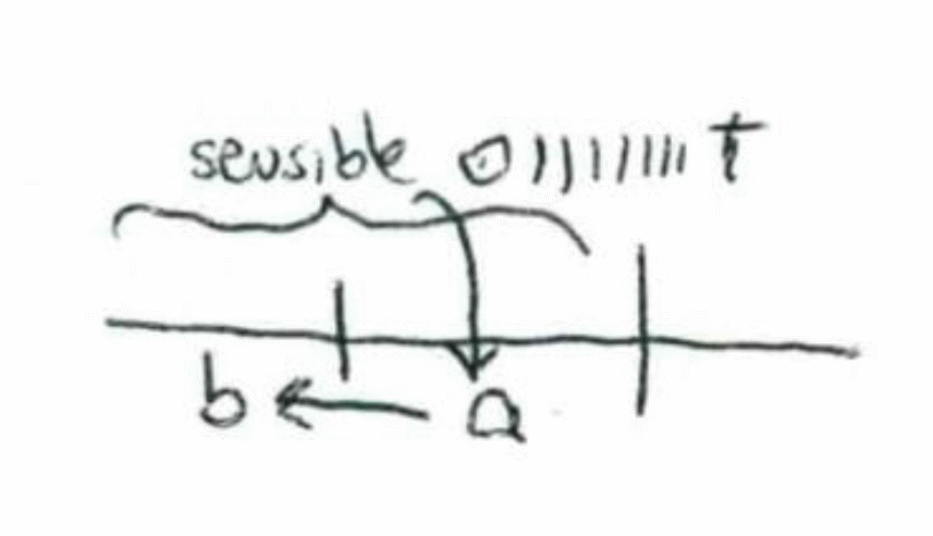
[FIGURE 1983 0115-1-AB. Divided Line: Lower Half. Facsimile scan from AB class notes.]
a) = World-Mind's energy or creative activity. Physically, everything can be reduced to the light of the Sun. The sensible light is the intellectual energy of the Sun, its fabricative energy.
Belief is already built into your perception of an object -- you take its existence for granted. Even a Sage sees the imaged world presented through belief.
You can place all of the dignities and non-dignities in a) -- first the non-dignities above the line as constructing the object and the dignities below as belief knowing it.
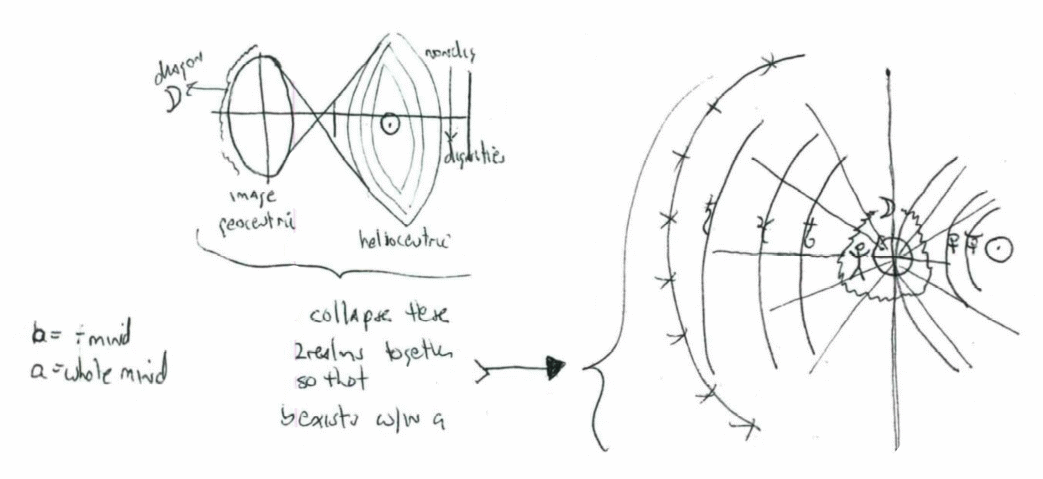
[FIGURE 1983 0115-2-AB. Heliocentric and Geocentric. Nondig = Non-dignities; W/in = Within. Facsimile scan from AB class notes.]
Within b) ego and world seem separate (perception) -- within a) both ego and world are seen as two poles of a whole (apperception).
Belief is imposed on the bodily sensation.
Hen seen by fox -- hen is an enervation of fox's body.
"That's my dinner -- go get it" = belief of fox superimposed on the modified sense apparatus.
The instincts or behavior patterns = tropes.
Belief = what organizes or structures the tropes and provides goal-directed behavior (imposition of form on matter).
How you use the tropes = belief.
Planetary spheres (a) = gnostic and fabricative = the way belief organizes the creature, belief or gnostic and fabricative operate through (b) -- the bodily organization.
The notion of individuality is derived from belief.
Belief = the "spontaneity of the absolute mind" or imputation.
Natal chart = the imaginal realm or conjecture through which belief operates.
[Classnotes AB 1983 0115 End]
DIAGRAMS FOR 1983 0115
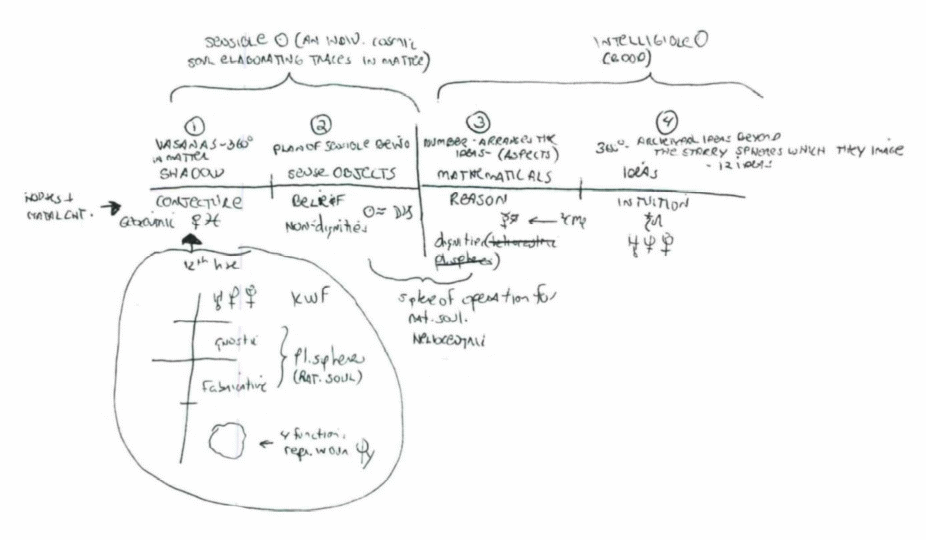
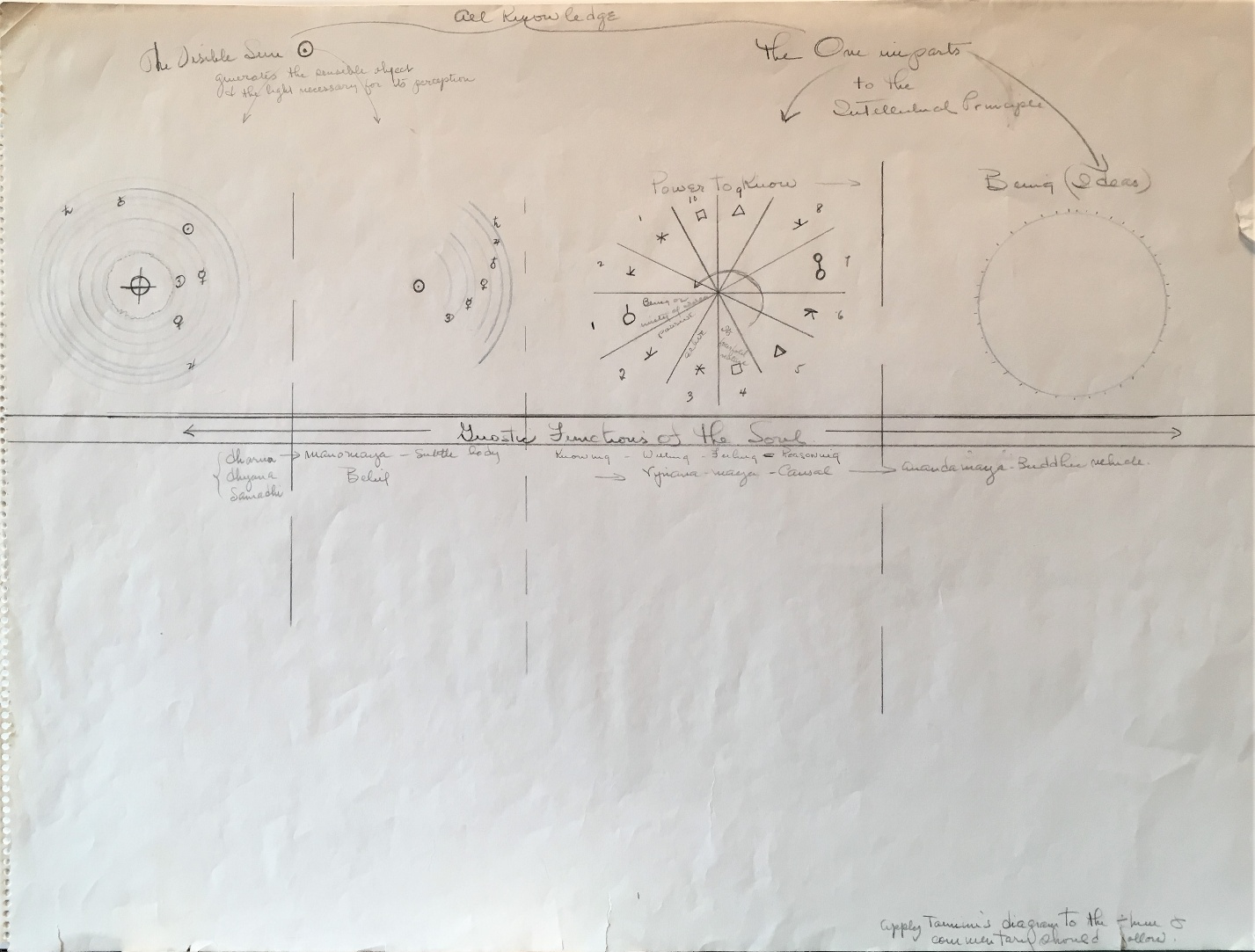
Class
Saturday, January 15th, 1983
Verbatim, unedited transcriptClick the series name to view more
CLASS at Wisdom's Goldenrod, Hector, NY
with Anthony Damiani (AD)
January 15, 1983
PLATO; REPUBLIC; DIVIDED LINE
with Appendix: Classnotes AB 1983 0115.
TOPIC: Plato
SUBJECT: Republic
SUBSUBJECTS: Divided Line, Tropes, Belief, Conjecture, Gnostic and Fabricative, Serpent's Path
CONTENTS:
Divided Line: Being, Knowing, Belief, Conjecture
Focus on Belief, Conjecture
Solar energy/light of sensible Sun as image-bearing light which is fabricative of object, organ, and imaged light
Reason-principles inherent in solar light organize tropes into a functional unity which is then able to function with a belief as to its own and others' existence
Light of Sun as underlying energy substratum of all images
Belief built into psychosomatic organism; even Sage functions with it, sees the Sun rise, etc.
Belief as unconscious
Childhood fantasies prophetic of unconscious beliefs that are going to be lived out
Discussion on relationship between image-bearing solar light and Earth's Dragon at both individual and cosmic levels
Apperception and perception
Tropes/tropical functioning as modification of bodily apparatus; as patterns of behavior of protoplasm; as response of an organism to a stimulus; as traces of life left behind in life of Earth; as astral belt
Functioning of tropes correlated with conjecture
Belief organizes the tropes in harmonious fashion so that they function as a unit; this gives rise to goal-oriented behavior and notions of self-existence and others' existence
Belief points out that an object is but doesn't give knowledge of that object
Undivided mind's fabricative and gnostic powers organize various tropes into entity/unity by superimposing their knowledge and belief
Undivided mind organizes creature then functions through it
Notion of individuality is derived from realm of belief/undivided mind
Undivided mind reduplicates itself in every creature
Soul is gaining an experience of itself as an individual/unity through inhabiting body after body provided by the undivided mind
More discussion on notion of belief
Imaginal essence as substance of Sun
Belief indicated in natal chart by aspectual pattern that organizes the tropes into a functional unity; this is where notion of individuality is coming from
Serpent's Path
Discussion of upper half of Divided Line
Intellectual-Principle as Being and Knowing; faculty of Intellection in the soul (Saturn in Leo) knows Being, faculty of Reasoning in the soul (Jupiter in Virgo) knows Knowing
Appendix: AB class notes
BOOKS READ FROM OR REFERENCED:
Rudolf Steiner, Macrocosm and Microcosm
Guenther Wachsmuth, The Etheric Formative Forces in Cosmos, Earth and Man: A Path of Investigating Into the World of the Living
Paul Brunton, The Wisdom of the Overself
Thomas Taylor (tr.), The Republic: A Dialogue Concerning Justice (Volume 1), in The Works of Plato, viz. His Fifty-Five Dialogues, and Twelve Epistles
Paul Shorey (tr.), Plato, The Republic, Volume II, Books 6-10 [Note: Shorey's translation is also to be found in Plato: The Collected Dialogues, Hamilton and Cairns (eds.) (Bollingen).]
Plotinus, The Enneads (MacKenna translation, 4th ed.)
PLOTINUS QUOTES READ OR REFERENCED: V.1.4, VI.4.14-15
DIAGRAMS appended to this transcript:
FIGURE 1983 0115-1-AB. Divided Line: Lower Half.
FIGURE 1983 0115-2-AB. Heliocentric and Geocentric.
FIGURE 1983 0115-3-AB. Divided Line.
FIGURE C002 IMG_2587 fix. Divided Line.
Other diagrams also referred to are not with this transcript version. [Transcriber note: [diagram] means the speaker is referencing a diagram as he or she is speaking. If someone is drawing or writing, with audible sounds of chalk on a blackboard, I indicate this by [drawing] or [writing].]
NOTES:
- AB class notes with diagrams have been appended. AB class notes retyped from Classnotes AB 1982 1206 to 1983 0124.PDF. All spelling, capitalization, and punctuation corrected, abbreviations and astrological glyphs spelled out in AB class notes.
TRANSCRIBED Verbatim by IT prior to 2018 (V11a). This is V12a (2023) and has: updated prefatory matter, footer, and audio file name; Subsubjects slightly expanded, Book List completed, Plotinus quotes section added; typos corrected; new notes within transcript; AB class notes with diagrams and two divided line diagrams appended and references within transcript to these diagrams; new formatting to accord with new conventions. Archival verbatim transcript – V12a.
AUDIO FILES: 1983 0115a, 1983 0115b. [Note: "Tape" and "Side" refer to original audio cassette tapes that were later digitized into .MP3 Audio Files.]
1983 01/15 at Wisdom's Goldenrod
Plato; Republic; Divided Line
[Audio File 1983 0115a Begins]
S: Yeah.
S: (Hm/Yeah).
AS: Gotta get on the offensive with what-- Just as a background to the divided line, I know it doesn't-- I know we could use it either way but we really have these two frameworks, as we tried to point out. At least there seem to be two distinct frameworks to the divided line. Are you mostly going to try and stay within the 12th house framework? [Note: See FIGURE 1983 0115-3-AB, Divided Line, appended to this transcript to follow AS for next couple of pages. Also helpful to refer to throughout the class.]
AD: Yeah, today.
AS (faint): Ok. So we're definitely [couple/few words inaudible] ok then, and that's the first one, so that sets up where we're talking about--within the framework of the (Suns) and the individual.
AD (faint): Yeah because we're talking about (vritti) although they're not ours.
[short pause with very faint background student talking]
AS: And the second thing, (with that being in place), we made a comment a couple of times that it seems reasonable that when we put up the two higher things here where it says Intelligible Sun [diagram], and that that would be like the co-- you're thinking of that like the Universe-- that could be what goes under the Universal Soul. And that, at least the highest one we say would be like the tentative illumination, the Idea of the world or the Reason-Principle [AD simultaneously: Yeah, that's one possibility.] of the universe in the Universal Soul as a possibility for being [couple/three words inaudible] and--
S (simultaneously): (It could be) Ideas you need?
AS: Well the Ideas-- but the Ideas as they are in the Demiurge, say, or in the Universal Soul.
RG: Within Universal.
AD: The [AS simultaneously: Of course.] other possibility is to take that second half [diagram] and leave it the way Plato put it, you know. [Note: See FIGURE C002 IMG_2587 fix, Divided Line, appended to this transcript to follow AD for next couple of pages Also helpful to refer to throughout the class.]
AS: Uh-hm.
AD: He made an analogy between the Intelligible and the sensible, so--
AS (faint): (But) either is the Intelligible or [couple words inaudible]
AD (simultaneously): That would be the Intellectual-Principle [diagram] and this would be the individual [AS simultaneously: That--] cosmic soul [diagram].
AS: In that case, that w-- that first one would be the Intellectual-Principle [diagram] and the second one would be, well, say Universal Soul or any soul [diagram], could be any soul at all.
AD: Yeah, or we could leave it like I'm saying, like as though it is the Intellectual-Principle.
AS: No but I mean the second-- the second level [diagram], whereas reason-- this one [diagram]. Maybe I misunderstood, the [AD simultaneously: No, I--] first two.
AD: The first two would be the Intellectual-Principle, [AS(?) simultaneously: Being--] Being and Knowing. [few faint inaudible AS words simultaneous with AD] That would be another alternative.
AS: You mean, the fir-- these two divisions [diagram]?
AD: Uh-hm.
AS: That-- I don't follow that way. Because if he's-- he puts reason here [diagram].
S (very faint): Yeah.
AD: Well, you remember the analogy in-- [AS: Yes.] in the book where he [AS simultaneously: Yeah I know, I always had trouble with that.] said, he says that the One imparts Being and-- and the truth of Being.
AS: Right, I know and I always took-- well, yeah.
AD: Well, that sounds like the Intellectual-Principle.
AS: Right, but I always took that to be imparts Being and the truth of Being [AS indicates on diagram], that would be these two-- the two halves of the first section over here, not necessarily this way [diagram], although I (could be wrong too).
AD: Then the next section would be what?
AS: Well, again-- What do you say? You were going to s-- you were going to say these Being and Knowing would be these two things [diagram].
AD/S(?) (very faint): Go ahead, go.
AS: Because this is-- you'd say this is the Idea of the Good [diagram], say, and this is the Good [diagram].
AD: The Idea of the Good, [AS simultaneously: The Idea.] so that means that's the [AS drawing] Intellectual-Principle.
AS: Ok, but this is imparted by the Intelli-- he says that the Good imparts to that which is known and the knower the power to know and to the known the power to be or-- Yeah.
[short pause]
AD: Well, you could try all the [couple/three words inaudible]
AS (simultaneously): No, I-- could you just give me what you're doing, I [couple words inaudible]
AD: I had no way. I got half a dozen ways.
AS (simultaneously): Well, could you just say then again what you just said? When you said the power to know and the power to be.
AD: Yeah.
AS: And where would you put those, in these-- [drawing] both of these in these two sections [diagram]?
AD: Yeah, up above [diagram].
AS: So this would be the-- one of these would be the power to know [diagram] and this one would be the power to be [diagram]?
AD: Yeah, that would be Being and that would be Knowing [diagram].
AS: Ok. [drawing]
AD: And the al-- [AS simultaneously, drawing: And this is (couple/few words inaudible)] other alternative is the way you put it.
AS (faint): [drawing] Uh-hm.
AD: Then the other alternative is to put Knowing below Being [diagram].
AS: [drawing] Ok, this is a--
AD: See, but I'd rather start at this end [diagram].
AS: Ok. I guess you answered my question then, you're using it fluidly right now.
AD: Yeah, uh-hm.
S (very faint): Yeah.
AD (very faint): Gonna need that.
[short pause]
AS: At the other end you're going to put an individual soul or a cosmic soul [diagram]. The whole thing would be under the cosmic soul.
AD (simultaneously): Well, cosmic soul, I want to-- I want to work with the big framework first before I insert individual(s).
AS: Ok, because that does kind of leave a question. Ok, one question that leaves, if you put the cosmic soul there, ok, now then it's-- then you could see what the higher divisions might be, and now what about-- does-- the-- the explanations that-- all the explanations we've been doing mostly revolved around an individual's reproductive imagination in the ego with which to explain the lower level of projection. Now for the cosmic soul we'd have to bring in something like the whole of the Dragon say.
AD (very faint): (We're/I'm) gonna have do that.
AS: Yeah, I'm just saying that that-- we did-- most of the explanations we gave were just, say, for an individual's tropisms by our-- And now if we bring in a cosmic soul, we don't even talk about the individual, we say what does that fourth level mean for a cosmic soul. If you say that in producing all these life forms certain traces are left behind in the cosmos and the traces-- tropes of these life activities left behind would accumulate into this realm of conjecture. And I'm trying to see what it is on [one/two words inaudible]
AD: If-- well, if we start with what Plato said, he said that the sensible Sun generates the object, alright, and also the light which is the medium by which the object can be seen.
AS (very faint): Yeah.
[student assents, very faint]
AD: You remember that pretty accurately, fine. Generates the object--
AS: And the light by which it sees.
AD: Sees the object.
AS (simultaneously): Through which the [one word inaudible] sees it.
AD: Alright. So when it generates the body and the eyes or let's say any of the organs, it generates all these, alright, and it also generates the light by which the eye can see an object. [AS assents, very faint] And then when the Sun goes down, images disappear, there are no images, you can't see color or anything like that. When the light is-- the light of day is shining, you see colors and you see shapes and forms and all that.
AS: Uh-hm.
AD: Ok? So in that case, we would have to say that-- we could start by doing something like this. It generates the object [drawing].
AS (faint): That would be there [diagram], uh-hm.
AD: Alright?
AS: And then the light that hit--
AD: Then that would be the sensible object here [diagram], [AS simultaneously: Right. When the light hits it--] alright. Would that be the-- would that be the fabricative?
AS: The fabricative power of the cosmic soul.
AD: [drawing] Ok. Now--
AS: Creation of form.
AD: Alright. [AS simultaneously, faint: (Depends on Sun.)] What would the input be then?
AS: Excuse me?
AD: What would the input be? [AS simultaneously: You first.] Wouldn't belief be an input? [drawing]
AS: Oh, ok, yeah.
[short pause]
VM: I don't understand what you mean by [S simultaneously, faint: Say more.] input Anthony. I-- you know, that word sort of stands out, hope you don't mean it.
AD: Well insofar that let's say this is fabricating an object, it makes the object, inherent in the object that is made, alright, are the reason-principles inherent in it and from them the effect is a certain belief.
VM: I thought he-- ok.
AS: In other words now for any individual entity that participates in this, he automatically believes in that fabricated [AD simultaneously: Yeah.] object. He's forced to because that's the way that the object is fabricated [couple words inaudible]
VM (simultaneously): I guess I always understood belief or-- essentially I thought belief was in some ways sort of a subjective response to that--
AD (simultaneously): That may be too, that may be too.
VM (simultaneously): --to that fabricated object. And you're saying belief comes along with the object.
AD (simultaneously): That may be too, when we-- when we come from along here [diagram] and we say the soul is immersed in this process, alright, then the soul might be subject to those beliefs. [Note: See FIGURE 1983 0115-1-AB, Divided Line: Lower Half, appended to this transcript for the following.] I just want to work [VM simultaneously: Ok. Ok I really want to hear you out, ok.] with this part a little while, just for a little while to see [VM: Alright.] if we can make sense out of it, ok. Then he said that it operates or generates the light by which the shapes, forms, and colors are perceived.
AS: Ok. Now where would you put that?
AD: Yeah, that's what I'm going to-- is (it/that)--
AS (simultaneously): Or would that be the next one [diagram]?
AD: [few words inaudible]
AS (simultaneously): Think maybe you could say that-- Well, the way Plotinus even said that the perceived object, the imagined object, is refle-- is a reflection from the fabricated one, it's almost like we're saying the sensible light now reflecting off of those fabricated objects would give the appearance of a sensible-- a conjectural object. So when there's, you know, for the-- it's not our light, it-- but it's a-- thinking of the cosmic thing you're saying, the light of the sensible Sun reflected off those objects will give you an appearance, various appearances. (It casts) [one/two words inaudible]
AD (simultaneously): Now if that's so, then that means that the image arises here [drawing/diagram].
AS: Yeah, the image is there.
AD: And if the image arises here [diagram], then the result of that image would be a certain amount of conjecture.
[short pause]
AS: See this is-- I almost think that-- I think that the physicist here would say too that it-- the whole study of light that gives rise to this notion of relativity, the whole, you know, one of the-- anyway, [S simultaneously: Sure.] it's bound up with that, and that the notion of relative positions and all of that would come about in the realm of conjecture for instance.
AD: Now tell me, do you think that this might be, let's say, the dignities [drawing]?
S (very faint): It could be.
[slight pause with student laughter]
AS: That's not funny, what?
VM: Oh, those people are hung up on antiquities.
AS/S(?): No. (VM laughing, laughter, student words)
S (faint): I'd just kick him out.
AS (simultaneously): Well-- Ok well let me-- let [VM simultaneously: Show me less doubt.] me just put it this way then. If that's-- if you're going to keep ra-- restrict the cosmic soul to sense-- to the sensible [AD simultaneously, very faint: Sun, yeah.] Sun, then all-- you're talking about its powers being those seven planets. [AD, very faint: Uh-hm.] And if you're going to restrict them all to the sensible realm there, then you have to find the dignities somewhere there.
AD: Well, we'll worry about it when we get to it.
AS (faint): What do you mean? No I just-- you just mentioned it.
AD: Yeah.
S: Yeah.
AS: Well-- (some laughter, student words)
VM (amidst laughter): And he's supporting your position, I don't think it was--
AS (simultaneously): I'm saying "yes," I'm agreeing. (AS laughing)
VM: It wasn't contentious. (AS laughing, some laughter)
AS: This was only half a minute ago that you just said that. (laughter, AS laughing) Can't change it--
S (faint): (It/He) already [one word inaudible] (S laughing, laughter)
LR: Stop.
AD: Tell me, do you think-- do you think-- [AS simultaneously: Well then you got to say what you mean by it. (AS laughs)] do you think then that this would be the world-image being reflected off the objects [diagram]?
AS: It's the world-image.
BS (very faint): Reflected off(?/.)
AS: Well yeah, put the primordial object on one side, that-- you mean the one on the left now [diagram], yeah, yeah.
AD (simultaneously): This one here [diagram], do you think that this would be, in other words, the world-image reflected off the object?
S (faint): Ok.
AS: The only-- yes. Can I--
AD (simultaneously): In other words, in other words what I'm trying to say, if this is an incessant, you know, current of light going out [diagram], then the world-image is incessantly being created moment after moment.
AS: Well ok. See, now I have a harder time then because of those, you know, because the last goes to the fabricated object and the image.
AD: These two [diagram].
AS: Yeah, because now-- I always conceived that the fabricated object itself was a momentary creation of that World-Soul or that sensible Sun and I don't-- it's hard for me to see [AD simultaneously: Well what about if-- well--] (in) what extra it was for--
AD: Let me take for granted that this [diagram] is a momentary and incessant creation of the World-Soul, [AS assents, faint] alright, [student assents, faint] then wouldn't this [diagram] also be?
AS: Oh certainly that one's momentary, yeah, but I-- I don't-- it's hard to see what that is apart from the one on the right [diagram], for-- for the World-Soul.
AD (simultaneously): Well, if we say-- if we say that this [diagram] is equivalent to, let's say, the image on the screen, you know, like a television, and this is the Solar energy [diagram], [AS simultaneously: Oh I see, ok, I follow.] the intellectual-- you know, the intellect of the Sun.
AS: Well then you're saying these are like the obverse sides of one another.
AD: Uh-hm, uh-hm.
AS: Yeah, I follow that, when he talks of-- so you're talking about the realm of belief like-- yeah, I follow. The World-- the-- when he talks about the World-Mind's energy, how it begets the energy, and the appearance would be over there [diagram].
AD (simultaneously): Would be here [diagram]. So like if we took a television, alright, [AS simultaneously: Ok.] this would be the points of light [diagram], the bursts [AS assents] of-- Alright, that's not the image, this is the image [diagram].
SC: Does that imply an individual, or you're saying [AS simultaneously: I don't--] that even prior to an individual you'd have that image?
AS: Regardless of whether there's an individual to receive that or not [couple words inaudible] Whether there's an individual or not the world is still being manifested.
SC: Then it's hard for me to distinguish [AS simultaneously: Yeah.] between that image and those objects.
AS: That's the-- I mean that's--
AD: The image--
AS: That's the-- good.
SC: And the generated objects.
AS (very faint): That's good, yeah.
AD (simultaneously): Well if you think of an object as the substratum, the [AS: Force.] energy substratum of the image.
SC: Then what's the image, how do you think of the image? I can [AS simultaneously: This is it.] see that-- I can see the object as energy substratum.
AD (simultaneously): Well, well, do you know how the television principle operates?
SC: But then I can only think of an individual if you use the television analogy 'cause the image implies some kind of a-- some kind of particular individual viewing the finished image.
RG (faint): Why?
AS: Not-- not really.
AD (simultaneously): No, the image implies that there is a universal energy which is the underlie [SC simultaneously: Yeah.] of any particular object.
SC: That-- and that I could see, that's the generated object, that universal energy. But again, I-- it's hard for me to-- to imagine the-- what the image is other than that universal energy [VM simultaneously: Can you just (one word inaudible)] until I bring a-- an individual in.
VM: But why can't you say it's a space-time unfoldment of those energies which you're calling the generated object, generated objects? Or in the example of the energy is flowing-- the energy is-- let's say, has some structure, some form, but until it sort of unfolds itself in some level of space and time you really can't speak of an image. I don't know, I think that's-- is that the way you're trying to use it Anthony, that there's a space-time unfoldment of that object in the image?
AD (very faint): No, I wasn't thinking (of) that.
BS: Or is that--
VM (simultaneously): Well then-- then again I guess I don't understand how you distinguish the two either.
AD: Well, when we're looking at a television screen and we see that there's a horse and wagon and a car, they're two distinct objects, [VM assents] right, but the underlying substratum is the electrical energy or the pulses or points of lights. I mean they're the same for the car as they are for the horse. [students assent, very faint] The underlying substratum is one and the same but you do have two distinct images. [students assent, faint] Alright, so if I put that here [diagram], the underlying energy which is the common substratum, the image over here [diagram].
BS: But wouldn't that image be the propensity of that energy to take any form?
AS: It has [VM simultaneously: Not just any form.] to be a particular form though.
VM: Particular form.
BS: Well yeah, any particular form.
AS (very faint): Go on Anthony.
AD: Well, it can't take any particular form, it will take a form-- I mean when you say that the energy is going to take a certain form, you're speaking about the ideas in that energy.
BS: Yes.
AD: Well, I want to avoid that. I just want to see if I understand what I'm talking about here, if this is valid. If everything could be reduced to the light of the Sun, which is a scientific fact, [student assents, faint] right, everything--
VM: Energy of the Sun in a sense [couple words inaudible]
AD (simultaneously): Yeah. So thi-- this would be the common substratum of every object, no matter what object we're speaking about, the intellect of the Sun, its Solar energy, alright. Then this image [diagram] would be a reflection off that object, so that you-- This [diagram] is in continuous process, I mean, it's an incessant momentary manifestation always going on. Then this image here [diagram] is a reflection of that. Why go further? I just want one step at a time.
S (faint): Go ahead.
EC (simultaneously): What I thought Sam was saying is that image doesn't arise unless there's somebody to see it. That if this-- the substratum is the same for all that but a-- that-- and that image is potential but unless there's a seer it's not going to arise. It's just going to stay in that second framework.
SC (faint): I'm just getting [one word inaudible]
S (faint): [one/two words inaudible]
AS: See the Sun, Sun(--/.)
AD (simultaneously): This fellow-- this is the fellow [diagram] that sees the whole primal image.
[short pause]
EC: Yeah, well then I stop 'cause it's hard to say.
AS (faint): If he wasn't there [EC simultaneously: If that--] there's no more world.
S (faint): Yeah.
EC: That sees the whole image.
AS: His [one word inaudible]
EC (simultaneously): But that-- but that car and that horse--
S: You're talking about appearances.
EC: Yeah, I know, that's what I mean.
AS: That's right.
S (simultaneously): Are you talking about the primal--
AS: No but that's an appearance. The-- he's just saying the whole of the primal image is an appearance to the cosmic soul. If our Sun doesn't see the whole cosmos manifested, then we won't. Not necessarily, I mean we might be able to get back there and get it but, unless it has an ongoing manifestation, [student assents] that's what we are going to participate in.
S: Yeah.
AS: Well, you know, that whole [student assents] business, cosmos goes on whether you see it or not or [student assents, faint] planets keep whirling and Earth goes through changes and so on. But I lost your point. [few very faint inaudible words] And the energy which actually brings that about is the-- the belief, the fabricative nature of the Sun. [student assents, very faint] The final effect or the product of that it seems you're saying is in the last one, the image [diagram].
AD (faint): Uh-hm.
[students assent]
AS: Now do both of those involve the sensible light or is this-- the sensible light only in the last one and the previous one is the subtle light?
AD (very faint): I didn't understand you.
AS: Well, when you say that-- when he s-- when they say that all of the objects are just concretions out of the light of the Sun, now, by the light of the Sun, [AD, very faint: Yeah.] they mean the actual sensible light, the visible light you [student assents] see, or do you mean the subtle light, or one [AD simultaneously: Yeah.] is-- one each? In other words, you drew an arrow as if this was the sensible light here [diagram]. You said well when the Sun goes down the object is still there, you just-- it won't-- it won't appear as an image. [AD, very faint: Right.] So you seem to be implying that the sensible light is only necessary for the last one [diagram] and that this one [diagram] is more of a subtle light, the subtle energy. Are you equating these-- this generated activity with the sensible light [S: Is this the--] or with the--
AD: Oh, the object that is generated from the light, alright, [AS: Yeah. By which light?] you can say that those are the-- this-- the light coming from the Sun.
AS: The actual sensible light.
AD (simultaneously): Yeah, the sensible light.
AS (simultaneously): This fabricated object [diagram].
AD (simultaneously): You can say that the forms in that light [S, faint: Yeah.] [AS simultaneously: Ok.] is what generates the object. Now the forms in the light which generate the object, then that object has inherent within himself these forms and inherent in these reason-principles which generated or made the object, alright, then there is in-- an imputed belief that [AS assents] the object, let's say, the body must work with. If this is the body over here [diagram], alright, brought into being by certain reason-principles which are in the light of the Sun, the intellectual energy of the Sun, then inherent in the body itself there has to be the belief of this reason-principle which made the body.
S (very faint): Ok.
AS: I guess I was asking-- you just said there, right there when you said inherent in the light of the Sun, the intellectual energy of the Sun. So you're saying the sensible light is the intellectual energy of the Sun.
AD (simultaneously): Of the Sun.
AS (faint): That's very helpful here.
S (faint): Is that the-- does that answer your question Avery? I didn't follow the answer I guess from what you had asked about the-- the necessity--
AS (simultaneously): I just asked about the light.
S: Yeah, being necessary for the image to appear only in that the--
AS: No, I just asked what-- I was asking where he would put the sensible picture in terms of the light.
S: And he said only on the-- on the side of the belief? Is that his answer?
AS: The light of the Sun is its-- uses its fabricative energy, intellectual energy. You can't think about the light that you see, that's just an a-- [student assents] I mean--
S: When you make a distinction between both the imaged light of the Sun on that level and the-- and the light of the Sun on the belief level, what's the difference here? When you said subtle, what do you mean? On the side of the image are you talking about the sensible that we see here?
[short pause]
AS: Well, except that just as-- just as you would say that-- ok. Just as you would say, well I see like Vic, and then I know that on the obverse side of that there's this subtle-- there's this force, this energy in this World-Soul which is fabricating this vehicle.
S (faint): Ok, yeah.
AS: The same with that Sun. I mean I see the light of the Sun but I'm not seeing that intellectual energy of the Sun. [S, faint: Ok.] I'm seeing its appearance. Everything I'm seeing is an appearance so I guess what I'm saying is just as I see the appearance of all those other objects, I'm also seeing the appearance of that intellectual energy of the Sun. That's what I know as the sunlight because I don't know, you know unless-- I'm not normally seeing-- although science is investigating into the pa-- the intellect, the light as energy, but I don't normally experience that, I only experience an image of that.
S: Right, you see both as indistinct though, I mean you see both as--
AS (simultaneously): Yeah, so, I can't use my own example-- I can't quite use my own example of my experience of Sun 'cause all of my experience is going to be on the side of the image and not of the fabricative forces that are behind it. [S simultaneously: (couple words inaudible) that.] So it is the sensible-- it is the sensible light but of course and since I don't know the sensible light as it is, (then/I mean) we might [student assents] as well call it an intellectual energy.
AH: Would it be appropriate to [S simultaneously, faint: (one/two words inaudible) light.] hold distinction between sensible light and inner light?
AS: And--
AH: Sensible light and inner light, and hold that distinction?
AS: Well that's why I asked about whether he was-- whether we were going to call that some subtle light but no, I mean, I guess you-- that's the actual light, the sensible-- the light of the sensible Sun must be the sensible light, its light.
AD (simultaneously): And isn't that good enough?
S (faint): Sure.
AS: The light, the act-- the light that science studies.
AD (simultaneously): Anybody-- anybody understands the nature of the light?
AS: See that's what I'm saying, we-- Andrew we only-- we see light but what we see is the image. But, you know, when science starts investigating and starts saying that the whole of the sensible universe is just this energy, and that that light can be reduced to energy or energy reduced to light or whatever, then that-- that begins to go into a realm that we don't know, you could call it subtle in the sense that we don't really know what it is. But it's still the se-- the real sensible light that we don't know.
AH (simultaneously): I was curious because in some of the mystical descriptions of the light, talk about like the first time you see light you are light, like the light that is seen is light as productive of-- of the world rather than a light that reflects from images. I was just wondering if that distinction-- I missed the first two minutes today. Maybe that's already been discussed.
AD (simultaneously): Yeah, I would agree with that [AS simultaneously: You'd have to ask (one word inaudible)] Andrew. I would agree with that. In the experience of the light, the mystical light, alright, then you come into contact with the intellectual Solar energy, it'll bring about a transformation of the personality.
SC: But-- and [few faint inaudible student words simultaneous with SC] Avery's description of the growing [AD simultaneously, faint, possibly part of background: (Ok.)] knowledge of light in terms of science or us exploring what we see and using different instruments, wouldn't that all be in that last realm of just getting a broader picture of the final image? [students assent, very faint] In other words the image is created out of the gen-- first there's the generated objects which is j-- is this-- which is this energy which is not directly available to us, what's available to us is that primal image. So when we investigate the world and start to understand more about light and how it operates, we're really not understanding about those prior energy principles, the generated objects, we're really understanding more about that final primal image [student assents, faint] that we partake in.
AS (simultaneously): We're always speaking of the image but I don't see why some of the, you know, modern theories aren't really trying to get at that. I mean, PB always talks about this energy of the World-- he calls the World-Mind's energy, but the World-Soul's energy which is incessantly producing the universe. [SC simultaneously: Well I would think that ex--] And that energy-- [SC simultaneously: And that--] Oh, I agree that the scientist isn't going to experience it necessarily as this, you know, this inner experience but s-- Well, it-- [AD simultaneously: (Let--)] it's irrelevant, it doesn't matter.
SC (simultaneously): Well I'm ju-- well I was just trying to understand again more about what that image is, I was thinking of a way of saying that we all partake in-- in an image but you have to understand that image as other than what-- other than any one of us partaking or not partaking, so it's possible for an individual to have a growing understanding of that image without penetrating to the-- to the energy that's--
LR (simultaneously): Can true knowledge be placed in the realm of conjecture [students assent, faint] seems like what you're saying.
SC: Well knowledge of-- a better knowledge of that image, that that image you-- is--
LR: Can one have true knowledge in the realm of images?
SC: Well I wasn't asking-- I don't think I was asking [LR simultaneously: No?] that question as much as trying to understand whether there is some image that-- what the relationship I guess is between the individual and the image, that-- that image, that-- that there is--
AD (simultaneously): Ok but wait, I'm not ready to talk [SC simultaneously: Ok.] about it, I'm not ready to do that yet.
SC: Yeah.
AD: We-- we first-- we first want to say like for instance something like this. There's a scene somewhere in the world, alright, which there is no individual observer of that scene. Now, we cannot truthfully speak of that scene as being seen or known, granted. Now, the point would be if someone goes there he would see that, he would see that, and the reasoning that follows upon this is that the-- the image that is perceived is the product of a higher principle than the individual. [SC assents, very faint] So that means that the-- the primal image or the real image is going to be superimposed on an individual mind who goes there and sees it. So we have to grant that there is this imaged world, this primal image of the world which is, let's say, something viewed by the Sun, [SC assents] or the soul. Now if we do that, I said-- I was going to suggest, can we put the image there [diagram], the object over here [diagram]? And just think of Plato's schema for a little while and see what comes out of it. [student assents, faint] The belief is a fabrication of the reason-principles which-- or let's say the reason-principles or the image (from) the light which bears this reason-principle within it and fabricates the object, and at the same time that it fabricates the object it also produces a belief in that body which is fabricated. In other words, if the reason-principles go into making this body what it is, it at the same time generates within that entity, alright, certain beliefs about its own existence let's say, or existence in general. So it's ingrained in that entity.
LDS: Why must that be so?
AD: Can you, so to speak, produce a dream and not look at what you're producing and believe in it?
LDS: No.
AD: In other words, if the-- if the mind externalizes an idea, then it disbelieves in what it externalized? It would believe in its production because coming from within itself and making the images from the forms within itself it believes in what it's done, that's belief. Yes, no, perhaps?
LDS (simultaneously): I think I follow what you're saying. That there's like a law in this production that must be obeyed and that is that the very act or process of production doesn't make any sense without an inherent faculty of belief that's really coming from the principle doing the production.
AD: Yeah. So if we take for instance a fox who is the result of certain reason-principle, an entity called a fox, alright, and inherent in the very reason-principle that produces a fox, now the fox sees a hen running, alright, and he has belief in the existence of that hen. Why? Because the same reason-principles that made him believe that he exists makes him believe that that hen exists. Otherwise he won't go chase it…and be deprived of a dinner…[S: (Yeah, which he could see.)] which he believes to be real.
LDS: Yeah, the reason-principle is one thing. And the one thing is constituted of this inherent belief and whatever production is involved in that belief or is the object of that belief.
AD: Well the [AS simultaneously: Good.] belief would be the result of that-- of the existence, the idea [LDS assents] or the forms that are existent. [LDS assents, faint] It would be a generated result.
LDS (faint): Yeah.
LR: That's really the meaning of animal faith then.
AD: Yeah, I think so.
AH: The form-- the form of necessity includes its function. It-- the fox-- [AD simultaneously: That's right. Yeah that's right.] the fox functions as a fox because he's a fox.
AD (simultaneously): Because already the form within it determines it, alright. No matter how many times a fox eats a hen he won't turn into a hen, he'll always remains a fox.
[student assents, very faint]
AH: So to call that belief is really-- is it-- is hard to understand that because you see it as like--
AD: It's built in.
AH: It's so built in that to even call it belief and to make a separation between the form and the function of an entity--
VM: Yes, belief implies disbelief--
AH: Yeah.
VM: --I think Andrew's trying to say.
LDS (simultaneously): Or the po-- yeah, the possibility.
VM: Belief implies the possibility of taking it as [LDS: Something.] not real or [SC simultaneously: Yeah it's almost--] [one word inaudible] whereas the way you're speaking about [SC simultaneously: It's certainty.] it here it's the natural [LDS simultaneously: Guarantee.] sort of force in the object--
AD (simultaneously): Yeah, it-- I mean no matter how often you reason, you know, that there's no water in that mirage, you're going to go see it, you're going to go on seeing it, [student assents] and no matter how often you-- you reason out that, you know, the Sun doesn't rise, you go on seeing it. The belief is built into the very organism and the way it functions. There can't be, even for a Sage, there can't be a dissolution of that image which is being presented by the belief. He will see that world, the world will not dissolve! If-- except the way PB says, you know, in our comprehension we can dissolve it but--
AH (simultaneously): From what point of-- Pardon.
AD: Go ahead.
AH: From what point of view is the-- is the word 'belief' appropriate for this-- for this description? Is that from the point of view of the Intellectual-Principle?
AD: No, I would say it's-- in this framework, insofar that the sensible Sun fabricates an object with reason-principles necessary to make that object to be what it is, the net result of that would be the belief which is like an appendage to it, an after-thought which it must have, just like if I think an idea into existence like in a dream, then I believe it. [AH assents, faint] I can't do otherwise because I've done it! I'm the one who produced that. How can I say it's not there? So the belief is inhe-- It doesn't mean that-- it doesn't mean that I know what the thing is.
VM(?) (faint): No, that's the problem, right?
AD: But I do know that it is, even if the is-ness is momentary.
S: Anthony, how would you speak of the forms in that intellectual light, what-- say prior to any sort of fabrication or generation of that (off) the image. Coming back to what Andrew brought up before about the possibility of contacting that intellectual light, and let's say there are forms in there, what are-- what-- how do you speak of the forms in that intellectual light without any fabrication? What sort of forms do you have? How are you thinking of the forms that aren't here yet? You know what I'm asking? Or do you speak of forms if there's contact without the image, without the object?
AD: Can we put this as-- question aside temporarily, because that'll take us out of this realm.
[students assent, very faint]
S (faint): Ok, ok.
RC: Anthony there's-- there's one exercise that PB recommends that maybe-- maybe actually spans this process, that he talks about-- say once through reason-- through reasoning you've gotten some insight into the ideal that you want to operate with, then by creatively exercising your own imagination and seeing yourself actually living this out, seeing yourself actually doing this thing, it seems that that-- that's the process of actually believing that ideal into existence, that by energizing the creative imagination toward the embodiment of the ideal that reason has revealed, that you're actually believing that ideal into the imaged world. And it-- that's a different level-- that's a different level of mental operation than later on when you look in the mirror and--
AD: Yeah, yeah, that's a good example.
RC: So it's actually a creative [AD: Uh-hm.] activity. It's very powerful, it doesn't seem like-- I mean it's entirely different than conjecture, because the reference is to an ideal which needs to be embodied.
AD: Yeah, he speaks very highly of that power, to creatively visualize yourself as let's say a certain type of person and bring that into actuality, actually bring it into [RC assents] being, you know, sensible being of course.
RC: Yeah. (In/And) the energy of that-- that activity, it is a distinctly different one than when you look at a physical object or look in the mirror or--
AD: Now, suppose Randy that we unconsciously, or let's say we had beliefs of which we were unconscious, alright, nonetheless we have them and held them very dearly. Then it is inevitable that we would operate according to those beliefs.
RC: Yeah.
AD: So we may not know what the springs or the motives of our activity is, but they are coming from that, you know, unconscious belief, [RC assents] alright, and we're living it out and then we wonder, "Why is this happening to me?"
RC: Yeah there was a thing that Frost used to refer to a lot when he was working with young people. He used to talk in terms of how young people have a knowledge that nobody else will accept as knowledge but they're going to believe this into existence, this knowledge of what they-- what they are. They're actually going to believe it into existence. Later on other people will recognize it as knowledge but now you're at a stage where you're just believing it into existence, it's like this reference to the presuppositions you have about what you are. Even though right now you're blind, your actual energizing toward the world is a process of believing (these--)
AD (simultaneously): Yeah, and that's why very often the-- the childhood fantasies are prophetic of their future. Because it's like an exposition of the unconscious beliefs that they're operating with and which, as they mature, alright, become more and more unknown to them, let's say generally, alright, and that the consequence of these beliefs is that they put them into operation or they creatively visualize them or they have fantasies about them. If you go back to your childhood and think of the time when you were a little boy or girl and you were-- you were day-dreaming. This is like a-- like a view in the private chamber of your soul, you know, the-- the presuppositions that it's going to actualize in the sensible world and become that sensible object or thing or entity. That's why that's such-- that's such an overwhelming conception, belief.
RC: It seems like it's really making-- making the transition from what we-- we ordinarily talk about as like maybe a-- it's more properly described as being into what we've described as becoming.
[short pause]
AS: That last one is involved [diagram].
AD: Gee I-- I didn't want to go that far yet.
RC (faint): Ok.
AS (faint): They both [one word inaudible] through becoming.
AD: He calls this whole realm the realm of becoming [diagram]. He calls-- he calls this the visible world, the sensible world, he gives it all these kinds of names.
RC (simultaneously): Oh yeah, no I meant the-- the part of the line you haven't put anything on (yet/there) would be more the reference to me.
AD: Well, let's try dwelling, again, some more on this here? Could-- could we say that-- could we organize that into some kind of a--
S (faint): Astrological symbolism?
AD: Yeah.
[student assents, very faint]
AS: Well, could you-- could you now go back to what you were doing with the dignities thing because the-- only the d-i-g got up there but-- the lowest-- what--
AD: Dig.
AS: Dig. (bit of laughter) I didn't get to dignity. (some laughter) Anyway I followed up to the point where-- Well I don't want to go over it again, I'll say it a different way. He-- if you put the Sun there with all the planets [diagram], ok, and you put it-- and you have the fabricative power-- In other words, the intellectual energy of the Sun is not just the Sun but it's also all the planetary [AD simultaneously: Yeah, yeah.] spheres are operating to produce this object of belief, and you say that because of this, this belief arises. Now, that's where the question I think he's getting at. Is this a ki-- if this is a kind of knowledge, this belief? It's a kind of knowledge [three/few words inaudible]
AD (simultaneously): Well it's human knowledge.
AS: Right, now-- were you con-- were you saying there that that is represented by the dignities, [AD: Yeah.] would represent that [AD simultaneously: Yeah.] kind of knowledge, [AD: Sure.] in other words the knowledge that [one/two words inaudible] gets, then--
AD: You know, I'm-- imagine me as an artist, I draw a picture, I don't like it, I tear it up.
AS: Uh-huh. I want to-- but--
AD (simultaneously): No law says that I gotta-- I gotta live with it.
[Note: See FIGURE 1983 0115-2-AB, Heliocentric and Geocentric, appended to this transcript for the following.]
AS: No, I was just asking. So now would the dignities-- now, I-- if you put the dignities on the side of belief, which would be the gnostic faculty [diagram], that would be the gnostic side. And would you still put the non-dignities on the fabricative side? In [AD simultaneously: Yeah.] other words, (you do--) [AD simultaneously: Yeah, let's try it, let's try.] [drawing] this would be-- non-dignities and dignities would both be here [diagram] and this would be the planetary [AD simultaneously: Good. Alright then let's--] functioning [diagram]. One side would be fabricating the object and the other side is knowing that fabrication. [student assents, faint] [AD: Sure, why not?] That's the whole of the planetary spheres. And they're operative in constructing and they know-- when you say they know what they construct you're talking about this side [diagram]. When you say they're constructing something, this is the object [diagram] they give rise to. And of course the next thing that would arise would be the re-- the reflection of that, the actual image, the reflection of that (which they) include for the whole sublunary realm, all the bodies, all the entities here [diagram] [one/two words inaudible] would be(--/.)
AD (simultaneously): Let's try, Avery, let's try to, let's see how can this [diagram] give rise to that [diagram]. It's almost like over here we're-- we're working with the heliocentric [diagram], over here we're going to work with the [AS simultaneously: (Geo.)] geocentric [diagram], ok?
AS (simultaneously): Yeah. And the heliocentric is really the-- this energy, you can-- you really are-- you have to conceive of it as a kind of energy, because before you take a particular view you don't have an appearance. See that's the-- the hard thing. Well I don't really want to say that, I didn't want to say that-- to all of the continuous functioning of the planetary spheres is giving rise to this appearance.
AD: Uh-hm.
AS: In other words--
AD: Let's see if we can figure out how that's possible.
AS: I guess I was going to ask [slight pause] how that is possible.
VM: Don't you need the elemental realm in some ways to project that-- those forces on to it in order to give rise to the image? You have to invoke some principle of materiality or elementary nature if you want to talk about (it's) the Dragon that we embody. But-- well even your example of, well, TV screen or whatever, there's always something there but [couple words inaudible]
AD (simultaneously): In other words you want to put the Dragon around here [diagram]?
VM: Yeah, something like that, the elemental realm, the Dragon, the sublunar, just to have some-- [AD: Uh-huh.] something to stop that out-flowing force.
AS: I-- I guess-- [VM: It's a little different.] the only thing I guess that is being put there is that when you call it elements, because I have a notion of the elements that there's el-- the-- if the actual fabricated object is here [diagram] that includes the elements.
VM (faint): Yeah, yeah.
AS (simultaneously): I mean, if the elements are as much a fabrication-- a real fabrication as your body and so on-- In fact if anything, in a sense they're prior. I mean I'm just-- you know, when you [VM simultaneously: Yeah.] say elements, I want to be clear what you mean [VM assents, faint] by saying the elements are-- are necessary in the last realm. I understand that but if you-- if you call this the actual fabricated object [diagram]--
VM: I guess what I'm thinking about Avery is really but-- how you got to describe by the Dragon all those deposits of [S simultaneously: Yeah.] previous experience that go to give rise to the particular, peculiar configuration of the element-- of the image that arises. In other words, the actual image that appears is in part a product of what it's being projected on, [AS assents, faint] those previous experiences and so on.
AS (simultaneously): I mean, you're taking an example like say a magnet, you know, like you have the magnet in there [diagram] and in the left-handle side [diagram] you have all these images. And I'm just wondering which way you're conceiving of it. One way is to keep-- conceive it, you have all these potential images in the Dragon and this iron filing comes along and organizes it in a certain way. The other way to conceive it is that the image actually is projected from the right-hand side [diagram]. See I want to know--
(Side 1 of original cassette tape digitized as 1983 0115a Ends; Side 2 Begins)
AS: --the tropisms are a-- you know-- that they're--
AH (simultaneously): But in terms of a-- in terms of pro-- production of that fundamentally, where would you go to establish their ontic [AD, very faint: Yeah.] status?
AS: Well originally they would come from the light of the Sun and it would have-- everything in the cosmos comes from there and I don't know where else it could come from.
AH: Actually those images have been spoken of as a residue of that Sun's consciousness.
AS (faint): Yeah. I mean that was one-- [student assents, faint] at one time we had spoken about that belt, we spoke about it as a residue of the Sun's sort of-- sort of energy or energizing [one word inaudible] But then again in that sense I guess I could see your point about the el-- the elements in the Earth being the substratum of those things where, if we say those images are--
VM (simultaneously): They would allow-- they allow for persistence of those forms.
S (simultaneously, faint): Yeah.
AS: So you say that the images are inherent in the, you know, the el-- in the elements of the Earth.
LR (faint): There's one thing that-- that's been said that I think I can see, [AD, very faint: Well (one word inaudible)] I think. We started by saying it was the sensible Sun which gave rise to the images or last one and the belief which [one/two words inaudible] believing in (their production). You know? And now we're saying it's-- So I understood that, I mean, in what Randy was giving as the example, he was making it like the belief was actually giving rise to the object instead of the Sun which gave rise to both the body and the kind of knowledge that body would have. I don't know.
AS (simultaneously): Well I [couple/three words inaudible]
LR: So that's a [AS simultaneously: Well I am too, but--] question, I mean, is-- [AS, faint: (Oh/I'm) sorry.] is the belief actually fabricating? [AS simultaneously: Well, I think--] I thought the fabricative powers are fabricating, [AS simultaneously: Yeah but the fa-- but I thought--] and that at each level there was a-- an appropriate kind of knowledge going on with the gno-- at each level you would have an object and an appropriate kind of knowledge for that (to be).
AS (simultaneously): Yeah but that's more complicated than that. I think Randy was just saying that if you had a strong enough belief, if you weren't just operating with conjecture but with belief, then certain invariable effect would arise in the realm of image. You-- you actually would become [LR assents] a certain way because of this so, Randy was still-- I [LR simultaneously: Was going that way (diagram).] think he was talking about this process that we're talking about [LR assents] right here. [LR simultaneously: That I got.] You have a strongly held enough belief and you can operate almost the way that the planetary spheres will, giving rise to some actual i-- to some image.
LR (simultaneously): Yeah, that I follow if you're going [AS simultaneously: Well--] from there to the sensible [diagram].
AS: Well, Ra-- I don't know. That's what I thought Randy was saying.
RC: Yeah, that's why I heard what--
S: In other words that yeah.
RC: I was thinking in terms of like either for the soul nor for the individual, [LR: Yeah, that's the-- I--] that-- that the transition from the Intelligible realm to the sensible realm is made through the exercise of this faculty of belief.
AS: Well, ok. I-- no, I didn't understand your [couple words inaudible] I thought you were speaking of going from the realm-- operating with a strong enough belief and giving rise to some image. And you're saying you were thinking of it as going from the Intelligible realm to an actual object of belief.
RC: Yeah, exactly. I consider-- there's two quotes that are in my mind and I (don't know) exactly how they fit together yet but there's one in terms of PB talking about how the individual and his world arise together. In the other, the Steiner quote about how, in terms of these forces that, however much you hold back it goes to the building up of your own individual consciousness. What you can't hold back streams through you and goes into fabricating the world that-- that you find yourself in. [Note: See Rudolf Steiner, Macrocosm and Microcosm.]
VM: Randy, as far as at least the Steiner example as well as the quote you're speaking about in PB, I think it all happens down here at the bottom [diagram]. [student assents, very faint] In other words, that matter or that material substrate which allows for a-- a reflection to occur, I think, is this material all the way to the left [diagram]. And as far as bifurcation of the individual and his world that too must occur to the left, unless I am mistaken.
AD/S(?): [couple inaudible words]
RC (simultaneously): So I guess what I'm thinking is that this holding back that Steiner's talking about, that as much as you can hold back goes into building up your [VM simultaneously, faint: Yeah I remember, yeah.] consciousness, that that actually is the belief and that the rest streams through and is the world and later on that relationship gets imaged in the realm of conjecture, that that's actually building up the I-thought, that function of belief. And what doesn't get included within that I-thought has to remain in some objective relationship to that. But then that relationship is what later on gets imaged in the realm of conjecture.
[short pause]
AS: No, we-- [drawing] you used this example once, you know, to diagram this side with the Sun, the (middle) [diagram]. So this is the realm of belief [diagram] they were saying and if now you consider the Earth's point of view here [diagram], [student assents, faint] the geocentric. Ok, this would be the realm of conjecture [diagram], and that just [one word inaudible] It seems that that's what he's saying, the participation of all [couple/three very faint inaudible words, possibly another student] But that the Sun and all the planetary functions are fabricating-- fabricative. But the result of that fabricative energy is an appearance here [diagram] in any-- in any of these sublunary worlds. Then you have the body. And I mean we-- you could do this on any one of the planets, any one [student assents] of those planets will have this body and within that--
AD (simultaneously): (That would be) the geocentric point of view.
AS: And within that point of view there will be an appearance, [drawing] ok, and that appearance will be caught up with the traces of all the previous appearing. (And/Now) I don't know. I think we could do without that but--
SC: That's saying that--
AS (simultaneously): So I mean are you talking about the-- we're talking about the actual appearance of the Earth and all the creatures on it, [AD/S(?), very faint: Yeah.] [drawing] and that will be in the realm of image [diagram], whereas if you talk from the point of view of the Sun, you're just talking about this-- this fabricative energy. And the obverse side of that is the sensible appearances, there's one on each side, creatures [AD, very faint: Uh-huh.] and so on, on any one of these pla-- planets [one/two words inaudible] I mean is that--
VM: Uh-hm.
[students assent, very faint]
AS (very faint): I don't know if this is--
S (very faint): But I want to hear.
[short pause]
AS: But I still think Randy that there's where the for-- that whole business with the Steiner is talking about those forces and so on. Here is these forces from the Sun [diagram], the Sun-centered, streaming continually into the Earth and all the other planets, and certain amount of those forces get incorporated into the appearance of an image. But obviously not the entirety of that gets incorporated, gets imaged. I mean you could even see that for the Earth it can't image the totality of all the forces which are operative on it at any one instant.
RC: It seems that part of the difficulty is when you talk [AS simultaneously: Go on.] in terms of the Sun, it's arti-- I think it's artificial to distinguish gnostic and fabricative. 'Cause it's when we talk in terms [AS assents] of the relationship of the embodied human being to that world that we distinguish a gnostic power and--
AS: Well, I was saying that from the Sun's point of view, this fabricative energy is also gnostic. I was speaking of both of them there together. And that--
RC (simultaneously): And I would be saying now the Sun is believing those objects into existence.
AS: Fine.
RC: And that--
AS (simultaneously): Oh, believing which objects into-- [RC simultaneously, faint: That sensible world.] the one that's in here [diagram].
RC: Yeah.
AS: Ok, yeah, it's this realm that's giving rise to the image.
RC: If the Sun didn't believe in that world nobody else would.
AS: But the Sun's belief in that world is-- But that's a question. Is it the Sun's belief in this imagined world or is the belief part of the actual energic world that the Sun is fabricating with-- or with the planetary spheres?
RC: I would make it part of the actual energic world.
RG (faint): Yeah.
AS: Still, the question seemed to be here, how does that energic world of the Sun get turned into this here [diagram], I mean, is that-- is that what you're ask-- what is the relation between them?
[12 second pause]
PD: That was an interesting quote that Randy brought up from Steiner because he speaks of cosmic forces on the one hand are going to build up the organism, let's say of-- that's in the realm of belief, and then at a certain point they no longer are building up the organism but become reflected through the organism and [RC simultaneously: And start (half/one word inaudible)] start having images.
AS: And as this co-- and as the individual's consciousness.
PD: A-- right. So on the one hand those cosmic forces are streaming through the entity until the organism is built up to the point where it can reflect and start developing images.
AS: But isn't that both here [diagram] Paul, the-- the subject and its world? That splits.
PD (simultaneously): Yes, but insofar as it's building up the organism that's going to be the reflecting mirror, that's-- maybe that's belief.
AS: Ok. I could-- I guess I can follow that but I'm not sure. I mean we seem to have a slightly-- there seems to be a slight (total) one way or the other in how you're thinking of this.
AD (faint): And on the bottom where you have the subject [diagram] you're speaking about the body of the subject, right?
AS: Yeah.
AD (faint): And there would arise within that certain images. [AS assents] And right now you're speaking about images in what way? They're visual images within-- within the world.
AS: Within the total image.
AD (very faint): Yeah.
AS: But all of those individual-- insofar as his body though is part of this whole image on the Earth [diagram], that body contains within it these potential images, all these tropes. I'm-- I mean I'm-- as I say and it's that-- that's his world of-- his world of conjecture is limited by his body.
AD (faint): Yeah.
AS: Now the Earth's body being much larger, it's realm of conjecture is obviously the entirety of that Dragon, I would say, I mean I don't see how-- you would have to say that the entirety of that Dragon represents the Earth's body of conjecture, it's possi-- it's conjectural experience, (yeah), then you have--
AH (simultaneously): May I ask a question about that?
S: Yeah.
AH: If we return to the example of the fox that goes after a hen, we say that it's belief that its-- makes it have impulse toward hens. But belief would also be the-- the total entity fox in terms of its-- its biological presence as-- as a fox. Is that what's being suggested, that-- like belief now would include-- it not only include the function that the fox must follow but the belief also includes his very presence as a [AD: Entity.] entity. That-- that's the way we're speaking of belief.
AD: Yeah.
[short pause]
AH: So it's like in some sense belief is funda-- is prior to any image-making faculty of an entity?
AD: Yeah.
LR: But it doesn't seem that it's prior to the seed, the object that's-- that's in seed-form or the forces which are going through the senses.
AD: No, it's concomitant with.
RG: It's concomitant.
LR (simultaneously, faint): It's con-- right, and that's what I was-- the quote that I was-- I didn't think the point of-- point of view that these-- the gnostic faculties are constructing the object are going along with the [one/two words inaudible]
AS: Well, I think that's what I'm saying, yeah, that that belief is inherent in the fabricative-- those fabricative energies. That's why he's putting them together like that is--
LR: Yeah. Seems very appropriate.
AS: Appropriate. But I mean you see one thing, maybe the picture-- I think it's really in a way misleading [drawing] because seems almost like one of these is within the other [diagram]. In other words, you're not going to have a realm of conjecture unless you first have with that-- you don't-- before bringing in the geocentric you have the whole heliocentric thing.
AD: Yeah.
AS: You have the whole entity. He's there already, the Earth is there too. You don't need to bring this in [diagram]. The Earth is here [diagram] already. There's already an Earth and there's already, in a way, all the entities on it. There has to be. I mean if you're going to have to belief, then you're already fabricated by the Sun. Now the question is, what happens extra in this next realm. The guy-- the ener-- the Earth and all the individuals are there.
AD (simultaneously): Yeah, are you saying that the appearance or the image is within the sensible.
AS: Yes, that's what I mean, there's an act-- it's like a--
AD: Within the generated object.
AS: It's within the generated object so-- something like you take a magnifying glass to one part of it-- And he almost speaks like, you know when--
PD: Couldn't you say it's the--
AS: Magnifying and projecting powers of that body.
PD: The images at the level of conjecture are that cosmic forces mirrored through the organism.
AS: Yeah I'm saying, the body, the actual-- the body [few words inaudible]
PD (simultaneously): The body is [couple words inaudible] essential Solar energy.
AS (simultaneously): The body is the receiver.
PD: But at the same time there's becomes a mirroring process through a life organism.
AS: Uh-hm.
PD: And that was what [AS assents] was interesting about the Steiner quote because that's how he's speaking of the building up of the-- the spinal column and the nervous system which becomes a mirroring system for these cosmic forces.
AS (simultaneously): I-- I agree Paul but I was just saying that that Steiner quote to me takes place-- [drawing] is exactly what's happening between the two realms.
PD: That's just what I'm saying, [AS simultaneously: Oh, ok, sure. Yeah.] that on the one hand it's the-- it's the organism that is imputed through the cosmic [AS simultaneously: Exactly.] soul's functioning and now that organism [AS simultaneously: There's a (one/two words inaudible)] in turn mirrors the cosmic forces streaming through it.
AS: Right. The cosmic soul produces all these objects, these entities, and now each of those individual entities becomes a receiving apparatus. [student assents, faint] And that's when he says the Sun builds up. And I think the Sun-- the eye example he used. The sensible Sun, the light of the Sun, builds up the orb of the eye, is based on the forms inherent in the Sun, and that eye gets developed in such a way that it can now receive those forms. Now, we say that through the eye, the sense-or-- let's not even use the physical eye, but the sense of sight. That would be here [diagram]. That-- [drawing] that sense of sight would be apprehending a realm of conjecture [diagram], ok. But it's based upon the power back here [diagram], the power of belief. The fabricative energy of the Sun has built up this sense power of seeing and the orb-- the orb of the eye, let's use the actual orb of the eye, in such a way that the sense-- the power of sense is going to function through it and have some kind of conjecture.
CDA: Avery, I didn't understand why you'd put it in between these, why you would put the--
AS: It's not in, I didn't mean in between. I didn't [CDA simultaneously, faint: Oh, ok.] mean that it was lit-- physically in [CDA simultaneously, very faint: Ok, what do you mean?] between the two films. I meant that it was talking about the relation between the belief, the power of belief, the fabricative power, and the actu-- and the fabricated entities here.
CDA: But, insofar as that [AS, faint: Over there (diagram).] Sun is fabricative there of the entities, would you put the subtle body at that level? And that's where the [AS, very faint: I don't know.] subtle form of the Earth's [few words inaudible]
AS: Subtle, ok, yeah I think I know what you mean by [CDA: So--] what we sometimes call the subtle brain and the subtle--
CDA: Well yeah, so they're-- so that the individual would at that level be able to receive the subtle world, actually.
S (very faint): What is she doing?
S (very faint): Yeah.
AS: She's bringing in the subtle realm again.
CDA: Well, I--
AD: The subtle realm will be equivalent to the generated sensible object.
AS (simultaneously): Yeah. I think that's what she was saying. Yeah.
LR: The generated sensible object.
AS: Yeah, that's what she's saying.
S (faint): You mean--
AD: The generated object.
LR (simultaneously): The last one?
AS: No, no, no, this is the generated [LR simultaneously: Oh, oh, ok.] object, the subtle realm [diagram], [LR assents, faint] and I-- I (think Dickie/just think he) was agreeing with, [LR simultaneously: Ok.] the subtle-- [drawing] all the subtle forms would be here in the subtle object, in the-- the-- your subtle body. But then, when it gets channelized-- channelized through that body it comes out here [diagram] as this subject-o-- well let's bring the vehicle. [short pause with AD whispering in background] You imagine the same before the Earth evolved, the Earth.
[short pause]
AB: Well, [AS, faint: Yes.] Avery? When you're responding to Paul and you were saying-- were not discussing that the Earth is already contained in the belief, you know, generated by the Sun and then the primordial image that we have is that as projected through that or-- or from the point of view of that Earth. Isn't that the Dragon right there in the heliocentric? You know, the Earth as there is the Dragon, it's all these images through which are projected or are constituted the primordial image on the left.
AS: Ok, I was going to say no, but-- to-- in other words, from the point of view of belief, you don't have the Dragon yet. You can conceive of the Earth as an entity [AB: Right.] without conceiving-- well maybe I'm wrong, I don't know. What I'm saying is that this level of belief you can conceive of the Earth and all of the planets there as far as the heliocentric system and you won't have to talk about the Dragon.
AB: So how would you bring that--
AS: Ok, you could-- [drawing] I was trying to limit what we've called the Dragon or the-- the tropisms and the traces and so on as in the last realm, the realm of conjecture [diagram].
AB: Uh-hm.
S (simultaneously, very faint): Conjecture.
AS: Like if you could-- just like in an individual, if you could think of the Earth entity as divested of all of that-- all of the-- all of the tropisms, then it-- the Earth itself would be operating in the realm of belief.
AB: Ok. See the way--
PD: Didn't we locate the tropes though in the beliefs and their functioning in conjecture?
AB: Yeah, in other words--
AS: Ok.
AB: The other way to think of it would be that the bel-- the tropes would be the belief that the Earth have-- the-- you know, accrued through all its operations and then it's through that the conjectural image is projected.
AS (simultaneously): Ok. My only point was that the whole thing is already in belief but it doesn't func-- it's-- well [few very faint inaudible words]
AB (simultaneously): Could you call that aspect of belief which pertains only to the Earth, the Dragon, ok, is what you're saying-- I understand what you're saying, you said no.
AS: Well I don't know. Maybe.
AH: I don't--
AS (very faint): Maybe you go get (Tim), I got--
AH: I'd like to ask a question about the notion of images in terms of this discussion. Like, are we restricting image to an image that must be associated with some sensible entity, some sense-organ system? Like, we're not-- are we going to speak of an image prior to an imaging entity? [short pause] 'Cause in the [AS simultaneously: Well--] past I thought of the Dragon as being that function of image-making. [AS assents, faint] Like the Dragon is that connection between tropes and their imaging through entities. It's the-- that very thing that forms an image.
[short pause]
AS: Well, I think you're saying something similar to what Alan said but not sure. You're saying kind of that that-- We talk about the Sun fabricating this object and let's say that the Earth is where-- the whole Earth is one of the things that's in that fabrication. Now, you're saying that that Earth already includes-- that subtle form of the Earth or that energic form of the Earth that's in belief already includes the whole of the Dragon. That's presupposed. [student assents, very faint] In other words, anything that could appear in the realm of conjecture is prefigured in the realm of belief.
AH: I guess I was reaching more toward what Paul was driving at. Like we say that-- I think he said--
AS: I think it was the same.
AH: There's this presented world we're calling belief. There's entities there and all that, then there's a process, according to quote from Steiner and what Paul was driving at, that is reflected-- there's something that's being built up reflectively that in some way mirrors or is resonant with that presen-- presented objective world. And that's-- that's what I was understanding as the ima-- imaging. There's an imaging that we could speak of a re-- as a reflective sort of process which is the Dragon.
S (very faint): Of course
AH: (Without) any of that you just have a world that exists at the level of belief and you have creatures there but there wouldn't be any-- wouldn't be any at all.
AD (very faint): Frustrating, huh?
AS: I-- the reason I don't like that example is because, and the Steiner example too, the problem with it for me is you have to bring in the individual. And it seems to me that we haven't even gotten straight what the division is in terms of the cosmic soul, and I'd rather-- I think-- for me anyway I'd rather s-- be able to first see what it means in terms of the cosmic soul, in terms of feeding the whole-- you know, the whole of the Solar system, how you go from belief to conjecture ra-- 'cause as soon as you bring in the individual you've got an added pro-- you got one added problem. And I believe-- you know, the example makes sense to me, the whole Steiner thing, I mean, it made some amount of sense but it was like-- it was already one additional layer put on the problem of how to go from belief to conjecture. And I guess I was still trying to see what the level of conjecture would mean as an excerpt-- there's a whole-- like I'm thinking of this conjecture as the cosmic image, or whatever you want to call it.
RC (simultaneously): Well Avery, how about if you applied it at the level of the, as you said that, prior to its identification with this glowing sensible orb, there was an individual soul there which now has the job of being a cosmic soul. [AS, faint: Ok.] But, its entry into the realm of belief is its association with that glowing orb.
AS: Now, were you talking about the Earth or the Sun?
RC: The Sun.
AS: Well, I think--
RC (simultaneously): If you carry the whole thing through for the Sun.
AS: I think the Sun produces this realm of belief. In other words, before there's-- before the Sun comes in there's no realm of belief.
RC: I agree, and one of the things it has to do to fabricate that realm of belief is to fabricate its own body.
[someone drawing]
AS: Right, sure.
RC: And (its course of) fabricating its own body is the association of certain "material stuff" to its body and the exclusion of other stuff. It doesn't become some other part of the universe, it becomes a specifically located--
AS (simultaneously): It has a particular locus, [RC simultaneously: --space, yeah.] yeah. Yeah, I follow that.
RC: Then I-- I would see the same function as applying to any soul that comes into the material world, whether it comes in as a Sun or as a human being or whatever, that it must-- it must appropriate a certain locus which automatically excludes other [student assents] parts.
AS: Ok but I-- I think the problem's different for all these other individual souls now because there's-- they're going to already enter a universe which has been worked up somewhat by the Sun, they're-- they're going to come in through the Sun, if we talk about individual entities here, and then we're going to have an added-- we're going to have that added little problem of how they relate or interact or participate in the Sun's fabrication. Because I think the problem can be stated with just the Sun.
RC: Yeah. But like right at this level I think that when he says that this imparts the power of sight to the eye and the visibility to the objects and so on and so forth, that this is actually fabricating both of those-- both of those things, both the visibility in the objects and the power of sight in the organ and so on, and you don't even have to talk in terms of now some individual soul coming and looking through that eyeball by the medium of the connecting light, [AS: Yeah.] but just to-- to have this like-- some part of the fabrication capable of taking the eye form and some other part of the fabrication not capable of taking the eye form like [AS simultaneously: Ok, yeah ok.] going on right at this level.
AS: Yeah.
PD: See that would tie in with-- well Jung speaks of the archetypes as the structural determinants in the organism. Then the-- these structural determinants that are built into the organism created by the Solar belief creates the images that become the individual psychosomatic consciousness of the person. It's like the-- they become the mirroring eddies in the body through which the conjectural knowledge is going to be based on.
AS: I follow but I'm--
S (faint): Yeah.
RC: And in that sense I think the actual-- like say if the Sun is referring to a paradigm, like we've-- we've said a number of times that it has a certain job to do, a certain World-Idea to manifest, that the-- the ultimate placement of the various souls or whatever that are involved in working out that Idea would seem to be its final conjecture, that it decides to put this one in this place at that time, that one in this place at-- at another time, that that would actually be its operation of conjecture.
AS: Place what? What are-- what are-- "put this one," I didn't follow what the one-- [RC simultaneously: Well--] the souls, you're talking about the distribution of what?
RC: The distribution of individual souls that it has to do in order to carry out the plan that it's executing.
AS (very faint): Well, I didn't follow.
LR: In the realm of conjecture?
AS (faint): I don't follow you.
LR (faint): That would come from the realm of conjecture you think?
RC: Yeah.
LR: Why wouldn't it come from the plan? The blueprint I thought was al-- was included in the realm previous.
AS (very faint): I don't follow.
RC: I mean the actual putting of it into-- into the realm of the flux, that-- that this soul is embodied in this period, not some other period.
AS (very faint): Well, no I don't--
LR (simultaneously): But that's all-- that's all prior to the [AS simultaneously, faint: I think it's all contained (one/two words inaudible)] appearance of the [one/two words inaudible]
AS: The cosmic soul may fabricate the vehicles for that soul but I don't-- I can't conceive the cosmic soul determines when that soul is going to come in. It's [BS simultaneously: We know we actuate the--] something inherent in the essence of that soul [few words inaudible] not in the-- not in these two lower levels. That-- the cosmic soul may have something of that knowledge of those souls so that it will-- but even there I-- I don't know but anyway, only fabricating the vehicle for that soul and not-- not this-- I don't-- but anyway I don't see what that has to (do. I wasn't following) [couple/three words inaudible]
RC (simultaneously): I'm just trying to follow the line all the way through for-- for like one level, for the Sun or for the Earth or whatever, but not to mix the different levels, to see what it would mean for the Sun to be believing, what it would mean for the Sun to be conjecturing.
AS: Yeah, ok.
JA (faint): If, you know, if you were to speak of any living form participating in that fabrication as constrained to believe in its-- in its own existence, in other words the belief is a product of its [one/two words inaudible] (dreamlike) production of forms, that would get you(--/,) depending where you stand, then you can also say that it's also constrained-- the living forms are also constrained to make an image of their own functioning, which would be this, you know, reproduced in conjecture. So that is when you're speaking of an image or the very function that you speak about, distinction between sub-- subject and object and [few words inaudible]
[10½ second pause]
AD (faint): Anyway it stopped snowing. (bit of laughter)
AS (faint): I fell off the-- I don't know, I fell off the summary somewhere. [student assents, very faint] [short pause while drawing] Can I just-- you know, I just-- well-- [one/two words inaudible] well-- But again it seemed like the-- keep-- it's easier to do the cosmic than it is to do the individual.
S (very faint): We'll have to bring him in and figure out the--
AS (faint): Well, you're speaking about these-- those individuals form(s) that are [one/two words inaudible]
JA (very faint): Yeah but not if they're [one/two words inaudible]
[short pause]
BS: Could someone phrase the question we're trying to address please? Is it the inherent belief in the Sun in its own production which by some reflex within itself produces the image that we're trying to understand? [13½ second pause] Or whatever the question is.
S (very faint): [couple words inaudible]
AD (faint): Bring these two together.
BS: Excuse me?
AS (simultaneously): Bring what?
AD (faint): Those two realms, the lower side of the divided line, bring them together.
S (very faint): [couple words inaudible]
AD (faint): That might be enough. I'd say this is a [drawing] one, two, three, four [diagram], (do you think--) And, like if you look at that diagram you can see that 1 exists within the 2 [diagram]. [Note: See FIGURE 1983 0115-2-AB, Heliocentric and Geocentric, appended to this transcript for the following. Substitute Geocentric for 1 and Heliocentric for 2.]
AH: Is it-- it is poss-- is it possible to see 1 and 2 in context of perception and apperception or is that-- [S, faint: Yeah.] is that a way to spread it out, tackle it?
AD (very faint): Well, it depends on what you mean (Andrew). [AH simultaneously: Like 2-- 2--] (One) would be apperception and one could be a-- could be perception.
AH: 2 is perception, the level of belief would seem like--
S (very faint): [couple words inaudible] (bit of laughter)
VM (faint): [couple words inaudible]
AS (simultaneously): Belief, (huh)?
AD: I don't care, use any word you want, just tell me what you mean.
AH: The belief, you know, at the level of belief you could talk about perception, that-- in the way that we've spoken of it recently, where it's-- perception is the presentation of the world and entities in it.
AD: Sure, ok.
AH: Ok. Then when you talk about--
AD: Presentation would exclude dualism.
AH: Dualism, yes, it's non-dualistic perception.
AD: No, no, no, no, no. It just would exclude the subject-object.
AH: Yes. It's like prior to that.
AD: Yeah, like that whole thing, alright, would be the undivided mind, [students assent] so you wouldn't have a subject-object relationship.
S (very faint): Right.
AH: Now would--
AD: Subject-object relationship would exist within that whole undivided mind.
AH: Yes. Now, within that, now we have-- we have to talk about this reflective process that's being built up, the Dragon, however (want to/one) speak of. And that's apperceptive activity in some sense, like-- It takes a-- it's apperceptive because it's-- now there's two, there's a subject and an object, there's--
AD: Yeah.
AH: Things are divided, it--
AD (simultaneously): Yeah but you see, the reason I don't use the word like that is because when you say "apperceptive" that means that the-- the two ends, the subject and the object, are simultaneously being viewed.
AH: Well I don't-- I'm not using it that way.
AD (simultaneously): Whereas when-- huh?
AH: I'm not speaking of apperception that way.
AD: Well, how else can you speak of apperception if you say that apperception means the assimilation of the object to the subject or the subject to the object and they have to take place simultaneously? In other words, apperception would mean like you got a planet sitting on a degree and its opposite manifestation which is objective, [AH assents, faint] alright. Apperception can see the two of them together, like in the presentation.
AH: I thought perception could see (them/that).
AD: No, perception-- when I see a tree, the implication is I and the tree are two different things.
PD: But it--
AH: I'm really confused here.
PD (simultaneously): It's also-- (some laughter, student words)
AH: Really [one/two words inaudible]
LR (simultaneously): You weren't here last [one/two inaudible PD words simultaneous with LR] Saturday.
AB(?): You weren't here last Saturday, reversed, yeah.
PD (simultaneously): In many-- in many presentations it is reversed. Apperception, the process of apperception in various perspectives, you-- you're going from the split, you're going-- you're retracing your steps with the apperceptive process so that assumes the bifurcation of an ego and its world and then you're bringing it back together in the understanding, and I think that's the framework Andrew's coming from. So perception is what's undivided, any-- the process of apperception is coming from the division back towards understanding. I think that's where Andrew's coming from.
AS: Well anyway Andrew, I think, to follow what Paul's saying though, in-- in 1, in realm 1 [diagram] there's a split, "I am separate from my world," [AH assents] the ego is separate from the world. [AH assents] And all he's saying that in realm 2 [diagram], there's not that split of the ego from the world, both are seen as two ends of a stick viewed by some reflective consciousness or some witness position; and that if-- even if you're in 1 and you're attempting to unite those two ends, you're taking an apperceptive point-- you're taking a reflective point of view. You're trying to see both ends of that perception as really one and then you'd be back at what you call the primordial presentation. In other words, the presentation would be in realm 2 where [AH simultaneously, faint: (couple words inaudible) yeah.] the Witness would perceive both ends at once that way.
AH (simultaneously): But any description, any description of [couple faint inaudible AS words simultaneous with AH] subject and object being two ends of the same stick is always from the point of view of whole mind.
AS: Right, exactly, from 2.
AH: Yeah.
AS: Right.
AH: Like we [AS simultaneously: Yeah.] speak about that as if-- you know, we use language in a way that allows us to speak about that but it's always from that point of view where the two ends of that stick could ever be [AS simultaneously: Right.] resolved into a-- [AS: Hence--] like a non-dual.
AS (simultaneously): Yeah, yeah, and whereas in the point of view of 1, the one all the way at the left [diagram], you'd have a split, you do have an actual-- an apparent split between the ego and its world. [AH assents] But if any-- do-- but if you get any inkling while you're in that realm that it doesn't have to be that kind of split, it's probably coming because the 2 intruding into 1. In other words, if you can operate with any reflection even in the world, even in the con-- even within that-- the context of that split of ego and world, [S: Yes.] if you can operate there with any kind of reflection, then it's probably the availability of realm 2, [AH: But doesn't reflection--] because that is inherent in it.
AH: But doesn't the term 'reflection,' Avery, refer to 1 necessarily? I mean, that's--
AS: Ok, well you-- we gotta use some word though. I mean use another word then, don't use--
AH: Well every one you use will be in some way--
AS: Well I would say reflection refers to 2 because if I just know a tree, the tree is separate from me. [AH assents] But reflecting on that means that I can see both ends of that, I can see the "I" and the tree that's known in some way as forming some kind of unity because that's when I say-- I can reflect on it. How else could I reflect on it if I couldn't take a view which knows the knowing?
AH: I think what I'm driving at, if there's an image--
AS: Or knows the--
AH: If there's an image of a tree and one ego, that you're-- you're stuck at 1.
AS (faint): Ok.
BS (simultaneously): It could be a participation.
AS (simultaneously): Right, ok. That--
AH: Now, to talk about 2-- You see, I'm trying to see where the image-making faculty, I'm trying to see where this Dragon is-- is-- is becoming operative. I don't think it's the level of belief, I guess that's--
AS: Right that's-- I was-- I was kind of conjecturing that that's so too, that what we're calling that Dragon doesn't-- Well that's-- that-- maybe that's a place to go. Would you say that the functioning of the Dragon is operative as belief where you speak about the-- the whole presentation? It's included in there, I think everything would be included but I don't think it would be operative. It seems the operation of that Dragon, the operation of the ego that's split, all of that is what's going to give rise to or is concomitant with the last realm of conjecture.
LR: Yeah we've done that though [one/two words inaudible] [AS simultaneously: But it-- would it arise to it?] we've spoken about the ego structure per se as the-- [AS simultaneously, faint: (Um, realm.)] the realm of belief, and the actual activity of it which produces thoughts in process as being conjecture, which we'd say the same thing as the Dragon, that the actual structure of it, it seems, in that level of sheer presentation with a process activity level is reflected in it.
AS: Well, is the Dragon [LR simultaneously: Or--] the Earth's ego?
LR: Well, I was-- I thought it was kind of at a cosmic level the way the ego was at the--
AS: I'm just a-- well that's what I--
LR: I don't know.
AS: That's why I asked. Would you say that the Dragon is the Earth's ego?
S: Yeah.
LR: I-- that's the way I understand it.
AS (simultaneously): I mean I know that's a funny way of speaking of it.
PD: You know when we use the example of the fox chasing the hen, we call that an example of belief, right? Now that's like a-- the tropism of the organism itself that gives it that knowledge that hen was dinner. And it-- it automatically responds, and that's a-- that's a built-in knowledge of the organism. So on one hand that type of knowledge seems to be belief because that's the actual basis of the organism, it's built into the life organism itself.
AD: But the belief is referring to what now? The belief would be referring to the hen, right?
LR: To the existence of the hen.
VM (faint): Self-existence (of-- to) the object, yeah.
AD (simultaneously): But if you went further you would say the belief is in the image that this-- the body of the fox has of the hen. So--
PD (simultaneously): I don't understand that.
AD: Well, the fox has a belief that that hen is its dinner, alright. But now we have to go down into the realm of conjecture and say well the fox sees; let's say there's a modification of its sense-organ which produces a blotch of light and a certain form, alright. Now that belief, alright, enters into the conjecture or into the sense image and points to that, alright, and says "That's my dinner." [student assents, very faint] Is that right?
VM: Yeah. Simultaneously that--
PD (simultaneously): I-- but that's-- I don't-- I don't see--
AD: Well imagine I'm a fox. (laughter) [couple words inaudible] A hen is running in front of me, alright.
VM: I can buy that.
AD: Now I've got-- I have to see the hen, I, hen, alright. But when I examine what is this hen, alright, or what is there in me that's pointing out the hen, I have to point out and say well there's some, what'd you say, enervation of the optic system, which is only a blotch, you know, color, form, alright.
S: But the belief says "dinner".
AD: But the belief says "dinner." That thing exists in itself, that hen has a self-existence, alright, so that could be my dinner. In the same way I believe that I exist, alright, I know that that hen exists.
RC (faint): Yeah.
PD: You-- you're restricting belief to purely the notion of existence of an object or non-existence?
AD: Yeah, I'm trying to restrict the belief like one part of knowledge which has been superimposed on the modification of the bodily senses or the image. It is superimposed on that and says, "Ah. That's it, that's my dinner."
RC: Yeah but first I have to believe I'm a hungry fox.
AD: Well first you have to believe in your existence as, you know, an inherent entity.
RC: But that hen doesn't self-exist as my dinner, but in my universe, given that I believe I'm a hungry fox, then I can also believe that that hen is my dinner.
AD: Well in-- yes, because [S simultaneously, very faint: It is your dinner.] insofar that you believe in your inherent existence, you're going to believe that that hen has an inherent existence.
S (faint): Yeah.
PD: Now those constitutive belief are risks-- is that the same as the tropisms of the organism, when we use the term 'trope'?
AD (simultaneously): Well the-- the tropism of the organisms, the way I understand it, is the modification of the bodily apparatus.
PD: But the knowledge that a hen is dinner isn't acquired from the modifications of the senses. That type-- that knowledge--
AD: No, that's-- that's superimposed on it.
AS: Yeah.
PD: On the modification. So the specific--
AD (simultaneously): It's-- in other words, the belief is superimposed on the bodily modification or the sense apparatus which is being modified. It's superimposed on that.
PD: Ok, but-- Then what I'm trying to s-- to get at is that belief isn't just pertinent to existence or non-existence of an object but belief equals the 360 tropes or [VM simultaneously: No, no.] bits of meaning [VM simultaneously, faint: No it's--] that are built in the organism.
VM: I don't think so, let me try this, Paul. Let's say we have another hen there, two hens and a fox. Now they all believe each other are real including themselves, that's the belief part of it, but the fact that the one-- the fox sees the hen as dinner, that's let's say the tropes within the fox, whereas the fact that one-- one hen looks at the other hen and sees it as competition or as a rival or as a-- a colleague, whatever, (some laughter) then that-- that's the trope functioning. But I think [PD simultaneously: I don't-- I don't get what you're trying (couple words inaudible)] the belief that Anthony's trying to point to is the substantial--
AS (simultaneously): I don't--
PD: What's the trope functioning?
AS (faint): No, I don't see it.
VM: The trope is what's, let's say [one word inaudible]
S (very faint): Vehicle?
[Audio File 1983 0115a Ends]
[Audio File 1983 0115b Begins]
S (very faint): Uh-hm.
VM: (--'cause there's) the belief in a substantial reality of both the-- the individual and his world, whereas the tropes are-- I would agree with you that the tropes, you know, like Jung speaks of the archetypes and how the gypsy moth and so on fertilizes its young or hatches and all that, you know, his example from biology, fine [one word inaudible] But somehow it seems like belief is an appreciation or a-- a-- I don't know, appreciation (be--) I guess so, you can't go in circles but, there's a sense that the object and the subject have a certain kind of substantial reality existent, which is different than whatever their content of that object may be or the nature of that object may be. The nature [S simultaneously: That's true.] of the object would come more from the trope.
RC: Under conjecture. I conceive it-- I [AS simultaneously, faint: No.] conjecture that this hen is my dinner.
AS: No, that-- [PD simultaneously: No I-- no, no.] that's not the way it was being used though and I'm saying--
AD: Myra, what does 'tropisms' mean in biology?
MB: I think it means like a motion or-- but just with a direction.
AS (faint): Uh-hm, yeah, that's it.
MB (simultaneously): Like a-- like it's like a movement-- it'd be-- if it's a heliotrope it's like a movement towards the Sun [AS assents] or the geotropic movement towards the Earth.
AD: So it's the behavior of protoplasm?
AS: Right, that's what I'm--
PD: Patterning.
AD: Patterns of behavior of the protoplasm? [AS simultaneously: Right, just a response.] And these patterns of behavior of protoplasm have to be organized, let's say, into some kind of a whole, a functioning whole.
AS (faint): [one/two words inaudible]
MB: So they all-- (they all would have) to work too.
AD (simultaneously): Could we say for instance of an organism that it is the organization of all these various tropisms in a harmonious fashion so they function as a unit?
[student assents, very faint]
MB (simultaneously, faint): Uh-hm, we can say that.
AD: And the functioning of these tropisms is really equivalent to a bodily modification.
AS: Right.
[student assents, very faint]
AD: The way, for instance, if I apply a stimulus to an object, I mean to an-- an organism, the way it responds to that.
MB: Right.
AD: Then we could say that this response on the part of the organism is conjecture. I mean, let's say it withdraws from something or goes towards something.
MB (simultaneously): Yeah, right, it doesn't even matter what the thing is.
AD: Yeah.
MB: If it-- as long as it, whatever the thing is, has the potential of stimulating that trope then it will respond.
AD: Ok. So then if the belief is superimposed on the organism which has consisted of all these tropisms, alright, that that hen is my dinner, alright, then that belief superimposed on the entirety of these tropisms makes that fox run for its dinner.
AS (faint): Right, yeah.
VM: Wait [one/two words inaudible]
AD (simultaneously): So then the-- the totality of the functioning of the tropes within an organized entity, alright, is one thing. [few inaudible AS words simultaneous with AD] The belief that's superimposed on it that that's something-- that's its dinner, is another thing.
VM: Anthony, it seems like the [MB simultaneously, very faint: That makes sense.] "that's its dinner" is part of the-- the combination of tropes.
S: Yeah, uh-hm.
AS (simultaneously): Not the way he's using--
VM: The fox doesn't go after pineapples, I mean-- (bit of laughter)
AS: But not the way he's using it here.
LDS: But he would agree that belief is primary to the tropes, (right), the way he's using it.
PD (simultaneously): Well could you say that belief equals the-- that integrated or that holistic functioning of the system of tropes.
AD: I'm sorry, [AS simultaneously, very faint: Slow down Paul.] repeat.
PD: Could you say that the belief that the organism has equal(s) the organized system of tropes?
AD: It-- it organized? I--
PD: The organized system of tropes [AD simultaneously: Tropes, yeah.] equals the belief that--
AD: No, [AS, faint: No.] they're different. That's what-- [PD simultaneously: Ok, that they--] that's my point of view. They're different.
PD (simultaneously): Diagram the two of them, I don't see how-- I don't see how you separate them. Can you somehow make the dis-- The functioning of the tropes I can follow as conjecture. [MB: Well may--] But insofar as the tropes are constitutive of the organism itself I can't see that as conjecture.
AD: Well would the totality of the functioning of the tropes produce a goal-directed behavior, or would belief do that?
VM (simultaneously): Why not? Why can't it?
AS: [one/two words inaudible] no.
AD (simultaneously): If you-- well-- well--
VM (simultaneously): Why can't you say instinct is a be-- is a type of trope [S simultaneously: Yeah.] and the instinct for hunger, for survival and so on, causes an organism to move in a certain direction provided, however, that the belief is invested in it in the reality of the object.
LDS: The belief seems to be primary.
AD: But that's the whole [S simultaneously, faint: Right.] point, [VM simultaneously: That's just what I'm-- but I'm trying to keep them separate.] that the-- that the belief is invested in that organism--
VM: Makes it go.
AD: --what makes it-- which makes it goal directed.
VM: But the particular goal is the trope.
[student assents, very faint]
S: [few words inaudible]
AS (simultaneously): Why isn't belief [couple/three words inaudible]
VM (simultaneously): Because that fox doesn't chase, I don't know, [HS simultaneously: Pineapples.] give me some other, snails.
S: One's using inherent and the other's using superimposition [AS simultaneously: But it chases.] and there's two words that are being used that, one indicates belief--
AD (simultaneously): Do you remember, do you remember the example, if we're going to bring in an example about-- the one that Steiner used about an animal which was constituted-- [Note: Reference is to the siphonophoran. See Guenther Wachsmuth, The Etheric Formative Forces in Cosmos, Earth and Man: A Path of Investigating Into the World of the Living, pp. 184-194.]
AS: Yeah.
VM: Oh yes. [AS simultaneously: Yeah a (micro-celled) organism.] Reproductive, defensive [S simultaneously: Yeah.] [one word inaudible] and so on.
LR (simultaneously): The sina-- sina [one/two words inaudible]
AS (simultaneously): Right. [one/two inaudible AD words simultaneous with AS] Each one of those little guys has that--
AD (simultaneously): Each one of those was different from-- [drawing] this (is/was) reproductive, [VM assents] this was warfare, [VM: Right.] uh, I don't know.
VM (simultaneously): You can talk about defensive, we don't say warfare. (laughter)
AD (amidst laughter): [one/two words inaudible] no.
AS: Why is it--
AD (intensely): It's warfare!! Every organism is by definition aggressive.
AS: Motion, another one is motion.
AD: Motion. (some laughter, student words)
S: Digestion.
AS (simultaneously): Digestion.
AD: Digestion.
AS: Assimilation and digestion. Well, assimilation.
AD: Alright. Now each one of these is a different kind of function, [student assents] alright. Now, if there was no overriding individuality, [drawing] this thing would be split, would be schizophrenic. [AS: Sure.] There's a kind of overriding individuality which superimposes upon each one of these, let's say, instincts, alright, or modes of functioning, an individuality upon that creature so that it will permit each one of these to take place or to operate. So it's the overriding individuality or the belief which is superimposing on this organization of instincts [MB simultaneously: Could you--] which makes it a coal-- a goal-directed behavior. Take away the belief, this thing will not think of itself as inherently existing as one entity.
MB: Could you say in the case of a fox that the instincts are on the same level as the tropes in that each instinct represents a separate drive, like a drive to eat or a drive to reproduce, but that what orders those instincts and what tells the fox, "Alright, now I'm going to eat" rather than "[couple/three words inaudible] because I'm hungry," that is what signifies the level of belief that--
AD (simultaneously): Then-- yes, but then-- then you're having-- then you have the superimposition of form on matter.
[students assent, faint]
MB: So it's not the instincts or the tropes themselves that are the belief. You said already that the tropes weren't belief.
AD (simultaneously): No, they're not the belief.
AS: No, in fact--
MB (simultaneously): But the instincts aren't belief either.
AD: That's a mode of behavior, that's a mode of behavior, it's a way a thing is working or operating, [MB assents] what it can do. For instance, you could say that the-- oh, let's say the particles which revolve around a proton, alright, and the number of protons, that that's a mode of behavior. [MB assents, faint] That behavior is a tropism. I a-- I am making a distinction between a [PD simultaneously: I'm following what you're saying.] tropism and a belief. And when--
PD (simultaneously): Where do you locate the tropes now? If you-- if we distinguish belief from trope--
AS: The last section [diagram]; in the very last one in conjecture.
[Note: See FIGURE 1983 0115-2-AB, Heliocentric and Geocentric, appended to this transcript for the following.]
AD (simultaneously): In other words, in other words, I would put the tropes in here inside the Dragon [diagram], let's say-- if we say that inside the Dragon is where the-- all the traces of life are left behind in matter, alright, and this is the astral belt of the Ear-- of the Earth or let's say its life, then these outer planets, alright, the fabricative and gnostic, are organizing these tropes into an organized entity and superimposing their knowledge and their belief into that organism. I should say the fabricative and gnostic aspects of that. [AS assents, faint] Go ahead.
AH (simultaneously): Anthony, is-- the example of the fox is certainly helpful but I'd like to try to understand [AD simultaneously: If you want to take a crocodile too (one/two words inaudible) (bit of laughter)] how this might apply to people, you know. You say that the fox doesn't necessarily prefer red hens over white ones unless that's somehow built into his in-- instincts and if he did he's-- he's neurotic, you know, but-- but peo-- (laughter, student words)
AS (amidst laughter): [three/few words inaudible] red ones [AD simultaneously: Yeah.] taste better or something.
VM (amidst laughter): Right, they just taste better, I like 'em.
AH: In some way this fox-- like for people it's different, you see. I mean, there's another level here, there's like a reflective level. [LDS simultaneously: This is the right level.] Now is that s-- is that totally divorced from-- I mean, like the level of human--
AD (simultaneously): Well, we're speaking abstractly now, we're not s-- we won't find a human being like this. We're speaking abstractly now, we're trying to isolate that totality of the traces of life within the organism, distinguish it from the belief which gives that organism a certain goal-directed behavior.
RC: Can I ask [S simultaneously: Ok.] one more question about that specific example there, that [AD: Go ahead.] Steiner creature? Now, given that organization of tropes that that creature believes itself to be, now immerse that in an environment and that creature is going to respond to that environment--
AD: I'm sorry, that creature's going to-- yeah.
RC (simultaneously): That creature is going to respond to that environment in a--
AD (simultaneously): But when you say creature you notice you said "an inherent existent entity".
RC (simultaneously): Yes.
S: Uh-hm.
RC: Because it believes itself to be an inherently existing entity, now it's going to respond to the larger environment in which it's immersed in a very--
AD (simultaneously): In terms of any one of these [diagram].
RC: Yes. Now whichever one of them gets triggered in relation to some other creature seems to me is the-- is productive of the image that this creature has of that other creature. This one is only (wearing--)
AD (simultaneously): Not an image.
RC: Well, it doesn't have to be pictorial but just the fact that I respond to this one with my defensive mechanism, I respond to this one with my digestive mechanism, I respond to this one-- that those responses are like in keeping with what I conjecture that organism to be. Like it doesn't tell me anything about the self-nature of that organism. For example, some other creature might respond to it quite differently than me so my responses are unique to what I believe myself to be, they're conjectures which are consequent upon what I believe myself to be. But they don't really tell me anything-- they're not knowl-- they're knowledge in respect of how that other creature relates to what I believe myself to be, but they're not really knowledge of that other creature in itself. And it would seem to me that it's in that sense that I'm now living in a world of conjectured images when I have to respond. Like I have to conjecture that this one's an enemy, this one is not an enemy, this one is food, this one is-- that those are all things that I'm superimposing on the environment that I'm immersed in. Like the unity of the-- yeah, let's say the unity of the tropes comes from the belief, but the actual firing of the tropes is productive of my experience, my image experience.
S: Uh-hm.
AD: Ok. [short pause] Alright.
RC (faint): Ok.
AS: You mean like, (you say) like running, the fox can run, now that may be an instinctual tropism. But why doesn't it run all the time? I mean if that tr-- if it were just a trope, it would just go on. If there weren't something higher than it organizing it and, you know, [RC assents] organizing [S simultaneously: Avery--] all of them [RC assents] it would just run all the time.
RC: And the same thing could be [couple/few words inaudible]
AS (simultaneously): The eating one, the hunger one, I mean that [couple words inaudible]
RC (simultaneously): It could be running from or it could be running after.
AS: But it would be doing it all the time.
RC: Yeah. But running from or running after would depend on what do I conjecture this object of my senses to be, something to run from or something to run toward.
S (faint): Yeah, yeah, you're coming from [couple/few words inaudible]
AS (simultaneously): Well I think you're bringing in a belief there.
VM (simultaneously): Belief is like the intelligence that overrides and organizes and synthesizes all these disparate tropes.
AS: Yeah. I think-- [VM simultaneously: Well, I don't know.] I think it is some kind-- yeah.
VM/S(?) (simultaneously): What?
AS: That's [couple words inaudible]
VM (simultaneously): That's what I was just saying, that the--
EM (simultaneously): So it's not what you-- so it's [AS simultaneously: Right.] not what you conjecture it to be, it's what you believe it to be. I mean that would be the way you'd look at-- that'd be the way you change the (phrasing there)?
S: But--
AS: Conjecture's a funny word, I think conjecture's is do--
AS/S(?): [couple/few words inaudible]
LDS (simultaneously): But I think Randy was saying the conjecture realm has to do with the tropes, the structures, the modes [AS simultaneously, faint: And I was agreeing with that.] but the belief has to do with the-- the belief in the existence of, the taking of inherent existence.
AD (simultaneously): How you use those.
LDS: Yeah, how you're going to unify those.
AS: Great, I was--
LDS: Ok, I--
AS (simultaneously, faint): I'm just agreeing with what he was doing.
LDS (simultaneously): --I think-- I think Elaine wanted to change it now.
EM: No I didn't.
LDS: Oh.
S: [three/few words inaudible]
AD: So--
EM (very faint): I thought it was nice. (bit of laughter)
AD: So now would-- again if we go back to this notion of belief we're-- we're-- I-- I'm saying now, I'm saying that it's superimposed on the tropes and organizes them into a functioning relationship of parts towards a goal-directed behavior. Take away that belief and I would say that they get scattered, in other words they would war against one another. Hunger would say "me first," and thirst would say "no, me first," and sex would say "me first," and warfare would say "me first".
VM: But wouldn't the notion of me-hood drop if there's no belief in self-existence [PD/S(?) simultaneously: No, it would be your belief.] or inherent self-existence?
AD: Well now-- now we dropped the whole platform down one level, didn't we? [VM simultaneously: I don't know.] Now we're thinking of each instinct as having within it [VM simultaneously: A belief.] a belief in its existence.
VM (simultaneously): Yes, I'm saying if you withdraw that too-- Right, ok. [student assents] Good I just want to make sure I followed.
AD: Could we see it in that picture there [diagram]?
S (very faint): (Uh-hm), I guess so.
AD: I mean, is it legitimate to look at the-- the whole of the planetary scheme, alright, as the gnostic and fabricative aspect? In other words, that would be the undivided mind, the mind there is not divided, it is, so to speak, going to use those two aspects of itself to organize and-- organize, let's say, the tropes from that living animal or the Dragon, organize them into some creature, alright, and then function through the creature that it organized. So now the belief would have to operate through that very organi-- or-- very organization of tropes. So that would mean that belief would have to be superimposed on the modification of the bodily or the sense apparatus and work on that. So it would have a belief, a fox has belief, alright, and also has bodily modification.
AH: Is it to say belief-- the fo-- fox has belief and that belief is that-- is like the adhesive that holds all those tropes together to let that be a fox. It organizes the tropes into fox, belief.
AD: Yeah.
AH: And--
AD (simultaneously): And belief here now of course would refer to these two aspects of the cosmic soul, cosmic soul as being fabricative and gnostic. It knows what it's doing. It's going to organize these tropes, alright, into a c-- a certain kind of entity.
AH: Yes.
S: Yeah.
AD (simultaneously): And right there you would have gnostic and fabricative aspects of the cosmic soul producing.
AH: Now are we speaking of the tropes as that astral belt now?
AD: Yeah, because the basic material that it organizes into an entity are these tropes. Even if you take for instance as an example digestive processes that are going on in your body, your body selects certain elements from the food for its own use and discards the rest. That's a tropism. That's almost like at a sub-human level. We don't understand what's going on there but we assume that there the-- the functioning of the cosmic soul's intelligence is operative.
S: Which part is the tropism there? Which part is the tropism, selecting the food or the whole [S simultaneously, faint: Yeah. The (organ).] process of digesting the food?
AD (simultaneously): The whole process of digestion, for instance, certain foods are taken in, your body absorbs some and discards the e-- the rest, that's-- that's an organized behavioral pattern on the part of the tropes.
S: So nothing in that realm has a self-- like a self-standing life [VM simultaneously: Without belief.] unless the belief comes in. I mean it s-- it seems like nothing-- there's just this kind of a fragmented processes that are going along in--
AD: Yeah, each process or each-- each kind of functioning is in its own right, alright, has its own inherent existence we could say. But each one, insofar-- if we take this animal as an example, alright, there we could see that each instinct wants to function on its own and unless there's an overriding superimposition of individuality, there won't be any creature there, it'll just get fragmented.
S: So, ok, that--
AD: What is it that organizes [S simultaneously: It seems like the life--] the totality of your life into some semblance of sanity [PD simultaneously: I don't know. (bit of laughter)] if it isn't this compulsive belief in yourself as an individual, and which some traditions want to deny as nonsense, [LR simultaneously: That's not what--] that there is no inherent self-existence. Take away that belief, you got s-- you got an entirely different game going on.
S: But--
S (simultaneously): What do you have? This is just a--
AD: All I'm saying is I'm trying [couple faint inaudible student words simultaneous with AD] to establish the relative empiric reality of what we're talking about and not say it's a goose chase, a wild good chase, that's all.
S: But can I-- let me-- can I just ask, if you have an organism that's basically just functioning like vegetative essentially or, you know, someone who's brain processes aren't working and there's just basically the body functioning, it still seems like because there's an entity there that the belief is operating but you wouldn't say from the point of view of that entity that there's any kind of intelligence operating, it's just the intelligence like of the body going through these processes.
[short pause]
AD: I think, I think what we're basically trying to say, alright, and I think this is the pivot of the whole discussion, is the notion of individuality, [students assent, faint] and that this is derived from the realm of belief, in other words, from the undivided mind. Because if we take-- if we reason analogously, we can say if we think of that whole undivided, alright, as mind, undivided mind, then it would reduplicate itself in every one of the creatures. In every creature there will be a reduplication of this individual undivided mind. I'm saying undivided mind, by that I mean that the mind is always this one that it is, and every living individual thing, alright, is an exhaustion of the potentiality it contains to reveal itself in as many forms as possible. And they would call this the spontaneity of the absolute mind. Now we're coming from a scientific point of view more or less, and we're [S simultaneously: So--] not going to use that mythological language.
VM: Uh-hm.
S: So it's really the ordering, the ordering of like the life principle through the planet(s). No?
AD (intensely): No, it's the [AD banging on something for emphasis] individuality in an entity!!
AH (faint): Right.
LR: [couple/few words inaudible] (you say) in terms of astrology--
PD (simultaneously): But can't you say the very fact that you localized yourself in a body is a belief, and that from the point of view of the soul, you aren't in a body. What holds you to the bodily perspective is belief. [student assents, very faint] And that on-- if you're-- if you're trying [student assents] this-- to gain an experience outside of that framework, you're confronting your belief that you're embodied and localized in a lo-- in a-- in an organism.
AH: Paul, isn't that usually a consequence (so/of) that(--/?)
AD (simultaneously): I'm sorry, I didn't understand.
S: I didn't either. Please.
PD (faint): It's alright.
S: [few words inaudible]
AD (simultaneously): No, try again. I don't care how frustrating these seminars are but they're not meant to be pleasure cruises.
PD: From the point of view of--
AD (simultaneously): You've got to think and think and keep thinking.
PD: From the point of view of soul or that perspective which is trying to gain an-- a mystical experience, what is localizing you within the bodily organism and its world of experience is one's belief in that system and one's bondage to it is a system of belief. The soul is not tied to or bound to the perspective of the life organ. So this is coming from the individual--
AD (simultaneously): Yeah. Now let's see, if I follow what you're saying is, this here [diagram], alright, this whole thing here, the soul here and its-- the undivided mind [PD: Right.] is not bound to a creature which it fabricates over here [diagram].
PD: Ok.
AD: It's not limited by that, not bound to it. But when-- if we're talking about this undivided mind produces this creature, alright, then it has to preside over that creature, live through that creature, experience itself through that creature.
MB (faint): (But it has--)
PD (simultaneously): But it doesn't have to con-- like PB says, it doesn't have to confuse and identify itself with that body-thought.
AD: Alright, now the interesting thing seems to be that this here cosmic soul, alright, is what's providing us with a body within here [diagram], alright. So we go to this exam-- This whole cosmic soul [diagram] is providing us with a body within which the soul can inhabit and gain the experience of itself as a unity, as a-- as an individual.
[students assent, very faint]
AD: And if you think of the, you know, indefinite series of bodies that the soul will be presiding over and then assimilating the experiences of that body as an individual, a-- an individual as part of the whole World-Idea, alright, and the role that it has to play in that World-Idea, then the soul is gaining something from that experience of conc-- believing itself to be an individual in and as part of the World-Idea.
[student assents, very faint]
S: To--
PD: Yeah, I'm not taking away [AD simultaneously: No, we're just discussing, we're just discussing.] from that aspect of the problem, yeah. But I'm saying like when one is attempting to meditate and to gain a mystical experience, what one is confronting on the return journey, if I can use that expression, is the established system of beliefs that has localized consciousness in an organism.
[student assents, very faint]
AD (faint): Oh and I'm--
PD: It--
AD: Yeah, yeah.
PD: And it's--
AD: It would be-- it would be something like this. When you go out of the body, you-- you know, you have a-- a body ex-- a-- experiences of the mind itself and not the body, you're this whole realm here [diagram].
PD: You're not localized here.
AD: You're not localized. [S: Right.] Then when you come back into the body, you experience the confining mental limitations which organize that body to be what it is and that you have to function through the way that body is organized, [S: Right.] and that-- that's almost-- that's experienced like you're going into a cage.
AS: Yeah where is that on the diagram?
AD: (Remember?)
AS: Now, to be precise, are you talking about-- if you talk about the undivided mind as the second-- even in the lower half of the divided line as being the realm of belief, you're identified with the whole of the mind, ok, and you talk about coming back into the body as going from the third division to the last one, ok, you're using that example, ok. Now just-- I-- just the description of it as a belief now in the bodily existence, I mean-- if you call-- you're calling the level-- we call the level at 2 the level of belief. There there's a belief also. There's a belief in the fabricated object. [AD simultaneously, very faint: Yes. Yes.] And that's different from the way you're speaking of identifying that mind with that particular body which would happen only in the very last--
PD: Why Avery? The--
AS (simultaneously): Well I'm asking, I don't--
PD: The belief that localizes you in the life organism provided by the Solar Logos is the belief that's incarnating you. I mean, coming from the point of view of the individual soul now, not the cosmic soul, the cosmic soul has provided a life organism which is its functioning of belief on the one hand. But on the other hand from the point of view of the individual soul that is providing the individuality and wholeness to that system of tropes, that-- you have to localize a belief in that system, otherwise you're not-- it's-- it won't be your experience.
AS: Well, that's not--
AD (simultaneously): Let's take an act-- let's take this example, maybe this might help.
AS: I know but that--
AD: You-- you know we use the example where you wake up in the morning, the first instant of awakening, alright, where you have a presentation, [AD hits something] the presentation being an image with you in that image, and there isn't this division in you.
AS: Right. Now you're putting-- and I would put that in the level of belief here [diagram], the way you've been [one word inaudible]
VM: Ok.
AD: Now, [AS simultaneously, faint: Ok, ok.] I think, I think we're saying the same thing. In other words, we have the image here [diagram], alright, you wake up, the [AD snaps fingers] first instant, alright, and your body is part of that world-image.
AS (faint): Right.
AD: The next instant the belief that you're that body is operative and you're located there.
AS: Now, all I was trying to point out is this, I think. Well, ok, I follow the example.
AD: (But/Well) go ahead and try.
AS: Well-- It's just the consistency of the terminology, maybe it's just nitpicking or something but, belief now I'm-- you can talk about belief without bringing in the fourth section [diagram]. We have belief, I mean it's gotta mean something that we put belief here [diagram].
AD: Yeah.
AS: We don't need to talk about this [diagram] at all, [AD: Uh-hm.] we could just talk about belief happening here [diagram]. And I was just saying that in our terminology that kind of gnos-- knowing is what you're talking about right at the point before the first instant he wakes up. That's true belief.
PD: I thought in Tony's analogy was when you identified with the organism.
AS: I'm not talking about the analogy though.
PD: But in what he just said Avery, when you identified with a part of the presentation, then you fun-- were functioning with belief and that immediately precipitated you into an ego-object split or conjecture.
AS: Ok, I'll try again.
AD (simultaneously): Alright, you try again.
AS: Can I try again then? I follow what you're saying Paul. I'm using the diagram to ex-- to understand what he just said and you have these two-- two fa-- two-- in the first instant, he's not identified with that particular body, the body itself is part of the whole of that [PD: Ok.] presentation.
AD (simultaneously): Yeah, ok.
AS: At the next instant, he identifies with that body, the ego, he's the ego and the object split, [PD/S(?): Ok.] is split off. So here you have-- at the fourth level [diagram] I would say here [drawing] you have an ego and the world and a split. And here I would say at this level [diagram] you have a whole-- the presentation (as/is) a whole.
AD: Yeah.
AS: [drawing] Ok so far, you agree with that?
AD: Uh-huh.
PD: Or-- or the upper half--
AS: Well I'm not-- I'm leaving out the upper half of the diagram at all.
PD (simultaneously): No I mean both, the presentation [S: Ok.] is the--
AS (simultaneously): Oh I'm sorry, yes, I wasn't-- yeah sure, [AD simultaneously: Yeah, ok, go ahead.] there's a presentation. Now, the proper gnostic faculty to apprehend that presentation Plato calls belief, that's all I'm saying.
VM (faint): Ok.
AS: Now I know the way we just-- you know, we said there's a belief in that body and he's catapulted here [diagram]. But my-- my only point is, this gn-- there's a gnostic function proper here [diagram], belief. Now belief can operate through the body and then he may have a belief in that bodily existence and there's a subject-object split catapulted, fine. But we also-- I-- my confusion was because we called the proper function here belief.
VM: Why can't you still use belief there?
AS: You can, I just--
LR: But Paul's [VM simultaneously: Look, but even--] using identification with the bodies.
AD (simultaneously): Wait, now, let me try to understand what Avery is saying. Go ahead, ma-- keep-- keep at your point.
AS: Well, it's not really a point just, you have this whole-- the presentation of the world before it's split up, before you [AD simultaneously: Uh-huh.] take yourself here [diagram]. Now I'm saying that that's known, that presentation is known.
AD: Yeah.
AS: The gnostic faculty that knows that is belief proper, that's really belief. Well, look, I'm not saying that [AD: Well, I--] from experience, I'm saying that's the gno--
AD: Let me see, if I follow [one/two words inaudible]
AS (simultaneously): That's what the divided line says.
AD: Yeah, wait a minute Avery, I think I see what you're saying. So, what you're saying, on the one hand, belief operates insofar that there's a presented image, [AS: Yeah.] ok, and on the other hand belief operates insofar that it considers itself as a part of that presented image. In other words, [AS simultaneously: Unless something-- then it would be still in the--] the-- there's an input coming here [diagram], alright, [AS simultaneously: And there's another(--/.)] there's an output [diagram].
AS: Right.
S: Ooh.
PD: So (is/it's) input towards presentation, or belief towards presentation.
AD (simultaneously): Yeah in other words, in other words, the Witness-I sees the presen-- presentation, alright, there's-- [AS simultaneously: There's still a belief in the world.] there's the image of the world, [S simultaneously, very faint: Yeah, it is.] it has to believe in that, [AS simultaneously: There's still a belief in the world.] otherwise it won't see it.
SC: When you're saying presented image, [AS: Yeah.] do you mean the generate-- image in terms of the generated objects or in terms of what you were calling the world-image over there [diagram], I thought that's a--
AS: No (here). No right (here) [diagram].
SC: Do you mean a world-image without the individual being identified with playing a particular role? You mean the first one [diagram]. You're really not meaning what you said was generated image.
AD: No, I think, [AS simultaneously: Generated object.] I think very simply what Avery is trying to say is that the presentation of the undivided image, the unsplit image, [VM: Sure.] carries conviction with it.
[students assent]
SC: So that--
AS (simultaneously): Yeah that's really all [one/two words inaudible] yeah.
SC: It's possible to--
AD (simultaneously): It's known by belief.
SC: --possible to disidentify from any-- any world-image and still have the belief of-- of one's entity-hood within that-- that first realm of generated objects or that-- oh--
AD (faint): I'm sorry.
SC: It's possible to disidentify from any relationship to that final world-image and still have the belief of one-- of some entity-hood within the realm of generated objects on the right, number 2 [diagram].
[student assents, very faint]
S: Yeah.
AH: I think, I think I see what Sam is suggesting that, perhaps you have to find a notion of individuality at both 1 and 2?
AB: Belief has to operate with an object at its own level of the divided line, not only in relationship to the lower part.
SC (simultaneously): It's-- yeah it's just really what Avery was saying that no-- there's no-- even if there's no world-image whatsoever in number 1 [diagram], there still is belief operating, and that belief [AB: You think so?] is completely-- has something to do with some entity-hood, some belief in one's entity, and it's comple-- it's object is-- is the-- some relationship of those generated objects in number 2 [diagram]. There's no world-image at all.
BS: What do you mean by world-image in that case, the ego's image of that world?
SC (simultaneously): What we were talking about at the beginning of class as the produced world-image, number 1 [diagram] in the divided line as opposed to number 2 [diagram] in the divided line.
BS: I don't know why you'd say there wouldn't be-- I could see there wouldn't be a location or an ego point of view.
SC (simultaneously): I'm not saying whether-- I'm just saying that even if we disregard it and we're not-- and there's no identification with that image at all, there's still a believing entity or any number of believing entities, belief still functions.
AB: You have an object.
SC: Isn't that just what I-- [S, very faint: No.] really is more or less what you were saying I thought.
AS (simultaneously): Yeah 'cause I-- if there were-- world-image gets to be-- we just say-- [SC: That's why I--] I was just using the example Anthony gave us. There's a pre-- you just wake up, there's a presentation. Right? The world is presented.
SC: Yeah.
AS (simultaneously): There's a presentation and you're not taking the point of view of the ego split off-- off from the world. And we can call that a kind of a witnessing position where the world and the ego are not split, there's just a presentation. And all I was saying is the-- according to this divided line, the function that's operating there is belief and I was getting confused when we speak about next-- that the next instant now there's a belief in yourself as this particular part of that presentation [SC assents] and now there's a belief in yourself as an ego entity-hood as opposed to a world, [SC assents] and we're calling that belief also. And I was just suggesting that belief can function at this-- at [student assents] this level, in fact that's properly the way-- well I mean properly, no, but I mean according to the diagram that's what we were first meaning by belief. Now I don't know what else happens at the next stage.
PD (simultaneously): Well we were speaking of belief within the system of tropes that constituted the organism as-- [AB: Yeah but--] as what gave a wholeness to the system of tropes.
AS: See I would rather say that what happens is not belief but that this system of tropes has its own function of grabbing you and forcing you [SC simultaneously: That's right.] in to that realm-- that split realm. Rather than saying it's the soul, although there may be a way to say it that way, there should be a way to say it that this organized system of tropes which is part of this whole presentation immediately begins its instinctual functioning, its trope functioning, and its ba-- its main instinctual functioning is to grab hold of this witnessing entity and pull him into the realm of conjecture again, but not that the belief says, "Oh, I'm this guy," but rather that the tropical entity grabs him and says, "You're-- you're--"
AD (simultaneously): Yeah, that's-- that's [PD simultaneously: If you don't identify, it can't you take you in.] [one/two words inaudible] Plotinus' point of view where he says matter foists itself on the soul, [Note: See Plotinus, VI.4.14, last para, VI.4.15.] but it could just as well be [AS simultaneously: Be the other--] expressed the opposite way, [AS: Ok, the only reason--] because the soul must have an inclination to-- to that.
AS: Yeah. I know but--
S (simultaneously): So wouldn't it resist in the first place?
AS: I-- I f-- yeah, I-- [MB: See--] I just wanted to say the other one too, I understand the thing that belief also will carry him down too.
MB (simultaneously): You're saying the lowest part of the divided line appropriates all those other gnostic faculties and uses them in a reflective sort of way and [AS simultaneously: Well you know-- ok.] kind of-- they-- they think [one/two words inaudible]
AD (simultaneously): In a distorted sort of way.
AS: Distorted way, yeah. [students assent] I just wanted to bring-- I see, there's both sides and [student assents] there's also that en-- that guy himself. I mean one of the reasons you can't stay in that when you first wake up in that instant is 'cause those instinctual functionings are so strong, the ego, the distorted view of the ego, is so strong.
[student assents, faint]
MB (simultaneously): That's why we don't even-- we never get to-- to view that part of the line by itself but in the way you were suggesting, that belief has a function up in the realm of belief, that second little section of the lower half [diagram]. That section of belief has its own function at that level but we-- we aren't even aware of that at this point because all of our-- all of our knowledge is still reflected at the lower part of the divided. As soon as we wake up we're immediately part of the image. (You're/We're) not even aware of the image anymore.
AS: That next instant you move on and--
MB (simultaneously): The next instant it takes over and there's no-- there's no moment of separation where we can observe though.
S: Right, the--
MB (simultaneously): The other-- the other one-- the ques-- the term 'belief,' the way we're using it now, seems to carry a lot more power to it than we ordinarily think of when we use the term 'gnostic faculty' or 'known'. It seems to have a real force of attachment or (power) built right into it. Like it doesn't seem to be simply gnostic, seems to have a lot--
AB: Fabricative also.
[student(s) assenting, very faint]
PD: It seems like the-- [AS: No.] analogous to the to-- notion of imputation in another framework.
AD: Yeah. That's the way I understand imputation, (when you have all) Suns.
RC (simultaneously): When you use that example-- you use that example many times about Mars going into Capricorn. Prior to any particular activity you feel energized. Would you say that the-- that awareness of being energized is apprehended by belief?
[short pause]
AD: Your question again, the--
RC: You used the example a number of [AD simultaneously: Yeah.] times when Mars goes [AD simultaneously: Yeah, just the question.] into Capricorn you get aroused, you have a lot of energy. But, prior to doing anything particular but just realizing "I've got a lot of energy," being aware of this impulse of energy, would you say that that recognition is taking place at the level of belief?
AD: Yeah.
[student assents, faint]
AH: I would like to ask a question about this individual, you know. It seems that there's like another thing going on than what we've described because if we go back to the trusted example of the fox, there's an entity associated with an organization of tropes and it functions and it-- and all that. But like in the case of the human, a-- a reflective consciousness operating, it's like that individuality not only associates with an organization of tropes but it also seems to associate with those tropes in a preferential way. Like I'd like to see how we can speak about the ego being a consequence of that individual soul's contact with the organization of those tropes.
AD: Yeah let's try, let's try.
AH (simultaneously): Like in the case of the Sage in the Chinese tradition, they speak of-- of that-- that man who has a-- who has aligned himself with his own instincts in such a perfect way that there's no longer any-- there's no longer any objections on the part of Nature to the way he lives, you know, that-that whole Chinese Zen tradition. There's something that happens though in the-- this individ-- the-- the individuality gets confused with specific tropes rather than their-- their harmonic organization. Is that a way of speaking about the-- the reflective consciousness that-- the neurotic entity, the-- the-- that-- that individual who is never satisfied with his-- with his life? I-- you know, the example of the fox has been a very helpful one today but I'm still not able to-- to translate this psychologically, if you'd forgive the digression. What is it about a human and an ego entity that-- that is different than just this organization of tropes associated with a soul?
PD: Well, there's a-- a whole realm of the imaginal ego or the realm of conjecture that the reflective consciousness has to work through. So it's by no means a-- a perfect mirror.
AH: You think there's a-a preference for one trope over another?
PD: Well, just astrologically, you know each-- you see each person's chart, it's a unique system of determinants.
AD: Yeah. Now let's see, if I follow what you said, you said the undivided mind has to operate through that organism which is like a divided split mind, ok, in other words, the ego and the subjective functioning which produces an objective manifestation. The undivided mind, the totality, this part here [diagram], alright, this whole thing here, the undivided mind, has to work through an entity, right, here [diagram]. Now this entity here has very, let's say, certain very fixed tendencies, Mars square Venus one degree, [AS assents, faint] and this undivided mind which is spontaneous, whole, alright, has to work through a Mars square Venus one degree.
SC: Yeah.
AD: In other words, this tendency is fixed, [SC assents] ok, and that undivided mind has got to work through that tendency. [CDA simultaneously: Anthony--] So the distortion is inevitable.
S: Yeah.
CDA: Is it--
PD: Then that-- [CDA: Yeah.] that Mars square Venus, or let's say the natal chart, we're locating at that con-- realm of conjecture, the fourth level.
AD (simultaneously): Yeah, I'm locating that as the imaginal in here, completely in there [diagram].
CDA (faint): Well--
AD: Now, just one-- hold on. This here imaginal essence [diagram] is in constant or incessant-- is being constantly or incessantly projected. It is never self-identical with itself. You know, it's changing from instant to instant. This is what we have to understand.
AH: Is the imaginal essence the tropes per se? Or is it different than--
AD: No, the imaginal essence is-- is more like what the substance of the Sun. And the functioning of living entities in that function, I mean in that substance, leave behind in that substance, alright, their functioning or traces of their functioning. Now these are organized in a variety of ways which right now we'll pull aside. The imaginal essence though is the Sun's function, in other words, what we're referring to as this intellectual energy that belongs to the Sun.
S: Anthony?
AD: I don't know if you follow.
AH: I follow well enough but it doesn't-- I'm still not able to understand--
AD: If you speak about--
AH (simultaneously): And so (you/we) have the Sun's energy, we have the tropes, and we have an organi--
AD (simultaneously): If you speak about-- yeah, if you speak about the traces of functioning left behind in matter and if you think of this matter as some kind of, you know, a coarse brute [couple inaudible student words simultaneous with AD] substance, alright, then how in the world could you speak about the traces of functioning left behind in-- in matter? This matter would have no memory of anything functioning in it. But if you think of this matter as the substance of the Sun, the intellectual energy of the Sun, any activity that takes place within it, alright, will be retained by that.
AH: Does the fox participate in the Sun's imaginal essence?
AD: Yes, pro-- that's what protoplasm means. What does the word 'proto-plasm' mean?
S (faint): First life.
AD: And which is the first life?
MB (very faint): The Sun.
AH: I thought-- I thought the fox wa--
AD (simultaneously): Well wait, wait, answer the question! [short pause] Where does life come from?
S (simultaneously, faint): Sun.
AH: The Sun.
AD: Ok. Then any activity [couple inaudible student words simultaneous with AD] going on will leave its functioning behind, alright, in the Sun's substance. That's the imaginal essence of which tropisms are what we're-- we're speaking about as that deposit in that imaginal essence or in the substance of the Sun.
AH: And you would call those tropisms? [student assents, very faint] I'm sorry.
AD (simultaneously): Yeah. If we're speaking about the way things have lived in that substance of the Sun and when they stop living, that Sun's essence or that Sun's substance retains the functioning of it.
S: Ok.
AH: Well I'm having difficulty [AD simultaneously: I mean--] with an individual now, I--
AD (simultaneously): This-- this you have to try to see. Otherwise they're going to be just a lot of words brought together.
RC: Andrew maybe if you'd separated between the historical--
(Side 1 of original cassette tape digitized as 1983 0115b Ends; Side 2 Begins)
RC: --the karma, which is really like an adventitious individuality than like a real individuality of the soul in you. If this-- this adventitious individuality seems to be the one that we're speaking of--
AH: As a co-- as a product of those images in the Sun's--
RC: Exactly.
AH: Well then-- then you got to make the connection between a real individual and an adventitious one.
RC: Yeah that's a whole different problem.
AS: Yeah.
RC: Now that real individual has all these powers that the Sun has.
AH: It's not impressed by-- by what the Sun can do.
RC: Well I think you look up to your big brother [one/two words inaudible] but--
S (very faint): Of course not.
S (faint): Yeah.
S: Well, could you say that this undivided mind, insofar as it's not associated with tropes, is just a witness to the pure presentation but as soon as it becomes involved with a system of tropes, it is that which imparts a sense of individuality to that system? Anthony?
AD: I don't follow you.
S: Ok. I'm trying to make the connection between this system of tropes which would just be a disorganized schizophrenic thing without some idea of individuality connected to it, and on the other hand, the undivided mind or the realm of belief being just the pure presentation with no-- nothing split up, no sense of individuality in that instantaneous presentation. Would you say it's when the undivided mind becomes connected with the system of tropes that you get an--
AD (simultaneously): That the divided mind comes into being?
S: Yeah.
AD: Yeah.
S (simultaneously, very faint): Below the line [diagram].
S: And that's where you get an individual because this unity, this unified mind becomes connected with something that's going to split it up and make it more than just this presentation where you wouldn't even have to think of that notion of an individual.
AD: Well, [AS simultaneously: I don't see why you say there's no individual.] I think that's a much more involved question than you're-- you realize right now because that's going to bring in the whole notion of the World-Idea, the egos that are part of the World-Idea, the development of the egos as part of that World-Idea to become so-- let's say a race of supermen. It's bringing in that whole thing, I-- I think I can answer that if we first try answering this question. Avery suppose I ask you now, in this diagram, do you think we have everything that we need, I mean, when we're looking at the bottom half of the divided line, can we see it all in this diagram?
AS: Yeah. Yeah I think it's the same diagram.
AD: Yeah, go ahead.
LR: If you put certain aspect patterns at the lowest level and call that the constraint of the body, the limitation of the body, which is I think what you just did in that example of the Mars square Venus one degree--
AD: Yeah.
LR: You're saying that is what the individual takes to be his-- identifies with or takes to be himself somewhere (or within) himself.
AD: Yeah. Now [LR simultaneously: But now if that's--] the unidentified mind is-- the undivided mind is identifying with that split.
LR: Yeah.
CDA (very faint): [one/two inaudible words] split.
LR (simultaneously): But-- wait, please Carol just a second. [S simultaneously, faint: Yeah.] But, if that aspect pattern is there and not in the level of belief, [AD, very faint: Yeah.] what kind of individuality is it that is in-- in level of belief? Is it just the individuality of the species? I mean, before I was thinking of the aspect pattern as kind of a blueprint of the individual, and that'd be with that-- this constraint by a body. So I could see that aspect pattern as a kind of individuality. But now if that's the individuality of the lower after, [S simultaneously, faint: I thought you just said--] how would you symbolize or-- yeah how would you symbolize the individuality of that-- the Witness in the le-- in the level of belief or [one/two words inaudible] who presides over the presentation? Because that doesn't seem like that would appear at all in the chart, it seems like you're putting everything in the chart at the lowest level there. Do you see the problem?
[15½ second pause]
AD: I don't know. If you're patient and like to go over that again and what-- you understand what she said?
S (faint): Uh-hm, yeah.
S (simultaneously, faint): Yeah.
LR: What kind--
S (simultaneously): [couple/three words inaudible]
AS (simultaneously with LR and S): No but, I [LR simultaneously: What kind (couple words inaudible)] understand what she said but I don't use-- [S: Well--] Let's get it straight.
LR: What kind of identity [RG simultaneously: Yeah right.] does that undivided mind have?
AS: But--
SC: In other words, in that--
LR (simultaneously): All the things in the chart that we've attributed to-- to the blueprint of the individual, such as the aspect pattern, you're now putting at the lowest level, the image level.
AS: But that was-- but that was because [few inaudible LR words simultaneous with AS] we identified the organization of the Chaldean planets, Linda, with the-- with the ego.
LR: I know. So--
AS (simultaneously): Well, and we put that in the fourth--
LR: I know, I'm accepting that, I'm saying I see what [AS simultaneously: Well--] you're saying.
S (faint): Yeah, good.
AS: Yeah.
LR: So now if the aspects belong to that realm of the ego or the lowest level, the body level, how would you describe the identity or individuality of the entity at the level of belief? You said that's where the-- the idea of true individuality-- not the-- that's where the idea of self-existence or individuality arises.
AD (simultaneously): The inherent self [one word inaudible] is derived from it.
LR: Can you characterize that individuality at that level? Or is it only characterized at the lower level as something it is not? Is it just the individuality of the species at that level of belief, what kind of individual is that? Like what kind of form does the Witness have, I guess that's what I'm really, you know, asking.
S (simultaneously): I've been wondering that too and I'm trying to see if maybe that's the-- the totality of incarnations that the individual has gone through prior [VM simultaneously, faint: Oh no.] to the-- the incarnation [VM simultaneously: Why can't it just be the trans-Saturnian?] that we now talk about when you talk about the tropes. [10 second pause] Like if we talk about the history of the individual [one word inaudible]
AD (simultaneously): You want me to characterize, Linda, in some fashion the Witness-I?
LR: No I'm asking you, what kind of individuality it is. It seems like all the symbolism of the chart, particular aspect pattern, is now part of the psychosomatic organism of the body, ego, the ego, that it's really-- when you look at the horoscope it seems like you're saying it's the chart of the ego.
VM: No but look, in this-- in this particular chart here the trans-Saturnians really aren't on there.
LR: Ok, well then that's another point.
VM (simultaneously): So, I mean, maybe that's what has to be pulled in to really speak about the higher principles.
AS: I don't see why though.
S (simultaneously): [one/two words inaudible]
AD (simultaneously): No, you see the-- from [AS simultaneously: There's (few words inaudible)] the way I understand it the [S simultaneously: Ok.] Witness-I is only an ex-- is an intermediary between that and the highest [LR assents] knower, [VM assents] alright. And so that intermediary, the totality of its functioning, and again I think here we can use Jung's terminology that this would be the Self for Jung, the [LR assents] totality of all the psychic functioning would be the higher Self, [student assent] alright. Um--
S: But weren't you talking about the totality of psychic functioning of the tropes?
AD: I'm sorry?
S (faint): [one/two words inaudible]
S (simultaneously): Weren't you saying that the totality of psychic functioning was the tropes?
AS: Belief is a psychic function too. Seems the example is more showing that at any given time it's possible for him to take the Witness position rather than the position of the last level of conjecture, the position of the tropes. So at any time-- he's always a psychic being, he can always take that point of view. Why he doesn't is because of the power of the tropes or whatever. But at any instant he could take that and then [student assents] he'd be functioning not outside of-- I wouldn't even say there you'd be functioning outside of the planetary spheres, in fact you'd-- now you'd be actually functioning [student assents] at the level of the planetary functioning. Before that is when you aren't functioning with the planets really at all because all those planetary functions have to operate through that fixed kind of natal configuration. [AD simultaneously: Yeah.] But now at any-- say any transit, even a Sat-- I don't see why you couldn't conjecture that you have a Saturn transiting, if it's a dignity Saturn transiting a Venus or something, you might have an instance of that-- taking the position of that actual Saturn function rather than taking the position with the natal trope configuration. [S: But what I want to know--] And then you'd-- that-- you could call that a Witness position.
S: Uh-hm.
AS: It seems it would be possible to [one/two words inaudible]
S (simultaneously): On the divided line there if you have an objective side on top and subjective below, that the objective side may be the Witness-I and then subjectively you would have the-- the Witness-I's really becoming personalized as a conglomeration of-of incarnations previously and then go down into the incarnation that you have right now in this body as being, you know, the last section of the line. Can you talk about a principle of individuality(./?) Or would-- would all the incarnations be included in that individual functioning with its trope(s)?
AS: I--
VM: Let me see, why--
S: You know what I'm asking?
AS (simultaneously): You said-- yeah, but it's-- I-- I think it would-- it's a little confusing to bring in all these previous lives business because the whole thing is one life. I don't see why going to the level of that second belief has to bring in other lives.
S: Because if you're looking at a chart you're looking at this lifetime, see.
AS: Right, and I would s-- and-- You know, although it seems like at first like what we're saying by putting the natal configuration here [diagram] is that the chart doesn't say anything about the next level of belief, I don't think that's what was said. I still don't see why it--
S (simultaneously): But if belief is what-- is what organizes the-- the individual, then why not say--
AS (simultaneously): Yeah but remember that those positions of the planets are also reason-principles. I mean, at the level of tropes you consider the degrees as tropes. [student assents] But at the level of reason-principles, you cou-- you could just as well say also that the actual-- the existential functioning of that entity could be also indicated [S: Yes--] by the degrees that those planets are on, [student assents] considering those reason-principles, and I don't see why you have to go to another life to explain, you know, an instance of real belief at this-- in this life.
S (simultaneously): But if you want to know why reason-principles are organized the way they are for you, you would have to say because of my history, because of an accumulation of functionings from my past. I'm not saying you-- you're going to break it down, look at an individual lifetime, but I am saying that those reason-principles have to have a reason for their organization in a particular way.
AS: But that's looking at a historical point of view rather than keep-- coming the other way and seeing--
S (simultaneously): You talk about individuality, how-- how can you [couple/few words inaudible]
AD (simultaneously): Well what-- what do you mean by individuality here now? Are you referring to the natal chart? Is that the unique individuality which will never be reduplicated again, which, so to speak, is what distinguishes me from you insofar that you can say my fingerprints are different from your fingerprints, my individuality is [S simultaneously: No, of course there's an individuality prior.] different from yours? Or will you [AS simultaneously: (one/two words inaudible) that's more (one/two words inaudible)] say that the individuality is that whole undivided mind functioning to produce the organized entity?
AS (very faint): Yeah [couple words inaudible]
S (simultaneously): Yeah, and I'm trying to see--
AD: Wait, which is the individua-- I want to know what you mean [S simultaneously: Oh.] by individuality.
S: The organized mind prior.
S (faint): Undivided.
S: The undivided.
AS: She got locked in. (AS laughing a bit)
S: As a principle.
AD: Well then it would be the principle of the ego's individuality. In other words, it's the prototype of individ-- of what the individual is.
S: Uh-hm. Now, how is that broken down?
AD: How is what broken down?
S: How does that undivided mind become divided? [short pause] And it seems that you've got to look at belief to come up with an answer.
AD: Well how does the undivided mind become divided, and we said that insofar that it produces an organized entity which includes within (it) the-- these tropes and their functioning, that functioning, alright, assures us that there will be a split and there will be a subjective functioning and an objective manifestation of that subjective functioning, and that's how you come about the divided mind.
CDA: Now if we went back to Linda's question, at that point you spoke about the aspect pattern as being within the divided mind. And if I-- let me try to formulate a question the way I understood it, that we speak about the division happening within the tropes, the Dragon, and the example you gave was Mars square Venus. When you give that example, is it Mars square-- Mars on this functioning with this trope and Venus functioning with this other trope and could you conceive of that aspect between them as the superimposition-- as belief superimposed on those tropes and-- and the aspect pattern therefore would-- could be seen in both contexts?
AD: Being what?
CDA: Could be seen then in both contexts, in both conjecture as the superimposition of belief functioning as this creature and prior to that as the actual--
AD: Well, could we try the question this way. What is there in the chart that would make the native think of himself as an individual?
CDA: Well, I think I'm agreeing with Linda that it would be this aspectual pattern, structure(d), fixed.
S: No, I disagree there [one word inaudible]
CDA (simultaneously): Well I would really say that. Superimposition.
S (faint): The fact of the chart we identify.
S: It's a--
AD (simultaneously): What [S simultaneously: Look at the organization (possibly one/two words inaudible)] in the chart, what in the chart, in looking at your natal chart, makes-- I mean, what do you see in the chart that makes you think that it would indicate why you must conceive of yourself as an individual?
S: The fact of the chart itself.
VM (simultaneously): (I think) it's the totality of the whole thing.
[students assent, faint]
AD: Well--
VM: The planets, [three/few inaudible student words simultaneous with VM] the degrees, your aspects, you say "That's me."
AD (simultaneously): Well-- well basically then you would say the angular relationship of the planets to one another--
VM: I would include the degrees too. But--
AD (simultaneously): Well you would have to include [VM simultaneously: Yeah, ok, right.] the degrees because [S simultaneously: They're (one word inaudible)] a planet's sitting on a degree, [VM assents] you never find a planet--
S: So my question is [three/few words inaudible]
AD (simultaneously): So then, so then what we're speaking about is a-- tendencies, a variety of tendencies that are organized in a certain way to retain some of their identity, in other words, the tendencies go on repeating themselves all the time. So that's-- Now, where would you say that(--) that's coming from? If you say it's the angular relationship of all the planets to one another, what are you talking about? [S: Yeah.] Aren't you speaking about the way the Sun has effectuated or brought that being into operation or into existence?
S: Yeah.
AS: The very form [LR simultaneously: Yes.] of the light at that instant of birth is that angular pattern.
AD: Look-- yeah. And that [few inaudible AS words simultaneous with AD] is the superimposition of belief on that entity as an individual.
CDA: So you're saying that-- you're saying that the form of the light at that instant of birth is the superimposition.
AD: It's the organization of [one/two faint inaudible AS words simultaneous with AD] tendencies in a certain way and that organization of tendencies is the belief which is inherent in the-- in the entity now.
CDA: But there's-- I see two things you're saying. The organization of tendencies, now, the tendencies themselves are the tropes.
AD: Yeah, yeah.
CDA (simultaneously): The organization is the aspectual pattern.
S (very faint): Yeah, all the (stars).
CDA (simultaneously): Ok. So the superimposition is the in-- is the aspectual pattern now conjoined with the-- this-- the tropes and [student assents] organizing them in this way. So, would you conceive though, say, prior--
AD (simultaneously): That would be the functioning of the Sun, right?
CDA: Right.
AD: And its powers.
CDA: Right. Prior-- prior to the superimposition, if you wanted to speak about the individuality of the undivided mind, could you characterize it as the aspectual pattern per se?
AD: No.
CDA: No, you can't.
AD: The undivided mind is the totality of all the functioning that is going on in that realm. It's mind and its spontaneity without any division of subject-object relationship.
CDA: Then how--
AD: Well could--
CDA (simultaneously): Is it-- then you-- you wou-- would you say that the individual-- so I want to speak of an individual now, that insofar that it could be--
AD: In other words you want to speak about an ego.
CDA: No.
AD: Well then tell me what you mean!
CDA: I want to speak about an individual undivided mind.
AS: Well if it's [few words inaudible]
S (simultaneously): [couple words inaudible]
PD (simultaneously): Richard, if it is the cosmic functioning-- (some laughter)
AS: You mean the divided undivided mind. (some laughter)
VM: We'll do so undividedly.
CDA (simultaneously): No, I want to speak about the (individuality).
AD (simultaneously): If you say undivided mind, why put individual?
CDA: Be-- well I don't-- I--
LR: Because you said that's the level at which [CDA simultaneously: Yeah.] the notion of individuality-- individuality arises, that's where--
AD (simultaneously): No, I said that's where the notion arises from, that's the prototype.
LR: How, how? How do you characterize--
AD (simultaneously): But we just-- we just pointed it out!
CDA: No, no.
LR (simultaneously): You pointed to-- you pointed it out--
AD: Wait-- no? (AD laughing) Then I won't say anymore. (AD laughing, laughter)
LR: No you pointed to it in the realm of the ego. You said the Sun gives form to that ego.
AD (simultaneously): The-- yes, exactly. [intensely] That is where the notion that you are an individual, the belief that you are an individual is coming from, the imprint of the Solar-- of the Sun's con-- soul, alright, imprinting that on these aspects.
LR: I'm sorry, I thought you said the notion arises from the realm of belief.
HS: From what?
LR (very faint): (From belief.)
PD: Well, [S, very faint: Yeah.] if you want--
AD (simultaneously): Look, let me get to the question that really, really counts, ok. (laughter, student words)
LR: I don't know what he's talking about.
AS: Which is? (bit of laughter, student words)
AD: We have to make a connection between the vibrating world-image. The world-image is constantly being [AS simultaneously, faint: Reconstituted.] repeated, [student assents] ok, [AS simultaneously: Here, he's saying reconstituted or re-constellated.] one after another, from instant to instant, ok. [student assents, faint] And our ego, alright, would have to be [student assents] part of that incessant reconstitution. Can we make that connection there?
[student assents]
S: Yeah.
AH: The most-- what I think pro-- probably just an absolutely fundamental connection or simple connection would be the fact that when you do an individual's chart, what that is is an expression of an entity's position in time and space abstracted from that vibrating world-image. [student assents] To--
AS: Or one instant of that vibrating image.
S (simultaneously): Localized within it, yeah.
S: No I--
AH: You take one instant and you take one point [AS simultaneously: Point in there.] in space. So it's like intersection of time and space and you say there's an entity here now. Say like you stop that vibrating world-image in some sense, you stop it and then--
AD (simultaneously): What would be the cause of that incessant image?
AS: Sun's intellectual en-- energy. The Sun's continual projection of that image.
AD: Well let's say that that would supply the substance, wouldn't it? But the image itself, wouldn't we say it is the activity of the planets?
AS: Oh yeah, I'm including in the Sun [AD simultaneously: You're including? Ok, ok.] the whole-- yeah, the whole business.
AD: So then, so then--
AS: I think you're going from 2 to 1 on that diagram.
AD: Yeah, that's what I'm trying to do, I'm trying to go [AS assents] from 2 to 1 [diagram]. [few inaudible AS words simultaneous with AD] In other words, in other words, if my ego is being from moment to moment reconstituted because all it is is an excerpt from this imaginal essence, alright, [student assents] and I-- the reason I'm bringing this is in order to understand the Serpent's Path, alright. [Note 1: See Paul Brunton, The Wisdom of the Overself, Chap. 14, "The Yoga of the Discerning Mind," A Meditation on the Serpent's Path. Note 2: See WG Classes 1983 0116 and 1983 0206.] And then what we're saying is that every instant in time the world-image is being reconstituted.
AS: By the energy of the Sun and the planets, their activity.
AD (simultaneously): Planets, ok. And that would include the fact that my ego from instant to instant, alright, is being reconstituted.
S (faint): Ok could--
AS (simultaneously): Along with the whole world-image.
AD: Along with the whole world-image.
[student assents]
SC: Could I ask for a clarification? Are we-- are you saying that the reconstituted image and the ego are both in 1 [diagram]?
AD: Yeah.
SC: And the-- [AD simultaneously: Yeah, you have the whole world-image.] and the energy of the Sun is in 2 [diagram].
AD: Yeah, you have the whole [SC simultaneously: Ok.] world-image, ok.
SC: Yeah.
AD: Now we know that this world-image is being constantly recons-- alright, just like [SC assents] a movie picture. [SC assents] There's still after still thrown on the screen, alright. And we know that the picture on the screen, let's say my body's in that picture on the screen, I'll know now, alright, be-- that that ego or that the image of my body on the film, in the s-- on the screen, alright, is not self-identical but changing every instant with every still.
SC (simultaneously): With that reconstituted image.
AD: Yeah.
SC (faint): Yeah.
AD: Then the problem comes up in the Serpent's path exercise, how do I create an interval, alright, between the formation-- I mean between one still and another? How do I create enough of a hiatus or an interval so that I can get behind it and get to this realm here [diagram]?
[student assents, faint]
SC: Which realm, the realm of belief?
AS: Undivided.
AD: 2.
SC: 2, yeah, ok. [short pause] And the answer? (bit of laughter)
LR: See--
S: [couple words inaudible]
AH (simultaneously): See it's a big problem because [couple/few words inaudible]
BS (simultaneously): Excuse me, I think you got to get out of the Sun altogether.
AH: There's-- there's a-- there's a-- how you say how do I create an interval.
AD: Huh?
AH: You say how do I create an interval? Well--
AD: Yeah in other words you sit down and you want to practice this exercise and you want to reach this undivided mind, this mind which is whole, spontaneous, alright.
AH: Yes. But the "I" that wants to create the interval is an "I" that's based on there not ever being an interval.
AD: The "I" [AH simultaneously: Well--] that wants to create--
AH (simultaneously): The "I" that wants to create this interval--
AD: I mean wouldn't that be my ego? I say "I'm going to do [AH simultaneously: Yeah.] this exercise."
AH: Yes, "I want to-- I want to be enlightened."
AD: And I no sooner finish the sentence and it's already changed quite a few times.
S: It's not the same "I" who started it.
S: Yeah.
S (possibly part of background): [few words inaudible]
AH (simultaneously): But see, that I's basis, I mean, the basis of the existence for that "I", the very fundamental rudiment of its existence is that there ever-- never ever ever be an interval under any circumstance.
AD: I'm sorry, I didn't follow.
AH (simultaneously): That that "I" has to not ever have any intervals in order to maintain its position. If there's ever an interval it loses its status. So it's a big problem in terms of saying how am I going to do this exercise. The one who want to do it really doesn't want to do it. The one who thinks he wants to do it doesn't want to do it.
AD: But if you were to sit down, suppose you want to do this exercise now, (bit of laughter) alright. Let's [AH simultaneously: Or I will--] say that-- [AH: Yeah.] let's say your ego has reached sufficient strength where it says, "No, I gotta figure this out," you know. You're in the scales, alright, and the scale says, "Well, there's enough accumulation of good tendencies that he's going to do this exercise," alright? And you sit about. What is it precisely you're going to have to do now?
AH: It's like in the description of the exercise, you try to use as the symbol or the metaphor of the serpent. It's like you have to watch vigilantly where-- where this thought is going to emerge from.
VM: You have what sounds to me like a very hea-- a hard job and that is to s-- to slow down if not to temporarily stop this continuous reconstitution of the world-image, at least for you, at least your piece [AD simultaneously: Yeah.] of it.
S: You have to [couple words inaudible]
LR (simultaneously): But Anthony--
VM (simultaneously): And that's-- you know, I'm not saying anything different than what's already [AD simultaneously, faint: Yeah.] been said but it seems like a-- a rather serious assignment to-- (some laughter, students assent) to take upon.
LR: But, isn't there (bit more laughter) a [one word inaudible] [student assents] it's-- no. I don't think you're being required to stop the world-image.
VM: For you, that piece that's been-- that you participate in, otherwise how do you-- how do you lengthen the interval [LR simultaneously: Well--] unless you can--
LR: I thought those thoughts could--
VM (simultaneously): I wouldn't use "stop" because that sounds permanent but at least slow down.
S (simultaneously): Yeah. Well--
AH (simultaneously): He does say like you--
LR: I thought that those-- I-- I had understood from what had been said that that constant arisal, that incessant arisal of thoughts that one had to insert the awareness into was not to what was indirectly provided by say that image or the Sun but more directly it was the bodily organism. Insofar as--
VM (simultaneously): But didn't we just-- aren't you saying the body is in the Sun?
AD (simultaneously): Yeah, now w-- I think what you're saying is this here. Insofar that this body is an organization of tropes, and insofar that the body is always functioning, and insofar that this bodily functioning is bringing about images, [LR assents, faint] alright, I have to somehow make an interval between one and another thought which arises from the bodily functioning.
LR: Yeah.
AD: You didn't read the exercise very well.
LR: No, I was just repeating what you told me last night.
AD: No. I'm talking about the Serpent's Path, if you're going to do that, what is it you have to do. Well we'll do it tomorrow. We'll do it tomorrow. But before we go, what about the second half, just--
S (very faint): Once we go. (laughter, student words)
AS (amidst laughter): We don't even have to worry about that at all now. We could forget-- you mean the upper half [diagram]?
AD: Yeah.
S: [one/two words inaudible]
LR: Who cares about that?
AS (simultaneously): We're never going to get there. (AS laughing)
LR: If you get to belief you're lucky.
AS (simultaneously): If we get to belief we'll worry about it. (AS laughing)
RC: Can I try?
AS: No but seriously [one/two words inaudible] (laughter)
AD (amidst laughter): Yeah, seri-- seriously. (AD laughing a bit)
AS: What do you mean what [S simultaneously, faint: Well--] about it? (some laughter)
AD: Well how [AS simultaneously: Where--] would we work them (in/out)?
AS: Yeah, what are we going to put there?
RC: When you had the analogy of the dreamer having certain complexes to manifest, and then the dream gets unfolded, it would seem that this upper half of the line is-- is like the various "complexes" in the Sun's dream except in this case instead of being complexes it's the Intelligible world that it's contemplating.
[short pause]
AD: You have to elaborate more.
S (faint): (Really?)
S: What?
RC: Like once we step into the realm of belief it seems we're talking in terms of the equivalent of a manifested dream. And behind that dream, when we speak in terms of an individual we talk about that individual having certain non-spatial complexes which get spatialized in the process of dreaming.
AD: Alright, so the appearance of the dream, alright--
RC (simultaneously): Begins there [diagram].
AD: Over here [diagram].
RC: Yes.
S: Yeah.
RC: So in that sense--
AD (simultaneously): Now, prior to the dream, alright, we'll say that there are complexes which are in the unconscious, out of space and time.
RC (faint): Uh-hm.
AD: So we're going to have to speak about this [RC assents] realm here [diagram].
RC: So up there you'd have the various constituents of the World-Idea and at certain times like one individual's ego would be prefigured within that World-Idea and at the appropriate point in the dream that "complex" would get spatialized for a certain length of time, it would appear as a character within the, let's say--
AD (simultaneously): Well could we go back to the quote, the-- you remember the quote, the way Plato put it, he says the One imparts-- [AS simultaneously: Being and Truth.] Do you have the quote?
[Transcriber note: I am using Thomas Taylor (tr.), The Republic: A Dialogue Concerning Justice (Vol. 1), in The Works of Plato, viz. His Fifty-Five Dialogues, and Twelve Epistles, First Edition, London, 1804.]
Plato, Thomas Taylor (tr.) [Republic, Book VI, p. 346, RC reading]: "…that [RC reads: give] things which are known have [RC reads: possess] not only this from the good, that they are known, but likewise that their being and essence are thence derived [RC reads: but their being and essence is likewise thence derived]…"
[Note: See FIGURE C002 IMG_2587 fix, Divided Line, appended to this transcript for the following.]
AD: Alright, we're going to have to try to say [drawing] there's Being here [diagram] and then Knownness here [diagram], ok.
AS: No, I like it better if you put the Knownness-- Knowing over there [diagram].
AD (simultaneously): Or [drawing] Knowing here [diagram].
AS (simultaneously): Yeah.
AD: Then what would you put here [diagram]?
AS (faint): Oh. I knew that was a problem.
PD: You know, in the example that Randy tried to just use--
AD: You got it? Read it please.
RC (simultaneously, faint): It was-- it was from the (Republic).
[short pause]
AD: Go ahead. I want to read the quote because he does-- he does this very precisely. He makes an analogy, he says, this is the offspring of the Good [diagram], alright, this is the Good [diagram], and there's ana-- an anal-- he calls [drawing] this the visible world [diagram] and he calls this the invisible world [diagram]. So this is like the Intelligible world [diagram], this is like the sensible world [diagram], ok. So, what I want to understand now is, in some way could we pull-- pull in the meanings here to see what his analogy is all about. You find it, Avery?
AS: Yeah. Um, here it is.
[Transcriber note: I am using Plato, The Republic, Volume II, Books 6-10, translated by Paul Shorey, Loeb Classical Library, No. 276, London: William Heinemann Ltd, Cambridge, Massachusetts: Harvard University Press, 1935.]
Paul Shorey (tr.) [Plato, The Republic, Book VI, 508e-509a, pp. 103-105, AS reading]: ""This reality, then, that gives their truth to the objects of knowledge and the power of knowing to the knower, you must say is the idea of good, and you must conceive it as being the cause of knowledge, and of truth in so far as known. Yet fair as they both are, knowledge and truth, in supposing it to be something fairer still than these you will think rightly of it. But as for knowledge and truth, even as in our illustration it is right to deem light and vision sunlike, but never to think that they are the sun [AS adds: itself], so here it is right to consider these two their counterparts, as being like the good or boniform, but to think that either of them is the good is not right. Still higher honour belongs to the possession and habit of the good.""
AD: Would you say that that's the Intellectual-Principle he's talking about, that the Int-- that the-- the One emanates from itself the [student assents] Intellectual-Principle which has this division within it, this logical division [student assents] [AS: Of--] of the object or Being and the Knowing [S simultaneously: Truth, (uh-huh).] of Being? [AS simultaneously: Yes that-- yeah.] In other words, the Intellectual-Principle thinks, what it thinks is itself, so it is both at one and the same time.
AS: Yeah.
AD: It's a unity-in-duality.
[student assents, very faint]
AS: Yeah. And then [AD simultaneously: And if-- if we put--] the Good is what imparts both.
AD: If we put it this way, alright, for now, we could-- we could start exploring it this way.
[students assent]
AS: Ok but then, again your question is a good one.
PD (simultaneously): Wait, what one?
AS: What do you put underneath each of those [diagram] if you put those that way?
AD: Well, if--
AS (simultaneously): Well I wouldn't even worry about that.
AD (simultaneously): He does-- [S simultaneously: Well--] he does at the very end of that book speak about the soul, alright, he says put [drawing] the gnostic faculties of the soul down here [diagram] I think.
AS: Ok, but you just-- I guess--
AD (simultaneously): The very last paragraph.
AS: Yeah, I'll read that, if you want, I--
Paul Shorey (tr.) [Plato, The Republic, Book VI, 511d-e, p. 117, AS reading]: ""Your interpretation is quite sufficient," [I said;] "and now, answering to these four sections, assume these four affections occurring in the soul: intellection or reason for the highest, [AD drawing] understanding for the second; [assign] belief to the third, and to the last picture-thinking or conjecture, and arrange them in [a] proportion, considering that they participate in clearness and precision in the same degree as their objects partake of truth and reality.""
AD: Would it help us any if we did this here, if we put the Saturn here [diagram] and Jupiter here [diagram]?
AS (simultaneously): Yeah. Then the Mercury for the last two [diagram].
AD: Uh-hm.
AS: Yeah, well in terms of the soul-- see the way he lays it out here those faculties are all four faculties of the soul.
AD: Alright, so then [couple faint inaudible student words simultaneous with AD] the object of the soul's intellection would be Being [diagram].
AS: Yeah.
AD: This would be the reasoning aspect of the soul [diagram].
AS: Yes, but now-- yes, but now I don't under--
AD (simultaneously): The reasoning aspect of the soul can understand the Knowing. In other words, [drawing] how this [diagram] knows this here [diagram], alright, it's the reasoning aspect of the soul that has that for its object [diagram].
PD: How did you get Knowing [AS simultaneously: Ok.] there, I'm lost.
LR: I thought he said power of knowing, the power to know. The power [S simultaneously, faint: That's right(,) (good/Linda).] to know, couldn't that [S simultaneously: Yeah.] be something that was understood? In other words, could you put knowing or understanding beneath and the power to know above as its object?
AS: That's what he's doing.
AD (simultaneously): Power to know?
LR: Yeah.
AS: Yeah, that's exactly what-- that is what's there. That is the way he's working it.
LR: Oh.
PD: But I--
AS: Sorry Linda.
PD: I'm even further back than that. How'd you get Knowing or power to knowing or anything like that in the sphere of the object? Knowing is-- is the bottom half I thought [diagram].
AD: Well, try to recall-- try to recall like for instance the way-- you know, like when Plotinus speaks about the Intellectual-Principle, he speaks about it as a duality, and he speaks about it as there being two phases to this Intellectual-Principle. There's Being and there's Knowing and these two are identical in a certain way, alright, and he says that the Intellectual-Principle in knowing itself knows Being. Being calls the Intellectual-Principle's activity into operation and in-- in calling that operation into the open produces Being. So in other words like they're reciprocal but one depends on the other. The-- it's self-thinking Thought. Thought thinking itself into Being. Knowing, alright, produces Being. Being, by the very fact that it calls upon the Knowing, you know, to bring it forth, produces Intellectual operation or Intellectual-- [Note: See Plotinus, V.1.4, third and fourth paragraphs.]
PD: But both those two aspects seem to be the top part of the divided line.
AD: This here, Knowing and Being [diagram]?
PD: No, no, no, Being and intellection. I don't-- I'm just-- how do you put Knowing in-- Knowing at the Intellectual level at the level of dianoia [diagram]?
AD: Well, no, you see that's-- that's what I'm disagreeing with. [PD simultaneously: I see that you disagree.] That's why I want to-- that's why I want to work this out. If we say-- [drawing] if we say that the One imparts to each and every, not only its Being but its-- the Truth of its Being or the Knowing of that Being, alright, this is what we're talking about, the One--
PD: How are you doing that though, where is your basis for making that deduction? I don't--
AS: Here, we'll read it again. He makes an analogy between-- in the-- in the thing on the Sun, Paul, he makes an analogy between-- Maybe we should go to the first part, the visible part, where he says it gives to the sight, you know--
Paul Shorey (tr.) [Plato, The Republic, Book VI, 508b-c, p. 103, AS reading]: ""This, then, [AS reads: It's this] you must understand that I meant by [AS reads: as] the offspring of the good which the good begot to stand in proportion with itself: as the good is in the intelligible region to reason and the objects of reason, so is this in the visible world to vision and the objects of vision.""
AD: Read that again, that-- just that last phrase. "As the Good…"
Paul Shorey (tr.) [Plato, The Republic, Book VI, 508c, p. 103, AS reading]: ""…as the good is in the intelligible region…""
AD: [drawing] This is the Intelligible region [diagram]. Go ahead.
AS: Yeah.
Paul Shorey (tr.) [Plato, The Republic, Book VI, 508c, p. 103, AS reading]: ""…to…""
AS: Well, I guess he translates it this way but it would be--
Paul Shorey (tr.) [Plato, The Republic, Book VI, 508c, p. 103, AS reading]: ""…to reason and the objects of reason…""
AD: This would be reason [diagram] or [AS simultaneously: Or Know--] this is the object of reason [diagram].
AS: Yeah, or Knowing is the object.
AD (simultaneously): This is the Intellectual-Principle [diagram].
AS: Knowing and the object of Knowing.
Paul Shorey (tr.) [Plato, The Republic, Book VI, 508c, p. 103, AS reading]: ""…so is this in the visible world to vision and the objects of vision.""
AS: So he's just laying out those two-- each Sun has a double thing coming out of it [diagram].
AD (simultaneously): Yeah, has a double phase.
[students assent, faint]
AS: Now he says--
Paul Shorey (tr.) [Plato, The Republic, Book VI, 508e, p. 103, AS reading]: ""This reality, then, that gives their truth to the objects of knowledge and the…""
AD (simultaneously): Gives the truth to the object of knowledge. This is the [AS simultaneously: I think truth--] object of knowledge [drawing/diagram], alright--
AS: And I think the truth would be there too because--
AD: Yeah.
[student assents, faint]
AS: And--
AD: It gives it its Being. If you say it gives it its Being, alright, it must be true. It's true Being that you're speaking about. Alright? Go on.
Paul Shorey (tr.) [Plato, The Republic, Book VI, 508e, pp. 103-105, AS reading]: ""…and the power of knowing to the knower…""
AD: Power of knowing to the knower [diagram]. The Intellectual-Principle as knower, alright, knows the objects it thinks.
Paul Shorey (tr.) [Plato, The Republic, Book VI, 508e, p. 105, AS paraphrasing]: ""…because what does this you must conceive as the idea of the good, and you must conceive it as being the cause of knowledge, and of truth…""
LR: See and I was distinguishing the power of knowing from the actual act of it.
AD: Well I think the point that you have to grasp here is that this is simply the Intellectual-Principle [diagram]. If this is the Intellectual-Principle, in the Inte-- Intellectual-Principle you have the Intelligible object and you have the Thought that thinks that Intelligible object into Being. Or you could reverse it--Being calls forth the activity of the Intellectual Act. Alright, so this would be the Intellectual-- Intelligible place [diagram]. Just this here [diagram]. Now--
LR (simultaneously): Yeah well that's not saying anything new.
AD: Yeah. Alright so, call it the power of knowing, it doesn't matter. But then, alright, dividing these two like this, then he-- the very last paragraph he says now we take a de-- a line and underneath, alright, we show the four affectations of the soul, [LR simultaneously: Oh I see, so you're saying there's no--] and he speaks about conjecture, belief, [students assent] understanding, and intellect [diagram].
S (faint): Uh-hm.
LR: So you're saying the Knowing is--
AD (simultaneously): So these-- huh?
LR (very faint): I'm sorry [couple/few words inaudible]
AD (simultaneously): Yeah, now, now, what he is saying therefore is that if these [drawing] are powers of the soul [diagram], alright, the intellect of the soul is what can know Being, alright. Then he says the reasoning in the soul is what could know the Knowing that knows Being [AD hitting diagram for emphasis], if I follow the--
[students assent, very faint]
VM: Or the truth of Being maybe.
AD: Or the truth of Being.
VM: Just seems a little easier than saying knowing knowing Knowing.
[short pause]
LR: So you're saying Knowing is not a faculty of the soul. [student assents, faint] It's what--
AD (simultaneously): No, no.
LR (simultaneously): [one/two words inaudible]
VM: Not the way he's using the words.
AD (simultaneously): Not the way he-- The example is he's [LR simultaneously: No you-- no you're sa--] speaking about the Intellectual-Principle as being divided.
LR: Right. So you're saying Knowing is not the faculty of the soul, in fact (he is) just--
AD (simultaneously): No, over here he's referring to the Knowing which is inherent in the Intellection [LR simultaneously: Intellectual-Principle.] that's taking place in the Nous.
LR (simultaneously): And you're saying the faculty of the soul which--
AD (simultaneously): What it knows is Being. Now, again, what he's saying is that these powers which belong to the soul, one of these powers of the soul can and does have for its object the Knowing that's taking place in the Intellectual-Principle.
LR: It's rea-- reason. Reason or knowi-- or intellection?
S (simultaneously, very faint): That's (intellectual) understanding.
LR: I don't know which one you're pointing to.
AD: The understanding [LR simultaneously: Understanding.] or the reasoning faculty of the soul, [LR simultaneously: Knows Knowing.] the reasoning soul, is what can know [LR simultaneously: Knowing.] the power of knowing which is in the Intellectual-Principle.
LR (simultaneously): Yeah. Ok.
PD: How can reasoning know pure Consciousness? That [student assents, faint] doesn't make any sense at all.
AS (faint): He didn't say anything about pure Consciousness.
PD: Well that's what knows.
AD: No, pure Consciousness would be this itself [diagram].
AS: Yeah.
S (very faint): I see, ok.
LR: So reason knows the power of knowing.
PD (simultaneously): I can't follow this schemata what you're doing at all. It seems like (it/you)-- I gotta stand on my head.
AD (simultaneously): Well look, I don't-- I don't-- I don't think I'm doing it, I'm just trying to follow what he's saying. I'm just trying to put the diagram down the way he says it.
LR: So Anthony [S simultaneously: Yeah.] you're saying int-- [one/two words inaudible]
AD (simultaneously): If he says that the Idea of the Good is the product of the One, and that's what he's saying, and within the Idea of the Good which is equivalent to the Intellectual-Principle, alright, that's equivalent to saying that-- and it is-- it-- it is-- it does correspond with the whole Platonic theory, that the Intellectual-Principle is a duality in unity.
PD: But the Intellectual Knowing is a form of reasoning?
AD: No, Intellectual Knowing produces [S simultaneously, faint: It's an object.] the object, the Intelligible object. The object, on the other hand, calls forth the act of Intellection on the part of the Nous. You have to think of the Nous as having these two aspects.
PD: I follow that, that's not the problem. The problem is locating that-- that type of Knowing at the third level [diagram].
AD: Well, no, this is not the third level. What we're saying is that this is the divided line. Half of this divided line belongs to the Intelligible world [diagram]. This half belongs to the sensible [diagram]. Now the top part of the line, alright, the top part of the line only [diagram], we're saying this is the reality that's produced by the One. We're not talking about this here [diagram]. Alright? This is the reality that is produced by the One, the Intellectual-Principle. The Intellectual-Principle or the Nous is constituted of these two phases or two aspects of one and the same thing, Being and Knowing. This will be the same as what Parmenides of Elea would insist upon. Being and Knowing is one. But then why say Being and Knowing? No, it's two in one and one, so to speak, with two aspects. This is Being and Knowing [diagram], alright. Now, the interesting thing is when he starts speaking about the affectations of the soul, he speaks about the highest part of the soul knowing Being [diagram] and the reasoning part of the soul, the Jupiter in Virgo, is what knows, alright, understands the Knowing here [diagram]. That means that the reasoning part of the soul has to reproduce in itself, from the forms within itself, what this act is [diagram]. Ok, it's 1 o'clock, I think you better call it quits. The fun just began.
S (faint): Uh-hm.
S (faint): Yeah it did.
S: (Yeah.)
AD (simultaneously): I hope you experienced a lot of frustration today, (bit of laughter, student assents) because if you didn't you haven't worked.
[student assents, very faint]
S (faint): Does-- does that part of the-- does that part--
AD (simultaneously): You know, I think it's unfortunate a lot of you people went to college, I don't care what PB says. I think college practically makes you sit back and say "I'll find the answers--"
[Audio File 1983 0115b Ends]
1983 01/15 V12a: CLASS: Plato; Republic; Divided Line. Copyright 2023 Wisdom's Goldenrod p. iii