DIAGRAM FOR 1983 0121
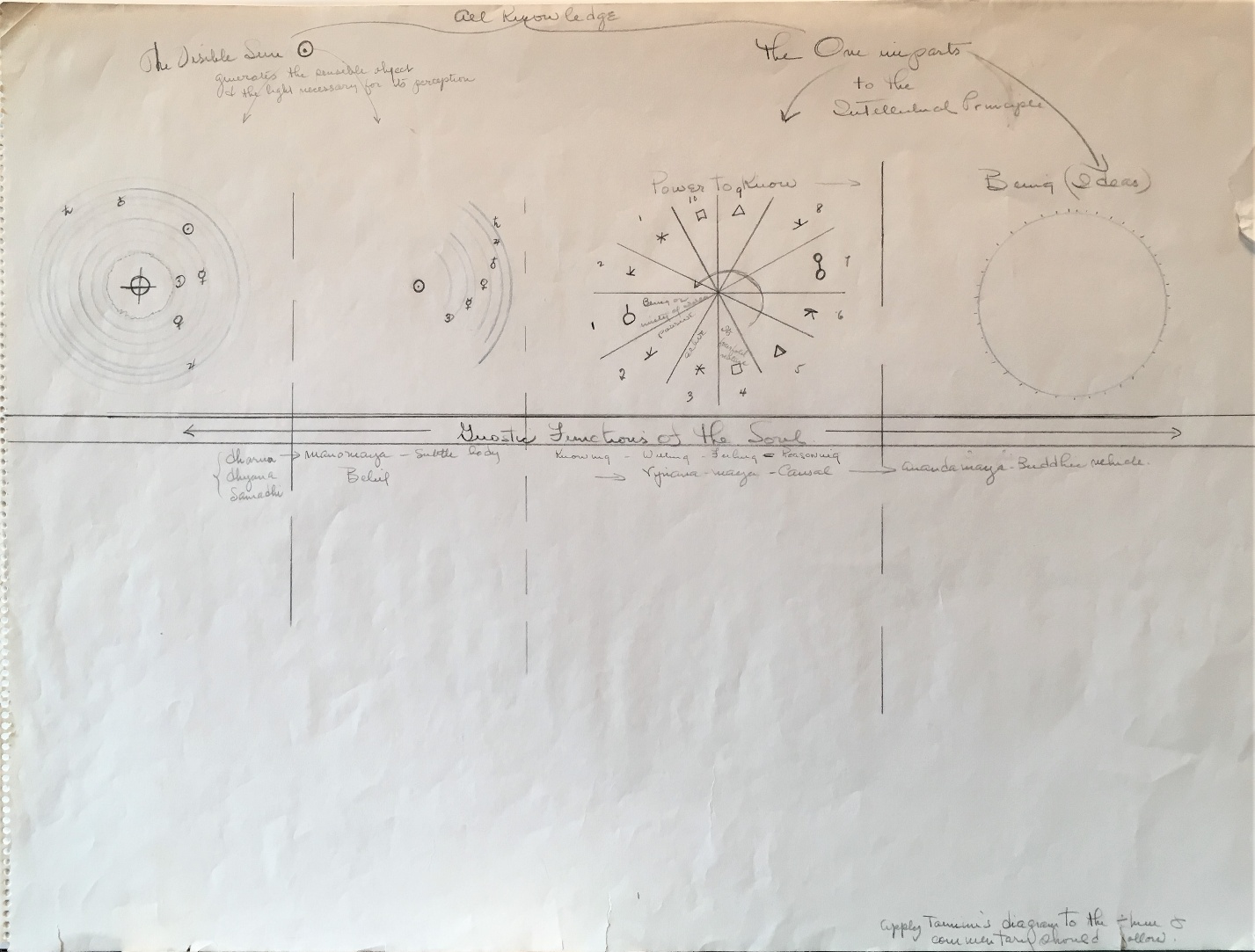
Class
Friday, January 21st, 1983
Verbatim, unedited transcriptCLASS at Wisdom's Goldenrod, Hector, NY
with Anthony Damiani (AD)
January 21, 1983
PLOTINUS; QUESTIONS
TOPIC: Plotinus
SUBJECT: Questions
SUBSUBJECTS: VI.7.7, Tentative Illumination, Divided Line, Solar Logos and Individual Soul, Gnostic and Fabricative, Mentalism, Serpent's Path, One's Intellection, Dialectic, Soul's Reasoning
CONTENTS:
Reading Plotinus, VI.7.7, on tentative illumination
Student discussion of VI.7.7, divided line brought in to facilitate discussion
All-Soul illumines space, determines where galaxies, etc., will go
Individual Solar Logos will elaborate a certain portion of that vast universal design
What world is given to individual soul?
Discussion of this continued in terms of divided line
Individual soul does not receive totality of universal manifestation
Reason
Sun uses gnostic and fabricative powers to produce world, objects/creatures contain reason-principles which give rise to belief
Sensible world is in Intelligible World
More discussion of Solar Logos, individual soul in terms of divided line
PB: world is given to the mind; mind not equivalent to soul
Sun's moment-by-moment production is given to individual mind which pictorializes it; this is primal image within which you're located
Individual mind and Solar Logos together are producing fetus and birth of fetus; individual mind is participating in the very forces building up the body
Serpent's Path; have to find the point before you fabricate the next world-image
Your undivided mind = undivided mind of Solar Logos
Incessant production of world by cosmic soul usually not noticed by individual; Serpent's Path disabuses person of notion of solid material world "out there"
Cosmic soul projects discontinuous patterns of energy; this is the substratum of the perceptual images within which you reside
More discussion of VI.7.7
No hiatus between Intellect of Sun and Sun itself
Sensible Sun = Mercury Pisces phase of Sun
Discussion of gnostic/fabricative and divided line
Soul is amphibious
Individual soul has its own reason and also participates in cosmic soul's reason
Learn to make sharp distinctions, then transcend them
Can realm of conjecture be generated solely through action of Solar Logos?
Solar Logos knows the images that will arise in the entity that has conjecture
More discussion of divided line, reason, dignities, non-dignities
Understanding vs. experiencing mentalism
More discussion of VI.7.7
Space qualified by directionalized tendencies
PB: closest you can come to conception of Void is space
Saturn in Aries as principle of falsity
Reading/discussing Plotinus, VI.7.40, on two intellections
Gita brings in notion of void between One and Intellectual-Principle
Reading Plotinus, I.3.4, on Dialectic
Reading/discussing Plotinus, IV.3.18, on reasoning
Discursive vs. non-discursive reasoning
Uninterrupted, non-discursive reasoning: Mozart, Archimedes examples
Living the rational life
Soul continuously employs unembodied reasoning
Uninterrupted flow of reason/inspiration is what eventually produces state of Nirvikalpa
Intuition is always about something
Bach lived in a continuous flow of inspiration/reason
Reading Plotinus, II.3.9, on deliberate usage
Reading Plotinus, V.3.4, on double knower
Act of reasoning (lower knower) recognizes Intellectual-Principle (higher knower) within you
You first live the inspired life before you get to insight
BOOKS READ FROM OR REFERENCED:
Plotinus, The Enneads (MacKenna translation, 4th ed.)
Paul Brunton, The Notebooks
Paul Brunton, The Wisdom of the Overself
Plato, Timaeus
Vyasa, Bhagavad Gita
PLOTINUS QUOTES READ OR REFERENCED: I.3.4-6, II.3.9, IV.3.17, IV.3.18, IV.3.30, V.3.4, VI.7.7, VI.7.16, VI.7.35, VI.7.40
DIAGRAM appended to this transcript:
- FIGURE C002 IMG_2587 fix. Divided Line.
This diagram is not from this class but is used as a stand-in to help follow along. Other diagrams also referred to are not with this transcript version. [Transcriber note: [diagram] means the speaker is referencing a diagram as he or she is speaking. If someone is drawing or writing, with audible sounds of chalk on a blackboard, I indicate this by [drawing] or [writing].]
NOTES:
- This is a Friday evening Plotinus-series class – miscellaneous topics.
TRANSCRIBED Verbatim by IT 2021 (V12a) on the basis of V11a, with two more passes, updated prefatory matter, footer, and audio file name, Book List and TOC completed, Subsubjects expanded, Plotinus quotes section added, one diagram added and reference within transcript to this diagram, new notes within transcript, new formatting to accord with new conventions. Archival verbatim transcript – V12a.
AUDIO FILES: 1983 0121a, 1983 0121b. [Note: "Tape" and "Side" refer to original audio cassette tapes that were later digitized into .MP3 Audio Files.]
1983 01/21 at Wisdom's Goldenrod
Plotinus; Questions
[Audio File 1983 0121a Begins]
AD: What's the topic? (AD laughs, laughter)
S (faint): Help us.
LR: [couple/three words inaudible]
RG (simultaneously): I could ask about anything, what do you--
AD: We'll resume. (bit of laughter)
RG: What is the topic, I have no idea.
S (simultaneously): Plotinus.
AS: Whatever you want.
S (simultaneously): She says--
RG: Whatever I want?
CDA: Potato.
S (very faint): (It's limited.)
DR: What's David [couple words inaudible]
LR (simultaneously, faint): Let's question (him).
RG: Just question any-- anything, any topic [S simultaneously, faint: In Plotinus, Plotinus.] in the last-- Oh, in Plotinus.
[students assent, very faint]
BS: Or you could just finish it--
RG (simultaneously): I think David already had a question.
S: Yeah.
S: David has a question.
AD: Oh, well let him start, let David start.
[short pause]
DB: The question I have is concerning the quote on VI.7.7 that we've read through once or twice. And my basic problem is that as many times as I've-- I've heard it, I don't understand precisely what-- what it is that the individual soul is elaborating, and what does it-- in-- in his experience what the distinction is between what has been provided for it in terms of the pattern that is spoken of as being set down and what the articulation soul is-- is concerned with. And I think part of my problem is that I'm working with PB's-- with the-- PB's conception of the individual mind being given the World-Idea and then projecting the world with it and the world in a-- in a sense of opposition. And I don't understand how to put that together with the Plotinus quote. Is that too general?
[17¼ second pause]
S: Would you say it again what the quest--
DB: Well, the question is, in--
RC (simultaneously, very faint): Why don't you just say the quote too, although not everybody has a book with them.
DB: Ok, I don't-- I don't have a book with me either. The quote is on 565, at the bottom in VI.7.7 where he says--
Plotinus [VI.7.7, DB reading]: "The power of the All-Soul, as Reason-Principle of the universe, may be considered as laying down a pattern before the effective separate powers go forth from it: this plan would be something like a tentative illumining of Matter; the elaborating soul would follow the tracings and give them minute articulation; every separate effective soul would become that towards which it tended, assuming that particular form as the choral dancer adapts himself to the action set down for him."
DB: Now, my problem is that-- well that-- I have two problems. One, I don't really understand the distinction in terms of what the All-Soul is presenting as this pattern and what the elaborating soul then does to give these traces-- let us see, so the minute articulation, I don't understand what that is. And also I don't understand how to put that conception together with the one that we've worked with from PB where the individual mind is given the World-Idea, projects it forth as the universe of its experience, and-- and-and so forth. I mean, I-- I have no question, I mean-- I don't suspect that they're talking about two different things here but I don't sufficiently understand either explanation well enough to be able to put them together. So that's my question. First one is, I-- that I don't understand the Plotinus quote, second one being I don't understand-- since I don't understand it, I don't understand how to fit it in with-- with PB's explanation.
[18 second pause]
S (faint): Didn't you find that PB's explanation is about the same thing as the one you stated?
DB: Seems to be. [short pause] We're speaking about the individual and his relationship to the manifested cosmos.
JfL: Well David, wasn't it-- I think we've said in the past that the individual souls can't work on matter, prime matter itself. And I think in part this quote-- I think this quote is in part dealing with how the matter gets prepared for the individual souls. I think you're laying down the pattern of (where) these effective separate powers, you just said individual souls. And it's easier for me to think of that in the different (rings), the Soul ring for instance, see effective powers like that, and the Universal Soul would prepare the matter in the-- for universal manifestation before the elaborating soul or before the individual soul follows with the minute arti-- articulation.
[short pause]
LC: Do you think there are three souls in this paragraph, the All-Soul, the elaborating soul, and the separate effective soul, or is the elaborating soul separate effective?
S: Answer that.
S: Uh-hm.
S: Yeah I know.
JfL: Well, either the elaborating soul could be-- I guess I-- I was first thinking that they were the same and that the separate effective soul was more the powers invested in the Mercury, in the Mercurius in the twelfth house and-- But I think it could probably be seen the other way as possibly the idea-- I don't remember then how we even discussed it, was it the tenth and eleventh house or-- could be seen as another aspect of that appearing twelfth house matter as well. I don't know if that's pointing to the issue right now but-- I think maybe initially that's good. It's an overview. You look startled David. [short pause] I think that prepares the idea for the-- for at least your-- potentially the PB idea. It's not really as separated. The Universal Soul and the individual soul sort of working together.
DB: See the-- [short pause] It seems-- it seems, from what I've been able to understand, perhaps this is not sufficient, that the individual soul has-- like on the one hand it has given to it from the Intellectual-Principle a specific version of the Idea of Man that, you know, makes it a unique soul, it has a unique vision of the Idea of Man. This is something that is e-- is eternally given to it. Now, that's at-- in the level of the Intellectual-Principle itself from the highest point of view of the soul. On the other hand, Intellectual-- the soul, an individual soul, seems to be given the World-Idea in this fashion, in a-- in a kind of a-- one image after another, so to speak, one presentation after another, it's a temporal-- temporalizing activity that's taking place in terms of the soul and its manifested quality, I mean they seem to be two things, ok. I might be wrong. I might be wrong.
RG (simultaneously): With the two things being what?
DB: The two things being that, on the one hand, the World-Idea-- no I'm sorry, the individual soul's relation to the Intellectual-Principle might initially be the Idea of Man that the soul contemplates, making it, you know, a special version of the Idea of Man at the level of the Intellectual soul, [RG assents] ok. And then, assuming that, there is this process of actualizing that [RG assents] Idea, ok. Now, that process of actualizing the Idea takes place within the whole production of the-- of the cosmos.
RG: Sure.
DB: Ok now, I'm looking at it as a-- [short pause] that as-- those as being two-- two things, alright, the one hand the Intellectual soul's vision of the Idea of Man and then the actualization. Well, perhaps they're not.
RG (simultaneously): Well, so they're two phases of soul.
DB: Right, ok, so they're two phases of soul.
RG: But isn't that what Plotinus is saying there?
DB: Yeah.
RG: Ok.
DB: Right. Now this is in reference to the second one, the-- the lower phase of the soul and its [RG assents] process of actualizing its potential. Now that requires say this Universal Soul, [RG: Yeah.] ok, [RG: Right.] to lay down this-- [RG: Right.] this-- Now, the question for me comes, I guess--
RG: How is that any different than the World-Mind gives a content and the in-- and the individual mind gives the form, or that, you know-- I don't--
DB (simultaneously): So would you be saying then that the Intellectual-- when he speaks of this pattern that is laid down here, he's referring to what the World-Mind-- that's the content part of it?
RG: Well that's one way to think about it.
DB: Ok. So then if that's the case-- I mean, assuming if that's the case then there's something in some respect that has to be excluded from that World-Idea as far as the individual soul is concerned.
RG: Why? Assuming a non-mentalistic viewpoint maybe.
DB: No, even as-- even--
RG (simultaneously): But if we're going to anticipate mentalism we ought to anticipate it properly.
S: Uh-uh.
DB: No, I mean even assuming a mentalistic perspective, [RG: Yeah.] there's something excluded.
RG: Why?
DB: What?
RG: Why?
S: Didn't that answer you?
DB (simultaneously): Why? Because, that's given to the particular state of development or particular arrangement of forms in that individual soul, and it's the combination of those things, those two things, that gives the experience.
RG: But, within the concept of the World-Idea or the world-image you could include both. And what-- right?
DB: Well, that's-- but that's a-- actually another question, but I'm not sure, I mean--
MB: Would-- would it be helpful if we tried to describe what level each soul's own act in terms of the-- the metaphysical chart, the souls that are being discussed in this paragraph?
S: And maybe while we do that we can refer to the sentence that you're talking about so everybody knows exactly where we're referring, 'cause it gets confusing on his-- Maybe we could just go sentence by sentence if--
S (faint): Yeah sure.
S: I just don't understand it anymore.
[23¾ second pause with faint background student talking]
RG: Hm. Well--
JfL: Well Dickie, before you start.
RG: Wait a minute, come on.
JfL (simultaneously): You're saying-- (RG laughs, some laughter)
RG: That assumption's unconscious.
JfL (simultaneously): That the pattern that is being laid down is the vision from the Intellectual realm? That you're saying that is the-- that's the illumining of the matter, that the matter is really the soul here?
RG: Well, it's the way we talk about cosmic soul, right?
S (faint): Uh-hm.
SC: I'll read the first part of the sentence.
S (faint): Yeah.
Plotinus [VI.7.7, SC reading]: "The power of the All-Soul, as Reason-Principle of the universe, may be considered as laying down a pattern before the effective separate powers go forth from it…"
RG: And Sam, how would you interpret it? (bit of laughter)
SC: I'm the reader. (laughter)
S (amidst laughter): [couple words inaudible]
RG (simultaneously, amidst laughter): The readers also have to interpret in this class.
SC: Well, he-- it seems to speak about-- when he says the effective separate powers go forth from it I take it that they're these separate powers are going forth from the All-Soul. So you've got the All-Soul giving some quality to-- I take it that both of those things are talking about some cosmic-- a cosmic idea or the world-image, [RG assents] and that in order for the world-image to come into being there has to be first what he's calling the-- that basic illumining or-- I don't know what words to use to describe it.
S: Can't you use blueprint? (bit of laughter)
S: Informing?
SC: Informing?
DB: Well it seems, I mean-- it's a kind of lighting up of it. I mean, illumination is, you know, to light it and [one word inaudible] on it.
SC (simultaneously): So it's sense of being almost, let's say, it's seeming being. I take both of those, both the All-Soul and the effective separate powers going forth from it, neither one to be individual, that it is cosmic soul, both--
RG: The way I read it, the effective separate powers are the individual souls.
SC: Yeah, and I'm thinking that's not so.
S: Yeah, me neither.
SC: That-- that you need both that universal illumining or creating a seeming being for the universe, and then you need the particularities of the different reason-principles that are still of Universal Soul to create a cosmic idea that the individual soul becomes associated with [RG simultaneously: But isn't that--] at whatever level it's appropriate for that soul to be associated with it.
RG: But why can't that i-- that cosmic idea be included in the lay-- in the (pattern of--) of the first soul rather than the second? [SC simultaneously: Well he--] Already laying down a pattern would be an idea, the cosmic-- the cosmic idea which in all the effective souls elaborate.
SC (simultaneously): Well, he uses the words as-- when you go on to the next section of the sentence he says--
Plotinus [VI.7.7, SC reading]: "…this plan would be something like a tentative illumining of Matter…"
RG: Right.
PD: Keep reading.
Plotinus [VI.7.7, SC reading]: "…the elaborating soul would follow the tracings and give them minute articulation…"
RG: Right.
SC: And I guess again I was thinking of tentative illumining and following tracings as saying that there had to be this-- this basic plan which was a seeming being which was the-- the outline reflection of real Being, but then there had to be a particularization of that to actually create a cosmic idea and yet still you wouldn't be talking about an individual soul's alignment to it until you had those particular principles that were-- that were articulating the tracings, so to speak.
RG (simultaneously): Ok, and I-- and I would say that this plan is the idea and that is the-- represented by the power of the All-Soul and then each elaborating soul, which is each individual soul, gives them minute articulation, I don't-- I don't see how you're going to [SC simultaneously: See, now you need two steps.] conceive that the cosmic soul can give minute articulation to the tentative illumination when it's the karma of the individual soul that has to really particularize those tracings. I don't think you need a middle step in there.
SC: Uh-huh.
MB: So you're saying the elaborating soul is the same as every separate effective power?
RG (simultaneously): Yes because in the first sentence he says before-- I mean he uses "before the effective po-- separate powers go forth from it," and in the end of the sentence he uses "every separate effective soul". I don't think there's any problem, you know, relating those two.
AS: Well--
SC: When-- when we were talk-- when-- [S, faint: Uh-hm.] when we've been using the divided line recently, it seemed that we were [S simultaneously, very faint: Divided line.] speaking-- What?
S (very faint): Divided line(s).
SC: We were speaking of two things happening before you talk about the individual soul's alignment to the cosmic idea. First there was the-- the creation of the object of belief or [short pause] [S: What?] the-- kind of a foundation of the cosmic idea, which is the o-- There's an object to belief in which there's no-- no articulation or discriminated objects. And then from that-- and that would be what I was taking to be the power of the All-S-- All-Soul, tented illu-- tentative illumining of matter, and then there has to be the creation out of that of a cosmic idea. And that creation out of that of a cosmic idea still uses the powers of the soul to do that but doesn't speak yet to the individual soul's association with that.
RG: Now two things seem to follow from that. One is that you're not allowing the first object to be a cosmic idea if you only allow its unfoldment a-- in the realm of conjecture to be a cosmic idea, and also then the individual soul only works within the realm of conjecture and not also in the realm of-- of belief.
SC (simultaneously): No, that would suggest that, as far as the second one goes, the individual soul could be working only in the realm of conjecture or it could be-- have moved out of the realm of coje-- conjecture and be associated with the realm of belief, it could be associated with that-- that basic illuming or those principles that operate in the realm of belief.
RG: I still fail to see [SC simultaneously: (one word inaudible) both.] why that object of belief is not the-- the co-- a cosmic idea.
SC: And then what would the second one be, that creation of the cosmic idea [RG simultaneously: Unfolded into--] [couple words inaudible] a phantasy.
AS (simultaneously): Individual.
RG: An individual's ima-- an individual's world-picture.
SC: And so there's no cosmic idea in that conjecture?
RG: Sure, it's the belief part. It's not [SC simultaneously: Well that's again, that's what I'm-- that's--] two things. It's not two things.
SC: That's what I'm wondering, if--
[AS drawing in background]
RG (simultaneously): They're not separate.
SC: See--
RG: The-- the world-- the world's ont-- ontic existence is given along with the individual's image of it.
SC: So that-- you're saying then that the individual-- it seems that you're almost saying that the individual soul wouldn't be associated with belief, it would only be associated with conjecture because it is conjecture. [RG: No, no.] That conjecture is created by the individual soul.
RG: Well-- That may be true but I wouldn't limit it to that.
SC: Well I wouldn't-- see, I was thinking that that wasn't so, that conje-- that the individual soul was associated with the World-Idea which is produced in that conjectural realm but that it'd be--
RG (simultaneously): Well, from what I understand of the divided line, the individual soul is related to all the levels of the divided line in some way or another and can ascend completely.
SC: That's right, that--
RG: Therefore we shouldn't limit it either to belief or conjecture.
SC: Right, but right now we're talking about the crea-- you know, the cosmic idea or the cosmic--
[Note: See FIGURE C002 IMG_2587 fix, Divided Line, appended to this transcript for the following.]
AS: Well, befo-- before we get off on that, what do you think Sam? Do you think in the quote that-- is-- is he s-- is he saying that this [diagram] is the All-Soul that--
BS (simultaneously): What are you pointing to Avery?
AS: The right side of the boar-- is this-- is the All-Soul coming from here, tentatively illumining matter [diagram]? In other words, does the All-Soul have this Intellectual vision here and it's tentatively illumining matter? [S, faint: Universal.] And then you have a sensible Sun would be elaborating that [diagram]? Or is he saying that this is the All-Soul tentatively illumining matter [diagram] and then this is the articul-- [SC simultaneously: Yeah that's a good--] and that's the elaborating soul [diagram]?
VM: Doesn't it depend on how you're using the divided line though?
AS (simultaneously): But which one-- which one would you say?
S (faint): Either one.
AS: I mean-- I mean would you [S simultaneously: That's (the one I think).] say [drawing] that this is the All-Soul and then this is an elaborating soul here and then the minute ar-- articulation is only here in the actual image [diagram]?
SC: Well if-- see if you now if you say--
AS (simultaneously): Or would you start with this as the All-Soul [diagram] and then the elaborating soul is the one that produces this image here in the realm of conjecture [diagram], in which case the elaborating soul is the articulating soul.
SC: Yeah. If the All-Soul--
AS: Put it together with that part.
S (very faint): I don't think you could.
SC: Yeah.
[9 second pause]
S: Hm.
SC: I would think myself that the power of-- what he's calling the power of the All-Soul, that basic power, is coming from on the right-hand side [diagram] and is conjoined with the Sun [diagram]. And that's-- and then you'd have that tentative illumination or that conjunction.
AS: Yeah that's-- and that's the way I was looking at it but I don't-- I mean I-- the way-- just trying to fit-- as long as you're using the diagram, fitting it in with the way we did it before if we-- that the All-Soul is what's providing this whole of this illumined space or intelligized space that this sensible Sun is going to work in [diagram]? And this is in [drawing] the sensible Sun [diagram]. Like this is our Sun of our solar system. [student assents] Solar Sun. And that would be an elaborating soul. And what that produces based on the-- based on that World-Idea that's given to it from Intelligible realm, it's going to produce all the objects that-- and all its powers [drawing] are going to produce the sensible objects.
SC (simultaneously): I didn't quite get that Avery, you want to--
BS: Excuse me, Avery, why wouldn't-- why would the Sun be the elaborating soul, why-- why couldn't-- In some sense, yes, but why couldn't you say the planets themselves are the elaborating-- like the rational soul.
AS: Yeah, the Sun with its power, [student assents, faint] with its [BS simultaneously: Oh ok.] powers, [S simultaneously, faint: That's far.] looking at these as the powers of the Sun [diagram].
SD: Well, [S simultaneously: Uh-hm, uh-hm, the way--] doesn't this get back to Myra's question 'cause-- like there's one way that-- I think Dickie was interpreting it earlier that the All-Soul you're thinking of the cosmic soul and then the effective powers, you know, the elaborating soul, is individuals within that cosmic soul.
S: Yeah.
SD: And now you're taking it one step higher, which is another way that we've discussed it at different times, that the All-Soul is really Universal Soul and that the elaborating soul is in fact the cosmic soul of a particular universe.
AS (simultaneously): Yeah. Yeah, that's the way I'm interpreting it. And eventually both.
SD (simultaneously): Well, those are-- those are two very different levels.
AS: Well, that's-- those are the two I mentioned at the beginning, how are you looking at-- how are you-- if you're going to use this diagram to try interpret the Plotinus, what are you-- have to put it somewhere. I mean is this what you're going to call the power of the All-Soul [diagram], this one we call the sensible Sun [diagram]? I'm-- I'm asking, what do you think? Is this the All-Soul [diagram]? And then the elaborating goes on from [drawing] taking this object here [diagram] and producing the image out of it [diagram], and that's the elaborating of the particular souls or individual souls? [student assents, faint] Or, is this-- or is the All-Soul as reason-principle of the universe the transmission-- that-- is that what's transmitting the Intelligible Idea to this sensible Sun [diagram] which then elaborates based on what's transmitted there?
RG: And what does the individual soul do in this-- that picture?
AS: Well, in [AD simultaneously: Well--] that particular thing, the individual soul is going to articulate whatever is in this realm, either of those realms [diagram].
AD: Why don't you use astronomical example now? What would the All-Soul be doing?
AS (faint): Illumining space.
S (faint): Uh-hm, yeah.
AD (faint): Would illumine space, yeah.
RG: Uh-hm.
AS: And that would be-- I would take space as this whole-- this whole sense side of the-- this whole left side of the divided line [diagram].
AD: And you could put as many cosmic souls there as you want, individual soul.
AS (simultaneously): Any one of these. Any one of these [RG simultaneously, faint: Ok, so it is-- right.] sensible Suns here [diagram] could appear within it, a star soul--
RG (simultaneously): Any individual soul, [AS simultaneously: Well in particul--] whether it's the soul of a Sun or in a-- or a person.
AS (simultaneously): Yeah, yeah, sure.
RG: Well in this large--
AD: You better [AS simultaneously: (No wait.)] get a free ride. Soul--
RG (simultaneously): What?
AD: Take a free ride.
AS: To what?
AD: An individual soul like the Sun, [RG: Ok.] a Solar Logos. So, [RG assents] I think what Avery is saying is first you think of the Universal Soul as laying out the whole of the blueprint in all of space , alright, where the universes go, constellation, galaxies. That would be-- that would be the first, wouldn't it, the Universal Soul lays down that principle.
RG: Uh-hm.
AD: Then, within that realm, alright, individual souls, Solar Logoses, insert the portion or operate to elaborate a certain portion of that vast universal design.
RG (very faint): Uh-hm.
AD: And if we take our Sun as one of those examples, then the Sun elaborates-- elaborates let's say the portion which is given to it, the place within which it's going to manifest its world. [student assents, very faint] Alright, then the question comes to this. Now what is given to the individual soul, what world is given to the individual soul?
AS: That's--
AD: Is it the totality of universal manifestation? [S, faint: (No.)] I mean the basis for universal manifestation, or is it just that individual world he's going to live in?
S: The world [couple/few words inaudible]
S (simultaneously): Well it sound like [few words inaudible]
RG (simultaneously): Let's say that individual Earth. It's not only the world of conjecture though. I mean if it was he could never have any real contact with a real ontic world. I mean it has to be that his individual soul contacts all three realms in its own way, not as universal but as coming through his own-- [AS simultaneously: Yeah but it's just belief.] his own-- his own mind.
AS: But that's ok, but that-- you're talking about belief [diagram].
RG: Well, and reason, I mean I think the individual soul has to be spoken of as having a contact with the--
AS: With this [diagram], sure, but when [RG simultaneously: With that also.] we put the individual soul--
RG (simultaneously): Right. So I think the individual [AS simultaneously: --through the whole thing.] soul is given all of that, in its own way, not as universal. [AS assents, faint] Otherwise, you could never have contact.
AD: The question here asked would be something like this then: what is it that's given to the individual soul?
RG: I would say (from--)
AD: From the remark you made like the world is given to the individual mind, [RG: Right.] alright, [VM: From within.] and then the mind makes an image of it for itself, [RG: Right.] and this becomes the image within which your experience takes place.
RG: Yeah.
AD: Alright, what world is given to it?
RG: Primarily in terms of manifestation the world of pu-- of objects or belief, primarily, when we talk about--
AD (simultaneously): Well you could say, yeah, within the realm of the Solar Logos.
RG: Yeah.
AD: That's the world that's given to the individual mind to manifest, [RG assents] certainly not the totality.
RG: Right. But as you have often [AS simultaneously: Oh but-- oh I--] said we're-- we-- the individual soul, mind, and the Solar Logos have to manifest that world simultaneously.
AS: But-- but then-- but then you really-- like if you're going to use the PB quotes about individual mind, I-- I think you may have to restrict individual mind [SD assents] to this realm [diagram]. Now there may be Overself but [RG assents] that would be here so--
RG (simultaneously): Ok.
SD: Right.
AS: So [RG simultaneously: Yeah.] that would-- so that would show the distinction between given to the individual mind [diagram] [drawing] rather than saying well, ok, sure, the Overself may have its-- you know, its aspects here [diagram] but-- [RG simultaneously: But what about reason?] but Richard-- but given to the individual mind you may have to put it here [diagram].
RG (simultaneously): You're not including reason within the individual mind?
AD: Yeah, it's there.
AS (simultaneously): But is it given from with-- but is it given or is it part of the individual from his own soul? In other words, the picture here [diagram] [RG simultaneously: Ok, once again.] seems to show that-- suppose now the individual mind is given the world from within.
RG (simultaneously): I agree, primarily it's a world of the Solar Logos.
AS: Then-- then the soul's-- then the power of reason would have to be coming from within the individual's own soul.
RG: Well--
AS: I'm just using this-- I mean just using this diagram. If you say here he is, he's over here [diagram], there's also-- as we're saying, there's a bottom to this divided line too, the soul forming a continuity to this whole thing. [S, faint: What'd you say?] So if he uses reason in that world, if-- if he has access to reason, [RG simultaneously: Although I thought the world--] it may be from within him.
MB: But what about the point of contact of the World-Mind with the individual mind must be the Overself. PB also quotes that and it may not be out of [AS simultaneously: Right. Exactly.] place in this context either.
AS: It's exactly here [diagram], right.
MB (simultaneously): But-- so then-- but we--
AS (simultaneously): The Overself is a soul.
MB: So the Overself runs-- Ok. The Overself then you're not restricting to the right side, the right half of the divided line, the upper half [diagram].
RG: Well he is the Overself but not the soul. The soul's a more inclusive concept, the Overself's [AS assents] a-- the highest phase of the soul, in the-- in this understanding.
MB: In this understanding.
RG: Yeah.
MB: But what about the quote that I referred to that PB-- PB puts the Overself as the point of contact between the World-Mind and the individual mind. Now it's-- now from the way we've diagrammed it so far, we haven't fully explained it, looks like the-- the World-Mind is slipping something to the individual mind under the table. (some laughter)
AS: No, if his soul isn't here [diagram]-- if his soul is not participating in that world, he's not going to experience (anything).
MB: Yeah.
AS: Well that's the intermediary. Unless his soul is going to present it to him, how is he going to experience that world?
MB: So you're using then the term Overself to extend down into the soul.
AS: I'm using soul for now [student assents] instead of Overself 'cause we have to-- we'd have to discuss [MB simultaneously, faint: Ok.] the quotes in PB as to what he means by Overself.
MB (simultaneously, faint): Ok, that's [one word inaudible]
RG (simultaneously): But although Avery, you know, if you're-- what about the idea that it's the transiting-- that through transits and the planetary powers that we can become more rational and participate in reason? Is that not now included?
AS: Oh, but now you-- ok, so you want to move down, you want to say that this World-Idea that's given within is reasonable. I don't know.
RG: Sure.
AS: Say that that carries the seeds of reason. In other words, this realm [diagram] organizes this realm [diagram] so there is [drawing] some reason inherent in the very World-Idea [RG simultaneously: Well, yeah.] given to the soul, yeah. I would take it from there.
JC: But would you say that the experiences that are given by the action of the planets are-- is in the realm of belief, it's giving you the sensible reality and it's-- that sensible reality will be an image of the World-Soul's reason.
RG (simultaneously): But it's not only giving you belief because if it were-- if it weren't also delivering reason, then certain transits couldn't affect you in that-- in that way and they seem to do so.
JC: Well-- I don't know.
RG: I mean it's a funny idea.
JC (simultaneously): The act of reason may be your own-- [S simultaneously: No sense.] your own interactive [S: Yeah.] understanding the world that's given which is a reasonable world.
RG: Oh, so a Jung definition of reason there and not a real definition. Right.
JC: Oh.
RG: I mean that's Jung's definition of reason, that it's through the interaction with the individual and the world that you become reasonable. That's not what we usually mean by reason here.
SD: Well I think it's just the opposite, he's saying that the soul has to employ its own powers.
RG: I know what you're saying but then the link to astrological understanding evades me. If you don't tie it back up to the-- to the motion of the planets that we use as-- as Gods [JC simultaneously: Well I would say Jung's way of thinking--] to inform the mind as rational--
JC: In Jung's way of thinking it's more associative, and it's more like opinion which is in a lower realm. Those opinions can be forced on you, like we say, you know, tentative illumination of matter. But if you don't understand within yourself what that really means you haven't employed reason to do so. So, the world can convey you something, [student assents] it can inform your opinion, but unless you act on it from within yourself you don't understand it.
RG: Opinion isn't outside you either. It's a power of the soul, just as reason is. Those are [JC simultaneously: It's true.] powers of the soul.
AS: And-- and the way--
RG (simultaneously): The argument could be-- [JC simultaneously, faint: It's true.] I don't know, uh--
AS: You know, one of the ways we used the diagram before is that the presentation of this object [diagram] carries with it a belief or even gives rise to belief.
SD: Uh-hm.
AS: Ok, whereas here the object-- the image gives rise to this conjecture [diagram]. Now the question is he's saying, what about reason. Suppose he is here [diagram], we've got his chart here and here's the guy, now, he's-- he must have some access to reason. Is it coming through this way [diagram], transmitted through his soul say, or is there something of reason incorporated into the World-Idea that he receives [diagram]?
RG: Yeah and I think it has to be both.
AS: Yeah, [S simultaneously, very faint: Me too.] uh-huh. Well if the-- if-- if this World-Idea that's given to-- I mean the way (we're/we) seem to be using it, the Universal Soul's reason-principle that illuminates this-- the intelligence, this-- that's an intelligence, it must certainly be reasonable. You mean even if-- [drawing] at one time we had considered that it's even all the fixed stars, that this Solar-- Solar Logos here [diagram] finds itself in the midst of this illumined matter, which in a sense is this intelligence, which it then interprets according to its own, you know, it's own power. And these-- and these are [drawing] reasoning powers too [diagram]. So it would have to organize that-- the object according to reason-principles. I mean you look in the chart you say Saturn's on a certain degree, all the planets are organized according to these reason-principles.
PD: So when you have reason in [one inaudible AS word simultaneous with PD] the realm, the right side, the right half of the divided line, and the reasonableness of the presentations in the-- in the cosmic world, it's like one-- on the one hand you have embodied reasons, on the other hand you have an unembodied intelligence.
AS: That's what I-- I mean that's the way I would have to (look).
PD (simultaneously): So-- so when you-- when (we/we'd) have to understand reason on the right-hand side of the divided line, that's an unembodied intelligence that's being spoken of.
AS: Right. Whereas if we spoke about reason on the left-hand side it would have to be embodied. But this is not to mean-- to say that there isn't any there.
PD: Right.
AS: But then there's still-- it's a good-- I--
AD (simultaneously): Well inso-- insofar that the Sun produces, alright, elaborates the world, the Sun has both powers, fabricative and gnostic, right? So it uses reason [AS: And these are rational.] to produce the world, [RG assents] alright. And the [AS simultaneously: Well--] objects, the objects will contain reason-principles within them. Coming from the bottom half [diagram], alright, you say the soul has all these various powers, and the-- that second one coming down would be [AS simultaneously: Reason.] reason [diagram], alright.
AS: So it will have it that way too.
RG: Uh-hm.
S: So--
AD: Same thing.
AS (simultaneously): That-- I think [LR simultaneously: The problem is--] the question, 'cause you're saying that--
RG: Our problem is linking up to it.
AS: Well that's it, I think [AD simultaneously: Linking?] exactly--
RG: Up (with/to) the world, or the presentation of the World-Idea in the sensible and the experience of reason [LR simultaneously: But I think--] linked to that.
AS: But that makes sense Dickie because exactly--
LR (simultaneously): --that problem arose because the Sun that he has up there-- I mean, that divided line is supposed to be all knowledge.
RG: Uh-hm.
LR: It's supposed to be a diagram of everything that can be known. And somehow we've snuck the Sun in there as not on the divided line, it's coming down from a different direction. But really, it has to be on the divided line too. It looks completely separate the way it's drawn. But if the divided line is gonna be a diagram of all knowledge, then that Sun-- that Sun up there has to be on it, has to be a part of that divided line, not a separate--
AD: Yeah, but you [AS simultaneously: Well the Sun and the soul too.] remember, you remember the example, we came off of Plato's example, the Sun-- the analogy of the Sun to the Good. [LR: Yeah.] And he says the Sun produce the sensible object, generates the sensible object, and also the means by which the sensible object can be seen. And the Good imparts Truth and Being, [LR assents] the right-hand side [diagram]. So if we leave the Sun on the top there [diagram], and you know that the Sun has these gnostic powers as well as fabricative powers and it produces its world, it needs the reason-principles by which it produced that world as well as fabricative powers.
LR: Right.
AD: So-- so you could put the gnostic and fabricative powers, so to speak, belonging to the Sun producing the sensible world. Ok. And the result-- the result of a production of that nature is that any creature or body or entity that is produced will have these reason-principles constitutive [student assents] of it and automatically a certain belief arises within that.
LR: Yeah, I understand. The problem is, Anthony, to link now-- it looks separate and it really cannot be. It looks-- [AS, faint: I don't think it is.] what looks separate is the world that is experienced by the individual by virtue of the sensible Sun [AS drawing] and the world that is available to his own inner reason. One looks horizontal, so to speak, and one vertical.
AD: Do you remember the way Deck put it?
LR: Oh yeah.
AD: He said the sensible world is in the Intelligible.
LR (simultaneously): The Intelligible world.
AS: Uh-hm. [S, very faint: Uh-hm.] So that's-- I think you're just saying that this Sun that's here [diagram] is also a soul. I mean the whole thing, if you did it logic-- in a logical sequence, this sensible world wouldn't be here at all, it would just be the Intelligible world [diagram]. Everything on the left side of the diagram comes from the right side of the diagram, and so, on top of this illumination which the Universal Soul [drawing] which is back here [diagram] pro-- projects, the individual soul, which has also got its own Saturn and Jupiter phase back here [diagram], is also sitting there.
AD: Yeah. [AS simultaneously: I think that's what she's getting.] And Mercury-- and Mercury to the left [diagram].
AS: Yeah, [drawing] this is its-- this is actually the Mercury in [LR assents] Pisces phase of this sensible Sun [diagram]. And it's got a Saturn and Jupiter phase too [AS indicates on diagram], I think what you're saying was right. But to see the link you have to bring in the other diagram, that this Sun itself is a soul which has the whole Intelligible realm behind it, or it's within the whole In-- [SC: Yeah.] within it. And so, yeah, and where does it get its-- where does it get that reason-- reason-principle and its own [drawing] reasoning powers are from its own inner aspect. So yeah, it-- it has gnostic powers to project-- to elaborate a sensible world. And then I think Dickie's thing then would follow there, that [student assents] insofar as you are going to articulate that world-image, wherever it is, here or here [diagram], the reason in you will be evoked by the reasoning-- by the reason-principles that are within that image. But within-- you know, operating [RG assents] within the sensible world. And of course if your reason hasn't been developed, it could all be the reason-principles there want in that image and you won't see it, you'll only have a belief in them or a conjecture about them.
LR: But the quote that Da-- that David started out with sounds like, in that we are in a sensible world we are constrained to experience certain contents which are produced by that Sun.
AS: Yeah, I know.
LR: Ok?
AS: Seems like it. But we could bring in more.
LR (simultaneously): Now, would you say that that view-- what are the implications of that? Are the implications of that that insofar as we remove ourselves from the sensible world we're not constrained in that way?
AS: I would agree, I think-- and I think that was part of what we once went through with Plotinus, that with-- what part of the soul is [LR simultaneously: Constrai--] constrained to the cosmic circuit. These two [diagram] are constrained to the cosmic circuit in some way. If you could operate with unembodied reason, sure, why wouldn't you be able to get outside of the cosmic circuit and the sensible Sun? Then you'd be back in the Intelligible.
AD: And those are the very powers you'd need in order to take cognizance of the Intellectual-Principle which is operative within you. [student assents, very faint] So that you have-- in the left-hand side you have the gnostic powers that belong to the Sun [diagram], alright, and on the right-hand side of the divided line you have the gnostic powers belonging to the individual soul below the divided line [diagram]. Now do you think you can keep the two of them together without feeling like there's a contradiction?
LR: No, I like that.
AD: Good, good.
LR: I still think there's certain problems there.
AD: Alright, tell us the problems.
[short pause]
SD: Earlier-- or are we waiting for [couple words inaudible]
AD: We'll give her time to think of her problems. Go ahead.
S: (Hopefully.)
LR: Go on.
S (simultaneously, faint): I didn't say anything.
SD: I should go?
S (very faint): Right.
AD (faint): (Go ahead/Ok).
SD: Earlier when-- when we said what was-- what was it that the individual received from the cosmic soul within which he finds himself, we said that it was on the-- in the realm of conjecture and belief.
AD (simultaneously): A body.
SD: Ok. But, insofar as we're within a certain cosmic soul, we live in a certain structured part of the universe, do we have the entirety of all the reason-principles or aren't we also dealing with those reason-principles that are being manifested here?
AD: What do you mean the entirety?
SD: Well I don't know, but I mean one speaks of universe as infinite.
AD (simultaneously): You'll have enough of them, don't worry.
SD: Ok well--
AS: Even in our other conjecture, even the Sun-- even our Sun doesn't have what you're saying is the entirety [SD simultaneously: Right, yeah.] of those. I mean, we're talking about billions of Suns [SD: So--] [S, faint: Billions.] making up billions of galaxies (laughter, student words) [SD simultaneously: So it's probably--] making up billions of universes, and those don't even (exhaust) billions of a tenth of a whatever. (bit of laughter)
SD (simultaneously): So part of what's given is also on the rational level, right? In that sense what's-- on the reason level also there's something that's given.
RC: Yeah you just gotta change points of view, [AS: Yeah.] (substance) [couple/three words inaudible] [AS: Yeah.] On a process level our Sun doesn't-- isn't talking about all of them now. Doesn't mean that the principles are absent if you think of it as one.
SD (simultaneously): Ok so, insofar as--
AS (simultaneously): Also, what do you mean by "given" here, I mean there's no time back here [diagram]. If there's no time, it's a very hard thing to talk about "given", you're saying in-- this Intelligible world is given to like the Saturn in Leo [diagram]. Well, [SD simultaneously: Alright, well--] you-- what do you mean by that point of view?
SD (simultaneously): Well, I guess what I'm trying to work at is, if--
AS (simultaneously): That's not what is [drawing] given over here--
(Side 1 of original cassette tape digitized as 1983 0121a Ends; Side 2 Begins)
AS: What the Universal Soul has laid down is evolved or elaborated by that cosmic Sun, our Sun.
SD: And then--
AS: And that's those reason-principles which go-- which it combines some way we don't know to form the objects of this-- of this cos-- of this solar system. Then we get to know about them.
SD (simultaneously): And the individual within that solar system, [AS simultaneously: Is going to get to know about those.] his reason gets-- gets evolved through his experiences, [AS: Right.] but his embodied reason, and in [AS assents] that sense he's-- he's given a certain--
AS: In that sense he needs the cosmos to-- I mean we pointed that out before, he needs to get embodied in this cosmos to learn the lessons that that Solar Logos is providing for him. Now, you know, it's silly to ask the question, well can he-- can he then sometime later operate in this realm [diagram]? Well sure, probably. And then he probably won't need that Solar Logos' particular sense manifestation, but that may be speculation.
MB: Now Avery, if this you call the Solar Logos, the particular Solar Logos, we called it the cosmic soul before, this whole realm, [AS assents] 'cause the cosmic soul is really an individual soul.
AS: Yeah, remember the t-- the terminology we developed was that Universal Soul, in this quote anyway, All-Soul in this quote referred [MB simultaneously, faint: (The universe.)] to Universal Soul which was the Soul of the One, and which we-- you [one/two inaudible MB words simultaneous with AS] have to put back in the Intelligible realm almost. I mean it's like, it's laying down the groundwork for any particular soul. [MB simultaneously: So it-- you can't just--] Now a cosmic soul is a particular s-- is an in-- a-- a particular soul.
MB (faint): An individual (cosmic) self.
AS (simultaneously): Yeah, it's the subjective soul, it can maybe evolve and-- [MB simultaneously: So--] (but he's) using the word.
MB: So if we want to, you could put that Sun along the horizontal axis [diagram] and call it, you know, individual soul, maybe it-- maybe it sort of resides in-- in the very smack in the middle.
AS: I would-- I would say, again, yeah, that this is the third phase of some cosmic-- that individual soul has these three phases. This is the third phase [diagram] of this cosmic Sun (now).
AD (simultaneously): Yeah, I don't think you should carry your egalitarian notions out that far. (bit of laughter)
AS: Were you going to try and say that then we were the--
MB: No I wasn't. No, no, no, I--
AS (simultaneously): Yeah but I-- never mind, I mean that-- you're pointing out what Linda was saying, that there's some link, right.
MB (simultaneously): No I wasn't, I'm just s-- yeah, I'm trying to say that it has-- it has its own sort of relationship with those principles. And yet then we-- the reason why we've extended it, put it up there [diagram] is because we're subsumed under it. We still haven't discussed to what extent we participate in its fabrication. In other words, where do-- where does it stop fabricating and we-- you know?
AD: Where does it what?
MB: Where does its fabrication leave off and our fabrication begin? You know, where do we have to start participating (as) individual souls?
[short pause]
RC (faint): You really want to know?
AD: Well, you would have to-- you'd have to go back then and try to understand what the question David asked, the Idea, the World-Idea or the PB quote, in the PB quote it says that the world is given to the mind. [Note: See Paul Brunton, Notebooks, V13, 21:2.33.] Now PB there says the world is given to the mind and he-- it's kind of obscure because I would interpret that to mean the world that I perceive here and now is the [AS assents, faint] world that he's talking about and that is given to my mind. And my mind is not the same as the soul.
MB (faint): Evidently.
AS (simultaneously): Yeah.
AD: It's given to the mind. Now the mind, through the process of mental construction, fabricates its image or the image for itself in which it gets reflected.
AS: I-- [drawing] I would even-- I mean I would even see the individual mind as like here [diagram] in-- as part of this whole realm of belief, [student assents, faint] and the world that the Sun is constructing is given here to my individual mind. And that whole process he then speaks of as transmitted to the brain and so on, the-- you know, all that process of projection. And my individual mind is be-- is energizing constantly, is going on over here [diagram].
PD (simultaneously): But when PB says that the Overself that creatively constructs the individual's world experience, that--
AS (simultaneously, faint): Does he say that?
PD: Yes.
[students assent, very faint]
RC: Each individual receives his image of the world from his own Overself. [Note: "It is consequently from its own Overself that every individual receives the world-picture." Paul Brunton, The Wisdom of the Overself, p. 35, Rider and Company, London, 1943.]
AS: Yeah but does he say that the individual Overself is what creatively constructs it?
PD: Yeah, I'll read you the quote.
AS: Yeah, read the quote to me.
DB: Jeanne, go ahead.
S: Go ahead.
DB: The thing that I was [AS simultaneously, in background: You'd have to understand what (couple words inaudible)] trying to ask of earlier in terms of, you know, the World-Idea is presented to each of us every instant in time and yet, you know, I mean there are different worlds that we live in, and, that's what I'm try--
AD (simultaneously): If you put the Sun up there [diagram] as the soul which is constantly and incessantly producing the universe moment-by-moment, that is first given to the individual mind. The individual mind, insofar that it's operative, that is, it perceives and in the act of perception creates the primal image for you within which you are located, this is your world-idea. Don't go beyond that because it'll become meaningless.
[short pause]
S (faint): Mea culpa.
AS: Put it there [diagram], [student assents] I mean it-- Even conjoined with that whole process.
VM: Wouldn't you say that the World-Mi-- I mean the individual Solar Sun actually contains in some real sense the individual mind? Because I think PB also makes a point in there--
AD: Well let's say they're conjoined there, [AS simultaneously: Yeah, they're conjoined.] the individual mind and [VM simultaneously: And the Sun.] the Solar Logos are conjoined, [VM simultaneously: Ok.] [AS assents] alright, they operate together. So that even-- even the very process of your birth into the world [VM simultaneously: It's from above.] first takes place with the mind, the individual mind, conjoined with that, [S, faint: Ok.] so that the individual mind and the s-- soul together are producing let's say the fetus and the birth of the fetus, so that the individual mind is participating in the very forces that are building up the body so that the individual mind gets to know how to do that.
AS: Right.
LR: And that's why you could say that the bottom two levels of the divided line are a participation in the Sun and in its-- and the top two requires an individual or a subjective.
AS: Which way you doing it now?
LR (simultaneously): In other words, any being, insofar as he enters the sensible world, will have to-- will have to participate in belief and conjecture.
AD: Yes.
LR: That's part of the structure of that sensible order, it's what (he--)
AD (simultaneously): Yes, that's how-- that's how he can-- that's how he [LR simultaneously: But there's no--] can fit himself into that environment.
LR: Right. But there's no guarantee that he will also incur--
AD: The higher faculties.
LR (simultaneously): Reason and intuition, [AD simultaneously: Uh-hm.] that's out of his own effort, so to [AD simultaneously: Yeah, uh-hm.] speak, or his own act of--
AD: It's-- it [LR simultaneously: That's not part of--] develops the potential within him.
LR: That's not part of the sensible Sun's (li--/like) plans necessarily. That's not thinking it-- I mean when they speak in all these different doctrines and all these mysticisms about breaking away, that you must make a break with that sensible world, I think that's what they're talking about.
AD: Break?
LR (faint): Yeah.
PD (faint): You mean through--
LR: In order to reach that level of insight, you have to free yourself from the bondage or the constraint.
AD: No, it'd be better to put it this way, you better learn what the bondage or constraint is.
LR: That's the same thing.
AD: Exactly. [S: Yeah.] That's why there's no difference between us. (some laughter)
RG (faint): I don't get it. Wait a second. (some laughter)
AD: Oh, [S simultaneously: How about my--] (a) private joker.
RC: So analogously, could you say as an analogy that when you speak an idea to me you essentially present the idea for me to deal with but your understanding doesn't come with it, that--
VM: Haven't you noticed that?
S (very faint): Yeah.
RC: Yeah. (VM laughs)
S: That's obvious.
RC (simultaneously): That the understanding has to be generated by my own productive activity on that given, [AD: Yeah.] and whatever understanding I get is an image that I fabricate.
[short pause]
AD: And if you notice at the end of that quotation he says each one of us joins that world within a-- the Solar Logos like a choral dancer, [RG assents, very faint] and we get the particular body. Dickie, the interesting point here of course is that the Serpent Path I think is-- can be understood, the exercise of the Serpent Path requires this for a background in order to be understood. (Better.) [Note 1: See Paul Brunton, The Wisdom of the Overself, Chap. 14, "The Yoga of the Discerning Mind," A Meditation on the Serpent's Path. Note 2: See WG Classes 1983 0116 and 1983 0206.]
RG: In what way Anthony?
AD: Well if you think of the Sun as giving that-- the World-Idea to the individual mind in every instant in time, alright, that's the incessant production that's always going on that the world is-- is, you know, a series of thought-stills. And it's given to the mind, the mind immediately transforms that into the imaged world. Now, this is the-- this is the beauty of the exercise. It's like you've got to find that point before your mind fabricates the next world-image.
RG (faint): Good luck. (bit of laughter)
AD: 'Cause (if) it keeps fabricating one image after another, and the mind does this incessantly, it's between two fabrications that you've got to slide out to get to the undivided mind that's working behind it.
VM: But Anthony, that undivided mind is still considered to be in the bottom two levels of the div-- the divided line [RG simultaneously: No.] or do you actually [S, very faint: No.] start-- it's still there, I mean it's not that you're jumping into [S simultaneously: No.] the right-hand side of the divided line.
RG/S(?) (faint): What?
AD: In other words, the Sun's productive and gnostic powers is equivalent to my undivided mind, it's equivalent to my self, but to a certain extent. We'll [VM assents] worry about the higher reaches later on. [VM: Yeah well--] But right now I want to see if we can place ourselves properly in this perspective where the Sun, which PB calls the World-Soul and we-- we refer to as the cosmic soul, in its-- in the process of producing the universe and transmitting an image of the world to the individual mind and then the individual mind trans-- translates that or let's say pictorializes that for us, then that's the primal image within which we're located.
RG: But if one was really successful in that exercise, wouldn't they have to not be in the suc-- second level anymore, wouldn't you have [LR simultaneously, faint: Yeah, you'd have to be--] to cata-- be catapulted into the [LR: Third.] realm of di-- of dianoia, the right-hand side [diagram]?
AD: Yes.
AS: Yeah.
AD: But you see, the dianoia on the right-hand side and the dianoia of the Sun is the same thing.
RG: Right, ok, but once you-- once you-- you-- you've gotten through the thought-instant, so to speak, there is no-- I mean you've gotten past that productive activity. I mean you've gotten in between.
S (simultaneously): Yeah but--
AD: Yeah, in this sense. If you think-- if you think of penetrating into the Solar Logos' knowledge of what it is to do, not the doing but the knowledge of that doing which would be an eternally ordered, you know, the knowledge in stasis, [RG assents, faint] alright, it's not an activity. When you're thinking of it producing the world, alright, you're thinking of the cosmic soul, alright, moment-- working moment-by-moment, [RG assents] see. The Buddhists I think refer to that as the World Constructor. [RG assents, faint] And on the other hand, if you penetrate beyond that to its own stillness, alright, that would be the undivided mind. That's also the same as your undivided mind.
RG (faint): Uh-hm.
S (faint): Uh-hm.
VM: (Is) that [one/two words inaudible]
RG: And that's where those two link up in the third level. Then the split really disappears in some way.
AD: Well, not until a person reaches that level, alright, can he start speaking about recognition of the Intellectual-Principle within him.
RG: Right.
VM: But Anthony, to continue the Serpent Path issue, when we actually are advised to get between two thought-instants, it's not that we're actually affecting the pulsation or the generation by the Solar Sun, it's our own mind's response to it or something. I can't imagine we're stopping the Sun from pushing out its world instant-by-instant.
AD: Uh-hm.
VM: But somehow we are stopping our reaction or response.
LR (simultaneously): PB said-- in that exercise PB [student assents, faint] said you disidentify with it.
DB: With what?
LR: In that-- I thought that was a real important point.
AD (simultaneously): Well, yes, he points out, if I remember Linda, he points out that insofar that you recognize that the mind is producing the image, alright, you recognize the mentalness of your experience. In recognizing the mentalness of your experience then you can disidentify with it much more easily.
S: Uh-hm.
RG: Hm. Right but, just because the motion goes on to produce the world, your consciousness is freed from being within it. Isn't that the idea?
VM: Yeah, I think that's-- well Richard would understand it.
RG/S(?) (faint): Yeah right.
[student assents, very faint]
RG: And in that sense your consciousness then is at a level different from the production itself, while it normally is within it.
VM: If you go into trance it doesn't help somebody else necessarily. I mean you're not--
AD (simultaneously): Yeah, [few inaudible student words simultaneous with AD] [couple words inaudible] your mind [VM assents] to stop functioning. The other interesting point we made I think was this and I think it's really very important. The incessant production that's taking place by the cosmic soul is not noticed by the individual. [VM simultaneously: Too fast.] And because of that, he assumes that the world is a solid substantial con-tinuous reality. [student assents, faint] The recognition in this experience, you know, that it is not so, is very disabusive, you know, it just disentangles you from feeling that your reality, your real values are in the world, when you realize that it's the series of stills which your mind is constantly creating. Then there's a disenchantment with it. In other words, you've experienced the mentalness of things and their so-called solid substantial reality isn't (bought) any (longer/more). Of course when you come out then you'd have the same problem. The old habits will persist in trying to posit a real hard significant solid world out there for you and these archaic habits just try to take possession. But the memory is usually pretty enduring.
S (very faint): Yeah.
VM(?) (very faint): Guess so.
BS: There seem to be two set of stills, one that comes from the pulsation from the Sun itself and one is the re-interpretation of the individual mind.
AD: I'm-- I'm sorry, I didn't quite--
BS (simultaneously): In some sense there seem to be two set of stills. It's not that one is equal to the other.
AD: No, they're not two set of stills. What the-- what the cosmic soul projects forth is patterns of energy, not pictures. It's your mind that makes pictures of the--
BS: Now this pattern of energy, is it impulsive or is it continuous or--
AD (simultaneously): Is it what?
BS: Is it a continuity or is it a series of--
AD (simultaneously): No, it's discontinuous [RG assents] and [couple inaudible AS words simultaneous with AD] it's incessant. [students assent, faint] In other words what we're saying is the substratum of the perceptual images within which you reside and think of as your world, the substratum of that is these energy patterns, [BS simultaneously: Well these energy patterns which seem to be the--] the energy or-- or the--
BS: I'm sorry?
AD: Energy.
BS: Yeah. These energy pa-- what we call energy patterns seem at least to me right now to be the cosmic mind's image of the world.
AD: Yeah but, 'image' becomes [AS simultaneously: Go on (one word inaudible)] meaningless here.
RG: Right [one/two words inaudible] right, sure, right.
BS (simultaneously): Well I know that, I-- I understand, yeah.
AD: That's why I don't want to use the term 'image'.
S (faint): Right.
BS: Ok, I could--
AD: Our mind creates the image of the world for us.
BS: Yeah.
AD: Well then [BS simultaneously: I'm just trying--] just stop there, alright. [BS simultaneously: I'm trying to get onto the right-hand side.] What-- what is being-- the world that is being given to our mind, alright, is this cosmic pulsation.
S (faint): Uh-hm.
S (very faint): That ought to (help you) [one word inaudible]
BS: Is there--
AD: (Alright), let's stick to Plotinus.
S (faint): Yeah.
MB: Can I ask one more question on that part?
S (simultaneously, faint): Well we-- we elaborated.
BS: I wasn't allowed to. (bit of laughter)
MB (very faint): Right.
BS: But go ahead.
S (simultaneously): [couple words inaudible]
AD: Alright, go ahead, if you feel it's urgent.
Plotinus [VI.7.7, MB reading]: "The power of the All-Soul, as Reason-Principle of the universe, may be considered as laying down a pattern before the effective separate powers go forth…"
MB: So that's the-- the power of the All-Soul lays down a pattern before the sensible Sun takes it up.
AS: Right.
MB: So--
AS: But it lays it down, yeah.
MB: Yeah, what it--
AS: Provides it.
MB: Yeah, what it-- do we want to talk-- say more about that prior [AS simultaneously: That--] to the sensible Sun and what he's talking--
AS (simultaneously): That's what the sensible Sun itself receives, that's like the World-Idea that it receives, the reason-principle of the universe.
S (faint): Uh-hm.
S (faint): Yeah.
MB: So that's not--
AS (simultaneously): It takes a lot of intermediaries to translate the Intelligible Idea.
MB (faint): So that's not the discontinuous production that we were talking about just now, that's the sensible Sun's elaboration into the form of the [couple/three words inaudible]
AS: I think, if I understood what he was saying there, this [diagram] is this instantaneous energy is the production, the ela-- in the quote, the elaborating-- The sensible Sun elaborates that tentative illumined reason-principle that it-- that it [MB assents, faint] gets from the Universal Soul from here [diagram]. It-- it elaborates that in the form of this energy. And PB says, you know, that World-- he calls it World-Mind's continuous production, we're calling it this World-Soul, [MB assents] this continuous energy flow. And then that's pictured-- each instant that's pictured forth by your mind as your world-image.
RG: I'm sorry, what-- why does the sensible Sun have a different status than the other objects that you're talking about? [S simultaneously, faint: It's interesting.] In other words, you're making all but it's the producer. And I don't-- I don't get it, I mean I know it's not the Sun we see but you're still talking about it as [AS simultaneously, faint: Yeah, the Solar Logos.] if it were in the [MB simultaneously, faint: Uh-hm. It's a subject.] object of belief.
AS (simultaneously): No, I'm not.
MB (faint): It's a subject, it's not--
RG: But the--
AS (simultaneously): I'm talking about it as the-- Well, in the-- in the Plato quote, [drawing] he talks about it as something other than either the object or the senses [diagram]. I mean if you talk about it as--
RG (simultaneously): But if we're speaking of it as the cosmic soul don't we have to put it almost on the line between the right-hand and the left-hand [diagram] rather than in the left-hand for the diagram?
AS (simultaneously): I think that's why he puts it off the line here to indicate that it really isn't on-- [drawing] it isn't either of these two heads [diagram], he--
MB: He meant in the middle, exactly.
AS: Oh yeah, I think-- that was the-- that was the same with Linda's point. That would just be turning the diagram and saying that this Sun has behind it the power of all this [diagram].
RG: Right. They're a little different, I think, I mean--
AS: Oh?
RG: Just by-- because calling it the sensible Sun-- I don't--
VM (simultaneously): It's not sensible.
S (faint): Uh-hm.
RG: No, it's not [AS simultaneously: It's not in the sensible.] sensible, it's not e-- it's not--
VM: The principle of sensibility if you like.
RG: Yeah I-- yeah.
VM: Right? Isn't that the way we're trying to use it I think?
RG: Yeah. [students assent, faint] But the im-- I don't-- I don't know where you mean it to be.
AS: Well-- or do you mean it-- or is it-- or is [VM simultaneously: Eight-- eight inches off the line.] that the real light? I mean you see light but maybe that really is light, I mean that it-- but Andrew brought up that point-- (bit of laughter)
MB (simultaneously, faint): That doesn't--
VM: It is light.
AS: --from before, but I mean-- No, I mean--
HS (simultaneously): No, it can't be.
PD: Well, it does seem to lead to a lot of confusion to speak of the Solar Logos as the sensible Sun.
AS: Why?
AD (simultaneously): Why?
AS: I think that's the point.
AD: Why Paul?
AS: It is.
AD: Why is it [AS simultaneously: 'Cause a--] confusion?
PD: Well, like eve-- even in PB--
AD (simultaneously): Every tradition in the world, every tradition in the world looked up to it as the symbolic--- symbolic of the Gods.
PD (simultaneously): Well like in PB he distinguishes the-- in the Sun exercise, between the light behind the sensible Sun as being the Solar Logos, not the sensible Sun. He calls it the mystical Sun behind the sensible Sun.
AS (simultaneously): Yeah I know but-- but then you gotta-- [VM, faint: Yeah.] but Paul--
PD (simultaneously): See, and that's what he's calling the [AS simultaneously: Ok.] World-Mind in hi-- in his text.
AD (simultaneously): Yeah but--
AS: But I understand, but Paul the terminology--
PD (simultaneously): So to make the correlation with the World-Mind is a contradiction in his presentation.
AS (simultaneously): But look, if you're in the realm of conjecture here [diagram], Paul, if you're here, [drawing] and you're looking at the Sun, I mean we go through this all the time, I think it was just the question of what you're calling the visible orb. If you're in the realm of conjecture and you're looking at the Sun, obviously you're looking at the way that the Sun is reproduced in [RG: Sure, I know. But go up in your-- right.] your imagination. And that's not the sensible Sun we're talking about.
RG (simultaneously): Right. But go up one level than that, then you're going to say that--
VM (simultaneously): Nor either is it here.
AS (faint): Neither is it [one word inaudible]
RG (simultaneously): Nor is it there.
AD (simultaneously): I'm-- I'm looking (a lot at) Dickie because be-- in the-- in the Gods [couple inaudible AS words simultaneous with AD] the distinction between their body and their soul and their Intellect is irrelevant. There's no hiatus between the Intellect of the Sun and the Sun itself.
RG (simultaneously): Right but-- I agree. Right but-- It's only our understanding that's trying to put it on a diagram.
AD: Yeah, yeah.
RG (simultaneously): But in-- insofar that you really care where it goes, I mean, what-- I mean, yeah, if it's all one Sun it doesn't matter where it goes. It's pervasive.
S (very faint): Yeah.
AS: But that-- but I think what's indicated here is that this really-- maybe I'm (off/wrong) but, I would say-- [drawing] wouldn't you say that this is really the third level [diagram], that Sun-- if you want to call it a soul, ok, Solar Logos, it has three-- it's tripartite. Now we're saying that this Sun we're putting here is indeed the third aspect of that Sun, [RG simultaneously: That's why I would-- right.] it's not one of the first two [diagram]. That's why we're calling it the sensible Sun. The thing-- it is the thir-- like the Mercury in Pisces phase. It is the third phase of that Sun, it's not the first phase or the second phase of that Sun.
RG (simultaneously): Yeah I don't see why it isn't the second phase looking down.
PD: Well see that's-- wait, there's even more of a problem, Avery, because the sensible Sun is co-- the way you've got your diagram is coming from Plato's distinction of a sensible Sun and an Intelligible Sun. So the meaning of this sensible Sun is existing in contrast to the light in the Intelligible cosmos. I think that's what I'm objecting to.
AS: 'Cause you don't think there is a distinction?
PD: Well, when you're speaking in the-- in the manner we have, yeah, I think that it create more confusion than help because you're speaking of the sensible Sun as existing in a contrast from the Good.
AS: Yeah, well--
PD: And, I don't think-- I don't think that's a way to speak of-- or like PB's notion of the World-Mind.
AS: Oh I think he definitely makes a distinction between mind in its-- he speaks about the-- that ever-active phase of the World-Mind which is involved in manifestation. That's what we're calling this sensible Sun, where PB speaks about that the outward-facing aspect of World-Mind, he calls it World-Mind and we called it the World-Soul, that's bound up with the activity in the cosmos. He says that in a lot of places in the Wisdom. That that lower phase is bound up with the manifestation of the cosmos. But this is the Good [diagram], I mean I don't-- I don't see [PD: What--] why you would ever want to identify the Good with the cosmic soul. Certainly it's a-- [PD simultaneously: Well you're--] be a tremendous difference.
PD: See you're speaking [AS simultaneously: This is totally--] out of both sides of your mouth though. On the one hand you say the [AS simultaneously: Yes.] Solar Logos has these three aspects, [S: Speaking a fourth tongue.] and now on the other hand you-- you're su-- you're sundering them.
AS: But that-- isn't that the point we made in the Buddhism too, that on the one hand it's distinct but on the other hand you can't [VM assents] cut it off and say there's no relation and we have to explain both, how this manifesting principle is distinct from the Good, on the other hand, you know, if we look at the diagram another way, we have to see that this Solar Logos itself has an inner aspect which is in the Intelligible world. And I don't see why that's a problem. Obviously there-- there's a continuity but there's also a distinction.
JC: Isn't that sensible [one/two inaudible AS words simultaneous with JC] Sun being referred to as Nature? Plotinus has the three rings of light around [AS simultaneously: Realm of Nature.] the Good-- three rings of light around the Good, remember that quote? [Note: See Plotinus, IV.3.17, third and fourth paras.]
AS: Yeah. And you're-- you're saying like this is the natural light.
JC: The natural light. And-- and that is the-- that part of the Solar Logos which fabricates the world, not to say that it isn't the ("I"/eye) by which you see the higher aspect.
AS: I would agree and I would say that the sensible light we see is just a poor image of that light of that real sensible Sun. [student assents, very faint] Now if you talk about the inner aspect of this Sun you're going to be talking about something completely different if you're in the Intelligible world. I would say-- let me not say completely but--
PD (simultaneously): I-- that's-- I mean that's clearing it up because of the discussion Avery but, that's the [AS assents] point is that when you keep speaking of the Solar Logos just in this context in its relation to manifestation, [AS, faint: Well--] it's not representing the nature of the Solar Logos.
AS: In its entirety, I agree.
PD: In itself, in it-- as a-- as a principle.
AS (simultaneously): Exact-- I agree, and PB makes the point that what it is in itself he talks about the World-Mind in itself and then he talks about the World-Mind in its active aspect manifesting a cosmos. (Uh-hm.)
AD (simultaneously): In other words, in other words, the cosmic soul has a principle of manifestation but then when you inquire into the higher meaning of cosmic soul it has a principle which is beyond the principle of manifestation, alright, and that would be in the Intelligible realm.
S (very faint): Yeah.
S (faint): To an extent.
AS: Well it seems ok, he's just (reverse it).
AD: But we do have to, you know, confine ourselves to the analogy that he's given us, otherwise it becomes useless. Anyway, do you people have objections to putting the fabricative and gnostic powers of the Sun in the left-hand side and putting gnostic powers on the right-hand side of that divided line for individuals souls [diagram]?
VM: No fabricative though for the individual soul? You want that too, don't you?
LR: I didn't get what you just said.
RG (simultaneously): Yeah, I didn't get what you said either.
CDA/S(?) (simultaneously): Yeah, me neither.
PD: What-- (bit of laughter)
VM: You got to [one/two words inaudible] now, I didn't get--
AD (simultaneously): (Well), you remember we had just the gnostic and fabricative on the left-hand side [diagram]?
VM: Uh-hm.
CDA: Wait, the [S simultaneously: Uh-hm.] left-hand side, [S simultaneously: Yeah.] where's my [one word inaudible]
AD (simultaneously): Yeah, left-hand side.
AS: Here [diagram].
CDA (simultaneously): (You/It) had the dignities or--
AD (simultaneously): And the week-- and the week [CDA and another student assent] before that we had the gnostic powers on the right-hand side [diagram].
CDA (simultaneously): Right-hand side, right.
AD: Now could we have them together [diagram]?
VM: In both sides.
CDA (simultaneously): Have them both together in belief.
AD: Well, have the gnostic powers on the right-hand side, [student assents] alright, [student assents, faint] and the gnostic powers on the left-hand side, [CDA simultaneously: Oh you want to do both?] only on the left-hand side they belong to the cosmic soul, on the right-hand side they can belong to any individual soul. So I could have the gnostic powers there [VM simultaneously: Well, what about--] and the very powers [CDA simultaneously: I want to know why.] that are needed to recognize the--
S (faint): Why would that be [one word inaudible]
CDA: [one/two words inaudible]
AD (simultaneously): Why. Why not?
CDA: Why do you want [one/two words inaudible] (CDA laughs)
AD (simultaneously): Let me turn it back, why not?
S: Well, you get--
AS (simultaneously): How else are you going to know the-- [AD, faint: Yeah.] the reason-principle?
RG (simultaneously): Because, [CDA simultaneous with AS: Well--] you can't-- because the individual on the left-hand side also has gnostic powers.
AD: Yeah.
VM: If they're good.
RG (simultaneously): But the first thing you said was we should ensure--
AD (simultaneously): You remember that quotation in Plotinus when he s-- he points out, he says that there is a reasoning phase of the soul which recognizes or has cognizance of the Intellectual-Principle within it. [students assent] And then by knowing that the Intellectual-Principle is within it, it can know its selfhood, [RG assents] Nous, yeah. [Note: See Plotinus, V.3.4.]
HS (simultaneously): Is that-- is that the individual soul which you're pegging on the right-hand side of this line now?
AD: I didn't hear you, [AS simultaneously: Bottom of the right-hand side.] Herbert. Avery, what did he say?
HS: Is that the individual soul which you're taking on-- as the right-hand side of this line now?
AS: No, the bottom.
AD (simultaneously): The individual soul is the bottom, the whole bottom [diagram].
S (simultaneously): Yeah.
HS: The whole bottom is the [AD simultaneously: Yeah.] individual soul?
AS (simultaneously): Yeah. [one/two words inaudible] this--
AD (simultaneously): Because he-- he's like-- what do they call those things, ducks? They lived in the sky and-- [S simultaneously: Or amphibians.] no crocodiles, they [AS assents] live in the water and on land? (some laughter)
RG: Talk to him about [one word inaudible]
VM (simultaneously): Amphibian.
AD: Amphibian, (laughter) yeah amphibian, that's the-- yeah, the soul is amphibious. That's the word I want.
HS (simultaneously): He lives in the water of the cosmic soul?
VM: Yeah.
AD: Huh?
HS: He lives in the cosmic soul's (water)?
AD: He lives in the co-- he lives in the Nous and he lives in the world that the cosmo-- that the cosmic soul created for him.
HS: When you speak then of the right-hand side being, so to say, extra-existentially-- you know, it's outside of the existence of the cosmos, why isn't the substances of the individual soul's reason also in the cosmic soul's reason? [one/two words inaudible]
AD (simultaneously): Well why can't he have his own? Let me turn it back on you.
HS: But, w-- I don't-- I don't understand why--
AD (simultaneously): If we say that every [S simultaneously: Yeah.] soul has a tripart division, [HS: Yeah.] alright, it has an Intellectual phase, a rational phase, alright, [HS: Yes.] then why shouldn't it have it?
RG: And it also participates in the cosmic soul's reason on-- in the-- yeah.
AD (simultaneously): At the same time, yeah.
RG (simultaneously): At the same time, in the right-hand side diagram there.
AD (simultaneously): Otherwise it would be wasting its time participating in-- in the cosmic circuit, wouldn't it?
RG: Right.
HS: And yet it--
AD (simultaneously): It would never know what the hell's going on.
RG: Exactly, that was [AD simultaneously: Yeah.] the point you made before.
AD (simultaneously): Very good! (AD claps) We're getting there. (AD laughs a bit)
DB (simultaneously): But, so-- so [S simultaneously: I just--] Anthony, then would it-- would it follow that the individual soul's understanding, that the accumulated understanding that the individual soul is working with is something that's extrinsic to the functioning of the cosmic soul?
AD: I do-- I-- I can't understand how you can take a scalpel out and make these, you know, demarcations so intense. I think you ought to [VM simultaneously: You've been teaching us to do that for years.] concentrate on, [RG simultaneously: Ok, good point.] you know, not having such sharp contours.
LR: Years of training [couple/few words inaudible]
VM: You've been teaching us years and years now.
RG (simultaneously): It takes years of Virgo training (to do). (RG laughs, some laughter)
AD: Well you notice, you're getting ready for something better.
VM: I hope so.
RG (simultaneously): Yeah, good. That's (up).
VM/S(?): Let me die.
AD: Getting ready for something better. First, the need to bring about these very sharp distinctions and then to see that they're useless.
AS (simultaneously): Then it's all one, everyone is-- 'cause everyone-- (laughter, clapping) All one everyone.
RG (simultaneously): Right Avery, yay! (RG laughing, more laughter, clapping)
VM (amidst laughter): Oh I don't think I'm ready for that.
AD (simultaneously): Do you think-- do you think that you could make a distinction like that between the powers that belong to an individual soul and powers that belong to the cosmic soul, gnostic [AS simultaneously: No.] power?
RG: No.
S (simultaneously, faint): No.
AD: Ok.
AS/S(?) (faint): Of course not.
VM: Well Anthony, I want to make just one--
AD: But, I first (bit of laughter) had to introduce that distinction, make you believe it, force it down your head, alright, (bit of laughter) kick you, yell at you. Now that you believe it I tell you drop it, and you get upset.
VM (simultaneously): Yeah I know, you've been doing that for years.
S: (Just do it.)
VM: I want to [AD simultaneously: You never know. (bit of laughter)] just make one-- one small (comment).
LR: What lies you told? (some laughter)
VM: No, pedagogic devices.
AD (simultaneously): They're not lies.
VM: Pedagogic device.
LR: What do you call it?
AD (simultaneously): They're medicinal lies. (laughter, student words)
S (faint): Oh yeah.
AS: Skillful means.
RG: Right.
S (faint): Skillful.
AD: You-- [HS, faint: Yeah.] you know, one of the charts I'm going to do is Hegel. I'm going to put you people through some real floundering. (student laughs) I decided I was going to get even on all of you now.
RG: Oh no.
S (simultaneously): Uh-hm.
VM: Will you make us read a lot of Hegel or just his chart? Or both?
AD: Both.
VM: Good.
S: (Both.)
VM: In order to prepare myself for that I want to ask a simple question. This-- when you were speaking about the gnostic and fabricative powers of the Sun, that seems clear that we need both, and then it seemed like you were just speaking about the gnostic for the individual soul on the right. Don't you want to attribute fabricative powers to it as well or-- or not?
RG (simultaneously): Not on the right-hand side 'cause there is nothing fabricated on that--
AD (simultaneously): There wouldn't be-- for the soul there wouldn't be no such distinction.
HS: Oh.
VM: There wouldn't be such distinction.
AD: Fabricative and gnostic would be the same thing.
VM: They'd be fused on the right [AD simultaneously, faint: Yeah.] you say or indistinguishable.
AD: Yeah, it learns mostly of the fabricative. Because of the lack it learns that through the cosmic circuit. Once it learns it then it would become part of its powers.
AS: And then it becomes-- it can become fabricative too because I think you have to keep remembering that ultimately the-- in essence, this cosmic soul is going to be the same as an individual [RG simultaneously: An individual soul.] psyche. So he's-- the cosmic soul itself just really only needs to exercise its fabricative nature here [diagram]. And I think as Richard just said, it doesn't have to fabricate it over here [diagram].
VM: Ok. But, let me ask a--
AS (simultaneously): And you have this--
VM: One time we spoke about the realm of conjecture. Now let me leave the individual soul, let-- let me back up a little bit. Let's leave the consideration of the individual soul aside as much as possible. Are we still holding to the idea that the realm of conjecture, the space-time realm of appearance or manifestation [AS drawing] can be generated solely through the action of the Solar Logos?
RG: No. In the con-- realm of conjecture? I thought--
VM (simultaneously): But you say no very quickly Dickie but I don't know if you were here that day but we were [RG simultaneously: I guess not.] trying to-- we were--
RG (simultaneously): Is that the claim?
LR (simultaneously with VM and RG): Say it again Vic.
VM: We were trying to consider, maybe a week ago or so, I didn't date it very carefully.
AD: Well if you take the wholistic view that the Sun, alright, is negating itself by creating an other, alright, a subject and an object for itself, which will be the two sides of the divided line, alright, well then I think you can say it.
LR: I didn't hear what the reference was.
S (faint): I didn't either.
VM: The one I said was the idea with-- set aside the individual soul. Just keep him out of the picture for-- at least for a while. The realm of conjecture can be generated or produced by the Solar Logos or the sensible Sun independent of the individual's contribution. We did try and speak about some sort of a manifest world of appearance, not known by an individual soul but just nonetheless produced.
LR: It's not over in the conjecture [student assents] [VM simultaneously: Yeah, on the left.] side but the belief side.
AS: No, in conjecture side.
VM (simultaneously): No, in the left. [RG simultaneously: Even in conjecture.] All the way over in conjecture.
S (faint): Uh-hm.
LR: [couple words inaudible]
RG (simultaneously): That's impossible.
S: Uh-hm.
AS: What do you mean?
VM: Why is it impossible?
RG (simultaneously): There can't be an image world without a knower of it, and that [AS simultaneously: Well--] knower is an individual soul.
VM: Why does that-- (AS laughs) [S: Uh-hm.] But look, the individual Sun is an individual. Why [AS simultaneously: That's right.] can't it be the knower?
RG: Well then there is an individual knower.
VM: I'm sorry Dickie, when I was using 'individual' it was like individual human mind.
RG(?) (faint): Ok.
AS: But that-- oh--
VM (simultaneously): Granted-- granted the Solar Logos or the sensible Sun has individual nature but I was, [RG simultaneously: Well (one/two words inaudible) beat up-- right.] you know, trying to separate it [RG simultaneously: Ok.] from the human stream.
RG: But you know, Anthony just made a distinction that the-- we can't really use the term 'image' for Solar Logos because it's manifesting moments [AS simultaneously: An en--] (and/an) energy pattern. And it would be very hard then to conceive of how the Solar Logos could manifest imagery without an individual mind's space-time unfoldment of what we now understand image to be independent of those energy patterns, [AS: Right.] and what the distinction would be then.
AS: Yeah. You know, I tried to-- I tried to do that with the divided line before. I don't know if this analogy makes sense but, if you use the ratio business too it seems to make sense there. The Good generates the Idea and the knowing of it. But in that generation of Idea and knowing of it there's not really a split, I mean the Idea and the knowing of it are together. But if you bring in [drawing] the second part of this divided line on the right [diagram] then-- the reasoning part, which means you have to be talking about a soul in particular, then you could talk about the knowing of it split off [RG assents] from the Idea. I think similarly here, if you just talk about the Sun, this realm of conjecture is not anything other than the actual fabricated world, [RG assents] and so you can't talk about a split of a realm of conjecture other than the energy manifestation.
RG (simultaneously): But then why would you even [AS simultaneously: But--] speak of it?
AS: No, I'm saying, but now-- but if you bring in the individual again on this side of the divided line [diagram], again you can now talk about that individual's-- that image split off as it were [RG: Right.] from the ener-- [student assents, faint] energic manifestation.
VM (simultaneously): You just turned it around 180 degrees though.
RG: But it seems to me-- right.
AS: No, no, I'm [couple words inaudible] supposed to be(--/.)
VM (simultaneously): No, no, I mean, I thought-- I thought Anthony agreed that one could speak about a realm of appearance independent of an individual soul, I'm--
AD (simultaneously): In the sense, yeah, but in the sense [AS simultaneously: But I'm--] that the Solar Logos knows, [AS: Part of--] in the sense that the Solar Logos knows and comprehends the images that are going to arise in the entity [AS assents] that has conjecture.
VM: Ok.
AS: Yeah.
AD: In that sense he knows what they (mean).
VM (simultaneously): Ok.
AS: Just as the Intelligible-- the Intellectual-Principle would comprehend all of the possible reason-principles that the individual soul could come up with.
RG: Yeah, but you wouldn't say that that knowledge is the corollary of the in-- of the realm of conjecture (in/seeing) that cosmic soul would--
AD: Oh no, of course not.
RG (simultaneously): Right, right.
CDA: May I ask something? Do you-- do you mean, when you put gnostic on the-- on the right-hand side, do you mean anything different than reason?
AD: No.
CDA: You don't.
AD: I mean-- I mean reason.
CDA (simultaneously): You just mean reason.
AD: Yeah, reason, yeah.
CDA (simultaneously): Then why did you ma-- m-- try to make that distinction before?
AD: Why did I try to make the distinc--
CDA (simultaneously): That was on the right or left-hand side [few words inaudible]
AD (simultaneously): Well all I did, all I did was, we agreed that it was on the right-hand of the divided line and then the following week we agreed it was [CDA simultaneously: But we were calling--] on the left-hand on the divided side.
CDA: But what we were--
AD: Wait, wait. And then we saw that it had to be on the-- we-- we got up a lot of good reasons why it had to be on the left side of the-- of that divide, right? [CDA: But we were s--] And now this week you can see why both are necessary.
AS (very faint): Exactly.
CDA: But when we were (bit of laughter) referring to those powers, we were referring to the dignities.
AD: Yeah.
CDA: Now, does this mean-- or are you implying that-- that the-- the dignities are none other than reason embodied?
AD: No, I'm not implying that, I'm just saying that there's reason on both sides. There's a reason that is included in the Solar Logos' functioning to fabricate a universe and there's reason--
CDA (simultaneously): As the dignity.
AD: [one/two words inaudible] And there's reason necessarily implied in the soul's functioning in order to grasp the reason-principles that the Solar Logos employs in order to build up a body.
CDA: That's quite clear to me.
AD: Well then what's your problem? Everything is alright. Everything is fine.
CDA: No it's not. (bit of laughter)
HS: (Aren't there/Think there are) two different forms of reasoning you say?
AD: That's why I didn't want to use the two of them all at once, [CDA: But--] put them on on right and put them on the left at the same time.
CDA: But-- so symbolically you would say the dignities are still in belief. [RG assents] And when you put gnostic powers on the other side--
AD (simultaneously): Well the dignities, the dignities, yes, are still in the left-hand side of-- of the divided line because they're required by the Solar Logos, alright, to comprehend the universal Ideas from which it is going to manifest a particular entity. So the-- the cosmic soul, let's say, our Sun, insofar that it travels on the elliptic, alright, and has these Ideas, alright, it combines those Ideas. So it needs the reason-principles to grasp what those Ideas are. [CDA: Right.] And then it needs the fabricative powers in order to make the object according to the reason-principles which are above it.
CDA: Ok.
AD: Fine, ok?
CDA: Ok.
AD: No problem.
CDA: So, um-- so again when you put the gno-- the gnostic powers with reason, is that different than putting Uranus, Neptune, and Pluto there?
AD (very faint): Yeah.
CDA: It is different.
AD (very faint): Yeah.
CDA: Um-- Ok.
AD: But, there may be a little disagreement here where--
CDA (simultaneously): Jupiter in Virgo [diagram]-- [S simultaneously: Yeah.] Jupiter in Virgo is symbolic of the shaktis and--
AD: Symbolic of the reasoning powers of the soul.
CDA (very faint): Oh the reasoning powers.
[short pause]
AD: Alright. Another question from Plotinus, from Plotinus?
AH: Actually, this goes back a few minutes. Just to maybe clarify a little bit, you were talking about mentalism in this context. What-- what is the difference between an understanding of mentalism and what you refer to as the experience of mentalism? Could--
S: What?
AH: Could you-- could you say something about what the difference is?
LR: Between what?
VM: One's conception, one's--
AH (simultaneously): The understanding of mentalism, and then you refer to the experience of mentalism.
LR: Understanding of mentalism and the experience of it?
RG (simultaneously): Of mentalism and the experience of mentalism.
VM (simultaneously): Come on.
AD: Well that would come up in PB's notes, why don't we [student assents] move forward [RG simultaneously: This isn't Plotinus.] with it on Wednesday.
AH (simultaneously): Ok, sure.
AD: Ok?
AH: Sure.
AD: There is a real distinction. As a matter of fact PB makes the remark that he first had the experience and then formulated it, alright. It could also be the reverse, some first formulate it or understand it and then have the experience of it. Either way is important and worthwhile pursuing. If you haven't had the experience of mentalism, you study it and maybe you could (even/either) foster it or bring it about. Even if it's a momentary thing, which it is, the experience that, you know, neither you nor the world has a solidity that it-- that you impute to it is something worth going after.
AH: Just to [one word inaudible]
AD (simultaneously): In other words, the compulsive tendency to regard the world the way we do in our ordinary state of mind is taken away from you momentarily, alright, and everything feels as though it's like in a dream, you know, it has no substantial reality to it.
S: Is that another way to talk about the non-affirming negation (of the Buddhist)?
AD (simultaneously): I don't know, I don't know. Spare me.
[students assent, faint]
HS: In this discussion what-- that in the-- in the (circumstance) of where's--
AD (simultaneously): When I-- when I hear the jumble of language that they want to put me through I just refuse. If I can't say these things simply I-- I'd rather not say anything, I go read the comic books with Tim. (laughter)
RG: Right. Right.
AD: Let's have another question from Plotinus now.
HS (simultaneously): In this discussion where is the articulation of matter, you know, the first-- in this discussion, VI.7.7, [RG: Right.] (first) [couple words inaudible] preliminary--
RG (simultaneously): Tentative illumination?
HS: Tentative illumination, a preliminary articulation of matter by the All-Soul, where is that taking (place)? In this context.
AS (simultaneously): What-- he says-- first he says tentative illumination, then he says ela-- that it gets elaborated [HS simultaneously: Ok, and the tentative illumination--] by the All-Soul. And the-- Which one did you want?
HS: The tentative illumination.
RG: Right.
AS: That's what the Universal Soul lays down as-- that's--
AD (simultaneously): It's a sketch of the universe to be.
S: To read the--
AS: Like all the Ideas, the universal Ideas that that cosmic soul is going to work with. In other words, those energic-- that energic production is based on something.
HS: What-- yeah what-- in-- [AS simultaneously: It's based on it--] where is that now in this line?
AS (simultaneously): It's this whole-- the whole backdrop here [diagram]. It's like if you consider this as the universal illumination with all the universal Ideas, [drawing] you can imagine all these signs are all situated in that.
HS: All those signs here?
AS: I think that's what the individual Suns receive.
HS: Oh Sun.
AD: A possible meaning of that might be that the s-- the space or the receptacle in which universes will appear is qualified by certain tendencies and these directionalized tendencies decide or predetermine what universe is going to manifest where. [student assents, faint] He's speaking in a grand scale here.
S (faint): Yeah.
HS: And the qualification of that space is intersection of Idea and [one word inaudible]
AS: The-- the illumina--
HS (simultaneously): In a preliminary pre-manifest way?
AS: Yeah, the illu-- the pre-- pre-elaborated manifestation of space, intelligized space. We also talk about it as those force-fields, universal force-fields or--
HS: So it's not [AS simultaneously: We talk about--] manif-- it's pre-manifestation [couple words inaudible] be, the tentative illumination.
AS: Yeah. Pre-mani-- [HS simultaneously: And that--] ma-- if-- when we mean by manifestation this incessant production or elaboration by World-Soul.
HS: Ok. Now the matter that's spoken of in that context would be what? Is that something that's delivered out as it were?
VM: How could it be the space?
HS: Well is it-- it's delivered out as the space?
AS (simultaneously): You mean ultimately?
HS: Well yeah, or is-- in terms of the discussion.
PD: Well [few inaudible student words simultaneous with PD] isn't this quote strange, it says this plan is something like a tentative illumining of matter. There's not a real illumining of matter here.
VM: No that-- matter can never be affected, I mean if it's impassive it can't be truly illumined.
HS: Ok so in-- the matter comes from where? Or is there-- or is it not matter, it's just like an unfoldment from within of mental substance?
AD: No, it's not-- it's not substance. It's a receptacle. It's the space within which manifestation takes place, it's a receptacle, nothing can be done to it. And I think Vic made the point there.
AH: Talk about physical space?
VM: Huh, yeah.
AD (faint): No.
VM: Physical space is usually something you conceive of the way I think Anthony was trying to use it. But, you know the analogy they often use is like, if you have a dream the space within which the dream occurs is the space of the dreamer's mind or if it-- you have the nature of the dreamer's mind and I think where Anthony speaks about receptacles, he's not talking about a space that you can measure or do experiments in physics with. That gives rise to the space let's say which is more of a conceptual nature, at least in physics, that you would talk about as curved or otherwise.
AH: Vic, there's space-- there's a space between you and I.
VM: Oh yeah, that's [AS simultaneously, faint: (Allowing.)] perceptual-- perceptual space.
AH (simultaneously): Alright, so-- so it's a space--
[Audio File 1983 0121a Ends]
[Audio File 1983 0121b Begins]
HS: --and in terms of the chart is that-- is that the twelfth house?
AD: Louder.
HS: In terms of the chart, is that the twelfth house, the twelfth house of the metaphysical chart? Space? I'm just trying to fit this-- this divided line into some [students assent, very faint] understanding.
AD: The twelfth house? No, you won't find-- you won't find the principle of falsity there.
S: So how does--
HS: So is it-- so this--
AS: The Mahabhutas are almost like the illumined-- they're the illumined space. Remember Herb we traced it all the way back to [RG simultaneously: To Saturn in Aries.] one of the principles in the One.
S (faint): Yeah.
HS: [couple/few words inaudible]
RG (simultaneously): [couple/few words inaudible]
AS: And, [S: Where?] even in-- you know, in the Timaeus too he says that that Universal Soul-- even the quote indicates, he says it illumines the matter, it doesn't even produce that absolute receptacle. It-- it gets that from-- it's unproducible, uninferable. It's almost all those things we attributed to the-- to the opposite pole.
AD: As a matter of fact I think there was a quote in PB where he says the closest you can come to the conception of the Void is space.
S (very faint): Yeah.
AS (faint): The closest you'd come.
AD: And in-- in one of the discussions we had we said that the entirety of all the indivisible aspects of the One are going to be manifested in the last principle that it operates with and that was the Saturn in Aries or the principle of falsity, that the entirety of manifestation takes place within that.
LR: Why would you measure [HS simultaneously: So what--] it to the Void if it's the principle of falsity? [few inaudible student words simultaneous with LR] [few words inaudible]
HS (simultaneously): What is the divided line then? Does this whole thing take place in the One in that (scheme)?
AD (simultaneously): I'm sorry?
HS: Are you saying then the whole divided line takes place in the One?
AD (simultaneously): Oh no, no, don't carry the analogy there, don't go that far with this.
HS: Well I'm just trying to follow the words.
AD: Yeah but you can't-- you can't draw in the divided line to every discussion. Quite meaningless now.
HS: Ok. But then this--
AD: You remember the story about boil an egg, it's alright if you do it for three minutes, after that it explodes? The analogy's only good up to a certain point.
HS: Ok, ok. Retract that then.
AD: Alright, subtract it.
HS: Subtract it. So the tentative illumination of matter is which now? Is the All-Soul sending (forth--)
AD (simultaneously): Plan or blueprint of the universe to be.
HS: And the matter part in that discussion is--
AD: Within which it takes place. The locus within which it takes place.
HS: And that's a matter that's pre-existent and any universe could appear in that matter. Right? I'm [AS, faint: Yeah.] a little lost here.
AD: Well, you see, that has nothing to do with the quote.
HS: Oh it has nothing to do with--
AD (simultaneously): No, the-- that would be a quote on matter, if you want to find a quote on matter then we'll go to that quote.
S (faint): Yeah Herbie.
S (faint): Right here?
AD: But, if we could learn to apply the-- you know, what we learned from our ability to pay attention from meditation? If we could apply that, it would really be worthwhile. Give me a question from Plotinus.
HS: Um--
AD: Give me a quote, quote you don't follow, you don't understand, we could discuss it. And if you like to talk about matter we could do that too.
HS (simultaneously): Ok, so this is not-- this is not a discussion of matter when it says--
AD: No, this--
HS: Ok. Ok. When he says the elaborating soul follows the tracing of a tentative illumining and then gives them minute articulation, there's a tracing that it follows or what?
AD (simultaneously): In other words, the elaborating soul is following the blueprint according to which the Universal Soul laid down for it to follow.
HS: Ok, and the blueprint that it's following is-- it's like-- it's an ideational blueprint, it's like a blueprint in [AS simultaneously, faint: Well--] reasoning?
AS: Yeah, Idea. Pre-- pre-manifest.
HS: Pre-manifest.
MB (faint): Maybe the use--
AS: (Yeah/And) that's--
MB: Well-- Maybe the use of the word 'matter' in that sentence applies because you crossed over that dividing line (going) center and there's-- [student assents, faint] there is principle of falsity you cross there.
BS: Which way did you cross?
HS: I don't really want to talk about matter.
MB (simultaneously): You moved to the left.
AD: No, what we want to do is get a quotation, if you want to talk about matter get a quotation from Plotinus and we'll stick to-- we'll stick to specifics. Make out you're meditating now--one thought at a time, one quote at a time. Be-- you know, we got little grasshopper minds.
RG: But as long as we're at VI.7 we can still--
S (faint): Uh-hm.
LR: Go ahead, do it.
RG: How about the two intellections?
AS (simultaneously): Next question. (bit of laughter) Which one?
S (very faint): Two [one/two words inaudible]
RG (simultaneously): Two intellections. We're at VI.7.
AS: Which one? VI.7.4?
AD (simultaneously): Read it then Dickie, read it to us and tell us your question. And [RG simultaneously: I don't know.] we try.
RG (very faint): Well, you-- you need to.
AD: At any-- at any rate I think this gives you a perspective, this diagram, it gives you a perspective of roughly where we're located at, alright, and the absurdity, you know, of saying "I am God" and things like that.
[short pause]
RG: Ok I-- I mean I-- you know, we've debated this before but I've never [AD simultaneously: Sure, sure.] understood it according to your logic so--
AD (simultaneously): Read it, read it.
MB (very faint): Oh no, watch out.
RG: Alright, well-- (laughter) What? What was that? What Myra?
MB (faint): Said "Oh no".
S (faint): Anyway, what--
LR (simultaneously, faint): Just do it Dickie [one word inaudible]
RG (simultaneously): Alright.
Plotinus [VI.7.40, RG reading]: "That there can be no intellection…"
S (simultaneously): Where are you now?
S: Oh where?
RG (simultaneously): VI.7.40.
[few seconds of faint background student talking]
Plotinus [VI.7.40, RG reading]: "That there can be no intellection in the First will be patent to those that have had such contact; but some further confirmation is desirable, if indeed words can carry the matter; we need overwhelming persuasion."
VM (faint): Especially for a Taurean.
Plotinus [VI.7.40, RG reading]: "It must be borne in mind that all intellection rises in some principle and takes cognizance of an object. But a distinction is to be made:
"There is the intellection that remains within its place of origin; it has that source as substratum but becomes a sort of addition to it in that it is an activity of that source perfecting the potentiality there, not by producing anything but as being a completing power to the principle in which it inheres. There is also the intellection inbound with Being--Being's very author--and this could not remain confined to the source since there it could produce nothing; it is a power to production; it produces therefore of its own motion and its act is Real-Being and there is has its dwelling. In this mode the intellection is identical with Being; even in its self-intellection no distinction is made save the logical distinction of thinker and thought with, as we have often observed, the implication of plurality.
"This is a first activity and the substance it produces is Essential Being; it is an image, but of an original so great that the very copy stands a reality. If instead of moving outward it remained with the First, it would be no more than some appurtenance of that First, not a self-standing existent.
"As the earliest activity and earliest intellection it can be preceded by no act or intellection: if we pass beyond this being and this intellection we come not to more being and more intellection but to what overpasses both, to the wonderful which has neither, asking nothing of these products and standing its unaccompanied self. [short pause]
"That all-transcending cannot have had an activity by which to produce this activity--acting before act existed--or have had thought in order to produce thinking--applying thought before thought exists--all intellection, even of the Good, is beneath it.
"In sum, this intellection of the Good is impossible: I do not mean that it is impossible to have intellection of the Good--we may admit the [RG reads: that] possibility--but there can be no intellection by The Good itself, for this would be to include the inferior with the Good."
[short pause]
LR: Let's hear it again please.
RG: What? Hm?
LR: It's nice to just get the whole thing first [RG simultaneously: Right, that's right.] and then do the--
[short pause]
RG: Well (now--/no.)
S (faint): Stop it.
S (faint): Uh-hm.
RG: Well, now that's right. Well, given that he, plainly to me at least, (bit of laughter) says that the second intellection he discusses in the quote is the highest possible intellection, and he further adds that there is n-- that this act can be preceded by no intellection, and I think he's pretty clear on that. If we pass beyond this intellection which is inbound with Being, there is no more intellection and there is no more Being but the One, I still don't understand how you can speak of the first intellection as not inferior to the second, and the way it's always been spoken of is as superior and as the intellection in the One.
LR: Why don't you just forget about the paragraph (and) [couple/three words inaudible]
RG (simultaneously): Well, you know, I got my question.
S: (Oh.)
RG: Well, I believe-- I don't--
S: Or maybe it's to the other one.
LR: What do you mean?
RG (simultaneously): Well that's my question is about the interpretation of it.
LR: Well how do you interpret this?
RG: Well I interpret it that the second intellection-- the first-- there is the intellection that remains within its place of origin here, and it's a completing power to the principle in which it inheres, is an intellection that's inferior to Intellectual-Principle.
LR (simultaneously): What is it?
RG: It could be soul's kind of intellection where something, you know, is added, it isn't-- it isn't a production of In-- of the Intellectual phase of the soul.
LR (simultaneously): And the-- and the second one he talks about you're saying is the intellection inbound with Being, [RG simultaneously: Right, it's the In--] Being in its in-- and in--
RG (simultaneously): Right, it's where Being and In-- Intellect are one with each other, there's only the logical distinction but in fact it is the Intellectual Act of the Intellectual-Principle.
S: Go ahead.
JC (simultaneously): Can I try to answer the question? [S: (Not really.)] And I'd like to do so by reading two other shorter paragraphs.
RG: Well I'd-- I mean I think we should st-- I'd like to stick here though.
JC (simultaneously): Well, I'm sticking right to this point. A little bit earlier in this tractate he speaks of two powers of the Intellect. In one he calls Intellect loving, in one he calls it knowing, ok? And these are two [RG simultaneously: Where?] powers, [RG: Yeah.] ok? 589 [RG: Uh-hm.] unt-- par-- the section 35. We-- I don't know if you've ever talked about this in class before quite in this, you know [one word inaudible] so I'd like to bring that up also for that reason. The paragraph starts this way.
Plotinus [VI.7.35, JC reading]: "Intellectual-Principle, thus, has two powers, first that of grasping intellectively its own content, the second that of an advancing and receiving whereby to know its transcendent; at first it sees, later by that seeing it takes possession of [JC adds: the] Intellectual-Principle, [JC: Which I think should be here the One, not that.] becoming one only thing with that: the first seeing is that of Intellect knowing, the second that of Intellect loving; stripped of its wisdom in the intoxication of the nectar, it comes to love; by this excess it is made simplex and [is] happy; [and] to be drunken is better for it than to be too staid for these revels. [JC: And then a little bit further down he says,"But is its vi--" Well I'll just continue.]
"But is its vision parcelwise, thing here and thing there? [JC: He says--]
"No; reason unravelling gives process; [JC adds: but] Intellectual-Principle has unbroken knowledge and has, moreover, an Act unattended by knowing, a vision by another approach. In this seeing of the Supreme it becomes pregnant and at once knows what has come to be within it; its knowledge of its content is what is [JC adds: to be] designated by its Intellection; its knowing of the Supreme is the virtue of that power within it by which, in a later (lower) stage, it is to become 'Intellective'."
S: Uh-hm.
JC: And then also on page 393 where the Dyad is being referred to, it's something similar.
RG: But you know, I don't-- can we just-- can we just go (to/through) this one first?
JC: Ok.
RG: I don't think that disagrees with it at all, it only speaks that the-- when you speak of it as intellective it's within the Intellectual-Principle and when you speak of its union with the higher, you don't anymore speak of it by intellection but as union--
JC (simultaneously): No he's saying it's still the Intellectual-Principle [RG simultaneously: Oh, that's not the question.] and it's not the One.
RG: That isn't the question [JC simultaneously: You're saying it's not the One.] I was speaking to though. The mea-- [AS simultaneously: Can I--] it was the meaning of intellection. It could still be Intellectual-Principle and have union with the One but not by what we now called intellection but by love or union or something else.
JC: But the intellection which remains within its place of origin is this love.
RG: I disagree. I think he [JC simultaneously: (Really?)] clearly states in VI.7.40 that you can't-- you don't speak of intellection above [AS simultaneously: Richard?] the Intellect-- in that sense at all.
AS: Richard, in VI.7.40 quote, what do you think he means by the source? What is the source?
RG: That source as a substratum?
AS (simultaneously): In two places, he uses two places.
RG: Right.
AS: Source as substratum and the next sentence (in/and) the other one, "…this could not remain confined to the source…"
RG: Because it is (intellection).
AS (simultaneously): No what do you think source means there? If it's the intellection that produces Being, what is the source that it could not remain confined to?
RG: Wait, go-- say that again?
AS: If this second intellection is the intellection inbound with Being [RG simultaneously: Uh-hm.] and its very author, and therefore it could not remain confined to the source, what's the source? [short pause] What does he mean by the source?
RG: I'm reading it, I don't know. (bit of laughter)
AS: Wants you to get lost in the source.
S: There are actually three sources in that.
AS: I think it got lost in the source but--
[11¼ second pause with faint background student talking]
RG: Well what do you think it is, I mean what do you think the second is? (some laughter)
AS: The only thing that could be [S simultaneously: That's the first.] the source [VM simultaneously: The One.] of Being and intellection would have to be the One.
RG: Uh-hm.
VM (simultaneously, faint): Be the One.
AS: And therefore this means that this intellection in the second case could not remain confined to the source. In the previous case it does remain to the source.
VM: Uh-hm.
AS: And that source I interpret as the same one, the One. It has the source as its substratum. It remains within its place of origin. The place of origin for intellection and of Being is the One. Or the Good, I mean he use the term-- he uses the Plato term too, that the Good is the source of intellection and Being, and I think he's using this-- the word the same way, he does it in several other places in VI.7. He quotes Plato quote back in VI.7.7-- 16.
RG: Ok.
AS: Supreme is the cause of essential reality and the knowing of reality.
RG: Yes. It's certainly the cause.
AS (simultaneously): So, the Supreme is the cause and source of intellection.
RG: But that doesn't-- that may be true [AS simultaneously: That's the source.] that it's the sou-- that it's the cause, [AS simultaneously: But he says--] but that to say that-- but to equate that with the idea that it is intellection remaining in its place of origin, it has that source as substrat-- I think it's a kind of soul intellect where because it isn't-- it doesn't grasp its intellectual object completely, it has-- it-- the knowledge becomes an addition to it because it is not a perfect knowledge where Being and knowing are identical, the first one.
AS: I know but I'm saying, then take the thing, "…this could not remain con-- and this [RG simultaneously: The second way.] could not remain confined to the source."
RG: The second one.
AS: What's the source there, in the second one?
RG: The Intellectual-Principle.
AS: That's the source [RG simultaneously: Yeah.] of the intellection in man?
Plotinus [VI.7.40, RG reading]: "There is also the intellection inbound with Being--[S: Where-- where are you?] Being's very…"
AS (simultaneously): "…Being's very author…"
RG (simultaneously): Right. And here Being means a Real Being.
AS: No but, "…Being's very author," [RG simultaneously: Right, Being.] "and this could not remain confined to the source…" Now that source can't be Being.
RG (simultaneously): "…since there it could produce nothing…"
AS: That source can't be Being then, [RG, faint: It could also be Intellect.] because it's Being's author. If the intellection--
RG (simultaneously): Yes, it's the principle of Being, granted.
AS (simultaneously): If the intellection is Being's author, [RG: Right.] then the source of that intellection can't be Being.
RG: I agree, but if it turns on--
AS (simultaneously): Then what is the source?
RG: It turns on the meaning of Being. Is it real Be-- [AS simultaneously: No, what--] does it mean a being or does it--
AS (simultaneously): I don't care what, a be-- he's using the word 'Being'.
RG: Right.
AS: It's Being's very author.
RG: Right.
AS: If that intellection is Being's author, then Being is not the source of that intellection. Then what is the source?
RG: What is the source?
AS: Yeah, in the sentence, "…this could not remain confined to the source…" What's the source? I-- I don't see how it could be anything else but the One. Can't be Being because it produces Being. It's Being's author.
RG: I agree it produces Real Beings, Real Being.
AS (simultaneously): That's-- the apostrophe come-- the apostrophe is before the "s". (bit of laughter, student words)
RG: Doesn't matter.
VM: God, you guys.
AS: Yes it [S simultaneously: This is really sophisticated.] does. You're the one who's doing this-- [RG simultaneously: I didn't--] No, no, but if Being--
RG (simultaneously): I'm going by the idea of what intellection means.
AS: No, no. Oh, but he uses-- look, we're [RG simultaneously: In this context.] going by just this quote. If we're going to bring in [RG simultaneously: I want to just do this quote.] other quotes I'll bring in other quotes where [RG simultaneously: Well--] he uses intellection in the One.
RG: He says--
Plotinus [VI.7.40, RG reading]: "In this mode the intellection is identical with Being; [RG: Not s-- in--] even in its self-Intellection no distinction is made…"
RG: So he's saying that [AS simultaneously, faint: Right.] that intellection is the-- is Being itself.
AS: There's two layer-- I-- what's the s-- I still [RG simultaneously: Ok.] think the key to the paragraph is what he means by the source. Because if that source is the One, when he says "could not remain confined to the source" and that source is the One, and I think in the previous sentence when he uses source the same way, that the source is again the One and the intellection remains confined to its source.
S (faint): Yeah.
RG: How could the intellection [AS simultaneously: It's be--] in the One be "a sort of addition to it in that it is an activity of that source perfecting the potentiality there"? [AS(?), very faint: Yeah.] What does that mean in terms of the [AS simultaneously: That's right.] One? How do you speak of it?
AS: Just the way we spoke of it before.
RG: Well let me hear again.
AS: He says "a sort of", he uses all of these ways of trying to conceive of what it might be like within the One, [JC simultaneously: He also calls it the Dyad.] not by producing anything, and he says, "not by producing anything", [S simultaneously: Maybe--] nothing comes about," [RG(?): But by--] but you can conceive of all of these internal perfections.
S (simultaneously): Maybe in the sense that the One has to like overflow and maybe in that sense, [AD simultaneously: Remember the--] not-- he says "a sort of addition", he didn't say that it's--
AD: Remember the example we use(d), take, we said-- take ten ideas, alright, and permutate and combine them in every conceivable possible way so that they are fully exploited and not a thing is left behind. Now in order to do that, some power was required and that power is the completing power which belongs to the One, is included within the One.
RG: Uh-hm.
AD: And that would give you, if we continued with the analogy, that would give you that monolithic integral in-- you know, simplex that cannot be in any way sundered.
RG (faint): Uh-hm.
AD: I'm just trying to build up the concept, alright. [RG assents] You take ten ideas, ten times nine times eight, alright and we say the ideas are going to be fully exploited in every conceivable way that they can be combined, recombined, arranged and etc., ok, so that the product will be this huge monolithic homogenous substance with no differentiation within it. But, what was required to bring about-- bring that about was this power. And this power, alright, completes, let's say, this, you know, combination of all the ideas, alright, and yet it doesn't produce anything new because everything is already contained in the ten ideas permutated and combined in all possible ways. [RG assents] Now that's the way I look at it. There's another interesting point here and that's why I left this-- In the-- in some of the explanations in Bhagavad Gita when they try to speak about this-- this point here, they speak about the One, alright, which is beyond the One, you know, they-- they want to use that language, because there's-- there's this problem here that in between the One and let's say the Intellectual-Principle, they bring in a notion, you know, from outside, I don't know, it's in the Gita too, where there's a sort of void in between these two. In other words like the One, if you consider it, you know, as this homogenous mass of substance, on its surface which is void, you know, on its surface the-- a void surface, alright, they posit that between the two, between the Intellectual-Principle and the Ultimate. So, I mean-- and it could be argued endlessly, this point. And the best way would be to just, [RG, faint: Ok.] you know, have the two points of view out there and just say "There they are," alright, and not try to-- not try to penetrate beyond that.
S (very faint): Yeah.
RG: Let me just-- one more paragraph, I just want to get to one more, I-- Avery, if you want to follow through on your explanation I'd just like to hear in-- in the terms of two paragraphs below that, [AS: Yeah.] still in VI.7.40.
AS: Uh-hm.
Plotinus [VI.7.40, RG reading]: "Anyone making the Good at once Thinker and Thought identifies it with Being and with the Intellection vested in Being so that it must stand as self-intellective: at once it becomes necessary to find another principle, one superior to that Good: for either this act, this intellection, is a completing power of some such principle serving as its ground, or it points, by that duality, to a prior principle having intellection as a characteristic. It is because there is something before it that it has an object of intellection; even in its self-intellection it may be said to know its content by its vision of that prior.
"What has no prior and no external accompaniment could have no intellection, either of itself or of anything else."
AS: And, I agree, but you know, there's a funny way he puts it. There he says that the Good has no intellection, but in the first-- in the very first paragraph we read there is the intellection that remains in the place of origin.
RG: Right.
AS: It's a funny thing. It's not like the-- it's not like he's saying-- he's trying to say the Good doesn't have this intellection, it doesn't need to have just an intellection which is other, but that the intellection itself just remains there.
RG: But you know, Avery, don't you think in this paragraph though he's showing that here there are-- there's the Good and then there are these two kinds of intellection, one-- the first one that he talked about in the above paragraph where it-- "…this intellection, is a completing power of some such principle serving as its ground…", which is the same exact idea that he uses for the first intellection, [AS: Yeah.] that it is an activity that's-- it "becomes a sort of addition to it in that it is an activity of that source perfecting the potentiality there…" That's one kind of intellection that can't be the Good, and then there's the second kind, "…to a prior principle having intellection [AS simultaneously, faint: Oh.] as a characteristic."
AS (simultaneously): Yes. Oh that's great, and here [one word inaudible]
RG (simultaneously): No I--
AS: [couple words inaudible] interprets it. Look, go over the one you said.
Plotinus [VI.7.40, AS reading]: "Anyone making the Good at once Thinker and Thought identifies it with Being…"
AS: So we're not going to do that.
RG: Uh-hm.
Plotinus [VI.7.40, AS reading]: "…and with the Intellection vested in Being [so that] it must stand as self-intellective: at once it becomes [AS reads: would become] necessary to find another principle, one superior to that Good: [AS: Ok.] for either this act, this intellection, is a completing power of some such principle serving as its ground, or it points, by that duality, to a prior principle having intellection as a characteristic."
AS: Now I think the first one is the case. Except that isn't that same-- it isn't the intellection in the Intellectual-Principle but it has the Good as its-- its-- it is the completing power of the Good. [short pause] When he says the "or", it's the second one that points to a duality.
S (very faint): Uh-hm.
RG: But then he [one/two words inaudible] Ok.
AS: But, I think it's here.
RG: I don't know. Alright. [11 second pause] And then--
Plotinus [VI.7.40, RG reading]: "Immune from intellection the Good remains incontaminably what it is, not impeded by the presence of the intellectual act which would annul its purity and unity."
[short pause]
RG: I don't know.
AS: Well you know, he explains it in the other-- in another place I'd say and it's not to be thought of having but as being intellection.
S (very faint): Uh-hm.
S (very faint): That's quite a distinction.
AS: And maybe that's the way to understand it.
RG (faint): Alright.
[21½ second pause]
AS (faint): Let's see if--
[short pause]
AD: No new results Dickie so let's-- let's go on [RG simultaneously: Ok.] to one that's [RG: Ok.] easier for them to deal.
S (faint): Uh-hm.
CDA: I don't have a question but I have a suggestion, that we go through quotes on the reasoning soul and apply to-- try and apply them to the divided line.
AS (faint): Can't hear you. Well--
RG: Could you speak louder Carol.
CDA (simultaneously): That-- that-- I would like to go through a few quotes--
AD (simultaneously): She wants to go back on the divided line.
CDA: Yeah.
S (faint): Yeah.
AD: She's fascinated, divided line.
CDA (simultaneously): That apply specifically to the reasoning soul, the higher reasoning soul, and see-- see if-- I have a few quotes, and [AS simultaneously: Well--] see if we could understand that--
AS: (Pick/Take) out a quote.
CDA: Ok. I.1.9 and I.1.10 and [AS, faint: How about III.5?] I.3.6 and V.3.4.
AD: Well you can only read one at a time.
CDA: Well-- Avery, you pick which one.
AS: Out of those?
CDA (simultaneously, faint): [couple words inaudible] yeah.
AS: Well, which one do you want, I-- I--
CDA: They're all very similar, they're-- the one on dialectic is sort of interesting, well-- I.3.6.
AS (faint): I.3.6?
[15½ second pause with flipping of pages, faint background talking]
CDA: Or it's actually--
VM (faint): She said (I.36)?
S (faint): I.3.6, yeah.
CDA (faint): I.3.5 and 6, uh-hm.
VM (simultaneously): What is it again Carol [couple words inaudible]
CDA: Well, they're just quotes that--
VM: Well just give me the numbers.
S (faint): I.3.5.
CDA (simultaneously): Actually Avery had just mentioned some point of the reasoning soul, and I-- I just thought it would be interesting to go through them and to try to understand that third section [diagram], the reason. And I--
AD (simultaneously): Could you read it, could you read it please?
CDA: Should I read the quote?
AD: Sure, read the quote to them.
CDA: Uh-- [short pause with faint background student talking] Well, in-- in 5-- in I.3.4, he ex-- he just defines dialectic as--
Plotinus [I.3.4, CDA reading]: "…the Method, or Discipline, that brings with it the power of pronouncing with [CDA reads: the] final truth upon the nature and relation of things--what each is, how it differs from others, what common quality all have, to what Kind each belongs and in what rank each stands in its Kind and whether its Being is Real-Being, and how many Beings there are, and how many non-Beings to be distinguished from Beings [CDA reads: Being].
"Dialectic treats also of the Good and [CDA adds: of] the not-Good, [and] of the particulars that fall under each, and of what is [the] Eternal and what the not-Eternal--and of these, it must be understood, not by seeming-knowledge [(opinion)] but with authentic science."
CDA: He goes on, um--
Plotinus [I.3.4, CDA reading]: "…it employs the Platonic division to the discernment of the Ideal-Forms, of the Authentic-Existence, [and] of the First-Kinds (or Categories of Being): it establishes, in the light of Intellection, the affiliations of all that issues from these Firsts, until it has traversed the entire Intellectual Realm: then, by means of analysis, it takes the opposite path and returns once more to the First Principle.
"Now it rests: caught up in the tranquility of that sphere, it is no longer busy about many things: it has arrived at Unity and it contemplates…"
CDA: Now, if there's--
AD: You better pick an easier quote. [10½ second pause] There's no Sages here.
CDA: That's-- but that's why this became a question because-- [short pause with faint background student talking] Is what he-- is what he's speaking of here the-- the ultimate potential of the reasoning soul? Because is-- it's both looking down and making judgment upon things. He says, "…pronouncing with final truth upon the nature and relation of things…" And the reasoning soul [one word inaudible]
S (simultaneously): Can't hear you Carol.
CDA: Never mind, he's complete-- he doesn't respond.
AD: I want an easy quote, I mean, I don't want to get down into this.
CDA: Well, yeah. (CDA laughs a bit)
AS (simultaneously): You know, there's a little-- there's a little easier one than that Carol, but I--
CDA (simultaneously): Please, please.
AS: --that's on the same topic as that topic you want.
CDA: Yeah, I just wanted to approach [AS simultaneously, faint: Talk about (couple words inaudible)] that topic really.
AS: I'll-- let me just read a few sentences, see if you want to do this one.
S (very faint): I'm sure (it'd be fine).
AS (simultaneously): But it's highly (recommended). This is in IV.3.8.
AD (simultaneously): She wants us to talk about un-hypothetical truths.
AS: 18.
S: IV.3.18 you said?
AS (simultaneously): Yeah. But-- Here he makes a distinction that I think is kind of helpful but-- In fact it may even help distinguish between reason in the realm of belief and reason as it is in the next one, alright. He says--
Plotinus [IV.3.18, AS reading]: "There remains still something to be said on the question [AS reads: There still seems to be some doubt on the question] whether the Soul uses deliberate reason before its descent and again when it has left the body.
"Reasoning is for this sphere; it is the act of the Soul fallen into perplexity, distracted with cares, diminished in strength… [AS: So on.]
"But if souls in the Supreme operate without reasoning, how can they be called reasoning souls?
"One answer might be that they have the power of deliberating to happy issue, should [AS adds: the] occasion arise: but all is met by defining the particular kind of reasoning intended: we may represent for ourselves a reasoning that flows uninterruptedly from the Intellectual-Principle in them, an inherent state, an enduring activity, a reflection, we may say, of the [AS reads: that] Principle [AS: the Intellectual-Principle] itself; [AS adds: and] in this way they would be users of reason even when in that over-world. We certainly cannot think of them, it seems to me, as employing words when they are wholly in the Intellectual…"
AS: And so on. But I think there he--
AD (simultaneously): That's a good quote, start there.
AS: I think there it's-- I think that's kind of getting at the-- what you were talking about, Carol.
VM: That's the third level of reasoning [one/two words inaudible]
AD (simultaneously): Yeah, start with that quote.
S (faint): Yeah.
S: (Jupiter--)
AS (faint): It's a little easier than-- It's embodied and unembodied.
VM: Yeah. It seems that that reason, that unembodied reason, could be in a way that Saturn-- or Jupiter in-- in-- in Virgo there.
S (very faint): Sure.
AS (faint): That seems to work [one/two words inaudible]
VM: Yeah.
CDA: But in--
VM (simultaneously): Also I would say it's the reasoning-- I mean in the same tractate, IV.3.30, it's the reason that takes thoughts from the depths of the soul let's say and spreads them out in the imagination, the lower half of the divided line.
CDA: Then the quo-- then what does he mean by "users of reason"?
VM: Let's see, in this sentence here?
AS (faint): What you were talking about.
CDA: I mean it's--
VM: "…in this way they would be users of reason [CDA simultaneously: Yes.] even when in the over-world…"?
CDA (faint): Yeah.
S (faint): Yeah.
VM: Well, I think he's talking about unembodied reason or reason as an outflowing from the Intellectual-Principle itself, not reason like we would use it in-- in let's say a problem in geometry.
AS: Now, I thought basically it was this thing which was (here/near) between reasoning as part of that belief [diagram].
VM: Yeah.
AS: That unembodied, whatever you want to say. Reasoning in the-- when-- when the soul is embodied the reasoning would be according to the realm of belief more. In the unembodied reason--
S: More to the higher.
S: Do we start--
DB (simultaneously): Well don't--
RC (faint): Opening up.
AS (faint): That's right.
DB: I was just going to say, it reminded me of something that was said once. I mean, at this level, reason is something that we kind of have to work at. I mean, one doesn't start out with it but you have to develop it through, you know, you go to school and then [half/one word inaudible] so on. And, I remember someone speaking at one point when you're first exposed to the Intellectual realm, it's a very homogenous kind of situation, you know, it's not-- you can't really discriminate one Idea from another, it takes a period of time there to be able to make distinctions I guess. I don't really know what I'm talking about but it sounds like that process would be something like being users of reason in that realm. I don't know.
S (very faint): Yeah, ok.
S (faint): Uh-hm.
AS: Should we read it from the beginning? [short pause with faint background AD and AS talking] Ok.
Plotinus [IV.3.18, AS reading]: "There remains still something to be said on the question [AS adds: of] whether the Soul uses deliberate reason before its descent and again when it has left the body.
"Reasoning is for this sphere…"
AS: The lower-- obviously he means the-- this one.
AD (simultaneously): Discursive reasoning.
RG: Uh-hm.
AS: Yeah, he means--
AD (simultaneously): Reasoning here is discursive.
AS: Discursive. Ok. This way of talking of reason--
Plotinus [IV.3.18, AS reading]: "…it [AS reads: this] is the act of the Soul [AS adds: which has] fallen into perplexity…the [AS reads: and it has] need of deliberation [AS adds: which] goes with [the] less self-sufficing intelligence; craftsmen faced by a difficulty stop to consider; [AS adds: but] where there is no problem, their art works on [by] its own forthright power."
MB: [one/two words inaudible] what are we talking about here?
S (faint): To me.
S: The discursive reason.
AS (simultaneously): It's the discursive reasoning, you know, the deliberative reasoning.
LR: Is that opinion?
AS: He's trying to get to the-- [VM simultaneously: Trying to reason right now.] he's trying to get you to some understanding of what reason could be in the Intellectual realm and he says, well, you start-- you know, you have some idea of what you think reasoning is, you work out a geometric proof by a series of reasoning or you want to build something so you start thinking about how you're going to do it, I mean, and that's what we normally call reasoning.
MB: So we're really talking about in the realm of conjecture some reflec--
AD (simultaneously): No, no, no, [AS simultaneously: Belief.] we're talking about reason, we're talking about discursive reason. We're talking about the way you reason, when you prove [AS simultaneously: Right here.] a geometric proposition you go one step at a time, alright, and you follow a certain sequence, a logical ordering, and you come to a certain proof. That's reason, discursive reason. The point that we have to understand is what does he mean by reasoning that's not [AS simultaneously: Not discursive.] discursive. Now the next--
AS: That's what he'd like to get you to, because he says, but, obviously, now this kind of reasoning isn't going to be used in the Supreme so if souls in the Supreme operate without reasoning, without this kind of reasoning, how can we still call them reasoning soul?
MB (faint): What's this-- what's he talking of here?
AS: The Intellectual-Principle, the right side [diagram] of-- he-- [few faint inaudible student words] he uses Supreme for the Intellectual-Principle a lot, not only for the Good.
MB: Well we're talk-- the first kind of reason is still--
AS (simultaneously): To the embodied guy, it's embodied.
MB (simultaneously): So it's the embodied guy that still reason(s) (properly for) understanding?
AS: It's still form of reason. No but it's reason as applied here, [S simultaneously: So it's embodied.] reason embodied. Discursive reason, it's operating with images, with thoughts, but it's reason but follows a sequence of steps. It does-- it's not just opinion because it doesn't just assert that something is, and it doesn't just assert what it is but it does give a reason for it. Like they don't just ask you, "Well you see the blue." No, you go through a series of steps. And he's saying, well, obviously the guy-- if you've left the body, you're in the Supreme, you don't use that kind of reason. So what do we mean by reason there, and how can we still call the soul a reasoning soul if it no longer has this kind of discursive reasoning that we think is reason really. So-- ok.
AD: Read the next phase.
AS (faint): Sure.
Plotinus [IV.3.18, AS reading]: "One answer might be that they have the power of deliberating to happy issue, should [AS adds: the] occasion arise…"
AS: So that's a possibility, you could say, well, they don't reason there but they still potentially could deliberately re-- the-- reason deliberatively. Now, that's not quite as good as saying--
Plotinus [IV.3.18, AS reading]: "…but all is met by defining the particular kind of reasoning [AS adds: that's] intended; we may represent to ourselves a reasoning that flows uninterruptedly from the Intellectual-Principle in them…"
AD: Ok, let's stop and let's [student assents] examine it. What does he mean? Uninterrupted reasoning. [AS, faint: Well--] Maybe we'll have to try with some examples.
AS (faint): Yeah.
LR: Well he uses I think a very nice example which is, [AD simultaneously, faint: Yeah.] once in a while the eye touches-- understands something without having to think just by-- you know, it's an unspoken--
Plotinus [IV.3.18, LR reading]: "Even in our [own] case here, eyes often know what is not spoken…"
LR: And he says in the Intellectual-Principle that's the kind of knowing that goes on all the time. There isn't a sequenced logical ordering temporally the way we have to have it here. That in that it is, it knows, [CDA simultaneously: And how would you--] and in that it knows it is, and just-- and it's not separated from the beginning so that it's an automatic--
CDA: How would you separate that from intuition?
AD: Well, l-- [CDA simultaneously, faint: I mean that's not (one word inaudible)] let's not bring another problem in, [CDA simultaneously: No, but how is that diff-- that sounds--] let's understand, what is she saying?
CDA: It sounds like intuition.
S: It does.
CDA: It doesn't sound like reasoning.
AD: In other words, in other words, if I sat down and instantaneously there-- there flowed out of my pen a-- let's say a tone-poem of ten minutes, alright, that would be intuition?
S: No.
S: That'd be more like [S simultaneously: A what?] inspiration.
AD: Well then--
CDA: But not the [AS simultaneously, faint: That might be my inspiration.] flowing out of your pen.
AD: Well, I get the inspiration, alright, like Mozart, you know, he points out, [AD snaps fingers] I got it, all of it, all at once, and then he'd write it out, [student assents] alright.
CDA: Ok.
AD: So he had to use discursive reasoning to apply it to, [CDA simultaneously: Right, right, right.] you know, ok. But what was it before that?
CDA: Before the discursive reasoning?
AD: Yeah. Was that an uninterrupted flow of reason where there was no juxtaposition of one theorem with another and ordering them in a certain sequence and all that?
CDA: Well I-- [PD simultaneously: I--] I don't know what that means, I--
LR: Well I don't think he's distinguishing in that way Carol.
PD (simultaneously): From the point of view of the ego you say it's intuition but from the point of view of the higher soul that's a reasoned communication from-- [CDA simultaneously: But, ok--] of--
LR (faint): He's not distinguishing in here, this isn't the right quote to distinguish.
CDA: But is it because you're making it in [one word inaudible]
AD (simultaneously): But look, look, why are you bringing intuition, we're trying to understand reasoning here at this uninterrupted level, forget about intuition now. Let's see if we can understand what he means by [CDA: Ok.] uninterrupted reason, then maybe we may understand intuition too.
CDA: Ok. The reference you ma-- you-- you just made, the example [AD simultaneously: An example, yeah.] you just gave, would you call that reasoning, that under-- that inspiration, ok, that Mozart got, would you call that reason insofar that it's in reference to an embodied soul and-- and not-- and--
AD: Well let's say he's-- let's say he's in a meditative state and he's not embodied, he's just, you know, reasoning.
PD: You know in-- in that the-- that realm of reasoning is sometimes correlated to the mathematical ratios through which an Idea gets put into a space-time continuum.
CDA (faint): Yes, I've heard that Paul.
PD: In the example he's using like the inspiration for a piece of music, that is a-- that is simultaneously the inspiration, the ro-- the Idea, but also it's through a ratio process that a piece of music is communicated. [student assents, faint] The whole nexus of ratios and interrelationships of the harmonics is worked out. That's a-- that's a--
LR (simultaneously): [one word inaudible] Mozart (before) it's unfolded.
PD: That's the reasoning from the point of view of the soul.
(Side 1 of original cassette tape digitized as 1983 0121b Ends; Side 2 Begins)
BS: Well, did he see the music?
AD (simultaneously): In other words, in that-- in that instant, alright, the inspiration included within itself, alright, the entirety of the piece, all the relationships necessary for it, alright. There you could say reasoning was not discursive. But you wouldn't call it reason? What would you call it?
CDA: Well I'm-- I mean this is new to me, I just ne-- it's-- I've never understood it.
AD (simultaneously): Well, if we go back to-- if we go back to the example that we like, Archimedes, you know, before he ran out naked?
VM: Right.
AD: And he was pro-- he was, you know, pondering this problem. And, in the instant when he realized what the solution to the problem was, alright, would you say that he was-- that he was, let's say, ordering the theorems or the propositions by which he can find out what the specific gravity of it? [VM: Not really.] He didn't even know those things, right?
VM: No.
AD: But, couldn't we say that at that moment he was reasoning but it wasn't reasoning as we ordinarily understand it discursively, A, B, C, but that he saw A, B, C, D [AD snaps fingers] simultaneously all at-- all at one, it was an uninterrupted continuum, the interrelationship of all the parts with each other?
BS: Wouldn't that be a juxtaposition of reason-principles?
AD: Wait a minute, wa-- wait.
S (very faint): What--
BS: See I don't understand.
AD (simultaneously): Is it-- is it conceivable that this could be what he means by reasoning, uninterrupted reasoning? A reasoning process that's going on? [S, faint: But--] You certainly won't say it was insight, he didn't get an insight into THATNESS, [S: But--] the ultimate reality. It wasn't that, alright, so we can throw out the insight. [RG, faint: Ok.] Then what is it?
RG: If you reserve intuition for only that then it has to be [CDA simultaneously: I don't-- yeah.] reason, but--
AS: No, but intuition--
AD (simultaneously): Well you know, 'intuition' is another [RG: Yeah, yeah, right.] word that we don't know what we're talking about all the time.
RG (simultaneously): No, no, but I'm saying if you reserve that word [AS simultaneously: Well, intellection.] for insight then of course it has to be reason.
AS: Yeah, [MB simultaneously: Well, can I--] if we-- if we reserve intuition here mys-- for intellection.
S: And how could--
AD: Is it-- is it conceivable that this is what he means by the kind of reasoning that the soul carries out in the Intellectual realm?
BS: Not yet.
CDA: Can I-- can I--
AD: Why not?
BS: Because there is some connection with the object in the non-Intellectual realm.
AS: No, that's only afterwards though Bert, that-- I think he mean--
BS (simultaneously): Well no, not if you're talking about the juxtaposition of the parts.
AS: No, no but wait. In the example of the inspiration and then the expression of it, the expression of it (in/and) writing it out is the discursiveness. But in the original intuition-- in the original reasoning apprehension of it, you would have to say that that's not discursively played out yet. [BS simultaneously: But when you put it that way, yes.] But the point is though that it is-- I think one of the points is too that it's not-- it is a particular reasoning, I mean he-- the particularness--
AD (simultaneously): Yeah, Archimedes was thinking about something [AS simultaneously: Yeah.] very specific. [AS simultaneously: It's like with seed, this--] He wasn't thinking about the Moon made out of cheese.
AS: Yeah, there's a seed-- there's a seed-thought, like a reason-principle that he contacted.
BS: And isn't that intuition, it's pure reason on the [AS simultaneously: Yes, that's what-- exactly.] third-- the third section [diagram].
RG (faint): Yeah, [AS: Yeah.] that's what he's saying.
MB (simultaneously): So why-- so why are we saying it's coming from the Intellectual-Principle and why-- why aren't the objects of reason proper to the reason itself?
S: It--
DB: Because they're reflections within the soul of-- I think [AS simultaneously: Of Idea, yeah.] that's the way the quote goes, it's a-- it's a reasoning in the soul--
AD (simultaneously): Can we pursue this first, can we pursue the feeling of what uninterrupted reason is? Can you just stick to that?
S: What?
AD (intensely): Because it has happened to you and you probably did not know that at that time you were a knower. You probably just walk away with a blank mind. Now let's stick to this here.
S: Yeah.
BS: But a knower of what, may I ask?
AD: Well, if you're embodied you won't know it until you've put it into a discursive form. If you're disembodied, alright, you'll know it there. Again, [AS simultaneously: You're going to have to get used to it.] can we stick to the point?
RG: It is a process though.
S (very faint): It is a process.
RG: [few words inaudible]
JB (simultaneously): But not in time, or is it in time?
AD (simultaneously): Is it a process? If everything, the beginning, the end, alright, is all included in that instant, [RG: No.] it's not a process as we understand it.
RG: I don't even know how it's a process how we don't understand it. (laughter, student words)
AD (amidst laughter): (Without) time. (laughter) No, very simply you can say it's a process because you're coming from down here going up there. Up there it may be an eternal [RG simultaneously: Not in that instant?] knowledge which is not process and which you got-- you got to look at.
RG: Right. I mean in that instant, you're not looking from down here. So therefore I don't see how you could call it a process, it's a mo-- it's an instant.
AD: Exactly. Now-- now would that sound like uninterrupted reason if you're a disembodied soul and by definition there's no exclusion of other souls, all are within-- are included within you and you want to communicate with another soul, what are you going to do, start talking?
RG: It sounds like intuition.
AD: Yeah.
S (simultaneously, faint): Uh-hm.
MB (faint): What about--
AD (simultaneously): But-- but look.
RG (simultaneously): But-- but I don't know what that-- I mean I think that--
AD (simultaneously): Yeah, you see the word 'intuition' [RG simultaneously: Well--] has been bandied around where these people are using the term 'reason' [RG simultaneously: Ok, but what--] and they have a tremendous respect for that-- [RG: Ok.] that term.
RG: I know, but what it more sounds like (is/there's) a direct contact with an Idea, whether it's a reason-principle or an intellectual Idea I don't know. But it sounds as if in that instant there's a direct contact with an essence, and there is no process in that instant.
PD: But it's more than just that direct contact Richard, because it is worked out into a certain harmonic [RG simultaneously: Oh. That's a--] proportion and ratio.
RG: That's after. I would say afterwards the discur--
PD (simultaneously): But that's the reason--
RG: Exactly.
PD (simultaneously): The fact that the-- it's a-- it's a whole with parts and a system of ratio is involved in it is what they're talking about as a reasoning.
RG: But isn't that the very-- the difference between the instantaneous apprehension of the essence in an intuition and the unfoldment through reason afterwards?
PD: But see, you're making the unfoldment of reason only a-- the discursive process. They're trying to speak of a reasoning process here that's not discursive. You're doing away with the distinction of reason and discursive reasoning. [BS simultaneously: Well that's why--] You're saying there's intuition and just discursive reasoning.
RG: No I--
BS: That why I said [AS simultaneously: That's limiting it.] before there's some aspect of the object on the left-hand side of the divided line that's [CDA: Yeah.] within that Idea, in a ro-- in a-- in a real fashion of course, in an undivided fashion but there is some connection, I think that's what you're saying.
S: Yeah.
BS: Probably not, but that's what I think you're saying.
PD: Could we hear the quote again?
AS (simultaneously): No, what he's saying I think is that really in our other terminology you're limiting-- not that I want to speak about, but that highest one would be like insight, [RG assents] PB would talk about insight. And to talk about anything less than that, you're really talking about a partic-- a s-- like they would talk about a seed-object, a seed-thought, a reason-principle.
AD: But you see, what we're talking about here, and it's very important is because many people do speak about it and the Greeks of course especially, but they spoke about the rational life. Now if you think by the rational life they meant by living according to some kind of discursive reasoning [RG: No.] that you're going to operate with or unfold within yourself and live according to that, you got no idea what the rational life is. [AS: Right.]
The rational life-- let's take a-- let's take a-- a-- an agent, alright, who is trying to live the rational life, um-- [9½ second pause] There-- here's an example, the other night, you know, PB class we were speaking about the fact that before a person undertakes a certain course of action which is going to be detrimental he is presented with the correct-- correct way. Ok. That is-- that is the reasoning that we're talking about. That's the only way you can live the rational life according to the initiates and the mystics. [students assent] It isn't-- it isn't an ordered sequence of reasoning that says "This is what I have to do." You grasp instantaneously and all at once the full implications of the course of action you're going to follow. The results of that action may not, you know, come out for ten years so there's no discursive reasoning here that's going to help you.
Now, you want to call it intuition, you call it intuition but over here we're going to use the word reason because that's what he's using, and this is what he's referring to as unembodied reason. This is where your guidance comes from. Insight into ultimate reality is not going to-- is not going to guide your-- [RG assents] let's say your ethical choices. [students assent] But the-- the kind of apprehension of intuition which includes within itself the totality of the consequences of what the course of action is, this is what they mean by uninterrupted reason. [students assent] And this is the kind of life, this is the kind of reasoning that the soul unembodied exercises. So in other words, if you could think of the life of the soul as continuously employing this kind of reasoning, alright, you can see that if you take the totality of the insights that you have all your life, which might add up to-- to a couple of minutes, alright, (bit of laughter) that would be an indication of the way the soul lives continuously in that realm. I'm not going to talk no more.
S (faint): You're talking.
AD: Go ahead, reread it, uninterrupted life of reason in the soul.
[short pause]
AS: Yeah. Um-- So--
Plotinus [IV.3.18, AS reading]: "[But] if souls in the Supreme operate without reasoning, how can they be called reasoning souls?
"One answer might be that they have the power of deliberating [to happy issue], should [AS adds: the] occasion arise: but all is met by defining the particular kind of reasoning intended: we may represent to ourselves a reasoning that flows uninterruptedly from the Intellectual-Principle in them, an inherent state, an enduring activity, a reflection, we may say, of the Principle [AS reads: Intellectual-Principle] itself; in this way they would be users of reason even when in that over-world."
AD: Now, let me point out that this is the reason that takes you to the higher realm, not the discursive reasoning that you carry on with here. It is that uninterrupted flow of inspiration which eventually produces the state of Nirvikalpa, nothing else, the insight into what reality is.
AS: I want to try what I was saying before, I think the insight is what you would put at the highest level there, [MB simultaneously: How is (one/two words inaudible)] at the level of intellection, [AD simultaneously: Intellection.] Saturn in Leo [diagram], that would be [AD simultaneously, faint: Yeah.] insight. And anything below that-- in fact-- I mean it's in the Wisdom or someplace, he distinguishes carefully between intuition and insight in one of the la-- last chapters [AD simultaneously: Uh-hm.] in the Wisdom.
MB (simultaneously): But, can you talk about what [AS simultaneously: Also--] that difference is?
AS: I'm wondering. There's a little more. I think also, now I-- I wanted to ask about this but, it seems to me at that level there would still be a distinction between those three modes of consciousness, and I know--
AD: Yeah, intuition is always about something.
AS: No, I was speaking of-- yeah, and I was speaking of--
AD (simultaneously, faint): Well, intuition's always about something.
AS: Yes, but I was speaking in particular about the three modes also, the willing, feeling, and knowing modes. There could be those three different modes of the reasoning consciousness. Would you still put those there?
AD (simultaneously): Well, we'll-- we'll do that tomorrow, we'll get into how the universal particularizes [AS simultaneously: No I was-- I guess--] itself while Dickie's around.
AS: Yeah. No, I was asking in particular, would-- would you still characterize the reason by those three modes or is it already there through--
AD (simultaneously): Yeah, yeah.
AS: I wouldn't think it would be unified there.
AD (simultaneously): Yeah, that-- that's exactly what I said Avery, [AS simultaneously, faint: Oh, yeah.] that's the way the universal particularizes itself and that would be the trans-Saturnians. [AS, faint: I think what--] But if-- if you can get a glimpse of what the kind of reasoning that he's talking about here you can see it's more like, in our modern, you know, our modern way of speaking, will be like inspiration, a continuous flow of inspiration without interruption. And if you think of some of the great men in-- you know, in history, or musicians or composers, you can s-- some of them had like uninterrupted flow of inspiration, they were constantly writing. I mean how could Bach possibly have done what he did, you know? Day in, day out, Cantata, week in, week out, you know. I mean how do you do that!? (bit of laughter) Reasoner? Alright.
BS: Would-- would you be interested--
AD: You want to go to dialectics, huh?
AS: Oh, I got one-- there's one more quote, we [BS simultaneously: Yeah, go--] read it once a short time ago about "no one possesses except by deliberate usage."
S (faint): Yeah.
Plotinus [II.3.9, AS reading]: "There is another life, emancipated, whose qual…"
AD (simultaneously): Wait, read it louder, I'm sorry, I--
S (faint): What section?
Plotinus [II.3.9, AS reading]: "There is another life, emancipated, whose quality is progression towards the higher realm, towards the good and divine, towards that Principle which no one possesses except by deliberate usage but so may appropriate, becoming, each personally, the higher, the beautiful, [the Godlike], and living, remote, in and by It…"
AD: Yeah. That's the [AS simultaneously: I--] use of that reasoning the way we just spoke about it, as getting you up to the above. And that's-- that's the one that he refers to, he says it is that act of reasoning that recognizes or cognizes that there's an Intellectual-Principle within you.
AS: Yeah, that was the other quote too.
AD: And he calls that the lower knower. You remember that phrase?
AS: Yeah.
AD: He-- can you pull that out?
AS: Yeah. Thus, the lower self-knower--
Plotinus [V.3.4, AS reading]: "…is the one that takes cognizance of the principle in virtue of which understanding occurs in the Soul or mind…"
AS: V.3.4.
AD: That's quite blissful.
RG: Uh-hm.
AD: The man is uncanny, I can't believe this guy.
BS: Now that principle, would that be what PB refers to as insight?
AD: Can that principle what?
BS: Is that what-- what we refer to as insight?
AD: No, that principle takes you to insight.
BS: No-- yeah that's what I mean.
AD: That principle takes you to insight. [BS: Reasoning--] You first live the inspired life before you get into insight.
S: Yeah.
BS: Would you care to speak about--
AD: No.
BS: I've been wondering the difference between intuition and insight.
AD: I'm leaving the room.
AS (simultaneously): But that's the next one Bert. That's the higher self-knower.
AD (simultaneously): Going to go-- I'm going to go punch out.
AS: Read the quote, V.3.4. (laughter, student words) He has the higher self-knower there too and that would be insight.
[students getting up to leave, background student talking till the end]
S: What's the source of that quote Avery?
AS: V.3.4.
S: V.3 what?
S: Do that one next week.
AS (simultaneously): 4. V.3.4.
S (faint): Not next week.
S: Oh not next week.
RG: No.
AD: Look, [VM simultaneously: What's next week?] if you want to bring [S simultaneously: Sesshin.] questions in, it doesn't matter, you turn the book anywhere and you'll have a question.
S: Bert--
AS: Bert that's where he distinguishes, the way-- the way I--
[Audio File 1983 0121b Ends]
1983 01/21 V12a: CLASS: Plotinus; Questions. Copyright 2021 Wisdom's Goldenrod p. iv