DIAGRAMS FOR 1983 0122
Class
Saturday, January 22nd, 1983
Verbatim, unedited transcriptClick the series name to view more
CLASS at Wisdom's Goldenrod, Hector, NY
with Anthony Damiani (AD)
January 22, 1983
PLATO; REPUBLIC; DIVIDED LINE
TOPIC: Plato
SUBJECT: Republic
SUBSUBJECTS: Divided Line, Plotinus, Intellectual-Principle, Trans-Saturnians
CONTENTS:
Divided Line: top half
Reading Plotinus quotes on Intellectual-Principle
AD suggests that quotes read refer to top half of divided line
Intellectual-Principle as unity-in-duality
Learn to make precise distinctions, then transcend them; in transcending them, they get blurred but don't dissolve
What is indivisible in the One becomes the aggregate of Ideas and their powers in the Intellectual-Principle
Student discussion of Intellectual-Principle
Symbolizing Being and Knowing on divided line
How does the Intellectual-Principle within my soul, which is universal, reach to the level of the natal chart?
Uranus Neptune Pluto and divided line
Second quadrant rulerships (power to Know) symbolized by Uranus Neptune Pluto
More discussion of divided line
More discussion of Intellectual-Principle as unity-in-duality
Intellectual-Principle as Abiding Proceeding Returning; equilateral triangle
Example of mind and thoughts
Only representation in sensible world of Being and Knowing is inerratic sphere and trans-Saturnians
BOOKS READ FROM OR REFERENCED:
Plotinus, The Enneads (MacKenna translation, 4th ed.)
Plato, Republic
PLOTINUS QUOTES READ OR REFERENCED: IV.3.30, V.3.5, V.3.6, V.3.10, V.5.3, V.6.6, V.9.5, V.9.6, V.9.8
DIAGRAMS appended to this transcript:
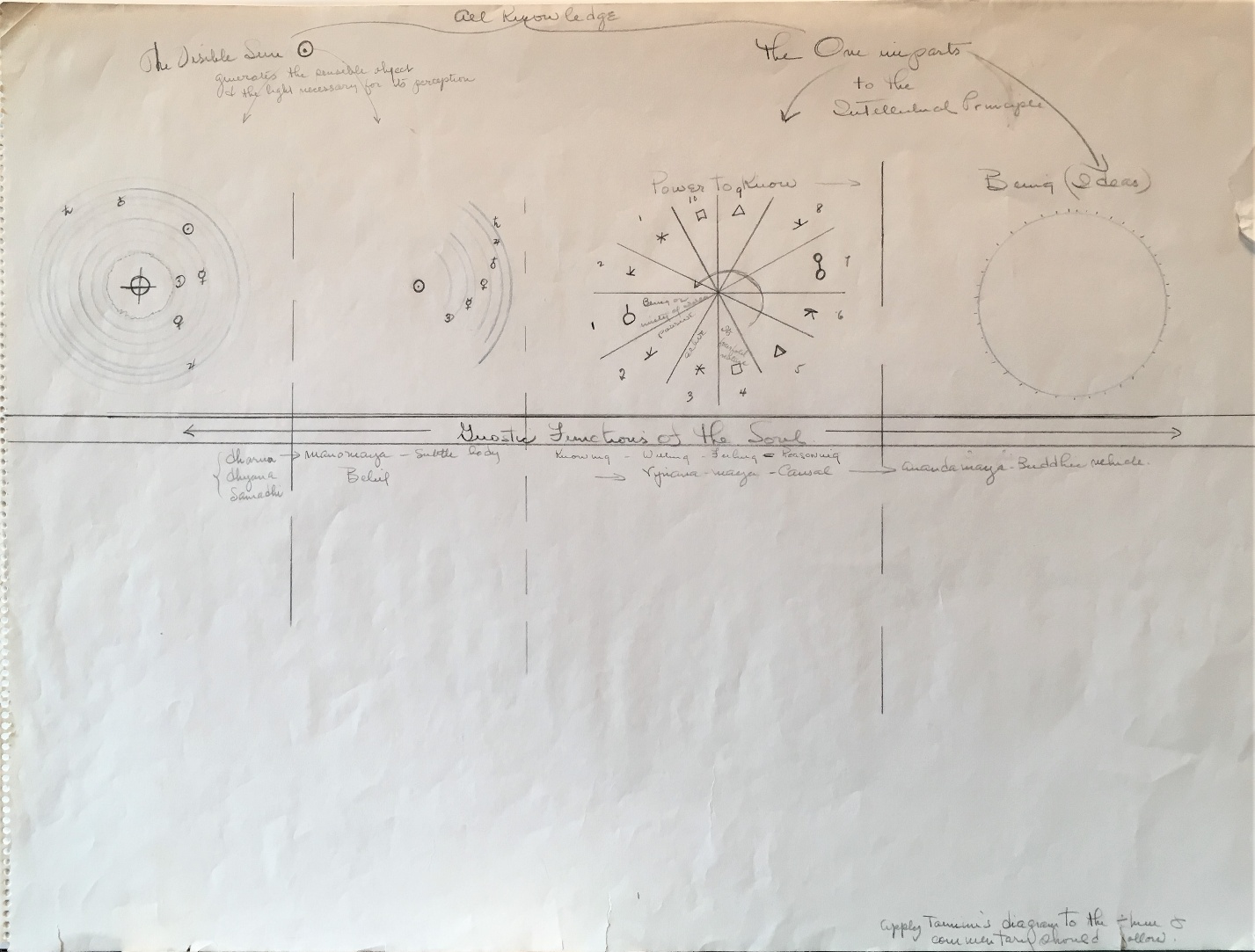
FIGURE C002 IMG_2587 fix. Divided Line.
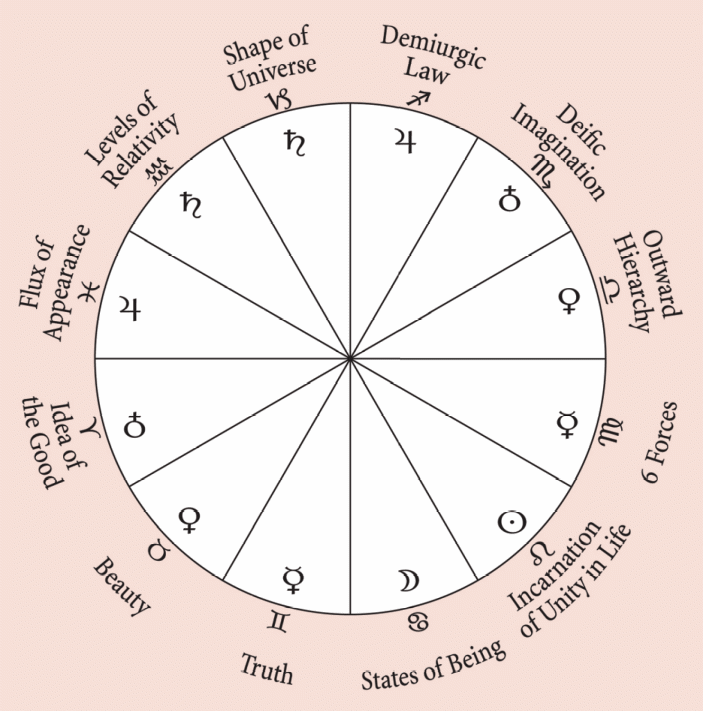
FIGURE 1983 0122-2. Intellectual-Principle.
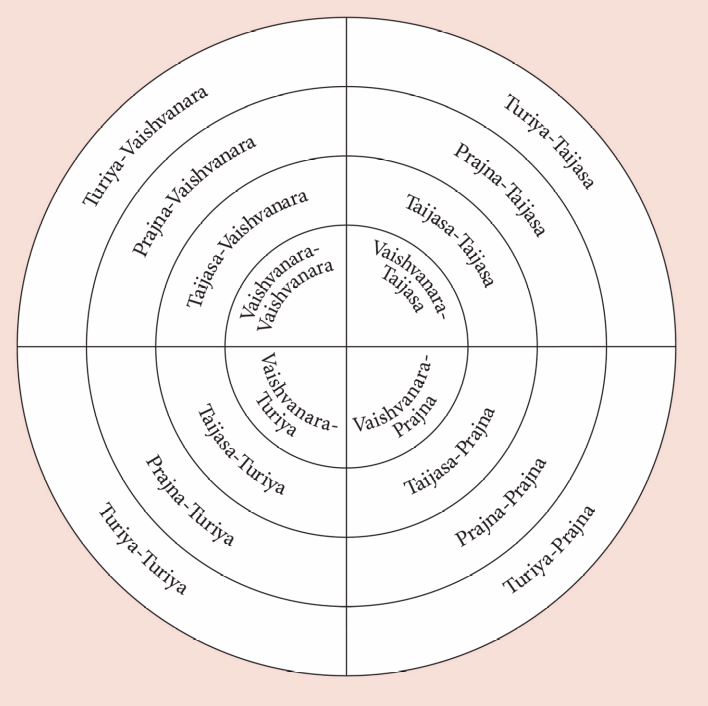
FIGURE 1983 0122-3. Four States of Consciousness in Four Rings and Four Quadrants.
Other diagrams referred to are not with this transcript version. [Transcriber note: [diagram] means the speaker is referencing a diagram as he or she is speaking. If someone is drawing or writing, with audible sounds of chalk on a blackboard, I indicate this by [drawing] or [writing].]
TRANSCRIBED Verbatim by IT 2022. Archival verbatim transcript – V11a.
AUDIO FILES: 1983 0122a. [Note 1: "Tape" and "Side" refer to original audio cassette tapes that were later digitized into .MP3 Audio Files. Note 2: We only have the first audio file for this class, we are missing the rest.]
1983 01/22 at Wisdom's Goldenrod
Plato; Republic; Divided Line
[Audio File 1983 0122a Begins]
AD: --trying to understand the top of that divided line, the Intelligible, by reading from Plotinus some quotes on the Intellectual-Principle.
S: Uh-hm.
AD: So, if we go to V.3.5. [student assents, very faint] [31 second pause, flipping of pages] And I think this was a sort of expansion or amplification of Plato's remarks on the One, what it imparts to Intellectual-Principle. He says--
Plotinus [V.3.5, AD reading]: "In order to perfect self-knowing it must bring over from itself the knowing phase as well: seeing subject and seen objects must be present as one thing. [Now] if in this coalescence of seeing subject with seen objects the objects were merely representations of the reality, the subject would not possess the realities: if it is to possess them it must do so not by seeing them as the result of any self-division but by knowing them, containing them, before any self-division occurs.
"At that, the object known must be identical with the knowing act (or agent), the Intellectual-Principle, therefore, identical with the Intellectual Realm. And in fact, if this identity does not exist, neither does truth; the Principle that should contain realities is found to contain a transcript, something different from the realities; that constitutes non-truth; Truth cannot apply to something conflicting with itself; what it affirms it must also be.
"Thus we find that the Intellectual-Principle, the Intellectual Realm, and Real Being constitute one thing, which is the Primal Being; [the] primal Intellectual-Principle is that which contains the realities or, rather, which is identical with them."
[11¾ second pause]
AD: Down at the bottom.
Plotinus [V.3.5, 6, AD reading]: "As an act--[and] one whose very being [AD emphasizes following word] is an act--it must be undistinguishably identical with its act: but Being and the Intellectual object are also identical with that act; therefore the Intellectual-Principle, its exercise of intellection, and the object of intellection all are identical. Given its intellection identical with intellectual object and the object identical with the Principle itself, it cannot but have self-knowledge: its intellection operates by the intellectual act, which is itself, upon the intellectual object, which similarly is itself. It possesses self-knowing, thus, on every count; the act is itself; and the object, seen in that [AD reads: the] act-self is itself.
"6. Thus we have shown that there exists that which in the strictest sense possesses self-knowing."
AD: Maybe you could find a-- [short pause] On page 291, V.3.10.
Plotinus [V.3.10, AD reading]: "We repeat that the Intellectual-Principle must have, actually has, self-vision, firstly because it has multiplicity, next because it exists for the external and therefore must be a seeing power, one seeing that external; in fact its very essence is vision."
[short pause]
AD: And then on a-- con-- continuing that 10 to the end, well, almost. He says--
Plotinus [V.3.10, AD reading]: "The intellective power, therefore, when occupied with the intellectual act, must be in a state of duality, whether one of the two elements stand actually outside or both lie within: the intellectual act will always comport diversity as well as the necessary identity, and in the same way its characteristic objects (the Ideas) must stand to the Intellectual-Principle as at once distinct and identical."
[35½ second pause, flipping of pages]
S (faint): Proceed.
AD: Um-- V.5.3?
S (faint): Yeah.
Plotinus [V.5.3, AD reading]: "Thus we have here one identical Principle, the Intellect, which is the universe of authentic beings, the Truth: as such it is a great god or, better, not a god among gods but the Godhead entire."
[1 minute 17 second pause, flipping of pages]
AD: V.6.6.
Plotinus [V.6.6, AD reading]: "When a thing is a Being, it is also an Intellectual-Principle; when it is an Intellectual-Principle, it is a Being; intellection and Being are co-existents. Therefore intellection is a multiple not a unitary, and that which [(like the Good)] does not belong to this order can have no intellection."
[16¾ second pause, flipping of pages]
RC (very faint): Would you read that one again?
AD: I'm sorry?
RC: Would you read that one again?
[14¼ second pause]
Plotinus [V.6.6, AD reading]: "When a thing is a Being, it is also an Intellectual-Principle; when it is an Intellectual-Principle, it is a Being; intellection and Being are co-existents. Therefore intellection is a multiple not a unitary, and that which (like the Good) does not belong to this order can have no intellection."
[23 second pause]
AD: I'm sure you could think of some others where this insistence that the Godhead includes within itself the act of intellection and the object in his-- in this reciprocal and this mutual reciprocal relationship which forces us to posit some sort of consciousness which forms that unity. [16¼ second pause] I think V.9.5.
[short pause, flipping of pages]
Plotinus [V.9.5, AD reading]: "The Intellectual-Principle, therefore, is itself the authentic existences, not a knower knowing them in some sphere foreign to it. The Authentic Beings, thus, exist neither before nor after it: it is the primal legislator to Being or, rather, is itself the law of Being. Thus it is true that 'Intellection and Being are identical'; in the immaterial the knowledge of the thing [AD emphasizes following word] is the thing. And this is the meaning of the dictum 'I sought myself', namely, as one of the Beings…
"For none of the Beings is outside the Intellectual-Principle or in space; they remain for ever in themselves, accepting no change, no decay, and by that are the [AD reads: and by that they are] authentically existent. Things that arise and fall away draw on real being as something to borrow from; they are not of the real…"
[9 second pause]
AD: And then in 6 he says--
Plotinus [V.9.6, AD reading]: "We take it, then, that the Intellectual-Principle is the authentic existences and contains them all--not as in a place but as possessing itself and being one thing with this its content. All are one There and yet are distinct: similarly the mind holds many branches and items of knowledge simultaneously, yet none of them merged [AD reads: merge] into any other, each acting its own part at call quite independently…"
[10¾ second pause]
AD: And then in 8.
Plotinus [V.9.8, AD reading]: "If, then, the Intellection is an act upon the inner content (of the Intellectual-Principle), that content is the Form, and the Form is the Idea.
"What, then, is that content?
"An Intellectual-Principle and an Intellective Essence, no Idea distinguishable from the Intellectual-Principle, each actually being that Principle. The Intellectual-Principle entire is the total of the Ideas, and each of them is the (entire) Intellectual-Principle in a special form."
[short pause]
AD: Down at the bottom he points out--
Plotinus [V.9.8, AD reading]: "It is our separating habit that sets the one order before the other: for there is a separating intellect, of another order than the true, distinct from the Intellect, inseparable and unseparating, which is Being and the universe of things."
AD: I think if you go on, you can pick out quite an innumerable number of quotations working on that principle. And, what I'm suggesting is that that's the top of the divided line, the right side of the divided line [FIGURE C002 IMG_2587 fix]. [student assents, faint] Alright, now perhaps another way of looking at it would be if we take this-- well, excuse me, take it down. [student assents, very faint] (I didn't--) [9 second pause] In the-- in the chart that we've put up when we try to show the rulerships and its sign-- well, we can make it to design, we could have-- Well, let me do this here. [Note: See FIGURES 1983 0122-2, 3 for the following.] Take the-- [drawing] And you say this is an Idea and you say this is an Idea. Right? We put the Ideas here [diagram]. So this (subtle). Then move the rulership here [diagram]. And alongside this whole line we have Turiya as consciousness. Turiya here [first quadrant] is consciousness, alright, but over here [second quadrant] it's Prajna Turiya. Turiya here is consciousness, alright, but over here [third quadrant] it's Taijasa Conscious, Turiya here, alright, is Vaishvanara [fourth quadrant]. [VM assents, faint] Now, is it possible that he's saying that the underlying consciousness is the unifying or the units-- unitary backdrop of these two aspects? In other words, one would be a passive aspect and the other would be an active aspect. But they're unified in common ground, consciousness. Is that a way of looking at the Intellectual-Principle?
S (faint): Yeah.
LR (faint): You have this [three words inaudible] Is it possible that--
AD: Can we see what he refers to as the duality-in-unity? Can we see that the consciousness which underlies is the unity, consciousness which underlies, the Turiya, you know, going around, and that the active aspect would be the-- the dignities or-- and the passive aspect would be the Ideas, and these are two aspects of one and the same, alright, the consciousness that underlies them. Is that a conceivable way of--
RG: No the consciousness that underlies them is the consciousness of the Intellectual-Principle or the One?
AD: No, it would be-- I-- I think of it as being the unitary aspect of the Intellectual-Principle. In other words, if you say that the Intellectual-Principle is a duality-in-unity, or let-- it has multiple-- all kinds of beings in it, and at the same time we want to say that it's also-- it's a one-many in other words, alright, the oneness is going to have to be coming from the Turiya consciousness. [student assents, very faint] In other words, as you string around-- as you associate the co-- a certain type of consciousness which-- with each quadrant, it is that consciousness, so to speak, which is a unifying back-- background to the Ideas and their powers.
S (faint): Well--
CDA (faint): Just talk about--
AD: Just talk?
CDA (faint): --about how to conceive this consciousness.
[short pause]
AD (faint): How to conceive of this consciousness. Well you talk, you get the idea. See, go ahead.
CDA (faint): Well you talk Dickie [one/two words inaudible]
RG (simultaneously): Ok, (and you) [one word inaudible] (RG laughs) I don't get the third thing, the third-- the third point. I mean I don't see the need in the discussion of Intellectual-- it seems that when he speaks of the unity-in-duality, I could understand it from ea-- it seems like you could take either side of the duality, and from which point you're looking you-- you can think of them together, that you don't have to posit another consciousness above the Being of the Intellectual-Principle or above the Knowing phase of it. It seems that it's inherent in both, otherwise it wouldn't be Intellectual-Principle (above).
AD (simultaneously): Yes, you're saying the same thing.
RG: Well, then I don't understand what you're saying and it--
AD (simultaneously): But-- but you explained it quite correctly. [short pause] Let me make a remark because yesterday I didn't finish the remark I made. [Note: See WG Class 1983 0121, Plotinus - Questions.] There was a purpose in-- in developing a kind of precision in our-- in our understanding, and I didn't mean that later on that this was to be disregarded, in that offhand way. It's like we develop a kind of precision to understand the natal chart, we try to understand a planet on a degree, and we have to be precise and formulate it accurately. And then we have to formulate the opposite degree and that has to be precise, alright. But, if you stay with that precision, you won't be able to go any further. There's a strange dialectic that occurs and that is that there's a sort of inherent contradiction which now doesn't become contradictory, it becomes complimentary. It's like there's a shift in your level of understanding. And when I said that the contours of your precision thinking, alright, get blurred, I didn't mean that now it gets dissolved, you know, and disappears. It's still there but the alteration of the level on which you're working shows how what was contradictory from one level, alright, is now in this synthesis complimentary. So you actually in your thinking shifted levels but the sharp contours of the lower level of thinking had to merge, alright. That's what I meant, I didn't mean that, you know, now that you can think precisely throw it away. I didn't mean that. I just wanted to rectify it. Alright, so, if we go back to this, Dickie. What you said is precisely what I'm saying.
RG: Ok then if-- then if that's-- then the-- well, you have the Ideas and you have the gnostic powers, right, as the-- [AD simultaneously, faint: The power.] as the planets and-- and the si-- and the houses here. Now, what is-- what is this (above--)
[Note: See FIGURE C002 IMG_2587 fix for the following.]
AD (simultaneously): You see, if what you say wasn't true, if what you say isn't true, and the way you put it is probably better than the way I put it, if that isn't true, then I wouldn't be able to do this here. Over here when Plato speaks about, alright. [drawing] Over here is the Being and let's say over here is the Act [Power to Know], ok. Now what you said is this in a-- this is Thought thinking itself [diagram], alright. So this [diagram] is the same as this [diagram]. This is the object [Being] which causes ideation, the thinking [Power to Know]. [RG assents, faint] So that they're two aspects of one and the same thing. Whereas if you think of it like this, alright, and you say well this is the consciousness which underlies both, it seems that you got three things. But the way you put it is more correct. If you take that away, alright, and you think of ideation, alright, the product of ideation is the object. The object causes or pulls out from ideation, alright, and they're mutually reciprocal. So then we could say this is the power to know, ok, or to ideate [diagram]. And this is the known object [diagram]. So then this would correspond to what Plato said, that the Idea-- the Good gives to the Idea of the Good, alright, Being, and the power to know that Being, or the Truth of Being. So that this becomes one realm [diagram], alright, in the same way that this was similarly one realm [diagram]. So that the analogy has got to stay together.
LR (faint): You think it's a valid question at all to ask by what power an Idea or a principle gets bifurcated into subjective-objective [one word inaudible] I mean is that a reasonable thing to try to fit in?
AD (faint): Try again now.
[short pause]
LR: I'm wondering whether it's valid to ask what-- what power is responsible for the bifurcation of the subjective and objective [one/two words inaudible] I mean to try to understand how one principle seemingly gets bifurcated at any level into subject and object. We show many examples of how-- how it does [couple/three words inaudible]
AD: Well, wouldn't you have to trace it back to the One itself?
LR: Yeah, I would think so.
AD: In the sense that in the One there was this active and passive perfection which in their coincidence, alright, or in the indivisibility of the One remained what it was there. But the power radiating from the One or the emanation of-- from the One brings these two, the active and the passive, into a-- into focus, or they're available. In the same way like for instance when we say that there are many Ideas in the Intellectual-Principle, many powers by which these Ideas are manifested, isn't it in a s-- similarly I mean there's a reflection, alright, of what is in the One when we speak about the indivisibility of the aspects within the One, alright, in the Intellectual-Principle all these aspects are, so to speak, mirrored as Authentic Beings. What is indivisible in the One in the Intellectual-Principle becomes the aggregate of the Ideas and their powers. So there you have a sort of reflection of what is in the One. Similarly, when the One imparts to each and every-- every Idea its aseity, at the same time it's also the power, it's granting it the power to manifest itself.
RC: Isn't it actually the intellective power itself that introduces that necessary duality that allows for knowledge?
AD: The intellective--
RC: The intellective act itself that prior-- logically prior to the exercise of that intellectual act, the Intellectual-Principle isn't truly Intellectual-Principle. But with the exercise of that knowing act, it seems to like "come out" of the One and establish itself.
AD: I think I would agree with that. If I could elaborate a little bit more. If we say that the One radiates, alright, or emanates, and we understand emanation in this very specific sense, that there's a power which is identical with the One, and there's this issuing act or this flowing out, this power which is radiating. Now in that power there would have to be inherent, alright, the passive and the active aspects of the One. But now they are bifurcated in the Intellectual-Principle.
RC: Uh-hm. Yeah he seems to say that in order for there to be knowing, that this duality of thinker and thought must be established. And without that duality, knowing per se hasn't come to be.
AD: Knowing per se?
RC: Knowing per se hasn't come to be. That this establishment of Being and the duality of thinker and thought are proper to the second Hypostasis and not the first.
AD (very faint): Uh-hm.
LR: But, that too would be saying that it-- it rests on the paradigm of act-- the act [one/two words inaudible] in the One. I mean it-- it seems like what you're saying is that in-- in that you have any Hypostasis or any principle, there has to be the unfoldment of itself and a [one word inaudible] of itself and, you know, integral-- integrity of itself. That that's just a-- that's a law of any Authentic Being or even above that that's one of the-- that's one of the characteristics attributed to the One, if you could say the One had any characteristics. And that when you say that anything which is goes out from itself, even its univer-- even beyond the realm of-- the One is it spills out. 'Cause you're saying that that bifurcation takes place anywhere, and it must happen? And it's not by virtue of any third principle that it happens but it's in the very nature of the principle itself. I mean I think that's what you're saying. So we're not to think of any-- I mean, at the lower level, for example, the one image portraying forth both an ego and it-- and the world, bifurcating into an ego and an imaged world. When you say both of those are part of an image it becomes a little bit more complicated. You have to bring in more factors now.
AD: Well let's not worry about the lower aspect now. Go ahead, Avery.
AS: But I-- I thought Randy's point was a little different. That it's-- it is-- it is the intellection, it is the intellective act that splits these up, but unsplit up in the One. It isn't the One that splits up this thing, but it's the act of the intellection that seems to not be able to apprehend that One as a total unity and therefore has to split it up in that way.
LR: But I thought already by speaking of the act of intellection you were presupposing an object contemplating.
RG: That's not--
AS (simultaneously): No, they're both concomitant. They're both-- they're both concomitant.
RG (simultaneously): And that object is not [LR simultaneously: Right.] prior to the Intellectual-Principle [LR simultaneously: Right.] according to these quotes.
AS (simultaneously): And even if it is--
LR: I-- but I'm saying they both [AS simultaneously: And even if it is--] would arise together.
AS: But even if the object is prior and you say the object is the One, that-- that object itself in some places he says is a unity, and intellection can only break it up, it's the only way it could grasp it. [RC simultaneously: It (seems) too--] Not that-- I'm just trying to follow-- I mean I-- I think I--
RC: It seemed too that this kind of consciousness that we're talking about as being appropriate to the Intellectual-Principle isn't really to be thought of in terms of subject and object because the consciousness is associating with the subject and not with the object [couple inaudible RG words simultaneous with RC] [couple words inaudible] The identity of the thinker and the thought is really what is objective to that consciousness. (Kind of) like you-- I don't think it-- it would be right to say that the Intellectual-Principle is identified with the thinker and the thought is beheld as its object but that its consciousness precedes the seamless identity of the thinker and the thought. But that duality is necessary for the kind of consciousness that it is to exist.
AS (faint): Well, that kind of knowing, otherwise it would just be the One.
RC: Yeah.
RG: And in fact if anything he seems to emphasize the Being aspect as prior than the Knowing and I bet--
AS (simultaneously, faint): Well, I don't know.
LR (simultaneously): Well, it depends which quote 'cause sometimes he [couple words inaudible]
RG (simultaneously): No but I mean-- well, I mean the quote we just read he does. Because be--
Plotinus [V.9.8, RG reading]: "…we are compelled to think of existence as preceding that which knows it, we can but think that the Beings are the actual content of the knowing principle and that the very act, the intellection, is inherent to the Beings…"
RG: Which is I think the model for the divided line [one word inaudible]
AS (simultaneously): You can't [few words inaudible]
[Note: See FIGURE C002 IMG_2587 fix for the rest of the class discussion unless otherwise indicated.]
RG: No but I think by putting the Being part on a-- on the-- on the right-hand side, and the power to know it on its left [diagram], you're saying-- you're implicitly coming from that point of view. [student assents, very faint] Right, I mean--
AS: I don't follow.
RG: You don't follow?
AS: No.
RG: If Being-- if that-- if the diagram--
AS (simultaneously): I don't see how either one could be [S simultaneously, very faint: Prior.] given priority.
RG: So there's no priority on the right-hand side at the level?
AS (simultaneously): I can-- I can-- absolutely no priority [couple words inaudible] (and) intellection.
RG (simultaneously): You mean reason and Nous have no priority.
AS (simultaneously): No, no, I'm talking about the-- all the quotes we just read on Being and intellection.
RG: I agree you can switch them but in the diagram what's prior.
AD (simultaneously): Well, yeah, I think what you're trying to say, Dickie, is it would be our natural predisposition to put Being to the right and Knowing to the left. [RG: Right.] And Avery's saying but of course in all these quotes that we've gone across, [RG: Yeah.] he makes it very clear that they're simultaneous the whole time.
RG (simultaneously): Yeah I-- I mean I alway-- I agree with that.
AD (simultaneously): But, if we-- if we use that, then it would justify putting the Being on the left, then the knowing of Being on the right [diagram]. And it is our presupposition that the existence of prior-- prior to knowing, which, you know, in this instant wouldn't be-- wouldn't be correct.
S: Right.
S (faint): Uh-hm.
AD: Alright now, the next question that I'd like to ask is, if we wanted to symbolically represent this, would we put the degrees where Being is? Will we put the power to know with the three trans-Saturnians in this kind of artificial way?
S (very faint): What?
S: Right.
[short pause]
JC: I wonder if that's for the soul though, I mean, isn't it?
LR (simultaneously): No it's not.
AD: We're not talking about soul.
JC (simultaneously): The powers of the s-- the intellectual power of the soul would--
AD (simultaneously): We're not talking about the soul. I'm sticking to the Intellectual-Principle.
JC (simultaneously): Principle itself? Then I wouldn't agree with that formulation. I think that the stars themselves are the intellection and Being. That to bring in the planets is bringing in a principle that doesn't reside, you know, as the planets in the Intellectual-Principle. [RG assents, faint] Planets are in motion about the fixed stars.
AD: So we'll start?
[short pause]
JC: Not in relation to each other.
[short pause]
RG: It would be very hard symbolically once you've established the Sun on the left-hand side of the diagram as the center and the-- and the cosmic soul [diagram], symbolically to put planets within that sol-- solar sphere behind Uranus Neptune and Pluto in a prior symbol.
VM: But we're not talking (here), [S simultaneously, faint: Why not?] they're invisible to the naked eye.
RG: Yeah but--
VM (simultaneously): Some people would conte-- you know, and we've spoken about them as being non-individual.
RG: But is it (the/a) part-- [RC simultaneously, faint: No.] I mean they're still within--
VM: They're a bridge in some way between what's transpersonal and what's more personal.
RG: Well, I know. But I don't-- I still don't get the symbol because it's-- the Uranus Neptune and Pluto are still in-- rotating around the Sun in the-- in the solar system and if you don't want to make them a prior principle I think you have to go to a different symbol.
AS: Well, I don't mind the symbol so much but could you-- could you say some more, Anthony, about-- can you find somewhere where he talks about a threefold principle? That's the one thing I've had the hardest time. I mean just, not-- not in terms of the-- I could follow the Uranus Neptune and Pluto if I could see what the principle is. I mean we-- we see the principle of this division of Knowing and-- Being and Knowing.
AD (simultaneously): Well--
AS: Or we could say the Ideas are the 360. But I-- the hard one I have is, in what way you could conceive of the intellection itself as the threefold, this princ-- in terms of the theoretical.
AD: How would the universal spirit or the universal-- the universality of Being, the Nous, particularize itself?
AS: (Let's see.) How would it particularize itself. Well, we talked about two ways, we talked about this Separating Intellect. And then you talked about soul. [9¾ second pause] I mean, in tho-- on all those quotes we read, the-- the Intellectual Realm is already a multiplicity. [LR assents] And it's-- it's very--
AD: How would the Separating Intellect, alright, how could you bring that in?
AS: Well I don't even know if that's where you-- where this point is at.
AD: Again, let me go back to the question. How would the Nous, which is universal, particularize its activity?
AS (faint): Through the Idea of Number. Well, I was thinking (thing).
S (very faint): Uh-hm.
S (very faint): Yeah.
S (very faint): Well what do I say?
LR: [one/two words inaudible]
AD (simultaneously): Now [couple words inaudible] I wouldn't disagree [LR simultaneously: Nice.] with that.
AS: No I mean I was thinking particularly of the way we spoke about the--
AD: You see, there you're not speaking [AS simultaneously: The sixth house.] about the universality of the Nous, you're speaking about the undivided mind.
AS: No I was thinking about the way we spoke about the sixth house. The way we've spoken-- the way you would speak about each Idea-- when you say particularize itself, at what level does he-- you mean the way each Idea is a unique Idea, or the way those Ideas then get further particularized? [15 second pause] You said how does the universal-- the universality of the Nous get [RG, faint: Particu--] particularized. Ok, now, in the universality of the Nous you're including all the Ideas. Ok. And, are you also including in that universal Nous that each Idea is a particular Idea?
AD: No, no, I'm not-- no I'm not thinking of it that way. The Nous remains universal.
AS: Well then that's what I asked. Then you're talking about the particularizing [AD simultaneously: Now--] is going from the universal to each--
AD (simultaneously): To-- (in) the individual in the natal chart.
AS: Oh, oh, I see. Ok, I'm sorry.
S (faint): Uh-hm.
RG: So doesn't this--
AS (simultaneously): You're talking at that level.
AD: Yeah. I'm speaking about, how does the universality which is the Intellectual-Principle within my soul, [RG: Right.] alright, reach to the level of the natal chart or the ego.
AS: Well then I'd bring in reason.
AD (simultaneously): In other words, that universal, alright, particularizes itself in the actual natal chart.
AS: Well then I'd bring in the reason quotes. Like when he says reason develops the pure Thought and spreads it out. [Note: See Plotinus, IV.3.30, second para.] Then it would have to bring in some kind of [one word inaudible]
AD (simultaneously): What kind of reasoning are we referring to here?
AS: Same kind we did last night.
S: Unembodied reasoning.
AD: Unembodied reason.
AS: He says there's a continuous flow of reason. In another place he says that the soul's reasoning is the entire outpouring activity of the Intellectual-Principle towards the production. So there I would say if you said that in the topmost path, the very top part, you had the universal Intellect [diagram], then it would be this unembodied reason would take that pure Thought and distribute it or spread it out. That's why I thought the-- (well), that number would be appropriate. You know, I think I'm coming more from the bottom half of the line than the top half [AD simultaneously, faint: Yeah.] of the line. 'Cause the bottom half you have those six powers. But somehow the Idea too would have to-- I mean on the top we shouldn't have this-- have to bring in the soul on the top at all [RG assents, faint] for what you're saying.
AD: No, I'm still-- I'm still within the-- I'm still in the top half of the line.
AS: I know, that's why when--
AD: I'm not moving anywhere.
AS: No but I was. That's why I think what I said just doesn't-- I can't quite-- I can see the soul's activ-- the activity of reason doing that. But I'm not sure I see what that would be on the top half of the line. I still think then from the way-- still seems to me that from the way we've been describing it, the second division here-- this division in the second division doesn't come about until you talk about the soul. I mean if you talk about this is the Intellectual object with the knowing and the known as concomitant, and you say well, how is that going to be particularized, you know, like almost fed into this individual here I-- seems like you have to bring, you know, the soul in. Actually otherwise-- otherwise what would form that medium or the link between the pure Thought and the cosmos, the individual?
RG: And if you put rational objective principle in the left-hand side of it-- of that reasoning part [diagram], it's hard to understand how that's all (under/on the) Nous itself.
AS: Well, insofar as the Nous itself is through the principles of soul, it's ok.
RG: Yeah, but once [couple inaudible AS words simultaneous with RG] you make that split it is the principles of soul. I mean we aren't making a divided line.
[short pause]
RC: Is the question of how the Nous particularizes itself, is that the same question as to say how the-- the-- like the World-Idea that is timeless in its own domain contains within itself the timing by which the soul will unfold?
RG: Is that the level there?
LR: I think-- but, I think that the question really is, can Uranus Neptune and Pluto symbolize not the soul but Nous and it divulging knowledge in the soul. I mean we've been thinking about Uranus Neptune and Pluto as parts of the soul, the reasoning part of the soul. And I think the suggestion is maybe we consider them as the Intellectual-Principle, that the soul is [one word inaudible] the understanding part of the soul is getting to know. It's the power of knowledge in the Intellectual-Principle. Our reason then discovers that power of knowledge.
RC: So then how does--
LR: Can we think of Uranus Neptune and Pluto that way rather than as soul.
S: Yeah.
RC: So then the question becomes how-- does the question become, how does the universal knower become particular knower. Is that the particularization we're talking about?
RG (very faint): Uh-hm.
LR: Maybe, I don't--
AS: He speaks about the Separating Intellect, whatever that means, well is that different [couple words inaudible] But I still-- I mean I would accept that Linda but then, I mean--
LR (simultaneously): No it's a question, I'm just [AS simultaneously: No, no.] posing it as a question.
AS: Ok. But what is that-- where-- I never found-- I mean I can't-- I keep looking through here to find some way of describing that three-- Maybe I'm looking too much for a particular threefold and maybe it's just a--
RG (simultaneously): No but it-- I-- I mean I think--
LR (simultaneously, faint): Well, I mean I-- and I think it's just--
RG: I mean one idea of this Avery, it seems to me the threefold is in the way the one it describes, is in the approach, is in the Idea of the Good, the True, and Beautiful. I mean it seems that's the clearest threefold in this area that we can look to. There doesn't seem to be a real threefold in the Intellectual-Principle.
LR (faint): But what about Being Life and Activity or--
AS: Being Life Intellect. (Yeah.)
LR (simultaneously): Being Life and Intellect in the Nous? I mean that's a threefold in the Nous.
S (simultaneously, very faint): Uh-hm.
AS (very faint): Yeah, it's possible.
RG/S(?): Yeah.
[students assent, very faint]
RG: Uh-hm.
AS (faint): But--
RG: But then are you going to use Uranus Neptune and Pluto to symbolize the Being Life and Intellect or the subjective way one approaches that Being Life and Intellect?
LR: No I think it's being suggested that we try to see it as I think a [one word inaudible] and (if his soul contemplates).
RG: But which part of this-- how-- if we don't have-- which part of the soul contemplates it? If there isn't a corresponding threefold contemplative power in the soul, how could it ever--
LR (simultaneously): (Doesn't have) to be.
RG: No I--
LR (simultaneously): Knowing willing and feeling.
RG: Right but we don't-- we-- you know, how do you then use-- then we don't have any a-- if we reserve Uranus Neptune and Pluto for the objective part--
LR (simultaneously): Ok, but don't worry about this-- I mean, does that make sense first?
RG: The idea makes sense but, when you bring in Uranus Neptune and Pluto I don't know what you mean by that.
LR (simultaneously): I mean you yourself said that the Chaldeans can be rational soul. [RG: Right.] I mean they're not (at level) so-- And we don't have to-- I think we'll find plenty of symbolism. (But I think) the point where we need sym-- ways of seeing it that, does it make sense to say that Uranus Neptune and Pluto in a chart are not the actual soul powers in the entity but they're the way the Intellectual Prin-- Principle is imaged for that soul. By contemplating the Uranus Neptune and Pluto, it will know the way in which Nous--
RG: Yes but I think already you're saying that it's the subjective power of the soul contemplating Being Life and Intellect.
LR: What is?
RG: Uran-- (but) your description is already tending towards a subjective orientation, (feeling, knowing), and Pluto.
PD: But, I think--
LR: I think Anthony's saying Uranus Neptune and Pluto is what is contemplated by the reasoning power of soul.
RG: Yeah, I know that's what he said but I'm just--
LR (simultaneously): I'm just trying to understand how.
RG (simultaneously): Right, yeah.
PD: But, I mean, interpreting of that threefold (belonging) another line where Life is what's proceeding into soul from Nous, Being is what is abiding in the soul through the Nous, and the Intellect is what's transcending the soul in-- You know, it's looking at that threefold and not just in terms of willing knowing and feeling but from an intellective aspect, [LR simultaneously, faint: Right.] not from a soul's contemplative aspect. [RG assents] So--
(Side 1 of original cassette tape digitized as 1983 0122a Ends; Side 2 Begins)
RG: --a greater aspect but in Being Life and Intellect as within the Intellect and not within the soul. But are you going to-- the question then (terms) are you going to use Uranus Neptune and Pluto to symbolize that or the soul's contemplation of it.
PD: Or both. I mean, one hand it could be a subjective activity, another hand it's an objective activity that's being referred to.
RG: Uh-hm.
LR: See I think in the ex-- when you get to the-- well, this-- this probably isn't a-- a valid process of reasoning but, when you get to a level where you're actually looking at a horoscope, the experience that-- in the charts we've seen where there's Uranus Neptune and Pluto, is not of-- is of something of the Nous entering. You could easily tran-- in terms of those experiences, the Nous-- this-- the person being receptive to the-- to the knowledge, that knowledge being-- that power of knowing being Uranus Neptune and Pluto and I think you could easily call that the entrance-- the entry of the Nous into the soul. And then you would-- well, maybe I shouldn't carry it any further [RG simultaneously: No then--] but then you would reserve-- then you would be able to see the Chaldeans all the way up [student assents] as soul, as rational soul as well as psychological.
RG: Right, but there is a part of the soul that's above rational. I mean when you say the Nous coming into the soul, isn't that the intellectual part of the soul? I mean what do you do with the intellectual part of the soul now?
AS: Well that'd be--
LR: I don't think that--
AS: The intellective part of the soul is the one that's in-- that's in identity [LR simultaneously: Or is it.] with the Intellectual-Principle. [RG assents, faint] You could call that the higher self-knower.
RG: Right, but isn't that what's delivering the knowledge, not the Nous itself but coming through the intellective phase of the soul?
AS: Well, we seem to have both all the way along, I mean you seem to have the one going along the bottom line from left to right and you also have the one going up and down [diagram]. So that, I mean [RG assents] [one/two words inaudible] up and down. Well, we still have a little--
RG: Well I mean you could reserve the transiting trans-Saturnians for it-- for that and we haven't really looked at the natal-- I mean, I think you'd have to bring the natal and the transits.
AS: Yeah but-- You know, you could-- what we had before under there is the Jupiter in Virgo [diagram].
RG: Uh-hm. Which is seven principles.
AS: Yeah, which is those six powers.
RG (simultaneously): Six powers.
AS: And they seem to get translated into the-- the Chaldeans later on. But I still-- I mean-- I mean you can-- I know, you can do Being Life and Intellect or Truth Union Symmetry, I just-- Even if you do that I still-- well-- You know, you make this separation between the known object or Being and the power to know. Now, every time you do one like Being Life and Intellect or whatever, [RG assents] now is the implication of that you're saying that that division is only coming from this side, the power to know is what breaks that up? Because Being, this is Being here [diagram]. [student assents] I mean I don't-- I-- I don't--
RG: It's also Life and it's also Intellect.
AS: I know, I don't quite follow.
RG: I-- well--
AS: I still-- I mean I-- I al-- I could almost follow it. I know Being Life Intellect, yeah but I--
RG: No I tend to-- I tend to agree, I mean, with the problem. But I think those threefold distinctions are in the right-hand side, not in the left though.
AS: Well no, see I thought-- (and I don't--) I could understand it if I could see that in the right-hand side there was a unity of the object with its intellection and in this second side here [diagram], when you said the universal Intellect is becoming particularized, it first-- you first have to understand this universal Intellect which is a unity-in-duality, you first have to understand that-- you're saying in terms of the power to know it has to be understood in that threefold way? I think that's what you're saying but I-- Could you just say more about what that threefold is? What e-- Well, what are we describing here?
[short pause]
TS: Avery (was). When we speak about Being Life and Intellect, wouldn't that be a threefold position in the known object? (In the Atman.)
AS: Depends who you read, I mean--
RG: Yeah.
S (faint): (Good idea.)
TS (very faint): Uh-hm.
AS: Does it?
TS: And if that was so well then there would be some mode of knowing that would've in the second half, the-- that split, the--
EMD: Can't hear you Tim.
S (faint): (Right.)
TS (faint): Ok.
S: [three words inaudible]
AD (faint): Uh-hm.
VM/S(?): [couple words inaudible]
AD: Good. (bit of laughter)
TS: That if Being Life and Intellect are some division within the known object that-- that there would be some kind of power to know, right, but according to each one of those. Power to know Being, the power to know Life, the power to know the Intellect.
RG (faint): Well, I don't think it--
TS: And that the-- the trans-Saturnians would be the identity of the rational-- the rational soul-- the knowing (of/in) the rational soul is those powers to know.
AS: Ok then-- then you're-- that's almost like you're using this and you're saying well, in this object there's a unity of Being Life and Intellect. They're not separated, it's almost like the model we use for insight. It's not even the three of them together, it's like it transcends that or they're all unified there. And then he says well, intellection though can't know that as a unity. The power to know can't know that Being Life Intellect as a unity as it is here, [drawing] so the power to know has to split that up as Essence Power Energy or Being Life Intellect. And that power to know isn't-- is just taking what's implicit in the ob-- in the known object, but in terms of this power to know it has to split it up because it can't grasp it as a whole. It has to split it up as a threefold. You're saying that those three powers would be the powers to know-- each one of these would know a different aspect of that intellectual object. Uranus would know one aspect of that intellectual object. Here I mean we could still call this a unity-in-duality. Each one of these would form a unity-in-duality with its object.
AD: Well instead of putting it now--
AS: And that would break it up.
AD: Instead of using-- using Uranus, Neptune, alright, trans-Saturnians, if you think of all the Ideas on the right-hand side where Being is [diagram], [AS assents, faint] and on the left-hand side you put all the planets, the dignities [diagram], alright. [AS: Yeah.] Let's say I'm working off the second quadrant. Then all the planets would be what?
AS: All the planets would be the power--
AD: What would know the Idea?
AS: The power to know the Idea. I called it (before).
AD (simultaneously): What would be-- what would they be? What would be the planets that know the Ideas?
AS: Well, if you take just the top two ones, you'd say it's-- the Moon would be Being, the Mercury and Sun would be Life [FIGURE 1983 0122-2, second quadrant rulerships].
AD (simultaneously): It will be the Sun [in Leo] Moon [in Cancer] and Mercury [in Virgo], wouldn't it?
AS: Ok, if you do-- I was going to do the Sun-- I was going to do the Moon, [writing] the Sun Mercury, and then also the Jupiter-- why not-- why not include the second ring?
AD (simultaneously): Well what for?
AS: Ok. [drawing/writing]
LR: I'm lost.
AD: If we said-- if we said that the [RG simultaneously: You're in the second quadrant.] Idea, alright, is the passive side, and the dignities represent the active side, [AS simultaneously: The rulers.] then they would know the Ideas, alright, so the Moon Sun and Mercury would represent the power that knows the Ideas, the fifth-- the [AS simultaneously: Fifth, sixth, and (seventh) (one word inaudible)] fourth, fifth, and sixth house.
AS: Ok.
AD: Now, what would the Moon Sun and Mercury represent, Avery?
AS: Well, I would say the Moon represents Being, Sun represents Life, and Mercury represents Intellect.
AD: Ok. (bit of laughter)
S: [couple words inaudible]
S: Mercury.
AD: Now--
AS (simultaneously): As three-- as the pow-- but as the power of-- say as the power of Being, the power of Life, and the power of Intellect.
AD: Alright. Now if we say that on the-- on the-- on the left-hand side we had the power to know and on the right that which is known [diagram], ok, now what-- what would you symbolize the Moon Mercury and Sun? As-- what would be a sensible representation of that?
AS (simultaneously): Oh, I-- there I would agree. If once you show me that the Uranus Neptune and Pluto would make some sense there. I think we could-- I think there's some way to correlate them, I'm not sure which. Say-- that might be hard. If--
S: Moon.
S: The Moon--
AS: [drawing] [one word inaudible] to the Moon, [S, faint: (Also.)] but-- Which would be which?
S: Pluto.
AS: Pluto would have to be--
RG (faint): Right.
AS: Which one though? (laughter)
S (amidst laughter, faint): He asked which one.
TS: Neptune's Life.
RG: Nep--
S: Uranus is Intellect.
AS (simultaneously): Yeah, which is?
AD: Well, let's not [VM simultaneously: Well, or you make it up, (let's--)] worry about the lower realm right now, let's-- let's see if you understand this here.
AS: Well you said what symbolize-- what would symbolize that in the chart.
LR: Uranus Neptune and Pluto.
RG: Right. (bit of laughter)
TS: Yay, you got it. (bit of laughter)
AS: (No) I-- using the quadrant it makes more sense if I do it that way, using the second quadrant. [one/two words inaudible] of--
RG: But, if you only-- if you're using the second quadrant for that whole right side, what becomes of the third quadrant? I mean if you-- you're going to have the fourth quadrant for the left-hand side, right?
[few seconds of background student talking]
S (faint): Of course on the line.
RG: I'm sorry, I mean--
AS: Well I gotta understand the one place first though.
RG: Yeah.
AS: I mean that seems to be the most obvious if you take-- I guess I kept thinking of (the/it)--
[short pause with children making noise in background and an adult trying to shoosh them]
AD: Well they probably make more sense. [Note: Reference to children in background.] (bit of laughter)
RG: Well obviously. Well I think that the--
AS: Well I follow that and it makes sense. But, I just--
AD: You can if you want, you can put up all the Ideas and all the dignities. If you want to work that way.
RG: But you know, I'm losing the distinction of the third level of the divided line. I can understand it as a whole, you know, if-- if we're taking it purely as the Intellectual-Principle level on-- on the top. But, I don't-- I don't then get what the distinction is. I mean, when you say the power to know and the known object, they really are in unity. They really [AD simultaneously: Uh-hm.] are one--
AD: They're not one.
RG: One principle.
AD: They're one principle, yes, [RG: Right.] but they're not one.
RG: They're not one but they're aspects of one principle. Two sides of the same coin.
AD: Yeah but it is two sides.
RG: Ok. But, it doesn't seem to-- it's not the level that you normally call reason. I mean, or that I-- [AS simultaneously: But we haven't gotten (one word inaudible)] it still seems to be within the Intellectual-Principle.
AS: Well, ok.
RG: But I don't know.
AS: But the thing is you haven't brought in the levels yet. I mean you haven't talked about-- I still keep seeing-- I understand what you're talking about, maybe you just have to say that before you bring in the bottom part, that this whole top realm can't be separated.
RG: Ok.
AS: Again, it is a unity-in-duality.
RG: Uh-hm.
AS: They're both equally suspended from the Sun.
JC: But why aren't you putting the power to know under [RG: Right.] the known object? Why don't you put Intellect under the Intellectual object, [RG assents] I don't understand-- [AS: Well--] I'm confused about the diagram.
RG/S(?) (faint): Yeah, (the) diagram.
AS (simultaneously): Ok well, see why--
JC (simultaneously): Why is it in the reason part?
AS: Because we went back to that thing from Plato. And if--
LR (simultaneously): You boys would go out (on this). (bit of laughter) Get (something) [few words inaudible] Come back and ask your question.
JC (simultaneously): Alright, alright, alright. (laughter)
AS: Better answer but I [few words inaudible] (laughter)
RG: Wait till you go away though. (some laughter)
JC: No it's like I say. Why don't you put Intellect under the Intellectual object if you do-- I mean, I've s--
AS: Well, in the divided line he talks about it as the passions of the soul.
JC: Oh I agree.
AS: The ones underneath [FIGURE C002 IMG_2587 fix, Gnostic Functions of the Soul].
JC: Yeah I agree. So then why don't you put it with the known object if you want to make them both part of the Intellect itself.
AS: No because, in the first part all he says is this is the Intelligible [FIGURE C002 IMG_2587 fix, right half] and this is the sensible [left half].
JC (simultaneously): Right. And by Intelligible he includes--
AS: [drawing] Well, by Intelligible you include the known object or the Idea and the power to know it.
JC: No. No, no, no, you include the reason-principles [AS simultaneously: Yeah.] [RG simultaneously, faint: Yes, yes.] and the Ideas. (laughter) The reason-principles and the Ideas are included in the Intelligible World.
AS: Well, where does he say that?
JC: The right half of the--
AS (simultaneously): He doesn't say reason-principles and--
JC: The mathematicals. The intermediates. They're both part of the disembodied essence world. And the left-hand side is part of the embodied essence world.
RG (faint): Uh-hm.
AD (faint): (Need coffee.)
AS: I think there's two-- I mean-- Seems that before you bring in the lower part there, the soul, things are a little different. Before you bring in that soul you have-- seems to me you have the Intellectual Realm.
JC: Ok. But the divided line is specifically the gnostic powers of the soul. If you want to say let's look at the divided line as-- starting with the Intellectual-Principle itself in that fourth section, [AS: No.] then in putting all of soul as, you know, the intermediate in the third, you know, that's-- [AS simultaneously: Wait.] that's a different way of using it than the way--
AS: No but we-- but the problem is that in the Republic he start-- before he does the divided line, immediately before that he talks about the two Suns.
JC: Yeah.
AS: And, before you bring in the bottom half here, [drawing] you're still at the level where he's discussing the two Suns, the Intelligible Sun, the Good, and the Good imparts the power to know and the known, and the Being of the known object, and the sensible Sun. So he hasn't even-- I mean, you have to reconcile that with the di-- with what he later calls-- what he later does when he takes a line and divides it up into different pieces. And the first thing he says is that now according to this division of Intelligible and sensible, take a line and divide it that way. [JC assents] And it's only after he does all that that he then at the end brings in the passions of the soul which know these various objects of the soul's knowledge. So I mean--
JC: Alright, but--
AS: The first division, this division, the main one here, [JC: Right.] is based on the discussion of the Intelligible life and the sensible life.
JC: Ok. And that does not include reason-principles?
AS: Yeah, the discussion-- at least the discussion with the Sun just discusses what the Sun gives to the Intelligible World, [JC: World.] and what the sensible Sun gives-- is in the sensible world.
JC: Ok but still why in the upper half of the line would you put a power to know?
AS: Because that's what he says that the Sun imparts, the power to know and the known object, to Intellect, intelligible. He doesn't [JC simultaneously: Yes.] say he's imparting this to the soul yet.
JC (simultaneously): Yeah but it's before he's made the line.
AS: I know. But he doesn't impart this to the soul.
JC: Oh I agree.
AS: The powers of the soul are down here [diagram]. So this has-- the power to know has to be something other than-- distinct from the power to know this in the soul. (I'm sorry) now--
JC (simultaneously): Ok, but what becomes the reason-principles in the third section is something internal to soul.
AS: Well, that's what we'll have to-- I-- they may only come in-- I mean, if you speak about reason-principles, that may only come in when you speak about soul. What do you mean by reason-principles? I mean here you have Ideas and the power to know the Ideas.
JC (simultaneously): Right.
AS: It's with the soul that you're going to bring in these (reason-principles).
AD (simultaneously): You don't think there's a correlation between the Moon Sun Mercury and the tran-- trans-Saturnians?
AS: Yes, I think there is.
AD: Well, why don't we work on that?
AS: Yeah. You mean-- now, let's go-- first, you're talking about the Moon Sun Mercury in Cancer, Leo--
AD (simultaneously): In the Intellectual Realm as well as the Idea, so it has the power to know the Ideas.
AS: --and Virgo.
AD: And the Ideas would be the fourth, fifth, and sixth house.
AS: [drawing] Yeah that's-- those-- that particular Sun Moon and Mercury.
AD: Alright. Now, if we say-- if we say that the-- the Moon represents Being Life and Intellect, alright, and go along that way.
AS: Yeah.
AD: Now, in the sensible world, that would be the--
AS: Being Power and Activity.
AD: No, we have a-- we're supposed to have a representation in the sensible world of the power to know the Ideas. Now, would it be the Sun Moon and Mercury in the Chaldean system?
AS: No.
LR: No.
AD: I don't think so either.
AS: No I agree, the power to know the Ideas we would put with Uranus [AD simultaneously: Well--] Neptune and Pluto.
AD: Well, would there be like a correlation like [AS simultaneously: Well that's (one word inaudible)] Pluto representing Being, [LR assents] Neptune Life, [LR assents, faint] and Uranus Intellect?
AS: Sure. [drawing] That's a possibility.
AD (simultaneously): And how far of a leap is it from saying Uranus is the knower, alright, the intellectuality in the chart? There-- there they're unifiable of course and in the sensible they're un-- you know, they're separated.
AS: I don't-- I don't have any-- I mean, that-- I was just-- my question mainly was what-- what is the paradigm you're using for these. And once-- once I see that this is the-- once you say this is the paradigm, I think I can see the link-up. Although, I still have a problem with one little-- only one little-- I have a problem with but I--
AD: Well, I-- If I-- if I thought of Being, alright, as the underlying unitary consciousness, then Life and Intellect would be two aspects of it.
[short pause]
AS: And now I'm confused. Could you do that again?
S: (Right.)
AS: Now I-- now I'm getting-- Let me erase this. Very simple. [drawing] First we had a model where the-- the Good sheds its light on the Ideas as the intelligibles, which we're now-- we called all the rulers. And--
AD (simultaneously): Alright now, on the right-hand side you put all the Ideas.
AS: Right.
AD: And on the left-hand side you put all the corresponding rulers, [AS simultaneously: Yeah, that's--] whether you work with quadrant or ring?
AS: Right, that's the way we-- that was our original model for the Intellectual-Principle. That's the one you're just using now. And the [drawing] rulers represent some power to know. And the Ideas we could say represent the--
AD (simultaneously): The Intelligible object.
AS (simultaneously): --the Intelligible object or the Intellectual-Principle. [drawing] And this is what he says forms a unity-in-duality.
AD (simultaneously): No, no, I wouldn't call that on the right the Intellectual-Principle.
AS: No I'm saying both of these are the Intellectual-Principle.
AD: Ok.
AS: This is the Intellectual-Principle which [drawing] forms the unity-in-duality. [AD, faint: Uh-hm.] I mean you can't-- you can't have one without the other.
AD: Yeah, ok.
AS: Ok, in terms of the Intelligible World you need to have both. Ok now, if you restrict it-- if you just-- we just talk about the second quadrant, for example let's-- you'd have these three Ideas. [drawing] Cancer, Leo, Virgo. And then here the Moon, Sun, Mercury. Alright this, I think-- if I follow what you said about the Being being the underlying consciousness upon which tends--
AD: Well, see I've got to use different words because those words are [couple words inaudible]
AS (simultaneously): Because we use the example of underlying consciousness [AD simultaneously: Yeah.] here, the co-- beca-- We already used that analogy of the consciousness with the Ideas and the--
AD (simultaneously): No, I don't want-- no, I don't want to do that now.
AS: --and the power to know. That's why I'm asking-- You mean something different now about like the-- like Essence Power and Energy.
AD: If-- if I were-- if I were to think of the Intellectual-Principle in the singular, alright, again, I'd go back to the reference, I would say that the consciousness which underlies all the quadrants, alright--Turiya-Prajna, Turiya-Taijasa, Turiya-Vaishvanara [FIGURE 1983 0122-3]--I would call that in the singular the Intellectual-Principle. Now, if I want to show that it is a duality-in-unity, I would show that it has an active aspect and a passive aspect, passive being the Ideas, the active being the power to know the Ideas.
AS: Ok, so far [AD simultaneously: Ok?] I'll-- And he-- is that the model for those three (maybe here)?
AD: Yeah.
AS: Go on. You're saying that's the model for [AD simultaneously: Of those three.] those three things that you're saying, Being Life and Intellect [AD simultaneously: Uh-huh.] or Essence Power Energy or knowing willing and feeling at a lower level.
AD (simultaneously): Uh-huh. [short pause] Go ahead, Dave.
DB: Right, if-- I was-- I was just curious if there wasn't a point of transition between the level that we're speaking here in the Intellectual-Principle and Uranus Neptune and Pluto that, you know, we're-- we're familiar with, and if you didn't have to bring in the Universal Soul and its operation to account for that. I was wondering also if that-- the quote from last night didn't have some relation to this twofold that we're dealing with here. Because there-- it seems to me that there's a threefold established at that level too in terms of the actual particularizing of the-- the Ideas into the manifested houses. I mean that--
AS: Yeah but--
DB: Oh I'm sorry, what?
AS: I mean go on, finish.
DB: Well-- I mean it almost-- it seemed to me that the Universal Soul's patterning, you know, was one thing, the elaborating soul was the second, and then the individual knower would be the third.
AS (very faint): (Yeah/Right). But--
DB: Yeah I'm sorry, go ahead.
AS: Do you think those really cor-- those seem to be on three different levels of the same, (you know), rather than being, you know, three different aspects of one thing. That's one problem. The other problem is, how could you tran-- I'd like to see it in terms of this realm, [DB: Of?] in terms of the intelligibles. Yeah I'd like to see-- I think what he-- I think the-- what he's saying is that you have this light which is appropriate to both. Let's-- and then you have the object and the power to know. And that's the three, depending on what you put the emphasis on. But that's a unity. But see that's all on one level rather than-- The thing with the Universal Soul first operating and then the elaborating soul after that and then the individual soul, that's like verti-- that's more like a vertical, [DB simultaneously: Right.] you know, on levels. And I don't see how that's an image of the Life, the Idea, and the power to know. 'Cause each one of those is some kind of a pow-- an active-- activity power. They don't seem to be distinguished in the way of knowing willing and feeling. I mean you wouldn't say that one of them knows, the other one wills, and the other one feels. You know, the Universal Soul knows and Solar Logos wills and, I mean-- Seems like each one of those would have all three. I don't see [couple/few words inaudible] It's a threefold. That's a-- but this-- it seems different at this level but I don't-- Is that what you-- are you saying that that is the model?
AD (simultaneously): Can we resume now? Resume what we're trying to do?
AS (simultaneously): I mean, you're saying that that's the model, right?
AD: Yeah.
AS: That you have the Life that's appropriate to both. [drawing]
AD: Yeah, ignoring that, I'm not interested in that. I'm not going to use that.
AS: But you just mentioned the underlying consciousness [AD simultaneously: Yeah.] of the whole thing now. I don't see why that's different from that Life.
AD: Yeah because-- because--
AS: You're saying it is different?
S (very faint): Yes it is.
AS (faint): I'm sorry. I'm sorry.
AD: No, no, it's alright, I just-- I just don't want to bring that in.
AS: Well then I don't un--
AD (simultaneously): I just want to pursue-- I just want to pursue this thread. Alright, instead of saying [AS simultaneously: Then--] Being Life and Intellect, alright, suppose we use different words. Alright? Abiding Proceeding and Returning? So that, you know, they're not going to be put into a pigeonhole that I don't want them to be put into. Now, if we say Abiding would represent the consciousness, the universal consciousness which we refer to as going around the chart, alright, or the Prajna, you know, etc, ok. We say that's Abiding. And then we would say that the Proceeding would be the-- the Ideas, and the Returning would be the-- the power of the Ideas. [short pause] In other words, when we show-- when we show that there-- there is Being, alright, don't we have to also show that it Proceeds and Returns?
AS: I have no problem with that.
AD: Alright. Then couldn't we use them, so to speak, that terminology, you know, Being Abi-- Abiding Proceeding and Returning, as the prototype of what we're going to call, so to speak, willing feeling and knowing?
RG: Uh-hm.
AS: Sure.
AD: Can we?
AS: Ok, yeah.
S (very faint): Uh-hm.
AD: And how would you represent that in the Intelligible Sphere?
AS: By Intelligible Sphere you mean the second quadrant--
AD: Yeah.
AS: Or do you mean the whole thing.
AD: Oh no just-- just that-- Whichever one. The ring or the quadrant.
S (very faint): Ok.
AS: If you do the-- if you do the quadrant, then I would say you could just go right down Abiding was Cancer, Proceeding is Life or Leo, and the Returning is the Intellect. At least if I follow Proclus too, I mean he uses it that way: Being Life Intellect, Abiding Proceeding Returning. Maybe you should stay away from the one with the-- with the whole ring 'cause I don't-- I see the rulers and I see the Ideas but I-- this-- [students assent, faint] I'd rather leave that one out. I don't-- [S: How about--] I don't follow that underlying consciousness.
AD (simultaneously): Now, those-- those three, those three that we just referred to, I mean, when we say Abiding and Proceeding and Returning, I mean it isn't that in the Intellectual Sphere, alright, there's a Being that abides and then goes forth, alright, out of the Intellectual Sphere so to speak and then returns to it, I mean, it isn't that way at all, is it.
AS (faint): No.
AD: When-- when we're saying Abiding Proceeding and Returning we're speaking about principles.
AS (faint): Correct, yes.
VM: Would it be something like this, Anthony, if you say that the eternality of the Idea would be its Abiding nature. Proceeding nature would be perhaps its ability to manifest or to move into the second half of the divided line, the lower half. And the Returning is reason. Would that be somehow the ability to turn back upon itself or be re-assimilated, and the only way that can be done is through the reasoning [one word inaudible]
AD (simultaneously): Well, I would say that the Abiding aspect was the consciousness which we said was the unitary ground of the Proceeding which was the Idea, alright, and the Return was the power that manifests that Idea.
VM: The Returning is the power to manifest? That seems like it's going down.
AD (simultaneously): Yeah, why would it manifest those Ideas?
VM: I'm sorry, say it again, I was making noise.
AD: You see, what I'm afraid of doing is that, in using these words, alright, that we're going to fall back to previous meanings and I'm not working with previous meanings, I'm just trying to work out the background for the symbolism. [S, faint whisper: Alright, now I (one/two words inaudible)] And what I'm saying is this here. If we say that the consciousness, you know, the Prajna, [VM: Yeah, yeah.] Taijasa, ok, if we say that that's Being, that's Abiding.
VM: Ok.
AD: Alright? And if we say-- if we say further that the Ideas is the Proceeding aspect. And if we say the rulership or the power, alright, is the Returning aspect, everything remaining in the Intellectual-Principle, nothing is moving, alright.
VM: It's just difficult, I suppose maybe I'm hung up on words but, when you say Return it means to me that somehow things being turned back upon itself or is somehow being retracted or re-assimilated or something, and, that doesn't seem the way that you're understanding it.
AD (simultaneously): That's-- that's not what I'm meaning.
VM (faint): No.
AD: If we took--
VM (simultaneously): Like the power to manifest, you call that Return, I don't know, I'll go along with that, I'm trying to be flexible, which is hard to do but--
AD: Well in the Intellectual-Principle there is this power to manifest the Idea. And this power to manifest the Idea does not move out of the Intellectual-Principle, it remains there. And the same-- and the same with the Idea. It is what is going to get manifested. But, the Idea in the Intellectual-Principle is not the horse or the man that's here.
VM: Sure.
AD: So it stays-- all this stays in the Intellectual-Principle, it doesn't move.
PD: When you say the power to manifest the Idea, it would seem to be more appropriate to say the power to know the Idea which then becomes a returning of-- to-- to the Being.
AD: No difference, Paul. Power to know or--
PD: Well see manifest always implies going outside of this principle and that's why that word throws me off anyway.
AD: Alright, then--
PD: Whereas the power to know, which is again analogous to the way that Proclus uses the Intellect is a return to the principles.
AD: Yeah. But you have to remember that in the Intellectual-Principle there's no going forth, there isn't-- it isn't leaving the Intellectual-Principle.
AS: Yeah.
AD: So that the-- the-- let's say the Mercury Moon or Sun in the Intellectual-Principle manifests the Idea, it's the principle by which all Ideas get manifested. It isn't that that principle moves out of the Intellectual Realm. So you have there the prototype of Abiding Proceeding and Returning. That's the prototype. But in the sensible world, alright, that's going to be changed a little bit insofar that you're actually going to bring about changes in, let's say, the Being Life and Intellect, or the equivalent down here, knowing willing and feeling.
PD: Like in the Hindu Trimurti where Shiva is spoken of as the-- the Returning aspect, it also symbolizes the destructive aspect of creation. It's returning of creation to its principle(s). Now that's again referring to the sensible exterior manifestation, the-- Ju-- to speak in terms of knowledge seems to be clearer anyway than--
[24 second pause; AS drawing]
S (very faint): Ok.
AS: Which one?
S (very faint): [couple words inaudible]
AS: That's what we just said.
S (faint): Oh.
VM/S(?): Abiding Proceeding Returning.
AS: Abiding Proceeding Returning? [short pause] I just wrote it down (from Tim). Did I?
S (very faint): Uh-hm.
AS: (Ok?)
LR: I don't know, I just didn't (really understand). [student assents, very faint] That goes with consciousness [couple words inaudible]
AS: Yeah this-- considering it's a whole-- if you consider the whole Intellectual-Principle, the underlying consciousness being the Abiding nature of the Intellectual-Principle, the Proceeding aspect being the Ideas, and the Returning being the ruler.
[10 second pause]
DB: So-- so that this-- this threefold, all they-- basically takes place underneath the-- at the level of-- the way we're speaking of it, Abiding Proceeding and Returning, but that-- that threefold all, I mean, remains in the Intellectual-Principle. So that--
AD (simultaneously): Yeah, when you say Being Life and Intellect they haven't left the Intellectual-Principle.
DB: So that it's all under the-- the first one, I mean, they're-- they're all Abiding instead of Proceeding. Maybe at the next level where those three are considered, they're all under the-- they can be spoken of as Proceeding.
AS: No, I think this included both sides here. See that's the other thing, now I gotta see how these are both sides, the rulers and the Ideas, and I don't--- You-- I could see-- I mean if you put it here [diagram] you could say the whole thing is Abiding [drawing] and then the Ideas were here, this would be Proceeding and Returning [diagram]. Power to know. And here we put the Ideas [diagram]. I put underlying this is the consciousness. [short pause while writing] That's the other-- that's the way we just diagrammed it. The Ideas and the power to know the Ideas are the two sides here. And the underlying consciousness is the consciousness underlying the whole Intelligible World. Now, it seems-- Well--
AD: Go ahead, Avery.
S (faint): I (don't).
AS: The o-- the abiding underlying consciousness is unitary. But, then, [drawing] further you'd have to say from a point of view of-- well I don't know about the point of view of the Ideas but from the point of view of the power to know you'd say that this distinction is going to be made between consciousness, Ideas, and power. From the point of view of Ideas, I don't know, it seems maybe from the point of view of the Ideas they should be all unified. Maybe it's from the point of view of consciousness that they unify but certainly the distinction between them comes about through this one, the power to know. From the point of view of consciousness, they're not distinct. Now I don't know what happens from the point of view of the Ideas. But I think we're saying that from the point of view of the power to know you can distinguish itself, the power to know, the Ideas, what's known, and the underlying consciousness. From the point of view of the consciousness you wouldn't distinguish them so there's a threefold [drawing] that arises from here which is based on this threefold [diagram]. Whereas-- I-- I would-- it seems still from the point of view of the Ideas you wouldn't make this threefold distinction. But I don't know.
AD: Well, wouldn't those three [AS simultaneously: Because--] really be, so to speak, unified?
AS: Well, they're unified.
AD (simultaneously): I mean wouldn't it be the One-Many that you're talking about?
AS: Excuse me?
AD: The triangle, you know, the equilateral triangle [Note: symbolizing Being Life Intellect]. You're not going to have one without the other.
AS: Right. And I'm--
AD (simultaneously): It's quite meaningless to speak about them in any other way.
AS: Right. But I'm saying that within that unification, from [drawing] one of those three you can distinguish the three.
AD: Yeah.
AS: That's what I said but, from the power to know [drawing] you could distinguish all three of them.
S (faint): Uh-hm.
AS: From the point of view of consciousness you couldn't even make any distinctions between those three, if you just said both the Ideas and the power to know have this unitary consciousness. Whereas you said the power and the activity are both based on this Abiding. I'm just-- I guess I'm just trying to say maybe but-- maybe to see if this is some kind of paradigm for something we've done somewhere else, that you could take a point of view of this three-- Suppose it is an equilateral triangle. You could take a point of view of this triangle from either one of these three. And that-- and taking the point of view of the triangle from any one of the three would--
AD (simultaneously): Always necessitates positing otherness.
AS: The other two.
AD: Yeah.
AS: Yeah. And those-- but those three points of view would give you three different relations between these.
AD: All the time.
AS: And that would give you the three that we've called knowing willing and feeling, which would be a paradigm for what Bhattacharyya has called knowing willing and feeling. In fact this would be the Intellectual paradigm for it. You could take the point of view-- I'm just suggesting. Is this what you're saying? From the point of view of consciousness [drawing] there's a unification of Ideas and knowing. From the point of view of the Idea the object is distinct. From the point of view of this one, the power to know, there's some kind of a-- a free activity of the cons-- of the willing.
AD: There's a what?
AS: A kind of a free activity. Maybe it's the other-- maybe you (got it) the other way around. I'm trying to say that specifically taking the point of view of consciousness, Ideas, or the power to know should give you the three different modes.
AD: Uh-huh.
AS: And I was just trying to see which one was which. It seemed that the one, taking the point of view of the consciousness is seeing the unification of the Ideas and the power to know. Taking the point of view of the Ideas [S, faint: The knowing.] is from the point of view of knowing.
AD (simultaneously): If you take-- if you take the 360 degrees, you would be saying that the Abiding would represent them as a monad. The Ideas would be the distinguishing of the 360. And the planets would represent, so to speak, the interrelationship between these two. [student assents, faint] I don't see how you can get out of it.
RC (faint): But you have that threefold of the thinker and the thought (and the consciousness). I think this is the same thing that Avery's talking about, if-- if--
AD: If we take a simple example, Randy, my mind, alright, and its thoughts? [student assents] They're two different things?
RC: Yes.
AD: But if I-- if I want to say that they're-- that the-- the thought is identical with the thinker, then don't I have to posit that they're made of one substance?
RC: Yes. So it seems that from the [one word inaudible]
AD: But then how could I speak about just one and two? Don't I have to speak about three?
RC: Oh yes. It seems that-- that the thinker is distinguished from the thought from one perspective, but in the perspective of the consciousness, the consciousness knows itself as the identity of that duality.
AD: Alright.
RC: So that you could have on the one hand the consciousness as the-- as that underlying unity, and then--
AD (simultaneously): Alright on-- that would be one side of the coin, the consciousness recognizes the underlying unity which is the-- let's say, the background of the Idea and the power to know the Idea.
RC (faint): And then you could see one side--
AD (simultaneously): Now go to the other side.
RC: Yeah. You could see one side of that duality as being the-- the actual structure of the thinker, the way-- the way those powers are structured in that thinker. And the other side of that duality as being the consequent thought that's brought into being by that structure. And you must have this structure-- structured thinker in order to have this Being. In order for it to be that Being it must have that structure that can call itself into being by thinking it. (Now--)
AD (simultaneously): So self-- self-thinking thought is a unity-in-duality in this very peculiar way.
RC: So I could have like from the point of view of knowing, I could conceive the thought as in one sense independent of the thinker. From the point of view of feeling I would have to be aware of the necessary relationship of the thinker and the thought. And, from the point of view of willing I would have to be aware of myself as the underlying consciousness that brings forth both of them as its free activity.
AD: Now you tell me what symbolism can you use in the sensible world that would correspond to that.
RC: Pluto for the underlying consciousness? Insofar as [couple words inaudible]
AD (simultaneously): Well I'm-- I-- I think all I'm trying to get to is that the only representation that we have in the sensible world with that would be the trans-Saturnians and the inerratic sphere. I don't know of any other symbolism that I can employ.
AS (faint): No that's fine.
HS/S(?): Now you [couple words inaudible]
AD (simultaneously): I first have to understand what I'm talking about as in the Intelligible before [AS simultaneously: Yeah I'd like to--] I start looking for something in the sensible that represents that.
AS: Yeah and I'd like to go-- I'd like to try and understand what you're talking about in the Intelligible [RG simultaneously: Yeah (few words inaudible)] before we-- I think the question still revolves on finding that threefold distinction in the Intelligible. You seem-- am I right in saying you're saying now that it's based on that threefold distinction.
AD: Uh-hm.
AS: You have the knower and the known, [writing/drawing] the power to know and the known Idea. And you're saying but wait, they make a unity. And you're saying the unity of those is that underlying consciousness. And again, those-- that threefold distinction that we're making is-- here it's unified, we can't separate these three [diagram]. And again but and-- We can't separate those three but from the point of view of Intellect we can distinguish them. That's what-- I mean I would say that from the point of view [drawing] of this side of the upper half, from this side B [diagram], you can't distinguish the consciousness, the Idea, and the knower. But from the point of view of the power to know, you can distinguish the Idea, the power to know, and the consciousness.
AD: No, I would say-- I would say that those-- those positions are available to each angle of the triangle [diagram].
RG: Uh-hm.
S (faint): Yeah.
RG: I mean there are certainly distinctions within the right-hand side, otherwise you wouldn't be an Intellectual-Principle. You have to allow for the distinctions within the Being aspect. Otherwise what would be the distinction between the--
VM (simultaneously, faint): There's no multiplicity.
RG: There is multiplicity in the Being.
VM (simultaneously): No I'm saying if you don't allow it, then you don't have any multiplicity.
RG (simultaneously): Right, then you-- (and--) right.
AS (simultaneously): No but-- but wait, but now I-- I think that's confu-- that's confusing something though.
RG: Why?
AS: I'm not saying that there's no distinctions there, I'm saying that you can-- that the distinction can be made (on/in) this left side [diagram].
RG: No and I'm saying I think the distinctions are in the right side as well.
AS: Yeah but implicitly there. They are unified.
RG (simultaneously): Existentially there. Maybe only known by the left half but ontically there.
AS: Well then we're confusing two things though. Maybe I'm not getting this out clearly what I'm saying but--
AD: I-- I think what you're trying to do, Avery, is you're trying to keep the power of knowing distinct from the object which is known, logically distinct at least.
AS: No I-- I'm trying to say that if they're not distinguished then I'm just on this side of the divide, I'm only on the right side [diagram].
AD: Yes but--
[Audio File 1983 0122a Ends]
1983 01/22 V11a: CLASS: Plato - Republic - Divided Line. Copyright 2022 Wisdom's Goldenrod p. iii