APPENDIX: AB CLASS NOTES FOR 1983 0124
[Classnotes AB 1983 0124 Begin]
1/24/83 Patton
Believed in reincarnation, had visions and was psychic.
When mystics often go to a place they previously lived, a vision is evoked.
An audacious egotist.
1) Developed tank for US (WWI)
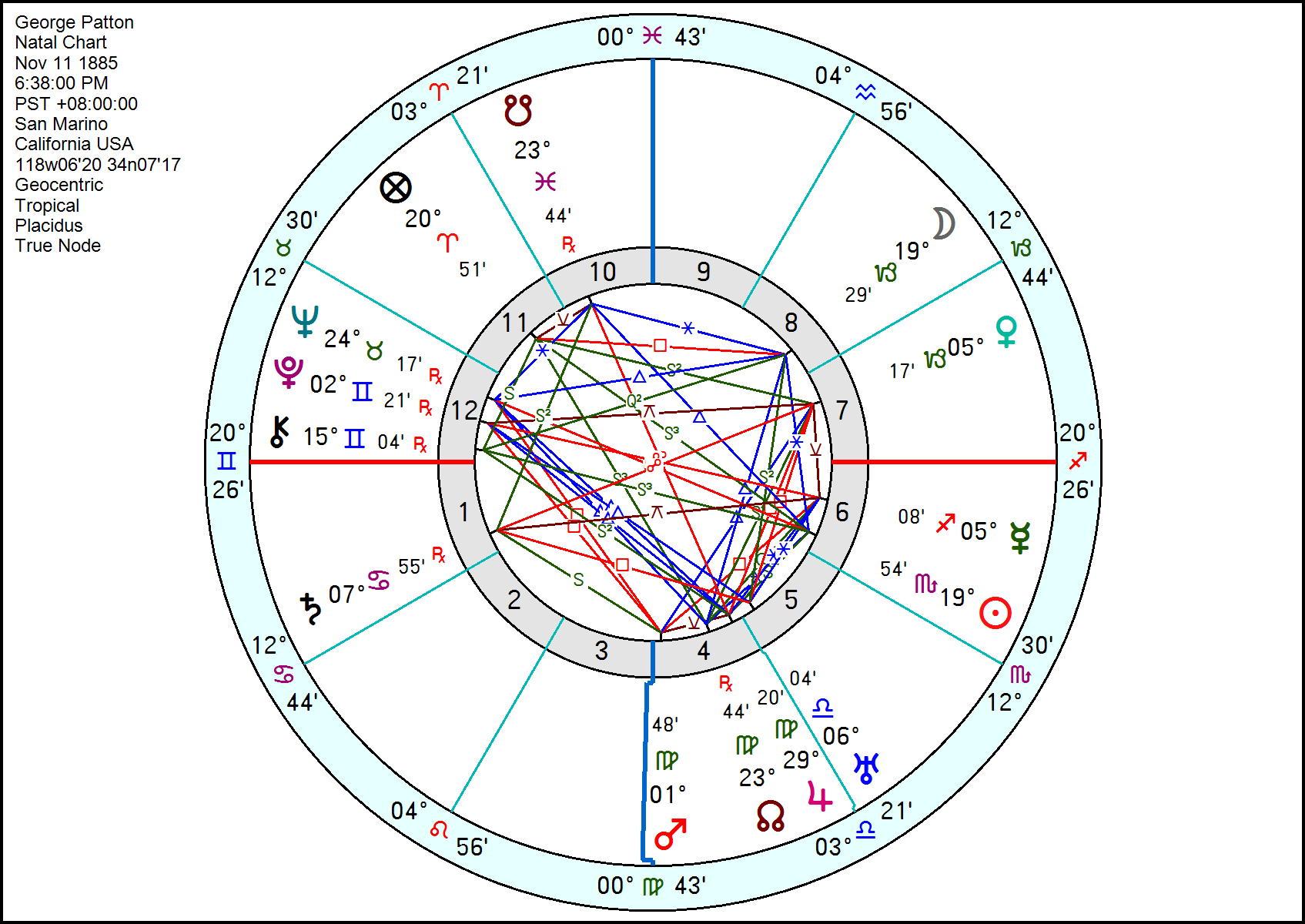
Venus conjunct Sun
Uranus square Sun
Mercury sextile Sun
Venus sextile Moon
Neptune trine Mercury
Pluto opposite Venus
Head conjunct Venus
Sun square Saturn
Neptune sextile Uranus
Pluto square Uranus
2) 9/26/1918 -- wounded in battle, vision of ancestors in sky -- conquered fear -- WWI
Struggle with his lower nature -- he had to overcome fear -- it is time for another (i.e. ancestors) Patton to die -- a mystical death -- the animal part died -- got a glimpse.
Mercury Venus sextile Sun
Mercury Venus trine Moon
Sun trine Pluto
Pluto opposite Venus
Pluto conjunct Saturn (ego torn apart)
Mars sextile Mars (redefining courage)
Sun conjunct Jupiter (protection)
Neptune sextile Uranus
Pluto square Uranus
Mars opposite Neptune (violent accident)
Saturn square Neptune
Uranus square Neptune
Pluto on natal Saturn, square natal Uranus, opposite natal Venus
Transiting Uranus Saturn opposition t-square transiting Mars, with Mars opposite natal Neptune (violent situation)
7/25/1937 -- in between -- vision of not being taken to die after injury -- Vikings
3) Tank command -- 1940 (7/15) -- reassigned to develop tank and style of warfare to counter German blitzkrieg.
Mercury Mars Pluto trine Mercury
Venus square Jupiter
Mars sextile Uranus
Sun sextile Neptune
Uranus conjunct Neptune
Neptune trine Neptune
Pluto sextile Pluto
Neptune conjunct Head
4) Africa landing (chosen by Ike) -- start of movie -- takes over US troops but is assigned to a defensive role (Montgomery is allowed on offensive).
Uranus opposite Mercury
Pluto trine Mercury
Mars sextile Venus
Mercury sextile Mars
Uranus square Mars
Neptune conjunct Jupiter
Uranus trine Uranus
Pluto sextile Uranus
Jupiter sextile Neptune
Uranus conjunct Pluto
Neptune trine Pluto
5) 7/10/43 -- Husky Landing -- second fiddle to Montgomery again in Sicily.
Uranus opposite Mercury
Pluto trine Mercury
Mercury square Uranus
Mercury opposite Venus
Venus conjunct Mars
Uranus trine Uranus
Mars trine Mars
Jupiter sextile Jupiter
Pluto sextile Uranus
Neptune conjunct Jupiter
Mercury conjunct Saturn
Venus square Pluto
Jupiter sextile Pluto
Considered a renegade, i.e. unorthodox.
Was Christian -- read Bible and Koran every day.
In Sicily slapped two soldiers with shellshock -- relieved of command for one and a half years.
Appointed general of Third Army -- Knutsford incident -- political faux pas, frame-up -- Ike always stood by.
Once he is in France he is in the right spot in the right time.
D-Day -- had to wait one month to get in -- "The biggest war in the history of the world is going on and I'm not in it."
First offensive started in four opposite directions.
8/1/44 -- roared across France in two months. Slowed down because Montgomery and British can't keep up with him.
Battle of Bulge -- anticipates German counterattack, wins.
Functioned on intuition, not only planning.
Found concentration camps before Germans could cover it up.
5/6/45 -- stopped, Germans surrender. Depressed -- knew his destiny was over.
12/45 -- in a freak car accident -- only one injured -- broken neck -- died ten days later.
From D-Day to death 18 months. His whole life was geared to these 18 months. He knew he had a destiny. "God has meant me to fulfill my destiny and I will do it."
Sun Jupiter septile -- exact age 52, vision and tank brigade.
Wanted to fight Russian after was over -- "Either we fight them now or in twenty years."
Was "a pure warrior".
Neptune conjunct Jupiter during war, died Neptune conjunct Uranus
During war: progressed Jupiter conjunct Uranus, progressed Mars conjunct Head, progressed Sun conjunct Moon (1944)
Natal Saturn Venus opposition t-square natal Uranus -- warrior -- Saturn in first house, all in cardinal
Venus in seventh -- control of others, Uranus in fifth house -- hero
Natal Pluto Mercury opposition t-square natal Mars -- strategist -- things hit Mercury
Natal Neptune Moon Jupiter Head grand trine in earth -- ability to implement and function as a leader
Mars degree conjunct nadir -- psychical fearlessness
#2 Saw his ancestors -- you have to be in an actual circumstance of fear to overcome it.
Pluto -- necessity of circumstances.
From then on he never took council from fear.
Saturn degree has something of the higher lifting up the lower.
Saturn in Cancer -- a change in the archetypal structure of your senex is inevitable.
His senex changed meaning and manifested the uniqueness of his individuality.
Uranus degree -- could tame his psyche to manifest the courage.
Pluto and Uranus = a universal mode of consciousness which is individualized through Saturn.
Transiting Pluto conjunct natal Saturn square natal Uranus -- an infusion of universal consciousness into and transforming his ego.
Neptune with transiting t-square -- Neptune degree -- a societal situation (park - war) was required to actualize his role.
Sun Moon sextile unaspected -- Mercury Venus sextile and trine triggered experience.
Normally, gave him tendency to operate in terms of himself, here was brought out in the context of a larger situation.
It took him a whole lifetime of experience to prepare him for the Germans. The Germans were feared -- Patton had conquered it.
The World-Mind was preparing the leaders (Ike, Patton, FDR) necessary to oppose Hitler.
The circumstance of getting in trouble (slapping) were necessary to eventually set him up with the Third Army -- which could fulfill what was necessary.
The real spiritual significance of an event comes from the trans-Saturnians and gets actualized in the receptacle provided by the ego.
[Classnotes AB 1983 0124 End]
CHARTS FOR 1983 0124
Class
Monday, January 24th, 1983
Verbatim, unedited transcriptClick the series name to view more
CLASS at Wisdom's Goldenrod, Hector, NY
with Anthony Damiani (AD)
January 24, 1983
ASTROLOGY; HOROSCOPE-PATTON
with Appendix: Classnotes AB 1983 0124.
TOPIC: Astrology
SUBJECT: Horoscope-Patton
SUBSUBJECTS: Patton (major events, vision of ancestors)
CONTENTS:
Review of Patton's life, character, major events
Patton believed in reincarnation, had visions, was psychic
Often, when mystics go to a place they previously lived, a vision is evoked
Patton is warrior caste; development of a warrior takes lifetimes
Patton's South Node, North Node degrees read
AD wants symbols read that show the warrior quality
Discussion of this point, multiple possibilities considered
Review of aspects for Patton's vision of his ancestors (WWI, wounded in battle)
This was a struggle with his lower nature, had to overcome fear; can't overcome fear in theory; happened when he was 33
Situations are complex; many aspects involved in one and the same event
World doesn't openly reveal its significance, you have to dig it out
Discussion of aspects for vision continues
Saturn in Cancer: change of senex meaning already implicit
Transiting Pluto conjunct natal Saturn, square natal Uranus
Pluto, Uranus represent universal mode of consciousness which is going to individualize itself through the ego
Discussion of aspects for vision continues
Patton had mystical death during this vision, animal part died
Discussion of aspects for vision continues
World-Mind was preparing certain leaders (Bradley, Eisenhower, FDR, Patton) that were going to be able to confront the Germans
Slapping incident necessary to eventually put Patton in charge of Third Army
WWII was a fight between good and evil
AD: America had most powerful armed forces in the world; with that power came responsibility, which wasn't properly used
Real spiritual significance comes from trans-Saturnians
Natal Chaldeans related to each other, even if unaspected, unless person is psychotic
Do men of destiny have a gurukula?
Appendix: AB class notes
BOOKS READ FROM OR REFERENCED:
Marc Edmund Jones, The Astrology of Concepts
Marc Edmund Jones, The Sabian Symbols in Astrology
Homer, Iliad, Odyssey
Cornelius Ryan, A Bridge Too Far
George S. Patton, "My Father as I Knew Him and of Him from Memory and Legend"
George S. Patton, Martin Blumenson (ed.), The Patton Papers, 1885-1940
SABIAN SYMBOLS: Taurus 25, Gemini 3, Cancer 8, Virgo 2, 24, Libra 7, Scorpio 20, Pisces 2, 24
CHARTS appended to this transcript:
FIGURE 1983 0124-1. George Patton Natal Chart (astro.com).
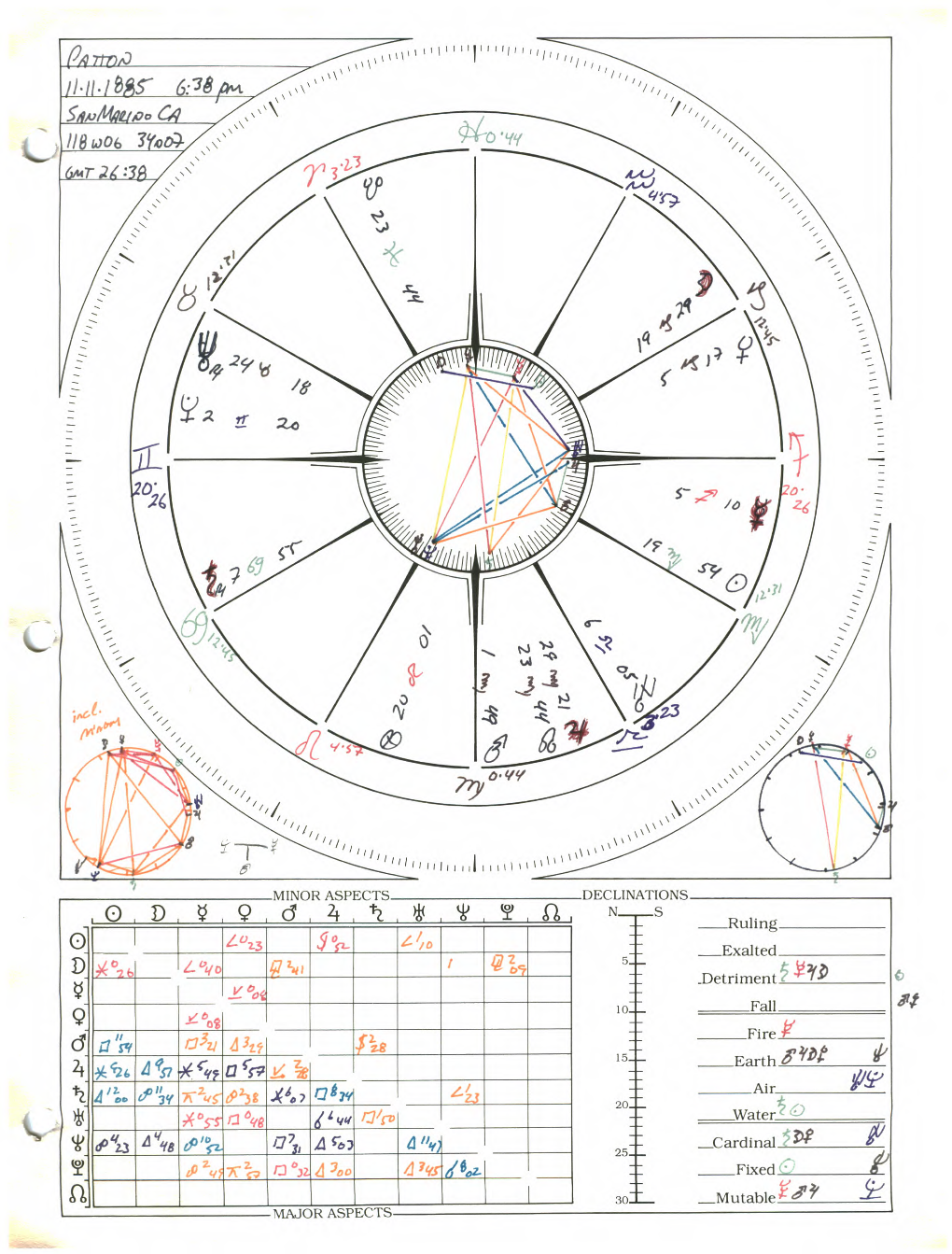
FIGURE 1983 0124-2. George Patton Natal Chart (WG version).
Other diagrams also referred to are not with this transcript version. [Transcriber note: [diagram] means the speaker is referencing a diagram as he or she is speaking. If someone is drawing or writing, with audible sounds of chalk on a blackboard, I indicate this by [drawing] or [writing].]
NOTES:
AB class notes have been appended because they contain information that the verbatim transcript does not have. They thus help round out the class. AB class notes retyped from Classnotes AB 1982 1206 to 1983 0124.PDF. All spelling, capitalization, and punctuation corrected, abbreviations and astrological glyphs spelled out in AB class notes.
Earlier partial transcript version also exists.
TRANSCRIBED Verbatim by IT prior to 2018 (V11a). This is V12a (2023) and has: updated prefatory matter, footer, and audio file name; Book List and TOC completed; AB class notes appended; new notes within transcript; new Patton chart added; new formatting to accord with new conventions. Archival verbatim transcript – V12a.
AUDIO FILES: 1983 0124a, 1983 0124b. [Note: "Tape" and "Side" refer to original audio cassette tapes that were later digitized into .MP3 Audio Files.]
1983 01/24 at Wisdom's Goldenrod
Astrology; Horoscope-Patton
[Audio File 1983 0124a Begins]
TS: They think you've got an hour and a half.
BC (faint): I've got an hour left, yeah.
TS: I'm going to try to go through-- quickly go through Mr. Patton's life and about ten or twelve events in his life and then begin on Mr. Edison so, we're moving quickly and it's with intent. So, Robert uh--
BC: Listen quick 'cause we're gonna have (lots) [one/two words inaudible]
AD: There was one announcement. No class next Monday.
TS: I have that.
AD (faint): You've got Monday? [11½ second pause with faint background student talking and shuffling about] Gonna lose it Monday.
[20 second pause with faint background student talking and shuffling about]
BC: Ok, um-- [9½ second pause with page turning, few faint student words] Patton was born into a-- a family of military background, both ancestors on his parents' side were-- were generals going all the way back to the Revolutionary War. So as soon as he could think and talk, what he heard most about were his general soldier ancestors. His parents taught-- gave him a very interesting education early on to-- that-- he-- they didn't force him to-- to read or write until a much later age than most normal children. And his childhood was basically spent riding horses, learning how to shoot a rifle, and playing with swords. But when he got to school his-- the teachers were appalled that he couldn't read but what amazed him-- them were that he could quote long passages from the Iliad and the Odyssey, Shakespeare, and most of the classics by heart, just long passages so-- Even when he got to school he wasn't-- he was behind in some ways and very advanced in others. [short pause] He-- his father enrolled him into a military academy which was started in late junior high for kids our age through high school in-- somewhere in Virginia to try to get him prepared to get into West Point. Patton was never-- never smart, so to speak, in what one would call the mathematics, sciences, and those lines. Thus he had much problems when he did get into West Point later on. His father being in politics finally pulled enough strings that got him into West Point when he was about 17 or 18 years old. And, he didn't do too good the first year, he flunked out the first year, which wasn't very-- as Tim says probably the only lesson in humility he learned for many years on.
TS: Pluto on the ascendant.
BC: Pluto on the ascendant, yeah.
[student assents, faint]
BC: He-- he-- he finally made it through West Point in-- in five years. He retook his first year. And, he graduated with-- The one thing that he-- he worked hard on, knowing that he wasn't smart in the academic skills, he worked very hard on receiving what they called the-- the appointment of the adjunct at West Point which is-- which is hon-- an honorary degree for the-- for the soldier with the greatest discipline, fewest demerits through the years, just the most disciplined soldier. There was one point during, I think it was his junior year at West Point that he would change his uniform fifteen times a day to make sure that he would be properly dressed. So that (can/kind of) tells you--
LR (faint): Right away you're dealing with Patton.
BC: Who-- yes [one/two words inaudible] So very early on the two-- the two words that one could use to describe Patton would be discipline and honor, which those are the two words that would carry throughout his entire career. After graduating from West Point he was, oh, appointed to some base in Texas, which at that point there was a war starting to break out, Pancho Villa was running amok through the country and they sent down Pershing, Jack-- "Black Jack" Pershing to put down the rise-up, the rising, and his aide-de-camp was Patton. Which he had him pull a few strings to get that job, Patton-- Pershing was dating his sister, which didn't hurt to help get him the position. But once he was on the staff he-- he did-- he distinguished himself in a fight, which got him an appointment on Pershing's staff when World War II-- World War I broke out and the Americans were pulled into it. Pershing was the equivalent of General Eisenhower in World War I, he was the leader of the American troops. So Patton had a very good position knowing Pershing as well as he did.
The first major event which I have up there which, I'm not going to go through the aspects now, I'm going to leave that up to Mr. Smith to sort all these things out. These aspects are exact, 1½ degrees and less, most of them, so you can see he's a very complicated individual to probably sort out. But the first-- first major event that I picked out was that, during the war, early on in the war, World War I, the tank had just been invented by the French. And he saw that in battle the first time and he decided that this is what he wanted to do, this is what the-- the area of-- of warfare he wanted to specialize in, which at the point was-- at the time was a very risky chance of taking one's career because cavalry was still the-- the thing to be in if wanted to be-- one wanted to be a successful soldier. But, he went off, he formed the first American armored division, opened a school to teach these Americans who had never seen a tank how to drive them and how to shoot them. The interesting thing is, stories when the Americans got their first shipment of tanks from the French to practice with they had to wake him up in three in the morning because he was the only American that knew how to drive a tank. So, he successfully unloaded them, got into the school, taught his soldiers--
LR: Excuse me Bo, these transits are for which of those things you just mentioned?
BC: The-- the day that-- the first one up there is his tank command was the day that he decided to become the tank-- you know, tank division. He got his transfer from cavalry and-- under Pershing's staff to tank command. So, for the next-- I didn't put the date up, that date was 10/3, 1917. And he worked with this school for well over a year to get them ready for battle. It was just about the last year of battle that the tanks in the American-- for the American army was put into commission. And he was fairly successful because of his driving discipline with the battle. There are many stories of him when first his tanks would break through the-- break through the line and they came to a bridge and they said that it was mined. And he didn't pay any attention, he said "Ok, follow me," and he walked over this mine(d) bridge. And, they followed him and-- He worked with--
LR: And?
KD: What happened to him?
LR: [one/two words inaudible]
[few students at once, few words inaudible]
KD (simultaneously): Did they die?
BC: Well, no, obviously because he lived to fight the next war. He did work with his intuition. It would be a scary word to use right now but I'll use it. (bit of laughter) That he didn't think these things out but at the time he knew what was right to do and he'd do it, as in this case. Mostly in a feeling mode. He describes it as he'd get these feelings and he would act on them immediately, knowing that they were right. The next-- the next event I have up there is for 9/26, 1918. This is a day where his division really distinguished itself in breaking through, I don't know, 10 or 12 miles behind the line now. I'm not going to go into great detail but World War I was trench warfare, which means one army di-- digs a big ditch and the other army digs a big ditch and you try to take over the other guy's ditch. (bit of laughter) Well, what Patton did was he took over their ditch and went 12 miles past their ditch, which nobody had done before. And, as-- when he did this, he was regrouping his men, got-- he and about twenty of his men got pinned down by machine-gun fire and he dove into a ditch, he dove into a foxhole. And, he peered out o-- in-- he said at this point he was seized by fear, you know. Fear wasn't something that he knew later on but at this point he said he was terrified. And he peered over the edge of the foxhole to see the enemy where they were, and he said-- now this-- this is a vision, I got a quote here [one/two words inaudible] that-- he said--
[Transcriber note: I am unable to access this quote, reference needs to be checked.]
[BC reading] "Over the enemy line, in the clouds, he distinctly saw all his ancestors. They were staying there looking at him, shaking their head."
S: I'd be scared too.
BS: Which one? (laughter)
BC: For Patton to be in a foxhole was not the position of general. And the feeling that he got at that point was that they were saying it's time for another Patton to die in battle. So at that point he jumped up and said follow me guys and off he went. He did get shot. He-- they did take the city, he fell and got hit and that was it for him for the war. But, it was interesting, from this point on, it was like-- it was like he had conquered his fear at this point and the thing that died would seem to be the fear and not the man himself. And later on in the war, the next war, his line whenever this fear would start to come, he would say, "Do not take heed of your fears," and he would say it with a force to himself. And at that point it was like they were put down and he would go ahead with what he really had to do. So, it seemed like this(--) being very big for him, that he had conquered his fear during this war.
So, very shortly thereafter the-- World War I ended. And thus bega-- began a period between the two wars that was kind of an obscure time for him, he shook it around from base to base. He at that point was transferred out of the tank battalion back into cavalry because there was no funding for it, the tank battalion was just on paper and there was no money for it. And, actually he became distinguished, strangely enough, between the two wars as being the best polo player in the army. And, strangely enough is that when World War II came this is what he was known for more than being a good general and a good fighter of World War I. He spent the years, though, training, writing all kinds of articles that-- by the way that, if any of you ever rea-- read any of my KCB write-ups this is a man after my own heart because he was the worst speller has ever hit the Earth. (bit of laughter) [couple/three words inaudible] way that he (distinguishes/distinguished) [one/two words inaudible] as a writer is that he would write the article, he would give it to his wife, and his wife would edit it and be sent off and he was considered a fairly decent writer. But between those--
Say a little bit about his character. Anybody s-- if you ever saw the movie, it was subdued. (laughter) His character was actually much more outrageous than it was portrayed in the movie. Audacity would be the word that he used for himself, that-- in everything he did, from fighting to leading his life. He was very profane, which he did for an effect. He was not-- he didn't-- he didn't swear because of a lack of vocabulary, he did it for an effect. And the effect was to motivate his men, which was the greatest thing that he actually could do. And, he was known as "Blood and Guts," which was actually a misquote from one of his speeches, actually it should've been-- he said-- the quote was actually "A pint of sweat saves a pound of blood," which, it got translated into guts and blood and so he became known as "Blood and Guts," so-- otherwise-- So, now at this point, let's say about 1937, I skipped an event up there, I'll have-- need the transits later. This time the Germans were really starting to build up. They had developed a panzer tank and modern-day warfare that the Americans had no conception of. I've got pictures in here, I could pass some pictures, I don't know if anybody wants to see. There is a picture in here of the United States Army, 1940. If you look at them, they're all on horses, (bit of laughter) ok. This is what they were going to fight the German panzer tanks with, ok.
AD: They had twelve panzer divisions that--
BC: Yeah. So, during the war Patton-- between the wars Patton was very big at trying to motivate the government into building-- modernizing the army. He was always writing letters, articles, and those kind of things but nobody really-- he wasn't the only one, don't get-- but he was very strongly an influential force in the-- trying to develop the tanks.
AH: Bo was he a general at this time?
BC: No, he was a-- he was a major at this point. See, he got up to a colonel in War World I and then after that they go through this rank busting after the war, he was down to a captain or something like that. He didn't become a general until 1940, brigadier-general in 1940. So, just trying to keep it set up is that during 1930's the Germans were building up, and the Americans weren't. The next event that I really want to stress is on 7/25, 1937. He was 52 years old and for a ge-- for a man who's-- think he was a colonel then, 52 years old and a colonel, he was getting what they thought over the hill, he wasn't fit-- he was too old for what they thought would be a good commander. So he, at this point obviously, fairly depressed in life thinking that he had-- and all this training had gone for nothing. He had a-- he had a terrible accident, he was riding-- he was a great horseman but he was always flying off his horse. (bit of laughter) And he fell off this--
LR (simultaneously): Is this the one you (skipped) [possibly one word inaudible]
BC: Yeah this is the one I skipped. He fell off this horse and he broke his leg and he fell unconscious. And he said when he fell unconscious he had this vision that he had-- that he woke up on the battlefield of the ancient Vikings. And that he saw himself laying on a shield, which at that point, if you know anything, dead men were always laid on their shield to be taken back to Valhalla. And, he said he saw himself laying on this shield and these two large Vikings picked up the shield to carry him away. They held the shield and then they looked at him and they shook his head-- they shook their head and they put him back down on the ground, took the shield away and walked off. And when he woke up he said-- he said he knew at that point that he had a dade-- a destiny to fulfill, that he knew that he had something very important to do. And from that point on he really became even more motivated.
LR: What date was that Bo?
BC: That was 7/25, 1937. Now, 1940, 7/15, 1940, around 1940, this is when he became brigadier-- brigadier-general, one-star general, lowest one (you/he) could-- lowest of the four. And he at this point was reassigned to the tank, tank-- the armored division. And, if you look at the-- I'm not going to go through them but if you look at the aspects he had, I mean he had-- kind of blows you away. (No one has excuse.) Um--
RG: [one/two words inaudible] so they built tanks in those-- in those three years?
BC: In the three years he had finally gotten them to-- he and others, to start funding because at this point, German-- the Germans were running through Poland and-- I mean these things, I mean they-- at this point the build-up started. And-- This is a very large but--
AD (simultaneously): You know what impressed him?
BC: Excuse me?
AD: The Ger-- you know what impressed him, when the Germans ran through Poland in 18 days with their panzer division? [BC simultaneously: The German--] That woke him up.
BC: The Germans were-- the Germans had developed kind of warfare called blitzkrieg, which I don't need to go into but-- Needless to say, trench warfare was no longer-- and the Germans had perfected a new kind of warfare, modernized warfare of strafing and-- followed by tanks that was quite awesome. At this point, as Patton being reassigned to tanks, these years he had not laid idle and he had developed his own warfare. And for the next year or so they had many-- United States had many "war games" to get prepared to be put into battle. And, unfortunately Patton in his-- I think it was the Seventh Army at that time, was always screwing up the war games because they were always ending them two to three days earlier than they had planned because he had developed what they call, if you know football it's called the end round. Is that he would send everybody around one end very pointedly, strong in one direction and he would get to his destination days before anybody even thought possible. Thus, he had really started to formulate tank warfare the way it was fought in World War II.
LR: And which date is that tank (second-in-command) for?
BC: That is when he beco-- takes the command of his first battalion and he's reassigned. He's-- he again at this point thinks a very strong destiny, that he has a strong destiny to fulfill.
LR (simultaneously): You haven't gotten to that yet.
BC: No that's-- yeah I just finished that.
LR: That's what you were just speaking of, [BC: Yeah.] the war game [one/two words inaudible]
BC (simultaneously): Right, right. Ok, without going into the great hierarchy of American command--
S (faint): Excuse me but one more thing, what's the date of that?
TS: 7/15, 1940.
S (simultaneously): 15. Uh-hm.
BC: Eisenhower is been chosen for chief of command of air and ground of all Allied forces. And, there's many other generals between Eisenhower and Patton at the moment but Ike would-- graduated I believe eight to nine years after Patton did at West Point. But somehow between the years, between the wars, Patton and Eisenhower were fairly close, which is fairly-- If you know anything about Eisenhower he had an amazing shoot up the ladder, I mean-- So when Ike and Patton were friends, Eisenhower was a mere lieutenant, so I mean it was these fated circumstances so that when Eisenhower did become in charge, he kind of-- he held Patton under his wing through many a storm which we'll come to. So, Eisenhower chose Patton to lead the first landing of the Allied forces into A-- Africa, which is the next event.
S: Is that Tunisia?
BC: French Morocco actually. And that was a strange battle, we were fighting the French in that battle. (bit of laughter) We got into their harbor and French fleet was there shooting at us and they got de Gaulle, who was the guy-- and said "Look, tell them that we're on their side." (some laughter) De Gaulle said, "I'll do that under one condition." Eisenhower said, "You could tell him where to put his condition," and they went in and had to fight the French because de Gaulle was very outrageous, so-- So anyways, at this point I have to bring in one more general, can you keep all these generals in the back of your mind, British general named Montgomery.
[student assents, very faint]
S: Oh yes. (laughter)
[few seconds of laughter, mostly inaudible student comments]
BC: Well, ok. Monty at the moment is fighting a general from the Africa core from Germany, Rommel's troops. He's another general.
AD: Well he did take time out to fight the Axis, huh?
BC: Excuse me?
AD: He did take the time out to fight [one word inaudible] men.
BC (simultaneously): Well actually he fought more with Eisenhower and Churchill than he did with the Germans but-- (bit of laughter) So, at this point, Patton has successfully landed and taken South-- North Africa, excuse me. But he has to take a defensive position. If you know Patton that wasn't what he liked at all. And basically he had to sit on a sideline. At this point if you watched the movie this is where the movie starts, ok. And he takes over, after a general screws up somewhere along the line, he takes over all the American troops in Africa, but he has to be on the defensive as Montgomery wins his only battle of the war, ok, as he pushes Rommel out of Africa. Ok. Next landing, in Sicily. I--
LR (faint): Is this Husky landing?
BC: This is the Husky landing.
AD (simultaneously): Do you have the vision he had when he was in Africa?
BC: You mean the--
LR (simultaneously): No they don't have the date and you said it's not [one/two words inaudible]
BC (simultaneously): No. (No/Now) actually it was the date--
AD: Not a vision uh--
BC: You mean-- I could-- he-- he was very-- now, I could back up here a little bit, he had a basic Christian upbringing. But, not only did he have these-- what I would call these mystical experiences. He highly believed in reincarnation, I mean it was like second nature to him. Not only did he-- I mean he was steeped in all the-- the lore, the history of-- of-- of warfare, but like there was a vision-- something happened like when in World War I he came to a camp where Caesar had set up, and he had a (guide/guy) there to tell him. And he told the guide he-- where Caesar had been, where his tent was, and the guide would-- I mean he constantly did this, he'd walk onto a battlefield and he said "This is how the battle took place." Just like if you saw the movie he had those visions that said, "I've been here." He thought he'd fought with Napoleon in Russia. In Russia the-- on coming back from Moscow he said he had vivid memories of the cold and the battles there.
AH (simultaneously): Bo did-- Bo did you find his poem about that?
BC: Yeah I did but I don't have it.
AH: He actually wrote a poem about the various experiences that he'd had in past lives.
AD: Yeah this one was very specific, it was the Car-- campaign Carthage.
BC (simultaneously): Yeah.
S (very faint): (The Carthage.)
BC (simultaneously): But that was-- that was after-- that was after the Sicily invasion.
AD (simultaneously): After the Sicily invasion?
BC: Yeah, after they relieved him of command they carted [AD simultaneously: Took him down?] him around a bit but--
AD (simultaneously): Oh.
BC: I mean I couldn't find a date and I really-- they didn't really talk about it.
AD (simultaneously): 'Cause this very often happens to mystics when they go back to a place they've previously lived. Gets you going, comes out.
BC: Yeah it's like I said, many times he'd walk into a place and said--
AD: Yeah, he knew it.
BC: This is what-- many [AD simultaneously: Yeah.] times in battles he unconsciously crossed the same river, the exact same spot as-- as Hannibal did or as Caesar did or Napoleon did, you know they'd book-- trucking across this river and he said, "Napoleon cro--" I mean some-- [S simultaneously, possibly part of background: One hopes.] He was constantly doing that.
AD: But he's a warrior caste.
BC: Yes.
AD: Yeah. Gotta keep that in mind. [BC: So--] The development of a warrior takes a long time.
S (faint): (We all know) a warrior.
NR: Well he had memorized all those things from Homer and so on when he was a kid.
BC: Yeah.
NR: Was that imposed on him or was that something he just picked up?
BC (simultaneously): His-- his dad would read to him, but it wasn't-- he would pick it up, I mean it wasn't--
NR (simultaneously): It wasn't like [BC simultaneously: It wasn't forced.] he was made to memorize.
BC: No. He had an amazing memory, which we'll get to in a little bit.
AD: No if you read his life you won't get that feeling that he was just repeating what lessons he'd read in history.
BC: No.
AD: That had nothing to do with his vision.
BC: So you gotta remember I'm-- it was-- it-- along with these what I call mystical experiences, he'd get these intuitions and reincarnation was just second nature to him, so to speak. He was als-- he did read the Bible every day. He read the Koran. He had read other religious and philosophical works so he wasn't-- wasn't an ignorant man by any means. Ok we'll quickly go through the-- the Sicily invasion. Once again his major enemy is Montgomery.
S: Yeah. (RG laughing)
BC: Montgomery gets all the troops--
AD (simultaneously): No, it was the Germans. (AD laughing, bit of laughter)
BC: Gets all the troops, gets all the landings. And, there's a map, one, two-- if anybody's interested, here's a map. [few very faint inaudible student words] [faint, to student: It doesn't really matter.] That he landed on the wrong side of the island, and he had to go all the way around the island to get to-- if you know, there's a town called Messina. Messina's right on the tip of Sicily which is the closest city to Italy, so it was a very strategic city. And this was the point that-- if anybody's into war games, this is--
[few seconds of background student talking]
AB: Just give it back to Tim.
BC: Just give it back to Tim, Tim was there. (some laughter)
TS (faint): Yeah. Yeah the little guys (that have read) [couple words inaudible]
BC (simultaneously): Yeah give him--
CDA: They did that in the movie a lot with a map.
[students assent]
BC (simultaneously): They did that-- Ok, if you remember, he had to go (a long--/along) the long way. And, he actually did beat Montgomery to Messina, going the long way around by 8 hours but he got there before him. Now, that sounds in one hand like an ego trip, that-- and it was, he was an egotist, there's no ways about it. (some laughter) But up till this point there was another thing that you had to say for him is that, at this point in the war throughout, the United States army was taking back seat to the British, and this galled him more than taking a back seat to Montgomery. And he wanted to prove to the world that the United States army was the best. And he was the one, although being a big egotist, he told his reporters, every time he says, "Don't report on me. Go to the front and report 'em up on the men at the front." I mean those were the guys that he wanted reported on. He was also the one general who was always at the front. [student assents, faint] He was the one pushing jeeps out of the mud, he was the one pushin' 'em out of the snow, he was the one that was delivering supplies, he was pulling 'em out of buildings so I mean he wasn't sitting back at some command post miles away. Of course Eisenhower was always yelling at him for it, and always asked where's Patton, he's always at the front.
AB/RG(?): He was in his late 50's, right?
[students assent]
BC (simultaneously): He's in his late 50's, yes, he was-- [student assents] So-- Ok, now an event happened at Sicily, the slapping of soldiers, he actually slapped two of them.
LR: The date is when he beat Monty?
BC (simultaneously): The-- the Hu-- no Husky landing, that is when he lands in Sicily. (Oh) he-- let's see, Messina is 8/17, it took him a while, month and a half to get to Messina.
LR: And what's the date for these transits?
BC: For the Husky landing it was 7/10, 1943. Now, I didn't put up the slapping events because, you know, it's kind of absurd actually when you look at it in retrospect. He-- he-- one of the things that Patton would do after the battles he would go to the tents to visit the wounded and decorate them personally. He came across two men in two separate occasions who had a case called shell-shock, not wounded. He just freaked out because these uninjured men were in the tent of what he called the heroes of the war. And he threatened to shoot them if they didn't get them out of the tent right then, slapped them and threw them out of the tent. Those two events got him relieved of command at the end of the Sicily invasion, he had no army for well over a year and a half. For that year and a half he was used as a decoy that they would [one word inaudible] and Patton and four secret servicemen and a secretary were shipped all over Europe, Africa, parts of Asia, just dropped so that wherever Patton landed they'd make sure that the Germans knew where Patton was just to keep them guessing where the general was going to fight next. He gets-- we're coming up to D-day now, working up to D-day, which is actually the starting--
Another incident happens. He gets appointed the general of the Third Army which is the army, his army that he runs through Europe with. And about two days afterwards he gets invited to a tea party, talking to his-- maybe twenty to thirty elderly ladies about the war. He gives them a little pep talk. It's called the Knutsford incident. (bit of laughter) And the quote-- the quote is-- he says that the American and the English people are two nations separated by a common language. (laughter) And the quote was, he says, "And I believe with Bernard Shaw that the Americans and British are destined to rule the world." End of speech, walks out, they applaud. He gets quoted as saying-- as leaving out the Russians, which is a big slap for a supposed ally. And for this event they almost shipped him back to the United States, I mean-- I got the exact speech in here, I mean it's harmless, I mean you can't imagine-- Really did seem like a frame-up. I mean it really seemed like somebody was out to get him. But anyways, they don't--
RG: Well but you know, certainly that other incident, I-- in retrospect it was crucial, [S simultaneously: Exactly.] the slapping was crucial to his-- [BC simultaneously: Well--] the next year and a half, I don't know.
BC: The next year and half, you know it's-- Going through it, I have a feeling that once he gets into France, he is in the right spot at the right time with the right command and any other command I don't think he would've been-- So as you say, you know, he was put in the right position.
RG: But how did it-- how did it happen that he came favorite then?
BC: Eisenhower never-- when-- when everybody wanted his head, Eisenhower stuck by him. Eisenhower was in command and Eisenhower almost lost his command for sticking up for Patton. But, he stuck by him through the whole thing.
AH: Also he was considered a renegade certainly by everyone--
BC: Patton?
AH: --Ei-- Eisenhower included.
BC: Yeah.
AH: But they knew that he was the man to move tanks across Europe.
AD: What do you mean a renegade?
S: Yeah.
AH: Well he wouldn't conform to standard tank tactics. (bit of laughter) He insisted on--
BC: He was tank tactics.
AD: That's-- that doesn't make him a renegade.
AH: No but he-- from the point of view of the more conservative generals he-- he insisted on his own creative approach to tank warfare, and Eisenhower believed in him I guess.
BC: Yeah, sure did. Ok. We're up to D-day now. The invasion lands without a great deal of success, they get a-- they get ashore-- Famous words of Patton, person in charge of major part of the forces is, you guessed it, Montgomery. And, as Patton said he did a lot-- a lot of nothing in a big way for a long time and got nowhere. Patton landed in France a month later. So I mean you can imagine that he was sitting on the sidelines since the invasion was going on for a month, must of have al-- it almost killed him [one word inaudible]
S: (Killed.) (S laughing)
BC: Well that was the quote, he said-- you know he said-- he says "The biggest war in the history of the world [RG simultaneously: Going on and I'm not in it.] is going on and I'm not in it." (laughter) Did you like that?
RG: It was great scene in the movie too.
BC (simultaneously): Great [student laughs, assents] scene, yeah.
S: Right.
S: Yeah he was vain.
BC: Ok. So he enter-- enters France finally, sets up and-- ok, this is where the events start. The next-- next day that I picked was Third Army becomes operational, this is where he finally gets his chance, this is 8/1, 1944. Actually, as usual (as) Patton he started working more about three days before he was supposed to and-- so by the time he got the word to go he had already started. And, he started his first offensive, now you got to get this, first offensive, he sent his four divisions in four opposite directions, ok. He's the only man in history who ever fought an offensive war in four directions at the same time. And the first day he so freaked the Germans out that they didn't know which direction he was going. (laughter) That-- he did come up-- he came up-- he came up to one of his divisions that were supposed to cross this river. And they were sitting there reading his mail and he said a few things which I cannot repeat. (laughter) And they-- he said, "Why have you not crossed this river?" And they said, "We are studying the maps." And he said, "I have just forded across the river, it's two feet deep and there's only one machine gun on the other side, get moving." And he was always the one that pushed his men farther and faster than anybody thought possible. So from 8/1, 1944 to the 1st of September, two months, he literally roars across France and Europe.
The things that stop him again, it's not the Germans but it's Montgomery and the German-- and the-- the British slow him down, they can't keep up, he's gone too far, nobody can keep up with him, so he has to slow down. (bit of laughter) The only way they slow him down is they take his gas away, ok. (bit of laughter, student assents) No gas, no tanks, no warfare, which is very simple. But there are scenes-- there are things where he would-- he had sent his men out to steal supplies from Seventh Army and direct a-- (some laughter) direct the trains the other direction and they'd end up somehow (with) Third Army and somehow they'd get another 20 miles down the road. (AD laughing, laughter) So anyways-- (laughter, student words) Ok.
The next-- there was another big battle but I'll skip that, (there are/they're) two battles. It comes up to the biggest battle of the war called the Battle of the Bulge. Now, this battle-- now, Patton's army is heading towards Germany, in that direction now. You gotta-- he ha-- he gets this feeling that the Germans are going to start a counteroffensive, the last counteroffensive of the war for the Germans. He sets up weeks before anybody else does how he would fight this battle if he was in charge. Two weeks later he gets this call from Eisenhower saying meet-- meet me at Luxembourg, we got problems. So at this point he has already set up three plans with his army, A, B, and C, 'cause he knows what's going to happen. He says "I'm going to give you phone call in a couple hours and I'm going to say A, B or C, depending on the plan and you act on it." Ok? So he gets there, meeting, and Montgomery says-- Eisenhower asked Montgomery how long will it take him to get his men to fight. Montgomery says "Two weeks." Bradley says "Eight days." Bradley is the American general in charge of--
S: Europe.
BC: Europe, yeah but he was in charge of two armies, I forget which one, (the Seventh), it doesn't matter. Bradley couldn't get there in less than a week. They asked Patton, he said "I can have my men there in 36 hours." (bit of laughter) They kind of look at him, he says "Well when can you go to the battle?" He says, "As soon as you get me out of this meeting." (laughter) They thought he was bragging, but he did it. Now, if you've ever been in a carpool, (laughter) add in three or four more people in a car and you call people up and say "I'm changing directions"-- He did this with thousands of men, tanks, supplies to go with it. He made them go-- turn a 90-degree angle, in less than two days had thousands of men cross hundreds of miles in winter time, ok, I mean-- The feat had never been equaled, I mean it sounds-- it sounds corny but I mean he saved the Allied's-- the Allied army because at that point the Germans were trying to cut-- at this battle if the Germans had been successful it would have cut the Allied's forces in half and would have stalled the war years possibly and would have probably given Hitler possibly enough time to finish what he called his wonder weapons, the nuclear bomb.
AD: No that was a rocket bombs then, Hitler [couple words inaudible]
BC (simultaneously): The rocket bombs?
RG (simultaneously): Yeah the rocket bombs, go ahead.
BC (simultaneously): Ok, well--
AD: But they were devastating, they were starting to use them to bomb London. They'd just set them off and they'd go to London and just blow, you know, big rocket bombs. [AB simultaneously: They were like (one/two words inaudible)] And he wanted the time to develop [student assents] them.
BC (simultaneously): Right, I mean this was-- this was the major thing in this offensive was to give them time to develop these weapons. Now Patton actually-- the transits again, now this was the second Saturn return which is kind of interesting, it's not up there.
S (faint): It's not up there.
BC: Right, I'm sorry. I got too many other transits. But at this point, after winning the battle, this was probably the bloodiest battle of the war, and, at this point they put Patton back on the defensive, right? They win this battle, which British want to do what Montgomery calls regroup. Patton never regrouped in his life, he was always going forward. And so he got on what they-- what Patton termed 'active defense', which you can imagine what that was like. (bit of laughter) There was a quote, I don't know where it went but fine too, it's alright. That he woke up after the Battle of the Bulge one night and he-- he got this intuition how he could get to the Rhine before anybody else [couple words inaudible] And the quote reads something like, he says, "I don't know if these ideas come to one due to-- are they insights or due to insomnia," he says, "but they come to me full-blown like Minerva." Then he says, "And I act on them." He says "It's not like ge-- it's not like people think that generals plan these things out in detail." And it's like, during all his major battles he'd get this full-blown intuition and he would do it. And he-- actually he got to the Rhine second, which is the only thing that broke his heart during the war. And, he got his men-- Bradley got over [one/two words inaudible] first, American general. Montgomery was planning-- Montgomery got to the Rhine second actually but he had to regroup for two weeks, (some laughter) and plan an invasion. If anybody-- did anybody see the movie, what was it called, "Bridge Too Far" I think it was called, this was--
AH (simultaneously): It was also a book by Cornelius Ryan. [Note: Cornelius Ryan, A Bridge Too Far.]
BC: Yeah, yeah, well this was the-- that was Montgomery's wonderful plan that he finally got to the Rhine and had 60 divisions and 70,000 rounds and thousands of planes to go over the Rhine. Patton got to the Rhine and same night he stole a couple rowboats, rowed his division across the Rhine before the Germans even knew he was there and called Bradley from the other side of the Rhine and Bradley said "You're not supposed to be there," and Patton says "You want me to give it back?" (laughter) So-- Which at this point Montgomery wasn't too pleased but-- Ok. Again he goes roaring across Germany, can't-- at this point the Germans are pretty well-- defense is pretty well crumbling. And-- let's see, the next event that I got was-- Oh Roosevelt dies, which is very-- he was very touched by-- He and Roosevelt were actually quite close. Patton whenever he would take a city, he would find some artifact, art object or something like that and box it up, said "Private Special Delivery, Top Secret" and send it off to Roosevelt. And, you know, he had a nice collection of artifacts, the--
CDA/S(?): Booty.
BC: Booty (some laughter, student words) is what it's called, yes. So, he was actually very close to Roosevelt in that way. But-- ok. The one thing that-- the one thing that's-- you-- one can thank Patton maybe if you want to say that is that he moved across Germany so quickly that the Germans did not have time to destroy the information and the bodies from the concentration camps. He was--
(Side 1 of original cassette tape digitized as 1983 0124a Ends; Side 2 Begins)
BC: --go with him for the few times, he marched every one of his men through the camp. He marched every one of the photographers through the camp. He captured every one from the village near Buchenwald and marched them through the camp, made a speech and says "This is what you're fighting. Don't ever forget it." And-- so I mean it was due to him that many of the records that are kept was because, I mean his fast movement. I've got two more events here then I'm done.
5/6, 1945 Patton is stopped. War's over, the Germans surrender. He at this point-- ((I/we) have) quotes in the book again, he says-- he said, he had never felt lower in his life, the war was over. Now, one might think that this was a-- you know, a comment like, you know the-- being let down after all this activity but to me after reading through it all, it's like his destiny was over, he knew it, he kind of intuitively knew it was over. And at this point it was like he knew everything he had done he was not going to do anymore. So, they surrender somewhere around there and he's also made a full general, four stars. He has a homecoming and considered a real hero, given the hero's welcome. And the biggest mistake-- at this point when he's home, he wants to go-- he wants to fight the Japanese, ok. He said "War's over in Europe, send me to Japan." Nobody would take him, nobody wanted Patton. Nobody in the South Pacific [one word inaudible] would have Patton. They sent him back as the governor of the occupied territory in Germany, which almost killed him, because he stated over and over again he was not a politician, they made him a politician and he was the worst politician. Made terrible-- (made/many) many mistakes.
Ok, the last event is-- ok, just-- I want to give you a quick date here, so the war is over 5/6, 1945, June, ok. Now in December, five months later, six months later, he's in a car accident. Very freak car accident. That he's driving in this large Buick with five other people in it who stopped at a railroad crossing. A Jeep rear-ends him going 25 miles an hour. Everybody in the Jeep's alright, everybody in the Buick is alright, not a scratch on 'em. Patton has-- has broken his neck. They rush him off to the hospital. They-- they jerk this-- the head surgeon in the United States off the golf course in Virginia somewhere two hours after the accident and fly him over. He gets there like, I don't know, however long it took him to fly there then. And soon as the surgeon got there, looked at the x-rays he knew there was no hope. He walked into Patton's room. Patton was conscious and said-- Patton asked the surgeon, he says "Will I ever ride again?" ride a horse, and the surgeon said, "No." And that was-- you know, Patton just kind of resigned himself, he-- he knew it was over. And ten days later he died in his sleep. So three months after the war, he dies. You know, and it's--
TS: Also a year and a half after he had his [couple words inaudible]
BC: Year and a half-- I mean-- so I mean it's like-- just to sum this thing up it's like-- to me it was like his destiny, this destiny that he said he would fulfill wa-- was the conquering of Europe, going through France, and it was a year and a half time that seemed like his whole life was geared to that year and a half time period and that was it. That was what he was meant to do. [short pause] Any questions?
AH: Not a question, just a comment to reinforce what you last said. I read this material I think nearly a year ago, a few months ago, and I had the impression after going through it that, just as you described, that all the years prior to World War II, he had a feeling that I'm-- you know, an amorphous kind of feeling that he had some kind of a destiny [BC assents] some place. And he often like spoke outwardly about it, he didn't know what it was or where it was going to be but he is absolutely one-pointed, disciplined, and he kept training and trying to understand more about tank warfare and it was like he was preparing himself for-- for something that he didn't know what it was but he knew it was something.
BC: Uh-hm. He kept saying "God has meant me to fulfill my destiny. And I will do it." And this is-- he had this overpowering feeling of destiny as you said, [student assents, faint] seemed to be-- [TS simultaneously: Kennedy.] [one word inaudible] too.
[short pause]
TS: I think that might have come from the-- yeah. There was an exact Sun Jupiter septile in the chart, which by direction it would come exactly as 52 which was 1937, I mean, took command of-- of the tank brigade.
BC(?) (very faint): '37 he had the vision.
TS: Right, when he had the vision, um--
[short pause]
AH: Bo could-- excuse me, Bo could you say something more about his character?
TS: Or read him [AH simultaneously: Like--] a speech. (TS laughs, bit of laughter)
BC: I got some speeches here that I could--
TS (faint): That you could--
AH (simultaneously): I had the sense of a real enigma about him. Because like, you know, you used terms that are-- that suggest that. On the one hand he is almost prudish about some things. [BC assents] And his language was-- was coarse even by military [BC: Yeah.] standards. [BC: He--] It was like these-- this dual nature that [BC simultaneously: Yeah.] it-- the absolutely dissimilar character traits that would s-- [BC simultaneously: There were--] His family described him as being a very gentle and very loving person.
BC: There were so many events through the war that, be-- besides this crass-- very, you know, crass exterior, there are events that when men in his command that he was close to died, you should read some of the letters that he wrote to parents. He'd personally write these letters and they were really moving, I mean you know he'd do things, he'd take the (effects) and personally send them and-- He was in-- he was in Israel one time, it was before it was Jerusalem, and during the war he-- they came-- he came across-- they took him through the tour and Christ was crucified and-- At this point he buys a little Bible for his 92-year-old nurse. You know, he personally was always remembering people that were very close to him. And he was always writing back to them and sending them things so-- One event was that Pershing, the general from World War I, before World War II started was-- had been totally forgotten in a military hospital. And bef-- the night before Patton left for the African invasion, he went to see him. And, he saluted the old-- his old general and told him what he was going to do, I mean he-- you know, he never forgot people that he was close to and he was always very-- very sentimental, very dear to them in that way.
AH: So that's the enigma that I felt about him.
BC: Uh-hm.
AH: That he was on the one hand able to write these absolutely poetic letters to the mothers of dead soldiers but at the same time he had no reservations whatsoever about using soldiers in this very defensive way, I mean he-- he just didn't consider that.
BC: Uh-hm.
AH: You know, he knew that-- there seemed to be a kind of duality about his [BC simultaneously: Yeah.] nature and character.
BC: Well in a way you say that though but if you look at his record, as I told you before, he said-- because of the speed that he went through his battles, he lost fewer men and supplies than other generals in the same battles. So, although he was a merciless slave driver he had fewer casualties.
RC: He had some pretty unusual men.
BC (faint): He had some pretty unusual men, yeah.
RC: They emptied out the death rows and asylums for the violent and gave them to Patton. (some laughter)
S: Whoa. (S laughing)
[student assents, very faint]
NR: Was there any indication when Hitler started coming into power of-- that (his) feelings about him or any kind of personal intensity there?
BC: To Hitler himself? I didn't come across any-- no. He knew his duty, he was-- he said his duty was to kill Germans, he didn't care which ones. He said what he wanted to do was he wanted to be the first one to Berlin and he was going to find Hitler himself.
NR: [few words inaudible]
AH (simultaneously): He used to-- he used to refer to Hitler as that [BC: Paper hanger.] paper hanger.
AD: He knew it was-- he knew it was a war between good and evil. [student assents, faint] To him it was black and white. [student assents, faint] There was no doubt in his mind. [BC simultaneously: He--] The Germans were evil, the Allies were good. Period, that's it.
BC: Now just one last thing that--
S: Except (just 'Gomery). (bit of laughter)
BC: Except Montgomery.
HE: He was gray.
BC: He was (confident).
S: Gray. (S laughing, some laughter)
BC: One last thing is that now you got to realize when he was stopped, he-- when the war was over he was somewhere outside Poland, Poland-- Polish border and was in charge at that point of the largest army in the history of the United States, armed and ready for battle. And, he wanted to fight the Russians.
AD: He didn't want to wait.
BC: He didn't want to wait. He's got quotes, he says "You either fight them now or 20 years from now. They have just fought the Germans, we can do it." And, he had-- he had no illusions. Just because your enemy is fighting this other person doesn't make them your ally. He had no doubt that the Russians were going to be the next people we were going to have to fight. And that might sound like he was bloodthirsty but he I think has been proven right.
LR: Bo, didn't he have problems with Truman at that point?
S (very faint): No.
BC: Well it's-- it-- I don't-- I didn't really come across--
LR: But didn't he have less power after Roosevelt died?
BC (simultaneously): Well, Roosevelt dies-- let's see, Roosevelt dies 4/12.
RG (simultaneously): I think it was 4/12. Yeah [one word inaudible]
BC: And then 5/6 the war is over. So it's less than a month that the war's over in Europe, I mean, so it's not like-- it's not like Truman had any power over him when the war was on. [student assents] And his-- the decision not to take him into Japan was-- wasn't based on Truman, it was based more on MacArthur.
RG (simultaneously): [one/two words inaudible] Well MacArthur [BC/HE(?) simultaneously: And he could not (one/two words inaudible)] had a lot of problems with Truman, [AH and BC assent] General MacArthur.
S: Uh-hm.
LR (faint, possibly part of background): One of these [one/two words inaudible]
RG: Yeah I think that they--
S (simultaneously): Yeah.
TS (simultaneously): (Ran him over.)
RG: Yeah. (AD laughs)
BC: Yeah it was more-- (RG laughs)
[short pause with faint background student whispering/talking]
AD: Remember the Germans investigated and tried to find out what kind of person Patton was and they [RG assents] came up with what conclusion?
AH: Called him a pure warrior.
AD: Yeah.
BC: The-- one thing that Patton used to do was, when he'd capture a general, German general, he'd interview him personally. And he would treat the general with the dignity that he thought a conquered warrior should deserve. He had great respect at this point for the Germans, obviously it's easy to have respect for somebody you have just beaten. But he did have great respect for his class of man, and he did have great respect for the German soldier. And the German soldiers when interviewed would say, the one question that the German soldier asked themselves every morning when they got up is, "Where's Patton?" [RG assents] "We know where Montgomery is, we know where Bradley is, we know where Eisenhower is. Where's Patton?" (bit of laughter) So, that tells you from probably the greatest soldiers in the world who they respected most.
AH: Actually there was a-- a class of German officers that were professional soldiers that-- Rommel specifically, [BC: Yeah.] that he admired very greatly. And many of those generals considered themselves to be professionals and [BC assents] they didn't have political [BC: Yeah.] allegiances. [BC: Yeah.] That was possible then. Like if you were a solider you were able to do your job without political [BC assents] implications. And Patton certainly respected that class of German officer. You know, he thought it was as you say, as warriors they deserved a certain-- there's a protocol between them.
BC (simultaneously): Yeah. Yeah as I said honor was-- was very high on his list.
AH: I thought one of the most interesting and bizarre facts about his life was what he did in Mexico. He went on a little [BC: Shooting match.] combat patrol and he came back with two of Pancho Villa's guerrilla fighters tied on the fenders of his car.
BC: Strapped on the fenders. (some laughter)
AH: And that-- that rather impressed Jack Pershing, you know.
BC: Kind of impressed the Mexicans too, they didn't fight with Jack (and they left).
S: Which one?
AH (simultaneously): That was like his fir-- I think that was his first combat experience.
BC: Yep. [one word inaudible] terrible misconception that I want to clear up. He never carried pearl-handled pistols. They were ivory-handled pistols. (bit of laughter) The media was wrong.
AH: He said only a New Orleans pimp would carry a pearl-handled pistol. (laughter)
BC (simultaneously): Yep, yeah. (laughter, student words)
RC: There's one thing that you didn't mention that was part-- probably the-- the big element in his success was, a number of people who served with him said that they were really afraid of him, that in many situations they went forward because they were more afraid of Patton than they were of the German army.
S (very faint): Yeah, that's [one/two words inaudible]
BC: On the other-- on the other hand--
RC: He used to do a regular-- regular practice, sending people forward knowing that at a certain time that area was going to be strafed and if they weren't on the other side of it, [BC simultaneously: They were going to get strafed.] they were gonna get it from him.
BC: Yeah. Yeah but on the other hand he also backed up his-- the commanders under him. They knew if they made a mistake that Patton would just whack 'em, I mean-- The guys that got on his right side-- right side, he backed the whole way, some of them. You either loved the man or you hated the man. Couldn't feel neutral about him. Ok.
RC (simultaneously): But just in terms of what you were saying about his relationship to fear.
[short pause]
BC: (Enough of) the mutual admiration [TS simultaneously: Right.] [few words inaudible] Now let's--
TS (simultaneously): Here's some transits here.
LR/S(?) (faint): What about the symbols?
AD: Why don't you read a couple of the degrees that [RG and TS assent] show his warrior--
BC: Show that warrior? Ok.
S (faint): You want to read it?
RG: I noticed there's an extraordinary amount of one-degree aspects (that) [student assents] he's got.
TS: Yeah, there's-- there's a--
S (simultaneously): Oh.
TS: It's an extraordinary chart, I mean [RG assents] he has two T-squares--
LR: Four detriments.
RG: Right. [short pause] So we know there's a lot of (higher).
LR: A lot of ways you could look at this.
RG: Yeah right.
TS (faint): So, we introduced him, do you want to read those [one word inaudible]
S: Sure.
LR: Would you like to hear the dignities or the non-dignities? (bit of laughter)
BC: I thought you'd start with the Head and work--
AD: I like to start with the-- the Tail.
S: Head.
S: Tail. (some laughter)
BC: I see. You want to start with the Tail?
AD/S(?): (I don't--)
RC (simultaneously): Is that direct by the way?
BC: What?
RC: The Head and Tail.
S (very faint): Don't know.
TS: It might be, I'll-- I don't know. It could be.
BC: The Tail degree is--
Marc Edmund Jones [The Astrology of Concepts, Pisces 24, BC reading]: "The tiny island seems lost in the broad ocean but its happy inhabitants have created a great world all their own."
S (faint): That was Einstein?
BC: Head degree to go with it.
Marc Edmund Jones [The Astrology of Concepts, Virgo 24, BC reading]: "A large book [for children] is open at [a] colored page; here Mary with her yellow curls [BC reads: locks] leads an immaculate white ram-- lamb." (laughter, AD laughing, student words)
AD (to LR): I always knew you had a relative in the military! (AD laughing, laughter)
[19¼ second pause with faint background student talking/whispering]
TS: Oh, well--
S (faint): Let's do it Tim.
TS (very faint): Do the Sun?
BC: Sun, (or Moon).
TS (very faint): Ok.
LR (simultaneously): Just read down through 'em?
BC: Just read down through all the symbols?
TS (simultaneously): (I don't know), let's see. We do the S-- the Sun and Moon are in a sextile together [student assents] which is exact and also you can see that they-- it makes no aspects to any Chaldean planet, and it's tied into just the Neptune. So we should probably do those three together or at least the Sun and Moon first.
BC: Sun degree.
Marc Edmund Jones [The Astrology of Concepts, Scorpio 20, BC reading]: "An immensely tall entranceway is closed by heavy and dark velvet portieres [BC reads: curtains]; [BC adds: and] a woman in white draws these [BC reads: them] aside."
Marc Edmund Jones [The Sabian Symbols in Astrology, Scorpio 20, TS reading]: "This is a symbol of the enduring values which the average individual visualizes behind the outer facade of everyday existence, and of his desire to penetrate to more worthy dimensions of experience. … [The] keyword is DARING. When positive [TS reads: Positively], the degree is the psychological indomitability with which the human spirit plunges ahead in every new adventure of accomplishment, [and] when negative [TS reads: negatively], a personality debased by fatuous self-exhibition."
TS: I think (Friday) [one/two words inaudible] (bit of laughter)
BC (very faint): I think you're right, Tim. (BC laughs a bit) Faultlessly asked.
[short pause]
TS: Want to read the opposite degree together with it or just the degrees?
AD: (What--) whatever you want to do, whatever shows the warrior quality, [TS: Whatever shows--] what you think shows the warrior quality.
[student assents, very faint]
BC (very faint): Saturn and Jupiter.
LR (simultaneously): Well, that's a real good question.
TS (simultaneously): I think that's Mars. Ok.
LR: I mean, that is a really good question. For instance, the quality of action would be seen to be [one/two words inaudible] Do you think that would be-- I mean he had four detriments. So obviously three non-dignity planets. And, each of the non-dignity planets is in a close aspect to a trans-Saturnian.
RG (very faint): What did you say? But the Sun is in the--
LR (simultaneously): Neptune-- [TS simultaneously: Well, for the Sun it is.] Neptune's opposite the Sun, Pluto's one degree square Mars and Uranus is two deg-- one degree square Venus.
[RG assents, very faint]
CDA: You know, that was-- Napoleon has a similar situation, just (very--)
LR: So-- And that's one of the things we've been wondering, whether it was more from the non-dignities than the dignities, if you wanted to look at it that way at all, I don't know.
RG: Yeah but many of the non-dignities have very close-- many of the dignities have close aspects to the trans-Saturnians also.
LR: Yeah.
[student assents, faint]
RG: What would be your claim then?
LR: I don't have a claim, I just-- I-- I don't know, I don't know what detriment is.
RG: Right. But-- I mean, right. Are you asking if a--
TS (simultaneously): It seemed to me that-- that in terms of looking at the chart so far, that the role of being a warrior seems to me to come off of the Saturn Venus Uranus configuration, that the Uranus in the 5th house is a hero and one-- they're in cardinal signs, it's one of action, the self-discipline or the Saturn in the 1st house, the authority, the valuing of control and organization of others, the Venus in the 7th house in Capricorn, both sort of focusing in on that Uranus in the 7th house I think is-- [S: 5th.] or the-- the 5th house I mean is the heroism of the warrior. I think that the Pluto opposite Mercury square Mars is the strategist, the person who tried to-- to assess the overall situation and get-- work through his intuitions because over and over again with the transits we saw in terms of knowing where he was going or getting insights as to what he was going to do it seemed to come off of that T-square and things hitting that Mercury. [RG assents] You know, and I think that those two together-- I mean this ch-- would be mostly where the warrior comes from. I think that the grand trine would be-- is capacity to execute that and function as a practical leader. Grand trine in earth is Neptune Moon Jupiter, and I think the Jupiter in Virgo also is in detriment and on the Head. There's a quality of being a leader, Jupiter is a leader or guide or hero of some kind. And here I think he was a leader, you know, of-- in a military or practical way. And I think the Jupiter degree-- when-- when Neptune hit that Ju-- the Head is when he went into Sicily. And-- the Head, right? Neptune-- that was the race to Messina. I think if you gave me the transits for--
BC: You know, Neptune [one/two inaudible TS words simultaneous with BC] hits the Head he's reassigned to tanks, 1940.
TS: Oh. So is that-- is that Neptune or Jupiter was close to--
HE: Right.
TS: Yeah.
BC: Yeah, Neptune on Jupiter [TS: Ok.] throughout the war.
TS: So yeah-- right, through the war he had Neptune on Jupiter and then when the war was over and when he died he had Neptune hit Uranus. It's like it was taken away. Also throughout the war progressed Mars was sitting on the Head.
BC: Yeah. Progressed Jupiter was sitting (around here).
AS: Uranus.
BC: Uranus.
TS: Yeah.
BC: And during--
AD (simultaneously): I'm sorry?
AS: He had two big pr-- very big progressions for the whole war.
BC (simultaneously): He had three big progressions during the war. He had Mars on-- progressed Mars on the Head. Progressed Jupiter on [AS: Uranus.] Uranus. In 1944 he had progressed Sun on the Moon.
TS: So, I think maybe if we look at those guys as-- as groups maybe we could see something. I don't know, I mean--
AD: Well, would you repeat-- tell me what-- what you thought the warrior was?
TS: Well, I think basically the warrior was the Uranus in the T-- close aspect of Uranus squaring the Saturn in the 1st house and the Venus in the 7th house. Uranus in the 5th house being some kind of intuition into the--
AD (simultaneously): Yeah but, would that be the warrior?
PD: Wouldn't Mars at the nadir [S simultaneously, faint: Mars.] bring a-- bring [one/two words inaudible]
AD (simultaneously): Yeah, look at what he says here about Mars.
Marc Edmund Jones [The Sabian Symbols in Astrology, Scorpio 20, AD reading]: "…the degree is [the] psychological indomitability…"
S (simultaneously): No the Sun, the Sun.
AD: Huh?
S: It's the Sun.
AD: Sun?
S (simultaneously, faint): Sun.
S (very faint): It's the Sun.
PD: I mean Mars [AS simultaneously: Mars is the Virgo.] at the nadir might-- seems [AD simultaneously: Mars.] to me to-- to be--
Marc Edmund Jones [The Sabian Symbols in Astrology, Virgo 2, AS reading]: "[A] large white cross upraised [AS reads: raised up]."
AD: Even worse.
RG: Uh-hm.
AS: I-- I think the-- well I don't know.
TS: Ok well you guys [couple words inaudible]
AS: But the Pluto-- (some laughter) I kind of agree with Paul, the Pluto square the Mars for one thing, the Mars at the nadir. The other thing that seemed a huge clue was that that progressed Mars just-- it hit that Head like in 1940. And it was there for five-- for the whole war or five years. [short pause] And the Pl-- the Mars-- 'cause the Mars also was in the T-square. And [TS simultaneously: Yeah.] although it's not listed there the Mars-- the Pluto-- there's a Pluto Mercury opposition which is square to the Mars.
TS: I know. See I thought that-- I thought that would be the strategist in terms of-- I think both T-squares together is what made him successful. But I-- I thought of the Pluto Mercury Mars as the-- the person who was actually involved with the strategy of the war as well as himself as being a warrior.
CDA: But Pluto square Mars, isn't that usually a very volatile aspect just by itself?
[student assents, faint]
JC: But why not combine them, I mean you can't-- you can't be a warrior if you can't anticipate your enemy while you're moving.
AS: Well, the interesting thing is that they both-- both of those T-squares, right Tim, they are tied in-- they aspect each other.
TS: Uh-hm.
AS: The two-- the two T-squares are making a symmetrical spherical pattern, the whole thing is tied in. But the Mars--
RG: Yeah, it's in a very clo-- [AS simultaneously, faint: Mars square--] in a very close T-square.
S (faint): Oh yeah.
[short pause with faint background student talking]
AS: You know, you read those degrees and-- the cricket game or--
Marc Edmund Jones [The Astrology of Concepts, Virgo 2, LR reading]: "[A] simple but impressively large white cross has been set up on a splendid isolation-- in splendid isolation on top of a commanding eminence."
PD: On top of a what?
S: [couple words inaudible]
LR (simultaneously): Commanding eminence. You want me to read it again?
PD (faint): No I've got--
[18¾ second pause with shuffling about, faint background student talking]
Marc Edmund Jones [The Sabian Symbols in Astrology, Virgo 2, TS reading]: "[This is] a symbol of the conscious stewardship through which man sustains his more enduring values, here emphasized by an uncompromising testimony to his deeper allegiances. His moral courage is a dynamic for all transcendental achievement, and his psychological fearlessness is a corrective for the maladjustments of both individual and society. A sense of spiritual belonging is exalted as the greatest of human satisfactions. The keyword is GLORIFICATION. When positive [TS reads: Positively], the degree is an utterly selfless enlistment in some dramatic service for the ultimate welfare of humankind, and when negative, [TS adds: a] witless dogmatism and misdirected efforts for causes of great pretension but little real worth."
CDA: What was that?
TS: That's Mars.
RG: But in terms in [one/two words inaudible] Well the sentence he has in the long version--
Marc Edmund Jones [The Astrology of Concepts, Virgo 2, RG reading]: "This is a symbol of that sense of individualization in man which may at first make nature seem his enemy but by means of which at length he becomes master of his environment."
[22 second pause]
PD: It seems like that psychological fearlessness was a-- a chief virtue that Bo spoke about all the time, the sense of-- which seems to be brought out more by being right at the cusp of the nadir, that the-- that courageous quality which became enlisted for the service of mankind, as the symbol seems to bring it out, got a-- just tremendously exalted in-- in his own vision of what he was and what he is.
AH: I had the impression while reading about him that like it-- frequently it was like he didn't have any psychology. But that's-- I think that is saying the same thing, there was psychological fearlessness in the sense that he-- he didn't agonize over the consequences of his actions psychologically. There was a-- an ability to-- to act directly. And I think that may have been the same quality really, only that was-- I was always wondering like, it was as if he didn't have psychology, it was as if he was operating without it sometimes. Because he didn't go through the-- the gyrations that people normally do. [HE simultaneously: (Obviously/I see).] I mean he'd make a decision to commit a hundred thousand men to a battle and go to sleep. You know, [AD simultaneously: Bo, do you know--] go to bed, cover up and go to sleep.
RG: But that doesn't--
AD (simultaneously): Do you know Bo when the date for when he saw his ancestors?
BC: Yeah. Date was 9/26, 1918.
AD: You got the aspects down?
BC: Yeah, first-- second one's up there.
S (very faint): He can't see them.
BC: Oh you can't see 'em? Ok. The aspects--
HE (faint): (He's 59.)
[couple students at once, few words inaudible]
TS (simultaneously): Everybody--
BC: Wounded and vision, wounded. Wounded and has a vision.
S (faint): Mercury-- everyone [one word inaudible]
BC: Yeah let's-- let's see if I can-- [S simultaneously: Mars, that Mars.] I'll pick out-- start with--
RG: No more?
BC (simultaneously): In--
PD: These are all-- these are transits you got [student assents] listed Bo?
[few inaudible student words as BC begins to talk]
BC (simultaneously): These are all transits and I'm sorry they're all exact, can't help it. In the sky that day there was a Saturn Uranus opposition there and it squares Neptune. Mars was also opposite his Neptune. Uranus-- Pluto was square his Uranus. Neptune was sextile his Uranus. Pluto was on his Saturn. The Sun was on his Jupiter. Mars sextile Mars. Pluto opposite Venus. Sun square Venus. Mercury Venus trine the Moon.
TS (very faint): (He had) sextile also.
BC: Mercury Venus tri-- sextile the Sun.
TS: So for the biggest one Pluto was on the T-s-- the Saturn Venus Uranus T-square. Pluto was on Saturn, opposite Venus, and square Uranus. And Neptune was sextile Uranus. Yeah, Neptune was sextile Uranus.
S (very faint): [couple words inaudible]
S (faint): Somewhere else the planet?
[11¼ second pause]
TS (faint): What?
LR: How could Pluto have been square Neptune?
TS: Square Uranus.
BC: Square Uranus.
LR: Doesn't it also [S simultaneously: It says square Neptune up there too.] say Pluto square Neptune up there?
S: It does, yeah.
BC: If it does it must be wrong. I'm--
TS (simultaneously): It's Neptune let's see--
BC: I'm sorry.
TS: Saturn and Uranus were square your Neptune.
LR: Yeah I thought that.
S: Neptune, huh?
LR: But, if Pluto was square Ura-- if Pluto's activating the T-square that day--
TS (simultaneously): It went from like--
S (faint): [one word inaudible]
LR (very faint): It's alright.
S (very faint): That's alright.
S (faint): Guy had 14 aspects [one/two words inaudible]
S (simultaneously): [couple words inaudible]
BC: Never mind.
[short pause]
TS: Are there any-- any of those degrees you want to look at?
AD: No Tim, I was just interested in your interpretation of that vision. 'Cause I don't think it was an actual-- like I mentioned, I thought it was the struggle with his lower nature, he had to overcome the fear.
TS: Well, it seems like the main-- would you say that the main--
AD: You can't overcome fear in theory, you know? You got to be there where-- I mean it has-- the circumstances and the events have to be so arranged that you're in a position of fear. That's when you overcome it. You don't overcome it by, you know, speculating about it, how--
TS: How you might.
AD: Yeah, how you might. Right then and there it was sharply defined by the actual life situation he found himself in.
TS: Ok well I think that might come from the Pluto on Saturn Anthony, because of the interpretation that-- of the Saturn degree. Now Pluto is the, you know, higher will that's forcing you into-- to confront certain things through circumstances. The Pluto usually does act through the necessity of circumstance, you know, often does act that way. The Pluto is-- the Saturn degree is--
Marc Edmund Jones [The Astrology of Concepts, Cancer 8, TS reading]: "An imaginary land of rabbits is revealed, with its citizens faultlessly dressed, and on dignified parade."
TS: Now the-- Jones interprets it sort of interestingly.
Marc Edmund Jones [The Sabian Symbols in Astrology, Cancer 8, TS reading]: "[This is] a symbol of the upward reach of consciousness towards spirit, or [of] the necessity in all worth-while experience that events in some fashion make their continual [and stimulating] contribution to whatever values the self may be building into its own nature. The habiliments [TS reads: vestments] of higher implication are always available for a lower life to wear [experimentally]…"
TS: That's why I thought that it might be from this degree.
Marc Edmund Jones [The Sabian Symbols in Astrology, Cancer 8, TS reading]: "…thus sharing in what is as yet has not been able-- [TS: I'm sorry.] thus sharing in what as yet it has not been able to assimilate to itself. The real is established as it is dramatized. [The] keyword is APPROPRIATION. When positive, the degree is unlimited assurance in any projection of self into a superior dimension of reality, and when negative, an ingenuous substitution of affirmation for accomplishment."
TS: And I was thinking that that-- if-- you know, that was the-- the trans-Saturnian conjunction, I mean of all the transits, that was the one where there was a trans-Saturnian conjuncting a Chaldean and it was a dignity Chaldean, Saturn in Cancer, it was in dignity. And perhaps that the Pluto is forcing that more positive functioning of the Saturn to-- of the lower nature to put on some kind of-- the virtues of a higher self into itself, the courage and--
[short pause]
PD: Yeah, I have to-- you know, just following up what you're saying I think the Pluto on Saturn does kind of undermine the whole security of the ego that it has in itself. And you get a-- an ins-- an insight into a state of anxiety that's quite pervasive.
TS: Well, usually Saturn in Cancer has fairly strong state of anxiety, it's a-- it's a fairly emotional Saturn. You know, in the 1st house I think that that would be--
PD: Even more so.
TS: Pretty str-- a pretty strong sense of ego that would be born into him.
AH: So this was happening when he was wounded?
BC: Yeah.
TS: Yeah this was when he had the vision and he was [couple words inaudible]
AH (simultaneously): And how-- and how is this an overcoming of the fear?
BC: Well at the time-- charging out of a foxhole with machine guns shooting at you, that's pretty--
AH (simultaneously): No I mean-- I mean in terms of the-- the-- what we've said about the two--
AD: Well from then on he never took counsel with fear, he never would pay attention to fear.
AH: Yes, I understand that but I don't understand how it's happening astrologically.
TS: Well we're saying that the Saturn degree has in it some quality of the lower nature putting on something of a higher nature, take-- lifting itself up, he says it's a-- the Saturn degree symbol is "the upward reach of consciousness towards spirit, a higher-- habiliments of-- vestments of a higher nature are always available for a lower life to wear." And it seems like with Pluto a higher sense of will or duty or-- was sitting on top of that Saturn and bringing out the positive functioning of that Saturn to its fullest through [AH simultaneously: So--] the situation.
S: [one word inaudible]
AD (simultaneously): How old was he then, Bo, [BC, very faint: Well let me see.] roughly?
PD: But, you know, in a general sense too, [S, faint: 30.] you can say that the Saturn being the [BC simultaneously: He was 33.] ego-complex which is [RG simultaneously: 33.] the root of anxiety and fear itself, you know, psychologically it's-- the root of fear resides right in the ego-struc-- ego-structure itself. And Pluto on that is gonna--
TS: Bring it out [one word inaudible]
PD (simultaneously): Bring it out tremendously.
TS: Yeah. That seems also to be true. And also if you looked at the Uranus degree, which I think we should bring in 'cause Pluto was squaring Uranus at the same time, the Uranus degree is a-- where did he go to--
Marc Edmund Jones [The Astrology of Concepts, Libra 7, TS reading]: "An eccentric old witch is feeding her chickens and seeking to allay their fear of a hawk whom she has [just] tamed." (bit of laughter)
Marc Edmund Jones [The Sabian Symbols in Astrology, Libra 7, TS reading]: "…the dual constitution of the soul in its responsibilities of conservation on the one hand and [of] development on the other. There is here every [TS reads: a] capacity for a control of events through a nurturing of the things which are desirable and a rejection of those which have no immediate value. [The] keyword is SHREWDNESS. When positive [TS reads: Positively], the degree is a high competence in administering the duties of normal experience and a very special skill in protecting the self's real interests…"
TS: So, I mean Pluto was squaring that Uranus so maybe there was like a-- also an intuition. And it was a vision. He didn't just overcome his fear through being-- through the anxiety of-- of being under fire but he also saw all these ancestors that were, you know, looking at him so that had to come from somewhere, I mean that was sort of an unusual set of-- combination of events it would seem, you know.
AH: Also, I got the impression from what Bo was saying that this was his first real confrontation with fear. Like, he had not ever experienced the depths of his own fear in the way that he did at this point.
BC: Well, I mean-- yeah, he had to confront it, I'm sure he'd had fear before but (this was/there's) first time he had to actually confront it and overcome it.
AH: It's like the knowing of it is in some sense the accomplishment over it. You know that that shame of-- the shame that he experienced and I remember the passage, the shame that he experienced when he realized how afraid he was forced him out of it.
BC: Yeah.
TS: Or you might say something that it was that higher nature within him, the higher will that just sort of took over, it would seem, that presented him that situation of-- you know. He had to-- he-- he overcame it by doing something about it too.
AH: Yeah. I remember the-- the passage and you-- he-- he said he was like absolutely mortified with shame in the face of his ancestors, that he was-- that he was, you know, cowering in this foxhole.
BC: Uh-hm.
TS: And he was 33 when this happened?
[students assent]
JC: It seems to me the vision of the ancestors would center around--
AD (simultaneously): (One minute.) Isn't that interesting? (some laughter)
LR: Isn't it?
JC: It seems to me the vision of the ancestors would center around the Pluto on Saturn, that something about-- (well) I don't know. Something about the strength of the will that was operating in him from his deeper self just being impressed on his consciousness, that he should not-- you know, that he should be courageous or, you know, not--
LR: Well what does the Pluto degree mean?
JC: The [one/two inaudible student words simultaneous with JC] Tuileries?
LR: Hm?
JC: Is that what it is?
LR (simultaneously): The Tuilerie, yeah.
S: (Yeah/Hm).
S (faint): What?
AB: The garden of the Tuileries in Louis XIV.
LR (simultaneously): Oh I'm sorry, didn't we read that one?
S: No.
S (faint): No.
RG: No.
Marc Edmund Jones [The Astrology of Concepts, Gemini 3, LR reading]: "An etching of rare beauty displays a charming vista of court life at the garden of the Tuileries under Louis XIV."
Marc Edmund Jones [The Sabian Symbols in Astrology, Gemini 3, JC reading]: "[This is a] symbol of [the] self-confidence and authority which come to [JC reads: comes to a] man through social position and wealth…"
JC: And he was supposed to be a leader.
Marc Edmund Jones [The Sabian Symbols in Astrology, Gemini 3, JC reading]: "…his ability [JC reads: abilities] to bring all his capabilities to some graceful and exquisite self-expression."
[short pause]
AS: Got an interesting one for this long one, he says--
Marc Edmund Jones [The Astrology of Concepts, Gemini 3, AS reading]: "Positively [it is] a degree of poised efficiency; negatively, [it is] pure unthinking personal strength."
AS: But Tim-- Tim you had a des-- you-- you know the garden of Tu-- Tuileries?
S (faint): Tim.
TS: Well just in terms of the image itself I mean that was-- I don't know if it helps or not, that--
LR (simultaneously): It's a [one word inaudible] painting. Isn't that? [TS simultaneously: Yeah, that's part of--] I mean everyone is-- everyone knows [one word inaudible] painting.
AS (simultaneously, faint): What is that?
TS (simultaneously): But-- [S, very faint: Yeah.] but the garden of Tuileries look-- the part of Paris actually called the garden of Tuileries looks more like the Hector land-use area than a formal garden. It's-- it's planted trees, just regularly planted trees in rows like the-- the pines are as you go over Hector land-use area, it's not formal gardens or anything. There's-- there are formal gardens around it but that's not what's called the garden of the Tuileries and it's just-- it's sort of a picnic area, you know, it's all there is. There is a certain naturalness and order, and also that it's trees, it's not tulips, you know, they've been there a while.
AS: So--
TS: I don't know, I always thought of this symbol as being, you know, very cultured and cultivated but it's actually not quite that way. He also says here about the degree, he says--
Marc Edmund Jones [The Sabian Symbols in Astrology, Gemini 3, TS reading]: "Here are the more exalted or immortal constants of everyday values, [evident] as they are given a solid foundation in human achievement or are preserved through a concern for them by people in general."
TS: Now I wonder if that would be sense of a-- an accumulated kind of wisdom that would be projected out of himself as his ancestors.
S (faint): It's the Pluto, Tim?
TS: What? Yeah, that's the Pluto degree. Pluto sitting on the Saturn. Does that make sense or do you think we should look elsewhere Anthony? Well if you see other degrees operative in this-- at this time then-- that might have brought this vision to him or this experience to him--
S: Is the Moon being aspected at that time?
TS: The Moon was being aspected by Mercury in (Aries).
BC (faint): (Aries), yeah.
TS: Yeah. And the-- the two group, you know-- Neptune was being squared by Saturn and Uranus. That's the other big aspect that was going on. Both Saturn and Uranus-- Saturn and Uranus were in opposition in the sky squaring his natal Neptune.
BC (faint): There was a s-- yeah it was a-- And the Mars is also square the Moon [TS: Yeah.] opposite the M--
TS (simultaneously): Opposite--
[Audio File 1983 0124a Ends]
[Audio File 1983 0124b Begins]
JC: --get a grip on himself, get a-- get a con-- you know, a hold on himself that he never lost after that.
AD: And then the Mars sextiling the Mars? Continue.
JC: He went out of the foxhole--
AD (simultaneously): That would be defining courage [JC: Yeah.] in actuality. [student assents, faint] See if you could do that with a few more, the Jupiter Sun conjunction, protection. He wasn't killed off, go on.
JC: Yeah, right, it's the second one.
AD: See-- [AS simultaneously, faint: Sun, (uh-hm).] see if you can-- if we could itemize all these various meanings of these aspects to try to get the total situation, [LC: Yeah.] and not, you know, just stick with one thing. Because I think if you go along like that you'll be able to see the complexity of the situation, everything that is involved. It wasn't only a question of courage being defined under fire, in actuality, alright. It was also that he did get hurt but at the same time Jupiter-- Jupiter on the Sun protected his life in some way or other. Yeah, go ahead.
BC: I just--
AS: I think the Moon also there(,) (is) like you've often (talk) about the 8th house, the Moon, is something from the past. The Moon degree also is interesting, the hidden choir is singing. I think there was also some-- with the actual vision, the fact that he had a vision at the time too of his ancestors may be tied up-- he had two-- the two trines, the Mercury and the Venus trine to the Moon might have deli-- the Mercury might have delivered some kind of a vision. With that Moon degree he saw it, the hidden choir is singing.
AD: Huh.
AS (faint): I mean--
AD: I think so. And I think if you keep it up you'll be able to take that one section where he (has/was) wounded and it's like a complex, you know, which you can factor out all the factors, you know, and could see what went into making that situation. Because it's certainly not just an isolated event-- event where he overcame his fear but, all these things have to be brought together into that one life situation.
AS: Yeah 'cause that-- yeah.
BC (simultaneously): Let me-- let me just read the one paragraph that he wrote on this. This was-- he wrote a book called "My Father". [Note: George S. Patton, "My Father as I Knew Him and of Him from Memory and Legend," unpublished memoir. Some sources refer to Ruth Ellen Patton Totten as the author of this memoir.] Kind of corny book but, this is the line that-- the paragraph that he wrote on this--
[Transcriber note: I am using The Patton Papers, 1885-1940 by George S. Patton, Martin Blumenson (ed.), Boston: Houghton Mifflin Company, 1972.]
George S. Patton, Martin Blumenson (ed.) [The Patton Papers, 1885-1940, p. 613, BC reading]: "…just before I was wounded I felt a great desire to run. I was trembling with fear when suddenly I thought of my progenitors and seemed to see them in a cloud over the German lines looking at me. I became calm at once and saying aloud"It is time for another Patton to die" called for volunteers and went forward to what I honestly believed to be [BC reads: was] certain death. Six men went with me; five were killed and I was wounded so I was not much in error."
AH: What was the nature of his wound?
BC (quietly): He got shot in the ass. (some laughter)
AD: You asked for it, didn't you? (laughter, student words)
BC: I think some lady one time after the war asked him where he got wounded and he asked if he could drop his drawers in the middle of this reception, which was a great scandal at the time, so, you know.
TS: The recalled (him a faction) again, (right)?
BC: Yes. (laughter)
TS (amidst laughter): (If I were you--/They fire you.)
S (simultaneously): But--
AS: But you know-- you know there's almost [possibly one word inaudible]
AD (simultaneously): Why don't you try to go over that, Tim? Just-- just (stick with/pick) one thing for an example, alright, that wound, and see if every one of those aspects can be significantly incorporated into that event.
AS: And that o-- even that [S simultaneously: This part (couple words inaudible)] one-- you know, even that little sextiles to the Sun there too, the woman drawing the curtains, he says--
Marc Edmund Jones [The Sabian Symbols in Astrology, Scorpio 20, AS reading]: "…a [AS reads: the] symbol of enduring values which the average individual visualizes behind the outer façade of everyday existence… Implicit [in the symbolism] is the essential courage of the soul, [and the] vital concept of life as unrewarding except as it provides a way to cross every threshold of common limitation."
CDA: What degree was that?
AD: Oh, that now--
AS (simultaneously): That was the Sun. (AD laughs)
AD: That's the Sun.
AS: The S-- and Mercury Venus was aspecting the Sun.
TS: It seemed like the messa-- the way I would try to interpret it-- you know I-- I think there are probably other ways of doing the same set but--
AD: In other words what we're saying very simply is the world doesn't carry a significance on the palm of its hand and show it to you. You're going to have to do some work to find out what that event really means. And it's not going to be a little, you know, capsule. It's going to be a criss-cross of a lot of thing in a person's life that are brought into focus at that instant.
BC: Yeah, just to say that the Pluto Saturn, this big aspect, he had that through the whole war.
AD: Yeah.
BC: I mean so it's-- you know, just to focus on that one aspect I mean (was--)
AD (simultaneously): Is not sufficient to, you know, to really pinpoint that particular instant.
TS: No, I know that, but it is a background and [AD simultaneously: Yeah. Yeah.] Paul's interpretation of it was quite accurate to me, that-- that with Pluto on Saturn your ego is pretty well torn apart. And, as far as there being any-- a manifestation of the basic anxiety that the ego favors as its sort of root, I think that with Pluto with on Saturn it would be really--
AD: Well, I don't know if that's Pluto on the Saturn. I would say that basically any Saturn in Cancers, there's already implicit the change of the senex meaning.
S: (11th/The what)?
AD: If you have a-- [AS simultaneously, faint: A change in senex.] a Saturn in Cancer, there's always-- implicated is always a change of the archetypal structure of your senex. [TS simultaneously: No, but it's--] It's inevitable for anyone with Saturn in Cancer. So--
TS (simultaneously): And it seems like this is what would be bringing that about would [AD simultaneously: Yeah.] be that-- that-- yeah. At the same time that there would be some kind of-- We're just sticking with the Pluto transit firstly. With Pluto on Saturn then Pluto was al-- also squaring Uranus, so that-- right? And it was exact. If it was on Saturn it was-- it was exactly square Uranus.
AD (simultaneously): Yeah but, squaring the Uranus, if you go back to the Uranus meaning.
TS: That was the chicken, (about/how) the-- eccentric witch allaying the [S, faint: Fears.] [RG: Fears.] fears of-- [S, very faint: Chicken.] the chickens' fear of the hawk it has just tamed.
AD: Yeah.
TS: It seems like in some ways there's a basic intuition in himself of the kind of-- I mean both in himself and him-- to other people of-- of the kind of way of acting utterly from courage in his ability to organize his whole psyche to incorporate that kshatriya orientation. I mean it seems like the Uranus gave him the knowledge of how to deal with his psychology and character in such a way that it contained that, you know-- it could handle that fierce courage that he seemed to have coming into birth in himself. And it would seem like surely the courage did come from Mars at the nadir, you know, and perhaps with the transiting Mars sextile.
AD (simultaneously): Well maybe-- maybe you will allow me to re-state it a little differently because-- Well I'm not disagreeing. I just want to state it differently. The Pluto and the Uranus, let's say, represent a universal mode of consciousness which is going to individualize itself. Saturn is what is going to get individualized through that universal activity, that universal consciousness activity. You see the point I'm getting at? [short pause] Let-- let me put it simpler. How does this universal consciousness, the true subject, become individualized? Right there is an example. The Pluto is on the Saturn squaring the Uranus. Go over the symbols and I think you can see that now that Saturn becomes-- not only does the senex archetype change its meaning, alright, but it is the individual, the uniqueness of that individual. [short pause] Am I making any sense? Because basically what we want to understand is how that super-consciousness, if I could use a different terminology, becomes a non-reflective consciousness.
CDA (faint): What do you mean? I don't-- I don't catch-- I don't catch that.
AD (simultaneously): What do I mean? Well, it's a little private thing of Dickie, Robert, and me.
S: Hm.
TS (quietly): Well, you better explain it to the rest of us. (bit of laughter, student words)
AS: But, I have [CDA simultaneously: You mean it's going to reach a higher (level).] a question, there are two things that you said are going on there, and I think you-- you mean to say both of them, on the one hand, universal consciousness is becoming individualized through his ego. In other words, through the Saturn, the universal meaning of that Pluto and Uranus are going to become actualized or individualized. On the other hand the Saturn function itself is becoming-- I don't know--
AD (simultaneously): Transformed.
AS: Tran-- ok, transformed.
AD (simultaneously): Yeah. Yeah.
S (faint): [couple words inaudible]
AD: Because, isn't that a question you would like to ask yourself? How is it that this universal consciousness, alright, is functioning in this stupid little ego? And why should it bother? Because that universal consciousness wants to get individualized.
[student(s) assenting, faint]
AH: Anthony, are you suggesting that his courage at that moment was actually a detachment from limitations of--
AD: Are what?
AH: There's a kind of detachment from his limitations? Are we still talking about this--
AD: Yeah, I'm still talking about this.
AH: --this courageous act?
AD: Yeah, I'm just pointing out the infusion of a higher consciousness which pumped itself into his ego structure and transformed the ego structure he's working with.
AH: You know, I was reading something really interesting about Alexander and they were commenting that it's hardest-- perhaps hardest for the warrior to find this courage, especially if he has a vivid imagination, because he's seen-- you know, he's seen men die horribly in battle and it-- it's not-- it-- there's no one that would find it any harder to face death in that way than the warrior, because he's seen death in that way. And it's almost as if there would have to be a higher point of view that came in in order to take that kind of stand. You couldn't do it willfully, I don't think.
AD/S(?) (faint): Yeah.
RG: Are we still-- the long version, could we read the long version of the Pluto?
Marc Edmund Jones [The Astrology of Concepts, Gemini 3, RG reading]: "This is a symbol of the genuine aristocracy of human kind or the effort to exercise the full capabilities of individual being gracefully and exquisitely."
RG: Now if that represents his higher will, there was some touch, contact between his-- that vision of the higher will there that really related to the higher elements of humankind and almost a sense of history and his place with the other great leaders of the world coming into his ego and gave him-- you know, took away any fear that his own personal ego might have.
S: Yeah.
NR: Of course someone who believes in reincarnation would have less of fear of death.
RG (simultaneously): Well without-- oh.
S (faint): Yeah.
RG: [sound or one inaudible word]
NR (faint): [few words inaudible] (laughter, student words)
LR (amidst laughter): Sounds kind of [S simultaneously: No.] weird (Nancy). (laughter, student words)
RG (amidst laughter): You know, what do you mean by believe, I mean--
NR: Well I'm curious as to what his religious (leanings) were and just--
RG: Well it doesn't--
S (faint): It seems like--
RG: But we're talking about [couple words inaudible]
LR (simultaneously, faint): It doesn't change the [one/two words inaudible]
AS (simultaneously): But the Pluto degree--
RG: But, it's a funny Pluto degree to have, an etching of rare beauty, I mean for a man-- you know, for a man of such action, and it's a very aesthetic vision of the will almost.
TS: Well he was-- there's like-- whenever he was prevented from being in action he was utterly frustrated and depressed and as soon as he got in the midst of action, that's when-- I mean war, he-- he was at his happiest.
BC (faint): He's [one/two words inaudible]
LR: You know, [TS: Yeah.] that Pluto symbol-- I'm sorry. (Nancy?)
AD: I don't see why you say it's strange.
Marc Edmund Jones [The Sabian Symbols in Astrology, Gemini 3, AD reading]: "Here are the more exalted or immortal constants of everyday values…"
AD: I wish I had some of this.
LR: [few words inaudible]
Marc Edmund Jones [The Sabian Symbols in Astrology, Gemini 3, AD reading (simultaneously with LR above)]: "…evident as they are given a solid foundation in human achievement or are preserved through a concern for them…"
TS: It seemed like with-- we-- are you s-- you're suggesting that with Pluto on Saturn and square to Uranus that there was some knowledge-- the senex, the self-apperception was re-oriented towards seeing itself in terms of that Pluto, in terms of-- of becoming an agent or rec-- for that Pluto, transcending his lower nature and operating in response to the necessity of destiny that that Pluto-- higher will would make available to him. And at the same time with the square to Uranus that there was some kind of actualization of it in his knowledge, that he had some kind of understanding that that's what was going on. And it would seem like, you know, one could see him going through that experience and not knowing at the same time that he was doing. But it seems here that he did have--
RG: Yeah.
RG/S(?): Uh-huh.
RG: You done?
TS: Why, no.
S: Well finish (it all).
RG (simultaneously): I want you to finish first.
LR (faint): He just doesn't.
TS: That he would have some kind of way of knowl-- knowing that this transformation of what it was he was trying to dedicate himself to was some higher kind of will and he had to conquer himself. Because it [student assents] did stick with him, I mean after this he couldn't go back.
RC: Uh-hm.
LR: I think it's possible that that Pluto symbol, this-- the meaning of the symbol itself is a sense of historical destiny. That that simplicity in this-- it's like the symbol-- I'm not reading the interpretation, just the symbol, but the symbol is like a-- a bit of history, you know, it's like a historical setting and that coming on to the structure of the actual temporal psyche has the possibility of showing to it that it's a chunk of a much larger overall scheme, you know? And then that other time when he had-- when he knew what his destiny was when he fell off that horse and had that other vision, he had Saturn sextile the Pluto, he brought the destiny-- you know, he accepted the destiny into himself. So I-- I get the feeling that that Pluto was really that-- the-- a part of himself which is presenting him with that sense of historical unfoldment that he had. Is that possible, Anthony?
AD (quietly): I don't-- I don't know right now, Linda.
PD: You know, maybe one approach would be like, when Jones speaks of the planets he speaks of them as different levels of significance, like the trans-Saturnians he calls them the planets of significance, which is transpersonal significance. And then the luminaries he speaks of the lines of vitality. And Mercury Venus and Mars he speaks of the planets of circumstantial efficiency. Now if we take this a-- take the event that we're looking at here and s-- and see if we could see these different strains in the cir-- in the occasion. I don't know if this is what Tony [TS: Yeah, well that--] was driving to drive at or not but, [TS: Yeah.] in terms of like the wound we should theoretically be able to locate aspects along the lines of vitality. The specific occasion that-- of circumstances that brought out and made explicit the confrontation with fear I would, you know, imagine Mars or Venus and Mercury involved in that. But the ultimate significance is coming from the trans-Saturnians which is bringing this meaning into the personality. I don't know if that's--
AD: Yeah well basically, I don't agree with Jones' divisions, you know. But, you got the point I'm trying to make, we take that one situation, alright, and we break down all the factors or we try to deliver all the factors that were involved in that situation, alright.
PD (simultaneously): But you gotta establish some [AD simultaneously: Yeah well-- well--] type of categories like that otherwise [AD: Yeah I--] you're coming from at it from a million points of view and you can't--
AD (simultaneously): No, I'm coming from one point of view, [AS simultaneously: (few words inaudible) that Paul.] the point of view we established when we first worked at it, we-- we kind of gave the Chaldean planets the-- you know, the implications that Jung worked with, you know, Mars like the shadow, the primitive will, the Sun the Apollonic consciousness or the central ego complex, the-- the Saturn the reflection on one's self-image. I mean, I'm still going by that you see, alright. And what I'm trying to say is now, if we want to understand astrology and stop kidding ourselves, because everybody loves astrology and nobody understands what the hell's going on. But if we can take one situation like that, factor out, understand every one of those aspects, how they are involved in that situation. It's like you take the cake and you analyze all the ingredients and the proportions of the ingredients. Then you've got all the factors that went into making that one situation, alright. Now when someone else-- now when someone brings in a remark and says "Well, I have Saturn square Pluto, that's why this is happening," that's all bunk. I'm not going to buy it. The only time I'm going to buy it is when he gives me the whole context of that situation, all the aspects that are going on at that time. And then I'm going to say well I don't agree that it's the Saturn on Pluto, it's-- it's Y conjunct Z. And this is, you know, a s-- a problem that keeps coming up. But I think if we can do this and do it a couple of times, and then you can enlarge, so to speak, your concept of the significance of any event. At least from the point of view of spiritual significance.
TS: Excuse me, Bo. Do you have the transits for that, I mean--
BC (faint): You want these [few words inaudible]
TS: Yeah. How is it Mars can be sextile Mars and opposite Neptune? Shouldn't it be square Mars? [couple words inaudible]
BC (simultaneously): What was the question Tim, I'm sorry. Mars--
TS: I think-- [couple inaudible student words simultaneous with TS] wasn't Mars at the end of Scorpio, which would make it-- it was at 1 Sagittarius it would be square Mars, it can't be both opposite [RG assents] Neptune and [RG simultaneously, faint: Sextile (the Moon).] sextile [BC: Ok.] Mars. [AS simultaneously: In fact--] One of those--
BC: Hang on.
AS: In fact that's pretty wide to be aspecting both of them at [one/two words inaudible]
TS (simultaneously): I know. That's why I was curious because in terms of the violence, and if you're saying this-- he actually got wounded on this day, I'm looking to see where the violence came from, [AD, faint: Yeah.] you know. I think that the--
AS (faint): Mars opposite--
AD (simultaneously): And especially if it's with metal you'd look to Mars.
TS: I'd look to Mars and I'd see-- try to see--
RG: Well Mars-- oh. Mars opposite Neptune.
AS: Yeah, that's what we want-- it can't--
TS: Well, it's either opposite [AS simultaneously: It can't really be both.] Neptune or square Mars that it-- [RG/S(?): Oh.] or it's sextile Ne-- Mars and it's not opposite Neptune.
RG (simultaneously): Right, right, right.
TS: Yeah but [RG assents] something-- Well, isn't there an ephemeris here now or no? The 1980?
CDA: Your--
S: [one word inaudible] now(--/.)
CDA: Yours is here.
AS (simultaneously): You've got-- Oh no.
TS (simultaneously): I know that doesn't-- Oh good. [paper noises in background] This is faster.
AD(?): Yeah.
TS: It's September 26, 1918.
S (faint): Use both.
BC (faint): Tim's fast (although Anthony--) (student assents, some laughter, student words)
TS: So Mars was at 26 degrees of Scorpio.
RG: There you go, it was opposite Neptune.
TS (simultaneously): So it was exactly [few inaudible AD words simultaneous with TS] opposite Neptune, but it wasn't--
RG (simultaneously): Neptune, right.
S: See that makes sense.
JC (simultaneously): He got shot in the rear in Scorpio. (laughter, student words)
[Transcriber note: AD speaks to student in background for a bit as student interaction continues, hard to hear; student interaction follows the AD paragraph below.]
AD: [few words inaudible] so that means that the [few words inaudible] is part of the fabric and this the other part of it. But they all have to be [few words inaudible] [S: (Yeah.) This thing doesn't--] This thing doesn't mean anything. As a matter of fact if you look real closely [few words inaudible] you've got aspects all over the place. But, most of us are lucky because we only have one or two aspects going on at a time. Wait till they gang up and you'll see what happens. Just imagine yourself [possibly one or more words inaudible]
RG: Right.
[couple students at once, few words inaudible]
AS (simultaneously): So, it makes sense that opposition [TS simultaneously: Right.] he got--
BC (faint): Yeah, it's 26 Scorpio.
RG: Right, right [one/two words inaudible]
S (faint): It's amazing.
S: But they always--
RG/S(?): Let's review all these things.
BC (faint): Yeah, but watch [few inaudible words]
S (simultaneously): 'Cause we had two mistakes and now what do we got?
DB/S(?): Yeah that's the other [one word inaudible]
AS: The Sun was at 2-- 3 Libra.
BC: Let's have him print right there.
RG: Alright, so the Sun is trine to Pluto. Good, we got that. Right on.
TS: Do we have up there Sun trine Pluto?
RG (simultaneously): Yeah, Sun trine Pluto.
BC: [couple words inaudible] exact.
AS: Yeah, and the Sun-- Dickie the Sun square Venus is kind of wide.
BC: Yeah it's three-- yeah, it's two and half degrees.
S: (It cou--)
S: That's right.
S: [one word inaudible] degrees.
RG: Yeah it's just going to--
AS: [one word inaudible] (somebody close to you.)
RG (simultaneously): Yeah, let's erase the ones already [couple/three words inaudible]
TS: So he didn't have the [couple words inaudible]
RG: No Sun square Venus, go ahead.
TS: Mercury was at 18 degrees of Virgo.
BC: That's a two-degree trine.
TS: 18° 01'.
RG (simultaneously): Two-degree trine to the Moon. [S simultaneously: Go on then.] But it's alright.
TS: So Mercury [RG simultaneously: The Mercury Sun.] is trining-- And Venus is--
LR (simultaneously): Is it also sextile the Sun?
HE: Yeah.
S: Yeah.
TS: Yeah. And Venus is at 18 degrees of Virgo too, there was a Mercury Venus conjunction.
RG (simultaneously): Venus Mercury conjunction, so these are--
TS: Yeah, so those are all-- all--
RG: Right.
TS: What? Well, if we're going to figure it out we might as well start with what's there.
RG: Right.
TS: Jupiter was at 13° 33' of Cancer.
S (faint, possibly part of background): [couple words inaudible]
RG (possibly part of background): No thanks. No thanks.
TS (simultaneously): So-- The Sun on Jupiter we said?
AS: Yeah. [couple words inaudible]
AD (simultaneously): That's what I saw on the board.
RG: Sun on Jupiter, yeah.
BC (simultaneously): (But), it's almost three degrees. It's two and a half degrees.
TS: That's two and half degrees past.
RG: Past?
TS: Yeah. It's three degrees past. What else? Saturn was at 23° 41' of Leo.
S: 24.
TS: So, that was square Neptune it seems.
RG (simultaneously): Square Neptune, we got that.
S (faint, possibly part of background): Put it up there.
TS: And, Uranus was at 24 and change of Aquarius. So that's also square [BC, very faint: Exact square.] the Neptune.
AS: That--
RG: And that's not up here.
LR: We don't have that one up there, do we?
RG: We don't have that.
TS: Well Saturn and Uranus were in opposition square to Neptune.
LR (simultaneously): Oh, that's-- that was the one that was mistaken, [TS simultaneously: Yeah.] that's what it meant to be--
BC (simultaneously): Oh. Ok.
LR: [one word inaudible] it used to [AS assents] be Uranus square Neptune.
TS: And then Neptune was at 8 and change of Leo.
BC (faint): What happened?
TS: 8 and change of Leo was-- well [couple/few words inaudible]
RG: Sextile Uranus.
BC: Yes, three degrees.
TS (simultaneously): Yeah, sextile.
RG: Now it's what?
BC: Three.
TS: 8° 45 minutes.
S: That's a [one/two words inaudible]
LR: Well s--
TS (simultaneously): 8° 45' and--
BC: Two, two. [one/two inaudible student words simultaneous with BC] (Not yet.)
TS (simultaneously): See those guys have been rounded out, the-- the 6° 05 [AS/S(?) simultaneously, faint: No.] is--
RG: (It's not on) [couple words inaudible] [TS simultaneously: 6--] And what about Pluto, where was Pluto?
BC: Pluto is in exact square to Uranus, one and a half degrees to Saturn.
TS: Yeah, so Pluto [couple words inaudible, possibly another student]
RG (simultaneously): What degree is that, Tim?
TS: 6° 34', 6 Cancer.
AB: You have a transiting T-square (interrupting).
S (simultaneously): Well if you have the [one word inaudible] Venus so--
AS: Yeah that's the-- that makes sense of that whole--
TS: Ok, just so we didn't get those clear.
RG (simultaneously): Right, put it up there then.
TS: So-- so Mar is opposite Neptune, [RG: Right.] I mean-- I'll tell my fairytale and then you can rectify it. That [AD, possibly part of background: Uh-hm.] it seemed like he was able--
NR(?) (simultaneously, to AD in background, very faint): [few words inaudible]
[Transcriber note: AD speaks to student in background for a few seconds as student interaction continues, hard to hear; student interaction follows the AD paragraph below.]
AD: Well that was part of it. [NR(?): Uh-hm.] That was part of it. That's why I refer to that as the mystical death. When within that vision he was told that another Patton was going to die, that's what happened, he had a mystical death of [few words inaudible] And the-- and the-- and the blossoming of the--
TS: He had Mars opposite Neptune, Saturn square Neptune, and Uranus square Neptune. And it--
RG/S(?): Mars was opposite Neptune, Uranus square Neptune, and what was the other one?
AB(?): Yeah, definitely.
S (simultaneously, faint): Saturn square--
TS: Yeah. So it's a T-square to his Neptune.
S: Right.
NR/S(?) (very faint, possibly to AD in background): Uh-hm. And then he could really [one word inaudible]
AD: Patton. No we were just saying, we said this before that it was a mystical death in the sense that the lower aspect of his self, fear, which is one of the things that the ego, you know, rides on, that that died. When the ancestors said another Patton is going to die what-- what they meant that the lower-- the animal part of Patton was going to die. And it died there. From then on he didn't know fear and it-- if it ever came up he just pushed it aside. So I'm interpreting that mystically.
TS: Well now that's a-- that part of it, would you think that that would be the T-square where Neptune-- you said Neptune was the higher knower-- a higher feeler or the sense of a-- these mystical sense of value of things, that what was objectified to that was Mars, that the lower nature of Mars?
AD (simultaneously): Well I-- I don't-- I would go by the idea that the planet is sitting on rather than any standardized interpretation of what a planet means.
TS: Well if I do it that way then I'd go back the other way and say that it's [AS simultaneously: Pluto on Saturn.] Pluto on Saturn--
AD: No.
TS: --is-- is what gave that meaning and then Mars opposite Neptune the tran-- mundanely speaking, if we started with the mundane events, first of all it would seem that it would be the Mars opposite Neptune that would be from-- in the 6th house, that that might be what got him shot. And that day he got shot. Mars-- it's the only-- Mars was opposite Neptune, Uranus was square it and Saturn was square it so there was certainly-- he was in a very violent environment, you know.
LR: Uranus was square Mars?
TS: Uranus was-- well in [LR simultaneously: Neptune.] the sky, in the sky Uranus was square the-- transiting Uranus was square the transiting Mars was-- and transiting Saturn was square the transiting Mars.
AS: No Neptune.
S (faint): Neptune.
TS: Tran-- no, no, it's a transit.
RG (simultaneously): It was a transiting.
TS: Here I'll draw it.
AS: T-square transiting--
TS: Excuse me here, I lost the--
S: [couple/few words inaudible]
AS (simultaneously): --with the natal Neptune is the [one inaudible student word] short-- the other [S simultaneously: Sky.] leg.
RG/S(?): (There you go.)
HE (simultaneously) Yeah but he's talking about in the sky.
TS (simultaneously): Oh boy.
RG/S(?) (faint, in background): Yeah, well, for that degree.
HE (faint, in background): Yeah. But that's not what he's talking about.
TS (simultaneously): See he has-- [drawing] [HE/S(?): Oh.] natal Neptune. And what was happening to that was that, here was transiting Uranus-- no. Let's see, this is in Leo. Yeah right, transiting Uranus is in Leo, transiting Saturn is up here in Aquarius, and transiting Mars is over here [diagram]. Ok? And those are all exact. Or I think I got 'em--
S (faint): [one/two words inaudible] gotta reverse it.
JC (simultaneously): I think you gotta reverse it.
TS: This-- that would be in Aquarius.
S (very faint): That's right.
AS: Tim? [TS drawing/writing] I could-- could-- On that little group, you know, trying to follow the thread of that, I think the Mars opposition, as you say, that seems to be, you know, what brought in the violence saying he got shot. I still-- could you still go over a fairytale again for a Chaldean transiting a trans-Saturnian? That's the one I still have trouble with a fairytale for.
TS: Yeah.
AS: You know, or even the Saturn square the Neptune. [TS simultaneously: Ok (one/two words inaudible)] Or even, even-- or even a generalization of a-- of what happens when a Chaldean--
TS (simultaneously): Or a part of all three but not all of any of them?
AS: Well uh-- or-- or a--
LR: Or--
AS: You know, your current feeling on a Chaldean transiting a trans-Saturnian. I mean a trans-Saturnian transiting a Chaldean seems-- we've worked on that a lot, you know, at least you get some examples but--
TS (simultaneously): Well I can do it-- it was two different ways [AS simultaneously, faint: Yeah. Yeah what--] of looking at it there that-- But I thought that-- I mean 6th house is a house [AS simultaneously: Not in dignity.] of health, right? Among other things this would be a house of health, so with Mars going into that-- into that house, you know, that-- but opposing the Neptune it would seem like that would be what got him sick, you know, ended up-- [AS: Yeah.] that it was through a violent accident that he got sick, ok, so there's that part of it just in terms of the mundane things.
AS (simultaneously): Yeah, I [couple/three words inaudible]
TS: But I can't see that coming from any of the other aspects myself.
AS (simultaneously): No. No, no, that part-- the actual, you know-- that triggering off that actual action seems to make sense.
TS: And the fact that it was a very deadly event in that the other-- he said there were six people that jumped up out of their foxholes [S simultaneously, very faint: And the other guys died.] and the other five were killed. [AS: Yeah.] I think that was this, I mean, this whole configuration we'd say that to me in the sky that it was a very, you know, accident-prone situation. (TS laughs, bit of laughter)
S (faint): Yeah, transiting T-square.
S (simultaneously, faint): It was the beginning of the war.
TS: Transiting T-square, you know, if that had any aspect to your natal chart--
LR: So it was-- it was actually making a grand cross [couple words inaudible]
TS (simultaneously): It was making a grand cross to his na-- natal Neptune. Now as far as what a transiting Chaldean means aspecting natal Neptune--
S: Go ahead Avery.
AS: Well, yeah that's what I-- I mean I saw the Mars opposition being, you know, mundanely you could give-- those interpretation make (some sense). I-- maybe just do the specific exam-- how about the Neptune here? What is it-- why is [LR simultaneously: Let's figure out the (Neptune).] it that it's-- what is it that it's op-- what is the opposite [PD simultaneously: What is Neptune degree?] of Neptune in particular, [TS simultaneously: Well let's listen to Neptune, (I mean--)] I see the Mars opposition [student assents, faint] but I don't [S simultaneously: I think--] see the Neptune yet.
Marc Edmund Jones [The Astrology of Concepts, Taurus 25, LR reading]: "A magnificent public park spreads its charm before the eye in a vista that awes the loftiest spirit."
LR: Is the symbol of that Neptune.
TS: Let's see here. I'll apologize. Um--
AS: (Just) [one word inaudible] it's in the line of duty for society (something/some thing) [students assent] [few words inaudible]
Marc Edmund Jones [The Sabian Symbols in Astrology, Taurus 25, TS reading (simultaneously with AS above)]: "[This is] a symbol of the everyday integrity of society at large, and of the community divisions of labor through which each person gains the resources for well-being and self-enjoyment which obviously he could never create for himself through his isolated efforts-- his own isolated efforts. [AS/S(?): I see.] There is here an emphasis on the common experience of mankind as the setting for an individual's worth and achievement in their more characteristic lineaments…"
AS: I see so--
TS (simultaneously): And that seems pretty obvious in a sense.
AS: So you're saying that-- it seems to be saying that he could only get this experience through war. I don't [TS simultaneously: You know--] mean war in particular but through some-- through societally or group--
AD (simultaneously): Something that society brought up, society brought about, yeah?
AS (simultaneously): Yeah. Something that society brought about, and that's where the Neptune part of it. It's not just the-- a Mars opposite, he's not just getting shot on the street, you know, all-- a lot of the experiences he gets have to be through this w-- through the war, [TS: Through collective--] through these war, through the collective karma [couple words inaudible]
TS (simultaneously): Also I think that here he was-- if I'm not mistaken but he was a leader at that point, right, he was--
BC (simultaneously): He was the only-- only officer left at that front at the time.
TS: So in a sense that he had a s-- if you would say that Neptune is a sense of obligation or responsibility to the people besides himself that he-- [student assents, faint] that motivate him to act as much as anything.
AS: I see, so when he says "Positively, a high devotion to the practical welfare of all people collectively," [TS simultaneously: Right. Even though--] the-- the whole action was involved in this [TS assents] heroic act, I mean part of it was he was looking out for his company.
TS: Right, even though with the opposition instead of being a trine or a sextile it wasn't exactly-- the outcome wasn't exactly optimistic, I mean that the o-- that that action was something which would go against his own vested interests.
S: Yeah.
JC: Well I'll tell you, you could--
AH (simultaneously): It's har-- it's hard to see that gesture as a-- as a positive one toward society at large. Certainly he fulfilled his obligation as a soldier as he saw it.
TS: Well that was his society, that's what I mean.
S: Well you can say--
PD (simultaneously): But wouldn't [AH simultaneously: But--] the vision of his ancestors like the society that was-- he was judging himself by here?
AH: Yeah, 'cause the five guys with him got killed.
AB: No but his--
PD (simultaneously): I mean the society he was dealing with was the society in his own mind, his heritage. [student assents, faint] His ancestors were judging him. I mean that was the vision that he was-- he was seen in the context of his ancestors' heritage, that-- in his own consciousness now.
TS: That's true [AS simultaneously, faint: (What's that?/But that--)] too, I don't know. Elaine, you were going to say something?
EM: Well I was just-- everyone's-- I just have another way of looking at it which is that the outcome of the situation certainly put him in a position to be of an incredible value to society, [AB: Right.] to the good-- I mean [student assents, faint] to the whole-- the good of the whole world.
AB: Right, and in order to do that he had to overcome-- yeah.
EM (simultaneously): And he had to overcome this-- I mean he had to develop that heroic aspect in himself in order to take the part he took in-- [TS assents] in destiny.
[student assents, faint]
TS: I could see-- I mean that-- also if we go back to the transits you see that Neptune transiting Neptune was also playing a part in this and that Neptune was transiting sextile his Uranus, ok. So that, if you say that there is some intuition into what the hero is that the Uranus in the 5th house might provide him, that that would be-- that this would be a s-- a situation where the environment or his sense of responsibility to society was bringing that about and conversely was going to produce some effect which would be benefic for-- and beneficial for a large group.
EM: I don't know with Neptune if it would be the sense of responsibility or the fact that he had a responsibility, I mean--
TS: Yeah well that's better put.
EM: Do you-- do you know what I'm saying?
TS: Yes.
EM: That it wasn't an ego--
LR (simultaneously): The (purest/purist) [TS: Right.] (demanding).
TS: [couple words inaudible]
EM (simultaneously): It wasn't an ego development exactly, it was a development of a higher--
TS: Yeah, he had a larger [one word inaudible]
EM: Yeah.
AS: Well that's-- you know that's interesting, you'd say it wasn't an ego-- with the-- seems you're saying one difference. When the trans-Saturnian was on the Saturn you say there's something of that higher, you know, one of those three modes of the higher consciousness is trying to be-- is becoming individualized through his ego, [student assents] you know, it's working itself out through his ego and is becoming individualized through that ego. In this one it seems you're saying that s-- almost-- well, it's a similar thing but the ego-- one of those Chaldean functions is bringing out something that's in the trans-Saturnian. Now I don't know--
RG (simultaneously): Yeah. I mean if you say like Saturn square Neptune, he had to realize what that o-- what that higher demand was and it was through this experience that he-- he came to realize it some.
LR (simultaneously): The-- the ego grasps something of a larger--
RG (simultaneously): Yeah, the ego grasps the stru-- this [student assents] higher responsibility.
AB: Well he did have-- the Uranus square was natal, so you could also say that, when we said he had Neptune sextile Uranus and then Pluto on the Saturn, you know, which was square the Uranus, that the Pluto restructured the Saturn in such a way that it could make the influence of the Uranus more available to him through the rest of his life.
RG (simultaneously): Yeah but that Pluto transit on the Saturn was there a long long time, I mean, (so) [couple words inaudible]
AB (simultaneously): Yeah, it wouldn't be just this one incident.
TS: Yeah. It would seem like-- so it would have to be-- the triggers would have to be the Mars opposite Neptune [student assents] and the Mercury Venus conjunction [RG assents] connecting to the Sun Moon sextile, 'cause the Sun Moon sextile otherwise is not aspected, you know, he's-- it's connect-- left out and I think the sense of both his own personal-- I would suggest that some of his courage in his earlier years might come from that lack of sense of self that-- that disconnected from his [RG assents] circumstances, I mean his-- the Moon being some sense of assimilation and the Sun being some sense of individuality, that those two planets [RG assents] not being operative with the rest of his psyche, there are times when he might act and not really think of himself in any way. [RG assents, faint] And this time it was brought home to him, a message was, you know, his own worth, Venus, and a-- sort of a-- just a message that he was there, that this was a decision that was crucial to his own life, whether he continued or not, was also brought home to him with those transits. Jeffrey, you want to say something?
JC: No, I agree the-- about the Sun and the Moon.
[students assent, faint]
TS: Well Mercury Venus was conjunct, sextiling one and trining the other. And-- the point is that Pluto was on Saturn square Uranus opposite Venus for years, ok, and the Neptune sextile Uranus also was going on for some time. The aspects which were for the day would have to be the Mars opposite Uran-- Neptune and the Mercury Venus conjunction. Now usually-- that's also the-- that volcano degree, that Mercury Venus conjunction. [student assents] (I don't know) if we want to bring that in right now.
LR/S(?) (faint): That's-- that's 17 Virgo?
TS: 17 Virgo, yeah. But the-- a conjunction in the sky like that is usually-- has a certain kind of intensity. And there was-- the aspects in the sky that day were amazing, the Mercury Venus conjunction and then this thing also.
RG/S(?) (simultaneously, faint): Big T-square.
LR: So--
AS: You know also, that thing about the confluence of all these different things. Seems like from the meaning of the Sun that there is a lot of a certain kind of courage, he ca-- he says Daring is the keyword for the Sun and certainly, at least there's some kind of-- if it's not courage at least foolhardiness but ma-- but as you're saying be-- it's not really tied into the rest of the chart. You know, it's like sitting there. Maybe at this particular point the confluence of all these aspects brought, you know, something of that courage which was in him anyway, to bear on a different-- I mean maybe that's another factor, bringing the courage which is in some other of these functions to bear on a different part of this-- on his self-reflective nature, on the [student assents] self-apperception. [TS simultaneously: So you're saying--] I mean they all get tied in. Well I don't know, do they all get tied in [couple words inaudible]
TS (simultaneously): That with Mars (it's) some kind of animal will in itself that was-- that alone might have been sort of a-- the kind of mechanical training of the-- of his early heritage as a-- as a military student at West Point or whatever, the disciplinely investment in the military attitude. But when it was brought in conjunction(--/,) that these aspects connected that a-- that quality of courage and military bearing of the Mars to his sense of purpose and individuality which is the Sun, that sense of some kind of daring or higher sense of courage. You're saying that the Mars was [couple/three inaudible AS words simultaneous with TS] turned over to some larger sense of self. Is that--
RC (simultaneously): Seems to me like where it truly becomes courage, like where it-- what had been a certain daring and more or less [TS simultaneously: Audacity.] unconscious audacity is actually forced to confront the fact of personal death. And that in that confrontation it became courage rather than daring. I'm wondering if in terms of the Mars being opposite the Neptune if this really was like birth of that quality as actually courage and that this participation in the-- in the ancestry demands that I manifest this courage and not-- in this situation it actually is courage, it's not just audacity.
AS (faint): Yeah.
TS: Uh-hm.
AS: That's a good-- [student assents] You know, I think maybe it's even a different-- so many aspects to this thing. Like the M-- I-- this Mercury, I think very specifically the Mercury sextile, you say it's defining that daring in a very particular way. And that Mercury symbol is the game of cricket, you know, which-- which he interprets as being-- well, you know, "man's insatiable desire to refine and strengthen his potentiality". [S simultaneously, faint: Yeah it's Sagittarius.] But it's like here it's defining the arena in which that-- [AD: A daring.] the individuality or the daring, the individ-- the daring which characterizes his individuality is gonna be brought out in his whole-- the rest of his life. The arena in which it's gonna be defined is gonna be in the terms of war.
S (simultaneously): War. [possibly another student: Yeah.]
CDA (simultaneously): You're looking at the wrong degree, Avery, for his [one word inaudible]
LR (simultaneously): No.
TS: No.
S: How-- yeah.
AS (simultaneously): No, I'm looking at Mercury.
CDA: Oh.
LR: He has it in [one word inaudible]
AS (simultaneously): The Mercury in Sagittarius, yeah, and it's-- it's in dignity.
LR: No--
[couple students at once, few words inaudible]
CDA (simultaneously, faint): Oh I'm sorry, I'm sorry, I'm sorry.
AS (simultaneously): So he really gets a feeling of-- he really-- the sense of that daring in the Sun is really getting defined in terms of where it's-- so he gets a feeling for where that daring is really appropriate to be [student assents] operative, that being in war [one/two words inaudible]
TS (simultaneously): 'Cause in terms of the event, if I understood Bo correctly he-- he certainly was audacious, he went twelve miles beyond enemy lines, he sort of stuck his neck out and it would seem like that--
AS (simultaneously): That one seems like the Sun.
TS: There was a little bit of overextension that was operative there, you know.
AH (simultaneously): You know, in his later life or after this event he talk-- he talked a lot in his papers about courage and how to develop it and how to-- how to use it. And, he never-- he never spoke about fear being absent. He said like only the dead ones aren't afraid. But, it was like a way of controlling the fear. And apparently that was the insight that he gained. He had some access to a power to control fear. It's not like the fear disappeared and he was no longer afraid. It was just a question of dealing with the fear.
TS: Yeah the-- I wanted to read the opposite degree of the Mars 'cause the Mars itself was--
Marc Edmund Jones [The Astrology of Concepts, Virgo 2, TS reading]: "A [TS reads: The] simple but impressively large white cross has been set up in splendid isolation on top of a commanding eminence."
TS: It certainly seemed to be an exaltation of the Mars as a certain kind of primitive will we've called it. But the opposite degree is--
Marc Edmund Jones [The Astrology of Concepts, Pisces 2, TS reading]: "Almost as if possessed with man's intelligence a tiny squirrel remains watchful on a limb hidden from [the] hunters."
TS: [paraphrasing] Negatively this is a-- one a-- a degree of self-debasing timidity and the keyword is Caution. Certainly would seem to be the opposite of the way his Mars operated. (TS laughing a bit)
NR: Bo, does he describe that experience as being a major turning point for him? That is this something we're coming up with or is it something he's described?
BC: Well, I read to you what he said, how he experienced it.
NR (simultaneously): He just describes this [BC simultaneously: Well he describe--] vision of his ancestors, he doesn't really [S simultaneously: Oh.] connect it with a-- with giving up his fear.
BC (simultaneously): Doesn't really--
TS (simultaneously with NR): There aren't too many times when--
BC: He doesn't really--
NR (simultaneously): I mean does he consciously recognize this at all?
BC: Does he con-- I don't underst--
LR (simultaneously): Doesn't matter. I mean it doesn't matter if he reflectively said that that was a turning point in his life. [BC: He never--] He do-- he didn't reflect about his life in that way at all.
NR: But we're saying that prior to that he just unconsciously operated with this courage but-- that wasn't really courage, [S simultaneously: No(--/.)] it was just a forging ahead, and now he's-- he's integrated it somehow so that he can operate without fear. And I don't quite see how we're making this split between, you know, the prior functioning and what he now operates with.
BC: Well--
AS: But I think there's a distinction between the positive-- what do you call it, character of daring as he says for the Sun, and this overcoming of this anxiety or fear that the ego always has, they really seem to be two really different factors going on. On the one hand that daring, audacity was defined but also the fear that's in-- I-- it still seems like this-- the fear, the overcoming of the fear or the ability to overcome it and-- was from the Pluto on the Saturn still. And it seems there's two different-- (different) [one/two words inaudible]
RG (simultaneously): Well, I might-- you know, I could make a case for the Mars opposite Neptune being what instilled the overcoming of the fear, (I mean/and)(,) to your question of a transiting [AS: Yeah.] Chaldean to a natal-- to a natal trans-Saturnian, I mean, it-- I couldn't argue from the Pluto Saturn, it's just too long an-- an event to really talk about one realization from. But if you'd say that the transiting Chaldean was the rational part of his natal power of courage, and that in transit to the trans-Saturnian, the Neptune was feeding it this higher feeling, that in that-- in that opposition he had a vision of what his real soul pow-- soul function of courage was by getting fed from the Neptune.
[student assents]
TS: And to object to that.
AS (faint): (Right/No).
TS: (You aren't ready?)
AD (faint): Uh-huh.
TS: That's-- and I could see why I want-- that's one way to look at it for sure is to say that there's a kind of gnostic functioning of his natal trans-Saturnians and what goes opposite them is recognized or known by them in some way. And I could see that. I could also see though that-- a slightly different interpretation of the same-- from the same point of view would be that supposing we said that that Mars was a certain kind of audacity or-- or overextension of himself that was there. And that with the Pluto on Saturn, the idea that he ought to be overcoming a certain kind of insecurity and looking for glory I think would be-- it's in the negative functioning of this-- the Saturn degree that he had to con-- see the sort of real value or ramifications on his life that that Mars left on-- left to function irrationally would bring to him, you know, and that there was-- then that the demand that he had to act on what the Pluto transit was trying to bring in was driven home and he had no choice, either he--
(Side 1 of original cassette tape digitized as 1983 0124b Ends; Side 2 Begins)
AS: [half word inaudible] the mode of the higher consciousness whereas with the Chaldean transiting you're still talking about the Chaldean type of unreflec-- un-- [TS simultaneously: Irrational.] un-super-reflective. Yeah, the irrational. But let's say not-- it's not the super-reflective consciousness operating, it's the Chaldean consciousness, whereas with the transiting trans-Saturnian, there's-- there's something of the consciousness of one of those modes of super-reflective consciousness.
RG: Right. [TS assents, faint] Well that-- [AS simultaneously: And that's--] I wouldn't mind that, I was just saying that in the transiting Chaldean to the trans-Saturnian you get a chance for the Chaldean to become rational, not super-rational. But the elevation from it-- [AS: Yeah.] from the irrational to the rational is possible.
TS: Yeah well in the sense that he did-- if you said it that way, that given the intuition that was coming in too that he did get up out of the foxhole and say well, ok, at least he's going to act courageously [RG: Right.] at this point and do what he had to do, even if it was--
LR: He-- well-- yeah, that's a good-- good part to bring in too. From what Bo read, the guy thought he was going to die.
RG: Right.
TS: Yeah, he didn't--
LR: He didn't think "Boy, I want to be courageous now and get 'em." [few inaudible student words simultaneous with LR] He thought "Now I'm going to go meet my [one/two words inaudible]" which is-- right.
AH: That's where he-- that's the important part of it.
RG (simultaneously): That took great courage.
TS: Yeah.
RG: Right, that's the courage.
TS: And he was-- he said he was almost right, you know. [AH simultaneously: But that--] He seemed like he was almost disappointed by being wrong, he didn't seem to like being wrong too much. (laughter)
AH: But that-- when Bo read that it was like a moment of exaltation that he experienced there where everything was alright, he was gonna die and that's fine, let's just do it. And then the rest of his life, he wasn't like that. But he could remember having been like that once. And that provided him with [LR simultaneously: (Something) to go on.] access to suppressing the fear for-- forever after.
CDA: I-- I-- I think it's a little more than that though, that not that he wasn't li-- that-- not that he only remembered that but that once you-- once you've faced your death, then your life becomes your own, I mean in that sense it's-- you-- the destiny is-- the sense of destiny is alive, [AH: Yes.] you know. And that whatever happens you know that death is awaiting you and it doesn't matter.
AH: Yes Carol I-- I'm not [CDA simultaneously: He knows--] saying anything differently except that there was a moment of exaltation in that experience for him.
CDA: Yeah, yeah.
AD (simultaneously): What I think you really mean, Andrew, is that he got a glimpse.
AH: Yes, he had a glimpse, and that-- the memory of that glimpse sustained him for the rest of his life.
AD: Well I don't [CDA simultaneously: Well, more than (you know)(--/.)] know that if it sustains you but I would put it this way, that it's going to take a whole time-- it took a whole lifetime of experience to prepare him for what was coming--Germany, 1942, '43, '44. I mean, all you have to do is go back and read through some of the World War II history. The Germans were feared. They were feared. The German army was overwhelming. You know what they did, they cut across Poland in 18 days? They attacked France and got to Paris, what was it, a month and a half? They obliterated portions of Yugoslavia, Greece, Italy like nothing.
AH: Yes, the Polish cavalry fought with tanks.
AD: Yeah. We would have fought the tanks too with-- with a cavalry if it wasn't for men like him. Yeah, the point is he did get a glimpse. But I think what you'll see is, now I was-- we were speaking about this, it was very strange that era. Because you had on the one side like-- just to give you a sense of the conflict. Hitler got into power, Roosevelt was elected. Alright? It seems that the World-Mind was preparing on this side of the fence certain leaders that were going to be able to confront the Germans. And so these men Bradley, Ike, Roosevelt, Patton, they were being geared for this. And these experiences were being provided so that they would become the leaders that were going to be necessary to overcome the Germans. Now the other thing we have to keep in mind is, you have to remember, Monty was not too anxious to finish the war. Nor was Churchill. They actually preferred putting off the second front as long as possible. They want the Germans and the Russians to fight it out as long as they could. You have to keep that in the back of your mind, you know.
BC: Then if they wanted to fight it out then why (did/didn't) they finish it when they had the shot? (bit of laughter)
[short pause]
TS: Now why was that stopped, was it-- do you think it can be seen in the charts? Why was Patton stopped when he got to Berlin?
BC (faint): He didn't get to Berlin.
TS: Or when he got-- when he-- when the Germans surrendered. Seemed like [few inaudible student words simultaneous with TS] there were several times in his life where he was just pulled back. And those are as mysterious to me as these that--
AD: Well there were many many factors at that time involved and among them was this notion, this liberal idea, you know, that the Russians were alright.
TS: No I was thinking in terms of his own chart Anthony, if there was some-- 'cause like he was relieved of his command a few times through his life, and just pulled-- where suddenly he was a man without an army and--
AD: Yeah but I think the way Bo pointed out that that was really necessary in order to preserve him as a commander of the Third Army. [student assents] Because it was the Third Army that sliced right through Europe. He had to be in charge of that army. Supposing he wasn't relieved. He might've got stuck with the army he was in charge of.
BC: In Italy.
AD: Huh? Yeah in Italy.
BC (simultaneously): If-- if he would have gotten-- if-- if he was [couple inaudible student words simultaneous with BC] staying to the end--
AD (simultaneously): And that was a long drawn-out campaign in Italy.
BC: Right, they never really made it through there.
AS (simultaneously): He hadn't slapped those men they wouldn't have taken them out right there and--
AD: Because, in proportion, in proportion to the insignificance of the event and the importance [RG assents] they attributed to it, it seems that something came in and made it into a big deal. [student assents] [TS simultaneously: Yeah, that was my--] The same thing like when he gave that talk to the English woman.
PD (simultaneously): That would be-- that would-- the aspects would be interesting then, you know, the event was insignificant so-- on the surface. It was a very insignificant event on the surface and yet it's like the depth that was impinging on those gentle circumstances just blew up.
AD: Yeah but you see there we would have to draw-- we would have to make charts of men like Wallace, you remember Vice President Wallace at that time was very pro-Communist, very pro-Russian, alright, Hopkins. These were men that had a lot of influence [couple inaudible student words simultaneous with AD] in Roosevelt's cabinet and they might have done something at that time to put him in this favor because they knew his views. They knew he was pretty much against the Communists as well as the Germans. So it's much more complicated than one chart, I mean, we'd have to look at dozens of chart and see these men arraigned against each other 'cause that was a world crisis. I-- those of you who've read the notes of PB, remember he points out Second World War was a fight between good and evil, there was no two ways about it. It was considered-- I-- well, you know, those of us who were here, Eleanor maybe and myself, this country had 12 million men in uniform. And you're talking about population of 140. 12 million men in uniform. It had the most powerful armed force in the world at that time. Liberal rulers decided that we were going to get along with Russia. They might have been right, they might have been wrong. From my point of view, with that power came responsibility…which they didn't use, properly. [short pause] [gruffly] In other words, they buckled under. Hey look, 10:16 and we didn't even get (AD laughs a bit) going in his chart.
[student assents, faint]
AH: Yeah I was thinking of something while [couple inaudible student words simultaneous with AH] talking about Patton, it's kind of an aside comment but in-- in the study of literature, I could think of two authors very specifically, Stephen Crane and Ernest Hemingway, who wrote about war and were fascinated with this kind of opportunity that Patton had to conquer his fear, you know. They wrote novels about that, that war provided an opportunity.
AD: Yeah. So does daily life. But I think Robert had a good suggestion, we should've put up Erwin Rommel's chart just [students assent] during the Africa campaign, [RG simultaneously: Yeah well he had a good thing, he didn't get-- I mean with Rommel--] that would've been really (fascinating). [S simultaneous with RG and AD: Right with Rommel. It might be advantageous.] 'Cause they're two [S simultaneous: Yeah.] warriors, alright. [RG: Yeah.] Rommel [S simultaneously: Yeah.] was just warrior class. [student assents] He wasn't interested in politics. "I want to fight a war and I want to win it."
BC: Another Scorpio.
RG: Right.
TS: You know, Anthony, one of the other aspects that in terms of this event and his future I wanted to point out before you close this here, Neptune-- that Neptune was sextiling his Uranus at this time, and when it conjuncted it-- and this was-- it was this wound I believe that took him out of the war, right? He got tooken out-- taken out of the war, this was the [BC/S(?) assents] end of his involvement in World War I. [RG simultaneously: And he died with Neptune (on the Moon, uh-hm).] When Neptune hit Uranus is when he died at the end of World War [AD simultaneously: Yeah.] II.
RG: Yeah. [student(s) assenting, faint] [possibly another student: Uh-hm.]
TS: So it seems like that there was a-- a period of time that was bracketed by that, that [one/two words inaudible] events.
AD (simultaneously): Allowed it, yeah, allowed it, yeah. I think you'll see this of me-- of men of destiny quite often. Remember when Napoleon lost his last battle, he knew the power was taken from him. He felt it inwardly, "The power is gone, I do not have it anymore."
RC/S(?): Yeah. PB had mentioned that [couple words inaudible]
AD (simultaneously): Thanks a lot for all the work you people have done. I know what it means, that's why I won't do it. But, let's try to keep that in mind, maybe we could try to do that for next time with one of the-- whether this chart or another. Take one of these events. Factor out everything that's involved. Itemize it, write it down. And see if you can grasp the immense complexity given any situation in life. Not that you're going to live with it but you can grasp it. [AS simultaneously, faint: I-- I (couple/few words inaudible)] And I think basically what was mentioned was that the real spiritual significance is going to be coming from side of the trans-Saturnian. But don't underestimate, and this is important, how this super-consciousness individualize itself in the receptacle which the ego provides. Yeah go ahead Avery.
AS: That's just what I wanted to ask about. You know we started off, the beginning it was-- just a general comment about his chart, which I notice also, I-- He had these four detriments. And, although it's true there were aspects of trans-Saturnians to the detriments also but there were three really big-- each one of those, Uranus, Neptune, and Pluto, was very closely aspecting each one of the three non-de-- non-dignities. Now if you talk about those non-dignities as some kind of activity, you know, fabricative activity, it seems that there particularly that the World-Idea had something in mind for him, aside from the personal development of his-- of his ego. Did-- would you say that there's some kind of a-- if you say that the Uranus, Neptune, and Pluto have something to do with delivering the World-Idea to him, manifesting the World-Idea--
AD: Or, (for) his part in the evolution of the Earth.
AS (simultaneously): Yeah I'm saying-- yeah that his p-- his part in it was very much-- he-- he had to play a big part-- well-- But that that in-- that might indicate something of the part he had-- he in particular had to play. I don't know.
AD (simultaneously): Well you see my problem is that I could never separate the Chaldeans, I always regard them as a unit. It doesn't mean anything to me, you know, even to say that you have an isolated Sun or Moon or Mercury. It doesn't mean anything to me. How could it be isolated? [AS: Right.] You mean-- you mean I got no complex, ego-complex because my Sun is not, you know, in relation to anything else?
AS: No, I wasn't saying that.
LR (simultaneously): No it doesn't mean, it means in fact you probably [RG simultaneously: Have a very good one.] do have a strong complex.
AS: Yeah. (laughter)
AD (amidst laughter): No, that's not the point I'm getting.
AS (amidst laughter): No but I--
AD: Mary had a little lamb, a little ram.
AS: But-- but I-- I--
LR (simultaneously): No, no, I'm quite serious about that, that wasn't a joke. If you have-- if you--
AD (simultaneously): No I took it seriously, I got a strong ego-complex, go ahead.
LR: Well I didn't even know you were talking about yourself.
AD: No the point--
LR: But, if you have it-- yeah.
AD (simultaneously): The point I'm trying to-- the point I'm trying to make here, that unless a personality is psychoi-- psychotic or something, alright, those seven Chaldean planets are all related to each other somehow.
LR (simultaneously): They may be related but they may be related as unintegrated or [RG simultaneously, faint: (couple/three words inaudible) is what he said.] terrifically integrated or--
LR: What?
RG: That's what he said by saying they're-- they-- unless they're psychotic, if they're terrifically unintegrated then they're-- then you would call a person psychotic, right?
AS: Well now-- (but) it's--
AD (simultaneously): I'm trying to say I just don't understand Tim that you could have the seven Chaldeans and some parts of it unrelated to other parts, alright. But, I unders-- I also suspect that there's a substratum that relates all seven together. It's got to be there.
TS (simultaneously): Well it seemed that there's-- there is a given substratum that all seven are related to each other but it also seems that they do function (in) selected complexes.
AD: Ok, well--
TS: And--
AS (simultaneously, faint): That was-- yeah.
AD: That-- yeah.
TS: (In/And) the point of those complexes, that if one planet from one group which is very firm interacts with a-- one planet from another group, it-- at-- in terms of the growth and evolution of the psyche, it would seem like there was a certain time at-- at which the subjective consciousness that the individual believes he's working with becomes aware of those various complexes which are sort of the outreaches or the a-- the-- let's say the islands that rise up out of that substratum. And that only as he-- they are brought in contact one with the other through progressions or transits does he usually get a sense of that substratum unless he happens to be transparent like Emerson or somebody. In which case it would seem like that would be redundant or not important. [AS: That--] But it just-- I mean in terms of this-- this kind of a person, it would seem like from the ordinary reflective psychological consciousness he might not be explicitly aware of that substratum throughout his whole life. So it would be there, otherwise he would be (psychoid).
AS: I didn't see how that-- that-- I wasn't sure how what you're saying related to what I was trying to say. I mean I wasn't talking about it either a unity or a split within his ego. I was just saying there are certain of the func-- of the-- certain aspects of his ego through which that, you know, input from the higher consciousness [AD simultaneously: Uh-huh.] could come into the whole-- into the ego as a whole or into a particular function [few words inaudible] But, I guess I was--
AD (simultaneously): Yeah but, it ha-- it has to-- it has to go into the ego as a whole because-- otherwise I don't know what we're talking about.
AS: Right, I follow, but still it's the-- but still it's particular ones of those Chaldeans that are related to the trans-Saturnians.
AD (simultaneously): Yes it could be one of the functions rather than the other which relates [AS simultaneously: And--] more to a trans-Saturnian idea.
AS: Right. And the reason I brought that up is 'cause we-- we did the transits, we looked at transits of trans-Saturnians to both dignities and non-dignities. Now I-- I don't know, it seems obviously that his relation to the World-I-- to his-- to this destiny was much more in terms of his action. I mean he might have learned something personally in terms of his overcoming of his fear and so on but in terms of, you know, his part [AD simultaneously: Yeah.] as a man of destiny, it was much more in terms of action, whereas somebody else say like Einstein might-- I-- it seemed to me it was much more in terms of some kind of idea [AD simultaneously: Thought, yeah.] [couple/few words inaudible] some kind of thought. [AD: Uh-hm.] And I-- you know, I was just curious, I'm-- is it, you know, could you say-- could you relate that to the fact that primarily you had these three big very close aspects to the non-dignities. Now I know there are aspects to the dignities too but--
RG: But I mean just statistically in the chart there are as many or closer ones to the detriments as there are to the non-dignities. It's pretty e-- it's very equal. I mean you can make the claim that all of-- they-- all the Chaldeans are aspected to all the tr-- to the trans-Saturnians and that is his destiny, that's why he's a man of destiny, but, just if you go through it it doesn't-- it doesn't come up that way. There are as many close trans-Saturnian aspects to the dignities [few inaudible AD words simultaneous with RG] as there are to the non-dignities. I mean I--
AD: Well, let's do a few [AS simultaneously: Ok.] charts of men of action and maybe some kind of pattern will emerge. But we'll-- we'll always have diffi-- difficulty, if you try to separate being and knowledge that constitute, you know, the man in his totality, you're always going to have trouble.
AS: I know but, we do want to-- but, on the other hand--
AD: On the other hand we'll have to see--
AS (simultaneously): You want to factor them out somehow.
AD: Yeah, (yeah).
AS: And obviously they mean something-- you-- there's-- there's some distinction like-- I mean just like the one Tim gave, Mars was opposite his Neptune and he got shot, I mean, if the Mars had been in dignity you would expect there'd be some-- something else you would see. I don't know [couple/three words inaudible]
[9¼ seconds of faint mostly inaudible student talking; continues as AS begins to talk]
AS (simultaneously): Yeah because-- You know when you talk about destiny, you know, you say a man of destiny, well--
AD: I know, (repeat).
AS (simultaneously): What is it, what-- what is it in there that makes him a man of [one word inaudible]
AD (simultaneously): Like the Ideas in the Nous have selected him to perform [AS assents] a certain role. And that's the realization.
AS (simultaneously): Yeah. Yeah and you see that-- I mean, lots of people have aspects with (a--/it), I mean I'm [few faint words inaudible] But this is-- some of these fellows like are-- as you say, there's almost like everything is arranged [few inaudible TS words simultaneous with AS] [couple/few words inaudible]
AD: Uh-hm.
AS: Maybe we'd have to look at a few of them together [AD simultaneously: Yeah and see.] and see if there's something common, [AD: Yeah.] if there's anything at all that links them together in some way.
AD: Another type of thing that I was wondering about was would these men of destiny, like in the West Napoleon, Patton [one/two words inaudible] would they have a gurukula?
RG: That's what-- anyway-- that's what I was just thinking, some type of destiny [one/two words inaudible]
AS (simultaneously): Yeah. [couple/three words inaudible]
AD (simultaneously): That at some point in [RG and another student assent] their life they make a choice to accept the-- the mission or not.
RG: Yeah. It seems there [TS simultaneously, faint: You know--] should be.
TS: Seems like [AB simultaneously: You know--] this T-square certainly is one possibility Anthony that-- I mean this link of some kind of turning-- turning around. And Vivekananda had that also. He had a big T-square in his chart. It seemed like he had to deci-- decide whether he was going to pursue his own development or accept the destiny of being-- managing the Ramakrishna missions, what little-- little we do know of his chart. I mean it's one possibility that--
AB: You know PB said that about JFK usually. PB said when he was given the decision.
AS: Yeah he's another one that--
AB: When he was on the bo-- on the raft.
RG: Yeah, right.
AS: He has [couple/few words inaudible]
AD (simultaneously): (Yeah, on which raft?)
LR (simultaneously): (Dickie 109.)
AB: PB said that he had-- [student assents/agrees, not clear with whom] he had a mystical experience and he had a de-- a decision then to come back for a particular purpose.
AS (faint): He-- (Tim) probably be able [one or more inaudible words]
S (simultaneously): Yeah, he'd be a good one for sure.
AS/S(?) (faint): [few words inaudible]
S (faint): Yeah.
AS: But anyway-- [couple faint inaudible TS words simultaneous with AS] Seems to be more than one factor though.
RG: Yeah right.
AS: I mean like this-- I notice this one thing, that one-- like even a particular degree, the one about the caretaker of that big ga--
RG: Right.
AS: And that Einstein had that also.
LR (simultaneously): Magnificent public [RG simultaneously: Yeah.] park?
AS: The magnificent public park.
LR (simultaneously): So did Wagner.
RG: Yeah.
AS: Now, I mean they [S simultaneously: So did (couple words inaudible)] both-- he and Einstein both had a big trans-Saturnian on that degree where there seems to be some kind of great interest or some kind of destiny caring for the-- for the needs of the whole society or something (of--)
[student assents, faint]
TS: Well, yeah, his Sun degree is Eleanor Roosevelt's Mars. That's another degree that's-- we've seen before in terms of public impact.
CDA: That-- when-- when Napoleon was quite young he had-- he realized that-- that great men of-- can't really remember it how-- how he phrased it but that he-- he realized that if he set out to live out his ideals that death was certain. So--
AS (simultaneously): And if he didn't set out to realize his ideals death was certain too. (AS laughing, laughter, AD laughing)
AD (amidst laughter, AD laughing): I gotta do better than that [one/two words inaudible] we're fighting his campaign over here! (laughter, student words)
AH: So we're sure about death.
AD: Napoleon's aide, she's going to give us-- [CDA simultaneously: No, I'm embarrassed, go ahead.] (we're doing) his chart, right?
LR: Are there people who would like to transcribe some of these tapes?
AS: Two weeks, two weeks.
LR: Before we get people to do it?
[Audio File 1983 0124b Ends]
1983 01/24 V12a: CLASS: Astrology; Horoscope-Patton. Copyright 2023 Wisdom's Goldenrod p. iii