DIAGRAMS FOR 1983 0218

Class
Friday, February 18th, 1983
Verbatim, unedited transcriptClick the series name to view more
CLASS at Wisdom's Goldenrod, Hector, NY
with Anthony Damiani (AD)
February 18, 1983
PHYSICS; TWELFTH HOUSE
TOPIC: Physics
SUBJECT: Twelfth House
SUBSUBJECTS: Cosmology, Matter, Inerratic, Planetary Spheres, Dragon, Space and Time, Causality, Milky Way, Quantum Mechanics, Tentative Illumination, Elements, Epistemology, Divided Line, Intellectual-Principle, Soul and World-Idea, Aspects, Septile, Quintile, Number, Arithmetic, Geometry
CONTENTS:
Fourfold structure of twelfth house and development of physics
Mercury Body correlated with pre-Newtonian physics, Ptolemy
Mercury Nature correlated with Newtonian physics
Venus in Pisces correlated with quantum mechanics
Jupiter in Pisces correlated with unified field theories
Jupiter in Pisces as Ideas beyond starry spheres; Venus in Pisces as Ideas embodied
Stars radiate unknown guiding influence
Zodiacal animals represent certain types of intelligences
More discussion distinguishing the four levels
Ideas make space; planetary spheres make time
Milky Way galaxy; constellations are a local affair
Beyond a certain point all knowledge becomes relativized, no communication possible
Scientific model of universe is a hypothetical thought-model
More discussion of structure of Milky Way; our focus is local
Sagittarius and center of galaxy
Astronomers claim universality of laws of physics; AD says intelligence of particular solar systems unique to them
Discussion of formation of elements; all elements derived from stars
Stars and tentative illumination
Neutrinos
AD's theory of sound vs. contemporary theory
Jupiter in Pisces = directionalized forces; Venus in Pisces = stars which radiate parts of themselves into universe and thereby determine structure of matter = guiding intelligence
Scientists don't know all the rules of the game yet
More discussion of tentative illumination
Plotinus (II.3): stars don't cause, merely announce; no hiatus between a God and its body
Dragon as elements and traces of life left behind
Earth's memory as subconscious intelligence
Ideas beyond starry spheres are deposited in the Earth's astral belt through the Sun; these tropes are used to make bodies
Earthly worm, celestial Dragon
Einstein example: transiting Uranus septile restored original archetypal meaning to trope
Divided line and aspect theory; quintile and septile placed as belonging to soul and its knowing of World-Idea/mathematicals
Transiting septile as ordained knowledge coming into soul
Quintile and septile distinguish soul from World-Idea and give it its own individuality
Student attempts to correlate sevenfold division of circle to soul's understanding of World-Idea
Power to Know: Intellectual-Principle has certain arithmetic forms/numbers within itself by which it can unfold an Idea (Plotinus, VI.6.9)
AD disagrees with geometric approach presented by student, can't bring together discontinuities
Problem: how are the forms in the soul going to reflect the numbers which are in the Power to Know?
AD working off logic inherent in chart
Quantum physics problem starts at level of Power to Know, or possibly level of undivided mind
BOOKS READ FROM OR REFERENCED:
Plotinus, The Enneads (MacKenna translation, 4th ed.)
Paul Brunton, The Notebooks
H.P. Blavatsky, The Secret Doctrine, Vol. 6
Thomas Taylor (tr.), The Philosophical and Mathematical Commentaries of Proclus on the First Book of Euclid's Elements, 2 vols.
PLOTINUS QUOTES READ OR REFERENCED: II.3 (esp. II.3.7), IV.3.30, VI.6.9, VI.7.7
DIAGRAMS appended to this transcript:
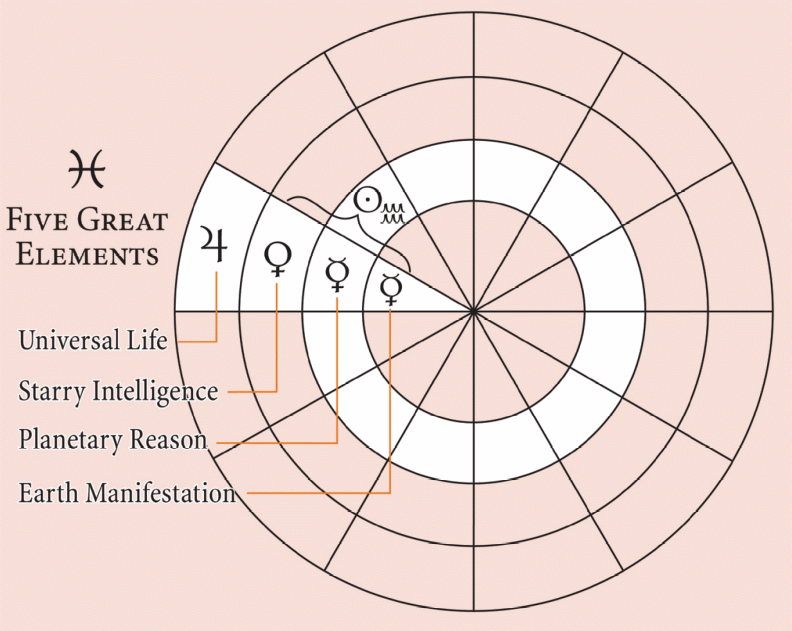
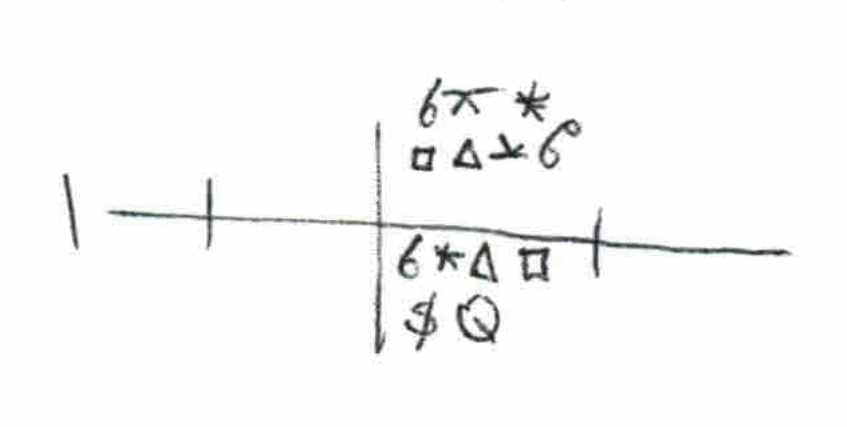
FIGURE 1983 0218-1. The Central Sun and the Levels of Pisces.
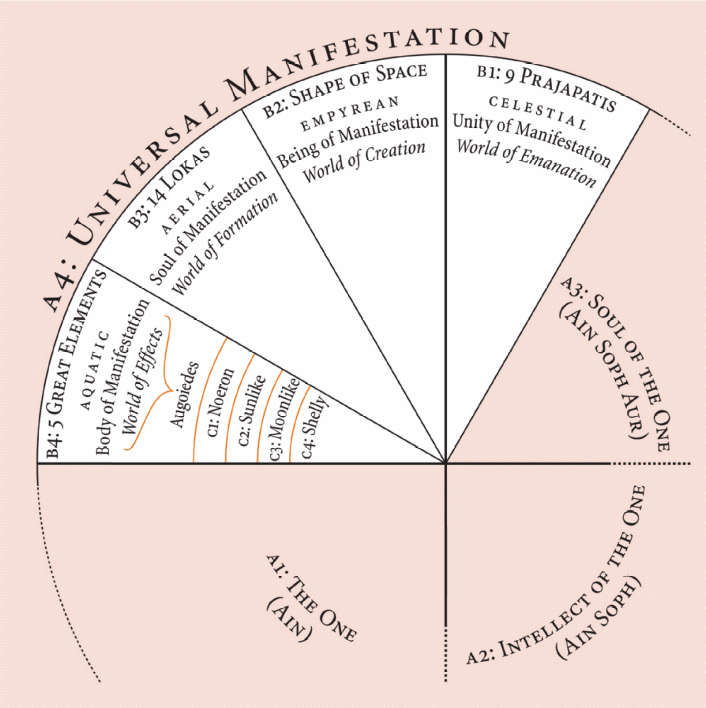
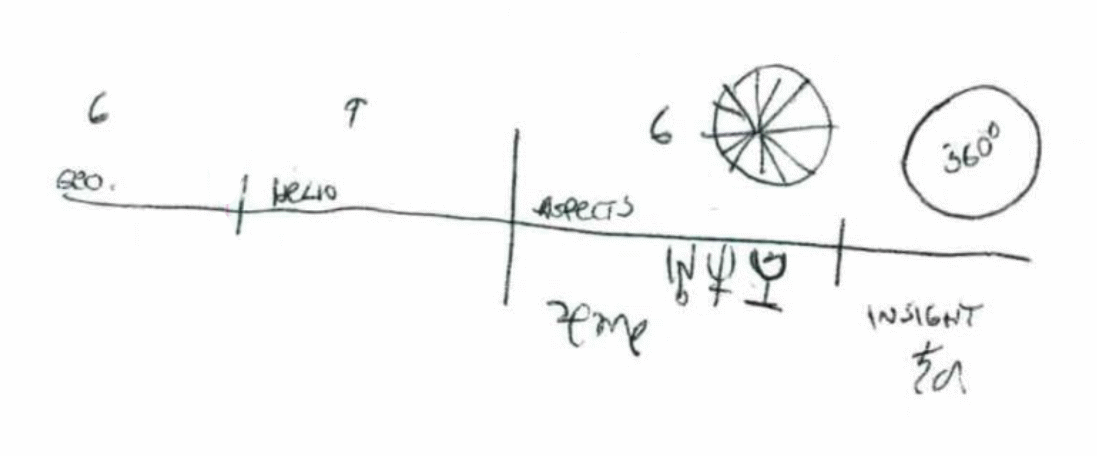
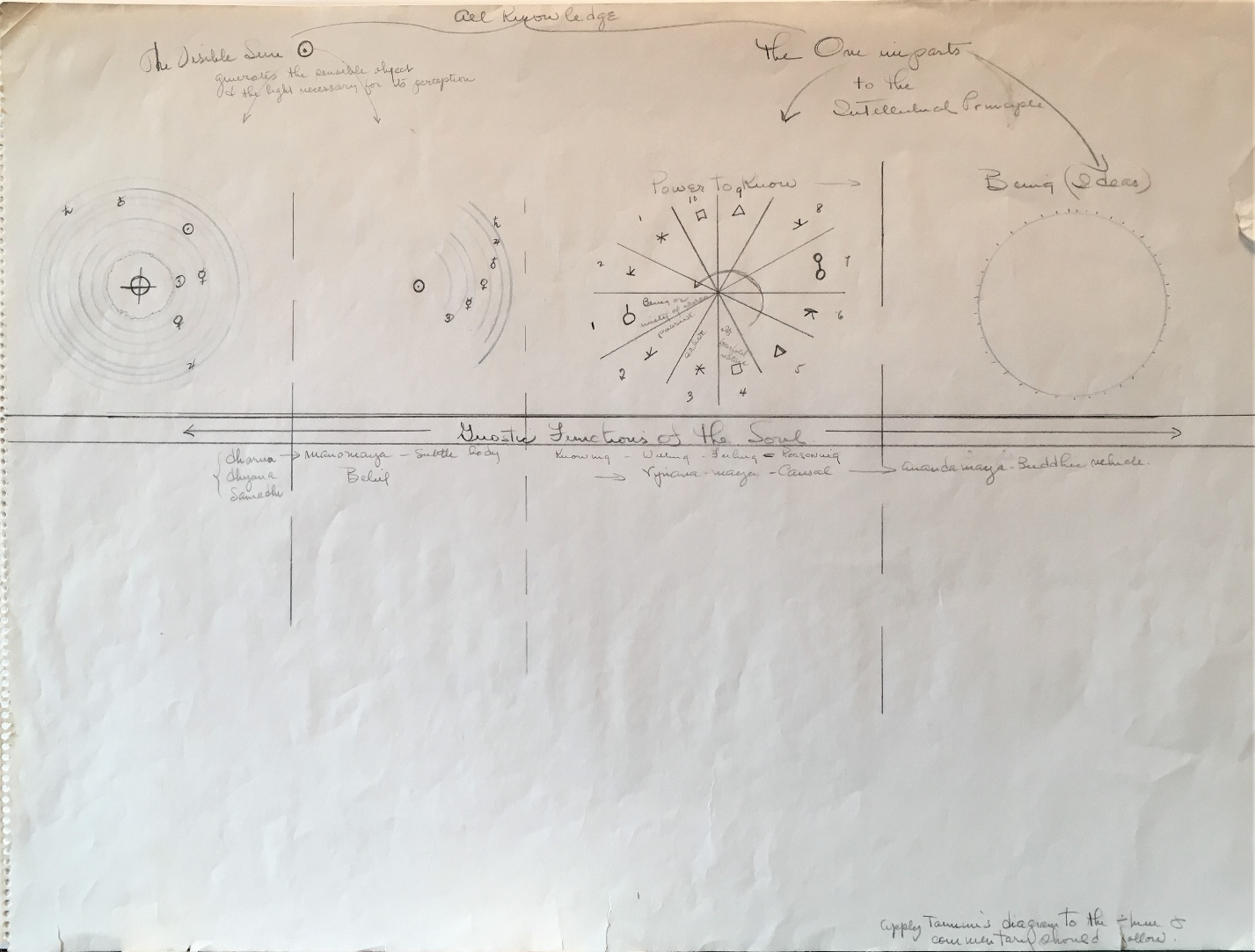
FIGURE 1983 0218-2. Three Hypostases and Two Levels of Cosmology Mapped onto Metaphysical Chart.
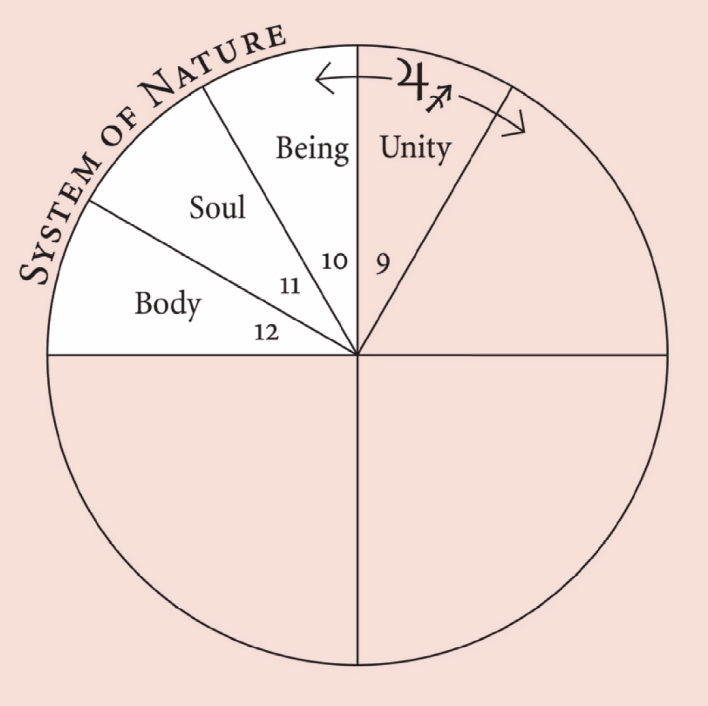
FIGURE 1983 0218-3. Twofold Zeus.
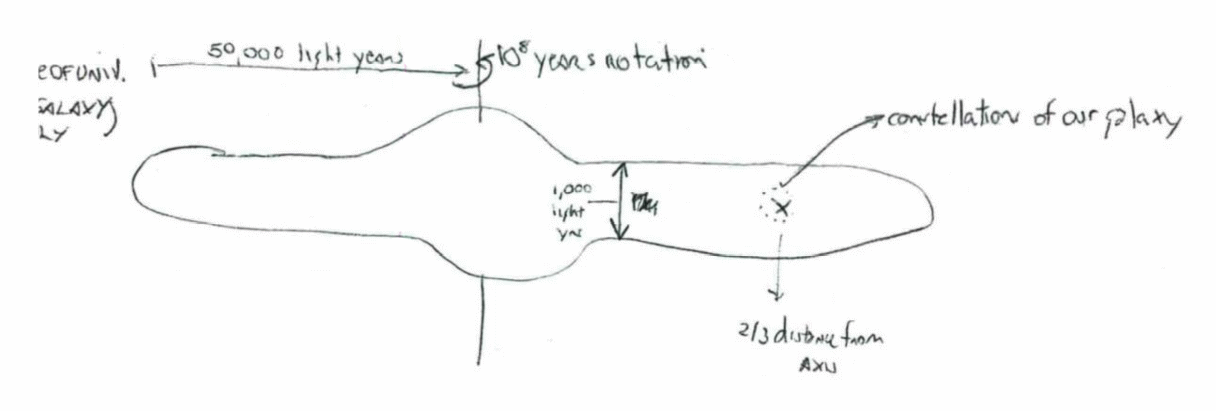
FIGURE 1983 0218-4-AB. Milky Way Galaxy.
FIGURE 1983 0218-5-AB. Aspects in Soul vs. Aspects in Separative Intellect.
FIGURE 1983 0218-6-AB. Seven Polygons.
FIGURE 1983 0218-7-AB. Aspects and Divided Line.
FIGURE C002 IMG_2587 fix. Divided Line.
[Transcriber note: [diagram] means the speaker is referencing a diagram as he or she is speaking. If someone is drawing or writing, with audible sounds of chalk on a blackboard, I indicate this by [drawing] or [writing].]
NOTES:
The discussion on the Divided Line and Aspects in the latter part of this class is continued in WG Class 1983 0219 Astrology; Theory.
We have a partial transcript for this class, Scan File 1983 0218 Physics Vic.PDF. The first six pages are a summary of the first two-thirds of the class. The last six pages, which are not part of this class, are a fragment on Buddhism by His Holiness the 14^(th) Dalai Lama, published as Kindness, Clarity, and Insight.
Victor Mansfield was a member of Wisdom's Goldenrod, professor of physics and astronomy, Colgate University. See https://www.paulbrunton.org/victormansfield.php.
TRANSCRIBED Verbatim by IT 2022. Archival verbatim transcript – V11a.
AUDIO FILES: 1983 0218a, 1983 0218b. [Note: "Tape" and "Side" refer to original audio cassette tapes that were later digitized into .MP3 Audio Files.]
1983 02/18 at Wisdom's Goldenrod
Physics; Twelfth House
[Audio File 1983 0218a Begins]
[Note: See FIGURE 1983 0218-1, The Central Sun and the Levels of Pisces, appended to this transcript for the following.]
VM: Anthony would like to look at the problem of the fourfold structure of the twelfth house, you know, the Jupiter, Venus, two Mercuries, and to try and use that as a framework for understanding, say, the development of physics, perhaps both from a historical as well as conceptual point of view. I've made some (altering) attempts in those dire-- in that direction. And one-- one of the things as I understand it we'd like to try and do tonight is just to do or to maybe concretize what those four levels of the twelfth house mean. Essentially this point of view, you know, the philosophical view that we're trying to take of it here. And as maybe you heard last Friday, I have tried to make some tentative mappings between those four levels in different areas of physics. Maybe the thing I'll do, let me just take five minutes and, you know, just say very quickly the kind of overall scheme that I'm sure will collapse as we go on but, the general approach that I was trying to take and then we'll proceed to try and dig in to what the fourfold means and the whole thing may be totally reconfigured in short order but-- I thought I would say sort of where I was attempting to go.
If we start at the bottom which I feel better at-- Let's call this the Dragon, let's-- [drawing] And then the planetary spheres, and then the inerratic. And then the unity of it--Jupiter [diagram]. [aside: You should use that car.] I was trying to put this into, [writing] let's say, pre-Newtonian physics. And as an example I would tend to use the Ptolemaic view of the solar system. And that's a kind of a nice example because it's something that we deal with a lot but there's more to it than-- Let's say the astronomical point-- the astronomical part of it is something that's kind of interesting, the notion of deferents and equants and excentrics and so on and to see how they actually tried to understand the observational data that they-- that they just picked up using the senses, there was no telescopes, no observing equipment in those days and so on. And to try and say in what way is it like the sublunar realm of the Dragon.
And then the next one was [writing] to talk about Newtonian physics or more broadly speaking classical physics. [short pause] And the example there was to take the same example but show how Newton looked at the solar system and go i-- not in any great depth but actually discuss very quickly. There's three fundamental laws that Kepler a few years preceding Newton developed through looking at Tycho Brahe's observations with great care and mathematically analyzing them so that he realized that, despite a lot of previous thought orbits were elliptical and the Sun was at one of the focuses and there was the notion, the equal areas swept out in equal time. Another one too, how the radius of the orbits relate to the periods. And then show how Newton actually took those and developed the mathematical (equation), but let's say, with his force law and gravitation law actually showed exactly how all these things pop out. And that was considered great intellectual triumph and-- To see in what way that ties in with the planetary spheres I think is kind of interesting. So let me just say the example that I was thinking of talking about was the, [writing] let's say, Newtonian derivation of Kepler's laws. Ok?
And then-- (I don't know if) I've got any room here. The last one, this goes into quantum mechanics. [writing] And we've struggled with quantum mechanics before but I have what I think is a real nice example, very different in some ways but also the same from the other one and that's the Einstein-Podolsky-Rosen paradox, EPR paradox, it's a real famous one. And, it was an attempt for like Einstein to undermine the-- I wouldn't say it 'cause that sounds too vicious, to undermine but-- 1935 was Einstein's last real shot at quantum mechanics to try and show that it was an inadequate and incomplete theory is the word he used. And, the rebuttal that it-- that came back from the Copenhagen school and so on really helped to clarify the foundations of quantum mechanics and so it's a real nice example and it's very simple one too. No mathematics, just conceptual.
And then the last one here was these unified-- unified field theories. Now we essentially won't do much here, [writing] partly because there is no generally accepted unified field theory. But we can talk about a little bit about what it could mean to have a unified field theory. So that was the sort of overall scheme, it would take a few nights anyway to go through this. But, where I feel weak, and I-- I don't think I'm alone in this situation, is to-- is to-- I really would want to understand more precisely what the Dragon is, what planetary spheres are, what-- how (it) differs from the inerratic, what's the interaction between the planets and this-- and inerratic. I mean these are problems we've been working on obviously for a long time. But, if it seems agreeable with Anthony (that could be--) I thought rather than just charge into the physics as a group we could maybe work not-- I don't have a lecture or anything but as a group we could try to work on making some tentative clarification or whatever we could call it of these four levels. And then after those are relatively clear in our minds we can proceed to try and interface them with the physics and maybe one will enrich the other or maybe this whole thing will collapse. That's a possibility too and you say it was all screwed up. But that remains to be seen. So that was the structure that I had in mind, Anthony, but I'm happy to turn it around. One of the things you've taught me is not to get too hung up on [AD simultaneously: Yeah, I have the same--] one particular attack.
AD: Have the same idea in mind.
VM: Does that seem right to you then?
AD: Yeah. First do the overall context or framework that we've been operating with and try to decide where it's-- where it's located at. [Note: See FIGURES 1983 0218-1, 2, 3 appended to this transcript for the following.] And just if I could put up this [VM: Yeah.] very simple version of our scheme, something like this, you have-- [short pause] [drawing] You have three Hypostases, alright. Intellectual-Principle, Soul. Soul is two-faced, alright. The Zeus is twofold [AD indicates on diagram], ok. So, let's say we would put over here, alright, the fourth [diagram]. In the same way, in terms of universal manifestation, you would have the unity of manifestation, so-called the intellectuality or the being of that manifestation. [VM assents, faint] Let's say the intellectuality. [VM, faint: Ok.] [short pause] And then you have the life in that universe, alright, and also-- and then you have the body of the universe which is the fourth-- you know, the-- this would be the ninth house, tenth, eleventh, and twelfth [diagram]. [VM assents] Now this one here, the body, again is subject to this fourfold division that we worked with, alright, so-- Over here if you speak about Jupiter as unity of that body, alright, and then the Venus or the inerratic sphere as the intellect, the inerratic, again, the nature of the body, and then the last one [diagram]. [short pause] Now, do your laws apply to this realm [diagram] or to this realm [diagram]?
VM: My first guess would be definitely the lowest realm.
AD: I don't know that.
VM: But, maybe that's to be seen, you know?
AD: Yeah. We could at least put it in that framework.
VM: At least to start with that would be the first guess. [short pause] So the way I have thought about it, Anthony, was to try and clarify at least for me, you know, what-- what the various levels really mean at this-- I mean I know you can't cut them exactly nicely in Virgo pieces and plug-- plug them in but, to some extent to do that. And, maybe it's a-- it's a candid admission that I haven't followed everything that's gone on in the last few years but-- So, does that seem like a place to start then in the twelfth house?
AD: Yeah.
[11 second pause]
JL: Vic, I don't understand one thing. In what sense does quantum mechanics have a cosmological, you know, aspect? I mean you are speaking of a cosmological [VM: Well--] framework.
VM: I'll-- gee I'll-- I'll jump ahead a little bit but I'll tell you why-- why would I associate, let's say, quantum mechanics with the inerratic. Well I guess in order to understand that I have to say something about each of the realms. Which may be jumping ahead a little bit but-- Pre-Newtonian physics, let's say, is based largely on sense data. And a lot of preconceptions came in. This is a difficult thing because there are also certain insights that people (had/have) that were let's say handed down by real Sages and Seers and so on so that gets mixed in with the common run of the mill scientist or pre-scientist, natural philosopher. It's a little tricky. So I'll abuse some of them, like people like Archimedes and people of that kind of level. But nonetheless it was largely built on sense data and almost an imposition of psychological structures on the sense world, ok? I think very anthropomorphic view of the universe.
Then Newtonian physics comes along, and let's say Galileo and Kepler and those people were-- were sort of forerunners of it but, they basically abstracted qualities away from the sense world. They tried to get at the underlying principles, the dynamic powers which structure the manifestation. Just like we try and get at the dynamic principles or soul powers that govern the sense world, govern the Dragon, the planetary spheres, ok? And, they had a certain view of these principles and developed them mathematically and they were all-- You know, this took several hundred years (of development) but nonetheless, the-- there's a very deterministic flavor to everything they did. Just like-- like the other night with Ed we were talking about Napoleon's chart and Anthony again reminded us of the very deterministic nature of the motion of planetary spheres. There's a relatively small area where any kind of freedom comes into play but, you know, it's really a Newtonian flavor to that discussion of the planetary spheres.
Now, the third level, the inerratic sphere, we often speak about these 360 degrees or these forms embedded in matter, as having a certain kind of unified nature in the sense that they contain both what will later become-- later down in the Dragon become empirical subject and empirical object, ok? In other words, like when a transit's going over a certain degree, that colors both the outer experience and the inner experience so inner in a relatively low level way, ok? And in quantum mechanics the big thing that everybody makes such a stink about and has such difficulty accepting in a lot of cases is the unity that's forced upon you in terms of not considering the objects, whether they be electrons or photons (and) whatever, as independent of the measuring situation. There's a real unification of the apparatus and the object measured, of the empirical subject and the object. Ok? And, these objects that you're studying are really more like potentials for manifestation, just like the 360 degrees are more like potentials and so on.
And then the Jupiter, well that's a little harder to deal with because it's not much clarified at least in terms of the science, let alone my own lack of understanding of what Jupiter in Pisces is but-- If you look at Jupiter in Pisces as the sort of underlying, unifying consciousness or intelligibility that pervades and is the ground for all of the twelfth house, that would be very closely analogous to what a unified field theory should provide in terms of physics. It should be one self-consistent overall theory out of which all the others could be derived in a logically consistent and precise way. Ok? So that's very brief sketch.
LR: Could you do it again the brief sketch?
VM: (And that was/Now we'll) just-- Well, if you like, I mean-- It wasn't the way I had attacked it or thought of attacking it but if that's the way you should go let's go that way, I-- (bit of laughter)
LR: Let's hear it, Vic.
VM: See we could use a lot of time like this, I don't know, but what do-- give me some help, Anthony, just-- not that you have to do it but guidance.
AD: Tell me. We'll start. The Jupiter, let's say, [VM simultaneously: Yeah, let's start now.] is it the realm of the archetypal imagination or the Ideas?
S (faint): Yeah.
VM: Jupiter in Pisces you want to start?
AD (simultaneously): Yeah, I (think/see) the Ideas. [short pause] Basically, the Ideas that are beyond the starry spheres themselves.
VM (faint): Right. [writing] Let's say beyond the starry sphere(s).
AD: Whereas the inerratic sphere would represent these-- the stars, or the Gods themselves, in other words, the statues that they make for themselves.
[9¼ second pause while VM writes]
VM: So, would you say that this-- the inerratic is sort of like the Ideas--
AD: Embodied.
VM: Embodied and manifest somehow. [AD simultaneously: Yeah, yeah.] I mean, I always try and work backwards too, I think well this is really a reflection of the tenth house, this realm. I mean, isn't that one way of sort of trying to tie it in with prior principles, to say that the inerratic in some ways is a reflection of the principle of the tenth house in the twelfth?
AD: Yeah, but then you would be jumping out of the twelfth house framework, alright, [VM simultaneously: Of course.] and be working with nine, ten, eleven, twelve, [VM: Yes, yes.] alright, which is (confusing).
VM (simultaneously): But I mean isn't it legitimate to try and draw inspiration for your understanding of the twelfth house by appreciating [AD simultaneously: Yeah.] it as a reflection of the tenth for example?
AD: Yeah.
VM: We talk about the Shape of the Universe in the Mind of the Demiurgus, the-- the Being of non-Being, these other terms which we've worked with a lot but-- At least the notion of shape in matter is-- somehow comes through. But-- ok.
MB (simultaneously): Well, just-- I mean also if the-- there gotta be more than just those twinkling things up there. I mean-- we're talking about the Intellect of the twelfth house so they-- they ha-- they have to do more than just twinkle. (laughter) It's not just those bodies, I mean the way we think of stars.
S (very faint): (It's what you see.)
VM: Oh yeah, well the twinkling star is a reflection of these principles down into the lowest realm.
MB: Into the lowest realm, right. But we [VM simultaneously: Yeah.] call them the bodies of the Gods and we're saying they're on some sort of body level. And yet they have sort of a functioning that-- more than what we normally conceive the body to have in itself.
VM: Well let's get that clear because it's probably harder for a erstwhile astronomer. The-- when you s--
AD (simultaneously): They radiate?
VM: Pardon, these stars.
AD (simultaneously): They radiate.
VM: Sure they radiate, radiate let's say--
AD (simultaneously): What do they radiate?
VM: Intellectuality or meaning, units of meaning.
AD (simultaneously): Yeah, that's-- that's the way I'm looking at it.
VM: Right. Let's say they radiate meaning? Not just meaning though.
AD (simultaneously): They radiate-- they-- they radiate an influence which, let's say, is still suspect. (some laughter)
S: Suspect?
VM: You mean-- what do you mean by suspect?
AD: We don't know.
VM: Oh, ok, ok. They radiate an influence. But, when you look in the sky-- I mean if you're looking with normal sense functioning, you're down in the Dragon here seeing [drawing] reflections of these principles, that's the twinkling star. Right? So we're-- in fact, when we talk about as I understand from previous classes, when we speak about the 360 degrees, like you read the Jones symbols or Kozminsky or one of those people, we're still looking at reflections of these principles in-- in the Dragon, you know, and we hope-- we hope as I understand it, and that's-- somebody will clear it-- this up if it's not so, we hope that by, yeah let's say, really trying to reflect on the meaning of these symbols and bring them into ourselves and so on that we'll get to some hint of the meaning of this realm [diagram] that's embedded in the-- in those symbols. Isn't that the way you view those [one/two words inaudible]
AD (simultaneously): Yeah, basically that the ancients looked up there and they saw all kinds of mythological animals. And these animals I suspect was their way of representing certain types of intelligences. I don't think that that intelligence could be understood in the abstract.
VM: Could we say how one can make a distinction-- more precise distinction between these two, Anthony, or is that asking a lot? I don't know. I mean, to say these are Ideas here beyond the starry spheres and then to say that they're involved in matter or somehow penetrated the matter, although, if you believe Plotinus they'd never affect the matter, the matter's impassive and so on, but nonetheless there's a certain perhaps diminution or a differentiation of the forms as they come into here. How would you make the distinction sharper if that's appropriate?
LR: Would it be like the-- I'm sorry Alan.
AB: Well, I was just thinking in terms of your analogy to quantum physics, that compared with the unified field, you would have certain discrete phenomena which were still indeterminate or unknowable in themselves so, there's some kind of focalization of what was, you know, in these Ideas but, if they're still unknowable as they are. I mean that's one of the epistemological--
VM: So they're separated out maybe [student assents, faint] more here [diagram] than they would be here [diagram].
LR (simultaneously): That's the Separating Intellect.
VM: Yeah.
LR: That's the-- the ring of the Separating Intellect and we said that that means that the Ideas are differentiated (out) one from another. They're given a certain focusing light of one another, they're not totally interpenetrating which they would be in the previous realm maybe.
VM: So, the Ideas--
LR: So there's an order or structure given to them there and each has its own uniqueness in that.
VM: (Are/Our)--
LR (simultaneously): I mean, we put 360 degrees around the circle there, don't we? Isn't that the first (degree)?
AD: Yeah.
LR: So, they're actually in some way quantified.
VM: Can we say they're distinguished through matter or something like that? I don't know if that captures what you're trying to say.
S (simultaneously, faint): I think--
[short pause]
AH: Vic, you're-- you're interested in-- in making a clearer distinction between those two realms.
VM: Yeah, as much as we can. [short pause] Well maybe we could put down the others and then just continue [AH assents] to-- to work with them. Let's say the first Mercury-- [drawing/writing] I don't know, we could call it Nature, planetary spheres. [9 second pause while drawing/writing] I've-- the way we've been discussing them, at least my understanding of them has been that these embodied soul powers actually take these Ideas which are distinguished out here and combine and let's say develop what's inherent in these Ideas and unfold them in the Dragon, unfold them in the imagination, in the elemental realm. And we've talked about these as being both the gnostic and fabricative. These-- these dynamic powers take, let's say, these units of meaning in here and not only build a world but influence our knowing of that world simultaneously. Now I'm not real clear on exactly how that's done, and, maybe that's something that should be worked on. I think I can actually see it in terms of the physics, how the principles of Newtonian physics both structure the world as well as structure our knowing of it, I-- at first it was a little-- had a little difficulty in seeing how they were in any way gnostic but after a certain amount of thought on it it's quite clear, at least to me it is. We could talk about that later but-- [short pause] Let's say-- [short pause while drawing] Well--
[9½ second pause while VM draws]
LR: You know Vic, that--
VM (simultaneously): Yeah.
LR: That's the place that gets-- that's the place where we bring in soul.
VM: Here [diagram].
LR: Yeah.
VM: Yeah.
LR: I mean we correlate soul with the planetary spheres [VM simultaneously: Right.] and so the-- [short pause] It's like there's a different Hypostasis that comes in [VM simultaneously: It's a new element comes in.] at that level or it combines the Ideas or-- at that level that-- Well I don't know how you correlate it in physics but-- Something gets inserted or conjoined with those Ideas at that level, some life gets [couple words inaudible]
VM (simultaneously): Yeah they're vivified in a sense, like you could think at least in cosmo--
LR (simultaneously): Right, maybe that.
VM: Here the Ideas are relatively fixed, eternal kind of mode [diagram], here they're a little more spread out or more distinguished [diagram]. But in some ways they're-- they're not active as--
LR: They're principial.
VM: Right, they're not active in manifestation either in a gnostic or a fabricative way until this dynamism has come in and brings them into, let's say, the elemental world or the imagination or life as we know it, the sense world.
LDS: We speak of that too as like the rational-- the sphere of rationality, [VM: Yeah.] or of its rational power. So it seems that there's some kind of ordering and rationing out or providing a ratio. Ratios would inform manifestation from that sphere.
VM: Yes, in some ways you could say this is the-- what's the word I'm looking for, not the-- the unfolding of the Ideas through Number. At least one example of it is in here [diagram]. Isn't that sort of what you're trying to say, I mean [few words inaudible] words.
LDS (simultaneously): Yeah, I guess that that wouldn't be contrary to what I'm saying.
VM: 'Cause we talk a lot about the aspects here and so on.
AB: Yeah. That can turn [VM simultaneously: Yeah, go ahead.] to your three-- your three modes of physics. Isn't this the first time that the behavior of the object is predictable? Determinate?
VM (simultaneously): Yes. Yes. [short pause] Yeah. Alan's-- Alan's drawing attention to the very deterministic nature of the laws at this level. These dynamic powers-- Let's say there's still a lot of potentials and possibilities here but once the planets configure themselves in a certain way, inexorably a certain kind of experience must (apply).
AB: You're going to have correct me if I'm wrong but, [VM simultaneously: (Give me that) (one word inaudible)] in quantum, [VM: Oh.] you know that there's certain functioning. You know that the object's functioning a certain way, but you can't predict it. You can't say exactly what's going on so, it's almost like we can separate out these Ideas as each has a unique functioning but we can't specify it. But now in planetary spheres, the functioning is specified in the determinate way so that we know how A is going to operate precisely and how B is going to operate precisely.
VM: Yeah, yeah. Or let's-- to again use the astronomical or astrological idea. When you think about these archetypal-- 360 archetypal meanings, they have wide range of possible levels of interpretation and so on, and they're relatively indeterminate. But once they're fixed in terms of the planetary pattern, then a very particularized, let's say, life or horoscope is then determined by these-- functioning of these particular powers. And that does have a close correspondence to what you're trying to bring out in the physics. I was trying more or less to not make much reference to the physics initially but play it by ear, maybe that's good to go back and forth, I mean--
SD: Isn't that also like the first level at which time per se comes in. You don't really have behavior at the level above that you could or couldn't create because there isn't a factor of time, it's the circling of the planets that brings in time because [student assents, faint] it's soul that's the principle of time.
S (faint): Uh-hm.
VM: So you say this-- I don't know, time, I can just put-- just put some buzz words down.
SD: I-- one thing, I don't know if it's a valid comparison but it seems that there's a distinguishing when you start with the unity at the top, that the second level brings in like a-- each-- each of those potentials, instead of interfusing they have their distinct locus, [VM assents] and it's like there's a separation spatially there. And then on the next level it's time that comes in.
VM: Oh I see what you're saying, yeah.
S: Could you repeat that, Severin?
SD: That at the second level, the distinction that's made, the reason it's a Separative Intellect or just physically looking at the-- each star representing a particular intelligence as opposed to the intelligences all being unified, it's like there's a spatial separation they-- saying that they're in matter, perhaps you should better say they're in space, they're given a locus of their own. [VM drawing/writing] And there's a distinction between them [PD simultaneously: What's--] as a result. And then on the next level time comes in to bring them into activity.
S (very faint): Uh-hm.
VM: Yeah but let me put separation in space with space around quotation marks because clearly you're not using space in a physical sort of way, right? Somehow you think of separation. I guess the best metaphor we have when you think, you know, conceptually is to spatialize them. But that is appropriate if you think of matter as being a-- or like (some/a) sort of space. Then in some sense indeed they are being spatialized, as long as you use space in that very abstract way.
JL: That's very--
VM: Like a mathematician would use space.
JL: That's very Newtonian though, I mean like--
VM (simultaneously): Which-- which is, John?
JL: The-- what-- the way of looking at-- looking at the-- the inerratic as space and the planetary as time.
VM: Say more.
JL: Well, you conceive of a-- of a-- of a vessel in which things happen. You know, a pre-existing space in which things happen. Whereas-- whereas probably a-- possibly a-- a more accurate perception would be that things happening create that.
VM: Create which, John, here [diagram] or down here [diagram]?
JL: (Well), I'm not sure. It just seems that the plan-- the planetary spheres themselves are space, or, you know, the-- the-- the space within which things happen.
VM: I was more thinking-- you know, there's many levels of space I guess John, I was even thinking that the Dragon is where we usually encounter space. That's let's say sensual space.
JL: Yeah. Physical space.
VM: Yeah, physical space.
DH (faint): (Like/That) matter.
VM: Pardon?
DH (faint): Like matter.
VM: Well that's-- that's matter too but it's even a coarser level of matter than I would understand matter up here [diagram]. That would be like the four, five elements, depending on whether you want to count your fifth element in there or not. But, you know, we spoke about that as the elemental realm, fire, earth, air, water, and ether. Maybe ether, maybe not, I'm not sure, ether may be up in here [diagram]. But, at least the four. Ok. And-- So that's level of space, I-- That's why I put quotes around it, John, I really wanted to keep that distinction, you know, because--
JL (simultaneously): Well, something sticks in my mind from Wednesday night class in that-- the three categories in that PB quote. [Note: See Paul Brunton, The Notebooks, V13, 19:1.65. See also WG Class 1983 0216 PB Paras; Mentalism.] [SD assents] Space, time, and causality.
VM (simultaneously): Oh space, time, and causality? Mm.
SD: Uh-hm.
JL: And which causality would probably be more applicable to the inerratic.
CDA: It was space, time, and matter. Wasn't it?
VM (simultaneously): Well but we-- we sort of changed the terminology a little bit and I think it was more general, at least to my liking.
JL: I-- I don't (agree).
VM: I don't know what to do with [JL simultaneously: It's not a big deal.] space, time, and causality, John, exactly [PD simultaneously: I mean--] where to put those.
JL: Sorry.
PD: We're conceiving of this whole thing as like the visible body of the universe.
VM: Yeah I think so.
PD: Or the visible body. So, in one sense, (trying/if you want) to pick up on what Severin was saying, that what separates the various intelligibles that are in the universe, that separation becomes space later on. But that separateness of one intelligence from another, whatever it is, is becoming a ground for space.
VM: You could say this is the principle of space if you'd like, yeah.
PD: Well just translating space in difference-- the intelligibles as the same way.
AD: Those Ideas make space.
VM: Yeah. The principle of space.
AD (simultaneously): I think that's what he's saying.
VM: Yeah.
PD: So if you take all-- like all the stars in the s-- in the heaven, quote, that we see, it's-- it's those divine intelligibles that are radiating this visible cosmos. [student assents, faint] And the space they're providing is the-- is the locus of universal manifestation.
VM/S(?) (very faint): Yeah.
JL: (And/I mean), that was probably what I was trying to get at.
AH: Is that space the locus or is it part-- or is it that manifestation, I don't-- it's an important distinction.
VM: I'm sorry Andrew, I couldn't hear you. Can you say it lou-- louder? [AH: Like--] It's unlike a Leo to speak so softly.
S: Yeah. (bit of laughter)
AH: I just-- (laughter)
VM: Sorry old friend, you could take it. (bit of laughter)
AH: I was just picking up on Paul's comment, like you say that space is-- the-- these principles provide the locus in which manifestation (occurs/occurred) or is this physical space that manifestation.
PD: Well I wouldn't speak of physical space. If we're saying of the separateness between the various intelligibles, that separateness becomes the body of space of this cosmos. Now I don't know whether we can call that physical space at all or not, Andrew. That's like pre-epistemological space we're [student assents] saying. [student assents] It's the form of the-- of mind [VM simultaneously: See I would almost think--] and mental activity of the Gods.
VM: Wouldn't you think at this realm, Paul, that the-- almost the epistemological categories are on a level of the planetary spheres, in other words, when you speak about the mind has to function with the categories of space and time and causality and so on, I would guess that they're here [diagram], at the level of the planetary spheres, and that these are the factors that the individual mind has to use to unfold experience, to have imaginal experience which in my understanding (I have an) experience occur in the Dragon below this.
PD: I-- I would--
VM: I don't know, I'm--
PD (simultaneously): At least-- prior to that you can't still seem to be able to speak of temporal processes.
VM: Prior to this [diagram].
PD: Right.
VM: Yeah, I know, except--
PD (simultaneously): The second level is the simultaneous perspective of the intelligences in the cosmos.
S: Right.
LDS: Yeah and to follow that up I think we'd want to follow it, if we think of the Ideas themselves as-- as the principles of this space. You know, the planetary spheres would be visioning that. That would be its vision, its prior would be those Ideas so, if we say that the most immediate source of space for us would be the planetary spheres that would make sense because their-- their vision is of something of the principle of space which is found in the Ideas of inerratic.
JL: Unless you think of time in terms of the unfoldment of the Ideas, which in turn creates space, extension. [short pause] The sequence of the unfoldment of the Ideas.
VM: I guess, see, it's troublesome to use the word 'space' here John, I mean [JL assents] you keep bringing us back there and I agree with (you).
JL: Just let it drop.
VM (simultaneously): If we could use distinction or the principle of distinction which later unfolds itself in terms of separation and physical space. Because it isn't sp-- not any way that I understand space.
DR: Yeah but at the same time you don't-- you don't really want to make it--
VM: Too disjoined.
DR: Or too ethereal either, I mean, somehow that concept is going to have to be distinguished from the other places where--
VM (simultaneously): Yeah, from the true second house or second quadrant.
DR: Every time I go through some kind of fourfold, I mean this is supposed to be [couple inaudible VM words simultaneous with DR] the body of the universe. [student assents, faint] Now, it seems like a pretty rarified body but I don't know exactly-- I mean if-- if there's any place at all that you're going to speak of a-- you know, the distinctions between the gods as some kind of space this seems like an appropriate place to do it.
DH: But I think the point that everybody's making is not that that separation in space is, you know, but that it is space.
VM: Say more, (David), I really--
PD: You know like [DH simultaneously: Say-- that's what I've been hearing (couple words inaudible)] when you look at pictures of the vast universe and, you know, different Milky Ways on and on and on, the vastness of this visible body of the universe. [VM assents, faint] That vastness is-- is the radiation of this-- these intelligences.
VM: Ok.
PD: The fact that this visible cosmos has such a tremendous breadth of [VM simultaneously: Possibilities.] potentiality, we're speaking of the 'separation', quote, of one intelligence [VM assents, faint] from another.
VM: But we have to keep that notion distinct from the idea of magnitude, let's say. Alright?
S: Uh-hm.
PD: I don't know.
VM: You don't want to. (PD laughs)
S (faint): Why?
VM: 'Cause I-- I really want think of magnitude as not to be confused with-- at least in my mind I want to try and keep distinct the notion of magnitude from breadth of possibilities. There's one is really a qualitative thing and the other's very quantitative.
PD: But not-- you know, if you take space as being qualified space all the time, then-- then when you speak of these intelligences as being a ru-- maintaining their spheres of radiation in the cosmic panorama, then it's not an empty space.
VM: Yeah. Ok.
AH: Paul, could I--
AD: If you drew a-- if you drew-- if you draw a diagram of our galaxy I think it would be like two bracket signs joined. [Note: See FIGURE 1983 0218-4-AB, Milky Way Galaxy, appended to this transcript for the following.]
DH (simultaneously): Draw (a) picture of our galaxy.
AD: Yeah, you know, they usually-- (bit of laughter) Looking at it fro-- a sectional view the way they make it. Yeah. Something like that and our--
VM (simultaneously): This would be-- they'd be spinning around this axis.
AD: Yeah and our Sun is all the way at-- over in one end.
VM: [drawing] (Off to) ten megaparsecs. (laughter)
S (amidst laughter): Strike.
VM (amidst laughter): [one/two words inaudible] words.
S (amidst laughter): (It's/Get) real.
VM: But I'm sorry, go ahead Anthony, before I get off on numbers. (laughter)
JL (amidst laughter): Yeah, do it again.
AD: No I'm-- I'm just asking, alright, you know, if you were to distribute the constellations, could you-- could you do that with x's?
VM: Well the constellations would be-- let's say the-- this thing [Note: Our Sun.] is roughly two-thirds of the way out. This whole distance here. I'm sorry I have to put in these numbers but, maybe it'll help us appreciate the vastness that Paul referred to. [writing] This is 100,000 light years, and the Sun is roughly two-thirds of the way out. And the constellations would be sitting in here looking out, inside the-- inside the disc of the galaxy. So the constellations are very much [drawing] a local affair on this scale [diagram].
MB: (Aren't/Weren't) some of them outside the galaxy?
VM: Well they might be but let's put it this way, that the--
MB (simultaneously): Some of the stars and some of the (nebulae) also.
VM: Yeah but you won't see gener-- you won't see stars. Like when you look up in the sky, you only see stars in our own galaxy, in fact you see only the ones in our own neighborhood.
HS: That forms the constellations, [VM simultaneously: Pardon?] the ones in our neighborhood?
VM: Oh yeah. Yeah. In fact-- Like Virgo, the constellation Virgo. When you look in that direction, if you look with a big telescope, you actually see many many galaxies, there's a huge cluster of galaxies in Virgo, in the constellation Virgo, at least as the constellation Virgo as the astronomers define it, which is probably different from the astrologers and one shift of a sign or something. But you don't see those galaxies with the naked eye, not by a long shot. So, I'm not sure exactly what you were getting at here.
AD (simultaneously): You're con-- you're concen-- yeah you're concentrating on the Virgo constellation.
VM: Yeah you look through it, it's the foreground, let's say, [AD simultaneously: Uh-huh.] the astrological comes--
AD: Yeah, it's the foreground.
VM: It's the foreground. In the background you have many other galaxies (here/yeah).
AD (simultaneously): Many other galaxies. I'm not interested in that.
VM: No me either.
AD: Ok. (laughter)
VM: No, this little solar system, this little planet. Ok I'm not sure what you're getting at.
AD (simultaneously): Yeah, you can see what's going to happen, as soon as you go beyond a certain point you absolutely relativize all knowledge. We wouldn't even be able to communicate. So we have to-- we have to refrain ourself.
VM: Ok let's stay here.
AD: Yeah. (laughter)
HS: That picture you drew, Vic, that-- is that a-- what kind of space is that right there? That galaxy, that squiggly thing?
VM: This thing here?
HS: That's the imaginative space way down from the lowest level of the Dragon?
VM: That's an attempt at delineating the cosmos while working from the Dragon.
HS: So is that [one/two words inaudible]
VM (simultaneously): So-- You know, we always have this thing, I have always trouble with this, Herbert. You're hitting me right where it hurts. You know it's like, what does really astronomy have to say about anything outside the sublunar realm. You know, isn't it all reflection in sublunar consciousness? [student assents] I guess it is.
HS: Well I don't know, I'm a-- I'm asking how you understand it.
VM (simultaneously): Well, I'm trying to-- you know, I'm trying to be fair both to the astronomy and to the philosophy. And, what these stars are in themselves, these intelligences and so on, astronomy can't address that partly because the astronomers are continuously having unconsciously the-- these intelligences are reflected in their sublunar functioning or their Dragon consciousness [couple words inaudible]
HS (simultaneously): Is that a tentative picture though of what Paul described where these-- the stars are, you know, unfolding their own space as it were?
VM: I would say it's a reflection of this realm down in the Dragon [diagram].
HS: I don't know what you're (talking--)
VM: The inerratic sphere in some ways, it's a reflection of that realm in the Dragon. This is not totally-- I mean, the-- the work that went into developing this model of the universe and its verification and so on really drew a lot on the reason-principles which were-- which are, let's say, governing the-- you know, the manifestation so, it's not just a purely perceptual-- a perceptual--
AD (simultaneously): It's a hypothetical model. It's a [VM simultaneously: Pardon?] thought. It's a hypothetical thought-model.
VM: Yeah.
AD: Vic, what would you say was in the center of that--
VM: This [diagram]?
AD: Yeah.
VM: A lot of people are saying there's a black hole in here. (laughter) They make it a million solar masses. [Note: 4.1 million solar masses.] That's the-- one of the latest ideas but, it's an extremely active region. [drawing] Right in here, the nucleus of the galaxy.
AD (simultaneously): And everything revolves around--
VM: Yeah, that's fairly clear, at least in the model that's used, it's-- you know, it spin around like a big disc, like a pin-wheel.
AD: What would you say that the rotation-- how long would you say the rotation takes around that (center)?
VM (simultaneously): Oh that's easy enough. That number's fairly well known, it takes 108 years [S: What?] to go around once at the Sun's-- at the Sun's distance. It doesn't rotate like a solid disc though, you know, in other words like a phonograph all parts take so much time, same amount of time to go around 360 degrees. That's not the case in the galaxy, it doesn't rotate like a solid body but at the Earth's or the Sun's position it's a hundred million years [Note: 230 million years = one galactic year.] to go around.
AD: To go around, uh-hm.
AH: Vic?
VM: Well, I didn't want to get off into astronomy but just wanted to pursue--
AD (simultaneously): No it's just-- it's just a framework [VM simultaneously: Yeah.] I want to place us in.
VM (simultaneously): Just like you see that framework you want to see--
AD (simultaneously): Yeah I want to place us in.
CDA: And the center doesn't move? I mean it-- there is that center there that every--
VM (simultaneously): This center is moving relative to the other galaxies.
CDA: It's moving relative-- But-- but, [AD simultaneously: Yeah, whatever that (number) is.] the whole galaxy is moving around that center?
VM: Here. I just finished saying that the galaxy doesn't rotate like a solid body.
CDA: Yeah.
VM: But I only have solid bodies to demonstrate with. So here is our galaxy, it's a very bad representation. (laughter) In terms of shape it's an overweight galaxy. And this-- the center is essentially, you know, like a top, and the Earth is-- the Sun is about two-thirds of the way out. This distance here [diagram] is about 1/100 of this distance [diagram]. See so the scale is even as I've drawn is not right. This is too thick. It's much thinner than this. This is an extremely active region, very high density of stars, gas, dust, all kinds of wild radiation coming out of there. To understand it people are trying to posit the existence of supermassive black holes of like a million solar masses and all that business. It's a very exciting place to worry about. (laughter)
DH: Is it rotating faster on the outside or the inside?
VM: Let's see, I-- I can draw you a picture of the rotation curve but I don't think you really want to see that. We could talk about that. I would--
AD: Alright so, we want to restrict our attention to that place where you put a little 'x', right? And around it the constellations? [VM/S(?), faint: Yeah.] And those are the mythological zodiacal constellations that we say that the ancients try to rep-- represent to us of certain intelligences [VM assents] which were surrounding that area. [VM assents] And that these intelligences were, you know, typified through the symbolism of the animals.
VM: Right.
DH/S(?): Which constellation is the center there?
VM: If you look towards what the astronomers call(ed) Sagittarius, it looks like a teapot in the sky, it's in the Southern sky in the summer, you'd be looking towards the nucleus of the galaxy. It actually looks like a little teapot.
LH: The-- basically all the laws--
AD (simultaneously): And I think some of the ancients astrologers used to think that the Sagittarius was at that center.
VM: No kidding.
AD: Yeah.
VM: That's very interesting. Because that definitely I mean, just from an astronomical point of view, you look through Sagittarius and you're looking into this region [diagram]. (bit of laughter) So Sagittarians, beware. (VM laughs a bit)
AH: Vic if you don't mind I'd like to return to i-- the discussion about space for a moment.
VM: Sure.
AH: I-- I just want to be sure I followed what Paul was suggesting, he said you have a notion of space which you were thinking of the form of the mind. And, that was like a vastness. Then within that, we have another kind of space which is magnitude or distance or physical space.
PD: (Good eye.)
AH: Is that the equation you were--
PD: I think so, yeah.
AH (simultaneously, faint): Right, yeah.
PD: Speaking of the former space as being the effect of the intelligibles.
AH: Right.
PD: And, what we'd normally call space is an epistemological situation where it's the relationship of objects to each other.
AH: That's physical space.
PD: Yeah. So we-- we characterize it that way. But here we're speaking of it as the-- you know, the form of activity of the intelligibles itself.
AH: That--
LH: Is there any speculation about the law-- the laws being different in different parts of the galaxy?
S: Nice, Larry. (bit of laughter)
VM: Well, the current view in-- in the physical sciences is that there is-- they've had enormous and almost unexpected success in assuming that the laws of physics are the same everywhere at every place. In other words, they're universal. And it was a great thing. It was a daring thing in fact that Newton had this insight when he supposedly had to go home because the bubonic plague was raging at--
(Side 1 of original cassette tape digitized as 1983 0218a Ends; Side 2 Begins)
VM: --had this leap and he had the idea that that principle which pulled the apple to the ground was the same principle which held the Moon in orbit around the Earth. That was actually very revolutionary idea because, you see, the Ptolemaic universe and the cosmology that came with it said that the laws of the sublunar realm are appropriate to that realm. In other words, we would say too, the laws of the Dragon, the principles that govern the Dragon, are not the same as the principles which govern the planetary spheres or the inerratic. But, Newton went against that idea and said no, in fact I believe that the Moon is pulled around the Earth by the same principle of gravity that pulls the apple from the tree and he went to work it out and had a tremendous success and so on. However, we really want to talk about that later in a way because all these so-called revolutions in science and so on, I can still all see them as being done in the sublunar realm. And, so to distinguish--
LH (simultaneously): But basically, say when you get in this-- in this center realm of the galaxy where you talk about all this [S simultaneously: Yeah.] activity, [S, very faint: Right.] they're-- they're not speculating about whole different schemes, people are (not) [one/two words inaudible]
VM (simultaneously): No. No they-- they had--
LH (simultaneously): I'm just asking because we're localizing [VM: Yeah.] ourselves in, I would guess back here in the inerratic sphere, up-- up here, that somehow those Ideas are peculiar.
VM: To this solar system.
LH: That--
VM: Sure. Well, as Anthony wants to impress on us all the time and I'm beginning to see-- I think I'm beginning to see what he means, is that the intelligences of particular solar systems or star systems are unique to them and that we can't relate to that at all. We've only got a limited, let's say, repertoire of 360 archetypal degrees that are unique to our system, and to try and understand that is eons of incarnations required. And to think that you're actually going to try and understand what's going on in another solar system is completely outrageous. On the other hand, the astronomers claim, and I happen to believe their (numbers to) some extent, that there's very good evidence for the universality of the laws of physics, and they've been able to make a very self-consistent picture and one that has predictive value and the predictions seem to be borne out by measurements and so on, you know, so the whole story may be enormously wrong at one level but it's also very self-consistent [one word inaudible] Now, anyway, but I don't want to-- If you let me steer it away from that, I would rather try and focus on these four realms again.
S (faint): Good.
VM: Maybe, just to get the whole picture out. I'll put the Dragon up here [diagram], which maybe is symbolic of something. See we call it [one word inaudible]
AD (simultaneously): Vic, could I ask you one thing?
VM: Please do.
AD: Could you think of any radiation coming from the stars which are formative or determinative-- determinative of events or, let's say, the-- is-- must be included in the cons-- in the constitution of events here?
VM: Anthony, I don't think this is what you're asking but it sounds to me like you're asking for almost like a-- a physical kind of explanation [AD simultaneously: Yeah, yeah.] of the influence of the planets.
AD: Yeah. Yeah I'm not afraid.
MB (faint): Well that (causal) [one word inaudible]
S (very faint): [one/two words inaudible]
VM: There's certainly--
AD (simultaneously): Can you think of something that they--
VM (simultaneously): There's certainly all kinds of radiation that falls but, to see the efficacy of these minute amounts of radiation is extremely difficult in terms of the current paradigm that science works with. I'll give you a kind of example of the response that this gets from the great worthies in my field. Carl Sagan for example had this little witticism to make. He says, if for example-- this is to follow up on what you were saying-- if for example it's a gravitational influence that's being exerted by the planets, for example, the particular configuration of the planets exert a subtle gravitational force on a child when it's born, that is the efficacy-- in that is the efficacy of the horoscope, ok? If you take that supposition, then it's absolute-- any physics-- high school physics student can calculate that the gravitational force of the doctor and the nurse are larger on the child than the planet Jupiter. [S, faint: Look at me.] Ok? So you certainly can't go down that road. Now there may be-- now gravity is a very weak, long-range force, you know, so, you know, you might want to talk about other forces. The only other force, you would say, well how about electro-magnetism? Well, electro-magnetism really only works between objects that have a certain finite charge on there. And, in normal conditions, the force is so strong that if there is a charge separation, the electro-magnetic force quickly neutralizes it by dragging the opposite sign charges over, smoothing things out. So most macroscopic-- almost all macroscopic objects are neutral. You occasionally get experiences where there's charge builds up from a cold night, cold dry night, you drag your feet across the rug, you shake someone's hand and, you know, a spark jumps between you, that's just that electric field generated to try and neutralize.
AD (simultaneously): I was thinking of something much more fundamental.
VM (simultaneously): Ok. Well please tell me more then, Anthony. I'm not afraid of the speculation now since I put (your hair up).
AD (simultaneously): It's the-- it's the formation of so-called matter. Like the-- we have a certain number of elements here. Whatever they are, 98, 100, 105.
VM (simultaneously): Yeah. That's right.
AD: Are they formative of those elements?
VM: The radiations from the stars formative?
AD (simultaneously): Yeah.
VM: Well the current--
AD (simultaneously): Well, what is the theory as to where the elements are derived from, let me put it that way.
VM (simultaneously): Ok, that's easy. I could tell you that one, that's easy. The basic idea is from the beginning, as they say, the Big Bang, you know, roughly twenty--
AD (simultaneously): Alright, let's take the Big Bang.
VM: Start twenty billion years ago, it's a good place to start. And, you don't know exactly where all this matter's coming from, there's various theories, nobody's completely happy with any of them but-- but once you get rid of the first two seconds after that is-- standard physics has a relatively straightforward deductive role to play in showing what happens. In the first minute and a half or so, three minutes, is when these neutrons and protons are changed into hydrogen and helium (with/and) a little else. So, three minutes after the Big Bang is over, helium nucleosynthesis is done. What you have from that is essentially hydrogen and helium and almost nothing else, a little barium, and that's about it. But it's an insignificant amount. Some deuterium. Basically just hydrogen and helium. Then as the universe cools and expands, it goes through several phases, eventually galaxies are formed and within these galaxies stars are formed. The stars initially are formed from this primordial matter which is essentially just hydrogen and helium. Through nuclear processes in the centers of stars, it's possible to explain in amazing detail just how all of the various elements are formed and in fact their relative abundances as well. Some elements are obviously much more abundant than others. Gold is less abundant than iron, much to many people's dismay but it's a fact-- (bit of laughter) it's essentially a fact of nuclear physics that gold is harder to build than iron in the cores of stars and so on. Gold requires supernova explosions. They're not as frequent as normal processes like in the center of the Sun and so forth. So, through an understanding of the nuclear processes that go on in the stars, you can show how the entire periodic chart of the elements--
AD: Comes into being?
VM: Comes out. And then this matter is continuously mixed out into space and like the Sun, our Sun is supposedly a third, fourth generation star. It has had the benefit of preceding stars, of taking this material into them, cooking it in so-called nuclear furnace, spewing some of it out. It goes to seed the interstellar gas and clouds and that enriched-- enriched with these heavier elements and materials no longer now purified (into the) helium but has had the benefit of this nuclear processing, now this material is scooped up and a new solar system is formed, let's say like the relative late-comer, our own, and the richness of chemistry and physics that we know is due, so the astronomers say, to the fact that it's had an opportunity to benefit from the-- from its previous-- previous cycles of nuclear generation. So that's basically the idea in a nutshell. It's-- actually it's considered a real elegant piece of physics to show how you can (flip) for example (when) meteorites come in. They're clearly outside the-- astronomers saying they're clearly outside the solar system. And you can bring these into a lab and you can break them down and show that you have so much of various elements, ok? The elements are very similar in their general abundance to the elements on the Earth. However there are slight changes in isotope number, in other words, some iron has more neutrons than other iron. So the isotope level is different in-- in meteorites in general than it is on the Earth, and you can understand these differences by working through various scenarios of nuclear physics in the center of stars and show that this is really the material from outside the-- a particular cloud that formed the solar nebula and so on. (Though) it's really--
AD: But then to get to the point--
VM: Go ahead.
AD: Then to get to the point, the elements are coming from the outer regions.
VM (simultaneously): The stars. From the what?
AD: From the outer regions, the stars.
VM: Yes, very much so. And we would say that these are the formative-- where are we? Yes. These are the formative principles of our solar system, they give rise to the structure, to the intelligibility of our particular planet. And the astronomers would say that the stars are the birthplace and the evolutionary place of material that our-- that our world is built on or our planet is built on.
JfL: Wait Vic, did you say that the elements were the product of this Sun or--
VM: No, I was trying to say Jeff that this Sun has had the benefit of preceding-- preceding cycles of scooping material together in stars. You know, let me just run it by again quick 'cause if you haven't heard the story before--
JfL: Well it's the stuff coming from all the other stars though, it's not in fabrication of this solar system.
VM: No. As I say, coming out of the Big Bang all you have is hydrogen and helium. And this forms galaxies. And within the galaxies there's fragmentation into stars. The first generation of stars, all they have to work with is hydrogen and helium. But they go to work and in the cores the nuclear processes go on and more and more complex elements are built up. Through various stages of stellar evolution where there's lots of times explosions and things being thrown off and so on, some of this enriched material, and like it has let's say iron and carbon and silicon, things like this, it's thrown out into the interstellar medium. Then succeeding generations of star formation pull together material and then form a star. Then (it) has not just hydrogen and helium to work with but all these other elements as well. Ok? As I said our Sun is probably third, fourth generation in the solar system. So, it's benefited from previous-- previous cycles of nuclear burning. So, when you pull together the material to form the Earth, you got all this hundred odd elements. If we were-- if the Earth was put together, let's say, at the beginning of the galaxy's evolution, then it would be considerably impoverished in terms of the different kinds of elements that it was composed of. Like chemistry would be a considerably duller subject. Some people already consider it pretty dull. (VM laughing)
S: Vic, and then-- in theory is this process ongoing, is--
VM: Oh sure, it's still going on.
S: So there's still other galaxies and universes being formed.
VM: Yeah, most of the galaxy formation went on a long time ago though. But, again, I-- unless Anthony wants to pursue this line I would rather--
AD: No I just wanted to know if there was a definite material radiation coming from the stars. Ok.
VM: Well--
MB: Well--
VM: I would say there's three influences that I can enunciate very quickly, this is the-- this is a standard story. Obviously there's electro-magnetic radiation, full spectrum, from the shortest most intense [AD, faint: Uh-hm.] energy stuff like gamma rays all the way through the long-wave length radio waves. Then there's also cosmic rays which are high energy charged particles which come into the Earth's atmosphere, that's like electrons, protons, and alpha particles, things like this. There's also neutrinos which are another form of elementary particle which shower on the Earth in enormous abundance. They rarely interact with matter. The calculations have if you can imagine this, that through every square centimeter on the Earth there's 1038 neutrinos per second going through it. So right through the top of your head 1038 neutrinos per second through every square centimeter, you know. Fortunately very few of them interact. Otherwise it's a terrible headache. (laughter) Plus-- Ok then there's one more thing, and that is the gravitational influence. So, the three forms of radiation or influence that would be coming from the stars as the scientists would have it would be electro-magnetic radiation, various forms of particles, charged and otherwise, and gravitational influence. And that's-- that's their menu and you get to pick from one of those three. Now I don't know if any of those three or a combination thereof is a sufficient to try to explain it.
AD (simultaneously): If you want to speak about the-- if you want to speak about the stars having a guiding influence, you've got to look for something material.
LR/S(?): Uh-hm.
VM (simultaneously): You think so, Anthony? You really-- you really have to work at that level?
AD: Yeah. That's the level I want to work at right now.
LR: Well, if it's intelligible it's got to have body, I mean I-- I think that's what you're saying there, that all the-- it-- it has to have all four of those constituents so that-- we've only looked at the intelligible, so-called intelligible aspect of it. And I think what he's saying is it has to have a physical correspondent or a material correspondent which oh-- because we haven't-- 'cause everything has those four. We'd have to put them together to get a whole picture.
AD (simultaneously): Let's (think-- well--)
VM (simultaneously): You know PB said to me, Anthony, I think I told you this once before, he said, well if you're not afraid of your colleagues you might talk about the philosophical basis for astrology. He didn't tell me I'd have to talk about the material efficacy of astrology. (laughter)
AD: No I-- I just-- it's interesting.
VM (simultaneously): But I'm willing, you know? I'm willing.
AD: We call this-- what did we call this? You know, an excavation trip, right?
VM (simultaneously): Yeah, yeah. It's a [one word inaudible]
AD (simultaneously): That's all, we're just going to dig things up.
VM: Yeah.
AD: And, I want to see the material end.
VM: Ok. Let me just say, here's what-- what-- there's a-- there's a voice behind me, that this is sort of twenty years of schooling and so on. And it comes in immediately and says-- says to me, if you want to speak at this level about material influences, then you're really walking on scientific territory, you'll have to play the rules according to that game. In other words, you have to play the game according to those rules. In other words, if you're going to say that the following kinds of radiation or whatever are what account for depression or whatever psychological states, then you would have-- actually have to develop some experiments and--
AD (simultaneously): Oh no, no, I wasn't thinking of that, I was thinking--
VM: You think they have a different way?
AD (simultaneously): I was thinking that the stars were distributing first of all that primary sketch of what the universe is going to be. Without that matter, no-- no world of ours can ever come into being.
VM: Oh I see. You're saying this is the tentative illumination that Plotinus speaks (about/of). [Note: See Plotinus, VI.7.7, third para.]
AD (simultaneously): Yeah. Yeah that's what I'm saying.
VM: Oh and the tentative illumination would be like the fact that there's a hundred elements instead of ten. That would be [AD simultaneously: Uh-hm.] part of the tentative illumination. The particular nature of those elements and what-- what you can build up [student assents] from those elements is part of it.
AD (simultaneously): Yeah because it's going to take the Sun and its powers to manipulate that matter and make it into a-- let's say an ordered cosmos.
VM: Oh ok. I thought you were really committed, I thought you were really saying the-- well how come when Saturn is square Uranus the following kinds of things, well--
AD: Remember, I don't work with that causality. [VM simultaneously: Oh good. Good.] Saturn square Venus doesn't cause anything.
VM (simultaneously): Good. Good, you had me real worried there (for a minute). (laughter)
AD: I would be the first to build a shelter. (laughter)
VM: At least there'd be an ambulance. (student laughs) Ok.
AD (faint): Listen.
S: Tell me--
AD: One other thing, where do the neutrinos come from?
VM: They come from everywhere but the closest big source of neutrinos is the Sun.
S (very faint): I think Richard knows about (neutrinos).
PD: Is that like cereal, like a neutrino cereal?
S (simultaneously): Neutrino cereal guys. (laughter, student words)
S (amidst laughter, simultaneously): Yes. (S laughs)
VM: Neutrinos.
JL: They're good for you.
VM: Can I have more Neutrinos there? (laughter)
JL: Give me a bowl. (laughter)
S (faint): [couple words inaudible]
AD: No, go to the store and buy your own. (laughter)
VM (amidst laughter): Yeah, yes.
JfL: So Vic, just once again.
VM: Yeah.
JfL: You're saying that all the stars are contributing to the elements floating around and it's our Sun that is organizing it, [VM simultaneously: Right, you could say that.] which is possible because-- Well is that what you're saying?
VM: Yeah. I think that's a proper rephrasing of it.
AD (simultaneously): Yeah, that's the way I was looking (yeah/here).
VM: That's right.
JfL (simultaneously): It's-- it's not a-- it's not a process exclusively due to our Sun. It's--
VM (simultaneously): No. No in fact our Sun is in a phase of its own evolution where its nuclear burning that's going on is pretty much held within its own core and doesn't seem to get out much. Ok? It has to go into a later phase of its evolution where it's more-- more explosive and more dynamic and then some of that material does get dumped out into the solar system and enrich-- enrich the gas clouds and so on outside the Sun. But a lot of that went on before the solar nebula formed. And as I say, if it weren't for that then it would just be hydrogen and helium here.
JfL: So except for the-- let's say the difference-- the different distances from the Sun, all the planets would have the very same make-up.
VM: In fact the uniformity of chemical composition across the solar system is pretty good. I don't mean the solar system, I mean the galaxy. There-- not every hunk of matter in the galaxy, and we're back to the galaxy-- If you [drawing] look over here [Note: See FIGURE 1983 0218-4-AB, Milky Way Galaxy, appended to this transcript.] and then you do observations over here and what you do is spectrographic observations, it's-- they're relatively straightforward to make observations of stars and study the spectrum and determine the abundances of various elements. The abundance varies, oh, only maybe 30, 40% across the whole galaxy, which is quite amazing.
S: But--
VM: To the elemental level.
[short pause]
AH: So could-- could you summarize what-- what was suggested about the material basis?
VM: Yeah. As I understand what Anthony's trying to-- to say, and that is, the ancients say that the elements come from the stars. Like elemental fire for example really comes from the Venus in Pisces or the inerratic sphere, those statues of the Gods, ok? And the modern version is very sympathetic to that, it says indeed, the material that our bodies are made out of-- Think of it, if you have some gold in your teeth or something like that, that gold according to the modern view has actually been generated in a supernova explosion. There's no other way as far as nuclear physicists are concerned that you can form gold. Why-- why? (Well), because it has a very rich core of neutrons and you can only get this great burst of neutrons in a supernova explosion, and so any gold that you might have in a room you could look at it and say wow, it's [one/two words inaudible]
AD (simultaneously): You know what that amounts to, Vic? My way of looking at it. If I were to sound a bell here, ok, [VM: Uh-hm.] I hit a bell, and you say that there are airwaves reaching you. I say no, it's the substance of the bell reaching you.
S (faint): (Uh-hm.)
S (very faint): Uh-hm.
S: Mm.
[short pause]
VM: I heard those words, Anthony, but I didn't understand that too well. I could repeat them back to you but I don't have any meaning behind the words. The substance of the bell reaching you. Then I guess I have to ask the question, what do you mean by the substance of the bell?
AD: Well if you keep ringing the bell, you'll wear it out. (bit of laughter)
HS: It'll get inside your head.
AD: No. No.
VM: If I keep ring-- yeah, I keep ringing the bell I'll wear [one/two words inaudible] out (or/of) something.
AD (simultaneously): It's a radiation, it's a radiation of the matter of the bell that you actually hear. It's the very substance of the bell, alright, which is, oh let me see, being transmitted or radiating-- Let me try another way. When you hear me, the theory is that there's certain verification, condensation of airwaves taking place till it reaches your tympanum.
VM: That's right, yeah.
AD: Are you hearing me or are you hearing airwaves?
S (very faint): [couple/three words inaudible]
VM: But I would say I'm hearing you.
S (simultaneously, faint): Hearing you.
S: You would be very thin by now, Anthony.
AH: Anthony?
S: Uh-hm.
LR/S(?): Yeah.
VM: But you know, Anthony, we get into [few inaudible student words simultaneous with VM] epistemology here when you say--
AD: Well that's why I really should wait until we get a little more (with your) [one word inaudible] 'cause I want(ed)-- I want to interpret it a little differently than the way they do.
VM: Ok that's good but-- Maybe it's not good to focus--
AD: The whole theory of sound, for instance, that I'm working with is different than the contemporary theory of sound, you know, the way-- Because I don't come up with sound with them. [VM: No I agree.] I come up with airwaves.
VM: You come up with airwaves and at best you get into jigglings in the brain.
AD: Yeah.
VM: But, that means again, what I hear you saying is that the conventional view, conventional wisdom has the sounds waves generated over there coming at me going into the brain and somehow-- I just read Elaine a wonderful quote from this Nobel Prize winning physicist about how all these wild combinations, permutations of signals in the brain generate consciousness but let's say that would be their view. But you're saying that's impossible.
AD: Well no, not that it's impossible, it's only partial.
VM (simultaneously): Part. Well it's--
AD (simultaneously): There has to be a medium for the transmission of the substance of the-- let's say that's giving out the sound.
VM: But I thought like on Wednesday nights we take the idea that presentation is first.
AD: Uh-hm.
VM: And the presentation cannot be (as) understood as coming from without in, but in fact it's an unfolding from within, not necessarily within the human body, although the human body plays a role in the amplification mechanism and so on, but it's an unfoldment from within the mind. Then within this presentation you have experience. And if you start from that angle, you'll obviously have a very different view of sound propagation, light propagation, and so on.
AD: Alright, let's wait for the details.
VM: But--
AD: Let's wait for the details a little bit.
VM (simultaneously): Ok.
AH: Anthony, could I ask, one-- implications of what you describe with the bell might be that, if we-- if we took up the notions of space that we were talking about earlier tonight, that there's like space which is the form of the mind, and then there's this physical space. If you describe the sound of the bell within the (context/contact) of physical space you speak in terms of airwaves. If you describe this sound in the way that you did as the substance of the bell reaching you, it would be within the context of the space as mind where--
AD: Well I was thinking of the stars radiating their influence and when I was speaking about radiation I was speaking about something very material which they give off. [AH: But--] So-called material though.
S (simultaneously): You're thinking [AH simultaneously: But what you were talk--] of fabrication as being an actual physical substance.
AD: Yeah, yeah.
AH: But is it a physical substance to be-- to be described within the context of physical space or a physical substance to be described within a context of that mind (is/as) space?
AD: No, within the physical space. Then you have to go further on. If you go back to the fourth, or to the unity, alright, you're going to be speaking about the way the Ideas are directionalized forces which create space, and then within that space you have the appearance of the stellar stars or the stars which radiate actual parts of themselves out into the universe. And I just want to stick at this point to get to the-- the same thing, like I gave the example of the bell, part of its substance is what's radiating. In the same way, the star, part of its substance is actually radiating. This is going to be part of the guiding intelligence that we're speaking about. Otherwise you're going to have these mystical notations, you know, or connotations that when we speak about guiding influences, there's some mysterium magnum, you know, at work in space.
VM: Anthony let-- maybe just--
AD (simultaneously): And I'm trying to think of it in a very very, you know, down to earth--
VM: Corporeal way.
AD: Yeah.
VM: Maybe this is not the place to pursue this but, would you envision this-- this substance as being something that can be measured with eventual equipment, for example?
AD: Ultimately yes.
AH: Like when-- Vic, when you made your comment it has to play the game according to the rules if we're going to--
VM: Yeah.
AH: Maybe the rule--
AD: Yeah but I don't think that they know the rules yet.
AH: That's what I was--
AD: They only know some of the rules.
AH: Maybe there's a way-- maybe there's ways of measuring that they haven't discovered yet.
[students assent, very faint]
VM: Oh I don't doubt that, Andrew.
LDS: Well--
VM: You know-- but anyway--
LDS: To follow that up, I think if you follow the scientific fact that the sound generated by certain objects causes a vibration that can destroy others, there's something-- there's something very very specific and qualified about each object's sound. And, I don't know if it really speaks to Anthony's point about the substance of that specific object being generated or being reflected or emanated. But, the fact that a specific object can radiate a specific sound seems to say that, you know, it does qualify sound according to itself. And in that sense maybe it's so long [couple words inaudible] of some kind of substance as being--
AD (faint): Alright.
VM: Here's-- Let me just pick up on what you're saying and see if I'm--
LDS: Yeah.
VM: You know, you probably heard about these resonance experiments, well you hearkened, you made a reference to them, and that is, if we have two tuning forks, you hold one over there and I have one over here and I sic-- you know, bang mine against the wall [LDS simultaneously: Yeah.] and I get mine to vibrate. Now, probably if you held it that far away you might too but let's say if they're not too far away. The sound-- there he has it-- the sound goes over. It starts impinging upon this other tuning fork.
LDS: Right.
VM: Because this tuning fork is tuned to precisely the same frequency as the first one, it takes very little energy, 'cause the sound waves don't have much energy, very little energy to get that thing vibrating so that now both of them vibrate at the same frequency although initially only the first would [LDS assents] vibrate. Activated it. So it works, ok. The same thing could happen with a piano. If you get two pianos together and they're properly tuned, you hit one piano chord and you can get the other one to resonate, ok? Now maybe what Anthony is saying like this, something. Insofar as the body that I actually-- like my physical body is actually made from material that's generated from the stars, that's what permits those radiation from the stars to have some efficacy on my body, because it's actual resonance phenomena, just like the two tuning forks. I don't know if that's--
AD: That's one possible resolution.
VM: That's-- I don't know if that has any meaning or not but it's somewhat--
AH: Here's another facet too is that in fact that both tuning forks are within a common matrix.
VM: Yes, yes.
AH: Like-- I mean we talk about two-- two tuning forks, [VM simultaneously: Right, and that's why I'm saying--] and one-- the one influences the other. Now that's one way of looking but another facet, another perspective, is that both tuning forks are in a-- in a matrix that-- that doesn't depend upon their-- you wouldn't speak of their being an individual from the point of view of the matrix that contains (them/these).
VM: Well-- well--
BS: You're losing me.
VM: I am really thinking of them as being distinct. And, the matrix maybe that you're referring to is the fact-- or that I tried to stress in Anthony's example is that, physical body, the stuff (of) the world, is made out of material that was previously processed in stars. And so an influence from those stars finds a very receptive vehicle there for its influence. Why? Because that material is the same as its own. And that's what maybe is allowing for such small amounts of energy to have such efficacy in our bodies. I don't know.
AD: Or another way of looking at it would be that the body would have to act the way it does because it's this-- these particles which have been [one word inaudible] emanated bear traces which-- let's say traces of the way they can be and the way they cannot be, the way they can act and the way they cannot act. That those traces are already in, let's say, these particles of matter. So that, again, we would get back to the notion that the reason laid down a sketch of the universe before it gets articulated into shapes and forms by a particular soul.
VM: I mean I could see, Anthony, if you say-- and this would be conventional wisdom in a sense, you (could/can) say well it's the very atomic structure of all the elements in the periodic chart that determines the kind of chemistry you have and therefore the kind of biology you could have and therefore the kind of behavior you can have. I mean that'd be a real materialist [AD simultaneously: Yeah, yeah, I--] interpretation and there's a certain truth in it. And I think you'd say yeah, that's true, that's not the whole story but that's--
AD: Well, for me it's very easy because there's no such thing as matter, there's-- there's living stuff, yeah, [VM simultaneously: Right, ok.] but there's no such thing as matter.
VM: Ok.
HS: And then working back is the very atomic structure is determined by the radiation from the reason-principles, [VM simultaneously: That's what I think Anthony--] from intelligent substance?
AD (simultaneously): Yeah, yeah. Yeah the reason-principles that went into determining how this so-called radiation was going to be formed, or what went into forming this matter which gets radiated from the stars. There's al-- it-- inherent in it is already a set of laws as to what it could do and what it can't do. [VM assents, faint] And it's going to take a super-intelligence to be able to manipulate that matter and put it into shapes and forms of its own choosing.
HS: And the reason-principle radiates a capacity to move the matter around or it's [one word inaudible]
AD (simultaneously): No the reason-principle we said was that which was prior to the body of the stars and the body of the stars represent the embodiment of these reason-principles. That means that the body of the stars, insofar that it is a body, and will radiate part of its substance, that that substance which is being radiated from the star already has included within it the reason-principles that are determining-- [HS simultaneously: (And how?)] determining its behavior. Now this is going to be the sketch of the universe that's laid down before there's any manifestation. Before you talk about a solar system or, you know, any kind of binary system or anything. I'm just trying to pick it up from the grossest level possible.
VM: Well you know, Anthony, eventually, you know, let's say if this planet survives, you know, some of this understanding would have to come out because clearly the efficacy of the star, or at least for those of us who look into it all, is evident, self-evident, I mean you can't deny it. And, it does seem to have an influence on both the-- let's say the material level, psychological level, spiritual level and so on, and the forces somehow have to be operative there too. So as much as there's been a lot of problems in seeing it in a straightforward way, some-- [AD simultaneously: Well I'm not--] some efficient cause must be there.
AD (simultaneously): See I'm not interested in finding a justification for philosophy as much as I am in finding a uni-- a unified ground.
VM: Yes, you want to bring the philosophical principles [AD simultaneously: Yeah.] right down to the lowest level of materialization.
AD (simultaneously): Yeah, I'm not interested in justifying astrology, I'm not worried about that.
VM: No I agree.
AD: Especially, especially if a man like Plotinus makes a remark that all you're going to see when you look up there is an announcement. [Note: See Plotinus, II.3, especially II.3.7.]
VM: What's up there?
AD: Do you remember?
VM: Yes, yes.
AD: He says all you're going to see up there is an announcement. It isn't that that causes this.
VM: No but I thought you were also talking about that at a certain level there is material causes and forces, if you want to speak in a dynamic kind of way, that one can grasp.
AD: Yeah.
LR: So what do you mean-- I-- yeah, I want to pick up on that too, what (did) you mean when you say Uranus square Saturn doesn't cause anything?
AD: It's announcing something that's already happened in the Intelligible World.
LR: But-- Well, if-- if you want to take that point of view, then there is no causality.
AD: Of course not.
LR: Well, I didn't think you were-- but I didn't think you were speaking of that level, we're not talking--
AD (simultaneously): There is no causality. What is the hiatus between the Gods and their body?
LR: Huh?
AD: What is the hiatus between the Gods and their body?
VM/S(?): Yeah.
AD: Isn't there intelligence and an immediate efficacy?
LR (faint): Yeah. Yeah.
AD: So you have no causality. What do you think, the Hindus are the only ones without causality? Insofar, insofar that the ancient Platonists made the remark that the efficacy of the God's intelligence is immediate with no interval, no hiatus, no break in its functioning, then you cannot speak about causality unless you're a nincompoop.
LR: Why? You can't speak of causality the way you do of space, time, causality but you certainly come up with a different level or notion of causality.
VM: Ok, you can't speak about efficient causality.
LR: I don't know-- you know, you're-you-- you always say that there's-- for each realm there's a different kind of--
AD (simultaneously): Well, well, now-- Let's not get into this notion of causality 'cause I don't want to get into it.
BS (faint): [couple words inaudible] the stars, reference to the stars of course.
AD: All I'm saying is that if there's a spiritual intelligence, it doesn't have to say you, will you tell him to tell her to do that on the board, [LR: Right.] because it's done immediately. (some laughter)
LR: That's real causality.
AD: That's the only kind there is which means that there isn't causality. You cannot say that because A follows B therefore A causes B. That's the only causality we know. Let's go back to this here, we'll [VM simultaneously: Ok.] get to the problem of causality after.
VM: I was hoping to put down a few (frameworks) for the Dragon, which seems relatively, you know-- relatively accessible since most of us live there. The elemental realm, let's say, the realm-- [writing] the instincts, appearances, sense-- sense appearances.
AD: Is that the elemental?
VM: I don't know, Anthony, is it or isn't it? The elemental realm is prior?
AD (simultaneously): Well, when you say elemental realm don't you mean fire, earth, air, and water?
VM: Yeah. But aren't-- so would you say that elemental realm is prior to my sense functioning? It's the ground for my sense functioning, is that what you're saying?
AD: Yeah, I would say that instincts already show or have within them the life principle or, you know, at one time or another.
VM: So then where-- where would you put the elements in this fourfold then, let's say they don't belong here [diagram].
AD (faint): And the elements--
SD: Well that's what he's saying is that they [student assents] should belong there.
S: That was fire.
VM (simultaneously): Are you-- oh you're saying the elements do belong there.
SD (faint): Yeah, it's the other stuff that doesn't.
AD: Can we say that-- can we say that these things you just spoke about like instincts, [VM: Yeah.] are in the elements?
VM: They're-- they're a manifestation of the elements, yeah that's the way I look at them [one/two words inaudible]
S (simultaneously): [one/two words inaudible] seems like you have a very (nice principle).
AD (simultaneously): No, would they be a manifestation of the elements or would the instincts be a manifestation of life?
VM: Well, I would say that they're-- when we talk about the instincts as tropes, as the traces of previously lived life in the elements that's--
AD (simultaneously): Well then they would be manifestations of life.
VM: In the elements though.
AD: Yeah. And the elements would be fire, earth, air, and water.
VM: Ok. So what we would say is that these planetary spheres that take combinations and permutations of the 360 archetypal degrees and manifest them in the elemental realm and after eons of this they develop what we call the instincts. Is that the way you're looking at it or not?
AD: No, not quite.
TS: Are you saying that there is a unity, intelligence, life, and body to the Dragon, and that the life of the Dragon is the instincts, and that the body in which that life lives is the four elements?
AD: Try it again, Tim.
S: Yeah.
TS: Are you saying that, like you were speaking ear-- well, are you saying that the Dragon or the sublunar realm has its own unity, intelligence, life, and substance, and that the life that is unique to that sublunar realm is what we would call the instincts, and it's embodied or embedded in the substance of that realm which would be the-- (I think it's) fire earth air water, in other words, the Mahabhutas, space (at least).
AD: What do you think?
TS: Well I think so, that's (why/what) I asked you.
AD: Well let's-- let's try elaborating it a little bit more.
[12¾ second pause]
VM: You make it another four and the last four, the last four.
TS: Seems like this-- I mean--
VM (simultaneously): Yeah it makes sense.
TS: From what I gather you're saying that there's-- it's like the unity, intellect-- intelligence, life, and substance is a fourfold that applies to all of these.
VM: Well, that really-- that's a Tim [S simultaneously: Yeah.] special now. (laughter) You want to see four in every fourth. Am I right?
S (simultaneously, faint): (Yeah right.)
TS: Well--
S: Yeah.
CDA: The Earth is--
SD (faint): Happy Valentine's [couple words inaudible]
VM (simultaneously): You want [few inaudible student words simultaneous with VM] to see four in the planetary spheres, you want to see four in the inerratic, see four in the--
TS (simultaneously): But some of those fours may be simultaneous or concatenated, that the matter of the stars is substrate of like the subatomic or the atomic matter upon which the substance of the sublunar resides. And I don't know that they have to be, you know, striated such that the bottom of the-- you know, that the matter of stars is [VM: Yeah ok.] outside of that.
VM (simultaneously): Maybe there aren't sixteen [couple words inaudible]
TS (simultaneously): No, I'm not saying there's sixteen but there's-- it's like four--
JfL (simultaneously): Well they can be coincident you're saying in that [TS simultaneously: Yeah.] each one is brought out-- brought to attention. [VM simultaneously: You know, I--] The lowest one is the visible [few words inaudible]
VM (simultaneously): It seems like last Saturday we stuck at about the same point, didn't we. Is that-- isn't that right Anthony, last Saturday we were working at about the same level when we quit? Trying to understand the divided line, the last level of divided line, more precisely is above the line, below the line and so on?
AD: Well we got somewhere, didn't we?
VM (simultaneously): No, no, I'm-- well, we always get somewhere. Even if it's confusion that's somewhere. But, I guess-- I guess at least in my mind I'm grappling with similar problems, try and understand more precisely what the Dragon is. I was thinking it was the realm of compulsion let's say, the realm of sense functioning.
AD: Well I won't disagree with you but-- We want to speak, you know, in terms of what cons-- what are the constituents of the Dragon, alright.
VM: Yeah.
AD: And, as far as we went we said that it would be the way life has operated here and the traces or the memory of this operation which has been left behind. [VM assents] And we said that the combination of these two things was the Dragon.
VM: Combination of the traces of previously lived life in the elements?
AD: Yeah.
VM: Is that the two you're talking about?
AD: I think we got that far?
VM: Oh yeah. [S, faint: Yeah.] That sounds familiar.
LDS (simultaneously): Anthony, could I ask, if we think of the Dragon realm as also the elemental realm, let's say the elements constitute everything within that realm, whatever phenomenon or object, any phenomena that you're going to point to within the Dragon is constituted by the elements in some way or other. If I remember right studying the alchemists, they talked about each element having a salt, sulphur, mercury aspect, or a body, a soul, and a-- what, an intellect or a unity aspect. Like, can we trace, let's say, the instinctual functioning within the Dragon would have as its basis the elements, but we're speaking-- when we speak of the instincts of an aspect of the elements, a level of the elements functioning, that is, its life aspect, is this going in-- in the direction that you're leaning toward? [short pause] In other words, we're never speaking of anything other than the elements in one way or another when we're speaking within the Dragon. But we have to speak of the elements as having levels or aspects within them. A life aspect, a unity aspect, a body aspect.
PD: What's the difference between the Dragon and, let's say, a body aspect? When we say body, don't we mean--
VM: Physical body there.
PD: Well, a living matter, living bodil-- body, that seems to be identical with the notion of the Dragon, I can't separate them.
LDS: Well--
AD: Go ahead.
PD: And when you speak of a living-- a living organism, that has-- that has the traces of life in it, it's a-- it's composed of the four elements. [VM: Well--] I mean that's what the body principle seems to refer to is [VM simultaneously: Ok.] that conjoint.
VM: But I thought that we spoke of the Dragon, Paul, in previous efforts as containing both the psycho and the somatic. You seem to, you know, make clear the-- [S, faint: Yeah.] what the somatic part is, the corporeal body [PD simultaneously: But-- well see--] that functions in this realm but also has a certain psychic component too and the psychic component--
PD (simultaneously): Yeah but I-- when I say body I don't eliminate [VM simultaneously: You don't eliminate--] the intelligence that's operative in a body either.
VM (simultaneously): Ok. Ok, good.
LDS (simultaneously): But you can distinguish, can't you, or can't you?
VM: You can. I would--
PD: The living matter. I mean going-- going back to just the kind of a-- an experiential thing when you confront a body. You have a li-- a living organism there.
LR: But I thought the Dragon was all the bodies, all living organisms, and I thought that was in some way the distinction. The way it feeds off all the-- surrenders all the--
PD: I can't hear you, Linda.
VM: 'Cause she didn't say anything. (VM laughs a bit)
LR: I thought the Dragon, Paul, was an accumulation of all the functioning of all these lives in bodies. That it-- that its-- its life or its nutriment came from the surrender of all these various living matters to it in some way.
LDS: In other words, it's not a principle in itself?
LR: It was larger in scope, right, it was dependent upon these separate entities for its food. It was in some way multiple.
[someone drawing]
AD: Maybe if we start on an individual psychological level. If we take an individual, and the-- all the experiences he has are-- this is fictional, it's a story, it's a fairytale, let-- all the experiences that he had, let's say, get conden--
[Audio File 1983 0218a Ends]
[Audio File 1983 0218b Begins]
AD: --this living memory of the individual seeks to express itself and does so whenever the opportunity arises by, let's say, presenting you with an image. That-- that make any sense on an individual basis?
VM (simultaneously): Yes, yes,
AD: So that the totality of this living memory which is deposited in us, and each and every one of us has our own, alright, can only express itself through a very specific or particular image. And what it is-- what it expresses is only a little part of itself, it can't express all of itself in one image or even a series of images. Now if we expand that analogy, if we think of the Earth as having a living memory, and that this-- this memory that the Earth has is of everything that has, let's say, lived on the surface of the Earth, and that has-- it has left behind this memory in the-- on the Earth's surface let's say, and this as one thing, as a totality, seeks to express itself through any image that is fabricated. So anybo-- any creature that appears, that entity seeks to manifest itself or satisfy itself through that individual entity, even though that individual entity can only partially express it. And isn't this also the same intelligence, the subconscious intelligence, which takes care of digestion and breathing and all the functions that normally we say, you know, they're unconscious. And therefore each person to some extent, alright, is a m-- is a vehicle through which the memory of the Earth is expressing itself through. Now, taking-- taking that the way it is and then imagining a soul inhabiting that image, we call it physical body, alright, the soul inhabiting that image, and disagreeing with what the-- let's say the-- the totality of the entity wants to do, alright, then there's going to be conflict, there's going to be trouble. But, [student assents, faint] if we do this up to this point here then the question we would ask ourselves would be-- I'm sorry. What was the question you were just asking?
VM: We were trying to define the Dragon. And you had really I thought--
AD: No it wasn't the [S simultaneously, faint: (It wasn't.)] Dragon I was trying to define, was it?
LR/S(?): No.
AD: Or what it was constituted of.
VM: Yeah.
S (faint): Right.
AD: And we said it would be the memory of everything that lived here.
VM (simultaneously): Right, right, and the soul inhabits this or expresses itself with these constraints or in this form, [AD simultaneously: Yeah.] and there's conflict?
AD: Yeah because--
VM: Between the soul's nature and these-- the medium it [AD simultaneously: Well--] has to express itself in?
AD (simultaneously): Yeah. Well let's see. If we go back a little bit now. And this can only be done logically, not temporally, because we can't conceive of the beginning. But if we say that these intelligences which are beyond the starry spheres, alright, and (are get--) are seeking-- Or let's say because of their pervasive influence, you know, simply pervade every-- that-- that whole realm within our galaxy, alright, where we're located, their influences are pervasive, and so they reach the Earth. But they reach it through the Sun. The Sun, so to speak, [VM assents] is the intermediary.
VM (faint): The focal point, yeah.
AD: And-- yeah, the focus through which these intelligences, alright, reach the Earth is through the Sun, so the Sun is in this sign, that sign, the other sign going around like that. And as it does so, alright, and through its powers fabricates creatures here, alright, which are an embodiment of those Ideas, true, a very [VM simultaneously: Dim but (yeah), uh-hm.] dismal-- dismal imitation of it, and this process keeps going on, then the result-- the result would be at some time along the way that the various-- the various Ideas which are beyond the starry sphere are being deposited in the astral belt or in the Dragon. [VM assents, faint] So in a sense the Dragon contains or has the residue of all these creatures that at one time lived, but these creatures are a manifestation of the Ideas. And we're not saying they're perfect manifestation, we said they're dismal manifestations. [students assent, faint] So that within the functioning of the Dragon we're saying is-- there has been deposited all the degrees or all these intelligences, but in this very reduced fashion. So that the degree, what it means up there, and what it means down here are two different. One you can say that's the celestial, this one is the earthly. This one's the worm, that's the Dragon, [VM assents, faint] alright. So, surrounding-- Let's say if we say that the Dragon surrounding the Earth or the worm surrounding the Earth contains the residue of all these forms of life that at one time live here, and they-- they would be the deposit of the Ideas in the Dragon. (Yeah/Ok)? Now, [AH simultaneously: Yeah.] that's part of it but--
S (very faint): Ok.
VM (faint): It's good.
AH: To go back the other way, how that-- how that Dragon fabricates images for entities that are present (later on). Like we spoke of as residue of living entities. Now is it possible to speak of its function as providing-- providing the experience for these-- the present we live?
AD: Yeah. Now, that would be exactly the point, that that entity, that Dragon, alright, is what provides us with all the images that we work with. That's what I think Jung referred to as the storehouse of memory, the-- Not Jung. I think-- It doesn't matter, the point would be that this would be the storehouse of all the images.
AH: And is it those images, Anthony, from which the reason-principles are extracted?
AD: Well we said that those images that are in the Dragon is the result of the Ideas, [AH simultaneously: Yes.] alright. Now, it would seem, it would seem that if we could really understand the origin of the image in the Dragon, it would take us back to the Idea, [AH, faint: Right.] the original prototype. It would seem to be that [VM assents] that should be possible. So that--
AH (simultaneously): If we could understand-- if we could understand the image in the Dragon or the image that has created the Dragon? Or the Idea that-- I'm sorry I-- Let me try again. If we could understand-- You say that the Dragon is a consequence of the-- of the dismal expression of the Ideas.
AD: Yes, the-- it's the residue.
AH: Yeah. Now how shall we find the Idea in the Dragon except as expressed in a reduced way?
AD: Yes, but even in a reduced way, I mean, after all, we-- we're only human beings. Even in a reduced way like-- well, the examples we'd have to fall back on would be actual experiential examples of charts. So that-- Oh when for instance Einstein had the general theory of relativity formulating he had a septile, Uranus septiling the Saturn Mercury conjunction. [Note: See WG Class 1982 0823 Astrology; Horoscope-Einstein.] Now, one of the ways of looking at that would be to say something like this, the Saturn and the Mercury was the residue of these Ideas, alright, but now very diminished, a very bad imitation quality, but still there's enough traces left in those degree symbols, the Saturn and the Mercury, alright, that when this super-reflective intelligence operated on that or illuminated it, then he was able to see the general theory of relativity right-- like built right into his ego structure, it was part of his ego structure. So that through the illuminating guidance and influence of the trans-Saturnians, that illumination, alright, brought him back to the original Idea. In other words-- Another way to-- additional way. If the ego is nothing but a series of thought-structure, alright, nothing but a bunch of thoughts, alright, and these thoughts are not, you know, haphazard, I mean they're thoughts in the sense that they are the residue of past living. And if we say that the ego is composed of all these-- is composed of thoughts, then these thoughts ultimately are the residue of that functioning which started, you know, in the starry spheres and came all the way down, got lived out, and now became incorporated into the Dragon. The Dragon uses it to rebuild bodies after bodies. And it incorporates into the body that it builds or the ego that it builds these very residues, you know, of those Ideas. So that means that the residue of the primary Ideas which has been deposited and now is just, let's say, tropes, gets organized into a living functional system. It's included as part of that functional system. Alright. You follow, Tim? In other words, it's incorporated right into the ego structure of the entity.
LR: Then the--
[students assent, very faint]
S (faint): Yeah.
LR: Just, why would the entity then want to strike out against that Dragon if that Dragon had-- contained the wisdom (in/of) those very Ideas [couple words inaudible]
AD: Well he would be very--
LR: I mean it seems like for individuation to take place, one has to some-- divorce the functioning of that entity from himself.
TS (simultaneously): There seems to be a difference in what Anthony's saying between responding to the residue and responding to what that is a residue of.
S: Yeah.
TS: If you say that there's a-- that the Ideas leave a deposit in the Dragon, you could-- just like in this example you just gave of the Uranus septiling, there's a residual or a dismal copy of it that would be functioning in the psyche of an individual all along. But when Uranus came by then there's a chance to access what it was a image of.
AD (simultaneously): What it originally was concerned with.
TS: And there might be some conflict between or a choice presented, yeah.
AD: But we're assuming for now that the soul is intent upon the acquisition of knowledge and that it's not battling its lower instincts, we're just forgetting about that, alright. Because when you speak about the battle with the Dragon you're speaking about trying to overcome, let's say, the lower self. What we're speaking about now is a little different in the sense that this superior reflective kind of knowledge, alright, is looking right into the ego structure almost, illuminating a degree which constituted part of the ego structure, and that degree is the residue of those Ideas, and by illuminating, alright, then that Idea was built into the ego structure and only a-- a super-reflective awareness and understanding can get back and see ah, that's what it means. Because the meaning is not going to be found in that thought which constitutes the ego.
VM: Just a shadow of it.
AD: Yeah, it's a shadow, it's a very dim adumbration, you know, it's hardly worth talking about. So, of course that-- you know, the question comes up, you know, what is happening then is this universal consciousness or super-reflective awareness which we really are illuminating those images of which we are constituting and bringing out the true basic Idea which at one time brought them into being. [short pause] Well that's the realm of the Dragon. But that's still only part of what we're interested in. Because the other problem we just spoke about before we got onto this.
VM: What's that, Anthony? You mean the fourfold aspect of the Dragon?
AD: No, no, not that.
PD: Well we'll try to define this as a level of knowledge or of experience, you know, like an ontical division like analogous to the body, life, intellect, and unity.
VM (simultaneously): Yeah. Uh-hm.
PD: I mean I-- and I lose that. Now maybe it's just me but-- I mean we distinguished certain sense-- the perspective of the star and a perspective of the planets, and this as another perspective within the visible cosmos has to be gained.
VM: It's the Earth.
AD: Well, let me see if I can--
PD (simultaneously): You know, as a point of view, quote, kind of.
AD (simultaneously): Yeah but-- I don't know, maybe-- maybe I-- I'll try to recall what we did last week. It was a little peculiar but I think it was to the point. Tim, correct me if I'm off. [drawing/writing] Remember we worked with the divided line? [Note: See FIGURE C002 IMG_2587 fix, Divided Line, appended to this transcript for the following.] Over here we put the unity of the Ideas [diagram]. [few inaudible VM words] Then over here in the twelfth house, let me move out of this circle, [drawing] we did a twelfth house thing. And over here we had the conjunction, semi-sextile, sextile, square, trine--
S: Quincunx.
S (simultaneously): And the quincunx.
AD: Oh, whatever it is, opposition, ok, going around [diagram], ok. And then over here we had the Sun, Saturn [diagram], ok, and we're going down. Below was the subjective faculties of the soul [diagram]. This was the soul, this is one soul, ok. This is soul. Over here we posited insight. Saturn in Leo operates with insight. [Note: See FIGURE 1983 0218-7-AB, Aspects and Divided Line, appended to this transcript.] There's no-- there's no distinction between these two, ok. Over here we spoke about this is the power to know the Ideas [diagram]. Now below what did we put?
TS: Well, what we had there [AD drawing/writing] was those seven numbers, the conjunction-- [Note: See FIGURES 1983 0218-5-AB, Aspects in Soul vs. Aspects in Separative Intellect, and 1983 0218-6-AB, Seven Polygons, appended to this transcript for the following.]
AD: Conjunction.
MB (faint): Opposite.
TS: Well let's see, conjunction, opposition, trine--
S: The natal positions too?
AD: Wait a minute, wait, what?
TS: Well it was ano-- an order, it was a linear order, not a circle. You just had them listed.
S (simultaneously): The circle divided in half.
AD: Well let me put it a little-- what's the difference?
TS: Ok.
AD: Conjunction.
TS: The second one would be opposition.
AD: Second one is opposition?
TS: Yeah.
S: The circle divided in half. And then divided into three.
S (simultaneously): (The numbers--) number two.
S: One circle.
TS: Take a circle, you divide it in half, then-- then it's a two.
AD: Well the circle is divided in half, isn't that opposition?
TS: Yeah.
S (faint): [couple words inaudible]
S (simultaneously, faint): That's (what I said).
TS (simultaneously): That's the number two there too.
AD (simultaneously): But wouldn't that be this here [diagram]?
VM: Yeah but you can't go around from the first house to the second house when you do it that way.
S: Who knows?
S: No.
S (very faint): Yeah.
TS: You want to try to draw them big or shall (we--)
AD (simultaneously): Well because--
VM (simultaneously): It's two-- It's simple, it's (just) two views of the aspects, [AD simultaneously: Well, if--] as I understand how to do it.
AD: Well basically what we're doing, [Note: See FIGURE C002 IMG_2587 fix, Divided Line, appended to this transcript for the following.] we're calling this [drawing] the geocentric view, right. This is the heliocentric view. [VM assents, faint] This the teleocentric view?
VM/S(?) (faint): Yeah.
AD: Ok? And, like if we imagine here the realm of the Ideas [diagram], and then superimpose this on the realm of the Ideas, ok. Of course this is nothing visible, alright. And then you superimpose this on this here [diagram], which (is then/has been) superimposed on that [diagram]. So then that this would be working (or/off) the power that knows what the Ideas are?
VM: Uh-hm.
AD: We got that far?
S (very faint): Yeah.
TS: Oh great, yeah. That's--
AD: I mean, isn't that how far you got?
TS: Well--
AD: I'm trying to stay out of this.
VM (simultaneously): (With) some-- some discussion(s). (bit of laughter)
AD: Let's not-- [few inaudible student words simultaneous with AD] when Einstein discovered-- when Einstein discovered the general theory of relativity, what did he have? A septile?
TS (simultaneously): Uranus septile Pluto. Uranus septile Mercury.
AD: That-- that would be seventh house?
TS: No.
AD: Alright Tim.
TS (simultaneously): Um--
AD: When he first discovered it what did he have?
TS: He had the opposition first.
AD: Do you remember what-- when he had a quintile what he discovered? (laughter)
TS/S(?): No. (bit more laughter, student words)
S (faint): [couple words inaudible]
TS (simultaneously): I wasn't here.
S (laughing): You--
S (faint): Ok, Tim.
S: [couple words inaudible]
LR (simultaneously): You had a (transcript) with the planets.
VM (faint): Watch out [few words inaudible]
TS: Ok, should I do it over there?
VM: You have a two-to-two approach, Tim.
TS (simultaneously): Alright.
S (faint): That's great [few words inaudible]
VM (simultaneously): (Look to) the aspects [couple words inaudible]
TS: Once upon a time.
VM: There was two views of the aspects. One was taking the twelve house--
[Note: See second division above the line in FIGURE C002 IMG_2587 fix, Divided Line, and FIGURE 1983 0218-5-AB, Aspects in Soul vs. Aspects in Separative Intellect, appended to this transcript for the following.]
AD (simultaneously): Yeah you take the twelve, yeah.
VM: And breaking them up sort of like you were doing up there but the one in the bottom--
AD (simultaneously): Yeah, and that [TS drawing/writing] would be equivalent to what Plato referred to as the mathematicals we said, or the [VM simultaneously: Right.] intermediates.
TS: Right we said that this is simply this as-- this set here [diagram], which is you're taking one Idea, and I think simultaneously but in his--
AD (simultaneously): Working out all the meanings of one Idea.
TS: Right. And this-- this is sequential but it's also simultaneous, [AD simultaneously: Uh-huh.] if I understand what you mean. [Note: See FIGURE 1983 0218-6-AB, Seven Polygons, appended to this transcript for the following.] The other one was to take circle, divide it in half, divide it in thirds. Now this is something that Avery pointed out. [drawing] When you do this, you simply have the conjunction. You divide it in two it's the conjunction and the opposition, it's not the opposition only. Divide it into three, conjunction, trine, and the second point as being second (point).
AD (simultaneously): I don't understand.
S (faint): Three.
TS: We have a trine between Aries and Leo, [AD: Yeah.] and a trine between Ari-- Sagittarius and Aries. [AD or student assents] So we could talk about this as a cycle.
LR (simultaneously): Keep it straight, Tim.
TS: Ok. So I just call that a prime triangle.
AD (simultaneously): Yeah, alright.
TS: Then if you take a square, [drawing] in the square you have not only the conjunction, but you have a square, the square, the opposition again. So this guy here tends to show up often, the opposition, and the second square up here [diagram].
AD: Now Tim, when you looked at the mathematicals above the line [diagram], alright, does that seem to be reasonable, I mean that this is what the powers of the soul is? If you took for instance one Idea, put it in the first house, alright, and unfold the meaning of the Idea through that whole circumambulation, [TS simultaneously: Yes.] you get a feeling well this can be a power that is within the Intellectual-Principle, how the Intelligible know its-- its [LR simultaneously: Knows itself.] own Idea, manifest it. You get that feeling?
S (faint): Uh-hm.
AD: I mean, if you don't--
TS (simultaneously): Well I [S simultaneously, faint: Just speak up.] think what I understood so far about it was that if you take the Ideas or meanings, the degree meanings, and you see what--
AD (simultaneously): Now, we're talking about the Intellectual-Principle, right?
TS: Oh, ok, (you're/not) talking about the soul.
[Note: See FIGURE C002 IMG_2587 fix, Divided Line, appended to this transcript for the following.]
AD (simultaneously): Right half-- right half is the Intellectual-Principle [TS simultaneously: Ok.] up on [S simultaneously: (Ok.)] top.
TS: Ok.
AD: Ok?
TS: Well there I wouldn't understand it as being mathematicals in the soul at all then, I thought it would be-- just it would be-- In the Intellectual-Principle if you were going to talk about how one Idea was a unique form of the other Ideas that you would implicitly depend upon this sequence.
AD: Which sequence, the one up there.
TS: Yeah, the one up there, to-- to articulate and differentiate the various--
AD: Possibilities inherent in that Idea.
TS: Yeah.
AD: Ok. Then that feels to you like a power of the soul, ok?
TS: No.
AD: I mean a power of the-- of the Intellect to [LR simultaneously: (Ah./How?)] know itself.
TS (simultaneously): Yes, yes.
AD: Ok. Down below.
TS: Well, that's what I've been trying to think about, [AD simultaneously: Yeah.] and that's what I thought--
AD: Well I'm asking you, down below, do you get the same feeling?
TS: That it's a power of the soul to know--
AD: Of the soul to know itself?
[short pause]
TS: I honestly think that it is, yes.
AD: Well, tell me, tell me, come on.
TS: That was about as far I got. (bit of laughter) The--
VM (faint): Obviously he knows [one word inaudible]
TS: That-- Yeah I had both.
VM: You don't say [one/two words inaudible] you're on.
TS (simultaneously): Here we go. Eagerly the student (and also scalpel), uh--
AD: No. (laughter) Well Tim you follow the analogy I'm working with, alright. I mean there seems to be some justification from what we have done that the power of the Intellect to know itself is precisely this procedure, alright, where you have the conjunction working, you know, sextile, all that pulling it out. It's very strange down below, down below, alright? (bit of laughter)
S: Yeah.
AD: Notice what happens. The only difference would be the quintile and the septile.
TS: Yeah well, if you do it that way, it's just the order is simply [drawing/writing] conjunction, opposition is the two. If you want to take number that way. This is one where we did it, one, two, three is a trine, four is a square, quintile is five, sextile is six, and septile is seven, ok. [Note: See FIGURE 1983 0218-6-AB, Seven Polygons, appended to this transcript for the following.] Now, I want to argue about that a little bit but I don't know if this is-- they I [couple words inaudible] I thought that we were going to do this tomorrow so-- (some laughter)
VM (faint): (Do) the harder stuff today [couple words inaudible]
AD (simultaneously): [few words inaudible] (this) today, tomorrow, and yesterday.
TS (simultaneously): Ok well-- 'Cause I think that this model here [diagram] makes more sense to me.
S (faint): Uh-hm.
S (faint): Yeah.
LR: Makes more sense than what?
TS: Than this [diagram]. In other words--
VM: We don't see the distinction between [LR simultaneously: What--] those two models.
DH (simultaneously): What's the difference?
TS: Ok. In this model here the number three includes a conjunction and two trines. [Note: See FIGURE 1983 0218-6-AB, Seven Polygons, appended to this transcript.] It's not just a three but it's a cycle. So a grand trine in other words. If a person had a grand trine in their chart, they would be specifically giving a full manifestation of one of the forms of the soul's power to know. If they had a t-square [drawing] or a grand cross in their chart, they would be fully activating that power of the soul to know. Ok, if they have a grand sextile in their chart, ok, a Star of David in a chart, then again there would-- which happens, then again there would be a complete manifestation of one of the ways in which the soul can know itself. And these would be different modes of knowing itself. So, the difference is--
AD: But does the soul know itself or does it know the World-Idea?
VM: Got the (hit/hint).
TS: Uh--
VM: Well let's say that-- let's say those--
TS (simultaneously): Well I'll try. Maybe [couple/three words inaudible] Does it know itself or-- I didn't think-- I thought it knew both.
AD (simultaneously): Tim, we're just speculating, don't get upset. (laughter) We're just speculating.
TS: I thought it knew both. I thought the way in which it knows the World-Idea is a perhaps higher or more primary kind of knowledge than the way in which it knows itself. Maybe I should say that-- more precisely that if I try to understand these aspects here below-- this guy here [diagram] being right here [diagram].
AD (simultaneously): Tim, imagine the top disappeared. [Note: Top of the divided line.]
TS: Oh yes, ok.
AD: Now-- (laughter) What are we talking about?
TS: What are we talking about?
VM: Nothing.
S: Huh.
LR: But--
TS: I don't think you talk about nothing, wasn't the Soul a Hypostasis? If you threw out the Intellectual-Principle--
VM (simultaneously): But I thought that the object-- the object of knowledge is-- I mean just broadly speaking, the object of knowledge is the top and the-- let's say the subject is the-- subjective apprehension of that is the bottom.
TS: Well, I thought it was--
AD (simultaneously): Yeah, I think maybe here maybe we ought to try to clarify something. It is true the soul can only know things according to its own mode of being, alright. But what it does know would have to be-- yeah.
TS (simultaneously): Yeah. Ok so, what it knows is here [diagram] and I was going to say that perhaps a better way of talking about this set of aspects isn't so much as ways of knowing as ways of empowering or bringing into life or unfolding what it knows, what inte-- knowledge is given to it through this organization here [diagram]. Here's the knowing. Here's the organization of knowledge which the soul participates in, and the way in which it participates in it, 'cause this is-- this is theoretically Jupiter in Virgo, right? [Note: See FIGURE 1983 0218-7-AB, Aspects and Divided Line, appended to this transcript.] This is-- right? 'Cause this is Saturn in Leo, then this should be the Jupiter in Virgo, so this--
AD (simultaneously): Yeah, the reasoning powers of the soul.
TS: So this reasoning is a kind of way of [AD simultaneously: Well--] enlivening or-- or unfolding--
AD (simultaneously): Yeah. Well, the reasoning there, if we think of reasoning here as some kind of transcendent mathematical logic, alright, which the soul functions with in order to grasp the mathematicals above, the power of an Idea to get unfolded through that sequence of-- [11¼ second pause] Put the list down underneath that.
TS (faint): Um--
LR: See Anthony, see--
AD: Where you have the star, yeah. Put the list down. [short pause while TS writes] Vic, this is going to go right into what you're talking about.
VM: Yeah I have no--
AD: Because we have to do down.
S: Yeah, just--
[short pause while TS writes]
AD: Could you read them off, Tim?
TS: Ok. Conjunction, opposition, trine, square, quintile, sextile, septile.
[18¼ second pause]
AD: If you put where the opposition is, if you put the semi-sextile or the sextile.
TS: Yeah?
AD: What follows next, the trine?
TS: Oh here? [drawing/writing] You mean if I just [VM simultaneously: Reduplicate it.] [one word inaudible] [couple inaudible student words simultaneous with VM and TS] reduplicate this over here?
AD: Yeah.
TS: [writing] Conjunction, semi-sextile, sextile, square.
AD: Go ahead.
TS: Trine, quincunx, opposition.
AD: You got seven of them, is that right?
S: Uh-hm.
[short pause while TS draws]
[Note: See FIGURE 1983 0218-5-AB, Aspects in Soul vs. Aspects in Separative Intellect, appended to this transcript for the following.]
AD: Now, what would be the difference between below and above? Is there--
TS (simultaneously): Right here?
AD: Yeah.
TS: Well, ok.
AD: Quintile and septile?
TS: Oh, yeah, these-- well, in terms of what [one word inaudible]
LR (simultaneously): The thing that's also is on the one above and the other one here.
TS (simultaneously): Yeah, the sem-- the semi-sextile and the quincunx are only above, and the [drawing/writing] quintile and the septile are only below.
AD: What does a quintile mean to you? And a septile? Take the example, take the example of Einstein. He discovered the general theory, he had-- he had the septile. Or any other that suits you, or that you could think of.
TS: Well--
AD: Would you say it came into him, it came into him in the sense that it came-- this knowledge came into his soul? Kind of ordained knowledge?
TS: Yeah. Ordained, there's a givenness, [AD simultaneously, faint: There's a givenness about it?] there seems to be a prefiguration or a-- Many of these people we saw-- I don't know if you-- In Patton's chart he has a Jupiter Sun septile. So we said that the whole life aspiration is towards the accomplishment of some task, and there's a fate-- there seems to be always a fatality and--
AD: Could you think of an example of a quintile?
TS: Wagner had a bunch of them. I have to make up--
RC (simultaneously): Well, didn't Mozart have like four of them?
TS: What?
RC: Mozart had four of them too.
TS: Yeah?
S (faint): Yeah.
TS: I don't know his chart very well but I-- I would think of a quintile as being more kind of creative or--
DH: Could be lively.
TS: What? [couple inaudible DH words simultaneous with TS] Yeah, a vital kind of creativity, more artistic than fatal.
AD: Ok then, if we-- if we think that, Tim, just for a minute, now this is just a speculation, alright, this'll probably go on for some time, then the only difference between the above and the below would be the quintile and the septile.
TS: Well no. The quintile and septile, the semi-sextile and the quincunx. The difference-- that the-- what is below only is the septile and the quintile. What is above only is the semi-sextile and the quincunx. See that's why I think that this-- this shows very clearly why they call the five major aspects the five major aspects, they're the same in both places. Conjunction, opposition, semi-sextile, square, and trine. Those five are-- are un-- homogenous figure.
AD: Well what do you mean by that?
S: But--
TS: It's not--
AD (simultaneously): This is what I wanted.
TS: What?
AD: That's just what I wanted. I think that's-- that's a very important point, they're both homogenous. In other words, the power to know that is going on in the Intelligible Realm, alright, and the soul's power to understand that [TS simultaneously: Are identical.] power to know are the same, [TS: Yes.] except that there has to be an entrance and exit between the two of them. In other words, to distinguish the soul from the World-Idea, alright, you would need a-- let's say something of the knowledge of the World-Idea coming into the soul. [TS simultaneously: Yes.] So the quintile and the septile provide that.
TS: Or the semi-sextile and the quincunx, ok. I mean these two guys are what--
VM: This-- they're distinctions.
TS: The quintile and septile seem to be what uniquely distinguish the soul from the World-Idea. And, it seems like the semi-sextile and quincunx--
AD (simultaneously): How does it distinguish it? In what way does it distinguish the soul from the World-Idea? [TS simultaneously: In what way?] Would you say it's because now it becomes a possession of the soul, it's something that the soul understands.
TS: I would say that-- I-- this is speculating, I would suggest that there is a unique combination of two meanings or Ideas, or two powers of the soul which meaning only pertains to a speci-- a-- say human or a-- a living way of implementing that meaning.
AD: Is that enough to separate it from the World-Idea and give the soul its own individuality? [student assents] Even though at the same time it is part and parcel of the World-Idea.
TS: I would-- I would think that that would be so, that this is the specific-- the aseity of the soul would reside in these two.
AD: Alright, now use the other system that you have.
[Note: See FIGURE 1983 0218-6-AB, Seven Polygons, appended to this transcript for the following.]
TS: This guy here [diagram].
AD: Yeah.
TS: Well the reason this-- this system here--
S: Uh-hm.
TS: Yeah. Let me finish this system, show-- show you why I think it's what's involved. I'll just do it this way again, ok? [drawing] Ok you have the oppos-- conjunction and the opposition. You have the trines. Oh dear. You have the four. This would be the fives. And this-- well, ok. This is the conjunction, square, opposition, square.
S (very faint): Write darker.
TS: What?
S (faint): Dark.
VM: Write louder.
TS: Write darker?
VM: 'Cause no one in the back is going to see it.
TS: True. Ok in that case I [one word inaudible] write-- move this guy down. Um-- [drawing] And this would be the conjunction, the quintile, the bi-quintile.
VM: Oh, oh, here we go (again). (laughter, student words)
TS: The bi-quintile. This is the quintile. Well, I've got the-- those guys there.
VM (simultaneously): Oh yeah. It's self-consistent (alright).
TS: It may be crazy but at least it's consistent. This is the se-- this is the sextile.
AD: Psychosis is consistent. (laughter)
TS: It's one of its few reassuring qualities.
AD: Can always rely on it. (bit of laughter)
MW: It's true.
VM (faint): [few words inaudible] his diagrams.
S: [few words inaudible]
S (faint): Right.
AD: Now Timothy, can you-- [TS simultaneously: Yeah.] can you connect that with the above [diagram]?
TS: Yes, that's--
AD: Go ahead, go ahead.
TS: Well I got one more.
[TS drawing/writing, background student talking]
S: Could it be left out?
TS: Conjunction, [writing] septile, bi-septile, tri-septile, bi-septile. [short pause while TS draws/writes with faint background student talking] Now-- I--
S (simultaneously, faint): Do the next trick.
TS: What? Well, I want to show you some examples of these, I worked on a few charts this afternoon to bring out these guys, ok. Alan Leo talks about them. I don't know if he's a good place to jump off from but he will work with them. Anyway, the reason I like this schema that Avery suggested was that--
VM: Good, let's blame it [S, faint: Right.] on Avery.
S: Oh right. (laughter)
S (amidst laughter, faint): He isn't here (either).
LDS: [couple/three words inaudible]
[Note: See FIGURES 1983 0218-5-AB, Aspects in Soul vs. Aspects in Separative Intellect, 1983 0218-6-AB, Seven Polygons, and C002 IMG_2587 fix, Divided Line, appended to this transcript for the following.]
TS: Is that you can superimpose these numbers on the one on top in all cases excepting these two, ok. In other words, if I take that-- this twelvefold scheme, conjunction-- say I take the square, the fourth one, you know, one-- I don't know-- one-- well what number? [one word inaudible] my number [one/two words inaudible]
VM: It's [one word inaudible]
AD (simultaneously): Just point to it.
TS: Ok this right here [diagram]. If I take this one which is the fourth series which is the square, [AD: Yeah.] ok well, if I superimpose [drawing/writing] this guy over here, [S, faint: It's the same.] it's the same. Ok, so that the way in which this number is in the soul is also an image of what is in the World-Idea.
AD: I don't-- I don't follow.
TS: Well--
LR: That's the only one of them that appears in this sort of (sequence).
VM (simultaneously): Do one that doesn't work, Tim, and then he'll see.
TS (simultaneously): No they all work.
LR: The four-- well, but then--
TS: This way they all work, that's why I like this [one/two words inaudible]
LR: The square is the only one which appears sequentially in the same order [TS simultaneously: Yeah.] in both places above and below.
TS: See if I do it-- if I tried--
S (simultaneously): So it's the fourth--
LR: In both places.
TS: Oh ok, I'm trying to do some-- I'm trying to do something different. What I'm trying to do is avoid that. You see here, Anthony, we can see that number one in the soul is conjunction, the number one in the Ideas, in the power to know is a conjunction. [student assents] The number two in the soul is opposition. The number two in the power to know is semi-sextile. How can I possibly relate these two meanings, semi-sextile here [Note: above the line] and opposition here [Note: below the line]? Ok. Well if I think of opposition as Aries to, you know, Libra, then that's why this model here works, you see. If I superimpose them, say that this bifurcation of some unity in the soul can be then as taken as divi--
AD (simultaneously): But, an opposition is a bifurcation?
TS: A split, a polarization? Full manifestation?
AD: Yeah, full manifestation, yeah.
TS (simultaneously): Ok, full manifestation.
AD: But I don't see how that-- (some laughter) I don't see how that means, you know, polarization.
TS: Polarization? Well, I would think of it as a polarization in that there's a subject-object here. [short pause] Think of it this way, the way I like to try to sell that one is that-- is if you take two things which are in opposition they're as far apart as they can get and still stay in the circle. They can't get any further apart.
S (faint): Yeah.
TS: They're fully separated.
AD (simultaneously): Well, I thought of an o-- I thought of the meaning of opposition was the utmost unfoldment of the potential which is contained within the Idea. This is not a split. This is an unfoldment. [TS simultaneously: Ok.] That's what opposition means.
TS (simultaneously): Yeah, ok, I mean I could understand that at this-- up here I would understand it that way.
AD: Up where?
TS: Or in-- in-- in this realm. I mean down there it might be felt [few words inaudible]
AD (simultaneously): Well, we'll worry about that when we get there.
TS: But, see, that's why if you take the number two and you say well the number two, I'm trying to connect this number two in the-- in this cycle of Id-- power to know in a semi-sextile with what means an opposition in the soul, that doesn't make any sense to me at all. See--
AD (simultaneously): Try again, come again, run by.
TS: When I take the numbers and I go 1, 2, 3, 4 and so forth up here, the one is a conjunction, the two is the semi-sextile.
AD: What would-- what would that mean, Tim, let's say in terms of the Idea.
TS: Up here [diagram]? That would mean a certain kind of empowerment, a certain kind of giving it of a substance, a connecting it with its vasanas. I mean up here-- way up here I would say that this is the power that is necessary for the Idea to manifest. If you take Ari-- Leo as the unity here, then Virgo would include the powers of Nature necessary for that Idea, the Idea of Man, to manifest. Ok, this is an empowerment of some kind.
AD: Well, if you have the unity first, wouldn't the next thing be the Double Act that identifies that unity?
TS: Well that would be these guys.
AD (simultaneously): And therefore you (would/will) be speaking about passive and active?
TS: Yes.
AD: And, you're referring to that as active?
TS: No. Well I guess not, I was thinking-- This is the-- this is the power that's needed but not the activity of that power, this is the potential that's still needed now. I'm trying to follow the model and-- (I've gotta) get a C- on my understanding of the metaphysical chart but--
AD: Yeah.
TS: I was thinking of this as some kind of-- I was trying to describe that empowerment as a past-- still potenti-- it's in potentia. It's an empowerment of the Idea but it hasn't yet manifested, it's just--
AD (simultaneously): Yeah but I would call that separation, let's say, of the vasanas from the entity or the separation of the essence from the Idea.
TS: The essence from the Idea?
AD: Yeah. In other words, the essence or the I-- the-- the essence of what makes an Idea to be the Idea that it is, and the power that it has, these two together constitutes the unity of the Idea. So that the-- the second house will be the essences which are separated out or factored out from that unity. I don't come anywhere near the way you understand it yet. (bit of laughter)
TS: Sort of a nice way to say it. (laughter)
AD: No I-- Basically, basically I'm trying to understand those-- that division of the circle into seven aspects, alright. And I really can't get it in there yet.
TS: Well, I'll persist.
AD: Yeah.
TS: Um--
AD: We have a few minutes yet and we can continue tomorrow. But, [TS simultaneously: This is just--] this is very important because in a sense, alright, we're trying to understand the powers that the soul is working with to understand the World-Idea. And what I'm-- I'm coming from the point of view that there has to be some commonality between these two.
TS (simultaneously): Yeah, right. That's why-- that's why I'm trying to do it this way, Anthony. That there-- here there's a commonality. In other words, supposing I say what is the relationship of two things which are-- (so) I take two Ideas, ok, or two reason-principles, two degrees, and I say that by degree they're in opposition, ok. [drawing] Well that gives me a relationship which is going to be on the paradigm of Aries to Libra. Right? Or a part of Aries to part of Libra. Now if I say what is the relationship of two powers of the soul which are on those two degrees, I would-- I think I would want them to follow that same paradigm because I thought that the soul--
AD: I don't know what that means.
TS: Well, that would be this.
AD: Yeah, but I don't know what that means that two powers of the soul could be in opposition.
TS: Wait. Well I got Mars in Aries-- I don't, I-- You say [writing] Mars is on 1 degree Aries and it's opposite--
AD (simultaneously): Wait but you're talking about the ego now.
VM: Oh you see, he doesn't want to get down to that level [student assents, faint] I think, Tim. He's really trying to speak about numerical principles or intermediates prior to any soul power being on those-- or being related by those degrees, isn't that right, Anthony?
TS/LDS(?) (simultaneously): Well why--
AD: Yeah.
TS: When you say opposition, couldn't we say that o-- no, I had a fairytale about what these are.
VM: Maybe you shouldn't use the word 'opposition', you should use 'number two'.
TS: Yeah well it's the number two. Say that there's a kind of-- Oh dear. [short pause] Well, this is--
AD: Go ahead.
TS: If you didn't follow me before, this is even worse. (bit of laughter) Supposing I took a Mars Venus opposition, ok, as saying that the Mars is some kind of a capacity of the soul to act, and Venus is some sense of beauty that's in the soul. Can I use those as terms for now?
AD (simultaneously): Go ahead now, go ahead Tim, go with your example, go ahead now.
TS: [drawing/writing] So you say you have a Mars Venus and what's between them is some mode called opposition. Now we say this is-- say-- well let's see, we can do better, we can call this the irascible and this the desiderative. (some laughter) Right? As irrational powers of the soul? And in what-- and there's some relationship that they have to each other for this particular soul. Ok now if it's an opposition-- Well I'm just going to jump off the edge here. (laughter) If it's an opposition you might say that [drawing/writing] perhaps the force of Kriyashakti is being involved with this. In fact, if I went and took this and called this not Mars Venus but Mars Jupiter, I have Wagner, Verdi, Vivekananda, Freud. All of them have this Mars Jupiter opposition. Ok. Say that there's some kind of-- something that-- that these two are going to be related through some kind of fabricative force in the soul. If it's say a conjunction, [drawing/writing] that it's going to be brought right into the body, the kundalini, the force of kundalini is going to force these two powers to be embodied. So in other words what I'm doing is I'm going to take those six forces of Nature and relate them to each of these aspects in some form.
S (very faint whisper): Six to seven?
TS: What?
SD: Six to seven?
TS: They're-- I could probably (play some) Blavatsky with each other so-- (bit of laughter)
VM (faint): That's good.
S (faint): Good.
TS: And when she relates them in the back-- in the sixth volume she talks about seven powers, yeah. [Note: See H.P. Blavatsky, The Secret Doctrine, Vol. 6] But, I'm just trying to make a distinction between the powers of the soul and the aspects in the soul. And we'd seen that we've talked about the powers of the soul as relating to the planets in some way. Right? So far so good?
AD (simultaneously, very faint): Yeah, yeah.
TS: So then, I was trying to figure out well if that-- if the planets are powers of the soul, then the aspects surely can't be powers of the soul too, that doesn't make sense. But there are ways in which those powers of the soul are-- are combined in order to bring into life or manifest or to unfold within the soul this power to know which is given to it.
[18 second pause]
AD: Class over. (laughter)
S (amidst laughter): [couple words inaudible]
(Side 1 of original cassette tape digitized as 1983 0218b Ends; Side 2 Begins)
PD: --and doesn't assume. I mean, you take a circle and you divide it with two points of view, you divide it through the trine, through the square, each one of them in a sense doesn't assume the-- [VM simultaneously, faint: Totality (couple words inaudible)] the totality or work with the assumption of that twelvefold division to begin with.
TS: Each one is a form in itself, a geometric number [PD: Yeah.] in itself which is giving a specific form to this circle but it's-- And [PD simultaneously: So--] in fact some cases it's absolutely not based on the twelve like quintile and septile.
PD (simultaneously): My-- my point being is that they seem to be more revelatory of the nature of the numbers themselves than the former division [SD assents] because of that directness of geometrization of the number.
AD: Do you want to try again?
PD: The-- what do you call them, the poly--
S: [one/two words inaudible]
PD (simultaneously): What's the term, Tim?
TS (simultaneously): Polygons.
PD: Polygons that are occurring through the division of the circle in this approach represents a purer geometrization of the meaning of number than the former diagram where already you have assumed a twelvefold division and then you're going to give-- go back and give the meaning to 1, 2, and 3. But you take a circle and divide it through the-- the polygons, you don't have to have any 360 degrees, you don't have to have there the arithmetic schemata (already) to unfold it. You take a circle and divide a circle through the-- or inscribe a polygon in it, and it seems to be more pointed in the numeric significance. Just looking at it in terms of symbolism now and not--
VM: You know-- I don't know if this is tangential, I hope it's not. You know, they used to have a-- maybe David could tell us about this, they used to have a sort of standard way of laying out geometric patterns just using a-- what was it they used, you know, the ancient Greeks, just a compass and a [TS, faint: Straight edge.] straight edge.
LR/S(?) (faint): Straight edge.
S (faint): Uh-hm.
VM: You know that? Can all these figures, the seven that Tim has, can they all be laid out with just a compass and a straight edge or there's some that are more difficult than others or-- I wonder if-- I wonder if that classical method of construction has a [S simultaneously: I don't think that they--] bearing on this issue at all.
AB/S(?) (simultaneously): (They don't care), I'm not sure (of this).
TS: Septile is the--
VM (simultaneously): The septile can't?
TS (faint): [couple/three words inaudible]
VM (simultaneously): That would be interesting if you [S simultaneously: Hopefully we can.] can't lay out the septile. I don't know.
TS: You can?
DH: Right, and so can (17) [one word inaudible]
TS (faint): Yeah.
S (faint): Yeah. (laughter)
MW/S(?) (amidst laughter, faint): [couple words inaudible] don't be afraid.
TS: Yeah. Oh boy, well the--
VM (simultaneously): Ok well-- (laughter)
S (faint): (And there) he goes.
VM: Ok, I don't want to pursue that, I just wanted to ask the question.
TS: Well it seems to me when if you-- I was looking through Euclid's comments or Proclus' comments on-- bless his soul-- on Euclid, (bit of laughter) [Note: See Thomas Taylor (tr.), The Philosophical and Mathematical Commentaries of Proclus on the First Book of Euclid's Elements, 2 vols.] and the-- the forms that he talks about there in terms of the different kinds of triangles and the different kinds of-- And, that's where I was coming-- try to come from here and I--
AD: That's where I wouldn't come from. (bit of laughter) From Proclus I would not come.
TS: No but, (laughter) he talks about cer-- this-- the-the-- the forms.
AD (simultaneously): Yeah I-- basically Tim all I'm trying to do is see if I could take that scheme and superimpose it on the power to know and see if I can understand it and I haven't been able to.
TS: Well let me ju--
LR (simultaneously): What about doing the opposite way, [TS simultaneously: Yeah let me--] or say that the soul in its-- that the soul is actually given by the Intellectual-Principle within itself the structure or knowledge. But that the soul itself doesn't receive the structure of knowledge the way it is laid out in the Intellectual-Principle. And so it's own version of that knowledge, that structure of knowledge is that second list of aspects. [short pause] Does that--
AD: It's a good try.
TS: I don't understand (following).
LR (simultaneously): Well I mean I-- [student assents] that's the way I see it, I see it the reverse way. Instead of trying to superimpose the bottom on the top I see it--
AD (simultaneously): Yeah, you're reversing the procedure.
LR: I think the soul receives, I mean the soul is innately more to the left.
AD (simultaneously): Right, right, the soul receives, yes.
LR: The Intellectual-Principle is knowledge revealed. So the soul's powers of knowledge I think is derived from the Intellectual-Principle within itself.
AD (simultaneously): Well, let me-- let me put-- Alright. Let me try to state the question and then we'll call it quits and we can continue tomorrow after you have a good sleep.
[students assent, faint]
LR (faint): Or a bad sleep.
AD: Bad sleep in your case.
S (very faint): Right. (bit of laughter)
[9¾ second pause]
AD: Where we have the power to know [diagram], alright, and we'll take one example, ok. We'll say like for instance there's one Idea there. We're only interested in one Idea. And that the aspects that that Idea makes to itself, alright, will unfold the meaning of the Idea. Basically this is what we're saying, ok. So the power to know would mean something like this, that there are certain geometric-- certain forms, arithmetical forms, within the Intellectual-Principle which are the ruling principles by which that Idea gets unfolded. Ok?
S (very faint): Uh-hm.
TS: Uh-hm.
PD: Is this like the Plotinus quote where he speaks of reasoning taking an intangible Thought and spreading it out in the imagination? [Note: See Plotinus, IV.3.30 (second para).]
AD: No. [S, faint: Uh-hm.] No. This is [S simultaneously, faint: Similar.] the quote from Plotinus where he speaks about number as that which unfolds the potentialities or the possibilities which are contained within any Idea, it is the guiding principle, it is the substance or the force of the Idea to unfold itself. [Note: See Plotinus, VI.6.9.] And this force I'm conceiving of as the way number can direct the unfoldment of the Idea. Now, the soul must be able to comprehend that in order for it to have the knowledge of that Idea. Now the suggestion they're making there is that a geometrical form is be-- going to be superimposed on an arithmetical form. And that's the way the soul would understand that. And I'm disagreeing with that because we're bringing together discontinuities.
TS: Where-- I don't see the discontinuity, Anthony, I just-- If I take [drawing] a circle-- if I have on the outside here numbers and the Ideas?
AD: Yeah, go ahead.
TS: And--
AD: In other words, if you put the first house Idea there, alright.
TS: Uh-hm.
AD: Let's say you take the seventh house Idea, alright, and you put it in the first house, [TS assents] and one of the things that would unfolded would be the opposition, alright, [TS assents] which would bring out the full implication [TS: Yes.] of what Parasamvit means. [TS simultaneously: Uh-hm. So it'd be--] So, an opposition is really the unfoldment of all the contents that that Idea has.
TS: Yes.
AD: In a similar way-- Well never mind. Now down below [diagram] what are we going to do to superimpose on that? That?
TS: Yes. Because then that says that these two guys are exactly-- it is exactly a superimposition if I have a conjunction and I take the circle and divide it in half, then that form falls exactly on the same points as-- and so there's a-- there's-- a diameter is the full manifestation of line within the circle.
AD: I don't know what you're saying. I know a diameter, I mean, it's--
S: Yeah.
TS: So when I continue--
AD (simultaneously): I know what a diameter is.
S: Yeah.
TS: If I take an opposition I just superimpose the form, the geometrical form of an opposition on top of this arithmetic form provided by the Ideas, I find that they correspond exactly such that the powers-- the way in which that occurs in the soul, that that form or image in the soul is a geometric pattern which participates in the relationship of Aries to Libra. Like Aries to Libra are opposite each other, so also the two points which are connected by an opposition.
[short pause]
AH: And you're calling that arithmetic?
AD (simultaneously): I'm sorry.
S: Exactly.
TS (simultaneously): I just don't see why [AD simultaneously: I'm just--] you say these two things [diagram] aren't in the same place as is Aries and Libra, that's doesn't-- I-- I wish I understood.
AD (simultaneously): I'm not thinking of Aries and Libra, I'm just thinking of an opposition.
TS: Yeah I know, you--
AD (simultaneously): I can't understand what you mean by an opposition in the soul, the form-- a geometrical form that in the soul is going to comprehend what we're referring to as the opposition in the power to know.
TS: Supposing we said that in an opposition--
AD: I can't equate them, I can't bring them together.
TS: Wouldn't you say that the-- you said (is) a full manifestation, so you say the person-- if there's an opposition in the soul, that there's some necessary obligation that the soul has to fully manifest the differentiation of the Idea that is being presented to it by the opposition in the power to know. They would have to-- if it-- there's a full differentiation is going to be accomplished which is implied by the two aspects of this power to know being related through opposition, that the soul is going to have to fully manifest it.
AD (simultaneously): That sounds-- that sounds a little better, yeah. [TS simultaneously, faint: Well, ok.] That it has to have the power to be able to unfold the contents which are in the Idea.
TS: See if this has got to be absolutely worked out in every ramification mul-- through the one and many that, say, 1 to 7 shows us, wouldn't it be that the-- it's exactly the full-- fullness of manifestation or-- well I guess just the manifestation from the potential here all the way down to the opposition would have to have in it. If you take a trine, you know, that this is some kind of harmonization or bringing into life of this I-- if this represents the life of the Idea, then it would require that form in the soul, that is to say to manifest this in the life of the (entity).
AD (simultaneously): Don't go down there. Don't go down there. You keep going down there.
TS: Force of habit.
AD: Yeah I know. (bit of laughter)
S (faint): Uh-hm. Ok.
TS: Ok well, I'll go down this way [diagram], is that--
AD: Yeah, ok. Alright Tim, we'll continue tomorrow.
[short pause]
VM: Hey Timothy?
LR (simultaneously): Paul--
PD: Well why do you keep them--
AD (simultaneously): Do you see the problem, Vic?
VM: Which problem? There are many problems.
AD: No, just this one problem, we can [one/two words inaudible]
VM (simultaneously): What you want to do is show how the individual structures in the individual soul relate to those in the--
AD: Of the World-Idea.
VM (simultaneously): In the Intellect itself.
AD (simultaneously, faint): Yeah.
AH: And it seems there's been a-- suggestion's been made that there's somehow a progression from number which you call arith-- arithmetic to-- to form which is geometry. And we had this trouble cutting rafters if you remember. (bit of laughter)
AD: I'm aware that the-- for the Greeks number was always geometrical. I know that, they speak about cube numbers, you know, and the triangular number, I'm aware of that. But, that's not the problem, the problem I'm having is how those forms which are in the soul are going to reflect, alright, the numbers which are in the power to know.
PD: I think Tim and I were coming off the notion that the-- the-- those polygons or forms of the reason through which it's going to put forth in the imagination the Ideas. If you take-- if you take the-- the geometric forms as being equatable with the ari-- ar-- the arithmetic number, but as in reason and unfolding it in the imagination, it's going to be through the geometry.
S (very faint): (Right.)
TS: Then there's a kind of a-- an identity in all but the two cases, that the form that the soul brings to-- to try to understand this order or organization of the Idea is an image of it, there's that identity.
AD (simultaneously): Well, we'll talk about that tomorrow but would you repeat for my edification what's the fivefold star, what are-- what are the constituent parts? (laughter) I mean if I think of-- if I'm going to think about it I got to know those parts.
VM: Bi-quintile, you know.
[Note: See FIGURE 1983 0218-6-AB, Seven Polygons, appended to this transcript for the following.]
TS: This is a conjunction, a quintile, and a bi-quintile, 144 degrees.
AD: Yeah.
TS: I worked out your chart, I'll show you. (laughter)
AD: Tim, you're wasting your time if you're working on my chart. (AD laughing)
TS: Yeah. Well that's a little more interesting (than the way--) This guy here you want [diagram]? This is-- this is a conjunction.
AD: Yeah.
TS: The septile, the bi-septile, and the tri-septile as-- (laughter) 51 degrees 25 minutes 42 seconds, give or take, times two which is a 102 degrees and some odd seconds and 154 degrees. Now-- yeah. Both I'm-- I know that people like Alan Leo and [couple words inaudible] well those guys use these [diagram].
AD: Well that's alright, bring in that information if you feel that it's appropriate. But I'm going to be coming from, you know, deducing the logic that's inherent in the chart. And I'm going to try to keep my mind free of anyone else's thinking. But you bring in whatever you think can support your point of view.
TS: Yeah. Ok.
AD: Because this is-- this is really worthwhile, we gotta go all the way down, alright, and then we can imagine, so to speak, how each is superimposed on the other till we get to the sensible world. And it's when we get to the sensible world-- I think that the problem that they're faced with in quantum mechanics and, you know, the epistemological problem starts all the way up there. [student assents, very faint] And if not there at least at the level of the undivided mind. [student assents, very faint] Because depending on where the attention has shift, you know, you're going to have either a wave or a particle. Alright, we'll continue tomorrow. Make sure you drink a lot of coffee.
VM: Yeah. Lets you find septiles on the way home.
S (faint): Oh yeah. (VM laughs)
[background student talking till the end]
[Audio File 1983 0218b Ends]
1983 02/18 V11a: CLASS: Physics; Twelfth House. Copyright 2022 Wisdom's Goldenrod p. iv