CHARTS FOR 1983 0328a
Class
Monday, March 28th, 1983
Edited transcriptClick the series name to view more
CLASS at Wisdom's Goldenrod, Hector, NY
with Anthony Damiani (AD)
March 28a, 1983
ASTROLOGY; HOROSCOPE-GANDHI
TOPIC: Astrology
SUBJECT: Horoscope-Gandhi
SUBSUBJECTS: Gandhi natal chart, Chaldeans and Trans-Saturnians
CONTENTS:
Brief review of Gandhi's life
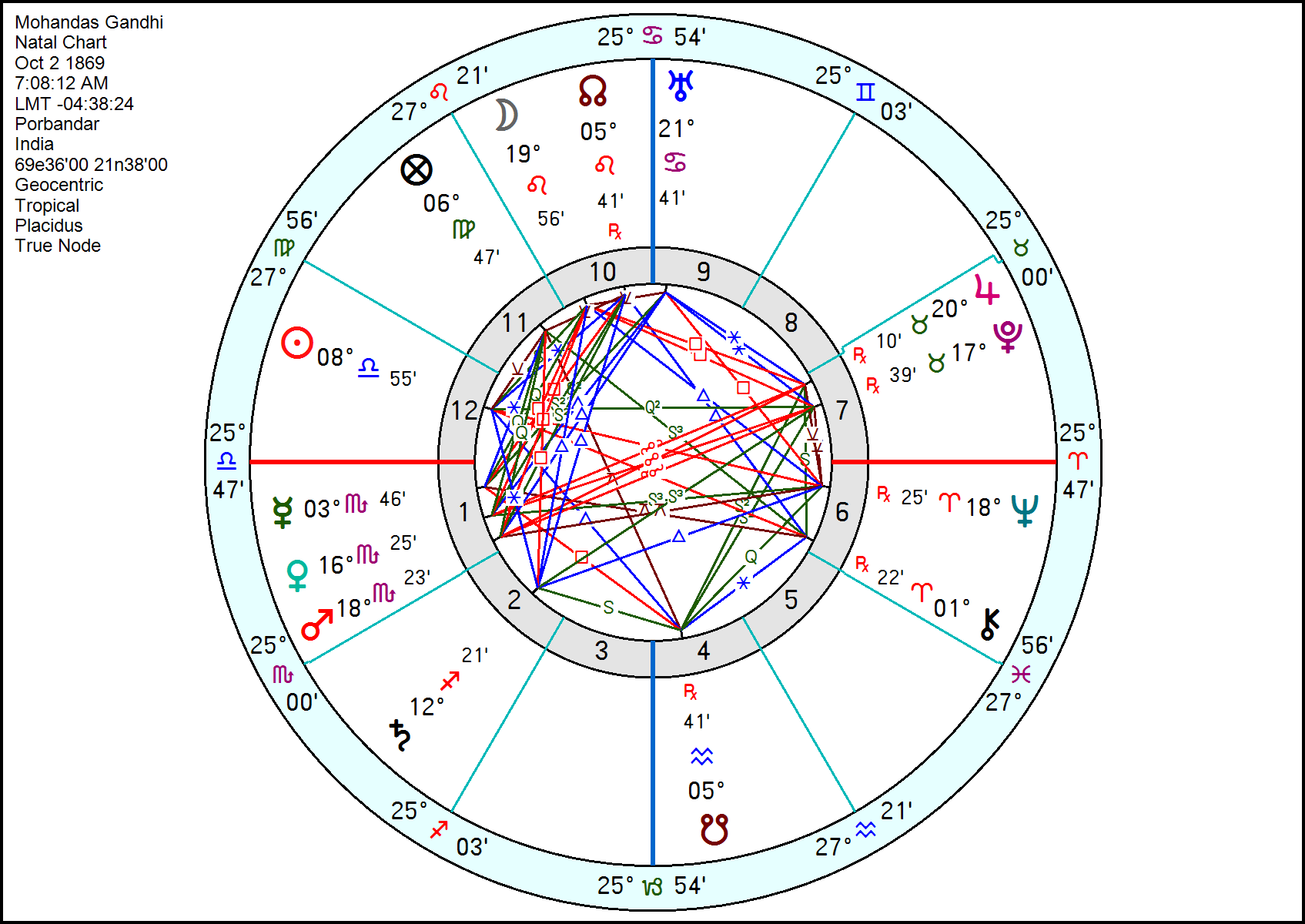
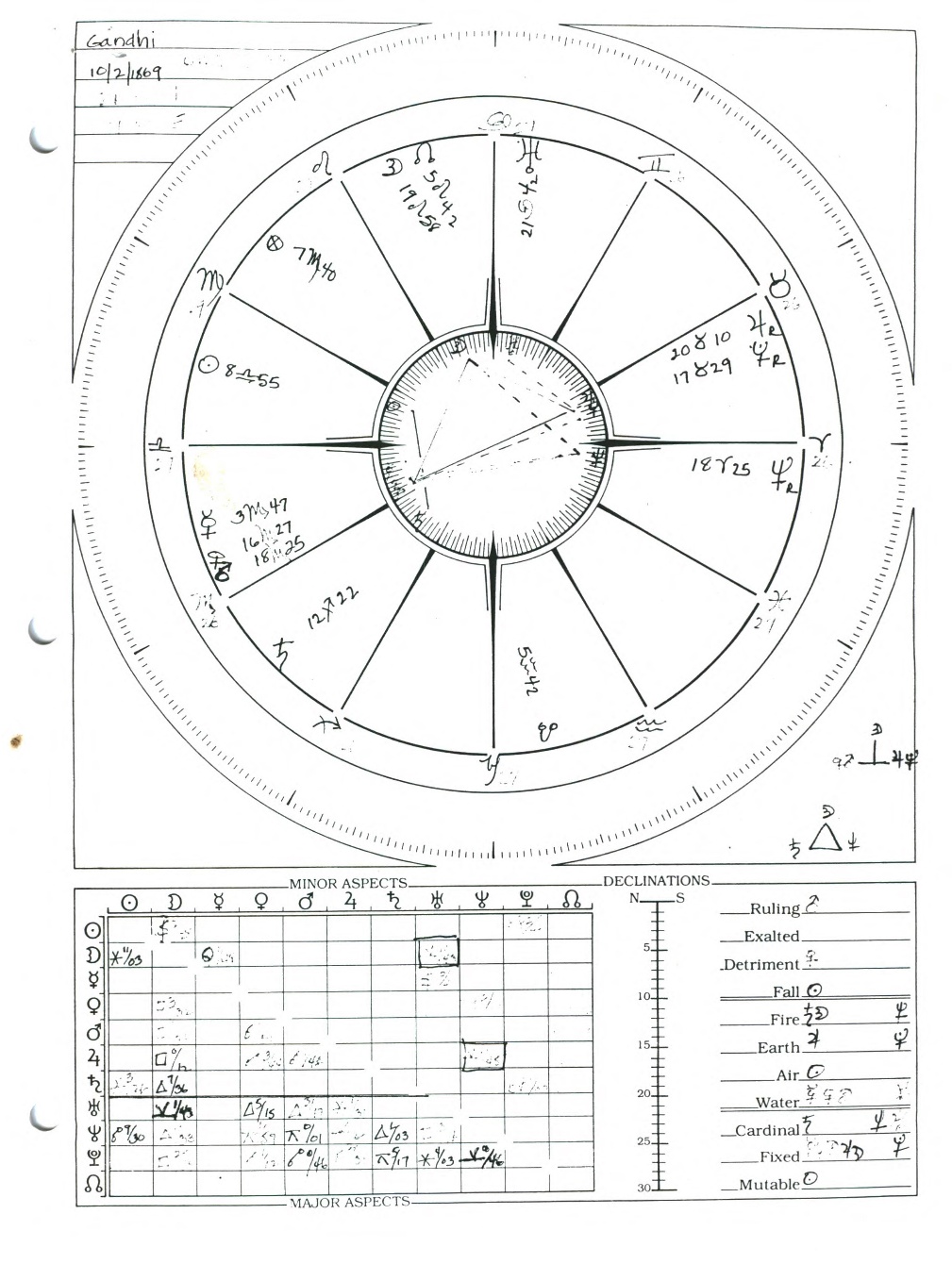
Gandhi's natal chart
Sun at Libra 9: cooperation of the ego with the World-Idea, and God superior to both; if you believe that the world comes with the ego and vice versa, then you have to believe in God
Opposite at Aries 9: world and people in it are in irrevocable partnership whether they like it or not
Mercury being unaspected would convey the same message in its transit through the houses
Mercury at Scorpio 4: there are transcendental values in everyday experience
Venus at Scorpio 17: if you attempt to practically put your ideals or spiritual quest on the line, then the overshadowing of the spirit is inevitable
South Node is residue of all your past living, North Node is pointing towards the future
AD reads South Node before reading the planets, and reads North Node last
Moon at Leo 20: Sun is embodied in the Moon, all the strength is within you
Mars at Scorpio 19: vitality had to be channelized, sculpted into an idea that he wanted
Jupiter as instinctual wisdom
Saturn at Sagittarius 13: personal struggle made public
South Node as stuff of ego
North Node at Leo 6: applying a traditional ideal/value to a modern situation
Epistemology of Astrology
Trans-Saturnians capable of direct perception, Chaldeans of indirect perception
Trans-Saturnians are higher knower in us, natal positions of Chaldeans are lower knower
Eternal and evolving seeds in Buddhism; idea in Dragon is evolving, outside of Dragon it isn't evolving
Taimni diagram
Life as the burning up of tropisms in the animal body
Uranus at Cancer 22: be calm; equanimity is imperative for the reception of intuition
Trans-Saturnians in your chart are the soul force you operate with
Higher knower decides the purpose of life of this ego
The only kind of knowledge within natal Chaldean structure is a self-reflective awareness; link to higher knower is through natal aspects to trans-Saturnians
Ego lies to itself, to others, and to its owner
BOOKS READ FROM OR REFERENCED:
Marc Edmund Jones, The Astrology of Concepts
Marc Edmund Jones, The Sabian Symbols in Astrology
I.K. Taimni, The Science of Yoga
William L. Shirer, Gandhi: A Memoir
SABIAN SYMBOLS: Aries 9, Taurus 4, 17, 19, 21, Gemini 13, Cancer 22, Leo 6, 20, Libra 9, Scorpio 4, 17, 19, 21, Sagittarius 13, Aquarius 6, 20
CHARTS appended to this transcript:
FIGURE 1983 0328-1. Gandhi Natal Chart (astro.com).
FIGURE 1983 0328-2. Gandhi Natal Chart (WG version).
RETYPED AND REFORMATTED by IT 2023
NOTES:
REDONE RETYPED PARTIAL TRANSCRIPT (hence V10.1). From 1983 0328 ASL Gandhi 18p.PDF. THERE ARE NO AUDIO CASSETTE TAPES EXTANT.
This is 1983 03/28a, Astrology; Horoscope-Gandhi Class, the first entry associated with this date. 1983 03/28b = Gandhi Astrology seminar from earlier in the day, for which we have no audio, just JF notes.
This is a redo of the previous version which was done in 2018. This version is labeled V10.1 (per new convention for all redone partials) and has: updated prefatory matter and footer; Book List and TOC completed; Title and Subject changed to accord with new conventions; typos corrected and new notes within transcript; different Gandhi chart appended that matches the birth info from astro.com; new formatting to accord with new conventions.
Anthony is Anthony Damiani (AD).
All punctuation and capitalization errors corrected, most numbers and all abbreviations spelled out.
1983 03/28a at Wisdom's Goldenrod
Astrology; Horoscope-Gandhi
[File 1983 0328 ASL Gandhi 18p.PDF Begins]
Astrology 3/28/83 Gandhi
[Note: Sabian degrees and interpretations are from Marc Edmund Jones, The Astrology of Concepts and The Sabian Symbols in Astrology.]
Linda: Gandhi wasn't simply a passionless man; he used tremendous powers of discipline to control his passions. He was married at 13; he later spoke out against child-marriages. One incident of his marriage impressed him deeply. He was shirking his duties toward his father because of his lust for his pregnant wife. When his father died unexpectedly and his child was born dead, he blamed himself.
Gandhi spent about 25 years in South Africa; he developed all his ideas there. He was 46 when he returned to India.
Gandhi said that the way to fight someone is to make them a better person, and he applied this with remarkable success to General Smuts.
Gandhi cherished his time in jail. Usually he was busy all the time; in jail he had time to study, read, correspond.
By the end of his life he wasn't really after independence; he wanted the Indian people to be worthy of it. The country couldn't live up to his ideals.
The struggle against the caste system was very important to him, was one of his main causes.
There was very little distinction between the country's public life and his private life. For example he would fast because of riots, etc.
Tim: We are taking a Sun-centered point of view of the universe. Anthony suggested that as the Sun is the center of the solar system, so in a sense it is the center of the individual mind. We have seen it to be the purpose of life, and the life force of the individual. Now we are trying to see how all the Chaldean planets are trying to elaborate the Sun and also bring a certain self-consciousness to that Sun.
Then, how does the Moon instantiate all of that which is within (Sun Venus Mercury) and that which is more external (Mars Jupiter and Saturn), into daily or waking consciousness. So we'll try doing the degree symbols in this order.
Marc Edmund Jones wrote a book on Gandhi; he also has the same Sun degree.
Sun, 9 Libra: "Three Old Masters hang together in an art gallery; they have a room to themselves and seem to hold converse."
Opposite Sun degree (9 Aries): "A seer gazes intently into a crystal ball before him."
There was a constant interchange between the outer and inner. He took as his own personal experience events that were going on in the world. And conversely, he wanted to bring out to the world conflicts within himself, either to be totally open or because he thought they were universally applicable. For instance, he thought that everyone should learn five languages, since he'd found them so useful.
"Concept of the world and individual as irrevocably linked in partnership." The essential meaning being worked out through his life was the idea of the World-Idea and the ego as really linked together. The ego could actually be seen as part of the unfolding of the World-Idea. He had that kind of awareness.
"Man's capacity for embracing a universal reality within his own personal experience."
Linda: The symbol might represent a certain integrity, linkage between the various parts of his being: intellect, feeling, etc. When he had an idea it had to be willed, lived, etc.
Vic: The pair of degrees sound very similar; perhaps the outer and inner are closely intertwined.
Tim: In the Sun degree, the emphasis is on the individual being part of the World-Idea, on universal reality. With the opposite degree, it is the reverse: how the individual includes an image of the greater whole; how the microcosm images, mirrors the macrocosm.
So the development for Gandhi would be an objectification, a detachment from his own personal psychology.
Anthony: A person has the desire that people should work together, to come to greater values. If that was projected out, you would suspect that he thinks this way because he feels that the world and the people in it are one whole thing.
If a person has the attitude that people should get along well, and seek greater values in that cooperation, that would seem to be the reverse of taking for granted that the world is one whole with all the individual egos within it.
If the Sun, the life within him, is permeated with this idea, then everything he does will be a manifestation of that idea. So then all the other Chaldean planets will be concerned with trying to manifest that central purpose in his life.
The approach is that a life is a manifestation of the ideas; each and every one. These ideas are manifested, we're made self-conscious of them, by all the Chaldean planets. The Chaldeans help to make us [Note: Seems like word(s) missing here.] of the ideas that are presupposed in our functioning. It's mentalistic from the very beginning. If there's nothing but ideas and the way they are combined and the way they express themselves, you're speaking about mind and its expressions; there's nothing else.
Dickie: Also his individuality must be a fit receptacle to embody willing, knowing, and feeling (the trans-Saturnians) in an integrated way and that becomes the central purpose of life both personally and collectively, internally and externally. I don't see how that degree talks particularly about how he unfolds his relationship to the world.
Anthony: How do you see that from the symbol? I interpret the three old masters as the World-Idea, the ego and God. I don't see absolute knowing, willing, and feeling here. These were the three masters he worked for; he believed in the cooperation of the ego with the World-Idea, and God superior to both.
At any rate, the very substance of his being, his life, seems to be his preoccupation with the idea that the world and the individual go together and that they learn to work together. This is manifested most explicitly in getting along with the people around you -- someone might believe the world should be a happy place and still argue with their neighbors at every opportunity. Gandhi first tries to live out the idea in his own life. The reverse side of this would be the premise that the world and the people in it are in irrevocable partnership whether they like it or not. That is the central purpose, the guiding idea that the Sun is going to become reflectively conscious of. It is the other Chaldean planets which make the person conscious of the central purpose.
Tim: That agrees with his almost disinterest in the independence of India and his concern that there be some accord or harmony between the warring factions.
Mercury, 4 Scorpio. "In an old-fashioned candle-lighting service a youth gains for the first time a sense of the great other world."
Opposite Mercury, 4 Taurus. "The rainbow's pot of gold is revealed in the midst of a shower of sparkling and flashing colors."
Tim: (Mercury has no aspects except a quintile.) How does this connect to the Sun as being the first elaboration of it? First, if the Sun needs to see the cooperation of the egos and the World-Idea, "true contact with inner and transcendental realms of reality," and "evidences of higher meaning and immortal value in each moment's detail," characterizes the intuitive or knowing function (Mercury). If he was going to be able to penetrate through the haze of contingent circumstances to see the direction of the movement towards harmony, he would have to have a deep and penetrating mind. He wouldn't get caught up in superficial aspects of circumstances; he could see the underlying pattern. "Ever-clear vision to bring every possible sustainment to man in his outer and practical world" -- when he saw what had to be done, he could operate with a real clarity. An example of this was when Gandhi stopped a South African organization to help Indians with business practices from becoming a financially independent institution, so it wouldn't get caught up in political uses and so it would best serve its members.
Also, if we presume that Gandhi had some inner residence in the trans-Saturnians, which we could perhaps infer from the Sun degree, then there is a bridge between that inner guidance and its practical use through Mercury.
Anthony: Another practical use of the Mercury being unaspected was that it would always be conveying the same message, the idea it's sitting on, regardless of its circuitry through the houses. It wasn't impeded by a strong attachment to any psychical aspect of his personality, but was free and undetermined. If you think of the Mercury going through the houses, circumstances, he would always see with the same motif -- that there were transcendental values in every everyday experience. The way it operated was unqualified.
Tim: It is free from the editorial board of the ego.
Jeff: That may be why he could hold to his vision of society's potential, in spite of the reality. He wouldn't compromise that vision.
Linda: I see a certain faith in that degree, brought out more in the opposite degree. Remember when he got the idea for the salt march. There was a very innocent faith about him; faith in the objective psyche. "There's always the promise of a treasure which proves to be a gratifying complementation in physical tokens of spirituality," and "an eternal covenant between the least of individuality and the universal matrix of life itself." By virtue of his faith, guidance would come.
Dickie: It's unaspected -- thinking by itself didn't serve a role; only thinking in service of changing the world. It was very pragmatic; philosophy by itself wasn't enough.
Linda: For instance, he had eighty volumes of journals, but he rarely ruminates about his inner subjectivity. It is always applied thinking about the spinning wheel, or what needs to be done. Most of his writings were printed in a weekly periodical; it was all applied thinking.
Tim: A couple of times his wife was dying and the doctors said she needed beef tea. He said forget it; he wouldn't compromise his principles. And she survived, of course.
In another incident, his son broke his arm when Gandhi was experimenting with earth treatments, so Gandhi treated his son's arm.
"The reference to these experiments is not to demonstrate their success. I cannot claim complete success in any experiment. Even medical men can make no such claim for their experiments. My object is only now to show that he who would go in for novel experiments must begin with himself. That leads to a quicker discovery of truth, and God always protects the honest experimenter."
He would try to see the principle of a thing, and apply it, all through his life.
Venus, 17 Scorpio. "A woman is great with child; the remarkable thing is that she was impregnated by her own spirit or aspiration."
Opposite Venus, 17 Taurus. "An imaginative battle is under way between swords, the disciples of might, and torches, the disciples of enlightenment."
Tim: We're saying the Sun is first elaborated through the Mercury, and then Venus is added. In the Venus there is a constant struggle between the purity of ideals and doing something practical with them. There was a real struggle, a constant need for reformulation.
It says "experiment," he was constantly experimenting all the time. He might start a strike and then call it off. Because he knew the ideal, but he struggled with the best way to manifest it.
In the opposite degree, there's a sense in his own ethics that would want to engage in that struggle between good and evil, and apply this idealism he had towards that struggle.
Dickie: The value there is taking a spiritual vision and embodying it.
Linda: But there's a conflict.
Dickie: There's a mystery but maybe not…
Anthony: If he had to take spiritual ideas and put them into a practical form, what would that result in? Wouldn't that bring in the presence of the spiritual? That is what nucleation is referring to. If a person constantly attempts to practically put his ideals or spiritual quest on the line, then the overshadowing of the spirit is inevitable. Unless a person does that, the spirit won't come into focus. Only when the person tries, says this is my ideal, I have to apply it, then the spirit becomes more available to him, overshadows what he's doing.
Dickie: That degree really sums up where he placed value. All his value was in that practice.
Tim: That Venus rules the ascendant, and it's in detriment.
Dickie: And it's conjunct a rulership (Mars). And both are in dignity by house, also.
That 17 degree axis is a major battle place between good and evil throughout history; Hitler's Mars-Venus conjunction was on 17 Taurus.
Linda: Gandhi spoke a lot about Hitler. He thought Hitler could be treated like anyone else, be overcome without violence.
Anthony: I don't work with associations. What that might mean in Hitler's chart is beyond me; you'd have to see how the ideas are quantified, the aspectual relationships, which makes it completely different.
It's just like listening to a symphony, and a great musicologist comes along and says those eight notes are an exact steal from Brahms. That's ridiculous. The eight notes in Wagner are not the same; in the context of the whole thing they're utterly different.
Tim: In following the chart with this scheme, the Nodes would fall between Venus and the Moon, and the Moon and Mars; shall we try them in this order?
Anthony: I prefer to say that the South Node is the residue of all his past living, and the North Node is pointing towards the future. So I usually read the Tail even before reading the planets, and the Head last.
But before reading the Tail, see if the dossier you have made of the 7 Chaldeans gives you some idea of the past tendencies of this man. If the ego is a matrix of the past tendencies, then after you read the Chaldeans, you should get a feeling of what it was this ego came in with.
Moon, 20 Leo. "A group of prehistoric American Indians are seen in the course of an elaborate and impressive invocation to the Sun."
Opposite Moon, 20 Aquarius. "A [big] white dove, a message bearer."
Tim: This degree seems to follow from both the Mercury and Venus degrees. The keyword for Mercury was faith, and the Venus as well has a certain idealism, so it seems like all three of these degrees were able to instantiate themselves. He had a real faith in being helped. In his own subjectivity he was constantly questioning his own fidelity to his own inner vision (on/or) outer practices. He was always examining himself: Am I really being faithful to what I know is the best I can do? And it took him a long time. He was very shy, unassertive as a youth.
Dickie: You are getting this from the Moon?
Tim: Yes, as the head of a T-square. At a certain point he began to recognize his inner resources; then he had the courage to do what needed to be done. When he was trying to conform to something outside himself (family, peers in England), he was more hesitant.
Linda: The Moon as brain or moment-to-moment consciousness could never be separated from his ideal. The highest purpose had to be embodied, even in the smallest bits of life. An example of this was when he won his first case in South Africa, and convinced his employer to accept his award in a series of payments instead of driving the other party bankrupt.
Anthony: What does this degree really mean?
Linda: I think it means the Sun is embodied in the Moon.
Anthony: I think you are right. Within this body, six feet tall, etc., is everything that I'll need to carry out the struggle. It sometimes dawns on a man that all the strength is within him. What does it mean to say that you worship the Sun within you?
Mars, 19 Scorpio. "A wise old parrot has been listening attentively to the conversation and preening himself; now he begins to talk."
Opposite Mars, 19 Taurus. "A newly formed continent is seen, fresh and green within its setting of interminable ocean."
Anthony: What is the raw stuff of intelligence that can shape your consciousness to anything you want it to be? Imagination? No, that will be shaped according to the idea. Passion, vitality.
Linda: "Man continually projects the image," here the desire nature, "in which he creates himself and transforms it through the imagination." It sounds very Tantric.
Anthony: So probably that was the need for the projection of his passionate nature -- to see what had to be shaped or molded. That vitality had to be channelized, sculpted into an idea that he wanted.
Dickie: And it seems it was guided by the Venus, that vision of spiritualizing… (the conjunction).
Jupiter, 21 Taurus. "A moving finger points to the significant passages in a large open book."
Opposite Jupiter, 21 Scorpio. "A soldier runs the risk of court-martial in remaining absent without leave, but a lovely miss clings to him."
Tim: Whenever he had a reaction to something, he got the message. His reactions to his own efforts and his ability to read the reactions in other things… He could see what was going on, get the point, in his own experiences. "A symbol of rectification of experience" -- his own compulsions or his own psychology spilled forth and he'd get the point; he didn't have to go around twice.
Linda: His instinctual nature was reliable, it was racial in scope. It stood for more than psychological…
Tim: He had the ability to intuit or sense the right activity to undertake, like when to make a strike or what the best symbolic gesture would be like the salt marches.
Linda: It had racial implications. Also, Jupiter is the instincts; the things he did like fasts would actually change the actions of people. He would fast, cut off a certain appetite and all around the country the appetites were put in abeyance.
Tim: He literally did this, and many times.
Randy: His way of dealing with someone he opposed, by making them into a better person, was like seeking out whatever the level where there was a kinship between his soul and theirs. He would try to work from that feeling of kinship rather than from any feeling of opposition.
Anthony: I think what you see there is the Sun degree, the place and the role of each individual in terms of the complex situation, whether it be the environment, the country or the world. If I recognize your place and my place in the world, then I would act with you according to my understanding of your place in the world. I would expect from you a certain level of behavior; if you didn't live up to that, I would bring you up to that level. That's what I expect from you; that's how you are supposed to act.
He had a recognition or understanding of where that person's approximate situation was in terms of the World-Idea they are all situated within. There is a possibility that Jupiter might have been involved, since there is a kind of instinctual understanding that you've got to have about the person. I'm giving the primary emphasis to that recognition of where we all are in terms of the World-Idea.
Dickie: There's a violent struggle going on there in those four planets. Venus-Mars in the first house versus Jupiter-Pluto in the seventh. It's hard to imagine that he was outside of that long enough to really get into the other person from that particular point of view. There was a tremendous taking up of his own inner struggle, which produced an image that people participated in. His struggles were the struggles of the people.
For example in the Moon T-square, he imaged forth those struggles and that became his public image. And that is how he got out of it, solved it. He could embody them and fast for sixty days and he became a symbol of the nation. It became his act of worship almost.
Jeff: Jupiter might indicate the ability to perceive the course of action that was required to integrate the various aspects of the situation he was dealing with, in order to find the way that would bring everything towards the vision he sought. To perceive the proper approach where his opportunity lay to order and integrate the various goals that he sought.
Tim: Yes. When he picked up a certain symbolic gesture like making salt or burning English-made clothes, it captured the nation's imagination, over and over again. He found the thing that brought out India's national pride.
Linda: And in that his leadership lay, since Jupiter is associated with leadership.
Tim: He knew that by going to the people, not by working with the elite of India, that anything would be accomplished. He had a sense of how to bring everything together, unifying his practical goals with his inner ideals.
Linda: He wasn't allowed to finish that first speech, when he said that the problem doesn't lie with the British, but right here with us in our very nature.
Andrew: Jupiter is the wisdom in the instincts; how does that relate to this degree?
Linda: Racial wisdom: "the rectification of experience and fine discrimination…a dramatization of the racial wisdom as it becomes incarnate in conscious individuality."
Tim: He was able to give Indians a pride in what was authentically Indian. With that degree, he would speak to a large group of people.
Amy: Another point is that not until he identified himself with the Indians was he able to express his own conscious purpose. His individuality really came through that tradition.
Tim: Yes, he didn't wake up to himself until he rejected all his Western modifications.
Harriet: This was also in the Moon degree: "self-fulfillment as he is true to his group tradition."
Saturn, 13 Sag. "A wistful young woman, dressed in black, is surprised into a warm companionship to which she has felt alien."
Opposite Saturn, 13 Gemini. "The great artist, a world-famous pianist, sits at his instrument on the stage of a huge auditorium."
Tim: He published his autobiography in his newspaper, and any kind of personal problem he had he put right in it. This is in the sense of making it the property of all. He wanted to make sure everything like that about him was published. He didn't like being called Mahatma. He didn't like being taken for something more than he was.
He really wanted to be very open with what he was as a human being, his own foibles, personal struggles. He talks a lot about his own lack of education, and his naiveté in England. He really made an effort to be very honest with himself.
Linda: Another point is "successful employment of past failure." He'd really dwell on his weaknesses because through that kind of desire to pull up the negative parts, he would then know what to do next. He really used that to point out the next step in his self-development.
Tim: He always said that he failed because; he would see situations that he was responsible for in that way. When the Hindus and Muslims started fighting, he would take that personal responsibility that Saturn sometimes gives a person. He would take something that occurred as his failure, and do something to deal with it, and accomplish something.
Linda: And that way of seeing himself put him on the stage as a great hero. (See symbols.) It seems like the most obvious thing to do and yet very few do it; few say I'm going to draw on my failings, that's what's going to teach me.
Michael E.: The Saturn keyword is rectification, and he was always doing this with his diet, etc. To get the idea of the Sun he would have to rectify his own desires. There was a continual purification of his own body to let the idea of the Sun manifest more through the Saturn process.
Andrew: He seemed to recognize quite clearly that it was his own desire nature that kept him from his ideals of the Sun.
Anthony: Given this psychical organization that follows from putting together these seven Chaldeans, could you offer this man the choice or the possibility of leading India to freedom, given the context, social mores, etc. in India?
Can you see that this was the appropriate man -- he wouldn't scold the Hindus, he would turn around and purge himself. Given the context of Hindu civilization, morals, teachings, wouldn't it be some kind of saint/ascetic?
Tim: An ascetic with some practical consciousness of the world. If he was just a yogi he wouldn't have the common sense to get things done at the right time and place; Gandhi had this courage, and knowledge of the modern world as well as the inner world.
South Node, 6 Aquarius. "The stage is lit dimly for an allegorical drama and a solitary performer carries the thread of mystery."
Linda: This seems to lead to a different interpretation of what the Tail means. We spoke of it as what is brought in with you, which you have to let go of to get to the Head. In this case, it wasn't let go of, but totally embodied.
Lauren: But that is what the Tail means: the present moment isn't anything but what has been already, so you are living that Tail right now; it isn't something behind you.
Linda: It's the stuff that the ego is made of.
Anthony: Yes.
North Node, 6 Leo. "A sweet old-fashioned belle, and a pert and attractive little modern flapper, stand in mutual envy of each another."
Vic: That's good; think of Gandhi's efforts at modernizing the society, breaking down ancient ideas like the caste system, and simultaneously keeping in mind and stimulating traditional Hindu values.
Dickie: But what does this mean for him; how is this the culmination of his life?
Linda: If you speak of the Head as the goal of the life or that towards which the life is leading, and a certain past has to be terminated in some way…
Anthony: It's the culmination of the past functioning, not a termination.
Vic: Didn't he have to synthesize Western and Eastern views in himself in a sense? He was educated in the West, read Tolstoy, etc.
Anthony: But strangely enough, Jupiter made him desert all that.
Vic: But didn't he synthesize them somehow, bring them into some harmony?
Tim: He really did throw it overboard.
Ken F.: But he didn't embody the Hindu tradition like someone like Shankaracharya.
Vic: I'm trying to see this interplay between modern and old, East and West and somehow a synthesis in himself as well as outward in his career. The Head keyword is Contrast. He's bringing the Western ideal of democracy to India.
Anthony: The question is, given the potentials or the matrix that constituted the stuff of his ego, did he apply that creatively and understandingly to the problem he was faced with, and did he bring about a resolution of that problem? "Personal achievement through a creative appreciation and adaptation of the values established by others."
Tim: I don't see him fulfilling the values of others.
Anthony: Ahimsa is one of the five limbs of yoga, it's not his. It's a tradition about as old as India itself. He brought about the freedom of the country and he tried to do it without a bloody revolution.
Elaine: The values and ideals he lived were very traditional.
Bert: He embodied a traditional Hindu thing like asceticism; that's the old-fashioned aspect…
Anthony: …and he applied it to a modern situation. Given the stuff that constituted his ego, he was not going to buy guns. He worked through the cultural mores that he imbibed from his society.
We may need a sense of the trans-Saturnians to help see this Head degree. We need a feeling of what the Chaldeans and trans-Saturnians are. You can notice a difference between having a trans-Saturnian versus a Chaldean on a degree; there is a distinction between the ego as a knower and the trans-Saturnian as the higher knower.
Tim: When a Chaldean is on a degree: Its functioning crystallizes around the degree meaning, and colors it so that the degree meaning functions as through the meaning of the planet. For example, if you take a degree meaning with Jupiter on it, that meaning has to be taken as colored by the instincts. And the Mars degree is not just the raw substance of intelligence by itself, which might be the stuff of buddhi, sattvic or whatever. But you could only get to that meaning through the kama rupa; the substance of the wisdom there was kama rupa, desire.
With a trans-Saturnian on a degree, the trans-Saturnian is almost outside or prior to the degree and is revealing itself through the degree meaning, and the degree has a certain transparency. With Uranus there's a certain intelligence or intuitive knowledge and singleness of intent that will make that idea present, that will implant that degree meaning throughout the Chaldean structure, and that will apply that meaning in a universal knowing (wisdom) way.
So there's a clarity to the degree meaning for the trans-Saturnian, and a certain way it can be applied to all the Chaldeans as if the trans-Saturnian or higher knower is trying to transform or condition the psychosomatic organism to take into itself and act in accord with the intent of that higher being.
Are we saying that if the trans-Saturnians deal with the ideas impersonally, directly, the Chaldeans will always interpret those degrees based on prior experience; it is within the realm of Saturn? Any planet is a channel for a degree, Neptune via feeling, etc.
Linda: But this is different; we think of the stars to symbolize the degrees. The planetary spheres from Saturn down are inside that. So the function will appropriate any intelligence they radiate. The degree can only make sense as identified with that function. The Uranus, the trans-Saturnians aren't functions that can be appropriated by the psychosomatic organism. So the intelligence there would be seen more purely.
Anthony: Think of the Chaldean system, the seven planets with the Sun. On one hand they make sensations and on the other they coordinate these sensations. These two parts, the fabricative and gnostic, working together, make and coordinate them. This is the thought before it becomes the sensation.
Now that guides, brings into being the categories of the imagination. Through the categories of the imagination, the seven in your chart, that prior functioning (fabricative and gnostic) becomes self-reflective, self-conscious, within the categories.
So starting with the Chaldean Sun, and its representation in the chart as the central purpose in your chart and its becoming self-reflective in your self-consciousness(;/,) you could see that all this would be involved from the level of belief all the way into conjecture. So there's something murky about it; there's always a certain amount of distortion from the Chaldean structures.
But that isn't so with the trans-Saturnians. They don't operate in the system of beliefs which organize the sensations which then become the categories of the imagination through which you become self-reflectively conscious. They don't operate that way. They don't go through that.
Jeff: Is the system of beliefs based on prior functioning? It's the knowledge that's been assimilated, so it doesn't have the immediacy of the content that the trans-Saturnians have.
Anthony: Yes, that's the point. They more directly grasp the ideas; the others grasp them indirectly. That's why we really don't understand the trans-Saturnians functioning very often as they are functioning; because their apprehension is a direct and immediate perception, without the use of the intermediary sense organs, system of belief and all that. Whereas when we try to understand we do so through that organization.
So it seems that the trans-Saturnians are capable of direct perception, the Chaldeans of indirect perception.
Andrew: How would we be aware of the trans-Saturnians functioning if it's not accessible to the imagination?
Anthony: Well, it will be accessible to the imagination, it will affect the various categories of the imagination, but you could also directly operate with their functioning. You don't have to wait for them to reveal themselves through the categories of the imagination; you could apprehend directly and immediately the idea that is being conveyed. But since we're not accustomed to understanding the meaning of direct perception, we don't understand. With a trans-Saturnian transit often a person knew something but didn't know how, what the cause of his knowledge was, but he'd act infallibly correctly, if he followed it through. The trans-Saturnians are really the higher knower in us, the natal positions of the Chaldeans are the lower knower.
Linda: Would they be a counterpart of the realms of being? If the degrees are the idea coming in, do the trans-Saturnians represent the knowledge part? In other words, being and knowledge are inseparable; would the trans-Saturnians be on par with the knowledge that is coming in? (No answer.)
Anthony: Apply this to Gandhi's trans-Saturnians.
Avery: You mentioned the split within imagination(,) that enables self-awareness. Instead of attributing it to the opposite degree, could you say that it's actually the resistance of the Chaldean functioning that is creating the split of the opposite degree? In the case of the higher knower, it is in unity with the idea; there's no need for an opposite because he directly apprehends the idea. But the very blockage or interference that the Chaldean must operate with, since it's going to portray this idea in a system of beliefs, is automatically going to create the split.
Anthony: The split doesn't split in the trans-Saturnians.
Jeff: It may be primarily with Saturn because it's basically reflective functioning.
Anthony: Once it enters into the sensible cosmos then it is inevitable. If the mind is functioning and then fabricating the categories of the imagination which represent your various ways of knowing, then that idea has to be split. In itself the idea isn't like that.
Avery: I was just suggesting that the actual functioning of the Chaldean planets is bringing about this split.
Anthony: It wouldn't be proper to say that it's worthless or meaningless or useless; the Buddhist texts refer to this as the unreality of the imagination. It does have a value and that is to bring you to this recognition.
Avery: Also they speak about the self-reproductive nature of an idea versus the evolving nature. You're saying in the case of the trans-Saturnians, it can apprehend the non-evolving or self-reproductive nature of that degree. Whereas with Chaldeans it has to be in terms of the evolving; there has to be an evolution of that idea down through various levels.
Anthony: It's the same distinction they make between the eternal and the evolving seeds in Buddhism.
Avery: The eternal ones are self-reproducing, the others are evolving.
Carol: The evolving ones being the Sun's actual production and the non-evolving ones being the inerratic sphere.
Avery: Since they say everything even at that level is in change, it's constantly transforming into itself. That may also be at the basis of this notion of samadhi. The diagram "A A A"; at that level the idea is always identical in itself. In the Chaldeans, it's A C B A D. [Note: Reference is to Taimni diagram, in which A A A is the one-pointed thought of samadhi, and A C B A D are the miscellaneous thoughts of ordinary thinking. See I.K. Taimni, The Science of Yoga, diagram on p. 284.]
Anthony: Constantly duplicating itself but in variable forms.
Avery: And the forms are interfering with the pure shining through of that idea.
Linda: Are you saying the trans-Saturnians aren't karma-producing?
Dickie: How could that be?
Anthony: Anything within the realm of citta vritti is karma-producing(?/.)
Linda: Then what does evolving and non-evolving mean?
Anthony: The self-identity of the idea and the idea reproducing itself within the categories of the imagination. In other words, an idea in the Dragon is an evolving thing; outside the Dragon it isn't evolving.
Tim: Would you say the essence remains self-identical?
Anthony: Yes. Once it enters the realm of the imagination that seed thought will go through a process of evolution, according to the Dragon's evolution.
Tim: So the degree the Sun is on isn't quite so accessible. It takes the life lived to evolve the meaning of the Sun, and to divest it of tropes associated with that particular being.
Anthony: So the incarnation of vasanas in the categories of the imagination is what is spoken about as the life being the burning up of the vasanas; the life is the actual flame, is burning itself out. In other words tropisms in the animal body are in the process of living, burning themselves out. The other way: vasanas prior to their incarceration in the Dragon are always self-identical with themselves. But let's get to the trans-Saturnians affecting the Chaldeans.
Uranus, 22 Cancer. "A young woman, neatly attired in outing clothes, with eyes softened by dreaming, awaits a sailboat coming towards her."
Anthony: You can see the importance of PB's statement: be calm no matter what. Unless you are calm you won't get any hunch, any intuition. Equanimity is absolutely imperative for the reception of intuition.
Tim: This interview he gave shows this.
Anthony: Yes: This is the higher knower in him. Remember the scene in the movie where he was sitting on the wall facing the river, thinking, trying to be very calm. Then all of a sudden he knew what he was going to do. He had to be very still. If there's any disturbance, agitation in the mind, the intuition will never get through. I think he recognized that was the higher knower in him and tried to conform to it.
Tim: That reliance on that equanimity was a real power. By getting back to that peace within himself there was a certain strength.
Anthony: That is the first thing they tell you when you put on the Brahmin thread in Hinduism -- be calm.
Tim: The intuition of the import of satyagraha comes from this degree. In an interview a journalist asked, "How have you done it?" "By love and truth," Gandhi answered. "In the long run, no force can prevail against them." "I understand, but could you be more specific?" "I know it is difficult for you from the West to understand, but I was quite serious. You cannot comprehend what we are trying to do and the way we are trying to do it unless you realize that we are fighting with soul-force." "With what?" "Soul force," he said emphatically, and then paused to see if it would sink in. I had begun to see that he was a man of infinite patience. "We call it Satyagraha," he said…."Satyagraha, or soul force…is a very practical weapon." [Note: See William L. Shirer, Gandhi: A Memoir, Simon and Schuster, New York, 1979, pp. 29-31.]
This man recognized that force that Gandhi operated with; that there was no greater strength that could be gotten than truth.
Anthony: But in a very practical way, what is this soul force that he's speaking about? The trans-Saturnians in your chart are the soul force that you are operating with.
Tim: That's why I think the Uranus degree goes back to the Sun degree. There was a sense of inner wisdom that he recognized as underlying the purpose of his life, giving it the power.
Anthony: What aspect does Uranus make to the Sun? (None.) So I don't think it comes from their connection.
The Sun degree is one thing; it stands out very clearly. This is one of the ideas in the World-Mind: that the ego is part of the world, and that the world involves the ego. The two of them come together and leave together. If you have one, you have the other. The symbol means to me that if I believe that the world comes with the ego and vice versa, then I have to believe in God. Uranus can reach the Sun through the aspects it makes to the other Chaldean planets. Notice how I'm riding on the rigid formalism of the chart.
Dickie: And there's no possibility of experiencing the unity of that idea through the Sun? You have to experience it as evolving?
Anthony: Yes, and even more so, you experience it as an incandescence, a burning of tropes in animal matter. I never look to the Chaldean planets for knowledge.
Dickie: It's hard to understand that with this vision of the Sun as the central purpose of the life. In your description of the Sun…
Anthony: The higher knower has decided what the purpose of the life of this ego is going to be about.
Dickie: Doesn't the purpose of that life sometimes have to do with getting to its own prior principles, ever?
Anthony: No, not to me. Because the only kind of knowledge you are going to have within the Chaldean structure is a self-reflective awareness, and the understanding that becomes available to you is a system of beliefs that the solar consciousness is operating with.
Dickie: So what is the link?
Anthony: The link is the direct connection of the Chaldean with the trans-Saturnian (natal aspects).
Tim: There's plenty of them here.
Anthony: You know my motto: the ego lies to itself, to others, and to its owner.
[File 1983 0328 ASL Gandhi 18p.PDF Ends]
1983 03/28a V10.1: CLASS: Astrology; Horoscope-Gandhi. Copyright 2023 Wisdom's Goldenrod p. iii