DIAGRAMS FOR 1983 0427a
Class
Wednesday, April 27th, 1983
Verbatim, unedited transcriptClick the series name to view more
CLASS at Wisdom's Goldenrod, Hector, NY
with Anthony Damiani (AD)
April 27a, 1983
PB PARAS; OVERSELF
TOPIC: PB Paras
SUBJECT: Overself
SUBSUBJECTS: Asmita, Mercurial Phase, Mercury in Pisces, Principle of Awareness, Individuality, the "I", Soul, Saturn and Jupiter in 2nd Quadrant, Void, Idea of Man, Ahamkara, Ego, Paradox
CONTENTS:
PB PARAS ABOUT HIS LITERARY WORK
SOUL HAS TWO ASPECTS: THE SOUL, OR OVERSELF, IN THE INTELLECTUAL-PRINCIPLE, WHICH IS A UNIVERSAL CONSCIOUSNESS, AND THE LIGHT EMANATING FROM IT, WHICH IS A PRINCIPLE OF AWARENESS
THE CONSCIOUS EGO IS PROJECTED FROM THE POINT WHERE THE RAY COMES OUT OF THE CIRCLE, AND INSIDE OF THE CIRCLE YOU CAN SPEAK ABOUT THE VOID
YOU CANNOT SPEAK OF INDIVIDUAL AWARENESS UNLESS IT IS ASSOCIATED WITH SOME ASPECT OF MANIFESTATION
THE PRINCIPLE OF MENTALISM: EACH INDIVIDUAL AWARENESS OR CONSCIOUSNESS PROJECTS FROM WITHIN ITSELF THE ENTIRE WORLD FOR ITS OWN EXPERIENCE
THE KNOWER CAN'T BE KNOWN, AND YOU CAN'T MAKE AN OBJECT OUT OF IT
SATURN IN LEO AND JUPITER IN VIRGO REPRESENT THE DIVINE PHASE OF THE OVERSELF, AND MERCURY IN PISCES REPRESENTS THE DEMI-DIVINE PHASE, THE ASMITA PRINCIPLE—THAT PRINCIPLE OF AWARENESS THAT IS OF ETERNAL GENERATION
SUBTLE INTUITIONS AND PROMPTINGS COME NOT FROM THE OVERSELF BUT FROM THE MERCURIAL PRINCIPLE
THE MERCURIAL PHASE OF THE OVERSELF IS ALWAYS ASSOCIATED WITH MANIFESTATION
CONTEMPLATION ON ASMITA CAN MAKE YOU OMNISCIENT BECAUSE IT INVOLVES YOU IN SOUL ITSELF, THE UNDIFFERENCED KNOWLEDGE
ASMITA IS THE PRINCIPLE OF YOUR INDIVIDUALITY, AND THE ACTUAL EXPERIENCE OF THAT I-PRINCIPLE IS QUITE AUTHENTIC
THE CHARACTER OF THE OVERSELF PUZZLES THE INTELLECT BECAUSE IT UNITES A DUALITY
THE PARADOXICALLY DUAL NATURE OF THE OVERSELF: "IT PARTAKES ON THE ONE HAND OF A RELATIONSHIP WITH A VIBRATORY WORLD AND ON THE OTHER OF AN EXISTENCE WHICH IS ABOVE ALL RELATIONS"
THERE IS ONLY ONE OVERSELF FOR THE WHOLE RACE (SATURN AND JUPITER IN THE 2ND QUADRANT), BUT THE POINT OF CONTACT WITH IT (MERCURY IN PISCES) IS UNIQUE AND CONSTITUTES OUR HIGHER INDIVIDUALITY
THE VISION THAT THE SOUL HAS OF THE IDEA OF MAN IS A PERMANENT POSSIBILITY IN THE INTELLECTUAL-PRINCIPLE, AND THAT IS NOT TO BE EQUATED WITH HUMANITY
"TO SAY THAT THE HIGHER SELF IS OR IS NOT INDIVIDUALIZED IS TO DISTORT MEANING AND AROUSE MISCOMPREHENSION"
THE DISTINCTION BETWEEN ASMITA AND AHAMKARA
DIFFERENTIATING RECOGNIZING ONESELF AS AWARENESS FROM SURRENDERING INDIVIDUALITY TO ENTER THE VOID
ON PB'S NOTEBOOKS: "YOU'VE GOT NALANDA UNIVERSITY IN THOSE VOLUMES"
BOOKS READ FROM OR REFERENCED:
Paul Brunton, Notebooks. 16 vols; Vol. 1 entitled Perspectives, published 1984-1988. Some Paul Brunton Notebook paras are, as of 2018, unpublished, and are noted as such.
Manly P. Hall, The Phoenix: An Illustrated Review of Occultism and Philosophy
H.P. Blavatsky, The Secret Doctrine
Plotinus, The Enneads (MacKenna translation, 4th ed.)
PLOTINUS QUOTES READ OR REFERENCED: V.1.1, V.3.4
DIAGRAMS appended to this transcript:
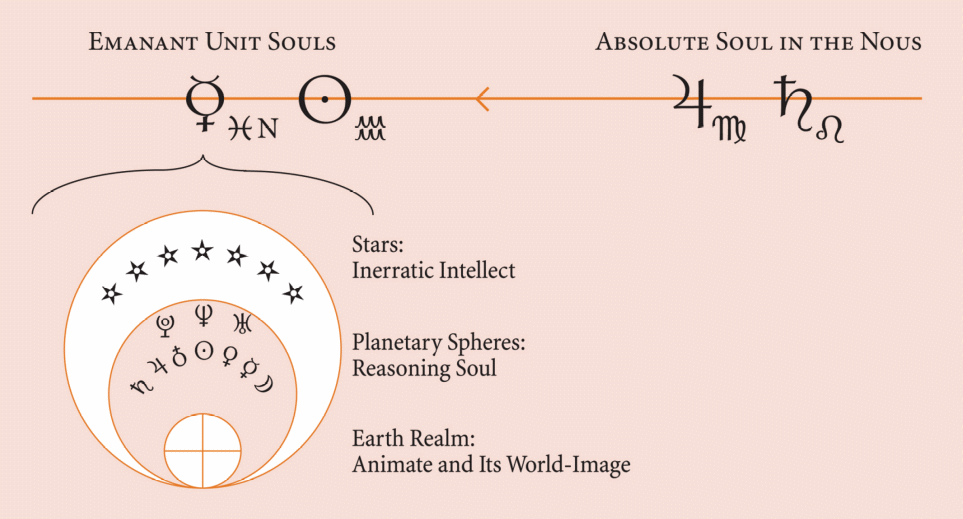
FIGURE 1983 0427a-1-AB. Absolute Soul and Emanant Unit Souls.
FIGURE 1983 0427a-2. Tripartite Soul and Levels of Cosmos.
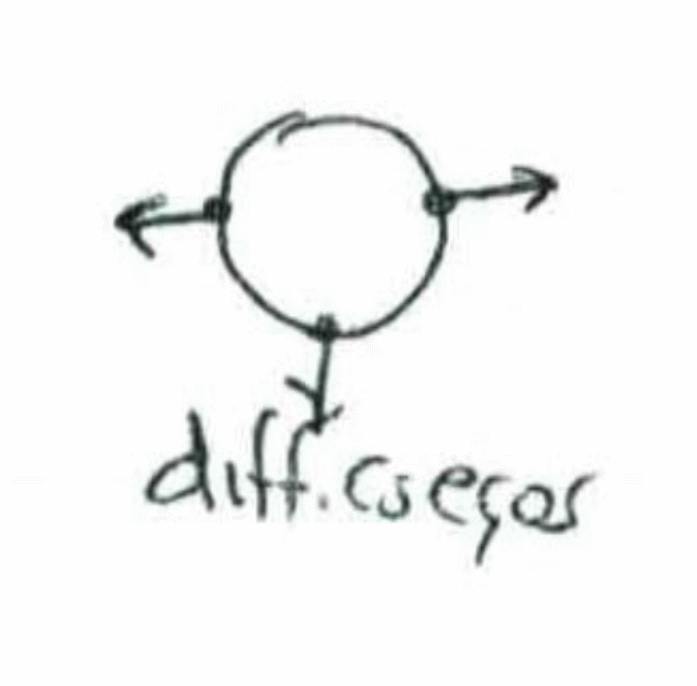
FIGURE 1983 0427a-3-AB. Void and Individual.
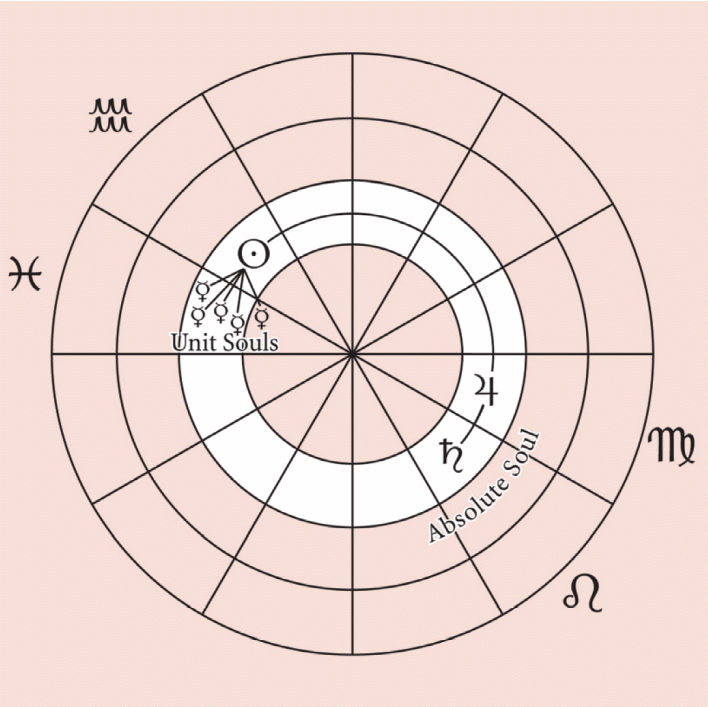
FIGURE 1983 0427a-4. Tripartite Soul in Soul Ring.
Second and fourth diagrams are from Astronoesis, pp. 203 and 184 respectively. Other diagrams also referred to are not with this transcript version. [Transcriber note: [diagram] means the speaker is referencing a diagram as he or she is speaking. If someone is drawing or writing, with audible sounds of chalk on a blackboard, I indicate this by [drawing] or [writing].]
PAPER associated with this transcript:
- "Notes on the Meaning of "Asmita" in Yoga Philosophy". Retyped as 1983 0427b V09BN. Hinduism - Asmita from Scan File 1983 0427 PBP Asmita 03p.PDF. These notes are attached to the 1-page partial transcript that we have for this class and are almost certainly student notes.
NOTES:
This is 1983 04/27a, PB Paras; Overself class, and the first entry associated with this date. 1983 04/27b = Asmita Book Notes.
Earlier partial transcript (Scan File 1983 0427 PBP Asmita 03p.PDF) exists. This Scan File is a combination of "Asmita" Book Notes and the 1-page partial transcript for this class, which consists of key Anthony comments and ideas from this class.
Unpublished PB paras, even if sourced, should be proofread.
TRANSCRIBED Verbatim by IT 2018. Reformatted from V11a version by JRM & JF 2019-2020, with Subheads and Table of Contents added by JRM. In 2023, IT reformats again to accord with new conventions, fixes prefatory matter and footer, updates audio file name, fixes/completes Book List, adds Plotinus quotes section, adds new notes within transcript, fixes minor errors, adds four diagrams and references within transcript to these diagrams, removes appended paper which now stands alone (see notes above). In 2025, MW expands Subsubjects and alters Subheads to make more accurate. Archival verbatim transcript – V14.1a.
AUDIO FILES: 1983 0427a, 1983 0427b. [Note: "Tape" and "Side" refer to original audio cassette tapes later digitized into .MP3 Audio Files.]
1983 04/27a at Wisdom's Goldenrod
PB Paras; Overself
Archival verbatim transcript
[Audio File 1983 0427a Begins]
AD: --read you a quotation from this book, Manly Hall, Phoenix. Page 123 (in here). He says--
[Transcriber note: I am using The Phoenix: An Illustrated Review of Occultism and Philosophy by Manly P. Hall, Seventh Edition, The Philosophical Research Society, Inc. Los Angeles, California 90027, 1975.]
Manly Palmer Hall [The Phoenix, p. 123, AD reading]: "H.P. Blavatsky herself realized that her…"
S (simultaneously): We can't hear up here.
AD: You can't what?
S: We can't hear.
AD: Who's that!? (laughter)
S: Terry.
S (faint): Terry.
AD: Oh you--
CDA: I'll just turn the [one word inaudible] off.
Manly Palmer Hall [The Phoenix, pp. 123-124, AD reading]: "[H.P.] Blavatsky herself realized that her writings were out of sympathy with the age and [that] the full significance of The Secret Doctrine could not be fully recognized until the advent of a more auspicious time. It was to be the occult textbook of the twentieth century, to stand without addition or subtraction until the coming of the next emissary of the Masters, which, according to H.P.B. was to be about 1975."
[short pause]
S (very faint): That's it.
RG/S(?): (Hm?/Uh-hm.)
LR: That's it?
[student assents, very faint]
AD: That's it.
SC(?): I want to know, what's the date on (that/it)?
PD: What was 1975, the next coming or the--
AD (simultaneously): The-- within a hundred years.
PD: --or a text?
AD: The next book. The next message from the Masters, you could take that word 'Masters' to mean many things. [PD simultaneously: I don't understand (one word inaudible)] But, if you think of it as a higher power, alright. It doesn't have to be people. [short pause] Well anyway, I asked Amy to pick out selections and quotes for very personal use, and they turned out to be so good that I thought I'd read them to you before we get started with this here. [short pause] There's no need for comment on them, we could appreciate them, you know, their aim point blank, I mean--
PB PARAS ABOUT HIS LITERARY WORK
PB [V8, 12:3.169, AD reading]: "Whoever thinks that these talks present him only with mere abstractions is greatly mistaken; they really deal in things that are vital to human beings because they are the foundation things of life [AD reads: it really deals in things that are vital to human life]. Properly understood, these"abstractions" will help people [AD reads: men] to more successful living. [AD adds: And] Whoever will endeavour to translate the ideas of this [AD reads: the] psychological technique into action will find his prize in equipoised existence, inner peace, and spiritual power."
AD: Don't ask me for the page, the book, the number, go read the books.
[student assents]
[short pause]
PB [V8, 12:5.6 and Perspectives, Chapter 12: Reflections, #40, AD reading]: "To attempt this book will be an adventure for the Warriors of Light, but the wanderers of night will [AD reads: would] put it down with much celerity. For these pages are enchanted with a white magic which can inflict no greater injury on adversaries than to permit them to resist the principles contained therein."
AD: Again--
PB [V8, 12:2.146 and Perspectives, Chapter 12: Reflections, #42, AD reading]: "I have attempted to think out anew, and on the basis of my own experience [AD emphasizes the rest of this phrase] and not that of men who lived five thousand years ago, what should be the attitude of a normal modern man toward [AD reads: towards] life. Such blessed independence may be scorned by some, but it is a birthright which I jealously guard [AD reads: guarded]."
[short pause]
PB [Perspectives, Chapter 12: Reflections, #29, AD reading]: "This book is but a mirror, in which I have shown the facts and events of a life devoted to the quest of Realization. Whether the conclusions it contains are to your taste or not, please deign to believe that as a record I have endeavoured to invest it with absolute verity."
[short pause]
PB [V8, 12:5.67, AD reading]: "The thoughts in this book have been set down for the few, since they alone can receive and take my meaning; the latter is too simple and straightforward for the many, who will much prefer to misunderstand me. For instance, some among them will prefer to dub me a mystic, still more will regard me as an arrant atheist, while a few will find me too religious to satisfy everybody. I have attempted to satisfy nobody, but dug my sword into every dark corner that was near at hand. Truth has so many facets to it that it frightens most people away; they retire to their petty corners and contemplate the paltry glimpse [AD reads: glimpses] of the single facet they have seen, usually spending the remainder of their lives over this simple process."
AD: This one here I think is appropriate for all of us.
PB [V8, 12:3.6 and Perspectives, Chapter 12: Reflections, #34, AD reading]: "My work is a"prophetic" message to our times, a religious revelatory work. An academic seal would put it on an intellectual and consequently lower plane."
[17 second pause]
PB [Perspectives, Chapter 12: Reflections, #32, AD reading]: "If this book can only make the Overself seem as real to the imagination of others as it is to me in actuality, as living a presence to their faith as it is to my meditation, it may be of some service to them. But if it fails to do so, it may still…."
AD: You fill in the rest.
[short pause]
PB [V8, 12:6.199, AD reading]: "The object [AD reads: subject] of these pages is to tell the Western world about the spiritual life to which the gods led my feet in India; I seek [AD reads: it seeks] to share with others, so far as the secondhand medium of writing can do so, this rare blessing of contact with a God-Man."
PB [V8, 12:3.170, AD reading]: "If this message is false, you cannot know this until you have fully investigated it, for to come to conclusions before thorough examination is unworthy of a thinking person [AD reads: man]. If this [AD reads: the] message is true, then it is of colossal importance to the world, and to you."
[20 second pause]
PB [unpublished, 12z-pbw.0 (21v/29/81), AD reading]: "I must make clear and intelligible these doctrines which have hitherto been covered with dust."
[short pause]
PB [V8, 12:3.182, AD reading]: "That so slight a cause as a few pages of printed matter should lead to so serious a result as giving a totally new direction to some people's [AD reads: men's] lives, is one reason why writing has come to mean for me a ministry whose character is almost as sacred as any vocation could [AD reads: can] be."
[short pause]
PB [Perspectives, Chapter 12: Reflections, #33, AD reading]: "In this book I have considered myself to be a sensitive recording instrument, carefully and minutely registering the impressions received from these higher states of consciousness."
PB [V8, 12:4.21, AD reading]: "I shall have to lay down my pen one day, but the intuitions and experiences which flow through its ink shall find other hands and continue to publish themselves to the world."
PB [unpublished, (unable to find source, possibly 21v (red)- jf), AD reading]: "What I have written about many of these mystical experiences has the advantage, over much other material, of being recorded from the inside looking out, as well as from the outside looking in."
[9½ second pause]
PB [Perspectives, Chapter 12: Reflections, #30, AD reading]: "It is not without much reluctance that I have ventured to betray aloud the intimate experiences received in [AD adds: a] secret [and] solitary communion [with nature]. I would fain have harboured them until this body was gone, when their fate would carry no concern for me. But the bidding of my spiritual Guides was such that [AD reads: so that] these words have gone out into print."
[9 second pause]
PB [V8, 12:3.167, AD reading]: "[AD adds: Yet] It is not for me to play any spectacular part in the present epoch. I have not issued these books for any propagandist purpose. Mine is a specialist's task working in a special field. But despite all this, it will not be easy for anyone to run a measuring-rod over the amount of work done. I have set ripples going but how far they will spread is the concern of destiny. P.B.'s body will pass away but his ideas will go on working. For these ideas have taken hold in some minds, who in turn will transmit them to other minds and another generation. The legacy of ideas which he toiled over during his lifetime will be with them long after his passing from this earthly plane."
[short pause]
PB [Perspectives, Chapter 12: Reflections, #1, AD reading]: "This I may say that my work throughout has always been based on first-hand knowledge of what I write about and not upon hearsay or tradition."
[short pause]
PB [unpublished, 20a-prac.1 (21v/58/4), AD reading]: "Here is no mechanical system, no artificial technique, no dreamer's theory. It has come into being but of a living experience and a world-wide observation. It has been formulated in accord with circumstances and requirements of a modern occidental life."
[short pause]
PB [V8, 12:3.171, AD reading]: "The teaching which is particularly expressed in my books is not, so far as I know, imparted by any individual who is accessible to the general public; nor is there any institution to develop the capacities [AD reads: capacity] of learners along these lines. This situation exists because the teaching traverses its own unique field. None other approaches life from quite the same standpoint."
[short pause]
PB [Perspectives, Chapter 12: Reflections, #38, AD reading]: "It is precisely because we are entering an epoch when the common people are at last coming into their own and when the world's conscience about its duty toward [AD reads: towards] the underprivileged has been tardily aroused, that I feel I am obeying a divine command when I write of sacred things in [AD adds: a] direct manner, of metaphysical themes in a plain manner, and of mystical experiences in a familiar manner. Spiritual snobs may call my treatment of these subjects, cheap, and my work, journalese, but its result--faintly indicated by the long record of help gratefully acknowledged--is their best answer."
[13¾ second pause]
PB [V8, 12:5.2, AD reading]: "My work has been to open up new paths, both for those already interested in spiritual seeking and for those who in the past were not but are now ready to begin it."
[short pause]
AD: I find this one particularly touching and, I'd like to read it.
PB [Perspectives, Chapter 12: Reflections, #36, AD reading]: "Have I not searched far and suffered much to prepare an easier path for you all [AD reads: for all of you], to cut through thick jungles a track which others could follow with less pain and less labour? Have I not gleaned sufficient knowledge at great cost to be worthy of a hearing? Have I not attained sufficient proficiency in yoga and philosophy to be worthy at least of a claim on truth-seekers' attention? Have I not toiled and over-toiled in the effort to share both the modicum of knowledge and the measure of proficiency with others to be worthy at least of their interest?"
[10 second pause]
PB [V8, 12:2.61, AD reading]: "[AD adds: But] I have not planted in vain. My teachings have already borne a little fruit. Although I have refused to set myself up formally on the teacher's dais, nevertheless teaching has somehow been going on. Through books, letters, interviews, [and] even meditations, men and women have been guided, counselled, instructed, perhaps inspired, upon this age-old quest [of] the Overself."
[short pause]
PB [V8, 12:3.73, AD reading]: "I have embodied in these pages the matured wisdom and dearly [AD reads: deeply] bought experience of many many lifetimes."
[9¾ second pause]
PB [V8, 12:3.168, AD reading]: "If these pages can but recall a few people [AD reads: men] to the paramount importance of philosophical culture, can sustain in them large [AD reads: larger] hopes for their own future as for that of mankind, can keep before them a shining vision in the darkness, the effort will find justification."
PB [V8, 12:3.3, AD reading]: "Rather than be the scribe of ephemeral fact let me, O Lord, be the scribe of eternal vision [AD reads: wisdom]. Let me write down word-for-word those divine messages which come to me out of the ether."
[short pause]
PB [V8, 12:5.150, AD reading]: "It is not the books which belong to my past that I have any esteem for or count important to humanity; it is the books which belong to my future. I feel intensely what Tolstoy felt in 1864:"I regard everything that I have published until today as no more than exercises [AD reads: exercise].""
PB [V8, 12:5.152, AD reading]: "The author of those [AD reads: these] earlier works is dead. He himself certainly, and perhaps many readers too, would not want to resuscitate him. The old P.B. had too many deficiencies, weaknesses, and faults for my liking. Time has turned and I with it. I have profited by past errors in dealing with individuals, but in any case larger issues will necessarily claim me henceforth."
[10½ second pause]
PB [V8, 12:5.34, AD reading]: "Why did the late Yuvaraja of Mysore keep a photograph of P.B. prominently displayed in a central position on his writing table at the Mysore Palace? Why did [AD reads: And why does] the Yuvaraja of Kasmanda keep a similar photograph on his own writing table at [his] Lucknow [AD reads: Lucknow's] Palace? Why, when most of the yogis of India were at their command, did they take lessons in meditation from P.B. and honour him with their chelaship? Why did Yogi Ramiah [AD reads: Yogi Rama], then esteemed one of the leading disciples of [Ramana] Maharshi and later head of his own monastery, declare [on January 1, 1936] in the presence of some of his own Telegu disciples to P.B.:"You have learned all about yoga. There is nothing more for you to learn about this practice." [AD adds: And] Why did Captain [Mohamed] Rashid, [A.D.C.] to the late Yuvaraja of Mysore, say in 1939 [AD reads: '39] when broadcasting from the Akash [Vani] Radio Station in India: "My learned and distinguished friend and European yogi, Dr. Paul Brunton, is now in our midst again [AD reads: is now again in our midst]. He has done more to clarify the subject of yoga than any other Westerner.""
[short pause]
PB [V8, 12:4.39 and Perspectives, Chapter 12: Reflections, #15, AD reading]: "P.B. as a private person does not count. There are hundreds of millions of such persons anyway. What is one man and his quest? P.B.'s personal experiences [AD reads: experience] and views are not of any particular importance or special consequence. What happens to the individual man named P.B. is a matter of no account to anyone except himself. But what happens to the hundreds of thousands of spiritual seekers today who are following the same path that he pioneered is a serious matter and calls for prolonged consideration. Surely the hundreds of thousands of Western seekers who stand behind him and whom indeed, in one sense, he represents, do count. P.B. as a symbol of the scattered group of Western truth-seekers who, by following his writings so increasingly and so eagerly, virtually follow him also, does count. He personifies their aspirations, their repulsion from materialism and attraction toward [AD reads: towards] mysticism, their interest in Oriental wisdom and their shepherdless state. As a symbol of this Western movement of thought, he is vastly greater than himself. In his mind and person the historic need for a new grasp of the contemporary spiritual problem [AD reads: problems] found a plain-speaking voice."
[short pause]
AD: Thank you, Amy. [11¼ second pause] Well, now we'll go back to the quotes we did last week.
[students assent, very faint]
[42½ second pause, some very faint AD and student talking in background, shuffling about]
RC: We're going to use the gong tonight or--
S (faint): No.
[students assent, very faint]
AD: No, just try to concentrate on one thing at a time. Don't spread yourself out.
[15 second pause]
SOUL HAS TWO ASPECTS: THE SOUL, OR OVERSELF, IN THE INTELLECTUAL-PRINCIPLE, WHICH IS A UNIVERSAL CONSCIOUSNESS, AND THE LIGHT EMANATING FROM IT, WHICH IS A PRINCIPLE OF AWARENESS
RC: Ok. Well we-- we sort of had a dry run last week with a smaller number of people, and we're gonna go over the same material that we did last week. And, take it just one-- one quote at a time and make out like-- like each quote is the only one that exists for the time that we're on it. And there's a couple that I found that-- that I didn't know of last week that we'll do. Oh, remember this picture from when we were doing the mentalism classes [diagram]? [short pause] Since we're going to be talking about the Overself, we can get rid of this [12½ second pause] and then put it in a different context. [39½ second pause while drawing/writing] [Note: See FIGURES 1983 0427a-1-AB, Absolute Soul and Emanant Unit Souls, and 1983 0427a-2, Tripartite Soul and Levels of Cosmos, appended to this transcript for the following. Second diagram is from Astronoesis, p. 203.] So that each one of these Mercuries, and some probably infinite number of them, each one of them would have that whole system suspended from it that we talked about before [diagram]. Each one could be talked about as an undivided mind. And each one would be producing its own universe of experience.
[short pause]
MB (faint): [few words inaudible] more discussion?
RC: No I just wanted to set that up as a (counter), you have a question on the diagram?
MB: Well since we're talking about the Overself I thought you would want to tell us where you thought-- what level you thought that (being), maybe that's the--
[short pause]
RC: Think it is to be determined from the quote. But I think a good place to start is in the context of if we think of the Saturn and Jupiter as the common ground [diagram]. Well usually the Mercury is its being the historical continuity of each individual. So that when we speak of it in a timeless aspect we talk in here [diagram]. And when we speak of it in terms of its presiding over a series of incarnations we're talking about some individual.
MB: So the Overself would actually (span/stand) (entire/higher) life.
RC (faint): Uh-hm. If we talk history we're-- somebody is in here talking [diagram].
[32½ second pause]
PB [V14, 22:3.186, RC reading]: "Although awareness is the first way in which we can regard the soul or Overself, the latter is also that which makes awareness possible and hence a sub- or super-conscious thing. This explains why it is that we do not know our souls, but only our thoughts, our feelings, and our bodies [RC reads: body]. It is because we are the soul and hence we are the knower as well as the act of knowing. The eyes see everything outside yet do not see themselves."
[20½ second pause]
RC: I'll read the first two sentences again.
PB [V14, 22:3.186, RC reading]: "Although awareness is the way in which we can-- Although awareness is the first way in which we can regard the soul or Overself, the latter is also that which makes awareness possible and hence a sub- or super-conscious thing."
[20½ second pause]
HS: You want to comment?
S (very faint): Yeah.
S (faint): He did.
[short pause]
RC: Go ahead Herb. Do I want(--/?)
HS (simultaneously): [one word inaudible] he-- yeah you want to comment or you want to--
RC: Sure, go ahead.
[short pause]
HS: "We", in the first sentence, "we regard our Overself". Existential person would you say?
RC: Uh-hm.
HS: Awareness, that gives you-- how do you grasp (when/would) you say awareness? [possibly another student: Except] they give you more-- they give you information about it, it's the source of awareness, it's you, ok? So, if it's the source of your awareness and-- I don't-- [one/two words inaudible] what's the second part of the thing?
RC: Um-- first way, awareness is the first way, and it is also that which makes awareness possible.
HS: (Ok), in existence you'd want to grasp-- you want to get to the Overself, they say it's present, right, as awareness. Ok?
RC: Uh-hm.
JC(?): That would be the first one.
HS: That which makes awareness possible, it's the source of the awareness?
RC: Uh-hm.
[student assents, very faint]
[17¾ second pause]
AH: Would-- would you mind reading the rest of the quote please?
PB [V14, 22:3.186, RC reading]: "This explains why it is that we do not know our souls, but only our thoughts, our feelings, and our bodies."
AH: The explanation being that principle of awareness is prior to those things that we are aware of.
RC: Yes.
AH: Always and forever.
[21 second pause]
JC: Randy? I wonder if he isn't using awareness there to be something like what we call the Mer-- Mercury principle on the board, you know, [student assents, faint] the light of a-- of the world's activity for you. [student assents, faint] Because he speaks of it in reference to your thoughts, your feelings, and so on which would be contents to that light or activity of mind which that Mercury represents.
RC: Yeah.
JC: Yeah, but the principle of awareness, of that kind of awareness, which is more like-- Mercury would be more like I think thinking activity [RC assents] that can manifest any content. The Saturn Jupiter would represent the principle of that activity, which is not normally known.
[student assents, very faint]
RC: Uh-hm. Either that or-- or they appear together, Saturn Jupiter and Mercury all appear together. And then the Mercury considered separately would be the awareness actually functioning in the-- in the operational world of relation, [S simultaneously: Even though--] [JC simultaneously with S and RC: So--] or whatever sheath you're identified with from physical body all the way up to the--
[student assents, very faint]
JC: 'Cause that awareness has an object in a-- in a sense of-- not in a sense of self-content, which Saturn Jupiter would know, but in a sense of a content as projected. You see the-- or the distinction [couple words inaudible]
RC (simultaneously): Uh-hm. Yeah, and I think the "I" in itself would be ultimate content that the Mercury would have. Insofar as we speak of that as the asmita, that to reach that level would be the samadhi of the asmita, that there would be-- the consciousness could be withdrawn from any particular types of objects but you're still contemplating the very sense of being a-- a distinct [JC: Personality.] person, yeah.
HS: You went too fast for me, I don't know what you mean-- I didn't know what [one/two words inaudible] meant there or what Jeff did. What-- what do you use the word 'awareness'? What do you mean?
RC: I guess the only way I can talk about it simply is to say that if there's any content, it's a content of which I am aware.
HS: Of which you are aware.
RC: Yeah.
HS: If-- you know-- you know like you have a flashlight in the dark? Do you envision it that way as that light?
RC: I don't, I mean I-- I've heard that analogy enough times but-- I-- I tend to think of it more like the capacity of the mind to make a-- a whole for itself it's lit up by. The transition from sleep to dream for example. I just tend to think of it more that way.
HS: So you'd say that('s)-- in the phrase 'awareness' you think of it in those terms, like a whole, it has wholes, like a totality of reason-principles giving off light, something like that?
RC (simultaneously): Yeah. Basically things don't exist for me unless I'm aware of them, and it's that very being aware that makes it so that they exist for me.
HS: But the being aware in-- I think in the quote was differentiated from the thoughts, feeling-- the body, feelings, and thoughts even.
RC (faint): Uh-hm.
S (very faint): No.
HS (simultaneously): The-- the plain awareness, so I don't understand.
AH: Nor do I. I don't understand how you can speak of awareness as having any content.
JC: 'Cause I think that's exactly what he says, [RG simultaneously: There's nowhere in the quote where--] he speaks of "awareness of". [RG simultaneously: No, there's nowhere in the quote that--] And not as awareness as pure illuminate-- as knowing, [RG simultaneously: Jeff (one/two words inaudible)] not awareness as the knowing principle.
RG: There's nowhere in the quote where he says the awareness here means "awareness of", he says 'cause we are the soul and we are-- I mean we are the knower and the act of knowing, there's nowhere where he talks about that awareness related to a content.
MB: I think there is, I mean, (in parts) connection between this notion of awareness and the notion of knowledge in this quote, whether or not-- I mean he uses the two terms in the quote and I think that they're used somewhat synonymously, although he--
RG (simultaneously): He says the knower. Not knowledge, the knower.
MB: This is what-- this explains why we do not know our souls.
RG: Right, because we are-- read the next sentence, because we are the knower. We are the soul, that's why we don't know it, because we are it.
LR: Read it, read the whole thing again.
PB [V14, 22:3.186, RC reading]: "Although awareness is the first way in which we can regard the soul or Overself, the latter is also that which makes awareness possible and hence a sub- or super-conscious thing. This explains why it is that we do not know our souls, but only our thoughts, our feelings, and our bodies. It is because we are the soul and hence we are the knower as well as the act of knowing. The eyes see everything outside [RC adds: and] yet do not see themselves."
HS: So there's a distinction there between the knower and the act of knowing. (Is that--)
PD (simultaneously): That distinction there Herb, the act of knowing seems to be what was spoken of before as the-- the thinking activity that-- Now that's distinguished from the awareness here, [AH simultaneously: I thought--] which is the knower.
AH: Yes I thought it quite clearly makes that distinction.
MB: What's distinguished from what?
HS: Distinction between the knowing and the a-- the act of knowing and the knower.
RC: Uh-hm. So you read we are the knower as well as the act of knowing.
S: But--
DB (simultaneously): Which would mean that the awareness is in some sense transcended by what he's spoken of as the soul here.
LR: But I-- I didn't see the distinction between the knower and the act of knowing, I thought they were two modes of awareness, [DB: Yeah but then why--] static and-- you know, functional and substantial. What's-- what is being postulated as the distinction? I'm sorry, I just missed that point, (you know)?
HS (simultaneously): The distinction is being postulated.
RG: No it isn't. What-- what do you think's being postulated?
S: [one/two words inaudible]
HS: It just said there's a knower and an act of knowing, there's a distinction.
RG: Well--
HS: Two different things.
LR: We are the knower and the act of knowing, [RG simultaneously: Right, he seems to be bringing those together.] well you-- you said there's a difference? What difference were you saying Herb?
HS: You got-- you got a "we", you got parts, the knower and an act of knowing. There's difference.
LR: And can you-- can you elaborate the difference?
AH: The knower cannot be known.
HS: The act of knowing is what's known.
LR (simultaneously): Can the act of knowing be known?
AH: The knower cannot be known.
LR: And can the act of knowing be known? I mean--
DB: The act of knowing is impossible.
LR (simultaneously): My question is, what is the distinction being drawn between the knower and the act of knowing?
HS: My interpretation is the knower is being given to the awareness, the act of knowing includes those things, thoughts, feelings, and body.
AD (simultaneously): Isn't the-- isn't the knower the awareness?
LR: Yes.
[student assents]
HS: I would say so.
LR: And the act of knowing, isn't that the functional aspect of the knower?
AD: I don't know what difference there would be between act of knowing and knower.
LR: Yeah, [RG simultaneously: Right.] that's what I'm saying.
[student assents, very faint]
HS: There's no difference between act of knowing and knowing?
RG/S(?): Not at this level.
AD: Uh-hm. You produce it? You produce the differential, Herbie?
HS: Could I say it-- excuse me?
AD: Can you produce the differentia? That which distinguishes the act of knowing from knower. What is that distinction that you see there?
HS: How do you mean by produce, (I'll find it).
AD: Well can you show me, illustrate it, demonstrate. Verbalize, pictorialize. What's the difference between the act of knowing and the knower?
HS: The act of knowing can be known, the knower can never be [couple/three words inaudible]
AD (simultaneously): No, the act of knowing can't be known.
HS: The act of knowing can't be known?
AD: No.
S (very faint): That's right.
S (very faint): No.
LDS: Is that right?
HS: (Just carry on.)
LDS: Possibly the act of knowing would imply content where the-- the knower-- the knower as the Self.
AD (simultaneously): No, no, act of knowing!
LR (very faint): The act of knowing(./?)
HS: I don't-- you keep saying "act of knowing, act of knowing," what--
LR (simultaneously): Well you-- you seem [AD simultaneously, faint: Yeah.] to know what knower is. If there's a knower there's gotta be an act of knowing going on.
AH (faint): I don't know what knower is.
RG: No it's just what Linda said I think, it's the subs-- it's the view of-- the knower [LR: Functional and substantial.] is the static and the-- and the act is when the knower functions. And there's no real distinction.
LDS (simultaneously): Well, that is the distinction, that's the only (distinct--)
RG (simultaneously): But it's not a-- it's not a separation.
LR (simultaneously): But-- but then the--
LDS (simultaneously): No it's not a--
LR: Yeah, they're simultaneously happening.
[simultaneously] [student assents, faint]
S (simultaneously with LR, faint): Well what-- what is with you guys?
RC: Is there a runner when there's no running going on?
S (faint): Yeah.
HS/S(?) (faint): Is there a runner--
PD: But I think that's the point of the quote, is that the Overself is more than that act of knowledge.
LDS (simultaneously): That's-- that's right.
S: (It's more.)
DB (simultaneously): And why otherwise why would he set the first sentence up the way he had? I mean read-- read the first sentence he has.
LR (simultaneously): It's the principle of that awareness.
PB [V14, 22:3.186, RC reading]: "Although awareness is the first way in which we can regard the soul or Overself, the latter is also that which makes awareness possible…"
DB: So now back-- right there there's a distinction where he's saying that we can first regard the soul as awareness but the latter, the soul, is in some sense transcendent to that.
AD: Isn't he-- isn't he saying the thing that we've been talking about, that the soul has two aspects? One we call the soul in the realm, in the Authentic Existence, in the Intellectual-Principle. The other we call the soul has a light emanating from it. And this light or this awareness, this principle of awareness, alright, has for its father the Overself, the soul. The Overself or the soul is a universal consciousness. The awareness is a ray coming out from it. This ray of light which comes out from it is an eternal offspring, which, identified with any content, alright, will then produce for you the triple relationship, the thing known. But both of these, both of these, the Overself or the soul, and that principle of awareness which is operative in you here and now, alright, are one essence, two persons.
AH: Anthony? When you identify that essence with the-- with who is here now, have you not i-- associated with a content of thoughts and mind and body and feeling(s)?
PD: But even the mystic--
AD (simultaneously): All content will be a projection from within itself.
AH: That's not a triple relationship.
AD: It can become a triple relationship but that's-- that's not the issue here. The issue here is the recognition that there is a principle of consciousness which is superior to consciousness, which is the generator of consciousness. That principle he calls soul. The principle that is operative within you in the manifested world he would call awareness, consciousness.
AH: See that's-- I [couple/three inaudible RG words simultaneous with AH] didn't understand the quote that way at all.
AD: Hm?
AH: I-- I didn't understand the quote that way but--
AD: Well I didn't ask you how you understood it. (bit of laughter)
HS: Ok so that's the first sentence. I agree.
RG (simultaneously): Right but Anthony in that context I think you'd be following Herbie's interpretation by allowing that the knower be the higher one. (Well/But) who's the know--
AD (simultaneously): There's no distinction, they're one essence.
RG: Right, but-- right, given that, but you just established the two persons given one essence. Now on the same analogy, can you establish the two persons that the h-- the Overself (as/is) the source of awareness within the second sentence be the knower? We are the soul and hence the knower, the Overself, but--
AD (simultaneously): Either-- either case, if you apply yourself to either case, you would have the knower. If you refer to this principle of awareness operative within you at whatever level, from the, you know, asmita or augoeides all the way down into the dragon, this is the principle of consciousness, this is the knower. This is the individual. When that principle merges back into the soul, alright, then you have the pure undifferentiated consciousness which cannot be distinguished. This is your one and many, soul as one and many. It is one in its source, but the rays that emanate from it are many. [9¼ second pause] We've had this discussion, you remember? One essence, two persons. Persona means what? What's the Latin [S simultaneously, faint: Mask, right.] etymological derivati-- [S simultaneously: (It's ok.)] derivation?
S (simultaneously): Mask.
RG: Mask.
S (simultaneously): Mask.
AD: Huh?
RG: Mask.
AD: No.
S: Is it through--
AD: One in and through itself.
RC (faint): For persona?
AD: Per-son-a. One in and through itself. Now I don't know where you got the derivation mask.
DB: Jung [couple/three words inaudible]
LDS (simultaneously): Jung. Carl Jung.
AD: Huh?
RG: Right. (RG laughing)
AD: No, you've got-- (laughter, student words) Just analyze the word. A principle sui generis, a principle in its own right. Well I guess we don't use the same dictionary. (bit of laughter) That's the essence of that quotation, everything else is secondary and that's what you should try to get to, the essence of the quotation, the essential point of the doctrine that's being made. And not go off into, you know, irrelevancy. You follow that? You follow what he's saying? The Overself is a universal consciousness, like the Sun, and from the Sun there emanates millions of rays from it. Each ray is a principle of consciousness in its own right now. It could inhabit any world. That's where you speak about your individuality. Once that goes back into the Overself there is no individuality.
RG: But there is awareness.
S (simultaneously): (Subtle.)
AD: Yes, but that's the principle of awareness!
RG: But, what's the difference between the principle of awareness and awareness?
AD: As we said, one is individual in the sense that I can lay claim to it.
RG: That's no-- I don't believe that's awareness the way he's using it here. I mean, how could awareness be individual, I don't-- I don't understand that [one/two words inaudible]
AD (simultaneously): The awareness that is associated with the series-- the indefinite series of lives that you've lived and that you will live, alright, is distinct in you from me.
RG: I don't get it.
RC: Like you can direct your attention towards something, know it, but I don't get to know it at the same time unless I also direct my attention.
RG: Yeah, but [possibly one faint inaudible AD word simultaneous with RG, possibly part of background] my attention isn't what he's calling this super-conscious thing.
PD: Read that first sentence Dickie and you'll see too.
AD (simultaneously): No, I didn't call that attention super-conscious.
RG: Right.
AD: That attention that he's referring to, that is the principle of awareness which makes you an individual. Your consciousness, your attention, is not mine.
RG: I know. I don't (think a--)
AD (simultaneously): Well that's the ray going through you which is your consciousness.
[student assents, faint]
RG: I don't (poo-poo).
S (very faint): (Alright.)
AD: Now, the ray that's going through me is my consciousness. The only time we'll ever agree Dickie, is when we're both in that universal consciousness. (laughter, student words) Did I make the point?
RG: I guess I'm not there yet 'cause I don't agree. (RG laughs) I-- you made the point but I don't--
(Side 1 of original cassette tape digitized as 1983 0427a Ends; Side 2 Begins)
AD: Try another one, Randy.
THE CONSCIOUS EGO IS PROJECTED FROM THE POINT WHERE THE RAY COMES OUT OF THE CIRCLE, AND INSIDE OF THE CIRCLE YOU CAN SPEAK ABOUT THE VOID
PB [V14, 22:3.313, RC reading]: "There is a point where the human meets the divine, where the conscious ego emerges from the all-encompassing Void. That point we call the Overself."
[short pause]
S (faint): Would you [one word inaudible] it?
PB [V14, 22:3.313, RC reading]: "There is a point where the human meets the divine, where the consciousness ego emerges from the all-encompassing Void. That point we call the Overself."
[13 second pause]
DB: That-- Randy so, I mean, the-- if I'm-- could I just try to say that same thing? The point, the Overself point on the one hand where the human meets the divine, right, the same point is where the emerging ego comes out of the-- conscious ego comes out of the all-encompassing Void. Now the-- is the all-encompassing Void here, would that be understood as like the World-Mind or something like that, and the point with that conscious, you know-- I mean where on this diagram is--
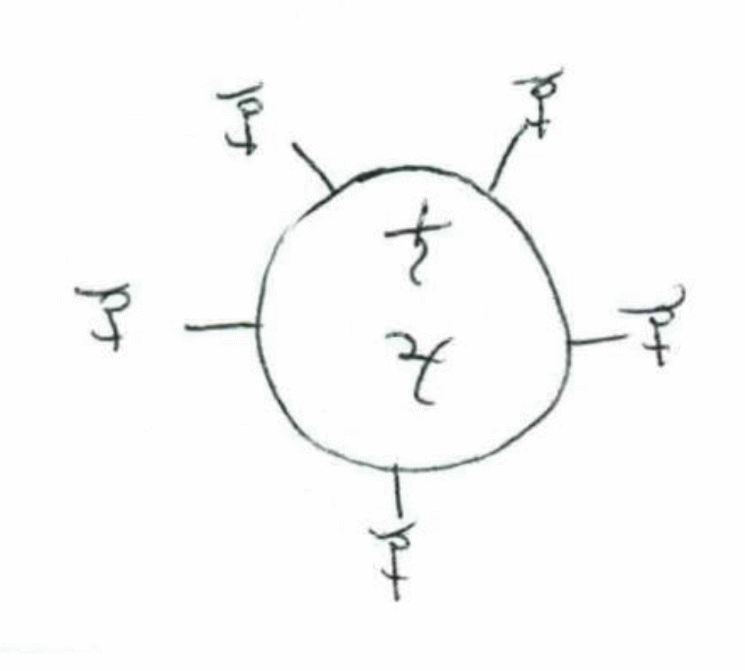
[Note: See FIGURES 1983 0427a-1-AB, Absolute Soul and Emanant Unit Souls, and 1983 0427a-3-AB, Void and Individual, appended to this transcript for the following.]
RC: I think we could call the Saturn and Jupiter [diagram], I mean, and everything deeper than that, everything more internal than that, we could speak of as the all-encompassing Void. [DB assents, faint] And that the principle of conscious ego emerging from it would be Mercury's realm [diagram], that through the participation in-- in Mercury's realm, what we call the conscious ego emerges.
S: Isn't Mercury the point of consciousness? Sorry.
S: Yeah, no, that's what I was--
BS: You've introduced a third term over the last quote which is a kind of sequel. [RC assents] Ok, but it seems to me we still have to consider awareness and the Overself as super-conscious as being two sides bes-- Anthony said two sides of the same-- [RC assents] well-- well I'll say coin. [S, very faint: Essence.] Two sides of the same essence. So wouldn't that point include the awareness and the super-consciousness of the Overself, one aspect of the Overself being more encompassing whereas one-- and the point where (their/that) conscious ego emerges from, if we leave off the conscious ego, we just think of that emergence being in that ray, I'm trying to pictorialize it, then you would have that point having a double aspect also.
AD: I would agree with that Bert.
BS: Excuse me?
AD: I would agree with that. At the point where, let's say, the ray comes out of that circle, at that point, the conscious ego is being projected. Inside of that circle you can speak about the Void because there would be no distinction between speaking about the (soul/Soul), World-Mind, and the One as Void, all three would be-- are referred to as Void. There's nothing there, I mean, you won't find any thing there. It's a voidness. At the point of projection where that light emanates from it, that's the individuality, that's the conscious ego, which is going to be different from another conscious ego which let's say is emerging at another point. So if you think of the symbol of the Sun, you know, the Japanese flag, with the rays emanating from the Sun, each one of those rays would be a conscious ego. At the point of conjunction between the two, let's say the Sun-circle and that line coming from it, is where on the one hand the conscious ego steps into the Void--that of course is the mystical death--or descends into manifestation, at any level of manifestation, from that point on, any level down, you can speak about a conscious individuality.
AH/S(?): Yeah.
AH: Anthony, could this quote be connected to the-- to the one we discussed first, in the sense that that conscious ego, that principle of awareness is inherent there as well as in itself?
AD: Is inherent there-- well you-- like--
AH (simultaneously): As a cos-- as conscious ego?
AD: Well I-- elaborate what you mean, [AH simultaneously: Well--] I mean, say a little more.
AH: You describe this point where the conscious ego emerges from the Void. And in the other quote we were trying to decide if there's distinction between awareness as principle and awareness as somehow involved in the act of knowing.
AD: In the previous quote we had a distinction between the principle of awareness and awareness itself.
AH: Yes. Yes, see, awareness itself and the principle of ware-- awareness, is that-- that's where you're making distinction?
AD: Yeah. One is a universal, undifferentiated consciousness and the other is a consciousness that belongs to an individual, or you can speak of the origin of the individual there.
AH: So, then the connection would be Void is awareness itself and the principle of awareness the conscious ego?
AD: Yeah, is the underlying individuality, is the consciousness in the ego.
AH: The consciousness in the ego but not the conscious ego.
AD: Well you can say ego means "I".
AS(?) (faint): It's the other way around.
AH: Well then (you're essentially--)
RG (simultaneously): You flipped the words I think.
S (faint): Which one(s)?
RG: I think you meant the same thing. I think you meant to agree with the other way of saying it. The principle of awareness is the underlying one, the awareness would be like the conscious ego.
AH: Is that so?
AD: Yeah, yeah.
AH: You meant to say that the principle of awareness is the Void and awareness is associated with the conscious ego.
AD: With individuality.
AH: The principle is the Void. (laughter, student words)
AD: Yes. The principle is the Void. The experience of the Overself is just like the experience of the Void.
AH: And awareness itself is to be associated with the contents of the ego.
YOU CANNOT SPEAK OF INDIVIDUAL AWARENESS UNLESS IT IS ASSOCIATED WITH SOME ASPECT OF MANIFESTATION
AD: Awareness itself has to be associated with some aspect of manifestation.
AH: How can it be awareness itself if it's associated with contents?
AD: Because you cannot speak of individual awareness unless it is in association with some aspect of manifestation. In other words, I have to think of myself as such and such. I think of myself for instance as the augoeides, or the star, or I think of myself as the sunlike body or the rational mind, or I think of myself as an ego, alright. Unless there's something I can associate with, there is no speaking of an individual consciousness.
AH: But I thought awareness was being made distinct from thinking in the first quote.
AD: Awareness is made distinct from thing? Yeah.
AH: From thinking and from body.
AD: Yeah, from any content, yeah. But unless that awareness is associated with some content, there will be no individuality to speak of.
AH: And it seems that if it is associated with some content-- content there could be no awareness.
AD: How could you say that, [RG simultaneously: No there--] how could you be aware of what I'm saying unless there's a principle of awareness operative in you understanding and illuminating the functioning of your mind to yourself? [short pause] And that awareness in you which illuminates your mi-- mental functioning, alright, is individual because it's not mine.
AH: Right.
RG: I don't know why you wouldn't say though just in that-- say, for there to be individual awareness, there's awareness associated with some type of thinking, conscious ego, some historicity.
AD: Some-- yeah, some content.
RG: But the awareness aspect of it, I mean--
AD: The asmita principle, yeah.
RG (simultaneously): The asmita principle--
AD: Is the principle of pure manifestness. It has no standing being, you want to go on?
RG: No, I want-- well not-- not that way.
AD: It has no standing being, alright, then what is it? If-- when it has no standing being, alright, you can't speak (of it) as individual.
RG: Right, I-- right, and I would try to say that, to speak of awareness at all you can't speak of it as individual, and the association of individual awareness is the association of awareness with a-- with-- with an ego or with an in-- with a-- with a-- a sheath or with a body or with some-- some sort of--
AD (simultaneously): I'm sorry (Vic), would you say that again?
RG: An awareness, whether it's the principle of awareness or awareness, that-- to bring in the word 'individual' now seems to be bringing in an aspect of a-- some sort of sheath or some sort of [AD simultaneously: Uh-hm, (yeah).] ego or some sort of thinking, which can be distinguished from awareness per se.
AD: From the principle.
RG: From the prin-- yeah, or aware-- I mean I don't-- I still don't get the distinction of awareness and principle of awareness. It seems when you say an individual awareness you're already associating the principle of awareness with a historical field, with a s-- with a his-- with a-- with a ego-conscious-- with an ego. I don't know.
AD: With some content, yeah.
RG (simultaneously): Right, [S simultaneously: With distinct (one word inaudible)] with some content. And that's-- that association of awareness with that content, that fusion is what we call now the individual [AD simultaneously, faint: Yeah.] awareness.
THE PRINCIPLE OF MENTALISM: EACH INDIVIDUAL AWARENESS OR CONSCIOUSNESS PROJECTS FROM WITHIN ITSELF THE ENTIRE WORLD FOR ITS OWN EXPERIENCE
AD: Yeah. And that's-- that's the principle for instance of mentalism, that each individual awareness or consciousness projects from within itself the entire world for its own experience. And each individual ray of consciousness must do that for the, let's say, owner of it, through which he has experience of the sensible world, what he projects out. And that's why the principle of awareness is one thing, the individual awareness of each entity is distinguished from it. [RG assents] Not separated, [RG simultaneously: Uh-hm, right. If the person (is the--)] distinguished. And-- and this way you can think of the soul as a one and you could think of it as a many. And you have to think of it in both ways in order to have answers to the questions you're going to ask.
AH: Anthony? I think-- I think my-- my difficulty in understanding this has been perhaps another issue altogether, if it is, ignore it, that logically we can conclude what we have about the principle of awareness and awareness as associated with an individual.
AD: This has got nothing to do with logic.
AH: Well how shall I--
RG (simultaneously): That's for sure. (RG laughing, bit of laughter)
THE KNOWER CAN'T BE KNOWN, AND YOU CAN'T MAKE AN OBJECT OUT OF IT
AH: Can I-- can I ex-- how-- in terms of my own individual experience in my own knowledge, can I know awareness?
S: Yeah.
AD: If-- in what way you speak about knowing(./?) We have to clarify that because we-- [AH simultaneously: Can I--] we had that last week.
AH: Can I know it--
AD: Objectively?
AH: --in connection with the way that you've described it? In order to follow what you've said about this distinction, the knowing of that distinction, is that to know the awareness in my own stream?
AD: I'm sorry, I still don't follow you.
AH: Like-- like, if you put this in the context of experience, individual experience, and I look in my experience for awareness, I wish to know--
AD (simultaneously): Who's looking?
AH: I wish to know--
AD (more forcefully): Who's looking?
AH: The awareness.
AD: Well then how could you see it?
[short pause]
AH: Can't see it.
AD: No.
AH: It is the seeing.
AD: Yeah. [short pause] So your question was answered on two points, right? [short pause] First of all it shows that the question is absurd. [short pause] How could the knower be known? How could you make an object out of it, which is a very obvious thing. But all that can be an object is the content that it projects from within itself. That is its content, is what gets known.
AH: And then how can [AD(?), very faint: No.] associate it with a content?
AD: How can it be associated with a content?
AH (faint): Yes.
AD: If (you/you're) projecting it from within yourself how can it not be associated with that content?
AH: How is it associated?
AD: No, I-- [couple inaudible student words simultaneous with AD] you didn't follow me. [AS: Yeah.] How can it not be associated if it's its own content that it's projecting forth? How can you not be associated with let's say an anima projection? [AH simultaneously: That's what I thought.] To begin with it's there. It's its content.
[short pause]
S: Yeah.
RC: Like instead of the flashlight principle could you conceive of your mind not being associated with its dreams?
[short pause]
AD: But you see that-- then another question comes up. This content of this pure consciousness, alright, where did it come from, you know. What's it all about? Well, we've been discussing that for years. If you don't see that we've been discussing that and then of course we have to go over it again…but it won't be with me. (bit of laughter)
HS: In this discussion are you making a synonym between consciousness and awareness?
AD: I'm using them interchangeably.
HS: Interchangeably, yeah?
AD: Awareness is more precise, consciousness means the perception of objects together, in their togetherness. But awareness is a more precise term because you can't break it down in analysis. [short pause] Let's try another one Randy.
SATURN IN LEO AND JUPITER IN VIRGO REPRESENT THE DIVINE PHASE OF THE OVERSELF, AND MERCURY IN PISCES REPRESENTS THE DEMI-DIVINE PHASE, THE ASMITA PRINCIPLE—THAT PRINCIPLE OF AWARENESS THAT IS OF ETERNAL GENERATION
PB [V14, 22:3.386, RC reading]: "The mysterious character of the Overself inevitably puzzles the intellect. We may appreciate it better if we accept the paradoxical fact that it unites a duality and that therefore there are two ways of thinking of it, both correct. There is the divine being which is entirely above all temporal concerns, absolute and universal, and there is also the demi-divine being which is in historical relation with the human ego."
[short pause]
LR: I gotta hear it again, I'm sorry Randy.
PB [V14, 22:3.386, RC reading]: "The mysterious character of the Overself inevitably puzzles the intellect. We may appreciate it better if we accept the paradoxical fact that it unites a duality and that therefore there are two ways of thinking of it, both correct. There is the divine being which is entirely above all temporal concerns, absolute and universal, and there is also the demi-divine being which is in historical relation with the human ego."
[short pause]
AH: Can--
LR (simultaneously): And both-- in other words both are referred to as Overself?
S (faint): Uh-hm.
S (faint): [one word inaudible]
AH: Can the theme of the last two quotes be taken as one?
AD (simultaneously): No, just this quote is enough, this quote is a mouthful, this one.
HS: [one/two words inaudible] could you do one sentence?
LR: So he's say-- it seems like he's saying that if you restrict Overself to either one of those, you're-you're [RG and DB assent] tripping it-- you're going too short.
[student assents, very faint]
AD: Yeah.
LR: You're limiting it.
RC: Yeah.
LR: That it has to include the active or a manifest temporal sequence as well as that which is in con-- conjoined with-- with the Nous. That both those aspects are what he means by Overself.
RC: Uh-hm.
AD: Well what does he mean by divine and what does he mean by [HS simultaneously: By demi.] demi-divine.
LR (simultaneously): Oh I thought that's what he meant.
RG: Yeah, right.
AD (simultaneously): Well-- say it again.
LR (simultaneously): That-- that the divine aspect is that which was conjoined without moving away from the Nous, that was always in contemplation of those principle. And that the demi-divine was that aspect which dared to--
AD: No, it didn't dare, it's a [LR simultaneously: --manifest itself.] natural, (it's inevitable). (laughter, student words) (You're thi--) you're thinking of [couple words inaudible] you're thinking of when Plotinus says the audacity of the soul? [Note: See Plotinus, V.1.1, second para.]
LR: Yeah.
AD: Yeah. So-- and in Plotinus or most of the ancients, they would speak about a tripart division of the soul. But he's speaking about the divi-- division of the soul as dual here, alright. But you can see that that Jupiter could be referred in either phase.
LR: It could go either upper--
SUBTLE INTUITIONS AND PROMPTINGS COME NOT FROM THE OVERSELF BUT FROM THE MERCURIAL PRINCIPLE
AD (simultaneously): Yeah. So if you think of the Saturn and Jupiter as the divine phase and the Mercury as representing the demi-divine phase, the asmita principle, that principle of awareness, alright, which we said is of eternal generation, if you don't understand that principle, you can't understand metempsychosis; you can't understand reincarnation; you can't understand any of these very important subtle intuitions and promptings that come from your past. Because they're not going to come from the Overself. They're going to come from that principle, the Mercurial principle, which is that ray of (life/light) within you which is associated, which has, let's say, the-- the past.
LR: Yeah, but that is the Overself as well, I mean the quote said that--
AD (simultaneously): Yes, if you-- if you-- if you remember now that that principle and the principle, the Saturn principle itself, that these are two aspects of one and the same thing, it's one essence, two persons.
LR: Ok, now do you think he's consistent in that, in other words, do you think when we refer to Overself we should always include that aspect of that whi-- of the Overself which goes into-- descends into manifestation and experiences in temporality its historicity?
AD: If-- if the person is in contact with the Mercurial awareness or-- the principle of awareness within his individuality, there will be no difference between that and the Overself except that in once case you're functioning as a, you know, a person in the world, in the other case you'd have to be in trance.
LR: Yeah.
AD: But essentially they're identical.
AH: Anthony, what does it mean (that the/if a) person's identified with that Mercurial function?
AD: To-- to-- to look to this awareness within you as your guiding-- as your guidance.
[short pause]
AH: But I thought we said it was the looking.
AD: Yes, it was the looking.
AH: How can you look to--
AD: You just look to it. Don't split words here. You just look to that for guidance.
AH: Well how do you do that?
[slight pause followed by laughter]
AD: Silence. Stop chattering. In other words, you have to keep quiet, mentally you have to keep quiet. That awareness can flood you. Or it could very gently tell you what to do. Intuitively, silence, through silence.
AH: But if I'm quiet how is that different than trance?
AD: How is that--
AH: How is that different than trance?
AD: It depends on your definition of trance, if you think of it as the cessation of bodily functions, alright, that would be a difference. But it's not necessary for you to cease functioning, but to go-- to get intuitive guidance. [short pause] Trance puts you out of the-- out of it completely, alright. We can speak of a trance state when for instance the-- when you are, let's say-- when you're-- the self-recognition that you are this individual awareness seeks to merge into its source, then you've got to go into trance.
LR: Again please?
AD: When you recognize yourself as this principle of awareness, this individual awareness, and you seek the source, then you have to go into trance. The body cannot function at that-- Because, it's the-- it's-- it's what they call the mystical death, you're going into the Void. Bodily functioning ceases. Or it's so slowed down that there's hardly any diff-- difference.
AH: But that intermediate state then when a person is associated with his individual awareness but not in trance, is that-- is that like condition of the Sage?
AD: Yeah. (To rest) constantly intuitively aware.
AH: I see.
AD: Let's try another one.
RC (simultaneously): (We've talk--) we've talked earlier about like the Buddha remembering his earlier incarnations, that the memory of the earlier incarnations would be coming up to the Mercury and it's through his association with a particular series, and what would really be making him a Buddha would be-- would be simultaneously operating with the-- the Saturn Jupiter as well.
S: Anthony, would the Mercury phase then be the only place where you could speak of an individual Overself?
AD: Would be the only what?
S: Would be the only place where you could speak of an individual Overself?
AD: Yeah.
S: At the Saturn there wouldn't be an individual.
AD: Then I think the quote that he used last week when he spoke about it as the father of mankind, I forgot the way he put it.
RC: Only one Overself for the entire race, that the point of contact with it is different for each individual and constitutes the higher individual (awareness).
[student assents, very faint]
THE MERCURIAL PHASE OF THE OVERSELF IS ALWAYS ASSOCIATED WITH MANIFESTATION
LR: Can I-- could I ask and see if this is divergent? It's-- is the Mercury aspect, what you're calling the Mercurial aspect always associated with life?
HS: With what Linda?
AD: It's always associated with manifestation.
AH (faint): With life.
LR: Is that life?
AD: Well, it has to be.
LR: Ok.
AD: If you were living in the au-- in the au-- body of the augoeides you would be full of life.
LR: Well, in--
AD: You wouldn't be dead.
LR: The Mercury aspect is what you consider to-- what he considers in that quote to be the receptacle for the historicity of the individual.
AD: Yeah, it is that which makes the associations with any phase of its own content.
LR: And when a person dies, is that Mercury or the history-- the historicity of the individual, does that reside in the higher phase?
AD: No, resides in the Mercurial phase.
LR: And where does that reside?
AD: That doesn't reside anywhere.
AB: That resides (there/here).
AD: Next book, it's-- in one of the future quotes he's going to show you that it's infinite too.
RG: So are you--
LR (simultaneously): So then it's not necessarily associated with life manifest.
AD: It is. It has a content of its own.
LR: Well, in other words, it stays bound up with manifestation even if the body died.
AD: It is the principle of manifestation as far you're concerned.
LR: And when the body dies--
AD: It's still in a state of manifestation.
RG: It's still [LR simultaneously: Ok, that's the-- that's (important).] the principle of manifestation, it just gets [one word inaudible]
AD: When the body dies doesn't mean that you go into an unmanifest condition, you just go on to somewhere else.
RG: Is this what Guenon would call causal manifestation, that level?
LR: That's puzzling.
[student assents, faint]
RG: So in--
AD (simultaneously): If I remember him.
RG: Right, but I mean, so in a Vedantic sense it wou-- I mean, are you equating this with like the anandamaya kosha, the Mercury?
AD (simultaneously): Uh-- the what?
RG: The-- the Mercury, the--
AD: No, the Mercury can be associated from the anandamaya kosha all the way down [RG simultaneously: Down, yeah.] to the annomaya kosha, [RG: Right] any level(--/.)
RG: But it includes the level of the anandamaya?
CONTEMPLATION ON ASMITA CAN MAKE YOU OMNISCIENT BECAUSE IT INVOLVES YOU IN SOUL ITSELF, THE UNDIFFERENCED KNOWLEDGE
AD: Yeah. Above that is-- is the asmita principle itself. This is the thing like I pointed out where Dasgupta and quite a few of the commentators on the text don't understand how contemplation on asmita makes one omniscient. Because contemplation on asmita in-- involves you in the soul itself, [RG assents, faint] the undifferenced and absolute knowledge.
RG: And by asmita here you mean the totality of your entire manifestation.
AD: Not the totality as much as the principle of that (life/light) which is coming from the soul. [RG simultaneously: So why do they call--] To turn the (life/light) within you on itself. Of course this is incorrect speech. Because it's-- it can't be reflective in any way.
RG: If it's-- then why would it-- why is it called asmita?
HS: Yeah.
ASMITA IS THE PRINCIPLE OF YOUR INDIVIDUALITY, AND THE ACTUAL EXPERIENCE OF THAT I-PRINCIPLE IS QUITE AUTHENTIC
AD: Because it's the principle of your individuality. What does asmita mean? [one/two inaudible student words simultaneous with AD] Timothy--
TS: I. (bit of laughter)
RG (faint): What did he say?
TS/S(?) (very faint): (Asmita.)
TS: As-mi [TS possibly makes it sound like "Ask me"]?
RG (faint): Right, ok. (laughter, student words)
AD (amidst laughter): Let me ask you this Timothy, is it the same as ahamkara?
TS: I think it's about the same as ahamkara, [AD simultaneously, faint: (No.)] not the same.
DB (simultaneously): English! (bit of laughter)
CDA: I.
TS: And it is-- I think it's the principle, it means "principle of I".
AD: Ahamkara means I-maker.
RG (simultaneously): I-maker.
TS: Yeah, I-maker.
S (simultaneously) (faint): I-maker.
AD: Asmita means "I".
TS: Yeah.
AD: Don't-- doesn't it sound that there's a difference?
S: Uh-hm.
TS: Think so.
RG: Yeah.
RC(?) (faint, possibly part of background): What's new?
TS (simultaneously): Um--
AD: Yeah a-- ahamkara is a lower version.
TS: That's a maker of the individual vehicles then.
AD (simultaneously): Yeah.
TS: Asmita I think means principle of "I", [sounds like AD assenting] that's (fine). [CDA simultaneously: (We are--)] Not avidya, that's not--
HS: But doesn't-- isn't there a-- an implication of identification with a false sense of "I" in that asmita?
S (faint): (Say again please?)
AD (simultaneously): That's no false sense of "I".
HS: Well, the way you're using it no.
AD: No, it's no false sense of "I", it's the-- it's a true "I".
RG: It--
S: (Wait a minute.)
HS (simultaneously): We're just quibbling on words.
RG: It's a tr-- ok. Right. Uh-hm.
AD: If-- let me-- let me exaggerate it, alright. Let me say that you're a very good fellow, alright, and when you die you go right up to your star, alright, right from the star where you come from, and you're robed in-- or dressed in this beautiful suit of clothes, reason-principles, alright.
LR: You could say (robed/robe). (bit of laughter)
VM: Yeah, yeah [one/two faint inaudible words, possibly another student]
AD: Ok?
LR: Alright.
AD: It's the same "I" there that's here. It's that same pure principle.
HS: So in that sense it's not-- you can't--
AD: Huh?
HS: Can't speak of it as a false sense.
AD: No, it's not false.
HS (faint): Ok.
S (very faint): Good.
RG: But being the real sense of "I", isn't there some sense where it's the wrong sense of the principle of awareness?
AD: Um--
RG: Being the real sense of "I" isn't there some sense in which it's not the right sense of pure awareness? Isn't that where the false aspect of asmita comes in, when--
AD: No, I-- I don't-- I don't agree with that, I-- I've heard that interpretation.
RG (simultaneously): No I don't know, I mean--
AD: And I don't agree with that interpretation. Because the actual experience of that I-principle is quite authentic.
AB: Haven't we said that the lower phase of the Overself is real and eternal?
RG: Yeah.
AB: So that it would be your real "I", [RG simultaneously: It is your real "I".] it's not the ultimate source of the "I".
RG (faint): Right, it's alright, it's the real "I".
AD: Alright, let's try another one Randy, I think you can see why you had so much difficulty last week.
MB: Can I ask one question?
AD: Sure.
THE CHARACTER OF THE OVERSELF PUZZLES THE INTELLECT BECAUSE IT UNITES A DUALITY
MB: Some of the quotes-- some of the quotes emphasize the-- the idea that the Overself has this lower aspect and a higher aspect or the more individual aspect and the more infinite totally non-individual aspect. And then the o-- there's a-- the other quote that emphasizes the idea that the Overself is the point of contact between the two aspects. Not that it-- because of the two aspects but it somehow--
RC: Unites a duality.
MB: Unites the duality. Is that how you can--
RC: Yeah, that was the--
S (simultaneously): It's the same quote.
RC: Because of the paradoxically dual nature, it-- that does unite a duality.
PB [V14, 22:3.386, RC reading]: "We may appreciate it better if we accept the paradoxical fact that it unites a duality and that therefore there are two ways of thinking of it, both correct."
MB: Ok. So this-- the point (isn't-- is) really metaphor, not--
AD: Not a metaphor, Myra. It's a very difficult thing to understand. I mean when intellectual giants like Coomaraswamy and Guenon can't understand this principle, alright, you're going to have difficulty too. When they insist on ridiculing the notion of reincarnation, criticizing it, criticizing what, you know, anyone who has any understanding (wouldn't) say that's not the theory of reincarnation, that's a misunderstanding, and they criticize a misunderstanding, you can see that they don't have the correct principle of what reincarnation or metempsychosis is all about. So naturally it's a difficult thing to see-- to-- to understand this way of looking at it.
MB: I guess I have trouble with the-- with the con-- with the concept of point and when I said metaphor-- 'cause when I usually think of point I think of something that has no extension, but the-- the-- the lower aspect of the Overself seems to be in-- the O-- the principle of Overself seems to be fairly extensive, it seems to extend into the realm of the infinite as well as into the realm of the--
AD: There again you're saying that this principle of "I", alright, is quantitative. And how could you say that? I don't care how big the size.
RG: But, on-- on that-- on that quote about the point, isn't it the demi-divine-- from this quote, isn't it where that demi-divine principle meets the conscious ego that's in the heart, when he-- when he uses that?
MB (faint): No, same quote, [HS simultaneously: But--] it's the same quote.
HS: Well do the quote.
AD (simultaneously): Where they meet?
LR (simultaneously): Uh-hm.
RG: Where they meet.
AD: Where they meet, yeah.
RG: That it's not the pure principle of Overself as the un-- universal.
AD: Uh-hm.
RG: It's where the demi-divine portion meets the conscious [AD simultaneously: Uh-hm.] ego.
S (faint): Yeah, so what are they calling [one word inaudible]
MB (simultaneously): Well, you're saying now there's the pure principle of Overself and the impure principle of Overself?
RG (simultaneously): No not-- no, the demi-divine and the divine. Don't say impure.
RC: Ok. (bit of laughter)
MB (simultaneously): The demi-divine aspect of the Overself?
RG: Right, it's the one that's in historical relation and-- through all your incarnations and as distinct from somebody else's, that's the demi-divine.
MB: Yeah.
RG: There's the pure principle of Overself which is one and the same for everybody, and there's the conscious ego which is the manifested product of that.
MB: Well--
HE: What are you saying?
MB (simultaneously): I guess the-- the problem [few words inaudible] the pure principle of Overself he means like the demi-divine is a-- is not-- not--
RG (simultaneously): Well, it isn't the pure awareness per se, I mean--
S (faint): [couple/three words inaudible]
RG (faint): Well you can't talk.
JfL: Anthony? (some laughter, student words) Anthony, how you're talking about the Mercury principle projecting the contents for its experience, in that projection there's the World-Idea and the--
RC: Uh-hm. Yeah, and I think at the asmita level they would still be in union. The separation that comes in later between that-- the empirical person and his world at that stage is, you know-- [short pause] On that thing with the point not being a metaphor, to-- to me it's the most real thing that I know about in the sense that, if I come back-- I mean we can do it with the technical language of saying if we can conceive of a-- of a point, in this sense it might seem to be metaphorical, where the sa-- the eternal and the temporal somehow meet. Then it might seem to be metaphorical but, if I think of it in terms of there is like a point which is really my point of origin in that it's what allows my attention to-- to be a center, to be a bindu, and I can turn it outward and have experience, or I can turn it inward and have non-experience. But in either case whatever I do with mine doesn't equal to yours, for you. [AD/S(?), faint: Right.] So you can do the same thing, you have the same choice, independently of what I do. That I-- I have that awareness to operate with as an individual, and so do you. And in that sense it seems I could say well mine is a certain point and yours is a certain point, like a bindu. And, in that context it-- it doesn't seem metaphorical at all. For me to turn it-- to have the power to turn my attention towards something completely independently of what you do with your attention, kind of a--
MB: I just maybe, you know, was getting too spatially oriented. The notion of this point, it's not limited to that borderline region, you know, it's not-- it's not stuck in the middle there [diagram]. But it actually functions in both realms.
DH: Yeah.
RG: [couple words inaudible]
DH (simultaneously): But Myra, also if you-- and technically if you have a-- if you have a point that-- you know, as the-- defined as the intersection of two lines, the two lines are really part of a point. [S: Uh-uh.] I mean you can't-- [MB simultaneously: And vice versa, the point is part of a li--] you can't separate the point from the two lines, [MB: Right.] and if they're-- they're both-- I mean-- the two lines are as much a part of a point as you can have two points joining-- with a line joining the points, [MB assents, faint] you say that those points are part of the line. Doesn't that make sense? [sounds like MB assenting] And when you look at point in that way as being defined by the line, the line's a part too. You just have to think of-- you know, we're so used to thinking (in part) [couple words inaudible] these relations of [one/two words inaudible] different way but-- But this point that we're (talking) doesn't exist independent of it being the-- the joining things or it being junction [one/two words inaudible]
HS (simultaneously): So the junction that we're talking about now is [S, faint: (Demi-divine.)] the demi-divine with the conscious ego?
RG: Well, I think there are two, there-- I mean, there's this way to speak about the demi-divine as the point between the divine and the conscious ego. You know, I think that's the way that [HS simultaneously: Oh you--] Anthony's using it. And then there's the other way you could speak of it as a point, as the-- between the demi-divine [HS, faint: And the conscious (ego)] and the conscious ego. [HS simultaneously: Yeah. (couple/three words inaudible)] [couple/three words inaudible] light, I'm saying in-- in this body maybe there's a point.
RC: Well for me I think what makes the demi-divine, demi-divine is that it does stand in necessary relation to an evolving ego. I mean--
RG (simultaneously): But, doesn't it stand in internal relation to it?
RC: Between-- yeah, to a specific--
HS (simultaneously): To an ego?
RC: To a specific thread of evolution.
RG: Uh-hm.
DH: But-- but without both of those aspect of it, it wouldn't appear, I mean the point it doesn't-- it's not independent of the-- the two things in his chart [diagram].
MB: Not only that but the two things are not independent anyway.
RC: Right.
RG: No but I think it is independent, I don't think it's a coroll--
RC (simultaneously): The second one comes out of the first.
RG: Right, it's not a corollary relation. The demi-divine exists independent of the particular ego that it's related to but not vice versa.
DH (faint): That wasn't the way I understood it.
RG: Well then let's talk about it but--
DH (simultaneously): No, when the--
RG: The demi-divine--
DH (simultaneously): When souls absorb back into the Overself [couple/three words inaudible] if any [one/two words inaudible]
RG (simultaneously): No I disagree with that, it's an eternal-- it's an eternal principle, it doesn't eva-- as Anthony just said, it doesn't-- when the conscious ego of this life dies, demi-divine principle doesn't go anywhere, I mean--
LD (simultaneously): But it's always related to some thing, some [student assents] sheath or ego.
RG (simultaneously): Yes, it's own-- it's own internal-- right. It's own internal content.
LD (simultaneously): So you can't ever speak of that demi-divine as being non-relational.
S (simultaneously): No.
RG: No-- well, I don't-- I think [DH simultaneously: That's still kind of (one word inaudible)] that idea of relational is-- could be the most [couple words inaudible]
DH (simultaneously): That's still-- that's just another level of manifestation.
S (faint): Read the next quote.
S (faint): Right.
S: Yeah.
S: Yeah I know. (bit of laughter)
RC: No I mean I think we are ready for--
HS/S(?): Alright.
PB [V14, 22:3.390 and Perspectives, Chapter 22: Inspiration and the Overself, #11, RC reading]: "Because of the paradoxically dual nature which the…"
RC: Hard to read this one but--
THE PARADOXICALLY DUAL NATURE OF THE OVERSELF: "IT PARTAKES ON THE ONE HAND OF A RELATIONSHIP WITH A VIBRATORY WORLD AND ON THE OTHER OF AN EXISTENCE WHICH IS ABOVE ALL RELATIONS"
PB [V14, 22:3.390 and Perspectives, Chapter 22: Inspiration and the Overself, #11, RC reading]: "Because of the paradoxically dual nature which the Overself possesses, it is [very] difficult to make clear the concept of the Overself. Human beings are rooted in the ultimate mind through the Overself, which therefore partakes on the one hand of a relationship with a vibratory world and on the other of an existence which is above all relations. A difficulty is probably due to the vagueness or confusion about which standpoint it is to be regarded from. If it is thought of as the human soul, then the vibratory movement is connected with it. If it is thought of as transcending the very notion of humanity, and therefore in its undifferentiated character, the vibratory movement must disappear."
[12¾ second pause]
HS: From the top?
RC (faint): (I think so.)
PB [V14, 22:3.390 and Perspectives, Chapter 22: Inspiration and the Overself, #11, RC reading]: "Because of the paradoxically dual nature which the Overself possesses, it is very difficult to make clear the concept of the Overself."
RC: That seems to be an easier sentence to explain than the ones that come after. (some laughter, student words) But usually a concept tries to be very specific and begins with either/or thing, something can't be two things at once and so on and so forth. But he's saying that because what he's talking about is-- is dual, that it's difficult for the conceptual mind to make clear what it is that it's trying to point to.
HS: And that-- and that dual paradox is what we spoke about in the previous quote we just [possibly one word inaudible]
DB: The divine and the demi-divine.
S (very faint): (Ok.)
S (faint): Yeah.
PB [V14, 22:3.390 and Perspectives, Chapter 22: Inspiration and the Overself, #11, RC reading]: "Human beings are rooted in the ultimate mind through the Overself, which therefore partakes on the one hand of a relationship with a [RC reads: the] vibratory world and on the other of an existence which is above all relations [RC reads: relation]. A difficulty is probably due to the vagueness or confusion about which standpoint it is to be regarded from. If it is thought of as the human soul, then the vibratory movement is connected with it. If it is thought of as transcending the very notion of humanity, and therefore in its undifferentiated character, the vibratory movement must disappear."
LR: So humanity must mean there manifest [HS: Humanity.] contents attached to that?
RG: Individual.
DB: Mercury.
S (very faint): [couple words inaudible] better read that again.
MC(?): So he seems to be speaking of life in two-- in two worlds, or the life in the cosmos and the life in the Intellectual, in the Nous.
RG: Uh-hm.
RC: And he seems to say that the Overself makes those-- makes what appears to be two worlds one, that it unites that duality.
S: It spans--
DB (simultaneously): Well that's-- that's-- I mean--
S (simultaneously): It spans them both.
RC: Well, I don't think it's so much-- well at least I'm not getting the impression that he's saying it spans them both, but that it makes what appears to be two actually one.
DH: To say it spans them both implies that there's two separate [one/two words inaudible]
RC: Right.
[student assents]
S: Yeah.
DB: Yeah but, I mean, doesn't he make clear distinction between on the one hand you've got vibratory activity and on the other hand you don't? And when you're speaking about vibratory activity you're talking about human souls, [RC assents] and when you're not you're talking about a-- an existence that transcends that-- that vibratory humanity?
RC: Uh-hm.
DB: So, I mean, for purposes of discussion, not to dispute the notion that (view/you)-- that the Overself is a paradoxa-- paradoxically-- or a duality, you know, trying to understand that, but I don't see how that brings the two worlds any closer together.
RC: Well I guess what I was objecting to was the notion that there are two worlds that need to be brought together. That's why I didn't like the flashlight thing you started with, which is basically I would much rather think in terms of whatever is out here [diagram] gets drawn upon by this principle and manifests it from within, the Overself is consistently operating through the Mercury to manifest its own content in terms of a later duality between ego and world.
DB: I followed that but I-- I--
RC (simultaneously): Like if when you speak a sentence, if the sentence actually embodies your meaning--
DB: Gotcha, yeah.
RC: If you're drawing upon yourself to speak a meaning, then is the articulation a different world than the world in which the meaning exists while you're speaking?
DB: In my case? (bit of laughter) Generally yes.
RC (simultaneously): If you-- if you actually get your views expressed.
DB: I don't know because-- you know, ordinarily I take the other point of view but just in the perspective of this quote I guess I still am unable to follow the conclusion that you've drawn. I mean it seems as if there aren't-- there is on the one hand this vibrational activity, movement, and on the other hand there isn't, ok, and the Overself, so to speak, partakes of both. But I don't see how in that partaking that-- I really don't see how it draws them into a way that I can see them in a unified perspective.
RG (simultaneously): The-- well because the quote also says it's not one or the other. It isn't that one stops and the other starts. And that's why it's hard to bring the concept together. It-- they go on simultaneously.
DB: Well you see but that's-- but the-- I mean that's in reference to the Overself specifically here.
RG (simultaneously): We're only talking about the Overself, two aspects of it.
DB: Right. And I was looking for the-- the contexts on-- I mean, he speaks of it-- in the first place he establishes it as a duality, right?
RG: Dual nature.
DB: There's a dual nature of the Overself, right. On the one hand it takes-- partakes in this vibrational manifestness, on the other hand it doesn't.
RG: Yeah.
DB: Ok. So there are a few things that are under discussion. Or not?
RG (simultaneously): There's two aspects of one principle, [DB simultaneously: Of the Overself.] not two things, right.
AD: Two aspect? [sounds like DB assenting, faint] Go on. [RG(?) simultaneously: And that doesn't--] One principle is in the Nous and there's no activity there.
RG: Right.
DB: Yes.
AD: The other principle is not in the Nous and is receiving that activity.
RG: Right.
DB (simultaneously): That's right. So--
DH(?): Yeah [couple words inaudible]
DB (simultaneously): [one/two words inaudible] to whom did the-- [one/two faint inaudible student words] to whom was that agreement directed?
[Audio File 1983 0427a Ends]
[Audio File 1983 0427b Begins]
S: [one/two words inaudible] [student assents, very faint] the motion.
RG: Yeah but he doesn't equate the vibratory motion even with the second-- with s-- with the second aspect of the Overself, it's merely its field, it's not itself. The vibratory motion it relates to, but it doesn't lose its character as awareness when it relates to it, it just happens to function in that field.
LR: Couldn't awareness be vibratory?
RG: He doesn't say it is but it could be, I mean he doesn't say it is.
LR (simultaneously): He doesn't say it's not.
RG: Come on Linda, it's not the quote.
DH (simultaneously): Yeah but, the vibratory is not there because it's not something you see.
LR (simultaneously): I don't know why you said what you said, that's what I'm--
RG (simultaneously): Because the quote happens to be-- I think it distinctly says that it relates to the vibratory movement, is connected with it, not that it itself is vibratory. 'Cause I think that would change the meaning of the whole thing if you said that. Then it would make the Overself dual-- dualistic. It would be vibratory motion in one [one/two inaudible student words simultaneous with RG] context and pure awareness in the other, and I don't think that's what he means to say.
LR: Well I think manifestation implied a certain vibratory motion.
RG (simultaneously): Yes, of the content but that doesn't imply it through-- to-- of the Overself, only the content.
LR: But--
DH (faint): Where's the content, I don't follow [couple words inaudible]
RG (simultaneously): That is the vibratory motion, the manifestation is the content.
DH: But it's-- it doesn't exist out separate from the Overself.
RG: Who said it (does too)?
S (faint, possibly part of background): Ok.
S (faint): [couple words inaudible]
PD (simultaneously): Well it seems to be a separate principle from the Overself. The vibratory movement seems to be a separate meaning than the meaning of the Overself. Now its origin may be ultimately the same as the Overself but that's not under question here.
AS: Well maybe that vibratory motion is the activity of that Mercury phase.
LR: Yeah, that's what I was [student assents, faint] saying. Yeah.
AS (simultaneously): Or which is what Linda's implying.
PD: But maybe it's also the activity of the Divine Nous itself.
LR: No.
AS: Well even-- then even more so is it connected with the Overself.
RG: But it may-- even if it's a-- even if it is the activity of it, I would distinguish between the activity of that Mercury phase and the Mercury-- and the consciousness of that Mercury, I mean I think if you read the quote again and, you know, review it, I don't--
RC: Ok, let's read the quote again.
PB [V14, 22:3.390 and Perspectives, Chapter 22: Inspiration and the Overself, #11, RC reading]: "Because of the paradoxically dual nature which the Overself possesses, it is very difficult to make clear the concept of the Overself. Human beings are rooted in the ultimate mind through the Overself, which therefore partakes on the one hand of a relationship with a vibratory world [RC: The one we find human being in.] and on the other of an existence which is above all relations. [RC: Which would be the ultimate mind to which (RG assents) the Overself makes it.] A difficulty is probably due to the vagueness or confusion about which standpoint it is to be regarded from. If it is thought of as the human soul, then the vibratory movement is connected with it. If it is thought of as transcending the very notion of humanity, and therefore in its undifferentiated character, the vibratory movement must disappear."
AS: (And/I mean) I just wanted to point out it seems to me that the vibrat-- the relation to the vibratory activity is that it projects that vibratory activity. [students assent] And that was the only point. [RG/AB(?) simultaneously: Yeah (sure).] [one/two inaudible student words simultaneous with RG and AS] It's not that it-- [PD simultaneously: But-- well the-- that doesn't seem to be there in the quote though.] not that the Overself wasn't vibratory activity. [RG/S(?) simultaneously: (Right, I concur.)] Well I'm just saying, it's misleadi-- it's a little bit misleading, especially in the mentalistic view we're trying to take, to say that there's-- the word there was 'relation'. In one phase it's in a relation to this vibratory activity, it makes you think as if there's a vibratory activity outside of it which [students assent] it must come into relation with and to-- and I think--
PD (simultaneously): And that's when you call it the human soul.
AS: No, no, I think--
PD (simultaneously): Yes, that's when you call it the human soul.
AS (simultaneously): Can I-- can't I just finish?
PD: Well you [one/two inaudible student words simultaneous with PD] never finish Avery, come on.
[short pause with very faint background student talking]
AS: Try again. Ok. No I-- all I was trying to say Paul was that in-- when Linda was talking, you know, about this vib-- the intimate connection of the vibratory activity, I was just suggesting the quote sounds on the face of it like there's a vibratory activity and then the Overself's ray, the second phase of it or the Mercurius must come into some kind of relation with that. And I think that's a point of view but I think also, I was just think-- I thought she was just trying to point out that in fact the vibratory activity was the result of that soul's activity. [LR simultaneously: It defines it in some way.] What is the soul's activity? I'm saying it projects it, the soul's activity is that second phase, the Mercurial phase, and it's giving rise to that vibratory activity. And therefore if it were to withdraw, it would withdraw into itself and it-- the relation to the vibratory activity that itself projected would stop.
PD: Yeah, and my point which I was making was that he s-- calls that first phase the human soul when it's-- this principle is in relation to some type of vibratory activity.
AS: Yes.
PD: He doesn't reduce the vibratory activity to the principle.
AS: Oh but I was saying--
PD (simultaneously): S-- now let me finish, right?
AS(?) (very faint): Ok.
PD: So when you're speaking of the soul as related to the world, to the World-Idea, you're speaking of the human soul, right? And then its phase that's not related to the World-Idea, it's totally the Overself in and for itself.
AS: Well I-- he didn't bring in World-Idea here, I don't find--
PD (simultaneously): Well, that's what I'm calling the world in the first part of the quote.
AS: Well, yeah, the vibratory ac-- I'm not saying any--
PD (simultaneously): No, the very first part of the quote.
AS: I'm not-- I don't think I was saying anything different than that. I really don't. I-- I thought that-- it's ok.
RC (simultaneously): No it-- it does sound like you're saying the same thing in the sense that if-- if by being related to the World-Idea you mean this whole system we had under this before [diagram], that the individual soul comes in, relates to the World-Idea as being manifested by the Solar Logos with its system and so on, that definitely coming into relation with the World-Idea is the operation of the Mercury phase. [Note: See FIGURE 1983 0427a-2, Tripartite Soul and Levels of Cosmos, appended to this transcript.] Is that-- is that what you're saying?
HS: Yeah, he calls human soul.
RC: Uh-hm.
PD: Yeah.
AS: Yeah.
RG: That's (right/fine).
S (faint): (But who is that), yeah?
RC (simultaneously): And you're saying that that same-- you're saying that that same thing means necessarily getting involved with [drawing/diagram] a moment-by-moment vibrating pattern of [HS: Yeah.] changes in ideation within the framework of this-- of Solar Logos' manifestation of the World-Idea.
[student assents]
HS (simultaneously) (faint): The boys are in harmony.
S: Yeah.
AH: Could we have the quote once more please?
PB [V14, 22:3.390 and Perspectives, Chapter 22: Inspiration and the Overself, #11, RC reading]: "Because of the paradoxically dual nature which the Overself possesses, it is very difficult to make clear the concept of the Overself. Human beings are rooted in the ultimate mind through the Overself, which therefore partakes on the one hand of a relationship with a vibratory world and on the other of an existence which is above all relations."
RC: Which I guess I would schematize the whole three of these as the-- as both parts.
PB [V14, 22:3.390 and Perspectives, Chapter 22: Inspiration and the Overself, #11, RC reading]: "A difficulty is probably due to the vagueness or [RC adds: the] confusion about which standpoint it is to be regarded from."
HS: "It", the Overself.
RG: Right, the Overs--
RC (simultaneously): Yeah.
PB [V14, 22:3.390 and Perspectives, Chapter 22: Inspiration and the Overself, #11, RC reading]: "If it is thought of as the human soul, then the vibratory movement is connected with it."
RC: [drawing] Anything under that Mercury [diagram].
AH: Yes.
PB [V14, 22:3.390 and Perspectives, Chapter 22: Inspiration and the Overself, #11, RC reading]: "If it is thought of as transcending the very notion of humanity…then the vibratory movement must disappear."
HS: So there's the implication that the vibratory movement arises out from within it, [S simultaneously, faint: Yeah, it has to.] in that it-- in that it could disappear.
RC: Uh-hm.
AS: It's its own a-- it's [HS: Ok.] the very-- (where he) says the soul's very activity is what gives-- is that motion of the universe, I mean what else could give rise to that vibratory activity?
AH: It seems that like the notion that the concept of the Overself is extremely difficult to evolve is so not only for [one word inaudible] (convention) but, we say that it has-- it has a dual paradoxical nature, and that duality is not in the same format or (same as context). There's not-- [short pause] There's two things but those two things aren't within one way of understanding. [couple/three inaudible student words simultaneous with AH] Because on the one hand, you can't understand the non-relational from the point of view of relation. And it's clearly one side of this paradox is non-relational.
RC: Ok, yeah, and if-- if you got two things that are-- you-- you have two things you're trying to relate and the nature of one of them is that it's not relatable.
AH: Yes, that's a problem.
AS(?): It's-- yeah. (AS(?) laughs)
AH: That's a big problem. (bit of laughter)
HS: Well not only that, when you think of that first one you-- the whole thing disappears, I don't really [RC: Yeah.] see what the problem is.
BS: Well it's a strange thing (bit of laughter) to say it disappears too. It seem-- to me it seems to apply where you say that the vibratary-- the vibratory motion would disappear. Somehow or other, it would seem to have to get absorbed along with the Mercury into the Nous or the Saturn Jupiter phase. And then if it projects itself, the vibratory motion-- well projects, I mean-- if it's go-- if it's gonna use its attention towards [RC simultaneously: To externali--] what we-- if it's going to externalize itself that's automatically or-- or spontaneously a vibratory motion. In that case wouldn't the vibratory motion actually pre-exist, so to speak, before the Overself gets itself projected out?
RC (simultaneously): Ok but not in spite of the-- You know, it seems its content would pre-exist but its manifestness seems to be caught up with this-- its vibratory way of operating. It seems that-- we're talking about a transition from eternity to time.
BS: Yeah.
RC: And it seems that talking about something as having a vibratory way of operating is appropriate to the time context.
BS (simultaneously): Yeah.
AH/RC(?): I mean--
BS: Well--
RC: Like you could hear a piece of music, say Mozart hears a piece of music. And he hears it all in just one moment. But in order to have it played, he's gotta put it into relation with like some tempo, some vibratory movement, in order to manifest it.
[9¼ second pause with few very faint AD words in background]
BS: It's where the idea [one/two words inaudible] not the music.
RC: Ok. Yeah. And to play the music he's gotta have tempo.
LR: So what's the argument?
JA (faint): Well, I [HS simultaneously: Perfect accord.] thought that the distinction that you and Avery made sort of confused [possibly one/two words inaudible] because (bit of laughter) it seemed that you were saying that there's no difference between movement and that manifest-- manifesting Overself. And, I thought I--
S (very faint, possibly part of background): (I don't know.)
JA (faint): I don't think that's quite right. I mean I think it confused-- confused things, you know, just thinking about (it) [few words inaudible] But [one/two words inaudible] I didn't get what you were trying to say.
S (faint): What's the point?
JA (faint): I'm asking them.
LR: Should we keep going on with this?
S (very faint): (We/He) should probably do it.
RG/S(?): Yeah.
S: Let's do at least one.
RG: That it's obviously very hard to elaborate (the nature) [couple words inaudible]
S (simultaneously): Yeah, I (second that). (S laughing, bit of laughter)
AB: Oh no, you shouldn't have asked. (RG laughing)
AS: You're proving it well.
JA (simultaneously): No I thought he clearly said it was connected with vibratory motion and it wasn't saying that it's equating, it's just saying [couple words inaudible]
LR (simultaneously): Ok, well then you have to get into what is the nature of this vibra-- vibratory motion. Is it the nature of that manifest principle of the soul itself or is it some other thing that (move)?
HS (simultaneously): Ok.
RG: But Linda do you-- from hearing the quote--
HS (simultaneously): Ok but from the quote--
AS: It's not really the point of the quote.
LR (simultaneously): Is that the question, I'm just--
AS: No.
RG: From hearing the quote [AS simultaneously: So it's not--] [couple words inaudible] idea you still want to say that the vibratory motion is the nature of that second?
LR: In some way I still do still want to say that.
BS: Nature of what Dickie?
RG: Nature of the-- of the human soul and [BS simultaneously: Oh.] its content. Well, I just don't know where you get that from, I mean, it seems like you're pulling it from somewhere else.
LR: Ok. I--
RG (simultaneously): Yeah.
AH: It seems the [LR simultaneously: I could get back to this (one/two words inaudible)] last part of the quote necessitates speaking from a standpoint, like clearly deciding which standpoint the Overself shall be spoken of from. And, there's a temptation to speak at it simultaneously from both points of view. But that-- that's like blurring standpoint.
RC: Well something that was interesting to me was that Beethoven was one of the people that really pushed the development of the metronome. And, he was really into it and he made statements like, "Each of my pieces of music has a specific soul, is a specific soul. And in order to communicate that, I have to be able to tell musicians the exact time that it's to be played in." So he really wanted his thing that would go so many beats, such and such a rate, so he could point specifically to the soul that he wanted to manifest as this piece. This would actually be the soul of this piece. And I think what Linda's trying to talk about, what Avery's trying to talk about, is that there is a realm of manifestness that bears that message that-- that that very association with like what a metronome does is the way that the soul gets specified in order to get manifested.
LR: Yeah. And I don't think it's po-- I don't know how you would discuss that part that-- of soul or of Overself, namely the Mercurial part(,/.) is he speaking of that(./?)
RG: No I think you would have to speak of that.
LR (simultaneously): Well then I don't see how you could--
PD (simultaneously): I thought the Mercurial part was the awareness.
RG: No but it's the awareness in relation.
LR (simultaneously): Well it's all the awareness.
PD: No, no. This-- the Overself is something superior to awareness, the principle of awareness.
LR: No the awareness-- the Overself is both.
PD: Very good.
S: So then--
PD (simultaneously): But you're now saying that the Overself is the beat.
TS: No he's saying that when you speak of the Overself as human soul, then to speak of it as human soul, the signature of the human soul is this motion, and that to distinguish it as having no reference to motion whatsoever or of vibratory activity of manifestation is to speak of it no longer as individual.
PD: I thought it's the connection to vibration, that the Overself is the soul that's connected to this vibratory movement, not that it is the vibratory movement.
TS: No but it-- [JA simultaneously: Soul is the principle of motion.] the connection that it has [AS simultaneously: Yeah.] I'm saying, suggesting, that the connection is the signature by which you can speak of it as the Mercurial phase. It's not Mer-- if-- [RG assents] if you said that it is that then you would deny its nature as consciousness. [RG assents] If on the other hand you say it has no connection, or the connection is non-essential, adjectival, something which can be eliminated and still be s-- and the thing can still be spoken of as the same-- having the same character, then you end up with the Overself as only universal and divine.
PD: But I'm doing neither. I said it's connected but it isn't it. It isn't that which it's connected to. I'm keeping it distinct from what it's connected to, even though it's bound to a relationship to it.
RC: You forget that you're speaking of it as the Mercury phase.
PD: Yes.
RC: Yeah ok.
TS (simultaneously): Right, yeah.
RC: Yeah it seems that it definitely would be independent of any specific content. But could you say that-- would you say that its own identity allows for it being perceived as totally apart from the content. Or when you say totally apart from content do you have to shift to the next level.
PD: I can't, I mean-- I don't know.
RC: That seems to be the discussion basically.
PD: But I can conceive of it as being bound to a relationship but not being the content of the relationship.
RC (simultaneously): Right, right. That--
BS: But then you've only got one aspect of it.
LR: Right.
TS (simultaneously): Yeah, but then if the aspect--
PD (simultaneously): Well that's all I'm speaking of right now is the one aspect.
BS (simultaneously): Yeah, I-- well, but we're s-- we're trying to understand the dual paradox.
RG: No, Paul has both in his description, [student assents] it's-- the fact that consciousness has to be related to a content is one aspect, [S: Yeah.] and the same consciousness unrelated to a content is the-- is the higher aspect.
LR (faint): They're not the same.
RG: It's a dual nature.
LDS (simultaneously): So but-- but Paul in your view how do you maintain mentalism?
PD: Don't worry about that, we're not talking about mentalism here, stick to the [one word inaudible]
RG (simultaneously): Paul, Paul-- Lou, Lou, Paul wouldn't deny that-- that the content could also arise from within it, within the Overself.
LDS (simultaneously): Well then I don't understand what he's saying if-- if that could be the case.
RG: He's not speaking to that issue, he's only speaking to the cognitive aspect.
LR: See, I'll just try to say what I'm trying to say once more and then I'll-- [S, faint: Right.] then I'll drop the whole thing. Maybe I should drop it before I try to say it.
HS (simultaneously) (faint): Yeah, I think you should drop it.
BS: Ok.
S (faint): Say it.
LR: Just what a paradox means. I mean if you say a dual paradox means it's one thi-- it's two things, then there's no paradox. The paradox is that it's both simultaneously.
RG: Right, it's not a dual paradox.
LR (simultaneously): That's what makes it a paradox. So [RG simultaneously, faint: Right.] the Overself is both vibratory and static, both, at once.
AH: Then it's no longer paradox, you don't--
LR (simultaneously): And to li-- to say there's two things conjoined does not make it paradoxical. The paradox is to try to stand somewhere and grasp both natures in an instant. And that I think is what he's pointing to in the quote, not that it comes into and associates with something that--
RG: But-- ok. [S, faint: I'd agree.] And my-- well--
LR: Ok, I'm sorry, that's-- that's just my opinion.
RG: Ok.
S (faint): Say it then.
MB (faint): Well said.
AH: Is the paradox to be solved and resolved at the level of relation?
[couple students, few faint inaudible words, possibly part of background]
PD: No but the paradox can be clarified more, Andrew.
AH: Can a paradox be clarified?
PD: Till it totally mystifies your consciousness, sure.
AH: Are--
HS: Shall we just state the paradox and then we could proceed [one word inaudible]
LDS (simultaneously): Paul, would you state your case again?
[few students at once, mostly inaudible, disagreeing with LDS's suggestion]
HS (simultaneously): Just-- no just state-- just state where we're at.
PD: Well, I mean I f-- I follow what Linda's saying but I'm-- what I'm trying to say and what I-- the way I'm understanding this principle of the Overself is that it is not both the static and dynamic, that's a very simplistic explanation, it's of-- it is on one hand a super-principle, that awareness, it is super, above awareness.
LDS: Yes.
PD: On the other hand, it is awareness as the manifest principle of experience. That phase of it is what is connected to vibration. The prior phase has no-- there is no relationship either s-- identity or difference, it's totally unrelated to manifestness. The secondary phase is in a relationship to the World-Idea and the vibratory cosmos. [student assents, faint] I mean that's where I'm taking the understanding of the Overself at.
AS (simultaneously): Yeah, and what's that [couple students at once simultaneous with AS, few words inaudible] vibratory cosmos, is it apart from the soul?
AD (simultaneously): That's why you need to stop.
HS: That's good.
AD: We'll go on with the next quote. (some laughter, student words)
AB (faint): Yay.
THERE IS ONLY ONE OVERSELF FOR THE WHOLE RACE (SATURN AND JUPITER IN THE 2ND QUADRANT), BUT THE POINT OF CONTACT WITH IT (MERCURY IN PISCES) IS UNIQUE AND CONSTITUTES OUR HIGHER INDIVIDUALITY
PB [V14, 22:3.381, RC reading]: "There is only one Overself for the whole race…"
S (faint): Onto this quote.
[couple students at once, few words mostly inaudible]
AD (simultaneously): Continue it a little. (laughter, AD laughing)
LR: [couple/three words inaudible] of this argue. (bit of laughter)
PB [V14, 22:3.381, RC reading]: "…but the point of contact with it is special and unique, and constitutes man's higher individuality."
[short pause]
S: Therefore--
DB: Randy the-- I don't know what I-- the-- man's higher individuality here would refer to the-- in that other quote the demi-divine being, and this-- the other is-- is the abs--the absolutely undifferentiated principle of awareness.
RC: Yeah. Saying that insofar as we're speaking of human beings, we have a nice schema here where we just happen to be coming out of a Saturn that's rooted in the Idea of Man [diagram]. [Note: See FIGURE 1983 0427a-4, Tripartite Soul in Soul Ring, appended to this transcript. This diagram is from Astronoesis, p. 184.]
DB: Uh-oh. Alright. 'Cause we're-- we're flipping things around a little bit now but go ahead.
RC: Well, insofar as we're talking about human beings and there being one Overself for the whole race, [DB: Right.] it seems that from what we've worked on before we can talk in terms of-- of there being an Idea of Man which is the Overself in humanity, and-- then each individual person [DB assents] having a certain contact with that Idea which is special and unique.
DB: The-- my problem is not-- I followed but when I put it together with the diagram, on the one hand we used to have that contact being made at the level of the 5th house and the unique-- the unique part, and here we seem to be talking about it from the point of view of the Mercury. So I-- I no longer know [RC assents] precisely what context to understand it. I mean I could un-- if you want to say that the-- the Saturn and Jupiter (are) established by the-- the Idea of Man for one-- you know, for the human race(--/.)
S (faint): No, they're not.
HS: Except if you'd gone with the previous-- the previous usage, humanity was assigned to the vibratory pattern there [RC simultaneously, faint: Yeah, that's what I--] and that's a-- that's a comple-- And, I mean, and above the vibratory which we assigned to within the Mercury in this discussion, you know, what-- then what you're-- what you have been analyzing seems to break down, although I would say-- I-- I tend to agree with the way you're talking about it. Depends on how we want to-- what kind of usage you're (doing) to use.
AD: Well why does it break down, Herbie?
HS: Well just in that in the previous quote the hu-- humanity was defined to the-- by a vibratory pattern.
AD: No, if we address ourselves to this quotation first, what does this quotation say?
HS: One Overself.
AD: For the whole human race.
HS: For the whole hu-- the human race.
AD: And yet each person, alright, has his own higher individuality.
HS: Unique individuality.
AD: So that means that each person would be one of those Mercuries around that circle [diagram]. [Note: See FIGURE 1983 0427a-1-AB, Absolute Soul and Emanant Unit Souls, appended to this transcript.]
HS: Would have a demi-- what they call the demi--
AD (simultaneously): Their own higher individuality or the princ-- or the awareness within them.
HS: Ok.
AD: Ok? And yet that awareness within them has as its source that Overself or the soul.
HS (simultaneously): That one Overself for the whole of humanity. Ok I-- I understand.
AD (simultaneously): (Now--)
HS (faint): Ok.
AD: I mean how clearer do you want it?
HS (faint): No it's clear.
THE VISION THAT THE SOUL HAS OF THE IDEA OF MAN IS A PERMANENT POSSIBILITY IN THE INTELLECTUAL-PRINCIPLE, AND THAT IS NOT TO BE EQUATED WITH HUMANITY
S: There was a question I was going to ask on that other quote though which this one seems to bring up too and that is when you say that the higher phase transcends the very notion of humanity. You know, we speak of the notion of humanity as being rooted in the Idea of Man.
AD: Yeah. Don't confuse the Idea of Man with humanity.
S: But isn't that the source of humanity?
AD: No, no. [AD speaks next four sentences with intensity] The Idea of Man is an Idea in the Mind of God. [S simultaneously: So when he speaks of--] It's a presence. It's a personal and-- I mean it's a permanent possibility. Humanity can come and go.
S: So when he says the very notion of humanity he means manifested.
AD: Plotinus even makes the remark that when you reach that level you're over the other side, you're something completely different. [Note: See Plotinus, V.3.4, fourth para.] Remember? Look, don't make the equation with the Idea of Man in the Mind of God with humanity.
DB: Anthony, where is the unique vision that the-- the individual human soul has of that Idea now to be understood as taking place?
AD: I'm sorry?
DB: Where-- where does the unique vision the individual soul has of the Idea of Man now to be understood as taking place?
AD: The unique-- unique vision of the Idea of Man which is-- of-- of which-- the soul receives [DB simultaneously, faint: Right.] the Idea of Man within itself, yes.
DB: Yeah.
AD: That would be the Overself, alright.
DB: Right.
AD: Yeah.
DB: Now, where-- where-- where is that unique vision to be understood as taking place?
AD: That's-- that's in the Intellectual-Principle.
DB: Right, I mean, and this is-- this is the part that I-- I thought I had understood previously which now I don't understand in relation to this diagram and the way we've been discussing for the last two weeks because it sounds as if and that--
AD (simultaneously): The last two weeks I didn't discuss anything.
DB: Alright, well, this week.
AD: This week.
DB: It sounds as if-- it sounds as if that unique vision now would be understood with reference to the Mercury.
AD: No.
DB: Ok.
AD: No, the vision that the soul has of the Idea of Man is a permanent possibility in the Intellectual-Principle. That is not to be equated, like I just mentioned, with humanity. In other words, [student assents] the relationship that the principle of-- I'm sorry-- the relationship that the awareness, the individual awareness has to all the contents it may associate with.
DB: Yes. Ok. [RG simultaneously: So (couple words inaudible)] But, is that a--
AD: Because if you equated them, you would be saying that the sensible world will ultimately culminate in manifesting and exhausting the Idea of Man. Let me try the analogy this way. There's a line in the Intellectual sphere, in the Intellectual realm, and there's a line here that you're going to draw on the board. And you're going to draw and draw to infinity. Those two lines have no common denominator. [students assent, faint] So the idea of humanity is equivalent to the line that you're drawing. The Idea of the line in the Intellectual realm, alright, is a permanent possibility which you cannot draw.
DB: Ok. So that that--
AD: So now what you're really, what you're really positing is that you don't understand the nature of the Idea of Man in the Intelligible.
DB: Well, insofar as from this quote we were speaking of the Overself as being one for the entire race of-- of humans, ok, I'm trying to understand what that quote now, how that-- how to understand that in relation to this Idea of Man--
AD: I just told you.
DB: No, not-- it's not the distinction between-- not the distinction between the manifestness that-- here and that Idea, ok.
[short pause]
RG: Dave, could I talk?
DB (simultaneously): I think of the problem is that in this quote here that was just read, the intellective phase of the soul is spoken of as purely universal, alright. I mean, on the one hand I--
S (faint): Just finish (the sentence).
S (simultaneously): [one/two words inaudible]
RG (simultaneously): No it's ok, ok, and, yeah.
DB: Alright.
RG: And on the other hand?
DB: And on the other hand we've spoken of the relationship of the higher individual soul to the Idea of Man as taking place at that same level, alright, completely transcendent to the manifested world. And that then this is the part that I don't understand.
AH: Is the confusion or the thing you don't understand is that how can-- how can we speak-- how can humanity connect itself with the Idea of Man?
DB: No, no, I don't [RG assents, faint] care about that. [HS(?): Oh.] All-- I mean, well I suppose I do but-- but specifically, specifically here-- I mean the-- Timothy, could you please read that first quote, the-- no the one that was just read, the first part of that. So I-- perhaps I didn't understand it, obviously, [student assents] but, if you could just reread that.
[54¼ second pause, background student talking as students look for quote]
PB [V14, 22:3.381, RC reading]: "There is [RC reads: There's] only one Overself for the whole race, but the point of contact with it is special and unique, and constitutes man's higher individuality."
DB: Ok, now, we had spoken of that point of contact there as being this demi-divine being, right? [students assent] Ok, that's the Mercury.
RG: Mercury.
DB: Right. Now, this one Overself for the entire human race [RG: Right.] would be the [RG simultaneously: Saturn and Jupiter.] Saturn and Jupiter.
RG: Right.
DB: Alright now, I can understand how one individual demi-divine being is going to, you know, follow a series of incarnations and guide them, alright, I-- what I don't understand now is, where the individual, the higher portion of the individual who receives particular vision of the Idea of Man is to be understood.
RG: Right, but isn't this his portion of it, this Mercury phase, isn't this his vision, [DB simultaneously: Well you s--] his higher individuality?
[student assents, very faint]
DB: You see that's what I would think, I mean that-- but we have spoken of this process as taking place between the Saturn in Leo and the 5th house Idea prior to this and that's where the question comes up.
RG (simultaneously): Right but-- right now isn't-- isn't that contemplation, contemplation of the higher phase of the Overself in contemplation of the Nous?
DB: But that's universal. That's no longer--
TS (simultaneously): But it's still a [RG simultaneously: It's still the individual.] part of the individual, it's still the Overself.
RG: It's the Over-- it's not-- right, it's not Nous itself.
TS (simultaneously): (Sort of) one's own Overself.
RG: Right.
TS: It seems to me that he's saying-- asserting that the Overself has this essentially paradoxical nature which includes individuality and universality. And that insofar as that one tries to formulate it it's either universal and hence wears the individual aspect of it or individual and hence wears the universal aspect of it. Seems like that when formulated from the point of view of the-- the dis-- at least the discussion here of the Overself, that question can't be answered. Because you say well, the Overself has a vision of the Idea of Man and the World-Mind. Now is that the individual Overself or the universal Overself? But, at the end of it, if the Overself is at once individual and universal, it would seem as though the unique form of the Idea of Man associated with the individual form of the Overself isn't going to come from the Overself. I said what I had to say [possibly one word inaudible]
AD: What David is bringing in, he's referring to the fact that at occasions I may have spoken of the unit soul as receptive of the Idea of Man. But I also pointed out, that was-- that was the Celestial God and I refused to talk about that Ennead if you can remember. Remember? I didn't want to talk about it, I says I couldn't even understand it. Now, I do not think that there is any harm, let's say if I was in the position of PB, to say "my Overself" and by that mean the universal consciousness.
DB: Ok.
AD: And then if there was another one like Ramana, who said "my Overself", again, I wouldn't disagree with him either. You're making a fetish out of words. You're going to end up with a totem pole, you know?
[student laughs a bit, assents]
S: (Should've worked.) (bit of laughter)
RC: Word de-processor.
VM: The word-- (it's alright).
[8¾ seconds of audible/inaudible background student talking/joking]
AD: Besides, you have no right recalling something that happened two years ago. (bit of laughter) But you did remember. (bit of laughter)
CDA: Would it be incorrect to think of the indi-- the-- the idea of the individuality of every Overself being contained unifically within the Nous?
AD: Yeah, and then again that's just-- well that's-- I mean we're using words here, you know. But, (bit of laughter) it would be really impossible to explain what you mean by unific within the Overself.
CDA: I meant within-- I know that. But--
AD (simultaneously): Yeah, but I'm just taking your words at the surface meaning. And you could think of it that way, that all the rays of the Sun come from the Sun and somehow they're united in the Sun. But when they leave the Sun each one has its own point of origin. And that point of origin is the, let's say the projection and the evolution of an individual , phase of the (individual) self, yeah, you could use that.
"TO SAY THAT THE HIGHER SELF IS OR IS NOT INDIVIDUALIZED IS TO DISTORT MEANING AND AROUSE MISCOMPREHENSION"
RC: Here's a good one for that.
PB [V14, 22:3.388, RC reading]: "It is hard to tell in words about the wordless, hard to formulate in intellect-born phrases what is beyond the intellect. To say that the higher self is or is not individualized is to distort meaning and arouse miscomprehension. (CDA and AD laughing) But a simile may help us here. The drop of water which, with the [RC reads: out of the] countless millions of other drops, makes up the ocean is distinct but not separable from…"
AD: It says "I'm water."
PB [V14, 22:3.388, RC reading]: "…is distinct but not separable from them. It is both different from and yet the same as them."
AD: You see, all language is going to break down here.
PB [V14, 22:3.388, RC reading]: "At the base of each man's being stretches the one infinite life alone, but within it his centre of existence rests."
[students assent, faint]
AD: Very nice. Let's go on to another one.
RC (faint): Yeah, we could tie--
AD: You can see how difficult this is and why we spent so many years in trying to unravel what is meant by mental formation.
PB [V16, 28:1.53 and Perspectives, Chapter 28: The Alone, #19, RC reading]: "The Supreme Godhead is unindividualized."
AD: No, don't give them this. (AD laughing)
RC: No? (AD laughing) Ok.
AD: Don't give them it. An easier one.
RC: Ok. Gee, I don't know what to do now.
AD: Wait a while for that.
RC: Ok.
THE DISTINCTION BETWEEN ASMITA AND AHAMKARA
TS: I looked up asmita [one/two words inaudible]
HS(?): Ok. (RG laughs)
AD: (Oh/Uh), yeah? Go ahead.
TS: The word itself simply means "I am". It comes from the verb "as" which has got two meanings, "to be" and "to turn away". Has a s-- it has a second form of the verb which means "to be frightened". (laughter, AD laughing, student words)
AD: And how about ahamkara, you look that up?
TS: Well that means I-maker but [couple words inaudible] asmita is--
AD (simultaneously): But "I am" and the I-maker, you can see that you're speaking in-- at two different distinct ontological levels.
TS: Well the "I am"--
AD (simultaneously): The "I am" is equivalent, you know, like when in the Bible (would) ask, "Who is it that I shall say sent me?" He says "I AM sent you."
TS: Yes. It's the same as Being itself in (some sort of way).
AD (simultaneously): Yeah. Because, if we said that the Overself is Authentic Being, any reflection, any light emanating from it, its emanation is eternal Being.
TS: I thought that was very interesting that it-- that it gave both of those meanings to that, that-- that word, that it's at-- at once being and also turning away.
S (faint): Yeah.
TS: Or, you know, a throwing out.
AD (simultaneously): I-- I think it's quite accurate, you can see almost the precision of the Sanskrit language philosophically, how the asmita principle is Being and it is a turning away from its undifferentiated source. [RG assents] If it doesn't do that, we'll never be individual(s). We couldn't be individuals.
MB: In the case of the I-maker, is the "I" that is being made a lower version of the "I" than the "I" which is the "I"?
RG (simultaneously): Yes, yes.
[student assents, very faint]
AD: Yes. Yeah, the I-maker there I think is [MB: The ego-maker?] like the rational mind which is constructing over and over again a series of psychosomatic organisms through which there accumulates from a variety of experiences this notion that it's an "I".
MB: That's more like the ego, that "I".
AD (simultaneously): Yeah. You notice how some people have little tiny egos and some have bigger and bigger and then finally there's a real strong center which you can call this-- say this person has a real ego, it's a solid structure. That rational phase of the soul which is making those psychosomatic organisms, through the re-- indefinite number of lives it accrues a feeling, this entity begins to have a feeling that it is an "I". There it's making the "I". Whereas the other one, asmita, is the very principle of I-ness, the awareness, alright, which is prior to that "I" which is made and which is like an expediency. If you watch even in a child's development, alright, from the time he's born till the time of maturity, you can see that that ego develops gradually out of an undifferentiated state and then, let's say it develops and recognizes itself to be a separate ego, alright. That same process is what we're talking about. [short pause] And I think there was quotes where he points out how long and difficult, you know, is the process of developing and making an ego. And that to throw it-- throw it away is senseless.
[RC(?) assents, very faint]
S (very faint): As if you could.
AD: As if you could, yeah. [sounds like student(s) assenting, faint] I'm sorry Randy. Go ahead.
PB [V14, 22:3.379, RC reading]: "The higher self is a paradox. It is both central and universal. The two are together."
[short pause]
MB (faint): The two what? Central and u--
RC (simultaneously): Central [S simultaneously, faint: And universal.] and universal.
SD: Is central being used like individual here?
AD: Yeah. You know. You heard that saying, hitch your wagon to a star? That central is the star. Your star. (bit of laughter, faint student talking in background) I mean it, I'm very serious. The asmita principle is symbolized very often, over and over again in mystical experience as a star. It will be always within your vision. See that's-- that's the central. The other one is universal. It's not localized as a point of light. [short pause] You people are doing very well tonight. (MB laughs a bit) Let's have another one Randy.
[student assents, faint]
PB [V14, 22:3.383, RC reading]: "This Overself is everywhere one and the same for all men. The experience of rising into awareness of it does not differ in actuality from one man to another, but the purity with which he absorbs it, interprets it, understands it, does. Hence, the varieties of expression used about it, the clash of revelations concerning it."
AD: Randy I missed the second phrase, would you read it all over again?
PB [V14, 22:3.383, RC reading]: "The Overself is everywhere one and the same for all men. The experience of rising into awareness of it does not differ in actuality from one man to another, but the purity with which he absorbs it, interprets it, [RC adds: and] understands it, does [RC adds: differ]."
[short pause]
AD: You see, every-- every one of those Mercuries, alright, insofar that they go into the circle, the experience of the undifferentiated consciousness is one and the same. Soon as they come out and talk about it, alright, the variety of different experiences that each one has leads him to formulate it or express it differently. And it can't be helped, it's in the very nature of thing(s).
JfL (faint): How do you differentiate between the-- the individual going into the Mercury principle [one/two words inaudible] Void?
S (very faint): (Enlightenment.)
AD: I'm sorry, how [JfL simultaneously: (That--)] do I--
DIFFERENTIATING RECOGNIZING ONESELF AS AWARENESS FROM SURRENDERING INDIVIDUALITY TO ENTER THE VOID
JfL (faint): How-- when you s-- well-- how do you differentiate the individual going into the Void versus going into the asmita principle or-- I mean isn't that an absorption of sorts, going into--
AD: Well that's kind of difficult Jeff because it's like I think we spoke about it before when we were saying that when one has reduced himself to this life, this principle(--) to this awareness, and-- this is all incorrect language, alright, just follow the best you can-- and he knows himself to be that awareness, and then he makes the effort to plunge into the Overself, directly into it, which would be the same as the Void, this is called the mystical death because in a sense, you have to give up that which has individuated you from others, that-- that asmita principle. And so to surrender it is to go into the Void. You cannot go into the Overself itself unless you surrender that principle. Ok? But, there's no going into or out of the asmita principle. I mean the phrase doesn't mean anything to me, I don't know what you're trying to say.
JfL (faint): Yes, I was thinking of identifying with, you know, a mystical experience that would be [one/two words inaudible]
AD: Yeah well, that-- now I see what you're saying. Well when you practice meditation, alright, the-- the culmination would be that you recognize yourself as this light, alright. But that's not the asmita principle. When you suppress that you recognize yourself as a kind of intuitive mental being, alright. You suppress that, alright, you go up to a higher phase, a much higher phase where you'll actually identify with the universality of life. Then you suppress that. Then you're at the asmita principle. That's why the word 'light' is so misleading because usually the first experience the mystic has is that of being light, alright, but that's not the asmita principle. That's still a sheath, that's still a vehicle, that's something of which his real consciousness or awareness is aware of that light. So what I'm saying is you're not that--
(Side 1 of original cassette tape digitized as 1983 0427b Ends; Side 2 Begins)
AD: --asmita principle I plunge into it, and the-- you know, like you put up a lot of dramatic stage setting and curtains and all that. It can happen very directly and simply, you know, in a sense that a person is willing to give up the ego. To give up the ego means precisely to give up that individuation principle in you.
CDA: When you say that is it--
AD: Could be really short in the sense that you-- you're not aware of traversing all these various stages, alright. It's not necessary. It could be a direct plunge right into it, given the occasion, the background, the ripeness of the individual.
RC: Is that really-- that's really the essence of the short path.
LD: That's like Ramana when he was 17?
AD: Yeah the-- that-- that's exactly what happened with Ramana. He went direct to that. He went directly to it. He didn't bother with identifying with the rational or with that or the other thing, he went directly to the pure consciousness itself, the Overself itself. I'm sorry. Let's have one more and you'll call it a night.
RC: You want to be around for a while or [few words inaudible]
AD: I'll leave it to you Randy. Go ahead read it.
RC: Oh no this is another one. You want to go to that one then?
AD: Alright, read it, read what you got right there.
[Transcriber note: The following quote had an editorial mistake that was recently corrected. RC reads the old version, I type in the corrected version.]
PB [V14, 22:3.387, RC reading]: "It is possible for the fully illumined mystic…"
[student assents, very faint]
AD: Sure.
PB [V14, 22:3.387, RC reading]: "…to experience two different states of identification with his [RC reads: the] Higher Self. In one, he becomes conscious of the latter on ITs own plane; in the other, which he experiences in deep trance only, even that is transcended and there is only the ONE Infinite Being. Yet this is not annihilation. What it is, is beyond human comprehension, and therefore beyond human description."
AD: It's a good one to end on, go ahead.
CDA: Would you mind reading it one more time Randy?
S (faint, possibly part of background): [couple words inaudible]
RC: Yeah it's-- well, I think it's sort of important the way he actually wrote this one. The way that he wrote ONE/Being [Transcriber Note: This is a reference to the uncorrected version of the quote].
[17 second pause while someone writes on board]
PB [V14, 22:3.387, RC reading]: "It is possible for the fully illumined mystic to experience two different states of identification with his Higher Self. In one, he becomes conscious of the latter on ITs own plane…"
RC: And (then/there) IT again is capitalized: on ITs own plane.
PB [V14, 22:3.387, RC reading]: "…in the other, which he experiences in deep trance only, even that is transcended and there is only the ONE Infinite Being. Yet this is not annihilation. What it is, is beyond human comprehension, and therefore beyond human description."
LR: I think Anthony just elaborated that to Jeff [RC assents] (and every one of you), that exact quote.
JfL: (And the) [couple words inaudible] with the annihilation.
LR (simultaneously): Giving up the principle of individuation or grasping for it, identifying.
RC (simultaneously) (very faint): Uh-hm.
JfL (faint): And what isn't annihilated is the Mercury principle.
S (faint): Ego, yeah.
JfL/S(?) (very faint): Yeah, just my ego.
[students assent, faint]
PD: But is that the first step?
JfL: Is which the first step?
PD: Giving up the ego. I mean that's got-- that seems to be the first step. The second step is something [JfL simultaneously, faint: No the first--] even above that.
JfL (faint): No the first step was being aware of the Mercury principle or being in identity with it.
PD: In its own sphere.
JfL (faint): Yeah, and then the second step I thought he's going into the Void where you have-- you're not annihilating, you're not lost, the ego's not lost.
LR: Ors-- the way, the way it was put before, central and universal. [AH: Now I get--] The first step would be a centralizing to a one-pointedness of the individuality. That would be its own plane. In the second step would be no individuality, it would be universal consciousness.
AH: I have the same vasanas from week to week and I-- that's the same question I asked last week. (some laughter) This quote is for the fully illumined mystic. There's two states being described for him.
HS: So explain it. (bit of laughter)
AH: And we keep explaining it from one-- from the psychological point of view, I-- I just don't understand(--/.)
RG: And I have the same vasanas from last week. And-- (bit of laughter, student words) Well I don't see why you say it's psychological, he does say fully illumined mystic and not fully illumined Sage and we know that he distinguishes between the two-- the two ideas. And I don't know-- why do you think he's not talking about that?
PD: I don't-- I don't grasp that, Richard. The fully illumined mystic is something other than the philosopher?
[student assents, faint]
TS: Yeah.
RG: Yep. He makes them--
S (simultaneously): Fully illumined?
PD: Fully illumined?
RG: Mystic.
PD: Well he didn't just say mystic, he said fully illumined mystic here.
RG (simultaneously): Fully illumined mystic, I think [student assents] he definitely distinguishes that in his writing. (bit of laughter)
PD: I think-- I-- [AB: (What/Well)--] I don't see it but--
LR (simultaneously): That's not the most important part (of the choir).
AB (simultaneously): Can we understand what the two states are without [one/two words inaudible]
AH (simultaneously): [few words inaudible] [few students at once simultaneous with AH, mostly inaudible] No, the two states-- the two states, where-- where are-- at what level are you going to speak about--
[someone rings bell to signal end of class]
[few seconds of laughter, student talking, shuffling about]
AD: Thank you.
[few seconds of laughter, student talking, shuffling about]
[tape break]
ON PB'S NOTEBOOKS: "YOU'VE GOT NALANDA UNIVERSITY IN THOSE VOLUMES"
[Transcriber note: I'm assuming the following paragraph is part of this class. I might be wrong.]
AD: I mean, I've known people that have had experiences from within, some of them were tremendous, had no idea what it was about. We're on the outside, we don't know what's inside at all, period. So I've met the-- I've met the prac-- practitioner, the man who was capable of doing it, and I've met the man who was a theoretician, who knew what it was all about. But it was rare, the time I met PB, who knew both. That I haven't come across anywhere, anywhere in all the books I've read. That's why I read you those quotes. And, if you notice the simplicity. I know it's difficult but still the language is something you can-- we can fight about it, sure, we can spend a couple of hours over a phrase. But, eventually we'd get to it because it's in a language we can deal with. And you can, you know, fall back on our understanding. He's really quite an extraordinary (man), I-- You-- that's what I meant when I said you've got here Nalanda University in those volumes. To go to Asia would be a waste of time unless you first went through those volumes. I wouldn't know what the dickens you'd do in Asia anyway. (bit of laughter) Catch dysentery.
[Audio File 1983 0427b Ends]
1983 04/27a V14.1a: CLASS: PB Paras; Overself. Copyright 2023 Wisdom's Goldenrod p. iii