DIAGRAMS FOR 1983 0429a
Class
Friday, April 29th, 1983
Verbatim, unedited transcriptClick the series name to view more
CLASS at Wisdom's Goldenrod, Hector, NY
with Anthony Damiani (AD)
April 29a, 1983
ASTRONOESIS; NATURE; MERCURIUS; SHEATHS
TOPIC: Astronoesis
SUBJECT: Nature
SUBSUBJECTS: Mercurius, Sheaths (Subtle Bodies), "The Third Phase of Soul" paper, Epistemology of Astrology, Overself, Cosmology
CONTENTS:
AD paper on Mercurius as the third phase of soul; its relation to Soul in Nous; its relation to World-Idea
Mercurius as awareness, Soul in Nous as principle of awareness
Discussion of "imitation of God"–who is practicing the imitation?
Mercurius as asmita, I-ness, or function of manifestness, able to identify with one or more grades of thought within itself
Asmita as infinite immaterial and universal consciousness
No individuality beyond asmita; true mystical death, true knowing begins after this
Discussion of doctrine of anatma in Buddhism; has multiple meanings depending on context
Asmita's relation to content within itself after mystical death
All grades of manifestation are within Mercurius, no manifestation beyond it
Description of descent of Mercurius through the koshas within itself
Anandamaya/Augoeides: "the World is my Idea"
Vijnanamaya/Noeron/Uranus Neptune Pluto: soul knows its role in the World-Idea, knows what cosmos it's going into
Universal Soul fabricates Intellectual Idea of the World; this is vibratory and pre-manifest; asmita manifests this through its own vibratory activity
More discussion of Augoeides: asmita identified with all stars (whole World-Idea), not with any particular one, consciousness is infinite
More discussion of Noeron: soul has knowledge of unique combination of Ideas which constitute its role in the World-Idea; this includes knowledge of all the functioning that happens below this level, knowledge of all lifetimes
Anandamaya includes all possibilities; World-Idea as a monad; level of public certitude where one soul can hardly be distinguished from another in terms of content; soul identified with manifestation of Universal Soul per se
At vijnana, soul enters into relation with belt of stars concerned with our solar system
Description and discussion of functioning at level of manomaya–reception of World-Idea from vijnanamaya and transforming it into space-time form
Descent into the Dragon
Description of ascent of Mercurius through the koshas, starting at level of Dragon
Discussion of bhavas/dignities and cosmic soul powers
Distinguishing bhavas from knowing at the vijnana level
Bhavas reduplicated in psycho-somatic organism as the four psychological functions which bifurcate subtle image into subject-object
Five modes of knowledge belonging to the Witness-I
Dream analogy: unconscious complex = World-Idea, dreamer = undivided mind/Witness, dream subject = psychosomatic organism (whose tendencies/habits/attitudes bias its judgment)
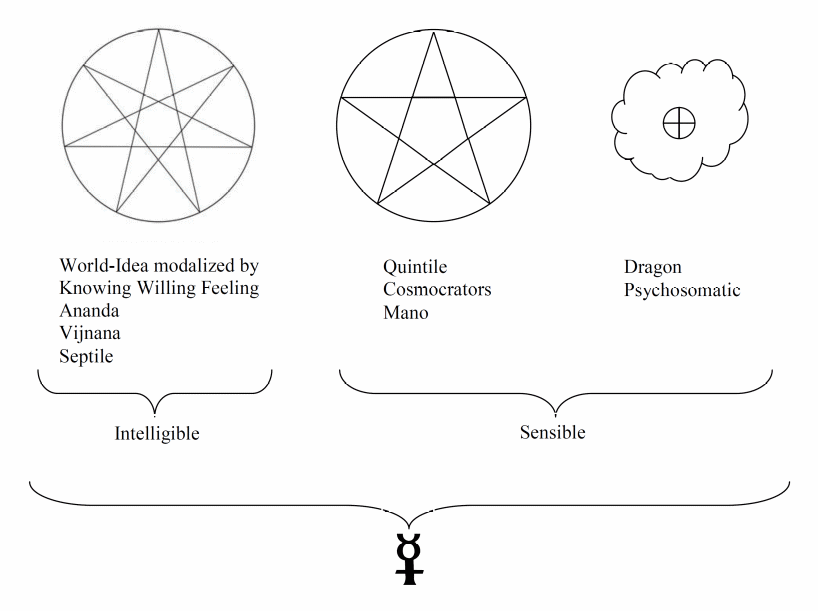
Brief discussion of septiles, quintiles, regular aspects
Septiles and quintiles must be involved for higher knowledge to come in, they are the inner connection
BOOKS READ FROM OR REFERENCED:
Plotinus, The Enneads (MacKenna translation, 4th ed.)
Thomas à Kempis, The Imitation of Christ
Brother Lawrence, The Practice of the Presence of God
Julius Evola, The Doctrine of Awakening
Patanjali, Yoga-Sutras
PLOTINUS QUOTES READ OR REFERENCED: I.6.9, IV.8.2, IV.8.4, V.3.9
DIAGRAMS appended to this transcript:
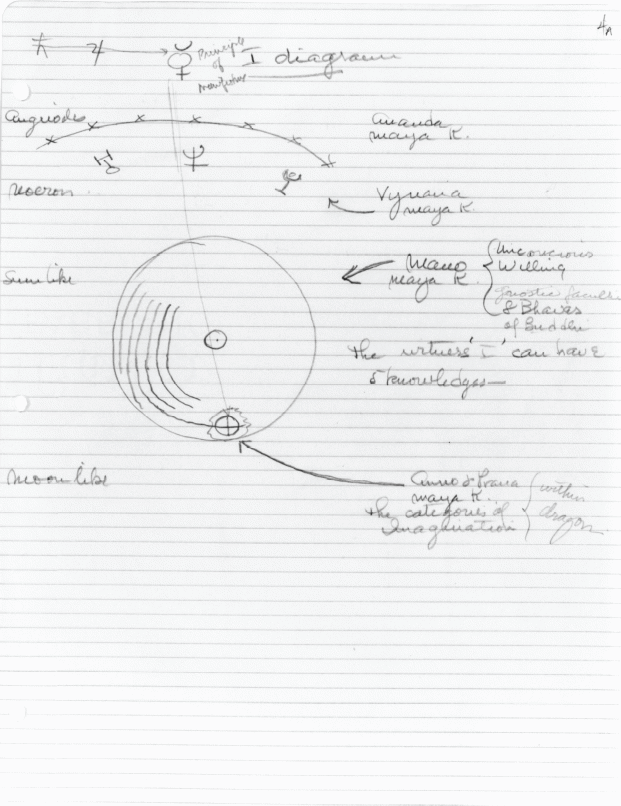
FIGURE 1983 0429a-1-AD. Tripartite Soul, Levels of Cosmos, and Sheaths.
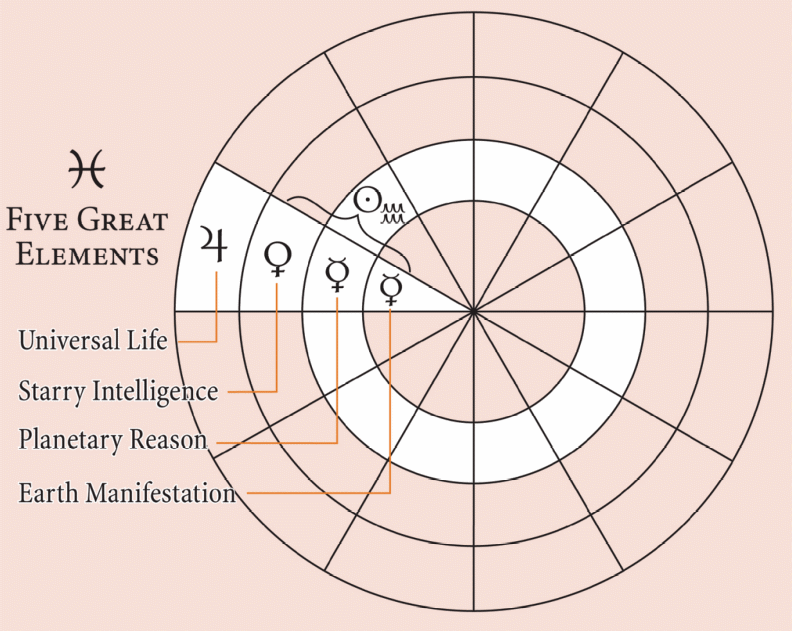
FIGURE 1983 0429a-2. The Central Sun and the Levels of Pisces.
FIGURE 1983 0429a-3-AB. Mercurius and Three Levels of Aspects.
The first two diagrams are from Astronoesis, pp. 254 and 246 respectively. See also diagrams on pp. 347, 349. [Transcriber note: [diagram] means the speaker is referencing a diagram as he or she is speaking. If someone is drawing or writing, with audible sounds of chalk on a blackboard, I indicate this by [drawing] or [writing].]
AD PAPER read in class:
- "The Third Phase of Soul". Retyped as 1983 0429b V09MP. Astronoesis - Soul. This is an early draft which is published in a different form in Astronoesis. There it is primarily found on pp. 252-256 of "The Third Phase of Soul," Endnote 52, and a paragraph ("As we continue retracing our steps…") in "Astrology: The Topography of the Subtle World" (Epistemology of Astrology). The last five paragraphs remain unpublished. This paper is continued in WG Class 1983 0513a Astronoesis; Nature; Dragon. A different version of this paper which contains both parts is read and discussed in WG Class 1983 0527a Plotinus; Soul.
NOTES:
This is 1983 04/29a, Astronoesis; Nature; Mercurius Class, and the first entry associated with this date. 1983 04/29b = The Third Phase of Soul Paper.
This is a Friday night Astronoesis class.
TRANSCRIBED Verbatim by IT prior to 2018 (V11a). This is V12ap (2023) and has: updated prefatory matter, footer, and audio file name; Book List completed and Plotinus quotes section added; new notes within transcript; three diagrams appended and references within transcript to these diagrams. Archival verbatim transcript with AD Paper – V12ap.
AUDIO FILES: 1983 0429a, 1983 0429b. [Note: "Tape" and "Side" refer to original audio cassette tapes that were later digitized into .MP3 Audio Files.]
1983 04/29a at Wisdom's Goldenrod
Astronoesis; Nature; Mercurius; Sheaths (Subtle Bodies)
[Audio File 1983 0429a Begins]
AS: This-- this i-- this is some material that's m-- more rela-- relevant to what we've been doing on Wednesday night. [short pause, shuffling about] And it's really on this-- on the third phase of the soul, and on soul. So, we'll read that since we've been doing these(--/.) [short pause, faint background AD and student talking, shuffling about] And there's a couple of pictures, we put them up as we go along. Now I don't know. With this particular material I don't know if it's better to read through completely before questions. Probably not. It would probably would be good to do a paragraph at a time since I-- it should be somewhat familiar.
S: Yes.
AS: And I think you'll get the drift.
[Note: The following paper is an early draft which is published in a different form in Astronoesis. There it is primarily found on pp. 252-256 of "The Third Phase of Soul," Endnote 52, and a paragraph ("As we continue retracing our steps…") in "Astrology: The Topography of the Subtle World" (Epistemology of Astrology). The last five paragraphs remain unpublished. This paper is continued in WG Class 1983 0513a Astronoesis; Nature; Dragon. A different version of this paper which contains both parts is read and discussed in WG Class 1983 0527a Plotinus; Soul. The following has also been retyped as 1983 0429b V09MP. Astronoesis - Soul. I transcribe the paper exactly as AS reads it, including any alterations made during re-reading.]
AD ["The Third Phase of Soul," AS reading]: "The third phase of the soul, which we may call for convenience Mercurius, needs to be thoroughly understood and explained, and its functioning amplified by illustrating its relation to a body which is part of the cosmos.
"It is a spark from that soul in the Nous and identical in essence with it, and therefore an eternal offspring, receiving from the cosmos or World-Idea the vehicles or sheaths which it must ultimately bring to qualitatively resemble its highest phase through the practice of the"imitation of God" or the philosophic disciplines, including yoga."
[short pause]
RC: Cut 'its' in "its highest phase"?
S (whisper): Read that over again.
S: Read that sentence again.
JC: Could you just do it again?
AS: Yeah, let me just read it again. [S simultaneously, faint: Let's just settle down, there's too many vibes.] It's always-- the first paragraph always-- you're-- you're not-- you've got to read it again because you're not-- not very--
S: And the second is this--
AS (faint): I got to read it (again/over).
AD ["The Third Phase of Soul," AS reading]: "The third phase of the soul, which we may call for convenience Mercurius, needs to be thoroughly understood and explained, and its function amplified by illustrating its relation to a body which is part of the cosmos.
"The third phase of soul is a spark from that soul in the Nous and identical in essence with it, and therefore is an eternal offspring. It receives from the cosmos or the World-Idea the vehicles or sheaths which it must ultimately bring to qualitatively resemble its highest phase through the practice of the"imitation of God" or the philosophic disciplines, including yoga."
AS: "Its highest phase" refers to the soul that's in the Nous. [student assents, very faint] The "its" is soul and "its highest phase" would refer to the-- that soul. Ok then?
JC: One thing I haven't [AS simultaneously: That's it.] really understood, Avery, is in what way the spark or this Mercurius phase is the same in essence with the soul itself, or, let me not ask it that way, let's say with the higher phase. [HS, very faint: Yeah.] I'll try to lean towards your-- the way it's read.
AS: Yeah.
JC: Because I-- [three/few inaudible AS words simultaneous with JC] I understand it as being an outward facing hypostasis of that soul wou-- and would in some way have a definition of-- well let's say that this-- a substance diff-- distinct from the soul itself.
AS: Well, would you say that-- I think the i-- or the example, it's just analogy, you would probably use is like the light, you know, the Sun and its rays.
JC: Uh-hm.
AS: Say are the rays in essence different from that Sun?
JC: Yeah, I guess I would say so, yes.
AS (simultaneously): They're distinct from it, they're distinct from it, but I would have to say no, the Sun rays are not a different essence from the Sun itself.
JC: Well let me ask it this way, do you think the soul is a different essence than the Nous?
AS: Well, [RG simultaneously: It's a different question.] why is that-- why-- why is that question--
JC (simultaneously): I don't think it is different question.
AS: What?
JC (simultaneously): Because it's an outwards-facing hypostasis of the Nous, just as--
AS (simultaneously): No, but the soul is a hypo-- the soul itself is a principle in its own right. It is a distinct [JC: Right.] essence, whereas--
JC (simultaneously): Yeah, and the light of the soul-- the light from the soul--
AS (simultaneously): Well, I think the-- well, there may be some people who have a concept that the soul sends out something which is different in essence from it. This concept, however, is that what we're speaking of here, this light of the soul, is the same in essence as it, [JC simultaneously: (Just like you--)] and not [JC simultaneously: Ok.] different in essence.
AD: Just like in the Wednesday quote, where PB refers to that as the principle of awareness and that which exists within you as awareness. [AS: Yeah.] Or one is [AS simultaneously: Or the other way around.] consciousness and the other is super-consciousness.
JC: So, would you regard it like a phase of the activity of the so-- of the principle of awareness?
AS: Yeah. I think the way he's tries to [JC simultaneously: And is that the way you would say it?] say it, the way PB tries to say that I think is that the activity is diff-- is-- there are two-- they have two distinct functions. They're different in terms of function but that the essence [JC simultaneously: Uh-uh.] is the same. [JC simultaneously: Ok, see that (wouldn't be my--)] When the soul's light fun-- it-- the one phase functions in respect of a universe and the other phase is considered in terms of the Nous. But I think the point is that the essence must be the same. Otherwise you're going to have a hiatus which you will not-- you know, you'll lose that identity between the Nous and here, and you cut-- you know, you cut it off. [student assents, faint] It would be cut off.
RC (simultaneously): You say the essence is-- is awareness? So that like [AS: Yeah.] extroverted awareness or introverted awareness is still awareness [AS: Yeah.] or the [one word inaudible]
AS: I think this also allows you to say that the soul does not descend completely. That would be-- you mean it would become something else.
RC: Yeah so, in that way of putting it you'd be saying like just because your awareness comes into association with content, it doesn't cease to be awareness.
S: (Uh-hm.)
AS (simultaneously): Or the-- the way the terminology was used before, it's the principle of awareness and when it lights up contents, it seems-- it is-- it is awareness. It's the activity of awareness. If you take away the contents, you say there's no activity of awareness, it just reverts back to the principle of awareness. But it's a question of terminology. [student assents, faint] Just the way you would seem (to) [couple/three words inaudible]
DR: So Avery then who-- who's doing this imitating of God in that-- in that (statement)? Is that the-- that's not going to be the Mercurius, is it?
AS: Yes, I think that is what practices the imitation of God. That's actually the guy that's going through this.
JC: Is God here the higher phase of the soul or do you mean the Nous?
S: (Explain.)
AS: (Explain?) [short pause] I think it would be enough to say that the-- that God here is the higher-- the higher soul, the Overself, that soul which remains in the Nous.
JfL: Could you read that section again [AS: What?] that David was just asking?
AS: Ok.
AD ["The Third Phase of Soul," AS reading]: "…therefore an eternal offspring, [AS: This spark is an eternal offspring.] receiving from the cosmos or World-Idea the vehicles or sheaths which it must ultimately bring to qualitatively resemble its highest phase through the practice of the"imitation of God" or the philosophic disciplines, including yoga."
AS: "Imitation of God" is in quotes. That's a quote from--
JfL: So it doesn't sound like the spark-- doesn't sound like the spark goes through that.
AS: But I-- I thought, Jeff, it says who is putting us through the paces, he's asking who is the one that's practicing this thing. [student assents, faint] And it sounds like he's saying here that the-- the light of the soul, this offspring, is putting these vehicles through this process of development.
[student assents, very faint]
JfL: Uh-hm.
RG: I thought David's question was, who actually practices that?
AS: Yeah, and I said who practices that.
RG: But your answer didn't seem to be the answer who practices but who impels the vehicles, I don't--
AS: But the one who's practicing is the one who's impelling them to do this.
RG: Well--
AS: Vehicles can't practice anything.
RG: I don't see why not.
AS: Well, they can't really-- [PD simultaneously: But couldn't you see--] well it depends how you interpret what he's saying.
PD (simultaneously): Couldn't you say the "who" is-- the "who" and the actual practicing you have to s-- to keep distinct. The "who" is the-- the awareness and the practicing is-- is what's occurring in the vehicle.
S (very faint): It's alright.
S (very faint): Uh-hm.
LR: But it was also saying that the [AS simultaneously: Yeah, ok.] vehicles are part of the World-Idea, Dickie, so it's not the World-Idea which is trying to attain the higher phase of soul.
RG: If you take that point of view that [LR simultaneously: No, but that's--] the vehicles are the World-Idea.
LR: Well that's what it said there, it said the Mercurius phase receives from the World-Idea [RG: Yeah.] the vehicles necessary. So it like takes on those objects in order to achieve its end, but it clearly stated that those sheaths were part of the World-Idea. At least that's the point of view that--
RG: Ok, so if we take that point of view then, it's hard to understand why that spark, if it is of the essence of the soul as Jeff's question was getting to, what it's missing, I mean what-- what it needs to practice if it already is the thing.
AS: Right, but you're talking again, and we've had this [RG simultaneously: No, I don't--] problem before, as if the soul is an absolutely perfect, all-complete thing, as if it has nothing to learn, and I don't-- I don't know. I don't see that. I see this-- the "who" that's doing the practice is that Mercurial phase. If it isn't the Mercurial phase, then you're saying that these sheaths are practicing something and I don't think that's the import, at least of the quote here.
RG (simultaneously): No, I'm just trying to understand you.
AS: That-- I'm just saying I think the import is that it is this second phase that's actually the "who" that's practicing, if you want to put it that way.
RG (simultaneously): See, yeah, my question would be not that the soul has nothing to learn, but that if it is a spa-- if it is this awareness in fact, and is the ray of that principle of awareness, that how--
DR: That's [AS simultaneously: (It's active.)] exactly what makes it so difficult to understand, [AS simultaneously: But (it's active).] that it seems that you put both things right there.
AS: Sure.
DR: In some ways that makes sense that you put both things right there but it's very difficult to understand.
RG: Yeah, it's hard and I don't-- [S simultaneously: But can't--] and I don't really understand.
AS (simultaneously): You're- you're wondering how princ-- this principle-- how this awareness or the spark of the soul can have any kind of activity or--
RG (simultaneously): No, no, no, no, I--
DR: How it needs a learning experience.
RG (simultaneously): I would phrase it as-- I believe it could learn to pr-- the awareness can learn, but I can't imagine how the awareness can think itself unaware.
DB: Could be-- wouldn't it be unaware of itself?
AS: Yeah, why--
RG: You know what I mean?
AS: Why can't it-- why can't it, so to speak, lose its-- lose itself?
RG: 'Cause then I think it wouldn't be That. I think it's de-- awareness is defined by awareness and if you [S simultaneously: But--] speak of losing [AS simultaneously, faint: Oh no.] it you wouldn't be defining awareness any--
LR (simultaneously): But Dickie, would you say that the aware--
AS (simultaneously): No, that's a Vedanta-- I think that's a-- the-- a Vedantic interpretation, in the sense that you say awareness is always self-luminous and lights itself [AD simultaneously: (couple/few words inaudible) paragraph! (AD laughing)] up and therefore knows its own--
RG (simultaneously): [three/few words inaudible]
S: Maybe it clarifies-- maybe it just--
RG (simultaneously): Alright, now (I'll/I don't) let it go. Go ahead.
S (faint): Hey Dickie?
RG: We can go on now.
AS (simultaneously): If-- the-- I think the point is, if it lights-- consciousness or this-- like the dust motes, ok, the ray of light lights up the dust motes. Now as long as like the attention is focused on the dust motes, it's not self-consciously aware that it's the awareness. Although it can't ever not be the awareness, it could take itself to be lighting up dust motes and forget its own proper place. Gets distracted. That still doesn't prevent it from being self-luminous and lighting up everything else. But the fact that there are dust motes veils from it its own true nature.
RG: I don't know what that means.
AS: After all, even now it must be operative, otherwise how would you know anything? [RG: Right.] And are you aware that you're the higher soul? [AD, faint: Yeah.] Are you aware that you're identical in essence with the higher soul?
RG: No, that's why--
AS: Then it mu-- then, there it i-- I mean it seems [LR simultaneously: But do you believe you're not?] it's experientially obvious.
RG: Do I believe I'm not?
LR (simultaneously): But wait a minute, you have to ask the rest of that question.
AS: No, I don't.
LR: Do you believe you're not the higher soul in some way? I mean do you believe that principle of awareness is not in you?
RG: I didn't say that.
LR: No, I know. [student assents] But that's--
RG (simultaneously): No, no, no, no, I didn't--
LR: You don't notice--
RG (simultaneously): You can say that the principle of awareness is in you and still believe that that which is developing is not that and not deny that the principle of awareness is in you.
LR: So-- but you just said two things, you said you're not aware of yourself as that awareness [RG: Right.] and-- but yet you take yourself essentially to be that awareness.
RG: That's right.
LR: And that's the-- I mean that's what was said, both those things.
[student assents, very faint]
AS: That's--
LR: You are that and you're not aware of yourself as that.
RG: Right. There's a different interpretation of that [AS, faint: Yeah.] (difference they were). But go on, I don't [couple words inaudible]
AS (simultaneously): And also that's the developing thing, that's different question as to what develops. I don't think right here what's said-- what's actually said here is that these vehicles are qualitatively brought to resemble the highest phase. It doesn't yet say anything about what transformation the light itself went through.
RG/S(?) (faint): Ok.
RC: Can you say [AS simultaneously: I think.] more about the practice and the imitation?
AS: I don't know, there were a couple of quotes from Plotinus but I don't know if they're relevant.
LR: So that was only the first sentence, right?
AS/S(?) (faint): Yeah.
AS: Where he says, "Look in yourself. If you don't…" There-- that was the one where he says, "You don't find yourself beautiful, chip away here or chip away there until you come to perfect likeness." [Note: Plotinus, I.6.9.] There was that one, and then there was another one. Beginning-- you can even begin-- one place where he says you can even-- that, you know, grasp-- try and start from that which is highest, but if you can't start with that start with the rational, and if you can't start with that then you might even start from the vege-- from the-- the irrational and ascend from there. [Note: Plotinus, V.3.9.]
RC: Would you say it's basically-- basically learn-- insofar as my individual mind or your individual mind manifest the World-Idea for us, that that's like half the imitation and the other half would be retaining our self-awareness in the process?
AS: Well that-- I think it's just mainly speaking here of some kind of spiritual path.
RC: I'm just trying to be, you know-- [AS simultaneously: More specific.] get more specific about what it would mean to imitate God (in) the language that we usually use.
DB: Isn't it-- is it possible that it may have something to do with the notion of silence?
AD: Well I assume that it was an educated au-- audience, you know, and that they had read The Imitation of Christ [student assents] and The Practice of the Presence and [RG simultaneously, faint: Thomas à Kemp.] all these philosophical yoga texts on, you know, how to approach the divinity within, I mean I-- but that-- [Note: Thomas à Kempis, The Imitation of Christ, Brother Lawrence, The Practice of the Presence of God.]
RG (simultaneously): You really assumed that?
AD: I shouldn't have, I made a mistake. (AD laughs a bit, laughter)
AS: Should put a footnote here.
AD: Footnote: Don't assume. (laughter)
S (faint): [few words inaudible]
AS: Ok, I'll read the next paragraph.
AD ["The Third Phase of Soul," AS reading]: "Without understanding the fundamental nature of this eternal twin, the theories of reincarnation and karma become hopelessly muddled. Some contemporary writers' precise understanding of the philosophic doctrines falter here. To criticize a misunderstood theory of reincarnation is not of service to philosophic students, and may even have serious consequences for the author and his followers."
RG: Beat up Renee. (RG laughs a bit)
S (faint): Is that fair Anthony?
AD ["The Third Phase of Soul," AS reading]: "Their intense and overwhelming aspiration to explain everything by reducing it to the nondual is an admirable display of devotion; but it is not the balanced view required by philosophy, for it leaves certain very important and practical matters unexplained and unexplainable.
"The fact remains--and no words can abolish the situation--that our identification with our ego includes a meaning that cannot be whisked away at the stroke of a pen. They have not properly inquired into the value and significance of the ego. Obviously, the interval between the Self or Atman or the (Soul) and its representative, the ego, is a no-man's land, and it is very noticeably left unexplained. That contemplative"Nature" put into so much travail to produce the necessary vehicles by which the Mercurial phase may evolve is in fact one of those questions which, if left unanswered, will rankle in our mind. [AD, very faint: Good quote.] It must be squarely faced. There are various views on this subject scattered throughout the ancient and modern writings, and we have attempted to bring them together in a coherent and organized fashion to help us in our understanding of reincarnation and, more to the point, metempsychosis, and also to understand the meaning and value of the ego, and how these fit into the metaphysical scheme."
S: Excuse me, Avery?
AS: Yeah?
S: What is metempsychosis?
AS: Well, that's what we're going to have to try and understand here as how that's distinct from reincarnation. [RG assents, faint] I think the word, the actual word, 'metem-psychosis' (means/needs) detail. [one/two inaudible student words simultaneous with AS] [couple/three words inaudible]
AD (simultaneously): You could reincarnate at any-- any level.
AS: Yeah.
AD: Animal, plant, a human being.
AS: Yeah, that [AD simultaneously: Whereas reincarnation--] it's this light-- Yeah, that's what we're going to try and understand, that it's this light which gets associated with these bodies, not that some personality comes back again [RG assents] and gets re-incarnated [students assent] but that the psyche, this-- the so-- psychosis, the soul is what is actually inhabiting or working through different levels of vehicles and various vehicles rather than saying it's a vehicle or some aspect of it that comes back as a person. Well, ok, I'll read this again.
AD ["The Third Phase of Soul," AS reading]: "As we previously pointed out, the ancients conceived the Soul as tripartite, but it can just as easily be conceived as dual. [AD/S(?), faint: Ok.] The higher Cognitive Act and the power of intelligence or (cit-sakti) of the soul as isolated cannot directly experience the sensible world; and therefore this higher phase acts through the lowest phase, or Mercurius, within which the manifestation of the World-Idea will take place."
LR: With-- say that again, within which--
AS: Yeah.
LR: --the manifestation of the World-Idea will take place?
AS: Yeah.
LR: Does that imply that the higher phase isn't in contact with the World-Idea?
AS: Well, not with the manifestation of the World-Idea. The point is whether it contacts the man-- It's not that the World-Idea-- it's the manifestation of the World-Idea is within the lowest phase.
LR: Yeah.
AD: You'd have to read on to find out. (bit of laughter)
LR: Ok.
AD ["The Third Phase of Soul," AS reading]: "The third phase may be refer…"
AS: In fact, yeah, let me finish the paragraph going along with [one/two words inaudible] that we've been using for the first two.
AD ["The Third Phase of Soul," AS reading]: "This third phase may be referred to as the function of manifestness, or asmita in Yoga terminology. [AD, very faint: Uh-hm.] This infinite light"descends" completely into the realms of manifestation by a process that will be explained later, that is, into the womb of the world, or what the Buddhists call the Tathagatagarbha.
"This spark of the higher soul will evolve or gestate through indeterminable time concomitantly with the Idea of the World. This World-Idea is sponsored and organized by the Universal and cosmic souls (laughter) and projected through the individual soul. The perpetual unfoldment of the World-Idea is irreversible in its direction and therefore ultimately guarantees the evolution of that individual soul in its second phase."
HS: Is the second phase third phase?
S (faint): Uh-hm.
AS: Oh, ok. (bit of laughter)
HS: Well you keep changing the name.
AS: No, no. We're using two phases here. The first phase is what we-- the Saturn Jupiter together, [HS: Ok.] [student assents] the higher Cognitive Act and power of intelligence. The second phase or lower soul or sometimes I guess it still says third. Ok.
LR (simultaneously): Yeah, it says third.
AS: Well, second and third are the same.
HS: Ok. (bit of laughter)
AS: Last.
AD ["The Third Phase of Soul," AS reading]: "The perpetual unfoldment of the World-Idea is irreversible in its direction and therefore ultimately guarantees the evolution of that individual soul. The evolving"double" of the soul, as part of the World-Idea, is also spoken of as the "second soul."
"Through its function of manifestness…"
AS (coughing): Can I get some water? I drank--
AD ["The Third Phase of Soul," AS reading]: "Through its function of manifestness, the soul, which is projecting the Cosmos given to it from within, and its experience of that Cosmos, is the modification of its own functioning, referred to as citta-vrittis or the world as thought, depending on the level which it is identified with."
S: Reread that sentence again.
S (simultaneously): Yeah, reread it.
S: [one word inaudible] in quotes.
AD ["The Third Phase of Soul," AS reading]: "Through its function of manifestness, the soul, which is projecting the Cosmos given to it from within, and its experience of that Cosmos…"
AS: The function of manifestness is projecting the Cosmos and its experience of that Cosmos, ok.
[short pause]
AD ["The Third Phase of Soul," AS reading]: "Through its function of manifestness, the soul, which is projecting the Cosmos that is given to it from within, and it's projecting its experience of that Cosmos, is the modification of its own functioning, referred to as citta-vrittis…"
AS: Oh, I'm sorry.
RN (simultaneously): Just think that its experiences [one/two words inaudible]
AS (simultaneously): No, no, I'm sorry, there's a [one word inaudible] Let me try and read this a little differently.
AD ["The Third Phase of Soul," AS reading]: "Through its function of manifestness, the soul which is projecting the Cosmos given to it from within, and its experience of that Cosmos is the modification of its own functioning, referred to as citta-vrittis, the world as thought…"
LR: Just leave out the "which."
S: Yeah.
AS: Which "which?"
LR: In other words, the soul projects the cosmos and experiences it through the modification of its own functioning. Leave out the sou-- [AS simultaneously: Right. That's what (it's/I'm) saying.] leave out the "which," "the soul which"--
AS: Yes, that could be done there, good. Ok--
AD ["The Third Phase of Soul," AS reading]: "…and it will experience its own functioning, referred to as citta-vrittis, or the world as thought, and this depending on the level with which it is identified."
AD (very faint): Yes, that's good.
AS: In other words, at various-- there'll be various levels of these citta-vrittis, or this citta-vritti.
AD ["The Third Phase of Soul," AS reading]: "This encompasses the entire manifest universe for an individual soul. The archetypal or intellectual Idea of the universe is manifested through the secondary phase of the soul, which will project it within itself by continuously transforming itself, and which will include the necessary sheaths which it will operate through.
"The very function of manifestness or asmita is also the means by which the individual soul takes itself, at any level, to be part of the cosmos, to be incarnated in one of those modifications or some vehicle. These mental modes are instantiating or imaging the Ideas as various grades of thought, and all these are manifest to, and appear within, the Mercurial phase of soul."
LR: Can you go a little slower, Avery?
S (faint): Yeah.
AS: Sorry I-- [S simultaneously: Can you back up a little too?] I guess I should read it [couple/three inaudible student words] again. Asser-- try to start this paragraph again, I think I-- or back a little, let me back up a little. I have to draw a picture too, might help.
AD ["The Third Phase of Soul," AS reading]: "The perpetual unfoldment of the World-Idea is irreversible in its direction and thus guarantees the evolution of that individual soul. The evolving"double" of the soul, as part of the World-Idea, is spoken of as the "second soul."
"Through its function of manifestness, the soul is projecting the Cosmos given to it from within, and its experience of that Cosmos is the modification of its own functioning, referred to as citta-vrittis, or the world as thought, and this will depend on the level with which it is identified. This world of thought [AS: The whole modi-- the whole manifestation of these vrittis.] encompasses the entire manifest universe for an individual soul. The archetypal or intellectual Idea of the universe is manifested through the secondary phase of soul, which will project it [AS: The Idea of the world.] within itself by continuously transforming itself, and which Idea will include the necessary sheaths that the soul will operate through.
"The very function of manifestness or asmita is also the means by which the individual soul takes itself, at any particular level, to be part of the cosmos, that is to be incarnated in one of those modifications or in some vehicle. The mental modes of its functioning are instantiating or imaging the Ideas as various grades of thought, and all these are manifest to, and appear within, the Mercurial phase of soul. In the Vedantic classification these grades are called Anno, Prana, Mano, Vijnana, and Anandamaya koshas. The Platonic equivalents Shelly, Moonlike, Sunlike, Noeron, and Augoeides. The imaged cosmos itself provides a framework within which we can locate these levels of vehicles. We have tabulated and correlated these various classifications within the chart in the attempt to pictorialize somewhat the concept of Man as the ancients conceived him."
[Note: See FIGURE 1983 0429a-1-AD, Tripartite Soul, Levels of Cosmos, and Sheaths, appended to this transcript for the following. This diagram is from Astronoesis, p. 254.]
AS: So, let me just put up the diagram and then we can refer to it as we [couple words inaudible] [S, faint: Right.] It could be any one of several diagrams [drawing] so put this one up first, it doesn't really-- I don't think it matters too much. Ok, here you s-- these are supposed to be all grades of thought within the cosmos [diagram]. You know this picture. And, I guess you could simultaneously or alternately think of this Mercurius, all of this is within the Mercurius phase [diagram]. Or you could think of the Mercurius phase as-- [one/two inaudible student words] just remember a week ago [diagram].
[short pause]
S: What was that second alternative?
AS: Well, I think that the way-- the way it will have to be understood somehow is that all of this levels of thought are within the Mercurius phase but at the same time that very Mercurius phase is what can take itself to be identified with the various grades of thought, as we said. So on the one and the same time, the world is within it and then it finds itself within the world. And I don't see any way to get around both of those views, you know, whether they're real views or just, you know, one of them is only "as if" it were. It doesn't matter at this point, it seems experiential [couple words inaudible] Well, anyways so-- so this level [drawing/writing] we-- somewhere over here we have Augoeides equals Ananda and then Noeron equals Vijnana and then we have Mano equals Sunlike, which includes the willing and the knowing, eight bhavas and the seven willing functions that we spoke about [diagram]. The-- this (was/is) supposed to be the whole of what we call the Undivided Mind, and then this-- this one finally here we have the imagination, the Prano/Anno, or the Moonlike/Shelly [diagram]. Ok. And this-- this whole thing is the realm, [drawing] in here [diagram], all these are grades of the manifested cosmos or twelfth house in our diagram, and these are all grades of thought, [short pause while writing] 'cause-- using "thought" the way it's being used here. And in here we have, of course, the categories of the imagination [diagram]. [13¾ second pause while writing] Earth centered, Sun centered [diagram]. Now maybe we can just go over the points, key points, of this paragraph, just-- Oh and of course these-- these are the two-- [drawing] the-- in the double division-- oh, well, we'll start.
AD ["The Third Phase of Soul," AS reading]: "As previously pointed out, the ancients conceived the Soul as tripartite, [AS: And we've done that before also.] but we could just as easily conceive of it as dual."
AS: Putting together the two so-called higher phases which are in the Nous anyway, as distinct from the third phase, which we'll now call the second phase. It's ok.
AD ["The Third Phase of Soul," AS reading]: "The higher Cognitive Act [AS indicates on diagram] and the power of intelligence [AS indicates on diagram] of soul isolated cannot directly experience a sensible world; [AS: ok] and so soul must experience it through this lowest or Mercurius phase, within which the manifestation of the World-Idea will take place."
AD: Severin, what would that mean?
SD: What, that-- that the world manifests within the Mercurius?
AD: What would that function of manifestness have as a corollary? I mean, what-- how would you think of it if you wanted to ascribe an attribute or two to it?
SD: Well, the Mercurius would have to have this double nature of, on the one hand, being identified with the higher in essence and on the other hand looking outward and in some ways being related to that world.
AD (simultaneously): But if it manifests the whole universe and you're included in the inerratic sphere, what would you think of that consciousness?
SD: Well it's certainly a very vast and cosmic consciousness.
AD: You'd think of it as infinite, wouldn't you? Ok, just curious if you would draw the implications.
S (simultaneously): Right.
PD: Could you speak of that Mercurial phase as the-- the epistemological subject in terms of-- or like Kant, the transcendental ground of all experience, (where/or) he speaks of the subject in that manner?
AD: Well, I don't think Kant goes that far. There'd be-- for him the transcendental subject would be from the Sun-like body down. [AS drawing/writing] So this concept is even vaster than Kant's apperceptive ego. If the-- if the Mercurial phase of the soul is a consciousness, and even the quotes that we've heard, he says it's consciousness, and the Overself is the principle of consciousness. Well then, if it is consciousness, it has to be infinite. If you consider that for each soul the whole of the universe is manifested within it, well then that consciousness would have to be infinite.
LR: Why would one need to think there was anything beyond that in that description?
AD: Beyond the second--
LR: Yeah.
AD: You wouldn't have to think that. There's nothing beyond it.
LR: Well clearly there is.
AD: It wouldn't be in the manifested universe.
S (very faint): Right.
AD: It would be absolutely and completely immaterial. No way could it be manifested.
LR: I don't even see how it could be experienced, from the description you gave.
AD (simultaneously): Well when you get to the asmita principle in its purity, you'll get to the experience of that which is beyond the manifested universe.
LR: And what would lead one to think there was anything-- any part of the soul greater than that, except for coming to class and having someone tell us that there is? (laughter) Well I'm serious, you know.
AS (simultaneously): You mean unless [couple words inaudible]
RG (simultaneously with LR and AS): I mean noth-- nothing.
LR: Here's why I'm asking.
RG: Nothing would lead you to think it and that's why it's given to you.
LR: Well, you know [AS simultaneously: No, you could--] how some people are-- some-- some people tell us that [AD simultaneously: Certainly.] it's important to have these understandings, because if you ever had the mystical experience you'd never understand what it was.
AD: Well, [RG simultaneously: Uh-hm.] it certainly shows you how vast or how pivotal this concept of the Mercurial soul is. And that, you know, it'll give you a notion not to underestimate it. And if Jung got all confused about what Mercurius was all about, it's--
LR: Understandable.
AD: It's understandable.
LR: Well, Anthony, if one were to have the experience of that pure asmita, [AD: Uh-hm.] how would he separate that from any higher principle of his soul? What are [one/two inaudible AD words simultaneous with LR] the marks of that phase of the soul in experience that would be different from the other phase?
AD: Up to that point he's still an individual. [LR: Ah-ha.] From that point on, he no longer remains individual but becomes the principle of awareness itself, the Oversoul, the Soul itself. This is the experience of Plotinus and Ruysbroeck and Saint John and all the great mystics. It's the point we also said that this is the true mystical death. Because mystical death here is referring to more than just the dying-- body dying but re-- a dying to one's individuality, the giving up of everything that you have gone through and have experienced, alright, which made you to be the individual that you are. It's not just a simple dying up to this body. It's all that's implied that brought you to that point. And that's why it's called the mystical death. It's a little different from the death of the body, because the death of the body doesn't mean that you die at all. You just keep going, you know, different places and other bodies and all that but this is a complete surrender of your individuality to that Soul and then you can speak about being identical with the Overself (or Soul/All-Soul) and there you would experience a pure undifferentiated consciousness, the principle of awareness itself.
LR: So is it possible to know anything beyond that point?
AD: The real knowing begins after that point.
LR: You still speak of knowledge as--
AD: Yeah. As a matter [LR simultaneously: Who would be knowing?] of fact, as a matter of fact, they would consider everything from the Mercurius downward, they would consider that a form of avidya in the ancient Vedantic text.
LR: Who would be knowing past that point?
AD: It would [S simultaneously: No one.] really be true knowing. Here you're no longer, so to speak, the lower knower, you know, the Mercurius, [AS simultaneously: Then there's higher realm.] but the higher knower.
LR: So the Knowing [AS simultaneously: But there's no-- but the "who".] would be synonymous with Being at that point.
AD (simultaneously): Yeah.
AS: Yeah.
RG: Sure, there's no object.
AS: No "who".
AD (simultaneously): See, but these are things I want you to draw out. I don't think that I should spell out everything for people.
LR (simultaneously): I'm drawing it out.
AD: Good. (laughter, student words) Try to do it in your own mind.
LR: Oh, you mean don't talk.
AD: Oh yes, you can talk, now all I'm trying to say is that there has to be a point where you have to draw out some of the implications, I'm not going to spell everything out. I don't think it should be spelled out.
RC: Anthony, when-- when the Buddhists talk in terms of an-- [LR: We have plenty of time don't we?] anatma doctrine, is it basically that they're saying that this Mercury is not Atma or is it that they say that no contents of the Mercury?
AD: No content of the Mercury.
RC: Because a lot of the things that we read in class in Buddhism they-- they don't seem to want to talk about any consciousness independent of content, that they just won't talk about it.
[students assents, faint]
AD: Yeah but, I think-- I think there the problem would be that you would have to take the specific text and find out within the context of that text whether the anatta doctrine is here referring to the fact that I am not this imaginal essence, that I am not-- You know, one text will be referring to that. A more comprehensive text would refer to the fact that I'm not even-- I'm not even the manomaya. Another text would refer-- would be referring to the fact that it isn't even the World-Constructor. You remember that?
RC: Uh-hm.
AD: That would be like identical with the manomaya.
RC: Uh-hm, uh-hm.
AD: Another text would go beyond even that, you know, like when they conc-- they conceive of anything withi-- within the realm of form as anatta. So it depends on the text, I wouldn't be able to answer that point blank.
RC: Just seems that the highest ones that you're talking about, if-- you could almost (be say) that the "I" which arises is not to be believed.
AD: Yeah like, if you look at the last realm where the Shelly and the Annamaya body is, an "I" arises there and that's not really "I", alright. But one could just as easily go to the next realm and identify with that and the Yoga texts would say even that has to be disowned. So, every text has to be examined on the basis of its own merits, and that's why I don't want to make a point blank statement. So for, you know-- each reader will satisfy himself according to the level of his understanding. If he thinks it's sufficient not to identify with the, you know, the body that is formed within the Dragon, that's fine. And if another reaser-- reader has reached a point where he doesn't even want to conceive of himself as the Augoeides, that's fine too. It'll all be included. Another one won't be satisfied until he's the Overself itself, which means that he's none of these things at all, and that's alright too.
RC: So if someone were to actually, well, go beyond this very asmita principle itself, he-- like all the last four houses of the metaphysical chart would essentially--
AD: Yeah. Yeah, you remember the text we read, like in the-- like for instance in The Doctrine of Awakening, where he insisted that you go beyond all realms, form, desire, until you reach the formless realm, and even that has to be thrown aside. [Note: Julius Evola, The Doctrine of Awakening.]
AS: Yeah. He went through the four formless contemplations as well. Even-- I mean even in the Yoga Sutra text they go up as high as Nirvikalpa but then they don't say-- it's just-- and it's similar to the Samkhya doctrine. It gets you to pure Purusha there or the Yoga text gets you to Nirvikalpa but they don't-- they don't really say, you know, what the nature of-- that can't be [one/two words inaudible] what's the nature beyond the realms of form. [S, faint: Or--] Or there's an implication in other places that [couple/three words inaudible]
[student assents, faint]
AD: See, so we want to-- we want to have a background where the initial pre-- premises are comprehensive enough to be able to account for and explain any level that a person wants to work with. But I'm not going to go into details about that, I think that each individual will have to do it for himself, wherever he thinks he's located at. But the other point here too is that without understanding this Mercurial phase of the soul, alright, we're going to get into some real difficult and unexplainable matters, alright. Now if, for instance, Guenon understood the doctrine so well, then how come he didn't believe in reincarnation or metempsychosis?
[short pause]
S: What was his excuse?
DB: He was a good Catholic.
S: Uh-hm.
AD: Well he had joined an order, a certain Sufi order, that didn't believe in it. It didn't believe in it, therefore it happened to be a sufficient explanation for him. But if you understood the philosophic schemata and the metaphysical principles that are involved, I think certain--
(Side 1 of original cassette tape digitized as 1983 0429a Ends; Side 2 Begins)
AD: --backdrop for astrology, alright.
SD: When-- when Linda was asking how one would-- what possible mark there could be to distinguish an experience of that Mercurius with the hint that anything that would be beyond that, would one mark the-- whether or not there were any s-- seeds, potential still remaining for re-identifying with-- with lower-- or with vehicle? That if-- if one could go beyond that-- that Mercury phase, what it would mean would be the passing away of any potential like that.
[11¾ second pause]
AD: I don't think I understand your question right, oh, except the hint that you throw-- threw out, that at this level, let's say, of the Augoeides, would there be any samskaras left to hold him back.
SD: Well, you say that what-- what makes you go beyond that Mercurius phase is that mystical death, and wouldn't-- wouldn't that consist entirely of cutting off those things that still have a hold on you to return to some sort of identification with some level of-- of the manifested world.
AD (simultaneously): Yeah. Yeah, you cut them off, that's true. That's true.
SD (simultaneously): So-- so it would be the presence of those potentials that would mark whether or not you had passed to-- to the higher phase of the soul.
AD (simultaneously): Well, if you've gone beyond that, if you've gone through the mystical death, alright, then you come back, those vasanas are still the, let's say, part of your repertoire, you know, part of the asmita's contents. And then they're not destroyed, [SD assents] they'll go through this process of transformation.
SD: But the identification isn't there.
AD: That's what transformation mean. [students assent, faint] The identification will be there because you're going to have to use this content for your experience in the world, and the "world" here is the whole world.
SD: But would you still take yourself to be that as you use it?
AD: Not if you went through the mystical death.
SD: So-- Well, ok, it's a different use of "identification" than I would--
RC: So like when PB talked about PB in the third person, [S: Uh-hm.] seems like you'd be saying PB is that that like grounds it in this operation of the Mercurius, but the perspective that he's speaking from would be the higher Soul.
AD: Yeah.
RC: And he could look at PB as an ongoing object.
AD: As a distant cousin.
[student assents, faint]
[9¼ second pause]
AD: Got an idea now of the vastness of the topic, and why it can be so easily misunderstood? [student assents, very faint] But you see, if PB is to function at all, that asmita principle has to be. [students assent, faint] Alright, go.
[short pause]
AS: Ok?
AD: Yeah, let's try another one.
S: Yeah.
AS: Want to go over-- over this or just go on, [S, faint: Oh.] we could just-- you want to just go on?
S (very faint): Sure, yeah.
AS: Ok. So we ended up-- so in the Vedantic classification or the other one, we have all these grades of thought encompassing the entire manifest universe, and this is all within that third phase of soul, the second phase, but also the point that it's this function of manifestness or asmita is that by which the individual takes itself to be part of the cosmos or to be incarnated in one of those vehicles or some of those.
SC: So the asmita is both the consciousness that contains all of those vehicles and also that-- that aspect of consciousness that identifies within.
AD: Yeah, just like in a dream, right Sam? [SC simultaneously: (Go ahead.)] You're at one and the same time [SC: Same time.] having the dream and identifying with part of that dream as your representative of you.
SC: Same consciousness that's [AD simultaneously: Both are required, yeah.] having the dream and is also (identifying/identified).
[student(s) assenting, faint]
AS: It seems it's almost also like the momentum or-- it's al-- At first at least it seems inevitable that the force which has manifested or projected the world is like carried along by that momentum to an identification with something in that which it projects as a dream and so, unless through a long series of dis-identifications or practice, I mean it's habi-- it's like the nat-- in the innate nature of that to identify almost and it needs to be trained not to identify with that which it projects. However at first it seems it has to identify with it if it's going to project it. Only later can it project it without identifying with it, or without identifying with a part of it. [short pause] Ok, so this goes on.
AD ["The Third Phase of Soul," AS reading]: "The Mercurius phase of the Soul is the pure form of manifestness--that is, consciousness or our"I AM"--and it is first identified with the highest reaches of heaven, the intelligence of the cosmos in its pure (sattvic) aspect, called Reason or Wisdom of the Universe. Here it assumes substantiality as the pure joy of existence called the anandamaya kosha, or the Robe of Glory. The principle of pure light is being aprioristically conceived, that is, it's being conceived before it manifests a cosmos. But through its function of manifesting, the soul takes itself to be embodied in these reason-principles."
AS: And that's at the very highest level.
HS: Could you just do it again please Avery? Principle of pure light is being conceived prior?
AS: Yeah. We have to conceive that this principle, the principle of manifestness, the I AM or asmita, [couple inaudible HS words simultaneous with AS] runs even beyond the manif-- the whole of manifestation. It's the light of the soul. Ok, but this principle of light, through its function of manifesting, takes itself to be embodied in those reason-principles which it manifests. [student(s) assenting] The same thing we were saying [one word inaudible]
HS (simultaneously): Are you saying something, that the principle of light extends out beyond the manifestation of the whole universe?
AS: The principle of asmita or the I AM is actually, in reality, beyond-- the principle of manifestation is beyond manifestation is what it's saying. The I AM or that consciousness is not even the very highest reason-principles in the cosmos, it's even beyond that. But at the first step of identifying with a cosmos from totally outside, it identifies with the highest or purest part of what it projects, and the highest or purest part of what it projects we're calling the Wisdom of the Universe and the intelligence of the fixed spheres.
AD (very faint): Yeah.
[student assents]
AS: And that's the highest part of the cosmos.
HS: But you're concei-- [S simultaneously: Yeah.] you're conceiving of this asmita-- is this the Mercurius now [one/two words inaudible]
AS (simultaneously): Yeah, the Mercurius. The Mercurius--
HS (simultaneously): Consider this Mercurius as this-- as something that's there into which the cosmos manifests?
S: Let me--
AS (simultaneously): No. No, I think the point before, this princ-- the asmita receives the world from within. It's received from within and it projects it out. Now the very first thing that it's projected out is what it first identifies with.
HS: Ok.
AS (simultaneously): The highest phases of it-- the highest phase of its outward manifesting activity must be that image of the Intelligible which we call the inerratic sphere.
HS: Ok. But is there any manifestation prior to that-- that inerratic sphere? Is there anything at all manifest?
AS: Oh no, that's the highest fi-- that's the highest level of manifestation.
HS: That's the highest level of manifestation.
AS: And above that is what's beyond manifestation, and like this pivot point or this [HS simultaneously: Ok, the (one/two words inaudible)] fulcrum point as it were is this principle of asmita. [HS: Ok.] And that seems to have, you know, a foot in both camps, if you want to say.
HS: So you say that this principle is prior to manifestation principially.
AS (simultaneously): Yeah, the point here is that principially the principle of manifestness, the Mercurial phase, is beyond manifestation.
HS: But there's nothing manifest prior to manifestation.
AS: Right. Well that's-- yeah. [HS simultaneously: No, uh--] Therefore-- Right, [RG: But--] therefore, it is not manifested.
HS: Because I was thinking like you-- I was conceiving it sort of like there's this ground, you know, it's out there, and then it gets filled in as sheer space. This is not the principle of space now.
AS: No, I think we're-- that that discussion is not being considered here. You would have to say that that-- conceive that separately. And you're talk-- you're talking about like the illumined space.
HS: Yeah.
[short pause]
AS: Um-- I think this discussion is from the point of view of the individual soul and the soul would receive that from within also.
HS: Would receive the totality of the illumined space?
AS: Yeah, like the World-- that would be the World-Idea that it receives.
HS: That would be like man-- but that would be manifest to it.
AS: No, I think the way this is talking, you'd have to conceive of the highest level of what we're here calling manifestation. Manifestation here means manifest to and through-- to and by this principle of manifestness. Anything prior to this principle of manifestness is not manifest.
HS (faint): Ok.
[students assent, very faint]
AD: Awareness itself is not manifested.
AS (simultaneously): By definition.
RG: Ok.
AS: It can't make itself an object. And all I'm saying here is the very first thing that it makes an object is the highest level of the cosmos. Maybe we should read the whole--
RG: You know, that certainly isn't the way Yoga uses the term 'asmita'.
AS: What?
RG: As beyond manifestation. I don't think so.
AS (simultaneously): Yeah, I think it does. Well, we'd have to get the--
LR (simultaneously): What would there be then to differen-- Well, go on so I could--
AS (simultaneously): We'd have to--
RG: No, well, as in Samkhya, I mean they--
AS: No, it's different. Samkhya [three words inaudible]
RG (simultaneously): No, it's different but they would use buddhi for the same principle.
AS: Well, I--
PD: Or avidya in Samkhya, which is prior to buddhi.
AS (simultaneously): Yeah, that's more like it, what Paul's saying. I would more equate asmita in the Yoga with avidya because Samkhya takes the point of view of knowing, and there it's avidya, and avidya's beyond manifestation. Here it's part of unmanifest prakriti and here I would say the interpretation is that it's a willing, here what-- what's the principle that corresponds is a willing principle [couple words inaudible]
RG (simultaneously): But that-- isn't that willing principle distinct from prakriti in Yoga? Isn't the asmita the first principle that arises from prakriti?
AS: That arises from prakriti? Well I think this is interpretive. Though, you know, he always says there that the asmita is a pure function of manifestness or pure function of identifying without any substantial being.
RG: Uh-hm.
AS: He says that-- he says Samkhya doesn't conceive of such a thing, that any function has to be associated with a substantial tattva, but that in Yoga they conceive of this function as like a function without a substantial being, which seems, like Paul was saying, almost like avidya. [couple inaudible RG words simultaneous with AS] Now I think the novel interpretation, if you want to say it, is that here we're ascribing the function actually to soul [RG assents] rather than to prakriti, [RG assents] which I-- that I, you know, it's questionable whether the Samkhya yoga dualism would accept that. In other words, in the final analysis they might say, at the very final stage, even that function is re-- refundable back to the prakriti and the pure soul [RG assents] is pure in itself. But here it's-- it's sort of a-- you know, a modified interpretation.
RG (very faint): Ok.
SD: Avery, when [one inaudible AS word] Herbie had asked about the-- the space or-- you know, the illumined matter, is it that the individual soul--
AD (simultaneously): That-- that's going to come next, that's going to come next.
[student assents, very faint]
AS: You have to wait a minute. Well let me-- let me finish this paragraph anyway, that [one word inaudible] [short pause] Go up to the end of the paragraph and then we'll go back. He--
AD ["The Third Phase of Soul," AS reading]: "The Mercurius phase, the pure form of manifestness--consciousness or the"I AM"--is first identified with the highest reaches of heaven, the pure sattvic aspect, called Reason or Wisdom of the Universe. Here it assumes substantiality as the pure joy of existence called the anandamaya kosha, or the Robe of Glory. The principle of pure light is being aprioristically conceived, that is, before it manifests a cosmos. But through this function of manifesting, the soul takes itself to be embodied in these reason-principles. The I takes itself to be this mind, the self-affirming certitude of "I am the World-Idea." At this level, the I or asmita is thus the substratum or the basis for the differentiation of the appearances within itself, i.e., is the basis for all the lower principles which evolve from Reason. At this stage of ananda, the soul that still has its wings is associated with a vestment of luminous reason-principles that form the "Robe of Glory" or Augoeides, the radiant body, and here may truthfully say, "The world is my idea." For here, the intelligence of the stars is the locus for the soul's first association with the cosmos, and it is infused there with the intelligible form of the cosmos, or the World-Idea."
[short pause]
AS: That--
LR (simultaneously): You know, this is-- this is pretty fundamental, I'm s-- but-- If it is manifesting those reason-principles and it sees itself as that body of light, and in fact--
AD (quietly): It doesn't see itself as a body of light, it sees itself as this body of reason-principles.
LR: I'm sorry, that's what I meant.
AD (quietly): It sees itself as the Idea of the World.
LR: And that Idea of the World is in fact part of it at that stage.
[student assents, very faint]
AD (quietly): Yeah.
LR: I have a hard time seeing where the misidentification comes from.
AD: It would-- I-- it would be kind of absurd for us to think of ourselves as misidentifying ourselves here.
LR: Well, but that's the im-- that's-- that seems to be the import, [AD simultaneously: Yes, thinking--] that it's taking itself to be something it's not and yet it is that.
AD (simultaneously): Yes, because it's more than that.
LR: Ok but--
AS: It's limiting itself. Don't forget Linda, I think the point here is that, [LR, faint: Yeah.] as was, you know, hamm-- you know, they were pointing out before, this is the manifested Idea, this isn't the Ideas per se. These are the Ideas as they are already manifested and in that sense it's a limitation. It's limiting-- even though it's limiting itself to the highest and purest part of manifestation, which might be almost infinite from our point of view, it still is limiting itself to something [LR simultaneously: Ok, and I didn't hear you--] which it less than itself.
LR: Ok. Then I didn't hear the word 'limiting' there, I just-- I mean, [AS simultaneously: Well, that is a limitation.] that's-- that's really the crux of it because if you say it's not that and it takes itself to be that, that's not really entirely true. The fact that it could--
AD (simultaneously): Would you-- would you read the-- the whole paragraph? Just read it at one swoop without break.
AS: I did-- I did read the whole thing, but I'll read it again.
AD: Read it in one-- read it in one-- one swoop without a break.
AS: You want me to read a little more than where I read up to also?
AD (simultaneously): Yeah, read that paragraph and just go right [AS simultaneously: Ok.] on for a while because [AS: Sure.] it is a little difficult.
AS: Well I--
AD: But it's to the point and it's not hypo-- it's not hypothetical. It's-- I-- I say it's-- you know, I mention that this is the way the ancients conceived of the concept of a Man. But, don't let that be-- don't let that academic jargon mislead you. I would say you people are too ma-- premature with your remarks. Let the whole thing come into you. Let the impress made-- be made and then criticize. I'm aim-- I'm trying to-- I'm trying to get to clarity of-- actually through a more of a literary method than in an exact-- an exactness or precision in thought, because you can't be that precise. Thought here will fumble, it can't be that precise. You can't, for instance, separate Being and the power of knowing Being the way we would like to, you know, verbally and intellectually.
LDS: Anthony, if I could make a compent on-- comment on the general impression of what's been read so far, for me is that rather than think of this process of the Mercurial phase getting involved with the reason-principles as a misidentification, rather it seems to be the way-- the flavor of the paper is that this is a necessary aspect of the soul and, you know, the tone is not one of any kind of mistake or limit, you know, limitation except in the sense of something required for the completion of, let's say, the soul's learning or soul's function. Is that along the lines of what you're trying to express?
AD: Yeah.
LDS: You know, it's really contrary to a lot of other, especially Eastern, texts that we've read where-- you know, where they seem to be--
AD (simultaneously): Well, in the upward ascent the ultimate aim, of course, is to transcend even that identification and to reach the level of the pure Purusha, [LDS: Yeah.] alright? But, assuming that that has happened, alright, then you take your place in the universe, alright, wherever that place may be that you're assigned, and to be, let's say, identified with the Augoeides is not exactly to feel a lack. (laughter) And that's why I didn't want to be too precise is-- and refer to that as limitation, because when the soul does get its wings back, it will preside over some portion of the heaven.
AS: Yeah. But then it [LDS simultaneously: I--] won't be felt as a limitation because [AD simultaneously: No, it--] as Plotinus says, then he governs without having to at all be bothered by the cosmos, like a star's body, say it governs-- [student assents] star would govern it without any-- any problem. [Note: Plotinus, IV.8.2, 4.]
LDS: I think we spoke of this before as that part of the soul, the Mercurial phase, as picking up the magnum opus on-- in its descent at the level of the Augoeides.
AD: Well they do call [LDS simultaneously: Yeah.] it the anandamaya kosha. And it is referred to as the joy of existence. So, let's reread the paragraph.
AD ["The Third Phase of Soul," AS reading]: "The Mercurius phase of the Soul as the pure form of manifestness-- that is, consciousness or"I AM", our "I AM"--is first identified with the highest reaches of heaven, the intelligence of the cosmos in its pure (sattvic) aspect, called Reason or Wisdom of the Universe. Here it assumes substantiality as the pure joy of existence called the anandamaya kosha, or the Robe of Glory. The principle of pure light [AS: This same one, Mercurius.] is being aprioristically conceived, that is, before it manifests a cosmos. But through this function of manifesting, the soul takes itself to be embodied in these reason-principles. The I takes itself to be this mind, the self-affirming certitude of "I am the World, I am the World-Idea." At this level, the I or asmita is thus the substratum or basis for the differentiation of the appearances within itself, i.e., the basis of the lower principles that will evolve from Reason. [AS: All the way down.] At this stage of ananda, the soul that still has its wings is associated with a vestment of luminous reason-principles that form the "Robe of Glory" or Augoeides, the radiant body, and may truthfully say, "The world is my idea." For here, the intelligence of the stars is the locus for the soul's first association with the cosmos, and it is infused here with the intelligible form of the cosmos, or the World-Idea. At the station of Reason and its act--that is, the clear shining of the intelligence which contains the Ideas for the formation of the world--the highest phase of the Mercurial soul is in harmony with the operation of the cosmic and Universal Soul in forming the World-Idea.
"The ray of the Soul in its universality, dressed with its robe of reason-principles, participates in the spiritual powers of absolute willing, knowing, and feeling, through which it is modalizing or particularizing itself as this individual soul-- [AS, faint: I'm sorry.] through which it is modalizing or particularizing itself as this individual soul at the level of vijnanamaya kosha or the Noeron body. This Nous or intelligence of the cosmos as being manifested through an individual soul includes that particular soul's role in the World-Idea, and constitutes its spiritual knowledge. Consequently, the soul functioning at this level of intelligence is a spiritual gnosis that includes the spontaneous knowledge and activity of the planetary spheres, or the next lower vehicle, the manomaya kosha. [AS:"i.e., the next lower…"] This self-knowing within the soul occurs through the modes of willing, feeling, and knowing, symbolized in the cosmology of astrology by the three trans-Saturnian functions, Uranus, Neptune, and Pluto. And these stand for the absolutes of knowing, feeling, and willing. And from…"
LR (simultaneously): Avery, could you just-- I'm sorry, I missed the transition.
AS: Ok, to--
LR (simultaneously): I missed the point where that-- I mean I know you can't make these clear distinctions but [AS simultaneously: Yeah, it's not clear.] I didn't get the-- how-- I didn't get the point where that soul then identify with the mano.
AS: Oh, I think it was right here.
AD ["The Third Phase of Soul," AS reading]: "The intelligence of the stars is the locus for the first association with the cosmos, and there the soul is infused with the intelligible form of the cosmos, or the World-Idea."
AS: That's the Robe of Glory. Now, this station of Reason and its act--that Reason which we spoke of as these-- as the World-Idea, includes its act also.
AD ["The Third Phase of Soul," AS reading]: "At the station of Reason and its act--that is, the clear shining of the intelligence that contains the Ideas for the formation of the world--the highest phase of the Mercurial soul [AS: Or the Mercurial soul at its highest.] is in harmony with the operation of the cosmic soul and Universal Soul in forming the World-Idea."
AS: Ok? This forming of the World-Idea is where we bring in the next level I think.
AD ["The Third Phase of Soul," AS reading]: "The ray of Soul in its universality, dressed with its robe of reason-principles, participates also in the spiritual powers of absolute willing, knowing, and feeling, through which it is modalizing or particularizing itself as this individual soul at the level of vijnanamaya kosha or the Noeron body."
AD: That's the difficult point.
S (very faint): Uh-hm.
RG: Can we repeat it?
[students assent, very faint]
AS: Yeah.
AD ["The Third Phase of Soul," AS reading]: "The ray of the Soul in its universality, dressed with its robe of reason-principles, participates in the spiritual powers of absolute willing, knowing, and feeling, through these it is modalizing or particularizing itself as this individual soul at the level of vijnanamaya kosha or the Noeron body."
LR: So would you say the mark of that is that it particularizes itself in those three modes?
AD: Before, it was identified with the whole World-Idea.
LR: Right.
AD: Now the next step is that it identifies with the role that it's going to play, this-- the next step is that an individual soul identifies itself with the role it is going to play in that World-Idea. That's the knowledge of-- that the Noeron body has.
LR: Ok.
S: Uh-hm.
S (simultaneously): Would that--
RG: Why is that--
AD (simultaneously): And we can see, it's going to be like a steady limiting of that universal consciousness until it reaches down into the Dragonic belt.
RC: Would that apply too-- would that apply also to-- to a Sun, in the sense that at that point that soul--
AD (simultaneously): No, no. This is the third phase of the Mercurials-- the Mercurial phase of an individual soul. That's why I said prior to that, that he cooperates with the Universal Soul and the cosmic souls that are going to elaborate each their own universe. So, the individual soul as it descends is collaborating with the Universal Soul but also the individual cosmic soul that is going to elaborate a universe for itself from those reason-principles. So it has to be in alignment with both the Universal Soul and the cosmic soul in order to enter into its-- into the world that belongs to an individual cosmic soul.
RG/S(?) (faint): Ok.
RC: Then, like when you speak in terms of a certain portion of the universe in a sign, in some--
AD: Yeah.
RC: That that distribution has already taken place at the anandamaya kosha. Is that-- is that true?
AD: No the-- it's the next step, at the vijnanamaya kosha, where the individual soul knows in what cosmos it's going into. If you get-- if you get the feeling of what that consciousness is like which we spoke about as infinite because it in-- contains the whole of the manifested universe within it, you can easily take the next step and see that within that infinite consciousness even the whole of the galaxy is a terrestrial incident in its infinite duration.
RC: Yeah, that's this part. That was sort of what I was asking was that the soul that's-- like the soul of our Sun in this system, at the level of the anandamaya wouldn't yet have restricted itself to the particular [one word inaudible]
AD (simultaneously): No, I didn't want to bring in the cosmic soul here because that would complicate it endlessly. We have to imagine that within that realm, alright, within the Augoeides and within the vijnanamaya kosha, within that there's already an individual Sun manifesting its universe, alright, and the cos-- as the individual soul is entering from the Augoeides into the vijnanamaya kosha, then it will be entering into the manomaya kosha or the cosmos of that individual Sun. So it has to be in alignment with the understanding that the cosmos, the-- the soul of our cosmos is working with in order to enter into its cosmos.
[student assents, faint]
RC: I guess that's-- that's where I'm [one word inaudible]
AD (simultaneously): You see, over here, over here, there's no need like for the daimons the way Proclus wanted all these daimons all along the way so that they would guide the soul. In the Plotinian doctrine, all that's nonsense. In the Plotinian doctrine, the soul knows what it's doing at each step of the way and has knowledge of that. So, at the level of the vijnana kosha, it already knows into what cosmos it's going to enter. And that's why it has to previously be in alignment with the functioning of that Sun, that cosmic soul's universe with which it's going to enter in. So I left out any notion of the, you know, of the cosmic soul's functioning and I'm just speaking about individual souls entering into the world, our world.
RC: Ok, the point that I'm most confused about at this point is sometimes you've spoken about this Mercury principle as itself being productive of manifestation per se. Manifestation begins with Mercury, that the translation of the Eternal into time is Mercury's job. It seems like that's one of the--
AD (simultaneously): No, I will explain in the following paragraphs that the whole of the Intelligible World, the Idea of the World which is to be manifested by an individual soul, is done behind the scenes, so to speak, by the Intellectual World, the Universal Soul, alright, is doing that and constructing. In other words, the Idea of the World is in the Intellectual-- or the Archetypal Idea of the World is something which is fabricated and constructed by the Universal Soul and this we might say is what the individual soul is going to manifest from within itself. Because I'm s-- I'm sticking with mentalistic premises.
RC: Ok, then when you speak of the Mercury as coming into as-- as bringing the individual soul into association with a cosmos--
AD: No, I-- I'm not speaking of it like that, the Mercury is that individual soul. The Mercury is the--
AS (simultaneously): I think-- I think the problem is-- I'm not sure. I think the problem is to think of the Universal Soul's organization or the Universal Soul's World-Idea or the World-Idea as it is in the Universal Soul is not to speak of manifestation at all in some way, the way we're using manifestation. Then manifestation begins within this third phase of the Mer-- of the M-- of the soul, and it's not like this brings you into association with manifestation, it projects manifestation. [AD simultaneously: Otherwise, you--] 'Cause otherwise you're going to have a problem with the dualistic [one word inaudible]
AD (simultaneously): That's-- that's very precise, otherwise you'd have to say the Universal Soul is outside the [AS assents] external universe that I'm looking at. But if I state it this way, alright, the Universal Soul's fabrication of the Idea or the Intellectual Idea of the World is not something in manifestation. It's the vibratory World-Idea which, so to speak, the individual soul is going to manifest by its vibratory activity.
S: That's almost impossible to understand.
AD: I'm sorry, I know(,) I can't-- I wish I could make it clearer but--
RG: Well, why should it be (Scorpio)?
AD: Maybe-- maybe [AS simultaneously: Oh, I think--] by your questions, you know, and lack of perception I can see a way to say it that's more clearly. But--
AS (simultaneously): I think it's like-- That's it. May-- maybe you can almost conceive of it as like the radio-like communication at a much higher level. Here you have this individual soul. It has a principle of manifestness, but what's it going to manifest? It's not going to manifest something that's already out there manifest. It-- it's manifestness means it is going to do the manifesting of what's given to it. The only thing he was saying is that it's given within.
RG: Right.
AS: It's like the Universal Soul is feeding the principle of manifestness the World-Idea in the form that it can manifest. Not the-- not the World-Idea as the pure Ideas in the Nous but like it's prepared them somewhat. It's-- I think maybe that's a way to say it, that the-- the Ideas per se are not available to be manifested. The Universal Soul or the Demiurge has to at least work them up into a form that they can be manifested in or elaborated by the individual souls. The individual souls don't like go out and find them some where. They're-- they're given within.
AD: So the Idea of the World, the Intellectual Idea of the World, is something that's invisible, intangible, untouchable, alright, it's not manifested in any way whatsoever. It's the individual soul or the third phase of the soul which is going to manifest it and you mean by manifesting precisely that.
RG: Uh-hm.
HS: Precisely [RG: (Right/Yeah).] that it's going to manifest--
AD: It's going to-- it's going to convert it into this imaged world.
RG (simultaneously): [couple/three words inaudible] (have) appearance.
HS (simultaneously): "It"-- "it" being--
AS: The World-Idea [one word inaudible] the World-Idea.
AD (simultaneously): "It" being that individual soul is going to convert this in-- [AS assents, very faint] unin-- invisible, unintelligible-- I mean intangible, timeless, spaceless world into these qualities of space, time, etc.
HS: Now in this discussion when you say the-- at the Augoeides or the inerratic sphere there's an identification with the starry body and it's-- and it's a universal knowledge at that point?
AD: Yeah.
HS: Ok, and then when you move toward the next level of the vijnana or what-- the Noeron I think, what has happened?
AD (simultaneously): Well, the first-- first then you have to say at that highest level, alright, the whole World-Idea is projected out, is manifested. Now this is one Idea, the World-Idea. Within that World-Idea, there will be a variety of levels within it [HS: Ok.] or there will be a differentiation within that one World Thought. Ok?
HS: Ok, would it-- Ok.
AD: Then the differentiations within that World Thought, the first one would be the highest heavens and then second, third, and fourth, and as the soul, which is an infinite consciousness, will contract itself, so to speak, as it goes down these steps.
HS: So at the step-- at the level of the inerratic it's still infinite, the consciousness?
AD: Yeah.
HS: The compe-- consciousness is infinite? [AD simultaneously: Yeah.] Ok. And then when you go from infinite consciousness of the inerratic to the Noeron--
AD: To the formation of the World-Idea by a combination of various Ideas and the role that each individual soul will play in that World-Idea.
HS: Ok, could-- I have a very concrete conception. When you speak of a starry body or an Augoeides for an individual now, is it one particular star or are you-- is the individual located in the-- in the inerratic?
AD (simultaneously): No, at that level it's equatable with the whole World-Idea.
HS: With the whole World-Idea?
AD: Yeah, the consciousness is infinite.
S: Hm.
AD: Can you show me the size of consciousness?
HS: No.
AD: A limit? A dimension? Does it even have dimensions?
HS: But-- but when you speak then of the Augoeides--
AD (simultaneously): Wait, wait, wait.
HS: No.
RG (simultaneously): [one/two words inaudible]
AD: How are you going to speak about it?
HS: How am I going to speak about consciousness?
AD: Yeah.
HS: I won't.
AD: Nonetheless, nonetheless, alright, the star that you're looking at [HS: Yes.] which you may call the galaxy Androme-- Andromeda, alright, is within your consciousness. [student assents] That means it's here!
HS: That means it's here.
AD: Here, [HS simultaneously: Where's here?] in my consciousness! [student assents] Then my consciousness has got to include that. Otherwise, otherwise you got to revert your epistemology and say, "No, the object is out there, I'm here, and [HS simultaneously: Ok, no I--] there's [couple inaudible student words simultaneous with AD] rel--" Ok?
HS: Yes, I understand that point. I was-- I'm-- I'm being real concrete. Do-- like does this being have a star prior, this entity have a star prior to--
AD (simultaneously): But-- but tho-- that's a question of particulars. I don't want to get into that, to what star you came from, if you're going to go back there, alright, [HS simultaneously: No, no, I'm--] is that your home.
HS: I just want to know what you mean when you say there's an identification with an Augoeides, a [AD simultaneously: The Augoeides--] totality of reason-principles.
AD (intensely): But we just said, it's an identification with all the reason-principles that go to make the World-Idea! Not with any one star!
[short pause]
HS: And it's-- and it's-- still it's the infinite and it's universal consciousness.
AD: Yes, it's identified with all of them. That's when you can speak about the Ideas as being a monad, in the singular.
HS: And you're talking about the principle of indi-- the principle now of individual soul starting to manifest, it's like coming into manifestation.
AD: The princ-- the individual awareness, alright, [HS: Right.] is manifesting this [HS simultaneously: Ok.] World-Idea, yeah.
HS: That's what we're talking about. We're not [AD simultaneously: Yeah.] talking about individual souls manifesting.
AD: No, we're talking about individual souls.
AS: Yeah.
AD (intensely): Each individual soul must manifest the whole World-Idea for himself and not for anyone else.
RG (faint): Uh-hm.
HS: Ok, ok.
S (faint): Right.
RG: Now could I-- at-- so at the level of the Noeron now, you say he now limits himself.
AD: Now, yeah, now there begins a limiting, in other words, the-- the various-- In other words, insofar that he plays a role within that World-Idea, [RG: Uh-hm.] he has the knowledge of the various Ideas which combine and constitute that knowledge, alright, which contains the functioning that's going to go on in the Chaldean-- the planetary spheres and the effects of that functioning. [RG: In the--] It's got to contain that knowledge, alright, and it also has to contain the knowledge of the various Ideas of which it is going to be a manifestation. It's not going to manifest all the Ideas.
LR: So here there's a particular soul?
RG (simultaneously): Right. So you're understa-- you're understanding Ura-- yeah, the Uranus, Neptune, and Pluto here as organizing those Ideas to manifest in the Chaldean-- [AD: Yeah.] as the Chaldean structure.
TS (faint): Structure.
S (faint): Right.
AS: I think maybe you could say it, and I'm not sure, I guess this is a question, differentiate these. Certainly the highest level would be for all lifetimes because you wouldn't specify any particularity of the Ideas. Now, I'm not sure but, the question would be I guess, at the second level, would you speak of this Noeron now, the peculiar arrangement of certain Ideas, [RG assents] as just for one lifetime?
AD: No, not for just one lifetime.
AS: Not yet.
AD: No. All [AS simultaneously: That's--] lifetimes, [AS simultaneously: Right, that's (one/two words inaudible)] all lifetimes.
RG: I thought that was in the anandamaya, all lifetimes.
AS: No, I'm-- that's why I'm asking the question.
AD (simultaneously): No, we're s-- the anandamaya, like we tried to point out, is the totality of all possibilities. But the human soul does not participate in all the Ideas but some of them, in the Idea of its world.
RG: Well, I thought the anandamaya had all the possibilities for the one-- for the individual.
AD: No.
RG: No? Then what--
AD (simultaneously): Not the way I understand it, Dickie. The anandamaya--
RG (simultaneously): So you're saying it contains what?
AD: --is the totality of all the possibilities [RG assents] of the world, [RG simultaneously: So--] all the possibilities.
RG: So then there's only one anandamaya, there aren't-- there aren't anandamaya koshas.
AD (simultaneously): Yeah, there the Idea, the World-Idea is singular.
RG: But the Overself there should be plural. I don't--
AD: I'm sorry?
S: Uh-uh.
AD: The Overself there--
AS (simultaneously): Purusha samanya.
AD: No, go on (there).
RG: They're not-- it's not the Atma, I mean it's the-- it's the first sheath.
AD: Yeah.
RG: And insofar that it's the first sheath it seems that it would have to have some differentiation from Over-- Overself as singular and-- and the concept we worked with the other night, the Overself as containing within it all the incarnations of the-- of the entity, that which distinguishes one Overself from another are the relation to some historical consciousness.
AD (faint): Yeah.
RG: And I always thought that was the anandamaya, now you can certainly correct me. And if it isn't, then what distinguishes that from the Overself per se?
LR: Well, maybe it's an individ--
DB: Isn't it something-- well could you sa--
AD (simultaneously): What-- what distinguishes the anandamaya from that awareness, the I AM itself, alright, is nothing. (RG laughs a bit) There's no-- it's impossible almost to distinguish there. In other words, the awareness principle, the I AM, and the World-Idea are almost in identity there.
LR: But it's still an individual soul. That's what you're saying.
AD: Yeah, the individual soul (is) in identity with the Idea of the World.
RG: The individual [S simultaneously: But--] soul in identity with the Idea--
AD (simultaneously): Yeah, because [LR simultaneously: It's entirely--] there the consciousness of the univ-- of the I AM is universal. That's the very first step, it is a universal consciousness. It's only at the next step where you see the beginning of it differentiating itself from that Idea, the whole World-Idea, and how it's going to modalize itself as an indivi-- as an individual soul within that World-Idea.
AS: Hm. I see. Can I--
AD: Go ahead.
AS: I think-- I think that you would-- then what you're saying, Richard also could-- not to bring in these details of the other thing, but they might kind of help, in saying that at the Noeron level, you are identified with the Ideas which are going to be played out in a whole sequence of lives whereas at the-- it seems at the anandamaya level, we really-- going back to that discussion of Universal Soul, it almost is like there you are identified just with the functioning of the Universal Soul. In fact we're almost-- almost seems we're saying that there the individual soul is m-- is manifesting together with the Universal Soul or all the individual souls are manifesting together that-- the World-Idea together with the Universal Soul, and there the identification is just with manifestation per se, the universal manifestation.
AD: Ok, yeah. Correct, sure.
AS (simultaneously): And then-- then you bring in-- In other words, in-- even in our diagra-- now I-- this is going back to this old funny thing [couple words inaudible] individual mind.
AD: Remember also that we're here interpreting certain mystical exper--
[Audio File 1983 0429a Ends]
[Audio File 1983 0429b Begins]
AS: Well your-- our individual souls are going to be associated with this Solar Logos probably for quite a while, a number of incarnations. It's like a--
AD (simultaneously): A very long time.
AS (simultaneously): A long time. And like this-- [drawing] at the level of the Noeron, [AD simultaneously: And until that-- until that--] it's almost like we're saying, here the identification is only with that particular belt of stars almost that is concerned with our Solar system. In other words, it's almost like here you've-- there is a limitation, the limitation is only to certain of the Ideas that are going to be involved in this Solar system. And then the fir-- then at the next step, that would be your own-- limiting it to like one-- the one-- one particular life or one in-- the individual mind at one particular life.
DH: So the first separation [few words inaudible]
AS (simultaneously): I know it's not [couple/three words inaudible]
RG (simultaneously): I know and I-- I don't know I-- it's weird.
AS: It's what?
RG: It's just so different than--
AS: Well you know the chart-- it almost [RG simultaneously, faint: --the (Vedanta) (few words inaudible)] fits with the twelfth house diagram where we had [drawing] the Jupiter and then the Venus [diagram], and the Venus is the particular In-- the separating Intellect. [Note: See FIGURE 1983 0429a-2, The Central Sun and the Levels of Pisces, appended to this transcript. This diagram is from Astronoesis, p. 246.] I don't know, that seems the way it's coming [S simultaneously, very faint: So--] [couple/three words inaudible]
RG (simultaneously, faint): The Indian-- the Indian--
DB (simultaneously with AS and RG): Excuse me, but the--
AS: Sorry, I stop that.
DB (simultaneously): Couldn't-- couldn't it be stated that at the level of the anandamaya you have the individuality of the soul established but you don't have the-- the contents, you know, what distinguishes it from another soul in terms of its history, its development, the particular reason-principles it's going to associate with?
AD (simultaneously): Yeah, I could say-- I would-- I would agree with that. At that level you can hardly distinguish one soul because of its content from another soul because of its content.
AS: Yeah.
RG: But you're saying you can't because its one content.
AD (simultaneously): Yeah, yeah, [AS simultaneously: Yeah, you--] exactly.
RG: But then I don't know the difference [DB simultaneously: No, but that doesn't--] between that and the-- and the-- and the principle prior to it.
DB: [couple words inaudible]
AS (simultaneously): Yeah, but that's-- there's a good explanation of that Richard. I'm sorry David. The-- the one-- I-- that-- and this is a Sanskrit technicality, but you know that-- that description in the Samkhya article on Purusha samanya? He knows the wor-- he's still individual but he knows the world as any Purusha would know it. Therefore, although he-- although it's as an individual Purusha experiencing a world, the world which is experienced is experienced as a universal, or as universal.
AD (simultaneously): Yeah, where's that quote come from?
AS: That's from the Samkhya article. He talks [one/two inaudible student words simultaneous with AS] about the-- the word, the technical word is Purusha samanya, community of Purushas.
AD: Put that down on the paper, I want to look it up, huh?
S: Where--
AB (simultaneously): It's also in the Yoga article.
AS: There's a-- they're tra-- yeah, I know it's in the Samkhya. But he talks about-- it's-- it's an individual soul experiencing the universe but the universe it experiences [AD/S(?) simultaneously: (Ok.)] is the universal universe as any-- he experiences the world as any individual would experience it.
AD (simultaneously): That's exactly public certitude, yeah, yeah.
RG (simultaneously): Public certitude, which is in-- right, which [AD simultaneously: Yeah.] is in buddhi.
AS: And this is part of buddhi.
AD: Yeah, well, you can call it buddhi.
[Note: See FIGURE 1983 0429a-1-AD, Tripartite Soul, Levels of Cosmos, and Sheaths, appended to this transcript for the following.]
AS (simultaneously): These both [diagram] are buddhi.
S (very faint): Ok.
RG: Yeah, but--
AD (simultaneously): We can call it buddhi.
RG: Well, I mean that's what he called it.
AS: Mahat.
AD: And buddhi, the reason-principles, if you think of it as the great Mahat, fine. No disagreement. But see if you could look up that reference, I want to-- I want to [AS simultaneously: Ok.] include it.
RG: Hm.
AD: Because that's exactly the situation there.
AS: I'm sorry.
DH: Is it the-- the top level, the anandamaya, that's-- that's where it is-- is the experience of manifestation as a monad, alright, manifestation as a-- [AS simultaneously: As a whole.] as a unity.
S: True.
AS: That's what Anthony was saying, that--
DH: Without separation.
S (very faint): Yeah.
DH: And the separation first happens at the Noeron.
AS: Yeah. It seems that that's what he's saying, yeah, the separation, some separation occurs there.
DH (simultaneously): [couple/three words inaudible] So that-- that's where it starts.
AS: Yeah, differentiation.
AB: Vijnana.
AD: Remember, this is-- [AS simultaneously: Vijnana.] this is a concept according to the ancients, don't get carried away, it may not be true.
[student assents]
S (faint): Anthony--
RG/S(?): But--
S: Yeah but--
AS: I mean, you know--
AD: This is the concept of man they evolved compared to the concept of man that the modern chemist has, (bit of laughter) five dollars and ten cents worth of chemicals.
S (faint): Uh-hm.
S: Uh-huh.
RG: So in this understanding, like the traditional understanding of what we mean by the causal body would be at vijnana, not at ananda.
AD: Uh-hm.
AS: Yeah
AD: Uh-hm.
AS (faint): Probably here.
RG: Strange.
AS: Or you could put them both there. I was trying to conceive it before but I-- I guess it's wrong but the-- that whole-- the distinct-- well we did that before, the function of buddhi versus its substantiality. [RG assents] They're both-- both would-- The-- the word he was using there, the Wisdom or [RG assents] Reason was for buddhi.
RG: Yeah, I could see it as Mahat, I mean, as the cosmic [one word inaudible]
AD (simultaneously): Yeah, it's the great Mahat, sure.
S (faint): Yeah.
[short pause]
AD: Alright, let's try a little more.
AS: Alright--
AD ["The Third Phase of Soul," AS reading]: "From here [AS: The"here" being the Noeron body, the association with these three modes of absolute knowing, feeling, and willing. "From here] the Mercurial spark descends to its association with the cosmic soul's faculty of understanding or image-making faculty and the resulting sensible world. First we have to consider its association with the cosmic soul's functioning, its faculty of understanding that can create the necessary concepts to implement its production. This is the realm of the Chaldean planets and their functioning, producing the World-Idea in its subtle form [AS: As opposed to its causal form would be at the higher.]
"As we have said, the"I principle" or asmita identified with the vijnanamaya [kosha] includes the knowledge of these two lower realms. It is that power to know by which the Ideas are being variously combined to form the World-Idea for an individual soul. This latter is received by the functioning of the manomaya kosha or the mind. The individual soul conjoined to the cosmic soul participates in the functioning of its powers. The soul or mind receives the World-Idea and makes a representation of it for itself, and inherent in this production is its knowledge or intelligence, which may be referred to as the faculty of understanding, which simultaneously imbues its productions with significance, that is, a system of beliefs."
AS: Ok, this is talking-- this is all talking about this realm of the undivided mind [diagram] as we called it be--
AD ["The Third Phase of Soul," AS reading]: "The mind of the cosmic soul is receiving the World-Idea and with its powers making representations of it. These sensations are organized by its faculty of understanding into seed-principles or the subtle image of the world. This then organizes the imaginal essence or the Earth's memory which can become the medium through which that prior mind can become reflectively aware of its activity. At this level of our unconscious mental functioning, the World-Idea is being instantiated and a total significance included within it."
AS: (But he's--) this is now speaking still this whole manomaya, the Sunlike.
AD ["The Third Phase of Soul," AS reading]: "That is, the soul's fabricative powers of chesta, dharma, motion, stoppage, life-energy, and so on, are combined with its faculty of understanding, is constantly re-creating the World-Idea. This subtle image of the World-Idea is not optical and is prior to our reflective awareness; it is an alogical whole which nonetheless contains all the features that will later on become available to us through our murky, reflective self-consciousness. It is this immaterial reason-principle that is organizing the"matter"--[or] more precisely, the Earth's memory, the elements--into individual living creatures."
AS: "This immaterial reasons-principle" is referring to the one at the subtle level, the ma--
AD ["The Third Phase of Soul," AS reading]: "…is organizing the"matter"--or more precisely, the Earth's memory, the elements--into individual [living] creatures. The individual horoscope is the map of this subtle image and is thus a means by which the incarnated soul will become reflectively aware of its own content through the functioning of the psychosomatic organism.
"As we have said, this psychosomatic organism is an organization of the Earth's imagination and may be referred to as imitative being. We wish to remind the reader that at this point we may also recognize the presuppositions or basic attitudes that will be manifested in the functioning of his mental powers and faculties. Here and only here, in this realm, we may speak of Jung's archetypes as the precondition for an individual psychological experience and say that philosophy is a mouthing of these archetypes."
AD: You see the way we've gone down and (you're) just-- [RG assents] and we're going to go up again. Go down and go up, so you'll get familiar with Jacob's ladder.
RG: Uh-hm.
RC: It is very very good.
AD: I'm sorry?
RC: That was really very good, it--
AD: We had to leave out a lot of details because it's really an outline that I want to first get across before we go into much more-- you know, more details. That will be astrological details, you know, how these things actually operate.
RC: Could you just read that again, that second?
AD: Sure, go right ahead. But we worked all these things out, it's just-- it was a question of putting them together in some kind of coherent order that we could, you know, read it off to ea-- to each other. Let's read-- read that again.
[student assents, faint]
AS: Where do you want to start Randy, which place are you speaking about?
RC (simultaneously): You-- where you started this-- this last reading after the discussion stopped.
AS: Oh ok, it's kind of long. Where the--
S (faint): The manomaya?
AS: The manomaya?
RC: Yeah.
AD ["The Third Phase of Soul," AS reading]: "The World-Idea is received by the functioning of the manomaya [kosha] or the mind. The individual soul conjoined to the cosmic soul participates in the functioning of the cosmic soul's powers. The soul or mind at this level receives the World-Idea and makes a representation of it for itself, and inherent in this production is its knowledge or intelligence, which may be referred to as the faculty of understanding, and this simultaneously imbues its production productions with significance, system of beliefs.
"The mind of the cosmic soul is receiving the World-Idea and with its powers making representations of it. These sensations are organized by its faculty of understanding into seed-principles or the subtle image of the world. This subtle image then organizes the imaginal essence or Earth's memory which can become the medium through which that prior mind can be reflectively aware of its activity. At this level [AS: The level of mano, the Sunlike."…this level] of our unconscious mental functioning, the World-Idea is being incessantly instantiated and a total significance included within it. That is, the soul's…"
AD (simultaneously): Drop-- drop by drop.
S (very faint): Yes.
[short pause]
AD ["The Third Phase of Soul," AS reading]: "That is…"
AD (simultaneously, sympathetically): I know it's hard, I know it's hard.
PC: Could you just do the last sentence [RG/S(?) simultaneously: I don't--] [couple/three words inaudible]
AS: Yeah.
S (faint): [couple words inaudible] the middle of the (sentence).
AD: But you know, the-- the pen can't perform miracles.
S (faint): Yeah.
AD: It's only a pen. (AD laughs a bit) [short pause] Or typewriter.
LR: What do you mean the soul receives the World-Idea? I though it was the World-Idea.
AS: No, at this level the soul or mind-- this mind [diagram], so--
LR: Are we-- the-- the lower?
AS (simultaneously): The light of the soul as identified here now but with the mind [diagram] is receiving the World-Idea from itself as identified with the prior.
[student assents, very faint]
LR: So it doesn't experience itself as projecting it anymore, it experiences itself as receiving it?
AD: Yeah.
LR (simultaneously): Would that [few inaudible student words simultaneous with LR] be a fair--
AD: Uh-hm.
AS (simultaneously): Yeah, it's receptive.
AD: See, before it's--
LR (simultaneously): So at a higher level it saw its--
AD (simultaneously): Yeah, before it's-- before it's intangible, invisible, spaceless, timeless. Once it gets into the cosmic circuit, then the production in space, in time, takes place.
LR: So would you say at both the anandamaya and the vijnanamaya it experienced itself as projecting the World-Idea, and [AD simultaneously: Yeah.] now as receiving it? I mean would that be why the confusion?
AD (simultaneously): Well-- well, n-- no, the confusion is going to be, if you-- if you identify the fabrication of the Gods, which is all that content, with the individual soul, that's when you'll be-- get confused. If you think of the individual soul as manifesting this work of the Gods, alright, and then associating or identifying with any level within it, then you will be correct.
LR: Right, except-- right, I understand.
RG (simultaneously): Run that by me again.
LR: But--
AD: In other words, that functioning of the Chaldean structures, I mean those are Gods, right, the mundane Gods. Above that you have the-- what do they call them, the [AS simultaneously: Liberated.] supermundane Gods. This-- this is the work of the Gods. The content that this Mercurius phase is going to manifest is the work of the Gods, it's their fabrication.
LR: But we have an identification-- starting with the anandamaya--
AD: No, you don't have an identification. You have a manifestness going on. Now, the identification, when we get to the bottom, then we'll start going up and we'll point out how the principle of awareness in ev-- any individual can locate itself or identify itself with any one of those levels or all of them or none of them.
LR: At the anandamaya level you have an identifica-- an association of the individual soul with the entire World-Idea.
AD: Yeah, which we pointed out is the work of the Gods. Go ahead.
LR: I'm not trying to identify the World-Idea with the soul.
AD: Alright.
LR: I'm not doing that.
AD: Ok.
LR: But at the anandamaya level you said the individual soul associates with the entire World-Idea.
AD: Yeah.
LR: And in fact it manifests it.
AD: It manifests it, yes.
LR: Ok. Now at the manomaya level, [AD: Uh-hm.] it's also manifesting, [AD simultaneously: Uh-huh, and also sees--] but it's-- there's a difference.
AD: Yeah, and also sees the role it's going to play in the World-Idea. [LR simultaneously: Well that starts in the vijnana.] That's going to be its self-knowledge, yeah, that's going to be its self-knowledge.
LR: Alright. So let me-- let me start over again, ok? At the anandamaya--
AD: Well you can continue. I think you--
LR (simultaneously): Well I wanted to insert something.
AD: Ok.
LR: At the anandamaya it associated with the World-Idea entirely [AD simultaneously: Uh-hm.] without distinction to itself. [AD: Uh-hm.] In the vijnanamaya it particularized itself with a particular, say, portion [AD: Uh-hm.] of its own destiny [AD: Uh-hm.] in terms of knowing, willing, and feeling, alright. At the manomaya level, it again is associated with the World-Idea but now you seem to be talking about receiving the World-Idea and projecting it in a certain form. There's-- and that's where for me the distinction got blurred, I didn't-- I didn't quite catch the-- the difference in standpoint there.
AD (simultaneously): Well, there the implication will be that if-- if the Mercurius phase of the soul is identified with the vijnanamaya kosha it would have self-knowledge, [LR assents] alright. Again, the implication is at the next level if it's identified with the manomaya kosha, now it will be receiving the Idea of the World and transforming or translating that Idea of the World to the space-time continuum.
LR: And it wasn't doing that before that.
AD: No.
LR: So only--
AD: Before that, it-- before that it's-- there's no space-time continuum. And at the next level, even when we're speaking about the cosmocrators, alright, I would assume that you would see that you're speaking about the Chaldean planets from within the Dragon, because it's only from within the Dragon we speak about the seven planets rotating out there. If you were outside of the Dra-- Dragonic [one word inaudible] alright, you wouldn't see seven planets. You wouldn't perceive that kind of a world. The perception of that kind of the world depends upon the fact that the soul is inserted into a psychosomatic organism and must operate through that psychosomatic organism. That's why it will see the world the way it does. But when if it-- if it's not in-- inserted in that psychosomatic organism, it's not going to see the world the way we see it now. So that would mean that if it's not the way we see it now, then what are we talking about when we say the Cha-- Chaldean planets? We're simply using that as a sensible representation of what we mean.
LR: Ok, but I wanted to ask a very specific thing, and that was the stand-- the shift in standpoint from those higher two to the mano, would the soul--
AD: It's to bring you along.
LR: Would the soul associated with the manomaya kosha apprehend or view, envisage, the World-Idea as outside of itself? Would it appear as something--
AD (simultaneously): Yeah, yeah. [LR simultaneously: And before that--] It would be receiving, it would be receiving the World-Idea.
LR: And before that you wouldn't talk that way.
AD: Uh-hm.
S (very faint): You wouldn't talk like that.
RG: But I thought-- the way you're speaking it seems it's still receiving it from within at the level of the mano, it's receiving from the vijnana. [student assents, faint] [LR simultaneously: Yeah, but it's something that--] So it wouldn't yet think of it as--
AD (simultaneously): Well, "within" or "without" really [LR simultaneously: I didn't--] doesn't mean too much unless we're-- unless we're willing to undertake to define these terms.
RG: Well--
AD: What do you mean-- if we say [LR simultaneously: Didn't mean outside (one/two words inaudible)] that the-- the manomaya is receiving from within, alright, then we're locating the vijnanamaya kosha within the manomaya kosha and we're locating the anandamaya kosha within the anandamaya ko-- within [student assents] the vijnanamaya and the vijnanamaya within the manomaya. On the other hand, you can speak of it from without. [RG assents] You can say, according to the diagram, that the anandamaya kosha is beyond the vijnanamaya kosha, the vijnanamaya kosha is beyond the manomaya kosha, alright, you can speak that way. It's only a question of liter-- literary usage here.
RG: Yeah, well--
RC: It seems like at the level of the vijnanamaya it's been determined that for this life and probably many before and many after I'm going to be established in relation to the Sun of this system as a recipient.
AD: Well maybe this might give you a-- a clue. If you can get the knowledge in a dream-- if you can get knowledge in a dream, it's usually about a very specific event and it's usually about the proceedings of the next day. If you can get knowledge when you're in a state of sleep, then you would get knowledge of what your whole life is about. That's the relative [student assents] comparison between the two kinds of knowledge that [student assents, faint] these koshas are working with. So the vijnanamaya kosha would have a knowledge which, let's say, is including the entire or the indefinite series of lives in the Dragonic belt, let's say, ok, whereas the manomaya kosha would not.
RC: So like when you've said that before incarnation the soul gets a glimpse of its life, it would seem that that glimpse would be its last memory of the vijnanamaya perspective, ok, where it's going when it goes into the manomaya.
AD: Yeah.
RC: And when it's in the manomaya the quality of its consciousness doesn't permit that.
AD: Yeah, you see, that would be at the level when a person is a deep sleep state in death. In other words, he's gone into the heavenly bliss and he's absolutely at rest, at peace, and when he wakes up and is going to reincarnate again, alright, that's when he gets the glimpse of his whole life and he's given the choice, you know, hard, harder, hardest. (laughter) [9 second pause with faint background student talking] Alright. Let's have a little more, I-- I can see the legitimacy of a lot of your comments and just points out the inadequacy of trying to put these things in words. But, we'll get there. Let's have a little more now.
AS: Well we were in the middle of re-rereading that paragraph. Do you want to do that or just go on instead?
AD: Alright.
S: Let's go on.
S (faint): Yeah.
PD: If you can just read it through and [S simultaneously: Finish it.] then go on.
RG (faint): Uh-hm.
AD: Reread and go on.
AS: Sure.
AD ["The Third Phase of Soul," AS reading]: "The soul or mind…"
AS (very faint, to himself): Yeah, well I'll just read "soul" here, yeah.
AD ["The Third Phase of Soul," AS reading]: "[The] soul or mind receives the World-Idea [and] makes a representation of it…"
AS: We read this over already.
AD ["The Third Phase of Soul," AS reading]: "The mind of the cosmic soul is receiving the World-Idea and with its powers making representations of it. And these sensations are organized by its faculty of understanding into seed-principles or the subtle image of the world.
"This then organizes the imaginal essence or the Earth's memory which becomes the medium through which that prior mind can become reflectively aware of its activity. At this level of our unconscious mental functioning, the World-Idea is being incessantly instantiated and a total significance included within it. That is, the soul's fabricative powers…[AS: Motion and so on.] combined with its faculty of understanding, are constantly recreating the World-Idea. This subtle recreation or subtle image of the World-Idea is not optical and is prior to our reflective awareness; it is an alogical whole which nonetheless contains all the features that will later on become available to us through our murky, reflective self-consciousness. It is this immaterial reason-principle that is organizing the"matter"--or more precisely, the Earth's memory, the elements--into individual living creatures. The individual horoscope is the map of this subtle image and is thus a means by which the incarnated soul will become reflectively aware of its own content through the functioning of the psychosomatic organism.
"And as we have said, this psychosomatic organism is an organization of the Earth's imagination and may be referred to as imitative being. We wish to remind the reader that at this point we may also recognize the presuppositions or basic attitudes that will be manifested in the functioning of his mental powers and faculties. Here and only here may we speak of Jung's archetypes as the precondition for an individual psychological experience and say that philosophy is a mouthing of these archetypes."
HS: Where and only where when you say "here and only here"?
AS: Yeah, at the lowest-- at this lowest realm.
HS: [one/two words inaudible]
AD ["The Third Phase of Soul," AS reading]: "This last realm is the sublunary system of tropes or life traces which the cosmic mind's knowledge has organized into a variety of species in conformity to the World-Idea, as far as this is possible. In this imaginal realm of the Earth's dragonic belt are constituted the Moonlike and Shelly bodies, the lowest vehicles of the soul's experience. That our mind is really cosmic in extent is obscured at this final identification with the lowest or imaginal sheath, and the apparent bifurcation of the soul into an empirical subject and a phenomenal object occurs here. A simplified picture of the vast cosmological presuppositions must be delineated in order to understand our sensible experience. And for example, another diagram, the following three circle diagram, may be helpful. In this way the ancients conceived of what conditions were necessary for the arisal of knowledge. The entire panorama of the sensible world which was fabricated by the gods was a necessary prerequisite--the stage upon which the actors made their entrances and exits."
AS: Ok, and this was another very simple diagram.
AB: Avery, wasn't there a mention in the discussion of the manomaya that "here we can speak of the archetypes as the precondition for psychological experience"?
LR: That's [couple words inaudible]
AS (simultaneously): No, in a lower realm.
AB: That was only made in the lower realm, ok.
[Note: See FIGURE 1983 0429a-1-AB, Mercurius and Three Levels of Aspects, appended to this transcript for the following.]
AS (simultaneously): I think it was made in the lowest one, [AB: Ok, I was just-- yeah.] that it's there. Oh, [drawing] it was just a simple three ring diagram. [short pause while drawing] It was just to help Tim out so he can follow the-- Here we have the cosmocrators or the mano [diagram]. [short pause while drawing] And here we have the World-Idea [S, faint: (Where's) the quintile?] modalized, [short pause while drawing] willing, feeling, knowing [diagram]. And here we have the Dragonic or the psychosomatic [diagram].
[short pause while AS draws]
RG: I think-- what do you mean by the World-Idea modalized in the [one word inaudible]
AS: Well and here you have the World-- combining the top two levels of ananda [drawing] and vijnana [diagram].
AD: I didn't distinguish them there, [RG: Yeah, but--] Dickie.
RG: Didn't distinguish what?
AD: The ananda and the vijnanamaya. I just put them together there.
S (faint): Uh-hm.
AD: The funct-- the working of the septile, you know, and then the working of the quintile, [RG assents] then the working of the regular aspects, I thought that that would be a background for-- for it.
RG: Right, I just thought--
AD (simultaneously): If it turns out to be true. (AD laughs a bit)
RG: I just don't understand why you would say the World-Idea modalized and not the subject modalized.
AS: Because (it's not) the World-Idea.
AD (simultaneously): The World-Idea, alright, yeah, the World-Idea.
RG (simultaneously): No, I don't know what you mean-- I don't know what you mean by that.
AD: Uh--
AS: That knowing, willing, and feeling are modalizing the World-Idea.
AD (simultaneously) The World-Idea, let's say, modalized or particularized for an individual soul. Yeah, ok. Yeah, because that has to be.
[student assents, faint]
AS: Well as, yeah, by.
RG (simultaneously): Yeah, "by," right.
AS (simultaneously): Yeah, I'm sorry.
S (simultaneously): [couple/three words inaudible] that's "through".
AS: Actually here it's "through".
RG: Ok.
AD: Is the next paragraph on the dream analogy?
AS: No.
AD: No?
AS: A little later. You want to get to that?
AD: No, just follow up.
AS: It's quite-- it's several pages.
AD: Yeah, alright, that's alright.
AS: Ok, or we could represent this whole thing on the divided line and this would be the [drawing] Intelligible World of the divided line, [diagram] and these two would be under the sensible Sun [diagram], or I could-- [10½ second pause] But of course we have to-- [drawing] just to keep in mind that this whole thing is under that Mercury [diagram].
[short pause]
AD ["The Third Phase of Soul," AS reading]: "The entire manifested world can be conceived of as a huge thought projected forth from each individual soul. Within this whole we may conceive of a hierarchy of levels, each level distinguished from the whole and from one another, the highest level Life Intellectual and among the lowest, the vegetative life, a life dim and obscure. [AS: (Yeah--)] The laws that apply to our level are different from those of another, and all those various levels we can conceive as operative within a single entity. The microcosm [AS reads: macrocosm] is a miniature cosmos.
"Nonetheless, we are to remember that we are situated within thought--Mind's functioning. The Mercurial phase of the individual soul may be thought of as associated or identified with the lowest of Nature's kingdom and gradually rising through this hierarchy and consequently assimilating a knowledge of those reason-principles from each of the levels.
"If we insert this"I-ness" into an animal body which has gone through a phylogenetic and ontogenetic development, this soul would first be superimposed upon by the inherent functioning and vitality of that organism. [AS: The animal organism.] This corresponds to the "man of flesh and blood," the separative ego that regards the world as completely other and which must be the source of satisfaction to its own desires. This is a whirlwind of never-ending activity. Essentially, this gives rise to a realistic epistemology and a geocentric world-view.
"These are abstractions, for in reality we cannot truly separate the various levels that exist simultaneously within an individual. However, constantly intruding into this"natural man" is the functioning of the world's intelligence, which is indicated by the motion of the Chaldean planets--altering, modifying, transforming that matrix of tendencies (despite the claims of inertia, which was referred to as the psychosomatic organism). Ultimately, a sufficient deposit of this higher mind's functioning orientates that individual soul towards a more rational view or a heliocentric position.
"If we continue retracing our steps on the upward path of that part of the soul which is said to be divisible among bodies, we can summarize the foregoing remarks by pointing out the relationship that exists between the transiting Chaldean planets to the natal chart, or, how that individual's greater mind is attempting to become aware of itself in the reflecting medium that the psychosomatic organism supplies. It must do so through this organism that has a phylogenetic and ontogenetic background, but nonetheless to which it is heir. We should point out in a very specific way the interferences and distortions that intervene between the subtle image produced by the greater mind's functioning and its reflection in that empirical subject which is its vehicle.
"To properly envisage the complexity of this situation, the astrologer cosmologist had to conceive the solar system or the seven Chaldean planets as the greater mind whose spontaneous activity or functioning is what Samkhya refers to as the eight powers of buddhi (which can be thought of as four powers operating either toward manifestation or away from manifestation), and including also seven fabricative powers of the soul. The former powers correspond to the four levels of dignities in the astrological mandala…"
RN: Which are the former in that sentence?
AS: The eight powers of buddhi, which can be thought of as four operating toward or-- or away from manifestation.
RN: And those can be thought of as the four dignities?
AD ["The Third Phase of Soul," AS reading]: "These correspond to the four levels of dignity in the astrological mandala…"
AS: Ok? Rulerships, exaltations, detriments, and falls. Right? Or anais-- willing, feeling, knowing, and dharma? Other way around. Willing, knowing, feeling, dharma. Well--
AD: I prefer the Sanskrit terms there because, you know, we won't confuse them with the higher willing, feeling, [AS simultaneously: Oh.] and knowing of trans-Saturnian(s).
AS (simultaneously): Ok, usually I don't like this. Ok.
AD (simultaneously): Yeah, that's still a problem.
AD ["The Third Phase of Soul," AS reading]: "…or anaisvarya, jnana, raga, and dharma."
HS: What do those words mean? (laughter)
AS (amidst laughter): Uh, knowing [one/two words inaudible]
RG (simultaneously): It means willing, feeling, and knowing. (laughter)
S: Willing.
AD: That's what we'll have to come up with, [AS simultaneously: We'll have to.] some English equivalents to distinguish them from the trans-Saturnian functioning. In other words, the functioning of the Witness-I in terms of, you know, rulerships, exaltations, detriments, and fall is still a kind of willing, knowing, and feeling, but it's the functioning of the rational soul. It's not the functioning of the vijnanamaya kosha. It's not the power of knowing that's in the Intelligible soul.
RG: Yeah, but either is the Uranus, Neptune, and Pluto that's in your chart the vijnanamaya either, the way you've defined it.
S (faint): That was [one/two words inaudible]
AD: I'm sorry?
S (very faint): Yeah.
RG: By the way you've defined the vijnanamaya as the totali-- as this organization of all your incarnations, certainly the Uranus, Neptune, and Pluto in your particular natal chart can't be that. It's on a degree for a particular life, right? It may be representative of that but if that's the case I don't see why-- why it isn't those three, you know, on-- [student assents] on--
TS (simultaneously): But the circuit that Uranus, Neptune [one/two words inaudible]
RG (simultaneously): Let me finish, (and then) you should go around it. You know, I don't see why it isn't those very three principles, actually. See, I think it'll be very hard to distinguish those two, I don't--
AD: I think so too, Dickie, but I-- I think that the dis-- the distinction between these two is valid and you-- you know, I'd like to work on that problem.
S (simultaneously): Yeah.
RG: But even in your discussion of buddhi, I mean as Mahat, the pure bhavas of buddhi are the apprehenders of that, and I think that would be-- well I don't know if I could-- you could organize the case (instead of) [one word inaudible]
AD: Well alright, why don't we-- you organize your case for tomorrow.
RG: Tomorrow!? (laughter, student words)
AD: I had to rewrite this this morning.
RG: Ok, you got it.
S: [one word inaudible] (bit of laughter)
S: Don't.
S: Get Dickie--
AD (simultaneously): So, at any rate to restate what we're saying is that the willing, feeling, and knowing which is in the vijnanamaya kosha has to be distinguished from the willing, feeling, knowing, and sensing which takes place in the rational soul's functioning or the undivided mind. [RG: Right.] And that would have to be associated with or identified with those seven powers that we refer to as cesta, dharma, and all that. And, on the one hand you-- these would be representative of the faculty of understanding that the cosmic soul works with, alright, and it could create the necessary concept. I think it has to be put that way because it's very important, it can create the necessary concept by which it can translate the World-Idea into that organized subtle picture realm. So these two things are really almost impossible to separate from one another. On the one hand, the cosmic soul's functioning has these eight bhavas of buddhi and it has these seven powers of being able to manufacture, create. But, I'll let that ride for now and tomorrow maybe we could get into a serious discussion. You keep this up and Om will have to change his computer or add to it. Let's go a little more uh--
RG/S(?) (faint): Read?
[short pause]
AD ["The Third Phase of Soul," AS reading]: "These eight are reduplicated [AS: Or four, four pairs,"are reduplicated] in the psychosomatic organism as the reflective awareness of the empirical subject--as psychological functions in Jungian terms, or the equivalent in Samkhya as alocana, vikalpa, abhimana, and niscaya, whose activity results in the bifurcation of the subtle image into a subject and object that translates the unreflective activity of the transcendental imagination into a phenomenal world with all that it implies."
[short pause]
AS: And there should be something said on those seven fabricative powers.
AD: I'm going to do that. I had to get the paper that was written years ago and I got to read it over. (AD laughs a bit) I couldn't remember.
S (faint): Which one?
AD: The seven powers that we pulled out of the Patanjali work.
RG: Uh-hm.
DH: Yeah, right. The seven powers you're talking about here, that's at which level?
AS: Everything we're talking about now is at this level, the level of the cosmocrator, the undivided mind, and he-- he's going to go through three different aspects, (or) those two, the willing aspect-- the knowing aspect and the willing aspect are [student assents, faint] combined there. And now--
AD ["The Third Phase of Soul," AS reading]: "If we situate ourselves at this level of subjectivity--this unity of the transcendental"I" or the impersonal Witness or the undivided mind--then it can regard its transformations in five different modes corresponding to right knowledge, wrong knowledge, imagination, presentation-- [AS: I'm sorry.] presentation of a presentation (memory), and presentation of absence, that is, including sleep. [AS: Now these five, ok, if we--] In trying to understand the impersonal Witness' overall view, we can fall back on the analogy of the dream. The dreamer is conscious of his dream and has recognition that it is within the imagination; and that his dream self is asleep; or, that his dream self has right or wrong knowledge in regard to a given topic; or, that his dream self is remembering. It is a consciousness that is not tethered to the compulsions inherent in the psychosomatic organism. This grander knowledge inherent in the functioning of the individual mind is an entirety or the transcendental unity of apperception. The lower mind, i.e., the empirical, with its accompanying world image, is a synthesis, pure or impure as the case may be, within which the empirical subject is becoming reflectively aware of this "I" within himself.
"If we continue with the dream analogy, a hidden complex which is neither in time or space is analogous to the World-Idea. It stimulates the mind into an activity wherein it tries to represent to itself that stimuli, incessantly transforming itself into sensations, and that includes the representation of the dreamer's self; and this representation of the dreamer's self is the first image which is prior to the dreamer's self becoming reflectively aware of it."
AS: Sorry.
S (very faint): (Do it) again.
AD ["The Third Phase of Soul," AS reading]: "If we continue with the dream analogy, a hidden complex which is neither in time or space, it is analogous to the World-Idea, stimulates the mind into an activity. In this activity the mind tries to represent to itself that stimulus, the complex, and is incessantly transforming itself into sensations that include a representation of the dreamer's self. [AS: Ok?] This transformation is the first image which is prior to the dreamer's self becoming reflectively aware of it. In the process of becoming self-reflectively aware of it, those tendencies or strongly held attitudes and habits are constituent ingredients of the dreamer's self which intrudes in its perception of the dream world by superimposing prior tendencies on its judgments."
AS: So this is analogous to the Dragonic complex here.
AD ["The Third Phase of Soul," AS reading]: "The dreamer's mind is like the impersonal Witness-I which has the power to think the dream world into existence, and then by identifying with a certain cluster of sensations which represent the dreamer's self, with which he can identify, it then experiences the world it has thought into existence, that is, the impersonal Witness mind can experience the world which it has itself thought into existence. Rarely does the dream self consciously realize that it is the functioning of his own mind [that he experiences. We generally remain sleep-walkers]."
(Side 1 of original cassette tape digitized as 1983 0429b Ends; Side 2 Begins)
AB: --you know, (and/when) we were speaking of the archetypes as the precondition for knowledge, and then you brought in the-- the discussion of the bhavas, the modes of knowing and the cosmocrators and it seemed like we were back [couple/three words inaudible]
AS (simultaneously): We're going back up. [AB simultaneously: You mean back up into the vijnana?] We already came all the way down and now we're going back up. "If we continue…" You lo-- you lost this line.
AB: Yeah.
S (simultaneously): Uh-hm, (yeah/right).
AD ["The Third Phase of Soul," AS reading]: "If we continue retracing our steps on the upward path…"
AB: Ok, and that was-- I missed that turn there.
AS: Ok.
AD ["The Third Phase of Soul," AS reading]: "We should point out the very specific way that the interferences and distortions go on as produced by the greater mind's functioning."
S (faint, possibly part of background): It's the first time, (yeah).
AS: And there's supposed to be a picture of these two-- you know, the two-- [AD: Yeah.] you know, the two levels-- lowest-- lower levels, the undivided mind and then the divided mind and you know, we're already-- there's already a discussion of the divided mind briefly and now it's going into this undivided mind. And to illustrate the relation between the two there's this dream example.
AD: Well you've given me some hints tonight how to rewrite and rephrase some of these things but it is difficult to make it coherent, you know, and try to [LR, faint: It's very good.] [RG: Yeah.] verbalize experiences that are really very profound mystical experiences and that even people who've had them a few times over and over again still get confused as to what's going on. It's only really the Sage that can understand this. And if you, you know, pore through the mystical books, and even among the Platonists, the information is really quite scanty. To put it together-- to put together their concept of Man, what they thought Man was, I think is quite difficult. But it certainly I think would be their response to people like, you know, Sagan and these materialists who-- whose comprehension of astrology is, [RG: Vague.] you know, what they read in the newspaper. They think this is astrology. (bit of laughter)
LR: Think he'll read your book Anthony?
AD: I don't think anybody will read the book, (laughter) and if they do they're crazy. (bit more laughter, student words) But I think, I think in a sense it's also-- brings up the rear guard as far as PB's mentalism is concerned. [RG assents] Because he will not touch these things, his-- his task is to provide a general awakening, he's not going to go into these detail(s).
[student assents, very faint]
LR (faint): [couple words inaudible]
[student assents, faint]
AD: Well we'll try to finish it tomorrow and we'll try to get right into the astrological-- there's only a couple of pages, and we'll go right into the astrological problem that we've set up, you know, the septiles, quintiles, and regular aspects.
LR: Reptiles [S simultaneously, faint: You'll--] and futiles.
AD: I-- (laughter) Quintiles and reptiles and septiles and quintiles, alright. Tim has had his say but we're going to have to work that problem out. We have found out how-- how they're-- how often they're involved, those quintiles and septiles, any time there's a real piece of real-- there's a-- a real piece of knowledge coming across. That's why I wanted to do about a dozen scientists, because there we have very specific moment. An idea comes [AD hits board with chalk] into the mind of a scientist like, let's say, Heisenberg, alright, and even PB makes the remark that he had experienced Nirvikalpa samadhi, so that means this greater universal consciousness modalized itself and became available to this man and he was able to work out an earth-shaking, you know, conception. Alright now, if we-- if we could do this with a dozen men and we see when these events takes place, the corresponding aspects, a quintile, septile, and the regular aspects, and we-- we will-- I'm quite sure we'll notice that when this real knowledge is coming in, there will be a septile and a quintile or a few of them. [student assents] And the regular aspects--bah. (some laughter) You get a square, you might break a leg. You won't get a big idea. You got to have that inner connection. [students assent, faint] But Dickie and I are going to argue about this tomorrow, I can see that. (AD laughing, RG laughs a bit, bit of laughter)
TS (faint): (Exactly.)
S: Thank you.
AD: Thanks for your patience and your criticisms. Tonight they were I think to the point.
[Audio File 1983 0429b Ends]
1983 04/29a V12a: CLASS: Astronoesis; Nature; Mercurius. Copyright 2023 Wisdom's Goldenrod p. iv