CHARTS FOR 1983 0506a
Class
Friday, May 6th, 1983
Verbatim, unedited transcriptClick the series name to view more
CLASS at Wisdom's Goldenrod, Hector, NY
with Anthony Damiani (AD)
May 6a, 1983
ASTRONOESIS; NATURE; DRAGON
TOPIC: Astronoesis
SUBJECT: Nature
SUBSUBJECTS: Dragon, 360 Degrees, Tropes, Categories of Imagination, Undivided Mind, Symbolism, Ego, Subconscious, Maya, Epistemology, Cosmology, Astrology, Gandhi natal chart
CONTENTS:
Reading/discussing AD Paper, "Notes on the Dragon"
Predisposition to operate in a certain way formulates the kind of thoughts you have
Ego has its own mechanism by which it produces its imaged world
A lot of imagery in dreams is manipulated by Dragon to deceive you
Reading T. Lake Harris, Arcana of Christianity, on World-Soul
Earth's memory as an organism existing and living in its own right
Earth's memory organized by planetary spheres into world-image
Ego as functional unity of Earth's memories
Energy of tropes derived from inerratic sphere
Sage has overcome compulsive nature of tropes
Dragon supplies sense-qualities
Categories of imagination
Earth's memory supplied by all life that has existed on Earth
Compulsive nature of images; psychological functioning is compulsive intensity of memories constituting psychosomatic organism
What is the nature of an image in the Earth's memory?
Symbolific activity of mind represents matrix of tendencies that are the result of lived experience as a symbol
Symbol contains plurality of meanings
Matrix of tendencies can always be added to
Epistemology of astrology
Can't speak about epistemology inside Dragon, only in realm of cosmocrators
Seven powers of soul and eight bhavas of buddhi get translated into seven categories of imagination and four psychological functions
In what way does a cosmocrator leave a trace of itself in the imagination?
The intelligence of the undivided mind is present in every creature
All 360 degrees are the contents of the ego, entire functioning of the subconscious is included
Earth's memory images become your world; this is superimposition/maya; perception of the world is the perception of the functioning of the psychosomatic organism
Animals are our brothers but can't identify with the knower yet
Direct and indirect perception, judgment
Scientists trace phenomena back to functioning of undivided mind, no longer beguiled by images arising from psychosomatic
Plato: real knowledge comes from the stars
Sun in chart as central significance of a life, of which you become reflectively aware through the functioning of the other Chaldeans
Sun is unity of individual life, unifies the memory images, no Sun = death
Most people solipsists, only dealing with their image of the world, which has compulsive quality; philosophy as mouthing of archetypes
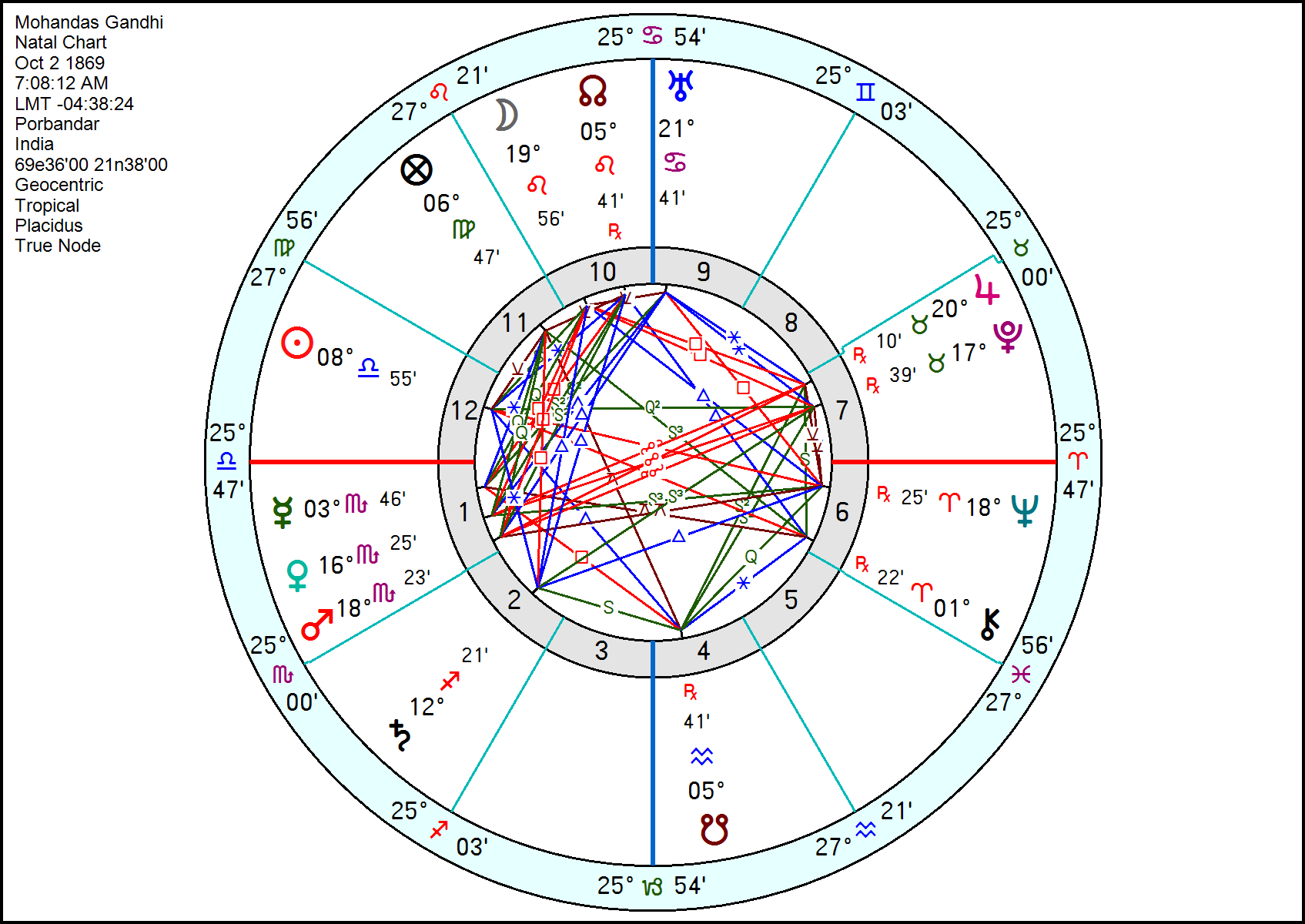
Gandhi's Sun at Libra 9: cooperation of the ego with the World-Idea, and God superior to both
Compulsive intensity for Gandhi to live out this image; rational soul will have to look into it more deeply
"Me" = inward reflection of phenomenal object
Opposite at Aries 9 - brief student discussion
Rational soul will have to correct ego
Dragon includes the highest ideals that men have lived for
Gandhi not a Sage
BOOKS READ FROM OR REFERENCED:
A.J. Penny, Studies in Jacob Böhme
T. Lake Harris, Arcana of Christianity, Vol. 1, Part 1
Julius Evola, The Doctrine of Awakening
Immanuel Kant, Critique of Pure Reason
Paul Brunton, The Wisdom of the Overself
Marc Edmund Jones, The Astrology of Concepts
Marc Edmund Jones, The Sabian Symbols in Astrology
C.G. Jung, CW 14, Mysterium Coniunctionis
SABIAN SYMBOLS: Aries 9, Libra 9
CHARTS appended to this transcript:
FIGURE 1983 0506a-1. Gandhi Natal Chart (astro.com).
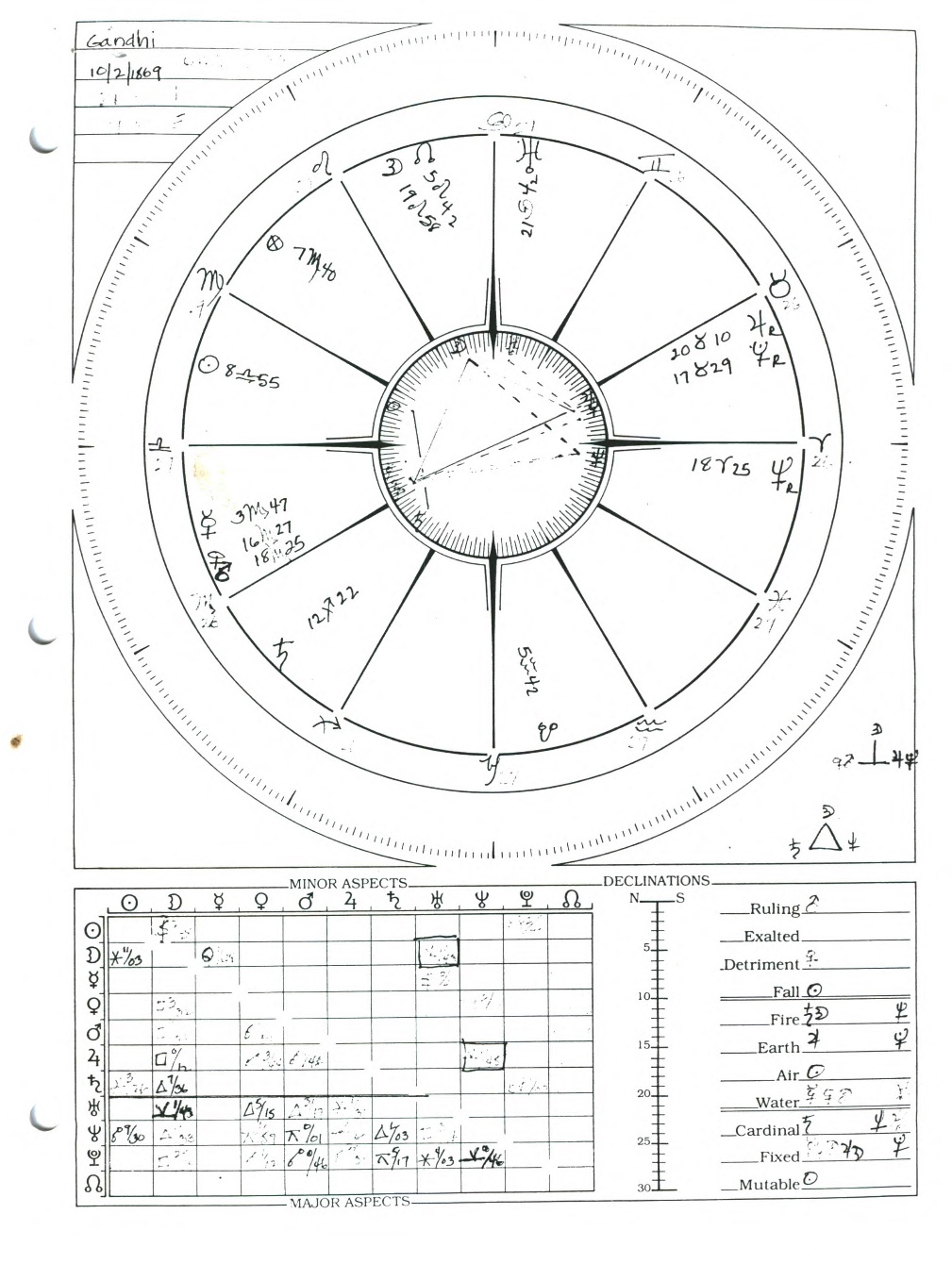
FIGURE 1983 0506a-2. Gandhi Natal Chart (WG version).
AD PAPER read in class:
- "Notes on the Dragon". Retyped as 1983 0506b V09MP. Astronoesis - Nature - Dragon.
NOTES:
This is 1983 05/06a, Astronoesis; Nature; Dragon Class, and the first entry associated with this date. 1983 05/06b = Notes on the Dragon Paper.
Correct Dates (per IT & JF) for the Two Classes on the Dragon (Astronoesis; Nature; Dragon) are May 6, 7 (Fri, Sat) – NOT May 4, 5 (W, Th). The old partial transcript dated May 6-7, 1983 matches the content of these two verbatim transcripts; it is appended to WG Class 1983 0507.
May 6 is a Friday night, the usual class night for Astronoesis/Plotinus. The discussion continues on May 7, the Saturday morning class. See also WG Class 1983 0513 (Friday) for more on the Dragon.
TRANSCRIBED Verbatim by IT prior to 2018 (V11a). This is V12ap (2023) and has: updated prefatory matter, footer, and audio file name; Book List and TOC completed, Subsubjects expanded; typos corrected and new notes within transcript; different Gandhi chart appended that matches the birth info from astro.com; new formatting to accord with new conventions. Archival verbatim transcript with AD Paper – V12ap.
AUDIO FILES: 1983 0506a, 1983 0506b (formerly 1983 0504a, 1983 0504b). [Note: "Tape" and "Side" refer to original audio cassette tapes that were later digitized into .MP3 Audio Files.]
| NEW FILE NAME | OLD FILE NAME |
| 1983 0506a | 1983 0504a |
| 1983 0506b | 1983 0504b |
1983 05/06a at Wisdom's Goldenrod
Astronoesis; Nature; Dragon
[Audio File 1983 0506a (formerly 1983 0504a) Begins]
[couple seconds of music followed by tape break; class starts at 52 seconds]
[students and AD discussing class schedule, etc.]
[discussion ends and class starts at 2 minutes 41.8 seconds]
AD: Avery, they-- they're just general rem-- remarks, you could read them off and maybe it'll-- there'll-- some reminiscence will take place.
[Transcriber note: The following paper is found in AD Supplementary Material (pp. 1096-1097) and has also been retyped as 1983 0506b V09MP. Astronoesis - Nature - Dragon.]
AD ["Notes on the Dragon," AS reading]: "If we examine the 360 degrees, associated with each degree is a symbol, an image, which is then followed by a psychological commentary of that symbol. [AD, faint, sounds like part of background: (No.)] These images are what we are referring to as the Earth's memory. The totality of possible permutations and combinations of these images constitutes the storehouse of content deposited by the lived experience of mankind. The totality of these 360° [degrees] would constitute the so-called subconscious or Jung's archetypes of the collective unconscious. This is the life of the Dragon, the Earth's memory of all that has transpired within its domain. [short pause] It can be conceived of as a totality or [AS adds: as] a single organism--which includes all the degrees to be found in the horoscope. It is to be distinguished from the celestial Ideas which were instantiated or manifested by the functioning of the cosmocrators. [short pause] [AS: Next point.]
"This is the irrational life with its inherent dynamic and vital energies which is [AS reads: as] present in every living animal organism of which man can become reflectively aware as constitutive of his ego. [AS: Sorry,"which is"-- "which is present in every living animal organism of which man can become reflectively aware as constitutive of his ego."] [short pause]
"The karma of an individual is associated with the living out of these vasanas as they are incarnated in a body. -- The organization of these vasanas gives rise to certain predispositions, intense in their compulsive nature and grossly or subtly getting manifested as the psychological experience of an individual. [short pause] Their organization as [the] psycho-somatic organism is what constitutes the matrix of tendencies, etc. [AS reads: and so on], that is referred to as the ego. The glamour and fascination which they exercise on the human Soul is revealed by our preoccupation with our fantasy life. This is Plato's cave--the images in water. It lives in and through every one of its creatures, i.e., its experience of pain and pleasure is through its creatures, referred to in folklore and legend as the Dragon--the Wisdom of the instincts or the body. Its revelation is in dreams, i.e., a manipulation of images, symbols, animals, etc. [AS reads: and so on], or in waking fantasy."
[17 second pause]
AD: Any random thoughts you have on-- on the Dragon, just [half/one word inaudible]
VM (simultaneously): I would like to hear the whole thing again, it's short enough Anthony, can we just do it?
AD (simultaneously): Well they're just random thoughts, I mean he read them like they're-- like it was a paragraph, but they're just, you know, random thoughts.
VM: Well--
AD: Sure, go right ahead.
VM (simultaneously): If-- if it's alright.
AS: Ok. I'll try and read them as if they were random thoughts. (laughter)
VM: I think I have a hard time connecting. (some laughter)
JC(?): Start again.
AS: Ok, I'll try again. One. Some point. I'll read them singly and maybe we can comment on--
AD ["Notes on the Dragon," AS reading]: "If we examine the 360 degrees, associated with each degree is a symbol, [AS adds: or] an image, which is then followed by a psychological commentary of [AS reads: on] that symbol [AS adds: or image]. These images are what we are referring to as the Earth's memory."
[short pause]
AS: Ok?
VM(?): (Good/Uh-hm).
RC: And by that you mean the actual pictorial image in the symbol book? Is that the image that you mean?
AD (faint whisper): I'm sorry?
RC: "Image" in that context where he just read it, it means like from the symbol book?
LR: Sabian symbol.
AD: Yeah, Sabian symbol book.
RC: The actual pictorial scenery.
AD: Yeah. You have the italicized symbol written out, alright, and that's one-- let's say that that's an i-- that's an image. It's not an optical image, it's an image, alright. [student assents, very faint] And then the psychological commentary is something distinct from that. And, all I'm suggesting is that this is what we're manipulating when we're trying to understand (how the) person operates, (you know), psychologically.
LDS: Anthony--
AD: Well just throw the questions out.
LDS: Ok, when you-- when you say that the psychological commentary is distinct from the symbol, you're saying-- are you saying it's distinct in the sense that it's not exhaustive of the meanings [AD: Yeah.] in the symbol?
AD: Uh-hm.
LDS: Now, with that, what-- how should we think of the symbol as a-- as more profound or more inclusive than the psychological commentary, in what-- You know, are we speaking of [VM simultaneously: It's (one word inaudible)] some kind of power?
AD: That-- that's what this-- that's what I'm hoping the class will be about, that we can discuss these things and see if we can elaborate some of these ideas. They're not in any way meant to be-- just suggestive, to get us going, you know?
LDS: So the psychological interpretation is an excerpt from each of the symbols.
AD: Well, I think it's obvious that being that there's so many books on symbolism that people have different interpretations of one and the same symbol.
VM: Anthony, just a point of clarification on terminology. At one time we tried to draw a distinction between using the term "symbol" versus "image". Are you still trying to hold to that or are you using them interchangeably?
AD: Well right now I'm using--
VM: Interchangeably now, ok.
RC: When you said by image you don't mean the i-- the pictorial scene but the--
AD: You see, that's one of the things that I think will come up in our discussion, that when we understand the way these symbolic or non-optical images are operative and they reveal or let's say we become aware of them through our psychological experience-- I'm sorry, got a question?
LR: Does it [one word inaudible] pictorially?
RC: [one/two words inaudible] he said no, that we did didn't mean the optical image (for anyone) but more like, would you say a gut disposition?
[student assents, faint]
AD: Gut(?/.) If--
LR: The what?
AD: Many of you, for instance, have the experience, you get up in the morning and there's a tune running through your head and you can't get rid of it, alright, and the next day and the next day and you recognize that there's a certain compulsiveness about this melody that keeps running through your head. Now, in a way what I think is being said here is that this predisposition to operate in a certain way, alright, is formulating the kinds of thoughts that you're having. It is not only an ingredient but it is the s-- the structure which predisposes you to think of this particular thing rather than another. And if this is going on all the time, we're in deep trouble. But just read them randomly, Avery.
AS: Well it's (provo--)
AH: I would like to I guess answer Louis's comment, or speak to it, and ask a question at the same time, is it-- These images are in the collective unconscious, that was mentioned as another way of speaking of them. And of necessity is that sets up a polarity with the ego structure or the psychological entity. I mean there has to be that polarity, consciousness is-- ego consciousness is split off from these archetypal contents. Is that an appropriate--
VM: Why can't you think of the ego as an outgrowth of the unconscious, if you want to use that term, as a manifestation of the unconscious, as an island within it?
AH: Well, [S: Yeah.] the question I'd like to get to is, what-- like what is it-- what is it that one does with those images? Is it-- is it to assimilate them? Is it to de-- to deny them and ignore them and split consciousness farther from them? Like, what perspective are we--
AD: You-- I think you remember a remark and-- that was made concerning the ego, that it has its own mechanism, it has a mechanism by which it produces its imaged world. You remember that remark?
AH: I'm sorry, I don't remember that.
AD: I think it was in the quotes on the ego by PB, that the ego functioned in a certain way and that that functioning included or supplied the pictures that we work with. Do you remember that quote? Let's read this through, let's-- let's just get a lot of thoughts together before we get into a discussion, alright?, I-- I have a few more quotes. Because we've got to have a little bit refresh-- refresh-- What do you call it, refreshment? No, it's not refreshment.
S (simultaneously): Refresher.
S: Refresher.
AD: Refresher. (bit of laughter) So let's read the next line.
AS: Ok [couple/three words inaudible]
AD ["Notes on the Dragon," AS reading]: "The totality of possible permutations and combinations of these images constitutes the storehouse of content deposited by the lived experience of mankind. The totality of these 360° [degrees] would constitute the so-called subconscious or Jung's archetypes of the collective unconscious. This [AS reads: It] is the life of the Dragon, the Earth's memory of all that has transpired within its domain. It can be conceived of as a totality or a single organism--which includes all the degrees to be found in the horoscope. [AS: Another point.] It is to be distinguished from the celestial Ideas which were instantiated or manifested by the functioning of the cosmocrators. [AS: Another point.]
"This is the irrational life with its inherent dynamic and vital energies which is present in every living animal organism of which man can become reflectively aware as constitutive of his ego."
RC: Would you read that one again, Avery, a little slower?
AD ["Notes on the Dragon," AS reading]: "This is the irrational life with its inherent dynamic and vital energies which is present in every living animal organism of which man can become reflectively aware as constitutive of his ego. [10¾ second pause]
"The karma of an individual is associated with the living out of these vasanas as they are incarnated in a body. -- The organization of these vasanas gives rise to certain predispositions, intense in their compulsive nature and grossly or subtly getting manifested as the psychological experience of an individual. [short pause] [AS: Again--] Their organization as the psycho-somatic organism is what constitutes the matrix of tendencies, etc. [AS reads: dispositions, and so on], that is referred to as the ego."
S (faint): Sorry Avery [couple words inaudible] on the previous sentence.
AD ["Notes on the Dragon," AS reading]: "Their organization [AS reads: The organization of these vasanas] as the [AS reads: a] psycho-somatic organism is what constitutes the [AS reads: a] matrix of tendencies, etc. [AS reads: dispositions, and so on], that is referred to as the ego. [short pause] The glamour and the fascination which they exercise on the human Soul is revealed by our preoccupation with our fantasy life. [AS adds: And] This is Plato's cave--[AS adds: also what he refers to as the] images in water. [short pause] It lives in and through every one of its creatures, i.e., its experience of pain and pleasure is through its creatures, [AS adds: and it is] referred to in folklore and legend as the Dragon--[AS adds: i.e.] the Wisdom of the instincts or the body. Its revelation is in dreams [AS reads: It reveals itself in dreams], i.e., a manipulation of images, symbols, animals, etc. [AS reads: and so on], or in waking fantasy."
[17 second pause]
LR: I didn't understand that last part Avery. Its revelation is in dreams as-- [AS simultaneously: Right.] this(--) as the actual images? Is that as the act-- actual kinds of images that are revealed there or as the organization of those images?
AD: Look, look--
AS (simultaneously): What it says here is "that [LR simultaneously: (Ok.)] is, a manipulation"-- I'm sorry.
AD (faint): The way-- the way, for instance, a lot of the imagery in dreams is manipulated to deceive you.
LR: Deceive?
AD: [first sentence spoken very quietly] Yes, to deceive us. Let me read another quote which you remember, it was from Harris's Arcana. And he says--
[Transcriber note: I am using Studies in Jacob Böhme by A. J. Penny, Wipf & Stock Publishers, Eugene, Oregon, 2016.]
A.J. Penny [Studies in Jacob Böhme, p. 162, AD reading]: ""Every sun has a solar spirit." . . . "Every planetary orb of the terrestrial sort [AD adds: is] a terrestrial spirit. The spirit of every orb is diffused into, and lives throughout, its mineral, vegetable, animal, and human kingdoms, [and] [AD adds: it] is an immortal entity, a living, indivisible, and instinctively conscious existence, but [AD adds: it] is without human personality, and so abstractly conscious of pleasure or pain, but without power to determine its own sensations."" [T. Lake Harris, Arcana of Christianity, Part I, Vol. 1, pp. 100, 101]
AD: And then another quote.
A.J. Penny [Studies in Jacob Böhme, p. 162, AD reading]: ""Insphered in every solar, aromal, or terrestrial planetary world, is an appropriate World-Soul…"" [T. Lake Harris, Arcana of Christianity, Part I, Vol. 1, pp. 100, 101]
AD: Which I'm calling the memories of our planet.
A.J. Penny [Studies in Jacob Böhme, pp. 162-163, AD reading]: ""…living in the life of all its distinct creations [AD reads: creation], [and] permeating alike its atmospheres, its waters, its [AD adds: mineral] material crust… These World-Souls comprise the first family of God, and their number is that of the stars." . . . "They are [AD adds: the] absorptive organs for the Divine Spirit; and, pervading each its own world, and living in all its parts, they distribute throughout matter the Divine vitality." . . . "I was given to understand that the World-Soul of one planet had become inverted from light to darkness, in consequence [AD reads: consequences] of the abandonment of its race to moral evil; that the external body of that orb had long since been dissipated; but that the psychical form of the planet still adhered together, and was the abyss spoken of in ancient days." . . . "The lost Spirits from that orb were the first tempters and deceivers of our own human race." . . . "The World-Soul of our orb is exceedingly afflicted, and suffers in all the inversions of Divine order upon our globe." [T. Lake Harris, Arcana of Christianity, Part I, Vol. 1, pp. 100, 101]
AD: You remember that quote.
[students assent, faint]
AD: Um-- So, I think-- we're trying to think, like if we use the analogy of a human being, each me-- you know, we all have memories, and if we think of-- if each person thinks of his own memory as an organism existing and living in its own right and manifesting itself through whatever images arise in our mind. And, if you-- if you recall, like there's times when you might remember something, let's say some incident that happened, and you could recall the image with all the peculiar qualities, the colors, the taste, the aromas, the shapes, and all that, you bring it up from your memory. You could make that kind of comparison the way to help understand, you know, the microcosm and macrocosm.
LR: Well-- I didn't follow.
AD: Well I'm suggesting that if you have difficulty abs-- conceiving abstractly this living organism, you know.
LR: But you started-- you gave an exa-- you said in many-- the memory one experienced was certain tastes or smells I forgot?
AD: Yeah, this--
LR (simultaneously): What was that an analogy of?
AD: Well, if you think of that, alright, [LR simultaneously, faint: And the subs--] and you think of that as-- well, let's say the Earth's memories contain this jumble of shapes, forms, sights, smells, and all that, alright. And then you go back and you say to yourself something, well, let's see, the-- the Intellectual nature of our mind is such that it has fabricative and gnostic functions, and it-- in receiving the World-Idea it tries to represent that World-Idea to itself, and the representation requires that its Intellectual nature grasps, let's say, the significance of that World-Idea. But then it creates or makes sensations for itself of what it's trying to represent. Now if we say that these images which are contained in the Earth's storehouse are the very sensations which are organized by its conceptual or its faculty of understanding into the picture of the world that we have, then on the one hand you would have the higher part of the mind, the Intellectual part of the mind, which makes representations for itself of what the World-Idea is. Representation here would be more like an abstract schemata which is going to organize in images, which are, as we said, they have these various qualities, alright, it organizes those sensations into a picture of the world, and in organizing those sensations into a picture of the world, included in that organization is, let's say, your psychosomatic organism. So that, from this-- this is a vantage point of view because then if you can understand it in this abstract way, then you could say, well, that entity, that psychosomatic organism, is nothing but a composition of this imaginal essence or the memory of the Earth. And you could understand why some people if-- can have a dream-like quality. Because if you were to do the same, you know, like in-- when you're sleeping at night and you dream about something, you draw up these pictures, alright. On the one hand you have an abstract idea of the-- let's say the complex you want to represent, but on the other hand, you have to have these images, alright, all these various sense-qualities, organized by this abstract schemata to become the scenario or the scene of the dream that you want to experience.
VM: Anthony, can we make the analogy to try and build on what you're saying? If you say there's some sort of complex that tries to manifest itself in the dream, [AD, faint: Uh-hm.] but it'll use the-- as a vocabulary for the expression of that complex the images in the waking life of the recent past, [AD simultaneously: Yeah.] say a day or two, whatever.
AD: Uh-hm.
VM: Now, to move the analogy up one level, you say the Intellectual part of the soul has a certain, let's say, schemata or impulse that it wants to manifest, and it too has to use the images of, this time, the Dragon. [AD, faint: Uh-hm.] And that's the material, that's the vocabulary, that's the substance that it has to mold and--
AD (simultaneously): That's the-- that's-- yeah, that's the vocabulary or the material of the presentation which is going to take place. But now the peculiar thing that occurs with this notion is of course you can see that include-- that each one of those sense-qualities, alright, which are brought together to form some kind of unity of this psychosomatic organism, each one of those that are combined in that way have a certain mode of functioning or operating which is, let's say, included in that organism when it is combined into a totality.
LR: You know, but I-- it's--
AD: Well, let's fall back on the dream example, ok. You take a-- an example when you, let's say, have a dream, and in this dream you have to create a representation of yourself in the dream. And you will ascribe to it certain qualities which are peculiarly significant and, let's say, pictorialize that attitude or that disposition that you-- you want to see out in the picture form. And it will also-- it will also have that compulsive nature to be that way and be understood in that way. Now I'm saying that in a sense, insofar that we are a psychosomatic organism or an ego, then this is what is included in our structure. This is what we're constituted of, we're constituted by this-- these memory images in the Earth's storehouse, we're constituted by those memory images, and we're organized, let's say, by the aspects that we see in the chart. So that one image may, let's say, work without friction with another image, alright, but would be in contradiction to a third image, and this is welded into, let's say, a hylomorphic unity of some kind.
[short pause]
LR: It seems impossible. I don't understand what it means for a man to actually transcend that. I mean when this--
AD (simultaneously): No, no, let's not get into that, first I want to get into this deep-- I want to get-- I want the mud up to my mouth.
LR: You read a quote that said it's the actual deliverer of the vitality of the Divine Being.
[student assents, very faint]
AD (very faint whisper): Yeah.
[student assents, faint]
LR: I mean that gives it-- that gives it a-- an inclusiveness which is-- I mean, if it-- if it, you know, if-- it just seems that there's many levels of this, I guess that's what I'm trying to say, ranging from the most seedy psychological egotistical level to one which is actually the deliverer of Divine vitality and I don't--
AD: No, all that that Divine vitality is, is that these tropes, alright, are invested with matter, I mean with energy. You remember the example about rolling up the paper for six months under the bed.
LR (faint): Yes, [student assents, faint] I remember.
AD: Alright. Any-- If we say that-- If we trace back the species that have existed and that will exist, from our studies we know that-- that this is the result of the inerratic sphere which is, let's say, the archetype or the Intellectual archetype of those species. So that the power of the Ideas to manifest themselves into this imaginal essence, that power or that energy remains there.
LR (faint): Remains(--/.)
AD: In those images.
LR: Or in the Ideas.
AD: No, in those images.
LR: The power of the Ideas to manifest themselves, [AD: Yeah.] the Ideas--
AD (simultaneously): They manifest themselves as creatures, alright, a whole s-- a whole list of species. Now the manifestation of the Idea, alright, has-- the manifestation-- the Idea manifesting itself in these imaginal essences or what we, you know, refer to as tropes, that energy ultimately can tra-- be traced back to the Idea. So, in that-- in that organism or Dragon, there's the traces of the energy of the Ideas which had the power to manifest themselves. Now, you can call this Divine vitality, but that's irrelevant right now. The point that we're trying to get to and that I want you to stick to, and don't run away from this because tonight I mean to get a little further into it, alright, is to try to get a glimpse of the nature of this Dragon. 'Cause this is-- this-- this is what it means to me when someone says this man has conquered himself, whether it's the Dalai Lama, PB, or any Sage, this is what he's saying, he has conquered himself. That means that in this body, alright, where all these images with their compulsive activity, alright, is organized into this one entity, that when that soul overcomes those compulsive natures, alright, then he-- he can get out of the cave. That doesn't mean that he vacates the premises. But he sees now what those images in water are about. Now, this is what I want to tackle, alright.
RC: And this would include all the-- all the emotional judgments of experience that ordinarily pass for the specie's intelligence (the person--)
AD: Yeah.
S: Say that again Randy?
RC: All the em-- the emotionally-colored responses and experience which come from there that normally pass for like the-- the specie's intelligence, the instinctual reactions, the emotional judgments of situation(s), things, and people as they immediately affect this biological organism.
S: [couple words inaudible]
DB: But in philos-- I mean it seems as if you could say that what this boils down to is that the--
AD: I don't want to boil it down, I want to expand it.
DB: Ok. What-- what we-- what we so fondly refer to as our-- our lives and our identities and our egos and things we seem to be preoccupied with a good deal of the time is this-- I mean, it consti-- on the one hand constitutes our personality, but on the other it's basically impersonal force of compulsive energy that's been left behind in the-- in the Earth's atmosphere. And, I mean--
AD: If you notice he said fire, earth, air, and water, and all the kingdoms of Nature?
DB: Yeah, ok, and furthermore, this life we think we're living is something that it seems to be living at our--
AD: Expense.
DB: --expense. I mean uh-- it's actually somewhat awe-inspiring, if I--
LR (simultaneously): [one word inaudible]
AH: I'd like to pursue David's point. In a-- on the one hand a selective process of these images constitutes the ego. You know, like in a sense the ego is a product of this Dragon in-- in a certain way of speaking, but at the same time the ego has to maintain its autonomy.
AD: You know how much autonomy it has? [AH: But--] You [S simultaneously: (No.)] remember what Evola said, [AH simultaneously: No, but how about--] like a dog on a chain? [Note: See Julius Evola, The Doctrine of Awakening, pp. 68-69.]
AH: But how about inundation with unconscious contents, you know, ps-- psychosis-- Like, the ego has to split itself off.
AD: You're-- you're getting into something right now which is-- which I want to avoid because what we'll be doing would be to try to understand how the soul gradually disidentifies from the psyche. First I want to understand the so-called nature of the psyche.
AH: Well really Anthony I thought that's what I was asking. Like, the ego is a product of the Dragon. Is that so?
AD: Yes.
AH: But what is it about that ego or the conscious life of the person that is able to maintain a distinct selective discrete perspective?
RG: The planets and their aspects. The configuration of a center.
BS: I don't follow the question.
AH: Well, it's just that there's-- (there's) David's point and the thing that Richard just described or explained that there's two sides, you know. The ego is a-- is a consequence of but in some way it maintains its-- its integrity.
DB: Yeah but Andrew at the same time I think if we could really see the total morass that our, you know, fantasy life really is, we'd be appalled. I mean, relatively speaking, you know, it's probably fairly specific and integral and all the rest of it but if I just look and-- and if I was to write down all the garbage that goes through my mind for even a period and try to make sense out of it to somebody else, you know, it would be real difficult.
DH (faint): Right.
AS (faint): Oh, I'm sorry (I won't--) I-- I don't-- I don't have any-- what (Andrew) just asked is not really the same point. (State) your reason, (you know), [DB simultaneously, faint: Oh (one/two words inaudible) yeah.] changing the subject (and) I don't mean to unless you're--
S: Andrew, go ahead.
AH: No I-- I'm just confused about the dual nature of this conscious ego.
DB: And Andrew couldn't it be like just the distinction between Nature-- just on a physical level, you've got, you know, these forces of Nature in the world itself but you have them brought into specific bodies that organized into specific structure. It seems like it's the same process on a psychic level, you know, that we're discussing now and what actually does that seems to be something other than what the remarks that Tony had-- had written. I don't know.
S: Anthony? Could this have something to do with the way these degrees and their symbols, the 360 degrees, could that have something to do with the way that-- that our sets receive the impulses of the Earth? And then we manifest it depending on the way, karmically, we are able to put it out?
AD: Well, [slight pause] there was this-- this notion that if we-- if we think of this Dragon, alright, and-- or think of all these memories, and we say that beyond that, alright, outside the belt of the Dragon, you have the cosmocrators functioning, alright. And that this Dragon belt supplies the very material, let's say, and I'm being very specific here, the very sense-qualities that are being constantly reorganized to form different pictures from moment to moment and that is being done by the cosmic circuit, so that the-- the abstract schemata that it represents, the abstract understanding or idea, alright, is being-- is organizing these pictures or let's say this-- these sense-qualities into pictures, into images. It is these very images that we-- we're going to assume as reality. And the point that-- the point here that becomes very-- I think this is the important part.
Now, if-- if we recognize that these images in the mind of the Earth or the life of the Earth, if it is these images which are organized into a psychosomatic organism and we take seven of those degrees and we place a planet-- a planet on each one of those degrees, we would be in effect saying that the aspectual asp-- the aspectual relationship of the planets to each other has brought about in-- or has brought into being or manifested, alright, this peculiar entity, which is constantly changing, we're not going to go into (it/that), but it organizes it in this very peculiar way. First of all, you have let's say a planet on a degree. Now, that's going to-- I think this part is going to be obvious to understand. When Jung says that these are the categories of the imagination, anima, you know, senex, etc., well he's speaking as truthfully as he can, because in effect he's saying, "Look, all that's being organized here is the memories of the Earth and this is nothing but imagination, so why shouldn't I call it categories of the imagination?" [RG assents, faint] So my anima function is the way, alright, that particular function has for its content this memory of the Earth organized in a certain way to deliver certain contents and not any others. So that if that becomes an aspect of my personality, if the senex is an aspect of my-- if all these seven, each one representing a category of the imagination, if these seven constitute my personality, alright, and if I could be a little impersonal for a while, I'll be able to look at that as the imagination functioning as an entity. In other words, from this whole bunch of memories I just pick certain [AD claps], put them there, alright, and say, "This is going to be an entity," and keep doing that all the time(,) continuously without interruption.
HS: When you say imagination functioning as an entity, is that what you mean by ego, imagination?
AD (simultaneously): Yeah, that the ego is basically nothing but the activity of the imagination [HS simultaneously: It's like (one/two words inaudible)] or the activity of these memories. [HS, faint: Ok.] Which is a pseudo-identity, it's not a real identity, it'll-- soon as it falls apart each-- each of those images will go back to whatever it was, [one inaudible HS word simultaneous with AD] or let's say be returned to the-- you know, to the storehouse.
HS: And the storehouse is the Earth's memory?
AD: Yeah.
HS: And the Earth's memory is supplied by ki-- human functioning on Earth?
AD: All life that ever existed on Earth.
HS: All life, [AD simultaneously: Yeah.] what we call natural life that that [couple/few words inaudible]
AD (simultaneously): All life that ever existed on Earth.
HS: Ok but-- but for humans there's a-- there's a-- but there seems to be like peculiarly like human psychological stuff.
AD: Yeah, of course, but there's also the reptile in us if you've noticed.
S: Hm.
RG: And we've discovered those aspects.
AD: Huh?
RG: We've discovered those aspects [one word inaudible]
AD (simultaneously): We've discovered the reptile aspect, yeah. (bit of laughter) The animal is there, Herbie. Sure there's the human there.
HS: No, no. But it's this-- that's the point. It's the-- for-- for the human psychological though, I-- I could crawl over there, prove my (anima/animal). It-- it's actually human life, so to say, that's feeding this animate and it's like psychological life that we have is entering into this-- or i-- into the Earth's memory?
AD: No, what we call our psychological life [S simultaneously, very faint: Is.] [HS: Yeah.] is the [S simultaneously, very faint: Is, yeah.] functioning of those memory images.
HS: Is the functioning of the memory image. But is it-- and it's being re-- recreated or regenerated and reposited back up, as it were, or back in it?
AD: You mean when we pass on and then we leave behind the [HS simultaneously: (Or/Well) maybe--] good we've done.
HS: Yeah.
AD: Yeah. (bit of laughter)
HS: We're doing [one word inaudible] (and others--)
AD (simultaneously): You don't mind I'm gonna be around(./?) (laughter, student words)
S: Anthony, which [few words inaudible]
HS (simultaneously): Like which is-- which is the human-- yeah that's the question [one/two words inaudible]
AD (simultaneously): I'm sorry?
HS: I'm losing the point (to) which is the human part and which is the Earth's memory.
RG: Isn't that's what's given by the categories of the imagination, the peculiarly human functionings that Jung-- Jung describes for example, the senex, the anima, those are the particularly human configurations that this imagination takes.
S (simultaneously): But how are you distinguishing [S simultaneously, faint: What?] those from the images? [one word inaudible, possibly another student]
RG (simultaneously): Oh, that's one's function-- 'cause they're-- they're very different, one's the content and one's the function.
LH: Isn't there any difference, though, between [CDA simultaneously, faint: I-- what (one/two words inaudible)] the kind of historicity which you find within that imaginal sphere and the historicity that we speak of as the soul's-- I don't know what word to use there, that the soul would have a historicity which has presided over a number of [S simultaneously, faint: Well you're leaving (things out).] incarnations.
RG: Yeah, but that's not what Anthony's talking about, I mean, he doesn't want to go to that higher level right now. [one inaudible student word simultaneous with RG] He wants to stick--
LH (simultaneously): Well then-- but you were saying that the human-- [RG simultaneously: (one/two words inaudible) as--] what defines the human is just a figure or a selection of relationships in that imaginal sphere, and it seemed here--
RG: Well it's not a "just". The particular categories that do that, that are-- that are reflections of those cosmocrators are not a "just". That's a major factor. Go ahead.
S (simultaneously): But in what sense are they reflections? Aren't they a reflection [RG assents] [couple words inaudible]
AD (simultaneously): Well wait wait, I-- we'll get into that in a little while, [S simultaneously: Ok.] because what we have to do-- what we're going to have to do I think in a little while is when we get a chart up and look at a chart and we'll see the way the planet is on a degree which is, let's say, organizing that functioning of that, and on the sa-- at the same time is revealing itself, and then we get all seven of them and see all the relationships that exist within them, alright, and then some sort of image arises (and/but) after that we'll be able to reflectively become aware of what--
(Side 1 of original cassette tape digitized as 1983 0506a (formerly 1983 0504a) Ends; Side 2 Begins)
HS: This content [student assents] which organizes, still you're talking about the-- the realm of the Dragon now.
AD: Yes, [HS: Ok.] yeah.
HS: Ok.
AD: So that, when we put a chart up, alright, and you got Saturn on a certain degree, you know, or Mars on a certain degree, that degree belongs to the life of the Dragon…and that is part of the Dragon's life, alright. Now that planet sitting on that degree on the one hand is going to be organized by that degree and on the other hand is going to be manifesting that degree, so there's a reciprocal relationship going on.
LR: Are the planets part of the Dragon in that example or the planets are not, part of the soul?
AD (simultaneously): Well, that's a question that's going to come up, what do we mean when we say the cosmocrators, alright, and what do we mean when we say my-- the planet in my chart?
RG: No doubt.
AD: Now the planet in your chart is not a cosmocrator but it's, you know, exemplifying one of the categories of the imagination. Go ahead Avery.
AS (faint): Well, alright, I don't [S: Yeah.] (know--)
AD: Go ahead.
RG (simultaneously): [one word inaudible] go ahead.
AS (faint): Well, the element(s).
LR: Well in the example you just gave, you said the planet is sitting on the degree. Did you remember (A)?
AS: Go on. Yeah I did but--
LR: Let me just ask about the example [one word inaudible]
AD (simultaneously): You-- you see, I'm not interested in that right now, [RG simultaneously: Right.] [LR simultaneously: Oh, alright.] I'm still-- I still want to stay with the Dragon, I want to understand [LR simultaneously: Ok.] more and maybe-- You know like, I paid you for a cup of coffee, right, and I look into your face, alright, and there's that glamour there, that sheen, alright, and I say, "Look at the compulsive nature of these images, the way they draw me, alright, out, alright, and force me to relate to this image." I want to-- I want to get to know this Dragon much more intimate. I want to be able to recognize him because I think he's always behind me but every time I turn around there he is in front of me.
S: Yeah. (some laughter)
AH: Anthony, is it-- is it the image or the compulsive quality of the image that's the Dragon?
AD: Are you going to have one without the other?
AH: Uh, I am going to have?
AD: Just imagine when in a dream you met your dream girl. Did you notice that the image and the compulsive quality were associated?
VM: Associ-- (laughter)
AH (amidst laughter): Well, yes they-- they-- they always-- they always are, but--
AD: Well isn't that-- isn't that what we're speaking about, the attraction that the Dragon has, that the-- When-- when for instance we speak about the imaged world as having this glamour, this sheen on it, alright, [AH simultaneously: Yes, yes.] aren't we speaking about that-- the Dragon, so to speak, making it look so enticing?
[student assents, very faint]
AH: That-- that's for sure but I wanted to discriminate between the-- the presence of an image and the compulsive quality of an image.
AD: Go ahead, do so.
AH: Insofar--
AD (simultaneously): Try to see a compulsive quality in an abstract idea.
AH: I was going to suggest the Dragon is the compulsiveness but not the image itself.
RG: No. You can't separate it.
AD (simultaneously): That's the whole point. It's the image and the compulsiveness that that image contains. An image isn't in a vacuum divorced from this compulsiveness.
[student(s) assenting, very faint]
AH: You--
AD (simultaneously): If-- the first beautiful girl that passes by, you ever watch?
PD: Did you ever not watch? (laughter)
VM (amidst laughter): Well spoken.
AH (simultaneously): Anthony, this-- We could use the example-- perhaps the example of the-- the man that you revere here that have conquered himself--he sees the girl walk by.
RG: It's not an [DB simultaneously: What?] image though.
AD: See, I'm trying to leave out the higher soul functioning in the psyche. [VM simultaneously: Yes, it scares everybody to do that.] I'm trying to stay [AS/S(?) simultaneously: Sure.] within the psyche, within the Dragon.
AH: Alright.
[inaudible student talking in background while RG talks]
RG: But I would just answer, Andrew, if he could that it's not an image anymore in the psychological sense of image. He's seeing the person, there is no image there and so there's no compulsion.
AH: Ok, alright.
S: [couple words inaudible]
[sounds like student assenting]
AH (simultaneously): I see, the psychological pictoral--
RG: Right, not image as a sensible manifestation but image as a psychic compulsive component.
AH: Oh I see, I was thinking of image as the presented world.
RG (simultaneously): No way.
AD: You've got to understand that compuls-- that intense compulsive that an-- compulsion that an image operates with in order to be able to recognize that your psychological functioning [AD speaks rest of sentence forcefully] IS that compulsive intensity that the image which-- or the memory which constitutes your psychosomatic organism.
AH: Ok.
RC: Not that that-- yeah.
AH: Ok.
RC: Not that the image is like presented to the ego that then reacts to it but the actual functioning state of the ego is part of the image that's presented.
[students assent]
AD: Yes.
RC: Alright, so [DB simultaneously: I mean--] like when Eliade talks of it, quote that we've all read a billion times about these [S, very faint: Vasana.] vasanas getting discharged, it-- they contain within themselves the-- all the impact of the whole situation. Once it comes up it's already decided how the empirical subject is going to (react) to these [one word inaudible]
AD: And how it's going to experience, yeah. [student assents, very faint] Now, if possible, maybe some of you have shovels or pitchforks, you could dig a little bit more into the Dragon, what its nature is like.
DB: Yeah, Antho-- now one thing that struck me is that there does seem to be-- you spoke of (a/uh) karma. That's-- it's like if you have an experience over and over, now something that you're doing, something that you could talk about, you can say, "Well I did this and I did it 500,000 times," whatever, eventually what happens is when that's translated into a vasana that you're going to meet again in a next life or something, it's become part of the way the mind is functioning then, alright, and-- and it's got the-- the striking thing about it is these-- these all seem to have an existence of their own, an independent type of vitality from-- from ourselves. I mean, you know we-- and it-- it seems like part of the compulsive nature that they have is they're always wanting to manifest but they're also-- Well, it's not enough to say they're appealing because that's not really what I mean, it's not something that can be drawn to, that there's a quality about each one of them or about all of them that makes us identify with it. I mean, you know, we take all this activity as being something very original and very personal and important and so forth and so on, and it seems that what you're saying is that no it's-- it's a completely--
S: Mechanical.
DB: --mechanical, habitual, machine-like affair.
AD: Yeah, well of course we experience it in a personal way.
DB: Yes, right.
AD: Everyone regards, you know, his experiences as very unique.
LR: And of course isn't the hitch that all the vitality that you know is tied up there? Not that there isn't some other source of the life, but as far as we're concerned. (Just--)
AD (simultaneously): Well--
LR: That is where you get your vitality.
DB: Right, yeah.
LR: You don't want to--
AD: Cough it.
LR: --cut off, cut yourself off from that vitality per se, it's scary.
DB (simultaneously): No, I mean, that seemed to be necessary. [AH: And it--] But there's also-- there's one other thing about all these things is that they seem to need us too, or, you know-- but that-- that's ano-- I mean like there's an implied inadequacy that they have, you know, [S simultaneously, faint: They do.] like at least my vasanas, they really, you know--
AD: They really look you up, don't they?
DB: Yeah they, you know-- the-- they don't care about what I happen to really want to do, they-- they require me.
RG: Go ahead.
AS: You know, back in the beginning when you were-- in the beginning, very first line of this first point, and you're talking about the symbol which then gets a psychological interpretation. You know, I can somewhat conceive of the nature of like say an Idea in itself and the way that all of the individual men, say, participate in the Idea of Man. But we have a-- (seeing) a similar situation here, that each-- have this Earth imagery which contains what you're calling 360 degrees. I'm-- but I-- I'm not quite clear yet on what the nature of, say, the degree is in itself. I mean you have this-- you have a symbol which is the best way we could get to it, say, and then you have a psychological interpretation of that symbol. [S: Hm.] But the symbol is representative of say this-- you say an ima-- you know, a-- an image in the collective unconscious, an archetype or-- maybe in Jung's terminology. But (tell me), what is the nature of that image? I mean it's not a pictorial image. What actually is the nature of like that image itself that all these individuals that have, say, 30 degrees Aries in their chart can participate in, and what's the-- and you say it's compulsive. Well that's the way I experience it or the way somebody else experiences it but what kind of a nature does this Earth's memory have in itself, like this memory trace, I don't know, the-- the actual nature of that degree itself is(--) say even beyond that symbol(./?) And it is-- say, are Jung's, the way Jung describes his archetypes, is that valid? Do you think those are valid type descriptions of the nature of that memory image, of that collective unconscious? Is there a way-- I mean is there some way to conceive of that Earth's memory in itself? Because that seems to be-- that's what's manipulated by the cosmocrators and then it-- say every individual entity that has that certain degree that's being aspected will feel the effect of that. There seems to be a middle-- like a link there, the cosmocrator is organizing this degree or is activating it or energizing this degree in the Earth's memory, and now all of the natal-- all the people that have this degree natally are going to feel some compulsive effect of it. So it's like, you could conceive somehow that degree as part of the Earth's memory in itself.
AD: Well, I think, I think right now, Avery, if you pursue that question, what is the nature of that symbol when you try to investigate that, might help amplify a little bit more something about the nature of that memory image.
AS: Yeah. I mean that's-- this is the question Vic is always asking about. You know like, you have the symbol in the book and that symbol-- if we don't-- one way, we go one way to particularizing it and we could read the psychological interpretation, but if we try and push the symbol the other way, it seems you really get to something quite different, and you're almost hitting it, trying to hit at what is the nature of that degree, not as an Idea in the inerratic but as a-- as a memory trace and what-- what is that symbol in itself almost, the nature of the Earth's memory in itself.
LR: (You mean/Be) like the status?
AS: Yeah-- well not necessarily just status but what is it like? I'm saying, again, you know like we experience the compulsive nature but at-- fifty million people on Earth have a certain degree or the five billion, however many, and a planet hits that degree and everybody feels it. I mean everybody with that degree feels that energy. Now, that degree in itself almost, so there's a-- what is this-- what the symbol is supposed to represent is the nature of that Earth's memory trace in itself. You know, can we get, say, from that symbol-- instead of taking-- taking the symbol and abstracting the psychological meaning can you take the symbol and try and almost get at what that degree is in itself, [student assents] or what that memory is.
HS (simultaneously): Or would you say it's material?
AS: What?
HS: Would you say it's material?
AS: Well, if you [couple inaudible student words simultaneous with AS] say it's material what do you mean by material? You know, I mean if everybody on Earth, if everybody that has that degree can participate in it, that's not the nature of material things completely. We usually think of material things, well I take a piece of this pillow and you take a piece of it, it's gone. But it's almost that immaterial quality of an idea--everybody can participate in it.
S (very faint): Yes, seems [one word inaudible]
HS (simultaneously): Well, it's got a certain imagal quality we said, that it-- [AS simultaneously: Yeah.] it again is-- is a material imagal.
AS (simultaneously): What do you mean by imagal? I mean, [S: Yeah.] we said it's not a pictorial imagery.
S: Well sometimes it is, isn't it? I mean, take the cosmic egg as an archetypal symbol. That's pictorial.
S (faint): [couple words inaudible]
AS: Yeah.
S: And it explains something much deeper, I mean it has meaning, many levels, but pictorially it's a cosmic egg.
[student assents, faint]
DB: Oh but it seem(ed) like, you know, if-- if we don't want to--
AD (simultaneously): Well, what is the web or the network of relationships that that symbol [AS: Yeah.] is [AS: Symbolizing.] pictorializing?
S (very faint): (I see.)
S: What is the web?
AD: What is the web or the nexus of relationships that is subsumed under that symbol? And I think if we went into it, we would find that it doesn't mean one thing but it has a plurality of meanings, so that this same symbol can be used in a, you know, diverse ways. And because it is a web of relationship of a lot of different, let's say, experiences that life has gone through and they're deposited-- and they-- it seems that the-- there's a certain variety of experiences that, how could we say, form a nucleus and in this nucleus they're all tied together there and they represent this matrix of a lot of different tendencies and then we a-- put a symbol on it or let's say it brings-- brings within-- it'll-- brings within us a symbol, alright, but what is the nature of the meaning of that symbol?
LR: If you got to that nature itself, the question you were asking Avery, would it still be the Dragon?
HS: That's part of the [AS(?) simultaneously, faint: I--] question then.
AS: I-- I would-- I mean I'm conjecturing [RG simultaneously: Yes.] yes, it is. [LR, faint: You would say it is.] [RG simultaneously with LR and AS: That is exactly it.] You're not-- you're not talking about the Idea. In fact, I was going-- that is--
RG (simultaneously): This is exactly it, yeah.
PD: [few words inaudible]
AS (simultaneously): We're talking about the symbol as part-- [S simultaneously: (Wait.)] we're talking about the symbol as part of the Dr-- as representing this image within the Dragon and not a-- I'm not talking about getting beyond it to the Idea that was instantiated to begin with but the actual nature [LR simultaneously: Ok, then can you explain what--] of that deposit, that nexus or conglomeration of--
LR: But then I don't know what the difference is between [AS simultaneously: Web of relation.] germ idea and the symbol anymore. [RG: Sure.] Like what is it that's qualita-- what you're saying, getting down to the symbol, ok, penetrating the nature of that symbol(--/.)
RG: Linda, the symbol's only the picture, right?
HS (simultaneously): It's only what now?
LR (simultaneously): No, not the way he was talk--
AS (simultaneously): Yes.
RG: Yeah, no--
AS (simultaneously): Yes it is [one/two words inaudible]
LR (simultaneously): You're talking about a picture?
AS: Yeah-- no, I'm using [RG simultaneously: The Sabian symbol.] symbol like you rea-- you read the italics in the book. And I'm saying now you read that italics in the book, that-- Jones gives a psychological interpretation, [LR simultaneously: Ok, I got it.] that's an extractio-- an abstraction from [RG assents] the symbol. [LR simultaneously: In a psychological (model).] Now take the symbol and try and go the other way with it. Make it a symbol.
HS (simultaneously): And what's this-- you're saying what's is it-- what is it a symbol of.
AS: Yeah, [RG simultaneously: Right] in a sense, sure, what is it a symbol of, [LR simultaneously: Right.] what is that tremendously complex thing that really is this memory in the Earth's-- in the Earth's memory, what is [RG assents] that memory like.
RG: And if you could penetrate it at the first level, you sh-- theoretically get there.
LR (simultaneously): Ok, and I s-- and I'm [AS: Yeah.] speculating that if you got to what it's a symbol of, you no longer have a symbol, you have the (Idea/idea), that the symbol is precisely the point where you cross from say the (Idea/idea) to the other mode, the psychological mode, that it stands right there in the instant between. [S simultaneously: Not (true).] But to abstract the nature of the sym-- to get to the symbol itself--
AD: No, the [AS simultaneously: That's not the way I was talking Linda, but you might be right, I--] symbol-- the symbol is in-- is still within the-- [LR: I'm trying to understand what you were--] the symbol is still within the Dragon.
RG (faint): Right.
LR: Ok, yeah, the symbol.
RG: No but-- but the [AS simultaneously: Yeah, but so is what it symbolizes.] symbol as given in Jones is not a real symbol, [DB simultaneously: I mean there's a--] I mean it's a picture, and he--
DB (simultaneously): There's a difference between [S simultaneously, faint: It's a symbol as well (few words inaudible)] an Intelligible Idea and some form of parasitic growth (or-- on top of it).
PD (simultaneously): But the words [few faint inaudible student words simultaneous with PD] written in the book aren't the symbol [AS: Yeah.] but in order to get to that, [S: Yeah.] to get to the symbol, you have to-- your mind has to be modalized into that image, otherwise you're not experiencing the symbol, [AS simultaneously: Oh but--] and that modalization is the symbol.
LR: That's the [S simultaneously: Yes.] nature of the symbol [RG simultaneously: Look, you can (one/two words inaudible)] itself. Exactly, that's what I mean Paul.
PD (simultaneously): Yeah, I think that--
AD: But Paul, if you continued then, if you say that the modalization of the mind, alright, becoming that symbol, would-- wouldn't in a sense, aren't you in a sense saying that the ability of the mind to function and transformed it-- it transforms itself into that function. [short pause] In other words, it isn't-- it isn't just a symbol but the way the mind took his whole-- its whole heritage and became that image that it, you know, (of--) It was out there and you penetrate into the symbol, that symbol is you for a-- you've e-- you experience your mind modalizing itself as that symbol, alright. [LR assents, faint] But then that would mean that included in that very process the mind has this capacity to do so. But then is the mind, so to speak, that very functioning(./?)
LR: Which has that capacity?
AD: To make--
S: Yeah.
LR: To take a form, to take one of those forms?
AD (simultaneously): To-- to take on a symbolic form.
RG: But, (may I) ask a question again, is the mind the very functioning [S simultaneously: Function.] of those symbols?
AD: What we call [RG simultaneously: Going the other way (around).] the mind, the empirical mind, [RG simultaneously: Yeah. Is that what--] is precisely that ability to modalize itself, pictorialize itself, transform itself, into these images.
[students assent, very faint]
PD: So like the 360 symbols are this-- the s-- the sphere or locus--
VM: Wouldn't you say it's the image of the mind's functioning, something like that?
AD (simultaneously): Yeah, I don't think they're 360 symbols. I don't think of it that way. That's just a convenience, because like I said the permutations and combinations are indefinite, [VM assents] and it's only for the sake of convenience we're speaking about 360 degrees. But I don't know what it would be, for instance, you take the first degree, you know, in-- in Aries in the first and Cancer and you have a square between these two symbols, what's going to come out.
LR: No what you've seen yourself or said yourself that it-- that one degree appearing in a different chart will not be interpreted as the same-- in the same symbolic way.
AD (simultaneously): Yeah, and that-- that is an automatic assumption, that there cannot be two charts alike because there's no two charts(--) or there is no two psychosomatic organisms that are composed of the same imagery.
LR: Right. So wouldn't that be-- I mean wouldn't that speak to the point that there's more than 360--
AD: Yeah.
LR: --that it--
AD (simultaneously): But, if we can get back to this question that he brought up, alright. What is the nature of that symbol or image?
LDS: Anthony, [S simultaneously: I think--] could I-- could I speak? You've mentioned before this nucleated center that-- that let's say the symbol is trying to point to or give us-- give us a sense of. It would seem to me that if you want to get farther into the symbol and get to what it's pointing to, you would be getting to some kind of specific energy pattern let's say. And the symbol, the image that we read and try to allow the mind to modalize according to is a means-- is a-- is a way of getting to the-- let's say the feeling-tone or the theme or the specific energy pattern that that degree represents. Is that something along the lines of what you're suggesting, that it's-- The way we speaking of vasanas and so on as structured energy patterns, there's no real pictorial nature about them in and of themselves, but they will draw--
AD (simultaneously): Yeah because, if you took an example, alright, if we think of let's say the different ways that digestion could take place, alright, by the gamut of species, all of them, alright, and then these patterns of functioning are to be grouped, alright, they would nucle-- they would come into a nucleus, alright, all the different ways that food could be digested [LDS: Yeah.] is brought under the heading of one symbol or one symbol let's say indicates all these different possible ways that digestion could take place. So we would say that the symbol has this indefinite plurality of meanings, you know, it's multivalent. And consequently when we see it in a chart, we cannot say it just means this, it could mean a lot of other things, [RG assents] but they would all have to fall under that-- [RG assents] that particular matrix of possibilities [AS assents] and have-- it wouldn't be concerned with seeing.
LDS: Right.
AD: Ok?
RG (simultaneously): [couple words inaudible]
LDS: So you've got to get to that theme that [AD simultaneously: Yeah.] symbol is pointing to.
AD (simultaneously): So then, [S simultaneously: What is the theme?] so then we could say that that symbol [S simultaneously, faint: It's just a word.] is pointing to a certain theme, a conglomeration of related activities, focuses it or becomes a nucleus. In a similar way like for instance in your experiences in life, alright, certain experiences that you have in life after a while begin to congeal, you know, and they form a nucleus, they come together, and they're different from other experiences that you have.
LDS: Yeah, and then they'll pervade a certain realm of your experience.
AD (simultaneously): Alright, so that if all these experiences, let's say, that you had in terms of relationship with woman or in terms of relationship with music, all-- alright, let's say that they-- they nucleate around a common center, alright, and then some kind of symbol would indicate that matrix of all these different relationships.
RG: Yeah. You know, [one/two inaudible AH words simultaneous with RG] no I mean if you read ten different symbol books, it's like they each-- each clairvoyant gets a piece of that matrix of possibilities of--
AD (simultaneously): And makes that the mainstay, you know, [RG simultaneously: Right.] makes that his symbol.
RG: Right I mean [AD simultaneously: Yeah.] if-- you know, you get-- and they're pretty cons-- I mean, it's like they get-- each get a-- and one set of symbols gets a whole-- one slice of that matrix of possibilities, another set gets another slice. But they all-- they all, if you could see it, I mean they all converge around the same--
AD: Theme.
RG (simultaneously): --particular quality.
S (simultaneously): They're speaking of the same kind of aura, a quality about it.
RG (simultaneously): Yeah, yeah, right.
AH: To-- to press the issue of looking-- looking through the symbol as it were to its essential quality or its essential nature, is it like-- if we spoke the other way in terms of sequence, what is peculiarly human experience is a consequence of-- of that-- a planet being on a degree, [VM assents, faint] etc. But to go back in the other direction, and I think we gave the example in this discussion before of like certain primitive peoples that would identify with an essence of an animal for instance or-- or try to make a connection with one of those essential zodiacal qualities and live it in their life, they have to forfeit what is peculiarly human in order to do so. Like they actually become that, [someone assents, possibly AD, very faint] like-- I don't-- I don't understand what it means to s-- start from the perspective of peculiarly human intelligence and-- and penetrate into the essential fundamental meaning of a symbol if that intelligence is dependent upon that. Like--
RG: Why?
AH: (I mean) we're a consequence of [RG simultaneously: But that--] a certain chain of events.
RG: That doesn't mean the effect doesn't have a link to its cause and can't relate to it.
AH: Well a dif-- I think a difficulty, Dickie, is presented quite clearly that when you read the italicized symbol and form a-- an image, a picture, there's a poverty of-- of possibilities there to grasp-- If you try to do it in terms--
RG (simultaneously): I disagree, there's a wealth [TS assents] of possibilities there to grasp it.
AH: No, but you hang to the picture, you don't get it.
RG: Well, that's an art, to be able to read them properly, you know, get it. I mean--
[student assents simultaneously with RG above, faint]
AH: I'm really asking, how do you do it, you know, I mean, how do you actually do it, what is that art? Is it a very--
LR (simultaneously): Calling the soul.
AH: Is it a very strenuous thought process? [RG: (Well--)] Is it an intuitive glimpse?
LR: But--
RG (faint): (Yeah.)
AD (simultaneously): Andrew, how do you do what? [AH simultaneously: What is it a glimpse of?] How do you do--
LR (faint): Get the symbol.
AD (faint): How do you do--
RG/AB(?) (simultaneously): But that's why I don't really [one word inaudible]
LR (simultaneously): [couple words inaudible] symbol.
S (faint): (Alright/Uh-hm).
LR: Wouldn't you say that each of those symbols is like a certain stance of the mind, certain peculiar posture that the mind takes and then it-- in s-- that seeing the symbol means that you-- that you-- the mind actually takes a certain position?
AH: Linda, I thought the position the mind would take is a consequence of a planet being on one of those degrees.
LR: We're talking about the symbol as one of those degrees, yeah.
AH: The stance that the mind takes is a consequence or an effect of a planet being on the degree. It's not--
LR (simultaneously): Well wouldn't that work-- Right, that's [AH simultaneously: Ok. It's--] right, but now we're talk-- now you're talking about how you get, you know, and how you're sitting on the other side and you want to get back to the symbol.
AH (simultaneously): Yeah. And I thought you were-- I thought you were--
LR (simultaneously): I'm talking about-- I thought we were talking about Avery's question [AH simultaneously: Yes.] still, what's the nature of that symbol.
AH: And I think you suggested that it's a [couple/three very faint inaudible AD words in background simultaneous with AH] stance that a mind takes.
RG: Hm.
LR: Well what does that mean?
S (simultaneously): What does that mean--
AS: I'm sorry [RG simultaneously: That wasn't (one word inaudible)] [couple words inaudible] if (it'll--)
S (simultaneously with AS and RG): --stance the mind takes?
AS: Yeah.
S: Isn't that--
S: Yeah.
AD (very faint, possibly part of background): That's it, that's it.
AS: Maybe I'm--
LR: Yeah, go on say it.
AS (simultaneously): And-- but it's not relevant that it's my question or not, it doesn't matter, but that-- I still think-- I wasn't asking what the nature of the symbol is exactly, I thought just from what Dickie said and so on, again, I'll try again. You could have many sets of symbols. Now, just the terminology, I was using the word 'symbol' to mean the actual-- this-- the italicized description you read in Jones or you go to Kozminsky and he has a certain [LR simultaneously: Right.] symbol there, and I think all of those, as Dickie was saying, each one of those is a peculiar slice of something. That something that I'm calling the thing that [RG assents] it's the slice of I'm saying is not an Idea, it's-- that is the Dragonic-- [RG: Right.] that is the actual [RG simultaneously: It is the--] memory.
RG: Right. The Dragonian idea.
HS (simultaneously): Ok [couple words inaudible] the actual memory.
S: I don't [RG: Right.] see the--
AS: Dragonian tra-- [S simultaneously: What is?] memory trace. And that's a-- that itself is a-- a vast complex of interrelationships of webs. It's so vast that, you know, you could pull all kinds of-- like we could-- ten people-- fifty million people could have that same degree in their chart and they'll have a different-- and it'll manifest differently. And all of those things must belong-- you'd have to put like all of those together to understand what that-- that memory was, that one memory. I mean, take one degree Aries, take all the people that have one degree Aries. All those people that have one degree Aries will be participating in the nature of that Earth memory, that one degree Aries, so it must be vastly complex. The symbol only gives you--
LR (simultaneously): But you're saying it's something other than the symbol.
RG: Of course [AS simultaneously: Yes, I'm de--] it's-- of course it's something other than the symbol.
AS (simultaneously): Well "other"-- By [LR simultaneously: But I'm try--] the symbol-- what do you mean (it's)--
AD (simultaneously): Look, but we pointed out that the symbol is the best representation [AS simultaneously: Yeah.] of that matrix of [RG, AS, HS assent] possibilities that the mind could present you with.
AS (simultaneously): I-- I agree. [S: Yeah.] But all I was just trying to point out is that the symbol is a representation or something-- the way that that Earth memory is going to be given or made available. But again, as we pointed out, [RG simultaneously: It's an image of it.] there can be many-- there (could be) [RG simultaneously: Right, it's not it.] many of those possible symbols.
[TS assents, faint]
HS: When you speak of this matrix [AS simultaneously: And al--] of possibilities now, [AS simultaneously, faint: Right.] is it a-- is the matrix of possibilities a previously experienced and now memorized images? It-- or is it a matrix of new possibility? Is there any new possibility [one inaudible AS word simultaneous with HS] in there?
AS: It seems to be me-- memory means something which has been experienced.
HS: And is it-- and is the matrix built around anything [AD simultaneously: Is what?] or-- or other than past memories?
AD: Is what?
HS: Is the matrix built around anything?
AD: Well by definition we're saying that it's the result of lived experience.
HS: Ok, but it's the result of lived experience. And it's a-- and it's a set of [AD simultaneously: Tendencies, yeah.] congelations around previous lived experience.
AD (simultaneously): Yeah. And it could always be added to. You could always add more to it.
S (faint): Yeah, right.
AS: [one/two words inaudible]
HS: Oh, so you could [S, faint: You have to.] add more to the Earth's memory.
AD (simultaneously): Yeah, you could add more to that.
RG: Yeah and-- you know it does seem that degree-- I mean it's even like, you know, you read degrees-- sym-- a symbol book from the eighteenth century and it seems-- you know, there's a certain evolution it seems in the-- in the possibilities in each degree almost.
AD: Uh-hm.
[RG/S(?) assents, very faint]
S (faint, possibly part of background): [few words inaudible]
AD: So at least we come to this, and that-- and that is that the symbol represents or is the best representation that the mind can come up with of these-- these tendencies which are grouped together and nucleated as all relating to a certain theme, [RG, HS assent] alright. So that if a person, let's say, continuously dwelt on one kind of experience and all these similarly related experiences, alright, they eventually would deposit in his mind that activity which, when the mind wishes to recall or bring up to itself, it makes a symbol for itself of all that-- all those tendencies. But it can't, so to speak, take each and every one of those tendencies, isolate them, and view-- view them as though they're in a test tube, because now they've been deposited in a common substratum. [RG and another student assent] And even there can we say that, like for instance, when you forget something, does the object or the thought that you forgot, does it sink into the unknown in the way that you knew it?
VM (very faint): It's always been [one/two words inaudible]
AD: In other words, like I have-- I have an image of something, alright, and then I forget about it, now, forgetting about it, what do I mean by that? Does it-- does it go back into a barrel, alright, the way I saw it? Or does it become, let's say, a certain activity or tendency of the vital energies?
RG: [noise or one word inaudible]
LR: Isn't rela-- isn't memory-- remembering or forgetting a process of formulating or unformulating, dissolving a form? The process of putting a form, attaching form to a tendency, wouldn't that be remembrance, re-membering, re-formulating, [AD: Yeah.] and--
AD: And we-- and we [LR assents, faint] say that that's the mind's symbolific activity.
RG: Uh-hm.
LR: That re-formation, [AD simultaneously: That-- that re--] that (formulating/formulated)--
AD (simultaneously): Yeah, that re-formulation of a previous content.
LR: Ok, and the specific-- So then that content, that tendency in itself would not have a specific form.
AD: No, in itself, yeah.
LR (simultaneously): The mind is providing it with a specific form that [AD simultaneously, faint: Yeah.] we call the symbol.
AD: Uh-hm. And you can refer to that as the symbolic activity of the mind.
LR: And, in the process of forgetting, that form drops away and that tendency remains what it always was then.
AD: Well, when you say that the form drops away, what do you mean?
LR: See, the way I'm thinking, and this is pictorial language, I mean I don't really know, the way I'm thinking about it is that the mind is none of these forms but assumes forms in order to grasp these tendencies but--
AD (simultaneously): But if it assumes a form, alright, then you're speaking that the mind has an Intellectual nature, alright, which can provide a form for these forgotten contents.
RG: Uh-hm.
LR (very faint): Alright, I--
AD: Now we're back to what we started before. We're saying that the cosmocrators are, or our mind conjoined to the-- alright, is the Intellectual part of our mind. [RG assents] It formulates in the best way possible, alright, [couple faint inaudible LR words] an image of the Ideas it's working with. And this formulation of the Earth's memories into a unity, alright, is what we're referring to as this psychosomatic organism. [RG assents] Now, if we put someone else's-- if we put someone's chart up, alright, and we look at where the planets are sitting on the various degrees and the relationship that these aspects have to each other, we're speaking about the way these memories, the Earth's memories, which have been organized into this unity, is functioning.
LR: Yeah, and [S simultaneously: But--] I would-- I would add to that speculatively that the-- the aspects you're looking at give you the quality of formulation that you're going to find.
AD: Well, you're jumping ahead.
VM: Anthony I want to get it again what you are saying, the planets were [AD simultaneously: You're jumping ahead.] distinct from the-- distinct [AD simultaneously: (three/few words inaudible) around.] from the symbols.
LR (faint): Alright.
RG: The Intellectual part--
VM (simultaneously): Can you just run that by again?
AD (simultaneously with RG and VM): I'm-- I'm trying to describe in a very peculiar way the Critique of Pure Reason.
S: Uh?
RG (simultaneously): Uh-hm.
S: Ok.
VM: Yeah, but you might as--
AD (simultaneously): That the-- In order for us to understand the nature of knowledge we have to also enquire into its origin. [student assents, faint] We have to know something about the origin of knowledge in order to understand something about knowledge. We also have to understand what conditions are necessary in order for knowledge to arise. (Now/And) I'm laying this out on a cosmic background. [RG assents] I'm saying the presuppositions necessary in order for knowledge to arise is this whole cosmic panorama, [LR: (one word inaudible) repeat?] and-- and not-- and not the footnotes that you will find in a commentary on epistemology. This is what we need in order for us to speak about what conditions are necessary in order for me to know.
RG (faint): Uh-hm.
S: You mind just going over again what you said about our mind conjoined with the cosmocrators?
AD: Well we said this a dozen times. You're going to enquire into the nature of the knowledge, and we would automatically assume that that means we also have to know something about the origin of knowledge, how it can arise. So the very first thing we recognize is that there must be something about our mind which has an Intellectual bias, alright, Intellectual here not the--
VM: The lower sense, yeah.
AD: --not the intellect of the ego, alright. Now, this Intellectual nature of our mind, I'm saying conjoin that to the cosmocrators, (with/to) the whole of the planetary spheres. This is the Intellectual nature of our mind. And we're not going into the fact that it has eight bhavas of buddhis and seven powers by which-- alright. Ignoring that for now. But that is its Intellectual nature. Now it makes for itself, alright, a representation of the Idea. This is an abs-- abstract schemata. This is what's organizing the Earth's memories, images, into a unity, a functional unity. [RG assents] The peculiar thing about the Earth's memories is that they're the very sense-qualities which we ascribe, let's say, to this pole, to this body, or to anything else.
VM: Anthony I was listening but I'm sorry, I missed it.
S: Yeah.
S: [couple words inaudible] just--
VM (simultaneously): And, you know, I might have just bad problems tonight but--
AD (simultaneously): Alright, let me try with the-- let me try with the image, ok, the dream image. Let's say you have the experience, you have the experience of seeing the-- in-- in wakeful life you see a-- the redness, the glow of a sunset, ok. [VM, faint: Ok.] This peculiar quality of redness, the sunset, alright, is a sensible quality, ok. Now at night you're having a dream, alright. That has been preserved in your imagination, in your memory. That is what is going to be used as the vocabulary of the dream that you have [VM: Yes, fine.] where you'll see this red fiery bull coming at you. The redness of the fiery bull is the redness of the-- the sensible quality that you perceived in wakeful nice-- in the wakeful life, but the Intellectual part of your mind takes that and organizes very many sensations into this imaged or-- yes, this imaged dream.
VM: Ok.
AD: Now in a similar way I'm saying that the Intellectual part of your mind makes an abstract schemata of the World-Idea which is coming in, alright. This World-Idea, of which it now has an abstract schemata-- and you have to also think of this going on instant-by-instant-- [VM: Of course.] it has this abstract schemata. Now the only thing that can correspond or make an image or a picture of that Idea [VM simultaneously: Our Dragon.] are the sense-images or the memories [VM simultaneously: Right, right.] of the Earth. So it organizes those memories into a functional image or unity, which you're going to call your body.
[students assent, faint]
VM: Ok, (go ahead).
AD (simultaneously): You-- Alright, you get the drift?
VM (simultaneously): I think I followed that, in fact I thought that was exactly the analogy I used about an hour ago, but that's--
S (simultaneously): Ok.
AD: Yeah, yeah, it was [one word inaudible]
HS (simultaneously): When you speak this way though, what happens to the degrees? Where do the--
VM (simultaneously): The degrees [AD simultaneously: I'm sorry?] are those memory images that are [HS simultaneously: What are--] being brought into, you know, some kind of image by the functioning powers of the soul or the cosmocrators.
HS: So the degrees are the very memyor-- memory images.
AD: The Earth's memory, the images that are retained by the Earth, alright.
HS: And the abstract schemata is prior to [one word inaudible]
AD (simultaneously): Is the Intellectual part of the nature which is going to organize those memories into a thing, an entity, a psychosomatic organism, which is nothing but a cluster of sensations. All that you know about your body is what you know about it in this sensible way, alright, it weighs so much, it's this color, it smells, etc., etc. These are all nothing but sensible qualities. But we said sensible qualities are images which are left behind and retained in the m-- in the Earth's memory, the soul of the Earth.
RG: So you seem to be [AD simultaneously: (An--)] making a corollary in the sense that the cosmocrators contemplate the World-Idea and that gets reflected in the psyche as the degree symbols as reflecting the World-Idea, and the categories of the imagination reflecting the cosmocrators [LR simultaneously: (Self/Soul).] or the Intellectual part of the (self/soul).
AD (simultaneously): Yeah, uh-hm. So that in-- in the realm of the cosmocrators we can speak about epistemology. [student assents, faint] You can't speak about epistemology inside the Dragon belt.
PD: When PB speaks in The Wisdom of-- of karma as the kinetic memory of Nature, that's like the first level of the reproductive imagination, the actual constitutive images of the body as [one word inaudible]
AD (simultaneously): And was the kinetic memory, yeah.
PD: I mean that's-- that kinetic memory of Nature is another way of talking about the very continuum of existence [AD: Uh-hm.] in which the Overself is then going to--
AD (simultaneously): Well, don't bring the Overself in now.
PD (simultaneously): Well, that's the backdrop to the--
AD: You see, because the Overself--
PD (simultaneously): --primary epistemological subject.
AD: Yeah but you see the Overself is even beyond the cosmocrators. Now, I just wanted to add one-- one thing there, which I forgot. [few inaudible whispered student words] Uh-hm, need more coffee.
VM: Went into the barrel.
AH: Is there another way-- is there another way of speaking about--
AD: Oh yes. No, no, that wasn't it.
VM: Go ahead, please.
AD: No, that wasn't it, no.
AH: Is there another way of speaking about the Intellectual part of the mind?
AD: The faculties of the mind?
RG: The Intellectual. Those are the categories of the imagination.
VM (simultaneously): How about if you said it the-- could you call it the undivided mind as you have in many cases, in many instances of the past?
AD (simultaneously): Yeah, of the functioning and the spontaneity of the manas principle.
VM (simultaneously): So, this undivided mind then, if I could speak pictorially, takes some sort of impulse from the World-- [AD simultaneously: Idea, yeah.] the World-Thought or the World-Image, which is not any kind of pictorial thing, but let's say it takes-- somehow it grapples with this or takes the form of this energy and seeks to pictorialize it in terms of these-- or combinations of the 360 tropes.
AD (faint): Uh-hm.
VM: And this is the epistemological issue there, or let's say the epistemological hunting ground where you can really find out what the nature of knowledge is.
AD (simultaneously): Well the cosmocrators is the epistemology, [VM simultaneously: That's what I says-- that's what I mean.] that's where you're going to come to the epistemology.
RG (simultaneously): This is one level below that.
VM: Yeah, I understand.
AD (simultaneously): But within the realm of the Dragon [VM simultaneously: No, it was (nothing to--)] you'll never solve epistemology.
VM: No, right, fine.
AS: Uh-hm. You don't want to get into that particular problem either now of the-- the distinction there within the Dragon of those categories of the imagination?
AD: Yeah, yeah, I wanted to follow that up now.
AS (simultaneously): Because, that seems to be the next [one word inaudible]
AD (simultaneously): Yeah, the next step would be now that, if we have a little bit of a feeling of what these degrees are, you know, in fire, earth, air, and water, and then we speak about a planet sitting on them, alright, then we have to try to understand the transition from what we refer to as the eight bhavas of buddhi and the seven powers of the soul, we have to understand how it translates itself, alright, into the psychosomatic organism. In other words, as far as our personality is concerned, those are no longer the cosmocrators, they now become what we refer-- what Jung refers to as, you know, anima, se-- senex, [AS assents] etc., and also what we refer to as the eight bhavas of buddhi, alright, now become the four psychological functions.
[students assent, faint]
AS: Yeah I-- I guess-- I'm not really clear on the nature of that "become". That seems to be a real-- Like, ok we explained it in-- we gave some explanation in terms of the tropes, I could un-- the traces of life activity. Now, the cosmocrators are also a-- an epistemological activity and they leave their traces, like the trace-- it seems you're saying the trace of the Venus function say is what Jung calls the anima. Now, is that anima as an imaginal category an actual imaginal entity or is that only arising as-- I mean there seem to be two models for it. You could speak of anima as an actual imaginal entity just as those tropes are actual imaginal traces, or you could speak about anima arising only when the cosmocrators function, like a force field organizes certain vasanas and then you have the anima manifesting. Can you actually conceive of anima function as a-- as a-- a distinct imaginal or imaginal psychosomatic trace as you can the degree? Say that again, maybe I didn't make it clear. [couple/few words inaudible, possibly another student]
AD (simultaneously): I think the problem you're bringing up is the one that, you know, we did a few times. [AS assents] Jung speaks about the archetypes, alright, and under that notion, alright, [couple inaudible AS words simultaneous with AD] is included anima, senex, [AS assents] alright, which I distinguish from the archetypal degrees [RG assents] that they sit on.
AS: Right.
S: Right.
AS: Now [TS simultaneously: So does Hillman.] we got a third thing too.
AD: Huh?
RG (simultaneously): So-- he does sometimes use--
AD: Well, if you remember, bring it out, anything to help us along, bring it out, anything that you--
PD (simultaneously): But he spoke of the natal chart as this-- the subjective psychic system, the personal psychic system. He did make that comment.
AS: Right.
PD: And that would be the-- within the realm of the Dragon.
AS: But--
S (faint): (Say it again?)
AS (simultaneously): But Paul that's-- but-- but Paul in that example, if you say the natal chart is the psychosomatic within the realm of the Dragon, the natal chart includes two dis-- very distinct systems. One system would be what we call those tropes or the degrees. The other system is what we'd call these imaginal categories, except in a funny--
[Audio File 1983 0506a (formerly 1983 0504a) Ends]
[Audio File 1983 0506b (formerly 1983 0504b) Begins]
[Note: Tape is weird for first 35 seconds but still audible.]
AD: Well we can't say aes-- aesthetic qualities but, if we sa-- if we go back to what the-- some of the ancients thought of it as that which makes matter and form in a harmonious way, alright, if we think of that as a principle, alright, just speculation, then when Venus is sitting on a certain degree, what precisely-- would there be an imprint, a seal, so to speak, on those memories, the imaginal essences, the-- the memories, [S: Venus.] and that the traces of the functioning of this power of the soul is now left behind in the imaginal essence, organize the imaginal essence to function this way?
S: You mean it's a-- a memory trace?
AS (simultaneously): Question because--
LDS: Yeah because you could have different--
AS (simultaneously): If this--
S (faint): Go ahead.
AS: If the-- if the-- if the tropes are trace or a residue of the Ideas, as we're saying, are these imaginal categories in the same way a trace of the higher soul powers? Or-- or--
AD (simultaneously): The traces of the-- yeah, of the functioning soul powers, yeah.
AS: Yeah. [RG simultaneously: Or are they the soul powers, right.] Or is there no trace at all? It's possible you could conceive that there isn't actually a trace but that Venus is like a magnetic field and it organizes certain tropes into the contents of the animus and then you speak about the anima.
DB: But [RG simultaneously: You know, on the other hand (one/two words inaudible)] aren't the cosmocrators the-- the way that--
AD (simultaneously): Wait, can I uh-- I just want to repeat what you s-- You're saying that Venus as a functioning power of the soul organizes certain tropes and this organization of tropes represents the anima functioning.
AS: Right. The other possibility is that there's an actual image of all prior functionings of Venus just as there's an image in the Dragon of all the prior activity of certain other ideas.
RG: Well and then there's a-- and the third alternative is that it is-- there is one Venus principle and it gets reflected in different levels, and that you don't have to speak about traces of a Venus principle.
AS (simultaneously): Yeah, that's similar to the first one I think.
RG (simultaneously): Similar to-- similar to the first one but--
PD (simultaneously): But the-- the-- the experience contains simultaneously different levels of reference.
AS: Sure.
PD: So on one hand there's parts of that continuum of experience that are pertaining to the level of the Dragon but there's parts of it that could be pertaining to a level that's not of the Dragon though it's over-laden with the Dragon's functioning.
DB: (Uh-hm.) Didn't the tropes--
AS (simultaneously): I think even sticking within the Dragon, is there-- maybe it's a-- maybe it's a silly kind of question and-- or it dissolves, but sticking within the Dragon, you could conceive the two ways, that there is an actual--
RG: I don't know what that means, a trace of the Venus function, what that would mean.
DB (simultaneously): Well didn't the tropes get in the Dragon in the first place by the cosmocrators? I mean, did they just sort of magically appear there to begin with?
AD (simultaneously): Yes, yes.
DB: Ok. Well it doesn't seem that-- I mean, it would seem logical then that any appearance of these tropes in some sense is going to be permeated by the particular cosmocrator that brought them then.
CDA: But they've all brought them there at some point, you know.
DB (simultaneously): Right, I mean, but the-- but-- but I mean doesn't that have to do with the plurality of-- of meanings that one particular degree could have?
AS: Sure.
[student assents]
LDS (simultaneously): Yeah that makes sense, that makes-- 'Cause all the different planets have been on all those tropes at some point, so--
AS (simultaneously): Yeah. But, that still doesn't say what that Venus function in my chart. If I say there's a Venus cosmocrator, fine, ok, leave that out for a minute, that's part of that Intellectual mind or the undivided mind. Now, as a psychological entity organized by this undivided mind I have certain tropes that go to make up my psycho-somatic organism. We're also saying I have these seven peculiar psychological functions. [student assents] Now are-- now, these psychological functions are something less than just the cosmocrators, I won't say they're something more than just the cosmocrators, [few inaudible RG words simultaneous with AS] they're actually something less than just the cosmocrators. [LDS assents, faint] They're a certain psychological function. Now, are those psy-- seven functions also a part of the memory traces in the Dragon? Or [AD simultaneously: Or (possibly one word inaudible)] are they [RG: Right.] like the, you know, see--
RG: But let me say-- let me ask you this though. If-- it seems to me that there's one function and that it-- when they get identified with the tropes they appear as these psychological functions but [AS simultaneously: Ok.] in fact the man who could conquer it he would still have a Venus-- the same Venus function in his chart. He would be operating according to the soul power and not according to the [LR simultaneously: That's the first position.] Venus in the trope. [AS: Right, that--] And therefore there's one-- [AS: Right.] one function that can operate in [AS simultaneously: Right.] the trope or not in the trope.
LR: It's almost like by forgetting its, you know, let's say, this cos-- this cosmic power or this Venus enters this field where there's all these tropes, [RG assents] and it's only called the category of the imagination insofar as it forgets its own power, [RG assents] and it somehow associates with these tropes and identifies with them and now it's a psychological function. If-- if it were to remember, regain [RG assents] its earlier position it would then still be a soul power, it hasn't become anything else.
RG: Right [one/two words inaudible]
PD (simultaneously): But I think you have to say it's always on both levels 'cause if it is pertaining to the psychosomatic organism, that part that's within the Dragon is going to be the very continuity of the person's body, let's say.
RG: But [S simultaneously: (That's true.)] that's why I don't think--
PD: And so you have to-- you can't resolve one level into the other I don't think.
RG: I-- well but-- [LR simultaneously: No.] using it in this peculiar way as psychological category of the imagination, the man who's conquered his Dragon, why would you say that he had a psychological component function?
PD (simultaneously): Well he still has psychological preferences for tea.
CDA: He still has a kidney function.
AD: Yes, so that then-- let's try again this way. If we say, if we say that the psychosomatic organism is a complex functional unity of imagination--now, that means that basically the imagination is, let's say, the body of this functional unity, and that this body has seven different ways of functioning or six different ways of functioning--I think now that there would be a distinction between the way it functions and the contents that are within it. [RG assents] So that we would have to conceive of my-- a continuing identity of the function, [RG assents, faint] and not think of it as just a system of tropes which have been organized because that system of tropes which has been organized by let's say a cosmocrator, alright, when that cosmocrator is no longer on that degree, alright, what happens to that organization of tropes, wouldn't it [AS simultaneously: Still remains.] dissolve?
AS: No.
AD: Wouldn't it fall apart?
AS: No, I would say when-- well it depends [RG assents] what you mean. If you have at birth the cosmocrator is on a certain degree, now it's moved on, it's no longer on that degree. My-- my psychological functioning still retains-- it sti-- it more leads to suspect that there is an actual organiza-- a functional organization of that psychosomatic organism which is part of it, it's embedded in it.
RC (simultaneously): Is that specifically a-- the trace you were asking about before is why is it that Venus appears to continue to be on this degree in my chart?
AS (simultaneously): That's something like what I mean. You look at the guy's natal chart, now Venus has moved on, the cosmocrator Venus is some place else, but Venus in my chart is still organized by that degree or the Venus [RG simultaneously: Or Venus organize it.] function is organizing that degree. I still have a kidney function, I still have a psychological function of this Venus, and it's-- it's as much a part of the psychological entity as these tropes which are the content. I mean the function has to be conceived as part of the imagination too.
RG: Right, and in fact isn't that you mean by the categories of the imagination, if not they would just be the transits as the rational soul powers and fixing them as the natal chart [AS simultaneously, faint: Right, that--] defines the categories of the imagination.
AD: But aren't you [few words inaudible]
AS (simultaneously): But, that argues for that point of view then, that-- that there is a-- [RG: For what?] an image of that Venus function within the psychological entity.
RG: Well, or that it gets structured for a person's life as-- yeah, in a certain way surely, according to the degree.
AS: But what I mean is [couple words inaudible] I mean--
PD: They're like the functioning organs of the body, quote, [RG assents] you know, just-- at some hen-- in some sense that congealment of these-- of this imaginative tissue is that function, and as long as the body persists as a content in consciousness those principles are operative at that level of experience. When the consciousness is no longer localized at that level of experience, then you--then you may not speak of a-- a continuity there.
RG: Uh-hm.
CDA: But you-- I'm not sure I'm understanding you but you-- you-- if someone weren't-- is not identified with the body, say, is in a state of samadhi or whatever, the images aren't functioning, I mean, the whole-- the way (we'll) be-- we've been speaking of the Dragon, that se-- that's gone, but the functioning of the-- of the organic functions in the body which has to be a unity for the body to stay alive, that's something different and will continue.
PD (simultaneously): That's preserved-- preserved by a greater consciousness or [CDA assents, faint] to the cosmic soul or something.
CDA: Is that what you're implying? 'Cause that's what I wasn't following, that distinction, (you know).
RG (simultaneously): Well but Venu-- even, I mean, Venus is still on x-degree in your chart if you're in a samadhi, I mean [couple words inaudible]
CDA (simultaneously): No but say [AD simultaneously: Yeah but--] you're not functioning [AD simultaneously: Now--] with the images.
AD: This is the basic point though that Avery's bringing up which I-- I'm disagreeing with but I-- I got to look into it. [CDA, faint: I understand, yeah.] He's saying basically that the tropes can be organized into a function.
S: [one/two words inaudible]
AS: No, I don't think I'm saying that. I'm saying they're organized by a function.
AD (simultaneously): You said it the other way around, you said that the function organizes the tropes and now this becomes what we call the category of the imagination, these [AS simultaneously: (I get it.)] these organized tropes.
AS: No I'm saying that the func-- the tro-- I'm not saying that the tropes become a function of the imagination. I'm not saying it right. I wasn't saying the tropes are becoming this func-- this imaginal function, category of the imagination. I'm saying they're distinct. The tropes are distinct from that category of the imagination, the category of the imagination representing a certain functioning and the tropes representing a certain content. My question is, what is the status of that function, that category of the imagination? Saying there's-- I can conceive of its status in two ways. One is that that category of the imagination is a trace or an image within the psyche, within the imagination, it's an image just as much as those tropes are. But the other way I could conceive it is that the cosmocrator function, it doesn't have a real status in the imagination but is like the reflection or is-- is an organization of tropes by the higher power, by the soul's power.
RG: But isn't that saying the same thing Avery? In one you said it was an image, in the other you said it was a reflection. Isn't that the same idea?
AS (simultaneously): (You know what--) No, no, by image I mean as a-- I mean it in the same way that a trope is-- is a memory t-- is a trace [RG simultaneously: Right, but--] that's in the Dragon.
RG (simultaneously): Right, but when you say it's an image, don't you mean an image of the cosmocrator?
AS: No, no, no, I mean specifically that it's a trace. Is that Venus function the category of the imagination? In other words, if I function with Venus a certain way in this life, next life aren't I going to inherit something of the consequences of that functioning, is there-- is there any kind of continuity within the Dragon? Or, is it only-- next time, you know, is it only that higher function instantiating itself again, functioning again, within the imagination? I don't-- maybe there isn't any difference [LR simultaneously: I--] in those.
AD: Well the difficulty would be that if we thought of a function, the, you know, category of the imagination as a function, and we kept that, alright, then we would have some way of tying in to the rational soul. But, if we cut that off, we say that the-- a category of the imagination, the functioning of a category of the imagination, [VM simultaneously, whispering: Is just a trope.] in some way which we don't know, but in some way is reflected or assimilated by the organism which is made the-- its body is of [AS assents] imagination, alright, if it doesn't have access to the rational mind in some way, then I would never be able to conceive of how it would be possible, alright, to-- for the rational to come into the psyche.
AS: Ok, so then you're taking the second model. That's why I presented these two--
HS (simultaneously): Which is the second now, wait.
AS: That's why I presented these two possible, you know, models for how this works. You're saying basic--
S (faint): Well only [couple words inaudible]
RG: Yeah. I mean we already have the model of the rational soul as the transit-- transiting Chaldeans, right? Now, when we say that you have a natal chart and it fixes it as a category of the imagination, it is those ra-- that-- those rational soul powers in transit fixing them-- it's like they fix themselves almost for a moment.
AS (simultaneously): Yeah. That's fine, and all I'm asking is what is really-- what is the nature of what you s-- you say fixing themselves, I was just trying to get a little bit [RG assents] more precise of what you mean by fixing.
AD: Yeah, that's what we want to try to understand. [AS simultaneously: What do you mean by fix?] In what way does it reflect itself in the imagination, [AS: Yeah.] reflect itself or leave traces of itself, and I think we have to directly attack that.
RG: Uh-hm.
S: Yeah.
S: Uh-hm.
VM (simultaneously): But, is it possible--
PD: Is the seven the rational functioning? Maybe, I mean-- you can see those seven principles not as the-the rational functioning but as the-- a pure fabricative activity that every form of life possesses.
RG (faint): Yeah, you can see it [one/two words inaudible]
PD: And so--
AD (simultaneously): Yeah, I wouldn't disagree with that, sure.
RG: Yeah, that's good.
AD: Yeah, I wouldn't disagree with that.
PD: So the sevenfold classification is not a-- a necessary indication of the rational soul.
AD: Oh yeah, [AS, faint: No it is.] it is.
RG (faint): It still is, sure.
AS: Because-- well the life-- if-- even if you say that sevenfold indicates the life functioning too, [VM/S(?) simultaneously: So it is the rational.] we'd have to fall back and say that the life functioning is an image of the rational soul.
PD: But, yeah, I'm--
S: [one/two words inaudible]
AS: In fact [PD simultaneously: I'm not saying it right.] it's more than an image, it's your-- it's--
PD (simultaneously): But, just like as an-- [AS: Yeah.] a natural-- an animal, ok, a horse, a dog, I mean, they can be seen as possessing those seven principles, [RG: Right.] but they don't have a-- the ra-- the principle of rational consciousness operative in them.
RG: But it's very different to say that the rati--
PD (simultaneously): And that's what I meant by rational.
AS: Yeah.
RG: But you wouldn't not say that the (rational soul) [couple words inaudible]
AD (simultaneously): But what is rational in the horse and the dog, alright? And here I think you can see that insofar that any fabricative activity is going-- going on-- In other words, when, let's say, the Intellectual part of the mind organizes the Earth's memory, alright, into a functional image, a unity, but it's functional, it's a-- it's a functional image, it's not a picture, insofar that that's being done, it en-- the-- the Intellectual part of the mind, alright, is right there. In other words, it is immanent in its production and it guarantees that production, alright, with Intellectuality.
HS: Now in the case of the horse you're talking about the sustai-- the sustaining of the physical form and the life of the horse, is that what you're talking about [couple words inaudible]
AD (simultaneously): Yeah, and its functioning.
HS: Ok.
S (faint): That's what-- yeah.
AD (simultaneously): It shows, it shows the intelligence or the rationality of the undivided mind present in the creature.
RG (faint): Uh-hm.
HS: And--
AD: A significance is given to that conglomeration or unity of images which it would not have otherwise.
HS: Ok, but the significance here is this, the sustenance of the life at-- in that (body/model).
AD: Yes, but not only the sustenance of its life but all the intelligence that is [HS assents] (manifested) by the activity of that ac-- that creature.
HS: Ok, ok.
AS: Well in that [few inaudible student words simultaneous with AS] case then that seems to answer that-- the question-- it seems to clarify something a little bit. When we speak about-- we tried to distinguish before, and in Jung he had a difficulty doing it, distinguishing between those seven categories and the tropes. You now are seeming to give us a handle on how to distinguish them. The seven categories are really the presence of that undivided mind's function in the imagination. Tropes are the traces which stay with the imagination when the [RG assents] entity leaves. They are the contents of the [AD simultaneously: Uh-huh.] Earth's memory. [RG assents] So you're answering very specifically the question of which way the thing goes. The categories of the imagination are the actual presence of those soul [RG and another student assent] powers when they're associated and working through the imagination.
RG: Right.
LR: Identified [TS simultaneously: So--] now with tropes.
TS: So [AS simultaneously: And that-- yeah.] you could say that we could [LR: Yeah.] look at Gandhi's chart now and although we might by reading those chart-- those symbols and the organization they have, we could see the traces left of his functioning of that entity which was Gandhi, we could see the traces of the functioning of that entity in the way in which his rational soul organized--
AD (simultaneously): Is manipulating those categories [TS simultaneously: Right.] of the imagination.
TS: Right.
[student assents, faint]
TS: [couple words inaudible]
AD (simultaneously): And that's why it's possible for him to take a stance in the rational mind.
AS: Yeah but--
TS: And also for that stance to leave its mark in the tropes and in the or-- peculiar organization of those degrees such that we could now read those degrees and see something of the inner nature of that person.
S: How does it leave its mark, Tim?
AD: How does what leave its mark?
S: The-- you were saying it leaves its mark. How does this become fixed, this thing?
PD: Well if I was following Tim, like with Gandhi he would-- when a riot was breaking out or something in India, he-- he took that upon himself and brought that into his own inward contemplation and fasting to effectuate what was going on in the country, and he-- That is a-- in a sense his higher rational soul leaving its mark.
S: In that way, I see.
AD: Or, [PD simultaneously: Am I-- was I following you?] or if we could say the same thing but reverse it. [TS: Yeah.] If we say that Gandhi as an ego, alright, identified with the functioning of the rational soul and not with the functioning of the ego, alright, then these are the traces that would be left behind, which upon the next incarnation would seek a suitable psychosomatic organism, alright, to accommodate the level of functioning that he had achieved. Now, here-- here's-- here's what becomes interesting. We're-- we're speaking about psy-- Gandhi. We're speaking about this ego, alright, and we're saying that it is composed or its body is that of imagination. We're saying that this imagination can function in six different ways, right, [RG assents] and we're saying further that included or the content or the-- the very substance or being of the imagination is the content which is going to manifest. Now I'm going to go further and say all 360 degrees are the content of that ego. [RG assents] It's only some that are being emphasized but all those contents [VM: Sure.] are his contents.
RG: Uh-hm.
VM: Sure.
AS (faint): Subject to [three words inaudible]
AD (simultaneously): So-- so then if we do that, if we do that, alright, we'll have a psychosomatic entity which is a body of the imagination, which can function in s-- six different ways to unfold the tropes that it is incarnating in.
S: Uh-hm.
TS: Uh-hm.
AS: Right. But then he-- he still--
PD (simultaneously): What do-- what do you mean "unfold the tropes"?
AS (simultaneously): He still fun--
AD: Well, when you look at your chart, tho-- all those degrees are contents of your imagination, they're included in the imaginal essence. And you say "In what way?" Well, who takes care of digesting the food you eat? [S, whispering: Nobody.] What I'm trying to point out is that the entire functioning of the subconscious, alright, is automatically included in this entity. He may not be conscious of it but he can't be because the subconscious is huge, this-- all those living forms in the Dragon which are functioning as his body. So it's like a nest, alright, the psyche is like a nest. It has all these contents and these various ways of functioning. And then we can speak about a light coming into that nest or that psyche illuminating its functioning. But in illuminating its functioning, the only thing it can get to know are the images that are the contents of the Earth's memory and they get superimposed on the world or they become his world.
AS: (They become his world.) They are illuminating that world too, that's all that they're knowing. These have--
AD (simultaneously): I'm sorry.
AS: That's all that these powers of the soul are knowing, that's all the light can know there, within that body, is those images, these 360 degrees [couple words inaudible]
S (simultaneously): So those images aren't ever [AS simultaneously: --or the--] lost.
AD: They're never lost.
S (simultaneously): Which [AS simultaneously: No, those aren't.] was a question that came up earlier, [AD: No--] what happens when you forget them, where (do they) go?
AD (simultaneously): Well you can retrieve them, and you can be put in a state of hypnosis where you can recall things that you did when you were two year old. [student assents, faint] [AS: But--] Better still you can do it yourself in meditation, you can watch things that happened when you were two years old come up to annoy you. (some laughter, student words)
AS: I guess I'm still a little paste-- still a little bit stuck on the-- I can conceive that the light that you're speaking of as the seve-- as the powers of the so-- the soul, the light of the soul, as containing those seven powers, the soul powers, but you-- we still keeping speaking in a language as if you say, well they can organize the categories of the imagination or they work through the categories of the imagination. Now if-- [AD simultaneously: Let's say then--] I think you mean--
AD: Then we'd have to change the language and say that they are reflected [RG: Right.] within the imagination--
AS: As the [RG assents, faint] categories.
S(?): As the categories.
AD (simultaneously): As the categories [couple words inaudible, possibly student]
AS (simultaneously): Yeah, ok, I jus-- I-- I just needed-- 'cause we keep saying, and I-- I think we-- you seem to be coming to this thing very clearly it seems, that if re-- if you don't have that light of the soul shining in, you can't speak about those seven categories being (there).
AD (simultaneously): Now-- Yeah. Now that-- that light shining in, alright, this-- into the psyche, alright, that light shining in there could now identify with the images, [students assent] alright, and these are images that belong to the Earth, [students assent] the Dragon, alright. Those are images, for instance, like they speak about they're superimposed on the world, alright, and therefore this is maya, you can't see the reality, you only see the func-- these images getting manifested.
[student assents]
RG: Yeah.
AS: Well by "superimposed on the world", it's a funny thing, in this epistemology the world [RG simultaneously: (It becomes it.)] is the idea that that light of soul is manifesting from within, and those superimpo-- it's a funny thing, superimposed on those ideas is the only way those ideas could actually manifest, 'cause those are the very sense-- those tropes are the very sensible qualities through which that world is manifest. [PD simultaneously: But couldn't you also say that--] So it's a very funny-- You know, they say, well maya, superimposed on it, but you can't-- I mean, that's the only-- how else could it be--
AD (simultaneously): No, no, I think the point here that's being made clear now is that we're-- we can recognize that our perception of the world is the perception of the psychosomatic organism's functioning, [AS and RG assent] [S simultaneously: (one/two words inaudible) yes.] and this we going to call the world.
RG: Uh-hm.
AS (simultaneously): Yes, that is the world.
AH: Anthony, [S simultaneously: Is that--] is that-- is that light connected, or is it the same as reason the way you were speaking of it in the case of the horse? You said that the rational was manifest in the case of the horse, for example.
AD: Well, you've-- you've seen horses, [AH simultaneously: Yeah, they're perfect.] you know, and in-- in Renaissance Italy you remember they worshipped the horse. [AH: Yeah.] They said if you can draw the horse you can draw anything. So they must have conceived of it as a very beautiful form, a functioning intelligence. Wouldn't you say it was imbued with intelligence? [RG assents] Wouldn't you [AH assents] say it was imbued with rational thought?
AH: Yes, when you use those words, it was a very beautiful understanding of that but when you call it the (light/life) in relation to man, I really lose the thread of understanding. Like the light of human consciousness is the same reason that you spoke of in the case of the horse.
AD: Yeah.
RG (faint): That's right.
S: [one/two words inaudible]
AD (simultaneously): Yeah, that's why the horse is your brother.
AH: I need to understa--
AD (simultaneously): Animals are our brothers.
AH: I need to understand what it means then to say that that light can only know the images in the imagination.
AD: Well, if you speak about yourself now-- if you speak about yourself now as a soul, alright, and not as the animal body, then you can identify with that light which is illuminating the functioning of the psyche. The horse can't do that yet.
AH: The horse can't become--
AD: He can't identify with the knower in him.
AH (faint): I see, alright, yeah. That's [RG simultaneously: But--] the peculiarly human--
RG: [few words inaudible]
AD (simultaneously): Now, now if we take-- if we take a chart, alright, Avery [AS: Yeah.] or Tim, how about a chart, Gandhi's chart or anyone you're familiar with?
RG: Could I just ask one [AS simultaneously: Well can I-- yeah (one/two words inaudible)] more question [one/two words inaudible] [AD: Yeah.] [AS/S(?) simultaneously: See I have one more (few words inaudible)] If you posit that the rational soul, that in Gandhi's case say, he con-- you can conquer the Dragon and operate from the rational soul, you'd also have to posit that you now could have access to the World-Idea [students assent] prior to its unfoldment as the tropes.
AD: I'm sorry, uh--
LR: (Good.) [AS simultaneously: Yeah.] It'd be the necessary correlate.
RG: Right. If you in fact posit that the man can operate on the rational level and control the Dragon, then he also must have access to the World-Idea prior to its unfoldment as the three hundred si-- as the tropes. In other words, the ascent through the intelligent part of the categories of the imagination brings him to a higher level of the Idea [one/two words inaudible]
AD (simultaneously): Isn't that like the picture he had in his book, a man sticking his head [S simultaneously: (Freedom.)] out of the-- [S simultaneously: Oh yeah.] you know?
VM: Sure.
RG: Yeah.
AD: You remember [AS simultaneously: But--] that picture?
RG: Uh-hm.
S (simultaneously): Oh yeah.
AS: But I--
AD (simultaneously): That meant that he got outside the Dragon, alright, and was looking at the starry spheres and the heavens and everything [student assents] and it was quite different than the way--
RG: Uh-hm.
S: Yeah.
S (simultaneously, faint): I see.
LR: What does the term "anima mundi" refer to in this?
AD: The soul of the world.
LR: Yeah but what does that mean in this par-- in this language, in this kind of talk? Where does [AS simultaneously: Is that the Earth soul or is it--] that fit in or does it not fit in at all?
AD: But, I don't see where that's coming from.
LR: Oh ok.
AD: Anima mundi or the-- the undivided mind, the soul of the world, [LR: Oh.] [RG, faint: Yeah.] [AS simultaneously: In fact, that answers (one/two words inaudible) (bit of laughter, student words)] is one usage of that term. In-- in another usage of the term anima mundi would be the an-- the belt, the Dragon belt. [S: Uh-oh.] It depends on who you're reading, there's no-- It's like any other word, you know.
VM: But like say [LR simultaneously: Oh, so it could be one or the other, you don't know.] when Jung used to use the term in The Mysterious Conjunction--
AD (simultaneously): Oh. [TS simultaneously, faint: Yeah (couple/few words inaudible)] Always, always by the context. Now I think the next thing we ought to try to do is this here, and this may be a little more involved, ok. That is, if we see a planet sitting on a degree and we know-- we're going to say that that degree or that trope is going to in some sense organize the functioning and in some way the functioning is going to reveal the meaning of that trope, alright. And then we're going to look at the way it relates to the house it's in and then also the way it-- it goes outside. And if we do this with all seven, and we're going to stick to seven now just for the sake of--
TS: Yeah.
VM: Sanity.
RG: Uh-hm.
AD: Yeah, sanity. (some laughter, student words) Then if we consider this as a functional unity, alright, now when all this is posited, alright, and all this is functioning, we can say that the reflective awareness comes into operation. Now we can say we have a phenomenal object. Now we make a judgment on that phenomenal object. [RG assents] So that we have these three levels: the Intellectual part of the mind, alright, which organizes the sensations into a functional unity. This functional unity, alright, now when it operates, alright, can only reveal its own inner being, its own content, but, of course, if you trace that back it'll take you to the activi-- the activity of the rational mind. But, not going that far back, alright, just imagine that the process is going down. Now that functioning of this ego structure, alright, when we say that all these are operative and we say now a phenomenal object appears, a judgment is made on it. Now the point I'm trying to get at is, we can see that after reflection and the object appears and judgment is made on it, alright, we can see the process like starting with the reception of the World-Idea, the Intellectual part of the nature organizes the se-- these images into a functional unit-- unity, then this functional unity or this ego personality, alright, is manifesting its own content and delivering a judgment on that. So that we can see that-- well, in a sense like for instance we could say with the Buddhists, alright, Dharma-- Dharmakirti, he can say, the first part, the Intellectual part of the nature when it grasps the Idea, that's intelligible intuition or intuition, [couple faint inaudible VM words] direct perception, [VM assents] alright. But, when this same entity, this undivided mind, is now identified with the Shelly and Moonlike body and must operate through it, alright, it cannot have a direct perception, it can only have an indirect perception and it can only deal with [S simultaneously, faint: (Reproduction.)] what we call the ideas which are this imaginal essence. So that it is only dealing with, what would the term be, "ideality" wouldn't be correct, I would say [VM: Reruns.] phenomenal, [RG: Imaginary.] [VM simultaneously: Reruns.] imaginal, alright, so that when the person is speaking about the object, alright, he's speaking about this imaginal object and his judgments and reflections are about that imaginal object. He is not directly contacting the reality. He's dealing with phantoms in the cave?
RG (faint): Uh-hm.
AH (faint): But--
AD: And I think if we keep this as a background and go to a chart, we can actually observe this process.
AS: Anthony, [VM simultaneously: That's quite a challenge.] now when you say observe the process, you mean not looki-- looking at the chart, the structure, the organization of the ego, but you mean the process starting from the undivided mind itself. Or just the lower part of the--
AD: No, just the lower part.
AS: Yeah that's the question I had because you're still--
AD (simultaneously): In order to understand the higher part, you know, [AS simultaneously: Yeah, ok.] that was the work we've been doing in the past [AS simultaneously: Right.] is try to understand the [AS simultaneously: Right.] connection between the World-Idea and how [AS simultaneously: Yeah.] the rational mind which is within the ego, that is, I'm going to identify with the higher rather when-- rather than with the function of the tropes in the ego.
AS: Yeah you mean the cave, when we-- when we (talked a bit earlier about) the cave.
AD (simultaneously): Yeah. When you're in the cave.
AS: Now I still-- I don't-- I'll just finish up one more time. There's some implication, maybe we haven't draw it out completely, but we had this problem a long time, this thing about how do we look at the natal seven Chaldean planets. And again, I mean it's obvious that we're looking at those as organized by tropes and they're within the Dragon. But there still seems to be an implication [one word inaudible] point(--/.)
RG (simultaneously): But I think the implication is that it's both, that the rational soul is present--
AS: Yeah, yeah, I-- and that's what I'm--
RG: --and you could get to it.
AS: I don't-- not that--
HS: So what--
AS (simultaneously): Let me say this, that it seems that the description is implying that those seven natal Chaldean planets can be the channel for the rational understanding to come through. If in fact you're saying that, on the one hand, it's just the tropes and the memory in the Dragon but that it's only when the light of the soul comes in and organizes it that we talk about these categories of the imagination, then those Chaldean planets, after we get an idea of what they're like functioning in the psyche, the psychosomatic, we should also be able to see how they can become channels for the rational knowledge.
AD: Yeah.
RG: Yeah.
AS: And that-- and in that sense they would almost be lifted out of their functioning in the psyche. They would be lifted to their higher functioning, [RG assents] their rational functioning, and that's-- [HS simultaneously: Ok, now where you've got that chart on the board--] it seems (now) there's a continuity, [RG assents] otherwise you would be cut off.
RG: Right.
AD: Yeah, and isn't that exactly like for instance the great discoveries, you know, that we speak about [AS assents] when a scientist who-- regardless of who it is, alright, when he no longer is, let's say, beguiled by the images that are arising from the psychosomatic organism but establishing himself in reason and reasons a thing out, alright, he has to let go of the order, let's say, with which imaginations flow out of his imagination. They may be meaningful for him psychologically, I'm not denying that. But let's say we're trying to understand some phenomena in the world, alright, the images must be discarded at least in the order that they're presented or that they're going to deliver something. Because basically, what-- what happens when the per-- let's say when a scientist is working on a problem, he is getting back to the rational functioning of the mind which has produced, alright, that, let's say, con-- conjuration of phantasmagoria. (laughter, student words)
AS: Now-- and isn't that exactly the theory-- But, it seems like, isn't that exactly your theory, that that's one thing that can happen getting out of the ego, that is, you-- there's a continuity between the psychological function and the rational soul's rational function, but then also you'd have to bring in as Richard said the content side, the idea [RG assents] side. There's also the possibility and in fact necessary that those rational soul powers don't just look down to the tropes but look at the Idea itself. And then you're bringing in--
AD (simultaneously): Without which real knowledge would not be [AS simultaneously: Right.] available.
RG: Right.
AS: And I thought that was exactly your speculation of [AD simultaneously: Yes. That's--] theory, that the quintile refers to the one of those, the [AD simultaneously: Yeah.] first we spoke of, and the septile to the second we spoke of, (refers to) the Idea side.
AD (simultaneously): Now you remember I also quoted Plato conceived of knowledge, real knowledge, coming from the stars.
RG (very faint): Uh-hm.
AS (faint): Yeah, (sure).
AD (simultaneously): In the technical sense of what he means by knowledge, he says it comes from the stars.
RG: Right, but that-- right. So that means that any real knowledge has to be a contact with the Ideas outside the Dragon.
AD (simultaneously): With the World Ideas, yeah.
AH: Anthony, in the case of the scientist or anyone else who is functioning with reason, you spoke of like reason was coming in in the observation of a phenomena, like-- Is it-- is it as if his-- his essence and the essence of that phenomenon are like in some way fused? Like I-- I was trying to-- I was trying to understand in a practical sort of--
AD: Isn't it basically that he is enquiring and trying to understand the unconscious processes, the unconscious mental processes?
AH: Is that a-- is that a-- a dualistic approach to knowledge?
AD: No. No, I'm not worried about dualism right now. What I'm-- what I'm concerned about is the fact that when, for instance, Archimedes discovered the specific gravity of gold in contrast to brass, alright, he couldn't be working off the images in the sense-- in the sense that the images were going to deliver the information, ok. If we think about this very carefully, alright, he sits in a bathtub, the water rises, alright, and so the idea, the idea of the specific gravity of gold comes into existence for him. [with emphasis] Now did it comes from the images? Was there [AD hitting chalk on board to emphasize point] in the images the law of specific gravity of metals? When I open a book, are the ideas in the printed word?
AH: But it's-- but was it in the water?
AD: I asked you first! (some laughter)
VM: Better not answer yes.
AH: Is it in--
AD (simultaneously): Or was it, or was it in the very processes, the very mental processes, that are ultimately re-- responsible for the way the imaged world is constructed?
AH: The whole matrix.
AD: In other words, wouldn't he have to go back to the mental processes that constructed the imaged world to find out what those images are about!?
[AD leaves room; about 1 min of student talking/laughing]
AD: Does anyone have a Sabian book with him, Sabian symbol?
LR: I got it.
RG (faint): Linda does.
RG/AB(?) (faint): She doesn't go anywhere (without it).
AD: Let's take [couple/few words inaudible]
RG (simultaneously): Doesn't leave home without it. (RG laughing, student assents)
AD: Yeah go ahead-- go ahead Dave.
TS (simultaneously): [couple words inaudible] say-- [short pause] I've been trying to figure out that the-- I've got four different approaches to the Chaldean structure so far.
RG (simultaneously): Only four? (bit of laughter, student words)
TS: Alright, 1, 2, 3, 4, 5, you're right. No--
S (simultaneously, faint): Oh geez. (bit of laughter)
TS: Now, try to see this way in which the-- the residue-- that which is explicitly or peculiarly the organization of the psychosomatic within the Dragon would seem to go from the Moon out. You would start with the Moon and go out through Saturn, you take a geocentric point of view. That which reveals the rational soul's organization, [one inaudible student word simultaneous with TS] functional organization (with) the tropes would seem to be heliocentric, [RG assents] starting from the Sun and going into the Moon. That which shows the dynamism of the tropes themselves would seem to be the aspect pattern within the chart. [RG assents] In other words, starting with the closest aspect, the Moon Jupiter square in this case, and going all the way out to the Sun Saturn sextile. [RG assents] That which shows the organization of the tropes according to the organic order of the signs, so you'd start with Aries and work through the planets that way. And then that which shows the space-time organization, which you'd start with the first house and go-- [RG: Good.] Now, those all seem to be different kinds of orders of-of unfolding the-- the imagination. Are there any or-- of those that you want-- that made sense?
AS (simultaneously): [couple words inaudible] the one starting with the fir-- the earliest degree in your own chart.
TS: Yeah, ok.
RG: I vote for the Sun.
TS: [possibly another student, faint: (Seems--)] [10½ second pause] Yeah, that's another way. So if a planet early-- the planet in the earliest degree of any sign--
AD (simultaneously): Well, Tim if I could make a suggestion. What I had in mind was something like this. What-- what I was more interested in illustrating to myself, I mean, you have to remember this is really for my benefit. I was trying to understand like the remarks we just made, that when, let's say, this light of the soul is nest in this organism, alright, I was trying to understand the functioning of that organism independent of the rational soul which was nested within that.
TS (simultaneously): Within that, yeah.
AD: Now just-- I'm trying to see, you know, the way we are just here and now, if we can take one or two or three planets, it doesn't even have to be Gandhi, it could be any one of us here, and see if we can actually in-see that tropism functioning.
TS: Yeah, see that's why I was wondering what-- if you-- instead of using the heliocentric position, start-- in other words starting with the Sun and going into the Moon as it were would seem to me to reveal the connection between the-- the undivided mind and the psychosomatic, where starting with the Moon, the geocentric position of the planets, and sort of reading the symbols in the order Moon, Venus, Mercury, Sun and out like that, might reveal more the autonomous functioning of the psychosomatic entity. How does the trope sort of-- how does that mechanical thing sort of wheel along by itself, which I thought was what you were-- I mean I was-- [9 second pause] Would you rather pick somebody here than Gandhi?
AD: It doesn't matter too much. Any example will do. I usually work off the Sun, alright, not that I'm rational but that in the Sun, in the case of the woman very often the Moon, but in the Sun, there the central significance of the person's life is going to be manifested and the other Chaldean planets are going to be concerned about making that central purpose of that individual imaginal essence, in other words, what provides it with the functional unity, making that reflectively aware. He becomes reflectively aware of what the central purpose in his life is by the functioning of the other categories.
PD: Well, if I can-- if I'm following you in like Kantian terminology, pr-- the primary productive imagination contains the monograms or the schematas of all the experience that's going to unfold in the reflective imagination or the reproductive imagination. And in that-- in that-- at that level of functioning, these-- the monograms are not filled with the content of sensibility yet, which occurs through their fila-- what we've been u-- the term we've been using is the reproductive imagination.
AD: Yeah. Ok.
HS: Except just say what monogram means.
AD: In other words, when the actual Sun in your chart, at the moment that the actual, the real Sun was at a certain degree, alright, the moment you're born the natal Sun is on degree, what I'm saying is that-- According to him it has no content. According to me it is content but not sensible content yet, reflectively aware content. Now, that Sun which was at 1 degree Aries in the heavens the moment you were born is now your na--
(Side 1 of original cassette tape digitized as 1983 0506b (formerly 1983 0504b) Ends; Side 2 Begins)
AD: --alter somewhat what's going on. I'm just trying to keep it as simple as possible. So I usually work with the Sun in the case of a man, the Moon in the case of a woman. But very often a woman, when she's in her 40's, then the Sun becomes prominent and the whole thing gets all mixed up all over again, you got--
CDA (simultaneously): And vice versa.
AD: Hm?
CDA: And vice versa.
AD: It depends. (some laughter)
S (amidst laughter): [few words inaudible]
AD: Men usually [CDA simultaneously: Remain.] remain animals all the way.
S (faint): [couple words inaudible] (bit of laughter)
S: What a switch.
S: Yeah.
AD: So, if we did that, if we took-- if we took his Sun degree, read that off, alright, first, Tim.
TS: Yeah.
RG: Yeah.
TS: I think, I mean, I could easily spin out-- and I've been thinking a lot about [one word inaudible]
AD: That doesn't exclude other approaches.
RG: One other comment on-- Also in this vision of the Sun, isn't the Sun also the texture of the imagination as a whole almost?
TS: But see, that's where I wanted to ask the other question because, it seems like that Sun is the texture--
AD (simultaneously): I don't know what you mean by texture of the imagination, I know Li-- Linda used that. [RG simultaneously: (Yeah/With) Linda that would come out.] I-- I did make some notes on her paper which I haven't returned to her, but what--
RG (simultaneously): I mean that if the Sun, you know, analogically-- analogically is the central purpose of your life, I mean, epistemologically it also seems to be the-- the central mental component and in that sense it's almost the source of the psychic-- the imagination. I mean, you know, the Sun and its rays, I mean-- It's almost like the hea-- you know, and analogically like the heart center out of which the stuff of the imagination unfolds.
[short pause]
AD: I could think of that, you know, as, let's say, in-- in the planetary spheres, [RG assents] the Chaldean realm, but in terms of an individual psychosomatic organism, I think of the Sun as the-- If-- Let me try this way. We said that a psychosomatic organism is constituted of many images, alright, each image having its own compulsive nature and trying to manifest itself, alright. Now the thing that holds the putty together is the Sun. [RG assents] So I regard that as the unity which the idea of this individual life, it is that unity which holds that life together.
RG: Uh-hm. Yeah, uh-hm.
TS: And then would-- wouldn't the Moon re-- represent to some extent the peculiar way in which that rational soul would try to organize the tropes in which it was reflecting itself?
RG: But Tim, this very Sun is already within the tropes, I mean we're talking about, why--
AD: Well-- It may be so, I don't know Tim. You're saying that the Moon is what does that, that organizes the tropes.
TS: Yeah, which is peculiarly devoted to the organization of tropes which includes the-- like-- how can I say this? An organization of the tropes such that it will-- they will reveal that intentionality in the Sun and so forth and so on. In other words, we've said that this-- each symbol is-- represents a nucleus or thread of a-- of an in-- vast web of possibilities intrinsic in every degree. I'm wondering if it is not the Moon which peculiarly draws upon, really(--) provides its own nucleus within those-- that-- each matrix of the different degrees that the planets are on to allow the Sun to manifest its purposiveness and allow the Venus to manifest its-- its values.
DB: But wouldn't that have to do with our opinions about --
AD: I'm sorry, I still don't understand it Tim. Not-- I mean, not that I'm disagreeing, I just don't understand. I've been trying to see it this way, maybe-- maybe what you're saying is something like this. We can think of the Sun as that which organizes the categories of the imagination and you're saying that the Moon is that which-- well you've said organizes the tropes, but I still don't understand what that means.
LR: The brain structure.
TS: (We talking now), we talk about it as you take the seven conative vrittis, (we/you) talk about the Sun as jivana, as the life intelligence, [AD: Yeah.] the Moon represents samskara, ok. Now by that I understand it to mean that intelligence which-- Well let me (say--)
[short pause]
AD: You (notice--)
TS (simultaneously): In each degree, you have seven degrees, the planet-- the seven Chaldean planets are on seven degrees. Now, within each of those seven degrees we said there's a vast network of possibilities for all these different memories associated with each of those degrees, which network is held together by some symbol or embodied through some symbol. Now I'm trying to suggest that it's in the pecu-- the Moon give-- it's the function of the Moon which adds the individual's own kind of needs of pulling out of those different matrixes those memories in the Earth which are appropriate for the accomplishment of the Sun's purpose.
[9¼ second pause]
S (very faint): I don't (get it).
AS (simultaneously): I see what you're saying there.
TS (simultaneously): Do you see what I'm saying?
AS (simultaneously): Let me try and now say what he's saying.
TS (simultaneously): [couple/few words inaudible] closer (language/to the image)(./?)
AS: I think, I think I see what he's saying almost. Ok. May-- and you can probably go further but-- Saying that the Sun-- ok, Sun represents the central purpose that's going to be unfolded by the other six categories and through the degrees that they're on and so on. But even-- but given that, he's saying, in order to acco-- in order for these other six categories to unfold the meaning of the Sun, each of those has to pull-- has to be related to the degree it's on in a peculiar way, of course, I mean-- but al-- and-- but also there's something-- it's almost like the Sun is more referring to the category side, ok, the way the categories are going to pull out the meaning of the Sun whereas the Moon he's saying is more referring to the way the tropes have to be conditioned, the trope-- the trope side. The Moon is more referring to the-- the trope side of that relationship and the Sun to the category side of the relationship. So therefore the Sun really points more towards the undivided mind and the Moon points more towards the way that the-- the tropes are conditioned in some way. In other words, for each one of those planet on a degree, you have to talk about the peculiar trope that's there and you have to talk about the category. The categories are all related back to the Sun and in some way you're saying the tropes are all related or tethered back to the Moon. The trope-- yeah.
TS (simultaneously): The Moon is-- yeah, the Moon is trying to so condition those tropes associated with the degrees the planets are on such that those tropes will somewhat appropriately manifest the integrity of the [AS simultaneously: Of the Sun, right.] Sun and allow all of those other categories to accomplish the intent that the Sun has.
AD: Yeah, but I still don't understand what you mean when you say that the Moon conditions those tropes. [AS simultaneously: Well, neither do I, that's (just) I--] I don't know what you mean. That's the problem I'm asking.
TS (simultaneously): Well you sa-- you say that a degree has within it all these, you know, millions of different memories, alright.
AD: Tendencies, yeah.
TS: Yeah, it has all these different tendencies. Now some of those tendencies, like we say the tendencies of eating grass is--
AD: Is suppressed in favor of eating bread, yeah.
TS: Alright. Ok now, I'm saying that it's the Moon that does that 'cause it looks over at the process--
AD (simultaneously): How?
TS: Well--
AD: I mean, I don't see the connection.
TS (simultaneously): I don't know how, I was just telling (you). (TS laughing) That's his problem.
AD (simultaneously): Well I mean, I'm not looking for a detailed explanation or a microscopic explanation, I-- just a general reason why. (bit of laughter)
PD: Well if you say that the--
AD: I don't eat by the phases of the Moon. (some laughter, student words)
PD: If the Sun-- if the Sun contains the-- the unity and quintessentia of the life, if I'm just-- the Moon contains that life distributed among the tropes. It's like almost a reversal. On one hand you have them all contained within the Sun as a distillate, on the other hand in the Moon it's distributed in a mul-- into a multiplicity-life.
CDA: But, are you [S simultaneously: It's sort of like--] speaking within the category now?
TS: Yeah.
CDA: You-- Paul?
PD (simultaneously): I don't know.
RG: But you know, Tim, I think-- I mean I could see it (if) it's--
AD (simultaneously): Maybe you can, go ahead, try.
RG: No, I could see it if it's the principle of the Moon prior to its category of the imagination, as the rational soul principle that's right prior to the unfoldment of the psychic function [TS simultaneously: Yeah, that's what I mean.] as that.
TS: That's what I mean.
RG (simultaneously): But once you get in the ca-- right, that's what you mean, the [TS simultaneously: Yes.] lunar function as principial distributes--
AD: Oh, but then he's speaking about the Moon as one of the powers of the soul.
TS: Yes, that is what I'm speaking about.
RG (simultaneously): (Right), but not as a category of the imagination.
AD (simultaneously): Well, yeah. Sure.
S (simultaneously, possibly part of background): [three/few words inaudible]
RG (simultaneously with AD and S): Right.
PD: But as a [AD simultaneously: (Skip) that.] category of the imagination it's going to continue to function in that manner [RG simultaneously: Yes, but you can't speak--] as distributor of experience [RG simultaneously: Right.] into the multiplicity of phenomena.
RG: Yeah, but you can't speak of it then as about organizing the-- all [couple inaudible AS words simultaneous with RG] the tropes because they're [AS assents] already organized.
AS: Each planet does that [student assents] for itself.
RG: Right.
AS: I mean, in other words you have Venus on one degree, Mars. Within it, [RG assents] they're already distributed that way but if you look just prior, I guess [S: (I'm sure) there's something.] saying that [RG/TS(?) assents] the Moon as one of the powers of the soul is what's responsible for organizing [CDA simultaneously: So how--] all of those tropes.
LR (simultaneously): So why couldn't we say that the Moon as one of the powers of the soul takes the other seven and inserts it into a body?
RG: Right, we could.
LR: Well--
TS: That's-- that would be the same thing.
S (simultaneously): [couple/few words inaudible]
LR (simultaneously with TS and S): And would that be [AS simultaneously: That's--] seven?
RG: Right, as a power of the soul.
AD (simultaneously): Yeah, but that's-- that's a whole different ball game. [LR: Yeah.] (bit of laughter) You're speaking about the Moon as the first intellect.
RG: Right.
AD: I don't want to get into that.
LR: That's the-- that'd be the organization of the whole [one/two words inaudible]
AD (simultaneously): This-- this is confusing, but nonetheless I think it's pretty straightforward because what we're doing, and it's harder than reading the Critique, believe me, I'd rather go back and read the Critique of Pure Reason than go figure this thing out, it's taken years, alright. But now what we want to do is see if we take one of the ch-- take Gandhi's chart, ask Tim, what do you think is the most notic-- noticeable of any of those planets?
TS: Jupiter square the Moon.
AD: Huh?
TS: Jupiter square the Moon.
AD: Let's discuss that right now. Take the symbol of Jupiter, alright, read the symbol, the commentary, the opposite, the manifestation of that functioning in the opposite, its relationship to the houses with both.
TS: That's, as far as my understanding, (is) his psychology, not anything else but the psy--
AD: Yeah, yeah.
S (faint): Let's do it.
TS (faint): Yeah well ok that's-- you got this [one word inaudible]
AD (simultaneously): Because what we have to exhibit now, alright, is the reflective judgment that takes place within the ego, alright. In other words, we say that this light of the soul comes into the body, into the psychosomatic organism, alright. This psychosomatic organism has already been organized in a certain way, but the light going in there is going to illuminate that functioning. Now, that means we ha-- if we took Jupiter and the Moon and their square, there's this (type/tight) relationship, alright. The light of the soul should be able to reveal the functioning of these memory images that constitute that psychosomatic organism and see the consequence of that functioning and the judgments that would be made on that functioning so that the epistemology runs right down to the bottom.
LR: You've used that a lot, what do you mean by "judgments made on it"?
AD: Well when I talk to you, you get mad at me, right? That's a judgment.
[student assents, very faint]
RC (faint): The getting mad.
AD: Getting mad. (bit of laughter)
LR: You're talking about the reactions of the psychosomatic to itself?
AD (simultaneously): Yeah. To its own functioning because, no matter what you see in the world, alright, you're at heart a solipsist. It's always your image of the world that you're dealing with, [LR assents] and the interaction with the image of the world which is your image. So that you don't directly get to the person, you're getting to your image of the person. But if your image of the person is already organized by the very compulsiveness of the memory images which constitute you, then that image is going to be distorted, the judgment that flows upon that is going to be distorted. So our whole reflective apparatus, so to speak, all the thinking that's going on, is going to be subject to this. And that's why I pointed out that when you study a philosopher you can see buried in those tropes the very [LR simultaneously, faint: Presuppositions.] presuppositions that he's mouthing off as the ultimate philosophy. Let's try, let's try the Jupiter.
TS: Yeah, I understand in doing this that it's in a context of the Sun degree, I mean I didn't want to-- If you'd rather do the Sun degree, I--
AD: Well I always work-- I always prefer the Sun degree first, [RG(?) simultaneously: Let's do it then.] (that--) [TS simultaneously: Ok. I mean I think it's-- it'd be worth going into.] because it is basically-- it is what I refer to as the unification of those memory images. Take away the Sun function you'll see the whole thing collapse because you're speaking about death.
TS: Yeah. So we should start with the Sun degree and then [AD simultaneously: Yeah.] I would think look at the squares in terms of that. But as far as the--
AD (simultaneously): Alright, let's try, yeah.
TS: --stance on the psyche (and it gets--)
AD: Because basically if we said that the other categories of the imagination are going to make this soul aware of the functioning of this organism in a reflective mode, alright, then the thing that's going to orientate us in terms of, you know, compass readings will be the central significance that this life is endowed with, so we can see what those categories of the imagination are trying to make available to that functional unity or make it, let's say, reflectively aware of the hidden purpose that it carries in its own life. [short pause] Alright, so we have to read the Sun degree just for sake of having it as background. Ok.
Marc Edmund Jones [The Astrology of Concepts, Libra 9, LR reading]: "Three Old Masters hang together in an art gallery; they have a room to themselves and seem to hold converse."
Marc Edmund Jones [The Sabian Symbols in Astrology, Libra 9, LR reading]: "This is a symbol of man's capacity for embracing a universal reality within his own personal experience. Here is representation of the fundamental faculties of self-expression as they may be established in effective alignment with each other, thereby furthering every pertinent aspect of human potentiality. Implicit is the concept of the past and the present as irrevocably in partnership, every individual's heritage providing him with a foundation for the achievement he desires. The keyword is ACCORD. When positive, the degree is a gift for bringing people and events together in high appreciation of the greater values of life, and when negative, idle worship of tradition and destructive self-contemplation."
AD: Alright, I think we probably would disagree as to the interpretation of symbol, but that's alright, we could-- we could have-- [VM simultaneously: Many levels of it, yeah.] we could have many inter-- there's no harm in disagreeing.
VM (simultaneously, faint): [few words inaudible]
AD: Now the way I interpreted the Three Old Masters I think was different than the way some-- So I'll-I'll give my interpretation and those of you who have different, please, come out with them, because we already pointed out it's a multivalence(--) meanings are hidden in a symbol. I consider the Three Masters as representing the-- [S, faint: Ego.] the ego, the World-Idea, the juxtaposition between these two, and a transcendent unity behind all. This is the-- the Three Masters the way I understand it. Now it doesn't exclude the mea-- the possible meaning of, I think Richard you said the balance between willing, feeling, and knowing, Three Old Masters. It doesn't exclude that.
LR: Well in his life he would put it devotion, action, and truth. [couple inaudible student words simultaneous with LR] I mean those are the three he spoke of all [RG assents] the time as [couple/three words inaudible]
AD: Yeah, and that certainly would go to knowing, willing, and feeling.
LR: I think it might.
AD: But, if we say, if we say that the tropes represent the deposit of man's life in the world, alright, I think then we could see the-- these various meanings as being contained there, alright. In other words, it is possible through many lifetimes of experience you be-- begin to recognize the fact that the ego and the World-Idea it works with have to be balanced with each other because it forms a tri-une unity, in other words, there's the unity, and there's the ego and the world, and these are subsumed or they're a unity, you know, like a triangle. And certainly it won't exclude the need that one brings into a proper, you know, equilibrium willing, feeling, and knowing, because they-- they're going to refer back to this [RG assents] here or these three are going to manifest this here. Alright so, we're saying that that was something that was inherently significant in his life, I mean it was the purpose of his life.
TS (faint): Say that again.
AD: You know, I didn't realize it's so late.
AS: It's ok.
S: Go on.
AD (simultaneously): It's ok?
S: Yeah.
AD: Alright, we'll continue a little bit.
TS: Three Old Masters (would--) Would you [AD simultaneously: Three Old Masters.] read over the symbol one more time?
Marc Edmund Jones [The Astrology of Concepts, Libra 9, LR reading]: "Three Old Masters hang together in an art gallery…"
LR: I can't read it Dickie.
AD: After all, [RG, faint: Yeah.] didn't we refer to the images in the memory of the Earth as the gallery?
S: Yeah.
AD: The art gallery--all the pictures you'll ever want that--
Marc Edmund Jones [The Astrology of Concepts, Libra 9, RG reading]: "…they have a room to themselves and seem to hold converse."
AD: Now, I think you could see that this was his central purpose in life.
Marc Edmund Jones [The Sabian Symbols in Astrology, Libra 9, AD reading]: "[This is] a symbol of man's capacity for embracing a universal reality within [AD emphasis] his own personal experience."
AD: That means within that world that his mind projected forth [one/two words inaudible] within that imaged world, alright, this was the motive, this was the purpose of that life.
TS: It almost-- and that seems to be part of that idea of whether you take him, either the willing, knowing, and feeling or the Idea of-- the World-Idea, the in-- the individual, and the transcendent unity, it's like the way he begins his autobiography by saying his approach to spiritual awakening is through political action or through his action in the world. He saw a transcendental-- an image of some spiritual or transcendental evolution in his daily and I guess you would say social or political action. So, in other words then, it's another way of saying what he says in terms of a grasping the universal and making it part of a personal reality. He's able to bring that down into the-- re-form his own psychosomatic (organism/organ), its structure such that it in-- within itself images something of the rational qualities.
LR: Yeah well, you know, I don't think you have to choose between the three that-- the ego, World-Idea, God and willing, knowing, and feeling, I mean in some sense I see them both as applicable in that one would be a horizontal harmonizing and the other a vertical harmonizing. That he had to get the excellences-- that the excellence he had to attain to was a certain-- he could only get to this place in the World-Idea by transcending certain amount of egoity, and that within-- within the world sphere it was achieved through the three har-- you know, being in harmony.
AD (simultaneously): Look at this.
Marc Edmund Jones [The Sabian Symbols in Astrology, Libra 9, AD reading]: "…the degree is a gift for bringing people and events together in high appreciation of the greater [AD emphasis] values [LR assents, faint] of life…"
AD: What is greater values of life?
LR: The transcendence of the ego.
S (faint): True.
AD: But--
LR: That assuming, I mean when I assume--
AD (simultaneously): Someone could also say that the greatest values of life is to include in the ego structure these ideals and transcendent realities.
LR (simultaneously): Ok then. Now that seems new.
TS (simultaneously with AD and LR): Yeah. That seems to be--
LR (faint): That (preserves) [one word inaudible]
AD: That seems to be what I think would be much more to the point now.
LR: Well that was [AS simultaneously: He--] his purpose, I mean that's--
AS (simultaneously): If you interpret the--
AD (very faint, possibly part of background): [couple words inaudible]
LR (possibly part of background): The Sun?
AS (simultaneously): If--
AD (faint, possibly part of background): Yeah.
LR (faint, possibly part of background): (Walk.)
AS: If you interpret the art, the gallery, as we're saying, as the imagination, then the Masters which seem to hold converse in there we'd be saying these highly developed egos or-- you said bringing the higher ideals right into the art gallery, the imagination.
TS: Yeah.
AS: So he's really interested in living out these ideals, I mean, and bringing the ideals to life.
AD (simultaneously): Yeah, and if we go-- if we go back to the-- to the symbol, alright, and we try to read it. I can't read it, could you read the whole symbol?
Marc Edmund Jones [The Astrology of Concepts, Libra 9, LR reading]: "Three Old Masters hang together in an art gallery; they have a room to themselves and seem to hold converse."
AD: Now, (if) you remember we were trying to get to Avery's point, well this symbol, what is a symbol of, alright. And we would have to think of all the experiences that mankind has gone through in regard to which where, let's say, they're trying to bring together or align willing, feeling, and knowing, or the fact that the World-Idea is bigger than any individual, individuals have to learn to cooperate with the World-Idea so something greater comes out of it, alright. But, if we think of all the possible experiences that mankind has had, and they're deposited into this image, and this is one of the images that now is constitutive of his personality, we can see that there's going to be a compulsive intensity for him to try to live that out. Just like there's a compulsive intensity for me to drink coffee if I-- someone puts a cup in front of me. It's built in now, it's built into the psychosomatic organism. He must operate that way. I'm not saying it's right or wrong, I'm just saying he must operate that way. It's going to be the rational soul that's going to have to look into that matter more deeply. [S: Wait.] And we're saying that's what house, the twelfth? [RG assents] What does the twelfth house represent to you, Tim?
TS: The great unwashed. (laughter, student words)
AD: The great what?
TS: Well it means a number of things but usually it means imprisonment, it also means public service, it means being aware of what the-- the public, the general masses. That's what I mean by the great unwashed.
AD (simultaneously): So then in a sense this was being lived out in the world, [student assents, faint] alright. Then the opposite degree would refer to what?
TS (faint): What's going to happen (within/with him).
AD: I'm sorry?
TS: That'll be an internal purification or refinement.
AD: Alright, so let's read the opposite.
CDA (simultaneously): Not the objectification?
RG: I don't understand that.
AD: Let's read the-- let's read the opposite.
TS (simultaneously): It's my fairytale, (I know).
S: Yes. (some laughter)
AD: That means--
AS: The objective--
TS (simultaneously): It's my [one word inaudible] my [one word inaudible]
AS: The objective result is an internal purification because--
RG (simultaneously): Yeah but if it's-- it's a twelfth house Sun, I mean--
AD: Go ahead [one word inaudible] go ahead.
TS (simultaneously): Which is manifesting into the sixth.
RG: Into the sixth, so wouldn't you say the sixth was where the outer appearance in his work life comes out and the Sun is really his internal consciousness of it?
TS: No.
RG: In the twelfth house, you wouldn't?
TS: No I wouldn't.
RG: Alright, well, I would. (RG laughing, bit of laughter)
S (very faint): That's how it goes.
TS: I say the Sun in the twelfth house he's going to be-- his life is not-- the circumstances of his life are going to be totally or say highly organized by that destiny of the Sun. There'd be very little free will available (in his own--) where his movements. And his whole life was an imprisonment, an imprisonment to that destiny.
RG: Uh-hm, right.
TS: That's what I would say.
RG: Sure, that-- isn't that an internal experience?
TS (simultaneously): And it's going to-- it's going to force an internal purification.
AD: Now-- now look, you see, we're going to have to build up this thing, alright, this is the thing that we're going to have to build up. On the one hand, you have the phenomenal object. On the other hand, you have the reflection of the phenomenal object inwardly. This inward reflection of the phenomenal object and the totality of images that accrue from such reflections is going to constitute what we're going to call our inner being. [RG assents] But it's not really an inner being. [RG assents] It's the counterpart of, you know, the objective manifestation. So that all the images of the world that I take into myself in their totality are going to constitute what I call the "me", and this "me", alright, as is obvious, is not the "me".
VM: Not the "I".
AS: But, in this-- in the particular example, and maybe it varies from example to example so just use this one, one-- supposedly, theoretically, one end of this pole will-- will represent the outer experiences you're speaking of, the way the world is organized. The other end should represent what we're calling "me". Now, in this example, I mean there's a-- the disagreement is over which end of this [AD simultaneously: Is me.] is me and which end of this is the outer-- [AD: Uh-huh.] the outer world, right, I mean isn't that--
RG (simultaneously): And I would say the Sun-- I mean if the Sun is the central purpose of your-- of your life, I mean in some sense you take it as your most "me".
AD: Well--
RG: But, I think--
AD (simultaneously): I-- You see, that's-- that's not the "me" at all. In other words, what I'm referring to the "me" here [RG: Yeah.] is the collection of all these reflections that have taken place within your psyche.
TS (faint): Yeah.
RG (faint): Ok.
AD: But that "me" is in no way, alright, that central purpose.
RG: Fine.
AD: And I think-- I think I can show it. But right now if we can read the opposite degree?
Marc Edmund Jones [The Astrology of Concepts, Aries 9, LR reading]: "A seer gazes intently into a crystal ball before him."
Marc Edmund Jones [The Sabian Symbols in Astrology, Aries 9, LR reading]: "…man's capacity for bringing an entire universe within the purview of his mind. There are higher faculties of human understanding, but as no more than the illimitable possibilities of personal experience in the realms of potentiality. [Implicit is the] concept of the world and the individual as irrevocably in partnership, [LR, faint: Finish it off (couple/three words inaudible)] each reflecting the other and [thereby] providing a foreview of every possible mood or situation. The keyword is ACUTENESS [LR reads: ACUTENESS is the keyword]. [When positive], the degree is consummate insight in planning the course of events or organizing them in the light of immediate convenience…"
[10½ second pause]
DB: Um-- Anthony? Is it possible that what's going on here is, from the point of view of the Sun, that we're talking about the way his particular mind is going to be structured. But this opposite degree refers to the contents of that structuring? You know, that the world that's unfolded from within him would be structured by (this/the) Sun, the opposite degree would be the objectification of that inner structure. I mean is-- is that-- I'm just trying to understand if that's the perspective that's being understood or if it's something different than that.
LR: Well that's what we're-- we're trying to figure out.
RG: Right.
LR: You know, I-- the interpretation of that degree, I think you could make a strong case for saying that through harmonizing these things which he called action, devotion, and truth, you know, the effect of such thing would be that he would take a real pl-- he would have a real place within, or within him the whole wide wo-- World-Idea would be unfolded, that that-- that seer gazing through the crystal ball would be an image of the-- the macrocosm within the microcosm and that that would be the effect of his-- the inner balance he had to perform.
[9¼ second pause]
TS: So you're saying that as the Sun became active in his life, that the subjective experience that he had was of the personal or internal significance of the unfolding of the World-Idea.
[RG assents, very faint]
LR: Yeah.
TS: In other words, the way in which he would tend to take these events as indicative of his own need for further development or purification [RG assents] [few words inaudible] There was the first time he was jailed and you know the ashram sort of got a little sloppy and he, instead of criticizing anybody in the ashram or his students, saying "Well why didn't you keep your act together while I was away?" he said, "Well, I must not have been [RG assents] clear hearted enough while I was in jail, I'm going to have to fast [RG assents] because this is clearly a reflection of my own psychological integrity." [RG assents] And I--
RG (simultaneously): But wouldn't you see the fasting as in the sixth house, in some sense as reflecting the-- to purify as you just said, the-- the [one word inaudible]
TS (simultaneously): Yeah [one/two words inaudible] Yeah, there's a [RG assents] personal purification which is part of his subjective (sense of feeling).
RG (simultaneously): Right, because he didn't feel he was balanced enough yet that he-- that he has to now go purify himself in order to become more balanced.
TS: So that his personal work or his-- the way in which he defined his own ego structure or subjectivity as-- as-- well say as the felt "me", as we used to say, that it would be in terms of that opposite degree and that the way in which the circumstances through which he would kind of accomplish the-- ameliorate that felt "me" would be through the activities in the sixth house, [RG assents] service to others, fasting, purification, [RG assents] the-- [RG assents] the march, things like that. But the Sun itself, the purpose of the life, wasn't to do that. Purpose of the life was to manifest that-- those higher-- it was the short path, those higher qualities in every instance. In other words, he always was-- seems to emblemize those vasanas, admir-- certain admirable qualities, courage, moral integrity, initiative, pacifism. And those seem to be-- I could see that as being part of that Sun as being-- as manifesting the universal ideals in the personal [RG assents] and bringing together, you know, inspiring others through that actualization, which I think was part of the way that Sun degree got--
S (faint): (Folded.)
AD: Well, I think we better close it up. If you like to review tomorrow before couple hours. I-- I just want to get this epistemology all the way down, through, out, so that we can bring to bear what it means to function with the rational.
TS: We got the other part down pretty good. (some laughter, student words)
[students starting to shuffle about]
AD: I think the amazing thing will come out as we get deeper into this, you can see all that functioning is going to be what the previous quote I used, that the ego has its own mechanism by which it makes a world from within itself, its own contents, and this is the world it wants to live in, whereas the rational soul is going to bring correction to bear on that. And then it's also going to point out to you that the world that you see is not exactly what-- what you are looking at, that's not the world, that's your image of the world. And we'll be-- you know, we'll be actually illustrating and making an example of what, you know, the official doctrines call maya and superimposition, this, that, and the other thing.
CDA: Can I--
AD: Go ahead.
CDA: It seems that-- I thought originally that we were going to try to read these-- read these-- interpret these symbols as within the Dragon without any rational functioning(s). (But/And) when I hear you interpret (sometimes the--)
AD (simultaneously): This is not rational functioning.
CDA: Ok, when I hear you-- when I hear you interpret those symbols, are you coming straight out of the Dragon, are you not bringing [couple words inaudible]
AD (simultaneously): Yes sir, right out of the Dragon.
CDA: When you talk about the ego--
AD (simultaneously): Right out of the Dragon, [CDA simultaneously: But wait, when you talk about the relation--] the Dra-- the Dragon, the Dragon includes also the highest ideals that men have lived for.
CDA: Ok.
AD: I told you, don't make an abstraction [CDA simultaneously: What if--] out of this.
CDA: No, I'm trying to see it, I cannot-- I cannot--
AD: There will be symbols where the only way they could be understood is by bringing in the rational.
CDA: There's rationality in every one of those symbols.
AD: And irrationality, yeah.
CDA (simultaneously): In every single one of those interpretations there's rationality. I don't see how you can deny that, [AD simultaneously: But--] that there's n-- [TS: 5 Cancer.] that there's-- (laughter)
AD (simultaneously): But that-- that doesn't mean that it doesn't incline--
CDA: In the interpretations Tim.
AD (simultaneously): That-- yeah but, irrationality-- irrationality as the way something functions or the way a life organism is functioning and that doesn't mean that rationality can't grasp it to some extent.
CDA: Well, I-- all I'm trying to say is that the way you're inter-- the way you interpret the symbols does not help me understand the functioning of the Dragon. I-- I get-- I-- the-- any differentiation between rational functioning and the Dragon gets totally lost, and I-- and I-- I--
AD (simultaneously): Well we'll try, we'll try Carol.
LR: Well you know, it is [one inaudible CDA word simultaneous with LR] hard with [AD simultaneously: We'll try.] someone like Gandhi because he's already attained so you-- [CDA simultaneously: Well--] there's so much rationality [couple words inaudible]
AD (simultaneously): No, he hasn't attained.
CDA (simultaneously with LR and AD): So, we can do the chart of some irrational [LR simultaneously: C'mon, he's a Sage, the guy's a Sage.] person and make a distinction but certain, you know--
AD (simultaneously): Yeah but he-- he hasn't attained.
LR: What do you mean by attained? [one/two words inaudible]
AD (simultaneously): Well-- (look) like what PB (as/is) speaking about (is/his)--
LR: Well the guy has certainly attained a certain degree of self-purification [few inaudible CDA words simultaneous with LR] much more than most other people [couple words inaudible] right?
AD: Yes, I'm not-- I'm not putting [LR simultaneously: No, but that's why I'm saying it.] him do-- I'm not putting him down, but he has not attained, he was not a Sage.
S: Right.
LR: I wasn't calling him a Sage, Anthony, I was just saying it would be hard not to with some kind of rational [couple/few words inaudible]
AD (simultaneously): To bring in rational understanding, yes, of course. But rational understanding, I think what she has to sta-- what she-- she has to understand is that for instance, you can come to a rational understanding, alright, [S, faint: The irrational.] that your instincts won't dry up, they'll always want food the next day. [CDA: But that's--] That's irrational functioning.
CDA: Yeah. And you can say that the-- that the intellect, the inte-- the ego's intellect is not-- which is that this-- the self-reflective ability of the ego and that intellect, that intellect could understand the relationship between the ego, the World-Idea, and the transcendental unity.
AD: No.
CDA: Then-- then I-- then I don't understand [AD simultaneously: Well, you know--] how you-- how you're-- how you're saying that's in the Dragon.
AD (simultaneously): Continue it tomorrow. (Continue it/Continuing) tomorrow.
[Audio File 1983 0506b (formerly 1983 0504b) Ends]
1983 05/06a V12ap: CLASS: Astronoesis; Nature; Dragon. Copyright 2023 Wisdom's Goldenrod p. iv