APPENDIX: AB CLASS NOTES FOR 1983 0513a
[Classnotes AB 1983 0513 Begin]
5/13/83 Soul - Dragon
Continuation of paper from 4/29 on soul phases. [Note: See WG Class 1983 0429a Astronoesis; Nature; Mercurius and Paper 1983 0429b V09MP. Astronoesis - Soul.]
Earth's body contains material for Shelly and Moonlike bodies.
This material is 'recycled' and contains the tropes -- traces of previous activity = Earth's memory.
Images of degrees have three levels of meaning (which are homogeneous).
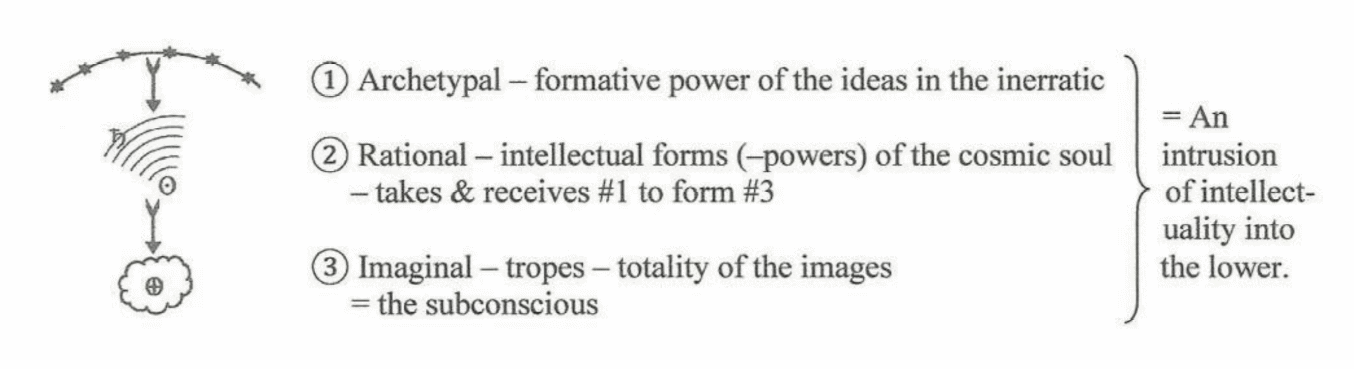
[FIGURE 1983 0513a-1-AB. Three Levels of Degree Meaning. Computer generated by NT from AB class notes.]
A specific combination of degrees = an individual psychosomatic organism.
By the appropriate combination of meanings associated with trope-essences → concepts in conformity with the ideas = understanding.
The activity of reflective thought is within the dragon.
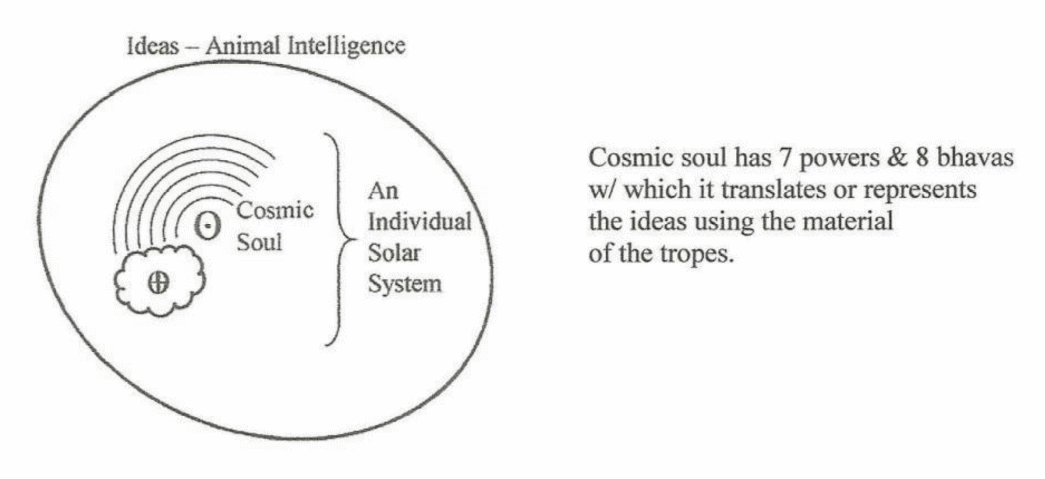
[FIGURE 1983 0513a-2-AB. Three Levels of Cosmos. Computer generated by NT from AB class notes.]
8 30-T good discussion by Anthony -- side 2, Tape 1
You can build up a philosophic system that will reflect the samskaras of God (i.e., not human samskaras).
Sun -- your purpose
Other six -- make that purpose conscious to you -- unfold its meaning for you.
[Classnotes AB 1983 0513 End]
CHART FOR 1983 0513a
Class
Friday, May 13th, 1983
Verbatim, unedited transcriptClick the series name to view more
CLASS at Wisdom's Goldenrod, Hector, NY
with Anthony Damiani (AD)
May 13a, 1983
ASTRONOESIS; NATURE; DRAGON
with Appendix: Classnotes AB 1983 0513.
TOPIC: Astronoesis
SUBJECT: Nature
SUBSUBJECTS: Dragon, Tropes, Epistemology, Astrology, 360 Degrees, Thinking, Science, Maya, Philosophy (as mouthing of archetypes), Rational Functioning, Nietzsche
CONTENTS:
Reading/discussing AD Paper, "The Third Phase of Soul," section on Dragon and Astrology
Student discussion of three levels of degree meaning
Student discussion of tropes and elements
Continued reading of AD Paper
AD reviews three levels of cosmology
Earth's memories organized into a psychosomatic organism
Soul operates through this organism
Transits bring about constant creation of thoughts through manipulation of biology
Thinking is scientific when there is conformity to the intuitive mind that produced the object
Cul-de-sac
Can't do metaphysics or get to truth within the Dragon
Reminiscence
Emotional purification, yoga, philosophic discipline, necessary to get to unembodied reason-principles
Rational life entails conflict with Dragon
All levels of cosmology within asmita
Endless flow of thoughts produced by transits is not the same as thinking
Thinking requires getting back to the unconscious mental activity that produced the subject-object
Tropes are in all four elements
Superimposition, maya
Soul must exercise its inward strength to organize functioning of trope, to govern it and not be governed by it
Two kinds of interference from tropes
Contact
Tropes make it difficult to understand, philosophy as mouthing of archetypes
You're always mouthing the archetypes unless you're a Sage
True philosophy denies the mouthing of archetypes
Example of Santayana, his philosophy only partly a mouthing of archetypes
AD prefers studying Sages to academic philosophers because academic philosophers still struggling with tropes
Scientific revolution brought about rational consciousness
Teaching of Sages will start reaching people that have developed some kind of rational understanding
Platonists feel that you can build up a philosophic system that will reflect the samskaras of God
Truth at multiple levels
More discussion of reminiscence
Psychological and metaphysical meaning of a symbol not clearly differentiated in Jones
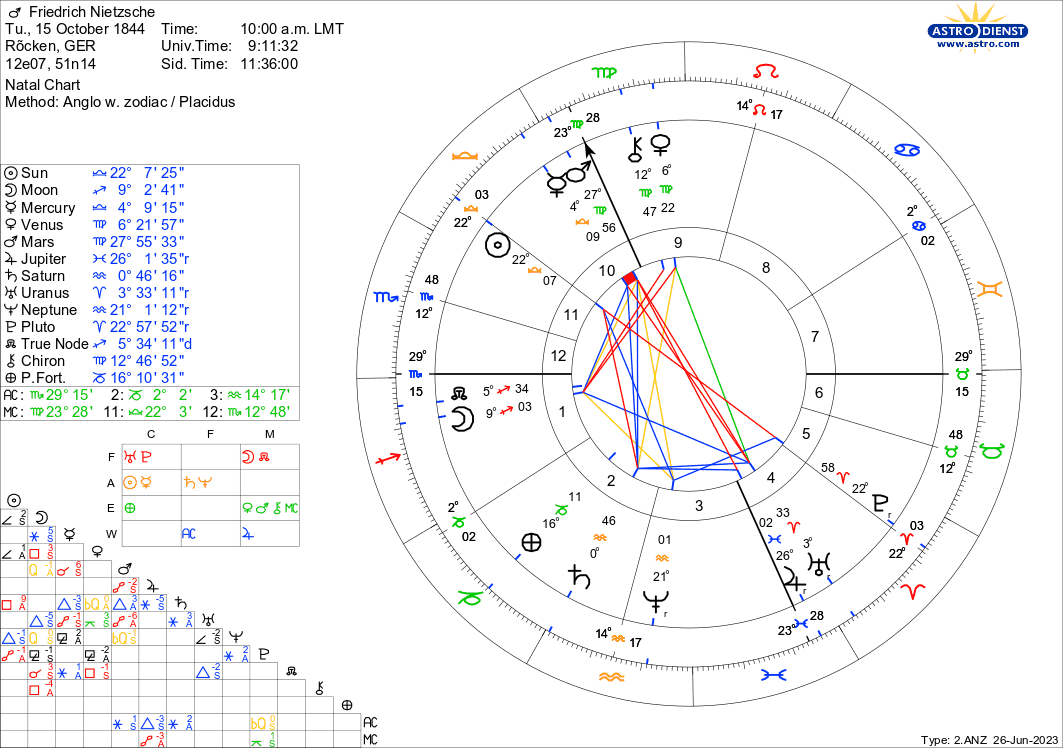
Nietzsche's Sun at Libra 23: constant self-affirmation
Nietzsche's philosophy and life are an unfoldment of this idea
Sun as pivotal idea in a chart, other planets unfold that central purpose
No need to live out shadow, possible to operate from rational soul
Natal chart is a duplication of the Dragon in our own peculiar way
Sage can rationally manipulate his natal chart, no compulsion
PB: the time to surrender ego is when it is fully developed
Appendix: AB class notes
BOOKS READ FROM OR REFERENCED:
H.P. Blavatsky, Isis Unveiled, Vol. 1
George Santayana, The Realm of Spirit: Book Fourth of Realms of Being
Paul Brunton, The Hidden Teaching
Marc Edmund Jones, The Astrology of Concepts
Marc Edmund Jones, The Sabian Symbols in Astrology
PLOTINUS QUOTES READ OR REFERENCED: VI.7.5
SABIAN SYMBOLS: Aries 23, Libra 23 (Friedrich Nietzsche Sun and opposite)
DIAGRAMS and CHART appended to this transcript:
FIGURE 1983 0513a-1-AB. Three Levels of Degree Meaning.
FIGURE 1983 0513a-2-AB. Three Levels of Cosmos.
FIGURE 1983 0513a-3. Friedrich Nietzsche Natal Chart.
[Transcriber note: [diagram] means the speaker is referencing a diagram as he or she is speaking. If someone is drawing or writing, with audible sounds of chalk on a blackboard, I indicate this by [drawing] or [writing].]
AD PAPER read in class:
- "The Third Phase of Soul". Retyped as 1983 0513b V09MP. Astronoesis - Soul. This is an early draft which is published in a different form in Astronoesis. There it is primarily found on pp. 256-262 of "The Third Phase of Soul," and on pp. 265, 269-270 of "Astrology: The Topography of the Subtle World". A number of paragraphs remain unpublished. This is a continuation of "The Third Phase of Soul" paper that was read in WG Class 1983 0429a Astronoesis; Nature; Mercurius. A different version of this paper which contains both parts is read and discussed in WG Class 1983 0527a Plotinus; Soul.
NOTES:
This is 1983 05/13a, Astronoesis; Nature; Dragon Class, and the first entry associated with this date. 1983 05/13b = The Third Phase of Soul Paper.
AB class notes with diagrams have been appended. AB class notes retyped from Classnotes AB 1983 0429 to 1983 0606.PDF. All capitalization and punctuation corrected, abbreviations and astrological glyphs spelled out in AB class notes.
Friday night class (which, during this time period, was usually Plotinus or Astronoesis).
Previous Friday-Saturday classes (May 6-7, 1983) also on Dragon.
TRANSCRIBED Verbatim by IT prior to 2018 (V11a). This is V12ap (2023) and has: updated prefatory matter, footer, and audio file name; Book List and TOC completed, Subsubjects expanded; typos corrected; new notes within transcript, including references to diagrams; AB notes section redone; Friedrich Nietzsche Natal Chart appended; new formatting to accord with new conventions. Archival verbatim transcript with AD Paper – V12ap.
AUDIO FILES: 1983 0513a, 1983 0513b. [Note: "Tape" and "Side" refer to original audio cassette tapes that were later digitized into .MP3 Audio Files.]
1983 05/13a at Wisdom's Goldenrod
Astronoesis; Nature; Dragon
[Audio File 1983 0513a Begin]
AS: --"…Phase of the Soul". And, we got about halfway and the second half obviously is somewhat involved in the Dragon. So, we'll start from there. I think this is where we left off. Anyway, it's a good start.
[Note: The following paper is an early draft which is published in a different form in Astronoesis. There it is primarily found on pp. 256-262 of "The Third Phase of Soul," and on pp. 265, 269-270 of "Astrology: The Topography of the Subtle World". A number of paragraphs remain unpublished. This is a continuation of "The Third Phase of Soul" paper that was read in WG Class 1983 0429a Astronoesis; Nature; Mercurius. A different version of this paper which contains both parts is read and discussed in WG Class 1983 0527a Plotinus; Soul. The following has also been retyped as 1983 0513b V09MP. Astronoesis - Soul. I transcribe the paper just as AS reads it, including any alterations made during re-reading.]
AD ["The Third Phase of Soul," AS reading]: "We are re…"
AS: Even if you don't remember what went from the previous half, this is kind of self-sufficient, so--
S (very faint): You could [couple words inaudible] if they let them know.
[student assents, very faint]
AD ["The Third Phase of Soul," AS reading]: "We are retelling an ancient view of the mystery of Man, (of) the philosophic mythology of Orpheus."
LR: Of who?
AS: Orpheus.
S (very faint): Oh.
AD ["The Third Phase of Soul," AS reading]: "If we conceive of the Mother Earth as a goddess within whose domain has transpired the manifestation of innumerable species of life, their immediate origin would be her body itself. This body will contain the necessary ingredients for the building up of the lowest two sheaths, what are referred to as the Shelly and Moonlike bodies. This"material" has…"
HH: Avery? Could I just ask a very simple question? Is it Moonlike or Moonlight?
AS: K-k (AS making "k" sound). (some laughter)
HH: Ok.
AS: As in-- (laughter)
HH: Well, I've always wanted to know.
AS: No(--/.) Shelly and Moonlike (bodies/body).
HH: Alright, thank you.
AD ["The Third Phase of Soul," AS reading]: "This"material" has been recycled innumerable times…"
VM (very faint): Ooh, just thinking about it. (laughter)
AD/S(?) (very faint): [couple/few words inaudible] (laughter)
AS (faint): No, let's keep going.
VM (faint): (Right.)
AD ["The Third Phase of Soul," AS reading]: "…it therefore has certain tendencies or proclivities which are indications of past functioning and which may be referred to as the tropes. The combination of the Great Elements into organized living bodies [AS: The Great Elements, Mahabhutas. Because (Jung was) there.] included (bit of laughter, couple inaudible RG words) [AS rereads: The combination of Great Elements into organized living bodies included] these selected responses or tendencies that manifest themselves in the body's functioning. Or, in other words, within this mysterious imaginal essence is retained traces of its functioning after the dissolution of the entity, and the totality of these traces constitutes the memory of the Earth. This beginningless ontogenetic and phylogenetic development is the source from which and within which the bodies of all living creatures are produced and live. [11¼ second pause]
"This indefinite and indeterminable storehouse of images, this seething cauldron of innumerable disembodied functionings…" (laughter, student words)
BS: Sounds like my bed. (bit of laughter)
AD: Yeah.
AD ["The Third Phase of Soul," AS reading]: "…is the material of the soul's fabricative activity and is suggestive of the nature of the Dragon."
S: Oooh. Oooh. (bit of laughter)
TS: "Ladies and gentleman, this is your life." (bit of laughter)
AD ["The Third Phase of Soul," AS reading]: "The Shelly and Moonlike bodies of living creatures are an extension of it, and their activity is refunded into this"subconscious." The Dragon lives and breathes through the individual organisms, and not only is it constitutive of the physiological functioning of the organism, but also of the significance attributed to that functioning. [short pause] This is the lowest vehicle, or the lowest pair of vehicles, which are supplied to a soul and within which it will acquire a rudimentary understanding of the sensible world. The soul as inhabitant of such a body is becoming acquainted with the traces of the intelligence of the Ideas which have been left behind as part of the Earth's memory. It is these traces of the Ideas which give rise to images. Each non-optical image constitutes a matrix of disembodied tendencies that have been miscalled "archetypes". Imperceptible in themselves, they can nevertheless be inferred through reflection on their activity by the soul's gnostic powers when it reaches the level of reflective conscious judgment. But for the present it is being maintained that these contents will become the environment or the idea of the world for that individual soul inhibiting-- [AS: I'm sorry.] inhabiting that individual body, and that the presence of the soul within that World-Idea is also indicated."
VM: Anthony, why are they miscalled 'archetypes'?
S: [couple words inaudible]
AS: "…that have been miscalled"archetypes"." I think in Jung's terminol--
AD (simultaneously): The term 'archetypes' was always used for the Ideas.
VM: I'm sorry? I couldn't hear you.
AD: The term 'archetypes' was always used for the Ideas.
VM: Oh I see.
AS: Miscalled by Jung, you know, when he calls them the archetypes of the collective.
VM: Right. Yes, [AS simultaneously: Or (couple words inaudible)] it perpetuates the confusion between tropes and Ideas.
AS: Right [couple/few words inaudible] Yeah I think that--
AD ["The Third Phase of Soul," AS reading]: "What [couple inaudible student words simultaneous with AS] we witness here [AS/S(?): (I hear) Anthony.] is the presence in the imaginal essence of the intelligence of the Ideas as tropes or samskaras and the powers of the soul or functioning of the soul as represented by the categories of the imagination, and both are included in this imaginal essence. Under these conditions, the soul perceives images in water--the shadows or phantoms in the cave. The soul as wrapped in a cocoon of oblivion, i.e., the body, is unable and unwilling to investigate into the mystery of the nature of man."
S (faint): Sure.
S (faint, possibly same S as above): Sure.
AS: I don't know, maybe there's some comments [few words inaudible] David?
DB: There was one quote concerning the fact that these tropes constitute the physical body as well as the significance attributed to it, I think.
AS: That's what it says.
DB: Yeah. Is that-- is that correct?
AS: Yes, that's [DB simultaneously: Ok.] what it says.
DB: Does that-- does the significance attributed to the body refer to the-- these non-optical images which are constantly charging themselves?
[short pause]
AS: Um-- That the significances comes from there also. [student(s) assenting, very faint] That's what it refers to.
DB: Well what are the significances?
AB: Wouldn't it be the meaning you give to your experience as well as the experience?
DB: So, it would include the interpretive activity?
AS: Yeah.
DB: Basically could you say like this would be opinion or belief or something like that?
AS: Sure, all your beliefs and so on would be based on that.
DB (very faint): Ok.
S (very faint): Yes.
AS: Now that I think (the paper) would say. Not-- not only the, you know, so-called sensible images but also the beliefs, the whole system, you know, if you look at all the degrees, tropes in your chart, that would basically tell you the presuppositions of your belief.
DB: Right, but all-- but fundamentally like the-- the whole notion of the body's materiality or whatever, you know, our relationship to the world, all that is pretty much supplied by the tropes, you know, not-- not just specific-- Like you might have one reason-principle on your side and I might have another, but just on a general basis the whole-- the whole way the thing functions, what it, so to speak, believes itself to be.
AS (faint): Ok.
[student assents, very faint]
AS (faint): (Any-- anything else?)
VM: Can you amplify the distinction between the categories of the imagination and the tropes?
AS: Oh, yeah I-- well--
VM: Maybe that's later, I don't know.
AS: I-- some of that will come up later, yeah.
VM: Ok.
AS: But basically I think just that distinction we were getting at last week, the traces of the Ideas as they're continually being instantiated or whatev-- what you want to say, is left behind as these tropes, whereas the image of the functioning of those seven soul powers we talked about as those seven [VM simultaneously: Categories, yeah.] categories. Ok, and it seems to be speaking here of both of those as the twofold or fivefold aspect of this imaginal essence.
AD ["The Third Phase of Soul," AS reading]: "…presence of the imaginal essence-- in the imaginal essence of the intelligence of the Ideas imaged as the tropes and the powers of the soul or the functioning of the soul as represented by the categories of the imagination…"
VM (very faint): Oh ok, (thanks) [one/two words inaudible]
[students assent, very faint, possibly part of background]
AS: Yes, there is more in there so let me read the next-- the next paragraph. Because that's-- that's probably up the (next)(--/.)
AD ["The Third Phase of Soul," AS reading]: "A preliminary investigation into the nature of the dr-- of the degrees, which are all-encircling, will require extended investigation. [short pause] For now, we are simply asserting the suggestion of the intrusion of the Intellectuality of the cosmos into our world."
AS: (Well/But) this-- (I don't think) that's clear.
AD ["The Third Phase of Soul," AS reading]: "The nature of these degrees will require extended investigation. For now, we are simply asserting the suggestion of the intrusion of the Intellectuality of the cosmos into our world. Therefore, each of these degrees is often symbolized by an image that includes a homogeneous hierarchy of meanings."
AS (faint): We could just talk about how [couple words inaudible]
RG: Uh-hm.
AD ["The Third Phase of Soul," AS reading]: "First we have the formative power of the Archetypal Ideas, the presuppositions of the genera and species of all life. Next, we have the intellectual mind of the cosmic soul, that is, its own forms or reason-principles intuiting the Archetypal Ideas and organizing the Earth's memories, by its images or by its image-making faculty, into particular entities. And finally, the activity of these entities, that is, their life functioning which is left behind as memories in the imaginal essence."
AS: Well, that's those three levels.
S (very faint): Could you just reread?
AS: Yeah.
AD ["The Third Phase of Soul," AS reading]: "Each of these degrees is often symbolized by an image that includes a homogeneous hierarchy of meanings."
AS: And, he's laid out this threefold hierarchy of this degree.
AD ["The Third Phase of Soul," AS reading]: "First we have the formative power of the Archetypal Ideas, [the] presuppositions of the genera and species of all life."
AS: Yeah, and I suppose we would diagram those in the inerratic.
AD ["The Third Phase of Soul," AS reading]: "And then we have the intellectual mind of the cosmic soul, that is, its own forms or reason-principles. And, this cos-- this intellectual mind intuits the Archetypal Ideas and, on the other hand, organizes the Earth's memories by its image-making faculty into particular entities. Finally, the activities of these entities, that is, their life functioning which is left behind as memories in the imaginal essence. And furthermore, the totality of these images can be thought of as the subconscious, an intelligence so vast that an individual's intellect is nothing in comparison."
LR: The totality of those memories is thought of as the what?
AS (simultaneously): Images.
AD ["The Third Phase of Soul," AS reading]: "…the totality of these images…"
AS: And that's the last level, the totality of that last level.
LR/S(?) (very faint): I see.
LR: [one/two words inaudible]
AD ["The Third Phase of Soul," AS reading]: "…can be thought of as the subconscious…"
LR: Yeah, the third, you're not creating a new level, that's-- that [AS simultaneously: No.] is the subconscious.
AS: I think it was for that-- that remark is referred to the la-- the third, that where he says--
AD ["The Third Phase of Soul," AS reading]: "…the life functioning which is left behind as memories in the imaginal essence".
[short pause]
HS: These are the three things that structure the what now, the image of-- of a degree symbol? Is that what you just did?
AS: The line you're referring to, uh, Herb--
HS: [three/few words inaudible]
AS (simultaneously): He says "Each of these"-- Yeah--
AD ["The Third Phase of Soul," AS reading]: "Each of these degrees is [often] symbolized by an image that includes a homogeneous hierarchy meanings."
HS: So you're talking about the inner working of that image now.
AS: Or that the image has to symbolize a-- a gamut of-- of levels of meaning, ok, or stands for not just one meaning-- one level of meaning but various levels of meaning although they're all in some ways homogeneous.
AD (very faint): [couple words inaudible]
RG: Can you go through that again?
AS: Ok, it says, "a homogeneous hierarchy of meaning". In other words, there's a thread of meaning that would go through all the levels, you know, from the archetypal to the rational to the tropical or imaginal.
HS (simultaneously): Right, ok.
LR: What does it mean homogeneous hierarchy?
AS (simultaneously): I think it means homogeneous that [couple very faint inaudible AD words simultaneous with AS, possibly part of background] there's a thread through all the levels [LR: Ok.] of the reason-principle, it's not like the archetypal is completely a different thing from the lowest, its image. Is that-- I'm sorry. [11½ second pause] You want to-- Alan did you want to--
AB: I just want to [few words inaudible]
AS (simultaneously): Sure.
AD ["The Third Phase of Soul," AS reading]: "First we have the formative power of the Archetypal Ideas… And next, the intellectual mind of the cosmic soul with its own forms or reason-principles, which takes this Archetypal Idea and then organizes the Earth's memories by its image-making faculty… Finally, we have the activity of those entities depositing their life functioning in the imaginal essence."
AH: And those-- those three things are symbolized-- It was-- Could you read--
AS: Yeah, that sentence-- I-- I got to just read the s-- I think the sentence was pretty precise there.
AD ["The Third Phase of Soul," AS reading]: "[A] preliminary investigation into the nature of-- the nature of these degrees, which are all-encircling, will require an extended investigation. But for now we are simply asserting the suggestion of the intrusion of the Intellectuality of the cosmos into our world. Therefore, each of these degrees is often symbolized by an image that includes a homogeneous hierarchy of meanings."
AS: I think the hierarchy of meanings refers to this intrusion of the Intellectuality [one/two inaudible AH words simultaneous with AS] which can be grasped through that image.
AH: The hierarchy is not the three things that we were--
AS: Yes, [S: Yeah.] exactly, the hierarchy is the three levels he just laid out. There is an intrusion by those-- or at least mo-- the top two into the lowest.
S (faint): Ok.
[students assent, very faint]
HE: Avery?
AS: Yeah?
HE: Could you explain again the process by which the-- the Intellectual-- is it intuits the Archetypal Ideas and then using its own forms it organizes the-- it structures the memory? Or that somehow it's translating these-- You had three things, you had the [AS simultaneously: Yeah.] intu-- intuiting the Archetypal Ideas and organizing the Earth's memories and then something about its own form of reason-principles and I didn't--
AS: Yeah, I-- I guess--
HE (simultaneously): Maybe I'm being too mechanical about this, I don't know [few words inaudible]
AS (simultaneously): No, I think it's-- I think it's pretty close to the way we've done it before. There is more detail but maybe it would help [HE simultaneously: Oh.] to just draw the simple diagram (the/that)-- Anthony, do--
AD: Go ahead.
[Note: See FIGURE 1983 0513a-1-AB, Three Levels of Degree Meaning, appended to this transcript for the following.]
AS: I mean, I'm just-- I'm-- I'm kind of assuming that the diagram is-- 'cause-- follows on the previous quote from two weeks ago where we have these three-- three levels that we spoke about, either one within the other or whatever, where he spoke about the first level as the Archetypal Ideas. [short pause while drawing/writing] You remember the (question(s)).
RG(?) (faint): I skipped it.
AS: (It's) more detailed [couple words inaudible] and then you had the reason-principles within the cosmic soul [diagram], right? And he says, it has its own forms of-- or reason-principles, ok, and it in turn is organizing the Earth's memories by its image-making faculty into particular entities and then-- so finally then you have the activity of these entities. So you have this Archetypal Ideas, remember Ideas are powerful too, and the cosmic soul apprehending that and using its own forms to organize the Dragonic memories [diagram].
HE: But somehow using its own forms is the translation process.
AS/S(?): Uh-hm.
AS: Well, I think the-- I'm not sure, I'm just remembering from this line in Plotinus where he says that there's a natural link of reason-principle to reason-principle, [Note: Plotinus, VI.7.5, last para.] and the first line seems to be starting from here [diagram]. [drawing] You have these tropes, which are the image of the Ideas, and he's speaking of-- it's not just that these are images, they're actually the result of an intrusion of Ideas into your experience. And so if you read one of these degree symbols, not only is it speaking somehow of the imaginal or sensible qualities but it's also speaking of meaning, and in fact if you could get to it, he says this [AS indicates on diagram] reason-- this material reason-principle would image another [AS indicates on diagram] reason-principle in the cosmic soul which itself would be an image of an Archetypal Idea in the inerratic [diagram]. And so there's this natural link of Idea in the inerratic to the forms which are in the soul, the cosmic soul, to the image of that within the Dragon. And I think somehow we're saying that this is all immaterial(,) in fact(,) this is collapsed somehow [diagram], and through this image you can try and grasp symbolically or otherwise--
LR (simultaneously): And which do you think the symbol is of?
AS: Well I think the-- I think it's ref-- the symbol re-- would refer to all three and that's the-- the [VM simultaneously, faint: That's the homogeneous (part).] point of this homogeneity. It's the homogeneous hierarchy. [LR: But the symbol--] If they're not homogeneous, then you wouldn't be able to grasp anything of the higher. I mean if it were heterogeneous, then there would be-- you know, there would be a break and all you would ever intuit here is just-- the word 'sensible', a lived hierarchy.
LR (simultaneously): Yeah right, there's a difference in--
S: Wait.
AD/S(?) (faint): Well let her finish.
AS: I'm sorry, go on.
LR: There's a difference in saying that the symbol-- I mean, there's two ways [AS simultaneously: Looking at it (one/two words inaudible)] of looking at it. One is that the symbol actually embodies all three levels and the other is no, the symbol is actually on the-- the level of the Dragon but what we mean by that is that because it's on the level of the Dragon it somehow reflects those prior uh-- In other words, those are two different things to me. Like what-- what expanse can the symbol actually take in?
AS: Right. Well there are two questions, first, by the symbol you mean the words you read in the degree book.
LR: No, I don't mean word(s).
AS: Well, ok, I'm-- [couple inaudible LR words simultaneous with AS] well, but you can't--
LR: Yeah.
AS: That's always the problem, I mean that seems to be what you mean by it being a symbol. It [LR simultaneously: (But--)] doesn't have the existential-- Symbol means that it does not have-- oh no, that was just my interpretation then, symbol means it doesn't have the existential reality of the higher.
LR: Definitely not.
AS: Right, but it allows something of that to come through. So it's here [diagram], the symbol is here, but it's referring, in-- in the very thing, it's referring or leading you to what is beyond it, namely the re-- the higher, more real ideas in the cosmic soul or the Archetypal Ideas. Otherwise, when a planet was on a degree you wouldn't know anything about the transiting planet for example.
DH (faint): So what do you mean [couple inaudible AS words simultaneous with S] by the symbol there? (I didn't follow that.)
AS: Oh, ok, I though that "Each of these degrees just has-- is often symbolized by an image". And I was thinking that for example when you read the Jones, Jones has this word, now-- the words aren't the symbol but the words are supposed to convey to you the symbol or they embody this--
DH (faint): (Or) precipitate [one word inaudible]
AS: Or precipitate-- I think they're saying that that symbol which is that mea-- which is that-- those lines [one/two inaudible student words simultaneous with AS] in the book that you read is supposed to evoke in you a homogeneous hierarchy of meanings. In other words, it's-- I just-- I just think he's saying, it's not-- In other words, we said it's a matrix of possibilities. It's not just a horizontal matrix in some way but there's also a vertical matrix implied in that symbol. [S: Are these--] In other words, you cannot limit the interpretation of a sym-- You have the symbol, you read the symbol. And he's saying you cannot limit the interpretation of the symbol just to the trope, because implied in that trope is that it's the trace of a higher activity which means that inherent in the symbol, inherent in that image, is the intrusion of the Intellectuality, if he could grasp it through the symbol. Now the symbol is not the Intellectuality, the Intellectuality can come through the symbol.
DH(?) (faint, possibly part of background): You guys.
S: (Tony--)
RG: But isn't-- isn't there(--) the image also the symbol? I mean, you have three-- you have the symbol of the Jones symbol, then you have the trope which is an image of the Idea, [AS: Right.] and in that sense the trope itself is a symbol of the [AS: Right.] Intellectuality [AS simultaneously: I--] of the Idea.
AS: Ok, and I thought that-- the way I would read this, although you could-- there are two ways I think Linda's saying. One way is to read it is the Jones symbol, symbol-- what does it symbolize? It symbolizes three levels of reality. It symbolizes the trope, it symbolizes the reason-principle in the soul, and it symbolizes the Intellectual I-- so when you read it, you could get back to the trope level or you could read it at this level [diagram] or you could read it at that level [diagram].
RG: Uh-hm.
AS: That's-- that wa-- that was one-- one way of interpreting it.
RG: Well Anthony, which [AS simultaneously: 'Cause what--] way did you mean it?
AD: I just-- I just was using the words there that the symbol includes all three levels, [RG simultaneously, faint: Uh-hm, (yeah/right), (we'll take it).] that's all. It wasn't technical in any way, it's a symbol.
RG: So all of it.
AD: And all [few inaudible student words simultaneous with AD] three levels of meaning are included in that symbol.
DH (faint): Right.
AS: Yeah, ok.
DH: (So), but the words in the book can't use it.
AS (simultaneously): No, no.
DH (simultaneously): The words in the book are like a name principle.
AS (simultaneously): Right, sure. [few words inaudible]
AH: I'd like to ask just a general question about the way the symbol is being defined in the context of astrology. We say that-- see, typically, like in literature or how(--) in myths or whatever symbol is used, it stands for something. But that something that it stand for is at the same-- let's say the same level. It's referring to something not other than itself but within the same matrix of possibilities, it's a level of [one/two words inaudible]
AS: I thought that was signs. [RG simultaneously: Yeah, I remember signs.] In Jung's definitions I think that [VM simultaneously, faint: That was sign and symbol(s), yeah.] was the word 'sign' was taken [AH simultaneously: Oh, that's--] to not go beyond itself but [RG assents] symbol, [VM, faint: What's--] at least in Jung, [TS(?) assents] was always just the oppo-- was that which actually went beyond itself.
AH (simultaneously] Ok, I understand the [RG simultaneously: (Right/Yeah).] definition now. It stands for something outside the matrix of its own [S, very faint: Formation.] formations.
RG (simultaneously): Uh-hm.
S (faint): Uh-hm.
RG: Uh-hm.
S (faint): Yeah.
RC: Sort of like Pegasus he used both ways. If you use it as a sign for, what was it, Texaco or Amaco or something, or as a symbol for the spiritual state that the Pegasus was-- originally represented.
S (faint): Yeah.
S: Well you're right, that's--
S (very faint): Randy, where'd you get that? (laughter)
RG (amidst laughter): [few words inaudible]
RC: Well, if your libido gets wings.
S: Right.
RG (faint): Oh no, yeah, I see it.
AH: Can you say a little more about, well if it is so then that the symbol is standing for something outside of its own matrix, how is it that the symbol conveys that something outside? I mean how-- [RG/S(?), faint: Right.] how can you speak of that actual dynamic in terms of human intelligence?
RC: Maybe if you took a feeling of, you know, like he talks about intuitions as primarily being these feeling intuitions. And if you took that as a provocation and inwardized the attention to its source that you'd be saying that you would arrive at these different levels of your own being which when you experience them would be deeper than the image and certainly deeper than words. But if I, by focusing on that original feeling state that's precipitated by the words or by the image, that that's like a doorway into the specific realms of the subtle geography.
[student assents, faint]
AS: Or-- and I would add or maybe, you know, summarize it, I think the word 'outside', the-- is a little-- some-- seems to obscure somewhat to say that the higher reality represented is outside of the symbol in the sense of something other. It's more like this higher seems to include the lower, at least the way Plotinus is saying, like the image deposited here [AS indicates on diagram] is included within the higher reality that it symbolizes and therefore the link, as he says, this natural link, is not one of, you know, A and B where A and B are some separate or other things. B is already included in A, B being the symbol included in--
[student assents, very faint]
AS: Ok, so--
JC: Avery? I'm sorry [couple/three words inaudible] just going. I have a question about which-- the meaning of material reason-principle. What is it about the trope that remain-- that results in a particular form of manifestation based on a historical process? And if it is a reason-principle I assume it's a particular kind of, say, animal intelligence, a certain kind of vitality that maintains some kind of self-identity. [S: Sure.] But, if it's-- over a period of time it's been-- it functioned in a certain way, [AS: Yeah.] and has left certain-- that something is retained about the way it functioned apparently-- [AS: Yeah.] I mean that's what they say, I guess Nature takes back something of what it's done, alright. I-- I just don't quite understand, I mean, is that something-- is that particularity of its functioning something retained within the reason [possibly half/one word inaudible] so-called material reason-principle itself or is it a-- is it something like a-- a ghost, I mean, I don't know, you know the floating body of some prior functioning that you assume the vitality of that form remains for a period? I mean I--
AS: You're asking what's the actual nature [JC simultaneously: Well what is the trope? Tell me what the trope is.] of that retained trope. What's the nature(--/.)
JC (simultaneously): Because if it's a reason-principle I assume it has a certain universality, that Jung would say it's an archetype.
AS: Yeah well-- Ok, he says and-- I mean Plotinus says, and I assume he's saying that-- we're saying similar thing that it's-- it's a reason-principle associated with matter or inseparably associated with it. So there seem to be two aspects of it, like that organizing reason-principle, which itself is a vast-- he-- the way he defines reason-principle, it's a mult-- it's (an/in--) incredible multiplicity, and so there's no surprise that various aspects of it can be more manifested than others, but he says inseparably associated with the stuff of the Earth's memory. [JC(?): Yeah but--] I think we've called, you know, these-- the elements, like those-- the etheric forces and so on, [student assents, faint] [JC simultaneously: Yeah.] the-the elements that actually constitute the Earth's memory are what retain that habit energy.
JC (simultaneously): Yeah but you could say those forces are the reason-principle, the elements are the essential part, and the way they have functioned is the-- [AS: No I--] the material aspect.
AS: I-- I think that the way he speaks, although I don't know, is that body, the way he's using "body" here, there's always an association of a reason-principle with [AD, faint, possibly part of background: Oh no.] this matter, formed matter like-- [JC assents, faint] like fire, earth, air, water. Either one separately won't give you the possibility of a trope.
[student assents, faint]
JC: Yeah but I mean, earth is not dirt, it's the principle [AS simultaneously: No. No, no.] of crystallization.
AS: Sure, sure, the elements themselves are a lower grade of reason-principle.
JC: Right.
AS: I agree.
JC (simultaneously): Oh, so you're saying [AS: There's no--] the tropes are a material reason-principle, 360 varieties let's say, that work through the four elements as another of the lower grade of formative force to actually mold the imagination, imaginative substance.
AS: Ok, I [S simultaneously: Uh-hm.] just don't see then why you can't consider those 360 degrees that are in the Earth's belt or whatever, the totality of the Earth's belt, as being reason-principle with the fire, earth, air, water already. In other words, if you have 2 degrees Aries I think that that reason-principle's inseparably associated from the real true element fire. I mean you don't have 2 degrees Aries reason-principle manifesting in some other element, there's an inseparab-- there is already-- 2 degrees Aries is already (in/an) association. [couple inaudible student words simultaneous with AS] I think that trope is the association or the trace of the reason activity in the fire element and it's not a separable relationship. It is formed that way, as that union. I don't see how you could do-- how you could explain it without both(--/,) understanding of course that, I think, that the four elements are themselves reason-principle, I mean, we're not talking here--
JC (simultaneously): That the four elements could be each at four levels. [DH/S(?), very faint: Oh yeah.] I mean the fire could have a fourfold and air and so on.
AS (simultaneously): Yeah, I think that's getting more complicated though, I think now, I think (with) fire, earth, air, and water here he means when-- you know, the constituents of the Earth's body. Keep it-- keep it material, I think, 'cause--
JC: Ok, but you still haven't touched what I want to understand, [AS simultaneously: Ok.] the particular residue of that-- those fun-- those reason-principle [AS simultaneously: Yeah, what's life.] as an element-- yeah. I--
RC: Well I know there's one-- one thing that was very interesting, talking about mudra with PB. And he was talking about for certain kinds of insights that you have to assume the proper attitude in order to get the insight and I realized that he was talking about mudra as part of assuming the proper attitude, to actually put yourself in the physical position that [JC simultaneously: Yes.] would be a vehicle for the idea that [JC simultaneously: Yeah, of course.] you're trying to get.
JC: Yeah, body language.
RC: Yeah.
JC: Right.
RC: I think maybe you could apply the same thing to the elements, and say like by actually behaving that way that you get access to a certain type of intelligence that you could only get by actually behaving in a certain way.
JC (simultaneously): Right. But I'm-- I'm referring to the quotes that were read last Friday about the way we've dirtied up the atmosphere, you know, we-- [RC simultaneously: Yeah.] we're using certain aspects of those forces in a-- in a way that's-- you know, there seems to be a variety of ways of doing it. It's not that you're just imitating a particular force and that's the-- the best imitation, a certain mudra, but that it must be a, you know, you-- it's been misused or used properly in some cases, different degrees we say are better than others in that sense. I'm trying to get to the particularity, the particular--
AS (simultaneously): Well they-- they're be-- some degrees are better seems to mean that some Sages [JC simultaneously: Yeah, maybe.] have had certain degrees and [couple words inaudible] work those over and put a very [one/two inaudible student words simultaneous with AS] positive [JC simultaneously: Uh-hm, right.] significance to those tropes.
JC: Right.
AS: And that's un-- I don't-- I mean that's understandable.
LR (simultaneously): Wouldn't that just mean they brought more of the Idea into that?
AS: That mo-- yeah almost, I don't want to say quantitatively more, but yeah, say a higher level of that Idea. [one/two inaudible student words simultaneous with AS] I think that's-- I'm no--
LR (simultaneously): More of the Idea gets instantiated in a trope, [AS simultaneously: I'm not sure but I think--] more of the pure Idea.
AS: Yeah. I think that's why he suggested that there is also the significance goes along with just the sensible functioning. The trope contains with the sensible functioning the significance. [LR assents, faint] Ok?
AD ["The Third Phase of Soul," AS reading]: "The Dr-- …it is constitutive of the physiological functioning of the organism and also the significance attributed to that functioning…"
S: Could I--
AS: But I mean-- I don't-- I'm not sure what-- you seem to be asking-- trying to understand what-- how it could actually be a particular-- how it could be particularized but--
JC (simultaneously): Well, it seems like there's two sides to what you mean by the word 'trope' and we-- you know, you-- sometimes you talk about the essential side and then you talk about the memories of prior functioning. That seems to be more what could be referred to as the material side although what the nature of that matter is, is a question. [couple/few words inaudible AS words simultaneous with JC] You say in-- if (your/you're)--
PD: But the memory's the [AS assents] conjoint in that there's the [AS assents] material side would be the pure elements let's say, [AS, faint: Right, that's what I'm talking, yeah.] the pure Mahabhutas, but the fact that the-- the continuity of memory is that conjoint, with a trace of life.
JC (simultaneously): The pure-- the Mahabhutas are just a lower form of reason-principle.
AS/S(?): Oh yeah.
PD (simultaneously): Well yeah, I think they're conceived in this context as a(n)-- in relation to reason-principle [student assents, faint] so, if you're going to say that then you make the distinction meaningless.
AS (simultaneously): Lose the distinction, yeah. Maybe that's the problem Jeff right there, that's what Paul's saying.
DB: Jeff maybe it's that-- is it possible that the-- the question you're asking could be expressed like this? What's the difference in the life in those tropes when they're brought together and associated in a body as opposed to after that body's dissolution and they're distributed back to whatever, yeah, I mean--
JC: Is this an elaboration?
[student assents]
S (very faint): Give me more.
DB: I mean it's--
JC: I mean--
S (faint): Jeff?
JC: I'm going to use what Paul-- [DB simultaneously: Yeah (one/two words inaudible)] what Paul is saying. If you say that the element then, in its own vitali-- vitality of the element, I want to make it something immaterial by calling it vitality, [AS: Sure.] would-- that retains the particularity of its prior activity, I mean that-- that it-- that it what-- did a certain thing.
AS: Sure. Because I think it's like the example of the rolled-up paper, you know, you have this paper which is like the elements and it's been lived a certain way, [JC simultaneously: Right, the life's been lived a certain direction.] the element's been lived a certain way, in this case a paper has been rolled a certain way [S simultaneously: (Gotcha.)] and that particular rolling is like the form. If I folded it this way or that way it would retain a different formal trace than if I lived it a different way. Now once I've lived it, the actual trope is a combination. If there's no paper, there'll be no retention of the form. If there's no form, then the paper will just remain flat the way it is. Now I need to put them both together to understand what the nature of a trope is I think, the formal, so-called formal side, which is the forms that my life has lived, and the matter side which is the actual stuff of my body. [JC assents] And, it's imaginal stuff, sure, it's not-- it-- but, you know, leaving that question aside of what the actual nature of the matter is that(-)that-- I think that gets confused to say that the matter itself is a reason-principle, [JC simultaneously: Yeah, right.] that's-- that won't help, but you see what I'm saying about the-- you know, like the paper example is to me a good one. [student assents] [JC simultaneously: If I could--] You know, (if) all this energy is a-- I-- that's a-- that maybe a question, is-- is the energy of the system the energy of the material or is the energy the life energy of that form, that's a harder question. [S simultaneously, faint: I'm sure.] [JC assents, faint] You know, (what are/whether) the actual mechanism--
RC: But you can see it, I mean, look into your behavior, I mean, anytime you try to change a habit you see that it has an innate force in it.
AS: Recalcitrant (matter).
RC (simultaneously): Yeah. That even though you at least think that you want to do something differently, if there's a-- there's a life and an energy in that-- in that mode of behavior.
[student assents, faint]
JC: See, if I don't-- I don't mean to say that the t-- that the-- the trace of prior functioning is in matter itself. Matter is unintelligent. It's in the-- the way the life has gone. And then when the life goes that way again it projects an image of itself, you could say, on matter or whatever, but-- but the re--
AS (simultaneously): Good, so you're saying the life comes from the-- the li-- the-- [JC simultaneously: From the reason-principle.] the energy comes from the reason-principle, sure, sure, ok.
JC (simultaneously): There's a reason-principle, it can function in any innumerable ways. It functioned one way prior, you know-- you know its energy went a certain direction and it will tend to do that again, [HS: The reason--] [AS simultaneously: No, no (two/three words inaudible)] to repeat itself, it will tend to want to repeat itself in that-- in that functioning.
AS: Ok.
PD: Well, I'm getting--
JC (simultaneously): Is that a way of-- I mean is that agreeable?
AS (simultaneously): Sure, I don't see any difficulty with. Except again, I-- I can't get the forms to--
VM (simultaneously): I would say the tendency to repeat is from the matter side.
AS: Yeah, see--
JC: Ooh, matter's a-- [few inaudible student words simultaneous with JC] look, matter is completely [AS simultaneously: His view of matter is a little--] unintelligible, it was--
AS (simultaneously): I think it's your view [VM simultaneously: No (couple/few words inaudible) there's a certain inertia.] of matter Jeff, I'm not sure but [students assent] there's some-- there's something [student assents] there in your view of matter I think.
PD: It seems like you're only working with primary [AS simultaneously: Yes.] matter, Jeff, you're not [AS simultaneously: I don't ride along.] considering the Mahabhutas matter.
S (simultaneously): It won't--
JC: I'm trying to understand Plotinian epistemology. [AS/S(?): (Fine.)] I don't think he has any-- Ma-- matter contains no form in itself, and that means it does not in itself have a habit energy in itself, it as matter.
AS (simultaneously): Oh, oh. Jeff, I--
PD (simultaneously): I don't think we're at that level.
AS (simultaneously): I really-- yeah, I think Vic's comment was appropriate. It's not prime [JC simultaneously: Ok.] matter we're speaking of here, [JC simultaneously: You said it was the elements.] especially not in the Plotinian sense.
JC (simultaneously): You said it was elements.
AS: Right.
JC: But elements are formative forces.
AS: Right.
JC: So it's a-- a type of reason-principle or intelligence, [S simultaneously: Yes.] the lowest-- the lowest one.
AS: I agree, the lowest reason [one word inaudible] that's going to-- that's really going to throw us off because those-- (say it), that's-- first of all those elements are not to be conceived as formless matter, but they are also not produced in that sense by the soul, they're like a given.
PD: Let's say they're provided by the Earth's consciousness or the Earth soul.
AS (simultaneously): Sure, say they're provided by the Earth. To go [AD(?) simultaneously in background, faint: Soul of the Earth, yeah.] further into the nature, the very nature of those elements, like asking what the nature of that paper that's going to receive these impressions or, you know, impressed in some way by these life traces, I don't-- I don't know, we'd have to ask Anthony, but I don't think that's the point--
AD (simultaneously): No, I consider the whole discussion irrelevant, [AS: Yeah, ok.] [S, faint: Yeah, (it is).] utterly irrelevant because what I'm trying to do is compress a vast philosophical ideas [AS assents] into the compass of a few pages and I cannot go into a microscopic analysis of what the meaning [AS simultaneously: Matter.] of the gunas is right now.
AS (simultaneously): Yeah, yeah, [RG assents, faint] I-- ok.
[RG assents, very faint]
AD: I can't do that, [AS: Right.] because then I would have to expand that to four hundred pages if I stopped to explain everything along the way.
AS: Yeah. That's right.
AD: Because every other-- every other sentence is going to be like that. [AS simultaneously: Ok, but--] So first give you the general unknown and then we'll go into the specifics.
AS: Ok.
LR: "See your forthcoming book." (some laughter)
VM: Yeah, you would sound like Guenon--"I will treat this subject in more detail…"
AD (simultaneously): "See your-- see your past notes." (laughter)
AS: "See my previous book"! (laughter) (Write/Right) in there, "In my pre…" (more laughter)
RC (amidst laughter): "Consult my [one/two words inaudible]"
AD: But, you won't get the impact if you break it up.
AS: No I'm sorry, ok, that's my fault.
AD (simultaneously): You have to read the whole thing as one, you know, one dosage.
AS: Ok, perhaps Anthony then your suggestion is we should just read through.
AD: Read it through and then [AS simultaneously: Ok.] I'll discuss with you.
AS: I'm sorry. That's my fault.
AD: No, it's their fault.
AS: No, I-- I should've just done it. Ok so, [S: So--] we'll now read it-- (some laughter)
S (faint): [one word inaudible]
AD: Poor Dickie has been waiting to get a complete summary of this thing and he's despairing, I think he went in the back.
AS: [couple/three words inaudible] Richard!
S (very faint, to herself): Richard.
KD: [couple/few words inaudible]
AS (simultaneously): You're going to give us a complete [KD simultaneously: He went to the (bathroom).] summary of the--
S (simultaneously): He went to the-- he went to the men's room, I mean [one word inaudible] is right there.
AD (simultaneously): Let's try again, let's try again.
LR: Poor Dickie.
AS (simultaneously): (Ok) [one word inaudible] Let me [VM simultaneously, faint: Poor Dickie.] back up a little bit and then go on. (laughter)
VM: Poor Dickie.
S: He's not--
VM/S(?) (simultaneously, very faint): He's not even here. (some laughter)
AS: We do it all for you.
AD (simultaneously, very faint): [couple words inaudible] just read it.
RC/S(?): Just read it.
AS: Ok. (laughter)
S: Need a [one/two words inaudible]
AS: Ok, I'll back up a little and then read-- read-- it's not really that many pages, it's four or five typewritten pages so be prepared. Ok, so--
AD ["The Third Phase of Soul," AS reading]: "We are simply asserting here the suggestion of the intrusion of Intellectuality into cosmos and therefore each degree is symbolized by an image that includes a homogeneous hierarchy of meanings."
AS: Ok, take that as you want.
AD ["The Third Phase of Soul," AS reading]: "The totality of the images at this third level can be thought of as the subconscious, an intelligence so vast that an individual's intellect is nothing in comparison.
"A selection from that totality or a specific combination of those degrees will constitute a specific psychosomatic individuality, in other words a unique person, which will provide the soul [AS rereads: This will provide the soul of--] with a body that his [AS reads: has-- Rereads: This will provide the soul with a body that his] karma entitles him to. This is indicated at the moment of birth by the position of the planets, because each of the cosmocrators represents a certain gnostic and fabricative power of the cosmic soul to which the individual soul is conjoined. That peculiar quality of energy of that moment is imported-- is imparted to the individual psychosomatic organism and results in the categories of the imagination, so that something of the intellectual nature of the mind is transmitted into that entity or into that functional but adventitious unity, i.e., the ego.
"At the moment of birth, the precise aspectual relationship between the planets, signs, houses, and degrees indicates the exact relationship of the degrees to one another through the medium of the soul powers and vice versa the relationship of the soul powers to each other through the medium of the degrees. The powers of the soul leave traces behind of their functioning, indicated by the way that this ego is organized. These powers are reduplicated in that organism as psychological functions of knowing and categories of the imagination.
"We are gradually approaching an understanding of how the ego is a thought made of memories, the stuff of dreams, and nonetheless it reflects those microcosmic principles, for included in its subconscious is the totality of memories of the Earth."
VM: Is it microcosm or macrocosm?
S: Yeah.
AS: Says microcosm.
HS (faint): Could you read it again?
AS: Ok.
AD ["The Third Phase of Soul," AS reading]: "We are gradually approaching an understanding of how the ego is a thought made of memories, is the stuff of drea--"
(Side 1 of original cassette tape digitized as 1983 0513a Ends; Side 2 Begins)
HS: --on(--) the planets, the-- the degrees, is that what you mean?
AS: Yeah.
HS: Ok. And their relationship?
AS: And their relationship.
[student assents, very faint]
AD ["The Third Phase of Soul," AS reading]: "The specificity of the individual ego [AS: that] refers to the significances attached to the functioning of its tropes."
[short pause]
DB: Read slow.
AD ["The Third Phase of Soul," AS reading]: "The specificity of the individual ego refers to the significances attached to the functioning of its tropes. But this ego will be used as a vehicle by an individual soul, whose knowledge and consciousness will be unfolded through the resulting interaction. [AS: That is, the interaction of the soul and the vehicle.] The process by which the individual soul or I AM as embodied becomes more conscious by and through the power of combining in innumerable ways the significances or meanings attached to the tropes."
AS: Should I read that slower?
S: Yeah, yeah.
[simultaneously] [multiple students at once asking to reread, faint]
AS: I'm sorry.
AD ["The Third Phase of Soul," AS reading]: "The process by which the individual soul or I AM as embodied becomes more conscious is by and through the power of combining the significances or meanings attached to the tropes in innumerable ways and thereby it creates the necessary concepts by which it can understand that which the intellectual part of the mind has created and then reflectively judges the object. [short pause] It becomes scientific when there is a conformity of these concepts with the prior activity of the intuitive mind. That is, the mind is trying to understand through the psychosomatic organism that which its own prior activity has created."
[short pause]
S: Well--
AS: Maybe I'll first-- I'm going to try and read that-- that-- what I just read, the [student assents] last paragraph again (I mean), just to go over it.
AD ["The Third Phase of Soul," AS reading]: "We are gradually approaching an understanding of how the ego is a thought made of memories, the stuff of dreams, but nonetheless reflects all of these principles that we have spoken of, for included in its subconscious [AS: in the ego's subconscious] is the totality of the memories of the Earth. The specificity of this individual ego refers to the significances that are attached to the functioning of its tropes. This ego will be used as a vehicle by an individual soul whose knowledge and consciousness will be unfolded through the resulting interaction of the soul and its vehicle. [student assents] The process by which the individual soul or the I AM as embodied becomes more conscious would be by and through the power of combining in innumerable ways the significances or meanings that are attached to these tropes and thereby this I AM or the individual soul is creating the necessary concepts by which it can understand that which the intellectual part of its mind has created and then reflectively judging the object. It then could become scientific when there is a conformity of these concepts with the prior activity of the intuitive mind. That is, we could say that the mind is trying to understand through the psychosomatic organism that which its own prior activity has created."
HS: Read 'mind' for 'soul' here or--
AS: Yeah. (Write that over.)
AD ["The Third Phase of Soul," AS reading]: "What must be recognized and clearly understood is that the activity of reflective thought is within the Dragon. We are in effect combining those meanings and significances which are attached to the tropes and manipulating them, creating concepts of understanding to grasp the object. The compulsiveness of these significances can and does predetermine that understanding to such an extent that the meanings are then the presuppositions of our psychological experience. Insofar as the ego is constituted by these presuppositions and its life a gesture or manifestation of them, it is difficult to see how we can arrive at the formulation of a doctrine of Truth. (bit of laughter, students assent) It is at this point that the full import of being in a cul-de-sac arises. (laughter, student words) The way out is shown to us in the Platonic teachings that attempt to disentangle the reason-principles, which the images embody, or in other words, what Idea the images are embodying. [AS: That is, to disentangle the Ideas from the image.] The great philosophic thinkers pierce through the images to the reason-principles directly. This is intelligible intuition without the use of any intermediaries and is not of a conceptual nature, does not rely on the language of the-- of the Dragon. Those who are not free from the compulsive intensity of these images do not have access to this intelligible Truth.
"The rich storehouse of information that the horoscope contains can be a source of spiritual and metaphysical knowledge that could inspire and enrich our lives, for in this mysterious way the transcendental is included or is immanent in the empirical. Perhaps in delineating the chart of well-known writers whose lives are well documented, we could, through a post-mortem astrological analysis, illustrate something of what is meant by the famous dictum that"We do not have ideas, rather they have us"--or--"What superior beings think, we must perceive."
"So, we must begin by reminding our readers that in the degree symbolism there is inextricably buried a hierarchy of meanings, that is, significances that are attached to the tropes functioning. At the moment of birth, the planets are conjunct with certain of those degrees so that we have at one and the same time an aspectual relationship between all the planets and between the degrees they are conjunct with and one another. As friends of the Ideas, we must point out that at the very origin at birth, this entity is already endowed with meanings that will be manifest in the course of the person's life. These cosmocrators, which are powers of the World-Soul to which our mind is conjoined, will organize the tropes into a body of imagination. This entity then will have seven ways of functioning and four ways of knowing, each bearing the impress of the cosmocrator, resulting in a category of the imagination or a psychological way of knowing. That is, [AS rereads: That is] the result will be different ways that this entity of imagination can function and know."
RG: Can you read that again, Avery?
AS (faint): Uh-hm.
AD ["The Third Phase of Soul," AS reading]: "This entity has seven ways of functioning and four ways of knowing, each bearing the impress of the cosmocrator, resulting in…"
AS: In other words, category of the imagination, categories of the imagination, [RG assents, faint] and these ways of knowing.
RG: Ok.
AD ["The Third Phase of Soul," AS reading]: "…that is, will result in the different ways that this entity of imagination can function and know."
RG (faint): Uh-hm.
AS: What results? The cosmocrators' functioning results in these different ways that the entity of imagination can function and know.
AD ["The Third Phase of Soul," AS reading]: "By"body" we mean here the grouping together of these tropes, and by "psyche" we mean the functioning of the categories of the imagination. This is the psychosomatic organism that is imitative being and includes within itself traces of the Ideas. In the chart a planet conjunct a degree indicates, on the one hand, how that function is influenced by the trope, and on the other hand, how that planet will manifest the significances within the trope. If we think, in the case of Santayana's chart, of the Sun at 25 degrees Sagittarius in the fifth house, and we attempt an analysis by pointing out that the Sun as a category of the imagination is the restriction of life to this central meaning or idea, that is, the principle that will individualize this life, the central purpose, Sun, is indicated by the degree that is in fact an idea that has been left behind as part of the Earth's memory, the procedure we have to follow, and it must be elaborated, is to take each planet, correlate it with the category of the imagination, and situate it in the specific house and its relationship to that house; then the opposite degree and how it is the outward manifestation of that subjective functioning and also relate it to that opposite house, and then to integrate with all the others and try to show this as a functioning unity. Also, we can illustrate by this the law, the occult law, that what is within must get externalized or manifested and what is external must be internalized. After all this is done, then we can show how the soul, through its faculties of understanding, is creating the necessary concepts in order to understand the given, the World-Idea. It can be shown that this understanding of the given, in all cases except the man liberated from his ego, could be traced back to those ideas which the categories of the imagination have manifested. It can also be shown that a deepening understanding accrues when the natal chart is making certain aspects with the transiting planets, and even further, that a vastly superior and universal consciousness can be transmitted through an individual soul particularizing itself within the system of tropes representing an individual entity."
AS: Should read that again.
AD ["The Third Phase of Soul," AS reading]: "It can also be shown that a deepening understanding accrues when the natal chart is making certain aspects with the transiting planets, and even further, that a vastly superior and universal consciousness can be transmitted through an individual soul particularizing itself within the system of tropes representing an individual entity.
"If we continue retracing our steps on that upward path of that part of the soul which is said to be divisible among bodies, we can further our understanding by pointing out the relationship that exists between the transiting Chaldean planets to the natal chart, or how that individual's greater mind is attempting to become aware of itself in the reflecting medium of the psychosomatic organism. The soul must come to an understanding of itself through this organism that certainly has a phylogenetic and ontogenetic background, but nonetheless to which it is heir. [AS: To which that soul is--] It must take it upon itself [AS: The soul must take it upon itself] in each incarnation to erase the interferences and distortions that intervene between the subtle image produced by the greater mind's functioning and its reflection in that empirical subject which is its vehicle, until finally the ego is subservient to the God within."
[13½ second pause with some very faint background student talking]
AD: I'm sorry, it's pretty sloppy but we tried to do it in one day and we're-- We see more errors now than you [student assents, faint] (must have). Alright, let's see what you understood because that's the only way I can tell how bad it is.
AH: I'd like to-- [S simultaneously: Oh but you can('t) go by us.] I'd like to ask-- I'd like to ask a question concerning the-- the-- the cul-de-sac that was so-- so appropriately described and--
LR (simultaneously): It's funny you should pick up on that, (Andrew). (some laughter)
AH (simultaneously): And the solution, the solution to that was the Platonic doctrine of the Ideas, and-- but throughout the paper I was unable to discriminate between like the Idea and the trope, you know, like--
S (very faint): Yeah.
S: That's the whole point.
AH: I'm not able to make that distinction upon hearing the paper once. Uh--
RC: There was one remark that was made there that as long as we're subject to the compulsion of the tropes that the Idea's not accessible.
VM: Yes, but the other side of the coin is that this hierarchy that was mentioned so often, this linked or homogeneous hierarchy, does make it possible to escape the cul-de-sac because if those Ideas weren't-- the Intellectuality of the cosmos weren't really embedded in the tropes then indeed it would just be a continuous discharging and living out of these mechanical instincts.
DB (faint): It would be. [student assents, faint] Well it would seem as if the-- the-- if-- if it's the-- the Ideas that are supposed to deliver us from this cul-de-sac, then it would be the relation between the-- the soul and the Ideas that it has within itself, that it-- I mean you wouldn't-- I don't know if you'd be necessarily bound to the particular, you know, symbols which would be in the natal chart, the-- [VM simultaneously: No but--] You see what I'm saying?
VM: But I thought the point was made in the paper that the-- the soul learns about itself by experiencing those particular tropes which are [AS simultaneously: (one/two words inaudible) trope(s).] configured in [AD simultaneously: Yeah.] its horoscope.
DB: Uh--
[AD drawing in background]
DB: Yeah but, I mean don't-- don't those-- aren't those the distortions?
AD: I'm doing this for Dickie.
VM (faint): The Ideas?
AD: Yeah.
VM (faint): Well I can't read the--
[Note: See FIGURE 1983 0513a-2-AB, Three Levels of Cosmos, appended to this transcript for the following.]
AD: Well, we start out, [VM simultaneously: Animals (one/two words inaudible)] these are the Ideas, the archetypal Ideas, the animal intelligences [diagram].
VM: Zodiac.
[few students at once, few words inaudible]
AD: They're pure eternal immutable Ideas. Insofar that the inerratic sphere represents them they only live to be ten billion years old.
VM: I see. (some laughter) (And they) supernova [one/two words inaudible]
AD (simultaneously): That's-- that's the-- yeah, [VM simultaneously: Yeah ok.] it has to. [AS simultaneously, faint: Yeah. And then they go into samadhi.] Then we're speaking about an individual Solar system within this vast arrangement. And we're saying within this Solar system we have a cosmic soul, this would be the equivalent of a cosmic soul [diagram]. And the cosmic soul has the, what we refer to as the seven powers and the four bhavas of buddhi or eight bhavas of buddhi. That's taking the Ideas here [diagram], alright, and it's going to translate them or make a representation of these very abstract Ideas. Now, the point that we have to keep in mind is that the material that it uses, the material that it has at its disposal by which it could make a thought or a sensible representation of these Ideas is the tropes that are buried in matter. Now I didn't want to get into a discussion of the gunas now or matter. But for now I just wanted to restrict myself to the notion, which is an accepted one I think even in scientific circles, that protoplasm inherits certain properties and it goes on doing so. When you speak about the behavior of, let's say, the atom and the electrons going around it, alright, that specific behavior [RG assents] is a trope, alright. If you speak about the behavior of different kinds of molecules, that's a trope. Whenever you speaking about the trope of any material thing, the specific behavior of any s-- anything, you're speaking about a trope, alright. It becomes more noticeable when you come to living forms, li-- [VM simultaneously: (one/two words inaudible) evolution.] life-- yeah. Now you're speaking about a more difficult, a-- a more, let's say, differentiated arrangement of the behavior, but it's still basically the behavior pattern of a certain entity.
RC: Like lesser tropes combined under a bigger trope?
AD: Yeah, that could be one way and also the variety of behaviors which are innumerable, I mean, you just can't pin them down. When we say 360 degrees, I mean don't take that-- that's just a-- a little fairy tale because you can combine those 360 degrees ad infinitum, there's no end to that. But at any rate, you may not believe in tropes, you may not believe in the images, you know, that are left behind, in which case you're going to miss the whole point. (some laughter)
S (faint): (Until you believe.)
S (very faint): (It's not big deal.)
AD: We do take-- we do take ourselves-- and this is the extent of our materialism, that we actually go on speaking about matter when all the time the only right you have to speak about, after so many years, are thoughts. Now what is the nature of a thought? And you'll get off on a whole different kind of analysis of experience. You won't be coming up, so to speak, with any kind of matter. You'll only be coming up with the behavior of certain [student assents] kinds of thoughts.
HS: And in this context that's trope?
AD: In this context what we're saying is-- In the same way I-- I told you to use the analogy of your own mind. All the experiences that you ever had in the past, all these have left certain [couple/three inaudible student words] residual effects in you, alright, and whenever you-- whenever you need to make an image of something, you pull up those residues, those memories, and you organize them into some kind of an image. [students assent, faint] Now the image that you're looking at is an image, it's made of the imagination, it's not made of any real material, even if the intensity of your concentration is so real that it posits that thing in front of you. [students assent, faint] You're not going to say that that's a thing, you're not going to say it's made of matter. You're going to say it's the externalization of a thought within you, alright, and the intensity of your attention and the concentration you bestow upon it gives it the reality that it's going to have for you. [student assents, very faint] Now, if you could think of the Earth, alright, as retaining in the Great Elements all the traces of any activity that ever went on, which is not, you know, something outlandish, then in that case, you remember-- you remember when we spoke about what they call psychometry, the way a person would hold on to something and be [S simultaneously, faint: Oh yeah, yeah.] able to tell you? Now how is that possible unless some traces have been left behind in that object, alright, which can be read off? [Note: See H.P. Blavatsky, Isis Unveiled, Vol. 1, pp. 182-186.]
RG: Uh-hm.
[student assents, faint]
AD: And-- well, you can go into countless examples but that's not the point here, alright. The whole point is this one big idea which is being worked out, alright, and that is that-- [drawing] Now you have all these various tropes. And this-- these are images, alright, memories of the Earth. Now, if you say they're memories of the Earth, immediately you've got to recognize that they're only thoughts, they can't be anything else, alright, and the organization of all these memories, alright, these here [diagram] are going to organize these tropes into a certain entity, which when it does that you'll have the individual chart. I'm not-- whether it's true or not doesn't matter. If you-- if you get the idea I think you'll even penetrate into someone like Kant. [students assent, very faint] And I know it's a fashion nowadays to say that Kant didn't know what he was talking about…but those people who said that never read (him/it), and I'm talking about scientists who make they-- these remarks about Kant and don't know what the hell he ever said. But re-- disregarding Kant, just follow this idea, ok. (bit of laughter) And we said these are organized, alright, [drawing] these are organized in this certain way. Every place there's a planet and the relationship of the planets to one another in their houses, alright, and we're speaking about this as the unique entity that (it's/has) now been organized. Just like when you want to think of something and you take all these thoughts in your mind and you bring them together and then you organize them and you get this image of what you want, alright. [student assents] In the same way this is what is doing here [diagram]. So this is the intuitive mind [diagram] which receives the World-Idea, and then organizes these tropes into a particular entity which now has this chart, ok.
Now, something really interesting happens. We know that if we want to understand this-- you know, if we want to make a dossier of this person, we have to read the planet-- the degree the planet is on, alright. And we have to understand the way that degree is influencing that functioning. And we also have to understand how that functioning, alright, is manifesting this degree. We do it with one and then we do it with the opposite. We do it with each one of these, alright, so that, you know yourself it becomes a very complex affair. Now, all these points in a chart and their opposites, now you're going to operate through that. Alright, your soul, alright, is coming into this and is going to operate through this. Now that means-- that means that over here [diagram] you have the empirical subject and the empirical object or let's say the phenomenal subject, phenomenal object, because the real subject is not here, alright. We could put on the outside, over here [diagram], alright, this principle, [drawing] [RC, faint: Yeah, you could leave that there.] we could put that outside, but that doesn't matter right now. Now, it's got to function through this. And we know that each one of these tropes has a certain way of operating and the way it operates it has a certain effect or a certain result. Like for instance, what characterizes protoplasm is irritability or a Virgo, right? [student assents, very faint] [AD lightly hits board with chalk] That's what we're talking about.
Now, this is the interesting part. These planets are moving along, let's say all ten of them are moving along, making aspects to this natal chart. So there's a constant manufacturing or a constant manifestation of mental activity. By mental activity we mean the functioning of the tropes, we don't mean mental activity, we mean that my blood pressure is rising and I'm getting vertigo, [RG assents] alright, and consequently I think I'm going to go into samadhi because I have less and less thoughts. (laughter, student words) In other words, all this biological functioning, what we refer to as biological functioning, is the functioning of these tropes, and the manifestation of that functioning is revealed in our physiology. [RG assents] Now, that is going to be affected by these aspects. So that there's constantly being created [drawing] thoughts all the time, from moment-to-moment, as you probably could bear witness to. Alright? (bit of laughter)
It is this creation of thoughts which now you need, alright, and you have to-- you have to organize in a certain way. You have to organize these thoughts so that you get a concept, a concept of what a thing is. And then, you have to prove the validity of the concept with the object that you're referring to because when you do that what you're doing is that you're-- you're seeing the-- the conformity of the concept that you have with the object. What you're really doing, in a sense, is you're seeing that-- you're going back to the intuitive mind and you're seeing that there must be a necessity in the conformity of the subject to the object [AD indicates on diagram] in order for us to be scientific, there has to be a conformity of this relationship to what the intuitive mind has done. In other words, this [diagram] is an unconscious process, it produces certain objects here [diagram], and in order to understand those objects the concepts that you come up with, alright, have to describe that object. So l-- if you have like a synthetic judgment, alright, I mean an analytical judgment, that's-- that's meaningless. Like you say, "All bodies have extension." You're not saying anything, alright. But if you come up with a synthetic judgment, you say "Bodies are heavy," you're a-- you're saying something about that which you didn't have before and didn't know before. Now in order to find out if they are heavy, alright, then you've got to go through experimentation or some kind of proof to show that this is so. But then what you're proving is that this intuitive mind when it organized these-- the so-called subject-object relationship here [diagram], and if there's conformity between this and this [diagram], then you know you're scientific. If there isn't, then you know you're fantasizing.
Now I think, Dickie, that you experience(d) precisely this functioning, that insofar that all these thoughts can be manufactured-- what's the word that they use, vikalpa or samkalpa?-- that you can put thoughts together, get a concept, alright, [RG assents, faint] and then you discovered that this goes on forever and there's never a guarantee as to whether the-- the concepts you're working with are applicable. Is there some way of proving that this concept, in other words let's say [chalk on board sounds] this idea, is true? And in metaphysics you can't. [RG: Right.] In science you can. [RG: Right.] In metaphysics you can but in a whole different way. You can't put anything on a scale.
So then if we started that, alright, can you see the extraordinary complexity of this idea? You have the Intellectual Idea here [diagram], the Idea of the World that's being given to the cosmic soul, to which our individual mind is conjoined. The functioning of this cosmic soul through the seven powers and the four bhavas of buddhi organizes these memories, alright, into a specific individual. This specific individual-- let's say that the planets correspond-- In other words if this is-- if this is a function [diagram], it will create an organ for itself. Ok? So, these are certain-- these are functions up here, these are functions of the soul. They will create organs for themselves. So the categories of the imagination would represent the organs by which these functions are going to be manifest in the psychosomatic organism, and also the gnostic powers will also make organs for themselves by which they get represented within here. Now, we're inside this thing here, this Dragon [diagram]. Everything that we say, everything that we do, everything that we know, everything that we understand, is in terms of these images, the Dragon. Now how in the world am I ever going to say anything in here [AD indicating on diagram] that's valid for what's going on out here [diagram]?
HS: That's the cul-de-sac, right?
RG (simultaneously): You're not.
AD: That's the cul-de-sac, we're caught in here [AD indicates on diagram].
AH (faint): Yeah.
RG: You're not.
S (faint): Yeah.
AD: Well no, you're not, wait a minute though, there's (no use--)
RG (simultaneously): Well you [one/two words inaudible] ma-- you may and you can't know it. I mean, you-- as long as you're in there you can't know-- you can't know it.
AD (simultaneously): Well that's why, you know, in a sense, in a sense, a lot of the-- a lot of the culture, a lot of our culture is basically the effect of the Dragon's functioning. Not all of it. I'm saying a lot of it is, and a great deal is going to be influenced by the Ideas. But the point I'm getting at is-- and this is the difficulty which I think is available as soon as you try to understand a degree, that in the degree there's the meanings which we say are simply the residue of all prior ontogenetic and phylogenetic functioning. Alright, that's in the very matter itself. Now, if your body is composed of this kind of functioning, alright, and your soul is inserted into that body, then anything that you know about the world, anything that you know, alright, is going to be, so to speak, the superimposition of the bodily functioning. In other words, the memories of the Earth are going to be superimposed on the objective reality and you're going to say that's the real. This is where, so to speak, a lot of difficulty comes. Because how can you discuss metaphysics in here? Because if metaphysics wants to know the structure of Being, understand something about (authentic) Being, it can only do so through this language which has been brought into being let's say by the Dragon itself, whether they're howls or barking, you know.
RG: So-- so what's the answer to that question?
AD: No, I just want to emphasize your point, the-- the frightening thing that you maybe have seen, and that was that [drawing/writing] in this relationship between the transiting planets and the natal chart that represents you, this constant interaction between these two results in a flooding, you know, a series of thoughts one after the other. These thoughts, I'm saying, you trace-- you trace back to the significances which are attached to the functioning of the biology or the tropes. And with these here you're going to try to build a metaphysics? That's why I could understand Anatole France when he said, "My opinion is to have no opinion!"
LR: But you also laid-- left room for the fact that those transiting planets, besides just providing thoughts or the input for thoughts, impetus for thoughts, are something of the higher nature, so that that's also flooding through that--
AD: No, that's not flooding through. That's not, you see. Now the catch is here. The ideas that have been left behind in the matter and which are what we're referring to as our tropes, alright, and produce certain bodily modifications which give rise to an apparent world or a phenomenal object, within that very object, alright, the soul has to discern the Idea that is embedded in that phenomenal object. He has to disentangle or disassociate the Idea, the reason, which made that object to be what it is, from the object, from the phenomenal object, the object that is brought into being, for instance, when I got, let's say, Mercury on this degree and its outward manifestation is here [diagram] and all I really know is the way these two things are functioning, alright--let's leave out the complications--that's all I know(--/.) So I have to actually get into that sensible object and observe it so carefully that-- and given that certain, you know, good aspects are [LR simultaneously: Well that's what I'm talking about.] occurring, then I can see the reason-principle in the sensible object and now I could reason, alright, I could employ a reason which is disassociated from the memorized images.
LR: Right, but I was-- but that's-- that-- you said given that certain good aspects or transits are going on. That is what's representative of the rational part, isn't it?
AD: I'm sorry? No, it's the rational soul [LR simultaneously: The rational sou--] that is brought to a state of reminiscence as to what the reason-principles are. In other words, the object will give the rational soul which is in the body cause to reminisce about what those reasons are. [RG assents, faint] That's what reminiscence means, that you're going to go back to the Ideas that are in the soul, not to the i-- reason-principles that are embodied--
LR (simultaneously): Yes, and in that diagram where are those Ideas?
AD: In the soul.
LR: Yeah where, show me.
S (very faint): [few words inaudible]
AD: Well we just-- we just pointed out that [LR: Ok.] your soul is-- the individual mind is conjoined with the cosmic soul. [LR: Ok.] The cosmic soul--
LR (simultaneously): So that's what I'm saying Anthony.
S (simultaneously): (Let him) [one/two words inaudible]
BS: S-- Ok.
AD: The cosmic soul has the bhavas of buddhi and the powers, alright, and the forms within its own being by which it can recognize anything. Otherwise how could it take this World-Idea and convert it into an object here?
RG: But it is no guarantee just because you have a transit that you're going to see rationally either.
LR: No, but it's an opportunity.
RG: No, but what is-- what would be-- what is the mark then?
AD: Well, primarily, primarily the way that you can get to those reason-principles would be through this disciplinary process, you know, philosophic disciplines and yoga, emotional purification, because emotional purification really is cutting right down into the tropes. [AS simultaneously: In other words--] Because that's-- when you say tropes, what could you think of [one/two words inaudible] [AS simultaneously: In other words, you--] except an emotional attachment, a compulsiveness which brooks no denial and throws you out of the way? So, I think one of the biggest catalogue-- one of the biggest categories in PB is emotional purification.
AS: In other words, you could always operate rationally with the transits except that the compulsion of the tropes immediately is superimposed on it.
[students assent, very faint]
RG: Right, but when-- coming up with the idea of how to do ma-- how to think within the Dragon assuming-- I mean, I-- [AS simultaneously: But why wouldn't the rational light--] I mean it seems valid kno-- What? I mean, how to have correct thinking. You can't.
AS (simultaneously): Well, the rational soul-- well but the l-- if-- if the light of that rational soul is available, then he says when we make that our own-- well, if we could make it our own by freeing it from the compulsive activity, [RG: Right.] then you would be able to discern the Ideas which have become embodied in [RG simultaneously: Right.] the tropes.
AD: Well that's why it's always inevitable that the rational life [AS simultaneously: Sure.] or the spiritual life entails a conflict with the Dragon. Now I don't mean to be negative about this because in a way you can see the-- how important this is, I mean--
VM: Anthony, when you said--
AD (simultaneously): The marvelous thing about this whole arrangement is, if you think of the Earth's memory, alright, and think of your own memories, and think of anything that you could make of your own memory would only be a thought, and anything that's made here is only a thought. So if you think of this ego entity, it's only a thought. So we're made of the stuff that dreams are made of.
VM(?) (very faint): Yeah [couple words inaudible]
AH: How do the transits produce anything but more of those thoughts?
AD: They do. The transits-- the transits, like we're trying to get to, is to show that the transits bring about a vast shuffling of thoughts, you know, a constant efflux of (thinkings) going on, people are chattering away all the time. [students assent, very faint] Tomorrow you have an aspect and you're depressed and the next day or the next week you have another aspect and you're ecstatic and it goes on and on. And if you watch very carefully after while it's pretty mechanical, if you're detached enough from that.
AH: Yeah but in the paper you described that process as becoming more conscious, and it's-- it sounded as if it's like a question of just a sheer quantity of thoughts, the sheer-- the sheer energy of that process.
AD: No, no, it-- I didn't mean it if that's the impression you got. What I meant was that insofar that this soul was inhabiting this body, and this process of-- the-- this process of thinking is going on, then thinking is thinking or let's say, I-- I should say this endless chattering of the mind that's constantly going on is not thinking, but thinking would require for us to-- if we study a particular object, to attempt to understand everything that we can about it, select according to, you know, our understanding, our culture, etc., those attributes that belong to the object, try to get a definition of what the essence of the object is and then see if there's conformity of the essence of the object with the idea. Then you start saying to yourself, "But this concept, and (a) conformity of the object to this con-- concept is guaranteed by what? What guarantees that?" Well, it would have to be the prior activity of the mind that put it together. That's where (I--) there is a necessary-- a necessity in the correspondence between the concept you have and the object you have, so you trace-- you trace that conformity and the validity of that judgment back to the intuitive mind's functioning.
[student assents]
VM: If you trace it back farther, do you get to the inerratic or do you get to the soul?
AD (simultaneously): You get-- you get to the inerratic.
VM: In other words, the forms that you're trying to trace back your concepts to, to see if indeed there is a conformity, they're traced back the objective route or through the soul?
AD: Well why do you make the distinction? The soul is here now [diagram], [RG assents] this is the individual mind. The asmita principle includes all of that [diagram]. [student assents, very faint] Why-- Alright, if you remember we put out in the asmita principle, you had the reason-principles up here [diagram], alright, then you had the formation of the World-Idea from these reason-principles and that's the intelligible level [diagram]. [student assents] And then below that you have the intuitive mind [diagram] taking this Idea and-- [VM simultaneously, faint: And instantiating it, right.] Alright? Now if you take those four levels, alright, and you say the asmita principle covers all of that. You could be-- the "I" could identify with any one of these levels.
VM: I'm sorry Anthony, I missed four, I only see three, I mean there's the inerratic--
AD (simultaneously): We said the reason-principles [diagram], [VM: Ok.] alright, the combination of the reason-principles to form the World-Idea, [VM: Ok.] and we refer this simply as Being Life and Intellect, [VM simultaneously: Right.] and then this would be the intelligible-- intelligible portion [diagram]. Then over here [diagram] we have the intuitive mind or [VM simultaneously: Right, right (three words inaudible)] the cosmic soul, alright, with its intuitive faculty or image-making faculty organizing the memories here [diagram] and making a body or a vehicle which this I-principle inhabits.
[student assents]
JC: But isn't that cosmos imposed on the asmita principle?
AD: Imposed?
JC: Yes.
AD: You mean it's coming from within the asmita principle.
JC (simultaneously): Right, from a cosmic source.
AD: Yeah.
JC: So--
AD: It's the fabrication of the Gods, the Intellectual world is the fabrication of the Gods, [JC: Right.] and that Intellectual cosmos, alright, is within the soul.
JC: So-- but the unders-- the-- the fact that the-- the soul recognizes-- fact that the soul comes to understand the correspondence between an image in the Dragon and an Idea in the starry sphere is a perception from within the asmita principle. It might be of its own reason-principles [AD simultaneously: Yeah, but--] that correspond to those levels.
AD: But that's-- that's what this is [diagram], right?
HS (faint): Go over it.
AD: I mean we're speaking about this asmita principle, alright, as an emanation from soul. [JC simultaneously: Ok, then I'm not--] That's the individual soul [diagram], this is the universal [diagram] [one/two words inaudible]
JC: Ok. No I'm just trying to understand that you could say that the-- the cosmos impose a certain activity on you, these four levels, and you come to understand it after a certain amount of experience, but you're drawing on the same principles-- it's within the asmita principle-- it belongs to the soul itself and not to the imposed functioning, that that's-- that's the means by which you understand what the world is doing.
AD (faint): Uh-hm, yeah.
JC (simultaneously): It's from the source from within you, ultimately from your own higher soul.
AD (simultaneously): Yes, that's-- that's what reminiscence is, that's what [JC simultaneously: Ok.] the-- the term "reminiscence" refers to, the fact that the soul recognizes these Ideas because these Ideas are already within it. That's-- that's eternal reminiscence, the reminiscen-- reminiscence of the Ideas. But these Ideas here [diagram] are coming from the Universal Soul, alright?
JC: Yes.
AD: But, the point is that all this which seems to be external to the asmita principle is in fact internal to the asmita principle, and if we think of this as a consciousness, you know, with no sides, no dimensions, no way of-- alright, and we say that included within this asmita principle is this whole thought, this one thought within which there are all these distinctions, alright, then it won't be any problem [half/one word inaudible] disidentifying with this here [diagram]. And I think the beauty about this is to watch this functioning here [diagram]. As these planets go around, as there's a relationship between the transits and the natal chart, (as the/there's a) constant chattering and thoughts that are going on, we know that that's not thinking. Thinking requires something more. Thinking requires that the soul which is identified with this entity, alright, has to get back to the source, the very origin of what made possible the empirical subject and the empirical object, and that means that he must understand how there could be a validity between a concept and the object [AD indicates on diagram] that that concept is about, and the only way that that validity can come is to go back to the unconscious mental activity that produced it. [students assent, faint] When you get back to this here [diagram], this is what guarantees not only the conformity but the validity of the judgments you make. If it doesn't conform, if it isn't a valid judgment, then it is not according to the-- to the way the cosmic soul has created the object.
[student assents, very faint]
HS: The access back now to the undivided mind behind the tropical is-- [AD: Yeah.] is granted by the fact that the rational light floods the tropical at all times, it's always putting reason into-- into existence?
AD: Well it's always organizing this according to its understanding. The sublunary world [HS simultaneously: Is always being organized.] is organized according to the undivided mind's spontaneous knowledge. But if we-- if we consider for a moment, then if this is organized by the activity of the spon-- you know, [HS simultaneously: Yes.] the undivided mind, then if you want to know the truth about an object, that truth must conform to this unconscious activity as far as you know.
[student assents]
HS: When you say conform, you're conforming between your concept--
AD (simultaneously): Whether a law is true or not!
HS: But what's the or--
[Audio File 1983 0513a Ends]
[Audio File 1983 0513b Begins]
AD: --scientists (just) want to go on, although they're being forced to today whether they like it not. But basically what we're saying is this [diagram] is what guarantees or let's say is the neces-- the necessity behind the truth that we find here [diagram]. If it doesn't conform to the truth or to the functioning of this cosmic soul, that's not true.
HS: Ok, and necessity is implanted into the-- into the tropical by the-- and we call those the tropes.
AD: (Right), the necessity is implanted within the Dragon, alright, [HS: Ok.] because it has organized it.
HS: And we call those the tropes? Because I think before [half/one word inaudible]
AD (simultaneously): Well the way your tropes are organized. Anything-- anything in our world is an organization of all these memory images of the Earth or the tropes in matter, fire, earth, air, and water. And you might-- you might have noticed, for instance, if you travel to different places you get different thoughts. (bit of laughter)
S (very faint): Yeah, that is true.
VM (faint): That is so.
RG: Uh-hm.
AD: The tropes are in the air, in the fire, in the earth, and in the water. Then we can get nasty, we can say the tropes are in the digestive system you're working with, in the very waves that are moving [student assents] in your-- in your brain. But I-- I don't want to get into that problem. That's a whole nother question. Alright, back to the drawing board. Rewrite.
DB: Excuse me, Anthony--
RG (possibly part of background): Looking good to me.
DB: What's-- what is the difference between the tropes, the vitality in the tropes, when they're organized to constitute a specific individual's body or natal chart as opposed to when they're refunded back into the-- the memory of the Earth and their association [one/two words inaudible]
AD (simultaneously): Well assuming that you've brought about some changes in them, alright, then when they get refunded back into that, let's say, Nature's memory [DB: Yes.] they will to some extent influence that whole fund.
DB: Right, ok.
RC(?): Sure.
DB: Now, I think-- I think I can see that. I gue-- I guess what I was asking though is, does the-- the presence of the-- of the individual as-- asmita principle, its association with those tropes, does it give them a sort of life? Alright, do they participate in some way in its awareness? Or do they always like remain just part of the Earth's memory?
AD: I think the way we have to look at it is that when the body is organized by the various functions, you know, that constitute it, they have their own way of functioning, and they do modify the body in certain ways. Now, the soul as an entrant into that body and conjoined to that body has-- has to, let's say, on the one hand, interpret what the functioning of those tropes is, and at times has to alter them; and secondly, it has to get beyond the functioning of those tropes, in other words, the kind of significances that arise, it has to see through them because if it doesn't then what takes place, and it takes place anyway, but what takes place is the superimposition of the bodily functioning, alright, onto the world and the notion that the world is this bodily functioning which is projected out. And so one says, "Well, I see a pole," whereas what he mea-- really means is that the way these five func-- the organs of the body function, alright, gives you this resulting appearance. But what's there, alright, is not these five functional appearances which is produced by the functioning of the senses which in their turn are the conglomeration of a lot of tropes. So the whole notion that the Vedantists work with when they speak about superimposition, alright, is that the functioning that's going on into-- into the body, which is projected outwardly, alright, onto-- outwardly in space, into the given, alright, and then it calls that appearance of its own bodily functioning the reality of the world. And the Hindus keep pointing out, that's maya. That's not the real world. What you're seeing there is simply the bodily functioning and the significances that are attributed to that functioning.
DB: But the-- they wouldn't be able to have that type of apparent life were it not for their association with this individual soul.
AD: Well of course not.
DB: And they like that.
AD (simultaneously): If the individual soul doesn't inhabit that body, there wouldn't be any projection taking place.
DB: Ok, but now part of the compulsive nature of these tropes seems to be their specific demand that they do this continually. I mean that's one of the things that-- I mean, in addition to the specific, you know, reason-principle here or-- as opposed to a reason-principle there, I think, they seem to like to want to do that all the time. I mean, that's--
AD (simultaneously): They seem to want to do what?
DB: This-- the compulsive quality of these tropes--
AD (simultaneously): Well they-- they want to keep on doing what they've been doing.
DB: Right. Now that's-- I mean, all I'm just trying to distinguish is if--
AD (simultaneously): So, when the soul inhabits a body the-- you know, the-- the stomach says, "I want to eat." And the soul says, "Sure, let's get you something good-- something good right away." (laughter) It doesn't say, "Wait a minute, you just ate two hours ago, what the hell are you talking about?" (laughter)
AS (faint): The stomach always likes [couple/three words inaudible]
AD: Yes, the functioning goes on and the-- it is-- it is the purpose of the soul-- one of the purposes of the soul in the body should be to exercise its inward strength to organize that-- that functioning of the tropes, alright, and govern it and not be governed by it.
DB: So, so, in other words, would you say that at a certain point these tropes-- that at a certain stage of development these tropes are no longer interfering with the epistemological process of the soul?
VM (faint): I don't see how that's possible [one word inaudible]
AD: Well, it depends on what we mean by interference, we could mean two things by interference. One of them is that insofar that the soul inhabits the body, there will be interference even if the tropes were functioning correctly and rationally, because you will not see what's there except according to the way the body can function. Let's disown that, let's say, "Alright, that's fine," alright.
DB: Right.
AD: Now, if we think the second way where there is real interference, is the-- let's say the functioning of these tropes have certain emotional attachments to their functioning which predetermine the way you're going to view an object.
DB: Right. Yeah that's-- that [one/two words inaudible]
AD (simultaneously): And that intrudes, alright, into everything that we think about an object. That prevents us from knowing the object. [S, faint: But, what--] Alright, so a trope, you know, a woman passes by, you go that way, right? That's a trope. The soul comes in and says, "No, straight ahead," alright, "Back," alright. I don't know how many incarnations it'll take to straighten out the eyes but-- (laughter) That's what-- that's what the Buddha was referring to when he says that that's contact. That's the sense-organ contacting the object--stop it. The soul has to exert its power. How else-- how else will it unfold its consciousness, alright, how else will it unfold what it potentially contains? But the most important thing is then that these tropes, insofar that they function, are a basic presupposition, are-- they are not our attitude, we are that attitude. You can't say, "I have this attitude," it's the other way around. [RG assents] This attitude is you. Then they really, so to speak, come in, you know, and make it difficult for us to understand. And I wanted to use one or two philosophers as an example, alright, and I don't-- I don't mean Sages, I mean philosophers, and you could see the extent that-- of the operation of these tropes, how influential they were in getting themselves expressed, alright, and masquerading as a philosophy.
[student assents, faint]
RG: Right, so Jung wasn't so far wrong in that concept.
AD: Jung was never wrong.
RG: No, but if (we're) talking-- (some laughter) Whoa, write that down!! (laughter, student words) No but--
AD (simultaneously): When he says--
S: You got it?
[student assents, faint]
KD: I wrote it down. (laughter)
AD (amidst laughter): Provided--
RG (amidst laughter): Provided you're not a Sage, philosophy is an elaboration--
AD (simultaneously): No, providing you remember the meaning of archetypes. [RG and another student assent] If archetypes means what he says it means, then you're always mouthing the archetypes unless you're a Sage.
RG: Right. No-- right.
S: [one word inaudible] (laughter, student words)
DB (amidst laughter): Dickie, where you find [one/two words inaudible, possibly another student]
RG: I don't know what you said there.
AD: Alright, I'll repeat it. As long as we take him to mean, as long as we take him to mean that the archetypes refer to those-- the memory images [RG assents] of the Earth, and that we're constituted by them, then for the for the ordinary perfe-- for the ordinary person, any mouthing of philosophy [RG: Right.] are these things [RG: Right.] masquerading [one/two inaudible VM words simultaneous with AD] themselves [students assent, faint] as philosophy.
RG: Well isn't that exactly what he said? Isn't that--
AD (simultaneously): I don't think so. (some laughter)
DB: All philosophy is [RG simultaneously: Aw well--] just the expression(--/.)
AD: (That's it.)
RG (simultaneously): Well, if we-- if we elaborate it, (I mean/and) all philosophy by people within--
AD (simultaneously): That's the difference, [RG: Right.] that's the difference. [AS simultaneously: But he said you can never get beyond it.] All philosophy is not the mouthing.
RG: Right.
AD: As a matter of fact, true [RG simultaneously: Philosophy, yeah.] philosophy denies the mouthing of these archetypes, [RG: Right.] his archetypes.
RG: Right. But for the vast majo-- I mean, for anyone who's not transcended that, then their philosophy is a mouthing. In fact, that is their philosophy.
AS: But what-- but what they take is not philosophy.
AD (simultaneously): Yes but look, if we take, if we take someone like [RG simultaneously: Right.] Santayana who [couple faint inaudible AS words simultaneous with AD] we don't consider a Sage, but nonethele-- nonetheless I-- I mean, I respect the man's intelligence, his ability to write, his real great artistry in writing, alright, and also tremendous penetrating insights he has. When you read the-- The Realm of Beings, you know, the fourth volume, [RG assents, faint] you can see that that man had an acquaintance with the fact that the soul was nestled in the psyche, alright, and got caught in there [student assents, faint] and was trying to find a way out. [Note: See George Santayana, The Realm of Spirit: Book Fourth of Realms of Being.] Now you know I don't believe what he says philosophically over and over again but he has insights where you can see, he recognizes the light of the soul nestled in the psyche and caught there and trying to find a way out and very often he has illuminating insights. Now to say that his philosophy is a mouthing of archetypes is only partly true, [students assent, faint] alright. So, it isn't that his statement is all right. [RG assents, faint] It's partly right, [RG assents] it's partly right.
[student assents, faint]
S: I don't--
AD: And that--
AS (simultaneously): But on the other hand, you know, if-- if you do reinterpret archetypes though to mean the whole gamut from the inerratic down, then it becomes more and more correct-- it becomes more and more applicable. You know, turning his statements around Anthony that what we know is the archetypes, if we take those degrees as symbolic of the higher Ideas--
AD: Yes, I would have to agree with that, sure. Because--
AS (simultaneously): And in that sense you can say that all we know-- you can say all we know is the Ideas rather than all we know is the archetypes.
AD (simultaneously): I-- yes, that would be 100% agreement because then true philosophy would be, so to speak, these Ideas, alright, dressed up in words so that we can understand.
LR: But I thought in fact what you said Avery was exactly [one/two words inaudible]
BS: So we'd speak of a, you know-- [few inaudible student words simultaneous with BS] it's like trying to discern what the real object is, essentially (you're/your) own-- is seems that you're always speaking about ideas all the time which don't seem to be objects because though-- Unless you completely isolate the soul or the asmita principle from all-- [short pause] from all that's manifest, the psycho-- psychically or psychosomatically or ind-- individuated in any way, there's always a modification of the idea taking place on each level of manifestation. I'm confused as to-- even if you have intuition, what would this real object be?
RG (very faint): The Idea(s).
AD: Well, I got a little lost in what you were saying. Can you try again?
RG (simultaneously): Well would-- wouldn't that be the reason-principles at one level and the-- and the Ideas at the higher level? Those are those objects.
BS: Reason-principle at one level and the Ideas-- Oh ok.
RC: Ok. PB also talks about having to see that both the ego and the world are ideas, is that where you're coming from?
BS: Say that again?
RC: We were talking about how you have to see-- to appreciate the world as mental you have to see that both the ego and the world are ideas. And, seems like you're-- you're saying that there's-- there's an idea behind their relation that establishes their relation and can that idea be made an object. Is that--
BS: Well I guess I should just [one inaudible]
AD: No Bert, try to express what you're saying, no-- nobody [one word inaudible] try to express it.
BS: Well I would agree. Actually I think I would agree with Avery's answer that the object, what we're calling the intelligible object, is the Idea, and then if I could lump it all together then all we know are ideas, essentially.
RG: Right. And there are various levels you know it at depending on the facul-- the level of the faculty you're working with it. I mean if you're working only in a category in the imagination, you know the tropes. If you're working at the level of rational faculty then you know it as reason-principle.
BS: Ok, I guess just those distinctions, although I could understand (it's embodying)(--/.)
AS: What (now)? Go ahead, Bert.
BS: It's just personal, that's why I said I'll drop it. (bit of laughter)
AS: I'm not sure what you mean by these (bo--) these [couple words inaudible]
BS: Well it just seems-- it seems to be a question of possibility of error could constantly take place on whatever level, so--
AS (simultaneously): Oh yeah, I--
AD: Oh, that goes without saying [AS simultaneously: I've been (students assent) caught in the same.] Bert. I think Dickie'll testify to that. (some laughter)
VM (amidst laughter): A living example.
AD: When you recognize the enormous amount of chattering that the mind is constantly going through, alright, and then to pick out and formulate a concept, that's really an ordeal, and then to take that concept and make sure that conforms with the object that you're speaking about and that it has a necessary validity, alright, if that wasn't so the possibility of knowledge would be non-existent. And if the possibility of knowledge is non-existent, well, you know there's only one thing for all of us to do--[few inaudible student words simultaneous with AD] join Lauren. (some laughter)
S (faint): What?
AH/S(?) (faint): What did he say?
VM: How do I sign up?
S (simultaneously, faint): [couple words inaudible]
S: We don't get it.
S (faint): Yeah. (laughter)
S (amidst laughter): (I forgot.)
HS: In the example you use of Santayana--
AD (simultaneously): My God, that would-- that would be chaos.
AS (simultaneously): Yeah.
RG: To join Lauren? (laughter, student words)
AD: But she's [S simultaneously: Lauren is (one word inaudible)] in a depressed state right now.
S: Oh ok.
RG (faint): Pluto on Venus.
AD: Pluto on Venus is, you know, is changing everything around for her.
[student assents, faint]
HS(?) (simultaneously): I--
AD: But basically what we're saying is, if that wasn't possible, alright, if it wasn't possible to do this Dickie-- In other words, if there wasn't a possibility of understanding philosophy in this way, of seeing how(--) within a philosophic scheme, alright, let's say you study a philosophic scheme thoroughly, [RG assents] ok, and you can see whether that scheme conforms to what's outside the language and the words. If you can't see a n-- the necessary conformity of these two, alright, then there's no way that you could ever prove, there's no way that you could ever prove that this philosoph-- philosophic system is correct.
RG: Right, but your statement was you have to stand outside [student assents] your own seeing in order to see it really.
AD: Yeah.
[student assents, very faint]
RG: (Yeah. Who could do that?)
AD (simultaneously): And that's why, that's why, that's why I will try-- make an attempt to understand a Sage and I won't waste my time with academic [RG simultaneously: Right.] philosophers, [RG simultaneously: Right, so you--] because they're struggling with the tropes.
RG: Right.
AD: I don't need that.
RG: Right. But in this view, for us the only valid form of knowledge is-- is testimony and scripture.
AD: Testimony and scripture, but I would say, I would say that insofar that, you know, the sixteenth century brought about the scientific revolution it showed us one step up how we could absolutely be sure that we can go one step further. [student assents] [RG: Right.] So the rational enquiry that scientific procedure started made it possible, alright, for us to get out of the mythological stage, [spoken intensely] not get into it deeper the way Jung wants us to do.
RG: But you know, it seems in science you can-- I mean, you can do that pretty easily, I mean with experiment and re-- you know, repeatability, etc. It's-- I mean in philosophy it's--
AD: In philosophy the same results are guaranteed but the difficulty here is who is willing to pay the price.
[student assents]
S: It's the yoga side.
BS (simultaneously): Could you explicate that [couple words inaudible] [DB simultaneously: Anthony--] when you say the same results are achieved, method--
S: Or--
LDS: [couple/three words inaudible] test.
AD (simultaneously): The method--
RG/S(?): Do the experiment.
PD: (You mean yoga is definitely--)
AS: Take your lifetime, follow the experiment.
AD (simultaneously): If you follow [RG simultaneously: Right, right.] the secret that is laid down by the philo--philosophic Sages, you will guarantee have the experience. If you don't follow it, you cannot have the experience.
RG (simultaneously): Right. But again, Anthony, that very [BS simultaneously: It's direct perception (couple words inaudible)] understanding is a revelation.
S: Once more?
RG: That very understanding is a-- is a revelation (though).
AD (simultaneously): Well we would call it a revelation. The guy who had the experience would say, "That's the only knowledge. What you're talking about is nonsense."
RG: Exactly. Right, so [one/two inaudible student words simultaneous with RG] then again the only real form of knowledge is when you rely on metaphysics or scripture.
AD (simultaneously): Alright, now the same way that-- in the same way that the scientific revolution has brought about a rational consciousness and is becoming more and more pervasive, whether the Traditionalists like it or not, ok, the same thing will happen in the future because the teachings of the Sages will start reaching these people that have developed some kind of rational understanding.
RG: Right, and I-- ok, and I would just say that the reason is secondary though in that ca-- I mean, the rev-- the-- the revelation is given and reason may be able to elaborate it, but reason by itself in the way, I mean-- can't ever get to it.
AD (simultaneously): Well because you saw the cul-de-sac.
RG: Yeah.
AD: Well that's the same problem that any great thinker has and especially Kant, he saw that here he is trying to speak about the structure of Being [RG: Right.] but he's got to do it within the sensible world, and he showed, you know, to say-- if you say the thing-in-itself, it's a direct and immediate contradiction to an appearance of the thing, [RG assents] and he uses that kind of dialogue to get you out of it. It's only a ladder to get up to the roof, then you don't need the ladder. And he called that, you remember, the transcendental method, the critical method. [sounds like student assents] [S simultaneously: But (one word inaudible)] But here's ano-- another interesting thing. If you look at this, alright, and-- it's irrelevant now whether it's true or not, you can see why a person like Nagarjuna would despair of ever stating truth. [RG assents] And it's much easier to take to a destructive criticism than it is to a constructive, and the reason why my preference has always been for the Platonist(s) is because of the constructive attitude that they-- They feel that you can build up a philosophic system that will reflect the samskaras of God. [short pause] Not individual, not human samskaras.
RG: Uh-hm.
DB: So An-- Anthony?
AD (simultaneously): Because (he would) say that the reason-principles are God's samskaras.
DB: Would that mean that-- that in the process of this philosophic development or-- there are times or moments whereby--
AD: There are what?
DB: There are times or, you know, periods of times or moments where you're actually participating in an understanding or a level of understanding which is not Dragonic. By the time you turn around and try to talk about it and put it into mental imagery to explain it to yourself and your friend--
RC: [couple words inaudible]
DB: Right, but that there-- I mean-- I mean it just seems to me that if you take a-- a man who's written an inspired work like Plotinus and you sit down and you reason and you-- you know, you try to-- like the, you know, how you say sometimes you take a passage into meditation and work on it and try to penetrate into that, would the understanding that comes about if that's done successfully, that doesn't seem like it would be tropical.
AD: Well, let me put it that wa-- this way, that there is experienced a joy in the soul but generally it's unknown to you. What is known to you is when it trickles down through the tropical or through the tropes. And then you experience a kind of happiness(,) you understood something(,) and you could even formulate it. But very often, you could be happy and not know that you had understood something. (bit of laughter)
RG/S(?): I had that (dream).
AD: Yeah, [S simultaneously: (one/two words inaudible) yeah.] it happens. You could also be depressed and not know. (laughter) Know that you don't know. (AD laughs a bit, laughter)
AH: Anthony, I'd-- I'd like to ask a question about the discussion of conformity, like-- Would it be appropriate to understand that notion in terms of a discussion of mentalism or an analysis of experience? Like, could you-- could we start from that perspective? For instance, they say, there's an appearance of an object and it appears in a certain way. But if we examine that we see that it doesn't conform to truth. There's-- within the analysis of experience, you have possibility to see that there's error, and in the very same way that it's presented in the Hidden Teaching.
AD: Well look, [AH simultaneously: Isn't that (one/two words inaudible)?] then you do this here. [S simultaneously: Right.] If you take a chair, alright, [AH: Yes.] you see a chair. You analyze the chair and you decompose it in your analysis, you know, to these abstract concepts that science works with, you know. It's an organized structure of energy, it's not even a material thing. [AH: Yes.] But nonetheless the material thing, the chair, is still there, alright, [AH: Yes.] so that you could see that within your mind, alright, or within the Dragon you've got to see the chair. But with the rational mind, you don't have to see the chair. You can, let's say, perceive the reason-principles that are organized to bring about that chair as an appearance.
AH: Is that to say Anthony that the conformity would be then that the chair was seen as mental or as interior to the mind?
[student assents]
AD: I'm sorry, I don't (get/catch) your point.
HS/S(?) (faint): Conformity [few words inaudible]
AH (simultaneously): If you-- if the-- if you saw the chair from a point of view of the reason-principles, the chair would conform to truth.
AD: Well that (will/would) be a level of truth, it's not the ultimate truth, but it would be a level of truth. There's deeper reason, a deeper, let's say, conjunction of various reason-principles that make that object to be what it is, alright, and that will be, let's say, a perception through the organ of thought. But then there is also the object which you're looking at here and now. Now the point in this discussion was that that object which you are perceiving here and now, table, chair, s-- quartz crystal, anything, alright, that object that you're perceiving, we have indicated how a-- how the appearance of that object is brought by showing how these memory images are organized, alright, into a phenomenal subject and a phenomenal object, so that you can't get rid of the phenomenal object without getting rid of the phenomenal subject, alright. So that the quartz crystal stays right there and you're looking at it. That's one level, alright, within the realm of the Dragon, within the memory-- the Earth's memory images. Now, there's another aspect to that quartz crytal-- crystal which you can't see with your eyes, but you have to see with your mind. That would be what reason-principles went to constitute that the way it is.
AH: And it--
AD: But at all these levels it's always something mental.
AH: But where does the conformity start, at what level does-- does conformity begin?
AD: The conformity?
AH: Conformity to truth.
AD: Again, I don't know what truth you're referring to. Are you referring to the truth of the reason-principles? Are you referring to the ultimate truth which is nothing but consciousness? Are you referring to the truth that this pole is here and that if I hit my head on it I'll get hurt? What level of truth are you referring to?
AH: Well then how come-- if that-- if there are three levels of truth in the way that you've enumerated, how come I'm not always experiencing in conformity to truth?
RG: You are.
AH: I am but I don't know it.
RG (very faint): It's ok.
S (faint): (Just) tell him [one word inaudible]
PD (simultaneously): What are you talking about Andrew, I don't understand what you're talking about.
DB: Because the [couple/few words inaudible]
RG (simultaneously): You're now experiencing the truth. But in the lowest level you're experiencing the truth that all (your/you're) experiencing is the unfoldment of those tropes and that isn't truth. That's the truth of that level.
AH: I see, and it just-- alright. I was just trying to understand--
AD: You remember a long time ago we had a discussion where we said that Plato was kind of fed up with this extreme position, on the one hand you had the snapping Curs [sp?] who believed that there was nothing but sensation. Remember? [AH: Yeah.] And he says, well in that case we don't even have to talk, we could just bark at one another (some laughter) because there couldn't possibly be any meaning there. And at the other extreme you had Parmenides who insisted that Being was-- was Truth and Truth was Being and at that level, alright, there can't be no error, there can only be Truth. And he said, well what about the domain of human knowledge where you have opinion which can range at any extreme, from the extreme of sensation, alright, to the extreme of truth? What about these two domains, don't they count? Because that's where most of us are. So he devised this notion, you know, that there's these different ways of understanding truth, the truth at a sensible level, a truth at an intelligible level.
AH: Ok. And conformity is possible at all of those levels.
AD (simultaneously): At all those levels.
RG: Oh yeah, and for each level there has to be a knower appropriate to that object in that level.
AH(?): Ok.
DB: Anthony? You know-- you were s-- I think the very end of the-- of the paper Avery read there was the discussion of how the-- ultimately after x number of incarnations this process of the compulsive operations of the tropes gets to be subdued, ok, withdrawn, or-- it no longer is functioning. But, I was curious, insofar as(--) in the early part of the discussion you said that each one of these degrees symbolizes the tropical and then the-- all the way up to the-- the inerratic sphere. Would it be a higher level of meaning of that particular degree which would for the individual ultimately transform that operation or stop it, or is that too general a question, problem [one/two words inaudible]
AD (simultaneously): I don't understand the question.
DB: Ok. Well, let's say someone has a Sun degree at, you know, 14 degrees of a given sign. Now, that-- that one degree is symbolized in the book, you open it up and there's whatever, and that sym-- there are three levels of meaning there. There's the tropical, which is problematic, there's the-- the level of the-- of the--
AD: The highest level of meaning [DB: Right.] would not be in the trope. [DB: Right, yes.] In other words, [DB: Yes.] in o--
S (faint): [couple words inaudible]
DB (simultaneously): (No), go ahead.
AD: No (the)--
DB: No, I understand that the highest level of meaning would not be in the trope but would it be that level of meaning which would ultimately free the individual from the trope's compulsive functioning?
AD: Well, it wouldn't-- it's not the highest level of meaning that would free the soul from, you know, operating according to the trope. The highest level of meaning which is in a trope, like if you take an animal and the Idea of that animal, the highest level of meaning of that Idea would be in the inerratic sphere. That Idea in no way is in matter or can be found in matter, no way. [DB: Yes, right.] What we said was that the traces of the energy or the power of that Idea is what was left behind in matter. [DB: Right.] Now, when the individual soul as in a body recognizes, let's say, the functioning of a certain animal intelligence in an animal, the Idea of that animal is in his soul, not in the trope, but the trope is what brings about a recollection of that Idea or a reminiscence of that Idea. So when-- when I say that there's various levels of significances in a trope, it doesn't necessarily follow, alright, that the highest level of meaning, the inner-- the Idea per se, is in the trope but only that the level of meaning which is in the trope and is of that nature, in other words, of a-- an image, can evoke in the soul of a person who is in that body, it can evoke in his soul the Idea of man or animal, whatever it is, in his soul.
[short pause]
DB: Ok, now--
AD: You see, you made the assumption that-- you made the assumption that insofar that this trope, alright, is the traces of an Idea which is coming from the inerratic sphere, therefore when I get that Idea I've got to go up to the inerratic sphere, whereas I think you were making the point, is that no, it's reminiscence in my own soul and the Idea is to be found within my soul.
DB: Ok, so that-- so that-- See, I guess I'm trying to get a-- a picture of the mechanics of this, that there's a particular trope that has gone to structure the body in such and such a way and that's represented by a degree in the-- in the natal chart and it has a compulsive characteristic, it's always functioning to superimpose a-- an inferior level of understanding upon the world. Now, the idea is to somehow become free of that. Now, is it that then this trope evokes a reminiscence within the soul and once this reminiscence has taken place then that reminiscence is in some sense used as a-- as leverage against this trope in order to subdue it?
AD: Yeah.
[short pause]
DB: So that right within that-- that very, say, Sabian symbol, you can find both the problem and the solution to the problem. Maybe that's pretty simple-minded but-- I--
RG/S(?) (simultaneously, faint): I'm still having trouble.
AD: Yeah, that's why I believe it's possible that under c-- given-- under certain aspects the solution that a person had, I mean the problem as a person has, can be indicated in the chart what the solution of that problem is. But, it's something that I-- I don't know of(--/,) I don't know the existence of such a book of symbols because all the symbol books that I'm acquainted with, I don't know maybe Tim knows and some others, they're always at the psychological level. And in the case of Jones we've seen very often, included in that psychological description is implications of a higher order of meaning but which is never clar-- clear. The very fact that sometimes he interprets the symbol first in a way that is psychological and then second and the-- you know, when he starts out with the keyword and then the-- and that's psychological, but very often when you read the symbol you'll see that it's reversed, that he's giving the psychological explanation first and then he's giving a higher level meaning to it second. So that in reading through the symbols you'll see that very often happening and you-- I mean, at least I came to the conclusion that there wasn't a clear understanding in his mind as to the higher meaning of the symbol and the psychological meaning of the symbol. Now if there was such a book of course it would-- it would be quite, I think, a boon to see what the highest significance of some of these buried meanings in the tropes are indicating.
HS: When you spoke before about Santayana, you said his philosophy was formulated-- he was bound to formulate by his tropical ideas.
AD (simultaneously): Many-- many of the thoughts he expresses, alright, you can almost see directly linked to certain degree symbols. And very often there are many writings, alright, many of his writings, which are really like a manifestation of that idea.
HS: That idea being the tropical idea?
AD (simultaneously): Yeah, whatever planet-- whatever degree the planet is sitting on.
HS: So therefore you'd be able to make the conclusion that he didn't so to say transcend the psyche in the way that you would say a Sage [AD simultaneously: Yeah, uh-hm, yeah.] has which would have access to the intelligible.
AD: He was not out of the cul-de-sac.
HS: Because his-- you could define him by that particular set of symbol(s), so to say, you--
AD (simultaneously): Well, that's not enough, I mean, [HS: No I--] because-- I mean it's possible for a person to enunciate a proper philosophic doctrine and that would-- might include some of the tropes he's working with. So, it-- that's not enough.
HS: But you're seeing by how he self-limited himself conceptually.
AD: How he was restricted by those ideas which were indicated in his chart.
HS: Ok. And how it showed in the [half/one word inaudible]
AD (simultaneously): And-- I mean I looked through the symbol book in the back of Jones and there was only two or three philosophers, but if you know any of them, like if you've gone-- had the experience and gone through Nietzsche or Schopenhauer or(--) a great number of Western philosophers, and you look into their chart--and I haven't, believe me I haven't, I'd like to--I'm almost willing to guarantee what their-- what-- the main points in their philosophy you'll see indicated in their chart. I-- I would like to take for an example like Schopenhauer or Nietzsche. Anybody got a symbol book?
S: Yeah.
AD: Take it out now. See if you got Schopenhauer or Nietzsche or any-- Hegel would be too complex, I can't deal with him. Kant would be another one but--
[9¼ second pause]
JC: Well Nietzsche's in here.
LR: Nietzsche's in here.
AD: Alright, what's his Sun sign-- what's his Sun degree? [Note: See FIGURE 1983 0513a-3, Friedrich Nietzsche Natal Chart, appended to this transcript.]
LR (very faint): Seven twenty-three.
AD: Huh? Seven twenty--
LR (very faint): [couple words inaudible] of the chart.
S (very faint, possibly same student as above): (He's here.)
TS (simultaneously, faint): Confirmation.
[short pause]
AD: You know anything about Nietzsche?
S (faint): Little bit.
AD: Man-superman, transvaluation of all values, ecce homo, ecce orbi. You know something about him, huh?
S (faint): Yeah.
S: Right.
AD: The will to power? I assume you read some while you were in college, right?
S (faint): That's right.
[student assents] (some laughter)
S (faint): Philosophy 101.
AD: Philosophy 101.
CDA(?): [three/few words inaudible] (Libra).
S (very faint): That's what you have?
[student assents, very faint]
AD: You got his Sun degree?
LR (very faint, possibly part of background): No you read (Plato) [few words inaudible]
S (faint): Go ahead again.
AD: You know when you read some of these men like they-- there's one nail and they got ten hammers but they keep hitting that one nail. (some laughter) No matter how many books come out, it's always the same nail. You ever read Krishnamurti? Up till about the last two-- up to his last book or the one before that, he just kept hitting this nail that if you've read one you've read them all, over and over again tirelessly repeating himself, that I used to be embarrassed for him! (laughter) Yeah, how can anybody write ten books on the same damn thing?!! (laughter)
S: And what did he write in his last book?
AD: Well, I didn't read it because I was (laughter) (scared to) but I heard it was a change from his previous books, so I'm going to reserve that for a treat someday when I'm relaxing. (bit of laughter) Would you read please?
JL (simultaneously): [laughing, possibly one/two words inaudible] Books are worthless.
Marc Edmund Jones [The Astrology of Concepts, Libra 23, LR reading]: "Chanticleer mounts the corner post of the fence; never will the day again be greeted with the enthusiasm now born."
AD: Now read the--
S: Hm.
Marc Edmund Jones [The Sabian Symbols in Astrology, Libra 23, LR reading]: "This is a symbol of the soul's ultimate self-realization through a basic integrity of its own insights or judgments, and of the unchallenged acceptance it is able to gain for its particular role in human affairs. Implicit in the symbolism are the practical rewards which come from the more effectively dramatized distinctions of everyday living, and the enduring significance which the self achieves for itself through the place in life it succeeds in making its own. The keyword is FERVOR. When positive, the degree is a fearless self-affirmation which gains a sympathetic attention and wins immediate allegiance from the hearts and minds of everybody, and when negative, ill-starred conceit and ineffective bombast." (some laughter)
AD: I think I'm [PD simultaneously: Sign is that?] going to give that some attention but I think if you follow, fearless affirmation, I-- if you know anything about Nietzsche, that summarizes him in one word.
S (simultaneously): Self-worth.
RC: Apollonic conscious?
AD: Constant affirmation. It was-- it was something that he couldn't live without. He had to constantly transcend himself. And in that transcendent he felt he was affirming his real self. [students assent, very faint] Read the opposite because that should be more available. No just read degree in the book, the book is good enough.
Marc Edmund Jones [The Sabian Symbols in Astrology, Aries 23, LR reading]: "A woman in pastel colors carrying a heavy and valuable but veiled load."
LR: Sorry.
AD (simultaneously): Psychological, psychological.
Marc Edmund Jones [The Sabian Symbols in Astrology, Aries 23, LR reading]: "[When positive], the degree is [the] unimpeachable integrity of the man whose fullness of life becomes a practical contribution to the circumstances in which he dwells, [and] when negative, a disinclination to participate at all fairly in everyday living."
AD: That was one of the things really stood out about him.
TS: That was his Pluto.
AD: That was his Pluto?
TS: He had an exact Sun Pluto opposition.
[sounds like student assents, faint]
S (faint): Wow.
S (faint): (Has an extra) [one word inaudible]
[student assents, faint] (bit of laughter)
S (simultaneously, very faint): (Yeah, right.)
TS: Yeah.
LR (simultaneously): Probably even more.
AD (simultaneously): You see what--
HS: So if you say a little more on that, now you're saying he's-- he's so to say bound within this now, his philosophy is going to be, so to say, unfold within this tropical.
AD (simultaneously): Well his philosophy would be an unfoldment of this idea. I always regard the Sun as the pivotal idea in a man's chart, like we tried to say before, it is that idea in the man, alright, which is the very life of the man, it is what's individualizing him as this being and no other being. But then there's something very peculiar. The other planets are the planets that are making that purpose conscious to him. In other words, if he didn't have the other planets and just the Sun degree he wouldn't understand the purpose of his life but the other planets unfold the meaning of that central purpose. Now through that unfoldment, alright, of the meaning of the central purpose of his life, through this reflection upon it, alright, there arises the whole of the phenomenal and-- the phenomenal subject and object.
HS: Ok, but now when you have a man who has a philosophic formulation, now you're saying that, you know, that there's a lot of, I guess reflection, right? Now you're saying there-- thereby he would exhibit a lot of-- of what? I mean he would exhibit a lot of understanding that's available to him within his chart?
AD: No, what I'm saying is that what his life is, is a manifestation of the meaning of that idea.
HS: And his philosophy would--
AD: That's his philosophy.
HS: Ok, (alright), now it's written down. Right?
AD: It's still his philosophy, whether it's gesture, word, or deed.
AH: Whether or not it's-- conforms to metaphysical truth is another issue.
AD: No, that-- yes, that's a-- that's a whole different ball game.
AH: And even if it did conform to metaphysical truth it still could express the uniqueness of--
AD (simultaneously): Could still be expressing those trope(s).
AH: Yeah.
AD: But ver-- very often, many people's life are not expressing any metaphysical truth.
HS(?): Or any truth. (bit of laughter)
AH: [couple words inaudible]
AD (simultaneously): They're expressing a truth in the Dragon, sure.
AB: If-- in the spiritual development of the individual, don't you first have to be able to-- to be in a conformity with and express those tropes? Like, be in conformity with your own inner being before you can transcend it? So even though we're correct [student assents] in criticizing these philosophers there's [AD simultaneously: Well--] not--
S (sounds like part of background): You can see.
AD: Well, let's cut your discussion right down to ground. So if you got a square between Mercury, alright, and Mars, and you have inclination towards forgery and thievery, you should conform to them?
AB: No, no, that isn't what I meant. But, remember the way Jung defines satori as a breakthrough into the underlying psychic structures of your being?
AD: Yeah.
AB: Wouldn't-- In my own understanding I would have to understand and be able to reflect and at-- through the tropes that constitute my chart first in conformity with that and be that before I could transcend it.
AD: Oh no. No that's-- that's one of the things I absolutely disbelieve, I don't believe that you should have-- that you should live out your shadow.
AB: Well--
AD: It's come down to that again.
AB: That-- yeah. That isn't how I meant it.
AD: No I know, you're-- you're trying to pepper it a little bit, you know, (laughter) but that's what it comes down to, Alan.
AB: Well-- Ok, I'll leave it.
AD: I mean, I want to be a nice guy to such-- such an extent that I'll let other people step on me but I'm conforming to my chart, right?
AB: But don't you have to make the-- the potentials of your chart conscious before you can tran-- transcend it or go beyond it?
PD (simultaneously): That's a different story than living them out.
AD (simultaneously): Well does conscious mean that I have to go ahead and do it?
AB: No, I wasn't-- I just wasn't-- I shouldn't have put it that way.
AD: Ok.
AB: No, let's say Nietzsche, ok--
AD: Well that's the advantage of the reflective consciousness, [AB simultaneously: Right.] it brings that out and not necessarily that one has to go ahead and do it.
AB: Ok. Now we would criticize him by saying that he lived it out. But we could also say that, to be able to-- to reflect in his imagination the presuppositions in his--
(Side 1 of original cassette tape digitized as 1983 0513b Ends; Side 2 Begins)
LR: --interpretation of those reason-principles.
AB: Right, or to transcend the reason-principles you'd have to consciously be aware of them as your presuppositions.
LR: I don't know what it means to transcend those reason-principles, we'd have to-- you'd have to--
AD (simultaneously): Transcending, transcending here doesn't mean that a person, you know, insofar that he has an ego and has to operate in the world, doesn't mean that he's beyond (it/them). Transcending sim-- really means that you understand precisely what these things are, what they're doing, and whether you want to go along with that or not.
LR (simultaneously): So it means self-control in other words.
AD: Well, self-control. I think more important is understanding.
LR: Ok. But, insofar as the vehicle is maintained or the vehicle in some, the-- insofar as the being has to operate with a vehicle in this world, he's still going to have that particular organization of reason-principles to operate through when he operates and he could operate many different levels of his vehicle.
AD (simultaneously): No. Again, you see, yeah you and Alan are both-- you both keep pushing me into the Dragon all the time [LR: Yep.] and (laughter) I'm-I-- [S simultaneously: Ego.] I'm trying to point out that you could operate from and take the stance, alright, in the rational soul.
[student assents]
S: But isn't that--
LR: But you said that those symbols aren't limited to the Dra-- the level of the Dragon, in fact you claimed that there was a hierarchy-- [S simultaneously: Uh-hm (couple words inaudible)] hierarchy of meaning that that-- that that one symbol could attain to.
AD: Yes.
LR: Yeah.
AD: Now, in order-- in order to recognize a hierarchy of mea-- of meanings, alright, and let's say you recognize that there is such a hierarchy, do you think you're still in the Dragon?
LR: No.
AD: (Alright.)
LR: That was my point.
S: But doesn't the-- the meaning in the Dragon have to be lived in some sense for the World-Idea to execute itself?
TS: Yeah, get lost. (some laughter, student words)
S: In other words, if the Sun is the central or fundamental purpose of the--
AD: But again, you're taking the stance within the Dragon, Peter, you're saying I've got to act according to that Dragon. And the point is that very often we do rational things. I know it's not often and it's even unusual but the fact that we could do them now and then shows that you could take a stand in the rational soul and look upon the organization of the ego structure from that point of view.
S: But that does-- wouldn't preclude the ego's expressing itself, the ego's being expressed.
AD: It's no use.
PD: But it make-- precludes [S simultaneously: I'm--] it's made in the sense of taking this negation of the ego in a given circumstances. Rather than getting defensive and hostile towards somebody else, you [one/two inaudible student words simultaneous with PD] open out towards love towards that person and you do not accept the hostility in you. In that act you're negating the egoity.
S: But there's an aspect to the trope which isn't necessarily a hostile aspect, there's a higher aspect here (too).
PD (simultaneously): Well, I use(d) that as a specific example Peter.
S: Right, but there's a difference between transcending the lower aspect of the ego and transcending the ego as an expressive vehicle.
[students assent, very faint]
DB (faint): I-- I don't understand (that at all).
AD (simultaneously): I think-- I think it can almost be guaranteed because one of the results if you look at this carefully is when you look at the constitution of the natal chart, in other words, when you're looking at that ego, you can say in, "By God, that's a duplication of the Dragon in my own peculiar way."
S: Yeah, but what I'm saying is--
AD: I know what you're saying Peter, I'm just saying it depends on the stance you take. If you identify with the natal chart, then of course you're-- you're going to have to express it.
S: But even if you're identified with the Witness position, isn't the natal chart going to express itself?
AD: Well you tell me.
LR: But we looked at charts like Emerson.
LDS (simultaneously): How about in the case of a Sage? How about in the case of a Sage who has a very unique taste, proclivities, and is very distinguished from everyone else or any other Sage? What is it that individuates him? Let's say from our perspective we see that he likes tea or we see that he likes to take walks or whatever, you know, that each Sage seems to exhibit a very unique per--
AD (simultaneously): I would say what distinguishes him from me would be that he could rationally manipulate his natal scope, his [LDS simultaneously: Ok.] natal chart.
LDS: He can--
LDS/S(?) (faint): I can see that.
LDS: He can rationally manipulate it. That does not-- I think what you're saying is, that doesn't necessarily mean he doesn't express something through the spec-- specificity of those tropes, [AD: Uh-hm.] but he does it in a rational way or in a non-compulsive way.
AD: You got the point.
LR: So when you look at a chart like Emerson, we didn't disregard the degree symbol but rather we pu-- we saw I thought that the very highest meaning in many cases of those symbols were being expressed, that [student assents] they were different [couple/few words inaudible]
AD (simultaneously): As soon as you say that the highest meanings of those symbols were being expressed you're out of the Dragon.
[student assents, very faint]
LR (simultaneously): Yes, [LDS assents, faint] but that's the point.
AD: What's the point?
LR: You say as long as-- you said before, as long as-- as those degrees are operating then you're talking about the Dragon.
AD (faint): Yeah.
LR: But I don't think so, I don't-- and I think-- it-- it seems like--
S (simultaneously): What's the [one word inaudible]
LR: It seems like you said that there is a hierarchy of meanings [couple words inaudible] expressed by those symbol(s). (In/And) one of the [one word inaudible] of [AD simultaneously: Well, (yes/yeah), (I/uh)--] the symbol can either be operating with the Dragon or with the highest idea available to that [one word inaudible]
AD: So when you say that Emerson was operating the way he was, [LR simultaneously: Yeah.] alright, then you're saying that operating through the rational soul he was manipulating those symbols to accommodate the rational soul, not that [LR/S(?) simultaneously: Conscious control.] the sym-- not that the tropes were manipulating the rational to do what it wanted.
LR: Right.
AD: It's just a question of perspective, where you're coming from. [student assents, very faint] That's the first thing that has to noticed or recognized.
AH: Anthony, I'd like to ask specifically about a passage in the paper that is to the point that we're discussing. It described the process of becoming more conscious, which I think is the process of becoming more rational, those two ideas are the same, and it was described as the process of the transits evolving more and more concepts and qualitatively different kinds of concepts. Is it as if that at some point there's a concept that equates to the idea of reminiscence or the idea of-- a concept that is more aligned with the rational?
AD: Well, if I can take you back to a quote from PB. He said the time to surrender the ego was when it was fully developed, alright. You remember that quote? You don't surrender an ego which is impoverished, famished, unrefined, uncivilized, savage, animalistic, I mean, that's not the kind of ego that you can surrender to God. The ego that you have to surrender to God is one that has reached a level of refinement, maturity, polish, manners, alright, great understanding, etc., etc. Well that means you have to go through this process.
[student assents, faint]
AH/S(?) (faint): I see.
AD: Yeah, consciousness, the birth of more consciousness, is always attended with some travail.
AH: But there's certainly-- [someone rings bell] there's certainly-- (bit of laughter)
S: Yeah.
AD: You feel better kid?
[10 second pause with background student whispering/words]
HH: Yeah, I feel fine now.
AD: Huh?
HH: I feel fine, thank you. (laughter, student words)
AD: Thank you Harold, thank you.
[Audio File 1983 0513b Ends]
1983 05/13a V12ap. CLASS: Astronoesis; Nature; Dragon. Copyright 2023 Wisdom's Goldenrod p. v