DIAGRAM FOR 1983 0518
Class
Wednesday, May 18th, 1983
Verbatim, unedited transcriptClick the series name to view more
CLASS at Wisdom's Goldenrod, Hector, NY
with Anthony Damiani (AD)
May 18, 1983
PB PARAS; SAGE
TOPIC: PB Paras
SUBJECT: Sage
SUBSUBJECTS: Philosophic Sage, Rebirth of a Sage, Overself
CONTENTS:
WHAT IS DISTINCTIVE ABOUT A PHILOSOPHIC SAGE?
EVEN PHILOSOPHICAL SAGES MUST RETURN TO THE WORLD AT SOME TIME SINCE IT'S THE VERY NATURE OF THE WORLD-IDEA
WHEN A SAGE IS REBORN, THE LINK IS NEVER BROKEN, SO THEY CONTINUE TO PERCEIVE THE INTELLIGIBLE WORLD WITHOUT USING ANY INTERMEDIARY
THE SAGE DIRECTS THEIR OWN REINCARNATION IF THEY DO COME BACK; WE DON'T
TIBETAN TULKUS ARE SUPPOSED TO BE ABLE TO DIRECT THEIR REBIRTH—WHERE THEY WILL BE REBORN, THEIR PARENTS, ETC.
WHEN A SAGE IS REBORN, THEY LOSE ONLY SUPERFICIAL KNOWLEDGE, BUT THE DEEPER KNOWLEDGE, THE LINK, IS STILL THERE
THE MIND CONTAINS INTELLIGIBLE MATTER BY WHICH IT MANIFESTS ITS WORLD, AND THESE TENDENCIES ORGANIZE THE TROPES THAT CONSTITUTE THE BODY
THE I AM PRINCIPLE OF A SAGE IS AWARE OF ITS CONTACT AND IDENTITY WITH THE PRINCIPLE ABOVE IT AND WILL ALWAYS DIRECTLY PERCEIVE THE INTELLIGIBLE
THE OVERSELF IS NOWHERE IN TIME AND NOWHERE IN SPACE, BUT IT DOESN'T EXCLUDE THEM EITHER
BOOKS READ FROM OR REFERENCED:
- Paul Brunton, Notebooks
DIAGRAM appended to this transcript:
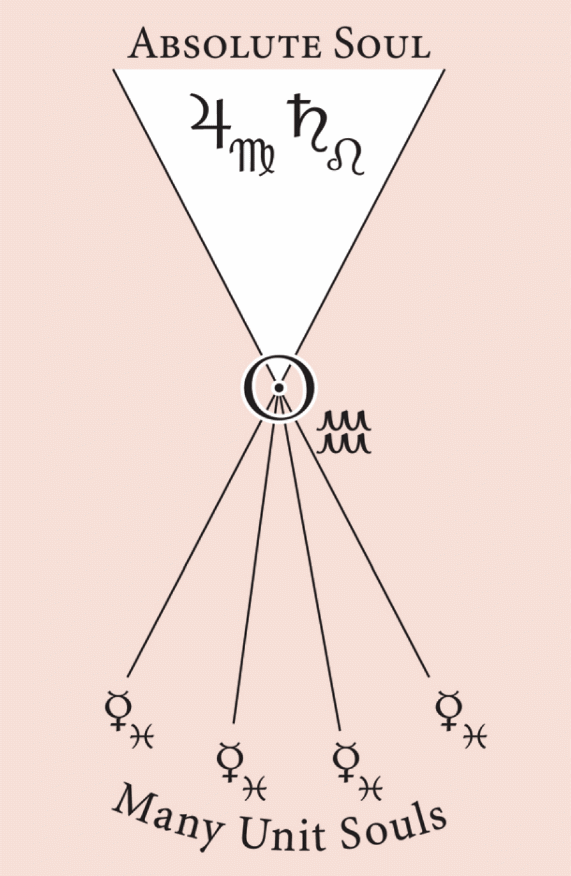
- FIGURE 1983 0518-1. Absolute Soul and Unit Souls.
This diagram is from Astronoesis, p. 185. It is not from this class but is used as a stand-in to help follow along. [Transcriber note: [diagram] means the speaker is referencing a diagram as he or she is speaking.]
NOTE: Even though the discussion is primarily about Sages, it's probable that the Overself was the main subject discussed in the missing audio portion of the class since this class took place in the time period when the Overself was the theme of the PB classes.
TRANSCRIBED Verbatim by IT 2019. Reformatted by JRM & JF 2019-2020, with Subheads and Table of Contents added by JRM. In 2023, IT fixes prefatory matter and footer, updates audio file name, fixes Book List, fixes minor errors/typos, adds a diagram and reference within transcript to this diagram. In 2025, MW expands Subsubjects and alters Subheads to make more accurate. Archival verbatim transcript – V14.1a.
AUDIO FILES: 1983 0518a, 1983 0518b. [Note 1: "Tape" refers to original audio cassette tapes that were later digitized into .MP3 Audio Files. Note 2: We are missing the first one or two audio files for this class.]
1983 05/18 at Wisdom's Goldenrod
PB Paras; Sage
Archival verbatim transcript
[Audio File 1983 0518a Begins]
DB: --one of his understanding, I mean, all the other people that were spoken of seemed to be within a specific tradition and they didn't go outside of that in their exposition of the understanding.
PD (simultaneously): Well definitely, that would pass for a period, make-- make PB very very unique because he's not tied to a traditional--
WHAT IS DISTINCTIVE ABOUT A PHILOSOPHIC SAGE?
AD (simultaneously): Well, this is a-- you know, something that we have to approach with a certain amount of reverence and I hope I'm not misunderstood. In a sense that PB speaks about a philosophic Sage, Ramana was not a philosophic Sage because he was restricted by cultural mores and the-- the lack to grasp philosophic issues outside of that cultural more. Whereas what PB is referring to as a Sage is a person who's versatile [student assents] and understands a variety of traditions and is quite capable of stating his case in any one of them, whereas Ramana would have immediately felt out of his element if he had to do that. And his main thrust was always, you know, meditate, [PD: Yeah.] follow your teacher's advice, and preferably silence. Because he had this-- you know, the presence was so overwhelming in him, alright, that most people would get benefit just by being [PD simultaneously: Just by being in his presence.] there, you know. And I'm-- we're not talking about the movie picture but just being there was, (laughter) you know, enough to bring about a transformation. But he still wouldn't be a philosophic Sage.
S: (Keep going.)
JB: You wouldn't call that a higher kind of Sage.
AD (simultaneously): And like the same with Ramakrishna, you know, Ramakrishna was probably one of the most godly men, you know, always-- I mean that's all he-- every moment of the day. But nonetheless there was a certain lack as far as communicating and bringing about let's say some unity in a philosophic way. He wasn't capable of that.
PD (simultaneously): In terms of its functions.
AD (simultaneously): He-- [S simultaneously, very faint: (Yes sir.)] and he did that religiously but not philosophically.
MB: I think he did a lot of that though actually. I mean he had--
AD: Not philosophically, religiously.
MB (simultaneously): I'm just--
RG (faint): Right.
MB: He did, you're right-- I mean he embraced-- it's however he'd communicate-- if you use the word just communicate, he may not have been well-versed philosophically but he was well-versed in a lot of different traditions and he had disciples and he established [RG/S(?) simultaneously, faint: That's a mystery.] an order and if anyone had bodhisattva-like qualities, Ramakrishna did.
AD (simultaneously): He couldn't read.
HS: He (could only) get it through intuitive feeling though Myra.
MB (simultaneously): Yeah he did-- yeah, there were two-- yeah, I know.
AD (simultaneously): So then what tradition are you talking about that he was acquainted with?
MB: Diff-- well, as you put it, different religious traditions.
AD (simultaneously): Now look, we're not saying-- I'm not saying that the man was not intelligent spiritually, I'm not saying that.
MB: But all-- but the words you're u--
AD (simultaneously): I'm saying that if-- if someone went over to him, alright, let's say a good analytical positivist, alright, (bit of laughter) there'd be no possibility of communicating. (RG laughs, bit of laughter)
MB: No--
RG (simultaneously): What a great idea.
MB: But I mean-- (laughter)
S (amidst laughter): (What?)
MB: He communicated but not intellectually, not philoso--
RG: Yeah he would touch you.
MB: You couldn't use the word-- you couldn't use the word--
AD (simultaneously): But that's what we're talking about, he was not a savant.
S: [couple words inaudible]
MB: Right. But you couldn't use the word philosophical but--
AD (simultaneously): Do you notice, do you notice as you go along in PB's notes how he's almost making-- like for instance Bergson. Who was he referring to there or I should say what was he referring to? Do you know the book he was referring to?
S: Bergson?
MB (simultaneously): No.
S (very faint): (No/Yeah).
S (very faint): Uh-hm.
LDS (simultaneously): Yeah, Bergson.
AD: Yeah. That makes a savant, alright, because when you read that book, and I'm not going to tell you, (some laughter) [few inaudible student words] when you read that book you can see that's the perception he was working with. And in another one, in another note, he criticizes someone for criticizing that view but he doesn't mention who it is. Do you know who that might be?
MB: How would I know? (MB laughs a bit)
AD: Jacques Maritain, [MB: Oh.] who said he might-- he would-- he would be able to help Bergson to see better.
MB: Uh-hm.
AD: Alright? But, this is what I'm talking about. That's why to read his notes is to get an education, and I don't mean it in the, you know, vulgar sense of the word.
MB: Uh-hm.
AD: Now if you can't see the distinction between a philosophic Sage and a Sage-- [MB: I--] Alright?
RG: But Anthony, [MB simultaneously: I-- just let me-- yeah.] in their attain-- in their attainment there's no difference.
AD: No, in the attainment there is no difference.
RG: It's only in the exposition of the doctrine.
S: It's all (it is).
AD (simultaneously): But, it could take you many many lifetimes to be able to be, you know, capable of that exposition.
JB: Then [MB simultaneously: Well--] you do consider it hierarchical and not just a ty-- a kind of Sage? It is higher as Randy said?
PD (simultaneously): Functional. Let's say it's--
S: It's what he said?
S (simultaneously): The--
S: I know a lot--
AD (simultaneously): Let's say functional rather than hierarchical because you might think there's a difference between gold and gold.
MB: Well we spoke of the-- we spoke of the ideas as, what was it, the rhinoceros? The-- the distinction between the Sage who communicates and the Sage who doesn't communicate was the distinction that we started out with. And from that point of view, I would still have to put Ramana and Ramakrishna and Atmananda as Sages who communicated. They didn't go off in a cave and become totally alone. They did have a relationship with disciples, they did communicate some of their achievement.
RG (simultaneously): But that isn't the distinction he was making, Myra.
S (simultaneously): Yeah, that isn't the distinction.
MB: That was the earlier distinction that we were making in some of the quotes and now we're talking about another distinction between Sages that communicate philosophically and Sages who may yet [AD simultaneously: No you--] communicate in other ways.
AD: No that wasn't before, that is now, that's the difference [student assents] between a philosophic Sage and a Sage or let's say a Sage that's more the role of a teacher and the Sage who's more the role of a guru.
MB: Now we have three kinds of Sage.
AD (simultaneously): No, [S, faint: No.] no. (laughter)
RC (faint): Actually PB [few words inaudible]
MB (simultaneously): What about the s--
AD (simultaneously with RC and MB): The same thing over and over again.
RC: He made a distinction between someone who was a guru and what he called a philosophic Sage. And he said that the guru will accept disciples and get personally involved in working out their psychology with them. He said that the philosophic Sage (will/would) not accept disciples, will not get psychologically involved, but will make his knowledge available to those who could purify themselves sufficiently to get access to it.
[students assent, faint]
EVEN PHILOSOPHICAL SAGES MUST RETURN TO THE WORLD AT SOME TIME SINCE IT'S THE VERY NATURE OF THE WORLD-IDEA
MB: Now, from the quote, the long quote that Tim just read, [Note: Paul Brunton, Notebooks, V16, 25:4.17 & Persp., Ch. 25 #64.] it seems to imply that the philosophic Sage does return again and again by choice. Seems that for this-- for this Sage that is inevitable and that goes without saying.
DH: Why was that quote just about to-- I don't-- didn't catch that quote as being just about the philosophic Sage.
RC: Which one?
MB: The long one.
DH: The one about coming back to that, back [one/two words inaudible]
AD (simultaneously): He has to, it's the very nature of the-- a World-Idea.
S (faint): Right.
PC: But (is/isn't) it (impossible) that someone like Ramakrishna or Ramana would come back also?
AD: Yes.
MB: Yeah.
RG: Mm.
S (faint): Uh-hm.
AD (simultaneously): It's the nature of the World-Idea. The point is, will they come back here.
PC: Well, would-- [three/few inaudible TS words simultaneous with PC] isn't that possible that they'd come back here?
AD: Yes! That's the whole point. We have to. We have to keep coming back.
PC: But then there are others that would come back somewhere else because they were--
AD: But they still will come so-- come back so to speak within our world.
S: You're saying (given/giving) endless duration these compassionate Sages will develop facilities to dispel ignorance and become philosophic Sages.
AD: Well [PC simultaneously: Ok but the--] there's no ending to it, I [S simultaneously: Right, given endless duration.] mean they're going to keep coming back. (AD laughs a bit)
PC: But then there was that other type which went instead to a world of peace, harmony, and light.
AD (simultaneously): (That I could) believe, yeah.
PC: So we are talking about three different types in a sense.
AD (faint): Yeah.
PC: Ok.
AD: There's that distinction in Buddhism, you know, Shravakas and Pratyekas and the universal Buddhas, compassionate Buddhas.
S (faint): Yeah.
BS: Is that an actual possibility, to get swallowed up in the unconscious? (laughter, student words) To will-- to willfully-- to willfully allow that to happen? You mentioned that it was possible.
AD: I didn't mention anything of the sort, you did. (laughter)
BS: No I've been keeping-- I mean I'm remembering what you said before.
S: Uh-hm.
AD: I didn't say that.
BS: Well maybe not.
AD: I-- because I don't even understand the passage, what-- how do--
BS (simultaneously): Well you said there were those Sages that might choose [RC simultaneously: I didn't get any (one/two words inaudible)] as to disentangle them and enter the unconscious.
S: He didn't say [one word inaudible]
AD (simultaneously): I didn't say that. (bit of laughter)
RC: So that was-- that was from the quote, maybe [LDS simultaneously: There's a quote.] we should reread that and get the words right anyway.
AD: (Where do you/I'm ready to) see that book(?/.) (laughter) I don't know how you could confuse the two of us. (AD laughs)
BS: And no one remembers. (laughter, student words) Well I admit I remember the quotes afterwards confused me because I recall what you had said prior to that. And that PB in his exposition was avoiding that entirely.
TS: I'll read this passage here [couple words inaudible]
BS (simultaneously): No, no. I'm not talking about a passage. But it's alright.
S: Yeah. (laughter)
AD: Bert I know I wouldn't say that. (laughter) Because I don't know what it means.
BS: I know I get crazy sometimes but--
S: [one/two words inaudible]
AD: I don't-- I'm not [BS simultaneously: Hallucinate (one word inaudible)] saying you get crazy. (laughter, student words) You could just, you know, misread or misplace something and that's no cause for psychosis. (laughter)
BS/S(?) (amidst laughter): [three/few words inaudible]
AD: Oh of course I too have very often heard things which I never did hear. (laughter)
BS: May I borrow the tape after? (laughter)
AD: It's right here. Let's have another [couple/three words inaudible]
RC: [couple/three words inaudible] [S simultaneously: This is the (one word inaudible)] part again, [S simultaneously: Yep, yep.] see if this is what he's talking about?
AD: Sure, go ahead.
RC: Since it might have been-- might have been my misunderstanding but I thought he said here, um-- um--
PB [V16, 25:4.17 & Persp., Ch. 25 #64, RC reading]: "It is thus alone that he achieves immortality, not by fleeing forever--as he could if he willed--into the Great Unconsciousness, but by suffering forever the pains and pangs of perpetual rebirth…"
RC: I think I started what might be what Bert's talking about.
S (faint): You started it.
BS: Well I know you started it, yeah. (some laughter)
RC: I was saying that it seems that he's saying here that, if he-- he could if he willed, escape.
AD: What do you think he means by going into the Unconscious, the Great Unconscious?
RC: Well he-- I mean, [LR simultaneously: (That you're) unconscious (of that).] for me it's just a matter of that, when they talk about these choices, one of them they always speak of--
AD (simultaneously): Like staying in the Nous?
RC: --going into that door from which none return.
AD: Uh-huh. Yeah, that's a possibility. I don't know why he used the Great-- the term unconscious.
RC: It's capitalized, "Great" is capitalized and "Unconsciousness" is capitalized.
AD (simultaneously): Oh, yes.
S: Did he?
AD: Yeah. That will be absorption into the Nous.
S (faint): Uh-hm.
RC: Ok.
AD: But even so, let's say it's for the whole length of a Manvantara you would still eventually have to come out again. (laughter)
S (amidst laughter): Oh
S (amidst laughter): Yikes.
S (amidst laughter): Uh-hm.
RC/S(?): Ok.
BS: That was what my next question was going to be. If that was possible wouldn't he be forced [EC simultaneously, faint: That's the best rest I think.] after a world period (um--)
AD: Yeah. As far as I understand, after the period of Manvantara they would have to return.
S: (If) they leave forever obviously they return. (bit of laughter)
PB [V2, 1:5.102, RC reading]: "The thirst for perfection is certainly present within us. This thirst is a pointer to its eventual slaking. But there is no necessary implication that this will be attained whilst [RC reads: while] we are in the flesh and on a level of existence where everything is doomed, as Buddha points out, to decay and death. It is more likely to be done on a higher level where such limitations could not exist. The perfection we seek and the immortality we hope for are more likely to be mental rather than physical achievements. For all mystics are at least agreed that there is such a level of untainted, purely spiritual being."
[19¾ second pause]
WHEN A SAGE IS REBORN, THE LINK IS NEVER BROKEN, SO THEY CONTINUE TO PERCEIVE THE INTELLIGIBLE WORLD WITHOUT USING ANY INTERMEDIARY
HS: Randy, excuse me a sec. Anthony, could I go back for a second? When you speak of the Sage who-- who returns, you know, we speak that way and-- Returns to another embodiment? Is this how we're talking about it, he takes another birth in a continuation [S simultaneously: Herbert--] of-- of his own con-- continuum, right? Is each time that-- that there's an incarnation isn't there like different kinds of development or is it just the-- does he necessarily recapitulate what he previously recapitulated and push forward or does sometimes he have trouble getting the information that he had in the past, (after), so to say, manifested? Could you-- is there a question here that you could just--
AD: Yeah I follow you. (laughter) From what I understand the link is never broken, so when they reincarnate the link is still there, they're capable of falling back on that identity. And it would seem plausible that they are constantly, you know, learning. I mean it isn't that it's a-- an end process. It's not a goal process. And, I think somewhere PB mentions the fact that although the Sage has climbed tremendous heights, from his point of view there's still further heights to climb. From our point of view we can consider that, the height to reach. So I would assume that the-- you know, the discovery of the Nous and all-- you know, that it might possibly lead to something that would go on for the Sage.
HS: And it stays-- it'll come back each life so to say, (it'll/it would) be--
AD: As far as I understand, the link is never broke. [LR simultaneously: Yes.] Once they've achieved it the link is with them forever.
HS: And let's say a guy is born, you know-- so to say is a-- a shepherd somewhere. Is the spirituality present with that man but (he/you) might not have like books around but he might-- is this-- you know, I'm serious.
AD: I'm serious too.
HS: Ok. Now is the spiritual-- what's--
AD (simultaneously): Spirituality has got nothing to do with the books.
HS: What's-- ok what's present then?
AD: You mean what is the nature of his spirituality that could be carried--
HS (simultaneously): That could be carried over.
AD: It's a way of functioning or a way of perceiving directly the Intelligible World, alright, which even the sense world or his incarnation in the sense world does not prevent, it does-- it cannot stop that. In other words he can, even though incarnated in the flesh, perceive the Intelligible World without the use of any intermediary.
HS: And that's ca-- and that's-- and that's carried in the vehicles from life to life at that point?
AD: It's not carried in the vehicles, it's brought into the vehicles.
HS: It's brought into the vehicles.
AD: Yeah, because that's-- that's his way of being now.
RC: In ordinary--
HS (simultaneously): Ok then what gets carried--
THE SAGE DIRECTS THEIR OWN REINCARNATION IF THEY DO COME BACK; WE DON'T
RC: One of the things would seem to be that he doesn't lose that consciousness at death and so its continuity is not broken. That's one of the things the Dalai Lama talked about calling (them/him) when he wanted to distinguish between rebirth and reincarnation. [students assent] He said most people die and they end up where Nature puts them and we call that rebirth. But at a certain stage the man is able to retain consciousness through the death experience and choose his next incarnation. And that's what we call reincarnation.
HS: Well, I'm not that-- I don't think it's that easy. But--
AD (simultaneously): No I think that's to the point though, you know. The Sage does direct his reincarnation if he does come back, we don't.
HS: Ok but-- and then when he gets reincarnated he has so to say remember. Is it-- is it na-- is it natally given, is this like--
AD (simultaneously): Remember?
HS: Is the-- [couple inaudible student words simultaneous with HS] is the person-- (don't they have to) push you right here on the way in?
AD (simultaneously): Remember?
HS: Don't they give you a little touch here to make you forget?
S: What?
AD (simultaneously): What is he going to remember?
S: No I see what it is.
LR (simultaneously): All (the/these) (experience/things).
AD: Something he forgot?
S: Yeah.
HS: Ok, that's a guy that doesn't forget. (laughter)
AD: But if we said, if we said that he deals and seizes the Intelligible directly, alright, what do you mean remember?
LR: Maintain.
AD: Well then you don't mean ray-- remember.
LR: Herbert means maintain.
AD: Because you keep on being that way.
HS (simultaneously): Well because it seems to me it's a rough passage, as it were, to die and, you know, and you go into soul realms and you get reborn again. And--
AD: That doesn't happen to them.
HS: It doesn't happen that way.
AD: No, they don't go through all that.
S: Mm.
LD: You mean they're born enlightened?
AD: That's what bodhisattva means, a being of light. Bodhi-sattva. [LD simultaneously: But ins--] The bodhisattva is born, it's not like you and I getting born, [LD simultaneously: But insofar--] willy-nilly. (laughter)
LD: Insofar as we reincarnate, I mean there's certain act of self-will that--
AD (simultaneously): Yes, and if you remember, if you remember, Randy made that remark that PB pointed out that he actually had to will himself to reincarnate. And I would add where, how, where-- and when.
HS: You would say [S simultaneously: (It's all of those things.)] that that-- that kind of knowledge is available?
RC (simultaneously): (It probably took) several lifetimes to get the aura that he was working with this time.
AD: Uh-hm. Yes.
HS: But that kind of knowledge is-- you're actually-- you're talking about real precise.
AD: What do you think we're speaking about when you speak about the higher knower?
AH: I'd like to--
AD: Well-- Herbie, what do you think the higher knower is?
HS: What do I think?
AD (simultaneously): Someone who reads just the top of the page? (laughter)
S (amidst laughter): If you want, if you want we could get Lauren. (laughter, student words)
AH (amidst laughter): I'd like to pursue the question, um--
AD: Eleanor?
[few seconds of background student talking, laughter]
S: (Go.)
EC (simultaneously): There was-- PB mentioned that full realization came to him at a certain time in his life. Is that because he was in a human body before all that could be fully acquired, all that knowl-- not acquired-- [couple/three inaudible student words] You said it is-- you haven't forgotten but he did reach a certain time in his life when he said he was fully realized. I forget what age that was.
AD: June, 1963.
EC: Well, he came in fully realized so he did have to go through some kind of a process.
AD (simultaneously): He had the ultimate realization [few words inaudible]
PC (simultaneously): Well maybe he didn't have it before this life.
EC (simultaneously with AD and PC): Because he was in a human body and you had to go through that normal process?
S: That had to happen before.
AD: Normal process?
RG: No, no.
EC (simultaneously): But I thought he was fully realized many times.
AD: Well he had many enlightenments. But if [EC simultaneously: Oh.] you're speaking about the ultimate realization, alright, [EC simultaneously: This was the first time?] that was the one that happened in '63.
EC: Oh well then I misunderstood, I thought he had-- the soul had had that full--
AD: No, you can have many enlightenments [S simultaneously: Oh.] and you do on the way-- on the way to full enlightenment or ultimate realization, you have many of them. But the ultimate realization, which you can't speak of going, you know, beyond because you're speaking about being identical with this principle of awareness, that's it.
EC: So that now that the next reincarnation he doesn't even have to go through that, I mean it'll be available immediately.
AD: He'll always have a link to that. He'll always be linked to that, no matter-- Because now everything would be under his conscious control, it isn't that karma steps in and tells him where he's going to be born and things like that. Although he'll cooperate with the karma of the world, still he will have a certain freedom as to, you know, the parents to choose, the environment, the country and all that. [PC simultaneously: Well wouldn't his life--] That's what we mean by the higher knower, right Herbie?
HS: That-- that capacity--
AD: The hi-- higher knower directly seizes the Intellectual meaning of the world, the plan of the world and what's with that, not with the sensible manifestation.
HS: And in-- and in that seizing you actually have the capacity, in this case say, to enter into manifestation at the appropriate time in accord with say what you're viewing?
AD: Well you have-- you have power, yes, you have power.
HS: Ok and then-- and when the-- and when the-- the-- that entity has a chart now, is that-- is-- is that--
AD: Forget about it.
HS: You don't even do that, huh?
AD: Let's not waste our breath. (AD laughing)
S: I have a feeling that--
AD: Besides you won't know his chart, [HS simultaneously: You won't know it?] until after he's dead.
LD: Do you know of any examples?
AD: Any examples of what?
LD: Of a previous enlightened man who has come back again?
TIBETAN TULKUS ARE SUPPOSED TO BE ABLE TO DIRECT THEIR REBIRTH—WHERE THEY WILL BE REBORN, THEIR PARENTS, ETC.
AD: I would have to be right alongside with them to be able to tell you about those things. (AD laughs) But you know it's interesting, you have some-- I think like Blavatsky speaks about an example, who was it, uh-- um-- [short pause] She says that, I think it-- I think now, I'm-- I'm not quite sure that-- Nicholas Cusa, uh, came back-- Or was it the other way around? [S, faint: Yeah.] Never mind. I can't remember in those sets. But, there are some quotes and some references where Blavatsky points out that that's what a Kulku is, you know, what the Tibetans call a Kulku, [S, faint: Tulku.] [S simultaneously: Tulku.] they direct--
S (faint): Tulku.
AD: Tulku.
LR (simultaneously): Tulku.
S: Tulku.
AD: They-- Tulku, where (is this)? (laughter, student words)
S (amidst laughter): That's a verb so--
AD: That's a verb? (laughter) They-- they're supposed to direct their rebirth, alright, where they're going to be born. And that's the theory behind the Tulku, that they take advantage of their knowledge, the place they're going to be born, their parents, etc. And they leave indications and traces for others to find them. And they say that the Dalai Lama was such a person. They also claim that of many others but I get skeptical, you know, unless I have more proof further. It's a statement that's made too often.
LR: Yeah, they say all the abbots are Tulkus.
AD: Hm?
LR: They say all their abbots are Tulkus and all--
AD (simultaneously): Yeah, yeah, that's why I'm skeptical. I can understand the Dalai Lama being a Tulku because he-- the evidence was certainly in his favor. But of the many abbots, you know, I just [CDA simultaneously: Ok, are you s--] have no opinion.
CDA: Are you saying that someone who was-- is it-- is referred to as a Tulku who has di-- directed his birth had-- has had the ultimate realization as a-- and could be called a Sage in a prior life?
AD: No, no, the Tulku is just a-- an indication of the possibility of what a Sage could do, I don't-- I [CDA simultaneously, faint: (Oh/Ok).] wouldn't say it's a Sage. Just like for instance you can direct your mind as to the kind of dreams you're going to have if you wish. You know you can practice at night and determine the nature of your dreams so that they could even become rational, alright, pace Mr. Jung, I mean, I-- I don't want to disturb his theory but it's a fact that anyone who wants to can practice a certain exercise whereby he determines precisely the nature of his dreams. And that right away gives you an indication that, you know, these powers of the mind extend beyond the space and time boundaries. And also for instance like the exercise, you remember, upon the future where you can actually predetermine to some extent your behavior, your conduct and your [one word inaudible] by practicing very intensely at night the moment you fall asleep to hold that in and it becomes a seed-thought which predetermines the next day's activity, all of these are indications of certain powers or siddhis that the Sages know about which they don't go around advertising.
WHEN A SAGE IS REBORN, THEY LOSE ONLY SUPERFICIAL KNOWLEDGE, BUT THE DEEPER KNOWLEDGE, THE LINK, IS STILL THERE
S: Like that-- I think Herbie's question is, if I understand it, not of having or losing the previous link but his question seems like most-- mostly to do with apparent knowledge, that a Sage dies and then is reborn, does he have the same apparent knowledge all available, which I think he has to restart right from beginning. For example if PB is born in Tibet he will not start speaking English right there in Tibet. He will have to learn it again right from--
AD: Yeah, well what you say I think is correct, the superficial knowledge is [S simultaneously: Yeah right, yeah.] lost. The deeper knowledge, the connection, the link is there, yeah.
S (simultaneously): Oh yeah, ultimate connection is there, that's-- that's no problem.
AD (simultaneously): Yeah I--
S: Yeah.
AD: I would agree with that, yeah.
S: Uh-hm.
LR (simultaneously): Although there's certain facilities, (and when) we saw that even the other night that you can-- you might have to have the exposure but certainly people have the facility to say [couple words inaudible] to pick up something if they've done it many times before, the facility will be there and I'm sure that would be the same with repeating philosophic studies, it wouldn't--
AD: Yeah but still, you know, I think in the context he's speaking about that's all on the surface compared to this deep-rooted knowledge which is a permanent possession. Whereas the other thing, you know, is-- Like Blavatsky had many of these powers, you know? I don't know if-- if you seen some of the diagrams, like a drawing she did in a half hour in the dark and it's got more detail than I could see in daylight! (AD laughing, laughter) Alright.
S: Was Ramana's experience one of these sorts of experiences where it was there, it was available to him without-- without work in this lifetime and that-- is that the kind of thing we're talking about? I get-- I'm with Louis, I-- Do these people who-- these people who are philosophic Sages and then when they come back do they hide themselves? Are there so few? They're not avatars, are they?
AD: No, they're not avatars [S simultaneously: And they're not-- and they are--] but-- but they are few.
S: And we're not considering Ramana to be such a being exactly.
AD: Yes, Ramana I think was. How old was he when he got the Enlightenment?
S: 17.
S (simultaneously): 17.
S: 16.
RC/S(?) (very faint): That must be why.
AD: He went into a death trance and immediately [student assents] accepted and went right into it.
LR: So that would be a--
S: Uh-hm.
S (very faint): Yeah.
S (faint): Yes, Anthony--
AD: I think so. I don't like to make comments on these people.
S: I know, but-- (AD laughs a bit)
AD: Alright. They're only really opinions.
MB: Anthony, you brought up the-- the Tulkus and maybe this isn't a good explanation but earlier we talked about three different levels of realization, the level of realization of the I AM principle, the level of realization of the Nous or the Void, and the level of the One. And, when we spoke--
AD: Well we spoke about two of them.
MB: Two of them. We didn't speak about the third. And now I think the philosophic Sage is the-- has certainly achieved realization of the Nous and can direct his reincarnation. It's possible, I don't know, I'm asking, maybe that someone who's realized the I AM has somewhat more control over his reincarnation than the ordinary person but not as much control as the philosophic Sage and maybe those are considered Tulkus.
AD/S(?) (faint): (Yes.)
MB: I'm just asking a question.
AD: That-- that could be, that could be.
RC: I think you could make more substantial the notion of-- say if someone is-- is awakened to the Nous, what it would mean for them to direct the next incarnation, it would seem that you'd say their soul has actually turned its powers so that that contemplation that it has of the Idea that it's going to instantiate remains unbroken. And when it looks for guidance it doesn't look to the world. It's constantly turned to that Idea. And it's in s-- it's in that sense that it's directing the next incarnation. [student assents] It's not like we would imagine making distinctions and getting a few things out [three/few words inaudible] The mind is turned toward one thing, [MB assents] and it's the Idea which would be incarnated. And in that sense he's directing his next incarnation.
JB: So that would allow for more Tulkus. I think Myra's trying to be fair to the claims of the Panchen Lama [MB simultaneously: Yeah.] and the abbots and so on.
MB: No this is-- but just-- but just to say, you know, there may be somewhat more control and at a level not at the ultimate but I think Randy you're saying like you don't look to the world for your reincarnation, you don't decide well, I like houses with blue roofs so I'll reincarnate over there. You know, you reincarnate with the house with the blue roof because it happens to conform to what the World-Mind has in mind for that incarnation or-- or what that individual's path is. Is that what you're saying, something like that?
RC: Which is basically trying to make more substantial the difference between a lifetime guided by looking up and a life being guided by looking down [MB assents, faint] in terms of like the soul's own limitation. [S, faint: Looking down.] [S simultaneously: You mean--] It's not like done-- done with the hands so much as done with a mind.
S (faint): Uh-hm.
PC: In other words it wouldn't be on the basis of any preferences of the Sage's ego that he would make that decision, it would be based on what he perceived in the World-Idea.
RC: Yeah and the tendencies within his ego would be forced to conform to that as best they could.
PC: Right.
DB: Well on the other hand, would you say that there would be-- There's another question. Is the-- I mean we spoke of this continuity of the contemplation of the Intelligible World from one lifetime to another. But in terms of the ego would you say what sort of continuity would there be then?
[short pause]
RC: I guess I'd think of the ego more in terms of samskaras that, you know, become an apparent subject when that light come(s), you know, into association with the--
BS: I'm sorry Randy, becoming what?
RC: Like whatever the body is for example that he incarnates in is-- it's a bunch of tropes.
BS: And?
RC: And, in-- in coming into association with them, there could be an apparent subjectivity that would come to identification with that body. But one impression I got the time I spent with PB was, it just really hit me one time that I don't think he was ever identified with his body. The way that he talked about it and the way that he talked about having experienced it when he was younger it was always an "it". [S: Right.] It was never him.
S: Ok.
BS: Is it-- Well the question I would like to ask, when you think of the asmita principle, the I AM, let's say for someone who has realized that, if that is going to be used, ok, by a Sage. Uh-- [short pause] Is there a-- a residue-- do you think there's a residue of distilled wisdom that is, you know, distilled from experience that for a highly evolved person like a Sage, the powers of the soul that seem to be inherent somewhat with that I AM principle become so conjunct with this residue of wisdom that there's almost an identification with this so the World-Idea could be worked with as the flux is being played out in experience?
THE MIND CONTAINS INTELLIGIBLE MATTER BY WHICH IT MANIFESTS ITS WORLD, AND THESE TENDENCIES ORGANIZE THE TROPES THAT CONSTITUTE THE BODY
RC: Yeah. That's what I was trying to get at by mentioning that remark he made about he had worked for several lifetimes to develop a specific aura that he was working with. [student assents] That was why he was so careful about not shaking hands and making sure that-- [BS: Oh.] to have more used goods around him and that things would (know) what-- He was actually consciously trying to work with a specific aura that had taken a long time to develop.
HS: Just what you said-- Talk a little more. Between one life, the vehicles so to say disperse, right? [student assents] Then next life. Now the aura is what? What (aura/order)-- where is the aura here?
S: Yeah [one/two words inaudible]
RC: Well I think it would be the-- like the actual aroma of the-- the material that the body's made out of, like you get born into one level of society in general you're going to end up with a much coarser body than if you get born into a more sophisticated level. Like the actual quality of the-- the material of the body, the quality of the samskaras or the people that are built into that body, the tendencies that that matter wants to repeat. Like a lot of the things that you inherit from your parents I think, I think are for a lot of people would get better, are good.
HS (faint): They're what?
RC: They're good, the tropes that come with, I mean it seems like it's at a certain point-- Well that's getting off the point.
HS: Yeah.
AD: Herbie, there's [HS simultaneously: Yeah.] an ancient Egyptian theory that says when the time comes for you to reincarnate, all the atoms that constituted your body will be regathered for that purpose. But that's just an ancient Egyptian theory. (laughter)
HS: Ok. Ok, now here-- here it's a little more though, here you're talking about a capacity to so to say coll-- collect kinds of atoms.
AD: Yeah, the kinds that you've been working for-- working with before and before that and before that. Or rather than saying atoms it would be more to the point to say the perceptual material.
HS: Ok, we wouldn't say tropes.
AD: No, I would say the perceptual material, the intelligible matter which the mind contains by which (it) manifests a world.
RC: Well what kind of difference in those-- I mean how are you using trope that's different from the perceptual material?
AD: Well the tropes are going to be directed and guided by that. In other words we're speaking about the mind's power to organize and manifest a world for itself and including in that manifestation would be the specific body that it will use. [RC: Ok.] But the body that it will use will be dependent upon the prior functioning, you know, of a previous body. [student assents] So we're speaking about two kinds of tropes and the word 'trope' would be misleading. Certain guiding tendencies which are within the soul [RC, faint: Ok.] which organize the tropes according to those guiding tendencies or-- which are in the soul rather than let's say the s-- the organization of those-- those tropes by the cosmic circuit.
S (faint): Ok.
RC: Where does the psycho part of the psychosomatic fit in this? Like [one/two inaudible student words simultaneous with RC] are these perceptual--
AD: The psychosomatic organism is all the functioning of the tropes.
RC: Ok.
AD: Alright? We're speaking about guiding-- Like when-- in the case of PB when he was developing a peculiar tendency, you know, to isolate himself and develop this, you know, very special aloneness you might call it, that's something that's guided by the soul. That's not the (tropes/trope's) functioning. That tendency which remains within the soul goes on developing and it is used over and over again insofar as to the selection as to the way the body should be organized in order for him to inhabit it. [RC assents, faint] Even in this life he had a body that, you know, had only two layers of skin compared to the ordinary three that everyone else has. An extreme sensitivity to the functioning of the body was something you noticed. [RC assents, faint] Once he tasted something he knew immediately in the taste, you know, what that was. Alright, that's a soul quality, so to speak, in contact with the tropes themselves and judging-- you know, pronouncing judgment on the functioning of those tropes. But I think we ought to leave this off and go on to the more general quotes. These-- these things are very--
AH: Perhaps a general-- general question that-- concerning the incarnation, reincarnation of a Sage. There's a confusion for me because we spoke so often about our individuality connected to the individual ray from the Overself. You know? And when you talk about a Sage is one who has transcended that individual ray, realized its universal nature. Now if that's so, what is it that reincarnates or what is it (that) directs the reincarnation, is it the individual ray again? Like if we define Sage as one who has transcended individual aspect of Overself, it's hard for me to understand what it is that reincarnates. What-- what aspect of individuality of that particular Sage reincarnates? Because to speak of Sage is at once to speak of non-individual. At least in one way.
RC: Not merely individual.
AH: Not merely individual.
S: Yeah.
RC: The first set of quotes that we read were all in terms of this Overself unites a duality [students assent] when you speak of it, that it's not to be thought of as union with the Overself means leaving one end behind in-- in any way, [student assents] that precisely what it is is this union of individuality with universality. And it would seem like to say what reincarnates would be to say specifically the individuality is what reincarnates.
AH: Isn't that what's transcended in his-- in his wonderful attainment?
RC: Yeah, yeah. [LDS simultaneously: Yeah but--] It would seem that that-- that's what permits for the inner freedom amidst the cycles of rebirth which continue(s).
LD: But haven't-- haven't we also established that that attainment is intermittent and also that that ray is an eternal ray? [RC: Well--] Are those--
RC: He talks about the difference between degrees of enlightenment, and the final goal being permanent enlightenment which is not intermittent.
LD: So-- [short pause] I thought we established that it has to be. You can be, what did he say, the Manvantara [MB(?): Uh-hm.] and-- but sooner or later you have to come out of that, I thought that's the way we've been speaking of it but maybe I misheard.
RC: Well I haven't been able to relate the notion of going into Nirvikalpa and trying to stay there to the notion of the Overself the way we've been reading about it as being both these things, as uniting a duality. It may be because the Overself unites the duality that the guy can't stay in Nirvikalpa. That that's just the very fact of any individual's higher being is that-- of both of these poles are going to be forever.
THE I AM PRINCIPLE OF A SAGE IS AWARE OF ITS CONTACT AND IDENTITY WITH THE PRINCIPLE ABOVE IT AND WILL ALWAYS DIRECTLY PERCEIVE THE INTELLIGIBLE
AH: Randy? If the Sage quality that reincarnates is as we have said tonight knowledge of the Intelligible, [AD/S(?), faint: Yeah.] that's no kind of memory. Or [RC simultaneously: Yeah.] the knowledge of the Intelligible is-- is disconnected from memory or from the psychosomatic entity.
RC: I don't know about disconnected. Certainly differentiable. But I mean like for him to remember that Bergson was right, remember the name Bergson and even that intelligence is connected with memory. When he read a book he didn't forget it forever because the hands of the clock (were moving).
AH (simultaneously): I'm talking about from one incarnation to the next.
S (very faint): Right.
RC: Yeah well, I guess that's a different issue.
AH: If the quality that reincarnates is the knowledge of the Intelligible, I don't understand anything about speaking of an individual Sage's reincarnation.
RC: Well like he has it, I don't, I mean, one person has it-- one individual center has it, another one doesn't.
AH: Can an individual center have knowledge of the Intelligible? Of the Intelligible World?
PD: By definition must.
S (very faint): Yeah.
RC: It must be an instance--
PD: I mean, like Randy was saying before, the Overself unites both.
LD: And to have knowledge would imply a duality which would necessarily mean [RC simultaneously: (Um/Well)-- but see--] an individual whereas to be in--
PD (simultaneously): I think Andrew, on one hand you transcend your individuality or a Sage transcends his individuality. But that transcendence doesn't negate the existence of individuality [RC assents, faint] in his act of-- of relating to the World-Idea.
AH: Yes I can agree with that implicitly but when you speak of a-- of reincarnation--
PD (simultaneously): You make the transcendence sound like the negation of individuality.
S: Yeah.
AH: It's only hard to understand when you speak of reincarnation from one entity to the next. Like there's some quality that's being transferred from a life to another life and that very quality of Sagehood is a quality without qualities, you know. It's knowledge of the Intelligible World.
RC: Ok. Well there's a whole different batch of quotes that maybe we should go into to try and address this topic.
S (faint): Yeah.
AH: It's just a confusion for me.
PD: Well, this isn't something (at/we're) all but familiar.
AD: It's the I AM principle.
AH: That reincarnates.
AD/S(?) (very faint): Yeah.
AD: And that this I AM principle hasn't lost contact and is aware of its contact and its identity with the principle above it, alright, and will always directly perceive the Intelligible. In that case, if that is so, then any state that it manifests it will be aware of that.
AH: So what it doesn't-- what the I AM principle doesn't lose is its connection with the Intelligible.
AD: Yes.
AH: From life to life.
AD: And also the recognition that it is that principle which manifests the world for itself, if you're speaking about a Sage.
AH: I see.
PC: Would the reincarnating Sage be aware of that even as a child?
AD: I'm sorry?
PC: Would the reincarnating Sage be aware of that even as a child? Would he have that awareness of the Intelligible?
RC: Would he be self-aware even as a child?
[Audio File 1983 0518a Ends]
[Audio File 1983 0518b Begins]
S: Uh-hm.
S: Uh-hm.
S (very faint): What?
S: Yeah.
S: What did he say?
S (very faint): What did he do?
AH: Also they spoke about this-- the marks-- the marks of the Buddha.
AD: Yeah. 32 marks, yeah.
AH: Some of them are like manifested in the body.
AD: Uh-hm.
S (very faint): Yeah.
AD: But what do you think that those legends are talking about? His self-forgetfulness? Alright let's-- let's go back to the more-- more available.
RC: Ok. Do you want to drop off the stuff about the bodhisattvas and the Sages and go into things generally about the Overself?
AD: Yeah.
RC: Ok.
S (very faint): Yeah.
S (faint): Uh-hm.
[18½ second pause with faint background student talking]
RC: I'll make a little trouble with some of these.
S: Go ahead.
THE OVERSELF IS NOWHERE IN TIME AND NOWHERE IN SPACE, BUT IT DOESN'T EXCLUDE THEM EITHER
PB [V14, 22:3.245, RC reading]: "The Overself does not evolve and does not progress. These are activities which belong to time and space. It is nowhere [RC reads: nowhen] in time and nowhere in space. It is Here, in this [deep] beautiful [and] all-pervading calm, that a man finds his real identity."
[16 second pause]
RC: You know there's one thing that-- can't remember who wrote it but, someone referred to once a certain stage of development is reached you can't fit all of yourself into the period of your (morning). And you always have a sense that there's a part of you that just you can't fit into your circumstances. [students assent] And, I think that might be some awareness of this being a larger being than-- than the ego and its circumstances, being aware of a level of self that doesn't evolve, doesn't progress, doesn't belong to time and space.
DB: So Randy, um, there were two-- two things, one of which was that it was-- he s-- he said it would-- it's Here.
RC: Yeah H, capital H.
DB: Right, not there so, ok. But, you know, would-- would you refer that to the Mercury here as looking at the Saturn in Leo [diagram] so to speak? [Note: See FIGURE 1983 0518-1, Absolute Soul and Unit Souls, appended to this transcript. This diagram is from Astronoesis, p. 185.] I mean it's not the principle-- it's the principle of manifestness but it's not actualizing anything.
RC: I-- I would want to see it that way, yeah, in the sense that you speak about a man finding his true identity.
HS: You're talking about in everyday life now, right, that quote? [students assent, very faint] This sense of Here, so to say, or Now.
DB: No I thought of--
RC: I think it would be-- I would tend to phrase it the other way around, that I would find that everyday life took place in it and [one/two words inaudible] life on it [couple words inaudible]
HS (simultaneously): Whatever, you're-- we're coming upon this now as it-- as it appears in everyday life or any way you do it.
DB: I was just-- I just thought he was saying Here insofar as it was referring to something that-- that I'm familiar with rather than there, something [RC simultaneously, faint: Yeah.] you've read about, so--
RC (simultaneously): Yeah, no he mentioned-- we were talking about writers one time, he asked me, how many writers do you know of that can make you aware that the Intelligible is Here and you don't have to go anywhere.
HS: Ok now--
AH (simultaneously): But that-- but that Here is not a reference to time and space here.
RC/S(?): Maybe I could just--
RC: Yeah, time and space [couple words inaudible] not Here.
S (very faint): Yeah.
AH: See that's complicated because it's right here. But the only kind of here that we can fabricate in our imagination is one that is intersection of time and space.
AD (simultaneously): Oh boy. Then you must be an English major. (laughter)
HS: Me.
RC: T. S. Elliot.
AD: You nailed a meaning onto the word 'here' and that's it.
AH: Well, what I-- the question was actually rhetorical. I think that--
AD: Imagine yourself in a dark room, alright, or better still imagine yourself in meditation where you lost the sense of time and space. You could still say "Here I am."
AH: Yeah. I think that's the point of trying to understand that what he said Here is the eternally present.
AD: Yeah it's-- it's comprehensive Being.
AH: Yeah. It's not like in front of my television or something. (AD laughs a bit)
AD: (Oh no.)
HS (simultaneously): Yeah but he means here though, right?
AD: Huh?
HS: When (he/you) said it was Here, he means here, right?
S (faint): [couple words inaudible]
BS: [few words inaudible]
HS: No, no.
S (faint): No.
S: PB's here and I don't [three/few words inaudible]
PC (simultaneously): Isn't there a phrase right after Here?
AD (simultaneously): Well it won't exclude [HS: Here.] the spatial [LDS assents] time and place you're talking about.
HS: Ok, that's all I wanted to say.
AD (simultaneously): But it can't be restricted to that.
AH(?): It's like [HS simultaneously, faint: Ok.] Trumansburg.
AD (simultaneously): So if I say Being is here, alright, I'm saying Being is universal, what's wrong with saying it's here too!?
[bell rung]
HS: Well I like this half.
AD (simultaneously): I got the last word. (laughter) Thank you Randy.
RC/S(?) (faint): Thank you.
[background talking till the end]
[Audio File 1983 0518b Ends]
1983 05/18 V14.1a: CLASS: PB Paras; Sage. Copyright 2023 Wisdom's Goldenrod p. ii