DIAGRAMS FOR 1983 0527a
Class
Friday, May 27th, 1983
Verbatim, unedited transcriptClick the series name to view more
CLASS at Wisdom's Goldenrod, Hector, NY
with Anthony Damiani (AD)
May 27a, 1983
PLOTINUS; SOUL;
PB'S "WHAT IS THE USE" PARA; UNIT OF LIFE
TOPIC: Plotinus
SUBJECT: Soul
SUBSUBJECTS: PB's "What is the use?" para, Unit of Life, AD's "Third Phase of Soul" paper, Mercurius, Dragon, Astrology, Cosmology, Epistemology, Thinking, Scientific Method
CONTENTS:
Beginning announcements, building a shrine on WG grounds below annex
Overview of levels of Soul
Soul is one and many; modern mentality works with reductive tendency
Reading AD paper, "The Third Phase of Soul"
Reading PB's "What is the Use" para
Unit of life remains self-identical; World-Idea evolves within it and brings forth greater and greater understanding
Higher knower represented by 360 degrees; most fundamental part of chart
Functioning of the real ideas in you is the higher knower, asmita is the lower knower; asmita principle learning to be guided by Intellectual-Principle
Asmita principle never loses its individuality
The "Who" and "What"; both lead to universal Overself, both void
What is evolving?
When my life reaches knowledge of the Nous, it becomes sanctified
Transits bring about constant creation of thoughts, almost inexhaustible
Thinking becomes scientific when there is conformity to the intuitive mind that produced the object
Why are we intelligent? Why are we able to ask questions and seek answers?
Life in itself is indeterminable, Nous determines life; same on a lower level
Miracle of cosmology involved in causing our souls to grow in intelligence and understanding, brings about ability to ask questions and seek answers
Difference from purely mystical path
Evolution of understanding from tropes to Ideas
Modern mentality sees nothing divine about cosmos; sin against the Holy Ghost
BOOKS READ FROM OR REFERENCED:
Plotinus, The Enneads (MacKenna translation, 4th ed.)
C.G. Jung, CW 14, Mysterium Coniunctionis
Paul Brunton, Notebooks
PLOTINUS QUOTES READ OR REFERENCED: II.9, V.1.2, VI.7.7
DIAGRAMS appended to this transcript:
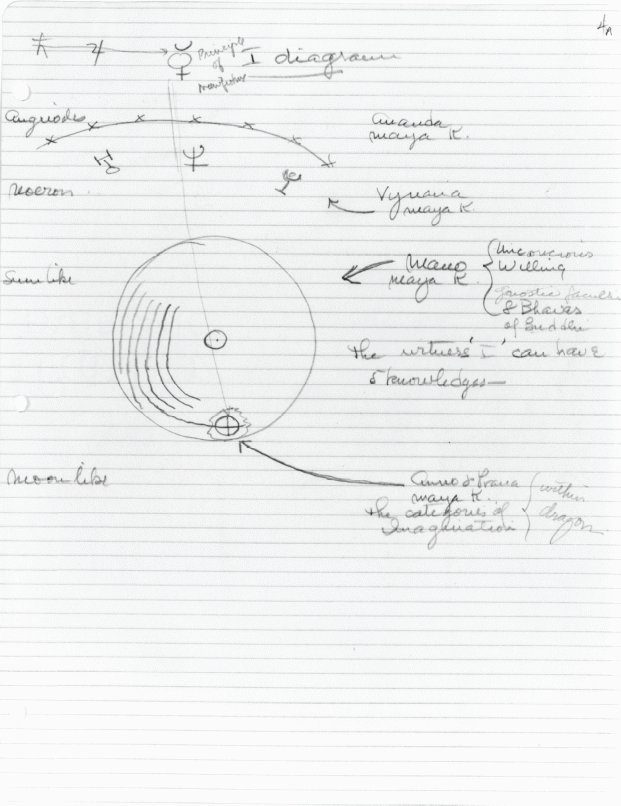
FIGURE 1983 0527a-1-AD. Tripartite Soul, Levels of Cosmos, and Sheaths.
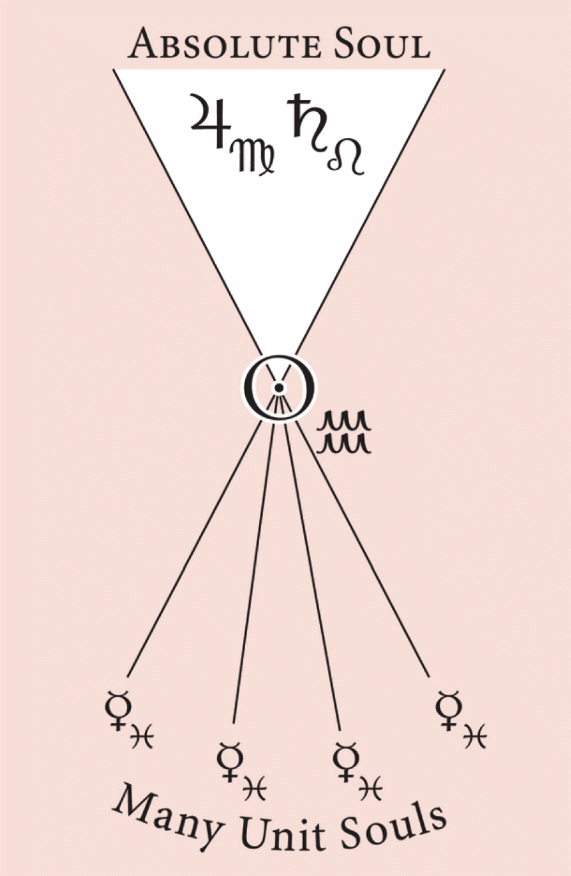
FIGURE 1983 0527a-2. Absolute Soul and Unit Souls.
These diagrams are from Astronoesis, pp. 254 and 185, respectively. Other diagrams referred to are not with this transcript version. [Transcriber note: [diagram] means the speaker is referencing a diagram as he or she is speaking. If someone is drawing or writing, with audible sounds of chalk on a blackboard, I indicate this by [drawing] or [writing].]
AD PAPER read in class:
- "The Third Phase of Soul". Retyped as 1983 0527b V09MP. Astronoesis - Soul. This is an early draft which is published in a different form in Astronoesis. There it is found in "The Third Phase of Soul," Endnote 52, and a few paragraphs in "Astrology: The Topography of the Subtle World". A few paragraphs remain unpublished. A different version of this paper is read and discussed in WG Class 1983 0429a Astronoesis; Nature; Mercurius and WG Class 1983 0513a Astronoesis; Nature; Dragon.
NOTES:
This is 1983 05/27a, Plotinus; Soul Class, and the first entry associated with this date. 1983 05/27b = The Third Phase of Soul Paper.
Earlier partial transcripts, Scan Files 1983 0527-25R02.PDF and 1983 0527-03R02.PDF, exist. Scan File 1983 0527-03R02.PDF is really an outline and not a transcript.
Friday night class (which, during this time period, was usually Plotinus or Astronoesis).
It appears there may be multiple audio cassette tape versions, not all of which "match" (i.e., some missing portions at beginning or end).
TRANSCRIBED Verbatim by IT prior to 2018 (V11a). This is V12ap (2024) and has: second audio file transcribed verbatim; updated prefatory matter, footer, and audio file name; Book List and TOC completed; Plotinus quotes section added; new and updated notes within transcript; minor errors/typos corrected; two diagrams appended and references to these diagrams within the transcript. Archival verbatim transcript with AD Paper – V12ap.
AUDIO FILES: 1983 0527a, 1983 0527b. [Note 1: "Tape" and "Side" refer to original audio cassette tapes that were later digitized into .MP3 Audio Files. Note 2: In 2024, REP Studio improves the sound quality of file b. Sound quality much better but still hard to hear in places.]
1983 05/27a at Wisdom's Goldenrod
Plotinus; Soul; PB's "What is the Use" para; Unit of Life
[Audio File 1983 0527a Begins]
[beginning announcements for a little over ½ a minute, talking about upcoming workday]
[tape break at 0:00:53.7]
AD: General idea, just a little bit of the general idea, is that I'd like to try to clean the grounds, clear them up. We may-- we may have to end up bringing in a machine down there to make some pathways. And, in back of our mind there's a notion that we're going to build some kind of a shrine, small building. It's mostly in the talk stage right now. There's nothing really definitive. Some people are getting into it and working-- working up the ideas. I thought we'd mention this just so that, you know, you don't feel that you're being left out, it's that nothing is definitive yet. But this much is definitive, to clear up the grounds somewhat and make them look a little respectable instead of like a-- a jungle hermitage. So that much at least we know is a first step forward. And, if we get in-- into it a little more, then I'll ask Andrew, some of the others, to talk to you about what ideas they have. I don't want to commit myself yet. I-- I want to wait a little bit. [students assent, very faint] But, in discussing and talking about these things, there's no harm communicated. [short pause] Alright, that's-- that's about it and if yous want to ask any questions--
[10 second pause]
LD: Did anybody lose a silver parker pen?
S: Oh.
S: No. (bit of laughter)
S: Yeah.
S: Yeah.
S: Anthony? This weekend--
AD: This--
S: For this weekend, will be the meditation on Sunday?
[tape break at 0:03:21.3]
[13¾ second pause]
AD: If you remember last week when we spoke about the soul, we were trying to trace the-- the soul, the way it is spoken of in a transcendental way in the One and then it flowed from there to the Universal Soul and then that Life in Universal Soul flowed on, so to speak, into the Royal Intellect or the Intellectual side of the Soul which was concerned with the fundamental ground plan of the cosmos. And still going on, so to speak, then (there/they) would be individual planetary soul, star souls, or cosmic souls, which then Plotinus said elaborated-- elaborated that ground-plan and each soul, so to speak, each cosmic soul elaborated and articulated its own version of that World-Idea where the individual is working. [Note: See Plotinus, VI.7.7, third para.] And still the Life Essence which flowed through also flows through these individual planetary souls or cosmic souls and it keeps on flowing right down into the individual souls because they too are units of life or consciousness and each one of them also manifested its own version of the World-Idea. So that the continuity or the rivers of Life which flowed from the Source went all the way down even into the-- into the least creatures.
And then it was pointed out, I think we spoke about the fact that each-- each creature lives its life by soul entire [Note: See Plotinus, V.1.2, fifth para.] and it forced us to understand that when Plotinus said that soul was one and many, that this was an intuitive knowledge. You won't be able to grasp it with your intellect. The response should come from the inner being to try to understand what that means, to say that the soul is one and many. And then, I don't know if it was brought in or not, but it should've, then we would have to go on and recognize that insofar that each soul, and it doesn't matter which soul you're referring to anymore, it's-- insofar that each soul is a unit of life and that it is going to evolve from a germinal condition and try to manifest more and more of the World-Idea, that there would be a corresponding evolution of that individual soul and the Life would just flow on and on. And so, the intellect can't understand how a soul could be one and many and that if a definition was to emphasize one to the detriment of the other it would be to defy and deny the intuitive knowledge that Plotinus was giving us when he said that soul is one and many.
Now the-- you know, the con-- contemporary mentality is-- is really in many ways absurd because of its tendency always to reduce everything to the simplest, as though it knows what the simplest is, you know. And you know, we take the example of reducing-- you go to your-- to the Notre Dame Cathedral and you look at it and you say, "Well, that's a good pile of rocks," you know, and forget that that's the most irrelevant thing about the whole-- the whole building. So this reductive tendency that we operate with is so readily observable. Like for instance if you read Jung, like off the top of his head he just decides that Plotinus meant that souls are really one, they're not many, alright, and I-- I kind of, you know, contemptuously pushed it aside because in my heart I recognized that his study of Plotinus must have been equivalent to about three hours reading or something to that effect. [Note: See C.G. Jung, CW 14, Mysterium Coniunctionis, pp. 534-535, paragraph 761. See also WG Class 1982 0417a where this issue is discussed.] I don't mean to be, you know, facetious, I actually mean when a man has three hundred, four hundred books in the back of a bibliography, and he thinks I'm going to believe that he read these things, I'm-- I'm going to-- I'm just going to be humorous because I know physically it can't even be done. I mean if you had the time you can't do it. You know what it is to read three, four hundred books in the back of one book that you wrote? (bit of laughter) C'mon. [S: Ok.] So, it's the old technique and you're all familiar with it, you all have gone to Cornell and you know what those-- (some laughter, student words) You have these very learned footnotes that show that you looked up in the index of a book something and you put it down.
S (faint): Yeah, we really do that.
AD: Well any rate, that was the background. Now this week what I'm going to do is repeat what I did last week, go back to that notion of the twin soul, the one that descends, alright. I don't think I could read my corrections so you're going to have to bear with me. [short pause] And this-- this part is extremely important, as I (tried/try) to point out, because we-- we're doing this work with PB now and the PB notes and so this is a correlate to help us understand better those notes. Now, those notes are difficult, and, you're almost forced-- it's like a Rorschach reel, you know, you read the quote and then when you give me your explanation I wonder where it's coming from but, (some laughter) still you people are doing very well considering how difficult they are and aphoristic. You're doing [one/two words inaudible] But they are difficult and-- I got this quote from him to which I'll read at the end of the class. [short pause] So, we'll say this third-- we started off by saying--
[Transcriber note: The following paper is an early draft which is published in a different form in Astronoesis. There it is found in "The Third Phase of Soul," Endnote 52, and a few paragraphs in "Astrology: The Topography of the Subtle World". A few paragraphs remain unpublished. A different version of this paper is read and discussed in WG Class 1983 0429a Astronoesis; Nature; Mercurius and WG Class 1983 0513a Astronoesis; Nature; Dragon. The following has also been retyped as 1983 0527b V09MP. Astronoesis - Soul. I transcribe the paper just as it is read, including any alterations made during re-readings.]
AD ["The Third Phase of Soul," AD reading]: "The third phase of the soul which we may, only for the sake of convenience, call Mercurius, needs to be thoroughly explained and understood, its functioning [AD rereads: its functioning] amplified by illustrating its relation to a body which is part of the World-Idea.
"It is a spark from the soul [AD rereads: It is a spark from the soul] in the Nous, an individual unit of life, and a perpetually evolving offspring. [15½ second pause] This evolving offspring must ultimately be brought to qualitatively resemble the higher phase, that is, the soul which is in the Nous, through the practice of the"imitation of God" and other philosophic disciplines, including yoga.
"Without understanding the fundamental nature of this eternal twin, [AD: That is, this germinal soul.] the theory of reincarnation and karma becomes hopelessly muddled."
AD: Now, I'm going to ignore this [AD flipping pages] because it's not to the point, alright?
EMD: Tony, could you please speak a little louder?
AD: I'm working up to it.
AS: Uh-hm.
S: Uh-hm.
S (simultaneously): Uh-hm.
S: Uh-hm.
AD (simultaneously): I-- I might as well read it.
AD ["The Third Phase of Soul," AD reading]: "To criticize a misunderstood theory of reincarnation is not of service to philosophic students. The intense and overwhelming aspiration on the part of many of these contemporaries to explain everything away by reducing it to the nondual is an admirable display of devotion but it is not the balanced view required by philosophy, for it leaves certain very important and practical matters unexplained and unexplainable.
"The fact remains--and no words can abolish the situation--that our identification with our ego includes a meaning that cannot be whisked away at the stroke of a pen. [students assent, very faint] They have not properly inquired into the value and significance of the ego. Obviously, the interval between the Self or Atma (the Soul) and its representative, the ego, is a no-man's land, and it is very noticeably left unexplained. That Nature put into so much travail to produce the necessary vehicles by which the Mercurial phase of the soul may evolve is in fact one of those questions which if left unanswered would rankle in our mind. So it must be squarely faced. There are various views on this subject scattered throughout the ancient and modern writings and we have attempted to bring them together in a coherent and organized fashion to help us in our understanding of reincarnation and metempsychosis and the meaning and the value of the ego and how this fit into the metaphysical scheme.
"Now, it was previously pointed out that the ancients conceived the Soul as tripartite. It can just as easily be conceived of as dual. The higher Cognitive Isness or Awareness and its intelligence cannot directly experience the sensible world and therefore must act through the lowest phase, which we refer to as Mercurius, within which the manifestation of the World-Idea will take place. This lower phase may be referred to as the function of manifestness, asmita in Yoga terminology. This infinite light"descends" or contracts completely into the realm of manifestation by a process that will be described later, into the womb of the world, what the Buddhists call the Tathagatagarbha, where Buddhas are born, that is.
"This germ from the higher soul will evolve or gestate through indeterminate time concomitantly with its Idea of the World. This World-Idea, as we said, is fabricated and organized by the Universal and Cosmic Souls and then projected by and through an individual soul as its own thought. The perpetual unfoldment of the World-Idea is irreversible in its direction and therefore guarantees the evolution of the individual soul with it. The evolving"double" of the soul, as part of the World-Idea, is often spoke of as the "second soul".
"Through its function of manifestness, this soul which is projecting the Intellectual Cosmos(,) given to it from within. Its experience of that Cosmos or thought is the modification of its own functioning, referred to as the World-Idea."
S: You can't read any (more/longer).
AD ["The Third Phase of Soul," AD reading]: "This projection encompasses the entire manifest universe for an individual soul. The archetypal or intellectual Idea of the universe is manifested through the secondary phase of the soul which will project it within itself by continuously transforming itself and which will include the necessary body with which it will identify and operate through.
"Now this very function of manifestness is also the means by which the individual soul takes itself at any level to be part of the cosmos. These thoughts or these mental modes are instantiating or imaging the Ideas as various grades of thought, and all these are manifest to, and appear within, the Mercurial phase of the soul."
AD: Vedantic classifications, you know, the Platonic equivalents, alright.
AD ["The Third Phase of Soul," AD reading]: "The imaged cosmos itself provides a framework within which we can locate these vehicles, and we've tabulated them and correlated these various classifications within the chart in the attempt to pictorialize somewhat the concept of Man as the ancients conceived him." [Note: See FIGURE 1983 0527a-1-AD, Tripartite Soul, Levels of Cosmos, and Sheaths, appended to this transcript. This diagram is from Astronoesis, p. 254.]
[AD flips pages]
S (whisper): Yeah.
AD: And I'm not going to put up any pictures.
[students assent, faint]
AD ["The Third Phase of Soul," AD reading]: "The Mercurius phase of the Soul as the pure form of manifestness--that is, consciousness, our"I AM"…"
AD: Now we're starting at the top, alright, this is the fairytale that the Platonists tell us.
AD ["The Third Phase of Soul," AD reading]: "…is first identified with the highest reaches of heaven, the intelligence of the cosmos in its pure aspect called reason-principles or Ideas variously combined to form the Idea of the universe. Here the Mercurial phase of the soul assumes substantiality as the pure joy of existence and is referred to in other literature as anandamaya kosha, or the Robe of Glory. The principle of pure light, the I AM, is being aprioristically conceived, that is, before it manifests a cosmos. But through this function of manifesting, the soul takes itself to be embodied in these reason-principles. The I takes itself to be this mind, the self-affirming certitude of"I am the World-Idea." At this level, the I or asmita is the substratum or basis for the differentiation of the appearances within itself. In this stage of ananda, the soul that still has its wings is associated with this vestment of luminous reason-principles that form the "Robe of Glory," the Augoeides, the radiant body, and here it may truthfully be said, "The world is my idea." For here the intelligence of the stars is the locus for the soul's first association with the cosmos, and it is infused there with the intelligible form of the World-Idea. [12½ second pause] At the station of Reason and its act--that is, the clear shining of the intelligence which contains the Ideas for the formation of the world--the highest phase of the Mercurial soul is in harmony with the operation of the Cosmic and Universal Soul, unfolding the World-Idea for itself.
"The ray of soul in its universality, dressed with these reason-principles, participates in the spiritual powers of absolute willing, knowing, and feeling, through which it is modalizing or particularizing itself as this individual soul and this is the level which may be referred to as Noeron body or the vijnanamaya. This Nous or intelligence of the cosmos as being manifested through an individual soul includes that particular soul's role in the World-Idea, and it also constitutes spiritual knowledge or gnosis. Consequently, the soul functioning at this level of intelligence is a spontaneous knowledge and activity… [short pause] [AD: Uh--]
"The planetary spheres, or the manomaya kosha, to use another terminology, is a self-knowing within the soul at a lower level and is through modes of willing, feeling, knowing symbo--"
AD: I'm sorry. Read the wrong paragraph. Backing up, "spontaneous knowledge and activity…"
AD ["The Third Phase of Soul," AD reading]: "…which includes the knowledge of the planetary spheres or the manomaya kosha and its effect. This higher self-knowing, the vijnanamaya kosha, within the soul takes place through the modes of willing, feeling, knowing, symbolized in the cosmology/astrology by the three trans-Saturnian functions of Uranus, Neptune, Pluto.
"As we have said, the"I principle" or asmita identified with the Noeron body includes the knowledge of the two lower realms. It is that power to know by which the Ideas are being variously combined to form the World-Idea for an individual soul. This latter is received by the functioning of the manomaya kosha or the greater mind which we can correlate with the planetary spheres.
"This is the realm of the cosmocrators, the powers of the cosmic soul, and symbolized by the sensible Sun and the planets, which are elaborating the sublunary worlds. The individual soul conjoined to the cosmic soul participates in the functioning of its powers. The soul or mind receives the World-Idea, or rather intuits it, and makes a representation of it for itself. And inherent in this production is the intellectual nature of the mind, which includes the powers of the soul, that is, both fabricative and gnostic, that simultaneously imbues its representations with significance.
"Now the mind of the cosmic soul [AD: That is, the planetary spheres.] is receiving the World-Idea and with its powers or representative faculty organizes the Earth's memory. This organization which is the given content of the world of sense or the subtle image of the world is still prior to our reflective consciousness.
"This imaginal essence or the Earth's memory then becomes the medium through which that prior mind can become reflectively aware of its prior unconscious activity. At this level of our unconscious mental functioning, the World-Idea is being incessantly instantiated and transmitted. That is, the soul's image-making faculty is constantly recreating the World-Idea. This subtle image of the world is not optical, but rather an abstract schema or synthesis, and it is prior to our reflective awareness. It is an alogical whole which nonetheless contains all the features that will later on become available to us through our murky reflective self-consciousness. It is the functioning of this mind that is organizing the"matter" or more precisely the Earth's memories, and the elements, into clusters of sensations which constitute the functional images that become the phenomenal subject and object of our knowledge, which at this level is our empirical experience. These clusters of sensation, these images, memories, or the organization of these Earth's memories into a functional image, is the medium through which the soul or the mind "incarnates" and therein becomes self-reflectively aware of its prior activity.
"The functioning of this psychosomatic organism--which is, as we have said, on organization of the Earth's imagination--may be referred to as imitative being. And here we wish to remind the reader that at this point we may recognize the presuppositions or basic attitudes that will be included in the manifesting of his mental powers. Here and only here, within the organization of the memories, [AD: I can't read this.] we can speak of Jung's archetypes as the precondition for an individual psychological experience, and say that philosophy is a mouthing of these archetypes. [short pause]
"This last is the sublunary system of tropes or life traces which the planetary spheres have organized into a variety of species and their accompanying environment, in conformity to the World-Idea, as far as this is possible. In this imaginal realm of the Earth's dragonic belt, which constitutes the Moonlike and Shelly bodies, the lowest vehicles of the soul's experience, that our mind, which is really cosmic in extent, is obscured at this final identification with the lowest sheath, and the apparent bifurcation of the soul into an empirical subject and a phenomenal object occurs. Now this is a simplified picture of the vast cosmological presuppositions that must be delineated in order to understand our sensible experience. [short pause] It is approximately in this way that the ancients conceived what conditions were necessary for the arisal of knowledge. The entire panorama of the sensible world, which as we said was fabricated by the gods, was a necessary prerequisite--the stage upon which the actors made their entrance and exits. [short pause, AD shuffles through some papers]
"So the entire manifested world can be conceived of as a huge thought projected forth from each individual soul. And within this whole we may conceive of a hierarchy of levels, each level distinguished from the whole and from one another, the highest being Life Intellectual, or the soul as embodying reason-principles, and among the lowest the vegetative life, a life dim and obscure. The laws that apply to one level are different from those of another, but all these various levels we can conceive as compressed and as operative within a single entity. The microcosm is a miniature cosmos.
"Nonetheless we are to remember that we're situated within thought--Mind's functioning. And the Mercurial phase of the individual soul may be thought of as associated or identified with the lowest of Nature's kingdoms."
AD: Alright, now, that's the way the Platonists spoke about it. They start at the top and they work their way down. Now more in keeping with the contemporary mentality, alright, we'll start at the bottom and work our way back up. So this would be more to our liking.
AD ["The Third Phase of Soul," AD reading]: "If we insert this I-ness into an animal body which has gone through a phylogenetic and ontogenetic development, this soul, this I-ness, this unit of life [AD: It doesn't matter here, this--] would first be superimposed upon by the inherent functioning and vitality of that organism, and that this corresponds to the"man of flesh and blood," the separate ego that regards the world as completely other and which must be the source of satisfaction of its own desires, and this is the whirlwind of never-ending activity. Essentially this gives rise to a realistic epistemology and a geocentric world-view.
"But, constantly intruding into this"natural man" is the functioning of a greater intelligence, which is indicated by the planetary spheres, altering, modifying, transforming that matrix of tendencies (despite the claims of inertia, which we refer to as the psychosomatic organism), till finally a sufficient deposit of this higher mind's functioning orientates that individual soul towards a more rational view or heliocentric position."
[AD flipping pages]
AD: Assuming the Dragon don't bite you.
S: [few words inaudible]
[short pause]
AD ["The Third Phase of Soul," AD reading]: "We are retelling an ancient story about the mystery of Man, which started with Orpheus and continued through the Greek philosophical mythology and culminates in the Enneads of Plotinus."
AD: Like it or not, it's an astral theology that we have to deal with.
[student assents, very faint]
AD ["The Third Phase of Soul," AD reading]: "If we conceive of the Mother Earth as a goddess within whose domain has transpired the manifestation of innumerable species of life, their immediate origin would be her body itself. This body will contain the necessary ingredients for the building up of the two lowest sheaths, what are referred to as the Shelly and Moonlike bodies. This"material" has been recycled innumerable times; it therefore has certain tendencies or proclivities which are indications of past functioning and which may be referred to as the "tropes" or the memory of the Earth. The combination of the Great Elements into organized living bodies include these selected responses or tendencies that manifest themselves in the body's functioning. Or in other words, within this mysterious imaginal essence is retained traces of its functioning after the dissolution of the entity, and the totality of these traces constitutes the memory of the Earth. This beginningless ontogenetic and phylogenetic development is the source from which and within which the bodies of all living creatures are produced and live.
"This indefinite and indeterminable storehouse of images, the seething cauldron of innumerable disembodied functionings, is the material of the soul's fabricative activity and is suggestive of the nature of the Dragon. The Shelly and Moonlike bodies of living creatures are an embodiment of them and their activity is refunded into this subconscious. The Dragon lives and breathes through the individual organism; and not only is it constitutive of the physiological functioning of the organism, but also of the significance attributed to that functioning which is later on understood when the reasoning part of the soul judges it. But for now, as located within that rudimentary body, it will-- for now, located in that Moonlike and Shellylike body, a rudimentary understanding of the sensible world takes place. The soul as an inhabitant of such a body is becoming acquainted with the traces of the intelligence of the Ideas which have been left behind as part of the Earth's memory.
"It is these traces (of the Ideas) which give rise to images; each non-optical image constitutes a matrix of disembodied tendencies that have been miscalled"archetypes". Imperceptible in themselves, they can nevertheless be inferred through reflection on their activity by the soul's gnostic power when it reaches the level of reflective conscious judgment. For the present it is being maintained that these contents will become the environment or the idea of the world for that individual soul inhabiting that body. [one/two inaudible student words] Similarly, the presence of the soul within that World-Idea is indicated as well."
AD: I'm-- I'm sorry. Cancel that out.
AD ["The Third Phase of Soul," AD reading]: "What we witness here is the presence in the imaginal essence of the intelligence of the Ideas [AD: That's capital"I".] as tropes or samskaras and the powers of the soul or the functioning of the soul as represented by the categories of the imagination. Both are included in this imaginal essence. Under these conditions, the soul perceives images in water -- the shadows or phantoms in the cave. The soul as wrapped in the cocoon of oblivion is unable and unwilling to investigate into the mystery of the nature of Man."
[short pause]
AD: [one word inaudible] could read this.
[student assents, very faint]
S (faint): [couple words inaudible]
AD: Maybe I better sit next to you so you could read it.
AS(?): [couple words inaudible]
S (simultaneously): Yeah.
S: Yeah.
AD: I'm-- [short pause] Alright.
AD ["The Third Phase of Soul," AD reading]: "A preliminary inquiry into the nature of the degrees…"
AD: No that's--
S (very faint, possibly part of background): Ok.
[14¾ second pause, AD shuffling through papers]
AD: So patient and quiet tonight. Well, there's a paragraph missing. It's probably in the wastepaper basket.
S: Mm.
AD ["The Third Phase of Soul," AD reading]: "A preliminary (AD laughing) inquiry into the nature of the degrees, which are all-encircling, will require extended investigation and research. For now, we are simply asserting the suggestion of an intrusion of the intellectuality of the Ideas into our world in the peculiar way described previously. For each of these degrees is often symbolized by an image of multivalent significances. It includes the formative power of the archetypal Ideas, the presuppositions of the genera and species of all life. Then we have the intellectual mind of the cosmic soul as it…"
[short pause]
RG: "…as its power to…"
AD ["The Third Phase of Soul," AD reading]: "…as its power to know the Idea in the archetypal realm and through its functioning, which is both gnostic and fabricative, organizing the Earth's memories into a world-picture, an alogical whole that includes [RG: Adventitious.] adventitious unities whose very organization brings about the experience of a phenomenal subject and object."
S (simultaneously): Yes.
[short pause, AD flipping pages]
AD (very faint): Try.
AD ["The Third Phase of Soul," RG reading]: "A selection…"
S: I'd like that paragraph again that you just finished, that was--
[flipping of pages]
AD: Paragraph again we just finished?
S: Impossible?
AD: Sure.
S: [few words inaudible]
BS: Start at the [one word inaudible] paragraph.
RG (simultaneously): The whole thing? The whole thing is one paragraph. You mean the whole thing?
S: Where it talks about the degrees.
AD/S(?) (simultaneously): Uh-hm.
RG: Ok.
AS: The inquire-- preliminary--
AD ["The Third Phase of Soul," RG reading]: "A preliminary inquiry into the nature of the degrees, which are all-encircling, will require extended investigation and research. For now, we are simply asserting the suggestion of an intrusion of the intellectuality of the Ideas flowing into our world in the peculiar way described previously. For each of these degrees is often symbolized by an image of multivalent significances. It includes the formative power of the archetypal Ideas, the presuppositions of the genera and species of all life. Then we have the intellectual mind of the cosmic soul as its power to know the Ideas in the archetypal realm and through its functioning, which is both gnostic and fabricative, organizing the Earth's memories into a world-picture, an alogical whole that includes adventitious unities whose very organization brings about the experience of a phenomenal subject and object.
"A selection or specific combination of the totality of the degrees and how they are being portrayed by the various functioning of the categories of the imagination will constitute a specific psychosomatic individuality, a unique person, which will provide the soul with a body that its karma entitles it to. Only after this acquisition can the soul, operating through this body, can we speak of the phenomenalization of that primary image--that is, the operation of reflective judgment on and through the functioning of this entity.
"At this point, what must be recognized is the mortality of this entity. There is no reincarnation for this entity. It is important that this be understood to prevent an animistic conception of reincarnation. The ongoing continuity of this individual soul's karma--that is, its next psychosomatic organization--is provided by the cosmic circuit. But the reference of this continuity of karma, which a succession of bodies provides, refers us to the same self-identical"I AM" or individual consciousness.
"A thoughtful consideration of the natal horoscope--our cosmic identity--suggests the particularity of this individual soul's status, and this description should not be regarded as an explanation.
"At the moment of birth, all the geometrical and arithmetical relationships are precisely indicated and announce the nature of this imitative being which participates in the functioning of these soul powers.
"Insofar as the functioning of the cosmic soul, to which is conjoined the individual soul, is operative, it will create the necessary organ in the imaginal essence which manifests that function. So something of the intellectual nature of the soul's power is transmitted and left behind as a trace in that entity or adventitious unity. The reduplication of these soul powers which is left behind in the organized imaginal essence is the ground of our psychological experience. We will try to illustrate this description a little further on."
AD ["The Third Phase of Soul," AD reading]: "So we're gradually approaching an understanding of how the ego is a thought. It is made of memories, the stuff of dreams, and nonetheless reflects those macrocosmic principles."
[26¼ second pause with background whispering, AD possibly involved]
AD: Carol, are you here? Can you read this?
CDA(?) (very faint): Oh yeah.
AD(?): Uh-hm.
(Side 1 of original cassette tape digitized as 1983 0527a Ends; Side 2 Begins)
AD ["The Third Phase of Soul," CDA reading]: "…mirror, which may be referred to as our subconscious, is a vast intelligence-- as a vast intelligence, refers to…"
CDA: Let's see. I'm sorry, this is wrong, it's wrong.
AD: Or we could leave out [one/two words inaudible]
CDA (simultaneously): No, I think I could do it.
AD ["The Third Phase of Soul," CDA reading]: "And this totality of the memories of the Earth may be referred to as our subconscious, as a vast intelligence. [S: Yeah.] The specificity of an individual ego that refers to the significances attached to the functioning of its tropes will be used as a vehicle by an individual soul, whose knowledge and consciousness--or, in other words, its"I AM"--will be unfolded through the resulting interaction."
S: Uh-hm.
S: Would you read that last sentence again? (laughter)
AS: Sorry.
CDA: Ok.
[short pause]
AD ["The Third Phase of Soul," CDA reading]: "And this totality of the memories of the Earth, which may be referred to as our subconscious, as a vast intelligence…"
AD (very faint): You said it was an (intelligence).
AD ["The Third Phase of Soul," CDA reading]: "…refers to the significances atta…"
CDA: Wait.
AD: Well, I could say it easier there.
CDA (simultaneously): Yeah, yeah. (student laughs) Ok, the last sentence was, yeah--
AD ["The Third Phase of Soul," CDA reading]: "The specificity of the individual ego that refers to the significances attached to the functioning of its tropes [CDA: Ok.] will be used as a vehicle by an individual soul, whose knowledge and consciousness--or, in other words, its"I AM"--will be unfolded through the resulting interaction. The process by which the individual soul or "I AM" as embodied becomes more conscious by and through the power of combining in innumerable ways the significances or meanings attached to the tropes and thereby creating the necessary concepts by which it can understand that which the intellectual part of his mind has created and then reflectively judging the object. It becomes scientific when there is a conformity of these concepts with the prior activity of the intuitive mind. That is, the mind is trying to understand through the psychosomatic organism that which its prior activity had created."
CDA: Do you want me to keep reading?
AD: Go ahead, (you/I) could read the rest.
S: (Go ahead/Uh-hm), yeah.
AD: That's a very difficult passage, I'm going to have to try to explain it, I'm never going to be satisfied so-- But, [S simultaneously: That's why (couple words inaudible)] it's so-- it's so huge that any concept that's used is a limiting concept, a boundary concept, and it defies the-- the very intuition I want to get out, it deprives me of that very-- But we'll try.
AD ["The Third Phase of Soul," AD reading]: "What must be recognized and clearly understood is that the activity of reflective thought is within the Dragon. We are in effect combining those meanings and significances which are attached to the tropes, the degrees, and manipulating them, creating concepts of understanding by which to grasp the object. The compulsiveness of these significances can and does predetermine the understanding to such an extent that [9½ second pause] these are the presuppositions of our psychological experience and understanding. Insofar as the ego is constituted by these presuppositions and its life a gesture or manifestation of them, it's difficult to see how he can arrive at the formulation of a doctrine of Truth.
"It is at this point that the full import of being in a cul-de-sac arises. (bit of student chuckling) The way out is shown to us in the Platonic teachings that attempt to disentangle the reason-principles which the images embody or in what Idea the images are embodied. The great philosophic thinkers-- [short pause with couple faint inaudible student words] The great philosophic thinkers pierce through the images to the reason-principles directly. This is intelligible intuition without the use of any intermediaries and not of a conceptual nature, nor does it rely on the language of the Dragon. Those who are not free from these compulsive tendencies and the intensity of the images do not have access to this intelligible truth.
"The rich storehouse of information that the horoscope contains can be a source of spiritual and metaphysical knowledge that could inspire and enrich our lives, for in this mysterious way the transcendental is included or is immanent in the empirical (and not embodied in footnotes)."
AD: Oh that's a metaphysical joke to Linda. She won't appreciate it. (tiny bit of student laughter)
AD ["The Third Phase of Soul," AD reading]: "Perhaps in delineating the chart of some well-known people whose lives are well-documented, we could, through this postmortem astrological analysis, illustrate something of what is meant by the famous dictum that,"We do not have the ideas, rather they have us"-- or--"What superior beings think, we must perceive."
"So we must begin by reminding our readers that in the degree symbolism there is inextricably buried a hierarchy of meanings, that is, significances that are attached to the tropes' functioning. At the moment of birth the planets are conjunct with certain of those degrees, so that we have at one and the same time an aspectual relationship between all the planets and the degrees they are conjunct with and one another. As friends of the Ideas, we must point out that at the very origin, at birth, this entity is already endowed with meanings that will be manifest in the course of the person's life.
"Those cosmocrators, which are powers of the World-Soul to which our mind is conjoined, and organize these tropes into a body of imagination. And this entity has seven ways of functioning and four ways of knowing, each bearing the impress of the cosmocrator, resulting in a category of the imagination, that is, the different ways that this entity of the imagination can function and know. By"body" we mean the grouping together of these tropes, and by "psyche" we mean the functioning of the categories of the imagination. This is [AD adds: what] the psychosomatic organism that is imitative being and includes within itself traces of the Ideas.
"In the chart, a planet may conjunct a degree indicates, on the one hand, how that function [AD reads: functions] which is represented by the organ or category of the imagination of the trope, and on the other, how that planet will manifest the significances within the trope.
"It can be shown that this understanding of an entity, [AD: Of a given entity.] in all cases except the man liberated from his ego, can be traced back to these ideas which the categories of the imagination have manifested. It can also be shown that a deepening understanding accrues when the natal chart is making certain aspects with the transiting planets, and even further, that a vastly superior and universal consciousness is being transmitted through an individual soul particularizing itself within the system of tropes that is represented by this individual entity.
"If we continue retracing our steps on the upward path of that part of the soul which is said to be divisible among bodies, we can further our understanding by pointing out the relationship that exists between the transiting Chaldean planets to the natal chart or how that individual's greater mind is attempting to become aware of itself in the reflecting medium that the psychosomatic organism supplies. The soul must come to an understanding of itself through this organism that has a phylogenetic and ontogenetic background, but nonetheless to which it is heir, and must take it upon itself in each incarnation to erase the interferences and distortions that intervene between the subtle image produced by the greater mind's functioning and its reflection in that empirical subject which is its vehicle, until finally the ego is subservient to the God within."
AD: I'm sorry for-- I should have typed it out but, the general idea is there. [short pause] But, I'm going to ask-- I'm go-- I'm going to attach this quotation from PB to this, for he says in a couple of pages what I've been trying to say practically through a chapter. Would you read, huh? We've heard this once before but it's such a--
[short pause]
PB [V16, 26:4.257 and Perspectives, Chapter 26: World-Idea, #49, RG reading]: "What is the use, ask many questioners, of first, an evolution of the human soul which merely brings it back to the same point where it started and second, of developing a selfhood through the long cycles of evolution only to have it merged or dissolved in the end into the unselfed Absolute? Is not the whole scheme absurdly useless? The answer is that if this were really the case, the criticism passed would be quite a fair one. But it is not the case. The unit of life emanated from the Overself begins with the merest glimmer of consciousness, appearing on our plane as a protozoic cell. It evolves eventually into the fullest human consciousness, including the intellectual and spiritual. It does not finish as it began; [RG adds: but] on the contrary, there is a grand purpose behind all its travail. There is thus a wide gulf between its original state and its final one. The second point is more difficult to clear up, but it may be plainly affirmed that man's individuality survives even in the divinest state accessible to him. There it becomes the same in quality but not identical in essence. The most intimate mental and physical experiences of human love cast a little light for our comprehension of this mystery. The misunderstanding which leads to these questions arises chiefly because of the error which believes that it is the divine soul which goes through all this pilgrimage by reincarnating in a series of earthly forms. The true teaching about reincarnation is not that the divine soul enters into the captivity and ignorance of the flesh again and again but that something emanated from the soul, that is, a unit of life that eventually develops into the personal ego, does so. The Overself contains this reincarnating ego within itself but [RG adds: it] does not itself reincarnate. It is the parent; the ego is only its offspring. The long and tremendous evolution through which the unit of life passes from its primitive cellular existence to its matured human one is a genuine evolution of its consciousness. Whoever believes that the process first plunges a soul down from the heights into a body or forces Spirit to lose itself in Matter, and then leaves it [RG reads: them] no alternative but to climb all the way back to the lost summit again, believes wrongly. The Overself never descends or climbs, never loses its own sublime consciousness. What really does this is something that emanates from it and that consequently holds its capacity and power in latency, something which is finited out of the Overself's infinitude and becomes first, the simple unit of life and later, the complex human ego. It is not the Overself that suffers and struggles during this long unfoldment but its child, the ego. It is not the Overself that slowly expands its intelligence and consciousness, but the ego. It is not the Overself that gets deluded by ignorance and passion, by selfishness and extroversion, but the ego.
"The belief in the merger of the ego held by some Hindu sects or in its annihilation held by some Buddhist ones, is unphilosophical. The"I" differentiated itself out of the infinite ocean of Mind into a distinct individuality after a long development through the diverse kingdoms of Nature. Having thus arrived at consciousness of what it is, having travelled the spiral of growth from germ to man, [the result of] all this effort is certainly not gained only to be thrown away.
"Were this to happen then the entire history of the human race would be a meaningless one, its entire travail a resultless one, its entire aspiration a valueless one. If evolution were merely the complementary return journey of an involutionary process, if the evolving entity arrived only at its starting point for all its pains, then the whole plan would be a senseless one. If the journey of man consisted of nothing more than treading a circle from the time of his emergence from the Divine Essence to the time of his mergence back into it, it would be a vain and useless activity. It would be a stupendous adventure but also a stupid one. There is something more than that in his movement. Except in the speculations of certain theorists, it simply does not happen.
"The self-consciousness thus developed will not be dissolved, extinguished, or re-absorbed into the Whole again, leaving not a trace behind. Rather will it begin a new spiral of evolution towards higher altitudes of consciousness and diviner levels of being, in which it will co-operate as harmoniously with the universal existence as formerly it collided against it. It will not separate its own good from the general good. Here is part of the answer to this question: What are the ultimate reasons for human wanderings through the world-process? That life matters, that the universe possesses meaning, and that the evolutionary agonies are leading to something worthwhile--these are beliefs we are entitled to hold. If the [RG reads: this] cosmos is a wheel which turns and turns endlessly, it does not turn aimlessly. Evolution does not return us to the starting point as we were. The ascent is not a circle but a spiral.
"Evolution presupposes that its own possibility has always been latent within the evolving entities. Hence the highest form is hidden away in the lowest one. There is development from the blindly instinctive life of animals to the consciously thinking life of man. The blind instinctive struggles of the plant to sustain itself are displaced in the evolutionary process by the intelligent self-conscious efforts of the man. Nor does this ascent end in the Vedantic merger or the Buddhistic annihilation. It could not, for it is a development of the individuality. Everywhere we find that evolution produces variety. There are myriads of individual entities, but each possesses some quality of uniqueness which distinguishes it from all others. Life may be one but its multitudinous expressions do differ, as though difference were inherent in such expression.
"Evolution as mentalistically defined by philosophy is not quite the same as evolution as materialistically defined by Darwin. With us it is simply [the mode of striving, through rhythmic rise and fall, for] an ever fuller expansion of the individual unit's consciousness. However, the ego already possesses all such possibilities latently. Consequently the whole process, although apparently an ascending one, is really an unfolding one."
[short pause]
BS: Would you repeat one line for me please, one or two?
AD: I'm sorry?
BS: I wonder if you wouldn't mind repeating one or two lines about how the "I", I think, gets ferreted out from the infinite diversity which it is--
AD (simultaneously): Finited out of the ultimate--
BS: Excuse me?
AD: The individual "I" is finited or finitized out of the universal consciousness.
S: Uh-hm.
BS: There was a reference to Nature, the diversity of Nature.
PB [V16, 26:4.257 and Perspectives, Chapter 26: World-Idea, #49, RG rereads a part of]: "The"I" differentiated itself out of the infinite ocean of Mind into a distinct individuality after a long development through the diverse kingdoms of Nature."
BS: It's a different line, "ferreted". I may not be able to--
AD (simultaneously): Not ferreted out, it's finited.
RG (simultaneously): Finited out, yeah.
BS: Not that line.
AD: You remember I think Randy did this picture here with the-- [drawing] and he pointed out that there was this germ, alright, which descended, started out in the sublunary realm, then kept growing, kept growing, alright, until it reached its-- its own (life/light), alright, as a pure (life/light) or pure principle of asmita, and then that contact became available to it. It could even merge in that but then when it could-- when it came out, there was continuing worlds and then that would take us into the 11th house [diagram] where you got, so to speak, seven dis-- different levels or degrees of existence, where each one has its own kind of epistemology, its own kind of ontology. It would be enough to drive anyone up a wall. But it certainly isn't the simple explanation that they want to give us in-- in orthodox religious traditions. But, what was the other one he did?
RG: Yeah. There were just-- that's the only place Nature's mentioned, Bert. No.
BS: Well, I wrote it right down.
RG: What?
AD: Well we can--
RG/S(?): Yeah, we can. (student laughs)
S: Yeah Bert, you read it.
RG: Hm. No, say what you have.
BS: Probably the bottom of it, the en-- either the end of-- near the end of the first segment (you have, I don't know) which one, (the intellect--) It had three pages or four?
RG: Four.
BS: Uh-hm, yeah, the end of the third or fourth line.
S (very faint, possibly part of background): Yeah, that's for sure. Ok.
MB: Anthony, would-- will you equate what PB's calling [BS simultaneously: It doesn't really matter.] the ego there with the principle of asmita?
AD/S(?): Yes.
S: Ok.
S: [couple words inaudible]
S: [few words inaudible]
MB (simultaneously): Asmita.
S: But what was the question?
MB: Are they equatable, the ego--
S (simultaneously): I didn't hear you.
MB: The answer there--
S (simultaneously): The ego and the asmita? I just didn't hear what--
MB: The question was would he equate those two principles here, PB's ego and the asmita, the Mercurius. The answer, surprisingly enough, (laughter) is yes. I think-- [few seconds of background student talking, few words from AD] what-- because it seemed that the other night when we spoke of the asmita principle, we talked about it as not undergoing these travails, as not descending-- It's the principle of manifestation but it-- it also is not attracted by manifestation. And yet the way PB talks about this evolving ego-principle, it sounds a little more organic, you know, it sounds like it's being developed.
AD: Again, you have to keep in mind the distinction that I made, and that is that the essence of life always remains undisturbedly essence of life. The Ideas or the component factors, in other words, what's added to it, the World-Idea, alright, that goes on evolving. But that essence of life, that unit of life, is always self-identical with itself.
MB: But now I don't understand (the component). The essence of life is self-identical. [S, very faint: Exactly.] The essence of life?
S: Uh-hm.
S: Yeah.
RC: If you say because you have consciousness [couple/few words inaudible] because anything will arise.
S (very faint, possibly part of background): (Ok/Uh-hm).
S: But the intelligence and consciousness of the asmita is the manifestation?
RC: Yes, it's just awareness of the World-Idea. [few words inaudible]
S (simultaneously): And it's both of those?
RC: Yeah [few words inaudible]
AD: Let's go back to what we said, you remember the way we defined that life, we're trying to define it? And of course we're really [student assents] below. But we spoke of it as a principle of self-motion, it's self-motivated. And you could say that of the highest level down to the lowest level. That is always self-identical with itself, that essence is always what it is forever. Now there's a second part that you could always keep in mind and that's the evolving World-Idea which it carries within itself. This World-Idea has, you know, we said in the paper, has a direction, it's going someplace, alright. It'll always go in a certain direction. Now, as this evolving and developing World-Idea is within this unit of life, the unit of life doesn't alter its nature. What is brought out, so to speak, is the intelligence through which it functions but that essence of life is always self-identical.
S: Is it always self-aware?
S (very faint): Yeah.
AD: Is it always-- No, not if we start at the bottom, if we start at the bottom, the way PB does, then the self-awareness you might say is so germinal that it's--
S: [few words inaudible]
AD: On the other hand, if we start at the top, the Platonists starting from the top, then they speak about it as descoon-- this-- when it descends, it loses this self-awareness until finally it's really obscure.
[9¼ second pause]
SS: Would you go over it once again?
S: Yeah.
SS: The intelligence that's brought out in the soul?
AD (simultaneously): The World-Idea, alright, which in every [one/two words inaudible] unit of life, and each and any and every unit of life is self-identical with any-- in every other unit of life. You can speak of this as one life but then that would be to reduce everything to universal being, or from our point of view we could speak about it as many (life/lives). But that means that each and every life, alright, insofar that it is a life, is self-identical as far as its own essence is concerned. This doesn't alter. Then what is it that alters? Well we said that within that, there's the World-Idea. This World-Idea is a fabrication of the Intellectual Gods because each soul, as we said, has the Intellectual Cosmos within it, alright, and the Intellectual Cosmos is the product of the Intellectual Gods. They're the ones who put that World-Idea together behind the scenes, so to speak. Now, insofar that the World-Idea is being manifested through that individual life, then that World-Idea is informing that individual life, that is, it's constantly correcting it, encouraging it, or whatever interaction takes place within the life essence and the World-Idea which it carries within itself, whatever that interaction is, it's going to bring forth from that life essence greater and greater understanding. That would be really, so to speak, the higher knower which is going to evolve in this life essence. So that as this World-Idea evolves and the understanding that is in that World-Idea brings about this interaction, there's forced out this potential that is already in that life, forces it out, until it is fully realized self-actually-- actually in the soul.
SS: So that's its inner intelligence, which it brings from-- from--
AD (simultaneously): From within itself.
SS: From the Intellectual. [couple inaudible MB words simultaneous with SS] Which it already has but it has to be schooled--
AD: Has to be what?
SS: --by the World-Idea.
MB: [one/two words inaudible] If it already has--
AD: (And/And that) in a way, in a way like, when you take a look at the individual natal chart and you have these ideas surrounding it, alright, and you-- you give them a number but like I said that's just metaphor, because the possible combination of the ideas is indefinite. Now, these ideas are what you are manifesting or let's say-- let's put it that way, that these ideas are being manifested as your intelligence, as your understanding, ok, and that the-- if it was possible, let's say, to manifest the totality of the intelligence which is in these ideas, alright, you would be equivalent to the higher knower or the World-Mind itself. But in one individ-- an individual's chart there's only a selection from these which is the peculiar intelligence of that entity that's evolving, and in the next incarnation more and more, and this keeps going on.
SS: But even all that is a-- would not it be a representation of the Intellectual Cosmos?
AD: I'm sorry?
SS: All this which is being unfolded in the individual soul through the World-Idea, and it comes in contact with the various aspects of the World-Idea for many incarna-- or through many contacts with the World-Idea on the various symbols or the degrees, that would be, in its totality all those degrees, still a representation of what it-- what comes from the Intellectual [student assents, faint] Cosmos, the Intellectual-Principle?
AD: No, that would be limiting it, that-- that's not necessarily so because, as we pointed out, there's buried in those tropes a variety of significances or meaning from the highest to the lowest. That is, the highest meaning in the tropes can be brought out from the soul. In other words, it will remind the soul that these-- about these Ideas. On the other hand, insofar that it's concerned with only, let's say, physiological functioning, the soul could be buried or lost in the significance of-- of physiological functioning. But the interesting thing here is, and if you could notice, is that if these ideas are being manifested [one/two words inaudible] let's say that their intelligence gets actualized in the life of the individual. This actualized intelligence ultimately becomes what you might say, the higher knower. So, there's a representation of the higher knower in us all the time in terms of all the meanings that are available right, you know, the degree, the degrees themselve(s). The whole point that I'm making here is that the ideas which are encircling the chart--that's fundamental. That's the most fundamental part of the chart because that is the higher knower, whether we think of it in embryonic form as tropes in matter or whether we think of it as triggering off reminiscence in the soul. Either way, it doesn't matter [couple/three words inaudible]
MB: What do you mean the actualized intelligence becomes the higher knower?
S: Hm?
AD: Well, if the original archetypal Ideas, which we said were the presuppositions of all the genera and species of life, if these Ideas which leave behind these tropes in the matter, and the functioning of these tropes, at least the significances of what the meaning of these tropes are all about, they bring about a reminiscence in the soul of the Ideas prior to what they were when they got embodied in matter. This becomes the higher knower in you.
SS(?): Hm.
S: Hm.
AD: In other words, the functioning of the real Ideas in you is the higher knower.
S: Uh-huh.
SS: Uh-hm.
MB: Now-- just a minute.
SS: Hm.
MB: When you speak of the-- the asmita principle that manifests, if the asmita principle has anything to learn, so to speak, then you could say perhaps that (it's) learning how to manifest that-- an Intellectual possibility. But even if we say that, I still don't understand how that principle which is [one/two words inaudible] manifesting at the same time gets-- not lost in the manifestation but has to work through that manifestation. I mean it seems like there's a con-- co-- a continuum between that knower which produces and that knower which becomes our knower, and yet at the s-- there's-- and yet at the same time there does seem to be a distinction.
[10½ second pause]
AD: The distinction I think (you're forgetting is) what you're calling the asmita principle is the lower knower and the Ideas that he's becoming acquainted or what are ma-- (he's/is) manifesting through that functioning is the higher knower.
S: [one/two words inaudible]
RC (simultaneously): PB had that one quote where [few words inaudible]
AD (simultaneously): I'm sorry?
RC: There was that one quote that I [few words inaudible] respect to the Overself [few words inaudible] the higher knower as remaining [one/two words inaudible] or that the Divine [couple words inaudible]
RG: But then in that understanding, are the Ideas something different than the Overself?
AD: Something different?
RG: Different than the Overself, which you could also think of as the higher knower.
AD: Well no, I'm not going that far, I'm not going to make a distinction between universal consciousness, the Overself, alright, and the World-Mind. If-- I'm treating them as the same thing. So, when I say that the soul becomes the higher knower, I'm not speaking about the Overself as becoming the higher knower, what I'm speaking of is the asmita principle, alright, becoming acquainted with the higher knower. Because the Overself is the same time not only Soul but also Intellectual-Principle, alright. [RG assents] And what the asmita principle is learning to do is to be guided and governed by that principle. So--
S (simultaneously): You follow?
LR: It seems that in the quote, in that one quote by PB, the thing he's-- [short pause] the thing that he's arguing against is the mergence and merger of the asmita totally in the Saturn Jupiter phase [diagram]. [Note: See FIGURE 1983 0527a-2, Absolute Soul and Unit Souls, appended to this transcript. This diagram is from Astronoesis, p. 185.]
AD: Yeah, it will [LR simultaneously: Because--] never be [student assents] merged.
LR (simultaneously): And it's not-- it's not-- he's arguing with-- he's-- he's arguing it seems for the maintenance of the asmita principle, and that seems to be the principle that he says [AD simultaneously: Yes, but that--] continues, not the Saturn Jupiter phase.
AD (simultaneously): But-- but that would not stop, alright, [RG: No.] this evolutionary process which turns the asmita principle, alright, into a more godlike creature with superior kind of-- almost a superman.
LR: Well, I would think that even a star or something higher than even [one/two words inaudible] that would have an asmita principle in some way of speaking, [AD, very faint: Yeah.] you know, that it was a principle of manifesting.
AD: Uh-hm.
LR: So-- and I mean I-- I don't know, from the classes we've been doing on Wednesday night I'm understanding it in a different way from the way I think of ego. 'Cause it really seems like its origin [one word inaudible]
AD: Seems like what?
LR: From the way we've been speak-- speaking, ok, it seems that what he's arguing for in his-- is the integrity of the asmita.
AD: Uh-hm.
LR: That that never [one word inaudible] but that is always the same in essence with the Saturn Jupiter phase.
AD: Yeah.
LR: But it doesn't lose its individuality.
AD: Never. Uh-huh. I think that that's something peculiar to the Westerner more than Easterner, [LR simultaneously: But they make some--] and I-- I would suspect, you know, that underneath the misunderstanding which is so rampant in Christian philosophy is basically-- you know, their glorification of the ego and their immortalization of it, I think underneath that, that's debris, alright, alright, (bit of laughter) but underneath that they intuited that there is something [student assents] in us which is individual and-- because they want to keep bringing back the same ego which is pretty scary, alright. (some laughter) After fifty years you could get pretty disgusted.
LR: So then Anthony, one further question?
AD: Sure.
LR: Then it seems that anything-- any inquiry into the "who" that we're going to do, the "Who am I?", would ultimately reach the asmita principle and no further; but that an inquiry into the "what" might touch on the Intellectual-Principle.
RG: I don't see why you say that.
LR: I say that because the "who"-- the "who" it would--
RG: If you trace the "who" deep enough, don't you get to the Overself per se as the pure subject?
LR: (If) that seems to be the Intellectual-Principle(--/.)
S: Well--
RG: You're being polite so-- then you're agreeing that you could trace the "who" to the Intellectual-Principle, also.
LR (simultaneously): Well, when I say "who" I'm talking about someone that [few words inaudible]
S: Gotta say more.
RG (simultaneously): Well, then you've already defined the answer.
LR: Yeah, I'm saying, that's [couple words inaudible] of [RG simultaneously: Oh, well--] asking a question was.
RG: Well I would argue against that, that the "who" can be traced to the pure Overself and if you agree that it's in the Intellectual-Principle then you could [half/one word inaudible]
AD (simultaneously): Just like the "what" can be traced to the Overself.
RG: Right, either one.
LR: Well, I thought the whole purpose was maintaining the distinction between the "who" and the "what". If you say that--
AD (simultaneously): Well, it's only a verbal distinction. Like we tried to point out, the Saturn Jupiter in Leo represents [LR simultaneously: But--] the soul in the Intellectual-Principle, alright, and that's it, that's the higher knower, whether you think of it in terms of Intellectual-Principle or the universal consciousness of the Overself, they're both. So either [LR simultaneously: You don't agree that--] approach of the "what" or the "who" will take you there. [RG simultaneously: In the "what" approach-- yeah.] I think the "who" is shorter because it's much more intimate and more direct and accessible to your introspection, and by following--
LR (simultaneously): I just lost all the distinctions you were making, they just all crumbled.
RG (simultaneously): No, why, why? The "what" is-- they're just approaches Linda. The "what" is--
LR (simultaneously): The "who" and the "what" are just approaches but they finish the same then.
RG: Yeah.
LDS: No, but I-- I though that the "who" and the "what"-- [S: Yeah.] the "what" was necessary, that PB introduced the "what" to complete something, that the "who" was not enough for him.
RG: It isn't to say that you don't need consideration of both but it isn't to say that one is more transcendent than the other.
LDS: No, I didn't think that anyway, I'm not [student assents] saying that, but that both are necessary for completion. And what does that mean "completion", like-- if--
LR (simultaneously): I thought you were speaking of different phases of the soul.
PD: Well, (you're a gentleman).
S (very faint): Uh-hm.
S: Go ahead.
PD: Couldn't the transformation of the "who" and the "what" in PB's formulation be to get away from unders-- understanding the soul in a personalistic manner? [RG assents] And that where it's taking you isn't a different place but a diff-- a more impersonal way of understanding yourself.
[short pause]
RG: Uh-hm.
[short pause]
JA: Ok Paul, you were saying that the higher subjectivity is quite a different kind of subjectivity and you-- you know I (speak--) I think-- I think you're talking about the "who"-- the "Who am I" as leading to epistemological subject?
S: Uh-hm.
JA/S(?): [couple words inaudible] connecting to the soul?
[short pause]
JA: That the ontological subject is-- is recognized as being a subject or as being [S simultaneously, faint: (In other words) (one word inaudible)] soul, is given this Grace now.
S: That makes sense.
DR: I think those distinctions of what (we refer that) as a "who" and a "what" and-- and they always left me with a similar kind of flavor of the separateness, I-- if you talk about the asmita as the essence of life, and that somehow-- that somehow does seem to answer a question of "who". But if you start asking question of "what" it seems that the Idea is a-- is a much better answer to that. And if that takes you to-- to an Overself that's non-distinct from an Intellectual-Principle, well I could see them not distinct.
S (very faint): Yeah, me too.
DR: I don't see them as both--
LR (simultaneously): They're denying it, I mean that's coming to the same thing.
DR (simultaneously): I know but I don't see that at all, I mean it seems to me that the whole notion of division-- I mean it doesn't have to be separate levels. I mean if somebody wants to demolish the levels that's alright but it always seems to me that if you ask "what", the answer that you look for is in the-- in the realm of the Ideas.
RG: And I submit that if you ask "who" and let the-- and let the "who" take you to the deepest part of the "who" you'll get to the pure Overself [S simultaneously: That's right, yeah.] consciousness subjectively. How could you say that the "who" which relates to the subjectivity, that the-- that the deepest subjectivity of the person is a-- is at a lower level than that of the pure Overself?
DR: Well, to tell you the truth then if you-- if you're looking for, you know, what level you're going to get to then it does become somewhat meaningless.
RG (simultaneously): Well, but in your-- in your-- in your formulation of the "who" and the "what" you've already determined what those levels are by your answer.
JL(?): Well if there is no difference why--
DR: No, no, no, no, it's not a higher level.
RG: You just said--
DR: The Ideas versus-- when you talk about the essence of life as the asmita principle and you talk about the Ideas as somehow embedded in the Augoeides, then you're not going to have levels in a very fluid way.
RG: That one is the higher knower and one's the lower knower.
AD: But [DR simultaneously: In what way?] if we stop (this/just) for a minute, you know, if we take our personal experience here, there's always the feeling of an "I" and there's always a feeling a not-I. Both of these are included, so to speak, in one overall view. There's an "I" aspect to our experience, there's an other aspect to our experience. Now we're saying is that within one and the same experience right here, alright, there's this reference to a subjective principle, alright, and there's also reference to an objective content that, let's say, is either intimately conjoined with it or is part of it. Whatever way we say, there [are these two aspects. And I think on the one hand, if we trace this back, we would come to a common root, to a root which is common to both of these; and I think that root soul would be the Saturn, the Overself itself.] [Note: The bracketed sentences are from the alternate "Tape 1" that jf used in her transcript, also found in Scan File 1983 0527-25R02.PDF, pp. 19-20.]
[Audio File 1983 0527a Ends]
[Audio File 1983 0527b Begins]
AD (faint): The distinction between its consciousness and the objective ideation can't be distinguished there. They're both spoken of actually in a sense that they're both void. So they'll both merge back into that. But as we come out of it, alright, there seems to be a wider and wider distinction being made. It's like, you know, the trunk grows and then it starts separating into two branches, and one of them seems to be referring more or less to the Ideas which in their totality, you know, would be World-Idea, and to it a life within which they are taking place. If it doesn't take place within an individual life, or in life, alright, then it's not your experience. The Ideas have to be your experience. So they're both very inter-blended all the time. All the time.
LDS: Anthony? By asking two different questions, "who" and "what", is that another way of appreciating the fact of the soul as one and many? Is it-- is that the same theme that you're talking about?
AD (very faint): Yeah.
S: I think he's-- I think he's saying that if considered under "what", it's-- PB's thrust is to remind us that the ego is important. That is I think part of that previous-- that quote that we just read at the beginning of his paper. The ego, you know, exists [few words inaudible] The development is important, you can't just look at your I-ness. You have to see, you know, that-- almost that the content is the development, and that the development is important as well, that the [couple words inaudible] Maybe there's two parts to that first part. Development itself (has been) important, and then the annihilation is you got the higher.
S (very faint): Uh-hm.
[short pause]
S: I'm just--
DB: Yeah. Just considering the evolving soul or what is taken as this person's ego, I'm (kind of--) I'm-- I don't quite understand the distinction (of--) between ego-- I mean, on an empirical level I can see that, you know, I [couple words inaudible] see the difference between the (Oversoul) and, you know, the rational man. But, from the point of view of that-- this unit of life contains within it in potential the power it's-- it's unfolding, it seems that from an ontological perspective, that remains pretty much the same. And yet, there is an evolution. And, seems like the evolution is only in terms of the-- its knowledge, (to/if you) understand the quote the world (and) itself. [students assent, faint] I don't know, see that's why I-- it's-- that's kind of what I'm trying to get at. Is it the case that-- that what is evolving here is not so much the being or this essence of life but its knowledge? Or is it in some sense both?
AD: I cannot understand what is meant by the evolution of life. I can't see how life could evolve. Could it become something else?
DB: Well, no. But--
AD: Well then what is it that's evolving? If it's not the life principle itself, then what is it that's evolving?
DB: Well, the life-- the life principle always remains precisely what it is, but its powers and capacities--
S (very faint): [couple words inaudible]
AD (simultaneously): What was the other one?
DB: I mean that seems to be a distinction that (he--) he was talking about.
AD: But, then as soon as we say that, we're speaking about-- when we-- when we say that, we're speaking about the fact that what's evolving or developing is the Ideas.
DB: Well, yes Anthony, that the Ideas are evolving and developing, that's true but, I mean, the center of consciousness-- the center of consciousness which is only a protozoa and--
AD: Consciousness, the life, was not the protozoa. Don't identify the life essence with a vehicle through which it is manifesting. [DB: Well--] Life is not the protozoa or the protoplasm even.
DB: Ok.
S (very faint): [few words inaudible]
DB: Well alright, but-- but you see, this is-- this is the very problem because-- I mean--
AD: No, this is the very answer, Dave. (bit of laughter)
DB: Well--
RG: Let me read the quote from the paper, because I think it's very--
DB (simultaneously): Alright. But read the part about the ego evolving from the protozoa.
RG (simultaneously): Right. Right, I am, I was going to.
AD (simultaneously): Alright.
PB [V16, 26:4.257 and Perspectives, Chapter 26: World-Idea, #49, RG rereading part of]: "The unit of life emanated from the Overself begins with the merest glimmer of consciousness, appearing on our plane as a protozoic cell. It evolves eventually into the fullest human consciousness…"
DB: I mean that's-- (that opt--) that's besides-- that was where I was coming from was--
AD: "The unit of life…" Would you read?
PB [V16, 26:4.257 and Perspectives, Chapter 26: World-Idea, #49, RG rereading part of]: "The unit of life emanated from the Overself begins with the merest glimmer of consciousness…"
AD: Say the merest glimmer of knowledge.
PB [V16, 26:4.257 and Perspectives, Chapter 26: World-Idea, #49, RG rereading part of]: "…the merest glimmer of consciousness [RG reads: knowledge], appearing on our plane as a protozoic cell."
AD: And what would evolve would be that knowledge. When it reaches the human level, it's knowledge that's evolved. The life hasn't evolved, it hasn't become something else. It still is that life.
DB: So that-- so then if the evolution that's being spoken of as the secondary soul is only an evolution of knowledge but not of being, its being (content) is really--
AD (simultaneously): Well, again, no, it's not the evolution in being, it's the-- it's-- the unit of life is evolving a knowledge. It is not evolving into being.
DB: That's what I said.
S: Alright.
RG: David--
AD: Being (upset), fine.
DB: The being--
AD: Then (the-- are two.) Then if it is-- if it is evolving this knowledge, it can evolve into being.
DB: Now Anthony, are you saying then--
AD: What would be the consequences then? That that life which, so to speak, is evolving this knowledge, and this knowledge takes it into being, then that life must accompany it into being.
DB: The life accompanies the knowledge into being. Ok, so the transformation of life into being is--
AD: No! Life doesn't transform itself into being.
DB: Well I'm sorry, I missed this-- I missed what you said. Could you do it again please?
RG: Anthony, he does say "The unit of life emanated from the Overself…" Well what is that? He does say that that evolves, the unit of life.
AD: He didn't say the unit of life.
S (very faint): (Its/It's) content.
RG: Yes he does.
S (very faint): No he [one/two words inaudible]
RG: He says-- he does.
AD: Well, (read).
PB [V16, 26:4.257 and Perspectives, Chapter 26: World-Idea, #49, RG rereading part of]: "The unit of life emanated from the Overself begins with the merest glimmer of consciousness…"
S: He's (reading), not (asking).
RG: Could I finish?
PB [V16, 26:4.257 and Perspectives, Chapter 26: World-Idea, #49, RG rereading part of]: "The unit of life emanated from the Overself begins with the merest glimmer of consciousness, appearing on our plane as a protozoic cell. It…"
RG: And I take the "it" here as the unit of life.
PB [V16, 26:4.257 and Perspectives, Chapter 26: World-Idea, #49, RG rereading part of]: "…evolves eventually into the fullest human consciousness…"
S: Yeah but [few words inaudible]
[few students at once, inaudible, laughter]
PD: The very first sentence, part of the sentence Dickie, when he says, "The unit of life emanates…"
RG: "…emanated from the Overself…"
PD: Now, that three-fold distinction he's speaking of there, I got confused before when an equation was made between the ego and the principle of manifestness. I think that-- I think they're distinct, I think this emanating aspect of the Overself is what we were formerly calling the asmita aspect. [student assents] That-- the fact that the Overself emanates life [RG assents]--that's the principle of manifestness; and that's the Mercurial aspect of the soul. That's different than the ego that has evolved.
DB: But he says that the ego--
PD: You see what I'm saying Dickie?
RG: Yeah, I see this although you better ask Anthony because he [few words inaudible] to be a (Platonist).
AD: I think I follow-- I follow what you're saying and it is the point I'm making, that if the World-Idea, all knowledge, glimmer of knowledge or a whole lot of knowledge, it doesn't matter, but it is that life that is manifesting the World-Idea. Consequently, you know, that life which is manifesting the World-Idea, if you say that that's evolving or growing, can you think of life getting bigger and bigger?
PD: Only the vehicles allowing [AD simultaneously: Yeah.] more life to manifest.
AD: Yeah but we're speaking about that unit of life which we refer to as soul and essence, alright, an immaterial essence. It's not some kind of a thing. Now, if you can imagine that as evolving, getting bigger and bigger, then I would have to agree with that interpretation. But I don't see this life getting bigger and bigger. I see this life manifesting more and more of knowledge, and when it finally manifests a knowledge of the Nous, then it is in the Nous with its knowledge.
RG: Let me try one--
AD (simultaneously): But--
RG: Ok. There's another quote, maybe-- how about this one?
PB [V16, 26:4.257 and Perspectives, Chapter 26: World-Idea, #49, RG reading]: "The long and tremendous evolution [through] which the unit of life passes from its primitive cellular existence to its matured human one is a genuine evolution of its consciousness."
AD: Yeah, but that's the same thing.
S (simultaneously): No, no, in terms I (wouldn't--)
RG: Stay present. Its knowledge-- its--
AD: Look, it's just the way I understand, and you could understand it your way.
RG: Go ahead. (bit of laughter)
AD: But I've always considered my life as the realm within the manifestation of the World-Idea in a very dwarfed condition is taking place. And I have (prospects) in the hope that it gets more and more, manifests more and more in the life, my life, not anyone else's. I don't care about anyone. My life has to manifest that World-Idea more and more. And when it does reach-- when it does reach that level of knowledge which we consider knowledge of the Nous, then my life, alright, has become sanctified. [RG assents]
Now, there was another part there that we were discussing, that page that I want you to underline, can't find it but you-- And I thought that that was an important passage but, no matter how many times-- no matter how many cups of coffee I had I couldn't get it (to enter) my [one word inaudible] (bit of laughter) But basically the idea behind that was, if I speak of it-- about this. You look at your chart, alright, and you know there's these 360 degrees or tropes going around, and you know your-- the natal chart is fixed on certain degrees. We also know further on that the transiting planets are constantly making aspects to every one of those degrees or sitting on and making aspects with the natal. Well then that means-- that means that inherent within-- within us is this ability to put together such a variety of thoughts that we can come up with concepts. If you look really into this, you can see that it's almost like inexhaustible. The amount of thoughts, the number of thoughts that you can combine and re-combine in so many different ways which are indefinite and innumerable, that they could produce any concept you want, any hypothesis you want. You see what I'm getting at? [student assents] Now if that's so, then how would you be able to tell--and you can see why sometimes this is so bewildering because, you know, when you're thinking something out you could see that it has so many different ways, and each one of these ways seems to be valid. In other words, you create a concept to understand something, and then you can create another concept to understand the same thing, and sometimes you could even have contradictory hypotheses explaining the same phenomenon, that it's enough to, you know, make you get a little upset. [couple inaudible student words]
The interesting thing about the scientific method was this here: that they realized that those concepts only are valid which will conform to the object that they're trying to get at. But isn't that the same as saying that those concepts only are valid which your unconscious mental functioning has already projected as an object for you. So scientific method really amounts to this: that you have to create necessary-- you have to bring together the necessary thoughts to bring about a certain concept--a concept which, so to speak, is talking about the way it functioned before you became reflectively aware of it. [RG assents] And if there is a conformity with the concept that you create and the object's behavior, you know, under experimental conditions, then you got to the truth of the object. [RG assents] But what you really mean is you got to the truth about the way your unconscious mental activity was operating.
VM: Wait a minute Anthony, can't I say that I'm getting to the truth of the World-Idea? You make it sound too subjective for my tastes, or the taste of [one word inaudible] But-- Why can't you say that the true science is ever-increasing knowledge which conforms [AD: But--] to the World-Idea and its conformity is that you could consider (it binding).
AD (simultaneously): Yeah but the primitive mind or the mind which is conjoined to the cosmic soul and which is fabricating with the cosmic soul the world in which you're going to live, alright, is necessarily cooperating with the World-Idea, it's not going to represent the World-Idea in a false way. [VM: Good.] So, when I say that it understands its own unconscious mental processes, we're saying we understand-- we understand this unconscious functioning which is interpreting the World-Idea. So it isn't just subjective; there's also an element of objectivity; that is, if we took for instance Kant's way of looking at it, Kant would say well, there's that faculty of the mind which receives the thing-in-itself, that means the World-Idea, and then fabricates through its process-- you know, through its representative faculty fabricates the object. Now if that object is understood correctly, it will be according to the way the intuitive mind made a representation of that object. [student assents, faint] Alright. So therefore, scientific truth means that the reflective understanding must create the concepts which necessarily conform to the way the unconscious mind or the divided-- the undivided mind created that. [VM assents] But, the shattering thing was this here: and that was that the ability that we have to bring so many thoughts together. When you start thinking of 360 degrees and the ten ways-- ten planets which can combine them in such a variety of ways, you can see why your head is always full of thoughts and why it's always chattering, that there's no end to it, that it goes on continuously, that if you could pick the right ideas and make a concept you could use that as a, you know, claw to grab an object.
DB: Excuse me Anthony but, isn't it-- doesn't it seem more as if the-- the concepts which the scientific method ends up with are a response more directly to the question the mind of the scientist proposed to itself in the first place and that its answer is never really exhaustive of the totality of possibilities inferred by that question but only adequately answers the question that the scientist started out with in the first place.
AD: I don't think the scientists are looking for exhaustive knowledge.
DB: Right. But that's what I'm saying is that the-- that the fact of the question being raised in the mind of the different scientists at a given time is more an expression of the functioning of the World-Idea through him. (Being that) you pose that question, the concepts come after that and that directs it more towards that-- that inner subjective state than to--
AD: Well, there-- there again, I mean that's kind of speculative but, I would-- I would tend to answer it the other way, Dave, and that would be that, it seems as though the individual comes up with the question, [DB: Yes.] because that question is brought up in terms of his own experience. But that experience could be the experience of an Einstein, [DB: Right.] where given a certain cultural milieu, alright, then that question is forced out sooner or later, you could say by the force of circumstances which the World- Mind is arranging. But I was thinking in a much simpler way, that as-- that as that each and every one of us when confronted with any kind of difficulty or problem or even non-problem, alright, will conjure up a question. And then once we conjure up that question and see its validity then we got to go seek an answer for it. But not only is it the-- Let me try this. Not only is it that we have the-- we possess the ability to create concepts, answering concepts, but we also possess the ability to ask (a) question, which from my point of view I regard as more important. Now, this is the thing that I thought was absolutely flabbergasting. And I think-- I think we're hooking onto to it 'cause when Richard threw his hands up couple of weeks ago, went out-- well not screaming but certainly bewildered.
DR: I'm sorry Anthony, this doesn't-- (bit of laughter)
S (faint): Go ahead, Dave.
RG: Well, yeah.
DR: The-- maybe there's some other angle. I'm missing the import of the conversation. I don't know if I take too much for granted or what but, you know. And that I-- that I formulate a concept or that the concepts are formulatable, and that-- and this is somehow-- this is somehow a direct, you know--
S (faint): [couple words inaudible]
AD: There is, we would say--
DR: The consequence of an undivided mind [S: Yeah.] (trying) in the course of-- I don't-- I don't--
AD (quietly): No the point I'm simply getting here is that we could ask questions.
VM: Yeah, I guess I'm [couple words inaudible] in this class. (bit of laughter) But, the fact I can ask questions is certainly valuable. I can't deny that. Maybe--
AD (simultaneously): I'm not saying it's valuable.
VM: You're saying--
AD (simultaneously): Say-- I'm saying it's unbelievable.
VM: Alright, well, [DR: That's what I don't get.] I don't quite understand where the unbelievable nature comes in. The more unbelievable thing for me is that-- that you can arrive at answers which can be judged as correct or false.
LR: Yeah but the question is what has access to both knowing and not-knowing. The question presupposes that something in me knows enough about a thing to even maybe to ask about it, and also that part of you which doesn't know. I mean the question verges on both-- the brink of both sides.
AD: It's--
LR: You couldn't ask the question unless something in you already had the content. But on the other hand, you-- So you have a-- it's both the divided and un--
S: It can't--
AD: Let me try this way. It is un-- it is unpicturable to me that a situation could be created where the soul could be inserted and the situation that is created is that thought comes forth. [short pause] Alright, but that is my opinion, I'm going to forget about it.
S: Can you go-- Then [few words inaudible]
AD (simultaneously): Look, very simply, how come, how come we're intelligent instead of dummies? (laughter)
S: Yeah because (we--)
S: Well not smart but then-- (laughter)
AB: If you take-- if you take the whole--
DR: Wait a minute, wait a minute.
AB: If you take the whole approach that means there's--
DR (simultaneously): I mean you start-- you start off, and you just start off question. And then--
VM: And then therefore you question.
AD (simultaneously): That-- that you could even ask a question!
VM: But that's a question itself, I don't-- you're in a bootstrap [student assents] situation here.
S: No I don't think so [one word inaudible]
AD (simultaneously): Yeah that e-- In other words, that a whole cosmology, the whole of the cosmic circuit is so constructed that it could bring about and elicit forth from these imitative being questions--of any kind, any kind of thought--is a miracle of n-dimensions!
DR: Well that's the same-- that's the same argument that people use to establish that there's an asmita principle, that there is an I AM at all. And yet you're just taking the same argument and saying--
AD: Look, the asmita principle could be very well content without (him/it).
DR: Really?
RG: Yeah.
AD: By definition, life essence.
DR: You mean that life essence doesn't have to be intelligent?
VM: It won't give you problems in that sense.
LR: But Dave, I mean-- (laughter)
VM: I'm happy.
LR: I think--
AD: Well, the point that-- the point I was saying was the life in itself is indeterminable. What determines life is the Nous or the Ideas. Similarly, at a much lower level the same thing is happening. We got a similar situation where life in itself, alright, is quite satisfactory--everybody is satisfied with eating, sleeping, procreating, drinking wine and dancing! (laugher)
VM: That's great. (more laughter)
AD: I mean, why-- why-- and the mystic thinks and trances, yeah I remember that. [Note: See Paul Brunton, Notebooks, V2, 1:5.67.]
VM: Oh so you're saying-- Oh, how about look at something like this, Anthony, 'cause this springs me on the idea. You know how the Platonists used to say that the motion of the planets are to teach us the-- to teach us [AD simultaneously: (Stars.)] time? How to count and so on? I mean are you saying that in a slightly different form perhaps, that-- that the motion of the planetary spheres are to provoke questions and searches for answers and so on?
AD: Yeah, that's certainly part of it, it's just-- it's just the-- the whole miracle of cosmology is involved to elicit from our souls a response which is going to cause it to grow in intelligence and understanding. And-- and that has such miraculous proportions to me, alright, that I feel like going out drinking and dancing! (some laughter)
VM: [one word inaudible] we've come full circle. (laughter)
S (faint): That's right, yeah.
VM: That was like an (advertisement).
PD: Could this be said a little differently, that the-- let's say that the aesthetic continuum that's presented to the soul, which the soul in attempting to envision or understand puts forth broken images of that continuum. Now these images are in one sense a product of that mind's functioning and will-- will contain the schematas which will end up unfolding in the conceptual knowledge that put forth the different images, and yet the-- the continuum will provide for a panorama of different envisioning(s) of it.
AD: Yeah, that's one half. And the other half is that the individual soul is thrown into that situation. [short pause] So the whole thing becomes like one huge cosmic miracle.
S: But isn't--
AD: You don't think so? Alright [one/two words inaudible]
PD (simultaneously): I mean, ask [couple words inaudible] Dickie?
DR: I mean I think all these questions and you're telling me I should be ecstatic that I do. I mean--
AD: Yeah, I know this isn't orthodox. (AD laughing, laughter) I know this isn't very orthodox because all mystics tell you stop thought immediately, alright, and we'll grow spiritually. But going-- going to the side, you know, (AD laughing, some laughter) deviating from the straight path, it just dawns on us when we study the cosmology that we've been studying, what an immense effort (there/that) is involved to bring about the questioning mind, alright, and exhaust the questioning mind into stillness. But before we worry about reaching that stillness, alright, is the whole miracle of bringing that mind into this questioning activity. The soul is drawn forth and questions, and that starts this process going. And I think that that's miraculous.
DR (simultaneously): Would you say that that step-- you're-- are you saying that that's a direct draw of the Ideas on that soul?
AD (simultaneously): That's a direct--
DR: It's a draw [one word inaudible] by the Ideas [few words inaudible]
AD (simultaneously): Yeah, ultimately. Yeah, ultimately. If we say that-- if we say that our thinking is based on the tropes, alright, it's easy enough to see that our thinking would be very rudimentary and confined let's say to the physiological functioning that's going on there, alright, and that's all you're interested in, drinking and dancing, alright. But with the unfoldment of the intelligence of that same entity, alright, then the indications or the ideas which are in those images--the higher meaning of those images is what the soul gets interested in and its lesser meaning is either put aside, you know, or just, you know, allowed to function in a healthy way but ignored and the deeper meanings of those traces that are in the tropes is what brings to the soul a reminiscence of the Ideas in their native and original purity.
DR: Do you think that's inherent right in the tropes that there is that draw, that--
AD: Yeah, absolutely! Absolutely. Otherwise, you know, the-- the whole miracle of cosmology becomes meaningless. I don't think that, you know, it went through all this trouble. I thought it was simply a creation of maya, magic.
VM: So, what-- along these lines, Anthony, this is one of the reasons perhaps that Plotinus was so vehemently against this-- this Gnostic view of the evilness of the world and so on? [Note: See Plotinus, II.9.] Because he too appreciated the miracle of the-- the whole cosmology and how it elicits, well the virtues from the soul in a life.
AD: I think also that despite the fact that many of the commentators, you know, who comment on astral theology and point out, you know, its absurdity because modern astronomy has shown it's different. And some of them even, you know, look upon it-- There are modern commentators who don't see anything divine about starry spheres and the hosts in the heaven. I could-- I could name-- [VM simultaneously: No I (agree).] I'll show you a half dozen commentators who actually--alright, now follow this carefully--who actually look down upon all of that vast panorama; they're only, you know, stones floating out in space.
RG: They don't have Tim.
AD: They don't have (who)? (some laughter)
DR: But in a way isn't that-- isn't that a-- [AD simultaneously: Just like-- just--] a logical mistake?
AD: Isn't that a logical mistake? I think that's a mistake of irreverence, and I think it's-- I think it's a sin against the Holy Ghost.
DR: But there's something in the tropes that draws a [one word inaudible] meaning out of-- out of a man. As let's say his most primitive stage he would somehow reify those questions and that questioning mind to the extent that he would see the work of that and lose perspective entirely on where (it/he) came from (or say) it was.
VM (simultaneously): I say-- I say it's the fault of the astrologers. I'm serious. They have so muddied the noble science that you have to make horrendous efforts to see any value in it. And the poor academic who wanders around and picks a few books off the shelf, looks at this, he says "This is junk." And I don't blame him. Well I'm just defending my colleagues.
AD: But a man like Kant was satisfied that there was starry heavens above [VM assents] and the moral law within. And he was a student of science and even though-- you know, [VM assents] the same thing like Laplace really. And that the--
VM: At least have science and theology closer.
AD: No, I think that-- I think that basically reveals--and I'm speaking now about two specific philosophers that I would refer to--[E.R.] Dodds was one, the other one was [J.N.] Findlay--who considered the whole of the starry host, you know, not worthy of any adoration.
VM: Yeah, that one was-- yeah.
AD: That's like saying what the hell, you don't need universal manifestations, our intellect is superior to it. [students assent, faint] Well, since you're such good-- you've been so quiet tonight yous could go home.
S: Well--
VM: Have off for good behavior, [student assents] is that not enough? (AD laughs, laughter) Someone (needs to be) kept back in school.
AB (simultaneously): You can have a party, you know, right this--
VM: Or go drinking and dancing, Anthony, want to go with us? (laughter)
AD: That's a statement in one of PB's notes. The ordinary man drinks and dances; the mystic thinks and trances. (much laughter) I mean that was-- that was an example of that ec-- you know, trance because, when Dickie went home so bewildered, I knew there was something so fundamental that I had to go and sit on it for an hour before it finally dawned on me. Because that was an authentic response on the part of his inner being to his brain functioning. (laughter) Thank you for your patience. Tomorrow we'll-- those of us, you know, who [few words inaudible] Maybe some day we'll make this whole place a little more, you know, (not just) [one word inaudible] I mean really more [couple words inaudible] Only in meditation. The buildings, they come and go. Thanks. Goodnight.
S: Yeah thanks.
S: Uh-hm.
S (faint): Uh-hm.
DR(?): Yeah.
[background student talking until end]
[Audio File 1983 0527b Ends]
1983 05/27a V12ap. CLASS: Plotinus; Soul. Copyright 2024 Wisdom's Goldenrod p. iii