DIAGRAM FOR 1983 0601
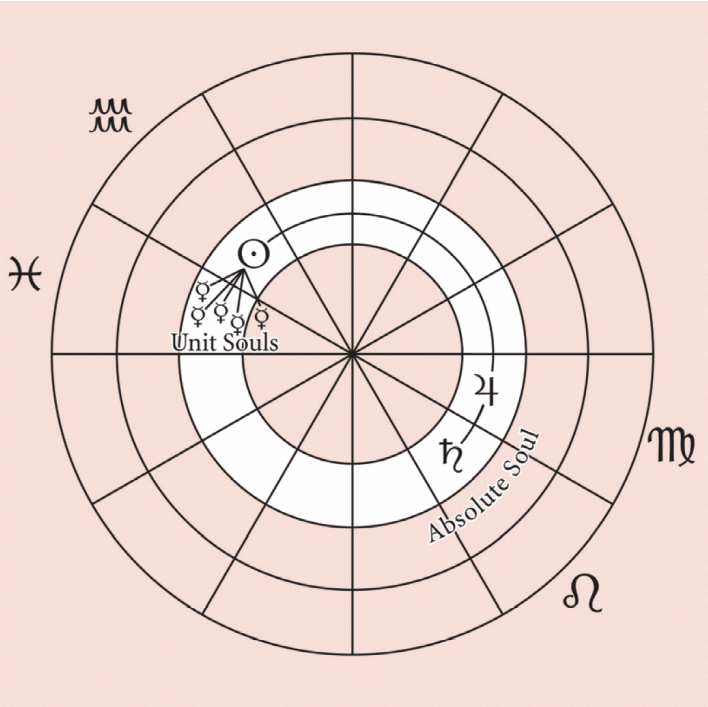
Class
Wednesday, June 1st, 1983
Verbatim, unedited transcriptClick the series name to view more
CLASS at Wisdom's Goldenrod, Hector, NY
with Anthony Damiani (AD)
June 1, 1983
PB PARAS; OVERSELF
TOPIC: PB Paras
SUBJECT: Overself
SUBSUBJECTS: Asmita, I AM, Double Standpoint, Soul as Life Indivisible and Divisible
CONTENTS:
PB PARAS ON THE OVERSELF
HOW TO APPROACH PARADOXICAL STATEMENTS ABOUT A BEING THAT IS BOTH OUTSIDE AND INSIDE THE "I"
THE DOUBLE CONSTITUTION OF MAN
YOU DON'T EXPERIENCE YOUR LIFE AS BEING INDIVISIBLE AND WHOLE, SO THAT LIFE WHICH IS INDIVISIBLE IS NOW IN THE BODY, DIVISIBLE, PARTIAL, AND APPLICABLE IN A TOTAL WAY TO EACH PART OF IT
YOU ALWAYS WANT THE I AM TO BE OUT THERE; YOU WANT TO OBJECTIFY IT, AND YOU THINK THAT THE INSTRUMENTS IT CREATES WILL GET YOU BACK TO IT
IN SILENCE, THERE IS A DIVINE FELLOWSHIP OF THE EGO WITH ITS SOURCE
THE I AM IN A PERSON IS CENTERED IN THEM, BUT ITS CIRCUMFERENCE IS NOWHERE SINCE THERE IS NO PLACE IT IS NOT
IS THE DIVINE SOUL IN US THAT IS UTTERLY ABOVE SENSE IMPRESSIONS THE SOUL IN THE NOUS OR THE DEMI-DIVINE RAY, THE I AM?
THE I AM, ON THE ONE HAND, IS WHOLE AND INDIVISIBLE, BUT ON THE OTHER HAND, IT IS DIVISIBLE, SO YOUR I AM IS BOTH AT THE SAME TIME
IT IS YOUR LIFE THAT METAMORPHOSIZES ITSELF AND TRANSFORMS ITSELF INTO THE WORLD-IDEA
THE NEED FOR A DOUBLE STANDPOINT: ONE RELATIVE AND PRACTICAL, THE OTHER ABSOLUTE AND FOREVER UNCHANGED
THERE'S A PART OF YOU THAT IS UNIQUE, ETERNAL, AND WHOLE, AND THERE'S A PART THAT IS CONSTANTLY CHANGING, AND THE PHILOSOPHIC POINT OF VIEW BRINGS TOGETHER THESE TWO POINTS OF VIEW
BOTH THE LONG PATH AND THE SHORT PATH ARE FROM THE RELATIVE POINT OF VIEW
THE RECONCILIATION OF THESE TWO POINTS OF VIEW IS NECESSITATED BY THE FACT THAT THEY ULTIMATELY ORIGINATE IN THE NOUS
THE TRUTH IS NOUS (INTELLECT); IT IS ITSELF; IT'S NOT OBJECTIVE
THE OVERSELF CAN TAKE POSSESSION OF YOUR BODY AND DISPLACE YOUR MIND
BOOKS READ FROM OR REFERENCED:
Paul Brunton, Notebooks. 16 vols; Vol. 1 entitled Perspectives [Persp.], published 1984-1988. Some Paul Brunton Notebook paras are, as of 2018, unpublished, and are noted as such.
Aristotle, Metaphysics
Plotinus, The Enneads (MacKenna translation, 4th ed.)
PLOTINUS QUOTES READ OR REFERENCED: I.3.5
DIAGRAM appended to this transcript:
- FIGURE 1983 0601-1. Tripartite Soul in Soul Ring.
This diagram is from Astronoesis, p. 184. It is not from this class but is used as a stand-in to help follow along. [Transcriber note: [diagram] means the speaker is referencing a diagram as he or she is speaking.]
NOTES:
- Unpublished PB paras should be sourced and proofread.
TRANSCRIBED Verbatim by IT 2019. Reformatted by JRM & JF 2019-2020, with Subheads and Table of Contents added by JRM. In 2023, IT fixes prefatory matter and footer, updates audio file name, adds Plotinus quotes section, adds new note within transcript, fixes minor errors, adds diagram and references within transcript to this diagram. In 2025, MW adds Subsubjects and alters Subheads to make more accurate. Archival verbatim transcript – V14.1a.
AUDIO FILES: 1983 0601a, 1983 0601b. [Note 1: "Tape" and "Side" refer to original audio cassette tapes that were later digitized into .MP3 Audio Files. Note 2: Both audio files originally had incredibly poor sound quality, especially the second one. Also, AD speaks very quietly throughout. In 2024, REP Studio improved the sound quality, but the transcript was done before this so certain words may be mistranscribed and student and AD comments that were marked as partially or completely inaudible may now be audible. All time markers are for the audio files enhanced by JF.]
1983 06/01 at Wisdom's Goldenrod
PB Paras; Overself
Archival verbatim transcript
[Audio File 1983 0601a Begins]
PB PARAS ON THE OVERSELF
PB [V14, 22:3.385, RC reading]: "[This other being is outside the"I"] yet, paradoxically, and in another sense, it is inside the "I." It is not himself yet also it is himself. If these statements cannot be understood at first reading, do not therefore denounce them. If you are really in earnest, approach them prayerfully or, if your feelings cannot be made to run on [RC reads: along] that line, [RC adds: then approach them] aspiringly at the precise moments [RC reads: moment] when you approach the mysterious moment that transmutes your waking state into the sleep state. But do not expect to receive satisfaction with the [RC reads: a] first trial nor [RC reads: or] even a twentieth--although this is always possible. If you do not desert the enterprise through impatience, you will find one day that you are at last able to read, clearly and correctly, the meaning of these mystical words. Other people have done it, have emerged from the mind's obscurity into [the] intuition's clarity, although at [RC reads: although all at a] varying pace. They have succeeded because the constitution of man, being double, makes it possible."
S (very faint): Could you do the first paragraph again, I was just [one/two words inaudible] when I heard it.
S (very faint): Do it again.
PB [V14, 22:3.385, RC rereads]: "This other being is outside the"I" yet, paradoxically, and in another sense, it is inside the "I." It is not himself yet also it is himself. If these statements cannot be understood at first reading, do not therefore denounce them. If you are really in earnest, approach them prayerfully or, if your feelings cannot be made to run on that line, [RC adds: approach them] aspiringly at the precise moments [RC reads: moment] when you approach the mysterious moment that transmutes your waking state into the sleep state. But do not expect to receive satisfaction with the [RC reads: a] first trial nor [RC reads: or] even a twentieth--although this is always possible. If you do not desert the enterprise through impatience, you will find one day that you are at last able to read, clearly and correctly, the meaning of these mystical words. Other people have done it, have emerged from the mind's obscurity into [the] intuition's clarity, although at varying pace. They have succeeded because the constitution of man, being double, makes it possible."
[14¾ second pause]
PB [V14, 22:3.384, RC reading]: "This is the [RC reads: a] paradox, that the Overself is at once universal and individual. It is the first because it overshadows all men as a single power. It is the second because it is found by each man within himself. It is both space and the point in space. It is infinite Spirit and yet it is also the holy presence in everyone's heart."
[39¾ second pause]
PB [V14, 22:3.317 & Persp., Ch. 22 #5, RC reading]: "The Overself is the point where the One Mind…"
RC: That's capitalized, One Mind.
PB [V14, 22:3.317 & Persp., Ch. 22 #5, RC reading]: "The Overself is the point where the One Mind is received into consciousness. It is the"I" freed from narrowness, thoughts, flesh, passion, and emotion--that is, from the personal ego."
[22 second pause]
PB [V14, 22:3.323, RC reading]: "That [RC reads: The] point of contact in consciousness where man first feels God and later vanishes into God, is the Overself."
[24 second pause]
PB [V14, 22:3.324, RC reading]: "The Overself is a part of the One Infinite Life-Power as the dewdrop is a part of the ocean."
[22¼ second pause]
PB [V16, 28:1.23 & Persp., Ch. 28 #44, RC reading]: "There is but One God, One Life, One infinite Power, one all-knowing Mind. Each man individualizes it but does not multiply it. He brings it to a point, the Overself, but does not alter its unity or change its character."
AD/S(?) (very faint): Again.
PB [V16, 28:1.23 & Persp., Ch. 28 #44, RC rereads]: "There is but One God, One Life, One infinite Power, one all-knowing Mind. Each man individualizes it but does not multiply it. He brings it to a point, the Overself, but does not alter its unity or change its character."
[35½ second pause]
MB: Randy, what do you think he really meant?
[16¾ second pause]
RC: That's what I was trying to get at a few weeks ago and-- talking about how like for it to be accessible to my attention isn't the same thing as for it to be accessible to your attention. That somehow they-- there's a capacity that allows me to do it as what allows you to do it. And it seems that whatever-- (whatever/whenever) we want to talk about that faculty, [short pause] that that faculty brings the whole of this Infinite Life and Infinite Mind to a point or each individual that's being spoken of.
[short pause]
MB: It sounds like he's saying each man-- One-- the One Life, when it can follow each man's (entelechy), focuses that (particularly), the Overself's attention. Actually, it's the thing.
S (very faint): Do it again.
[11 second pause]
PB [V16, 28:1.23 & Persp., Ch. 28 #44, RC rereads]: "There is but One God, One Life, One infinite Power, one all-knowing Mind. Each man individualizes it but does not multiply it. He brings it to a point, the Overself, but does not alter its unity or change its character."
[10¾ second pause]
RC: And I guess you could think too about, we've barely spoken about [couple words inaudible] The whole of the unmanifest is potentially manifest the way [three/few words inaudible] And its passage through that simply a consciousness unfolding, as it were, a picture of the world you're passing through.
AD (very faint): That's nice.
MB: You know it's-- the expression intrigued me, "he brings it to a point". It's as if the lower takes the wider and narrows it in order to receive some more.
RC (very faint): I think the lower is the wider in this context.
PD: The "he" is a Sage in PB's (language who) identifies with your own Mind.
AD/S(?) (very faint, possibly part of background): You're not talking.
S (very faint): Who's the "he"?
MB: Each man-- each man individualize the-- and none of us can say "he". So I assume he's talking about everybody.
RC: We've been getting into that a lot, on Friday nights we were talking about a passive-- It wasn't really made [one word inaudible] saying that each soul lives by-- each life lives by life entire, soul lives by soul entire. Because you've got a definite individuality (within that). [short pause] But, all the difference that-- despite all the difference that turns up in a historical (problem), it seems we're talking to, at least potentially, everything (more) is potential for each.
BS (very faint): He didn't even (explain).
S (simultaneously): (Yeah.)
[15¾ second pause]
DB (very faint): Maybe-- maybe the point of the quote, [S, very faint: It was the first quote.] the notion that individuality which each man(,) I think(,) is [couple words inaudible] he achieves.
S (very faint): That's good. That's pretty good.
DB (very faint): I mean, well, speaking of becoming (free of it).
RC: It's interesting 'cause that's a point that Aristotle makes early-- early on in the Metaphysics. 'Cause he says that when we talk about the potential, we're speaking with respect to soul. That for a given soul you can say that Being beyond it is potentially [possibly one word inaudible] but (it/in) itself a permanent actuality of that Being's [one word inaudible] or discovered. And unless each soul has the actuality in itself for itself, in its own essence.
[students inaudible, 0:13:34.6-0:13:53.6]
S (very faint): (Well) the definition?
DB: Yeah. It was paradoxical nature, that on the one hand this being was spoken of as being outside, on the other hand it was spoken of as being the inside. And, I just wondered what is the nature of this "I" here, (although) he's speaking about the "I", in order for this to be properly understood. I mean because it does seem to-- we would not say that that example within personal ego, you know, would say that.
BS (very faint): [few words inaudible] Is--
S (very faint): That's not good.
DB: Well that's-- that's what I'm trying to get, eke out the definition of that, what he means here by the Mind.
AH: See I don't think that that would be an analogy to this para. But a paradox is a paradox.
S (very faint): Whatever. (bit of laughter)
BS: Or is it?
S (very faint): [couple words inaudible]
BS: Is it?
S (very faint): [three/few words inaudible]
S: What's the "I" (then)?
S (very faint): [couple words inaudible]
S (very faint): Well, then you should find [one/two words inaudible]
S (very faint): Yeah.
AB (mostly very faint): We'd say that the Overself comes all the way down as far as the ego (and shines) his awareness through the ("I"). You could also say that the higher [AH, very faint: Overself.] is reverse (on this).
DB/S(?) (very faint): That's the Intellect.
S (very faint): Uh-hm.
AH (very faint): Yes. But I thought the quote was saying almost how that happens or how that is described, how they describe.
S (very faint whisper): [few words inaudible]
PB [V14, 22:3.385, TS rereads a part of]: "This other being is outside the"I" yet, paradoxically, and in another sense, it is inside the "I." It is not himself yet also it is himself."
[short pause]
DB: Now I'm just--
S (very faint): [couple words inaudible] you too, yeah.
TS: Ok let me start and read those as we go along.
HOW TO APPROACH PARADOXICAL STATEMENTS ABOUT A BEING THAT IS BOTH OUTSIDE AND INSIDE THE "I"
PB [V14, 22:3.385, TS rereads]: "This other being is outside the"I" yet, paradoxically, and in another sense, it is inside the "I." It is not himself yet also it is himself. If these statements cannot be understood at first reading, do not therefore denounce them. If you are really in earnest, approach them prayerfully or, if your feelings cannot be made to run on that line, aspiringly at the precise moments when you approach the mysterious moment that transmutes your waking state into the sleep state. But do not expect to receive satisfaction with the [TS reads: a] first trial nor [TS reads: or] even a twentieth--although this is always possible. If you do not desert the enterprise through impatience, you will find one day that you are at last able to read, clearly and correctly, the meaning of these mystical words. Other people have done it, [TS adds: and] have emerged from the mind's obscurity into the intuition's clarity, although at varying pace. They have succeeded because the constitution of man, being double, makes it possible."
[short pause]
S (very faint): Possible.
VM: Could we try it in a simple-minded way?
S (very faint): Absolutely.
VM: If you identify certainly with a psychosomatic [S, faint: Ego.] ego, then the-- the-- this higher (being) sort of-- certainly seems like other. You're confronted with it, let's say-- Just think if you go into trance, it's where this-- (or) objectively given, it's inflicted on you and so on, so in that sense the lessons and the wisdom of life experience seems to be forced on you, it's other, it's not [one word inaudible] On the other hand if you want to take-- let's say, finish that excessive identification with the-- and you turn inward, and actually through a contact with what (we're) calling the asmita principle you see in a sense that that asmita principle is, let's say, the source, the wellspring of all experience. And in some sense the whole world is within that. Keep both those positions at once, then it does scream-- that does become a paradox, but if you identify with the asmita then of course the whole world is within that. If you identify with the ego, whole world is crushing the "I". Well, it appear-- that might feel that way. I'm not sure I've captured the theme exactly but that seems to be [S, very faint: Yeah.] plausible, at least plausible to me, approach.
DB: (But you know), I had thought somewhat that just sticking to that Mercury principle in itself representing Mind (colloquially), you could say well, Saturn and Jupiter [diagram] certainly appear to be outside of it. [Note: See FIGURE 1983 0601-1, Tripartite Soul in Soul Ring, appended to this transcript. This diagram is from Astronoesis, p. 184.]
S: Outside of the (physical/visible).
DB: But, insofar as they're all a part of the-- what, soul ring, that if you went, again the-- the point, went within the Mercury, you'll find it included the same substance, so to speak, between the two.
MB: David, I don't agree but-- I don't agree with your interpretation that the first "I" that he's talking about is the Mercury. I really think the first "I" that he's talking about is the ego which is-- which is a thought that appears within the Mercury. And-- and that as such the Mercury is outside it because the "I"-- the I-principle itself can never be embodied by anything else. In other words I take this quote at a lower level than the way you're taking it as. The paradoxical sense in which it's inside the "I" is that-- is--
DB (simultaneously): No, inside the person (leaving it), right?
MB: --is that asmita principle which is the I-ness which is producing all the time ego thoughts below.
DB: Now how is that-- this is I guess what I'm trying to get at is that I don't understand how that's within you. I don't see anything (that/of) the ego except a certain unit [one word inaudible] I mean, you know, within the ego structure, one thought following another, like what does it mean that something [AD/S(?): Yes.] is within me?
MB: Maybe it's not within [S: That's deep.] that matrix that's structured but it's behind it.
DB: Then it's outside of it. [S simultaneously: But it's immanent (there).] That's what I'm try-- that's what I'm trying to understand.
MB: Im-- yeah, immanent in-- in that it's never not there.
AH (mostly very faint): It's paradoxically within it because of its perspective that you're forced to enjoy, (irrespective/the perspective) of Nous or Mind. But from the point of view of intuition, [S: But--] [S simultaneously: See I think you could pick.] but you have-- don't you have on one side of the paradox has to be understood as a paradox.
THE DOUBLE CONSTITUTION OF MAN
BS (very faint): What did he say again? Let's go over it.
TS: Constitution of man being double.
S: This other being that--
S: Yeah.
PB [V14, 22:3.385, TS rereads a part of]: "They have succeeded because the constitution of man, being double, makes it possible."
HS: So the double part is the higher and a lower? And which end-- I'm trying to grab which is the other name you use [one/two words inaudible] or what it should be?
RC: Yeah, it seems that the first-- first (electric saying) seems to be--
HS: Now the other thing should be that-- that ego foisted on the higher.
S (very faint): Definitely.
VM: No I'm just saying like that other being from the ego point of view is like-- You know, remember one sentence-- I'm sorry to (qualify), this is really back three, he says, "God to me is that thing that I shape my fist on." In other words, you know-- I'm s-- I'm sorry. I'm sure you won't say no. Anyway, even you know like-- like Jung speaks about the objective psyche. Learn your lessons in the world or experience is the teacher and so on, and, you know, you're conforming to the World-Idea and so on. That World-Idea does appear to come from without, it does appear that the lessons that you have to learn and so on seem to be other than your own personal desires. Your personal desires and-- and so forth seem to (me/be) the way-- in a way are the lessons you learn, so in that sense it seems like it's out there. On the other hand if you retire within, in the way that I [couple words inaudible] I'd try, as best you can, the intuition that you're seeking, this transcending or this staying awake as long as you're in a sleep state seems to me that he's trying to point to the possibility of seeing that that asmita principle is the true center of man in that perspective, that our world is [couple words inaudible] including that ego in the world it seems.
HS: The other being(s).
AD/S(?) (very faint): It is.
HS: The ego and the world together, this other being.
VM: See I don't want to make the-- the other being just the world.
HS: No the ego--
S (very faint): Yeah.
HS: --is the other one.
MB: Not in this quote.
RC (very faint): Well that's the way that Myra said it [one/two words inaudible]
HS: Well, well what-- I'm just-- just one way or the other, I mean the other would be (there/that).
LR (very faint): [few words inaudible] though. Doesn't seem to-- I-- [S, very faint: (Have) the potential.] It is the world, I mean other beings being the world.
HS: [one word inaudible] built on the true I AM.
LR (simultaneously): This falls on the side of the I AM (in that case).
HS: [few words inaudible] from the other or--
LR (simultaneously): It's not a self [one/two words inaudible]
HS: Maybe something in the ego is that awareness now. It's immanent in you. The higher immanent in the world.
VM (simultaneously): [one/two words inaudible] I'm aware the ego is I suppose in some ways. If you're being gracious you would say it's an expression [couple/few words inaudible] and so on of the higher. It's hard to see.
S (simultaneously, very faint): Maybe both of us are.
S: Well what--
HS (simultaneously, very faint): [three/few words inaudible] (bit of laughter)
JC: Would you read that again please? (Some of us can take it.)
AD (very faint): Why don't you try.
[students inaudible, 0:24:47.1-0:24:50.9]
S (very faint): Yeah read.
S (very faint): Yeah.
PB [V14, 22:3.385, RC rereads a part of]: "This other being is outside the"I" yet, paradoxically, and in another sense, it is inside the "I.""
RC: I-- the "I" here is in quotes. So it gets--
AH: The "I" is what?
HS (simultaneously): (So) this is the asmita principle or--
S (very faint): (One more time.)
S (very faint): Once more please.
PB [V14, 22:3.385, RC rereads a part of]: "It is not himself yet also it is himself."
RC: I think you can assume that-- I think it's safe to assume that he would expect most of his readers to take himself to be the ego.
HS: You would never really say that is the true "I", that it-- it is not attainable. So that's why [couple words inaudible]
RC: Well, if you identify with the ego very often you'd tend to call it God. You'd think of it as something very exalted. I think that anyone who claimed to be identical with God is pretty well mistaken here.
HS (very faint): It's true. (Category statement.)
[short pause]
RC: I think it's important to see this in the context of two-- read two quotes in the context of the self being both universal and individual. And in one sense, insofar as it's individual you can take it to be inside yourself, insofar as you get an inkling into its universality that seems (unimpressed) with the (beyond) [few words inaudible] Like the very formula of the thought that comes down from a state where this is my self means more than [one word inaudible] And in the very process-- I think part of the experience-- in fact there's quote here on the experiencer here (which we'll do). But part of the experience is precisely that feeling that the "I" has this one direction toward the individuality (you're at least going to) take to be yourself, but then at the same time points beyond it to the universality of the consciousness, in other words, the Ideas. He's got one here, he says--
PB [V14, 22:6.315, RC reading]: "The [RC reads: This] experience explains a man to himself for the first time, lights up the fact that he lives in two planes at one and the same time. It reveals his ego as the illusion which envelops his consciousness and his Overself as the reality behind his consciousness."
[short pause]
S (very faint): Yeah.
AH (very faint): (With respect) that whole describes the simultaneity of-- of these two states.
RC: Yeah.
AH (very faint): But experientially, when you speak of [one word inaudible]
RC: Maybe I'll read-- just read it again.
S (very faint): Yeah.
PB [V14, 22:6.315, RC rereads]: "The experience explains a man to himself for the first time, lights up the fact that he lives in two planes at one and the same time. It reveals his ego as the illusion which envelops his consciousness and his Overself as the reality behind his consciousness."
AH (very faint): So, that-- that-- that [three/few words inaudible] the higher [one word inaudible]
RC: Yeah. I think we have to always keep in mind that most-- almost all the quotes we've read (here/are) definitive of the way he's using Overself, but always in terms of it uniting this duality, uniting this apparent duality, not choosing just the higher self. State of being that he's calling the Overself seems to be-- be independent of [couple words inaudible] It being the-- the meeting point of multiplicity and unity will not be exclusively either one or the other.
AH (very faint): And, you explained it at one time [few words inaudible] you just read is from the point of view of intuition [few words inaudible]
RC: Yeah.
AH (very faint): [couple/three words inaudible]
RC: Experience, experiences claim [one word inaudible]
AH: So then the duality is not expressed in this para. It's expressed as the unity. But from another point of view where he implies this unity which expresses paradoxically, I think this-- this perspective [couple words inaudible] that [one/two words inaudible] ok, from the perspective of (this)(--/.)
RC/AH(?) (very faint): Meditation (unfolds).
DB: The-- the last one, or I think (the other one), there's-- here he's speaking about a man's consciousness, and it's enveloped on one side by the illusory (frames) of ego, it's what-- But on [couple words inaudible] is this-- the-- the reality of the Overself. Now, the first quote had being and the other being which was outside the consciousness and inside the consciousness, so, that was one being standing two places, so here you've got the individual, the Overself and the ego, so I just don't know which parts to plug in there to identify, you know?
AB (very faint): Consciousness developed as the ego--
DB: Right, that's the other being which is--
AB (simultaneously): The Overself is inside the knowing.
DB: Yeah but he speaks in the first quote of that other being as one.
S (very faint): What is the consciousness? [one/two words inaudible] the Overself?
DB: I thought he spoke of the individual "I" [couple words inaudible] other being is experienced as without. And from another point of view-- another point of view it's experienced as within. And my (point is) [couple words inaudible]
S (simultaneously, very faint): I think they drew a meeting of the "I".
RC: To say the-- whatever you take about yourself to be the [few words inaudible] unspokenly accept this is-- the real being is here. Well then, when you formulate I-thought-- when you formulate the I-thought on the one hand you're trying to (give) as much of the truth (as) real being [couple words inaudible] But at the same time you-- you realize you are the being, and-- and anytime [couple words inaudible] it's always going on. [short pause] If you're really saying-- you really mean (that).
[short pause]
DB (very faint): I've got that, turns the Overself [few words inaudible] Now I follow the second quote ok. That was alright. But I still haven't been able to put that together with the first one to the point where I could actually [one/two words inaudible] so that I can understand-- understand it.
RC: I guess if you take the-- the notion of-- that this being actually has these two parts, one being kind of evil and the other being kind of free from [one/two words inaudible] that the-- I guess you could really apply it either way, the rest of it [one word inaudible] rest of-- which (would/was) the other (be/being). I'm inclined to think-- to take the other being as the higher self [few words inaudible] that would be the ego. It seems on the one hand to be such-- far beyond (it), and yet on the other it seems to be (the most intimate) [one/two words inaudible]
S (very faint): Yeah, yeah.
BS: The distinctions in the quote when you speak of [couple words inaudible] if you're inclined to take that view of what I would be like.
RC: Well we're either of the extremes. All the megalomania [couple words inaudible] extreme. (bit of laughter)
S (very faint): That's true.
[short pause]
[students and possibly AD mostly inaudible, 0:34:09.8-0:34:32.0]
RC: Figured where the One Mind enters the consciousness.
[short pause]
BS (very faint): Did you see any--
AD (very faint): [few words inaudible]
BS (very faint): Well that's the Overself.
S (very faint): Well yeah.
BS (very faint): It's employed this double [couple words inaudible] double--
S (very faint whisper): Yeah.
AD (very faint whisper): (That's good.)
S (very faint): (He's a man.)
BS: And I was wondering about the double nature. It seems to me the double nature of my [one word inaudible] would be anything below that [one/two words inaudible] paradoxically [few words inaudible] the Overself. You know, you had to mention at least the Overself. And that's maybe my (opinion that--)
RC: Well there was that one quote where [S: That--] it was necessary but--
BS (simultaneously, very faint): Well anyway that's-- I was wondering if that is the being outside your "I" paradoxically, man being double [one word inaudible] At the same time the Overself being the meeting-point would also be within his "I".
RC: Yeah. Well I think that-- that duality has to. I mean if you remember that one that we did a couple of times the last two weeks, that the two terms of this duality are unity and duality.
AD/S(?) (very faint): [few words inaudible]
RC: Yeah. The two terms of this duality (are that the) Overself (or) the (higher) self, with unity on one side and duality on the other.
HS (very faint): Are you talking-- [few words inaudible] You're talking soul as one end and ego as a-- that it's universal higher part or--
S (very faint): David--
S (very faint): Yeah.
RC: He's talking about each individual-- what each unit of real being is both individual and universal. And to speak of the Overself as uniting-- being a state of being which unites unity with duality, I would think that we'd be on the side of duality to make like all the distinctions. All the distinctions are specified one individual to some other [one word inaudible] the duality that makes possible the existence of "I". So it must co-exist in the "I". It all seems to come on the duality side. And it seems to be speaking of the Overself not as dualistic, not as two terms of an inner duality, but a-- as a union of [couple/three words inaudible]
S (very faint): So--
RC: Yeah well that-- I mean that necessarily has to be a paradox in a strict sense of the word because you're taking it as beyond the-- you know, everyday-- beyond the mind as a paradox.
S: Para-dox.
PD: Well the [couple/three words inaudible] means paradoxic unity on which the lower levels of [one word inaudible] nature of the Overself itself. To speak of it-- the full nature of the "I", the "I" which is on one hand, you speak of that, (you got) ego present, on the other hand there's the higher consciousness illuminating and that's duality, it is a duality of the Overself. That's-- every principle that we (see/seem) [couple words inaudible] studies say you've got to be careful.
TS: It seems it would be hard to find it as the (unit--) the Overself and-- as a union of unity and duality and also speak of it as a trans-- to be found in the transition between waking and sleep. Seems to me that if they're speaking of the states of consciousness, that it would seem to be also-- I'd agree with Paul that it would seem that that would imply that it would be within relationship of the individualized but in the Overself and the ego. It would seem like it would be only from the point of view of the-- that double nature or the double s-- the duality side of the Overself that one could speak of something here as being revealed through a change of a state of consciousness such as wake to sleep. There's something else in it.
S (very faint): I don't know.
S (very faint): Told you [couple words inaudible]
RG: But I'll grant-- you said-- I mean the-- the other dozen ma-- the other dozen [one word inaudible] of the-- of the Overself you wouldn't speak of inside or outside, one or the other.
MB (very faint): I agree. I don't think you would.
VM: I'd rather speak of this as the-- your side of the Overself, I agree.
RG (simultaneously): Yeah your-- yeah. You don't speak of it inside or outside your "I" in that case, though in some places as one being.
AB (most very faint): That's also a paradox, those two quotes they're a big paradox. One can just stay in it and also that the Overself is functioning [couple words inaudible] is also a paradox in the same way too is the problem.
S: They have a problem.
TS/S(?) (very faint): Do you understand [couple/three words inaudible]
[short pause]
S (very faint): Are you telepathic? (bit of laughter)
S (very faint): Yeah.
AD(?) (very faint): [few words inaudible]
LR: The Overself is universal, individual, and what's the other?
AB: Yeah, that-- that's the higher point of view of the asmita, say the Mercury and the Saturn [diagram] are universal and individual. [Note: See FIGURE 1983 0601-1, Tripartite Soul in Soul Ring, appended to this transcript.] But then within the here and now of your saying [one word inaudible] consciousness, the Overself is somehow within that consciousness but is somehow behind it as well. So they're both there in--
[short pause or incredibly faint talking by AD and or a student]
LR: So he tells you (to see), there's no way to grasp, I mean-- He tells you the only way to grasp it is by taking it prayerfully and to sleep with you. [couple/few inaudible student words simultaneous with LR] In other words, it seems that it-- that it can't be logically-- logically infinite.
RG: That's true, but that doesn't mean [couple/few words inaudible]
VM (simultaneously): It doesn't mean you have to stop.
RG: Yeah.
S (very faint): Can I try?
TS: Ok, do you have his logic?
S (simultaneously): The first-- sure. (student laughs)
RG: That explication doesn't answer the paradox, it only pushes--
LR (simultaneously): I didn't hear the [one/two words inaudible]
RG: Well-- Go back to it.
LR: Well you can always parrot.
RG: Yes. (That wouldn't be/That doesn't mean) the answer.
[short pause]
S (very faint): But he talks about--
S (very faint): That's too bad.
AS (very faint): [few words inaudible]
S: I see.
AD (very faint): Once more.
S: PB talks about making this--
DH (very faint): [few words inaudible] into this-- including waking to sleep, that it's-- it is possible to be (aware inside).
S (very faint): [couple words inaudible]
DH (very faint): That's ok.
AS/S(?) (very faint): Doesn't get any [one/two words inaudible]
DH: It is (reducible) to each.
S (very faint): There's always a switch up.
LD: But didn't Guenon say that about everything he talked about, he said it's your--
S: [couple/three words inaudible]
S (very faint): Yeah.
RG: Is that right? What is the aspects? (RG laughs)
VM/S(?): This is very grounded insight.
S: [one/two words inaudible]
VM (very faint): There's something there that--
LD: I'm amazed [couple inaudible student words simultaneous with LD] there's no reason not to-- [AH: Yes.] not to talk about it and discuss it. There's [one word inaudible] here.
S (very faint): Go on Richard.
S: I can see why they flew over-- discussed it with the paragraphs. I see it as a problem.
[short pause with very faint background student talking]
S: But what [one word inaudible]
AB: Inside and outside, it's the same thing [few words inaudible]
S (very faint): It's inside and outside [one word inaudible]
S: Well it's outside because our inadequate or our illusory relationship to our ego or our lack of understanding has come through outside.
S (very faint): Right.
S: [couple words inaudible]
RG (simultaneously): Then if he really knew that though, it wouldn't be-- and it wouldn't be a paradigm. How could that be that it could appear that way when in fact it isn't true.
PD: If you take it in terms of your feeling consciousness, on the one hand there's the soul in terms of principle, that's a certain reference to the quote to try to approach it with a statement. And on the other hand, you know it's the very quintessence of your being. And that's a paradox. Because, (if) we had ego, there he goes.
[9 second pause]
MB: Somehow I'm not inclined to think that the paradox disappears when you get to that level. In other words--
PD: Well you're probably right.
MB: I think the paradox remains. And, for instance the-- the notion that the Overself is outside the ego, that's always going to be the case. As long as there's an ego there, the Overself is not going to be identical with it. It's merely a thought. But that thought can never contain the Overself.
PD (very faint): Paradox is going to get you (there).
S (very faint): (You just do) [one word inaudible]
S (very faint): Yeah.
[11¾ second pause]
S (very faint): It is a [one word inaudible] question.
BS (very faint): Does that mean that you understood that quote from (earlier) [one word inaudible]
MB: No, that they sh--
S (simultaneously, very faint): [few words inaudible]
S: (Your) questions.
RC: I mean he's-- he's written a number of times here that it is-- it is paradoxical. There was that one that we-- Maybe I think the first week we started this and he started right out saying it's not really possible to explain it, it's not really possible to define it as of the nature of [couple words inaudible] (And I) have to be able to describe (as it happens), describe (its/this)--
[short pause]
AH (very faint): (How would that) [couple words inaudible] There's a certain character to that consciousness, a certain character [couple words inaudible] Do you think also a philosopher [couple words inaudible]
PD: Well, the (rest) I totally see if you're trying to do it, aspirational contents, that's what [couple words inaudible]
S (very faint): [one/two words inaudible]
S (very faint): Yes.
S (very faint): Philosopher [couple words inaudible]
VM (simultaneously): That's because most logic is of the realm of this personal ego's [couple inaudible student words simultaneous with VM] habitat. You know, that means dualistic thinking is the point of logic. That level I think paradox is resolved, not in an intellectual but the kind of insight that David's made reference to must be some form of transcendence of your limitations, logical thinking in the normal sense of logic.
AH (very faint): But he says clearly it's-- it's a-- not what you would want. It is through a mind only, the logical mind.
VM: That's right.
S (very faint): Yes that's right.
S (very faint): It's got greater-- I mean it's con-- there's a process [few words inaudible]
S (very faint): Yeah it would have to be the most philosophical knowledge.
S (very faint): And then there's that.
RC: And there was one time I had been reading-- I was in Switzerland and I had been reading this commentary about Plotinus.
(Side 1 of original cassette tape digitized as 1983 0601a Ends; Side 2 Begins)
S (very faint): Yeah.
RC (very faint): What (Ploti--) what Plotinus was trying to say that he discovered that he was most exalted when he isn't (the subject). So I started to read-- read that to PB and I got as far as "he discovered". And PB said, "We keep those quotes to ourself. Shh." (laughter)
S: Thanks.
RC: Thanks.
RG: Well I believe that it is the most philosophical paradox, that-- because if you think about it, you come to the conclusion that it can't be. And that is its-- that isn't a logical paradigm. That in fact the thing that we take to be true isn't, and you could think-- think that out and maybe you'll start with the fact of an insight. And that's a great paradigm, how could it be.
S (very faint): That question [few words inaudible]
S (very faint): Yeah.
[short pause]
S (very faint): Yeah but--
S: But in it--
PD: It's not a way of dissolving it, it's a way to get more-- more of this amazing paradox of the nature.
BS (very faint): I think--
RC: [one/two words inaudible]
S (simultaneously): [one word inaudible] is a fabrication of insight?
AH (very faint): Is that to suggest that the paradox is [one word inaudible] clears a grasp by [couple words inaudible] which is this aspiration? Or let's say that the thinking is able to grasp this paradox. Then it should have a crisis that it can't resolve. Is there the suggestion here that it is through aspiration that the-- [possibly few very faint inaudible AD words] I stepped.
AD (very faint): Let's go on, let's go on.
AH: I'm trying to see it through a sequential-- in terms of a path, you know.
BS (very faint): [mostly inaudible]
DH: Seems the word's insight.
RC (very faint): Yeah.
S (very faint): Yeah.
S (very faint): Yeah.
RC: It says to approach it prayerfully.
S (very faint): What is that [couple/three words inaudible]
PB [V14, 22:3.385, RC rereads a part of]: "If these statements cannot be understood at first reading, do not therefore denounce them. If you are really in earnest, approach them prayerfully or, if your feelings cannot be made to run on that line, aspiringly at the precise moments when you approach the mysterious moment that transmutes your waking state into the sleep state."
S (very faint): Ok.
[19½ second pause]
RC: Unless Anthony wants to pick up on any one of them and work on this for a while.
S (very faint): Take a different path, come from a different direction.
[short pause]
YOU DON'T EXPERIENCE YOUR LIFE AS BEING INDIVISIBLE AND WHOLE, SO THAT LIFE WHICH IS INDIVISIBLE IS NOW IN THE BODY, DIVISIBLE, PARTIAL, AND APPLICABLE IN A TOTAL WAY TO EACH PART OF IT
AD (very faint): [few words inaudible]
RC/AH(?): Yes.
AD (very faint): Paradoxically insisting (you wouldn't understand) [inaudible, 0:53:16.0-0:53:25.7] all the way down. That means (what) you had said, being divisible about your body. And totally [inaudible, 0:53:35.5-0:53:44.3]
AH: How-- how it rises from experience.
S (very faint): Yes (Andrew).
AD (very faint): How it arises from an experience and how it arises (in front), oh yeah. Listen very carefully to what is being said. Is it true that your life is one indivisible entire whole?
AH: No that's not true.
AD (very faint): That's not true. You find walls, partitions within it, right?
AH: Yes.
AD (very faint): Can you tell me what they are?
AH: Thoughts.
AD (very faint): Alright it's a-- it's a thought, it's [one/two words inaudible] Do you agree with that? [10½ second pause] You don't experience your life being indivisible, whole, ok. Embodied (life). You don't experience your life in-- the embodied life, living within that. And therefore that life which is whole complete entire and indivisible is now in the body, divisible, partial, applicable in a total way to each part of the body. And this is talking about inside and outside consciousness.
S (very faint): Yeah.
AD (very faint): [couple words inaudible]
RG: Yeah but he brought it up.
AD: Yeah, I know, he brought it up but what'd you do? (bit of laughter)
S: Right.
RG: Why do you think he brought it up?
AD (very faint): Metaphorical way of speaking is-- to speak about a consciousness inside the ego and outside the ego, there's a metaphor for that. [student assents] [short pause] Trouble is that I think you people try to [one word inaudible] and I'm trying both ways [couple words inaudible] indivisible Mind which you are.
S (very faint): Uh-hm.
AH: And if you try to see it as an object--
AD (very faint): Yes.
AH: It was some-- something, some thing.
AD (very faint): Try to see it objectively, you know, like he was saying [couple/three words inaudible] Well as soon as you do that, your intellect will be (looking). [short pause] I think in essence you could answer the question. [short pause] Try a few more. He said twenty times, didn't he?
RG: Uh-hm.
RC: Yeah. Native.
[short pause]
YOU ALWAYS WANT THE I AM TO BE OUT THERE; YOU WANT TO OBJECTIFY IT, AND YOU THINK THAT THE INSTRUMENTS IT CREATES WILL GET YOU BACK TO IT
PB [V14, 22:3.245, RC reading]: "The Overself does not evolve and does not progress. These are activities which belong to time and space. It is nowhere in time and nowhere in space. It is Here, in this [deep] beautiful [and] all-pervading calm, that a man finds his real identity."
[11¾ second pause]
S (very faint): Would you mind reading it again?
PB [V14, 22:3.245, RC reading]: "The Overself does not evolve and does not progress. These are activities which belong to time and space. It is nowhere in time and nowhere in space. It is [RC: Underlined.] Here, [RC: Capital H.] in this deep beautiful and all-pervading calm, [that] a man finds his real identity."
[19¾ second pause]
PB [unpublished, RC reading]: "Nothing could be nearer to a man than the Overself, for it is the very source of his life, mind, and feeling. Nothing could be further from him, nevertheless, for it eludes all his familiar instruments of experience and awareness."
[10¾ second pause]
S (very faint): Read that again.
PB [unpublished, RC rereads]: "Nothing could be nearer to a man than the Overself, for it is the [very] source of his life, mind, and feeling. Nothing could be further [RC reads: farther] from him, nevertheless, for it eludes all his familiar instruments of experience and awareness."
VM: Isn't that precisely what he just said in the sense that continuously (then/when) you subjectify both, and you turn that objectifying [one word inaudible] which are the tools that you have at your disposal more or less towards the principle of pursuing the Overself [couple words inaudible] get farther.
AH (very faint): [few words inaudible] the source of--
VM: Center of your being.
RC: It's a source of life, mind, and feeling.
AH (very faint): Would you say perhaps it was like [one word inaudible] close?
RC: I guess.
S: Would you say it's above them? (bit of laughter)
S: [one word inaudible]
S (very faint): Yeah.
AD (very faint): That's-- that's the problem you see (there).
RG/S(?) (very faint): Uh-hm.
AD (very faint): You always want it out there, you want to objectify it. (bit of laughter) It's not a concrete thing because then your "I" would be [couple words inaudible] Now that Idea makes eyes, ears, nose, (coloring), alright, it makes all these things, and the brain. Then these things want to get back to the Idea.
RC: (They) want to get back.
AD (very faint): Huh?
AH: They-- they want to do that.
AD: They want to get back to it. Thinking that their activities will take them back to the I AM.
S (very faint): Andrew--
AH (very faint): And by definition it wouldn't be possible to get there because they've already been objectified.
S (very faint): Yeah.
AD (very faint): They-- they are organs of functioning. Just (by) the I AM, alright, seem pretty (absurd/observant) [one/two words inaudible] if I can get to know the I AM. Alright, they're functioning.
AH: Would you say that again?
[short pause]
AD (very faint): The I AM is (impressing) right there all these things. Because you see, all these organs, eyes and ears and nose [inaudible] (expressing it), the I AM. It's--
[short pause]
DB (very faint): Now--
S (very faint): I AM.
DB (very faint): With res-- with respect to this problem, there's another element that has been brought in. [one/two words inaudible] I'm not sure precisely where it fits in to this-- the discussion, but that is the fact of the attention. That doesn't seem to be any one of these particular organs. And yet somehow the-- the-- this principle--
AD (very faint): [few words inaudible]
DB: I don't know.
AD (very faint): Well that's a good answer.
DB: Right, ok. So then, is it that the faculty of attention is-- is completely un-- indistinguishable from this true awareness or the I--
AD (very faint): Why go around a merry-go-round?
S (very faint): Dave--
DB: Well--
S: There's no more thoughts [couple words inaudible]
AD (simultaneously): And perhaps you have to cut a man's head off, because he won't stop it.
DB (very faint): [couple words inaudible]
AD: After that he should stop thinking.
DB: Right. But then, here's that-- that the-- that's the question, this--
AD: David I'm glad I don't have a two-by-four. (some laughter)
DB: I wish you (still didn't) care.
S: That's good.
DB: It is-- you're saying that it is the (same). This "I" is a faculty-- what is--
AD (very faint): (Give me the de--) difference. [DB: Well--] You're pure attention, alright. (You got) [couple words inaudible] with you?
DB: I-- I don't think they're with me.
AD (very faint): Well, then it would be worthwhile to cut it off right there. You'll never mind [one word inaudible] if you cut it right off.
DB (very faint): Alright. (bit of laughter)
AD: It's ok, he's-- Hard, isn't it? (bit of laughter)
S: It would be the same (kind/time).
DB: I--
AD: Something in you has got to respond to that.
DB: Well it's-- it's on the (way). (bit of laughter)
S: David! (laughter)
S (amidst laughter): Come on!!
DB (amidst laughter): But it--
S (very faint): Establish [one/two words inaudible]
AD: Next one!
S (very faint): Ok.
PB [V14, 22:6.265, RC reading]: "He enters into a state…"
AD (simultaneously, very faint): [couple/three words inaudible] last (month/night).
DB: I didn't, I had to go with my relatives and I was forced to go. Anthony wait a minute. It's only for just (like) thirty-- thirty more seconds.
S (very faint): I think you're going be (surprised). (bit of laughter)
S (very faint): That's right.
S (very faint): But if you could only [one/two words inaudible]
AD (very faint): There.
DB: The fac-- the faculty of attention, so it's that capacity within us which we're trying to develop, say for example in order to direct it, in order to learn how to concentrate. You know, we meditate and we try not to listen to the cars going and try and control and direct that attention, that awareness from streaming out through the sense organs, you know, getting caught up in-- in the world we're caught up in. I'm just-- I'm just asking, is that ability or faculty of directing this attention anything other than the attention itself. That's-- I'm not trying to distinguish between the attention and the I AM. Just it seems sometimes that--
AD (very faint): Well insofar as [one word inaudible] you're always (the attention). [9¾ second pause] Maybe your thoughts [few words inaudible] attention, believe me, you're already out of it. It's a [one word inaudible] if you're thinking anything but attention and nothing (else). [S, very faint: Yeah.] [short pause] I'm going to deal with it [couple words inaudible] Let's go on. (some laughter)
BS(?) (very faint): But right now it's--
IN SILENCE, THERE IS A DIVINE FELLOWSHIPS OF THE EGO WITH ITS SOURCE
PB [V14, 22:6.265, RC reading]: "He enters into a state which is certainly not a disappearance of the ego, but rather a kind of divine fellowship of the ego with its source."
[short pause]
AD (very faint): Try again.
PB [V14, 22:6.265, RC rereads]: "He enters into a state which is certainly not a disappearance of the ego, but rather a kind of divine fellowship of the ego with its source."
AD: Try another one.
[18¾ second pause]
AH (very faint): Could you read it once more please?
PB [V14, 22:6.265, RC rereads]: "He enters into a state which is certainly not a disappearance of the ego, but rather a kind of divine fellowship of the ego with its source."
[9 second pause]
HS (very faint): So you talk about it as the ego's been through it, as it were, (and then) realizing its source.
AD (very faint): (Ok.)
HS (very faint): And that ego enters into [one word inaudible] I see.
AD (very faint): It's already within the spiritual [one word inaudible]
HS (very faint): To speak about [couple words inaudible]
AD: Did it ever leave the source, Herbie?
HS: Excuse me? Did it ever what?
AD (simultaneously): Your ego ever leave the I AM?
HS (very faint): It doesn't have to leave the I AM. [few words inaudible]
AD: Then how could it enter what it never left?
HS (very faint): I think by entering what it never left is meant kind of the recognition that there is the never leaving.
AD: You mean by shutting up, right?
HS (very faint): Never leaving [couple words inaudible]
AD: Isn't that what it means?
[short pause]
AH (very faint): Well it said that this divine [one/two words inaudible] that-- that would be the [couple/few words inaudible] but rather the ego shuts up.
S: Uh-hm.
AD (very faint): (It's time.)
S: The attention doesn't need objects. You tend to think of attention, you can tend to think of being-- attending to some thing. That's the problem with this question of attention is that you're wai-- you're waiting for some center.
[short pause]
[students inaudible, 1:08:08.9-1:08:17.4]
S (very faint): It doesn't have control over it.
S (very faint): (Right.)
S (very faint): Ok. Ok.
DB: So it's only by never having left its source that it somehow (force) itself to leave the past.
[short pause]
AD: Let's try it again.
PB [V14, 22:6.265, RC rereads]: "He enters into a state which is certainly not a disappearance of the ego, but rather a kind of divine fellowship of the ego with its source."
[12½ second pause]
AD: What inner state is that he enters into?
DB (very faint): Silence.
RC (very faint): Steady knowledge.
S (very faint): Silence.
AD (very faint): It's silent.
S (very faint): Ok.
DB/S(?): Knowing(--) knowing.
AD (very faint): But he [one word inaudible] necessarily (lose it). His ego doesn't disappear. It still could, you know-- But he goes and deals with, you know [few words inaudible]
VM: Then his ego is a collection of thoughts. You enter into the silence, doesn't that mean thoughts at least temporarily subside, so in that sense there is no ego.
RC: There's some quotes that talk about the--
AD (simultaneously, very faint): (State) there-- the body's still there.
S: The body, ok.
AD (very faint): It's still there.
VM: So, the way you're using the word 'silence' then it doesn't mean the cessation of all thought.
AD (very faint): No it's not Nirvikalpa. Nirvikalpa would be just [couple words inaudible] So it wasn't (Nirvikalpa). It's just [couple words inaudible] Ego is silent. [inaudible, 1:10:24.4-1:10:37.7]
AH (very faint): This consciousness [few words inaudible]
S (very faint): Well--
AD (very faint): I'm sorry? Change is necessary. [couple words inaudible] No change is necessary [couple/three words inaudible]
[students and AD inaudible, 1:10:52.6-1:10:59.9]
AD (very faint): The organs such as seeing and so on can't be [one word inaudible]
BS (mostly very faint): Organs such as seeing, hearing and so on (themselves) couldn't possibly pierce that source, ourselves. I got a reference to the reason (he talks) about (is mentioned). And that he'll never be [one/two words inaudible] or outside it. Those functions [couple words inaudible] the function of sight for example, as an example.
AD (very faint): Covered with this--
BS (very faint): Isn't that the way of method?
AD (very faint): [inaudible, 1:11:43.0-1:11:58.0] the I AM [one/two words inaudible]
S (very faint): It's more than [couple words inaudible]
[short pause]
BS (very faint): [three words inaudible]
AD (very faint): I'm asking you, why add a head onto the one you already have? The point is made [couple words inaudible] a little accurate. Because then you dissipate the impact that the answer should have. I thought I'd be (nasty/nastier) [three/few words inaudible] I-- I got a good aspect, Mercury trine Mercury.
S (very faint): [few words inaudible]
AD: Go ahead.
HS: Where you going to go? (bit of laughter)
TS: Well Herbie always (says something).
AD: Read-- read it to Herb.
PB [V14, 22:3.185, TS reading]: "Without the Overself no human creature could be what it is--conscious, living, and intelligent."
TS: Well that's obvious.
S (very faint): Uh-hm. (some laughter)
[short pause]
AD (very faint): Well sometimes really [few words inaudible]
S (very faint): Can't hear you.
[short pause]
THE I AM IN A PERSON IS CENTERED IN THEM, BUT ITS CIRCUMFERENCE IS NOWHERE SINCE THERE IS NO PLACE IT IS NOT
PB [V14, 22:3.397, TS reading]: "Each Overself is like a circle whose centre is in some individual but whose circumference is not in any individual."
S (very faint): Again?
TS (mostly very faint): Yeah. And that was like if you--
PB [V14, 22:3.397, TS rereads]: "Each Overself is like a circle whose centre is in some individual but whose circumference is not in any individual."
[11¾ second pause]
S (very faint): [few words inaudible] (bit of laughter)
S: That's true.
TS: But each, yeah, is the same.
S: You want to go on?
TS (very faint): Not now.
PB [V14, 22:3.397, TS rereads]: "Each Overself is like a circle whose centre is in some individual but whose circumference is not in any individual."
TS: Seems like if it was said the Overself, then you could say that its circumference would be its universal aspect and its center is--
AD (mostly very faint): Well suppose he's not saying that, suppose [TS simultaneously: Yeah.] he's saying the I AM in a person is centered in (him/you), alright, but its circumference is nowhere. [DH, very faint: It's unmanifest.] What would that imply?
TS: There's nothing, there's no limit to its-- its being [couple words inaudible]
VM (very faint): That means overcomes--
AD (simultaneously, very faint): Or more precisely [couple/three words inaudible] I'm not sa-- speaking about its-- its being anywhere. [couple/three words inaudible] adjustments or-- [9¾ second pause] If you say that it's an infinite circumference, alright, I'm sure you're going to limit it some place (or/so) you'll find-- But if you just deny that it has any circumference, alright, you're-- you're spared that-- [VM, very faint: (Witness.)] that (random) thought.
MB: Why call it a circle at all? I mean, what does it share in co--
AD: To make you feel good, you're-- you're at the center. (bit of laughter, student words)
[short pause]
AD (very faint): Go ahead, read them that.
IS THE DIVINE SOUL IN US THAT IS UTTERLY ABOVE SENSE IMPRESSIONS THE SOUL IN THE NOUS OR THE DEMI-DIVINE RAY, THE I AM?
PB [V14, 22:3.343, TS reading]: "The divine soul in us is utterly above and unaffected by the sense impressions. If we become conscious of it, we also become conscious of a supersensual order of existence."
[9½ second pause]
S (very faint): Would you do that again?
TS: I just--
PB [V14, 22:3.343, TS rereads]: "The divine soul in us is utterly above and unaffected by the sense impressions. If we become conscious of it, we also become conscious of a supersensual order of existence."
AD: Tim, what do you think the divine soul in us is? Is it referring to the asmita, the I AM, to the individual unit of life, or is it referring to that universal principle there that we speak about as the Soul in the Nous?
TS: I think the latter, the Soul Nous-- I mean, Soul in the Nous.
S (very faint): Oh yeah.
[short pause]
TS: In that it seems like the asmita principle as an awareness is first point of being aware of the sensible-- sense existence. It seems like [couple words inaudible]
AD (simultaneously, very faint): Then why would he-- why would he say that we would become aware of the supersensible realm?
TS: Well, that's why I thought then the divine soul would be that which is in the Intellectual realm, the--
AD (very faint): Yeah but there wouldn't be an "I" or a "you" there.
[short pause]
PC (very faint): Supersensible could be anything the rational sphere (and above).
TS: Yes it could. (laughter) Well, here you want to try another one? (laughter)
AD: No.
S: Go ahead.
AD (very faint): He says we-- we would take twenty tries at it.
S (very faint): Let's hear that one again please.
S (very faint): (Let's hear it.)
S (very faint): Uh-hm.
PB [V14, 22:3.343, TS rereads]: "The divine soul in us is utterly above and unaffected by the sense impressions. If we become conscious of it, we also become conscious of a supersensual order of existence."
AD: Now Tim, if it's above us, alright, then it can't become aware of the sensible world.
TS: Yes.
AD: Has to be in us in order for us to be aware of the sensible world.
TS: Yes.
AD: That so?
TS: Oh I would-- I thought so. And I thought that's why-- I thought the asmita in other words was in the individual and was aware of that sense world or of the creation of that sense world.
LR (very faint): Yeah. But he doesn't say aware of it, he says affected by it, that's what he (says).
AD (very faint): Go on.
TS: Yes, he says "utterly above and unaffected by sense impressions".
LR: Alright. So you could be aware of sense impressions from that point of view (affecting/affective) [one word inaudible] some part of (you). He doesn't say you're aware.
AD (very faint): Would you say that the I AM is unaffected by the sense impressions? Doesn't the I AM--
LR (simultaneously): But it projects the sense impressions.
AD (very faint): Doesn't the I AM [few words inaudible] sense-impressions?
LR (very faint): In that sense it does.
AD (very faint): Then on the other hand experiences itself, the (God). It could be that the way he experience himself in the world [couple words inaudible]
LR (very faint): So there's two aspects to the I AM.
AD (very faint): Well the Witness [couple words inaudible] If-- if it's the Soul in the Nous, cannot in any way be affected by sense impressions. The only way it can know from the [one/two words inaudible] [couple inaudible LR words simultaneous with AD] is-- Better not answer.
LR (very faint): I would agree with Tim in his point. It would be the Soul in the Nous which is utterly without (dimension). Because I-- because otherwise it would act like the asmita is what brought about that image, brought about the manifestation of-- so to speak, of these utterly opposed and mysterious [one word inaudible]
S (very faint): Careful.
S: Why wouldn't it be a s--
AD (very faint): Was the I AM, on the one hand, (whole) entire indivisible but on the other hand is divisible [couple words inaudible] So your I AM is both at the same time, exactly.
LR (very faint): So you say utterly above there's a principle that rules-- has nothing to do with that.
AD (very faint): Yes, that's what I mean.
S (very faint): That's right.
S (very faint): Ok read it.
AD (very faint): [three words inaudible]
PB [V14, 22:3.343, TS rereads]: "The divine soul in us is utterly above and unaffected by the sense impressions. If we become conscious of it, we also become conscious of a supersensual order of existence."
AD: Well, Tim, what do you think?
TS: Well I still agree with myself, [S: Ah.] [AD, very faint: Still agree with yourself.] that the divine soul in us as being the divine soul, like what we think of as the-- the Overself principle in the Nous, and--
S (very faint): Yeah but it seemed like a contradiction.
PD: But you're saying, one hand, soul in us, you're assuming that contrast here, the "us" you're speaking of as ego-consciousness.
TS: Well, insofar that the "us" is what is conscious of sense impressions, and sense worlds, it would be the ego or the asmita principle I think.
PD/AD(?): Well, (couldn't you)?
TS: Ok.
PD: But then, when that ego-consciousness comes out-- becomes conscious of the I AM it seems to be it becomes conscious of a higher world, a higher level of existence to your own.
TS: Yes, that's-- you know, I don't disagree with that, it's just that insofar as that I have understood that it's that as-- I-principle or asmita principle that translates the World-Idea into sense impressions, that to speak of some principle which is utterly above and free of that without reference to the sense impressions, that's why I was taking the divine soul as being in the Nous; where the asmita principle, although not necessarily enmeshed in-- exclusively in sense existence does seem to be the father of that sense existence.
HS: So does that principle father as it were reason and the intellection to it?
TS: Well, rational, yes.
HS (very faint): Ok, so that much you could say, that, so to say, is supersensible.
S (very faint): He would contact the Nous now.
LR (mostly very faint): It's the fact that basically I thought we were [inaudible] repeating. And maybe that's more necessary freedom.
AD/S(?) (simultaneously, very faint): Well--
S (very faint): [couple words inaudible]
AD (very faint): It's alright, we spoke about the [one word inaudible] So, that would be Mind there. Then he [few words inaudible]
S (very faint): You got to keep these [couple words inaudible]
S: Yeah.
AD (very faint): [few words inaudible]
S (very faint): Wouldn't they speak of the-- the asmita or asmita though as the [one/two words inaudible]
TS (very faint): Stay in the woods.
AD (very faint): (It would/You did) imply-- But you can't speak [inaudible] what was-- could there be organized classifications, (we/you) spoke about Soul in the Nous as divine. And we spoke about the individual soul as a raying out of that. It's demi-divine.
S (very faint): Uh-hm, and--
AS(?) (very faint): It's demi-divine with the spirit, always define the soul as the [couple words inaudible] as the entire(--/.)
AD (very faint): Well then it would become the [few words inaudible]
PC (very faint): The asmita as pure asmita is not [couple words inaudible] Mind.
S (very faint): What you mean?
THE I AM, ON THE ONE HAND, IS WHOLE AND INDIVISIBLE, BUT ON THE OTHER HAND, IT IS DIVISIBLE, SO YOUR I AM IS BOTH AT THE SAME TIME
PC (very faint): The asmita as pure asmita, pure "I", is not divisible about bodies is what I mean.
AD (very faint): Do you remember, again, the point here is that it's both. That this I AM is at one and the same time, which sounds paradoxical, is-- is all (thing) [couple words inaudible] alright. Still the same time is divisible among body [S, very faint: Right here.] and partial as sense. Then you have two ways of looking at the thing, it would be good. Within the demi-divine soul or the I AM principle as standing alone and unique, that's-- that's your life. That's the unit of life within your soul, your soul. Then that unit of life is also divisible among body, the body that you have, alright, you'll say that [three/few words inaudible] So this unit of life is both these things at the same time. Now it's a paradox. But like I said it's a paradox only if you insist on holding to the way of thinking that you've been inundated by [one/two words inaudible]
PC (very faint): Now do you say that that whole (you say is) divisible about bodies not from the (perspective) or like--
S (very faint): [couple words inaudible]
AD (very faint): Well, it would be unaffected if it is unique, whole, entire and indivisible. It would be affected when it is in body, alright, and divisible in body. And will be present to each part of the body.
PC (very faint): So if you were at the Witness position witnessing that psychosomatic organism, you know, (doing), the rational being would say-- I-principle that's looking at that as you do it, it wouldn't just be this psyche that would be experiencing the rational, it would be the "I" in the psyche?
AD (very faint): No, (you're bringing) the Saturn (in). [few words inaudible] It'd be this I AM. I don't ever--
PC (very faint): Alright I'll buy it.
IT IS YOUR LIFE THAT METAMORPHOSIZES ITSELF AND TRANSFORMS ITSELF INTO THE WORLD-IDEA
AD (very faint): But if you follow the question then you would stop [one/two words inaudible] If you followed what I said. [short pause] That each life is-- and I'm speaking about my life, you speak about yours. Is this so? It's so important because when you speak about that fleecy cloud hundred miles away, you're speaking about your life. If you're speaking about the Himalaya tower or the mountain, you're speaking about your life. Because it is your life which metamorphosizes itself and transforms itself into that World-Idea. So you have your body, what you want to call your body, (it doesn't have to), that your individual life is at one and the same time a complete whole entire and indivisible. And also, in your body, alright, divisible within your body, totally present to each organ in the body. [12 second pause] It's only a paradox to the ego, it's a real-- But if you understood these things you will see very clearly [couple/three words inaudible] That tree is my life! It's my life that's making a representation of that tree for me! [short pause] Hold on to your opinion Tim. Until you think it out. (laughter) It is wise to do so because if you can't think it out you should hold onto the error till you see that it is an error. Don't give up the error because I said so because then you're just parroting.
[short pause]
THE NEED FOR A DOUBLE STANDPOINT: ONE RELATIVE AND PRACTICAL, THE OTHER ABSOLUTE AND FOREVER UNCHANGED
PB [V13, 19:2.5, RC reading a part of]: "If we think,"I strive to become one with God," or, "I am one with God," we have unconsciously denied the statement itself because we have unconsciously set up and retained two things, the "I" and "God." If these two ultimately exist as separate things they will always exist as such. If, however, they really enter into union, then they must always have been in union and never apart. In that case, the quest of the underself for the Overself is unnecessary. How can these two opposed situations be resolved? The answer is that relativity has taught us the need of a double standpoint, the one relative and practical and constantly shifting, the other absolute [and] philosophical and forever unchanged. From the first standpoint we see the necessity and must obey the urge of undertaking this quest in all its practical details and successive stages. From the second one, however, we see that all existence, inclusive of our own and whether we are aware of it or not, dwells in a timeless, motionless Now, a changeless, actionless Here, a thing-less, egoless Void."
[10¾ second pause]
PB [V13, 19:2.5, RC rereads a part of]: "If we think,"I strive to become one with God," or, "I am one with God," we have unconsciously denied the statement itself because we have unconsciously set up and retained two things, the "I" and "God." If these two ultimately exist as separate things they will always exist as such. If, however, they really enter into union, then they must always have been in union and never apart. In that case, the quest of the underself for the Overself is unnecessary. How can these two opposed situations be resolved? The answer is that relativity has taught us the need of a double standpoint, the one relative and practical and constantly shifting, the other absolute and philosophical and forever unchanged. From the first standpoint we see the necessity and must obey the urge of undertaking this quest in all its practical details and successive stages. From the second one, however, we see that all existence, inclusive of our own and whether we are aware of it or not, dwells in a timeless, motionless Now, a changeless, actionless Here, a thing-less, egoless Void."
[18 second pause]
RC: This is a different number but it's pretty obviously a continuation at the same time.
PB [V13, 19:2.5 cont., RC reading a part of]: "The first bids us work and work hard at self-development in meditation, metaphysics, and altruistic activity, but the second informs us that nothing we do or abstain from doing can raise us to a region where we already are and forever shall be in any case. And because we are what we are, because we are Sphinxes with angelic heads and animal bodies, we are forced to hold both these standpoints side by side. If we wish to think truthfully and not merely half-truthfully, we must make [both] these extremes meet one another. That is, neither may be asserted alone and neither may be denied alone. It is easier to experience this quality than to understand it."
[short pause]
MB: Randy, do you think there's a parallel here with the first point of view of the sentence (what appears) if you go on the Short Path? In other words, the Short Path, you take that attitude that you're always--
RC: Yeah that too.
VM: In some ways that's still quite personal. To say-- take that attitude consciously presupposes that the opposite is true and there is a distinction (in) truth.
MB: So even that is form of a quest which would not be necessary from the second point of view.
VM: I guess so, I mean if you take away, you know, take it to its full conclusion.
MB: But really to admit it-- (bit of laughter)
VM: (Me/You) too, really, right you won't do anything.
S (very faint): If (you're really) like you spoke of.
S (very faint): Seems like.
DB: Yeah. But, you know, the interesting thing about that is that that whole process of doing that is, you know-- I mean, developing that relative point of view that sees both perspectives seems to still be within that-- within the first point. You know, it's still evolving. [S, very faint: Exactly.] (But) capacity allows [one/two words inaudible]
[Audio File 1983 0601a Ends]
[Audio File 1983 0601b Begins]
S (very faint): Right.
RC (very faint): And both [one/two words inaudible]
DB (very faint): But, well that's-- I mean that's the thing, I mean I think he's saying that on the one hand (we) spoke of [one word inaudible] guaranteed because that's from the point of view of being [couple/three words inaudible] or [one/two words inaudible] Problem is, it seems to come when you start talking about what is knowing that. That's the relative perspective or-- I mean it does seem to be a split in terms of being the knower.
RC (very faint): It seems both sides (in here/appear) [one word inaudible] And the lower won't become the higher experience, that both the Saturn Jupiter phase and the Mercury phase are going to be what they are forever and which you're always going to be working [couple words inaudible]
DB: Yeah right.
AD (very faint): But before we discuss the quote I just want to make sure that we understand the first one which we read.
S: Yeah.
AD (very faint): At least (experience it).
[12 second pause]
RC (very faint): (Well) you want to start at the (beginning)?
AD (very faint): Well I think you have to really get [one word inaudible]
PB [V13, 19:2.5, RC rereads a part of]: "If we think,"I strive to become one with God," or, "I am one with God," we have unconsciously denied the statement itself because we have unconsciously set up and retained two things, the "I" and "God." If these two ultimately exist as separate things they will always exist as such. If, however, they really enter into union, [then] they must always have been in union and never apart. In that case, the quest of the underself for the Overself is unnecessary. How can these two opposed situations be resolved? The answer is that relativity has taught us the need of a double standpoint, the one relative and practical and constantly shifting, the other absolute and philosophical and forever unchanged. From the first standpoint we see the necessity and must obey the urge of undertaking this quest in all its practical details and successive stages. From the second one, however, we see that all existence, inclusive of our own [and] whether we are aware of it or not, dwells in a timeless, motionless Now, a changeless, actionless Here, a thing-less, [RC adds: and] egoless Void."
[11¾ second pause]
S (very faint): [few words inaudible]
S: Yes.
[students and AD inaudible, 0:03:13.7-0:03:28.6]
S (very faint): Do it again.
S (very faint): I'm sorry, take it.
HS (very faint): The second.
PB [V13, 19:2.5, RC rereads a part of]: "…the other absolute and philosophical and forever unchanged."
DB (very faint): Now that has-- that quote here seems to me to make its requisite is something [few words inaudible] other-- other [one word inaudible]
HS (very faint): Well, what is it that's--
S (simultaneously, very faint): What is it you're happy for?
DB: Yeah but he says whether you know it or not.
THERE'S A PART OF YOU THAT IS UNIQUE, ETERNAL, AND WHOLE, AND THERE'S A PART THAT IS CONSTANTLY CHANGING, AND THE PHILOSOPHIC POINT OF VIEW BRINGS TOGETHER THESE TWO POINTS OF VIEW
AD: Herbie, finish now the second part Herbie.
HS (very faint): I thought what--
AD (very faint): Yeah.
HS (very faint): The second part is that what he was talking before.
AD (very faint): I'm sorry? Again!
HS (very faint): The second part is that-- the idea (he was) before.
AD (very faint): No.
HS (very faint): From the point of view of, so to say, undivided mind where the person is authentic. And when-- and then, it says [few words inaudible] or not.
AD (simultaneously, very faint): Well in this terminology, in this terminology, the-- the individual unit of life, or would it be the universal principle over here? [short pause] In other words there's two parts to us, right? [HS, very faint: Yeah.] There's one part which we said was soul or the soul which is whole and indivisible, alright. Then there's that same soul divisible about bodies. That part which is divisible about bodies would demand a governing point of view. That part which is not divisible about bodies, is that what he's referring to, the part which is not divisible (about) bodies, is that the demand philosophically or absolutes?
HS (very faint): Yes, that's the demand.
AD (very faint): I (would) think so.
HS (very faint): But I-- but again, what's the point of view here? Is it-- it is that, (I think) about Saturn.
AD (very faint): It is--
HS (very faint): It is that. It is all in you. And that's like philosophic point of view.
AD (very faint): Well then the philosophic point of view is if you take the (whole/total) into consideration.
HS: You take the lower and the higher.
AD (very faint): There's a part of you, alright, part of you which is unique, eternal and always (whole) etc. There's a part of you which is constantly changing, being reorganized from moment-to-moment. This is the philosophic point of view would be to see these two points of view and to bring them together.
S (very faint): Ok.
HS (very faint): [couple/three words inaudible] the recognition that it is that way. It is that way when you-- when you go upon [few words inaudible]
[10¾ second pause]
VM (very faint): I hear what Anthony's saying about the philosophical point of view or the absolute (point of view) or whatever. But this quote just means the absolute [few words inaudible]
LR (very faint): [one word inaudible] Well the absolute plays as you see the old systems [few words inaudible] which is a curious way of saying it, it's a cur--
S (very faint): [few words inaudible]
S: [three words inaudible]
PB [V13, 19:2.5, RC rereads a part of]: "From the second one, [however], we see that all existence, inclusive of our own and whether we are aware of it or not, dwells in a [RC reads: this]…."
S (very faint): Timeless, spaceless, motionless.
RC (very faint): Our existence basically interprets this [one word inaudible] existence.
RG (very faint): You know what's interesting too is that you say both states of-- seems to me there's [one word inaudible] that either striving to become one with God and "I am one with God," both assert that-- of "I" and "God". And you [LR simultaneously: You still--] can't have a relation of identity. [LR/S(?) simultaneously, very faint: You still have these two to deal with.] You could only have difference.
S (very faint): I agree.
LR (very faint): Yeah.
VM: (Postulation--)
AD (simultaneously): (Hold) on, Dickie.
RG: Hm?
AS: Go on.
RG: Therefore, I mean, any assertion itself that that even distinguishes in order to unite the "I" and God is not appropriate for the second-- the second level. So it's already an assertion of [one word inaudible] splits them up.
S (very faint): I missed the whole point.
DB (very faint): Does having that assertion that is the thought, even though it wouldn't be from the highest point of view it is behind it, acts as a counterbalance to the [few words inaudible] I mean [couple words inaudible]
RG (simultaneously): I don't think that's what he's saying though in the quote. It may be.
AD (very faint): Well Dickie, what is he (putting out/including now)? What's the third point now? [short pause] There's a lot of that.
RG: Yeah.
PB [V13, 19:2.5, RG rereads a part of]: "From the second one, [however], we see that all existence, inclusive of our own and whether we are aware of it or not, dwells in a timeless, motionless Now, a changeless, actionless Here, a thing-less, egoless Void."
RG: Which transcends the assertion of even the identity or the distinction of what we were talking about.
S (very faint): Yeah but--
[short pause]
VM (very faint): See, it seemed from that truly absolute point of view, there can't be any mention of [couple/three words inaudible]
[short pause]
S (very faint): Mention?
VM: Yeah mention.
S (very faint): What do you mean?
VM (very faint): It can't make reference to it because you split it off by saying [one word inaudible]
AD (very faint): So the philosophic point of view could include both these. If-- if we say that [three/few words inaudible] the I AM principle [couple words inaudible] has a series of (lives) [inaudible] soul, then where is the (principle/principal) point of view coming from?
S (very faint): The I AM, right.
AD (very faint): You say it's coming from the universal (essence).
S (very faint): (But the last Void) (--/.)
AD (very faint): [one/two words inaudible] that philosophic poise or stance of such a philosopher (anyway) become acquainted [few words inaudible] I AM. Or (from the image your) I AM is divisible among body. Both would be-- you have to be-- that sees both of them in this way. It's subordinated to something [one word inaudible]
HS (very faint): (But-- but) it had to be from that point of view. But if you go to the second one it was really [couple word inaudible] It includes the other one. But standing in-- within the I AM you (wouldn't) have to put it in the [couple words inaudible]
AD (very faint): [few words inaudible]
LR (very faint): Wait [couple/few words inaudible] you're saying the Void? You're saying now that [few words inaudible]
AD (very faint): Yes. [short pause] Say that (this) is not [one/two words inaudible] or this [one/two words inaudible]
LR (very faint): (It's just terminology.) That-- I mean, the last thing you said was the Void was universal Overself.
AD (very faint): Yeah.
S (very faint): The Ideal.
S: Yeah.
AD (very faint): Universal Overself [few words inaudible] that voidness. But it is also the [few words inaudible]
LR (very faint): I thought that it was a question we were going to [few words inaudible]
AD (very faint): [few words inaudible]
LR (very faint): Oh. Well he says-- I thought that [one word inaudible] had some reference to this (business). That you're speaking that it [one/two very faint inaudible AD words] [couple/three words inaudible] the existence(s), that you could speak of it as true existence but that it-- that you need this for [one word inaudible]
AD (very faint): [few words inaudible]
LR (very faint): It's bigger than Being when you're speaking existence in Nous, right?
AD (very faint): Well where you speak of the asmita (principle) it's Being, and it's [couple words inaudible]
LR (very faint): Of existence.
AD (very faint): Existences. [short pause] Well let's hear it again, let's hear the quote [one word inaudible]
PB [V13, 19:2.5, RG rereads a part of]: "If we think,"I strive to become one with God," or, "I am one with God," we have unconsciously denied the statement itself because we have unconsciously set up and retained two things, the "I" and "God." If these two ultimately exist as separate things they will always exist as such. If, however, they really enter into union, then they must always have been in union and never apart. In that case, the quest of the underself for the Overself is unnecessary. How can these two opposed situations be resolved? The answer is that relativity has taught us the need of a double standpoint, the one relative and practical and constantly shifting, the other absolute and philosophical and forever unchanged. From the first standpoint we see the necessity and must obey the urge of undertaking this quest in all its practical details and successive stages. From the second one, however, we see that all existence, inclusive of our own and whether we are aware of it or not, dwells in a timeless, motionless Now, a changeless, actionless Here, a thing-less, egoless Void."
[9½ second pause]
[students inaudible, 0:14:23.4-0:14:41.4]
PD (very faint): If you're speaking of the u-- that the Overself was God.
BS (very faint): [couple words inaudible]
PD (very faint): It's not God.
S (very faint): [couple words inaudible]
VM (very faint): The Overself is God or the knower is the asmita?
AD (very faint): Asmita, (God).
S (very faint): What'd he say?
[short pause]
BS (very faint): The I AM is God.
AD (very faint): Well that's going to be God.
[short pause]
PB [V13, 19:2.5, RG rereads a part of]: "If we think,"I strive to become one with God," or, "I am one with God"…"
AD (very faint): But you were saying here that the "I am one with God", he's saying that that's speaking about Overself is one with God [few words inaudible] when I say "I am one with God" I need a definition what is one with God, (can't).
S (very faint): But I don't want to [one/two words inaudible] I don't know.
DH (very faint): (Good luck.)
S (very faint): Go on.
S (very faint): Let's hear it.
S (very faint): Either is not in relation to God or all related (to--) [AD, very faint: (possibly one/two words inaudible) yeah.] (of) God.
[short pause]
PD (very faint): (Can't speak that way), Dickie.
RG: Uh-hm.
PB [V13, 19:2.5, RG rereads a part of]: "If, [however], they really enter into union, then they must always have been in union and never apart. In that case, [RG adds: though] the quest of the underself for the Overself is unnecessary."
RG: He doesn't--
AD (very faint): But isn't this exactly what we've been speaking about in the quote [couple words inaudible] that I can understand soul, he must understand that [couple words inaudible] On the one hand it's [one word inaudible] alright, eternal, indivisible, pure I AM [one word inaudible] present [S: I don't know that.] right in the (ego), ok. On the other hand, that same I AM that's divisible within body, alright, fragmented, totally present in each and every organ of the body, we said that that was the unit soul and that's what soul is. That's the way the soul is going to (split).
PD (very faint): That's all the second.
AD: Huh?
PD (very faint): That's all the common fact of I AM.
AD (very faint): Well--
PD (very faint): I mean just going from couple different conversations we've had about it where he spoke of the-- the Overself and its relation to the divine "I" as the higher illumination. That's the higher illumination that appears to be referred to here in the second section where there's this communion between the Overself and God that's-- [MB simultaneously: But he talks about--] that can't even be spoken of.
RG: But Paul, if he-- if he really meant that he wouldn't say that the-- that the-- the other one.
PD: There's no need for a quest from that point of view.
RG: The quest, yeah, the quest of the underself for the Overself, not--
PD: Isn't necessary.
RG: Yeah but, from what you're saying he should've said the quest of the Overself for the World-Mind is unnecessary, from the way you want to interpret it.
PD (simultaneously): Well the-- the I AM that's going through the experiences of-- of the world, not that-- what's going through the quest.
AD (very faint): You're saying the I AM doesn't go on the quest. It's the ego that goes on the quest. Both points of view have to be taken into consideration. As soon as you say that this light of awareness or (the asmita), when he says relativity, relativity teaches us, I would strike out that word and say asmita (teaches us).
PD (very faint): What he calls the philosophical one is the absolute point of view.
S: Oh no.
S (simultaneously): You're changing it.
VM (simultaneously, very faint): But-- Wait a minute I think quite the contrary. It seems that he said, how do we answer-- first he said something (sterilized) or this-- this apparent division between [S, very faint: I don't know if I could--] ego striving for something and the point of realization, and this realization already totally accomplished. How do we reconcile this? Well it seems (we) probably had to understand that the dictates that are reaching relativity, I agree with him, it's really-- it's bananas, the dual standpoint that's required--one shifting and forever changing and individual and so on and the other absolute [one word inaudible] (to accomplish it. So) it seems by offering resolution in that form, it relieves man of [couple words inaudible] absolutely (saying) it's within. It's already within ego. Ego point of view is seen through actually.
PD: But I'm taking the soul as the eternal wanderer, and that's not the absolute point of view, that's the practical point of view, [VM: I think that--] the soul that's developing from life to life to life, that's the practical.
S (very faint): Paul, speaking of--
AD (very faint): It's quite clear that the I AM is not (that).
PD: Yes I have to agree at the same time. But that's still not the ultimate non-dual point of view.
AD (very faint): Yes the ultimate non-dual point of view is what philosophy teaches us. It is that both of these are required. The I AM on the one hand is a hypostasis forever transcendent. The I AM as embodied, as building a body, alright, is of the [few words inaudible] These two together [one word inaudible] split from the higher point of view [few words inaudible] or what can be properly spoken of as philosophy. From a philosophic point of view these-- these [one/two words inaudible]
PD: And I-- that's another possi-- we're saying the same thing then, (that) those two I'm putting under the practical.
S (very faint): Why'd you put--
AD (very faint): Practical [one/two words inaudible]
PD: But if you read the last part of that sentence that's where he's trying to see this--
[short pause]
MB: You're saying that the thingless egoless Void is practical?
BOTH THE LONG PATH AND THE SHORT PATH ARE FROM THE RELATIVE POINT OF VIEW
AD (simultaneously): And I'm saying further that both paths, Myra, the Long Path and the Short Path are both on the relative side.
MB: The Void is relative?
AD: [couple words inaudible] (Path) is that the Long Path and the Short Path are both on the side of the relative one.
VM: That's--
MB: Ok. That I can accept.
AD: The Short Path is carried on in your imagination, just as well as the Long Path.
MB: That--
AD: And believe me, it's not so short. (laughter) It's long [one/two words inaudible] The term I would use would be Long-Short [AD says: Long hyphen Short].
MB: Long-Short [MB says: Long hyphen Short]?
S (very faint): Long.
AD: Because you could practice both of them and feel-- You should recognize that you have to practice both of them. If you are on the Short Path, don't forget the Long Path. If you're on the Long Path, wait till you get on the Short Path. Then tell me what to do.
VM (very faint): In fact PB made quite a few [one word inaudible] (about) this possibility of a lot of confusion about the terminology and he didn't really want to waste it on his reader. He didn't really want to keep that rigid Short/Long distinction. It was the shorter path or something like that. Very much in-- very much in--
AD (simultaneously): Well, that's good. Then you get rid of the hyphen, just make it Long Short.
MB: Or--
VM: Yeah, just in very much in keeping--
AD (simultaneously): Long-- Long--
MB: Long, that's the one that got--
S (simultaneously): Longer, Long.
VM: Longest.
AD: Longest.
VM: Right. (bit of laughter)
MB: I've been-- I've bee-- I-- I can see the point that both paths are from the relative point of view but the second position, position of the Void-- Seemed to me that earlier we said that the second position subsumed the first position. And then later on we said that there needs to be a third position from a higher point of view that views both of those two standpoints. And I'm a little bit confused because [short pause] it seems that in some way the second-- the second position can get-- even though there's-- it's motionless, it's timeless, that in some way, if you go to the Nous, you don't have motion in the-- in the Nous either.
[short pause]
AD (very faint): But I would say the [couple/three words inaudible] that there's [MB simultaneously: And--] stasis in both the I AM and the Nous. It's in the Nous.
MB: The question is whether you-- whether you need to s--
AD: The question is, is there any practice when you are identified with the I AM. Any practice, Long or Short, [MB simultaneously: That's a different--] or in between.
MB: Or--
AD (simultaneously, very faint): Any practice.
S: It's--
AD (very faint): Alright.
MB: That-- that's a-- that's--
AD: There's nothing to practice there. You only practice the Short Path as long as you think you're the ego. You can go on and say "I'm going to make out I'm I AM. I AM."
MB: Ok, that wa-- that's a different question than I thought I was asking.
AD (very faint): Alright, then I'll give you the sentence (that--)
MB: That's-- that's-- that's in--
AD: Let's try another one.
PB [V13, 19:2.5, RC reading a part of]: "This is puzzling indeed and can never be easy, but then, were life [RC adds: less] simple and less paradoxical than it is, all its major problems would not have worried the wisest men from the remotest antiquity until today. Such is the paradox of life and we had better accept it. That is, we must not hold one standpoint to the detriment of the other. These two views need not oppose themselves against each other but can exist in a state of reconciliation and harmony when their mutual necessity is understood."
[short pause]
RC (very faint): It's interesting, he throws that right in. I think it's awkward at first, but then were life less simple and less paradoxical than it is, then I'd think you'd realize that this [couple/three words inaudible] with a paradox. Life is more simple and paradoxical.
HS (very faint): The philosophic point of view demands-- are those two points of view. And one is no point of view, just so to say being as you are, and the other is that ego exists and that it's an ongoing (entity).
RC: I think both of these views, insofar as you call them views, have to be understood as manifest within the principle of manifestness. [three/few very faint inaudible student words] That it seems to me that an awareness which can entertain them simultaneously must be an awareness that transcends the duality that is (there).
HS (very faint): Duality [couple words inaudible]
RC: The principle of manifestness.
[short pause]
PC: Can you say that the I AM doesn't-- the I AM itself doesn't entertain both those positions simultaneously?
RC: I think the I AM itself is manifest in consciousness.
PC: I don't know what you mean.
THE RECONCILIATION OF THESE TWO POINTS OF VIEW IS NECESSITATED BY THE FACT THAT THEY ULTIMATELY ORIGINATE IN THE NOUS
AD (very faint): Maybe you could use [couple words inaudible] the I AM, the quote [few words inaudible] that (determined) the asmita principle or the I AM is the reason principle or the combination of reason principles [one word inaudible] alright, which is directly related (to the Nous). So that this principle of manifestness that's manifesting the (whole world). Follow that? So consequently you're going to have the principle of manifestness which is absolutely I AM which [one/two words inaudible] And at the same time it's manifesting the Logos which are directing the awareness. If that is so, that means that at one and the same time this demi-soul, alright, carries within itself the reason principle which brings about the relative point of view. It itself has a being which is kind of stasis. But it carries within itself the relativity, the point of view that is the World-Idea. So these two, alright, have to be reconciled. And the only way they can be reconciled is by understanding that-- that philosophic viewpoint, which means you have to take the position of these reason-principles which are within us. And if you understood Plotinus, your Plotinus, you would see that immediately.
HS (very faint): If you what [one word inaudible] Ok I think--
AD (very faint): If you understood Plotinus you would see this immediately, that the reconciliation of these two points of view is necessitated by the fact that they have their ultimate origin in the Nous. They will-- they must [couple words inaudible] [June Fritchman's class note reads: The philosophic standpoint (point of view of the Nous) includes both points of view.]
HS (very faint): [couple words inaudible] what time is it?
AD: Huh?
HS (very faint): (So then in--) philosophic position is kind of like so to say dwelling in this (point of view)?
AD (very faint): Yeah, it's like trying to take the point of view of the Intellectual-Principle.
S (very faint): Yeah.
AD (very faint): And, you remember that problem. Alright David. [couple/three words inaudible] That is Plotinus points out, or it is pointed out that you need [couple words inaudible] if you're in accordance-- accordance with the knowledge of the Nous or dianoia. [student assents, very faint] My thoughts. Anything less than that is-- anything less than that is thinking. [9 second pause] [S, very faint: Yeah.] I think you people had too many days off.
PC (very faint): Is the fact that we could do that [few words inaudible] means the reflection of the-- of that Nous [three/few words inaudible]
AD (very faint): [few words inaudible] Now it would be very hard for instance if you would say, you take the-- a ray of light coming from the Sun, to say that it [one word inaudible] that light and there isn't some [one word inaudible] It's better that way, if I think about it, it's better that way [couple words inaudible, possibly student] But-- [short pause] You won't get to see the day in which we do that. Yeah, David.
DB: Anthony, it seems to me that-- that a person's-- a person having been established in this philosophic point of view recognizes the duality of which you spoke and senses-- is speaking from the point of view. Everything that is going to be within-- everything that's going to be included within the, so to speak, relative level of functioning there is going to be a completely different quality of that person's-- not of that person. [S, very faint: Ok.] Do you see what I--
AD (simultaneously, very faint): Remember the way Plotinus spoke about dialectic? He says it was the most precious part of philosophy, alright. [Note: See Plotinus, I.3.5, sixth para.] [short pause] (It's invaluable) [couple words inaudible] talking about it. And the man who was established in his I AM doesn't in any way operate from a philosophic perspective [couple words inaudible] But-- [couple words inaudible]
S (very faint): [couple words inaudible]
AD (very faint): I'm sorry?
VM: You mean he's unable to-- because he's established there he's unable to function philosophically, the dialectic is wiped out?
AD (very faint): He's able to function [few words inaudible]
DB: Right. But in the-- in the other case--
AD (very faint): Because as soon as he's functioning, lacking control of [one/two words inaudible]
AH/S(?) (very faint): Yeah and that's the dialectical [few words inaudible]
AD (very faint whisper): Yeah it's very [one word inaudible]
S (very faint): Yeah.
AD (very faint): If by establishing [few words inaudible] Overself, which does not exclude awareness that it's (the ego).
DB (very faint): So the-- the-- the sit-- the thing that differentiates this philosophic perspective and the dialectic that goes along with it from an individual who's just established in his-- his I AM, is it just the actual transformation of that relative functioning of his being or of his existence or what, that the--
AD (very faint): [few words inaudible] for you.
DB (very faint): In the sense that each one of his thoughts--
S (very faint): Ok.
S (very faint): [couple words inaudible]
VM (very faint): You have to get along with people. (bit of laughter)
S (very faint): Right.
AD (very faint): (The) next quote.
S (very faint): Randy? Would you read the one that you read [couple words inaudible] Sphinxes?
RC (very faint): (Sphinx skater.)
[short pause]
THE TRUTH IS NOUS (INTELLECT); IT IS ITSELF; IT'S NOT OBJECTIVE
PB [V13, 19:2.5, RC rereads a part of]: "The first bids us work and work hard at self-development in meditation, metaphysics, and altruistic activity, but the second informs us that nothing we do or abstain from doing can raise us to a region where we already are and forever shall be in any case. And because we are what we are, because we are Sphinxes with angelic heads and animal bodies, we are forced to hold both these standpoints side by side. If we wish to think truthfully and not merely half-truthfully, we must make both these extremes meet one another. That is, neither may be asserted alone and neither may be denied alone. It is easier to experience this quality than to understand it."
[short pause]
AD: What do you think he means when he says you've got to think truthfully?
S (very faint): I don't know.
AD (very faint): Where do you find truth, in what [one/two words inaudible] Truth being resident [three/few words inaudible] The truth is Intellect. It is itself. It's not objective, it's not something far away, what is it (you said, speaks of it) [couple words inaudible] where he speaks about Being (and the) truth of Being. Just think of [couple words inaudible] So you can see [few words inaudible] he's speaking about the Nous here.
S (very faint): [few words inaudible]
AD (very faint): That's why we're reading it.
LR (very faint): But it seems both [few words inaudible]
AD (very faint): But that means that (he's not really in control). I've got to point out again and again that position of the I AM is not Nous, then I think-- We're not saying that you should push your way into (bums)! (student laughs) I'm saying it's not philosophically accurate. That's like that man who told me-- told me I was one of his slaves in a former incarnation. He was a pharaoh (and I pay him to go) see a good psychologist. (Speak) philosophic [one/two words inaudible] (laughter, student words)
HS: Is the I AM a necessary achievement [one word inaudible] or all-- in any attempt to reach philosophic truth?
AD (very faint): It should be obvious that both these things are necessary, to develop the ("me")(,) where he goes through that in some of the quotes.
HS: No, no but--
AD (very faint): That the ego has to be developed to get you to a position to recognize your I AM. The I AM was, so to speak-- included within its understanding (or) the ego's own (body), these two positions have to be [couple/few words inaudible] You can't separate them even if you try.
HS (very faint): Ok I'm [one word inaudible]
AD: Even if the man was totally identified with the I AM, alright, and got up to get a cup of tea, it would show you that he's got his ego with him all over again.
HS (very faint): When you speak of identification with the I AM in this sense you're not talking about a necessary identification. Or are you talking?
AD: I'm talking about anyone who has it, I don't care what you call it. Mystic, a golfer, a (row boat addict), I don't know. (AD laughing, some laughter)
S: That's [one/two words inaudible]
HS: Ok now, but-- but when you speak that way, the philosopher so to say achieves the identification which is further and (offhand) so to say relativizes that position?
AD (very faint): That's not relativized, (for instance), but it can't be relativized. It can be understood in the context of the relative position but it can't be relativized because like I point out here, you can't relate to it objectively.
HS (very faint): And--
AD: As long as you think that you could relate to this Witness-I objectively, alright, you're in worse trouble than before when you didn't know anything about it. (bit of laughter)
AH: Can you relate to it whatsoever?
AD: You can relate to it in the fantasy of the thinking that goes on.
AH: Well wait a minute, wait. That's the only way you can relate to it?
AD: How else can I relate to it?
AH: Is it efficacious to engage in that fantasy?
AD: But if you relate to it, then you're saying it's different from the ego. If you say it's different from the ego, alright, then you've got the problem of bringing into identity two things which are in relationship, and that could never be. But on the other hand, if you say that there is no such possibility of bringing these two into union, therefore they've always been in union, you-- don't you see what you're doing? You're trying to use the la-- language of the Dragon to understand inside the Dragon what's going on.
AH: So what-- what should you do?
AD (very faint): Well, come see me at my office hours. (bit of laughter)
S: Yeah.
AD (very faint): [one/two words inaudible]
S: Talk to my--
S (very faint): [one word inaudible]
AH/S(?) (very faint): No but you-- how would you [couple words inaudible]
AD: Don't try to objectify it. [short pause] You can't bring it into existence by thinking about it. It's always what it is, it's what you are. [short pause] Let's go on to another one.
RC (very faint): This one's great.
THE OVERSELF CAN TAKE POSSESSION OF YOUR BODY AND DISPLACE YOUR MIND
PB [V16, 25:2.251, RC reading]: "The Overself will overshadow him. It will take possession of his body. There will be a mystical union of its mind with his body. The ego will become entirely subordinate to it."
[9¼ second pause]
RC: Well, what would you think of as the Overself's body, speaking here of mystical union of its mind with his body.
AD (very faint): [few words inaudible]
PB [V16, 25:2.251, RC rereads]: "The Overself will overshadow him. It will take possession of his body. There will be a mystical union of its mind with his body. The ego will become entirely subordinate to it."
[short pause]
AH (very faint): Its mind (here) have a life?
AD (very faint): Yes if you [couple words inaudible]
AH (very faint): (You just/That you) spoke of or that principle of pure attention.
AD (very faint): Yeah. Then--
AH (very faint): Then nothing, there's no objecti-- objectification possible.
AD: No. (bit of laughter)
AH (very faint): But it--
RC: You got it.
AD: Now how would you describe yourself?
AH (very faint): What pure principle, they would--
AD (mostly very faint): Well, I would say something like this, you know? I feel like an idiot. I don't have a thought in my head. [slight pause followed by laughter] But, assuming that then-- the ego then claims its own again, says, "Hey, give me back that body, that's mine," then that state of mind is gone. [few words inaudible] What he speaks-- what he's speaking about there is that entire (pantheon) take possession of your body, practically displace your mind, ok, and just pushed out of the way from the ego. It-- it drives out (here)(--/.) (It's like a long haul. It's like a long haul. You may) find peace (during) that. (Then/They) sit smiling.
VM: Like those guys with the broom or whatever?
AD: Huh?
VM: Like the Zen painting of those guys with the broom?
AD (very faint): Yeah the-- they speak in Zen. Or let's [few words inaudible] I call it--
S (very faint): [one/two words inaudible]
S (very faint): Yeah.
S (very faint): Yeah.
AH: Psychotic monks.
AD (simultaneously): (Well) I call it the liberated psychotics.
VM: Right.
S (very faint): (Yeah.)
AD (very faint): You're right, Vic. (bit of laughter) [short pause] Read it again.
S (very faint): (Ok.)
PB [V16, 25:2.251, RC rereads]: "The Overself will overshadow him. It will take possession of his body. There will be a mystical union of its mind with his body. The ego will become entirely subordinate to it."
AD (very faint): You see in the-- the structure of the sentence, of the state of the Overself, alright, he (understood) the body. Because that would lead you to suspect well, if this is contradicting what he said.
VM (very faint): Oh yeah, (mystic principle).
AD (very faint): In the sense that there could be such a union and it was an eternal union or there can't ever be a union because you speak about-- speak-- So you have to place it in context of what he's speaking about. It seems to the ego that it is the [one word inaudible] which practices (dharma), it has a certain duration and then ends, alright. Whereas the actual (type) is that that's always been like that. There's always-- the mind has always been the underlying [one word inaudible] you know, regulating it the whole time it was. But you don't experience that, what we experience is our ego functioning [one/two words inaudible] It's only when that is displaced (you are--) That's-- that's what you realize. As a matter of fact that's the feeling that accompanies it, that that's really-- I'm talking really backwards but I can't [few words inaudible] You get disturbed by it and after a while you get used to the idea. Before you know it it's-- totally embrace it, you get back to the way (you are).
S (very faint): That's real fitting.
AD (very faint): It's a very fitting different state of consciousness. But not in keeping [one/two words inaudible] Alright, let's try another one.
S (very faint): Why didn't the ego scare you when it's--
AD (very faint): Why doesn't what?
S (very faint): The ego's [couple words inaudible] try to--
AD: Scare you (away/what)?
S (very faint): No, why doesn't [one/two words inaudible] the-- the Overself?
S (very faint): Exactly.
AD: Well it does.
S: It's the-- it does that.
AD (very faint): This is a-- this is an unusual occurrence, [S, very faint: But (ultimately--)] which I will give up many pieces (of gold).
S (very faint): That overrules the--
AD (very faint): It's a pure (consciousness now). It's a [few words inaudible] which is-- It's like you're at the stage or at the level where you could comprehend or understand that it has to communicate its presence through, you understand. [student assents, very faint] But the ego is blocking that [one word inaudible] That's the Long Path, Longest Path or the Short Path. [short pause] One more, please.
PB [V14, 22:3.370, RC reading]: "It is not possible for the timeless, spaceless, formless Overself to be degraded into activity by its time-bound, space-tied, form-limited offspring the person."
[short pause]
(Side 1 of original cassette tape digitized as 1983 0601b Ends; Side 2 Begins)
AD (very faint): --the soul [mostly inaudible, 0:49:46.7-0:50:24.5]
S (incredibly faint, possibly part of background): Yep, that's it.
[bell rung]
[Audio File 1983 0601b Ends]
1983 06/01 V14.1a: CLASS: PB Paras; Overself. Copyright 2023 Wisdom's Goldenrod p. iii