DIAGRAM FOR 1983 0608
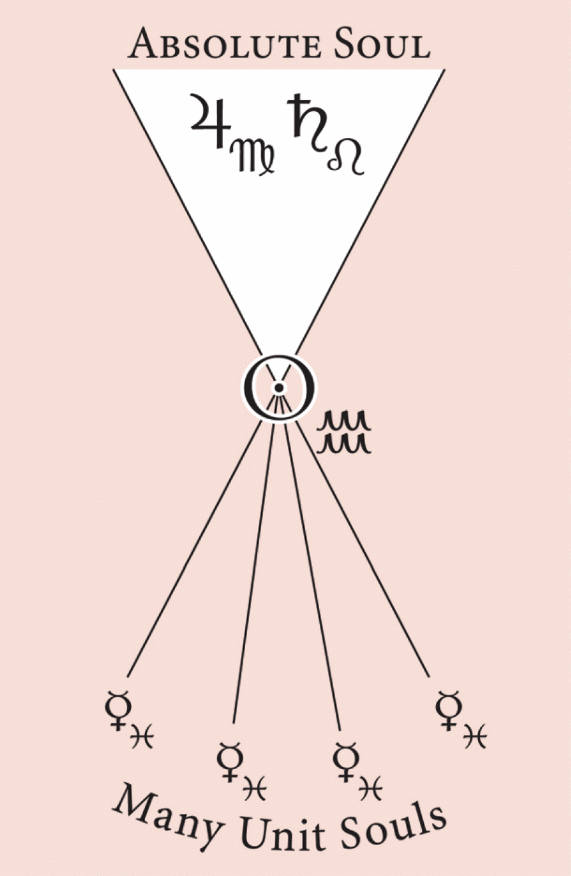
Class
Wednesday, June 8th, 1983
Verbatim, unedited transcriptClick the series name to view more
CLASS at Wisdom's Goldenrod, Hector, NY
with Anthony Damiani (AD)
June 8, 1983
PB PARAS; OVERSELF
TOPIC: PB Paras
SUBJECT: Overself
SUBSUBJECTS: Asmita, I AM, World-Idea, Ego, Philosopher, Void, Soul in the Nous, Idea of Man
CONTENTS:
"THE CAVE OF THE HEART" IS THE POINT IN CONSCIOUSNESS WHERE THE MIND PROJECTS ITS THOUGHTS
THE MYSTERIOUS RELATIONSHIP BETWEEN THE EGO AND THE OVERSELF
THE CREATIVE IDEA OF EACH PERSON IN THE WORLD-MIND CALLS TO BE REALIZED AND BROUGHT INTO MANIFESTATION
A SAGE IS ALWAYS AWARE OF THEIR IDENTITY WITH THE OVERSELF AND YET IS ALSO CONSCIOUS OF THEIR LIMITATIONS AS AN EGO
AN INDIVIDUAL RAY OF SUNLIGHT DOESN'T SAY "I'M THE SUN," BUT IT CAN SAY "GOD AM I"
THE PHILOSOPHER PERMANENTLY HAS A SIMULTANEOUS CONSCIOUSNESS OF THE PERSONAL EGO AND THE IMPERSONAL OVERSELF
THE PHILOSOPHER IS ESTABLISHED IN THAT I AM CONSCIOUSNESS WHICH DOES NOT EXPERIENCE MANIFESTATION
TO DISTINGUISH BETWEEN THE VOIDNESS OF THE SOUL IN THE NOUS AND THE VOIDNESS OF THE I AM IS QUITE A FEAT
THE WORLD-IDEA IN THE SOUL IS A MANIFESTATION OF THE INTELLECTUAL COSMOS, BUT IT'S NOT A SENSIBLE MANIFESTATION
THE GOD-LIKE IS IN EACH ONE OF US, AND IN EACH THE INFINITE BEING FINDS A UNIQUE WAY OF EXPRESSING ITS OWN INFINITUDE
THE EGO CAN BE LOST IN THE I AM, BUT THE I AM, WHICH IS ITS LINK TO GOD, THE UNDIFFERENTIATED CONSCIOUSNESS OF THE OVERSELF, REMAINS
IF YOU GRASP THE NATURE OF THE I AM, THE ASMITA PRINCIPLE, YOU WILL HAVE AN ARCHIMEDEAN POINT FROM WHICH TO UNDERSTAND ALL THE TRADITIONS OF PHILOSOPHY
BOOKS READ FROM OR REFERENCED:
Paul Brunton, Notebooks. 16 vols; Vol. 1 entitled Perspectives [Persp.], published 1984-1988. Some Paul Brunton Notebook paras are, as of 2018, unpublished, and are noted as such.
Haritayana, Swami Ramanananda Saraswathi (tr.), Tripura Rahasya
Plotinus, The Enneads (MacKenna translation, 4th ed.)
Bible, Exodus (3:13-14), King James Version
PLOTINUS QUOTES READ OR REFERENCED: VI.7.7
DIAGRAM appended to this transcript:
- FIGURE 1983 0608-1. Absolute Soul and Unit Souls.
This diagram is from Astronoesis, p. 185. It is not from this class but is used as a stand-in to help follow along. [Transcriber note: [diagram] means the speaker is referencing a diagram as he or she is speaking.]
NOTE: Unpublished PB paras should be sourced and proofread.
TRANSCRIBED Verbatim by IT 2019. Reformatted by JRM & JF 2019-2020, with Subheads and Table of Contents added by JRM. In 2023, IT fixes prefatory matter and footer, updates audio file name, fixes/completes Book List, adds Plotinus quotes section, adds new note within transcript, fixes minor errors/typos, adds a diagram and references within transcript to this diagram. In 2025, MW adds Subsubjects and alters Subheads to make more accurate. Archival verbatim transcript – V14.1a.
AUDIO FILES: 1983 0608a, 1983 0608b. [Note 1: "Tape" and "Side" refer to original audio cassette tapes that were later digitized into .MP3 Audio Files. Note 2: Both audio files originally had incredibly poor sound quality. In 2024, REP Studio improved the sound quality, but the transcript was done before this so certain words may be mistranscribed and student and AD comments that were marked as partially or completely inaudible may now be audible. All time markers are for the audio files used to transcribe.]
1983 06/08 at Wisdom's Goldenrod
PB Paras; Overself
Archival verbatim transcript
[Audio File 1983 0608a Begins]
PB [V14, 22:3.370, RC reading]: "[It is not possible for the timeless, spaceless, formless Overself] to be degraded into activity by its time-bound, space-tied, form-limited offspring the person."
S (very faint, possibly part of background): Imagine that.
RC: We read that one together.
S (very faint): Just read once more.
PB [V14, 22:3.222, RC reading]: "It is a consciousness where the"here" is universal and the "now" is everlasting."
[short pause]
S (very faint): Again.
PB [V14, 22:3.222, RC rereads]: "It is a consciousness where the"here" is universal and the "now" is everlasting."
[short pause]
S (very faint): But this is what I got.
S (very faint): This is what I got.
S: Yeah.
S (very faint): Are there actual questions?
S (very faint): [couple words inaudible]
RC: Very (suspenseful).
[students inaudible, 0:01:00.0-0:01:15.1]
[short pause]
DB: Person is different than--
S (very faint): (Mercury.) [Note: See FIGURE 1983 0608-1, Absolute Soul and Unit Souls, appended to this transcript. This diagram is from Astronoesis, p. 185.]
S: Mercury.
S: Right.
DB/S(?): Offspring here is something else.
[short pause]
S: Yeah.
S (very faint, possibly part of background): I'm sorry.
[26¼ second pause]
PB [V12, 18:4.94, RC reading]: "But before he can even attempt to surrender the underself, he must first begin to feel, however feebly and however intermittently, that there is an Overself and that it is living [there] deep within his own heart. Such a feeling, however, must arise spontaneously and cannot be manufactured by any effort of his own. It does not depend on his personal choice whether he experience [RC reads: experiences] it or not. It is therefore an unpredictable factor; he cannot know when it is likely to come to him. This indeed is what makes this [RC reads: the] quest so mysterious. For such a feeling is nothing else than a manifestation of grace. Hence an old Sanskrit text, the Tripura, says:"Of all requisites Divine Grace is the most important. He who has entirely surrendered to his larger self is sure to attain readily. This is the best method." Without the divine grace [(Faiz Ullah)], the Sufis say, man cannot attain spiritual union [with Him], but they add that this grace is not withheld from those who fervently yearn for it."
[22 second pause]
S: Just waiting for that [couple words inaudible]
PB [V12, 18:5.220, RC reading]: "We should not egotistically interfere with the working of grace when it comes [RC reads: when it does come] but should let ourselves be borne unresistingly and, as it were, helplessly [RC reads: helpless] upon its gentle current."
[21 second pause]
"THE CAVE OF THE HEART" IS THE POINT IN CONSCIOUSNESS WHERE THE MIND PROJECTS ITS THOUGHTS
PB [V14, 22:3.244, RC reading]: "The point in consciousness where the mind projects its thoughts has been called by the ancients"the cave" or "the cave of the heart." This is because to the outside observer there is nothing but darkness in it [and] therefore the cave hides whatever it may contain. When, by an inward re-orientation of attention, we trace thoughts, whether of external things or internal fancies, to their hidden origin and penetrate the dark shroud around it, we penetrate into Mind, the divine [RC reads: divine the] Overself. We cannot help remembering Gray's apposite lines: "Full many a gem of purest ray serene, [The] dark unfathomed caves of ocean bear.""
LR: Randy, the point where mind projects its thoughts or when it projects (them)?
PB [V14, 22:3.244, RC rereads a part of]: "The point in consciousness where the mind projects its thoughts…"
S: Linda--
LR (very faint): I gave you this chart.
RC: Why don't you just take them.
LR: Well at first [RG simultaneously: Well it suggests--] I thought it was where it's projected into, this wor-- you know, projects the world. The mind projects its thoughts where, you know, like Plato's cave analogy that we had. And-- and that's what it seemed like the first time but then it-- It doesn't say the point where mind--
RG: That's what it says.
S: Better?
S (very faint): [couple words inaudible]
S (very faint): Yeah.
LR: As it-- before, it was part of the same sentence here.
LR/S(?) (very faint): You say it would make sense [one/two words inaudible]
S (very faint): [few words inaudible]
BS (simultaneously, very faint): Where does it say that?
DB: Well--
LR: It says the point--
RC: But where does it say the two ways of looking at it? [short pause with faint background student talking] No I see what you mean but I don't think (every time he explained it to you).
S: First of all, the mind--
S: [one/two words inaudible]
PB [V14, 22:3.244, RG rereads a part of]: "[The] point in [RG reads: of] consciousness where the mind projects its thoughts has been called by the ancients…"the cave of the heart.""
RG: Now, Linda said you can understand it as the-- as sort of the space in which the mind projects its thoughts, you know, the space of it, the space of it as in Plato's (allegory). Or you could understand it as where the mind projects its thoughts (as a process).
LR: Because I think the idea [RG simultaneously: Yeah.] he's trying to get at was just-- it's just not very clear, you know?
RC: It was one-- one of the essays that we read a long time ago he described part of the universe(,) entering into this cave. Immediately he was driven back out of it [few words inaudible] The experience was just telling him [few words inaudible] it appears to be [three/few words inaudible]
VM: Because here there's a third interpretation which [one/two words inaudible] (maybe), we can just junk the others. When PB speaks about the seed-like thought-form which clearly is-- is what's rev-- relevant here, speaks-- says that there it first breaks into space-time, subtle form of space-time which is then amplified by the physiology into the sort of empirical space-time that we all experience. So somehow I feel he's more referring to that level of heart.
RG: I agree, that was the sentence too.
VM: Ok.
S (very faint): Randy could you read it (once more please)?
PB [V14, 22:3.244, RC rereads]: "[The] point in consciousness where the mind projects its thoughts has been called by the ancients"the cave" or "the cave of the heart." This is because to the outside observer there is nothing but darkness in it and therefore the cave hides whatever it may contain. When, by an inward re-orientation of attention, we trace thoughts, whether of external things or internal fancies, to their hidden origin and penetrate the dark shroud around it, we penetrate into Mind, the divine [RC reads: divine the] Overself. We cannot help remembering Gray's apposite lines: "Full many a gem of purest ray serene, The dark unfathomed caves of ocean bear.""
S (very faint): (Hope is natural.)
[9¾ second pause with bit of laughter]
DB: Well it's-- you know, I mean you project having this birth and it's definitely-- just think of it as not (big) [one word inaudible] I mean projection, whether [loud noises for a few seconds, inaudible] But it's [couple words inaudible]
S (very faint): See I agree but--
LR: Well yeah [couple words inaudible]
DB (simultaneously): The mind that projects thought.
RG (simultaneously): That's-- that's what I'm saying.
S (very faint): [couple words inaudible]
LR: I just finished it. I just was out here [few words inaudible]
[students mostly inaudible, 0:10:27.6-0:10:40.1]
S (very faint): Duke it out. (bit of laughter)
[9¾ second pause]
S (very faint): I wasn't (trying).
RG: No.
AD: Of course.
RG: Plato, the cave is the empirical, in this case the cave is the reality that's-- is the source of the permanent. And it's only called the cave 'cause since you're on the side of the appearance, that's on the side of reality or the source of it.
[10½ second pause]
S (very faint): Is this vague or--
S (very faint): [three/few words inaudible]
RC (very faint): We rea-- we read-- somebody's talked about it.
S (very faint whisper): [few words inaudible] (laughter)
RC: Elegy of a country church [one word inaudible]
S (very faint): You should do it, are you going to do it? (laughter)
RG: Good idea (Louis). (laughter)
S: Pretty [one/two words inaudible]
RC (very faint): [few words inaudible] (laughter)
S (laughing): Yeah.
[14¾ second pause]
THE MYSTERIOUS RELATIONSHIP BETWEEN THE EGO AND THE OVERSELF
PB [V14, 22:3.393, RC reading]: "When we say that the Overself is within [RC reads: in] the heart, it would be a great error to think that we mean it is limited to the heart. For the heart is also within it. This seeming paradox will yield to reflection and intuition. The mysterious relationship between the ego and the Overself has been expressed by Jesus in the following words:"The Father is in the Son, and the Son is in the Father.""
[17¾ second pause]
S: What do you think he means by ego (there/here)?
RC: Well, he doesn't mean [three words inaudible, possibly another student] because--
DB (very faint): I thought he just meant letting go of his ego (is) worthy [RC: Certain thoughts I believe.] of thoughts. One thought, then another (thought) [few words inaudible] try to understand it all [inaudible]
RC: Would you take the Father as the Mercury, Son as the evolving ego?
DB: Well, if-- well, I mean, if in some sense the ego doesn't-- isn't perpetually brought to life--
[students mostly inaudible, 0:14:5.8-0:14:26.1]
RG: Question of whether it's in relation [inaudible] its relationship to-- to its source as consciousness.
DB: Well, if the Overself-- if the ego was (something) Overself can be within, if (one is this) side of that, then in some sense I don't see why you're (given) (a/up) assumption that the ego [few words inaudible]
RG: I don't, I mean, I don't think it's-- it's solid but to talk about that the ego has to be (that type) of being (where) it is within the Overself, on this-- in this context.
DB: Why do I--
RG: Can you think of anything in this context that isn't within the Overself?
DB: I don't-- I don't have any problem with something being inside the Overself, it's the other way around and I don't care. I was trying to say the Overself is within something that's inauthentic. That's my problem.
S: Say that the [one word inaudible] in the heart means the heart that--
S (very faint): [few words inaudible]
S: Maybe that's this [few words inaudible]
DB (very faint): Even so like somebody that's been (had).
AD (very faint): Keep going [three/few words inaudible]
PC: How about that Mercury's awareness is [couple words inaudible]
AD/S (very faint): That's right now [few words inaudible]
S (very faint): I'm still thinking about it.
PC: (That/The) Mercury's awareness is immanent in the thought structures that constitute the ego. In that sense the Overself is [one/two words inaudible]
DB (very faint): Can you read it once more please?
PB [V14, 22:3.393, RC rereads]: "When we say that the Overself is within the heart, it would be a great error to think that we mean it is limited to the heart. For the heart is also within it. This seeming paradox will yield to reflection and intuition. The mysterious relationship between the ego and the Overself has been expressed by Jesus in the following words:"The Father is in the Son, and the Son is in the Father.""
DB: (Thought/Son) he was talking about being-- (entering) the New Testament (emphasizes) the Christ. Ok that's not a thought of God. I mean Father there is (provided/divided) by the Son there.
LD: Ok why-- why it's not David's interpretation (lower) level? The Saturn Jupiter [diagram] or the universal consciousness is within the asmita principle and likewise the asmita principle is within universal consciousness [couple words inaudible] [Note: See FIGURE 1983 0608-1, Absolute Soul and Unit Souls, appended to this transcript.]
JC: 'Cause the analogy of the heart wouldn't apply.
S (very faint): [couple words inaudible]
LD: Say why.
JC: Because you wouldn't call it heart, heart.
LD/S(?): You what?
JC: There are [S simultaneously: Uh-hm.] two principles, each--
S (very faint): [couple words inaudible]
LD (simultaneously): To a certain extent we were speaking symbolically. He's not talking about a physical heart here.
S (simultaneously): Right, (he is).
S: How do you know?
RC: We reversed feeling.
AH: Well the heart that's in the world and the world that's in the heart (would be) ultimately (mystic) world that's in the heart, but that would be a spiritual world. And it's also possible to speak of a physical (heart) [one/two words inaudible] from the quotes. [one word inaudible]
S: The spiritual heart center is verification of that central channel or [few words inaudible]
RC: Yeah but I think Jeff's right that in a reference to say that it's within the heart is specifically he's saying this is where the body first [couple words inaudible] first awakening, the recognition there is an Idea.
AH: But again, there is a freedom in the asmita to help adjust [couple words inaudible]
RC: Exactly.
LD: Well when he's speaking about the Father is in the Son, the Son there, like David said he's speaking about the Christ which is the principle of the ego, the principle behind man itself. He's not talking about--
S: No problem.
S: Yeah but-- so Louis--
RG (simultaneously): But we're not interpreting the New Testament, we're interpreting PB. [LD simultaneously: I (three words inaudible) the soul here.] No, but whether to do the-- But he's using this quote as an illustration. And I don't think it's fair to take your understanding of the New Testament you're using to understand the quote, what the quote's on. It's only meant as a-- as an example of what he's trying to say in the first part, [LD: Yeah.] which does seem to be more-- I mean I could see it your way if you just interpret the quote. But it does seem he wouldn't use the ego per se if he was talking about the relation of the Overself to-- to the Witness-I, he would much rather use the Witness-I and pure Overself [one/two words inaudible] ego and Overself, which essentially (his whole text).
S: What about [one/two words inaudible]
VM (simultaneously): Seems that PB's talking about (it) [one word inaudible] in the heart.
RG (very faint): Right.
PD: First part is the heart in relation to the Overself which is unembodied. That seems like the new-- it's to the pure universal consciousness.
RG: And I don't think so. The Overself is living in the heart, he didn't say [one/two words inaudible]
PD (simultaneously): That aspect of the Overself, just like we say the asmita phase of the soul, the I-- that I AM-ness is the individual aspect.
RG: Is within the heart.
PD: That's right, that's the heart (of it). The part that has no relation to the heart is the universal aspect or the Saturn Jupiter aspect.
RG: But he's not talking about that at all in the quote.
PD: That was the very first part, the whole [couple inaudible student words simultaneous with PD] locus in the heart and not located in the heart.
S: Not limited.
RG/S(?): I'm confused.
LD (simultaneously): How could you-- how could you put the Father in the heart? I mean-- I mean we have to interpret this, whether you like it or not he's using the New Testament, and--
AB (simultaneously): The Overself is the Father and the ego--
LD: You know, shrug your shoulders but that doesn't mean that--
RG (simultaneously): The Overself can be the Father and the ego could be the Son, now you could interpret it any level you want. That analogy runs throughout metaphysics and I don't see why you--
LD (simultaneously): So why don't you so adequately say it's your interpretation [couple words inaudible]
RG (simultaneously): I do. I said I could-- I didn't-- I said I could see both from the first part of the quote. I won't argue with--
LD: I do. (laughter)
RG(?) (amidst laughter): I wasn't arguing with you, you [one/two words inaudible]
VM: I don't know what Louie's talking about.
AH: Could you read it again please?
PB [V14, 22:3.393, RC rereads]: "When we say that the Overself is within the heart, it would be a great error to think that we mean it is limited to the heart. For the heart is also within it. This seeming paradox will yield to reflection and intuition. The mysterious relationship between the ego and the Overself has been expressed by Jesus in the following words:"The Father is in the Son, and the Son is in the Father.""
AB: Ok I think the key argument you could make to support the (low-- your individual) or he says the mysterious relationship between the ego and the Overself, that would seem to preclude a higher interpretation [three words inaudible]
BS (very faint): Are we calling the ego the asmita right now (or) the quality of the asmita the highest [couple words inaudible]
AB: Well then you could-- then you could argue it.
BS: I don't know, I--
RG: There are times when we have talked about the ego as [S, very faint: (And when I speak to you.)] principle of ego.
S: But I think--
RG (very faint): It's going to be the last time.
RC: Do you think that there would be (that hunger), do you think there would be like, say, if you really dig qualitatively for this (asmita) anywhere, you would be-- there's actually living in accordance with the guidance that say would come through your heart, you think there would be a really big qualitative difference between that and what we'd call the soul?
[short pause]
DB (very faint): [inaudible] just doesn't add up (for/to) me. You have two percent, whatever-- I mean, that's-- that's the only basis for distinction between that. That's why I understand-- understand [one/two words inaudible] I mean we've spoken-- there's that other quote which talks about the divine [few words inaudible] never descends and so forth and then there's this demi-divine being which is [few words inaudible] Now if that's what's you mean to say, ok. But then that sounds like (the first).
RG: Yeah that's not PB's [one/two words inaudible] Demi-divine one is the one he means here by the Overself and then you just said the Overself doesn't mean the Intellectual-Principle. This one obviously does have a relationship to a higher.
DB (very faint): Yeah but even if that's not meaningful [three/few words inaudible] takes place-- is taking place within.
S (very faint): No. I don't think so.
PD: That-- [few inaudible student words simultaneous with PD] that part of the Overself presides, the I AM presides over manifestation. I conceive of that the Sage will take that as his ego. So like PB speaks of this analogy of Son to the Father because it's the level of identification he's coming from. There is no longer that personal ego at all to speak of as-- as the "I" here.
S: What's the heart?
PD: The heart is the personal ego in, say, the Sage's case.
AB/S(?): Which is the "I".
PD: Which is the I AM-ness. There's nothing other. And that in relation to that consciousness that the universal--
S: So you think that his focus is on the (intuition here).
PD: Yeah.
S: Uh-hm.
VM (simultaneously): I think he started with a very simple experience that he's-- makes reference to, there's a lot of different places where the first sort of feeling relationship one gets to the presence of the Overself is felt in the heart and there's times Ramana went so far as to say it's two fingers to the right of the breastbone and all that business. Paul I grant you that asmita and the Overself as universal is a general interpretation but somehow I don't feel it's the spirit of where this quote is coming from.
RC/S(?): Ok.
S: This other thing too.
RC: The recognition that it's not defined [couple words inaudible] is your personality. It's a recognition that takes place within the Mercury (principle, where the--) where the individual consciousness [short pause] sees itself as greater than the physical body, that all that appears appears within the (mind/body) itself.
LR: I think one of the problems is we mistakenly think of it-- he said in these quotes that [few words inaudible] You know? Do you know what I mean, there's [RC simultaneously: Yeah.] grey-- I don't think there's-- I don't think it's like on or off, [few inaudible student words simultaneous with LR] these awarenesses of the-- (bit of laughter)
S: [couple words inaudible]
RC/S(?) (very faint): [one/two words inaudible]
LD: Oh yeah.
LR: And I think a lot of-- there's a lot of arguments about these quotes that are like that. [student assents] The actual issue does not demand a black or white situation, there's-- there's shades of you being aware of the Overself which you don't actually happen to have some of the names for it. But, they should-- they should be kept experimental.
LDS: Especial--
LH (simultaneously): Well, is there an objection to find the analogy [couple words inaudible] or is it just here or--
S (very faint): I--
S (very faint): Yeah.
S: Well I--
S (simultaneously, very faint): I see more of like the [few words inaudible]
PD (simultaneously): Well-- I object completely to Son as the personal ego from what little bit I understand of the New Testament. So that's why I cannot take that level of reference [few words inaudible]
S: That's exactly how he classes it and he said it's structured within [couple words inaudible]
BS: Well then--
PD: That's why I interpret it the way I did.
BS: But then Randy [few words inaudible] It would take only the principle of individuality to (discourage) your thoughts (and feeling)(./?) Since the Overself is not limited only to the-- to the heart, you're taking that to be ego as my individuality.
RC: I don't know, because I get confused [one/two words inaudible]
BS (simultaneously): What universal means.
RC: It might be mental or the spiritual heart center. Like there's two--
BS: (Oh/Ok) the heart center.
RC: Even within the standard occult schemas they talk of the heart in two different ways.
S (very faint): What's the heart?
VM (simultaneously): Read it, read it.
S: Would you read it again?
VM (simultaneously): Guenon has got three levels of the heart so we need the other third interpretation (student laughs) to cover them all.
S: Well, let's hear those two.
BS: Three is necessary.
JC: It's the incarnating ego which comes (to those), it's within the Undivided Mind which is [one word inaudible] the ego and that's the psychic bubble in the heart. And that-- that identification with the Undivided Mind which is a individuality that persists from life to life is within the asmita principle which it is the real identity behind the whole operation.
BS: That asmita seems it participates in the [one word inaudible] accordingly.
JC: It's the basis of the identity.
RC: It seems like sometimes Ramana would talk about the heart center as different from the visible heart. And he would say the first [one word inaudible] that so if you want to do all seven, (pull) it up to the head with your thought and not [one word inaudible]
S (very faint): [couple words inaudible]
S (very faint): Yeah.
S (very faint): They're (not/like) clues.
VM: I don't know, there's a footnote in Guenon but I-- I don't think it's appropriate to get spun off. Again it's good that we have at least two interpretations.
RG: Get the right one. Anthony? (laughter)
VM: You have too digital a mind [couple words inaudible]
RG (simultaneously): Anthony, what's the right one?
S: What's it(--/?)
AD: We start with (his/this) the ego is the Son? He says [one word inaudible]
VM: (Boy/Oh), so much for that analogy. (bit of laughter)
S: This is just--
S: Uh-hm.
S: Yeah.
S: Sure.
AD: It's in a subtle way.
VM: It's a prodigal son maybe.
RC: That-- that often quoted statement about "None comes to the Father except through me", interpret it this way seems to be saying it's only through the experiences the ego takes upon it that you will come into awareness of the Mercury.
S: So is that--
BS: If the ego principles always die then we die, body dies. And that's the vehicle to the Father?
RC: Well so far when we did the ego quotes we didn't speak of it as just the one life but we spoke of it as increasing the volume of--
S: But we spoke of the ego dying in life.
LD: Yeah but we also spoke of just that crystallization of certain-- you know, what they used to-- like Saint Paul [one word inaudible] passed through a part of this, and only a certain crystallization dies each lifetime but the heart holds the whole three levels of the ego PB made out [couple/three words inaudible] So that in its totality dies [couple words inaudible] 'cause there is some continuity from lifetime to lifetime. So if that whole thing dies then you (should've maintained) [couple words inaudible]
BS/S(?) (very faint): (Right, right), yeah. Yeah I'm still [one word inaudible]
DB: Excuse me, so Jeff is it that the soul [few words inaudible] and ego then is reflection of Dragon [few words inaudible]
AD: (There's/Your) soul divisible about bodies and is that (body now).
DB: So then that is what is-- is that soul is the (World-Mind's) in.
AD: No, that is the ego. Don't you be afraid of it. You said it the first time.
DB/S(?): I heard him.
[AD and students mostly inaudible, 0:31:44.3-0:33:01.9]
LD: What you just said also--
AD: I won't lie to you [one word inaudible]
[AD and AH mostly inaudible, 0:33:10.3-0:34:21.2]
AD: Yeah go ahead. I could explain that. Slowly.
THE CREATIVE IDEA OF EACH PERSON IN THE WORLD-MIND CALLS TO BE REALIZED AND BROUGHT INTO MANIFESTATION
PB [V16, 26:4.63 & Persp., Ch. 26 #50, RC reading]: "The ideas in a man's mind are hidden and secret until [RC reads: till] he expresses them through [RC reads: in] actions, or as speech, or as the visible creations and productions of his hands, or in behaviour generally. Those ideas are neither lost nor destroyed. They are a permanent part of the man's memory [and] character and consciousness and subconsciousness, where they have been recorded [as] automatically [and as] durably as a master phonograph disc records music. Just as a wax copy may be burnt but the music will still live on in the master disc, so the cosmos may be annihilated or disintegrate completely but the creative idea of it will still live on in the World-Mind. More, in the same way a man's body may die and disintegrate, but the creative idea of him will still remain in the World-Mind as his Soul. It will not die. It's [RC reads: It is] his real Self, his perfect Self. It is the true Idea of him which is forever calling to be realized. It is the unmanifest image of God in which man is made and which he has yet to bring into manifestation in his everyday consciousness."
[short pause]
S (very faint): [one/two words inaudible]
[11¼ second pause]
PB [V16, 26:4.63 & Persp., Ch. 26 #50, RC rereads]: "The ideas in a man's mind are hidden and secret until [RC reads: till] he expresses them through actions, or as speech, or as the visible creations and productions of his hands, or in behaviour generally. Those ideas are neither lost nor destroyed. They are a permanent part of the man's memory and character and consciousness and subconsciousness, where they have been recorded as automatically and [as] durably as a master phonograph disc records music. Just as a wax copy may be burnt but the music will still live on in the master disc, so the cosmos may be annihilated or disintegrate completely but the creative idea of it will still live on in the World-Mind. More, in the same way a man's body may die and disintegrate, but the creative idea of him will still remain in the World-Mind as his Soul. It will not die. It's [RC reads: It is] his real Self, his perfect Self. It is the true Idea of him which is forever calling to be realized. It is the unmanifest image of God in which man is made [and] which he has yet to bring into manifestation in his everyday consciousness."
[45 second pause]
RC: Where would you put that under in terms of the schematization?
[short pause]
LR: He's just talking to these as individual (awarenesses). Seems that he's speaking at the I AM, each unique particular, not the Overself being [couple words inaudible] Seems like he's speaking about each-- each man as having his own Overself [few words inaudible] You read this [one/two words inaudible] individual Overself.
S: Especially the part (without it) 'cause their body's [couple words inaudible] The ideas expressed in that [few words inaudible]
S (very faint): Right.
S: [couple words inaudible] body and asmita.
AD (very faint): [inaudible]
[10½ second pause]
LR: Does-- did he put (down--) [short pause] did he put each life is the [one word inaudible] to your [few words inaudible] Or do you think that each life represents the revelation, the functioning?
S (very faint): [couple/three words inaudible]
LR: Is it an Idea which (you need to go) part by part or is it that each life can actually reveal qualitatively more of it?
RC: I think that given that we speak [one/two words inaudible] given that we speak of it as-- as soul, as derived from this Intellectual-Principle, that the perpetuity [few words inaudible] is such a characteristic. Or these two states that we speak of (is nice). [10 second pause] And on the one hand there is the-- if the person is living, there is the sense of wholeness about the Idea having all this present. And, yet at the same time [few words inaudible] the individual's life is just a part of it, on the one hand expresses a certain possibility.
S (very faint): Possibility.
S: Yeah, temporal in nature. The [one word inaudible] is present to the-- the soul is present. Each of those lives the whole of (your/the) soul is present, only the Idea is present to each life. [couple words inaudible]
LR: I'm not-- I think maybe exactly the first (if you get this), I mean, the soul, the whole soul must be present in order to call it the soul. [one word inaudible] speaks specifically about-- Last week we made this distinction between the consciousness and the Logos, both of which confers the Idea of you. The Logos was the Idea given to the consciousness that was to remain passive. (And) some people might say that that Idea oversees a whole series of life. Lifetimes. And each lifetime is a partial expression of that, expressing one facet. And other people might say, no, actually the Idea in its entirety is being expressed through partial forms. [RC simultaneously: Someone like Blake (one/two words inaudible)] So that would be-- I--
RC: I would think someone like Blake who had had a-- an experience of a-- in second. You know, he'd actually been talking in terms of seeing (the/that) whole world as having some [inaudible] But then if you look at the grain of sand as a grain of sand it's not-- it's not--
LR: I guess the question then becomes is the partiality of the manifestation due to the partial [one word inaudible] or due to an actual-- is it actually part of the Idea that's being (manifest). I don't know if this is [one/two words inaudible] is it-- is it--
AD (very faint): That's alright.
LR: You think it is--
S (simultaneously, very faint): [one/two words inaudible]
AD (very faint): Well I'd like to answer a different way because--
[short pause]
LR: I don't know. I guess I didn't understand because I got to ask (it).
AD (very faint): [inaudible]
[Transcriber note: This seems like an appropriate place to insert the following sentences from June Fritchman's class notes to stand in for the portion of AD that is inaudible here.]
AD: ["One point of view: won't be a complete manifestation of the Idea of Man, even in a Sage -- because no finality to the manifestation of the Asmita principle. The other point of view: the Sage is the embodiment of the Idea of Man in a given time."] It's the same thing. [inaudible] Now both these things happen [couple words inaudible] together. You can fall on either side, (falling into the function), the thing.
[short pause]
S: Second?
RG: The last two sentences of the quote--
PB [V16, 26:4.63 & Persp., Ch. 26 #50, RG rereads a part of]: "It is the true Idea of him which is forever calling to be realized. It is the unmanifest image of God in which man is made and which he has yet to bring into manifestation in his everyday consciousness."
RG: And that-- doesn't that seem to imply that there is a-- a point of realization at which that does happen, there is that alignment with the Idea even if the higher realm of manifestation never gets manifested.
AD: What's it mean then?
RG: Right but qualitatively there is an alignment with the Idea so that you can speak of [couple words inaudible] realize to whatever extent a human could realize it and work on it.
AD: What's he mean here though? Also, that there's nobody (else) [RG: Yeah.] in this process. [RG: Right.] But then you have to take both points of view together. [student assents] [inaudible] If it was possible to fully manifest the Idea, there would be finality to this manifestation [few words inaudible]
S (very faint): Well--
LD (very faint): Correct me if I'm (wrong).
S (very faint): Well--
LR: See to fully manifest the Idea does not make him [one/two words inaudible] For instance--
AD: Well then what does manifest mean?
LR: Actualize? [9¼ second pause] For instance, if a man is-- you know, is-- is trying to express an idea (that's-- you) try to be-- so this part about-- as that Logos within him, obviously you can only iden--
(Side 1 of original cassette tape digitized as 1983 0608a Ends; Side 2 Begins)
LR: I'm sorry.
AD (very faint): (Make your) language simpler.
LR: What does the "they" refer to?
AD: (Total) of aspects of asmita. If you have a melody you need a certain number of notes to manifest the melody in its completeness. On the other hand, alright, each note does in a way manifest completely only the melody, otherwise you'd never have a melody.
LR: You would say each note manifests the whole melody.
AD: Yes, present in the note, alright, is the whole. Just like implicit in any of the particular mathematics is the whole of mathematics.
[15¾ second pause]
PB [V16, 25:2.156, RC reading]: "He who has reached this degree…"
[students inaudible, 0:48:24.6-0:48:35.0]
S (very faint): Yeah but consciousness--
RC: Well I think this-- this quote is actually (right directly) to that. It's--
PB [V16, 25:2.156, RC reading]: "He who has reached this degree will be always poised in the Overself, always aware of his identity with its inimitable nature yet also conscious of his limitations as an ego. This may seem queer and contradictory yet the man will never feel himself pulled in different directions but, on the contrary, will feel a perfect harmony between the human and the divine."
[short pause]
PB [V16, 25:2.156, RC rereads]: "He who has reached this degree will be always poised in the Overself, always aware of his identity with its inimitable nature yet also conscious of his limitations as an ego. This may seem queer and contradictory yet the man will never feel himself pulled in different directions but, on the contrary, will feel a perfect harmony between the human and the divine."
[24 second pause]
RC: Does that help sir or [few words inaudible]
S (very faint): Well, I mean, (better) understand you, the-- the memory that's-- that's retained in the memory of-- of-- I'm not sure that that's soul. And he makes the analogy to this [couple words inaudible] Wouldn't they say so? And--
RC: Yeah.
S (very faint): Qualitative.
RC: Yeah. But we've been talking basically about the ego as a-- as a manifestation of, an aspect of World-Idea.
S: For a while (we've) said that.
RC: And he's saying that-- that even if the cosmos is annihilated or disintegrates completely, the creative idea of it will still go on in the World-Mind. Same way a man's body may die or disintegrate but the creative Idea of him will still remain in the World-Mind as his soul. And-- [9½ second pause] Seems to be saying that the very way in which your soul is going to unfold the World-Idea in a particular way as your ego stream is permanent [one/two words inaudible] the World-Idea.
[short pause]
S: That's very true.
JB: It takes-- takes away (Buddhahood). [S: Let's put him in--] The quote starts with man's behavior, what he says, what he does, what he thinks, what he feels. But then if he dies the Idea of him remains just as it always was, which totally takes away whatever might come, in a way, I mean [one/two words inaudible]
RC (simultaneously): No. I (hear) it's doing all those the essence [couple words inaudible]
JB: But if your figures who are doing it is kind of conceptually linked--
RC: Conception of the Buddha, I mean very-- it's excruciating. And everything that you call you isn't doing that. My (idol/I).
JB: I was trying to interpret Sera's question, I had the same question because the parallel seems to fall away. There is the appearance of making-- claiming that continuity without your actual behavior even saying-- doing all of that, which (holds/pulls) immediately to the persistence of the Idea. Then the identity between what you do and the Idea of you which prefigures you and lasts after you is the problem that I'm having. If the Idea of-- that you are manifest to (project, engage) and do both precedes and follows all your actions in the same way irrespective of your actions or annihilation, the change that has taken place in the permanence that is a wedge to the you-ness of it and it's changed somehow, it's [couple words inaudible] I don't even-- I don't get it.
BS (very faint): [few words inaudible]
JB: That really-- yeah well [couple inaudible BS words simultaneous with JB] the presumed identity between the actual living Idea of you which I [one word inaudible] object.
BS: [few words inaudible] there may be some-- well now you got some new word. Would there be some-- would there be some (adjust) or effect-cause but not within? It's hard to say, not within the Idea itself but just Being?
JB: I agree with you, I'm looking for what effect your actions have upon permanence, which is exactly what seems to be raised in the quote and then is dropped. See now it seems to be relevant.
S (very faint): [couple words inaudible]
BS: I don't understand the negative actions. If it had an effect, the [JB simultaneously: (The break.)] permanence might be a guide to your actions.
AD: Start over. Start again.
RC: Read the whole thing again?
AD (very faint): Just read us the first part please.
S (very faint): Just about-- yeah.
PB [V16, 26:4.63 & Persp., Ch. 26 #50, RC rereads]: "The ideas in a man's mind are hidden and [RC reads: or] secret until he expresses them through actions, or as speech, or as the visible creations and productions of his hands, or in behaviour generally. Those ideas are neither lost nor destroyed. They are a permanent part of the man's memory and character and consciousness and subconsciousness, where they have been recorded as automatically and [as] durably as a master phonograph disc records music. Just as a wax copy may be burnt but the music will still live on in the master disc, so the cosmos may be annihilated or disintegrate completely but the creative idea of it will still live on in the World-Mind. [More], in the same way a man's body may die and disintegrate, but the creative idea of him will still remain in the World-Mind as his Soul. It will not die. It's [RC reads: It is] his real Self, his perfect Self. It is the true Idea of him which is forever calling to be realized. It is the unmanifest image of God in which man is made and which he has yet to bring into manifestation in his everyday consciousness."
VM: Can we bring this down to earth a little bit by saying that this creative Idea can be understood as that particular configuration of the 360 archetypal degrees? But that's-- it's a partial expression of the individual. And if the entire sublunary and perhaps even planetary spheres are disintegrated, still those-- that particular configuration of Ideas in the inerratic remains. And it is that-- those creative forces which eventually, let's say, seek manifestation or give rise to your actions, behaviors, thoughts, feelings and so on.
RC: I'm not sure I really understand [few words inaudible]
LR: She was (asking/asked)--
S (very faint): Said it's hard to [inaudible]
RC: Anthony spoke of it as being very [one word inaudible] stuck in the individuality, as being a creative Idea not as [few words inaudible]
LR: But, it is also spoken of as the reason-principle given to each individual soul, which seems to say the ego or somebody. But soul is an internal principle. And each soul is-- as you said has a unique vision of the Nous. That unique vision is the Logos or Thought of God which is embedded-- embedded in each soul.
S: Which distinguishes one soul from another.
LR: Which distinguishes one soul from another or marks it its own individual [one word inaudible] And, I think creative parts is to be the way in which that's appearing, the way in which that's actualized. I would say that.
JA (very faint): I thought that [inaudible]
LR: You don't think the action of man is (clear enough)?
JA: It's got the creative Idea.
RC (simultaneously): Seems the crea--
S (simultaneously with JA): But the crea--
JA (very faint): Yeah I do [few words inaudible]
RC: He says it's hidden and secret [one word inaudible]
S: Not as being wise but--
RG: Yeah but I think there are two levels of the first. The first part's dealing with a temporal evolution of, you know, the recording of the-- of various lives and the second part dealing with the idea of everything [one word inaudible] is the basis for that.
[11 second pause]
RC: Now does it make sense to relate those two then? If we had the VI-- VI.7.4 or VI.4.7 somehow. Which was the one about there being a tentative illumination that the individual elaborates or brings it out? [Note: See Plotinus, VI.7.7, third para.]
S (very faint): [three/few words inaudible]
RC: Last one would make sense. If we think of [short pause] that creative Idea as being a-- what it should it be or cast from the actual(--) given that the life has been evolving but that it is the very essence of that particular (evolving). So it's an evolving particular Idea.
LR: Wouldn't you say that's a creative Idea?
RC: I would, yeah. Creative in the sense of being true. Anything that we know of is a development of that [one word inaudible] body [couple words inaudible] everything we studied in mentalism.
[17¾ second pause]
RG: What he calls the creative Idea in this quote [inaudible]
RC (very faint): But there was one quote we read last week that was very good.
RG: Right but--
S: I (will get--)
LR: Oh I wouldn't limit the-- the idea of potential creativity to the soul. Soul will use those Ideas (or Beings).
S (very faint): [three/few words inaudible] part.
RC: Yeah I wouldn't take perfect that way, like in a sense of like it being the goal or the drive of (totality). I would take-- in this context I would take perfect much more in the sense of a-- a completion of this harmony between the human and the divine. And, perfect used to mean Being [one word inaudible] [short pause] You're not like something that comes at the end of a time-series [couple words inaudible]
S (very faint): [few words inaudible]
RC: Yeah.
RG: But then it couldn't be in time because as we just discussed everything is always done (in time). (Yeah but) perfect can't be.
S: From the point of view of the ego. But the Idea is whole.
RG: Right. But he says it is his true Idea, capital I, and I don't know see how that could be spoken of as temporal, as evolving.
S (very faint): The Idea (is perfect)?
RG: Oh yeah, definitely, (yeah/it is).
[students inaudible, 1:02:25.3-1:02:39.2]
S: That's just representing(,) my egos will always seem to be striving.
BS: So you take [couple words inaudible] the Idea of Man is possible with the ego? [S, very faint: Yeah.] Dynamic as a creative man is-- and that Idea isn't, it seems to exist simultaneously with a temporality [couple/three words inaudible] its manifestation.
RC: I think definitely retain the dynamism and say (they/that) try to evaluate the (purpose) in terms of the-- the qualitative nature of the-- the consciousness of the individual person against it [couple words inaudible] [short pause] I just [couple inaudible student words simultaneous with RC] can't see soul stopping.
AD: I'm sorry?
RC: I just can't stoul-- soul stopping, you know. It seems the very nature of soul is this ongoing light of manifesting the contents of the Nous in a way that's appropriate for soul.
BS: As appropriate to soul for example would be the manifestation of the Idea of Man and the substance being soul which is the-- the very-- the existence-unity of Nous.
[short pause]
RC: Say it-- would you say it in a few more words?
BS (very faint): [few words inaudible]
[short pause]
RC: I got-- when they speak of a perfect man I-- I just don't see a statue of marble, I see the individual person that's living moving and in perfect harmony with the truth of his own being. And the perfection being that harmony rather than some fixed standard.
JB (faint): Being harmonious within limitation, the extent to which the Idea can be manifest limited by [one/two words inaudible] within him as an ego.
RC: In one sense. I mean insofar as you're like looking (to) these actions from moment to moment, none of them are complete. But on the other hand, the presence that pervades all of those actions is not incomplete.
RG: Well, I think they do talk about three ideas in this quote. And I think there's an ascendancy to the level of Idea that he's trying to bring us through the quote. It's not to be interpreted on a horizontal level necessarily. There are-- he starts-- I mean the ideas-- in the first quote an idea is a small "i". The ideas in a man's mind are hidden and secret and those are not lost or destroyed, so there's a certain perm-- kind of permanency to those kind of ideas. And then he gives the example--
PB [V16, 26:4.63 & Persp., Ch. 26 #50, RG rereads a part of]: "Just as a wax copy may be burnt but the music will still live on [in the master disc], so the cosmos may be annihilated [or disintegrate] completely but the creative idea of it will still live on in the World-Mind."
RG: So the World-Idea also lives on whether-- whether the manifestation appears or not.
PB [V16, 26:4.63 & Persp., Ch. 26 #50, RG rereads a part of]: "More, in the same way a man's body may die and disintegrate, but the creative idea of him will still remain in the World-Mind as his Soul. It will not die. It's his real Self, his perfect Self. It is the true Idea of him which is forever calling to be realized. It is the unmanifest image of God in which man is made and which he has yet to bring into manifestation in his everyday consciousness."
BS (very faint): I thought Sera's question was, I mean, out of the first part, out of the-- just the first part [few words inaudible]
RG: It doesn't.
BS (simultaneously, very faint): [couple/few words inaudible]
RG: And the quote doesn't talk to that problem, see, and that's a question but I don't think the quote would ever talk--
RC (very faint): I think it's just [few words inaudible] I don't know what ideas are in the mind's (eye directly) [one word inaudible]
S (simultaneously): It's best--
S (very faint): Keeping it visual(s) to that, otherwise [AD simultaneously: There is--] [couple words inaudible] the ideas here are, as far as that, let's say the creative--
AD (very faint): [couple words inaudible]
S: It is nice.
AD (very faint): Oh no. Many people say [inaudible] Yet that actualization or manifestation is evolving [inaudible, 1:07:49.8-1:08:53.0]
[students and AD mostly inaudible until 1:13:48.5]
S (very faint): Never mind.
JB: That's not the planets? Idea isn't enough to fill that gap. That's the last sentence.
S: Yeah that's exactly.
RC: Insofar as I'm quoting I never [couple words inaudible]
JB: It's not a Witness kind.
S (very faint): Reread.
S (very faint): I thought so.
S (very faint): Uh-hm.
RC: Ok.
PB [V16, 26:4.63 & Persp., Ch. 26 #50, RC rereads a part of]: "It is the unmanifest image of God in which man is made and which he has yet to bring into manifestation in his everyday consciousness."
JB (very faint): Every man, every way is potentially [few words inaudible]
RC: I think so, uh-- There are some quotes that-- I don't have them here today but there are some quotes where PB's talking about the World-Idea where he says, "I know so (visually) little of World-Idea." And yet, comparing it to how like even less other people know it seemed to be able to [one/two words inaudible] But he was like constantly, I mean, always very [one/two words inaudible] [short pause] But qualitatively, the consciousness in which he was learning is what I would think of as being the perfected (experience). Wasn't anxious about [couple/three words inaudible] State of the mind was in a state of equilibrium that made is possible that it could go on discovering more and more of it day by day.
S (very faint): [few words inaudible]
PB [V16, 26:4.63 & Persp., Ch. 26 #50, RC rereads a part of]: "It is the unmanifest image of God in which man is made and which he has yet to bring into manifestation in his everyday consciousness."
S: Randy, is that in this-- the-- the World-Idea or is it the Logos of your souls?
RC: I think that particular, yes.
S: It's the creative Idea of the individual.
S: So that maybe the Sage would be aware of (what was) going on in his own soul (but--) so it wasn't aware of the World-Idea [one/two words inaudible]
AD (very faint): Say it again but without the sloppiness.
[9 second pause]
RC: Says not the physical one.
[short pause]
S (very faint): Read it. Read the sentence.
AD (very faint): It is a spark [few words inaudible] [short pause] Did you read a different-- next quote, then I'm good after
A SAGE IS ALWAYS AWARE OF THEIR IDENTITY WITH THE OVERSELF AND YET IS ALSO CONSCIOUS OF THEIR LIMITATIONS AS AN EGO
PB [V16, 25:2.156, RC rereads]: "He who has…"
RC (very faint): Start later with this [one word inaudible]
PB [V16, 25:2.156, RC rereads]: "He who has reached this degree will be always [RC reads: always be] poised in the Overself, always aware of his identity with its inimitable nature yet also conscious of his limitations as an ego. This may seem queer and contradictory yet the man will never feel himself pulled in different directions but, on the contrary, will feel a perfect harmony between the human and the divine."
JB: Isn't this inimitable nature very strange, very-- it's in his ego. So it's there.
RC: It seems to be that the inward awareness of that inimitable state that makes it so obvious what the limitations of the ego are, and some mystics don't care to even recognize those limitations. I would think their failure to recognize them would be part of what would disqualify them from being called [one/two words inaudible]
JB: So the contradiction is thinking that if you see it they cometh. That-- that's a problem.
AD (very faint): Wouldn't the contradiction be that if you recognize your being as this boundless (life) consciousness, then at the same time, well, there's an (ego that's in/ego's) manifestation too. (It's limited.) It's a-- That's the wrong (job).
S: Yeah.
JB: Yeah, maybe it's just the word [S simultaneously, very faint: Well--] 'contradictory'.
AD/S(?) : Seriously, so--
JB: I understand.
AD: Well, you ever experience yourself as this infinite life? [JB: Right.] On the other hand you experience the ego's manifestation of that, that's really a contradiction, isn't it.
JB: Although I hope that knowing the two things simultaneously, the contradiction disappears.
AD: Knowing [one/two words inaudible]
JB (simultaneously): [few words inaudible]
AD: That is a contradiction. And (isn't it/then is it) very clearly-- [JB: Ok.] very clear contradiction, how could this be? On the one hand, in one pocket, alright, Maximilian was the greatest emperor that ever lived. On the other hand I'm only a pauper if I live the other part. [short pause] And so it's a fair-- it is a contradiction.
S: The ego's [one/two words inaudible]
AD: Then on top of that he says [inaudible] Is that what he said?
S: I think.
AD: [couple words inaudible] There's an anxiety provoked in you. (some laughter) I thought for sure I'd be very upset. On the one hand here I am this boundless infinite life and on the other hand this puny little man walking and strutting around like a peacock. This is a contradiction. It's the most basic contradiction. Then on top of that I'm gonna [one/two words inaudible] the anxiety about this [few words inaudible] (laughter)
JB: So my hope that this is being described [couple/three words inaudible] (bit of laughter)
[AD and students mostly inaudible, 1:20:15.2-1:21:36.6]
JB: You see that was-- it's a small quibble, I want to know how you harmonize the human heart. [S: What is going on?] It's what-- what interests me that's where the peacock [one word inaudible] I know this is--
AD (very faint): Well, look, I'll be honest. (The Spirit that you want is God's world.)
JB: I agree but that's not a harmony, it's-- ok, that's-- alright.
S (very faint): It's [couple words inaudible]
[12¾ second pause]
AN INDIVIDUAL RAY OF SUNLIGHT DOESN'T SAY "I'M THE SUN," BUT IT CAN SAY "GOD AM I"
PB [V16, 25:1.146, RC reading]: "Is a tiny spark the same as a great fire? Can it destroy a house as a fire can? No--although the two are of the same nature, they are not of the same identity. For any man to say"I am God" is incorrect, unless he understands the statement to refer only to the nature of his innermost being and only in this way, that he is but an insignificant spark of God, with all the limitations that belong to a spark."
[18 second pause]
BS: Is the spark the Overself?
[9½ second pause with faint background student talking]
S (very faint): [couple words inaudible] Carol?
[short pause]
AD: That has no right to say the I AM (or--)
DB (very faint): So to assume that--
AD: (You have) individual ray of sunlight doesn't say "I'm the Sun" because it's incorrect. But he can say "God am I".
[32¾ second pause]
DB (very faint): So is the fragments [couple words inaudible] (bit of laughter) Isn't that the-- this fragment's relatively the-- the-- relatively speaking-- we put up here (I don't need) [couple/three words inaudible] and as it were as it does that, its relation and dependence upon [few words inaudible]
S (very faint): (Just lost you.)
S (very faint): It's ok.
[short pause]
AD: We try again David.
DB: Well, I was just asking if this-- that relatively-- relative completion of this-- prior to the spark's development we talk about that if the fragment recognizes its (own) significance in relation to the-- the divine and its (own limitation), and yet at the same recognizes itself as being-- but also above that. And that that is kind of (marking--) well, is spoken of the way ego is actually spoken of as being aware of its own-- never mind-- [one/two words inaudible] and significance, where you wouldn't say "I am God" but you'd say "God am I" in the sense that is-- otherwise insofar as it's possible [couple/three words inaudible] the Overself.
AD: Dickie, could you read it again please?
[52 second pause]
RC (very faint): One second.
S: That's it.
TS: Well, burn down the house. (bit of laughter)
AS: (You have it reversible.) (laughter)
[10¼ second pause]
RG (very faint): Almost disappeared.
JB: Seems to disappear.
[18½ second pause]
RG: Here it is.
S: Yes.
PB [V16, 25:1.146, RG rereads]: "Is a tiny spark the same as a great fire? Can it destroy a house as a fire can? No--although the two are of the same nature, they are not of the same identity. For any man to say"I am God" is incorrect, unless he understands the statement to refer only to the nature of his innermost being and only in this way, that he is but an insignificant spark of God, with all the limitations that belong to a spark."
[16¾ second pause]
[students and AD mostly inaudible, 1:28:38.3-1:32:49.5]
S: Oh, so it does provoke.
S: See--
AS (simultaneously): You mean properly claim?
RG (very faint): Told you.
AS: Yeah, it claims that it's--
S: That's right.
AS: Oh it claims, yeah.
S: Yeah.
AD: It makes the claims that it's [AS: Yeah.] all these things.
AS: Oh, that's like-- and I guess it-- it--
AD (simultaneously): Now-- yeah now it's-- now it claims "I am God".
AS: I guess I could-- didn't know what you meant by claim because the claim is-- the claim that it's separate is false, it's only [couple/three words inaudible] ego. But, the claim-- but the true claim is if he's-- if he identifies with that claim principle per se and not the ego, then the claim of being identical in essence would-- (would/wouldn't) be true for (them).
[10¾ second pause]
S (very faint): I don't know but--
RC: Yeah but I think if you relate it to a quote we did last week this may-- may or may not be material. One that he said, if we make the statement "I am God" and it's like self-contradictory because unconsciously we posited two things, the-- the "I am" and God. And that at the deeper level it would almost seem that the possibility of formulating the thought pattern doesn't really exist.
[9¼ second pause]
S: My original question was [few words inaudible]
AD (very faint): Good.
JB: How much is the spark limited? He said that a spark would (be) like-- like a ray of the Sun and-- and it's attached to it as the Overself ray is to the limited part. Then why it's identical--
[Audio File 1983 0608a Ends]
[Audio File 1983 0608b Begins]
AS: --that it's limited.
JB: It's a spark. Avery, is that the spark that you also [one word inaudible]
AS (simultaneously): Yeah I guess he's got three, that spark that's-- I think he's not directly under, I think. Let me ask a question [three words inaudible] But we've spoken before of the spark as the presence of, you know-- when we used it as this bodhicitta, the way-- as that principle of asmita who [few words inaudible]
AD (very faint): [few words inaudible] is the spark, alright? [couple inaudible student words] There's a certain consciousness in the [inaudible, 0:01:02.2-0:01:15.2]
[students and AD mostly inaudible until 0:01:34.3]
AS: Ok.
[11 second pause]
AD (very faint): I don't know, let's do another one.
PB [V13, 20:4.139, RC reading]: "The notion, uncritically learned and sedulously taught by several Hindu sects, including a modern one which is actively proselytizing the West, that a criterion for whether [RC adds: or not] a man has attained the highest state is his ability to remain constantly immersed in [the] trance, is not endorsed by philosophy. These sects, being of a religio-mystic order, have yet to reach a higher standpoint."
[short pause]
S (very faint): [couple words inaudible]
RC: Read that one partly because there's three quotes here that seem to be related. Maybe just do the three of them together.
PB [V13, 20:4.107, RC reading]: "To arrive at a simultaneous consciousness of both states--[the] personal ego and the impersonal Overself--is possible, and has been done intermittently by some people such as mystics and artists--or permanently by philosophers."
S (very faint): A little more.
PB [unpublished, RC reading]: "Men who have reached this heavenly state belong to a rare species."
[short pause]
[students inaudible, 0:03:08.5-0:03:20.5]
THE PHILOSOPHER PERMANENTLY HAS A SIMULTANEOUS CONSCIOUSNESS OF THE PERSONAL EGO AND THE IMPERSONAL OVERSELF
PB [V13, 20:4.107, RC rereads]: "To arrive at a simultaneous consciousness of both states--the personal ego and the impersonal Overself--is possible, and has been done intermittently by some people such as mystics and artists--or permanently by philosophers."
PB [unpublished, RC rereads]: "Men who have reached this heavenly state belong to a rare species."
[short pause]
DB (very faint): [inaudible]
RC: Let's not get hung in the way I understand it. (laughter)
AD (amidst laughter): Right! (more laughter)
S: (We're definitely evolving.)
S (very faint): Next quote.
DB (very faint): [few words inaudible] this one quote and it's about the simultaneity and Sage's [few words inaudible] this discussion about Sahaja samadhi [few words inaudible]
AD: Alright Avery.
DB (very faint): [three/few words inaudible] (RG laughs)
AS: Yeah An-- An-- Anthony doesn't believe [few words inaudible] but a mystic or [one word inaudible] There is this problem that has to do with this duality [few words inaudible] but for the philosopher there is no such duality. [few words inaudible]
RG: Right. He could have that state and his eyes could be open.
S (very faint): [couple words inaudible] his eyes could be open.
S (very faint): [couple words inaudible]
AD: What is that Dickie?
RG: He could have that state and walk around with his eyes open and not lose it.
AD: Well he would be established [AS simultaneously: See the world.] in [couple words inaudible]
RG (simultaneously): Right.
AD: But, Dickie, a mystic and the artist--
RG: When they come out of their samadhi they are not in a state of non-duality, they somehow experience the world not in identity as was [one word inaudible]
S (very faint): Yeah.
AD (very faint): Ok.
JfL: Dickie are you talking about the ego as-- that's where you're talking about the higher.
RG: No I think the ego [S simultaneously: (Jeff--/Yeah.)] or the Mercury.
JfL: I thought so. Didn't know.
RC: I think the way the quote reads though that he's saying that even-- even for those who do it intermittently, while they do it, they do it. They are simultaneously conscious of the personal ego and-- and also the Overself.
[short pause]
DB (very faint): [inaudible] that that would be the mystic.
DB/S(?): So it is possible.
AD: In other words, it would have been-- be established. (Simply) they could be in one state. They experience silence.
RC: Seems to be what the Buddhists [one/two words inaudible]
LR: (Yeah.) That would be (the Sage). Could we say [one word inaudible] if you've attained awareness of the I AM, that's not necessarily a state of trance. But anything-- to speak of anything beyond that, like that would say was in fact we're speaking trance state. That was what he said before.
RG: Right and that's the difference but for the Sage he doesn't need to be in trance to be aware, which is different than the Nirvikalpa of the higher state with the I AM mergence with the Overself, which we said is not a permanent experience. But the presence of the I AM to-- [LR simultaneously: To your wakeful consciousness is attainable.] to wakeful consciousness is attainable.
S (very faint): Yeah.
RG (very faint): Right. (Ok.)
S: Is that where we put awareness?
S: That's right.
S: This higher state in which [couple words inaudible] or the non-dual state in which one is aware of higher and-- and more simultaneously (refer to)(?/.)
DB: See I'd always thought--
AH: Exactly.
S (very faint): Yeah.
S (very faint): What did (you) say? I didn't hear you.
RC: See this--
BS: What's the answer to it?
S: Yes, yes, yes.
RG (simultaneously): Seeing how he did refer to it that-- [S: Yeah.] the last one.
DB: And it doesn't seem-- doesn't it seem like we talked about a non-dual state, we've got a non-dual state of event, there's another state which turns that non-dual state into the lesser half of the [couple words inaudible] I mean--
RG (simultaneously): Well, no.
S: That's not bad.
RG: It's not.
DB: I mean-- look I mean if we got the individual established in his I AM consciousness, you got the world, then we've got the-- the world of the Intellectual-Principle or the Nous which is not accessible to it. [couple/three inaudible student words simultaneous with DB] At the same time I-- it still looks like two worlds to me where you're looking out the door or you're not.
LR: That's it, to you.
DB: Well, I mean-- (student laughs) oh I mean the way it's set up everything [one word inaudible]
AB (simultaneously): No but the individual--
LR (simultaneously): No, no.
JB: [couple words inaudible]
LR: [few words inaudible] from an eg-- what from an egotistical point of (view/you) see appear and had to logically be thought of as [few words inaudible] may not be samadhi.
DB: Well that's a--
JB: Well--
AB: David in the-- in the non-dual state [DB: Right.] when you're aware of the I AM, [S, very faint: Right.] wouldn't you be aware of the (higher/prior), say the Overself or the Nous, as immanent in your experience, whether-- whether it would be non-dual?
DB: I don't see how it would be [one word inaudible]
AB (simultaneously): Isn't like, you know, heaven--
S (very faint): [few words inaudible]
DB: Right, of course.
AB (simultaneously): Buried in the earth.
DB: Ok. So what is he missing out on?
AB: Nothing, that's why it's the philosophic goal.
RG: Yeah but well--
DB (simultaneously): Ok but what is this thing that--
RG: That there are higher possibilities of realization according to the way we've been addressing (those/them). So he is-- has access to higher principles, but--
DB: So it's qualified that?
PD (simultaneously): You cannot hold--
RG: Ok, it's qualified under those, but above that level I don't think it's proper to speak at all about dualism or non-dualism really. Those are adjectives that are ascribed to a much lower state and as (we/you) just said, I mean I-- what Anthony said before, that when you're in the I AM you're-- you are the Overself.
S: Well yeah.
RG: Distinctive. [S: Yeah.] You can't make a separation there. You are the higher as well. The point is that when you are the Mercury you're also more than the Mercury, I mean you can't have this--
JfL: But I think the thing [few words inaudible] that Mercury not always to the higher, that you are the higher, but you also are the ego. [student assents, very faint] See people who are still the individual.
S: Don't?
S (very faint): Yeah.
S: Right. That's universal.
RC: But since we talked about-- we had two polarities we talk(ed) about, two ways that we talked about the Mercury. And then we have a way of talking about the Saturn Jupiter. And it seems that within the context of talking about the Mercury we say well, you're either having the asmita experience, in which case it's an exaltation of your individual "I" and you're not conscious of a voice or that-- Or that I AM is transformed into the appearance that you see. Both of those talking about [couple words inaudible] (untending) thing and if a person is able to be simultaneously aware of both things (in relation), he has to be [couple words inaudible] I think that's been said. I don't think it's been agreed upon, but he has to be in a higher place of the Overself.
PC: But isn't that a--
[students inaudible, couple seconds]
JfL: Well, I think that--
PC (simultaneously): If he's aware of the physical manifest world--
RC: Both-- both poles of the Mercury.
S (simultaneously, very faint): But [couple words inaudible]
S (very faint): What are you saying (is/at) the Nous?
DB (very faint): Well, say Saturn (Jupiter).
RC: Say the Void.
S: Wouldn't the Saturn Jupiter phase of the Overself, wouldn't it be--
S (simultaneously, very faint): [couple/three words inaudible]
RG: But, Anthony, would you (side) by this one?
AD: I think (that he) just did.
S (very faint): Ok, good.
RG: The Void-- you aren't that way. If you have that--
AD: Well the Sage-- Sage is established--
RG: In the Void. And the experience you're talking about, getting beyond that, is the ascent to the One from the Void state.
AD: Yeah, or the appearance of the One in that Void state.
RG: Ok. [couple/few inaudible AD words simultaneous with RG] That it's at that level that you have to talk, I mean--
THE PHILOSOPHER IS ESTABLISHED IN THAT I AM CONSCIOUSNESS WHICH DOES NOT EXPERIENCE MANIFESTATION
AD: Yeah, we're making very very (calm) distinctions now. Ask if you don't understand this. Actually the situation [couple words inaudible] is that you could be aware of his higher being, alright, he's in the-- localized there or-- that's all you'd be aware of. And on the other hand, it's not there as usually the man in his ego-consciousness. And he goes on to say that there are some mystics [couple words inaudible] who have this experience where they see both. That's like being in (mountain valley) but not established. They can see, so to speak, the ego-consciousness as a manifest-- manifestation within that principle of manifestness and they could see these two sides of it, one or-- and there he has a glimpse, so to speak, in the sense of a higher level of functioning. This is where the philosopher is permanently stationed.
RG: So, in the sense that we have [couple words inaudible] that he talks about making this insight longer and more [one word inaudible] permanent, he's talking about establishing that Void realization permanently while he's awake an end state of consciousness, to make that a permanent realization [couple words inaudible]
AD (very faint): They're speaking [couple/three words inaudible] we said that the way that this [one word inaudible] comprehended the nature of the One now by suppressing [few words inaudible]
RG (simultaneously): Right. By taking the [three/few words inaudible]
AD (very faint): But these thoughts are an expression of that principle (perceived) in that way.
S: Yeah.
AD (very faint): (Then/And) the higher-- higher stages [couple words inaudible] and the philosopher stationed is the experience [few words inaudible]
RG: That experience has to be--
AD: As far as the philosopher. [12 second pause] Then the Sage is established in the I AM. That means that he's established in that boundless consciousness, (or) so he recognizes that the manifestations within that consciousness are speaking of (a sign, his Witness-I) is [one/two words inaudible] is the principle [one word inaudible] he establishes being manifest. But the ordinary person looks at seemingly one or the other. For instance, meditate and then you get an experience of the I AM, you lose-- you lose sight of everything else. Then when you come out of it you're back in the ego and the I AM is just [one word inaudible] And then there are those who further advance with that experience (and) have both the I AM and the Idea that the I AM is manifesting. And they-- both of those, so to speak, are within-- in this-- its being. The next-- the next step (here is) [few words inaudible] The philosopher is that person who's established in that I AM consciousness which does not experience manifestation. Just a little bit more and he-- it's a recognition-- recognition [few words inaudible] That is, he's also in a sense [inaudible] So this position is really in the Nous when he recognizes the principle I AM and [inaudible, 0:16:14.7-0:17:00.3] First it's established in this I AM.
[short pause]
PC: Anthony, would this condition be different from being in the Noeron body?
[short pause]
AD (very faint): I don't think I understood you.
PC: I guess I was-- last week [couple/three words inaudible]
AD (very faint): I don't understand you. [few words inaudible]
PC: It just seems like everything you just said sort of wipes out the distinctions of the manifest bodies like the Noeron body and--
AD (very faint): It's alright.
PC: I don't understand how everything you just said doesn't kind of wipe out the distinctions of the Noeron body and manifest body.
S (very faint): [one/two words inaudible]
AS (very faint): All those discuss-- previous discussions [couple words inaudible] previous discussions started [inaudible] The discussion started [inaudible]
PC: Could you be-- could you be in the Noeron body and not be aware of yourself as the asmita? [short pause] I mean, I thought [few inaudible AS words simultaneous with PC] that once you were above the-- the ego or like Shelly bodies you would be aware of the asmita simultaneously with whatever body you were identified with.
AS (very faint): Not the [one word inaudible] soul.
RG (very faint): Otherwise the [couple words inaudible] [PC simultaneously: That's the (one word inaudible)] otherwise that level past the level of the asmita (would) be left out.
S (very faint): [couple/three words inaudible]
AD (very faint): Why don't you read another quote, huh?
S (very faint): Yeah.
JfL: If that--
AD (very faint): No more questions.
JfL: For the Sage who we're speaking of is aware of the [few words inaudible] asmita, is there manifestation?
AD (very faint): Yes.
JfL: And he's in the Void doesn't seem possible. I mean I thought-- I was thinking that-- [RC, very faint: (one word inaudible) you'll see.] that when you link-- the Sage would link to that. That (is he--)
AD (simultaneously, very faint): Yes and it's also the link that is there.
JfL: Fine but, I thought-- well, ok, let me just-- If-- if we're-- if he were I think tied with the Void, it would be known-- not that the Mer-- Mercury state is annihilated but there would be no manifestations operative. I thought that was the Sage.
AD (very faint): Say it again.
JfL: That-- that a person [couple words inaudible] is a Sage, that they still have a Mercury to function as a function, but-- but that it's not operative, so there would be no manifestation to speak of at all. But Sage would still be-- I'm not--
AD (very faint): (Well you) don't express it like that. To say that there is no manifestation, to say that there is no [three/few words inaudible]
JfL: If there are no thoughts in the Void, what was being manifested?
RG: Isn't-- isn't that the paradox, Jeff, that simultaneously he's being this world-thought or the world is presented and he could harm-- harmonize both.
JfL: Well, again, question is, is the Mercury--
AD (very faint): Can we try again? (We explained) that the higher [one word inaudible] or aspect of-- which is perc-- which is perceiving. The perception of the World-Idea is it's [one word inaudible] composed, it's fluid, it's not a solid thing, this-- The same-- the functioning of the higher part continuously runs down, all the way down through the lower line and [one word inaudible] go down in body and is operating through that [one word inaudible] body [three words inaudible] but does not stop the other one.
[short pause]
RS (very faint): (It is/In) what is [few words inaudible] That's the only stage where there's simultaneous awareness possible but [couple words inaudible] it's not possible. And then, somehow the [couple words inaudible]
S (very faint): So what?
S (very faint): (So/Say) what?
RG: Jivanmukta is the only stage where you have both awarenesses. So long as you have this body, physical body, always have difficulty.
AD (very faint): He's what?
RS (very faint): He will always have difficulty. But you are anything but your Overself is not. That's not possible there [few words inaudible]
AD (very faint): Yes. Yeah [few words inaudible] explanation of how that's possible that you could be identified simultaneously, alright, (be) rational-- the rational soul, part this body and also the [one word inaudible] body or this consciousness or the ego which is perceiving [one word inaudible] entirely. All these states are operative, alright, and-- For instance if we take an example. Remember the [couple words inaudible] where Archimedes, (the guy) was thinking about a problem. He was so immersed in the problem [few words inaudible] it was just [couple words inaudible] extremely abstract reasoning without any [one word inaudible] Now I would say there he's identified with the intellectual nature of his mind, alright, or that intellectual nature of the mind made representations of itself in the imaginal essence of the Earth and then that perceived that body [couple words inaudible] So what I'm saying is that that meant Archimedes was so involved in the intellectual processes, the mind, alright, did not stop the world from existing. All he-- it just went on. The dominant phase of the intellectuality (descended/ascended) the higher reaches of the Void. [few words inaudible]
RS (very faint): That's different. That gave (him) [couple words inaudible] so many different way, things [inaudible]
AD (simultaneously): Both of them.
S (very faint): That's good.
AD: At least for Archimedes who was willing to [couple/three words inaudible] alright, he could operate and just [few words inaudible] But I don't see why this dis-establishes the Sage.
JfL: Because I thought that in the Void he wasn't to receive it and objectify. Then--
S (very faint): That was (taught) about the example.
JfL: Yeah.
AD (very faint): But the point that you referred to now--
S (very faint): That's [few words inaudible]
RC (very faint): That's why it's-- well, it was wrong.
JfL: That's not surprising.
RG: That that part of it will never [one word inaudible] But then that doesn't-- yeah.
LR (simultaneously, very faint): Wait. [few words inaudible]
AD (very faint): The way you're using the term [one word inaudible] now is the personality which is [inaudible] this I AM, this is also [few words inaudible]
JfL: Oh no, no I don't think that's the fear. I don't think that's--
S (very faint): [couple/three words inaudible]
AD (very faint): I think it was made very clear, Jeff.
JfL: To me, and I felt-- (laughter)
AD: (very faint) That this experience of your I AM is [few words inaudible] There isn't any thingness that you will (bear).
RG: But Anthony, you also said that that represents an aspect of-- he resides in the Intellectual-Principle also once here. Right?
AD: What is the I AM?
RG: Yeah.
AD (very faint): But how could-- how could it be otherwise? [one/two words inaudible]
AS (simultaneously): The I AM is not-- he hasn't severed from the Intellectual.
RG (simultaneously): I agree, I agree, but the Voidness then refers to a state within the Intellectual-Principle and-- as you-- I mean his own being in the Intellectual-Principle.
TO DISTINGUISH BETWEEN THE VOIDNESS OF THE SOUL IN THE NOUS AND THE VOIDNESS OF THE I AM IS QUITE A FEAT
AD (very faint): Well, let's try this way, let's do this way. The experience of the I AM, alright, we referred to this I AM as-- it has a similar essence or nature (to the) universal Overself, and it has something of that quality [few words inaudible] various passages [few words inaudible] this I AM is boundless (life/light). It is void of any thinghood. In other words, if you were to think, if you were-- if I were to conceive what this-- this principle of manifestness-- if you-- if it was possible to (do/know) anything at all, it couldn't be a principle of manifestness. So it-- it has this nature of doing this. Now if you reach that level, alright, then obviously this is a reflecting medium for the Intellectual-Principle. The Intellectual-Principle reflects directly off of it. And to distinguish between the voidness of being Soul in the Nous and the voidness of the I AM is really quite a feat.
RG: But you now want to do that or not? I mean is-- no you--
AS: When you say [one word inaudible] so when you say established in the Void, you mean that Vo-- it's-- that I AM is this-- it always is established. [few words inaudible]
AD (very faint): Because that recognition is [one word inaudible] See, if that recognition doesn't come that [couple/three words inaudible] that he is there, that he has achieved and has reached. So this higher recognition has to (be) [one word inaudible] which is coming from the Nous, then he reminds himself [one word inaudible] Then he distinguish(ed) (multiple) levels [inaudible]
AH (very faint): [few words inaudible] Sage, it's a power of a certain Sage is experienced [couple words inaudible] manifestations of that power.
S (very faint): Or this is some kind of new state.
RC (very faint): Well [few words inaudible]
AH (very faint): Sage goes into manifestation and he know(s) [couple words inaudible]
[students inaudible, few seconds]
AH: Like the difference between my experience and his is that I don't have the station as manifestation, as having big--
S (very faint): Right.
RC (very faint): You also are not stationed in the Void.
AH: Not of manifestation.
S (very faint): In the Void, Andrew.
[short pause]
AD (very faint): Essentially, what you can say is that I think he's [few words inaudible] the recognition that the world is Idea, and this recognition that this world [three/few words inaudible]
[short pause]
LR (very faint): Is that relation [inaudible] What does that mean [one word inaudible]
THE WORLD-IDEA IN THE SOUL IS A MANIFESTATION OF THE INTELLECTUAL COSMOS, BUT IT'S NOT A SENSIBLE MANIFESTATION
AD (very faint): Well, let's say that below this is [few words inaudible] soul is its version.
LR (very faint): By calling soul [couple words inaudible] say that the World-Idea is a version, reflection of the Ideas in the N-- that the Nous has? Are you saying that the Logos is [one/two words inaudible] inspiration? Then the next question I want to understand is what direction [three/few words inaudible] the Ideas of the Nous and the--
AD (very faint): Go on.
LR: Good question?
AD (very faint): Yeah, go on.
LR: Because the way I understood that level as principle which is within the chart is not how the source is [couple words inaudible] just how the source [couple words inaudible] that is-- it's a result of the soul's contemplation of the Nous. [short pause] And when we say World-Idea do we mean the manifest version of the Nous? To (be) actualized version of the Nous?
AD (very faint): Well, I would say [few words inaudible] a manifestation of (another) Intellectual Cosmos, although it's not the sensible manifestation. It's a manifestation in-- in the individual soul.
[short pause]
AS (very faint): When you say that the-- something like that, that this is based in cosmic soul's [few words inaudible] vision [S, very faint: Of the world.] of the world, and that the individual Logoi are-- are both participations in that World-Idea, then at the same time that just to say [couple words inaudible] each individual soul is in the Nous without cosmic soul's (input). In other words it's kind of-- seems simultaneous, I mean for cosmic soul and individual soul, cosmic soul will have that World-Idea, individual souls have (various/very) [one word inaudible] participations in that World-Idea. That's the [couple words inaudible] the individual soul is participating in the World-Idea. On the other hand, they're all participating [few words inaudible]
S (very faint): [few words inaudible]
LR: The reason I ask--
AD (very faint): [couple words inaudible] go on, maybe try, you could read any descriptions.
[short pause]
THE GOD-LIKE IS IN EACH ONE OF US, AND IN EACH THE INFINITE BEING FINDS A UNIQUE WAY OF EXPRESSING ITS OWN INFINITUDE
PB [V14, 22:3.347, RC reading]: "Because the godlike is in each one of us, and because no two of us are alike, each has his [or her] separate gifts, capacities, or talents to express. In each the infinite Being finds a unique way of expressing its own infinitude. Even if we have no gifts we have our individual characteristics." (laughter)
S (amidst laughter, very faint): That's a--
VM (very faint): It's a (cul-de-sac). (some laughter)
S: Ok.
AD: Try it once more.
PB [V14, 22:3.347, RC rereads]: "Because the godlike is in each one of us, and because no two of us are alike, each has his separate gifts, capacities, or talents to express. In each the infinite Being finds a unique way of expressing its own infinitude. Even if we have no gifts we have our individual characteristics."
S: Right.
[short pause]
AS (very faint): Yeah [inaudible, 0:33:54.2-0:34:25.4]
[short pause]
RG: Anthony had brought--
[12¼ second pause]
PB [V14, 22:6.266, RC reading]: "There is still a centre of consciousness in him, still a voice which can utter the words or hold the thought"I am I." The ego is lost in an ocean of being, but the ego's link with God, the Overself, still remains."
[short pause]
S (very faint): Selective of the ego.
JfL (very faint): Read it again.
THE EGO CAN BE LOST IN THE I AM, BUT THE I AM, WHICH IS ITS LINK TO GOD, THE UNDIFFERENTIATED CONSCIOUSNESS OF THE OVERSELF, REMAINS
PB [V14, 22:6.266, RC rereads]: "There is still a centre of consciousness in him, still a voice which can utter the words or hold the thought"I am I." The ego is lost in an ocean of being, but the ego's link with God, the Overself, still remains."
S: That would be I AM.
S: But--
LR (very faint): Well finish it.
S (very faint): Well perhaps the individual way the Overself [one/two words inaudible]
LR: I think he's saying the ego is lost in the ocean would be the Overself but it's still linked to an individuality [couple words inaudible] itself.
S: Isn't this a different way of describing a non-dual state?
[short pause]
LR: And I think there he brings in both-- both aspects of the Overself. One he's des--
AD (simultaneously, very faint): Wait.
RG (very faint): Well you said it.
S (very faint): [couple words inaudible]
LR (simultaneously): One he describes as the ocean (of being--)
RG: Well read it.
PB [V14, 22:6.266, RC rereads]: "There is still a centre of consciousness in him, still a voice which can utter the words or hold the thought"I am I." The ego is lost in an ocean of being, but the ego's link with God, the Overself, still remains."
S (very faint): Yeah. They got to repeat.
S (very faint): Yeah. Go on.
LR: When he says, the last sentence of this is: his link with God, the Overself, he-- in other words, he's maintaining the link and-- but the link, it's simultaneous, that's what I--
PC: Yeah 'cause--
RG: I wouldn't then locate, I would interpret the ego's lost in the ocean of being [couple words inaudible] or, I mean, it's lost in the ocean of manifestation. So--
JB: [few words inaudible]
RG: Even when the ego's lost in an ocean of being it's still to a certain-- there still is the I AM, but there still is the undivided.
LR: What do you think he means by [one word inaudible]
S: Could you read it again, Randy? (bit of laughter)
PB [V14, 22:6.266, RC rereads]: "There is still a centre of consciousness in him, still a voice which can utter the words or hold the thought"I am I." The ego is lost in an ocean of being, but the ego's link with God, the Overself, still remains."
AB: Can you-- when you're in the non-dual state, you're no longer experiencing in terms of ego, the ego seems lost in an ocean of being but you're still aware of its relationship.
RG: No but, then the rest of the sentence doesn't make any sense. If you say "the ego lost in an ocean of being" means the voidness, "but the ego's link with God, the Overself, remains", that certainly would-- that remains, I mean--
AB: Right, (of course).
S: So?
BS (simultaneously): (But) [one word inaudible] says it can still [RG simultaneously: Still say--] say "I am I", even in the [one word inaudible]
AB: That's where your center is, that [S simultaneously: Yeah.] higher principle.
S (very faint): [couple words inaudible]
AH (simultaneously): I don't think he's fully reached a point [couple/three words inaudible] principle [few words inaudible]
AS (mostly very faint): And the link is still there. Even though the ego is lost in an ocean of being [few words inaudible]
AH: Actually [one/two words inaudible]
RG: Andrew--
S (simultaneously): Find this quote.
AH (very faint): [few words inaudible]
PC: Avery-- Richard, do you think you're interpreting "lost in an ocean of being", the ego lost in the ocean of being?
RG: Yes, I know. I-- yeah, I am. I am interpreting it that way. But uh--
PC (very faint): That's not the way the first half of the-- the quote's set up.
S (very faint): [couple/three words inaudible]
RG: I--
PC: What-- it's the other way around.
S: I'd like to see it again.
PB [V14, 22:6.266, RG rereads a part of]: "There…is still a voice…"
RG: I mean you could-- in terms of still [S simultaneously: There's a voice, yeah.] could mean you're lost in manifestation and there's still the voice [S simultaneously: Oh no, not manifestation.] or you're lost in voidness and there's still the voice.
AS (simultaneously): That's not-- [S simultaneously: Right.] I thought he meant there that even though the personality of the ego will dissolve, that could still be this higher individuality which [one/two words inaudible]
S (very faint): [couple words inaudible]
S: [couple/three words inaudible]
AB (simultaneously): And the personality would just no longer identify with it.
AS: 'Cause I don't think the ego is lost in the world of manifestation.
RG: You don't?
AS: I think that's where it's found in an ocean (of being).
PD: And isn't that true?
AD: In other words, [AS simultaneously: Before (one/two words inaudible)] we say that the ego gets [AS simultaneously: It has a soul.] lost in the asmita principle.
AS: Yeah, the ego gets lost-- it's not [AD simultaneously: This is--] lost when it's in manifestation.
AD: This is the ocean of being.
AS: Yeah. And in that ocean of being, it's not-- it's not a non-individual ocean, I mean, it could be an individuality of a higher kind.
AD (simultaneously): S-- it's the same thing like-- it's the same thing like when Moses told them, "Who shall I say sent me?"--he says "I AM THAT I AM." [Note: Bible, Exodus, 3:13-14.]
AS: There's still that I AM. But the ego's-- I think that-- that seems to be the point he wanted to make, that even though the ego gets dissolved there's still the I AM.
AD: And this is-- this I AM is the link to universal [one/two words inaudible]
S: But, why can't you say--
RG (simultaneously): But-- but like-- well I would say the ego is lost, you know, in manifestation because in fact it loses its link which is always there which he says in the second part of the sentence. Although I think you could have it even there.
AS (simultaneously): [couple words inaudible] total manifestation [one/two words inaudible] it could ever be lost.
RG: It's lost because it--
AD (simultaneously): [couple words inaudible] contradictory [one/two words inaudible] [S simultaneously: I--] One says it's lost and the other one says it feels at home! (bit of laughter)
DB: I mean, the ego requires-- the ego requires manifestation insofar as I--
RG (simultaneously): Right. But the lostness of it is that it brings-- has to hold it-- it always holds its link anyway. The lostness is that it forgets, [DB simultaneously: No but--] that it doesn't know anymore than it's linked.
DB: But that doesn't fit in with the first sentence.
RG: Well I think it does, I think you could interpret it either way [one/two words inaudible]
AS (simultaneously): It might (be better) but being is the kind, it's--
VM: Or reverse.
PC (simultaneously): Is "being" capitalized?
RG: No, no it is not. I-- Believe me, it if it was I wouldn't have taken the-- [AS: I know I--] even a chance with the other principle. (bit of laughter)
AB: Well, Dickie, how about this. You're identified with the I AM principle, right?
RG: No. (RG and another student laugh)
AB: Now this guy is-- this guy they're talking about in the quote is identified with the I AM principle. He's no longer identified with the ego. But he sees that ego as being linked to that I AM and therefore make-- to the Overself.
S: That's right.
BS (simultaneously): Could you read it once more now?
S (simultaneously): Why don't we read the quote.
PB [V14, 22:6.266, RG rereads]: "There is still a centre of consciousness in him, still a voice which can utter the words or hold the thought"I am I." The ego is lost in an ocean of being, but the ego's link with God, the Overself, still remains."
JB: The "I" [couple words inaudible]
S (very faint): Yeah.
BS: Well when the ego is lost for instance--
AD (very faint): [few words inaudible] this explanation the ego is lost [few words inaudible] ego is lost in the ocean of being, (ok), it's the asmita principle.
LDS: Is it-- [PC simultaneously: That's soul though.] You know, I would-- I would go so far as to say that--
AD (very faint): That asmita principle is the link to God.
RG: But Anthony, [S simultaneously: But, why you would say--] I don't see why you would say it's-- what? The ego is lost in the ocean [S simultaneously: It's more impressive.] of being but the ego's link with God still remains, I mean--
AS: That's it, that's your God.
RG (simultaneously): Of course.
AD: You will come out of it, don't worry. (some laughter) You'll come out [AS simultaneously, very faint: That's right.] of it and you'll say that I-- I was that I AM.
S (very faint): Clearly, (yeah).
AD: That link is not destroyed.
RG: Yeah, right. Right.
S (simultaneously): Yeah.
RC (simultaneously with RG and S): What (Dickie is) saying--
RG (simultaneously): I agree.
RC: It seemed part of this problem-- I think I'd like to clarify. In this last part where he says--
PB [V14, 22:6.266, RC rereads a part of]: "…the ego's link with God, the Overself, still remains."
AD: Well you can see the way he's using the word 'Overself' now, not as the asmita principle, alright. But synonymous is the soul within his-- in his life.
RC: That's what I wanted to bring up. It's not that the-- There seem to be two ways that you could take it, you could either say that he's saying here the Overself is the ego's link to God or he could be saying Overself and God are synonymous here, in this sentence.
IF YOU GRASP THE NATURE OF THE I AM, THE ASMITA PRINCIPLE, YOU WILL HAVE AN ARCHIMEDEAN POINT FROM WHICH TO UNDERSTAND ALL THE TRADITIONS OF PHILOSOPHY
AD: Well he's really-- he has made a distinction between the Overself as universal undifferentiated consciousness, and he refers to that as God. And he refers also to the-- to the rays or the sunlight that emanate which he calls the-- the unit soul. And after the individual soul, let's say, World-Idea is manifest then in that, World-Idea which is manifesting this ego, which this asmita principle (orders) [one/two words inaudible] life [one word inaudible] Now, the ego can at-- and this is from experience, can lose itself or drown in the ocean of being which is this I AM. It is the ocean of being. That's why I keep telling you, if you grasp the nature of this principle which is so fundamental, you will have an Archimedean point to understand [one word inaudible] all the traditions in philosophy. Without grasping this point, I don't-- my experience has-- has been no matter how learned the savant is, the-- the intricacies haven't (been asked). And the web of the connections that existence force, (they're--) like Guenon can't understand reincarnation so he just abolishes it with one stroke and says there is no such thing. And that applies to Swami-- well most (teachers) [couple words inaudible] and I have respect for them in principle, but they can't grasp this point. They can't grasp this intermediary which we con-- Plotinus keeps speaking about. You have the Nous and Soul in the Nous. Everything's permanently there, it's stationary. It never deviates, always there, alright? But it sends out something from itself, a unit of life. This unit of life is the individual soul. It is this principle that is to be grasped like the highest-- the higher with the lowest. But again, this principle is no minor thing. It's immense! And I just tried to give you an example. When Moses asked, you know, "Well who shall I say sent me?" the answer was "I AM THAT I AM"--the asmita principle in Moses! It wasn't the Unity! Follow that? Alright, then if you follow that, you can see how an immense principle this is. And I think in some previous quotes Randy pointed out that the early Christian Eastern Orthodox Fathers got as far as this and called this God! They didn't go further. I'm not s-- I'm not criticizing, I'm ju--
(Side 1 of original cassette tape digitized as 1983 0608b Ends; Side 2 Begins)
AD: --(dismisses) his ego temporarily or let's say the Grace of the asmita principle, his I AM, takes over, he's going to feel he's completely drowned in this ocean of being. The life he experiences would be utterly boundless, there's no limits to it. And this is not God yet! But it is the link to God, alright, from the ego to God. That is the link. So whether the ego drowns in that ocean of being and doesn't come out ever again or whether he comes out and says "Now I know my link to God," if he had the experience of something beyond that. But if he hasn't had experience of something beyond that principle, he's going to think that that's God. So, think of it this way. (For/To) you it's an Archimedean point if you could grasp this a little. It'll give you insight into, you know, really philosophic issues. All your readings (in/from) Plotinus you're getting a real insight into [couple/three words inaudible] There is a-- it is your God. [few words inaudible] so it is your God. [short pause] Let's have one more, Randy.
PB [V14, 22:0.1, RC rereads]: "When he first faces the mystery which is at the heart's core and in the mind's essence, he knows nothing about it other than that it is the source of his being and that it possesses a power and intelligence utterly transcending his own. Yet he feels that it draws his love and, in his best moments, inspires his character."
[short pause]
AD (very faint): That was really beautiful. [11¼ second pause] That's enough.
[bell rung]
[Audio File 1983 0608b Ends]
1983 06/08 V14.1a: CLASS: PB Paras; Overself. Copyright 2023 Wisdom's Goldenrod p. iii