APPENDIX: AB CLASS NOTES FOR 1983 0613
[Classnotes AB 1983 0613 Begin]
6/13/83 Oppenheimer
Neptune degree – cat-mouse argument – need to rationalize his actions – socially or internally.
Uranus degree – Pope, sacerdotal pomp – playing the role of a leader forced him into taking a larger, Uranian perspective.
Uranus opposite Neptune –
Neptune degree brought out the problems.
Uranus degree wanted the position.
Combined → a moral conflict; identity with social conscience in conflict with desire for political achievement!
Pluto degree – self-service cafeteria — fullness of supply channeled a broader perspective and wealth into the psychological functions (trine Saturn, semi-sextile Mercury).
Limitless of plenty made possible by a rich inner being.
Through the actualization of the higher will he was able to give to others.
Trine to Saturn – fed and expanded the Saturn – intellectuality.
The Pluto came through his reflective ability.
27 Pisces Tail – harvest Moon – benediction (a man that is properly qualified to gain from the experiences in this life[,] the trial and the test) / eclipse of superficiality by the dreamers of the race, supremacy of visualization over realization / he was qualified to take part in the good/evil struggle and be initiated / he was qualified to try and fulfill the Head.
27 Virgo Head – elderly ladies enjoying tea – showed him the importance of the inward path for his next life.
Reservoir of racial assets, custodian of human traditions – transfer of his impulse from the outer and psychological to the inner[,] spiritual.
His last year he had throat cancer.
Can't interpret Head (personally), but what he left for others.
The little we may do for the good, in the struggle of good and evil, is deposited as a reservoir for humanity to use.
24 Cancer Moon – soul's necessary decisiveness in the basic allegiances of life – woman and two men, castaways stranded on a bit of sunlit land.
7/16/45 Trinity 5:30 am – the bomb was the beginning (Luke 24) [sic; Luke 21]
I.e., the seeds of destruction will be sown in the desert (i.e., to be later brought to fruition).
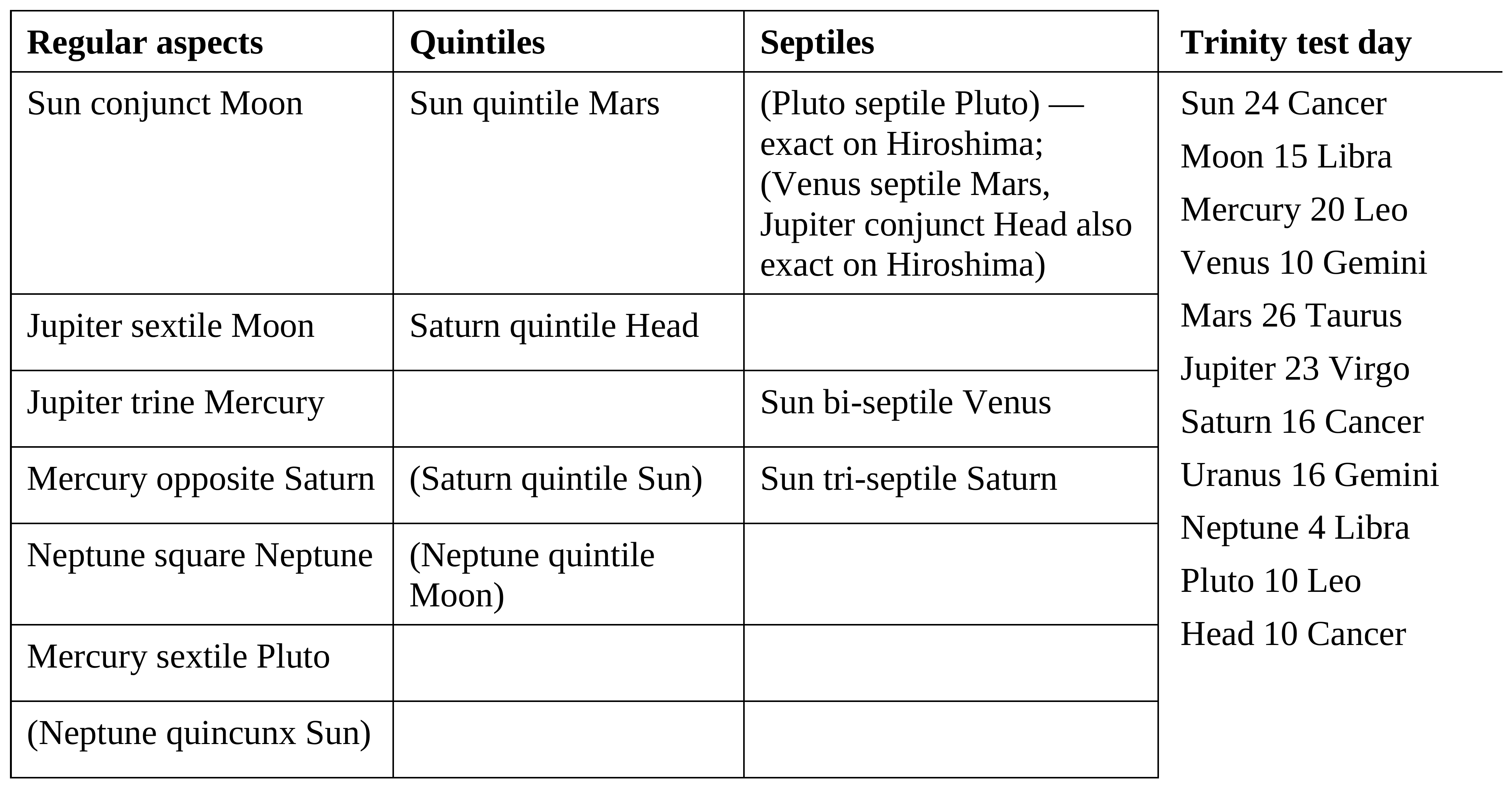
[First column in table above bracketed] → the event presented him a problem: a confrontation with the guardian – the evil in us; the moral crisis.
Jupiter sextile Moon defined the moral crisis for him.
Jupiter – anima
Moon – his basic allegiance
In the definition of the action (bomb) was the moral crisis – now he had to choose – up to this time he was not faced with a moral crisis – then it hit him.
Neptune square Neptune – forced him to identify with and experience the conflict inherent in the Neptune.
Mercury opposite Saturn — Saturn = the ego. The ego was questioned by the Mercury, which showed the ego what it was like – he saw the fruition of the ego's desires – saw that the ego is death.
Mercury is what shows the ego what it really is.
Mercury sextile Pluto – Pluto supplied him (his Mercury) with the abundant reasons and understanding to see what the Saturn was about. Mercury showed him what the Pluto should be working for.
Oppie was being initiated into philosophy — that the fundamental issues in life are what your practical morality is and its application.
Progressed Sun opposite Neptune at death – realized that he was more the Neptune – social conscience – than the Uranus.
How does the higher knower impose something on the ego through the medium of the asmita?
Through the trans-Saturnians? Quintiles? Septiles?
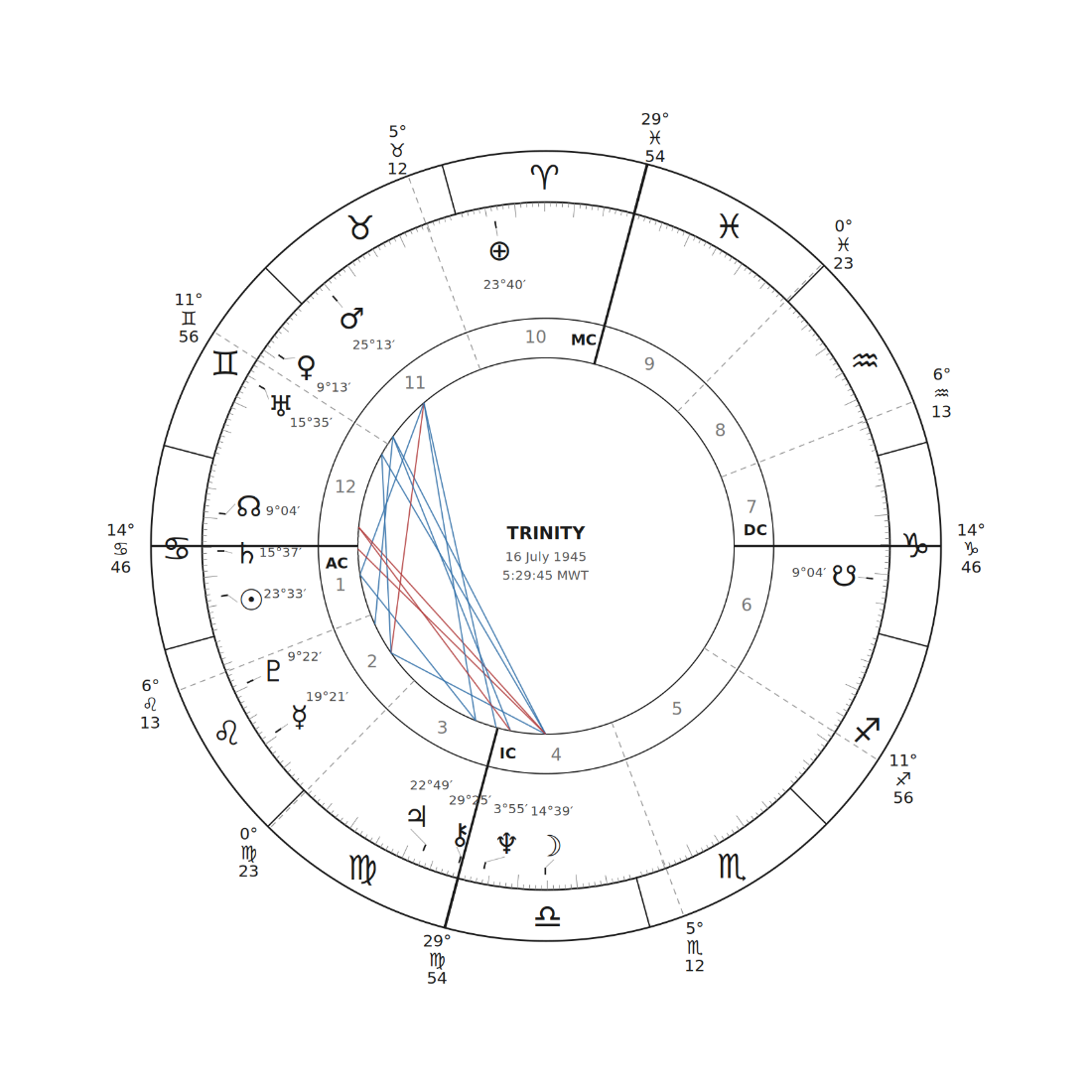
Horary of Trinity has Saturn conjunct ascendant at 15 Cancer.
The problem of man (Saturn) on the ascendant.
The problem of man is man = a crisis in the affairs of men.
Quintile = relation between the rational soul and the ego.
Septile = relation between the inerratic and the ego.
[Note: The following page of AB's notes appears out of sequence and has been moved here to the end. It has no counterpart in the recorded session, and its source is uncertain. In the scanned original the page is oriented sideways and, alone among the pages, carries no date at the top — possibly a loose sheet from another occasion that was later gathered into this set. Its content is Trinity transits to Oppenheimer's natal chart at an orb of one degree or less: transit Sun bi-septile natal Venus (0°51'), transit Sun tri-septile natal Saturn (0°30'), and transit Saturn quintile natal Head (0°41'). These aspects also appear in the septile and quintile columns of FIGURE 1983 0613-1-AB. The page most likely belongs to another Oppenheimer class or seminar for which no recording survives.]
Septiles – the answer
Sun bi-septile Venus – the moral crisis was to reveal the higher values of life – his path was to use his own moral crises to embody or experience the higher ideals known by the Venus.
Sun tri-septile Saturn – Saturn intelligence/ego had to be employed in the service of that crisis.
Quintiles – his understanding
Saturn quintile Head –
Head – racial/spiritual inheritance
Saturn – his ego, understanding – the meaning of the bomb was that he gave (Saturn) a new crisis/potential to the human race.
[Classnotes AB 1983 0613 End]
CHARTS FOR 1983 0613
Class
Monday, June 13th, 1983
Verbatim, unedited transcriptClick the series name to view more
CLASS at Wisdom's Goldenrod, Hector, NY
with Anthony Damiani (AD)
June 13, 1983
ASTROLOGY; HOROSCOPE-OPPENHEIMER
with Appendix: Classnotes AB 1983 0613.
TOPIC: Astrology
SUBJECT: Horoscope-Oppenheimer
SUBSUBJECTS: Oppenheimer natal chart (trans-Saturnians, Head/Tail), Trinity test transits (regular, quintile, septile), Quintile/septile theory
CONTENTS:
Quintiles and septiles in the natal chart, an interpretation wanted
Their count: a dozen at one or two degrees, eight or nine septiles; few close Chaldean aspects — "an uncluttered mind"
Neptune, Cancer 4 — the cat arguing with the mouse it is to eat
Two levels — the ego's required surrender to a larger collective; the Krishna–Arjuna parallel, Arjuna's reluctance to take on his dharma; the ego forced to become consciously aware of what the higher reason demands
Neptune on the ascendant — identified with the role of social conscience, needing outer sanction, trying to make the world conform to his image
Uranus, Sagittarius 30 — regal and sacerdotal pomp; the Pope holding audience
The leader's role as the vehicle of knowledge
Uranus opposite Neptune as inner/moral conflict — the Neptune social conscience against the Uranian desire to lead; Sun (Taurus 2) as possible mediator
Pluto, Gemini 20 — the self-service cafeteria
Prodigal resources, limitless plenty from an inner source
Pluto as nirodha
Pluto and Neptune against Uranus; Los Alamos as higher will organizing others
AD's verdict: agrees with RG on Neptune and Uranus, and adds the trine to Saturn — the Pluto came through his reflective ability (Saturn, Aquarius 20)
Tail, Pisces 27 — the harvest moon; eclipse of superficial reality by the dreamers of the race
Inheritance rather than attainment
The visionary capacity to take on the project
Head, Virgo 27 — elderly ladies at tea; the reservoir of racial assets
A demand to grow up, be responsible, capitalize on what was given and put it in service beyond ego
Objection: too outward a reading; Head in the fourth house — inner experience, not self-image; can transfer the superiority onto the historical figure and finally be himself
Had to actualize what he had only thought about in the Gita
Last years: throat cancer; the Institute; The Flying Trapeze (1964); died February 18, 1967, with Saturn on his Tail and Uranus two degrees short of his Head
Disillusionment at the end; inward transformation from the heights of power to being called a traitor
What was passed on (Head, Virgo 27): the legacy for other scientists; inner conflict itself passed on; burden and responsibility of applied rationality
Perhaps the inheritance is for him — the realization that the next life must be inward; responsibility as the accompaniment of knowledge
Trinity: setting up the board
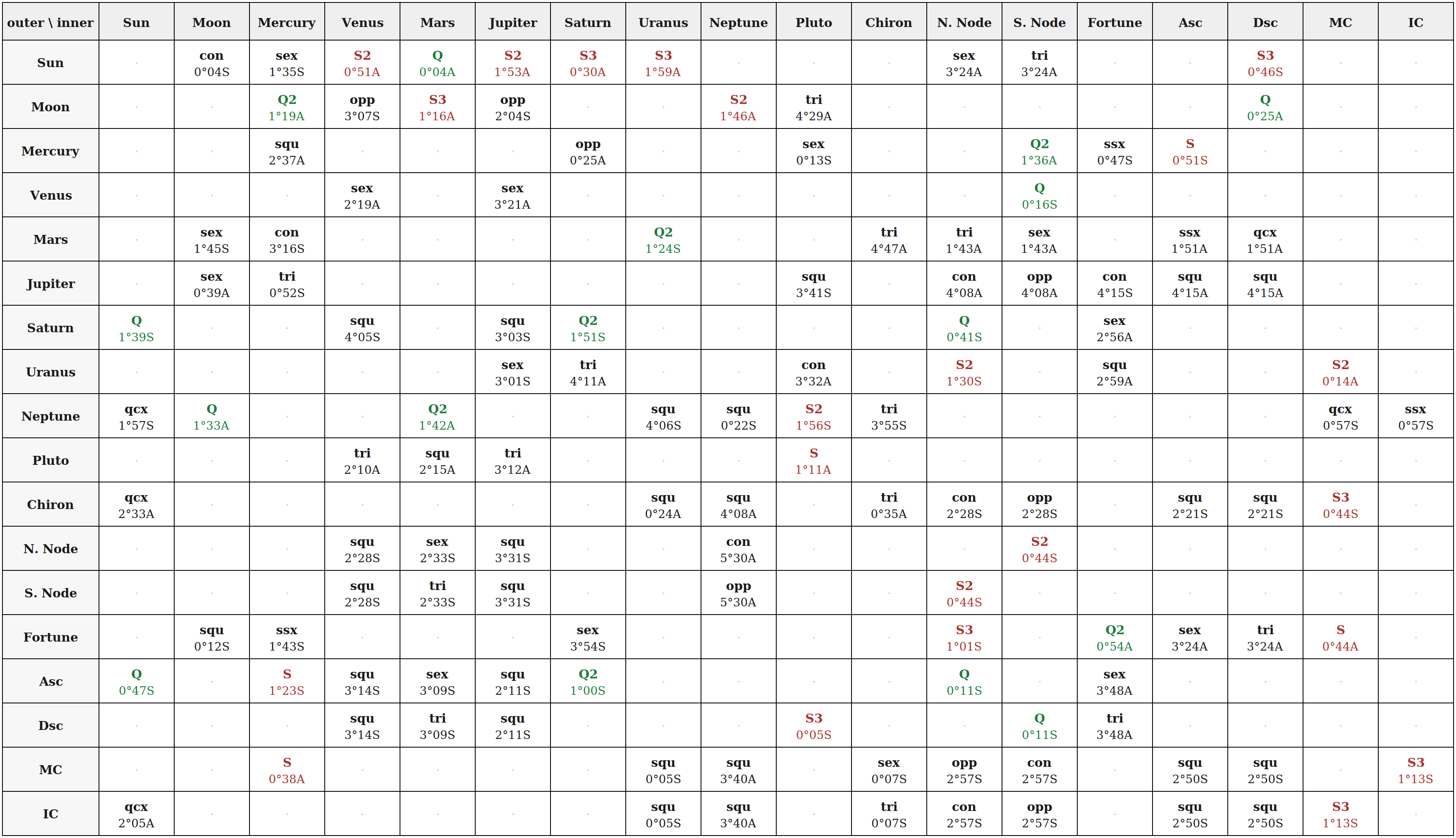
The transits written up in three columns (regular aspects, quintiles, septiles) plus the day's positions; AD restricts the work to orbs of one degree or less; bi-quintiles, bi-septiles, tri-septiles unavailable
Davis read on Oppenheimer's bearing in the blockhouse: the question whether Krishna was in that light, and the Gita line about becoming death
AD: the more appropriate quotation would have been the seeds of destruction blossoming (being sown) in the desert; the bomb as only the beginning, with the end-times discourse (Luke 21, etc.) recommended for reading
Moon degree settled at Cancer 24 rather than Cancer 23
Trinity: the transits
AD's working speculation: all regular transits represent the circumstances making the arisal of knowledge possible, but are not themselves knowledge; RG's alternate theory that knowledge comes through the trans-Saturnians
Jupiter trine Mercury — the cosmic idea actualized
Sun conjunct Moon — life purpose joined to practical embodiment; the bomb as that combination
Jupiter sextile Moon — the moral crisis defined
Transiting Jupiter, Virgo 23 — the circus performer; Astraea led from the world (Kozminsky)
Neptune (Libra 4) square natal Neptune — could never again participate unconsciously in a collective
Mercury opposite Saturn — the ego shown its own nature and the fruition of its desires
Mercury sextile Pluto — Pluto supplied the Mercury with the understanding needed to see what the Saturn was about
Natal Saturn (Aquarius 20): divine guidance, or the ego's certainty of it; difficulty of distinguishing, "mystical development par excellence"
Transiting Mercury, Leo 20 (Zuni sun worshippers), as degree of interest — two kinds of emanation (wave and particle) from the sun in Egyptian symbolism; opposite Saturn — the older values destroyed
AD's judgment that Oppenheimer was being initiated into philosophy — that the fundamental issues are practical morality and ethics
Progressed Sun over the ascendant and Neptune, late in life; sixty-one years of experience required to bring him to the identity that was more truly his — the social conscience rather than the Uranian leader
AD's general principle: the natal chart as fixed tendencies, with the transits' relationship to it forcing knowledge up — but the stage must be set
Whether the bomb could have been stopped; the atmosphere of 1945; Pluto septile itself and Venus septile Mars became exact at Hiroshima, with Jupiter on the Head
The explosion as a confrontation with the greater guardian, the evil in us
Head degree (Virgo 27) as a reservoir for humanity of whatever is done for the good; Tail (Pisces 27) as qualification to undergo the trial
Quintile-septile problem taken up again — the asmita principle as the frame; asmita appearing as three lights according to its vehicle, and the aspects as what lets each come through
Objection: if the trans-Saturnians deliver the higher knower, nothing licenses singling out the septile
The cosmic soul brings the knowledge, but the reason-principles must be evoked from his own soul; counter: transits are cosmic throughout; progressions are where he has his own light
Proposal to cast a chart for the moment of detonation
Announcements
Appendix: AB class notes; includes Trinity aspects table, event chart material, undated loose page working out Sun bi-septile Venus, Sun tri-septile Saturn, and Saturn quintile Head
BOOKS READ FROM OR REFERENCED:
Marc Edmund Jones, The Astrology of Concepts
Marc Edmund Jones, The Sabian Symbols in Astrology
Vyasa, Bhagavad Gita
Peter Michelmore, The Swift Years: The Robert Oppenheimer Story
J. Robert Oppenheimer, The Flying Trapeze: Three Crises for Physicists
Nuel Pharr Davis, Lawrence and Oppenheimer
Thomas Wolfe, Look Homeward, Angel: A Story of the Buried Life
Bible, Matthew 24, Mark 13, Luke 21
Isidore Kozminsky, Zodiacal Symbology and its Planetary Power
Paul Brunton, Notebooks
Plotinus, The Enneads (MacKenna translation, 4th ed.)
PLOTINUS QUOTES READ OR REFERENCED: V.3.6
SABIAN SYMBOLS: Aries 13, Taurus 2, 22, Gemini 20, Cancer 4, 23, 24, Leo 20, Virgo 23, 27, Libra 4, Sagittarius 30, Aquarius 20, Pisces 27
TABLE and CHARTS appended to this transcript:
FIGURE 1983 0613-1-AB. Trinity Test Aspects Table.
FIGURE 1983 0613-2. Trinity Test Event Chart.
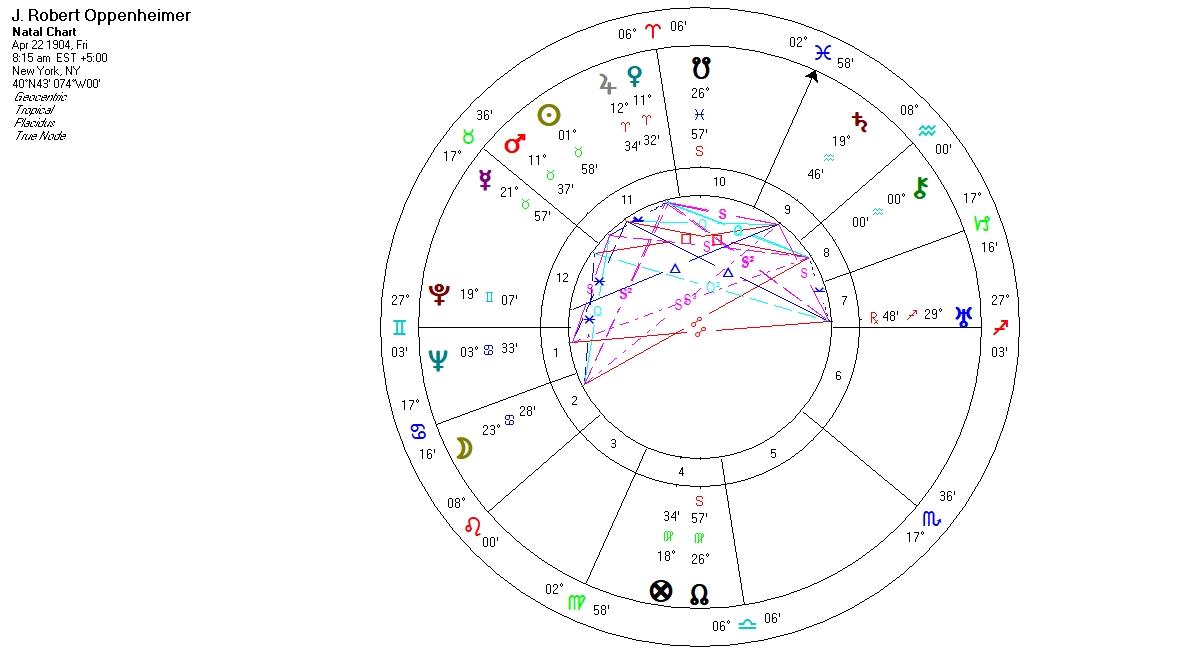
FIGURE 1983 0613-3. J. Robert Oppenheimer Natal Chart.
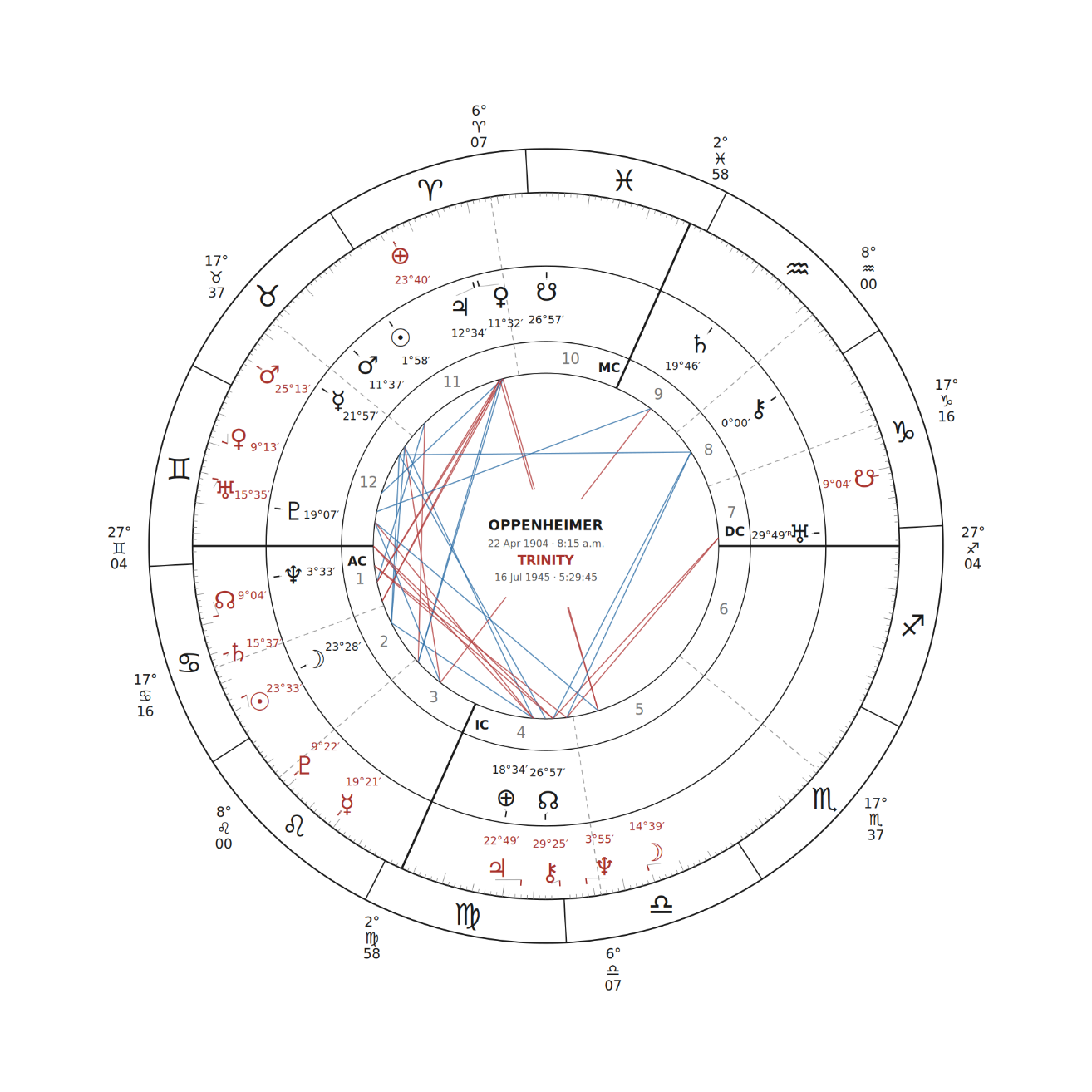
FIGURE 1983 0613-4. Oppenheimer Natal (Inner) with Trinity Transits (Outer).
FIGURE 1983 0613-5. Transit Grid for Oppenheimer/Trinity Test.
[Transcriber note: [diagram] means the speaker is referencing a diagram as he or she is speaking. If someone is drawing or writing, with audible sounds of chalk on a blackboard, I indicate this by [drawing] or [writing].]
NOTES:
- AB class notes have been appended because they preserve material the recording does not: the blackboard table of Trinity transits, which the class discusses column by column but which survives only in AB's hand (reproduced here as FIGURE 1983 0613-1-AB); a closing passage working out the event chart PD proposes in the final minutes; and a loose undated page of uncertain origin. Retyped from Classnotes AB 1983 0608 to 1983 0715.PDF, with spelling, capitalization, punctuation and similar errors silently corrected, and abbreviations and astrological glyphs spelled out.
TRANSCRIBED Verbatim by IT 2026. Archival verbatim transcript – V11a.
AUDIO FILES: 1983 0613a, 1983 0613b. [Note: "Tape" and "Side" refer to original audio cassette tapes that were later digitized into .MP3 Audio Files.]
1983 06/13 at Wisdom's Goldenrod
Astrology; Horoscope-Oppenheimer
[Audio File 1983 0613a Begins]
[Note: See FIGURE 1983 0613-3 (Oppenheimer Natal Chart) for all references to Oppenheimer's chart throughout.]
LR: --typically. So if we get three I guess we'll turn-- three more I guess we'll-- [S: Yeah.] we'll look at a couple dates. And Anthony would like someone to come up with a brilliant explanation of quintiles and septiles.
VM: Oh, oh. (laughter)
S: Good job, (Victor).
AD: It's hard for me to think.
VM: Would you like the Earth to stop rotating too? (VM laughs)
LR: So if anyone is so struck with an interpretation of the quintiles and septiles in Oppenheimer's chart, be helpful if he or she just stepped forward.
AS: 'Cause there's a lot of them, right?
S (whisper): Yes.
AS: He's got about a dozen.
RG: Right.
VM: But you already did those triple points [couple words inaudible]
S (simultaneously): Just quintile, (right)?
LR: I've got a couple here.
VM: Oh, bring those out.
LR: No, I don't have the triple, the natal triple.
S: Three septiles.
AS: He's got about twelve one or two degree [RG assents] septiles in (there).
LR: Um-- I don't have the information, I mean I--
AD (simultaneously): Twelve septiles, Avery?
AS: No, septiles [LR simultaneously: No.] and quintiles. One or two-- one and two degrees. I-- that's what Tim counted.
LR (simultaneously): All these green. Anne drew this up. All these dark greens are [AS: Eight or nine.] bi-quintiles, quintiles, [couple inaudible student words simultaneously with LR] septiles, tri-septiles, all those (three).
BS: [few words inaudible]
S: Bob, they're not talking to you.
S (faint): Fair enough.
AS: There are eight or nine septiles.
VM: He's got at least twenty of those points.
AD: And how many regular aspects among the Chaldeans are--
LR: Not a whole lot of close ones.
AD: Very few? An uncluttered mind, yeah?
LR: I'm sorry, I didn't hear what you said.
AD: It's alright, don't mind me.
LR: How many close Chaldean aspects?
AS: No he said--
LR: Not--
S: He said an uncluttered mind.
RG: Only four independent of the bi-- of the septiles and quintiles.
LR: There's not a whole lot of aspects, right.
VM: (I get out of bed this morning.)
LR: And, pointing it out again, the Venus Jupiter is exactly semi-sextile the Mars. There's that cluster. And then there's this interesting configuration with the Uranus Neptune opposition, Pluto right above the ascendant, Neptune right below, and Uranus on the descendant. Right? And then there's this whole business of Saturn at 20 Aquarius, Mercury at 22 Taurus which is square, and the Moon at probably 24 Cancer. The chart really is tight, Anthony. Do you think it's necessary to review the Chaldeans or can we just start on Uranus Neptune Pluto? You all remember, right?
[10½ second pause with faint background student talking, shuffling about]
RG: Anthony, do you want to review the Chaldeans?
AD: Oh, don't go by me, go by them.
LR: What does everyone think?
S: Go.
S: Go.
S: Yeah.
AD: My mind's made up.
S (simultaneously): Do the trans-Saturnians.
RG: What? (student laughs) You might give it up?
AS: No, he said his mind's made up.
RG: What else is new?
S (very faint): Yeah.
S: Stay here.
LR: Ok well, I-- maybe what-- Let me read you the three degrees. And I have a peculiar-- [S: Uh-hm.] after looking at these for a while, I'm stuck in a peculiar way of interpreting it so somebody else can help me out and get me unstuck maybe but--
S (faint): Ok.
RG: [few words inaudible]
LR: Um-- The Uranus degree is a typically-- No it's not. It's--
Marc Edmund Jones [The Astrology of Concepts, Sagittarius 30, LR reading]: "A picture of regal and sacerdotal pomp and glory reveals itself; the Pope is holding audience in his palace."
LR: The Neptune degree is a group of merry-- Sorry, reading the opposite. The Neptune is--
Marc Edmund Jones [The Astrology of Concepts, Cancer 4, LR reading]: "[In] an imaginative tableau a hungry cat is seen arguing earnestly with a [LR reads: the] mouse who is to be her victim."
LR: And the Pluto is--
Marc Edmund Jones [The Astrology of Concepts, Gemini 20, LR reading]: "A self-service restaurant, the cafeteria such as originated in Los Angeles, displays its inviting steam tables."
S (faint): Everything happens in L.A.
LR: Um--
S (faint, possibly part of background): Would you read it?
S (possibly part of background): No.
LR: I guess I'll read the interpretations.
CDA (faint): I lost [couple words inaudible]
LR: This is for Neptune, the cat arguing with the mouse. He says--
Marc Edmund Jones [The Sabian Symbols in Astrology, Cancer 4, LR reading]: "This is a symbol of man's necessary establishment of a set in mind or realization as a preliminary to any entrance into personal experience, and of his tendency to enjoy the preparatory more than the consummatory phases of his participation in reality. Here also is the eternal effort of human nature to get outer acceptance or social sanction for its inborn desires, as well as inner or intelligent and practical confirmations for the values it has made its own. The keyword is JUSTIFICATION. When positive, the degree is a gift for persuading others to accept the motives of self and to co-operate with its ends, and when negative, interminable quarreling with the nature of things."
LR: We do one at a time or [student assents] should we read all of them?
S: One at a time.
LR: Ok. It seemed clear to me that this Neptune is speaking of two levels of something going on. The cat is more powerful than the mouse but he's arguing with the mouse even though it's very clear that the mouse is going to become-- well, that the mouse is going to be eaten by the cat. Yet the cat is trying to argue and persuade the little old mouse. And-- Neptune's usually referred to as social obligations in mundane astrology and I was trying to see that from a more philosophic standpoint as being something like the soul's relation to a greater collective, like the World-Idea for instance, rather than seeing it as connected just to the society, the person in the society. So it'd be more like the obligation one has to the World-Idea or the individuality is cooperating with the World-Idea, that kind of relation.
I thought this degree especially spoke of the ego needing to surrender to some higher or larger collective than his own perspective, and that the Neptune is making that kind of demand, that he-- that Oppenheimer himself both play out a role that the World-Idea has planned for him, and also that he give up something of the ego's standpoint for a larger standpoint, ego's values for larger values. [14¼ second pause] Because of the nature of the degree being so discursive, that there's a certain amount of argument going on, there's a certain kind of-- his feelings-- Well, I really don't know what it means in terms of his feelings. I thought the demand by the World-Idea or the individual principle (of/in) his self, that he incorporate higher than egotistical values into himself was-- was the keynote of that symbol. And it seems like the ego is going to be swallowed at any cost with this degree, that there's really no choice, that ultimately that's what's going to happen, but in the degree there seems to be an interest in teaching the ego discursively or letting it know the reasons for exactly what's going on because the cat's arguing with it. There seems to be a demonstration to the lower self of the consequences of its own ends in terms of self-destruction, which is what happened to Oppenheimer in a sense. The lower was destroyed. Here, the larger or more powerful force is pleading with the lower. The guide of the life in terms of the higher feeling was presenting him with a demand for incorporation of greater values than previously sought, or than the ego previously incorporated.
And I thought the so-called broken quality which his friends perceived in Oppie toward the end of his life was possibly that the ego had indeed seen into its own workings and gotten a glimpse of the higher purpose that (he was) going to take. But he also fulfilled the purpose that he was-- the mission that he's set out to accomplish.
And, my feeling about all three of these degrees, Uranus, Neptune, and Pluto is that he was sent to do this particular work, that he was set up to do it, and there was absolutely no choice. I mean I-- when we do-- it shows more clearly in the Uranus and the Pluto degrees but it seems-- but those degrees seem to outline the project that he had to put forth. That if you can see more in this Neptune I would appreciate [couple words inaudible] There's a lot of Neptune transits during all these events that are--
VM: You know, this may seem like a stretch of what you're trying to say but, I can't help but think of-- if you talk about this Neptune as sort of cosmic feeling and the role that the individual has to play in regard to the World-Idea and so on, it almost sounds like the Krishna and Arjuna sort of thing where Arjuna is so reluctant to take on his dharma but he's given this rational, at least partly rational, explanation of the necessity of his playing his role and so on, and he will be cons-- at least there's a lot-- a possibility of him being consumed in the battle, or at least others being consumed. I'm trying to raise it from cat and the mouse, you know, sort of like you are, from too literal.
S (faint): Right.
LDS: Following that up, I--
S: That's (good).
VM: So he was very-- I mean that was the thing that flashed on of course in the-- that when the bomb went off, despite Anthony's contention, why couldn't he have quoted from the old Testament, but still, he was sort of struck by that particular metaphor from the Gita. [S: Yeah.] "I am the destroyer of worlds" and so on. Go ahead Lou, I'm sorry I cut you off.
LDS: There seems to be a suggestion here that I think you've already said in some ways, of his ego being forced to become conscious of what this higher reason is suggesting that he do, you know. It's not just a matter of adjusting to it, but adjusting to it consciously.
VM: You can't just go through the experience.
LDS: Yeah.
VM: The cat has to know, or the [LR simultaneously: It's a real symbol in--] mouse has to understand or [LDS assents] whatever why he's being eaten.
LDS: Exactly.
VM: This is the way it is, you know, [LDS assents] and so on.
RG: But you know, I mean this is his Neptune degree. It's already not his ego in some sense.
VM: Ok.
RG: It's [LDS: Yeah.] already his--
VM: His whole being is in the scales.
LDS: Higher reason or some--
LR (simultaneously): I think it's the Neptune is both the lower and the higher aspect, [RG: Right.] the cat and the mouse.
RG (simultaneously): Yeah, I don't think we can interpret one as the lower aspect of the ego and I-- [VM: No.] The way I look at it though, Neptune's on the ascendant, and he almost was completely identified with his role as the social advocate as he was embodying the dialogue or the social conscience of his age by playing both sides of the cat and mouse argument to the public. And it's almost as if because he was so i-- he was so identified with it, he had to get public approval. As it says here, outer con--
Marc Edmund Jones [The Sabian Symbols in Astrology, Cancer 4, RG reading]: "Here [also] is the eternal effort of human nature to get outer acceptance or social sanction for its inborn desires…"
RG: It's like he tried to make the world conform to his own image of what should happen. And he ran into tremendous conflict with that and yet he constantly persisted in it.
S: Yeah.
VM: You ever find the date of that talk at MIT where he said you have sinned? [Note: Oppenheimer, "Physics in the Contemporary World," Arthur D. Little Memorial Lecture, MIT, November 25, 1947. VM is paraphrasing; the line runs "the physicists have known sin." The lecture was published in the Bulletin of the Atomic Scientists 4, no. 3 (March 1948), and in MIT's Technology Review.] [short pause] I don't think we should ascend to that but I was-- just was asking (about) who has it.
S: Right, well yeah.
RG: Right.
AB: See according to that interpretation (then you accept) in the ultimate end of his life he realized that this degree couldn't be fulfilled. [S simultaneously: Well by--] In other words, that what he thought should be would never be socially sanctioned by the world.
RG: Right, but the degree doesn't need the-- right. Right, but it's more the fight, it's more the-- the discussion of the problem rather than the solution. I mean it's-- he enjoys the preparatory more than the consummatory phases of his participation, like he outlined the dialogue, the problem on a global level.
AB: Then you could say that he realized that it couldn't be done outwardly and that the answer wasn't to get social confirmation for what he felt but that this was an internal process he had to go through in terms of reasoning it out.
PD: Well maybe he didn't realize it but that he lived it out as the Neptune not being the ego, but something that was imposed on his very ego personality, that conflict.
RG: Yeah. He did live it out, he never gave it up. I mean he could, you know, I-- at any-- I think at any point, you know, he could have. But he didn't, he was that-- he had a-- he couldn't give up that social conscience or whatever you want to call it I think due a lot to this-- this particular Neptune degree. A different kind of Neptune probably could have adapted a lot easier to the-- the societal claims on his conscience.
LDS: You're saying his personal identity was-- was that conflict, was that--
RG: Not his personal identity, his identity of himself as a-- as a world leader almost. I mean it's a Neptune identity on the ascendant. He took himself to be that pro-- that embodiment of that knowledge, yeah, (right).
LDS (simultaneously): Yeah, that's what I was trying to say. That he actually identified with it.
RG/S(?) (faint): Uh-hm.
S (very faint): I see.
[23 second pause]
S (faint): Yeah.
S: They're going through this.
VM: No.
LR: Well-- [short pause] The Neptune's opposite Uranus and that should be very interesting to try to understand. There's opposition to Uranus natally. [student assents, faint] And, if we could understand the Uranus degree then maybe we can understand a little bit of what-- I mean that really presents a conflict, Neptune being opposite Uranus. If Neptune alone is a conflict, an internal conflict, this opposition with Uranus is really a-- yeah. So, the degree says--
Marc Edmund Jones [The Sabian Symbols in Astrology, Sagittarius 30, LR reading]: "This is a symbol of human excellence on the side of the special values exalted in the various social and political hierarchies of modern civilization, [and] of man's ambition as entirely inadequate except as he is able to meet some exceptional need of everyday experience and so proceed to dramatize whatever abilities he may have developed in climbing to the position in which he finds himself. A person is strengthened within himself by the appreciation he succeeds in winning from his fellows. [The] keyword is SANCTITY. When positive, the degree is an effective and spectacular sacrifice of self in some enduring service to the race at large, and when negative, inordinate love of self-display and surrender to a lust for power."
LR: Now, boy this is a--
RG: Yeah.
LR: Right on the descendant, ok, so this is the image that's projected that lives-- is lived out in relationships. And, you know, last week we were talking about this and we were saying, well how is it that this is the higher knower? And, you know, in looking at this today, there's-- over and over there's one theme repeated in this chart, at least to my mind, and that is that whatever is learned in terms of higher spiritual, any kind of apprehension of an idea has to be brought down and lived in a very concrete way. In some ways, just having a Sun in Taurus means that. This-- the Sun degree is the heavens and the forests coming together illuminating them both. [Note: Taurus 2, "A brilliant electrical display illuminates the heavens and the forests beneath."] And over and over in his chart you'll find this thing where this-- the-- what's learned mentally has to be put into practice, and the Uranus degree, to me he was saying that the higher knower could only be revealed in terms of an activation of very mundane, very day-to-day affairs, day-to-day struggles, day-to-day context. That kind of world was where the higher knower would reveal itself.
Or another way of saying it is if Uranus is the kind of focus, a focused role that one has to play in order for knowledge to take place, that's where the focus had to be. Now, in-- in the biographies of Oppenheimer I've read, they speak in-- we spoke about this before, the degree of abstraction that he really centered his life around. He was very me-- and he lived in a very-- a world of his own mentation, you know. And he really-- like I-- he would wander off into the woods for days with some idea and never show up again, you know, it was that kind of abstraction. He had no idea what was going on until-- in the world until 1937 or something. So-- and, you know, the biographer speaks of him as being-- as liking to wake up very late and then going about his day in a very sheltered mental-- you know, his intellect was what was really driving him.
Suddenly this guy General Groves comes out to California. Oppenheimer had no idea. I mean he knew in terms of ideas what was supposed to happen in Los Alamos. But he had no idea what he was bargaining for when he took that position. In fact, he thought that there were going to be thirty people at Los Alamos. See, they were setting up the place for thirty people. Turned out there were 6,000 people there. His life previous to that, you know, he wouldn't even eat. I mean he never thought about what we call-- term the "lower life," I don't particularly like the term "lower" but the practical life, [couple inaudible VM words simultaneous with LR] he just didn't concern himself with it. So here he is, he gets stationed in Los Alamos, and he ne-- first of all, he never slept there. He was-- you know, his job ran from morning till night, not just as overseer of the theoretic ideas that were go-- theoretical ideas that were going on, you know, he had to be at all these meetings. He also had to-- he was the one in charge of getting all the people to Los Alamos that were needed, picking and choosing who should be there and who wouldn't, ok. But besides that, he was flown to Washington all the time to administer to the government. And then he had to do this social entertaining in his home at least three to four nights a week so that he could-- he was like an ambassador of goodwill, so he could keep all these different factions going and at peace.
And then lastly, they had all these shortages there. They had no water, they had no milk, you know. It was a pretty stoic spartan kind of existence, and when there were shortages it was Oppenheimer that was in charge. He had to oversee all that kind of thing. And when somebody died of some freak disease he was the one that was staying to appease the family and make sure there wasn't hysteria breaking out in Los Alamos, so his life there covered, you know, A to Z. There was nothing that was out of his ken, whereas before he went there he was really very different. And I think some of that, well, the Pluto will point out the same things, but I keep seeing that over and over, the thrust is to go from an abstract kind of knowledge to a[n] involved, a very involved, and that his growth as an individual depended upon his involvement in that kind of way. I think the degree speaks to that, that--
Marc Edmund Jones [The Sabian Symbols in Astrology, Sagittarius 30, LR reading]: "…man's ambition as entirely inadequate except as he is able to meet some exceptional need of everyday experience and [so] proceed to dramatize whatever abilities he may have developed in climbing to the position in which he finds himself."
LR: I'm trying to see Uranus as-- as squeezing it-- as forcing its knowledge into that kind of role rather than into some abstract role, you know, and when we do the Head and Tail I think we're going to see the same kind of thing here. And I was trying to see it all as revealing the meaning in the Sun as well. I mean in some way the Uranus repeats too the same thing, the clue that the Sun speaks to, that-- that no knowledge is great unless it's brought into a living situation. And in the eleventh hou-- well-- That's all, I mean, that's just-- that's another way of seeing it but it's not (good for very long).
PD: Are you-- are you saying, Linda, that the Uranus, in that he had to play that role of a leader, in playing that role, in fulfilling the obligations of being the organizer and the leader, he started gaining the perspective of, let's say, Uranian knowledge.
LR: Rather than adhere-- rather than [PD simultaneously: Rather than his personal--] (formal) mind or-- yeah.
PD: And he started seeing things in a broader perspective, and that's what the Uranus was demanding of him all the time, that he had to see people, events in terms of their broader context, and as he played that role that he was placed in, he seen a broader and broader context. When he backed off from that role, he did not-- that knowledge was taken away. So it's like playing that role--
LR: Is what Uranus--
PD: Gave him-- gave him the vision.
LR: That's the way I'm seeing it. 'Cause last week we were asking this question, what way is this the higher knower, and I think the term "higher" and "lower" is really dumb. I don't think it-- I think we keep think-- if we think of it as terms of higher or lower-- You know, in this case it's by living the actual practical life that the knowledge comes in. Like you say, the wider perspective comes in.
PD: Like within this degree it speaks of some service at large, to the race at large, and that's where he-- [S: Yeah.] that Los Alamos developed into, he was-- His knowledge kept extending and he see the broader implications more and more as to what was happening.
LR: Can anyone add to that or does someone see more in that symbol?
RG: So far I think that's good. If you try to put it in opposition now to that Neptune, it becomes an incredible fight within himself because he desperately wanted to play that role as the leader. And in a sense that conflict between being a social conscience and having to live that out, and also wanting to be the leader in-- in the world and embody his special kind of insight was completely at odds. And in fact the Neptune somehow won out it seemed.
LR: Say it again, Dickie. What do you see as the conflict?
RG: That the Uran-- that he did, I mean, just as he was the-- the amazing leader at Los Alamos, and he was the leader of the Atomic Energy Commission, he desperately wanted to keep being that-- on that higher level of public service and embodying his special talents. And given the Neptune degree where he was also identified, more identified 'cause it was on the ascendant, with his social conscience and with playing out the intellectual dilemma of atomic energy in some sense.
LR: I see. So you're saying [S: Yeah.] the struggle was that he had to bring out the evil in some way, what was actually happening, even though he wouldn't want the loss of power that would accrue from that [RG: Yeah.] realization
RG (simultaneously): Right. He was-- through the Neptune he was playing the intellectual problem, but through the Uranus he really wanted to be the leader of-- of the atomic movement in some sense. And that conflict really-- I mean that's what broke him. I mean if he just had to be the Neptune he probably wouldn't have been broken, he could've-- he would-- I mean he might have said to himself, well, this is my role and I'll accept it and stay at Princeton but Ura-- it probably ate him up not to be able to play the Uranus in a way that he was used to on that level of (serving).
LR (simultaneously): Well, and also his Sun degree says--
Marc Edmund Jones [The Sabian Symbols in Astrology, Taurus 2, LR reading]: "Implicit in the symbolism is a terror in the loss of aplomb [LR: Jones likes the word"aplomb."] whenever human personality rises to a moment of union with [LR reads: whenever the individual is made to meet] the universal forces."
LR: So the sense that the ego was losing any of its power was terrible, was a terrible feeling for him, and that that was what really had to occur.
AB: Well, Dickie, you're interpreting the opposition almost like as a moral conflict. In other words, if the Uranus was left to do what it wanted, it would've utilized its personality to be in this role of the organizer and the accomplisher. But the Neptune always had to rationalize and bring out the inner logic of what he was doing. And in this case since he was doing something of such momentous moral significance, it always had to bring out the other side so that in a sense would undermine the Uranus and there's kind of a seesaw-- [RG assents] seesawing back and forth between those two positions, [RG assents] and let's say his-- in his stance after the bomb, in terms of bringing up the moral issues, you could say that the Neptune was undermining position that Uranus had attained. Although I would want to-- since the Sun is in trine and sextile to that I think we-- [RG simultaneously: To the (Uranus).] we want to try and see how somehow the opposition was either harmonized or fulfilled in the Sun, or how the Sun mediated the opposition. The Sun in some way made that opposition less intense or more harmonious. Sun is trine Neptune and-- [couple inaudible RG words simultaneous with AB] is trine Uranus and sextile Neptune.
RG(?): [few words inaudible]
AB (simultaneously): Sextile--
S: No.
AS(?) (simultaneously): That's right.
S: That seemed good [couple words inaudible]
AB (simultaneously): He had four degrees, three degrees.
S: Two degrees.
RG: Two degrees.
LR (faint): Two degrees?
RG: Hm.
S: Three.
RG (simultaneously): Two degrees. It's two to Neptune and three to Uranus.
S: Where's that from?
S: Well it seems [one word inaudible]
RG: Yeah.
LR (simultaneously): (Who's scared?) Sun trine Uranus?
RG: Yeah, [few inaudible student words simultaneous with RG] right, in that sense the sextile [couple words inaudible]
S (simultaneously): Yeah, yeah.
LR: Oh.
S: Here look.
S: Yeah.
S (faint): Is that [couple words inaudible]
AB: And in a way we interpreted the Sun as also a conflict, and therefore a moral conflict.
[short pause]
LR: I mean, but that theme keeps repeating itself [RG assents] again, the abstract versus the-- Well let's do Pluto and then maybe we can put 'em all together. Is that ok?
RG (faint): Yeah.
LR: I mean this is so remarkably similar that it-- it's hard to separate them. This is the self-service cafeteria.
Marc Edmund Jones [The Sabian Symbols in Astrology, Gemini 20, LR reading]: "This is a symbol of the facility with which men organize their own special experience for the benefit of the community at large. The divisions of labor which constitute a civilization are refined to the point where each individual has the largest possible part in the total reality, and the resultant ease of function provides a continual reassurance of the self's competence. Here a prodigality of resources in general becomes a very immediate realization. The keyword is SUPPLY. When positive, the degree is a fullness of contribution and an effectiveness of requisition in all personal relationships, and when negative, a chronic inability to make decisions or a hopelessly dilettante spirit."
LR: And that really describes-- that positive and negative really describes what he went from to what he went toward in a sense. The prodigality of resource, I mean he really had it. He had it when he was born, the Tail degree really shows that to you. He really didn't work too hard to learn what he learned in this lifetime, you know. He'd spend a week on each thing, he'd give it a week. [S: Yeah.] That was all. [S, faint: Yeah.] He'd get each language in a week, he'd get French poetry. It was all done, you know, very-- And the Tail shows that too, that it's just-- he comes in with a certain culmination of learning. It wasn't that the life did that for him. But instead the life seems to push him into putting that to use, working for that, working for others with what he's been given.
AB: Yeah. If you look at the aspects, I think there's some semi-sextiles missing there too but, Pluto is like in trine or sextile or semi-sextile to like four or five of the inner psychological planets. It's almost like that supply, you know, the fullness, is being fed right into these psychological faculties. So his intellect had all these capabilities or (steerings) or whatever.
[9¾ second pause]
S: I think [couple/three words inaudible]
S: He's trying to say already.
S (very faint): [few words inaudible]
S (very faint): Doesn't hurt.
S: What house?
S (faint): Uh-hm.
LR (faint): Do you know what it is?
S (faint): I don't know.
S (faint): [few words inaudible]
S: Put the mundane meaning of the house too, it was twelfth house. The place where [few words inaudible] in those situations are those regions [couple words inaudible]
LR: See also, I look at Pluto these days [few words inaudible]
S (simultaneously): Try it.
LR: You know we call Pluto nirodha. I mean we say it was the way the ego would be stopped. And I often try to see the Pluto degree as what needs to be ployed in order that-- employed in order that the ego be suppressed. So it-- it seems to work a lot that if you could grasp the nature of the Pluto degree and embody it, it would be suppressing or taking a point of view which would undermine the ego. And this seems to be saying also that that service he had to perform was the way he-- or--
RG: Is that--
LR: So I'm stuck in this way of seeing.
AB: It's almost like the-- it's an opposite view of nirodha, which is normally stopping. In this case [VM simultaneously: It's suspended.] it's a kind of full-fledged supply of things available, (more) selective--
LR (simultaneously): Well that's why I'm saying, I don't think this-- that--
AB (simultaneously): --was what-- But that's what made him transcend his, say, egocentric--
LR: See there's two ways of looking at it. One is to say the degree the Pluto is on is what has to be stopped. And I'm not looking at it that way, I'm saying it's the employment of the Pluto degree that will undermine the ego.
AB (simultaneously): Right. Like for instance, let's say he could have just been a poet or a free thinker, but the Pluto made him, you know, stop that and implied a higher purpose, or a more social purpose. [13 second pause] And also [few words inaudible]
RG (faint): That degree is semi-sextile [couple words inaudible] Mercury. That was his point. It seems that--
S (faint): I'm just kidding.
RG: Well you could fill in all those boxes, you know. But it's almost as if the Pluto and Neptune, I mean it's almost as if there's like a Pluto Neptune conjunction on the ascendant [LR simultaneously: Yeah I see it that way.] [one word inaudible] it's not opposite the Uranus. I mean Uranus is the handle to the bucket. So all the energy of that is being funneled through the Uranus, there's an image of himself as that [one word inaudible] (Pope).
LR (simultaneously): But I can't see the Pluto opposite Uranus. I can see the Neptune opposite Uranus. But in this-- well it's actually not opposite Uranus.
S (simultaneously): [couple words inaudible]
RG (simultaneously with LR): No, not in the degree.
LR (simultaneously): And I have a hard time seeing it as opposite Uranus because it seems to embody a lot of what Uranus says.
RG: No, it's very different. I think [LR simultaneously: Ok how?] in the Pluto he's em-- he's working with-- with the collective and he's organizing and being a community servant with others but in the Uranus he's clearly the leader. I mean--
LR: But those two were in opposition in his life.
[short pause]
RG: No, but I think they were part of his inner conflict.
LR: Oh you're saying Pluto operates with the Neptune?
RG: Yeah. Pluto and the Neptune are-- were at the same-- operating on the one side as a dedication to the world-- to his vision of the future of the world in that sense. Uranus is sitting out there, I mean-- you know, all by itself, manifesting its self-image. I mean when you got the tree-- three trans-Saturnians right on the axis [LR simultaneously: Obviously, yeah.] like that it's obviously a major (battle point).
[20 second pause]
VM: [few words inaudible]
S (very faint): Uh-hm.
[short pause]
LR: Do you have any feeling of comfort with these degrees, what we've said?
AD: I think what Dickie said about the Neptune and the Uranus is smack on the nose.
LR: Yeah.
AD: The identity, you know, with the Neptune, the feeling, you know, is where you put his social conscience, on the one hand, and the political, you know-- desire to guide people politically, they were inevita-- and I mean the conflict was right out in the open, those two. [short pause] The Pluto I still don't see yet.
S (faint): Yeah.
S: (Interpretation?)
VM(?) (faint): I don't like talking about the Pluto.
LR: The interpretation?
VM: Yeah, ok.
S: Let's go.
Marc Edmund Jones [The Astrology of Concepts, Gemini 20, LR reading]: "A self-service restaurant, the cafeteria such as originated in Los Angeles, displays its inviting steam tables."
Marc Edmund Jones [The Sabian Symbols in Astrology, Gemini 20, LR reading]: "This is a symbol of the facility with which men organize their own special experience for the benefit of the community at large. The divisions of labor which constitute a civilization are refined to the point where each individual has the largest possible part in the total reality, and the resultant ease of function provides a continual reassurance of the self's competence. Here a prodigality of resources in general becomes a very immediate realization. The keyword is SUPPLY. When positive, the degree is a fullness of contribution and an effectiveness of requisition in all personal relationships, [and] when negative, a chronic inability to make decisions or a hopelessly dilettante spirit."
RG: And in the long my-- longer-- in the [S simultaneously: What (did it) say?] other description he says--
Marc Edmund Jones [The Astrology of Concepts, Gemini 20, RG reading]: "This is a symbol of the prodigal distribution of life's resources, of the limitless plenty that an inner richness of being makes possible."
RG: Sometimes-- and I think it was like he was even born with all of it. I mean he had tremendous resources that could be used for-- for any activity.
S (very faint): Uh-hm.
[16½ second pause]
LR: (Like the dishes?)
RG: Uh-hm.
LR (very faint): [few words inaudible]
RG: Yeah, whatever-- whene-- whatever anyone needed to come to the tables for, he'd give-- he would give them.
S (very faint): Yeah.
LR: Yeah, he really took care of that.
RG: He had whatever people needed in that way.
VM: What does it have to do with Pluto though? Let's now focus that.
RG (simultaneously): Well, let's say, if you talk about it as the higher will, how he organized Los Alamos. I mean as we said, I mean, who else could have brought all those people together? He had all the vast richness of resources to appeal to each scientist there, to bring the best out of them, to give them what he had and organize them in a way that-- that they could work together.
AB: That through the actualization of his own higher will that he was able to give, you know, fully of his-- of his own food. And he was-- the way they described the whole process leading up to the bomb it was like they were all swept into this mission. Certainly wasn't just only the psychological point of view that was actuating it.
LDS: When you say too the trine with Saturn, almost exact trine, really helped to implement that. It brought it right in to his self-apperception.
LR: The Saturn's that intellect. Remember the Saturn symbol, the white dove--
VM: Yeah, what was it?
LR: --flying above overhead and [LDS assents] proves to be a carrier with a message. [Note: Aquarius 20, "A large white dove circles about and about overhead and then descends and proves to be a carrier with a message."]
LDS: Yeah.
LR: That there's an incredibly abstract intellect that he operated with.
LDS: Yeah.
LR: But the Pluto really brought it into useful sort of--
LDS (simultaneously): Yeah, he could draw on that Pluto from the Saturn.
LR: And he always felt that-- that that intellect, that feeling that he had a real mission to perform.
LDS: That was his self-image, that was his self-apperception.
LR: It had to be brought into life if you call the trine some kind of incarnation.
LDS: Yeah.
[short pause]
LR: Do you see it yet, Anthony?
AD: Yeah.
LR: What do you see?
AD: Well, what he just said. I'm agreeable tonight to Dickie's version.
AB: (It's compatible.)
RG: (Oh yeah.)
AD: The only thing is I would bring in this-- the trine through-- the trine to Saturn and it came through his, you know, reflective ability. It came through that.
RG: Oh. But-- Right, I mean, he wrote-- he was a physicist. I mean he did it through an intellectual, you know, reflective mind and he--
LR: Do you want to look at one of these days or do you want to try-- What-- what about the Head and Tail, should we look at the Tail and the Head?
AD: Go right ahead.
LR: The Tail-- well I think we're going to see the same figure in that.
VM (simultaneously): Right. You didn't do them last week, did we?
RG: No.
VM: The Head and Tail we didn't do last week? I don't remember.
LR (simultaneously): Well not to any satisfactory I don't think.
AD: She likes it better. She's getting to like it better and better. Go ahead, do it.
RG (faint): You like it better? (Tell him the truth, Linda.)
LR: I (picked out every one).
S: She liked the Tail and Head very much.
RG(?): They're getting you used to it, yeah.
LR: [couple words inaudible] Ok. "The harvest Moon…" This is the Tail.
Marc Edmund Jones [The Astrology of Concepts, Pisces 27, LR reading]: "The harvest moon rises superbly in the east and the light of day is shamed by [the] colors of an autumnal evening."
Marc Edmund Jones [The Sabian Symbols in Astrology, Pisces 27, LR reading]: "This is a symbol of [a] life's moments of culmination as the threshold of new achievement rather than as any canceling out of experience in the given aspect, and it emphasizes the fact that nature in her immeasurable prodigality is forever showering man with the products of her untiring creativeness. She is saying to him that his productivity is as rich as hers, and that the highly concentrated resources of the world are at the immediate service of anyone who will put them to use and so facilitate their replacement. The keyword is BENEDICTION. When positive, the degree is self-consummation which is successful beyond any possibility of measure, and [when] negative, loss of self in a welter of opportunity."
RG: You got to hear this one.
Marc Edmund Jones [The Astrology of Concepts, Pisces 27, RG reading]: "This is a symbol of the eclipse of superficial reality by the great dreamers of the race or the supremacy of visualization over realization."
AD: What was that one?
RG: Tail degree.
AD: Tail degree.
LR: Read it again.
Marc Edmund Jones [The Astrology of Concepts, Pisces 27, RG reading]: "This is a symbol of the eclipse of superficial reality by the great dreamers of the race or the supremacy of visualization over realization."
LR: That's what he was born with, right?
RG: Uh-hm. That's what he came in with.
VM: He actually had to be quite a visionary to take on this whole project. When I think of the little dealings I have with government contractors who fund research, [LR: Yeah.] I think of getting an idea like this funded to the extent that he did, he would have to just strike some enormous resonances in people.
LR: Well how about the other thing too?
VM (simultaneously): And-- and be able to sell this idea which was-- it was quite uncertain at the time that it would ever work. [S, faint: Right.] It was very flimsy ground. What were you going to say?
EM (simultaneously): Well, I-- the thing Vic always says about academic, like trying to do something in an academic environment is that everyone's totally into their own independent thing and they will not work together. So you just have committees that go on and on and on and on and on, and no one will ever-- they'll never like come to-- they'll all gentlemanly disagree with each other and not-- So not only did he do it with the government, but he had all these very academic people [LR simultaneously: People coming together and working.] working together.
AB: So isn't that the--
EM: So that was also--
VM: Isn't-- that's Pluto.
AB: --the point, that it wasn't hard.
RG: Right [few words inaudible]
AB (simultaneously): Now it was he already had it. It wasn't like he [student assents] had a hard time.
LR (simultaneously): This is what he was born with. [RG assents] He didn't work for any of these resources, [RG assents] it seemed like he-- I mean, you know, we're not thinking to do this-- Look at his life, he never had any [AB simultaneously: Very (one word inaudible)] experience in doing any of this.
VM: No, no what-- he had done some theoretical calculations on the possibility of the bomb [S: Never (couple words inaudible)] and an organized [LR simultaneously: But I-- but I mean--] seminar. But, [couple inaudible RG words simultaneous with VM] it was a long shot, [RG: Yeah.] let's put it that way. [LR simultaneously: Vic--] And there was some magnetism that happened between he and whoever else.
S (simultaneously): Whoever else, [LR: And--] yeah.
AB: And wasn't he in the [VM simultaneously: Because--] right place at the right time [VM: Well--] for the [student assents] right purpose?
VM: Sure, sure, (well--)
AB: And that was like his inheritance. It wasn't like he had to work for that and convince everyone that this is what had to be done.
VM: But for a guy who was so exceedingly haughty and so on, to be able to hit it off with this general--
S: Really?
LR: Yeah, sure--
VM: Very interesting
LR: --skimpy guy, hardly a--
VM: Real pinhead. (bit of laughter)
S: [few words inaudible]
LR: Ok, let me read the Head. "This is a symbol…" This is--
Marc Edmund Jones [The Astrology of Concepts, Virgo 27, LR reading]: "In the luxurious quarters of a home furnished in delicate period style elderly ladies are enjoying afternoon tea."
Marc Edmund Jones [The Sabian Symbols in Astrology, Virgo 27, LR reading]: "This is a symbol of life's maturity as a threshold of new discovery rather than as any canceling out of personal reality, [and] it emphasizes the fact that each individual may pass on what he has gained and thereby have an effective continuance of himself through others. Here are the highly concentrated values of selfhood as the reservoir of racial assets, since the traditions of one generation are always the ever-ready strength of the next. The keyword is APLOMB. When positive, the degree is an efficient administration of inheritance or position and a full capitalization on the opportunities of common experience, and when negative, a selfish delight in special privileges of any sort."
AB: It wasn't that he was work-- what he was working towards [few words inaudible]
LR: I don't know, what do you think? What do you mean?
AB: Well, I mean, I'm thinking in terms--
Marc Edmund Jones [The Sabian Symbols in Astrology, Virgo 27, AB reading]: "…capitalization on the opportunities of common experience…"
AB: Like he saw certain opportunities for the human race and, you know, the consequences of the bomb, or, you know, new discovery is canceling out personal reality. Like he wanted humanity to take a higher point of view now and discard their personal petty concerns because now, you know, we can all kill ourselves. And that was what he dedicated-- was working at the end of his life to be [one/two words inaudible] That's what seemed to be frustrating him.
LR (simultaneously): So, when you say new discovery, it has to be on a different level from all the learning and all that kind of thing, right? I mean that's what you're saying. That it's a whole different state-- I mean it speaks about the soul's maturity, this degree. So the kind of discovery that goes on from this degree is a vertical shift rather than a horizontal shift?
AB: And it's the Head, so it's not something that he had or maybe attained, something that he was striving, working towards fulfilling.
LR: What does that one say, Dickie?
RG: Here you go.
Marc Edmund Jones [The Astrology of Concepts, Virgo 27, RG reading]: "This is a symbol of the background of best people in all society, here seen in the role of such groups as custodians of the all-important traditions of the race."
S: Uh-hm.
S: Yeah, right.
(Side 1 of original cassette tape digitized as 1983 0613a Ends; Side 2 Begins)
LR: --total--
LDS: Yeah, learning.
LR: Here it says--
Marc Edmund Jones [The Sabian Symbols in Astrology, Virgo 27, LR reading]: "…the degree is an efficient administration of inheritance…"
LDS: Yeah but are responsible in other words, taking that kind of responsibility for what was--
LR (simultaneously): Right. So I saw this as again being some kind of demand to--
LDS: Grow up.
LR: --be responsible and actually administer to or bring all that learning into some-- [LDS: Yeah.] capitalize on it, do something with it, put it in the service of some other than egotistical demand.
AB: Didn't we say last week that-- Like with the bomb, the adolescence of humanity was over. He was trying to be the spokesman for this new consciousness that we needed to have. And in a sense he was ahead of everyone else.
LR: Well [student assents] in a sense though-- but, in a sense he had to wake up to the realization of his own innocence. Now that's what we said last week too, that the bomb-- the ma-- the bomb made everybody mature rather quickly and--
LDS: Would you say in his biographical material that he had a moral sense prior to that? I mean I'm trying to follow what you're saying now. Did he have a moral sense perhaps?
RG: He's got moral sense but it-- [S, faint: No.] I don't [LR simultaneously: Not in his scope.] think you could say it was ever tested in this--
LDS: Yeah, it wasn't really tested.
RG: --in this--
LR: (I thought) there was no scope to his experience now.
LDS (simultaneously): Yeah.
LR: It was all very--
LDS (simultaneously): Yeah, it was very sheltered and--
LR: You know, it was--
DH: It wasn't connected to the outer world.
S: Yeah.
LR (simultaneously): It had no [RG simultaneously: That's right, yeah.] connection to the outer world, [VM: ('Cause) he didn't have it.] it was extremely academic, all mental abstraction. Oh--
DH: It was very broad, but it was very isolated in a way.
LDS (simultaneously): Yeah. Very mental.
AB (simultaneously): He was idealistic (in a) kind of a--
LR: In fact, he was actually the one that wrote letters to General Groves saying things like, we shouldn't allow Niels Bohr to go under the name Niels Bohr, we have to find another name because it's very dangerous for him to come here with that name and-- I mean that's the extent to which his responsibility extended.
VM: Niel Baker.
AB: Why was it that he--
VM: Oh his original (author)?
LR (simultaneously): Baker. Henry Baker or something. [Note: Bohr's cover name on the Manhattan Project was Nicholas Baker, often shortened to "Uncle Nick" at Los Alamos.]
AB: But why was it--
LR: The only--
AB: I don't understand the point.
LR: Oh. The protection that was needed, I mean people shouldn't know who was coming in and out, that sort-- you know.
AB: And then there was a secret (point of view).
S: Yeah.
LR: But I'm not sure-- I'm-- I mean-- [few inaudible student words simultaneous with LR] even though I've said all these things I'm not sure I know what I'm talking about. I don't get a sense of what David was doing.
VM (simultaneously): [couple words inaudible] certainly a mystery to me.
AB: Well let's-- we have a certain--
LR: And that's what Dickie read. This just says that he was one of those kingpins in racial history. And the Head is saying, fulfill this role because this is a-- this is a mark of-- this is a historical marker and--
AB: Yeah but [one/two words inaudible] definition of what does that mean. And have Avery--
VM: Can I see that volume?
LR: I thought it was--
AS: And I think what you just-- what you just said makes a lot of sense, that that's what was-- you know, what (boils down) to this ingredient [couple words inaudible] he could-- he becomes one of these kingpins or, you know--
LR: Say it louder, Avery.
AS: Well what you just-- I was agreeing with what-- sounds like what you said was a meaningful interpretation of this Head, of his direction.
LR: He's going to take his place [AS simultaneously: So--] as one of those--
AS: Yeah, but it's-- it still seems outward though, I mean, [RG assents] it still seems-- it-- it seems valid but it seems like an outward interpretation. I mean you look at the guy from the outside, he obviously is-- would be called one of the custodians of the great tr-- you know, so-called great traditional sciences, [S: Oh (definitely).] father of the bomb, but what-- what-- what-- what was that bringing (him)? Or where was it bringing him to? I mean he's got a [few words inaudible]
RG (simultaneously): Sure. I mean on the other hand, the Head is in the fourth house and he almost from that has to give up the world, and he has to learn to give up the attachment to his position.
LR: Well I think in the fourth house means that something has to be incorporated into his being that wasn't there, some way of thinking of himself [RG(?): That's right.] that wasn't there before, but I--
RG: Right. Not through the self-image but through a-- and his own inner experience.
LR/S(?) (faint): Right.
RG: And it's also--
LR: But they all went to his being (there).
S: Dickie, why do you say that about the Head in the fourth house?
RG: Well that's the fourth house. And if the Head's there, that's what you have to grow towards, an inner experience [S simultaneously: Would you say then--] rather than a place in the world, [S: Oh.] a place in objective manifestation which the tenth house represents. So you have to almost get-- I mean I don't see how, for him anyway, you could get to that unless you could-- you get-- you-- some experience forced you into it and you gave up first of all being the Pope and second of all gave up your position in some sense in the world as a-- and a-- you know, one of the top leaders in world affairs, I mean, too much to ask for a person [one word inaudible] a spiritual pattern.
AB: The way we were interpreting that, his outward downfall kind of a--
S: Yeah.
LR: Or some mature-- you know, he says here--
Marc Edmund Jones [The Sabian Symbols in Astrology, Virgo 27, LR reading]: "…life's maturity as a threshold of new discovery…"
S (faint): Right.
LR: And it really seems to say then that he had to really-- he was forced to gain a new image of himself which wasn't any of those other things, which had nothing to do with the pool of all that learning and intellectual prowess. And at the end of his life he really-- he really withdrew.
AB: Like a spiritual--
LR: People called him a broken man but I have a feeling that there was a lot more [AB assents] going on than anyone knew about.
VM: In fact, I regret that we were not able to get a hold of book of his letters. Just turned out recently.
LR (simultaneously): I have that.
S: (Oh) you do?
S (simultaneously): Oh, you got to have them--
LR: Well I have one book of letters. This only goes up through the war.
AB: Let me see.
S: Oh.
VM: There was a very recent one within the last year. It was the second half of his life. And I imagine that we would be able to address some of these things much better, I-- It wasn't in the libraries around here, where did you get that one?
LR: That's from Cornell.
VM: Oh that's the older one though.
LR: Yeah. And that only goes through the war, [VM simultaneously: Which is still useful.] and of course there's nothing personal in there because he wasn't-- he didn't speak personally during those years. Go on, Avery.
AS: [one/two words inaudible] I'm asking [one/two words inaudible] Maybe going-- but you both were saying no. He has to give up that role of the Pope and so it seems like here he becomes this, you know, world-renowned figure but this one line he has here--
Marc Edmund Jones [The Sabian Symbols in Astrology, Virgo 27, AS reading]: "…have [AS reads: has] an effective continuance of himself through others."
RG: Uh-hm.
AS: He now can finally give over this whole view of himself as this big leader and so on, now it's become this-- you know, this-- he's become a world figure but now he can transfer all that superiority to the world figure, the figurehead as it were, [RG assents] and he can more be himself now. [RG assents] And once he loses-- when he finally does lose that whole role of superiority and so on, he's become a monumental historical figure. [RG: Right.] But he himself can now put all of the superiority over onto this monumental [LR simultaneously: (Well/No) that's good because--] historical figure and just-- And he also says--
Marc Edmund Jones [The Sabian Symbols in Astrology, Virgo 27, AS reading]: "…a symbol of life's maturity as a threshold of new discovery rather than as any canceling out of personal reality…"
RG: I would say he had to learn all the things that he thought about in the Bhagavad Gita, I mean he had-- he had a chance now to actualize them in his life [LR: Assimilation symbol.] rather than just think them.
LR: Well, maybe I'll try to get [AS simultaneously: Ok.] that because really I was-- in all these things I've read, it's [S simultaneously: All the outer (one word inaudible)] all horizontal, there's no--
VM: Yeah, I agree, that's what makes it so hard.
LR (simultaneously): And even when he's quoting the Bhagavad Gita, there's no sense that he's realizing anything spiritually.
S (simultaneously): [one/two words inaudible]
LR: It was all--
RG (simultaneously): Yeah but I think if I-- I think it would be very hard to know that being the Head.
AD: If he knew that he was realizing something spiritually he wouldn't be put through it!
RG (simultaneously): He wouldn't be. Right.
AB: Because it's still the Head, it's what you're working towards.
LR: No, but we're speculating that something changed by the end of his life.
AD: Hm?
LR: We're speculating that perhaps towards the end of his life some of that changed, that he actually assimilated into his being some of that.
AD (simultaneously): Oh he did.
AS: Yeah, there was more (specific) [one word inaudible]
VM: If you look at these pictures when he was older, (then) this kind of-- like this famous picture here. And compare that to that jaunty guy with the pork pie hat that used to run around.
AS: I know.
VM: Gee, something happened.
AS: You know, this line here too.
Marc Edmund Jones [The Sabian Symbols in Astrology, Virgo 27, AS reading]: "…the fact that each individual may pass on what he has gained…"
AS: By pass on I think he means--
S: Uh-hm.
LR: Pass on.
S (faint): Oh.
VM: No.
AS: May pass on what he has gained [one/two words inaudible] (laughter) [few words inaudible]
S (laughing): Pass on what he's saying. (laughter)
[few seconds of laughter, students commenting]
S (amidst laughter): I pass on [one word inaudible]
AS: No, not that way. I (literally) pass judgment on what he is saying.
S: Oh.
AD (part of background): Who's going?
AS: That-- in that sense.
S: I'm sorry.
AS: I'm sorry. I couldn't (read).
AD: What was his last year like, do you know?
LR: He had throat cancer. He was really unhealthy.
RG: You know, Uranus got to within two degrees of his Head before he died. He died in '67?
LR: Yeah.
RG: But it never got there, it got within two degrees of his Head. And turned around.
LR (simultaneously): I don't know, I'm going to try to get this book that Vic's talking about of later--
AD: What else besides that he was sick and dying? I mean-- (laughter, student words) What else was going on? (more laughter)
S: Go ahead.
AD: I mean what was he doing, was he teaching?
S: (Right.) He was directing the--
S: Still head of the--
S: He was still directing [AD simultaneously: Princeton?] the Institute for Advanced Study.
AD: Did he write anything at that time?
LDS (simultaneously): But what-- what did that entail?
S: But isn't (that) [one/two words inaudible]
AD: A year or two like before his death, did he write any books anymore?
VM: I don't know.
AD: Any papers?
RG: We couldn't find any.
AB: [few words inaudible]
S: Right.
AB: [couple words inaudible] Is that around the time you said you had him there?
[Transcriber's note: I am using Peter Michelmore, The Swift Years: The Robert Oppenheimer Story (New York: Dodd, Mead, 1969).]
Peter Michelmore [The Swift Years, p. 253, LR reading]: "In the late spring he attended the commencement ceremonies at Princeton University to receive an honorary doctorate of science. He had pinched a nerve in his leg, using a cane to walk, and the sight of him [on stage at Nassau Hall], hunched over the cane, his face etched with pain but his eyes clear, was memorable. As the moderator read the citation,"physicist and sailor, philosopher and horseman, linguist and cook, lover of fine wine and better poetry," it could have been that Oppie's [LR reads: Oppenheimer's] mind went back to his own Fire Island commencement day…"
LR: Um--
VM: He got-- he got the Fermi award.
S: Uh-hm.
S: [couple words inaudible]
AB (simultaneously): That was four years--
VM: That was four years before he died?
S: (Sure.)
AB (simultaneously): In '63.
VM: Well that was an important thing in some ways.
AB: A year-- but I mean less than a year before he died he asked her to retire early but I don't know if that--
LR: Here's-- what he quoted-- He went--
Peter Michelmore [The Swift Years, pp. 253-254, LR reading]: "Shortly before his throat seizure, he had returned to Donne [LR: John Donne.] in an address at the Smithsonian, in Washington. [LR: And here's what he quoted.]
'And new Philosophy calls all in doubt,
'The Element of fire is quite put out;
'The Sun is lost, and th'earth, and no man's wit
'Can well direct him where to looke for it.
'And freely men confesse that this [LR reads: the] world's spent,
'When in the Planets, and the Firmament
'They seeke so many new; then see that this
'Is crumbled out againe to his Atomies.
''Tis all in peeces, all cohaerence gone;
'All just supply, and all Relation.'"
S: Uh-hm.
AD: Go ahead [one word inaudible]
S (simultaneously): Which one is that from?
LR: He doesn't say, Jane [couple words inaudible]
AD (simultaneously): It's John Donne. That's not going to help us.
RG: Hm?
AD: You want to know what he wrote, not what John Donne wrote.
LR: Well, he chose what to say (it).
S (simultaneously): It's like calling [one/two words inaudible] (laughter)
LDS (amidst laughter): That's true, that's true.
VM: Yes.
LR: He could have written about tra-la-la, here we go gathering-- (laughter) I think what a man chooses to say is what he--
AD (simultaneously): You're going to drive me to drink (RG laughs)
VM: Coffee.
AD: What was his last book, do you remember, Vic?
VM: It may have been this Three-- something of Flying Circus: Three Crises in Modern Physics. [Note: J. Robert Oppenheimer, The Flying Trapeze: Three Crises for Physicists (London: Oxford University Press, 1964).]
AD: Was it on physics?
VM: Yeah, there were two on physics and one on the political ramifications of the bomb.
S: When was that written?
VM: I think it was in the late fifties, early sixties. That may have been the last book but he probably wrote stuff after that. Although I don't know, I don't know that much about his latter-- [S: Yeah.] latter part of his life.
AB: This book here says that once he got ill, in addition to, you know, dealing with his illness, he maintained (thread of determination) to remain connected with physics at the Institute, so that at least he was preoccupied with physics 'til the end, I mean at the end.
LR: I have [couple words inaudible] '62 was when [couple words inaudible]
VM (simultaneously): Yeah, that's the thing, The Flying Trapeze: Three Crises for Physics [sic], 1964. But I, you know, skimmed some of that stuff in there and there was certainly one article on the sort of political issues around the bomb. And I-- the part that I did look for carefully in that book was sort of the philosophical issues raised by quantum mechanics and he touched on it but he didn't go that deeply into it. They were popular lectures though, I mean they weren't supposedly real technical.
S (very faint): Right.
[short pause]
RG: He had Saturn on the Tail the week he died.
S (very faint): Uh-hm.
S (faint): Right, right.
S: He knew Harold Cherniss.
RG: What? Hm? What did you say? Well tell him. Yeah, right. [one/two words inaudible]
DH: What month did he die?
RG: February 18th.
LR (simultaneously): February 18th.
AB: Anthony, you know Harold Cherniss, the guy you like, the classicist? They were good friends [couple words inaudible] And-- well he (invented--)
VM: Life is so complex it seems I-- I don't know what to feel but I don't feel I really know him.
AS: Very well, yeah.
LR: Wish you could find some of those later letters.
RG: It's very hard with the Head in the fourth house, nothing would be public about what he was developing, I mean we--
VM (simultaneously): Yeah, despite the fact, you know, they had like four and a half feet of documentation on him when they went into that '54 thing. Four and a half feet of every kind of surveillance, wiretapping, this, that, and the other, and he was extraordinary public figure, yet you don't sense that his heart was on his sleeve in some ways, you don't really-- at least I don't feel like he's really obvious, you know.
LR: Vic, he--
S: [couple words inaudible] too.
S (faint): Oh.
LR: (Just seeing) there was this certain amount of disillusionment [RG: Sure.] that he-- They called him broken and maybe he had other things he was seeing but, there's an incredible amount of disillusionment that he had at the end of his life. I mean, despite what Anthony says, this poem that he chose to quote speaks to that.
VM (simultaneously): (Oh solves) the delusion. Yeah.
LR: And, the fact that he saw the world in chaos, you know, that-- that this was out of his hands and that that was the direction that he was going, you know.
DH: And in the movie, you know, they had an interview with him that was a couple years before he died, what he said in the interview there.
LR: It was too late.
DH: It was too late.
[13¾ second pause]
LR: I can't help thinking-- it's such a limited way of seeing it I think but I can't help thinking that he was sent to perform the mission he performed. I mean, I can't find from the chart what kind of inner development [VM simultaneously: What it meant-- what it meant to him.] is forced upon him except to be living the role that he had to--
RG: Well look at [S simultaneously: Oh yeah.] what he had to give up though, I mean, and it was a tremen-- had to be a tremendous inner development. [few words inaudible]
LR (simultaneously): But I'm saying it's hard to find it, it's hard to define it or say what kind of development that was.
AB: That's what you're looking for in the Head.
LCG: Yeah but I-- but it sounds-- [AB assents] it seems like what-- that's what-- just what Dickie's saying is that you do see it and that he did have to let go, I mean--
LR: He was forced to let go.
LCG: Yeah.
DH: Yeah but on the other hand, at the end of his life, he-- he was back where he was-- you know, in some ways he was back where he was in the beginning, I mean that-- that-- I mean, you know, he was still the-- he was in his isolated theoretical life.
RG: Oh, but inwardly he had gone through such a transformation [DH simultaneously: Yeah, I understand.] from the heights of power, that oblivion of being called [one word inaudible] a traitor, I mean that has to put somebody through a tremendous transformation, especially when he believed he was doing the most patriotic thing he could possibly do and saving the world from obliteration.
JA: What kind of impact did this-- you know, his career, you know, the lesson of his career have on other scientists do you think?
RG: Well, you know, [Hans] Bethe's quoted as-- in that movie and another by saying that we need-- if we only had more Oppenheimers then we could have, you know, prevented a lot of the nuclear prolifera-- I mean in some sense he left a legacy which other-- many other nuclear scientists have still-- [student assents] have taken up to try to-- try to control nuclear arms. I mean, that is some tradition that seems also to be in the Head, that he's also maybe laying down a new tradition, a new discovery of--
JA: But how did they view, you know, the downfall, I mean, [RG: Yeah.] and how that--
RG (simultaneously): Oh, well, from the book, everyone but Teller-- and they only got five people and only three scientists to testify against him. I mean the entire scientific community except for Teller and a couple of his cronies thought he was an amazing-- you know, an amazing scientist, a patriot to the nth degree and loved him.
LR: [one/two words inaudible]
RG: I mean that--
LR: [couple words inaudible] to fame.
VM (simultaneously): Yeah, the scientific community was certainly favor-- I mean-- certainly behind him.
RG (simultaneously): And in fact, up until '54, most of the scientific community was with him in his letters against the hydrogen bomb. And it was only after what happened to him they got afraid I guess and sort of backed off but-- There was a big split between Teller on one side and most of the other scientists on the other from '49 to '54 about the development of the-- of the H-bomb.
JA: Do you think it produced any disenchantment or suspicion of government in science, (and) he was working--
VM (simultaneously): For sure. But the whole-- the whole country was reeling from that-- that McCarthy era. But definitely there was a lot of people who fled doing any defense work that said-- for whatever reason, you know, I guess dirty work and you end up being put into all kinds of compromising situations.
PD: Would you say the struggle that he went through in his life, that's that conflict he passed on to the scientific community and that's what's being referred to here in this degree as what he passes on and a continuance of himself through others. And--
Marc Edmund Jones [The Sabian Symbols in Astrology, Virgo 27, PD reading]: "Here are the highly concentrated values of selfhood as the reservoir [PD reads: reserve] of racial assets, since the traditions of one generation are always the ever-ready strength of the next."
PD: It's like that conflict that tore him apart and in a sense broke his personal life because of the depth of import that it has, he passed on to say the value [student assents] the scientific community has to deal with.
AB: Wasn't that you were just saying, Vic?
VM: Yeah [one/two words inaudible]
AB (simultaneously): It was a conflict between disinterested scientific inquiry and scientific inquiry funded in the service of the government or a particular ideology. Isn't that always a problem [three words inaudible]
LR (simultaneously): Even in the movie you saw that, you know, that guy that was saying-- Wilson who was saying he'd throw up every morning, he woke up and realized what he had done, you know. It seemed to be a terrific impact on him.
PD: Prior to him was there that conflict in scientists, Vic?
VM: No, of course not. [RG simultaneously: Right because there's no atomic (one word inaudible)] You didn't have that kind of power either.
RG: But you know, it isn't always this--
VM (simultaneously): Well, it's like a quantitative jump, [S: (I know.)] and qualitative as well.
RG: I mean it wasn't only for science. Since that thing, there's been mass-- I mean there's a huge television series about it last-- last year.
VM (simultaneously): Well Oppenheimer.
RG: On Oppenheim--
VM: Oh yeah.
RG: I mean there's been tremendous-- I mean he like--
VM: Celebrity.
RG: Yeah, he's almost a public conscience about nuclear warfare in a sense, he's been-- become another symbol as he was-- you know, as he was in the past, but after his death he-- I mean he's definitely known and looked to as, hey if it happened to Oppenheimer it could happen to anybody.
JA: Paul, you were describing that in terms of the-- the Head degree, right?
PD: Yeah.
JA: How would you express it in terms of his own personal development?
PD: I'm just-- I'm wondering if you can, you know-- just approaching the Head from a different angle.
JA: Oh.
PD: Maybe to, you know-- just coming at it not as a personal thing.
VM: Right. It's sort of the noblesse oblige of the-- the scientist.
AB: It's what-- Paul, you're saying like the Head is suggesting that the meaning of his life was in what he left for others.
PD: Well, that-- specifically speaking about the conflict, that's why-- not his whole life.
[short pause]
RG: Anthony, what do you think?
LR (simultaneously): [couple words inaudible] something for himself also but-- The Sun degree says that, Alan, the Sun degree says that it's a symbol of impact on events.
AB: Right. Electrical storm. But in this seems like some kind of legacy.
PD: He says--
Marc Edmund Jones [The Sabian Symbols in Astrology, Virgo 27, PD reading]: "…and it emphasizes the fact that each individual may pass on what he has gained and thereby [have] an effective continuance of himself through others."
[short pause]
S: Yeah.
VM: So you'd almost say, Paul, like this man and his life and conflict and so on almost represents the responsibility and burden of applied rationality almost. Let's say the science and technology, 'cause it wasn't-- it was hardly a pure science, I mean, there was a huge [PD simultaneously: Yeah, right.] application. Let's say the responsibility that comes with reason, applied reason.
AS: Or-- or why-- I mean maybe in terms of himself, I mean he's going to pass on to his-- you know, to his next life now this-- the understanding that it's not through the outward achievement that he's going to gain what he wants. Maybe he-- this degree symbol indicates that he will pass on the realization that it's got-- that his next life is going to be an inner development, enough of this outward one. He's going to start developing something inward, he's going [S simultaneously: That's so. Uh-hm.] to take the inward path now because he sees finally that the outward position and so on, just no matter what, it just isn't going to change the world, I mean he-- he realizes the-- maybe that's the inheritance that it means for him.
LR: But he-- he didn't.
AS: No [one word inaudible] Again that [one word inaudible] shows a [one/two words inaudible] in that fourth house.
LR: Go.
RG: I mean it's a-- I mean it seems that it still his Head. It's got to mean [VM simultaneously: That's right.] something for him as well as for the world.
AS (simultaneously): [few words inaudible] [VM simultaneously: That's his Head in the fourth house.] [few words inaudible]
RG: It's got to be his own inner experience somehow, the distillation of his life for himself.
LCG: Well also there's a-- I mean, the way we've spoken of the Head before is organizing the rest of the (psyche). Were those other aspects of his psyche working in harmony towards his ideal or did it come together real good, did those other parts of his psyche come together under this idea? You know, as we talk about or-- I mean at-- on the next level we speak of it as ordering principle, you know, I mean principially, you know, that way so trying to bring that idea down into my (day), trying to see how this will be a-- had some cohesive effect, left a positive-- You know what I'm saying?
LR: [three words inaudible]
LCG: But I'm not familiar enough.
JC: I wonder if it couldn't be just the opposite of what Avery said, that he had some channel to the inner knowledge, knowledge of principles. But what he had to learn as has been repeated here is the-- how to apply these in terms of the world situation, how to properly--
LR: The responsibility is what needed [few words inaudible]
JC (simultaneously): --unfold the responsibility that comes with knowledge and its manifestation, how it should be handled.
JA: Well-- well since he did retain, you know, to the end of his life the association with science, it seems that that may-- that had, you know, a real significance to him, being that-- [couple words inaudible] personal meaning of what science means in the world would be what he was being--
AB: I mean he could have given up physics after he got booted out. I mean that would've been [JA assents] completely understandable.
S: Did you-- also did you say that he founded the Institute for Advanced--
AB: Well he was the head of it. Right?
S: He was the head of it.
RG: He didn't found--
VM: He didn't found it. (Flexner.)
DH (simultaneously): For about twenty years.
VM: But he was the first head though. [Note: Abraham Flexner was first; Oppenheimer was third.]
RG: Oh.
DH: No.
VM: Wasn't he the first one?
DH: Uh-uh. (First.)
VM: Pardon?
DH: [one word inaudible] was. And then--
RG: Wait a minute, you know, here-- (he/it) says--
Marc Edmund Jones [The Sabian Symbols in Astrology, Virgo 27, RG reading]: "Here are the highly concentrated values of selfhood as the reservoir of racial assets…"
RG: And I still come back to the fact that somehow in his being he-- he-- he had to find the bedrock of archetypal values in that-- in that-- in-- in his own inner being and not relying on the prestige of the world or--
VM: Yeah.
S: What's aplomb? Is that like--
AB: Calmness.
S: Calmness?
LR (simultaneously): Self-confidence.
RG: Self-confidence, equipoise.
AS: Equipoise, yeah.
AB: That makes sense.
LDS: Did he hold fast toward the end of his life to the idea of dispersing this knowledge? Did he-- I know initially after the bomb he wanted--
LR (simultaneously): No, he saw-- no. He initially--
LDS: He wanted to give it to everyone, right. He thought that would achieve some kind--
LR: But see he didn't realize the Soviet Un-- that Russia was an enemy I think.
LDS: Right.
LR: So he was disillu-- he was disillusioned of a lot of these naïve ideals [LDS assents] that he held. At the same time, he never was in favor of defense through-- power through-- through incorporation of more defen-- I mean he [LDS simultaneously: Yeah, peace through power.] never advocated--
LDS: Yeah. That-- [LR: That--] the development of the hydrogen bomb though. He didn't advocate that. But it seems--
LR: And his political naïveté was really taken away in some respect.
LDS: So he was naïve about the responsibilities at first of what esoteric knowledge means and the responsibilities that go along with it. It seems initially--
RG (simultaneously): [one word inaudible] clear. I don't-- I don't know, Louis, I don't know if you could generalize to that.
LR: Well politically [one/two words inaudible]
LDS (simultaneously): Well what he said at first, he-- he said let's spread this out, let's give it to everyone, let's tell everyone about it.
LR: Politically he was, Dickie, when he-- when he went where-- I mean he had-- he lived for certain ideal. And he really was very naïve about what people would do with the ideas if they were given them and naïve-- You don't like the word naïve. How about idealistic?
LDS: Optimistic.
LR: He was incredibly idealistic about all those things.
RG: Yeah. He certainly was naïve about what they were going to do to him [couple words inaudible] to them. (RG laughs)
S: Right.
AB: Couldn't you-- this is like a very simplistic statement, but couldn't you say that his life taught him, you know, what it means to be human and-- in the sense of, you know, the seriousness of the human responsibility in the world. And that was a racial inheritance that came into his own self.
LR: Yeah, [S simultaneously: What--] responsibility.
AB (simultaneously): We-- we have a heavy responsibility.
LR (simultaneously): Right, right. One's intellectual--
CDA: What about more-- more the responsibility of knowledge?
AB: Uh-hm. Right. And that's really the meaning of being human in the twentieth century perhaps and--
CDA: Well, I-- I don't know, I could see it also if you-- I mean co-- coming in-- coming in with such incredible gifts that very possibly, you know, he-- and with such an ethereal quality that he-- in his youth that he-- one could easily surmise he had a-- a spiritual background in his past lives, you know, and probably very developed. And that he--
LR (simultaneously): Why is that?
CDA: Pardon?
LR: Why do you say that?
AB (simultaneously): 'Cause he was so gifted.
CDA: In that--
AS(?) (simultaneously): (He had an) occult background.
CDA: He had an occult background and that he had to see what responsibility for that knowledge truly was.
LR: I don't know [few inaudible CDA words simultaneous with LR] where you see his occult background in the past, I don't know what--
AB: Carol could still make the point effectively.
EM: The fact that he could learn things so quickly [CDA simultaneously: But he could still--] surely shows [few inaudible AS words simultaneous with EM] some incredible unusual development.
CDA (simultaneously): Still could read-- speak several--
RG: [few words inaudible]
LDS (simultaneously): [few words inaudible]
LR: Well, you're saying the same thing though, that he had to be responsible for the knowledge he has gained.
CDA: Yeah, but it was, you know, not-- I mean it's some responsibility but-- (CDA laughs)
LR: Well, you know, we're-- we keep saying [RG simultaneously: Yeah that's right.] the same things over and over, maybe we should try to look at some transits or something.
S: Yeah, go ahead.
RG: This (is--) Anthony, what do you think?
AD: Trinity.
RG: Ok, Trinity.
LR: You want those aspects?
AD: Why not?
LR: Why not?
[10 second pause]
AB: (Well) it was when the bomb went off. [couple words inaudible]
RG: [couple words inaudible] right.
LR: Just--
AB (simultaneously): Yeah, (do that) aspect.
[someone writing on board]
[Note: The aspects being written on the board here are preserved as FIGURE 1983 0613-1-AB (Trinity Test Aspects Table), reconstructed from AB's class notes. Its first three columns give Trinity transits to Oppenheimer's natal chart — regular aspects, quintiles, septiles — and the fourth gives the positions of the planets that day. AD shortly restricts the work to aspects of "one degree or less," and the table reflects this: every unbracketed entry falls within a degree, while all four in parentheses exceed it. The table is discussed by column at several points below — "all three columns together," "this first column," "this third column," "that left-hand column." For the same material at full orb, including the bi-quintiles, bi-septiles and tri-septiles LR was unable to run off, see FIGURE 1983 0613-5 (Transit Grid); for it drawn as a bi-wheel, see FIGURE 1983 0613-4.]
RG: [few words inaudible] for her if she (needs).
AS: He doesn't have any real close Head-Tail aspects (in here).
RG: In the trine.
AS: Some though-- you know, some are in [few words inaudible] Like this one.
RG: There's a three degree Uranus square [couple words inaudible] And isn't that part quintile to some extent.
S (faint): Right.
S (faint): Uh-hm.
VM: Right.
LR: You want just the zero, the one degree?
AD: One degree or less now.
LR: One degree or less?
AD: Yeah.
RG: Oh.
S: Yeah.
S: Well that's (pure Sanskrit).
S (faint): [few words inaudible]
RG: Right.
JC: What time did the bomb go off?
LR (simultaneously): Now with some of these they're just like one [AS simultaneously: We're trying to determine.] or three orb, so that's--
S (simultaneously): Oh, alright, alright.
AB: Look--
RG: What time did the bomb (detonate)?
VM/S(?): It went off 5:30 in the morning, right.
RG: Right. Well Alan wants [one word inaudible]
LR: Remember [one word inaudible]
RG: They were in their bunkers.
S: Alan--
VM: Not that you had a real good date [couple words inaudible] [student assents] Just rough time they were-- they want the horary (atlas).
AS: Or just [couple/three words inaudible]
RG: They were worried the day before because the winds were blowing to Albuquerque and they thought they would radiate the whole city, but the winds calmed down so they could set it off.
AS: Luckily things calmed down.
S (faint): Albuquerque [few words inaudible]
RG: What? Who?
S: Albuquerque is.
S: (It's south what?)
IF: That (pretense).
RG: Except they can't until they start it up again distinctly.
S: Just kidding.
RG: David--
S: [couple words inaudible]
S (simultaneously): (I guess props can be good.)
RG: David [couple words inaudible]
S (simultaneously): No, they just-- no, they just have room.
S (faint): Yeah.
S: No.
S: [three words inaudible]
S (very faint): They don't care, is that what you said?
S: No.
S: Ah.
S: Why? (laughter)
S (faint): That's not true.
LCG: Wait a minute.
S (faint): I see [one word inaudible] from your house in Albuquerque.
S: I can't see over here.
S (simultaneously): No paper, right?
S (faint): Yesterday (you've) got a paper.
RG: Get up, Lauren. You've got to defend New Mexico. (RG laughs a bit)
VM: She can take the golden posture and press go. (laughter)
S (amidst laughter): You forgot some. It's beautiful.
S: I can't do that.
S (very faint): (Sure.)
AS: That's the Goldman-- their philosophy [three words inaudible] (laughter)
RG (amidst laughter): Yeah.
S (amidst laughter): Yeah, sort of easy going.
RG: Ok, when I'm gone you can plant plenty of carrots with [one/two words inaudible] (RG laughs)
S (faint): Oh God.
S (faint): Oh God.
DH: What does-- what does parentheses mean?
LR: That is when you're over one degree. It's one more numeral.
S (simultaneously): (Funny.)
S: One numeral?
S: Funny.
S (faint): Yeah.
S: [few words inaudible]
S: What's the next one?
LR: And this is all [one word inaudible]
AB: Such a [one word inaudible]
[10¼ second pause while writing continues in background]
LR: I don't-- sorry but I wasn't able to run off the bi-quintiles, tri-septiles.
RG (simultaneously): Linda, you're going to lose your chair.
LR: Bi-septiles, I-- My boss wasn't here so I don't know.
S: You could have.
LR: And I'm (not) [AS simultaneously: Yeah.] [one word inaudible] to have my computer.
AS: Yeah [few words inaudible]
RG: Avery could figure it out.
[couple seconds of background student talking]
LDS: This is from what point at Trinity? When the bomb went off?
RG: This is at 5:30 in the morning when the-- [LDS: Ok.] when the first test bomb went off.
LR: Yeah but I didn't--
AB: Linda, do you have his positions somewhere of when the--
LR: Oh yeah. I think I have that.
AS: Oh.
CDA: See I-- it's in the sky [couple words inaudible]
AS: But is it a planet [couple words inaudible]
S (simultaneously): [few words inaudible]
LR: Oh to [one word inaudible] [AS simultaneously: Name them.] [couple words inaudible] I didn't hear [couple words inaudible]
RG: Right, I know.
S: [three words inaudible]
RG: Well, I mean--
LR: Um-- [short pause] Yeah, maybe that's clear I should put that down anyway.
S: Well--
AS: Yeah.
S (faint): [few words inaudible]
AS (faint): Put that away [student assents] [few words inaudible]
VM: Good, good.
LR: It's not available.
[10¼ second pause]
RG: Well, there is some pretty graphic description about I think his reaction at the time.
[19½ second pause while someone writes]
AS: Well there you go. The Moon is natally bi-septile Venus, bi-septile Jupiter, tri-septile Saturn. And you got three of them right there. That Sun. And the--
LR (simultaneously): Avery, why don't you come up and put 'em up?
S: (Ok.)
AS (simultaneously): The Sun-- the transiting Sun's on the Moon, the Moon is natally tri-septile and bi-septile-- [LR simultaneously: Oh right.] bi-septile a bunch of stuff.
AB: You're saying the Moon--
AS: And quintile Mars one degree. [AB simultaneously: You want to try to--] So it's triple.
LR: Stack that up there.
AB: --all three columns together?
AS: Oh yeah, you got the quintile to Mars, yeah.
S (faint): [three/few words inaudible]
AS: Made a full quintile.
S: Uh-hm.
AS: And they go on.
S: 'Cause we never did [couple words inaudible]
AS (simultaneously): Those are easy to do there.
S: [three words inaudible]
[9 second pause while someone writes]
S: (Fine.)
S: [couple words inaudible] can speak.
AS: [few words inaudible]
AD: Go put that in the fire.
VM: [few words inaudible]
AD (faint): [one word inaudible] doesn't matter.
S: What's that, five four six?
RG: There is this quote right after he--
AD (simultaneously, faint): [few words inaudible] what a quintile is and a septile. Yeah? What are you doing here really?
S (faint): [few words inaudible]
RG: Let me just read this about his reaction and his (response).
[Transcriber's note: I am using Nuel Pharr Davis, Lawrence and Oppenheimer (New York: Simon and Schuster, 1968).]
Nuel Pharr Davis [Lawrence and Oppenheimer, p. 240, RG reading]: "The best note on Oppenheimer's bearing in the blockhouse is one which New York Times reporter [RG adds: (got)]… According to them, Oppenheimer's face was tense and dreamy—withdrawn—until the moment that it was lit by reflections from the sand. [RG: When the bomb exploded.] Then it relaxed visibly.
"He himself told what he believed he was thinking. The glare he found very white, illuminating in ghastly detail every hummock and mesquite bush for miles and miles all the way south to the San Andreas Mountains. Fey with adrenalin like a drowning man, he had plenty of time to observe and [to] try to integrate. The problem was whether Krishna, who is in everything, was in this inhuman light. The [Bhagavad]-Gita seems to say, though Gandhi denied it, that it is all right to kill in war provided one does not spare kith and kin. …
"When the light faded, not abruptly for him, Oppenheimer became conscious again that he was not alone in the blockhouse. 'A few people laughed, a few people cried, most people were silent,' he said. 'There floated through my mind a line from the [Bhagavad]-Gita in which Krishna is trying to persuade the Prince that he should do his duty: 'I am become death, the shatterer of worlds.' I think we all had this feeling more or less.'
"By their eyes and eardrums physicists could tell at once that Fat Boy's violence was something new to human capabilities. 'We felt the world would never be the same again,' said Oppenheimer."
VM/S(?): Oh yeah.
S (faint): Uh-hm.
RG: Yeah.
AD: The only thing I had said, Vic, was not to change that, but more appropriate would've been the quote where they speak about the seeds of destruction would blossom in the desert. It would've been more appropriate. That's all. [VM: Well--] Misquoted the situation.
RG: Probably didn't read the Bible. [Note: The phrase is Thomas Wolfe's, Look Homeward, Angel (New York: Charles Scribner's Sons, 1929), pt. 1, chap. 1, recurring at pt. 2, chap. 15 — though it may not be the source Anthony had in mind. It is not biblical, despite RG's remark; cf. Isaiah 35:1, where the desert blossoms in restoration, and Hosea 8:7.]
AD: They-- that was just the beginning.
RG: Right.
VM: What was just the beginning, Anthony?
RG (simultaneously): Yeah. That was the beginning.
VM: That--
AD (simultaneously): That bomb.
RG: That wasn't the outer--
S (simultaneously): Yeah, break, yeah.
S (faint): Uh-hm.
VM: Initial volley.
AD: And if every-- anyone remembers some of the sections from, what was it, Luke 24, they speak about the end of the world. [AS: Right.] He says not even the-- the day and the hour thereof only the Father knows. [Note: The end-times discourse is Matthew 24 / Mark 13 / Luke 21. The saying that only the Father knows the day and hour is Matthew 24:36 and Mark 13:32; Luke omits it.] But he-- if you get a chance, just read it.
VM: Ah.
RG: [couple words inaudible]
S: [few words inaudible]
AD: I don't want to quote it. Go home and read it.
AS: Luke 24.
S (faint): [couple words inaudible]
[short pause]
S: Probably happened to him.
S: Well--
AD: Got three of them in the library.
S: It could also be [few words inaudible]
S: Yeah.
LCG(?): [three words inaudible]
AD: They'll go. (bit of laughter)
S: It's humor.
[few seconds of faint background student talking]
AD: Not a stone shall be left standing [Matthew 24:2 / Mark 13:2 / Luke 21:6].
AS/AB(?): Why would that--
AD: Remember that one?
LR (faint, possibly part of background): [few words inaudible]
AB (faint): (You/He) said he only wanted to [couple words inaudible]
AD: You ordered the Bible? Why, because you're anti-Christian, right?
S: [few words inaudible]
S: That was the older Bible.
AD: They read the Douay [Douay-Rheims] version.
S: That means absolute?
AD: They read [LR to S: Yeah.] the Douay version, Alan.
S (simultaneously): Avery--
S: [couple words inaudible]
AD: You got one there, one clue?
LR: Ok. I'm not really a good story teller.
RG: Yeah.
S (faint): Uh-hm.
S (faint): [one word inaudible]
S: Make [couple words inaudible]
S: Somebody asked [few words inaudible]
LR: You want to talk about the Moon?
S: Not right now.
AB: In fact we didn't do it.
S: [few words inaudible]
S (faint): We might have to do it.
LR: Well should we read that? Alan's saying we never really talked about the Moon because we weren't sure of the Moon degree [one word inaudible]
AD: Try it.
LR: We could read the one that we've got here, the 24.
Marc Edmund Jones [The Astrology of Concepts, Cancer 24, LR reading]: "Three castaways, a woman and two men, stand on a bit of glorious sunlit land facing the broad southern ocean."
Marc Edmund Jones [The Sabian Symbols in Astrology, Cancer 24, LR reading]: "This is a symbol of the soul's necessary decisiveness in the basic allegiances of life…"
AD: That's it.
RG (faint): Uh-hm.
AD: Read the other one. (bit of laughter)
AS: [one word inaudible] harder.
[short pause]
LR: Well I'm not sure what the other one would be.
JC: [couple words inaudible]
AD (simultaneously): Well either before or after, what's the difference?
LR: Um-- Oh I know which one the other one is, I'm sorry. The other one would be the one before, because the one after would give you a different Sun symbol.
Marc Edmund Jones [The Sabian Symbols in Astrology, Cancer 23, LR reading]: "This is a symbol of man's resourcefulness in developing new areas of experience on the imaginative side, [and of his] genius for widening his interests and stimulating everybody to broader ideals…rewarding…"
AD (simultaneously): What degree was that, the-- the symbol?
LR: That's--
Marc Edmund Jones [The Astrology of Concepts, Cancer 23, LR reading]: "A serious little study group, a literary club, has met for social and intellectual fellowship in some member's home."
AD: Uh-hm.
[short pause]
LR: And I read the interpretation again?
AD: If you wish, sure.
Marc Edmund Jones [The Sabian Symbols in Astrology, Cancer 23, LR reading]: "…man's resourcefulness in developing new areas of experience on the imaginative side, [and of his] genius for widening his interests and stimulating everybody to broader ideals [and] more rewarding goals…"
AD (simultaneously): You mean you want to go on?
VM: Yeah, it's too intellectual or too removed from practical application. Is that one point?
AD: Well compared to the next degree where--
S: Yeah.
VM: Where your bo-- your whole being is in the scales. Yeah.
AD (simultaneously): Your whole being. Money is where your mouth is.
AB: Like isn't--
LR: I'll read the other one.
Marc Edmund Jones [The Sabian Symbols in Astrology, Cancer 24, LR reading]: "This is a symbol of the soul's necessary decisiveness in the basic allegiances of life, here emphasized in the terms of practical or everyday relations. There must be a mediation between the competing demands for immediate attention to various transient needs, and for some consistent or over-all goal which will bring an individual's efforts into a cohesive pattern. The inner capacities must be disciplined continually for the sake of a plethora of outer opportunities. The keyword is INCEPTION. When positive, the degree is an unusual gift for organizing and exploiting the self's potentials [LR reads: potential], and when negative, a devastating sense of ineptitude and estrangement from reality."
AB: His life purpose was conjunct that?
S (faint): Yeah.
DH: Right. That's where the Sun is right here.
LR: That's where the Sun is, yeah, real close to that.
AB: And--
RG: (Right.)
S: Keep going.
AB: Didn't we say that the Jupiter degree represented--
LR: His dharma.
AB: His dharma to commit what would be an evil in the service of a higher purpose? [Note: Aries 13, "A bomb that has failed to explode is now safely hidden from discovery."]
RG: (Right.) Jupiter aspects?
S (faint): Or aspects to the (higher soul).
S (faint): [one/two words inaudible] that trine--
AS(?) (faint): Trine.
LR: Well we're just talking.
AS: Huh?
LR: You're talking to yourself.
RG: There's a Mars trine the Head and [sextile] Tail. Go ahead. [short pause] Well, Jupiter trine Mercury, I mean given that that Jupiter degree seems to exempt him from karmic responsibility in some sense, trine his Mercury, it must have been (so--)
LR: We mentioned that the-- the heritage of the collective. It's the bird, carrier (pigeon). [Note: Oppenheimer's Mercury, Taurus 22, "A white homing pigeon flies straight and fearlessly over a broad body of troubled water.]
AB (simultaneously): Homing pigeon.
LR: Homing pigeon.
AB: It's also reconciliation of difficulties.
Marc Edmund Jones [The Astrology of Concepts, Taurus 22, LR reading]: "…fearlessly [LR adds: flies] over a broad body of troubled water."
AB: Yeah, we said his understanding was unrestricted.
[10 second pause]
AS: This is supposed to be the--
LR: Trine would bring that Mercury and the Jupiter, the dharma, would bring that Mercury into active--
VM/S(?) (faint): I don't see transits right here at all.
LR: That's where the planets were.
AS (simultaneously): [few words inaudible]
S: This third column?
AB: This first column is supposed to be the outer or the psychological situation for him that the--
RG: Is that the current theory?
S: Yeah.
AB: I know they won't--
RG: I don't know what current theory [couple words inaudible]
AB: That degree [one word inaudible]
S (faint): Sextile Venus.
AB: And we're going to put [one/two words inaudible]
LR: No, that's the theory.
RG: Yes.
AD: The theory, the theory or the speculation was that they represented the circumstances which made possible the arisal of knowledge but they themselves were not knowledge. I mean that's just speculation, [student assents] that's what I was working with.
RG: So with the Jupiter trine Mercury, I mean the Jupiter was his participation almost in this cosmic idea. With the trine he-- it actually got actualized. It was take-- you know-- it worked. It was his project, I mean, and-- and it worked. Now if there was a Jupiter square Mercury it might have been a dud.
AD: But, Dickie, do you think if you go through that left-hand column that-- that he will come up with the actual knowledge?
RG: The knowledge?
AD: Yeah.
RG: Um--
LR: The knowledge being where he-- this is a sin? [S: Right, yeah.] This is wrong? What is the knowledge? Isn't that the knowledge?
AD: Well whatever it was for him.
LR: Well I mean I think, you know-- On the one hand we have to come up with the thing working. On the other hand we have to come up with the knowledge that he gains by the actual explosion which was this was-- this is not a good thing here.
RG: Right. My alternate theory would hold that you could through the trans-Saturnians' regular aspects to the Chaldeans, like maybe in the Neptune quincunx the Sun, [AB: Or the square.] or in the Neptune square Neptune you have the possibility for certain kinds of knowledge. I would agree that in the Chaldeans to Chaldeans you don't. You have the circumstance. But I'm not sure that in the quintiles or septiles you get either, but I'm--
[Audio File 1983 0613a Ends]
[Audio File 1983 0613b Begins]
RG: That's the question.
S (faint): Uh-hm.
AB: Well do we have interpretation for (some of) [couple words inaudible]
RG: Linda, where you going? Alright, so-- well--
AD: Well sit down.
LR (simultaneously): I'm not good at fairy tales, I told you.
AD: Go sit down.
AB: Um--
LR: No.
AD: This isn't fairy tales. Soon as you gotta think you're in trouble.
RG: Alright. [AD simultaneously: Let's think.] I would say Jupiter trine the Mercury, the same one. I mean it was such a-- it was his--
AB: And what, like the Sun is-- you say the Sun was his life purpose. And the Moon meaning seems to be some kind of a decisive application of oneself to the practical outer circumstances. That's what the bomb was for him was the [student assents] combination of his life purpose in practical things.
RG: Yeah. (Well) interpret a one day transit like that, I mean that's the difficult part. Yeah, I mean it was the-- 2 degrees Taurus really went off, I mean, it was an electrical storm. Mercury opposite Saturn.
LR: Dickie, why'd you skip the first two?
RG: I'm sorry. No, we didn't, we just-- oh, I don't know. I like Jupiter and Venus.
LR: Huh?
RG: I like Jupiter and Venus, I don't know. Sun on-- we just did the Sun on the Moon, I mean--
AS: But then--
S: It's a one day transit.
LR: But it brought the spiritual crisis to contend with what his real allegiances were? That the spiritual crisis hit the question of what his true allegiances were?
AB: But wasn't the Moon that his true allegiance had to be to some kind of practical embodiment of--
DH: Yeah, there had to be rumination.
AB: But in terms of practical or everyday relations.
RG: I don't know. I think the first three aspects up there just indicate that all the things came together in the conjunction, the sextile, and the trine for the thing that he was in-- that he was working on for five years to come off.
DH: How about that that degree that the Sun is on is also quintile Mars and bi-septile Venus and tri-septile Saturn? I mean it's not--
RG: What about it?
AS: Anybody want that degree?
DH (simultaneously): [one/two words inaudible]
RG: What--
DH: I mean it sounded as-- I mean you were saying that it's just a--
VM: Can't toss it aside.
DH: --one day aspect.
RG: No, no, just in terms of the Sun.
DH (simultaneously): I mean with the Moon that it's a real-- it's a real strong-- the degree is (future)?
RG: So what would you say about it?
VM: I don't know what to say, just [few words inaudible]
RG (simultaneously): Well then I (recant). You know that [couple words inaudible]
VM (simultaneously): No but the-- but [RG simultaneously: Yeah.] David's point is well taken.
RG: What would you say?
VM (simultaneously): Because it's got-- I wouldn't-- I wouldn't know what to say either but I'm saying we just can't dismiss it quickly.
RG: I don't dismiss it. I just-- you know, in going through the left side I--
S: [few words inaudible]
S: Here we go.
S (faint): [few words inaudible]
RG (simultaneously): Somebody else do the little aspects, I like to concentrate on the longer one(s).
S (faint): (Let Avery do it.)
S (faint): Uh-hm.
S (faint): Yeah.
[short pause]
RG: Jeff, you do the left.
JC: The left side?
RG: I mean, you know--
JC: Um-- Well the Sun Moon I thought was adequately-- from-- as far as I can understand.
RG (simultaneously): Right. But then we have Jupiter sextile the Moon.
JC: Ok. Um-- I think both the sextile and the trine to Mercury indicate that that vision that he was working towards the-- to the-- accomplishing the ends of the project was made complete with this explosion, it was the culmination of [RG assents] the direction that his life had been taking.
LR: I think the Jupiter also brings into question whate-- what the Moon's talking about.
AD: What? What was that?
Marc Edmund Jones [The Sabian Symbols in Astrology, Cancer 24, LR reading]: "…soul's necessary decisiveness in the basic allegiances of life…"
AD: So then you're saying that that sextile repres-- defined-- defined the moral crisis for him.
JC: Yeah, that's good.
LR: Yeah, that's what I'm saying.
RG: It's kind of hard to see the sextile in that kind of crisis.
AD: Well if-- [S simultaneously: No.] if we think of the Moon had to do with what his basic allegiances were, and if [RG simultaneously: You mean that--] we think of Jupiter as dharma.
LR: Limitation, [RG simultaneously: Yeah.] it showed the limitations of his action in some sense.
AD: It was defined, it was laid out.
LR: It was both.
RG: Ok, right.
AS: I think actually [few words inaudible]
LR (simultaneously): The action was defined, [RG simultaneously: That's right, right. Right.] and in the definition was-- [RG: Ok.] was the [RG simultaneously: The question.] light of what the question actually became.
RG (simultaneously): Right. Ok.
RC: You think that question that you read that you said he was asking, is Krishna present in this eerie light is like his Jupiter here? Think that's what he was really after?
AD: I'm sorry, would you say it again?
RG: Uh-hm.
RC: The question that he said he was asking, is Krishna also present in this eerie light. I wonder if by Krishna he meant his own Jupiter. Is that what's bringing this about?
RG: Uh-hm.
AD: Yeah, I think you're saying the same thing.
RG: Yeah.
AD: That light brought up, defined the crisis that he had to face, what-- defined his allegiances. Now he had to make up his mind--which way?
Marc Edmund Jones [The Sabian Symbols in Astrology, Aries 13, LR reading]: "…survival of good through evil intention and effort [LR reads: act]…"
AD: Huh?
LR: The Jupiter--
Marc Edmund Jones [The Sabian Symbols in Astrology, Aries 13, LR reading]: "…is a symbol of the survival of good through evil intention and effort…"
LR: So both sides are brought to light. Literally brought to light.
S (very faint): Uh-hm.
AB: Do you think--
LR: Where was Jupiter?
S: (3.)
S: 23 Virgo.
AD: Yeah up to that time we could-- we could say that he really was not faced with a moral crisis, right? [RG assents] I mean he didn't have that problem ever really. Even when he heard about the Nazis, you know, killing Jews and all that, he still did not have a moral crisis. [RG assents] The moral crisis came when that went off.
LR: [few words inaudible] The Jupiter-- the transiting Jupiter is on this degree.
Marc Edmund Jones [The Sabian Symbols in Astrology, Virgo 23, LR reading]: "This is a symbol of the organic integrity of the world at large…"
VM: What is the degree, read the symbol.
Marc Edmund Jones [The Astrology of Concepts, Virgo 23, RG reading]: "A man clad in gay colors of the circus rushes into the barred arena where unwilling animals await his bidding."
S (faint): Uh-hm.
S: Yeah.
S (faint): Nice.
S (very faint): Yeah.
S: Hm.
S: What's--
S: Is that--
S: Speak louder.
LR: Says--
Marc Edmund Jones [The Sabian Symbols in Astrology, Virgo 23, LR reading]: "This is a symbol of the organic integrity of the world at large, evident [here] in man's gift for using all its interweaving relationships to impose his ideas and desires on lesser forms of life. Implicit in the symbolism [S: That's heaven.] is the fact that an individual will be conditioned more and more hopelessly by his environment and experience if he fails to give continual attention to his own potentials and to the self-discipline he must have to develop [them]. He finds that he can do everything for which he is able to enlist the whole of himself."
LR: So both the posit-- it's an achievement and it's also the question of allegiance or--
DH: This is the 23 Virgo?
LR: 23 Virgo.
DH: And the Kozminsky symbol there is--
[Transcriber's note: I am using Isidore Kozminsky, Zodiacal Symbology and its Planetary Power (London: William Rider and Son, 1917).]
Isidore Kozminsky [Zodiacal Symbology and its Planetary Power, Virgo 23, DH reading]: "The Virgin Astraea, with bandaged eyes, being led away by the angels from the world flooded with blood, misery, injustice, and crime."
S: Well-- (laughter)
AD: Would you read that passage [couple words inaudible]
S (simultaneously): [few words inaudible] (laughter)
AB: Tim would've loved it.
Isidore Kozminsky [Zodiacal Symbology and its Planetary Power, Virgo 23, DH reading]: "The Virgin Astraea, [DH: I don't know (few words inaudible)] with bandaged eyes, being led away by the angels from the world flooded with blood, misery, injustice, and crime."
[short pause]
RG: That's pretty clear. [10¾ second pause with faint background student talking] Yeah then what-- that's pretty clear. I mean-- (laughter)
AD: Nothing's clear to me, Richard.
RG: Alright.
S (faint): Uh-hm.
S: Which degree is that?
PD: 23 Virgo.
RG (simultaneously): 23 Virgo.
S: 23 Virgo.
RG: The Jupiter.
LR (simultaneously): That's the transiting Jupiter.
[short pause]
AD: Try Neptune square Neptune now, Dickie.
S: (What's the deal with that?)
AD: Is that-- is that on what?
RG (simultaneously): Yeah, yes, Neptune square Neptune.
JA (simultaneously): You can try that.
LR: 4 Libra.
S: 4 Libra.
AB: It's in Libra, it's--
Marc Edmund Jones [The Astrology of Concepts, Libra 4, AB reading]: "A group of students of higher truth in summer conference [AB reads: camp] are seated about a camp fire in unconscious meditation."
LDS (simultaneously): [few words inaudible]
RG: Meditation.
LDS (faint): What degree is that?
RG: Oh. David? Wait, the degree-- the degree Neptune was on and squaring his natal Neptune was--
Marc Edmund Jones [The Astrology of Concepts, Libra 4, RG reading]: "A group of students of higher truth in summer conference are seated about a camp fire in unconscious meditation."
Marc Edmund Jones [The Sabian Symbols in Astrology, Libra 4, LR reading]: "…uncritical consummation of group experience, [and of the] totally unconditioned capacity of each individual to associate himself with his kind without [exaction or] inhibition. Implicit [here] is the fact that any reality broader than a simple self-concern must have its origin in common functions where any responsibility becomes the expression of identity rather than [of a] divergence [in interest]."
RG: Never again would he do that.
S: The next part--
AB: Never again could he what, unconsciously be part of a--
RG (simultaneously): Unconscious part of a group, participate in a mass group hysteria like that. He had to become conscious of his moral obligation, especially with the natal Neptune degree.
S: And a square, and a square to that.
LR: It's like it brought out that natal.
RG: It brought out the natal Neptune.
LR: The natal Neptune.
RG: And he really could-- he then-- he then really started experiencing himself through the ascendant as that Neptune (through that) constantly.
[11¾ second pause]
AD: Try the next one, Dickie.
VM: Mercury opposite Saturn.
LR: Ok, Saturn we said was unlimited power of intellect.
AB: Right. Deepened by [couple words inaudible]
LR (simultaneously): And Saturn was conviction that his own processes of thought would-- were guided or could bring fruition.
AD: Now Mercury opposite that.
RG: Mercury's at 19 or 20?
S (faint): 20.
S (faint): 20.
LR: 20.
RG: Oh, Zuni sun worshippers. [Note: Leo 20, "A group of prehistoric American Indians are seen in the course of an elaborate and impressive invocation to the sun."] The Sun worshippers degree, Mercury is the--
AB: Mercury is the homing pigeon.
RG: Yeah but the transiting Mercury was the-- was the Zuni sun worshipper. Huh, ninth house so it's in the third, he had to-- Well, he couldn't live in the clouds anymore from that-- from that opposition. I mean he actually saw manifested the fruit of his vision and he had to come to terms with it. He had to understand himself through (that).
AB: Well--
AD: What was his natal Mercury?
AB: Homing pigeon, skillful reconciliation of difficulties. Isn't this--
Marc Edmund Jones [The Astrology of Concepts, Taurus 22, LR reading]: "A white homing pigeon flies straight and fearlessly over a broad body of troubled water."
AB: Could you say that like Saturn was this unlimited faith in the intelligence. So like the Mercury came in there and said you can't rely on the Saturn to give you the answer.
AD: Well then instead of saying intelligence, why not use the right word?
AB: Self-apperc--
AD: The ego?
AB: The ego.
LR: Say the ego is questioned by some degree of real intelligence [couple words inaudible]
AD: No I think-- I think the Mercury showed up the nature of his ego, what it really is like. May only last a couple hours, that aspect, but it's enough.
AS (faint): I have a few (of those).
AB: What-- what are you saying that he saw in himself through that?
AD: He saw the fruition of the ego's desires, the ego's, so to speak, self-concern. [short pause] What else will give you an insight into your ego? When someone tells you, for instance, that the ego worships itself and only itself (PB, Notebooks, V6, 8:3.133 and Perspectives, Ch. 8, #64), I mean, what part of you is going to recognize that? You need Uranus? Or that the ego lies to itself, lies to its owner, and lies to others (PB, Notebooks, V6, 8:3.83 and Perspectives, Ch. 8, #28). Yeah. It's all Mercury that understands all of these things about the ego. [15 second pause] I think you'll see the complexity of that whole, you know, thing there. Everything we said I think is part of what was going on that day for him. [short pause] What was the last one, Pluto?
RG: Mercury sextile Pluto.
AD: Mercury se-- septile Pluto.
RG: Sextile.
AD: Oh sextile?
[37 second pause]
LDS: Would you say maybe the Mercury being sextile to Pluto and also opposite the Saturn was helping him to see beyond just what his ego was all about, the fact that the ego was drawing on something far beyond itself, you know, that Pluto.
AD: In other words, you're saying that the Pluto supplied him with all the abundant reasons to be able to see exactly what that Saturn--
S: Yeah.
LDS: Yeah. Maybe I was saying something like the Mercury saw that what the Saturn was drawing on was something cosmic or profound, yeah, much profounder than itself. That's not quite what you just said.
AD: No.
LDS: What'd you say again? (laughter)
AD: Pluto supplied him with all the necessary re-- supplied his Mercury with all the necessary understanding to see what the Saturn was about.
LDS: Oh ok, ok.
AD: Go back to that Saturn, read it over. Would you?
RG: Na-- the natal Saturn.
AD: Yeah.
Marc Edmund Jones [The Astrology of Concepts, Aquarius 20, AB reading]: "A large white dove circles about and about overhead and then descends and proves to be a carrier with a message."
Marc Edmund Jones [The Sabian Symbols in Astrology, Aquarius 20, LR reading]: "This is a symbol of man's recognition of a transcendental or superior wisdom from which he may always receive his inspiration and assurance, emphasized here by his inner faith and [his] self-strengthening through an ever-constructive attitude of mind."
AB: If you interpret that Saturn as the ego, didn't he have this faith in himself which was bordering on an arrogance that we talked about?
S (faint): Yeah.
AD: Well, you people who read his life--what do you think?
LR: I disagree with this interpretation. This is the certitude of the ego. That the certitude of the ego is that there's some transcendental guidance. I mean, that's what the symbol is saying, [AD assents] that--
Marc Edmund Jones [The Sabian Symbols in Astrology, Aquarius 20, LR reading]: "There are [LR reads: There's] always secret signs of divine favor for a faithful heart…"
AD (intensely): Isn't that-- isn't that what every ego says when it goes on its path [S: No.] and does its own thing?
AS: The ego worships [couple words inaudible]
AD: That I am being providentially guided?
S (faint): Yeah.
LR: No.
AD: No?
AS (simultaneously): Unless [one word inaudible] that it is being providentially guided.
S: Well, in this case it was.
RG (simultaneously): Right, in this case--
AS: Whether it thinks it is or not.
RG: In particular this case it happens that-- that it is. [few words inaudible]
AS (simultaneously): Just because it thinks it's providentially guided doesn't mean that it can't be guided.
AB (simultaneously): Wouldn't that account for the outward appearance [one/two words inaudible] (bit of laughter)
RG: Right, but to only interpret it on the belief and not the reality of it seems that, you know, it doesn't give him enough [one/two words inaudible]
AD (simultaneously): But I think we all would agree that it's-- it is really difficult to be able to say when you are being guided by something divine and when you're being guided by the ego. [VM: Yes.] I mean that's almost a mystical development par excellence.
VM: Right.
RG: I agree. I agree. But it does--
S (simultaneously): Shows it's right.
AD: If I inherited that degree, I would always be questioning what my ego was up to and not take for granted that it was the dispenser of good and evil.
RG: If you had that degree on your Saturn maybe that's why you didn't.
AD: Huh? Maybe I should have it to accommodate you. (RG and LDS laugh)
LR: Yeah but why have this degree though? I mean, everyone who has a Saturn doesn't read the symbol that says this is a symbol of divine guidance.
RG: Right. The only-- I mean, this is Sa-- I mean it's Saturn rule-- in [LR simultaneously: Saturn has to be the soul.] Aquarius in the ninth house. And Saturn in Aquarius as we've seen is a very powerful place for Saturn and there's a tremendous sense of discrimination usually we've seen that goes along with Saturn in Aquarius, whether it's in Jung's chart or--
AS (faint): Archimedes.
RG: Or-- what? Who else's chart?
S (very faint): [one word inaudible]
RG: Well I didn't hear you. Anthony, you know how even Saturn in Aquarius well there's this tendency, there is this powerful discrimination operating--
AD: Oh yeah.
RG: --in a certain level. Now how do you think that operated in him through this degree?
AB: Didn't we say he was an instrument of the World-Idea?
RG: Yeah. Yeah but through his ego. I mean--
AD: I don't deny that he probably felt the magic of Being hovering around, alright, but I am saying that it is difficult to distinguish that, you know, from the actual complexities that the ego works with, the-- 'Cause the ego will use that for its own ends.
RG: Right, I agree. [three words inaudible]
AD: I'm not downgrading Oppenheimer, [RG simultaneously: No, I (one word inaudible) I--] I have the greatest respect for the man, I thought he was amazing.
RG (simultaneously): I agree with what you said, I mean--
S: Right.
AD: But--
AS (simultaneously): Maybe the Mercury opposition cleared the haze, I mean, the actuality of the divine inspiration was clouded with the-- with the ego's own overlay of that. The Mercury opposition cleared the haze. Hey, you know, this divinely inspired bomb is also-- well then you have your ego as being completely inflated with it. That's not just divinely inspired, it's a subterraneous sort of inspired.
LDS: Would you say there'd be a--
AS (simultaneously): Pluto might have told him that. The Pluto [RG assents] might have also told him of the subterraneous--
RG: Right, the Mercury [LDS assents] sextile Pluto--
AS (simultaneously): The Pluto gave him enough in-- had-- he had enough, you know, huge amount of information at his disposal to realize the subterraneous influences as well as the divine ones, and I think the Pluto sextile might have brought those-- made him realize those subterraneous influences.
GH: Isn't that [RG simultaneously: Yeah but the Merc--] the genesis of the quote though from the Gita that he picked up, especially with the Mercury being the Zuni sun worshippers degree? That picture of the light, and recognizing possibly the inherent destruction?
RC: His Saturn was the "I" that was talking.
AD: Well, the sun worshipper degree, could we hear a couple of sentences from that? Because that's a very interesting degree. There are some Egyptologists who claim that the Egyptians knew about the double nature of reality, wave and particle, [VM simultaneously: Oh yeah, that's true, uh-hm.] and that they portray it in some of their hieroglyphics, [VM: That's right.] and they also portray it in their Sun symbolism, that two different kinds of emanation come out from the Sun. [student assents] Just out of curiosity, just give me a little on that.
Marc Edmund Jones [The Sabian Symbols in Astrology, Leo 20, LR reading]: "…man's recognition of higher and natural forces from which he receives his life and strength, emphasized here in his everyday ritualization of his loyalties and in his self-buttressing through a preservation of older values in any evolution of new ones. The normal individual is endowed by custom…"
AD: Well wouldn't that cut it all out now? The older values are not going to be preserved. They're going to be destroyed.
S: Right.
RG: Well--
AD: That Mercury opposition showed him that all that is going to be destroyed, all those values. Isn't [couple words inaudible]
RG (simultaneously): Saturn values.
AD: Huh?
S (faint): Saturn.
AB: But, the way we were interpreting the Mercury sextile Pluto was in terms of how Pluto gave the Mercury something. But wouldn't we also have to see how the Mercury lit up the Pluto Mercury?
S: That's what I was thinking, yeah.
AB: I didn't see that in our [one word inaudible]
AS: Well, that's just, you know-- May-- the-- if the sextile, the Mercury is defining the Pluto, maybe it's the best-- the way we were describing the Pluto, the cafeteria, I mean he gave out this stuff to everybody, he organized-- He was no longer going to put that Pluto to that-- to the service of the same line. I mean, he used that Pluto at the service of organizing this huge thing at Los Alamos without any thought to the morality of it.
AB: And now it's like the Mercury showed him what he had to use those abundant gifts for.
S: Maybe.
AS: Yeah, maybe it was going to define it a little bit.
LDS: So maybe the book was--
AD (simultaneously): Well, I don't have a negative opinion of Oppenheimer. I think actually he was initiated, he was being initiated into philosophy. [RG assents] The end of his life I think it became very clear to him that fundamental issues in life were the practical morality and ethics that a person lives with.
AS: Anthony, it almost fits the--
AD: That's a real initiation. Not when you open a textbook on Kant.
AS: Yeah, this-- maybe this is an irrelevancy but I think that within two or three years of the end of his life the progressed Sun was on his Neptune. And it just crossed--
AD (simultaneously): What?
AS: The progressed Sun, within five years of the end of his life it crossed the ascendant, within about two or three years it hit that Neptune, the cat arguing with the mouse.
S: [couple words inaudible]
AS (simultaneously): The Sun the electrical storm.
AD: Storm, yeah.
AS: Hit-- hit the-- hit-- progressed onto it, I-- [few inaudible student words simultaneous with AS] It must have been pretty close, it's--
AD: The Sun on Neptune then, the progressed Sun on.
RG (simultaneously): I think [couple words inaudible] Yeah.
AS: It's six-- probably when he was 62.
RG: That's the year he died, when he was 62.
AS: Really?
RG: And he probably had a progressed Sun on Neptune.
AS: Yeah. It might have been 61, [RG: Yeah.] well you know-- you know, it might have been just a little before, maybe six months before that [few words inaudible]
AD: Well if we think of a progressed Sun then, right, as like the accumulation of all of life's experiences brought to bear on that point on what the-- it's like it required all of these 61 years of experience of life to bring him to an understanding of that identity which was really much more fundamental for him than the Uranus. [AS: Yeah.] That he's more this, alright, this social conscience, [RG: Yeah.] you know, than the other thing.
RG: Right. And I-- you know, and in some sense he could realize that that was his inner being and it was--
AD: Yeah.
RG: It was ok. I mean he-- it was worth it.
S: Yeah.
RC: I was wondering the same thing Gretchen was wondering or I think she was wondering, about when that explosion went off the other-- the other thought, that-- the Gita passage that he thought of.
GH: And that's why the selection, that's what I was thinking.
RC (simultaneously): Yeah. If for that moment the Mercury defined the Saturn in terms of the Pluto and that for a moment the-- the ego experienced itself as a container for the Pluto, the intelligence that transforms the material world. [student assents, faint] And that in that moment the ego was the "I" that was experiencing itself as "I am become this death." And that was what he had to confront, seeing that in himself.
AD: Yeah that's interesting. Well that would be a good way. I think that would be a very novel way of looking at it. That the ego is death. [student assents] But you still didn't come up with a theory about quintiles and septiles and reptiles.
S: Yeah you want to [couple words inaudible]
RG (simultaneously): I'm going to let you try reptiles.
AD: You have one, Avery?
AS: No, it was just a question about this particular event. I think that what this shows, and I don't know if the historical fact bears it out but, seems to be saying that a certain problem was presented here. But I don't think the solution came in this event.
LDS: Probably not.
AS: I mean I don't think-- [AD, faint: No.] I think that-- [S: Uh-hm.] I think that that one-- the one little Sun-- you know, Sun quintile, septile, I don't think that brought him [couple words inaudible] that the solution then.
AD (simultaneously): Well, that's what I mean, that the circumstances just set up the whole stage.
AS: It did and it brought up this moral crisis for him, but I don't-- I don't think he yet saw the-- you know, the way-- the way out of it for him, but he certainly saw that-- [RG simultaneously: Saw the problem.] that it was-- [AD: Actually--] he saw the problem.
RG (simultaneously): But seeing the [S simultaneously: I don't think we should--] problem is knowledge, isn't it?
S: Yeah.
RG: Isn't seeing the problem knowledge?
AD (simultaneously): Yeah, that-- that too is a form of knowledge, sure, sure.
AS: You have to start [one word inaudible] knowledge about the--
VM: It seems that--
AD: But you know, if we take the natal chart and we say that the natal chart represents a set of fixed tendencies, proclivities, alright, this endless repetition that we always go through, alright, you have your kind of peculiar desire, I have mine, we're reborn, I'm still going on with mine, you're still going on with yours, alright. And, it seems that the only thing that would bring us to recognition of what that is would be the rational soul, you know, the circ-- the planets circle-- circling around and constantly interacting with that tendency and trying to illuminate or bring some light on that subject. That's why I think that it's the relationship of the transits, whether they're, you know, Chaldeans or trans-Saturnians or both, in relation to the natal chart, it's that relationship that forces knowledge up. But the stage has to be set for that knowledge to come through.
RG: Uh-hm.
VM: You know, in terms of the moral conflict and those sorts of issues that Oppenheimer struggled so much with in his life, perhaps we shouldn't-- obviously we can't do both things at once, but perhaps we shouldn't let go the opportunity to look at what his transits were when the bomb was first dropped on a-- on a city, on Hiroshima. [couple student words inaudible simultaneous with VM] Because in some ways there still was the hope after this thing was, ah, we've got such a weapon here, you know, a lot of people felt this way, now we'll be able to take the Japanese and show 'em this and then the war will blow over and we'll all sit down at a banquet together or something like that.
AD: Well Vic, did he--
VM: I-- that may seem naïve in retrospect.
AD: Vic, I was alive and functioning then. I can assure you there was no such possibility. The atmosphere was outside of-- I mean it was utterly impossible to say let's not use this weapon on the Japanese.
VM: You say--
AD: Utterly impossible.
VM: Yeah.
LR: Well, what's interesting is--
VM (simultaneously): So you mean-- you're saying that in a sense--
AD (simultaneously): The sheer momentum that, [VM assents] you know, was going on then.
VM: So all the bombs went off on Trinity. Two that went off in Japan [AD simultaneously: I think so.] went off that day as well.
AD (simultaneously): I think they all went off then.
RG: Yeah [one/two words inaudible]
LR (simultaneously): Exce-- in terms of the transits--
RG: It was only twenty days later, so most of the difference [one word inaudible]
AB: I mean if it hadn't worked [couple inaudible student words simultaneous with AB] it would be a different thing [LR simultaneously: It was (couple words inaudible)] but the fact that it worked.
S: Right.
RG: Yeah, it was twenty days later.
AS: Twenty days after this they dropped the bomb?
RG (simultaneously): July 16th [couple words inaudible] all this stuff [one/two words inaudible]
AD: Ask Eleanor, she was my age. She remembers those years.
AS: Boy, they didn't waste any time.
VM: It was very hard.
AD (simultaneously): Eighteen million people-- thirteen million men in arms.
AS (simultaneously): They must have had [LR simultaneously: Twenty days (couple words inaudible)] (arms) and everything ready.
S: Oh yeah.
S (faint): Uh-hm.
AD: The army alone, thirteen million.
AS (simultaneously): It's like they were just waiting for--
S: Yeah.
RG: Uh-hm.
LR: The interesting thing is that Pluto, which was almost septile itself when Trinity exploded, was exactly septile itself when they exploded the bomb on Hiroshima, and also Venus was septile Mars. So those two things which weren't quite exact became exact when they exploded the bomb.
DH: Yeah. In the movie, Wilson was quoted as--
LR: Also Jupiter was on the Head.
DH: Yeah but they had a--
AS (simultaneously): Jupiter on the Head.
DH: He had organized a meeting, you know, to talk about whether or not they should actually drop the bomb before the test, before Trinity, whether they should actually drop the bomb on people. Oppenheimer came and argued persuasively [AS simultaneously: That they should.] to them that they-- that they had to.
S (faint): Yeah.
S (faint): Yeah, (right).
RC: Anthony, if-- is this particular explosion, you think it was really for him like a literal confrontation with the greater guardian?
[12½ second pause]
LR: What do you mean by that, Randy?
AD: The evil that's in us.
LR: Oh.
RC: I'm wondering if that was so, that given the Head symbol that he-- that he had, if given the opportunity between identifying and disidentifying with it, if that particular Head symbol kind of led him in the direction of choosing to want to become harmless rather than to--
AD: Choosing to become?
RC: Choosing to want to become harmless rather than to appropriate that problem.
AD: Well the way I understand that Head degree is that among the numerous struggles that go on with individuals all the time, alright, between good and evil, the little that we may do for the good becomes like deposited, you know, in like a reservoir, alright, which is a help to humanity ultimately, not immediately but ultimately. It's something that you manage to draw back on and say I've learned from this kind of a struggle, alright, between this con-- the conflict between good and evil how to deal with this here. And it becomes so-- (it is) resources. If we think of the way we understand the degree symbols, that they represent tropes in matter, alright, the activity of human or-- let's say human living, and the way that activity responds to the situation of good and evil in life. And the-- that's refunded back into this, let's say, general fund and then is used again for further, you know, incarnating souls. And some ego may incorporate that into his own being. And in that sense I can understand that this is transmitted to future people. I can't understand it in a personal way.
RC: Yeah but there seems to be a polarity, at least to me there seems to be a polarity in that Tail and Head between, on the one hand this ability to access the powers of Nature, these great powers of Nature on the one pole, and on the other it seems to be having really brought them into a civilized, refined, not unnatural but--
LR (faint): [one word inaudible]
RC: What did you say, Linda?
AD: Well the way I looked at the Tail was a l-- I think a little different. I see the Tail as the man is properly qualified to gain from the experiences of-- in this life that he's going to go through the trial and the test. [student assents] Alright. That's the way I look at the Tail. Because a stupid man, an ignorant man, alright, a man of mediocre intelligence, which means most of us, alright, really are not qualified for this struggle. I mean, we can't even tell what good and evil is, let alone join sides one way or the other. So-- You see what I mean? [RC: Yeah.] It's a man of intelligence, a man who has gone through a certain amount of learning, you know, living out the reason-principles, that is brought up to this level where he is now qualified to be initiated into this higher teaching. And the Head to me signifies that if he succeeds, he will be qualified for the higher teaching. But he's got to come in qualified to go for that test.
RC: And how do you understand becoming qualified, if not personally at least.
AD: If not?
RC: If not at least personally.
AD: It has to be personal. It has to be per-- It's got to be something done to you and not in your head.
RC: Yeah.
AD: You actually got to be put through it! You can't read about the problem of good and evil. A man doesn't really know what his values are 'til he's really put on the carpet. "Now come here, sir. If you lie, you'll save your job, if you don't lie, I'll can you." And then he'll say, "Well now let me see what my values are." Or for instance a poor man who believes he's a great quester, you know, and then they put him in charge of the register, the till, alright? Now he'll find out if he's-- (laughter) He's not going to find out about this, alright. (laughter) He'll never know his values until life puts him in that situation.
AS: 'Til life put him--
AD: Go ahead, Avery.
AS: Oh no, this is-- this is a totally different thing. It was about this quintile, septile business.
AD: Yeah, let's go.
AS: I have an idea but-- Maybe I could-- yeah, I think I can--
AD (simultaneously): You got an idea. I'll listen. I'll listen to anything at this point. (RG and AD laugh)
AS (simultaneously): I think I can distinguish--
AD (laughing): I'm desperate! (RG laughs)
AS: But-- but it involves a kind of a thing we did very recently. And I think I can distinguish now or-- theoretically between that business with Uranus-- You know, we had one formulation, Uranus is the intellectual, then the [AD: Yeah.] transiting, and then the-- I think that-- it seems to me that refers to the cosmic system. But these three-- remember we were just speculating recently about the asmita principle contains in itself a representation of the higher.
AD: Yeah.
AS: And therefore operating through the ego it's the rati-- the irrational light, operating through the Sunlike body it's the rational light, and as operating through the higher it contains in itself also the intellectual light. [AD assents] Is it possible that all three of those aspects represent the way that this asmita principle comes through? When there's an aspect, that's when something of the asmita comes through, something of that I AM, or something of the power of the soul. And that those three represent those three different powers which are inherent or reflected or present in that-- in that asmita. But at the light-- at the lowest level, it represents the irrational light, or the way that the-- that I AM principle is organizing the irrational. At the middle level it represents the way that it is rationally operative, and it-- the septile indicates something-- something that's in it of the-- you know, the reflection of the highest is coming through. But that's to be distinguished-- Now that's like coming off from the-- from the soul side, whereas-- or-- whereas if you take a tri-- Uranus-- you know, the other system where you have Uranus, Neptune, and Pluto, the transits, and then the natal chart, that-- that almost represents the act of the cosmic circuit side. [couple words inaudible]
RG (simultaneously): That's [one words inaudible] See from that schema, I don't see why all the transits, but all (the left), don't represent the cosmic schema side, 'cause the transits are the cosmic schema [AS: Right.] in some sense. Now I don't see-- if you're looking for an inner arisal of intelligence, you don't look for something like the progression, which actually give you the individual's particular unfoldment of this intelligence it seems rather than the-- the cosmic elements exper-- the cosmic intrusion and transits, which is-- which is sort of, you know, everybody's participating in that. The way it affects your natal chart seems to be the way the cosmic soul is coming into you. But I-- I mean I've never understood that, why we don't look at that, look at that, but-- [AS, faint: Oh yeah, (uh-hm).] Go ahead.
AD: Well, I-- well, we're speculating about these things, and we'll have to go on speculating until some hypothesis is worked out that we could test the empirical charts.
RG: Right.
AD: Basic principle was that the I AM, alright, includes within itself the highest level down to the lowest.
S (faint): Uh-hm.
RG: Yeah.
AD: Now, [RG: Right.] if the highest level of the-- of the soul, alright, wants to and insists on getting something done-- In other words, the Intellect acts compulsively, alright, the soul through persuasion. [Note: See Plotinus, V.3.6, fifth para.] You remember that. [RG assents] If the Intellect thinks something, there's no two ways about it, it's going to happen, alright, whereas the soul has to be persuaded. So like I have to sit here and discuss a great deal with you and argue, you know. I can't-- can't compel you. [RG: Right.] Alright, but if I was the Intellectual, I can compel you. Alright, so if we take that, alright, then the-- the higher knowledge that is in the Intellect of the soul has to be transferred all the way down to the ego that's functioning, alright, and it has to receive that. I lost it.
S (faint): Uh-hm.
BS: The highest functioning might present itself as a problem to the-- to the ego.
AD: The-- the basic thing is this here. Within the asmita principle there's the Intellect, alright, the rational soul, and the ego. These three things are present within that I AM principle. [RG assents] And the difficulty we have is in trying to understand-- you know, like if I say that the Nous is within me, you remember-- oh you weren't here, but in speaking about the double knower, alright, we have to trace the knowledge which is within us. We recognize that the reasoning is our own. It's my soul's reasoning, alright. So that means I stepped into the Sunlike domain, you know, the ra-- the Chaldean planets. Now, if I want to become the Nous, the higher knower, then I have to step in even further, alright, and reach-- reach what we might call the-- the higher knower in us, the Intellect within us, and that we said was symbolized by the trans-Saturnians. [RG assents] Now this is the speculation [RG assents] we have. So if the higher knower wants to communicate something and compel the ego to do something, is it in terms of the transits on the left or is it in terms of the right, or is it a combination of both?
RG: From your formulation it would be in terms of the trans-Saturnians acting on the Chaldeans in any of those aspects.
VM (simultaneously): From whatever transits, right.
RG: From just your formulation. If the trans-Saturnians represent the Nous and that's what delivers the higher knower, then it's through the trans-Saturnians, follow (it), I mean-- If you follow the application of that theory in the chart, there's nowhere in that theory to come-- pull out the septile as opposed to the natal, I would-- I would understand the trans-Saturnian to Chaldean through any-- any aspect. I mean I would say-- and I would say in this case the Neptune square Neptune is bringing in a tremendous knowledge into him. The problem is knowledge now. He has a piece of knowledge that there is a real problem. That is a big piece of knowledge.
AD: Oh yeah, oh yeah.
RG: Right. And [S: Yeah.] I-- and I don't particularly see that, you know-- I would look to that. I mean if I was looking at all these aspects, I could, you know, develop a strong case for that aspect as bringing-- bringing in a tremendous amount of knowledge rather than [S: Right.] a one day transit of a Sun [AS assents] quintile Mars.
AS: But suppose you said-- but suppose you continue and say that the knowledge is brought in, as you say, by the cosmic soul or the World-Idea. And that's what the Neptune square, it's not really-- Look-- I mean maybe we're making artificial distinctions, but say the solution hasn't come about because it hasn't evoked from his own soul the reason-principles or idea that's within his soul.
RG: Ok.
AS: In a sense that it's coming, as you say, from-- it's coming from some collective situation or it's coming from the cosmic soul or the World-Idea, the Neptune-- in the Neptune square Neptune. Whereas it requires some-- I'm suggesting that the inner, you know, the inner response [RG assents] to that would be indicated by some septile. For example, when the Pluto went septile the Pluto, now it may be that an inner response is evoked to that outward problem of the Neptune, of-- you know, of the cosmos in a way.
RG (simultaneously): Ok. Then I-- I don't understand the theory of that transit just because it's a septile now evoking an inner response because it's still the cosmic soul responding to the individual. I would still say according to that theory that any of the-- [couple inaudible AS words simultaneous with RG] any of the transits as transits, as a level of soul, represent the cosmic soul and doesn't evoke the individual particularly.
AS: But-- but-- except for one thing--the individual soul is working through the cosmos.
RG: But I would say--
AS: No but wait--
RG: Alright, go ahead.
AS: The individual soul is working through the cosmos, ok. In some sense the whole cosmos is within it. But, if you say that cer-- if it has to operate through these vehicles, certain conditions of these vehicles would allow or evoke from within the soul the-- you know, its powers. [student assents, faint] So I'm saying that the-- although you're saying yes, it's the cosmic soul indicating it 'cause the transiting planet is quintile, the functions are of the cosmic soul but those aspects between them might be that doorway through which the soul's own life comes.
RG: It might. And I'm say-- right.
AS (simultaneously): Or the aspects between.
RG: Hey look--
AS: Not through the planet itself in other words but through the aspects.
RG: Right. I-- but I can follow that idea although it gets muddy for me because we're still--
AD: I know Dickie, the whole thing gets muddy but--
RG: But we're still dealing with transits, and I [AS assents] don't see why we don't even look at-- But I would--
AS (simultaneously): Oh I-- I would include progressions and so on too.
RG (simultaneously): I would look at the progressions because that is where the individual it seems has his own unique vision.
AS (simultaneously): Yeah. Yeah but see--
RG (simultaneously): It's peculiarly his own light somehow.
AS (simultaneously): Ok. But I'll tell you why I wouldn't restrict it to that, because the progressions and everything are still really of that natal chart. Whereas if we say the asmita is also conjoined to the next higher, the Sunlike, and it's conjoined to the hi-- the higher, then it shouldn't be restricted. The ideas that are in the soul shouldn't be restricted just to ego and its accumulated knowledge. There should be times when it would be able to have access to knowledge which is of the [couple words inaudible]
RG (simultaneously): Oh, I agree, and then we say it's of the cosmic and I say that comes in through the transits and you have [AS simultaneously: Right so--] in that understanding differentiated both levels and allowed for both of them. And that when there [AS assents] are progressions and transits, then you have a union of both and then you have a lot-- a lot of knowledge.
AS: But, I'm just saying-- I'm just saying the cosmic circuit's transits can be occasions for that soul to exhibit the three-- let's say the three levels within that I-- within that soul that are possible to be expressed. [RG simultaneously: I (one/two words inaudible)] I think the cosmic circuit transits indicate the occasions through which that knowledge [RG assents] can be expressed.
RG: And I'm just saying from my looking, and looking at all these charts and trying to be sympathetic to his vision, I see it more in terms of the trans-Saturnians [AS assents] coming in through any kind of aspect than these-- than the quintile septile understanding. I'm not-- you know, I'm just [student assents] saying that's--
AD: Well, one-- one thing is for sure, we're going to have to try to formulate the problem very precisely,
RG: Because from your-- from the theory of the trans-Saturnians as the higher knower, there's no reason to understand the septile/quintile as bringing in the higher knowledge. I-- from your theory it follows that it should be through any Uranus Neptune and Pluto aspect. Or if you're going to limit it to the septile/quintile then at least the Uranus Neptune and Pluto septiling and quintiling.
AS (faint): (Make) the other one.
AD: Alright.
[bell rung]
RG: Ding-a-ling.
AD: We'll give it a try again. See if we can-- Maybe if we could articulate this asmita principle with more precision we can understand what the-- those aspects are talking about.
VM: I don't feel like we've quite exhausted this particular [AD simultaneously: No.] event. Do you Anthony?
PD: Yeah maybe a horary chart [FIGURE 1983 0613-2] should be thrown up with that event since that has such [couple words inaudible]
VM (simultaneously): It's just not a personal thing, is it?
PD: It's not an individual event.
VM: Hardly.
RG: Yeah.
PD: You know, [couple inaudible AS words simultaneous with PD] maybe a horary chart can be (thrown) up of--
AS: Well--
VM: You could certainly get a--
PD (simultaneously): --when that bomb was--
VM: There's a very precise time.
AB(?) (simultaneously): [few words inaudible]
LR: That's it on the left. Well I got it.
JC (simultaneously): No but what was-- what was the ascendant, what was the midheaven?
LR: I'll tell you what that chart is.
VM(?): It's in that book. Jones has it.
RG: Yeah, that Jones.
AS: Which book?
S (simultaneously): Well let me [RG simultaneously: Yeah.] say something. Before everyone goes I have-- I would like to talk to everyone who's singing this weekend. I have just a quick thing to tell you. Ok, go ahead.
RG: Sing well.
S: No, I just didn't want to-- (laughter) I didn't want everyone to stay.
S: [one word inaudible]
S: Singers cannot leave.
LR: What is it?
S: Ok, I'll just say it. The rehearsal, instead of at Lori's, is at eight fifteen at the music school.
VM: Tuesday? [one/two words inaudible]
LR: Tomorrow. Tomorrow night, (eight fifteen) at the music school.
S (simultaneously): Eight fifteen at the musical school tomorrow it's happening.
S: It's at the corner of Aurora [RG simultaneously: Prospect--] and--
LR: Prospect and--
RG: Aurora and Prospect.
S: What does that mean?
S: Prospect.
[few students at once, few words inaudible]
S: Community School of Music. And we should be-- we should listen-- Jayne's got a recital in there. We should listen. And if there are little children playing instruments, we should not go in there, or be quiet because we're-- yeah, until they're done. They-- they're supposed to be done at eight. Ok.
LR: While we're making announcements [couple words inaudible]
VM: Doing things in reverse order, [LR simultaneously: Yeah I know.] [few words inaudible]
LR: Go ahead.
VM: [few words inaudible]
AS: I-- this is a much better way of doing it.
VM: Why is that?
AS: Announcements at the end.
VM: 'Cause everybody wants to leave and they make the announcements quick?
S: Go ahead and make your--
RG: Well let's do it. (RG laughs)
S (simultaneously, faint): [few words inaudible]
PK: Ok, just reminding people about the money for the gift, and then also there's an envelope for making contributions to party things. I think there's about $40 of expenses that are right now not [one/two words inaudible]
S (simultaneously): Oh much more than that.
PK: Not much more than that?
LR: Separate from--
S: Much more.
[Audio File 1983 0613b Ends]
1983 06/13 V11a: CLASS: Astrology; Horoscope-Oppenheimer. Copyright 2026 Wisdom's Goldenrod p. v