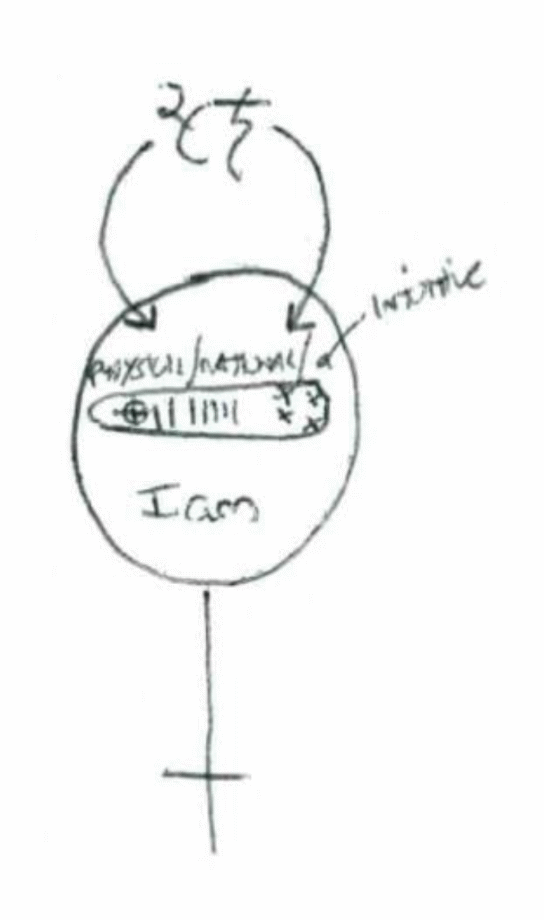
DIAGRAM FOR 1983 0615
Class
Wednesday, June 15th, 1983
Verbatim, unedited transcriptClick the series name to view more
CLASS at Wisdom's Goldenrod, Hector, NY
with Anthony Damiani (AD)
June 15, 1983
PB PARAS; OVERSELF
TOPIC: PB Paras
SUBJECT: Overself
SUBSUBJECTS: Idea of Man, Augoeides, I AM, Asmita, Mercurius, Sage, Ego, Fear of Death
CONTENTS:
THE TRUE IDEA OF MAN THAT IS SEEKING TO BE MANIFESTED IS THE INDIVIDUAL RAY OF CONSCIOUSNESS, THE AUGOEIDES (THE STAR-LIKE BODY)
ALL YOUR ACTIVITY TAKES PLACE WITHIN YOUR CAPITAL M MIND, THIS TRUE IDEA OF YOU, AND THE TRACES OF THAT ACTIVITY ARE RETAINED BY IT TOO
THAT I AM IS THE UNMANIFEST IMAGE OF GOD
FIRST GRASP THE CONCEPT OF THIS BOUNDLESS CONSCIOUSNESS OF THE I AM, THEN YOU CAN UNDERSTAND HOW IT MODALIZES ITSELF AS AN EMPIRICAL SUBJECT
THE MANIFESTATION OF THE I AM IN EVERYDAY CONSCIOUSNESS IS A SAGE
THE SAGE HAS KNOWLEDGE RIGHT AT ITS VERY INCEPTION AND CAN WATCH IT GET CORPOREALIZED, ALL THE WAY DOWN
THE ILLUMINATION THAT GOES ON IN THE EGO AND MAKES IT THINK IT'S A KNOWER IS NO DIFFERENT THAN THE CONSCIOUSNESS WHICH IS FROM A HIGHER LEVEL
THERE IS A REPRESENTATION OF THE NOUS IN MY I AM CONSCIOUSNESS, AND INSOFAR THAT THE EGO ACTS IN CONFORMITY WITH THAT, IT IS IN CONFORMITY WITH THE SOUL IN THE NOUS
AN ILLUMINED BEING WOULD SAY "GOD AM I," NOT "I AM GOD," BECAUSE NOUS (GOD) IS FIRST AND THE I AM FOLLOWS FROM IT
THE GAP BETWEEN OUR EVERYDAY MIND AND THE NOUS IS UNCROSSABLE, WHICH IS WHY THERE IS NO SUCH THING AS PERMANENT UNION WITH IT OR UTTER ABSORPTION
AFTER HAVING WHAT SEEMS TO BE A GLIMPSE, IT IS WISE TO SPEAK TO SOMEONE WHO KNOWS THE MARKS OF AN AUTHENTIC EXPERIENCE
IT TAKES AN EXTREME EFFORT OF WILL TO PUSH AWAY THE FEAR OF DEATH WHEN THE VASANAS RISE UP AND OVERPOWER YOUR RATIONAL FACULTIES
THIS EGO THAT I AM CAN BECOME THE SUN, PROVIDED I CAN DISENTANGLE THIS CONSCIOUSNESS THAT'S IN THE EGO
BOOKS READ FROM OR REFERENCED:
Paul Brunton, Notebooks. 16 vols; Vol. 1 entitled Perspectives [Persp.], published 1984-1988. Some Paul Brunton Notebook paras are, as of 2018, unpublished, and are noted as such.
Paul Brunton, The Wisdom of the Overself
Thomas à Kempis, The Imitation of Christ
Padmasambhava (revealed by Karma Lingpa), The Tibetan Book of the Dead
DIAGRAM appended to this transcript:
- FIGURE 1983 0615-1-AB. I AM as Image of God.
[Transcriber note: [diagram] means the speaker is referencing a diagram as he or she is speaking. If someone is drawing or writing, with audible sounds of chalk on a blackboard, I indicate this by [drawing] or [writing].]
NOTES:
I use Scan File 1983 0615 PB Paras F10.PDF, the Pat Campbell partial transcript for this class, to supplement or stand in for parts that are partly or completely inaudible. The use of the partial transcript is noted accordingly.
Unpublished PB paras should be sourced and proofread.
TRANSCRIBED Verbatim by IT 2019. Reformatted by JRM & JF 2019-2020, with Subheads and Table of Contents added by JRM. In 2023, IT fixes prefatory matter and footer, updates audio file name, fixes/completes Book List, fixes minor errors, adds a diagram from AB notes and references within transcript to this diagram. In 2025, MW expands Subsubjects and alters Subheads to make more accurate. Archival verbatim transcript – V14.1a.
AUDIO FILES: 1983 0615a, 1983 0615b. [Note 1: "Tape" and "Side" refer to original audio cassette tapes that were later digitized into .MP3 Audio Files. Note 2: Both audio files originally had mediocre sound quality, especially the second one. Also, AD speaks very quietly throughout, especially on the second audio file. In 2024, REP Studio improved the sound quality, but the transcript was done before this so certain words may be mistranscribed and student and AD comments that were marked as partially or completely inaudible may now be audible. All time markers are for the audio files used to transcribe.]
1983 06/15 at Wisdom's Goldenrod
PB Class; Overself
Archival verbatim transcript
[Audio File 1983 0615a Begins]
RC: --thought that I'd combine last week that I didn't feel like we really talked enough about. It seemed to be the one that most people, or the most people had the most questions about. So I thought we really go over that one again first tonight before going off. So one of the-- it says--
THE TRUE IDEA OF MAN THAT IS SEEKING TO BE MANIFESTED IS THE INDIVIDUAL RAY OF CONSCIOUSNESS, THE AUGOEIDES (THE STAR-LIKE BODY)
PB [V16, 26:4.63 & Persp., Ch. 26 #50, RC reading]: "The ideas in a man's mind are hidden and secret until he expresses them through actions, or as speech, or as the visible creations and productions of his hands, or in behaviour generally. Those ideas are neither lost nor [RC reads: are never lost or] destroyed. They are a permanent part of the man's memory and character and consciousness and subconsciousness, where they have been recorded as automatically and as durably as a master phonograph disc records music. Just as a wax copy may be burnt but the music will still live on [in] the master disc, so the cosmos may be annihilated or disintegrate completely but the creative idea of it will still live on in the World-Mind. More, in the same way a man's body may die and disintegrate, but the creative idea of him will still remain in the World-Mind as his Soul. It will not die. It's [RC reads: It is] his real Self, his perfect Self. It is the true Idea of him which is forever calling to be realized. It is the unmanifest [RC reads: manifest] image of God in which man is made and which he has yet to bring into manifestation in his everyday consciousness."
[13 second pause]
RC: Did you actually find that thing helpful, Jon?
JB (very faint): (I did.)
S (faint): He did.
RC: Then maybe we should go over that one.
[short pause]
JB/S(?) (very faint): [inaudible]
RC: We've been talking about it last week, Jon and Sera mostly. I woke up Thursday morning still thinking about it. Wrote down a few notes. Gave that to Jon.
JB: I would still ask how the permanence, first part, that actions become a permanent part(s), as the quote says, his consciousness. It didn't tell you (anything--) anything, how that level of permanence bears to the kind of permanence that persists after the annihilation of the cosmos. And I think that was the two kinds of elements [RC simultaneously, faint: Ok.] that confused me last time.
RC: The permanence related to becoming as distinct from the permanence of (Plotinus).
[9 second pause]
DB: Look at the idea, the first part wasn't-- I mean the discussion-- the permanent part was the master-- the master record or wax cylinders he spoke of at times. [short pause] But wasn't it the ideas in man--
S (simultaneously): But louder please!
DB: Wasn't it the ideas-- I'm trying to remember. Oh. "The ideas in a man's mind are hidden and secret" too and I thought they were the permanent of part of the man's memory, character and so forth.
[short pause]
S (faint): Could you read the first part again?
PB [V16, 26:4.63 & Persp., Ch. 26 #50, RC rereading a part of]: "The ideas in a man's mind are hidden and secret until he expresses them [RC reads: these] through actions, or as speech, or as the visible [RC reads: invisible] creations and productions of his hands, or in behaviour generally. Those [ideas] are neither lost nor destroyed. They are a permanent part of the man's memory and character and consciousness and subconsciousness, where they have been recorded as automatically and as durably as a master phonograph disc records music."
[16 second pause]
LDS: It says they become a permanent part of the subconscious and conscious.
RG: (There you go.)
S: Yeah.
RC: Memory, character, consciousness and subconsciousness.
AH (faint): You just read the rest of it.
RC/S(?) (faint): Yeah.
S: Yeah.
AD (mostly very faint): Go on, Andrew. What you said right now [few words inaudible]
RC: Ok these ideas are hidden until they're expressed, they're neither lost or destroyed, they're permanent part of the memory, character, consciousness and subconsciousness.
PB [V16, 26:4.63 & Persp., Ch. 26 #50 cont., RC rereading a part of]: "Just as a wax copy may be burnt but the music will still live on in the master disc, so the cosmos may be annihilated or disintegrate completely but the creative idea of it will still live on in the World-Mind. [More], in the same way a man's body may die and disintegrate, but the creative idea of him will still remain in the World-Mind as his Soul. It will not die. It's his real Self, his perfect Self. It is the true Idea of him which is forever calling to be realized."
AD (very faint): What is that? What is this true Idea of him? [couple/three words inaudible]
S: No.
[9 second pause]
S (very faint): Can't hear him.
RC: Can't hear.
AD (very faint): True Idea. What true Idea that you are. Didn't we interpret this as the underlying consciousness, the individual ray of consciousness, this augoeides, a star-like body? Is this the true Idea of Man which is seeking or waiting to be manifested by the [one/two words inaudible] This is the creative Idea. If you went further and you understood what this nature, this view of consciousness is, then you would understand that all your activity, regardless of how trivial or (unimportant), it would take place within that Idea. That true Idea would be-- consequently it would be the causal or the impressions, essence, and that Idea here would be retained, providing you understand what the true Idea of that man is. That is the true Idea of a man.
ALL YOUR ACTIVITY TAKES PLACE WITHIN YOUR CAPITAL M MIND, THIS TRUE IDEA OF YOU, AND THE TRACES OF THAT ACTIVITY ARE RETAINED BY IT TOO
LR (faint): I thought you were speaking of each man fabricates (his own) [AD, very faint: Oh no.] vision of(--) the Idea can be fabricated. And I would start with manifestation as the Idea, the content part of [one/two words inaudible] of that vision you've used there sometime.
AD (very faint): [couple words inaudible]
S (faint): [couple words inaudible] What?
AD (simultaneously, very faint): [few words inaudible] consciousness, with that emanation only the person [couple words inaudible] is soul [couple/the words inaudible] that augoeides, [Pat C. partial transcript reads: It is within the individual ray - or what we have also called the emanation from the undifferenced Soul] the star-like body, the body which has no circumference, in which all the activity of that entity flows through that, is taking place within your Mind. Whatever activity's taking place is within your Mind and the consequences of that activity [one word inaudible] traces behind it, (give you more time) for that activity. So anything you have done cannot be destroyed, the essence of what you've done is contained (apparently with) that Mind. Is that too abstract?
AH: It's hard to-- it's hard to understand what you just said but at the same time using the terms in the quote that-- of memory and subconscious, that's the difficulty I have. Like, are we speaking of certain-- obviously you're not speaking of personal method.
AD (faint): Well, most importantly you understand that you need to be [couple words inaudible] really understood at all, anything else makes sense is that [one word inaudible] that key notion that-- that you are this (manifested) I AM, this (manifested) [Pat C. partial transcript reads: unmanifested] image of God, if I read you another quote. [short pause] Well unless that is first understood, it won't be possible to understand how any activity that you are engaged in can be retained. [11 second pause] Let me try this way. PB somewhere mentions that the Mind, if you wanted to speak of your Mind [few words inaudible] this Mind(./?) [short pause] (Oh/Well) you got to do better than that. I mean silence is alright if this was a Zen Buddhist monastery but I don't buy.
AH: Well it can't be located because the reference to (the occasion) is posterity.
AD: Alright (Randy), then where is it? (You/He) said it can't be answered. The question is improper. Whereness appears within that Mind. Isn't that what you said?
AH: Yes.
THAT I AM IS THE UNMANIFEST IMAGE OF GOD
AD: Alright. Then back again. What is this manifested Idea of Man that-- this manifested Idea of Man in God?
AH: Yes what we--
AD (simultaneously): Will you read that quote? Would you read that part?
PB [V16, 26:4.63 & Persp., Ch. 26 #50, RC rereads a part of]: "It's [RC reads: This is] his real Self, his perfect Self. [It is] the true Idea of him which is forever calling to be realized. It is the unmanifest image of God in which man is made and which he has yet to bring into manifestation in his everyday consciousness."
AD: What is this unmanifest image of Man?
S (very faint): [couple words inaudible]
AD: Wouldn't it have to be what we just referred to as that Mind? And that it has to be actualized.
RC: I think you could say that the whole-- what we call the Intellectual Cosmos, the whole Divine Mind, as potentially knowable but not yet known by the individual would be an unmanifest image for it that its own activity would-- would generate images of.
JB (faint): It's quite a mouthful.
[short pause]
RC: I cannot say-- talking about an unmanifest image of God I have here, we talked in Plotinus that the first image which appears is the Intellectual-Principle but for us that's-- I'm-- God [couple words inaudible]
AS (simultaneously): I would say (it's/that) the I AM.
RC (simultaneously): That's not where I'm stopping. (bit of laughter) [S, faint: Yeah.] I'm not stopping there. That's not manifest for us. Nonetheless we do say that each individual person, each individual soul is going to have his own vision of-- of Nous. And that particular vision which he is going to have isn't going to appear to him all at once. It's going to appear to him through the operation of the Mercury phase of his own soul. And that insofar as the Mercury phase of his own soul holds that as a potential, that potential within it would be its unmanifest image of God.
AD (very faint): Well-- well then, why not just go to the (quote) Randy and say that that I AM is the unmanifest image of God.
RC: 'Cause I was trying to say more than just I AM because it seemed like a [couple/three words inaudible]
AD (simultaneously): Well I didn't want you to say more there.
S (simultaneously): Yeah.
LR: What's the point?
[Note: See FIGURE 1983 0615-1-AB, I AM as Image of God, appended to this transcript for the following.]
AD: That's the whole point, that unmanifest-- that unmanifest I AM, alright, is the image of God. The fact that it contains within itself the Intellectual, the rational, you know, that's secondary. All that-- all that will get manifested and actualized. But primary is to grasp this notion that we've been speaking about, what he called Mercurius, the I AM or the consciousness, the Being-Consciousness, the emanation from the Universal Soul, and any way you can grab it. But this is what you first have to grasp, that this is the image of your being, the image of your I AM, [RC: Yeah.] from God.
RC: Exactly and I wa-- I was also trying to stress that it is an image. I mean when he says the unmanifest image of God he's--
AD: Well, now, what do you mean by image?
RC: He's not equating that with the unmanifest God.
AD: Yeah. No he's not equating that with-- what do you mean by image here?
RC: That this I AM which each of us declares so enthusiastically is itself an image, and if taken as God is an idol.
AD: Well as long as you don't take it for an image, you know. As long as you don't take the I AM as the reflex of something else, you know, then in that sense (you don't put) image. If you take it in the sense that-- that it's a-- it's-- it's a pure consciousness, it's a-- the presence of your being which pervasive (of both). Any of these ways of looking at that as image of God, fine, as long as you don't bring in any kind of picture or (anything).
RC (simultaneously): Ok. And I would try to make the image more-- I mean, to get it even further away from the pictorial representation, I'd gear it more towards speaking of it as a functional image [couple faint inaudible student words] in the sense that through this activity of creating one's own world and experiencing one's own consciousness as transcendent of that very creative process, that that whole process is an image of God.
[short pause]
DB: Well, it seems that the-- there's a distinction between on the one hand the fact that this-- that this I AM or this consciousness or this unmanifest image that we said at-- was at a transcendent level to the-- to the-- the world, universe. But, I mean the-- the last sentence of the-- of the quote talks about how that has to be, you know, made manifest. I mean it has to be brought into regular consciousness, so in some sense that potential being, that level of Mercury or whatever, actually has to be brought into the-- into the everyday life. But it's that-- it's that presence of that pure being of whatever that is-- is-- I would say that would be the image of God. All the activity that's necessary to make that happen or make that manifest wouldn't necessarily be so.
RC: So you have an incomplete God-image.
DB: How so? Might it-- the-- As I understand it we're speaking of God here, God would refer to the individual's Sun. Right? As of last week we speak of God and that's what we mean. I mean that's the level at which we have to understand that. And insofar as we're a ray of that, and the-- the unmanifest image of God-- I mean that's-- that remains at that level of the Sun, doesn't it?
AS: Remains as a celestial [one/two words inaudible] By God here it's just (really) [S simultaneously: Louder.] the Intellect. I think by God here, when he says that this I AM is an image of God and by God he's more referred to the (asmita) or at least-- or the Overself, which is practically indistinguishable. The Overself in the Intellectual-Principle would be God. And the image would be usually what we spoke of that-- that ray, that I AM, which is an image of God. We spoke before, I don't (remember) [few words inaudible] I think. I think he's saying that that-- that I AM is an image, and therefore an i-- an image but not in the sense that we think of an image. You know, a re-- an-- an emanant, an essence identical with God, the Overself. And that therefore it also contains the-- the entirety of the Idea which is going to manifest.
FIRST GRASP THE CONCEPT OF THIS BOUNDLESS CONSCIOUSNESS OF THE I AM, THEN YOU CAN UNDERSTAND HOW IT MODALIZES ITSELF AS AN EMPIRICAL SUBJECT
VM: See, that point of view-- view, he gives me some confusion or let's say it's hard to get to understand the idea that this image is an emanant of let's say the universal Overself and the-- the Intellectual-Principle. So in that sense there's an eternal nature to it. On the other hand, the way the book stresses, it also requires living out or actualizing and manifesting through your-- your actions in the world, your thoughts and feelings and so forth and then these in turn lay down traces. And yet all of that, including all of the traces laid down through innumerable lives, is still part of that Idea. And that seems, to me anyway, to be in a fairly sharp contrast with the eternal aspect of it.
AS: Well wasn't that the way he spoke of the-- [S, faint: I don't know.] (Thursday's) soul.
S: Like in Plotinus.
AS: It's both indivisible and divisible.
VM: So you're saying the eternal nature would more correspond to the indivisible, and the divisible part are these traces that we push out through our own activity.
AD: No you--
AS (simultaneously): Or the divisible part is the fact that he's living through the experience. Consciousness to me is made available through the experience. The I AM is distributed in body, the (facts) are actually operative right (here). [AB simultaneously: That's what I'm (asking).] (So it's like) also into this [one word inaudible] in that its essence is identical to it in the Overself.
DB: What is it-- [AS simultaneously: It seems (couple words inaudible)] what's then is the distinction between-- and I think I follow what you're saying, Avery, but what's the distinction between that and having been brought into manifestation into his everyday consciousness? Because that's something which he says has yet to happen for most people.
AD: You're cutting the serpent short in the (quote). PB is not going into an explanation of that. But if you start with the premises, ok, Mind, your Mind, capital M, is this reflected image. Within this Mind, capital M, your Mind, there is included within it the whole (of) the heavens starting with the inerratic sphere all the way down to the sublunary. This I AM, this universal consciousness that you are and that goes through the process, particularizing itself in the way that we have explained in other classes, that it's coming down from the inerratic sphere [one word inaudible] the-- the formation of the World-Idea, planetary sphere where it's getting substantiated in the Earth's memories, and then there's the appearance in this particular form, this I AM. This particular entity must manifest those qualities which are in this I AM. And any-- any activities going (on) is recorded in that I AM. Just like, you know, anything that you do, here now yesterday, is recorded by your Mind, the trace is there. And unless you see this whole scheme, you can't understand how this I AM is going to be incarnated in the empirical person and manifest through that empirical person. How the universal consciousness basically modalizes itself as an empirical subject and not (waste) all the way down. Now, the most important thing over and over again I'm going to keep up repeating is, you must get to this Idea that he is speaking about, what this I AM is or whatever you want to call it. The Greeks gave it the name of the star-like body. The-- we have spoken about it as boundless radiating consciousness whose circumference is nowhere. That's your I AM. So unless you first, you know, like turn yourself upside down, you conceive of yourself in this way, this I AM in this sense that it's a boundless consciousness, and that within it, alright, there is an Intellectual Cosmos, cosmic soul's functioning, the elaboration that goes on in the sublunary realms, manifestation of a particular appearing subject--all that comes after this concept is grasped.
S (very faint): Is that [couple words inaudible]
AD: None of this is image (yet/here), the images don't appear until you get into the sublunary realm.
S (very faint): Ok. Then man doesn't appear--
AD (faint): I can't hear you.
S (faint): I thought soul was the unmanifest image of God within the [one/two words inaudible]
AD: Yes. But when-- come on-- I'm trying to point out that that's not an image.
S (faint): I know, I'm trying to understand being an image at this level but I don't.
AD: Well that's because you decided that any time the word 'image' appears you got to see the picture. Now, for instance, is feeling an image?
S (very faint): That's hard to understand.
AD: Answer me. Is feeling an image?
S (very faint): I don't know.
AD: Of course! But do you see anything?
S (very faint): (Not really.)
AD: Do you see a picture, a shape?
S (very faint): That's ok.
AD: Huh?
S (very faint): That's ok.
AD: That's ok, it's still an image, right? Alright. In the same way you could apply that word 'image', you know, in various ways. It doesn't necessarily mean a picture or something. It doesn't have to have spatial temporal connotations.
S (very faint): Does it need to be [couple words inaudible] it has to achieve?
S (very faint): Yes.
AD: But yes.
S (very faint): Yeah, ok. Alright.
S (very faint): And this I AM is defined [one/two words inaudible]
AD (simultaneously): I just told-- I just (mention to you) how to define it. It is this boundless consciousness, this Mind that you are! Which is formless, has no shape, no size, alright, you can't say it's atomic or it has twelve dimensions. You just try. Think of the Mind, see if you can-- if you can give yourself a new image of Mind.
S (very faint): Well then feelings--
[short pause]
AD: The purpose of saying that feeling was an image was to get you away from the notion that when the word 'image' arises, there must be an automatic reflex which says "the meaning of this word is I got to see a picture".
S (very faint): Well, I understand that, I'm just trying to get a sense for something here. [students assent, very faint] [three/few words inaudible] where I take away the (Idea/idea) from another standpoint.
[13½ second pause]
AD: Is this about--
AH (simultaneously): (Yeah.) It seems un-- the unmanifest image [AS: Yes.] was a kind of contradiction. Is that what you're driving at?
S (faint): Well I think that they're-- I can interpret back to the image-- I mean, state of the image to be without [couple words inaudible] That's-- that's ok, I just need a little bit more (precise with the) [one word inaudible] And just say call him an image and leave the [one word inaudible]
S (very faint): [couple words inaudible]
AD: Alright. If we say that the I AM is an image of God, alright, now we say that this God is universal consciousness, universal intelligence, (the same) Intellectual-Principle, alright. It's intangible, invisible, has no spatial qualities that (go on now). Now, what kind of image are you going to get?
[short pause]
DH: Something that's formless without space.
AD: Huh?
DH: Something that's formless without spatial dimension(s).
AD: Ok. Alright so, I mean the word 'image' here is a metaphor. Now what kind of image would that be, Lauren?
S (very faint): Guess I kind of-- I-- I guess I see your metaphor [three words inaudible] even though it may not name them, they can't change the [one/two words inaudible] take that for what it is and [one/two words inaudible] or-- I mean that's [couple words inaudible] trying to understand in what way the image has any [few words inaudible]
RC: Well then what if [couple inaudible student words simultaneous with RC] you thought that you're only going to know that much of God as--
S: Right, yeah. I mean that's your problem, (that Mind is instead) of these possibilities.
S (very faint): [few words inaudible]
DB: Isn't it that the way he's using image here has to do with that record player and you have the master-- you have the master copy and after that you had innumerable numbers of images of that master copy. I mean, I think that's the-- the kind of sense he's-- he's using because, I mean, there are innumerable numbers of these images of God for each-- for each man. I mean I think that's the-- the nature of the idea.
JB: But their very unmanifestness takes away that parable.
DB: No, because [S simultaneously: Right.] the Intellectual-Principle is spoken of as being a-- an image of the One. And what's manifest about that? The soul is spoken of as being an image of the Intellectual-Principle abo-- and what's manifest about that? I mean--
RG: (But) there are-- I disagree that there are many, in this quote there's one.
PB [V16, 26:4.63 & Persp., Ch. 26 #50, RG rereads a part of]: "It is the true Idea of him which is forever calling to be realized. It is the unmanifest image…"
RG: I don't think you could speak of multiple images in that (whole) [one word inaudible]
DB (simultaneously): Well when you do-- when you do yours and get yours manifested, does that mean everybody too?
RG: For you there's one.
AD (very faint): Well [couple/three words inaudible]
VM (faint): Their vision-- vision, that's alright.
RC: But there was another point I thought within this that was important to pick up on was these two themes of on the one hand what we spoke of as a-- as a preordained Idea that had a certain timeless permanence. And that being something distinct from the recording that goes on in the time-series. And, there seemed to me to be last week some trouble with-- a tendency to think of that Idea as in some elsewhere, some remote elsewhere, as if it had been accomplished by some other and now we're just supposed to mimic it or else, like-- as if there were some type of external critic constantly looking over your shoulder and saying this is what's expected of you and you experience it as if it were an external (worry). And, I thought it was real important to-- to talk about that more as a-- as an internal thing, that when you speak in terms of like exercising the faculty of self-judgment upon yourself in the course of living, that this preordained Idea rather than being elsewhere is resident as your very essence, and that all self-judgment is going on-- and the very process of your trying to become that more adequately. And that, as you find yourself actually expressing it, fulfilling it and so on, you feel peace and feel that its freedom from temporality is your own freedom from temporality, even though within the day by day living process you are compelled to act outwardly in keeping it that way, that its-- its direction comes from within and not from without in terms of it being the sense in which it is preordained, and that like when you speak of a-- a raison d'être, an actual reason for being, alright, this Idea is not something alien but is your very-- the very fact of what you are.
PD: Or you could combine [couple/three words inaudible] make this Idea to be external or going to include your outer life, your inner life, it's going to include the torments and tortures that you're going through as well as the inner peace. So I think you're trying to restrict it too much.
RC (simultaneously): No I'm not trying to restrict it, I'm trying-- I am-- I guess I'm an-- on one sense I'm trying to restrict it, but not in the sense that I got from what you just said. I'm saying that everything is going on within it, whether you experience it as-- as something within the states of the ego or something within the states of your world. Everything is seen within the context of how effectively that Idea is being manifest.
PD: But that only seems that you're conscious of the Idea. And I would think most people are not conscious of that Idea. And yet their lives are upholden willy-nilly.
RC: Well that seems to be the point of the last sentence in that they haven't become conscious of it in their everyday-- in their everyday consciousness. But it nonetheless is what they are.
BS (very faint): He gave this highly individual [couple words inaudible]
RC: For each individual, yeah.
PD: But I-- I don't see how you can even restrict the definition there, because on the one sense the Overself is individual and universal. I think the Idea itself is going to contain that dichotomy. It's going to include everybody else's life that you're involved in, you know, or upholding.
S (faint): Uh-hm.
AS: Yeah I-- no I (got/get) a different sense that-- I mean I thought you could see distinction of thought between of like eternal seeds, the World-Idea, and the celestial seeds. And then the evolving would be [couple/three words inaudible] Just as-- you're saying there's just the I AM [couple/three words inaudible] pervasive consciousness and therefore the celestial level has the eternal Idea. That's the level where it evolves more and more vehicles. It also is gaining as it were something from the experience and there making a record of what it manifests. And there you would talk about the evolving Idea. I think you could-- or both levels through that-- through the individual without having to go through a higher self or with any I AM in charge of all of this [couple words inaudible] also paradox there is (this Mind). It's just going to be working it out and therefore leaving a record of that which it actually does manifest or-- or evolving. [couple/few very faint inaudible student words] You're trying to reach and evolve. [short pause] Dickie you even probably wanted to say that the-- that--
S (very faint): Also Greek.
AS: And the Greeks, didn't they have two notions of-- that would be also (right). One view is that it already contained the Idea of all the bodies. The other view was that it was, I mean [one word inaudible] relation of the essences of all those bodies. That's [couple words inaudible] is in one sense the term of different kind of perpetual and evolving. And both-- both views have to be taken into account in this, both views that (I am/I AM) (stuck on).
AH: Avery, could you say that both views include notions of manifest and unmanifest?
AS: Yeah I would say that the unmanifest Idea would be as it is in the (asmita), and manifestness (would add) that I AM to manifest the various levels of you, expressing (or something) the record of the manifest [couple words inaudible] eternal (and) structure or the eternal-- the cosmic, the cosmic record, eternal conjoining of [one word inaudible]
AH: I'm having trouble just (facing/basing) ordinarily the-- of the quote, the discussion, which is how this true I AM can any way be made an object or any way made manifest. It seemed it's somehow connected with manifestation but in itself cannot be objectified.
AS: I don't think he said the I AM is manifest though, I don't-- and I don't know. [AH simultaneously: What would?] But-- but I think he was saying the I AM is what's (manifest/manifesting), what is-- it's not how-- it's what is doing the manifesting.
AH: Yeah. But what are we talking-- I thought you were talking about the I AM. Is that nothing?
AD: Probably.
S (simultaneously): Do you get the--
S (very faint): What you call the Overself manifesting or under, you know--
S (very faint): What do you mean [one word inaudible]
S (very faint): Yes the--
AD (very faint): [few words inaudible] is the real enemy here. The individual soul is an enemy [couple words inaudible] manifestation [couple words inaudible] Because neither of them (appeals) to that.
[short pause]
AH: Neither of them what-- nei-- neither of the references, both Overself?
S (very faint): Yeah Andrew.
AD: Neither of them are something you could see. Usually when you speak about manifestation, you're referring to the fact that the Ideas are being manifest, what was invisible is manifest or dressed in some kind of clothes and I become aware of the Idea indirectly through its manifestation. But the I AM or the-- the principle that we-- that we refer to as individual soul, to speak about it as manifestation, universal Overself, alright, then you will be expecting that there is some sort of, you know-- there's available to you kind of criteria by which you can [couple/three words inaudible] that. The whole point here is extremely (important), that this emanation which we refer to as the Universal Soul, the Idea living in the soul, or the individual Mind--doesn't matter the word--it's to grasp this concept of what that is, what is this-- that Mind. Unless that was grasped then everything that preceded that quotation will be unavailable to you.
[short pause]
CDA/S(?): But are you (asking) about--
PC: Well I mean (are you using) star-like body equivalent to the I AM?
AD: Sorry?
PC: Are you using the term 'augoeides' or 'star-like' body as the equivalent to the I AM?
AD: Or Mind. (Analyze) here.
PC: So are you eliminating the distinction between the-- the I AM and the Logos within it (up there)?
AD (very faint): No I didn't refer to the Logos here.
PC: I thought the-- but this could just be my misunderstanding but I thought the augoeides was the first level of manifestation within the I AM, that it was the first body.
AD (faint): Yeah and what we're saying now is that the I AM, the augoeides, the star-like body, the asmita, Mind goes (with them). [student assents, very faint] (Both.) So, you choose the one that you like the most. Which one do you like the most? [S, very faint: That's ok.] Mind is good, alright. Now, given that you've chosen that now-- (laughter)
VM: Am I going to regret it?
AD (faint): Now he goes ahead and says that [Pat C. partial transcript reads: PB says in The Wisdom that] Mind receives the World-Idea and is going to manifest the World-Idea. It is--
PC: Oh but you're-- you're making the another--
AD/S(?): What?
PC: You're making another distinction between soul and Mind then.
AD (faint): That's right. That's very good but-- (laughter)
AB: Anthony?
S: It's [couple words inaudible]
AD (faint): Go ahead, Peter.
S: Go on.
PC: Ok, I-- I know that we've eliminated that distinction you were speaking about the Nous. [few words inaudible] said that those were [couple words inaudible]
AD (simultaneously): But we're not speaking about that other one.
PC: No we're not speaking about that.
AD: We're not speaking about the Jupiter in Nous [diagram].
PC: Right.
AD: The reasoning dividing it, we're not speaking about that.
PC: Ok.
AD: We're speaking about that which emanates from it.
PC: Ok. Now I thought that once you were within that emanation, there were definite distinctions between the I AM and--
AD: Once you're within that emanation, alright, what will there be within that emanation?
PC: The reflections of what's above that [couple words inaudible]
AD: Well, there would be a reflection of the Nous, alright?
PC: Yeah.
AD: And that's represented by the inerratic sphere.
PC: And that's the Ideas you're saying.
AD: Yeah. There will be a reflection of the abiding reason which we're going to use. That would be represented by the discursive reasoning that the planetary spheres [couple words inaudible] Ok? There would be your sensible body which is part of the Earth's life, alright. And that would be represented so to speak as the picture of the world that you have. [someone drawing] So all these are within your I AM. So the primary concept that you've got to tackle [few words inaudible] is: what is it? If that-- if that isn't grasped, nothing else would make any sense. Now, if all these things are manifesting within this I AM, so Peter Campbell is right here manifesting within his I AM. Anything that Peter Campbell is saying to me is recorded or the traces of that is left behind in his Mind! And if you insist on identifying the Mind with what you find in a butcher shop, that's one thing. But if-- if you get this mystical taste of what Mind is, alright, then you begin to see that anything that you're doing in your world, your idea of your world, will be recorded by this I AM. Nothing can transpire within it without it leaving traces behind.
PC: Ok but that's not the--
AD: That's not what--
PC (simultaneously): That's not what-- that's not the problem that I was having.
AD: What's the problem?
PC: Well I-- we had spoken before of possibility of having that-- that experience, just the I AM without any content. Now--
AD: How would you be able to distinguish, alright, the experience of the I AM from its Logos?
PC: Well that's what I'm trying to understand. Is it the Logos that [one word inaudible]
AD: Can you understand? (laughter) Can you distinguish that content from the I AM? Because then it wouldn't be the I AM. It would be "I am this."
PC: Well I thought that was the idea was that once it began to descend through these various levels first it said "I am the World-Idea"--
AD: Yes but you see the point I'm trying to make, that at that level the distinction, the Logos principle within the I AM, alright, is something just to accommodate our discussion. But if you get there you'll never see a distinction between these two.
PC: You would never-- there will not be two different experiences of the I AM and the Logos.
AD (simultaneously): And the World-Idea, that-- that's right. There's no two experiences. [RC/S(?): Ok.] There's just the experience of the I AM, which is homogenous with the Logos that's within it so don't occupy yourself with that, occupy yourself with what I'm trying to get across! Mind, this concept that we keep throwing at each other. Well, think about it enough times and you can go absolutely, you know, berserk. [10¼ second pause] Try reading it backward. Understand the last sentence then you'll understand everything that preceded it. Don't understand the last sentence, nothing will make sense.
PB [V16, 26:4.63 & Persp., Ch. 26 #50, RC rereads a part of]: "It is the unmanifest image of God in which man is made and which he has yet to bring into manifestation in his everyday consciousness."
[11½ second pause]
S: Just once more?
PB [V16, 26:4.63 & Persp., Ch. 26 #50, RC rereads a part of]: "It is the unmanifest image of God in which man is made and which he has yet to bring into manifestation in his everyday consciousness."
(Side 1 of original cassette tape digitized as 1983 0615a Ends; Side 2 Begins)
THE MANIFESTATION OF THE I AM IN EVERYDAY CONSCIOUSNESS IS A SAGE
AD: [Pat C. partial transcript addition: You must bring that into your everyday consciousness.]
HS: --possible to bring that I AM into your everyday consciousness?
AD: Well, if that wasn't possible, Herbie, you and I should go out and play tennis and stop wasting our time.
HS: If it wasn't possible.
AD: If that isn't possible, you might as well go out and play tennis.
RG: Even if it is possible you should play tennis. (laughter)
AD: Alright, Dickie, I'll buy that. (RG laughs, laughter)
HS: So-- so when you say that it's possible to-- to bring it into your-- your everyday, alright, it says making what was-- what was unmanifest making it manifest? Could you actually make it manifest?
AD: Isn't that exactly what a Sage reminds you of?
HS: The unmanifest.
AD: Not the unmanifest. (laughter) The quality, the sublimity, the nobli-- and the nobility of God. [short pause] And famously referred to as the imitation of God. You know, like Thomas à Kempis, Imitation of Christ, or Plato's theory of the imitation of God.
HS: That would be the actualization of the bringing of this kind of (manifested) image of God into [S: Yeah.] [AD: Yeah.] everyday--
AD: Everyday life. In other words, you're expected to become a Sage.
RC: The emphasis seems to be--
AD (simultaneously): Don't look disappointed, Herbie.
RC: The emphasis seems to be in being it day by day rather than coming up with some manifested image.
S (very faint): Yeah.
S: Yeah.
DH: (Oh so/Also) we talk last week it's-- the task is to know it as ourselves.
RC: Yeah.
DH: It's not to get it out there.
RC (simultaneously): There's one quote [couple words inaudible] that it's not-- it's not that you are to know the Overself but that you are to become the knowing which is the Overself. [short pause] So it seems in everything we've been saying and a li-- so far, we're talking about taking place within this Mercury principle, which basically will be a-- a functional image that contains within itself these images of three different levels of the real being. And that the I AM can experience itself as being in identity with a physical-emotional being. It can experience itself as "I am this rational being." When it does that its-- its life is a reflection of the Jupiter in the Nous. Or it can experience itself as a-- an open intuitive living of the intelligibles within itself, in which case its own life would be an image of the presence of the Nous within it. And, at any given time in any person's life, one phase or another will dominate but all three of them are-- are taking place to unfold it-- to continuously unfold-- unfold this image, to unfold this true Idea in a way that it can be manifested within the everyday consciousness.
THE SAGE HAS KNOWLEDGE RIGHT AT ITS VERY INCEPTION AND CAN WATCH IT GET CORPOREALIZED, ALL THE WAY DOWN
AD: So you could see the perpetual source of happiness for the Sage.
RC: He doesn't have to go there.
AD: It's always available to him, the act of the soul is always available to him. He-- he has knowledge right at its very inception. He could watch it get s-- corporealized, whole process, all the way down.
[13¾ second pause]
AH: May I ask what's being spoken of? Randy you said uh-- you said well-- but it's not-- it's not-- know the Overself as becoming knowledge (that/but) is the Overself.
RC: Knowing is awareness (of it).
AH: Knowing it is that. But when we speak about this I AM become manifest, could you describe what that means in regards to the example you gave of the Overself? Like, it's not-- it's not to know the Overself so the I AM does not become manifest as an object. It becomes manifest as-- as subject.
AD: Look, let me put it this way.
AH: (But--)
S: But--
AD: Suppose that you were capable of perceiving the very origin of the world that you're going to manifest. Now, suppose we continue (in this stage) and perceive the very processes that are involved in taking that original and then making it so that it appears as you are now. Now this would mean, this would mean that you would have available to your understanding or at least available to your apprehension the origin, the continuing(,) proceeding, the effect of that proceeding as an empirical person. You have all this laid out in front of you. [AH: Yes (one word inaudible)] Now this would be a case of knowing from one end to the other, of the grasping of the Intelligible Idea to its manifestation as a sensible object. Do you think you'd be happy?
AH: Yes, but the fact remains-- (laughter) Could I--
AD (amidst laughter, faint): [couple words inaudible] that.
AH: I don't know, could I ask something about what you just said? You describe(d) that process as if it was a dualistic one, as if there's a subject that's observing.
AD: As soon as I-- I use one word I'm already in a dualistic framework. But, that wasn't the purpose at all. The whole purpose here was to show that the arisal of knowledge, the inception of knowledge, and the culmination as an effect, alright, this is all available to the Sage. And it can only (be/do) so in terms of that within his I AM. This-- this is what makes a Sage a Sage. Whereas all we know is all the way at the extreme left [diagram]. [Note: See FIGURE 1983 0615-1-AB, I AM as Image of God, appended to this transcript.] If the wind hits your sail the right way the boat will go. You know nothing about what preceded it. Nothing at all.
[short pause]
AH: I don't-- I could understand what it is the I AM can manifest, that's--
AD: Well what happened in this whole thing? [short pause] Who in the world are you talking about!?
AH: It's like everything unfolds within that(--/.)
AD: From within you!
AH (faint): From within you.
AD: You seize the intelligible, alright, you portray the intelligible as a sensible object, alright, who in the world are you talking about? Your I AM!
[short pause]
MB (faint): So then because the answer to this is how you go sailing? (laughter) You-- you do--
AD (simultaneously): Andrew would be happy, yeah.
MB (faint): Yeah Andrew would be happy. Because if I am going to (some laughter) distort (this) from which the mold even holds.
RG (faint): Of those quotes, yeah.
MB (faint): The process. Then you wouldn't be in opposition to it any more.
AD: So you wouldn't be in opposition let's say if suddenly the building that you were sitting in collapsed. (bit of laughter)
MB (faint): [one word inaudible] [RG: Yeah.] [possibly one word inaudible]
AD: It can't take away the happiness of a Sage because of the circumstance that Nature made.
MB (faint): Well you also-- (laughter)
LD (faint): PB gave us the building.
S (very faint): Right, yes.
S (very faint): [one/two words inaudible]
VM: That's one of Jeff's problems got solved. (bit of laughter)
AH: Anthony, when you say that everything unfolds within the I AM, (some laughter) right, if that whole process and-- if that whole process is-- is unfolded to that I AM, there's nothing that isn't unfolded, correct? Then you would speak of that-- that true I AM being manifest as every--
AD (very faint): [couple words inaudible] then I would--
AH: --as every possible-- every possible thing.
AD (very faint): No.
AH: --possible--
AD: What do you think the implications of mentalism are there? What do you think he's talking about? He's talking about the manifestation of your Mind. It's your Mind that's being manifested as this particular person.
AH: Yeah at the very beginning of this discussion we spoke of that I AM as Mind and also as not in any kind of spatial or temporal reference. It's prior to that always. And now you speak of that Mind being manifest--
S: The way [couple words inaudible]
RG: Andrew, when then Sun--
AH (simultaneously): There's still a logical problem [RG simultaneously: No there isn't.] because of temporality.
AD: It's a zoological problem? (laughter) What'd you say?
RG: It is [AH simultaneously: Logic.] zoological, it's not logical. It is zoo-- zoological.
AD (simultaneously): Zoological problem. (RG laughs)
AH: I don't--
RG: I mean I don't-- the logic of it is pretty-- pretty cool, that something can stand in its own place and emanate another level is simple logic. And it's the-- it's the--
AH: It is?
RG: Yeah it is. Yeah, that stands-- that's simple.
AH: It's not simple, it's not simple lo-- I mean the object.
RG: I mean the logic is simple.
AD: Let's try another quote. [few very faint words inaudible]
PB [V16, 25:2.208, RC reading (simultaneously with AD above)]: "He lives every moment in the…"
RG: Whoa. (RG laughs)
S: What does that mean?
VM: Don't analyze that.
AD: Randy?
THE ILLUMINATION THAT GOES ON IN THE EGO AND MAKES IT THINK IT'S A KNOWER IS NO DIFFERENT THAN THE CONSCIOUSNESS WHICH IS FROM A HIGHER LEVEL
PB [V16, 25:2.208, RC reading]: "He lives every moment in the awareness of his higher self. Yet this does not oppose nor interfere with, the awareness of his lower one."
[short pause]
S (very faint): (Read that quote again.)
PB [V16, 25:2.208, RC rereads]: "He lives every moment in the awareness of his higher self. Yet this does not oppose nor [RC reads: or] interfere with, the awareness of his lower one."
[12 second pause]
AB: Randy? Could-- could we say that those two awarenesses are the same [one word inaudible] same awareness? In other words, when you are aware of the higher self, that awareness was the awareness which is also aware of your lower self which is within that awareness.
AD (very faint whisper): Go ahead.
VM: This reminds me so much of a sense of-- We're in this-- in this pastry shop with PB. We were looking very carefully at all these [one word inaudible] (row of) Swiss pastries and-- Of course my passions were considerably aroused. And PB's looking what appears to me to be great interest too. (bit of laughter) I said to him, "PB are you hungry for any of these pastries?" He says, "No, only my eyes." (laughter) So the lower man is quite aware of-- or its quite aware of the lower man.
S (faint): Was he aware of higher [few words inaudible] in a certain tolerant state anyway so what problems could there be, you know?
VM: Was no problem.
S (simultaneously, very faint): Right [one word inaudible]
S (very faint): [couple/three words inaudible]
PD: That would be interesting there is he speaks of, consciousness is bifurcated for a Sage. Two levels of consciousness always going on simultaneously seems to be applied.
[short pause]
JfL: Paul, isn't it that they're-- that they are-- aren't they together sort of? Isn't that what the Sage (has to) do?
AD (simultaneously): What's the lower self, Jeff?
JfL: The ego.
AD: What's the higher self?
JfL: Mercury.
AD: The I AM?
JfL: Yes.
AD: Ok. The ego's consciousness comes from where?
JfL: Mercury. Or-- or of that ego.
AD (simultaneously): Yeah, or when the ego knows something--
JfL: The higher knows it.
AD: The higher self knows it?
JfL: Yes.
AD: Is there contradiction in saying that the ego self's knowing and the higher self's knowing are the same?
S (faint): Uh-uh.
JfL: But isn't there-- (bit of laughter)
RG: But, that's too easy.
AS (simultaneously): Well, that was (easy). (RG laughs, laughter)
S (amidst laughter): Yeah I mean--
RG: You prearrange(d) that little skit? (laughter)
S (amidst laughter, very faint): I was about to say [three/few words inaudible]
JfL (simultaneously, amidst laughter): Tomorrow, Tuesday night.
AD (very faint): (Let's) both.
S: Yes it is!
AH (simultaneously): The know-- (some laughter) but see if the knowing-- the knowing is certainly the same but what is known by the [couple words inaudible] in other words, a disparity.
PD: The knowing the ego consciousness functions with is not going to be the knowing that's going to apprehend pure consciousness either, the illumined nature of consciousness.
AS: (Other than) why [few words inaudible]
RG (simultaneously): Is the awareness any different?
PD: I don't know.
AS: Same way that--
PD (simultaneously): I don't know. (PD laughs a bit)
RG: Why not? (RG laughs)
S (simultaneously): [few words inaudible] the same.
S (faint): (Andrew--)
DB (simultaneously): So-- so-- so--
S: Are they talking?
S: Too many ghosts.
AD: That would be the reference (to) the ego, you know? We refer to it, it's a matrix of thoughts, corpses, alright. They're not living things and it's not consciousness. Also we have them as thoughts. What makes them peculiar is that the consciousness which illuminates them, now you say "I am a knower", ego says "I am a knower". But the illuminating-- the illumination that goes on in the ego and makes the ego think it's a knower is no different than the consciousness which is from a higher level. It's one and the same consciousness.
AS: Well you-- you also got that [few words inaudible] but it-- I think it's the same idea when he had that quote about His Holiness [one/two words inaudible] They're not two-- they're not two [one word inaudible] If you are that Mind, you can't be different Mind even though that Mind is going to be elsewhere knowing [couple words inaudible] But if you are identified with the ego--
AD (very faint): [few words inaudible]
AS: --how it says that it knows, this one says it's a different knower too.
PD: So in these quotes, the Sage is inwardly contemplating the essence of consciousness. And the ego could be knowing objects?
S (faint): Uh-hm, yeah.
AS: Unless you can say that the ego never knows anything.
PD: But he doesn't seem to take that point of view.
AS: Yeah but--
AD: I don't understand the question.
PD: When a Sage is-- what we're trying to say here-- contemplating an inner essence, and at the same time the ego be outwardly functioning and knowing objects through the senses or--
S: Yeah.
AS: But it's not that--
PD(?) (simultaneously, faint): (You always--)
S: But the consciousness will--
AS (simultaneously): [couple words inaudible] well why can't you rephrase it Paul and say that the ego is outwardly functioning but that what knows is still that same one Mind, and since on the view the ego really never does know in the sense of knowing.
S (faint): Maybe you should know.
PD: It says [one word inaudible]
AS (simultaneously): That one Mind can go through.
PD: But what most of us are (doing) is knowing, but he seemed to call [one word inaudible] known.
AS: Yeah.
S: But-- but just--
PD (simultaneously): Provided I'm leaving that in tact.
AS: But in the Sage's case he knows the ob-- by lower knowing means the Sage walks around and he knows there's a table, he knows-- he actually perceives it, it doesn't turn into a-- But, you would say that-- and even in our case, because of knowing, it still is really the I AM that's knowing the table. But I think (some) don't know. [Pat C. partial transcript reads: Even in our case, it really is the I AM that's knowing the table, though we don't recognize it.]
RG: I think going along with both formulation I don't see-- I mean if you want to keep, [AS: Yeah.] you know-- I would just, I don't know [three words inaudible]
AS (simultaneously): Except-- except that it leads to the conclusion that there are two knowers.
RG: Right, it could lead-- right. But allowing that it doesn't, that there's one illuminating Mind and that the vehicles will be-- one of which is the ego or functioning towards objects, and that there's one Mind which illuminates whatever knowing is going-- going on, whatever the-- from the highest to the lowest.
S (faint): That-- [S, very faint: Yeah.] (that--)
BS: Despite [couple words inaudible] is-- is that still the-- the higher knower seems to either still be the reflection or imageless reflection of the Nous but not Nous.
AD (faint): Not Nous at all. This was the I AM, ok?
BS: I see two aspects in some sense as same.
AD (faint): Well, yeah. To say that he is consciousness is a real (knower) [one word inaudible] And we say for instance [one/two words inaudible] nature [couple words inaudible] basically going on in this ego, the illuminating that is going on in those thoughts is of the same nature the illumination which is going on if those thoughts weren't there. It's one and the same. Now, when it's in the ego, then the ego takes possession of it and says "I am knowing."
S: But can--
S: Same thing Paul said.
RG (simultaneously): Oh but-- but Anthony, (on) that act of taking-- of the ego's taking itself to be the knower seems to be an act of consciousness.
AD: An act of what?
RG: An act of consciousness, I mean, it's not-- when you do take yourself to be the thing, it's a funny--
S: It's--
DH (simultaneously): The consciousness identifying itself with a certain glob of thoughts.
RG (simultaneously): Yeah but-- yeah but we al-- but in some sense, I mean if it is one Mind and one (illuminating) consciousness, it's that illuminating consciousness itself has to take itself as the ego to be other than itself.
AS: Or else the ego has a thought "higher knowing" and it screwed up.
RG (simultaneously): But how could it have--
AS: And then that's what it's aware of.
PC: Right, it's just thoughts actually-- thoughts are actually taking themselves to be the higher.
RG (simultaneously): I don't know what that means the thoughts taking [PC simultaneously: I mean the thought--] themselves to be, I mean it's certainly an act of aw-- cognition.
LD: But remember he speaks of it as a--
AS (simultaneously): It's more than an act of appropriation.
S (faint): Sure.
RG (simultaneously): Well, I don't know.
LD: That's true that--
AS (simultaneously): The light schools.
RG: Yeah, and then three.
AS (simultaneously): One says the light identifies with the ego, the other says that the ego appropriates the light.
RG: Yeah like everyone says that.
AS/AD(?) (very faint): That's very good.
AS: Well, it's leading me back to that simple-- (AS laughing)
LD: Remember he speaks in some places of the light forgetting its source, which-- which seems to--
RG: Yeah but that seems impossible. [LD simultaneously: I don't--] It seems impossible that if it's an illuminating consciousness it could lose the illumination and believe that it's other than the illumination. I mean that-- that seems (awful).
DB (simultaneously): Yeah but if it wasn't for that--
LD (simultaneously): Yeah but-- but (why?)
RG (simultaneously): 'Cause then it wouldn't be illuminating at the time, I mean how-- [DB simultaneously: But what--] But if it is always illuminating and there is one Mind, how could it ever not know that-- that it--
AS: 'Cause illuminating doesn't equal self-knowing.
S: Yeah.
S (simultaneously): Yeah.
AS: You remember, Plotinus [RG simultaneously: Yeah I remember.] the Nous is self-knowing.
RG: I remember.
AS (simultaneously): The soul itself is not of the self-knowing, it's-- it illuminates whatever's there. If it illuminates a thought that says "I am you", then that's what-- that's what gets illuminated.
RG: Right and that would lead me though to agree with your first thing, (figure(d)) that it is a thought 'cause it takes itself to be [S: Right.] the knower if the illuminator is always illuminated.
AB: Yeah but as long as they're identified with that thought you only know illumined thoughts, you don't know illuminating. So lights out.
S: Yeah.
DH: You read the quote last week, the soul has to be taught to be aware of the-- the Logos already contained inside. It has to become aware of that as in itself, soul.
RG/AS(?): Which quote?
DH: It was the middle part.
PC: The I AM?
S: I AM.
DH (simultaneously): I AM.
RG: The I AM?
DH: I think it's what-- I don't know, [S simultaneously: Yeah.] I would-- the I AM.
RG: I don't know that.
S: Well what was [couple words inaudible]
LD (simultaneously): By the first quote [DH simultaneously: And that's the--] I thought the--
S: That was right.
DH: That's the permanent record.
LD: You're becoming self-reflectively aware of the I AM, becoming self-reflectively aware of itself and its content.
RG: I don't follow that.
LD (simultaneously): I thought he implies it.
RG: I don't under-- I don't un-- have any idea what that means. Ok.
BS: He probably means soul.
PC: When it's first manifested I would think it wouldn't-- wouldn't know how to be aware of anything except the contents that it's illuminating, ego contents, you know, it starts out as a protozoic cell and (the plants).
S: Yeah.
AS: I don't know, I mean-- But then I don't know either.
RG: This is a whole other discussion.
AS/S(?) (faint): Right.
EMD: Will you please speak louder?
RG: I just said maybe we should-- a whole other area of discussion about that.
S: Go figure.
S (very faint): (Very good.)
S (faint): That's right.
S (very faint): What did you (say)?
RC: This is interesting.
PB [V16, 25:2.205, RC reading]: "If on the one hand…"
AD (very faint): Says--
[short pause]
PB [V16, 25:2.205, RC reading]: "If on the one hand he is conscious of himself in the divine being, on the other he is conscious of himself in the human ego. The [RC reads: These] two can coexist, and at this stage of advance, do. But the ego must knit itself to the higher self until they become like a single entity. When his mind is immovably fixed in this state, his personal will permanently directed by the higher one, he is said to have attained the true mystical life."
S (very faint): (Read it.)
BS (very faint): Can you read that once more please?
THERE IS A REPRESENTATION OF THE NOUS IN MY I AM CONSCIOUSNESS, AND INSOFAR THAT THE EGO ACTS IN CONFORMITY WITH THAT, IT IS IN CONFORMITY WITH THE SOUL IN THE NOUS
PB [V16, 25:2.205, RC rereads]: "If on the one hand he is conscious of himself in the divine being, on the other he is conscious of himself in the human ego. The [RC reads: These] two can coexist, and at this stage of advance, do. But the ego must knit itself to the higher self until they become like a single entity. When his mind is immovably fixed in this state, his personal will permanently directed by the higher one, he is said to have attained the true mystical life."
[short pause]
BS: What do you think the higher self is?
AD (very faint): Well, now ask me a question.
S (faint): Uh-hm.
BS: My first [one/two words inaudible]
AD (very faint): It's exactly one quote, speak [one/two words inaudible] only (of that). One quote does not refer to another quote.
BS: [three words inaudible]
AD: Not today.
S: (Randy?)
S (very faint): Not today's (anyway).
S (simultaneously, faint): Which quote?
AD: What's the divine being that he's talking about?
DB: The I AM.
S (very faint): Philosophic.
AD (very faint): Two of them. (bit of laughter)
CDA (faint): I don't really know [one/two words inaudible] [AD simultaneously: Go right ahead.] which one's Soul in the Nous, yeah.
DB: So then the I AM is the ego.
CDA (faint): No.
S (very faint): Yeah it was.
DB: Well, if--
AD: Why do you say it's the Soul in the Nous?
CDA (very faint): Well, I mean, it seems that it's easy to-- Well, it seems that it [few words inaudible] and it's [one/two words inaudible]
AD: Then the Mind is permanently fixed.
CDA (simultaneously, faint): That's what I said.
S (very faint): Exactly.
S (very faint): [couple words inaudible]
S (very faint): Sense.
AD: So then you-- the true mystical life is when the I AM is in complete conformity to the Nous.
S (very faint): Uh-hm.
LR: That settled it for me.
BS (faint): Wait.
LR (faint): I would consider myself in harmony with the true mystical life if the ego weren't [couple/three words inaudible] the ego. (I'd settle for that.) (bit of laughter)
S: You're not funny.
AD: Wouldn't it be the true mystical life if you would be the true knower. You'd be the higher knower.
S (faint): (Well I'm down for that.)
LR (faint): That's what you mean by the source of (All).
AD (faint): No you don't have to be evasive. (It's better) to be direct. Would you be the higher knower if you were in conformity with the I AM?
LR: Yes.
AD: And receive Nous.
LR: The source of my knowledge is my I AM principle, beyond that (I/it) can't be spoken of as an image [couple/three words inaudible]
AD: Wouldn't you have to answer that there is a representation of the Nous in my I AM consciousness. And that insofar that the ego acts in conformity with that, that is by definition in conformity with the Soul in the Nous.
S (faint): What else is (new)? (laughter)
LD: I didn't follow.
LR: (Conformity) with knowledge of Being, conformity with the [one words inaudible] Nous seems to represent these two forms of the Nous.
RG: But isn't that what--
LR (simultaneously): I don't have to speak of going down through all the reasoning.
S: Oh but isn't [RG simultaneously: Right.] it [CDA simultaneously: No.] true that all those--
LR: If you speak of individuality, you're speaking independently of soul. There's no need to speak of [one word inaudible] Just speak [one word inaudible] There's no reason to speak [couple words inaudible] There you've-- the soul gives itself over to (the Nous).
S (faint): Yes.
LD: If this is depositing, then why then-- when he speaks of true knower, we speak of that as a unit of knowledge of Being within that and we-- we-- although I agree with your interpretation. But this problem is bothering me. We speak of the true knower as having-- being in Unity-- with knowledge of Being as being in Unity. And that's what we call true knowing. And-- and in the I AM I-- it seems like there's still-- it exists some kind of duality but as far as the knowledge situation there's a who--
LR: Then knowledge is its being [one word inaudible] is its [one/two words inaudible]
CDA (very faint): But insofar that [couple words inaudible] and-- and it has-- it has something in it of the vision of Nous, the true knowing-- the true knowing isn't (in control).
RG: But as we've said many times, Carol, emanation are the-- the way you want to speak of it doesn't even change-- doesn't necessarily change the level of consciousness inherent in the emanants. If it's a true emanant it could also be a true knower. And I thought we were speaking of-- speak of the real emanants as real principles. [CDA: Well--] There's no need not to speak of them as true knowers.
LD: The only way [CDA simultaneously: Well then--] I could see it is, Carol, is the way he talked of the entities before where the experience of one wasn't-- there was no distinction in the experience, there weren't two experiences. But there's one and it-- and [couple words inaudible]
CDA (simultaneously, faint): And one insofar that it is the other. And if you say that true knowledge is [few words inaudible] it's true knowledge as it (through--) as in the quote (there's--) There-- is there-- I don't see how (you experience), but I see why you would have to eliminate speaking of why-- why--
RG (simultaneously): You don't eliminate it, Carol. You don't eliminate it but as you said it's inherent in it and as Anthony just said when you get there you can't know-- you can't know the difference anyway. It's only for our own distinctions intellectually that we even make that.
AS: But that quote is this quote you were quoting before about you can't tell the difference? I thought that was a reference to you can't tell-- you can't distinguish the I AM from the Idea that the [S simultaneously: Ok.] the Mind works with, Logos principle, but I didn't think that was saying there's no distinction between the I AM and the-- the Intellect per se.
RG: Ok. Alright but on the other-- but I thought we had said many--
AS (simultaneously): Idea of Man is that of the Overself.
RG (simultaneously): I thought we said many times though that, to be aware of-- simultaneously of the ego's participation in the world and the World-Idea and the world of (just) manifestation, and to be aware of the divine being, that position is one in the I AM. And that so speak of beyond that, or beyond that Sahaja state, you're not-- you-- you wouldn't speak of it-- of a simultaneous knowledge of the world appearance and the-- and the higher knower. In that state of the Nous you would only speak of-- not of your world, it would be a higher state even than (Sahajic) state of the dual consciousness.
S (very faint): [couple/three words inaudible]
S (very faint): (You say--)
BS: Yeah, this is the implicit poise in the--
S (faint): [couple/three words inaudible]
RG (simultaneously): No that's my-- that's your position on the--
LR (simultaneously): Can we hear this quote again please because I--
PB [V16, 25:2.205, RC rereading a part of]: "If on the one hand…"
[short pause]
RC: Did you like it? (bit of laughter)
S: That wasn't it.
PB [V16, 25:2.205 cont., RC rereading a part of]: "If on the one hand he is conscious of himself in the divine being, on the other he is conscious of himself in the human ego. The two can coexist, and at this stage of advance, do."
[10¾ second pause]
S (very faint): Can't help itself.
AB: "But the ego must knit itself" on itself?
S: Ego must knit--
PD: Louis--
DH: "In this stage the ego must knit itself to the-- the higher self…"
RC/S(?) (faint): We didn't hear that. (bit of laughter)
LR: But my (dream picked) this.
BS (faint): The same Void.
PB [V16, 25:2.205 cont., RC rereading a part of]: "But the ego must knit itself to the higher self until they become like a single entity. When his mind is immovably fixed in this state, his personal will permanently directed by the higher one, he is said to have attained the true mystical life."
[short pause]
LR/S(?) (faint): And Carol you're saying that there's a welding with the body, that it's permanent [couple/three words inaudible]
CDA (very faint): He says immovably fixed or--
S: What?
DB: The mind? The mind.
CDA (faint): See I-- I mean I don't know if I'm right but I have this sense that as high as this [couple/few words inaudible] it is-- is the process-- it is that power of manifestation. It's on-- it's this side of [couple/few words inaudible]
RG (simultaneously): I think-- I think basically the true mystical life he seems to be talking about in the quote is a-- is an a-- is an awareness of the higher knower and the participation in the world. I'm not saying that there aren't higher experiences where there is no manifestation, which seems to have been brought out in the last few weeks. But it seems at this level I thought we had established that you can't go beyond the I AM and also have an appearance of the world particularly. That wasn't-- what are we--
CDA (simultaneously, faint): Well what's-- but what's the point of this Sahaja if it's not both, that's, I mean--
RG (simultaneously): Well, that's exactly the point, it is both. And so-- and--
CDA (simultaneously): Both.
RG: Right. And at that level that it's both, you don't de-- the I AM is that higher knower, I mean what-- I don't understand the distinction.
CDA (faint): But I don't know [one word inaudible]
RG (simultaneously): But let's then-- let's get the right answer.
DB: An-- Anthony--
CDA (faint): You're not convincing me, I'm sorry [couple words inaudible]
DB (simultaneously): I would just-- Carol, I would just like to understand if you mean by the-- by the Nous here, you know, this-- that the Nous is the higher knower, I mean, I guess my-- my problem with that position is that I don't understand how it is going to be that the ego, which we're generally given to understand as this-- in the process of thought, is going to knit itself to, I mean, the Intellectual-Principle all of a sudden.
CDA (simultaneously, faint): Yeah obviously I mean-- obviously [DB simultaneously: I mean--] at this high state that ego as-- as a possible thought has really forfeited the, you know-- you know, in control of the higher will, I mean that's what he's saying.
DB: No it's not in con-- it's not in control of the higher will, its personal will.
CDA (simultaneously): I'm in control of the higher (will). (bit of laughter)
DB: Right.
CDA (faint): Yeah.
S (faint): I just--
S: Could you read the last one again, Randy?
PB [V16, 25:2.205, RC rereads a part of]: "When his mind is immovably fixed in this state, his personal will permanently directed by the higher one, he is said to have attained the true mystical life."
AS: In-- in the diagram you have there I think he's-- I think he's saying that the ego knit to the higher is what mind fixed, that whole thing is the mind, physical, rational, intuitive. When that whole thing is fixed, then that would mean also one thing that you never-- you never again identify with is the [one word inaudible] probably you identify with the rational. And the whole thing, that whole mind, the whole of the (metaphysical) and the whole mind and that whole we want to say vehicle for the higher will, in other words, becomes a pure expresser of the Nous. [few words inaudible]
RG: I would think within--
AS (simultaneously): The ego now is no longer any separate entity at all and just it is the ego completely welded and in the whole of that Mind, not a separate entity.
RC: Yeah I would think that he would--
AS (very faint): No longer separates himself.
RC: --be aware of that part of him which this-- only physical, and what its state would be-- be aware of the part with which psychic and what its state would be and so on.
[short pause]
CDA (faint): Isn't the question still though about [one/two words inaudible] of this-- of the source of the statement because what Avery just said, that if this entity that's-- that's [one/two words inaudible] always (mistakes/the states) has (two worlds, what matters are the states).
RG: (If/Yes) Anthony really said.
AD (very faint): It's--
RG: Then what's the answer then?
AD (very faint): I didn't say separate [one/two words inaudible]
RG: What's the answer though?
S (faint): So you're not answering [one/two words inaudible]
RG: Do the answer.
S (very faint): Yeah.
S (very faint): (Do it.)
AD (very faint): Maybe not.
AS (faint): I think it also(--/.) Carol, let's say he has [RG simultaneously: I thought--] the knowledge [couple words inaudible]
RG (simultaneously): Jonathan, when it's Jonathan's (to read) and (the/a) question.
AD (very faint whisper): [inaudible, 1:27:32.5-1:28:55.5] There's no real distinction. The I AM is-- is this universal law. Universal law. [short pause] Soul in Nous, the distinction that we're trying to-- In one case these are the pure hypostasis, in the other they're hypostases as embodied. [S, very faint: As within soul.] Soul [possibly one word inaudible] [Pat C. Partial transcript reads: The complete alignment of the ego with the higher knower requires that one begin with a state of Sahaja -- you don't conceptualize, have no thoughts -- just the I AM is manifesting through that. Then what I know of you would be living the true mystical life. The I AM would not in any way disagree with the Intellectual-Principle as a hypostasis (pure hypostasis vs. hypostasis as embodied is the only distinction between the two).]
CDA (very faint): Nous within soul is of-- of this-- is an image of the vision of the Nous, of this-- of soul's vision of the Nous. Now, then the I AM is (this) and, you know, speak in this-- this kind of way but there's-- there's this (pole) there, I just keep having to talk the Nous in soul. Whereas the hypostasis Nous, you speak of them as being only logically distinct but [couple words inaudible] it's in this hierarchy that the true-- the true knowing in the soul is the Nous, that-- that-- that is-- that is the true knowing is this Nous knowing itself, it's (same thing). [Pat C. Partial transcript reads: The true knower in soul is the Nous.] So there's-- there's two levels. Might just be one [one word inaudible] of the statement. And I can't-- I just can't explain that-- that I-- that I-- that [few words inaudible] that while he's there, that kind of knowing, I can't explain it. Knowing is going to be (partial).
AD (simultaneously, faint): With the knowing that's in the Intellectual-Principle. Yeah. Go ahead Richard, talk.
RG: Then what is so sharp about your understanding of the distinctions, Carol?
CDA: Well--
RG: What pol-- what-- what is-- what are the marks of each that makes you so strong if they're so different?
CDA (simultaneously): Well at least what I-- what I just said against both.
RG: Not knowing either I have trouble distinguishing.
CDA (simultaneously): Well, I mean, come on [one/two words inaudible]
RG (simultaneously): No, no, but I mean you guys seem to have a strong idea of how distinct they are and if you could make it--
CDA (simultaneously, faint): Well but, I mean one is a hypostasis, it's the Thought that's in the Mind of God, the Intellectual-Principle, ok? And the goal there would be just the true knowing being (assigned to) knowledge of Being, and that true knowledge for us is so-- the knowledge that he's [one/two words inaudible] is--
RG: Is that the knowledge of the soul or the knowledge of the Intellectual-Principle per se?
CDA: Both. For soul to have true knowledge it has to know its-- know that there's knowing (of/in) itself.
AD (simultaneously, very faint): Yeah but [few words inaudible] is [one/two words inaudible] Is that right? This is necessary in order to build it in this new way. [short pause] [three/few inaudible student words] I AM is different (always). If you-- if you reverse the quotation, the (connotation) is the life he's speaking about [few words inaudible] or the Nous which is in your soul, alright, you will be doing here that which is actually necessary in order to speak about [few words inaudible] [Pat C. Partial transcript reads: If operating from Nous in the soul, we would be doing here what's absolutely necessary to live the true mystical life.] So you will-- you will see that the distinction(s), alright, were valid up to a certain point. It's hardly feasible to speak about a distinction between knowledge and what it's [few words inaudible] the Sage the knowledge which is in the Intellectual-Principle [three words inaudible] [student assents, very faint] The distinction [one word inaudible] you really have great pain (is--)
CDA: You said--
AS (simultaneously, faint): Could you say a simple analogy, you could say that, if-- if you're anybody, like ego, any identification with a part of the (given), and the relation of that person to the I AM, it's analogous to the relation of I AM to Nous [one/two words inaudible] If you were any of those persons, the Shelley body or the soul, the I AM (is this) [one word inaudible] or your-- your abiding principle, which is-- or the high-- or the knower within you. But, if you were the-- say the Sage [couple words inaudible] recognize the Absolute Mind, then the higher knower would be [couple words inaudible] (to say).
LR (very faint): I would disagree with that.
AS (faint): [three/few words inaudible]
S (very faint): Isn't the Sage higher being?
S (faint): [couple words inaudible]
LR (simultaneously): No, no, he's making [S simultaneously, faint: Yeah.] an analogy.
AS (faint): Making an analogy and saying that the I AM recognizes the knower within it as a principle because it is identified with that knower. He has access to that real higher knower within it. Whereas if he is any of those bodies he has access to the-- that-- that which is the higher knower within him would be the I AM.
AD (very faint): If she goes by the context or-- Well it is-- isn't by in terms of the context used.
DB: Anthony, I-- I would like to-- to ask-- to pursue the-- this question of the knitting of the ego to the higher knower. You spoke I think earlier of, you know, that requires a peaceful state or that there's a-- there's a-- I guess you said that the ego there was dead, something like that.
AD (very faint): What I said was that the mind was dead. The mind that (you know as) functioning [couple words inaudible]
DB: Right.
AD (very faint): It has thoughts that are conceptual.
DB: Ok. But now is it-- is it that in some sense the principle which-- which allowed that to happen-- not-not the I AM consciousness but--
[Audio File 1983 0615a Ends]
[Audio File 1983 0615b Begins]
AD (very faint): I'm sorry, say it one more time.
DB: Well, you know, there's this whole-- there's this whole process of development that goes on over many periods of many-- many lifetimes. Then all of a sudden it seems this functioning which has been developed to a very high level of-- of sophistication stops. Now it seems that this stopping of this-- this process of thought, this ego or whatever, to allow the manifestation of this higher knower in one's daily life or so that this is knit, this-- this principle is knit to the higher, it seems like this is a very special kind of transformation that's made here, because it's-- I mean it stopped but it's not stopped in the same sense as it would have been if it had just gone to sleep or so. Because it still provides a channel for this principle to operate within the world. And I'm just-- I'm just asking that-- if that's so. I'm trying to see what this-- this stage of the development is like wherein it's spoken of as this ego is knit to the-- to the higher self that its functioning stops, its personal will is at the behest of this higher knower and so forth. I'm-- I'm trying to grasp what that means.
AD (very faint): (It fulfills) the higher self.
DB: Yes.
AD (very faint): [inaudible]
DB: Right.
AD (very faint): [few words inaudible] when the higher self [one word inaudible] [Pat C. Partial transcript reads: Purification of emotions, character development, the ego -- you go through these other categories to see how the ego becomes aligned with the higher self.]
DB: Right. And this alignment or for the ego-- from the ego's point of view is constituted in an ability to be silent, to not function but in some sense to remain at-- Do you see what I'm trying to get at? I mean there's this--
RG: I don't see why you say it doesn't function. I think it functions perfectly.
DB: Well--
S (simultaneously): Right.
RG: It functions perfectly 'cause it just it-- it doesn't take itself to be self-limited.
JB (very faint): So the being, is that the same as functioning?
AD/S(?) (very faint): [one/two words inaudible]
RG (simultaneously): (It remain/In a way), why can't it remain?
AD (very faint): If you say the ego becomes a perfect servant [one word inaudible] the higher self, the means are still there. They're not destroyed but it's transformed. That's what the (evidence) [couple/three words inaudible] purpose is. [Pat C. Partial transcript reads: If the ego becomes a perfect servant of the higher, the ego remains, but is a perfect vehicle for the I AM consciousness.]
S (faint): Let's go.
AD (very faint): [three words inaudible]
AS (very faint): [inaudible] And if that was a permanent (condition), he said (you were) dead. [Partial transcript reads: If Sahaja were a "permanent condition", you'd be dead.]
AD (very faint): I would be dead. [short pause] Let's read another one, go ahead.
PB [V14, 22:3.329, RG reading]: "The thoughts and feelings which flow like a river through our consciousness make up the surface self. But underneath them there is a deeper self which, being an emanation from divine reality, constitutes our true self."
[31½ second pause]
PB [V14, 22:3.38, RG reading]: "For centuries theologians have argued about the meaning of Jesus' declaration that the kingdom of heaven was at hand. Most of them have given it a historical interpretation. Only those who could approach the mind of Jesus have given it a mystical interpretation. For only they can see that he meant that the kingdom of the Overself is really as close to us as is our own hand. All such argument is useless when it starts from different planes of knowledge and the arguers never really meet each other."
[32 second pause]
PB [V14, 22:3.373, RG reading]: "The true unchanging self is apart from any historical era and is not dependent on outer changes of custom and form."
[12 second pause]
PB [V14, 22:3.147, RG reading]: "All his finest emotions, his deepest wisdom, his creative faculties, his truth-discriminating intuitions come into being because of the Overself's central if hidden presence."
[10¾ second pause]
AN ILLUMINED BEING WOULD SAY "GOD AM I," NOT "I AM GOD," BECAUSE NOUS (GOD) IS FIRST AND THE I AM FOLLOWS FROM IT
PB [V16, 25:1.161, RG reading]: "An illumined being would better describe his inner status by the phrase"God am I" than by "I am God," as his first thought is not "I" but "THAT.""
[short pause]
S (faint): (What if) he is?
S (very faint): [couple words inaudible]
S (very faint): It wouldn't be his soul.
RG (simultaneously): Illumined being.
S (very faint): What is it?
[students inaudible, 0:07:03.1-0:07:30.0]
RC: Could you-- could you think of that as a-- as a recognition within the I AM, that while everything that it knows can be traced to its own activity, its own being can't be traced to its own activity?
[students inaudible, 0:07:57.9-0:09:11.1]
RG: Listen, yeah, if I take his first thought is not "I" but "THAT", then what is it that's reached?
JB (faint): The (latch) from the inside I assume that (Madame Buddhist) wanted to just stop for (the) observation there. [S, very faint: Yeah.] The Mind is first. Your "I" is God and therefore [couple words inaudible] So I-- I hope [few words inaudible]
S (faint): Would you read it again?
S (faint): Yeah.
PB [V16, 25:1.161, RG rereads]: "An illumined being would better describe his inner status by the phrase"God am I" than by "I am God," as his first thought is not "I" but "THAT.""
[20½ second pause]
AD (very faint): You want to mention, Dickie? An illumined being, it's much more appropriate.
RG: Yeah I know.
AD (very faint): [couple/three words inaudible]
RG: I would say here that it is the asmita that will be (over), I mean, the true-- the true I's relation to the-- the Nous, and that he-- the illumined being is aware that his existence, being and consciousness comes from a source that is in the Nous and therefore he has to give precedence to the Intellectual-Principle as prior-- as what he knows is consciousness.
S: (Uh-hm.)
AD (very faint): Is that(--) you say-- you're saying that in the order that we speak about, you know, I AM as an emanant of That, so the I AM is an emanant of the Nous. So when he says "God am I" that would be the proper order, the I AM follows from this principle. If you reverse it--
RG: If you reverse it I mean it's--
AD: "I am God".
RG: If you think that the I-- I mean-- I mean, that-- if you believe the I AM is-- well, even on an equal level to the Nous you're-- seems to be a certain amount of inflation there, unless--
AD (simultaneously, very faint): Well, (if we bring the) [Pat C. partial transcript reads: If you reverse it, from a] philosophic point of view the hierarchy [RG: Right.] is turned upside down.
RG (simultaneously): It's the other-- is the other way around, and the I AM could never encompass the power or the grandeur of the Nous. So you don't really have a right to say it.
AD (faint): So if we say "God am I", seem like the God inside of (you) is here, alright, "am I" is an emanation from it. So God is primary; the emanation is secondary.
[short pause]
RC: It is true that he's saying that God's being extends into the being that is taken to be this "I". But it doesn't seem that it would be [AD(?), very faint: The same.] valid to reverse it and say that God's being--
AD (simultaneously): Wouldn't be valid to say that I AM is God.
RC: Right.
AD: Go ahead.
S (very faint): Yeah.
MB (very faint): What do you mean that his first thought is God, what level is he talking?
RG (faint): Whatever (level).
AD (very faint): I just gave you the explanation. Go on, let's do another one.
MB (very faint): (That's really-- I'm overwhelmed.)
S (very faint): Uh-hm.
RG: But Myra at any level, that realization is reflected at any level of thought, that his first thought that this is a reflection of reality is always the one-- but the precedence on the side of the Nous, whatever it is, at whatever level you're talking.
LD (faint): Even at this level of the one who is talking it's proper to say that [few words inaudible] later on (it would seem to) God, capital G.
AD (very faint): It's not, yeah.
[short pause]
MB (very faint): (What's) the function of the body was to-- manifestation [few words inaudible]
S (very faint): [few words inaudible]
AD (faint): That was true [inaudible] instead of this-- here the logic will be reversed and it's (not) the hierarchy and the order of principles, God is first and then the individual soul is an emanation from it. (Well to) say-- say "I am God" is to reverse the proper procedure which is God is first and I AM follows, "God am I." Don't ask me to explain it again (if you can't/you can) follow me the first time. Otherwise we will-- we won't get beyond a half a dozen, we want to go through quite a few of (these/those).
PB [V14, 22:3.230, RG reading]: "Wherever they happen to…"
AD (simultaneously, faint): I want to s-- I want you people to get saturated.
PB [V14, 22:3.230, RG reading]: "Wherever they happen to be, in wide-scattered countries, widely [RG adds: in] different climates, and far-apart centuries, men have experienced this divine presence. What does this show? That it is not dependent on place and hour, not subject to the laws of space-time [RG reads: space and time]."
[10 second pause]
AD (very faint): Excuse me, Myra [few words inaudible] You know, I've experienced with many people they're all confused once [few words inaudible] why didn't you tell me? I don't understand it the way you understand it, I understood it quite differently. [inaudible] Those words can be very deceptive until we have the entire background of this man's work [couple/few words inaudible] It'll be [one word inaudible] until you reach a point (but) that much of a background that you're operating with can be very misleading.
S (very faint): Well, that's good enough.
S (very faint): Go ahead.
JB (very faint): "God am I" is a-- it's sort of a simple [one/two words inaudible] this [one word inaudible] this hierarchy is this word 'THAT' has a similar esoteric meaning to the Nous?
AD (simultaneously): They're synonymous. THAT is synonymous with God.
JB: THAT is the Nous, THAT [couple/three words inaudible]
AD (simultaneously): (But) out of the word 'THAT' is synonymous with God in PB's language. Not the I AM.
JB: Right, I thought it was symbolic of the relationship of God and ("Who am I") because THAT, well if it always starts with God.
AS (faint): 'Am'-- seems like 'am' would be symbolic [couple words inaudible] at "am God".
AD (very faint): In other words [couple words inaudible]
AS: Well, yeah, I mean just the word 'am' would be symbolic of the relationship of THAT, Nous, and the "I".
[short pause]
THE GAP BETWEEN OUR EVERYDAY MIND AND THE NOUS IS UNCROSSABLE, WHICH IS WHY THERE IS NO SUCH THING AS PERMANENT UNION WITH IT OR UTTER ABSORPTION
PB [V14, 22:3.308, RG reading]: "The gap between man's mind and God's mind is uncrossable. But the gap between his everyday mind and the Overself--which is close to God--is not. Through it he may penetrate a little deeper into the mystery."
[short pause]
PB [V14, 22:3.308, RG rereads]: "The gap between man's mind and God's mind is uncrossable. But the gap between his everyday mind and the Overself--which is close to God--is not. Through it he may penetrate a little deeper into the mystery."
[short pause]
AD (very faint): Go back.
AS (very faint): (Seems like) God (probably the Nous).
RG: Yeah.
AS (very faint): It's the Intellect the way we've described.
AD: Say it.
S (very faint): Those were [three words inaudible]
AD: Read the I AM--
AS (very faint): That um-- when he says the gap-- the bri-- the gap between man's mind and God's mind is unbridgeable, by God's mind I think he means the Nous in itself. There is-- you cannot trans-- you cannot go from this mind, everyday mind (and even) the I AM to the Nous direct and no bridge there. But, on the side of the I AM, on the side of the soul, in light of the soul, there you can find such, what is divine in you and not to God's mind per se, at least to [couple words inaudible] representing an essence [few words inaudible] That does [few words inaudible] [Pat C. partial transcript reads: By God's mind he means the Nous in itself. You cannot go from man's mind direct to the Nous. But in the I AM principle you find its representative in essence, which leads you to something of God's mind.]
JB (faint): There's something (of) everybody, man's mind (especially), take all of that [S: Yeah.] (and) compare it to the everyday mind. Seems to not be-- [couple inaudible student words simultaneous with JB] see but I mean comparison.
AD: Well--
JB: Maybe just reread the quote that you have up there.
AD: Well your everyday mind now, the one that you're using [one/two words inaudible] now.
JB/S(?): It is (with this) [one/two words inaudible]
AD: (Quick), alright. This everyday mind that you're using now could it ever-- that can approach this I AM. Which, between this everyday mind and the I AM--
JB: Is not really the individual. But even the whole of man's mind, including the parts yet unfulfilled, un-- un--
AD (simultaneously): Yeah, the to-- the totality of the I AM.
JB: It just can't--
S: Be a [one word inaudible] bridge.
JB: (Can/Can't) be a bridge to God.
JB/S(?): So it was an entity that--
AD (simultaneously, very faint): [couple/three words inaudible]
JB: Even the lower mind can't get into the I AM. So, the everyday mind [couple words inaudible] [RG assents] even the most potentiated mind can't bridge God's mind.
AD: That's why there is no such thing as permanent union. When they speak about utter absorption or Nirvana, which, you know [one/two words inaudible] it can't be.
CDA (faint): That doesn't exclude the-- that the-- the Sage(')s-- doesn't see that, let's say, or doesn't explain that everything's [few words inaudible]
AD (simultaneously): We just said it can't be a permanent identity.
CDA (simultaneously): Right, right, but insofar that it's a possible experience, I don't understand how it is unbridgeable [one/two words inaudible]
RG (simultaneously): Oh wait, but the quote-- the quote doesn't read that the O-- that there's a gap between the Overself and God's mind which is unbridgeable, it only reads that there's a gap between man's mind and God and that's a link. To man's mind the closest he could get is to the Overself, it doesn't say that once he gets there, it then also can have a link to God's mind.
LD: No but even if (you had experienced) the universal consciousness, I mean, there's no way you could bridge infinity, I mean, [CDA: No, I--] permanently, you know, I mean (you wait to) experience that I think. But to speak of a permanent--
CDA: Right. Well I understand that and there's no way that-- that even the Sage's experience of the Nous can ever even penetrate more than just this-- But still, there is a link that is a (link), and it's that-- is the Overself.
S (very faint): (Go ahead.)
LR (very faint): I think his position seems to [inaudible]
RG (faint): Right, it's unclear. I mean, I don't know why you think it's ok.
LR (very faint): He says [couple words inaudible]
RG: But I've also have said many times that the way is open above that once you've attained the Overself and have access to hi-- higher principle.
LR (simultaneously): You become the [one word inaudible] you become the principle beyond the Overself?
RG: He has access [S simultaneously, faint: No.] to those principles.
JB: But you're not man's mind.
LR: But you still remain soul.
RG: Well, yes. Well isn't that-- isn't there a relationship between the soul and the world?
AB (faint): Yeah but he says the Overself cannot transcend its relationship to the World-Mind.
RG: We never said that [S simultaneously: In its turn.] but-- but the quote here is that, first part is that there's a gap that's unbridgeable. If you allow that there's a relation that is a bridge.
AB: But the-- even though the ego can be permanently wedded to the I AM, the I AM can never lose a distinction from the--
RG: But that-- but that's--
AB: --Nous.
RG: Yes but in not losing its distinction it also retains its (loka).
AB: Right. But it can't cross into--
RG: I think that's a-- I think that's a verbal thing that doesn't make any sense, I mean--
LR: It's not, Dickie [AB simultaneously: Can't become distinguished but--] [couple words inaudible] Dickie, it's a question of whether you become more than the ego.
RG: What? We're not qualified to talk about that.
LR: Well, [RG simultaneously: What--] if you want to be that way we're not qualified to talk about a lot of these quotes.
RG: That's right. (laughter) It just slipped my mind and I agree with you.
LR (simultaneously): Yet we pursue it, we get--
RG: But thi-- but this particular level of understanding is far beyond even what we adequately talk about. [a lot of coughing, few student words inaudible] No I don't-- I don't know.
S (very faint): That's good.
RG: Hasn't it been said [LR: I don't see--] that there's acts that the Overself has access to the Nous and to the One?
LR: In what way?
AD (faint): Why don't we wait till we get to those categories, (that'll be for) the Void.
RG (simultaneously): Right. Ok.
AD (faint): The One, (waiting).
PB [V14, 22:3.250, RG reading]: "The Overself surrounds the borderline of the ego, its perfection stretching into infinity."
[11½ second pause]
PB [V14, 22:6.291, RG reading]: "The divine self reveals itself for a few thrilling moments and then draws back into the void where it dwells. But the glimpse is enough to tell him that a higher kind of life is possible and that there is a being beyond the ego."
S (very faint): Ok.
AD (very faint): Let's try it again.
PB [V14, 22:6.291, RG rereads]: "The divine self reveals itself for a few thrilling moments and then draws back into the void where it dwells. But the glimpse is enough to tell him that a higher kind of life is possible and that there is a being beyond the ego."
[short pause]
PB [V14, 22:6.292, RG reading]: "The glimpse gives him a slight inkling of what the term Overself means. It shows him--not as intellectual idea but as realized fact--something of the ideal toward which he shall strive."
[10¾ second pause]
PB [unpublished, RG reading]: "The impersonality of the Overself seems monstrous to some and is terrifying to others."
[short pause]
PB [unpublished, RG reading]: "Every effort to find the Overself is confronted by its illusive character."
AFTER HAVING WHAT SEEMS TO BE A GLIMPSE, IT IS WISE TO SPEAK TO SOMEONE WHO KNOWS THE MARKS OF AN AUTHENTIC EXPERIENCE
HS (faint): Ok how-- ok how-- how (do those) glimpse, the glimpse is better than, so to say, another--
AD (very faint): A glimpse carries its own authenticity with it, but believe me, takes a while [Pat C. Partial transcript reads: it is wise] to speak to someone about it who's had one.
HS: Would you say that would be that they're knowing your [AD simultaneously, very faint: This is--] way, (simply) that they tell you you've had one?
AD (very faint): [couple words inaudible] They would be able to elaborate, you know, a little bit of something about what the marks of an authentic glimpse are like.
S: Could you elaborate? What goal [couple words inaudible]
AD (very faint): [few words inaudible] what the experience itself is like so that you don't mistake it for the real thing. And very often he can tell you by personal contact. If you personally contact the person he can tell you what that (glimpse) is. [few words inaudible] And he wouldn't say [few words inaudible] [short pause] You know, like many people that used to take drugs and thought that they were getting glimpses of reality. (laughter) But to someone who had a glimpse, he would be able to point out that you cheated the authentic item, point out what you would have to experience (and what'd it be like for them). [student assents, very faint] So there's always need for a little help in these matters.
[short pause]
BS (very faint): It seems that you could have a wide experience [couple/three words inaudible] So you're willing to be [one word inaudible]
HS (very faint): Yeah what does that say about (the glimpse)?
AD (simultaneously, very faint): Well-- yes Herbie, the variety-- the variety of the glimpses I don't think would be [couple words inaudible] months and years.
HS (very faint): He has his own. (But then it) disappears anyway.
AD (very faint): It varies. It's-- it's its own authority. You can't say "I don't believe you."
[students assent, very faint]
RG: Right.
AD (faint): Whereas the other, you know, like if you got the experience, let's say a drug experience, some time after that you would question. Sometimes (that you're gonna) say that you have question. But the other thing there's no question. See [couple words inaudible] better-- can be answered with a-- another question. But if you should be having one now, Herbie, knowing someone who's had it, he can almost feel it, you know, almost (alone). Stuck. (laughter)
S (amidst laughter, faint): Nothing to it.
S (amidst laughter, faint): Oh my God.
AD (very faint): (Wait), it's bad.
S (faint): Nothing (quite externally).
S (very faint): (That's right) [one word inaudible] (bit of laughter)
LR: How do you know that expression, Chip? (laughter)
VM (faint): (Yeah) I'm been trying to explain (the latest) to the neighbors [couple words inaudible] (laughter)
AD: With stu-- with stuff that I know of.
RG: That's right. (some laughter, student words)
AD: [couple words inaudible] goods. (bit more laughter)
S (very faint): That's crazy. (bit of laughter)
AD: (The psyche.) Let's have another one.
S (very faint): What?
RG: What?
PD: The--
RG: Well what-- I don't--
PD: The thing about--
JB: The kind of person you were, what are the elements that make the Overself seem frightening.
AD: The what?
JB: That's implied. That make the Overself seem frightening. It was two quotes ago.
LR: Ego doesn't--
AS (simultaneously): The personality [couple words inaudible]
LR (simultaneously): The ego (doesn't care) to get what it wanted.
VM: It didn't just [couple words inaudible]
LR (simultaneously): [couple words inaudible] oh this is too [one word inaudible]
AD (simultaneously): If you wait a little while we're going to repeat, do all those notes on the ego, we'll go over (again).
S (simultaneously): It's ok. (student laughs)
S: Let's get to them.
JB (faint): (Ah), those are the most [couple words inaudible]
S: Definitely.
AD (simultaneously, very faint): [one/two words inaudible] the class but it's worth it. (bit of laughter) Some people went out nauseated, some went out sick. I knew that they would work!
JB: I was there, I must have blocked all that.
S (very faint): The ego was there too.
S (very faint): Yes you were.
S (very faint): Yes I was there.
AD (simultaneously, very faint): (Good.) [one/two words inaudible] yes. We never could forget.
S (very faint): [few words inaudible]
S: Getting (sick)?
AD (simultaneously): Oh yes, that's part of its technique! (some laughter)
S (amidst laughter, very faint): [few words inaudible]
AD (faint): Sure. It's part of the (stuff). But generally the frightening part of an experience of a glimpse unfortunately (is when the Sun) hits the ego's attempt. It could be fear, alright. But it could be many other things. The ego will seek any-- will seek the fundamental way in terms of your own make-up to divert your attention.
JB: So the fear--
AD: As a matter of fact, (where) you're most sure.
[short pause]
S (very faint): Let's do [three/few words inaudible]
AD: No the glimpse is not an [one word inaudible]
S (simultaneously, very faint): No, it's not.
RG: Then we need a [one word inaudible]
S (simultaneously, faint): So then you called it blissful [three words inaudible]
AD (faint): Glimpses [one word inaudible] (happiness).
S (very faint): Yeah, uh-hm.
IT TAKES AN EXTREME EFFORT OF WILL TO PUSH AWAY THE FEAR OF DEATH WHEN THE VASANAS RISE UP AND OVERPOWER YOUR RATIONAL FACULTIES
JB: I have an ideal view that the fear of annihilation and meaninglessness is the principal ego fear. And while the ego may imagine it has to dissolve in presence of the Overself--
AD (simultaneously): I-- It knows.
JB (simultaneously): No, no, I mean it-- it may dissolve in something else (student laughs) but that-- that could be alright. But if it knows (laughter) it just seemed to me that like the-- the reassurance of having a-- an essential identity even though the possibility of mortality would take away the [couple/three words inaudible]
S (simultaneously): Yeah but then you're getting--
AD (simultaneously, faint): In other words, you're coming (at it) from your head now [one word inaudible] (laughter) which-- I thought it's like a lot of people say "Don't worry. When we die it's all over like that." Phooey. (bit of laughter)
S (faint): Whatever that means.
AD: 'Cause that-- that last hour I wanted to say that. That last hour when (you/he) (still--) you only have an hour to live, I wanted to say God get this over and that's it, that's--
JB: I appreciate that 'cause even though I'm taking the opposite view [couple/three words inaudible]
AD (simultaneously): Yeah, in other words, in other words, what I'm saying is something like this, it's one thing-- it's one thing to throw out a concept. It's another thing when you recognize that the life you live is in a sense the-- what could we say, the incarnation of vasanas and when they become operative, any concept is going to be brushed aside as like some meaningless. So you take a man who has gone through tremendous yogic training, that won't(--) if death [one/two words inaudible] I'm almost willing to bet nine out of ten he's still living with fear. His vasanas take over and will brush aside any of (his) intense-- intense training that he'd gone through. It's going to take an extreme effort of will to be able to push the vasana aside and say [couple/three words inaudible] [Pat C. Partial transcript reads: Even one who's gone through intense yogic training will have a hard time pushing aside vasanas to be free from fear.] That's what I meant when I said it's coming from your head, sure, it's God. As soon as the vasanas come out they're going to say, "Wait a minute, this is the end of me!" (laughter, student words) All (the battle) comes out.
PB [V14, 22:3.284, RG reading]: "There is something within him which is without personal existence, without a name, and without scrutable face. It is the Overself."
[short pause]
PB [V14, 24:4.12, RG reading]: "The Overself is first and last felt or experienced as a deep peace within oneself. Hence the larger meaning of the greeting used in the Orient and in early Greek Mysteries that"Peace be with you!""
[short pause]
S (very faint): (And, what if you die) [one/two words inaudible]
AD (very faint): Just take over (altogether. Achievable) [couple words inaudible] If it ever occurs that you are meditating, alright, and the fear of death comes (over one/along) [couple/three words inaudible] if you're a quester, then realization is guaranteed if you die. You must, if you die, you must experience that glimpse. So that you will be able to persist and say, "Alright, I'm going to take you on your word. You say I'm going to die? Let me see." And you persist and see that that fear will go. There will be [one/two words inaudible] (laughter)
JB: Challenge the ego with that (instinct).
AD (simultaneously, faint): Challenge it, challenge it. The recognition, this is now, alright, any true quester, if a person is really on the quest [three/few words inaudible] and he dies, he will get a glimpse. That's quite a request to die. (It's on) the same [couple words inaudible]
S: At least you request. (student laughs)
S (very faint): [one/two words inaudible]
S: Try to say [couple/few inaudible student words simultaneous with S] you request it.
S: That's what the ego [couple/few words inaudible]
AS (simultaneously): No after you die you [one/two words inaudible] (laughter)
CDA (amidst laughter): [few words inaudible]
S (amidst laughter): (Right.)
AD (very faint): That's alright, that's alright.
S: Do it again.
AD (very faint): Go ahead now.
S: (Um--)
S (simultaneously): Oh.
VM (faint): Please, just a few minutes ago you said even a yogi whose intense practice [couple words inaudible] death, he experiences fear. (Seems--)
AD: It overwhelms (all/well) rational faculties.
VM (simultaneously): Yeah, right.
AD (very faint): Yeah.
VM: It's hard to put that together with the very last sentence.
AD: To bring it [couple/three words inaudible]
S (very faint): Yeah.
VM: I mean that's a new rule.
S: Yeah.
AD (faint): That's true, Vic, but it's only-- it's the other thing that I think (The Tibetan/the Tibetan) [three/few words inaudible] If you look at this light [one word inaudible] which you face it [S, very faint: Yeah, yeah.] [few words inaudible] look at it (next). But I mean you got the light-- I mean if you-- if you have the death-- the death itself, it's that [one word inaudible] alright. That's the basis light, but for the ignorant people there's utterly no recognition that they're seeing reality. [Pat C. Partial transcript reads: So when a quester dies, it's not the same as when an ordinary person dies. The Tibetan Book of the Dead makes it obvious that when you die you have to face this Light, but most people don't know what it is.]
VM (very faint): Even the (possibility/possibilities) [one/two words inaudible] Of course, that's very (sad) to realize it [couple words inaudible]
RG: When he dies.
S (faint): What is this-- what is this [one word inaudible] (bit of laughter)
S (faint): So--
AD (very faint): Yeah but--
S (very faint): [couple words inaudible]
AD (very faint): [inaudible, 0:36:33.6-0:36:52.1] But people who speak about it, you know, is people who [couple words inaudible] But it's true, the moment that you're faced with that fear you wouldn't think of the fact, "Well, I'm going to die and I'm going to see the [few words inaudible]" Then fine. You won't bring that in.
VM: But it's right down with the rest.
AD: But, if this-- I think you'll see that again and again, you will turn to the higher power. [Pat C. Partial transcript reads: In dying, you will turn to the Higher Power for help.]
S (faint): But now--
RS (very faint): I think this experience, there's a first [few words inaudible] again, and especially the [few words inaudible]
AD (faint): Yeah, yeah, un--
RS (very faint): (That) experience from there it's just [one/two words inaudible]
AD (simultaneously, faint): The next-- the next glimpse was-- would be easier but the ego is now twice as smart. (bit of laughter) So it gets twice as difficult narrowing the ground.
S (faint): Uh-hm.
S (very faint): Be interesting.
S (very faint): That's how it works. (bit of laughter)
AD (faint): Becomes-- becomes the-- the ego or the mind becomes much more subtle, and it's not going to be in this belated way, this [one/two words inaudible] way of the object or that guy [couple words inaudible] the objects, alright. (student laughs) Because if you're at a-- at a level where you see "I know where this is going to bring." Even Freud told me that the ego is the seat of anxiety, I should know that much! (laughter) The ego is going to look for subtle ways to get it-- to get its way now.
DB: You mean like congratulating itself on its own sainthood?
AD (faint): Your own spirituality.
DB: Yeah, right.
AD (faint): (It) could do it in so many ways. It's going to be very private in the way it does it. [student assents, faint] Let's try a couple more.
PB [V14, 22:3.239, RG reading]: "The Overself is not only the best part of himself but also the unalterable part."
[short pause]
PB [V14, 22:3.175, RG reading]: "There is some life-power from which we derive our capacities and our intelligence. It is hidden and intangible. No one has seen it but everyone who thinks deeply enough can sense that it is there, always present and always supporting us. It is the Overself."
[short pause]
PB [V14, 22:3.307, RG reading]: "That point in man where the two worlds of being--infinite and finite--can be said to touch, is [RG adds: the] Overself."
[11 second pause]
PB [V14, 22:2.53 & Persp., Ch. 22 #40, RG reading]: "When the ego is displaced and the Overself is using him, there will be no need and no freedom to choose between two alternatives in regard to actions. Only a single course will present itself, directly and unwaveringly, as the right one."
[short pause]
S (very faint): (Yeah.)
S (very faint): (Please read.)
PB [V14, 22:2.53 & Persp., Ch. 22 #40, RG rereads]: "When the ego is displaced and the Overself is using him, there will be no need and no freedom to choose between two alternatives in regard to actions. Only a single course will present itself, directly and unwaveringly, as the right one."
DB: Would the implication of that be that what we ordinarily speak of as free will has to do with which of the number of many vasanas we have that want(ed) to get actualized in any (given) situation? I mean there's-- it seems like in this state when the ego is displaced that freedom is-- is gone. No?
[short pause]
S (very faint): I think that-- that earlier--
DB: I don't know, you know, I mean he speaks of-- I'm not-- You know it-- it says there when the ego's displaced there's automatically a-- that the right understanding of what course one should pursue. But prior to that seems to be this freedom, every circumstance we're faced with any number of options to choose, you know, well there's good, bad, indifferent, so on and so forth. And most of them seem to-- most of them seem to come from, you know, like the ego's own set of-- of vasanas, sort of its own (copy). Like the possibilities come from there. But when the ego is displaced, that freedom, so to speak, of it to choose what it's going to do is no longer there. It's like able to actualize whatever it's told rather than being forced into the situation by the ego, this, that and the other way. Do you see what I'm saying?
BS (very faint): That the I AM chooses now. (Is that the soul?)
AB: Not because it's not the doer? Like when the ego thinks it's the doer seems that there's choices. But in the state that has been spoken about, the ego is no longer the doer so problem isn't there.
RC: Yeah we-- what do you think it means to say the ego is displaced though? Wouldn't that mean that the vasanas are suspended?
AB: Yeah it's a vehicle for something else.
S (very faint): That it is.
AB: The ego transmits the impulse without the thinking [three words inaudible]
JB (faint): So what you were saying, that it is a common choice or not spiritual? Or it's just that putting it in that formulation which means stop?
S (very faint): [three words inaudible]
LR (faint): See I would think of that as an immense truth.
DB: Well yeah, I mean I'm just using it the way he was using freedom in the quote.
AD (very faint): [few words inaudible]
DB: You know?
S: Please.
BS (faint): Would you please read it again?
RG: The same one?
BS: Can't hear you.
PB [V14, 22:2.53 & Persp., Ch. 22 #40, RG rereads]: "When the ego is displaced and the Overself is using him, there will be no need and no freedom to choose between two alternatives in regard to actions. Only a single course will present itself, directly and unwaveringly, as the right one."
BS (faint): It seemed there that some people were suggesting the (sentences) [three words inaudible] which eliminates other choices.
AD/S(?) (faint): Yes.
PB [V14, 22:6.303 & Persp., Ch. 22 #63, RG reading]: "In that sudden moment of spiritual awareness, or that longer period of spiritual ecstasy, he identifies himself no more with the projection from Mind but with pure Mind itself. In that severance from its projection, the shadow becomes the sun."
RG: Becomes the sun, s-u-n.
S (very faint): (What page?)
AD (very faint): One more.
THIS EGO THAT I AM CAN BECOME THE SUN, PROVIDED I CAN DISENTANGLE THIS CONSCIOUSNESS THAT'S IN THE EGO
PB [V14, 22:6.303 & Persp., Ch. 22 #63, RG rereads]: "In that sudden moment of spiritual awareness, or that longer period of spiritual ecstasy, he identifies himself no more with the projection from Mind but with pure Mind itself. In that severance from its projection, the shadow becomes the sun."
[23¾ second pause]
JB: Is that different from the ray becomes the Sun? It sounds a little bit different but feels like they're the same.
LR: Richard, (where) is this from?
RG: Hm?
LR (very faint): Where is it from?
RG: Page 1163 in (bold June 12th) [one/two words inaudible]
AB: You'd read that as darkness becomes light? In other words, what was previously unknowing to the I AM because it was spoken outward becomes illuminated so that shadow becomes light.
S (very faint): I AM becomes [one/two words inaudible]
S (very faint): (What is it?)
PB [V14, 22:6.303 & Persp., Ch. 22 #63, RG rereading a part of]: "In that sudden moment of spiritual awareness…he identifies himself no more with the projection…"
AD (simultaneously, very faint): That's right, yeah. You're spiritually [few words inaudible]
PB [V14, 22:6.303 & Persp. cont., Ch. 22 #63, RG rereading a part of]: "…he identifies himself no more with the projection from Mind but with pure Mind itself."
AD (faint): He no longer is identified with the projection from Mind. (Now/And) what would that mean?
(Side 1 of original cassette tape digitized as 1983 0615b Ends; Side 2 Begins)
AD (faint): --or illuminating consciousness, alright, which wasn't worried about that, (identified) with the [one word inaudible] which the ego is, alright, appropriates that. Then the next moment that consciousness is no longer identified with those thoughts but now stands in its own glory. [Pat C. Partial transcript reads: Projection = the ego; Pure Mind = the I AM. The Mind is no longer identified with those thoughts but now stands in its own glory.] [17¾ second pause] [few words inaudible] like part of it saturated [couple words inaudible] [RG: Yeah.] That's the way I want to look at it now.
[students inaudible, 0:49:39.4-0:49:55.3]
AD (very faint): Shadow, this ego that I am, can become the sun, provided that I disentangle its associated [one word inaudible] consciousness which is in these [one/two words inaudible] [Pat C. Partial transcript reads: This ego that I am can become the sun, provided I can disentangle this consciousness that's in the ego.] Right there and then I am the sun. So-- Another one.
PB [V14, 22:3.336, RC reading]: "It is [RC adds: an] amazing paradox that the Overself completely transcends the body [RC adds: and] yet completely permeates it: both these descriptions are simultaneously true."
[short pause]
PB [V14, 22:6.269, RC reading]: "It is neither the ego thinking of the Overself nor the Overself thinking of itself. All thoughts are absent from this experience. It is rather that the Overself contemplates and knows itself in the moment that the ego is withdrawn into it."
[short pause]
RG: Yeah.
S (very faint): Do another one.
PB [V14, 22:3.29, RC reading]: "In one sense that [RC reads: the] world of the Overself remains always inaccessible and inexpressible, but in another sense it is as close as breathing and as palpable in the highest art forms or in the illuminated man's presence as a fragrant perfume."
[short pause]
AD (very faint): Once more. This principle--
PB [V14, 22:3.29, RC rereads]: "In one sense that [RC reads: the] world of the Overself remains always inaccessible and inexpressible, but in another sense it is as close as breathing and as palpable in the highest art forms or in the illuminated man's presence as a fragrant perfume."
[short pause]
AD (very faint): Alright, for sure now.
[bell rung]
S (very faint): Thank you.
[Audio File 1983 0615b Ends]
1983 06/15 V14.1a: CLASS: PB Paras; Overself. Copyright 2023 Wisdom's Goldenrod p. ii