ENDNOTE FOR 1983 0617b
To be included with essence of soul (Type back of this page separately with essence of Soul)
We find this paradigm or principle on the part of the Soul in its highest phase in the Nous. The Soul's tendency towards division in bodies first indicated in the extraordinary revelatory passage of 6-2-6 (quote - last para). [Note: Cf. Astronoesis, p. 186, which has the Plotinus quote and an earlier version of the AD text.]
"Soul, then, is one and many—as many as are manifested in that oneness—one in its nature, many in those other things. A single Existent, it makes itself many by what we may call its motion: it is one entire, but by its striving, so to speak, to contemplate itself, it is a plurality; for we may imagine that it cannot bear to be a single Existent, when it has the power to be all that it in fact is. The cause of its appearing as many is this contemplation, and its purpose is the Act of the Intellect; if it were manifested as a bare unity, it could have no intellection, since in that simplicity it would already be identical with the object of its thought." [quote added]
When speaking of the Soul as self-contemplative we find that this is the root cause and principle that gives rise to the desire of the Soul to become divisible among bodies (which we find seated in its Asmita phase). This principle [is] a primeval and fundamental urge which is concerned only with its endless self duplication. As it exists in the Nous it gives rise to the many I Am's, and as it exists in the I Am it gives rise again to many expressions of itself. One might even say this is the tendency to reincarnate and is imaged again in each incarnation as the procreative desire, the passions, of the psychosomatic entity. It is this Soul which imparts to the body through its power, the latent tendencies, dispositions, etc. that it is the bearer thereof.
Paper
Friday, June 17th, 1983
PaperClick the series name to view more
Epistemology of Soul
by Anthony J. Damiani
Paper V09MP
3-LETTER CODE: ASN
TOPIC: Astronoesis
SUBJECT: Soul
SUBSUBJECTS: Epistemology, Plotinus, Sage's Happiness
ORIGINAL LOCATION & FILE NAME (of PDF used for typing): ASN MASTER SOUL 131-150.PDF (pp. 132-145)
CONTENTS:
Plotinus, III.4.6
Individual soul as reflex of Absolute Soul, contains inerratic, planetary, sublunary
Any phase can be dominant; Sage can operate with all three simultaneously
Plotinus, I.4.10
Three phases of soul's act required in order for knowledge to arise
The Sage's Happiness
Plotinus' theory of knowledge
Twofold order in knowledge
Trans-Saturnians as soul's intellection
Sage sees differently than ordinary man
Dragon and reproductive soul
Animate
The 'ours' and the 'We'
Imaginal essence
Simultaneity of impersonal consciousness and ego
Ideal form of sensible thing perceived by rational mind working through Animate
By means of Ideal Forms the I AM has lordship over the ego
From the moment of operation of the Sunlike vehicle there is the authentic We
BOOKS QUOTED FROM OR REFERENCED:
Anthony Damiani, Astronoesis: Philosophy's Empirical Context; Astrology's Transcendental Ground (published 2000)
Plotinus, The Enneads (MacKenna translation, 4th ed.)
Plotinus, Porphyry, Paul Henry, A. H. Armstrong (tr.), Plotinus: In Seven Volumes, Volume I
R. Baine Harris (ed.), J.N. Findlay, The Structure of Being: A Neoplatonic Approach, "The Logical Peculiarities of Neoplatonism"
Paul Brunton, Notebooks
PLOTINUS QUOTES REFERENCED: I.1.7, I.1.8, I.4.4, I.4.8, I.4.10, III.4.6, IV.3.17, IV.4.23, IV.8.8, V.1.12, V.8.9, VI.2.6
DIAGRAMS embedded in this paper:
FIGURE EOS-1. Mercurius as containing Inerratic, Planetary, Sublunary.
FIGURE EOS-2. Tripartite Soul, Levels of Cosmos, and Sheaths.
AD HANDWRITING: Has extensive AD and student edits
COMPLETENESS: Labeled "unfinished"
PUBLISHABILITY: Yes, mostly unpublished
ALTERNATE VERSIONS: AD SUPP ASN Originals, pp. 1054-1061, 1065-1069; AD SUPPH 1-17.PDF (pp. 1-12) and AD SUPPH 18-34.PDF (top paragraph on p. 9 (H-27)); also read in WG Class 1983 0617a Plotinus; Soul; Theory of Knowledge
DATE ASSOCIATED WITH THIS PAPER: 1983 0617
VERSION OF PAPER IN ASTRONOESIS: A few paragraphs from this paper are reproduced in Astronoesis (p. 220, p. 255, pp. 280-81, and fragments elsewhere, as noted). Most of this paper remains unpublished.
RETYPED AND REFORMATTED by JF, IT 2023/2024
NOTES:
RETYPED AD PAPER presented in class (V09MP).
This is 1983 06/17b, Epistemology of Soul Paper, and the second entry associated with this date. 1983 06/17a = Plotinus; Soul; Theory of Knowledge Class.
This paper is read and discussed in WG Class 1983 0617a Plotinus; Soul; Theory of Knowledge.
A version of this paper was created Aug. 15, 2015 for an Astronoesis class presentation handout based on this paper, with explanatory editorial notes and additional diagrams. It is included with the March 2023 files, PDF version only.
An edited version of this paper was considered for inclusion in From the Heart.
Substantive editorial-add-ins are indicated by the insertion of square brackets [ ]; omissions are indicated by ellipses . . . Spellings have been made conformable to that style used in Astronoesis; abbreviations (such as I.P.) have been spelled out. Quotations and quotation references formatted. There are additional footnotes, many of which came from the 2015 version. Underlines have been replaced with italics.
This paper addresses a number of the Soul topics as related to Epistemology: such as the double knower, the subtle bodies, the Sage, perception, III.4.6 (Our Tutelary Spirit), I.1 (The Animate and the Man), and I.4 (Happiness).
In 2024, IT merges his retyped version of this paper with JF's (including merging prefatory matter notes), proofreads paper and corrects mistakes (in paper and footnotes), moves fourth paragraph to last paragraph where it belongs (as read in WG Class 1983 0617a), makes paragraphs referencing VI.2.6 into an Endnote, since they were intended to be part of "Essence of Soul" paper and not read as part of this paper in WG Class 1983 0617a.
[ASN MASTER SOUL 131-150.PDF (pp. 132-145) Begins]
Epistemology of Soul - unfinished
In III.4.6 is described the immense scope Plotinus ascribes to the individual Soul or Mind. This tractate is again one of such magnitude that we can hardly envisage its implications, and if grasped will reverse drastically the understanding we have of who and what we are. Even as a concept it is too vast to be assimilated by the modern mentality and incorporated into a theory of knowledge.
There is a Luciferian perversity and arrogant pride of the intellect with which the ego operates that prevents many modern commentators from an inquiry into the fundamental nature of Soul as Plotinus describes it and [prevents them from] explaining it to their readers. If anything can assure us of their lack of experience and irreverence towards the teachings, one or two quotes would be more than sufficient. (quote Findlay and Dodds)[1]
"We must understand that, while our souls do contain an Intellectual Cosmos, they also contain a subordination of various forms like that of the Cosmic Soul. The World Soul is distributed so as to produce the fixed sphere and the planetary circuits corresponding to its graded powers: so with our souls; they must have their provinces according to their different powers, parallel to those of the World Soul…" (Plotinus, III.4.6)
This conception of Soul or Mind may be likened to a transparent crystalline sphere[2] of life-radiating consciousness, which is a reflex or emanation from the Absolute Soul. The vision of the pure Soul in the Nous is held within the boundless consciousness and this is represented by the inerratic sphere. The planetary spheres represent our rational Soul, the discursive form of the abiding wisdom of the Soul in the Nous. And finally, the individual mind contains within it the sublunary realm, the medium in which the two priors are expressed and which provides the means that the Soul may come to know the reason principles through its experience of the sensible world.[3]
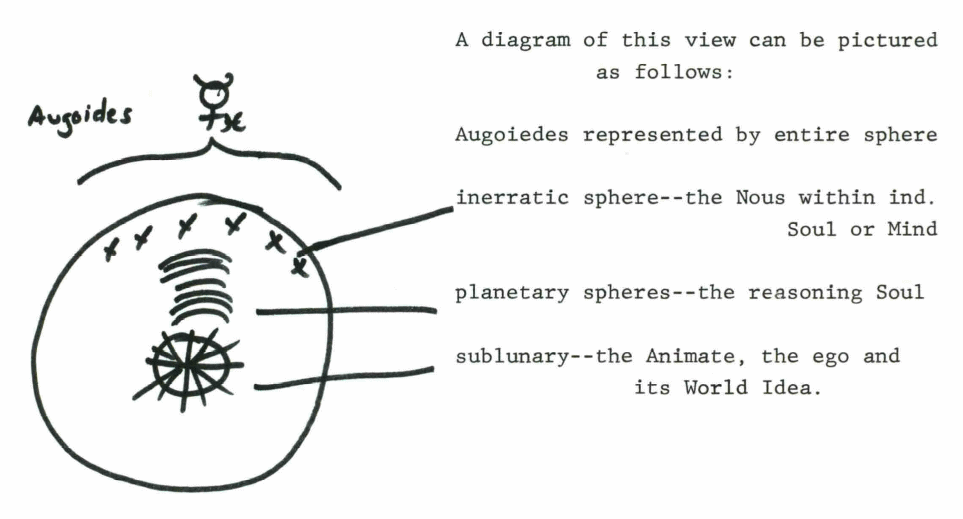
[FIGURE EOS-1. Mercurius as containing Inerratic, Planetary, Sublunary. Ind. = Individual. Facsimile scan from AD SUPPH 1-17.PDF, p. 2.]
A diagram of this view can be pictured as follows:[4]
* Augoeides represented by entire sphere
* inerratic sphere--the Nous within individual Soul or Mind
* planetary spheres--the reasoning Soul
* sublunary--the Animate, the ego and its World Idea.
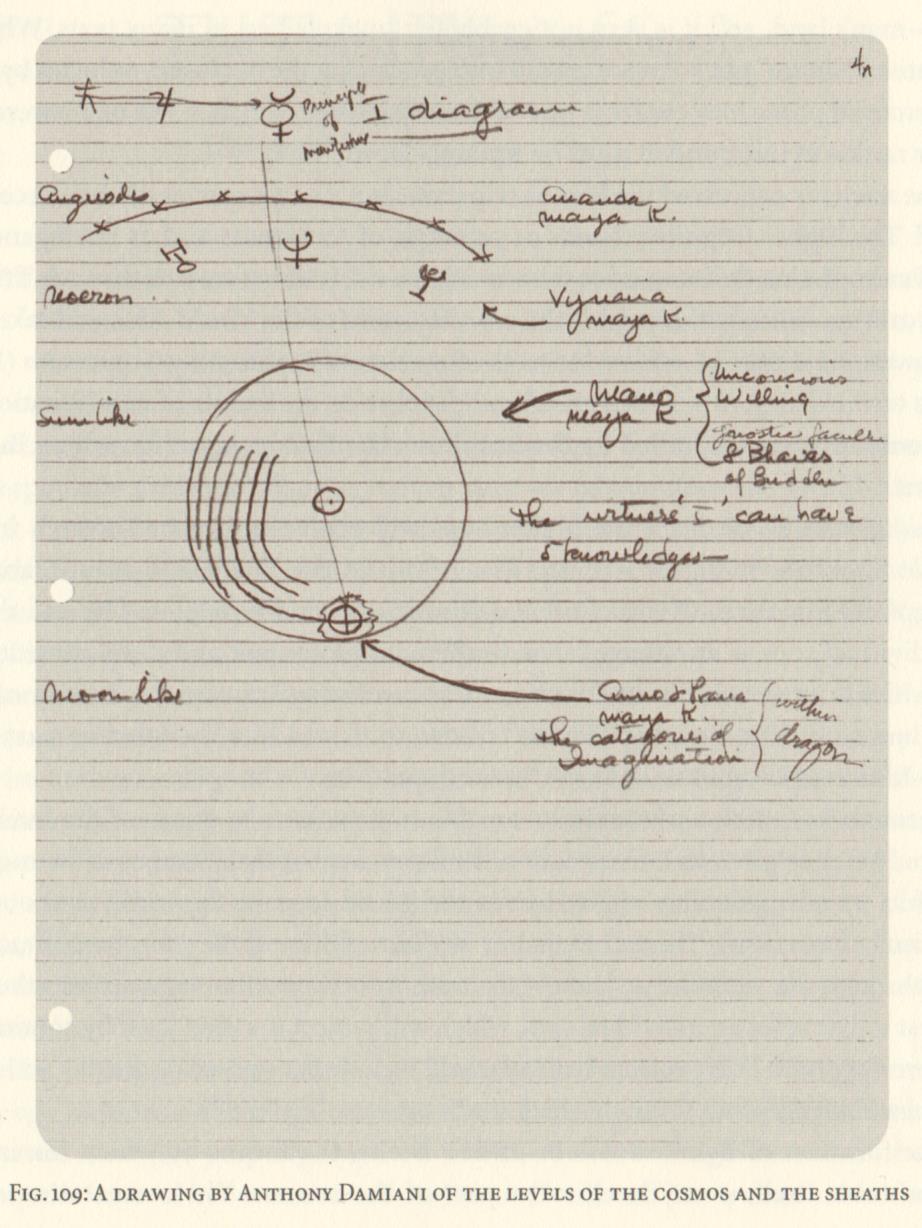
[FIGURE EOS-2. Tripartite Soul, Levels of Cosmos, and Sheaths. K= Kosha. Facsimile scan of hand-drawn diagram by Anthony Damiani from Astronoesis, p. 254. Diagram added to this version.]
Any of these three phases can be the dominant principle in the Life; it is the uniqueness of the Sage that he operates with all three simultaneously if he so desires, that there is no hiatus in his experience between the intellectual and the sensible. Because the Sage has a complete and direct understanding of the nature of man he can delineate the necessary factors involved in knowledge.[5] In I.4.10 with considerable kindness Plotinus takes us through a step-by-step description of how the sensible arises.
I.4.10. "Let us explain the conditions under which we become conscious of this Intellective-Act:
"The thought-object is deflected and the Intellectual-Principle which is active in the life of the Soul (i.e., the Rational Principle) is, so to speak, thrust back, as an image might be reflected in the smooth and shining and untroubled surface of a mirror; in this illustration, when the mirror is in place the image appears but, though the mirror be absent or out of gear, all that would have acted and produced an image still exists; so in the case of the Soul; when there is peace in that within us which is capable of reflecting the images of the Rational and Intellectual-Principles these images appear. Then, side by side with the primal knowledge of the activity of the Rational and the Intellectual-Principles, we have also as it were a sense-perception of their operation." (Handwritten note: add to this V.1.12 and IV.8.8)
We must take as our example not the "ordinary man who drinks and dances, but the mystic who thinks and trances,"[6] that is, the Sage who is present at inception of knowledge as well as at its end result.
For knowledge has its origin at the highest level of the Augoeides, where this universal consciousness formulates its World Idea through its absolute Knowing, Willing, and Feeling. This is the indivisible whole that must ultimately become reflected as and in the sensible world (an image). But it is the reasoning phase of the Soul that transmits this, moment by moment, and spreads it out in the realm of the earth's memories which becomes our sensible world.[7] These three phases of the Soul's Act are required in order for knowledge to arise. The Sage has in actuality all three at his disposal--this constitutes his happiness, which cannot be taken from him by the "blows of fortune" and the "nursery of terrors."[8] The natural man has knowledge only of the sense world with an intermittent mild infusion of rationality. The level of knowledge available to him depends upon the dominant phase of the Soul operative, though each man has all three in potential.[9] [10]
(Note IV.3.17, Soul's descent into heavens.[11]
Although this is beyond the powers of our apprehension, nonetheless, regardless of our limitations, we must proceed and try to understand Plotinus' definition of happiness and what it entails. To begin with it is truly a royal 'We'--the Divine Mind operating through Plotinus that is explaining the nature of true happiness.
Plotinus' theory of knowledge is based on Self-realization--of who and what we are. Let us make clear to ourselves his initial premises regarding the indivisible whole of knowledge and the Soul's relation to the Intellectual-Principle. He is not referring here (quote I.1.8, first two paragraphs in Armstrong) to what we have stated as the knowledge of the inerratic sphere within the emanant Soul, but rather the Divine Mind itself.[12]
But how are we related to the Intellect [Nous]? I mean by "Intellect" not that state of the soul which is one of the things which derive from Intellect, but Intellect itself. We possess this too, as something that transcends us. We have it either as common to all or particular to ourselves, or both common and particular; common because it is without parts and one and everywhere the same, particular to ourselves because each has the whole of it in the primary part of his soul. So we also possess the forms in two ways, in our soul, in a manner of speaking unfolded and separated, in Intellect all together. (Plotinus, I.1.8, A.H. Armstrong trans.) [quote added]
This, he says, we possess as common to all, even though it is transcendent to the lower phase of the Soul that emanates from it. We possess it in common insofar as the source of the Second Soul is the Intellectual-Principle itself--One Entire. And we possess it particularly as the inerratic sphere (Ideas) within each individual emanant Soul -- "in the Soul as it were unrolled and separate" [Plotinus, I.1.8] -- that is, the whole of the firmament representing the Ideas. In the Nous they are experienced as unified, the sheer presence of mighty powers indistinguishable one from another.[13]
Following the implications of the above remarks a twofold order in knowledge is presented. The highest is the primary identity of Being and Knowledge in the Nous. The second order of knowledge has to now be considered distinguished from this. The Nous as unfolded in the Soul we said was represented by the inerratic, that is, the eternal and immutable Ideas--as symbolized by the stars. More precisely, it has been explained elsewhere that the immaterial body which is given to the various souls as their seat in the firmament are each illuminated by an individual Cosmic Soul, each an Intellectual-Principle in its own right. So the entirety of the firmament is an unfolding of the Ideas, a revelation of the Nous in the heavens. This is all manifested within the infinity of the Asmita principle and makes possible the twofold division of knowledge which is properly knowledge of the Nous.[14]
(see quote III.4.6, p. 1)
At this point we re-introduce the symbolism of the chart in order to explain the more spiritual part of our nature, represented by the trans-Saturnian planets—Uranus, Neptune, Pluto—which are particularizing the World Idea for an individual I AM. The trans-Saturnians, in the process of evolving the World Idea which includes the ego, gradually deposit traces of spiritual meaning in that image the Soul has made for itself. This was the application we made in regard to the meaning of the astrological chart. We must now add to this from our understanding of the previous quote the meaning Uranus Neptune Pluto have for Plotinus' theory of knowledge. This is the Soul's intellection which, taking place at the highest phase of the Asmita principle, is equivalent to the Soul's direct apprehension of the intelligibles, the Ideal Forms. This, Plotinus says, is possessed potentially by each personality, but effectively possessed by the Sage is this realm of Authentic Intellection. And he says that
"to possess it effectively is what we mean by happiness. . . . the man, already in possession of true felicity, who is this perfection realized, who has passed over into actual identification with it." (Plotinus, I.4.4)
It is made transparently clear by this master of introversion that the Sage sees differently than the ordinary man; that the experience of the Nous within us is not a psychological state and it will not be discovered through the analysis of thought by more thought. This is the state "earlier-than-perception" (I.4.10) not to be found in the ordinary mind. Then follows his description of the reasoning activity which is still prior to the empirical awareness of the personality. When authentic intellection is to be reflected (not all intellection is made sensible) the reasoning Soul organizes the images into a sensible world that will reflect the prior intellection.
We have previously discussed the conception of the ancient cosmologists concerning the earthly life of all living creatures being a participation in the one life of the Dragon. To amplify this view we continue in III.4.6 where Plotinus speaks of that phase of the Soul divisible among bodies as that faculty where the Soul's desire for earthly life resides. This is the light (referred to in I.1.7) that the Asmita phase of Soul gives forth from itself to the organized body and which we may refer to as the reproductive power of Soul. When entering the earth's sphere, and conjoined with a body thereof, the desire of the individual human Soul to be divisible among bodies is conjoined to the same faculty which we find in the Dragon--two instances of the same power which brings into body the latent tendencies, dispositions, etc., that it is the bearer of.
We have referred to this dragonic life--the traces of the functioning of the Ideas left behind in the imaginal essence--as the 360 degrees of the zodiac. The desire of the Soul to participate in earthly life is represented by its selection and organization of a certain number of these degrees determined by the position of the planets at birth. This is the organized body (Animate?) of which Plotinus speaks in I.1.7: the ego as representative of the Soul in the Dragon, in which is "vested Sense-Perception and all the other experiences found to belong to the Animate."[15]
Again in I.1.7 Plotinus makes a distinction between the organized body which he terms "the 'ours'"--in which is vested sense perception and the 'We'--the authentic human principle, the rational Soul that precedes and passes judgment upon the Animate. The planetary spheres or the rational Soul is in constant interaction with its representation, the ego, revealing itself in the empirical subject as discursive reasoning and intellection. He states that "the faculty of perception cannot act by the immediate grasping of sensible objects…" and it is to amplify this point that we will for a moment proceed to another tractate. For to understand Plotinus' theory of knowledge a pivotal issue must now be dealt with and which we will find expounded in IV.4.23.
Beginning with the perception of a sense object, he says that first the pure form is seized, i.e., the object as intelligible without discerned parts. This first, albeit unknown and unconscious step in the process of knowledge, is a direct intuition by the Soul of the World Idea--the Thing-In-Itself--within itself. In the end, he says, it will exhibit all the details of the sensible object--and it is the problem of the intermediary steps involved in this transition from Idea to sense object that we shall now try to articulate.
Plotinus rules out in the beginning that the Soul assimilates itself directly to the sensible object but instead offers the alternative that the Soul must "enter into relation with something that has been so assimilated." That is, in order to experience the Ideas as sensible it must first create for itself a vehicle through which it can operate, and a medium in which the immaterial reason principles can be represented. What, we must inquire, is this intermediary? What is this "one elemental Stuff," that which is the link of the two extremes? The imaginal essence--the dragonic belt of the Mother Goddess' memories is this medium or essence within which the Soul makes an image of itself within which a psychosomatic organism can be formed. This representation--the Animate--contains the functioning image of the Soul's powers which become the categories of the imagination and the immaterial reason principles as the degrees which are organized to provide for the multitudinous variety of experiences, circumstances, and events which represent the basic tendencies latent in the lower Soul. This imaginal essence is of such plasticity that when the world image is projected -- i.e. the organized body and the World Idea, it appears to this knower -- the I Am identified with the functioning of the rational Soul. It is now possible to conceive the situation as follows.
First, the subject-object relationship as a totality is the object of this impersonal consciousness. Secondly, this knower takes itself to be the empirical subject within the sensible world. These two are operative simultaneously. You are at one and the same time this impersonal consciousness and the empirical person perceiving the sense object.
The rational mind organizes the earth's memories, and this inner knowledge is quasi-intelligible -- as organized by the reason principles in Soul. The outer impression--that representation which is perceived as other to the ego--is a mere phantom. The reason form received within is projected outward as the world to which this person seems separate. But the 'I Am' working through the ego has a perception of the ideal form of the object, the meaning and reason which accompanies the sense picture as well as the sensations. The ideal form or reason essence of the sensible thing is perceived by the rational mind working through the Animate, and its perception is closer to the intelligibles. As for example when we see a circle in the jar top--the inner form of circle is available to the reason, but only the sense form is available to the animal.
By means of the Ideal Forms--the reason principles in Soul--the 'I Am' has lordship over the ego. The higher principle brings the discursive reason, understanding of sense and intellection. For the lower man there is compulsion and suffering which only the light of understanding can overcome. From the moment of the operation of the rational phase or Sunlike vehicle there is the authentic We--the psycho-somatic is an ours, because it is a possession, it is mine but not I.
[ASN MASTER SOUL 131-150.PDF (pp. 132-145) Ends]
1 See R. Baine Harris (ed.), J.N. Findlay, The Structure of Being: A Neoplatonic Approach, "The Logical Peculiarities of Neoplatonism," p. 9, also read/discussed in WG Class 1983 0617a. E.R. Dodds reference needs to be found (AD paraphrase): "You have to sympathize with us because our science is the study of nothing."
2 See the first two paragraphs in V.8.9 in which Plotinus describes the exercise/experience of the gleaming crystalline sphere.
3 This paragraph published in Astronoesis, p. 255.
4 In the original paper (on MSS p. S134), there's a placeholder illustration hand-drawn by one of his students (FIGURE EOS-1). See also Anthony's hand-drawn illustration (Fig. 109, p. 254 of Astronoesis, reproduced in this paper as FIGURE EOS-2) as well as Fig. 91, p. 203
5 The top of this paragraph published in Astronoesis, p. 280.
6 See Paul Brunton, Notebooks: "The man of the world drinks and dances; the mystic thinks and trances." (V2, 1:5.67)
7 The first part of this paragraph (edited) published in Astronoesis, p. 128.
8 Quotes "blows of fortune" and "nursery terrors" are from Plotinus I.4.8. Manuscript (S136) has "nursery of terrors" with AD-handwritten inserted "of."
9 This paragraph is published in Astronoesis, p. 128 (divided line) and pp. 280-281 (sage).
10 There are several "three phases" either explicit or implied in this paragraph: Knowing, Feeling, Willing; Uranus, Neptune, Pluto; Intellection, Reason, Sense; Saturn in Leo, Jupiter in Virgo, Mercury in Pisces Nature.
11 Note here: IV.3.17, Soul's descent into heavens. See sidebar with this Plotinus quote in Astronoesis, p. 347.
12 Published in Astronoesis, p. 220.
13 Published Astronoesis, p. 220.
14 Published Astronoesis, p. 220. See also III.4.6.
15 See note at end of paper for another version of this material written by Anthony Damiani.
1983 06/17b V09MP: PAPER: Astronoesis; Soul; Epistemology of Soul. Copyright 2024 Wisdom's Goldenrod p. iv