DIAGRAM FOR 1983 0622
Class
Wednesday, June 22nd, 1983
Verbatim, unedited transcriptClick the series name to view more
CLASS at Wisdom's Goldenrod, Hector, NY
with Anthony Damiani (AD)
June 22, 1983
PB PARAS; OVERSELF
TOPIC: PB Paras
SUBJECT: Overself
SUBSUBJECTS: Ego, I AM Principle, Mystical Death, Sufi Stations, Meditation
CONTENTS:
PB PARAS ON THE OVERSELF
SUFIS DIFFERENTIATE BETWEEN GLIMPSES (STATES) AND PERMANENT ADVANCES (STATIONS)
THE FIRST STATION: THE COMPLETE CESSATION OF THE EGO; IT CANNOT DOMINATE YOU ANY MORE
THE SECOND STATION: GROWING IN THE SPIRIT, REBIRTH IN THE OVERSELF—THAT IS, THE SPIRIT DIRECTS WHAT YOU'RE TO DO
THE EGO IS THE ENTIRETY OF THE FUNCTIONING OF THE PSYCHOSOMATIC ORGANISM, AND AS LONG AS IT COULD TELL YOU WHAT TO DO, IT'S ALIVE AND WELL
AFTER THE MYSTICAL DEATH, YOU'RE REBORN INTO HUMILITY; YOU KNOW YOU ARE NOTHING, SO NOW THE SPIRIT CAN TEACH YOU
THE THIRD STATION: THAT WHICH HAS BEEN TRAINED TO WALK IN THE SPIRIT IS BROUGHT TO COMPLETE IDENTIFICATION WITH THE I AM BY THE SOUL IN THE NOUS
AFTER THE EGO IS OVERCOME, WHEN THE I AM TELLS YOU TO DO SOMETHING, YOU DO IT; YOU HAVE NO CHOICE IN THE MATTER
THE UNDERSTANDING THAT THE EXPERIENCE OF THE OVERSELF GIVES WILL BE FAR SUPERIOR TO WHAT YOUR INTELLECT TELLS YOU ABOUT IT
BECAUSE OF OUR I AM, WE CAN INFER SOMETHING OF THE TREMENDOUS ACTIVITY THAT'S INVOLVED IN THE GENERATION OF THE WORLD-IDEA
YOU CAN ACHIEVE UNION WITH THE HIGHER I AM THAT YOU ARE; YOU CANNOT ACHIEVE UNION WITH ANYONE ELSE'S I AM
MORE DISCUSSION OF THE FIRST TWO SUFI STATIONS
WHEN YOU FREE YOURSELF FROM YOUR MECHANICAL PAST CONDITIONING, YOUR PERCEPTIONS WILL BE SPONTANEOUS, FRESH, NOVEL
PRACTICE TRACING ALL THOUGHTS BACK TO THEIR ORIGIN
BOOKS READ FROM OR REFERENCED:
Paul Brunton, Notebooks. 16 vols; Vol. 1 entitled Perspectives [Persp.], published 1984-1988. Some Paul Brunton Notebook paras are, as of 2018, unpublished, and are noted as such.
Reynold A. Nicholson, The Mystics of Islam
Paul Brunton, The Quest of the Overself
Arthur Koestler, The Invisible Writing: The Second Volume Of An Autobiography, 1932-40
Paul Brunton, A Search in Secret Egypt
J. Krishnamurti, Commentaries on Living, 3 volumes
Plotinus, The Enneads (MacKenna translation, 4th ed.)
PLOTINUS QUOTES READ OR REFERENCED: VI.4.14, VI.4.15
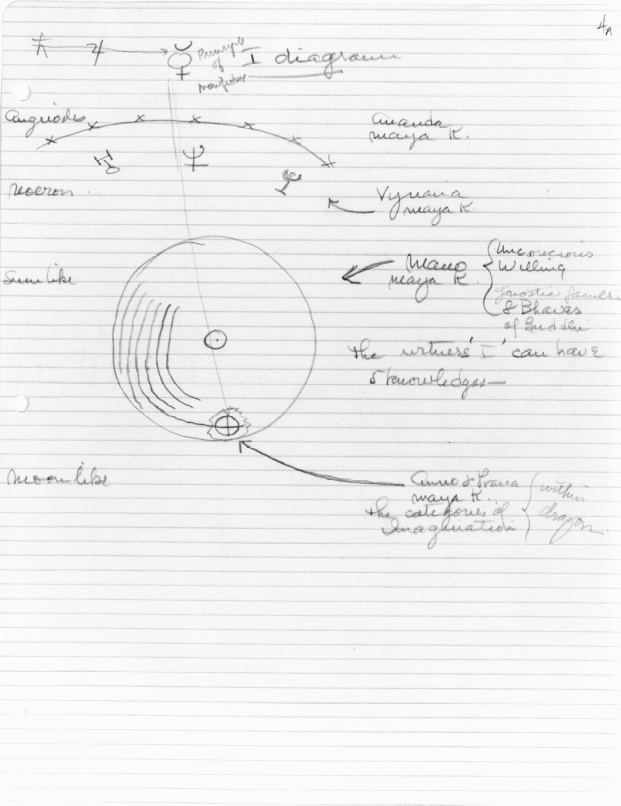
DIAGRAM appended to this transcript:
- FIGURE 1983 0622-1-AD. Tripartite Soul, Levels of Cosmos, and Sheaths.
This diagram is from Astronoesis, p. 254. [Transcriber note: [diagram] means the speaker is referencing a diagram as he or she is speaking.]
NOTES:
I use Scan File 1983 0622-29R03.PDF, the Pat Campbell partial transcript for this class, to supplement or stand in for parts that are partly or completely inaudible and parts that are missing. The use of the partial transcript is noted accordingly.
Unpublished PB paras should be sourced and proofread.
TRANSCRIBED Verbatim by IT 2019. Reformatted by JRM & JF 2019-2020, with Subheads and Table of Contents added by JRM. In 2023, IT fixes prefatory matter and footer, updates audio file name, fixes/completes Book List, adds Plotinus quotes section, adds new notes within transcript, fixes minor errors, adds a diagram and reference within transcript to this diagram. In 2025, MW expands Subsubjects and alters Subheads to make more accurate. Archival verbatim transcript – V14.1a.
AUDIO FILES: 1983 0622a, 1983 0622b. [Note 1: "Tape" and "Side" refer to original audio cassette tapes that were later digitized into .MP3 Audio Files. Note 2: Both audio files originally had mediocre sound quality, especially the second one. Also, AD speaks very quietly throughout, especially on the second audio file. In 2024, REP Studio improved the sound quality, but the transcript was done before this so certain words may be mistranscribed and student and AD comments that were marked as partially or completely inaudible may now be audible. All time markers are for the audio files used to transcribe.]
1983 06/22 at Wisdom's Goldenrod
PB Paras; Overself
Archival verbatim transcript
[Audio File 1983 0622a Begins]
RC: --material that hasn't been read so far on this topic and start reviewing. I've been working on a different section this week and I found one quote that-- It doesn't fit exactly but it's such a nice quote, and it's relevant, and I thought I'd like to read it.
[9¼ second pause]
PB PARAS ON THE OVERSELF
PB [V13, 19:4.171 & Persp., Ch. 19 #34, RC reading]: "It is our innate inertia which keeps us set in [RC adds: the] habitual outlooks and thus keeps us victims of our own past experience. We copy again every day what we did before, what we thought [RC adds: before] and [RC adds: what we] felt before. We live in both the conscious and the subconscious memories, desires, [RC adds: and] fears which time has accumulated for us, and that the ego has created to bind us to itself. We are ruled by compulsions, fixations, and neuroses--some of them not even known--that freeze us, preventing [RC reads: and prevent] further real advancement. We rarely enter the day to gain really fresh experience, think really new thoughts, or [RC adds: to] assume really different attitudes. We are prisoners of time. [RC adds: And] This is because we are so ego-bound. The compulsion which makes us conform ourselves to dead yesterday's [RC reads: yesterday's dead] ideas and practices, concepts and habits, is an unreal one, an illusory one. In letting ourselves become victims of the past by letting it swallow up the present, we lose the tremendous meaning and [RC adds: the] tremendous opportunity which the present contains. Whereas the Overself speaks to us from tomorrow's intuitive understanding, the ego speaks to us through memory. Its past enslaves us, preventing a new and higher way of viewing life from being born.
"But it is possible to arouse ourselves and to begin viewing life as it unfolds in the Eternal Present, the Now, with wholly fresh eyes. Every morning is like a new reincarnation into this world. It is a fresh chance to be ourselves, not merely echoes of our [own] past ideological fixations. Let us take it then for what it is and live each moment anew.
"When a master mystic like Jesus tells men to refrain from being anxious about the morrow and to let today's evil be sufficient for today, he speaks out of his own consciousness of living in this Eternal Now. Consequently, he spoke not of periods involving twelve or twenty-four hours, but of pinpoints of a moment. He told them to live timelessly, to let the dead past bury itself. [RC adds: So] He is indeed a Christian, a Christ-self man, who lives cleanly and completely in the present--free, uncontrolled, and unconditioned by what he was, believed, or desired yesterday."
[54½ second pause]
PB [V14, 22:3.175, RC reading]: "There is some life-power from which we derive our capacities and our intelligence. It is hidden and intangible. No one has seen it but everyone who thinks deeply enough can sense that it is there, always present and always supporting us. It is the Overself."
[14 second pause]
PB [V14, 22:3.307, RC reading]: "That point in man [RC: The"in" is underlined. "That point in man] where the two worlds of being--[RC adds: the] infinite and [RC adds: the] finite--can be said to touch, is Overself."
[21¼ second pause]
PB [V14, 22:2.53 & Persp., Ch. 22 #40, RC reading]: "When the ego is displaced and the Overself is using him, there will be no need and no freedom to choose between two alternatives in regard to actions. Only a single course will present itself, directly and unwaveringly, as the right one."
S: Again Randy.
PB [V14, 22:2.53 & Persp., Ch. 22 #40, RC rereads]: "When the ego is displaced and the Overself is using him, there will be no need and no freedom to choose between two alternatives in regard to actions [RC reads: action]. Only a single course will present itself, directly and unwaveringly, as the right one."
[15 second pause]
PB [V14, 22:2.51, RC reading]: "His behaviour is spontaneous, but not through mere impulse nor through unused intellect. It is the spontaneity, the forthrightness of an inspired man who knows where he is going and what he is doing, who is directly guided in his relations with other men by a higher will than his own ego's."
[9 second pause]
PB [V4, Part 1, 4:2.321, RC reading]: "Neither the intuitive voice nor the mystical glimpse will answer to your call if you demand an instant, clear, and powerful response. But if you are patient, co-operative, and meditative, there is a better chance of successful result."
[46¼ second pause]
PB [V3, 2:4.6, RC reading]: "What is the Overself waiting for, so long and so patiently? For our willingness to die in the ego that It may live in us. So soon as we make [the] signs of this willingness, by acceptance of each opportunity to achieve this destruction of egoism, the influx of new life begins to penetrate the vacated place."
[short pause]
PC (very faint): Would you read that again please?
PB [V3, 2:4.6, RC rereads]: "What is the Overself waiting for, so long and so patiently? For our willingness to die in the ego that It may live in us. So soon as we make the signs of this willingness, by acceptance of each opportunity to achieve this destruction of egoism, the influx of new life begins to penetrate the vacated place."
[20 second pause]
RC: Read this one a while ago.
PB [V16, 25:3.152, RC reading]: "This paradox is the extraordinary situation of such a man. He accepts the ego but he also repudiates it at the same time."
[25½ second pause]
SUFIS DIFFERENTIATE BETWEEN GLIMPSES (STATES) AND PERMANENT ADVANCES (STATIONS)
PB [V14, 22:8.28 & Persp., Ch. 22 #91, RC reading]: "Islamic mystics called Sufis differentiate between glimpses, which they call"states," and permanent advances on the path, which they call "stations." The former are described as being not only temporary but also fragmentary, while the latter are described as bearing results which cannot be lost. There are [RC adds: thus] three main stations along the path. The first is annihilation of the ego; (some laughter) the second is rebirth in the Overself; and the third is fully grown union with the Overself. [S, very faint: Yeah.] [S, faint: Randy?] The Sufis assert that this final state can never be reached without the Grace of the Higher Power and that it is complete, lasting, and unchangeable."
[9¾ second pause]
PB [V14, 22:8.48, RC reading]: "No glimpse is…"
RC: Oh.
S: Go ahead.
PB [V14, 22:8.28 & Persp., Ch. 22 #91, RC rereads]: "Islamic mystics called Sufis differentiate between glimpses, which they call"states," and permanent advances on the path, which they call "stations." The former are described as being not only temporary but also fragmentary, while the latter are described as bearing results which cannot be lost. There are three main stations along the path. The first is [RC adds: the] annihilation of the ego; the second is rebirth in the Overself; and the third is fully grown union with the Overself. The Sufis assert that this final state can never be reached without the Grace of the Higher Power and that it is complete, lasting, and unchangeable."
[16¾ second pause]
S (very faint): (Go ahead.) Go ahead.
S (very faint): I still don't--
S (very faint): Do you want to have questions? Or let's just go through this.
RC: If there are questions, sure, I don't know. What (have we/could be) done with it though?
S (very faint): I see.
DB (faint): Well, I've got a couple but the one specifically about this quote is that, these-- these three stations that the Sufis talk about, you know, and-- are we to understand that, for example, you could reach this first station and then go for a period of time, you know, year, two years, whatever, before the second station is accomplished? But then for-- Like what's the-- what-- how does that part work? I mean I-- you know, I always kind of assumed that, you know, if the ego's annihilated then those other stations would follow. Well, this (doesn't) happen. And that the grace of the Overself is necessary to do the first part of that. So perhaps I don't understand what is being spoken of here. [short pause] I mean, is the annihilation of ego, does he mean by that, [S, faint: Yeah.] you know, when you-- when you first start out to work at it, it all comes to not being concerned with it at all and to just work at it for a few years, just kind of--
[short pause]
RC: I think there's a difference between, say when you've reached a point that there's been enough grace that (you) find your own ego is a-- just isn't (sensitive) anymore, you know. You don't get pulled into doing the things that you did before. But as far as your susceptibility having diminished, that that's a qualitatively different thing than actually getting an influx of feeling yourself supported by and inspired by and infused by the Overself. I think that's an easier one to demarcate than the other two as to what fully grown union with the Overself may be as a-- as opposed to occasional inspiration. But I think there is a big difference between having the ego displaced and being inspired, and I think that's the difference in the-- in the first one.
DB (faint): So-- so like-- like annihilation there is, you know, understood as that its effectiveness is [one/two words inaudible] ways complete as an actual, something like that.
RC: I would take it that way in line with the other stuff that we read.
DB: So, would you-- you say at that point then the individual's battle with his egoity and so forth would be at an end?
RC: No, I think he's got the upper hand.
S (faint): Right.
RC: I mentioned couple of times I think that PB made the remark that until-- until the person is permanently fully established on the other side that it is possible to fall all the way back. He said don't confuse possibility with probability but it is possible.
[9¼ second pause]
PC (mostly very faint): Also doesn't the ego present itself as the problem to be dealt with, you know [couple words inaudible] stages when a person is functioning?
RC: Yeah I-- I think so.
S (simultaneously): We can't hear.
PC (faint): I just said doesn't the ego present itself as a problem to be dealt with even though [one word inaudible] by stages where the person is supposed to--
RC: It becomes subtler and subtler for sure.
[short pause]
S (faint): Yeah.
RC: Yeah.
LDS (faint): If I follow what you're s-- what you're saying then I think-- assume that that wouldn't be a [one/two words inaudible] does not lead to an inevitable immediate influx of the Overself's-- In other words, you could go through a long period of time with-- in a state of say [one word inaudible] and not necessarily have the grace of the Overself interfering.
RC: Yeah. Yeah I think it would depend on your karma.
[students assent, very faint]
S (very faint): (Don't you) think that the ego would have [one word inaudible]
RC: No.
LDS (faint): No I'm not saying it would. But the ego could be defeated and then be followed up-- you know, the next stage may not be [three words inaudible] you know, where you [couple words inaudible] person.
S: What is intermediate?
LDS (simultaneously): I don't know, that's what I heard him say.
JfL: [one/two words inaudible]
S (simultaneously): What is intermediate stage?
RC: The intermediate one is a rebirth in the Overself as distinct from the third which he calls fully grown union with the Overself.
BS (faint): So there is an entity through three stages, or two stages. One-- there's one entity that goes through the ego, the rebirth--
AD (very faint): Yeah.
RC: Yeah. Yeah.
BS: But you're not taking annihilation here literally?
RC: No I'm not, I'm taking it more like [short pause] sufficiently weakened susceptibility to egoity, that--
VM: How about annihilation of tyranny?
S: Ok.
BS: Excuse me?
VM: Annihilation of the tyranny of the ego maybe is a way, I don't know.
THE FIRST STATION: THE COMPLETE CESSATION OF THE EGO; IT CANNOT DOMINATE YOU ANY MORE
AD (faint): Well the first step is the annihilation of the ego. This was that [VM simultaneously: What--] permanent station.
VM: What does that mean exactly?
AD (simultaneously): Second step-- What does it mean?
VM: Exactly, yeah.
AD: Completely purified, which is the same as being dead. [S, very faint: Yeah.] Yeah.
S (faint): (Go ahead/Ok).
AD: Annihilation of the ego is a station. It's not a fragmentary glimpse, it's not something that you get a glimpse of the Overself then it's over and you get another glimpse and then it's over. Annihilation or the first station refers to the complete cessation of the ego. It has no longer the dominant say; it is completely under the control of the higher self. [S simultaneously: Oh so (one/two words inaudible)] Second station is the annihilation of the annihilation. That is, you get rid of any such notions that you're going to get purified. Third is when the higher power is-- the three Hypostases, or the Absolute, or the Overself in the Intellectual-Principle is completely aligned with the I AM principle. Those are the three stations of the Sufis.
VM: But Anthony, if you say that the annihilation of the tyranny of the ego, that's not as-- as strong a statement as you're making? Because I imagine, you know, that realized man still has something in the way of a functioning ego, but it doesn't tyrannize over him, it doesn't have any-- any compulsion anymore. I mean, the annihilation of the ego can't be that there's absolutely no one there, I mean there's a person who does have (lolly) needs [AD simultaneously: Ego--] and desires and so on, so he has some form of ego.
AD: The ego isn't there. Any and every reference to the psychosomatic organism is over. It does not think in you.
VM: So then that's--
RG: Isn't that station concurrent with the-- the rebirth in the Overself? It's-- it-- in your description of that first station you're describing it--
AD: Rebirth in the Overself is now the continuing-- a continuing process of aligning yourself with the Overself.
S (faint whisper): The Overself.
AD (faint): Yeah.
RG: Uh-huh. It's [S, very faint: Right.] like one and two are not-- are-- can be simultaneous. I mean it doesn't seem--
AD (simultaneously, faint): No they're not simultaneous, they're two very distinct steps.
RG: But, could you have--
S: Well what would you be like--
RG: I don't see how you can have-- well--
PD: Isn't that the point of three stations, and that the whole thing is you have three distinct stations, they're not glimpses.
RG (simultaneously): Can you-- can you differentiate the first two for me?
PD: Well I thought Tony just--
RG: I didn't get it. That's why I want more.
PD: That the second stage was at this point the realigning of the functioning of the vehicles from the higher point of view, not from egoity-- egoity.
S: Doesn't--
LDS: What did he say about--
PC (simultaneously): But where are you in your [one/two words inaudible] though?
PD (simultaneously): First step is the destruction of the egoity. Now the vehicle--
VM (simultaneously): So then what does it have to align?
PD: Listen, now the vehicles aren't aligned. Now that becomes the second process so the vehicles, functioning vehicles become realigned to the higher power's point of view.
RG: Could the annihilation of ego happen if that already didn't happen?
PD: Apparently yes.
RG: Well that's what I don't understand.
PD (simultaneously): Apparently the ego can be pushed right out of the way.
RG (faint): I don't understand.
PC: Well what-- what would the state be like in that intermediate-- what would you-- you know, what would you be aligned with, I don't understand that.
S (very faint): [couple words inaudible]
S: [one/two words inaudible] you could be aligned--
DR (simultaneously): You know, I don't-- I don't understand the question. [S: Uh-hm.] Anthony said that as the higher power takes over it, it is annihilation of the ego.
RG: So?
VM (very faint): So then how do you differentiate [one word inaudible]
RG: How do you differentiate (one from--)
AD (faint): [couple/three words inaudible]
DR: If they say there's three stations, right?
S (very faint): What?
LDS: What is the enlightened (state)?
S (faint): [three/few words inaudible]
RG (simultaneously): (Tweak a word and unders-- and) understand it.
DR: Isn't it enough to think about, I mean the-- that the annihilation of the ego [RG simultaneously: No.] is a station. And that's so far beyond anything you can see, [RG simultaneously: That would--] that would seem like the end of the entire work as far as you're concerned.
RG: Exactly. That--
DR: So what's the problem in terms of stations beyond?
RG: I could believe anything, David, I thought the point was to try and understand it. (laughter, RG laughing)
DR: Well it sounds [RG simultaneously: I can just sit here and dogmatize and--] like-- I mean I thought-- I thought the difficulty was when you say the annihilation of the ego that you imagine there's some empty state where the man is just totally annihilated, nothing is acting at all there. And that's just, you know, a disagreement with the words because the next one says the rebirth in the Overself, it sounds like the Overself's already taken over the annihilation of the ego. Well--
S: Yes, that's so.
DR: Higher self doesn't(--/.)
RG (simultaneously): But, I'm-- I'm just asking for a little more explanation, that's all.
AH: Try to fix the time (of/that) your whole state is like perhaps impossible to talk about any kind of time. (You/It) might have one day to several lifetimes [couple words inaudible] I mean the whole thing could happen in a day or it could take fifty lifetimes.
LDS: Anthony are you saying that the first stage, the annihilation of the ego, could first be conscious of the spiritual self(hood), consciously--
THE SECOND STATION: GROWING IN THE SPIRIT, REBIRTH IN THE OVERSELF—THAT IS, THE SPIRIT DIRECTS WHAT YOU'RE TO DO
AD (faint): I'm ver-- I'm very simply saying it's one thing to over-- overthrow the tyranny of the ego and that it cannot dominate you any more. Alright, that's one thing. It's another thing now to grow in the spiritual life. That's a second thing. And it's a third thing when that growth has completely matured. [student assents, faint] That help? Is that clear?
RG: No, but I'll agree with that. I won't ask anymore.
AD (simultaneously): Alright, so suppose-- suppose your-- your ego no longer dominates, now what?
RG: I would say that-- I would say then, I mean, the Overself is governor.
AD: What?
RG: The Overself is governing your life if the ego isn't dominating.
AD: Don't you see that that's the point, that's what you have to learn now, how the Overself rules.
RG: I-- I agree with you.
LR: It's like getting a whole new set of (rules) now.
AD (simultaneously): That's what we mean by saying growth-- growing in the Spirit.
RG/S(?) (faint): I agree.
RG: When you say--
AD: But you can't grow in the Spirit while the ego is around.
RG: Right. But if you say the annihilation of the ego, in order for the ego to be annihilated, doesn't the second stage already have to happen? How could the s-- how could the first stage really happen unless there were some rebirth in the Overself that allowed that annihilation to happen?
AD (simultaneously): Well you insist on saying it in your way.
RG (simultaneously): No. No I just want to-- no.
AD (simultaneously): Yeah, well I'm trying to say it in my way. [student assents, faint] There first has to be the complete overthrow of the ego's dominance, and that means any reference to the psychosomatic organism as telling you what to do. That must come first. [RG, very faint: Ok.] Now assuming that that has come, now there could take a growth or the growth could occur in the Spirit, that is, the Spirit directs you as to what you're to do. Right? That's the growth or the rebirth in the Overself. [student assents, very faint] And the third one is when there's a perfect alignment with that higher self and the so-called low-- lower self, what he spoke about in the previous-- when he made the previous point that the ego must seek absolute atonement and integration into its higher self.
Now annihilation of the ego here, according to the Sufis, does not mean that you take a pistol and blow your brains out. (bit of laughter) It's not what they mean, ok. When they speak about the annihilation of the self, they're simply meaning that the ego no longer dominates, it cannot tyrannize, can't tell you what to do anymore. But at the same time, alright, and accompanying that, going on from that point of view, is the Spirit has to teach you how to live now. And that's the growth or the rebirth in the Overself. That-- that could be a process that varies. It's indeterminable. Then there could be the stage where there's a complete alignment of the ego as a-- as a tool that is used by the higher self and is a perfect servant of that higher self. And he makes the further point, he says that won't come about without that higher power leading you. In other words, the perfect alignment between the higher self or the I AM and the ego is brought about by the grace of that Absolute which is beyond any of them, any of these three stations.
[short pause]
AH: One difficulty that I'm trying to understand what annihilation of this ego [couple words inaudible] It's not as if that's something that happens as one fact, it's like that process is a long and difficult one. Like there's a distinct--
AD (simultaneously): No. That would not be a station, that would be a glimpse. [AH simultaneously: The actual--] That would be a state, that would be what the Sufis call a state. If you have a hundred glimpses it's still not the state.
S (very faint): Yeah.
AH: You were describing that state as like the mystical death.
AD: That first state is the annihilation of the ego, overcoming its tyranny, the refusal on the part of the soul to accept anything that comes from the psychosomatic organism without being examined impersonally and impartially.
RC/S(?) (very faint): Yeah.
AH: Anthony but there's another--
AD (simultaneously): It's-- he's not-- he's not speaking about a long, drawn-out battle [AH: Alright.] with the ego. [S simultaneously: That-- but--] He's not referring to that as the first state. When that's over, that's the first state.
S (very faint): Uh-hm, yeah, ok.
LR (faint): Paul said it was a result of that; that stations were defined by results. So, it's not the process.
RC: He says the-- the latter, the stations, "are described as bearing results which cannot be lost."
AH (faint): (Can't-- can) be lost?
RC: Yeah.
PC (very faint): But I thought in that second state would you be identified with the I AM [three words inaudible]
AD (very faint): More and more as you go along. You begin to understand more (and more) that it's directing you.
S (very faint): Ok.
PC (very faint): But yet you're not identified at all with the ego there.
AD: Yeah, that doesn't guarantee that you know what to do. You people have a lot-- a lot of difficulty understanding that.
RC: Yeah that was a nice thing about that earlier quote that said when the ego is displaced and the Overself is using it, then there's no vacillation between different possibilities.
LDS: Is that the sentence?
PC: What's that no-man's land like--
S: Yeah what was in that [possibly one word inaudible]
PC (simultaneously): --you're identified with and it was in that in-between state?
AD (faint): That's a growth in infinite Spirit.
RC: It seems like one of the things that really qualifies a person for that second stage is that he can distinguish between when the Overself is using him and when it's just his ego and be able to--
S (simultaneously, very faint): That's (right).
RG: This is after the first stage.
RC: Well, I would disagree with that I guess, for the purpose of discussion.
RG (simultaneously): Well then you're disagreeing with the first stage.
LD: No he said--
RC: I haven't finished what I was saying though.
S (simultaneously, very faint): Yeah.
S (very faint): (Go ahead/Ok).
S (very faint): Ok, yeah.
RC: That the person can distinguish between when he is being used or she is being used, guided, and when he's not. And he's capable of doing nothing if he's not being guided. He's capable of saying to the ego, "Shut up. You don't have anything worth contributing to the matter and until I get some instructions I'm doing nothing." And because he's capable of that he's achieved the first station.
AS (faint): But I-- I mean I (think--)
RC (simultaneously): But I think by the time he's reached the third station, he doesn't have to wait.
S (simultaneously): Always [couple words inaudible]
S (very faint): Yeah that's true.
S: But that first station there is no [one/two words inaudible]
RG (simultaneously): (But that third) station, does he characterize that? What Avery?
AS: Oh but-- but-- I'm just wondering about this, I'm wondering--
AD (simultaneously, very faint): It's like for instance, (in this) middle state right there, [S, faint: Right.] [AS: Is it the rational process?] (there's) processes going on, [AS: Yeah.] you hear the interior word, you're guided to (do) [possibly one word inaudible] It may be specific guidance as you should or you shouldn't. This would be that middle state, it's a station. It's indeterminable, it-- it could extend for a year or for a couple of lifetimes.
AS (faint): But I'm just wondering about [few words inaudible] transcends the dominance of the ego, then you'd be--
THE EGO IS THE ENTIRETY OF THE FUNCTIONING OF THE PSYCHOSOMATIC ORGANISM, AND AS LONG AS IT COULD TELL YOU WHAT TO DO, IT'S ALIVE AND WELL
AD (faint): There is no ego. [couple inaudible AS words simultaneous with AD] You've got to understand that when they say annihilation of the ego there is no more ego.
S: Then you would be--
AS (faint): Then we would reach what (we/you) call rational. You'd be living the rational [one word inaudible] In other words, maybe it's, you know, rational. That was the rational [one word inaudible]
TS (very faint): There's no ego.
AS (faint): Rational(--/.)
S (very faint): [couple/three words inaudible]
AD (very faint): Ego, ego.
RC (simultaneously): Yeah Tim, what do you mean by ego when you say there isn't any in that stage? I mean how are you-- how are you using it there to say that?
AD (very faint): Yeah, Tim. I didn't-- I didn't hear you (clearly).
RC: When you say that there is no ego in the second stage, what-- what do you mean by ego?
AD (faint): The entirety of the functioning of the psychosomatic organism is what I would refer to as the ego. And as long as it could tell you what to do, it's living and well. It is dead when it can't tell you anymore what to do. That doesn't mean that you're not walking around. But the impulses, volitions, wishes, repressed desires, past conditioning--all that is gone, it's over. There's none of that anymore. That's a pure ego; it's dead. I'm not talking about the body being dead, [RC simultaneously: Yeah.] not functioning.
RC: No I'm thinking in terms of, when we did the ego quotes like, one of the things that he said about the ego was that it includes the physical body, that-- we've gone through a lot of things about how--
AD: Basically the ego is the psychosomatic organism and the functioning of the psychosomatic organism as a separative entity considering itself to be the center of all the activity that's going on. That's not there no more. But that activity is still going on, the function, the [one word inaudible] he said the function of egoism is dead, is gone.
RC: Yeah, ok. That's what I would--
AD: But the ego isn't buried.
RC: Ok.
AS: Right.
AD: All you have to do is read The Islam-- Mystics of Islam by Nicholson and he lays out all these stations for you. [Note: Reynold A. Nicholson, The Mystics of Islam.] When you're in the second station any gain that you make there--let's say that in terms of discipline you've learned to listen to the interior word, you know, permit it to guide you, and the results of that guidance includes in the sense that-- that your understanding of the way the Spirit works is more available to you--this is now a permanent acquisition. Like I said, it can take any number of-- any number of years, we don't know. But once-- once something like that is acquired and assimilated, it's yours permanently. That's why they call it a station. Whereas if-- if you speak about a person who has a glimpse and is given some-- gotten some guidance about a temporary situation, and then the next hour or the next day he's back to his old tricks, the ego isn't dead.
RC: You put that to me one time in little different language that was pretty meaningful to me. I was asking how-- what kind of measure or standard to use to distinguish between when you might be being guided as opposed to when you might just really be fooling yourself. And you said well the first step is that you have to be able to make yourself absolutely humble. And unless you can reach the point of being absolutely humble, you can never be sure. You said but if you can do that, then you'll know. Either there'll be no guidance or it will come and when it comes there'll be no question. But you made a-- I mean you really stressed the point of being able to make yourself absolutely humble. Which seems to be a different way of saying annihilating the ego.
AD: Oh I could point out to you the way that you could check it out for yourself. Ok? When you sit down and meditate, now I'm just saying meditation and not the rest of the day but, when you meditate, every thought that arises in your mind, trace it to its origin, and you will know whether your ego is dead or not. You'll see what it's referring to all the time, alright. Every thought: I'm not excluding any.
[short pause]
AB (faint): As an example--
AD: Are you familiar with that? You see a thought comes up, you see a nice big chocolate bar. You know it suggests (happiness/happy). (laughter, student words)
S: Hershey's.
S: Hershey's. (laughter, student words)
AD: Or, or something totally irrelevant, you were two years old and said hello to a man whose beard you never forgot. (laughter) "But what the hell am I looking at this for?" Trace the-- trace the thought back and you see it's right back to the ego. Right? So, if you do this--and I guarantee you, one hour will nauseate you permanently. (laughter) That's a way of testing it. It's a way of testing it, see if the ego is doing well, healthy, very healthy, (laughter) ex-- extremely [one word inaudible] healthy. (more laughter) Now, with annihilation, that doesn't happen. The ego isn't there any more throwing up these suggestions, these thoughts, these impulses, wishes, desires, memories. It's dead, it doesn't do that anymore. That's a permanent state. Tomorrow it can't start throwing them up again. It wasn't dead then.
S (faint): And you're not [one word inaudible]
AD (simultaneously): That's what they mean by annihilation of the ego.
RS: That-- that is going to yield to confusion, but that is distinction between mystical and theor-- and theoretical exposition or [three words inaudible] Well this here that you're talking about is the practical experience of the third, when he gets enlightened. First he experiences that experience. He goes through the process as it is dying. Next experience it comes up as if something is being born inside, or of rebirth, you see, even though he is not really dead [one word inaudible] Practical point of view. And then third stage he goes through his taking that into actual, you know, daily life. But standing aside and you guys analyze each stage is not like (except/accept) his experience, dying or annihilation of ego and all that. Before (this), you've always compared it to (the five) stages [one word inaudible] and then he's-- from that stage you can then analyze that next time anywhere you have [few words inaudible] But-- Description here didn't give practical experience when a person Sage or let's say person enlightened, when a person is not enlightened. That's why [couple words inaudible]
[short pause]
S (very faint): [couple words inaudible]
AD (faint): [one/two words inaudible] saying [one word inaudible] (what) I mean by [one word inaudible] right now. He's saying the first-- the first step is the mystical death, one's death.
RS (very faint): That's right.
AD: And the second?
RS: Then they (contact) that process when he feels that he's dying, almost dead or something like that. Then again there is awakening of [few words inaudible] He believes that it's [few words inaudible] he realize [one/two words inaudible] Even though that stage might be almost [couple/three words inaudible] after that, then the experience in that sense is like a [one word inaudible] But still it is a distinct step when a person's going through.
[short pause]
AD (faint): Sorry, I lost you again. Try once more please.
AFTER THE MYSTICAL DEATH, YOU'RE REBORN INTO HUMILITY; YOU KNOW YOU ARE NOTHING, SO NOW THE SPIRIT CAN TEACH YOU
RS: Saying in the process of enlightenment, person-- anybody would get enlightened. But I experience and I take it more [few words inaudible] (and/then) I think most of it, it goes through first stage, experience enters. And then after that experience immediately he gets this experience of enlightenment.
AD: Well after that, doesn't he have to learn to start living again?
RS: Exactly.
AD: I mean he's dead, [RS simultaneously: Yes.] the ego died, right?
RS: Right, right.
AD: And then he's got to learn to live all over again, [RS: That's right.] but not that way, [RS: But--] not the old way.
RS: First he experiences that he is again relating to just sort of (a) enlightenment [AD simultaneously: (Then/That) he's reborn.] experiences like (rebirth/reborn). Yeah, yeah.
AD (simultaneously): Yeah he's reborn. But now he has to learn how to start walking again.
RS: That's right, and that's the third stage is [few words inaudible]
AD (simultaneously): Now, how long it takes him to walk?
RS: Well that I cannot tell you, I didn't-- but each person is-- it's probably different.
AD: It's different for each person.
RS (simultaneously): Yes, yes.
AD (very faint): Ok.
RC: So you're not agreeing with him. He's not agreeing with you.
AD: I thought he was.
RG: No he wasn't.
RC: What you just called the second stage is what he was calling the third stage.
AD: Well, wait. (some laughter) The second stage is this long walk that you gotta take in the Spirit, that you've got to constantly grow in the Spirit.
RS: I think that is much before that, the death. [few words inaudible]
AD (simultaneously): Oh no, no, no, not before the death, before the-- before the death is the long path and the short path.
RS: Right. And once [AD simultaneously: Right.] there is a death.
AD: Yeah once-- once you die to the ego, once the ego die(s).
RS (simultaneously): There is-- then there's an experience of rebirth that way, see, that he is in (this--)
AD (simultaneously): Well, you know what that means. That rebirth, you know what it means.
RS: Well that I take it as the [one word inaudible]
AD (simultaneously): It means that you know you're nothing.
RS: That's right.
AD: Yeah now what do you do?
RS: (Well--/What?)
AD: What do you do now?
RS: Well after nothing, that rebirth has been some type of enlightenment.
AD: No, no, no. I die. I went-- I went through a mystical death, alright. I know I'm utterly nothing. That's what the mystical death is, I'm know I'm nothing.
RS: That's right.
AD: Now what do I do?
RS: Now that awakening comes up next.
AD: There comes what?
RS: Awakening.
AD: What awakening?
RS: Let's say it's a rebi-- a rebirth experience.
AD: No, no.
RS (simultaneously): [one/two words inaudible]
S (simultaneously, faint): No (it/he) may not go through that [one word inaudible]
AD (simultaneously, intensely): We just went through that, we just went through the rebirth. You die, now you're reborn and you know you're absolutely nothing, you've achieved absolute humility, alright, that's what-- what the rebirth is. When you're reborn, you're reborn into humility, what do you think you're reborn into!?
RS: Also that experience and knowledge of being enlightened. No, that--
AD (simultaneously): No. No, no, no, no.
RS (simultaneously): That experience of that nothing like as a completely void(--/.)
AD (simultaneously, intensely): No, that's not en-- that's not enlightenment because if you're enlightened then you cannot be taught anything! You cannot be taught anything if you think that that time that you are enlightened. I mean it when I say you are nothing! That's what it means to be humble. You know you're nothing. Now the Spirit can teach you. Not before. Before that, it wouldn't bother with your ego.
RS: Well I think that once he [one/two words inaudible]
AD (simultaneously): Alright, now that takes a long time. It varies with individuals.
RS: Ok, see that-- I think that's what he is saying as the third station.
THE THIRD STATION: THAT WHICH HAS BEEN TRAINED TO WALK IN THE SPIRIT IS BROUGHT TO COMPLETE IDENTIFICATION WITH THE I AM BY THE SOUL IN THE NOUS
AD: No that's second station. Then the third station, if you want to read the third station, alright, he says now, that-- that which has been trained--don't go away Ram--that which has been trained to walk in the Spirit, alright, that's what's going to get enlightened. And that enlightenment can only be brought about, not by anything within the I AM principle but something beyond the I AM principle. In other words, the Absolute. Not the absolutely Absolute, but the Absolute.
S (faint): Ok. (bit of laughter)
S: Oh.
AB(?) (faint): Well it's the relative Absolute.
S (faint): I see.
AD: By that I mean Soul.
S (very faint): Relative Absolute?
AD: First Soul, yeah. We got that straight?
RG: Completely.
AD: Huh? (bit of laughter)
S: Yeah.
RG: Completely.
S: Anthony?
AD: You got it straight? Ok.
S: Yeah.
S (whisper): Guess so.
RC: So, could you say that the three stations would be-- that the middle one that you're speaking about is a constant living toward the higher but not yet having established complete identity with it?
AD (faint): Yeah.
RC: And the third stage is even the secondary soul is no longer taken as the true "I" but Soul--
AD (simultaneously): Well no, no. Secondary soul, you reach absolute identity-- identity with the I AM.
RC: Would you explain your reference to the first Soul?
[13 second pause]
AD: All this is taking place within the lower phase of the soul, that you call the individual soul. We're saying that what's going to take place is the death of the ego, its annihilation, alright, the rebirth into humility, [Pat C. partial transcript addition: the knowing of himself as nothingness; and the growth in that spirit of humility which finally leads him to identify himself completely with the I AM principle. But this ultimate identification with the I AM principle is brought about by the grace of heaven, or, if you want, Soul in the Intellectual-Principle.]
(Side 1 of original cassette tape digitized as 1983 0622a Ends; Side 2 Begins)
S (very faint): Is the-- the dark night before or is that the ego's manifestation?
AD (faint): (We're concentrating on the quote.) Read the quote. I want you to stick to this quote.
AB: But an example of the [one word inaudible]
AD (simultaneously): If you got a dark night, just consider you're lucky.
AB (very faint): The example of the annihilation of the ego, the first station, that you might be free of the ego's tyranny but you wouldn't necessarily know what to do. PB gives a lot of examples in The Quest about that, making a lot of mistakes (along the way). And now he resides [few words inaudible] So then the example of someone at the first station [couple words inaudible] go but not yet at the second [few words inaudible]
AD (faint): You're a child of the Spirit. You don't even know your ABC's yet. [short pause] That's that whole second step. But that second step, like I said, has many, many parts to it, and there's a lot of learning that goes on in that step. But unless a person is reduced to utter humbleness, the absolute conviction which has come from the death of the ego that he is nothing, the Spirit cannot teach us. Out of the question. Anything you get before that, before that death, you know, is just like warmed-over toast. (bit of laughter) You're not in the-- you're not in the real game yet. They're-- they're speaking about stations: permanent. Once (it/it's) acquired, it's forever. So if a person goes and let's say achieves the first station, when he dies, his rebirth, when he's reincarnated, that person doesn't have to reduplicate it. It's immediate, goes on to the next one. [short pause] If you want to look these things up there's a very good book on it, or any book by Nicholson, but especially The Mystics of Islam by Nicholson he goes through a very detailed description of what they're talking about, states and what they call the stations. There's only one copy in the library, I don't think I got (another one with me).
S (very faint): Yeah.
AD (very faint): But--
LR (very faint): Do you mean that when you say [few words inaudible] or it would just be later an equivalent thing?
AD (faint): (No) it's permanent. It's permanent.
LR (faint): The child doesn't, I mean--
AD (simultaneously, faint): If the-- if the man has learned through mystical dying that he is nothing, it will just-- it'll just reappear with him. Next incarnation it'll just be right there.
S (very faint): Yeah.
LR (very faint): (He/You) won't go through the process of building an ego [few words inaudible] or the--
AD (faint): He'd form an ego, sure. But the ego won't be the dominant--
LR (faint): Won't have a dominance.
AD (faint): It'll always be subservient to the intuitions that operate within (him/it). [short pause] Alright. Shall we go back and do a couple of the next line? Ready.
AS (very faint): Is it possible to [inaudible] it's the language he speaks about another way--
DR: Little louder.
AB: Would-- would you s--
AS (faint): Is it possible to speak about this in terms of being identified just with transiting planets, the rational soul? Instead of the-- instead of being identified at all with what died and that whole big ego, well he's now identified (with), in a sense, this-- with this position, the position of the higher [few words inaudible] That's the first-- that's the [one word inaudible] death of that-- of that. Now (for/so) the person that's stationed here would be identified with the Now as the trans-- so he's identified with the functioning of the rational soul.
AD (simultaneously, faint): He's actually present, yeah.
AS (very faint): It would be-- so not-- not now the memories-- the pastness would be the pastness of memories as they are experienced [inaudible]
S (very faint): That's (beautiful/wonderful).
S (faint): That makes--
AS/S(?) (very faint): [few words inaudible]
LD (faint): The-- well this chart on the first two states [few words inaudible] dying so that he is always beginning in the same way, living the rational life as--
AS (very faint): Yeah.
[10 second pause]
AFTER THE EGO IS OVERCOME, WHEN THE I AM TELLS YOU TO DO SOMETHING, YOU DO IT; YOU HAVE NO CHOICE IN THE MATTER
S (very faint): It's a question.
S (very faint): Yeah.
DB (very faint): Well, the quote that you-- you know, that you read earlier concerning the displacement of ego and the asmita, would you please repeat that? I [few words inaudible] to try to understand precisely in that quote what the third person singular is referring to there.
PB [V14, 22:2.53 & Persp., Ch. 22 #40, RC rereads]: "When the ego is displaced and the Overself is using him, [DB: That one.] there will be no need and no freedom to choose between two alternatives in regard to actions. Only a single course will present itself, directly and unwaveringly, as the right one."
[short pause]
BS (very faint): Whoever has his ego [one/two words inaudible]
DB: No, well the-- within the-- within the Mercury natal chart business, what does that "him" refer to?
RC: I think it is that unit of life.
DB: Say that that was the I AM?
RC (faint): Well, the I AM I think is actually more complicated than what I would call the unit of life in the sense that the I AM involves the evolution of the intelligence of the Nous in that life stream. The unit of life is just-- it's life, it's essentially a unit of life. But, (the verb) in that unit of life of the Logos which represents the intelligence or unfolds in time, the-- a certain aspect of-- would require evolution. [short pause] And that I think we're talking about unit of life learning to distinguish what is coming from what we call the ego as opposed to what is a-- a fresh structure of that Logos principle. And that-- that continuity of the entity is primarily conceived as-- as the life in which that intelligence evolves. [27½ second pause] And that whether you're-- whether you're stupid or you're smart [three/few words inaudible] you know?
S (very faint): That's true.
RC (faint): You get the intuition or you get the obscuration.
S (very faint): Yeah.
S (very faint): Say that again.
RC: The intuition comes into your life or the obscuration comes into your life or--
[12 second pause]
AD (very faint): Well we could say very simply that the I AM tells you to do something, you do it. That's it, period. You got no choice in the matter.
[short pause]
DB: It-- I guess the-- the whole--
AD (simultaneously): That's about as straightforward as it could be made, David. Brooks no denial, accepts no wavering, doesn't care in the illusion of possibilities that you think you have. It goes straight to what has got to be done, that's it, the I AM says "this is what you do", that's what you're going to do.
DB (faint): That-- no. An-- Anthony, I-- I think I-- I follow that part.
AD: Well then, that's all the quote is saying (though/now).
DB: The-- the question was, so in there he makes it-- this distinction between when an ego is displaced and the-- and the Overself is using him, see. Now, I-- I think I understand the relationship of the-- you know, the-- the I AM saying, "Alright, you're going to do this" and you-- it's just done automatically. What I'm trying to (introdu--) what I'm trying to understand is, in order for that to happen, it seems like this "him" which he refers to here has got to be something that's developed a certain amount of understanding, receptivity and intelligence, so on and so forth, to be able to carry out those directives, see.
AD (very faint): I don't know what you're talking about.
DB: Well in-- in the quote, specifically, he says when the ego is displaced, ok, and the Overself is using him--
AD: But let's change the word, when the ego-- when the ego's overcome.
DB: Right, the ego's overcome. Ego's overcome and yet there remains something. Now I don't even mean to say remains because it's not as if it's some fragment of the ego but there is something there which knows enough to obey orders, ok; what in this quote he refers to as the "him". And it's that part that I was just trying to get a little clearer understanding of.
LR (faint): But that's the thing, what you want to see.
DB (faint): Yeah.
LR (faint): That's what you're calling "him". It's always [one word inaudible] It's just that it's tyrannized by the ego.
DB: Right, oh fine, ok.
LR (faint): I mean, it's not like it comes in [couple words inaudible] it has to be over there but [couple words inaudible]
DB: Well, you see now here's the-- here's the--
LR (faint): And it may be part of that [couple words inaudible] easily and also there's a whole new--
DB: Perspective.
LR (faint): You know, it's not operating yet to the-- that the old way is dying off.
DB: That much I under--
LR (simultaneously, faint): Then it can bring its [one word inaudible] pure (bare) stripped of the [few words inaudible]
DB: Yes, granted.
LR: That it's the state he--
DB: That's the part, I mean like on our diagram Saturn Jupiter, the parentheses, Mercury, [diagram] it seems like this-- what you're talking about fits somewhere between that Mercury and the natal chart. [Note: See FIGURE 1983 0622-1-AD, Tripartite Soul, Levels of Cosmos, and Sheaths, appended to this transcript. This diagram is from Astronoesis, p. 254.] And I'm just asking, you know, is that the case. That's the part I-- I guess I don't quite get.
[23¼ second pause]
PD (faint): I don't know, maybe I'm [couple words inaudible] David. I think if you're made to try to elucidate, like there's no self in your pure nature, and at certain times it's to reify the distinction. Some of them do speak in understanding (in) one respect(,) is distracted from the point of the quote, and that-- I'm sure we can go into an analysis of the nature of the ego versus that higher self but that's not necessarily the point of the quote, right, that's the point I'm trying to get to.
[10¾ second pause]
RC: He's got one here, he says--
THE UNDERSTANDING THAT THE EXPERIENCE OF THE OVERSELF GIVES WILL BE FAR SUPERIOR TO WHAT YOUR INTELLECT TELLS YOU ABOUT IT
PB [V14, 22:2.174, RC reading]: "In the glow of the experience any attempt to analyse it destroys it. Let it explain itself. Do not bring it within the narrower walls of the intellect. For then you bring in the ego and unwittingly dismiss the Overself."
AD (faint): Unwittingly what?
RC: "…dismiss the Overself."
AD (faint): Yeah, well, the-- Trouble is it won't work, as soon as they get an experience they'll blab like kids.
[15¼ second pause]
AH: Would you read that again?
PB [V14, 22:2.174, RC rereads]: "In the glow of the experience any attempt to analyse it destroys it. Let it explain itself. Do not bring it within the narrower walls of the intellect. For then you bring in the ego and unwittingly dismiss the Overself."
[short pause]
S (faint): Uh-hm.
S (very faint): Perfect.
AH (faint): Any attempt to explain--
S (very faint): Brings in [one word inaudible]
S (very faint): Uh-hm, yeah.
RC: I think if you're getting either a glimpse or in-- intuition or for a moment you're almost apprehending something, I think what he's saying here is that, if instead of immediately stepping back into an intellectually analytical position, if you can be receptive to-- to what may be coming into the mind, that that-- you should let that continue to-- to work on you and explain itself. But that if you do immediately jump into an intellectually analytical position, then you're bringing in-- you're returning to the ego and dismissing the-- the impulse that was coming.
AH (faint): Is that to say, Randy, that that impulse is by definition not conceptual, not intellectual? [short pause] The coming in or there's something coming in or something calls for something to be assimilated. Maybe read the quote again please.
PB [V14, 22:2.174, RC rereads]: "In the glow of the experience any attempt to analyse it destroys it. Let it explain itself. Do not bring it within the narrower walls of the intellect. For then you bring in the ego and unwittingly dismiss the Overself."
RC: I don't think that means that you shouldn't bring in the intellect later but that you should give the-- the experience or the intuition its own time.
AD (simultaneously): A chance to reveal itself.
RC: Yeah. And then when that's gone then you could say well, now wait a minute, let me try to understand what happened. But, not to choke it off by--
AD: If you'll underst-- but you'll see that the understanding that the experience gave you will be far superior to what your intellect is going to tell you about it. It'll happen again and again: "But I can't understand it". Well of course not. The ego can't understand it, it's out of the question. So why don't you shut up and let it explain itself to you?
[short pause]
AH: What does that mean, explain itself?
AD: Let it happen. [RG assents] I mean it's not going to write you a letter, I don't mean that when I say that it-- it'll explain itself. It won't write you a letter. But if you let it happen to you, then you know what it was or what it is. Give it a chance to, you know, directly reveal itself to you without your head getting in the way.
RC: It's a nice one, um--
PB [V14, 22:5.10, RC reading a part of]: "Koestler got his glimpse by working out Euclid's geometrical proof of the infinitude of the number of primes."
S: Who?
RC: Koestler. [Note: See Arthur Koestler, The Invisible Writing: The Second Volume Of An Autobiography, 1932-40
VM/S(?) (very faint): Koestler.
S (faint): How do you spell it.
RC: K-o-e-s-t-l-e-r.
AD (simultaneously, very faint): Write it on the board.
S (very faint): It was what?
PB [V14, 22:5.10 cont., RC reading a part of]: "That he was able to learn of the reality of the Infinite by a purely mathematical and precise method, without becoming a vague emotional mystic, so satisfied his highly intellectual and scientific nature that, in his own words, an"aesthetic enchantment" fell upon him. This developed until he became one with Peace never before known. The experience passed away, as it usually does, but it remained to haunt his memory. It inspired his journey to India and Japan several years later, where he spent a year trying to meet holy men and yoga experts. These meetings [RC reads: The meeting] did not bring him what he sought, but his faith in the authenticity of that [RC reads: the] earlier glimpse never left him. He knew what few mystics know, that he did not need to violate the integrity of Reason, nor become lost in generally hazy gushy feelings, [RC adds: in order] to know Infinity, which is the truth of Reality."
[11 second pause]
AH (faint): The last phrase please, (again)?
RC: "…to know Infinity, which is the truth of Reality", capital R.
[9½ second pause]
S (faint): Is that the same?
S (very faint): Yeah.
RC: Yeah I like that-- the words that he used, the "aesthetic enchantment".
LDS (faint): Randy, what did he say Koestler was working on, that's an infinitude of primes?
RC: Geometrical proof of the infinitude of the number of primes.
S (very faint): (Oh yeah), number of primes.
AD/S(?) (very faint): [three/few words inaudible] (bit of laughter)
RG (very faint): Say it again?
[short pause]
BECAUSE OF OUR I AM, WE CAN INFER SOMETHING OF THE TREMENDOUS ACTIVITY THAT'S INVOLVED IN THE GENERATION OF THE WORLD-IDEA
PB [V14, 22:3.192, RC reading]: "From the ordinary [human] point of view the Overself is [the] Ever-Still: yet that is our own conceptualization of it, for the fact is that all the universe's tremendous activity is induced by its presence."
[27 second pause]
LD: You think that would be the second soul, the I AM, this Overself to me? [21½ second pause] 'Cause like Plotinus speaks of second soul as unmoving but really it is moving in relation to the first Soul which is total-- totally unmoved.
[short pause]
RC: I have a hard time given all that we've spoken of about soul in the other classes, I have a hard time thinking even of the first Soul as not vital or not in itself being the principle of motion. I don't know if I could distinguish by the way we talked of the first and second.
BS/AD(?) (very faint): Well read [few words inaudible]
[11¾ second pause]
PB [V14, 22:3.192, RC rereads]: "From the [RC reads: our] ordinary [human] point of view the Overself is the Ever-Still: yet that is our [own] conceptualization of it, for the fact is that all the universe's tremendous activity is induced by its presence."
[19¼ second pause]
S (faint): I don't think my [few words inaudible]
[19½ second pause]
AD: Try again.
PB [V14, 22:3.192, RC rereads]: "From the ordinary human point of view the Overself is the Ever-Still: yet that is our own conceptualization of it, for the fact is that all the universe's tremendous activity is induced by its presence."
[10 second pause]
S (very faint): Randy, did you say Ever-Still or Never?
RC: Ever.
S (very faint): Thank you.
[pause followed by incredibly faint student talking, 1:14:48.5-1:15:54.7]
[short pause]
AD/S(?) (very faint): (That's what I would--)
AD (very faint): Pure latency or [one word inaudible] [Pat C. partial transcript reads here: (Manifestation is) brought out of potentiality.] Insofar that the Overself is-- the Overself is present, your I AM is present, brings out of a state of latency the World-Idea. [16¼ second pause] Well, that's about the biggest leap I ever heard. [couple words inaudible]
S (very faint): (Uh-hm.)
S (very faint): Go ahead.
AB/S(?) (very faint): [couple/three words inaudible]
S (very faint): [few words inaudible]
AD (very faint): Well that's why I said it's the biggest leap I ever heard of. Do you know the time when it isn't? [Pat C. partial transcript read here: Is there ever a time when the World-Idea is not present?]
S (very faint): But that's [few words inaudible]
AD (very faint): Then it's-- it's forever going to be. [Pat C. partial transcript reads here: That's why there's forever a World-Idea.]
S (very faint): (Uh-hm.)
[15¾ second pause]
RC: Anthony, this is a quote that I-- I thought of in connection with one that was just read, but I wasn't sure how to class it. I'll read it. It says--
PB [V16, 28:1.100, RC reading]: "It stands alone, unique, unseen and untouchable. Yet from it emerge all the gods of all the planets which they govern, all the ethical injunctions which men need and must have in the end."
[9 second pause]
AD/S(?) (incredibly faint): (Read/Do) it once more.
PB [V16, 28:1.100, RC rereads]: "It stands alone, unique, unseen and untouchable. Yet from it emerge all the gods of all the planets which they govern, all the ethical injunctions which men need and must have in the end."
AD: That's our One, our Ishvara. Yeah, (when they say) way--
[short pause]
RC: So that would be a Solar Logos. [short pause] Now--
[short pause]
S (faint): I see.
RC: Is it legitimate to hold these two quotes up side by side and try to understand? [13¼ second pause] The one in which he says here--
PB [V14, 22:3.192, RC rereads]: "From the ordinary human point of view the Overself is the Ever-Still: yet that is our own conceptualization of it, for the fact is that all the universe's tremendous activity is induced by its presence."
[short pause]
RC: I had a sense that he wasn't talking about the same thing in those two quotes but I was really stumped in terms of--
AD: He had them twice?
RC: Yeah, well it's two different quotes. They're both in the section that's almost all about the Overself and experiences of the Overself. [short pause] I mean it's clear in the one he's saying that from the presence of the Overself is induced all the universe's activity, all the universe's tremendous activity.
[13¾ second pause]
AD (faint): Well maybe if I try to rephrase it, I don't know if I'll succeed. But, it's because-- because of our I AM principle that it's possible for us to come to inference concerning this tremendous activity that's involved in the generation of the World-Idea. In other words, the I AM is the intermediary through which the inference of the generation of the World-Idea and the generation of the gods can be found out. That's about [few words inaudible]
[35 second pause]
RC: So I'd like to go back over--
AD (very faint): Yeah why don't you go back?
S (very faint): Yeah.
RC: --quotes that were done through the weeks, and see if the discussion (has) really got any good in the sense of trying to get some feedback or opinions of these-- of-- well we really haven't been saying much of anything (good). Let's pick out some of these more important ones.
[33¼ second pause]
YOU CAN ACHIEVE UNION WITH THE HIGHER I AM THAT YOU ARE; YOU CANNOT ACHIEVE UNION WITH ANYONE ELSE'S I AM
PB [V14, 22:3.108, RC reading]: "There is much confusion of understanding about what happens to the ego when it attains the ultimate goal. Some believe that a cosmic consciousness develops, with an all-knowing intelligence and an"all-overish" feeling. They regard it as unity with the whole universe. Others assert that there is a complete loss of the ego, an utter destruction of the personal self. No--these are confused notions of what actually occurs. The Overself is not a collective entity as though [it were] composed of a number of particles. One's embrace of [other] human beings through it is not in union with them but only in sympathy, not in psychic identification with them but in psychic harmony. He has enlarged the area of his vision and sees himself as a part of mankind. But this does not mean that he has become conscious of all mankind as though they were himself. The true unity is with one's own higher indestructible self. It is still with a higher individuality, not a cosmic one, and it is still with one's own self, not with the rest of mankind. Unity with them is neither mystically nor practically possible. What we discover is discovered by a deepening of consciousness, not by a widening of it. Hence it is not so much a wider as a deeper self that he has first to find.
"With the rectification of this error, we may find the correct answer to the question:"What is the practical meaning of the injunction laid [RC adds: down] by all the great [spiritual] teachers upon their followers, to give up the ego, to renounce the self?" It does not ask for a foolish sentimentality, in the sense that we are to be as putty in the hands of [all] other men. It does not ask for an utter impossibility, in the sense that we are never to attend to our own affairs at all. It does not ask for a useless absurdity, in the sense that we are to become oblivious of our very existence. On the contrary, it asks for what is [RC adds: both] wise, practicable, and worthwhile--that we give up our lower personality to our higher individuality.
"Thus it is not that the aspirant is asked to abandon all thought of his particular self (as if he could) or to lose consciousness of it, but that he is asked to perceive its imperfection, its unsatisfactoriness, its faultiness, its baseness and its sinfulness and, in consequence of this perception, to give it up in favour of his higher self, with its perfection, blessedness, goodness, nobility, and wisdom. For in the lower ego he will never know peace whereas in the diviner one he will always know it."
[22½ second pause]
TS/DR(?): That sounds like the end of the quote.
PD (faint): Well the summary of the three stations you were speaking about before. The three positions are summarized [couple words inaudible]
[17 second pause]
AS(?) (very faint): That's not all that (he speaks about).
AD/S(?) (very faint): [three/few words inaudible]
[58¾ second pause]
S (very faint): [few words inaudible]
S (very faint): [few words inaudible]
S (very faint): What's that?
AD (very faint): [few words inaudible]
S (very faint): Anyway.
S (very faint): [few words inaudible]
S (very faint): (Yeah I know.)
S: Can't hear [one word inaudible]
S (simultaneously): Little louder, Lauren.
[student(s) and AD mostly inaudible, 1:29:28.4-1:30:30.6]
RC: Ok.
PB [V14, 22:3.108, RC rereads a part of]: "There is much confusion of understanding about what happens to the ego when it attains the ultimate goal. Some believe that a cosmic consciousness develops, with an all-knowing intelligence and an"all-overish" feeling. They regard it as unity with the whole universe. Others assert that there [RC reads: it] is a complete loss of the ego, an utter destruction of the personal self. No--these are confused notions of what actually occurs."
AD: You-- you understand these two? Do you understand these two positions? Alright. Your ego doesn't become the Encyclopedia Britannica on the one hand, and it doesn't get destroyed on the other. (bit of laughter)
S (very faint): Alright.
AD: Alright then-- then what happens to it?
[11¾ second pause]
S (very faint): Avery--
RC: The O--
AD: Well let him go on [S simultaneously: Oh.] reading. [S simultaneously, faint: (Yeah) (one word inaudible)] Go on reading it.
S: Randy--
PB [V14, 22:3.108 cont., RC rereads a part of]: "The Overself is not a collective entity as though it were composed of a number of particles."
RC: I think that applies to the-- what you were saying about, if he does become in identity with the Idea, then why not with all the particles. And he's saying, "The Overself is not a collective entity as though composed of a number of particles."
BS (faint): Could I interrupt (your) question?
S (very faint): Uh-hm.
S (very faint): Uh-hm.
BS (faint): Would-- do you think that in PB's way of looking at this, the ego would be a collection?
VM (very faint): Collection of thoughts.
BS: Huh?
VM: It's certainly a collection of thoughts.
[short pause]
BS: And with no intrinsic connection to the Overself?
S (very faint): Well both, yeah.
BS (very faint): Isn't he talking there about the Overself is not a collection of particles, is that right?
RC: Yeah--
PB [V14, 22:3.108, RC rereads a part of]: "The Overself is not a collective entity as though it were composed of a number of particles."
AD: Now it's not like for instance when you look at your chart and you see that you got ten planets making 37,465 different kinds of aspects, alright, that wouldn't be the uniqueness, the indivisible uniqueness of your Overself. Ok? Because it's not a collection of particles. [BS, faint: Yeah.] Alright. So you're not going to get to it by extending your understanding of all the particles that go to constitute what we would call the-- you know, the ego in its running phase. Then how do you get to know it? What do you have to do? Let's read a little bit more.
PB [V14, 22:3.108 cont., RC rereads a part of]: "One's embrace of other human beings through it is not in union with them but only in sympathy…"
AD: Alright, so you read somebody else's chart, you can be in sympathy with the things that they have to work with. But you-- that doesn't mean you're identical with them.
RG: That's true, but Lauren's question doesn't apply to-- it's applying to the second part [AD: Yeah.] there. So therefore the realization is not (achieved), the realization that your psyche per se is one with every other human. It's deeper than (that).
S (simultaneously, faint): [few words inaudible]
S (very faint): What do you (say)?
AD: Alright, that's not where you're going to find the union. Alright, he goes on.
PB [V14, 22:3.108 cont., RC rereads a part of]: "…not in psychic identification [with them] but in psychic harmony."
AD (faint): Alright, that's the best we could do, hope that we get along with a minimum of trouble. Never mind harmony. (laughter)
PB [V14, 22:3.108 cont., RC rereads a part of]: "He has enlarged the area of his vision and sees himself as a part of mankind."
AD: (I like--/Alright) so did you ask Tim, he sees his-- he sees the role he's playing among many other roles, you know, he's enlarged his scope of understanding, and he could see that, oh this guy's got this configuration, he's got to work that way, I got this configuration, I got to work this way. But all of us together, we'll make a kind of disordered whole. I-- I mean a harmonious whole. (laughter)
PB [V14, 22:3.108 cont., RC rereads a part of]: "But this does not mean that he has become conscious of all mankind as though they were himself."
AD: Obvious, huh Tim? Thank heavens.
PB [V14, 22:3.108 cont., RC rereads a part of]: "The true unity is with one's own higher indestructible self."
AD: That means you gotta dig, and dig deep (and--/in.) Not this way, not vertically-- horizontally, you gotta dig vertically, right down, or above it.
[short pause]
PB [V14, 22:3.108 cont., RC rereads a part of]: "It is still with a higher individuality, not a cosmic one, and it is still with one's own self, not with the rest of mankind."
AD (very faint): So there it's very obvious, he's pointing out by, you know, profound meditation you sink into yourself and you come into contact with this deeper self that you really are. So it's not a question of width, extension, amplitude; it's a question of [Pat C. partial transcript addition: focusing. Don't spread yourself out: Get yourself down to a real narrow being and just follow it through.]
[Audio File 1983 0622a Ends]
[Audio File 1983 0622b Begins]
[Note: Pat C Partial transcript has the following part of the quote being reread.]
PB [V14, 22:3.108 cont., RC rereads a part of]: "What we discover is discovered by a deepening of consciousness, not by a widening of it. Hence it is not so much a wider as a deeper self that he has first to find."
[10¼ second pause]
AD (very faint): (Is that straightforward?)
S (very faint): [few words inaudible]
AD (very faint): Isn't that straightforward? He's saying that (we all/we'll) have to seek out your (true/deeper) self, the (deeper/truer) self, never mind this encyclopedic knowledge, this-- That maybe will have to be acquired later on, maybe not. Generally, the point that he makes here is by sinking a shaft deep in yourself you come into this higher I AM that you are. That's the union that you can achieve. You cannot achieve union with anyone-- anyone else's I AM.
S (very faint): Even-- [S, very faint: Yeah.] even [one word inaudible]
AD (very faint): You as I AM can't achieve union with another I AM. You as ego can't achieve union with another I AM. [S, very faint: In either case.] It always has to be with your own.
S (very faint): I don't really follow.
AD (very faint): You don't follow what?
S (very faint): I don't follow-- follow the ego [inaudible]
AD (very faint): What I said is there can't be an identity, a mystic identity or union between two I AMs. [short pause] That doesn't mean you will not recognize and understand very clearly someone else's individual soul or I AM, in principle. He-- you would know that he has the same thing.
S (very faint): Yeah.
S (very faint): (I bet.)
S (very faint): Same thing.
S (very faint): But again it's not [one word inaudible]
AD (very faint): (It'd) be two numerically different individual(s), individual souls.
RG (faint): But, could you know-- you could know that as a prior to the I AM, as I think [one/two words inaudible]
AD (faint): What's the matter, you weak tonight, Dickie? Come on, loud!
RG: You could know that which is prior to the I AM as [AD: I think--] in identity and also as-- couldn't you?
AD (faint): Prior to the I AM?
RG: The Overself principle.
AD (faint): Oh yeah. [couple/few inaudible student words simultaneous with AD] (Could) be a union with the I AM and the great Absolute Soul.
RG: Because the I AM as principle is still individualized, and therefore you can't know another individual soul's uniqueness.
AD: Well you can't be mystically identified with (him/it).
RG: But you can be mystically with the Soul that is that prior.
AD (faint): It's alright, Tim. [short pause] See how once you pull out the main threads of his thought how they can guide you through anything he says? Or most of what he says. [18½ second pause] Alright.
RC (faint): Take (the pages)?
[14 second pause]
PB [V14, 22:3.108 cont., RC rereads a part of]: "With the rectification of this error, we may find the correct answer to the question:"What is the practical meaning of the injunction laid by all the great spiritual teachers upon their followers, to give up the ego, to renounce the self?" It does not ask for a foolish sentimentality, in the sense that we are to be as putty in the hands of all other men. It does not ask for an utter impossibility, in the sense that we are never to attend to our own affairs at all. It does not ask for a useless absurdity, in the sense that we are to become oblivious of our very existence. On the contrary, it asks for what is wise, practicable, and worthwhile--that we give up our lower personality to our higher individuality.
"Thus it is not that the aspirant is asked to abandon all thought of his particular self (as if he could) or to lose consciousness of it, but that he is asked to perceive its imperfection, its unsatisfactoriness, its faultiness, its baseness and [its] sinfulness and, in consequence of this perception, to give it up in favour of his higher self, with its perfection, blessedness, goodness, nobility, and wisdom. For in the lower ego he will never know peace whereas in the diviner one he will always know it."
[9¾ second pause]
MORE DISCUSSION OF THE FIRST TWO SUFI STATIONS
AD (very faint): Why don't we stop for a little while and (have) general discussion. Any questions, you know, general, (on) all that we (expressed) so far is ok.
S (very faint): That's [couple words inaudible]
LH: I have a question on the-- those stations again. Um-- I understand I think what you described as the three stations and also, obviously, leading up to the death of ego and also the growth in perfection of-- of the reborn soul. What-- but what is the-- what is the state in between that first station and the second, I mean what-- after the death of the ego, what-- and before the-- the rebirth in the-- in the light of-- of the higher self, what is that? [short pause] I mean, it can't just be a vo-- it's-- it--
AD (simultaneously, very faint): Just give me-- you give me [one word inaudible] just give me the question.
LH: Well, unless-- if-- if they are two distinct stations, right, the death of ego and the rebirth in the light of the Overself, then I assume it's possible that there could be a moment between them or it could be a great length.
AD (very faint): Could be what?
LH: Just a moment between those two or it could be a great length of time, right? What is that-- what type of-- what's the condition in-- in that-- between those two? It's not a-- just a blankness, is it?
AD (simultaneously): No, no, no. First of all I would like to say that you people should not preface the question you're going to ask me by repeating what I have said with the assumption that you think I'm going to take for granted that you understood it. Alright, you've got to remember, I don't buy that. I know you could throw back the words at me, that doesn't mean that the accompanying meaning came with it, alright. Now, if you understand that then you should see, if you understood what you're (throwing) back to me, that your question was answered.
LH: Well, I didn't understand it then because I don't see what that would be there.
AD (simultaneously): Well, that's legitimate, sure. It can't be understood. (laughter) How can you understand a state of utter humility, alright, and then the progress you're going to make in that humility, until (it's/this) finally even that is annihilated. You want a time table, a schedule? [LH simultaneously: No. I don't need a schedule, just--] Well, you died at 12:03 am, you had the mystical death. At 12:04 you started rebirth, alright, into the mystical life. Is that what you want?
LH: No. Not at all.
S (simultaneously): [one/two words inaudible]
LH: I mean--
AD: Try again.
LH: But it seems that there would be some-- some time that would pass, that you would be in-- in some condition. And I'm just trying to get an idea of what [AD simultaneously: I just told you.] that condition would be. You can't get an idea of it.
AD (simultaneously): You're in a state of utter humility and humbleness. Now, if you're in such a state, alright, you're not going to be worrying about what state you're in. Because that wouldn't be humbleness; that wouldn't be humility; that means you haven't died. You don't consider yourself nothing if you keep worrying about what state you're in. [students assent, faint] That's like the man who told Ramana, you know, "I surrendered. Now what do I do?" (laughter)
S (faint): He did.
AD (very faint): You could have some [one/two words inaudible]
LDS (faint): Anthony, would it be fair to try an example of a public person? We've read about like Brother Lawrence or Saint Francis or-- Would you-- would you consider their state to be something like this first state? So Brother Lawrence was--
AD: That he was in the second station.
LDS (faint): He was in the second station.
AD (faint): Anyone else?
LDS (very faint): How about Saint Francis?
S (faint whisper): Nice.
S (very faint): Overself.
AD: Yeah, I don't think he reached the first station.
[short pause]
S: (Keep) [one word inaudible] Louis. (laughter)
LDS (very faint): I'm trying to compare it (with his) books.
[9¾ second pause]
AD (faint): Well, don't ask me about Eckhart because I don't have information. [Pat C. partial transcript reads: Don't ask me about Eckhart; we don't have enough information.]
LDS (faint): St. John of the Cross?
RC/S(?) (very faint): Second station.
AD (faint): Second station.
LH: What St. John describes as the second dark night, would that be that--
AD (faint): Well, that's a whole different issue, he's got three dark nights: dark night of the senses, dark night of the soul and dark night of the spirit. You'll ignore that for now. But, as you read St. John, like I said-- you know, (philosopher/philosophy). You'll see that what he is speaking about was after his experience of nothingness, and that the death of his ego, that he was training himself in the Spirit, that he had gone through a continuous ordeal. Alright? You and I would say, "Well, how in the world could anyone do this? How could they put themselves through something like this?" Well, if you think of yourself as something, you can't put yourself through it. There's got to be this-- what we call this ensuing (awareness)--awareness of your nothingness. Then we could speak about the ordeal or training that the Spirit will put you through. But, not with the ego, can't do it.
RC (very faint): Yeah he's got one quote. It's just a one-liner, it says--
PB [unpublished, RC reading]: "No longer wanting the lower, not yet wanted by the Higher, what can he do?"
S (faint): That's right.
AD (very faint): Yeah, what could he do?
AB/S(?) (faint): [few words inaudible]
AD (faint): That's right on the nose. Can't do anything now. [short pause] What about that other one, Randy, where he spoke about "he who-- he-- he repudiates the ego"?
RC (very faint): He accepts and repudiates it at the same time.
AD: "He accepts and repudiates the ego at the same time." (Now) that would put everyone here in a state of anxiety. (laughter)
[short pause]
WHEN YOU FREE YOURSELF FROM YOUR MECHANICAL PAST CONDITIONING, YOUR PERCEPTIONS WILL BE SPONTANEOUS, FRESH, NOVEL
NH (very faint): I have a question about the first quote, talks about giving up like past association(s).
AD: Make out I'm one of your kids. Yell at me.
NH (faint): When he talks about like how past associations, the first quote. I'm wondering if that is in lines of this first station or if it's a more elementary kind of thought, just--
AD: No that's-- that's a little different, Nancy. The best way to look at that-- First of all, let me recommend Krishnamurti for that. He's got ten volumes written on it. He calls it conditioning: the mind is conditioned. And if you look back into your own childhood, your own past, alright, when the first impressions were reaching you, [NH, faint: Oh yeah.] I think you will notice that there's an association with those impressions, or those first sensations that came into you, that really molded the mind. So, let's say the first three, four years, five years, alright, you go back to those times, you'll see that perhaps the way your mother spoke to you or-- or the way you perceived a certain object left behind a certain feeling or-- Any time this object is perceived again, that feeling automatically is superimposed on the object. So that there never is perception that is fresh and spontaneous. But always, when you perceive, you bring in from your past all this conditioning that's going on and it's projected onto an object. So, an easy example would be, you know, if you think of the first way or the first time let's say you read a very important novel, and let's say you were listening to some very beautiful-- beautiful music at the same time, there's a very strong association. Now, any time you hear the music you'll think of the novel, any time you, you know, think of a character in the novel you'll think of the music. Now I don't mean "think" here that it's deliberate and articulate, but it's a nuance, it's a shade, it's an image in the sense that it's a feeling that now is permanently molding every perception that is occurring to you.
NH (very faint): I follow that, is it, (I mean--)
AD (simultaneously): Alright, now that's-- that's the past conditioning, that's the past conditioning which is now operative in each and every one of us. Consequently, we're never living in the present; we're always reliving our past. You follow that?
NH (very faint): Yes I do.
AD: If you follow that, then it should be obvious, alright, that your perceptions have already been weighted, and the point would be "Well, how could I uncondition my mind so I could perceive, you know, what is there [NH, very faint: And my question is--] without all the superimpositions?
NH (very faint): Is the only way to get that is annihilate the ego?
AD: Well, in the meantime (bit of laughter)--because it's a long way off, (laughter) it's a long way off, [NH, very faint: Yeah.] alright--but in the meantime, like every now and then I-- so-- you know, someone comes over and speaks to you or me, you-- you'd like to really see what that person is saying, you know, and not what you think he is saying. And there's a difference between what you think he is saying and what he's actually saying. So--
NH (simultaneously, very faint): So in some sense this quote is more-- more in terms of an exercise, trying to react in this [few words inaudible]
AD: Yes, it can become an exercise in the sense of living in the present, you know? My favorite expression: "Take the cash and let the credit go." That means living only [LR simultaneously: It is? (some laughter, student words)] now in the present and what it brings. Never mind all those debts that you owe. [S: Then--] Now if you take-- like if you read Haiku poetry, you know, the Japanese, alright, like they have a-- they get a perception, and a particular aspect of that expression-- I mean of that perception has to be expressed in a very s-- you know, either seventeen-syllable arrangement or whatever. And they try to-- they try to articulate that perception shorn of every association, but with an immediacy and a spontaneity, alright. That is, it's like, you know, the-- when you go out after a heavy rain, everything feels fresh and clean and clear. Well, that's the way they want you to perceive when you perceive. That means the mind is getting unconditioned, letting go about the past. And it-- that's quite important, because that's a training in living in eternity. Most of us are living in time--past time--bounded to it [student assents, very faint] hand and foot.
[short pause]
AH: Why do we prefer time instead of spontaneity, what's--
AD: I'm sorry?
AH (faint): What's the attractiveness of it, of living in those stale impressions if the fresh one is--
AD: You tell me. (bit of laughter)
AH (faint): Like what's the allure of it? Why do we keep doing it?
AD: You tell me. I can't tell you, I find it nauseating, (RG laughs) disgusting, moldy. And-- and it keeps going on. Get up in the morning and you get the same bunch of impressions, the same snapshot(s) shown to you over and over and over again. And you go about in a state of jubilation: "Oh, I'm going to work!" (laughter, student words)
S (faint): I don't agree. (bit more laughter, student words)
HS: What you're talking about here is-- you're talking about objective perception now, at this (point)?
AD (faint): Any kind-- any kind, Herbie.
HS (faint): Any kind of perception(s)? So like we--
AD: Do you-- It's possible to perceive inwardly, it doesn't have to be outwardly, and perceive the contents of your past, or the contents of whatever you're doing, in a very novel and spontaneous way. But I can assure you that when you look at the contents, whether they're inner or outer, they're about as mechanical, you know, as any [one/two words inaudible]
HS (faint): Now, so to say, regular life.
AD: Yeah you could go further: follow the cycle of the moon every month. And you will see Monday you will feel this way, Tuesday that way, Wednesday that way, Thursday--right?--and then Monday you repeat. And you keep doing this week after week.
HS: Ok now, in the way that you expressed it before, when do these-- when you get these spontaneous ones, at what stage do they start to (bit of laughter) come in? (bit of laughter)
AD: It's patented.
S (very faint): It's patented.
HS (faint): (Right/Patented). (bit more laughter)
S (very faint): [couple words inaudible]
S (very faint): [few words inaudible]
S (faint): How?
HS: So you get the feeling that everything's been said and done already so how-- I mean how do you come up with something new?
AD (very faint): [one word inaudible]
HS (faint): So you've got the stage where the ego is annihilated [three/few words inaudible]
AD (faint): Oh no, as I said, that-- that's far in the distant future. I mean I'm thinking like the annihilation of the ego, you know, I'm thinking about fifty lives from now. It certainly won't happen in this one, alright, or the next one. So, let's put that off for fifty lives, ok? In the meantime, in the meantime--
HS (simultaneously): Ok so no-- nothing spontaneous for fifty lives?
AD: Huh?
HS: There's not going to be no spontaneous behavior or action or thought?
AD (simultaneously): Well, yeah, in the meantime there-- there should be a way of living that's a little more inspired than the way I'm living now, right?
HS: Yeah, there should.
AD: So what could I do about it?
HS: Ok I would ask you, what could I do about it? (bit of laughter) (Because I have no idea.) (more laughter)
S (very faint, amidst laughter): [one/two words inaudible]
AS: [few words inaudible] for help. (laughter)
HS: [one/two words inaudible] the ultimate. Well let's see, what do you do? Do you read some books about-- (laughter) about spontaneity?
AS: You read Krishnamurti's (laughter) [one/two words inaudible] on spontaneity. He wrote lots about (it). (more laughter)
AD: In about ten books that's all he does. Don't worry, the conditioned mind, conditioned mind prevents you from being free.
HS/S(?): Right.
AD: He goes on for ten books but he never tells you what to do.
HS: Who, Krishnamurti?
VM: Yeah, like Krishnamurti but you'll--
S (very faint): Yeah [couple words inaudible]
RC (simultaneously): Here's-- here's a couple that--
DB (faint): That's the nature of it I thought.
HS: No [AD simultaneously, faint: Yeah Bert.] it's that quote you brought up before.
S (simultaneously, faint): Right.
S: Yeah.
HS: When one guy-- you landed one and the other got on the opposite.
AD (simultaneously, faint): When you learn the piano, you know, in other words when you sit on the piano now you could extemporize, you went through a hell of a lot of training first. [student assents, faint] You know, discipline yourself, you had to learn the techniques, you had to learn every possible way of, you know, using your fingers and the mind, you've got to know all the forms that you understand about music. Then you could sit at the piano; then you can, so to speak, extemporize. But before that, you can't. So, there is a discipline and a training required in order to be able to perceive spontaneously what's there, and to refuse to accept the conditioning that the mind always imposes on the world that you perceive. [couple/three words inaudible, possibly student] But that would mean you'd have to meditate, you'd let go of your thoughts, your memories, your impressions, you know, the whole junkyard.
AS (faint): It also seemed to imply that the Overself, you know, does not give the grace to destroying the ego until the ego has been purified [one/two words inaudible] through the Overself's [one/two words inaudible]
AD (very faint): [few words inaudible]
AS (very faint): Look at the other ones.
AH: Uh-huh.
DB: So, I think it sort of comes down to recognizing that you're in this conditioned state, sounds you're stuck in their own way of viewing things, becoming aware of that, and within that framework itself developing a perspective that's antithetical to the whole business. With-- within that perspective, you know, say you're bound every time your mind is throwing up some garbage from last week or whatever, and with-- but within the functioning of that mind itself you have to consciously develop perspective that is antithetical to that. I mean [AD simultaneously: Yes.] you actually have to say well, what I got here--
AD (simultaneously): Well what would that be?
DB: What would that be? Well, the only thing I can think of is to shut it down, develop enough control so that--
AD: Well you remember we were speaking about before, in meditation just watch every thought that comes up, trace it to its origin, do that for an hour, alright, and then after awhile you'll begin to see-- you begin to see that almost every thought you have is something which is coming from the ego, alright.
DB (simultaneously): Yes.
AD: Now, certainly there's not going to be any spontaneity, freshness, novelty there, [DB: No.] because it's going to be a repetition of the garbage that's been going on in the past, over and over again.
DB: Yeah.
AD: Alright, so then the recognition comes from that source there won't come novelty, you know, freshness, spontaneity, etc., ok. Well-- well where will it come from? Obviously it has to come from the higher source. [DB, faint: Right.] But, to get that higher source to become operative in you, [DB, faint: Yeah.] you got to shut up for a little while. [DB: That's right.] So that means you got to keep those thoughts down. [DB, very faint: Yeah.] But I-- I think everyone is aware of this because, whether-- whether you-- whether you're speaking to someone, uttering, let's say, an excuse, ok, and you will see how archetypal it is. Whether you relate to someone in terms of your feelings, you'll see how archetypal they are. It's like there's never that freshness, that innocence, that purity, that clarity and cleanness when you relate to a person. You can see how contrived, how mechanical. And after a while you begin to see, it repeats itself. But the ego's only supplying with you that feeling "Ah, this is nice!" (some laughter) You have coffee with a girl, "This is lovely!" (some laughter) That's not novelty, that's not freshness; that's not the simplicity that we're speaking about, that spontaneity. That's old stuff. You've been doing that for thousands of lives, (laughter) taking this girl for a cup of coffee, (AD laughing, laughter) (feeling good about it!)
RG: I know.
BS: Bet your [one word inaudible] Andrew.
AD (faint): You got the point.
S (very faint): [one word inaudible]
S (very faint): Yeah.
[short pause]
AD: I would be inclined to say here that the point that was discussed before, that the attempt to go deeper into oneself is a way of circumventing or getting underneath the habitual pattern that the ego operates with. Perhaps another example would be this, although it's not as profound. Many of you probably had the experience where you're listening to music, and you're in a complete state of oblivion--you can't remember the author, I mean the composer, or author, if it's a poem, alright--but yet the music is so beautiful. [student assents, very faint] Then all of a sudden it occurs to you who the composer was, you know, the whole historical context, and right away it's de-evaluated. You see what I mean, the way the past de-evaluates-- takes away the novelty and the freshness of that perception of a piece you might have heard a hundred times. You might have heard this piece a hundred times; the hundred-and-first time you're hearing it, alright, but there isn't all this association with it, all this past conditioning. And you're listening to the thing as though it was the first time. That would be spontaneity.
AH: But before we described the spontaneity as presentation. Is that-- that's always overlaid with our psychology, so to speak?
AD: Spontaneity would be the presentation without our psychology.
AH: Without.
AD: Without the psychology.
AH (faint): And apparently, in most cases, the ego is threatened by that kind of (perception).
AD: Oh yeah, it'll immediately start searching out who the composer is or the author. "Hurry up, get me the name of that composer, I ca--"
AH (faint): Well what-- (maybe composer--)
AD: "I can't bear this novelty!" (laughter)
AH (faint): What specifically is the threat to the ego?
AD: Huh?
AH (faint): What-- what's the specific threat to the ego of that spon--
AD: You do this a few times and you'll begin to see how phony the ego is. It's always giving you the substitute, you know, the substitute joy, the warmed-over toast. The other one is very intense, very living, very radiant, spontaneous. Spontaneity here is not like when you say "Well I got an impulse to do something," that's not spontaneity. Make sure you understand that. I got an impulse, you know, to go swimming, it's hot. (laughter) I got an impulse to go out with this girl, she's pretty. That's not spontaneity. That's as routine and as mechanical, you know, as the first day that the sun rose.
JfL: And I like the story that Randy came back with, that he walked into the room and PB was reading this book that Paul Brunton had written (bit of laughter) about [S: Wait.] Search in Secret Egypt or about-- Sounds like something of what you're talking about.
S (very faint): Louder Jeffrey.
LDS: What did he do?
S (simultaneously): Can't hear you.
BS: We can't hear you.
S (faint): Well this is--
RG (simultaneously): Louder.
BS: We didn't hear anything.
S (simultaneously): What's the punch line?
AD (faint): Tim help him.
JfL: That [S simultaneously, very faint: Started with Harriet.] Tim had-- Tim do you want to tell the story? (laughter)
AD: Tim help him!
S (faint): Spontaneous [one word inaudible]
TS (faint): Oh so, I think '75 I-- PB was reading Search in Secret Egypt.
DB (faint): Louder Tim.
S: Louder, yeah. (bit of laughter)
S (faint): He did it.
JfL: Tim, I'll take [S simultaneously: Oh yeah?] it, ok? (laughter) Tim had gone into the room while PB was on the couch reading a PB book and he was anxiously awaiting the ending.
AD (simultaneously): Awaiting to finish it because it was really interesting! (laughter) Well you've probably had the experience, you read a letter of yours, you don't know it's yours and say "This is good!" (laughter) (Dave/Hey)!
S (faint): Well, true.
MB (simultaneously, very faint): Well, Randy?
[19½ second pause]
AD (faint): I didn't mean to downgrade Krishnamurti's [one/two words inaudible] There are a few, like the Commentaries on Living, first, second, third series, they're quite good. He really shows with tremendous, you know, insistence how much the past conditions every perception, how it restricts your freedom, takes away from the freshness and the creativity that life brings you, because you immediately block it, you know, with the way you're organized. I think this is a common thing with the artist, they always have to struggle with it. They're al-- they're trying to get a new version, a new interpretation, a new vision; and the past always keeps intruding and they got to keep arguing and fighting with that. That's why many of them become so neurotic after a while.
RC: Yeah he has a lot of quotes about not to confuse this quest of novelty for novelty's sake.
S (faint): Uh-hm.
AD (very faint): Well [couple/three words inaudible]
[13 second pause]
HS (faint): But in this discussion of the artist, you view life as-- [S: (Well--)] the art would be life or the living in this discussion of the artist (and/in) person, and then trying to inculcate-- What are you trying to do now, is this the discussion of the subjugation of the ego, letting so-- something filter in right now? Just trying to place how-- how you're looking. Is this like Overself consciousness present in-- in the flux? Would you ascribe it to that? Or would you just ascribe it to good transits perhaps?
AD: No, I would say that the artist simply has to learn to be unconsciously conscious.
HS: Unconsciously conscious?
AD: I mean after he's learned all his techniques and knows how to apply them, alright, has all of the understanding that goes with those techniques, then he has to forget all that. But not forget it in the sense that he shouldn't be able to recall it if he needs it to express what he wants to say. But he can't be consciously aware of these things while he's trying to seize, you know, an inspiration. So he has to be in a sense unconsciously conscious; unconscious of his achievements and acquisitions, you know, but yet conscious that he's seizing or trying to get a new vision, look at the tree and see it in a different way.
HS (faint): And then-- I don't mean to push.
AD: And he knows that that means he has to really push aside, he has to push aside his psychology.
HS (faint): So he's trying to s-- you know, this kind of stuff you were talking about something objective in there or, you know--
AD: Herbie, I don't follow you.
HS: You're talking about some sort of subjective unfoldment, you know, some creative thing unfolding out of the-- in terms of this personal stream, or you're talking about a participation in just the flow of life? Or it could be either or both?
AD (very faint): Yeah.
[short pause]
HS: Like real creativity, is it personal?
AD: Look, let me put it this way, Herbie. You're walking down Main Street in Ithaca, alright, and you're looking at the building, you're looking both sides of the street. How many times you've caught yourself saying "How boring all this is."
HS (faint): Go on.
AD: Huh?
HS: Yeah go on, ok.
AD: But do I have to go on?
HS: So that's not spontaneous. Well what-- can I spontaneously be bored?
AD (simultaneously): Well, what's happened there? (bit of laughter) What's happened [HS simultaneously: What's happened (one word inaudible)] when you have that kind of-- when you have those sort of feelings? Aren't you expressing a kind of contempt for the mechanical nature of your mind, the way it's just re-- repeating over and over again the same hash?
HS: Is there any particular-- what can you-- can you get out of this other than stopping the mind? See it seemed to me the mind sto--
AD (simultaneously): Well-- But Herbie you sound (contradictory/contradicting). Can you get out of it any other way except by stopping the mind? But the very thing that's bothering you is the fact that the mind is working. So how else can you get-- get out of it?
HS: The fact that the mind is working or fact of mecha-- mind is mechanical?
AD: What's the difference? In our case. The mind is working, you see how mechanical it works, you're bored with it. You look at the red brick buil-- building and you don't see no beauty in it, you see a kind of boredom, alright, and all the negativity that you can possibly express within a few minutes. (laughter)
HS: I don't need an external person.
S (faint): Exactly.
AD: And so there's nothing more amusing than to walk down any Main Street and look at those vacant eyes. Nothing more (real).
HS: But--
AD: So what-- what can you do? Well shut it down, stop it! What do you want to do, reconstruct the city? [short pause] Read Krishnamurti.
S (very faint): That's not good. (laughter)
AD (very faint): Oh boy.
S (very faint): Boy. (bit of laughter, student words)
BS (very faint): [couple/three words inaudible] about associations.
AD (faint): That's one of the first disciplines they put you through in Zen.
S (very faint): [couple words inaudible]
AD: Yeah, I actually mean that. That someone should say something with-- to you without it being a word association test. I say-- like you say 'wife' and right away the guy thinks 'misery'. (bit of laughter) Word association. Just notice, any word that is said. The best example was this one I saw in an institution. The doctor was talking to this patient who was as psychotic as they come. And after a couple of minutes he was getting annoyed and arguing with him! (bit of laughter)
S: Yeah. (laughter)
BS (very faint): That's very good. (laughter)
AD: In other words, that-- (laughter)
S (amidst laughter): [few words inaudible]
AD (mostly faint): This psychotic was saying words and the psychiatrist was responding to them just like Pavlov's dog. (laughter) [short pause] Yes that's one of the first disciplines they put you through. Then you could go on [one/two words inaudible] learn to disassociate what was so strongly associated. That there must be an automatic response every time you hear a word, alright, shows exactly the calamity that we're in. [9¼ second pause] And I'm sure you're going to meet people who will repeat to you the same stories 4,786 times (bit of laughter) and they will never wear away. (AD laughs) Let's have another quote. (AD laughing)
[13 second pause with faint background student whispering]
AD (faint): Did you ever read (to me the story) [three words inaudible] or that sometime (I don't know that the prejudice section). Look, take a book of Haiku poetry, go down (on) the (screen/street) and read it and you-- One-- one haiku every 25 minutes.
S (very faint): Would you?
S (very faint): Reminds me of college.
S (faint): Fascinating.
AD: Huh?
S: Reminds me of college.
AD (faint): I know. That's what I wanted to (tell you, free) to do. (bit of laughter)
S (very faint): Yeah.
S (very faint): I'm free to do all this.
AD (faint): I never liked bothering Tony so I mean I ran the other way. (bit of laughter)
HS (faint): I'll have to read Krishnamurti though. (laughter)
S (amidst laughter): [three words inaudible]
AD: You're not going to read him, right?
S (faint): That's good.
AD: Don't worry Herbie, you're going to read a lot of stuff before that fifty incarnations are over. (some laughter)
S (very faint): Yeah.
S: A joke.
HS: But you can't plan spontaneity, right?
AD/S(?) (faint): There's no (perfect).
S (faint): [three/few words inaudible]
DB: No but I think-- isn't the point that, Anthony, that you could make yourself rec-- receptive to it by the development of your disbelief in the mechanical activity that's always going on.
PRACTICE TRACING ALL THOUGHTS BACK TO THEIR ORIGIN
AD: Not disbelief but the practice of it. Not a question of believing or not believing, it's a question of practicing. Like we said, every thought that comes up, if you do this in meditation, that's why you people should try to make meditation something very (personal). Take problems and bring them into meditation and develop them, spend a couple of weeks on one problem, see what comes up. But if you try this, like I said, every thought, for one hour every thought that comes up into your mind, trace it to its origin. You will see again and again it's the ego. Then why in the world barter any more your freedom? Every time a thought comes up: off with its head! Why go around bantering, saying "Well, tomorrow, the next day." Start doing it now. After five, ten years, you're bound to have some success. You think the years don't go? Boy (you'll/you'd) be surprised.
RC: This one I think's relevant, uh--
[short pause]
PB [V13, 19:4.188, RC reading]: "Memories keep a man fastened to the old ways of life, however stupid they have proved themselves to be and however worthless their values have shown themselves [RC reads: have been]. There is no way out of them except to put the destructive ones, the limiting ones, the useless ones, and the obstructive ones to the stake, [RC adds: to] burn them, and [RC adds: to] be done with them--[and be done with them] ash and all."
AD: That's-- that's good advice.
RC: And it-- I think the ash part is the guy that is hanging around saying, "I can't go back to those things anymore." It's like the ashes that are left over and taken onto him too.
AD (faint): Well there's a very beautiful line in Plotinus where he speaks about the alien, the intruder, who (foists) himself upon the man and makes demands upon the man, and eventually takes over completely and submerges him completely, and it just lives out the life it wants. [Note: See Plotinus, VI.4.14, 15.] And there's passages [couple words inaudible]
S (very faint): (What/Where) were the passages [couple words inaudible]
S (very faint): [one word inaudible]
AD (very faint): Yeah. And [few words inaudible] a few minutes ago. [short pause] You see, unfortunately, most of you are now in a situation like me: you've got-- you've got to start practicing. You've got to actually say--a thought comes up, a negative thought--you got to say "No!" I mean it for real: you got to actually do it now. It can't be theory no more!
[short pause]
S (very faint): What's that?
BS (very faint): Just-- or just association there, again that's just referring to-- that is referring to (meditation there). Seems to me what is suggested is, in a manner of speaking like-- like pure observation [one word inaudible] I-- I get lost because [one word inaudible]
AD: I know Bert but that's why it's so much easier to try it than discuss it. Actually-- you know like, some people say, "Well how could I practice a mantram all day long and be working?" But there's one way of finding out: try it. [student assents, very faint] You'd be surprised, the mind could do it. It could be practicing on this mantram, alright, and you could be-- go ahead doing things that you think, you know, you need absolute attention--you don't. You could actually keep on practicing your mantram or keeping your-- the presence of God in the back of your mind all the time. There's no way around it except doing it. This is the sacrifice you're called upon to make. Otherwise it just goes on the-- you know, it's like-- it's like a-- what do they call them, a C-- or C-rate film just going on and [S simultaneously, faint: (Cesspool.)] on perpetually. (bit of laughter)
S (very faint): Yeah.
AD: C--
S (very faint): Triple C I think.
S: Triple C?
S (simultaneously, faint): The triple--
AS (faint): Triple C. It's triple C.
S (simultaneously, faint): [one word inaudible] (laughter, student words)
AD: (I know how to think), like for instance these people don't want to work. They keep looking at these things going on there. Stop it.
[short pause]
PB [V6, 8:4.45, RC reading]: "The soul's presence is to be realized, its consciousness is to be attained. But the ego's conceit overshadows the one, [RC adds: and] its turbulence obstructs the other."
[short pause]
AD (very faint): [one word inaudible]
RC/S(?) (very faint): It's good.
AD: Would you read this quote, this is really quite good from Plotinus.
[10¾ second pause]
Plotinus [VI.4.15, LR reading]: "The Soul sprung from the divine lay self-enclosed at peace, true to its own quality; but its neighbour, in uproar through weakness, instable of its own nature and beaten upon from without, cries upon the living total, spreading the disorder at large. Thus, at an assembly the Elders may sit in tranquil meditation, but an unruly populace, crying for food and casting up a host of grievances, will bring the whole gathering into ugly turmoil; when this sort of people hold their peace so that a word from a man of sense may reach them, some passable order is restored and the baser part ceases to prevail; otherwise the silence of the better allows the rabble to rule, the distracted assembly unable to take the word from above.
"This is the evil of state and of council: and this is the evil of man; man includes an inner rabble--pleasures, desires, fears--and these become masters when the man, [the manifold, gives them play.
"But one that has reduced his rabble and gone back to the Man he was, lives to that and is that Man again, so that what he allows to the body is allowed as to something separate.
"There is the man, too, that lives partly in the one allegiance and partly in the other; he is a blend of the good that is himself with the evil that is alien.]"
[Audio File 1983 0622b Ends]
1983 06/22 V14.1a: CLASS: PB Paras; Overself. Copyright 2023 Wisdom's Goldenrod p. iii