Seminar
Saturday, June 25th, 1983
Edited transcript or student notes of a class/seminarSEMINAR at Wisdom's Goldenrod, Hector NY
with Anthony Damiani (AD)
June 25, 1983
PB PARAS; WORLD-MIND
TOPIC: PB Paras
SUBJECT: World-Mind
SUBSUBJECTS: Reality, Mind, Non-duality, World-Idea, Soul, Overself, Asmita, Cosmology
CONTENTS:
WORLD-MIND'S ACTIVE AND PASSIVE PHASES ARE NON-DUAL
OVERSELF AS GOD'S DEPUTY; INSIGHT
SPIRIT AND MATTER; NON-DUALITY
SOLAR LOGOS
BOOKS READ FROM OR REFERENCED:
Paul Brunton, Notebooks. 16 vols; Vol. 1 entitled Perspectives [Persp.].
Plotinus, The Enneads (MacKenna translation, 4th ed.)
PLOTINUS QUOTES READ OR REFERENCED: IV.8.2
DIAGRAM embedded in this transcript:
- FIGURE 1983 0625-1. Absolute Soul, Solar Logos/Mercury and I AM, and Cosmos.
TRANSCRIPTION/TYPING NOTES:
RETYPED PARTIAL TRANSCRIPT (V13.1). From 1983 0625 PBP F08.PDF and JF Notes. THERE ARE NO AUDIO CASSETTE TAPES EXTANT.
1983 notes were originally typed by JF for Anthony immediately after this seminar.
Retyped by JRM, proofread by JF.
Reformatted 2019-20 by JRM/JF with a few copyediting corrections, such as spelled out numbers, one, two…; hyphenations; it's; etc. Subheads and Table of Contents added by JF 2020.
PB paras in this transcript version were copied from PBPF online Notebooks, with "Published" identifiers; old identifiers from WG library volumes also kept such as (RED XVI, p. 30 #18).
Astrological glyphs and small in-line diagrams in square brackets, i.e., [Mercury] or [small in-line drawing: circle with 12-fold division].
In 2024, IT updates prefatory matter and footer, expands Subsubjects, alters some Subheads to make more accurate, adds Plotinus quotes section, fixes errors/typos, adds new note within transcript, reformats to accord with new conventions.
OTHER NOTES:
While comments in this transcript are generally not attributed to Anthony, a few are. However, JF thinks most is close to his actual words.
On the following day 1983 06/26 there was another seminar on World-Mind.
1983 06/25 SEMINAR at Wisdom's Goldenrod
PB Paras; World-Mind
WORLD-MIND'S ACTIVE AND PASSIVE PHASES ARE NON-DUAL
[File 1983 0625 PBP F08.PDF Begins]
SEMINAR, SAT, 6-25-83 ON P.B. QUOTES, RED. VOL. XVI, World-Mind (with Anthony's comments)
PB [26.2.24 (RED XVI, p. 25 #10)]: The earlier non-existence of the cosmos is only physically and not metaphysically true. Even when its form was not developed, its essence was and shall ever be. Whether as hidden seed or grown plant, the appearance and dissolution of the cosmos is a movement without beginning and without end. Science establishes that the cosmos is in perpetual movement. Philosophy establishes what is the primal substance which is moving. Although the cosmos is a manifestation of World-Mind, it is not and never could be anything more than a fragmentary and phenomenal one. The World-Mind's own character as undifferentiated undergoes no essential change and no genuine limitation through such a manifestation as thoughts.
"Science establishes...perpetual movement.…": You would say that what is moving, i.e., the energy of the solar logos, has an intelligibility, an undivided reason phase within it. This third phase is the Asmita, the I AM. It has two aspects: mind per se, and that which manifests ideas within it.
"Cosmos...phenomenal one.…": The World-Idea can never manifest the completeness of the World-Idea or the Mind itself.
"World-Mind's own character..."-- The active phase doesn't limit restrict or circumscribe the passive (phase). The passive phase is like the ocean; the active like the waves on the ocean. The active phase doesn't restrict the ocean.
That's what they mean by non-duality. The active phase of the mind and its passive phase--any appearance is within mind; any appearance within mind is a non-dual expression or manifestation of it.
I would say, to use the dream example, imagine the existence of your body--that body which is imagined forth is non-different from the mind which expresses that idea. Its important to recognize that the thoughts the mind has are not two things--only one thing. Mind is non-dual; the cosmos and the mind are non-dual, so it's possible to have a cosmic vision where the world appears in the mind and the mind and the world are not different from that mind.
In the theosophical terminology of Atma, Buddhi, Manas--the lowest phase of the Soul is mind--this mind gives rise, projects forth from within itself a universe. So the universe is a thought within that mind and therefore non-different from that mind.
OVERSELF AS GOD'S DEPUTY; INSIGHT
PB [28.2.79 & Persp. p. 384 (RED XVI, p. 30 #18) (complete para moved here from slightly later)]: The chasm between the Real and man seems entirely impassable. The intellect is conditioned by its own finitude, by its particular set of space and time perceptions. It is unable to function where absolutes alone reign. The infinite eternal and absolute existence eludes the grasp of man's logical thought. He may form mental pictures of it but at best they will be as far off from it as a photograph is far off from flesh and blood. Idea-worship is idol-worship. Everything else is an object of knowledge, experienced in a certain way by ourself as the knower of it; but the Infinite Real cannot be an object of anyone's knowledge simply because it cannot be conditioned in any way whatsoever. It is absolute. If it is to be known to all it must therefore be in a totally different way from that of ordinary experience. It is as inaccessible to psychic experience as it is impenetrable by thought and feeling. But although we may not directly know Reality, we may know that it is, and that in some mysterious way the whole cosmic existence roots from it. Thus whichever way man turns he, the finite creature, finds the door closed upon his face. The Infinite and Absolute Essence is forever beyond his vision, unreachable by his knowing capacity and inaccessible to his experience, and will forever remain so. The point is so subtle that, unless its development is expressed with great care here, it is likely to be misunderstood. Although man must pause here and say, with Socrates, "None knoweth save God only"--for with this conception he has gone as far as human thought can grasp such mysteries--nevertheless he may know that the seers have not invented an imaginary Reality. He has neither been left alone in his mortality nor abandoned utterly to his finitude. The mysterious Godhead has provided a witness to its sacred existence, a Deputy to evidence its secret rulership. And that Witness and Deputy can be found for it sits imperishable in the very heart of man himself. It is indeed his true self, his immortal soul, his Overself. Although the ultimate principle is said to be inconceivable and unknowable, this is so only in relation to man's ordinary intellect and physical senses. It is not so in relation to a faculty in him which is still potential and unevolved--insight. If it be true that even no adept has ever seen the mysterious absolute, it is also true that he has seen the way it manifests its presence through something intimately emanated from it. If the nameless formless Void from which all things spring up and into which they go back is a world so subtle that it is not really intellectually understandable and so mysterious that it is not even mystically experienceable, we may however experience the strange atmosphere emanating from it, the unearthly aura signifying its hidden presence.
"The chasm between the Real and man ... signifying its hidden presence."
If the Soul is encased in the imaginal essence, it won't know anything outside that. However, insight is a perception into the aura emanating from the Nous into the Asmita principle itself.
Insofar as the reasoning phase of the soul is involved in manifesting, it is functioning through a body. This functioning is constituted through space-time causality, and operative through that.
See Kant's remark: anything beyond that is in the realm of speculation.
"Elude man's logical thought," that is, the I AM and anything above that would elude the logic of man.
"If it is to be known to all it must therefore..." -- Correct "to" to "at". [Note: this is a correction suggested by Anthony -- which does NOT seem to be made in the published PB Notebook.]
"The mysterious Godhead has provided a witness...deputy, the Overself." One would say here the I AM. The Godhead could be the Nous, the Soul in the Nous, the One, or anything above.
"... we may however experience ..."-- this "we" refers to the ego and the life of its I AM. "We" would refer to "we adepts" -- i.e., one who has brought his ego into alignment with the I AM, into subservience to the I AM principle. The adept recognizes his I AM is a direct emanation from the Absolute--he does have access.
The function of the I AM is insight--what insight functions through is the emanation of the Overself from the Nous.
PB is not talking of mystical union (for there is no knowledge there, even of what you are in union with), rather he says that the I AM has the faculty of insight--for the sage has the recognition that this I AM is an emanation from the Absolute Void. He says that the most he can know of the Absolute is the aura emanating from it and identified with the I AM and its faculty of insight.
You could reverse this too--The I.P. [Intellectual-Principle] knows itself as its offspring, one of its I AM's. The Absolute recognizes the I AM in that fashion--That insight is the very means by which the Absolute has knowledge of its I AM. But conversely, the I AM has knowledge of the Absolute, because insight is the very faculty of the I AM.
[PB: "The chasm between the Real and man ... signifying its hidden presence." (complete para was in scan here)]
SPIRIT AND MATTER; NON-DUALITY
PB [28.2.154 & Persp. p. 388 (RED XVI, p. 32 #37)]: Without keeping steadily in view this original mentalness of things and hence their original oneness with self and Mind, the mystic must naturally get confused if not deceived by what he takes to be the opposition of Spirit and Matter. The mystic looks within, to self; the materialist looks without, to world. And each misses what the other finds. But to the philosopher neither of these is primary. He looks to that Mind of which both self and world are but manifestations and in which he finds the manifestations also. It is not enough for him to receive, as the mystic receives, fitful and occasional illuminations from periodic meditation. He relates this intellectual understanding to his further discovery got during mystical self-absorption in the Void that the reality of his own self is Mind. Back in the world once more he studies it again under this further light, confirms that the manifold world consists ultimately of mental images, conjoins with his full metaphysical understanding that it is simply Mind in manifestation, and thus comes to comprehend that it is essentially one with the same Mind which he experiences in self-absorption. Thus his insight actualizes, experiences, this Mind-in-itself as and not apart from the sensuous world whereas the mystic divides them. With insight, the sense of oneness does not destroy the sense of difference but both remain strangely present, whereas with the ordinary mystical perception each cancels the other. The myriad forms which make up the picture of this world will not disappear as an essential characteristic of reality nor will his awareness of them or his traffic with them be affected. Hence he possesses a firm and final attainment wherein he will permanently possess the insight into pure Mind even in the midst of physical sensations. He sees everything in this multitudinous world as being but the Mind itself as easily as he can see nothing, the imageless Void, as being but the Mind itself, whenever he cares to turn aside into self-absorption. He sees both the outer faces of all men and the inner depths of his own self as being but the Mind itself. Thus he experiences the unity of all existence; not intermittently but at every moment he knows the Mind as ultimate. This is the philosophic or final realization. It is as permanent as the mystic's is transient. Whatever he does or refrains from doing, whatever he experiences or fails to experience, he gives up all discriminations between reality and appearance, between truth and illusion, and lets his insight function freely as his thoughts select and cling to nothing. He experiences the miracle of undifferentiated being, the wonder of undifferenced unity. The artificial man-made frontiers melt away. He sees his fellow men as inescapably and inherently divine as they are, not merely as the mundane creatures they believe they are, so that any traces of an ascetical holier-than-thou attitude fall completely away from him.
What does the mystic take to be the opposition? The experience of the I AM and the experience of the World-Idea now divide it into spirit and matter. "Without keeping in view the medium..."-- within the mind is manifested the world--the mystic can experience the I AM independently from the World-Idea--there's spirit within and matter without.
Spirit and matter should shake hands: to the philosopher neither of these poles of this bifurcation is fundamental.
The Mind here is an emanation from the Absolute, the Nous.
"He looks to that Mind of which both self and world..." -- he looks to the I AM and the World-Idea manifested within it--and both of these are manifestations of what is called the Absolute, not necessarily meaning the One (for the One is--Absolute Absolute).
Where did the I AM come from?? --from the Absolute--the Absolute is prior to the I AM and the Overself--he calls [Mercury] the Overself, also the [Saturn Jupiter].
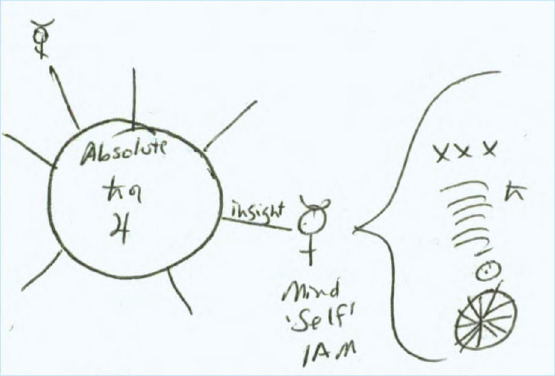
[FIGURE 1983 0625-1. Absolute Soul, Solar Logos/Mercury and I AM, and Cosmos. Facsimile scan from 1983 0625 PBP F08.PDF.]
AD: There's two [Mercuries <Note: single Mercury glyph>] conjoined: one is the solar logos and the other your I AM. If there's a solar logos there's souls within it, and if there are souls, there's a solar logos. You say basically the World-Idea which is the intellectual cosmos is what feeds the solar logos, which (in turn) has to feed the individual I AM. ... i.e., you manifest your own world.
If established in insight one sees these two aspects--the world in the I AM and the I AM in the world (one leads to mysticism; the other to materialism).
What it means to become a sage--the knowledge he has through insight is the knowledge of the intellectual cosmos, the I.P.
[PB 28.2.154, Persp. p. 388 (Red. XVI, p. 32 #37)] "Without keeping steadily in mind..." (complete para here in original transcript)]
"Reality of his own self is mind"--he has the knowledge of the reality of his own self, that the reality of the Asmita principle is mind.
The sage recognizes the object is a manifestation of the mind, and the mind is an expression within of the object--he recognizes non-duality--that's where he recognizes both positions, the Soul in the indivisible [small in-line drawing: both Saturn and Jupiter glyphs within circle]*, and the Soul divisible about bodies [small in-line drawing: circle with 12-fold division]*.
*[Note from JF: Saturn in Leo, Jupiter in Virgo glyphs within circle = Absolute Soul; Circle with 12-fold division refers to Manifested World with 12 mundane houses.]
This is the Soul's nature, and has nothing to do with categories. PB criticizes Aristotle's categories because it's absurd to apply the categories [small in-line drawing: both Saturn and Jupiter glyphs within circle] to the [small in-line drawing: circle with 12-fold division].
"Both remain strangely present" -- Isn't that amazing! It's like when the sage sees the waves on the ocean, he sees both, doesn't deny the differences in the Oneness. For the mystic is partially blind--he sees the ocean, not the waves. The materialist is blind; he sees the waves, not the ocean.
So this is a statement of the highest teaching: "This is it."
SOLAR LOGOS
PB [28.1.41 & Persp. p. 383 (RED XVI, p. 37 #12)] When Mind concentrates itself into the World-Mind, it establishes a focus. However vast, it goes out of its own unlimited condition, it passes from the true Infinite to the pseudo-Infinite. Consequently the World-Mind, being occupied with its cosmos, cannot be regarded as possessed of the absolute character of Pure Mind. For what is its work but a movement of imagination? And where in the ineffable absolute is there room for either work or imagination? The one would break its eternal stillness, the other would veil its unchangeable reality. This of course it can never do, for Being can never become Non-Being. But it can send forth an emanation from itself. Such an emanation is the World-Mind. Through its prolonged contemplation of the cosmos Mind thus becomes a fragment of itself, bereft of its own undifferentiated unbroken unity. Nevertheless the World-Mind, through its deputy the Overself, is still for humans the highest possible goal.
Unity, Being, reasoning phase--this is the pure Mind, its sheer intellect.
"focus"--focuses the Asmita principle of that pure mind [small in-line drawing: both Saturn and Jupiter glyphs within circle] (true infinite) onto the pseudo-infinite [small in-line drawing: circle with 12-fold division].
"imagination" = intellectual imagination of the Sun.
It's right in Being, which is unchangeable reality. Non-Being can't become Being but Being is within non-Being. [Note from jf: ?? Or, should last phrase read: "... but non-Being is within Being." ?] Being can't become non-Being.
The Asmita principle of our Cosmic Soul is [small in-line drawing seems to be here: both Saturn and Jupiter glyphs within circle] the World-Mind.
The [Mercury]** is the true infinite, because the separation between the true Intellection--the Cosmic Soul--and its emanation doesn't exist.
**[Note from JF: Mercury Pisces Nature.]
[Mercury] -- the indivisible aspect of World-Mind, contemplating an indivisible aspect of itself becomes divisible.
"Ind. [Individual] Asmitas" = "through its deputy the Overself."
The highest possible attainment for a human being is through his Asmita, which attains union with the Asmita of the solar logos. The ultimate philosophic attainment is the One.
Is there a relation between the individual I AM and its recognition of the I AM of the solar logos? There is no difference between the [Mercury] and [Saturn Jupiter] of the solar logos, for the [small in-line horizontal drawing "cosmos": stars - planetary spheres - earth elements; see right-hand side of Figure 1983 0625-1] is its child.
The most we can know is through our Isvara, no matter what the scientists say and how many spaceships they send out. The ignorance of modern science is that it'll self destruct, but it'll take time to see that.
We're funneled through the solar logos, that's as high as we can go. In essence, they're co-equal, but not in power.
However, even though we can get only as high as Isvara, Plotinus would say when you are there, you can get revelations of the One. They are revelations, not in our I AM's experience.
Plotinus has a passage where he refers to the universalization of the I AM. ((At enlightenment)) you don't abandon the solar logos--you become a solar logos in service to others. [Note: See Plotinus, IV.8.2, fourth para.]
Proclus' viewpoint is that our Soul is not an emanation of our Isvara, or our solar logos. It's rooted in the Nous, as the solar logos' Asmita is rooted in the Nous.
PB [28.1.87 (RED XVI, p. 63 #16)]: "Before Abraham was I am!" These words are an expression of the higher mentalism. Note carefully that Jesus did not say "I was." This means that he as the non-personal unindividuated Mind existed before the birth of Abraham. "I am" points to the eternal One where no individual entity ever was, is, or shall be.
If Abraham was realized (his) Soul would say, "I am before Jesus was," because Jesus was a historical person. The I AM points to the eternal One--the Absolute.
PB [28.1.60 & Persp. p. 391 (RED XVI, p. 43 #12)]: We are constantly faced by the hoariest of all problems, which is "Why did the Universe arise out of the depth and darkness of the Absolute Spirit?" The Seer can offer us a picture of the way in which this Spirit has involved itself into matter and is evolving itself back to self-knowledge. That is only the How and not the Why of the world. The truth is not only that nobody has ever known, that nobody knows, and that nobody will ever know the final and fundamental purpose of creation, but that God himself does not even know--for God too has arisen out of the Absolute no less than the universe, has found himself emanated from the primeval darkness and utter silence. Even God must be content to watch the flow and not wonder why, for both God and man must merge and be absorbed when they face the Absolute for the last time. (In the symbolic language of the Bible, "For man cannot meet God face to face and live.")
Here God is Isvara, the solar logos.
[File 1983 0625 PBP F08.PDF Ends]
1983 06/25 V13.1: SEMINAR: PB Paras; World-Mind. Copyright 2024 Wisdom's Goldenrod p. ii