APPENDIX: AB AND JF SEMINAR NOTES FOR 1983 0705a
[Classnotes AB 1983 0705 Begin]
7/5/83 Seminar / Time and Eternity
Four Views of Time in Ancient Philosophy [Note: By John Francis Callahan.]
Plotinus [Note: The Enneads.]
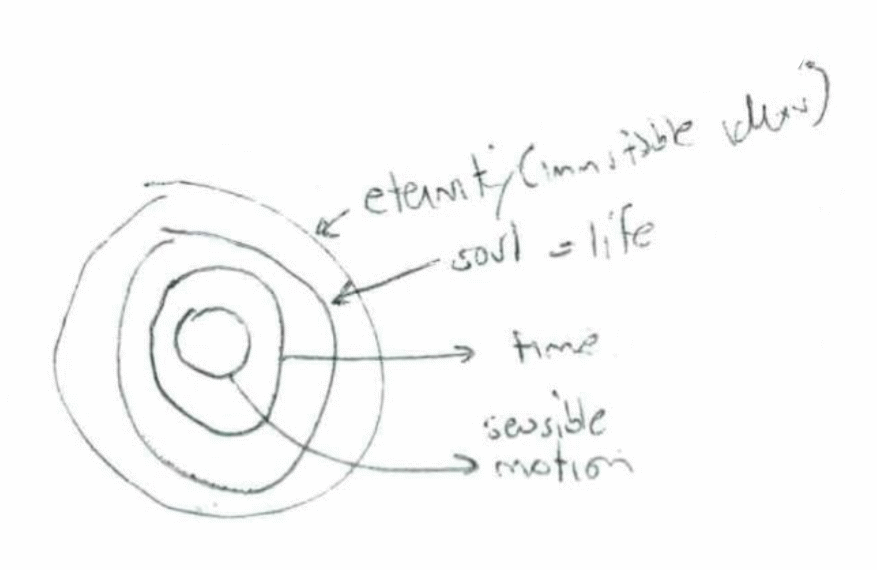
[FIGURE 1983 0705a-1-AB. Four Views of Time. Facsimile scan from AB class notes.]
Time is an image of eternity.
Time = the life of the soul.
Plotinus conceives of time as substantial.
Motion manifests time (time is the principle of motion).
The life of the soul translates the immutable Ideas into images.
Time is the ordering principle within soul which determines how things manifest.
Time ≠ the soul's life but is a mode of that life.
The Buddhists take their stand in the asmita principle of a cosmic soul.
Time = the principle of manifestness (and cannot itself be manifested).
Page 225, Plotinus: eternity = that which has neither been nor will be, the life instantaneously entire, complete, unbroken, belonging to the Authentic Existence. The higher phase of soul participates in this eternity. (Eternity = the life of the Intellect.)
Aristotle thought that motion is the measure of time.
[Classnotes AB 1983 0705 End]
[JF Notes Begin]
[Note: The following are JF seminar notes only for the second (missing) audio file.]
III.7.8: "Movement Time cannot be . . ."
--He goes through all the definitions [of time] starting with Aristotle.
--See Coomaraswamy, Time and Eternity.
--Time: the Life of the Soul, has both Movement and Rest, Eternity is Life in Repose.
--Time is in the Life.
--Anthony: Time is the principle of Life being divisible.
[JF Notes End]
Seminar
Tuesday, July 5th, 1983
Verbatim, unedited transcriptClick the series name to view more
SEMINAR at Wisdom's Goldenrod, Hector, NY
with Anthony Damiani (AD) & Red Witter (RW)
July 5a, 1983
PLOTINUS; SOUL; TIME & ETERNITY
with Appendix: AB and JF Class Notes 1983 0705.
TOPIC: Plotinus
SUBJECT: Soul
SUBSUBJECTS: Time and Eternity, Cosmic Soul, Demiurge, Cosmology, World-Idea
CONTENTS:
Reading of Plotinus, III.7.11
AS reading his paper on Time and Eternity, Cosmology
One World-Idea or many, different cosmic souls
III.7.12
One & many, indivisible & divisible
Inner & outer
Star soul movement through the cosmos
AD on "We" can't answer cosmic soul's relation to other cosmic souls
Universal Soul's ground-plan, eternity
Back to paper, part on cosmic soul
Place of cosmic soul & Demiurgic Intellect
Reading of III.7.1, 2, 3
"Life instantaneously entire"
III.7.4, 5, 6
Appendix: AB and JF class notes
BOOKS READ FROM OR REFERENCED:
Paul Brunton, Notebooks
Plotinus, The Enneads (MacKenna translation, 4th ed.)
Plato, Parmenides, Timaeus
John Francis Callahan, Four Views of Time in Ancient Philosophy
Ananda K. Coomaraswamy, Time and Eternity
PLOTINUS QUOTES READ OR REFERENCED: III.2, III.3, III.7.1-6, III.7.8, III.7.11, III.7.12, VI.2.6
DIAGRAM appended to this transcript:
- FIGURE 1983 0705a-1. Four Views of Time.
AS PAPER read in class:
- "Time and Eternity". Retyped as 1983 0705b V09M. Plotinus - Soul. Some similarity to Astronoesis, "Nature: House 12," p. 245 ff.
NOTES:
This is 1983 07/05a, Plotinus; Soul Seminar, and the first entry associated with this date. 1983 07/05b = Time and Eternity Paper.
AB and JF class notes (including diagram) have been appended because we are missing the second audio file for this class. They thus help round out the class. All capitalization and punctuation corrected, all abbreviations spelled out in appended class notes.
Previously printed, distributed 2007 as part of a set.
Summer 1983 Plotinus; Soul classes/seminars thematically related.
For more on Time and Eternity, see WG Seminars 1981 0821, 1983 0706b (Coomaraswamy), among others.
TRANSCRIBED by jf 2006 from Audio Cassette tapes; reformatted by jf 2018. In 2024, IT does two more passes, corrects listening errors and makes verbatim, updates prefatory matter and footer, replaces tape markers with audio file markers, expands Subsubjects, completes Book List, adds Plotinus quotes section, corrects errors/typos, adds new notes within transcript, creates an Appendix with AB and JF notes and diagram, reformats to accord with new conventions. Archival verbatim transcript with AS Paper – V12ap.
AUDIO FILES: 1983 0705a. [Note: "Tape" and "Side" refer to original audio cassette tapes that were later digitized into .MP3 Audio Files.]
1983 07/05a SEMINAR at Wisdom's Goldenrod
Plotinus; Soul; Time & Eternity
[Audio File 1983 0705a Begins]
PB [V12, 18:2.10 & Persp., Ch. 18, #11, S reading part of]: ""[I turn to you, O Master, for inspiration to rise above and excel myself, but I] create that inspiration by my own will. I kneel before you for guidance in the problems and decisions of life, but I receive that guidance by taking you as an example of moral perfection to be followed and copied. I call upon you for help in my weakness and difficulty, my darkness and tribulation, but I produce and shape that help by trying to absorb it telepathically from your inner being.""
[15¾ second pause]
AD: [one word inaudible] to that we're over (music) [one word inaudible] [short pause] Whether you want to chant it or [one word inaudible]
[10½ second pause]
S: Yeah.
AD: Set it down there? Oh that's June!
S: Yeah.
S: Uh-hm.
[15 second pause]
AD: So let's hear it, Avery.
AS: Hear what? Oh.
AD: Yeah, let's hear it, come on. You kept it secret (for all).
S (faint): Kept secret.
AS: What do you mean? Just three pages. No I-- all I was doing, I was just trying to-- to clarify some things so I wrote a couple of things based on the tractates in "Time and Eternity". [Note: Plotinus, III.7.] 'Cause this-- it's just a summary of some of the things which (are in) Plotinus.
AD (simultaneously): Alright. Let's hear it.
AS: Um-- break. [10¼ second pause] 237. [11 second pause] Well it's partly based on this tractate in "Time and Eternity".
[14 second pause]
RW: What page are you going to read from?
AS: This 234. Says--
[Note: In the reading of Plotinus quotes throughout this class, [added phrases], <omitted phrases>.]
Plotinus, III.7.11 (AS reading): ". . . Time lay, though not yet as Time, in the Authentic Existent together with the Cosmos itself; the Cosmos also was merged in the Authentic and motionless within it. But there was an active principle there, one set on governing itself and realizing itself . . . and it chose to aim at something more than its present: it stirred from its rest, and the Cosmos stirred with it. . . .
"For the Soul contained an unquiet faculty, always desirous of translating elsewhere what it saw in the Authentic Realm, and it could not bear to retain within itself all the dense fullness of its possession. [AS: And then he says--]
". . . To bring this Cosmos into being, the Soul first laid aside its eternity and clothed itself with Time; this world of its fashioning it then gave over to be a servant to Time, making it at every point a thing of Time, setting all its progressions within the bournes of Time. For the Cosmos moves only in Soul--the only Space open to it to move in--<and> therefore its Movement has always been in the Time which inheres in Soul.
"Putting forth its energy in act after act, in a constant progress of novelty, the Soul produces succession as well as act; taking up new purposes added to the old <it> brings thus into being what had not existed in that former period when its purpose was still dormant and its life was not as it since became: . . ."
[27¼ second pause]
AS: There was another one here and we could certainly read it but I don't know (if it fits) here.
[short pause]
AS Paper, "Time and Eternity" (AS reading): "So in III.7.11, the cosmos and time he says lay in the Intellectual Cosmos together with Soul."But Souls contained an unquiet faculty, always desirous of translating elsewhere what it saw in the Authentic Realm, and it could not bear to retain within itself all the dense fullness of its possession." [AS: Again--]
"In a similar vein, in VI.2.6, he also refers to the essence of Soul as a one and many, and he says that through striving to contemplate itself the Soul is a many, and that the purpose is"the Act of the Intellect." [18½ second pause] [AS: Ok. And then--]
"The many unit souls are expressions of soul's"unquiet faculty," having a desire of realizing the Ideas and themselves distinctively. Each cosmic soul will be such an intimate emanation of its intellective origin, which is Absolute Soul, and will be a principle of rational unfoldment. [AS rereads: "It will also be a principle, and is also a principle of rational unfoldment."]
"In the striving to actualize their inner vision, these unit consciousnesses or cosmic souls become the Logoi or expressing principles of the Intellectual-Principle. The cosmic soul's quiescent inner essence, or its intellectuality, is in eternity. It is a participant with the Absolute Soul. It holds the idea of the world in an eternal vision, and this vision is an eternal wisdom guiding the soul's activity.
"The cosmic soul's outward energy is the manifesting of the World-Idea in perpetuity. Each soul will know itself more fully through its awareness or witnessing of the world which it unfolds within its own I AM. It thus fulfills its double purpose: through the Act of Intellect, knowing itself as the Act of Intellect.
"For the Intellectual-Principle, contemplation and contemplated are identical--no movement ensues. Soul contemplates Intellect as well, but it is a principle of motion, putting what it sees into living activity. In order to do this, the soul emanates a secondary phase or I AM, which has the rational activity of bringing a cosmos into being. He says it clothes itself in Time.
"The cosmic souls emanate as productive principles, whose life-motion is time. The cosmic soul thus translates what it sees or contemplates into a cosmos, and so it has the power of unfolding the World-Idea as the perpetual spiraling sequence of the cosmos.
"Each cosmic soul is an Absolute Individual. Insofar as its vision is occupied eternally on the Ideas, it is not outside of the Nous, for it is where it knows. The cosmic soul has eternally this inner awareness of the intellectuality which is its intimate prior. But it has also an awareness of that which it's manifesting in time, that is, the cosmos. In the awareness of the cosmic soul these two phases are not separate. Even amidst its activity, its eternal seeing keeps it in eternity, in what he calls the more veritable life of Soul.
"So again, this cosmic I AM or cosmic soul's rational energy, (clothed) in time, is manifesting its World-Idea in perpetuity as its cosmos. Each cosmic soul has a unique version of the Ideas which yet includes the others. The one World-Idea is held in the knowledge of each Solar Logos, and also includes a knowledge of the other Logoi, while yet it is manifested distinctively by each. The totality of the cosmic souls are expressing as much of the Intellectual Cosmos as available for manifestation, and this again is equivalent to the World-Idea. The one World-Idea, or universal reason-principle as Plotinus calls it [cf. III.2, III.3], thus includes the interpenetrating World-Ideas or Logoi of all cosmic souls. And included in these will be the Logoi of the individual souls, which are lower in order.
"The sensible cosmos provides us with a symbol of the relation of the cosmic souls and their cosmos. The Intellect of each cosmic soul is in an omnipresent interpenetration with the others. The stable inner essence of the star soul's Intellect is sensibly symbolized by its rotation about its axis, which is called the Pole of Vesta. It represents the intellective act wherein the star is eternally established in its own essence.
"In its reasoning or understanding activity which is unfolding the cosmos, the cosmic soul is in perpetual changing relation with the other cosmic souls and their intellectual expressions. The rational energy of the star soul, which receives the Intellect or the Ideas-- which receives the Ideas-- is symbolized by the motion of the star transiting through the heavens. So the Intellect of a cosmic soul grasps the Idea, but with an accompanying rational vision, or rational motion.
"Receiving this Idea in its understanding, the cosmic soul is expressing through its rational powers, which are themselves the activities of the distinct planetary souls-- which are-- Receiving the World-Idea into its understanding, the cosmic soul is expressing it through these rational powers, which are themselves the activities of distinct planetary souls. The planetary motion around the Sun represents for us this act of understanding of the Sun soul, which he says again, clothing the World-Idea in Time, generating the cosmos instant-by-instant.
"The result of this activity is the organization of the body of this cosmos, the body of the cosmic soul, and this includes all the vehicles of the individual souls that will inhabit this vast cosmos. These individuals then view the result of this cosmic activity sensibly through their own associated bodies within it. And the inerratic, planetary, and sublunary spheres which they see are the symbol then of the prior cosmic activity."
[11 second pause]
AS: That's it.
[32¾ second pause]
RW: Avery, is the division that each star soul (or planet), of its World-Idea, and the World-Ideas of every other star soul-- [short pause] Each star soul has a World-Idea, a vision of the World-Idea, and each star soul can see-- has-- assimilates all the other star soul visions also. Is that what you were saying?
AS (faint): Ok.
RW: If you take each star in the inerratic sphere as a cosmic soul, and that cosmic soul has a vision of the World-Idea through the I AM principle, or the Logos, the World-Idea held within it. Now it's-- somehow I get the understanding that each one of those also assimilates the World-Idea held by every other cosmic soul or star soul. Was that-- was that clear or--
AS: No, no, it's fine. Within-- within the Idea that it's going to-- if each of those receives the World-Idea, that World-Idea includes necessarily in some way all the others. [short pause] It's all [RW assents] the other souls. It inclu-- it includes-- How can I say it?
[short pause]
RW: What did you say that I didn't say?
[short pause]
AS: I don't know.
S (faint): [few words inaudible]
[35 second pause]
RW: Can you find that line where you--
AS: Yeah right here.
[37¾ second pause]
AS Paper, "Cosmic Soul; Time and Eternity" (AS rereads part of): "Each cosmic soul has a unique version of the Ideas, or vision of the Ideas, which yet includes the others. This one World-Idea is held in the knowledge of each Solar Logos, and includes a knowledge of the others, while it is manifested distinctively by each."
RW: Now, I guess my question is, I understand that they would manifest it distinctly. But my question is: the World-Idea held within before manifestation by each soul, cosmic soul, is that an identical World-Idea, is that one World-Idea, or is each one, since it's a distinct cosmic soul, have within a different World-Idea that gets manifested even more differently.
[22¾ second pause]
AS: I guess I was trying to say that in their Intellectual phase, there would be the same Idea, [RW: Ok.] but there wouldn't be different Ideas that they were contemplating. But then in the rational phase of the soul, it would be-- it'll have to be separate, it'll have to be distinct.
RW (simultaneously): Uh-hm. That was my question. [27¼ second pause] It just wasn't clear to me, this has come up two or three times this week in the discussion of the double knower in his-- I've wondered about that. [short pause] Just like if you could-- to make it simple, if you could line up-- take ten cosmic souls, and they all receive the World-Idea, could you walk through the mind of each cosmic soul and say, yes, they're all looking at the same World-Idea.
AS: Well, see I was just-- this was-- I was trying to follow up that thing we-- the quotes we had in PB where he spoke about inwardly the World-Mind has an eternal hold of the World-Idea.
RW: Uh-hm.
AS: And-- but that also, that outwardly, if you want to put it that way, it's manifesting in perpetuity, [RW assents] it's manifesting a cosmos. Now, I was just trying to understand the best that-- um-- [short pause] I think that inwardly, if you want to put it that way, what would that inwardly mean? You know, that each World-- the World-Mind has an eternal grasp of the World-Idea. If we could apply that to cosmic soul, then we would have to refer to its intellectual phase, [RW assents] and we would have to refer to the-- to that in the cos-- in the World-- in the cosmic soul which was inseparable from that Intellectual vision. [RW assents] And just (even/in) there, you couldn't-- couldn't really distinguish the World-Idea one from the other. Not only in terms of its rational activity of manifesting the--
RW: Uh-hm. The thing it--
AS: Although--
RW: Yeah, I could see how the-- this-- the Logos, as the World-Idea being presented to the Asmita or the I AM or the Overself, is a World-Idea. But then there almost seems to be the beginning of distinction when you start to talk about the inerratic sphere, for each Solar Logos in that. Which brings us down there and what we just talked about.
S: Right.
[short pause]
CdA: Would it-- would your question-- could your question be phrased that this Time begins at the rational phase? Or does it begin at the Intellectual phase? Is that--
RW: No. I (really) haven't gotten into the-- the time aspect of it, I was just trying to figure out how you grasp the World-Idea from within. But maybe time is an important part of that, I wasn't aware that (it was part of the) question, although it may be. [10¼ second pause] It's a question that keeps coming in and out of my mind all week. Gets this whole thing started.
CdA: So it--
RW: Yeah, I think I have it settled and then I find out I don't have it settled.
AS: See I-- like I didn't-- I didn't read this quote but he says--
Plotinus, III.7.12 (AS reading): "<But> let us conceive this power of the Soul . . ."
AS: And he's speaking of Time as this power of the Soul, as (manifesting). He says--
Plotinus, III.7.12 (AS reading): "<But> let us conceive this power of <the> Soul to turn back and withdraw from the life-course which it now maintains, from the continuous and unending activity of an ever-existent Soul . . . let this [the] outgoing phase of <the> Soul become once more, equally with the rest, turned to the Supreme, to Eternal Being, to the tranquilly stable.
"What would then exist but Eternity?
"All would remain in unity; how could there be any diversity of things? . . . What ground would lie ready to the Soul's operation but the Supreme in which it has its Being? Or, indeed, what operative tendency could it have even to That since a prior separation is the necessary condition of tendency?
"The very sphere of <the> [this] Universe would not exist; for it cannot antedate Time: it, too, has its Being and <its> Movement in Time; . . .
"If, then, the Soul withdrew, sinking itself again into its primal unity, Time would disappear: the origin of Time, . . . [AS: And so on. And with it all] Soul's tendency towards the production of the sensible Universe with the consecutive act <ensuing> [ensues]."
[25¾ second pause]
AS: The other thing is [few words inaudible] trying to see how this-- the Soul's essence is to be both a one and many, it's also to be both indivisible and productive or active. [RW assents] And seems-- let's say that the purpose-- he has this line, the "purpose is the Act of the Intellect" [Note: See Plotinus, VI.2.6, last paragraph.] and so on. It's like, this activity of the soul fulfills a kind of a double purpose, it's the-- At one and the same time it's the Act of the Intellect. And that is the activity which is bringing this World-Idea into manifestation. But it's also-- the other purpose is that it-- soul strives to contemplate or know itself and it's also this purpose that's achieved through its manifesting. Through its manifesting (a cosmos).
CdA: I guess [RW simultaneously: So that--] two-- Excuse me.
RW (simultaneously): Go ahead, I'm sorry.
CdA: No.
RW: Just let me finish this. The-- the quote on 236, where he says that--
Plotinus, III.7.12 (RW reading): ". . . the activity is Time, the Universe is <a> [the] content of Time. [RW: And, then he says--] No doubt it will be urged that we read also of 'the orbit of the Stars being Times': but do not forget what goes [on] with these words; 'the stars exist', we are told, 'for the display and delimitation [AS: Right.] of Time', and 'that there may be a manifest Measure'. [RW: Says--] No indication of Time could be derived from (observation of) the Soul; no portion of it can be seen or handled, . . ."
RW: It's like-- now I'm back to the-- I guess my same question. It seems though that within the-- a Solar-- oh let's see, within a cosmic soul, there is this inner and outer aspect. And it almost sounds like even the inner aspect is this time which is activity, and that the outer aspect is the content which ends up being the universe. If that-- if that is the case, it may not be, but if it is, it then sounds like that each Solar Logos has a distinct vision even of the World-Idea in addition to a distinct manifestation of the World-Idea.
AS: Yeah but I don't-- I guess I'm saying that-- well-- I mean maybe I'm wrong. But I was trying to use the cosmos as a model as we were doing the other day, that's the other thing I was trying to do. [RW assents] And we could-- you know, we could work upwards [RW assents] and say well, if this-- we have the sensible manifestation, now if this is a replica of what's going on-- And we have the sublunary which is a symbol of the actual body. Now the rational movement of the plan-- the-- no. The movement of the planetary bodies is a symbol of the rational unfoldment of the cosmos instant-by-instant. [RW assents]
Now, if we-- even if we look at the stars, now, suppose we say the stars are a symbol of the intellectuality. The star-- the inerratic sphere is a symbol of the intellectuality of all those cosmic souls, you know. In some way, it might also represent-- you know, the way we were speaking of a star moving through the cosmos. In some way that's not the pure intellectual eternal vision. That movement almost seems to me to represent the way that, as he says somewhere else, the understanding faculty or the reasoning faculty receives the impressions of the intellectual. And it's-- it's that in which there's a changing relation to [RW assents] the other, as it were, a changing relation where you could speak about receiving the impressions of the Ideas.
RW: So you're talking about--
AS: Rationally.
RW: Oh.
AS: He says like a rational-- he says that a rational movement accompanies the intellection of soul.
RW: Yeah. So if you were to take--
AS (simultaneously): I'm not speaking about even the inerratic there the way we spoke about a soul-- you know, like a Solar Logos moving through the cosmos and [RW assents] assimilating more of that Idea.
RW: Yeah.
AS: That can't be its-- that's not a symbol of its eternal inner vision.
RW: Uh-hm.
AS: That's-- that-- even that is a symbol of the way that--
RW: Seems like I could [one word inaudible]
AS (simultaneously): Be the rational activity that's accompanying [RW simultaneously: Right. Yeah.] (vision), the way it's going to receive the World-Idea [few words inaudible]
RW (simultaneously): Yeah, there's even a rationality there, seems like.
AS: Well yeah because there seems that there's a motion through [RW: Yeah.] the cosmos is symbolizing that.
RW: Uh-hm.
CdA: Can you-- would you mind just--
AS (simultaneously): So I was distinguishing that from the eternal-- I'm saying, all-- I was trying to say here that the inner-- This is a-- holds the World-Idea in an eternal kind of a-- that really refers to its Intellectual phase. [RW assents] And that if you say anything else, you-- you're speaking of even the highest faculty of the understanding, the way it receives that World-Idea is not going to be eternally, but is going to be in perpetuity. And then it's going to rationally try to play that out.
RW: So there's perpetuity even as the star travels through the cosmos, with the rational powers around it.
AS: Yeah well-- or work upwards or downwards, you know. The rational powers are traveling around.
RW: Yeah.
AS: Ok. The planets, the bodies of [RW assents] the planets are traveling around the Sun. That is an image of the rational motion of its powers which are unfolding instant-by-instant [RW assents] the Ideas. Now you could also speak about-- and that would be the rational powers in the soul. But it seemed to me you could also speak about-- Maybe I'm confused on this but, you could also speak about the way that that rational faculty is like apprehending or receiving the impression of that eternal Idea. It (can't) receive that impression in eternity. [27 second pause] Oh maybe-- maybe what I'm-- maybe the distinction is this, and I don't know. I'm--
AD: I don't think this question can be answered with any precision.
AS: Oh no?
AD: In other words, you'd have to live there.
AS: Jumping off.
RW: Maybe I'll drop it, (Avery).
AS (simultaneously): But if you-- (well--)
AD (simultaneously): Well it's just that the-- it's just that the intellectuality of the cosmic soul's vision, alright, and whether it creates a distinctive world from other cosmic souls, is a question that we can't answer because in some way, it does and is influenced by the other cosmic souls, and includes something of their influence in the manifestation of its world. But its world is different from other worlds.
AS: I know what I-- But, I-- I almost tried it-- now this-- this would complicate the matter. But it seems like you could maybe do the following and say that the motion around its pole referred to its own inner vision, its stable essence or its eternal vision. [RW: Oh.] But if the motion through the cosmos, as soon as you speak about that, it seems you're referring to-- you have to bring in the Demiurgic activity too. You say that now, not only does this soul have an inner essence but in order to manifest, we left out the whole thing of bringing in also the Universal Soul.
AD(?): Yeah.
AS: The Universal Soul is providing the seat for a sensible manifestation. And as soon as you speak about that, even its intellectuality try-- It's almost like the motion through the cosmos is the intellectuality of-- is that star soul trying to or interpreting the Universal Soul's illumination through its own intellectuality. And that's where that motion [couple words inaudible]
RW (simultaneously): I like that 'cause I've been trying to do something with that Demiurge all week.
AS: I don't know, Anthony, if that makes any sense, probably doesn't, but-- On the one hand, the Solar Logos, any cosmic soul, has this inner eternal vision. On the other hand, when it manifests, it has to do so not just in a vacuum but in terms of the Universal Soul's ground-plan. It has to work with that. Now that may also be provided internally. But in terms of manifesting a cosmos in relation with the Universal Soul's ground-plan, obviously it does not have the entirety of that ground-plan. But, now in manifesting the world it will have to operate within a given locus, within a given portion of that ground-plan. And it's going to be interpreting that according to its own inner vision. But now that will be already as in perpetuity. Soon as we speak about its relation with that ground-plan, it's already-- it's not eternal-- eternity anymore, we're talking about perpetuity, the way it's going to express its Idea, and that will have to be symbolized by its motion through the cosmos now. And that shows its relation to that ground-plan, [RW assents] to that Universal Soul's ground-plan. And in that sense it is-- you know, it-- not in an inner relation in-- not in inner identity with all the other souls (right from) its essence but now is in--
RW: With the World-Idea.
AS: Yeah, and therefore in a interrelation with the other--
RW: In other words, running around it gives a nice little place to separate eternity and perpetuity too.
AS: Well-- [short pause] I don't know.
[short pause]
RW: Well--
[1 minute 37½ second pause]
AS: Anyway I-- I think that tractate though on III.7 would go very well about where we left off with those astrology, the general-- the general quotes on astrology.
AD: Oh yeah.
AS: Where there again he talks about the cosmos in the Intellectual, and then the cosmos as being expressed [one/two words inaudible] (the fundamental--) (you got) the general quotes on the reason-principles [few words inaudible]
[20 second pause]
AD: Read it once more, would you, Avery?
[short pause]
AS Paper, "Time and Eternity" (AS reading): "In III.7.11, he says the cosmos and time lay in the Intellectual Cosmos, together with Souls."Soul contained an unquiet faculty, always desirous of translating elsewhere what it saw in the Authentic Realm, and it could not bear to retain within itself all the dense fullness of its possession."
"In a similar vein, in VI.2.6, where he refers to the essence of Soul as one and many, he says that through striving to contemplate itself the Soul is many, and that the purpose is"the Act of the Intellect."
"The many unit souls are expressions of soul's"unquiet faculty," having a desire of realizing the Ideas and themselves distinctively. Each cosmic soul will be such an intimate emanation of its intellective origin, that is, the Absolute Soul, and is also a principle of rational unfoldment.
"In this striving to actualize their inner vision, the unit consciousnesses or cosmic souls become the Logoi or expressing principles of the Intellectual-Principle. The cosmic soul's quiescent inner essence, or its intellectuality, is in eternity. It is a participant with the Absolute Soul. It holds the idea of the world in an eternal vision, and this vision is an eternal wisdom guiding the soul's activity.
"Cosmic soul's outward energy is manifesting of the World-Idea in perpetuity. Each soul will come to know itself more fully through its awareness or witnessing of the world which it unfolds within its own I AM. It thus fulfills a double purpose: through the Act of the Intellect, and knowing itself as the Act of Intellect.
"For the Intellectual-Principle, contemplation and the contemplated are identical, and no movement ensues. The soul contemplates the Intellect as well, but it is a principle of motion, putting what it sees into a living activity. In doing this, the soul emanates its secondary phase or I AM, which has the rational activity of bringing a cosmos into being. He says it clothes itself in Time.
"The cosmic souls emanate as productive principles, whose life-motion is time. The cosmic soul thus translates what it sees or contemplates into a cosmos. It has the power of unfolding the World-Idea as a perpetual spiraling sequence of the cosmos.
"Each cosmic soul is an Absolute Individual. Insofar as its vision is occupied eternally on the Ideas, it is not outside of the Nous, for it is where it knows. Cosmic soul has eternally this inner awareness of the intellect which is its intimate prior. But it has also an awareness of that which it manifests in time, that is, the cosmos. In the awareness of the cosmic soul these two phases are not separate. We have to conceive that even amidst its rational activity, its eternal seeing keeps it in eternity, in a more veritable life of Soul.
"Each cosmic soul has a unique version of the Ideas, or the World-Idea, which yet includes the others. The one World-Idea which is in eternity is held in the knowledge of each Solar Logos. It includes a knowledge of the other Logoi, while it is yet manifested distinctly by each of these souls. The totality of the cosmic souls are expressing as much of the Intellectual Cosmos that is available to manifestation, and again this is equivalent to the World-Idea. The one World-Idea or universal reason-principle thus includes the interpenetrating World-Ideas or Logoi of all the cosmic souls. And of course included in these will also be the Logoi of the individual souls, which are lower in order.
"The sensible cosmos can provide us with a symbol of the relation of the cosmic souls to each other and to the cosmos. The Intellect of each cosmic soul is in an omnipresent interpenetration with the others. This stable inner essence of a star soul's Intellect is sensibly symbolized by its rotation about its axis, which is called also the Pole of Vesta. This represents the intellective act where the soul is eternally established in its own essence."
(Side 1 of original cassette tape digitized as 1983 0705a Ends; Side 2 Begins)
AS Paper, "Time and Eternity" cont. (AS reading; <<= omitted on taped version vs. prior>>): <<"In its reasoning or understanding activity which is unfolding the cosmos, the cosmic soul is in perpetual changing relation with the other cosmic souls and their intellectual expressions. The rational energy of the star soul, which>> is receiving or receptive to the Ideas, is symbolized by the motion of the star(s) transiting through the heavens. And so he says the Intellect of the cosmic soul grasps the Idea, but has also an accompanying rational activity.
"Receiving the World-Idea in its understanding, the cosmic soul is expressing it through its rational powers, and these are themselves the activities of distinct planetary souls. The planetary motion-- the body-- the planetary motion around the Sun represents for us this act of the understanding of the Sun soul, clothing the World-Idea in Time, or in other words, generating the cosmos instant-by-instant.
"The result of this activity is the organization of the body of the cosmos, the body of the cosmic souls. It includes all the vehicles for the lower or individual human souls and so on, which will inhabit its cosmos. These individuals then view the result of this cosmic activity sensibly through their own bodies. The inerratic, planetary, and sublunary bodies that they see are the symbol of the prior cosmic activity."
S: Yes.
[23¾ second pause]
AD: Red, put it right here. [32½ second pause] Then we can make-- then make an addition to one of the papers there, I think it would be very good. You know, supplement one of those papers. [9½ second pause] But you're trying maybe, (throwing up) the (description/distinction) or creation [one word inaudible] (Parmenides).
AS: Well, that's what this is kind of leading to. I-- But I realize that, you know, when I was reading this tractate there's so much more in there that that wasn't going to lead into. And-- I was trying to (read--) But, the only reason I did this was 'cause some-- some-- You know, we do a lot of things in the class and I realized that-- for a while that-- (I'm always wrong) but-- to write, you know-- to write the paper clearly means to leave out some of the details that we [AD simultaneously: Well--] do in the discussion. And the paper is so much better when all these little details are left out because it just flows. I mean it-- On the other hand, I keep feeling like, you know, as there are some details which I wanted to-- you know, I want to clear up for myself more. Somehow our nice-- you know, maybe they're just little details but some [AD simultaneously: Nice.] of them are nice.
RW: I know. In my coffee cup. (AS and RW laugh)
AD: I missed. (bit more laughter)
AS: And every time I try and write them out they just-- you know, it doesn't flow but I know that they're, you know, little details that would be nice.
AD: You can't put in all the details, Avery, you're crazy.
AS: I know. [AD: But--] I know, maybe that-- Well that's why I just wanted to--
AD: I try over and over again to put in all the necessary details and I can't find the line where it's necessary and where it's unnecessary.
AS: Yeah right. Yeah. I know.
AD: Uh-huh. So if you don't feel strong enough, and I don't have the powerful comprehension, why don't we turn to "Time and Eternity" and read it.
AS: Yeah. Ok.
CdA: I wonder if I could try and ask [AD: Oracle.] my version of those questions.
AD: If you understand, what's question?
CdA: Well, from-- from mine, probably very vague notion, interpretation of a vague notion of what (other) question I (think/see).
AD: Alright. We'll have to ask Red if he thinks your question--
CdA: Would this be-- would this be coffee?
RW (simultaneously): I get to judge you now.
CdA: Would this be coffee, Mr. Red? [short pause] But-- The question seems to arise in the context of the--
AD: Hurry up!
CdA: It's a hard-- it's-- Come on, leave me alone. You know, let me just struggle a little bit.
AD: Struggle!
CdA: Enjoy my pain for a moment.
AD: Oooh.
AS: Uh-oh (I think--)
CdA: Insofar as the inerratic spheres, that point where perpetuity and eternity are of the-- it's very difficult to grasp the difference. And I don't mean the image, I mean the actual intellectuality of the cosmic soul. Is the point of the cosmic soul's contact with the Demiurgic production that gives the distinction of perpetuity at that level? The place, that place within its-- that would specify this individual Solar Logos from another. And insofar as that specification occurs within the Demiurgic Intellect, time begins.
S (faint): Very good.
AS: I think the Time is the result of the soul's own activity.
CdA: Well, could you really distinguish the-- I mean we're putting them-- Could you distinguish at that point the cosmic soul's activity from its-- from its contact, from its place within the Demiurgic Intellect? And could you-- could you separate those two?
[short pause]
AD: Yes, if I was Absolute Mind.
AS (faint): And there you go.
AD: In which case I wouldn't even bother.
AS: Right, the problem-- the problem is, when the soul manifests, the only-- I mean it is said before, it doesn't manifest in a vacuum. That [CdA assents] automatically or simultaneously manifesting means in conjunction with [CdA simultaneously: Demiurge.] the Demiurge's Idea.
CdA: Yeah.
AS: To say that time comes about just from the individual soul or just from the Demiurge, at what other point are they ever separate?
CdA: Separate, yeah. That--
AS (simultaneously): You don't speak about this-- I don't think you would speak about the soul manifesting and not in association with the Demiurge.
CdA: But is it--
AS: 'Cause where is it gonna-- 'cause what and where will it manifest.
CdA: Right. And isn't it its-- Well, maybe-- maybe I'm asking, is its manifestation that articulation that-- articulation of the ground-plan.
AS: What?
CdA: Is-- isn't its manifestation, isn't its manifestation the initial [AD: You're not all--] elaboration of the Demiurge's ground-plan?
AD: He's not allowed.
CdA: Maybe this is irrelevant, but I think-- I think I'm just--
AS (simultaneously): But if I ask you this, is the Demiurge's ground-plan in time, or is it eternal? We speak about the illumination--
CdA (simultaneously): It's eternal. It's eternal.
AS: The Demiurge's illumination [CdA simultaneously: It's eternal.] or ordering of matter. Would you say [CdA simultaneously: It's eternal.] it's perpetual or eternal?
CdA (simultaneously): It's eternal. [couple inaudible AS words simultaneous with CdA] It's not a-- it's not in motion.
RW: Let me read a quote from same tractate.
AS: Ok.
Plotinus, III.7.11 (RW reading): "Time, however, is not to be conceived as outside of Soul; Eternity is not outside of the Authentic Existent: nor is it to be taken as a sequence or succession to Soul, any more than Eternity is to the Divine. It is a thing [RW emphasizes next word] seen upon Soul, inherent, coeval to it, as Eternity to the Intellectual Realm."
AS: Yeah.
RW: Just there's no [AS simultaneously: I already answered it.] clear distinctive-- [AS simultaneously: Yes, yes.] Well she-- she was asking like I was, tell me the exact place where it begins and ends and it's-- he says, [CdA simultaneously: Well--] doesn't work that way.
CdA: I didn't-- I know you can't say 'begin'-- 'begins' but, when you begin to refer to it conceptually where, you know-- I mean that's more--
AS: At what time does time begin.
CdA: Is it possible to refer to-- refer to this conceptually or-- Maybe we have to stop and we have to--
AS: Well, maybe we could read this.
CdA: Yeah.
RW: (Just) do the tractate, then we don't--
AS: Well what do you think, Carol, is the illumination by the Demiurge, that tentative illumination, if you could conceive of that, would that be eternal or would it be perpetual?
CdA: It seems that it would have to be eternal. If that-- if there's no-- I have not understood that there could be any change in that. That it is-- as is the outgoing act of the inner contemplation--
AS: Yeah, even if it's in the fourth quadrant.
CdA: The only-- the only change I could conceive of is-- is that which cosmic souls impose upon it. I don't-- What do you think, Avery?
AS: Says in the Timaeus whatever the Demiurge makes is eternal but-- I mean, in the Timaeus he says that whatever the Demiurge fabricates is immortal. I don't really know if he says eternal. He says immortal. Now I--
S: Same thing.
[short pause]
AS: 'Cause on the one hand, you're right, it's immortal and unchanging. But on the other hand, I don't see how it can have the same status. I don't see how the ordering which the Demiurge imposes on that disordered motion can have the same status as the eternity which is in the Intellectual-Principle.
CdA: No, I don't-- I don't--
S (faint): It's just the definition he gives on 225 [few words inaudible] [few inaudible CdA words simultaneous with S] [few words inaudible] the four qualities to (be) some part of change and thus possibly could be used [few words inaudible] as in time. And I don't know.
CdA: Yeah I don't-- see I'm just positing that-- that it is the very substratum of time and not-- not that it's-- that--
[short pause]
AS: Say that in between time and eternity? It's a middle-- a middle ground?
CdA: No but still, I mean, certainly you can't speak of time as without, I mean-- [short pause] Yeah.
AS: No time with the cosmos came into existence.
S: The (acceptance) of the time is everything.
AS: No, that--
S: I think you'll avoid (her).
S (very faint): [three/few words inaudible]
CdA: Yeah.
AS: Alright, that [few words inaudible] again.
RW: Well let's read the tractate.
AD: Alright well start, start.
Plotinus, III.7.1 (RW reading): "<1.> Eternity and Time; two entirely separate things, we explain, 'the one having its being in the everlasting Kind, the other in the realm of Process, in our own Universe'; and, by continually using the words and assigning every phenomenon to the one or the other category, we come to think that, both by instinct and by the more detailed attack of thought, we hold an adequate experience of them in our minds without more ado.
"When, perhaps, we make the effort to clarify our ideas and close into the heart of the matter we are at once unsettled: our doubts throw us back upon ancient explanations; we choose among the various theories, or among the various interpretations of some one theory, and so we come to rest, satisfied, if only we can counter a question with an approved answer, and glad to be absolved from further inquiry. (some laughter)
"Now, we must believe that some of the venerable philosophers of old discovered the truth; but it is important to examine which of them really hit the mark and by what guiding principle we can ourselves attain to certitude.
"What, then, does Eternity really mean to those who (thus casually) describe it as something different from Time? We begin with Eternity, since, when the standing Exemplar is known, its representation in image--which Time is understood to be--will be clearly apprehended--though it is of course equally true, admitting this relationship of Time as image to Eternity the original, that if we <chose> [choose] to begin by identifying Time we could thence proceed upwards by Recognition <(the Platonic Anamnesis)> and become aware of the Kind which it images."
CdA: What does Anamnesis-- [CdA mispronounces word]
RW: Anamnesis. That's the history.
CdA: Ok. And--
RW: How things come about. [short pause] Like when you take a medical history of somebody.
Plotinus, III.7.2, 3 (RW reading): "<2.> What definition are we to give of Eternity?
"Can it be identified with the (divine or) Intellectual Substance itself?
"This would be like identifying Time with the Universe of Heavens and Earth--an opinion, it is true, which appears to have had its adherents. No doubt we conceive, we know, Eternity as something most august; most august, too, is the Intellectual Kind; and there is no possibility of saying that the one is more majestic than the other;--the Absolute One may be left out of account, since not even majesty can be predicated of it;--there is therefore a certain excuse for identifying Eternity with the Intellectual World, all the more since the Intellectual Substance and Eternity have the one scope and content.
"Still; by the fact of representing the one as contained within the other, by making Eternity a predicate to the Intellectual Existents--'the Nature of the Exemplar', we read, 'is eternal'--we cancel the identification; Eternity becomes a separate thing, something surrounding that Nature or lying within it or present to it. And the majestic quality of both does not prove them identical: it might be transmitted from the one to the other. So, too, Eternity and the Divine Nature envelop the same entities, yes; but not in the same way: the Divine may be thought of as enveloping parts, Eternity as embracing its content in an unbroken whole, with no implication of part, but merely from the fact that all eternal things are so by conforming to it.
"May we, perhaps identify Eternity with Repose-There as Time has been identified with [the] Movement-Here?
"This would bring on the counter-question whether Eternity is presented to us as Repose in the general sense or as the Repose that envelops the Intellectual Essence.
"On the first supposition we can no more talk of Repose being eternal than of Eternity being eternal: to be eternal is to participate in an outside thing, Eternity. [CdA: Huh.]
"Further, if Eternity is Repose, what becomes of Eternal Movement, which, by this identification, would become a thing of Repose?
"Again, the conception of Repose scarcely seems to include that of perpetuity--I am speaking, of course, not of perpetuity in the time-order (which might follow on absence of movement) but of that which we have in mind when we speak of Eternity.
"If, on the other hand, Eternity is identified with the Repose of the divine Essence, all the other categories of the divine are put outside of Eternity.
"Besides, the conception of Eternity requires not merely Repose but also unity--and, in order to keep it distinct from Time, a unity excluding interval--but neither that unity nor that absence of interval enters into the conception of Repose as such.
"Lastly, this unchangeable Repose in unity is a predicate asserted of Eternity, which, therefore, is not itself Repose, the absolute, but a participant in Repose.
"<3.> What, then, can this be, this something in virtue of which we declare the entire divine Realm to be Eternal, everlasting? We must come to some understanding of this perpetuity with which Eternity is either identical or in conformity.
"It must be at once something in the nature of unity and yet a notion compact of diversity, or (more exactly) a Kind, a Nature, that waits upon the Existents of that Other World, either associated with them or known in and upon them, they collectively being this Nature which, with all its unity, is yet diverse in power and essence. Considering this multifarious power, we declare it to be Essence or Being [in] so far as it is in some sense a subject or substratum; where we see life we think of it as Movement; where all is unvaried self-identity we call it Repose; and we know it as, at once, Difference and Identity when we recognize that all is unity with variety.
"Then we reconstruct; we sum all into a collected unity once more, a sole Life in the Supreme; we concentrate Diversity and all the endless production of act: thus we know Identity, a concept or, rather, a Life never varying, not becoming what previously it was not, the thing immutably itself, broken by no interval; and knowing this, we know Eternity.
"We know it as a Life changelessly motionless and ever holding the Universal content in actual presence; not this now and now that other, but always all; not existing now in one mode and now in another, but a consummation without part or interval. All its content is in immediate concentration as at one point; nothing in it ever knows development: all remains identical within itself, knowing nothing of change, for ever in a Now, since nothing of it has passed away or will come into being, but what <it> is now, that <it> is ever.
"Eternity, therefore--while not the Substratum (not the essential foundation of the Divine or Intellectual Principle)--may be considered as the radiation of this Substratum: it exists as the announcement of the Identity in the Divine, of that state--of being thus and not otherwise--which characterizes what has no futurity but eternally is.
"What future, in fact, could bring to that Being anything which it now does not possess; and could it come to be anything which it is not once for all?
"There exists no source or ground from which anything could make its way into that standing present; any imagined entrant will prove to be not alien but already integral. And as it can never come to be anything at present outside it, so, necessarily, it cannot include any past; what can there be that once was in it and now is gone? Futurity, similarly, is banned; nothing could be yet to come to it. Thus no ground is left for its existence but that it be what it is.
"That which neither has been nor will be, but simply possesses being; that which enjoys stable existence as neither in process <of> [or] change nor having ever changed--that is Eternity. Thus we come to the definition: the Life--instantaneously entire, complete, at no point broken into period or part--which belongs to the Authentic Existent by its very existence, this is the thing we <were> [are] probing for--this is Eternity."
[10 second pause]
AD: I just am not strong enough today.
AS: This is a hard one.
RW: Huh, got it?
AS (simultaneously): [few words inaudible] isn't really. [few words inaudible]
AD (simultaneously): Yeah. That (drives to mind).
AS: I think this is-- the one other interesting, where he says--
Plotinus, III.7.3 (AS rereads): ". . . [it] may be considered as the radiation of this Substratum: it exists as the announcement of the Identity in the Divine . . ."
AD: Uh-hm.
AS: I thought that was good.
S: Yeah.
AS: And I-- I almost-- you know, referring it to Life in the eternal and so on, it almost seems that he's practically identifying it with the Saturn in Leo.
CdA: Yeah. Or the in-- or the Absolute Soul itself.
AD: Or the what?
CdA: Or the Absolute Soul itself.
S: [three/few words inaudible]
S: Let's see Michael.
AD: That's not gonna work, go ahead.
AS: Go ahead. Do you want to continue?
AD: Gotta keep our comments to ourselves. Shut up in other words. (bit of laughter) Read that last one [one word inaudible] last two lines.
RW: Ok.
Plotinus, III.7.3 (RW rereads): "That which neither has been nor will be, but simply possesses being; that which enjoys stable existence as neither in process of change nor having ever changed--that is Eternity. Thus we come to the definition: the Life--instantaneously entire, complete, at no point broken into period or part--which belongs to the Authentic Existent by its very existence, this is the thing we <were> [are] probing for--this is Eternity."
[short pause]
RW: The paragraph, previous couple paragraphs back it was interesting that (any) [one words inaudible]
AD (simultaneously): Boy, Augustine was a plagiarist all the way.
Plotinus, III.7.3 (RW rereads): "Eternity, therefore . . ."
AD: That's to be expected from these Church Fathers, they didn't have an original thought in--
RW: Need to get a good thing and run with it.
AD: Hm?
RW: And they a got a good thing and ran with it.
AD: Is this coffee?
RW: Just don't touch the lavender one.
AD: No that's for chivalry. Avery's (immolation/emulation). (RW chuckles) [short pause] Remember what PB called coffee? He says it's a fad.
RW: Yeah. (RW laughs) (I re--) It's not that old.
AD (simultaneously): It's only a couple hundred years old.
RW (simultaneously): Longest fad I ever have.
S: No, tea.
AD (simultaneously): Well, compared to tea.
S: Compared to tea.
AD: Tea's been around a long time, thousands of years.
[short pause]
RW: What did he ever say about his tea fad?
S: It's not a fad.
CdA: (Except) [one/two words inaudible]
S (simultaneously): Well--
AD: The Mecca of the gods. But he's prejudiced. (laughter) He's an Englishman.
[short pause]
AS: I [one/two words inaudible]
AD (simultaneously): Alright, let's try the next part. Avery?
CdA (simultaneously): What do you mean, wait a minute. (CdA laughs)
AS: [one word inaudible]
AD: You're not gonna discuss this with me, not now.
S: Prove it.
AS: We'll just listen.
CdA (simultaneously): [couple words inaudible] I wanted to see what you're doing [one word inaudible]
AS (simultaneously): Let's read.
CdA: Let's read.
AD (simultaneously): He's mad.
RW: Go ahead Avery, you're a good reader.
AS: Then you'll be mad. (AS laughs)
Plotinus, III.7.4 (AS reading): "<4.> We must, however, avoid thinking of it as an accidental from outside grafted upon that Nature: it is native to it, integral to it.
"It is discerned as present essentially in that Nature like everything else that we can predicate There--all immanent, springing from that Essence and inherent to that Essence. For whatsoever has primal Being must be immanent to the Firsts and be a First--Eternity equally with the beauty that is among them and of them and equally with the truth that is among them.
"Some of the predicates reside, as it were, in a partial phase of the All-Being; others are inherent in the All taken as a totality, since that Authentic All is not a thing patched up out of external parts, but is authentically an all because its parts are engendered by itself. It is like the truthfulness in the Supreme which is not an agreement with some outside fact or being but is inherent in each member about which it is the truth. To an authentic All it is not enough that it be everything that exists: it must possess all-ness in the full sense that nothing whatever is absent from it. Then nothing is in store for it: if anything were to come, that thing must have been lacking to it, and it was, therefore, not All. And what, of a Nature contrary to its own, could enter into it when it is (the Supreme and therefore) immune? Since nothing can accrue to it, it cannot seek change or be changed or ever have made its way into Being.
"Engendered things are in continuous process of acquisition; eliminate futurity, therefore, and at once they lose their being; if the non-engendered are made amenable to futurity they are thrown down from the seat of their existence, for, clearly, existence is not theirs by their nature if it appears only as a being about to be, a becoming, an advancing from stage to stage.
"The essential existence of generated things seems to lie in their existing from the time of their generation to the ultimate <of> time after which they cease to be: but such an existence is compact of futurity, and the annulment of that futurity means the stopping of the life and therefore of the essential existence.
"Existence for the (generated) All must similarly consist in a goal to be attained: for this reason it keeps hastening towards its future, dreading to rest, seeking to draw Being to itself by a perpetual variety of production and action and by its circling in a sort of ambition after Essential Existence.
"And here we have, incidentally, lighted upon the cause of the Circuit of the All; it is a movement which seeks perpetuity by way of futurity.
"The Primals, on the contrary, in their state of blessedness have no such aspiration towards anything to come: they are the whole, now; what life may be thought of as their due, they possess entire; they, therefore, seek nothing, since there is nothing future to them, nothing external to them in which any futurity could find lodgement.
"Thus the perfect and all-comprehensive essence of the Authentic Existent does not consist merely in the completeness inherent in its members; its essence includes, further, its established immunity from all lack with the exclusion, also, of all that is without Being--for not only must all things be contained in the All and Whole, but it can contain nothing that is, or was ever, non-existent--and this State and Nature of the Authentic Existent is Eternity: in our very word, Eternity means Ever-Being (aion = aiei on)."
[19¾ second pause]
S: Ok.
AS: Should I go on?
AD: Yeah, sure.
[short pause]
AS: Starting over [one word inaudible] again.
Plotinus, III.7.5 (AS reading): "<5.> This Ever-Being is realized when upon examination of an object I am able to say--or rather, to know--that in its very Nature it is incapable of increment or change; anything that fails by that test is no Ever-Existent or, at least, no Ever-All-Existent.
"But is perpetuity enough in itself to constitute an Eternal?
"No: the object must, further, include such a Nature-Principle as to give the assurance that the actual state excludes all future change, so that it is found at every observation as it always was.
"Imagine, then, the state of a being which cannot fall away from the vision of this but is for ever caught to it, held by the spell of its grandeur, kept to it by virtue of a nature itself unfailing--or even the state of one that must labour towards Eternity by directed effort, but then to rest in it, immovable at any point, assimilated to it, co-eternal with it, contemplating Eternity and the Eternal by what is Eternal within the self.
"Accepting this as a true account of an eternal, a perdurable Existent--one which never turns to any Kind outside itself, that possesses life complete once for all, that has never received any accession, that is now receiving none and will never receive any--we have, with the statement of a perduring Being, the statement also of perdurance and of Eternity: perdurance is the corresponding state arising from the (divine) substratum and inherent in it; Eternity (the Principle as distinguished from the property of everlastingness) is that substratum carrying that state in manifestation."
AD: Repeat that.
AS: Well--
Plotinus, III.7.5 (AS rereads): ". . . Eternity (the Principle as distinguished from the property of everlastingness) is that substratum carrying that state in manifestation."
RW: Carrying that state of everlasting?
AS: Yeah. Or perdurance. I think it's everlasting. [three words inaudible]
RW: Oh.
AS: This-- yeah.
S (faint): (Whatever will) happen.
Plotinus, III.7.5 (AS rereads): ". . . perdurance is the corresponding state arising from the (divine) substratum . . ."
AS: [couple/few words inaudible]
Plotinus, III.7.5 (AS rereads): "Accepting this as <a> true account of an eternal, a perdurable Existent--one which never turns to any Kind outside itself, that possesses life complete once for all, that has never received any accession, that is now receiving none and will never receive any--we have, with the statement of a perduring Being, the statement also of perdurance and of Eternity: perdurance is the corresponding state arising from the (divine) substratum and inherent in it; Eternity (the Principle as distinguished from the property of everlastingness) is that substratum carrying that state in manifestation."
AS: The state of perdurance.
RW: Oh.
Plotinus, III.7.5 cont. (AS reading): "Eternity, thus, is of the order of the supremely great; intuition identifies it with God: it may fitly be described as God made manifest, as God declaring what He is, as existence without jolt or change, and therefore as also the firmly living.
"And it should be no shock that we find plurality in it; each of the Beings of the Supreme is multiple by virtue of unlimited force; for to be limitless implies failing at no point, and Eternity is pre-eminently the limitless since (having no past or future) it spends nothing of its own substance.
"Thus a close enough definition of Eternity would be that it is a life limitless in the full sense of being all the life there is and a life which, knowing nothing of past or future to shatter its completeness, possesses itself intact for ever."
[25¾ second pause]
AD: That's quite a tractate. [shot pause] Well you read--
AS: Somebody else could read.
AD: Well you read this tractate exactly. Yeah, let the oracle speak.
AS: (Exactly?)
Plotinus, III.7.6 (CdA reading): "<6.> Now the Principle thus stated, all good and beauty, and everlasting, is centred in The One, sprung from It, and pointed towards It, never straying from It, but ever holding about It and in It and living by Its law; and it is in this reference, as I judge, that Plato--finely, and by no means inadvertently but with profound intention--wrote those words of his, 'Eternity stable in Unity'; he wishes to convey that Eternity is not merely something circling on its traces into a final unity, but has (instantaneous) Being about The One as the unchanging Life of the Authentic-Existent. This is certainly what we have been seeking: this Principle, at rest within the One, is Eternity; possessing this stable quality, being itself at once the absolute self-identical and none the less the active manifestation of an unchanging Life set towards the Divine and dwelling within It, untrue, therefore, neither on the side of Being nor on the side of Life--this will be Eternity (the Real-Being we have sought)."
AD: Gotta read that thing again.
Plotinus, III.7.6 (CdA reading): "<6.> Now the Principle thus stated, all good and beauty, and everlasting, is centred in The One, sprung from It, and pointed towards It, never straying from It, but ever holding about It and in It and living by Its law; and it is in this reference, as I judge, that Plato--finely, and by no means inadvertently but with profound intention--wrote those words of his, 'Eternity stable in Unity'; he wishes to convey that Eternity is not merely something circling on its traces into a final unity, but has (instantaneous) Being about The One as the unchanging Life of the Authentic-Existent. This is certainly what we have been seeking: this Principle, at rest within the One, is Eternity; possessing this stable quality, being itself at once the absolute self-identical and none the less the active manifestation of an unchanging Life set towards the Divine and dwelling within It, untrue, therefore, neither on the side of Being nor on the side of Life--this will be Eternity (the Real-Being we have sought).
"Truly to be comports never lacking existence and never knowing variety in the mode of existence: Being is, therefore, self-identical throughout, and, therefore, again is one undistinguishable thing. Being can have no this and that; it cannot be treated in terms of intervals, unfoldings, progression, extension; there is no grasping any first or last in it.
"If, then, there is no first or last in this Principle, if existence is its most authentic possession and its very self, and this in the sense that its existence is Essence or Life--then, once again, we meet here what we have been discussing, Eternity.
"Observe that the use of the word 'everlasting' and the reference to unbroken continuity must be taken as a mere convenience of exposition; the word is not strictly applicable to Eternity . . ."
[Audio File 1983 0705a Ends. We are missing the second audio file for this class. Seminar continues with reading of Plotinus III.7, etc. See appended class notes for more information.]
1983 07/05a V12ap: SEMINAR: Plotinus; Soul. Copyright 2024 Wisdom's Goldenrod p. iii