DIAGRAM FOR 1983 0708
Class
Friday, July 8th, 1983
Edited transcriptClick the series name to view more
CLASS at Wisdom's Goldenrod, Hector, NY
with Anthony Damiani (AD)
July 8, 1983
PLOTINUS; SOUL; THE SOUL'S MOTION
TOPIC: Plotinus
SUBJECT: Soul
SUBSUBJECTS: Cosmology, Astrology, Solar Logos, Soul's Motion
CONTENTS:
Plotinus astrology quotes list
Read II.9.8 (omitted student discussion)
Read II.1.5
Levels: Celestial, gods, inferior soul, manifestation
Explanation of levels
World-Idea as Image, Solar Logos
Animal life on earth
"Inferior stuff, inferior soul"
And Divine Beings in the Heavens
"Inferior soul" as the Solar Logos
The We principle "not of our existence but of our excellence," Asmita
Reasoning & animal life
Read II.2.1
Sun Soul's movement out towards self-awareness
Principle of motion or Life, Soul & Body
Soul as self-motive
Souls' inward contemplation, outward manifest motion
Soul as Primal Hypostasis, not category of Being
Principles above phenomena
Universe as self-actuating system
Outward & inward, circular motion
Soul as self-motive, traditional definition
Life & Thought
Admit we don't know what we're talking about
Soul as self-movement
Circularity of thoughts around ego
Straight line, circle
Ptolemaic astronomy
Sun vs. Earth centered
Earth-centered viewpoint
Plotinus speaking cosmology of his time
Laws/habits of nature can be changed
Nature takes back what it has produced
Omnipresent in its entirety, incapable of division
Analogies: friction cars, tonal space, pain
No spatial referent
Body in soul
Within the mind: discussion
The spatial locus & habit
Soul present at a place, without being a place
Motion of heavenly bodies vs. motion of soul
Soul within body vs. body within soul
Universal principles & World-Idea/manifestation
Circular motion in imitation of Intellectual-Principle
Solar Logos' journey universalizing the Ideas
Our solar system, edge of galaxy
Intellectual-Principle all-timed fixity vs. Soul as perpetuity
Solar Logos itself not in universe
Atom like solar system
Plotinus Great Books volume
BOOKS READ FROM OR REFERENCED:
Plotinus, The Enneads (MacKenna translation, 1st and 4th eds.)
Plotinus, The Six Enneads (Great Books of the Western World, Volume 17)
Paul Brunton, Notebooks
PLOTINUS QUOTES READ OR REFERENCED: II.1.5, II.1.7, II.2.1-2, II.3.5, 9, II.3.13, II.3.15, II.9.8, 18, III.1.5, III.1.8-10, III.2.3, III.2.14, III.3.6, III.4.6, III.7.11, III.8.6, IV.3.7, IV.3.8, IV.3.12-13, IV.3.17, IV.4.7-8, IV.4.16, IV.4.22, IV.4.24, IV.4.27, IV.4.30, IV.4.31-36, IV.4.39, IV.8.2, V.1.9, V.8.3
DIAGRAM appended to this transcript:
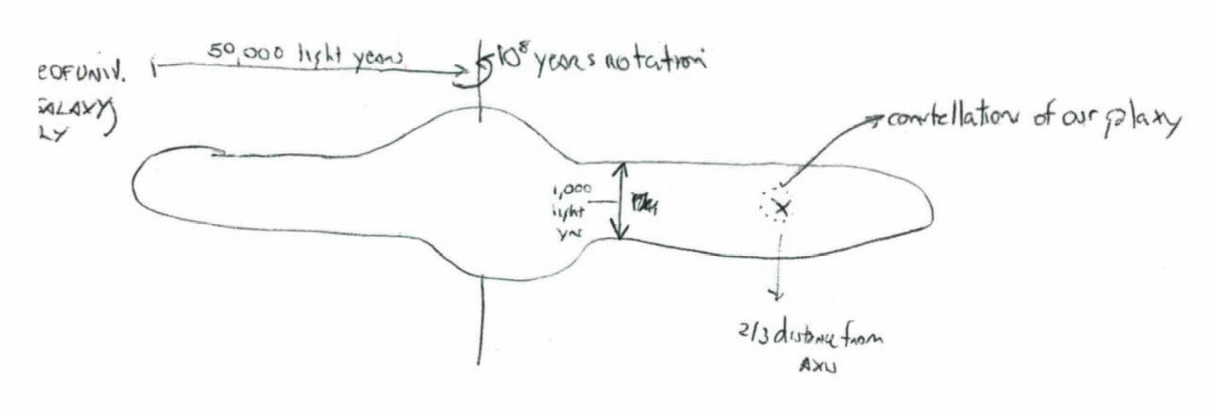
- FIGURE 1983 0708-1-AB. Milky Way Galaxy.
Other diagrams referred to are not with this transcript version.
NOTES:
Previously printed, distributed 2007 as part of a set.
2006 version was typed by jf from Sam Cohen/Pam Drix transcript of May 1985 (which was fairly verbatim for Anthony's comments only); jf then relistened to the audios, added the fairly extensive student/AD dialogue and made other corrections based on audio cassette tapes, identified students where possible, and added Contents & List of Plotinus quotes.
Summer 1983 Plotinus; Soul classes/seminars thematically related.
TRANSCRIBED by jf 2006 from Audio Cassette tapes; reformatted by jf 2018. In 2024, IT updates prefatory matter and footer, replaces tape markers with audio file markers, expands Subsubjects, completes Book List, adds Plotinus quotes section, corrects typos and some listening errors, adds new notes within transcript, adds one diagram and reference within transcript to this diagram, reformats to accord with new conventions. Readable edited transcript – V11r.
AUDIO FILES: 1983 0708a (formerly 1983 0708b), 1983 0708b (formerly 1983 0708a). [Note: "Tape" and "Side" refer to original audio cassette tapes that were later digitized into .MP3 Audio Files.]
| NEW FILE NAME | OLD FILE NAME |
| 1983 0708a | 1983 0708b |
| 1983 0708b | 1983 0708a |
1983 07/08 at Wisdom's Goldenrod
Plotinus; Soul; The Soul's Motion
List of Plotinus quotes written on blackboard prior to class, "Astrology Quotes": from JF's notes (not on tape):
II.1.5; II.1.7; II.2.1-2; II.3.5, 9; II.3.13; II.3.15; II.9.8, 18; III.1.5; III.1.8-10; III.2.3; III.2.14; III.3.6; III.4.6; III.7.11; IV.3.7; IV.3.8; IV.3.12-13; IV.3.17; IV.4.7-8; IV.4.16; IV.4.22; IV.4.24; IV.4.27; IV.4.30; IV.4.31-36; IV.4.39; IV.8.2; V.1.9; V.8.3
[Audio File 1983 0708a (formerly 1983 0708b) Begins]
AD: Got enough of them up? They're not all.
DR: Still can't hear you. (student laughter)
JC: It's a good start, Randy.
AD: It's a good start.
S: (inaudible)
RG: These quotes have to do with astrology. And (you have to) (inaudible) it was enough for it. Should we start?
AD: Yes, why don't we start at page 139?
RG: Wait (inaudible) is that (inaudible)?
AD: Yes. (Others.)
(shuffling of papers)
S: (inaudible)
S: II.9.
S: II.9 or II.1?
AD: "Against the Gnostics."
RC: II.1.5?
RG: II.9.1, II.9.8. (shuffling of papers, student comments) II.9.8? (student comments) And that's why (inaudible).
AD: Yes.
RG: Ok.
S: Here we go.
EC: (inaudible)
RG: II.9.8. "Against--" in "Against the Gnostics".
Plotinus II.9.8 (RG reading): "To ask why the Soul has created the Cosmos, is to ask why there is a Soul and why a Creator creates. The question, also, implies a beginning in the eternal and, further, represents creation as the act of a changeful Being who turns from this to that.
"Those that so think must be instructed--if they would but bear with correction--in the nature of the Supernals, and brought to desist from that blasphemy of majestic powers which comes so easily to them, where all should be reverent scruple.
"Even in the administration of the Universe there is no ground for such attack, for it affords manifest proof of the greatness of the Intellectual Kind.
"This All that has emerged into life is no amorphous structure--like those lesser forms within it which are born night and day out of the lavishness of its vitality--the Universe is a life organized, effective, complex, all-comprehensive, displaying an unfathomable wisdom. How, then, can anyone deny that it is a clear image, beautifully formed, of the Intellectual Divinities? No doubt it is copy, not original; but that is its very nature; it cannot be at once symbol and reality. But to say that it is an inadequate copy is false; nothing has been left out which a beautiful representation within the physical order could include.
"Such a reproduction there must necessarily be--though not by deliberation and contrivance--for the Intellectual could not be the last of things, but must have a double Act, one within itself and one outgoing; there must, then, be something later than the Divine; for only the thing with which all power ends fails to pass downwards something of itself. In the Supreme there flourishes a marvellous vigour and therefore it produces.
[JF note: This paragraph follows Plotinus MacKenna 1st ed.] "Since there is another Universe nobler than this, is it not clear what this must be: a representation carrying down the features of the Intellectual Realm is necessary, there is no other cosmos than this, therefore this is such a representation.
"This earth is full of varied life-forms and of immortal beings; to the very heavens it is crowded. And the stars, those of the upper and the under spheres, moving in their ordered path, fellow travellers with the universe, how can they be less than gods? Surely they must be morally good: what could prevent them? All that occasions vice here below is unknown there--no evil of body, perturbed and perturbing.
"Knowledge, too; in their unbroken peace, what hinders them from the intellectual grasp of the God-Head and the Intellectual Gods? What can be imagined to give us a wisdom higher than belongs to the Supernals? Could anyone, not fallen to utter folly, bear with such an idea?
"Admitting that human souls have descended under constraint of the All-Soul, are we to think the constrained the nobler? Among souls, what commands must be higher than what obeys. And if the coming was unconstrained, why find fault with a world you have chosen and can quit if you dislike it?
"And further, if the order of this Universe is such that we are able, within it, to practise wisdom and to live our earthly course by the Supernal, does not that prove it a dependency of the Divine?"
AS: Richard-- I don't know if you want to do this now, but there's one paragraph that was different.
RG: I was reading the first edition.
(student discussion, no AD, through about 2/3 of Audio File 1983 0708a (formerly 1983 0708b), Side 1. Then CdA suggests reading II.1.5.)
Plotinus II.1.5 (RG reading): "But how explain the permanence There, while the content of this sphere--its elements and its living things alike--are passing?
"The reason is given by Plato: the celestial order is from God, the living things of earth are from the gods sprung from God; and it is law that the offspring of God endures.
"In other words, the celestial Soul--and our souls with it--springs directly next from the Creator, while the animal life of this earth is produced by an image which goes forth from that celestial Soul and may be said to flow downwards from it.
"A Soul, then, of the minor degree--reproducing, indeed, that of the Divine sphere but lacking in power inasmuch as it must exercise its creative act upon inferior stuff in an inferior region--the substances taken up into the fabric being of themselves repugnant to duration; with such an origin the living things of this realm cannot be of strength to last for ever; the material constituents are not as firmly held and controlled as if they were ruled immediately by a Principle of higher potency.
"The heavens, on the contrary, must have persistence as a whole, and this entails the persistence of the parts, of the stars they contain: we could not imagine that whole to endure with the parts in flux--though, of course, we must distinguish things sub-celestial from the heavens themselves whose region does not in fact extend below [RG reading 1st edition, instead of"below": so low as to] the moon." [RG: It's very different compared (inaudible).]
Plotinus II.1.5, 4th ed. (JC reading): ". . . we must distinguish things sub-celestial from the heavens themselves whose region [JC misreads 'reason'] does not in fact extend below the moon." [RG: Whose reason or region? JC: Region, I'm sorry, "region does not extend below the moon. RG: Below the moon, so low as to the moon.]
Plotinus II.1.5, cont. (RG reading): "Our own case is different: physically we are formed by that (inferior) soul, given forth (not directly from God but) from the divine beings in the heavens and from the heavens themselves; it is by way of that inferior soul that we are associated with the body (which therefore will not be persistent); for the higher soul which constitutes the We is the principle not of our existence but of our excellence--or, if also of our existence, then only in the sense that, when the body is already constituted, it enters bringing with it influence from the Divine Reason in support of the existence." [Note: last phrase = 1st ed; 4th ed. = "some small influence through the exercise of reasoning."]
(inaudible AB/RG)
AB: Well, there's the celestial sphere, the celestial orders which is God, with a capital G. And from that are Gods and /or are Souls. And they create the Universe. And, for us, there's another level, which is at the end, which is an Inferior Soul, and is an intermediate between the Soul springing from God, and the physical person which it creates.
LDam: What do you mean by God? I don't know whether you're talking about the highest phase of an individual soul or whether you're talking of Intellectual-Principle? I have no idea what--
RG: No, I think it's got to be the Demiurgus. 'Cause he talks about him as the Creator. God here is the Creative God. It seems to be the principle of soul which manifests, um, manifestation.
LDam: But listen--
Plotinus II.1.5 (LDam reading): "Our own case is different: physically we are formed by that (inferior) soul, given forth (not directly from God but) from the divine beings . . ."
LDam: So--
RG: But he makes that distinction in the second paragraph, anyway. "The reason is given by Plato: the celestial order is from God" -- which means the celestial order of the star souls are directly from the Demiurgus. "The living things of earth are from the gods sprung from God;" --so there are other gods that are um, like (little things) sprung from the celestials, which are already at a level, the cosmocrators, which are not the Demiurgus itself.
LDam: You would take celestial as equatable with inerratic?
RG: Yes. (several other people assent, including possibly AD)
AB: Aren't there four levels here?
S: Yes, I think so.
AB: There's:
-God,
-then there's the Celestials sprung from God,
-and then there's the Inferior Souls,
-and then there's the Manifestation. (inaudible)
LDam: (inaudible) The inferior soul that we are associated with the body, that must be below even the planetary spheres. That again must be the partible soul that (inaudible)
S: But who, who builds it?
RG: Let's read it, and then we'll interpret it.
Plotinus II.1.5 (RG rereading): "A Soul, then, of the minor degree--reproducing, indeed, that of the Divine sphere but lacking in power inasmuch as it must exercise its creative act upon inferior stuff in an inferior region . . ."
RG: Now who's the Soul "of the minor degree"? Well, I don't think it's the planets, the soul of the planets is a soul of a minor degree.
S: Why not?
VM: Well they have to exercise their "creative act upon inferior stuff in an inferior region"-- (S inaudible)
RG: Well no?
LR: We're talking about the principle that creates body, that fashions body. That's no small-- (RG: Well no.) It's inferior to the Demiurge, but it's got-- From the point of view of our (inaudible) it's quite a high status in itself.
HS: Well what level of soul exercises its creative act upon inferior stuff?
RG: Right.
S: And that lacks power. (several people talking at once)
JfL: (inaudible) human soul (inaudible; more people all talking at the same time, about what to do, etc.)
AD: It's a quote!!
RG: Alright, we'll have Jeff do it. Go ahead Jeff, you read it. (JC: No, you read it.)
Plotinus II.1.5 (RG rereading): "But how explain the permanence There, while the content of this sphere--its elements and its living things alike--are passing?"
JC: Alright, in this chapter, he's talking about the heavenly system. And what he's bringing out in this first paragraph is that the things in the heavens are perpetual, they never dissolve. Whereas things below the moon are mortal, and at some point will pass away. (inaudible)
AD: Next line--
Plotinus II.1.5 (RG rereading): "The reason is given by Plato: the celestial order is from God, the living things of earth are from the gods sprung from God; and it is law that the offspring of God endures."
JC: Okay, I'd like to interpret this, this way. When we say that the-- I believe it's the Demiurge-- organizes the matter and determines the places in that matter into which these other gods will come and inhabit, that Celestial Order is what he is more or less laying out the plan for. You know. And then these other gods come in and inhabit those places allotted to them, and then they begin to create in turn in the sublunary world.
LR: So what are you saying the Celestial Order is?
AD: The Celestial Order is what the Demiurge creates.
JC: The Demiurge creates that order.
LR: Is that the stars?
AD: What do you think the reference is "from the gods sprung from God"?
JC: What we're calling the Solar Logos-- (RG: The inerratic?) --each being a Solar Logos. (S: I'm not sure what they mean--) Well, let's keep going--
AD: And "the living things of the earth are sprung from the gods sprung from God"? -- now translate it.
JC: The mortal creatures that we find on the earth have a life which is an emanation from the heavenly beings: from the star souls, planetary souls. They fabricate that mortal life, which does not endure, whereas the life in the heavens endures.
AD: Well, when he says "while the animal life of this earth is produced by an image which goes forth from that celestial soul" now--
JC: Well, I'm interpreting that as either our Solar Logos, and the gods working within that Solar Logos, its own planetary circuit--
RG: Well I don't know what that means-- "an image which goes forth from that celestial Soul" -- I thought that celestial Soul is what we already said was the Solar Logos, so there might be an image--
AD: Which it sends forth.
LR: Well the animal life would be like the zodiacal belt representing each Solar Logoi [sic], so that the Celestial Order is from God, the Celestial Order would be all the Solar Logoi, or the stars, or from the Demiurgus. And each of those produces-- each of those Solar Logoi "the gods sprung from God" is responsible for a whole zodiacal belt, that's beneath it.
RG: Well that's the image--
JC: The life goes forth--the animal life (RG inaudible)
LR: I think he's talking about the (animal) of life on earth. He says: "the animal life on this earth."
RG: Well, it's produced by this image-- but what is that of which the animal life on earth is a production? (LR: Oh, oh, okay, so-- ) (inaudible) Because the Solar Logos itself is a celestial soul, and then it wouldn't need an image which goes forth from it, it would be it. So the distinction of image from the Celestial Soul has to be understood. (S inaudible) But what is that image? It's not the Solar Logos, it's an image that's unfolded or emanated from it. Now how do you understand that?
AD: Well, wouldn't that be the World-Idea, the Solar Logos, isn't that what he meant?
LR: The image is the World-Idea?
AD: Yes. When he says "while the animal life of this earth is produced by an image which goes forth from the celestial soul."
JR: As indicated within the structure of the Dragon.
RG: Right. The World-Idea is the image or the idea which all the animal life on earth (inaudible; JC: Okay.)
Plotinus II.1.5 (RG rereading): "A Soul, then, of the minor degree--reproducing, indeed, that of the Divine sphere but lacking in power inasmuch as it must exercise its creative act upon inferior stuff . . ."
RG: What is that?
JC: The four elements, the elemental powers (in conflict), the sublunary elements-- (inaudible several people)
RG: Now the "soul of the minor degree"-- what is that?
JC: Our cosmic soul--
RG: Our cosmic soul?
JC: It reproduces that which is in the intellectual, it's not the divine intellect, it's reproducing what the Demiurge has-- but it doesn't act on celestial matter, the pure ether, it acts on "inferior stuff," the four elements.
JfL: Who are you saying this is? (inaudible)
JC: In all humility, the "soul of the minor degree" is here the Solar Logos, reproducing the Universal Soul, or the Demiurge, we'll call it.
RG: But I don't understand what that means-- (inaudible) the "soul of a minor degree" it seems it's still referring to the image-- It flows from the Solar Logos, and if we call it-- if we say it's the World-Idea-- it's almost like the principle of Nature is the inferior soul--
LR: So how about calling it the reproductive element of that Solar Logos-- that's what's responsible for generation--
VM: But isn't that what we mean by the planetary spheres? That we say that the planets actually put into manifestation, or manifest, what's intrinsic in the Solar Logos, or the Sun? So that those are the powers of that Solar Logos which transform that World-Idea into manifestation in the dragon? (several people talking at once)
AD: If I followed you, Jeff, you're saying that soul of a minor degree is a Solar Logos; it's a secondary god, it's not Demiurge.
JC: Yes.
AD: Yeah.
(Side 1 of original cassette tape digitized as 1983 0708a (formerly 1983 0708b) Ends; Side 2 Begins)
JA: --thought that we're speaking of the elemental realm as the realm of body. Jeff?
JC: Yes.
JA: And--
JC: Of mortal body.
JA: Yes.
JC: Ok.
JA: And I didn't think that we spoke of cosmic soul as entering into body.
JC: It doesn't enter, it emanates this animal life, which he says in the last paragraph, (JA: So you're saying (inaudible)) is the principle of the physicality. I'm sorry and I missed your question.
Plotinus II.1.5 (JC rereading): ". . . physically we are formed by that (inferior) soul, given forth (not directly from God but) from the divine beings in the heavens . . ."
JC: Such as our celestial god, the Solar Logos. (RG assents)
JA: Well, I thought "soul of the minor degree" means human soul.
RG: Louder, Jeanne, I can't hear you.
JA: I thought "soul of the minor degree" really actually referred to human soul which was a working out the (inaudible).
JC: Yes but then he goes on to say that our soul doesn't fabricate our physicality. We bring in "some small influence" by exercising our rational power but it's-- we're not the one that creates the physical body.
AD: Next paragraph?
Plotinus II.1.5 (RG rereading 1st ed): "The heavens, on the contrary, must have persistence as a whole, and this entails the persistence of the parts, of the stars they contain: we could not imagine that whole to endure with the parts in flux--though, of course, we must distinguish things sub-celestial from the heavens themselves whose region does not in fact extend . . . to the moon."
JC: The divine seats of the gods persist, I mean, as well as the whole persists, mortal bodies obviously don't, and that's from the moon downwards.
Plotinus II.1.5 (RG rereading 1st ed): "Our own case is different: physically we are formed by that (inferior) soul, given forth (not directly from God but) from the divine beings in the heavens and from the heavens themselves; it is by way of that inferior soul that we are associated with the body (which therefore will not be persistent); for the higher soul which constitutes the We is the principle not of our existence but of our excellence . . ."
JC: Our physical body is formed by this animal soul or this inferior soul that's given forth from the divine beings and habits from our cosmic soul and the cosmocrators associated with it. And from the stars themselves which that cosmic soul is participating in, all the ideas it participates in. It gives forth that wisdom through the animal soul to fabricate the physical bodies. And through our soul's sympathy, let's say, with that animal soul we become associated with the body so constituted. And We are really that rational soul, or let's say a soul with intellectual powers or rational powers. And this is what we bring in with us, we don't fabricate the body ourselves.
AD: Can I ask you, when he says here, "It is by way of that inferior soul that we are associated with the body," what would you say that that's referring to?
JC: The Intruder that wraps itself around us, and we call it the natal chart, the organization of the tropes or the life--
RG: That's changing your opinion.
AD: You're changing your opinion. (several inaudible student comments, people talking at once) Jeff, be patient--
Plotinus II.1.5 (AD rereading): "Our own case is different: physically we are formed by that (inferior) soul, given forth (not directly from God but) from the divine beings in the heavens and from the heavens themselves; it is by way of that inferior soul that we are associated with the body (which therefore will be not persistent) . . ."
S: He's talking about the World-Idea-- (S: You were saying, Jeff--)
JC: Well, the inferior soul here, I don't think is the Solar Logos.
AD: Why not? (several people talking at once, inaudible)
JC: Because he says it's given from the divine beings in the heavens; I would assume our Solar Logos is one of the divine beings in the heavens.
RG: Forget the image that he referred to in the previous paragraph. (inaudible) Why isn't that different than the soul "of a minor degree"?
AD: Isn't the Solar Logos that gives you the body that you have to be associated with?
JC: Yes, of course. It's its activity.
AD: I mean, when he says inferior, this is not a polite shadow; this would be a polite what?
MB: But, Anthony, on the previous page, the Solar Logos was (inaudible). (AD: Was what?) The Solar Logos on the previous page was given forth directly from God. That wasn't the intellectual soul, that was from God.
RG: The celestial-- There are three distinctions here: You have God as the Demiurgus, the Creator-principle which manifests itself through any Solar Logos. You have the Celestial Soul, which each Solar Logos. Then you have the image that goes forth from that Celestial Soul and that is what Jeff interpreted before as the "soul of the minor degree."
AD: It gives the body that an individual or a human/unit soul will be associated with.
RG: That's what you call the reproductive phase of the Solar Logos.
JC: Yes.
RG: Isn't it the inferior soul here which gives body (inaudible) (MB inaudible) Well, we're not distinguishing the lower aspect of the Solar Logos which is its image, and that is its reproductive phase which--
MB: Okay, so it's the image we're talking about, the World-Idea, that we're equating with this inferior soul at this level, not the Solar Logos.
AD: No, not WE, HE-- HE's calling it inferior. And the reason I'm pointing that out is to show you the status of this man.
LR: It's inferior to the Demiurgus (inaudible).
AD: It's not inferior to the Demiurgus. This man is calling the Asmita, or the principle of manifestness of a Solar Logos, he's calling that the "inferior soul." That shows you where HIS status is.
LR: Because he's realized that We, which is the principle of excellence.
AD: Yes. (RG inaudible/LR)
RG: And we're going to aspire to that. (LR inaudible)
AD: They speak of this man as having achieved union a few times with the One; no minor accomplishment.
LR: I think that this inferior soul is what we pray to when we say the Gayatri, it's the most exalted (inaudible).
RG: As Anthony was saying last Friday, that's all we know, the higher soul is in this particular soul ring. [Note: See WG Class 1983 0701a.]
JC: Could I ask one--
AD: Well, Jeff-- finish it (inaudible). As a matter of fact, I'm going to ask you to write it up.
JC: Well-- There's this animal life which is given forth from the Celestial Soul. Now, is it that life which directs the elements and forms the physical body, under the direction of the Celestial Soul? So that's what he's saying here-- It's not that the Celestial Soul reaches down with its rational hands and molds the matter, it must emanate this animal life which has--
AD: It's that life principle which organizes these elements--
JC: Under its direction--
AD: Yes, under the guiding idea. Jeff, finish-- And then he says, "for the higher soul which constitutes the We is the principle not of our existence but of our excellence."
JC: Our Asmita principle does not fabricate our existence here. It is our real nature.
AD: It's our better self.
JC: It's our better self, and if we can live according to it, we're living an excellent life--
AD: But let me ask, but "if also of our existence then, only in the sense that, when the body is already constituted"-- now notice the way he's saying that-- "it enters [that soul enters] bringing it with it some small influence through the exercise of reasoning."
JC: Um, well-- The babe's in the womb, it comes out, it has an animal life given from the Celestial Soul, the physical body's there, and so on, and our soul comes into sympathy with that animal life that's present and we can, through the exercise of reasoning, guide the flow and direction of our animal life, according to our own inner vision.
AD: That's pretty good, Jeff. When you translate a tractate, you know, you have to be consistent from beginning to end. That's the problem with these things; they're very difficult because of the changes in language, the psychology that jumps up and says what do you mean calling the Gayatri an inferior soul. We have to watch it.
LR: So this relates directly to the quote where Plotinus says [III.4.6, fourth para from end] "emancipated souls" have taken up with them (the desire for) life, it seems to be that (inaudible), he's talking about the whole realm of reproductive soul, which is the principle of physical existence, physical bodies. And you're saying here that "the desire for earthly life" [III.4.6] it's part of the reproductive soul which creates our body, and which he's calling here "inferior soul." So that he's identified himself with the emancipated soul which has taken up all that desire for earthly life. (silence)
AD: Let's try another one now. (RG inaudible) Any one.
RG: II.2.1.
AD: You see if you can get one volunteer to translate the whole passage. Not too long.
RG: Which one? The heavenly system. II.2.1, right? (S: Page 217. S: On the heavenly circuit. More students about what reading.)
Plotinus II.2.1 (RG reading): "But whence that circular movement?
"In imitation of the Intellectual-Principle.
"And does this movement belong to the material part or to the Soul? Can we account for it on the ground that the Soul has itself at once for centre and for the goal to which it must be ceaselessly moving; or that, being self-centred, it is not of unlimited extension (and consequently must move ceaselessly to be omnipresent), and that its revolution carries the material mass with it?
"If the Soul had been the moving power (by any such semi-physical action) it would be so no longer; it would have accomplished the act of moving and have brought the universe to rest; there would be an end of this endless revolution.
"In fact the Soul must be in repose or at least cannot have spatial movement; how then, having itself a movement of quite another order, could it communicate spatial movement?
"But perhaps the circular movement (of the Cosmos as Soul and body) is not spatial or is spatial not primarily but only incidentally.
"What, by this explanation, would be the essential movement of the cosmic Soul?
"A movement towards itself, the movement of self-awareness, of self-intellection, of the living of its life, the movement of its reaching to all things so that nothing shall lie outside of it, nothing anywhere but within its scope.
"The dominant in a living thing is what compasses it entirely and makes it a unity.
"If the Soul has no motion of any kind, it would not vitally compass the Cosmos nor would the Cosmos, a thing of body, keep its content alive, for the life of body is movement.
"Any spatial motion there is will be limited [tiny bit of student discussion on phrasing]; it will be not that of Soul untrammelled but that of a material frame ensouled, an animated organism; the movement will be partly of body, partly of Soul, the body tending to the straight line which its nature imposes, the Soul restraining it; the resultant will be the compromise movement of the thing at once carried forward and at rest.
"But supposing that the circular movement is to be attributed to the body, how is it to be explained, since all body, including fire (which constitutes the heavens), has straightforward motion?
"The answer is that forthright movement is maintained only pending arrival at the place for which the moving thing is destined: where a thing is ordained to be, there it seeks, of its nature, to come for its rest; its motion is its tendence to its appointed place.
"Then, since the fire of the sidereal system has attained its goal, why does it not stay at rest?
"Evidently because the very nature of fire is to be mobile: if it did not take the curve, its straight line would finally fling it outside the universe: the circular course, then, is imperative.
"But this would imply an act of providence?
"Not quite: rather its own act under providence; attaining to that realm, it must still take the circular course by its indwelling nature; for it seeks the straight path onwards but finds no further space and is driven back so that it recoils on the only course left to it: there is nothing beyond; it has reached the ultimate; it runs its course in the regions it occupies, itself its own sphere, not destined to come to rest there, existing to move.
"Further, the centre of a circle (and therefore of the Cosmos) is distinctively a point of rest: if the circumference outside were not in motion, the universe would be no more than one vast centre. And movement around the centre is all the more to be expected in the case of a living thing whose nature binds it within a body [this sentence follows 1st ed.--jf]. Such motion alone can constitute its impulse towards its centre: it cannot coincide with the centre, for then there would be no circle; since this may not be, it whirls about it; so only can it indulge its tendence.
"If, on the other hand, the cosmic circuit is due to the Soul, we are not to think of a painful driving (wearing it down at last); the Soul does not use violence or in any way thwart nature, for `Nature' is no other than the custom the All-Soul has established. Omnipresent in its entirety, incapable of division, the Soul of the universe communicates that quality of universal presence to the heavens, too, in their degree, the degree, that is, of pursuing universality and advancing towards it.
"If the Soul halted anywhere, there the Cosmos, too, brought so far, would halt: but the Soul encompasses all, and so the Cosmos moves, seeking everything.
"Yet never to attain?
"On the contrary this very motion is its eternal attainment.
"Or, better; the Soul is ceaselessly leading the Cosmos towards itself: the continuous attraction communicates a continuous movement--not to some outside space but towards the Soul and in the one sphere with it, not in the straight line (which would ultimately bring the moving body outside and below the Soul [this phrase follows 1st ed.]), but in the curving course in which the moving body at every stage possesses the Soul that is attracting it and bestowing itself upon it.
"If the Soul were stationary, that is if (instead of presiding over a Cosmos) it dwelt wholly and solely in the realm in which every member is at rest, motion would be unknown; but, since the Soul is not fixed in some one station There, the Cosmos must travel to every point in quest of it, and never outside it: in a circle, therefore."
AD: Yup, they'll all get up now-- everybody will leave. (inaudible student comments) I think the only one who could figure this one out would be an expert in Ptolemaic, so we'll call on Vic. (inaudible)
VM: It does really sound like Kepler's notion of the forces that move the solar system, it's actually very similar to that. (S inaudible) Do you want to try going through it line by line (inaudible)? (AD: Yes.) I think I'll need (inaudible) should I start from the top? (S inaudible)
AD: Well pick out the (inaudible).
AB: The first basic question. This is the question why do the planets or the spheres move in circular motions, and (inaudible) trying to explain it.
VM: Maybe the place to start is:
Plotinus II.2.1 (VM rereading): "In fact the Soul must be in repose or at least cannot have spatial movement; how then, having itself a movement of quite another order, could it communicate spatial movement?"
VM: I think he wants to establish early in the game here that Soul is not like some sort of external force in moving material masses, it may be the principle of motion, but it itself does not move (inaudible)
AH: Or at least its movement is of a different order than the spatial.
VM: Yes, right, a different order.
Plotinus II.2.1 (RG rereading): "But perhaps the circular movement . . . is not spatial or is spatial not primarily but only incidentally.
"What, by this explanation, would be the essential movement of the cosmic Soul?"
VM: Okay, so perhaps the circular motion that you see in the heavens is a material reflection of a deeper principle. Essentially all manifestation kind of returning back upon the Soul. I think he's going to try and lay that out in more detail.
S: Like kind of a psychic gravity?
VM: Yes, it is almost a gravitational explanation in a way.
RG: Well would be the essential movement if in fact the circular movement is only incidentally spatial.?
Plotinus II.2.1 (RG rereading): "A movement towards itself, the movement of self-awareness, of self-intellection, of the living of its life, the movement of its reaching to all things so that nothing shall lie outside of it, nothing anywhere but within its scope."
VM: I guess the intellection of the soul can be understood in some ways as a continuous movement towards its own center, nothing escapes it, it's continuously--
AD: Isn't he also saying that: If you think of this as the cosmic soul and its intellection would be the light going out in all directions to infinity. Isn't he saying that this is equivalent to a movement towards self-awareness.
VM: Well I guess you'd always have to maintain that self-awareness is of soul. But--
AD: He says "A movement towards itself." This here, this infinite Life going out, radiating from the Sun. The movement away, I think he's referring to that, a movement of self-awareness, of self-intellection. In other words, this is a movement towards itself-- it's opposite of what it looks. The movement towards itself is its light radiating out to infinity. (Refers to diagram, unfortunately not in jf's notes.)
LR: Are you saying, Anthony, if I follow you, that the radiation by and from the cosmic soul, which includes the entire cosmos, is the cosmic soul realizing itself?
AD: Yes. I think that's what he's saying, okay, sure.
VM: In other words, this effort at-- I don't want to say (LR inaudible) --this process of manifestation, of unfoldment of the soul, is not going out into anything, it's moving through itself in some sense.
AD: It's realizing itself.
VM: It's realizing itself. It's not like it goes out into some material mass or universe outside itself, some darkness that it illuminates, but it's a self-contained universe and it's unfolding within itself.
AH: And it is incidental spatial movement that we can observe. That seems to be the reverse, or it seems to be in an opposite direction of what is the fundamental movement?
RG: I don't think he's saying that it's opposite, but it's not the primary concern here.
AH: (inaudible) Anthony's comment that it is other than what it appears. That this outward flow of light actually is an indrawing towards itself?
AD: It's not an indrawing; it's the actualization of the potential towards universalization, and that is its self-awareness.
VM: Okay. Anthony, I don't want to descend into too technical--
AD: I'm just working with this here, it's (actually) very hard.
VM: But he says here that "the movement of its reaching to all things so that nothing shall lie outside of it, nothing anywhere but within its scope." Again, I don't want to spend a lot of time with this but if you would discuss the current cosmology of the big bang idea, the whole-- One of the hardest (premises) for the student is the idea that the universe is expanding IN (itself/inaudible), the idea that one has to arrive at is through geometrical analogy, you can't do it mathematically, at least in an introductory way, because the universe is entirely self-contained, and the expansion occurs only WITHIN IT, and there's nothing INTO which it expands. I think the idea is very similar. And so it appears to be going outward, really somehow it's an unfolding within itself, it's entirely within itself.
MB: But that analogy is on a spatial level. I have -- (RG: Louder, Myra.)
VM: Let's use the dream example in some way. If the dream unfolds, it appears that a dream is occurring in space and time and so on, but you can also understand it as an entire unfoldment within the mind. And the mind is manifesting itself to itself. And the 'to itself' part is some ways its self-intellection, its return to itself.
AD: Go ahead.
S: I just thought it was an interesting idea, you seem to be discussing here using space as an analogy because that's what we can grasp. But since you're talking about space as an analogy of something else, we're in a difficult situation. I think what he's trying to get some feeling for is that he's talking about linearity that's curving. It's a very interesting idea because if you think of a linear idea, it means it doesn't come back, it just keeps going forever. And a curved idea, in poetic analogy here, suggests something that is constantly turning in on itself-- and no matter where you're trying to see, let's say, your perception, you're somewhere within that continuum. And that continuum automatically contains everything, and in some way, the soul has a way of perceiving that, but not through words, he's suggesting it. (It's perhaps not too clear--) But that linear (or) curved idea is essential.
VM: Another thing is that the linearity is in the body. (S: Yes.) That's almost like the inertia that the physicist speaks about in matter. (S: Yes.) Something set in motion or with inertia will continue to go in a straight line unless there's something else--
S: To follow upon that idea, (inaudible) inertia is saying that the body has straightforward motion, and four paragraphs later, the circular motion constitutes its impulse towards its center. And that's the conservation of angular momentum. I mean there is there the perfect two vector forces in creating a circle. Linear motion in that at every instant is moved towards the center, that's the only way to make a circle.
VM: I couldn't help but think of that, that's right.
AB: Isn't that the Conjoint of soul and body-- it's always itself indwelling, and the body is this linearity. And you combine them you have planets, say, that's why it goes in a circle because the combination of these two types of momentum.
CdA: It's almost-- in the very first sentence he says that those particular [circular] movements are in "imitation of the Intellectual-Principle." How would your explanation just now display that?
AD: I don't think we're ready for that. I think that that will be answered by the time we get finished with the whole thing. (VM: So this might be the punch line. Further-- ) I think we ought to wait until we've done (inaudible). (VM: Okay.)
Plotinus II.2.1 (RG rereading): "The dominant in a living thing is what compasses it entirely and makes it a unity. [S query]
"If the Soul has no motion of any kind, it would not vitally compass the Cosmos nor would the Cosmos, a thing of body, keep its content alive, for the life of body is movement."
VM: Okay. So that principle in some ways which unifies the cosmos is this principle of Motion or Life. To summarize those two [paragraphs].
RG: And also it seems to imply that the soul-- it's the dominant in a living thing that encompasses it entirely. If the Soul (inaudible) was Intellectual-Principle per se, it wouldn't have this motion in it. (VM: That circular motion.) And therefore you wouldn't have the cosmos as being the inherence of the Intellectual-Principle, you need the principle of Soul, because the nature of the cosmos is motion.
LR: So also he seems to be saying there that life is motion. (RG: Yes.) That in order for life to be maintained with all the (inaudible) motion, and where there's motion there must be life. (RG: Right.) Because the cosmos, if it were merely a thing of body could have no life, and would be not in motion.
MB: I don't think he's equating life with motion. I think he's saying in the physical sphere, life is motion. But in the Soul he's not saying that life is motion, but that the soul needs motion in order to connect it with the life in the physical sphere. (LR inaudible) it says 'vitally'. He says that the soul needs motion in order to "vitally compass the cosmos." But I'm not sure that motion and life are necessarily the same thing in the soul. He's equating them on the physical level.
CdA: No, I don't think so. There's a little different reading here. If the soul has no motion then (inaudible). He does say that the soul does encompass the cosmos, that the soul is motion.
RG: Right. But Myra rightly points out I think, Carol, in this passage, the equation is only that the motion is meant to vitally compass a thing of motion, that in this paragraph he does not equate motion and life. (inaudible)
MB: There are two different motions, the motion in the subtle is not the same as the motion in the physical body. There is something called life-- And motion makes that translation of life from the soul to the body (inaudible). He wants to know how that translation takes place and I think that's where the circular motion comes in, that's that translating motion, the one that bridges the gap.
RG: Myra, we've often equated the principle of Soul with the principle of Life and with the principle of Motion, the Soul is Self-Motive, so it's hard-- it depends upon the context.
VM: Can we say that the way that the soul enlivens the cosmos of body is through this principle of Motion? That is the vitalizing force. In the last sentence he says "for the life of body is movement."
TS: It seems again he's saying that the life of the body is movement and body has no life of its own. (VM Right.) So it must be the influence of soul which is that movement which is seen in the cosmos--
AD: Can we make anything out of that, when he said, you know, the Platonic definition, that soul is self-motive?
RG: Well body isn't self-motive, it's moved by the soul.
AD: It's (alter-)motive. What does it mean to think of soul as self-motive-- and you can't bring any body here to understand--no BODY--so you can't see anything moving.
VM: Prior to any notion of body, you have to be able to understand the notion of motion.
AD: Yes. Well. Do we have any ideas on that?
AB: Isn't that the self-recurring self-vision that the soul has which is its motion, its non-spatial motion?
JC: What about the flow of ideas within the soul grasping its content? (AD inaudible) flow of ideas, flow of ideas within the soul.
AD: Yes but-- You're telling us that in the soul are ideas. You're not telling us what he means or what they generally mean when they say that Life or Soul is self-motive. I'm trying to see if I can get a feeling for what could that possibly mean that there should be motion in the soul and I've got no body here.
RG: Well he says what would be the essential movement of a cosmic soul, not a spatially (inaudible)?
AD: I'm not coming off the text.
HS: Some kind of ordering principle?
AD: You're saying the same thing, what is the ordering?
HS: It would order the movement of (inaudible).
AD: But I want to understand: What is motion, SOUL-MOTION? How can I conceive, or imagine, or make a picture, do anything? What do they mean motion-- the soul is self-motive? I've got no body here. I have to have some kind of conception of what soul is. Well what does he mean, soul is self-motive? There's no body around, so I can't think of it moving something. It's moving itself, but what is IT ITSELF?
LR: Life. (several people talking at once)
AD: Why didn't you say (anima) too?
S: Maybe it's like the inherent-- the activity of mind, insofar as you use that example-- that emanating outward, that activity-- (several inaudible S)
AD: Are you saying now Life or Soul is Act? Good. Soul is motion. Good.
(several inaudible student comments, laughter)
RG: Well in some sense isn't it spatial? (AD: Is it what?) It's thinking?
AD: It's activity. (several people talking at once)
RG: It's a specific kind of activity--
AD: If you bring in thinking, you're bringing in what? Intellectual-- Logos-- aren't you?
RG: No.
AD: Then you're going back to what he's saying, it's self-vision.
RG: No, no, but it's different to say it differentiates self-vision or thinking in the sense that self-vision can be thought of a thing of purely contemplative static (inaudible), whereas thinking demands actualization through images as the world's unfoldment.
JC: But there's a way you can say that thought presupposes Life. (AD: What Jeff?) A way of saying that thought presupposes Life, there has to be--
AD: Its manifestation or its actualization-- But we're still running around in circles. I'm still asking (inaudible, several students talking at once)
AB: It's not static, and it's not in space.
AD: Very good. (student laughter) (inaudible) So far zero.
AB: So wouldn't it have to be some kind of continual returning upon itself, which is an activity, but not going anywhere-- (student laughter, inaudible comments)
LR: You mean like self-reflection?
AB: I mean, you could think of the Nous as self-reflection, but that's static. The soul's self-reflection is some kind of perpetual activity which circular, you know--
AD: I know, it's circular-- (student laughter)
S: Well, the ability to feel, the ability to think, right, to have any response to anything whatsoever, implies a second, right, is that correct? (S inaudible) I'm just a little mote in the void, right, but I'm going feel, we're just going to put a hypothetical situation out here, a ripple of water passing, and there's a moment. But there's got to be a feeling, alright? And something is going to sense that feeling, and you may not know what it is but --we're talking in the world of words-- so we say that feeling is motion.
AD: No, we're not in the world of words. If there's any reality (S inaudible)-- If there's any reality we know, that's the Life within us. (S: I agree, but I'm saying--using words.) But, to try to get beyond them. (S: Exactly.) That's why if we get stymied, I feel contented. (lots of student laughter) We still have the problem, you know. (more laughter) What is the principle that has the ability to move itself?
DH: How about looking at this thing on the soul which you've put on the board here-- that there's this tendency to emanate, and there's this aspect of the soul, that (inaudible) self-awareness, that these are somehow-- they're two aspects of the same thing (inaudible). That defines the center, and it also defines (inaudible), it's not circular motion, but it's the principle of circular motion. In order to have circular motion, you need a center which is at rest. There's these two tendencies in the soul: There's the tendency to emanate, to (inaudible) rays going out, and it's the self-awareness, which --we were alluding to earlier-- are two aspects of the same-- two sides of the same thing.
LR: David, it sounds like what you're saying is that those two aspects are NOT (inaudible).
S: (inaudible) in relation to each other. (inaudible)
LR: And that the dynamism which we call motion is the pull towards contemplation of the intellectual, and then there's the pull towards creating, a form of manifesting, that somehow motion arises from that--those two directions.
DH: (inaudible) One of the quotes that we've done before in Plotinus talks about when the soul -- when soul does not know directly, then it must go through the circular motion. [Note: See Plotinus, III.8.6, first para.] And that when the soul doesn't need to know something as its self-knowledge, that the circular motion (inaudible). That seems to be what provides the basis for--
JC: But any discussion of the directionalization of the life of the soul does not tell you what the Life is itself. Whether it's self-directed or other-directed, it doesn't tell you that Life-principle is in itself.
AD: Do you think maybe that's why I refer to it [Soul] as a Primal Hypostasis? (S inaudible)
JC: A category of Being or a category in itself or maybe, however you want to refer to it.
AD: Yes, I refuse to identify it with Being-- I mean, that's a cop-out. As soon as someone tells me Life is a kind or category of Being, I just walk away. (inaudible student comments) Because then I can say then no-- Being is a category of Life. You got any--
LdS: I meant to ask you-- could you speak of the soul as the center, without dimensions, without any kind of real circumference to itself? And if the heavenly system, the stars and the planets and so on, moving in the circular motion, is the response on the part of those planets and so on to this field, this soul-center as field, they are within the center, and their response to the center and all that that entails is this circular motion. In other words, its direction of circularity is a response-- that is, it is not inherent so much in the soul-center, as it is in the bodies of these gods or planets. That as I said, it is some kind of response on their part, given their nature to this soul-center.
AD: I wouldn't disagree with that, even though I don't think it's any, you know-- I think you're going back to your--
LdS: I'm saying the same thing as--
AD: Yes. Alright, well we'll just--
[Audio File 1983 0708a (formerly 1983 0708b) Ends]
[Audio File 1983 0708b (formerly 1983 0708a) Begins]
JL: --the Platonic, celestial mechanics with an explanation of soul as something quite intrinsic. That is to say, it's not from the phenomena that the explanation comes, it's from the soul that the explanation comes. In a sense, putting the principle above the phenomenon.
AD: Oh, definitely.
LR: Anthony? Isn't this the same problem as when PB says the universe is a self-actualizing system?
AD: Well, you can see the problem there, sure. Because, again, the forces or the power that actualizes the World-Idea would be Life [old transcript version had 'light'] and again, the question is: what is it? what is that? I think we'll have to get dumb to get an answer. I just-- continue now--
S: I'd like to take a stab at it-- It seems like there's a couple of things here involved in terms of this idea of the universe. You have something that is going out from itself, and something that is out and coming in on itself. And that both things are happening at the same. And-- maybe that's the nature of the universal--of the universe. The soul maybe is like that light of consciousness or constant, and the idea of motion perhaps is not really what we would conceive of motion, but rather a distinction between that going outward, and coming inward. In one instance, the going outward would be like manifestation, and the other would be kind of like the idea of this self-awareness, or internalization. There's no motion per se-- you conceive of consciousness as something that is inclusive of both but yet has the ability (or life) itself, that gives rise to either distinction, or something in itself, and yet both are involved at the same time.
AD: I think we got lost there, I did. There a few points, but I thought they were contradictory. Would you like to try again (inaudible)?
S: It seems like you have this concept of a universe that kind of goes out from a point into a total type of thing--
AD: Yes, like this idea here (seems to be pointing to diagram)-- Going out that way--
S: And on the other you have the totality coming in on itself toward the center, the outer coming in towards the middle, the point. That's the nature of the universe, both things happening at the same time. The nature of soul is like that light of consciousness, it's kind of like the constant by which the two things will happen. You know the universe is a reflection, so to speak, of that constant, as something as the distinction, and yet is within that realm of consciousness or light. You don't distinguish anything unless you have light to distinguish it, and yet the very nature of light in and of itself is a constant, there is no distinction within itself, in the same way with soul. Soul has a unity and a multiplicity type of thing. (student laughter) The idea being-- when we talk about motion-- Soul giving rise to the motion of the universe or something, you don't really have motion when he's talking about that, it's a different type of idea of what motion is. It's really in one aspect a distinction from something that is simple, something that is constant.
AD: What is that simple? What is that 'simple'?
S: That would be the inherent nature of itself.
AD: I grant you. What would that nature be?
RG: The contemplation of the Nous.
AD: The contemplation of the Nous would be the definition of soul-- (RG: One definition.) No, I won't buy, I won't buy. Of course, we'll have to admit that if you have soul emanating from the One like the Intellectual-Principle, then it's contemplating the Nous. Yes, but we're asking: What is the essence of Soul? And all I'm saying is that the definition that has been traditionally handed down is that it is self-motive. And if you read someone--I forgot the name--he'll give you seven definitions, but they all come down to this one basic notion, that it's self-moving. WHAT IS IT THAT'S MOVING ITSELF, I'm asking. To speak about expansion and contraction is already a phase way beyond what this integral nature of the soul itself is; it's already something that is manifested.
RG: If you ask it in a way, what is it that is moving, I don't see how you could say it's other than the Idea unfolding itself, that that is what's moving.
AD: You mean, you can't make a distinction between Life and Thought. Well, then, tell me what is the distinction between Life and Thought, because that means you have to give me two definitions now: one, Thought, and the other one, Life.
RG: I have to define it in terms of Thought, and therefore, all my definitions are within thought.
AD: Alright, I'll agree with you that that's the only way we can understand it, sure, anytime we try to talk about it. So then will we admit that we don't know what we're talking about? (inaudible student comments, laughter) Like hell we will!
AB: Isn't it improper to ask what is it that is moving itself? Because--
AD: Alright, ignore that! What is it?! What is that essence? (S inaudible) Okay, that's all, that's all. We know we don't know, let's proceed. Because when you tell me something moves itself, alright, then I have this idea in my mind that there's this invisible, intangible, inconceivable "principle", quote unquote, and it duplicates itself over and over again endlessly, but I don't know what it is that's self-duplicating or self-repetitive. And when it repeats that, ALL of it is in the next movement. And when it repeats that, all of it is in the next movement--
LR: It, it?
AB: But isn't it a self-duplicating-ness? It's not something that is self-duplicating itself?
AD: It's just self-duplicating-ness. (student laughter) (You're giving me) a grammatical squeeze. (more laughter) I don't buy. I just want to point out that I don't understand and I'm looking for elucidation and enlightenment from you people. (laughter, comments) I KNOW that you know. (laughter) But isn't it mysterious? He makes this remark-- it reproduces itself, soul is self-motive, it reproduces itself, the totality of it is in that next production. If it divides itself, it's present in all its aspects. Go ahead and read on.
HS: To state the question that you had--
JC: What is soul itself?
HS: Can I ask that question? (S: Good question.)
AD: Herbie!! You got a surprise (baby)-- Let's read on. (S inaudible) No, it's just that I want to bring out that when we're using these words maybe somehow along the way we'll pick up what he means by soul as we dig(?) a lot about it. Alright--shall we keep trying?
Plotinus II.2.1 (RG rereading): "If the Soul has no motion of any kind, it would not vitally compass the Cosmos . . .
"Any spatial motion there is will be limited; it will be not that of Soul untrammelled but that of a material frame ensouled, an animated organism; the movement will be partly of body, partly of Soul, the body tending to the straight line which its nature imposes, the Soul restraining it; the resultant will be the compromise movement of the thing at once carried forward and at rest."
AD: Is that why all my thoughts all circularly go around me? I mean-- When the ego thinks, all it produces is a circle of thoughts-- around the ego, of course. (inaudible student comments)
VM: Now that we all understand the nature of soul, I think that he's just emphasizing in the beginning here that we shouldn't confuse soul with any form of spatial motion. Because that would be limited. It would not be that of "soul untrammeled" but some combination of matter and soul, an animate organism. He ascribes the linearity or the straightness to the bodily tendency, and this tendency to return upon itself, the centripetal as opposed to (shooting) outwards. This tendency to return upon itself, which we (inaudible) (contribution) of soul, which would take that straight-line motion and turn it into a spherical or circular movement.
AH: Vic, is there some fundamental argument or explanation for circularity being intrinsically different than linearity in terms of one being spatial and one not?
VM: I would say they're both spatial.
AH: I was wondering perhaps in terms of geometry (inaudible) if it's easier to conceive of circularity without spatial reference.
VM: I don't see how that's possible.
AH: Because there seems to be a gradation between linearly movement and circular movement. Like in some obscure way the circular movement is somehow superior--
S: It does require another force, an extra force.
AH: Right.
AB: That's what we were unable to define when we were talking about the soul, is the non-spatial circular motion.
RG: I think one way, if you take the straight line as a symbol of the indefiniteness of manifestation-- (VM: --the disordered motion of matter--) Yes. And without-- it could go on endlessly, there's an infinite magnitude that could happen on one level through the straight line. But when that straight line starts to curve back on itself, there's a harmony that has to brought about where that finitude is stopped, and another infinitude is opened, where--
VM: The first infinity is unconstrained.
RG: Right, and that constraining is turning back on itself, which opens it up to another kind of inward experience, it starts to revolve around itself, rather than extendedly going out in space infinitely.
S: (inaudible) curving can be feelings, the ability somehow to start seeing what it is, if it's a principle in just one direction, what is going to feel anything? Against what is it going to measure itself? As soon as it occurs, it's against all the rest of itself-- (inaudible)
DH: Is this because the soul brings in Rest, and Restraint? The Rest of the center of the circle, and the (inaudible; S inaudible) Imagine you have a body with a string trailing under it (inaudible).
RG: So it's the fact that there's a center of consciousness, that's defines lines. (DH: A center at rest.) The center at rest.
VM: But all these spatial metaphors are in some ways almost distracting. I mean I know we have them here on the page, but what about just-- It seems to me that this tendency to move back towards itself, this returning upon itself, must be more related to self-consciousness, self-awareness, or what he calls self-intellection, things like that. (several people talking at once, inaudible)
DH: (inaudible) talking about attraction, talking about going in to itself, talking about Restraint.
JC: That's perfect because the Rational Soul restrains the outgoing irrational motion towards sense-objects, and orders its life by making it move more in a circle. (RG: Of course. ) So in the heavens you have the circular motion and in the sublunary realm, where the animal life prevails you have more of a straight-line motion.
TS?: It seems really to be (inaudible) astrology, and that the natal aspects are a straight line, that forces a pattern within that part of soul which is currently embodied. And that part of the transiting planets themselves is altogether circular, and this thing where it says the soul restraining would be the compromise movement, the thing at once carried forward and at rest, it seems the mixture of the way in which that circular constantly restrains the irrational tendencies that are in the fixed lines of the natal relationships. (inaudible student comments)
AD: Well, Vic, could you could push right through this quote because-- maybe I might pick up something-- (VM: Do you want to just continue reading?) Yes-- I don't understand the Ptolemaic astronomy sufficiently.
VM: Anthony, the problem I have is to keep pushing myself away from thinking of the astronomy and the physics and maybe that's incorrect, but that's what I keep trying to do-- forcing myself away from thinking of gravitational forces or even going off into curved space-time, and thinking of (inaudible).
AD: You have to get back to the system of astronomy that was used by Ptolemy--that whole period--you know, the classical picture with the earth in the center and the Prime Mover on the outside. If you work with a modern conception, I think--
VM: Do you think he's working with an Earth-centered or a Sun-centered solar system here? I can't see where you would decide just from this passage-- If he takes the Sun as the Solar Logos, why would the Earth be the center of the solar system? Didn't the Pythagoreans and so on also have the notion of a Sun-centered universe?
AD: Yes, I mean that-- that's been known by some of the ancients. But if you take the diagram like we have it, like you have the Sun in the middle and the planets going around, the Earth could be in the center of that system.
VM: Yes, I mean certainly from a perceptual point of view it appears the Earth is the Center.
JC: But the center of the universe is the Earth-principle, whatever planet you're on. The Earth-principle is the most dense, central point in the realm of body so everything else will be moving about it.
AD: So if life oozes out body and then inhabits the body it oozes out and operates through it, it's going to be the Earth-centered point of view. Well, that will make the Prime Mover the outermost ring and Saturn the next, until you get to the Earth. I think we have to work with that imagery in order to understand what he is saying. I don't think you can use any modern physics here--gravitational pulls, this, that, and the other thing.
VM: Yes, I know, as I said, I'm trying to avoid those references although there's certainly many foreshadowings, if you like, with those ideas--
JB: Don't you think it's wonderful they rose above the errors of his time (inaudible), or are we just projecting or imagining it?
AD: I'm going to try to situation myself in the historical time--you know, 200 A.D.--and I imagine that he's speaking to a group of people there-- he has many auditors-- and this is the cosmology they had in the back of their mind. I don't think he had, you know, the-- like-- There's passages, he says--fire reaches the outermost sphere and then it stopped there. [paragraph 19 of II.2.1: "if . . . established"]
S: I have a question: when he's talking about a principle of (inaudible) all of these gradations (inaudible) the highest principle, is he talking about a principle of Life in general? -- this is just an information question for my own benefit. You know, the correlation between Life/Light and highest principle.
AD: He (starts) with three principles. One of them is Life. And the other one is Being. (Students: Light or life?; VM: No he's saying L-I-G-H-T.)
S: I'm asking: L-I-G-H-T. Can you correlate-- and I haven't read all of him, the highest principle with Light. (AD: Does he correlate?) The highest principle, as he understands it-- the One, with Light? Does he or doesn't he? (inaudible students)
RG: Light is an emanation of the Logos. (inaudible student comments) Why don't we go to the last few paragraphs here?
Plotinus II.1.5 (RG reading): "If, on the other hand, [RG: The real hand.] the cosmic circuit is due to the Soul, we are not to think of a painful driving (wearing it down at last); the Soul does not use violence or in any way thwart nature, for 'Nature' is no other than the custom the All-Soul has established."
AD: You think that science would accept that, Vic? That the so-called laws are nothing but habits of nature and that they can be changed.
VM: I don't know exactly what you mean by that-- I'm not trying to be elusive-- If you want to say that "the Soul does not use violence or in any way thwart nature, for 'Nature' is no other than the custom the All-Soul has established." I mean, we would say that Nature, the way he's speaking about it here are the habits in matter, this pattern, let's say, of rotations, revolutions of the planets--around the earth for some, it doesn't matter-- will establish a pattern in Nature, and that this is self-duplicating or replicating, and these are the laws of Nature, I don't find a difficulty with that--
S: But couldn't it also be spoken of as the continuity of the World-Idea? (VM: What do you mean by that?) Well, I mean--
AD: I'm just making an observation. He's saying, that what you people would call your laws of physics, I'm calling Nature's habits. And habits can be changed.
VM: The changing part I'm interested in, Anthony. Perhaps you don't want to develop that. What do you mean by "can be changed"? I agree that my habits, after great effort, if they're small enough, can be changed.
RG: (inaudible) says that the " custom the All-Soul has established" [is Nature]-- because the principles of Nature is ultimate (there), I would say they can't be changed.
S: But neither does this suggest that they can be changed. They have been established and are (the customs of the Soul).
RG: But if the soul has established them, then the soul can un-establish them.
S: Well, the ability of the laws to change at that level wouldn't be disputed by (inaudible).
VM: (inaudible) If you ever say the laws of physics have any time-variation in them, you get into a very heavy theological debate, you get a lot of resistance. Because that's one thing that scientists really like to think, that the conservation of energy has always been around and will always be around, for example.
AD: Yes. That's one of the laws, for instance, in physics.
VM: Right-- and I used to work on this cosmology that allowed for small changes in gravity, like one part in 10 to the 10 per year, it was considered a real crazy thing by some people. (student laughter) But there were a fair number of people interested in it, (inaudible), and there were some interesting ideas that came out of it. But some people immediately didn't even want to look at it! Insofar as it had anything to do with changing, forget it, it's got to be (inaudible). So there's a point to what you say.
RG: (inaudible) the principles, it's only because Nature is not the ultimate principle and there are principles higher. That which is lower can be modified by the higher principles. And while the laws of Nature can be taken as ultimate, for physicists, you wouldn't have any higher principles that could modify them, they are the principial thing.
S: I think I follow that. I'm coming from the notion that if manifestation is the best rendering of the principles of -- that can be accomplished-- then the notion that you could capriciously change them once established doesn't follow from (inaudible, several people talking at once).
LDam: (inaudible) existing circumstances, that doesn't deny the possibility of the whole World-Idea evolving.
S: The creativity of change may be considered the highest principle-- (several people talking at once)
AD: Well, he [Plotinus] made a remark somewhere, Plotinus, that soul doesn't take anything back from manifestation, but NATURE does and in that process of taking back what it has produced, it takes back something from what it has produced-- that's going to alter things sooner or later. In other words, if we think of Nature as a huge laboratory where experiments are being conducted and carried on, I mean, to come up with the second law of thermodynamics as an ultimate principle, I think [it's like] they're taking the Bible seriously.
VM: On the other hand, you have noticed the increase in disorder, at least locally. (student laughter, and S: Compared to '69?) Anyway, I agree with that, I'm sorry--
AD: It's just--I'm bringing out the passage from where he's coming, which is something that may sound absurd to us.
AH: This passage seems to suggest a harmony between Soul and Nature, there's not like a real contradiction in any way. Could someone speak to that point?
RG: If as in the previous quote, this Nature now is the reproductive phase of the Soul, then it would have to work with the Ideas in the World-Idea that the Soul is giving you. And it is the power that manifests the lives on the Earth. It would have to be in harmony. It couldn't not be.
AD: We have quotes on that, we'll be coming to it.
Plotinus II.2.1 (RG reading): "Omnipresent in its entirety, incapable of division, the Soul of the universe communicates that quality of universal presence to the heavens, too, in their degree, the degree, that is, of pursuing universality and advancing towards it."
AD: "Omnipresent in its entirety"-- what does that mean?
VM: The soul is everywhere present. (AD: Huh?) The soul is everywhere present, and it's incapable of division.
AD: Everywhere present, but he's saying, "omnipresent in its ENTIRETY."
VM: Yes. Like you were saying, that the soul is present in its entirety in EVERY point in the cosmos-- Well like Plotinus says in other tractates, the soul is entirely present in the tip of your finger, just as it is in every other place in the body, which is of course quite a mystery, to imagine how it could it be ENTIRELY present--
AD: Good, you're getting to the point.
S: I think it's something we were bringing in earlier, but it's-- We went to the fair last night (student laughter, comments)-- they had the friction cars-- you know what the friction cars are? (AD assents, student comments) May I go on? (AD: Yes. (student laughter)) These things ride around on plates, and it picks up all the current from the floor, which powers (them) continuously at any point, and it is not there also-- all the brushes, they always hit, all of it-- so (inaudible) they always that pick up electricity from any place on the floor.
AD: You're making the analogy that any place the car is, electricity is ALL THERE at that point, or any other point (inaudible). Or, like for instance, tonal space is totally present when you play just C E G or just C. All of tonal space is totally present. I can't figure these things out. (lots of inaudible student comments, laughter) I think, the point is being made, though, how mysterious this essence is. (more inaudible student comments) Totally present at any point and it is incapable of division yet it could be any where. I mean, the more you read this stuff, the more your mind is going to just get boggled. (more inaudible background student comments) Did you ever notice, Andrew, excuse me for interrupting you-- that if you get a pain in the toe or in the thumb it hurts just as effectively either place, that ALL the pain is here. (AH: I was going to suggest-- (student laughter)) Well, how could that be, Andrew? If I've got a pain in my thumb and one in my toe, how could that be? How could soul be totally present here and totally present there?
AH: Even to begin to understand how that might be, you have to (try to use) a non-spatial approach to pain.
AD: That's a good beginning. (inaudible student comments, S: You know exactly-- S2: There's a spatial referent, where it occurs in its entirety.) So you're saying, Andrew, we got to approach this notion of soul without bringing in space.
AH: I think that would be a prerequisite to possibly understanding what some of this might mean.
AB: Don't you have to place the principle of body within soul and not put soul in the body?
AD: Alright, so we put body in soul!
S: But what is the nature of the soul, that you put a body in it? (inaudible student comments)
AD: What's this nature of mind, for instance: When I think a thought, alright, it's within the mind; it's not outside the mind. If it was outside the mind, it wouldn't be my thought and I wouldn't be able to even relate to it and say what I thought. So it's got to be within the mind. What do you mean, within the mind?
S: Right, there's no without the mind.
S2: And that's the thing: what's the difference between when it's in the mind and it's being thought as opposed to the minute before when it wasn't, and the minute afterwards when it wasn't anymore either. Where did it go? (inaudible student comments) I'm not trying to be disagreeable -- it's great--
AD: Okay, okay-- as long as we see this, I just want to see these things, I don't understand.
AH: The necessity or the habit is to immediately think in terms of space. You know, like you say the soul is immediately present or always present in its entirety present in a gnat or in an elephant. My habit, my mental habit is to restrain the attempt to the locus, which is a spatial one-- the gnat or the elephant. But it's presence without locus -- you'd have to understand how it could be totally present. It's not present AT the locus, as locus.
LdS: Well I think it is present to the locus but it doesn't-- but not as locus, it's not limited or--
AD: It's present at a place, alright, without being place. (S: Without being a place.) I mean, it's no kind of thing. Alright, let's continue some more into this bewildering--
MB: Can I ask a question about this quote? In the first part of the quote he talks about the possibility that the circular motion (inaudible) the physical matter--
AD: Ah, I thought you had an answer, Myra. (S inaudible)
RG: I think it's a straw man, alright, because--
MB: But the thing is he never really knocks that down, he actually says that if you consider physical motion as being in a straight line, that's okay, but then it would end up outside the universe, so it would have to go around in a circle. And he actually explains circular motion without even bringing the Soul in. And then he brings the Soul, but he doesn't entirely explain why the first idea wasn't satisfactory.
RG: But I think he does, though, because as he said before--
JA: You're speaking of the cosmos as soul in body, right, and he speaks of body -- the definition of body's movement as in a straight line. But now the heavenly bodies, that was a different kind of motion, you have a circular motion, so we're speaking of a different level, right. We're speaking of soul in body as the cosmos, right, the cosmic circuit, (h)as circular motion. So it would seem that the motion of soul, right, restrains body in the sense of heavenly bodies, using this. Now we haven't established what the motion of soul is. But in some sense if body moves in a straight line, unrestrained by soul, then some sort of self-intention, would seem to be something that the soul, is the sort of pressure that soul exerts, but not in a (inaudible) way, right?
MB: You know what I think-- (inaudible) I think what he's saying is that when we consider the heavenly circuit-- if you're just considering the physical (circling around) of the planets, you might even come up with a physical explanation that is sufficient. So when you bring the soul into it, you're not talking about circular revolution alone, you're talking about much more than just the apparent circular motion, there is an actual attraction of the soul principle per se, that, you know, is-- (inaudible) But the circular motion that you observe is not the heavenly circuit that he's talking about--
JA: No, I think that he's talking about observed circular motion, in saying that the circular motion of the heavenly bodies proves that soul is present. Because if you speak of bodies moving on earth they tend to move in a straight line.
MB: Not if they want to stay moving.
RG: Myra (inaudible), but he does say:
Plotinus II.2.1 (RG reading): ". . . if it [fire] did not take the curve, its straight line would finally fling it outside the universe: the circular course, then, is imperative.
"But this would imply an act of providence?
"Not quite: rather its own act under providence; attaining to that realm, it must still take the circular course by its indwelling nature . . ."
RG: So I think by definition he's saying any circular motion demands a center as David said, and that center is the soul of which the circular motion is its outward-face. And I don't think you can consider circular motion without a center of consciousness about which it's circling.
MB: But that's how I interpreted it too. Except that he hasn't gotten to the other hand yet. In other words--
RG: But even without the other hand, when you consider circular motion, you have to bring in this idea of providence, order, and something's own nature, and therefore you can't consider it purely on a material basis.
MB: Do you consider the indwelling nature of body then to be soul?
RG: (inaudible) What indwelling nature would body have?
MB: I thought he was talking about something about the universe-- something about the physical universe itself.
RG: I don't believe he would ever divorce it from the being that's indwelling in it, indwelling means indwelling.
MB: That's how I follow it too, but all of a sudden I said, but then on the other hand-- (RG inaudible) But we haven't gotten to the other hand. (RG: But the other hand is that if the cosmic circuit (inaudible).) See what I said--
RG: Let's read it again--
Plotinus II.2.1 (RG rereading): "Omnipresent in its entirety, incapable of division, the Soul of the universe communicates that quality of universal presence to the heavens, too, in their degree, the degree, that is, of pursuing universality and advancing towards it."
RG: Now I guess along the lines of Tim and Jeanne, that for the heavenly spheres, since they don't have a natal chart in particular, that this motion would be the pursuit of universality, it's always circular, and it could always contemplate the intellect within it. And that is the pursuit of universality, that the universe is communicating to the celestial spheres. (S inaudible; then student laughter)
TS: It seems like the difference between the one hand and the other hand is that the -- in the earlier part when he speaks of the its own act under providence, the soul is understood as somehow interior to body or prior to body. Whereas in this latter passage, the soul is understood as omnipresent, and body is understood as posterior to, or within soul. And so that you-- there's no place that soul is not. (RG assents)
LR: In other words, the first hand is if you try to explain it from the point of view of body, you've still come up with soul. And the other is saying, you can't even start that way.
TS: Yes. (inaudible)
JB: I was hoping in this last sentence for a clue to this mystery we were in before, which may only penetrable in silence, but it seems like an (effort) of a clue which is this how the soul communicates the quality of universal presence, and that was the mystery we were looking at. But in reading this and in your explanation, I didn't catch what hook it is that we could make a connection on. Because that's why (inaudible) I'll try again (inaudible) how (they) pursue universality, the elements of the heavens reflect or demonstrate or show that universal presence is communicated to them.
RG: Well I think that the Oracle has to answer it, because this was her question. (CdA inaudible) No I think this now-- we have to go back to the second line in the tractate (several people talking at once): Whence the circular movement. Well it's really, the circular movement is an imitation of the Intellectual-Principle, but how? So now I think he starts to answer-- (people talking, inaudible)-- "of pursuing universality and advancing towards it" the circular motion of the soul in the heavens is trying to know the ideas, and this is its way, through this motion, that it kind of gives, and its universal omnipresence that it transmits to the planets, and the heavenly spheres. It's in that quality of universality that it's going to approach the contemplation of the intellectual within it.
VM: Could we say-- maybe this is going in the opposite direction-- could we say that it pursues universality by manifesting these reason-principles within? (RG assents) That seems to be the going outward, but in some sense it's manifesting that which is within it, these universal principles.
AD: But why would that lead to universality?
VM: Because these essences, by their very fullness, demand realization. (AD: I'm sorry, Vic.) Well the very fullness of the Intellectual-Principle and these essences within it demand a kind of realization in manifestation. And in some ways you could say that they were bringing order or harmony to this material mass. And that's pursuing a certain kind of universality, bringing it right into the--
AD: Insofar that it orders manifestation and also manifests it, that in that process, it is bringing out the meaning of the ideas, and insofar that it is doing that its intellect is getting universalized.
VM: I certainly wasn't saying it that well or that deeply. But-- I certainly agree-- (several people begin talking)
AD: In other words, he's saying something like this: that our Solar Logos, through its rational powers, manifesting the universal reason-principles which it's elaborating, organizing those reason-principles into manifested objects, alright, and spiraling towards that World-Idea, it is universalizing its own rational understanding.
AH: Anthony, this seems like half of the equation because you make it (in/an)quality between universality and multiplicity.
AD: All I'm saying in an astronomical way is that the Solar Logos's journey around the universe is universalizing its understanding.
AH: Through multiplicity?
AD: Yes, through the many Ideas.
RG: Well he says that the multiplicity is a characteristic act of the Intellectual-Principle. So there's no problem (inaudible)--
AD: Do you think the astronomers would like that? No--
VM: I forget, I still worry about what the astronomers (inaudible)
AD: You have to keep abreast-- Big bang, little bang, middle-sized bang, you have to keep abreast, all of those movements. (student laughter) Would that make sense, then?
VM: Yes.
DH: Maybe I don't understand what you mean by multiplicity. (inaudible)
AD: No, if you think of our galaxy, you know, it has a certain kind of shape, (DH assents) our galaxy, and you think of our solar system as going around that central point. (DH assents) And as it goes around the galaxy, alright, it must manifest the ideas in different realms. And as it does so it's getting, so to speak, a universal intellect. In other words, its intellect--
(Side 1 of original cassette tape digitized as 1983 0708b (formerly 1983 0708a) Ends; Side 2 Begins)
DH: --there's inherent the notion of the center, and-- and the-- somewhere in this quote he talks (AD: And?) about this too, and a circumference.
AD: And what?
DH: And a circumference.
AD: I'm sorry.
DH: Circumference, the-- an enclosure.
AD: Yes but if we think of our own solar system as going around that, alright. (DH: Right.) Now as it moves along and it's manifesting these ideas, (DH: Right.) what we mean by that is that within its own integrity it's manifesting the ideas. In other words, it's organizing its own interiority according to the ideas which the inerratic sphere represents. So on the one hand it grasps these ideas and on the other hand it translates them in terms of its own interiority and that means that there's a World-Idea which is ever in the process of being-- you know, widening out. And this is what I think he means when he says that the Solar Logos is universalizing its intellect and its attainment is, you know, there. It's always doing that. It's not something it will be doing, it's always doing that.
RG: Matter of fact he says the very motion through the cosmos is its eternal attainment. And in this too it's imitating the Intellectual because it has to-- the Soul has to do it through motion, while the Intellectual doesn't.
AD: Yes, it stands still. So now we got back to the Oracle's question.
RG: Right, right.
S: Very (good).
S: Alright, um--
RG: Speak louder please.
S: I didn't understand (anything). What did you just say?
RG: Oracle's been understanding this without--
AD: Well, go back to what Vic taught us some time ago. You know, those lessons [classes on physics and cosmology] I had him (give) weren't because I wanted to be amused. He actually had a diagram, he showed the galaxy, alright, and it was like an inverted sauce pan, two of them put together. And our solar system was at the extreme edge, if I remember, and it was traveling around. And I don't know, what was the diameter of the galaxy, 100,000 light-years? [Note: See FIGURE 1983 0708-1-AB, Milky Way Galaxy, appended to this transcript. See also WG Class 1983 0218 where this diagram is discussed.]
VM: That's the diameter, yes. (student laughter)
AD: It's a big diameter. And as our solar system travels around that, alright, it's going through different ranges-- (S inaudible) yes, all these ideas, alright. And as it goes past certain ideas, alright, then it manifests these ideas. Now what do you mean when you say it manifests them? (inaudible student comments, then laughter) It makes itself over into those ideas the best it can considering the inferior material that it has.
RG: It starts, right.
AD: That means you and I.
RG: You mean-- right. As it goes by various stars (AD: Yes.) it assimilates the meani-- the ideal content of those stars.
AD: This is the evolving World-Idea, you know, which knows no completion, no finality.
JB: Can I add to it, something to it? As I think David was saying, that is a vision of getting the ideas and sort of compiling or-- at least some number at a time, almost a finite number at a time. And what I was looking for was evidence of the universal presence(,) of everything at once.
RG: No.
JB: And I didn't see it in that but-- Why do you say no? That's what I was looking for.
RG: You can't-- you can't have it there. (inaudible)
AD: Yes, that would be the Intellectual-Principle.
RG: That's the Intellectual-Principle.
JB: Well, but I like a model that came to me from what Andrew said but I'll keep it to myself. (laughter, student comments)
AD: No, he speaks about-- the Intellectual-Principle, he speaks about the World-Idea as in an all-timed fixity, alright. And only there you have it. But when Soul manifests it, it takes all of perpetuity to do so.
JB: I like that but there is an element in manifestation that is parallel to universal presence. And it is that in the same way that the solar system goes around the--
AD: Yes but that's not in the universe. You're speaking about the intellectuality of our Solar Logos, which is not in the universe although present through the Willing that takes place at the lower level.
JB: But wouldn't you be happy if I found an element within manifestation? I mean (inaudible; loud student laughter)
AD: I'm just going to come over and congratulate you. (more laughter)
RG: Alright, Jonathan, (let it go).
S: No.
RG: Alright, sorry. No, yes, you found it (inaudible). (more laughter) We'll go there.
JB: It's not new. And the only reason that it's so exciting now is because it's (inaudible) (S: How much are you going to charge?) it breeds such contention.
S: Alright. How much? Come on.
JB: It is (inaudible). But everything is everywhere. That is, that the atom is like the solar system, and the galaxy is like the solar (inaudible).
AD: Yes, but do you remember that very beautiful quotation--the One incarnates itself in an atom, a solar system, a human body, through every one of these levels. [Note: See Paul Brunton, Notebooks, V16, 26:1.72.] And as a matter of fact, there's an exact parallelism between embryology and cosmology. (RG assents) Thank you, Richard.
S: Thank you.
S: Thank you.
AD: Do you think the astronomers would ever pick this stuff out of--
RG: No.
VM: No it's up to us to show it to them.
LR: You got the right answer (inaudible).
AD: When these people criticize a man like Plotinus, you know, and I've been reading philosophers, and they got no idea what he's saying, now, I don't see how the astronomers are going to have any idea what he's saying. (AD laughing)
VM: I don't think many astronomers read Plotinus. (student laughter)
AD: As a matter of fact, you know the famous comment by Mortimer Adler?
VM: No, what'd he say?
AD: "That's a dog." You know the Great Book Foundations?
VM: Yes, yes, I know Mortimer Adler.
AD: That's the one volume in the whole set, he called that a dog. Plotinus. (student laughter)
VM: We covered--
S: Talking about Plotinus, the one--
VM: Oh yeah, he says it won't sell, huh?
LR: Except for this one place in Valois, they keep ordering it. (student laughter)
(inaudible student comments)
[Audio File 1983 0708b (formerly 1983 0708a) Ends]
1983 07/08 V11r: CLASS: Plotinus; Soul. Copyright 2024 Wisdom's Goldenrod p. v