CHARTS FOR 1983 0711
Class
Monday, July 11th, 1983
Verbatim, unedited transcriptClick the series name to view more
CLASS at Wisdom's Goldenrod, Hector, NY
with Anthony Damiani (AD)
July 11, 1983
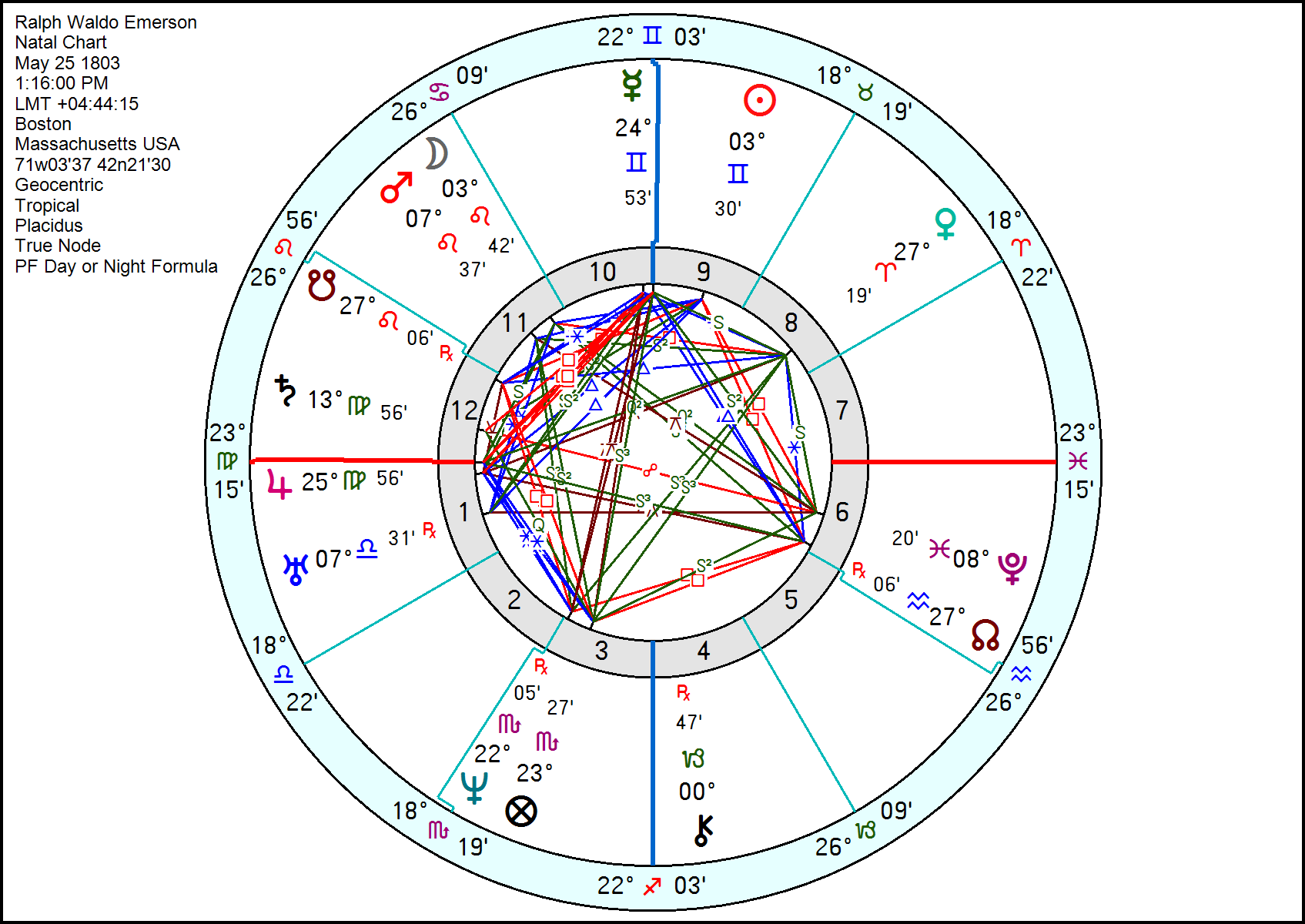
ASTROLOGY; HOROSCOPE-EMERSON
TOPIC: Astrology
SUBJECT: Horoscope-Emerson
SUBSUBJECTS: Emerson natal chart (septiles)
CONTENTS:
Septiles defined as fixed, a priori views of reality, not evolved through life
Method: read the two Sabian degrees in septile, fuse the planetary meanings, and identify a basic presupposition or belief
Question raised about distinguishing septiles from bi- and tri-septiles — left unresolved; all treated as one category for now
Mercury (Gemini 25, tenth house): Emerson's responsibility to shape experience through thinking
Uranus (Libra 8, first house): constant awareness of the I-principle — the ego empty without the higher knower at its core; the fireplace as the I AM always burning
Mercury bi-septile Uranus: knowledge of the I AM as the source of his thinking; his thinking gave the formless "I" form
Are septiles conscious or unconscious?
What is the subject that holds these presuppositions?
Septiles and quintiles arise from the 360° rather than the 12 signs; a septile cannot be represented in the signs
Regular aspects = image of the sensible in the psyche; quintiles = image of the rational; septiles = image of the Intellectual
Moon (Leo 4, eleventh house): manhood impressed on the samskaric entity; man's triumph over the animal nature
Jupiter (Virgo 26, first house): the rapt boy cutting through dead ritualistic form to the living essence; the instinctual energy directed toward the spiritual thread in any circumstance
Moon septile Jupiter: his fate was to impress upon the totality of his samskaras the meaning of manhood through a conscious appeal to the divine
Jupiter as dharma/adharma; as the principle of homeostasis in the psychosomatic organism
Venus (Aries 28, eighth house): spiritual independence; constant awareness of the transitoriness of things
Neptune (Scorpio 23, third house): attenuation from the physical to the subtle; the inner life liberated from confinement by circumstance
Venus tri-septile Neptune: universalizing the anima function
Was the anima function being universalized or the absolute feeling particularized?
Septile as a fixed wisdom in the ego, a trace of former intellection
Mars (Leo 8, eleventh house): his thrust into political, moral, and religious action
Mars bi-septile Neptune: universalizing the Mars; each unique ego must recognize itself as an expression of a unique reason-principle, not a truly separate entity; the greatest freedom is to cooperate with the World-Idea
His approach is essentially Platonic — always tracing the particular back to the universal; both septiles (Venus, Mars) point to this Platonic bent as a presupposition of his character
The natal septile is how one part of the psyche understands another part of the psyche — in a fixed, compulsive way
Brief discussion of whether 3° orb septiles should be included
Sun (Gemini 4, ninth house): the whole of his psyche accessible to him; no inner compartment closed off
Saturn (Virgo 14, twelfth house): seeing himself as part of a long line of spiritual giants; also read as the lineage of the rational soul; bond among the Emerson brothers noted
Sun septile Saturn: spiritual self-responsibility
Natal septile as the standard of judgment always in use; more intimate and therefore harder to objectify than regular aspects
AD on Emerson's portraits: always smiling as if asking "When is this going to end?"
BOOKS READ FROM OR REFERENCED:
Marc Edmund Jones, The Astrology of Concepts
Marc Edmund Jones, The Sabian Symbols in Astrology
Guenther Wachsmuth, The Etheric Formative Forces in Cosmos, Earth and Man: A Path of Investigating Into the World of the Living
Ralph Waldo Emerson, Journals of Ralph Waldo Emerson, ed. Ralph Waldo Emerson and Waldo Emerson Forbes, 10 vols.
Ralph Waldo Emerson, Essays: First Series, "Self-Reliance"
Ralph Waldo Emerson, Representative Men: Seven Lectures
SABIAN SYMBOLS: Aries 28, Gemini 4, 25, Cancer 15, Leo 4, 8, Virgo 14, 26, Libra 8, Scorpio 23, Pisces 9
CHARTS appended to this transcript:
FIGURE 1983 0711-1. Ralph Waldo Emerson Natal Chart (1:16 PM).
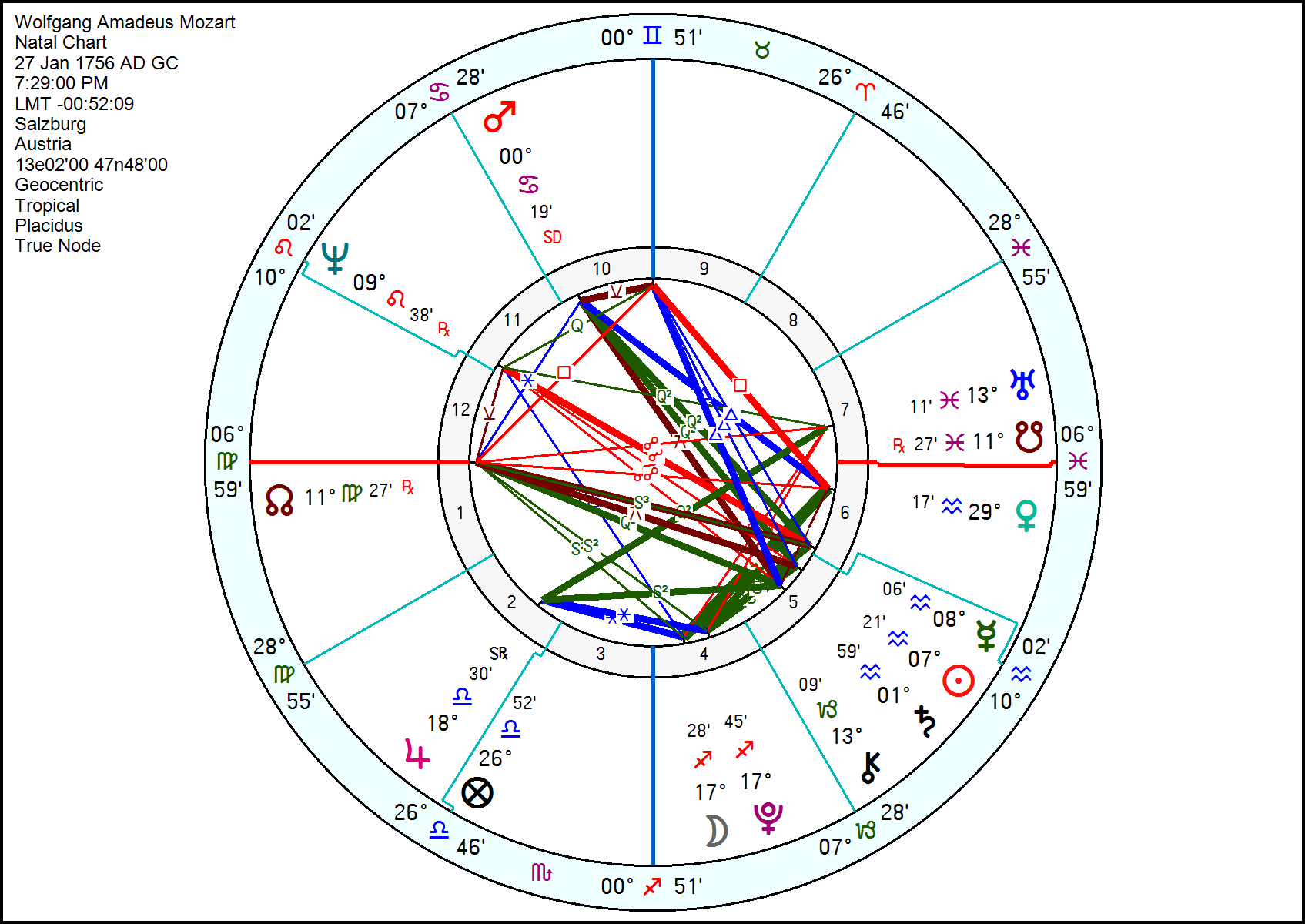
FIGURE 1983 0711-2. Wolfgang Amadeus Mozart Natal Chart.
TRANSCRIBED Verbatim by IT, LCB 2026. Archival verbatim transcript – V11a.
AUDIO FILES: 1983 0711a, 1983 0711b. [Note: "Tape" and "Side" refer to original audio cassette tapes that were later digitized into .MP3 Audio Files.]
1983 07/11 at Wisdom's Goldenrod
Astrology; Horoscope-Emerson
[Audio File 1983 0711a Begins]
[Note: See FIGURE 1983 0711-1 (Emerson Natal Chart) for all references to Emerson's chart throughout.]
TS: --the aspects in his-- the natal series of septiles and so forth. I just want to (see) [few words inaudible] today, so maybe we'll get some. [12½ pause, shuffling about] I guess the way we would see-- think-- trying to approach the septiles is the-- that series of aspects is maybe something like a view of reality or a given set of beliefs or mode of understanding that is intrinsic to the individual. It isn't evolved or developed through life but is sort of underneath the way in which that individual will experience their own psyche, that the patterns of the aspects that we-- the dossier that we've been doing for some time now of the natal Chaldean planets and the regular aspects would be the fixed presuppositions of the individual, but those presuppositions as embodying or identifying the psyche, the psychological outlook of the individual. And these seem to be prior to that as a way in which a person will understand the point of view that they have, the specific ideas that they bring in with them.
So what we've been trying to do is take the two-- two degrees that the two planets are on, the Sabian symbols for them, and refresh our memories about what they are, and then try to imagine them as somehow being bonded together to form an amalgam of some-- of the two planets, the functions the planets represent and the meanings, to see if we can see a basic belief or perspective that provides that individual background on which their life unfolds. Well, is there anything else to say about it?
RG: Except Anthony (will refer) to it as the mode of being as well as a mode of understanding, but [TS assents] I think they already know that.
[10½ second pause]
TS: Also I did Mr. Mozart here, he had nine of these guys [FIGURE 1983 0711-2 (Mozart Natal Chart)].
S: Uh-huh.
TS: Mozart-- Mozart had nine quintiles and seven septiles. So--
RG: And he's both creative and doing.
TS: Yeah. (RG laughs) I on the other hand [S simultaneously: Very (one word inaudible)] (aren't) either. (some laughter)
RG: Tim on the other hand's very creative and willing.
TS: Yeah. Ok, so, these are in the order that are closest here. Let's see, at least the first three or four I-- I don't know if we want to do applying and separating kinds of things yet but, you know, we got (time). Mercury.
LR: It also became clear to me-- but I'll-- I shouldn't say became clear. It also [couple inaudible RG words] came up into confusion that there was some-- there probably was some way of thinking of the septiles differently from bi-septiles and tri-septiles. And that maybe in some future time we might even begin to understand what those differences are. And--
RG (laughing): That's all there was to say on that topic.
LR (simultaneously): That didn't happen today. (laughter) But, you know, right now we're treating them all as septiles [S: Right.] instead of bi and tri-septiles but it may-- you know, if we really pin down what a septile means it might be possible at some future date to see what the bi-septile and tri-septile are. Because really-- well-- [short pause] So should we do the Mercury Uranus?
TS (simultaneously): Yeah.
LR: Does anyone have anything to add, say inspirations on septiles this week?
AS: Take us (without a) lunch.
LR: Ok, the Mercury Uranus bi-septile is fairly-- working with the theory that if you can understand those two planets together you'll get something of the natal predisposition, the natal bent, viewpoint, mode of being. So the Mercury degree is--
Marc Edmund Jones [The Astrology of Concepts, Gemini 25, LR reading]: "A gardener, with all of a mother's care for her child, is trimming a magnificent row of tropical palms."
[short pause]
TS: There's a couple of things in-- in the interpretation that I think are appropriate for the Mercury.
Marc Edmund Jones [The Sabian Symbols in Astrology, Gemini 25, TS reading]: "This is a symbol of the pride in effort by which man seeks to leave his immortal stamp on the world around him. There is here the bending of all natural resources to the will of the individual, and an enlistment of every beauty and capacity of nature for a continuing revelation of the self's aesthetic sense. … [The] keyword is ENHANCEMENT. …[TS reads: it] is an exceptional gift for bringing all things to an effective service in some special aspect of over-all achievement…"
LR: So, we thought that the Mercury was a sense of responsibility that Emerson could shape or had to-- he was-- it was his responsibility to shape his experience according to his way of thinking. In other words, his way of thinking couldn't be an abstract thought but actually had to shape the course of the experience around him.
And Tim's addition to that was that it was actually a process of trimming away, getting rid of dead leaves kind of thing. Clearing the way to get to the essence, the actual heart of a matter, perfecting through thought not only one's being but all of his circumstances. So it's really that-- the point of view of the subject who creates his experience through his thinking, and that he felt responsible to that. That's what we saw in that degree. Is that ok? Would you like to say more about that? Well, if you add to that the Uranus degree-- See, I don't have it written out in long form.
TS (simultaneously): Ok.
Marc Edmund Jones [The Astrology of Concepts, Libra 8, TS reading]: "In the depths of the woods is an abandoned farm; in the deserted house a fireplace blazes merrily and mysteriously."
Marc Edmund Jones [The Sabian Symbols in Astrology, Libra 8, TS reading]: "This is a symbol of naïve reality…"
TS: I don't know what that (means). The few sentences that made sense here, to me anyway, are--
Marc Edmund Jones [The Sabian Symbols in Astrology, Libra 8, TS reading]: "…the burning desire or capacity for passion which establishes man's loyalty to each object of his self-projection and instruments his more consistent self-orientation…a gift for enlisting [both] men and the natural forces [of life] in the service of [TS adds: the] self and its dominating vision…"
TS: I think the degree symbol and thinking about the-- the fact that it's Uranus in the first house, that Uran-- that there's-- We've talked about Uranus as some kind of concentration of attention. And in the first house it'll be a concentration of attention on the individual, and there was a-- was a sense of transcendental knowledge that seems to come from Uranus. So it seems to me that with this degree being his Uranus degree that-- that there would be a constant kind of awareness of the I-principle, that there would-- this fireplace in a deserted home. And he would tend to want to get to that point of view all the time or maintain that point of view all the time. There'd be an intuition into where it was and (a tending/attending) to it.
VM: Tim, I'm still not very close.
LR: Ok. It's a--
VM: The thing about the degree, I don't-- I don't-- [TS: Yeah?] it's really--
LR (simultaneously): The symbol is a burning-- a blazing fireplace in a deserted farmhouse, right? And it's-- I think it's quite literal in the sense that the real subject-- his knowing knew who the real knower was. There was never a doubt for him. The real subject was the-- let's say the I AM principle just because we have to call it something, the Overself. And that that was the true knower. And that with that symbol the ego was seen as empty without that fireplace burning, the empty farmhouse with the blazing fireplace at the core.
TS: Yeah.
LR: So that the heart center, the-- the I AM principle, was known as the knower, and-- Ok Vic? You got?
VM (simultaneously): Ok.
LR: And as fused or as combined with the Mercury symbol, which is the responsibility, the commandment to shape through-- think through one's thinking, that the thinker, the subject of that thinking was the highest principle, and it was known to be. In other words, ego and the world were known to be presented by that. He was always in touch with that principle. And his thinking wasn't a process of-- And if you read Emerson's journal(s) there wasn't a process of evolution where he came to the notion of the Self. It was always there in his writings. The content would change as he grew older. (Did) he started writing-- the journals start when he was seventeen or something, and there's always-- there's always a very hardcore fire burning in the center, there's always a knowledge of the highest principle of I AM, say, as being the base, the source of all that thinking, the source from which he was going to shape [TS assents] his thinking, his writings, they were all-- It all was un-- was revealed from that central place. And because it's in the first house he was identified with that place, there was an ability to take that point of view, whether it's "The Oversoul" or even-- even in "Self-Reliance." One of the first sentences I think in the essay on self-reliance is if one feels-- if one knows the conviction in his heart, he can simply express it and change the world by it. I mean, to him it was so apparent, it was so-- it's self-evident, that principle, it was always there.
[short pause]
JA: Linda? Are you taking these-- taking the septiles as conscious and a priori? Or is it just because it's the Mercury Uranus combination that it-- [RG: What was that question?] you know, that--
LR: Right, I-- yeah. That's a good question because Jeanne's asking are septiles conscious as well as being a priori. Or is it just sounding very conscious because it's the Uranus. I think--
AB: Or because it's Emerson.
S: [couple/few words inaudible]
LR: And it's Emerson.
RG (simultaneously): Yeah, and it's Emerson.
LR: No. But it's a good question because I think when we do the Moon Jupiter, it is simply the way he functions, you know. I think we'll see that, it's instinctually the way he functions and what-- you know, there-- you don't see that element of real awareness in it. I think it has a lot to do with the fact that it's that symbol and it's Uranus.
RG: And I think that Mercury's involved.
LR: And Mercury, yeah.
S: Yeah.
LR: Yeah.
RG: I think they could be-- I don't think consciou-- conscious [AK simultaneously: And that this--] or unconscious is a mark of a septile. They can become conscious as known, [LR simultaneously: That's (few words inaudible)] or they can-- right, or they can remain as unconscious determinants. And I think--
LR (simultaneously): In other words, you're always expressing that. Your actions are always unfolding that. But whether or not you're aware of your basic presuppositions, I would say you wouldn't have to be.
S: (Yeah.)
S: (There you go.)
TS: (But), probably had to do with how his, you know-- how those planets are either transited or how they're aspected natally as well. And here his Mercury in rulership at the midheaven and square Jupiter in dignity, in detriment in-- on the ascendant, [S: Hm.] you know. Both of those planets have some pretty close aspects, the Uranus is sextile Mars. So, I think in this chart in particular, you know, the relationship between the planets which are in septile and the structure of the regular aspects, that there's-- I think they're all pretty well tied together, you know. So that may give us some clue that-- that this was-- this was available to him, you know, in thinking. [student assents, very faint] I don't know, we'll have to see in other people's charts. But it certainly seems that in Emerson's life that most of these were real-- were consciously available to him. And this one in particular would be, you know, the higher knower being expressed in the way in which he wrote and the way in which he-- and the issues which he took up.
Because the way I think of that Mercury degree too is that there's a kind of careful awareness of what issues he should address. And those issues which are appropriate to his times he is willing to address and those issues which were not he didn't want to address. And I see that kind of discrimination coming off of that Mercury as well. And that because of his impersonal point of view he was able to always manifest that through his thinking. And I think also we observed that, you know, there's really not that much difference in the quality and perspective of the writing in his journals as in his essays as-- and as in himself as an individual, you know, that he didn't take a s-- an artificial stance in one of those places. Some people might take a stance in their writings which presumes a detachment that you wouldn't perhaps find in their personal life, you know, and there's been some remarks about some Traditionalists of that nature. But it seems like in Emerson's case it might be that this-- that the all-pervasiveness that a septile seems to have shows up everywhere, you know, that it's-- there's no place in his life that this-- his thinking wasn't colored by that detached point of view.
LR: As Anthony said, his thinking-- his thinking gave the formless "I" form. His thinking being represented by that-- his thinking and writing being represented by the Mercury actually was constantly giving form to the Uranus. So does anyone see that or want to ask about that? I mean is that clear to people? Yeah, go on.
AB: I could also see a lot of what you're saying with the constant awareness of the "I" and always building that into his self-identity as the Uranus trine the Sun.
S: Uh-hm.
LR: Ok. Well that's--
S: Yeah.
AB: But may-- but maybe I'm not clear on how you're using [student assents] the septile, (I don't know).
LR (simultaneously): I think the keyword is the build-ing, I mean, what we were-- the-- I mean that came up several times today, you know, what-- why not in the regular aspects?
AB: It's also sextile the M-- the [LR: It's exact.] Moon Mars which [S simultaneously: Mars.] is really strong.
LR: That's right. So, you know, the way we could explain that to ourselves was that the regular aspects were defining the psychosomatic organism. It was like you said building up something, it was building up that vehicle. It was trying to bring awareness into that vehicle, say. Whereas we were trying to see the septile as--
AB: Something he already had.
LR: --fixed ideas, you're born with these fixed ideas which you take at childhood to be beliefs, I mean you believe in-- you just believe that.
AB: So, for instance--
LR: And it's not something that evolves through the life. The life might be a playing out of those presuppositions but they're-- they're [AB assents] in some way like fixed.
AB: So what we'd wanna be able to show with the Mercury, (we're viewing about his) thinking or some kind of an intuitive perception, that built into that he already had from the beginning this sense of the higher "I" and what it was. Whereas if you take the Sun, you know, the pur-- his life purpose, his self-identity, we'd want to see how that was building into itself through the course of his life [LR assents] that Uranus.
LR: And also, it's not that the Mercury was not being changed through the life 'cause it has a lot of other aspects. You know what I mean? [AB assents, faint] So it's not like the Mercury was full blown at birth, but that the fusion of those two ideas were given. That there was something about the intellection or the-- the identity of those two, that two ideas, was self-identical, was identical. And then as separate functions that were evolving they were worked on by other planets, or they worked on other planets.
RG: But I-- let me try to say it this way. It's almost as if that the nature of the septile changes the meaning almost of the planets and that they start becoming more and more images of the rational rather than of the psychic. [student assents] And therefore the septile aspect allows you to think of the Uranus almost as the I AM and Mercury as the-- as the pure intellect that embodies the I AM. But in a Uranus trine the Sun, for example, you could say there's going to be archetypal contents coming up all the time, but that that Uranus doesn't necessarily mean the person's going to be aware of their I AM or constantly being abi-- abiding.
AB: So the Uranus is operating on a more rational level only in relationship to the Mercury.
RG: Well in Emerson's chart--
AB (simultaneously): It was brought to a higher level.
RG: I mean in Emerson's chart, obviously the Uranus, [AB: Yeah.] you know, I mean probably he was all working there. [AB simultaneously: Right.] But in this-- [AB simultaneously: Well--] I would offer that as a distinction for the septile, like the planets start approaching the rational definitions of the planets.
TS (simultaneously): Yeah. Well it seemed to me that in working through them that that-- I was also driven to that, that they-- to really understand them he har-- sort of have to incorporate the idea of the rational functioning more than your psychological functioning. But-- and it seems too that-- that there was a given, that although the expression or manifestation of the perspective that that might have, that the-- the perspective that the Uranus Mercury has, that-- to communicate this higher point of view in all of his thoughts, well as he gets older his-- the-- that thought-process is going to become more subtle and more aware and involved in the world around him as he took up issues of-- of the day and so forth. But the point of view that he-- that always his thought should reveal a higher point of view, that point of view you can find when he's 17 as well as when he's 72, you know. And it seems to me that that's part of the nature of the septiles is they're like fixed understandings that are-- that are-- permeate the psychological processes. Or the psychological processes, you can see that a-- you know, an evolution of the functions through the life.
S: Yeah.
LR: So would those be like an image of the fixed stars for the individual? I mean is that--
TS: Well we're equating them with something like that.
RG: Yeah, in terms of function.
S (faint): I didn't get it.
AK: Well what-- what is the-- what is the subject that's having this-- that has picked a vehicle which has as a presupposition that the higher-- the higher knowing can be expressed in Mercury? 'Cause we've been putting a lot of emphasis on-- especially in the septiles 'cause we don't have a good definition of how the aspect works, we've been looking mostly at the-- the contents, two degrees that are expressed between the aspect. But it's got to be a kind of functioning too. Plan-- planetary functioning (isn't brought out) much.
RG (simultaneously): Yeah well, that's what we were-- that's what we were trying to describe, the functions. And there we haven't done it.
AK (simultaneously): Now that's the function of the aspect but-- but that this idea can be modalized by the functioning of these two planets is similar, that [RG: Yeah.] this-- the-- you know, the-- what subject is it that believes that the higher self can be expressed rationally with the Mercury function, through the intellect, [student assents] (something like that) expressing it.
RG: Why is that a different subject and the other aspects believe that it's identified with the psychosomatic organism?
AK (simultaneously): Well, it seems like (from) the other aspects, the twelvefold, they seem to express a psychological.
RG: Yes but that-- but you asked who is the subject that identifies with it, and I think that the subject is the same, the level of the identification is different.
AK: Yeah. I guess I'm wondering where is this fixity held, is it the asmita or is it-- what-- what-- what is-- what is being informed in this way that can have this presupposition, that brings along into ca-- into an incarnation.
LR: Who is the incarnating subject, in other words?
AK (simultaneously): Yeah. [RG assents] Or that can be [RG: Yeah.] mobilized.
RG: That's a whole-- [S, faint: Yeah.] that's a, you know--
TS: Seems to be (in/at) a lower, and it's less than the-- the asmita.
RG: [couple words inaudible] degree.
TS (simultaneously): Sounds like-- (laughter) It's taller than the ego. (laughter) But--
RG: I-- that it's an image in-- of the rational soul.
TS: Yeah.
AK: The rational soul.
TS: Yeah.
AK: But I was-- I thought that it had been expressed that these were-- these were intellections, that the soul had gone-- these were-- these were visions of the Inte-- of--
RG: No, no, but they're in-- still in the natal chart.
AK (simultaneously): --of the Intellectual-Principle that's imaged in the soul. That was [student assents] just this--
TS: Yeah but now [one word inaudible] that they're using-- we're using planets here. At least I was thinking that this would be an image in that-- in the rational soul of (best) intellection because we are-- it's the-- I was thinking that the planets would represent that, basically the powers of the rational soul and the powers of the-- in functioning psyche. And he would--
AK (simultaneously): Well, I could see how-- I mean I could see how they're-- the planets expressing certain functions of the psyche, that these functions of the psyche somehow seem appropriate to image this vision of the Intellectual. But--
RG: But you have to si-- we're in a natal chart.
AK: Yeah, I know.
RG (simultaneously): We're not-- we're not in the Intellectual-Principle.
AK: Yeah, I know.
RG: And it's how this natal chart is organized still even if you're talking about a septile.
TS: Also mostly we're shooting in the dark still, I mean, [S: Oh.] [RG: Yeah.] you know, that it's--
AK: Explanation [couple words inaudible]
TS: And how (did) the-- good ex-- I mean I know-- I don't know that we're quite ready to try to figure out, you know, where we're (coming from).
AK (simultaneously): Because there seem to-- you seem to be making a real distinction for what the septiles and the quintiles as opposed to the regular aspects are like.
TS: Insofar as that the septiles and quintiles come out of the 360 and not [AK assents] out of the twelve signs, [AK assents] it seems that that implies a certain different level of-- of the zodiac, a different level of number. 'Cause it's-- you know, it's not some even number of signs apart, you know, if there's any other-- the regular aspects all are relationship of one sign to another. [AK assents] You know, whereas in the septile and quintile series you short-circuit that, in fact you can't represent a septile in the signs. It's unrepresentable there and there's a certain predilection I think we have to want to see the transition of the unmanifest to the manifest in the septile aspects, because you can't even actually construct a seven-pointed star.
AK: So you're saying that it appears to be bringing in a higher order of reality or expressing [TS assents] it or imaging it in some way.
RG: Good.
TS: Yes.
RG: And the right-- [AK: (Great.)] I think we said last week that within the psyche there is an image of the sensible, there's an image of the rational, and there's an image of the Intellectual. And we're trying to understand that the image of the Intellectual in the psyche is represented through the septile in function, and the image of the rational could be represented through the quintile possibly, and the image of the sensible as the regular aspects.
TS: Regular aspects. Ok, so let's see if we can--
LDS: Could I-- about that issue just there. Are you saying then if-- in speaking of the image of the Intellectual in the psyche, what that would mean would be that the image of the Intellectual would-- or let's say in terms of the Mercury function here, would be a content for that psyche, an idea for that psyche that is more profound or of a deeper level? Is that what you mean by the image of the Intellectual in the psyche?
RG: Well what we-- what we mean by vision of reality, mode of being, all those words I think are an attempt by the psyche to look up; whatever's within the psychosomatic and looks up and says what is real is defined in these ways by these aspects we're calling septiles. And the two planets that are in septile are going to define the functions which are doing the looking.
S (faint): Yeah.
LDS: Ok. I follow that Dickie, but are you saying too that with the septile there is a deeper sight?
RG: Insofar that you have a vision of-- of any-- of a real, yes. I mean in some sense that you have some experience of something real that seems to transcend the normal psychic experience, I would say yes, that that is a content that's coming through.
LDS: So you're--
TS (simultaneously): Well, let's try doing a few of these and maybe we [RG assents] can [LDS: Go ahead.] see what we're coming-- you know-- [RG assents] we'll have something to discuss more, you know, I think it's-- it's hard to just work on it with one or two of them.
LDS: Yeah.
LR: Because this is Uranus.
LDS: Yeah, I know, that kind of [couple words inaudible]
LR: So immediately we've got the point of view of the Overself or the higher knower.
S (faint): Yeah.
LR: You know?
TS (simultaneously): Or what? You mean the highest part of the chart, whatever that is.
LR: Right. It may, [TS simultaneously: Yeah.] you know-- let's do the Moon Jupiter.
RG: [couple words inaudible]
LDS (simultaneously): You have two Chaldeans [one word inaudible]
RG: First of all [few words inaudible]
LR (simultaneously): The Moon Jupiter is actually a septile.
TS: Yeah.
LR: And it's an exact one.
AD (faint): Yeah.
S: Well--
LR: And that we got a real clear flavor from too but it wasn't at all the same, it wasn't-- So, alright, the Moon symbol is-- Bo?
TS: [couple words inaudible] is not going there.
LR: Where's Bo?
JA: He just left.
S: He's outside.
TS: Intuitive sort.
LR (simultaneously): He knew it was coming. The Moon symbol, for those of you who might be unfamiliar--
Marc Edmund Jones [The Astrology of Concepts, Leo 4, LR reading]: "An elderly man in evening clothes, of poised and military bearing, stands alone before a lovely mounted moose head."
VM: I didn't hear it, Linda, would you repeat it please?
S: [couple words inaudible] (laughter)
LR: But you were suppo-- you missed it. (bit of laughter)
S (faint): Is that the one that's (within)?
TS: 4 Leo.
S: Is it?
[few seconds of background student talking]
TS: Um--
LR: Now we have to treat this as if we've never heard this degree before. (laughter) Absolute impartiality. And we spoke of this as a conquering or a need to-- for man to master the animal. Ok?
TS: See I was thinking of the Moon as-- here as memory. I was trying to--
S (very faint): Memory?
TS: Yeah. A reminiscence. Like I was trying to think of the Moon as a ra-- a function of the rational soul. And I was trying to think of it as some kind of memory or mode of embodying the rational soul in the psychosomatic. So I was thinking that there's a kind of immediacy of the mind that the Moon has and also a retention, a way in which it tries to reten-- retain that rational in the psyche.
LR: In other words-- (RG laughs)
S: You're right [one word inaudible]
RG: And now-- (laughter, student words)
S: Put it--
S (faint): [few words inaudible]
S: Thank you.
AB: If it was really [couple words inaudible]
RG (simultaneously): That you're living for [LR simultaneously: In other words--] before.
LR: No, I'm just trying to remember what you said. In other words--
TS (simultaneously): (You said), the worst Polish notation?
S: Yeah.
LR (simultaneously): Insofar as we think of the Moon as the brain consciousness, like you said, the immediate mind, the minute-to-minute thing, it is because there's a certain memorized form. And that's the-- that's the habitual way that the brain functions. And we ask, well what's the-- what's the principle that dictates the mind keep functioning at this-- it-- with this kind of intentionality or with this kind of definition. And you're s--
S (simultaneously): I don't think (that was the) case.
LR: No 'cause--
TS: Yeah.
LR: A certain [RG simultaneously: Works in the brain, right.] retention of the tropes, a certain image of the way the body functions and the way the [S simultaneously, faint: (couple words inaudible) on the brain.] brain functions we're calling the (new) Moon. I mean the Moon is the body at some level.
RG: It is the tropes, yeah.
LR: So--
RG: It's the brain (con--)
S: Yeah.
LR: Yeah.
TS: And it seems like it's the tropes (there).
LR: Memorized habits, [RG: Right.] and it's memorized form.
TS: So it seemed like the memorized form here is one of conquering the-- the animal nature. That the way in which-- that there would be a preoccupation with the-- with being-- being aware or sensitive to that animal and defining oneself according to having put that aside.
RG: Uh-hm.
TS: That I'm trying to see as the Moon in that the way we see it other places.
RG (simultaneously): Right. Uh-hm.
TS: (Ok.)
RG: So it would almost be like person.
TS (simultaneously): Uh-oh.
RG: Do we have rumbling, Tim?
TS: Yes. (TS laughs a bit)
AD: Huh?
CDA: He knows what his--
RG: Speak. This is your favorite degree.
AD: Which one?
S: Yep.
CDA: A man imagining himself--
LR (simultaneously): Leave him alone.
S (faint): I mean--
RG: [couple/few words inaudible]
AD: A moose head mount-- Oh, the-- the moose head.
S (faint): The moose head.
RG: Yeah.
S: [couple words inaudible]
AD (simultaneously): Linda's moose head.
RG: Right.
AD: If anybody finds me one, buy it please, I want to give it to Linda. (laughter) And what-- what'd you say it meant?
S: Buy us a moose head.
LR: Macho man, we said it meant he was a macho man, Anthony.
AD: Well what does it mean in this instance?
S (laughing): (Story.)
LR: He made--
AD (simultaneously): He was no macho. (laughter)
S: 'Cause it was--
S (simultaneously): [one word inaudible] bell.
AD: Huh?
S (simultaneously): 'Cause it was himself. (bit more laughter)
S: That was good.
LR: It means--
AD: Yeah?
LR: Well Tim will tell you what it means.
AK: I'm not sure where that comes in.
TS (simultaneously): That his-- his immediate preoccupation was with keeping the animal out.
S: Being--
AD: That's not very positive, Tim. [TS: Um--] What degree-- we talk for the Moon? Yeah.
RG: Moon.
TS: The Moon. Yeah, it's the M-- that the--
[couple seconds of background student talking]
AD: Wouldn't-- wouldn't you be more obliging to your assistant if you said something like his manhood was-- impressed the form of the samskaras.
S: What?
S: Say it again.
RG (simultaneously): Repeat that please. Say it again.
AD: Say it again?
RG: Yeah.
AD: Yeah?
S: I don't really know.
AD: His manhood was impressed on the samskara entity.
TS: Yeah.
S (simultaneously): Oh really?
CDA: That's the degree or--
AD: Cut out (talking). (some laughter)
TS: Well we blew our shot for the year. Ok.
AD: You got it Tim?
VM (simultaneously with TS and AD): But, I see sort of what you're saying [TS to AD: Yeah.] but he was still macho anyway.
TS: Or negatively said-- (TS laughs a bit)
AD (chuckling): Or negatively said. (bit of laughter)
TS: (It's just) the same.
LR: Right, he was-- his habitual mode of functioning was as man, (not being without) a soul.
TS (simultaneously): Was [one word inaudible]
RG: Right.
LR: [couple/few words inaudible] space.
TS: Yeah.
S: Ok.
LR: That it had been-- it was actually a samskara, not something that was evolving to be. I mean in some ways you could see the Moon in any chart as being that which is really well ingrained.
S: Yeah. The standard.
LR: So if you have the Moon at-- Is that the individuals that have overeaten? [Note: Cancer 15, "A group of merry sluggish individuals are resting; they have eaten most indiscreetly and enjoyed it."] You've learned to eat well. That was [one/two words inaudible]
AD: So what did your secretary tell you, Tim?
LR: Nothing, I was just babbling. So now--
TS: She said that we should look at Jupiter.
LR: We said we should look at Jupiter.
S: Yeah.
S: How come you're still here?
RG (laughing): Come on.
LR: Jupiter is--
Marc Edmund Jones [The Astrology of Concepts, Virgo 26, LR reading]: "A highly ritualistic service is in process: officiating priests are automatons, [LR adds: and] a boy with a censer is rapt-eyed."
Marc Edmund Jones [The Sabian Symbols in Astrology, Virgo 26, TS reading]: "…man's…outreach to the world he would claim for himself. [He makes] his conscious appeal to God…because he knows he must share any reality he would care to possess. [The] keyword is RAPTURE. …a completeness of self-dedication and an achievement grounded in a consistent worthiness of living…"
TS: And that's his Jupiter. Jupiter in the first house in Virgo
LR: Oh yes, I know.
TS: So it's in detriment of gnostic. It seemed to me that-- We talk about Jupiter as the instincts or the re-- the energy, the focus of the energies in the chart, and it seemed to me that in this degree there was a kind of way in which his energy would be focused on the living essences, focused on the-- in even the kind of the spiritual thread that would lie in any kind of circumstance or philosophy.
LR: It would be the-- the germ. In other words, in the symbol, there's some inspiration which created that whole huge symbol, only it's dead in the symbol, the priests are automaton. And yet the boy seems to be-- represents some kind of innocent fresh approach that can shed all the ritualistic form, all the dead husks, and be totally absorbed in whatever the inspiration is. And so for a Jupiter it would be like-- that would be instinctual that he would-- any form would be cut through to the actual essence of the thing. It would be, you know-- he'd always be seeing kind of the inspirational thread that would present or create all those forms around itself. And, his leadership-- I mean if you saw Jupiter as his leadership, it would be that quality that he could be so remarkable about his leadership and people would describe him that way because it's on the ascendant, he would actually appear with that ability (to do) that.
[16¾ second pause]
TS: Well--
AB: Well, I'm just going to bring out a different point which I think you were starting with is that for him the instinctual function would be divinized, wouldn't be a lower form but was like-- it was spiritualized functioning for him, the instincts, the libido.
RG (simultaneously): Yeah, why not.
LR: You have to-- you'd have to convince me of that, Alan. You got to explain more.
AB: Well, take the meaning of Jupiter.
LR: No, in Emerson, tell me how you see it.
AB: In Emerson?
LR: Yeah.
AB: 'Cause wasn't there a certain internal harmony that he had within himself and, you know, in relationship to his libido and a kind of naturalness, he kind of had this joyous attitude towards the physicality of life? Or--
LR: Not the Emerson I read.
AB: Well--
S (faint): Tim, what channels are (you--)
TS: No.
RG: Well wait, wait, I like Alan's idea though, let me--
AB (simultaneously): I'm trying to say-- I might not be saying it right.
RG: Yeah, let me-- Alan, let me help you. (bit of laughter) [S: What--] In the context of Jupiter as the energies, why wouldn't you understand that those energies are devoted towards a certain kind of revelation?
AD: I thought we referred to Jupiter as dharma or adharma.
RG: Ah. And what do those words mean?
AD: The rightness or wrongness of the way your instincts are operating.
RG: And in this case they were right.
AD: I don't know. We're just [RG simultaneously: What do you mean, I don't-- what does that--] saying this is what Jupiter represents.
RG: Wait a minute, how is-- how does that describe the functioning of the psy-- of the psyche, rightness or wrongness of-- What is that? I don't know what that-- how that works [student assents] as a function. You mean the judgment of it? Or the embodiment of that?
AD: No, whether you're going to be doing the right thing or not.
S: But that's [few words inaudible]
RG (simultaneously): How would you (say)? Yeah, how would you--
S (faint): No.
RG: Give me one Jupiter--
AD (simultaneously): Well just watch, if you got an afflicted Jupiter you'll know [S simultaneously: You're always doing the wrong thing.] that you're doing the wrong thing.
RG: Ok. Well, I'll shut up.
LR (simultaneously): You know when [few words inaudible] (RG laughs, laughter)
S: So when you're putting [couple/few words inaudible]
AD (simultaneously): Don't know what you'll be doing.
TS (simultaneously): I'll trade your opposition for my square.
RG (laughing): Tim.
S: Dignity [RG simultaneously: I'll shut up.] you'll know you're doing it and it's not dignity--
AD: Well what do you think, Tim? How would you translate Jupiter?
TS: Oh, rightness or wrongness. (laughter)
AD: Well if you say it's the instincts, then what would Mars be, what would Venus be?
TS: I-- well I would say--
RG (simultaneously): [couple words inaudible]
TS: Ok, wait a minute.
S (laughing): If you're going to (stay there).
TS: I mean it seems to me whether you're talking about it as a function of the rational soul or as the psyche, and that gets-- I would understand it as the instincts in the psyche but I would understand it as rightness or wrongness as the rational soul. And that the-- that the merit or rightness or wrongness in the sense of learning--
AD (simultaneously): Alright, then if you say-- if you say it's the instincts, alright, then you have to tell me, is Saturn the self-apperceptive instinct or not?
TS: No.
AD: Is Mars the thrust for individuality or not, the instinct, you know, to be self--
TS: It's not-- I wouldn't-- no, by instinct I mean--
AD: An unlearned behavior response.
TS: An unlearned--
AD: Well that's what instinct means. [short pause] That's why I'm curious to find out what you mean by Jupiter.
[short pause]
VM: We're back to zero. (bit of laughter)
RG: Yeah right.
TS: An unlearned [S simultaneously: It is (one/two words inaudible)] behavior response. [faintly to himself] An unlearned behavior response.
AK: [few words inaudible]
AD: You remember the example we used, Tim, when we said imagine this little sea monster, alright? And the center of the monster was the Sun, and it had instincts which were, so to speak, attached very loosely to it. One instinct was the instinct of self-reproduction, alright? Another instinct was for digestion, another instinct, etc., etc. Now the instinct for digestion could not combat, alright? But the combative cells took care of that, alright. But the combative cells couldn't digest food. So the cells that did digestive took care of that for them, alright. So you had this strange animal that had a center and a loosely organized number of instincts surrounding it, alright? You remember that from the Steiner book? [Note: Reference is to the siphonophoran. See Guenther Wachsmuth, The Etheric Formative Forces in Cosmos, Earth and Man: A Path of Investigating Into the World of the Living, pp. 184-194.]
S: Uh-hm.
TS: I think I [couple words inaudible]
AD: Remember we did that?
VM(?): Yeah, sure.
AD: Now, don't you get the feeling we're pretty much on the same par? That there's a center within us, a center of individuality, and we have four or five or six, maybe some seven or eight, I don't know, different kinds of instinct. And each one is doing its own thing. That when you try to tell 'em what to do they tell you mind your business.
S: Hm.
TS: Uh-hm.
S: On a good day.
AD: Huh? [student assents] And that Jupiter usually means dharma or adharma. Even the word "Gurukula" comes from Jupiter, the grace of Jupiter.
TS: Wait a minute.
S: Where (do you put) Jupiter there?
VM (simultaneously): But where did grace come from instincts, I--
RG(?): He's taking away all of that.
LR (simultaneously): (You) say it's not (grace).
AB: Right, it's not a--
S: Yeah.
S: But--
TS: When we speak about-- you-- so you're saying that a psychological function is dharma and adharma?
AD: Yeah.
TS: And it's not-- and so it's not a rational function in the soul.
AD: I wasn't thinking of it as the rational functioning, but you can look at it that way. I was thinking of let's say the homeostasis of the instinctual operation within the psyche.
TS: And that's dharma and adharma?
AD: Yeah.
TS: Well then we're shifting-- we're abolishing our perceptions from before, that-- that we talked about the-- the planets as functions of the rational soul as having a certain level of operation, and then we talked about the planets as psychosomatic functions. Now you're saying no, that psychosomatic is-- the rational and the psychosomatic are the same, right, that--
AD: No, Tim, I don't think I'm saying that. I'm saying within the psychosomatic organism there is an instinct towards homeostasis, that is to maintain a balance, and that this is instinctual in any psychosomatic organism, [TS assents] without which it would tend to lose balance. And Jupiter represents that function or that instinct. [RG: The instinct--] That's why I refer to (it) as the hierophant.
TS: Why?
RG: The instinct--
AD: I just said it!
RG: No, no, but why the hierophant? What does that got to-- what does-- how does that relate to the idea?
VM (simultaneously): I thought you made it homeostasis.
AD: Isn't it nice to have somebody inside of you like a little compass telling you you're going the wrong direction?
LR: Yeah but see, it's-- yeah.
RG (simultaneously): Ok. Good. Good I'm glad, it's your-- so it's you're teacher in that sense.
AD: In a sense it is, sure. If it maintains a balance within the psychosomatic organism.
RG: Good, I can live with that.
AD: That's the way I was thinking of the hierophant, I mean--
RG: Ok, good, good.
LR: And I don't think we ever called it just the instincts anyway. I thought we called it the distilled wisdom that was in the instincts.
TS: Uh-hm.
RG: Yeah or the libidinal instincts.
LR: So I think that's very much--
AD (simultaneously): Yeah, the wisdom of the instincts, yeah.
LR: I mean I think that's more what you're saying, and it wasn't just instincts, that it was qualified as being the-- the accrued learning or the wisdom that one had, that--
AD: Yeah, of the instincts.
LR: Yeah.
RG: So that makes it not the instincts.
AD: Well in a sense it is instinctual too.
LR (simultaneously): [few words inaudible]
S: Ok.
AD: The organism has acquired this, you know, knowledge through repetition and series [student assents] of lives and whatever, Dickie.
TS: See I-- I was thinking that the difference between the Jupiter as transiting or as part of the rational soul would be that kind of recognition of rightness or wrongness which was based upon reason, based upon the-- the activity of that rational soul. Whereas the rightness and wrongness that would be in Jupiter, that-- the guidance that the natal Jupiter would give as a psychological function would be based upon the cumulative wisdom and the kind of forward inertia that that particular psyche carried within itself. But that may or may not be close to rational depending upon how that person's lived. Would be, you know, in other words, a certain kind of conscience based upon what-- what one has learned from life. Whereas I thought that the transiting Jupiter would provide one with a more rational sense of what is right and wrong. And that might either corroborate or contradict the instinctual sense of what's right or wrong.
AD: Would you try again, Tim?
TS: I thought-- Taking the model that the natal chart-- the planets as they are in the natal chart represents the functions of the psyche.
AD: Yeah, ten CI [categories of imagination], category.
TS: Ok. The transiting planets represent functions of the rational soul. And that when we talk about Jupiter as the instincts in the natal chart that there's a s-- that there was a sense of kind of a forward moving inertia, a sense of con-- What? (laughter, student words) Well there's two kinds of inertia, right? There's inertia of a thing which is at rest and tends to stay at rest.
VM: No, no, I understand, just say it.
TS: Or there's inertia in the sense of something that's [student assents] moving in a direction like a habit.
VM (simultaneously): It maintains itself.
TS: And-- and like the habits tend to maintain themselves by continuing [student assents] to exist. So it's not inertia.
VM (simultaneously): No I understood, it's-- I'm [couple words inaudible] You misunderstood my jolly. So that's--
TS: So I was thinking of that Jupiter in that sense, as being the kind of tendency of the psyche to perpetuate its own habits, and that the natal Jupiter would have a certain kind of set of what-- right and wrong which would be based upon that inertial move-- continuation of itself and how that was affected by life. But it might not be a rational direction, a rational sense of what is right and wrong. A person might feel they're on the right track because they've been going that way for 35 years, you know, and then the Jupiter is giving them another opportunity, their psychology is presenting them with another opportunity that's in line with what they've done before. But I thought that when we spoke--
(Side 1 of original cassette tape digitized as 1983 0711a Ends; Side 2 Begins)
AD: I think what you're referring to is what I recall one of the five kinds of knowledge that the apperceptive ego has.
RG: Which kind?
AD: The rightness and wrongness of the particular activity of an evolving entity. It was one of the five kinds of knowledge which belongs to the apperceptive ego. But the principle of homeostasis belongs to the psychosomatic organism.
TS: Ok.
AD: That's-- it's just that I see the transcendental ego as the kind which has the knowledge of the rightness and wro-- or wrongness of what that evolving entity is doing.
TS: And that [one word inaudible]
AD: You remember the five kinds of knowledge?
TS: Yeah. Right knowledge, wrong knowledge, [AD simultaneously: Yeah.] appearance. [Note: See WG Class 1983 0402 for further discussion of this point.] Ok. More detail. See, so you would say that the natal Jupiter represents that kind of right knowledge that the transcendental ego has?
S (very faint): Uh-uh.
RG: No, no.
S: The homeostasis.
TS: (No) I'm only [AD simultaneously: No, no.] just trying to be sure I (get/got) it.
AD (simultaneously): Not quite, not quite.
TS: You're saying it's the ho-- a reflection of that right knowledge in the homeostasic-- static activity of the--
AD (simultaneously): Principle, yeah, yeah. Which is a little different.
TS: Yeah. Because once that latter is set in motion it may remain in harmony with its origin or not. The homeostatic dependency, the homeostatic energy in the ego may or may not continue to maintain a harmonic reflection of that right knowledge that's in the trans-- transcendent ego. And that would-- ok.
AD: And I think that was the fatality in his life, you know, that septile between Jupiter and the Moon.
LR: Say more.
AD: That he was to impress upon the totality of the samskaras which constituted his body the meaning of manhood.
[short pause]
RG: Where's the Jupiter part?
S (simultaneously): I was going to say, where's the Jupiter?
AD: I'm sorry?
RG: I got the Moon part of what you said, I didn't get the Jupiter part.
AD: Well what's the Jupiter degree?
LR: Censer. Boy with a censer.
RG: The rapt-eyed censer, remember?
AD: Yeah. What do you think that's about? I mean you have to read the degree to me, I'm working off my memory.
RG: Go ahead, Linda.
TS: Ok.
AD: Just a few selections.
TS: Do you want the image?
AD: Yeah, the image.
TS: Ok.
Marc Edmund Jones [The Astrology of Concepts, Virgo 26, TS reading]: "A highly ritualistic service is in…"
AD (simultaneously): Ok, next. (bit of laughter)
Marc Edmund Jones [The Sabian Symbols in Astrology, Virgo 26, TS reading]: "…a symbol of individual initiative as a basic dynamic in the uni…"
S (simultaneously): Real--
TS: What?
S: Keep going.
AD: I didn't say anything.
Marc Edmund Jones [The Sabian Symbols in Astrology, Virgo 26, TS reading]: "…universal scheme of things…"
AD: Go on.
TS: Ok, um--
Marc Edmund Jones [The Sabian Symbols in Astrology, Virgo 26, TS reading]: "…it reveals itself most simply in man's positive and necessarily self-seeking outreach to the world he would claim for himself. He makes his conscious appeal to God…"
TS: Those were houses of them.
Marc Edmund Jones [The Sabian Symbols in Astrology, Virgo 26, TS reading]: "…he knows he must share any reality he would care to possess. [The] keyword is RAPTURE. …a completeness of self-dedication and an achievement grounded in [a] consistent worthiness of living…"
AD: I don't know where I'm coming from. It's just a-- just a hunch.
RG: What? Say again. Say it again.
AD: Yeah. The Jupiter septile the Moon. The Moon represents the totality of the samskaras organized as his functioning body, alright. And the Jupiter represents an appeal to a-- represents really the impress that he should make on his body. [student assents, faint] The impress of manhood should be made on this totality of samskaras.
RG: And the impress of manhood is the Jupiter part?
AD: Yeah. That's-- [RG simultaneously: And the samskaras the Moon part.] that's impressing the Moon.
S (faint): Right.
LR: How--
RG: Wait a minute.
LR: Well, you said the-- [S simultaneously: I-- I don't see how you view it.] you said the manhood part was the Moon before.
AD: No, no, no. The manhood-- the Moon is the organization of the samskaras [LR simultaneously: Yeah, of the degree. The--] into an organism that's a body.
LR: Remember the moose head degree?
AD: Yeah.
LR: The man conquered the moose head. And you said there man was impressed on the samskaric entity, that that's what that degree meant. Manhood.
AD: Go ahead, Linda.
LR: The Moon degree, the man in evening clothes contemplating the moose head. The intelligence in that degree is that man has triumphed over the beast.
AD: Yeah, yeah. Ok, (again).
LR (simultaneously): Ok. So--
AD (simultaneously): And I said that that represented the impression--
LR: Of manhood on--
AD: On the samskaras.
LR: Right.
S (faint): Fine.
TS: And that's just the Moon symbol.
LR (simultaneously): That's the Moon.
S (simultaneously): That's just the Moon.
AD: That's just the Moon
S: Ok.
S (simultaneously): Let's get to the Jupiter.
AD: Yeah, you're right.
LR: Now the Jupiter is I thought something else. I thought the Jupiter was the ability to get past the form, the external form, to the real crux of the thing. The boy is rapt-eyed even though everything's ritualistic, empty, atomistic. But [couple words inaudible]
AD (simultaneously): Well-- yeah.
RG: But don't you think that in that Jupiter there's a conscious appeal to the higher power?
AB: Yeah, and that would be--
RG: And that that's his guide, and that's what's organizing this-- this impress of manhood on-- in his body? [S simultaneously: Septile (one word inaudible)] And that septile demands a complete rationality of living where-- where the divine is invoked in the body.
AD (simultaneously): Well very simply-- more simply said, you're saying that upon achieving manhood that an appeal could be made to God.
RG: Ok. And that those two in him were utterly fused, that man was nothing without an appeal to God. [AD assents] And they both had to be lived.
TS: Yeah, it wasn't just the--
AD (simultaneously): And that-- that constituted his peculiar destiny.
RG: Yeah.
LR: Or that-- or just to turn it around a little bit. I mean, that's seeing the Moon as prior. You could say that the way in which-- the way in which the instincts-- the way in which the samskaric entity could at all be impressed by manhood was because the divine was guiding, I mean that there was some appeal to the divine in the first place, that without some kind of grace there, there would be no ability to do that.
S: Yeah.
JA: Well, you know, without that he might have just been well-behaved. (bit of laughter) Maybe.
LR: Right.
RG: Without that he might have been what, Jeanne?
LR: Just well-behaved manners.
AD (simultaneously): Nicely well-behaved.
S (faint, possibly part of background): Oh, yeah.
LR: No. I have seen that degree be operated, [S: Oh nicely?] good form, good manners, you know, polish, [RG: Which?] finesse.
RG: Which, [JA: Yeah.] the moose head? The Jupiter or the-- or the Jupiter?
LR: The Moon. I've seen that degree operate that way. The style, that there's a certain style in that degree, and I think Jeanne's just saying that it's because it's fused with the Jupiter that it gave it a spiritual emphasis.
RG: Right. Uh-hm. That was his teacher. I mean if you take Jupiter as the teacher, that quality of the rapturous worship was given to his body all the time.
S (faint): Uh-hm.
TS: And I think also [one/two words inaudible] from any kind of social form of that worship.
RG: Right, yeah. [couple words inaudible] [LR simultaneously: It is a (couple words inaudible)] [couple words inaudible] [TS simultaneously: Well--] [few words inaudible]
AD: Yeah. (bit of laughter) Had trouble with my secretary too, Tim.
RG: Now what's the septile like? (Pamela's) gonna be--
AK: Well what's the pecu-- peculiarly septileness? Is it this-- is it these-- [TS: Well--] that one presupposes the other to function? [RG: Well, yeah.] That in these areas of functioning that one presupposes the other always?
RG: Yeah. [couple words inaudible] presupposition of one to the other. I mean this-- this was going to make you a man I think in terms of how man should act and how man should live, I mean that it was-- it was an unquestioned direct given idea, you know, but--
AK: But that is-- that's I think what I was trying to say is that-- that for him to express a rational manhood would have a spiritual aspect and that the spiritual aspect could naturally be expressing manhood, [RG: Right.] that those two ideas that you--
LR (simultaneously): That's what she meant by they presuppose one another.
RG (simultaneously): Oh good, good. Yeah.
AK: Yeah, that-- that they really almost formed almost like a unity of one idea, right? [TS assents] Like a meaning, sort of a meaning unit to him.
S: Uh-hm.
TS: Yeah, and he discovered it at every turn.
LR (simultaneously): So it wasn't a process of evolving to that idea in other words, he was that. [student assents] He was-- he-- he operated with this pre-a priori--
RG: He what?
S: Yeah.
RG: A priori, Tim?
LR: What?
RG: I mean what is a priori?
S (faint): Yeah, but pre-a-- I don't think pre-a priori--
LR (simultaneously): No not pre-a priori, he operated with this a priori disposition that he was-- that those things were in harmony, [RG simultaneously: Uh-hm. That--] that he was-- in other words, that he was master of the samskaric entity because he was always looking at the spiritual, and that was a-- that was a disposition, he was not developing it.
AK: So that the septile (necessarily) was a-- the fusion of these two ideas to form some kind of unit in functioning,
RG: But not-- yeah but a unit in what way? Unit in that this was almost [one word inaudible]
AK (simultaneously): Oh, a habit of mind that he would always have [LR simultaneously: Identity.] these two aspects together.
RG: Yes, but from a-- But that isn't enough, that could also be psychic. [student assents] That could also be a psychological--
AK: Like a conjunction. I'm trying to see them as different from a conjunction.
RG: Right. 'Cause I'd say it tran-- somehow it's transcendent to the regular psychic form, that it infuses the psychic form as his vision of what the reality of man is or something.
AK: So he's-- he's taking this as some kind of objective eternal truth?
LR: View of reality, yes.
RG (simultaneously): Yes, yes. Yes, for him that was an eternal truth. Right or wrong, that was his view.
S (faint): Right.
AB: How is this different from saying that his spiritual perception, you know, which was in the Jupiter, he had to live that out concretely. (You) see, now I'm going to wi-- you only see-- that's how we interpreted the Jupiter, remember?
LR: It is different from that.
AB: Ok, good, good.
LR: You're saying how is that different?
RG: Well I think that's very different than Jupiter's [couple words inaudible]
TS: Right.
LR: I think there was a tension between the Jupiter and the Mercury, there was a constant-- constant struggle to manifest in his writings, to get those forms, those spiritual forms, to find the right mode for [student assents] expressing them and there was a-- his writings, he would rip them up every night and start again in the morning and--
AB: Right, that's real--
LR: It's a process of--
AB (simultaneously): But we also interpreted that as saying that he had to live out concretely his idealism, his philosophy. Now maybe that really is better with what we said.
RG (simultaneously): I don't think that comes from the Jupiter Mercury square particularly. I think it comes more from this septile.
AB: Yeah.
TS: Yeah, maybe [couple inaudible AB words simultaneous with TS] some of the things we imputed before that incorrectly.
AB (simultaneously): Right. Sorry for my--
TS: There's a couple of sentences here that I think they're just remarkable in that the age at which he wrote them and the-- also for itself. This is this essay called "Myself" that he wrote when he was 17 [sic; 20].
AB: Uh-hm.
TS: Ok.
AB: Right. He was part of (the scene).
[Transcriber note: I am using Ralph Waldo Emerson, Journals of Ralph Waldo Emerson, vol. 1: 1820-1824, ed. Edward Waldo Emerson and Waldo Emerson Forbes, Boston: Houghton Mifflin, 1909.]
Ralph Waldo Emerson [Journals of Ralph Waldo Emerson, vol. 1, Journal entry, 18 April 1824, p. 360, TS reading]: "I am [TS reads: I'm] beginning my professional studies. In a month I shall be legally a man. And I deliberately dedicate my time, my talents, and my hopes [TS reads: hope] to the Church. Man is an animal that looks before and after…"
TS: He goes on there. And he ends it--
Ralph Waldo Emerson [Journals of Ralph Waldo Emerson, vol. 1, Journal entry, 18 April 1824, p. 367, TS reading]: "My trust is that my profession shall be my regeneration of mind, manners, inward and outward estate; or rather my starting-point, for I have hoped to put on eloquence as a robe, and by goodness and zeal and the awfulness of Virtue to press and prevail over the false judgments, the rebel passions and [TS adds: the] corrupt habits of men."
S (faint): (Right.)
S (faint): [couple words inaudible]
S: Yeah.
TS: Well--
S (very faint): It's important.
TS: Yeah, it seems that-- I mean I was thinking that that sort of is the sentiment that's expressed in-- in the Moon Jupiter, that there he was seeing that Jupiter as-- as the Church, just like in the last time. That he saw that in religious-- in taking a religious outlook that he would overcome these-- the-- the animal and make that impression of the virtues.
[13¼ second pause]
LR: That Jupiter I think is through all his writing, you know? [RG assents] Just prevailing quality of the life. I mean it's sitting right on the ascendant.
TS: See I think the difference between this and the other aspect, the Uranus Mercury, is that here-- there's something about the Moon Jupiter that because it's between two Chaldeans, that it's the way in which he sees himself, you know. But the Mercury Uranus is just-- it's a point of view of-- that he always is applying his thinking. And he demands that his thinking always take a-- take or embody or give form to an impersonal perspective.
LR: This is his personality.
TS: But this is the way he saw himself. He said well this is what I have to do with myself. And he would always come back to this Moon Jupiter septile. There's a basic fixed attitude about the ego within the ego itself, and how that ego should be regarded.
[short pause]
RG: But, I mean we're going to have this [few words inaudible] This fixed attitude, I don't like to concretize it just as fixed attitude, it was the way he lived also. And I don't think we should separate and think that the vision in the septile is independent from the direct manifestation of it. I mean, I don't see the gap.
TS: I don't-- [RG: Yeah.] didn't know that there was one implied.
S (simultaneously): That's the way I've understood.
RG: That was just pre-- [VM simultaneously: You are the reason-principles.] I was arg-- I was arguing with Linda briefly.
LR: Anticipating.
S: Sorry.
LR: (That was) anxiety, not participating.
S (simultaneously): Memories, Dickie.
RG: What?
LR: Who wants to argue with me? Even if I'm sitting here quietly minding my own--
RG: Shame on you.
LR: Let's go on to the next septile. Shall we? Unless everyone wants to-- Do you want to do this one some more or do you want to try another?
RG (simultaneously): I don't know, let's do [one word inaudible]
CDA: Can you summarize this one? I just didn't get the essence of it. (bit of laughter)
RG: Either did we. You're [LR simultaneously: Yes.] so-- hey, you're-- Carol, why don't you try this one then?
CDA: I-- if I could, I wouldn't ask you to. (bit of laughter)
RG: They're both going to be attempts.
S: Oh no.
[12½ second pause with background student talking]
LR: The lower nature is conquered by grace of the divine impulse. That that idea is a presupposition of his being. Or that in order to get to the divine impulse the lower nature must be conquered. That is a fixed rooted presupposition of his thinking from and activity from the beginning of his life to the end of his life. And you can find it in all his writing. And it's a[n] attribute of his personality. It's in there. [short pause] Now let's go to the next one, which is Venus tri-septile Neptune. (Isn't it?) This is a tricky one.
TS: As opposed to-- Moving from the clarity of our previous [S: Right?] [one word inaudible] (RG laughing) we're now (counting) very [one/two words inaudible] (RG laughing)
S (amidst laughter): Yeah.
RG: The concrete to the abstract.
LR: Ok. I think you all remember the Venus degree 'cause it speaks to the quality that everyone accused him of, which was this cold or weakness in his feelings. And if you remember, the degree was a large disillusioned--
Marc Edmund Jones [The Astrology of Concepts, Aries 28, LR reading]: "A large audience is seen rejoicing in some disillusionment to which it has [LR reads: which it's] just been subjected."
LR: And we spoke of that degree in terms of spiritual independence that he insisted upon, that his feelings would never attach themselves to any group, cult, idea, anybody else. It was always himself that he relied on first, and he had this very strong belief that one had to maintain his own spiritual independence. And people all through his life accused him of not having feelings, of being very cold.
TS: Of being somewhat misanthropic.
LR: There's a certain value, his evaluative function, his-- there's a certain value put on that self-reliance, that [couple words inaudible] completely within-- within yourself and-- We spoke of this being in the eighth house and having to somehow come to that meaning through experiencing the death of so many people in his life to whom he was very close. He's constantly going through the death and dying of his wife, his sons, his brothers. And he seemed to have a detachment in feeling. The Neptune-- The Neptune is 23 Scorpio. And the symbol is--
Marc Edmund Jones [The Astrology of Concepts, Scorpio 23, LR reading]: "A little white rabbit rests contentedly in his cage; before the eyes he metamorphoses into an elf in a fairy glade."
LR: The elf is a little creature of light. I'm quoting someone. [Note: This idea is rooted in Norse mythology.] The elf is a little creature of light. And here the physical animal is transformed into a spiritual creature of light, a spiritual-- ok? Oh. Not only that, it's a caged rabbit transformed. And there-- there seems to be in this symbol, and I'm not bringing in what Neptune means yet, but there seems to be an attenuation in imagination from the physical level to the subtle, a real transformation, Scorpio-type transformation from the concrete embodied form, caged-in form, literally, to a free spirit of light, that that symbol applies. And what we have to do is attach that kind of meaning to the Neptune. And because nobody can really pin down exactly what Neptune is it's-- it-- it was-- it was hard for us, but some of the ideas we had about that was-- were that Neptune was the way in which one's-- approached the rational soul, the rational intellect, that it was the way in which the rational intellect embedded itself into the life. There's an expansion of the personality through Neptune. What else did we say there?
TS: Well--
AK: Let me try.
TS: What?
AK: If we took a septile to be not a fixed idea or an opinion or a belief but a real felt knowledge that is always operated from as reality, perceptible reality, then you could maybe see these two planets together as if you-- if you believe intently or know that the real part of the person that you could be attached to with the Venus is their spiritual part, you wouldn't have the emotional response. Knowing that that part is immortal, you wouldn't have emotional responses to the falling away of the form, the animal form. You-- there would-- their relationship to the Neptune is that those-- you would know the real values, the real higher feelings, not the emotions but the feelings which couldn't be destroyed by mortality.
LR: Yeah, I agree with that [few words inaudible]
TS: Yeah. And that in the very sense of the-- the way in which the anima is structured is as perceiving the transitoriness of things that's in the Venus degree, the Neptune degree shows us that there is some kind of regeneration of going from the interior life to being confined by the external circumstances to me, to being greater than anything that the external life can possibly touch. I mean that's to me part of what I understand is that the transition that's implied in the Neptune degree itself. It goes from-- from an inner life which is caged by circumstances to an inner life which is actually encompasses and is free to move about quite frequently.
LR (simultaneously): Right, but that it's really a description of creative imagination in a sense.
TS: Or using the creative imagination in order to establish one in reason.
LR: That one gets to that reason through the use of that process.
TS: Yeah.
LR: Yeah. And so-- and the way I was seeing it was both that his-- he-- only through detachment of feelings to the actual embodied object could he arrive at that-- the reason-principles-- principles and (dealing/feeling) behind the thing with feeling, felt essence of the thing, [AK simultaneously: I think (he--)] and vice versa. That because--
AK (simultaneously): I think he knew that the real value was indestructible [LR simultaneously: Ok.] and there was no sense being upset.
LR (simultaneously): Ok, and that's vice versa. Because the immortal essence could be grasped, [AK assents] he didn't have to be detached-- attached in feeling to those things.
AK: Or he was attached to the real part of the person and which was immortal and un-losable.
AB: This the tri-septile you're talking about?
TS: Yeah.
RG(?) (faint): Yeah.
LR: So it was strictly that one. (bit of laughter, student words)
TS: Right. It's raining, right?
S (faint): Right, and the moose. What about him?
LDS: So you're saying without the Neptune degree meaning and the Neptune function, whatever that might be, let's say dianoetic power of some kind, let's say that Venus may have been just a disappointed feeling function in a life. But because of the-- because of the Neptune influence of this regeneration and so on there was a possibility of a real transcendence or a real transformation.
RG: Yeah, but in the Venus degree itself is the joy of the disappointment.
TS: But the disappointment-- that joy itself has a certain collective edge to it. It's a-- it's a--
LDS: There's no necessity in that degree of a real rising above, let's say, the psychological situation or the manifest situation. But with a Neptune it seems like there's a real possibility of that.
RG: Well, I would argue that on that-- [LDS simultaneously: I don't--] with Venus sitting on that degree, you're going to get pretty free from your evaluative function. And that the attachment and--
LR: It's a funny degree, it does seem [RG simultaneously: And that I--] to be rejoicing in the disillusionment.
S: Yeah.
TS: See I think [LDS simultaneously: Yeah.] that there's in-- I mean in the positive side of the degree, that that's-- there is a freedom, that in every crisis of life there's a knowledge of the transitory-- the inevitable transitoriness of anything. On the negative side it's a tendency to approach every-- every relation in life as inevitably and inexorably transitory. And there's even-- there's one a-- one series of quotes in here, or passages where he was having Neptune Venus aspects. And you get things like this.
[Transcriber note: I am using Ralph Waldo Emerson, Journals of Ralph Waldo Emerson, vol. 8: 1849-1855, ed. Edward Waldo Emerson and Waldo Emerson Forbes, Boston: Houghton Mifflin, 1912.]
Ralph Waldo Emerson [Journals of Ralph Waldo Emerson, vol. 8, Journal entry, August 1850, p. 120, TS reading]: "Every glance at society — pale, withered people with gold-filled teeth, ghastly, and with minds in the same dilapidated condition, drugged with books for want of wisdom — suggest at once the German thought of the progressive god, who has got thus far with his experiment, but will get out yet [TS reads: but will yet get out] a triumphant [TS reads: triumph] and faultless race."
TS: You know, there's a certain pessimism, [LDS: Yeah.] and this disgust with the-- right through this-- this period here, it's amazing 'cause it's-- you know, most of the time he-- that isn't really revealed so vividly in his writings.
LDS: Right.
TS: But this one period I-- I tried that thing with-- you did before with Jung in that I tried the-- took Neptune bi-septile Venus, [RG assents] Neptune septile Venus and tried to find the dates to see if they would-- harmonic sort of-- there would be any kind of resonance of that natal attitude in his writings. And this happens to be one of those periods. And all of these things there's this-- there's this-- there's a certain hopefulness that's there but there's also a strong sense of misanthropic kind of yuck [three words inaudible] you know. And I could see that as being in the Venus degree by itself, you know. But that with the-- the Neptune degree, there's a certain sense of an inner vision that-- that be--
LDS: Really replaced that in a way with something [TS assents] better, with something higher.
AD: Not replaced it, [LR simultaneously: But--] no.
LDS: Or transform it.
LR (simultaneously): [couple words inaudible]
LDS: Yeah.
AD: Yeah, more specifically?
LR: I would say any particular form of that would be universalized in the imagi-- through the ima--
AD: That's it, you got it. That Neptune degree is concerned with universalizing the anima function.
RG: Uh-hm, [TS simultaneously: Ok.] yeah. Right, [couple inaudible student words simultaneous with RG] and these two planets in septile is the--
LR (simultaneously): Anima. Feeling function.
RG: Right. And you have the two planets of the anima, of the higher feeling and lower feeling. And here they're tran-- you know, well-- they're-- they're both universalized.
AK(?) (faint): I agree.
LR: That--
S: Yeah.
LDS: We've talked of Neptune as being like the dianoetic, the rational energy of the soul.
RG: I don't know what that means.
S: It's near the Sun.
TS (simultaneously): Yeah.
LR: Didn't hear you, Lou.
LDS: I thought before we've spoken of Neptune as being like a dianoetic energy of the reason-principles in the soul. And that would be-- that would come through as a kind of feeling, a feltness, rather than so much mentally, like-- And that would be what universalizes that anima function.
LR: Yeah. As Anne just pointed out, this isn't a process so much going on in the life [LDS: Right.] as it is a creative energy in the life that's given from birth.
S: Yeah.
LR: And you-- this-- this was apparent in him-- You disagree.
AD: I'm just listening.
LR: Oh. I mean if-- that's the theory anyway. I don't know if that's actually true, but the theory would be that that-- that anima function was already-- had that-- that need or that universalized-- universalizing potential. You know, that that was what happened whenever the feelings would get engaged, [AD(?): Yeah.] that he would refuse to attach them to the actual particular form. And people accused him-- I mean, this is really the point in all his-- in all the facets of his being this was the one point where he was really criticized most strongly was that he was cold.
AD: He was.
JA: I thought that Tim spoke that the two ideas are in reciprocal relation, (you know). The way he described that. I mean the two ideas are fused together, disillusionment and transcendence.
RG(?): I--
AD: Now, let me put it this way. Was the anima function being universalized or was the universal feeling or the-- you know, the feeling, absolute feeling, being particularized?
RG: Or both.
S: You really need [AD simultaneously: Or both.] to say both.
CDA: How could you even distinguish, I mean-- How could you even ask that--
AD (simultaneously): How could you distinguish? How could I even ask the question then if I can't distinguish?
CDA (simultaneously): Can you ask the question? How could-- from what point of view could that question be approached?
AD: What do you mean, from what point [S simultaneously: Yes.] of view?
CDA: I mean, (couldn't you) [RG simultaneously: Right.] (just say) [one/two words inaudible]
S (simultaneously): [few words inaudible]
S: Right.
AD: Talk without me.
CDA (simultaneously): In other words, how can you ask that question?
AD: How can I ask that question?
RG: He did. He didn't need to ask the questions.
AD (simultaneously): Take a man like Dvorak, alright. He loses his wife and children, two years later he writes a great--
CDA (simultaneously): Stabat Mater.
AD: Yeah. What-- what happened? Didn't he universalize a very particular and specific grief?
CDA: [one word inaudible] yes, certain, yes.
AD: So why can't I ask the question?
CDA: Well, because you didn't give any example [S simultaneously: You want to--] of a-- of a [RG simultaneously: Explain to (that), was that-- right.] experience from Emerson's life. You just said, is it from this aspect, is it being-- is the universal being particularized or is particular being universalized.
AD: Or both.
CDA: Right. Well, [RG simultaneously: Well--] I just don't-- I-- it seems like you would need more of--
RG: Well we know his life now.
CDA: Specificity of few--
AD: You need more-- you need more spe-- You mean you want examples.
CDA: Yeah.
AD: Well why don't you ask them, don't--
CDA: Yeah, I think you would need an example.
AD: She wants examples.
TS: His whole life was miserable, [RG simultaneously: That-- no, no.] and he-- and it didn't stop him. (bit of laughter)
LR(?): Right.
RG: Read-- he wa-- if you read the description--
CDA: So you're saying the particular is being universalized.
S (faint): Yeah.
S: Yeah.
S: Yeah.
TS: But that-- I would say that with that Venus Neptune aspect, that in the-- in the Venus degree there was a kind of recognition that-- that his life was going to be filled with a feeling awareness that there was going to be many--
AD: Many, many disappointments.
TS: Disappointments in his life. And yet with the Venus degr-- with the Neptune degree, that there was a kind of ability to relate to the reasonableness of those events. That the meaning and the significance of them would be a sus-- a sustainment, a feeling awareness that there was a meaning and an-- and an evolution that was-- that could-- could not be otherwise. But that he would be--
AD (simultaneously): You want to recite the number of incidences in his life where he was--
TS (simultaneously): See--
RG: Many, many.
TS: See his father di-- his father died, his-- [AD simultaneously: You want examples.] his-- his best friend-- his oldest brother went crazy and died, his next brother just died, and the last one just went crazy. You know, in--
RG (simultaneously): But-- but if you want-- wait a minute. If you read, [TS simultaneously: --his life--] Carol, if you read the day-- [LR simultaneously: No.] his writing of what happened the day after his wife died, his first wife. [Note: See Journals of Ralph Waldo Emerson, vol. 2, Journal entry, 13 February 1831, pp. 356-357.]
CDA: Yeah, excuse me, I-- I-- I see the--
RG: I'm giving you the example.
S (simultaneously): That's one of the--
CDA: I see.
AB: Can I make a point now?
RG: Yeah. Not yet.
S: Yeah.
CDA: Excuse me.
RG: Do you want the example or not?
CDA (simultaneously): If you'd be quiet, yes. I'm sorry.
RG: I don't care, I don't need it.
CDA: No, go, please.
RG: It seems that if you read that example, within 24 hours he had already universalized the pain of that experience and saw the value of it to help him transcendentalize his feeling.
S (faint): Yeah.
CDA: But-- but then Anthony's question was--
RG (simultaneously): I would answer it--
CDA: --was is the universal getting particularized [RG simultaneously: Right, I know.] or is the particular getting universalized.
RG: And I'd say the particular was getting-- mainly getting universalized. If you want to choose one or the other.
AK: Is the septile aspect of it that-- that the particular should be universalized? That-- that there's even the-- this possibility that instead of the particular, that it somehow pertains to the universal?
S (faint): Yeah.
AS: Or-- or poss--
AK (simultaneously): There's the connection there, that the-- this effort should be made?
AS: Or possibly just this-- that he's not learning this.
S: Yeah, it's a built-in.
S (simultaneously): Yeah, ok.
AS: I think what you're saying [AK simultaneously: This is (couple words inaudible)] about the septile is that it seems to be a fixed wisdom inherent in ego. [RG assents] It's like if you could speak of the ego having an intellectuality, [RG: Right.] that this would be it. This would be the intellectuality of the ego, a septile, or [student assents] the wisdom inherent in it. So, it's almost from the very first time this happens, the next day he's already universalized-- again, he doesn't learn-- I'm (not) saying he's learning from that disillusionment-- disillusionment (but) the experience that they should get universal, like he knew automatically, he's-- and his very being seems to automatically take these disappointments and setbacks and--
RG: Right.
S: [couple words inaudible]
AD: So you were saying [AS simultaneously: --recognize--] it's like traces of former intellection.
AS (simultaneously): Traces of wisdom. Yeah. I mean that's what I'm saying, that the wisdom inherent in that ego is a trace of the former deposit.
AD (simultaneously): Former intellection, yeah.
AS: Of intellection. All these septiles seem to indicate that they're not really a growth or--
RG: No, there is no--
AS (simultaneously): They're there almost from the beginning, they're an innate wisdom in the ego. When you see the regular aspects, there's a process going on, the tropes are being reorganized, built, something's coming in, functioning, [RG assents] being reorganized and so on but--
RG: And that's why I think the planets themselves are very close to the rational meanings in a septile almost from birth.
AS: I see the sense in what you say there.
RG: I mean if it's the inherited wisdom in the ego and the ego is aspiring as much as it can to--
AS (simultaneously): As much as the ego can [one/two words inaudible] yeah.
RG (simultaneously): --to an intellectuality, then this would be the most the ego could get in itself without the help of transits to its rational prior.
AS (simultaneously): Yeah, that's what I mean. Yeah, it's like if you could speak of the intellectuality of the ego, [RG: Right.] like we spoke of the intellectuality of the soul, the rational nature of the soul, and its perception, this would be like the intellectuality which was in the ego.
RG: Uh-hm.
[short pause]
JA: Yeah, it seems like a stable identity, you know, that's associated with the ego, not dealing with sort of change or development, but-- I mean is it-- So the real-- If-- if you're thinking of it as something almost inherited or given, then it's not appropriated. Or is it?
S (faint): What do you mean given?
JA: Well--
AD: Generally your fixed ideas [AS simultaneously: It's his.] will carry over into the next life.
AS: It's (his/him). It is his. These [student assents] septiles are his.
RG: And therefore I don't think you have the experience of appropriating, but they are-- because they are so fundamental, I don't think you feel the need to appropriate them. The question doesn't even arise, "Should I appropriate them?"
S: You must.
RG: Yeah you have to. There's no-- there's no other to appropriate.
[14¼ second pause]
LR: Why don't we try the Mars. Mars is also there. Bi-septile there too.
AS: Yeah. There's so-- you know, it's just a funny feeling just came up. I was thinking, well, suppose he had that Neptune degree, you know, with-- and the Venus degree with the disillusionment and the Neptune degree with the transformation, but they were say square to each other you have to learn that. Then-- then I'm thinking no he can't, 'cause that degree is always in that septile relation [one/two words inaudible]
RG (simultaneously): That's ok.
AS: So those-- I'm [RG simultaneously: Right, those two ideas together.] saying, those two meanings are always built into it-- are always built in. When they are together, they're always built in in this [one word inaudible] way.
RG (simultaneously): Right, in that particular way, yeah. Right. So those ideas are structured--
AS (simultaneously): It's funny. [couple words inaudible] in square, [RG simultaneously: Right, those are structured.] those two are structured that way [RG: Right.] to be in a kind of-- [RG: Right.] you know, manifesting actually. These two ideas must be experienced that way again.
S: Yeah.
AS: I know it sounds--
RG: Right.
AS: I know it's trivial-- I-- it's--
TS: Now that just means that--
AS (simultaneously): It's trivial but it-- but there's--
S: It means what?
TS: It's hardly trivial.
RG: What does it mean?
TS: It means to understand each degree you'd have to read the seven that go with it.
RG: The seven that go, right. Or, well-- But each degree also has to be read in the aspect pattern [TS assents] of which it is, right, in the series. And no, it's an important idea. That was that these ideas are themselves structured ideally in these relationships, in multiple relationships.
LR: Well that's what you mean if you read one degree of every sign.
RG: Right, right.
LR: You mean-- I mean implicit in that is you're reading one degree semi-sextile itself, [student assents] sextile itself, square itself.
RG: Uh-hm.
LR: [couple words inaudible]
S (faint): [one/two words inaudible]
TS: So--
AD: Tim, is it possible that we're saying something like this? [short pause while drawing] Well, forget it.
S: Yeah.
S: What do you mean (by their) [one word inaudible]
AD: Let me pick. 5 Jupiter.
S: Hurry.
Marc Edmund Jones [The Astrology of Concepts, Leo 8, LR reading]: "A man of mean and low appearance, but with the burning fire of a great cause in his eyes, is stirring up discontent."
LR: That's his Mars. Now it's hardly a degree of detachment. And that's also septile-- bi-septile [RG: Right.] his Neptune. So the Neptune remains the same, and it sa-- it says-- represents that same process of attenuation or universalizing, but now we're talking about the Mars which was the energy that he actually-- his thrust into political action, moral action, religious action, breaking down all forms, supplanting (and) make new forms, revolutionizing activities, etc. I mean he really used that Mars to get in there, to get in places.
AK: You know [couple words inaudible] we're going back to "Self-Reliance" essay today. He is universalizing the individuation process as the necessity for every individual.
RG: Uh-hm. Yeah.
AK: Having those-- that energy as his--
RG: Because [one/two words inaudible]
AK (simultaneously): Be universally applicable.
RG: Because this vision of reality demands that each separative being stand on the rea-- the-- the rational part of the soul, or the wor-- or if you look at Neptune as the embodiment of the World-Idea. But by necessity this vision affords one that every individual has resources that-- that are-- that are a wealth of possibilities to him and he could rely on them for all-- for all his action.
AK: There's a part in "Self-Reliance" where he says he's going to say-- say no to all relationships and carve "Whim" above his door and close the door. [Note: See Emerson, Essays (First Series), "Self-Reliance," Boston: James Munroe, 1841, p. 42.]
S: Carve what?
AK: "Whim."
LR: That's the genius.
AK (simultaneously): The things he said. That's the genius?
S: "Whim"?
S: "Whim."
S (simultaneously): Yeah.
S (simultaneously): (Or/But) we could try on.
S: Thank you.
AK: Is this (also) Bolshevik revolutionary?
LR: No [one word inaudible] in the stars, theirs are also--
S: [couple words inaudible]
RG: But, you know-- you know, but I was trying to see it too, I mean there's an incredible-- go ahead-- powerful worldly person in that Mars Neptune relationship. I mean he knew he was a man of destiny somehow, I mean he was a man of destiny. And that Mars and Mars Neptune relationship seems also to speak, you know, the Bolshevik revolutionary degree knew his place as a spokesman for the new age, and yet he never let that-- he never got carried away with it. He always knew that that-- for that spirit of the new age he had to rely on the wisdom that was incarnated at that time also through Neptune. And then work--
LR: Ok but, I'd rather interpret this without what he actually got involved in. In other words, I'd rather see this as the predisposition of the character, a fixed idea by which the character had to live.
RG: And I-- I [LR simultaneously: Oh, you would rather--] know you would rather, I know you would rather, and I'm offering you can't-- you shouldn't want to just see it that way. You don't need to.
LR: Well at least-- [RG simultaneously: Right. Ok.] we could do both but at least we have to see it that way as well.
S: Right.
RG: Yeah, sure.
AK (simultaneously): But, was he having aspects to this when he quit the church?
LR: He had Mars aspects. So-- so then this--
[Transcriber note: I am using Ralph Waldo Emerson, Essays: First Series, "Self-Reliance," Boston: James Munroe and Co., 1841.]
Ralph Waldo Emerson [Essays: First Series, "Self-Reliance," p. 37, LR reading]: "To believe your own thought [LR reads: heart], to believe that what is true for you in your private heart, is true for [LR reads: of] all men, — that is genius."
LR: You know? "Self-Reliance."
S (very faint): [one/two words inaudible] (bit of laughter)
LR: What?
JA: I thought that was inflation.
LR: Yeah, for us it would be. (bit of laughter)
S (faint): Yeah.
S (faint): [few words inaudible]
RG: But he said a lot. Do you have that 27, 28 Aries degree?
LR: What?
S (faint): Yeah.
S: Yeah.
RG (faint): Aries wouldn't [couple words inaudible]
S: Not about him.
RG: Shred that up. Of course. (RG laughs)
LR: Can you see the way in which the Mars and Neptune is a prefixed idea in his psyche?
[10 second pause]
RG: I would say that the prefixed idea is that-- that the separative man cannot exist independently of-- [LR: Of the divine.] of the divine, [LR: Or of the rational.] of the rat-- of the rational soul and of the reason-princ-- of which he is an image. It's almost like there's an intuitive knowledge that the ego is an image of something prior, that prior being the Neptune.
TS: I don't see that at all. How is it that you find that different in meaning from the Moon Jupiter?
LR/S(?): I don't know.
RG: Uh, well--
S: Maybe they're the same.
CDA: Yeah it sounds exactly the same.
RG: No, no, no, because the Moon is not the ego, the conscious separative ego, it's just the-- it's the body in here. The independent man, the man of action as Mars, is very different from speaking about the Moon as the bodily samskaras. This is a conscious feeling of independence that is rooted in the reason-principles that-- of which he is embodying. I mean if you read his discourses of the representative men, he calls them representative men. [Note: See Ralph Waldo Emerson (1850), Representative Men: Seven Lectures.] The men by themselves are irrelevant, it's what they represent in-- in incarnating the spirit of the age they're living in that's important.
TS: And you're getting the independence from?
RG: From the Bolshevik revolution. From the Mars.
TS: I don't see the interpretation.
RG: Well it's Mars on a degree of revolution.
AS: Well-- well then isn't then what you're saying that the Neptune's working the same way here it seems, it's universalizing that notion of an individual. There's the indiv-- instead of the individual he takes these as the types of individuality. [RG assents] So instead of just the personal will, the personal will is elevated to the type of-- of-- [RG assents] of individuality.
RG: Right, and--
AS: The individual actions [RG assents] elevated to the type of--
TS: See I just don't get it [couple words inaudible]
RG (simultaneously): But as we-- alright, so--
TS: I mean I hear--
RG (simultaneously): Alright, let's hear-- let's try to get a-- [couple inaudible student words simultaneous with RG] alright, then let's try to get the [one word inaudible]
AS (simultaneously): I think [couple words inaudible] the same interpretation of the Neptune that we did before.
RG: Did with Venus.
AS: Yeah, as being-- there we spoke of the universal, the universalization.
TS: The Neptune I follow, it's the Mars that I don't see. He says here the Mars--
Marc Edmund Jones [The Sabian Symbols in Astrology, Leo 8, TS reading]: "…human spirit as it gathers strength from [the] innermost reaches [TS reads: resources] of man's own [or] enduring nature…selfless energy developed to an extreme by the revolutionists of each new age….[The] keyword is LEAVEN. [TS: Leaven. (student assents) That works.] …a determination to share the soul's vision and to make a permanent impact on history…"
TS: You know, it seems to me that when-- when I try to see this with the Neptune degree that it's almost like saying that the greatest freedom that the individual has is to cooperate with the World-Idea.
AS: I think--
RG: Same question.
TS: Well--
AS: (Right) [couple/three words inaudible]
TS: That's the same as saying independence?
RG: No, I'm [AS simultaneously: (No, you--)] saying that the independence is illusory unless it's based on the World-Idea.
AS: Yeah. Pretty good.
LR: Here's-- let me-- this is a nice little quote for that from Emerson. He says, "Let us all concen…" Oh--
Ralph Waldo Emerson [Essays: First Series, "Self-Reliance," p. 58, LR reading]: "Thus all concentrates; let us not rove; let us sit at home with the cause. Let us stun and astonish the intruding rabble of men and books and institutions by a simple declaration of the divine fact."
LR: And you really get the flavor of both those infusion, you know, you get the [student assents] dynamic quality of the Mars and also the revelatory power that's behind it.
RG: I mean you [S simultaneously: (But--)] stick Mars on that Bolshevik degree by itself and you could get an incredibly--
LR: Well we found some people that had that degree, [S simultaneously: Check it out.] they weren't exactly--
RG (simultaneously): Who?
LR: Remember, didn't Nietzsche have it? [Note: Nietzsche had nothing in Leo.]
TS: Sadat. [Note: Sadat had Neptune at 9° Leo but nothing at 8° Leo.]
RG: But Tim, I thought I was saying the same thing.
S: Yeah.
RG: Or maybe it's not [one word inaudible] (distinction). But that the individual realizes that he has to act in accordance with the World-Idea. And his will [TS simultaneously: Well--] has to be unfolded in that. [S, faint: Right.] That's fine, yeah.
TS (simultaneously): Ok, yeah. Ok, well I--
RG: Yeah.
TS: I didn't understand.
RG (simultaneously): No, no, I meant [couple words inaudible]
AS: Yeah it's funny, if you call that the Mars, the-- almost like the separation or the complete uniqueness of the ego. Remember that idea we had about each uniqueness of the ego has a reason-principle [RG: Right.] or even archetype?
RG: Right.
AS: It's like there the Neptune is saying that each unique ego has to recognize that it isn't a separate thing but it's really an expression of a unique reason-principle.
RG: Uh-hm. Yeah.
AS: And that's the way it gets universal.
RG: Universalized, uh-hm.
AS: That-- and that would be conforming with the World-Idea 'cause that reason-principle would be in the World-Idea.
RG: Uh-hm.
S (faint): Yeah.
TS: 'Cause see, I see in this--
[Audio File 1983 0711a Ends]
[Audio File 1983 0711b Begins]
TS: --those issues which he actually took up, you know, he knew which ones he had to take up, and he knew which ones were none of his business. He knew what his job was, you know, and I think in the sense of knowing what his own job was, that he had to con-- that [S simultaneously, faint: Conform (to--)] he had a certain i-- he has an obligation to craft a certain image, a new image of spirituality, and that he had to work that out and present that to the public in some way.
LR: You know, it's very Platonic in a way, in the sense of, he would never take up the particular form of the issue. He would always universalize the issue, you know. [RG assents] And whether it was with the Venus, the anima [RG simultaneously: Or both.] function, or with this Mars, it was always-- you know, he couldn't adhere to one group but rather the idea embodied in that group and that's what he would make a stand on and that's really-- in some ways that seems like his Platonism. [RG: Right.] 'Cause the Platonic idea is to start with-- you know, you start with that particular and you trace it back, whether it's the idea of love, whatever it is, you start with what you first grasp, what you first perceive, that's the particular form, you know, and then you-- with the mind you have to trace it back to the universal. In these two septiles, the Venus Neptune, the Mars Neptune, seem to-- We were talking about the septiles as the intellection that the soul-- a particular bent or vision that the soul has of reality. It's almost like it's Platonic in its-- in its approach right from the start, he's born with that kind of Platonic approach to the soul.
RG: You know-- you know what's interesting too, I mean, from all-- all-- Mercury, Venus, and Mars have these septiles to trans-Saturnians and it's almost like the lower knowing and willing and feeling are automatically inherently [TS: Upgraded.] upgraded from the start.
TS: Yeah. They're meaningless in themselves, [RG assents] (uh-hm).
LR: Anthony, do you think that's a valid way of seeing the se-- Are you here? Never mind.
AD: I'm still on Anne's question.
AS(?): Which one?
AD: I think Anne the septile indicates how we understand the functioning of our psyche.
[short pause]
S: [few words inaudible]
AK (simultaneously): Would that-- would that indicate some small disidentification with the psyche?
AD: I'm sorry?
AK: Would that indicate some small disidentification with the psyche in as far as you can see the cognitive function?
AD (simultaneously): No, all this is taking place within the psyche.
AS(?) (simultaneously): It's within the psyche.
S (faint): This is within the psyche?
AD: All this is within the psyche. It seems that part of the psyche, how it understands another part of the psyche. Septiles seem to indicate the way you understand your own psychic functioning.
AK: But that would have to indicate that part of the psyche has become objective to part of the psyche.
RG (simultaneously): No. He's not saying that.
AK (simultaneously): Or that there's the idea that your psyche can become objective even to itself.
AD: Yeah because-- this can be because this is not true knowledge.
AK: As opposed to simply being the psychology.
AD: I'm sorry?
AK (simultaneously): Being-- instead of-- in-- as opposed to merely being the psychology, having the squares, going through the struggle, this would indicate that there's-- that the-- I mean the idea-- that objectifying part of your psyche is not only possible but is a-- is a reasonable thing to be doing.
AD: Yeah.
AK: That one should be objectifying one's psyche because one isn't one's psyche, it is an object to the subject.
RG: But-- it's a funny idea. If you understand within the psyche, you can't.
AK: Doesn't Jung say something about it being a peculiar aspect of the human that is reflective? [S: Very true.] But he can't seem to locate that reflectivity in any particular kind of, you know-- why that should be seems a mystery.
RG: But-- yeah. But Anthony, when you say understand the psyche, I don't quite know, why do you-- By saying understand the psyche, are you saying the totality of whatever he can know? Is that what you mean by understand the psyche? 'Cause it seems in these septiles there is a hearkening to something prior within-- I mean yes, the experience has to be within the psyche. But it seems there is a reflection of some intellectuality that is prior to psychic process.
AD: No. I-- my view is that if you're speaking about the natal chart, you have no right to go outside the psyche.
RG: No, but within the psyche aren't there traces of what's prior to the psyche?
AD: Yes, but it would be psyche.
RG: Yes, I agree with you.
AD: Alright, so then what are we talking about?
RG: The psyche.
AD: We're talking about only the psyche
RG: All the time.
AD: Alright? All the time. So when you look at a natal chart, you're speaking about the interrelationship of parts to each other and to the whole.
RG: Then in this sense Jung's dictum is correct.
AD: I'm sorry?
RG: In this se-- in your-- in this sense Jung's dictum is correct that--
AD: I'm not worried about Jung right now.
RG: No, but in this sense when-- I mean I'm (saying--)
AD: All I'm trying-- all I'm trying to understand is the nature of the septile.
RG: Right.
AD: Let Mr. Jung in peace.
RG: No, but would you say that in this sense, what a man's philosophy is as a reflection of his psyche is revealed almost by the septiles. When you say the way he understands the psyche, isn't that partly what you mean? His philosophical outlook as embedded in the psyche?
AD: Yeah but we can't-- we-- we can't find such an instant.
TS: By itself (alone).
AD (simultaneously): You never find an instant where a man is dealing just within the psyche, I mean you always have transits going on. I'm just trying to understand it in terms of the natal chart.
RG: I agree.
AD: That the basic understanding that you have of the functioning of your own psyche is those septiles.
RG: I don't follow that with the way you're saying it. I don't know if I follow you.
LR: I thought you said that about Saturn, that that was the self-reflective consciousness. How are you distinguishing it from that? Maybe that would help.
RG: No. Yeah, that would help.
AD: What does self-apperception got to do with this particular mode or way, you know, that you must understand your own psyche?
LR: Well I thought that's what you meant by self-apperception, that's why I'm confused.
AD: I think what we said about Saturn was that the way the self-reflective processes are organized by a particular degree it's sitting on, this is the way that self-reflection is organized. What I'm speaking about now is the way the psyche is understood, the ideas that are dominant in understanding the psychic functioning.
RG (faint): Ok, right.
AD: That's all I'm saying. It's a very small statement. I don't want to--
RG: Well, no, but we're-- but we're trying hard to distinguish these septiles from other kinds of aspects.
AD: Well-- well we-- Then let me put it this way: the septile is what understands the regular aspects.
RG: It's the point of view from which you understand everything else. I mean is that--
AD (simultaneously): Well-- no, because we haven't touched on the quintiles yet.
RG: Ok. (bit of laughter) Then how could you make this statement if we haven't touched? I mean-- sorry.
VM: It's Carol's question.
JA: I (think--) I'm saying that it's like an image. It's not a true self-knowing, but it's like an image of self-knowing in the psyche in that the ideas involved in-- you know, by-- you know, in the degrees, include one another, and that they don't-- they don't have to be related to one another, they understand each other, so to speak. And, you know, it's not, you know, like the regular aspects would have to be relating the same way.
AD: Alright. Or, more simply, how one part of the psyche understands another part of psyche.
S: Yeah.
S: [one/two words inaudible]
AD (simultaneously): And what's involved in understanding another part of the psyche is this very fixed way that it understands the other part of the psyche.
RG: I-- what if-- I mean--
AD: Alright, I take it back, withdraw.
RG: No, don't take it back, push it.
S: You're late at the table.
S: We have eighteen and a half minutes out.
AD: Out! Forget it, let's go on.
[9 second pause]
RG: I don't-- I just don't--
AD (simultaneously): [one/two words inaudible] go on more, well go on more.
RG: I just want to understand what you meant.
AD: Then continue. Don't stop (here, please).
LR: We stopped.
RG: We're done.
TS: Well, if we go on to the next one we're making-- we're extending our--
LR: Can I just ask him then about the last thing I said to Bo? Anthony, would you agree with that?
AD: With what?
LR: With the-- (some laughter)
AS: With the last thing she said.
LR: With my speculation that you could actually see a Platonic thrust in his psyche by first--
AD: You see a Platonic what?
LR: I don't think he was hearing us.
AD: A Platonic bias?
S (simultaneously): [one/two words inaudible]
S: Thrust.
S (simultaneously): Yeah.
LR: Thrust.
AD: Oh yeah, sure.
LR (simultaneously): By-- no, no, no, wait, not just-- (some laughter)
RG: See, you're way ahead of the game, Linda, [LR simultaneously, faint: Yeah but--] let it go.
VM: Stop now. (laughter)
AD (amidst laughter): You're winning, stay there.
RG: It's the first time he's ever agreed with you.
AD (simultaneously): You're winning, stay there. (RG laughs) Yeah, he certainly-- he certainly revived-- revived it.
LR: I know. (laughter)
S (amidst laughter): Yeah but--
S: Yeah he [few words inaudible]
AD (simultaneously): Can't you see him as a rebirth of Apollo?
LR: Yeah. I wasn't asking about whether Emerson had a Platonic (RG laughing) kind of philosophy. I was actually asking about whether you could see the Platonic [TS simultaneously: That re-- that--] bent, that point of view as inherent in the Mars and Venus septiles to Neptune, in that Neptune used-- Neptune was--
AD: But what do you want me to do, yell? Yes.
LR: Oh, you did hear us.
RG (simultaneously): [couple words inaudible] yes, he agrees.
AD: Very definite.
TS: He's agreeing with you.
RG: Yeah, so why--
LR: Please go on 'cause I don't want to--
AD: (Speak.)
S (simultaneously): (Add one?)
S (faint): She shouldn't even mention it. (some laughter)
TS: We can try seeing if these three degree aspects are really there or not. Having seen how necessary the other ones were, there's-- no, uh-- See these other three guys are the Sun Saturn, Venus Pluto, Venus Mars are all three degrees. And it seems like the Venus Mars is there implicitly because they're in-- they're-- by translation they're connected to the Neptune.
S (simultaneously): You mean two degrees?
TS: What?
AD: Go ahead, try Tim, try. Three degree?
TS: Yeah.
S: Could we--
RG: Vic doesn't like it.
TS: The degrees--
VM: People are (fairly) sensitive [one/two words inaudible]
AD (simultaneously): Well, there's only one way we're going to find out, see if, you know, it would show something.
LR (simultaneously): We can look at a three-degree square. Don't you?
TS: Yeah. Let's look at it.
LR: You stop all your aspects at two?
RG: So we should look at eight degree septiles.
VM (simultaneously): I stop them off at one.
RG: Yeah.
AD: At four degree [LR simultaneously: You're right.] you go into a different kind of aspect, the three degree is still in the minor.
RG: Ok, let's do it.
AD: Let's try one, let's see what we can--
RG: Oh I see why Venus gives us [few words inaudible]
TS (simultaneously): No, 'cause [S simultaneously: Well do a unique one.] I think it's in the same sign. Do one that had-- doesn't have a--
VM (simultaneously): Ok, that hasn't been talked about [one/two words inaudible]
TS: [few words inaudible]
LR (simultaneously): And (she) doesn't mention the Sun.
TS: Sun Saturn, alright.
LR: Ok.
TS: The Sun is in Gemini, covers this one, um--
Marc Edmund Jones [The Astrology of Concepts, Gemini 4, LR reading]: "A series of rooms in a hospitable house, opening one into the other, are decorated gaily with holly and mistletoe."
LR: The Sun degree.
VM: Mistletoe is very astral.
LR: That's right. I mean mistletoe [S simultaneously: That's right.] is very astral.
VM: But I don't forget that part.
S (faint): (If) you ought to do--
LR: It's starting to get a little occult [S: What?] [one word inaudible] (in) here once in a while.
TS: Helps. Ok.
Marc Edmund Jones [The Sabian Symbols in Astrology, Gemini 4, TS reading]: "…a symbol of the maximum possible encouragement of human personality on the inner or subjective side, or of life's continual stimulus to every resource of imagination and spiritual appreciation. … He responds quickly and enthusiastically to the frequent and cyclic manifestation [TS reads: manifestations] of life's eternal overtones."
TS: The empty-- I think when we saw this degree before we sort of regarded it as like a chambered nautilus, that there was a kind of constant emptying out of different avenues of life that-- to get to the subject. And he was constantly digging deeper into finding the subject. And that the pur-- the life experience was understand [sic; understood] as a necessary kind of purificatory vehicle in which the Sun could reflect-- the solar consciousness, Apollo, could reveal himself.
S (faint): Ok. I didn't [one/two words inaudible]
JA: (That's solved empirically.)
S (faint): An old soul.
S: Jeanne, what are they saying? (laughter)
S (faint): Always pointing back.
S (very faint): Mars is [one word inaudible] trying to--
LR: Louder!
RG: Turn (off/up) the mic!
CDA: No, it doesn't work now. (bit of laughter)
S: Sorry.
AD: Sorry. (some laughter) I got my own ideas on the thing, you know?
RG: Well let's hear 'em!
AD: No.
LR: Yeah, let's hear it. (laughter)
VM: Bring in John.
S: Come on, what did he say?
RG: Hey Johnny, Gayle, come in here! (RG laughs)
AD: Let me hear what you said about the three degrees.
TS: We haven't said it yet.
AD: Oh.
TS: We just read the Sun degree, which was the-- the Apollonic consciousness degree, holly and mistletoe and empty rooms. And the Saturn degree, compensating for having the Sun in Gemini, uh--
RG: Ooh.
S: Ooh.
RG: Down on the Sun in Gemini, Tim.
LR (simultaneously): They have to [one word inaudible] that out [few words inaudible]
VM (simultaneously, faint): That's not fair, Tim.
S: What are you!?
RG: They definitely.
S: Mine is too.
Marc Edmund Jones [The Astrology of Concepts, Virgo 14, TS reading]: "A large sheet of parchment is covered with finely lettered names and [mysterious] lines; it is a splendid family tree."
TS: I sure don't understand this degree [one/two words inaudible]
LR (simultaneously): Spiritual heritage. He saw him-- his psyche and his environment as part of a long lineage of spiritual--
RG(?) (faint): Giants.
AD: What did you say?
LR (simultaneously): Giant-- I'm telling you what that Saturn degree means.
AD: Oh.
LR: It means that he viewed his self-apperceptive [S simultaneously: Who's that?] functioning-- he saw himself as part of a long line of spiritual giants, that he was-- he had a spiritual-- spiritual heritage to fulfill, a spiritual legacy. And that such essays as Representative Men were written as that family tree degree, that he actually had to embody that kind of spiritual lineage.
AS: Or it could be his own inner rational heritage, [RG: Right.] heritage of his rational soul. He saw himself as having a true lineage in the rational soul rather than only one in the, you know, historical.
RG: Uh-hm.
AS (faint): [couple words inaudible]
AD: There was a strong bond between the brothers.
LR: Pardon me?
RG: Between the brothers.
AD: Between the brothers or among the brothers [RG: Yeah.] there was a very strong bond.
RG: Yeah.
LR: Which brother?
AD: The Emerson brothers.
RG (simultaneously): Emerson brothers.
LR: Oh.
[few seconds of background student talking]
TS: He regarded himself as one of the--
AD: No?
TS: --men [few words inaudible]
AB (simultaneously): Yeah, especially one of them was like a real intellectual--
AD: Yeah.
AB: --you know, dialectic between them.
AD (simultaneously): And the whole-- all of them I think were intellectually orientated.
S (faint): Yeah.
RG: Yeah, the-- yeah, right. And they all helped each other.
AD: So that there's a degree that may have symbolic as well as literary, you know, significance. Both, you know, inner and outer.
LR: Spiritual presence in the blood, Jones says.
S: Oh yeah.
AD: What does she need, blood transfusion? (bit of laughter)
RG: Ok, his septile with the Sun-- the Sun.
[short pause]
AD: Speak!
RG: Well-- [short pause] The solar consciousness is the central purpose of one's life. And that was to delve into deeper and deeper aspects of himself, open all these doors. His vision of-- of the-- of the-- how he saw himself doing that and what was a given mode of his being was that-- that he had to rely on-- on his reasoning part of the soul to do it. And that was his inner authority. I mean usually you talk about Saturn and the Sun as your sense of inner authority. But what kind of inner authority is it in a septile? It's a mode of being that demands that the--
AD: But I think I lost the gist of what you mean by the Sun, his Sun.
RG (simultaneously): Well, I don't know. I don't know anymore.
S: Read it.
AD: Do you want to try?
RG (faint): Go ahead, Tim.
AD: With a little more gusto and fortissimo. (bit of laughter) I can imagine you people studying for ten hours a day in a Buddhist monastery. I can imagine you doing it for one day.
AS: Well, [couple inaudible student words simultaneous with AS] that's generous.
S (faint): Yeah. (laughter)
RG: One hour. (RG laughs)
LR: Tim will try.
RG: Tim will try it, yeah.
LR (simultaneously): He's good at telling stories. Come on, Tim, make up something.
AD: Go ahead, Tim, the-- [LR: Let him speak.] the Sun.
TS: The Sun?
AS: Tim could make up [couple words inaudible]
TS (simultaneously): Well, he saw his experience as constantly divesting him of any of-- of any imaginal associations or personal significance, and that there was a kind of-- he saw all the crises in his life as having-- as presenting him with a choice of either working out his personal perspective or divesting himself of that personal perspective so that that Apollonic consciousness could come through. There's a kind of a voiding out of himself, of his psyche that (you--)
AD: Tim, could you read that degree, or what you think is-- read what you think is significant about that.
TS (simultaneously): See he got just far enough (away to--) (bit of laughter) Ok.
RG: Sun.
TS: (Hurdle.)
Marc Edmund Jones [The Astrology of Concepts, Gemini 4, TS reading]: "A series of rooms in a hospitable house, opening one into the other, are decorated gaily with holly and mistletoe."
Marc Edmund Jones [The Sabian Symbols in Astrology, Gemini 4, TS reading]: "…maximum possible encouragement of human personality on the inner [or subjective] side, [or of] life's continual stimulus to every resource of imagination and spiritual appreciation. [Here is a] universal richness of experience through which man may substantiate the dignity of his order and learn to share the magic of his own self-renewal on every occasion."
TS: So-- I mean I think that if we talk about the Sun as some sense of purpose or meaning, that here the sense of purpose or meaning was constantly one of-- of voiding out the imagination, that-- of bringing light into every nook and cranny of the-- of the psyche, of the reason or-- What?
S (faint): Right, yeah.
RG: Yeah.
S: You're seeing that reflected in his ability to write on all these various topics and his range was really quite-- quite broad.
LR: It's Gemini.
S: That's just--
TS: Yeah.
S: Yeah.
TS: I think that might be the Mercury Gemini here, I mean his own life experience also brought him, you know, a very broad spectrum of events to deal with, I mean-- [student assents] He was an international traveler, he was stuck in-- you know, he was-- lived in the same house for sixty years, you know, he was a priest, he was a householder, and there was quite a variety of things that he went through in his life. And yet everywhere-- in all of those he constantly was forced to bring rea-- a perspective of reason or-- Reason isn't really-- Apollonic individuality, his own-- he was himself always, you know. And that there was a kind of an emptying of any associations that are ordinarily found in those things. So when he took the job as a priest, he was forced to bring his own individual perspective into that, you know. And when he went traveling again, he found at the end of his travels in Europe that he knew better these people-- he understood some of these people better than they did themselves. He would see great men, you know.
VM: Tim I'm sorry to be a knot head but I don't understand this symbol at all from what's been said. It's not that I terribly disagree with what you just said, I just can't see how you get it out of the symbol or how you relate it to any of this gibberish that Jones says, and uh--
TS: Well I think of the rooms as empty. I mean there's nothing that says that the rooms are full and I think of it as-- as like a-- a chambered nautilus, the image of a chambered nautilus, and there's these rooms [one/two words inaudible]
VM (simultaneously): Hospitable rooms.
TS: Well, some of us (enjoy). (laughter)
S (amidst laughter): Tim [few words inaudible]
RG: For Tim-- for Tim, empty rooms isn't [one/two words inaudible]
TS: The only friendly room is-- (laughter)
VM: Gaily decorated and so on.
TS: Well they're not gaily decorated, they got little dabs of--
AS: [few words inaudible]
RG (simultaneously): Wait a minute, they're not [S simultaneously: Hospitable.] empty.
Marc Edmund Jones [The Astrology of Concepts, Gemini 4, RG reading]: "A series of rooms in a hospitable house, opening one into the other, are decorated gaily with holly and mistletoe."
VM: Yeah, I don't see [one/two words inaudible]
RG (simultaneously): Doesn't make [one word inaudible]
S (simultaneously): And (no one) [S simultaneously: Well-- well--] have people, (Dickie). (RG laughs)
AB: Doesn't that show the vastness of his psyche and that it was all inter-- Like [VM simultaneously: I could see that.] each part had access to the other. In other words, [VM simultaneously: I could certainly see that.] there's a fluid open structure within--
VM: A voiding of imagination, I just couldn't get that out of [one word inaudible]
Marc Edmund Jones [The Sabian Symbols in Astrology, Gemini 4, RG reading]: "…life's continual stimulus to every resource of imagination and spiritual appreciation."
VM: Yeah.
TS: Do you agree with everything that man writes? (bit of laughter)
RG: More than I agree with you. (laughter)
TS: The answer is [one/two words inaudible] (laughter)
AD: So, what is this Sun?
S: (Bless you.)
VM: You're asking what is the Sun or what is the symbol?
AD: Yeah, what does it mean? What does the Sun degree mean?
RG: What do you think?
TS: Oh.
[short pause]
AD: I'd like to hear them.
RG: Ok, what do you guys--
AD: They hear me all the time I'm sure.
RG: What do you guys think?
LR: Come on, "them".
AB: Doesn't it mean that his per-- you know, his individuality was very-- had all these possibilities in it, it was very, you know, big and open and he had access to all the different parts of it. It wasn't like one part was compartmentalized off from the other.
AD: Yeah, that's the feeling I got, Alan.
RG: And there's like a celebration of it.
AD: Yeah, like a richness.
S: Hm.
RG: Uh-hm.
AD: A depth of experience, you know, a variety of experience.
RG: Right.
AD: And all this would lead ultimately to on-- the one and only purpose, you know, that's meaningful for him.
RG: Self-knowledge.
AD: Yeah.
AB: Well could you bring in the septile by saying that he-- he was aware of that richness in himself through this sense of a spiritual destiny or spiritual inheritance or perceiving himself as part of a lineage. Another way. He was an inheritor.
AD: What was his Saturn?
AB: It was the parchment, you know, the family lineage, and we said that could be external or internal, but that he perceived himself as inheriting this spiritual impulse or the self-reflection. And that that would be the way he experienced this vast rich personhood (in a way).
AD: You're saying the Saturn Sun septile means very clearly self-responsibility?
AB: Ok.
LR (faint): That's his Saturn Sun [one word inaudible]
RG: That Saturn Sun is self-responsibility.
VM (simultaneously): But that's Saturn Sun in general, I mean, you know?
RG: It seems the particular septile nature of it is that the responsibil-- that self-knowledge inborn in him is the-- is the-- is the knowledge that self-realization has to occur through an application of reason, or through a reli-- through a reliance on a spiritual tradition, whichever way you want to talk about that heritage.
S: Yeah.
AB: The richness of his psyche was as a result of, or because of this, spiritual inheritance.
S (faint): [few words inaudible]
RG: No?
S: (Wasn't he?)
RG: They were fused.
AB: Yeah, they were fused [few words inaudible]
RG (simultaneously): They were fused. One, I mean--
AD: So the richness of his psyche, alright, and the Saturn representing a kind of heritage.
RG: Right.
AD: And these two are fused.
S (faint): Yeah.
AD: What kind-- what would be the net idea of that septile? In other words, if those two ideas were unified and became a compulsive view about what reality is all about, what would you say that the fusion of these two ideas would be?
S: The rational life.
LR: But can you imagine-- I mean I'm just trying to imagine what it would be like to view the psyche, to view say myself as not an isolated little separate being, you know. Because actually part of taking the place in, having a space in this long richness of knowledge, you know, is actually participating in this spiritual heritage. That all the richness of what I was was part of this long--
AD: Well no, now-- now you're mixing in the Saturn.
LR: Yes I am.
AD (simultaneously): I follow-- I follow what-- very well what you said about the Sun.
LR: Well I am, I'm trying to mix in the Saturn, that's exactly what I'm trying to do.
AD: Well--
LR: I'm trying to see the septile, in other words.
AS: Oh.
S: Anthony [possibly one word inaudible]
LR: You know, and I can imagine that it doesn't happen to be my--
AD: Well you've met people [LR simultaneously: (Who has e--)] for instance who when they explore themselves inwardly, or even outwardly, you can see well, this is math, I won't get anywhere near it, you know, I'll stay away from that. And they go to another room. Oh, music, I like this, [LR simultaneously: Right, exactly.] I'll go in, you know. Whereas he didn't have that kind of feeling, he could go through any part of his being and would feel at home there. He didn't feel repelled by any of these various, let's say, inner compartments [RG assents] of his selfhood, alright. That's what I think that that degree means. [student assents] Like the accessibility of the whole of his psyche was there to him. And this has to be conjoined to what we said the Saturn represented, a kind of heritage, a spiritual heritage. Alright? So if we fuse these two together what will we get?
RG: What did we get?
AD: I think the words you used were quite to the point.
RG: Rational?
AD: Self-responsibility, spiritual self-responsibility.
RG: Yeah. Spiritual self-responsibility.
AD: Oh boy, you people look terrible [VM simultaneously: Doesn't (he)?] today. I don't know what it is.
AS: Ring a bell already.
S: Excuse me [one word inaudible]
S: Right.
AD: But, look at this. [10½ second pause] Ten o'clock, let's call it quits.
[bell rung]
S: (Ding-a-ling.)
VM: Saved by the bell. I still don't understand the first thing about septiles, I wanted to [couple words inaudible]
RG (simultaneously): Well go-- go study your own first. Do you have any?
VM: And--
S: I do.
VM: No, Dickie.
S (simultaneously): Yeah.
S: (I already have to.)
RG (simultaneously): (I already have to.)
LR: Oh.
AD: You don't [VM simultaneously: Not much.] understand septiles either?
LR: I don't know, I don't [one word inaudible]
VM (simultaneously): All those who understand septiles clearly and (recently) raise your hand.
AD: Raise your hand if you understand a septile. (laughter) Hopeless, (you know)?
VM: Hopeless.
AS(?): I think we understand what they thought it was.
CDA: Yeah. Yeah, no I see it now.
S: I do too. (bit of laughter)
RG: 'Cause my septiles demand that we understand septiles in the way we understand them.
AD: Anthony, Paul, raise your hand. Who understands? (bit of laughter) Alright.
TS (simultaneously): How many of you know there's a class happening here (right now)?
AB (simultaneously): I-- I have a question. There does seem to be-- (CDA laughs)
AD: If you come over to the cottage at 4 a.m. I'll explain to you.
S: Uh-oh.
AS: Uh-oh. (laughter)
RG: Uh-oh, we'll be there.
S: I'm (stuck).
VM: I was up at 4 a.m. Nothing got explained to me last night.
CDA (simultaneously): I'm afraid to go by myself, but if somebody come(s) with me I'll go. (CDA laughing)
AS: Yeah.
S (faint): Ok.
RG(?): They're hard.
AD: I don't know, Tim, how would you summarize a septile?
TS: You're going to lose your mind (come) [half word inaudible]
AD: I think you've done it before.
TS: I don't see-- I thought that the septile part was (fairly) clear, that-- that it is a-- an innate--
AD: Fixed idea?
TS: Fixed idea that-- which is applied to experience and revealed by experience. The person discovers that idea within themselves as a means by which they can understand their psychic-- psycho life. That part seems to me clear. I think some-- there was some overlap in our interpretations of some of them but I-- but, you know, it-- it's hard to--
AD: That's why I tried to express it before, within the natal chart and only within the natal chart the septile seems to me to be the standard of judgment that you're using all the time.
RG: Sure. Ok, I'll buy that.
AD: Within that function. Now I'm not bringing in transits [RG: No.] because that's another [TS assents] story, I'm just trying to stay [RG simultaneously: Yeah, I agree.] very restricted.
RG: You see--
AD: And it is the process that's an innate idea, and you're always using that ruler to understand what's going on within you. [RG assents] So naturally it's much more difficult then to understand because it's much more intimate, you know, with the way you function. [student assents] In other words, the identity with it is much closer.
S: Yeah, sure.
AD: I think you'll notice yourself, those things are hardest to understand of which you are unconscious because you are much more closely identified with [RG simultaneously: Ok.] them. Those things that you're less identified with, you can objectivize more and more. [VM: Yes, ok.] But when you're really identified with something, they say it remains in the unconscious. Well, that's one way of putting it. But basically you have to be unconscious of it. Once you become conscious of it, alright, it's like you're loosening the grip, the identity with it. And once you start loosening that grip it's almost like the reason within you is no longer identified with that but looking at it as out there. And that's why a septile is much harder to understand. Much harder.
TS: You know, it's interesting here, Anthony, that every single planet in his chart has a septile to it.
RG: Right.
S: Yes.
AD: Every single planet?
TS: Planet has a septile. If we include the three degrees.
AD: Degrees.
RG: Right, his--
TS: You know, which I think is, you know--
AD: You know, this man was a giant. [RG: Yeah.] I mean if anyone has illusions, just go back and read what you read when he was 17.
RG: Uh-hm.
TS: I know, at 17 this guy--
S: Yeah.
AD: He wa-- [TS simultaneously: His impersonality was--] you can see the Platonic tradition just coming out, you know, [RG assents] in those writings. At 17 who the-- who would make that kind of commitment? I wouldn't make it at 67.
RG: Ok. Sure.
AD: I'd find all kinds of extenuating circumstances and reasons.
CDA: Yeah.
TS (faint): Ok but [couple words inaudible] (bit of laughter)
AD: Alright, thank you [VM simultaneously: That helps, that helps some.] Timothy. Linda?
LR: Yes?
AD: Thank you.
S: (Thank you), Anthony.
AS: That's when he--
AD: But we should have picked out some events and then tried to see those septiles in action.
RG: Alright, we'll work it out.
TS: Certain parties have tried that and were dissuaded from so doing earlier today.
AD: Why? Is it too difficult?
TS: No, um-- I have actually a series which are Uranus to Mercury, Uranus bi-sep-- Uranus goes septile Mercury, Uranus conjunct Mercury. Interestingly enough-- well we didn't get (into/it to)-- Pluto septile Venus he died. That was when Pluto took-- I don't know why but-- but Pluto took an awful long time to get to Aries. Can't be his [one word inaudible] it just can't be.
AD: What was the Pluto degree, do you remember?
S: No.
S: [couple words inaudible]
LR: A jockey-- [TS simultaneously: I know (one/two words inaudible) I got his ascendant from--] a speeding jockey on a horse. [Note: Pisces 9, "A tiny jockey from his magnificent horse looks about eagerly and as the race starts he becomes a god of speed."]
[background student talking until the end]
AD (simultaneously): It almost reminds me as though Em-- very often when I look at his pictures and he was smiling, you know, and just smiling, as though he was saying, "When is this going to end?"
AS (possibly part of background): Yeah.
TS (possibly part of background): Right.
AD: That's the impression I got over and over again. You know, when's the show going to end?
S (possibly part of background): Yeah.
TS: Yeah, I think you're right, I think it did hit-- go past-- with Neptune-- Neptune to Venus-- Neptune to Venus (brought--)
S: [one/two words inaudible]
S: Neptune Venus from where?
TS: Well Neptune started out with tri-septile.
S: From what?
S: Jupiter [few words inaudible]
TS (simultaneously): [few words inaudible] We don't have them.
S: I mean maybe next week we can have them.
TS: Neptune went bi-septile and he (married) Ellen Tucker.
RG: Neptune went bi-sep--
[Audio File 1983 0711b Ends]
1983 07/11 V11a: CLASS: Astrology; Horoscope-Emerson. Copyright 2026 Wisdom's Goldenrod p. iii