DIAGRAMS FOR 1983 0715a
Class
Friday, July 15th, 1983
Verbatim, unedited transcriptClick the series name to view more
CLASS at Wisdom's Goldenrod, Hector, NY
with Anthony Damiani (AD)
July 15a, 1983
PLOTINUS; SOUL;
EVOLUTION OF THE INDIVIDUAL MIND
TOPIC: Plotinus
SUBJECT: Soul
SUBSUBJECTS: Evolution of Individual Mind, Individual Soul
CONTENTS:
Reading of AD paper on Purpose of Life
Two stages, two transitions, two approaches
Evolution, and nature of experience
Intellection: Knowing Willing Feeling developed and balanced
Individual soul manifests World-Idea (WI), evolves rational mind, evolves to intellection, to introspection
No further development for soul beyond intrinsic self-cognition
World-Idea doesn't stop, evolution of ego as part of WI = endless
Ignorance
Subjective and objective
Achieving insight
But WI keeps evolving
AD's "short stop" discussion approach
AD paper, section on evolution
Traces of cosmic soul's functioning, images in the body
Individual soul and individual karma
Cosmic soul's record-keeping
Individual karma
Ego: accepted or denied
Bitter consequences
Ego: vehicle for soul's understanding
Ego not an "I", and identification with moment-to-moment WI
Body has its desires
The "I" can tell body what to/not to do; development of rational consciousness
Ego or body side, with vasanas
Rationality
Fate and free will
Soul and body: Vedantist/Buddhist
Psychosomatic organism can reflect evolutionary status of soul
Body functional image of World-Soul
What soul takes back after body lapses
No continuity of body, only of soul
Memory of all lives in lower soul
Continuity: body, soul
Distinguishing reasoning part of soul from animal body
Animal vs. human
Where is this knowing?
Phases of retrogression
Insight (Sage) as achievement from point of view of WI
Body speeds up evolutionary process
AD paper, evolution of soul
Sheaths
Undivided mind of Earth and Sunlike body
Both body and soul appropriate
Soul gets body it wants at birth
Aspects indicate soul status
Soul's image
Mind coextensive with spheres yet gets incarnated in body
Reasoning from planetary
Takes body to get wisdom
You want something to happen…
AD paper, sheaths
Only Philosophic Sage knows the summary
Individual soul and cosmic soul relation
Mentalism
What makes epistemology work as it does
Philosophic Sage
Restricting to a theme
Answering debunkers of astrology
Astrology and System of Nature
Don't know anything beyond solar system
No absolute knowledge in realm of relativity
Psychological connotations of words
BOOKS READ FROM OR REFERENCED:
Plotinus, The Enneads (MacKenna translation, 4th ed.)
Krishnachandra Bhattacharyya, Studies in Philosophy, Vol. 1, "Studies in Samkhya Philosophy"
Paul Brunton, The Notebooks
PLOTINUS QUOTES READ OR REFERENCED: II.3.17, III.8.6. IV.2.1, IV.2.2, IV.3.13, IV.8.5, V.3.6, VI.4.14, VI.4.15, VI.7.6
DIAGRAMS appended to this transcript:
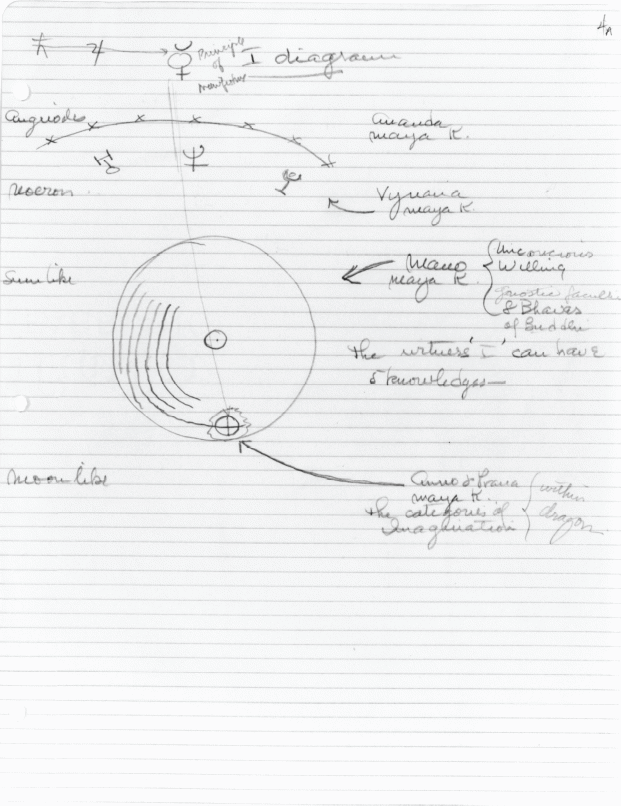
FIGURE 1983 0715a-1-AD. Tripartite Soul, Levels of Cosmos, and Sheaths.
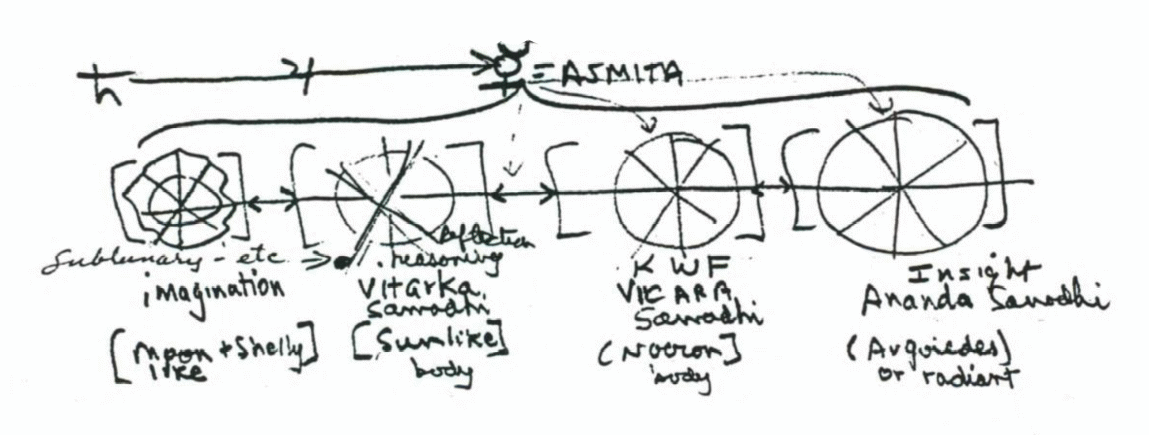
FIGURE ASN MASTER SOUL-129. Koshas, Samadhis, Levels of Cosmic Manifestation, and Divided Line.
The first diagram is from Astronoesis, p. 254. Other diagrams from Astronoesis also referred to. [Transcriber note: [diagram] means the speaker is referencing a diagram as he or she is speaking. If someone is drawing or writing, with audible sounds of chalk on a blackboard, I indicate this by [drawing] or [writing].]
AD PAPER read in class:
- "Evolution of the Individual Mind". Retyped as 1983 0715b V09MP. Astronoesis - Soul. Parts of this paper can be found in Astronoesis on pp. 259, 261, 278-279, 282-283, 350, 352-353. Not all of the paper is published.
NOTES:
This is 1983 07/15a, Plotinus; Soul Class, and the first entry associated with this date. 1983 07/15b = Evolution of the Individual Mind Paper.
Multiple earlier partial transcripts exist, including one by jf 2006 (Soul series).
TRANSCRIBED Verbatim by IT 2018 (V11a). This is V12ap (2023) and has: updated prefatory matter, footer, and audio file name; Book List completed; Plotinus quotes section added; new notes within transcript; two diagrams appended and references within transcript to these diagrams; minor errors/typos fixed; new formatting to accord with new conventions. Archival verbatim transcript with AD Paper – V12ap.
AUDIO FILES: 1983 0715a, 1983 0715b. [Note 1: "Tape" and "Side" refer to original audio cassette tapes that were later digitized into .MP3 Audio Files. Note 2: In 2024, REP Studio improves the sound quality of both audio files.]
1983 07/15a at Wisdom's Goldenrod
Plotinus; Soul; Evolution of the Individual Mind
[Audio File 1983 0715a Begins]
AS: First, III.8.6.
[Transcriber note: Parts of the following paper can be found in Astronoesis on pp. 259, 261, 278-279, 282-283, 350, 352-353. Not all of the paper is published. It has also been retyped as 1983 0715b V09MP. Astronoesis - Soul. I transcribe the paper just as it is read, including any alterations made during re-readings.]
AD ["Evolution of the Individual Mind," AS reading (cf. Astronoesis, pp. 282-283)]: "The purpose of life, according to Plotinus, is the acquisition of true knowledge and the individual's life in the sensible world is for that purpose. The astrological chart can and does reveal the specific ideas being manifested by that life and assimilated by the individual mind towards that goal. This is the fundamental spiritual nature of astrology.
"There are many levels of meaning from the ideas hidden in the symbolism of the degrees, which we have referred to as the basic presuppositions and attitudes that are the person. These basic ideas orientate a person towards certain goals in his life, and this activity furthers the contemplation carried on by the mind. This contemplation or"in-seeing" is the silent assimilation of those reason-principles which the second soul is garnering from the experiences in the sensible, because it could not achieve it directly in the Intellectual realm.
"Plotinus goes on to say that the purpose of the journey through the cosmic circuit is to acquire some good. What possible good could this be? It is the acquisition of those ideas by the mind--or the second soul--to complete the vision resident in the logos. So it is rather a straightforward affair to discern that the purpose of all this activity is to ultimately possess the object of contemplation, the ideas or reason-principles that are being manifested by life. This understanding will eventuate in the fulfillment, the peaceful smile of a Buddha. [9¾ second pause]
"[But] now we must consider the more immediate consequences involved in acquiring this knowledge. The knowledge must be applied to the facts of experience and to the yet unresolved picture of the world. The mind must make its own that which it knows. Knowledge must be lived or it becomes a source of infection, and these ideas must therefore be…"
EMD (simultaneously): Excuse me, Avery. When you sit up we hear you, when you bend your head your voice doesn't come out here.
S (very faint): Yeah [couple words inaudible] doesn't come out (there/here).
AS: Let me see if I can-- [slight pause] well--
[slight pause]
AD ["Evolution of the Individual Mind," AS reading]: "But now we must consider the more immediate consequences involved in acquiring this knowledge. The knowledge must be applied to the facts of experience and to the yet unresolved picture of the world. The mind must make its own that which it knows. Knowledge must be lived or it becomes a source of infection, and these ideas must therefore be applied in their place in the lower world; that is, by being translated into ethics, morality, and the virtues; otherwise it is not yet knowledge actualized.
"The briefness of this explanation should not delude us into conceiving that this is a process that can be accomplished within the mortality of the ego. It is a process spread over an indeterminable amount of time and involves the assumption of many bodies to secure the necessary observations. To grasp the meaning of this process, assume the existence of a secondary soul that has set out to fulfill its vision. Through its own activity it descends into the lower world and procures the body necessary in order to understand certain reason-principles which sensible experience can provide. The accompanying natal chart would indicate those reason-principles that will sensibly manifest as this entity and its experience, from which the second soul extracts the essence. The repetition of an indefinite number of such bodies would provide the second soul with all the reason-principles necessary to achieve its vision. Many lives in the body are needed by the evolving understanding to achieve maturity in the philosophic life. Only in this very wide context can the last paragraph of this tractate [of Plotinus] be understood.
"The Sage, then, has gone through a process of reasoning when he expounds his act to others; but in relation to himself he is Vision: such a man is already set, not merely in regard to exterior things but also within himself, towards what is one and at rest: all his faculty and life are inward-bent. (III.8.6)"
JL/S(?): Avery, would you read it again?
AS: Well that was kind of an introduction.
S (very faint): Ok.
AS: (Like), we actually read that one before.
S (very faint): Right.
AS (mostly very faint): Ok, don't worry about it, it's ok. But maybe (there's/this)-- [short pause with very faint inaudible student talking] 'Cause--
[short pause with very faint background student talking]
AD ["Evolution of the Individual Mind," AS reading (cf. Astronoesis draft, p. 118 ff.)]: "Our mind, or the lowest phase of our soul, is conjoined to the lowest phase of the cosmic soul.
"The evolution of the individual mind is taking place through the World-Idea that is being manifested by our Ishvara. The intricacies of this process we hope to indicate, nonetheless it will be quite fragmentary, a mere shadow of an outline. It was previously pointed out that our Solar Logos has an intellectual and reasoning phase in the Nous but its so-called lower phase is manifesting its idea of the entirety.
"Insofar as the cosmic soul participates in the Idea of the Six Holy Forces it will have these powers at its disposal in order to bring about a manifestation of its own Idea of the World. These powers are sensibly represented by the Chaldean planets (and our later attempt to correlate and itemize these powers with the planets will be tentative and mainly provocative)." (bit of laughter)
AB: (Aw/Well) (cute). (bit more laughter)
[short pause with very faint student words]
AD ["Evolution of the Individual Mind," AS reading]: "The perpetual spontaneity of their ordered functioning--and our childish attempts to discover something about this abiding wisdom…(may not be allowed). [short pause]
"This cosmic activity is received by the individual mind and translated into space-time perceptions, on the one hand--a sensible presentation, that is--and on the other hand, a perception of the sensible prior to the bifurcation into an empirical subject-object. This latter is a view that belongs to the"Witness I". But being here implies the identification of that unknown Witness with a body or psycho-somatic organism through which it can intensely experience its own functioning.
"What is becoming explicit in this exegesis is a theory of the endless evolution of an individual soul's awareness of its content. Through reasoning on the content of the World-Idea [which] it is manifesting, [AS: I'm sorry."Through reasoning on the content of the World-Idea that it is manifesting] the soul evolves its understanding until intellection becomes predominant, and then this is brought to bear on its own self-nature. If the inquiry is pursued, it will terminate in intrinsic self-awareness."
[13 second pause, very faint student words in background]
RG (faint): (Hm?) Would you read the last two (sentence)?
AS: Sure.
S (very faint): That's good.
AS (very faint): (I'm trying/And try) to select(--/.) "Through…"
AD ["Evolution of the Individual Mind," AS reading]: "What is becoming explicit in this exegesis is a theory of the endless evolution of an individual soul's awareness of its content. [RG simultaneously: Again.] Through reasoning on the content of the World-Idea which it is manifesting, the soul evolves its understanding until intellection becomes predominant, and this is brought to bear on its own self-nature. If the inquiry is pursued, it will terminate in intrinsic self-awareness."
AS (faint): Did you have a comment (on--)
S (very faint): Or a reason.
RG: I do. Should we read the whole thing again (probably) or-- Should we read the whole thing again then?
AD (very faint): However you want to do it.
AS (faint): That would be a good-- that might [VM simultaneously, faint: Let's do that.] be [three words inaudible] It's--
RG: Go ahead, explain it. Well I do have a comment in that [S, faint: (The evolving.)] the juxt-- there seems to be a juxtaposition in those two sentences of an endless evolution of content, of awareness of content, and the termination of the exper--
LR (faint): Can't hear you Dickie at all.
S (very faint): [couple/three words inaudible] (RG laughs, bit of laughter)
RG: There seems to be a juxtaposition of the endless evolution of the awareness of content, from the first sentence, to a termination of that evolution in a awareness of one's own in-- own self-awareness, in the second sentence. And that seems kind of contradictory.
LR (faint): Say it again? (bit of laughter, RG laughing)
BS (faint): Just provocative.
LDS (faint): Just be-- just be provocative.
AD: You think after Wednesday night I'm going to stop and start explaining that all over again? I'm going to treat you like a grownup.
RG: That's your first mistake. (RG laughing)
S (very faint): He's definitely (bigger).
RG (simultaneously): Um--
LR: He's referring to the quote about the two stages.
RG: The two stages, which two stages?
S (faint): No (I'm not).
RG: No, no. [S(?) simultaneously, faint: Only one.] Ok.
AD (simultaneously with RG and S, faint): Ok, go ahead Linda. Argue with your compatriot there.
RG: The two stages of the mystic [LR simultaneously, faint: Can you--] and the Sages-- and the phil--
LR: Just repeat what you said last part, juxtaposition--
RG (simultaneously): It seems there's a juxtaposition of-- in the first sentence, of an endless evolution of the ware-- of the awareness of content, which in the se-- which instantiates itself as a termination in the second sentence to be the awareness of one's own self-awareness.
LR: That's a-- that's [AH: Eventually.] referring to the quote on Wednesday night [Note: See WG Class 1983 0713; cf. Paul Brunton, Notebooks, V15, 23:6.88 and Perspectives, Ch. 23 #42, "Although the aspirant…"] that had-- that said first you become aware of yourself and then you become aware of everything in the world as the same substance. Now those two things that you've so elaborately gave the interpretation--
RG: Yes.
S: Right.
LR (simultaneously): I think that's what's being commented on.
RG: But they seem in reverse in this-- in these sentences. But that do-- I mean--
DB (simultaneously): It's two different-- two different kind-- (as--) I mean, in-- in this instance we're talking about the whole process of evolution, but I thought Wednesday night it was just a discussion-- transition between mystical and the philosophic whereas this is transition from the amoebic to the human and beyond.
S (simultaneously, faint, possibly part of background): [couple/three words inaudible]
PD: Or is Plotinus offering the reverse approach than the Eastern approach?
RG: Yeah that would-- it see-- it seems to be that it's here through the investigation of-- of the object's nature or the content, and here the object is the content to the soul, that you develop the power of intellection to then have insight into your own nature.
DB: Yeah but you don't-- your own nature doesn't get to be a problem until you've been reflecting on objects for several billion incarnations and you get tired of it.
RG: Well that--
DB: I mean--
RG: That's not-- I don't think that's the crucial point there.
PD: No I don't know Richard, I-- it seems to me maybe it's a possibility of a different approach that-- that [RG simultaneously: Yeah I'm agree--] Plotinus is offering there.
RG: I'm a-- yeah I'm agreeing with you.
HS: Well, could you just expli-- [AD, very faint: No.] explicitly state what those approaches are?
LR: Dickie you're saying that this paper's point of view is-- is from the point of view of beginning and evolution and you accumulate experience through many bodies, lives, etc. So your awareness is of many experiences and that will give you-- through-- by developing reason on those, you'll begin to-- well it says you will arrive at intellection, or your understanding will evolve to understand what the nature of experience is. And through understanding the nature of experience, the inquiry will end in self-awareness?
AD (very faint): Yeah [couple words inaudible]
RG (simultaneously): Yeah.
LR (simultaneously): That's what's being said?
RG (simultaneously): Yeah, yeah.
AD (faint): Only when intellect-- intellection is developed, in other words, willing, feeling, and knowing is brought to a perfect development and balance, then is it possible to become aware, intrinsically self-aware, or have the realization of what constitutes your self-nature.
RG: Which seems to be the first stage only of what we were talking about Wednesday night, and not yet dealing with the second part.
LR (simultaneously): But, the quote on Wednesday night was about the-- the evolution of a Sage, the stasis-- the stations of a Sage; that once he bec-- once he gains this self-awareness he can [RG assents] either stop there or become a philosophical-- what was the term, Randy, Savior Sage?
RC/S(?) (very faint): [one/two words inaudible]
AD (very faint): Philosophic Sage.
RC (simultaneously, faint): Yeah.
LR: Philosophic Sage, and then he could go even further into penetrating the World-Idea. So, I don't think this is talking about the stations of a Sage, is it?
AD (faint): Yeah, I'm-- I'm not addressing myself to that question. We're addressing ourselves to the fact that insofar that an individual soul or mind is manifesting the World-Idea through itself and for itself, alright, and learns by reasoning about the facts of experience, he evolves an understanding, the rational mind. This rational mind evolves further, brings about the possibility of intellection. Now he's Reasoning, capitalized here, or he's intuiting the meaning of Ideas. At that-- at that level, intellection becomes more dominant, the person is now ready for that s-- that stage where you could say he introspects directly into himself or introspects into introspection. Now, if he achieves that, he recognizes the ultimate nature of his own soul which is pure consciousness. I don't want to put it permanently to that stop, I-- they both go on, I don't want to think of them ending.
RG: Then why did you say "terminate"?
RC/S(?): Did he say terminate?
AD (simultaneously, faint): No, I (said/says) [RG simultaneously: He said it.] [couple/few words inaudible] was that it terminates in self-intellection or self-awareness. But there's no state higher than that. There's nothing higher than insight.
RG: Uh-hm.
VM: [one word inaudible] maybe use the word 'achieves'.
AD (simultaneously): So that's what-- that's-- that's the culmination of the process.
LDS (very faint): Culminates or something.
VM (faint): (Achieves/Achieved) or something like that.
AD (simultaneously): But, even though, even though a person has reached insight, it doesn't mean that now he stops reasoning about the world.
RG: But you also said in the past that he doesn't-- he doesn't stop evolving either.
S: [one/two words inaudible] doesn't have [couple/few words inaudible]
AD (simultaneously): The World-Idea isn't going to stop. [VM, very faint: No it's not.] Alright, so that's an assurance we have, right? (But) as far as going beyond insight, I don't see how you could be--
S (very faint): (Go ahead. I'm sorry.)
RG: But you--
S (very faint): I'm sorry go ahead.
RG: I--
AD: See that process reaches a terminal point. When the soul recognizes or has self-cognition, intrinsic self-cognition, in other words has insight, there's no further development after that. I mean what-- what's going to-- what development are we talking about?
RG: What are you talking about when you talk about a development after that for a Sage?
AD: There is no development after insight. What other faculty are you going to develop?
S (faint): [one/two words inaudible]
RG: But you said it's an endless-- Then what does it mean that the soul--
AD (simultaneously): I didn't say that it was endless. [RG simultaneously: You--] I says the World-Idea and the evolution of the ego as part of the World-Idea is endless. I didn't say insight is endless because insight isn't temporal so you have no problem there.
RG: Then you would agree with the Vedanta that the process has a beginning and an end.
AD (faint): That process--
RG (simultaneously): That the process is beginningless but can be terminated.
AD (faint): Well which process are you referring to?
RG (simultaneously): The one you're talking about. If-- The one you vehemently [S simultaneously: Well--] disagreed with the other night.
AD (faint): What do the Vedantists say has a beginning [one word inaudible]
RC(?): Ignorance.
RG: It's beginning--
VM: Beginningless.
RG: It's beginningless.
AD (very faint): Yeah, what are they saying beginningless [one word inaudible]
RG: Ignorance, and that ignorance can be terminated through insight. Sounds just like what-- like what you just said. Now I don't know why you-- why-- what-- what's different 'cause obviously you mean that the Vedantists don't do that, so I don't understand yet what you mean.
PD: I don't understand where you're going, Richard.
AD: I'm trying to understand what he's saying.
TS (faint): Try again.
AD (faint): What was it that was said was beginningless?
S: Uh-hm.
S (possibly same S as above): This is--
AD (simultaneously, faint): What does Vedanta say is beginningless?
RG: Ignorance.
AD (faint): Yeah.
RG (faint): Or--
AD (faint): You think it comes to an end?
RG: What-- well, from the way you're saying it why-- why doesn't ignorance come to an end through insight?
DR: Louder please.
RG: Why doesn't ignorance come to a terminus, just like you're describing here, through insight?
AD: No, the ignorance was about the World-Idea.
RG: I thought the igno-- I thought the ignorance was the fact that he didn't know who he was. I-- I don't know what you mean-- what is ignorant about the World-- why would you even think of ignorance about the World-Idea?
AD: Well look--
RG: Ok.
AD: Let's (stay for today).
RG/S(?): How?
AS: That's no big deal.
AD: Uh--
RG: My only question is this, you're making this clear distinction that from the subjective consciousness side there is a state which can-- there is no further attainment to and that state is called insight, from the subjective consciousness. Objectively though, there is a continual unfoldment infinitely of the evolving-- the World-Idea and the individual archetype that is associated with that World-Idea. Right? And those two kinds of processes are two distinct unfoldments and evolutions, right?
AD: They're two aspects of the same source.
RG: Ok. Then I don't understand why you would say the one process terminates in the other, they seem to-- and what, you know-- [S simultaneously, faint: It's not what he said.] it sounds as if-- yes, well, [RC simultaneously: Maybe (couple words inaudible)] maybe I hallucinated but read it again.
S (simultaneously, faint): I think (this is just) regarding the faculty of insight in--
RG: Read it again.
S (very faint): Read it again, Avery.
AS (faint): Oh (I'm sorry) [one/two words inaudible] Do you want the last-- just the last line Richard or--
RG: The last two sentences.
[student assents, very faint]
AD ["Evolution of the Individual Mind," AS reading]: "Through reasoning on the content of the World-Idea which it is manifesting, the soul evolves its understanding until intellection becomes predominant, and this is brought to bear on its own self-nature. If the inquiry is pursued, it will terminate in intrinsic self-awareness."
RG: It's [one word inaudible] If-- I would-- I would just add that subjectively it may terminate in intrinsic self-awareness but that doesn't mean that the unfoldment of the process doesn't go on eternally.
AD: Yeah but [AS assents] you're reading that in. [RG: No but--] I didn't say it's going to come to an end.
VM: You used the word [S simultaneously: Yes, you did.] 'terminate', Anthony, [few inaudible AD(?) words simultaneous with VM] if you change the word--
RG (simultaneously): You said terminates [one/two words inaudible]
AS: But he did.
VM (simultaneously): If you change the word to 'result' or 'achieve', you achieve [HS/S(?): Yeah.] insight or something like that, and that sounds less of a dead stop, you know, "Oh, now I'm done."
AS: But Vic, that [couple/few words inaudible]
AD (simultaneously): Well what's wrong with a good dead stop? Process of insight is achieved, alright, you recognize or the-- the awareness of awareness, if I could use that incorrect mode of speaking, is achieved, alright. You know that that is the substratum of the World-Idea which your mind is manifesting but the World-Idea goes on being evolved. It doesn't stop. I have nowhere said it stops. It's you that is saying it stops.
VM: I'm trying to say that I think, you know, if one small change in a word-- I don't mean to be a word fanatic, but it does change the spirit at least in some of us interpreting.
RG: I-- because it doesn't matter.
VM (simultaneously): Again, maybe it's [one/two words inaudible] (beat) the mountain, (I don't know).
AD (simultaneously): It doesn't-- to me it doesn't matter. I thought, I thought it was nice to get you just running and, you know like, then you can't stop and you gotta fall off the cliff. (bit of laughter) [RG: I apprec--] 'Cause that's just a conclusion he ran into was his own, wasn't mine. That shows the way he reads, you know, Rorschach business.
VM: But, excuse me if this sounds-- if this sounds inappropriate.
RG (simultaneously): Um, excu-- excuse me, (RG laughing, laughter) Mr. Rorschach, but--
VM: But part of the idea in writing is to minimize the number of confusions and psychological projections.
S: (Uh-oh.) (S laughing, some laughter)
S (amidst laughter): Alright.
AS: But, that may be true [one/two inaudible VM words simultaneous with AS] or maybe not. (laughter, student words) Remember, [VM simultaneously: I take it back.] even your own purpose is [VM simultaneously: I take it back.] [few words inaudible]
VM (simultaneously): Not many people would disagree with that but some would.
AB: Why is it-- why-- what's wrong with saying that when you achieve insight that that faculty of the soul can't develop any further, it's reached its ultimate growth, [RG: Yes.] but you're still in the world, the World-Idea is evolving, your ego is evolving, so there's still--
AD: I want you to figure that out.
RG: If all [AB simultaneously: There's no new knowledge taking place.] that was said it would be fine, it would be fine, but it doesn't say it.
AB: So now we know what he meant, let's go on.
BS: Yeah but you're not adding all that to it.
AB: PB was a researcher so he obviously didn't consider himself to, you know-- [RG: Alan--] not to learn anything.
RG: Alan-- I know. I thought-- I mean we know, we know, we know what the standard doctrinal line is, I mean-- But it-- I mean is it-- it just seems not s--
S(?): I know, I-- I like this view better myself.
S (very faint): Me too.
AD: Alright, let's put in that addition in--
AS (very faint): That'll be good.
AD: Under the editorship of RG. (RG laughing)
AB (very faint): You wanted-- you wanted to be promoted.
HS: So how is it supposed to read now so I-- so I could get it right? (bit of laughter)
S: Don't read it over and over, huh?
AS (simultaneously, faint): Well, just the way--
[short pause]
AD: But that's one of my stylistic methods, Richard. I call it, you know, "short stopping". I'll stop almost like what seems to be the middle of an idea but it isn't, the idea's completed and you go on running and then you realize that you've added to it what I didn't-- I never said. And you'll see that I do that quite often. (laughter) (You want me) to change my style, (Dickie)?
RG (simultaneously): Not at all.
AD: Oh, alright. But you can put it down.
RG: No no, we don't need it. (bit of laughter)
AD: Are you sure, Richard?
RG: I don't care. (bit of laughter)
BS: We don't need it but we [S simultaneously: (one/two words inaudible) Put it down.] don't want to get the world on the wrong path.
S (faint): Yeah, (right). (bit of laughter)
[33 second pause]
AS (very faint, possibly part of background): Ok I've already [one/two words inaudible]
TS (very faint, possibly part of background): You keep moving the piece of paper.
AD ["Evolution of the Individual Mind," AS reading]: (original Astronoesis draft p. 119) "If we retrace our steps and consider Plotinus' remarks about the second soul--that part which is said to be divisible among bodies, (IV.2.1, 2) then starting at the lowest we may understand how this germ now reascends through the various levels of the environment which is provided by the cosmic soul.
"Insofar as the animal body is composed of the traces of prior activities, inherent in it are the impulses, desires, [and] so on, which we refer to as the subconscious, [and] this is the life that the ordinary man lives. We may refer to this as the descending spiral where the soul of man identifies more and more with the not-I. It has its joys and sorrows but finally leads to satiety--this is the samsaric life, the endless round of birth and death which finally leads to the question"Why?" and the dawning of reflective consciousness. [17¾ second pause]
(cf. Astronoesis, p. 259, for this paragraph; original Astronoesis draft, p. 121) "It is important at this junction to point out that the moment-by-moment manifestation of the World-Idea includes the bodies which individual souls will inhabit in order to experience the world appearance. It is not to be forgotten that these bodies are being produced and manifested moment-by-moment [and] have a sort of continuity which is provided by the World-Idea. The individual soul imparts to that body a subjectivity or consciousness which is characteristically self-identical. The combination of these two distinct levels gives rise to the personal ego, a spurious entity that is constituted by a self-identical consciousness and a body being instantiated. So within this same entity there is an image or traces of the cosmic soul powers which fabricated it as well as traces of an individual soul consciousness and its evolutionary status."
LR: Question, Avery.
AS (very faint): Yeah.
LR: The bodies which are fabricated by the World-Soul, when you started talking about them as containing all the traces, was it saying that it contains all those traces of all the prior lives of that soul or the-- just the traces of life lived in a more general sense? When we--
VM (simultaneously): I don't think it said either but we would have to opt for the latter option, wouldn't we after all the discussion we've had about rent-a-vehicle and so on? [few words inaudible, possibly another student] (bit of laughter)
[short pause]
LR: When you began with the World-Idea includes all bodies--
[short pause]
AS (faint): Yeah.
AD ["Evolution of the Individual Mind," AS reading]: "…the moment-by-moment manifestation of the World-Idea includes these bodies which the individual souls will inhabit in order to experience the world appearance."
S (very faint): What world appearance?
LR: Go on.
AD ["Evolution of the Individual Mind," AS reading]: "It is not to be forgotten that those bodies are being produced and manifested moment-by-moment and therefore have a kind of continuity which is provided by the World-Idea. The individual soul imparts to that body a subjectivity or consciousness which is characteristically self-identical."
[short pause]
LR: Oh I know what, I'm sorry, it was in a previous sentence where you said the animal body holds traces of all life.
AS: Aha.
LR: I'm sorry.
AD ["Evolution of the Individual Mind," AS reading]: "Insofar as the animal body is composed of the traces of all prior activity…"
LR: Ok, whose? That's my question.
AS (very faint): Whose?
LR: Yeah.
DB: Its.
LR: The body's prior (activity/activities)?
AD (faint): No. [S simultaneously: (True.)] That's a mistake. It contains the traces of the cosmic soul's functioning.
LR (faint): Ok.
S (very faint): Continue.
LR (faint): Because otherwise you would make the body the container of the individual soul's karma and it [few words inaudible] then.
AD (very faint): Well just restrict it then. You know, the Sun squares Mars you get a heart attack. This [one word inaudible] (covers that).
S: Pardon?
AD (very faint): Cosmic soul which fabricates the body has functional images of its own being in the body as the various organs, various functions in the body representing this. But that-- that was incidental.
MB: But, it's incident-- can I just make a comment on that? It seems like the cosmic soul could possibly retain the elements in-- that are suitable for an individual soul's incarnation. Like we said bef-- way before that an individual soul when it incarnates assembles the elements that it needs for its body and this is a slightly different approach but nevertheless the cosmic soul could retain those elements so that when the individual soul incarnates it finds the body appropriate to it that's in alignment with its karma.
S (very faint): Keep your bank account (and) go to sleep.
RC: Sounds like keeping your bank account even while you're sleeping.
MB (faint): Yeah.
RC: When you wake up you still have the same account.
S(?) (very faint, possibly part of background): And that's interesting [one word inaudible]
[14½ second pause]
AD: (I didn't hear (you/him).) I didn't hear (you/him).
DB: High finance.
MB: I'll come over and whisper it to you. (MB laughs)
LR (faint): Maybe it's cooled off outside, has it cooled off out?
S (very faint): [one/two words inaudible]
AD (simultaneously, faint): No, no, it's going to get hot.
AS: Yeah, it's cooled off [AD/S(?) simultaneously, very faint: Yeah.] the inside.
AD (faint): Yeah Myra?
MB: I thought that Linda's question was directed at the notion that you've changed our approach, we no longer say that the individual soul comes in and assembles the elements that it needs, assembles its own body for--
LR: I never said that.
MB: I didn't say that you said that but that the-- there is that way of viewing it.
AD (faint): No, [AS simultaneously: We never said (one word inaudible)] (what we) said was two ways, that the cosmic soul fabricates the body, the individual soul is conjoined to the cosmic soul and participates in that fabrication. [MB simultaneously: Now--] And that insofar that the cosmic soul fabricates the body, alright, there will be traces of that cosmic soul's functioning left behind in the body. So like for instance, you know, the kidneys are represented by Venus and the Sun the heart, you know. It's like that, I mean they're functioning images of these--
MB (faint): But not only that, the cosmic soul probably could contain a certain collection of elements or certain collection of substances that are peculiar to an individual soul. In other words, the individual souls-- souls can leave a deposit of its karma in the so-called material substance that the cosmic soul retain(s) so that when the individual self incarnates again it can find the body which is conducive to its karma. 'Cause the cosmic soul is what's doing it for him.
AD (very faint): What (does it mean) the cosmic soul is doing it [few words inaudible]
MB (faint): Well, traces (in/of) a material substance [few words inaudible] Some kind of traces that--
AD (faint): Yeah, I wouldn't disagree with that, I mean the cosmic soul does keep a record of everything that transpires in its domain. This is what it means to speak about the precession of the equinox, the fact that the Sun remembers. Everything that's going on in his-- in-- in that cosmic soul's realm is retained by it, sure.
MB (faint): I guess I was just bringing out the idea that cosmic soul could retain not only a general prototypal (referent/reference) but something that's peculiar to particular individuals within, you know, its realm.
S (very faint): [one/two words inaudible] no need to go to that (stuff).
AD (very faint): Well you have to be more specific, I don't know what you're referring to.
MB (faint): Well, in other words it doesn't-- just doesn't have, you know, two eyes, a nose, a mouth. Whatever it's retaining in terms of first-- the human incarnation would be more individualized with-- with traces of individual karma [two/three words inaudible]
[12¼ pause]
AD (faint): Yeah, I think that will be included in what we just said. It is aware of the activity of that soul and what it did, you know-- you know, at a certain time, and it does retain the memory of that. But, I think you'll see that all this is quite secondary to the main point that we're making here. Avery, would you continue?
AS: Sure.
S (very faint): Start with the [one word inaudible]
AS: Start with what?
S (very faint): The different [couple/three words inaudible]
AS (simultaneously, faint): Start with "Within the in--" It's hard (being) [one word inaudible] Oh [one/two very faint inaudible words, possibly another student]
AD ["Evolution of the Individual Mind," AS reading (cf. Astronoesis original, p. 121 ff.; cf. Astronoesis, p. 259, first paragraph only)]: "The combination of these two distinct levels [AS: that of the body and the imparted consciousness] gives rise to the personal ego, a spurious entity that is constituted by a self-identical consciousness and an organized body being instantiated. So within this very same entity we find an image or traces of the cosmic soul powers which fabricated it, as well as traces of an individual soul consciousness and its evolutionary status. It should be noticed that the basis of the ego, its body or psycho-somatic organism, has no self-identity from one moment to the next, for it, as such, is part of the vibrating World-Idea, but the feeling of there being a self-identity comes from a completely different level of reality, that is, it appropriates this consciousness of the lower phase of the soul as its very own.
"This confluence between the two separate items, the body or psycho-somatic organism--which is part of the World-Idea that is being instantiated--and the consciousness that identifies itself with this body are intermingled and fused so that what arises--the ego--must be accepted and denied accordingly."
AS: Or, denied and accepted accordingly.
S (very faint): Read the sentence again Avery.
AS: Yeah the order which one's denied and accepted is--
S: Avery, could you go--
AD ["Evolution of the Individual Mind," AS reading]: "This confluence between two separate items, the body or the psycho-somatic organism on the one hand--which is part of the World-Idea that is being instantiated--and the consciousness that identifies itself with this body on the other hand, these are intermingled so that what arises--the ego--must be accepted and [AS reads: or] denied accordingly."
AD: Accepted and denied.
AS: And-- I s-- did I say "or", I should've said "and", it says "and".
VM (simultaneously): So it's accepted in the sense that it's a representative of the individual soul, however perverse the circumstances under which it will be manifesting (in me) but-- it's accepted insofar as it's a representative of soul and denied insofar as it's a part of the World-Idea? I don't understand the acceptance and denial.
LDS(?): It's the other way around.
LR (simultaneously): Yeah I think that's [couple/three words inaudible]
VM: Is that what you were-- is that the way you're understanding it, Anthony?
HS(?): Why don't you just read the paper?
AD: You finished it?
S (very faint): No.
AS: (Finish/Finished)?
S (very faint): No.
AD: Finish the paragraph?
AS: No, no I didn't.
AD: Finish the paragraph.
AS: Sorry.
AD ["Evolution of the Individual Mind," AS reading]: "That is, it must be developed so that it can become a medium for the soul's experience and has its place as part of the World-Idea. But it must be emphatically denied the status of an"I". Plotinus reminds us, for example, in II.3.17 that the nature of the matter which constitutes our body insists on making the past present--a combustion process that is objectifying and actualizing its illusory self-identity and the bitter [AS reads: better] consequences of identifying with that process."
S (very faint): The bitter consequence(s). (AS laughing)
S (amidst laughter): It's bitter, bitter. (some laughter)
S: He said what?
AS: The bitter consequences (AS laughing, laughter) of identifying. Sometimes it's better. Sometimes it's better and--
S: Sometimes.
LS/S(?): Is it a typo or a (vast/mass) (fantasy)?
AS: Typo.
TS(?) (faint): I think that was an intentional fantasy. (laughter, student words)
AS: It's always the typist's fault.
S (very faint): I agree.
S (very faint): Yeah [few words inaudible]
LR: Could you re-read?
DR: Yeah, Avery.
AS (simultaneously): Yes, I'm sorry. I'll read it a bit bitter. (laughter)
DR (amidst laughter): And I thought you asked-- [short pause with laughter, very faint background student talking] Avery is that the end of the section you're reading there or--
AS: It's the end of that paragraph.
DR: Well I don't know where the idea started but I'd like to hear it again. [AS simultaneously, faint: Well--] I didn't get it, to follow up what Vic said.
AS: Yeah, ok. [22½ second pause with whispering in background] Ok.
AD ["Evolution of the Individual Mind," AS reading]: "This confluence between two separate items, the body or a psycho-somatic organism--which is part of the World-Idea that is being instantiated--and on the other hand the consciousness that identifies itself with the body are intermingled, so that what arises--the ego--must be accepted and denied accordingly. That is, it must be developed so that it can become a medium for the soul's experience and it has its place as part of the World-Idea. But it must be emphatically denied the status of an"I". Plotinus reminds us, [for example, in II.3.17] that the nature of the matter that constitutes our body insists on making the past present--a combustion process that is objectifying and actualizing its illusory self-identity and the bitter consequences of identifying with that process."
S (very faint): Yeah.
S (very faint): What's the quote say?
S (very faint): [one/two words inaudible]
S (simultaneously, very faint): (3.17.)
AS (faint): 3.17.
DB: Avery?
AS (faint): Yeah?
DB (simultaneously): Is-- The-- the end-- the end result being that this spurious creature becomes a vehicle for that soul's understanding, what does that-- what does that end up meaning? I mean is it that we have here a kind of a concretized level of understanding or capacity for intelligent functioning or-- that is in itself no kind of subjectivity? I mean is it a sort of understanding that's developed here or what?
AD: David I-- I can't hear, this silent air conditioner.
S: Oh no. (some laughter)
AD: Try again.
DB: Alright. I'm curious if the-- the status of the end result of this process, this developed ego, now it's no kind of subjectivity but does it represent a certain-- certain knowledge, a-- I mean, what actually is it that it could be a vehicle for the soul's understanding and experience? I mean it's no kind of subjectivity so it's not any kind of a real being.
AD (faint): I didn't say it's no subjectivity
DB: It's not an "I".
AD: I says [couple/three words inaudible] it's not an "I".
DB: Ok. Could-- could you just distinguish that then? You mean it's like the form whereby subjective experience could take place but in itself it's an objective event in the cosmos.
[11 second pause]
AD: Remember the analogy we used Wednesday? I said, you're at a cinema looking at a picture.
DB: Right, yes.
AD: You think of that as the World-Idea, alright, it's being instantiated moment-by-moment. And there's your favorite hero.
DB (faint): Right, he brings me down.
AD: Right? Right here, ok?
DB (very faint): Yeah.
AD: And it's going on moment-by-moment. Now you identify, let's say you (lend him/lended) your consciousness. So now you've got these two separate items together constituting an entity which likes to refer to itself as "I". In other words, the very nature of the va--
(Side 1 of original cassette tape digitized as 1983 0715a Ends; Side 2 Begins)
AD: --the vasanas [couple/three words inaudible] The other point of view says, I am not the body; the body is something I preside over, something I've got to develop as a tool in order to gain more understanding of the World-Idea. You can't be present in a World-Idea without having this body. So this consciousness can be in the body, work with the body, and assimilate the spe-- the reason-principles behind all our experience, extract them from the experience, and develop its own potential, let's say, rationality.
DB: Yeah. And I guess [short pause] that this-- Which-- which part here that(--) the body is the vehicle, right, I mean-- in this quote the body is the vehicle. [short pause] I guess I'm not clear on what the distinction is between a body which is appropriating the I-ness from-- from the soul as opposed to a body that is no longer doing that.
AD: The body will always do that. It's the very nature of the body to do that.
DB: Ok.
AD: Alright? My eyes, for instance, make immediate contact when I'm looking at Myra. It's the body's desire, alright, to experience itself(--/.)
DB: Ok.
AD: But that's not the "I."
DB: Right.
AD: The "I" could say I'm not going to do what the eyes want me to do, make this contact.
DB: Yeah. [student assents, very faint] Ok. Now this-- is it then this "I" which says I'm not going to do this, I'm not going to participate in this charade any longer, is this what's developed?
AD: If-- yes, if that part of the soul which is concerned with trying to understand and, you know, reason what's going on, it must withdraw or it must distinguish between the activity of the animal organism and its own activity, its own reasoning activity.
DB: Ok.
AD: And this is what evolves and develops into a rational consciousness and then to higher stages of intellection.
[student assents, very faint]
DB: Ok, and in this paper the ego is always on the body side of this duality, I mean-- That-- I guess that's the part that--
AD: For all of us--there's the rare exception now and then--but for all of us, alright, the body with the vasanas inherent in it is the one that claims to be the "I." This is-- this is that part of us, alright, so to speak which Plotinus speaks about as the alien intruding itself upon the idea or the soul and foisting itself on it like a boa constrictor, wrapping itself around the consciousness, pulling it down, alright, to accommodate it to its own desires. [Note: See Plotinus, VI.4.14, 15.] [DB, very faint: Ok.] This is the root desire, the ego is that root desire, alright. Now it's a spurious entity because you're never going to be able to make a clear demarcation between these two. You're always from moment-to-moment are going to have to employ the reasoning to find out which one is which. And it may sound like a simple task, but, you know, our experience shows us again and again that when the Dragon bites you, you go so willingly along with it and you think you're obliging your higher soul (VM laughing) in so many different ways that after a while you can see it's quite ludicrous. That we're duped again and again, over and over, inside out, above and below, beyond and, you know-- Anything that you think-- if you ever think that you can outwit the ego, you're in for a real surprise. Not until that rationality is really developed can it penetrate right to the lair, right to the inner recesses of the ego, and see that it is what's telling you what to do. So it's a spurious entity for most of us for the simple reason-- should I say it? [S, faint: Yeah.] --that we have an undeveloped rationality. In other words, we're naive. [short pause] You remember-- remember the quote from PB? Well, he said something to the effect that the ego will even provide you with a spiritual method and a goal to get you off the path. (bit of laughter) (And a) pretty smart fellow.
LR: By body--
S (faint): When you used that cinema analogy the other night--
LR: Louder.
S: When you used the cinema analogy the other night, you said that the one difference between the analogy and what really happens is that your consciousness can interfere with what's taking place on the screen? How does that occur, what do you mean by that?
AD: Well, when a situation arises [S, faint: Ok.] and the rationality is developed, you can penetrate right on to what's going on. And even though the body may, let's say, have the final say, let's say it's an act of fate, something that is prescribed by the cosmic circuit, the inner being doesn't have to acquiesce to that. It can retain its inner feasance by refusing to identify with it, even if it has to go through the act. On the other hand, that rationality very often preserve the innocence of the soul and prevent it from doing an act.
S: So it can actually affect the action?
AD: Oh sure. Then of course we get into the difficulty of saying, well, it's actually changed fate, alright, and that would disturb me.
S: That would.
AD: 'Cause I like-- like my attitude is, you know, everything is fixed, I mean, I'm not going to change anything. When-- I think there was a remark PB made, he says, "Well that decision to carry on and do the right thing is also included in fate." So that kind of took me off the hook, Peter.
S: Does fate extend up as far as the rational working of the soul?
AD (simultaneously): No, no, that wasn't the point, the point was that the choice you (made/make) is already included in the World-Mind's Idea, in the Idea of the World, that choice you make. The exercise of free will, let's say, is part of the World-Idea.
S (simultaneously): Yeah. Right, right, right.
AD: Now don't ask me to distinguish between Fate and Providence, please.
LR: By body you mean-- you are including the whole psychosomatic organism?
AD: You know what I mean by body.
LR: We're the [couple words inaudible] What is the relationship then between the individual soul-- it seems like you're running a commentary of a dual nature (in/you're) trying to keep the distinction between the individual soul's consciousness and the manifestation by the World-Soul of the psychosomatic organism. What-- what is the relationship between those two terms?
AD: I just expressed that now.
LR: No, you said that-- well, maybe you did.
AD: That's part of the World-Idea, the body's part of the World-Idea.
LR (simultaneously): You said the individual soul gets [one word inaudible] into the-- in that whole picture.
AD (simultaneously): And the soul that comes into that.
LR: But you make them sound very distinct.
AD: Well I do that deliberately, alright, so that I don't have to explain why the ego's a spurious entity. I'm explaining both the-- I'm explaining the standpoint, for instance, on the one hand of the Vedantist who believes that there's a self-identical "I", a Witness-Saksin which is always itself and never anything else. And I'm explaining the point of view of the Buddhist who says that from moment-to-moment everything's changing. And I'm-- I'm trying to point [LR simultaneously: That I follow.] out(,) these two together(--/.)
LR: Give you both points of view, I followed that, I followed [one word inaudible]
AD (simultaneously): Both points of view, yeah. And they're both legitimate.
LR: I followed that point, that what you're presenting is a picture that includes both schools of thought. [AD simultaneously, very faint: Uh-hm.] Now-- but the thing that-- that I can't-- that I don't understand is that-- precisely the relationship, in other words, are-- In keeping them that distinct, it sounds as if the entire historicity of that psychosomatic organism is not related at all to the individual soul's consciousness, whereas it reflects the evolution of that individual soul.
AD: Yes but that's quite a distinction, isn't it?
LR: I'm sorry?
AD: That's quite a distinction.
LR: What is quite a distinction?
AD: It can reflect, you know, the evolutionary status of that particular soul, true. In other words, when a soul comes into incarnation and let's say has a body which reflects the level of that soul's evolutionary status. So if you take-- if you take a-- the soul of Oppenheimer, for instance, you-- you have difficulty inserting him into an Australian Bushman's body.
LR: Right.
[student assents, faint]
AD: So the body that was provided for his development does reflect something about the status of his soul.
LR: And when you say that body itself, that whole psychosomatic organism, contains traces of the lives that were lived--
AD: What body?
LR: Your body.
AD: No I didn't say of the lives, I says you--
LR (simultaneously): No I know. You said the World-Soul's functioning.
AD: Traces of the World-Soul's functioning, now--
LR (simultaneously): But, a body--
AD (simultaneously): In other words, the body is the functional image of the World-Soul.
LR: So the fact that a body has-- is prone to having ulcerated--
AD (faint): Don't get smart. (some laughter, student words)
LR: Ok I'll use another example, I'm sorry. So that a body that has kidney trouble, for instance, has nothing to do with the historicity of that individual soul.
AD: That too will follow. The illnesses peculiar to that body will be something that that [LR simultaneously: Has to do with the in--] soul has to inherit.
LR: I would think so, yes. Therefore I don't understand--
PD: But you can't say the soul has kidney problems, Linda.
AD: Exactly.
LR: No I wasn't saying that, Paul.
PD: But you-- you're trying to get it there.
LR (simultaneously): No I'm not trying to say that the soul has kidney [RG simultaneously, laughing: Right.] problems. (some laughter)
AD: Well, (insist). (AD laughing a bit, some laughter)
LR: Come on now. Never said that nor have I implied that.
PD (simultaneously): Well, you keep getting closer and closer.
LR: (Nope/No). The body insofar as it's a reflection of the [one word inaudible] or the light--
PD (simultaneously): Let me ask this way.
S: Let her finish.
PD (simultaneously): What [S simultaneously: (Wait), let her finish.] do you know in your [RG(?) simultaneously: Let her finish.] consciousness [S, faint: Yeah.] that's persistent? If your body lapses, what's there that's going to remain in your consciousness?
LR (faint): What's where?
PD: Within the field of your consciousness and your body lapses, what's going to remain within that field of consciousness? That's what you'll take from life to life.
LR: Paul, what are you talking about? I mean why are you ans-- I'm trying-- I don't understand what you said has anything to do with what I was saying. I'm not saying the soul takes the body up with it.
PD: But you're making a soul into a body, Linda.
LR: In what way?
PD: Well you had a kidney problem that's traceable to a soul-problem.
LR: No I didn't say anything about the soul's problems, I'm talking about a soul incarnating from life to life. And we're talking about the evolution of the consciousness of that soul.
PD: Yes.
LR: Now, is it true that the life you live now will have some reflection on the life you will live next or is not true?
PD: I could conceive-- conceive the possibility that the next life will have nothing in common with this life. [LR simultaneously: Ok, then let's not--] The body, psychosomatic organism, there's no continuity at that level.
LR (simultaneously): Ok then I'm definitely not taking that part-- point of view and I don't think Anthony is either.
PD: That where the development is going on is not in the psychosomatic organism necessarily at all, but [LR simultaneously: Paul--] in the development of the thoughts and feelings, let's say, that-- that are [possibly VM: no connection].
LR (simultaneously): That are not a part of that psychosomatic organism?
PD (simultaneously): Not at all.
VM (simultaneously): [possibly one word inaudible] you can't disconnect it [couple words inaudible]
HS (simultaneously): But the paper itself said that the bo-- that the soul uses body to receive reason from existence.
LR: Not only that, to manifest reason-principles from within the soul.
PD: Yes.
LR: So why are you making them that distinct?
RG: And how many thoughts and feelings does he have that aren't in the [LR simultaneously: Can't you just--] psychosomatic?
AD (very faint): I think Linda [few words inaudible]
PD (simultaneously): That's the point Richard, that the-- it's only those that are apart.
S (faint): Ok.
[student assents, faint]
AD (faint): If the soul has a body that's diseased, alright, or let's say, because of certain activities in the present, consequences will be that it will inherit a body in the future which is diseased, the next body that it inherits has no continuity with the former body. [students assent, very faint] The World-Soul fabricates a sufficient number of bodies to fill every possible need that any soul could possibly have. So, there is no need to say that there is a continuity between the body-- the soul has continuity between body A and body B. What is continuous is the soul, not the bodies that it's going to inhabit.
LR: Right. And yet you're making all those traces, all the-- well I guess it's the same old question we've had. Where does the memory of all the lives reside?
AD (faint): The memory of(--) the soul's--
LR (simultaneously): The essences of all of that life.
AD: The same place where that soul extracts the essence or the meaning of the life.
[student assents, very faint]
LR: Where-- which is--
AD: The lower soul.
LR: Which is a function of that soul [one word inaudible]
AD (simultaneously): It's-- yeah but the point here is that the soul is evolving and developing, let's say, an empirical mind, which it then evolves into a rational mind, which then evolves into intellection. Now you're asking me where does all this reside. "Where?" is a ridiculous question.
LR: No I--
AD: What have we been talking about all the time? [S, faint: Ok.] Who's been reasoning? Who's been having intellection?
LR: Exactly. And that's exactly--
AD: But who!?
LR: The soul.
AD: Of course.
LR: Well, could I-- I mean if you say it's the soul-- See, what I'm objecting to-- or not objecting, what I don't quite understand is by saying that the individual soul provides the consciousness and the World-Idea provides all the rest of it. It seems like when you say consciousness that's very loaded. It's not pure aware-- it's not simply pure awareness that's provided or is it? It seems like the whole continuity of the lives has to come in somewhere and that's what I'm not following, where--
AD (faint): Well, very specifically, he says that the soul provides that body with the faculty of perception.
LR: Yes.
AD: And invested in that body is the faculty of perception and traces of the reasoning soul.
LR/S(?) (very faint): Traces of the reasoning soul.
LR: And when that body, as you say, runs into some difficulty or becomes diseased, and you say sometimes that's-- that could be a result of some mistakes that were made, or some--
AD (simultaneously): Previous, yeah.
LR: Pre-- That continuity of that karma resides with the soul part, not with the psychosomatic part?
AD (simultaneously): Exactly.
LR: Ok, so the psychosomatic entity is the best possible facsimile of the soul's karma that can be gotten. So the soul will identify with that-- I'm just repeating, the soul will identify with that psyche which best suits the karma which it's carrying? And in fact really doesn't endow that body with any of its previous habits. See you keep using the wor-- the word 'habits' with body, and yet you're saying it's the World-Soul's habits or it's the habits of the Dragon and not-- That's where I slip off a little bit.
AD/S(?) (very faint): [few words inaudible]
LR: We say that within the psychosomatic--
AD (simultaneously): [one word inaudible] look, there is a continuity in animal bodies. I mean, if you're a horse breeder or a dog breeder you're betting on that fact, that there is some kind of continuity in a body, right? This dog gets that dog and the next dog; keep breeding them so that this dog that finally evolves can smell anything, anywhere, anytime, ok? (some laughter)
LR (simultaneously): That's a different problem.
AD: Well, the point I'm trying to get here is that there is this (continu-- or) this kind of continuity in the physical domain in bodies, but this is not to be used as an analogy to speak about the soul's continuity.
LR: Right, I understand.
AD: The soul can have this body in Asia and have another body all the way in Ti-- Timbuktu, some-- some other part of the world in the next incarnation. But, the karma that that would be provided would be continuous with that soul. [LR simultaneously: Yeah. That's no problem.] So, what's wrong with that? Fine. No problem there.
LR: Well, I guess we should wait.
LDS: A-- Anthony, what you're saying, what you're saying about the-- the continuity on the side of the soul, in terms of choosing different bodies or psychosomatic organisms, wouldn't it be that the reason-principles that the soul would next want to appreciate or get to know about in terms of bodily experi-- experience, those reason-principles that it has within itself would determine the next body it would choose because the cosmic soul would have a corresponding set of reason-principles built into or instantiated in that psychosomatic organism that the individual soul could then experience through the body. Isn't that the kind of--
AD (faint): That too is included.
LDS: When you say the s-- individual soul gives its consciousness to a particular psychosomatic organism, what you're saying when you say "consciousness" is i-- inclusive of the reason-principles for that particular incarnation that the soul is working with and wants to get to know in that particular incarnation through that body. It would have to choose the body built by the cosmic soul that instantiates those reason-principles or provides it with a possibility of experience.
LR: So Louis, can I ask you then? When you're given a natal chart, is it the natal chart of the World-Idea at that moment, the psychosomatic organism? Or is it the natal chart of the individual soul?
LDS: What I would say is the individual [AS simultaneously: Both.] soul chooses the psychosomatic organism that the natal chart [AS simultaneously: Both.] represents because the reason-principle-- reason-principles instantiated in that particular psychosomatic organism [AS simultaneously, faint: What it needs.] of that time are correspondent to what that individual soul wants in [student assents] terms of experience or knowledge. And there would be a close proximity to what it could provide it with. Does that answer your question? Did I answer you or did I--
LR (faint): Yeah, I just wanted to know why [three words inaudible]
AS (simultaneously): He goes into that later on in the paper.
LR: Ok.
AS: That question of the-- that light emitted at birth.
AH: May I ask a further question with regards to discussion? If we were to consider from the point of view of psychosomatic experience what [few words inaudible] if we were to describe soul--
LR (faint): Can't hear you.
AH: If we were to describe soul from the perspective of psychosomatic life, what words would we use?
S: Life.
AH: Like what qualities from a perspective, from the side of psychosomatic existence, what qualities could we attribute to this principle of individual soul?
S: Awareness.
AH: Yes, for sure, awareness, but are there others? Other qualities? I-- this is a question I-- I'd like-- I'd like a distinction like, we make a distinction in terms between psychosomatic and individual soul. From the side of psychosomatic how shall we describe soul, like what part of my experience is soul? Is it ever available to me in the immediacy of my experience?
AS (faint): No, not through-- (no but--)
PD (simultaneously): Well maybe not through qualities, [AD simultaneously: (These--/Please.)] sen-- sensorial qualities Andrew but in terms of activity or types of activity might be-- you might be able to see.
AH: Yes I'd like to-- I'd like to know [couple/three words inaudible]
PD (simultaneously): I mean, but that can't be named as a sensorial quality but the activity of being rational in a given set of circumstances, and acting according to a higher reason, would demonstrate a certain presence of soul.
S (very faint): Compassion.
AH: Isn't that [one word inaudible] (part of the question)?
PD (simultaneously): But that's not going to be something you can grab.
AD: How about all the products of art, religion, philosophy, literature, civilization? How about that, would that help you distinguish reasoning part of the soul from the animal body?
[short pause]
AH: If we took a specific example of a work of art--
AD: Yeah, wouldn't that give you an indication you got a reasoning soul here, a human soul? I mean, you don't see chimpanzees go around writing sonnets. (bit of laughter)
AH: But you know what, what's especially interesting--
S: Just painting. (bit of laughter)
S: [one/two words inaudible]
AH: I mean a painting or a sculpture and abstract from it, you know, like is-- it's a physical manifestation, it was done by someone's hands and eyes and mind, like there's-- you take away everything. And there's still something there that's the soul quality?
S (very faint): Yeah.
VM (faint): Inspiration.
AH: That-- that inspirational quality that's really to inspire others?
AD: There's a lot of traces about the human soul's activity in the world, ok, there's quite a few. (bit of laughter)
AH: Well I'm not denying that but-- I don't object to that but I wanted a-- There seems to be such a clear distinction we're making that between soul--
AD (simultaneously): Yeah well I have no doubts that there's a clear distinction.
S (very faint, possibly part of background): [one/two words inaudible]
AD: When I eat I know like every other animal I've got to eat to maintain the body, and I know that that's an animal function. But you know, if I sit down and write a poem I know that that's not an animal function. Animals are not interested in writing poetry. (bit of laughter) But the soul wants to write it so, I would say that that's a soul faculty, you know, something that belongs to the soul. I know today that they're trying to blur the lines, you know, they're trying to show how we just recently evolved from out of the apes so therefore there's some difficulty distinguishing. Well, I think we can distinguish.
S (faint): Why don't you read the rest of the page?
AD: I'm pretty sure.
[students assent, faint]
S (faint): Anthony, in-- in all this discussion it seems like there's a question of [few words inaudible] where does the actual evolution (that) the soul (picks up) [one/two words inaudible] (desire)?
S: [one word inaudible]
S: Where-- where does the actual evolution (that) the soul (picks up desire)? It resides [AD simultaneously, faint: Yeah.] in the soul rather--
AD: "Where" is so meaningless here.
S: No but I mean--
AD: Look, when I say that you know that the three lines, you know, make a triangle, where is this knowing? In your brain? Would you like to show me where?
S: No.
AD: Well where is this knowing?
S: Well when we talk about the soul assimilating reason-principles, then that's not occurring in the psychosomatic organism. It's occurring within this awareness that is [one/two words inaudible]
AD (simultaneously): Within your soul. Your mind.
S: Yeah. Ok. There's really no more you can say about it other than--
AD: Want to say more? (some laughter)
AS: I don't know. I thought maybe we could put it in (one of these) [couple words inaudible]
AD (simultaneously): How about-- how about if I give you a map?
AS/S(?): Right. (laughter)
AS (faint): [one word inaudible] map.
[short pause]
AD: Not only should the word 'matter' be expunged from the dictionary but also the words 'where'. (laughter) [student assents, faint] (I mean) where's this idea, you know? I went under the bed and I pulled out the (valise), (AD laughing) opened it up, and there it was! (AD laughing, laughter) Come on, you gotta think when you say 'where'.
LR: What principle.
S: From what station.
S: Yeah. What [RG simultaneously: In what mind?] principle [one/two words inaudible] what I mean. Is it in the lower reproductive part of the soul?
AD: It wouldn't matter to you if I told you it was in the lower reproductive or the middle phase or the top, it wouldn't matter. It's in the soul, it's in the-- it's in your mind. Now unless, unless you made something concrete of that mind-- how does that saying go Avery about the concrete mind?
S (very faint): [couple words inaudible]
VM (faint): Oh, it's all mixed up and [possibly one word inaudible]
AS (faint): [one word inaudible]
AD: Huh? [VM simultaneously, very faint: Hallelujah.] How did it go?
MB (very faint): [one word inaudible]
S (very faint): (It said--)
AS/S(?) (faint): Go right ahead.
AD (simultaneously, faint): Yeah.
DB: Anthony?
S (faint): Remix.
AD: Go ahead.
DB: Um-- [AS, very faint: Say it.] you know, if you were to say there is this evolution that takes place in the reproductive or whatever, in the soul(--/.) But there's a parallel evolution I think as well that takes place within the specific World-Idea that the soul has been associated with. The World-Idea is constantly evolving and the-- the specific--
AD: Which may include phases of not evolving but retrogression.
DB: Yeah I-- I-- (LDS laughs)
DB/S(?): (I'm gonna walk) really hard. (some laughter, student words)
DB: But-- but nonetheless, I mean when you-- when you speak of someone who's a, you know, a good guy, when the-- when from the point of view of the soul the evolution is complete to the point where it has attained the insight that was spoken of earlier, in terms of the vehicle that it's been associated with, what-- I mean that's for-- I mean isn't that kind of an achievement from the point of view of the World-Idea as well?
AD: It's an achievement on the part of the World-Idea that it can produce within itself bodies which are capable of becoming vehicles for a Sage? Yes, sure, you can say it's a--
RG: But why would you even say-- what-- what does that mean to think of it as an achievement of the World-Idea, I mean--
DB: Because somebody was associated with a body for millions of years, alright, starting out with a-- with a chimpanzee or an amoeba or-- this consciousness is evolving, and you get to the point where there's a vehicle which is purified enough so that the-- the intelli-- What are you shaking your head Dickie?
RG: I disagree.
S: (That's/There's) a big problem.
DB (simultaneously): Well, I'm not real good at body language, perhaps you could be more fertile about it [three/few words inaudible]
RG (simultaneously): Well fin-- I will when you finished, I was being polite.
DB: What?
RG: I was being polite, I was waiting till you were done. Finish.
AS (faint): [one/two words inaudible]
AD/S(?) (very faint): I know.
[short pause]
DB: You-- so you don't think that's significant.
RG: I think--
DB: Or what?
RG: I think that the explanation that was unfolded that the World-Idea will provide any amount of the appropriate bodies for-- for wherever the evolution of the soul is and that's the important point we're trying to get to. And that the bodies are-- are available when-- when the evolving souls need them. [short pause with faint student words] And that I thought Anthony was divorcing the evolving soul from the particularity of the bodies that were-- were around, that that isn't really what's evolving, the vehicles. They're just-- they're matter in this view. They're used by evolving souls.
[student assents, faint]
[short pause]
AD: Alright, let's read a little more Avery.
AS: Ok. Well, we left off with this confluence of these separate item(s). That was that-- what the paragraph was on. And-- by the way there's a PB quote, I don't have the quote here but paraphrasing it, he says: Well, it seems strange that although the body obstructs-- obs-- although the body actually is to obstruct our knowledge yet it's because of the body, because we have this actual physical body, that the evolutionary process that's necessary is so much speeded up, which otherwise if the soul were left in a subtle-- just in the subtle realm, would not be able to go through this tremendous process of individualizing itself in such a short time--or as short a time as it takes. (AS laughing) I mean instead of 500 lives on the physical plane it would take seven trillion lives in the subtle (one). There is a point about that, the-- the sharp focus which the body provides. Anyway--
AD ["Evolution of the Individual Mind," AS reading (cf. Astronoesis original, p. 121 ff.)]: "The soul by inhabiting a body prepared for it by the World-Idea is forced into a development and actualization of its powers. Plotinus mentions this also in IV.8.5, where he says that it thus brings about"activities and productions which, remaining merely potential in the unembodied, might as well never have even been there, if destined never to come into actuality, so that the Soul itself would never have known that suppressed and inhibited total. The act reveals the power…might almost say which would have been obliterated or non-existent, unless at some moment it became effective[:] in the world as it is…"
[AS repeats: So, again, the soul is forced into a development and actualization of its powers through inhabiting this body.] "But the peculiar way in which this actualization comes about has baffled investigators and questers, and of course is completely unavailable to the uninstructed, unillumined astrologers." (laughter, student words)
S (amidst laughter): (You know/No) (maybe not illumined astrologer).
AD: That was for you, Tim.
AS: That was (for Tim). (laughter)
MB (amidst laughter, very faint): That's your [one/two words inaudible]
AS (simultaneously): Tim Smith [couple words inaudible] (bit more laughter) That-- that was the higher-grade astrologers, the uninstructed and unilluminated. Then there were the others.
S (faint): The unconscious?
AD ["Evolution of the Individual Mind," AS reading]: "How does the soul participate in the wisdom of the cosmic circuit? [And] how is it instructed by it? Insofar as the ego is part of the World-Idea, it evolves within that World-Idea. Secondly, the soul as identified with the ego again which is [as] part of the world process is forced to attend to the body and its experiences and it must absorb, even if unconsciously, the ideas inherent and active in it. [one/two inaudible AD or student words] But there reaches a point when the development of ethics and understanding will lead to an evolution occurring at the higher level of the reasoning soul, and this is the lower phase of the individual soul that is conjoined with the transiting Chaldean planets."
LR: Read that last sentence.
AS: The higher reasoning soul is the lower phase of the individual soul.
[couple students assent, very faint]
AD ["Evolution of the Individual Mind," AS reading]: "[But] there reaches a point when the development of ethics and understanding will lead to an evolution occurring at the higher level of the reasoning soul, [and] this is the phase of the soul-- [few inaudible AS words] phase of the soul-- the phase of the individual soul conjoined with the transiting Chaldean planets."
[short pause]
AD ["Evolution of the Individual Mind," AS reading (cf. Astronoesis original, p. 125 ff.; cf. Astronoesis, pp. 278-279)]: "There can be many causes or reasons which might bring about the ego to a temporary standstill and when the mind ceases to be preoccupied with living out the animal compulsions--even temporarily--that it then can become a medium or apparatus wherein the rational process can be reflected. Even more precisely, instances can be shown within a natal chart when such a crisis is reached and the normal functioning is inhibited so that reflection on that life can occur. We could speak of this as an intrusion of a higher level of understanding or the presence of the rational mind mingled with and illumining the instinctual life and evaluating it."
AS: And KC has a real nice quote on this point in-- in the Samkhya Studies, paragraph 17. Says--
Krishnachandra Bhattacharyya [Studies in Philosophy, Vol. 1, "Studies in Samkhya Philosophy," stanza 17, AS reading]: "Reflection is at all stages a freeing process, the mind freeing itself from the body or from itself as a subtle body of the self. The process is spiritual in the sense that it is as much conative as intellectual, a detaching activity which may be indifferently [AS reads: which may indifferently be] called the will to deny will [(will to nivrtti)] or the knowing function. [short pause] It is in reflection that the self-assertive will (will to pravrtti) [AS reads: the will to experience] is known to have been one with the body that is sought to be freed from [AS adds: it]; and it is in reflection that the given object is negatively willed to be detachedly known [AS reads: known detachedly]."
[18½ second pause]
AD ["Evolution of the Individual Mind," AS reading]: "Thus, we can say that inevitably a moral conflict will ensue, demanding [a] growth of ethics and understanding. But this process is spread over an interminable amount of time. [short pause]
"The growth of this understanding in the process of individuation, the notion that one's evolution and spiritual growth requires his conscious participation; or in other words this means that one must take a hand in the game of life. [short pause] We must begin to choose--and it is our choice--to live by the higher, the ideas, or to continue to be led by the compulsions inherent in the animal body. Especially valuable at this time would be the acquaintance with any doctrine that is conducive toward that goal. We are reminded here of Plotinus' remark in V.3.6 that"our way is to teach our Soul…" [9 second pause]
(the next two paragraphs in Astronoesis p. 261) "If we use some picture language, mind, which is formless, can be conceived of as coextensive with the planetary spheres. Its entrance into a body is indicated at the moment of birth and the first breath imprints the quality of the rational soul on the organism. At this moment that aspect of the soul which is divisible about bodies is identified with the organized body, thus forms together with it the Animate or the ego.
"A moment of that spontaneous activity of the undivided mind contains the peculiar characteristics or traces of that soul--this coincides with the peculiar evolutionary status of the individual incarnating soul. The individual soul at that moment brings with it into the body those peculiar compulsions, fixed ideas, and so on, its heredity. This will be the source of life and consciousness for that individual entity. [short pause] This ray of individual soul will be the source of the subjectivity, the individual I-ness which tethers together all the instinctual functioning of the entity. [short pause]
(cf. Astronoesis, p. 352, quote) "The Sun symbolizes this life principle; and one way of viewing the natal chart is to see the Sun on a certain degree as symbolizing that life of the soul, the divisible life circumscribed by the purpose indicated and the other Chaldeans will be manifesting that central purpose. [11 second pause] The Sun degree in the chart, in other words, could be used to symbolize the individuating quality of that life, being brought to self-reflective awareness through the function of the other six powers within the organism. [RC simultaneously: Being brought to--]
"The resulting function…"
RC: Being brought to what?
AS (faint): I'm sorry.
RC: Just the last half of the sentence is--
AD ["Evolution of the Individual Mind," AS reading]: "The Sun degree in the chart may be used to symbolize the individuating quality of that life, which is being brought to self-reflective awareness through the function of the other six powers that are within the organism.
"The resulting functioning of this psycho-somatic organism brings about the appearance which is that field upon which the reasoning soul will pass judgment. The result of this activity is the building up of the manomaya or Sunlike body. This sheath [AS: the Sunlike] is provided by and is concomitant with the functioning of the cosmic soul, as we've pointed out, the Sun and its rational powers. So we may align this Sunlike body with the Sun-centered view of the cosmos, i.e., the rational mind of the cosmos. We find that this deeper level of our mind, the subtler vestment which the light of soul has put on in its descent, is participating in the cosmic soul's intelligent functions without deliberation or reflection, and so above our ego awareness. [short pause]
(cf. Astronoesis, p. 350) "In order to become aware of this higher functioning and the consequent levels, various systems from antiquity have been devised from antiquity by which this may be accomplished."
S: Avery, would you mind rereading the line previous to that? (I'm not satisfied.)
AD ["Evolution of the Individual Mind," AS reading]: "We find that this deeper level of our mind, this subtler vestment which the light of soul has put on in its descent, is a participation in the cosmic soul's intelligent functions without any deliberation or reflection, and so is above our ego awareness."
S: If it's already a mixture, why is it above the ego?
S (very faint): (Is it?)
AS: What is already?
S (faint): What you just described sounds like a mixture, light of the soul is already involved (with the) cosmic circuit. Why is that being defined as [one/two faint inaudible words]
[Note: See FIGURE 1983 0715a-1-AD, Tripartite Soul, Levels of Cosmos, and Sheaths, appended to this transcript for the following. This diagram is from Astronoesis, p. 254.]
AS: Most of these views we have equated the undivided mind or that mind which is spontaneously operating in conjunction with the cosmic soul to be the Sunlike body, which is above what we call the ego. So, remember we had-- we had (us/a s--) a diagram, we have [drawing] plenty of diagrams where we had this-- this is-- we call the undivided mind [diagram]. Above that-- or the Sunlike. Above that we had an even higher position of this light of the soul [diagram]. Remember, the pure light of the soul isn't even a pure light (in/at) this (l--) that's from here [AS indicates on diagram]. But then this from here has emitted that divisible light which is going to form the Animate or the ego [diagram]. So the Animate is itself a junction of an already somewhat determined light with the animal body. So (it's upon) being freed from that it's now appropriated or conjoined with the higher-- this next higher level, this undivided mind.
S (faint): (Just the fact of divisibility) which it creates.
AS: Yeah, the divided mind. Divisible in a s-- in the sense of being-- divisible in the sense of occupying a separate physical elemental body. (Well/But) as in its conjunction with the cosmic circuit it's much more-- he says spontaneous undivided mind. But then he's going to go on and say there's even levels-- you know, a level beyond that. In other words, the point, this [diagram] is not the pure consciousness level, ok, yet it's spoken of as a rational functioning, undivided mind. [couple very faint inaudible student words] Could you hear?
S: If you can believe it.
LR: I can't--
S (simultaneously, faint): [couple words inaudible] (to) believe it now.
[student assents, faint]
LR: We can't hear at all but--
EMD: Isn't it [AS simultaneously: Yeah.] cool outside, can't you shut it off now?
S: Taking our money for it. (some laughter)
S: [one/two words inaudible]
AS (simultaneously): The electric company's gotta give us money for it.
S (faint): I don't--
S (simultaneously, faint): (Right.)
S (faint): [one word inaudible]
LDS (faint): Speak louder.
AS: Should I read that again, would that help?
DR/S(?): Yeah.
LR (simultaneously): Avery, I need you to go all the way back to "Maybe the picture will help". (bit of laughter)
AS: "Maybe a picture will help."
LR: Because I--
AS: That's what I just tried to do.
LR: I--
AD ["Evolution of the Individual Mind," AS reading]: "If we use picture language, mind, which is formless, [AS: The undivided mind, you remember all those things.] can be conceived of as coextensive with the planetary spheres."
AS: Ok. So prior to speaking of a descent into this [drawing] body, our mind was coextensive with the whole of the cosmic circuit. Ok? [VM simultaneously: And that's where it con--] If you can believe that.
VM: That's where it contacts the [S simultaneously: If you can--] cosmic circuit(?/.)
AS: And that's-- that's where it is in contact with the cosmic soul, at one level. But now, it wasn't completely individuated there so it went even further. And he says--
AD ["Evolution of the Individual Mind," AS reading]: "Its entrance into a body is indicated at the moment of birth and the first breath imprints the quality of the rational soul on that organism."
AS: So at the moment of birth the planets are in some particular configuration and this ray of your individual soul which is now becoming divisible in bodies, or that animal life, is imparted(--/.)
[Audio File 1983 0715a Ends]
[Audio File 1983 0715b Begins]
LR: I can't connect the first sentence with the second sentence, I can't-- You start out by saying the mind is coextensive with the planetary spheres.
AS: Right, or--
AD: (Listen), ok?
AS: Right.
LR: (Go ahead.)
AS: And "its", the "its" means it sends off a divisible aspect of itself, some ray of-- your individual mind is conjoined with the whole cosmic mind. And now it's separating itself off, as it were, or separating off a light from itself, which is conjoined with this organized body. And now you speak of an Animate, an individual entity, which is a conjunction of an organized body--
LR (simultaneously): See, I got A and C [diagram] but the-- now there's [AS: There's--] something you're not explaining in there and I'm not getting.
AD (simultaneously): Well did you [few faint inaudible student words simultaneous with AD] ever notice that when you really want something you're going to be there?
AS: You-- remember from Wednesday night he said Linda that soul has this-- grasps that-- he says first of all the body as it were grasps or appropriates the consciousness but the consciousness also appropriates that body. Comes out of the womb and say "Hey that's just the one I wanted!"
LR: But the body is not [one/two words inaudible]
AD (simultaneously): Because it has [S simultaneously: Right.] certain desires that I want.
AS: Yeah, that desire is-- and those desires--
AD (simultaneously): They get-- they're going to get fulfilled through that.
AS: And that's the point(,) that it has within itself, that light has within itself [one/two words inaudible] desires.
AD (simultaneously): You still want the intermediate link?
LR: I'm not following the example, I'm really not following the-- [AD simultaneously: Well that's-- that's what I--] the explanation which this class is--
AD: Alright, [couple faint inaudible student words simultaneous with AD] that's what we're going to go--
LR: Because the body--
AD (simultaneously): You're just mind, [AS(?) simultaneously, faint: I thought (few words inaudible)] you're just mind, alright. But this mind has certain desires, [student assents] certain tendencies that it must fulfill, alright, it's laden, alright. At that instant of time, alright, all those qualities that it wants, all those desires it wants to fulfill are there at that moment of time.
LR: Are where?
AD: According to the aspectual relationship between the planets, [AS simultaneously, very faint: (couple words inaudible) the planets (one/two words inaudible)] the signs, etc. That indicates what the soul wants.
LR (faint): The aspects indicated what the soul wants?
AD: Yes. [AS assents] Yeah. Those are the peculiar qualities that the soul has been carrying with it.
LR: But it's already coextensive with that! That should be good enough, I mean I can't understand--
AD: Oh. You--
LR (simultaneously): I can't understand what you're saying there, you start out by saying the mind or the soul is coextensive--
AD (simultaneously): But we said, we said before that the mind [AS simultaneously, faint: It's the changing.] now wan-- the mind wants to experience these in a very intensive way.
LR: Yeah.
AS: And they're too brief!
AD (simultaneously): And-- and how could it be made intensive?
AS: They're too brief, Linda, because at this-- the next instant they're changed already. So even if it's coextensive with this whole sphere it'll only experience them for an instant, whereas if it appropriates a body which has those particular desires instantiated in it it'll have to experience those desires for a whole lifetime. [student assents] Which I think that's the intensity. 'Cause at this level [diagram] it can experience 'em but it's real quick. The next instant that transit's gone, [S simultaneously, very faint: It's over.] the whole cosmic pattern is different.
LR: Ok Avery, that's a great story, I like it. (bit of laughter)
AD: Well, do you remember, do you remember the quotation-- [LR simultaneously: I mean-- I really--] do you remember that quotation [AS simultaneously: I don't care what--] when Plotinus says that [AS simultaneously, faint: It's a story, a likely story.] the soul is not far from the image. It is as close to the image as it can be. [Note: See Plotinus, IV.3.13.] It doesn't even need-- according-- you know, Proclus would say it needs a daemon. He says it doesn't even need that!
LR (very faint): Daemon. (LR "correcting" AD's pronunciation)
S (very faint): Daemon?
AD (faint): I should know. (AD laughs a bit)
TS: Would you say that the-- that body which is being formed which the soul is conjoined with the first breath, is that body itself as capable of the sustaining life, itself is a product of the cosmic soul [possibly one word inaudible] the-- (of) the World-Idea being manifested by the cosmic soul, and that it has this-- being fully formed in that it's a living form, that it represents the culmination or an image of the culmination or that manifestation of the World-Idea at that one instant. And it's that peculiar co-- coincidence of the evolution of the body as in the World-Idea or by the cosmic soul and the individual mind's predilections to a certain fixity of [S, faint: Desire.] desires that it causes the attraction.
[student assents]
S (very faint): (Repeat.)
AD (very faint): [couple/few words inaudible]
RG (faint): Uh-hm.
TS: Oh no. (RG laughs)
AS: Tim I-- I would even say further that--
S: What-- what would-- how--
TS: If one was to put it better, how would one put it? (laughter)
AS: Tim I-- I would even say that further, that since the soul in its intellectual nature contains the reason-principles of all possible lives, that that would be the image maybe that the soul has that it's near to. And so it's not like even a deli-- it doesn't have to deliberate about which life, it already knows a-- it almost has prefigured in it the possible lives that are-- that are necessary for the development and it-- it will almost automatically tend towards that life which is close towards-- which is expressing--
VM: I think one of [TS simultaneously, faint: That's-- well--] those [one/two words inaudible] (possibilities).
TS: [couple/three words inaudible]
AS (simultaneously): Yeah, one of those [one word inaudible] which is an expression of one of those (things).
LR: You know, I think my problem is the-- the word 'coextensive'. When you say mind is coextensive with that spheres it doesn't mean it's wedded to it. If it contained the understanding, if it comprehended those spheres it wouldn't have to incarnate. Was-- wasn't that-- When you say coextensive-- from the beginning the mind is coextensive with the planetary sphere(s).
AS (simultaneously): Isn't your-- isn't your Overself or I AM coex-- isn't it omnipresent everywhere?
LR: But it hasn't realized the wisdom there.
AS: Well that's-- it hasn't realized it.
LR: So, you know that--
AS (simultaneously): Obviously there's something added but I don't see why that goes against-- Maybe coextensive isn't the right word.
LR (simultaneously): No I'm saying maybe I'm misconstruing the word 'coextensive'. Because, the wisdom that's in the spheres, the soul needs embodiment to be-- to gain that kind of rationality. [AS simultaneously: But--] And yet you say it's coextensive, well it had to-- in order to gain any of the rationality in the spheres, the mind has to be coextensive. And I-- but it's not coextensive in the sense of wedded to that-- those bodies or-- Think I'm just--
AD (simultaneously): Yeah, well we also said it was conjoined to that because it has to also remain there even when it gets incarnated in a body. It not only incarnates in a body and now is identified with that body, but now when you start reasoning, alright, you're not coming off the brain, you're coming off that planetary sphere. You're coming off the wisdom that's inherent in that realm.
LR: But it takes a body in order to comprehend that wisdom.
S: Louder please.
AD: Takes a body to comprehend?
LR: It takes [RG/S(?) simultaneously: (Sure/Yeah).] the soul--
RC (simultaneously): Its taking of that body is an expression of that wisdom.
LR: The body is both an expression of that wisdom and the soul--
RC (simultaneously): No not the body but its taking of that body.
LR (faint): I'm sorry, again?
RC: Its taking of that body is an expression of the wisdom that's behind its whole evolution. This is the wisest step for that soul.
LR: In order-- so that--
RC: S-- it will evolve.
LR: So that it will comprehend the wisdom that in order-- that was in the ideas contained within it.
RC: So as a fact it seems to be coextensive with its being, even though it might not yet be a content of any kind of reflective knowledge.
LR: It's definitely not a content of reflective--
RC: Right. But it would seem that the very fact that this soul does go to that body, which is going to contain what it needs to develop the (intellect/Intellect) that it's going to need to know itself [LR: Yeah.] and become a self-knower, that that very act of that particular incarnation is an expression of the wisdom within itself.
LR: Well Anthony said it's an expression of desire for some--
AD (faint): That-- it's not contradictory.
LR (very faint): Ok.
S (faint, possibly part of background): [one/two words inaudible]
LR: The soul will be attracted to those things which will make it wise?
AD (faint): It will be attracted to those experiences that it needs in order to develop (it) and part of it may be-- may be very unpleasant experiences, desires, (learning) of all different kinds, there's room for all of that.
LR: Look, I'm not really trying to disagree (why) I believe in astrology.
AD (simultaneously): No!?
LR: I don't have to be (bit of laughter) convinced of astrology, you know. [AS simultaneously, faint: (couple words inaudible) have to try--] I'm trying to follow the actual steps that are laid down here. And, it's really not [AD simultaneously, faint: Well--] clear to me what you're trying to say. So it's in that sense, not-- not to convince me that these-- that astrology works and--
AD: No this wasn't about astrology working, the point here that you have to recognize, in your heart there are certain desires, and I'm using the term in a very broad sense. Whether it's a desire for intellectual understanding or for certain types of experience, these are in your heart, these des-- these desires are in your heart. And at the appropriate moment when the cosmic soul has arranged for a vehicle which can satisfy to some extent these desires, alright, the soul will know, immediately, without any deliberation, and with certainty that this is what it wants, and will go to it. You seem to find that complicated but I find that the simplest, the most obvious thing about our life. You know long before something happens to you that you want it to happen. It's only your refusal to turn around and look at what's going on within you. It's always there. And your dreams show it to you every night, if you do any dreaming. How many times have you had the experience before something actually happened that you knew in your heart it was bound to happen? You've had that experience. Well then what arrangements would be necessary? They're all taken care of by-- by the fact that you want it.
RG: But-- (bit of laughter)
RC: One of the last things that PB wrote was a-- was a--
AD: You ju-- I-- I think you're missing the point of what mind is, of what it can do when it wants to do something. But we're assuming that it is a desire. You just want something enough and you'll see how you'll be tailing it. Yeah, I'm sorry.
RC: One of the last things that PB wrote down was a thing that he was quoting how a certain understanding of how the World-Idea works will bring you to understand the truth of the statement by the Zen Master who said that "Your rice has already been cooked for you." [cf. Paul Brunton, Notebooks, V15, 23:1.23]
[student assents, very faint]
AS: You mean your goose has already (been cooked for) you. (laughter)
AD (simultaneously): No, not the goose. All the preparations have already been made out, if the aspiration is there it won't lack in fulfilling, getting fulfilled. [short pause] Finish it, will you, Avery, finish it off. [LR simultaneously: I'd like to follow--] Tear it up and throw it out. Come on, finish it off.
AS (faint): (Ok/Yeah).
LR: I'd really like to follow the picture [one/two very faint inaudible words] (so put it there).
AS: Well, there's more to the picture. It's not a new picture.
LR: Would you just read it and go on [VM, faint: Yes.] talking about--
AS (simultaneously): What's-- where would you like me to start back at?
LR: "The mind is coextensive".
S (very faint): Yeah, yeah.
S: Official picture may be in order.
S (very faint, possibly part of background): That's what I thought.
AS (faint): Ok.
AD ["Evolution of the Individual Mind," AS reading]: "If we use picture language, mind, which is formless, can be conceived [of] as coextensive with the planetary spheres. But its entrance into a body is indicated at the moment of birth and the first breath imprints the quality of the rational soul on the organism. At this moment that aspect of the soul which is divisible about bodies is identified with the organized body, forming the Animate or the ego.
"A moment of that spontaneous activity of the undivided mind contains the peculiar characteristics or traces of that soul--this coincides with the peculiar evolutionary status of the individual incarnating soul. The individual soul at that moment brings with it into the body those peculiar compulsions, ideas, desires, and so on, and it will be the source of life and consciousness for that individual entity. This ray of the individual soul will be the source of the subjectivity, the individual I-ness, which tethers together all the instinctual functioning of that entity.
"The Sun may be used to symbolize this life principle; and one way of viewing the natal chart is to see the Sun on a certain degree as symbolizing that life circumscribed by the purpose indicated and the other Chaldeans as manifesting that central purpose. The Sun degree in the chart may be used to symbolize the individuating quality of that life, being brought to self-reflective awareness through the function of the other six powers within the organism.
"The resulting functioning of the psycho-somatic organism brings about the appearance [AS: of the world] which is the field upon which the reasoning soul passes judgment. From this complex interaction, the result is the building up of the manomaya or Sunlike body. [short pause] This sheath is provided by and is concomitant with the functioning of the cosmic soul, that is, the Sun and its rational powers. So we may align this with the Sun-centered view of the cosmos, [i.e.], the rational mind. We will find that this deeper level of our mind, the subtler vestment which the light of soul has put on in its descent, is participating in the cosmic soul's intelligent functions without deliberation or reflection, and so in a way above our ego awareness. [short pause]
(cf. Astronoesis, p. 350, for this and following paragraphs) "In order for us to become aware of this higher functioning, various systems from antiquity have been devised by which this may be accomplished. [short pause]
"For example in the Yoga system the transition of the Sunlike body-- [AC finally turned down] the transition to the Sunlike body, [short pause] which they refer to as the manomayakosha, and to subsequent subtler levels as a conscious attainment cannot be accomplished without the technique of meditation. Yoga speaks of this as having a threefold aspect: There is concentration on the thought, resulting in the stillness of the empirical mind, which leads to an inwardization of consciousness and then silence. The technique is called samayana [Note: samyama] in the yoga terminology. This meditation leads us out of the empirical mind into the mind of light, the first of a series that leads finally to the formless contemplation of the [pure] Soul and its Intelligence. The first level of meditation, if successful, would lead to a disidentification from the phenomenal or lowest sheath, to the viewpoint of the Sunlike body. The successive application of the threefold technique on this and the following levels leads to a series of transitions through the sheaths or forms of thought, leading up to the I AM or Overself. Apparently, although the transition between levels does involve a cessation of thought at each level, the pure light of the soul, or the I AM principle, does not become immediately available in normal practice because of the immediate appropriation by the next subtler level of thought with which it becomes identified. We may represent this process by using our pictorial representation of the sensible world or with the Divided Line-- (and/or) with the Divided Line." [Note: See FIGURE ASN MASTER SOUL-129, Koshas, Samadhis, Levels of Cosmic Manifestation, and Divided Line, appended to this transcript. See also diagrams in Astronoesis, pp. 347, 349.]
[short pause with some very faint talking in background]
AS: Maybe I should've just [one/two words inaudible] I'll just sketch it. [S, faint, possibly part of background: (Here's where we need to clock in.)] [drawing/writing] The (individual) mind, the empirical mind, then the Sunlike [diagram]. [short pause] Hm, but we only put three, I'm going to use all three. (There's/Here's) another one here. We spoke about this as the [drawing/writing] Noeron and then finally this Augoeides [diagram].
[short pause]
AD ["Evolution of the Individual Mind," AS reading]: "The two lowest sheaths--[AS: which in Sanskrit are the] manas and the combined prano/anno [AS: or the Sunlike and the Moonlike with the Shelly]--can be portrayed as the sensible world of Plato's Divided Line whose author is our Sun. Once the awareness of the Sunlike body is realized and actualized--which we may speak of as living the rational life, freed from the overwhelming compulsion of the memories and habits--then there is a further need to participate and evolve within us the clearer intuitive vision and efficacy of the Ideas through the triple modes of super-reflective Willing, Knowing, and Feeling."
AS: [drawing/writing] Up here [diagram].
AD ["Evolution of the Individual Mind," AS reading]: "That each individual human soul must apply these powers to the understanding of the World-Idea and of their role within it is to understand at the same time that [the] universal reason-principles [that] are manifesting themselves or working themselves out through and within the this World-Idea. Here we must not only think in terms of developing the rational soul powers, but we must align these to the intelligence of the Ideas which are manifesting themselves. At this level we make available the spiritual function of [Reason, or] the Noeron, which informs the functioning of the rational mind, and which recognizes the higher or universal knowing principles, those principles which are the higher knower or the intelligence of the sphere of the inerratic Ideas. These spiritual Presences are brought into manifestation by the functioning of Uranus, Neptune, and Pluto in relation to our natal chart. Similarly the transits of the Chaldean planets can be used to illustrate the intrusion into the ego of the rational mind. (cf. Plotinus VI.7.6)
"The intellectuality within us (that [is] represented by the inerratic spheres), particularizes itself (or becomes available to each individual soul) through its un-unifiable triple function of Knowing, Willing, and Feeling. This function could be conceived of as an image of the multiple organ of the Intellect's self-vision in the Nous. Through these transcendent functions the soul is the recipient of the Ideas--the spiritual gnosis often referred to as the Vijnanamaya [kosha]--that this includes the rational soul's content.
"After the full development of these Knowing/Willing/and Feeling and their being brought into a coalescence there arises the possibility of insight or true self-cognition of the Overself. The reason-principles or Ideas that robe the pure I--or light of the Soul--are referred to as the anandamaya kosha, the joy of existence and the inherent Intellectuality of the Ideas which are available to our Overself or I AM."
[14¾ second pause]
AS (faint): Put in the two self-knowers quote (in/right) (here).
[12½ second pause]
AS(?): Maybe--
AS/S(?) (very faint, possibly same S as above): (I don't know.)
AS: Anthony or maybe the two self-knowers quote would follow-- would follow this, the explanation on--
AD (simultaneously): Well (let's not do-- it's) [AS, faint: But I'm just saying, I--] hanging, there's some corrections necessary. [students assent, faint] I didn't think we'd get that far(,) (you know/yeah). Well I think that if we can finish it, what will become available is what you're talking about when you speak about the Philosophic Sage, what his achievement is. [11¾ second pause] You see why I call everybody else a shoemaker.
S: Why?
[9¾ second pause]
AD: Yeah, all the rest, all the gurus are shoemakers. This is the only man who knows the summary. [10¾ second pause] (Well/But) we need to-- we need to make a few corrections Avery now, bring in that understanding of the double-knower, and that the Sage encompasses both of these things. Alright, I won't bore you anymore. [short pause] Got questions, Linda?
S (very faint whisper): Ask a question.
LR (faint): Does anyone have any questions?
AD (very faint): That's unusual.
LR (faint): [one word inaudible] says I don't have any questions.
[slight pause]
MB: Anthony?
LR: (Oh/Go).
MB: I have a problem that's-- maybe it's my problem. And-- but also a general [one word inaudible] In the past when we've-- it's an epistemological problem, because in the past we've-- we've understood knowing from the point of view of the individual soul and we haven't brought the cosmic soul into it. In this paper we talk about the cosmic soul imposing the psychosomatic organism on the individual soul, and it's because of that imposition that we have sense-perception. And so, in that context I can't-- I don't know how to articulate what relationship there must be between those two souls in order for the epistemological situation to occur.
AD: In other words, you don't think we got enough problem here, you're wanting to bring in another problem.
MB: Yeah, yeah.
AD: Right?
MB: Yeah, it's not really within the scope of what you've talked about [AD simultaneously: Yeah.] but it does--
AD: Yeah, that's taken up somewhere else and that's basically concerning-- In other words, when we get into understanding the nature of mentalism or the theory of mentalism, alright, and you are convinced of mentalism, you know that all that you can experience [AD knocking on something] is your own mind, nothing else but your mind, you really have to be convinced of that, then [students assent] the next question that's going to arise is what, so to speak, is the a priori. In other words, the-- what is being-- or who is feeding the individual mind its content? So what you would be discussing wouldn't be so much epistemology anymore, but what makes epistemology work the way it does. In other words, you'd be scussing-- you'd be discussing the a priori or the prerequisites necessary in order to understand how the World-Idea, alright, is being manifested by the individual mind. So that's not the question, the question in epistemology is much more direct: "How do I know what I know?" [student(s) assenting, faint] And that's-- and you're restricted to that. As soon as you leave that level and you go into the fundamentals of ontology or Being which makes the World-Idea to be what it is and which is being fed into the individual mind, then you got a-- a whole different-- This was basically concerned to try to show the scope, the power, the dimensions of a Philosophic Sage, what he-- he has achieved, of which we are all unaware the depth of his achievement. And in front of a man like PB I was awed because this was available to me, what he had gone through. And I don't know of anyone else who's reached that level. I-- I-- I know like for instance, you'll read in PB's notes and he refers to Atmananda, calls him a Sage, you know. He doesn't call him a Philosophic Sage but he calls him a Sage, which means that he was in union or his individual consciousness was surrendered to his Overself and was always in alignment with that. But was he a Philosophic Sage?
S (very faint): Yeah.
S (very faint): (Yeah/No).
AD: I would say no. [11½ second pause] We have to restrict ourselves when, you know, we take a theme and we have to restrict ourselves to that theme because if we get off on tangents, it'll be, you know, (a/the) waste of time. Because you just-- you know like water, you spill it, it goes in all directions. I want to drop a brick and I want that brick to stay where I drop it, nowhere else. Same thing when I write, I want the idea to just say what I want it to say, I don't want it what you want it to say. You write if you want to say something. I write, I'm going to say it my way. And I've got peculiarities that (I/I've) gotta live with. I don't like 'em but they're me. (bit of laughter) [short pause] Anyway, that's the general plan and the last thing-- some of those details have not been worked out, I mean, last night was (convolusive) [RG assents] [one/two words inaudible]
RG: Ok.
S: What would? (some laughter)
S: Go ahead.
[short pause]
AD: Well if you got no questions then go home and take a bath or a shower. (some laughter) [S: Right.] It's not enough to say I believe in astrology. If you're going to answer back these men who think they know everything, alright, who say that astrology is bunk, you gotta-- you've got to answer them where they-- You first of all have to show basically their lack of understanding of what astrology is about, not to identify astrology with what you read in the newspapers. That's not astrology. As a matter of fact I-- more and more, the more I read these quotes the more I realize that for Plotinus the System of Nature and astrology is the same thing. That's what he means by the System of Nature. And I don't have to tell you that there's so many scientists today who believe that planets are just big rocks rolling around in the heaven. I mean I don't have to worry about those people. Because obviously if they don't have any respect for the Earth that they live on and they're willing to pollute the air, the water, the land, and everything else, they're not going to worry about rocks up there. [short pause] And I think it also makes something available to me and Vic, alright. I think I've tried to-- I-- whether we agree or not but at least I've made myself clear when I say that you don't know anything beyond this Solar system, beyond this cosmic soul. That is, from my point of view, all your cosmic laws are just habits of Nature, they could be changed in the next millennium, the next manvantara. There is no absolute knowledge in the realm of relativity. None. So I go way beyond Einstein will ever even consider. Do you see (what--)
VM: I (don't/didn't) follow what you (said).
AD (simultaneously): So, we understand each other, you know where I'm coming from. There's no absolute laws. There's only one thing that's absolute and that's Mind. Everything else is relative, completely. So, take it from there Vic, we'll continue tomorrow. [9¾ second pause] [S, faint: Well--] Linda, you surprised me, no questions (today).
LR: I don't follow this at all and I don't feel like asking Avery to go through it (again).
VM (simultaneously): No, it's-- it's a--
AD: You don't follow it?
VM (very faint): --summation of all the stuff we did.
LR (simultaneously): It's not the right time. I didn't follow that(--/.) I just didn't follow the whole lesson. [S, very faint in background: Ok, sure.] It's not--
AD: Well, we could try to rewrite it a little bit here and there, it needs a lot of-- the second half needs re-- rewriting. [quick tape break] --a word, that the psychological associations are so overwhelming that you don't [VM simultaneously, faint: (It's determining.)] give the mind a chance to get to a meaning. In other words what I'm saying, the connotations that words have for you are very powerful. So I use the word coextensive but you can change it, you can put a synonym (in) there. It's conjoined.
LR (faint): No, it's just words so it's not [one/two words inaudible]
[few very faint inaudible student words, possibly part of background]
[Audio File 1983 0715b Ends]
1983 07/15a V12ap. CLASS: Plotinus; Soul. Copyright 2023 Wisdom's Goldenrod p. v