CHARTS FOR 1983 0822
Class
Monday, August 22nd, 1983
Verbatim, unedited transcriptClick the series name to view more
CLASS at Wisdom's Goldenrod, Hector, NY
with Anthony Damiani (AD)
August 22, 1983
ASTROLOGY; HOROSCOPE-JUNG
TOPIC: Astrology
SUBJECT: Horoscope-Jung
SUBSUBJECTS: Jung natal chart (quintiles, septiles), Aspects (regular, quintile, septile), Squares
CONTENTS:
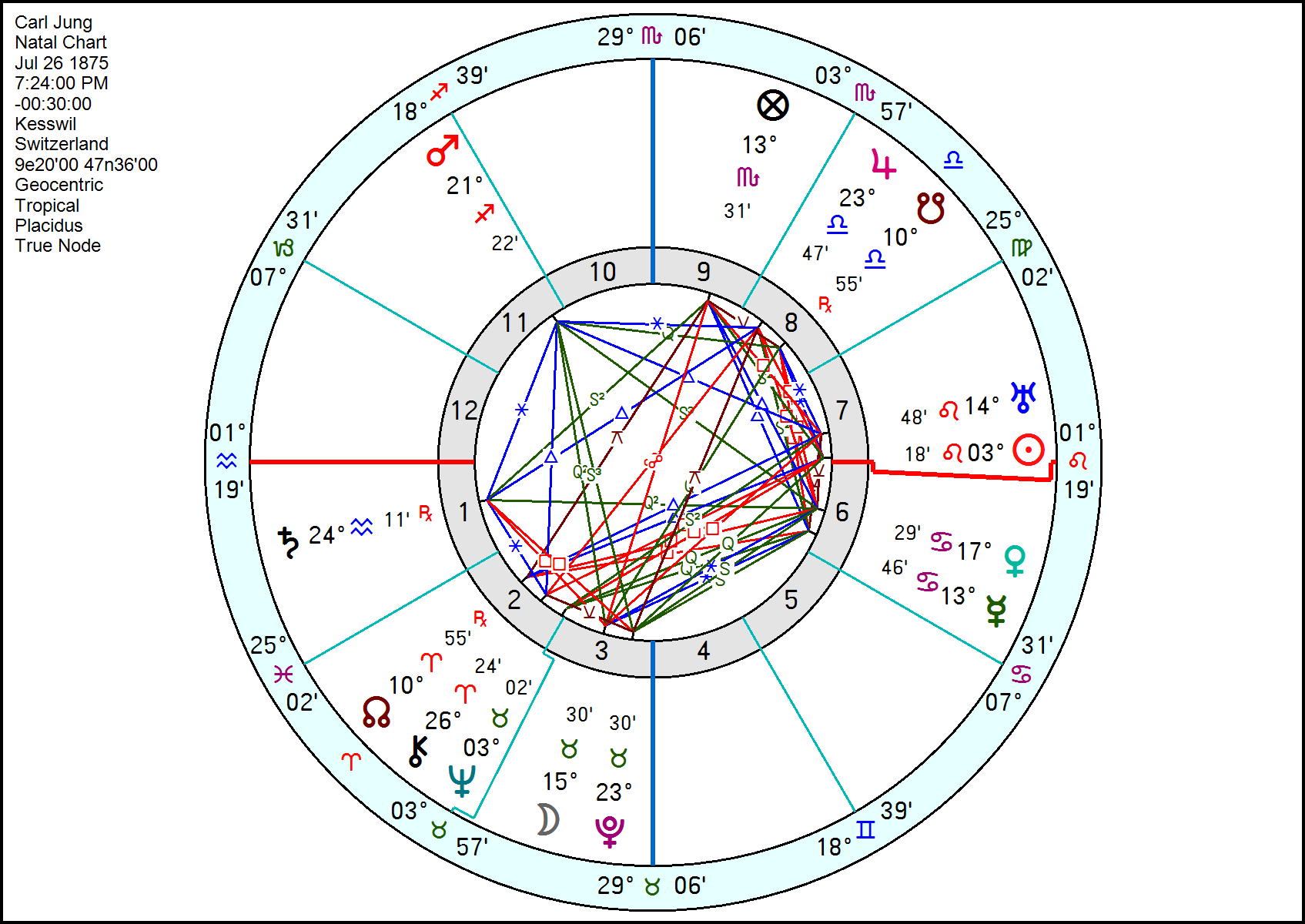
Jung–septiles and quintiles
Uranus-Neptune bi-septile
Distinguishing regular aspects, quintiles, and septiles: regular–refers to somatic functioning; quintile–refers to psychic subjectivity/psychic functioning; septile–refers to psychic truth/innate idea or the silent judgment on the functioning of the psychic subject
Mar Venus septile
Pluto Mars Venus septile (Jung as Western Tantrik)
Pluto Mercury septile
Mercury Venus Mars Pluto septile
Mercury Neptune quintile
Psychic subjectivity/quintile: our identification with psychic functions; the organization of our mind; what you feel yourself to be if you're identified with the psyche ("I am the way my mind works")
Regular aspects–organization of the body, somatic/perceptible manifestation
With quintiles we identify as a psychic being, with regular aspects we identify as a somatic being, with septiles we don't normally identify
Mars Moon quintile
Venus Saturn quintile
Jung as perfect example of his own statement–"All our philosophy is but a mouthing of the archetypes"
Can't apply this statement to Eckhart, St. John, etc., because they are not identified with the psychical essences constituting their organism even though they can use that organism to express themselves
Sun Pluto quintile
VM suggests writing up this delineation of Jung's horoscope as a service to the Jungian movement and AD agrees
Discussion of Jung's regular trans-Saturnian aspects–Saturn square Pluto, Moon square Uranus, Sun square Neptune
Square–what is it?
Square as a physiological guarantee that prevents a certain idea (delivered by a certain function) from coming in; this can be a help or a hindrance, depending on whether you want the idea to come in or not
PB quote (V9, 13:1.46) as keynote of the astrology that's being developed here: What does my life mean to me?
BOOKS READ FROM OR REFERENCED:
Marc Edmund Jones, The Astrology of Concepts
Marc Edmund Jones, The Sabian Symbols in Astrology
C.G. Jung, CW 8, The Structure and Dynamics of the Psyche, "On the Nature of the Psyche"
C.G. Jung, CW 11, Psychology and Religion: West and East, "Answer to Job"
C.G. Jung, CW 13, Alchemical Studies, "The Philosophical Tree"
C.G. Jung, Aniela Jaffe (ed.), C.G. Jung: Word and Image
C.G. Jung, Aniela Jaffe (ed.), Memories, Dreams, Reflections
C.G. Jung, Gerhard Adler (ed.), C.G. Jung Letters, Volume 1
The Secret of the Golden Flower, Richard Wilhelm (translator), C.G. Jung (commentary); also in C.G. Jung, CW 13, "Commentary on "The Secret of the Golden Flower""
Frances Sakoian, Louis S. Acker, The Minor Aspects
J. Robert Oppenheimer, Alice Kimball Smith and Charles Weiner (eds.), Robert Oppenheimer: Letters and Recollections
Paul Brunton, The Notebooks
SABIAN SYMBOLS: Taurus 4, 16, 24, Cancer 14, 18, Leo 4, 15, Sagittarius 22, Aquarius 25
CHARTS appended to this transcript:
FIGURE 1983 0822-1. Carl Jung Natal Chart (astro.com).
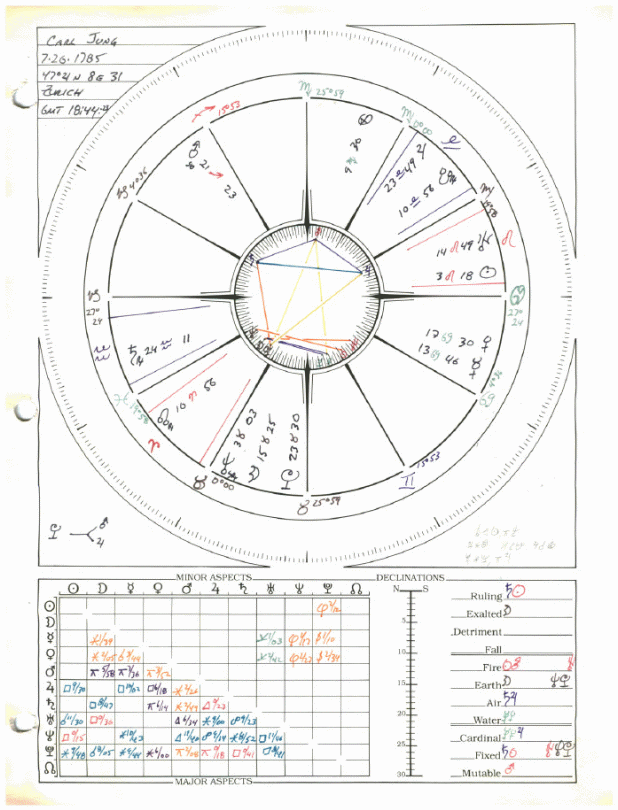
FIGURE 1983 0822-2. Carl Jung Natal Chart (WG version).
[Transcriber note: If someone is drawing or writing, with audible sounds of chalk on a blackboard, I indicate this by [drawing] or [writing].]
TRANSCRIBED Verbatim by IT prior to 2018 (V11a). This is V12a (2023) and has: typos corrected; updated prefatory matter, footer, and audio file name; Book List completed; new notes within transcript; new Jung charts; new formatting to accord with new conventions. In 2025, IT updates audio file markers to match new REP audio. Archival verbatim transcript – V12a.
AUDIO FILES: 1983 0822a, 1983 0822b. [Note 1: "Tape" and "Side" refer to original audio cassette tapes that were later digitized into .MP3 Audio Files. Note 2: Audio File 1983 0822a was originally recorded "back to front", i.e., Side 2 followed by Side 1; REP Studio fixes in 2024.]
1983 08/22 at Wisdom's Goldenrod
Astrology; Horoscope-Jung
[Audio File 1983 0822a Begins]
TS: [one/two words inaudible]
LR (simultaneously): Sort of like the [one word inaudible] Moon.
TS: [couple words inaudible] (bit of laughter) Still, we'll just leave that there. See?
[14 seconds of background student talking/laughing, shuffling about]
TS: So, we're doing these here quintiles [S simultaneously: Shouting now.] and septiles. (bit of laughter)
[short pause with background student talking, shuffling about]
LR: We were looking at in that diff-- several different people today and we thought-- it was suggested that we go through some, or the other parts that we've already thoroughly understood (bit of laughter) [TS, faint: And assimilated.] and pull out the quintiles and septiles in them. We haven't done that with any of them. So we-- we started with Jung today. [flipping pages] I know. I guess we decided not to go through Jung again. (LR laughing) [S simultaneously: Yeah, we (few words inaudible)] But I'm not sure, are we going through Jung again?
AD: Do what you want.
LR: But Anthony you know that's not true.
AD (simultaneously): No, you have-- you have to understand, it has nothing to do with how disgusted you get with doing something, it has to be done, and done over, [RG: Alright.] twenty, thirty, fifty, [LR simultaneously: We'll start with Jung tonight.] a hundred times.
RG (simultaneously): We'll start with Jung then.
AD: None of you here are Sages or geniuses.
[28½ seconds of background student talking/laughing, shuffling about]
AD: What are you, hiding?
LD: My ego's really shattered. (bit of laughter)
[24 seconds of shuffling about, background student talking/whispering, few words from AD]
LR: Carl Jung?
TS: Oh, yeah. But I could be-- it's back there somewhere. Ok.
[13¾ seconds of shuffling about, background student talking]
LR: Next-- we're just going to put it up, everyone should have to write down his chart from memory.
[11¾ seconds of shuffling about, background student talking]
TS: Ok, so septile, Dickie.
[drawing/writing]
[9½ seconds of shuffling about, background AD and student talking]
RG: Anthony, you want to--
S (very faint): Up to you.
[short pause with background student talking]
LS (faint): Why don't (we/you) do the septiles.
RG (simultaneously): Anthony, would you like the quintiles or the septiles?
AD: I like both of them.
TS: Aha.
LR: Maybe we should start with the Uranus Neptune because that seemed so basic in him.
TS: Go ahead.
LR: Anyway, Jung had a Uranus Neptune-- you'll probably remember this, we did this a few weeks ago, but Jung had a Uranus Neptune septile or--
RG (faint): First order sep-- I mean--
LR: Bi-septile.
TS (simultaneously): Bi-septile.
LR: Right. And, we found that to be, both a few weeks ago and today, kind of a bottom line of his psychology and his ideas. So, maybe if we start with that one it'll-- we're-- we'll try to see whether we could just lay the ground-plan of like-- for understanding Jung, and I think that one starts-- starts out at a good place. Uranus degree was a Mardi Gras. [Note: Leo 15, "The great American carnival, the Mardi Gras at New Orleans, is seen with a wealth of floats, decorations and merriment."] I don't know if you have to read the whole symbol. Raise your hand if-- if you want to hear the whole symbol, otherwise I'll just give you the [AB(?) simultaneously: Keyword.] catch phrases. Uranus was the Mardi Gras and Neptune was the rainbow's pot of gold. [Note: Taurus 4, "The rainbow's pot of gold is revealed in the midst of a shower of sparkling and flashing colors."] And what we're trying to see in the septile is the way in which the two ideas that the planets sit on can be fused to form the presuppositional basis of one's view of the truth. In other words, whatever those septiles are will be the fixed ideas one has about what's real and what's true. And, with Uranus and Neptune-- Uranus deals with the reason-principles in the-- in the actual embodied place. So we said that he-- Uranus is an intuition into the life-forms within the Dragon and Neptune was the intuition of a subtle evolution from the creative imagination to the material base, the rainbow into the pot of gold. Both of them have to do with a real manifestation within the tropes, subtle or material, and we said about the septile that-- that there would be a leap [slight pause] or-- What we said was that this-- this septile would be the limiting factor for his philosophy, that because of the septile, the degrees that it's on, you know, couldn't-- couldn't see reality as being anything but what was manifest, what was actually brought out into the living flesh. And, there were-- that was a prevalent idea at the time, (there were already--) there was a Neptune Uranus big septile in the sky and there seemed to be a great concern with the actual meaning of the vital per se, not abstractly but actually embodied. And also, because it's a septile not dealing with Chaldeans-- not only because it's a septile would it seem like his belief in a truth, but also because it's Uranus and Neptune which don't seem to be coming from his own psyche, say to him an embodying field of know-- knowledge within his psyche. Can we remember more? I'm not being very clear but--
AD: Yeah, you're still incoherent.
LR: I know, I know.
RG (simultaneously): Also-- well I guess if you take Uranus as the higher knower in us and Neptune as the higher feeling principle, and you put those two degrees together on a-- a vision of reality, it's almost like you get his higher knower couldn't-- had to experience itself in terms of the material basis of the archetypes and instincts. And that--
LR: So the view of the mystical life and the-- and the life of knowledge are painted in that as well, there's--
RG: Right, right. Right.
LR: That that would be--
TS: Basic presupposition, etc. In other words, he got Uranus as some intuition into the ideas/archetypes, the reason-principles of matter. Neptune is a-- is a constant valuing of the tangible or a physical manifestation of subtle things, so-- you know, the Jones interpretation. And you say that a septile is-- brings two functions together to provide--
AD: Two ideas together.
TS: Two ideas together as a fixed idea or a fixed presupposition that the person works with. So he has these two-- two trans-Saturnian planets on ideas both of which have to do with the embodiment or some kind of physical-- as one having to do with the intuiting the archetypes as in matter and the Neptune as being more a valuing of the-- of the manifest-- the tangible results than of the subtle process behind the tangible result.
AH: You would-- you would include Jung's notion of psyche, the reality of psyche, under manifestation.
TS: Yeah.
S: Oh yeah.
TS: Yeah, I mean he had a real intuition into the archetypes of matter. I mean we're not saying he had an intuition into something, ok, but because that-- you know, two-thirds anyway, if you take Uranus and Neptune and Pluto with something-- I mean we're not totally settled on what we understand it to mean but part of what we have seen them to mean is they have something to do with the-- the higher willing, or the willing, knowing, and feeling consciousness as it infuses the psyche. And if his values and his-- and understanding are both oriented towards a kind of materialism, and that's a basic fixed idea he's going to work with, it's going to be not likely for him to be inclined to look outside of that framework to-- for philosophic answers or for some kind of definition of reality for himself.
RG: Right, and when he says I mean philosophy is nothing but an elaboration of the archetypes-- (what did he say?)
TS (simultaneously): That was his point, yeah.
RG: That point of view, he really means it, I mean the higher knower can't be known apart from that.
LR: But it wouldn't even be a question whether it could or not, it would be-- because if it's a [RG simultaneously: Right.] septile it would be--
RG: It's a-- [TS simultaneously: Presupposed.] it's given. Any philosophical-- [LR simultaneously: That's a given idea.] any philosophical elaboration is of the basic archetypes.
LR: And, we-- from doing some of this, we kind of formulated the septiles to be objective in the sense that they're dealing with ideas, they don't seem to be taken to be subjective.
VM: Yeah, he couldn't see that as his psychology.
RG: Right.
LR: That was-- "These are the ideas, this is reality." Then when we looked at the quintiles, we thought that the quintiles were purely subjective. It didn't relate to an objective reality but the quintiles were seen to be the way funct-- the way two functions related in the individual to give him his certain stance or style, and he would very much take that to be "I am this kind of person." Equally presuppositional but now related to this psychic subject instead of reality. Whereas the twelve regular aspects have to do with a subject related to an object. When you describe the aspects in your natal chart which aren't quintiles and septiles, you usually speak about a process of living your life. You know, "Whenever I try to do this, I get this," but it's-- it's more like a threefold relationship or the subject-object mode, whereas the quintiles seem to be describing purely the psychic subject, and the septiles objective i-- ideal truths or something like that. Which goes along with putting the septiles on the idea of the-- on the level of the fixed stars the way we put-- make that analogy, and the quintiles on the level of spheres or rational, and then the twelve regular on the level of the sublunar.
AH: Linda, could you-- could you try to explain a little more about the distinction you've made between subject and object in regards to septile?
LR: Ok well I think we'll try to see it in these examples but--
RG (simultaneously): [couple words inaudible] let me try. Insofar that the septile is a vision of reality, the real is taken as objective, as independent of your knowing let's say, and in that sense it's objective. This is-- this is your truth. In that sense it's objective.
AH: Ok.
RG: In the quintiles, the process of the quintile is much more related to the two psychic functions that are-- that are related in aspect and therefore there is a definite-- the question of what's objectively real doesn't even enter because it's the process of the subject inco-- unfolding himself through those two psychic functions that's important for him. So the emphasis here is on the su-- the psyche as subject.
TS: (Trying--) yeah, or-- It's like the way in which the person-- we were-- we saw for example-- just a broad gloss would be, if you looked at Verdi and Wagner: Wagner's got lots of quintiles, Verdi doesn't. Ok, now we saw it-- began to be cl-- a little clearer that with the quintiles, you have some subjective image or experiencing of yourself or conscious of yourself as having a certain quality, a trait or pattern of behavior, which is partly unique to yourself and not entirely manifest to others.
AH: I'm a little-- I'm really confused, you-- you're speaking of subject and object in this regard not in the epistemological sense because certainly the subject who experiences qualities of his-- of his particular individual psyche, he's experiencing objective things about himself. Is that so?
RG: We're talking about a person's experience, not necessarily the objectivity of the fact that his psych-- psyche is objective, yes. We're talking about the felt experience of the-- of the person. In a sep-- We're talking about this-- [TS simultaneously: Look at all its (one word inaudible)] the psyche in all the aspects, and they're different aspects of the ego. Now in a septile the attention is directed objectively it seems, and in a quintile it's directed subjectively. It has nothing to do-- they're both objective phenomena from the [TS simultaneously: (Because--)] point of view of-- of what's prior to it.
AH: I see, so subject here is like reference to one's own individual (ego), [RG simultaneously: Psychology.] psychology.
RG: Not to Self, not pure-- not--
AH: And object is something other than that.
RG: Right.
AH (faint): Ok. Thank you.
RG(?): (Welcome.)
JA (simultaneously): You know, I still don't understand why you're saying the attention is a pure object. Because you've been speaking about the septiles as presuppositions. I could see them-- I mean if you're going to continue with what you've been saying about them, I could see you saying they-- they almost have the character of ontological presuppositions. But I don't know what you mean when you say that a septile means that the attention is directed to objective reality.
LR (simultaneously): Our [one word inaudible] that's right, it's--
AD: Maybe this way. Psychic subjectivity refers to the quintile.
JA: Yeah.
AD: The judgment on that functioning refers to the septile.
JA: Well, that's another mysterious phrase. (JA laughs a bit)
AD: What?
JA: Judgment on that functioning [one/two words inaudible]
AD: What's mysterious about it? [JA: Well--] It's good English. (laughter)
JA/LR(?) (faint): Alright, never mind.
AD: Uh, [JA: Say more.] the-- [S, faint: Yeah.] the view that you have about the psychic-- your own psychic subjectivity is a revelation of the septiles.
RG: Right. And therefore it's not taken subjectively, it's taken [JA simultaneously: I can't hear you.] as obje-- it's taken as objective. That's what I mean by the attention. That there's no question of your own psychological subjectivity revealing the septile or coloring the septile.
S: Right.
RG: You take that septile as real, even though it's a psychic function.
JA: What do you mean, you take the septile as real? I mean-- and it's a funny kind of--
RG (simultaneously): [few words inaudible]
AD: Well, that's why I'm restricting the language. All of this is taking place in the psyche, alright.
JA: Yeah.
AD: None of-- we're still in the natal chart, we haven't left it, and we're trying to understand the relationships in the natal chart. And the easiest way to formulate it would be the way we just said. Your psychic subjectivity refers to the quintiles. The judgment that you pass, the reality by which-- the view of reality which is operative in your psyche would be the septiles. That would be the simplest way to put it. Because, regardless of whether you're introspectively aware of it or not, there is always a silent judgment being made upon the way you psychically function.
AH: We're speaking of the psychological subject?
S: [one/two words inaudible]
AD (simultaneously): We're always within the psyche, and with Jung that would certainly be appropriate.
S (very faint): Yeah.
AH: I'm asking, generally in terms of our terms, we're res-- we make this distinction between quintile and septile in regards to subject and object, we're restraining--
AD: Well I'm leaving out those terms, Andrew, so that it's easier to look at it this way. Subject and object is going to be used again when you get to the regular aspects, alright, and you have the ego confronting the world, you're going to have subject and object again, and you're going to get confused. So, if you-- if you look at it this way, septiles are relating to the view of reality which is an innate idea operative within your psy-- within the psychic subjectivity that you function with. One sentence.
AH: Well that one sentence doesn't help me, I mean I--
AD: Well of course not.
RG: Alright, Andrew, they're all the--
AD (simultaneously): That's a page worth.
RG: They're all within the ego, all these aspects, we're talking [AH simultaneously: See--] about the natal chart. Everything is within the ego. When we use the word "subject", it's an apparent subject relating to an apparent object, has nothing to do with the real subject behind or witnessing the ego, ok? We're talking about the experiencer in these aspects.
AH: And that was the question, is this the psychological subject that we're speaking of?
S (very faint): Yeah.
RG: Yes.
[student(s) assenting, very faint]
AD: Go ahead Louis.
LDS: You know, a further qualification maybe that would help is, can you think of the septile as some kind of contact, something static, as opposed to the quintile which would have something about a function and a process about it, [RG: Yes.] to further qualify the two-- the distinction between the two.
AD: But hasn't that all been said when you say that the view of reality which is operative within the psyche is a static representation [LDS simultaneously: Yeah.] of your inni-- innate ideas. [LDS: Yeah, I--] Your psychic sub-- subjectivity is a functioning and therefore is not in stasis but always in motion.
LDS: Yeah.
AD: Good.
RG: Right. And I think it'll also come out that the septiles deal more with the degrees as such [LDS: Ok.] and-- and the quintiles deal more with the s-- with the planets. I think-- I think Jean brought that out a couple of weeks ago. [S, faint: Right.] That in the-- in their proper places, because the septile is imaging idea, [LDS: Right.] it relates to the degree symbols; in that the quintile is imaging the psyche per se, it's related to the planetary function.
LDS (faint): That's helpful.
AD: Now that means you've got to be able to locate in your own chart and understand how a quintile is operating or how a septile is operating, otherwise you're wasting your time here. Go to Sweden. (some laughter) You've got to actually see this in your chart and you can. [short pause] I see it every time I talk to you. I'm confronted with it. You take people that have five or six or seven septiles, I can't overcome their fixed ideas. (laughter, student words) Let's try, let's try.
LR: Ok, so--
S (simultaneously): Start over from--
LR: Can people ask questions about the Uranus Neptune, is that at all clear what we were trying to say about the Uranus Neptune septile(s) in Jung?
[short pause]
S (faint whisper): Maybe not.
LR (faint): Maybe (not).
RG: Well I guess so. Let's go on then.
LR: Was it clear? Did we get that one out?
AD: That everything is a manifestation of the archetypes [LR simultaneously: That the reality is--] was certified by his feelings.
RG: Uh-hm, yeah.
LR: What was that, supply?
AD: That everything is a manifestation of the archetypes [RG: It's certified.] is certified by his feelings, his feeling conviction.
RG: Uh-hm.
[short pause]
AD: If you see that, you can crack the chart. From there on you can see all the way down to the bottom.
RG: Now it seems the fact of two trans-Saturnians in septile are very important because they're two of the higher ma-- the higher functioning in the chart, in that natal chart, and they--
AD: Yeah, especially if we take the view, alright, that the Chaldean planets represent the instinctual field, the psychosomatic organism, the ins-- the instincts organized as a functioning unity, as one unity, alright. And then you think of the trans-Saturnian with-- the trans-Saturnians will be the willing, feeling, and knowing which is operative in that field. [short pause] [student assents] The thing should be a snap. [11 second pause with background student whispering] Well come on, let's go.
TS: Ok. Let's do the one before that, the Venus Mars, is that right?
LR: Mars Venus.
TS (faint): Mars Venus in other words.
LR (simultaneously): Yeah. That would be in (little bits).
TS (very faint): Yeah.
LR: See what we have is Uranus Neptune there, Mars to Venus, then we have Mars Venus and Mercury with the Pluto.
S (faint): How wide?
RG: Three.
LR: We're going to three.
[flipping of pages]
S (very faint): Ok.
VM: Skip it.
S (faint): Ok.
TS: The only reason we went to three in this particular case here is the planets-- there's this Mars Venus is one degree and Mercury Pluto is two degrees and then these-- the Mars Venus come in behind the Pluto and it seems pretty clear that that Pluto is quite dominant, predominant.
VM: So you want to include those, yeah.
TS: Yeah, (uh-hm), and we're in a-- settled on an orb that in this case [VM assents] it certainly seemed to be clear.
AD: Let me make one more remark, you remember the one we made, which I can't figure out yet, that was something to the effect that if we keep our premises, you remember, which was something to the effect that to each individual mind the World-Idea is simultaneously pre-- I mean, the World-Idea is simultaneously presented to each individual mind. Now, if-- if we just pluralize the World-Idea, instead of thinking of it as one Ideas think of it as 360 Ideas, ok. This is what's given to the individual mind, alright, and the individual mind, so to speak, fabricates out of that totality not only a vehicle through which it becomes operative, you know, the psychosomatic organism, alright, but also must supply itself with a view as to the reality of that psychic functioning, alright, and the transposition of that psychic functioning, in other words, that psychic subjectivity that could translate those ideas into the everyday practical view. But, the important thing is this remark which I still haven't caught the full import. If the World-Idea, or World-Ideas, is given to each individual mind, alright, then the 360 Ideas represents the World-Idea which is being given to an individual mind. And it seems that the functioning or the individual mind selects out of that material for its own vehicle, to make its own vehicle, but in the very process of doing that, the world gets created simultaneously. [students assent] So, we are in the realm of ideas all the time, we never leave the realm of ideas. Our life is nothing but a working out of these ideas, whether for the better or the worse, alright. So keep that idea in mind. And you won't have no trouble with the psychosomatic organism as some sort of physical thing. That too is one of the ideas, that too is a thought in the mind. Let's try the first one, huh?
LR: The Mars Venus. Mars. Who remembers the Chinese laundry with its shutters closed and operating as itself? [Note: Sagittarius 22, "A perfect bit of the old world is found in the new; a Chinese laun-dry has its shutters up and is now itself."] And Venus is the bustle of the barnyard, chickens happily clucking. [Note: Cancer 18, "On all sides is the bustle of the barnyard, and in its old-fashioned and natural life a hen clucks among her chicks."] [short pause] Now we want to take those two ideas and combine them in such a way that they form one belief as a presupposition of everything that he'll know. So--
AD: No, Linda.
LR: You don't want to do that.
AD: I don't want to form one belief.
LR: (You/We) want to fuse those ideas to see his-- a view of reality that he had?
AD: We're working with the quintile?
LR: No, septile.
AD: Septile, ok, I'm sorry. I'm sorry.
S: I thought you were going to--
LR: Did you want to do a quintile?
TS (simultaneously): Oh, we're doing-- moving on to the Mars Moon quintile.
RG: Right.
LR: Did you want to do the quintile now?
AD: Whatever you want to do. I mean I have no preference. I thought you-- I thought you were going to do the [S simultaneously: Right.] quintiles but-- Do the septiles, fine.
S (faint, possibly part of background): [couple words inaudible]
LR (very faint, possibly part of background): [few words inaudible]
AD: Do the septiles, Linda, and then we'll do the quintiles, go ahead.
S (very faint): Yeah.
LR: Ok, well actually, the way we had seen it was we did the Mars Venus and then saw how the quintile gets-- elaborated [RG assents] that so (I'm moving) [couple words inaudible] So with that septile of Mars and Venus--
VM: Can you give me a little foot up on the Chinese laundry degree, I just can't remember how that--
TS: Um--
Marc Edmund Jones [The Sabian Symbols in Astrology, Sagittarius 22, TS reading]: "…self-refinement through [the] unsuspected…activities of the community… A richness of [TS reads: in] living comes from a concentration on goals with remote reward… Here is imaginative self-sustainment through unremitting hard labor."
S (faint): (Uh-huh.)
TS: That he-- if you say Mars is the will of the individual, the lower will, the kama rup-- form of the ka-- the desire that he has is always to pursue these-- the long-range goals of his life and maintain a certain self-contained perspective in which he's going to accomplish that. And he's going to keep to himself. He's not going to go out and take in any information, other ideas that are outside of himself.
VM (simultaneously): Right, right, he was his own school in that sense.
TS: Yeah, [S simultaneously, very faint: I see.] and he--
VM: That was his strength and his [student assents] [couple/few words inaudible]
TS: Yeah, in this-- in itself it's, you know, it's just a-- to get done what he had to do, he had to focus and he's-- was able [VM assents] to pursue that [couple words inaudible] even though some things took him quite a number of years to work out. His will was so formed that he could do that. And the Venus degree is the barnyard, the hens-- hens scratching around and there's a sense of the anima and the feeling, the evaluative function, valuing the regulative power of Nature or the instincts. Again a certain sense that-- that the normalcy of life, the nor-- everyday mundane instinctual habits and even the processes sort of coming up out of the unconscious had a certain normalcy to them and there was some, you know-- provided an order by-- by finding himself-- oneself (through) them. So he-- seemed like one thing we at least-- we said before about the Mars Venus was that you say that Mars is the divisible aspect, the power of the soul which allows it to be-- become divisible about bodies, and Venus is binding you to the instincts, that there's a sense of subject or the-- the subject, the-- the will power or the attention of the subject being rooted in a-- an awareness of the normals-- normalizing strengths of the instincts, that because you take yourself to be a separate individual, you gain strength by grounding yourself in the physical world, and by grounding yourself in the physical world, you maintain a capacity to see yourself as a unique individual and not part of-- participating in [few words inaudible]
LR: [couple words inaudible] Well the words (aren't-- but) basic idea.
TS: The same idea?
LR: That the psychological subject or the divi-- the subject which is divisible which is an ego say, is-- is the normal state of man.
S: Yeah.
LR: His instinctual being is what makes him unique, what makes him a separative ego [one/two words inaudible] that those two ideas are harmonious and coincident, fused. There isn't those two parts of the being as separate (now). [short pause] You know, whereas as if they were maybe to square or something or some other aspect, they would be seen as taken to be very different. Now here they're very harmonious.
RG: I think-- I don't get it from a trine.
S: From the degree I--
RG: Trying to get the difference, I don't-- [LR simultaneously: From a trine?] from a trine, the way you're describing it.
LR: I mean that [S simultaneously: But--] was being revealed to him in life is what we're talking about, (in/through) circumstances of his life, the Mars and Venus, [RG: Yeah.] the-- What would he be doing with the Mars Venus? I don't think he would take that to be reality necessarily, that he would be living out a certain--
S (faint): [one/two words inaudible] expressed.
S (faint): Yeah.
LR: His life would take that form, but I think with the-- [S, faint: Yeah.] with the s-- the septile-- You know, the other way we said it was if one came into contact with his own kind of set of traditional beliefs, he would be in contact with the instinct. He would be in contact with that Venus. He would be arriving at the basic state of himself, you know, stay to a level of himself. That's not clear?
AH: No, because it seems to make the-- the notion of instinct so specifically individual in their expression.
LR: That's right, 'cause it's [S simultaneously: But that's the point.] sex-- it's septile the Mars, that's exactly the point.
AH: Oh that's the point you want.
LR: Yeah.
AH: Ok.
RG: Wouldn't you say the view here is through the-- the individuation process is itself an instinct or-- [student assents] Will you put it like that?
LR: Well--
RG: Like the drive for interiorization is-- is a-- is-- is an instinct.
[students assent, very faint]
LR: Or is a normal process that anyone takes.
RG (simultaneously): Yeah, is the natura-- is really the process of Nature.
TS: Yeah, yeah. And I think-- I think of that Mars as an extreme focus on individuality, [student assents] separateness, like this is-- this psyche is absolutely distinct and distinguishable from that psyche and-- I mean it would seem as a-- that if you really were going to be able to differentiate the uniqueness of one person's psychology from another, to be able to link that to the common element in all psyches which is based on the instincts would give that a special strength and power, you know, that you would-- by being able to hold those two things together there would be a certain depth to his perception of the indi-- the psychic individuality of people, you know, be his doctrine, his idea. So that then you got in-- that to become more uniquely an in-- an individual psyche would be the goal that one should achieve and that was-- to focus on the developing or heightening that individuality was almost all that he could do.
LR: In fact, if [S simultaneously: Yeah.] you-- yeah, if you take that same instinct, it would be like man is always searching for his own [S, faint: Yeah.] unique nature and so his theory about, you know, people are always creating mandalas, they're always seeking their-- that individuation process is always sought as kind of a automatic way of operating, not something which has to-- you know, he would see everybody is doing that whether they were consciously seeking themselves or not, with that.
AH: That's really con-- I'm a little confused.
VM/S(?) (very faint): Go ahead Andy.
AH: You say the archetypes are for everyone in Jung's-- Jung-- Jung's view, it's like a universal collective sort of thing, and their individual expression is the individuation process (itself). I mean is that what we're saying?
LR: They're [one/two words inaudible]
AD (simultaneously): No, what they're-- what they're [S simultaneously: No.] saying is the Mars and Venus is that the desire for earthly life is viewed beneficently.
AH: Oh.
S: Uh-hm.
AD: That's the septile. [11 second pause, student assents] Now the fun begins when you get Pluto into that. 'Cause that's septile too, right?
TS: Yeah.
S (simultaneously): Yeah.
TS: Come on let's do the Pluto.
LR: So now we have Mars Pluto, Venus Pluto, and Mercury Pluto in this.
TS: Yeah, Mercury gets thrown in as well.
RG: And, if you don't remember the Pluto degree, I found it.
S (very faint): It's the Indian scout.
AD: Indian scout.
RG: Yeah--
Marc Edmund Jones [The Astrology of Concepts, Taurus 24, RG reading]: "A mounted Indian brave rides proudly with human scalps as trophies at his belt."
[short pause]
AD: And we try to-- we try to recall the fact that the shamanistic technique was that the victory over the enemy wasn't so much a physical victory but it was also the assimilation of the power that belonged to his enemy, alright. That's much more important, that means he not only conquered you physically but he's taken over your spiritual power.
VM: Yes, in fact, just to support that a little bit, the Indians would think much more of [JL: Counting coup.] taking coup or counting coup, which doesn't mean you kill the guy at all. You just show your sort of superiority by maybe just striking him in an obvious way when he's down or something like this. It wasn't that you had to-- you had to necessarily kill [JL simultaneously: No.] but overcome him, something like that.
AD: And that's a-- that's a very ancient technique the shamans use to-- to gain ecstatic power. In other words, the same way like when you overcome one of your tendencies, we pointed out this afternoon, right?
VM: The energies.
AD: When you overcome any habit, alright, you assimilate the power that it's in-- inherent in a habit and you discard the habit itself. And that-- that increases your power. In other words, if you deprive a vasana of the inherent power with which it functions, alright, assimilate that power into your own being and discard the vasana, alright, that's the Indian brave riding with scalps on his-- ok. That's what that-- and that's a degree of power.
S: You--
AD: Now you make a septile to the Mars and Venus and you're going to see a tremendous influx of vitality and-- vitality and-- what should we say? Well, a tremendous influx of vitality into the Venus Mars. They're going to be enhanced.
TS: Right, so he was empowered, you're saying [AD simultaneously: Yeah.] that the power that ordinarily belongs to a-- a-- the unembodied non-psychic parts of the individ-- the non-psychic individual is here claimed for the psychic in this psych-- psychic subjectivity.
AD (simultaneously): Well Tim, very simply put I would say if you took that Pluto out, let's say that Pluto wasn't there, you would have-- you would still have that septile operative, but-- but it would not-- it would not have none of that domineering, you know, power over the personality.
LR: You would assume that-- that the instincts which are represented by Mars Venus and Mercury have access-- access a certain amount of power. The instinctual nature, the will or the driving force of Mars, the desire nature, he-- and Mercury, the formulative power, or function rather, because of those septiles to Pluto, he would assume that those functions were steeped in this kind of power that Pluto had and he would assume that of everybody's instincts in that(--/,) that would be a real belief, that would be a belief in the real, right, that-- You know, if you explore to the bottom-- deep enough into the instinctual nature, into the thinking nature, into any of those things, the chief toned instincts, you would come up-- you would access that spiritual power. And that was-- that was a belief in his system, wasn't it, I mean his whole system was based on that, so--
AH (simultaneously): Trans-- transmutation of instincts, a channelization of them.
TS: The libido, yeah. And--
RG: But I thought-- and I think it also gave him the opposite view, that the higher will was rooted in the instincts and not separate from-- from it.
[students assent, very faint]
TS: Well, here by instincts too we're meaning that the individual's intuitive or formulative function, his anima and shadow. [RG assents] And you got the trickster, the anima, and the shadow, and you got power coming through all three of those, [RG assents] you know-- And he certainly was capable of a tremendous amount of expression of power [possibly one word inaudible] through his relationships or through his working with the shadow or the trickster and that-- I was looking at the-- that book in the car, Jung and His Images, you know, mostly his dealing with the trickster and so forth. [Note: TS possibly referring to C.G. Jung: Word and Image by C.G. Jung, Aniela Jaffe (ed.).] It seems to me that, you know, the force with which he was able to confront and transform his own psychology came out of that. The idea that you should be able to do that(,) just (had/have) all this power and, you know, reformulate [LR simultaneously: With the will.] parts of yourself, yeah, with the will, you know, and not everybody's capable of doing that. And also he expli-- expressed and revealed himself as a man who-- that had a lot of power in his-- his thinking and his feelings and his will.
LR: Is that making sense?
[students assent, very faint]
S (faint): [few words inaudible]
VM: Discussion is so lucid.
LR: So lucid that you have nothing else [VM simultaneously: No need, that's right.] to say. Well, there's two quintiles that come out of these septiles that we saw as expressing somehow the-- these [couple/three words inaudible]
TS (simultaneously): Lucidity upon lucidity. (TS laughs a bit)
VM (faint): [one/two words inaudible]
AD: I mean, you can't see that?
VM: Yeah.
AD: You can't see that-- those three together, operating together? C'mon, speak up.
AH: Maybe you could summarize again what those three together. Terse summary.
AD: The Mars we said represented the desire for earthly life, alright, and insofar that it septiles the Venus, it is looked upon in a beneficent way. The Pluto energizes or makes much more powerful that septile.
AH: Anthony, it-- the notion of looking upon physical life beneficently, is that like because of the Pluto he was able to see-- see a way of trans-- transformation of this?
AD (simultaneously): No, no. No, we have to restrict ourselves to the ideas themselves and not-- not import from other planets what's going on. If we say-- if we said that the Mars represents the desire for earthly life, alright, and if we say that Venus represented the evaluative function in the sense that a like or dislike for it, alright, the septile here bring-- brings these two together. The desire for earthly life is looked upon as beneficent, something good, alright. The Pluto septiling both energizes them tremendously. That's all, no more, don't add.
LR: So that, to help you out--
VM (simultaneously): If I can't add can I-- can I quibble?
AD: Alright, quibble.
VM: Anthony, when you speak about the Pluto in terms of power, I can understand I think what you mean there. On the other hand, it seems that the septile, by its very nature, is the formation of root beliefs or root ideas which-- with which you view reality. And when you discuss it in terms of power, I can't see that aspect of it. Unless you're saying that he believed or he saw this power as a reality.
AD: Well, that will come in later on when he re-- you know, the recognition that the will of the Self is that higher power but I think the concentration right now has to be made on the fact of the recognition that, you know, the instincts represented a deep-rooted wisdom, alright, and that the desire to incarnate in a human life or, you know, the-- the incarnation or the desire for this earthly life is the very means by which this wisdom is going to get worked out.
VM: So we could say this is what made Ju-- made Jung sort of a Western Tantrik?
AD: Oh yes, definitely.
VM: This particular Pluto [AD simultaneously: Oh yeah.] [RG: Yeah.] septile?
RG (faint): Uh-hm, yeah.
AD: Yeah, and you-- if you remember he has the remark where he puts on one end the archetype and on the other end the instinct. Remember that--
VM: Yeah, "On the Nature [student assents] of the Psyche," right. [Note: C.G. Jung, CW 8, The Structure and Dynamics of the Psyche, "On the Nature of the Psyche".]
AD (simultaneously): Yeah. [S simultaneously: That's the (few words inaudible)] And that the instincts could reach all the way down into the very roots of matter or the [VM simultaneously: (All of) meaning, yeah.] archetypal-- all the way up to the spiritual level, alright, and that's the realm we're talking about.
[student assents, very faint]
AH: Anthony, when you say that Pluto is the power in this aspect--
AD: Yeah, the will, [AH: What--] the will of the a-- the will of your higher being.
AH: Have we said yet what has been empowered? Would you say that his life had been-- his physical life was empowered?
AD (simultaneously): No, just those two functions. You have to restrict yourself precisely to what it is septiling, alright, and it's septiling the Mars and the Venus and you have to restrict yourself to those functions. If we said that the-- if we say the Chaldean planets represents the instincts, alright, and only the instincts, and the totality of the Chaldean planets reco-- represent the organization of the psychosomatic organism, the psychic field in which willing, feeling, and knowing is operative, alright, then if we restrict-- restrict ourselves that way, we'll see that those instincts are being enhanced, empowered, [slight pause] energized.
AH: Ok.
AD: And it's the willing of that Pluto that keeps sending that influx of power into them. It's the-- it's the willing of the higher Self that's operative on those instincts.
[short pause]
(Side 1 of original cassette tape digitized as 1983 0822a Ends; Side 2 Begins)
TS: --he would face the unknown, (an interest--) and it's also at the same time a-- a sense of not-- of being able to look at one's own inability to quite grasp things. So in one sense you get a person who is capable of constantly articulating the mystery and the unknowability of certain--
VM (simultaneously): Yeah, right, he never nailed it down too hard.
TS: And yet-- and yet he gave you a certain respect for-- [VM simultaneously: Yeah, right.] for exactly the depth of what one is looking at, [student assents, faint] ok. So there's-- there's that quality. You always hit that in him--"Well, this is as much as I know, I'm just telling you as much as I understand. There's probably a lot more here than I'll ever [student assents, faint] get," ok, and he's always taking that point of view.
LR (simultaneously): It's part of his psychological agnosticism?
VM: Yeah.
LR: That there would always be something unknown that the-- the thinking would not be able to--
VM: Reveal, sure.
LR: Reveal.
VM: Good.
LR: Ok, now let's blend it with this same Pluto.
VM (faint): Ok.
TS: At the same point, so--
LR: There's something in the unknownness per se which-- which elicits power. There's something in the quality of the-- You know his whole thing about how if you-- if you make the-- if you make the inferior function conscious or you don't use it in the proper way, when-- when you take somebody's mind and make it-- like a psychotic, the kind of quality that an unbalanced person has, that when you bring it too much to the light they lose the power, they become weak, that there's a certain amount of power that resides in that quality of unknownness, [TS, faint: Yeah, it goes back.] he-- you know, the unconscious.
TS: You know, I think I just saw this thing, that that Mercury-- [Note: Cancer 14, "A very old man, whose feebleness adds strangely to his dignity, stands alone facing a vast dark space to the northeast."] with the Mercury together, the Mercury Pluto Mars Venus, you say that that Venus Mars Pluto is what made Jung a Western Tantrik, there's a kind of a-- an evolution of some-- an intuition or a-- an inherent understanding of Tantra from within the Western tradition. The other thing that's sort of always curious about him is that the really deep roots of his own experience and the point of view from which he's really coming he never quite reveals in his writings, you know, his--
LR (simultaneously): He doesn't know.
TS: What? Well [LR simultaneously, faint: He doesn't know.] either he-- I don't know whether he doesn't know but he-- like he always slightly puts, you know, like if he's interested in astrology or alchemy or some of these things, in his writings he always wants to put on the mask of the empirical psychologist, and he never quite-- you know, you always have the feeling that no matter how much of Jung you read in his [VM simultaneously: It is so clean (one word inaudible)] books or-- there's un-- experiences or understandings that he's never going to let you know where he got them from, where he-- he's not really going to fully let it out. And I was wondering if that might be inherent in this thing here, this-- the-- as Linda was saying, that recognition or built into the idea of that Tantric power was a sense that you had to keep it somewhat secret. That he gained or maintained his power by never fully exposing his perspective.
[students assent, very faint]
VM: I-- in that degree, you know, when I think about it, I don't get the sense that one is cautioned or is one forced to keep it secret. It's inherently secret.
LR (simultaneously): No, because (it/he) says dark, exactly.
VM: It's inherently secret but it's not like he has to make [LR simultaneously: It's a mysterious darkness, it'll always--] an effort at keeping [few words inaudible] yeah.
JA: I-- I disagree, I think it was intellectual coyness.
[student assents]
LR (simultaneously): The thing Tim's talking about.
JA: Yeah.
TS: Well, I think it-- ok.
LR (simultaneously): I'm not sure that's the septile, I know what you're talking about, I'm not sure that's the septile.
JA: I think what-- the quality [few inaudible LR words simultaneous with JA] that Tim was talking about, it may not be connected to this but, the quality that Tim was talking about.
LR: Is [couple words inaudible]
JA (very faint): Yeah.
TS: Well I was thinking of it as being this-- that you take Mercury as the communicator or the-- from where he writes, you know, and he's never quite seems to reveal exactly in his-- his sources in a sense, or the truth of it.
JA (simultaneously): No, you know, as the trickster you're on pose.
TS: What?
JA: That's a trickster pose.
TS: Yeah. And that there's a certain maintenance of power from being able to do that, because [JA simultaneously: Yeah.] you never really-- he could never be really thoroughly [few words inaudible]
JA (simultaneously): But it's not honestly acquired.
TS: What?
JA: It's not honestly acquired, you know.
TS: Well, either way, I mean I don't-- he just had a disinclination [JA: Yeah.] to really expose his own private track in his writings, you know. I'm not trying to do-- I'm trying to s-- [VM simultaneously: We like to see why.] not judge him one way or the other, [student assents, faint] (you know/yeah), because he did obviously make a lot of material accessible to psychologists that if he had come out with a more alchemical or symbolic treatment of it or as [VM simultaneously: (Gave them some insight.)] astrological and so forth, they would have trashed him right away. [VM assents] So, you know, I'm not saying-- I'm just trying to get, what if you take these four planets together, what do you get?
S: Well Pluto in the third house would be that-- Pluto in the third house will go underground anyhow, it will not let you in on all it's--
TS: On what it's doing.
S (simultaneously): On what it's-- yeah, what it's doing.
LR: Why?
S: Just because it's in the third house. I don't know why, but I know it's fact. I mean I've [RG simultaneously: Me too.] seen it.
LR: You've seen it. We have that quote by Jung where he says, "One does not become enlightened by imagining figures of light but by [student assents] making the darkness conscious." [Note: See C.G. Jung, CW 13, Alchemical Studies, "The Philosophical Tree," paragraph 335, pp. 265-266.] And somehow that [student assents] idea-- I-- I attach that idea to that Mercury Pluto septile. By constantly facing the darkness and bringing it into some kind of formulation and-- and the Mercury is al-- equally aware of facing that power.
[student assents, faint]
AH: You know, it's so that Jung was writing for academic communities and his public face, you know, so you say well he was guarded about what he said. But even in more private writings, like the letters he wrote, the quality that Tim described is still there, there's a certain hidden secretive kind of feeling you get that he's not telling you all that he's touched in his own [TS: Yeah.] psyche.
S: All--
TS (simultaneously): That's what I was thinking of is you-- [AH simultaneously: Yeah.] even when you read you think, "Well, now I'll read his letters and I'll really get those ideas or thoughts in a clear way that from which he then he's building his material." You read the letters and its-- he's still holding back, you know, and then even Memories, Dreams, and Reflections, he wouldn't let it be published till he was dead (and/but) at the time-- [Note: C.G. Jung, Aniela Jaffe (ed.), Memories, Dreams, Reflections.]
AH (simultaneously): Yeah, I was wondering if it wasn't-- if it-- if it couldn't be in part attributed to the fact that for him, his personal life, his own psyche or unconscious would constantly unfold. And then we-- you get the impression that he's always on the edge of something that was not fully known by him yet. There's like a deepening all the time in terms [student assents] of contents that were coming in.
TS: Yeah, that would be part of it.
LR: Also, you know what else we said about the septile? The i-- his idea that the weakest link in oneself is the transcendent rea-- is where-- [S simultaneously, faint: Transcendent function.] yeah, the transcendent function. Because of the Mercury symbol being that-- the feebleness attached to that--
AH (simultaneously): Is the what? That-- I didn't--
LR: The Mercury symbol is a man whose feebleness adds strangely to his dignity. Wait. And I'm trying to combine that with the power of Pluto, the transcendent power of Pluto, that, you know, he did have this belief that it is the most sensitive or weak part of yourself that would be that fourth, the transcendent function. [student assents, faint] And I wondered if that would come from a combination of those two degrees as well. What do you think?
S: How about--
PD: But couldn't you say that's the communicating mind that functions that way, so whether he understood the light or understood Tantra is beside the point. His literary style in writing was operating with that, that when he writes the ideas down, it always has that numinosity of-- of power impinging on his ideas. [TS: Yeah.] And that's his literary style, that's the Mercury getting empowered by Pluto.
S: Right.
AD/S(?): Uh-hm.
TS: Yeah, right, so--
LR (simultaneously): But, well-- [S simultaneously: Uh-hm.] that it would be-- it wouldn't-- well-- I'm not saying it right.
AH: That it's like--
LR: The actual process of writing would not be the Mercury Pluto. I wouldn't want to call that a septile. But what you're saying is, if you were expressing the Mercury the power of the Pluto would be behind it and I could-- I would agree with that, I just wouldn't call the Mercury Pluto septile his--
VM: Quintile do you mean or septile? It's quintile.
LR (simultaneously): What am I saying?
VM: You're saying septile.
TS: It is septile.
LR (simultaneously): That's [S simultaneously: It is septile.] what it is, it's a septile.
S: I thought they were bi-quintile.
LR: No.
VM: Sorry.
LR: I'm coming--
VM (simultaneously): I thought you said we were doing-- well, I'm getting kind of off put.
TS: We're headed towards the meaning.
S (very faint): I see.
TS: It's a-- [S: (Bless you Tim.)] all [LR simultaneously: So I wouldn't mind--] the planets are linked at one degree in his chart so it's a mess no matter how you approach it. See that's-- like what Paul was saying, that's what-- see, if you look at the Mercury, well the Mercury's got a quintile to Neptune and-- as well as a septile to Pluto so it seems like the-- giving power to one's ideas and giving power to the unknown is in the Mercury Pluto and then he writes about it through these other aspects, so it's-- how can you really [S: Yeah.] completely unglue stuff, but I think I see what you're saying, that-- that he didn't want to give-- you know, he had a capacity to do that, I mean you read his stuff and it's interesting. It's never-- there's always a certain numinosity to-- you know, the-- a sense of discovery, you know, and I think I can see that as being the Mercury Pluto. I was trying to take the four planets together because of the-- they are all linked, the Mercury Venus Mars and Pluto together, and say that in his own experience of the power that Pluto provided for the anima and the shadow, that there was an-- together we can bring the Mercury into it, there's a disinclination to really quite reveal that or expose it, to keep it somewhat unknown, to himself or to-- to others or whatever. There's an idea that you shouldn't make it totally conscious, those processes. That's all. If you do, you'll lose some of the power that they carry. You know, and these are-- these should be somewhat of-- some of these ideas that he would-- one would have you would think [couple/three words inaudible] I mean they're appropriate ideas for-- in the chart.
LR (very faint): (Evaluating.)
[student assents, faint]
TS: Yeah (evaluating), 'cause it's true. [students assent, very faint] You get cut off from the unconscious. We beat this one to death?
S (very faint): No, you did it right.
RG: (Right.) (RS laughs, some laughter)
LR: Anthony, did we lose you?
S: Oh.
AD: Huh?
S (simultaneously): [one/two words inaudible]
LR: Did we lose you?
AD: No, no, I follow.
TS: Yeah?
AD: I follow.
LR: Is it alright so far?
AD: Yeah. I think you have to connect those two, the Mercury Pluto and the Mercury Neptune.
LR: Right, now we [TS simultaneously: Yeah.] could do the quintile-- now, if we [one/two inaudible TS words simultaneous with LR] say what we said about the Pluto septile, now we look to the Mercury Neptune quintile. And, what we were trying to see is the distinction between the septiles and the quintiles is where one was the basic belief, you know, in those septiles as being objective truth. When we look at the Neptune-- when we look at the quintile we're going to try to see how he imaged himself as in a certain fashion, a certain style, the style being that the Mercury-- well, let's do the Mercury Neptune, (let's talk about it). You know that-- the ability to relate the personal unconscious to the collective unconscious, to pull out of any individual psyche symbols-- symbolism basically, [RG, faint: Through fantasy.] the-- the me-- the-- you wanted to call that the medium, [RG: Yeah] the seer? Go on Dickie, [couple/three inaudible RG words] do (your now).
RG: That the relationship of Mercury to Neptune here becomes a-- yeah, a subjective process of the symbol. I think his whole emphasis on the symbolic life come-- could come from this quintile and not-- now it's not a belief as in-- as in the septile. This was-- we have to see this as as it-- almost as his actual experience or technique or skill in manipulating them and it happened in his imagination. It doesn't happen directly in manifestation as it would with a regular aspect but I think the quintile would happen in-- in the ps-- in the psychic level per se, so the emphasis is on the Mercury Neptune relating to each other, the Mercury degree being open to symbolism because it's always looking for that which is hidden behind it and the Neptune degree revealing the collective unconscious through the symbol of the Mercury degree.
S (very faint] I see.
RG (faint): That make any sense?
[student assents, very faint in background]
S (very faint): [couple words inaudible]
AD: So you're saying the Mercury Neptune was his ability to decipher his in-- or s-- yeah, to decipher the symbolical renditions coming up from the unconscious.
RG: Right.
AD: And that brought these two subjective functions into this kind of specific relationship, [RG: Right.] the quintile basically being the specific relationship of two functions.
RG: Right, and--
LR (simultaneously): And--
RG: Go ahead.
LR: That the feebleness of that Mercury that we all thought about, that in order to do that, in order to be able to symbolize, you kind of have to throw the mind out of focus, you can't maintain the conceptual level or stance. And that Mercury symbol really corroborates that 'cause it's-- it's the feebleness, you know, it's the man facing darkness, that the feebleness of the man facing that darkness. So, in order to be a medium it seems you have to be able to put yourself out of focus to gain-- to gain knowledge of the unconscious.
RG: Yeah, the whole idea of synchronicity, synchronistic phenomena, how much it came up in his life and his experience, I think is related to this quintile, that a conceptual mind never lost its contact with the archetypes and was always revealing them in his imagination. I mean if he had a Mercury Neptune trine, he probably could have just been an unconscious medium of these ideas. But he wasn't, he actually could almost-- he could formulate them, he could stand [LR simultaneously: As a role, he could--] aside. As a role he could--
LR (simultaneously): It was a role he could play.
RG (simultaneously): He could step aside and in his imagination somewhat manipulate the symbols. He wasn't totally taken over by them.
LR: Are we getting the quintile (imagery)?
RG: Got to speak up if you-- you don't see it. Ok. Well, can you see that it's a process in his imagination between these two planets?
[short pause]
RG: [one/two words inaudible]
S (faint): [couple/three words inaudible] the imagination.
RG: Symbol, the idea of the symbolic life occurs as an abstraction from his-- from manifestation, and that this aspect takes place entirely within his psyche.
TS: Well it's part of-- one of the ideas in this quintile is that it's more abstract, subjective, or psychological, that imaginal process and not necessarily worked out into the circumstances so much. Like in other words one hovers somewhat above circumstances such that subjective(--) associations, ideas, whatever brought(,) circumstances are more distinct than they are in say the regular aspects. Ok? [student assents, faint] And that's just one of the ideas we have. I'm not sure we're holding onto it. I mean, I was thinking of the Mercury Neptune-- and he writes an autobiography and he calls it Memories, Dreams, and Reflections and if you say that the quintiles give the person partly its-- (in/an) patterning or an experience of their own subjectivity, say that he would experience his own subjectivity and he would see himself as this person who was constantly focusing on the symbolic meanings of things, you know, that that was the important [student assents] skill that he had.
VM: Right, when you read his biography, one of the things, if I remember correctly, he stresses in the beginning, he says, "There's not a lot of dates and objective facts and so on. [RG simultaneously: No, right.] This is an unfoldment of my inner life."
TS: Right, [S: Right.] and that would be-- that's what I-- yeah. The idea that your individuality or your self is built on this unfoldment of your in-- your inner life, and by "inner life" here he means the confrontation with dreams and [VM: Symbolic figures.] visions and what have you.
LR: That it would be in terms of Mercury, in other words, it would be an-- he would see himself as having the ability to express [VM: Articulate it, sure.] or to articulate symbolic meaning out of sort of a magical-- magical unconscious. That would be a way in which he could describe himself then. "I have this [TS: Yeah.] subjective genius."
RG (simultaneously): Right. But in some sense that was the way his Mercury worked, it had to formulate it also in terms of that magical consciousness.
LR: I'm sorry, what?
RG: That his Mercury had-- was defined also and work-- had to work in that realm [LR: Because?] of the quintile.
LR: That's what I'm talking about, [RG: Right.] the quintile.
RG: Right, I know.
LR (very faint): Oh.
RG: No, I'm just adding.
S (very faint): Yeah.
AD (very faint in background; not clear if it's part of class dialogue or an aside to a student): Now do the same.
RG: It wasn't just the way he saw himself. It was actually the way his Mercury was unfolding.
LR: Right, I'm just saying-- the reason I said that was a quintile would be, you know, the way he-- a subjective definition [RG simultaneously: Right.] or role that you would play, that you saw to be-- took to be yourself, your own inward abilities, [RG assents] subjectively refer.
S: Oh.
LDS: Yeah I was going to say, I think we spoke before about how people with quintiles usually-- although it is a subjective kind of process and functioning that's going on and not always, you know, real objective, usually people will develop some mode, and I think you spoke about this whole business of symbolic intuition, symbolic reading and the meaning of any experience in life in terms of its symbolism. Like, this was one of the modes that this quintile took to manifest itself. In other words, the process that the quintile indicates was helped along or was given some kind of vehicle for itself through that kind of-- through that mode, through the mode of symbolic intuition or symbolic readings, [student assents] that would be one of its modes at this level.
[44 ¾ second pause]
LR: Should we try the Mars Moon quintile?
[short pause]
AD: Go ahead.
LR: I'm having a hard time (Dickie) [few words inaudible]
RG: (Amy.)
TS: I want to be sure we're being at least a vague [one word inaudible] instead of clarity here, I mean we say that the quintile is imagination, Neptune is symbolic consciousness, Mercury is the ability to-- seems like we're building to a tautology in our interpretation, you know?
AS: There's nothing wrong with that.
TS: What? Well--
LR: You say my interp-- we're saying the same thing about quintile that--
TS (simultaneously): We're applying the same meaning to quintile, to Neptune, to the degree symbol. I don't see the--
RG: No, no, no, we're not. Neptune is just the realm-- is the archetypal realm of the collective unconsciousness. The quintile is the psychic-- is the level of imagination in the individual ego. That's the field of the quintile, say. It's very different than Neptune as the level--
TS (simultaneously): I'm not going to argue but it seems is that Moon Sun is imagination, capacity of imagination. [S, very faint whisper: No, psyche.] You say quintile is the field of the imagination and I say the Sun is the [RG simultaneously: (I/That) could be wrong.] psychic process of the imagination.
RG: Well, field of imagination and the faculty of it are different.
S (faint): Yeah, uh-hm.
RG (faint): I mean--
LR: Yeah.
S (very faint): [few words inaudible]
RG: [couple/three words inaudible] people got to hear what--
S (very faint): Yeah I know.
RG: (You know, that this--)
LR (simultaneously): She's trying to whisper them.
RG: No whispers, yeah [one/two words inaudible, possibly another student]
S (simultaneously): That there's something about a quintile that seems to suggest kind of reasoning by symbolic meaning [one word inaudible] and that-- and that leaves what we would consider objective facts which [three/few words inaudible] but by being able to take whole-- whole pieces and some kind of patterned fitting that's almost beneath the conscious mind, [student assents] that not immediately a pivotal relationships. It's a-- it's almost like (non-separatist, only in a sense), but it has its own-- an underlying unity [student assents, faint] which is (completely distinctable).
S (simultaneously, faint): (And), um--
S (very faint): Ok.
RG: Uh-hm.
LR: It's like if somebody ever complements you and says, "You're so good at that," whatever it may be, some facility, and it's nothing that you've ever worked at or nothing you've ever tried, it's something that you just are.
S: But it's imme-- it's immediate (under perception), it's not a (work in progress).
LR: Exactly.
S: And you feel that you can't even take credit-- you can't-- it's almost like a-- a perception of an underlying structure that's forming the moment [couple/few words inaudible] the rational logical sequence. And I cannot take credit for it, it is this-- it's just the [couple/three words inaudible]
LR: I think you're describing quintile now, you know?
[student assents, very faint]
S: [couple words inaudible] planets(./?)
S: That's why I was wondering why you're using imagination.
RG(?): I don't know [one word inaudible]
S (simultaneously): I mean why-- like the reproductive imagination which is actually presenting the whole boot-- the va-- the whole picture at once?
S (faint in background): I need to leave.
S: Those underlying structures which form both everything and the logical relationship?
LR: I think what Dickie meant by imagination was that psychic substance.
RG (faint): Uh-hm.
LR: Quintiles, that's-- that their-- their level is a predisposition of the subjective psychic substance rather than say one's idea of the truth which one would image as beyond-- or view as beyond that psychic substance.
[student assents, very faint]
LR (faint): Right?
[short pause]
S (faint): I guess I just have a hard time [one/two words inaudible] imagination [few words inaudible]
TS: How about this for a fairytale?
AD: Well Tim, first let's-- let's decide, what was the definition of the quintile? Let's go back.
TS: Well you said it was a-- the psychic subjectivity of those pattern in the psyche or-- pattern or a-- in the life of the individual. We said that--
AD: We spoke about it as the-- a specific kind of relationship between two planets or the functioning of two planets. In other words, we're referring it to psychic functioning. This is what we refer the quintile to.
TS: Yes.
AD: Now, if we can't keep that in mind I mean, we're going to-- we're going to end up in all kinds of confusion. Do we understand what we mean when we say psychic subjectivity? [RG(?): I guess (not/so).] What do you refer to when you say sub-- psychic subjectivity? Anyone.
S: Me.
RG: Me.
S (faint): Yeah, uh-hm.
AH: It's a natal disposition of the personality?
AD: That's not specific.
AH: Presuppositions that psychology has to work with?
RG: [couple words inaudible]
TS: Self [one word inaudible]
VM (faint whisper): Not specific enough.
S: You.
AD: No you gotta be very specific, otherwise what I said doesn't mean anything. [S, very faint: Definitely not.] If I say my identity is closer to my psychic subjectivity, [RG: Right.] the way my psychic functions, I'm very specific, I'm telling you something very specific. And if it can't be understood, then why go on?
[student assents, faint]
TS: Yeah, if you say the whole (thing--)
AD (simultaneously): Otherwise I'm going to get remarks later on by some people around here that "I didn't understand."
TS: Is it a developed "I" [few inaudible student words simultaneous with TS] and an a-- an interior-- interior content--
AD: Aren't you referring to the way each one of those specific instincts functions?
S (faint): Yeah, right.
AD: And a quintile means that you gotta bring two of them in relationship. [RG assents] And the relationship is very specific.
RG: Being?
AD: Very specific relationship [RG simultaneously: What is it?] between two functions. [RG simultaneously: What's the--] This is [S simultaneously: But then--] the nature of a quintile.
RG: What's the specific relationship? No, because you have a specific relationship in every aspect.
AD: Yes, the [RG simultaneously: (Yes./Thus--)] relationship-- the relationship-- in other words, you could have a few quintiles, right, each-- each of the two planets, the relationship would-- between these two is very [VM simultaneously: Is very specific.] specific, it's not a general relationship.
RG: But e-- right, right.
AD (simultaneously): And so we're speaking about the specificity of the functioning, alright, and their relationship.
RG: As opposed--
AD: Otherwise-- otherwise a quintile don't mean anything to me.
RG: But Anthony, as opposed to a regular aspect where you also have a specific relationship between two planets, how would you distinguish that? What kind of relationship is it in the quintile?
AD: Well, we keep-- we keep going over that over and over again, you keep-- I keep telling you a regular aspect to me has got-- a regular aspect has nothing to do with psychic subjectivity.
RG: Right, well, I understand, but the planets still are related in a particular way, right?
AD: Yes, you have-- you have a trine between two or a square, alright. [RG: So you're saying the peculiar way--] That is not a psychic [RG: Right.] subjectivity.
RG: Right, so the relationship in the quintile is of psychic subjectivity.
AD (simultaneously): Yeah, that's what you feel yourself to be. If you're identified with the psyche, you're going to say "That's me."
RG: Right. And that's felt as distinct from the ma-- from the bodily manifestation.
AD (simultaneously): Manifestation or any kind [RG simultaneously: Right.] of perceptible [RG: Right.] objectivity.
RG (simultaneously): And that's a very different experience than a regular aspect.
TS: Right. So you would say, " I have a Venus Mars square, I am a Venus Mars quintile."
VM: Yeah, yeah.
AD (simultaneously): Uh-hm, uh-hm.
RG: Yeah.
S: Anthony, when you said--
AH (simultaneously): So when you spoke-- when you spoke earlier about the 360 degrees being the diversity of the one Idea, and we have to think simultaneously of individual minds partaking of that one Idea, could you say that that psychic subjectivity is the very most fundamental aspect of that individual mind's--
AD: No, I'm not going to-- I'm not going to fall into right now evaluating these things, whether this is the most fundamental or the least fundamental. What I'm concerned about here is when I speak about my subjectivity, what am I referring to?
RG: Our identification [TS simultaneously: (one word inaudible) with psychic-- yeah.] with the psychic functions.
AD: Isn't that so?
RG: Yes!
TS: So--
AD (simultaneously): You don't identify with the innate ideas [RG simultaneously: Or-- right.] that are dominating you, right?
RG (simultaneously): Or you don't identify [S simultaneously: Right.] [AD simultaneously: No.] particularly with the-- the physical manifestation.
AD (simultaneously): It's-- in other words, you say "I am the way my mind works."
RG: That's right.
AD: Then that's a quintile, [RG: Good.] and if it isn't we'll try to find out as we go along.
RG: I agree.
LR (simultaneously): What is--
AD (simultaneously): But we got to stick to that.
RG: That's the level of the quintile, I agree.
TS (faint): Right.
MB: Well, if you don't [S simultaneously, faint: Yeah.] have a quintile then you don't got no psychic subjectivity?
RG (simultaneously): (No, you're free.)
AD (simultaneously): You always got quintiles, don't worry.
VM/S(?) (faint): No, you're free.
S: What do you mean you always got quintiles?
AD: They're always going on. They're just as numerous as the regular aspects.
TS: So, if I can ask this-- about this Mercury Neptune. I was thinking that the-- it's the peculiar--
AD: Relationship between two very specific functions. What are those specific functions?
TS: I was going to suggest that if you take the Mercury as in the sixth house, which is the house of psychotherapy among other things, and Neptune coming out of the third house, which has to do with study, just reading, what not, that I think it's the-- could you say that the Mercury Neptune quintile is that the specific subjectivity of Jung was capable of bringing his awareness or experience of the processes within the collective unconscious into the therapeutic process and s-- reading and discriminating the symbolic processes within an individual [one word inaudible]
AD (simultaneously): So then you're saying that he had a natal predisposition to try understand what was going on behind the scenes.
TS: Within the realm of the-- the symbolic or processes revealed--
AD (simultaneously): Yeah, basically symbolic, yeah, [TS simultaneously: Yeah, but s--] basically sym-- See, I'm leaving out imagination because everything is in the psyche.
TS: Yeah.
RG: Right.
TS: So but I'm-- by-- I want to be careful to ask whether or not the symbolic quality is coming from the in-- the fact that it's Neptune and Mercury that are being brought together, not that it's a quintile. I mean it's because Jung's mind had a certain intensity and focus that he would sit down and listen to someone's dream and say, "Aha, I-- the Isis myth," or, you know, "I-- the-- the archetypal [one word inaudible]" or something, the--
AD (simultaneously): Well then-- then aren't we saying that his mind was so organized in its functioning that it would always attempt to try-- to try to read off the symbolic meanings?
TS: Yeah.
RG (simultaneously): Yes.
TS: Yeah, but that symbolic meaning comes from the Mercury Neptune, not the quintile. [RG simultaneously: No, he--] It's the organization of his mind that wants to see symbolically. But the "wants to see symbolically" is in the Mercury Neptune. The Ne-- the quintile is the fact that his mind had a certain organizational order welded to it, [AD: Uh-hm.] so that (wherever/whatever) he went, he would bring that focus on the symbolic layer.
LR: But symbolic functioning you wouldn't say is the quintile.
TS: Right.
RG: I would [LR simultaneously: Its quintileness--] say the quintile has an element in [S simultaneously: No.] this aspect.
LR: Yeah, this aspect, not any quintile.
RG: No, not [TS simultaneously: No, that's--] any-- [few words inaudible] partic--
LR (simultaneously): Well that's what-- that's what Tim's trying to say.
TS (simultaneously): Yes, I'm trying to get-- yeah, I'm trying to pull out that so you--
RG: Yeah.
TS: [few words inaudible]
AD (simultaneously): So then Tim-- Tim is narrowing it down to saying, that's the symbolic reading he's always going on with.
LR (simultaneously): Right, right, yeah.
RG (simultaneously): Right, and the quintile nature is that he's doing it psychically and not laying this-- not laying it in the manifestation particularly.
TS: No.
RG: You don't think so?
LR (simultaneously): Quintile nature [TS simultaneously: No.] is that he feels himself to be that facility.
RG: Well, that [TS simultaneously: Yeah.] doesn't really mean anything.
LR: It's pro-- just in the same way Dickie-- wait--
AD: You don't think he identified heavily with that symbolic [RG simultaneously: Yeah but I think--] ability to read?
LR: It's a process which--
RG (simultaneously): Yeah, sure he did.
LR: Wait.
AD: I-- I'm saying [RG simultaneously: But I think--] that's part of his identity, [RG simultaneously: But I--] it isn't all of it.
VM: No.
RG: Yeah, but I think we heavily identify with every-- every aspect and planet [VM simultaneously: No.] in our chart, I don't (know), that doesn't help me.
VM (simultaneously): But wouldn't you say rather-- you'd say rather [TS simultaneously: Oh no.] than a man who's not just a rational-- well, what was the thing? You wouldn't find him as rational--
AD (simultaneously): Now look, how many-- how many people have this facility to symbolically read the unconscious which is operative [VM simultaneously: Not many.] all the time?
RG: Very few.
VM: Not many.
AD: Wouldn't you say that that-- that is due to the way that his mind is organized [RG: Yes.] to function that way?
RG: Yes.
AD: Didn't we say that that was what a quintile means, the relationship of these functions? And further, that there's a tendency to identify more with psychic functioning than there is with a septile which is the innate ideas, alright. I can't say the same for the other, the sensible manifestation, because there we tend to identify with that.
RG (simultaneously): We do identify also, [student assents] right. So what's the difference in the quintile? He--
LR: It's like presuppositional, in the same way that the septile [one/two words inaudible]
AD (simultaneously): But the-- again, the difference would be between identifying yourself as a bodily being [RG simultaneously: Or as--] and as a psychic being.
RG (faint): Fine, ok.
S: [few words inaudible]
RG: Ok.
AD: Let's try this quintile on another one.
LR: Mars Moon. I suggest we do the Mars Moon.
AD: Go ahead, read them off.
LR: The Moon degree, teacher of the occult is attempting--
RG (simultaneously): It's an old man revealing the Mysteries to a motley group with a degree of success (more than he) realizes. [Note: Taurus 16, "An old man is attempting with a degree of success unsuspected by him to reveal the Mysteries to a motley group."]
LR: And speak up.
RG: It's an old man revealing the mysteries to a motley group.
TS: With a degree [RG simultaneously: Yeah.] of success [LR simultaneously: (What do you mean?)] unsuspected by him.
RG (simultaneously): --suspected by him.
TS: Or lack of success [RG simultaneously: Right.] suspected by him (is the Moon).
RG: And the Mars degree is the Chinese laundry with the shutters up.
S (faint): Yeah.
LR: Ok, so already, in just the moment-to-moment consciousness that he had, the immediacy of any moment, he was aware of bringing the unknown to the fore, [student assents, faint] revealing the unknown. That's also in the Moon degree, right?
AD: Run it by again please, Linda.
LR: I'm just saying, with that Moon symbol, the immediacy of every moment was in some ways-- p-- provided the potential for unveiling or revealing something of the unknown, it was a mystery to him even in the instant-to-instant consciousness, because that's hi-- that was his Moon degree.
[short pause]
S (faint): I see.
TS (faint): Yeah, ok.
LR (faint): [few words inaudible]
Marc Edmund Jones [The Sabian Symbols in Astrology, Taurus 16, TS reading]: "[This is a symbol of] the need to share whatever may be the ultimate substance of selfhood, [as] here brought to a personal realization on the intellectual side. [TS: Ok.] …an awakening to a transient inadequacy, and a stirring to [TS reads: of] the effort which of itself is a promise of fulfillment once… There is [TS adds: here] a revolt against an inertia which threatens the very core of selfhood. … …[TS adds: an] uncompromising integrity of higher vision [and] an unshakeable determination to dramatize it, and when negative [TS reads: negatively], a failure in accomplishment through a loss of touch with everyday practicality."
[short pause]
TS: As I [few words inaudible]
AD (simultaneously, faint): [couple/three words inaudible] Moon was what, quintile here?
S (very faint): Quintile [one/two words inaudible]
S (simultaneously, faint): Yep, that's the Moon.
AD: Is this the Moon Mars quintile?
TS: Yes.
RG/S(?) (simultaneously): Uh-hm, yeah.
[13½ second pause]
AD: Well come on, don't sit like a stone statue.
TS: I think the Moon means that he was preoccupied with assimilating Western doctrines and taking them-- constantly taking in ideas, that he was-- In assimilating the ideas that were in the different-- in the various aspects of Western tradition, in communicating them in a new way, you know, that was the quintile to Mars. He wanted to bring out a new-- a creative vision of the essential ideas that are intrinsic to Western tradition.
LR: That's a who-- that's a--
TS: See they're like fools, I was going to say. (laughter)
RG: Well I think-- yeah. I mean also it seems in that deg-- the Moon on that degree, whatever he thought, he had to unfold as a doctrine.
VM: His individuality was a sort of living expression of exactly that teaching function if you will, [RG simultaneously: Right. And then ano--] or an exploration of the mysteries.
RG: Right.
LR (simultaneously): And also the shadow [RG simultaneously: And I think it was through his shadow.] could be used as a teacher.
RG: The shadow is his teacher.
VM (simultaneously): Ok, fine. Fine, that's good.
JL: How--
LR (simultaneously): The expression of the shadow could reveal oneself to oneself in a certain way.
RG: Right. That was how one got in touch with his shadow was in the mysteries.
VM (simultaneously): It was psychopomp almost.
MB: Where does the shadow come in?
LR: The Mars.
RG (simultaneously): Mars.
TS (simultaneously): The Mars.
JL: Isn't that really like--
MB (simultaneously): [couple words inaudible] what?
LR: Mars.
JL (simultaneously): Isn't that like his "Answer to Job"? [Note: C.G. Jung, CW 11, Psychology and Religion: West and East, "Answer to Job".]
MB: Oh, Mars itself is the shadow?
JL: Mars, yeah.
VM (simultaneously): (Also/Oh so)--
JL: Hm?
VM: Say more, I don't quite see what you're saying.
JL: Well, his-- his analysis of the Job story pretty much exemplifies his attitude of the individual toward the collective. And that [MB: Huh.] the relationship of the two would have kind of a-- a very uncomfortable acknowledgement of a person's psychic worth in-- in contrast to the-- the unconsciousness.
[students assent, faint]
VM: I don't quite see that from the Moon part though. How do you get-- Oh, you mean the collective is embodied or it's symbolized by that group of students you mean? I didn't quite follow that.
JL: Perhaps. [short pause] Let me think about it, you know?
LR: What we had said about it (give us--) bring the--
VM (simultaneously): Just do the historical research, yes.
LR: --was that the revelation of the mystery of the psyche came through the unfoldment or individuation of the shadow.
VM: Sounds [one inaudible student word simultaneous with VM] [one word inaudible] yeah.
AH: Could you-- could you say how or just maybe an example or-- I don't understand what that means.
LR: Ok. Some people tend to try to repress their-- the inferior part of themselves, some [AH simultaneously: Uh-huh.] people try to just live out every tendency that, you know-- there's a lot of ways of dealing with Mars. Some people just simply identify with it. And we would say for Jung, there was an innate ability to bring out the mysteries as a process of individuation, that part of oneself, that part of oneself which say we either project or see as inferior or simply use the energy up [AH: Now how is it--] and live out the desires, he actually saw that there was a mysterious key in that part of oneself to reveal the unknown within.
AH: Oh, you're using Mars as shadow--
LR: That it's a psychological [S simultaneously, faint: Principle of separation.] version of the willing.
RG (faint): Right.
JL: I thought that--
LR: So that he actually-- just in the other-- just in the other one where we spoke of he had this kind of innate ability to do this, he took himself as able to do this, [S: Yeah.] in this one he constantly saw the value of doing this in himself as revealing more and more of the psyche. It was something that he did automatically, not something which he ha-- he worked for or, you know, got to because of what his life circumstances brought it to. But it was actually an innate facility to operate in that way and to teach, you know, to actually bring that out for others.
JL: That's I think what I meant by the Job myth. [student assents] That Job was somewhat, to a certain extent, tempted by his shadow, and through the-- through the experiences that he went through, he realized his own consciousness, and also the independence of that, and was redeemed by it, you know, by the consciousness of that, and was able to return to a higher knowledge based on the-- based on the-- the balance of good and evil in himself. [student assents, faint] To him it was an in-- individuation process.
AH: Would you say that Jung's teaching via the shadow is another way of speaking about his-- his willingness to face himself more, whatever-- whatever that was. Like he didn't discriminate between the shadow and other contents, he--
LR: Well, we already said because of the Venus Mars septile, [S, faint: Yeah.] there was a union of those ideas anyway, there wasn't-- you know, they were connected, there was a value put on them. Now with the quintile he was able to use that to-- [S: Right.] well, what I just said.
RG: On the-- on the other hand it seems, the unfoldment of the doctrine was always from his own separative point of view. And he stuck to that till he--
LR: His-- the doctrine had to be his.
VM: He would [RG simultaneously, faint: Yeah.] assimilate traditions but it was always [RG simultaneously: In his own--] [few words inaudible] but he never--
LR (simultaneously): Here [couple words inaudible]
RG (simultaneously with VM): Of the Chinese laundry.
VM: Right, he never took-- he never became a proponent or adherent of one particular point of view but always [TS simultaneously: (Except him.)] maintained that unique [RG, faint: Yeah, except Jung.] separateness that's symbolized by that Chinese laundry, it would always-- never assimilated by the society, could stand out as a unique [couple words inaudible] and so on.
AH: I remember an extreme example of that. He opens one of his essays, maybe the one on kundalini, that hatred is the principle of individuation.
AD: Well now why don't you generalize what that is, the Moon Mars. One sentence. [short pause] The peculiarity of one's desires is the essence of his selfhood?
[short pause]
[someone makes cat hissing noise, seems to be AD, laughter, background student talking]
LR: But that's not a septile.
AD: That's--
RG: No, it's definitely not a septile.
RC: [few words inaudible]
LR (simultaneously): I mean it's not a belief that that [VM simultaneously: No.] is as real.
LS(?): He expresses that.
S (faint): It's a quint--
LR (simultaneously): It's an-- it's-- you know, it's a-- what he takes himself to be in some way.
AD: Is that a septile?
RG: No, it's [S simultaneously: Quintile.] a quintile.
LR: Quintile, yeah.
AD (simultaneously): That's a quintile, yeah. Alright, then we're speaking about the way his mind is organized, [RG: Right, yeah.] two functions are organized, and when we say that the Mars represents the desire for earthly life, alright, it's a peculiar desire, it's not-- everyone doesn't incarnate with the same desire in mind, you know. You des-- you desire to be a millionaire, I desire to have a harem, ok? They're different, the desires. [students assent, very faint] And it's the peculiarity (laughter, student words) of this desire nature which he conceived to be the essence of one's selfhood. That was a way that his mind operated.
RG: Where's the Moon in there? The essence of selfhood what?
AD (simultaneously): The essence of one's selfhood.
RG: In the degree you mean, the Moon degree.
TS (simultaneously): You see that, that's the degree meaning.
AD: You got a headache yet Tim?
TS: I don't understand how in the world you got that out of that Moon.
RG: He says "the ul-- the need to share whatever may be the ultimate substance of selfhood."
TS: That's the Moo-- you know, where's the Moon?
RG (faint): That's it.
S: Moon.
TS (simultaneously): Moon [couple words inaudible]
AD (simultaneously): You don't like one-sentences, right Tim?
LR: Moon function.
TS: Oh I-- I'll [one word inaudible] I like-- love one sentences, three words, but it's helpful when they, I mean-- I don't know where you got the Moon, where the Moon is in here.
AD: Well read the Moon, uh--
TS: But I see the degree just fine.
LR: Moon, function, [few inaudible student words simultaneous with LR] lunar function.
RG (simultaneously): Now-- yeah, what's the lunar function, what's the lunar function in their-- in your two psychic functions? We have a separative [S simultaneously, faint: See--] part of Mars. The Moon part would be what?
AD: The totality of the samskaras that constituted your psychosomatic organism.
RG: Ok.
RG: So you took yourself-- Ok. So you say it would be individ-- the individual--
AD (simultaneously): Now, would it-- would it be the totality of all the samskaras that constituted your psychosomatic organism which is going to provide you with the individuality? No, but some of them, a selection from them, the Mars, the peculiarity of your desire nature is what's going to individualize that selfhood.
RG: Uh-hm.
[student(s) assenting, very faint]
S (faint): [couple/three words inaudible]
S: Mm.
AD: One sentence, that's his-- that's his mind functioning. Oh I see you people are real comfortable with quintiles.
[Audio File 1983 0822a Ends]
[Audio File 1983 0822b Begins]
[few seconds of background student chatting, laughter]
S: Alright Dickie, say something.
LR (simultaneously): Something happened to the memory of quintile [couple words inaudible]
JL: Dickie, could you repeat what Anthony just said? (laughter)
RG: Anthony just said if you people knew what quintiles were you would [couple words inaudible] (laughter)
JL (simultaneously): No, no, no, no. No, no, no, no, about the Mars Mo-- about the Mars Moon.
RG: Anthony said about the Mars Moon that out of the totality of samskaras which define the substratum of your individuality as represented by Moon, the separative tendency of Mars defines it out to get your particular incarnation.
LR: The peculiar desires one has [RG: Right.] defines the essence of his selfhood.
RG: Right.
AD: You don't like it? [VM simultaneously, faint: Oh, oh, I see.] Just think about it, just think about it.
JL: Yeah.
AD: What distinguishes two people?
S (faint): His desires.
JL: The desires that one has.
AD: Their desire nature. That's why I think the Medievals put the Pars Fortuna, alright, cons-- you know, consider that among all the parts, that's the only one they really put down on the chart, they don't even care for the others.
LR: Why?
RG: Why? (RG laughing, laughter)
LR: You said, "that's why".
RG: Yeah, what do you mean?
LDS: They put it in Scorpio, and I think it would--
AD: Exalted in Scorpio.
RG: I'm sorry [few words inaudible]
LR (simultaneously): That's [couple words inaudible] already said.
AD (simultaneously): Transmutation.
LDS: Yeah, that's what you said.
AD: But basically, what you get an insight is into the way his mind is organized to function. And he was very closely identified with this notion, [RG: Right.] that through your-- through your inferiority [RG: Right.] you achieve selfhood.
RG: That's right. So again the shadow is the teacher.
S: Yeah, that's right.
AD: And this-- this was ingrained in his thinking. Tim, I thought you said you had a stomachache?
RG: He has both now [one/two words inaudible]
[few seconds of student chatting, laughter]
AD: Go ahead, batter it Tim, batter it. Don't take it for granted.
RG: I think he's just elaborating "the shadow is the teacher" idea.
TS (faint): Yeah [few words inaudible] (some laughter)
RG (amidst laughter): Think it's the shadow as the teacher (that I am)?
TS (faint): The shadow is the teacher.
RG: Is the teacher.
TS: That's a-- that is a-- And that's not a septile to [RG simultaneously: He--] say that?
RG: Oh no, [LR simultaneously, faint: Yes.] he worked with it all the time, it was a constant process.
TS (simultaneously): He did?
RG: Jung? Didn't he? You mean--
TS (simultaneously): He said he did.
RG: Don't you think he did?
TS (faint): I don't know.
AD: Wasn't it-- wasn't it revealed over and over again that he always felt that the peculiarity that constituted your desire nature, alright, is what really distinguishes you from someone else?
LR: Right but you're-- but the way you say that makes it a belief, an innate belief just the way we're talking about septiles.
AD: Well now-- now combine these two functions and conceive of his mind operating in that way and you're out of the realm of the septiles. We're always going to go through the realm of the septiles [LR: But that's--] any time we deal with a quintile. [RG: And you get a process with it.] Because, you've got to go through the ideas.
LR: Right. I see what you're saying.
RG: And it seems you-- what you would get in the quintile is a process of psychic unfoldment whereby the shadow is leading you and you have to deal with the contents that it presents, and by assimilating those contents you grow in know-- in self-knowledge.
LDS: And that's very pro-- [student assents] very much a functioning or a process and not so much [RG: Right.] a static [one/two words inaudible]
LR: Ok, so we would say by-- through the expression of the desire nature, one gains insight into his own uniqueness [RG assents] or his poten-- the-- his own unique tendencies let's say. [RG assents] And that's the way I would see it as a process [AD simultaneously: Yeah.] is through the-- instead of a static thing.
AD: Uh-hm.
AH: But in Jung's case it was not simply the expression but the transmutation.
RG: That's right.
AH/S(?): Well--
RG: Because it was-- it's a quintile, it's not a regular aspect, it's taking place in the psyche, it's the psychic aspect, it's not the somatic part. It's a psychic response to those two powers.
TS: If I said that his Mars Moon quintile was an indefatigable preoccupation with his own subjectivity.
AD: You got it.
S: Yeah.
RG: Uh-hm.
AD: You said it. (bit of laughter)
TS: Now, ok, um--
VM: It was on the psychic subject.
TS(?) (faint): Why was that the same [few words inaudible]
RG (very faint): They're the same thing.
TS(?): I know.
RG: Yeah, (experience), sure it's easier. Just take my word for it. (RG laughing, laughter)
VM (amidst laughter): I'll take your word.
RG: Please. It's easier. (RG laughing) You got the idea, it doesn't-- it's the same thing, he agreed with me.
S (very faint): (It doesn't really matter.) (laughter, RG laughing, student words)
LDS: Tim would like to appreciate [few words inaudible]
AD (simultaneously): We're performing surgery on the mind now, alright. I mean this is a very comfortable realm because you can see the person's mind operating this way if you got any kind of vision, if you can see just a little beyond the nose.
[student assents, very faint]
RG: Uh-hm.
[short pause]
AD: Let's try another one Tim. It'll take time to work out these definitions. Look, we ne-- we don't know what they are, everybody gives us these fanciful explanations, "Well, a septile is fatality, and quintile is creativity," and we looked at Verdi, he's got no quintiles. What the hell talking about?
TS: I like this-- this new book came out and I was telling you, The Minor Aspects, and it says-- you look up quintiles, it says, "A subtle esoteric aspect revealing the subtle esoteric qualities of the individual." (laughter) Then-- but then you look up septile, it says, "An esoteric subtle aspect [few words inaudible]" (laughter, student words) [Note: Frances Sakoian, Louis S. Acker, The Minor Aspects.]
LR (amidst laughter): "Karmic occult tendencies [TS simultaneously: It's innately--] innately…"
[some inaudible student talking while RG talks]
RG: But you know, wait, this is-- this is a two minute quintile. This is really the dominant psychic identification in his chart.
AD: You know, because that's one of the things I objected to immediately. Instead of the excellences of the soul being the pivot point in a person's life, this man does the extreme opposite. He takes you at your lowest and says, "This is what's going to individ-- individualize you."
RG: Uh-hm.
AD: I almost tore my hair out and the page.
S: Uh-hm.
AH: I remember an essay on alchemy where he quotes profusely from the Medievalists about the Moon, where he describes the Moon in all these different alchemical symbolic ways. It's very much what we're saying tonight.
AD: You know what PB said about people who get into alchemy? They're only going to read into it what they already know. The alchemists were such experts at hiding what they said that at the most the only thing that takes place is a projection.
S: It's a Rorschach test.
AH: The thing I remember specifically about that quote was that the Moon referred to as the Moon-bitch and other terms and-- is a matrix, it was like the central matrix of the personality.
AD (simultaneously): Yeah, it's very subtle esoteric phraseology, let's go on. (laughter, student words)
LR/S(?) (amidst laughter): Crazyology.
TS: Crazyology? [couple words inaudible]
RG (simultaneously): New field of endeavor.
AD (simultaneously with TS and RG): Phraseology or crazyology, [TS simultaneously: Yeah, ok.] go ahead.
RG: New field of endeavor that we're preparing.
LR: Crazyology.
S: Yeah, (it fits/if it's) a Leo.
AD: Well, why not coin another word for astrology, "crazyology," [student(s) assenting] the way these-- [LR, faint: Yeah.] I told you, I read a few books in astrology, you know, three or four books, I-- I had to vomit. (laughter) Couldn't believe it. I know now. (laughter)
VM: I agree. That's why I've always said Anthony, the astrologers are their own worst enemies.
AD: Yeah.
TS: They deserve their reputation.
VM (simultaneously): They deserve their reputation [S simultaneously: They do Tim?] as a bunch of charlatans.
AB: Careful, they're (amongst us). (laughter, student words)
RG (amidst laughter): And here's our very own! (laughter)
[few seconds of laughter, background student talking]
AD: Let's try another quintile, uh--
LR: Venus Saturn.
TS: Venus Saturn.
RG: Uh Venus, I like Venus Saturn.
AD (simultaneously): Oh that-- that was a good one, go ahead.
TS (simultaneously): (Yes, I--)
RG: Venus Saturn. Saturn, the butterfly with the right wing [S simultaneously: More perfectly formed.] more perfectly formed, tremendous development of reflective consciousness from the Saturn, identification in the first house with himself as a reflective organ-- being. [Note: Aquarius 25, "A butterfly struggles to emerge from the chrysalis and it seems that the right wing is more perfectly formed."]
TS: And Venus is the big mamas [couple words inaudible] (RG laughs)
RG: It's a big hen clucking around, the Venus-- the value on the normal life of Nature, the natural life. You put these-- now, you put these two together in a quintile and it seems you get a balance of function between the Saturn and the Venus that's very unique when usually reflective consciousness is at odds with Nature. In Jung's case it seems, he used feeling or the anima to unfold his reflective consciousness and he also used reflective consciousness to bring to bear on the instincts in a-- in a-- in a way that never denied either of them and always kept his reflective consciousness vital and brought reflective consciousness to bear on his vitality.
AD: I think he would see that as a mode of his way of operating.
RG: Yeah, uh-hm.
S: (Certainly.)
AD (simultaneously): Remember the remark I told you, I don't remember the source but, one of the remarks he made was, "I want to be remembered as a great lover."
S (faint): Yeah.
VM: He said that?
AD: Yeah. (some laughter)
S: Great.
RG: You got to find that quote. (laughter)
LR/S(?) (amidst laughter): That's right.
VM: I don't know Anthony, that stretches my imagination [couple/three words inaudible] (laughter)
AD (simultaneously): No, I wouldn't say it unless I was pretty sure. [couple faint inaudible VM words] Now I won't say 100% sure [VM simultaneously: It's (interesting though).] because I've got too much experience with my memory, but I'd say it's about 85 [students assent] to 90% sure, (laughter) because, when I read-- when I read that I was just--
S (simultaneously): No, you wouldn't forget that.
VM: So you tore out the rest of your hair. (some laughter)
LR (amidst laughter): The rest of your--
RG(?) (amidst laughter): [one/two words inaudible]
AD: I'm going by my-- by my memory, you know, ten year-old. [student assents] Ten year-old memory is not reliable. [S: So he--] But he did make that remark, I think it was in reference to a relationship that he was going through at that time, and that reflecting upon it he-- he made that remark. Alright, but there's nothing wrong with that, the point here is that he seemed to acquiesce to the fact that instinct-- normal instinctual functioning was conducive to the growth of the rati-- the reflective consciousness just as reflective consciousness was furthered by the normal instinctual functioning.
RG: Right, and that you cou-- shouldn't-- and you-- and you couldn't-- and you shouldn't separate them, that one has to vitalize and give life to the other.
VM: He in fact called reflection an instinct.
RG: An instinct, right, the view that was there.
VM: Which in that (sense/series) is a real fusion.
AD (simultaneously): Now, now, if this is a-- this is a quintile, [VM assents] alright. Now think if-- if that was a square, Venus Saturn square, [RG simultaneously, faint: Sure, Venus Saturn.] and you-- you'd see an enti-- entirely different thing. The circumstances and situation would o-- would operate against something like that.
RG: Yeah, you'd have an ascetic type of experience.
AD (simultaneously): Yeah. Or an opposition.
LR (simultaneously): And what about if it were a conjunction, Anthony?
AD: Huh?
LR: What about if it were a conjunction? How would you-- what would you say now in the conjunction, because we use the conjunction now as a septile, a quintile, and a regular aspect.
AD: I don't know Linda. [few faint inaudible student words simultaneous with AD] Really don't know. The few times I've seen it operative it always seems to be--
LR: Control (over/of it).
AD: Yeah, control.
[student assents, faint]
AH: In regards to that quintile, he saw much of his practice, I think, in his treatment of neurotics, his view of neurosis was that the conscious point of view had become [one/two words inaudible]
AD (simultaneously): Has disrupted the instinctual functioning.
AH: Had disrupted [TS assents] the functioning, become separate from it. I know that essay on The Golden Flower, the commentary takes that issue up in considerable detail. [Note: The Secret of the Golden Flower, Richard Wilhelm (translator), C.G. Jung (commentary); also in C.G. Jung, CW 13, "Commentary on"The Secret of the Golden Flower"".]
AD: Let's try another quintile.
TS: And that one-- (I mean/and then) there's a quote right here I found in the (Sun).
[Transcriber note: I am using C.G. Jung Letters, Volume 1, 1906-1950, selected and edited by Gerhard Adler, Routledge & Kegan Paul, Ltd, 1973.]
C.G. Jung, Gerhard Adler (ed.) [Letters, Volume 1, p. 413, TS reading]: "Your statement as to the transformability of instinct is correct in the main, yet it could [TS reads: yet that it would] give cause for criticism from biological quarters. Instinct [TS reads: Instincts] as seen from a biological standpoint is something extremely conservative, so much so that it seems to be almost inalterable. … Transformation of instinct, therefore, can only concern a small part of it and it takes untold thousands of years until a noticeable change is effected. This is the [TS adds: kind of] transformation envisaged by the biologist. But the kind of transformation which the psychologist has in mind is something else and cannot be compared to the biological effect, as it is not a"real" change such as is understood by a [TS reads: the] natural scientist. It is rather a "psychological" change, a change brought about by a psychological superstructure: a relatively small amount of instinctive energy…is led over into another form, i.e., a thought- or feeling-form (idea and (TS reads: or) value) upon the basis and with the help of a pre-existing archetype."
TS: And he said-- and I thought that that was really his attitude that would express this-- this Saturn Venus.
AD: Uh-hm.
S: What page Tim?
RG: Uh-hm.
TS: This is page 413 of the Letters.
RG: Uh-hm.
AD: Yeah that's-- that's pretty close, uh--
TS: And even here where he says--
C.G. Jung, Gerhard Adler (ed.) [Letters, Volume 1, p. 413, TS reading]: "It is only man [TS adds: not animal] that shows a certain unreliability concerning the functioning [TS reads: function] of his instincts, and it is only civilized man who is capable of losing sight of his instincts to a certain extent [and] under certain conditions. If he is nothing but instinctive [TS reads: instincts] he collides with [his] civilization, [and] if he gets [a bit] too far away from [his] instinctive base [TS reads: instincts] he gets neurotic."
S: There you go.
RG: Yeah, that's both sides of it.
TS (simultaneously): See, it figures.
AD (very faint): Uh-hm.
LR: And, what about that view of the second cosmogony? Wouldn't that be wrapped up somehow in this? You know when he was watching the giraffes [RG simultaneously: Yeah, uh-hm, uh-hm, yeah.] in Africa, and he s--
RG (faint): Reflective consciousness [couple/three words inaudible]
AD: Well-- well there I think the question was basically concerned with what was the meaning and value of reflective consciousness. Why would the Creator go through--
LR (simultaneously): Right, but wouldn't that be the Venus Saturn?
AD: I-- I can see it as Saturn but I don't see it necessarily as--
LR: Well you just said, the meaning and value of reflective consciousness. I mean that's-- I mean that's-- Venus is the evaluative function you said, and this Venus is tremendously tied in with the biological functioning.
AD: In other words, you're saying the Venus is applying to the Saturn and showing that the reflective consciousness is a high value although he wasn't able to explain it.
LR: Or in a biological function as well. Maybe that's-- I don't [few words inaudible]
AD (simultaneously): The biological I leave out because like he pointed out there, that's not what we're after or that's not what he was after, the transformation of a biological instinct. It was the overlay on the biological function that we can transform. We can change that. In other words, we can change the top part, the peak of the instinct which has entered into the conscious mind. You can't go down to the roots of the instinct and change them.
LR: But was the belief that reflective consciousness was an instinct?
AD: Yeah. Go on, I didn't follow.
LR (faint): That's all, I'll just (read).
AD: No, I-- I'm saying I-- you may be right that Venus Saturn was the-- the prop, you know, the underlying question he asked, what is the meaning of this reflective instinct that is implanted in us. That may be that quintile.
LR: Well only-- I'm only saying that because insofar as he regarded reflective consciousness as a normal instinctual function, just as the Venus was value on those normal, you know, the chicken-- the hen clucking among the chicks was actually a biological mode of operating, and it--
RG: That quote seemed to reveal that without man-- that without reflective consciousness man would stay in that Venusian degree state, [LR: Right.] and that it was with the Saturn, with reflective consciousness that man created a whole new world of--
LR: Right.
AD (simultaneously): Yeah, the second cosmogony [RG simultaneously: Right.] comes into existence as soon as man becomes reflective.
RG: Right.
S (faint): Yeah.
AD: As soon as you become reflective, a whole new world opens up.
JL: You were saying that the operational part of the instincts in-- in contrast to the-- the unconscious, the inner nature of it is-- can be transformed.
AD: Yeah.
JL: And that's what he-- that's what he thought, that's what he thought.
AD (simultaneously): That's what he said, that's what he said. The superstructure of the instinct can be transformed or deflected, alright. Like let's say an impulse comes into you towards eroticism, it can be deflected, [JL: Uh-hm.] alright, and al-- channelized somewhere else.
JL: Uh-hm. And you think that's inherent in [AD simultaneously: Yeah.] this-- in this quintile.
AD: Uh-hm.
S (very faint): Right.
JL: Uh-hm. That's his-- that's his Tantricism really.
S (very faint): Yeah.
AD: Well the Tantricism is going to come from the Pluto, I think you'll see that. [JL: Yeah.] Because if Tantricism [student assents] is preoccupied with anything, it's power.
JL: Uh-hm.
AD: No, I think he is-- he is really a-- an ideal, you know, to take the remark about our-- all our philosophy is a mouthing of the archetypes [RG: And put--] and just put it right on that-- in the center of that chart.
RG (faint): But he wouldn't mind, I mean, he shouldn't mind.
AD: Because if anyone's an example of that statement, he is.
RG: Well, and I-- and I think he would say, "Ok, you're right, [AD simultaneously: Uh-hm.] I am. I'm just espousing [one word inaudible or student assenting]"
TS (faint): Well, I--
LR (faint): That there is no [one word inaudible] only.
AD: Try that-- try that with someone like Eckhart, or Saint John, or Shankara and see how far you get. (RW chuckles) [short pause] Or better still, one of his favorites, Arnold de Villanova, who he wasn't even familiar with.
S: Uh-hm.
RG: Neither are we. (laughter, RG laughing)
AH (simultaneously): Would Eckhart-- would Eckhart and Saint John express [possibly one or two inaudible words]
AD (simultaneously): Well, you know, he claimed [few inaudible RG words simultaneous with AD] he knew the alchemists.
RG: What?
AD: He claimed he knew the alchemists.
RG: Oh.
AH: Anthony, are you-- are you suggesting that Eckhart and Saint John would not be an expression of the archetypes of their horoscope?
AD: Their philosophy would not consist of a mouthing of the archetypes or the way their basic psychosomatic organism is organized.
AH: In other words, we couldn't make these connections with them if we were to examine their chart.
AD: No, you wouldn't be able to do it.
AH: Why? Could you say why?
AD: Because they did not identify with that organism, with the psychical essence that constituted the organism. [short pause] They may have to express themselves through that organism, but they didn't have to identify with it.
[short pause]
AH: Have we seen any cases of charts we've done where that's true?
RG: Uh-hm.
AD: I think-- I think you'll see that in the Gandhi chart, which hopefully we do next.
RG: You'll see it in Emerson.
AD (simultaneously): Emerson's chart. [RG assents, faint] But we'll have to do specific examples.
RG (very faint): Yeah. [few words inaudible, possibly part of background]
[student(s) assenting]
[short pause]
AD: Want to try another one?
TS: You mean Gandhi.
AD: The [RG simultaneously: No, no, no.] quintiles, you got anymore?
RG: Let's--
TS (simultaneously): Sun Pluto.
RG: Let's do the Sun Pluto.
AD (simultaneously): Sun Pluto, let's do it, let's do it.
TS: Sun, the lovely mounted man stands before the moose head, uh-- (bit of laughter) [Note: Leo 4, "An elderly man in evening clothes, of poised and military bearing, stands alone before a lovely mounted moose head."]
AD: I noticed she left. (some laughter)
RG: The moose head left.
S: The moose head? Who would that be?
TS: Where did my degrees go, here they are.
S: Hey, hey.
TS: The Sun degree is the man dressed in evening clothes stands before the lovely mounted moose head, the Pluto is the Indian brave. We said the Pluto is this preoccupation with power, and the Sun degree, the interpretation he offers in here is somewhat--
Marc Edmund Jones [The Sabian Symbols in Astrology, Leo 4, TS reading out of order]: "Formality becomes a magical ordering of the automatism [TS reads: automatisms] of lesser things… His achievements become evident in the trophies by which he makes his consistent contribution of the real essence of himself to his fellows. …self-assertion at [TS reads: to] a point of effective impact on the world…"
[short pause]
TS: Quintile is the psychic pattern or form of psychic subjectivity. Sun is ((a/the) religious symbol).
[student assents, very faint]
[10½ second pause]
AD: Did you ever read of any reports of people who had thera-- therapy with him?
RG: And?
AD: I think that's Sun Pluto.
RG: What are the reports, what do they say?
AD: How he was overwhelmingly, you know--
S: His presence, his presence was--
AD: Overwhelmingly powerful. And if you sit in a chair and you're getting therapy and you got this lion, you know, roaring at you-- I mean-- I don't mean he's screaming [RG assents] but just the power that is coming through was one of the most characteristic features about having a session with Jung.
[short pause]
RG: The other way we tried to think about it, Pluto represents the higher will of the Self and the Sun represents the central purpose of the life. It seems through this quintile he would have an a-- an ability almost that when he looks from the Sun towards his higher Self, the way he experiences that is in terms of the teleology of the-- of the psyche, that that's how its-- that's how it gives itself to his imagination. [student assents, very faint] And I think, you know, [AD simultaneously: Yeah.] the man-- mandala symbolism and his whole--
AD: Yeah, I also think of, you know, his insistence on the ego, [RG simultaneously: Uh-hm, yeah, yeah, right, that's right.] that it's a pivotal point [one/two words inaudible]
RG: That appropriates the power.
AD: And you remember he held onto that all the time.
RG: Yeah.
AD: There can't be no consciousness without the ego, can't be no-- remember? So that that Sun was really empowered by that Pluto degree.
[short pause]
VM: Anthony it may be premature but I think it would be a great service to the Jungian movement to write up [couple inaudible student words simultaneous with VM] this delineation of his horoscope. I'm sure [few inaudible RG words simultaneous with VM] they wouldn't see it as a great service but I think it would be.
AD (simultaneously): I-- I assured Timothy and Linda [VM simultaneously: (Five/Ten) years ago.] that that's precisely the right thing to do.
TS: Yes.
[student assents]
VM: Well anyway, I don't want to spend a lot of [RG simultaneously: It's coming.] time (on it), I'm just--
S: [very faint] Yeah.
[few seconds of background student talking; continues as AD begins to talk]
AD: You want a good example of a chart, in the Spring magazine, Jung's son [RG: Son.] delineates his father's chart. It is hilarious. (bit of laughter, student assents) I'm telling you, you'll go away laughing.
RG/JL(?): Right.
[short pause]
AD: I don't think there's anyone here who can't do a better job.
LR: So there's a list to sign up in the back.
S (very faint): I could do it. (some laughter)
AH(?): Could--
RG: A list for what, [AD simultaneously: What?] who wants to do it? (RG laughing, some laughter, student words) Right.
S: [few words inaudible] a version. (bit of laughter)
[few seconds of faint background student talking]
AH: So how specifically was the Sun Pluto a quintile or manifest this quintile?
AD: Go ahead.
LR: Saw himself as a man of power.
AD: Exactly. Exactly.
AH: He saw himself-- he experienced himself in some non-reflective way--
AD: And so did others by the way. [student assents, faint] So did others. If there was anything that was noticeable about him was that he was a man of power.
[12¼ second pause]
S (possibly part of background): But--
AD: Now, how about a general discussion on Jung?
RG: A general discussion on--
AD (simultaneously): Could you put that all together?
S (faint): Uh-hm.
RG: Yeah.
AD: Now you're ready to make a dossier.
TS: I brought the regular ones of the aspects.
RG (simultaneously): Yeah please, I-- they're very important.
AD: You want to go over them?
TS: Well--
RG: You know, one degree Pluto square Saturn.
TS: Sun square Neptune, Pluto square Saturn, Moon square Uranus, all one degree. Not to mention Jupiter trine the Saturn.
RG: It seemed to-- it seemed to me last week that the Pluto square Saturn was the one that seemed to really prevent him from formulating the-- a consciousness independent of an ego. That reflective consciousness couldn't really get to the power that was prior to itself and that they were always in conflict. He was so identified in the first house with Saturn as himself, as reflective consciousness, he couldn't break himself apart from that to imagine the self freed of that relationship.
[short pause with faint background student words]
LR: Ok, what's a square?
RG: Well he struggled to do it, I mean, he kept trying to manifest it, he kept trying to bring in-- in through his reflective col-- reflective consciousness all these symbols of power. And he brought them in through the reflective consciousness but he couldn't conceive of it apart from it.
LR: No I mean what is this-- [RG simultaneously: The square.] or if we're going to now contrast the twelve regular aspects [RG: Right.] to what we've said about a quintile [S simultaneously, faint: Uh-hm, also the threefold, yeah, the threefold--] and a septile, now we're bringing in a different kind of relationship. [RG: Right.] Ok? This is no longer what he believed-- takes to be true, and it's no longer the process of expressing oneself or the-- [few inaudible student words] the felt "I". Now the regular aspects are going to have a different kind of flavor to them.
RG: Where he experiences a distinction between subject and object.
LR: Yeah.
RG: Right.
LR (simultaneously): There's going to be an interaction now between [RG simultaneously: That's right.] the ego and his--
RG (simultaneously): And I think he's turning-- right, and the world.
LR: And the world.
RG: And it seems in this case the [LR simultaneously: And in a square--] Saturn was his ego--
LR: Well now just tell me about a square without, you know-- before you bring in the particular one. Square is a struggle to manifest in a embodied--
RG: Uh-hm, in an embodied (form).
LR (simultaneously): --person and then that--
RG: In an embodied form the two parts to the [couple words inaudible]
LR (simultaneously): See, it seems like with the quintile, you no longer have the-- you no-- you don't yet have the crisis of embodiment [RG assents] to deal with. You're dealing with a being [S simultaneously: (That's true.)] that's not [couple inaudible RG words simultaneous with LR] yet in bondage to the-- to the body, to the material body. So that when you bring in the twelve, you're talking about relating to an embodiment. [one/two words inaudible, possibly part of background]
RG (simultaneously): I think it was a constant struggle of the [one/two inaudible LR words simultaneous with RG] eg-- of the-- of the reflective consciousness to deal with that power, the power of the unconscious, that it was a struggle all his life, and yet it prevented him from con-- from actually experience the power untr-- un-- unreflectively.
LR: Is there something in the square per se that brings in the notion of the struggle within embodiment, the struggle of embodiment?
AD: I would say by definition, by definition, you know, axiomatic, [LR: Yeah.] that the reflective consciousness could not and will not assimilate that higher willing.
RG (faint): Yeah, right.
LR: But what-- can you [VM simultaneously: That-- that's always true.] defin-- can you define a [S simultaneously: (No/Yeah).] square for me? Not Saturn Pluto, but a square. Is that the crisis of embodiment right there, a square of 90 degrees?
AD: Well, a one degree square-- well the square-- [41 second pause] A physiological guarantee that the power coming from Pluto could not be transmitted through reflective consciousness. So, it would amount to saying that the square-- the square was equivalent to circumstantial prohibitions against the manifestation of that power. What I'm saying, it's built into the organism.
RG: So, is it-- is there any positive value to the square?
MB: Uh-hm.
AD: I wasn't thinking of it either negatively or positively because [couple inaudible RG words simultaneous with AD] a square-- no, because a square could be a beneficial thing, I mean, in the sense-- let's say it was a degr-- a degree meaning, alright, which you don't want it to come in, [RG: Yeah.] alright, and the square would prevent that from coming in, so it would be positive. If you want the idea to come in, alright, then the square would be negative. So I don't evaluate the square in terms of positive or negative.
RG: But wouldn't you say-- uh, well--
AD: All I'm simply saying is circumstances can be a help or a hindrance. The way the physiology of this person was organized, it was a hindrance. Look, by definition, no amount of intellective thinking is ever going to bring you to the teleology inherent in the Pluto. [students assent, faint] By definition.
RG: I-- real-- I agree-- I agree that he'll-- he-- it blocked him from experiencing the Pluto in itself.
AD: Yeah.
RG: But he did formulate reflectively the teleology of the Self, (and/I mean) that seemed to be, in whatever positive--
AD: Yes, but the difference there, the difference there would be about, you know, reading the menu and eating.
RG: I agree, I agree.
MB: This is what prevented him from developing a better metaphysical system.
AD: Yeah, that's [possibly one word inaudible]
VM (simultaneously): (And is what ruined--)
RG: Now, what's interesting is the three trans-Saturnians all have one degree squares to Chaldeans, the Moon, Saturn, and the Sun, the three subjective Chaldean planets you would say. So it seems the higher will, in the case of the square to Saturn, was prevented from coming in the reflective ego, in the case of Neptune and the Sun the higher feeling was prevented from coming in his-- to-- to his-- to his manifest life, and from the Uranus Moon, his higher knower was prevented from coming in his everyday consciousness. So he was blocked from those three [AD simultaneously: Yeah.] points of view.
VM (simultaneously): But-- but wait a second now, I mean this is a very different view of squares than you spoke about before. It seems that we've always spoken about-- one of the ways that squares have been spoken about is manifestation. [RG: Right.] Now we're speaking about just the opposite, stoppage, blockage [one/two words inaudible]
RG (simultaneously): No but-- but he talked [one/two words inaudible]
AD (simultaneously): But that-- that-- that's in the realm of manifestation.
RG: But the other side of it is that from the Neptune Sun he did let in some of an-- of the [student assents, faint] coll-- of the archetypes but he couldn't experience them without the Sun, I mean it's in-- it's the relationship that prevents as well as reveals the content in this case. I mean in the Uranus Moon, something of the idea of a Self came in but it was entirely through the lunar consciousness.
LR (simultaneously): Ok. Let's say there's-- a being is trying to express something, ok, he's operating frictionless. A square seems to put a s-- a real impediment, 90 degrees, you know. I think-- I think it does have something to do with the embodiment of the person, which both-- if, you know, it's like a dam, it'll both emphasize or provide a fascination of the being with that which he's trying to unfold. You know, it'll stop the free-flowing into manifestation so the body both is blocking in the sense of-- you know, it's happening both ways, there'll be more of a consciousness about manifesting that thing as well as there will be the realization that it can't be just brought into [student assents] manifestation [one word inaudible]
RG: And--
VM (simultaneously): It reminds me of PB's talking about [LR: The ego.] consciousness in the body as being like a nichrome wire, you know, [RG assents] it provides a certain kind of resistance and that allows the thing to glow. It's not like a short-circuit which, to continue this analogy to perhaps an absurd extent, something like a trine would allow a free expression of the thing.
LR: But not necessarily consciously.
VM: No, no, I wasn't trying to-- I was just using consciousness as an example of-- the idea of the nichrome wire providing a kind of-- the resistance [LR: Yeah.] that pro-- provides for a manifestation, [LR, faint: Right.] and the square is a kind of re-- resistance or blockage of a free expression, which also provides for a manifestation [few words inaudible] principle.
LR (simultaneously): And you really have to work at that now to [VM assents] kind of bring it into consciousness.
AD (simultaneously): Yeah, so then what we're saying is that the preoccupation doesn't guarantee the resolution of the [RG assents] problem, [VM simultaneously: No, but it won't--] it just guarantees the preoccupation [LR simultaneously: Preoccupation.] with that problem.
RG: Right, [VM simultaneously: Ok.] and because the preoccupation in these one degree squares is to manifest the unmanifest content, by definition it can't in these three one degree squares.
VM (simultaneously): So it's a continuous source of frustration.
AD: I mean, [S simultaneously: Yeah.] doesn't it strike you peculiar, a man of his caliber, you know, to wait till he was, what, almost dead, to pick up a Vedantic text and be honest?
RG: Yeah.
VM: Yeah, I was always struck by-- and also his reaction to Ramana and that whole [AD: Yeah.] silly trip to India.
TS: PB said of him that it must be two people. [student assents] [few words inaudible] that he personally and finally began to study philosophy. [one/two faint inaudible student words] That he had, you know, the books he had on his death bed, I mean, the-- the sutras and-- [16¼ second pause] Would you say-- and just to try to focus on the difference between like the regular aspects and the others, would you say that, say take the Saturn Pluto, that he would experience the relationship between that transcendent power of Pluto and reflective consciousness as a problem?
S (very faint): I do.
AD: I think so.
TS (simultaneously): There were-- and he-- it wasn't like he-- he saw himself as having power or that there was a certain understanding of power, ok. There was an understanding of power that was given to him from the Mars Venus Mercury Pluto. He did know something of the power of the psyche, you know, a really tremendous insight, and then he had a certain power in his personality and his life expression through the Sun Pluto, ok. But as far as-- from the point of view of reflective consciousness or the development which-- and it seemed like the intent he-- of reflective consciousness for him was to develop rationality, if I understand the degree meaning of the Saturn, and that there was a problem-- that from the point of view of using reflective consciousness to develop rationality, the influx of the transcendental consciousness as power or a higher will was experienced as a problem, that he experienced that higher will as inflicting itself or a struggle against which reflective consciousness always had to maintain itself as other than. You know, that seems to me I could see that in the Saturn Pluto, and in the Moon Uranus that he-- his sense of personal-- a growth or assimilation or development again was seen as founded upon the archetypal consciousness, the consciousness of the archetypes, and yet in some ways could not but be somehow outside or external to the archetypes, and I could see that in the Moon Uranus. And then in the Neptune Sun which goes the reverse way, that his own life itself was the symbolic-- was it-- was Promethean in a revelation of the process of psychological development and evolution for a twentieth century individual, that there was something of a-- his life itself had a symbolic quality [AD simultaneously: Uh-hm.] over and above what it meant for himself, and I could see that in the Neptune Moon-- Neptune Sun, there it's going in reverse way, Neptune is a-- is applying to the Sun.
AD: Now, haven't-- haven't you understood the square?
TS: Well I [VM(?) simultaneously: Just--] think in those cases.
S: Uh-hm.
LR: See, in what you say Tim, I would say-- just the first one, the Saturn Pluto, and I'm coming off the Sun Pluto, the thing you just said about the quintile, when he was living from the mi-- most vital core within himself, the expression of power was free and easy, he could see himself that way very well. But when he applied-- when the reflective mode and the development of rationality was-- when he was engaging that faculty say, then that whole aspect of power would come in as a pro-- would be problematic in some way. He couldn't conjoin the two, that one would start working and it would come at-- to odds with the other.
TS: Uh-hm.
LR: And yet when he was just engaged in vital expression, that power would be no problem at all.
TS: Yeah.
LR: And, I can see why it's so much more difficult in a sense to get a feeling of the man from the regular aspects because you almost have to see him as embodied and operating in a day to day way, [RG assents] whereas the quintiles and septiles don't demand that you un-- you know that part of him.
AD/S(?) (very faint): Yeah, uh-hm.
LR: Somehow-- [TS: Uh-hm.] somehow I have to understand him in the actual running of his life. I have to imagine that to get these-- the regular aspects, I have to imagine the way the life actually took shape or took form, whereas I don't seem to have to imagine that with the quintiles and septiles.
RG (simultaneously): No, no, I don't have to imagine that for a Saturn Pluto one degree square. I mean I don't-- I don't know what you--
LR (simultaneously): Ok, I-- I see it as actually a conflict within the living situation.
TS: The thing isn't exactly widely received by anybody. [student assents] You know, I could see that coming from [student assents] those three squares as well, you know, that-- in other words--
S: Yeah.
S (very faint): [couple words inaudible]
VM: [few words inaudible]
TS (simultaneously): Or what?
VM: Couldn't we say something like this, that those three squares which Saturn, Moon, and--
RG: Saturn.
VM: Saturn, Moon, and Sun, right? Let's say that they were more-- more harmonious aspects, he would've been more of a philosopher in the way we use the term, and less let's say hung up in the psychological realm. On the other hand, the fact that he had those three squares in some ways is accountable for the twenty volumes worth of effort at trying to bring something higher into Freudian [RG assents] psychology, essentially what he was given.
RG: Right. I mean the fact that the three trans-Saturnians are linked so intimately with the [student assents] Chaldeans shows that he was preoccupied with it but that there were distortions in it [VM: Right, exactly.] [S simultaneously: Right.] which showed by the square.
AD: Now pretty late. Shall we continue with quintiles and septiles for another week?
VM (simultaneously): Oh yeah, we're just getting warmed up [student assents] I can see.
AD (simultaneously): Yeah. Suppose-- suppose [S simultaneously: Yeah.] we do the Gandhi. [students assent] Someone else taking this to Jeff?
LR: We're going to look at Oppenheimer and Napoleon also.
AD: Oppenheimer had a lot of quintiles, huh? [student assents, faint] Do we have enough understanding of his biography? That would be a problem.
TS (simultaneously): I feel very uneasy with it.
RG (simultaneously): I feel that I'm not-- I--
S: I think we did him.
VM (simultaneously): Just as I said Anthony, I just read a-- a volume [TS simultaneously: Few volumes.] of his letters from 1922 to 1945 and they didn't pick up after that because his correspondence was enormous after the bomb went off and it was also very formal because of all security regulations, [few faint inaudible TS words simultaneous with VM] so those weren't as useful for his intimate life. [Note: Robert Oppenheimer: Letters and Recollections, edited by Alice Kimball Smith and Charles Weiner.] [RG: Right.] This is supposed to be the most intimate portrayal [RG simultaneously: Right. Is it?] of-- of Oppenheimer. Unfortunately, it's not terribly intimate. The only thing I was speaking to Tim about that I thought might maybe shed some light, if you want to pick an incident and try and work with it like some of the [few inaudible student words simultaneous with VM] historical data you've used on Gandhi, was the thing that Alan brought up about him trying to strangle his roommate. (bit of laughter)
AD: Yeah, and that's not exactly--
VM (simultaneously): That's a big deal, he was [couple words inaudible] [RG simultaneously, laughing: Can I hear Alan's interpretation?] you know, he was an early--
AD: I often feel like strangling people too but--
VM (simultaneously): Well he actually tried it. But, you know, it's like another-- in some way it's a-- a real shaky period in his life but-- (bit of laughter)
AD: Well, the other alternative we have is maybe to pick up someone like Mozart with seven or nine quintiles (and/or) septiles.
RG (faint): But we don't have Mozart.
TS: Wagner had five quintiles.
AD: Let's do Wagner.
LR (simultaneously): Wagner had real (quintiles).
TS: Yes, he did.
S: Wagner [couple/few words inaudible]
AD (simultaneously): He's got five quintile?
TS: Yeah. Which--
AD (simultaneously): Now who are the septile?
TS: What? How many septiles for Wagner? Three or four I think.
AD: Ok. [TS simultaneously: He's got (few words inaudible)] Yeah, why don't we do the Wagner too.
LR: Gandhi and Wagner?
AD: Yeah.
TS: Yeah. They're very good together, yeah. (laughter)
LS: They're really a lot alike. (more laughter, student words)
AD: You getting any feeling for a septile and quintile?
S: Well kind of.
VM: I gotta go home and look at mine, I--
AD: Remember what I told you, if you got too many septiles--
VM: You're a knot-head.
AD: You're a knot-head. (laughter, student words) You're full of fixed ideas.
TS: And if you got too many quintiles you won't care, right? (AD laughs, laughter, student assents)
S (faint): Thank you Tim.
VM: Well, it's great to have you back Anthony.
AD (simultaneously): Thank you Tim, thank you Richard.
[10¾ seconds of background student chatting and shuffling about]
AD: Yous better start writing.
[10 seconds of shuffling about and background student chatting]
AD: Do you have that quote from PB? Read it to [LR simultaneously: I got it.] the class. Listen to this quote. Now, it was up on a bulletin board, but this quote, alright, this is the keynote of the astrology you're doing.
LR (faint): Yeah.
AD (in background): Hold on [one word inaudible]
[7 seconds of shuffling about and background student talking]
PB [V9, 13:1.46 and Perspectives, Chapter 13: Human Experience, #3, LR reading]: "The experiences which come to him and the circumstances in which he finds himself are not meaningless. They usually have a personal karmic lesson for him and should be studied much more than books. He must try to understand impersonally the inner significance behind these events. Their meaning can be ascertained by trying to see them impartially, [by] evaluating the forces which are involved in them, by profound reflection, and by prayer. Each man gets his special set of experiences, which no one else gets. Each life is individual and gets from the law of recompense those which it really needs, not [those] which someone else needs. The way in which he reacts to the varied pleasant and unpleasant situations which develop in everyday life will be a better index to the understanding he has gained than any mystical visions painted by the imagination."
AD: Ok. I think that's a good motto for what we're doing here, that's what we're trying to understand, what does my life mean to me and if this is a tool that can be used in that way, let's find it. Because everyone wants to know what his individual experiences mean to him, never mind what someone else's mean, and I think the chart is specifically referring to your experiences and no one else. Otherwise it wouldn't be your chart, you don't need it. Alright, Linda go home and start writing. [short pause] Stomachaches and headaches don't count.
[Audio File 1983 0822b Ends]
1983 08/22 V12a: CLASS: Astrology; Horoscope-Jung. Copyright 2023 Wisdom's Goldenrod p. iii